Ingredients:
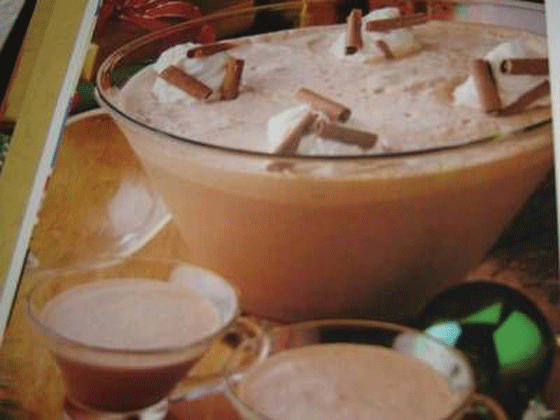
1 1/2 quarts water
1/2 cup instant chocolate drink mix
1/2 cup sugar
1/4 cup instant coffee granules
1/2 gallon vanilla ice cream
1/2 gallon chocolate ice cream
1 cup whipped cream, whipped chocolate curls (optional)
DIRECTIONS: In a large saucepan, bring the water to a boil. Remove from the heat. Add drink mix, sugar and coffee; stir until dissolved. Cover and refrigerate for 4 hours or overnight. About 30 minutes before serving, pour into a punch bowl. Add ice cream by spoonfuls; stir until partially melted. Garnish with dollops of whipped cream and chocolate curls if desired.
Christmas 2007 was the first time I tried this punch. I used it at our Christmas party and it was so pretty in the punch bowl. It looked like a giant chocolate milkshake. It really disappeared fast. I highly recommend it if you like chocolate shakes. I found it in the “Country Catalogue.”
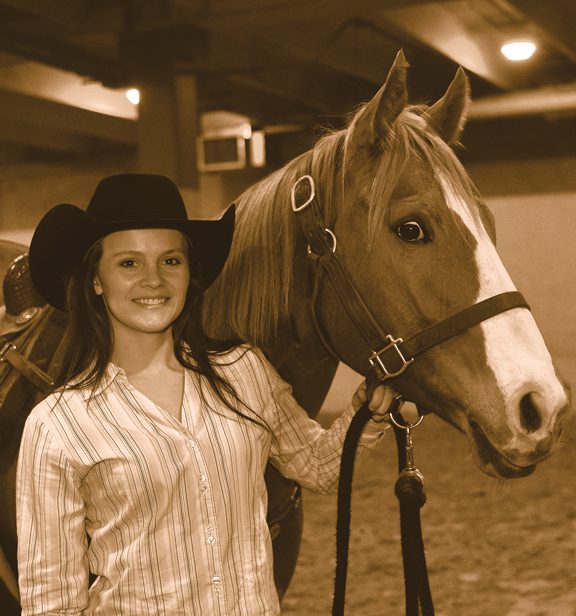
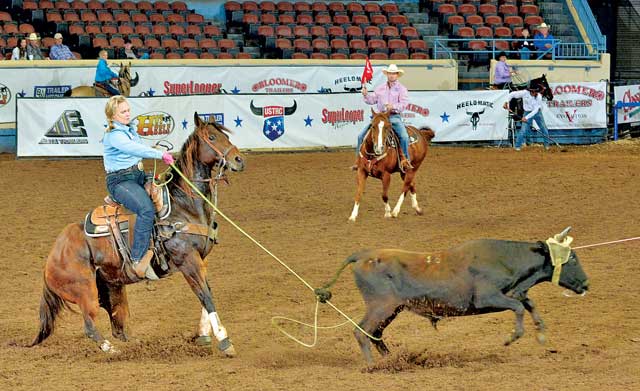
Everyone who enters the USTRC Finals has dreams of clean runs and big paychecks. Unfortunately, only a handful of ropers realize those dreams. One such dream come true was Courtney Small, and header, Lari Dee Guy, who came from third high call to win the Cruel Girl Roping. The pair posted a time of 37.25 on four head to win the roping and split $16,000 in cash plus prizes.
“Actually I prefer being third high call. From there the goal is to make a nice run and put pressure on the top two teams,” says Small.
Courtney, 24, started roping when she was just eight. She and her dad started roping at the same time. Eventually her brothers, Zac and Blair, rope as well.
“We would rope almost every night,” explains Courtney. “That’s where my addiction to roping started.”
Small is grateful to her parents for giving them the opportunity to rope and pursue their passion.
“My dad blessed us with the chance to rope every day during the summer. He wanted us to succeed in whatever we wanted to do,” says Small. “Every day we would start out roping the dummy, then saddle our horses and rope the mechanical dummy. That was our routine from about ten to fifteen years old. We were consumed by it.”
Courtney admits to a life long passion for horses and roping. When she was about thirteen, the family built an indoor arena where they roped and also had a church.
“The arena has been a huge blessing. God has used our arena to bless the lives of many people; and given young people a place to come and rope. We still rope in our arena every day and I’m very thankful for it.”
The Blair kids were homeschooled and well educated using the accredited Christian based A Beka Academy. To see how her education measured up, Courtney attended public school during her sophomore year and found it very easy.
After high school Courtney attended Tarleton University in Stephenville, Texas before transferring to and graduating from Oklahoma State University. Currently she is working with her father at the family cattle embryo laboratory near Welch, Oklahoma. She will soon pursue a Masters in Animal Science, a degree that will be helpful as they expand their business.
“There are some new things we want to do,” says Courtney. “I so enjoy working with my family. I also have lots of time to rope, which is a huge plus.”
“I am very grateful and give the glory to God. Without Him, none of these blessings would be in my life. I have to thank my parents and am so blessed to have them. I realize not many people get the opportunity to do what I do. I also want to thank my sponsor, Classic Ropes.”
COWBOY Q&A
How much do you practice?
About five days a week.
Do you make your own horses?
Yes. My brothers and I have made every horse we own.
Who were your roping heroes?
I always looked up to my dad because he got me started. He had won quite a bit and was my idol.
Who do you respect most in the world?
My father.
Who has been the biggest influence in your life?
My father.
If you had a day off what would you like to do?
Rope.
Favorite movie?
The new Magnificent Seven was very good.
What’s the last thing you read?
A textbook of some sort.
How would you describe yourself in three words?
Leader, dedicated, shy.
What makes you happy?
When I win.
What makes you angry?
When I miss.
If you were given 1 million dollars, how would you spend it?
I would set quite a bit back and probably build a horse barn on my property.
What is your best quality – your worst?
Best quality is independent thinking. Worst quality is procrastinating.
Where do you see yourself in ten years?
Hopefully more involved in our lab with the expansion, and enjoying the growth of business.
The One Armed Bandit and his Mule, Moe – Dale Miller
“Hi. I’m Moe and I’m more famous than John Payne. Or maybe not, but I’d like to think I am.
You might know John Payne, but you might know him by his other name. The One Arm Bandit. I’d like to brag that I’m the one who made him lose an arm, but it wasn’t me.
I came into John’s life ten years ago, when I was eight.
He was sitting at a sale, chewing the cud with all the other cowboys…. Well, actually, I’ll let John tell the story…
Hello, I’m John Payne, the One Arm Bandit, and one day, I was sitting at a mule sale in Ada, Oklahoma. I had a bullfight to work that night, and the mule sale was at the same place as the bullfight, or I’d have never been there and I’d have never bought him.
He’s a man killer, Moe is. He had six problems: you couldn’t catch him, you couldn’t bridle him, you couldn’t saddle him, you couldn’t get on him, and you couldn’t ride him. And he’d run off with you if you tried, even leading him.
But Moe and I, after I’ve pulled a lot of wet saddle blankets off of him, have come to an understanding. I ride him, he does what he’s supposed to, and we both get paid.
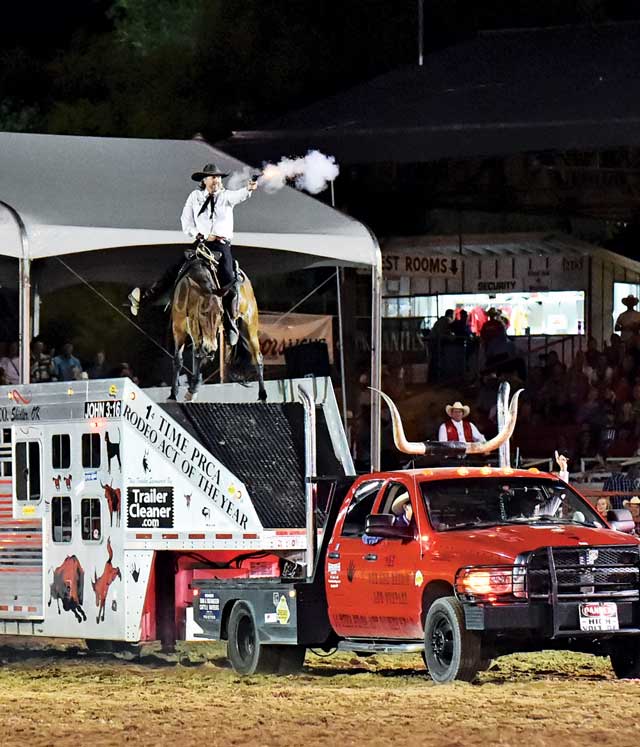
Part of my act is driving my trained buffalo or Watusi longhorns to the top of my trailer, following them up, and spinning my mule on the top of the trailer while cracking a bullwhip. All with one arm.
I used a horse for twenty years. I was the cowboy who said, when all the horses die, and I get tired of walking then I’ll use a mule.
But after I’ve had Moe, I sure do like how he works. He’s surefooted on the ramp. If it rains and it’s muddy and that ol’ ramp is wet and slick, he is really good at keeping his feet under him.
I’ve trained a lot of animals in my life. Horses, mules, zedonks, zorses, zebras, watusi cross longhorns, Corrientes, quarter horses, and mustangs, not to mention buffalo. And a chicken hawk. This hawk, I found it under a tree when it was a baby. I took it home, and fed it till it grew up. I’d whistle and he’d land on my arm. He loved mountain oysters and hamburger meat. When we was working cattle, he’d fly around and hang around us all the time.
Once I trained a woman …… to do whatever she wanted to do.
Buffalo is the meanest critter in North America. Buffalo tried to kill me almost every day for two years, and they’ve hooked me off the top of the trailer, twice, horse and all.
But back to Moe. Moe wasn’t harder to train than buffalo. He was a jerk, pulling back, making it hard on you every darn day, but he was not dangerous all the time. He was not hardheaded. He is very firm in his convictions.
He was worth it. Well, I had a lot of nice compliments on him and I’ve been offered $20,000 for him. But nobody could handle him but me. He’s the best looking mule in the world. He’s built great, stout, strong, durable, sure-footed, and trustworthy. I do parades on him when I jump off the trailer onto asphalt, and he slides on all four. A horse would be straddle-legged.
He’ll outwork two horses, but he’ll also outwork two horses trying to get out of work and being a little pillbox.
I can walk out there and say, ‘Moe,’ and he’ll come to me. Something else this mule can do, is I can stand on top of my trailer and pop a whip and he jumps out of the trailer and onto the pickup and up the ramp and come right to me.”
He’s the most famous mule in the world.
Moe: Well, I love you, too, John Payne, but I’m always keeping score and I’m not going to love you anymore than you love me.
Dilton and Pat Emerson of Bossier City, Louisiana, know the value of a horse shoe. Keeping equine athletes of all disciplines shod has sustained the husband and wife for many years, and their bootprints through rodeo history are accompanied by their ingenuity. This includes inventing a now widely-used anvil and starting their own horseshoe supply business – one of the largest in the country. They also support the rodeo industry with their time, serving on the boards of several rodeo organizations, and most recently, helping organize the Gold Card Reunion in Las Vegas during the WNFR. “The reunion originated last year, and we had about 150 gold card members come,” says Dilton, chairman of the reunion board and a gold card member himself. Shawn Davis, manager of the PRCA and one of Dilton’s longtime rodeo friends, recently asked Dilton to help organize the reunion. Open to all PRCA gold card members, the reunion takes place this year in the Thomas & Mack Center on December 8th. “We have someone in charge of getting interviews during the reunion for the Pro Rodeo Hall of Fame in Colorado Springs, and there will be slideshows and storytelling,” Dilton describes.
His own rodeo career with the PRCA – known at the time as the RCA – began in 1954, the year he married Pat. The couple – both born in 1936 – were raised one town over from each other, Dilton in Taylor, Arkansas, and Pat in Bradley, Arkansas. Horses were Pat and her family’s means of transportation, but Dilton didn’t own a good horse until he was in his 40s. Instead, he competed in all three roughstock events and steer wrestling. “His family thought he was totally crazy and doomed from day one,” Pat recalls with a laugh. Yet Dilton paid all his expenses and made friends with competitors like Shawn Davis, Tom Nesmith, who put Dilton on his horse Old Brown, and Neal Gay. “Neal took a liking to me when I was a kid and helped me out, and I worked for stock contractor Tommy Steiner. I got on everything he turned out,” says Dilton. “Steiner had a bronc saddle in his tack room that became mine, and I had a bareback riggin’ of my own.” His bronc saddle is now on display in the Lynn Hickey American Rodeo Gallery of the National Cowboy and Western Heritage Museum in Oklahoma City, its cinch tightened on a bronc sculpture rearing from the chutes.
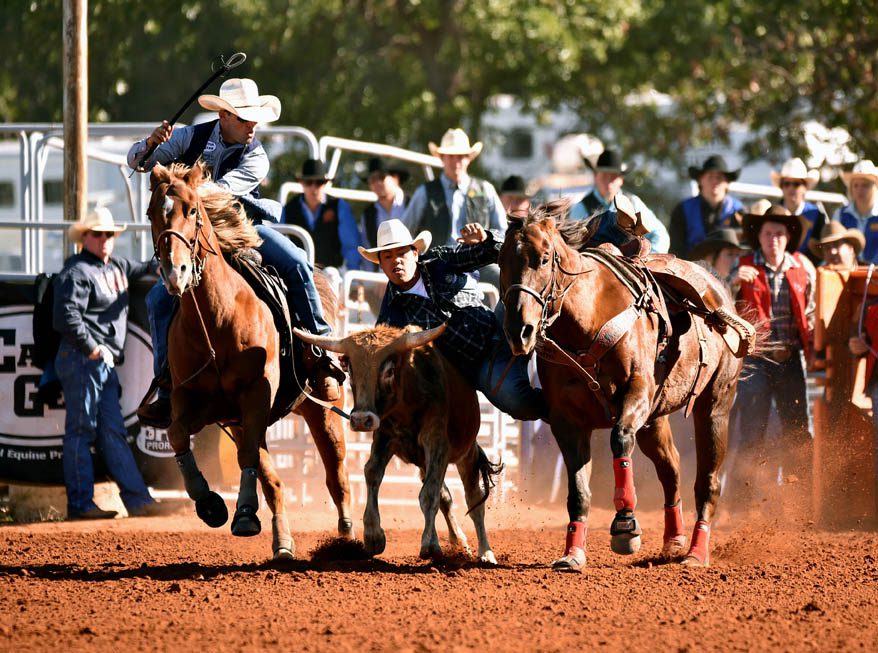
Steer wrestling in Opelousas, LA, 1961 – Ferrell
Dilton and Pat in their shop with the Emerson Anvil created by Dilton – Courtesy of the family
Bull riding in Lafayette, LA 1962
– Ferrell
Near the time Dilton’s RCA career began, Pat tried her hand at riding bareback horses in the Girls Rodeo Association (GRA). “I hadn’t thought about competing, but I had an older sister that rode roughstock. I was staying with her one summer and she took me to rodeos,” says Pat. “There weren’t more than six or seven bareback riders, but enough to have a rodeo. I messed with it for two or three years, and did exhibitions in saddle bronc riding the summer of ‘55. But once I started raising our three kids, I quit.”
Dilton was rodeoing with Pat’s brother when the couple met. While their children – Peaches, Joe, and Ross – were young, Pat worked as a secretary for several steel firms and Dilton rodeoed full time. When he eased off the gas pedal in the mid 1960s to start shoeing horses on racetracks, Pat was a mutuel teller, cashing tickets for the bidders. They travelled with their children to Detroit, Chicago, Omaha, Nebraska, and the Louisiana Downs in Bossier City, Louisiana, where they eventually settled. “We never had a horse trailer when we rodeoed or worked on the racetracks, we rented apartments,” says Pat. “We worked together for three or four years before starting our horseshoe supply business. Everything Dilton has done, he’s taught himself.”
“When I started shoeing horses, it was at an all-time low for farriers,” Dilton recalls. “A big horseshoe company went out of business in 1965, and people were predicting that it was the end of the horse era. Back then, they didn’t have playdays or horse shows. Horses were mainly used on ranches for working cattle, and the ranchers did their own shoeing.” Yet the Emersons still saw a need for horseshoeing, though they never intentionally set out to start a business. “Dilton always had a good supply of stock that he shod with, which a lot of horseshoers didn’t, so they’d buy or borrow from him. He got a distributorship specifically for thoroughbred racing shoes, and then we were able to get distributorships for bigger companies.” Within ten years, Emerson Horseshoe Supply was one of the larger horseshoe suppliers in the business. The anvil Dilton designed in the mid 1990s also set them apart. “There’s a lot of nickel in the anvil, which gives it good bounce-back,” he explains. The Emerson Anvil is preferred for many horseshoeing contests and even knife makers, and is shipped across the country and even as far as England. Their anvil is in use in the bladesmithing TV show Forged in Fire, and Dilton designed a commemorative 25th anniversary anvil for the 2004 World Championship Blacksmiths’ Competition, held during the Calgary Stampede.
Emerson Horseshoe Supply has been distributing horseshoes and farrier supplies for 35 years, the shop right next door to the Emerson’s house. “It works well for waiting on customers after hours. Before cell phones and ordering ahead of time, I’d be up at six in the morning selling horseshoes,” says Pat, who runs the store. “Grandma is really amazing – she can tell you about all the shoes, their differences, and the prices,” says Seth Emerson, their grandson. He’s worked in the store since he was old enough to stock shelves, and only recently left to become an auditor for the state and continue his rodeo career, tie-down roping in the PRCA. “My grandparents have done so much for me, and it was very rewarding for me to work with them. My grandpa started team roping in his 60s, and I’ve always roped at their place. I’ve been good friends with Shane Hanchey since high school, so he’s stayed there. I also used to hold a big jackpot there and guys like Cody Ohl and Marty Yates would come and Grandma would cook for them. Grandpa’s always been there when I rope, even if it’s cold, and then he pulls the truck up next to the arena to watch.” The Emersons also have three granddaughters, Cassie, a breakaway roper, Stewart, an aspiring actress in New York City, and Kirby, a junior in college at the University of Edinburgh in Scotland.
Prior to team roping, Dilton took up chuckwagon racing, living just a few hours from the National Championship Chuckwagon Races in Clinton, Arkansas. Dilton and his team, racing under Emerson Horseshoe Supply, won the classic division in 1997 racing thoroughbreds. He built his own wagon, weighing approximately 1,000 pounds, but his interest moved to team roping around 2000. He currently heels in the USTRC and local team roping associations. “I practice three times a week, but I generally go to Stephenville (Texas) so I can rope with Rickey Green,” says Dilton.
Pat enjoys snow skiing, and is planning a skiing trip with her granddaughters and grandson’s girlfriend in February. She’s also active in her church, and one of 50 rodeo wives that make up H.A.N.D.S. (Helping Another Needy Diva Survive). The organization, started by Sharon Shoulders and Donna McSpadden, sends anything from money, food, cards, or even personal visits to rodeo families going through hard times. “We were in Oklahoma City recently for Rodeo Hall of Fame inductions, and we also go up to Colorado Springs for the Pro Rodeo Hall of Fame, and then Las Vegas in December,” says Pat. “We’re both very active and very social. We’ve been blessed with good health, good friends, and good family!”
The Harrison family is affectionately known across the rodeo world as the “Clown Family.”
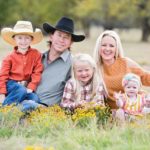
John and Carla Harrison and their four children: Addy, Caz, Billie, who passed away in October of 2014, and Charlee, are regulars at rodeos across the nation.
John, the grandson of world champion bull rider Freckles Brown, grew up in Soper, Oklahoma. When he saw Leon and Vicki Adams at his hometown rodeo at the age of six, he was hooked. “I knew then it looked like fun,” he said, “hanging upside down on a horse. I decided I wanted to do it.” His dad, Wiley Harrison, knew how to trick rope. He taught John in the family living room. “We tore up everything,” John remembers. “I broke lamps, hit the ceiling, knocked the lights out, knocked plaster off the wall. Mom was always cussing us.”
His first real audience was for 4-H talent show when he was fourteen. “I won the talent show and that threw gas on the fire.”
John had seen roman riding done at a rodeo, and decided he wanted to do that as well. He and his dad found a team broke for a wagon, but they “dang near killed me,” he said. “They were mean and kicked, and Dad realized I was going to get hurt.” They located a roman team owned by Vickie Tyer, who had sold them to Cotton Rosser, who was looking to sell them. John sold a few head of cows and over spring break, he and his dad loaded up for California to get them. They paid $10,000 for the team, what his dad considered a large sum. “My dad, a rancher, had never paid that much for horses, and he about croaked,” John laughed.
John spent two and three hours a day practicing his trick riding and roman riding, learning from trick riders like J.W. Stoker, Karen Vold and others.
It was in 1999 that he got his PRCA card. That year, he booked a dozen rodeos for Johnny Walters, doing the roman riding while Penny Walton and Kelly Brock were trick riding. He booked the next two years for Bob Barnes, roman riding, trick riding and trick roping. After that, his career blossomed. In 2002, he went to California and worked for Cotton Rosser and the Flying U Rodeo Co. The next year, he worked for Steve Gander’s World’s Toughest Rodeo tour based out of Iowa.
At this point, John wasn’t clowning rodeos yet, but he wanted to. A buddy in Wahoo, Neb., was putting on a bull riding and asked him to clown it. “Man, I’ll be terrible,” John told him. He borrowed a barrel from Gizmo McCracken, and “that’s what lit the fire,” he said. After a lot of performances and experience, clowning became fun and he became adept at it.
John gives credit to another clown, Keith Isley, for helping him get started. Keith had a trick riding act that he gave John permission to do. “Keith jumpstarted my career,” he said. “That’s truly the reason I am where I am in my career, due to that act.”
It was in Iowa that he met the California girl who would become his wife. Carla was interning with the World’s Toughest Rodeo, doing publicity and working closely with John on appearances and interviews. “I had a crush on her,” John said. “We were both too shy to let each other know it.” After her internship ended, she and John stayed in touch. Carla, who grew up on a cattle ranch near Salinas with a dad who ranch rodeoed, talked to John every night. When he called her, asking her to go with him to the PRCA Awards Banquet where he was nominated for Specialty Act of the Year in 2004, she realized she had an “overwhelming love” for him. They married in 2006.
Addy Harrison offers a banana to her little sister Billie, while Caz looks on. Billie died of kidney failure in the fall of 2014; little sister Charlee is now a member of the family. – Celeste Settrini
John Harrison trick riding at the Molalla Buckeroo Rodeo – Rough Around the Lens Photography
Addy, Caz and Charlee pose prior to a wedding. – courtesy of the family
John Harrison at the Hastings, Neb. rodeo. – John Olsen
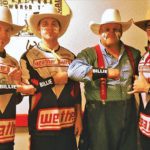
Bullfighters Cody Webster, Chuck Swisher, Justin Rumford and Dusty Tuckness show their tribute to Billie Harrison, who passed away in October 2014, with their wrist band – courtesy of the family
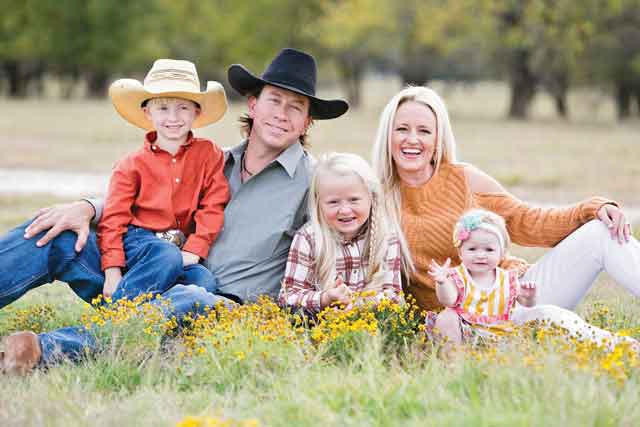
John and Carla Harrison with their children: Addy, Caz and Charlee. – Cross B Photography
They are on the road together, along with the kids, as much as possible. “We’re together constantly,” Carla said. “We did everything together, but now that the kids are in school, I stay home while he takes off.”
The Harrisons have diversified beyond rodeo contract work. They own rental properties in Hugo and Soper, Okla. “I’ve always been an entrepreneur,” John said. And he and Carla realize how the rodeo business works. “We talked about retirement in rodeo, and there is none. (Rentals) are something we could do and be gone.” They also own a liquor store in Hugo.
Each fall since 2007, they’ve produced a Wild West show at the Oklahoma State Fair in Oklahoma City. They aim for top-notch entertainment with good performers. Performers including Vickie Adams, Blake Goode, Vince Bruce, the Riata Ranch Cowgirls, Melissa Navarre, Jerry Wayne Olson, and others have worked the show. John used to trick rope but found it easier to be producer. They are in the same location for eleven days, a switch from being at a new rodeo each week. “It’s a nice break from rodeo after the summer,” John said.
John and Carla were hit with a tremendous blow in October of 2014 when their seventeen month old daughter, Billie, died of kidney failure. It was all sudden. Carla had been in California with her mother, who was going through cancer treatment. She had just flown home, and John had left for a rodeo, when Billie was life-flighted to a hospital in Texas. She died on October 17. Their faith and their rodeo family got them through the difficult time. “You use that term, rodeo family, loosely,” John said. “When we lost Billie, the way the rodeo community came together, it truly touches you in a way that is unexplainable.” Carla’s mom died four months later. “I spent many hours on the phone, crying with my mom,” Carla said, before she passed away. “I asked her, please, when you get to heaven, hug and hold Billie.” It was tough, Carla said, but she is grateful for others. “I want people to know how thankful I am for the love of others, how everyone poured into our lives. Our family, our friends and our rodeo family came in and surrounded us and uplifted us. I can’t tell you how that lifted us.”
Carla’s main job is wife and mother, but she also is an auctioneer. As a child, she discovered her dad’s old auction books and put herself to sleep, practicing. The family lived thirty miles from where they ran cattle, so on the way to and from cattle, he would help her with the tongue twisters and the speed.
She has sold cattle and farm equipment and still does junior livestock auctions, but her niche is benefits, especially the high-end auctions. She flies to California frequently, sometimes selling as few as a dozen items, but all very high-end. If John is free, he goes with her. “People assume he’s the auctioneer, and I get up, and they’re caught off-guard,” she laughs. Auctioneering is much like rodeo. “I want people to have fun, but you have to control the tempo of what’s going on.”
The couple’s children are Addison, age eight, Cazwell, six, and Charlee, who is thirteen months old. Addy is in third grade and learning to trick ride. Caz, a first grader, has a natural sense of humor, and Charlee, their “newest angel on the ground,” was born in November of 2015.
The “Clown Family” moniker came from announcer Jerry Todd. The kids frequently dress in John’s trademark yellow shirts with red fringe, and John loved to rub his red nose on Addy’s cheeks after a performance. Jerry picked her up and said, “oh, look at the little clown baby.” Carla started using the name on Facebook, in a tongue-in-cheek manner. But it’s grown. Last year in Las Vegas during the National Finals, people she had never met recognized them. “I love it, and welcome it,” she said.
They may be a rodeo family, but Carla jokes that she spends more time in vehicles than anywhere else. “I always tell John, we rodeo, but I feel like we really truly drive for a living. I’m always driving.” When they first married, John was reluctant to let her drive, even though she’d grown up driving trailers. He finally relented, in the middle of North Dakota, at night, when no one else was around. Now she drives most of the time, she joked. “So my alligator mouth has overloaded my little hiney. He went from never letting me drive to now, we get twenty miles down the road and he’s miraculously tired,” she laughed.
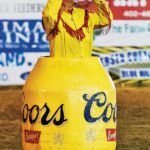
Throughout his career, John has been the PRCA Comedy Act of the Year in 2012, 2014-2015, the Coors Man in the Can in 2014, and has been nominated for either the Comedy Act, the Dress Act, or the Coors Man in the Can awards every year since 2008. This year, he has been selected to work the Wrangler National Finals Rodeo as barrelman.
Through their troubles and blessings, John and Carla hang on to their faith, crediting it with getting them through the passing of their daughter. “Without it, I don’t know how John or I could have gotten through.” They look at the positive in everything. “I try to find blessings along the way, even in the worst of times. I think it’s the only way to keep going.”
Colby Gilbert has one more year of school at the University of Lethbridge, Alberta, Canada to become an Registered Nurse. She picked the field because of the flexibility. “You can go anywhere and do anything and there are also so many fields that intrigued me. I really enjoy kids, so I like maternity and pediatrics.” Although she loves the nursing world, the 21-year-old loves barrel racing more, and has secured a spot in the Canadian Finals Rodeo coming in November.
She grew up rodeoing through her mom and dad, competing in the amateur ranks and the semipro association, making the finals five times. “Mom is a futurity trainer, and my dad was a steer wrestler, he pro rodeoed, but it was mostly my mom that got me into it.” Andrea Udal raised Colby as a single parent and to keep things financially together, she carefully picked horses, trained them, and sold them to continue to improve on the bloodlines.
“I sold all of our horses so we could buy more and reinvest,” said Andrea. “She made the Finals on three different horses and won the amateur Finals on a six year old futurity horse. There’s not a day goes by that I’m not proud of her.” Andrea has since remarried and now has two young sons. ““They are the funniest things ever,” said Colby, of her two little brothers, Parker and Haye. “They keep me entertained.”
Colby is grateful for her mom’s investments of time and training with the horses. “I fell in love with every single one of them, but my mom has been good for me in that every time we gave one up, we got a better one. It made me more versatile getting on so many. I don’t think I’ve made any Finals on the same horse. I enjoy being successful on different horses – for me that’s a huge accomplishment. She does the great job of training the futurity horses and I’m the jockey that takes them from there. We are great team and hopefully will be for a long time.”
This is Colby’s first year competing on the pro level and thanks to her equine partners, she made it to the Finals. She is riding two different horses from Fulton Performance Horses. “They are outstanding. Their natural ability is like nothing I’ve ever experienced.” She started the year on a 6-year-old mare, Streakin Ta Corona, and finished the year on a stud, French Streaktorodeo. “When I got him, they had roped on him, and I derbied him as a six year old. He went to his first rodeo last year. He makes is so easy. He’s so easy minded and easy going. He loves his job and so gritty. I think he’s one in a million.” Both horses are owned by Corny and Maria Wiebe, and Colby’s mom trained the mare and won high point at the Canadian futurity on her. “We’ve become family,” said Colby of the relationship between her and the Wiebes.
She managed to get to 45 rodeos in spite of her work towards her nursing degree. “It’s been really time consuming, I guess I’m good at prioritizing,” she said. The Canadian Finals Rodeo falls during a week in November that school is out. She will finish her degree in December, work on her practicum until April then she is done. “I’ll come down south with my WPRA card. So look out, here comes Colby and French Streaktorodeo.” She loves nursing and the people that she can help and be around, but her first true love is barrel racing. “I always wanted to be a barrel racer.” And now, thanks to two great horses, she gets to go to her first Canadian Finals Rodeo, as the Resistol Barrel Racing Rookie of the Year.
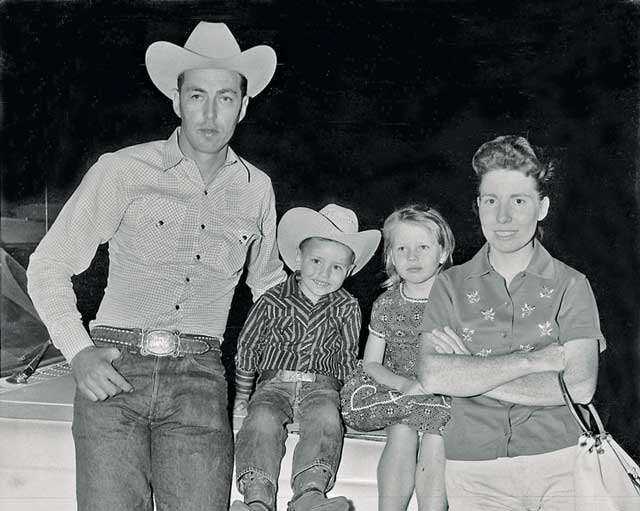
Cutline for the family photo
It was 2014 CCA Finals. I won rookie of the year and the CCA Finals Ladies Barrel Racing championship and my sister Hallie Anderson (half sister) won Junior Girls Season Leader, Horse of the Year as well as the Finals Championship as well! Very exciting and memorable year for all of us!
Lerin Thomas, 21, has her eyes set on the bright lights of Las Vegas to sing the National Anthem during the National Finals Rodeo set for Dec. 1 through Dec. 10.
Growing up in Newkirk, Okla., Lerin started singing when she was 9 years old and learned by listening to others. The young talent never took singing lessons but knew she wanted to learn the National Anthem.
“I would listen to it over and over and I got to where I could add my own flair to it after many hours of practice,” she said.
While Lerin did not rodeo much herself, she said her dad, Jim Thomas, is the one who got her interested in the sport. She attended her first rodeo with her dad at 6 weeks old and has loved it ever since.
The NFR’s National Anthem contest consists of an open category and a youth category. The first round of voting was Sept. 1-14. The contest committee then announced the top six contestants, with the next round of voting set for Sept. 26 through Oct. 6.
“The contest isn’t something a lot of people know about unless you follow the NFR Facebook page or you are involved in rodeo personally and I would like to change that,” Lerin said. “It is an amazing opportunity and I would love to get more people involved each year.”
This is Lerin’s second time to go through the contest process. In 2015, she made it to the top ten but came up short in the next round of voting to continue on.
This year is a different story. She is packing her bags and preparing to sing on rodeo’s biggest stage.
There are three winners of the open category out of 130 total entries and one youth.
“I have always wanted to sing at the NFR, it has been my goal since I started singing at 9 years old so when I got that call saying I had won, I was overwhelmed with excitement,” Lerin said.
She will sing in front of thousands at the Thomas and Mack Center but that does not seem to bother her nerves. She has sung for different professional events numerous times and loves the feeling it brings to her.
“We are all so different as people but for those 2 minutes of the National Anthem, we share a connection and I love that feeling,” she said.
Aside from singing, she is an Oklahoma State University strategic communications senior.
“OSU has been the best time of my life,” she said. “I’ve made so many friends and I’ve been introduced to many new things. Being apart of the OSU cowboy family means a lot to me.”
She said she would like to work for the Professional Rodeo Cowboy Association doing social media work and public relations.
Recently Lerin has had the opportunity to be apart of the backstage crews that help put on a rodeo. She is the social media director and founder for the 101 Wild West PRCA rodeo board. With that, She put together her first social media team for the 2016 Woodward Elks rodeo and plans to continue that each year.
With her spare time she likes to volunteer for the Miss Rodeo Oklahoma Pageant. “I’m passionate about rodeo and being a small part of something people love so much makes it all worth while,” she said.
She would like to thank all of her friends and family that have supported this dream and for those who voted for her.
Bull rider Layne Ward won the NIRA’s Southwest Region in 2015 competing in just five rodeos – half of a college rodeo season. This year, he’s sitting second in the region with plans to defend his title and represent Odessa College a second time at the CNFR. “This year is going good – I won the first rodeo of the season and placed in the second,” says the 22 year old from Almo, Idaho. He attended Utah State University for a semester in 2014 but competed in a full season of rodeo. When he arrived at Odessa College, he needed 24 previous credits before he was eligible for a second season of college rodeo, giving him just the spring of 2015 to qualify for the CNFR, which he accomplished by winning three rodeos and placing second in another. “College finals was rough – I’d separated my shoulder the week before in an accident and then went to two pro rodeos before the CNFR, so it was a hard week. But the experience was great and it’s a really fun rodeo to be a part of – it makes me hungry to do good this year and get back there!”
Odessa College came onto Layne’s radar when several of his friends, including a cousin, chose to attend school there. “C.J. Aragon, our rodeo coach, recruited my cousin, and I thought it would be pretty awesome to rodeo here,” Layne recalls. “C.J. put a scholarship together for me, and this is my second year here now. I love it here – the college and their rodeo program are great, and so is C.J. He’s always encouraging me, and any time I’m down, he’ll give me a boost. If I’m ever going through a rough time and have to ask myself why I’m doing this (rodeo), I’m reminded that I’m doing it to win titles, but I mainly want to push myself to see how great I can be. If I’m not at that point, then I need to keep working, and my coach and my parents do a great job of keeping me going. It’s always good to have those outside sources, but if you don’t have the internal drive to push yourself each day, it can be pretty tough.”
Growing up on a ranch in southeast Idaho gave Layne the foundation for the self-motivation and hard work bull riding requires. His parents, Steve and Tonya Ward, took him to gymkhanas where he rode sheep and calves before he competed in a year of junior high rodeo, while his brother and two sisters also compete. “I stick to the thrill side of things – I’m usually the one up for doing the scariest stuff,” Layne says with a laugh. “I try to take anything to the next level, whether it’s boating or riding my dirt bike.” In high school, he competed in amateur rodeos in the area, but after graduating, made a difficult choice to pause his rodeo career and serve a two year LDS mission in Mesa, Arizona. “Right as you graduate high school, it’s an important time in a rodeo career as you transition and practice for the college and pro level. It was a tough decision and I had to leave everything – I couldn’t ride bulls or horses or go to a rodeo for two years, but I don’t think I’d be as good as I am today if I hadn’t gone on that mission. I was able to heal up and work out, and let my body grow. But it was also a mental break that helped me forget about rodeo for a while and serve other people. It helped me grow up and mature, and put a lot of things into perspective.”
Returning to the chutes two years later wasn’t as challenging as Layne expected, but he admits it was still rough. “It was frustrating to re-learn some things, but I’d also forgotten some bad habits, and once it clicked, I knew how it should feel again,” he says. “Rodeo down here in Texas is a different level. It’s not better than anywhere else, but everybody here is ready to do well and help everyone else do the same. They step up the game and make rodeo what it is.”
Layne filled his PRCA permit this year and plans to ride on his card starting with the 2017 season. He’ll graduate in the spring with degrees in business administration and general studies. “I couldn’t have done a lot of this without the help of my sponsor, Brahma Lending and Leasing,” he finishes. “I’d like to win the college region here again and win the CNFR. I want to rodeo as hard as I can and see how far I go, but the aim is to make the NFR and win a gold buckle. I plan on going all the way!”
Alex Phelps steer wrestling at SWOSU – Dale Hirschman
Alex Phelps – Bravane Shandon Alexander Phelps – is the National Student President of the NIRA. “It is voted on by the board,” said the 22-year-old from Ulysses, Kansas. “I think it’s a good opportunity for me to be part of something larger than me so I can go and promote college rodeo.” Alex recognizes that college rodeo is a stepping stone to the PRCA. “College rodeo has been good to me and I’ve enjoyed my time so far.” His goal as both National President and Central Plains Regional Director is to help educate elementary school kids about rodeo. “One of our jobs as regional directors is to talk to third and fourth graders – it was funded by a grant under Western Heritage Program.” Alex also received the 2016 Walt Garrison Scholarship Award, honoring one student director a year.
Alex’s mom passed away when he was 8 and he and his brother and sister were raised by his grandparents, Don and Peggy Phelps. “My grandpa farmed and worked in feed yards and he used to rodeo and rope and I’ve roped since I was little. Team roping is what I’ve done the longest, but I started roping calves when I was in junior high, added steer wrestling in high school.” Alex stepped in front of his first bull when he was in seventh grade. “I tried riding a bull, but it didn’t go my way and Wacey Munsell is a close family friend, so he asked me if I wanted to start fighting bulls and I did.” Alex has cattle sense from growing up doing real cowboy work for his neighbors. He also got to attend Rex Dunn’s last school. He watches videos and studies the action and timing. Now he fights bulls at six of the college rodeos and worked 8 pro rodeos last year. None of what he has accomplished would be possible without the help and support of his family. “I wouldn’t be here without them.”
He competes in all three events at the college rodeos, making time management a priority; especially when he’s up in the short round. “There’s only one event between team roping and bull riding, so it’s hard to get the horse taken care of and hustle around to get changed.” As the Regional Director, he is also responsible for the banners at every rodeo. “I’m the first one there and the last to leave. I’m there to hang the banners and take them down. Time is money – that’s what they say in rodeo production.”
He spends five hours a day in the practice pen, working on his events. “We rope a lot, and that’s one thing I try to stay sharp on. But we chute dog a lot too.” He works on consistency in all of his events. “I do my best to have a short memory, so if I have a bad day, I work on that the next day, and then I go from there.” He is heading towards a degree in marketing and loves his classes. “My plan is to get my degrees and have that as a backup plan. I want to rodeo, fight bulls, and auctioneer and see if I can make that work. I’ve sold everything from horses to pigs to tack.”
Alex recently lost his little sister and has put life in perspective. “Life is short, you can’t take anything for granted and you need to tell the ones you love that you love them. Be kind to one another because you don’t know what the other person is going through. Things can change in an instant, so be happy and let others know that you love them.”
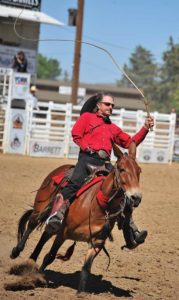
Blake Teixeira grew up in a ranching family near Salinas, California, where he spent much of his youth with his grandpa who roped and raised horses. As a youngster he roped with his family at local jackpots in lieu of Junior Rodeo. In high school he qualified for the National High School Finals and earned a scholarship at Tarleton University in Stephenville, Texas.
During his four years at Tarleton, Blake qualified for the college finals with heeler, York Gill, where they won three of four rounds and set an arena record.
Teixeira recalls going to his first jackpot in the Stephenville area and seeing many of the world champions he had watched on television.
“In the beginning it was very surreal. I’m at a jackpot and there are the Tryans, Speed Williams, Clay O’Brien Cooper, etc. Over time I got to rope with them and know them on a personal level.”
In fact, during his college years Blake took every opportunity to work for and with some of the best ropers in the world. He moved in with Jake and Jimmie Cooper during his sophomore year. At various times he worked for Randon Adams and Shawn Darnell. He helped both Ryan Motes and Michael Jones during their preparation for the NFR.
After graduating from college Blake drove for Chad Masters and Jade Corkill one summer and laughs, “It’s funny how much you can learn when you’re not entered.”
Afterwards, he helped Speed Williams for a couple of years. Blake says that’s where he saw first hand how professionals practice and prepare.
“While at Speed’s I learned a lot. I learned how to ride my horse better and basically learned how to win,” explains Teixeira. “It was then I realized how much it really took to rope at that level.”
When his grandfather passed away, Blake moved home to California to help his family. He took a break from rodeo after his head horses were injured. During that time he got his license and started selling insurance.
Now he has some good horses going, this year he’s been riding a nice black mare owned by Deforest Performance Horses that Chant Deforest rides at the rodeos, “Chant and I both rode the Black this spring and three of us rode her at Pendleton this year. I won third in the first round and Chant placed in the second round on her.” He is currently riding and winning on a bay mare, named Fanny, owned by York Cattle and Performance Horses.
“She has been awesome. I rode her at the rodeos all summer and at the BFI. She’s what I was riding to win the ACTRA Finals Open yesterday.”
Blake is thankful for the experience and exposure he’s had to the best ropers in the world. He credits that experience to the success he enjoys today. He also lost 75 lbs. this year, making a significant difference in the way he feels and rides his head horse.
“I used to really fight to get in front of my horse,” laughs Teixeira. “After losing the weight, I would almost crawl out too far.”
Now, at 31 years old, Teixeira is enjoying a healthy balance between work and roping. This fall he is roping with B. J. Campbell and the team has plans for some 2017 rodeos.
“I’ve been very fortunate to meet people who helped me and taught me. I’m thankful to my sponsors: Best Ever Pads, Fast Back Ropes, Remington Construction, Elko, NV, Great Basin Orthopedics, Yeti, Hansen Western Gear and Les Schwab tires. I’m immensely grateful to my girlfriend, Brooke Kieckbusch, and our families for their support.”
COWBOY Q&A
How much do you practice?
Every day.
Do you make your own horses?
Some.
Who were your roping heroes?
Speed Williams, Dan Green, Wade Wheatly.
Who do you respect most in the world?
My grandpa.
Who has been the biggest influence in your life?
My grandpa.
If you had a day off what would you like to do?
Play golf and go fishing with my girlfriend.
Favorite movie?
Tombstone
What’s the last thing you read?
The Score Takes Care of Itself by Bill Walsh.
How would you describe yourself in three words?
Easy going, honest, determined.
What makes you happy?
Seeing other people happy.
What makes you angry?
When the 49’ers lose.
If you were given 1 million dollars, how would you spend it?
Buy a ring, a house, a head horse and invest the rest.
What is your worst quality – your best?
Worst quality is procrastinating. Best quality is willing to help anyone if I can.
Where do you see yourself in ten years?
Married with kids and a home. I would still rope but would like to be a rodeo coach at a good school or give lessons. I enjoy helping people get better at their roping.
recipe courtesy of Dalton Boyden, Wasatch Rodeo Club from “One Big Family on the Rodeo Trail Cookbook”
ingredients:
1 lb. cooked sausage, bacon or ham
1 pkg. of buttermilk biscuits
8 eggs, scrambled
1 pkg country gravy mix, prepare as directed on package
1 c. shredded cheddar cheese
DIRECTIONS: Preheat oven to 350 degrees. Grease a 13×9 pan. Open biscuits and cut each one into quarters. Layer the bottom of the pan with the biscuits. Sprinkle the sausage, bacon or ham over the biscuits. Pour the eggs over the biscuits and meat. Pour the prepared gravy over the rest of the pan, sprinkle with the cheese. Cover and cook 30-45 minutes or until the eggs are cooked through and the cheese is melted.
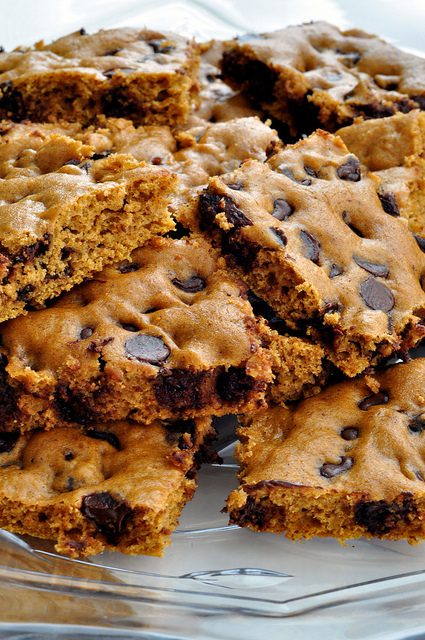
Pumpkin Chocolate Chip Brownies
recipe courtesy of Spikers Rodeo Club from “One Big Family on the Rodeo Trail Cookbook”
ingredients:
1/2 c. pumpkin puree
2 egg whites
1 c. flour
1/2 tsp. ground allspice
1/4 tsp. salt
1/2 c. semisweet chocolate chips
1 egg
1 Tbsp. vegetable or canola oil
1 tsp. baking powder
1/4 tsp. ground nutmeg
2/3 c. brown sugar, packed
1 tsp. unsweetened cocoa powder
DIRECTIONS: Preheat over to 350 degrees. Line a 7×11 pan with parchment paper. In a large bowl combine pumpkin, eggs and oil until smooth. Set aside. In a separate medium bowl, mix together the flour, baking powder, spices, salt and brown sugar. Add that to the wet ingredients and mix. Stir in chocolate chips. Pour into prepared pan and spread evenly. Bake for 15-20 minutes or until it passes the toothpick test. Cool before cutting.
Ivy Conrado has figured out what it takes to make 18 hour drives. “I listen to audio books, music, and call people all the time.” To stay awake, she drinks lots of water and doesn’t eat much. “Then you have to go to the bathroom and you can’t go to sleep,” said the 22-year-old who will run into the Thomas & Mack for the first time in December. Ivy comes from two generations of rodeo. “I grew up going to amateur rodeos, but I’m the first one in the family to make it to the NFR.”
Ivy started riding when she was three on a little pony named Snip. “I rode her all the time while my parents were riding futurity colts.” Both her parents, Cody Doig and Kelly Conrado, are horse trainers. They divorced when Ivy was five and she spent the school year with her mom in North Carolina and the summers with her dad in South Dakota. “My brother, Chance, lived with whoever he wasn’t in trouble with and Paige and I lived with mom.” Both parents moved back to Colorado when Ivy was 12.
She hasn’t always been horseback though. She was involved in a terrible horse accident at the Ft. Smith futurity when she was five. It took more than a year for her to get back on a horse, and the horse she got on was Tibbie’s mom. Little Fancy Granny (Racie) was raised and trained by Ivy and the duo took Barrel Racing Champion for the Colorado State Junior High Rodeo when she was 14. She never made the trip to the National Junior High Finals because it fell at the same time as the Junior Olympics for volleyball.
“I picked volleyball,” she said. “I quit riding in high school and focused on volleyball.” She played club volleyball and said it was the best experience of her life. “I played for some of the greatest coaches – it was a great experience. If I had to go back and do it again, I would.” The club she played on was a high level club and to get invited in took talent and work.
“Ivy is not tall, 5’5”, but she’s so gritty,” said Cody, who spent six years hauling her daughter to practices and tournaments. “The girls – who were mostly 6’ tall –told her she’d never make it playing for Front Range because she’s so short.” From October through July, the schedule was grueling. “I would go to work, pick Ivy up from school, and drive an hour and a half to South Denver to practice. She’d have a couple months off, then back to it.”
Ivy concurred. “Her schedule revolved around me – if we didn’t have tournaments all over the state on the weekends, we would have two practices a day.” The results of her dedication and hard work were several Division 1 scholarship offers for college. Ivy made another huge decision – to get back into competing.
“My dad was very thick into the horses and that’s where I ended up – at Dad’s house.” She started working with the colts and doing chores – feeding up to 75 head and cleaning stalls for her dad while Paige was rodeoing. “I loved futurities and taking eight horses, having the colts and the three years olds.” And along came Tiddie.
“Ivy and Paige had been riding and winning with Racie, and we did an embryo transfer on the mare,” explained Kelly. “I liked the Dash to Fame line, but it wasn’t reality to breed to because of the stud fees, so I’m opted for his son, Eddie Stinson, who I’d seen run on the track.” Chad Harddt owned the horse at the time, and he was willing to work with Kelly on getting the stud fees paid. “Then I worked with Royal Vista to get the embryo transfer done – it took a while to pay off the embryo transfer. We were eating at Wendys on the dollar menu and paying with quarters to get her here. She was the first foal out of the crop of Eddie Sins, first one of the crop and she’s been an excellent athlete from the beginning.”
CFour Tibbie Stinson – Tibbie – won 7 futurities with Kelly and has now taken Ivy to the fourth position going into the NFR. “When you’re running barrels you have to have a great horse,” said Ivy. “The amazing kind to make a living at it. It is up to you to keep it going, but you’ve got to have a good horse. I’ve got the good one.” The 7-year-old mare has proven herself again by winning the Barrel Horse of the Year, a distinguished award given by the AQHA and the WPRA.
The partnership between Tibbie and Ivy took time. “Getting on a horse that was a proven performer with my dad and hitting maybe $60,000 worth of barrels in our first year together was disheartening,” shared Ivy. “I’m not a quitter – those kinds of things make me want to be better. I went with Tibbie until I figured out a good routine for us. Rodeo is so different from jackpotting or futurities – you have to be able to adapt.” Ivy and Tibbie spent hours together, and with the continued encouragement and support of her dad, Ivy feels the team is ready for the Thomas & Mack. “Dad is a huge tool in my success because he is always there if I’m unsure – which is often. The goal is to stay in tune and in center with your horse which never happens perfectly every time.”
This was their first full year going hard down the road. Kelly got in the rig at Ft. Worth and went with Ivy for most of the year, helping with Tibbie. They are partners on the horse and the winnings. “Ivy is a really focused young person. We work really well together as a team,” he said. “She is very respectful of my experience and is very coachable. She strives to continue to be the best and looks at this as her job, which I appreciate. She doesn’t take any of it lightly. She’s been a real pleasure to work with. It’s been a lifetime goal and we’ve been able to work towards it together and that’s something I will always value.”
Ivy has used her dad’s lifetime of experience to help her this year. “He’s really good at entering, so he does that. If I feel very very strongly about something, he listens. I get to make the decision on how many runs we make.”
Ivy plans to keep right on rodeoing. “I want to see what Tibbie can accomplish. She’s so sound for a barrel horse and I get to be on for the ride.” After that, she plans to either train or find another horse and keep winning. “I like to win, first place is my favorite. I want to be the best I can be in this industry and have a healthy life.”

 Blake Teixeira grew up in a ranching family near Salinas, California, where he spent much of his youth with his grandpa who roped and raised horses. As a youngster he roped with his family at local jackpots in lieu of Junior Rodeo. In high school he qualified for the National High School Finals and earned a scholarship at Tarleton University in Stephenville, Texas.
 Biscuits & Gravy Breakfast Casserole
 Pumpkin Chocolate Chip Brownies