Rodeo Life

Category: Archive

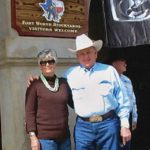
  • Back When They Bucked with Phil “Hatch” Hatcher

    Back When They Bucked with Phil “Hatch” Hatcher

    story by Judy Goodspeed

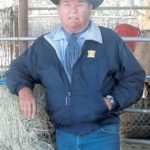
    “Going down a cotton row with a hoe or pulling a sack gave me the desire to do better. My dad was disabled from a stroke, but back then there was no such thing as a monthly check. The only solution was all ten of us kids worked, and worked hard, but none as hard as our mother. She worked in the field, managed a large garden, canned, cooked, washed by hand, patched our clothes, and kept a clean house. Even though our clothes were patched they were clean and she would always say, ‘Now you kids act as good as you look.’
    “My parents Robert (Bob) Hatcher and Flora Tuel Hatcher were both sixteen when they married in 1920. They began married life on an eighty-acre farm sharecropping for Dad’s father. I was born in 1934, the seventh child at that time, three more came later.
    “There wasn’t much time for anything but work, but occasionally when we’d get a break we would ride the workhorses.” Phil loved horses and desperately wanted a saddle horse.
    “One of our neighbors had horses and did a little trading. I was about fifteen when I ambled over to his place to see what he had. I only had twenty-five dollars in my pocket but was willing to part with it for a horse. He had a three-year-old sorrel gelding he wanted sixty-five dollars for. We worked out a deal and I paid twenty-five down and pulled enough cotton to pay the rest. That little sorrel made a mighty fine horse.”
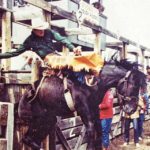
    The little town of Randlett, Oklahoma had a roping arena and Phil became a frequent visitor. He tried his hand at bronc riding and didn’t do very well, tried bull riding and held on for eight seconds.
    “I rode the bull but only because he just ran down the arena. Me and one other boy were the only qualifiers so I won second. I decided right then that I didn’t want to ride any more bulls.”
    In 1951 Phil and one of his older brothers joined the wheat harvest. They had worked through Oklahoma and made it into Kansas when it came a big rain. It would be days before the ground dried out enough to get back in the fields.
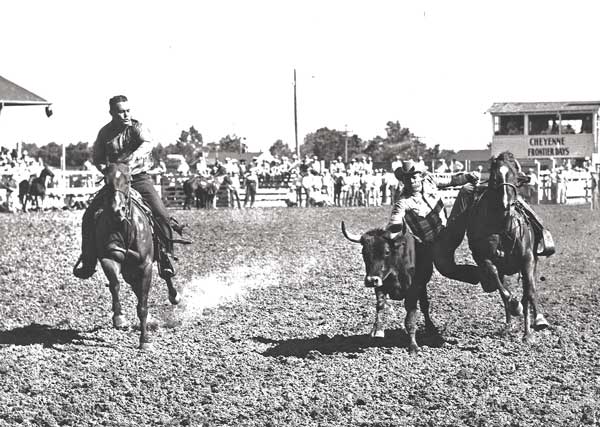
    “Our boss asked if we’d like to go to Cheyenne to the rodeo. That was a turning point in my life. I wanted to be in the arena and made up my mind to become a cowboy.”
    Phil began to try bull dogging along with calf roping. He really preferred bull dogging and sought out guys who knew something about the event. He was still working at every job he could find which was mainly farming. His dad had died and his mother and three youngest siblings were living in a house a friend had loaned them. Phil helped her as much as he could.
    It was about this time that he began dating Norma Bruce. Norma was also from Randlett and they had attended school together, but really didn’t know each other very well. Phil had dropped out of school after the first couple of weeks in the ninth grade. Norma was in the tenth grade when she dropped out of school. They were married in 1954. Phil bought a travel trailer and they started going down the rodeo trail. Years later after they were in one place long enough they returned to school and got their GED.
    “I was still farming but making a few rodeos. Problem was I was riding a green horse, but he wasn’t any more green than me. Finally, Aubrey Rankin started schooling me and that helped a bunch. Aubrey bought a good doggin’ horse from Fuzzy Garner. I rode him some but still wasn’t doing much good. It was hard making a living and having money for entry fees. By this time I had taken the plunge and gotten my RCA card.”
    Buster Morgan approached Phil and asked him to ride in a quadrille he had organized for the Woodward Rodeo. Phil told him the only way he’d go to Woodward was if he could enter the bull dogging and he didn’t have money for the entry fee. Buster entered him and suggested that Phil ask Lynn Beutler for a job with his rodeo company. Phil was hired to work on the feed crew making ten dollars a day. It wasn’t long before he was also making five dollars a day on the stripping crew. That job involved removing riggin’ from broncs. Then he started grooming the saddle horses and made five more dollars a day.
    “This was the perfect place for me. I loved the work, could park my trailer on the rodeo grounds and be close to Norma. The only problem was the three-week layover between Tucson, Arizona Rodeo and the Phoenix, Arizona Rodeo. We moved to Burkburnett, Texas and I farmed for three weeks. Norma was pregnant so I decided to stay close to home until the baby was born.”
    After Wayne arrived Phil and Norma hit the rodeo trail again. Phil still worked for Beutler Brothers, but had moved up to supervisor over the feeding crew. Slim Whaley was another cowboy who worked for Beutler Brothers. One of his duties was to buy the saddle horses used in the show and work as a pickup man during the bareback and saddle bronc events. A pickup man also works the bull riding. His job primarily is to get bulls out of the arena as quickly as possible. There is always a chance for something to go wrong so a good horse is essential. Phil was honored when Lynn Beutler asked him if he would fill in for Slim while he recovered from an injury.
    “One thing that helped me decide to take the job was I knew Slim had good, dependable horses. The biggest danger for a pickup man was having to rope a mean bull and drag him out of the arena. For a short time, if the gate man isn’t quick enough, you are in a tight place with a big mad animal.”
    Everything was going well for Phil and Norma. He was winning or placing in most of the rodeos he entered, mostly in the steer wrestling but often in the calf roping also. He and Norma decided they would like to buy a place and maybe run some cattle, so they started putting money aside when they could.
    “We had saved a thousand dollars when I found a horse that I thought I had to have. Without telling Norma I paid six hundred dollars for the horse. Needless to say she was not happy. I think at that time in my life if I’d had to choose between rodeo and my family I’d have picked rodeo. Fortunately, I didn’t have to do that.”
    In 1961, Wayne started to school in Burkburnett, Texas. Phil moved the travel trailer to a friend’s yard and that’s where Norma and Wayne lived until summer. Once school was out the family hit the road together.
    Phil qualified for the National Finals in 1962. He was winning and doing well so he decided to quit working for Beutler Brothers and rodeo full time. He was broke by the end of the year, so he went back to Lynn and asked for his job back. Lynn made an exception in Phil’s case because he didn’t usually hire back workers who quit, but he hired Phil.
    “Lynn saved my bacon.”
    Harry Vold approached Phil and asked him to work for him. Phil explained that he would work for him when he wasn’t working rodeos for Lynn if it was okay with Lynn.
    “I needed as much work as possible and I really liked Harry. I stayed busy making twenty-three or more rodeos a year. To this day I think of Harry Vold as Mr. Rodeo. He started at the bottom and worked his way up and is a super nice guy.”
    Norma and Phil finally started looking for a place to buy. While visiting Jim and Deloris Smith they found forty acres near Okemah, Oklahoma. We looked the place over and decided that it would serve our purpose. So Phil borrowed five thousand dollars and bought a house and forty acres.
    “Being in debt bothered me, but the old man I bought the place from tried to reassure me. ‘He said you’re young and healthy. You’ll have that note paid off in no time.’”

    Phil got Norma and Wayne settled and headed to Tucson. After the rodeo, he returned home to wait the three weeks until Phoenix. He loaded up his horse, hooked up his travel trailer and got about to Chandler, Oklahoma when an eighteen-wheeler pulled out in front of him. Phil couldn’t avoid hitting him. His pickup was totaled, his horse killed, and the travel trailer destroyed. Now, he was really in debt, but he picked up and went on.
    As it turned out he won the bull dogging at Guymon, Oklahoma, the all around at El Paso, Texas and split the average at Denver with Bill Linderman.
    “Now that was one of the highlights of my rodeo life. Bill was my idol and one of the nicest guys I knew. I went home with enough money to pay off my debt. That’s another thing I loved about rodeo, it afforded an old poor boy the opportunity to get ahead.”
    In 1972 at Nampa, Idaho, Phil was running some fresh steers to see if they were going to do for the rodeo. The horse he was using was young but had never offered to buck.
    “It was a crazy deal. I started to get down on my steer but changed my mind before sliding out of the saddle. When I collected myself to get back seated I must have hit the horse in the flank with a spur. He had never bucked but that didn’t mean he couldn’t. He started pitching and instead of bailing out I tried to ride him. I wound up with a broken, torn up knee.
    “I was an upset man. We had no income and I was going to be laid up for a spell. Just when I thought all was lost Norma announced she was going to work at the Wrangler Blue Bell factory in Okemah. Later she began working in the treasurer’s office at the Okemah County Courthouse. We survived.”
    Phil was disabled for sixteen months and the doctor said he would probably never jump another steer. Twenty-three months after his accident he won second at Hinton, Oklahoma. He continued to rodeo but stayed close to home until time for Cheyenne rolled around. He had to go, but this time he flew instead of driving.
    “It’s every dogger’s dream to win Cheyenne and I came close in 1974. My last steer dog fell on me and knocked me out of the running.”
    In his rodeo career Phil entered won the all around at Colorado Springs twice, the bull doggin’ at Albuquerque, New Mexico, Nampa, Idaho, Little Rock, Arkansas, Kansas City, Kansas, Plainview, Texas and the all around at Weiser, Idaho. He made the National Finals in 1962 in the steer wrestling, worked at the Finals as a pickup man in 66, 68, and 70, and was a timed event judge at the Finals in 73, and 75. He retired from rodeo in 1975.
    “With Norma’s help I had bought up some more land and leased some so we were running mama cows and doing okay. Wayne had graduated high school and been accepted at West Point. I did some cattle buying for people, hauled cattle, took care of cattle for area ranchers, shod horses and broke colts. In 1986 I decided to sell my mama cows and buy yearlings, that is still what I’m doing now.”
    Wayne didn’t go back to West Point after his first year even though he enjoyed attending there. He decided to marry his long-time sweetheart and attend Oklahoma State University for a degree in Horticulture. He and his wife have three children.
    “Norma passed away in 2008. I miss her everyday. She put up with a lot, but we were both raised in good Christian homes so divorce wasn’t even considered. She was a good woman and I give her credit for doing most of Wayne’s raising.
    “I didn’t leave as big a footprint as some of my contemporaries, but no one worked any harder or loved rodeo any more than I did. I never turned my stock out even if the weather was awful, or I was out of the money. There was no quit in me.”
  • Back When They Bucked with Dick Hermann

    Back When They Bucked with Dick Hermann

    Dick Hermann served his country well. The former saddle bronc rider and pickup man was in the U.S. Navy for 25 years, five years in active duty, mostly in Vietnam, and twenty years in the Reserve. After he was Seaman Hermann, he became a cowboy.
    Dick’s story starts as a farm kid, one of seven children born to Roy and Alta Hermann, in 1948 near Lesterville, S.D., southwest of Sioux Falls. For his twelfth Christmas, his dad gave him a set of harnesses, and Dick hitched up Corky and Princess, two of the saddle horses around the place. “They just looked at each other,” Dick laughed. His grandpa tied them together so they couldn’t split apart, and Dick trained them as a team. He remembers pulling his sisters on a toboggan on the lake near the house, behind the team. “I’d cut the corners a little sharp, and roll the girls out” of the toboggan. “They’d laugh till somebody got hurt and then it wasn’t fun anymore.”
    There were plenty of chores to do on a dairy farm, and Dick couldn’t participate in after-school sports. When he was a junior, he quit school. “I wasn’t much of a school guy,” he remembered. He did odd jobs, and youthful energy started getting him into trouble. A friend suggested they join the military. “We were going to get into trouble if we didn’t.”
    He joined the Navy in 1966, because the Marine and Army recruiter weren’t around. “The only guy there was the Navy recruiter,” Dick said. “I said, if I don’t have to milk cows, I’ll join the Navy.” Uncle Sam sent him to Vietnam for three years, and he returned to the States in 1970.
    After getting home, he went with a friend to a rodeo, where he got on a bareback horse and broke his arm. But the experience was worth it. It was a rush, and the rodeo bug bit him. He needed a place where he could work and get on as many bucking horses as possible. Someone recommended he talk to stock contractor Erv Korkow in Blunt, S.D., so he did. “I said I’d try it for a while, and I ended up staying for 30 years,” he joked.
    For the first couple years, Erv wouldn’t let him get on bucking horses. He worked, making $75 a week, plus board, which was good money, better than he had made in the military.
    Then he found out about the nightly rodeo held in Cody, Wyo., for six weeks during the summer. He quit work and went to Cody, where he met up with world champion saddle bronc rider Bill Smith and his nephews Jack Wipplinger and Tom Wipplinger from Red Lodge, Mont. Smith coached them in the finer points of riding saddle broncs, and Dick’s rodeo competition career began. He competed in Cody and area rodeos, becoming a member of the Rodeo Cowboys Association (the predecessor to the PRCA) in 1972 (his permit year) and often slipping off with his buddies to the Canada rodeos.
    But every fall, he’d be back to the Korkow Ranch. At that time, Erv didn’t have any fall rodeos, but he had a trucking company, so Dick hauled cattle all winter. And every spring, after helping with the rodeo school Erv put on at the ranch, he’d be off to rodeo again.
    Erv and his wife LaFola were like second parents to Dick. He “treated me good,” Dick said. “He treated me like one of his boys. He’d chew on you once in a while, but that happens to everybody. He was a good man.”
    And Erv always took Dick back on the labor crew each fall. “I’d go back to the ranch, and Jim (Erv’s son) would tell him, ‘Dick’s back in the bunkhouse’ and I’d pick up where I left off.”
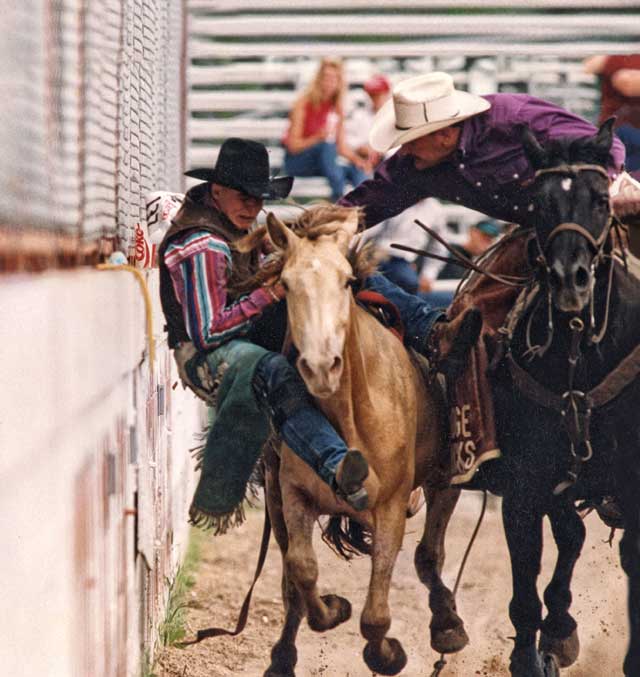
    In the 1980’s, Dick started working as a pickup man. He was in Dallas, at a Steiner rodeo, on the labor list. Tommy and Bobby Steiner wanted to know if Dick would come to Austin, to work for them, and in Austin was where he first picked up.  The Steiners were bucking horses at the ranch when the pickup man didn’t show up. Would Dick pick up? He agreed to, even though he never had before.
    That fall, at the National Finals Rodeo in Oklahoma City, Erv talked Dick into returning to South Dakota the next year, to pick up for Korkow Rodeo Co.
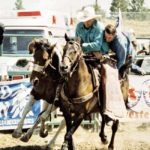
    As time went on, he purchased a semi-tractor and used Erv’s trailer to haul a load of bucking horses and bulls to rodeos, plus ride broncs and pick up, all at the same event. In addition to working for Korkow Rodeo, he also picked up for Jim and Steve Sutton.
    Dick credits Jim Korkow with teaching him the finer points of picking up. “He was good,” Dick said of Jim. Picking up “is all about timing, being at the right place at the right time. By watching other people, I learned. And I had different people point out different things, which I appreciated.”
    In 1986, he broke his arm in June, and his leg a month later. Lying around, the realization hit him: what would he do for finances if he was seriously hurt? “I realized I had to do something different.” He decided to go into the Naval Reserve, serving one weekend a month and two weeks a year.
    Dick served until 2006. In 2002, he decided to quit as a pickup man. He knew he was to be deployed in 2003, to Iraq. He and forty others were sent to train in Italy for two weeks with the Marine Corps. After the training, the group was sent home, which disappointed Dick. “Gol dang, I wanted to go.”
    Since his retirement in 2006, he enjoys his home in St. Onge, S.D. in the summers and in Phoenix in the winters. He has a team of Belgians that he uses to pull wagons in the parades for the rodeos in Deadwood and Belle Fourche, S.D.


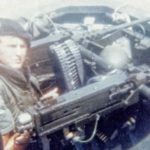
    In Vietnam, Dick was one of a four-man crew on the PBR river gun boats: patrol river boats. They were little gun boats, as Dick explains, 28 feet long, and ten feet wide, with a forward gunner, driver, an M60 gunner, and a 50 caliber gunner. The job of the PBR in Vietnam was to search and destroy. Dick was on many PBR patrols with the Navy SEALS, the Green Beret, and the Army, and two of those missions nearly killed him.
    Twice his life was in peril on the patrol river boats. On June 21, 1968, the boat he was in was completely destroyed, killing two of the men. He and one of his original crew, plus two new members, were assigned a new PBR, and two days later, the new boat was damaged to where Dick got blown over the side of the boat. It was 3 am, so dark a person couldn’t see the jungle tree line. When he came to the water’s surface, another boat ran over him, causing serious injury. The secret to surviving was staying in the middle of the river; the enemy was on the beach. Dick treaded water for so long his legs cramped up. He was the only survivor of the four in that incident. He nearly lost his life, but he can joke about it now. “I drank half of that dirty old river. It took me all these years of drinking beer to get rid of it,” he laughed. Out of the four men who were part of Dick’s original boat crew, he was the only survivor.
    For his bravery, he received the Bronze Star, the Purple Heart, and the Navy Commendation Medal, with Combat V and the Gold Star. At one time, his days in Vietnam troubled him at night. But the dreams have subsided. “The nightmares ain’t nearly as often as they used to be.”
    Rodeo has provided him with a lifetime of recollections. “I got a saddle bag full of memories and friends that all of the money in the world can’t buy,” he said. He loved riding saddle broncs, and watching bucking horses. “When I got tapped out on one, it was like poetry in slow motion. You’re so engrained in what you’re doing, you don’t even hear the whistle. There’s nothing better than watching a good horse that bucks.”

  • ProFile: Tatum Schafer

    ProFile: Tatum Schafer

    by Holly Wilson

    After a freak accident, high school junior Tatum Schafer had to overcome many obstacles to get back in the saddle.
    Tatum Schafer, a resident of San Tan Valley and member of the Arizona High School Rodeo Association, has been an avid horseback rider her entire life. An all-around cowgirl, Tatum competes in barrel racing, pole-bending, breakaway roping, goat-tying and cutting.
    Her father has team roped for the past 30 years, and rodeo is all she’s ever known.
    However, after a freak accident on October 27, 2015, Tatum would have to call upon her passion to survive.
    “When we got to the hospital, they told us it wasn’t good. It wasn’t what we expected at all,” Kerri said, “The paramedics had told my husband at that time that it was a pretty serious head wound, one of the most serious they’d ever seen.”
    This was caused by blunt force trauma when Tatum was ejected from the running board of her friend’s truck. The fall fractured the hardest part of her skull, and left with her with a hematoma, a skull fracture on her forehead and a skull fracture on her left temporal.
    “She had ruptured her ear canal, and her head and hair were completely covered in blood. That’s probably the only thing that saved her life,” Kerri said, “With a laceration in her ear canal, it released the pressure on her brain and allowed it to relieve itself.”
    Tatum was lucky to have survived the first 48 hours. And even then, it was a miracle that she survived the first 72.
    As a result of the accident, Tatum lost her hearing in her right ear, lost her taste and sense of smell, dislocated her ear, suffers from an unbalanced equilibrium, lives with chronic headaches and has trouble with short-term memory loss.
    “She was told that she’d never be able to ride again,” Kerri said, “She had a neurosurgeon, and we worked with that team.”
    They agreed to let Tatum ride again, but only if she wore a helmet. She underwent a conditioning program, just like any other athlete, and in March of this year she began competing again.
    “It’s the only passion she’s ever had. Everything else was taken away from her,” Kerri said.
    Tatum has overcome many obstacles in the last year, but doesn’t let them get the best of her.
    “At times it has been frustrating, but my friends and family that I have standing by my side have been giving me confidence and pushing me to keep trying when I felt like quitting,” Tatum said, “There were many challenges [when I started riding again], but the hardest obstacle was learning to compensate for my loss of balance. It involves many long practices and determination to strive to continuously do better.”
    Although she has made progress, Tatum still deals with anxiety and chronic headaches as a result of the brain damage. On top of that, Kerri explained that Tatum blacks out during times of high brain activity.  “At State Finals in June, because of the anxiety and brain stimulation, she kept passing out and blacking out,” Kerri said, “She does not remember one run at State Finals. The last thing she remembers in breakaway is backing into the box. She doesn’t remember any of it.”
    Yet, through every hard time, Tatum has had a large support system behind her every step of the way.
    “My mom has been the most supportive through my recovery and I could not thank her enough,” Tatum said, “She has sat in every waiting room, every doctor’s appointment, been there for me through all the good and bad news, and most of all supported me and helped me accomplish all my goals.”
    “I could also not be more thankful for the support that the rest of my family has given, especially my sister, Hailey, for pushing me to get back to where I was and helping me in every way possible,” Tatum said, “The love and support from all the families in the Arizona High School Rodeo Association has been incredible and I couldn’t have done it without all these people standing behind me and pushing me to be the best I can be.”
    The support that Tatum receives has enabled her to dream big.
    “My rodeo goals are to make it to High School Nationals [for] a 6th time in multiple events and be the best I can be in and out of the arena,” Tatum said, “My main goal is to get back to where I was before my accident and continuously be more successful.”
    Kerri describes her daughter as passionate and determined to make her life better, despite her circumstances.
    “She’s a fighter. She’s passionate about making her life better, making a difference and making it better for her. She wants to show anybody that, if you have a life-threatening injury, you can turn it around,” Kerri said, “She shouldn’t have made it through what she did, but she has a passion and determination for life. I’m not sure if I would use passionate or a living miracle, because that’s what she is.”

  • On the Trail with Dave Dahl

    On the Trail with Dave Dahl

    Dave Dahl can spot one of his saddles from a mile away. When the bronc saddle maker from Ft. Pierre, S.D. watches pro rodeo, he can see the saddles he’s made aboard the bucking horses in the saddle bronc riding.

    And the list of cowboys using his saddles sounds like a “who’s who” of great saddle bronc riders: 2016 world champion Zeke Thurston, world champions Taos Muncy (2007 and 2011), Jeff Willert (2005), Glen O’Neill (2002), and Cody DeMoss, Jake Watson, CoBurn Bradshaw, Chuck Schmidt, Clay Elliott, Wade Sundell, Cort Scheer, Kyle Whitaker, Jeremy Meeks, Shade Etbauer, and more.

    The 72 year old cowboy grew up on a farm near Keene, North Dakota, next to an Indian reservation, “where there were cowboys,” he remembers. He and his friends used to go to the reservation, round up horses, and ride them. “We didn’t know what the horses were like,” he said. “We just ran in a bunch of them. There were a few chutes, and we practiced. We had some wild times,” he chuckled.  After graduating from high school in 1962, he went to the oil fields. But he knew he didn’t want to spend his life there, so he went to college in Madison, S.D.

    Eastern South Dakota wasn’t for him, either. “It was too much ‘east river’ for me, and I liked the Black Hills.” He made a phone call to Black Hills State University in Spearfish, S.D., and a few months later, he was there, on the rodeo team riding saddle broncs. As a member of the men’s team, he won the 1967 National Inter-Collegiate Rodeo Association year-end saddle bronc riding title, qualifying for the College National Finals Rodeo four times and competing there twice.

    After graduating with a teaching degree, he taught a year at Pine Ridge, S.D., a year at a country school near Fruitdale, S.D., and a year in Eagle Butte.

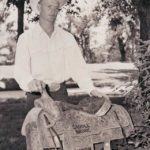
    He was doing construction work in Ft. Pierre, when he and a rodeo buddy, Dick Jones, ran across each other. Jones was making saddles, and Dave wanted to make his brother one. Dick helped him, and that was the beginning of Dave’s saddle career. Dick had made some saddles, and he gave instruction to Dave. “He knew a little bit, and I didn’t know much,” Dave recalled. “He showed me, and one thing led to another.” The two began a partnership in a saddle shop in Ft. Pierre.

    Dave, being a saddle bronc rider (he won the 1968 SDRA title and had a Rodeo Cowboys Association card), made bronc saddles. His saddles are different from other brands, and the cowboys who ride them, love them.

    Dahl’s bronc saddles differ from other makers in several ways, including the swells and the cantle. The swells are set higher so that a cowboy’s feet can set high in the neck of the horse, but not too high. The seat is a bit deeper, and the cantle is higher. Where a cowboy’s hips are is crucial. Chuck Schmidt, a saddle bronc rider from Keldron, S.D. and a three-time Wrangler NFR qualifer, has ridden a Dahl saddle since he started pro rodeo. “As in any sport, your hips are your power, and bronc riding is the same,” he said.
    “You almost have to sit back on your butt a little, not just sitting there straight up, like you’re going to rope. You want to set back, (to reduce) the force the horse will use to throw you forward. You counteract it it by sitting back.”

    The gullet on the saddle is also set narrower, so the saddle can sit higher up on the withers. “Beings it’s not a roping saddle, you can set your swells higher by bringing the bars in, thus allowing the cowboy to spur better,” Schmidt said.  “If the swells are set too low and too wide, it’s harder to reach your feet up into the neck. When you narrow the swells and set them up higher, your legs are closer to the horse’s neck, creating better spur contact when you ride.”


    Dahl’s saddles make riding broncs easier, Schmidt said. “Dave designed a saddle to take away half of your work as a bronc rider, the way it sets a horse and the way it sets the cowboy. It sets it up a little more natural, the way everything moves. There are minimal things to get in your way.”

    For some cowboys, switching to a Dahl saddle made them a better rider. It happened for Zeke Thurston, who won last year’s world title. The Big Valley, Alberta cowboy wasn’t riding well last spring. He decided to give Dahl a phone call. Dahl had a new saddle to him within five days, and Thurston took it to the Guymon, Okla. rodeo. “It took me a few rodeos to get it dialed in,” he said. “Once I broke it in, my spring skyrocketed. There were probably four weekends in a row where I won $12,000 or more.” He credits the saddle with giving him better spur outs and better upper body control.

    Jake Watson, Hudson’s Hope, BC., finished the 2016 season in fifth place in the world, and also uses a Dahl saddle. “The way the swells and cantle are shaped, the structure of them, they have a lot of forgiveness in them,” he said. “If you lift on your reins, you can turn loose and the saddle will do its job and keep ahold of you.” The different shaping of the swells and cantle make a difference. “Say you’re getting bucked off, and you’re still trying to spur, more often than not, you’ll end up back in the saddle and regain your position in the seat, which is definitely what you want.”

    Watson has used a Dahl saddle since June of last year, and it has made a difference for him. “It changed my career, honestly,’ from the very first horse I got on,” he said. “I was having hell. I had won $2,000 that season (up till June), and from the end of June till September I ended up winning $20,000. Itw as a big turning point in my bronc riding.”

    Dahl works out of his shop, the Diamond D Western Wear and Saddle Shop, on the main street of Ft. Pierre. He sells clothing, boots, hats, tack, and ropes, and does his leather work in the back of the shop.

    And when most people are retired and drinking coffee all day, Dahl is working. He’s turning out about a saddle a week, working on number 1657 in mid-January. He puts in long days, clocking in about 8:30 am and working till 6:30 or 7 pm, six days a week, “depending on how bad I want to finish something.” The good work ethic comes from the motivation to succeed. “I guess I made up my mind that I wanted to be the best at what I’m doing. When you see the good results of the cowboys, it’s a big incentive.” And making saddles supplements the store’s income. “I’m fortunate that I can make a good living in my workshop when things are quiet in the store. That makes it nice.”

    As cowboys call him to order saddles, he chats with them, finding out how they’re doing, what rodeos they’ve been to, and how they’re riding. He checks the internet nearly every day, to see the standings, and watches rodeos on the Wrangler Netowrk. He can pick his saddles out every time. “Everybody’s saddle looks a little bit different,” he said. “I have distinct little straps, little buckles. Most everybody has a buckle through the skirt (of the saddle), but my buckle is on the little piece that goes around the front of the swells.”

    Dahl ships saddles to Australia and now the second generation of cowboys are using them. And the “old-timers” – retired bronc riders –refer young guys to him. National Finals average winner Rod Warren “sends boys to me,” Dahl said.
    Six cowboys at the 2016 Wrangler NFR rode on Dahl saddles: Thurston, Schmidt, CoBurn Bradshaw, Cody DeMoss and Clay Elliott. And the list extends beyond the NFR. Wade Sundell rode one to win the $1 million at the American Rodeo last year. Cort Scheer won the Elite Rodeo Association title, Thurston won $100,000 at the 2016 Calgary Stampede; Jeremy Meeks won last year’s Indian National Finals Rodeo on one; Clay Elliott was on a Dahl saddle for his Canadian National Finals win, and eight-time Linderman winner Kyle Whitaker uses one.

    Retirement is not on Dahl’s radar. “I have  a lot of work to do,” he said. The man who supplies the d-rings for Dahl’s saddles is 95 years old, and still going. “I”ll have to work a while to catch up to him.”
    And saddle bronc riders hope he keeps working.

  • Spaghetti Pie & No-Bake Cheese Cake

    Spaghetti Pie
    recipe courtesy of Sandra smith and dee anita bowker from cookin’ with cowboys cookbook

    Ingredients:
    1 lb. hamburger, cooked & drained
    1 jar spaghetti sauce
    1/4 c. Parmesan cheese
    2 c. shredded mozarella cheese
    1 medium-sized container of cottage cheese
    1 1 lb. package cooked spaghetti noodles
    2 Tbps butter

    DIRECTIONS: Add spaghetti sauce to drained hamburger. Warm through in a 9×13 inch pan. Pour ¼ cup Parmesan cheese with 2 tbsp. of melted butter. Immediately pour noodles in and toss until cheese and butter cover noodles. Then add cottage cheese and 1 cup shredded cheese, covering all noodles. Pour meat sauce over top and add remaining cheese. Bake at 350° for 40 minutes .


    No-Bake Cheese Cake

    recipe courtesy of michele clement from cookin’ with
    cowboys cookbook

    Ingredients:
    1 graham cracker pie shell
    1 8-oz. package soft cream cheese
    1 c. sour cream
    1/3 c. sugar
    2 tsp. vanilla
    1 8-oz container Cool Whip

    Directions: Mix cheese and sugar. Add and stir sour cream and vanilla. Fold in whipped topping. Put in pie shell and chill at least 4 hours. Serve with your choice of pie fillings. I use fresh strawberries.

  • Blake Hughes

    Blake Hughes

    by Holly Wilson

    A humble cowboy from Sulphur, Oklahoma, Blake Hughes splits his time between the roping pen and the family dairy farm.
    “My dad owns a dairy farm, and he ropes. He’s the reason I started roping, and then I got into it with my uncle. He doesn’t go to any rodeos, but he still likes to ride,” Blake said.
    “My mom is a physical therapist. She didn’t grow up around horses but she’ll ride a little bit. The dairy keeps my dad pretty tied up.”
    Blake helps his father around the dairy by feeding and checking calves, and taking care of their milking cows.
    In his spare time, Blake enjoys fishing and, of course, roping.
    After taking up horseback riding at a young age, Blake was swinging a rope by age 12.  “I was probably roping every day by that point. I was into it pretty heavy and practicing every time I got a chance,” Blake said, “As long as the weather would permit and we weren’t too busy on the dairy, we would try to rope.”
    He and his uncle live closeby, and rope together nearly every day.
    “My uncle still ropes, and he goes quite a bit. He goes to a lot of the World Series ropings,” Blake said, “He still lives close, and we still rope together about every day. It’s convenient.”
    This tight knit family dynamic has helped Blake to be successful in his roping career. “My dad’s got me good horses, that’s a big part of it. He bought [Streakin King Dandy] and he’s bought some other ones,” Blake said, “He’s always given me good horses to ride, I’m pretty thankful for that.”
    Streakin King Dandy, a 2006 gelding, is Blake’s partner in crime.
    Because of his innate ability to rate calves with precision and speed, Blake doesn’t fuss with his horse at home.
    “To prepare for an upcoming rodeo, I work on scoring. When I go to practice, I want him to score good and leave flat,” Blake said, “He knows what to do in the arena, so I just try to keep him calm and quiet, and comfortable in the box.”
    This type of training works well with Blake’s busy schedule, and allows him to be asset on the family farm. Blake gathers cattle on Streakin King Dandy, and uses him as a ranch horse at the house in-between ropings.
    Being a humble man, Blake insists that his success is all due in part to his little rope horse.
    “I don’t know if I’d be where I am without him, that’s for sure. I’ve had good horses in the past, but he’s the best one I’ve had,” Blake said, “I like to think that I’d be close to where I’m at, but he’s played a big part in my success.”
    This past year, Streakin King Dandy and Blake placed and attended several notable rodeos including; the Bob Fiest Invitational, the George Strait, the ERA finals and RFD TV’s The American.
    The duo placed second in The American qualifier, and placed third in the open. They also finished 14th overall on the ERA leaderboard with a fifth place finish in the first round of the three part championship.
    Their most notable accomplishment, was a first place finish at the USTRC US Open Champions, where they spun five steers for 31.02 with partner Brady Norman.
    The bay gelding still has a lot of life left in him though, and Blake has several goals for the next five years.
    “He’s the only good horse I have right now that I feel like I can go win on,” Blake said, “A year from now, we’re gonna try to go a lot more and try to make the national finals.”
    “If we could make the national finals two or three times over the next five years, I’d say we’d be doing pretty good,” Blake said.
    He has high hopes for his bay horse, whom he affectionately calls “Snake”.
    “He’s got a lot of personality. I named him Snake right when we got him,” Blake said, “He was hard to catch; and then after you did get him caught he was always watching and was always trying to get away from stuff.”
    “Once you get him caught, he’s pretty good,” Blake said. “I don’t know what it is, but he’s kinda funny like that.”
    Although Snake has outgrown some of his old habits, the nickname is here to stay.
    “He hasn’t outgrown that one yet, it still fits,” Blake said with a laugh.


  • On the Trail with Brenten Hall and Jake Clay

    On the Trail with Brenten Hall and Jake Clay

    Brenten Hall and Jake Clay may as well be brothers. They both come from rodeo families and they’ve grown up together as best friends. Both handy with a rope, it only made sense that the two 17-year-old cowboys should team up together in their professional rodeo careers. And if this year in the International Professional Rodeo Association is any indication, it was a smart move.
    Both Brenten and Jake will be heading to the International Finals Rodeo this January in Oklahoma City to compete as two of the youngest in the field of competitors from the U.S., Canada and Australia.

    Growing up in Oklahoma, Brenten and Jake met around the age of 7 and were quickly rodeoing together.  “I don’t ever remember not roping or being around it. When I was little I went to rodeos with my mom and dad. It is just something that I do, I don’t see myself doing something different,” Jake describes of rodeo. His entrance into the IPRA was natural too. Both his father Dwayne and mother Julana are multi-time IFR qualifiers, his dad as a header in the team roping and his mom as a barrel racer. She won Rookie of the Year back in 1986 and continued on from there. Brenten’s mom LeAnna ran barrels and team roped, like Jake’s parents, his father Bob was also a multi-time IFR qualifier and team roping director for IPRA. Bob passed his love of roping on and coached Brenten to where he is today. Sadly, Bob passed away in 2015 from pancreatic cancer. Now they rope in his honor.

    Brenten and Jake grew up doing junior rodeos locally and have both gone into high school rodeo, but have quickly made a name for themselves as professional competitors too. This is Jake’s second year in the IPRA and Brenten’s rookie year. They have focused on preparation and practicing while they have done home school through high school.

    “We’re both homeschooled so it made it a lot easier. We couldn’t have done this if we couldn’t home school. We’d have had too many absent days, but you can kind of get ahead and prepare for what’s happening and take off for the weekend and not have to worry about it,” Brenten describes. He adds that his season had a slow start. “It’s been real fun. There were some very hard times. I went through some stuff I couldn’t figure anything out, I was having a hard time, I was missing, but the worst part about it is I felt like was letting my partners down, because I don’t do very good with that stuff,” he admits.

    Then things turned around for the team. “I wasn’t doing very good then come about Pawnee rodeo it just kind of worked. I won 1st and third there and that shot me in 17th or 18th in the world, and then I got to where I thought, ‘you know, I’ve got to go, I’ve got to try to make it [to IFR] since I went this far, closer than I was, not there, but closer than I was,” Brenten says.
    He and Jake make a good team for organizing a pro-rodeo career. “Pro-rodeoing has been fun, a lot of ups and downs. Entering, I still have zero clues whatsoever, I think I entered one rodeo,” Brenten says and adds of Jake, “he’s done every entering job, I just kind of tell him where I think we should go and then he does it whichever way it’s supposed to be done,” he laughs.


    Jake chimes in humorously that he also does all of the driving, to which Brenten replies, he looks after the animals. In reality, they get along well. “Neither one of us demands anything very often. Neither one of us are really that organized whatsoever. It takes us a good two hours to figure out how we want to go [to rodeos] just two a weekend but [our] moms take care of us,” Brenten laughs. Jokes aside, both acknowledge the great support they get from their families and sponsors. Brenten would like to thank his sponsors, Classic Ropes and Horselic, and Jake would like to thank Mid-States Industrial Sales and Tulsa Stockyards.

    The fact that Brenten and Jake are both laidback, works great for their team dynamic. They can hardly recall ever fighting, maybe twice, they agree. And the sport of team roping is unique they realize, because, as Jake explains, “It makes you want to try harder because you know your partner is trying just as hard, and if you mess up you let not only yourself, but him down too.”

    The boys split their days between school work and practicing. Jake also trains horses with his dad, and Brenten’s family has cattle and owns the local feed store in their town of Jay, in northeastern Oklahoma. Jake lives closer to the city of Tulsa, Oklahoma in the town of Sapulpa. It’s about an hour and 45 minutes-drive between their towns, but they practice together when they can, when they’re not on the road competing, which isn’t a lot now days. They’re usually gone every weekend to a rodeo.

    Both Jake and Brenten credit their horses for helping them get where they are. Jake mostly rides a 10-year-old sorrel gelding he’s competed on for the past four years, and is special because his dad trained the horse. And Brenten’s main horse is a paint he actually bought off of Jake a couple of years ago.

    Another component to success for the boys is a positive mindset. “[You’ve] just got to be humble in everything, because you could win one day and then not win for three weeks or however long,” Jake says and cites his favorite quote, ‘if you want to be the best, you’ve got to do things other people aren’t willing to do.”  As for Brenten, he thinks of the saying, ‘if you want to succeed as bad as you want to breathe, you’ll be successful.’ “I think that’s something you should live by if you try to win,” he says and adds another motto, “for a successful Plan A is not have a Plan B’ so keep after that plan A, practicing a lot, keep your head down, keep going for it.”

    Those mottos are clearly working for both Brenten and Jake. Beyond qualifying for the IFR, Brenten split the $100,000 win at the USTRC in October in Oklahoma City, “it was exciting, I wouldn’t know any other way to put it. I’m still kind of bumfuzzled over it,” Brenten says of that win. “I needed something, some kind of money so I could keep going and maybe get another horse, and it ended up coming through, and it helped,” he says but adds, “That money sure is good, but winning, the success, is what makes you happy.”
    And in December, the team saw even more success. Together, Jake and Brenten roped to a first place finish and a $150,000 paycheck at the World Series of Team Roping #15 Finale.


    Impressive accomplishments for two teenage high school kids.
    Both boys will be soon looking to colleges and college rodeo, as well as continued success, but for January, all the focus is on the International Finals Rodeo, Jan. 13-15, 2017 in Oklahoma City.

  • Back When They Bucked with Glen Bird

    Back When They Bucked with Glen Bird

    Because of his high school ag teacher, Glen Bird began riding bulls.
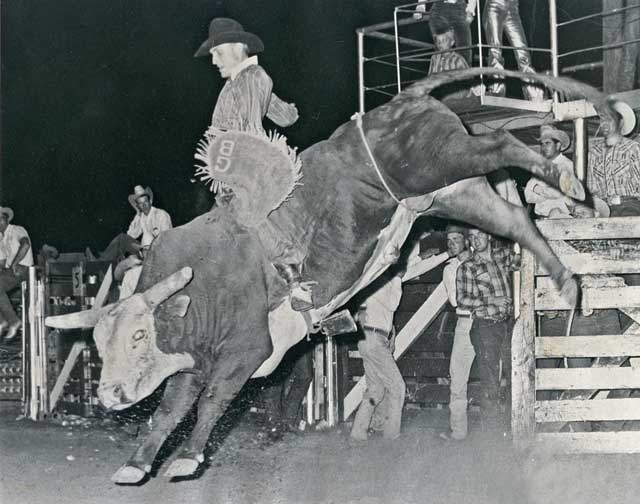
    The Weatherford, Texas man began his rodeo career at the behest of Mr. William T. Woody, ag teacher at Peaster (Texas) High School, a career that would end up with six International Pro Rodeo Association (IPRA) titles and the high respect of his fellow cowboys. As a child, Glen attended rodeos with his granddad, who loved them, especially the bull riding.
    He rode calves on the family ranch then continued the sport when he was in high school.
    Mr. Woody had competed as a bull rider at Sul Ross University in Alpine, Texas, and he saw potential in his student. Because Glen couldn’t drive, Mr. Woody would enter him in the FFA rodeos held across the state and drive him there. And because many of the FFA rodeos hired professional stock contractors, the bulls were extra rank and the high school kids turned them out, not wanting to get on them. “Mr. Woody knew all them stock contractors,” Glen remembers, “and he’d tell them stock contractors, ‘Look, these bulls are turned out and this boy I brought with me will get on them.’” So Glen ended up getting on five or six bulls at each rodeo. He may not have got them rode, but he was willing to get on them.
    He remembers one time at a rodeo in Gainesville, Texas, where Adrin Parker was the stock contractor. He had a bull, No. 36, that nobody wanted. Every performance, No. 36 was turned out and Glen got on him. “He slung me all over that arena. I was so beat up and bruised up by the time I got on the bull I had drawed, Mr. Woody kept ice on me all day.” Two years later, he got his revenge on No. 36; he rode him for a third place finish.
    In 1964, after high school graduation, he hit the rodeo road. He was already competing on the weekends, but now he hit the trail hard. He had gotten his IPRA card a few years prior, and, along with Hal Pilgrim, went to rodeos everywhere. “We’d try to go to a rodeo every day,” he said. It wasn’t hard. With bull buckouts at Mansfield, Texas two nights a week and a rodeo on Saturday nights, and rodeos in Simonton every weekend, there was always somewhere to ride.
    And Glen and his buddies didn’t limit themselves to Texas. It was common for them to be up at a rodeo on a Saturday afternoon in Texas or Oklahoma or Arkansas, then jump in the car and make a Sunday matinee performance in California. The car was full, too. By this time, Glen and friends Red Doffin (a bull rider) and Ronnie William (a bareback rider) were in the vehicle, along with Bernie Johnson, Glen’s brother Arnold Bird, and Hulen Missildine. “They would go anywhere I entered us,” Glen said. “I always had a full car, and we’d go non-stop.”
    In his glory days, Glen and his buddies were competing in anywhere from 150 to 200 rodeos a year. “The thing about it is, we loved it,” he said. “If you can’t travel, you’re not going to ever rodeo. Every day, when we’d wake up, we’d more than likely be in another state, meeting new people. It was unbelievable.” And his riding was unbelievable, too. According to Ronnie Williams, Glen’s style was impeccable. “I think he was one of the greatest bull riders there ever was,” Ronnie said. “He had a perfect style and form, he rode so perfect, that he made it look effortless. And his percentage of winning first place was unbelievable. It seemed like every time he’d nod his head, he was winning first.”
    In the early days of his rodeo, Glen rode bareback horses. He didn’t like to, but for a while, he did. And his friend Ronnie knew it, and occasionally set him up for a joke. “That dang Ronnie would enter me in the bareback riding, and I’d get there (to the rodeo) and find out I was entered. But he didn’t enter me in a whole bunch of them, because I was entering him in the bull riding, and he didn’t like that.”
    Glen won the IPRA’s bull riding title four times: 1966-67-68 and 1970, and the all-around in 1968 and 1970. The International Finals Rodeo began in 1970, so prior to that, whoever had the most money won at the end of the year was the champion.
    Ronnie won eight IPRA bareback titles, and thought his buddy was the best in the business. “I don’t think anybody ever rode with the style he rode with, and was dominant in the IPRA all those years. It was a privilege for me to get to rodeo with him.”
    Another traveling partner, Red Doffin, thought the world of Glen. “He had lots and lots of class,” Red remembered. “You talk about a bull rider that looked pretty on bulls. He just turned his toes out and rode them with style, rode them perfect. That’s the way he rode.” Glen was hard to throw off, as well. “He had good form,” Red said, “and when they throwed him off, they throwed him off on the top of his head because he tried as hard as he could try.”


    Glen never suffered from a lot of injuries. He broke a leg during his first – and only – semester of college, affixing a spur in the cast so he could continue to ride. He also broke a bone in his left hand, his riding hand that took six months to heal. The broken leg and possibly returning to riding bulls too soon has affected his walking today. That’s not being tough, he insisted, in riding with a cast, “all that was, was stupidity. If I had not have done that, I would be walking so much better today.”
    In 1972, he got on the last bull he’d ever ride. His legs were bothering him so badly he took the locks out of his spurs and rode with loose rowels. “I couldn’t stand the pressure it was putting on my legs,” he said. “After a while, anything you do that you burn at it like that, it makes the longevity of it short. It finally caught up with me.”
    By this time he had a wife, Judy, and two children, Jennifer (White) and Jason. He got a job with Miller Brewing Co. in Ft. Worth, working there for 33 years. He also started a Limousin cow herd, selling the bulls at the Texas Limousin Association’s annual sale for years. He started his herd from some heifers and a bull that his aunt and uncle had in Oklahoma. He ended up with a herd of 35 purebreds and did very well with the breeding program. Both of his kids showed the cattle, his daughter winning Limousin Heifer of the Year.
    When he quit riding bulls, Glen had to quit going to rodeos, for fear he’d get the bug again and hit the road. “I didn’t watch a rodeo on TV for ten years or so,” he said. “I wasn’t going to be able to quit them if I kept around them.” Then one day his friend Sam Roberts called, asking if he’d watched a bull riding on TV. “I can’t, Sam,” he said. “I’ll want to get to riding again.” Sam shot that idea down. “Hell, you ain’t going to do that, you’re too old,” he said. “And I thought, by gosh, he’s right, and now I don’t miss one.”
    Inducted into the Texas Rodeo Cowboys Hall of Fame in 2010, Glen remembers with great fondness his rodeo days. “I had more fun than the law allows. I thought I was a millionaire. I enjoyed every bit of it. I don’t regret any part of it,” he said. “If I ever got the chance to live it over again, I would.”
    And Mr. Woody, the ag teacher? They still stay in touch, even though Glen nearly got kicked out of his class the first day of school. Glen walked into the classroom with his hat on, pants stuffed into his boots, and put his feet on the table. Mr. Woody jumped up with a two-by-four in his hands and said, “We’re going to find out who runs this class right now. You or me? I’m going to ask you to take your feet off the desk and your hat off.” “I looked at that two-by-four,” Glen chuckled, “and I sure didn’t want no part of that.”
    Glen and Judy spend their time now “doing whatever we want to,” said Judy, who spent most of her years at home, working a couple different jobs along the way. “We’ve been married for 48 years and we have learned that it’s about being a companion to each other and doing for each other all the time. We go to church all the time and have a lot of friends to spend time with.” They also have two granddaughters, Skylar and Taylor.

  • Roper Review: Shane Brown

    Roper Review: Shane Brown

    Most ropers only dream of winning the kind of money paid at the World Series of Team Roping finale in Las Vegas. Those dreams recently came true for Shane Brown, Robstown, TX, and his partner, J. R. Wood, Sinton, TX. The duo won the #13 on December 6th, splitting $254,000. The team previously won the #12 roping at the World Series roping in Sinton, TX earlier this year. Brown and Wood both had their numbers raised, to a #8 heeler and #5E header, respectively, forcing the pair into the #13 Finale. The duo came from sixth high call to win the roping with a 29.65 aggregate time on four head.
    Shane, and older brother Scot, grew up in a farming and ranching family and were riding before they were walking. They started roping young and team roped and roped calves through school. Growing up, Shane won a couple of TYRA state championships in calf roping. In 1997 he was the Texas High School rodeo team roping champion header. In college Shane eventually dropped calf roping and focused solely on team roping.
    After high school Shane pursued an education at Texas A&M where he earned his degree in Animal Science and a Masters in Agri-Business. After graduation, Shane was a commodities broker for five years and is now a Vice President and the Robstown branch manager for Texas Farm Credit.
    Shane is married to his lovely wife, Ravyn, and the couple has two daughters, Bailey, 8; and Blakely, 5.
    “I met my wife in college,” says Brown. “We both grew up in rodeo. Once we married, she slowed down to raise our girls. Now she’s a stay at home mom and far busier than I am.”
    Brown admits to being fiercely competitive. This trait benefits his other hobby and passion – golf where he carries a #3 handicap. Being competitive and handling pressure runs in this family. Two years ago, his brother Scot, won the #11 at the World Series finale.
    Undoubtedly family comes first for Brown, “We do a lot as a family. Right now my girls are active in gymnastics and volleyball. I haven’t been roping as much lately. Basically just enough to qualify for the World Series finale.”
    COWBOY Q&A
    How much do you practice?
    Once or twice a week. But in preparing for the WSTR Finals, we would practice several times a week.
    Do you make your own horses?
    Typically yes. My dad raised the horse I rode in Vegas, and I broke and trained him.
    Who were your roping (rodeo) heroes?
    Phil Lyne. I grew up roping with him and rodeoed with his daughters. My dad was an extremely good roper and gave it up so we could rope.
    Who do you respect most in the world?
    My family.
    Who has been the biggest influence in your life?
    My parents, my wife, and God.
    If you had a day off what would you like to do?
    A perfect day would be playing golf in the morning. Then hanging out with my family and roping in the afternoon.
    Favorite movie?
    Lonesome Dove.
    What’s the last thing you read?
    Emails.
    How would you describe yourself in three words?
    Driven, family-oriented, competitive.
    What makes you happy?
    Being with family and friends.
    What makes you angry?
    Laziness.
    If you were given 1 million dollars, how would you spend it?
    Buy some acreage that my family and I could enjoy.
    What is your worst quality – your best?
    My worst is lack of patience for people who don’t try. My best is lots of patience for people who try hard.

  • Cherry Custard Fruit Pie

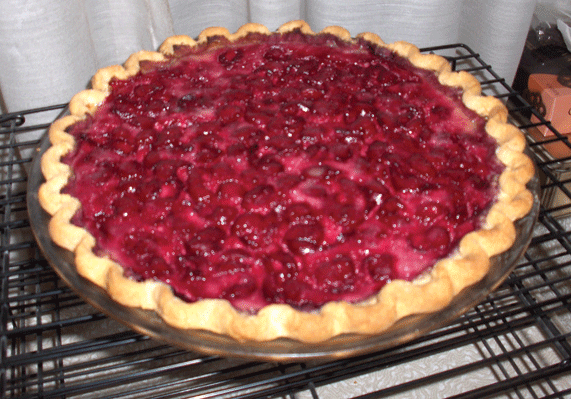
    Cherry Custard Fruit Pie

    courtesy of Karen Vold

    Ingredients:
    Crust:
    2 cups flour
    2 tbs sugar
    3 tbs mild
    1 tsp salt
    2/3 cup oil
    Topping:
    2 eggs
    1 pint sour cream
    1 cup sugar
    1 tsp vanilla
    21 oz can cherry pie filling or blueberry

    DIRECTIONS: Mix crust ingredients together and press in deep-dish 10” pie pan. Sprinkle with cinnamon on bottom.  Pour can of pie filling on bottom of crust.
    For topping, beat eggs, add sour cream, sugar and vanilla. Mix together and pour on top of fruit, then sprinkle a little cinnamon on top. Bake at 375 degrees for 45-55 minutes.
    My sister, Pam Barton, served this fabulous pie to me when we went to Florida to visit her. She got it from her neighbor, and it’s oh so good! You will be sorry it doesn’t make more.

  • Full Beef Tender

    Full Beef Tender

    courtesy of Karen Vold

    Serves 10-12

    Ingredients:
    Full beef or pork tenderloin
    Worchestershire sauce
    lemon pepper powder
    garlic powder
    butter
    brandy

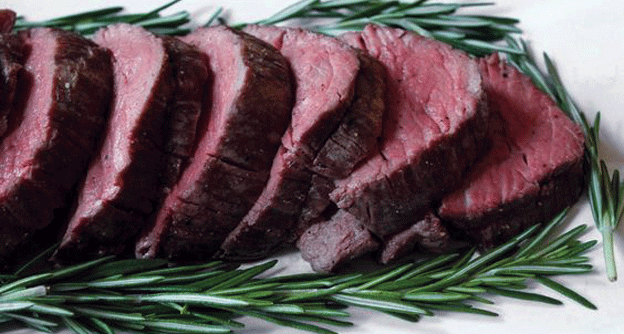
    DIRECTIONS: A full beef tender trimmed – pour Worcestershire sauce all over. Rub with lemon pepper and garlic powder (lightly). Brown all over on high heat in electric skillet with butter. Put in corningware dish – then pour 1/2-3/4 cup cheap brandy into drippings. Stir around a few minutes and pour over beef tender. Put in oven at 300 degrees covered for about 30 minutes. Then uncover and cook another 30 minutes, depending on how rare you prefer. It is ready to serve, but if you must hold for a while take out of pan you cooked in as it will continue to cook.
    This fabulous recipe comes from a lady in Oklahoma City who invited us to supper while there during the National Finals Rodeo over 30 years ago. Her name was Judy and I’m sorry I don’t remember her last name!  My entire family loves it so much it has been our Christmas Dinner special every Christmas.  Hope you enjoy it as much!

  • Wild Rice Casserole or Dressing

    courtesy of Karen Vold

    Serves 8

    Ingredients:
    1 box of Uncle Ben’s Brown and Wild Rice Seasonings – cook according to instructions.

    DIRECTIONS: Sauté onions and mushrooms and add to rice; mix, then pour half and half over it until soupy, 3 cups or more. Bake 30-45 minutes at 300 degrees. Add more liquid if needed.  You can use 3/4 – 1 cup of sour cream to replace equal amount of half and half if you like. This makes a great accompaniment to a turkey dinner.
    Shirley Churchill has brought this dish several times for Thanksgiving and everyone always enjoys it.  Good any time of year if you like rice.