Rodeo Life

Category: Archive

  • Back When They Bucked with Argene Clanton

    Back When They Bucked with Argene Clanton

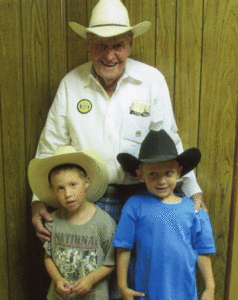
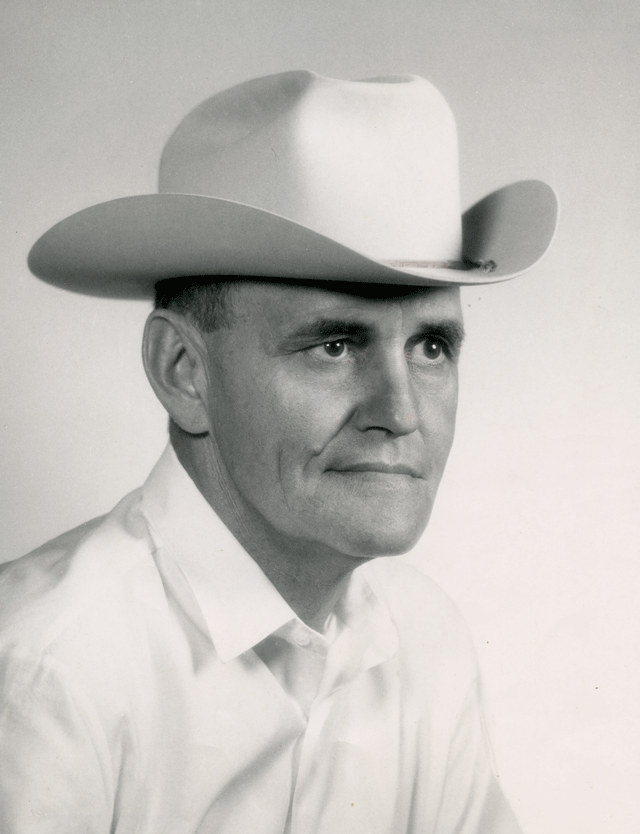
    Argene Clanton laughs, and life laughs with him.
    The cowboy, an Okie, former calf roper, café and truck stop owner, veteran, rodeo committee member and daddy of three girls, loves a good joke.
    And at the age of 94 years young, he’s still laughing.
    He was born in 1924 to Cleve and Verda Clanton in Barnsdall, Okla., weighing in at two pounds, seven ounces and sleeping in a box in the closet. When he was born, he was a “blue baby,” and one of the midwives attending his mother asked if there was any whiskey in the house. There was; she took it, warmed a teaspoon of it, and gave it to him. He lived, and says with a twinkle in his eye, “I’ve had a few drinks since then.”
    As a child, the family lived on a farm near Chelsea, Okla. He loved to rope and would try to rope everything: chickens, pigs, anything that walked across his path. In high school FFA at Chelsea Public Schools, the FFA kids would be hired out to help farmers work their cattle, sheep and hogs. Argene would load his horse in the FFA trailer, and the crew would go to work. People didn’t have good corrals and chutes in those days. Animals often got out, and Argene and his buddies got to rope them. But the animals weren’t always getting out on their own. “I guarantee you, somebody’d let one out so we’d get to rope,” Argene chuckled.
    Argene calf roped with his good friend Roger Morris. Roger’s dad was a horse trader, and Argene would ride a lot of the horses he brought home. One time, he bought a cow horse and Argene couldn’t wait to get on him. Roger’s dad “wanted me to ride him, to see what kind of a horse he was. I was always a fool to get on,” he said.
    So Argene decided to skip school so he could ride this cow horse. The horse “was snorty when I got him in the corner,” Argene remembered. “I got up on him, and boy, he broke in two. He ducked his head, bucked, and threw me right into the saddle room.” Argene got up and this time opened the gate to the pasture. He was going to ride this horse. He got back on him, spurring and whipping, and “out the gate I went. He hit three licks and settled down.”
    It just happened that the Clanton barn and pasture was next to the school, and the principal had seen Argene riding. The next day, over the speaker, came the principal’s voice, asking him to report to the office. Argene lied about skipping school, telling the principal that his dad had asked him to get cattle in that day. The principal told him he was going to get three licks. Argene said, “no, sir.” The principal locked the door and Argene told him, “you’re going to have to give them to me.” The principal “got hot, and everything turned red.” But he unlocked the door, and “I felt better,” Argene said. The principal told him to ask his dad to come and talk to him the next time he was at school. “I said I sure will,” Argene laughed. “And then I forgot to tell him.”
    In 1943, the year before he would have graduated, Argene entered the Navy. Six Craig County boys all went at the same time, and Argene was sent to San Diego to machinist school. He was on a troop transport ship, the Admiral RE Coontz AP122, going through the Panama Canal seven times hauling Puerto Ricans back and forth from Europe, where they were serving in the U.S. military. After World War II ended, the ship was stationed in the New York Bay, and Argene stayed with the ship as it was decommissioned to the merchant marines. He was assigned the task of teaching them how to run the ship, and given the option to take his thirty day leave and then return for his final two months of service, or stay for three months and then be discharged. He chose to stay. “I said, if I get back to Oklahoma, I won’t want to leave.” He was on the ship longer than any other Navy personnel; he was on board when it was commissioned and when it was decommissioned.
    In 1946, Argene was honorably discharged from the Navy and came back to Oklahoma, never to leave again.
    He bought a farm on Route 66, halfway between Vinita and Chelsea. He had beef cattle and dairy cattle, married Martha Carter, and started a family, having three daughters: Connie Butler, Peggy McGehee and Pam Swift. A small arena was behind the dairy barn, and friends stopped by to rope. He served on the school board for the White Oak School as well.
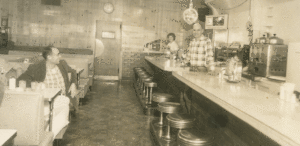
    His paternal grandpa Grant Clanton, known as “Sweet Tater” started Clanton’s Café in 1927. Cleve and Verda took it over in the 1940s, and when they decided to retire, Argene bought it from them. He moved his family to the house behind the café and his parents moved to Argene’s farm. Then he bought the service station next to the café and ran it. After eleven years of running the café, he sold it to his sister and bought a truck stop at Big Cabin, running it for seventeen years.
    He and Roger Morris competed at area ropings and rodeos. They never went pro, but they loved to rope. They stayed in the area, never venturing more than 100 miles from home, to rodeos in Oklahoma, Arkansas and Kansas. He also competed in the calf mugging and wild cow milking.
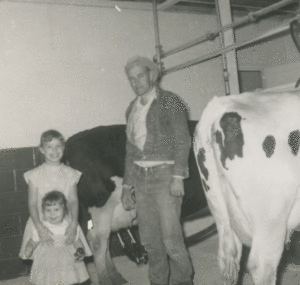
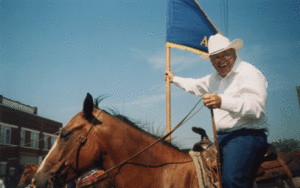
    Argene played a vital part in the Original Will Rogers Memorial Rodeo, held in Vinita every August. He has served as rodeo chairman and has been on the rodeo committee for years. When he was fifteen, he rode his horse eighteen miles, from his home to Vinita to watch the rodeo. He has gone to at least one performance of the rodeo every year of its 82 year existence, except for the three years he was in the Navy. He has carried the flag in the rodeo parade and posted colors at the rodeo for forty years. He attended the PRCA convention and the National Finals Rodeo many times, and one time, when there was no money to put on a rodeo, he and his good friend Bob McSpadden, brother to Clem McSpadden, took out a personal loan to finance it.
    When he returned from the Navy, World War I veteran George Franklin paid his dues to join the Chelsea American Legion. Two years later, he joined the Vinita American Legion Post 40, and has been an active member for 72 years, serving as commander of the Legion several years.
    Argene also was active in politics, volunteering as Craig County Republican Party chairman many years. He knew Clem McSpadden, a Democrat, from playing high school basketball against him and going to rodeos with him, and Clem knew Argene had influence in Craig County. When Clem ran for Oklahoma Senate in the 1950s, he asked Argene to go with him to be introduced to folks in the area. Argene knew the real reason Clem wanted him along: to open the gates. In the 1970s, when Clem ran for U.S. Congress, he asked for Argene’s help again. Argene told him, this time you’re opening the gates, and he did. “I drove, and he opened.”
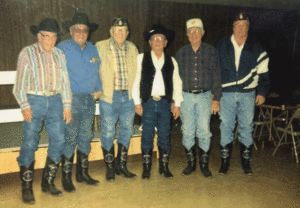
    In 2002, he, along with the other Chelsea veterans who didn’t graduate from high school due to their service, were asked to walk across the stage for high school graduation. His graduation party was at the senior citizen center!
    Six years ago, he, his daughters, and other veterans were part of an Honor Flight to Washington, D.C., where he saw the sights for the first time. The Clanton Café, which his dad started and he owned, is the oldest continuously owned family restaurant on Route 66 in Oklahoma (it’s now owned by Argene’s niece and her husband), and he still loves to dance, having taught all three of his girls by them standing on his boots.
    Argene’s wife Martha died in 1992 and he married Roberta Millarr two years later. Roberta has three boys and a girl; together, the couple has so many grandkids, Argene said, “we quit counting them.”
    Life is good for the old timer. He and Roger live two miles from each other and get together to tell old stories. Argene frequents the American Legion, where he likes to partake of the beverage that got his lungs working as a baby, and he counts his blessings. Life has “all been good, it really has,” he said. “Raising three girls and having two good wives, I don’t know how you could beat it.”
    It’s a life-well lived.
  • On The Trail with Nathan Hatchel

    On The Trail with Nathan Hatchel

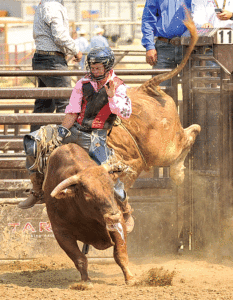
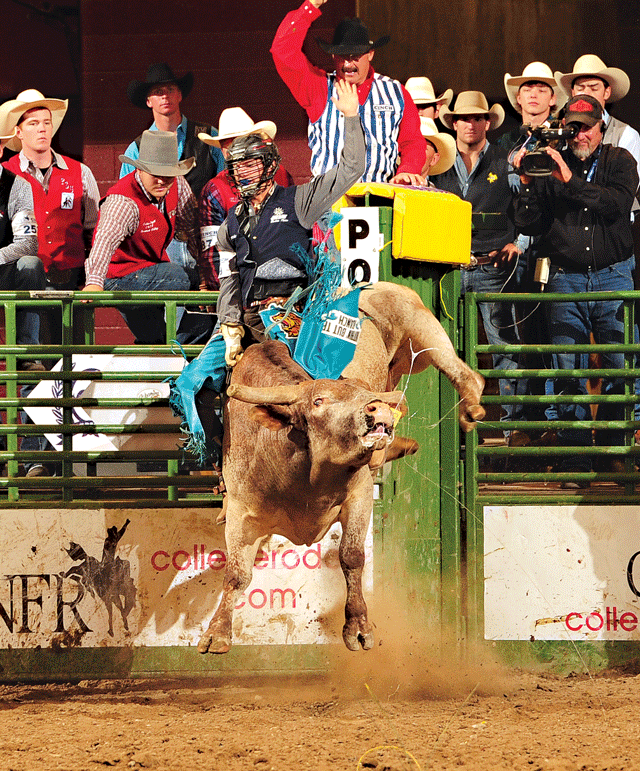
    Nathan Hatchel just graduated from Southwestern Oklahoma State University with a degree in business management. The 22 year old from Hennessey, Oklahoma, is heading to Casper for his third appearance at the College National Finals Rodeo (CNFR) in the bull riding. “This year I’ll go first in the nation. It’s a clean slate going in, but sitting first through the season is bragging rights; but whenever you get to Casper it’s all even, so it’s about riding good and getting good bulls. That’s the fun part to me – everybody has a chance.”

    Nathan is getting prepared for the upcoming Finals (June 8-15). “Right now, whenever I’m climbing on the bulls I feel like I’m physically and mentally ready and trusting in God. I go to my Bible every day.” He credits his coach in college (Mike Visnieski) for the mental game, and his dedication to the gym every day for the physical preparation.

    “I’m doing a lot of stretching and I do cardio and free weights. Right now I’m trying to gain muscle, but I ride the best at a certain weight so I try to keep that going.” He is also very careful about what he eats, avoiding sweets, cutting down on carbs, and doing meal preparation before heading out to a weekend of rodeos. “I get people laughing at me like I don’t have enough money for food, but I’m just trying to keep it healthy.” One of his favorite road foods is chicken and rice. “I could take that every weekend.” He puts chicken in a crock pot with barbeque sauce, Worcestershire sauce, lemon pepper, seasoning salt, and garlic salt. He adds onions, bell peppers, carrots, asparagus, and takes that with cooked rice. “I don’t even care if it’s hot.”

    “Wherever I go now, the preparation I’ve done through the week is done and I just have to react and trust myself that I’ve done the work in the week to be successful on the weekend.”


    Nathan grew up in a small 2A school, where everybody knew everybody, with his dad, Craig, and his older brother, Dylan. He came from bull riding stock, both his dad, Uncle Glenn, and grandpa, Corky Hatchel, rode bulls, but he wasn’t allowed to get on one until he was 13. Instead, he concentrated on sports – basketball, football, and baseball. He played on a traveling team in the summer and enjoyed basketball the most. “That’s what I played until my junior year of high school – then I put my focus into riding bulls.” His goal was to get a full ride scholarship, and that’s what he did at SWOSU. He competed for Oklahoma State High School Rodeo, making the National High School Finals both his junior and senior year. He was fourth in the nation his junior year, and was riding with a torn MCL his senior year, so he didn’t ride as well. “I got that fixed and went to college,” he said.

    His dad works in the oil field and was instrumental in teaching Nathan the basics. “He’s always there,” said Nathan. “He goes to every rodeo – he drives umpteen miles – Rock Springs to Casper – and everywhere in between.”

    Craig wasn’t crazy about Nathan riding bulls at all. “I know how dangerous it is – now I’m pleased that he is. He’s very gifted – Nathan is very athletic and has put a lot of time and effort into this.” Craig has supported him with practice bulls at home and helping him find the coaches he needed along the way. “He is very dedicated and when he sets his mind to something, he puts 110% in it. He finishes what he starts.”

    Nathan remembers watching his dad and uncle ride when he was young, but he wasn’t formally introduced until one day when Craig offered to let Nathan and his brother get on a steer. “We didn’t know what we were getting into. My brother was a football star, and I thought it was fun, but didn’t ride one steer for the entire year to date, not one.”

    The second year, he won the championship in the COJRA – Central Oklahoma Junior Rodeo Association. After that, he kept riding in another little association in Edmond. He started going to a bull riding school put on by David Berry (Monster Bull Company) out of Locust Grove, Oklahoma, “He puts them on once a month and he had the perfect stock for me to get on,” said Nathan. “We went back month after month and I spent summers out there in high school and worked for him. We did drills and drills and that’s how I got started. He’s been a huge help to me. Still to this day, he welcomes me and is always there to help and comment on my riding.” The drills consist of a stationary drill on a barrel as well as walking on a pipe for balance plus other things. “Another good one is getting a medicine ball and sitting on them and squeezing it with your legs – then try standing on top of that ball and keep that ball underneath you. When I’m on the back of a bull, I can’t see, so that’s where the subconscious comes into play. And the balance comes in.”

    David Berry has put on bull riding schools for more than 20 years. “I wasn’t a world champion bull rider; my claim to fame was the PRCA Resistol Rookie of the Year in 1988 alongside Ty Murray,” said the 51-year-old. The next year, in the short go of Cheyenne he broke his jaw. “That was the same year Lane Frost died – the bull after me. Growing up in Oklahoma all you heard about was Lane Frost. His school helped me a lot – he gave me the time of day.” David took his love of bucking bulls and started raising them and helping others learn how to ride. “I recognized the heart and try in Nathan – you can help coach to ride, but you can’t teach them to try. They have to bring that on their own.” David saw Nathan’s work ethic and dedication to learning. “Talking about riding a bull and getting on one are two different things. I can’t remember Nathan ever talking about riding a bull; he just gets on them. And he does everything with a grin on his face.”

    Once Nathan went to college, he turned to Chad Drury, with Nothin’ but Try Ranch. “They have accepted me into their family – I took a bunch of buddies over there and got on some of his young bulls and he ended up sponsoring me and we’re pretty much family – that’s the name on my chaps.”

    Both Chad and his brother, Shane, went to college at SWOSU. After college, Chad stayed around and Shane moved to Nebraska. Chad raised bucking bulls and would call the college to get his young bulls ridden. “Nathan is a good kid,” said Chad. “He’s talented and takes care of business- that’s the kind of person I wanted to sponsor. Anytime I need help, Nathan comes over and helps. It works out really great for both of us. He’s a really good kid and his fiancé is good as gold. He’s a winner, but he’s not arrogant and that’s the kind of guy I want to represent me and our ranch.”


    Nathan met his fiancé, Kodi Holloway, through friends at SWOSU, she’s on the soccer team, and will also graduate this spring with her nursing degree. The couple got engaged on August 6, 2018. They will get married on September 20.

    After the college finals, Nathan will move down to Castle Rock, Colorado, and start learning the tricks of the trade for his grandfather’s (Jim Lovell) construction business (Lovell Group), hoping to become a project manager and perhaps eventually taking over the company. He will also continue rodeoing, and plans to shoot for Resistol Rookie of the year next year once he buys his card. For now, he definitely is aiming for the Permit Challenge at the South Point this coming December. “I was leading the permit standings until April, and since college rodeo I’m sitting 7th and I’m focusing to make the permit standings challenge which happens during the Benny Binion Sale. This is my fourth year to fill my permit, but as long as you have a NIRA card, you can fill your permit more than twice.”

    “Graduating college is a big deal for me. There is a life after rodeo, especially riding bulls, and this degree will help me provide for my family,” said Nathan. “The biggest thing I learned from college is responsibility – showing up for class – nobody is there to get you going, you have to do it yourself and grow up and learn that responsibility.” He admits that college has gone by very fast, but he is looking forward to settling in Colorado with his wife and eventually starting a family and raising some bucking bulls of his own. “I want to take what I have and run with it and help others the same way others helped me.”

    He has been a believer his whole life, thanks to his grandmother, and the generosity of others that would get him to church since none of his immediate family went. “I bounced from home to home when I was young, and my brother and I finally ended up with my dad. We never had much money growing up, but I learned it’s not about your past; it’s about where you’re going. My past doesn’t define who I am now. I definitely didn’t have a very good childhood but I’m blessed it all worked out.”

    “Follow the Lord and your dreams will follow you. Everybody is chasing their dreams, but I’m chasing the Lord and my dreams have come to me. Don’t let anything set you back from that.”

  • Facing Fear

    Facing Fear

    Have you ever been scared to let go? Have you ever wondered what was going to happen next? Well if you have you are definitely human. If you haven’t you are special. Being scared is a human feeling. I’m pretty sure we have all been scared at least once in our lives. There is nothing wrong with being scared or even terrified for that matter. It’s what we do with our fear that matters. When fear starts to try to creep up on us we have two choices: give in to it or give it to God. Fear is the devil trying to tell us we can’t, we aren’t strong enough, or we won’t make it. Fear is the enemy lying to us. When we listen to his voice, it paralyzes us. When we hand it over to God it liberates us-sets us free from the enemies grip. When we hand our fears over it takes the pressure off of us and we can find strength and refuge in Jesus.

    Shelby and I recently moved back home to continue rehab at the house. We got a bunch of equipment set up in the garage and have it turned  into the rehab gym. We even took some climbing harness and a pulley system over the tread mill and have our own locomotor training walking machine set up. Needless to say my wife, brother in laws,  and I  have been vigorously training at the house. In the last month I haven’t had any huge new breakthroughs just the same leg movements as before but definitely getting stronger and stronger.

    One thing I had been waiting to do since the accident was get horseback again. It had been over six months since I had been on the back of  a horse, the longest in my entire life that I can remember. I had been trying to get to a place and ride while in Utah but kept having complications due to getting cleared by the surgeons. But, typical JR Vezain attitude, I was determined to make it happen regardless of what they said as soon as I got home.

    We got home Friday night and Saturday afternoon I was saddled up figuring out a way to get on. With a little ingenuity we transferred me over on to the flat bed of a pickup, stepped ol’ Rosie over, lifted one leg on the other side, and with a boost got swung up in the middle and set down. Instant freedom! I was ready to roll wherever I wanted to go around the ranch. Not confined to my wheelchair and where it could go anymore. I had a new set of legs ready to roam. I could go ride through the cows and look at the place that I had been away from for over six months. Then, I turned her to ride off and it didn’t feel the same. It wasn’t like it was before. I knew it was going to feel different but I didn’t know how different. I didn’t have any weight in my legs. I couldn’t really feel where I was in the saddle. My balance was off so I was death gripped on the saddle horn and bared down on my rope holding myself on.

    As I rode out of the yard I was already getting tired. My arm was tired from pulling on my rope. My legs felt like they were squeezing as hard as they could yet I couldn’t feel the weight in my feet. My whole body flexing to stay in the middle. Then, I got to thinking what if my horse spooks? I wasn’t seat belted in so I wondered if I would tip off the side. What if she began to trot could I control her enough to keep her the speed I wanted to go? Could I turn her around and go back to the house? What if I did fall off   how would I get anywhere? It seemed the harder I tried to stay on and keep her at a slow walk the more she wanted to go. She would speed up a little so I would pull on her mouth then she’d prance around and I would struggle to keep my balance. The more I squeezed the harder I worked the more wore out I got.

    I kept going though. The more I rode the more comfortable I got. The more I loosened up and gave her her head, the smoother the ride got. If I just let her go and just worried about staying in the middle the easier the ride got. The looser my grip got the more relaxed I felt.

    I gave her her head and rode out around the field about thirty minutes total. She knew her way around the pasture and led me back to the house safe and sound and it felt amazing! It was awesome to connect with a horse again. Great to be horse back even if it was only for a minute.

    Once I was back in my wheelchair I was sitting on the porch enjoying the evening reflecting on my ride when I came across the idea that life is just like that short little ride I went on. You can either go on your ride and let fear of the unknown, anxiety, or uncertainty take over. Grab hold of your rope and squeeze tight trying to control every step showing it where to go, unsure of what might spook her up; or you can swing up and give her her head. Trust in the Lord  and let her pick carefully the path she needs to take. She’ll lead you around the pasture and back home safe and sound with a smile on your face enjoying each step of the way no matter what uncertainties come your way.

    Proverbs 3:5-6 says  “Trust in the Lord with all your heart; do not depend on your own understanding. Seek his will in all you do, and he will show you which path to take.”

    You see we should not let fear or circumstances, outcomes or situations, grab ahold of our reins and take control of our lives. We should hand them over to the Lord, trust in him, and let him guide us where we need to go.


  • ProFile: Talsma Performance Horses

    ProFile: Talsma Performance Horses

    story by Madison Clark

    Ty Talsma is a fifth generation South Dakota rancher, who also fills the role of cowboy and horse trainer at Talsma Performance Horses. “Where I’m at now evolved from rodeoing,” explains the 41-year-old from, Springfield. “Growing up all I wanted to do was go to rodeos, but my dad wouldn’t buy a rodeo horse for me. There was a herd of them out there and my dad said go make one.”
    Larry Talsma, Ty’s father, was the first in his family to compete in rodeos. He team roped and rode bulls. Ty followed suit, participating in 4H, high school, and college rodeos growing up. He went to college at Oklahoma Panhandle State University and competed in steer wrestling, calf roping, and team roping. “I played football too and had a full ride in both football and rodeo.”
    The Talsma family operates the Tall T Ranch out of Springfield, South Dakota and the Trails End Ranch out of Verdigre, Nebraska. Ty eventually took it upon himself to commercialize his family’s horse training prospects. “My dad had it going pretty good too, and I decided to go for it.” He spends half of his year in Arizona, selling horses that he mainly gathers from Nebraska, South Dakota, Wyoming and Montana to snowbirds spending their winter team roping. “The team roping scene down there is huge – everybody is down there – and it’s great to be out of South Dakota in the winter.”
    Selling around 100 head of horses a year, Ty says he always has 30 or 40 at all times, and keeps about 10 to 15 with him in Arizona. His Uncle Pete Talsma helps with the operations while he winters and works with horses in the south. They also hire a few interns in the summer to learn the ropes and assist with training.
    “I didn’t really go out expecting to do it this way. There’s always been a demand, and I’ve always enjoyed the lifestyle. Riding horses, ranching, rodeoing, it all goes together,” explained Ty. While Ty says the larger market is the lower number roper, cow horse or team roping horses, he still has many rodeo cowboys as customers. “There’s a good market for the steer wrestling horses too – I train half a dozen or more a year.”
    Times have changed when it comes to methods of selling horses. Ty relies on repeat customers, word of mouth and social media for contacts to buy his horses. “Early in my career I put horses on pretty much every major sale in the country. Ninety percent of my sales are private now. A lot of people contact us through Facebook,” said Ty.
    Ty’s wife, Kristin, helps as much as she can with riding and training barrel horses, but she keeps very busy with homeschooling their three kids, Terran-12, Treyvan-10, and Gianna-5. “They like to rope and ride, I guess they kind of have to if they’re going to be out there with me. I think they’ll start junior rodeoing soon,” remarked Ty.
    Ty tries to make it to as many pro rodeos as he can each year, he makes between 30 or 40 and hopes one year to hit the road and try to make it to the NFR. “One of these years I’m going to dedicate myself and do it.” He has made the Circuit Finals a dozen times in both steer wrestling and team roping.
    In regards to the future of the business, Ty hopes to get back to basics when it comes to where his horses are coming from. He currently owns a couple of studs and mares but would like to expand. “Starting off, my dad always had a bunch of brood mares and a stud around. If I could sell ranch raised and ranch trained horses, started and finished by me, that would be best by me.”

  • Back When They Bucked with The Ludwig Twins: Wilma Hybarger & Wanda Cagliari

    Back When They Bucked with The Ludwig Twins: Wilma Hybarger & Wanda Cagliari

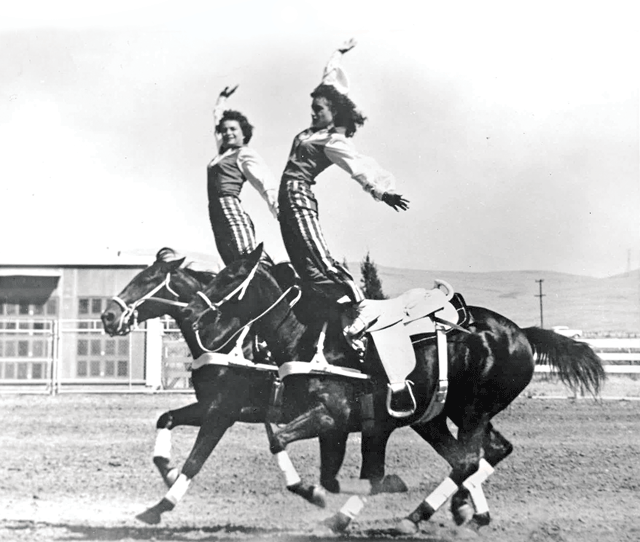
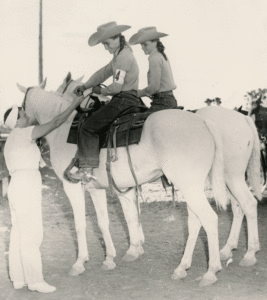
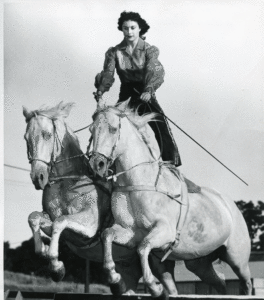
    The Ludwig Twins – Wilma and Wanda – made their mark, and their living, in the horse and rodeo world.
    Wilma Ludwig Hybarger and Wanda Ludwig Cagliari were born in Auburn, California in 1935, the daughters of Everett and Edith Ludwig. They were raised on a dairy farm, bottling and delivering the milk the hired man and their dad milked, and when the hired man was on vacation, the girls helped in the milk barn. Hard work was part of their upbringing, but it was a good life.
    Their first horse was a Shetland named Nipper. Then came a big paint horse called Chief. Their dad would buy horses from the Roseville, Calif. auction ring and bring them home for the girls, and that’s how they learned to ride.
    It was when they were in their teens that they saw trick riding for the first time. They were at a rodeo in Hughes Stadium in Sacramento, Calif., with Buddy Farren trick riding. “We decided that’s what we wanted to do,” Wilma said. Their parents didn’t approve. But when Everett and Edith took a two week trip to New York, the girls stayed home to do chores, driving to Buddy’s place in Sacramento, to take trick riding lessons.
    By the time their parents were home, Wilma and Wanda were accomplished enough that their parents consented to the two to continue. They learned more, and then a stock contractor, Ray Hicks, wanted to hire them. They worked for him, then took other contracts for other rodeos, gradually working events across the western U.S.

    For fifteen years, from the time they were eighteen to the early 1970s, the women entertained fans with their dazzling trick riding. And it wasn’t just rodeos that hired them. Any event that wanted entertainment would book them.
    In 1972, the duo decided to quit trick riding. By this time, they had moved to Nevada, were both married, with small children, and it was time to do something else.
    For both women, the “something else” still involved horses.
    They had trained horses in their trick riding days, but now they did even more of it. They didn’t work together, but each trained horses for a wide variety of disciplines. Both women had horses that excelled at the National High School Finals Rodeo, the College Finals Rodeo, and the National Finals Rodeo. Wanda’s daughter won the barrel racing at the College Finals in 1988 on a horse Wanda trained. Both had shown horses in their teens, and Wilma continued to show, becoming the first woman to make the finals in the snaffle bit futurity in Reno, Nev. Wilma also had barrel horses that qualified for the Indian National Finals Rodeo.
    Wilma gave lessons (and continues to) to beginning and advanced riders, barrel racers, cutters, anyone who wanted to get better on a horse. She’s tutored riders who have been successful in every discipline. Wilma never competed professionally, but in 1991, she won the Reno Rodeo aboard Wanda’s barrel horse Toppy, when the rodeo was not a WPRA event that year.
    After the trick riding, Wanda began running barrels. She stayed in the state associations: the Nevada Cowboys Association, the California Cowboys Association, the Idaho Cowboys Association, and the Nevada Barrel Racing Association for ten years, winning the NCA nine consecutive years, the CCA twice, and the Nevada Barrel Racing title ten consecutive years. She ran into Tom Marvel, the father of 1978 world champion saddle bronc rider Joe Marvel, at a sale. He told her she should go pro. “You have a good horse,” he told her, “and you might not get another one like it.”
    So she did. It was 1980, and she was a barrel racer in the Women’s Pro Rodeo Association for eleven years. She stayed close to home when she could, but rodeoed across the nation, qualifying for the National Finals Rodeo in 1980 and 1981 and winning Rookie of the Year in 1980.
    The horse Wanda rode at pro rodeos was Whats the Use, “Whatsit.” The three-year-old mare was fourteen hands tall, and “looked like a pig,” Wanda remembered. The seller told her Wanda could have her, and if she was able to make something out of her, he’d take $350 for her. Wanda didn’t want her, but the mare from the Jack Schawbacker ranch in Madera, California, was already loaded in the trailer.
    So Wanda trained her. Whatsit was talented at everything: running barrels, heading, heeling, poles, cattle work, “she did anything you asked her to do,” Wanda said. “She was a good horse, just a natural.”

    After nearly a dozen years of WPRA rodeo, Wanda called it quits. She had competed at fifty or sixty rodeos each year, and “it was quite a chore,” she said. “You drove till your head almost fell off.”
    The next stage of the twins’ rodeo competition began.
    Wilma and Wanda joined the National Senior Pro Rodeo Association in the 1990s. Wilma mostly barrel raced and occasionally team roped and ribbon roped. Wanda ran barrels, team roped, ribbon roped, and did a little breakaway, too. Wanda won the senior pro barrel racing title ten consecutive years, the all-around title eight out of ten years and the reserve title twice. She was also the 1993 Canadian Senior Pro Rodeo champion barrel racer.
    At a rodeo in Wells, Nevada, a cowboy approached Wanda. “He said, “we gotta do something about you. You’re winning too damn much.” Wanda “got mad and told him off,” she said. “I’ve worked too hard my whole life and I don’t need you telling me I have to quit.” Unofficially, Wanda was the first woman to win the all-around title against men in the senior pro association. After that, the competition was split into two divisions: the men and the women.
    Wilma has a knack for re-training horses that came to her with problems. She remembers a barrel horse once, where, at the first barrel, he’d run down the fence. The rider brought him to Wilma, asking if she could fix him, and how long it would take. Wilma replied, “It’ll take me as long to fix it as it took you to mess him up.” It took a year and a half to straighten the horse out. The rider was “ripping on his head, and that’s why he ran off,” Wilma said. “He’d say, I’ve had enough of this and he’d go down the fence.”
    The rider couldn’t wait while her horse was being “fixed”, so she sold him to Wilma, who called him Belairo. Wilma rode him in the senior pros and won the senior reserve world champion barrel racing and the Canadian Senior Horse of the Year on him.
    Oftentimes, Wilma says people think of horses as machines. “They are not,” she said. “They are an animal with a brain, and a good brain.” It takes time to train horses. “There’s nothing better than time. Slow and easy to start, so they don’t get scared of anything. If you scare them, it’s hard to get them back.”
    Two of Wilma’s protégés: Hayley Campbell and Randi Buchanan, are known as “Wilma’s girls.” Both women are barrel racers and have had success. Buchanan said Wilma “is one of those people who teaches you to get out of your horse’s face and work with your legs. That was something I admired. She gave me the mechanics to do that.”
    Now in their eighties, the ladies live about a mile from each other and haven’t slowed down. Wanda retired from barrel racing in 2012, due to a bad back, and Wilma still trains horses. Wanda is involved in the trail trials, rides with obstacles similar to the trail riding competition at horse shows but in a larger outdoor setting.
    Both women set the next generation on horseback. Wilma’s son, Russ Ferretto, and daughter, Cindy Ferretto, were competing by the time they were four years old. Wanda’s daughter, Cathy Cagliari, lives in Corning, Calif. and has won the California Cowboys Rodeo Association barrel racing and breakaway roping titles several times.
    The women are both inductees into the Nevada Horseman’s Association Hall of Fame, and Wanda is a member of the Senior Pro Rodeo Hall of Fame and the University of Nevada Sanford Stars Hall of Fame.
    Their lives were, and still are, satisfying, they say. “I wouldn’t trade my life for anything. It was fun, and I made money at it,” Wanda said. They were able to make a living doing something they loved.
  • On The Trail with Cervi Championship Rodeo

    On The Trail with Cervi Championship Rodeo

    “We were blessed to have started out at a good time with a good group of rodeos. Actually, we have had some of the same rodeos ever since I started,” said Mike Cervi, who was born in Denver, Colorado, September 9, 1936.


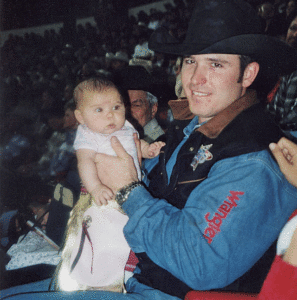
    For five decades, Mike, who earned PRCA Stock Contractor of the Year (1983, 2001), and his sons (the late Mike Jr., Binion, and Chase) have produced many of the country’s biggest rodeos, including RodeoHouston, the National Western Stock Show & Rodeo in Denver, and the San Antonio Stock Show & Rodeo and 27 others. They continue to take many of their animals to the Wrangler NFR. Recognized for his accomplishments, Cervi was inducted into the PRCA Hall of Fame in 2003.


    Today, Mike and his sons are recognized as one of the largest rodeo producers in the country, yet he has always been a deal-maker and entrepreneur. As an elementary schoolboy, he sold flavored toothpicks and Christmas trees, hauled ashes and rode racehorses. Cervi became fascinated by rodeo clowns and, by age 14, had a trained mule act at Little Britches and junior rodeos.


    Mike grew up in Littleton, Colorado where his dad had a newspaper. He got interested in rodeo through the Centennial racetrack, which was not far from his childhood home. “I started out galloping horses at the race track in 1952 at age 12. Many of the people I met were involved in rodeo. I took off with it from there.” Two years later, Cervi was at a Little Britches rodeo, where he was competing in steer wrestling and bull riding. He ended up clowning as well, because someone didn’t show up, and his passion for crowd-pleasing performances was sparked.
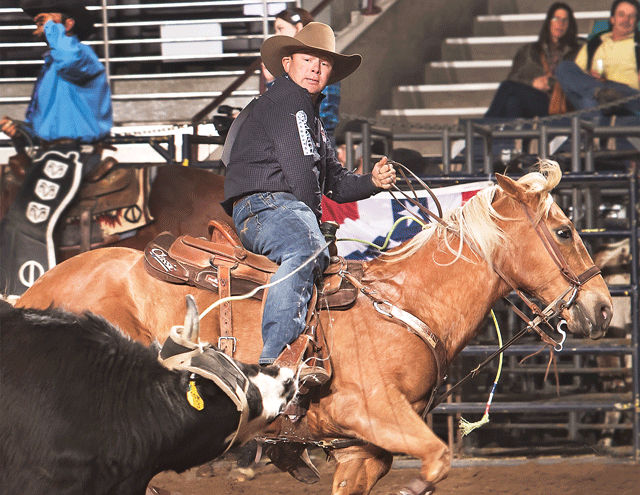


    Spending a semester at Colorado State University, Mike got his first taste of stock contracting. “Marvin Brookman sent all the stock to that rodeo in 1957, but didn’t have any help, so I pitched in,” recalled Mike. “That’s when the arena was outdoors – it was just a simple wire and the cars would park all around the outside of it.” Cervi Championship Rodeo now provides stock for CSU every Spring.


    Mike decided college wasn’t for him and took off for the rodeo road, taking his clown acts, steer wrestling and bull riding with him. One of his acts, the famous mule act, came from George Mills. “He gave me the mule, trailer, and everything I needed,” said Mike. “Gravel Gertie (the mule) would ride into the arena in the taxi cab, get out of the car and lie down while putting her feet in the air. She would get back in the car to leave the arena.” He had another trick that involved a station wagon with windows that were soaped up so nobody could see inside. “We’d get about 32 kids and pack that wagon. We were bringing the kids to the rodeo and every five or ten feet we’d stop the car and let a few more out. At the end, we’d let Gravel Gertie out – that’s how we got the idea of the colt coming out of the limo that we still use today.”


    The family had a ranch near Sterling, Colorado, which was homesteaded by his grandfather starting in 1852. In 1958 Mike acquired the family ranch. “When I first got to the ranch, I bought a load of cattle from Oregon. I was only 19,” explains Mike. “My dad called and asked how I was going to pay for them. I hauled the load to Scottsbluff and resold. I made a little over $350 – that was a lot of money back then. From there I started trading – I would bring cattle from the west, back to Colorado. It put a little change in my pocket.” He bought an airplane, put a good friend in charge of the ranch and took off. “That’s what I did from 1960 through half of 1980.” During that time the Cervi’s expanded their Colorado operations – adding a ranch in Roggen in 1979 and the Cervi Feedlot east of Greeley in 2001.
     

    Along with trading cattle, Mike was also producing rodeos. In 1967 he acquired the Beutler Brothers Rodeo Company, now known as Cervi Brothers Rodeo Company, and in 1974 the Billy Minick Rodeo Company, now known as Cervi Championship Rodeo Company. “When I got in it, there were two major stock contractors – Harry Knight and Beutler. Harry Knight was one of my best friends and one of the most professional people I’d ever been around.” During that time, Mike bought quality bucking horses. “I would buy all the good horses out there that I could. In the early 60s, 70s, 80s, my goal was to grow and improve our string of horses. That was the key to a lot of it. When we were in Oklahoma at the Finals, we sent as many as 35 horses to the Finals every year.”


    Mike Junior was born January 4, 1971, and his role in the stock contracting grew over time. At the age of 16 Mike went up to Canada and borrowed a stud from Donny Peterson. “He drove up there and wanted this stud – he’s the one that started the breeding program here,” said Mike. 70-80% of the first set of colts yielded good bucking horses. He got a scholarship at Sacramento State for football as backup quarterback. He graduated with a degree in history, and went to picking up for Mike. “He married Sherry (Cervi), and started to trade cattle. He was going to circuit finals, roping, and helping with the stock as he could.” Mike Junior was killed in 2002 when the twin-engine Cessna that he and four others were traveling in crashed. He was on the bubble in the standings and trying to get to a rodeo in Missouri. The loss was a void that Mike will never fill.


    Another tragedy struck the Cervi family in 2005 when Mike was charged with violations of the Safe Drinking Water Act. “It had to do with wastewater disposal for an oil field,” Mike explained. “I had built a monitoring well in 2000 and we had a leak – my employees were bypassing that without my knowledge.” Three years later, Mike spent five months in prison. “I came home from court and told Binion and Chase that I had to go to prison. They were 19 and 21.”

    “It felt like a lot of responsibility at the time, especially given our age, but everything happens for a reason,” said Binion.
    “I ran the ranches in Lompoc, California on Vandenberg Air Force Base,” said Mike. “They asked me to take care of 900 cows for them. The game wardens had five horses that were terrible, so I asked Chase to bring me some pickup horses and they stayed with me awhile.” Mike was able to raise their calf weight by 42 pounds by implementing his experience raising cattle and teach the game wardens how to do it. “They didn’t want me to leave,” he said with a laugh, then adding with a serious note about being in prison. “It matures you dramatically and you learn what the real world is – meeting all kinds of interesting characters.” He got out while RodeoHouston was going on, “All my committees stuck by me,” said Mike. He had home detention for five months, paid $30,000 in fines, and did several hundred hours of community service.


    After that, it was business as usual. Mike settled into his role running the feedlot, while Binion and Chase continued down the road. “I run this feedlot and oversee the two ranches,” he said. “When things increase, you put parts together and you have good people around you is how you do it.”


    “We call him for advice,” says Binion, “Dad gave us an opportunity that most people would die for. He would give you whatever you needed to get the job done. He crafted Chase and I each to do what we wanted to do and did best.” Cervi Championship Rodeo provides stock for pro, amateur, college, and high school rodeos. “We’ll take an animal for everybody – we bring enough for all of them. We make it as fair as we can for college and high school to compete on the same level.”


    Chase handles the livestock end of the ranch, on both ranches. He also picks up at every rodeo that Cervi produces. Chase was horseback his entire life, beginning his picking up at the age of 14. He gets horses that are started and then he trains them to be pickup horses. He doesn’t sell any, but when they retire, he gives them to a kid as a good retirement home and family friend. “We are blessed to be able to do what we’ve done our whole lives. Binion and I plan to be part of the rodeo thing forever, and we hope to carry on my dad’s legacy. It’s some pretty big shoes to fill.


    “These boys goals for high school and college is to develop the cowboy; help these youngsters come up so they have something to get on later,” said Mike. “They try to bring horses that the kids can be taught something on.” Part of that program includes a nonprofit that they started to provide free schools to help teach the next generation of bronc riders. To-date, the Ace High Roughstock Academy has put on 25 free schools in the last eight years and hosted over 700 aspiring saddle bronc and bareback riders. “We will host the first one of the year at the ranch in Stoneham, Colorado May 24-26. At the end we give prizes and scholarships.” Acehighroughstockacad.com has more information about the schools.


    A lot has changed over the years in rodeo for Mike. “Rodeo has increased in popularity considerably,” he said. So has the number of stock contractors. “There were probably 15-20 active stock contractors in the PRCA when I started; now there are over 70.” He has remained at the forefront of that list by being an example to others. “The best management is the owners’ footprint – the best fertilizer for a ranch.”


    Mike ended with this, “One day, if it all went away, we’ve been blessed to be able to do it.”

  • ProFile: Sydney Frey

    ProFile: Sydney Frey

    Sydney Frey, daughter of NFR bareback rider, Shawn Frey, won the barrel racing at the Junior American, held in Fort Worth, Texas. Her efforts against 155 barrel races won her $10,000 and a Twister 2 horse trailer, a beautiful buckle, and a Resistol 100x hat. “It’s another great opportunity for kids my age to go after the money they put up,” said the Marlow, Oklahoma, cowgirl who plans to put the money back. “If I had it right now, I’d probably go shopping.” Sydney started running barrels at the age of five, with her mom (Gaye) leading her. “I was really involved with dancing at that age, but I didn’t get serious until my sixth grade year. I started Oklahoma Junior High and I wanted to make nationals. I quit dance and after one year I quit basketball and it was full on rodeo.”
    Gaye ran barrels, making the Prairie Circuit Finals. “My mom, she didn’t get to do what she wanted to do in the rodeo career, when she had her kids she let us live our dream.”
    Sydney is riding the Great Guns on Dakota. “I call him Jax – that’s what his name was when we got him and I heard its bad luck to change names. I’ve had him for a year now – we bought him from Kelly Yates. I finished out my high school year with him – won the average at the Oklahoma State High School Finals – and then we placed at some pro rodeos in Colorado, Sterling and Lamar, and he filled my permit.”
    Sydney has taken this year off from college to pursue her dream of being PRCA Resistol Rookie of the Year. “I’m going for it. I’m doing ok, I’ve hit some barrels so I need to do better, but that’s part of it and I’m going to keep going.”
    She travels mostly with her mom and dad. Her older brother also competes as a steer wrestler. Her dad trades cattle and ranches and made the NFR three times, ‘88, ‘89, ‘90. “It’s changed a bunch since then. He’s a good driver though.”
    “I thank the Good Lord above first all, and my family, who has gotten me here and I thank Kelly Yates and I thank my vet, Robbin Johnson – she’s kept my horses all together and she’s a phone call away.”
    She also thanks her sponsors, Stierwalt Superflex, Team Resistol, and Team Tres Rios.

  • Back When They Bucked with Carolynn Seay Vietor

    Back When They Bucked with Carolynn Seay Vietor

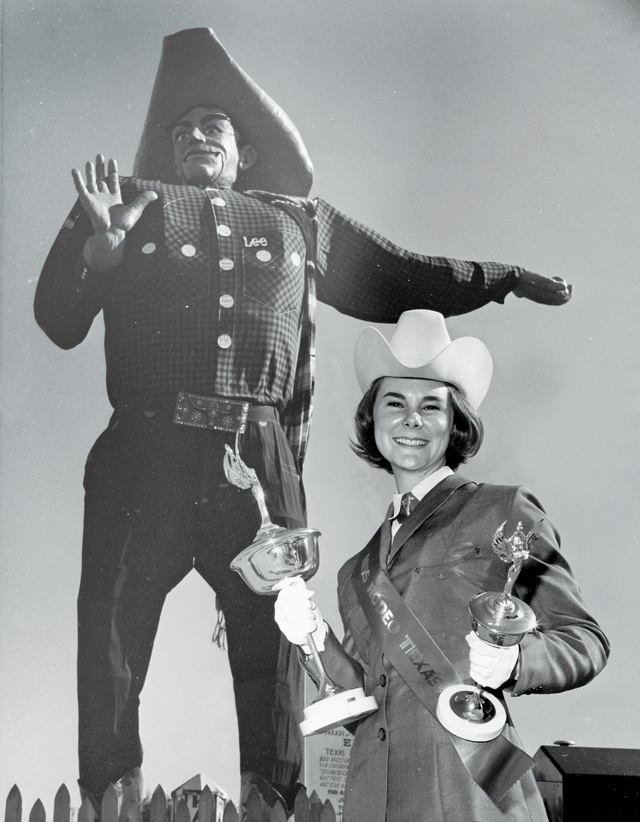
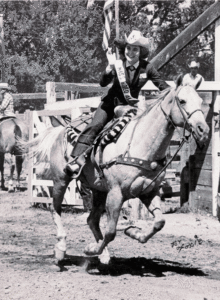
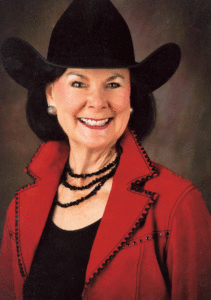
    Front porch sittin’ will have to wait at the Rocking Chair Ranch, in Philipsburg, Montana, because Carolynn and her husband Willy Vietor are far too busy in the rodeo world to occupy rocking chairs. Carolynn, former Miss Rodeo America 1966, has spent a lifetime promoting and competing in professional rodeo as well as promoting the western lifestyle. Carolynn spends many hours in the saddle each week exercising and training on three horses, (her competition horse, back-up horse and prospect mare) and often stays at the barn until after dark. With a rodeo career spanning over 6 decades, Carolynn still has a passion for running barrels and every Tuesday night through the summer season you can find her sharing that passion at the Ranch at Rock Creek, just 20 minutes across the mountain from her home. “Riding in the exhibition rodeos and sharing rodeo with people that know nothing about it has been one of the most rewarding things I’ve done in the promotion of the sport and the western lifestyle.” The rodeos are produced at the luxury dude ranch to share the experience of the wild west and a close-up view of rodeo with guests from all over the world, including social hours so guests can interact with the cowboys and cowgirls competing. Willy and Carolynn began working with the Ranch at Rock River three years ago, and the rodeos, produced with the help of former PRCA stock contractor Joe DeMers, offer a full slate of rodeo events to wow the crowds. Willy flags timed events and competes as a team roper in the rodeos. Barrel racing is one of the favored events of the night, and although many of the ranch’s wranglers race, Carolynn is the only professional barrel racer to star in the show, “I ride in full-dress code, bring one of my best horses and make the best run I can each rodeo, giving the guests a glimpse of true rodeo runs. All I’ve done in my life is coming to a head in doing this, it’s turned out to be one of the highlights of my life.”

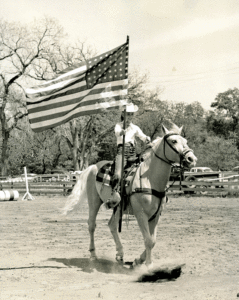
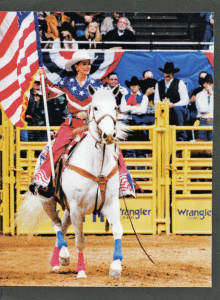
    Carolynn grew up in San Antonio, Texas as an only child and spent many days at her grandparents’ ranch just outside of Campbellton, Texas. Doll and J.G. Callan instilled a love of horses into their granddaughter, and as a child would take her to the San Antonio Stock Show and Rodeo. “Some friends of my grandparents gave us box seat tickets, and from those seats I watched the barrel racing for the first time and was hooked. I knew right then and there that I wanted to barrel race one day.” Carolynn’s grandpa was a cattleman and although he didn’t have rodeo horses, he made sure to buy his young granddaughter a horse that was kept at a nearby boarding stable and Carolynn spent several years riding and even competing in western pleasure shows. “My grandparents bought me a wonderful Palomino gelding named Sunny Boy. I was honored to carry the American flag on him at one of the shows at just 9-years-old; little did I know then that I would one day carry the American flag as Miss Rodeo America, and later at the 1998 opening ceremony of the Wrangler National Finals Rodeo on the WPRA’s 50th Anniversary.”
    Although Carolynn’s dream was to be a barrel racer, even then barrel horses were very expensive, so she started out on ranch horses and entered high school rodeos as a breakaway roper. “I was 4th in the state of Texas in breakaway roping, on borrowed horses with borrowed trailers, actually borrowed everything!” Carolynn graduated from W.B. Ray High School in Corpus Christi, Texas before going on to compete on the college rodeo team for Southwest Texas State as a goat tyer. Carolynn was the NIRA Southern Region Champion Goat Tyer two years in a row and placed deep in the goat tying at the college national finals in 1964. In 1965, the NIRA held a Rodeo Queen contest and Carolynn rode away from the competition with the crown and title that summer. By the fall of that same year, she had also claimed the Miss Rodeo Texas crown, and finally went on to collect the coveted Miss Rodeo America crown, reigning for all three associations in 1966. Carolynn was the first Miss Rodeo America to win in all three categories of the competition; horsemanship, personality, and appearance. After taking the year off from college to focus on her responsibilities as rodeo queen, Carolynn graduated from Texas State University in San Marcos, Texas in 1968 with a degree in home economics and speech. Carolynn’s senior year of college, a friend set her up on a blind date with Bill, known as Willy; they were married 6 months later and have enjoyed a life of 50-years together so far. Willy served as a T-38 instructor pilot, stationed at the Laredo Air Force base for 6-years during the Vietnam War before the couple and their young son Cal, short for Callan, moved to Willy’s family ranch where they raised commercial cross-bred cattle in Philipsburg, Montana. While they were in Montana, Carolynn barrel raced at local amateur rodeos, staying close to home to focus on her family. The couple had their second son, Justin in 1974. Sadly, tragedy struck the young family in 1979 when they suffered the loss of both their 8-year old son, Cal, and Willy’s father Bill, in a tragic airplane accident.

    In the late 70’s Carolynn had a sorrel gelding that made such an impression on her that his impact on her life can still be seen today. “Promino, a son of Classy Bar, was the best horse I have ever owned, and because of him, I bought his full sister, Classy Julie, from Dears Quarter Horses in Simms, Montana, and she and our Doc Bar stud, Dee Barretta have been the foundation of every great horse I’ve had since then.” Carolynn won the Montana Barrel Racing finals on Promino two years, and while riding Promino, she filled her rookie GRA (now the WPRA) permit in 1979 at one rodeo in Helena, Montana. After filling her card while competing in the PRCA Montana Pro Rodeo Circuit, she went to the circuit finals a total of 18 times on 7 different horses. In 2003, she was the Montana Circuit Champion on one of her colts, Classy Eye Am, a sorrel mare more fondly known as Bump. In 2003, Carolynn qualified for the 2004 Dodge National Circuit Finals in Pocatello, Idaho. The couple built a winter home in 2005, just outside of Wickenburg, Arizona and Carolynn stopped going to the Montana circuit rodeos as heavily. However, slowing down was not exactly Carolynn Vietor’s speed, and she and Willy continued to compete in the National Senior Pro Rodeo Association, with Carolynn winning the 2008 NSPRA Champion Barrel Racer title on Bump.
    In 1985, she held the Northern Region Director position, followed by the Montana Director position for the Women’s Professional Rodeo Association, for a total of 10 years before taking the reins as president of the association from 1995 until 2003. After retiring for 10 years, she was re-elected as president once again serving from 2013 until 2016. During Carolynn’s time with the WPRA, she not only saw incredible growth in the industry but was also recognized with many honors and awards. Carolynn was named the 1999 Coca-Cola Woman of the Year, 2002 Pioneer Woman of the Year, and was awarded the WPRA Heritage Award in 2002 as well. “Everything is bigger and better, Miss Rodeo America, rodeos, barrel racing, all of it. There are so many more rodeos, more sponsors, and so much more money. No one ever dreamed we’d compete for the money we can today.” In 2008, Carolynn was honored as the Texas State University Alumna of the Year because of her work in professional rodeo. Although it was due to the efforts of several board members and many years of earnestly working towards goals, Carolynn was fortunate to see major accomplishments while she was the WPRA president; in 1998, team ropers and barrel racers were given equal money at the Wrangler National Finals Rodeo, and she was also in the lead of the WPRA when the prize money went to over a million dollars at the WNFR.
    Carolynn is as busy as ever today, filled with the same passion for barrel racing that has been the story of her life. “I have a 7-year old horse coming up, so I’m about ready to get more heavily into competing again. I broke my leg last year so that slowed me down some, but I’ve finally just about forgotten I broke it, so I’m getting back in the groove and ready to go again.” Besides judging at multiple events, when in Arizona Willy ropes nearly every day of the week, sometimes going to 2 or 3 ropings a day. They enjoy spending time with Justin, his wife Brook, and their two granddaughters, Ellie, 8, and Reese, 6, (lovingly known as MayMay), who live near Salt Lake City, Utah. Carolynn and Willy are on a desperate search to find the perfect kid horses to share with their granddaughters, hoping to instill the same passion for the lifestyle that her grandparents once did for her.
    The Vietor family was inducted to the 2016 Montana Pro Rodeo Hall and Wall of Fame and in 2017, Carolynn was included as one of the Outstanding Women of the West at the Montana Silversmith World Reunion and Gold Card Gathering.
    “Professional rodeo has grown by leaps and bounds from the cowboys of the Turtle days that worked to gain recognition as a professional sport to what it is today, but still with the ground roots of the western lifestyle and where we came from. I am so happy to have been a part of it and see it all happen.”

  • On The Trail with Madison Outhier

    On The Trail with Madison Outhier

    Madison “Madi” Outhier has been competing in rodeo since she was one. “I started in the lead line,” said the 16-year-old sophomore who made history by winning both the Junior American and the American in the breakaway roping on March 3 at AT&T Stadium in Arlington, Texas. “I started roping when I was 8.” Helping her get the win was her equine partner, Rooster, a 10-year-old gelding that was raised on the ranch and trained by her dad, Mike.


    “Rooster is amazing. My dad let me start roping off him when he was seven, three years ago. He didn’t let me ride him too much because he would stop way too hard for my roping abilities. We are so molded together – he’s the sweetest horse in the barn. When I saddle him, he turns his head and nudges me. He goes wherever we need to go with a great attitude.”


    Rooster is a grandson of Colonel Freckles and a son of Gallo De Cielo. His mom is Colonel C Hermosa, a horse that was raised on the Outhier ranch as part of the LA Waters Quarter Horse breeding program started in the 1970s by Madi’s grandparents, Lou and Wanda Waters. “Colonel Freckles was a futurity Champ and one of the best cutting horses around,” explains Mike, who is Madi’s main coach. I had Rooster ready three years ago, but Madi wasn’t. We worked on position and the basics. Madi works real hard at rodeo and she’s so coachable.” Mike competed in both ends of the arena; bareback, saddle bronc, bull riding, calf roping, team roping, steer wrestling, and steer roping. He entered his first International Pro Rodeo at the age of 15 and went to the International Finals Rodeo, winning the All Around in 1995, 1996, and 1997. He made four appearances at the Wrangler National Finals, 2001 – 2004, competing in saddle bronc riding. He won the PRCA Linderman Award twice; 2004 and 2007. Through rodeo, Mike has developed a huge circle of friends that have been instrumental in his daughter’s success. His good friend, Ricky Canton, is a huge part of it. “He always keeps us in calves and puts on ropings every Saturday and Sunday in the fall and winter. It’s really helped her roping- she’s roping against girls that have roping schools of their own.”


    Madi also honed her horsemanship skills by playing polo, something her mom, Kristy, did professionally for 25 years. She played her last polo match last year, retiring to stay home with her family and help Mike with the horses that they train and sell .“Polo has helped me a lot with my competition skills, my mind set,” said Madi. “You have an hour and a half to make up your mistakes in polo, in rodeo you have 2 seconds and then you have to drive home. I bring my polo mindset to rodeo – and don’t get too stressed out.”


    All that support and Rooster’s incredible abilities have paid off greatly this year. They won the Junior NFR in Vegas in the 15 and under; Joe Beaver 15 and under, Cody Ohl and won second in Lari Dee Guy’s open breakaway.


    The family ranch is in Utopia, Texas, but they also have a place in Fulshear, 30 minutes from the middle of Houston, where they live during the week so Madi and her younger brother, Ace, can attend school. “Mom has a big polo barn. We live in a little house attached to the barn. Rooster is 200 feet away from my bedroom. We have polo fields out front that our family built.”


    Ace (11), is involved in baseball, basketball, football, fishing, and hunting. They both work hard at school. “School is very important to me and my family. I play basketball as well so basically ever since school started I’ve had basketball, then come home and rope and then homework. I work really hard to keep all As, but it’s worth it to keep good grades to get into a good college.” Kristy handles all the communication with school when Madi has to take time off to attend rodeos. “The teachers know I work hard and they give me my work and I usually get it done before I leave.”


    Besides polo, rodeo, basketball, and school, Madi has another passion – acting. “I was an actress and that’s all I wanted to do when I was 9. We spent one summer living in New York City. My mom had a couple of polo jobs in upstate New York that summer. I had won an acting competition that gave me an agent in New York City that sent me on auditions, sometimes three a day… all summer,” she said. “I was in a couple movies with Robert Duvall. That’s what I did and what I loved.” She was also in a fabulous children’s movie called “Charlie, A Toy Story.”


    She missed the ranch, though, and they came home. “It’s so much different when you have a whole ranch in Texas versus a tiny little apartment in New York City. My mom was so awesome to support me in taking me there, but they didn’t want to live there either. I had an agent in Houston that I still do auditions for, but a year ago I started focusing on everything else I was doing. It was too much to balance rodeo, basketball, school, – I still love the acting world – in fact Robert Duvall called my dad to congratulate me.” She felt the experience with acting gave her the skills to interview, something she has done a lot of since winning the American.


    Madi found out about the Junior American through the International Finals Youth Rodeo. “We signed up there and I went to a few others – Joe Beaver and Cody Ohl had qualifiers. Joe Beaver is also where I qualified for the open breakaway.” She had two spots in the Junior American and two spots in the main semi finals.


    After she won the Junior American short go on Friday, at the Will Rogers Memorial Stadium in Ft. Worth., she moved to the fifth round of the semi qualifiers at Cowtown Coliseum. “I honestly think I used up all my nerves in the semifinals. Once I made it to AT&T I knew I had accomplished my main goal. I was just like okay, get this one run at a time. Three runs. The last one was a 2.2 – my fastest time is a 1.7 at Ricky Canton’s roping. I was a 1.9 to win the Junior American at Will Rogers. I was actually a 1.9 three times that week. I’m usually not that fast.” She gives her dad the credit for that. “My dad giving me the perfect start. He can watch the calf and how long the box and barrier is. And then the calves were great there all week. We kept a list on them and we watched a video on them.” After that, she just remembers what he told her and nods her head. “Tip down, throw down. Look at the shoulder.”


    After that win, what’s next for this young roper? She competes in barrel racing and cutting, but breakaway is her favorite event. “I get direct results – the horse is a huge part of it, but I have control of the winnings because it’s myself doing the roping.” She practices every day – she ropes on Rooster and one other practice horse and I rope between 10 and 20 calves every day. I try to rope the dummy too.”


    College is definitely in the future. “I really don’t know what I want to do – I love the business industry, I’ll get into that like my grandpa did. My mom’s dad (Lou Waters) has taught me how to act and be and go about things. He’s such a respected and humble man.” Madi is quick to give her parents the credit for her success. “They taught me all their horsemanship skills and to stay humble and take everything as a blessing. I pray to God every night. They’ve showed me how to live.”

  • Roper Review: Luke Brown

    Roper Review: Luke Brown

    Earning $2 million as a professional cowboy is a milestone that PRCA team roper, Luke Brown, recently surpassed. Coming from east of the Mississippi, Luke still hasn’t fully accepted that he is in such an elite group, with only 30 cowboys to achieve those career earnings, out of thousands competing in the history of the sport. “Realizing I had passed the $2-million mark was pretty unbelievable but recognizing that I was one of such a small group of cowboys that had done it was mind-blowing; some of the greatest cowboys that have ever lived have had careers in the PRCA.”
    The Rock Hill, South Carolina native remembers well the day he passed the $1 million threshold in earnings, “My wife Lacy made a cake that said ‘Millionaire’ on it, and even though I had spent most of what I had earned, it was cool knowing I’d accomplished that.” Luke feels that this second million was slightly easier to achieve because of the increase in great paying rodeos. He earned $71,134 during the 2018 WNFR alone, and with more rodeos offering great payouts, it’s propelling cowboys to increased earnings at a faster rate.
    Growing up, Luke Swann Brown III was the oldest of the three Brown brothers born to Luke Jr. and Debbie Brown. His parents owned a construction company, and Luke, Jay and Cody spent their childhood roping and competing in junior and high school rodeos. While competing in the South Carolina High School Rodeo Association, Luke won 6 state titles, claiming 2 titles in the all-around, team roping and tie-down roping before graduating from Northwestern High School in 1992. Luke went on to Howard College in Big Springs, Texas to college rodeo for two seasons while studying for an agriculture degree. He returned to Rock Hill and went to work, while rodeoing in the SRA, IPRA, and attending many PRCA rodeos.
    A pivotal year for Luke was 2007, as he made the decision to move to Stephenville, Texas, live in his horse trailer, and make roping a full-time career. “I knew I was either going to have to go all in or get a better job and just make roping a hobby.” Luke credits much of the change in his path to professional ropers Allen Bach and Chad Masters. “Spending time with Allen, roping with him, and getting to be around some professionals that roped for a living, opened my eyes a lot. I watched their game plan as they practiced, noticed their priorities, and copied some of that to make a plan for my own roping. I lived with Chad Masters and he helped to change my roping style. I started catching better, riding better, and worked hard at the fundamentals; I had more of a blueprint for how I wanted to rope. Then, I got lucky and got a great horse, started getting better partners, and I never looked back.”
    Kevin Daniels loaned Luke a blaze-faced sorrel gelding named Slim Shady to practice on and help sell. Luke had recently lost two of his good horses, so riding Slim Shady was a blessing that he needed. “He was goofy about certain things, but he could run, and I roped so good on him. We started clicking, then went to winning, and I rode him until two years ago when I retired him; he’s 25 now.” Luke roped on Slim Shady that first season, competing on him at his first WNFR in 2008, while Kevin still owned him. “After the USTRC finals that year, I placed third with Jade Corkill and had enough money to buy Slim, so I paid Kevin for him as soon as I came home. Kevin had never said a word about it, he just told me to pay for him when I could, and I did.” Since retiring Slim Shady, the past two seasons Luke has ridden a palomino gelding that Brandon Webb gave to him and his daughter, Libby, 5. “He’s done great for me, but 2018 was his last WNFR, and now he’s my daughter’s to ride. She’s starting to enjoy riding, and it’s fun to see her on him.” Luke and his wife Lacy were married in 2011; she grew up in Texas in a family of cutting horse trainers. “Lacy and I enjoy roping together, and she takes care of all the hard stuff for our family so I can just focus on roping.” Luke is now mainly riding another palomino gelding he calls Fast Time, and still thinking about what horse he will ride for the 2019 WNFR.
    For 11 years, there has not been a December that Luke hasn’t rolled in to Las Vegas to compete at the WNFR. He has qualified as one of the top 15 headers in the world every season since making that decision to go all-in. “Every single finals is exciting, but I’ll never forget the first time, it was an unforgettable moment. I’d never been there or watched it live or anything, so it was pretty unbelievable when I first drove in. I still half-way don’t believe that this guy from South Carolina is where he is now.” For the last three years, Luke’s heeler has been Jake Long, and they’ve been a dominant pairing in the PRCA. This season, Luke will be roping with Paul Eaves, and he’s looking forward to a successful partnership with him. “At the end of the day, it all comes down to me doing the best I can do. I feel lucky to be a header because I have a lot of control over the money I make. These heelers are phenomenal, they have to deal with whatever you give them, but if you give them something to look at, they’re going to catch.”
    Most of Luke’s days include practicing and riding horses. “I don’t go to bed at night without a practice plan for the next day. I try to keep a consistent schedule so that my horses are ridden how they need, and so I work on areas I need for myself each day. I’m pretty hard-headed about staying disciplined and have found that if I stay to the basics and don’t get over or under-confident things go better. Some of the best advice I’ve heard is from Trevor Brazile; he said, ‘the shorter memory span you have the better off you’ll be. Do the best you can on that steer, then go to the next one and do the best you can.’ You keep doing the best you can on the steer you’re roping at the time, and at the end of the year the results will be there.”
    Luke appreciates his sponsors: Classic Ropes, Martin Saddles, 3S Services, All Nations Oilfield, Purina, Priefert, Wrangler, Smarty, Rodeo Rigs, Roberson Hill Ranch Cattle, Durango Boots, and Bill Fick Ford.

  • Back When They Bucked with John Harris

    Back When They Bucked with John Harris

    From the time he was a baby, all John Farris ever wanted to do was be a cowboy. And he spent his life doing it. The Addington, Oklahoma man was born in 1928 in Iowa Park, Texas, the son of B.A. and Eva Farris. When the neighbor’s cows got out and onto Farris property, John and his brother would ride them. At the age of sixteen, he hitchhiked to the rodeo in Jacksboro, Texas, to ride a bull. He got hit in the mouth, and when his parents found out where he’d been, “they threw a fit,” John remembers.
    But it didn’t discourage him. He graduated high school in 1944 and went to work, plowing for neighbors and working in the oilfield. He rodeoed, too, riding bareback horses, saddle bronc horses, bulls, roping, and even doing a little steer wrestling. Of his events, he won the most money at the saddle bronc riding and bull riding. In 1951, he won the wild horse race and placed in the amateur bronc riding at Cheyenne Frontier Days.
    It was at a rodeo in Stanford, Texas, in 1954 when he met a striking dark-haired barrel racer. John and Mildred Cotten met on July 4 and were married the next year. She was an accomplished barrel racer, winning the Texas Barrel Racers Association championship in 1955-57. When she joined the Girls Rodeo Association (the predecessor to the Women’s Pro Rodeo Association) in 1958, she began going to pro rodeos, and in 1957, John got his RCA (Rodeo Cowboys Association, the forerunner to the Pro Rodeo Cowboys Association) card, and the two traveled together.
    They spent the next fifty-plus years together, rodeoing and traveling across the nation.

    In 1962, they began working for stock contractor Tommy Steiner. Mildred took entries (those were the days before Procom and the computerized entry system, when contestants called the rodeo secretary to enter) and secretaried the rodeo. John was chute boss, for either the timed event end or the roughstock end, or both. Steiner was the first producer they worked for, but throughout their lives, they worked for others: Harper Morgan Rodeo Co., Neal Gay, Don Gay, Stace Smith, Mack Altizer, the Auger Rodeo Co., Mike Cervi, and more.
    When the Farris’s worked a rodeo, things went smoothly; the pay-out was right, the arena was clean, and the stock was loaded correctly.
    While they worked for stock contractors, both continued to compete. John rode bulls till the age of 44, and Mildred qualified for the National Finals Rodeo thirteen times.
    In 1967, one of the years Mildred made the NFR, John began a career of working the NFR that would last till 2012. Throughout those forty-six years, John did everything from security work to caring for grand entry saddle horses to working as chute boss. He was timed event chute boss for years, sorting cattle, setting the barrier, and making sure the animals were in the right sequence. He’s best known by rodeo fans as they saw him on TV: flagging in the next barrel racer during each night of the NFR. He set the barrel pattern at the NFR every year, from 1967 to 2012.
    The couple rodeoed nearly year-round. They would be gone all summer and most of the fall. After the NFR, they would be home till the Texas Circuit Finals on New Year’s, then home again until Ft. Worth started. The couple moved to Addington, to be near John’s parents. Their sons: Billy Tom and Johnny, stayed with B.A. and Eva Farris during the school year. As soon as school got out, the boys were with them. And during the school year, if the rodeo was close, John might run up to Addington to pick them up for a weekend, or a contestant traveling south might bring them. A few times, Tommy Steiner flew his airplane to get them.
    They worked thirty-five or forty rodeos a year, and as soon as their boys were old enough, they were on the labor list. They pushed calves and took saddles off, among other chores. “We’d rather do that than run around,” Johnny remembered.
    John and Mildred would call and check in on their kids but if the boys needed to get ahold of their parents, they called Procom. It was before the invention of the cell phone, and Procom would give the boys the number for the rodeo their parents were at. Then the boys would wait till entries opened for the rodeo, and Mildred would answer their call.

    John was working for Tommy Steiner when Tommy was the first producer to use the electric eye for the barrel race. He was with Tommy when it was purchased. He also considers improvements to the judging system as another forward step in pro rodeo. Before the professional judging system, a cowboy might get scored poorly if he wasn’t a friend of the judge. When the pro system started, it leveled the playing field.
    John and Mildred were reserved, but they took care of business, said Vickie Shireman, a PRCA secretary who knows the Farris family and worked with the couple. “They were very well respected. They were quiet, but if somebody needed help, John and Mildred would be the first to help.” They helped numerous cowboys and cowgirls get started, nurturing young people on the rodeo road. Buddy Lytle, a tie-down roper, steer wrestler, and later, a judge, lived with the family for years. Announcer Mike Mathis was a friend of the family. “John was an amazing cowboy,” he said. “He was a hell of a competitor, and he and Mildred were a team.” Rodeo producers knew that when John and Mildred worked for them, things would go smoothly. “No matter where,” Mike said, the work “was going to be taken care of, and properly.”
    One of John’s favorite parts of rodeo was the people. As contract labor, he and Mildred would be in town for the entire week of rodeo, and made countless friends among contestants, contract personnel, and committee members. They watched children of friends grow up, often seeing multiple generations compete. John worked through hundreds of hours of slack, sometimes six or seven hours a day, but it never got old for him. Once, after three days of slack at a rodeo, world champion tie-down roper Fred Whitfield asked John if he was tired of it. No, he answered, “because I get to see everybody.”
    Mildred passed away in 2013; before she died, she and John were recognized numerous times. They are the only couple to be inducted into the Pro Rodeo Hall of Fame (2006); the Texas Rodeo Cowboy Hall of Fame (2004) and the Rodeo Hall of Fame in the National Cowboy and Western Heritage Museum in Oklahoma City (2010).
    John was chute boss for the Texas Circuit Finals for twenty years and received the WPRA’s Outstanding Individual Award in 1999. He was Texas Circuit Man of the Year in 1997. Mildred was PRCA Secretary of the Year eight times and served as a director, vice-president and president of the Girls Rodeo Association and Women’s Pro Rodeo Association.
    His family: Bill and wife Sally, and Johnny and wife Jan, threw a ninetieth birthday party for him last year. More than 140 people came to visit with John and celebrate his life. John has four grandchildren and two great-grandchildren.

  • ProFile: Jessica Routier

    ProFile: Jessica Routier

    In her first year at the Wrangler National Finals Rodeo, Jessica Routier set her rodeo career on fire. And she had some help in doing it, aboard an exceptional horse.
    Routier, of Buffalo, South Dakota, rode Fiery Miss West, “Missy”, won over $250,000 for the year, and finished the rodeo season as reserve champion, second only to the 2018 world champ Hailey Kinsel.
    Missy, an eight-year-old palomino, was Jessica’s futurity horse just two years ago. Owned by Gary Westergren of Westergren Quarter Horses in Lincoln, Neb., she is an exceptional horse who is unusual for her self-awareness, Jessica said. “You see quite a few young horses running these days, but to have one that makes runs like she does, with no mistakes, is pretty rare.”
    Jessica’s exceptional year began with her RAM Badlands Circuit championship in 2017, which qualified her to compete at the RAM National Circuit Finals in Kissimmee, Fla., in March. There, she finished in second place, which put her at her highest rodeo rankings ever: the top twenty in the world. A trip to the WNFR was within reach. So at the Guymon, Okla. rodeo, she sat in her trailer with an atlas and a rodeo schedule, mapping out her rodeo year, knowing that she might have a chance to make the Finals.
    Jessica competed at 58 rodeos, traveling all over the nation, but never being gone from home more than two weeks at a time. Missy, her untried mount, handled them all. “There’s not a lot of different things I have to watch out for” with Missy, Jessica said. “That helped us last year, where we didn’t know where we were going (the arena conditions and set ups). She’s really adjustable to all the different situations.” Missy never ran like an amateur. “There wasn’t once where I felt she had a novice horse moment that screwed something up for us.”
    Jessica has been rodeoing since she was a little girl, growing up in Montfort, Wisconsin. The daughter of Jon and Shelly Mueller, her mom trained horses and both parents rodeoed a bit during their college and young adult days. Jessica was always interested in horses, competing at Little Britches Rodeos and the Wisconsin High School Rodeo Association where she did every girls event, winning the Wisconsin high school cutting title four years, the goat tying three years, and the poles and breakaway twice. She is a three-time Wisconsin all-around champion as well.
    With a rodeo scholarship to National American University in Rapid City, she competed under the tutelage of Glen Lammers. He was the main reason she chose NAU, and she appreciated his help. “He was a really involved coach who wanted to help anyone who worked hard. He was just a really great rodeo coach,” she said.
    She qualified for the College National Finals Rodeo four times, winning the national barrel racing title in 2003. She graduated in 2006 with a master’s degree in business.
    During her time in college, she met the man she would marry. Jessica was friends with Jessica Painter Holmes, Riley Routier’s cousin. At the time, Jessica Painter was dating Casey Holmes, a good friend of Routier’s from Wisconsin. Painter and Casey “set up” Jessica and Riley on a date; the four of them were going spotlighting for rabbits. Not being a hunter, it wasn’t an activity she enjoyed. She didn’t like the date, but she still liked the guy. “I don’t really know why I liked him after that,” she joked. Jessica Painter ended up marrying Casey Holmes; they live close to the Routiers.
    The Routiers married in 2007, making their home on the ranch ten miles from Buffalo. The ranch has come down through Riley’s mom’s family, the Painters, and Riley and Jessica’s kids are the sixth generation to live there. Riley’s dad Harold died twenty-eight years ago; Laurie, Riley’s mom, married Terry Goehring. Laurie and Terry, Riley and Jessica, and Riley’s brother Ryan all live on the ranch, working together but with their own herds.
    Like her mom, Jessica rode outside horses, up to a dozen horses a day. She met Westergren through mutual friends and business acquaintances, John and Liz Holman from Hot Springs. He was looking for someone to start his horses, with the ultimate goal of getting one of them to the WNFR. Jessica gets Westergren’s horses as two-year-olds. Someone else puts thirty to sixty days on them, breaking them. Then she gets them back, putting lots of ranch miles on them and slowly starting them on barrels. At that point, she and Gary decide if the horse is a good fit or not. If it is, it stays. If not, Gary sells it or if it’s a mare, takes it back and breeds it. She and Gary have worked together the last seven years, and she’s ridden a lot of really nice Westergren horses, but Missy was special. She reminded Jessica of Smoothy, the horse she won the College National Finals Rodeo on. Missy “had a lot of good qualities that I knew I liked.” Missy is a natural fit for Jessica’s riding style, too. “She’s one that I never had to really think about how I need to ride her correctly when I go into the arena. It’s natural. The way I want to ride is the way she wants to be ridden.” That’s a rare occurrence, Jessica said. “I’ve always said there are a lot of good horses and a lot of good jockeys out there, but finding two that fit together is important.”
    Missy does have a quirk, however. She doesn’t like to face cows, head on. Jessica discovered the trait while working the alleyway during AI season. “I think that’s one of the things that made her tough at a young age,” Jessica said. “We made her work through her fear. She was right in there with the cows, and she had to work through it. She’s as tough as nails. I think it’s good for a young horse to have to face their fears and learn to trust you.”
    She and Riley have five kids. Their son Braden is thirteen years old, a seventh grader and a math whiz. All year long, Braden kept track of his mom’s winnings. Daughter Payton is ten and a fifth grader who fell in love with trick riding after seeing trick rider Roz Beaton at the Badlands Circuit Finals in Minot, N.D. six years ago. Now she trick rides at regional rodeos and is working on getting her PRCA card so she can work as a specialty act.
    Twin daughters Rayna and Rose are three years old, and daughter Charlie, age two, makes up the family.
    Life in Buffalo is wonderful, especially with a family. “I love it here,” she said. “I don’t think there’s a better place in the world to raise kids.” Being gone for much of the summer was a prime example. The whole community stepped in to help babysit and take care of kids while she was gone and if Riley was out on the ranch and unable to take the kids with him. “The whole community will do whatever they need to, to help you. It’s a small town. You know everybody and everyone feels like family.”
    Her experience at her first WNFR was wonderful, and Jessica hated for it to end. There wasn’t time to sightsee and play tourist, but they made time to shop. The stomach flu hit the kids; almost every night at the rodeo, one child wasn’t able to be there, but Jessica never got sick. Both sets of grandparents were in Las Vegas and able to babysit when needed.
    She doesn’t have big plans for 2019; she’s waiting to see what Missy has in mind. Finishing second in the world will allow her to enter the big winter rodeos, which will hopefully help her move up into the top fifteen in the world standings earlier. She would like to give Missy the month of April off, to pull embryos from her. “We’ll see what we get done in the winter and that will determine how much we need to go in the summer.”
    This year, Jessica will know what rodeos are a good fit for her and Missy. “I have a better idea of what places are good for us to go to. Last year was a great big learning year, and it went well despite the fact that I hadn’t been to most of the places we went to. This year we have more experience under our belts.”
    She’s going to let it play out, “like we did last year. It’s hard to say you’re going to push hard (to qualify for the WNFR) when you only have one horse because you don’t know if they’ll get tired or need a break.” Making the WNFR is important, but she realizes that there are other important things, too. “It’s a goal again but it’s not a do or die goal.”