Rodeo Life

Category: Archive

  • Back When They Bucked with Marilyn Freimark

    Back When They Bucked with Marilyn Freimark

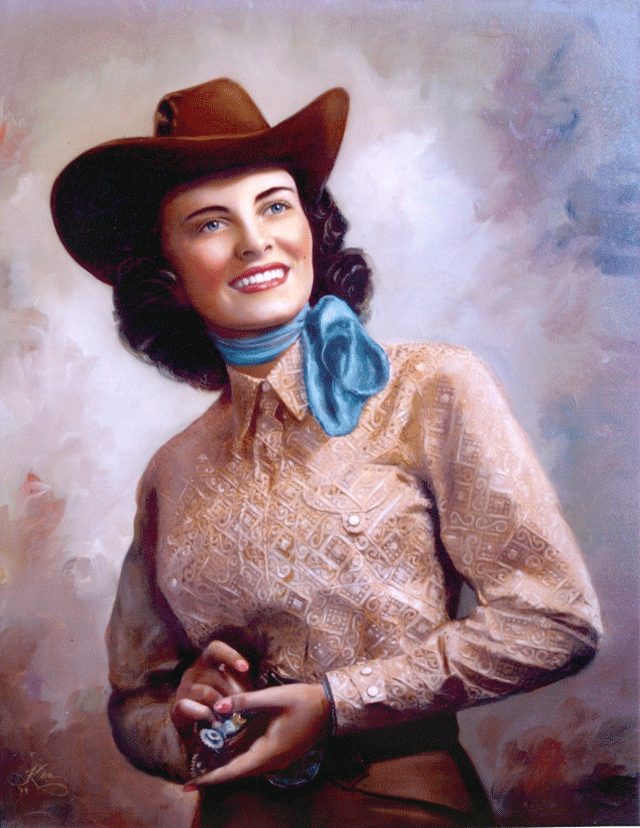
    Marilyn Freimark knows her family’s genes run thick with the blue-jean lifestyle of rodeo and horses, but it was her own love of horses that put the passion back in her family tree—and Marilyn herself into rodeo history as the first Miss Rodeo America.
    Born in 1935, Marilyn was raised in town in Cheyenne, Wyoming, but she was a country girl at heart. “The first horse I saw I fell in love with, and I’ve been in love with them ever since,” says Marilyn. “My father was a railroad man, but he came from a ranch near Newcastle, Wyoming. His brothers were all ranchers, and we would visit them every summer and ride many cattle for pleasure. When I was 13 years old, I started working at Merritt Western Store, an upscale Western store. I met people from all over the United States, and I was able to visit with them and meet a lot of ranch and rodeo people.” She modeled Merritt’s clothing and a clothing store in Cheyenne, which made up most of her own wardrobe as well.
    Marilyn graduated from Cheyenne High School in 1954, and motivated by the many Colorado livestock club students she met at work, she enrolled at Colorado State University in Fort Collins, known then as Colorado A&M University. Paying for her tuition and all her expenses through her job at Merritt’s, Marilyn majored in business and mass communications, and leapt in to a variety of school activities and sports, including Western and English riding lessons, polo, swimming, ice skating, basketball, volleyball, tennis and was an expert rifle marksman and she was an award winning fisher person. Marilyn also became a Kappa Delta and competed in five non rodeo queen contests, including Miss Colorado, Miss Colorado A&M.
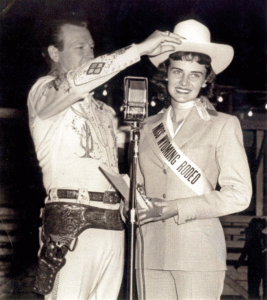
    A year into her studies at CSU, Marilyn’s employer at Merritt’s learned about the newly minted Miss Rodeo America organization and asked Marilyn if she’d like to compete for the title. “I just had fun doing it, never thinking that anything would come of it, but I won about four contests before I got into the (Miss Rodeo America) contest,” says Marilyn. Her first step was winning the Cheyenne Riding Club queen contest. With their sponsorship, as well as Merritt’s, she went on to win Miss Rodeo Wyoming, followed by Miss Rodeo Queen of the Rockies, all in 1955. “In those days, the contestants had grooms with them and some of them had been in special training for a year for the (Miss Rodeo America) contest. I had too, but it wasn’t that I was planning on doing anything with it—I just happened to be lucky and got in on some wonderful training before I went.”
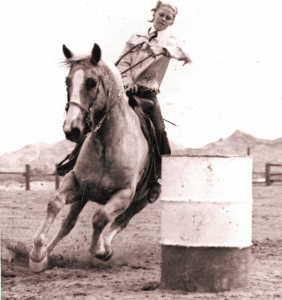
    The first Miss Rodeo America contest took place in Marilyn’s home state in Casper, where she and nine other women, including a Canadian, competed in front of 15 judges over several days. “They also had silent judges at various places watching you and seeing how friendly you were, and if you were greeting people and on your best behavior.” Marilyn excelled in and won all three divisions—horsemanship, personality, and appearance—but horsemanship was always her favorite. “You brought your own horse at that time, and they furnished other horses for us to ride. I am not a bronc buster, but I do know how to train horses for riding and western equitation, and even for English.” Marilyn competed on her mare, Blue, her first horse given to her by a friend when she was a senior in high school. “She loved to show off and do beautiful things.”
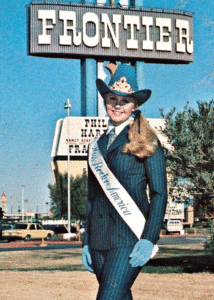
    By the end of the contest, Marilyn was hoping for the unusual—that the title would go to someone else. “I had a girlfriend from Colorado State University in the contest, Laurie, and she wanted to win so badly and I really wanted her to win.” The first ever Miss Rodeo America crown was placed on Marilyn’s hat, however. She and Laurie continued their friendship, and Marilyn, with her mother as chaperone, began traveling and representing rodeo across the country. She made history again as the first rodeo queen invited to ride at the Denver Stock Show, and she was even offered a contract with Paramount Pictures, along with opportunities for television appearances. “It was always wonderful to travel like that and go to many places and meet lots of people.” Marilyn’s schooling in mass communications came to her aid, though she was never entirely comfortable being on stage in front of an audience, and she continued studying at CSU through her reign as Miss Rodeo America.
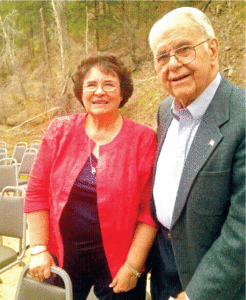
    A year after her reign, Marilyn was a junior in college when she married Paul Painter from Buffalo, South Dakota, who was also a student at CSU. The couple moved to South Dakota, where they ran Painter Ranch and Marilyn later finished her degree at Black Hills State University. She and Paul were married for 18 years and had 4 children, Joe, Laurie, Cindy, and Judy, who all went on to attend BHSU as well. When Marilyn and Paul separated, Marilyn moved to Spearfish, South Dakota, where she worked, and eventually met Dr. Lyle Freimark, a surgeon from Rapid City. They married in 1985, and while Marilyn wanted to become a stock broker, it wouldn’t give her the flexibility to travel with Lyle to seminars all over the world. Instead, she was his office manager for the next 15 years, and they traveled to 52 countries, sometimes staying for a week or even as long as 3 or 4 months. “He was very interested in music, and we always went to concerts and I loved the plays,” says Marilyn. Because of Lyle’s allergies, they didn’t have animals to care for at home, though Marilyn’s son, Joe, raised 75 head of buffalo for them at one time.
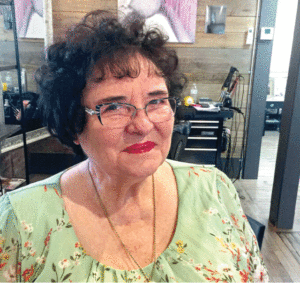
    Lyle retired in 1997, and he and Marilyn remained in Rapid City until he passed away in 2018. Marilyn stayed active in the horse world and even spoke at a rodeo queen clinic at Cheyenne Frontier Days in the early 2000s to 90 rodeo queens and their families. “I’ve always encouraged the girls to get their educations so they can take care of themselves in any situation,” says Marilyn. “I love schooling, and I told that to all my children and grand children.” Several of her children and grandchildren live nearby, and everyone in the family is involved with horses in some form, whether barrel racing like all three of Marilyn’s daughters, or team roping like her son and grandsons. Marilyn’s granddaughter-in-law, Jessica Routier, qualified for the WNFR for the first time in 2018 and finished second in the world standings. She also has a grandaughter Jessica Painter Holmes who has won over 50 saddles competing in rodeo events. “I always go to the Black Hills Stock Show, and my son, Joe, often gets into the ranch rodeo, so I’m always there that night, and I often go three or four times to the rodeo,” says Marilyn. “I’ve been blessed all my life. I’ve had two wonderful husbands, four great children, 6 grand children and 10 great grand children, two wonderful horses and two wonderful dogs. With the help of our dear Lord the many tasks I have chosen in this life have been the right decision. As a mentor for many, my legacy continues. God has blessed me and I feel very thankful.”
  • Tara Stimpson &  Painted Fling

    Tara Stimpson & Painted Fling

    article by Maesa Kummer

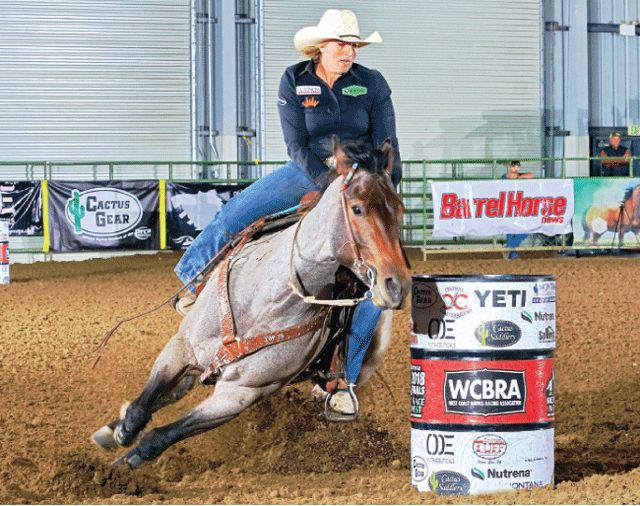
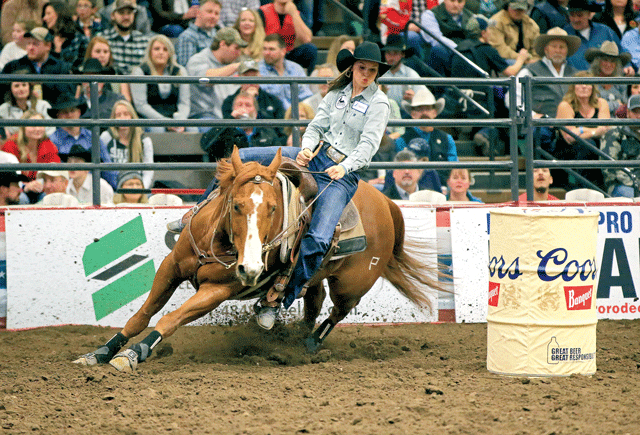
    Painted Fling aka ‘Reese’ is a 7-yr-old sorrel gelding sired by A Streak of Fling and he and his owner/rider Tara Stimpson are the new Montana Circuit Finals Barrel Racing Average Champions and have earned a trip to the RAM National Circuit Finals in Kissimmee, FL in March.
    “I bought him a year ago from Sara Cheeney and we started out together really good winning several jackpots and placing in the CSR Derby. I rodeoed on him over the summer and we didn’t have the best luck because he was going through some changes and I hadn’t really had a chance to get him completely figured out.
    My main horse ended up getting hurt the week before circuit finals and so it was up to ‘Reese’ to fill in and I wasn’t sure how that would go because I knew it was a challenging arena set up. I knew if I rode him well, that we had a good chance, but I was a little surprised at how well we did!” says Tara.
    Tara and Reese placed in every round, won the average and took home a saddle and $7,459.62 for their efforts.
    “He stayed really consistent over 3 runs! He was so honest, and we never had a perfect run but he tried his heart out and clocked so well. He doesn’t act like a barrel horse and he handles himself really well. He knows where his feet are and takes care of himself in different types of ground conditions. He’s smart and takes care of himself and me! At the circuit finals, it might have seemed like he was getting by his second barrel but he knew he needed the room so that he wouldn’t come back over the top of it. Some people think he’s a heel horse because of his build! He’s a tank!” says Tara
    Tara lives on a ranch in Lodge Grass, MT but has plans to travel south and hit some winter rodeos.

  • On The Trail with J.J. Elshere

    On The Trail with J.J. Elshere

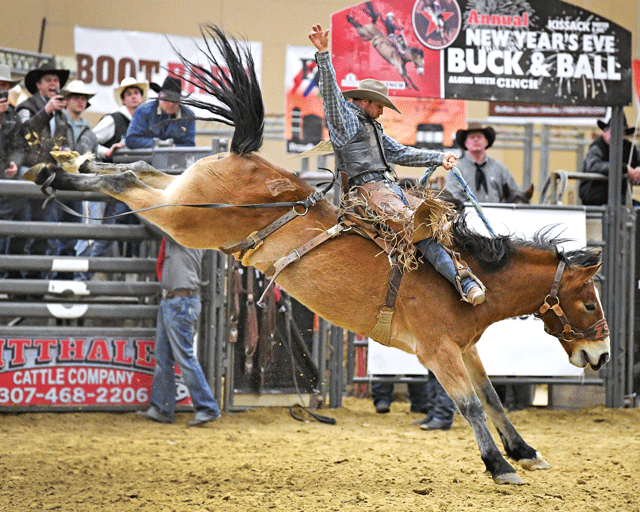
    South Dakota native J.J. Elshere finished 16th in the PRCA saddle bronc riding standings in 2018, and won his fifth Badlands Circuit Saddle Bronc Champion title in October. While J.J., short for Jeremy James, is also a four-time WNFR qualifier and the 2006 WNFR average champion in the saddle bronc riding, his motivation for riding at the age of 39 is still bucking horses over dollar signs— though pulling a check is always a highlight. “I wasn’t even planning on traveling that much, but with how Kissimmee went last year, and when I won a little out of San Antonio, things got rolling a little bit to where I decided I’d try (to qualify). I ended up pretty good for what I was planning on doing.”

    J.J. won $75,773.58 last season, and his 2019 rodeo lineup includes the San Antonio Stock Show and Rodeo, and Houston Livestock Show and Rodeo. In 2015, he competed in The American just a few months after winning the 2014 PRS World Saddle Bronc Champion title. These days, the Badlands Circuit, which J.J. has competed in since buying his PRCA card in 2000, keeps him closer to home and his wife and five sons, while the Black Hills Stock Show and Rodeo is just 40 miles down the road from his ranch near Hereford. “I’ll probably get into the Extreme Broncs there, and then the regular rodeo. They have some pretty good stock there and quite a little added money. Any time you can ride for that money and not have to travel is pretty nice.”


    These days, J.J.’s wife, Lindsay, and their five sons, Talon (16), Thayne (14), Trik (9), Tel (8), and Trailon (6), don’t often travel with him altogether because of a ranch to run and multiple school sports to attend. The whole family was with him the years he competed in the WNFR however, as well as the RNCFR in 2016, making the 30-hour drive to Kissimmee, Florida, following Trik’s state wrestling competition. “Rodeo is just the greatest sport there is. The rodeo family that you meet along the way are lifelong friends,” says Lindsay. “The years J.J. was making it to the Finals, I had four little boys with one on each side holding on to my purse. That was pretty stressful having all the kids there, and Taos Muncy’s mom (Johnnie Muncy) was sitting right behind us. She’s become one of my dearest friends and she helped me through the Finals. They become family and you can’t raise your kids without them. They video for you when you’re not there and text you to let you know how they did. And we get to see the country—our kids have been to pretty much every big zoo in the United States and Canada, and it’s a real great experience. It’s a hard life, but it’s great.”

    The Elsheres run cattle and grow hay on their ranch, all with the help of their older boys. “We sure couldn’t do half the things we do without their help. They’re pretty handy boys—rarely do we ever need outside help,” says Lindsay. She too grew up on a ranch, and rodeoed in the SDHSRA with J.J. Talon and Thayne handle the bulk of haying while J.J. is rodeoing in the summer, along with helping their neighbors during branding season and taking on other jobs like riding colts. J.J. has been starting colts since his teens, and has a pen full of horses to ride year round. “I put the basic 30 or 40 days on them, or whatever the owner wants. I have a barn that I can ride in, so they’re pretty good about loping circles in the barn all winter long. I just really like to ride horses. I like coming across the ones that are smart and pick it up quick that are pretty fun, and there are some that can be pretty challenging.” Like his sons, J.J. grew up ranching with his parents, Jim and Lana Elshere, and siblings, Cory, Ryan, and Misty, working the operation his grandpa started and later passed down to J.J.’s dad. “We’d make sure everything was done, and our parents would take us wherever we needed to go, and they worked pretty hard to help us along.”


    J.J.’s dad rode bareback horses for several years, then passed the roughstock gene along to J.J.’s older brother Ryan, who rode saddle broncs and helped J.J. start his rodeo career. “The goal was to ride professionally and make the NFR—I decided that right around high school. They didn’t have junior high rodeos back then, so I did a lot of 4-H rodeoing and then I high school rodeoed for South Dakota.” J.J. qualified for the NHSFR in saddle bronc riding in 1997 and 1998 and even slid his hand into a bull rope for a time, but saddle broncs were his niche. “It was just a little easier event because that’s what a lot of guys from up here did, so that made it easier traveling. My parents helped me out the most getting me started, and my brother. I used to work for Jeff Gabriel and he helped coach me along and we’d go to some schools. Eudell Larson, the rodeo coach in Dickinson, helped me out at some of those schools, and Tom Miller.”

    Today, J.J. helps with as many rodeo schools as he can, along with coaching Talon in the saddle bronc riding and Thayne in the steer riding. “We’ll have some practices in town or at the neighbors. We’re not really set up for bronc riding, but Thayne rides steers and we can do that at home. If not, then we go into Rapid City or Sturgis—Rory Lemmel has a nice facility we can use.” Talon qualified for the NJHFR in 2016 and now competes in the SDHSRA, while Thayne went to the 2018 NJHFR in Huron, South Dakota. “I could hit a couple rodeos that were close when he wasn’t competing, so that worked out good,” says J.J., who competes in bronc riding matches in addition to pro rodeos throughout the summer. Four of his five boys will be in 4-H rodeo this summer following their school sports, including basketball and wrestling. J.J.’s goal is just as much to help them pursue their passions as his own. “I plan on going to the stock shows and all my circuit rodeos, and to just keep having fun and pull a check or two. I want to thank everybody who’s ever helped me along the way. There’s a lot of people to name, but I’ve had a lot of support over the years.”

  • Roper Review: Travis Ericsson

    Roper Review: Travis Ericsson

    Hearing the word “cowboy” conjures up a variety of images for most of us. It’s doubtful many can envision Travis Ericsson’s lifestyle. Travis is a true cowboy. At Ericsson Equine he raises and trains some amazing horses, but that’s just part of what he does.
    Travis Ericsson is a 5th generation cowboy, son of the legendary Mr. Dave Ericsson, 1966 IRA Champion Saddle Bronc Rider. At the young age of three, Travis was exposed to his first gathering with his dad who contracted with the state of Arizona to remove burros from the Grand Canyon.
    Travis was featured in the Yeti Tumbler “Wild Cow Catcher” commercial giving a glimpse into his life and what most can only imagine. Catching wild cattle is a learned skill and not for the weak of heart.
    Travis, a native of Arizona was born in Wikieup, graduated from Kingman High School and attended Central Arizona College. During his college days, Travis would work for the San Carlos Apache Reservation gathering wild cattle. Travis currently contracts throughout the state of Arizona, from gathering wild horses on reservations to wild cow/bull catching.
    “There are over a million acres in Arizona unfenced. Cattle have everything they need to survive out there and become feral, like deer. At some point they will need to be caught. The process, while exciting, can be dangerous especially when catching wild bulls. Wild bulls learn to chase people because people have run from them. It’s unfathomable to most people. It’s like trying to catch buffalos with a rope.
    In September we caught wild horses for the Apaches. My dad was great with anything wild. I can look at the situation and know where they’re going and how to catch them. Most people don’t have the experience to know what to expect or how to get this done.”
    Travis credits his father with the knowledge and lifestyle he enjoys today. He considers himself blessed to do what he loves every day and will quickly tell you he’s the luckiest guy in the world.
    “My father was an amazing cowboy. I grew up not enjoying it and taking it for granted. Now that I’m older I feel so lucky to have been born into this life. I am excited to get up every day and do what I do. My dad was a maker of cowboys and taught so many people our way of life. We always had ten or fifteen guys working for us and they’re all the best cowboys in Arizona. I hope to continue what he started.
    He was also a phenomenal horseman who did not believe in a reject. He was a lover of horses and I’ve seen him whip many men for being mean to horses. He always tried to encourage a horse to do what he wanted.
    He was strict but never mean to us kids and has always been my hero. He’s been on the cover of Western Horseman more times than anyone. Many of Bill Owens paintings are of my dad.”
    Travis has spent his life devoted to his passion for ranch work, horses, and team roping. Today, when Travis isn’t qualifying at a World Series Roping or catching wild cows, you will find him riding and training colts.
    “We have an own son of Peptoboonsmal, Merada Ima Pepto, and he’s the coolest horse I’ve ever owned. We are raising some exceptional colts from him that are nice minded and super athletic. I’m fortunate because in the Scottsdale area, there are some phenomenal cutter and reining trainers, like Kelby Phillips, NRCHA Greatest Horseman. Getting to spend time with them is very enjoyable. I love to be around excellence.”
    Currently Travis and his partner, Lori, ride train and sell horses at their place in Scottsdale. For more information follow Ericsson Equine on Facebook or visit ericssonequine.com. A search on You Tube will yield videos that are well worth the watch.

    COWBOY Q&A
    How much do you practice?
    We rope all day every day when we’re home.
    Do you make your own horses?
    Yes.
    Who have been your roping heroes?
    Jake Barnes, he’s a neighbor and a friend. He’s always honest with me about my roping.
    Who do you respect most in the world?
    We all strive to be like Jesus, I respect Christ-like people. I respect Lorie, my significant other.
    Who has been the biggest influence in your life?
    My father. Also Mike Kevil, who starts colts for a lot of trainers in my area, has had a significant influence on me.
    If you had a day off what would you like to do?
    Ride colts and rope. I do a lot of fishing on my colts.
    Favorite movie?
    Lonesome Dove.
    What’s the last thing you read?
    How To Win Friends And Influence People.
    How would you describe yourself in three words?
    Optimistic, compassionate, adventurer.
    What makes you happy?
    Living the life we live.
    What makes you angry?
    The mistreatment of animals. When I see people jerk and whip on their horse I can’t handle it.
    If you were given 1 million dollars, how would you spend it?
    I would buy a place.
    What is your best quality – your worst?
    My best quality is forgiveness. My worst quality is my temper.

  • Back When They Bucked with Smokey Davis

    Back When They Bucked with Smokey Davis

    At 85 years old, Joe F. “Smokey” Davis is a Texas cowboy legend. Born August 25, 1933, in Crosby, Texas (35 miles northeast of Houston), Joe came into the world in the Great Depression. “Dad was a cattleman and a rice farmer; I was born right in the middle of the depression. They had a bunch of money on the rice, and when they called all the loans in, they lost everything. It took them three years to get back going again.”
    His dad, Joe Davis, along with 15 of his rodeo buddies, became tic inspectors for the USDA as part of a program to eradicate the tic problem that plagued a large portion of east Texas and Missouri – Cattle Fever Tick Eradication Program. “They worked four of five counties east of Houston,” he recalls. “I was six or seven and I’d go with him in the morning, moving cattle for inspection, then he’d take me to school.” His mom, Alice, was a bus driver, driving for three hours twice a day and working at the school cafeteria between shifts. “That was my young years right there.” His name, Smokey, came at a young age. His grandfather saw him covered in soot, coming from inside a heater pipe inside their home that had collapsed. He said ‘Looks like we have two Smokey’s – and it stuck.’ “I won’t answer to anything else.”
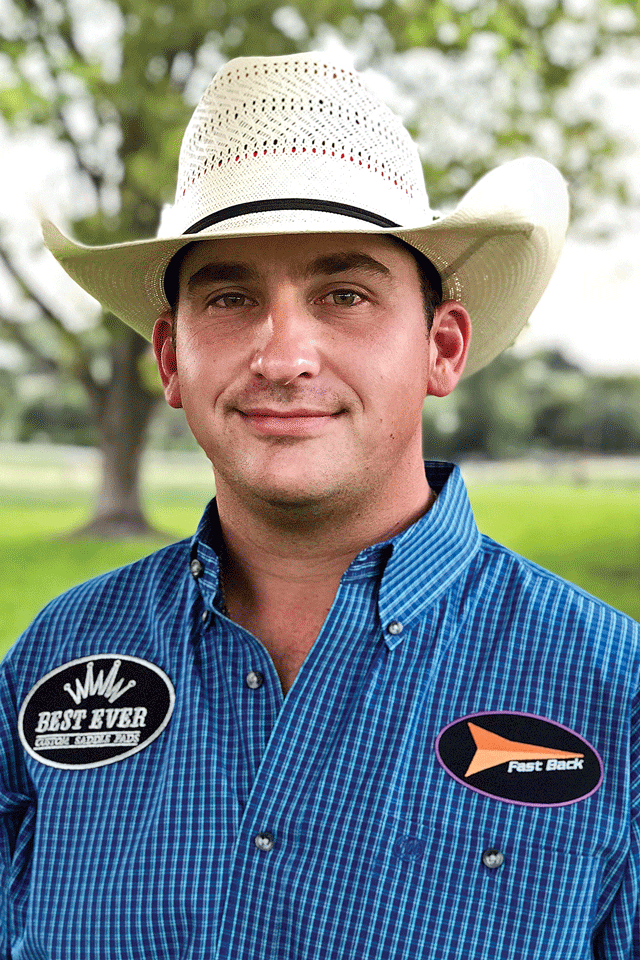
    His dad was a calf roper, so Smokey started breakaway roping at 9 years old. “When I was 11, they had a rodeo here at Barker Texas, TH Marks had a Memorial Day rodeo and my dad put me in the men’s breakaway. I won it with a 2.2.” That win pushed Smokey out of all school sports. “I was considered a professional. If you won money, you couldn’t enter any sports. They just changed that ruling 10 years ago.”
    Even though Smokey had no brothers or sisters, he was surrounded by kids. “We lived only a mile and a half from school, it was a dirt road, but all of us kids had horses and I grew up on a half Shetland pony. Three of the boys I run around with, their daddies worked for tic eradication program and we all went with our daddies. I did that until I was 13 or 14, and then they eradicated the tics.”
    In 1945, Smokey’s dad went to work for WW Fondren estate, raising Red Brahma cattle, – they won several awards in Houston and Dallas and San Antonio for their cattle. “I was showing them when I was a young man; we’d go to the sales and I was watching the rodeos, but never competed in those days. I was there from 1945 until I graduated in 1951.” When he graduated from high school, Smokey went to the University of Houston, competing on the rodeo team, serving as president, and competing in five events (calf roping, steer roping, steer wrestling, bareback riding, and bull riding). He married Betty Hambrick after the first year, and they began their family of five children. He worked side-by-side with his father as a pick-up man at the Texas Prison Rodeo for 12 years. He also took a job as a machinist beginning January 7, 1955, and working until 1972. He was looking for a job to supplement his income from rodeo. “My friend got me the job,” he recalls. “I had a wife and three kids, but not much income; I could do anything on a ranch and that got me the job.”
    He was still able to rodeo on the weekends, and he started picking up in the summer of 1953. “From then on I rodeoed everywhere.” He worked for Sloan Williams, an IPRA producer, for 10 years, and he bought him out in 1972 and joined the IPRA – producing 50 rodeos a year through Texas and Oklahoma, Louisiana, and leased stock for several other rodeos. He was SRA and TRA as well and was named producer of the year for three or four years for both of them. Rafter D Rodeo company was formed in 1978, bringing the entire family under one roof. Rafter D staged rodeos for dignitaries including Egyptian President Anwar Sadat, Queen Beatrix of the Netherlands and the Emperor of China. The many awards and honors he has earned cover a wall in the Fulshear, Texas, home he shared with his wife Betty, whom he lost in 2016 after 64 years of marriage.

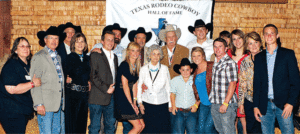
    Betty, was the IPRA secretary for 15 years. “She and I were recognized as the longest rodeo members that was at the old timers in 2016.” Their five children followed their parents’ example in the rodeo world; three boys and two girls all rodeoed through school and college. “Steven, twins, Donald and Ronald (Donnie and Ronnie) – they picked up my rodeos for me, Steve announced later after A&M; Karen turned into the secretary, she did that for the Finals for several years; Kathryn was the oldest girl and she kept time, along with Betty. Now I’ve got 15 grandkids, and 19 great grandkids.” Five of the nineteen grea grand children rodeo. Betty was with him every step of the way. Smokey served on the IPRA board as the stock contractor for the southern region for 22 years. He gave it up in 2001. One honor stands out to him- his 2011 induction into the Texas Rodeo Cowboy Hall of Fame, whose primary mission is to preserve rodeo history and honor rodeo achievement. His father was inducted in 2001.
    “The best part of my life has been family and friends,” he said. “The people are what have made this whole ride worth doing.”

  • On The Trail with Tyler Waltz

    On The Trail with Tyler Waltz

    Born and raised in Jersey Shore, Pennsylvania, Tyler Waltz was the oddball through high school, focusing on rodeo instead of other sports. “I grew up with Jeff Askey and he and I had rodeo in common.” Tyler worked every event in high school, trying to make his childhood dream of winning the world in the IPRA come true. Several injuries would have shattered that dream for most, but not Tyler. He’s leading the bareback riding in the IPRA by more than $10,000; and he’s more determined than ever to make his childhood dream come true. “It’s in my blood,” said the 28 year old. “My dad (Dave) and uncle (Steve) both rodeo, and I love to do it.”


    His list of injuries started his junior year in high school, when he broke his right femur at the National High School Finals in Farmington, New Mexico. He recovered from that and made it back to the high school finals again the next year. At a pro rodeo he attended before the Finals, he got hooked by a bull.. “It bent the rod in my femur; it was a bad deal. I really thought they were going to amputate my leg. We went to four different hospitals to find someone that could get the rod out.” He was headed to the University of Tennessee in Martin and the college rodeo red shirted him until he was better. “My dad went to school there and was on the rodeo team; my best friend Jeff Askey was going to school there, so I figured that was the place to be. The coach (John Luthi 731-514-4630) is really good too.” He made the college finals his freshman year in bareback and steer wrestling. “I missed my sophomore year for knee surgery, but went my junior and senior year.” He graduated with an Ag business degree and plans to be a rodeo coach. “I’d like to rodeo first, and when I slow down, I’d like to coach.”


    Tyler has focused on bareback riding, but has added steer wrestling to his events. He also team ropes and hopes to make a run for the IPRA All Around next year. He stays in shape by doing T25 on his phone at least a couple times a week. He also made the decision to stick closer to home to rodeo, something that has helped him stay healthy. “I think when I was starting, I just went too hard, and that led to some of my injuries,” he said. Tyler travels with his girlfriend, Bri Dubar, the 2017 IPRA Breakaway Champion. “She’s honestly done all the entering, she’s done it all,” he said. “I don’t like the road part of it. I like when you get there, and hanging out with your friends.”


    His dad knows all about overcoming rodeo injuries. “Its part of rodeo,” said Dave, who owns a fuel and coal business and farms on the side. “I was injury plagued when I rodeoed too – he’s mentally tough and that’s what he wants to do.” Dave and Tyler raise bucking bulls, hauling to 25 rodeos a year around the northeast. Tyler works for his dad in the winter, both in the fuel business and the bucking bulls. “My success is because of my dad – he’s always been there and taught me everything I know about rodeo. He gave me every opportunity he could get me to succeed.”


    His mom, Cindy, rode English and Western Pleasure and her parents produced a rodeo at Jersey Shore, which is how they met. “My parents put a rodeo on a few times a year,” said Cindy. “It was an open rodeo and lots of people came out.” Cindy knows rodeo is her son’s true passion. “He has a strong will and a good faith and I’m hoping this is his time. I’m very proud of him for going after his dream.” He has two older sisters – Lauren and Courtney –33, and 30; Lauren still runs barrels.


    Tyler and Bri will both be competing at IFR 49. “When I was a kid, I always wanted to win the world in the IRA It’s been a really good year – I’ve worked really hard to have a year like this.” Tyler wants to be remembered as a good person – an all around good cowboy.

  • Roper Review: Lane Ivy

    Roper Review: Lane Ivy

    Picking up a rope at 4 years old, a seed was planted in Lane Ivy’s heart that grew into a dream. Lane tagged along as his parents, Billy and Joanie Ivy, roped steers; watching, learning, and waiting for his turn. At 5, living on their Canyon, Texas ranch with younger brother Brent, Lane’s parents let him ride an old rope horse to track and rope slow steers as his skills progressed. As he grew, the dream in his heart did also; and like many young cowboys, he imagined himself running those steers under the big lights at the Thomas & Mack. For 26-year-old Lane, that dream has become a reality. “Growing up, roping was a huge part of our lives. I started going to junior rodeos when I was 9 and had some success. The thing about success is it makes you crave it even more, so I continued roping and one thing just led to another.” When Brent was old enough, the Ivy dream team of Lane heading for Brent became a regular entry. “I’m 18-months-older than Brent, so he’s always been a pretty good partner in crime. Although we’ve competed in other events, we were team ropers at heart. We’re blessed because our parents hauled us all over the country, so we could compete.” Lane’s parents did all they could to offer the resources the boys needed to progress in their sport. Lane’s grateful for family friend, Larry Hendrix, who spent many hours opening chutes and supervising the brothers when they were too young to rope on their own while their parents had to work.
    Lane competed in the Texas High School Rodeo Association as a freshman, heading for Landon Williams, who’s still one of his best friends today; and for Michael Trujillo his sophomore year. The Ivy brothers partnered to finish Lane’s junior and senior years. “I was fortunate to have an incredible streak-faced sorrel gelding with a 96 on his left hip, named Bandit during high school. Bandit was a true blessing who taught me a lot and made me rope aggressive. My family raised him, and he died last August at 24-years-old. I’d let kids ride him all the time, and one year I got in trouble because I picked up broncs and drug bulls out of the arena on him before team roping; my dad said he was too good of a horse to do all that!” At 15, Lane headed on Bandit at the George Strait roping for Jayten McCright, “It was exciting to hear the announcer mention I was the youngest header to ever make the Top 50 at the George Strait.” Lane also competed in tie-down roping on a sorrel gelding, named Whiskey. “He was absolutely amazing. We sold Whiskey to Trevor Brazile after high school, and Trevor took him to the WNFR. I don’t know that Trevor would name him as one of his top horses, but he was definitely one of the nicest I’ve ever owned.”
    When Lane was 15, he started riding horses for Jason Thomas, “I learned tons of lessons from him; every day he was trying to get better and trying to better his horses. It gave me such a great work ethic.” Lane attended Happy High School as a freshman and sophomore but switched to homeschooling his junior year as his dream of being one of the world’s best ropers became a passion and everything Lane did focused on it. “My whole family is completely competitive, we don’t want to just be okay, we want to be the best at something or not do it at all. I loved roping, making good horses, and was having some success; I thought when I turned 18, I’d rodeo for a year and make the WNFR; I didn’t think it would be hard at all.”
    After graduating, Lane attended Weatherford College and competed on the rodeo team. “My mom thought it would be good for me to live on my own and asked me to try college for a year.” Just after leaving college, Lane received a call from Jett Hillman, asking him to head for him at some pro rodeos, “I thought ‘here it is, someone is finally calling me,’ this was my whole goal.” The team started having some success, but their season was cut short as Jett had to return home to have neck surgery.
    In 2014, Lane roped with Lane Siggins, “We won maybe one check all summer. I was broke, and went back home. It was a hard pill to swallow; I was realizing that I didn’t give enough credit to the guys that made it the national finals. I was seeing that it was one of the hardest things I would ever do.” Lane moved in with Tyler Magnus in 2015 and learned lessons that year that equipped him with more than just the roping skills needed to be successful. “Tyler was such a great influence and teacher, he helped me get better horses, rope better, and I realized how much it was going to take to make the finals.” Lane went to California, and with some success heading for Bucky Campbell, finished in the top 40. “I was pretty excited. I bought my PRCA card, but my season wasn’t really going anywhere, and I went back home again.” In the spring of 2016, Lane moved in with the Coopers, where Jim Ross Cooper, and his brother Jake took him in like family. Lane felt his roping improved and credits the Coopers with helping him in many ways. Lane finished the 2016 season in the top 30. Lane had quite a bit of success roping with Buddy Hawkins in 2017. The dream of qualifying for the WNFR seemed almost in reach, but disappointingly, Buddy finished up in 16th place, with Lane finishing just 5 holes out of qualifying for the national finals.
    At 25-years-old, Lane was at a crossroads; feeling that he needed to break into the top 15 or get a job. More determined than ever, he did everything possible to have a chance at the finals. “I roped every day, tried to strengthen my weaknesses, invested in the best horse I could get, and was completely focused on making 2018 the year that I made it.” Buddy and Lane started out earning over $22k in the winter, and although the spring didn’t pan out the same, Lane was counting on the summer rodeos to propel them further in the standings. Lane’s horse Cuervo, a 15-year-old bay gelding he bought from Chad Masters, was working great for him. “Buddy stayed home during the 4th of July run, so there was about a month that I had to rope with other partners. It was difficult, but in the same instance I couldn’t let myself get caught up in that. I just focused on my job and trusted that my partners were going to do theirs.” Lane’s mom often reminded him of the verse Matthew 17:20, encouraging him that with the faith of a mustard seed, all his dreams were possible. Lane had success roping with Blaine Vick and Joe Mattern, and by the time Buddy was roping again, Lane had earned over $45k. Finishing the season together, Lane and Buddy won over $20k more, which qualified them both for the 2018 Wrangler National Finals. “I’m really grateful to be roping with Buddy, I don’t always do a great job of handling the steers for him, but he does an outstanding job of catching what I give him.” A dream come true as the result of the devotion he’s given to the sport, Lane will be competing in the WNFR as the number 14 header in the world, with season earnings of $67,457.62, and Buddy competing as the number 13 heeler with season earnings of $64,451.02.
    “I’m living my dream, the last of the season everyone asked if I was nervous about making the finals, but I was just enjoying the fact that I was close enough to have a real chance. It was fun being in the position that if I kept roping good, I could make the finals.” Shortly after the reality of what Lane had just accomplished set in, Walt Woodard asked him how it felt, “He asked me if it felt like everything I imagined all these years. I told him it felt like the biggest weight had been lifted off my shoulders, and someone put an even bigger weight on. I’ve made it to the NFR, but after that last round, it starts over, and I have to work even harder to get back there.”
    Lane is preparing with fellow WNFR competitors, Wesley Thorp and Cody Snow, in their replica WNFR arena. They practice on steers like those they’ll be competing on; filming and timing their runs so they can analyze them. “We’re doing as much as possible to be the best we can when we roll into Vegas. We don’t want anyone to be able to say they prepared more than us.” Cuervo will be coming along to Las Vegas, but Lane plans to rope on Tate Kirchenslager’s 18-year-old gelding, Papa. “Papa has been there, done that, and is solid as a rock. He’s bigger than Cuervo so it’ll be easier for him to pull steers up the wall.”
    Lane will be savoring every moment of this experience he has worked his whole life for, “I don’t know exactly how I’m going to feel once the competition starts, but the fact that I have the chance to rope a steer for $27k a night, 10 nights in a row is really exciting to me!”
    Lane appreciates his sponsors, Wrangler, Classic Ropes, Timber Creek Veterinary Clinic, Resistol and the Mirage Casino. He’s also grateful for his family, and all people that have supported him behind the scenes.

  • Katie Pascoe &  JR Streakin Espuela

    Katie Pascoe & JR Streakin Espuela

    When Katie Pascoe picks out a horse, she loves to go with A Streak of Fling.
    The Morro Bay, California cowgirl has raised and ridden five different babies all by Streak of Fling.
    Her latest protégé is a five-year-old bay roan gelding, JR Streakin Espuela, sired by A Streak of Fling by Espuela Pleasure (Blue Light Ike.) “Beretta,” as he’s known in the barn, is owned by Katie’s mother, Sherrie Jones and was intended as a rope horse for Katie’s dad, John W. Jones, Junior, a three-time world champion steer wrestler.
    But when Beretta showed a liking for the barrel racing, that’s the discipline that was chosen for him.
    He was started as a two year old and ridden on the family ranch, roped on, and Katie did a bit of barrel racing training in the practice pen with him, while sending him out to others to train and finish.
    In 2018, his first year of competition, Beretta carried Katie to the West Coast Barrel Racing Association’s Finals in King City, Calif. over Labor Day weekend, where the two of them earned $3,470 by winning fourth in the 1D first round, seventh in the 1D average, and twelfth in the finals.
    Beretta is young but has quite a personality. “He is just a clown,” Katie said. “He wants to be your buddy all the time, and he’s in your pocket.” Beretta has some antics that keep the family laughing. “He likes to find zippers if you’re wearing a jacket, and get a hold of them. He does some funny things out in the pasture. He’ll spin perfect circles, both ways, when he’s playing, and he’ll go from that into loping perfect circles in both directions. He does that when he’s playing and he’s happy.”
    He knows how to behave, as well. “He has good manners and is easy to be around,” Katie said.
    In the arena, Beretta is a focused competitor. “He seems to be really gritty and has a lot of try. External things don’t bother him.” Because of that, Katie thinks he’ll do well if she and her mom decide to transition him to rodeo. “We’ll play with him as he matures, and see if he can handle that kind of situation.”
    Katie is married to former NFL football player Bear Pascoe, who is in his rookie year of competition in the PRCA as a steer wrestler.
    She and her parents have a long history with Lisa Fulton and Fulton Family Performance Horses, owners of the stallion A Streak of Fling. John, Jr. qualified for the National Finals Rodeo ten times in the steer wrestling and twice in the tie-down roping, winning the world title three times (1984, 1988-89), so he and Lisa’s husband Brian, who passed away in 2015, crossed paths as Brian also competed in the tie-down roping and steer wrestling.
    Katie spent two summers with the Fultons on their ranch in South Dakota, just across the state line from Valentine, Neb., helping get colts ready for the annual sale. While there, she became close to Brian and Lisa and their three sons. “It was a pretty neat experience,” she said, “to get to see what all goes into a sale. It is an amazingly run production.”
    Katie loves the traits that A Streak of Fling babies have. “All of our A Streak of Flings have been very personable, fun to be around, with cute personalities. They have a ton of try and athleticism, and they’re quick. They’re really smart and willing, and they have a style that I really seem to get along with. It’s been fun having multiple A Streak of Flings.”
    She likes the understanding that grows between her and the A Streak of Fling offspring. “The ones we’ve raised have been fun to bond with. From my point of view, I feel like when you have a strong bond with a horse, they try harder for you. And it makes your success more satisfying when you have that personal bond.
    “They are really personable and do funny things that make them individuals. Those things really make me fall in love with a horse even more.”
    Sherrie plans on entering Beretta at more derbies and jackpots in 2019.

  • Back When They Bucked with Billy & Pam Minick

    Back When They Bucked with Billy & Pam Minick

    Born January 10, 1939 in Fort Worth, Texas, Billy Minick’s dad was a boss gambler in Fort Worth. “Gambling in the late 40s and 50s wasn’t legal, it was tolerated,” said the 80-year-old.
    Billy won the state high school All Around Champion in 1958, competing in steer wrestling and bareback riding. From there he went to the National High School Finals in Sulphur, Louisiana. “I was way in lead for all around; came off my second bull and broke my arm.” He was in the hospital in Lake Charles for ten days. While he was there, the coach from McNeese State College offered him a rodeo scholarship. “I went there a year and a half – got along good – but had ants in my pants and had to get back to rodeo. Fame and fortune were waiting.” A year into his rodeo road, in December of 1961, Billy was drafted into the Army, where he served as a medic. “How they made a medic out of the bull rider is a wonder.” He spent his time after medical school in Alaska. “I went to eight rodeos up there, winning the bareback at all of them, and won the All Around at the Anchorage rodeo.”
    His stay in Alaska was spent in a field hospital working with the natives, giving classes on childbirth and other things. “The Army taught me #1 to always be on time or early; #2 respect the system of bosses. You can fight it or take it for what it’s worth and get something out of it. I was bitter when I went in,” he admits. “I was peaking in my rodeo career – then I learned that I can’t fight it. You begin to realize how many people went through the same thing and died for this country to let us do what we do today.”
    Billy went right back to rodeo when he got out, starting off winning at the winter shows, but then hitting a cold spell and just getting by. He was able to make one NFR qualification in the bull riding, 1966. “I had a great year in ’66, leading one or two for the world championship most of the year, ending up fourth.” He had a job offer in 1967 and decided to take it, moving to Medora, North Dakota to start a show there. At the entrance to Teddy Roosevelt National Badlands Park, Medora is a tourist town that operated in summertime. The ranch/rodeo show was educational to the public and Billy remained there for two years. “I’d go to Spring rodeos and was approached by Harry Knight and Gene Autry to buy their rodeo company.”

    Billy had experience in production and he inquired where the rodeo company was located; they said San Antonio. “I asked what the temperature was and they said 72 and I took it.” He was able to purchase the Harry Knight Rodeo company and lease the Flying A ranch in Fowler, Colorado. “Harry Knight stayed with me a couple years and we went on to produce major rodeos they had from fall of 1968 to 1974 adding a few along the way. Billy sold the rodeo company to Mike Cervi in 1975.
    The year before, Mike had bought Beutler Brothers and combined them both and the combined rodeo companies dominated the major rodeos. Billy worked for Mike for four years, running Mike’s cattle ordering business, which was the largest order buying cattle company in Northwest. “The headquarters was in Caldwell Idaho, and we shipped thousands of head of cattle,” he said. “I loved that business – it was real people doing real things. I liked the action, and the numbers, I’ve always been good with numbers.” The job included working with a lot of people to ship the cattle all over.
    About 1979, Billy headed back to Texas. “I came back and had a ranch leased from Neal Gay.” Neal became his best friend, and Billy helped him with the Mesquite rodeo for a few years. Billy ended up quitting that and started messing around with the chrome plating business in Ft. Worth. “The company had a truck division and offered me and another boy 10% to get the sales up in the chrome business for over the road.” He built that up and added another side job, bringing him back to his love of rodeo.
    “When Billy Bob’s Texas opened April 1, 1981, I got hired to do the bull riding every Friday and Saturday night,” he said. The event is held in the former auction ring and is run like a regular rodeo – timers, announcers, secretary, bull fighters, etc. “It was a huge success. I had my own little operation in the bull riding. I was the only one that could stay on budget – I was in my element.” In December, Billy Bob Barnett, one of the owners of the 100,000 square foot club in Ft. Worth, made him an offer. “I took the club over as GM, not in charge of marketing, etc. just operational.” He stayed in that position through 1985.
    In 1982, Billy’s life changed again. His wife, Pam, walked through the door of Billy Bob’s, there to watch The Beach Boys. “If it hadn’t been for Pam, I wouldn’t be here today,” said Billy. It was Pam’s first time in the Fort Worth Stockyards, and she fell in love with the brick paved streets and Billy Minick. That was in December and they were married the following May.
    In 1986, Billy Bob started to do a development in the Stock Yards and raised a lot of money from notes to fund the development. Billy and Pam decided not to invest, so they parted ways. Billy sold insurance and picked up broncs, Pam worked for various TV shows, the face of the interviews at the NFR. “We got by.”
    In 1987, country music declined in popularity the economy in Texas went south, and the development project failed to produce the budget necessary. Billy Bob’s fell into bankruptcy in 1988 and closed its doors Friday, Jan. 8, 1988. Three investors formed a partnership and reopened the honkytonk November 25, 1988 with a very conservative budget. “Holt Hickman was financing it. He came and got me and said would you go back to work and see if you can pull it out. Said I’d give it a try, only if I had total control of it all.” Billy walked back in the door Feb 1, 1989, and promptly hired his wife, Pam, to do the marketing. “We went to work cutting corners and getting this cleaned up and straightened out. We started breaking even and making a little money. Garth Brooks came along and changed music. Country turned around in the early 1990s and that was a big help.”
    37 years later, Billy Bob’s Texas is a success, with more than a million and a half people coming through the door each year. Billy Minick still comes “to the office” one day a week and Pam runs the marketing. The rest of his time is spent at their home, a little slice of heaven that they enjoy. “We have the best horses in the country and my biggest decision every day is where I’m going to lunch and playing golf.”
    “I’ve been fair with people – I come off the asphalt and made myself a cowboy,” he says of his life. “Rodeo taught me how to survive – I’ve always enjoyed real people doing real things.”
    He is quick to give credit to Pam. Married for 35 years, he calls her excellent. “I don’t like to take credit for anything. I couldn’t do it without that bond – it’s the relationships.” She’s excellent – married 35 years.

    Pam’s Story…

    Pam was raised on five acres in Las Vegas, Nevada; considered a ranch. Her family of four had no involvement in horses until Pam and her sister, Lynn, decided to give it a try. Her parents bought Rebel and Rio, quarter horses that were used to pull a wagon up and down the Vegas strip for advertising. Pam and her sister rode the $300 horses bareback for the first nine months – with no clue how to care for or even ride. Those two horses shaped Pam’s respect and love for horses and forever changed the direction of her life. She joined 4-H, showing her horse and entering all the events associated with the county fair, which included speed events. “They had 8 events; four speed and four show. One year I won high point in all 8 on the same horse,” she recalls.
    That led to rodeo. She started competing in the Nevada High School Rodeo Association. “Every high school rodeo is 400 miles away when you live in Las Vegas – every weekend you’re driving 400 miles one way. My mom would occasionally go, but for the most part, I went alone. My parents weren’t involved in rodeo, and we didn’t know any different.” She competed in breakaway, barrel racing, pole bending, and goat tying, finding the most success in barrel racing. Her horsepower changed over the years, and thanks to friends and mentors, she was able to compete at the National High School Finals.

    After high school, she planned to go to UNLV, but before she could go to her first class, she won Miss Rodeo Nevada at the state fair in Reno. “Two months later, I won Miss Rodeo America,” she said. As the youngest Miss Rodeo America, she hit the road in 1973 to represent the sport. Traveling by herself was nothing new to her, having traveled to several rodeos, including National Finals, on her own. “For me, it felt like rodeoing, and I’d worked in high school in the PR department of a hotel, so publicity is what I knew, so when I would get into town, I was an aggressive publicity monger. I did every interview possible,” she said. “I felt the job was a PR person. The committees paid $15 a day and required you to go to Rotary breakfast and a few others, but I would go over and above those; I created my own path.”
    After her reign, she lived in Arizona for ten years. During that time, she continued to pursue her career in front of huge crowds and television; commentated for the NFR on and off since 1976, commentating for PBR for 12 years, 26 shows a year; announcing the Houston Livestock Show and rodeo – the first woman to announce that event. “I don’t like being a woman announcer,” she admits. “I like being a sideline reporter where I can do some investigative stuff.” She ended up in Ft. Worth to announce a rodeo. “That’s where I met Billy.”
    The duo have continued to manage the famous Billy Bob’s of Texas, Pam as the marketing director. “I’m here 9-5 everyday Monday through Friday – I love it because it’s a challenge,” she said. Along with that job, she produces Gentle Giants, a show she shoots, hosts, and edits every week for RFD-TV. When she’s home, she rides all her horses and really feels she has come full circle in her life.
    “I’ve never made big plans, I believe in God’s plan. Sometimes I have to be patient – I never thought I’d be Miss Rodeo America, or the first lady sports commentator; but I never looked at it as setting a goal,” she said. “I was in the right place at the right time. I’ve always been prepared for the next thing that God has for me. Every day I sit on my porch and look out where I live and say I’m blessed.”

  • Lari Dee Guy

    Lari Dee Guy

    “I just feel that roping has come so far since I was a kid. I feel that people have gotten so many opportunities with videos and schools and tools like the Heel-O-Matic, and horsemanship has come so far. We as older competitors have even evolved. I learn as much from the younger guys as they learn from us, and it’s really cool to see the sport evolve,” says Lari Dee Guy.
    A rodeo household name with numerous world titles to her credit, including 2018 WPRA World Champion Header, her mark on the evolution of roping has particularly inspired women ropers of all ages. Born in 1971, Lari Dee grew up roping and working on her family’s ranch in Abilene, Texas, where she still lives today. Her family taught her that challenges were meant to be overcome, not turned away from, and one of Lari Dee’s first challenges was learning to rope right handed, even though she was left handed. By the time she started college rodeoing, where Lari Dee won the breakaway roping twice at the CNFR, she also had 11 consecutive world titles in the AJRA. Her passion for roping was infectious, and she started putting on roping clinics while she was still in college. Since then, she has taught worldwide, along with sharing the Rope Like a Girl motto and all it stands for, which took root in 2013. “Two young women, Chelsea Shaffer and Kari DeCastro, approached me with that hashtag and asked if I could make Rope Like a Girl cool. I thought of how many young girls that it could touch, and women in the industry. The idea was really theirs, and I helped them put the roping behind it.”
    5 Star Equine, which has endorsed Lari Dee for the last 5 or 6 years, also helps spread Rope Like a Girl, which can be stitched on their saddle pads, halters, and cinches. “Every time I see a 5 Star pad, I look to see if there’s a little girl roping on it, and if it says Rope Like a Girl. When I do see that, it makes me feel good that people believe in that,” says Lari Dee. She started using 5 Star pads around 2010, drawn to the quality and durability of their products. “I feel that is the very best felt and wool pad in the industry, and I love the way they breathe. I love the pads, but what turned me on to the company is the people who own it. I met Terry and Julia Moore at the WPRA finals one year, and we became like family right away. They’re a very great Christian family, and that’s what drew me to their company.”
    5 Star Equine also sponsors custom pads for Lari Dee’s Rafter L Roping Finals, which she put on in October in San Angelo, Texas. Additionally, she puts on several ropings in conjunction with Cody Ohl’s Ultimate Calf Ropings, and continues to teach 10 schools a year, along with training horses and competing. “I’m a pretty organized kind of person, so I put on the calendar the most important places I want to attend, and I try to leave time during the week to ride the young horses and train, and then I try to be gone on weekends. I try to get most of my young horses ridden in the summer, and coming into the fall and winter, I try to focus on teaching and my finals. I also have a girl, Megan White, who really helps me out and keeps me organized, and Logan Harkey takes in horses for himself and he’s in there to help us with anything we need. Hope Thompson helps me do the schools, and here at the ranch riding horses and giving lessons. I live on my family’s ranch, and all the things a person could take for granted, they provide, like the calves and steers and feed. Having all that is a blessing.”
    Another blessing came in the form of Lari Dee’s horse Gangster, who came back into competition this May after she thought he was permanently retired. “He’d been turned out for two years and had torn his deep flexor tendon twice, and I thought he was never going to come back,” says Lari Dee. “Doctor Brock out of Lamesa, Texas, and my local vet, Doctor Paul Patton, did surgery on him, and he came back really good and I’ve been competing on him in the breakaway. I bought another young horse to help back him up, Primo, from Jessica Gray out of Florida, and in team roping I’ve been riding a horse that belongs to Trevor Brazile, named Sabrina.
    “My first love is roping calves, but I have really grown to love team roping because it’s brought lots of horse sales and it gives women the opportunity to make money roping. I think that rodeo in general is really growing and getting good for women ropers. The American is giving us a big stage to step on, and the WRCA has given us a big stage. It’s all because of the people and women who have worked so hard to get it where it is now,” Lari Dee explains. “My goals are to stay at the top of my game and stay focused, and try to do and be a part of everything that’s happening out there.”

  • On The Trail with Nate Jestes

    On The Trail with Nate Jestes

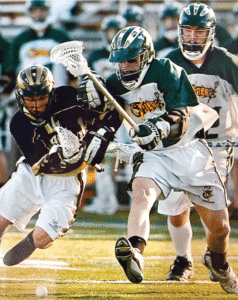
    Nate Jestes grew up in Fort Collins, Colorado. “I lived in town and spent my childhood playing sports.” Since the age of 6, Nate played hockey, baseball, and soccer as well as wrestling, track/field, and golf. When he got into high school, he concentrated on football and lacrosse, receiving academic athletic honors all four years. He played on All Star teams along with his older brother, Bryant, and younger sister, Kelli. The closest the bullfighter came to cattle was his summer job at a local sale barn, Centennial, working cattle in the back pen and family visits to his mom’s (Sue) family ranch in Douglas, Wyoming. It was at the family ranch that Nate acquired a love for flying when he flew with his uncle on the ranch.

    After high school, Nate pursued his dreams of flying, heading to Bozeman, Montana, and completing a two year Aviation Science program at Montana State University. He got his Associate of Applied Science in Aviation and went on to get his commercial rating and his flight instructor certificate. At the age of 20, he was hired as a flight instructor at Summit Aviation and taught for two years. While Nate was in college, he worked at the Yellowstone Jet Center to learn more about the aviation industry and get his foot in the door. His boss, Al Sanvold, was a professional bullfighter, and Nate tagged along to a couple of his rodeos.

    “When I quit playing sports and working out, I missed that athletic side of my life,” said Nate. “When I watched him, I was intrigued and amazed how much athleticism it took to do what he did. I decided I could do that and hit him up about it. I was really interested in learning how to do it.”


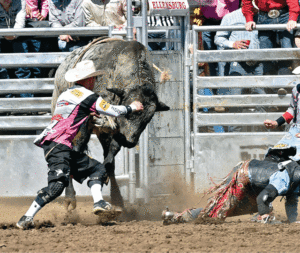
    “Nate is a laid back guy,” said Al, who has now switched careers again; he leases a spot in a barbershop and Red’s Classical Barber is open for business in Belgrade, Montana. “He was one of my most favorite employees, he would do anything I asked; he was quiet and got the work done. When he came to me, I wasn’t sure if he was serious.” After Al realized he was, he agreed to take him down to the (Montana State Rodeo) college practice and teach him how to fight bulls at their practice every Monday and Wednesday. “The first time we went and we were working with a wheelbarrow I knew the kid was going to make it – I didn’t know he’d be a 3x NFR bullfighter. He took to it right away and everything I told him, he put in his memory bank. He has more natural talent than I’ve seen in any student I’ve taught so far.”

    “I continued working as a flight instructor for two years and during that time I also worked a few rodeos; high school and then I had an opportunity to do a summer run full of amateur rodeos in North Dakota.”

    That is when Nate was faced with another decision. “When I gave my boss my schedule, he said he couldn’t work around it. At 22 years old, my aviation career was on track, and I was getting to the point where I was building enough hours to apply for bigger and better.” The amateur rodeos didn’t pay enough to make up for the loss of his flight instructor career, so he turned again to Al.

    “He told me that rodeo was tough and very few people made a living at it, and he told me that I needed to be willing to give up my life to do it – sacrificing my entire aviation career, weddings, funerals, birthday parties,” remembers Nate. “I’ve always followed my heart and it was tugging me towards rodeo and ultimately that was the decision I made.”

    He officially switched careers in 2010; moved back to Douglas and worked for his dad (David) in his construction business to fill in the gaps when he wasn’t rodeoing. He worked Montana State High School Finals in Bozeman and Al came to watch. “It had snowed 6 inches the night before and the arena was a mud pit. They hung up about 8 bulls; we had to work that night. Al came up to me and said ‘Nate really, really good job. There’s no doubt in my mind you are ready to get your PRCA card and start fighting bulls at the professional level.’”


    He got his card in September of 2010 and worked his first PRCA rodeo in White Sulphur Springs. Nate went to the PRCA convention in Las Vegas and spent three days sitting in his booth; nobody showed any interest in this new bullfighter. “The last day, Bob and Marty Barnes hired me for their entire summer run – June – September. I did their run for two years, working for my dad during the off time.”
    In 2013, Nate got another big break. “When I was fighting for Barnes we would sell the rodeo with the Mexican fighting bulls. I was down in Sterling, Colorado, at a bull fight and won it.” That is when he met Cody Webster. He was at the event, working for Cervi, and friends with PBR bullfighter Frank Newsom. “He invited me to go to Rex Dunn World Championships in Ardmore, Oklahoma. I made the short round, and ended up winning fourth. That is where my career as a bullfighter started to get some traction.”

    Cody worked a lot of rodeos for Powder River and Nate ended up getting hired in 2013 with Cody and the rest is history. “The young man has such a wonderful way about him,” said Lori Franzen, who along with her husband, Hank, own Powder River. “His personality is such that he wants to please – and his ability makes that easy – he’s really good in the arena and such a pleasure to have outside the arena around the crew. And his wife is a doll and a huge supporter of him.”

    This marks the third year that the trio, Nate, Cody Webster, and Dusty Tuckness, will fight bulls at the Thomas & Mack. The three work as a team. “We all know what each others doing. When you’re fighting bulls, you’re reacting to the situation. When you have three guys on the same page, it just falls together.”

    Nate spent the month of November at the Pitt Training Facility in Bozeman, Montana. Dane Fletcher is a retired linebacker for the New England Patriots, and Nate knew him when he was playing for Montana State. “I heard about this gym that was opening and I reached out to him – I sent him some videos of me fighting bulls, and he put together a workout routine. I try to get up there whenever I can.” His training consists of many things – explosive, deceleration, strength, cardio, stretching – everything. “The sport of rodeo is fast, you have split seconds to make decisions and react; your body has to be able to perform and get there – the speed is crazy.”

    Nate is married to Bridget, a kindergarten teacher in Douglas. The couple met through his cousin and their friendship led to a wedding on May 14, 2016. Her teaching schedule works perfectly with his work schedule. Although he only has May and November completely off, his busiest time is from June to September and they travel the rodeo road together during the summer.

    “When I started to find success in the rodeo industry, I was only missing one piece of the puzzle in order to take it to the next level. That puzzle piece was found 6 years ago when I met my wife. I just want to thank Bridget for all that she has done for me. She is the backbone to this whole thing, and I wouldn’t be where I’m at without her.”

    At the end of his rodeo run, Nate has no plans yet. “I wasn’t raised or led down the path to become a bullfighter. I’ve had the cards stacked against me from day 1… Never be afraid to dream. Chase those dreams, and through hard work, determination, perseverance and resilience anything is possible.”

  • Roper Review: Cody Russell

    Roper Review: Cody Russell

    Growing up in West Monroe, Louisiana, Cody Russell never gave much thought to becoming a team roper like his dad. A natural athlete, Cody started playing T-Ball at six, and football in the fourth grade. Those two sports remained his passion until he incurred a major injury during a football game during his freshman year.
    Complete separation in his ACL and MCL ligaments required surgery and a lengthy recuperation. Months of going to physical rehab and waiting to mend caused Russell to miss baseball tryouts that spring.
    “I was just sitting around,” says Cody, “My dad wasn’t a big fan of that and said we needed to find something for me to do. When I told him I wanted to team rope…. he told me it would not be a fleeting decision and I would have to work at it.”
    So, in a sport that most kids start about the time they’re able to stay on a horse, Cody took up roping at fifteen years old. His dad would sit on a 5-gallon bucket and watch him rope the dummy. Before he would be allowed to rope off a horse, he would have to be able to catch the dummy 100 times in a row.
    “I had messed around with a rope but never really worked at it or roped with other kids at the ropings. It took weeks before I was able to rope the dummy 100 times in a row. My dad has always been a worker and had the philosophy of ‘we’ll work through it until we figure it out.’ He also told me he would not give me a horse, but I could buy one from him.”
    That work ethic and philosophy has served Cody well. He’s never been to a clinic or taken a lesson. He invested in training videos and watched YouTube videos. He also describes watching a Rich Skelton video where he studied Speed’s hand position and delivery in slow motion. He would film himself roping the dummy and study that as well.
    “My dad said if I did what he said for a year, he guaranteed I would win a roping.”
    One year after starting his team roping journey, Cody and his dad entered a USTRC roping in Kinder, Louisiana. The father and son team won the Incentive and came back second high call, where Cody missed. Though it was his first roping, it was also his first taste of defeat and he was crushed.
    “Even though my dad told me it was okay, I was devastated. Even today if I miss an important steer I need a few minutes to get over it. Winning is important to me and I would rather not enter than not win.”
    In 2015 Russell got the opportunity to move to Texas where he stayed and worked at Chad Masters’ in Lipan.
    “That was the year they were going to the ERA rodeos, so Chad was home quite a bit,” says Cody. “I feel the opportunity and timing was a blessing from God. It allowed me to spend quite a bit of time with Chad and learn so much. He’s very much like my dad in that he works hard and would never ask you to do something he wouldn’t do.”
    This move, plus a new horse, took Cody’s roping to a new level and he was quickly moved to a #7 header. He has since sold his good horse and feels the loss.
    “This year I took a break and it’s helped me mentally. When I had my good horse, I felt like if I was entered I should win something. When I sold him, I felt I didn’t have an advantage anymore and had to re-evaluate my roping. Now I’m heading as well as I ever have. I believe it’s important to be positive and I don’t like to hear people talk negatively about themselves or anyone else.”
    Currently Cody rooms with fellow ropers, Andrew Wong and Dustin Searcy in Weatherford, TX, and has built a profitable shoeing business in north Texas.
    “When I was younger I thought my dad was just working, and now after all these years I realize he was preparing me to receive blessings. The harder I work, the more I receive.”

    Cody Russell heading for Coy Brittain – Kierce Photograpy

    COWBOY Q&A
    How much do you practice?
    A couple of times a week.
    Do you make your own horses?
    No.
    Who have been your roping heroes?
    Chad Masters. He had no idea who I was and took me in and gave me a chance.
    Who do you respect most in the world?
    My dad.
    Who has been the biggest influence in your life?
    God.
    If you had a day off what would you like to do?
    Play golf.
    Favorite movie?
    Gladiator.
    What’s the last thing you read?
    Bible.
    How would you describe yourself in three words?
    Kind, hard working, passionate.
    What makes you happy?
    Seeing people happy.
    What makes you angry?
    When I feel I didn’t do my best.
    If you were given 1 million dollars, how would you spend it?
    Tithe first, then I would buy some horses, a place, and invest the rest.
    What is your best quality – your worst?
    My best quality is being nice to people. My worst quality is I can be too quiet.
    Where do you see yourself in ten years?
    Making a living roping.