Rodeo Life

Category: Archive

  • Back When They Bucked with Arden Clement

    Back When They Bucked with Arden Clement

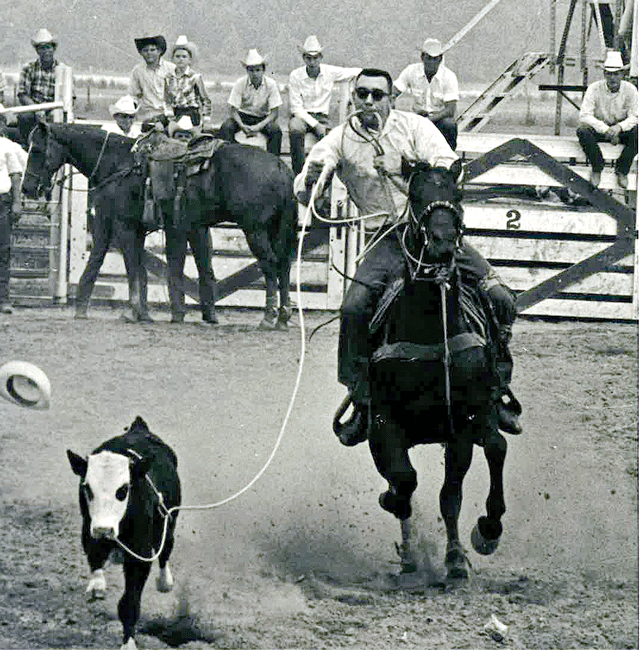
    Winston Churchill said, “We make a living by what we get, we make a life by what we give,” and the life of Arden Clement of Kinder, Louisiana, has been all about giving to the future of rodeo. With a Cajun heritage, speaking only French until starting school, Arden began training colts in his youth and quickly became a go-to cow horse trainer for many of the local farmers. In high school, he competed in the inaugural Louisiana High School Rodeo Association rodeo in 1950; and in 1951, riding a sorrel horse Red Man, in cutting, calf roping, and bulldogging, he finished the year as the LHSRA Reserve Champion Calf Roper, Reserve Champion Cutter, and Reserve Champion All-Around Cowboy. Red Man, owned by Sidney Marcantel of Welch, Louisiana, was sold to Wild Bill Elliott, who campaigned the horse in his shows for several years before selling him back to the Marcantel family for his retirement. After high school, Arden dedicated his life to training horses and kids for their own futures in rodeo, retiring from it in 2004, at the age of 72. He stepped back into the training arena in 2011, when his young great-grandson, Cole Ford, came to him with aspirations of becoming a calf-roper like his great-grandfather, and he was happy to get the fourth generation of cowboys started just right.
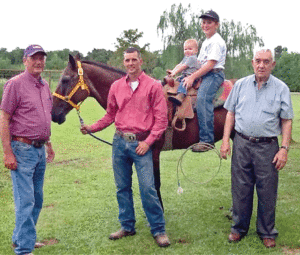
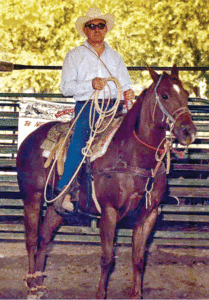
    Born in 1932, just after The Great Depression, Arden began training horses on the rice farm where his family worked, to ride the fields and doctor cattle. His knack for breaking young horses for work led him to training horses for many local farmers, charging them $10 per month to break their 2-year-old colts. Arden’s parents, Elza and Minnie Pearl Clement, counted on Arden to help on the farm, along with his three younger sisters, Rena, Dewanna, and Veronica. “I would break horses to make a little spending and rodeo money while I was in high school. My sisters would help me some, Veronica competed in rodeo through high school and would help work the cattle and the chute as I was training roping and cutting horses. Rena would help unless I raised my voice at her, and she’d head straight back to the house. At the end of the day, when I was done training on the colts, my sisters would ride them in the shade of a pecan tree grove by the house to cool them off, it was a pretty sight.” Arden would load horses up a ramp into the rice truck beds rigged with cattle racks to go to rodeos. “We also used old Chevy one-seater cars with 70-75 horsepower engines that would only pull at about 30-miles-per-hour, to haul trailers with no springs and wood boards on the sides. One time we were going to a rodeo and looked back when we heard something, to see boards falling off the trailer. We just picked them up and tied them back on, so we could make it to the rodeo.”
    After high school, Arden worked for a short time managing a hardware store in Elton, before being hired by George Grimshaw of Bunkie, Louisiana to train roping and cutting horses. “Mr. Grimshaw asked me if I needed someone to help me with the horses, and I introduced him to my good friend Billy Duhon. I had taught Billy how to rope and train horses, and he worked there with me until I left that job.” Billy Duhon was a lifelong friend of Arden’s and ended up spending his life training cutting and roping horses as well as competing as a steer wrestler for many years before his retirement. “I made the mistake of teaching Billy all I knew about competing and training, and after that I couldn’t beat him. He was athletic and knowledgeable, he just took to it like a duck takes to water.”
    Arden worked for Mr. Grimshaw for a year before leaving, “I went to work for Calcasieu Marine National Bank and started from the bottom up. I worked my way up to assistant vice president and manager of the bank during the 38 years I worked there before retiring.” While working at the bank, Arden continued to rodeo and train cutting and calf roping horses; and found a true enjoyment in helping aspiring rodeo athletes get a start in rodeo. He had a friend build an indoor arena for him at his farm, so he could give lessons year-round. “I could have a bad day at work but get home and ride or train on a horse and it would just relax me.” Arden and Billy remained friends but also worked together to help many get started in rodeo; including Arden’s son from his first marriage, Brent, and Billy’s son Steve Duhon. Steve went on to become a three-time world champion steer wrestler, and Pro Rodeo Hall of Fame Cowboy. Brent competed as a steer wrestler and won the champion title in the Louisiana Rodeo Association in 1981. The two friends were also instrumental in helping world champion steer wrestler, Mike Smith get started. “We both helped them, but Billy was really the champ teaching steer wrestling, I did most of the hazing.”
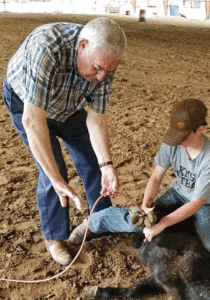
    Arden helped form the Louisiana Rodeo Association, now known as the Louisiana Rodeo Cowboy Association, remaining a member for many years. He competed in the PRCA for two years as a calf roper before a knee injury kept him home. Arden also competed in the Old Timer’s Rodeo Association, formed in Texas, and although he was one of the oldest in his group, he enjoyed competing in the association for several years before his retirement. Arden remained supportive of the LHSRA from its beginning and was honored at a LHSRA state finals rodeo a few years ago. His son, Brent, explained, “My dad has been active in rodeo his whole life. He’s helped people, trained horses, loaned horses, and let many come rope at his arena. At the LHSRA state finals, at least 50 to 70 people of all ages stood up that he had personally helped, and there have been so many more. He did it because he loved it.”
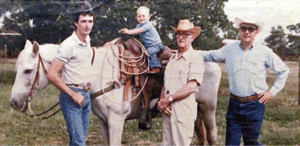
    Arden married his second wife, Betty, in 1970, and helped raise her children, Michael and Bill Creasman, and Sally Daigle. He was glad to share rodeo with them as they were raised, as well as several of their friends. Brent, who after competing in the LHSRA, amateur-rodeoed and college-rodeoed for McNeese State University, had a son, Cody Clement, who also competed in LHSRA as a saddlebronc rider. Cody’s stepson, Cole Ford, currently competes in the LHSRA as a calf roper. “Cole came to me and said he wanted to calf rope, so I started him on the dummy and he just took off, I was really glad to get him going in rodeo. Now Shane Hanchey has taken him under his wing and has really brought him along to where he is now.” Shane found Cole a new strawberry roan calf horse named Thumper, that Cole has had quite a bit of success on. When Arden checked Thumper out, they were surprised to discover that Arden had trained the gelding’s mother over 20-years-prior, as well as the gelding’s sister; and now the offspring of that mare is putting his great-grandson in the winning ranks of rodeo; evidence of the lasting effects of what Arden has given to a sport he loves.
    “Rodeo has changed so much over the years, there are better schools, better equipment, and better horses. Kids can go learn more about roping in a 3-day clinic than I learned in 6 years. What hasn’t changed is how good it is for the kids. I hear people say all the time that horses and rodeo fees are so expensive, but I tell them, ‘would you rather pay fines to get your kid out of trouble, or pay rodeo fees to keep them out of trouble?’ When it comes down to it, paying fees is cheap.”
    In his retirement, Arden enjoys going to the coffee shop to drink coffee with friends, reading the paper and taking naps after dinner. He still goes to the LHSRA rodeos that are close to home and enjoys seeing many of the results of the help he’s given over the years, especially his great-grandson that is starting down his own rodeo path.
    Looking back, Arden appreciates Zack Marcantel for furnishing him good horses and taking care of him throughout his rodeo career; and Doug Habert and family for furnishing his indoor arena for 20 years before he retired.
    “I’ve gone to every rodeo I ever wanted to go to in my life, except Calgary. I had a good career, met a lot of people, and saw a lot of things, I can’t complain.”
  • Jackie Ganter

    Jackie Ganter

    Professional barrel racer Jackie Ganter took the road less traveled when it came to her rodeo goals this season. It ultimately led her to a new horse, who is poised to put Jackie firmly in the competition for the 2019 season. The 22-year-old from Abilene, Texas, started out her 2018 season by placing in Odessa at the Sandhills Stock Show in January, but the following weekend, she broke her ankle when her horse fell in the middle of a run. “I rode a bit prematurely and tried to run at San Antonio and Houston because those are such big rodeos, but I couldn’t really ride right, so I didn’t have any money coming out of the winter,” Jackie explains. “I changed my science and we went to Canada. Two of my horses got hurt really early in the year, and my mom really wanted to make the Canadian Finals, so we kind of focused on her.”
    While Jackie and her mom, Angela Ganter, were rodeoing near Wainwright, Alberta, she was asked by a friend, Gayle Howes, to ride one of her horses, a powerful gelding named Tycoon. The duo won the first round at Wainwright, and they clicked so well that Jackie approached Gayle about purchasing the horse. “He was really special to her, but she said we fit so well together, and she sold him to us. Right after that, I went down to Cheyenne and he won fourth in the first round. My second round was under water, and we came back in the short round, which was muddy too, and he did great. Since my Baby J horse was hurt, I hadn’t ridden anything with that kind of power in a few months, so I had to get with it and remember how to ride that. He’s extremely powerful when he leaves a barrel.
    “It was pretty hard to accept at first when I got hurt just because I had bigger plans for this year, but that’s sometimes how plans work—they don’t,” Jackie says with a laugh. “I think everything happens for a reason, and this year it was to take a step back, and I was also meant to get Tycoon, which probably never would have happened if my good horses hadn’t been hurt. I’ve been back on my other horses, and they’re both sound and they look great, so I’ll have Jet and Baby J back, and Cartel has been good all year. Now I have Tycoon, so hopefully next year we’ll start with four sound, ready-to-go horses.”
    Part of Jackie’s program to keep her horses sound are her 5 Star Equine saddle pads, which she started using five years ago. “I started with them early in 2014—I won the BBR finals in Oklahoma City and I was riding a 5 Star pad, and they approached me and I’ve been with them ever since.” After four years of hard use, Jackie still uses her first sponsorship pad from 5 Star. “They’re incredible pads, and that’s all I ride in, at home and when I compete. I also use their breastcollars and just got introduced to their sport boots. They have awesome products and I’ve believed in them for a long time now. I’ve signed for them at the NFR both times I made it, and last year as well, and I’ve done some promotional videos and I try to promote them on Facebook. They are great people to work with.”
    Since returning home from the summer run, Jackie is starting several colts on barrels and riding eight horses a day. “I’ve always been a jockey—I’ve never trained my own horses and I’d like to get into that. One of my good horses, Jet, is a stud and his oldest babies that we have are three, and one of them I’m about to start on barrels. It’s a whole new realm I’ve never done before,” says Jackie. “I don’t think you ever quit learning—you can get something out of every single person that you ride with, and I always try to pick up at least one thing that day that I can implement in my program.”
    When she’s not in the saddle, Jackie enjoys visiting all the restaurants she misses while she’s traveling, along with reading. “I read murder mystery books, and I just read Rachel Hollis’s ‘Girl, Wash Your Face’. I thought it was incredibly motivational. Other than that, it’s horses from sunrise to sunset. I’m just glad to be home from the summer run like everybody is. Now I’m just trying to finish up the season in the top 40 so I can get into San Antonio next year.”

  • On The Trail with L.A. Waters Quarter Horses & The Outhier Family

    On The Trail with L.A. Waters Quarter Horses & The Outhier Family

    Mike and Kristy Outhier are continuing the brand that Kristy’s parents began – LA Waters Quarter Horses. “My dad (Lou Waters) put himself through college as a cotton farmer,” said Kristy. “When they moved to Boston, mom (Wanda) helped put him through business school – they had a $20 per week budget for groceries.” The goal was to buy a ranch in Texas and thanks to smart business decisions and a horse named Colonel Freckles, the dream came true. “They had instincts about him – and did lots of research – they bought Colonel Freckles as a young stud and promoted him.” Between his successful business ventures and Colonel Freckles, they were able to build a breeding facility on a 300 acre facility near Houston. “Dad was the backbone and master mind, but mom was the wind beneath the wings, did all the paperwork, and helped pick the crosses that they bred to.” Mike and Kristy are running LA Waters with a stallion, Wild Card Dunnit, that they raised and campaigned. “We won the AQHA Junior Horse of the year in all the roping events in 2006.”


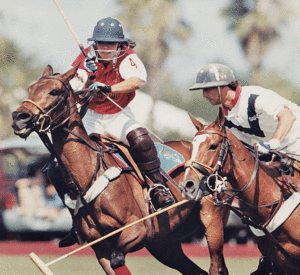
    Kristy grew up in the horse world, involved in AQHA and cutting, but left that behind when she found polo. “I fell head over heels in that, and went on to Texas AM intercollegiate polo.” After college, she worked for a year, and got hired to play polo professionally. “I spent 5 years hauling – three months at a time, playing across the United States.” For Kristy, polo was the best of sports – it incorporated her love of horses, which she trained, to her passion for competing. “To have a sport with a ball in the competition – all that goes into your strategy on the field, and then it’s multiplied by your horse and horsemanship. It’s like driving race cars – if you’re good at it, you still have to have a good car.”

    She was competing in Calgary Canada when she met Mike – both in their 20s. “I didn’t know a thing about rodeo, except it existed and here comes this guy.” Mike was traveling with a friend of his (Johnny Pollock) and his wife (Tori) introduced them. “He stopped by the barn while I was riding one of my ten horses. He offered to jump on one of my horses, English saddle and all. Away we went, and four months later we were engaged.”

    She continued playing polo and Mike kept rodeoing. “I would go somewhere riding 18 hours a day – it wasn’t glorious. Mike would fly in when he could.” She took time off when their oldest, Madison, was born, but went back to polo shortly after. “I was out of the country a lot; England, Argentina, and other countries, and that was hard on the family.” Madi watched her play on the US Team in the Queen’s Cup last year in England. She played her last polo match last year, retiring to stay home with her family and help Mike with the horses that they train and sell.

    Mike started competing at the age of 7. His dad (Milburn) was an IPRA bareback riding champion, and Mike was born into the rodeo world. “I remember going to the rodeos with my dad,” said Mike. “I’d be behind the chutes, rosin in hand. I was always around the chutes. I craved it my whole life.” His dad taught him how to do all the events – having competed in them himself. “All week we rode outside horses for other people, and then go rodeo on the weekend.” He had two younger sisters (Lynnsi and Amy) who started rodeoing when they got older. When he started entering the junior rodeos and high school, his mom (Deena) and grandpa (John Salsbury) would haul him. Mike competed in both ends of the arena, bareback, saddle bronc, bull riding, calf roping, team roping, steer wrestling, and steer roping. He was also a four time IFYR All Around Cowboy (1993, 94, 95, 96). Mike entered his first IPRA at the age of 15 and went to the IFR, winning the All Around in 1995, 1996, and 1997. He is a pro rodeo cowboy in the NFR as well as the IPRA. From Oklahoma, Mike was the PRCA Resistol Saddle Bronc Riding Rookie of the Year in1998. He made four appearances in the NFR, 2001 – 2004, competing in saddle bronc riding. He won the PRCA Linderman Award twice; 2004 and 2007. Most recently, he was inducted into the International Finals Youth Rodeo (IFYR) Hall of Fame in 2007.

    He finished his strongest NFR ever in 2004 and started off 2005 winning many of the major rodeos in Bronc riding. He was in the top 5 in the world standings going into the big summer run. He and his traveling partner, Taos Muncy, had to rent a jet to make it to several rodeos in a few day stretch. The two were up at Window Rock, Arizona with a huge week ahead of them when time stopped for Mike. He finished a picture perfect ride and hit the ground right after the whistle, when a pick up man ran smooth over Mike crashing him head on with the chest of his horse at full speed. Mike had to be carried out of the arena and put in an ambulance straight to the hospital. When he came to, he never regained full use of his left shoulder, his riding arm. After months of doctors and studies it was known that the blow had damaged all the nerves that attach the neck and shoulder. It was devastating to Mike and Kristy, as their lives suddenly changed. “Both of us have battled injuries and we always bounced back. Every time it just brought us closer and you learn to really appreciate each other when you are down physically.”

    He rode a bronc last year, and still competes in team roping and steer roping, but has concentrated his time on training horses and coaching his two children as well as many others in rodeo.


    Madison, Madi, is 16 and competes in all the events. She went to every NFR since she was born and by the time she was four, she was riding around the barrels on her own. “Her biggest love in life is roping, and she just completed her best year as a breakaway roper,” said Kristy. Between rodeo and school, she works hard to be at the top of her game. She is an AP student, taking a full load at school. “She is so much like her dad, but she also has varsity basketball, and of course, she got into polo big time – there’s not enough hours in the day.” Madi competes in the Texas High School Rodeo, TYRA, and YRA. She is headed to her third year at the Junior NFR, competing in breakaway. Her rope horse was raised and trained on the ranch and her barrel and pole horses were bought as yearlings by Mike’s father – they are now 22 and 15. They are working on young ones for Madi as she progresses in rodeo.

    She learned rodeo from her dad. “He’s really taught me how to be a humble winner and never take winning for granted. Just because you have a winning day doesn’t mean you always will. He’s been my only mentor in breakaway and I’ve had a bunch of success in that and I owe all of that to him.” Last year she won the Junior NFR in Vegas in the breakaway, also the Cody Ohl’s 15 and under and the Joe Beaver. ”I definitely thank my mom and dad – anywhere I want to go, they take me.”

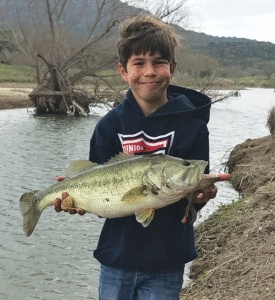
    Her younger brother, Ace, is five years younger, 11, and rides well but his passion is sports and fishing. “Ace is our bigtime fisherman,” said Kristy. “He just won 3rd runner up in his first ever state wide fishing tournament this year. He has the talent of a professional fisherman and has the passion for it.”

    Mike and Kristy head to the “office” every day – the barn – riding and training anywhere from ten to 20 horses each day. The foals start selling from their yearling year through to the two-year-olds that Mike has started. “We keep one or two,” said Kristy.

    Along with the performance horses, Mike raises bucking horses. “I used to wait for my folks to leave and buck all the steers at the house – I like the idea of being a stock contractor and messing with livestock.” He bought his first set of horses at the IFR Bucking Horse Sale in 1996. “I liked to have them around to buck.” He sold them, and three years later, he found some good blood from Ike Sankey, and started again. “I had some stock contractors take a chance on me and buy some of my horses. I raise them until they are three, after they’ve been dummied twice and ridden once. We take them to our family annual ranch rodeo, the Utopia Ranch Rodeo – which has been going on for 16 years.” The town of Utopia has gotten behind the event and with a crowd of more than 1,000 watching the Memorial Day event. The horses head to pasture for the summer and in the fall, they sell them all. Stace Smith, Pete Carr, Scottie Lovelace, and HiLo Rodeo have all bought horses from Mike. “Several of my horses have been to the NFR – Betty Boop, ridden by Tim O’Connell won a round last year. Sweet Maria has been high mark horse of the night. It’s been crazy – one year Raised the calf horse, sold him to my buddy who rode him at the NFR, plus I had bucking horses there as well. That’s pretty cool.”

    From bucking horses to performance horses, from polo to fishing – the Outhier family is on the go. “I couldn’t be happier to be building a breeding program and helping my kids succeed,” concludes Kristy. “I feel so lucky to have a great man at home and a great family and life ahead!”

  • Roper Review: Brook Styron

    Roper Review: Brook Styron

    Brook Styron, a Texas native, has seen a lot of changes in the roping industry over the years. He grew up in Granbury, Texas and was introduced to calf roping at twelve years old by a neighbor. That was before team roping had caught on, and Brook continued to rope calves in junior rodeo, high school rodeo and college rodeo.
    Now, in his mid-50’s, Brook has worked in the roping manufacturing industry since the early 90’s. As a young newlywed, Brook spent a number of years managing ranches in north and east Texas. He and his wife, Nancy, have raised three kids: Brandi, Sarah, and Bryce.
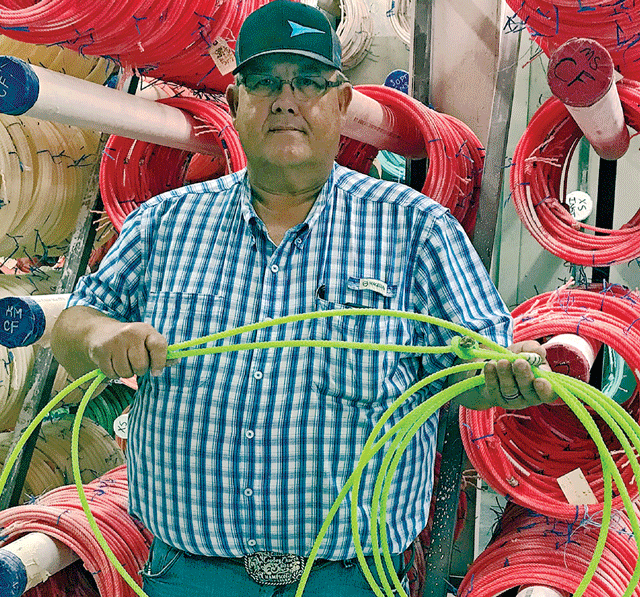
    Styron’s resume includes jobs as a deputy sheriff and telephone installer before settling in the rope manufacturing industry in the early 90’s. He worked at Maverick Ropes and Precision Ropes before settling in at Fast Back Ropes.
    Brook has been with Fast Back for twelve years and works in Operation Production where he’s responsible for purchasing string and other raw materials needed to produce ropes, in addition to other duties. He has seen a lot of changes in the rope making industry over the years.
    “Back when I first started, we tied a lot of 7/16” ropes which by today’s standards are extremely large. Also most rope companies carried just one or two ropes,” explains Styron. “Now there are numerous rope companies and they all sell a quite a variety.”
    Brook loves to rope and used to rope on a daily basis. Now he ropes several times a week and competes most weekends. He’s endured surgery on his right shoulder three times to repair damage from years of repetitive motion, primarily from roping. His last surgery, in March 2017, entailed a complete replacement.
    “I postponed each surgery as long as I could,” explains Brook. “By the time I had surgery I could barely rope and each time I came back and was competitive. This shoulder replacement, has made the biggest difference and I feel like I rope better now than I have in ten years.”
    Styron has also seen team roping evolve drastically over the years he’s been competing.
    “Besides the ropes and cattle getting smaller, the times have gotten incredibly faster. Back when I started, it was before the days of video and there weren’t many schools. Today kids have access to a variety of schools and training videos they can watch on their phone. They learn much more quickly and it definitely shows at the jackpots.”
    When not roping or working, Brook and Nancy, enjoy spending time with their grandkids: Ruger, Sadie, and Klara.

    COWBOY Q&A
    How much do you practice?
    Twice a week.
    Do you make your own horses?
    I used to, but as I’ve gotten older, I would rather not spend my time training. Now I just want to rope.
    Who have been your roping heroes?
    Clay O’Brien Cooper.
    Who do you respect most in the world?
    My dad.
    Who has been the biggest influence in your life?
    My wife.
    If you had a day off what would you like to do?
    Go hunting, fishing, or roping.
    Favorite movie?
    Remember the Titans
    How would you describe yourself in three words?
    Confident, generous, out-going.
    What makes you happy?
    Family and friends.
    What makes you angry?
    Disrespect.
    If you were given 1 million dollars, how would you spend it?
    Retire and enjoy life.
    What is your worst quality, your best?
    My worst is probably my temper. Loyalty is my best quality.

  • Jessica Routier

    Jessica Routier

    Jessica Routier’s goal at the beginning of the season was to finish in the top 30 of the WPRA world standings to set herself and her 7-year-old mare up for a bigger season next year. But when the barrel racer from Buffalo, South Dakota, and her horse, Fiery Miss West “Missy,” won the Badlands Circuit in the barrel racing in 2017, it set them up for numerous opportunities this year. “With the circuit finals money counting and the RNCFR counting, that gave us an opportunity for Calgary, and that money counted, and it all worked out,” says Jessica, who’s currently sitting eighth with $93,843. “I decided I might as well keep going fairly hard, and she’s run great. It’s been a learning year, and I haven’t been out of the circuit a lot before this. But for the most part, everything has gone really well and it’s been an amazing year.”
    Jessica, who is also a wife and mother of five, grew up riding cutting horses, along with roping, barrel racing, pole bending, and goat tying in the NLBRA. “I rode a lot of different horses when I was younger, and they were all nice. My mom trained them,” says Jessica. “I was 16 when I found that first special one I really clicked with, and that’s where my favorite event turned from goat tying to barrel racing.” Jessica went on to college rodeo on the National American University team, and has futuritied numerous horses. “I think cutting really shaped the way that I ride barrel horses. I really ride with my seat and my feet, and I ride a bigger saddle,” she explains. “I like my feet out in front of me, and I tend to get along better with smaller horses.”
    Finding the right fit of saddle and pad goes along with finding the right horse, and Jessica recently joined the 5 Star Equine team. “I’ve used their pads for a long time. I was always taught to look for no seams or anything that’s going to cause different places of pressure on a horse’s back. You can get a one-inch pad and use it forever and still have a one-inch pad, there are no indentations from the saddle. I love that they’ve been so good to work with on the different options you can have.” Jessica also started using 5 Star’s sport boots this year over the traditional polo wraps she normally uses. “I like that it’s something that’s going to conform to every leg as best as it can. It’s probably impossible to find a boot or wrap that’s going to support a 1,200-pound animal in all cases, but it’s the most protection you can get with the least amount of interference where the legs are going.”
    When she’s not on the road, Jessica is home helping her husband, Riley, on their ranch, and she rides horses for Gary Westergren, who owns Missy. “Gary raises a lot of horses and his stud and mares stand in Hot Springs, South Dakota. When his horses come of riding age, they come to my house and we decide what path to take with them. We typically send them to someone to put the first 30–60 days on them and then either my husband or I will work them on the ranch. I’ll start them on barrels lightly if they’re broke enough, but our main focus is being out and experiencing that world until they’re a little older.”
    Two horses that stand out in Jessica’s career are Especials Smoothie, who turned Jessica on to barrels when she was 16, and now Missy. “My mom started Smoothie, and then I high school rodeoed on her and won the CNFR on her. I ran her for about 17 years, and now my 10-year-old daughter runs her. She’s 23 now and she’s been an amazing horse. She and Missy are both very similar—they have very big hearts, and they can stand up on any ground and try 110 percent every single time.”
    When Jessica is traveling, her mother and several close friends put rides on the younger horses. She does the majority of her riding in the fall and hopes to ride through the winter this year. “Our family and our ranch and horses are what keeps us busy. Our oldest, Braden, is 12 and he loves to ranch and rope and do school sports. Our oldest girl, Payton, is 10 and she’s been trick riding since she was 4, and she also barrel races.” Jessica and Riley’s three youngest daughters, 3-year-old twins Rayna and Rose, and 2-year-old Charlie, love traveling to rodeos as well.
    “I just love how honest and loyal the horses are, and I love all the people that you meet. It’s such a kid-oriented thing too that gives your kids goals and good people to look up to,” says Jessica. “It’s an intense competition but everyone is there for each other too. My ultimate goal for the year is to make the NFR, and I would also like to get back to Kissimmee for the RNCFR.”

  • ProFile: Luke Branquinho

    ProFile: Luke Branquinho

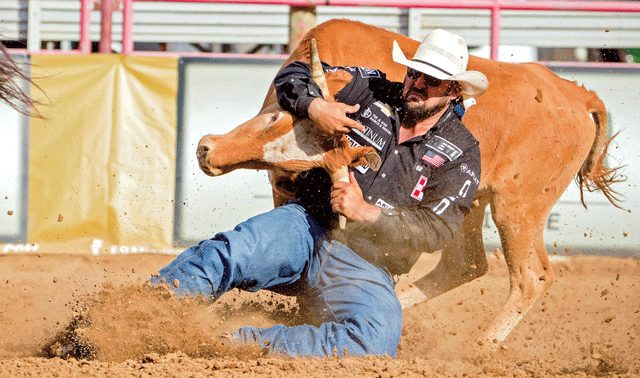
    Five-time World Champion Steer Wrestler Luke Branquinho won’t be shaking his booty under the bright lights of Las Vegas this December. He’s spent way too much time on the injured reserve list lately for that. But after a couple of comebacks in consecutive years, the living legend is looking forward to the $500,000 WCRA Semi-Finals, which will light up the Lazy E Arena in Guthrie, Oklahoma, during its November 15-18 run.
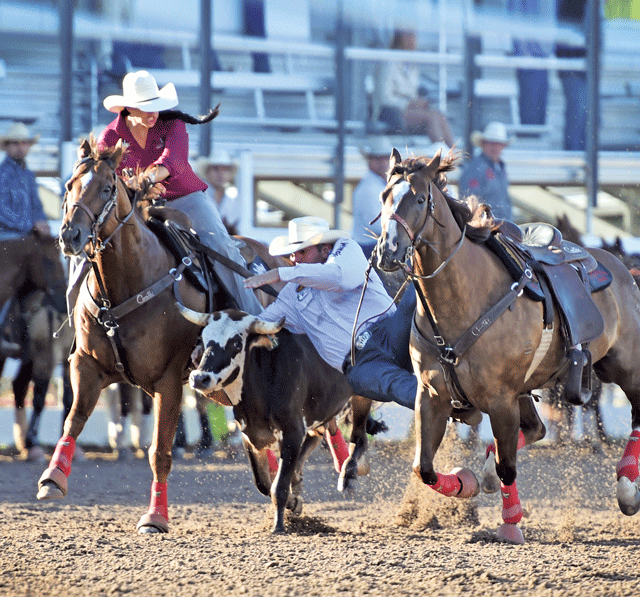
    Branquinho will be there via the World Champions Rodeo Alliance (WCRA) Virtual Rodeo Qualifier (VRQ) system, thanks to a series of recent rodeo nominations. Since his first event back after the latest injury—his hometown Santa Barbara Old Spanish Days rodeo in August, where he finished fifth—Branquinho has been busy nominating circuit rodeos in his quest to qualify for the WCRA Semi-Finals.
    As of press time the middle of September, Branquinho had placed at four of those rodeos, and was sitting fifth in the VRQ steer wrestling standings. The cutoff date for cowboys to nominate events for the Semi-Finals—for which the top 150 qualify—is October 29 (nominate now at app.wcrarodeo.com). He was vying to hold onto his spot in the VRQ standings, as the top-eight point-earners bypass the preliminary and progressive rounds, and advance directly into the top-eight finals at the Semi-Finals.
    Branquinho has largely planned his nominations strategy around cowboy-friendly conditions.
    “I’m nominating rodeos where the cattle are most likely to be even—not where there are three good ones, and eight you can’t win on,” said the Los Alamos, California, cowboy, who won the world in 2004, ’08, ’11-12, and ’14. “If it’s a rodeo where you’re likely to draw a steer that stops with the neck rope or runs so hard you couldn’t catch him with a rope, I’m less likely to nominate a rodeo like that, because too much is out of the cowboy’s control. The older I get, the less likely I am to enter rodeos that are notorious drawing contests.”
    The WCRA is going to great lengths to keep competitive conditions fair for all contestants.
    “I like a lot of things about the WCRA,” Branquinho said. “As professional cowboys, there just aren’t that many big-money opportunities. With the Virtual Rodeo Qualifier System, everybody has a chance to qualify to get there, and it’ll be a cowboy contest when we get there. I’ve heard people question the VRQ system, but to earn another chance at making good money from a rodeo I’m already going to is a no brainer. You already made the decision to enter that rodeo, why not pay a little extra to have a shot at a lot more money?”
    Branquinho turned 38 in September. So what’s left on his bulldogging bucket list?
    “I want to win as much money as I can before I retire, and the WCRA will help give a guy that opportunity,” he said. “Obviously, winning another gold buckle to get to six (and tie Hall of Famer Homer Pettigrew’s record) would be a big deal. My older boys (Cade and Jameson) got to see me win one. I’d like (Luke and wife Lindsay’s baby) Bear to get to watch me win one, as well.”
    In addition to the Days of ’47 in Salt Lake City, the WCRA will host three “majors” in 2019, for a total of four events featuring a $1 million guaranteed payoff in the coming calendar year.
    “I’m excited about all of this,” said Branquinho, whose trademark booty shake after a winning run is always a crowd favorite. “A shot at short-term financial gain is great, but in the bigger picture, we’re talking about the chance at money that helps set a cowboy up for the rest of his life. I want to be a part of it. With the PBR (Professional Bull Riders) as a partner, the WCRA will bring a lot more mainstream exposure to our sport, and that has all kinds of additional benefits and potential for cowboys.
    “More money and less travel is something we’ve all wanted for a long time. I look forward to the day when professional rodeo cowboys don’t have to travel like carnies to try and earn a living. Someday, cowboys won’t have to miss their families all the time to make ends meet, and I hope that day comes sooner than later. The WCRA is providing cowboys with some real-deal opportunities. Everybody has a chance to qualify to get there, and the cream will rise to the top. I just hope that in this day and age, I’m not low-fat milk.”

  • Back When They Bucked with Joe McBride

    Back When They Bucked with Joe McBride

    Although Joe McBride spends many hours behind the camera lens now, he started out in front of them as a rodeo clown and bullfighter during a rodeo career that spanned nearly 30 years. Joe has been capturing the essence of rodeo through photography at International Professional Rodeos, not missing a single IFR in Oklahoma City, Oklahoma since he snapped his first shot there in 1992. The Brooklyn born 79-year-old also takes photos at multiple rodeo events as he travels across the northeast on his off-time from his full-time position with the New York State Department of Corrections. Joe just passed his 35-year-mark of service to the job and has no plans to retire anytime soon. He watches inmates from his tower perch 50 feet above them at the Shawangunk Correctional Facility in Wallkill, New York. “When people ask when I’ll retire I tell them on the first…the first chance I get! But really, I have no intentions to retire, I’m like a worker bee, what would I do if I wasn’t working, sit on the couch and watch tv?”
    It was a very different line of work that filled Joe’s life before beginning his career with the corrections department. Joe had a fondness for horses, and an intrigue for the cowboy lifestyle. His mom, Eva Catherine McBride, an executive for IBM at their corporate headquarters in New York, fed her son’s passion by taking him on annual trips to the rodeo at Madison Square Garden in New York City, and even gifted him with a white gelding named Silver when he was 15-years-old. When Joe was 16, working at Camp Molloy in Mattituck, Long Island as a horse wrangler and trail guide, he went to the Islip Speedway Rodeo in Islip, Long Island and approached the owner, Gerry Partlow, for a job. Gerry let the teen exhibition ride on a bareback horse that night in 1956, and although he landed upside down into the fence after being bucked off in just a matter of seconds, Joe was drawn in to a life he wanted more of. “As I stepped out of the arena, my buddy asked me ‘How was it?’ and I said I loved it! I want to do it again!” Joe worked at a couple other rodeos for the Black Diamond Wild West Show that season, and at one of them, after sleeping on a bale of hay with a pair of clown baggies as his bedding, he remembers pulling them on just to see what they looked like, not knowing what a big part of his future he had just stepped into.

    Gerry agreed to let the aspiring cowboy have a job the next year if he came to Milan, Illinois the following spring. So, against his mother’s better wishes, in March of 1957, Joe dropped out of his studies at the School of Aviation Trades in Manhattan, and he and his friend Paul Dobin drove out of town in his Neptune green 1952 Ford pickup truck, headed for his future. “I thought spring started in March, and from watching television, I thought we were headed for a life that all cowboys lived, herding cattle on a ranch, sleeping in bunkhouses and then putting on rodeo shows as a sideline.” But, when Joe and Paul arrived in Milan to start their cowboy careers, they were taken aback when they found out the lifestyle of the wild west rodeo shows was not quite what they envisioned. “I was looking for the Black Diamond Ranch, but when we found Gerry Partlow, it ended up that he didn’t have a ranch; he rented a pasture to keep the horses turned out, and sold all the cattle but one bull after the season so he didn’t have to keep them through the winter, and he lived at home with his parents.” Even after attempting to sleep a few nights in Joe’s truck in the cold and snow, the two cowboy hopefuls were determined to make it work and finally decided to get a motel room and call their moms, who began sending them money to get them by. The friends worked several odd jobs and found a more permanent housing solution until May came along and the rodeo shows started up. Joe hauled a trailer that served as a stripping chute at the rodeos and was filled with the stakes and wire used to set up the rodeo arenas, and they left for the first rodeo of the season in Dexter, Missouri. “My job was to help set up and tear down the arena at each rodeo, and ride one bareback horse and one bull every performance.” There was another cowboy that hauled the bucking chutes trailer, and part of setting up the arena entailed taking the tires and wheels off the trailer, setting it on its axles at ground-level for the rodeo, covering the hubs with burlap sacks in case a cowboy was to land on them. They would then put the tires and wheels back on as they tore down the arena, readying it for travel to the next town. Joe spent several years working these traveling rodeo show seasons, riding and entertaining the crowds as a rodeo clown. In 1958, he added bullfighter to his list of job titles and often rode bulls while wearing his rodeo clown costume.
    Although rodeo is known to be big in the west, Joe made quite a career working as a rodeo clown and bullfighter in the northeast. Besides working for the Black Diamond, Joe worked for many other rodeo companies, such as Lou LaFalce and The Lazy L Rodeo Company based in Highlands, New York, Dick Quintoni who put on rodeos across Pennsylvania and New Jersey, the Crazy Horse Rodeo Company, Dodge City in Patchogue, Long Island, and for long-time IPRA rodeo contractor, Andy Compantero who owns Double R Rodeo Company. By 1965, Joe had given up bull riding, and was mainly perfecting his rodeo clown act. “In 1965 I bought a 1962 Ford F100 for $15 and turned it into my clown car. I moved the rear axle forward 3-or-4-feet so that it put the truck off balance. In my act, as soon as the other clowns got in the back of the truck it would buck and seesaw as I drove around the arena. The last part of the act a ‘bomb’ would go off, and then I’d pull a pin inside the truck that would flip the bed of the truck up and I’d drive out as the other clowns were dumped out onto the ground. As far as I know, it was one of the first clown trucks like it.”
    Joe Jr. was born in Brooklyn, New York in 1939 to his parents, Eva and Joseph F. McBride, who divorced when he was just 3-years old. Joe Sr. was a was a welder in the Brooklyn Navy yard and joined the Navy, becoming a Seabee and working as an underwater welder to repair damaged ships during World War II. He was also a golden gloves middleweight boxer.

    In February 1960, Joe met Carolyn Mirsky as he worked at Carroll’s Riding Academy in Brooklyn, by December of 1960 they married, and they ended up settling in the Middletown, New York area. In addition to rodeos, Joe worked many jobs ranging from installing chain link fencing to delivering produce and working as a driver for Sears for nearly 15 years. The couple had three children, Lisa, Joey, and Dennis, before divorcing in 1967.
    Photography was once just one of the many acts in Joe’s clown act arsenal, as he made the crowds laugh with delight as he wiggled and joked under a photographer’s cape with an exploding camera; but truly his passion for photography began with his mother. “My mom loved photography and bought me my first camera when I was about 13. Once I was clowning and fighting bulls, she gave me one of her old cameras and encouraged me to take photos at the rodeos; but I was so busy working I didn’t have time to take many. I finally upgraded to a Sears Camera, and then bought a Nikon and over the years I began taking photos at more and more rodeos. I really do it mostly for enjoyment, and now it’s my way of getting in to the rodeos without paying!”
    Although Joe didn’t finish his aviation studies in high school, planes were destined to become a big part of his life, and he still owns a 1962 Cessna 172 plane that he flew for many years, logging over 1000 hours of flight time. He is instrument rated and has a commercial rating on his pilot’s license. Joe also enjoyed traveling the roads on his 1993 Harley Davidson up until just 3-years-ago. His daughter Lisa May McBride currently lives in California, but recently passed the test to begin her own career with the same department of corrections as her father, so she will soon be relocating to New York. She has a son, Shawn that is married and living in California. Joe’s son Dennis also resides in California with his wife, Angela, where he manages a water treatment plant, and they have two children; daughter Lauren lives near Redding with her husband, and their son Chandler recently finished four years of service with the Air Force. Joe’s oldest son, Joey, lives on a 182-acre farm in New York, where he farms hay and he also drives double-trailer trucks for UPS, staying in town with Joe 5 nights each week. Joey and his wife Lisa Marie have 2 sons, Hunter and Logan that are 10 and 9-years old respectively, and 2 married daughters, Rachel who lives in Tennessee with her husband, and Heather who lives in upstate New York with her husband and just recently started in the training academy for the New York Department of Corrections.
    Joe McBride followed his passions in life and found happiness comes when you work for it, especially when what you do for work is a passion. He has literally spent a good portion of his life ‘clowning around’ and he wouldn’t have done it any other way.

  • On The Trail with Nellie Miller

    On The Trail with Nellie Miller

    Annelle (Nellie) Miller gets home as often as she can. “This year I didn’t have to travel near as much,” said the mother of two. “We had a pretty good start in the winter so we could pick and choose where we wanted to go.” Nellie has fit motherhood into her NFR run perfectly. “They travel with me most of the time.” That family includes James Miller, General Manager of Red Bluff Roundup, and their two daughters; Payton is 6 and Hadley is 3. “Since they aren’t in school yet, they can go with me. My parents are a huge factor in this too – her dad, Sam Williams, trains her horses, and her mom, Roxy often goes down the road to help with the girls. She has two brothers, Clint and Wyatt.

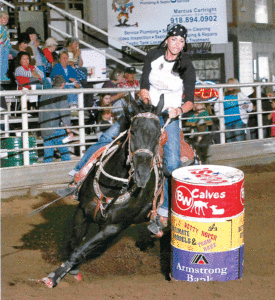
    She competes on her horse, Sister, a 10-year-old blue roan mare, Sire: KS Cash N Fame/Dam: Espuela Roan. “I have so much confidence in her,” said the 30-year-old who is making her third appearance to the Thomas and Mack arena this December, with career earnings of $533,276. The duo won Cheyenne Frontier Days in spite of a run around the barrels in the hail. “I knew she was going to work no matter what. My main plan was to push her through that hail – my cowboy hat helped block it a little bit and luckily it wasn’t too big. We definitely felt it – honestly I don’t remember much about it, I was just trying to get through it.” Back home in California now, Nellie is doing mom stuff. “I’m riding a few horses and I’ll go to the Circuit Finals, but until December, I’m home. “ The road to her third WNFR qualification started when she was a little girl.
    Nellie started riding about the age of ten. Roxy took it upon herself to take her daughter to some gymkhanas and once she started, the whole family pitched in. Sam is a self-taught horse trainer. “I’ve had a few mentors along the way; Tom Johnson, Bob Nelson and his wife, and I picked up a little bit from everybody, learning where I could from anybody.” Sam breaks all the horses they use on the ranch and roping trail. “I rope and my boy ropes too. Nellie started out roping and the barrels just happened,” he said. “You have great hopes for all of the horses you ride, but until you put them on the clock, you never know. Sister was a real good mare to break and ride – real confident. I was tying cattle out in the field when she was four – very willing and not afraid. To run at the PRCA level, you have to have a horse that can do anything. She tries hard every time. So does Nellie – she doesn’t weaken an ounce.”

    Nellie rodeoed through high school, competing in team roping, barrel racing, breakaway roping, pole bending and goat tying, although goat tying was her least favorite event. She made the high school finals in barrel racing all four years, but only traveled to it three times. “My last year it was in Springfield, way far away, and the horse I was on was a real good horse at state level, but not at a national level, so we decided not to go. Her parents, Parents are Sam and Roxy Williams and brothers are Clint and Wyatt…Father Sam trained her horse Blue Duck which was a homegrown horse and started out as Sam’s roping horse.”
    Nellie went on to college rodeo at UNLV in Las Vegas, winning the region and second at the CNFR. “I never made it in the roping, just barrels.” She had a great horse in Blue Duck AKA Rebas Smokey Joe (Registered name), half brother to Sister, and made the decision to start rodeing professionally on him. She filled her permit on 2008, but Blue Duck got hurt midyear and they went home. “He came back the following year and did OK and in 2010 we made the NFR.” Nellie has no words to describe her first trip to Vegas. “You never know until you experience it for yourself. It was a real learning experience. We struggled that week. We didn’t know what to expect.” The duo won second in the first round, and after that they were one out of the money every night for five or six nights, and then it went downhill.

    The bright spot in that year is she met James Miller, who worked for one of her sponsors. They got married one year later in Las Vegas. Payton was born in 2012 and they moved to California in 2013 for the position that James accepted as GM for Red Bluff RoundUp. Hadley was born and Blue Duck was getting older and Nellie was starting to work with Sister, but she wasn’t quite ready for life on the road. “She had a lot of potential and had what it took to be a rodeo horse, so when she came on, we hit the trail.”
    The family lives in Cottonwood, California, two hours from the Oregon border. The small town has a lot of team ropers and barrel racers, but it’s not the California that people generally think of. “It’s rural and ranching.” Nellie was raised there, but James made the trip across the country from his home state of Florida. “I kind of joke about James – he hit California and had more friends than I did – and I lived here my whole life. He’s got a lot to do with the community and the town and it’s fun to be a part of all that.”
    Both girls have ponies and they are already talking about barrel racing. For now, Nellie and Sister are at home making sure they are legged up for Vegas. “We raised Sister and have a whole family of horses related to her – I’ve been running her since she was six, and she’s consistent and always fires. She’s special!” Nellie’s secret to being on the road is simple. “I just try to do my own thing and if it works out that I win great and if not, that’s the way it goes. I don’t get wrapped up in beating anyone.”

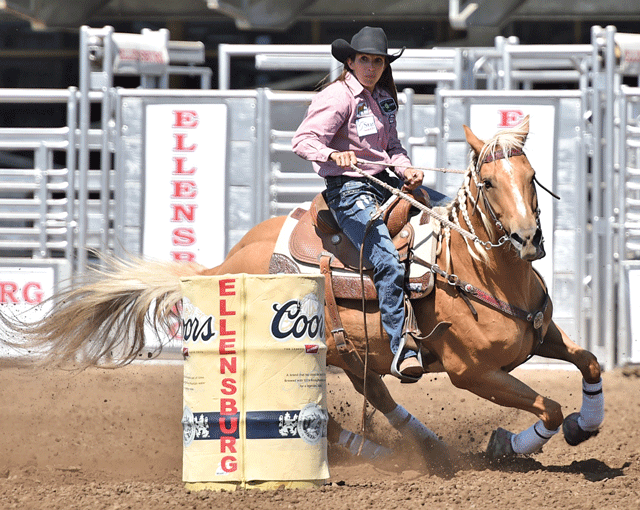
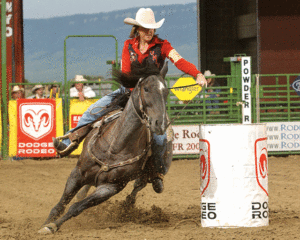
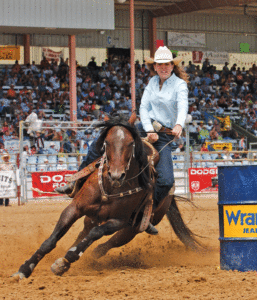
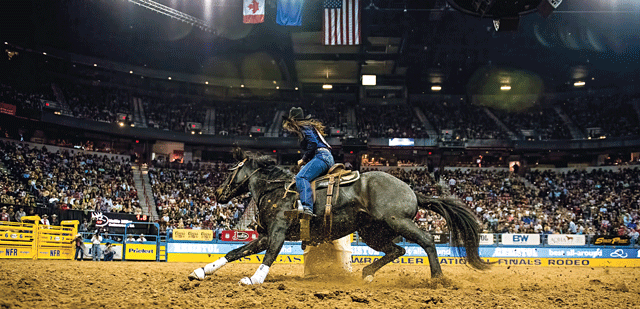
    Rounding the barrel at the 2017 WNFR – Steven Gray
  • Back When They Bucked with Don Huddleston

    Back When They Bucked with Don Huddleston

    story by Shiley Blackwell

    Don Huddleston’s name rings across the steer wrestling world as one of the greats. The Talihina, Oklahoma cowboy was an eight time NFR qualifier and has spent his days contributing to his community and the rodeo realm. “I’ve had some good guys beat me at bull dogging, and I’ve beat some good ones,” Don says of his 37-year career. “It was a lot of fun either way.”
    The 84-year-old Oklahoma native began his rodeo career during his teenage years in what was then-known as “FFA Rodeo.” “We didn’t have high school rodeo. The agriculture departments in different schools around here put on the rodeo,” Don says. “There was one in Clayton and one in Tuskahoma, and I’d make them every year and I got to where I could win.”
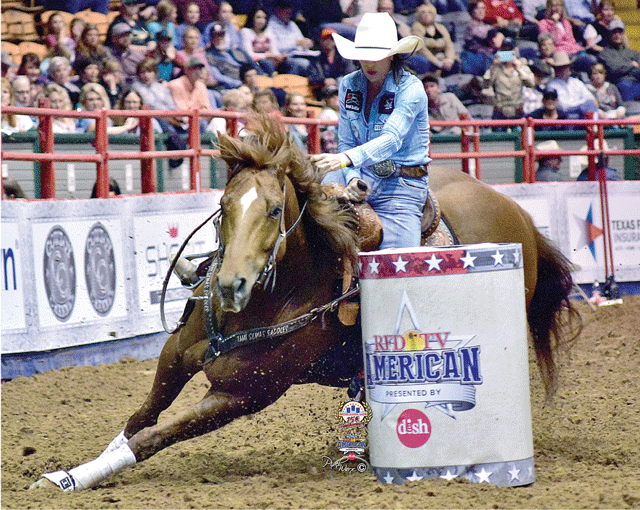
    During this time, a few boys from Kansas moved to Tuskahoma where Don went to school. A friendship formed and the group began rodeoing together. “We started branching out and going to stronger rodeos. I got to winning bulldoggings and bull ridings. That’s kind of what got me started.”
    Enthralled with his new-found love of rodeo, Don took every opportunity to improve his steer wrestling. “When I was going to school in Tuskahoma, we had one movie house and that was in Clayton. I went up there and I met Tater Decker and his wife, Jo, and they had bought a place down there in Clayton. We got to talking that night and he said he was going to build a practice arena. I said, ‘Well, if you want to, I’ll come help you then we can both practice down there.’ He said, ‘That’s a deal.’”

    That was the start of a building the arena that took four years and a friendship that lasted a lifetime. Tater and Don built an arena, then talked a stock contractor into letting them use a set of steers one winter in exchange for feeding and caring for them. “The bad steers we made better, and the good steers we didn’t use too much. He (the stock contractor) came out with a good set of cattle that year, so we started getting a set from a contractor nearly every year to straighten up.”
    After a few years of straightening steers out and practicing at Tater’s place, Don went to a rodeo in Ada in 1955 where he took third in the average and third in the go-round. “That showed me that I could rodeo with the rest of them since most of the professionals were there,” Don says. “I just went from there and got my RCA card.”
    This eventually led to him buying his Pro Rodeo card in 1958, leading to NFR qualifications in 1960, 1961, 1963, 1964, 1965, 1966, 1969-71. At Don’s first NFR, he set the record in the Dallas, Texas arena with a time of 4.0. Then, at the 1963 NFR he set the arena record in the Los Angeles, California arena with a 3.9. He also set the arena record in Oklahoma City with a 4.1.
    “In those days, they had the beefy, buffalo-type cattle, and at the first of the National Finals they let Lynn Butler have the steer contract. He’d buy a set of cattle in the spring, turn them out on the blue-stem grass in western Oklahoma in the summer, and then feed them 90 days before the rodeo… That made it a hustle to just be able to throw one down. When we started the National Finals, we had to bulldog steers weighing from 800 to 1000 pounds. You can imagine the hustle that that was,” Don comments.
    Between 1968 and 1982, he would fly his private plane to rodeos where a fellow cowboy would meet him with a steer wrestling horse. Don, who served as Latimer’s County Commissioner, was talked into running for office in the Oklahoma House of Representatives, which he won and he was a state representative for District 17 for two terms – 1971-74. Fellow politicians would join him on these “rodeo flights.” His other passengers included cowboys that were up at the same rodeos.
    “Most times, there in the house, there would be enough country boys there that would want to go to a rodeo with me. I had a six seat airplane so I’d load five up in there. One year, I loaded all of us up and we went to Helldorado Days in Las Vegas, and I won it. I couldn’t have had a better fan club there,” Don chuckles, “That’s the way it worked. There would always be people who wanted to come, so they’d jump in and come with me. I made sure that everyone who wanted to go could go.”
    During these years of flying to rodeos, Don had horses scattered throughout North America that he bulldogged off of. “I had several horses that went to California, a few in Canada, one in Idaho, another in Colorado. I sold them like that – all scattered out – then I rode them when I flew to rodeos.”
    Don’s arena on his ranch in Talihina became a gathering place for steer wrestlers looking to improve their skill and find the right horse. When Don retired from rodeoing full-time in the 80s, the arena they built in the 1970s continued to be a place for all the bulldoggers to gather. He and his twin brother, Dale, made many horses and competitors in this arena.
    Over the years, his “matchmaking” skills have helped dozens of cowboys find horses that have carried them to big wins. “I bought one horse from a guy over here in the county seat. He roped on him but he was just too charge-y. He told me he was going to sell him so I bought him and made a bulldogging horse out of him. I sold him to a kid in Arkansas and the first few months he had him he won $6,400 on him.”
    Don’s repertoire, as well as his ability to help cowboys find the right horse, brought in steer wrestlers from all over the country. “I had many bulldoggers here nearly every day,” he comments. “I trained a lot of bulldoggers, and many went to the finals.” Along with Don, there were many unmentioned cowboys that helped with the practices – opening a gate and pushing cattle.

    In his years of coaching steer wrestlers to success, Don emphasized the importance of attitude. “To win any rodeo contest, you need to have a good attitude. You can’t get mad at yourself, the steer, or your horse, then go to the next one and win anything… If someone has a good attitude, they’re worth working with and if they don’t have a good attitude, you might as well forget them.”
    He also served as the second vice president for the PRCA, from 1975-1980. Dale Smith was president, and Jack Roddy was 1st Vice President. After that he assisted Frank Shepperson as the steer wrestling director. His name was on the building at the ProRodeo Hall of Fame in Colorado Springs as being on the board when it was decided to build the building.
    In addition to steer wrestling schools, the Huddlestons’ arena also quickly became a place for rodeo competitors of all ages. “We filled that arena with bulldoggings and rodeos for junior cowboys and cowgirls. I had the first cancer society rodeo right here. We donated all the proceeds to the American Cancer Society in 1981.”
    They also started the now-famous Huddleston Ranch Bulldogging, which hit 46 consecutive years in May. The event, held over Memorial Day each year, brings top talent to Oklahoma for two days of competition. “Last year, we had several guys at the bull dogging who went to finals this year,” Don says. “There’s lots of gold buckles at this event.”
    And during these decades of bull dogging schools, ropings, and rodoes on the ranch, family has been at the center of it. “Our kids were raised right up here on the ranch, and they all rode horses,” Don says. “Lacee started hazing down here.”
    Don and Joye married in 1960 and traveled 17,000 miles on their honeymoon. They each had a child (Joni Grammar and Greg Vanderwagen) before they married and then they had two of their own (Gala Dawn Huddleston and Kevan Don Huddleston). They bought a ranch from Joye’s family in 1960, and still call it their home 58 years later. “We’ve been married a long time,” Don says. “And we’ve had a good life-the best life.”
    The ranch is now being run by Gala and her family and the tradition is being carried on under the careful direction of Don.
    Don has done a lot for rural Oklahoma, continuing the tradition of letting any child that had an interest in a horse to help them find their passion.

  • On The Trail with Lacee Curnutt

    On The Trail with Lacee Curnutt

    Lacee Curnutt from Talihina, Oklahoma, grew up riding on a ranch. Her grandfather, Don Huddleston (Back When They Bucked, page 18)raised her riding with him on the southeast Oklahoma ranch. “My grandpa went to the NFR 8 times and even though he had retired by the time I started hazing, I used to haze for everyone he helped,” said the oldest of five sisters. “On Sundays, Grandmomma took me to church and we always practiced after the meal.” Lacee competed in barrel racing and hazed with her two bulldogging teams through college. “Those two teams helped me stay on the rodeo team,” she said. Lacee went to college for elementary education, but left to go pro rodeo before completing the student teaching.

    She hazed for her ex-husband and several bulldoggers and came home when she became pregnant. “Then along came Walker Don Woodall,” she said. “I couldn’t be luckier –he’s friendly, loving and kind. And a good boy.” She came home and waitressed and eventually worked in the oil fields. “I was still hazing at the amateur rodeos and raising Walker; trying to be a good mom.” Although Walker rides horses, his first priority is playing football. He also likes fishing and playing baseball.


    Lacee met steer wrestler Tom Lewis through a mutual friend and they literally met on the road – at a Wendy’s at Hayes, Kansas. He went his way and she went hers. “I told him if he made the short round at Dodge City, Kansas, I’d come watch him.” He did and she went and he won the rodeo. “It was a good first date.” That was more than a year ago and the couple will be married November 10.

    She has been able to stay home, quitting her job of hauling horse trailers, to take care of the horses at home and keep up with 10-year-old Walker and Tom. Whenever she can, she hazes for Tom as well as several others. “I can remember the first time in 2003 when I bought my card. I hazed in Ft. Worth and they were fresh cattle; that will always weed out who deserves to be there. It was a man’s sport, and I had to prove myself before they were ever really nice. Once I did, they were good.”

    She says that one of the secrets to being a good hazer is having a good horse. “That hazing horse has to help everyone,” explained the 35 year old. “When I was young, I had a horse that we got off the track. He bucked everyone off and finally I got him and he took care of me until the day he died. He was 22 – it’s been hard to find another one. I’ve trained a bunch, and Chad Richard out of Utah had one that has been super awesome – Superman.”

    “Throwing your leg across enough of them you know the difference. When to say enough is enough and when to keep messing with them. With age, you recognize what a good horse has to have. You’ve got to have some heart in them – I like finding that peace in a horse.” They have the perfect team now between Superman and Maverick. It’s the same way they feel about working as a team with each other.


    “I never thought I would ever have a lady haze for me,” said Tom, who made the NFR in 2012. “She’s not just a cowgirl; she’s special. She’s the love of my life, we’re good friends and we can talk. It’s been good. At the end of the day, it’s just a rodeo.” He has been dogging steers since he was a junior in high school, joining the PRCA in 2001. In 2012, after winning the circuit 4 times, he made a run at the NFR. His good horse got hurt after he made the NFR in 2012 and it’s taken him four years to find Maverick. Four guys rode him at the Finals last year and the duo, along with the hazing horse, Superman, have had a great year.

    Lacee’s goal in life is to be happy and have a peaceful life. “I want to give back, I love helping young ones! Always give God the Glory; we would be nothing without Him! Her other goal is to be the first female hazer at the NFR, a goal she has held dear for many years. “I’d love to make history. To me it would be a payoff of years and years of hard work.”

  • Roper Review: Kevin Staples

    Roper Review: Kevin Staples

    Kevin Staples grew up in Stephens City, Virginia, where his dad, Billy Staples, trained horses and owned one of the largest sale barns on the east coast. Their monthly horse sale, held the first Saturday of each month averaged 300 to 400 horses, and during the spring months they would sell anywhere from 500 to 700 horses in one day. The sale included every kind of horse imaginable: roping, buggy, jumpers… they sold them all.
    “Growing up I was blessed to have access to an indoor arena with 30 stalls,” says Kevin. “We basically lived in that arena.”
    Kevin started roping when he was four or five, but his father started him trick roping at an early age. His first trick roping show was booked at just nine years old. Kevin’s trick roping act became an opener for country and western singers like Tammy Wynette. In 1983 he opened for B.J. Thomas on the White House lawn where they performed for President Reagan. He also appeared on the television show, That’s Incredible.
    By the age of fifteen, Kevin’s interest in team roping surpassed his desire to be a trick roper.
    “Like many kids, my dream was to make it to the NFR,” explains Kevin. “At the time I was breaking a lot of thoroughbreds, getting them ready for the track and then team roping on the weekends.”
    Obsessed with the dream of becoming a professional roper, Kevin realized he needed to spend time with people who would help improve his ability. In 1988, while living in Florida, Kevin was diagnosed with a grapefruit size tumor on top of his bronchial tubes.
    Kevin credits his doctors at Duke University, and the grace of God, for his complete recovery. Treatment consisted of chemo every other week for six months, followed by daily radiation for another month. Now, at age 50, he’s been cancer free since, or as he likes to joke, “I’ve been clean for thirty years.”
    Enduring and surviving a life threatening illness changed Kevin’s perspective on his life and goals. No longer did he feel a pull to be at the NFR, but realized the desire to hone his craft as a horse trainer.
    “I always knew my dad was a pretty good trainer,” explains Staples. “But it wasn’t until I matured that I realized just how good he was.”
    In addition to his father, Staples also credits a six-month stint he spent with cutting horse trainer, Tracy Bales, for the passion he now has for riding young horses.
    Kevin still loves to compete and regularly places at World Series ropings, but admits what really excites him is riding colts and watching their progress.
    During his early 30’s and living in Virginia, Kevin entered a horse in the San Antonio Ranch Gelding competition. There he reconnected with family friend, Tom Nelson, owner of the HK Ranch in Victoria, Texas. Having lived in Pennsylvania, Mr. Nelson knew first hand the challenges of riding and training in winter conditions. He offered Kevin a job riding horses in Texas during the winter. Staples would return to Virginia for spring and summer, and head back to south Texas in the fall. It was in the third year Kevin realized that Texas offered the lifestyle he craved and stayed full time, only returning to Virginia to visit family.
    Since then, other than a few years training at JB Quarter Horses, Kevin has been with Tom Nelson at the HK Ranch where he’s the General Manager and horse trainer.
    The HK Ranch operates a breeding program for foundation Quarter Horses. They are currently standing a Les Glow Colonel stallion and a Red Baron stallion. With a dozen broodmares Staples has his hands full with yearlings, two-year olds, three-year olds, plus a herd of 300 cows.
    Staples has trained some very successful jackpot and rodeo horses ridden by cowboys such as Trevor Brazile, Shay Carroll, Logan Medlin, and Charlie Crawford. One of the most famous horses to come from the HK was the well-known heel horse, Switchblade, ridden and owned by NFR heelers Kory Koontz, Allen Bach, and Jade Corkill.
    At HK Ranch, Kevin strictly trains team roping horses. Their philosophy is two and three-year olds are used for ranch and cowboy work only. Colts never see the inside of an arena before the age of four. By that time they are broke and mature.
    “The policy at the HK is ‘old school’. If we check fences or water troughs, it’s done horseback,” explains Kevin. “Rather than worry about saving time, there’s so much more value for a horse to be ridden and used. The only four-wheeler on the ranch is in the arena and used to pull a dummy.”
    The HK Ranch always has a nice variety of colts for sale in various stages of training. For information Kevin can be reach by email at: kevinstaples1@gmail.com.

    COWBOY Q&A
    How much do you practice?
    Every day.
    Do you make your own horses?
    Yes.
    Who were your roping or rodeo heroes?
    H.P. Evetts and Clay O’Brien Cooper.
    Who do you respect most in the world?
    Jesus Christ.
    Who has been the biggest influence in your life?
    My parents.
    If you had a day off what would you like to do?
    Go to New Mexico and hunt mule deer.
    Favorite movie?
    Lonesome Dove.
    What’s the last thing you read?
    The Gorilla Mindset.
    How would you describe yourself in three words?
    Genuine, fun-loving, honest.
    What makes you happy?
    Visiting and drinking a beer with old friends.
    What makes you angry?
    People that whip horses.
    If you were given 1 million dollars, how would you spend it?
    Buy land and cattle.
    What is your best quality – your worst?
    My best quality is honesty. My worst quality is being too easy going at times.

  • Tami Semas

    Tami Semas

    Tami Semas—professional barrel racer, saddle designer, and wife and mother of two—found her niche in the horse industry in high school, and dug deep into her passion after college. The first of her family to rodeo growing up, the 41-year-old from Brock, Texas, learned by trial and error, and her persistence earned her two qualifications to the PRCA Columbia River Circuit Finals, and a place at The American’s inaugural rodeo in 2014. In 2015, she was Equi-Stat’s highest-earning rider of futurity horses, and has trained multiple futurity and derby winners. “Where a lot of people who’ve had parents in that event have the process narrowed down a little bit, I had my biggest successes from my biggest failures,” says Tami. “I’ve spent a lot of time learning from horsemen how to get a horse really broke. I understand the game of barrel racing, and to combine that with horsemanship is kind of my approach. I wanted a very smooth motion in my horses around the turn, and I have learned to get a horse to be soft. I’m a small person—I can’t hold the horse around a barrel—and I’ve learned through various horsemen how to get a horse to respond through weight, leverage, and positioning to keep them light.”
    Searching for a saddle that was balanced for Tami’s smaller stature led her to becoming a saddle dealer for seven years, and ultimately, launching her very own line of Tami Semas Barrel Saddles. “A lot of saddles on the market didn’t feel like they balanced my weight great, and either pushed me forward or back. I ride everything centered, and I bought a saddle from one company that worked pretty good,” explains Tami, who at that time was Double J Saddlery’s highest-selling dealer without a store. “I learned a lot about what many riders were wanting and needing. I came up with some ideas on how I would tweak things if I would ever be able to build my own saddle from scratch.”
    Tami quit her dealer job in 2014, and she approached a manufacturing company about building her own saddle that same year. “A lot of things are the same with saddle parts, but they can be put together to have a uniquely different feel,” Tami explains. Her saddle came out in the 2015, her best futurity year to date, and the Tami Semas Barrel Saddle was a success. They now sponsor several athletes, including Hallie Hanssen, a futurity horse trainer from South Dakota. After two-and-a-half years, Tami decided to go out on her own for manufacturing, and with the aid of her custom tree maker and a new manufacturer, the latest line of Tami Semas Barrel Saddles will launch this fall.
    Of equal importance to a balanced saddle is the saddle pad underneath, and 5 Star Equine became one of Tami’s sponsors the year her first saddle came out. “I’m a firm believer in their product. I’d used their pads over the last 10 years, and they’ve been a sponsor over the last 3 years, and we also promote them with our saddles,” says Tami, who is also using 5 Star’s new line of leg gear. “The things I use for my barrel racing and riding I call timeless tools. I’m not someone to use the latest and greatest thing that’s come out on the market; I’m going to use the tools that have stood the test of time, and I believe 5 Star is a product that has stood the test of time. That 100 percent natural wool has always allowed my horses’ backs to breathe well, especially down in Texas. I want a pad that absorbs shock, breathes well, fits comfortably on my horse, and can withstand weather conditions, and 5 Star has been that product for us.”
    Tami, who trains all of her horses, sold her futurity horses this year, thinking 2018 was her year to rodeo. But when her horse Smooth N Famous, who won nearly $200,000 during his futurity career, had an injury this year, she had to turn him out to pasture and make a new plan. That became running and seasoning a 6-year-old, Colour Me Gone, she trained and sold but bought back recently. “I’ve pretty much seasoned him at the pro rodeos, and I’ve gone to Northside, which is an open rodeo every weekend. I always like the Diamonds and Dirt Derby, and we just keep training horses this year and selling them. Next year we’re hoping to have our horse better seasoned for the rodeos,” says Tami.
    Her 15-year-old daughter, Madison, traveled with her most of the summer, and enjoys riding and other sports, while Tami’s 16-year-old son, Myles, plays football. Aaron, Tami’s husband, rode bulls for 18 years and qualified for the WNFR 7 times, while he’s also one of the founders of the PBR. “He’s doing some fixer-upper homes down here and ropes, and when you have a family and kids at this age, it’s definitely a busy time. What we’re doing is just trying to train good horses, build a good saddle, and let the horses tell us where we’ll be going.”