Rodeo Life

Category: Archive

  • On The Trail with Bridger Anderson

    On The Trail with Bridger Anderson

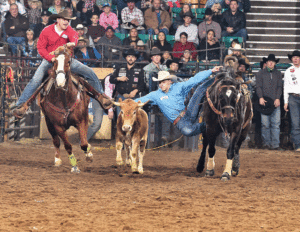
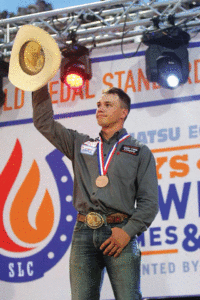
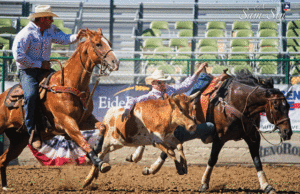
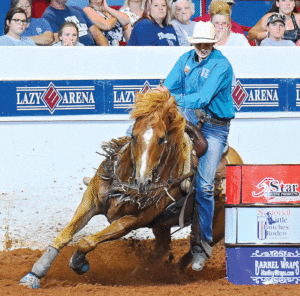
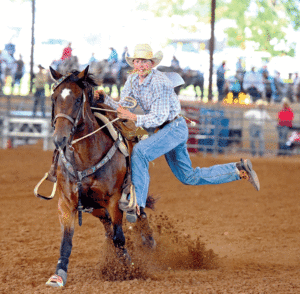
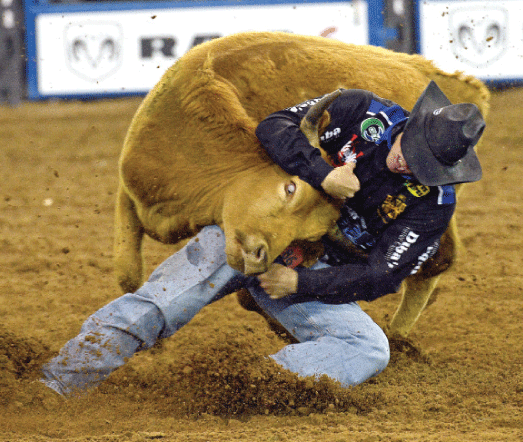
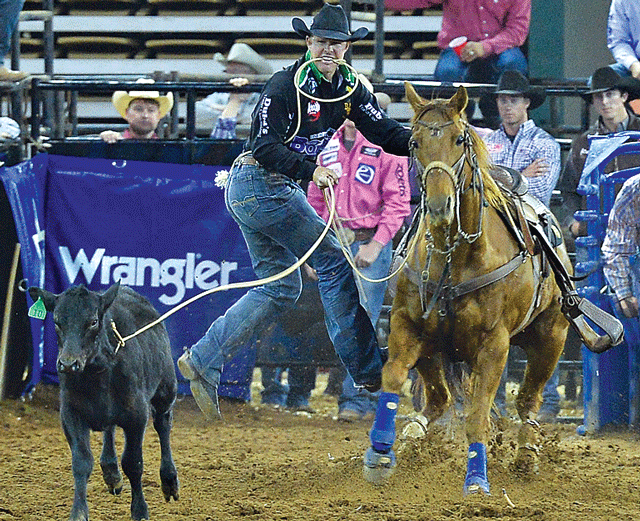
    Bridger Anderson is from Carrington, North Dakota, where winters are seven months long. “For five months out of the year you can’t beat it,” said the 20-year-old who just won the College National Finals in steer wrestling. “In the winter we practice when it’s above 15 degrees, but that doesn’t happen too often. The temperatures will get to -20 with wind chill down to -50.”

    “Bridger has been horseback for as long as he can remember. “My parents rodeoed, dad (Glenn) roped and mom (Robin) breakaway roped and team roped.” He has two sisters, Cedar and Dawsyn, who both competed growing up as well. “I was tying goats at amateur rodeos when I was five. The first time I roped at an amateur rodeo was in fifth grade.” He made it to Nationals in the calf roping twice in junior high and once in high school. His true passion has always been steer wrestling.

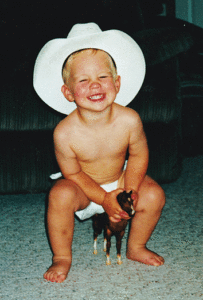
    “When I was three, I told my mom I wanted to be a steer wrestler. I was going to be a Paleontologist during the day and professional steer wrestler at night.” Although he’s not so interested in dinosaurs anymore, he’s definitely got his sights set on the WNFR. “I grew up going to rodeos, it was during the NFR that Luke Branquinho became my rodeo hero – the person I looked up to and idolized growing up.”

     

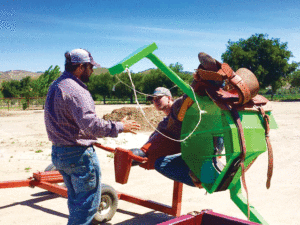
    He jumped his first steer in the spring of his eighth grade year at Tyler Schau’s bulldogging school.

    Then Robin came up with an idea in December of 2015. “We don’t give Christmas gifts; so we look for experiences,” explained Robin. “I wanted to do something that would take Bridger to the next level and to create some relationships. I sent a message to Luke’s Fan page on Facebook, asking if I could pay him to send Bridger to California to throw steers with him for a few days. Luke responded 20 minutes later and said ‘let’s do it’. We flew down and spent a weekend at the Branquinho Ranch in April, 2016. Ever since that weekend, Luke has been a mentor for Bridger; often seen in the box with him if they are at the same rodeo. I could always tell from a distance that Luke was a great human being – you need to surround yourself with people like Luke.”

    Luke has been glad to help. “He’s a sharp kid, he excels in the classroom and the arena. There’s a lot of talent out there, but he has all the things that will make a champion out of him. He has the right mentality, technique and work ethic. There’s several ways to bulldog. I teach the basics and let guys find their own timing. Nobody bulldogs the same. That’s what I like about Bridger – he’ll adapt to the situation and picks up things from here or there that will help him out. There’s very few out there that are like that.”

     

    As far as adapting Luke’s signature move once he’s thrown a steer, Bridger said, “I’ll be better known for walking out emotionless – I don’t do much.”
    Bridger went to Shawnee to the IFYR his sophomore year (2015) and won the steer wrestling title there. He was the North Dakota State champion wrestler at 170 # in 2016 – his junior year in high school. He was also in football but made the decision his senior year to retire from both sports so he could focus on getting into The AMERICAN. He qualified for the semi-finals that year in Rapid City, but didn’t make it to the AT&T – he finished in the top 25. He turned 18 in August before his senior year, bought his PRCA permit and made the short go his senior year in high school in Denver (2017) at the National Western Stock Show.

    When it came time to pick a college, Bridger chose to rodeo for Stockton Graves at Northwestern Oklahoma State University. “I’ve known him for three years, said Stockton, who has been the coach for seven years. “He’s a great kid – he works hard in the classroom and he works hard at steer wrestling.”
    Stockton is traveling with Bridger this summer along with Billy Bolden and JD Struxness, who was the 2016 CNFR steer wrestling champion, under the coaching of Stockton. They are hauling Bridger’s horse, Whiskers, Freeway, JD’s haze horse Wave, and Billy’s horse. “Whiskers is 10 – and came from Diamond S Performance Horses (Tyler & Jackie Schau, who are also mentors of his). He came off the track. He knows his job, usually if something goes wrong it’s my fault not his.”


    Bridger says the driving is just part of the game. “I like to rodeo and you have to travel to rodeo. It’s worth it if you get to run steers; there are cool rodeos and cool arenas out there. We’ve gone to quite a few, and this year we’re going to even more in hopes to make it to Vegas.”

    “I never doubted Bridger was going to be here. He’s always been determined, focused and willing put in the work,” said Robin. “When he was three he decided to quit daycare, saying ‘Mom, cowboys don’t go to daycare.’ So at the age of three, Bridger stayed home – Glenn was around on the ranch, and he painted pink fingernail polish on the television remote to show the power on and off button and the channel up and down button. He also taught him how to push ‘1-9 start’ on the microwave so he could make himself a hot dog.” He had lots of stories for his mom at the end of the day including what laundry detergent to use, and what his teacher had taught him during the day, insight gained from the television.

    Glenn taught Bridger good horsemanship. “He keeps his hands soft and is light on Whiskers mouth in the corner.” Glenn, who works for ProAg in the crop insurance world, is excited for his son. “The kid is living his dream and more power to him.”
  • Reaching For The Stars: Lexee Jo Barvian

    Reaching For The Stars: Lexee Jo Barvian

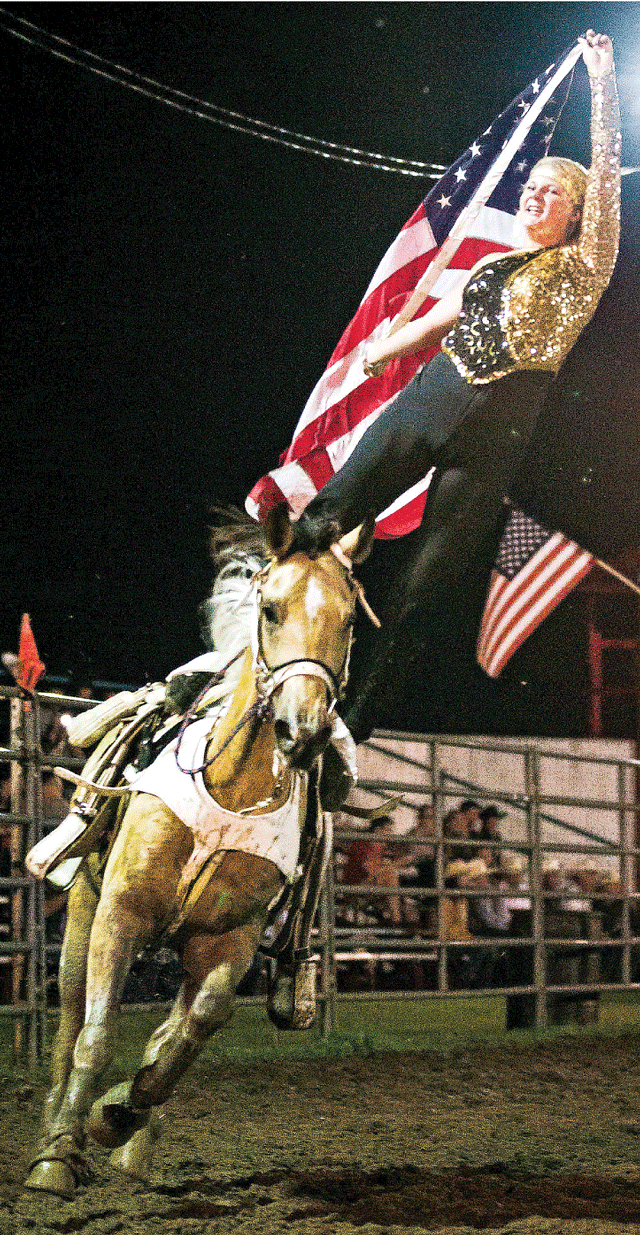
    Lexee Jo Barvian started riding horses before she could stand on her own two feet, but these days the 18-year-old from Attica, New York, does both as a professional trick rider. While the graceful drama of a death drag is one of Lexee Jo’s favorites, the liberty stand is where she literally stands her tallest, feet planted on her trusty palomino while the stars and stripes of the American flag in her hands streams out behind them.
    She takes her talents to APRA, IPRA, and SEBRA rodeos on the East Coast, performing for Rawhide Rodeo Company and Painted Pony Championship Rodeo, and competing in the barrel racing as well. “I know most of the contractors pretty well, and they help me out with where my performances go so I can barrel race,” says Lexee Jo. Her hometown rodeo is the Attica Rodeo, voted number one in the APRA, and Lexee Jo performed there in 2018 for the first time alongside one of her trick riding idols, Dusti Dickerson. “I’ve always watched her ride, and she’s been on the Dixie Stampede, and just to perform with her was a dream come true. I was smiling from ear to ear.”
    Lexee Jo grew up trail riding, though after a horse ran off with her during a ride when she was 3, it took her a year before she wanted to saddle up again. However, Lexee Jo spent her summers with a family friend who owned a trail riding business, and her courage grew as she rode everything from ponies to Percherons. When she turned 10, Lexee Jo was given a 2-year-old gelding for Christmas, Kutter, and she trained him with the help of friends. Kutter carried her through both English and Western disciplines, as well as high school barrel racing, before becoming her trick riding horse.
    When Lexee Jo started trick riding seven years ago, she and a friend read an article online, cinched up their trail riding saddles, and started experimenting. “We started looking up YouTube videos on how to do tricks right, and our parents said if we were really serious about it, they would take us somewhere to teach us the right way to do it. Later that year we went to Tennessee to train with Loretta Pemberton, and we learned the basics of trick riding there,” says Lexee Jo. “For the last six years I’ve been learning from my mistakes and trick riding with other trick riders.” Her trick riding career took off soon after when family friend Sam Swearingen, the owner of Rawhide Rodeo Company, hired her to perform at one of his rodeos. “I liked it so much that I’ve been trick riding since.”
    Lexee Jo’s background as a base for cheerleading—helping lift the flyers—has helped her with the strength and flexibility needed for trick riding. She’s also strong in the support of her family, particularly her parents, Todd and Suzette, and her older brother and sister, Brock and Laura. “Me and my mom are together all the time. Before rodeos she helps me wash my horse and get my costumes and saddle ready, and put glitter on my horse. It’s a lot of work to get done before a performance, and it’s definitely a lot of fun. My brother and sister are always pushing me to do my best.”
    A new member of the 5 Star Equine team through the Reaching for the Stars competition, Lexee Jo also appreciates the support of quality tools for her horses. Several years ago, her trick riding horse developed a rearing problem, and Lexee Jo discovered his back was sore from an inadequate pad. “A friend of mine let me use his 5 Star pad and I got Kutter adjusted, and he quit lunging forward. Ever since then I’ve been using a 5 Star pad for my trick riding horse and my barrel horse. I use the thickest pad possible for my trick riding horse because his saddle is so big. Trick riding saddles are very heavy, and they’re not really built to fit a horse that well—they’re built to stay in place and not shift around, so I needed a quality pad because of that,” Lexee Jo explains. “I use their sport boots and bell boots as well, and they fit really close to the legs. I like that a lot because no dirt can get in. When you’re going fast around the arena, you don’t want anything getting in there.”
    A recent graduate from Attica Central School, Lexee Jo plans to move to Oklahoma and work with a barrel horse futurity trainer this fall. A four-time NHSFR qualifier, she’s also making her first trip to Nationals this July in honor of her senior year, and plans to attend several college fairs while she’s out West. “If I’m going to college, it will definitely be a rodeo college. For my trick riding goals, I would really like to do the IFR Specialty Act Contest. And for barrel racing, I really want to make it to The American because I know my horse has the ability, so that’s one of my ultimate goals.”

  • ProFile: Phil Sumner Rodeo Company

    ProFile: Phil Sumner Rodeo Company

    The International Finals Youth Rodeo, known as the world’s richest youth rodeo, will take place for the 27th year on July 7-12, 2019, in Shawnee, Oklahoma. Not many understand the beginnings of the event better than Phil Sumner of Phil Sumner Rodeo Company. “The national high school rodeo finals had been held for three years in Shawnee, and when they moved to Gillette, Wyoming, Ken Etchieson put together a plan for the IFYR. Ken’s whole concept was that he didn’t want just one stock contractor, he wanted to have several stock contractors bringing in the best stock for the kids to compete on. He was very specific that he didn’t want any eliminators in the rough stock. So, the whole deal turned out that I won the bid on the stock contract, and I ended up bringing in some of the best contractors to furnish the stock for the IFYR for 20 years. That first year, I provided all the labor to run three arenas, picked up broncs, had horses and bulls there, and coordinated the rest of the contractors. Over the years I’ve coordinated with many stock contractors such as: Wendel Ratchford, J.C. Ward, Dale Hall, David Bailey, Sammy Andrews, the Rumfords, Bar 44, Chuck Donaldson, Lindell Tunes, Danny Hajek, Charlie John Coffee, Hall Rodeo Company, Vicki Long, and Charlie Thompson.”
    An Oklahoma native, Phil grew up between Stillwater and Perkins, Oklahoma, and graduated from Perkins High School before graduating from Oklahoma State University in 1966 with an animal science degree. Rodeo was a part of his upbringing and his senior year of high school he started riding bulls and made a short stint as a bareback rider as well. After leaving OSU, he managed 150 head of Black Angus in Glenwood, Arkansas, so rodeo was put on hold for a few years. Phil’s first wife, with whom he had a son, Rod, and set of boy and girl twins, Walt and Misty, had an aunt and uncle that were involved in a serious accident, so they came back to Stillwater, Oklahoma to help manage their dairy while they recuperated. Once the family was able to take back over at the dairy, Phil went to work for Oklahoma State University as the assistant beef herdsman for several years, before going to work for Farmland Industries in Enid, Oklahoma, where he has worked for 43 years. And between all the full-time jobs, Phil was building his name as a stock contractor throughout the country.
    Starting out, Phil had the opportunity to breed to a bull, Andy Capp, owned by Jim Shoulders that was nearing the end of his successful career, having been a favored bull at the NFR for many years with Jim. Phil was glad to end up with several great bulls out of those crossings. “I was doing work with Carl Rice, out of Begas, Oklahoma at that time, picking up broncs and leasing him bulls, and several of those bulls made the IFR at that time in Tulsa, Oklahoma. Things kept progressing along and I went to a Jerald Smith sale in Texarkana and bought some bulls and ended up with some really good bulls. I’d buy bulls that were someone else’s mistake and I’d bring them home and had success in bringing them along.”
    Phil had a portable bull riding arena, and he started hauling it to different locations and putting on bull ridings. Hank Moore put in Tumbleweeds, a bar in Stillwater, Oklahoma with an arena behind it, and Phil started bucking bulls there every Saturday night. He’d also buck bulls at Doug Blem’s arena on Sundays, plus buck bulls at his house in Goltry each week. “I had the opportunity to show those bulls three different types of arenas within a week’s time, it was good for them.” In 1991, he bought 3 bulls from Jess Kephart, one was Tumbleweed, and another, Bodacious. “I bought Bodacious in 1991 and in 1992 he went to the IFR, although he didn’t buck there. “Sammy Andrews started hauling them and Bodacious began an extremely successful career. He bucked off Bubba Don, and Terry Don West was the first man to ride him. Terry Don got on him four times, he rode him twice and got hurt twice. I watched Tuff Hedeman ride him in Long Beach and it was the best ride I’d ever seen on him, Tuff matched him move for move, but then got hurt on him. Tuff drew him at the NFR later and stepped off him out of the chute, because he didn’t want to chance getting hurt.” Bodacious had a reputation throughout the bull riding world as “the world’s most dangerous bull.” Bodacious was the bucking bull of they year in the PRCA twice, PBR bull of the year once, and was inducted into the Pro Rodeo Hall of Fame in Colorado Springs in 1999 and inducted into the Bull Riding Hall of Fame in 2017. On November 5, 2019, Bodacious will be recognized at the 2019 PBR Heroes & Legends Celebration at South Point Casino & Hotel with the PBR Brand of Honor, the sport’s highest recognition for a bovine athlete.
    Besides Phil’s success in breeding and choosing bulls, he also had some stand-out horses over the years. “I started putting together a few head of horses, Sammy Andrews would send colts to our friend Danny Hajeck to grow in the summer, and I would haul the colts and started putting on rodeos. A lot of the horses out of that deal went on to be outstanding. Cool Water, Lock and Load, Power Play, Roly Poly; they all went on to make the NFR. One of the latest horses I hauled for Sammy was H-09 who went on to be an NFR saddlebronc horse. Having the success that I’ve had with the horses and bulls has been a very self-fulfilling experience.”
    Through all the horses, bulls and productions, Phil was determined to not let rodeo interfere with his business life. “There were many times that I’d get off work on Friday, rent a car and drive to a rodeo where I had hired guys to haul my horse and meet me. I’d work as a pick-up man, and rodeo all weekend, and the guys would drop me off at work Monday morning, and I’d start work in the clothes I was wearing from the night before. Not too many people knew that’s what I was doing.”
    Phil has a stepson, Jason Auddell, from his second wife, “Jason has a passion for rodeo and has been extremely helpful. He’s got some bulls that he’s had good success with, and his son Thatcher just graduated from high school but hauls bulls to events himself. All my kids have helped me at rodeos. My daughter helps time, and all of them have helped me at the IFR over the years. It’s great to share it all with them.” Phil’s wife Jeni is now helping him with some of the rodeos he puts on each year. Phil passed on the torch and stopped bringing stock to the IFYR 5 years ago, but he currently puts on many IPRA and KPRA rodeos each year.
    Phil looks back fondly on the two decades he was involved with the IFYR, “One of the best things I ever did at the IFYR was on Sunday, I’d set up a trailer for the contractors to keep all their tack, and I’d put a 10 X 20 tent with a shade cloth on the west side, and I’d set up water misters. The stock contractors would all gather around there, and let me tell you, there were some very enjoyable stories told under that tent. Monday, the rodeo would start, so at that tent it was like the quiet before the storm.”

  • Back When They Bucked with Ronnie Bowman

    Back When They Bucked with Ronnie Bowman

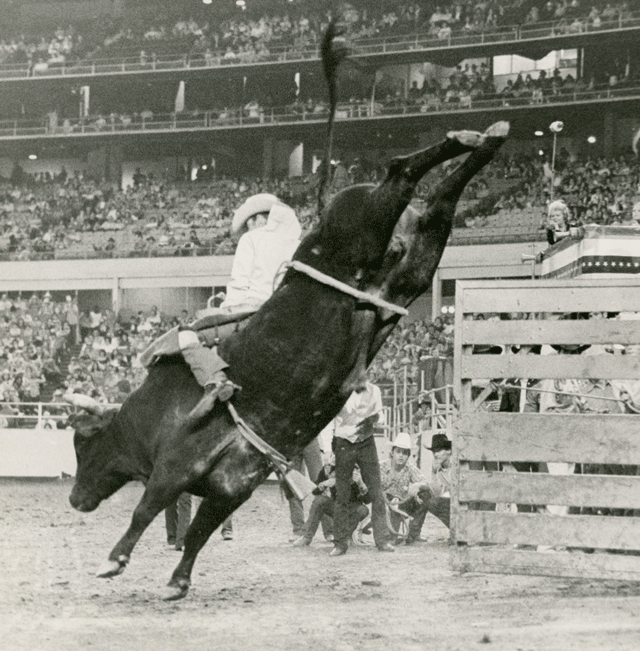
    Ronnie Bowman was part of the pro rodeo bull riding scene in the 1960s and 70s. The Durant, Okla. cowboy qualified for the National Finals Rodeo four years, never going to more than 55 or 60 rodeos each year, and rarely going far from home to compete. He was born in 1941, the son of Paul and Leota Bowman. His dad was a calf roper who made sure his sons always had horses and calves to rope. Living close to Southeastern Oklahoma State University (SOSU) in Durant, college boys were always on hand for practice sessions with the Bowmans.
    When he was a senior in high school, Ronnie started riding bulls. He graduated high school in 1959 and went to SOSU. The college didn’t have a National Intercollegiate Rodeo Association team, but Ronnie competed collegiately in both of his events.
    During the summers, he and buddies would jump into a vehicle and be gone each weekend, traveling as far as Nebraska and winning money. Not one to brag, Ronnie won his share of the checks. “We got to beating them a little bit,” he said. One summer, he and a friend worked on a ranch south of Valentine, Neb., in the Sandhills. They would put up hay Monday through Thursday noon, then hit the rodeo road, competing Thursday, Friday, Saturday and Sunday afternoon before heading back to the hayfield on Monday morning.

    After graduation from SOSU in 1964, he spent six months in the Army Reserve. “That sure did interfere with my rodeoing,” he said, of the weekends he had to spend in training. Often they would let him make up training in advance.
    Ronnie competed in International Rodeo Association events (the forerunner of the International Pro Rodeo Association), and in 1965, got his Rodeo Cowboys Association (the predecessor to the Pro Rodeo Cowboys Association) membership. He was roping calves and riding bulls, when two of his good calf horses died. One went down due to colic and the second one was struck by lightning. He bought another horse, and after placing at three rodeos, the horse was paid for. Ronnie came home, put the horse out to pasture, and went on with his bull riding. “I didn’t rope much after that,” he said.
    He often traveled with world champion bull rider Freckles Brown, who was towards the end of his career. For five years, they hit the road together. He also traveled with Spanky Brown, Randy Majors, and Benny Holt. Benny, from the Durant area, never rodeoed much but rode really well, Ronnie said.
    Ronnie qualified for the National Finals Rodeo the first year he had his membership, 1965, and three more times: 1967, ’69, and ’70. In ’66, 68 and 74, he was never more than $300 from making it. He rodeoed close to home, never straying far except for three or four weeks in the summer, when he’d go real hard. “I’d get in with Freckles and we’d go to Cheyenne, Albuquerque, Omaha, Pine Bluff, Ark., and back to Oklahoma City,” he remembered. The money wasn’t as good at the NFR as it is now, and he didn’t have the inclination to travel so hard. “A fella would have to go hard to get (to the NFR) now.”
    Even with his low rodeo count, he still won the big shows. He won Houston in 1974, taking home a check for $3,700. He won Odessa and Albuquerque, and out of eight trips to Cheyenne, he placed six of those times. He won a short round in Ft. Worth and competed at the American Royal in Kansas City in the calf roping and the bull riding three times, winning the all-around twice. “Some of the good big ones were awful good to me,” he said. When other bull riders were riding at 100 rodeos a year, he was doing a bit more than half of that, and still making it into the top fifteen in the world.

    For a while, he bought and sold bucking bulls. His dad had bought some and used them for practice bulls with Ronnie and the college boys, and Ronnie kept that business going. They were sale barn bulls, good practice bulls, but as Ronnie culled the herd, he “was the victim on most of them,” he said. He sold several bulls that went on to do well in the IPRA and the PRCA. Beutler and Son bought a dozen of his bulls, with two of them making the National Finals Rodeo. He also sold No. 77, Sunset Strip, to J.C. Ward. The bull was the 1970 IPRA Bull of the Year and was only ridden twice in his career.
    He and Freckles also put on bull riding schools in southeastern Oklahoma, commenting that if they’d have worked that hard at anything else, they’d be rich.
    In 1970, he won a prestigious award at the NFR: the George Paul “Great Guy” Memorial. George Paul had been a bull rider, killed in a plane crash that year at the age of 23. It was an award voted on by his peers, going to the bull rider with “character, personality, appearance, congeniality, ability, rodeo image, personality, conduct, and most likely to succeed.” The four-foot tall trophy still sits in his house today.
    Ronnie was careful with his winnings, putting them away in savings. In 1977, when he figured his income tax and didn’t make a profit, it was time to quit. The next two years, he only entered July Fourth rodeos. “Most of those boys spent all they could make,” he said. “I used it for a job. I bought and paid for a five-hundred acre place.”
    He married his wife Judy in 1965. While both were students at SOSU, a mutual friend introduced them while Judy was working in the library. She taught school and during the summers, traveled with him.
    He and Judy raised two daughters, Marci Jackson and Jeana Holt. The girls were good hands, “pretty tough,” their dad said, rodeoing through high school. Both girls qualified for the National High School Finals Rodeo, each in four events; Jeana won the goat tying and the all-around titles in high school rodeo.
    His worst injury was a broken jaw, an injury occurring on the last bull at the 1969 NFR.
    Ronnie got on some memorable bulls throughout his career, some of them who are just memories but at the time were “bulls that everybody knew back then,” he remembered. One of them was No. 107 of Steiner’s. The bull went seven and a half years unridden, but Ronnie covered him four times. “The first time I drew him he like to threw me out of the arena.” One of those times, was in Belton, Texas. An insurance company was giving a one hundred dollar bill to the high marked ride. Ronnie rode No. 107 and got the money.
    He rode No. R-100 of Beutler and Son’s, and Tex M of Hoss Inman’s. And he won a go-round in Ft. Worth on Billy Minnick’s V61, the 1970 RCA Bucking Bull of the Year.
    He and Judy enjoy life on their place near Durant, raising black Simmentals and enjoying their granddaughter and grandson. He’s a humble person, not talking about his rodeo success. But he’d do it all over again, if he could. “I got along pretty good with it,” he said. In 2017, he was inducted into the SOSU Rodeo Hall of Fame.

  • On The Trail with Jayco Roper

    On The Trail with Jayco Roper

    When your grandma is Betty Roper, the winningest barrel racer in the International Professional Rodeo Association, the announcer often mentions her when introducing you to the crowds. Jayco Roper has grown accustomed to hearing the announcers rave about his grandma and her six world titles as he is getting things just right in the chutes before they break open the latch for his bareback horse to bolt into the arena. Especially when Jayco is at an IPRA or IFYR rodeo, where the Roper name has a longstanding history. Jayco has competed at the International Finals Youth Rodeo for the past two years and is looking forward to going this July for his third attempt at winning it all. “I’m ready to make a big appearance this year, so they can remember my name.”

    As with many fourth-generation Oklahoma cowboys, rodeo surrounds Jayco on all sides, and with multiple family members traveling rodeo roads both currently as well as the past, rodeo is as much a part of the milestones in life as learning to walk. Jayco and his sisters, Jaylie, 23, and Jernie, 8, have had plenty of examples set before them, as their dad, J.W. competed as a team roper for many years, and besides their grandma Betty’s successful barrel racing and horse training career, their grandpa Jimmy Roper was a well-known and accomplished steer wrestler. Betty and Jimmy grew up with rodeoing parents, and, Jayco’s mom, Nikki, had grandparents that rodeoed back in their day as well. “I’ve lived in the rodeo environment my whole life, and both my sisters are hardcore barrel racers. Jaylie competed at the IFYR in barrel racing when she was younger and has trained some great barrel horses; and Jernie lives, eats, and breathes barrel racing.”


    At just 17, the Epic Charter School, homeschooled high school senior started his rodeo career riding sheep at 3 years old and stepped up the rough stock ladder to calves, steers, and mini broncs when he was 6 years old. Although he comes from a family of mainly timed-event competitors, Jayco had a passion for rough stock from the very beginning at the Ward Rodeo Company rodeos he would compete at. Jayco’s first year in the Oklahoma Junior High Rodeo Association led him to a national title as a seventh grader, when he left the NJHSFR in Des Moines, Iowa as the 2015 National Champion Bareback Steer Rider. Leading up to that, he had won the Oklahoma bareback steer champion title and champion rookie cowboy title. Jayco placed 4th in 2016 at the NJHSFR. He stepped up to bareback horses when he was about 14, and soon he was riding with all the big boys on full size broncs. Jayco won the 2017 Oklahoma High School Rodeo Association Champion Bareback Rider title his freshman year.

    Learning the bronc riding ropes has been easier with the help of neighbor Justin McDaniel. Justin competed in the IFYR in 2003 and 2004, winning the all-around championship in 2004 after topping the earnings board with money earned in both bareback and bull riding. He was inducted into the IFYR Hall Of Fame in 2014. “Justin has been a huge help to me over the years. He lives about 25 minutes away from our place in South Muscogee and he comes over to help me alot. He is always there to help fix my rigging and give me advice; I really look up to him. And, I never ride a horse without praying to God first.”

    Jayco keeps up a very busy schedule, competing in the American Cowboys Rodeo Association, Cowboys Regional Rodeo Association, and the All Indian Rodeo Cowboys Association. “My dad is my big-time manager; he takes care of everything. He schedules what rodeos I’m entering, and I hop and don’t ask too many questions. I take what I do very seriously and work hard to step-up my game to ride with the big guys at these associations.” Jayco spends much of his time practicing on his spur board, preparing for rodeos, and goes to the gym at least three times each week. “I like to run and do a lot of core work and powerlifting at the gym.” He does make some time for fly fishing occasionally and enjoys going fishing for trout with his bulldogger friend, Shylo Glover.


    Jayco’s dad works for the Oklahoma Department of Transportation, and his mom works as a schoolteacher at the Oklahoma School for the Blind. J.W. is happy to be a big part of Jayco’s rodeo aspirations, and enjoys the time they spend on the roads, knowing that the next transition is already beginning; and that is Jayco hauling with other rodeo competitors to rodeos. Currently, Jayco is starting to travel with his calf roper friend, Glenn Jackson to some of the local rodeos. This transition will let J.W. naturally progress into focusing his energies towards his ball of fire youngest, as she makes her way through the rodeo ranks as a star barrel racer.

    J.W.’s mom, Betty, lives next door to the family and at 70 years old, is still riding every day. “Grandma Betty is still healthy and gets around like a 40-year-old. She’s never sitting down unless they’re eating lunch.” Betty has helped both granddaughters with their barrel racing and imparted much of her training knowledge on the girls as they work with her. “Jayco hasn’t slacked up at all since he started riding, it has been non-stop. Jernie is riding a chestnut gelding named Cantina that my mom started, and she is rearing to go. She’s already been winning at some junior rodeo associations, and once I get Jayco going on his way, it’s about time for me to focus on her rodeo career,” explained J.W.

    Getting ready for the IFYR competition is building anticipation in the Roper household. “IFYR is the next big thing. It’s a great competition where you can win a lot of money and our family has a lot of history with both the IPRA and IFYR. Sometimes I joke with my grandma that I wish she wouldn’t be the center of attention all the time when I’m there. But really, I think it’s cool, and I want to keep working towards my goals to be one of the great ones. I’d like to win as many world champion titles as she has so that one day, they may be talking about me when my grandson is getting ready in the chutes.”
    Jayco appreciates his sponsor, Up North Outlaws, for keeping him looking great with their clothing line.

  • 19th Annual Fulton Family Performance Horse and Production Sale

    19th Annual Fulton Family Performance Horse and Production Sale

    The 19th Annual Fulton Family Performance Horse and Production Sale is quickly approaching this August with an exciting change to the location. The sale will now be held at the Central States Fairgrounds in Rapid City, South Dakota. “Rapid City is a hometown area for me,” explains Lisa, who grew up 75 miles southeast. “This location is a central hub for our customers coming from all over the nation and is a larger facility that will help us accommodate the horses and our customers.” The sale will take place on Friday, August 9th with the preview beginning at 2:00 PM MST and the sale at 6:00 PM MST.
    The sale will feature 45 horses with a majority of the offering by Fulton Ranch stallions A Streak of Fling, CS Flashlight, and A Dash Ta Streak. “Our draw has always been our riding two-year olds that are well started and ready to go in any direction you want to take them,” said Lisa. Her and her late husband, Brian Fulton started this program based on their desire to raise the horses that Brian couldn’t find while he was on the rodeo road. They found that in A Streak of Fling in October of 2003. “We knew he could produce the kind of horses that Brian would like to ride.”
    The Fulton program has since produced very diversified, athletic horses that have achieved championships in several disciplines – from barrel racing to steer wrestling, team roping, calf roping, reined cow horse, and Quarter Horse racing. “We were looking for confirmation, mind, and speed, and we have proven that these horses have all of that and more,” said Lisa.
    “We are evolving and I keep carefully researching the best program I can put together. I learned about horsemanship, confirmation, and how to pick out a good horse from Brian and I continue to get a lot of advice from key people that walk me through my ideas and steer me in the direction I need to go. But you can’t beat life experience to teach you, either. From marketing to time management to knowing what I like and what other people like.”
    This year’s sale has bloodlines for every discipline. A Streak of Fling and CS Flashlight sired two-year olds make up over 25 head of the offering, but Fulton’s also have the largest ever showing of A Dash Ta Streak two-year olds with over 8 head and counting. These include several exciting prospects brought in from outside consignors.
    Two full siblings out of A Streak of Fling x Give Me A Wink (Doc O Dynamite) are headliners of the sale this year. Give Me A Wink is a standout barrel racing mare who was a 2007 NFR Qualifier, California Circuit Champion, and Cheyenne Shortgo Champion, among other winnings. Give Me A Fling, a 2017 Bay Roan Stud, is an exciting stallion prospect and his full sister, Giveawinktostreaker, a 2017 Bay Filly, offers top genetics for a performance horse or breeding investment.
    Fulton Ranch broodmare Queen Fa Tima (Dash Ta Fame) has always produced top sellers and has two sons on the sale this year. Flingin Corona, a 2017 Sorrel Gelding, is sired by A Streak of Fling and is a full brother to proven performers, Streakin Queenie (LTE +$65,000 – owned by Shoppa Ranch) and Streakin Ta Corona (LTE $40,000 – owned by Corny & Maria Wiebe). A Dash Ta Corona, a 2017 Sorrel Gelding, is the first son of A Dash Ta Streak x Queen Fa Tima to sell.
    Another top bloodline is a 2017 Bay Roan Filly, A Easy Streak (A Streak of Fling x Easy April Whiskey by Paddys Irish Whiskey). Easy April Whiskey was a top calf roping performer for Jake Fulton and has since been a huge part of Fulton’s broodmare program. Easy April Whiskey’s dam, Easy April Lena (Doc O Dynamite), has produced Streakin Easy April (LTE $250,000+ and NFR Qualifier) and Lenas Last Streaker (LTE $25,000+) who carried Sydney Adamson to the 2018 Nebraska High School Rodeo Reserve Barrel Racing year-end championship.
    The sale listing and up-to-date information can be found on FultonRanch.com as the sale approaches.

  • Clover

    Clover

    “I don’t know if I could do what you do, handle the situation like you do, and have the attitude like you do.” These are all things that I have heard over and over from people the last nine months since the injury. At first I didn’t know how to respond to these statements because I felt like I was just being me. I have just been trying to handle the situation the best that I can, remain as positive as I can, and leave the rest up to God. The more I hear these statements the more I’ve thought about it, and have come up with a couple reasons as to why I choose to remain positive about the whole situation.
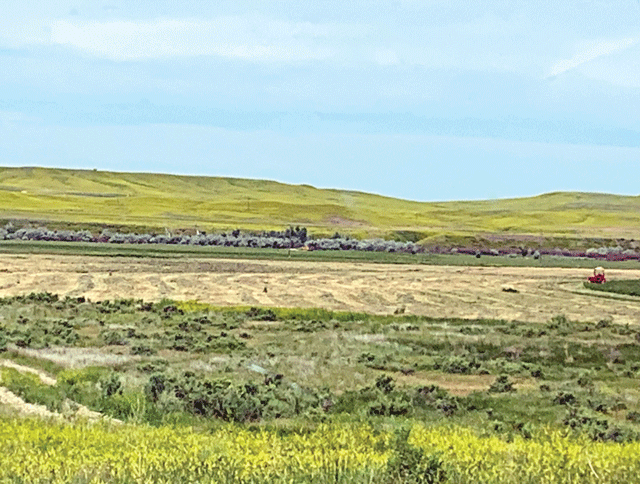
    I don’t know how many of you have been around any clover but on wet years we get a ton of clover in our area. It over flows our pastures and gets thick. It looks like alfalfa, starts small and then as it grows it bushes out and gets thick. It gets really green and makes the area look outstanding. Animals love it and it’s a bonus feed for the spring. From a distance you can’t even tell that it’s clover it just looks tremendously green all over the rolling hills as far as you can see.
    From Shelby and I’s house when you look across the river about a mile, on my in-laws place is where we calve our cows. For about a month as that clover popped up it turned the whole pasture a brilliant green. As green with as much clover as I’ve ever seen around here. Each afternoon I would load up my four wheeler and go with whoever was going to tag calves, usually either Sage my brother in-law, or Liane my mother in-law. I would get on my four wheeler with my rigged up handle to shift and take off. I would go around one side of the pasture looking for new babies. When I would find one I would take my sheep cane in one hand, get up beside the calf, get it hooked around the neck and pull it in towards my four wheeler. Once I got the calf pulled in and stopped, I then could lean off the side and stick a tag in its ear. Sometimes this worked really slick, sometimes I’m sure it was quite the sight to see as I chased the calf around trying to get it snagged. Regardless though I did my best to carry my weight and help out through calving season.
    As the month went on the thicker the clover got in that pasture. As it started to heat up it would start to bloom and get a yellow head on it. The hotter it got the more it turned. From our house, a mile away, you couldn’t tell it was turning yellow at all. You could only see it turning as you were driving or riding through it. All of May from out our front door it still just looked green, but each day when we would go tag calves a little more would bloom. Then about the first week of June, we had a week of sunny and eighty degree weather and it turned the whole pasture a bright dandelion yellow. As far as you can see, its just rolling hills of yellow sweet clover all over.
    This is kind of how I try to handle each hardship I come to. When I come to a storm and it seems like an overwhelming sense of green clover thickening all over my pastures I hold on to the sun and the heat, which represents the Lord and his word. Spending time in prayer, reading his word, and focusing on the hope that he promises us if we trust in him, will make that clover start to bloom. No matter how bad your situation is, remember it can always be worse. Therefore, if you make a habit out of finding the little things to be thankful for it will be like the clover starting to bloom. Little by little you keep finding the positives in every situation, hold on to the promises found in his word, then pretty soon it will be like when the whole pasture blooms and turns yellow. No matter how bad you think you have it when you focus on the little things to be thankful for you it will take your eyes off the mountain and put your gaze on the mountain mover!
    So, to those who say “I don’t think I could handle the situation like you do” I say sure you can. We all have a choice when we wake up. We may not be able to control our circumstances, but we all can control our attitudes. Just because you’re dealt a duce instead of an ace this hand, doesn’t mean it has to affect your frame of mind on life. Just because life got a little hard for a minute doesn’t mean it has to affect your quality of life. Each morning we are all blessed with a breath of fresh air. Each morning we are blessed with a God who loves us enough that he sent his son to die on the cross for our sins. No matter what you are facing and how bad it seems God has a plan for you and there is always something to be thankful for. Remember when you are complaining that somebody out there would love to have what you are complaining about, so find the positives, trust in the Lord, and keep stepping forward.
    “Always be joyful. Never stop praying. Be thankful in all circumstances, for this is God’s will for you who belong to Christ Jesus.” 1 Thessalonians 5:16-18.

  • New Sense of Love

    New Sense of Love

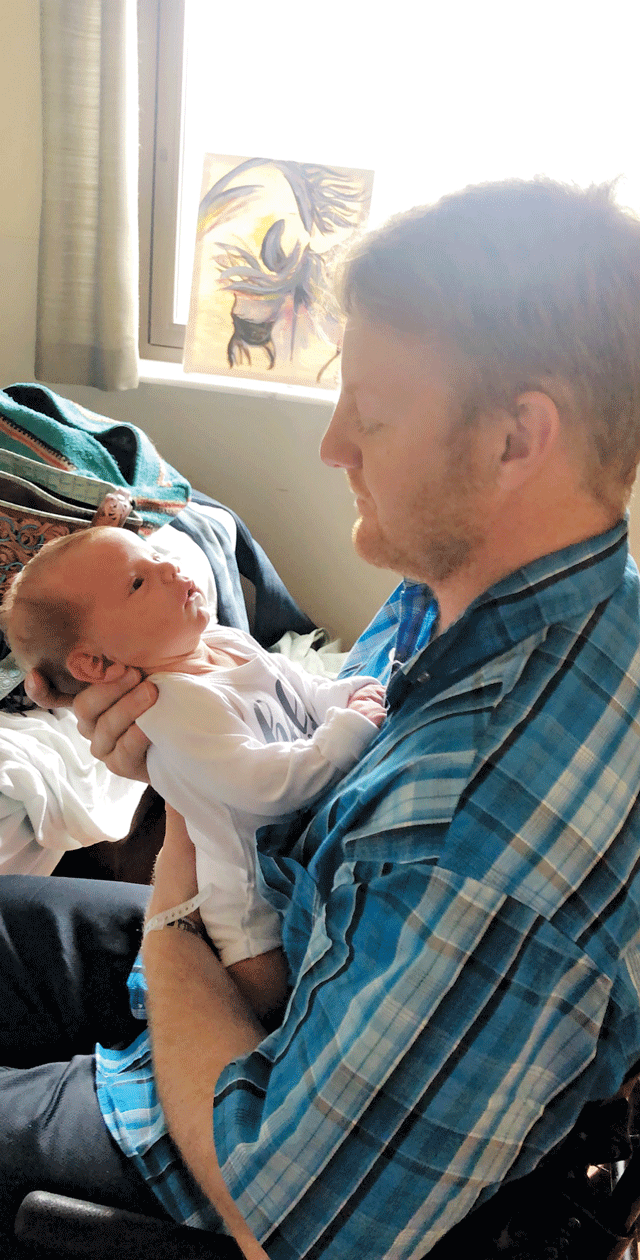
    May 17th at 2:20 am, I witnessed a miracle like one I’ve never witnessed before. Overwhelming feelings of happiness, joy, and love raced through me all at once like never before. It is a day that will forever be etched in my memories as my wife Shelby and I welcomed our perfect little baby boy, Ryatt Boyd Vezain into this world. There for a minute the world stood still! Nothing else mattered, it was pure bliss. I couldn’t stop smiling when they laid the little man on his mother’s chest and she just held him ever so gently. Then, they put him in my arms and it melted me. I didn’t know a person could love something so much. As I looked at him and his dark blue eyes, his full head of slightly red tinted hair, his button nose that looked just like his mom’s, his itty bitty fingers and toes, I couldn’t help but notice how perfect he was. I just wanted to hold him forever. It was the proudest moment of my life. Words can not even explain how proud of my wife I was. After carrying the little guy for nine months and then watching her in the hospital that day I couldn’t help but just be admired by her strength and beauty as she birthed the perfect little miracle that God had so precisely knitted in her womb. I was so proud of her, feelings I can’t even explain have been born inside of me that I didn’t even know were possible.
    As we brought Ryatt home and began taking on this new responsibility a new sense of love has swept over me. Actually, to be honest Shelby does most of it I just do the fun stuff like rock him to sleep after feeding and play with him while he’s awake, Shelby does all the hard chores. She is such a great mother! But, as Ryatt turned two weeks old the other day I have noticed a change in both of us. Since he showed up he is the first and foremost of our attention. His mother and I would do anything for the well being of that kid. As a new parent I would go to the deepest depths and not even second guess it for my child. I would give up everything to make sure our boy has everything he needs to succeed. I know from here on out will be a learning experience like none before and there will be times that I will make mistakes but for the most part I have a completely new sense of unselfishness to where I would do and give anything for our kid.
    Although I will never completely understand the depth of the Lords love, nor will I ever be able to love like the Lord loves us, I have a new sense of the love he has for us. As I love my wife and my child more than anything in this entire world, it doesn’t even come close to how much God loves each and every single one of us. The way I looked at Ryatt the first few minutes of his life and how perfect he was, is how God sees us every single moment of our lives.
    Psalms 139:13 “You made all the delicate, inner parts of my body and knit me together in my mother’s womb.” Psalms 139:16-18 “You saw me before I was born. Every day of my life was recorded in your book. Every moment was laid out before a single day had passed. How precious are your thoughts about me, O God. They cannot be numbered! I can’t even count them; they outnumber the grains of sand! And when I wake up, you are still with me!”
    The Lord loved us before we were born and every day we wake up he still loves us just as much. In John it tells us that there is no greater love than to lay down your life for your friends. What did Jesus do? He laid down his life for each and everyone of us. John 3:16 “For God so loved the world that he gave his one and only son, that whoever believes in him shall not perish but have eternal life.” I am forever grateful for this love.
    No matter what hardship you are facing. No matter how far off the deep end you think you have went. When you feel like there is no way God will accept what you have done. When you feel like there is no way God can love you because of the storm you are in, remember that he made you a miracle. He knit you together in your mother’s womb. He loved you enough to make all your delicate parts. He knew you before you were even born. And, the precious thoughts he has about you can’t even be numbered! He loved you enough to send his Son to die on the cross so we could have eternity with him, and it is never to late to accept his love!
    Ephesians 2:10 “For we are God’s masterpiece. He has created us anew in Christ Jesus, so we can do the good things he planned for us long ago.”

  • Garrett Tonozzi

    Garrett Tonozzi

    Garrett Tonozzi just won his second WCRA event, adding $50,000 to his check book, aboard Fulton Ranch raised mare, Streakin Disco. Heading for Joe Mattern, the team also won $62,500 a man at the $1 million Windy City Roundup in Chicago on January 11. On Sunday, June 2, the duo roped for the win at the Title Town Stampede at Resch Center in Green Bay, Wisconsin. “I’ve been around rodeo my whole life and I haven’t seen this opportunity ever,” said Garrett about the WCRA. “The crowd was amazing – you can tell Green Bay is a rodeo town.”
    Garrett, who has been rodeoing professionally for 15 years, is mounted on an A Streak of Fling-sired mare named Streakin Disco, who was born and raised at Fulton Ranch in Todd County, SD. The beautiful, stout bay roan was sold in the Fulton’s 2012 sale to Monica McClung who started her on the barrels and at the futurities. She was then sold to Justin and Jordon Briggs, who started her in the heading and eventually sold her to Garrett. “He had taken her to a few jackpots and had won some money at the World Series Finals on her,” explained Garrett. “Brittany was talking to Justin’s wife and mentioned I was looking for a horse.”
    “We call her Disco and she is one of the fastest horses I’ve been on. She lets me win everywhere I go from Cheyenne to Green Bay. Every time I nod my head I know she’s giving me 110%,” he said. “When you have a horse like this, it makes rodeo a lot more fun.” Disco is Garrett’s number one horse, but he also has two others that he hauls with him. “She’s the most trainable horse I’ve ever owned. If she makes a mistake and you correct her that day, she’s over it.” Disco fits into the Tonozzi breeding program as well. “We didn’t have a Streaker in the lineup, so we pulled two embryos from her, one is in the recip mare now and the other foal is a yearling.”

    Garrett Tonozzi and Joe Mattern at the $1 Million Windy City Roundup, Chicago, IL – Bull Stock Media

    Brittany, Garrett’s wife, has been building the breeding program for years, and the couple now has more than 50 horses in their care; training, breeding, and continuing to improve their line. “It’s hard with this many horses. We don’t have a lot of help, so it’s just me and Brittany with Tinlee (their two year old daughter). There will be days Brittany and I will ride 8 to 10 horses each, switching when we ride so we can watch Tinlee.” They just bought a place in Lampasas, Texas, one hour north of Austin, Texas, and home to the world’s largest spur! They spend their winters there and head to Monument, Colorado, for the summer. “We are heading back to Colorado soon, taking 18 head with us.”
    They will begin the summer rodeo run from there, starting with Reno, the BFI and going on. They recently purchased a toterhome to make family travel easier. “Tinlee was moving too much and it’s easier on her to do this. She can hang out in the back.” Garrett wouldn’t have it any other way. Growing up in Fruita, Colorado, Garrett started roping at his granddad’s (Tony Tonozzi) jackpots when he was 8. He competed in CJRA, CSHSRA, went to college for a couple days and decided he wanted to rodeo, and he’s been doing it ever since. He married two time World Champion Barrel Racer Brittany Pozzi in 2015 and the couple have been traveling together ever since.
    At 34 years old, Garrett and Brittany have no plans to slow down. “We both agree that when it’s time to haul Tinlee, we will focus on that, but for now, this is how we make our living, rodeo and horses.”

  • Back When They Bucked with Franklin Manke

    Back When They Bucked with Franklin Manke

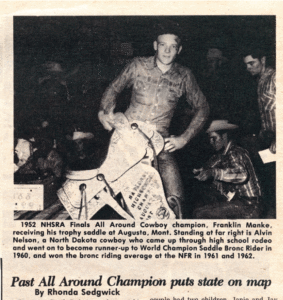
    The Edgemont, S.D. cowboy was the 1952 National High School Rodeo Bareback Riding champion, and it wasn’t until fellow South Dakotan Shane O’Connell won it in 2013, that the drought was over.
    Manke not only competed in the bareback riding, but also as a steer wrestler, cow cutter, wild cow rider, and occasional calf roper.
    He was born in 1935 to Alfred (Allie) and Dorothy (White) Manke, who ranched twenty miles south of Edgemont. As most country kids did in those days, he rode the three miles to the country school every day.
    By the time he was ten years old, he was riding calves at local county fairs, and as a freshman in high school, he got on his first bareback horse.
    High school rodeo wasn’t as prevalent then as it is now, and there were fewer rodeos to go to. But Franklin went to several, one of them being the Harrison, Neb. rodeo in 1952, when he won the bareback riding, calf roping, second place in the cow riding, and the all-around.
    That same year, his senior year, he won the S.D. state bareback riding and calf roping titles and split first in the cow cutting.
    Back then, if a high school finals rodeo contestant qualified for the National High School Finals in one event, they could enter a second event, and the all-around winner could enter as many events as they chose. He finished his high school rodeo career with not only the national bareback riding title, but the all-around as well, having competed at Nationals in Augusta, Montana in the tie-down roping, too.
    After high school, he came home to ranch with his parents. They owned two ranches, one south of Edgemont and the other about twenty-five miles away, in southeastern Wyoming.

    But he continued to rodeo, this time in the Northwest Ranch Cowboys Association (NRCA) and at local county fairs.
    In 1955 he went to a rodeo that was lacking steer wrestlers. The committee told Franklin they would pay his entry fees if he would bulldog. He’d ridden his rope horse in high school to bulldog, but the horse didn’t work out well. “I’d go to get off and he’d stop,” he said. “That left a lot of air between me and the steer.” But he borrowed a horse, rode him at that rodeo and all summer, finishing the year second in the steer wrestling for the NRCA.
    His dad, Allie, team roped when he was older, but as a young man, his hobby was race horses. He had a string of thoroughbreds he’d take to the county fair races, and some of them Franklin rodeoed on. It wasn’t a perfect situation, but back then, they made do. Every now and then the race horses didn’t know when to quit. “Sometimes it wasn’t very pleasant when you rode a race horse and you went to turn a cow and the horse just kept going,” Franklin chuckled.
    Franklin continued to rodeo in the NRCA. In 1956, he won the bareback riding, was second in the steer wrestling, and won the all-around. In 1957 and ’58, he won the steer wrestling both years. He competed in 1959, but injuries slowed him down.
    In ’59, he broke his riding hand while riding barebacks. As the pickup man approached, he worked to get his hand out of the rigging. Before he had it out, the bucking horse stopped, throwing Franklin’s body weight over the top of his hand and breaking a bone.
    The same year, he tore ligaments in a knee while bull dogging. There was no surgery for torn ligaments then; the only cure was time off. Franklin built a brace and wore it to bulldog, but his bulldogging days were coming to an end.

    After 1959, he quit rodeo for a few years, continuing to ranch on the family operation, which included mama cows, yearlings and sheep. His dad passed away in 1972, and by this time, Franklin and his wife Audrey had bought another place, between the Edgemont ranch and the Wyoming ranch. Without his dad’s help, it was too difficult to run both places, and he didn’t want to hire help. They also had a grazing lease that had expired, so it made sense to sell the S.D. ranch.
    Franklin’s parents owned and managed three motels in Edgemont, and after his dad’s death, his mom ran them for three years. It was more than she could handle, so Franklin and Audrey bought them from her, with the intent of running them for three years and then selling them. Two of them were side by side and shared an office, and one of them closed during the winter. They ran them for 22 years, before selling them in 1997.
    In the mid-1960s, when dally team roping became popular, Franklin began rodeoing again, at jackpots and a few rodeos close to home. He never ventured far from home, choosing to rodeo at NRCA events, local county fairs and jackpots in South Dakota and Wyoming. He didn’t go full time, believing it was difficult to do both well. “You either have to be a rancher and a part-time rodeo cowboy, or a full-time rodeo cowboy. That’s how I look at it.”
    Franklin team roped in the Old Timers Rodeo Association (now the National Senior Pro Rodeo Association.) He headed for a while, then switched to heeling, often partnering with Bob Stoddard of Douglas, Wyo. He enjoyed the jackpots the NSPRA held before the rodeo. He doesn’t brag, but “I guess I claimed my share of the money in the ropings.” He quit roping in 1994, after having a hip replaced.
    Franklin and Audrey first met when they were in country school. He had had his eye on her, he says, and asked her out on July 4, 1953. They married later that year and celebrated their 65th anniversary in October of 2018.
    And the rodeo gene didn’t end with Franklin. The couple’s daughter, Janie, was the 1971 Wyoming High School Girls All-Around champion, and their son, Jay, was the 1976 S. D. State High School Team Roping champion. Janie and her husband Butch Tinint live in Valentine, Neb., and both of Janie’s daughters competed in rodeo. Jay’s daughter and son, Katie and Ty, have also done well. Katie and her husband Jeremy Langdeau have three children who ride and compete, and Ty, who is married to Trista, has won the saddle bronc riding average at the Badlands Circuit Finals Rodeo twice. Franklin started Ty in the saddle bronc riding while in high school, buying him his first saddle. “In fact, I think he still owes me for that saddle,” he joked.
    Franklin and his great-grandson Jackson Langdeau goat rope together. On foot, Jackson heads and Franklin heels, and Franklin loves it.
    The couple sold the ranch in 1989, when the work with the motels became too much. They fully retired in 1997, when they bought forty acres and built a house on the east side of Edgemont. They stay busy: Franklin, traveling to rodeos to watch his grandchildren and great-grandchildren, and Audrey, who paints. Her artwork is excellent, Franklin said, and jokes that they’ll have to build longer walls to hang her work.
    He loved his days in rodeo. He and Audrey made it through the bad times, of which there weren’t many. They lost a granddaughter, Jay’s daughter Jayme, when she died in a car accident, but life is still good, filled with children, grandchildren and great-grandchildren. “We’ve never really had any downs in life.”

  • On The Trail with The Hinrichs Family

    On The Trail with The Hinrichs Family

    The National Little Britches Association was founded in 1952, and sanctions rodeos in over 33 states, giving children 5 to 18 years old opportunities to compete in rodeo events across the country. For kids in the central part of the country, NLBRA is one of few choices they have when it comes to being a rodeo competitor, and they couldn’t be more grateful. The Hinrichs family from Ellsworth, Minnesota have only been involved with the NLBRA for a few years now, but much of their time is now centered around the rodeo schedules in both the Dakota Prairie Little Britches and Minnesota/Eastern South Dakota Little Britches rodeos.

    “The Big Deal Land & Cattle Company, that’s what everyone likes to joke about and call me around Minnesota and South Dakota,” laughs Steve, patriarch of the Hinirichs family, who supplies all the timed event cattle and goats for Little Britches rodeos across Minnesota and South Dakota. The fact is, the busy family hasn’t slowed down enough to give the stock-contracting business an actual name since they started rolling along three years ago. Not only do Steve and his wife Bridget work jobs outside of the family’s horse training business, but all three of their children, Paige, 18, Tanner, 15, and Kiana (Bubbles), 8, compete in the Little Britches Rodeo Association with quite a bit of success. In 2016, the Hinrichs children became more involved in rodeo and started in the MN/Eastern SD Little Britches Rodeo Association. Word spread that the family kept stock for the kids to practice on and train horses, and it wasn’t long before the requests started coming to bring livestock to the rodeos. “A contractor backed out right before a rodeo a couple years ago, so they asked if we could bring some stock. People were happy with what we brought, and it’s grown to full-time from there. We bring stock to rodeos in both states and will supply cattle and goats at approximately 50 rodeos this year.”


    Paige competes in all 7 rodeo events available to a senior girl competitor; breakaway roping, ribbon roping, team roping, barrel racing, pole bending, goat tying, and trail. She recently graduated from Adrian High School, and will be attending the Southeast Technical Institute, where she’ll be studying Invasive Cardiovascular Technology. Besides maintaining a 4.0 GPA, which helped her obtain a full-ride scholarship to the school, Paige has worked for two years as a CNA at Parkview Manor, a nursing home in Ellsworth. Paige also helps with farm chores and attends the Salem Reformed Church in Little Rock, Iowa with her family on Wednesday nights. “I’ve enjoyed competing in the Little Britches Association. I really like the leadership role I can have as a senior in the association and cheer on and mentor the little ones.” Paige favors roping the most, “At home I normally break in the tie-down calves, so the kids often ask me how they’re going to run at the rodeos. It’s been nice competing with Tanner and we’re fortunate we can practice together.” Paige hopes to continue roping in the future and looks up to Trevor Brazile as a competitor, although she doesn’t get much chance to keep up with his career. “We don’t have time to watch much television because we’re always outside. Friends will talk to me about something that was on television and I’ll tell them ‘I have no idea what you’re talking about,’ we just live a different lifestyle than most people do.”

    Tanner, a sophomore at Adrian High School, likes math and playing guard for the school basketball team. He competes in calf roping, and as Paige’s partner in both ribbon roping and team roping. He spends time watching rodeo runs on YouTube and especially likes to watch his favorite calf roper, Cory Solomon. He agrees with his dad that he lives in a rodeo paradise and appreciates the opportunities he has to practice whenever he wants. “I can tie goats or rope when I need to, and if it’s raining, I can rope in the indoor arena. I’m pretty competitive, so It’s great being able to have the tools I need to get to the top of my game.” Tanner enjoys hanging out with his friends at the rodeos and has learned a lot seeing the backside of rodeo production through the family’s involvement. “Being involved in the Little Britches Association has been great, my family enjoys the time together and everyone in the association has been so good to us.” Tanner likes getting to drive within a 20-mile range of the farm with his newly acquired farm permit but looks forward to turning 16 in July, so he can have more freedom on the roads. “It’s not bad having all the chores on the farm; my dad says if you love what you do, you’ll never work a day in your life.”

    The youngest of the Hinrichs crew, Bubbles, may have been born with the name Kiana, but since her dad started the nickname after noticing she blew little bubbles laying in the hospital bassinet, Bubbles is what she’s gone by her whole life. As a second grader, her favorite school subject is reading, and she especially likes to read stories in the Biscuit series. She loves to compete in barrel racing and pole bending the most and likes practicing at home with her siblings. Bubbles likes riding Henny Penny, her 13-year-old black mare in all her events. “The Little Britches rodeos are giving Bubbles a great environment to grow as a competitor. She was a little hesitant to go too fast at first, but her confidence is growing, and she’s getting faster at each rodeo. She recently won the flag race and that used to be the event she dreaded the most.” Her favorite chore to help with in the afternoons is bottle-feeding the baby goats and calves.


    The family’s settling into their new home at Hinrichs’ Arena, on land where Steve grew up as the youngest of four children belonging to George and Leona Hinrichs. The farm is in the southwest corner of Minnesota, just one mile from Iowa and 30 miles from South Dakota. “My parents were very involved in showing horses and my mom was the secretary and treasurer of the Southwest Minnesota Trail Riders’ Club where we showed horses in halter, pleasure, and game events. When they passed away, I bought their 80-acre farm, and we’re raising our family here.” The farm has an outdoor and indoor arena that Steve used after he graduated from Ellsworth High School in 1989, to train outside horses while helping operate their dairy cow business. Bridget, graduated from Ellsworth High in 1997 and is grateful she’s just three miles from her childhood home, where her father, who remarried after her mom passed away, still farms and raises stock cows. Steve and Bridget have been married since 1998 and appreciate raising their family in their hometown with so much family history surrounding them.

    Currently, Steve works for a neighboring farm managing 4,000 head of swine. Besides that daily work, he spends three days each week riding horses at the sale barn, sorting and bringing livestock up for auction. “I work at the Sioux Falls sales barn on Mondays and Wednesdays, and the Sheldon, Iowa barn on Thursdays. I ride horses I have in for training while I work at the auctions and it gives me great opportunities to train horses for my clients.” Bridget who team roped, and barrel raced before family responsibilities took over, also works at the sale barn with Steve on Thursdays but spends much of her time managing the family and farm, where she takes charge of raising bottle calves and goats.
    The family keeps approximately 25 head of roping cattle, 30-40 goats, and 50 calves ranging from those still on milk, up to 350 pounds. “Right now, we’re bottle feeding 20 calves and get new calves in from the dairy twice each week. We use lots of Jerseys for the Little Britches rodeos; people thought they’d be too weak and wouldn’t run, but we feed them heavy and they work great for the kids. The cattle we use give each of the competitors a chance to win and we work hard to keep them as even as possible. If one of the cattle or goats don’t work well, we don’t bring them back again. We can’t always predict what they’ll do, but we want to bring the most user-friendly stock we can to the rodeos. I’d much rather see the kids beat each other on times rather than beat another contestant just because they drew better.”

    It’s said that a family that plays together, stays together; and for the Hinrichs that’s what their life is about. When they aren’t taking care of business, they like to take their dogs out for coon hunts and go bow-hunting for deer. They enjoy their time together on the road; Tanner shared, “On the way to rodeos, Paige and I put in the aux cord and get jamming with dad to get pumped up. We mostly play old country music that dad will recognize, and he gets crazy with all that stuff.” One of the family’s pre-game traditions is the kids all praying together before the rodeo competition gets started. Steve explained, “It’s not all about blood and guts, of course we all want to win, but it’s more about making good horses, learning from our mistakes, and helping each other get better. We’re glad that the Little Britches association gives us a great opportunity to watch our kids grow in rodeo and enjoy the members and the comradery we share. If we’re not having a good time while they’re competing, what’s the point in doing it?”

  • ProFile: Josh Peek

    ProFile: Josh Peek

    Josh Peek jumped his last steer in January at a buddy’s house. Before that it was Houston, March 2018. “I slowed down and decided to quit in September of 2017 – I couldn’t be away from my wife and kids anymore and I knew there was more on the horizon as far as making a living for my family,” said the 39-year-old father of three. The 7x NFR qualifier ended his career on a high note, winning the All Around at the 2017 RAM National Circuit Finals Rodeo.
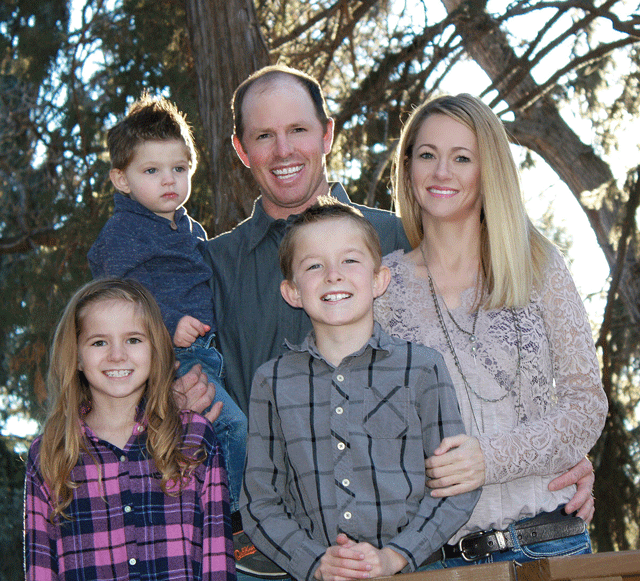
    “If I penciled it out, rodeo opened up the doors to everything I’m doing now and the platform for how I do business, but at the end of the day, I can maximize my time better doing something other than rodeo.” He spent eight months a year on the road and missed his family. “My mom and dad raised me as a family man and I know my life has always been God, family, work; no matter what that work was.” Josh is married to Kori and they have nine year old twins, Emry Autumn and Keagan Cole (born June 18, 2009); and a son, Jagger Devlin (born Sept. 20, 2016).
    During his rodeo career, he took his family with him as often as possible. “There’s good and bad in raising kids on the road – the western industry is one of the best ways to raise kids and instill values. On the other hand, they can’t live your dream in a back seat of a pickup. You’ve got to juggle that.” Once Emry and Keagan started school, the traveling was minimized.

    “There’s so much ebb and flow in rodeo– you can have the best horse and the calf you draw is not good enough to win on. The day you’re up in slack it can rain while others have a dry run-there’s just a ton of variables,” he said. His son, Jagger, was born September 20, 2016, and due to some heart and stomach issues, stayed in the NICU for a month. “I didn’t go much – I stayed home for a week and flew to a few rodeos. With the many things going on I ended up missing the finals by $74. At the end of 2017 I was in a spot to reflect and I realized I didn’t want to be away from home anymore.”
    Josh had a very successful rodeo career, competing since he was nine. He started in the AQHA, National Little Britches, high school level; winning World Championships all along the way. “I was able to have an unbelievable career, I feel like I achieved everything that God had planned for me in rodeo. I needed to put more time into my relationship with the Lord, being a husband and a father, and when my kids started school, I needed to be there for my kids; homework, soccer games, birthdays. At the end of the day, God gave me the ability to be one of the best cowboys to ever ride and compete.”
    Thanks to his degree in Business with an emphasis in entrepreneurship, Josh bought a hoof trimming business early in his rodeo career, building his business to supplement his rodeo expenses. He found a couple great calf horses, Nitro and Cody, started traveling with Kyle Hughes, and his rodeo career started to take off. He found sponsors along the way that he created a partnership with.
    “I was still trimming dairy cattle feet and owned the business until 2014, but I started training people into that business in 2008.” Then he started a sponsorship partnership with Stallion Oil Field Services and Toyota. In 2014 Josh met and started working with Danny Ford, Owner of Boulder Energy. He sold the trimming business that winter and went on with Danny doing sales and operations. “Danny took me under his wing, mentoring me, allowing me to be involved in budget meetings, legal battles, and bidding million-dollar jobs. I learned and watched about everything in the sales, marketing, productions, and the whole nine yards,” said Josh, who stayed there for two years. “I always had my sponsorships set up as business partnerships. I would take a position in the company for a base salary with a structured sponsorship/bonus program. I worked that position on top of rodeo every year.”
    Josh always looked at life after rodeo – which he admits could have hindered his rodeo career. “It was always my goal to build my own company. I was striving for the Gold Buckle but building a platform for my future was my goal after rodeo. Now, looking back, my focus could’ve been on that instead of solely winning a Gold Buckle. Everything along my path had inspiration that made me the person I am today, doing what I’m doing so I have no regrets.”
    “God had me in the right place, good and bad, losing money to having money to now understanding what it takes to attain success and have something that I can leave for my kids. At the end of the day, I strive to instill work ethic and values in my kids so they can be successful in life because of their mindset.

    After taking the job as an insurance adjuster in 2017, and running more than 500 insurance claims last year, he decided to explore steel buildings with his old college roommate, Brandon Falk. “I went and built three or four Metal Buildings and started learning about them – I sell under Premo Steel Buildings Umbrella. I enjoy building and putting a structure up. It was so rewarding to see the faces of those people that had been dreaming of that building for years – and we are giving that to them.”
    He took a district sales position for Premo Steel and since then he started a construction company (J&B Construction) on the side to erect the buildings he was selling. “We specialize in construction projects from remodels to metal buildings and roofs on residential and commercial projects in the state of Colorado and abroad.”
    One thing that Josh learned through rodeo is the necessity of building a good team. “I’ve got guys that have been mentors of mine, from my dad to BASICS with Bill Roth. They have allowed me to have the ability to call and bounce things off in business and understand how to handle any situation and be prepared.” Scheduling 75 to 100 rodeos a year and running two rigs down the road helped Josh with organizing crews and scheduling on the construction sites.
    “We strive to provide a better customer service and exceed our competition. We are the only steel building company that offers onsite inventory of our product – we physically drive or fly, take inventory and we stay alongside that client until that project is done.”
    Josh has always been willing to learn. “To be successful you have to be willing to learn and work with people and provide a quality product with customer satisfaction. Then the client will be happier that they came to me and my partners rather than any other person or company.”
    Josh has not left the rodeo world behind, and still provides several roping clinics across the nation. “I offer a clinic for whatever somebody wants,” he said. “Strive to be the best you can be and let God guide your path.”