Rodeo Life

Category: Archive

  • On The Trail with Timothy Troyer

    On The Trail with Timothy Troyer

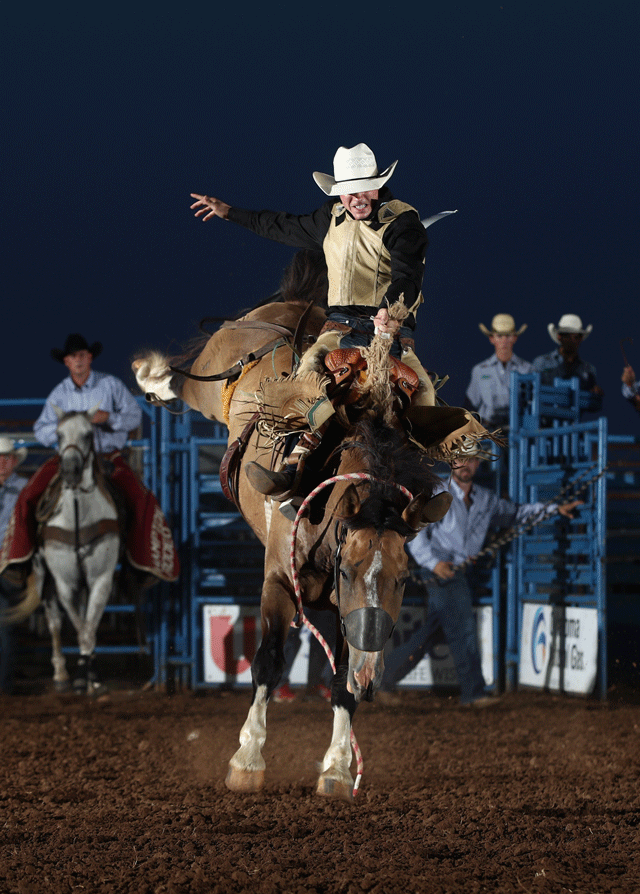
    Timothy Troyer is the 2019 International Finals Youth Rodeo (IFYR) Saddle Bronc Champion and is also sitting number one in the International Pro Rodeo Association. From Columbia, Kentucky, Timothy admits there’s not a lot of saddle bronc riders around where he lives. Put that with his height, 6’2”, and the fact that he just started riding broncs two years ago, and that makes his win at the IFYR even sweeter. “I just started going to rodeos and figuring it out along the way,” he said. “I do base all my success on God and I couldn’t do it without Him. My brother Jesse has always been there to support me and push me to get better – he is definitely one of my biggest motivations!” Timothy spends many hours working out – preferring the old school workouts like jumping and cross fit work.

    This was his second year at the IFYR. “It’s a great place for young people to get started and compete and it pays well.” Timothy was home schooled – he grew up Amish. “We weren’t allowed to go and even watch rodeos – no competitive sports. We played a lot of baseball or volleyball. But we couldn’t go to games.”

    Timothy’s parents decided to leave the Amish community when he was 13. They moved to Westcliffe, Colorado, for four years before moving back to Columbia. “A month after we moved to Colorado we lost everything in a house fire and had to start over from scratch,” said Timothy. “But with help from God, family and friends we recovered.”
     

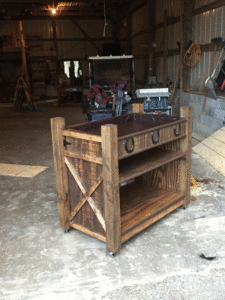
    He doesn’t miss much about growing up in that lifestyle but says it helped him in life by teaching him life skills. “I know how to make a living from hard work,” he said. “We still talk Dutch at home and cook the same. I build furniture on the side, and that’s one thing that I will always do.” The one thing that stumped him was social media. Although he’s figured it out, he admits that it is over used.

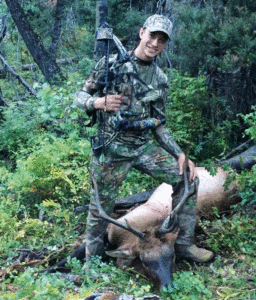
    While Timothy, Jesse, and his younger brother, Dwayne adapted well to the change, it has been more difficult for his mom, Kate. “I was taught so different that it’s hard. We didn’t learn English until we went to school at the age of six.” She also misses getting together with family and friends. She still raises a big garden and does all her own canning and freezing. They also raise their own meat, butchering a steer when the elk meat runs out. William is a big hunter and heads to Colorado every year to get an elk. The boys have gone with him.

    Timothy has been riding for just over two years. “I always wanted to do it as a kid and my parents wouldn’t let me until I was 16.” He picked up rodeo on his own. “My brother started riding bareback horses when he was 16. I bought a saddle and a pair of chaps and started entering exhibitions at rodeos. I watched some YouTube videos and halfway had the basics figured out.” The hard part for Timothy was entering. “I didn’t know anything about associations; I just searched for rodeos to enter.”

    Kate, wasn’t too happy about him riding right off, but she’s comfortable watching it now. “It was scary for me,” she said. “It was totally new for us. He was introduced to it through friends who barrel raced. The boys grew up on a farm – their dad used to train horses when he was younger – so they had always been around horses – we used them for everything.”
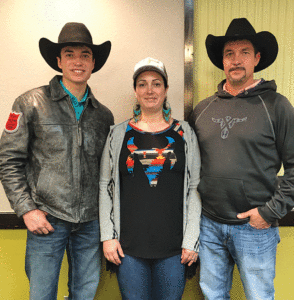
     

    The other delay in Timothy’s starting was due to an accident he had in 2015. “He was at work and fell 22 feet off the roof, shattering both bones in his left leg above his ankle. It’s full of plates and screws– it took three surgeries to fix that. It took a full year until he was back to normal.” Timothy has worked on his father’s (William) construction crew since he was 13. He used to build houses and pole barns. William switched to excavating two years ago.

    Timothy heads to school at South Western Oklahoma University this fall. “I am going to go for a business degree at Weatherford, Oklahoma, and rodeo.” He admits he’s a little nervous to start school. “I’ve never been to a public school – the Amish school I went to had 20 kids and was a 30×40 building.” He made it through the eighth grade in the Amish school. “That’s when you graduate anyway.”

    He has continued his education online to prepare for college. “I’ll have classes every day of the week.” For now, rodeo will have to be done on the weekends. The goal is to have his own business someday – either in furniture or construction. For now, he’s going to enjoy college, rodeo, and his girlfriend, Sadie Wolaver, who he met at a rodeo in Canada. They have been dating since November. “I would marry her right now, but I don’t want to get married and have financial problems, so I’m saving up for it.”

    “We’re proud of our boys and what they are accomplishing,” concludes Kate. “I love to watch him now. He’s got the determination and will power to push through and get after his goals. He doesn’t give up very easily. I would say he gets that from his dad.”
  • ProFile: Mayce Marek

    ProFile: Mayce Marek

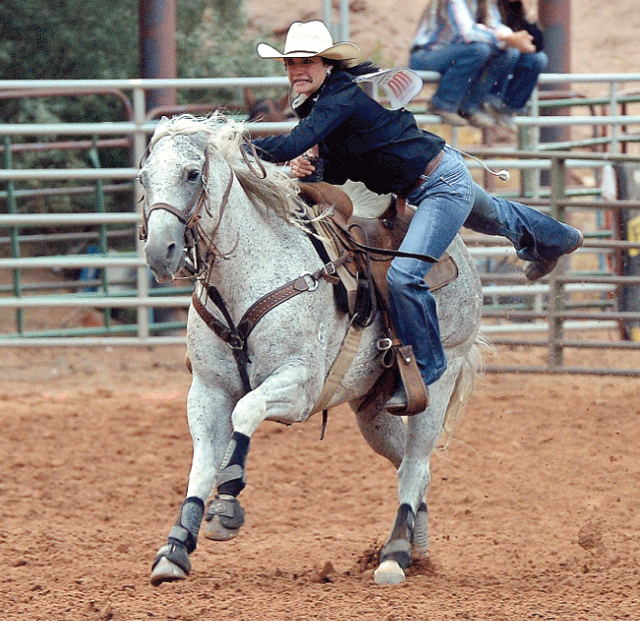
    Mayce Marek is looking forward to starting a new chapter in her life – she will be going to Warton Junior College on a rodeo scholarship, majoring in business with a minor in physical therapy. “I want to look into business and running an equine facility that has a deal for troubled or disabled kids,” said the 18 year old from Taylor, Texas. “I want to be around equine all the time and I like helping the youth. I’ve seen a lot of different cases where equine has a positive effect on youth. I want to give back in some way what horses have done for me. My life revolves around them – they’ve given me a future and helped me find friends that have become family.”
    Her summer rodeo run proved to be quite profitable as she won $12,000 at the Best of the Best; winning both the goat tying and the breakaway roping – and the All Around. “Winning Gallup was the biggest win I have had. As far as a youth rodeo, there aren’t many rodeos that pay like that. Along with the money, I won two pairs of Corral boots, and two American hats, an Ipad and leather cover.” She took the money and put it away for college.
    Mayce started rodeo at the age of five. “My mom and dad had both rodeoed and I’d always been around horses. I started out barrel racing and got into the breakaway roping and goat tying. It’s a lot more you in the roping events – barrel racing was about horse power.”
    Mayce is an only child. “It comes in handy when it comes to rodeo, because it’s not cheap to compete. But sometimes I’d like to have siblings.”
    Her mom (Misty) and dad (Rob) divorced when she was four. “My faith got me to where I am – and I learned that from life – by being allowed to never have to put down a rope – even when times got tough. God always seemed to help me get to the next one and I’ve been thankful for that.”
    Mayce tries to tie goats at least three times a week. “I rope everyday either the rope sled or live cattle.” All the practice worked. “At the Best of the Best – it comes from all the practice you do in the practice pen. I would think about my run, seeing it in my head. So when it came time, it was muscle memory – at that point it just happens and you use everything you have prepared to do.”
    Mayce is grateful for her life thus far. “Struggling and prospering from it is good. Anything is possible with faith – you set your mind to something, it’s only if you want it bad enough you can do it. If you have faith, there’s nothing you can’t achieve.”

  • Building Your Foundation

    Building Your Foundation

    A house built on a solid foundation is crucial to provide protection and safety to anything that lives inside. The function of a well-built foundation is to hold up and hold together the structure built above it. The foundation increases the amount of abuse the house can take while remaining safe for those living inside. The three main purposes of a building foundation are to bear the weight of the building, increase the stability against natural forces such as wind or shifting ground, and to shield from any other obstacle that might be detrimental to the building or its occupants such as flooding or predators. Just as it is important for a buildings foundation, it is equally important to build our faith on a solid foundation.
    Matthew 7:24-27 tells us “Anyone who listens to my teaching and follows it is wise, like a person who builds a house on solid rock. Though the rain comes in torrents and the floodwaters rise and the winds beat against that house, it won’t collapse because it is built on bedrock. But anyone who hears my teaching and doesn’t obey it is foolish, like a person who builds a house on sand. When the rains and floods come and the winds beat against that house, it will collapse with a mighty crash.”
    The foundation in which we build our faith upon has similar purposes to a buildings foundation. The relationship with God that we have provides stability to bear our weight. We can take all our problems, insecurities, and burdens to him and let him carry the load rather than try to handle them ourselves. The words we bury in our hearts help provide stability against the winds and shifting ground in our lives that try to knock us down. Through our conversations and prayer with Christ we can resist the lies that come from the predator as he tries to flood our minds and wash away our foundation.

    The last eleven months has given me plenty of time to revamp, repatch, and restore any cracks in my foundation. As the devil tries to shift the ground around me, sneak in the basement, and flood my foundation I have spent countless hours seeking God, spending time in his word, and praying to build my foundation stronger so that I can resist against the enemies lies. The foundation I had before has been solid enough to get me this far but since my wreck I have had numerous opportunities to continue to build and solidify my foundation in Christ.
    The thing about building a solid foundation in Christ is not only so we will follow his instructions, but also so we can continue moving forward knowing the best is yet to come when our world gets rocked and knocked upside down. It can become hard to see the light at the end of the tunnel sometimes after months and months of not seeing your dreams come to pass. Or after sometimes years of not seeing change, whether it be in your marriage, your finances, or your physical being when you are seeking healing. The Lord tells us that his word is alive and active, sharper than any double edged sword. The more we bury in our hearts, the more we memorize, and the more we reflect on them, the more weapons we have to combat the devil throughout the day. When he tries telling us this is it, this is all the better it’s going to get we can use Jeremiah 29:11 knowing that God has a plan for our future and his plan is to prosper not to harm us. When the enemy tries to lie to us saying that God doesn’t want to take care of our problems we can use Psalms 55:22 and know that we can give our burdens to the Lord, and he will care for us and not allow us to slip and fall. When Satan tries to tell us since God hasn’t answered your prayer yet he isn’t going to we can use Matthew 7:7 knowing that if we continue to ask he will give us what we ask for. Also, when we don’t know how we are ever going to get out of the situation we are in we can use Isaiah 55:8-9 knowing that God’s ways are not like our ways, and his thoughts are higher than anything we can fathom.
    The foundation we build in Christ has many purposes. To build our character so we follow the Lords instructions. To build our faith in God knowing we can take all our worries, cares and burdens no matter how big or small, to him so he can carry the load rather than try to carry it ourselves. And lastly, so we have a solid base with many weapons in store to resist the devil’s temptations and lies so we can lean on the solidity of the bedrock of Christ. So make sure you are building your foundation on the concrete of Christ so it can stand the storms that come your way!
    “The Lord is my rock, my fortress, and my savior; my God is my rock, in whom I find protection. He is my shield, the power that saves me, and my place of safety.” Psalms 18:2

  • Roper Review: Brandon Ben

    Roper Review: Brandon Ben

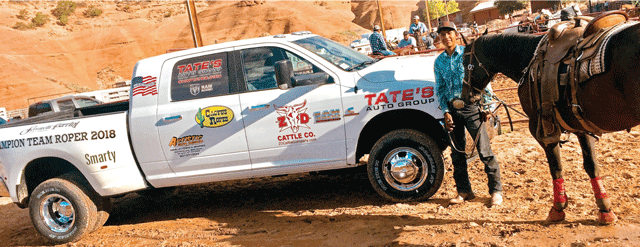
    Brandon Ben has been roping for 11 years. He started because his family ropes and he’s carrying it on. He learned from his dad, Rawley Ben, who is a 8+ heeler and 7 header. From, Peridot, Arizona, the 17 year old has done quite well in the roping world; he’s won two trucks so far – including the one that ZD Cattle is giving away in September. “I am keeping both of them, using them to travel,” said the #7 heeler who is also a #6 header. He ropes on a 6 year old bay mare. “She’s pretty small, like a kid’s horse, but we’ve been roping on her since she was three.” Six of Brandon’s eight siblings’ rope and they each have a horse they compete on. Whenever they are not at school or traveling, the family can be found in the arena.
    He is going to be a senior and fits school into his roping. Sometimes that doesn’t always work out – he qualified for the World Series Finale in Vegas this coming December, but can’t attend. “I can’t miss that much school.”
    Along with the two trucks, Brandon has more than 500 buckles that he has collected over the years.
    He takes the money he wins roping to enter more, buy feed and tack and help support his family. The family trains horses and rides horses for people that send them to them. He learned how to train horses from his dad, and they can have as many as 15 outside horses they are working with at a time. “If we buy a horse, we keep it for ourselves,” he said.
    He and his two brothers help with the training. His five sisters are not as involved in the training, but they rope.
    Their place is complete with cattle and a donkey, which they trail.
    When he graduates from high school next spring, he plans to try prorodeoing and go to college at Central Arizona College, and focus on college rodeo.
    He is looking forward to the upcoming truck roping. “I rope with Zane alot and he puts on a great event.”

  • Don’t Give Up

    Don’t Give Up

    Why is it so important to never give up? Somedays giving up seems like the easy thing to do. We have all had those days where throwing in the towel seems like the right answer. It can be very frustrating working day in and day out towards something and not seeing the results you think you deserve. When you don’t see your hard work bringing you success, it has the tendency to drain you physically, emotionally, and even spiritually. Giving up is the easy way out. But, quitting is not the answer. Giving up will not solve anything!
    “So let’s not get tired of doing what is good. At just the right time we will reap a harvest of blessing if we don’t give up.”
    Galatians 6:9
    This verse says it all. Even when we think there is no way it will work out. When we are tired of getting beat down. When all the hard work, late nights, failed attempts, and everything else has you drug down, just remember at just the right time we will reap a harvest of blessing if you dig in, dig deep, and don’t give up.
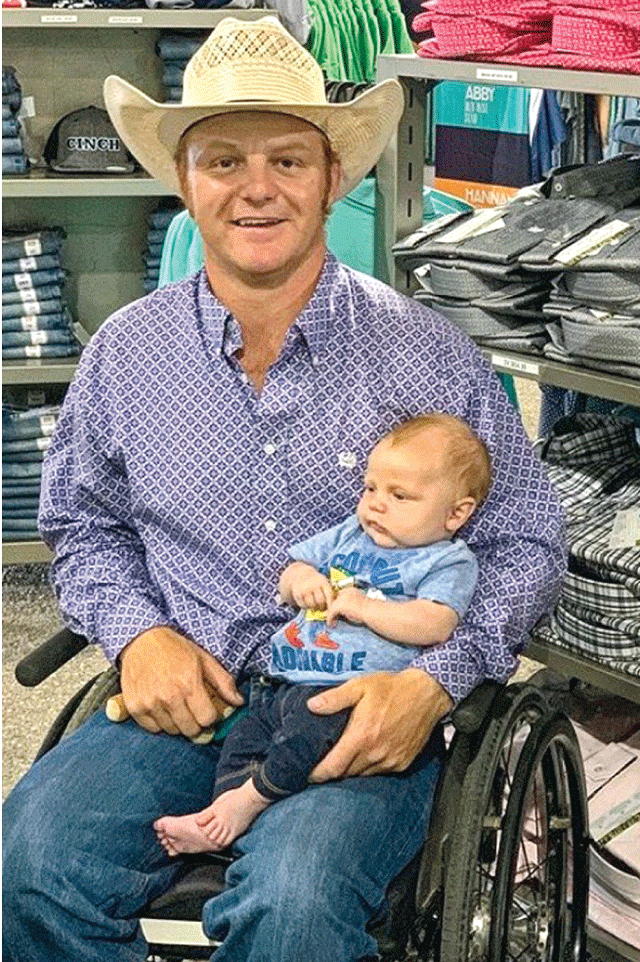
    I heard a saying a while back I find myself referring to constantly on hard days. When I try to wiggle a toe and it still doesn’t wiggle. When I stand up with a walker and think today is the day and my knees still don’t lock. When I try to kick my leg out and it just dangles there. After all this time, approaching 11 months, all the hours of strenuous physical therapy. All the days spent staring at my toes, feet, and legs trying to get them to move. After all these months praying, seeking, reading, and believing. After the constant day in and day out of putting in the effort and working hard to conquer the odds. After all the early mornings and late nights catching a workout in the gym between managing our cattle and getting leather work done, so I can still provide for my family. After all this time, why am I not seeing the success and results I feel like I deserve? This saying helps me a lot, “God loves us too much to deliver us at anytime other than the perfect time.”
    As Isaiah 55:8-9 claims, God’s ways are not like our ways. His thoughts are not like our thoughts. We cannot think like God thinks. We can’t fathom how God works. So who are we to say what we do and don’t deserve? All we are supposed to do is keep believing and not grow tired of doing what is good, because we will reap a harvest of blessing from the seeds we sow. Just like the story of Joseph, he could’ve given up when his brothers sold him into slavery. Or, when he ended up in prison for years. He could’ve quit trying. He could’ve given up on his dream, but he didn’t. He kept doing the tasks that God had laid in front of him day in and day out, and believing in the dream and vision God had given him until at the perfect time God delivered him to be Pharaohs right hand man, and save his family from the 7 year famine.
    So, when you grow tired we can find strength and peace in these promises from God:
    • “Give your burdens to the Lord, and he will take care of you. He will not permit the godly to slip and fall.” Psalms 55:22
    • “Don’t be afraid, for I am with you. Don’t be discouraged, for I am your God. I will strengthen you and help you. I will hold you up with my victorious right hand.” Isaiah 41:10
    • “For I can do everything through Christ, who gives me strength.” Philippians 4:13
    • “God blesses those who patiently endure testing and temptation. Afterward they will receive the crown of life that God has promised to those who love him.” James 1:12
    When you don’t see any progress, whether it’s in your dream business you’ve started and don’t see growing, your new weight loss program you’ve been doing for months and can’t shake the extra pounds, your physical breakthrough you are working towards, or any other trial that has you wore down and on the brink of giving up. Whatever it is, just remember Romans 8:18 “Yet what we suffer now is nothing compared to the glory he will reveal to us later.” So, dig in, dig deep, keep your vision in front of you, and DON’T GIVE UP!

  • Back When They Bucked with Terry Peek

    Back When They Bucked with Terry Peek

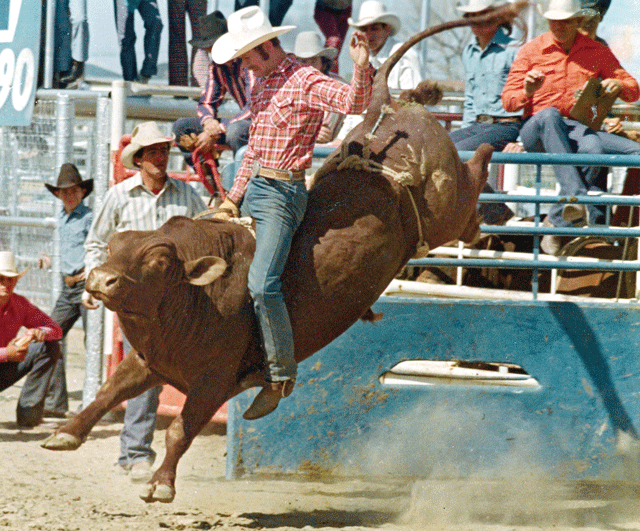
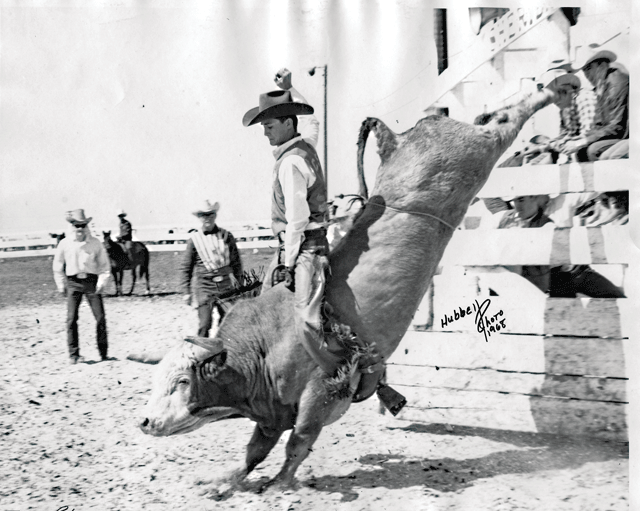
    Terry Peek craved riding bulls. And although he never made a living at it, it was his hobby, his lifestyle, and where he made many friends. The Bandera, Texas cowboy was born in 1945 in Paris, Texas, the son of Joe Bailey and Robbie Lee Peek. When he was seventeen years old, he was at a rodeo, behind the chutes, when someone asked him, “Son, do you want to get on this bull?” He thought it was a good idea, so he said, “You bet.” The man asked, “Did you sign a release form?” “I said, sure I did,” he recalls. “I didn’t even know what a release form was.”
    So he found a cotton rope, wrapped it around the bull’s girth, and got on. He rode him for six seconds, got bucked off, and “from then on, I said, boy, this is fun and this is what I want to do.” The next Monday, he bought a bull rope and a pair of spurs, and his rodeo career began.
    Terry, who had worked for local farmers and ranchers around Paris, had broken and ridden horses for people, earning $35 a head. After his first bull ride, he went to every junior rodeo he could get to, hitching rides with buddies or going on his own. He was friends with Sammy Andrews, Gerald Smith, who owned Wing Rodeo, and Robert Wright. Friends would meet at Robert’s, near Talco, Texas, every Sunday, to ride bulls.

    He was also friends with Todd Whatley, who introduced him to world champion bull rider Freckles Brown. Freckles’ home in Soper, Okla., was just across the state line from Paris, and Terry went to work for Freckles, putting up hay on his ranch. Terry rode bulls at the Paris rodeo, where Freckles was the judge, and when Terry won a go-round, Freckles was “tickled to death,” he said. “He said, Terry, did you get your check? I said, I don’t even know where to go.” Freckles laughed and said, “Son, go right up those stairs to the announcer’s stand and there will be a secretary there with a check.” It was a check for $250, “which was huge for me. I came back, showed it to Freckles, and he said, ‘that-a-boy.’”
    His parents were not pleased with his decision to ride bulls. His junior year in high school, he declared to his parents that football did not interest him anymore; he’d be rodeoing. His mother had something to say about that. “She said,” Terry remembers, “let me explain something to you. You’ve made a commitment to play football to the coach. You’re going to fulfill that commitment. You can ride bulls, but you’ll play football.” He did, but “I was thrilled when the season was over,” he said.
    His parents grew to accept his choice to rodeo. “They finally understood, this boy is going to do what he’s going to do. My mother said to my dad, let’s just go to some of his rodeos and watch him, so they did.”
    After high school graduation, Terry was a student at Paris Junior College. He was still rodeoing, and to him, rodeo was more important than school. He declared to his mother that he was going to quit school and rodeo full time. “My mother had this look on her face,” he recalled. “She didn’t say anything.” A few weeks later, his mother told him Sonny Sikes, the rodeo coach at Sam Houston State University, had called, asking him to rodeo for the team. “I said, ‘he does?’” And she said, yes. “They have a great team there and he’s heard about you and he wants you to come and rodeo at Sam Houston.” It was a set-up; Sonny Sikes had never heard of Terry but his mother arranged it so that Terry would go back to college.
    It worked. Terry attended Sam Houston State for two years, riding bulls for them and earning a degree.
    While in college, he qualified for the College National Finals Rodeo in 1967 and 1968, finishing the ’67 season as Southern Region bull riding champion. Terry was in good company, competing alongside the likes of Phil Lyne, Carl Deeton, Ronnie Williams, and other good cowboys.
    His parents made a real sacrifice to send him to college. Before he left for Huntsville, his mom and dad gave him fifty dollars. It was what they were able to save for him. His mother told him, “your dad and I have saved fifty dollars and we want you to have it, to get off to a good start.” Each week, his mom would put a case of Campbell’s soup on the bus to him. Terry would meet the bus at Huntsville to pick it up. “I always had food,” he said, even if he did get tired of soup. Sometimes he’d trade a buddy a can of soup for a hamburger. In 1968, he graduated from college with a degree in ag education. He enrolled in the master’s program at Sam Houston, but got drafted into the Marine Corps. He spent two years in the Marine Corps, stationed in various places on the west coast and in the Pacific, before his honorable discharge.
    When he got out of the Marines, he got a job in Coldspring, Texas, teaching agriculture. He was still competing at 35 or 40 rodeos a year, all over east Texas, Louisiana, and farther. They were regional and International Pro Rodeo Association events.
    After two years in Coldspring, he moved to Cortez, Colo., spending five years there as an ag teacher and the high school rodeo coach. He was still rodeoing, this time in Colorado, Utah and that part of the country.
    In 1979, Terry moved to Ft. Collins, to work on his doctorate in ag science at Colorado State University. After earning his advanced degree, he moved to Glenwood Springs, Colo., to work for Colorado Mountain College as dean of community education. He had worked with Exxon Mobil, getting students jobs with the oil company. When Exxon offered him a job, he took it. They sent him to Colombia, South America for three years, then Mexico, then back to the States: Houston, Illinois and California.

    But he decided he missed teaching, so he went back to the classroom, as ag mechanics instructor and rodeo coach at Texas A&I in Kingsville (now Texas A&M in Kingsville). He loved the classroom and helping rodeo athletes. For the five years he was in Kingsville, his athletes qualified for the College National Finals every year.
    It was there that he got on his last bull. Terry had quit riding at age 35, but at the age of 49, he got on one more. During an evening practice, the college bull riders couldn’t stay on. “They couldn’t ride a milk cow that night,” Terry remembered. “I said, ‘golly, you boys are pathetic. Let me show you how this works.” He got on a bull, rode for eight seconds, and when he dismounted, he fell and the bull stepped on him, breaking his pelvis and separating it three and a half inches. The college kids were laughing. “Yeah, yeah, Dr. Peek,” they said, as the ambulance came. “I was always one to take a dare,” Terry said.
    After five years in Kingsville, the wanderlust in Terry returned, and he moved to Farmington, New Mexico, where he worked at San Juan College for five years. Then it was on to Roseburg, Oregon, to Umpquah Community College as vice-president. Two years later, he was on to Wenatchee (Wash.) Valley College.
    He and his first wife had two sons: Josh Peek and Jason Peek (Terry and his sons are no relation to the steer wrestler Josh Peek from Colorado), and one of his grandsons, Idan Peek, needed some extra attention, so Terry raised him. After his divorce, he was single for many years. “That was good,” he said. “I wasn’t distracted. I was able to do my work and do a good job of raising that child.”
    Then a chance encounter on a plane brought him his wife, Dorene. It was on a flight from Austin to Portland, and he was seated next to her. As they visited, he discovered that she was a barrel racer and her father had raised some National Finals Rodeo bucking bulls. After the plane ride, they stayed in touch, then married in 2008.
    Terry retired in 2009 and the couple settled in Bandera, Texas. He still receives phone calls from former college kids who were inspired and helped by him. He was an example to them, that rodeo and a good education aren’t exclusive of each other; he was able to get his schooling done yet still ride bulls. He loves to talk to former students. “They appreciate what I did for them, and I was lucky to have them,” he said. He also has a high respect for Sonny Sikes, and the two stay in touch.
    He is a member of the Rodeo Cowboy Alumni Association, a group that gets together twice a year and raises funds for scholarships for young people. He enjoys getting together with other rodeo friends.
    In retirement, he golfs and works in a saw mill he and a friend purchased. He makes furniture, and still attends rodeos, including the National Finals Rodeo, Pendleton, Bozeman, Mont., and others. There are several retired cowboys in Bandera, and they get together. “We talk about how good we were, back when they bucked,” he laughed.
    Bull riding was his love. “I loved to get on those things,” he said. “I just craved getting on bulls. I couldn’t wait to get on the next bull, for so many years.”
    “I wasn’t one of the best, but I had a lot of passion for what I was doing.”

  • On The Trail with Jace Logan

    On The Trail with Jace Logan

    The 18 year old is from Yampa, Colorado, a small town located 30 miles south of the famous Steamboat Springs ski resort. Even with that close proximity, Jace doesn’t ski. “I get so busy with sports, I don’t make time for it.” Due to conditions and his high school sports, Jace is unable to practice in the winter. “We had 5 feet of snow last year and freezing temperatures all winter.” During the fall, he splits his time between football and rodeo and then wrestles throughout the winter. He was the running back and linebacker in football for Soroco High School and he wrestled in the 170 pound division, earning the state title this year in 2A. After spending the past three years as runner up, he finally reached his goal. Jace has wrestled since kindergarten, working his way through middle school into high school and coaching the peewee program. “I love the sport – it teaches great life lessons – I love that kind of competition. You are out there by yourself so there are no excuses. Dedication and teamwork are still in there as far as practice partners – being accountable for your actions on and off the mat. Wrestling teaches discipline in cutting weight, making weight, and grinding it out. It’s very rewarding in the success because it’s all you.”


    As a freshman, Jace was a big surprise to a lot as he made it to State finals, and ended up runner up – for the next three years. “It was a rough go for a while, but we got it done.” What he concentrated on this year was his mental game. “Honestly in life and in sport – if you can mentally overcome stuff, that will make the difference in your success.”

    Jace competes in the Colorado State High School Rodeo Association, where he is this year’s All Around Champion. Going into the fall season he would play football Friday night and then immediately head to the weekend rodeos where he competed in reined cowhorse, tie down, team roping, and steer wrestling. Add that to the fall ranch work, Jace kept busy. His family ranch runs 1,300 leased cow calf pairs during the summer and fall gathering on the 12,000 + acres takes some time. Add shipping to that and the family of three boys has their work cut out for them. “My brothers and I are the cowboys pushing them up to summer pasture and putting out salt and mineral during the summer. Then we gather in the fall.”

    Jace and his two brothers, Eric, 21, and Kody, 16, started their own cow herd when they were young. “I bought two cows in second grade and same with my brothers. Each year, we’ve grown our herd.” They have around 200 of their own cows now. “Mom and dad treat us good – we work pretty hard on the ranch and they help by taking care of most of the expenses on the cattle.” The cattle on the ranch are divided into four big bunches and the boys check on something every day during the summer.


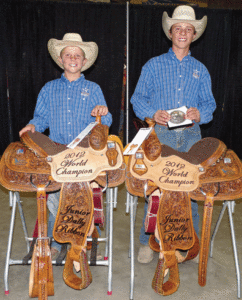
    He comes by his love of horses through his parents, Mark and Jeannie Logan, who competed in reining before the boys were born. They started raising horses with their stud, Doc Sugar Catalyst when Eric was just a baby and most of their horses they rodeo on and work the ranch on comes from Doc. Jace and his brothers found their niche in the horse world through rodeo, starting with the local gymkhana club and NLBRA, then climbing the ranks of junior high and high school rodeo. Jace competed in team roping and dally ribbon roping with Eric, and the brothers were crowned the NLBRA dally ribbon roping world champions in 2012.

    Jace has been pro rodeoing since last October, running down the road with Eric, who also steer wrestles. They use the same horses and haze for each other. “I pulled a check at my hometown rodeo, the Steamboat Springs Pro Rodeo series. We hit that ten week series every weekend.” One of the horses, the haze horse Skeeter, is one that was raised at the ranch. The steer wrestling horse, Gray, was bought out of Texas when Eric was at Odessa College. Besides steer wrestling, Jace and Eric also compete in team roping together. Jace heads on Skeeter-the haze horse, and Eric heels on a horse they also raised on the ranch and used in reining. During the week the boys and Eric’s fiancee, Shelby-who breakaway ropes, make time to practice everyday. The family put in an arena a few years ago which allows them the flexibility to practice whenever they have free time from the ranch.
    Jace is going to the University of Wyoming this fall to study Animal Science with a concentration in livestock production. He plans to apply that later in life as a ranch manager. For now, he’s going to rodeo for a while. “I want to see how far I can go in it.”

  • ProFile: Chris Woodruff

    ProFile: Chris Woodruff

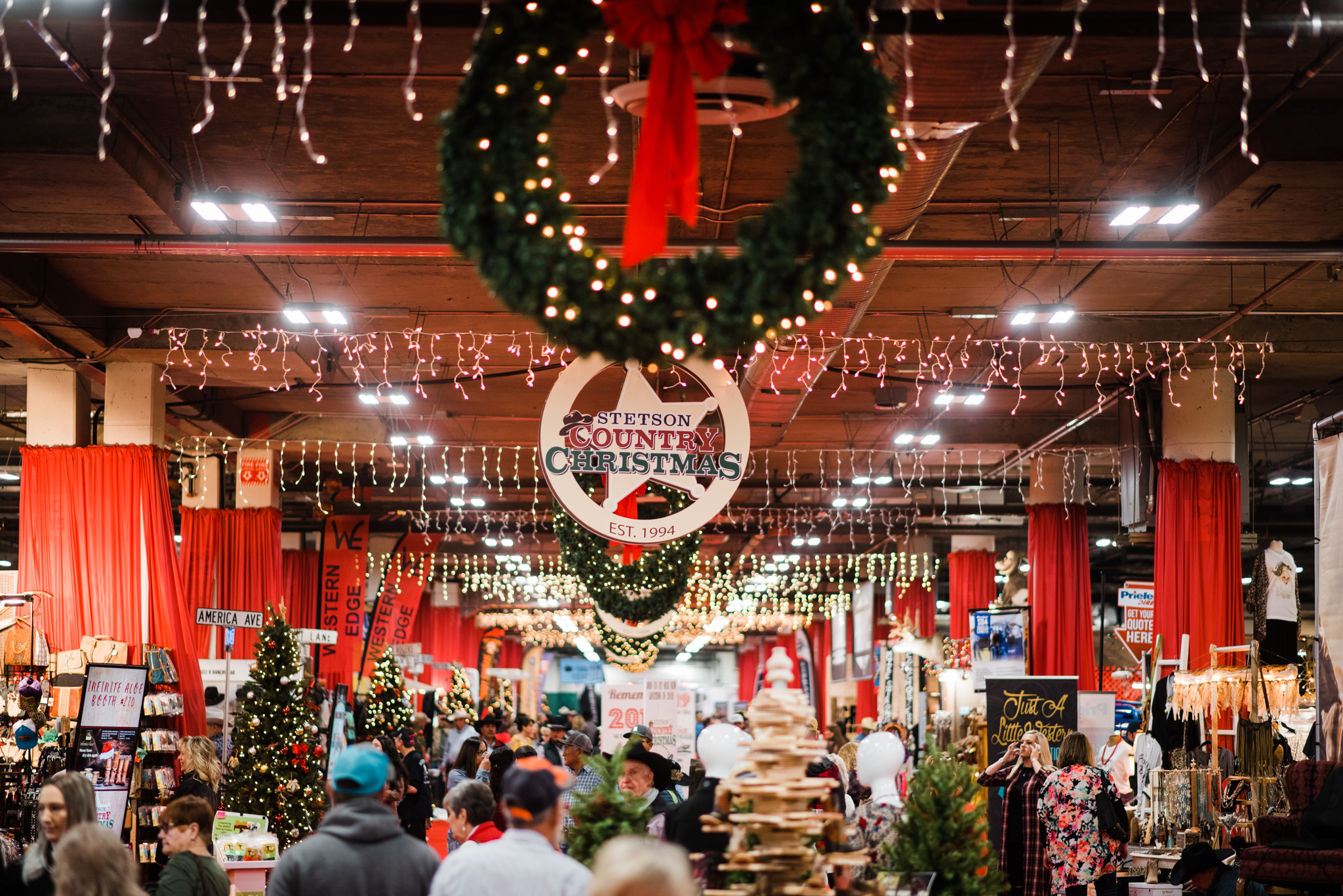
    Chris Woodruff is the man behind Stetson Country Christmas, Roper Cowboy Marketplace, and his latest venture, ALL IN Barrel Race and ALL IN Breakaway – both held at the Orleans Arena during the WNFR and guaranteeing more than $800,000 payout. Chris rode bareback horses in high school and college. “I was in the era of Bruce Ford and I wasn’t that level,” he admits. He got his start with a family owned advertising company in the oil field industry. “I learned how to talk to people and get my foot in the door –Las Vegas can be so intimidating in 2019. But when I started in 1994 that wasn’t the case.” He got into real estate for awhile and then in 1994, he saw the need for additional shopping during the NFR and the “rest is history.”
    “When I first started my goal was 100 booths – with hard work, effort and a great team, we’ve grown it into a must shop must see shopping experience during the NFR.” The first year he managed to get 500 booths into the Sands Expo and it grew from there. Fast forward to 2019 and between the two trade shows (Roper Cowboy Marketplace at Mandalay Bay and Stetson Country Christmas) it grew to more than 2,000 10×10 booths.
    With an unexpected move from the Sands Expo in 2016, Chris was given an opportunity to expand into producing an event. “I find the good in everything,” he said. “That move downtown got us into the ALL IN Barrel Race which we held downtown at the World Market Center, in conjunction to the Stetson Country Christmas. 2016 was the first year for the ALL IN.”
    Stetson Country Christmas has found a new permanent home at the Rio Hotel and Casino, with 14 acres of free parking on Twain Street (west side of the Rio). “Once people get there, they will be amazed at the accessibility of the shopping. We are already sold out of exhibit space.”
    Being in Las Vegas at the level of what he produced for 25 years with the two trade shows, Chris saw a need to cater to barrel racers. “The barrel racing interest comes from my daughter, Autumn, who started racing when she was 12.” Autumn was actually allergic to horses and was willing to take shots or whatever it took to be around them. She has outgrown it and keeps her allergies under control with over the counter medications. Chris has been a hands-on dad, attending the barrel racings that Autumn ran at and seeing firsthand what each event was like from the competitor side. “I saw the need for the barrel race event after watching the success with the team ropers and the World Series. Why not let the barrel racers have their presence,” he said. “I’m an entrepreneur; we produced the trade shows for 25 years so we have knowledge of how Las Vegas works internally. Group W Productions was an operational partner for the Rose Palace in San Antonio – so we put on several events there over the years. We just moved to bigger and better and set our sights on Las Vegas. We’ve participated first hand as a competitor so we’ve seen all the misses that a producer misses at an event. I take that into consideration and that’s part of our plan – to be everything we can be at the ALL IN.”
    “The concept is “ALL IN.” We want it to be a seamless experience for the barrel racers. There’s only 15 going to the NFR and this offers others a part of the pageantry and the lights plus pocket some pretty nice prize money.” Each entry includes a hotel room and stall, contestant’s jacket, trailer parking and more goodies as time goes. Sponsors are stepping up to add perks all the time. “We’ve got everyone entering from Sydni Blanchard to the weekend warriors and grandmas. Sydni is now one of the sponsors – she is giving one of her saddles to the fastest time to the event.”
    Whatever race entered, starting on Thursday, December 5th, each contestant gets two go rounds, and a short round. The top 30 of every D to the short go. “It’s a clean slate race in the short go, so who knows who will get it.”
    The entries are limited by the number of stalls available on each race – and now they added breakaway with a guaranteed $100,000 – so Chris encourages anyone interested to get their entries in early. “We want to make this ALL IN Barrel Race as big as we can make it. I had no idea we’d be paying over $700,000 by the fourth year of the event, and that’s just the barrels. The breakaway is $100,000. I haven’t seen anything where the breakaway is paid out that much. I feel like we’re stepping out there pretty good.”

  • Now Faith

    Now Faith

    What does it mean to have “Now Faith”? I was corrected the other day and said that I need to expand my faith and quit diminishing it by what I claim. The statements I was making such as “I believe I will walk again, whether it is on this earth or the next I’m not sure but, I believe I will walk again.” Now, although you might think this statement is a bold statement and makes the claim of walking again, by not claiming what I originally prayed for shows weakness in my faith! We all know that if we have accepted Jesus as our personal savior that the day we die we will be born again and given a new body in heaven. 2 Corinthians 5 tells us about putting on our new bodies in heaven. So, although by saying “I will walk on this earth or the next” I am claiming truth, but I am diminishing my faith because of course we all know that we will be made new and whole in heaven.
    The day of my accident I prayed for healing. I have had many prayer warriors stand in agreement with me. I truly do believe that I will regain my legs and be healed 100%. Trey Johnson brought this to my attention the other day and taught me the importance of renewing our minds and having “now faith”.
    Matthew 7:7-8 says “Keep on asking and you will receive what you ask for. Keep on seeking and you will find. Keep on knocking, and the door will be opened to you. For everyone who asks, receives. Everyone who seeks, finds. And to everyone who knocks, the door will be opened.”
    From the beginning I prayed for God’s will to be done and to be fully healed. Not partially healed, not somewhat healed, I prayed to be fully healed! I prayed to be healed that night. I prayed to be healed in three months. I prayed to be healed in six months. Now I am approaching ten months post injury still praying for full recovery and believing in Jesus name that I will receive it.
    After 6 months of not receiving what you are praying for it is easier to wonder if it will ever happen. And although I believed, I began wondering if it is God’s will for me to walk. This is a way that Satan lies to us. He begins to sneak in and try to tell us that we won’t receive our miracle on this earth. We have to remember that Isaiah 55:8-9 claims that God’s thoughts are not like our thoughts. And his ways are far beyond anything we can imagine. So, when we don’t exactly receive what we are asking for right when we ask for them, we can’t get discouraged. We have to know that God is working and his ways are higher than our ways, and we must remain patient. We must keep asking and know that we are going to receive at just the right time.
    We also must remember that God spoke everything into existence. Psalms 33:9 says “For he spoke, and it came to be; he commanded, and it stood firm.” So the words we speak about ourselves and our situation are what will become. They are very important. And the beginning of words are thoughts. What we think is what we will talk about. Therefore we must control our mind. It is important to start by renewing our minds and letting God change the way we think so that we can proclaim, and command truth upon our lives.
    Romans 12:2 “Do not conform to the pattern of this world, but be transformed by the renewing of your mind. Then you will be able to test and approve what God’s will is—his good, pleasing and perfect will.”
    By letting God transform the way we think and proclaiming his promises they will come to fruition. So, instead of me saying “I will either walk on this earth or the next” I need to say “Lord your will be done. I know I am healed. My back is strong. My legs are strong. My ankles are strong. I can lock my knees. I am able to take steps. By Jesus’ wounds I am healed. Your timing is perfect so I will remain patient. I believe father. Lord you say in Mark 9:23 that anything is possible if a person believes! I will walk again on this earth because you are faithful and I have asked!”
    So, it is a work in progress for me but I have began to let God transform my mind and seek his promises on my life, and within a week of speaking and proclaiming healing on my body I have began to be able to flex my glutes. That’s a huge breakthrough as the glutes and quads are the muscles that will lock my knees and make me able to stand on my own so praise God for that! Hebrews 11:1 describes true faith as believing in the things not yet seen. So, although you may not see your situation changing, you may not see your miracle happening, you may not see any progress, we can all rest assured that faith as small as a mustard seed will move mountains. Don’t weaken, keep believing, keep proclaiming, and know that God is working and will reward faith!
    Matthew 8:13 Then Jesus said to the Roman officer, “Go back home. Because you believed, it has happened.” And the young servant was healed that same hour.

  • Back When They Bucked with Jerome Robinson

    Back When They Bucked with Jerome Robinson

    courtesy of the family

    For Jerome Robinson, being born in Ogallala, Nebraska (the self proclainmed “cowboy capital of Nebraska”), might have been an omen as he was destined to spend his entire life dreaming about, and then acting out the life of a cowboy… Specifically, a rodeo cowboy. A three-year-old Robinson announced he wanted to be a bull rider while attending the Denver Stock show with his grandmother. Later that year he rode a horse (led by his mounted father) in the county fair and rodeo parade. By age five he was riding calves on the family wheat farm in Brandon, Nebraska.
    Riding calves evolved into riding steers and then cows in the farm’s corral that was converted into a make shift rodeo arena. These practice sessions along with breaking and training ponies and horses gave Robinson the confidence to enter little britches rodeos and later high school rodeos where he experimented in calf roping, bareback riding, and steer wrestling in addition to bull riding… He excelled at none of the rodeo events. When Robinson graduated from high school, he had not yet won an event at any of the rodeos entered and had placed only once.
    Robinson enrolled in Colorado State University (CSU) in Fort Collins, Colorado with thoughts of studying veterinary medicene. While struggling with chemistry, Robinson discovered a rodeo arena in Boulder, Colorado that was scheduled to host weekly practice sessions every Sunday afternoon throughout the year, weather permitting. Robinson became a regular at Rex Walker’s Sombrero Ranch practice sessions where he cut a deal to serve as rodeo bull fighter in return for mounting all the stock he could, without paying the customary three dollar practice fee.
    Robinson’s faithful practice habits didn’t render many results and his freshman year he was not selected to be on the csu rodeo team. Excluded from competing at any of the intercolligiate rodeos was his fate until team member injuries took their toll and Robinson was allowed to enter the last two rodeos of the year. Placing at both gave him a berth on the team and a trip to the National Intercollegiate Rodeo Association (NIRA) Finals in Yankton, South Dakota. The next two years of college, Robinson doubled down on the practice sessions along with attending World Champion Ronnie Rossen’s week long bull riding school where he got on thirty-three head of bulls at the seven day school. At one point, Robinson had practice sessions Tuesday and Thursday afteroons and Saturday and Sunday mornings in Fort Collins. Wednesday night and Saturday afternoon sessions took place in nearby Laramie, Wyoming and Sunday afternoon, it was Boulder again. Practice did not make perfect but it did make Robinson competitive on the intercolligiate level where he finished third and ninth nationally his junior and senior season, and the summers saw him being competitive at local PRCA rodeos while finishing fourth at Cheyenne Frontier Days in 1968.The 1970 PRCA rodeo year actually started the first rodeo after the 1969 San Franciso Cow Palace rodeo which ended in early November. All other 1969 rodeo winnings were credited to the 1970 championship standings. Robinson was attending his last few months of college, but to get a jump on the 1970 season, he would leave classes friday, driving overnight to scheduled PRCA rodeos in the midwest, competing on saturday or sunday and drive overnight to be back at school on Monday. St. Paul, Minnesota was the first rodeo of the 1970 season and Robinson drew up in the first performance on bull #1 and was the first bull rider to compete in that night’s performance. Robinson’s score held up for a first place finish. The next weekend was Bismark, North Dakota, where Robinson rode to another first place finish winning his first PRCA buckle and he won a second at the Chicago Stockyards rodeo over Thanksgiving weekend. The January 1st issue of the “Rodeo Sports News” had Robinson leading the bull riding standings. That would be the only issue in his sixteen years of competition (1967-82) that showed him leading the standings. Robinson would qualify for his first of eleven National Finals Rodeo (NFR) bull riding appearances, a PRCA record at the time. Robinson’s record would be broken by Donnie Gay, Wacey Cathy, Ted Nuce, and tied by Tuff Hedeman.

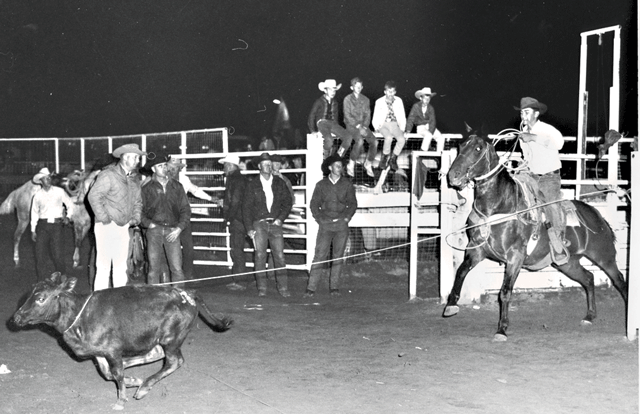
    Jerome competing at the Fort Collins College Rodeo, 1967 – Clore Photo

    Having qualified for his first NFR in 1970, Robinson decided to make some use of his degree in education and conduct a bull riding school. He recognized that at the seven day school he had attended, the majority of the learning was done in the first three days and the last four were just practice so he elected to cut the tuition in half and conduct a three-day riding clinic. Robinson’s clinics turned out some very accomplished riders. Wally Badgett from Ashland, Montana was a student at the first clinic and won the NIRA bull riding championship the next year and was an NFR qualifier four years later. Student’s from Robinson’s second and third clinic also won NIRA championships the year following their attendance. In addition to Badgett, several NFR qualifiers came from the ranks of Robinson’s clinic including Cody Lambert, Lonnie Wyatt, and Michael Gaffney (who, along with Owen Washburn, won PBR world titles).
    After six consecutive NFR appearances, Robinson while serving his fourth year as the PRCA bull riding director became involved in the implementation of a centralized rodeo entry office, known then as rocom (rodeo communications) and today as procom (prorodeo communications) that utilized a computer programed to implement the rules and guidelines of the prca rulebook regarding entries and drawing of competitive positions and livestock. It also utilized a bank of toll- free telephone lines to accommodate the communications of the rodeo contestants, stock contractors, and committees. Procom essentially consolidated the in excess of five hundred prca rodeo entry offices across the united states into one, facilitating a more efficient and cost- effective method of producing PRCA rodeos. While attending to procom growing pains, Robinson found it difficult to focus on his riding and 1976 proved to be the only year in a twelve-year span, Robinson failed to qualify for a berth at the NFR.
    Robinson left the 1981 NFR and elected to skip rodeos in Odessa, Texas and the Denver Stock Show for World Cup competition in Melbourne and Sydney Australia. Returning from Australia in time for the start of the Fort Worth Stock Show Rodeo, Robinson won a bull riding in Amarillo, Texas on his way to Fort Worth where he placed high in both of the first two go rounds and was leading the average going into the progessive third round. Prior to the his third round competition, Robinson competed in Scottsdale, Arizona, and was scheduled to fly from Scottsdale to Fort Worth the next morning when two bronc riders asked him to help them make the overnight drive and Robinson agreed. Robinson slept through the better part of the night and took over his driving shift at El Paso just after midnight Friday morning running into a Texas ice storm. Just past Big Spring, Texas, about three hours fom the Fort Worth destination, the storm seemed to subside, but a patch of ice sent the top-heavy van careening into the median, flipping onto its top, pinning Robinson’s right hand between the roof and the dashboard. An ambulance soon arrived and transported Robinson to the Big Spring hospital, leaving the bronc riders, who were uninjured, to settle the paperwork on the accident and find themselves a ride to Fort Worth where they were scheduled to ride that Friday night. Robinson was admitted to the hospital where a local surgeon amputated the end of two fingers and took skin from the front of his thigh and graphed it to the front of the two amputated fingers while suturing the third finger closed. All the time Robinson, being a left handed rider, was calculating his odds of competing on his third bull in Fort Worth. Calling the Fort Worth rodeo office, Robinson applied for and received a medical waiver allowing him to postpone his competition ride until Sunday afternoon. By Friday night, other residuals of the accident set in and Robinson was unable to lift his head off the hospital bed pillow. He all but abandoned any thoughts of Fort Worth competition. Amazingly, after a good nights rest, Robinson was much more mobile and began to think, “if I can improve as much in the next twenty-four hours as I have in the last eighteen, I think i could get on in Fort Worth”. By Saturday night, Robinson had made arrangements with a long-time-friend/traveling partner and Big Spring resident to catch a ride to Fort Worth for the Sunday afternoon third go round bull ride and hopefully the short-go finals Sunday night. Robinson arrived at the stock show arena in time to have Justin Sports Medicine’s team design and wrap a protective guard on the injured non-riding hand. Robinson scored a moderate score on a substandard bull in the afternoon performance and in the finals that night, Robinson posted another moderate score after the judges docked Robinson’s ride for being somewhat out of control on an excellent short go mount. Compounding Robinson’s lacluster performance was an unorthadox dismount that resulted in what Robinson thought was a dislocated knee but turned out to be a detached ligament. The injury required surgury and put Robinson on the medically disabled list for the next four months allowing him to return to competition on Memorial Day weekend. Robinson’s riding the remainder of 1982 was average at best and Robinson acknowledged that after riding competitive with the event’s premier riders for over a decade, riding just average wasn’t much fun. He announced his retirement that fall after making qualified rides on his last five bulls.

    Jerome tie-down roping at a Nebraska High School rodeo, June 1965 in Harrison, Nebraksa – Ken Studio

    During his four months of recovery, Robinson, who two years earlier had attended a three-day rodeo production seminar decided to try his hand at producing a rodeo. He convinced the CSU rodeo club to let him produce the “Skyline Stampede”, one of the oldest and longest running collegiate rodeos in the nation. The 1982 Skyline Stampede experienced a significant upgrade in entertainment value (complete with a sponsored “25 cent beer day”) and a modest increase in rodeo club profit. Robinson’s profits, though very modest monetarily, came in experience gained from producing a complete event from start to finish.
    Another mini project Robinson involved himself in while convalescing consisted of Howard Harris, PRCA livestock contractor representative, Ken Stemler, PRCA Properties Inc. President, and Robinson making a sales presentation to Steve Gander, a notable indoor rodeo producer in the midwest to bring his brand of “World’s Toughest Rodeo” under the sanctioning umbrella of the PRCA. Gander elected to join the PRCA and at a point in the year that it was obvious Robinson was not going to make his twelfth NFR qualification, Robinson was extended an offer from Gander to be his PRCA livestock liaison and arena director. Warning Gander he would be hiring a neophyte in both job areas, Gander laughed, repeated the offer, and Robinson accepted.
    The following three years, 1983-85, were filled with long days and short nights, with Gander and staff being responsible for Robinson receiving an education in rodeo production. In the late spring of 1985, Robinson was offered the position of production coordinator for a six event prca television series entitled “Winston Tour”. The rodeos were restricted to the top PRCA contestants selected to “outfits” with each “outfit” sponsored by a PRCA corporate partner. The best available livestock was used at each event with the televised performance being limited to the top six contestants in each event competing with two being eliminated, then four competing, eliminating two more, leaving the top two contestants in a head to head competition for the championship. In each televised performance, rodeo fans saw the top two contestants in each event compete three times on premium livestock in the two hour edited television show. The result was a rodeo fan’s dream.
    After the 1985 debut year, the “Winston Tour” made appearances at several existing rodeos in 1986 and then yielded to political pressure from within the PRCA ranks, and the waning involvement of Winston cigarette advertising that became restricted by federal regulation. The “tour” was discontinued at the end of 1986, but the basic concept the Winston Tour was founded on… the top contestants competing on the best livestock, multiple times, in the same performance… Would surface again and play an important part in another chapter of Robinson’s rodeo career.
    In 1986, Rex Walker of Sombrero Ranch practice arena, joined forces with Robinson to create Western Trails Rodeo (WTR) as a recognized PRCA livestock contracting firm. This made western trails rodeo an integrated company capable of producing rodeos from start to finish. While acquiring some venues from an acquisition of an existing company, 1987 proved to be a testing ground and was a springboard to 1988 and beyond when a couple of singing cowboys named Garth Brooks and George Strait, with what Nashville dubbed “the hat acts,” made western lifestyle events very popular with the American public and rodeo attendance soared, making Western Trails Rodeo a financially successful venture and opened the door to one of the most challenging but exciting segments of Robinson’s rodeo adventure… production of overseas rodeos/wild west events.
    Over the next two decades, Robinson would be contracted to take rodeo/wild west shows to Japan, Finland, France, Italy, Canada, Venezuela, Mexico, Oman, and Brazil. He considers the foreign performances as the most challenging and stressful, but also the most gratifying of the thousands of performances he has been a part of in the thirty-seven years of producing rodeo performances.

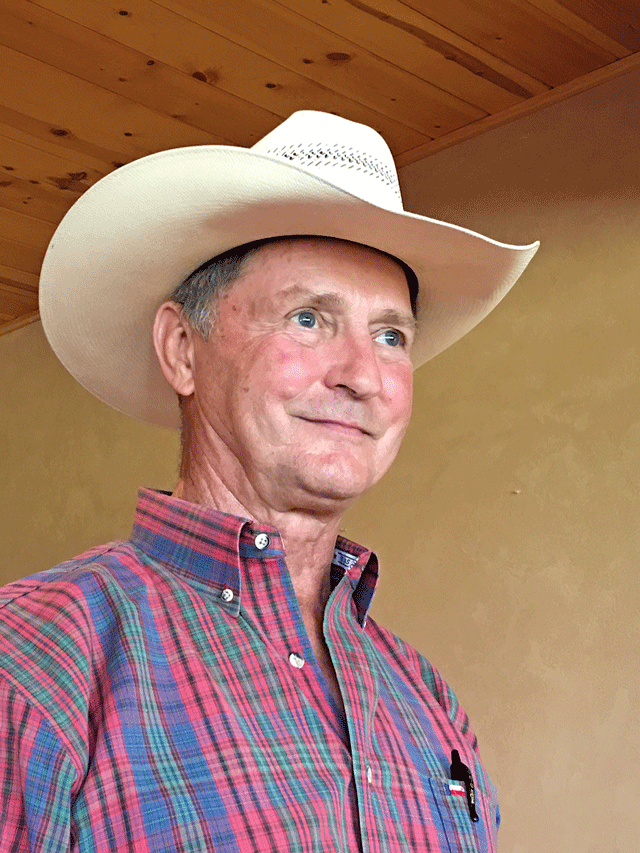
    Jerome, present day – Rodeo News

    In the middle of the decade of foreign events for Robinson and the WTR crew, they produced a 1992 bull riding in Scottsdale, Arizona for another promoter. Robinson remembers very little about that event other than the announcer being stricken with laryngitis and a woman rodeo association champion bull rider competing against the men, but a significant event took place in a room at the host hotel. A group of bull riders, several of who were the stars of the now defunct “Winston Tour,” acted on the basic premise of showcasing the premier contestant athletes, the best available livestock, and having those athletes compete multiple times in one performance. From that hotel meeting in Scottsdale, the delegation moved forward and soon afterward, twenty bull riders each putting up $1000, formed the “seed money” for a company that today is valued at between an estimated 150-200 million dollars… Professional Bull Riders,” the PBR!
    The next two years were filled with WTR winter/fall productions and the small county fair circuit rodeos in eastern Colorado, Kansas and Oklahoma. Sometime in early 1994, a delegation from the PBR headed by Robinson’s former bull riding school student, standout Winston Tour competitor and PBR founding member, Cody Lambert summoned Robinson to a meeting where they (based on the Winston Tour and subsequent rodeo/bull riding production interaction) asked Robinson if he would be interested in being the production coordinator for their first “PBR World Finals” at the MGM Grand Garden in Las Vegas, Nevada. Robinson accepted the task and began a job that continues today. The first two “PBR World Finals” utilized almost all equipment and personnel supplied and hired by WTR. They were successful beyond expectations and doubled in prize money each of the first three years and with growth, the PBR purchased their own equipment and employed staff to take over many of Robinson’s initial responsibilities. Robinson has remained in a significant operational implementation capacity at every “PBF World Finals” for over twenty-five years. PBR also began partnering with promoters (Robinson being one of them) to produce their own events, many of which Robinson took on the handling of logistical operations and today refers to himself as the PBR’s “logistics coordinator”.
    In 1999, while working on the sixth of the twenty-five PBR World Finals Robinson has worked on, he was bestowed the honor of being inducted into the PBR’s “Ring of Honor” for contributions to bull riding during his competition days and afterwards for work performed on behalf of the PBR. Earlier this year, Robinson was inducted into the “Bull Riding Hall of Fame” in Fort Worth, Texas and in August, Robinson will be inducted into the “PRCA Hall of Fame” as a “Notable Inductee” which is recognition of a competitive career along with contributions made while serving on the PRCA board of directors as bull riding director and a vice president. Serving a term on the National Finals Rodeo commission and serving on the PRCA research and development committee that recommended and facilitated the building of the PRCA headquarters in Colorado Springs and also the ProRodeo Hall of Fame and Museum.
    As Robinson embarks on his seventh decade of his rodeo adventure, he admits he enjoys the job’s travel demands, claiming to be a gypsy, relishes the challenges of producing rodeos/bull ridings and looks forward to more years with the PBR. Robinson is up for at least one, if not half a dozen more tours on foreign soil to share the culture that he loves and that has been so rewarding to him.

  • On The Trail with Piper Yule

    On The Trail with Piper Yule

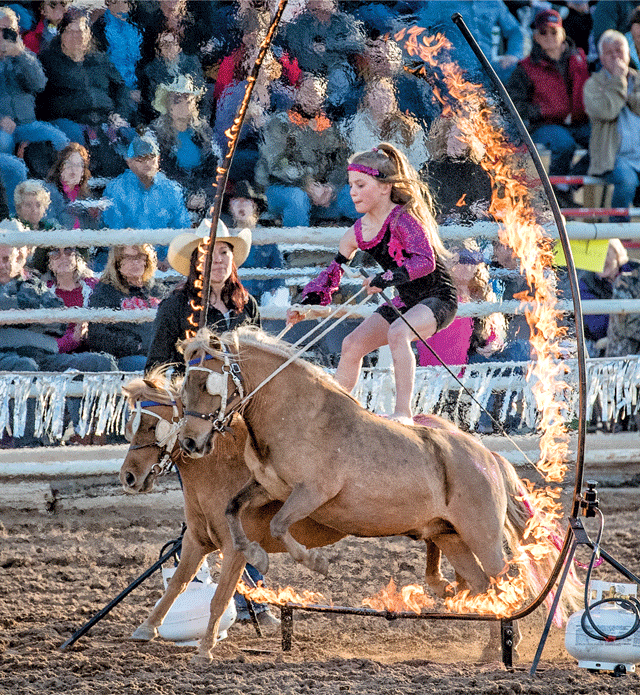
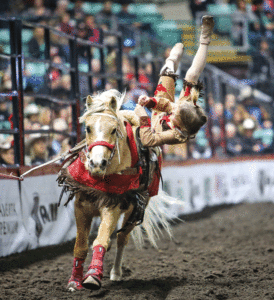
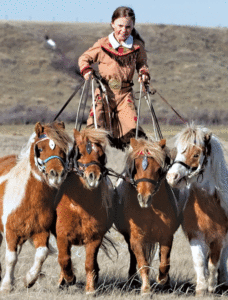
    Piper is currently mastering four ponies, and has been working on that for a year. She began her career as a trick rider at the age of four. She added Roman Riding a year later, hopping on her brother’s ponies one day in the arena. “My brother was driving a wagon and I wanted to be part of that, so I just jumped on.” She relies on her brother, Cash, for the ponies. Cash doesn’t mind anymore because the ponies aren’t fast enough for him to use on the chuck wagon. Chuck wagon racing is a Canadian thing, and he started with ponies, and is now moving to Shetlands. Along with the rodeo events, both Piper and Cash do a lot of work on the ranch, which has been in the family for five generations. The family lives in Wardlow, Alberta, a small ranching community, three hours from the border in the middle of nowhere. Between Brooks and Hanna, the community is known for the Calgary Stampede rodeo horses that make their home there as well. Most of their family lives around the area.


    Piper is a gymnast, nicknamed Pipes because she is so strong and has the ability to do things that kids her size can’t do. Her gymnastics teacher, Petre Neda, is an Olympian champion. He immigrated from Austria and coached the Olympian gold Korean team. She started at age 2 and at this time in her life, her groundwork in gymnastics is more difficult that the strap work of trick riding. “That’s what has set her apart,” explains her mom, Kelsey. “She can do difficult maneuvers like the bar work in gymnastics. Her snappy groundwork is her signature. The maneuver she likes the least is anywhere that the ponies can potentially bite her. “Since she rides naughty ponies, she has a hard time trusting her horse so she would prefer to vault.” Her work ethic in gymnastics included 20 hours of training a week. “Her coach was very strict – back hand springs, back walkovers, putting her feet in bars against the wall and lifting up; multiple chin ups and climbing a rope up a wall were other “warm up activities” he required of Pipes. “Piper respects her coach because he can do anything she is doing and when she doesn’t want to try, he shows her.”

    Pipes received her first formal training in trick riding from Rae-Lynn Armstrong, who was Madison MacDonald Thomas’s partner in Magic in Motion. “I met her through that,” explained Madison, who has been working with her for four years now. “She’s determined with a lot of try and a lot of heart. She’s very fun to teach – you can throw anything at her and she’ll try it. For someone as young as she is and the pressure of the shows we put her under, it’s incredible what she can do and handle.” Madison, who has been trick riding for 20 years, teaches trick riding from coast to coast. “The number of trick riders is growing,” she said. “The ‘trick’ is learning how to use your body, and Pipes is a natural – I love that little girl – she’s a fun one.”

    The trick riding and Roman Riding has come easily to Pipes, who practices Roman Riding often while the family is moving cows. This is the first year that she has had to work on the mental part. She’s never been nervous before. In Roman Riding there is no room for error. In order to “button up mentally,” Pipes has implemented a song into her preparation time. Fairland Ferguson used to performa in the show Cavallia, so Pipes sings the song: ‘Strong in the legs, quiet in the hand, chest and eyes up and go sell eggs.’ It’s an inside joke – she repeats the song until she is calm and focused.

    Piper leaves with Madison July 2, and she will go all the way to the end of August. Kelsey will travel along. “Maddie is contracted with Flying U, Mr. Rosser has given me my first chance to see if I’m good enough to be with her,” said Pipes. Her first show is Nephi, Utah, July 11-13. This is her first full summer on the road and she is excited. She came down to the states from the end of January until the middle of March for The AMERICAN and performed during the Junior American. “My teacher sent me homework. Miss Gray has been her teacher since kindergarten and now in third grade, she will work ahead to get done before she leaves. Half of her class is gone for the winter.

    “It gets pretty cold up here, so many of them go to Arizona,” explains Kelsey. “We do everything in -40 degree weather and it will be like that for a long time.”
    There is a tremendous amount of work that goes into the few minutes in the arena. “The production behind it takes a whole team,” said Kelsey. “It takes two hours just to get in the arena.” For Pipes, she would rather skip that part.

    “I don’t like to brush my hair,” she admits. “I just want my hair in braids.” She is not taking after her mom – who has a chain of beauty schools in Canada.
    “I grew up out here and I wanted to braid my ponies hair instead of barrel racing,” said Kelsey. “I worked internationally for Revlon for several years as Canada’s creative director. So I got to go to Barcelona and Paris, designing shows. I loved this side of the business, so I started schools. I have a great team – we’ve had the same team my whole career and we’re committed to each other. You can’t be strong without that.” Her ability to produce a style show has helped with the specialty act scripts. “We can do the photography, the make-up and all the art that goes behind it.”

    Her husband, Wes, spends his days doing ranch work, and is supportive of his children’s interests. “It takes a lot of time, but it’s good.” After a full day of looking after cows, haying, or whatever is necessary, he practices with the kids, rope a little with Cash. As a former bronc rider in Canada, he knows what it takes to get trucks and trailers ready to go. His bronc riding skills have come in handy as Cash breaks his ponies. “The ponies are too small for me to get on, but I can coach him.” He stays behind when the family hits the rodeo road. “I got the easy job – I fly down to watch and then fly home.”


    …A Little more about:

    Cash Yule

    Cash started working with ponies when he was six – he is 11 now. His secret is to spend lots of time with them. “Don’t give up and don’t let them win or they will keep doing that over and over again,” he said. “When I was little, I liked to play around with them. When I got older I started doing other stuff with them. I try to pick the better ones that aren’t naughty.” His cousin dropped off a trailer load when Cash was younger and he sorted through and picked the ones he thought he could break. “The other ones that I couldn’t break, I would buck them.” He puts them on a wagon and drives them until they are tired. He tarps them and ponies them on to something and Piper is often the rider.


    Cash is in sixth grade and attends a school where there are 75 kids in school from k-12. His favorite part is social studies and math. He plans to play defense in the NFL one day as well as become a veterinarian. Along with racing ponies, Cash team ropes.

    Last year, Kynan Vine, rodeo director of Calgary Stampede, hired Cash for the Presidents Day – a private performance done before the Calgary Stampede to recognize the sponsors. Last year it was geared towards kids and they had the opportunity to produce their first rodeo. They had to find all the other kids to help, they did events like ranch roping, mini broncs, barrel racing. He pushed the kids – they learned how to take the entire production seriously. He has become a huge mentor – they work hard for him and the rewards. Cash just sold 25 ponies – ponies that he raised. He has quite the business going on.

  • Full & Maternal Siblings Highlight  the 2019 Fulton Sale

    Full & Maternal Siblings Highlight the 2019 Fulton Sale

    Courtesy of Fulton Family Performance Horses

    The Fulton Family Performance Horse & Production Sale on Friday, August 9, 2019 will feature extremely elite performance prospects that represent the best bloodlines in the industry. The sale will be held in Rapid City, SD at the Central States Fairgrounds this year and includes riding two-year olds, plus yearlings, weanlings, broodmares and performance horses sired by A Streak of Fling, A Dash Ta Streak, and CS Flashlight.
    “This offering is a great representation of our program. Our best maternal bloodlines are at the forefront with full and maternal siblings selling and we are excited to showcase new mare lines offered from our consignors and the younger prospects. There is truly something for everyone in this sale,” says Lisa Fulton.
    Give Me A Fling (2017 Bay Roan Stallion) A Streak of Fling x Give Me A Wink (Doc O Dynamite)
    Giveawinktostreaker (2017 Bay Mare) A Streak of Fling x Give Me A Wink (Doc O Dynamite)
    Full siblings. Their dam, Give Me A Wink (Doc O Dynamite), was a 2002 NFR qualifier and 2007 California Circuit Champion with over +$400,000 in barrel racing earnings. Give Me A Fling will be the last stallion out of Give Me A Wink to be offered on the sale and is also the only bay roan stallion of this cross.
    Flingin Corona (2017 Sorrel Gelding) A Streak of Fling x Queen Fa Tima (Dash Ta Fame)
    A Dash Ta Corona (2017 Sorrel Gelding) A Dash Ta Streak x Queen Fa Tima (Dash Ta Fame)
    Maternal siblings. Their dam, Queen Fa Tima si 92 (Dash Ta Fame si 113), has over $115,000+ in progeny earnings and consistently has high sellers on this sale. Progeny from the A Steak of Fling x Dash Ta Fame cross have earned almost $1 million in progeny earnings and are considered a “Magic Cross” according to Equi-Stat.
    Wild Shawne Fling (2017 Brown Mare) A Streak of Fling x Wild Shawne Lace (Shawne Bug)
    A Wild Shawne Dash (2017 Bay Roan Mare) A Dash Ta Streak x Wild Shawne Lace (Shawne Bug)
    Maternal siblings. Wild Shawne Lace is a top producer for Fulton Ranch and is sired by the great Shawne Bug si 101, LTE $277,023 by Lady Bugs Moon si 100, LTE $191, 536.
    Flingin French Grey (2017 Bay Roan Mare) A Streak of Fling x French TJ Grey (Frenchmans Guy)
    Streak French TJ (2017 Gray Gelding) A Streak of Fling x French TJ Grey (Frenchmans Guy)
    Full siblings. These two are flashy and hail from one of the strongest maternal lines in the Fulton herd. Fulton’s have retained several broodmares by the dam, French TJ Grey, in their program. The maternal grand sire is the leading living sire of barrel horses with over $11 million progeny earnings, Frenchmans Guy.
    Streakinwinnsboro (2017 Bay Roan Gelding) A Streak of Fling x Winnsboro (Merridoc)
    Winn Me A Streaker (2017 Bay Roan Gelding) A Streak of Fling x Winnsboro (Merridoc)
    A Dash Ta Winn (2017 Bay Roan Mare) A Dash Ta Streak x Winnsboro (Merridoc)
    Full and maternal siblings. Their dam, Winnsboro si 80, is sired by the great Merridoc si 102, LTE $249,736 who has sired earners of over +$13 million. Their pedigree also includes Tinys Gay si 106, LTE +$445,000.
    The sale will start at 6:00 PM with a live auction and absentee bidders can bid over the phone or online via TheLivestockLink.com. A performance preview will be held at 2:00 PM. All sale information can be found on FultonRanch.com.