Looking out the window this morning I see something unusual in the small house-pasture. I have learned that if I don’t recognize something I need to check it out. Grabbing the binoculars I could clearly see two newborns! Twins. Very rare for us.
They could both stand and nurse. That was a good sign. When we got down to them we could see the softer hooves and frail frames typical of premature calves. The mother was not very full with milk, but they were both bumping her pretty hard to get whatever they could. They might make it, we thought.
The little bull calf was the stronger of the two. Both got ear tags. Oddly, Mom was quite docile during that process. That is unusual for our momma cows. They tend to be pretty aggressive and protective of their babies in these timbered varmint-rich hills of SE Oklahoma. Then something else caught our eye. The little heifer’s tail was half gone. In fact, it had been eaten off. Coyotes! Momma was exhausted from fighting off the predators during the long night.
The vermin had gone beyond her tail and gotten into some softer places on her south side. This was clearly not good. We patched her up as well as we could and returned her to Momma. The next morning, only her twin brother was alive.
There is no nice way to tidy up this story unless one doesn’t tell the truth. Even then, an astute child can realize the Momma lost her calf. One of the advantages to living on a ranch is children get to see the birth and death, struggle and thrill of life. The creatures that join us here on this earth, in most cases, lack the ability to show compassion. Those who are predatory are simply doing what they do to survive. The rancher, in my case “me”, does what he needs to protect the ones under his care who cannot protect themselves. In this case; baby calves.
Although some will not understand this, others will consider it immoral, a few will hate me, ranchers and farmers will give me recommendations for night-vision scopes and professional hunters will be glad to charge me for elimination services. I understand that some don’t understand, will not understand, refuse to understand, have no mental framework to justify understanding. Others will respond with a refusal to understand them in turn, call them idiots, see them as the enemy or simply ignore them as uninformed with too many decades removed from their great-grandparent’s world to appreciate this issue.
So I am left, within the limits of the law, to decide what my own value is. For me, it is simple. I am over 63 years into this life game, and coming to grips with reality, the laws of the land and nature are not new issues. I made peace with my values years ago and will act in accordance to my conscience. Logic, experience, legality, opportunity, commerce, providing for my family, protecting the vulnerable, what I understand to be moral, thousands of years of human and animal interaction, my father and grandfather, my trusted friends, and Susie will be my guides.
There is a small calf out there tonight. Two days old. Momma is tired and needs to get rest.
The dusk has barely turned into darkness and the coyotes are already howling, yipping and barking, north, south and east. And now an Oklahoma thunderstorm is coming in…the first of 4 days of rain.
As humans we often get frustrated by modernity trying to sterilize and sanitize us. Our men, in particular, are struggling, wondering how to use their instincts to protect and their strength to defend in good ways. We already know defending our own egos is largely a game for fragile men who can act like junior high boys sparring for status with the 8th grade girls.
We want a real and legitimate place to live out our protectors’ heart. A good way, I suggest, is to find a group that is vulnerable, weak, and cannot defend themselves against the predators of the world. Fight for them. Ignore the howls of those who do not understand. Listen to the counsel of good trusted friends.
There was a woman who was being mocked and accused by the self-righteous. Jesus stepped in, by himself, stood between her accusers and her and invited them to throw a stone if they had one. There was no script for this. He simply did what he was made to do. (John 8)
He found and defended the vulnerable. With strength and dignity.
The coyotes are ready to go to work. So am I.
Category: Archive
-
Defending the Vulnerable
-
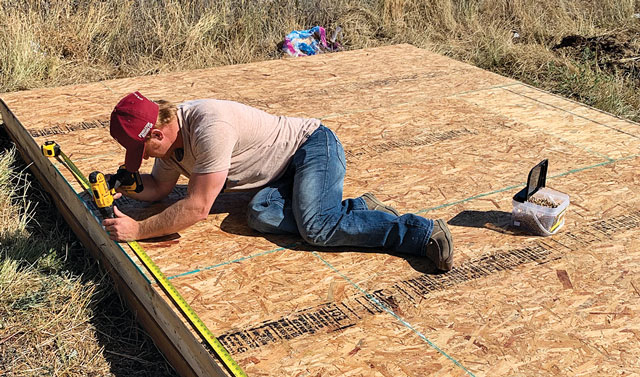
Resolutions
Hello everyone! Hope everyone is having a wonderful New Year in 2020. I assume everyone is crushing their new year resolutions right? I spent some time in prayer at the beginning of the year about my goals. If you haven’t, I think you should. I believe 2020 is going to be a big year! I have high expectations of what God is going to do in my life this year. I believe the breakthrough is going to happen. I believe God is going to restore my health. I believe I will WALK. I believe God is going to use me beyond what I can imagine. I believe that God is going to grow me and transform me into the character he has had planned for me all along. This year I made a goal to wait expectantly. Not to sit around think and wish, but to hope and know that God is going to do something new. To wait with high expectations.
Isaiah 43:19 “For I am about to do something new. See, I have already begun! Do you not see it? I will make a pathway through the wilderness. I will create rivers in the dry wasteland.”
I did some research and I found that about 65% of people make resolutions at the beginning of the year. Then, between January 12th and the 17th, 80% of those people’s resolutions fail. The majority of new year resolutions don’t even last three weeks. Why? Research says there are 4 main reasons why people fail to keep their New Year’s resolutions. Whether it is eating healthier, exercising more, reading more of your bible, budgeting better, or spending less time on social media, I’ll give some tips on how to keep your resolutions alive.
Your goals aren’t clear. This is the number one reason why people give up on their resolutions. Where are your goals coming from? Why are they important to you? How would your life be changed by achieving these goals? If you can’t answer these questions easily then you may need to clarify your goals before you set them. The most important part of setting goals is aligning the goals with who you are and where you want to be. Seek God’s wisdom first and be precise with your goals.
“Seek the kingdom of God above all else, and live righteously, and he will give you everything you need.” Matthew 6:33.
The next reason people quit on their resolutions is they feel overwhelmed. They start at the first of the year, but as they change it gets hard. It takes twenty-one days to create a habit. So, the first couple weeks it may be hard to get out of bed thirty minutes early to work out. If you’re like me, it may be hard to resist that extra Reece’s. Or, it may be hard not to click ‘purchase now’ on that Amazon account. At the beginning, you may not know where to start with your goals, but you also may feel pressured to hurry up and change. Then, the more pressure you put on yourself, the harder it gets to overcome. You see the long road ahead and it may cause you to feel as though it’s impossible. These factors may cause you to quit early or quit before you even start.If these pressures start to attack you remember: “For I can do everything through Christ, who gives me strength.” Philippians 4:13
The third reason people quit is they get discouraged. People become impatient in the process of changing. They strive to reach their goals but get frustrated when they don’t see progress or see change as fast as they would like. I can relate to this as I strive to get my legs back, working out tirelessly day in and day out. When I put the effort in and don’t see progress like I think I should it gets frustrating. When we get to this fork in the road we have two choices. We can either dust ourselves off, get up, and keep moving. Or we can remain comfortable, give in, and give up on where we want to be. For me I want to walk so I choose to trust in the Lord and his plan for my life. Even when it’s hard I put my hope and trust in the Lord.Isaiah 40:31 “But those who trust in the Lord will find new strength. They will soar high on wings like eagles. They will run and not grow weary; they shall walk and not faint.”
Isaiah 55:8 “My thoughts are nothing like your thoughts,” says the Lord. “And my ways are far beyond anything you could imagine.”
Lastly, people quit because they really aren’t ready to change. Growing pains may be to daunting. If you are considering goals for yourself you obviously are hungry for some level of change but are you ready to carry out the actions required to actually change? If you don’t ask yourself what, when, where, why, and how, it may cause you to lack asking yourself if you are truly ready to change. If you can make a plan, be precise, and be motivated to start changing then you will be more apt to carry through with the goals you have set. Goal setting takes preparation. Make a plan, be specific, and mentally get ready to do whatever it takes to reach your God given goals.
Romans 12:2 “Don’t copy the behavior and customs of this world, but let God transform you into a new person by changing the way you think. Then you will learn to know God’s will for you, which is pleasing and perfect.”
So, whether you have started and quit on your resolutions, have been teeter-tottering on the fence about starting, or keep putting off any goal setting at all be encouraged… Tomorrow is a new day. The day the Lord has made. It isn’t too late to start or start over. Every morning we wake up we have choices. The choice is yours. So, pick yourself up, dust yourself off, choose joy, and NEVER GIVE UP! Let God do something new in your life.
-
ProFile: Kaycee Feild
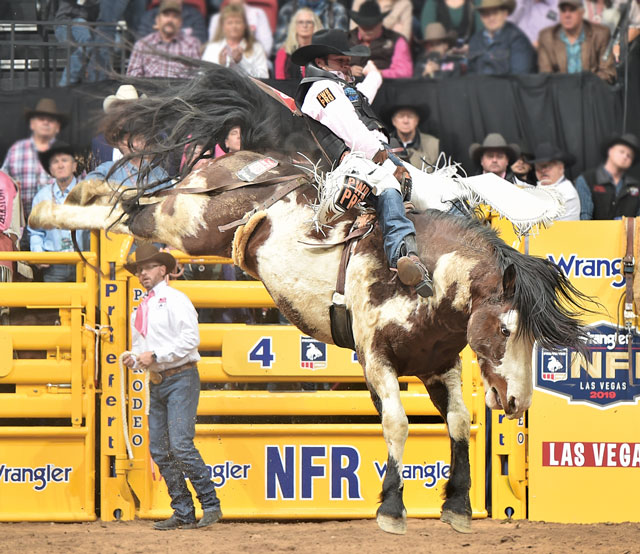
Kaycee Feild is 10x WNFR bareback riding qualifier, winning the world as well as the average standings four times (2011-2014). The father of three (Chaimberlyn, Remingtyn, and Huxyn) lives in Genola, Utah, with his wife, Stephanie. Kaycee is the son of 5x PRCA World Champion Lewis and Veronica Feild. He started getting on bucking horses and taking is seriously in 2003, getting his PRCA card in 2007. “I’m fortunate, I’ve broke my riding arm three times, my left collar bone; I’ve had hip surgery, ruptured ribs, cracked my jaw, fractured my skull, but when you’ve done it as long as I have and seen what I’ve seen, I feel fortunate to still do what I love to do.”
He sustained an injury last year on March 31 in Austin that kept the 32 year old sidelined for three full months. “I hit my head, my face, and got kicked on top of my head. I was unconscious for four minutes and when I came too, my vision was blurry and my brain was swelling. They scanned my brain every two hours to check for pressure.” His recovery took a full three months, and he was able to stay on top of the leaderboard all the way through his recovery time until Clayton Biglow passed him.
Kaycee has found a product that he relies on to keep him riding strong and hastens his recovery time. He discovered PWRr Pro CBD while searching for a product to help his youngest son, Huxyn. “My little boy has been hospitalized several times with asthma. They’ve had him on every kind of steroid as well as a puffer. All of that was changing who he was. I felt at the age of four, he shouldn’t have a personality change.” When they were at the NFR a year ago, he had a flair-up and had to be rushed by ambulance to the ER. “I found what I thought was the purest CBD oil – I’d heard it helped with asthma. We saw a difference in him,” explained Kaycee. “Before when he knew his breathing was bad, he would get really nervous and panic. With the CBD, and the inflammation fighters in that, it would calm his breathing. He hasn’t been to the hospital since that.” When he returned home from the NFR, he reached out to a friend who had been researching CBD oil and discovered PWR Pro CBD. “My partners have been formulating nutritional products and personal care products.”
“When I was in the hospital after my accident, my wife and brother got to the hospital the next day and brought my CBD oil. Instead of the nausea I went to sleep,” he remembers. “When I woke up, I didn’t have a headache and I could see. I credit a lot of my success and my comeback on the July 2 to CBD.”
Kaycee has no intent to stop rodeoing. “I still crave it – there was a point after I lost my dad that I didn’t want to get on bucking horses,” he admits. “I had a bad attitude, but leading up the American when I won it in 2016, there were some things that fell together to make it fun again. Winning the American was like finding the fountain of Youth again. Things changed and I still get hungry to ride. You’ll know when it’s your time – I heard that from my dad and I know that will come someday.
“I know I can still go – my body is doing great. I want a fifth world title, but with life and the things that It brings – we will see.” He knows that the time will come for him to quit. “My kids will be at the perfect age. It takes selfish time to be in a world champion’s caliber. You have to push a lot of things to the side and keep your head down and focused to ride bucking horses. This is a young man’s sport for sure.”
“Life after rodeo is important, and I’ve got to take care of business to take care of my family. I want to give back to the sport of rodeo – somehow I will use some of the profits that this company makes to help me give back to rodeo and to the military. I dream of having a ranch someday that I can offer military men and women to come to that are experiencing PTSD and help them.”To learn more about the company, go to PWRProCBD.com,
Or look on the outside back cover -

Featured Athlete: Hope Thompson
Hope Thompson is one of the lucky women in rodeo who can make her living with horses. The Abilene, Texas cowgirl, a breakaway roper and team roper, trains horses and gives clinics on roping. She was born and raised in Atlanta, Texas and attended McNeese State in Lake Charles, La., where she won the College National Finals Rodeo in 2008 in the breakaway.
After college, she made her way to Abilene, where she works with Lari Dee Guy, training and teaching.
She won the breakaway and $7,000 at the WCRA’s semi-finals in Guthrie, and advances to the WCRA’s Royal City Roundup in Kansas City on Feb. 28.
For the breakaway, she rides an eleven-year-old cutting reject named Ink, who she trained. The mare, who is solid black, “is my partner,” Hope said. “I couldn’t do it without her.” Ink has won horse of the year titles in several different associations and jackpots and was the reserve world champion AQHA Horse of the Year in the tie-down roping. Ink is a sweetheart, she said. “She’s very laidback. She wants to give you 100 percent. She wants to please.”
For the heading, Hope rides a seven-year-old gelding named Andre. Hope’s heeler is usually Whitney DeSalvo.
Of her two events, she’s been a breakaway roper longer, and might love it a tad more than the team roping. “I’m most passionate about the breakaway,” she said. “I’ve always been a breakaway roper. But I love anything to do with a rope. I love being able to do all of it.”
She does it with 5 Star Equine products. Her favorite 5 Star item is the saddle pad. “It’s the best material and the best product I’ve found in our industry. The wool is 100 percent virgin and it conforms to your horse’s back, even when (the pad) is brand new. They don’t break down, either. They last forever. My horses love them, which is important to me, because without my horses I’m nothing.”
She uses the 5 Star saddle pad with the fleece liner built in, and appreciates it. “Those are new for me. I just started using those and I really like those, too.”
She also loves the sports boots. “They’re my favorite. They fit well and they’re not bulky.”
5 Star items can be customized, and Hope values that touch. She owns several different colors of boots and tries to match the embroidery on her horse’s saddle pad to the color of the boots.
Hope loves training horses. “I’m passionate about training horses. I love getting to start and train them, and when I sell them, I love to see them go and do big things for other people.”
She also finds great satisfaction teaching people how to rope, and then seeing them compete, sometimes at the same events she’s competing at. “That’s pretty cool when you get to teach somebody your craft and they go and do it, and then you meet up with them again in competition.”
Working with people inspires her. “It goes beyond teaching people to rope,” she said. Some of her students might have faced obstacles in life, and roping heals them. “Getting to come and do something like that helps them.”
She is excited about the future of rodeo and breakaway roping. “I feel that more women are going to get to make a living breakaway roping.” The WCRA and the American Rodeo are instrumental in changing rodeo, she believes. “If it’s something young women are passionate about doing, I feel their time is now. (The WCRA and the American) are giving us the opportunity to make the same money as the men.”
Hope is a member of the 5 Star Equine team. -
Back When They Bucked with Lyle Smith
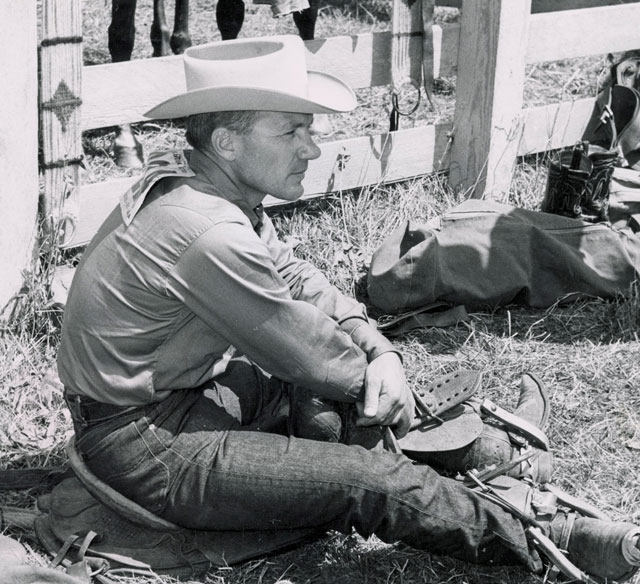
Because of a box of western magazines, and his dislike of cows, Lyle Smith became a saddle bronc rider. The Canada native now living in Reno, Nev., competed at four National Finals Rodeos and finished in the top ten in the world six times, making his mark in the rodeo industry. He was born in 1930 to George and Louise (Reuther) Smith, the third of eight children, on a farm near Donalda, Alberta.
When he was seven years old, his dad died, leaving his mom with eight mouths to feed and not much to put on the table. The family milked cows, raised chickens and gardened, to make it through. His older brothers milked three cows, morning and night, “so I grew up hating cows,” Lyle said. “I couldn’t get away fast enough from that farm.”
He attended a country school that went through the ninth grade, and when it was time to go to high school, he couldn’t go. There was no school busing in that district, and the family couldn’t afford to make the sixteen mile trip to Donalda High School.
So he went to work for a rancher named Herman Linder, and the trajectory of his life changed.
Cowboys gather at Lyle’s wife Joan’s uncle’s home in Boston. Her family, all excellent cooks, loved to cook for the cowboys when they were at the Boston Garden. Lyle and Joan are seated on the left. 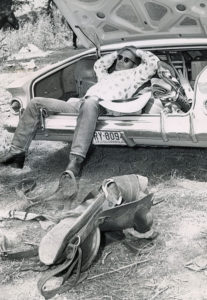
Lyle finds a place to nap before the Sidney, Iowa rodeo in 1961. – DeVere 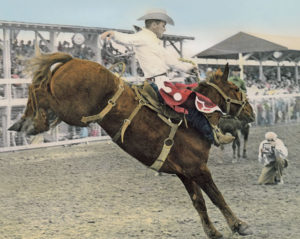
Lyle in a colorized photo done by Helen Helfrich, DeVere’s wife. She added the color to the black and white image. – DeVere Linder, himself a world champion bronc rider in his time, had a box of Hoof and Horns and Western Horseman magazines in the attic where Lyle slept. In his spare time, he would read them. “I read about Jerry Ambler, Carl Olson, and others who were world champions, and I thought to myself, ‘that’s the life for me.’”
So he gave Linder two weeks’ notice, then went home. His cousin, Lawrence Bruce, had bucking horses, and invited Lyle over to try some out for Harry Vold, who was scouting prospects for Leo Kramer, a stock contractor from Montana. Lyle got on four horses that day and bucked off three of them.
It was 1948, and he helped Lawrence as they drove horses to a rodeo in Holden, Alberta, where Lawrence was taking saddle broncs. Lyle entered the amateur bronc riding and won fourth place and ten dollars. His mind was made up. “That made me think rodeoing would be a way to get away from the farm and working for farmers,” he said. He entered the amateur bronc riding at other stampedes, which was what rodeos were called in Canada at that time.
In 1949, his big win came in St. Paul, Alberta, over the fourth of July. He won first place and $275 and used it to buy a Hamley association saddle. Prior to that, he had borrowed one from whoever he could.
The next few years, he competed in the amateur bronc riding at stampedes across Canada, wining here and there. His skills improved in 1951 when he worked for Lawrence, the father of Duane and Winston. He helped build a poplar rail and post arena, and the boys would try out horses and practice each day. “I got to riding better,” he said. He competed again across Canada but added a few stops in the U.S., too, including Lewiston, Idaho, and Pendleton, Ore. That same year, he got his Rodeo Cowboys Association (RCA) card.
Rodeo wasn’t his main income; he worked on an oil well drilling rig. He, along with the other cowboys who were short on cash, knew how to stretch their dollar, eating one meal a day and piling into the cheapest hotel rooms they could find.
It was in 1954 that his rodeo career took off. In Denver, he won fourth in the day money, a check for ninety dollars. But that was it, and Lyle was out of money. He competed at Ft. Worth, San Antonio, Houston, squeaking by on his winter earnings. Phoenix was the last of the big spring rodeos, and after Lyle rode there, he went home with Deb Copenhaver. Copenhaver, a two-time world champion, put Lyle to work on his ranch in Idaho, where he dug postholes and fenced. Deb entered him in Red Bluff, Calif. in April, where Lyle earned a fourth place day money check again. After that, he kept on winning rodeos from Vernon, Texas to Madison Square Garden in New York City, Boston Garden, and San Francisco.
The good days were here.
He rodeod all year, across the nation, from Denver to Ft. Worth, and from Baton Rouge to Oakdale, Calif. In 1957, he won $7,100 for the year and bought a brand new 1957 Chevrolet for $1,900. The next year, his annual earnings were $10,264 and he finished sixth in the world.
In 1959, he went to the first National Finals Rodeo, in Dallas, Texas, where he won a round and fourth in the average. He also was the high mark saddle bronc ride for the Finals, with a score of 187 points on a horse from Ray Kohrs, a stock contractor from California. (At that time, 210 points was the highest possible score in the roughstock; the scoring system changed to its present form of 100 points as a perfect ride in the mid 1960’s.)
The next two years, he went to the National Finals, wrapping up the 1960 season in sixth place with $11,285 in earnings, and the next year in seventh place, with $10,577 for the year. The year 1962 was the last time he would qualify for the Finals. By that time, Lyle was living in San Diego, working for rodeo cowboy Bob Robinson in a housing development. He was married with a son, and there were bills to pay. “You’ve gotta have money coming in when you’re married,” he said. “You can’t get by on one meal a day.”
He and his buddies lived in San Diego, working during the week and rodeoing on weekends. At the time, there were lots of little rodeos around the area. “It was probably the best time I had rodeoing,” he remembered.
In 1964, the job ended. He found work in Reno for a painting contractor. His rodeoing was slowing down, and in 1967, he rode his last bronc at the rodeo in Fallon, Nev., wining first place. Lyle had other priorities: his family and his work. “I was busy working, making pretty good money, and I couldn’t afford to go to a rodeo.”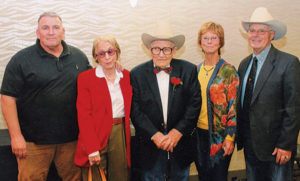
Lyle and Joan Smith stand with their son Chris (on the left), Peggy Randle, and Duane Bruce, Lyle’s cousin, last year when they gathered for the Calgary Stampede – Courtesy 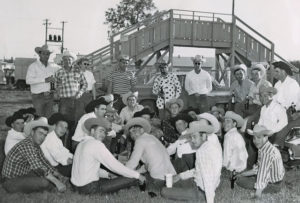
Hanging out after the rodeo at Red Bluff in 1958. – DeVere He got his contractor’s license in 1971 and has been working as a painting contractor ever since.
Lyle had met his wife Joan in 1958 in Boston. He and his friends were there to compete at Boston Garden, killing time during the day, walking through Johnny Walker’s western store. She had tickets for the rodeo that night, and now she had a cowboy to cheer for. Her family loved him. They were excellent cooks. When the cowboys came to Boston Garden to rodeo, they would all be invited over for a meal. “Her uncles would cook. They were really great people,” eh said. They married on April 5, 1959.
Lyle suffered a broken back in 1956 when a bronc fell over in the chute with him at the Oakdale, Calif. rodeo. He was in the hospital for twenty days, and the nurse, who was the same age as his mother, took him under her wing after his hospital stay was over. She was married to a ranch cowboy and understood his predicament, caring for him a month at her home after he got released from the hospital.
His other two serious injuries were from vehicle accidents. In 1980, he was in a car accident, breaking his right shoulder and a bone in his leg. And eleven years ago, as a pedestrian, he was hit by a car, breaking his pelvis and spending time in the intensive care unit and rehab.
The couple had a son, Chris, who was born in 1960, and who is married to his wife Seanne. Lyle and Joan have six grandkids, “every one a success and a great kid,” he said, and five great grandkids. One of his grandsons is named after him, and all of the grandsons are in the Air National Guard.
He and his son Chris still own and operate the painting contracting business, and at the young age of 89, he still goes to the office. He no longer drives; Chris picks him between 5:30 and 6 am in the summer and at 8 or 9 am in the winter. He hasn’t painted for the past five years, but he answers the phone, does paperwork, and bids jobs.
There’s still plenty to do, and he loves it. “I don’t know what I’d do if I completely stopped and sat in the house. I wouldn’t last long.”
He was admired by his peers, and still is, says his friend Herb Friedenthal, a bull rider who is ten years his junior. “He was level headed,” Herb said. “He was real popular. Everybody liked him.”
Herb acknowledged Lyle’s skill in the arena. “He was one of the best. He could ride those big old rank horses, those horses that came out of the north from Canada, Montana, the Dakotas. You would hardly ever see him hit the ground. He might not win every rodeo, but he wouldn’t get bucked off.”
Lyle loved his rodeo days. “I loved to rodeo,” he said. “I loved the guys I was with. I made friends that I’m friends with, to this day.” Since the Wrangler National Finals moved to Las Vegas in 1985, he’s missed only one year of attending the reunions held in conjunction with it.
The hardships of his childhood helped him succeed in rodeo and in life and made him tough, he believes. “Learning to make it as a rodeo cowboy got me away from the farm,” he said.
“He’s a real good guy, a real good guy,” Herb said. “And he still is.” -
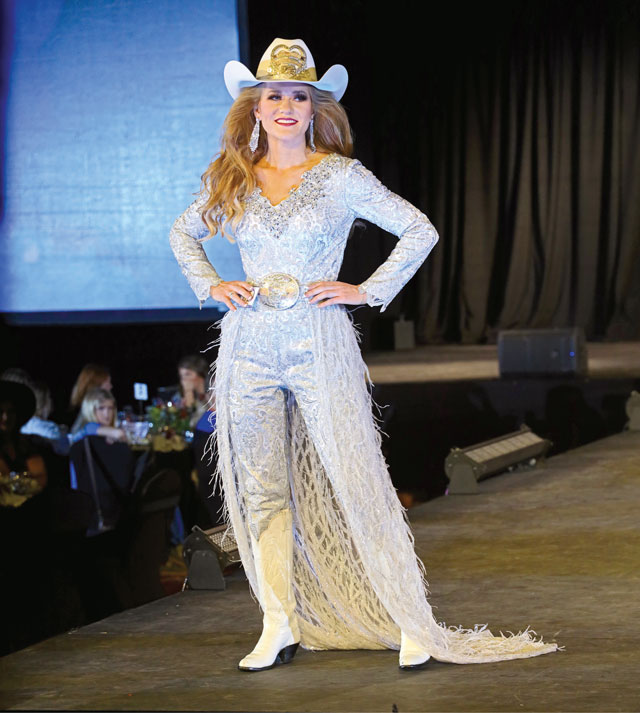
On The Trail with Jordan Tierney
“When I was dedicated as a baby, they said I would flow through the lives of people like the Jordan River,” said Jordan Tierney, 2020 Miss Rodeo America. “I remember being at work one day and having this feeling that I was made to do more than that job.” Her sister, Amy, encouraged her to run for Miss Rodeo South Dakota and now the 25-year-old from Oral, South Dakota, has an opportunity to live a bigger life and have a positive impact on those around her. “I want to leave people feeling better after having talked to me.”
Oral, South Dakota, has a population of 60 and Jordan grew up on a ranch, south of town, riding with her father, Paul Tierney. They raised AQHA horses and cattle. “I just this past year bought my own set of cows and now I’m fully invested.” The youngest of four, Jordan considers herself to be the caboose in the family. “I spent a lot of time with my dad, when he went out to the pasture, I went with him. I was on the stud, Cash, and I remember riding double with him. We had a pony, Teddy, I remember riding him while my dad practiced.” Jordan sees her father as an incredible hard working man. “He works sun up to sun down and is always willing to help anyone that comes along. He gives roping lessons and wants to see people succeed – it all came from his desire to be a rodeo cowboy and that’s taken him far.” Paul qualified for the NFR qualifier from 1977-1986, only missing one year. He was the World All Around Champion in 1980 and Tie Down Champion in 1979.
Her mom, Robin, was the 1985 Miss Rodeo South Dakota and second runner up to Miss Rodeo America. “She sacrificed so much for our family,” said Jordan. “When I was a junior in high school, my mom switched careers – she had been a dental hygienist for 25 years and quit that to start her own oil field service company.” That job required Robin to be away from home for two weeks at a time while she built it up. “She always made my important volleyball and basketball games as well as my rodeos.” That leap of faith has allowed her the flexibility and freedom to continue her love of raising good horses and riding. “She’s an incredible horsewoman.”
Jordan has two older brothers, Jess and Paul David, as well as an older sister, Amy. “I’ve followed in her footsteps my entire life, from sports to school leadership. She and my brothers have been huge encouragers to me in my dream to become Miss Rodeo America.”
Jordan started competing in rodeo in elementary school, competing in 4-H rodeo junior division. She eventually joined the National Little Britches and the South Dakota High School Rodeo Association. “I had a horse accident when I was five on the ranch. I was going out to get cows with my dad and my horse took off with me.” Jordan fell underneath the horse and he jumped over her. “I refused to get on a horse for three years. I started riding again when I was 8 and was very fearful – I didn’t want to go fast. My parents were very persistent and I eventually got faster.”
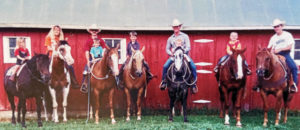
: Jordan as a baby sitting with her dad (grey horse), with the rest of her family 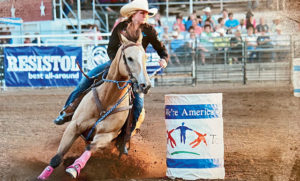
Jordan barrel racing at the South Dakota High School Finals Rodeo, 2012 – Cowboy Images 
Jordan and her mother Robin remembers those three years. “We wanted her to go, but really a neighbor girl, Megan Harkless, is the one who got her going again. She would come over and ride and she would ask Jordan to start coming out with her and pretty soon she was walking the horse around the arena while they talked. She was so patient and understanding.”
After that, the best part was taking her to her first 4-H rodeo. “She walked the whole pattern and we were so thankful – and it was such a good feeling,” said Robin. “Here’s what we always knew about Jordan – her personality and the way she was – a slow starter and a strong finisher. She finished amazing and we have been so proud of her determination and diligence to perfect her craft.”
When Jordan got back into rodeo, she didn’t win a lot, but by the time she hit middle school she had a very competitive mare that she ran barrels on (her name was Princess and she was also her brother Paul’s main heel horse). “I won the Junior girls state 4-H championship in goat tying in 2008,” she said. “I do think winning is important because I am a very competitive person so I didn’t like not winning in the crucial times that could’ve resulted in going to nationals, but when you start finding your identity in worldly successes that can be detrimental. I want to be an inspiration for rodeo and ranch girls to try rodeo queening as an addition to all that they do.”
Her rodeo abilities earned her a scholarship to Chadron State College where she competed in barrel racing, breakaway roping and goat tying. She earned a degree in business administration and plans to continue her education after her reign as Miss Rodeo America. “I would like to get the masters online program and start working in a career path in marketing and the agriculture realm.”
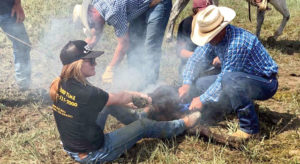
Branding on her family’s ranch 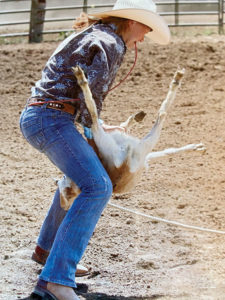
Jordan goat tying 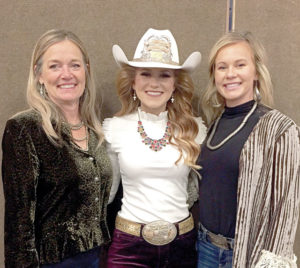
Robin, Jordan and her sister Amy – Courtesy For now, she is watching the calendar fill up with appearances across the country. “I’ve always been a people person – when I went with my dad, he would give us $5 and tell us to meet him back at the trailer. I found friends and that’s how it all started. This past year as Miss Rodeo South Dakota, I was telling people that I thought I was outgoing; I got out of my comfort zone – figuring out how to bring up conversation.” Her secret is asking people about themselves. “I like learning more about people and their history.” Her platform is Rodeo, Agriculture and building relationships with fans and new comers that foster understanding for the western way of life. She uses part of a Bible verse on her autograph sheets. Psalm 139:14. “I praise you because I am fearfully and wonderfully made; your works are wonderful, I know that full well.”
“I shorten it and say you are fearfully and wonderfully made – that’s a verse I’ve carried with me,” explains Jordan. “I am made in His image and I should be proud of that. I want to make people know that I care and they are worth caring about. I love where I’m at now – I’m having a great time and after this year, I will get back to rodeoing, breakaway roping and team roping.”
“My why is to help build people up the same way that I was built up during my early adolescent years when I had a lack of self confidence. My parents really gave me a strong foundation to stand on with all the good information they gave me to overcome my mountains in life.”
Jordan hopes that as she represents rodeo and meets thousands of people this coming year that they will see her genuine authenticity for the sport of rodeo and the western lifestyle. “It’s what I was raised in and I’m proud to represent it. I hope they remember me for that genuine feel.”
-
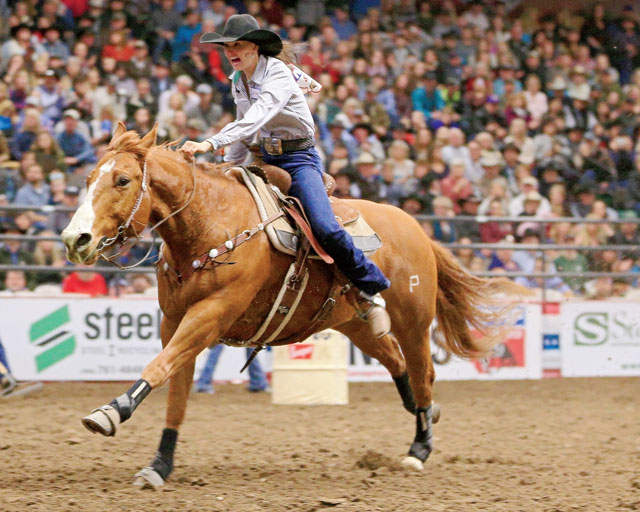
Tara Stimpson & Painted Fling
Tara Stimpson from Lodge Grass, Montana, won the Montana Circuit Finals in barrel racing for the second year in a row. “There are lots of good horses in this circuit and a lot of girls that could go on and make the NFR,” said the 24-year-old who is fortunate to be running one of those good horses – Painted Fling sired by a Streak of Fling from Fulton Family Performance Horses.
“He came from Sara Cheeney, who trains futurity horses,” explained Tara. “I bought my other good barrel horse, Peanut, from Sara, and I’d watched Painted Fling at some futurities and bought him two years ago. I’ve never gotten along with psycho horses and he’s real quiet. Nothing really bothers him too much – he’s real push style and he’s been pretty easy to ride.”
Tara started competing in 8th grade. “I’d always rode horses on the ranch, and since I didn’t grow up in a rodeo family, we didn’t do it. Both of my older sisters wanted to but we couldn’t take the time or money to go.” The family ranch, Stimpson and Brothers, located in Lodge Grass, is located 45 minutes north of Sheridan and an hour and a half from Billings. “I had some friends in middle school that rodeoed and I jumped in with them with an old ranch horse and that’s how it started.” She joined the Wyoming High School Rodeo Association her sophomore year in high school. “I was a way better roper through high school than a barrel racer. I almost made the National High School Finals my senior year in the team roping.”
Her mare, Peanut, is the horse that lit a fire under Tara for barrel racing. She bought Peanut her junior year at MSU Northern, and she got Tara going to where she wanted to do more with barrel racing than roping. Now, she ropes at the brandings and occasionally at a breakaway roping. “I sold all of my good rope horses to buy Peanut.”
This will be her second trip to Florida, which according to Google Maps, is a 34 hour drive. “The hospitality there is great – what they do for everybody is fun.” She will break up her trip this year by stopping first at the American Semi Finals where she is qualified to make a run at the AMERICAN.
Although she spends as much time as she can going to rodeos, she has an obligation to the ranch. “I come back and help my dad with his cows and my cows as much as I can.” One of her goals is to make a run for the NFR, and she plans to go to a few winter rodeos in Texas to see how it goes. “If it goes well, I’ll keep going. I’d like to get out of my comfort zone and go to some of the bigger rodeos.”
Her family is behind her 100% of the way. “My mom, Tana, and my sisters, Stephanie and Ashley, were in Florida with me last year.” Her dad, Dale, stays home to run the ranch. “It’s hard to leave – it’s my home, but I want to try for the NFR someday.” -
Back When they Bucked with Veach Saddlery
Monroe Veach was fascinated when he saw his first cowboys. His dad took him to Pawnee Bill’s Wild West Show in Saint Jo, Missouri, when he was eight. He was amazed at how they dressed, their horsemanship and ability to rope. He saw a Charro spin a rope like he’d never seen before. Once he got home he began to practice trick roping, he trained his horse to do tricks — he was hooked!
Monroe Veach was born in Missouri in 1896. The frontier had moved westward by then so when he was offered a job to cowboy near Eads, Colorado, in 1916. When he arrived at the train depot he unsaddled and unbridled his horse, slapped him on the butt and his horse headed home. Monroe took the saddle and bridle with him. He didn’t tell his family he was leaving. He hopped a freight train and headed west. He knew how they felt about his ‘cowboy ways’ so he wrote a letter when he arrived in Colorado. The folks thought Monroe’s cowboy dreams were a young man’s folly and he would grow out of it. Although his father raised sheep and trapped he wasn’t surprised at Monroe’s choices and accepted his decision.
Craig Robinson, Peggy Veach Robinson, Robert Robinson, taken at Veach Saddlery Co. Trenton, Missouri – Diane Lowrey – and the Trenton Republican-Times 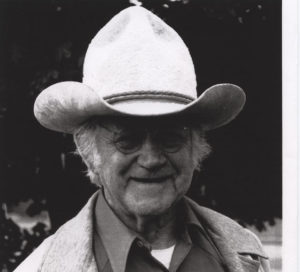
Monroe Veach, May 1978 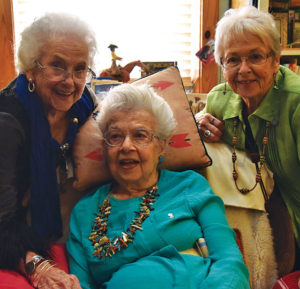
Veach Sisters, Letty Veach McAlister, Imogene Veach Beals, Peggy Veach Robinson – Rodeo News The following year his cowboy job ended due to World War I. He joined the Army and was sent to Fort Riley, Kansas, to the cavalry division, which he hoped would allow him to utilize his horsemanship skills. Much to his dismay his military time was spent in the saddle and equipment repair shop. Little did he realize how much impact this brief time in the saddle and equipment repair shop would mould his later career and allow him to continue in cowboy fashion. This was the only professional leather-making training he ever got. Monroe’s training as well as his creativity in working with leather expanded his horizons.
Monroe left the Army in 1919 and went home to Missouri and started a leather shop in a small building on his home place near Trenton. Mostly repairs on harness, saddles and such kept him busy in the shop. Shortly thereafter he married his childhood sweetheart, Alta. They had six children over a span of twenty years; with Billy, the oldest, Imogene, Mary, Letty, Ben and Peggy, the youngest.
When a friend asked if he could build a western saddle he had enough experience with saddle repairs that he knew he could do it. He made the saddle to the friend’s satisfaction. Meanwhile, as his children grew up he introduced them all to the leather-making business and at one time or another they were all trained in various aspects of the business, particularly saddles.
But Monroe had other talents as well. He loved ‘The West’ and his trick roping talents had expanded. He was asked to entertain at the local movie theater between silent movies. He also joined Foghorn Clancy’s rodeo and performed trick roping and trick riding. Trick riding was just getting popular and Monroe could see how necessary and important for the trick riding saddle to be strong enough, with the rider’s variety of tricks. They generally always used the saddle as their base. It is not surprising that his children also became fascinated and were passionate about the rodeo world of competition and performing.
His shop on the family place finally became too small for all the work he was hired to do. After a time, 1938, he moved to a location in Trenton on Main Street. The following year, Fred Lowry, a well-known steer roper who had won many of the biggest rodeos in the country, contacted Monroe. Lowry had won a trophy saddle, made by Monroe, and liked it so well he wanted a second saddle made like it with a few minor adjustments. The adjustments Lowry requested were for a stronger saddle than generally made. Lowry roped steers weighing 800 pounds or more and the weight was hard on a regular saddle. Lowry wanted a double rawhide saddle tree for additional strength. Once Monroe had made the new saddle and named it the, “Fred Lowry Roper” the orders from steer ropers all over the country came pouring in.
When World War II began Monroe found that the few companies who furnished a saddle-tree, which is the basis of every saddle, were hard to come by. Most all materials were going to the war-effort and were difficult to get for any reason other than the military. Monroe decided to make his own saddle trees. He used the Linn tree for wood, because it was strong and would not split when nails were used. He brought it to the shop to dry. Letty’s husband, George McAlister, ran the first ‘tree shop’. Monroe was very innovative in this endeavor, as he was in many things he did through his life.
He tried to get a foundry to produce metal saddle horns, but again the war-effort was using the majority of the metal. Monroe explained he was building saddles for ranchers, the very people who raised cattle to feed the soldiers. Once the company executives heard that they immediately agreed to provide them. “Those boys need beef!” He got their attention, and his metal saddle horns!
Monroe set the standards high in saddle-making. He set the trends for years to come and demanded a product (saddle) that was not only functional but of the best materials. He became the premier trick riding saddle-maker and had as many as ten people working in his shop. Having been a trick rider he had an edge on knowing what was most important in the development of trick saddles and made sure they were of the finest quality. Today an old Veach trick riding saddle is an important find, but a retired trick rider will seldom let their Veach saddle go.
Monroe and son, Billy, produced rodeos by Veach Rodeo Company. While Monroe ran the shop, Billy did the ramrodding of a rodeo but Monroe would perform, and act as secretary and timer. Other family members were always present to handle a variety of duties and responsibilities required to put on a good rodeo. At one of the rodeos son-in-law George McAlister was the announcer, and just prior to the Saturday night rodeo, a deluge of rain came and the performance had to be postponed until Sunday. George couldn’t stay over until Sunday afternoon because he had to head back to Trenton. When he let Monroe know he enlisted Clem McSpadden to take over his first announcing chores.
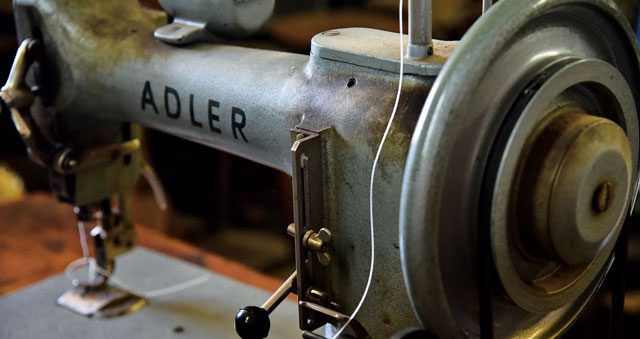
The Veach Saddlery grew and a boot department was added. His daughter, Imogene loved working in the shop and learned to weave cinches and stitching boot tops on a treadle sewing machine. In time, she got to do more intricate designs made by Monroe. He always had a pencil handy and once he created a design Imogene would then stitch it out.
When Peggy was ten or eleven, she recalled the pony business was booming and a gentleman in the Midwest had a large pony ranch and held a two day sale every year. He commissioned Veach Saddlery to make pony halters out of white latigo leather so each pony he sold was wearing a white halter at the sale. Monroe had all the leathers cut, and Peggy could put together a gross (144 halters) in a day. Peggy remembered her dad took her to the pony sale one year and saw all her halters leaving the auction area on those ponies. The Veach Saddlery was truly a ‘family affair’.
When Robert Robinson, Peggy’s husband, went to work for Monroe he built saddle trees. Robert remembered being taken to the tree shop, and Monroe showed him the patterns, the band saw, and described the process of making a saddle tree. “When I went to ask a question I turned around and Monroe was gone” recalled Robert. “He let his employees learn from their mistakes,” said Robert and Peggy’s son, Craig, who also has been on the payroll since he was fourteen. Monroe never got mad. He’d just say “Don’t let that dog bite you again.”
Veach Saddlery sold to numerous dealers across the country. They began putting out a catalog of their various leather goods and inventory. Robert Robinson was their salesman and he traveled and called on dealers in Iowa, Illinois, Kansas, Oklahoma, Missouri and Indiana. They also had a booth at the Western Market in Denver in the 1960s and 1970s. Other dealers ordered from the catalog. The last catalog was sent out in 1983 and was #14.
In 1976, the Bicentennial USA year, Monroe went to the Smithsonian Institute in Washington D. C. at their invitation to do a saddle-making demonstration. It was held near the Washington Monument Mall and in addition to the saddle that he made there, he brought a completed ‘Bicentennial’ saddle that he gave to the Smithsonian. Bryan Dew, a film-maker from New Zealand, attending the event watched Monroe build the saddle. Visiting with Bryan, Monroe’s passion for the West became evident and Dew began an extensive film shoot featuring Monroe. Dew and his crew worked on this project for ten years. Although it took longer to complete than Dew had anticipated Peggy remembers that it was her job to keep Monroe in the same shirt, hat, etc. – – – for the ten year span so the resulting documentary looked like it was done in a brief length of time. “A Ten Dollar Horse and a Forty Dollar Saddle” was the result, and was released in 1986. It was all about Monroe and his talents in the leather-making industry, his love of rodeo and performing as a trick roper, and telling tales of the West and so much more. When it was completed Dew learning that Monroe was ninety years old, and not in good health, hurried to Trenton and the film was shown at the local junior college for the entire community. Monroe passed away that year on Christmas Day. Two years later “A Ten Dollar Horse and a Forty Dollar Saddle” was given a Bronze Wrangler Award by the National Cowboy & Western Heritage Museum in Oklahoma City, OK. In 1993 Monroe Veach was inducted to the Rodeo Hall of Fame there as well.
Veach Saddlery has continued to prosper, with Peggy, husband Robert and son Craig in charge. Things have changed somewhat but the basic principles taught family members, spouses and friends have never been forgotten. In fact, knowing how far-reaching Monroe’s creativity and his love of the West have spread, it seems the entire family can be called ‘Throwbacks’. The definition of throwback is: ‘a return to a former type or ancestral characteristic’. A tradition in the family of Monroe Veach and his talents and desires that have carried over and influenced the lives of each and every generation since then.
Peggy, Robert and Craig, have continued to build saddles and leatherworks. Craig started his career sweeping floors. He has moved up to the responsibility of becoming their custom saddle expert. Peggy, who has kept her dad’s books which include the list of saddles by serial number (which is the actual number of the saddle made at the shop) remembered that in 1932 the first trick riding saddle was made for Lucyle Richards, a beautiful trick rider and lady bronc rider that the family kept a friendship with for her lifetime. Peggy also reported that the last saddle finished at the end of 100 years was number 18,949!
In their spare time the Robinsons have been ropers. In fact, Peggy, cut her thumb off roping, a common roping injury. Fortunately, she was able to have it reattached. They also attend and keep up with the rodeo world and the people in it, not only in their home state but across the country and in Canada. Through the customers they have satisfied during the past century they can name people from every state, as well as Canada, and they have sent saddles to Belgium and South Africa.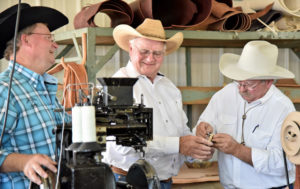
Drew Clark, Kenny Veach and Cary Veach, taken in saddle shop ,Drew Clark Saddles at Veach Saddlery, Clark-Beals Ranch, Colcord, Oklahoma – Rodeo News 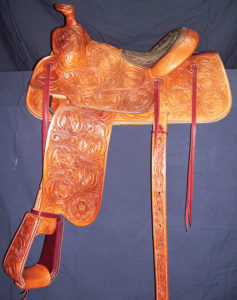
100th Anniversary saddle – Courtesy 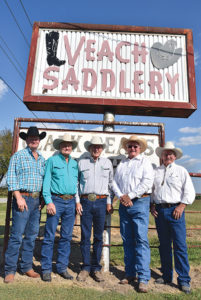
Drew Clark, Duke Clark, Robert Robinson, Kenny Veach, Cary Veach (all saddlemakers) at the Clark-Beals Ranch Billy, Munroe’s first born, put on rodeos until he was killed in a truck accident in 1957. Many members in the family came together to complete his rodeo contracts, after his demise, then sold the rodeo stock. Billy’s sons, Kenny and Cary both worked in Monroe’s shop, and now have their own shops. Kenny Veach Custom Leather is in Mount Vernon, Missouri. Cary after being a saddle bronc contestant makes and repairs rodeo equipment for the roughstock events, and is located in Ankeny, Iowa.
Roughstock rider, Charley Beals, married oldest daughter, Imogene, and once World War II was over Charley worked for Monroe and learned the trade. In 1945 they opened Veach Saddlery in Tulsa Oklahoma. Rodeo cowboys traveling through Tulsa never hesitated to stop at the shop and say hello. Charley and Imogene had one daughter, Donna Kay. She married Duke Clark, a roughstock rider from Trenton, who also trained horses, played polo, and has competed in pulling horse contests and presently ranches. Duke did work in the Tulsa shop and Imogene trained him to tool and make saddles. Charley retired in 1985 and closed the shop. In 2007 their grandson, Drew re-opened it at Colcord, OK. One of his specialties is the Doug Clark Roping Saddle. Doug, another grandson, was All-Around Cowboy at Cheyenne Frontier Days and Steer Roping Winner at Pendleton RoundUp, two of the largest, prestigious rodeos in the country. He also trains timed-event horses and has had horses he trained in National Finals rodeos every year for over 35 years. Doug and wife Linda’s daughter, Darcy, and her husband, Billy Good are roping presently and doing well. Third grandson to Charley and Imogene, Derek, was a saddle bronc contestant and qualified for the National Finals Rodeo fifteen times.
Mary, second daughter of Monroe, and husband Al Cunningham, had a Veach Saddlery shop in Branson, Missouri, for a time. Both are deceased. Letty, Monroe’s third daughter, and husband, George McAlister, not only handled the tree shop in the beginning for Monroe, but also announced rodeos for the Veach Rodeo Company. Letty in her younger years was a trick rider and she and her three sisters were always available when Monroe did his trick roping horse catch of the four girls.
Ben, Monroe’s youngest son, invented a stainless steel, one piece, stirrup buckle. He was the rodeo clown in the 1940s rodeos for Veach Rodeo Company .
Throwbacks, each and every member of Monroe Veach’s family and their off-spring and the next three generations are connected in some way to the world he created. When interviewing these individuals their answer to the question: “Have you ever considered doing anything else?” The answer is always the same, “No, why should I? I love what I do.”
A hundred years later there is no question to the stability of Veach Saddlery in Trenton, Missouri, and the others scattered around the country that came from Monroe’s passion for the cowboy life. The legacy he created and left has only expanded the commitment and desire for saddle-making, trick roping, trick riding, and competing in rodeo. Some of his youngest family members may not do it all, but they at least are involved in one or more aspects of the life he lived.
Monroe Veach was posthumously inducted to the National Cowboy & Western Heritage Museum’s Rodeo Hall of Fame in 1993. His son-in-law Charley Beals was inducted in 2010. His great-grandson, Derek Clark was inducted in 2018. His daughter, Imogene was the recipient of the Tad Lucas Memorial Award, and his great-grandson, Doug Clark was the recipient of the Ben Johnson Memorial Award. These honors were bestowed on these members of Monroe and his family because “they loved what they did for a living”. Can it be any better than that? -

On the Trail with Colton Bugis
‘Where did this guy come from,’ is undoubtedly on the minds of many team ropers in the IPRA that watched a rookie 21-year-old header, Colton Bugis, climb from the bottom to the top of the team roping leaderboard since June. With nearly $1900 separating him and the next header in line, Colton is excited to be traveling to the Lazy E Arena in Guthrie, Oklahoma for the IFR50 to see if he can finish the season as a world champion team roper.
Originally from Highland, Michigan, Colton’s start in horses didn’t give much of a clue that he would be where he is today. His parents Ed and Penny Bugis and younger sister, Eva, have a family farm where his dad sells grain, and also operates a septic company, King Septic; and none of them had a rodeo background. There was a love of horses in the family, and Colton’s grandma, Carol Redman, bred and raised Welsh ponies that became projects for Colton and his sister. “We were really young, but we would ride and drive the ponies she raised and turn them into show jumping and dressage prospects for other kids. My mom and sister were both really big into dressage and hunter jumpers, so I competed in that world growing up. I was in the Michigan Hunter Jumper Association and the Pony Club of America and did all that until I was about 13 years old.” In his heart however, he was a cowboy, “I always thought I was a little cowboy, running around with a rope when I was a kid. I went over to a roping school near us when I was young and learned to rope goats and got hooked. I started chasing everything I could on my pony, Lightning. A guy down the road, Tim Brown, took me to a roping pen at Rocky Alberts’ Blue Ridge Stock Farm one day, and that was all I wanted to do after that. My dad was glad to see me getting away from the hunter jumper riding and bought me a really good rope horse. It was a big deal for an old farm family to pay that much for a rope horse, but my dad bought me a black 7-year-old gelding named Player that really gave me a good start.”

Colton showing one of his grandma’s ponies – Courtesy of the family 
Colton Bugis riding a ranch bronc – Natural by K.Willford Photography 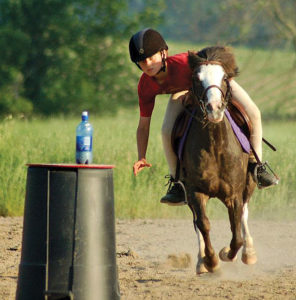
Colton competing in a pony club game Colton’s mom explained, “Roping is a better fit for Colton. He’s always been a little cowboy from a very young age. We are so excited to go watch him at the IFR50 in January. There is a whole group of his Michigan roper family going out to Guthrie with us to watch him compete. We are all extremely proud of him.”
Before graduating from Hartland High School in 2016, Colton competed in the Michigan High School Rodeo Association for three years, heading for Cale Johnson his sophomore through senior year of high school. The team won the MHSRA champion team roping title in 2015 and 2016 and qualified for national finals all three years they competed together. Colton also competed in calf roping and trap shooting during high school, but team roping was his main focus. Over the years, he’s even ridden ranch broncs for fun. “I come from a very supportive family, and even though my mom and sister didn’t like that I switched to roping, they still always came to watch me and support me in all that I do. They will be traveling to the IFR to watch me compete at my first IPRA finals rodeo, and hopefully watch me win the title there.”
Over the past few years, Colton has spent a lot of time at amateur rodeo associations and team roping jackpots. He attended a horse shoeing school in Purcell, Oklahoma in January 2017. “I didn’t stick with that as a profession, but I did learn enough to do some of my own horses when I need to.” He did, however, make a friend with Baker Roush while at the school, and Baker invited him to his family ranch in Dripping Springs, Texas for the winter. “He and I ranched cows, shoed horses, hauled cattle, and did odd jobs. His family had a wedding venue, so we helped set up things for weddings and maintain the property. I roped some, but mainly did whatever I could come across to make some money while I was there, and then I’d go back home to Michigan for the summer.” While Colton was riding a friend’s calf horse at a rodeo when he was in Michigan for the summer, Mike Culhain made a phone call that began a change in the course of Colton’s roping career. “I told everyone I talked to that I wanted to go back to Texas for the winter. Mike told me he was friends with Bob Masters, and that he would call him and put me in touch with his son Chad Masters. I ended up going out to Chad’s for the winter in 2018.”
Colton started out as the low man on the totem pole at Chad’s, mucking stalls, feeding cattle, and fixing fence. “I did whatever needed done, just trying to do my part. I also got to ride and rope with Chad and worked my way up. Chad taught me how he needed me to ride the horses and how he wanted things done. After winter, Chad went back to competing, and I decided to try rodeoing in the IPRA for the 2019 season. I didn’t really have a partner starting out, but I met Ty Parkinson at the Fort Worth Stockyards and we decided to start roping together in June. Ty is from Australia, and he’s a phenomenal heeler, he’s qualified for the IFR multiple times. We started out doing well together, and really went hard at the rodeos. From June until the end of the season we entered probably 75 rodeos and placed regularly. We won the team roping at St. Tite in Quebec, Canada, and just kept climbing in the standings as the months passed. Going into the IFR50, I’m leading the heading and Ty is leading the heeling.”
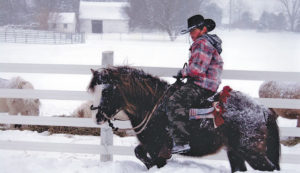
Colton on his pony Lightning that he started roping on 
Colton with his mom, dad and sister – Courtesy 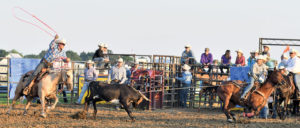
Colton roping with Ty Parkinson – Rayne Sherman, Circle S Photography A little dark brown mare named Betty has helped Colton make his mark in the heading competition. “My good horse ended up having ringbone, and Chad had gotten Betty in from a guy and made me a good deal on her. I’ve been riding her since this spring. She’s a little mare, maybe 14.3, but she is such a good horse and has made my job so much easier. I’m so grateful Chad helped me out with her. Coming from Michigan to Chad’s ranch in Lipan, Texas was very eye opening. It’s a totally different ball game. In Michigan, roping is more of a hobby that you do for fun, but here it’s the real thing; this is what they do. You learn a lot! I learned how to ride my horses better, how to use a rope better, and how to rope smart.” Colton is currently at the Masters’ ranch for his third winter and honing his skills so that he is as ready as possible for the IFR in January.
“My main plan for the IFR50 is to get ready to catch them all so we can go for the average. I don’t get to practice with Ty much, he’s all over the place. But we’ll get together right before we head to Guthrie and make some runs together and we’ll be fine. After the IFR my goal is to just keep getting as good as I can get and see how far I can take it. I’ve been able to learn a lot from several people over the years, and I’ve been lucky enough that people have seemed to like helping me. I plan to take all of it and see where it leads. I may not have come from a rodeo background, but it’s in my blood and I’m here to stay.”
-

Featured Athlete: Jennifer Sharp
ennifer Sharp competed at the Wrangler National Finals Rodeo last month. It was the first qualification for the 5 Star Equine team member, who lives in Richards, Texas. She and her husband Robbie own and operate Sharp Performance Horses, riding colts for the public and training barrel and performance horses.
Last year, her horse Six French Smooches “Smooch”, an eight-year-old mare, took to the training and rodeo world well, “so we kept going,” Jennifer said. “We hadn’t planned on rodeoing for the Finals this year, but we realized we might have a shot at it.”
So she and Smooch, plus a second horse, KR Famous Tequila “Tequila” hit the road, competing at more than ninety rodeos, and qualifying for the Wrangler NFR for the first time.
In November, two weeks before the Finals started, Jennifer got kicked in the right shin, fracturing the fibula head and tearing the PCL. Doctors told her she’d need twelve weeks of rest, but that wasn’t an option with the world championship of rodeo around the corner. So she did physical therapy twice a day, to get her quad muscle working.
She wore a hard brace, and at the Finals, visited the Justin Sportsmedicine trainers two and a half hours prior to each night’s rodeo. They taped it and used a TENS unit (a transcutaneous electrical nerve stimulation device) to alleviate pain and get the muscles to fire.
She wasn’t able to ride Smooch at the Finals, as the mare suffered an injury during the Texarkana, Ark. rodeo in September. So Jennifer took Tequila to Las Vegas, along with a second horse, Mitos Cutter, “Commander.” Tequila ran in all of the rounds except for round eight, when Commander took over to give Tequila a break.
Tequila does very well in smaller pens, Jennifer said, and is good when he knows the first barrel isn’t near the fence. “He’s definitely going to turn his barrels,” she said. The first barrel is blind at the Thomas and Mack arena, and Tequila “knew that first barrel was there and he was going to it,” she said. Unable to use her right leg fully to guide him, she “wasn’t able to be as aggressive as I needed to be,” causing several tipped barrels.
As a 5 Star Equine team member, Jennifer loves using their saddle pads. “I use the three-quarters inch thickness, and I love those pads. They hold up, I have no issues with them, and my horses’ backs never get sore.” She also uses 5 Star’s sports boots. “I love that they don’t get any dirt inside of them, their legs look clean when they come off, everything about them.” The color choices are good, too. “And obviously I love the color selection.” She tries to coordinate boot colors with whatever she’s wearing.
In Las Vegas, her husband and a friend, Chris Bradshaw, took care of her horses. “They brought horses to me every night, and took them back (to the place where they were staying.) They fed and watered. I didn’t get to see my horses much, which I did not like, but I knew they were taken care of.”
The couple has been together for ten years and spends their working and relaxing time together. “We’re together twenty-four, seven,” Jennifer said. “We have an awesome relationship. We complement each other in aspects that we need.” With the business, Robbie, a team roper, starts colts, puts them on the barrels, then Jennifer finishes them. If they need a tune-up, Robbie works with them.
Now that the Wrangler NFR is over, Jennifer will let her leg heal. Smooch will make a full recovery, and then the two of them will hit the rodeo road again. “I hope to be back at the NFR, without a broken leg,” she said.
Jennifer placed in two rounds, both times aboard Tequila. She finished the rodeo season in fourteenth place in the world. -
ProFile: Tory Johnson
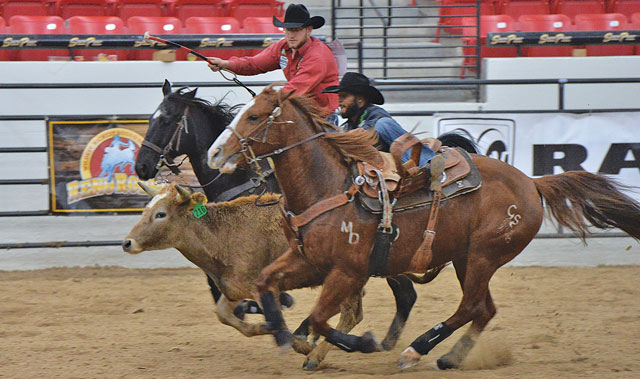
Tory Johnson knows how good it feels to achieve goals. And the Oklahoma man did just that, when he won the Permit Challenge in December, held at the South Point Casino Arena in Las Vegas.
The steer wrestler didn’t begin his rodeo career in that event. He high school rodeoed as a tie-down roper. In college, first at Bacone College in Muskogee, Okla., then at Langston (Okla.) University, he rode bulls and added steer wrestling, in part because of the adrenaline rush. “I was more of an adrenaline junkie,” he said, “and steer wrestling and riding bulls have more adrenaline activity for me than just roping calves.”
Actually, his bulldogging career began in unlikely fashion. He was in college as a roper, watching the bulldoggers practice, when he talked smack to them. “I got to talking noise with them,” Tory said, when eight or nine of them decided to put $25 each in a hat, and if Tory would run and throw a steer, they’d pay him. “Me, being the daredevil I am, I did it.” That was in 2004, and he came home from college that summer and worked hard, learning all he could from world champions and other steer wrestlers like Clarence LeBlanc, Jesse Guillory, Romon Jones, and others. “I took to it like a natural.”
After graduating from Langston in 2009 with a degree in business agriculture, he came home to Oklahoma City, working as a cement truck delivery man, and rodeoed.
For the past ten years, he’s competed in the Bill Pickett Rodeo organization, the United Pro Rodeo Association, the Cowboy Pro Rodeo Association, based in Texas, and the Texas Cowboy Rodeo Association. Between the four organizations, Tory has won ten steer wrestling titles, three reserve titles, two tie-down titles, one bull riding title, and five all-arounds.
In 2019, he decided to do things differently. He had purchased his PRCA permit ten years ago, filling it several times over but never getting his rookie card.
Last January, the time was right. “I’ve been wanting to (be a PRCA member) for the longest time,” he said. “I got out of my comfort zone and said, hey, I have the horsepower, I have the talent, I’m ready, I’m going to do it.”
The thirty-four-year-old wrote his goals down, three big ones: fill his permit again, qualify for the permit challenge, and qualify for the Prairie Circuit Finals. He did all three, finishing the rodeo season twelfth in the Prairie Circuit and finishing as the number one permit holder.
At the permit challenge, he was the only man to throw both steers, thus winning the average and the title of champion.
The permit challenge wasn’t his first monumental win, though. At the World Champions Rodeo Alliance (WCRA), he won the average at Guthrie, Okla., and second in Green Bay, pocketing $25,000. And in the Prairie Circuit, he won or placed at rodeos in Ponca City, Henrietta, and Elk City, Okla.; Texarkana and Hot Springs, Ark., and others.
Competing in Las Vegas at the permit challenge while the Wrangler National Finals Rodeo was taking place was a thrill, Tory said. “It was pretty awesome to feel like you were one step out of being in the ‘big house.’ It was fun to be able to run a steer in Vegas, at the same time the Finals were going on.”
He had a large cheering section, too. More than 25 people: cousins, aunts, friends, his dad, even sponsors, were on hand to cheer him on.
For much of the year, he rode Queenie, an eleven-year-old mare owned by Denise Mooney and Marvel Rogers. “Me and her have been clicking everywhere we’ve been,” he said. She’s a typical mare, though. “She’s fun to be around. She can act like a mare every now and then, she gets moody, but she’s a winner and that’s all that matters.”
When he’s not rodeoing, Tory works installing window blinds in new homes across Oklahoma.
He’s set his 2020 rodeo plans, written in the same calendar book where he keeps pro rodeo entry information. His new objectives: win rookie of the year, and make a run at the NFR. “I’d like to go to the Thomas and Mack and run ten (steers).” -

Dona Kay Rule
Dona Kay Rule is a 5 Star Equine Products Team member, and she’s headed to her first Wrangler National Finals Rodeo this month.
One of best friends, High Valor “Valor” is going along.
Actually, he’s the reason she’s headed to Vegas.
Valor, a ten-year-old sorrel gelding, out of Rare High by Valiant Hero, is the 2019 AQHA/WPRA Horse of the Year.
He was purchased late in his fifth year, and Dona Kay started him on the barrels at age six.
The long-time horse trainer was hauling and riding her good horse Juice at the time, but Valor went along. “My program is that wherever I go, whoever’s in the barn goes along. I exhibition when I can, and by the time Valor was ready to enter, I’d enter both horses.”
Valor is big and strong, and it took a while before Dona Kay decided she wanted to let him run. “He was the first full-on race horse I bought,” she said. “In the past, I’ve preferred half cow horse, half race horse.” But the barrel horse world is changing and she has adapted with it. “In today’s climate, you’d better have some power,” in your horse, she said. “It doesn’t matter how good a trainer you are. If you don’t have power, you’ll get outrun.”
Dona Kay began training horses under the tutelage of Billy Perrin for a year in the 1970s, then struck out on her own. She likes to bring a horse along slowly, believing that confidence and manners in a horse are just as important as performance. “It takes me a long time to train one,” she said, “because there are so many variables when you get to an event. Somebody will push a baby stroller in front of you, and you need to be able to stop your horse and get his head back together.” She likes taking horses to the pasture or around the outbuildings at an event to expose a horse to a variety of things. “I’ll go to the pasture, we stop, we turn. I set him up correctly for things I know I’ll ask him to do in the arena.” At rodeos and barrel racings, it’s no different. “You ride him around, stop when people are in the way, ride him through people, let him know everything’s all right. You get him to count on you, to ask, am I all right? Yes, you’re fine,” she said.
Not only is Valor especially competent in the arena, he’s good outside of it, too. He’s a kind horse, his rider said. “He’s really interested in stuff around him, and he doesn’t have any silly quirks.” He loves Dona Kay and relies on her. “He does count on me,” she said. “He’s my vehicle, but he’s also my friend.”
Dona Kay calls herself a “planner,” when it comes to preparing for the Finals. “I like to know what’s expected of me, so I can plan that and schedule in time for Valor. I need to not be in a mad rush every time I put a halter on him.” Prior to heading to Las Vegas, she will put some runs on her horse, to keep him fresh and ready.
She has used 5 Star Equine Products for years and especially likes the saddle pads. “I really like the quality and the consistency of the wool,” she said. “I like a wool pad next to my horse. It wicks moisture, compresses and refills. Good quality wool makes all the difference in the world.”
She also likes the fact that 5 Star Equine saddle pads can be ordered to match boots. “That’s a plus: they match. Things have come so far from the old days. Now we have things that match, and it always feels nice to have nice things.”
Dona Kay’s faith is important to her, and she’s learned to let go and let God handle things. “Letting go is something I’ve learned as I’ve gotten older, not to fret about stuff. It’s pretty amazing what God will put in your life, if you’ll just let him.” She asks God to use her every day. “Pretty much every day, I say, ‘God, take me and use me wherever you need me today. There are times I’ve been able to help. It’s not about Dona Kay doing well, it’s about where God needs me. It’s not about me, it’s really not about me,” she said.
She and her husband John’s kids, son Marshall, his wife Nicky and their son, and daughter KK, her boyfriend Clay Dumos, and their daughter, will come to Las Vegas, taking turns staying home to take care of the family’s cattle. “We’re going to play musical airplanes so somebody can stay at the place,” Dona Kay said. She and John have been married 39 years.
She knows God’s hand was on her all year. An example she recalls was when her truck broke down at Cody, Wyo. this summer. She limped it to a man’s shop on July fourth, and he worked on it for four hours, not charging her for it. “God had his hands in that,” she said. “I get a little choked up,” she said, thinking of the many situations that worked out because of her faith. “I don’t want to be in control,” she said.
And when she is at the WNFR, just as in her life, she’ll let God guide her.