Rodeo Life

Category: Archive

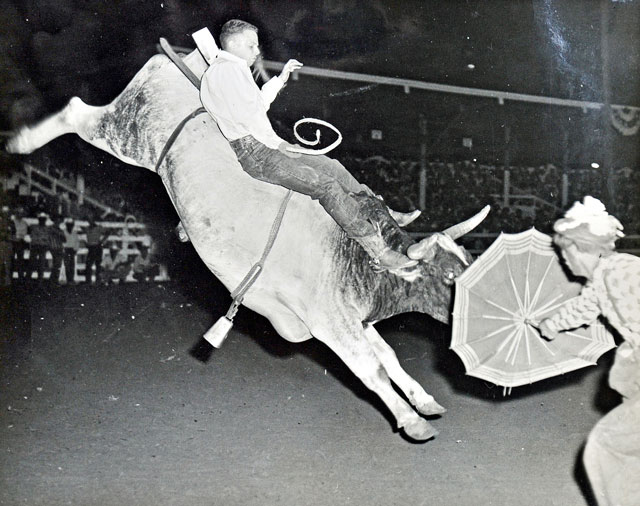
  • Back When They Bucked with Bill Skavdahl

    Back When They Bucked with Bill Skavdahl

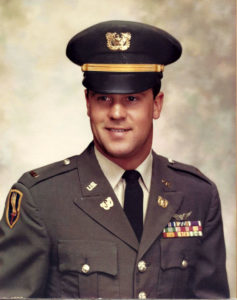
    Bill Skavdahl has gotten plenty of adrenaline rushes in his life. Some of them were ones he planned on, like when he rode bulls and bulldogged, and some were unpleasant ones, like when his helicopter was shot down while serving in the Army Air Corps in Vietnam in 1968.
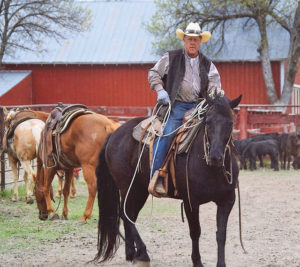
    The northwestern Nebraska man was born near Harrison in 1946 to Harold and Ellen (Howard) Skavdahl. His parents were ranchers and had never rodeoed, but Bill loved to ride the milk cow, much to his mother’s consternation. He was a hand with a horse; ranch work at the Skavdahls was done on horseback.
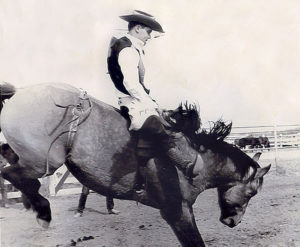
    As a freshman at Harrison High School in 1961, he competed at the state finals, held in Harrison. There were no regular season rodeos; anyone who wanted to could compete at the finals, and the top three in each event went on to the National High School Finals. He rode bareback horses and bulls, mostly because the equipment was easy to come by. An old bareback rider bequeathed him a riggin’, and bull ropes were cheaper than horses.
    At the state finals, he won second place in the bull riding. At that time, if a contestant qualified in one event for Nationals, they could add two more events in which to compete. So Bill added bareback riding.
    Nationals were in Douglas, Wyo., and he caught a ride to them with a friend. He made a qualified bull ride in round one, then made it to the finals, ending up tying for third with Denny Wall from Montana.
    Third place was a pair of spurs, nice ones, and fourth place was a certificate for a 20X Resistol hat. Bill loved the spurs but needed the hat. “I’d never had a felt hat,” he said, “and I wanted one, so I told (Denny) I didn’t need to flip (for third place prize), I’d just take the hat. I had that hat for a long time.”
    As a high school junior, he won second at state in the bull riding again. This time, Nationals were in Tarkio, Missouri, and he chose bareback and saddle bronc riding as his additional events. He rode one of his bulls and both of his saddle broncs, missing the short round by two places in the saddle broncs. He rode one of his bareback horses, but missed out the second horse.
    In 1964, four high school regular season rodeos were held in Nebraska, and Bill competed at two of them. At Thedford, he won the steer wrestling and bull riding, finished second in the barebacks, and won the all-around. In Crawford, he won the steer wrestling, bull riding and the all-around again. “I was on a roll for state,” he said.
    But in Crawford, he broke his ankle. He was in the chute on a Hollenbeck bull, one that hadn’t been ridden. “The bull threw a fit,” Bill said. He made a qualified ride in spite of the break.
    State finals were the next week, and he had a plan. He had won a pair of spurs in Thedford, and he modified one of them for his cast. “I took one of them out to the shop, took a blow torch, heated her up, and fitted it around that cast. I got me some plaster of Paris and baling wire and got that thing fastened on there pretty good.”
    The spur worked. He covered his first two bulls, but in the short round, the bull spun to the left. “I had a broken right ankle and that didn’t work out too good,” he remembered. He finished fourth in the state, one hole out of qualifying for Nationals.
    After high school graduation, Bill worked on the ranch for his dad. Times were tough, so he decided to go to California. He had an aunt there, and he found a job working for a paving company, making $150 a week. It was a good job, considering it would take a month at home to make that same amount. While in California, he competed at a few rodeos.
    He was there for a year when a letter came from his dad. A draft notice had arrived addressed to him in Nebraska, and Bill needed to take care of business. He got a physical in California, and passed it. The draft board told him he’d have to go back home to be inducted.
    So Bill went home and talked to a recruiter, asking what his options were. His test scores were good enough that he could choose several things. He wanted to be a pilot.
    Basic training was in Louisiana then he was on to flight training at Ft. Wolters in Mineral Wells, Texas and advanced flight training at Ft. Rucker, in Dothan, Alabama.
    The Army was short on helicopter pilots, so he volunteered. After more training in Ft. Benning, Georgia, he was one of 52 pilots in the 235th Aviation Co., an attack helicopter company formed by the Pentagon, and on October 10, 1967, he was sent to Vietnam.
    The attack helicopter’s main job was to escort the helicopters carrying troops into a landing area and to drive the enemy from the landing site till the men were unloaded. They also provided support fire for ground troops.
    Within a month, he was the aircraft commander and the fire team leader. Pilots spent about forty hours a week in the air, and Bill flew 805 missions, over 1,050 hours.
    The helicopters rarely went unscathed. At the end of every mission, the bullet holes in the sides were counted and recorded. Bill’s record was 29 holes in one mission.
    His helicopter was shot down on April 14, 1968. He and his crew were providing air support as a medivac unit worked to evacuate crews from two downed helicopters. Enemy fire knocked out the tail motor gear box on Bill’s helicopter, and he and his crew knew what was coming.
    “The feeling you experience is like that of having a horse fall with you,” he said. “It happens so fast you don’t get scared, you just try to get away.”
    The enemy was all over the area, but Bill’s helicopter had hit the ground farther away from the actual fighting. It wasn’t long till another crew was there to rescue them. It was only after he was on the rescue flight that he realized a piece of the helicopter had been driven through his leg. During his time in Vietnam he broke his back, and he received a Purple Heart for being wounded while serving his country. He also was awarded the Distinguished Flying Cross twice, for “heroism or extraordinary achievement while participating in an aerial flight.”
    A year to the day that he went to Vietnam, he was sent home. It was October 10, 1968.
    He spent another year in the Army, this time at Ft. Carson, Colo., where he and fellow soldiers filled in for the National Guard unit in Kansas City, Mo., as replacements, as the guard members were sent to Vietnam.
    While in Colorado, he rode bulls at Canon City and Pikes Peak or Bust, where he got to rub shoulders with bull riding greats like Freckles Brown and Larry Mahan.
    He was discharged in 1970, and headed back to the ranch.
    By this time, his dad had bought a second ranch, and Bill took over management of it. He married and had three sons: Josh, Jud and Joe, and a daughter, Tomi Jain.
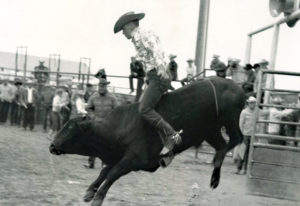
    He rodeoed a bit, riding bulls at regional rodeos in Nebraska, but he had a family, ranching obligations, and aches and pains from Vietnam. “You borrow a lot of money from the bank (to ranch),” he said, “and you can’t afford to get hurt.”
    But there was one more bull ride for him. At the age of 45, in 1991, he got on a bull at the senior pro rodeo in Crawford. He didn’t make the buzzer, but it “felt pretty good. I wanted to get on again. There’s a rush, you know.”
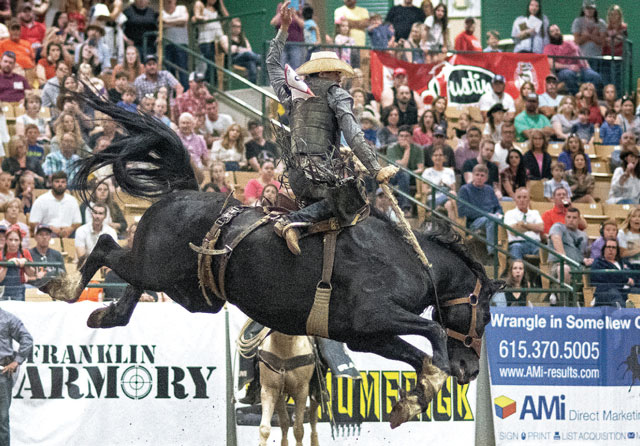
    His children didn’t compete in high school rodeo, but Jud, the middle son, rode saddle broncs at county fairs and was on the University of Nebraska-Lincoln rodeo team in the mid 1990s. He continued to rodeo in the Nebraska State Rodeo Association, making the finals several times. But, like his dad, he had a family to support and a ranch to run, so he career wound down, and, again like his dad, he rode his last saddle bronc at age 45, at the senior pro rodeo in Crawford last summer.
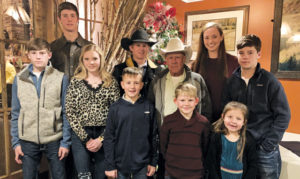
    All three boys attended the University of Nebraska, and help with the ranch. All three boys live close to each other and ranch and work together, even though their operations are separate. Joe is also a veterinarian at the Torrington (Wyo.) sale barn. Daughter Tomi Kirkland lives in Riverton, Wyo., and is an English teacher. Bill has ten grandchildren.
    Last summer, Bill went through another ordeal. He contracted a rare virus called campylobacter fetus, the “human” form of brucellosis in cattle. The bacteria can cause sepsis and localized infections in the brain, lungs, joints, and the pericardial sac around the heart. The virus got him down. He was in Rock Springs, Wyo., to watch a grandson compete at the National High School Finals and felt so poorly he couldn’t get out of the vehicle.
    He went misdiagnosed for two months and after a spinal tap, it was a doctor in Casper, Wyo., who diagnosed him. He made a full recovery and is back to feeding cattle and doing nearly everything he used to do.
    He, son Jud, and grandson Jack, a saddle bronc rider, all wore the same chaps as they competed. Bill purchased the “Jim Shoulders” brand out of a catalog in 1963 for $44, which “was a lot of money then,” he said.
    And one of his fondest memories was from the 1961 National High School Finals. He was the last bull rider for the evening, and the crowd roared when he made the buzzer. “I can remember the crowd was thunderous,” he said. The ride “was a crowd pleaser.”
    His mother gave her sons advice when they were growing up. There were two things they were not allowed to do: ride bulls and join the service. Bill did both, and loved it.
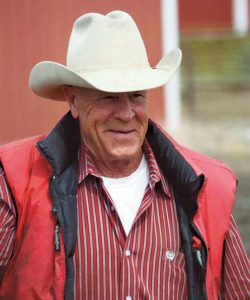
    Surrounded by his children and grandchildren, Bill’s life has been full and happy. He has served his country, has four children, kept a ranch going into the next generation, and rodeoed. The patriarch of the family is well-loved and is doing what he loves: ranching, working, and enjoying his kids and grandkids.

  • On The Trail with COVID-19

    On The Trail with COVID-19

    COVID-19 has wreaked havoc on the entire world, and the rodeo industry isn’t exempt. From contestants to contractors to committees, they’ve all been forced to adapt, since the nation was shutdown, starting in mid-March. For bareback rider Kaycee Feild, it took a bit to adjust to the new routine before he could switch roles. “I got lost for a few days,” he said. “My (rodeo) goals were unattainable, and I didn’t do a whole lot for about a week.” Then his focus shifted to being home.

    At home in Spanish Fork, Utah, the four-time world champion has done projects around he and Stephanie’s house: welding, building, and grilling.

    “I started to build a tack shed,” he said. “Growing up as a kid, we had a tack shed, and I spent a lot of time with my dad in it. So, not having one for the last decade, I’m building one and it’s bringing back a lot of memories.”

    He’s spent more time with his kids, too. Elder daughter Chaimberlyn, who is seven years old, is always busy with something. “I have to saddle her horse every day,” Feild said. “She likes going on picnics, or doing puzzles or playing with my wife.” The couple’s son, Huxyn, is four, and is all about dirt bikes. “He’s a dirt bike kid. He’s on it all day, every day. He’s worn out two rear tires this spring.” Third child Remi, a daughter, is eighteen months old.

    Time at home has also given Feild an opportunity to work with a few of his sponsors, including Power Pro (www.pwrprocbd.com) and Gel Blasters, a toy gun that shoots orbeez.

    Feild thinks that when rodeos start back, competition will be tougher than ever. He and a few bareback riding friends are organizing a practice session with money up for grabs, to get in tune for rodeos.

    “A lot of guys are on the same playing field right now, so when it opens back up, rodeo will be the best you’ve seen. There’s a limited amount of time to get to the (Wrangler National) Finals so you’ll see who wants it.

    The COVID-19 break has been good for him, physically. “This has put two years on the end of my career,” he said, “to be able to give my body a break this time of year, being able to stay home.”


    Wyatt and Leslie Casper with their two children - Courtesy
    Wyatt and Leslie Casper with their two children – Courtesy

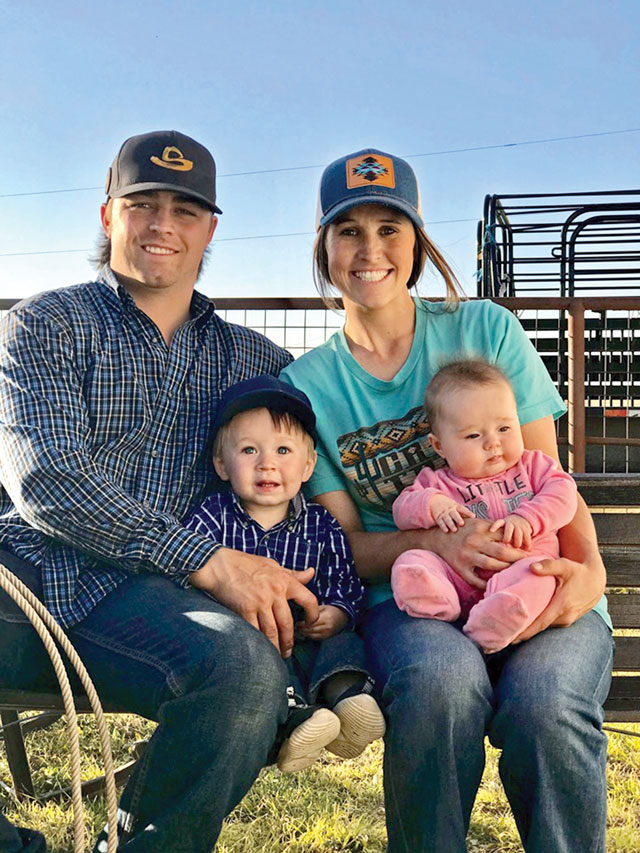
    Leslie Casper, wife of Wyatt Casper (OTT in Rodeo News March 2020) had their second child this past December. “We were able to go a little in the winter and spring with him but it just wasn’t a fun time with a month old and a 13 month old,” she said. “It’s pretty nice to have help with the kids every day all day long. Cooper our 18 month old really LOVES having his daddy home, it’s going to be very hard when rodeos finally kick back up.”


    For Binion Cervi, the worldwide pandemic is a double whammy. Not only has it forced the cancelation of pro rodeos for the stock contractor and his brother, Chase, but it has devastated the cattle markets.

    The Cervis own and operate a feedlot near Greeley, Colo., and with cattle ready to be harvested, JBS Packing was closed due to the virus. (It has since reopened).
    Like Feild, Binion is using the unexpected time at home to do projects that don’t get done when rodeos are in full swing.

    “We’re doing everything you usually push to the side: upgrading fences, the ranch, headquarters, we’re doing all that.” They’ve been able to keep their rodeo employees working at the ranch. “The people who would normally be on the road, they’re at the ranch helping us, so we can make sure they have a job.”

    When rodeos begin again, Cervi thinks things won’t be the same. “This changes people, and there will be caution in the world, even when everything is cleared to go. Some people will be blazing trails, some will go cautiously. I think you’ll see people with masks on at rodeos, and you’ll see people who don’t care. Everybody’s going to react to it differently.
    The pandemic has shifted the way Cervi thinks, as it has for a lot of people. “This is such a reality check for every human in the world. It’s a dose of reality, that nobody controls anything in life.


    Binion Cervi – ImpulsePhotographyMB.com

    “This is the real world, and we all get caught up in going so fast, on a personal level, that it’s like, this tells you what is important in life. It’s like God waking you up. There’s more to life than rodeo, there’s more to life than always building a business. That’s the biggest blessing I’m getting, that our whole family is getting.”


    The Franklin (Tenn.) Rodeo, didn’t have a choice when it canceled.

    Set to be held May 14-16, executive director Bill Fitzgerald didn’t think the long-running rodeo would be shut down.
    “For the longest time, I tried to play it off, to say this was going to go away. Then, as it got closer, the government was changing the way we did things. We couldn’t have our meetings, and I was starting to get nervous, like, how am I going to communicate with my committees, with my volunteers, with my people?”

    The rodeo is held at the county-owned Williamson County Ag Expo Center, fifteen miles south of Nashville.
    “The county actually shut the facility down, and that made the decision (to cancel),” he said. The building is closed through the end of May.

    The cancellation was made on March 23, seven weeks before the start of the rodeo, which meant the committee hadn’t spent much money yet. “We weren’t out a lot, because we hadn’t gotten to that point yet,” Fitzgerald said.

    He believes that next year’s crowds will be even better because they missed this year’s rodeo. “I honestly believe that folks love the sport of rodeo, and they’re going to come. The fans in middle Tennessee want to be a part of it. We still have people joining the fan club, knowing the rodeo won’t happen.”


    Franklin Rodeo – Tom Thomson

    Cheyenne Frontier Days is on the front lines of the time line.
    The “Daddy of ‘em All” is set to kick off July 17-26, and, according to CEO Tom Hirsig, at this point, the staff and general committee are working to make it happen, with state and local government officials as part of the decision making process.

    He’s spent sleepless nights worrying about all the factors, and believes that time will tell, especially as May rolls on. “The month of May will determine a lot, at least for the July rodeos.”

    “We’re on the cusp of being one of the first ones that might get to have their event,” he said.

    CFD is on people’s “bucket list, the Kentucky Derby of rodeo,” he said, with fans from all fifty states and 31 countries, which is another aspect to consider. He assumes that international travel won’t be opened yet, which could affect attendance.

    The economic influence of canceling CFD is enormous. The last economic study done for CFD showed a financial impact of $28 million to Cheyenne and $40 million for the state of Wyoming. “All rodeos have an economic impact on their community, whether it be Meeteetse (Wyo.) or Cheyenne.”

    Rodeos also have bills to pay, whether they hold their event or not.
    “We are $2 million into our show now,” spent on it. If we can’t have (the event) we lose that money.” And there is the cost of maintenance as well. “We own our own park and we have ongoing costs. Those utility bills don’t go away and payroll doesn’t go away.”

    Annual rodeos and events aren’t like other businesses that are open year-round, Hirsig pointed out. “It’s not just that we are missing out on making that money, but we have ongoing costs like any business. It’s just that we have ten days to make that money. It’s going to be hard on a lot of rodeos to recover from this. I don’t know, when we come out on the other side, how these rodeos will be.”

    Hirsig said CFD contracts with about 300 people or entities. “There are 300 individuals or companies out there, hanging on what we’re doing.”

    CFD sponsors have been loyal, he said. “I keep hearing that sponsors are pulling out, but we haven’t seen that. Our sponsors have been sticking with us, and are glad we’re making an educated decision. Many of them are local sponsors and they understand the long term effect that if CFD doesn’t take place, that increases the deterioration of their bottom line.”

    He’s also very aware that he is not an expert in infectious diseases or healthcare. “We are event planners, and that’s where our expertise is. Our expertise is not in diseases, viruses or healthcare. We have to rely on the experts in those areas at the state and county level, as to what is safe and not safe.”

    Hirsig also stressed that the decision to cancel or postpone a rodeo is not necessarily in the hands of the rodeo committee. They are “being advised by their health departments” if they can have an event.

    Like Cervi, he believes the COVID-19 pandemic will change events and event planning and marketing. “The world has changed. There will be people with masks on, and some without masks, and when you put a bunch of people in a stadium, everyone’s going to have a different feeling about what social distancing means. You’ll have people with masks, and if you get too close to them, they’re going to feel uncomfortable. Or the people drinking and having fun, there could be another level of discomfort.

    “You want people to leave your event saying, that’s so fun. I want to come back. You don’t want them to say, man, there’s a lot of people here, I don’t think we should go.”

    The goal of entertainment is to provide a distraction from the “regular world,” Hirsig noted.
    “What do you do to your brand if you put your event on, and people don’t have a great time? We’ve worked hard to create this brand where it’s fun, it’s away from the real world. With masks, there will always be that reminder, that there is something else going on in our world that you have to be concerned with. You have to measure that to some degree, too.”


    Chancey Williams in Moorcroft, Wyoming helping shearing. – Courtesy

    Chancey Williams and his band are staying busy as they wait to hear how to better plan for upcoming shows.

    “Our last show was March 13 in Houston and they’ve canceled everything through May, some in June, and some in July,” said Chancey Williams, whose band is usually booked every week. They have had to cancel 9 shows so far. “We are getting a few emails and phone calls for things in June and July but we still don’t know if it’s going to hurt us or not. We have two at the end of May that are still holding on – Craig, Good Old West Days is still planning on it.” The band has been making good use of their time off. We spent the time working on equipment, practicing, and Chancey learning how to do the social media live. “It’s been a learning curve, but we’re getting it.” Chancey has been able to help his family with shearing. “Stay positive and work through it – we want to be ready to play – we’ve got a new set and an album coming out – we’ll be ready to go when they open up.”


  • Back When They Bucked with Bob Click

    Back When They Bucked with Bob Click

    Bob Click was never a threat to any big-name cowboys, but he loved to compete. “Jim Shoulders never lost any sleep over me,” Bob quipped, “although I knew him personally and liked him.”
    Born the son of O.B. and Thelma Click, on the family farm near Warren, Oregon, just south of St. Helens, Bob rode calves and cows at junior rodeos, helped feed the polled Herefords on the farm, and was derisively nicknamed “Cowboy Bob” by his classmates at school.
    He and a buddy, both farm kids, were members of 4-H and FFA and “we were taunted at school,” Bob remembers. “They thought you were a clod and a hick” if a person did 4-H and FFA.
    But rodeo remained a constant throughout Bob’s life.
    In junior rodeos, he competed in every event, but in high school, it was narrowed to bareback horses and very few bulls, “mostly to please my mother, because she didn’t want me getting on bulls,” Bob remembered. He qualified for the Oregon amateur finals (now the Northwest Pro Rodeo Association) in the bareback riding, and added bull riding to his repertoire.
    In 1954, at the age of seventeen, he enlisted in the U.S. Navy. He saw guys, during their leave, who would buy a bottle, sneak it into the movie theater, finish off the bottle and sleep it off, then head back to the boat after leave. That was not for him. “I saw enough of that that I wanted no part of it,” he said. One day, in the paper, he saw a rodeo being advertised in Santa Anna, Calif., so he got a Greyhound bus ticket, headed to Santa Anna, and watched the rodeo.


    The bucking bulls didn’t look any tougher than what he’d ridden back at home. “I looked at the stock, and it didn’t look any worse than what I was getting on at amateur rodeos,” Bob said.
    At the time, the Rodeo Cowboys Association, the predecessor to the PRCA, was allowing those serving in the military to compete without having a card, so Bob went for it.
    And any time he had “liberty,” or leave, he was at a rodeo. “I had a 72 hour pass every weekend,” he said. Stationed at Mare Island Naval Ship Yard in Vallejo, Calif., northern California was full of rodeos in the summertime. “I was at a rodeo every weekend, sometimes two a weekend.”
    In 1957, before Bob left the Navy, he bought his RCA card. Stationed in an active submarine, he made port in Japan, and mailed his membership fees to Denver, so he could compete at the Cow Palace in San Francisco, Calif.
    After the Navy, he got a job at the phone company and continued to ride bulls. He wasn’t the best bull rider around, but that didn’t bother him. “I was getting bucked off bulls all the time, but I didn’t care,” he said. “I loved being there, being part of it.”
    He’d come to work with the typical bull riding injuries, and be put on “light duty.” After a six month probation, workers couldn’t be fired, so he knew that wasn’t an issue. But one day, his supervisor pulled him aside. “You’re a hard worker,” he told Bob, “when you can work, and we love your rodeo stories. But you can’t make a career out of light duty.” Bob told him he’d take his words under advisement.
    Not long after that, in 1963, Bob was in a bad car wreck, breaking vertebrae, and his bull riding days were over.
    After he healed, he did some scuba instructing. He had learned to scuba dive in the Navy for submarine escape training and took instruction on shooting a camera underwater. His parents had given him a Brownie Kodak camera for eighth grade graduation, and he enjoyed taking pictures. This knowledge would come in handy down the road.
    Married to his first wife Beverly in 1958, she loved rodeo as much as he did, and even after he got hurt, they would attend rodeos. But it was hard to buy a ticket and sit in the grandstand when he was used to being behind the chutes.
    One year, the county fair was happening in Vancouver, Wash., and Bob noticed there was a bull-a-rama. He bought a ticket, grabbed his camera, and took a few pictures.


    The next week, at a rodeo in Longview, Wash., he took his developed pictures from the prior week and went behind the chutes. Ron Hall, a bull rider whose dad, Tom Hall, had been one of Bob’s rodeo peers, grabbed his buddies and said, “come look at this guy’s pictures,” Bob said. “I had printed eight by tens, and they bought them all immediately. I was hooked then,” he remembered.
    Bob also helped his friend, Jim Smith, a tie-down roper, with a roping jackpot he produced near Molalla. Bob was the chute boss, but he brought his camera along and took pictures. The cowboys “loved having pictures of themselves,” he remembered.
    His underwater photography learning came in handy. “I learned the basics of photography from my underwater photography,” Bob said. “That helped more than anything.” The use of a strobe light in dark settings, like underwater, was similar to the use of a strobe shooting rodeo pictures after the sun went down.


    His hobby grew. It was the early 1990s and he was still working for the phone company, and taking rodeo pictures in the evenings and weekends. At the time, there were six rodeos in the Portland area that he could work and still be home every night.
    Being adept at photography and understanding rodeo didn’t necessarily mean that rodeo photography was easy, he said. “I had a lot of rodeo experience and a lot of photo experience but I did not have rodeo photography experience,” he said. “I had to learn it.”
    One of the people who helped him was Fred Nyulassy, also a rodeo photographer. “I was very fortunate to meet a nice guy,” Bob said. The two were Navy veterans, and they hit it off. “He is one of the best.”
    Bob also worked for three different news services, providing rodeo photos for them. The East Oregonian (Pendleton, Ore.), the Bend (Ore.) Bulletin, and the Spokane (Wash.) Spokesman-Review used his photos and loved them.
    Before he retired from the phone company, Bob worked as many as twenty rodeos a year, including the National Finals Rodeo, which he photographed for eighteen years.
    He retired from the phone company in 2003, and by this time, he had remarried. Jean, his second wife, had helped care for his three kids while Bob was on the road doing construction for the phone company. They became close, and married in 1963.
    In 2013, while he was shooting the National Finals, he got a call as he traveled home. Jean had died in her sleep. He had adopted her daughter, Michelle, who is handicapped and lives with Bob. The next year was his last one to work the National Finals; he couldn’t be gone from Michelle, who needs him at home.
    Now retired, he takes photos at about a dozen rodeos a year: Red Bluff and Redding Calif.; Sisters, St. Paul, Hermiston, Canby and Pendleton, Ore.; and Bremerton and Ellensburg, Wash.


    Rodeo photography has changed since he started snapping pictures at the bull-a-rama in Washington. The technology has advanced, Bob said. “When I started, everyone shot film. It has improved so much, and it’s so much easier to do than when I started.” One of his photographer heroes is Devere Helfrich, who shot rodeo pictures from the 1940s through the 70s. “I didn’t realize, when I was riding, how good Devere was. He didn’t have the great cameras they have now, and all the support, like Photoshop. Photography has changed dramatically in a twenty-five year period. Frankly, it’s not that hard to do anymore.”
    And it will require fewer skills to be a photographer in the future, Bob believes. Cell phone cameras have improved, and he foresees the day when high quality still shots can be pulled out of video.
    When he was riding bulls, he dreamed of the day his picture might be in the Western Horseman. He did have pictures in the magazine, but they were taken by him, not of him.
    Bob is the 2010 PRCA Media Award for Excellence in Rodeo Photography winner.
    But it’s not the awards and honors that satisfy him. It’s the friends he’s made.
    “It’s like you’re all one family,” he said. “We’re not blood related but we’re still family to each other.”
    Rodeo is one of the best parts of his life, he said. “All the unhappiness you see,” in the world, is forgotten when a person attends a rodeo. “With rodeo, for the most part, you get away from it. Rodeo people care about each other.”

  • Back When they Bucked with Sammy Thurman Brackenbury

    Back When they Bucked with Sammy Thurman Brackenbury

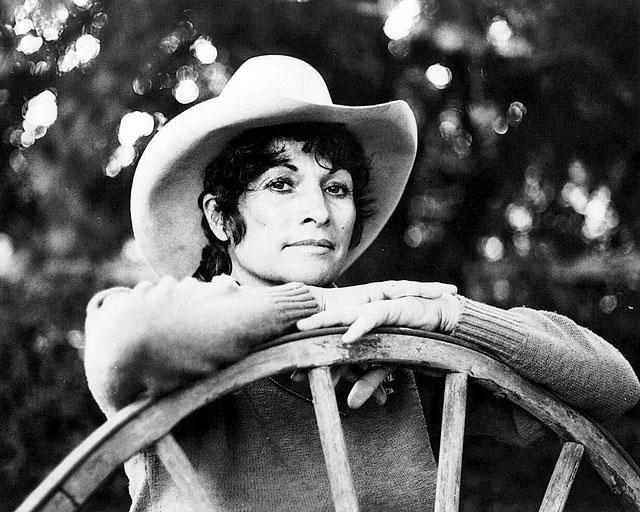
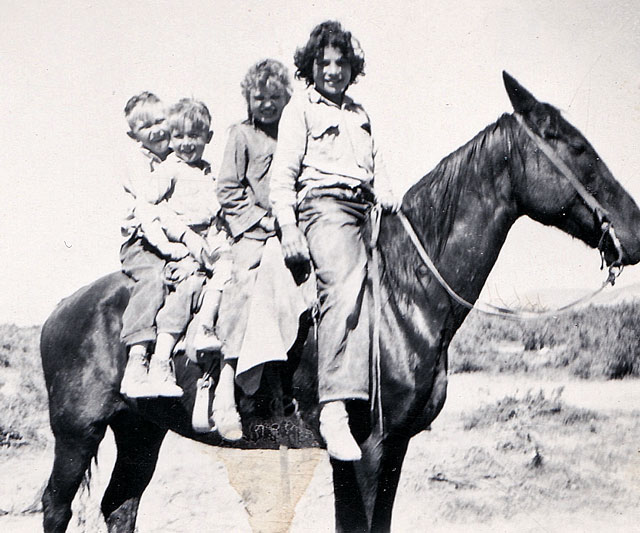
    Whether it was with wild horses, barrel horses or movie horses, Sammy Thurman Brackenbury lived her life with spirit, a sense of adventure, and a shot of adrenaline. By the age of seven she was breaking mustangs with her dad and selling them.
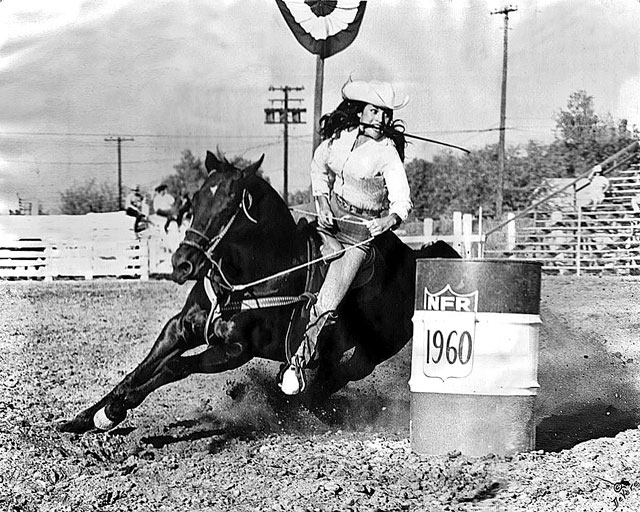
    At the age of 27, she ran barrels at her first of what would be eleven consecutive National Finals Rodeos, and five years later, she was the world champion barrel racer.
    She even doubled famous movie stars in the industry, doing horse riding and other stunts for them.
    She was born in 1933 on a ranch in the Big Sandy, near Wickieup, Ariz., the daughter of Sam and Mamie Fancher. Her mother had three children from a previous marriage, but they were grown and out of the house. Named after her dad, he wanted a boy and treated her like one. “I did everything a boy would do,” she said.
    Her father ran a ranch in Arizona, and when she was five years old, he quit his job to rodeo. The family moved to California to be closer to rodeos, since there weren’t a lot in Nevada at the time. After Sammy’s dad’s horse was injured, the family packed up again, this time moving near Imlay, Nevada, to work on another ranch. Her dad had bought interest in the ranch and rodeoed again to help pay the bills, and the mustangs Sammy broke were sold as kids’ ponies, which brought in a bit more income for the family.

    She attended rodeos with her dad, but few of them included women’s barrel racing. Barrel racing hadn’t found its way to California yet; it was more common in Oklahoma and Texas. She match raced, riding her dad’s horses, and rode calves, and read all she could about the Girls Rodeo Association, the forerunner to the Women’s Pro Rodeo Association.
    By this time, the family was living near Las Vegas, Nev., and Sammy was sixteen. Every horse her dad had she turned into a barrel horse. One fall, she and her cousin tried to convince the organizers of a small rodeo in Las Vegas to add barrel racing. They talked them into it, and the first year, with forty entries, Sammy won first and her cousin won second.
    By about 1950, a California rodeo advertised it was adding barrel racing, and Sammy went there, excited to run. But when she got there, there was no barrels; it was poles. She rode her barrel horse, having to “rein him through” the pattern. The girl who promoted the pole bending won the event. Sammy got even; on the second run, she got her dad’s rope horse: “you could do anything on him,” she said, “and he smoked the poles and I won the second round.”


    Sammy’s life was full of training horses, running barrels, and roping with her dad. Her first time competing with him at an RCA rodeo came about by accident. His partner didn’t show up, so she took his place. She hadn’t dally roped much, and her dad “was as nervous as a whore in church,” she laughed, about his daughter. “I got out perfect, laid it on (the steer),” Sammy said, “and when I roped him, my dad was looking at me to see if I was getting my dally, and went right on past the steer.”
    Her daddy spoiled her, she said. One time, at a rodeo in Delano, Calif., she ran her rope horse in the barrels. When it was announced she’d have to run again because they missed her time, she told her dad she was going to ride Punkin, an exceptional palomino that her father used for the hazing, bulldogging, heading, heeling and calf roping. “No, you’re not,” he told her, and she replied, hide and watch! “I was a brat,” she laughed.
    At the time, women were not allowed to compete in RCA rodeos, but Sammy and her dad were friends with Bill Linderman, RCA secretary and former president.
    Linderman helped Sammy out several times, paving the way for her to rope with her dad. Bill told her, “when you want to enter, you tell them I said you could enter. If they give you grief, have them call me. So I started roping with my dad,” she said.


    Because she did so well in the barrel racing, the Utah and Idaho rodeos often barred her from entering. She’d call on her friend Linderman again, and he’d say, “you tell them if they won’t let you enter, they can’t have barrels at the rodeo,” she remembered.
    By then, barrel racing was becoming more common and more rodeos were including it. It helped, Sammy said, that world champion Wanda Bush and Florence Youree came to California to promote the event.
    In 1960, she qualified for her first National Finals Rodeo. Living in Nevada, she competed in her home state and across California, Utah and Idaho. She and her dad made all the horses she rode, including what she considers her best horse, a bay mare named Ugh “because she was ugly,” Sammy remembers. The first time she had a chance to buy the mare, who wasn’t papered, the cost was $350. Her husband at the time, Anson Thurman, wouldn’t let her buy the horse. By the time she got her, the price was $850. But Ugh was worth it. “She was an outstanding barrel horse. You could do anything on her.”
    Sammy qualified for the NFR every year from 1960-1970, winning the world in 1965. That year, she rode Ugh for most of the season but due to injury, the horse was out for the NFR. She rode a borrowed horse, Roanie and still finished third in the average. Sammy didn’t often rodeo back east; it was too far. But when she did, she borrowed horses, to cut down on the expense of driving a horse trailer and because the rodeos didn’t pay well enough to haul a horse.
    One of the more innovative things she did for the sport was switching hands between the first and second barrel. Her dad taught her that. While most barrel racers ran with one hand, leading to the neck rein making horses stiff in the turn, Sammy changed hands between the first and second barrels. “Left hand, left turn, right hand, right turn,” she would chant to the students she later taught at clinics.
    Sammy won rodeos all over: Rodeo Salinas (Calif.) several times; the Grand National at the Cow Palace in San Francisco; Phoenix; Red Bluff; Oakdale; Redding; Tucson; Denver; and Caldwell, among others.

    In the mid 1960s, she began hosting barrel racing clinics. The concept was relatively new; Wanda Bush and Florence and Dale Youree had done some, and so had horse trainer Monte Forman, after whose she patterned hers. Barrel racing was so new that many of her students had only seen the event on TV.
    They were three days in length, with the first day for observation. “I’d give (the students) a paper to fill out, a brief story on them and their horse. Then I’d watch them all make a run and analyze their runs,” she said. On day two, Sammy worked with each girl on any problems they might have, and the third day was competition, for students to put into practice what they had learned. She did the clinics for ten years.Another part of her life was doing stunt work in Hollywood. When she was eighteen, she had a part in the movie In Cold Blood. Then movie work was put on the back burner to rodeo, but after she married husband Bill Burton, a team roper, steer wrestler, bull rider, and stuntman, she became involved in movies again. In addition to horse riding, she did whatever stunts were needed, including swimming, even though she couldn’t swim. In the 1993 movie Another Stakeout, she had to jump off the dock into the Fraser River in Vancouver. “I told them I couldn’t swim,” she said, “and they had security guys all over to keep me safe.” After jumping in and coming up, she swam for the ladder. The safety man said, “I thought she can’t swim,’ and she told him, “I can sure swim when I need to,” she laughed.
    She doubled for well-known actresses like Kathy Bates, Linda Evans, Jane Fonda and Dolly Parton. She was a charter member of the United Stuntwomen’s Association.
    She also held positions in the GRA, serving as west coast director in the early 1970s and director at large. In 1975, she was voted president of the GRA, but didn’t stay in that role for long. Her new marriage to Burton and her work with the picture business kept her busy.


    Sammy ran at her last pro rodeo in 1990, the same year she married her seventh husband, Jesse Brackenbury, a reined cow horse trainer, “possibly the best horse trainer I know,” Sammy said. She had her first daughter, Patti Parker, “before I was born,” she quips, joking about her age. She has two other daughters, Jodi Branco and Syd Thurman. Two of Jodi’s children, Stan Branco and Roy Branco, have continued the rodeo tradition. Stan, a steer wrestler, competed at the 2013 NFR and Roy has qualified for the California Circuit Finals in the tie-down roping. Her step-children include Billy Burton, Jr., David Burton, and Heather Gibson-Burton, along with six grandkids and four great-grandkids.
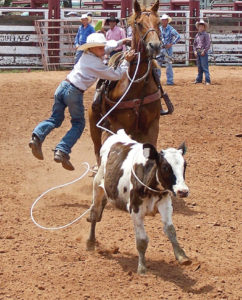
    Thurman was inducted into the Pro Rodeo Hall of Fame in August of 2019 and is a member of the National Cowboy & Western Heritage Museum’s Rodeo Hall of Fame. She has also been honored with the 2013 WPRA California Circuit True Grit award and the WPRA California Circuit Pioneer Cowgirl award in 2016.
    The best part of her life, she says, started “when I was one year old and it’s still happening. I love my life, I love everything that’s happened in my life. I worked the picture business, I rodeoed, I loved it all and I still do.”

  • Keep Your Eyes on God

    Keep Your Eyes on God

    “For if we are faithful to the end, trusting God just as firmly as when we first believed, we will share in all that belongs to Christ.”
    Hebrews 3:14 NLT

    When we don’t see the answers we are looking for right away we can begin to wonder. It’s easy to begin to doubt when we don’t see change right away. We may begin to question God when we don’t think he’s listening to our prayers. We may have the tendency to throw the towel in if we keep asking without results. But, what does God tell us to do?

    In Hebrews 3:14 we see that when we have faith to the end, trusting God like when we first believed, we will get all the Jesus has. What does Jesus have? I can’t count or list all that we will receive with Christ but I can name a couple big ones.

    First of all, he shares a throne with God, in heaven (Ephesians 1:20). He has the power to perform miracles and hand out blessings and he says we will do greater works than he (John 14:12). Another would be the power to resist the devil (James 4:7). Lastly, we get to share God by abiding in Jesus and him in us (John 15:4).

    By having faith and trusting God we get to spend eternity in heaven. We get to witness, call, and perform greater works than Jesus did, which we read about in the New Testament. We get the living power to resist temptation and the evil one while we are on this earth. And lastly, since God lives in Jesus, and we invite Jesus to live in us, we get to tap into all that God has to offer us, unlimited, anytime, anywhere!

    What’s the catch you may ask? You’ve tried and it doesn’t seem to turn out this easy? Just go back to Hebrews 3:14. We must keep believing, trust God, and stay faithful to the end, just as firmly as when we started believed.

    For example, take my story for instance. Sept. 22nd, 2018. Pasadena Rodeo, horse has just flipped on me. I can’t feel my legs and no matter how hard I try to move them they won’t move. My back is broke at t9 and t10 and my spinal cord is damaged leaving me paralyzed from the waist down. I prayed right there, believing for a miracle. I believed I would wake up the next morning and be healed. That night I believed full heartedly that I would walk out of the hospital.

    The next morning I wake up. 5 hours of surgery later. Rods and screws put in my back. Fused from t8-t12. Still can’t feel or move my legs. I keep praying and believing. Now I believe in the first 3 months I’m going to walk. 3 months go by. Still hardly any movement.

    I start praying and believing in 6 months I will walk. I rehab extensively everyday. 3-5 hours a day 5 days a week. Visualize moving. Visualize walking. Visualize running with my kid. Visualize riding. Sept. 22nd rolls around. I jump a level on all my tests but I’m still bound to this chair. I’m unable to lock my knees and stand on my own yet. I can’t bare my own weight yet. I can crawl but other than that I can hardly move or control any leg movements yet.

    It starts to wear on me. Am I ever going to get what I asked for that very first instance after my wreck? Is the hard work I’m doing going to have any results? Here it has been almost 1 ½ years and I’m still trying. Still looking for alternative medicine. Still trying to have an ear to hear God’s calling on my life. Still listening for his guidance on where to go.

    I’ve battled wondering. I’ve doubted. I’ve struggled with questioning. There’s been days I wanted to throw the towel in and just get used to life in a chair, move on, and figure out what’s next.

    But that’s not the cowboy in me. I still have this burning desire to keep going. Knowing that we receive what we ask for (Matthew 7:7). Knowing that the best is yet to come (Jeremiah 29:11). Knowing that my breakthrough is right around the corner (Psalms 116:1-2).

    I’ve decided no matter what I am going to keep believing. Keep trying. Keep seeking. Keep knocking. And keep asking. Sure, some days are hard. That’s alright. We are only human. But, by believing and keeping our faith we have access to a God that is far bigger than our problems. He loves us enough to call us his sons and daughters. No matter how big or how small he wants to be apart of it. And, he wants to give us the miracle we are asking for.

    All we have to do is remember how much we believed the very first time we asked. No doubts. No wonders. Full hearted faithfulness. Trusting in God’s timing not our own. And hold on to this belief and trust with firmness until the end.
    No matter what we see or don’t see. Hear or don’t hear. Keep your eyes on God. Hold on to your faith, trust, and keep believing knowing that you are going to get your breakthrough!

    “My thoughts are nothing like your thoughts,” says the Lord. “And my ways are far beyond anything you could imagine. For just as the heavens are higher than the earth, so my ways are higher than your ways and my thoughts higher than your thoughts.”
    Isaiah 55:8-9 NLT

    ““What do you mean, ‘If I can’?” Jesus asked. “Anything is possible if a person believes.””
    Mark 9:23 NLT

  • Featured Athlete: Beau Peterson

    Featured Athlete: Beau Peterson

    Beau Peterson loves her 5 Star Equine products, and they have served her well.

    The Council Grove, Kan. cowgirl has put them to good use, too, as she is a Kansas State High School Rodeo champion in the breakaway roping and goat tying (three titles in each event), and the pole bending (once).

    And, at the College National Finals Rodeo, she tied with Mia Manzanares as the 2019 National Inter-Collegiate Rodeo Association goat-tying champion (25.1 seconds on four head).

    As sophomore at Panhandle State University in Goodwell, Okla., Beau is studying biology, and after earning a bachelors in the subject, will go to nursing school. Her aim is to be a CRNA – a certified registered nurse anesthetist. She enjoys learning how the body works and helping people. “I think it’s fascinating,” she said. A CRNA usually works regular hours and few weekends, which is also appealing to her, as is the pay.

    As for 5 Star Equine products, Beau loves the saddle pads and has been using them for several years. “They’re such a great quality,” she said. “They last forever, if you take care of them.” She cleans hers frequently. “Some saddle pads get hard from dirt, sweat and hair,” she said. “They are easy to clean and if you take care of them, they last a long time.”

    Every week she uses the sponge that is sent with them, and, in a circular motion, wipes them down. “The hair comes off pretty easy. If your saddle pad is really bad, you can hose it down with a power washer and let it dry.” She never lets them get that dirty. “I do the sponge every week or so and it really gets the hair and dirt off and keeps them from getting hard.”
    Her horses love them, too. “Being wool, (the horses) don’t get sore.”
    She also uses 5 Star Equine front boots. “I like them. They are a unique style and have the double tabs. After you cross them once, it’s really easy to seal them for extra support. I just think they’re a nice set of boots.”
    For the goat tying, she rides a six-year-old mare named Missy who was purchased last year from her sister’s boyfriend, who started her in the heeling. “He let me ride her, and I’ve loved her ever since. She’s so willing to learn and has made everything so easy. She’s so quick, she’s fun to tie goats and breakaway on.” Missy is her backup breakaway horse.
    For the breakaway, she rides a thirteen-year-old gelding named Hustler, a bay she’s owned for seven years. He has improved her roping. “My breakaway has grown with him and through him. He’s just been awesome, and he was an awesome horse to start out on. He’s solid for me, he scores like a rock every time, and gives me the best shot. He’s true, every run.”
    Barbie is her barrel horse. Owned by Marc and Kim Harland, the seven-year-old bay has made Beau a better barrel racer. “I haven’t been much of a barrel racer, but the few years I’ve been doing it, they’ve kept nice horses under me, and she’s been fun to ride.”
    For the past two years, Beau has won 5 Star Equine Products’ social media contest, winning the most votes in the college division.
    For fun, when she has spare time, she likes to watch Grey’s Anatomy. She and her friends like to get out the cards and play pitch, too.
    She has an older sister, Michaela, who lives in Dodge City. Beau sometimes spends weekends with her sister.
    She currently leads the goat tying in the Central Plains Region, is fourth in the barrels, and sixth in the breakaway. She is also leading the all-around race and is on Panhandle State’s Dean’s list.
    Beau is the daughter of Matt and Dustin Peterson.

  • Back When They Bucked with Florence Hughes Randolph

    Back When They Bucked with Florence Hughes Randolph

    Early Day Madison Square Garden Cowgirl

    When searching for information about rodeo history, it is not unusual to be diverted in my quest to find a cowgirl or cowboy with unusual and interesting experiences other than rodeo. My attention goes directly to that person. Florence Hughes Randolph is just such a person. Her experiences just have to be re-told!
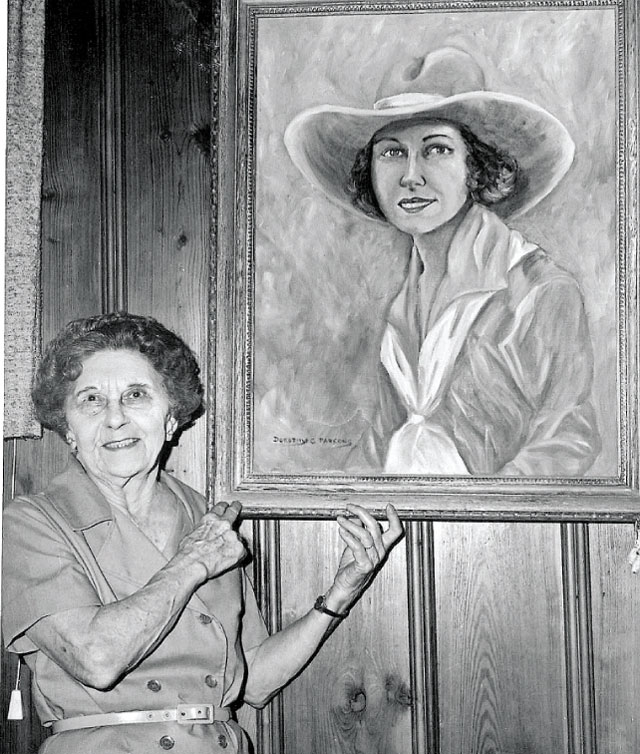
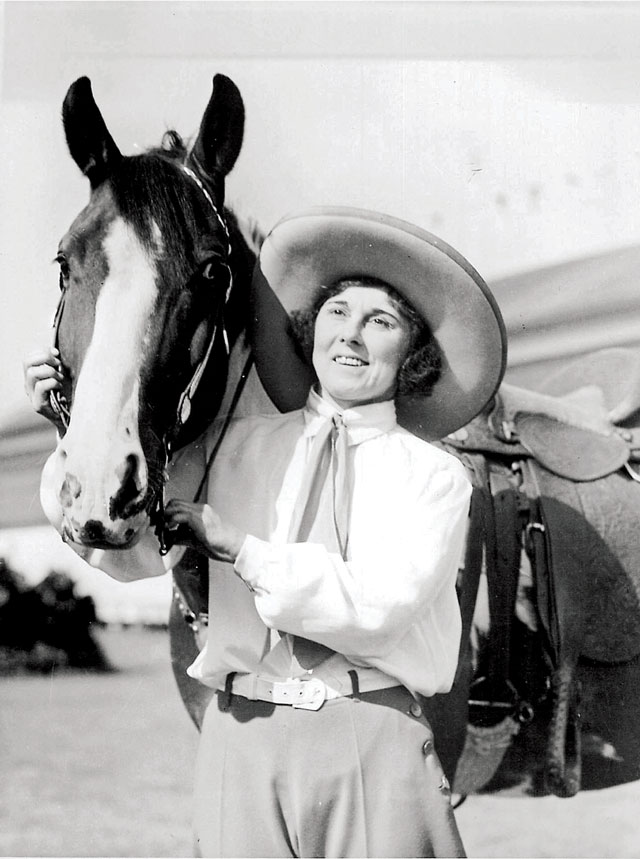
    Cleo Alberta Holmes was born to John and Mary Holmes in Augusta, Georgia in 1898. She didn’t like her name and let it be known. Her father, in jest, called her Florence instead. The name stuck and when she began her career it was Florence, not Cleo or Alberta, that she chose to call herself.
    She spent as many days as she could with her grandfather, on his cotton plantation, making rounds. She rode behind him on a mule. When she began riding alone, at age 13, she wasn’t satisfied with the mules. She rode horses instead, and eventually persuaded her mother to let her travel with a circus equestrian family as an apprentice.
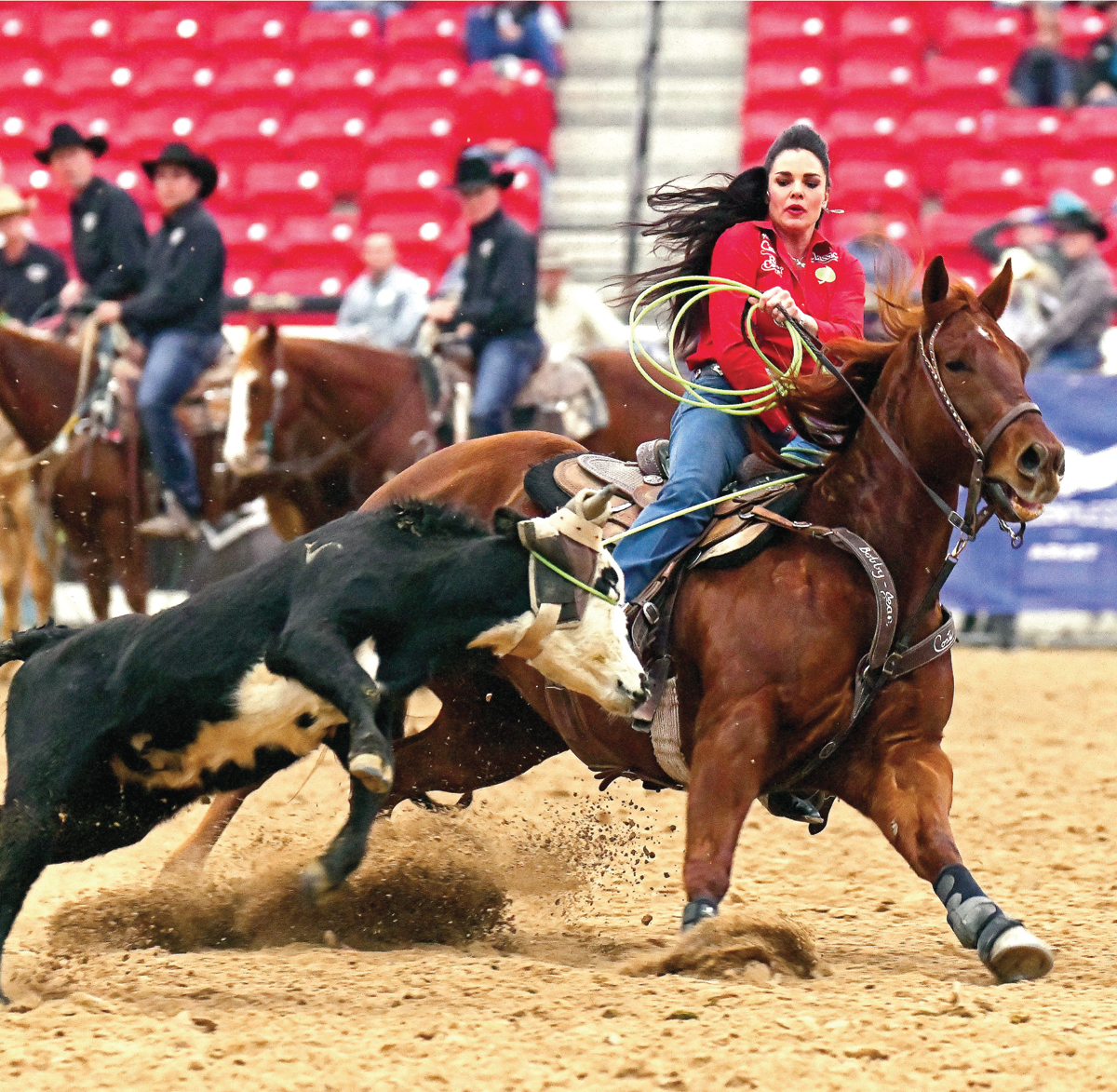
    She loved the excitement of the Colonel King’s IXL Ranch Wild West. She practiced with tutors, did the hard work she was also asked to do, and watched others, to learn, as they practiced their specialties with horses. She became a trick and Roman rider and a trick roper. A few years later, 1915, the troupe disbanded and Florence was free to do what she wanted.

    Florence – Courtesy of granddaughter, Madonna Pumphrey

    Florence never grew very big. She was four feet six inches tall and weighed all of 90 pounds, but her experiences had allowed her to gain so much confidence during those years she formed her own show. She named it ‘Princess Mohawk’s Wild West Hippodrome’. The group grew to sixty people, which in addition to the performers, included cooks and crew to set up and tear down. Often they traveled with other shows and carnivals. It lasted several years until a disaster struck in Kentucky. The bleachers collapsed on opening night and numerous spectators were injured. Florence lost everything!
    There was no time to waste, she had to earn some money! She joined the Barnum & Bailey Circus. While there Florence learned resinback riding from May Wirth, a well-known specialist in that endeavor. She learned much from this fine lady, including how to turn a backward somersault from one horse to another. Florence’s ability to perform could amaze and excite the audience.
    Meanwhile, between circus engagements she began to enter rodeos as a bronc rider and trick rider to try and win money. It took awhile to prove herself in rodeo as she was known as a ‘wild west gal’. In 1919 she heard of the rich purses offered at the Calgary Stampede and hungry for money she headed that way. Florence entered the three mile Roman standing race. The winner would receive the Prince of Wales Trophy and a silver mounted saddle. She was the only woman entered against eight men. When it was over she had won, the only woman to ever win that event. Plus the Prince of Wales trophy she won a silver-mounted saddle worth $1,500. She quickly sold the saddle to Edith Sterling, a silent movie actress. She needed the $1,500 much worse than the saddle.
    After this Canadian win she had confidence galore, and began entering all the big rodeos, such as Cheyenne Frontier Days, Pendleton RoundUp, Chicago and Fort Worth. Florence competed under the last name Holmes, Hughes, King, Fenton and Randolph, and occasionally as Princess Mohawk. Florence married a bronc rider named Angelo Hughes who was killed in an automobile accident at Mexia, Texas four months later. Suddenly she had to support herself plus support her mother and two younger sisters.
    When a Phoenix rodeo ended she went to Hollywood to visit friends. While there she was encouraged to double for Shirley Mason, a movie star. Florence would get two or three hundred dollars for doing risky horse riding chores, that actors refused to do for movies, such as riding horses over cliffs. She also posed as a Mack Sennett bathing beauty. But the desire to rodeo won out. Back in Texas she threw her saddle behind an open cockpit of a Curtiss bi-wing at Love Field in Dallas and took off in to the air to promote the Dallas Dunbar Rodeo.
    Her first New York competition was Tex Austin’s 1923 Championship Rodeo at Yankee Stadium. She entered all three cowgirl events – Bronc Riding, Trick Riding and Relay Racing. Later in life she was quoted as saying, “I didn’t win all the time, but I got my share of the prizes most of the time.”

    Florence – Courtesy of granddaughter, Madonna Pumphrey

    The rough and tumble world of rodeo did cause Florence to experience some bad spills. In Houston a bronc named ‘Dumbell’ fell on her and she was dragged to safety by world champion Bob Crosby. At the Shrine convention rodeo in Washington D. C. a notorious bronc named ‘School Girl’ turned a somersault and landed on Florence, who was declared dead, but after going to the hospital by ambulance she came back to ride again! Once, when she was taken to the hospital after a serious accident, Ruth Roach went with her. Florence had been unconscious and was coming to when she heard the doctor tell Ruth that she would never walk again. Florence bolted, got up and ran out, heading to the front door, with the doctor and Ruth after her, when she realized she was only wearing a sheet! One of her most embarrassing moments.
    In 1924 Florence was asked to go with the Tex Austin entourage to London, England, to compete in Wembley Stadium, the first rodeo ever held in England. It was a 14 day trip by ship with the cowboys and cowgirls, and the stock. The Prince of Wales, who by then was the Duke of Windsor, took a group of competitors to supper after one performance. He had remembered Florence when she won the Prince of Wales Trophy at Calgary five years earlier and was fascinated by her. Later he escorted her to Buckingham Palace to be presented to his parents, George VI and Queen Mary. He also took her to view the crown jewels of Great Britain.
    In 1925 she met Floyd Randolph of Ardmore, Oklahoma, who was judging a rodeo at Dewey, Oklahoma. He also furnished stock for the big rodeos, including 200 head of horses and steers for the first Madison Square Garden rodeo. They were married at Newkirk, OK later that year. They went on to the next rodeo since there was no money for a honeymoon. Florence’s desire to win at the Garden caused her to have an arena made, to the same dimensions as Madison Square Garden, at the Randolph ranch near Ardmore, Oklahoma. Regardless of the weather Florence could be found working out in the arena every day of the year.
    She also made and designed her own costumes. New ones were made for each season. Sometimes as many as sixteen costumes or more were made yearly. Many were made out of satin and when they wore out she would rip them up and make satin quilts from the fabric.
    Florence had several horses she trained for trick riding. The most famous was “Boy” a five year old that she bought completely untrained. During his training Florence lost two teeth to his wild ways, but she and husband Floyd finally got him settled down. “Boy” and Florence were featured at many rodeos. At one of their Madison Square Garden performances a representative of ‘Ripley’s Believe it or Not’ discovered ‘Boy’ had a clear map of the United States on his right side. Believe it or not, Florence had never noticed it before. In Philadelphia they were invited to a Rotary Club gathering and ‘Boy’ traveled by elevator up sixteen floors in the Bellvue-Stratford Hotel. She had him wear special made rubber boots so he would not slip on the tile floors.
    The SesquiCentennial in Philadelphia, 1926, is where she won her first All-Around cowgirl trophy. It was presented to her by Jack Dempsey, the well-known boxer of the era. All together she had won $6,000 there with wins in bronc riding and trick riding. She moved on to the Chicago rodeo and won the same two events there.
    Madison Square Garden rodeos were held in late October or November. Through the years the New York rodeo became bigger and bigger, with standing room only at times. Florence was one of the favorite cowgirl competitors and always sought out by various reporters. In 1927 she won the Cowgirl All Around Championship, plus the Cowgirl Trick Riding Championship. She was the first cowgirl to win the Metro-Goldwyn-Mayer Trophy, valued at $10,000. The trophy would not be given to a cowgirl to keep until someone had three consecutive wins.
    During her rodeo years Florence continued to go to the Madison Square Garden Rodeo. She remembered in 1932 when Mrs. William Randolph Hearst, Chairman of the Milk Fund, had a luncheon for the cowgirls competing that year. Mrs. Hearst gave each of them a purse for their enthusiastic participation in the rodeo which aided her favorite charity. After the presentation the cowgirls became silent. Florence got to her feet, in behalf of the group, and thanked Mrs. Hearst for her kindness and hospitality. From that time forward Florence became the ‘unofficial’ spokesperson for the cowgirls whenever there was any public speaking required.

    Florence – Courtesy of granddaughter, Madonna Pumphrey

    Her achievements were amazing. She won the Metro-Goldwyn-Mayer $10,000 Trophy; the George W. Nixon trophy for World Champion Girl Bronc Rider in Chicago in 1926; the Juergens and Anderson World Champion Cowgirl Trick Rider in 1927 and 1928; and the Champion All-Around Cowgirl at Philadelphia in 1930, plus many more.
    In 1939 Florence “Princess Mohawk” Hughes Randolph announced she was hanging up her saddle. “I have done everything in rodeo that I set out to do,” she reported. Her retirement dinner was held at Madison Square Garden, and she was presented a huge bouquet by Paul Whiteman, a popular bandleader of that era.
    She did not retire when going home, but began teaching her granddaughter, Madonna, age 5, to trick ride. Floyd’s daughter, Mary Louise had married Jim Eskew, Jr., world champion trick roper, and Madonna was their child. As a teenager Madonna became a well-known trick rider and trick roper. She retired from trick riding at 16, but continued to perform as a trick roper.
    Florence did many things during her retirement in Ardmore including assisting her husband politically when becoming sheriff. She was also active in her church. Madonna said, ‘There was never a Sunday that she didn’t have me at Sunday School and Church at the First Christian Church in Ardmore.’ Additionally, she and Floyd also helped start the Ardmore VFW Rodeo in 1946, and worked on it for many years.
    Florence was inducted into the Rodeo Hall of Fame at the National Cowboy & Western Heritage Museum in 1968. The only two women to be honored in that Hall of Fame at that time was Florence and Tad Lucas. Many of her trophies she had won during her rodeo career are housed there in the Oklahoma City Hall. Her most treasured were The Metro-Goldwyn-Mayer Trophy which she won in 1927 as “a tribute to the charm and courage of western womanhood’. The second trophy, also from Madison Square Garden, was from 1933 when she won as the Champion Trick Rider. She was also inducted to the National Cowgirl Hall of Fame in Fort Worth in 1994 posthumously. Florence had passed away April 14, 1971.
    The cowgirls from the 1920s and 1930s were fiercely driven and it was extremely difficult in those days. Once they honed their rodeo skills, won some prize money, learned how to travel from one rodeo to the next, and became friends with other cowgirls and cowboys, you couldn’t keep them away. It became their life, and some excelled at it, like Florence.

    Gail Woerner, rodeo historian, is writing a book about professional rodeo from 1920 to 1959, with an emphasis on the Madison Square Garden rodeos. She has always called the early day Madison Square Garden Rodeos the ‘unofficial’ predecessor to the National Finals.

  • ProFile: Kaycee Hollingback

    ProFile: Kaycee Hollingback

    2020 AMERICAN Breakaway Champion

    Kaycee Hollingback’s $100,000 win at the American “was God’s timing,” said the 20-year-old sophomore at Southeastern Oklahoma State University. “I’d been to a couple qualifiers and got close, but never made it. Mom and dad encouraged me to try for a spot at the last qualifier and they loaned me the money to enter.” She went to the Last Chance qualifier, the day before the Semi Finals, and made it in two spots. “I made it back on one of them to the top 40, like 17th.” Then she got to run in the perfs and made that cut and the rest is history. She made the two hour drive back and forth from Durant because she was fitting in class and two jobs with the competition. Kaycee is studying Elementary Education and works one day a week at the Durant stockyards and two days a week at J. Price Energy services. She has no intention of changing anything she’s doing after her win. “I told my parents to put the money somewhere I can’t touch it.”
    Kaycee came up the rodeo ranks starting at 7 years old. She started roping when she was ten, winning the Oklahoma State Goat Tying in junior high and winning the state in the high school in goats in 2016 and breakaway in 2017. She went on to college rodeo for SEOSU under the leadership of Christi Braudick. “I trailered her back and forth to the Semi Finals,” said Christi, who also qualified for the Semi Finals. “It was a long journey for us. I was so stoked she made it through. She is a hard worker and so deserving of this. When she won, I started crying because of how much she really deserved it.”
    The college is now shut for the remainder of the year, and the students continuing with online studies only. “I always take my Spring Break to help my dad (Jerald) work cows,” Kaycee said. “We work cows for the place my dad works for; running cows through the chute and ear notch and work the calves. I try to cheat and be the only one on horseback, but that doesn’t always work.”
    Kaycee is riding a horse she got from a girl she college rodeoed with last year. “I was looking for a practice horse and I tried him and liked him. In the practice pen, I could catch almost all of them, but at a rodeo I couldn’t catch anything.” The duo finally clicked in August. “At six, he’s like having a toddler around all the time – he has a lot of personality. He’s not bad, but he doesn’t like being by himself, so you have to have a buddy with him. He was so different at scoring and everything – I wasn’t use to it.”
    The pair definitely clicked at The American. “It was awesome – it was perfect for my adrenaline – I like going to bigger places like that – it pumps me up.” Kaycee remembers dreaming of roping for that much money and that big a stage when she was a kid. “My mom (Virginia) is an English teacher and I remember a writing project in school about something you predicted would happen in the future and my paper was about how breakaway roping will be part of the NFR.”
    For now, she’s at home practicing with her younger brother, Tanner, and enjoying some family time.

  • On The Trail with Wyatt Casper

    On The Trail with Wyatt Casper

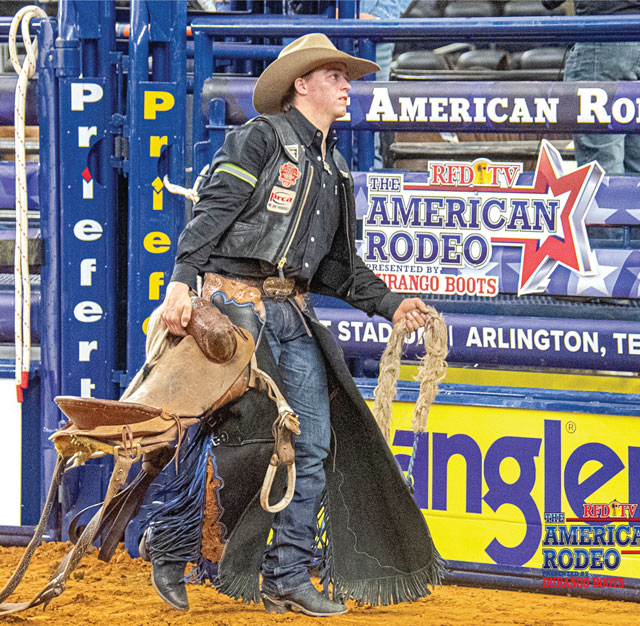
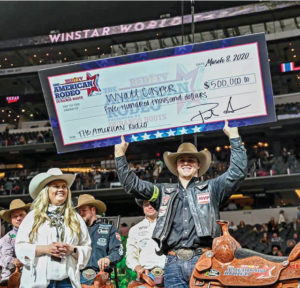
    Wyatt Casper can breathe a little easier after winning $600,000 at the AMERICAN. “When I’m home, I like to be home – and that’s what this money will help with,” said the Pampa, Texas, cowboy. “It’s tough, when I’m gone in the summer and my family can’t go with me. I go with buddies – we bust our butts for three months putting 45,000 miles on our rigs. Thank God for cell phones.” Last year, Wyatt supplemented his income by working for his dad, trucking.


    The Casper family (John, Amy and Ty, Clay, and Wyatt) moved from Minnesota to the Panhandle of Oklahoma when Wyatt was 5. “I transferred my trucking company (Casper Express) down there and never looked back or regretted it,” said John, who tried a little bit of everything in rodeo, but when he started raising a family, he settled on team roping when he can. “It was a great move for us – we wanted our boys to grow up rodeoing and cowboying and have more opportunities.” All three boys found success in rodeo from the junior high level to the national level. Clay has gone on to success at the USTRC Finals and Ty has won many Top Hand awards at ranch rodeos. Wyatt qualified for the National High School Finals Rodeo in team roping in 2010 and for saddle bronc riding in 2014.


    Wyatt didn’t get on a saddle bronc until his senior year in high school. “When Oklahoma high school only had two guys entered the first semester and neither one stayed on a horse, the money piled up,” he said. “There were six of us trying for that money by spring. If it weren’t for that, I don’t think I would have set foot on a bronc horse. I went out to OPSU in Goodwell that spring and Robert Etbauer and some of the other college kids helped me out.”


    “He’s a great bronc rider and it’s been fun watching him,” said Robert Etbauer, coach at OPSU. Robert qualified for the NFR 12 times; 1988-1992 and 1994-2000 and won the gold buckle in 1990 and 1991. “We’ve got a great facility and we can get those kids started by helping them take care of themselves before they get on – Wyatt had a lot determination.”


    After graduating from a class of 15 from Balko (Okla.) High School in 2014, he went on to Clarendon (Texas) College under the coaching of former PRCA bronc rider Bret Frank. He earned an associates in welding. He got his PRCA card in 2015 and last year was the toughest year he’s had. “I only won $3,500 between June 1 and August 31,” he said. “I went through that time just trying to forget about the week and look forward to the next week. It was really tough – I was digging a hole and all I could think about was digging harder to get out of it. I thought I’d been riding good but hadn’t been getting paid.” By the end of August, he started winning money and finished last year in 33rd place.


    The other thing that helped Wyatt is changing his riding style. “I shortened the seat of my saddle – 16 ¼, pulled my stirrups up and my binds up and that’s allowed me to expose myself in the back and show off those horses a lot better. I just tried it and ended up loving it.”


    “He’s waited a long time for this,” said his mom, Amy, a Special Ed teacher at Balko. “His dad and I have supported him from the beginning and told him to never give up. Financially we were there for him if he ever needed it to keep going down the road and doing what he loves. He’s a great kid and has a beautiful family. He has a huge following up here in Balko, in Minnesota and Pampa – always cheering him on.” Amy has already taken the ten days off for the 2020 NFR.


    Wyatt has never been to the NFR. “I said I wasn’t going until I make it.” Since a few rodeos cancelled, Wyatt headed home after the AMERICAN, which he says is now his favorite rodeo. “Hands down that’s my favorite – it’s such a cool place to ride.” Wyatt rode there in 2016, and was 78 points. He’s happy to be heading home to spend time with his family.


    He met Lesley at college. “I saw her and asked some friends about her. We were entered at the same rodeo, it rained pretty hard and she messaged me on Facebook about the ground. I stayed consistent after that and met her at another rodeo.” They were engaged on March 24, 2016 and married the following May 13. They have two children; Cooper, born November 4, 2018 and Cheyenne, born December 6, 2019.


    He is going to seek counsel on the best way to invest his current earnings. “My brother in law bought 12,000 acres in Miama Texas, and wants us to help them so we might go that route. I’m going to talk to some people who have gone through this – I’ve got some people in mind to pick their brains to figure out what is going to be best for me and my family.”


    Wyatt’s goal is to earn enough and invest enough that rodeo will carry him into his next venture. “I want stuff in place for me to already be making money when I’m done rodeoing.” His goal for riding is to ride at least 80% of his horses and use them. “I want to go at each horse the same and use them to my ability.” Last year, he rode 78% of his horses and so far this year he until Houston he was 35 for 35, with 30 of those rides being over 80 points. Houston didn’t go so well. “I landed straight on top of my head. I’m good – they say I have a compressed fracture on T1, but stable. I need to take a month off.”


    Wyatt started out in the roping pen, team roping and calf roping. He still ropes when he has time. “My wife barrel races and I’m training some of her young horses; hopefully by the time I’m done riding broncs we’ll have some horses going and some colts coming along.”


    “I am so proud of Wyatt,” said Lesley. “I have been with Wyatt basically from the start of his bronc riding career and to see him grow so much and come this far is truly amazing. Whatever Wyatt wants, he sets his mind to it and he always reaches that goal. He is a fantastic father and husband.”


    For now his priorities remain the same – God first, family second, rodeo third. “We all wouldn’t be here without our Lord and Savior.”

  • Back When They Bucked with Jon Temple

    Back When They Bucked with Jon Temple

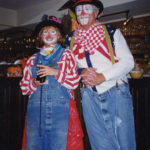
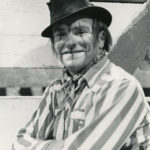
    Jon Temple loved his time in the rodeo arena. The retired bullfighter and clown spent more than twenty years in regional and pro rodeos across the nation, protecting bull riders and making fans laugh. Born in Cleburne, Texas in 1937, he saw a rodeo clown for the first time when his granddad took him to the Cleburne rodeo. He was about six years old, and he was fascinated. “I watched that fella real close, and I thought, I believe I could do that someday.”
    As a youngster, he rode calves and bulls, but that wasn’t where his dreams were. His bullfighting practice was during the weekends, at the buck outs in Fort Worth. There, he learned his way around an arena and around bucking bulls.
    Jon worked regional rodeos till his friend and fellow bullfighter Junior Meeks, who held a Rodeo Cowboys Association card (the predecessor to the PRCA), asked him to come to the RCA’s national convention, held in Denver at the Brown Palace. Jon accepted, but didn’t plan on getting his RCA membership. “I went up there with no intent of buying my card,” he said. Meeks and other friends introduced him to stock contractors and producers. Another friend, Jon Routh, introduced him to stock contractor Harry Vold. The three of them went across the street to a café for a cup of coffee. As they visited, Harry began writing on his placemat. He pushed the paper to Jon. It was a list of 33 of Harry’s rodeos, where he needed a rodeo clown. “You can have any of them or all of them,” he said. Jon took a look. “I didn’t want to look shocked so I looked it over,” he said. “And I said, I think I’ll take them all.” It was 1960, and his pro rodeo career was started.
    Jon Routh made sure Harry knew Jon was a good choice. As they walked out of the café, Routh called to Vold, “Harry, if he doesn’t make you a good hand, you call me and I’ll work the rodeos.”
    Another bullfighter Carl Doering also helped with his career. He worked with Carl, off and on, for three years. Carl helped him fill in his gaps in his schedule, and Jon loved working with him. “He was a swell guy,” he said.

    Each fall, Jon went to the RCA convention, prepared to book shows for the next year. Vold had told him he changed clowns each year. For two years, in the fall of ’60 and ‘63, he got a call from Vold, asking him to return to the rodeos. The committees liked the way he worked and wanted him back.
    In addition to Vold, Jon worked for a variety of stock contractors, at rodeos across the nation and Canada: Neal Gay, Reg Kesler, Bernis Johnson, Joe Kelsey, Roland Reid, Jim Shoulders, Beutler and Son, Wayne Vold, and more.
    One of his acts was a Model A Ford car. With the top cut out, he painted big flowers on it and called it a “hippie van”. The next year, to have a different act for the rodeos he returned to, he had a different paint job put on it and called it a “Tijuana Taxi.”
    Jon also had a mule he called Jenny Lou. Trained by a man from a carnival, she could “count.” In the arena, Jon and the announcer would banter about Jenny Lou’s intelligence, then they would come up with a problem, and she’d answer it. Scratched at a spot on the base of her mane, she’d turn her head up and down. Touched on the left shoulder, she’d turn her head back and forth. Jenny Lou was smart, “a whole lot smarter than I was,” Jon quipped. She could sense when they were about to leave for a rodeo. She wouldn’t eat and would drink just a little. During the travels, when they stopped for a water break, she’d get out, take a sip of water, roll, and jump back in the trailer.
    She also loved sweets. Tied to the trailer at a rodeo, the kids gathered around her. Jon would tell them to watch their cotton candy and ice cream because she’d try to eat it. As she moved toward the treat to take a bite, the kid would jump back and she’d keep the treat. One time, she took a bite of someone’s cotton candy and got the whole ball, making a mess all over the trailer.
    Jon had few serious injuries. He bruised a kidney once at a rodeo in Missouri when a bull rolled on him, which took a long time to heal. In British Columbia, an indoor rodeo was held on a hockey rink with sawdust and dirt over the ice. A bull got in a corner, facing Jon, and Jon slipped in a pocket of shavings. He fell, sliding between the bull’s front legs “like I was sliding into second base,” he joked. The bull “dropped to his knees and went to thrashing me with his horns,” he remembered. “I tried to grab him by the neck, to pull myself out.” A committee man saved him. “A big, heavyset committee guy in a starched white shirt jumped off the gate. The bull saw the flash and jumped to get it. That’s when I made my getaway.” Medics wrapped Jon’s head in gauze and sent him to his hotel. “My old head was throbbing,” he said. With gauze wrapped around nearly everything but his eyes and mouth, “I looked like a freak.” The next day, before the rodeo, he stopped at the doctor’s office for someone to cut the gauze off and put new wrap on it. And his hat and wig didn’t fit; he went without them for that performance.
    Another injury happened in Washington. When a bull rider hung up, Jon came in from the off-side, got him loose, and when the bell on the bull rope fell, it hit the back of his hand. He had seen a blur coming at him and put his hand up to his face for protection. It broke two of his fingers; the injury could have been worse if his hand hadn’t been there. And a broken ankle suffered in Mesquite kept him from working the 1969 National Finals Rodeo.
    The injury that propelled him to retirement was in 1969. When a bull rider got hung up, Jon moved in, got him loose, but didn’t get far enough back. The bull “gave me a judo chop” on his right ankle. “They put me in the limo (ambulance) and I went to the hospital,” he said. He had broken his leg, which put him out of commission. The doctor told him, “you’re in the wrong occupation. You won’t be walking when you’re fifty.” Jon decided to rodeo one more year, then retire.
    After retiring in 1970, he went to work for the Missouri-Kansas-Texas Railroad in Ft. Worth. He worked for them till 1999, when he retired from Union Pacific Railroad.
    After that, Jon did carpenter work, refurbished houses, and worked with his wife, Norma, who was a real estate agent. He and Norma owned and operated several car washes. He served for twelve years on a local school board and the couple is active in their church.
    Now he and Norma, who married in 1998, sell window treatments, and Jon golfs for a hobby.
    He has 3 beautiful redheaded daughters: Marla Roper, who lives in San Antonio, Jeana Temple, in Ft. Worth, and Jonelle Luce, who lives in Joshua, Texas. Norma has a daughter, Shelby Lloyd, who lives in Cleburne. Between the two of them, they have 8 grandchildren and 5 great-grandchildren.
    Jon is a 2001 Texas Rodeo Cowboy Hall of Fame inductee, and he loves attending the rodeo clown reunions and catching up with old friends. He appreciates the friends he’s made through rodeo. “The friendships over the years have been God’s blessings,” he said. “They connect me to the right things. That’s how my life has gone. I’ve had some good friends.”

  • Featured Athlete: Jimmie Smith

    Featured Athlete: Jimmie Smith

    Jimmie Smith is the 2019 Texas Circuit champion barrel racer and the 2018 WPRA Resistol Rookie of the Year. The McDade, Texas cowgirl won all her Texas money on a special horse, a ten-year-old mare, LenaOnTheRocks, “Lena.”

    The mare, a palomino, loves the winter rodeos, and she and her rider did well in 2019, finishing third at Ft. Worth, San Angelo and Corpus Christi, and making the finals at Houston and San Antonio.

    At that point, Jimmie was sitting in the top ten in the WPRA barrel racing world standings, and they hit the road hard.

    But after Calgary, in July, Jimmie knew something was wrong with her partner. It was nothing major, but she didn’t want Lena’s soundness to be jeopardized.

    “I could have kept running her,” she said. “She was never lame and never took a lame step. I could just tell something was off. If I had ignored it and kept on running, we maybe would have made the (National) Finals. But I also maybe wouldn’t have her running as strong as she is now.”

    The horse is out of Tourlena by FirewaterOnTheRocks. Jimmie purchased her as a five year old from Cindy Skinner. Susie Campbell had started her on the barrels, and Jimmie filled her permit on Lena in October of 2017.

    The horse is tiny but thick and strong, and a “total princess,” she said. “She knows that I love her, and we just have that special bond. She knows she gets treats before and after she runs. She just loves being pampered.”

    Jimmie, who is 23 years old, made the Texas High School Finals all four years of high school. In college at Texas A&M, she earned a bachelors degree in communications and journalism. She qualified for the College National Finals Rodeo three times in three events: the barrels, the breakaway, and the goat tying.

    When Lena was out of commission last year, Jimmie rode several backup horses, all of them leased. It was not ideal. “It was a pressure situation,” she said. “I knew I had to win money on these horses but had no clue how to ride them.” She kept switching back and forth between them, trying to get with each one, “and it never really clicked.”
    By September, Lena was released for competition but Jimmie took it slowly on her, not running her till Thanksgiving.
    The wait was worth it. At the Christmas Classic in Alvarado, Texas, she broke the arena record twice. The first time was on Pixie, one of the borrowed horses, with a time of 14.901. The second time was aboard Lena, with a run of 14.894 seconds.
    And at the Texas Circuit Finals in January, Lena won second place in the third round for her.

    Jimmie is a member of the 5 Star Equine team and loves their products, especially the saddle blankets. All eight of her barrel horses wear the 7/8 barrel racer saddle pad. She has been using it for the past four years, “and I have had no back issues. All my horses stay sound with no soreness in the back.”

    The saddle pad wicks away moisture, and is customizable, too. “They’re very pretty,” she said. “I love how pretty they are. You can match them to your personality and customize one for each horse.”

    Even though Lena being out for several months last year was hard, Jimmie sees the blessing. “If I had never had to go home (from rodeoing), I would never have had the two backups I have for this year.” She has Pixie and Minnie as her secondary horses. “I’m not stranded this year. I’m not a one-horse show.”

    Jimmie is taking this year slow, taking her cues from Lena. “We’re going one run at a time,” she said. She finished as reserve champ in Denver. “We’ll see where it takes us.”

  • On the Trail with Bobby-Jean Jones Colyer

    On the Trail with Bobby-Jean Jones Colyer

    Bobby-Jean Jones Colyer had a love for horses long before she competed. Growing up in Bruneau, Idaho, in a town of 300, she borrowed a horse to help her get going. “It’s a cool story – my parents (Penny and Gary) couldn’t even put a halter on a horse, but I grew up in a ranching and farming community that helped me get started.” Bobby-Jean remembers struggling in school. “I wanted to be a cowgirl so bad.” She got her first job washing dishes to pay for her entry fees for high school rodeo. “With three kids there wasn’t’ a lot of money there.” Her dad was a wood shop teacher and coach for basketball and football. Her mom was a stay at home mom. “My dad traded for the first horse I owned. I always wanted to barrel race. That first horse I owned got me started at 12 years old.” Gary built a screened in porch in trade for a three year old horse. Bobby-Jean has two older brothers, James and Danny, neither one who competes in rodeo.

    “I could never get her to bake cookies with me – she always wanted to be on a horse,” said her mom, Penny. “But because of this valley and her hard work and determination she did it.” Bobby-Jean is the only female that has ever won the Bruneau Round-Up All Around Championship – it’s a big deal. She has also qualified for the World Series Finale six times, as well as qualifying for the AMERICAN, and the Columbia Circuit Finals. “The biggest accomplishment to me is the fact that Gary and I aren’t rodeo people. We worked in the school district. She was two months old when we moved here – we didn’t have the means or the ways to get her there –she babysat and did whatever she could to get horseback.”

    Once she got started, her love of rodeo grew. She started roping and set goals for herself. “When I reach one I want another one.” Her rodeo career landed her a scholarship to Bozeman, Montana, where she made the CNFR in the team roping, goat tying, and barrel racing – one of only two women that qualified in 2002 in the team roping. “I would have never gotten through school if not for rodeo,” she said, graduating with a degree in consumer science. Once she graduated, she went down the rodeo road, but ended up back home and married to Kyle Colyer in 2005. They have two children – Piper (14), Cruz (9). Kyle is a third generation rancher and shows Hereford cattle. She continued rodeoing and added a central entry line to her job description.


    Bobby-Jean worked for Central Entry, now known as Rodeo Central, the entry system for the Idaho Cowboys Association, two others, as well as several open rodeos. She worked for Central Entry before purchasing it seven years ago. Orla Knight, former ICA secretary for 25 plus years,, developed an online entry system, with that Bobby Jean has made some new improvements. “We worked with a developer, Advanced Software, to offer central entry online to website,” explained the 39 year old. “Contestants can still call, but this gives them an option.” She starts in March and the rodeo season winds down the end of October. During that time, she employs several others to help take entries. “I have a lot of passion for the ICA – I’ve been a member for 17 years, winning Rookie of the Year in 2003. I also served on the board as a barrel racing director for six years.” Bobby Jean explains the rodeo draw as a 2,000 piece puzzle. “The computer isn’t always perfect. We have trades and everyone has to get everywhere … anyone in this business has to care about cowboys because they are not going to get rich doing it.”

    During the peak season of taking entries, Bobby-Jean still makes time for practicing. Through her example, Bobby-Jean is hoping to bring back old fashioned work. “In this day and age I’ve read all the books, but there is no substitute for working hard no matter how hard it is. I worked my arena with snow in there and if I don’t get out there and practice, they are going to beat me.” She tells herself there is always someone else out there working at it and there is no substitute for working at it. “When I go to the practice pen I have a goal every time.”
    She recently competed in the Art of the Cowgirl Worlds Greatest Horsewoman in Phoenix. “Go big or go home – I split first in the last two events – steer stopping and fence work; after not doing very well in the first herd work and reining. I knew I had to lay it all out there in order to make the top ten finals where it would be a clean slate. 59 would have to check for sure – there’s a lot of very accomplished horsewomen in that and I had to go for it.” She ended up third place overall. She is hoping to find another show horse and is preparing for the Perfect 10 World Series event in Las Vegas in March.

    Bobby-Jean continues to train her mind. “I think that having a good mental mind is the only thing that makes it at the end of the day. I’m not always there, but I’m working at it all the time. When you’re passionate, emotions go with it. I’ve always been passionate about horses – they’ve been my go to – when things are rough, I go get on the best in the pen – and the best one always turns things around for me.” Bobby-Jean loves to compete. “It’s not about beating someone it’s about reaching individual goals.”

    Her dreams include becoming successful in the reined cowhorse. “I want to change people’s lives by hearing my story and drive them to follow those dreams and goals with horses even if they didn’t grow up with horses or have a lot of money.”