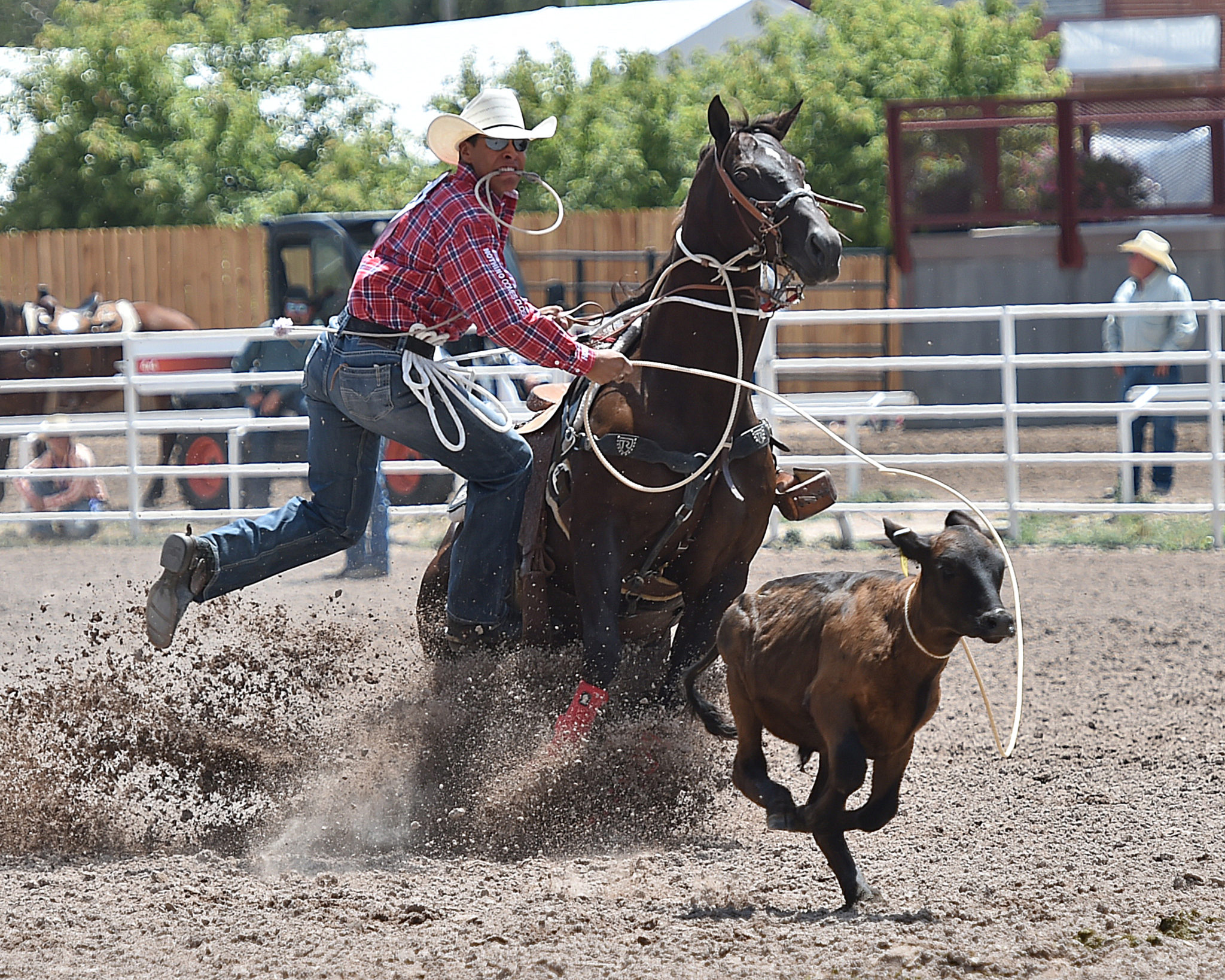
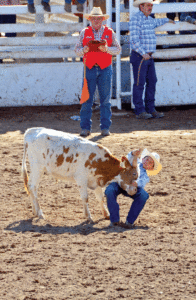
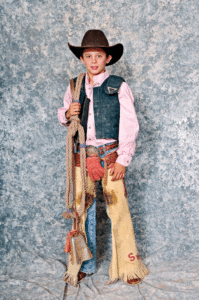
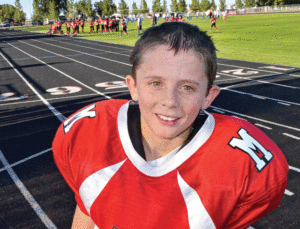
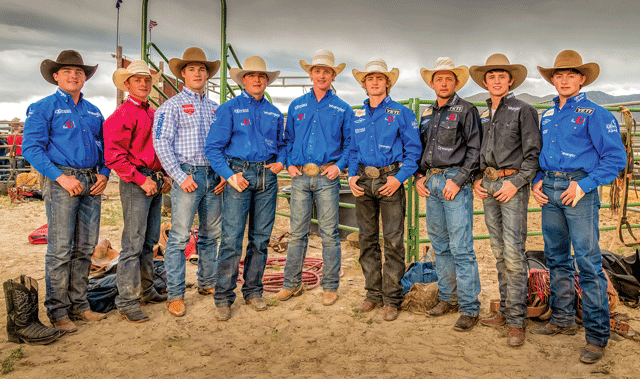
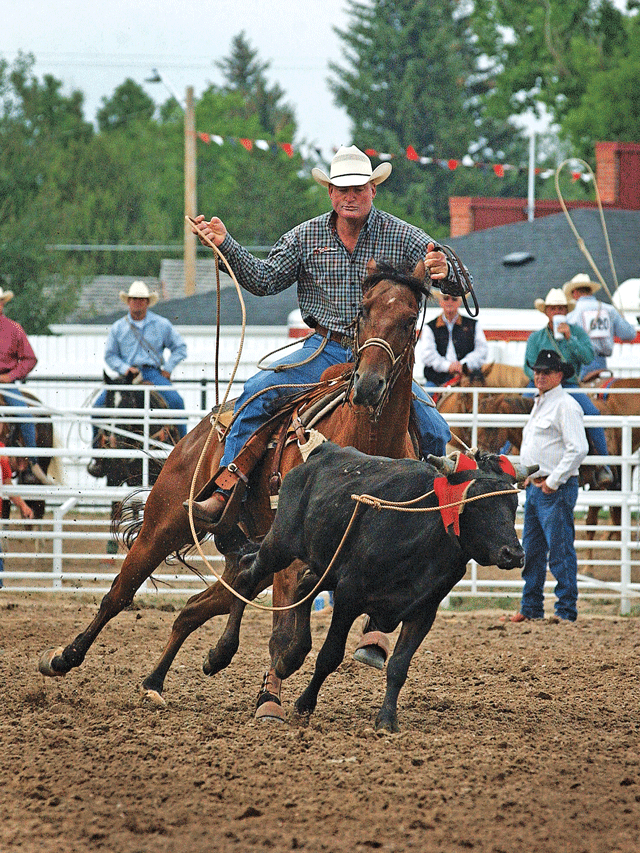
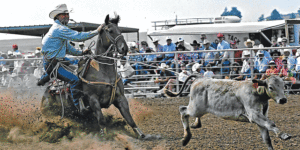
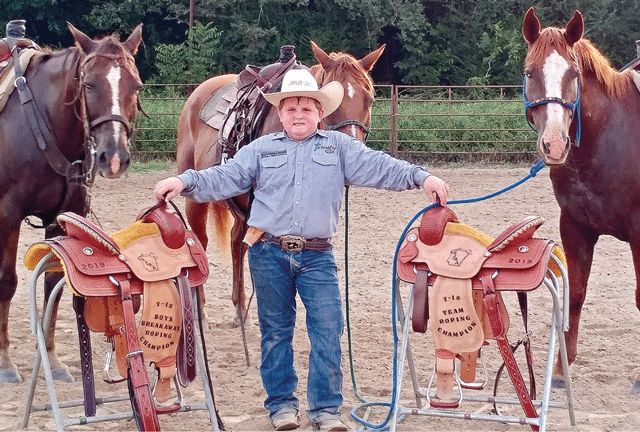
Shad Mayfield, from Clovis, New Mexico is the 2019 National High School Champion Tie Down Roper and has now qualified for his first WNFR. He grew up rodeoing. “My dad, Sylvester, did it, when we were little we went with them.” Sylvester made it to the NFR Finals twice (1985, 1987). “Since I turned 7, my parents took me to the junior rodeo associations.” He competed in New Mexico Junior Rodeo Association, making nationals all three years. He won the national title his sixth grade year in the ribbon roping, with his sister, Shelby. The next year he won the calf roping. Shad went on to high school rodeo, the first two years for New Mexico and then switched to Texas.
This is his first year rodeoing in the PRCA and he had his sights set on making the NFR his rookie year. He got a big boost in that direction after making enough money at Cheyenne to boost him into the #14 spot. He traveled with his dad. “He’s taught me everything about roping and everything around that. Since he made the NFR, he knows all about how to make a living at it and the mental game.” Shad listens to Tyson Durfey about having a strong mind. “That’s how you think … it’s a big part of it. Just blocking everything out – the interviews – the other runs, the bad draws and all of it.”
He also attributes his success to riding a lot of different horses over the years and having a rope in his hand constantly. “I rope a lot at home,” said the 18 year old. “I’ve roped on a lot of different horses so I know how to ride a horse. I rope the dummy a lot.” His main competition horse is a 16-year-old gelding named Jango. “He is probably the most honest horse out there. He’s the same horse when you back in the box and never going to cost you anything.”
He also likes the road. “There’s nothing but a Walmart in Clovis. I like to drive and see different places.” He also likes traveling with his dad. “Most people don’t rodeo like I do and that’s why he’s with me. He may think I don’t listen, but I do.”
Mom, JoEllen, stays home. “I’m the hired hand at home,” she jokes. “I worked as a mortgage loan process up until I had Shad. Once he was born I chose to stay home and be with them. I was able to do that – I’m a substitute teacher now.” Sylvester can work on the road – he buys and sells cattle.
She is very proud of both her kids. “I have two great kids – my daughter is at Texas Tech and has a lot of ambition. She is focused on school and her career. God blessed Shad with a talent – and he’s worked extremely hard. He sacrificed basketball and other things to make rodeo first. He amazes me – I have all the confidence in the world in him.”
Shad intends to continue his education, hoping to start college within a year. “I want to have an education and start doing something else to fall back on.” For now, it’s rodeo that he’s concentrating on. He’s especially grateful to his sponsors, which include CSI, American Hat Company, Hooey, Outlaw Equine, Tres Rios, Rock and Roll Denim, and Rattler Ropes.
Those who know Dr. Doug Corey ’72 describe him as a humble, honest man — a straight shooter. He’s the type of guy who prefers to kick around the horse barn in dusty boots and a Western hat, but who will put on a sharp tux for a black-tie event and impress everyone with his cowboyish charm. He’s also the type of guy who makes change happen.
The Whitman graduate has committed 40 years to protecting the well-being of rodeo livestock. Recognized as a national authority on animal welfare, the veterinarian has garnered many honors for his contributions to the sport, including a prestigious spot in the ProRodeo Hall of Fame.
“When I was in vet school, they didn’t teach the terms ‘animal welfare’ and ‘animal rights,’” Corey said. “The first time I heard those words was from a young bull rider. He said, ‘We really need to work on these animal welfare issues now, because they are going to become even bigger issues.’ I didn’t know what he was talking about at the time, but he was right.”
In 1981, Corey joined the newly formed Professional Rodeo Cowboys Association (PRCA) Animal Welfare Committee, taking a lead role in crafting the national guidelines and regulations for the care and welfare of rodeo livestock. He authored “A Guide to Veterinary Service at PRCA Rodeos” and traveled the country lobbying for rule changes and educating the rodeo and public.
The PRCA now has more than 60 animal welfare rules, including the requirement for an on-site veterinarian and a livestock ambulance at every professional rodeo.
“It used to be there were always ambulances and medical staff for the people, but never for the animal-athletes,” he said. “It was a big deal to make that happen.”
Corey has remained an active volunteer in the PRCA over four decades. Each December, he spends two weeks at the National Finals Rodeo in Las Vegas as the media spokesperson on animal welfare issues.
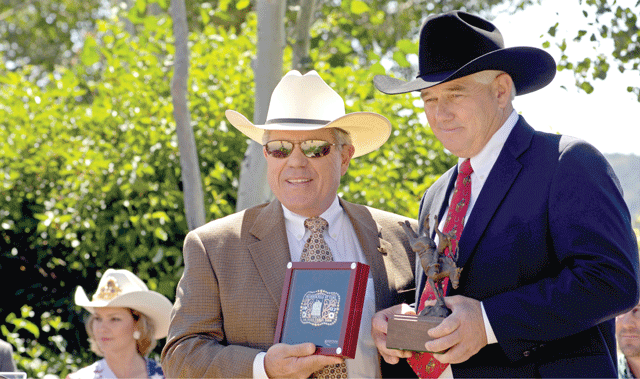
In 2007, he was recognized for his leadership in animal welfare with the highest honor in the rodeo industry: He was the first – and remains the only – veterinarian inducted into the ProRodeo Hall of Fame.
“It was the ultimate honor,” he said. “There were so many people throughout the country who played a part in developing all of these guidelines. I share the honor with them.”
In 2011, the American Association of Equine Practitioners honored Corey with the Distinguished Life Member Award. He was also named Oregon Veterinarian of the Year in 1997.
“I really enjoy the Western lifestyle and want to keep those Western traditions alive,” Corey said. “I truly believe the welfare of these animals is one of the biggest challenges to continuing that heritage.”
Growing up on a large cattle and sheep ranch, Corey formed an affinity for working with large animals at an early age. While at Whitman, the biology major considered medical school, but his heart steered him in another direction.
“Whitman gave me a very good background for moving on to that next degree,” he said.
He earned a Doctor of Veterinary Medicine from Colorado State University in 1976, then returned to Eastern Oregon to join the Associated Veterinary Medical Center in Walla Walla. Now semi-retired, Corey still tends to his beloved equine patients.
“Horses are extremely incredible animals, and to be part of their lives and take care of them on a daily basis has been something truly special,” Corey said. “There hasn’t been a day it felt like work.”
While Corey is well-known on the national rodeo circuit, he’s also a celebrity around his hometown rodeo: the Pendleton Round-Up. Thousands of competitors and fans flock each year to the annual weeklong event in September.
“In Pendleton, there are two times of year: before the Round-Up and after the Round-Up,” Corey said.
Corey, a Pendleton native, has been a part of the Round-Up since he was a child. He is a past president and member of the Round-Up board of directors, and he volunteers as the rodeo’s on-site veterinarian.
His wife Heather, who died in 2012, also had a long history with the event: She was the first woman named to the Round-Up’s board. Their daughter, Cydney, and son, Bobby, now hold Round-Up leadership roles.
“It’s always been an important tradition for our family, and it’s important to the economy of our city,” Corey said.
Corey and friend Andy McAnally started another annual event that has become a boon to the Pendleton economy: the Pendleton Whisky Music Fest. Now in its fourth year, the event has featured sold-out shows with headliners Zac Brown Band, Maroon 5, Blake Shelton, Pitbull and Post Malone.
“We wanted to bring the best entertainment to Pendleton so people could see great entertainers without having to go to a big city,” he said. “It was a crazy idea, but so far it seems to be working.”
Longtime friend Eric Johnson ’72 said Corey’s community involvement reflects a deep affection for his hometown.
“He’s Mr. Pendleton,” Johnson said. “Community runs in his blood.”
Corey credited his education at Whitman for providing not only the foundational skills to put his passions into action, but also the perspective to spur change on both local and national levels.
“Whitman gave me a well-rounded education that shaped my mind and opened my eyes to a lot of different viewpoints and opinions,” he said. “It genuinely made me a better person.”
Fourteen years later and by the grace of God this man is returning to the Thomas & Mack arena in Las Vegas, to compete in his eighth National Finals rodeo! Those who know him are not surprised. He will go down in history as one of the greatest cowboys that has ever lived! One who some will say, walked away from the game too early in his career. It was a choice he made for himself and for his family.
2005 was the last year Kyle Lockett competed at the NFR. He was 28 years old. He finished that year second in the world with his partner Wade Wheatley. At the time, I was pregnant with our first child, who was born later that summer. That was his seventh and last trip to the big show (so we thought).
I always encouraged him to continue to rodeo and pursue his dream of one day winning the world, but he’d just smile and say he “didn’t want to be away from his family.”So life went on and four babies later he had evolved into the greatest Mr. mom you’ve ever seen! From changing diapers, to warming up breastmilk, to lugging multiple car seats, to pick-ups and drop offs to nap times and spoon feeding baby food, to adjusting to life with multiple small children, which meant a play pen in the arena, saddling and hauling ponies to brandings and jackpots, to strapping down car seats in a golf cart for a game of golf with the guys. All of this while I worked 1-2 jobs at the hospital, this guy had it down! It wasn’t unusual for me to get texts of other moms telling me how Kyle had handled all four kids, by himself at a rodeo or a branding like a pro!
When the best headers in the world would call him and try to recruit him out of retirement, only for him to turn them down and say that he wanted to stay home with his family…it makes you grateful that you married such an admirable man, but it also makes you feel a sense of guilt. I always knew he was the best of the best and felt like too bad we couldn’t just load up and go! But rodeo with four kids? Dream on. It would be a divide in our family. He would have to be gone 9-10 months out of the year and that was something he wasn’t willing to sacrifice.
He once told me, “Ii don’t miss rodeoing, I just wish I could make the finals one more time!” Oh okay Kyle – dream on – that’s impossible. The only way to make the finals is to go hard all year and hope that you land somewhere in the top 15 money standings! That’ll never happen (so I thought!)
Well last winter he thought he’d do his friend Aaron Tsinagine a favor and heel for him at some rodeos in Texas. It wouldn’t be a long time away from home. He could fly in and fly out and make a weekend out of it. The two ended up winning San Angelo which allowed Kyle an invitation to compete at the infamous Houston rodeo! A once in a lifetime chance for a guy like Kyle, who doesn’t rodeo full time, to earn a solid pay check! He was gone for three weeks, but it was worth it! At the end of the month long rodeo, he and his partner Ty Blasingame WON IT! I was working at the hospital, hiding out in an empty room watching it on live on my phone! I screamed when I knew what had just happened! He had just won over $50,000 and earned himself a shot to make the NFR one last time! For the next three months, his name was at the top of the PRCA heeling standings! My husband has known since March that he will be returning to the big show! A thought that is almost too big to wrap your mind around! He will be 42 when he competes again and is still just as sharp as ever!
This last weekend the 2019 season came to an end. The top 15 contestants in each event have been determined and he will go into it ranked the #6 heeler in the world! He has picked his partner and will rope with past world champion Erich Rogers! What an accomplishment!
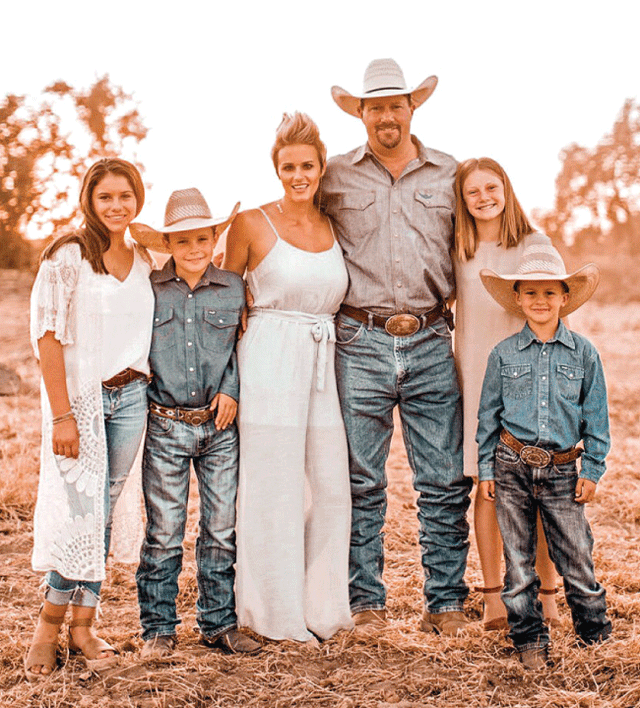
The last time he competed he was 28, unmarried and had no kids. This year will be a bit of a different story. Our kids know exactly what their dad has achieved and are his biggest cheerleaders! They will be 13, 11, 9 and 6 when they watch their dad compete against the best of the best for 10 straight nights!
So if you’re picking a fantasy team or thinking about rooting for an under-dog, place your bets on this one! There is nothing he can’t do! If you’ve never been, you need to go!
2019 will definitely go down as the wildest year thus far!
Hazlee McKenzie had a unique babysitter when she was a little girl. When her parents would go to a roping, they’d put her in a pen, on her pony Trigger. She’d ride Trigger for hours, and they didn’t have to worry about her. That’s how she fell in love with horses, and her love hasn’t abated since then.
The twelve-year-old cowgirl, a resident of Muldrow, Okla., is proud to be a part of the 5 Star Equine Products team.
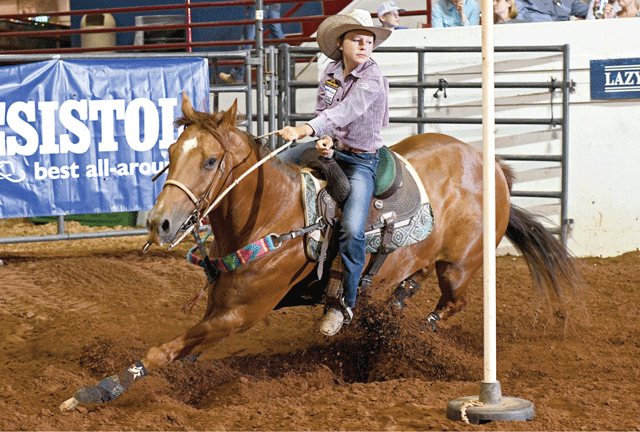
Hazlee competes in the barrel racing, pole bending, ribbon roping (running for Creek Williams) and breakaway roping.
She uses three different horses for her events. Scooter, an eleven-year-old sorrel, is her barrel horse. A poor fit in the cutting horse industry, the family got him as a four-year-old, originally for Hazlee’s mom Tera to rope on. Scooter is hard-headed, Hazlee said, but he’s smart, really athletic, and loves to run barrels.
BB is her pole horse. The eight-year-old sorrel was trained by her dad, Jason, and can also be used for the barrels and roping. He’s very personable, Hazlee said. “He loves attention and he does anything you ask him to do.”
Her breakaway horse is a four-year-old named Junior. Junior is also good at the poles, but is used mostly for roping. He’s really calm and sweet, she said.
Hazlee is home schooled, with her favorite subject being math and history a close second. Reading is not her favorite; she’d rather be on horseback. That’s why homeschooling is good for her; she can get her work done and head outside.
She uses several 5 Star Equine Products. The saddle pads are her favorite, because they’re made out of wool and fit the horse well. They can be designed by the customer, and Hazlee has designed some of her own. “You can make them look the way you want them to look,” she said. She also appreciates the fact that saddle pads and horse boot colors can be matched. It’s important to her that her things match, with blue being the predominant color among her things. Her favorite saddle pad is white with a turquoise border, and the matching boots are navy with turquoise straps to match the pad. (Hazlee’s favorite color is teal.)
The saddle pads also come with her initials on the backside. There are plenty of color options with the saddle pads, which is important to a girl who likes fashion. “It’s definitely a benefit for girls who want to bling up their pads, for sure,” Hazlee said.
Jason and Tera, both ropers, have been using 5 Star Equine Products long before Hazlee became a member of their team. “We just really like the saddle pads,” Tera said, “because you can order them in different thicknesses, depending on the horse.” They come in different lengths, too, a little longer for roping saddles, a little shorter for barrel saddles.
The McKenzies believe in the value of 5 Star Equine products. “We’ve owned several (saddle pads),”said Hazlee, “and as long as you take care of them, they last a long time.” They also come with a liner that can be used in the spring to protect the saddle pad so shed hair doesn’t get embedded. The liners can be used for dog or cat beds when they’re no longer needed, but the family has found that they can be used several years.
When it comes to meals, Hazlee’s favorite is steak, corn on the cob, strawberries, and ice cream for dessert. She loves to drink Pepsis and eat Sweet Tarts.
The best trip she’s taken was to Cheyenne Frontier Days a few years ago, when the family went to a rodeo performance and walked through the exhibits afterwards. She also enjoyed her time in Las Vegas when her dad qualified for the World Series Team Roping in 2017. They took in a night at the Wrangler National Finals Rodeo and some of the trade shows.
The McKenzie family has several pets. In addition to their horses, they have Cowgirl, a full-blood blue heeler, who is three-legged, and Reins, a Jack Russell-blue heeler mix. They have a barn cat, Lizzy, who is supposed to be a mouser, but prefers her free meals from Hazlee. They also raise cattle.
When she grows up, she’d like to be an interior designer and train and run barrel horses. She competes in the Oklahoma Junior High School Rodeo Association and the Cowboys Regional Rodeo Association (CRRA). Hazlee qualified for the National Junior High Finals Rodeo in the pole bending, finishing twenty-third in the nation this past summer. She competed at the CRRA Finals in Ft. Smith, Ark. last month in the barrel racing and won Rookie of the Year.
Her mom and dad enjoy how determined and hard working their daughter is. “She knows the effort she has to put in to achieve the goals she has set for herself,” Tera said. Hazlee loves to just be on a horse. “She likes to be on them,” her mom said. “She doesn’t have to be working barrels or poles or roping. She enjoys just getting out and riding across the pasture.”
Tiny Florence Price, from Addington, Oklahoma, learned cowboy skills early and well, in the footsteps of her Daddy, John Henry Price, and many other top hands. She cut a wide swath into the world of rodeo and followed it faithfully for decades, claiming amazing victories in equality for cowgirls. Last July, Florence pioneered even more territory for them, becoming the first “Notable” the ProRodeo Cowboy Hall of Fame inducted under the umbrella of the Women’s Professional Rodeo Association (WPRA).
“That was REALLY something! I never dreamed of such a thing,” Florence said. Her “desire for women to rodeo, and to help get bigger and better barrel races for them” was incidental in her mind; and she claims her 2019 induction “just kind’a happened.”
“My folks had box seats at the Fort Worth rodeo, and they always had horseback ‘Musical Chairs’ there,” said Florence about her beginning in rodeo. “I thought that was the neatest thing I had ever seen, but I had never done anything like that! I’d heard about barrel racing, so I got one of Dad’s best pasture (working ranch) horses and started training him.” By the time she was 14 Florence and that horse competed in small rodeos close to home.
Those were pioneer days for women’s rodeo, with some of those events having no set pattern and possibly old, used water heaters for markers if there was a pattern. Possessing foresight beyond her years, such infrequent, novelty events weren’t part of Florence’s vision. She identified a need for organization, standardization, and recognition for girls and their horses – and set out to make it happen.
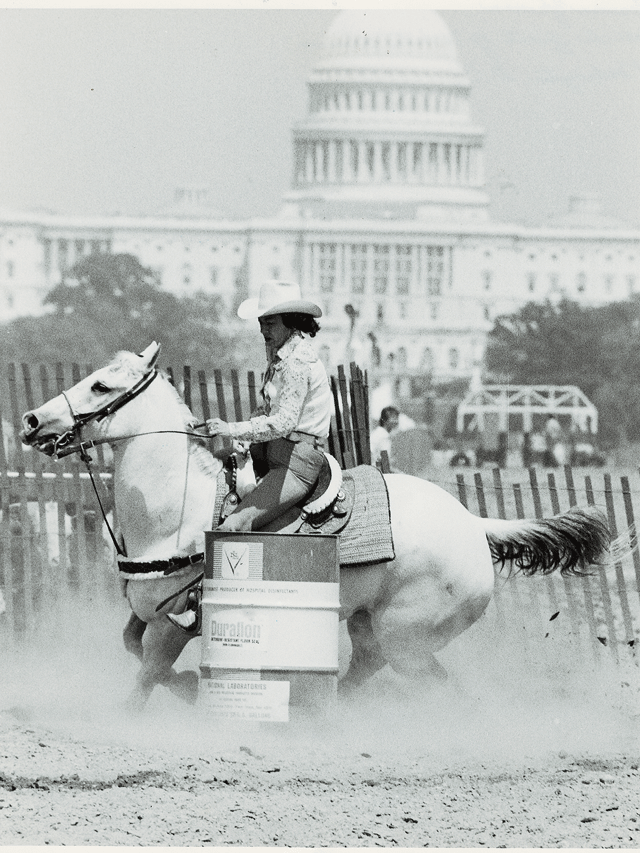
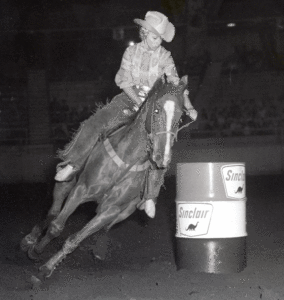
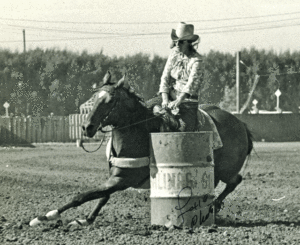
Barrel racing, 1974 – Gustafson Photo
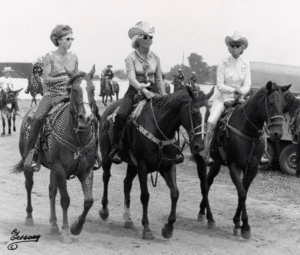
Florence Youree, Billie McBride, Manuelita Woodward Mitchell Richards, Berva Dawn Taylor – Courtesy
Florence Youree
Florence called her favorite arena horse ‘Chubby’, but the beautiful Palomino Quarter Horse’s registered name was Chubby Dun. “Grandad bought him as a stallion, and stood him for several years. When he didn’t want any more foals from him he gelded him. He was always real nice, and easy to work with,” Florence remembers. “He was a natural at working cows, and he learned the barrels pretty fast. I used a regular little old grazing bit, never needed anything else on him.”
Florence wasn’t the only good cowgirl in her family . . . sister Sherry Price shared the passion for horses and competition. Competing in rodeo was a rare treat for the Price sisters – busy growing up, going to school, and helping on the ranch – yet Florence did everything she could to help promote it, especially for women. Those efforts birthed the pioneering Girl’s Rodeo Association (GRA). “I didn’t travel to rodeos until after Dale Youree and I married,” Florence says. “He was a calf roper, and we pulled two horses behind a car in an old open top 2 horse trailer.” She remembers a storm that came up as they were heading to a rodeo in West Texas. “We pulled into a lumber yard in some little town, and got a big tarp. We tied it on there to cover the top and protect the horses a little,” Florence explained. “And when we pulled into the rodeo grounds Dale said, ‘Let’s just stop out here, I don’t want those people to see what we look like!’”
“We traveled some with Manuelita and Jim Mitchell before we girls joined the GRA. Fay Ann Leach and Billy were also great traveling companions,” Florence says. “By that time we had bought a pickup and a little 8’ camper, so we’d park out in the infield, on the backside of the rodeo grounds. Our kids John and Renee went along from 4-years of age, and I wouldn’t have it any other way. That kind of life was a good education in itself. They learned to meet, socialize and talk to people. We and our kids sit and talk and reminisce a lot about those times today, remembering and wondering about people we used to camp next to – you remember them forever, and wonder where they are now.”
Two Youree’s rodeoing worked so well, they often even rode the same horse. They didn’t even change bridles, as Florence explains, “I rode with whatever he had on the horse’s head. There was usually only a couple or three events between the calf roping and barrels . . . lots of times we just had time to change saddles.”
Rodeo can be a dangerous sport, even in women’s events, but Florence says, “I can’t remember having many bad wrecks.” Then she giggles, “There was that time at a rodeo in Weatherford.” Florence was on Mr. Ed, given to her by R.A. Brown from Throckmorton, Texas; a ranch horse he’d told her she needed, and he wanted her to have. His solid ranch horse background was about to be tested. Florence recalls,
“That day he turned the most awesome barrels, and was making the best run of my life. As we turned the end barrel to come back a big bucking bull escaped from the chutes, coming right at me! I just kept right on running for the line, and the bull swerved around and went behind me . . . I won it!”
There was no room for weak hearts in the barrel racing arena . . . but there was a lot of class and color, flash and pizzaz! A new fabric called “stretch lame’” sparked the rodeo fashion scene in the 1950’s. Tailored lame’ pants, electrically shiny as tinfoil and rainbow in color, fit cowgirls like a second skin.
“Manuelita Mitchell was the first person I saw wearing that fabric,” Florence remembers. “She lived over there by Maude McMorries who sewed fashions for Manuelita, and June Ivory and Jo Decker. I had her make mine also.”
She did join the fledgling GRA in 1951. She became a Director, then 1960-1964 President. During many years as Secretary-Treasurer, Florence was instrumental in the National Finals Rodeo (NFR) approving women’s Barrel Racing as a sanctioned event. “I loved working in the GRA office . . . I knew all those names from typing rodeo results, over and over! This year, in Colorado Springs for my Induction, I met Wanda Cagliari. I knew that name and had written it forever. I was honored to meet her!”
Barrel Racers at Houston Rodeo – Stratton Photo
Florence at the 2019 ProRodeo Hall of Fame Inductions – Steve Gray
Florence Youree and Janae Ward – WPRA World Champions – Springer
Somehow, along with doing all that GRA business, Florence and her fast horses raced their way into the GRA’s annual Top 15 six times! She then transitioned with GRA into the WPRA and captured their All-Around title in 1966.
Ever willing to share their talents and knowledge, Youree’s instituted a program for youth. “We held horsemanship camps here at the ranch for 14 years. We also held them other places – all over. We’d fly out of here Friday morning and go wherever, have a lecture that night and teach all day Saturday and Sunday; and then get home as fast as we could for Monday morning,” Florence explains. “We were training horses for the public and if a day passed we didn’t ride your horse, we’d only charge you for feed. We’d have as high as 18 or 20 horses in the barn, and after we got bigger Martha Tompkins and Sandy Hickox Bowden came and lived with us and rode for us, also Connie Combs fom Comanche.”
“When we got enough others that could help with the training, I backed off and did the cooking,” Florence explains. “Now Renee has three daughters and they all train here every day, and I cook lunch for them.”
Florence started a family tradition of barrel racing excellence and is proud to say, “My granddaughter Janae Ward Massey won the World title in 2003, and also won the National Finals Average. During the time she was in Vegas for that NFR, she had to complete the Finals Exams for her college degree. The teachers sent the tests out there to the University and she went and took them. She made it, and won the College National Finals barrel racing average, also.”
Barrel racers revere Youree for elevating the status of their event. “Jack Buschbomb was the RCA President when I met with them and convinced the Board to rule that any barrel race held at an RCA rodeo would have to be GRA approved. I asked for 10% of the approved purse, too, and that happened. Before that, we might go to a rodeo and all we’d have to run for would be $50 or $100 the committee had put up.”
The National Finals Rodeo incorporating Barrel Racing was another major Youree coup. “It was like a dream come true, we were very grateful. I met with Stanley Draper and Clem McSpadden and convinced them the NFR needed pretty girls and fast horses. They needed the GRA . . . they needed some color!”
She’s still pushing and providing NFR color. “Last year my granddaughter Kylie Weast went to the NFR, so my daughter and I bought white Wranglers and dyed them purple, red, brown, green, all bright colors. She had a sponsor out of Canada who sent her a dozen shirts in all colors, too,” Florence says.
All Girl Rodeos is another avenue that Florence and Dale explored. “Dale and I produced some all-girl rodeos years after they’d quit having them,” Florence remembers. “When we started doing that at Duncan, in the 70’s, we got some of my Daddy’s young beef bulls and flanked them for buckin’ bulls. We took all our barrel and pasture horses and used them for bareback broncs. We didn’t have any better sense but to try and do things! And as long as we were doing, we had a very blessed life!” she says.
“We’ve had happiness, and I’ve had the best husband a girl could ever have. My life has been a blessing, and the most wonderful thing. My success, I think, is because I had God with me all the time, and still do! Without Him we are nothing . . . and He’s not through with us yet! I am 86, and Dale is 91 . . . he’s kind’a tired this afternoon, he just got done sowin’ his wheat…”
Stetson’s first bucking horse was his brother. “We had a TV stand with swinging doors,” he explained. “Rusty would get in there, we’d open the door, and he’d ride out, with me or Ryder riding.”
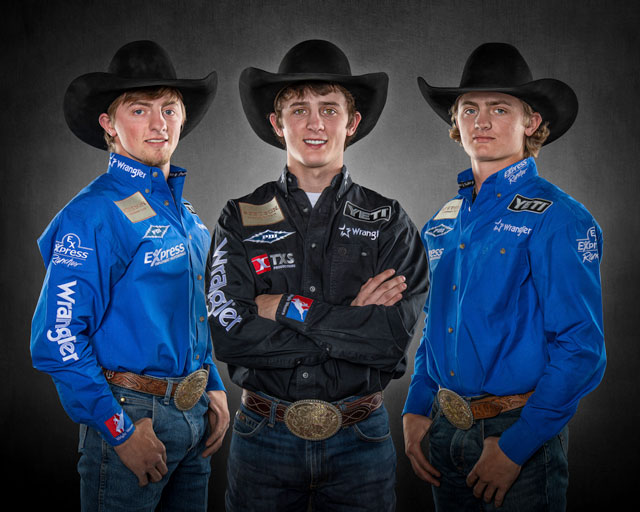
Now, at the age of 20, he’s joining his two brothers at the WNFR. “I didn’t know how soon it was going to happen, but I’m glad it’s now,” said the Beaver, Utah, cowboy who is going to Vegas sitting second in the bull riding and leading the all around. “I felt like I was ready, but I didn’t think I would have this much success this soon – I’ve always expected it of myself. Me and my brothers have always dreamed of this since watching my dad.” And watch their dad, Cody, is what Stetson has done since he was little. He’s been to every performance of the WNFR since he was three years old, watching dad for 13 years, then Rusty, who made his first WNFR in 2015, then Ryder in 2016, and now he is going.
The Wright family has made NFR history twice now – in 2014 when four of them (Jesse, Jake, Cody and Spencer) all qualified for the WNFR in the same year and again in 2016 when Cody and his sons, Rusty and Ryder, became the first father and two sons to compete in the same event at the WNFR.
“In my opinion, my dad’s the greatest bronc rider that ever lived. He might not have 6 world titles to show for it, but he’s perfected the style – he stays back, sets his feet, and he’s fast. From a husband to a dad – everything – he’s great. He tells us to trust our stuff and keep gassing it and just perform like you’re in the practice pen. He keeps us all positive; he’s a very positive guy.”
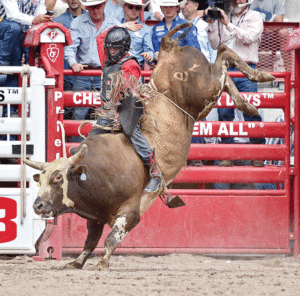
Stetson, winning Cheyenne with 93 points on Dakota Rodeo’s Safety Meeting – Hubbell
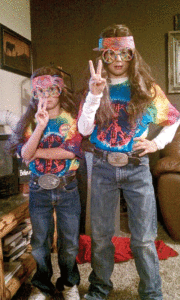
Statler & Stetson hippy day, 2010
Junior High rodeo in Nephi, Utah – courtesy
The boys wrestling – courtesy
Cody enters all three of his sons as well as two others. “He’s one of the best – he enters five guys and all five of us made it to the Finals this year. If we didn’t have him, we’d lose a lot of sleep. He wakes up every morning, looks at the books and enters us.” Along with entering the boys, Cody enjoys training dogs – border collies and kelpies. “Training dogs and entering us makes his living.” Along with his two older brothers, Rusty and Ryder, Stetson has a younger brother, Statler, 16; and a younger sister, Lily, 10. “Stetson’s my middle man,” said his mom, ShaRee. All of her kids rodeo and say collectively that if Lily could ride rough stock she’d be better than all the boys.
Stetson started riding broncs the summer before his freshman year in high school. He started riding bulls in the 5th and under state program and then did junior high and miniature bulls before getting on bulls in high school. “I honestly wasn’t good at riding bulls, Rusty and Ryder were better and it bugged me that I wasn’t good at it. It finally clicked my junior year and it’s been good going ever since.” He also played football and wrestled.
His senior year, 2017, he won the National High School Finals All Around along with All Around at the IFYR the same year. After high school, he rode on his permit in 2018.
Easter 2007
Junior High Nationals
Riding at Cheyenne Frontier Days – Hubbell
Milford little league football – courtesy
He had a setback last year in Kansas. “I had won about $70,000 on my permit. The bull stepped down on my hips. I tore my knee and it put me out for the rest of the year.” When he went to enter San Angelo, he had $100 left. “That made me really smart about my money. It was an awful feeling.” He won the first round and that put $5,000 back in his pocket. He won two rounds in San Antonio, so left there with over $20,000. That made rodeoing a little easier on my stomach.”
He had another setback when he broke his jaw this July in Kansas. “Honestly, it didn’t give me a concussion; it was such a perfect hit under my jaw. He hit me in the head first time, and that slid my helmet up; now I’ve got plates and screws and I lost four front bottom teeth.”
He kept riding horses, but didn’t do as well as he had hoped. He got on his first bull in St George, September 21, but had slipped behind Sage Kimzey in the standings. “I passed him and broke my jaw. There’s plenty of money to be won. If I didn’t think I could win, I wouldn’t have bought my card.”
Stetson will join his two brothers as the recipient of the Resistol Rookie of the Year in the saddle bronc riding. He is also a contender for the All Around and Bull Riding saddles. “It’s not surprising,” said ShaRee of her son’s accomplishments. “He has always been a determined kid. Once he sets his mind to stuff, he works to get it. It’s super neat to see him work towards these goals. It was a setback when he broke his jaw July 31 in Dodge City, the day after his birthday.” That rodeo was one he went to by himself. “He usually travels with Ryder, and he was by himself. “I think they are each other’s biggest support team,” she said. “It’s hard as a mom when you have one that wins and one that doesn’t.”
Now that Stetson is about to get on 10 bulls, he is working on keeping in shape. “I’m hopefully going to be healthy and fast so I can outlast everyone there.” He’s doing it with speed and agility drills, to get his feet fast. He likes to ride his bike too. “I jump up on crates, sprint through ladders, and run across the field. Mostly running and jumping.” His goal for the WNFR is to be the fourth guy to ride all ten bulls at the NFR; Jim Sharp, 1988; Adriano Moraes, 1994; Norman Curry, 1990. “I figure if I did that the world champion would come easy.”
After the WNFR, Stetson and his fiancé, Callie, will welcome their first daughter in January. The couple plan to marry shortly after the WNFR. Stetson will start the 2020 season in Denver. “I’m going to get on for as long as I can,” he concluded. “I’m excited to see what’s in store for us.”
God will always provide. He will provide what we need when we need it. The importance of remaining patient and continuing to trust in his will and his plan is important. Lately, the story of Abraham, Sarah, and their promised son has really intrigued me and inspired me to keep trusting and know that God is faithful.
In Genesis 18 the story begins with Sarah and Abraham being told by the Lord through three visitors that when one of them returned at that time next year that Sarah would have a son. Sarah laughed to herself thinking she was too old and worn out to bear a child. She didn’t think there was any way that she and Abraham could have a child. In verse fourteen the Lord replied “Is anything too hard for the Lord? I will return about this time next year, and Sarah will have a son.”
In chapter twenty one, the first verse says “The Lord kept his word and did for Sarah exactly what he had promised.” So, Sarah became pregnant and gave birth to Isaac. This happened at the exact time God said it would. Abraham was a hundred years old at the time of Isaac’s birth. Not only was the birth of Isaac a miracle but a true witness of God’s faithfulness on his timing.
Abraham and Sarah were promised over twenty five years before this, that they would have a son. Twenty five years, I don’t know about you, but most of the time I don’t even want to wait twenty five minutes let alone years. Human nature is to question the timing of God just as Sarah did. She thought there was no way after so many years that she could have a child, but as we see, since the beginning of time NOTHING is impossible for God. The same is true today. When we think there’s no way we can get our miracle, or when we think its past time, God is always working something out. God is always faithful even when we don’t see it. He’s always working out his plan, on his time, for his glory.
Well it is hard to remain strong in faith during our waiting seasons you might say. God never promised that waiting would be easy. He never said waiting wouldn’t test us. He never said waiting would be a walk in the park. I will agree, our human nature wants what we think is best for us right now, but in Isaiah 40:31 we see the benefit of waiting through our struggles. “But those who trust in the Lord will find new strength. They will soar high on wings like eagles. They will run and not grow weary. They will walk and not faint.”
God will keep us going. God will strengthen us through our struggle. When we take our eyes off the mountain, and keep them on the mountain mover, God sustains us! I encourage whoever is reading this to keep going. Don’t give up. Don’t give up on that dream God gave you. Pick it back up and and keep working on it. Keep believing. Keep trusting. Keep waiting patiently. God is faithful and will bring it to pass! Is anything to hard for the Lord?
For this article I want to give a little progress update thus far in our journey. I say our journey for a reason. There are so many people tied to this story other than just myself. I’m not the only one that has been impacted by this wreck. My wife, my family, my friends, the people I didn’t know before that I have met since, the prayer warriors that are still praying and standing in agreement for the miracle, all the people along the way that have have helped us out, my doctors, therapists, and everyone else in between. I have been blessed with such a huge support group and I can’t thank everyone enough for the prayers, kind wishes, help, and belief in me and what God is doing and going to keep doing through me for his glory at the end of this season. Thanks also, for following along checking in on progress. It’s been a heck of a ride that’s for sure. Bumpy at times with a few steep decline mountain switchbacks but, we’re still on the uphill climb, and I’m not about to let off the throttle just yet.
So, this is the month that I’m going to have my one year anniversary, post wreck. September 22nd will mark 365 days since we began down this journey. I’ve came a long ways and have learned a lot in the last year. I’ve learned patience. I’ve learned perseverance I didn’t know I had. I’ve learned how to adapt and overcome like never before. I’ve learned the ins one out of wheelchair life. I’ve learned how to be a dad (still learning this one). I’ve learned how to truly put everything in God’s hands and trust his plan. I’ve learned how to place things so I can always access them. I was short before but the last year I’ve been really vertically challenged. But seriously, I thought I knew or had these characteristics before, but I have really learned them and enhanced them in the last year. Although, the situation isn’t ideal for me. I would definitely rather be walking, running, jumping on my feet, I know my character has been refined, built up, enhanced, and made stronger. I know once I’m out of this waiting season all the lessons I’ve learned and the character that’s been built in me will be used for something great down the road for God’s glory.
On Labor Day, Shelby and I loaded up Ryatt (our son) and headed for Utah. I had been invited to a charity pheasant hunt, that Clint Robinson puts on for people with disabilities. Since I knew I was going to be there for the hunt, I scheduled a week of rehab at my old facility, Neuroworx. I wanted to get retested to see how much progress I’ve made since coming home in April, and see what their thoughts were and what to do moving forward. We checked back into our old apartment room Monday night and prepared for rehab the next morning.
The next morning it was like dejavu. The room felt the same. The stroll down the sidewalk to rehab was the same. Everything about the morning was like we had never left. We strolled into Neuroworx, and of course everyone was excited to meet the baby. They all came and said hi to the little man. Then, my former therapist from the time I was down before took me back to a mat for retesting. The moment was upon us. Had I made any changes since being home? Had I worked hard enough? Was I going to be able to walk? These thoughts began to flood my mind and I just said a quick prayer to myself and said “Lord, your will be done. Let any new results bring glory to your name. Bless his hands and the work we do this next week. And bless this place as it is changing lives, thank you. In Jesus name, Amen.”
The first test was a sit up. With my legs hanging off the table, and arms crossed I tried to sit up. I got about half way or a little better. Matt, the therapist was impressed. The time before I could only sit up about a quarter of the way. Next test was a reverse sit up. So leaning forward laying on my lap trying to sit back up straight. I gave it a go and I made it about half way up as well. Time before I couldn’t even get started off my knees. Next test was side to side and forward reach without losing control of my trunk. Each direction I could reach about five inches before loosing control. About four inches more then when I left. This concluded testing and Matt was happy to see I made so much progress. Doesn’t seem like much but in this game progress is progress. He told us first of all we don’t usually see people back when we send them home with an at home program, and we definitely don’t expect to see this good of results from at home therapy. So, I had jumped a level on every test and was on the right track. I didn’t have any new significant leg movements that they felt like I needed to stay and work there yet, but I had made leaps and bounds on trunk control and strength. So, the next step was to work our way down and begin getting more hip control. They said when I get hip control and get those muscles stronger and firing better, it will be a game changer. So, we got to work. The next three days we put our heads together, tried new movements, and came up with a different set of work outs to head home with, challenging me and focusing on getting my glutes to fire, and gaining more control at my waist.
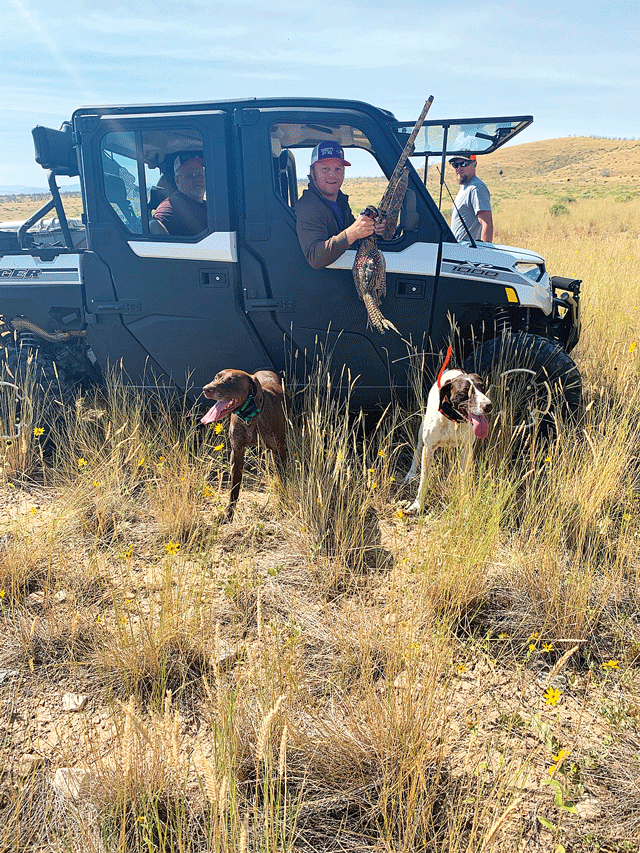
Then Saturday came. My old leather working buddy from down there, Kent and his son, Craig picked me up and we headed to the bird hunt. There was about twenty other people in wheelchairs all ready to shoot some birds. We gathered around had a little safety meeting, like don’t shoot the vehicle next to you and don’t shoot the dogs. We each loaded up in a side by side and in groups of five we headed to different fields. At each field there was dog handler and a couple dogs. He turned the dogs loose and away we went. We followed behind until the dogs got on point. Once they sniffed one out, a few gathered around it, got set and in position leaning the gun out the front window of the Ranger. Once we were set they would flush them up and the shooting would begin. It was an awesome experience. I hadn’t been bird hunting since high school, so it was good to get back out and do some hunting. It was a great event, and all the help setting up, taking down, and everybody that pitched in to make it all happen is greatly appreciated!
Over all it was a great trip, filled with good news. God is good and he is faithful. He’s still on the move. We’re still believing in the miracle. We’re back home and back to work, picking away. I’m excited to see where I’ll be in 365 more days!
“For our present troubles are small and won’t last very long. Yet they produce for us a glory that vastly outweighs them and will last forever!” 2 Corinthians 4:17 NLT
Lydia Moore was raised in a rodeo family in Missouri. Her parents, Hazel and Percy worked for many rodeo and wild west show companies traveling the country with her older sister, Maudie, and younger sister, Percyna in tow. Maudie was a trick rider and roper and Percyna had a goat act. In fact, Percyna was actually born in a tent while on the road for the Colonel Jim Eskew Wild West Show.
Lydia was forced to stay home most of the time as a tot with her grandfather, John Hickey, due to poor health. “I had no stomach lining when I was born,” said the 80-year-old, who now resides in Wayne, Oklahoma. “I drank goat’s milk and built up my resistance.” She finally grew out of the condition when she was ten years old and learned the art of trick riding and roping. “My dad taught me trick roping and my mom taught me trick riding,” she said. Rodeo season back then didn’t last all year like it does now – her parents were gone from April until September and the other months they were home. When they were home, they trained horses that went on to perform in wild west shows, movies, circuses, and elsewhere.
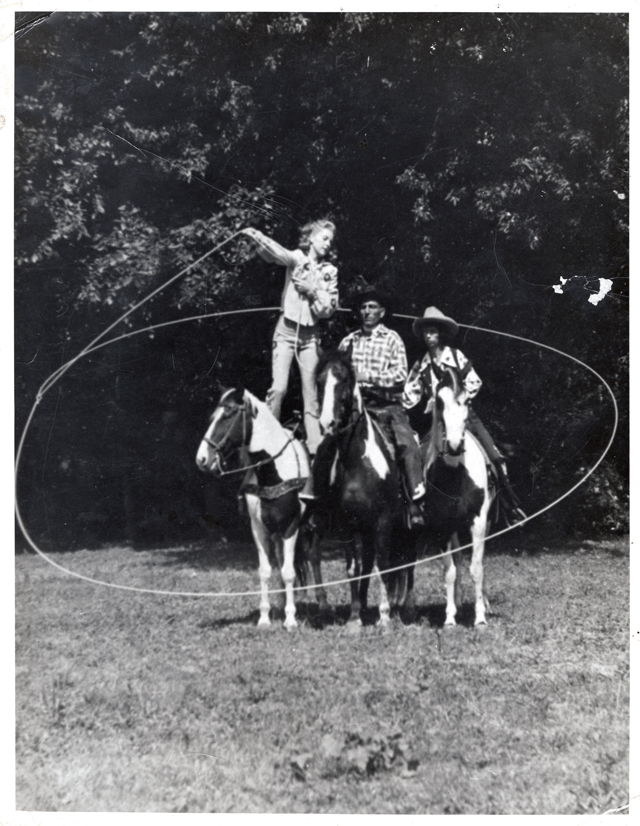
Performing dressage and liberty act maneuvers on her horse, Bullet at age 15.
Top row: Cindy Rosser, Renee Kenney, Dale Bibbo, Kay Davis, Wanda Bush, Lila Mae Stewart, Sandra Turley, and Dixie Pring. Bottom row: Pam Minick, Lydia Moore, Jimmie Munroe, Petesie Eberhart, Sue Pirtle (all girl rodeo). Womens Professional Rodeo Association board of directors including all girl rodeo director Sue
Lydia with her grand daughter, Darcy Good, 2019. – Taylor N. Photography
Her parents, Hazel Hickey Moore, a noted circus equestrienne, who gravitated towards the wild west show side of entertainment when she married her husband, saddle bronc rider, and steer wrestler, Percy Moore, both instilled in Lydia a love of horses and all things western. Famed trick roping performer, calf roper, and steer wrestler, Billy Buschbom, also helped Lydia with her trick and fancy roping and gifted her with her first set of ropes. “The Buschbom’s and my family were very close friends and worked for many different wild west show companies.” As a youngster, Lydia performed with her family in dressage and trick roping acts, and won many talent contests as a teen with her skills.
Lydia’s dad, Percy, broke his leg while competing on a saddle bronc, Preacher, Dun, at a rodeo produced by Monty Reger. The rodeo was in a resort called Sylvan Beach in Kirkwood, Missouri, a suburb of St. Louis. The family settled there while Percy recuperated, and afterwards was hired to manage the boarding stable. The entire family worked at Sylvan Beach. Young Lydia and Percyna worked as lifeguards, took riders from the boarding stable out on trail rides, as well as running pony rides. They also performed different circus and wild west show acts that Percy, Hazel, and Lydia were in.
Lydia was introduced to barrel racing by accident. “The annual St. Louis Fireman’s Rodeo produced by Tommy Steiner, was in town around the early 1960’s. Wanda Bush, Fanny Mae Cox, and Boots Tucker, all barrel racers from Texas, were in town for the rodeo. They didn’t have enough barrel racing contestants, which was a new event for the rodeo. Wanda reached out to a local horse facility, Valley Mount Ranch, since Wanda knew they were starting to have barrel races at that arena. Lydia was one of the ladies invited to enter.
Lydia went to a few barrel races, but due to her own family responsibilities, she was unable to pursue it. “I wasn’t driven like the other girls were. I was more interested in the administrative side.” In the early 1960’s she helped form the first chapter of the Girls Rodeo Association. “A group of barrel racers in the St. Louis area got together, and since we all worked full time, we had some administrative skills and used the guidelines of the GRA to form the chapter. We had advisors that we knew could help us, and they were instrumental.” While living in St. Louis she met one of her mentors – famed rodeo secretary June Ivory. Lydia learned to secretary and time rodeos from June, and over the years worked for many stock contractors like Beutler & Sons, David Bailey, and Jim Shoulders’ rodeo companies, and is a longtime PRCA gold card member.
After Percy Moore passed away in 1962 from emphysema, Lydia’s mom, Hazel, moved in with Lydia and her toddler daughter, Linda. (Lydia only has one daughter, Linda). Percy had been a lifelong smoker. He started smoking as a teen like most young men of that era. He either rolled his own or smoked non-filtered cigarettes. He was even hired as a young man to model for a few Chesterfield cigarette ads.
When Lydia made the move to Oklahoma City in 1967, it was with her mother Hazel, sister Percyna, and daughter Linda. She worked as a secretary for an oil field company upon her arrival. Before moving to Oklahoma, June Ivory had introduced Lydia to Stanley Draper and Bobbie Steenbergen from the Oklahoma City Chamber of Commerce who worked with Clem McSpadden, Buster and June Ivory as the group managing the National Finals Rodeo. “It’s hard to imagine, but during the early years of the NFR in Oklahoma City, there was little interest in the Finals. When it first moved there, tickets didn’t sell well – we had dinners and parades in downtown Oklahoma City to sell the event.”
Dottye (Krause) GoodSpeed Percyna Moore, and Lydia Moore at a barrel race in Kankakee, Illinois in the 1960s
Lydia Moore hired as Girl’s Rodeo Association executive secretary, 1973.
Lydia barrel racing at Denver Stock Show RCA rodeo, 1968. Photo by Jan Spencer – Jan Spencer
With the NFR’s move to Oklahoma City, Oklahoma barrel racer Florence Youree worked with Stanley and Bobbie to bring on the barrel race as one of its standard events. Florence’s pitch worked and the event was sold as – “pretty girls on fast horses,” Lydia said. Needing a liaison for the barrel racers, as a go between to handle any issues barrel racers had, Lydia was hired. She worked in that capacity until 1985 when the NFR moved to Las Vegas.
Adding to her jobs at the NFR, Lydia was hired by NFR manager McSpadden and stock superintendent Ivory to handle all secretarial duties in preparation for the National Finals each year and also ran the NFR press room with Arlene Worley. “Two weeks before the finals as the livestock came in, Buster and Clem needed someone to type the stock lists, so since I lived there, I’d take my vacation during the Finals and type the lists as the contractors came in.” “It was fun – Buster and Clem were wonderful. It was great to be part of it. They were so super to work with. And I knew all the contractors from secretarying and timing rodeos.
Lydia also received the task in those early years of the NFR as the GRA Awards Chairwoman for the barrel racers garnering thousands of dollars of awards for the ladies each year. “I wrote letters to various companies and everybody I saw that had a business, I asked for awards. I was even able to get a car and a horse trailer donated. Imogene Veach Beals who owned a large western store, Veach Saddlery, in Tulsa, Oklahoma, was the first donor I got.” Lydia’s dedication came from her interest in doing something for the girls.
Continuing her interest on the business side of women in rodeo, she served five years on the GRA board of directors as Bull Riding and Southeastern Region Director, before being hired as the executive secretary in 1973. “At that time, the GRA had all of the rodeo events – we had a lot of all girl rodeos – we used to have approximately one a month back in the day – we had a lot of great girls. Unfortunately, they don’t have any all girl or women’s rodeos anymore.”
GRA president Margaret Clemons hired Lydia on a six month trial basis to be the secretary of the GRA – that tenure ran for two years and every two years they had an election. “I was at the meeting as the Southeastern Director and was hired by the board. I was able to quit my day job and I really became involved in the women’s rodeo part there.” Since her position came up for renewal every two years, there wasn’t a lot of job security in it. Her job ultimately lasted nearly 25 years.
When she got the job, she converted her garage into an office. “There were a few boxes of records, 400 members and $800 in the bank. (A GRA card cost $25 in 1971, for example.”) (The WPRA card cost $150 in 1995, the last year we were in the WPRA office). When she left there were 2,000 members and the association was financially secure. “We ran a very efficient office and did everything we could for the members – Jimmie Munroe and Pam Minick were great at promoting the association.” She enlisted the help of her daughter, as well, along the way. “We all enjoyed working in the WPRA office,” said her daughter, Linda Clark. “Percyna and I did the newspaper and we are all a very close unit. We’ve always worked together. I typed envelopes on an old IBM Selectric electric typewriter when I was 13 – I totally loved it.”
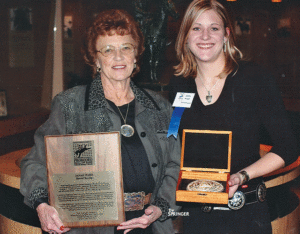
“She was the glue that held the WPRA together,” said Pam Minick. “She ran the association like she ran her household – she tried to save all the money she could. It was a 24 hour a day job for her.” Pam went to her house every October to help stuff envelopes for all the contestants. A prized honor she received in 1991, known as the WPRA Coca-Cola Woman of the Year, was awarded to Lydia for her years of service, passion, and devotion to women in rodeo, and rodeo in general. “I was absolutely thrilled. When Coca Cola put together that award for our association it was fabulous. Wanda Bush was the first honoree, Jimmie Munroe was the second, Pam Minick was the third, and I was the fourth.” The coveted bronze statue was created by artist and NFR qualifier Karen Galemba. Lydia feels fortunate to have seen firsthand the phenomenal growth in the sport of barrel racing that it enjoys today-barrel racing as a standard rodeo event, equal money at rodeos, and equal money at the National Finals Rodeo.
Her second award will be received in November when she will be inducted into the Rodeo Historical Society Hall of Fame. “I feel absolutely the same about this one – I’ll be emotional to be recognized at this chapter of my life. I help Linda in her business and enjoy what I’m doing. I’m blessed with good health and it’s great. I’ve been very blessed. I have a beautiful daughter and granddaughter that I love. They and their families help take good care of me.”
Doug Clark will receive the coveted Ben Johnson Award at the National Cowboy and Western Heritage Museum’s annual Rodeo Historical Society’s Hall of Fame Gala on November 9. Doug was born in Tulsa, Oklahoma. “I grew up in a saddle shop – Veach Saddlery – which belonged to my grandfather, Charley Beals, and was started 100 years ago by his father in law, Monroe Veach.” He spent his summers and every day after school at the shop. “I helped make saddles and repair things. My dad tooled all the saddles for years there and it’s a family business so we did a little bit of everything.”
He started tie down roping when he was 10. At that same time, he started competing in the junior rodeos in all events. “They were called FFA rodeos,” said the 57 year old that calls Wayne, Oklahoma, home. “I was fortunate enough to be around the right guys and my dad was quite a horseman. We are a huge rodeo family, so that’s all we do.” Doug and his family lived in Tusla and in the early 70s they moved 90 miles east of there to get out of town. They built an arena and that’s where Doug really started honing his skills. He went one year to the IPRA rodeos, competing in tie down roping and team roping (heeler), earning the title as Rookie of the Year in the tie down roping. He hit the road in the PRCA circuit in 1981, as soon as he was 18. He was ranked in the top 20 year-end standings for several years, winning the top rodeos and invitational ropings of the year, nationwide, while traveling on a part-time basis. He was the PRCA’s Prairie Circuit Champion tie down roper and competed in many circuit finals in that event. He set an arena record at the Cheyenne Frontier Days in 1987 when they roped calves weighing 280-300 pounds, as well as winning their coveted championship buckle for the all-around title in 1995. He added steer roping to his events entered and in 2005 earned the Pendleton, Oregon Round-Up steer roping championship. The win helped boost him to the qualification for the 2005 PRCA National Finals Steer Roping where he won second in the average and top horse of the finals.
Darcy (Clark) Good & Doug Clark, Bob Crosby steer roping champion, Roswell, New Mexico 1995
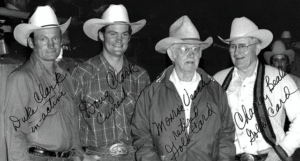
L to R- Duke Clark (Doug’s father), Doug Clark, great grandfather, Monroe Veach, grandfather, Charley Beals. Early 1980’s – Courtesy
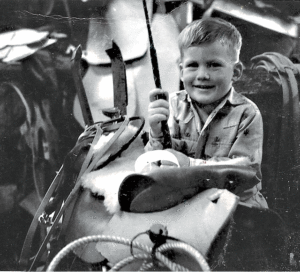
: Doug in Veach Saddlery, Tulsa, Oklahoma, his grandparents saddle shop. This photo was featured in Western Horseman article in early 1960’s – Courtesy
“I went as much as I could – I never set a goal to win this or that. I was training and traveling with some of the top guys so I couldn’t really go as much on my own.” Doug was riding and selling what he was riding to those guys. Doug has had horses either owned or ridden by Clark Quarter Horses at the National Finals Rodeo and National Finals Steer Roping Finals for over 30 years. Much of Doug’s career has been riding and training horses for the top ropers of the day, like Trevor Brazile, Tom Ferguson, and Roy Cooper. Never ‘living on the road’ entering and competing in rodeos, Doug’s real passion and specialty has been in training horses and people in a clinic format and one-on-one training in his home. “My dad was a great horseman – a quiet mild mannered gentleman – and learned how to be a good judge of horse flesh.” Doug was influenced by the old timers – great horsemen and ropers.
Along with the pros, Doug and his wife, Linda, have had the privilege of helping kids along the way. “We’ve had a lot of kids come live with us over the years. We still take kids in who want to get better in rodeo – but really it’s all about life – it all goes together.” Every one of the kids that have come through his doors has learned about everyday living. “That includes everything from riding 20-30 horses a day, shoeing, fixing corrals, cleaning pens – you name it.” It’s the Doug Clark school of hard knocks. The kids come in, learn how to be horsemen – sleep on a lumpy old couch and work alongside Doug to achieve their goals.
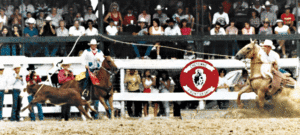
Doug at Cheyenne Frontier Days,1987, setting an arena record (11.1) over a 30-foot score and calves weighing 280-300 – photo by Jan Spencer
Doug riding “Touchdown”, 1993 horse owned by Doug that went on to be owned, ridden, and helped garner championships for many PRCA cowboys. – dudleydoright.com
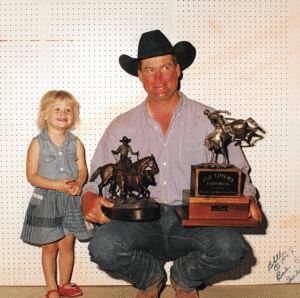
“The parents entrust us with their kids and that’s a huge compliment,” says Linda, who is the cook, but doesn’t admit to being the cleanup. Doug and Linda have one daughter, Darcy, who competed as well. Doug and Linda got married in 1985. “We met on Valentine’s Day at Baton Rouge at a rodeo,” he recalls. Six months later Doug and Linda were married. Darcy was born in 1991, and joined the rodeo road when she was young. “When Doug was horse showing, she went along. “We won a lot of awards including the Super Horse in 1999 one year, competing in all the roping events.” He was a trainer and exhibitor and judge during his time at the AQHA. Darcy competed on Doug’s old roping horses and qualified for the CNFR in 2008 in the barrel racing. She also won the breakaway at the IFYR in 2006. Darcy and her husband, Billy Good, a steer roper, still hit the rodeo road. Linda works part time as well as running a courier business with her daughter, Equine Courier Services, driving 10,000 miles a month delivering semen and embryos.
Not only does Doug train horses and hold clinics at every age and skill level in all roping disciplines, but for many years he showed horses in the American Quarter Horse Association. He was one of the teammates winning the 1999 Super Horse Award showing the stallion, Look Whos Larkin. Doug also has been involved training and even owning three of the many horses recognized as finalists for the AQHA/PRCA Horses of the Year, which is an award voted on, annually, by top ranked cowboys.
Doug has enjoyed his entire career and life being around the horse industry as a fourth generation rodeo participant. “I enjoy what we do and I want to keep doing it. We’ve got some good kids and some good horses,” concludes Doug. The Ben Johnson award is bestowed upon a person who has had a notable career in the arena, as well as, working outside the arena helping others to achieve their rodeo and personal goals. “I was honored with the award – I didn’t even know I was in there – it’s not what happened in the arena as much as what you can do for other people and helping them get where they want to go.”
Every day, Nollie Launius makes strides toward his dream of becoming a professional roper. The 10-year-old cowboy from Nashville, Arkansas, is already a dual-event champion in the Southern Junior Rodeo Association, competing in team roping, breakaway roping, and goat tying.
He’s traveling the rodeo trail with a prosthetic leg, born with one bone in his left leg instead of two, a birth defect called fibular hemimelia. While Nollie has had a prosthetic leg from the knee down since he was four and a half months old, with the exception of a slower dismount in the goat tying, his competition knows no limitations. “The biggest trouble we have with it is that his leg doesn’t move, so keeping it in the stirrup is a big challenge,” says Bill Launius, Nollie’s dad. “His prosthetic doctor came up with a wrench we could use to turn his foot so it stays in the stirrup, but then when he’s done, his foot is turned the wrong way,” he adds with a laugh. “We did get some stirrups that are curved, but most of the time, he rides with one foot in the stirrup and one foot out.” Nollie also has zippers put in his boots so he can easily slip them on.
As Nollie grows, so does his prosthetic foot—he’s on his 14th replacement, but saves his smaller prosthetics, particularly ones that have been signed. “Wade Sundell the bronc rider signed my leg, and we met Kory Koontz at a rodeo, and he didn’t have anything to sign it with, but he took a picture with us,” says Nollie. “Shawn Harris and Jimmy Driggers help Nollie a lot at the rodeos with team roping,” Bill adds. “There have been lots of people helping him because he has such a passion for it and he works so hard.”
“I want to do it every day,” says Nollie. “I want to be a professional roper, and I like to watch Kaleb Driggers.” Nollie won two saddles of his five saddles in the SJRA this year for breakaway roping and team roping, the same events he won last year as well. His favorite event is team roping. “I head, and I’ve been roping since I could walk. I’m learning handling steers and horsemanship, and I rope with my dad a lot. My mom (Michelle Launius) and dad come help me with practice—they turn out steers and they’ll pull the dummy for me,” says Nollie. His 8-year-old brother, Henry, enjoys riding and roping, and he competes in junior rodeos as well. They also have an older brother and sister, Casey and Cassidy, who are twins.
Family is one of Nollie’s main motivators in rodeo, from his parents to his grandfathers. His great-grandfather Clay Godfrey was Nollie’s biggest fan, faithfully cheering him on until his passing in April. He helped Nollie get started with roping dummies and finding two of his main horses, while Nollie’s grandfather Thomas Launius shoes all his horses and cares for them daily. “I have Blazer—I use him for heading—and I have Doc, and I use her for breakaway and goat tying,” Nollie explains. “I have a horse Zero that I use for heeling. My mare Chavez is my favorite because she’s a Paint and she’s my favorite colors, red and white. I pull bulls and broncs on her too.”
Nollie and his dad enjoy helping pick up broncs and bulls at Riding for the Brand youth rodeos around the area, while Nollie also loves to work cattle for friends. Whatever the job, he saddles up his horses with a 5 Star Equine pad, which he and his dad started using several years ago. Nollie purchased his 5 Star pad with the first rodeo check he ever won, and plans to buy another when his entry fees are squared up. “It protects my horses’ backs because I ride a lot,” says Nollie, who’s hoping to join their Rising Stars program in the future.
If he’s not roping, Nollie is at the very least thinking about it, or studying team roping videos. He pulls himself away from the arena long enough to attend Nashville Elementary, where he just started fifth grade and enjoys math. Then it’s back home to his horses, while he also enjoys deer hunting and playing basketball with his siblings.
“I want to go to the NFR, and I probably will junior high rodeo soon,” Nollie finishes. He extends his thanks to his sponsors, Trinity Ropes, and Horton’s Orthotics and Prosthetics, and says, “Thanks to the one who paid it all and gave me this ability and talent, my Lord and Savior, Jesus Christ.”
Lee and Dixie Wheaton have five PRCA gold cards within their family. Lee, a former multiple-event contestant, and his wife Dixie, a barrel racer, each have one. Their daughter Deena Wheaton, has hers, and Dixie’s dad, 1939 world champion steer roper Dick Truitt, had his gold card. Lee and Dixie’s niece, Trula Truitt Churchill, also has hers.
Lee began life in Rochester, New York, the son of Mel and Dee Wheaton. His dad owned a dude ranch, with weekend and overnight guests, and part of Lee and his older brother Jim’s job was to take care of the up to 100 head of horses that were kept. Each year, Mel would send for a new load of horses from the west, and Lee and Jim’s job would be to make dude horses out of them. “Some of the horses that came to us were not gentle enough for eastern dudes,” Lee remembered.
When Jim started rodeoing, Lee wasn’t far behind. Lee began riding bulls in 1947, when he was twelve years old. His dad had produced rodeos for a few years, at which Lee sometimes served as the bullfighter, and his parents were supportive. At the time, New York State had lots of open and amateur rodeos. Lee competed at rodeos put on by Pappy Westcott and his son Jackie, and the Baldwin family, among others.
Dixie Truitt was born in 1940, in Ada, Oklahoma, the daughter of Dick and Juanita Truitt. She traveled with her daddy as he rodeoed, and when she was twelve, she began barrel racing. In 1956, she got her Women’s Pro Rodeo Association card when it was the Girls Rodeo Association, and in 1959, she qualified for the first National Finals Rodeo, but her daddy wouldn’t let her compete because it was during college finals tests.
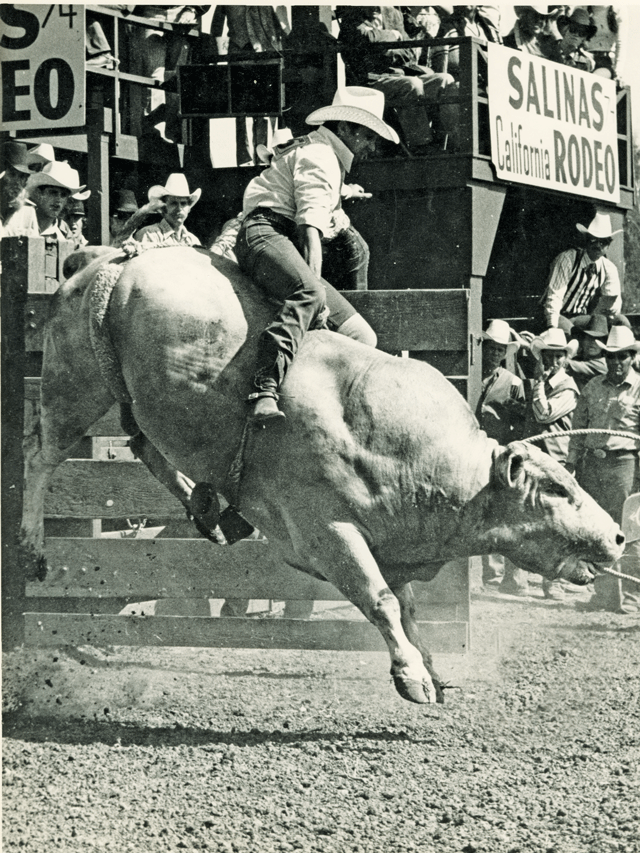
Dixie Wheaton in Salinas, 1974, 4 go rounds. Dixie won 3. – Foxie Photo
Riding Big Belt Buckle Little Money in Leon Iowa, May 1983 – JJJ
Lee graduated from high school in 1954 and amateur rodeoed up and down the East Coast. Two years later, he joined the Rodeo Cowboys Association, and went farther, traveling to the south and crossing the Mississippi River, going to rodeos in Missouri.
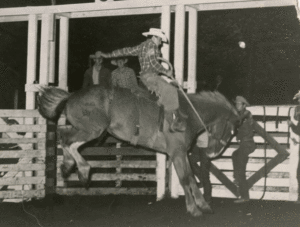
He was doing all three roughstock events and even steer wrestling, occasionally. In 1956 and 57, he worked for Frontier Town, a tourist attraction in New York. Frontier Town held three mini-rodeos a day, featuring one bareback ride, one saddle bronc ride, one calf roping run, one steer wrestling run, and one bull ride, plus contract acts. Lee was the roughstock cowboy and even steer wrestled a time or two. On Saturday nights, he’d drive the sixty miles to the pro rodeo in Lake Luzerne. “We’d drive like hell to get there, and contest there,” he said. He won the saddle bronc riding and the bull riding at Lake Luzerne’s series one year. He and his buddies would also take off for Cowtown, New Jersey, and compete there.
Once he expanded his territory because of his pro card, he went to Florida one January, but with no success. “I rode every bull I got on, and never won a penny,” he remembered. It was before public announcement systems and riders didn’t know their scores till they looked at judges’ sheets after the rodeo. In Okeechobee that year, he rode a bull they had placed on regularly. “Everybody patted me on the back and said, ‘that ride looked great.’” But he didn’t win anything. Afterwards, he went to the judge, Buddy Medford, and asked why he didn’t place. “Buddy said, ‘that bull jumped and kicked but he didn’t spin.’”
The next week in Kissimmee, Lee covered another bull with a good ride. “I had a bull that spun, wound it up, and again, everybody was saying, ‘that was a good ride.’” When the rodeo was over, Lee hadn’t won a dime. Medford was judging again, and Lee asked what the problem was. Medford replied, “Lee, he spun real good but he didn’t jump real good.’” They held it against him, that he was a Yankee and was a newcomer to the South.
Every October, when rodeos had slowed down, he headed back to New York. Depending on how he had done, he either got a job or hunted all winter. Then, in January, he’d head back to Florida and start all over again.
Lee met Dixie at a rodeo in Cookeville, Tennessee in June of 1961. They married in Iowa two and a half months later. They had planned to rodeo in place of a honeymoon, but Lee had torn up the palm of his hand and it wasn’t healed, so they took off. “We honeymooned in 21 states and five provinces,” Lee said, visiting Niagara Falls and other sites. The first bull he got on after marriage was one he’d won on a few times. For that ride, “I fell off like a big toad,” he said. “My buddies came around and said, “Damn, Lee, married life doesn’t agree with you, does it?” he laughed.
That fall, Dixie, who had graduated from East Central College in Ada, Okla., had a contract to teach physical education in Wichita, Kan. So they got an apartment in Wichita, got Dixie settled in, and Lee hit the rodeo trail again.
They stayed in Wichita for a year before going to Scott City, Kan., where Dixie spent four years teaching physical education: archery, swimming, bowling, basketball, tennis, and more. They moved again, this time to Dixie’s home state. “That Oklahoma girl got homesick,” Lee said. She had been working on her master’s degree and got a teaching job in Tulsa. It was 1965, and they moved to the place where they still reside, near Mounds, Okla., just south of Tulsa.
Dixie taught school in Tulsa from 1965 to 1992, teaching P.E. and coaching basketball. She was awarded the girls basketball coach of the year honors in the First Frontier Conference, and finished her teaching career at Will Rogers High School in Tulsa. She switched to the classroom, teaching child development, parenting, and psychology.
While at Will Rogers High School, the school had an annual roping contest among staff. Dixie won it several times, having grown up with her dad, the world champion steer roper, her uncle Everett Shaw, a six-time RCA steer roping champion, and her maternal granddad, Cole Underhill, a steer roper before the formation of the RCA.
Lee and Dixie rodeoed through the summers and during the school year, when she came home from school each night, Lee would have her horses saddled and ready to go. They usually bought race horses and Dixie trained them for the barrels. During her years, she had four bays that she considered her best. Levan II, “Reverend,” she considered her fastest horse ever. On Reverend, she won three rounds in Salinas, Calif. one year.
Cajun was another horse that was one of her best, as was Tiny Mark, a gelding from Arkansas, and Strongwall Snip. Dixie was a good trainer, coming by it “honest,” she said. Her daddy trained his own horses, and if a horse didn’t make it as a steer roping horse, Dixie would get him.
Their daughter Deena was born in 1962, and when she was sixteen, she had her WPRA card. Clem McSpadden called Deena “the teenage sensation from Mounds, Okla.,” and she ran barrels along with her mother.
Several times, while he was injured, Lee was called on to judge. In 1965, with a broken arm, he judged rodeos in Ft. Worth, Miami, Fla., and Chicago. He also judged the College National Finals Rodeo three times.
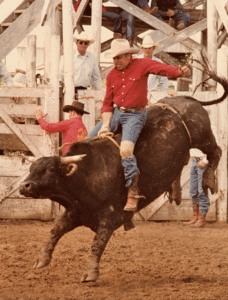
In 1975, Lee quit riding bulls. He’d been an RCA card holder for 21 years, and he still loved the sport, but it was time to quit. Dixie and Deena were still running barrels, but Lee couldn’t go with them. “I wouldn’t hardly go to a pro rodeo with them,” he said. “I knew, if I went, I’d want to get on. I was 41 and that was old enough to quit.”
Painted Pony Ranch Rodeo; Lee Wheaton on Angle Fac, August 1956 – courtesy of the family
Lee Wheaton – Courtesy of the family
In 1980, when Dixie turned forty, her good friend Florence Youree entered her in a senior pro rodeo in Canadian, Texas. Lee went with her, and he saw that the senior bull riders were all guys he had rodeoed with for twenty years. He watched the rodeo and said, “If those guys can still ride bulls, I can too.” The senior pros were fun for them. Rodeoing “wasn’t stressful,” Lee said. “When you left home, you had money in your pocket, and you knew you could pay your bills. You didn’t have to win anything.” The two of them qualified for the National Senior Pro Rodeo Finals each year from 1980 to 1985.
In 1982, Dixie won the year-end barrel racing title for the Senior Pros. That year, at every senior rodeo she ran, she won first place. She rode Dial Doc, a sorrel gelding that she and Lee traded for one of their horses and a tractor and brush hog. Doc, Lee said, was “half lunatic,” a horse who had been soured going into the arena. But Dixie figured out a way to get him down an alley. Two great big Native Americans who were at the senior pro rodeos would get ahold of the cantle and walk him up to the gate. “As soon as he got through the gate, he’d do his job great,” Lee remembered.
Towards the end of his bull riding career in the RCA, Lee took a job with the Oklahoma Department of Agriculture. He worked for them for twenty years, testing for brucellosis and later visiting horse events checking for health papers.
Dixie continued to train horses and ran barrels up to just a few years ago. Between she and Deena, they have trained eight world champion breed horses.
Dixie had a stroke a few years ago but she and Lee still live in their home of 54 years. They celebrated 57 years of marriage in 2018.
They also enjoy Deena’s son, Jesse Chelf, who is in the U.S. Army. Jesse has been stationed at Fairbanks, Alaska and has served tours in Afghanistan, Vietnam, the Philippines and Germany. Lee and Dixie have two great-granddaughters.
Rodeo days were good days, and Lee loved riding bulls. “It was the biggest adrenaline rush I could imagine,” he said. “I still look at bull riding pictures and my heart gets to beating fast, thinking about how good it felt. I loved it.”
They’ve had a good life. “We feel really fortunate. We’ve both never had a job that we didn’t enjoy. It’s been a wild ride.”