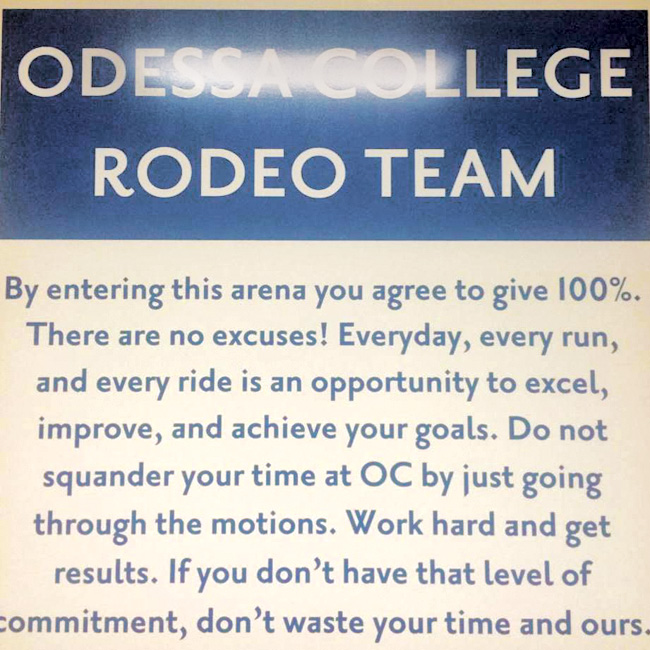
We are talking about practice. We have a sign at the gate of all three of our practice arenas, but there is much more than just the sign.
I recently had the chance to sit in on a conversation with other sports coaches about practice. From experience and the conversation it seems that there is a lot most of us can do to improve practice. Signs and motivational sayings are great, but there is much more we can all do to get more out of practice.
For most rodeo athletes practice time is limited and it is not as structured as most other sports. However the general consensus was that a lot of practice time is wasted because of a lack of focus. Coaches and students alike can have a lack of focus that can waste valuable practice time. Runs and rides in the practice pen should be approached with a high level of focus to get results. If possible find a way, a routine, to focus for your practice. Make your time in the practice pen count.
Student and coaches need to find a way to set expectations in the practice pen. Coaches need to be able to set the expectation of how they want their students to be coachable and students need to understand the importance of being coachable. All members of the team need to understand the expectation of being a good teammate. The final expectation needs to be for effort and energy in the practice pen. There is no substitute to effort and energy in the practice pen, bring it every day.
Finally what is a definition of a good practice? If you have a team with 25 students you will probably get 25 different answers on what a good practice is?
So what is a good practice for you?
Does one good run or ride define a good practice for you?
Does improvement or progress define a good practice for you?
You and your coach should both know your definition of a good practice. Have that conversation with them, whether it is your parents, a paid coach, your high school coach or your college coach. The students who have the most improvement usually have strong communication with their coach.
For most everyone practice time is limited. Make sure you make the most of it. Show up focused and know what you are working on in that practice session. Set expectations that will lead to improvement. Bring energy and effort to the practice pen. And finally know your definition of a good practice.
Category: Uncategorized
-
What is Good Practice?
-
Teamwork
College Rodeo is a unique sport because it blends an individual sport into a team sport. There are only a few other sports that have a similar format, golf and track and field being the most comparable. Individuals compete for individual titles, but they are still competing as a team.
Many students struggle to make the transition from practicing as an individual to becoming part of a team practice. As freshmen this is where I see one of the biggest struggles for students who go to a program that has practices that are run as a team. I have visited with several other coaches and they see the same difficulties in the program each year.
I have had the opportunity to coach a lot of really good individuals and a few great teams. From experience it is exciting and rewarding to have individual success. However the bond you will share with your teammates and coaches from team success is even more rewarding. With team championships the reward is much stronger because of the commitment and work that it took as a group to get there. Many of the following qualities can build the championship team that we all seek to be part of.
Your attitude will affect you in your daily routine. Not only will your attitude affect you but it may affect those around you. Your teammates and your coaches. Be coachable, and be the type of teammate you would like to have. IF you have a good attitude others will want to practice with you and help you.
You are now on a team. As a member of a team practice will not always be centered on you. You will not always get to run as many as you would like. You will not always get on the best practice horse or bull. However you are a member of the team and need to do what you can to make your team better. Run chutes, bring up the practice cattle. Be there to support your teammates as much as possible.
On every team that I have ever been on, or coached there have been strong personalities. Most good competitors have strong personalities, and strong personalities are not always the easiest to get along with. As a coach I have never expected everyone on the team to be best friends. I do expect everyone on the team respect each other in and out of the arena. You are members representing a school, working towards a goal and you are now going to be treated as an adult. One of the best and most important lessons you can learn on a team is how to be respectful to the different personalities on the team. This is a lesson that will serve you well the rest of your life.
A college rodeo team has a lot of different groups. I usually break it down into three groups, rough stock riders, men’s timed events and women’s timed events. Then in each group you have your individual events. Practice time and the coach’s time will be split up among the groups and events. Make sure you can learn to work on improving in practice without the coach babysitting you. Don’t expect a compliment or criticism on every run or ride. Coaches see more, observe more and hear more than you give them credit for. Coaches and team mates will recognize and respect great daily effort in the practice pen.
Be the teammate you would want to practice with every day. -
Social Media Presence
Social media has become huge. Facebook, Twitter, Instagram, YouTube, Snapchat and many more are out there for everyone to use. Social media accounts are used by young and old, alike and viewed worldwide. How important is your social media presence? That is probably a loaded question, depending on what you expect to gain from your social media account. I know people that keep their social media circle very small with just friends and family. Others choose to max out their friends or have thousands of followers. Make sure your social media is an accurate reflection of you.
Some use their social media account to become popular or even famous. Videos, pictures and whatever else they can post to become popular. I will admit I follow two totally different social media accounts. Dale Brisby and Eric Thomas. Those two are on opposite sides of the social media spectrum. One I follow for the entertainment value, one I follow for education and inspiration. That is the benefit of social media, it is a venue that can be used in many different ways.
As a coach I will use social media accounts to see if a student is someone we want to bring into our program. With a quick peak at your social media accounts we can watch videos of you compete. Learn about how you treat others. The type of decisions you make on your social media accounts can and will affect the scholarships you may receive. Once you are on scholarship for an athletic team, your social media account will in some ways begin to represent not only you but your team as well. Social media has become so prominent that many schools now have policies and programs about how to use social media in a positive way.
Many sponsors now look at your social media accounts as well. I know first-hand of very talented rodeo athletes that have lost sponsors because of their social media presence. I also know of other athletes that have had doors opened for them because of how they represent themselves on social media. Simple choices of what to post or send can lead you in different directions in a hurry.
Now even most employers will check your social media account. That post that was inappropriate that you posted seven years ago may now come back to haunt you. What you put on social media is out there, once you post, you have little control. It can be shared, copied, saved, made into a meme, the possibilities are endless.
With social media we all become our own promoter? How will you be represented on social media, everyone is watching… -
Lipstick N Whiskey passed away
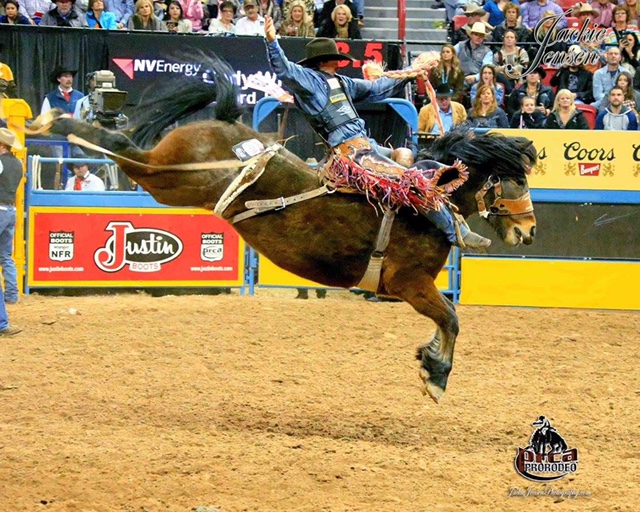
Lipstick N Whiskey, a 13-year-old mare owned by Powder River Rodeo of Riverton, Wyo., died Sunday, May 6th from complications in foaling. Lipstick N Whiskey had made five trips to the Wrangler National Finals Rodeo (NFR) where she carried four saddle bronc riders to go-round wins.
Her first trip to Las Vegas for the NFR was in 2010 where the 2009 world champion Jessy Kruse rode her for 87 points. In 2015 Rusty Wright won the third round on her with an 86.5. Last year his younger brother Ryder had the exact same result. Then, their father, Cody, rode her in the eighth round for 88 points to earn another go-round buckle.
“We are devastated,” said Lori Franzen who along with her husband Hank own Powder River Rodeo. “She was an outstanding mare and not just an important part of our program, she was part of our family.”
The Franzens buried Lipstick N Whiskey on their ranch next to her sire, Cut The Cards, who was selected for the NFR 3 times. He passed away last year. Her dam, Bay Rum had also been selected for the NFR. Also buried in Powder River’s bucking horse cemetery is Khadafy Skoal, who was inducted into the ProRodeo Hall of Fame in 2012. He earned bareback horse of the year title on three occasions.
-
Positive Attitudes
What separates those who are successful in the rodeo business? Over my years as a coach I have watched many students go on to be very successful in the arena and they all share a few key characteristics that seem to separate them from everyone else.
The best student athletes on my team each year are not the most talented on the team. In almost every case the students who win the most have a few characteristics that separate them from everyone else.
Winners are driven to reach their goals. They know what their goals are and so do those around them. Over the years I had a few students on my team that have been extremely successful. They were not shy about telling you what their goals were. They weren’t afraid of working hard to reach their goals. They weren’t afraid of competition. They also took their failures as a learning experience.
Along with treating failures as learning experiences, they were incredibly positive. Not just about what they were doing but to those around them. Their positive energy was contagious, it made them better and it made those around them better as well.
Because of their attitudes they were very coachable. They showed up to practice with energy. They listened to feedback from the coaches. I know there were times when they were coached, and told things that they did not want to hear. They listened anyway. That is one of the keys to any successful athlete, they have the ability to be coached. Not everything is going to go their way, they will not be told what they want to hear, and they learn from all experiences because of their attitude.
Dedication to their craft is a must as well. They study and learn all they can about their sport. They take care of their business. For a college rodeo student, that means getting good grades, becoming a leader, and being the best competitor they can be. These guys spent time in the gym and they really put in the work in the practice pen. Because of their dedication they find ways to win.
Finally they competed fearlessly. This group approached every competition with one goal in mind, winning. They didn’t worry about their competition, they didn’t make excuses. Because of their approach to competition they were able to eliminate distractions and focus on what they were working to accomplish.
I have been blessed to coach several WNFR, and PRR World Finals Qualifiers over the last few years. Every one of them had these traits, and I believe I learned a lot from these students as well. Now it is exciting for me to see these traits in students currently in our program or coming into our program. I truly believe that if you want to be at the top of any sport you need to embrace these traits. -
Judgement Call
At the last college rodeo I watched some college students question rodeo officials on their calls. Rodeo is officiated by the judges, they are human and they make mistakes. Like many other officiated sports it is very fast paced and the calls are made in the blink of an eye. Under this system the calls will never be perfect and there are always going to be those who question the calls made in the arena.
Every event has an element that is judged or open to a judgement call. Mark outs, the flagger, timers, they all make mistakes, but I rarely if ever felt that someone intentionally made a bad call. I haven’t agreed with all of the calls I have witnessed, but I think they were made to the best of the rodeo officials’ ability.
Here are a few of my takeaways from this weekend and college students protesting calls.
If you don’t agree will the call, don’t make a fool of yourself in and out of the arena after the call. No matter how much you disagree with the call, acting like a spoiled brat is not going to change the call. No one will remember the run in a few weeks, but they will remember how you acted. In many cases your behavior will warrant a conduct fine, you may get by once or twice acting like this but conduct fines are not cheap, and if you make a habit of acting like this you will get one. You may find some people in your corner that will tell you it was a terrible call and that the judge cost you lost of money, but in the end the one person in the arena that agreed with the call was holding the flag. End of story.
Don’t post the video on Facebook, naming the judge and ask all your friends what they think. Just don’t do it. I saw someone from another region do this and tag the judge in the video, I watched the video with the judges at a different rodeo. First the angle you filmed from was not good to make a case either way. Two, the judges watch your video and next time they are flagging at a rodeo you are at they will know to watch you for crossfire. Three you will likely not get the benefit of the doubt on any crossfire calls from that judge in the future, or any of the other judges that watched the video. Finally it was the right call, know the rules of the association you are competing in before you question the call on social media.
Finally the one good example was in the bareback riding where a rider missed his horse out. After the event the rider went to the judge and asked him what he saw, and what he could do better. The judge took the time to explain the rule and how he interpreted the rule in this case. Then he went on to explain how the rule book told them to judge the mark out. Both sides left the discussion feeling better about their conversation about the call.
In all of my year’s rodeoing and coaching, I have never witnessed anyone throwing a fit about a call or posting it on social media, get the call changed. If you plan on rodeoing for a living there are only so many rodeo judges, don’t find ways to make them all dislike you when you are still in college. -
Shorty Gorham
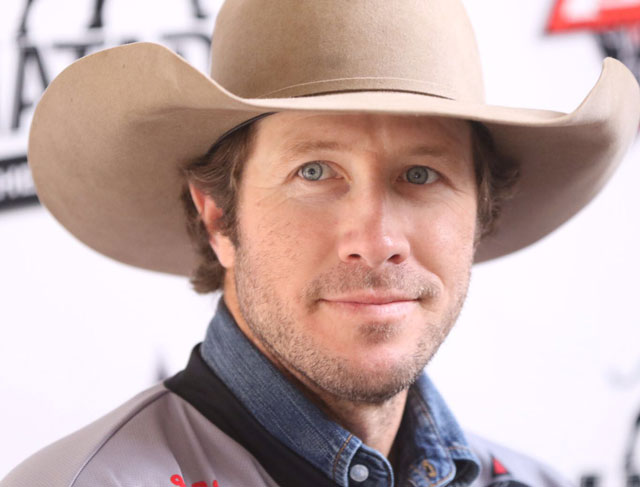
Bobcat- Courtesy of Shorty By day, Shorty Gorham is a bullfighter, now in his 12th season working PBR events across the country. By night – and even into the wee hours of the morning – he’s a hunter, either hunting deer or tracking bobcats with as many as 14 hunting dogs leading the way.
Originally from Orange County, California, Shorty moved to Cotulla, Texas, after marrying his wife, Amanda. “There are a few things I miss about California, but not very many,” says Shorty. “One of the cool things about south Texas is it’s really easy to transplant any game that’s non-native, like elk and a lot of different African game.” Cotulla is on the edge of what hunters call the Golden Triangle, a region that produces some of the country’s best whitetail deer through rigorous deer management, feed, and genetically improved breeding stock. Shorty uses Record Rack deer feed, while his hunting dogs are on Nutrena food, the parent company of Record Rack. “The deer are healthy as can be, and I’ve noticed with both my dogs and the deer that their coats are shinier and they’re fleshier,” Shorty explains. “I’ve been hunting my dogs hard enough to know that their food is doing them justice.”
Shorty did his share of coon hunting in California, but had to transition from coon hounds to fox hounds when he started hunting bobcats in Texas. “These dogs are Running Walkers, and they have more endurance and speed. Coon hounds are bred for their treeing ability, but these dogs are bred for running game. About half of them I’ve purchased already trained, but the other half I’ve trained myself.” The bobcat population is so dense that they are considered varmints, and Shorty does predator control for several ranches in the area, which also benefits the turkey and quail population. “I have GPS trackers on all my dogs so I know where everyone is at all times. You turn the dogs loose and follow them; I try to drive through areas that are bobcat habitats. You wait for the dogs to pick up a scent, which they’ll hopefully follow, and then you listen to some good old-fashioned hound music.
“The down-side to these dogs is that you have to hunt them really hard to keep them tuned in,” Shorty adds. “There are days I’m tired, but the dogs don’t care – they still need to hunt. When I’m beat up and sore, it can feel like a job, but this is my enjoyment and my therapy. I hunt alone a lot, and it’s peaceful. It lets my mind rest and just enjoy good dog work. And hopefully we catch some cats!
During the first few months of the year, Shorty’s PBR schedule keeps him on the road five or six days a week, flying from San Antonio to any of the major cities hosting the PBR. “This season has been going really good. We’re on track to break records again as far as attendance, and we have a young bunch of bull riders coming on the scene with that old school mentality of coming to win a world championship, not just be there their first year. If it keeps on course, this will be one of the more exciting years of my career,” he says. “When I was working rodeos, there were three or four month stretches where I never saw home, but now it’s just three to four days a week. I’m gone just enough that my family doesn’t get tired of me, but the dogs don’t bark at me.” Shorty and Amanda have a son, Tanner, and a daughter, London, who both compete in rodeo.
Shorty has also entered the stock contracting world, recently partnering with his wife’s cousin to put together a string of Spanish fighting bulls. “The freestyle bullfighting industry has taken off,” says Shorty. “It’s been on hiatus for twenty years, and it’s making a resurgence. I’m getting a little long in the tooth to be fighting bulls, so hopefully we’ll have everything together with our bulls so when I’m ready to hang up bullfighting, I can step into the stock contracting. I’m also working with Nutrena on building a feed for our fighting bulls, so we’re experimenting with different energy sources to enhance their performance. It’s been fun to have that relationship with Nutrena and Record Rack.” -
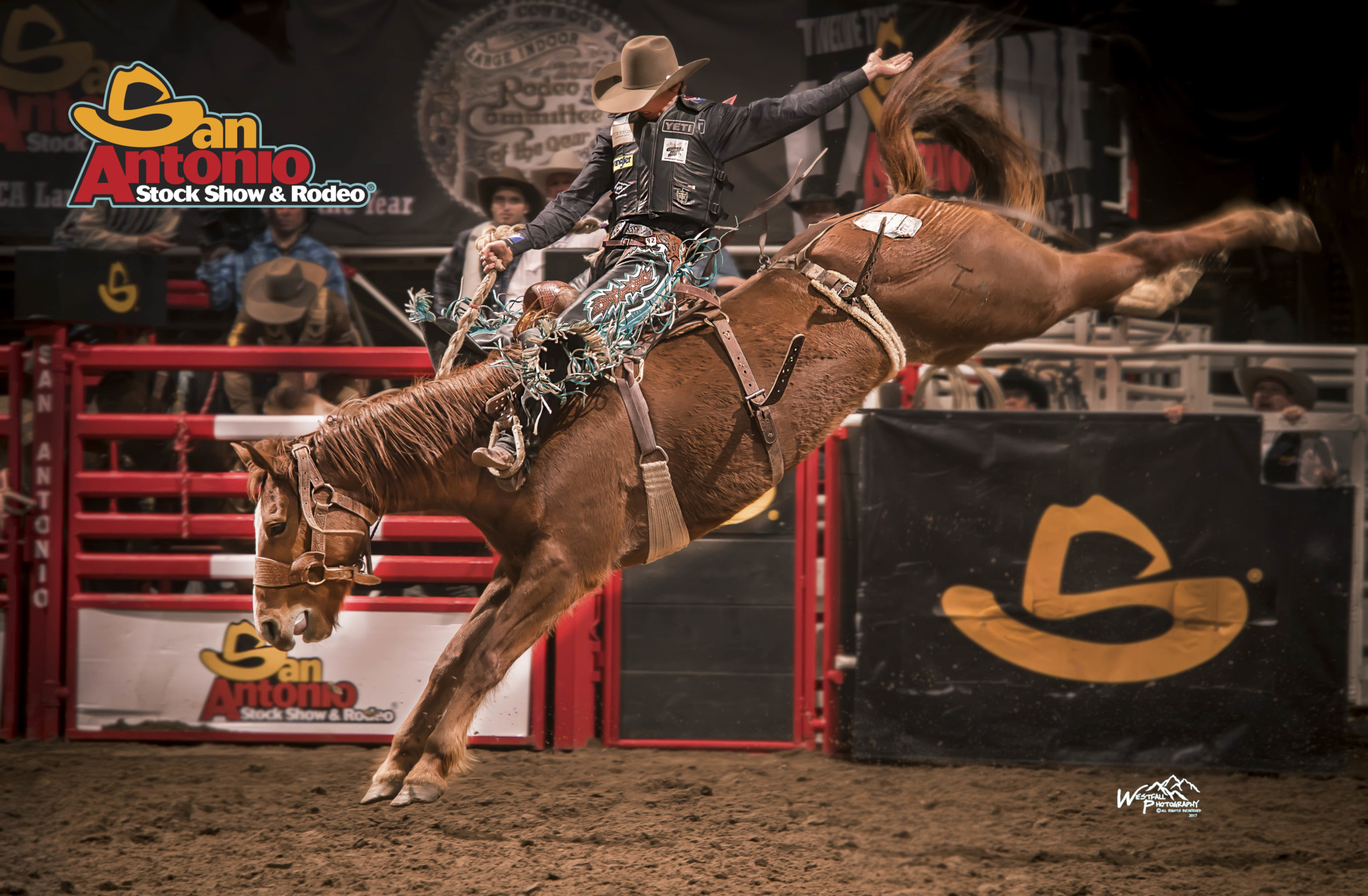
Contestants from five countries, 36 states to compete for $1 million at RAM National Circuit Finals Rodeo
KISSIMMEE, Fla. — When the RAM National Circuit Finals Rodeo (RNCFR) gets underway at the Silver Spurs Arena on April 6, more than 200 rodeo athletes from 36 states, plus Canada, New Zealand, Australia and four states in Mexico, will gather to compete for national championships as well as $1 million in prize money and awards.
The circuit system divides the United States into 12 geographical regions where Professional Rodeo Cowboys Association (PRCA) and Women’s Professional Rodeo Association (WPRA) members compete for points in their designated area to advance to their circuit finals. The winners of the 12 circuit finals as well as the year-end champions in each rodeo event are then invited to the RNCFR. This year, for the first time, the field also includes two contestants in each event from the PRCA’s Mexican Rodeo Tour.
With over $1 million in cash and prizes, the RNCFR one of the richest rodeos in the United States. Winning contestants will get substantial paychecks which for the first time will count in the PRCA and WPRA world standings. Champions in each event as well as the all-around category will also get a $20,000 certificate towards the purchase of a RAM vehicle, a new Polaris RANGER UTV a champion buckle, saddle and new pair of boots.
Events showcased at the RNCFR include: bareback riding; steer wrestling; team roping (heading and heeling); saddle bronc riding; women’s barrel racing and bull riding. The first four performances are being broadcast online on the Wrangler Network. The April 9 finals will air on CBS Sports Network on April 23.
RNCFR Qualifiers by Circuit
Columbia River Circuit (Washington, Oregon & Idaho Panhandle)
Wyatt Bloom Bend, Ore. bareback riding
Nick Gutzwiler Edwall, Wash. bareback riding
Kathy Grimes Medical Lake, Wash. barrel racing
Amberleigh Moore Keizer, Ore. barrel racing
Roscoe Jarboe New Plymouth, Idaho bull riding
Jordan Wacey Spears Redding, California bull riding
Max Filippini Battle Mountain, Nev. saddle bronc riding
Ryan Mackenzie Jordan Valley, Ore. saddle bronc riding
Cody Cabral Hilo, Hawaii steer wrestling
Dakota W Eldridge Elko, Nev. steer wrestling
Russell Cardoza Terrebonne, Ore. team roping
Brady Minor Ellensburg, Wash. team roping
Riley Minor Ellensburg, Wash. team roping
Hayes Smith Central Point, Ore. team roping
Blair Burk Durant, Okla. tie-down roping
Cooper Martin Alma, Kansas tie-down ropingCalifornia Circuit (California)
Teddy Athan Livermore, Calif. bareback riding
R.C. Landingham Hat Creek, Calif. bareback riding
Trula Churchill Valentine, Neb. barrel racing
Nellie Miller Cottonwood, Calif. barrel racing
Christopher Byrd Compton, Calif. bull riding
Aaron Williams Pismo Beach, Calif. bull riding
Cameron Messier Odessa, Texas saddle bronc riding
Joaquin Real Santa Paula, Calif. saddle bronc riding
Josh Garner Live Oak, Calif. steer wrestling
Blaine Jones Templeton, Calif. steer wrestling
Evan Arnold Santa Margarita, Calif. team roping
Dugan Kelly Paso Robles, Calif. team roping
Ryan Reed Farmington, Calif. team roping
Victor Ugalde Orovada, Nev. team roping
Jordan Ketscher Squaw Valley, Calif. tie-down roping
Ryle Smith Oakdale, Calif. tie-down ropingWilderness Circuit (Southern Idaho, Utah & Nevada)
Caleb Bennett Tremonton, Utah bareback riding
Tyler Nelson Victor, Idaho bareback riding
Jessie Telford Caldwell, Idaho barrel racing
Calli Van Tassell Draper, Utah barrel racing
Josh Frost Randlett, Utah bull riding
Garrett Smith Rexburg, Idaho bull riding
Jesse Wright Milford, Utah saddle bronc riding
Ryder Wright Milford, Utah saddle bronc riding
Olin Hannum Malad, Idaho steer wrestling
Baylor Roche Tremonton, Utah steer wrestling
Olin Pulham Payson, Utah team roping
Jaguar Terrill Blackfoot, Idaho team roping
Thad Ward Howell, Utah team roping
Jason Warner Rigby, Idaho team roping
J.C. Malone Plain city, Utah tie-down roping
Matt Shiozawa Chubbuck, Idaho tie-down roping
Montana Circuit (Montana)
Jessy Davis Power, Mont. bareback riding
Justin Miller Billings, Mont. bareback riding
Lisa Lockhart Oelrichs, S.D. barrel racing
Carmel Wright Roy, Mont. barrel racing
Parker Breding Edgar, Mont. bull riding
Luke Gee Stanford, Mont. bull riding
Tyrell J Smith Sand Coulee, Mont. saddle bronc riding
Chase Brooks Deer Lodge, Mont. saddle bronc riding & team roping
Ty Erickson Helena, Mont. steer wrestling
Newt Novich Twin Bridges, Mont. steer wrestling
Dustin Bird Cut Bank, Mont. team roping
Cody Tew Belgrade, Mont. team roping
Sid Sporer Cody, Wyo. team roping
Jake Hamilton Casper, Wyo. tie-down roping
Logan Hofer Magrath, Alberta tie-down ropingMountain States Circuit (Wyoming & Colorado)
Joel Schlegel Burns, Colo. bareback riding
JR Vezain Cowley, Wyo. bareback riding
Brittany Pozzi Tonozzi Victoria, Texas barrel racing
Kim Schulze Larkspur, Colo. barrel racing
Jess Davison Laramie, Wyo. bull riding
Clayton Savage Yoder, Wyo. bull riding
Colton J Miller Lance Creek, Wyo. saddle bronc riding
Andy Clarys Riverton, Wyo. saddle bronc riding
Nick Guy Sparta, Wis. steer wrestling
Josh Peek Pueblo, Colo. steer wrestling & tie-down roping
Travis Bounds Clifton, Colo. team roping
Brit Ellerman Ft. Lupton, Colo. team roping
Josh Fillmore Penrose, Colo. team roping
T.J. Watts Eads, Colo. team roping
Brice Ingo Boone, Colo. tie-down ropingTurquoise Circuit (Arizona & New Mexico)
Luke Creasy Lovington, N.M. bareback riding
Delvecchio Kaye Round Rock, Ariz. bareback riding
Sherry Cervi Marana, Ariz. barrel racing
Lori Todd Willcox, Ariz. barrel racing
Lon Danley Tularosa, N.M. bull riding
Tustin Daye Lupton, Ariz. bull riding
Josh Davison Miles City, Mont. saddle bronc riding
Cooper DeWitt Rio Rico, Ariz. saddle bronc riding
Dean McIntyre Cloncurry, Australia steer wrestling
Damian Padilla Rio Rico, Ariz. steer wrestling
Edward Hawley Jr. Surprise, Ariz. team roping
Cory Petska Marana, Ariz. team roping
Erich Rogers Round Rock, Ariz. team roping
Ty Romo Whiteriver, Ariz. team roping
Seth Hall Albuquerque, N.M. tie-down roping
Joseph Parsons Marana, Ariz. tie-down ropingBadlands Circuit (North Dakota & South Dakota)
Ty Breuer Mandan, N.D. bareback riding
Blake Smith Zap, N.D. bareback riding
Jana Griemsman Piedmont, S.D. barrel racing
Nikki Hansen Dickinson, N.D. barrel racing
Ardie Maier Timber Lake, S.D. bull riding
Tate Thybo Belle Fourche, S.D. bull riding
Ty Manke Hermosa, S.D. saddle bronc riding
Chuck Schmidt Keldron, S.D. saddle bronc riding
Chason Floyd Buffalo, S.D. steer wrestling
Taz Olson Prairie City, S.D. steer wrestling
J.B. Lord Sturgis, S.D. team roping
Levi Lord Sturgis, S.D. team roping
Jordan Olson Surprise, Ariz. team roping
Logan Olson Flandreau, S.D. team ropingPrairie Circuit (Nebraska, Kansas & Oklahoma)
Frank Morton Wright, Kansas bareback riding
Justin Polmiller Weatherford, Okla. bareback riding
Emily Miller Weatherford, Okla. barrel racing
Tracy Nowlin Nowata, Okla. barrel racing
Trevor Kastner Sulphur, Okla. bull riding
Nate Perry Elk City, Okla. bull riding
Shade Etbauer Goodwell, Okla. saddle bronc riding
Roper Kiesner Ripley, Okla. saddle bronc riding
Riley Duvall Checotah, Okla. steer wrestling
J.D. Struxness Appleton, Minn. steer wrestling
Buddy Hawkins II Columbus, Kansas team roping
Coleman Proctor Pryor, Okla. team roping
Billie Jack Saebens Nowata, Okla. team roping
Jesse Stipes Salina, Okla. team roping
Cody Quaney Cheney, Kansas tie-down roping
Bryson Sechrist Apache, Okla. tie-down ropingTexas Circuit (Texas)
Jake Brown Cleveland, Texas bareback riding
Bill Tutor Huntsville, Texas bareback riding
Ari-Anna Flynn Charleston, Ark. barrel racing
Tiany Schuster Krum, Texas barrel racing
Dustin Bowen Waller, Texas bull riding
Tanner Learmont Cleburne, Texas bull riding
Jacobs Crawley Boerne, Texas saddle bronc riding
Sterling Crawley Stephenville, Texas saddle bronc riding
Matt Reeves Cross Plains, Texas steer wrestling
Justin Shaffer Hallsville, Texas steer wrestling
Luke Brown Stephenville, Texas team roping
Paul Eaves Lonedell, Mo. team roping
Colby Lovell Madisonville, Texas team roping
Wesley Thorp Throckmorton, Texas team roping
Caleb Smidt Bellville, Texas tie-down roping
Marty Yates Stephenville, Texas tie-down roping
Great Lakes Circuit
(Wisconsin, Iowa, Minnesota, Indiana, Ohio, Illinois, Michigan, Missouri and Kentucky)Tanner Aus Granite Falls, Minn. bareback riding
Tim O’Connell Zwingle, Iowa bareback riding
Ashley Baur Virnamwood, Wis barrel racing
Jordan Moore Mauston, Wis barrel racing
Levi Michael Berends Maynard, Minn. bull riding
Trevor Reiste Linden, Iowa bull riding
Logan Allen Crescent, Iowa saddle bronc riding
Jordan Corrigan Toddville, Iowa saddle bronc riding
Bob Lawlyes Perrysville, Ind. steer wrestling
Justin Zwiefel Burt, Iowa steer wrestling
J.W. Beck Moville, Iowa team roping
Cody Graham Everton, Mo. team roping
Adam Rose Willard, Mo. team roping
Jason Stroup Cape Girardeau, Mo. team roping
T.J. Hobson Henryville, Ind tie-down roping
Jared Mark Kempker Eugene, Mo. tie-down ropingSoutheastern Circuit
(Louisiana, Mississippi, Alabama, Georgia, Florida, North Carolina, South Carolina, Tennessee and Arkansas)Tanner Phipps Dalton, Ga. bareback riding
Chad Rutherford Lake Charles, La. bareback riding
Lindsey Hayes-Banks Opelika, Ala barrel racing
Sabra O’Quinn Ocala, Fla. barrel racing
Lane Lasley Marshall, Ark. bull riding
Michael Riggs Jr. Claxton, Ga. bull riding
Heith Allan DeMoss Heflin, La. saddle bronc riding
Curtis Garton Kaitaia, New Zealand saddle bronc riding
Gary Gilbert St. Cloud, Fla. steer wrestling
Chance E Howard Cedarville, Ark., steer wrestling
Clark Adcock Smithville, Tenn. team roping
John Alley Adams, Tenn. team roping
Caleb Anderson Mocksville, N.C. team roping
Jacob Dagenhart Statesville, N.C. team roping
Randall Carlisle Athens, La. tie-down roping
Braxton Laughlin Westlake, La. tie-down ropingFirst Frontier Circuit
(Maine, Vermont, New Hampshire, New York, Pennsylvania, Massachusetts, Rhode Island, Connecticut, Virginia,
West Virginia, Maryland, Delaware and New Jersey)Andy Carter Ellsinore, Mo. bareback riding
J.R. Mills Dewitt, Mich. bareback riding
Wendy Chesnut Poultney, Vermont barrel racing
Karly Stoltzfus McClure, Pa. barrel racing
Scott Sellers Warwick, Md. bull riding
John Leinaweaver Orrtanna, Pa. bull riding & steer wrestling
Ray Hostetler Piffard, N.Y. saddle bronc riding
Mike Johnson New Castle, Del. saddle bronc riding
Olin Ellsworth Warrensburg, N.Y. steer wrestling
Kevin Brown Keedysville, Md. team roping
Darren Morgan Fort Ann, N.Y. team roping
Shawn Quinn Schuylerville, N.Y. team roping
Chuck Smith Townsend, Del. team roping
J.R. Myers Felton, Pa. tie-down roping
Carmine Nastri Ballston, N.Y. tie-down roping
Mexican Rodeo Tour
Jonathan Estrada Guadalupe, Nuevo Leon bareback riding
Hector Gonzalez Campo, Calif. bareback riding
Luisa Herrera Chihuahua, Chi. barrel racing
Nas Yeverino Saltillo, Coahuila barrel racing
Tigre Bustamante Cuauhtemoc, Chi. bull riding
Francisco Garcia Saltillo, Coahuila bull riding
Abelardo Gonzalez Chihuahua, Chi. saddle bronc riding
Fernando Arballo Chihuahua, Chi. steer wrestling
Carlos Ochoa Santa Teresa, N.M. steer wrestling
Aldo Garibay Caborca, Sonora team roping
Sergio Garibay Caborca, Sonora team roping
Daniel Sanchez Nuevo Casas Grandes, Chi. team roping
Catan Banuelos Chihuahua, Chi. team roping & tie-down roping
Mike Valenzula Chihuahua, Chi. tie-down roping
(Contestant roster is subject to change. – Contestants may designate any circuit as their home circuit.) -

Rhett Beutler
Beutler & Son Rodeo Company put its roots down in the rodeo world in 1929, starting out as Beutler Brothers Rodeo Company. Rhett Beutler, the fourth generation to work in the family business, and the son of Beutler & Son, brought a new angle to the company’s ranch outside of Elk City, Oklahoma, when he started guiding hunting trips in the late 1990s.
As a college student with a lean wallet but a robust passion for whitetail deer hunting, Rhett decided he would guide hunting clients on weekend hunting trips on The Beutler Ranch. “In the early ‘90s, we started getting deer on our ranch in western Oklahoma, so all through high school, they were progressing and multiplying,” says Rhett. “I graduated high school in 1995 and went to college, but we had deer on the ranch and I had stands and food plots and feeders I was taking care of. I was a broke college kid running back forth between school and the ranch trying to hunt. I knew there were places I wasn’t even hunting yet.”
Rhett mentioned his idea of guiding hunters to a friend, and within a few weeks, he had his first job. What should have been a three day hunt took only 30 minutes. The hunter filled his tag, paid for all three days, and was gone the same morning. “The next year wasn’t that easy,” Rhett says with a laugh, “but as I realized all the places I had to hunt and how much game there was, I knew there was no way I could hunt it all. Instead of poachers getting the deer, I decided to take a few days each year to take hunters out and make some money on the side.”
Many hunting trips are scheduled in October and November between the lull in rodeo season and the WNFR, but they run through the end of bow season in January. Though the ranch is known for its whitetail hunting, it also offers quail, duck, and wild turkey. Among the rolling Oklahoma hills are prairies, timber, brush, and lakes, and the Beutlers have set up blinds, stands, and cameras to track where the mature bucks are. “We probably have forty different places to hunt, and we try to make the habitats the best we can for the game,” says Rhett. He teamed up with Record Rack feed last summer after extensive research on their feed and feeding programs, and recently started putting it out on his food plots.
Numerous hunters fly into The Beutler Ranch, located 100 miles west of Oklahoma City. If they don’t want to fly the venison home, Oklahoma is one of several states employing Hunters Against Hunger, a program that donates meat to families in need around the state. “A lot of my guys will take their meat to a supporting meat locker, and then it will get distributed,” Rhett explains. “Some of the other guys will bring their ice chests and take their meat home. I’m more of a horn hunter myself, and I like to make jerky. We’re not like Kansas with the potential to kill a 180 – 200 inch deer,” he adds, “around here getting 150 – 160 is pretty good.”
With the state department recently capping the number of bucks to two per hunter per season, along with running an education campaign on allowing bucks to mature before hunting them, Rhett has noticed a positive difference in the numbers and quality of deer. That, along with the food and hospitality The Beutler Ranch offers, has brought many hunters back for the last 10 – 12 years. “We have a big barn we turn into a hunting and lodging camp. I bring in some people I know from Texas to cook for them, and we have drinks and satellite TV, so we’ll be watching football or NASCAR. Everyone has a good time!”
Many of the Beutlers are involved with the hunting on the ranch, including Rhett’s two children, Taylor, 12, and Jake, 9; his cousin, Justin Shireman; and his children. “My dad, Bennie Beutler, is a diehard quail and bird hunter, but he’s right in the middle of the deer hunters helping with whatever needs to be done,” says Rhett. “I enjoy doing it and making a little money to supplement everything we put into it. It’s good for the ranch and our family, and it’s about having a good time. I think most people keep coming back because they enjoy the food and hospitality that goes with the hunting.” -
Freshman
I was asked today what was important for freshmen athletes in college to learn. It got me thinking what were the qualities of successful freshmen athletes? After some thought, here is my list, most of these skills they need to come to college with. Some of the skills can be developed at college, but if you wait too long you may learn a hard lesson.
1. You have to learn to do things on your own. Independence is a key for success of any college athlete. College forces you to be responsible and independent. Going to class, getting your homework done on time, doing your laundry; all of a sudden your parents are no longer there to do it for you. The quicker you learn to be independent in college the more successful you will be.
2. You have to be able to work with others. If you are an athlete you are now on a team, you will be working with others and many times the groups success or failure depends on how well you can work together. All of a sudden this is real life stuff, just like a job, you may not like all of the people you work with but you must respect and work with them to get your job done. Not only on your team but in class group project you will have the one group member who lets the rest of the group carry them. This will be a skill that you will likely use the rest of your life so make sure you develop it well.
3. Time management will be key. You only have so many hours every day. Class, practice and sleep will take up a big portion of that time every day. How you manage the rest of your time will likely determine how successful you are as a student and as an athlete. In no other time in your life will you have the opportunity to improve your athletic skills like you will in college, take advantage of it.
4. Most college students have to learn to live on a budget. Success in college is about learning to make good decisions and one of the first places you can see students go down the wrong path is how they handle their budget. Athletes may have it tougher than many students because of their schedules it may be tough for them to have a job. It is important to learn to manage your money so it does not become an excuse for you to leave college.
5. How to deal with difficult circumstances. Most college athletes were the star in high school, college presents a whole new problem for them, and all of a sudden you are surrounded by many talented athletes. You may not win as much as you did in high school right off of the bat, but how you respond to the difficult times will tell how good you will be in the future. If you start making excuses, and believe that your talent alone will carry you through college, you are sadly mistaken. In college the talent level starts to equalize, the hardest workers will start to rise to the top. Those who can handle failure and learn from it and work through it will be the toughest competitors.
Just my observations… -
Tierney times three
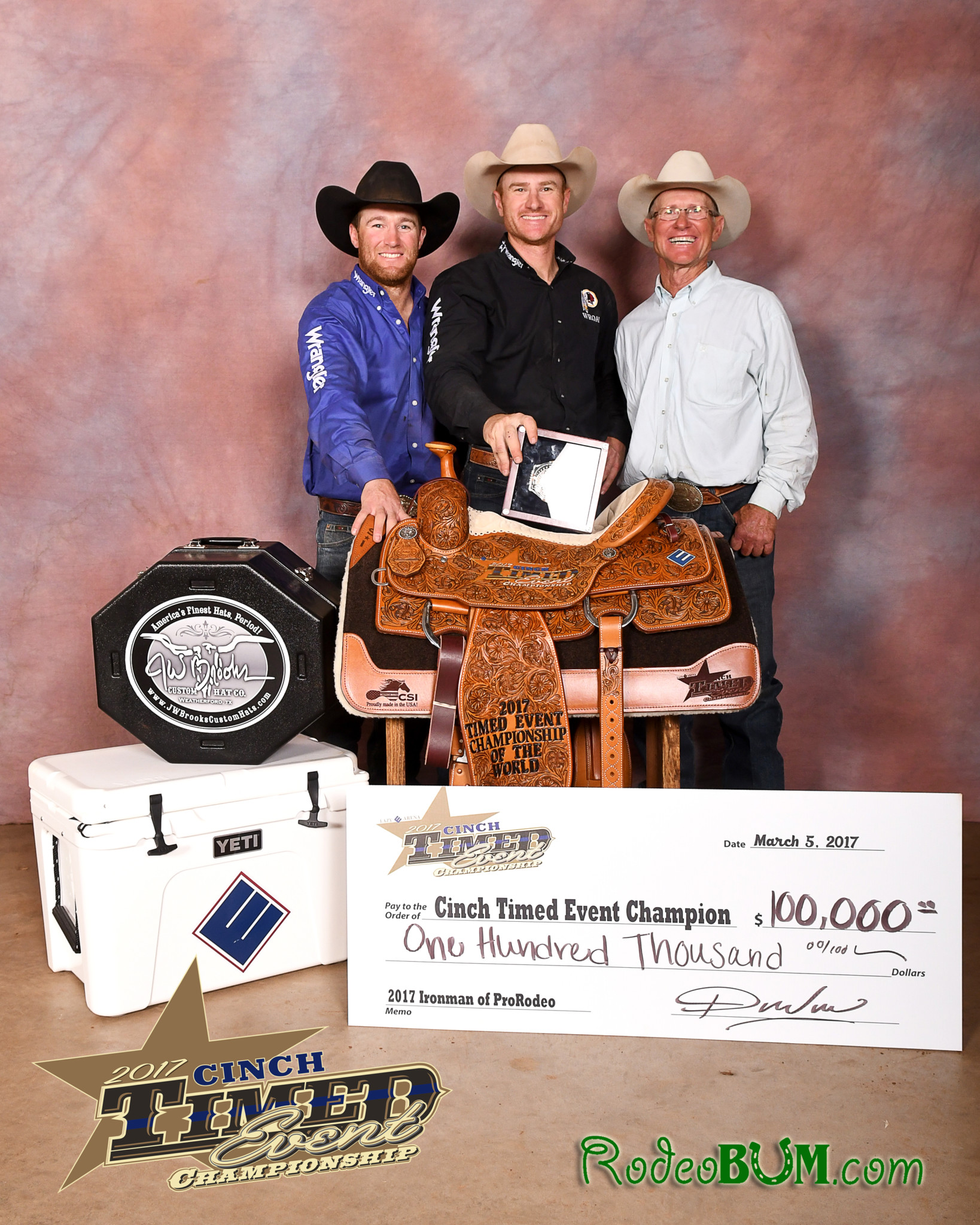
March 5, 2017 / Guthrie, Oklahoma – Jess Tierney closed out a wild and eventful final round of the 2017 CINCH Timed Event Championship to become the 13th winner of this storied competition.
More importantly, though, is that he became the third member of his family to claim this prestigious and elusive title, joining his four-time champion father, Paul, and his two-time titlist brother, Paul David.
“I couldn’t be happier for my brother,” Paul David said. “Now we all have a Timed Event buckle to wear.”
In all, the family owns seven of those gold buckles, a cherished piece of hardware that is the epitome of multi-talented cowboys. Paul won his first title in 1987, when Jess was just 5 years old. He added crowns in 1991, ’97 and ’00. It’s a family tradition they’d like maintain. With the winner earning $100,000, they have good reason
“This event is just the greatest event,” Jess said. “It could’ve paid 2 bucks, and I would’ve showed up. I just wanted to win this event. With them adding that kind of money, it’s just life-changing for us.”
When his dad won his first crown, the winner’s take was $40,000. When Paul David won his first title in 2014, it paid $50,000. While the financial incentive is greater, the call for the competitors is in the title: Timed Event Champion. Paul David won his second title a year ago and carried the lead into Sunday’s final go-round. In fact, he held the lead through the 23rd run of the championship, then saw it slip.
When he took his jump in bulldogging, the steer slipped away. He ran the length of the nearly 400-foot arena to remount. By the time he caught the steer and downed it, 41.7 seconds had ticked off the clock. He fell to fourth in the 24-head aggregate, and Coloradoan Josh Peek moved into the lead.
In the final event of this year’s Timed Event, Jess Tierney proved why steer roping his strongest event. He roped and tied his animal in 16.4 seconds. When Peek struggled and stop the clock in 33.9 seconds, Tierney earned the coveted crown.
“We went from one leading it to dropping to fifth,” Paul said. “Then the one that was third ended up winning it, but that’s the Timed Event.”
Yes, it is. The day began with five cowboys in contention for the title. It came down the final few runs of the five-round, three-day championship to decide this year’s winner of the “Ironman of ProRodeo.”
“My best friend is Jace Crabb,” Jess said of his partner in heading and heeling. “Fourteen years ago I said, ‘Someday I’m going to get to go to that Timed Event, and you and I are going to win it together.’ We’ve come here this long, and we finally won it.”
It’s just another great story in a great family CINCH Timed Event Championship legacy.
The 2017 CINCH Timed Event Championship is sponsored by CINCH, Priefert Ranch & Rodeo Equipment, YETI Coolers, Montana Silversmiths, ABI Equine, RAM, Carroll Original Wear, P&K Equipment, Cavender’s, American Farmers and Ranchers Insurance, Nutrena, MacroAir, National Saddlery, Cross Bar Gallery, John Vance Motors, Pendleton Whisky, CSI Saddlepads, AQHA, Western Horseman Magazine, Spin to Win Magazine, Guthrie CVB, Made In Oklahoma Coalition, Sherwin-Williams, La Quinta Edmond and the Fairfield Inn & Suites – Edmond. Hampton Inn – Guthrie.
The 2017 CINCH Timed Event Championship is a Lazy E Production. For more information on the CINCH Timed Event Championship or other Lazy E events, contact the Lazy E Arena, 9600 Lazy E Drive, Guthrie, OK 73044, (405) 282-RIDE, (800) 595-RIDE or visit www.lazye.com.
RESULTS
First round: 1. Trevor Brazile, 56.3 seconds, $3,000; 2. Clay Smith, 61.2, $2,000; 3. Shay Carroll, 63.7, $1,000.Second round: 1. Trevor Brazile, 54.7 seconds, $3,000; 2. Paul David Tierney, 56.5, $2,000; 3. Josh Peek, 56.7, $1,000.
Third round: 1. Paul David Tierney, 53.0 seconds, $3,000; 2. Jess Tierney, 62.1, $2,000; 3. Trevor Brazile, 63.0, $1,000.
Fourth round: 1. Josh Peek, 49.6, $3,000; 2. Shay Carroll, 59.1, $2,000; 3. Paul David Tierney, 61.1, $1,000.
Fifth round: 1. Shank Edwards, 58.7 seconds, $3,000; 2. Jess Tierney, 59.9, $2,000; 3. Marcus Theriot, 60.0, $1,000.
Average: 1. Jess Tierney, 326.8 seconds, $100,000; 2. Clay Smith, 332.8, $25,000; 3. Trevor Brazile, 336.2, $15,000; 4. Josh Peek, 339.8, $7,500; 5. Paul David Tierney, 350.7, $5,000; 6. Jordan Ketscher, 363.7, $5,000; 7. Shay Carroll, 432.2, $4,500; 8. Shank Edwards, 481.4, $3,000.
Total money: 1. Jess Tierney, $104,000; 2. Clay Smith, $27,000; 3. Trevor Brazile, $22,000; 4. Josh Peek, $14,000; 5. Paul David Tierney, $13,500; 6. Shay Carroll, $6,000; 7. Marcus Theriot, $5,500; 8. Jordan Ketscher, $5,000; 9. Shank Edwards, $3,000
-
Five to battle for Timed Event title
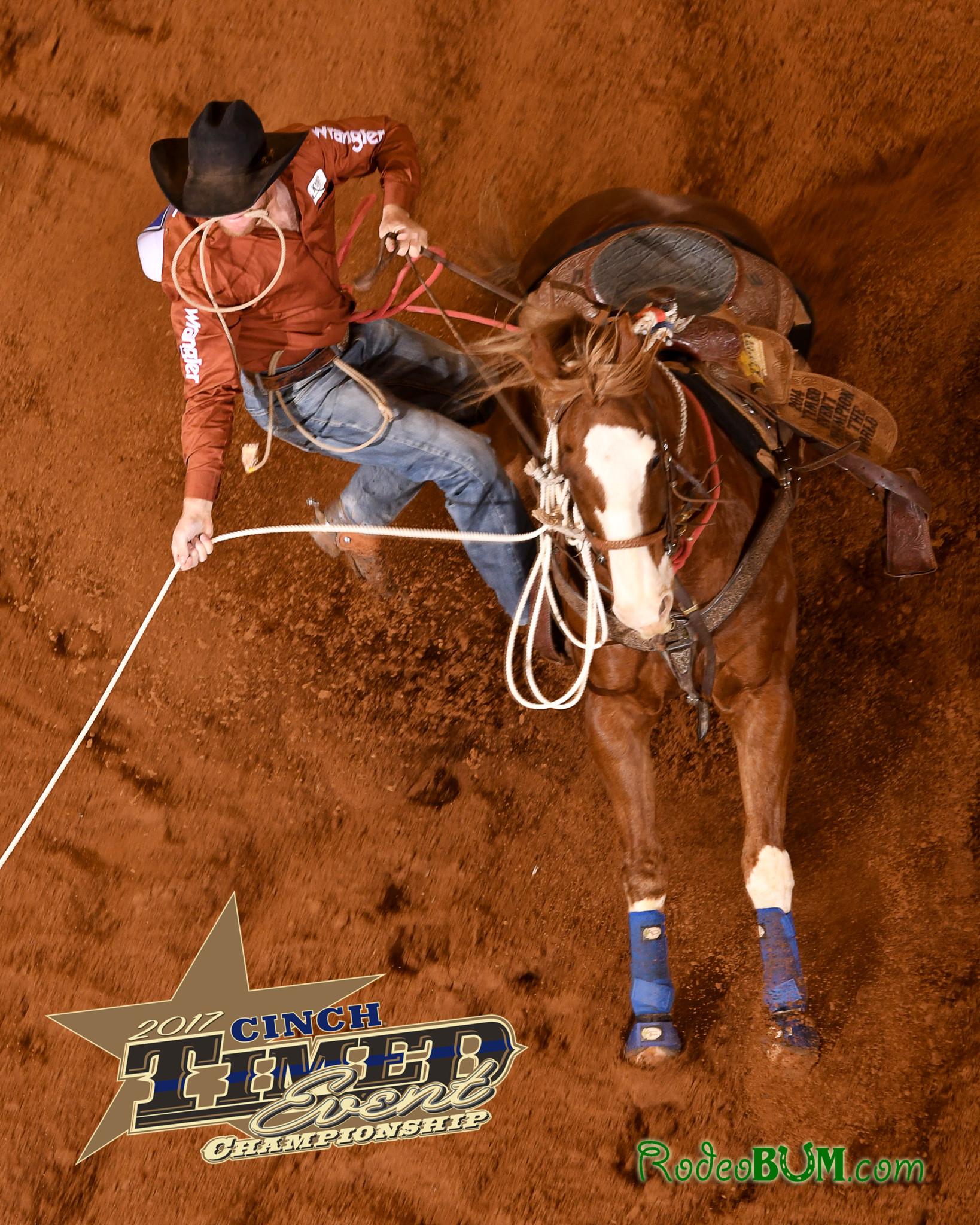
March 4, 2017 / Guthrie, Oklahoma – The final round of the 2017 CINCH Timed Event Championship is going to be a dogfight.
Five men are within 22 seconds of each other as they race for the $100,000 first-place prize, with reigning champ Paul David Tierney leading the way. He has roped, tied and wrestled 20 animals in a cumulative time of 251.7 seconds.
Trevor Brazile moved from first to fifth after a disastrous steer wrestling run but his aggregate time is 273.4. In between are runner-up Clay Smith, Jess Tierney and Josh Peek. Of the top five, three have claimed this title before – Brazile owns the most with seven, while Paul Tierney has two and Peek has one.
“A lot of things can happen,” Paul Tierney. “You’ve just got to keep it smooth and snare those bulldogging steers.”
Brazile had a 20-second lead over the field heading into steer wrestling. When the steer escaped his grasp, the Texan sprinted the length of the Lazy E Arena, gathered his horse, jumped onto the steer along the west wall and downed it in 55.1 seconds. He remains in contention.
“I think it makes it funner, keeps you more competitive and trying a little harder,” Paul Tierney said of the battle for the title. “You sometimes get to laying off, and you make mistakes that way. I like it this way.”
Peek turned in the fastest round time so far this weekend when he stopped the clock five times in 49.6 seconds to win the fourth go-round. He added $3,000 to his earnings. More importantly, he felt good about how he competed Saturday night.
“I haven’t done what I normally do at this event,” said Peek, the 2010 champ. “I’ve just tried to sit back and make smooth runs, and that’s not my style. My style is to be aggressive, know my talent and use it.
“This is a great confidence-builder for me going into tomorrow.”
The 2017 CINCH Timed Event Championship is sponsored by CINCH, Priefert Ranch & Rodeo Equipment, YETI Coolers, Montana Silversmiths, ABI Equine, RAM, Carroll Original Wear, P&K Equipment, Cavender’s, American Farmers and Ranchers Insurance, Nutrena, MacroAir, National Saddlery, Cross Bar Gallery, John Vance Motors, Pendleton Whisky, CSI Saddlepads, AQHA, Western Horseman Magazine, Spin to Win Magazine, Guthrie CVB, Made In Oklahoma Coalition, Sherwin-Williams, La Quinta Edmond and the Fairfield Inn & Suites – Edmond. Hampton Inn – Guthrie.
The 2017 CINCH Timed Event Championship is a Lazy E Production. For more information on the CINCH Timed Event Championship or other Lazy E events, contact the Lazy E Arena, 9600 Lazy E Drive, Guthrie, OK 73044, (405) 282-RIDE, (800) 595-RIDE or visit www.lazye.com.
Third round: 1. Paul David Tierney, 53.0 seconds, $3,000; 2. Jess Tierney, 62.1, $2,000; 3. Trevor Brazile, 63.0, $1,000.
Fourth round: 1. Josh Peek, 49.6, $3,000; 2. Shay Carroll, 59.1, $2,000; 3. Paul David Tierney, 61.1, $1,000
Average leaders: 1. Paul David Tierney, 251.7; 2. Clay Smith, 261.3; 3. Jess Tierney, 266.9; 4. Josh Peek, 267.7; 5. Trevor Brazile, 273.4.