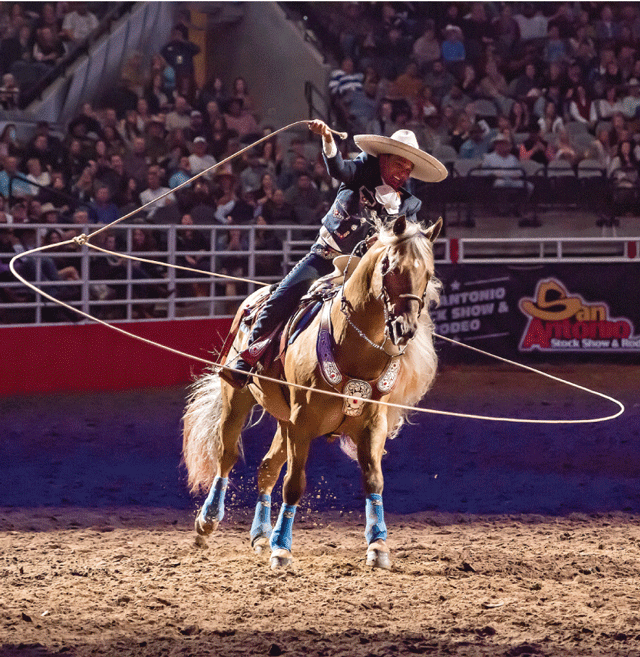
When Tomas Garcilazo and his horse stride into the arena, the rope artist does so with the goal of representing the Mexican charro and the American cowboy, rodeo tradition and the heritage of the West. With each deft turn of his wrist, the three-time PRCA Specialty Act of the Year winner ties the traditions and cultures together in hopes of making a lasting impression for future generations. “It’s a mission for me as an ambassador of the charros to preserve that. In modern day, everything is getting lost, and we have to be strong and keep our culture for new generations to see the background and how everything started,” explains Tomas, 50, who is now a U.S. citizen living in Stephenville, Texas.
His own roots start in Mexico City, Mexico, where Tomas was raised in his family’s tradition learning the horsemanship and roping skills of the Mexican charro. He competed in all seven of the La Charreria events growing up, many of which are similar to rodeo events. “I didn’t have the modern toys that we have right now, so I was playing with a rope all the time and developed more skills. In school festivals, I was performing and showing my skills with a rope.” He particularly found his love for showmanship at age 9 after performing for the president of Mexico, and continued to develop his charro skills through high school. “I had to think of ways where the horses were not just for beauty, but that they could perform and be in the entertainment business.” Tomas came to the United States for a year in hopes of finding his place in the entertainment business, but the year came and went without accomplishing those goals.
Rather than give up and return home, he traveled back and forth between Mexico and California competing in charro events. “In the meantime, I needed to decide what to do with my life. I would become a charro or go into the entertainment business—either opportunity that came along my path, I’d take it.” The opportunity to do both came along in 1992 when Linda Ronstadt was on tour to promote a series of traditional mariachi albums she’d recorded. Tomas was given a part in the show, riding on stage in traditional charro attire and performing his rope artistry. Soon after, he auditioned for Broadway’s The Will Roger’s Follies, a six Tony Award winner, and performed in 58 cities in 48 states, along with several cities in Canada.
After the three-year tour was finished, Tomas was invited to perform at Disneyland Paris in the Buffalo Bill Broadway show, and when he wasn’t performing as a cowboy in the cowboys and Indians show, he donned his charro attire and performed in horse shows. While riding at a European Rodeo Cowboy Association rodeo at the U.S. Air Force Base in Germany, Tomas met Shawn Davis, the general manager of the WNFR. “He liked my skills and the way I performed, and he invited me to recreate those scenes at the NFR.”
Recently married to his wife, Justine, whom he met in France, Tomas made his debut at the Thomas & Mack Center in 1997, little realizing he would command the attention of WNFR fans for the next 20 years and counting. “Looking back all these years, it’s amazing the evolution. I want to maintain what we believe—our integrity throughout the roping, the horses, the tack, everything that speaks for that tradition. Something that I admire about Mr. Shawn Davis is that he is very open-minded. He went to Europe and saw everything different and pulled those elements together and made them work.”
Tomas has pulled his own elements together over the years, including a variety of horsemanship methods and disciplines that have helped him build the trust and harmony he shares with his horses. A palomino overo Paint named Pinto Bean helped Tomas build his career as an all-around charro and performance horse, and the most famous of the horses today is Latigo Dun It, better known as Hollywood. The 17-year-old Quarter Horse stallion, whose elegant mane reaches past his knees, has more than 34,000 followers on Facebook and a Breyer model horse made after him. He stands calmly while nearly all 65 feet of Tomas’s rope whirl’s around horse and rider in a trick called the Wedding Ring, then lopes forward in a shimmer of gold, the rope still circling. Justine and their 4-year-old son, Louis, also join Tomas in the arena and perform on their other horses, including an Andalusian and Louis’s pony.
In February alone, Tomas put on 20 performances at the San Antonio Stock Show and Rodeo, and loses count before the summer run even starts. To keep his horses at their peak all season, he feeds them Nutrena. “It’s been an amazing product for us. The grain has all the supplements together inside—you can spend the money on all the supplements, but a horse’s system will only take a portion and the rest will be wasted. Since we’ve been with Nutrena the last two years, we’ve had really great results with their coats and their systems and toplines. We feed ProForce Fuel, Senior, and SafeChoice, and for the performing horses, they develop muscle and they don’t get too hot. It’s really good nutrition, and I’m trying to educate more people about being more concerned about nutrition in Spanish.”
Along with preparing for his 21st year at the WNFR, which he’s been nominated in for 2018 PRCA Dress Act of the Year, Tomas’s focus is ever on maintaining his skills and learning more. His wife, Justine, has also been a part of the Jaripeo Sin Fronteras USA tour, a Mexican concert combined with rodeo acts, which she choreographed and managed. “Our goal as a family is to produce and feature our own show,” Tomas adds. “We’ve been involved with so many performers, and we have so many ideas we’d like to recreate in our profession with all the variety of cultures and horse people.”
Category: Uncategorized
-
Tomas Garcilazo
-
A Streak of Fling Sired Horses Take 1st & 2nd in Barrels at the Nebraska High School Finals!
article by Maesa Kummer
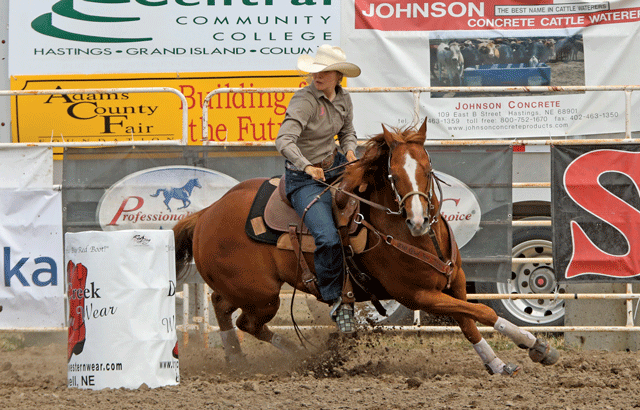
Bailey Witt, Valentine, NE took home the Barrel Racing and All-Around year-end championship titles at the Nebraska State High School Finals aboard StreakinIrishWhiskey (A Streak of Fling x Easy April Whiskey).
Bailey says, “I love him because he has so much heart and try and he gives me his all every run. He has a goofy personality and is fun to be around. He is all mine! I’ve ridden him since he was six-years old and we have really strong bond. He’s a very solid break-away horse also and he carried me to the All-Around title this year.”
This A Streak of Fling-sired gelding sold on the 2009 Fulton Sale and was raised at Fulton Ranch. StreakinIrishWhiskey is a full brother to Jake Fulton’s calf roping horse, Streakin Paddy. A full sister to both of these outstanding performance horses will sell at this year’s sale. A Whiskey Fling is a two-year old red roan mare with the genetics to make your next champion!
Sydney Adamson, Cody, NE took home Reserve Barrel Racing year-end championship honors at the Nebraska State High School Finals aboard Lenas Last Streaker (A Streak of Fling x Easy April Lena). This outstanding mare has already won over $25,000 previously at the barrel futurities with jockey Sam Flannery.
Lenas Last Streaker is a full sibling to Streakin Easy April (LTE $250,000+), ridden by Kellie Collier and owned by Kathleen Collier, and was the last of Fulton Ranch’s foundation broodmare line, Easy April Lena. Both Lenas Last Streaker and Streakin Easy April sold through the Fulton Sale. There are four 7/8 siblings on the sale this year!
Fulton Ranch would like to wish both of these talented cowgirls the best of luck at the National High School Rodeo Finals in Rock Springs, WY on July 15-21, 2018! Come find your next winner on Friday, August 17, 2018 in Valentine, NE! -
Boyd Polhamus
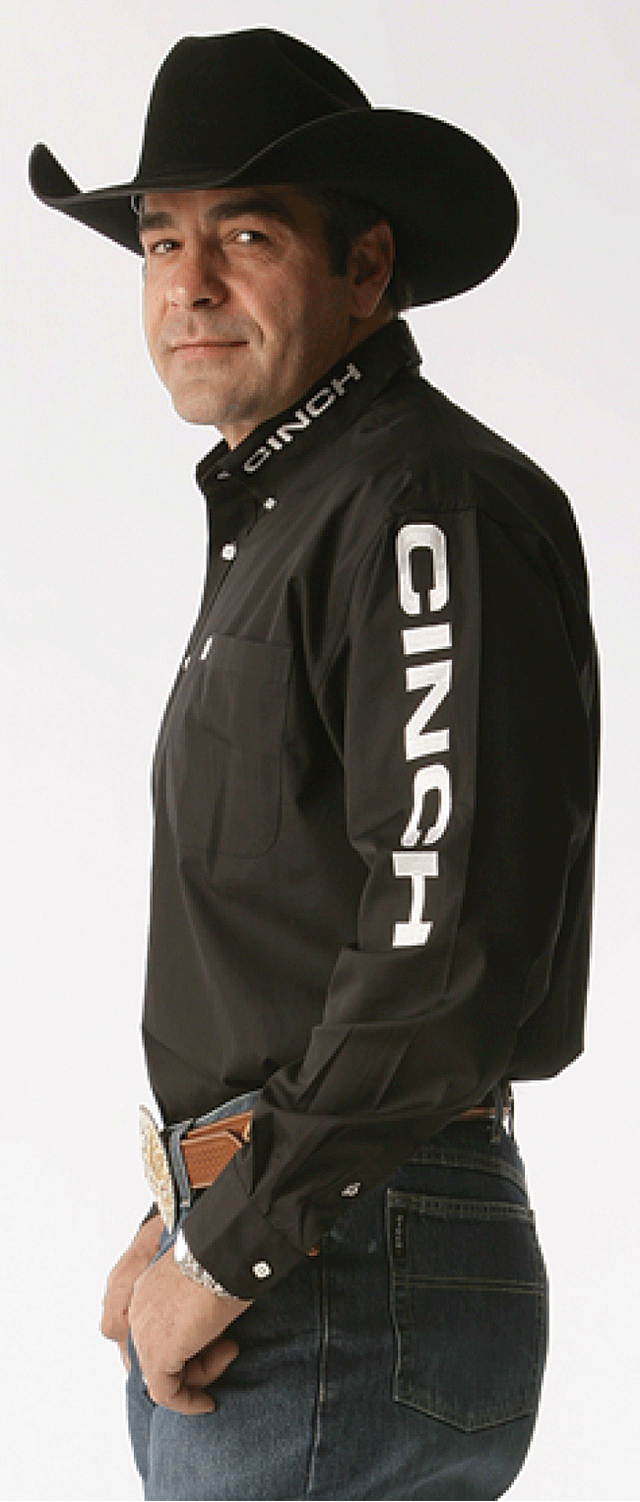
Behind Boyd Polhamus’s rodeo announcing career of 30 years and counting are numerous sets of hoofprints, left by the horses that have carried the Texan and his voice throughout rodeos all over the continent, from the college practice pen where he got his start to the height of professional rodeo at the WNFR. Gopher, Jack, Rolex, Limo, and a newcomer named Lambeau have all put Boyd close to the action on the arena floor.
Of the more than 1,000 rodeos Boyd has announced in his career, approximately 70 percent of those have been on horseback. “Number one, I love my job, and number two, my biggest fear is someone saying that Boyd took the day off, so I’m religious about my research. I want to make the fans know the contestant as best as I can,” explains the four-time PRCA Announcer of the Year. “It’s a lot easier to announce from a booth because you don’t have a horse to feed or bathe, but it’s therapeutic for me to step away from that research and interact with the contestants at the wash rack or feed time, and find some things out you wouldn’t in the media.”
When Boyd started announcing at 19, he rode stock contractors’ horses. Having ridden since he was 4—and known for being his home state of Wisconsin’s first three-time all-around cowboy in high school—he wasn’t scared to get on anything that was broke. By his early 30s, Boyd decided to start announcing on his own horses, and he looks for certain qualities in all the horses he works off of. Conformation is important to Boyd, along with a horse that isn’t too flashy—he prefers solid-colored horses without many markings. “If you study my horses, I want you to like them, but I want you to watch the competition,” he explains. “I want a horse that pays attention. It doesn’t matter if he’s a little flighty at first as long as he gets over it. I want one with spunk but who realizes something won’t hurt him.” Boyd’s horses have to grow accustomed not only to laser lights and pyrotechnics but being quick to respond, especially during the roughstock portion of rodeos. “You don’t want to be where the bucking horse can see you or you could draw the horse to you and out of the bucking pattern. I hide behind the gate the horse is coming out of, and if he goes bucking across the arena, I stay on his tail about three horse lengths back.”
Boyd is on the road often 260-280 days a year, frequently with a horse in tow. He and his horse experience a variety of temperatures, elevations, and climates, along with changes in water, within just a few weeks or even days of each other. His horse’s feed remains constant, however. “Zero times have I had a horse colic since I started feeding Nutrena, and I can’t remember feeding anything but Nutrena in over a decade,” says Boyd. “My horses look good and the reason is they’re getting proper nutrition. I do my part and worm them, but at the end of the day, you are what you eat, and my horses don’t colic.” Many of the animals on Boyd and his wife Sandee’s Band-Aid Ranch in Brenham, Texas, eat Nutrena, from their Brangus cattle to the fish in their pond. “They’re the cream of the crop when it comes to any kind of animal nutrition, and their reps are so knowledgeable,” Boyd adds. “My horses look fat and happy, they have shiny coats, and I have to attribute all that to Nutrena.”
Lambeau, a 5-year-old gelding Boyd purchased on Colorado, is his newest addition to the herd, though Limo remains his old faithful. Following the summer run, Boyd plans to take Lambeau to announce some smaller county rodeos in Texas to season him. The rest of Boyd’s time is spent at home, where down time is getting the trailer ready for his next trip, weaning calves, or spraying and fertilizing pastures. “Home is my vacation, but it’s not like I go home and go fishing—I’d much rather do something productive.”
His latest venture is picking up the baton from Shawn Davis as General Manager of Production of the WNFR in 2019. “I won’t be announcing the NFR this year because I’ll be shadowing Shawn Davis and learning from him. In 2019 I take over, and I’m going to continue announcing. In the words of Willie Nelson when they asked him what his goals for 2017 were, and he said to make it to 2018, my goals are to do everything better than I did before. I’ll be 53 in September, and I’m excited about the National Finals Rodeo and making it more fun and engaging for fans and contestants. Basically, I want to do things better than I have before.” -
Ten Over Talent
Every year college rodeo coaches across the country search for the most talented athletes to fill their rosters with. We are all searching for the next rodeo stars.
I am right there with the rest of the coaches, recruiting at rodeos across the country. But over the past few years I am starting to believe that people who have the following ten characteristics will be successful in our sport. Talent is great, but talent alone is never enough.
Here is a list that many of you have probably read before. I give this list to my students at the beginning of each year. The most talented students are normally not the most successful, unless they have the majority of the following characteristics. Very simply put, talent alone is simply not enough to be successful.
10 Things That Require Zero Talent.
1. Being on time. Time management is a great skill that truly requires no talent. You will make time and be on time for what you truly desire.
2. Work ethic. Don’t let others out work you in the practice pen or the classroom. We are in a competitive sport and if you allow yourself to get outworked in the practice pen, expect the same results in the competition arena.
3. Effort. What does your 100% effort look like? Do you give it every day?
4. Body language. How you move and express yourself around your coaches, teammates and judges shape who you are and how you are perceived. It may not seem like a big deal but it is.
5. Energy. Everyone has energy to devote to a goal especially the first few days, and the decision of how much to give. Those who can show up every day with energy will energize others. It is contagious.
6. Attitude. If you have a great attitude others will gravitate to work with you. If you have a poor attitude people will go out of their way to avoid you.
7. Passion. Every great competitor I have ever met has had passion. It is easy to work for what you are passionate about.
8. Being coachable. Most coaches have worked with people in your situation before; their experience can be invaluable if you allow it to be. Many times contestants only see the picture in front of them, while many coaches are working with you for the big picture. To reach the results you both desire you must work to be coachable.
9. Doing extra. I see this all of the time; the students who reached their goals first were the ones who consistently worked at their craft beyond what was required.
10. Being prepared. There is great truth in the saying: Failing to prepare is preparing to fail. -
Choices
Being a great student athlete is about easy choices. In fact it is amazing how many things in our life are determined by the easy decisions we make every day.
As a student every day you have so many easy choices. Every day is full of easy choices.
The decisions you make, and how easy they are to make are simply a reflection of your priorities.
It is easy to choose to go to class, if you want to be successful. It is also just as easy to choose not to go to class. You make the choice, you live with the consequences. If it is important to you to get good grades and graduate, it is an easy decision to go to class.
It is easy to make the decision to go to the gym every day. It may be even easier to make the decision not to go to the gym. You make the easy choice and you either get the benefits from going to the gym or continue along the same path. If you don’t view being in shape as a priority for your sport, it is easy to choose not to go to the gym.
Going to practice is also an easy decision for many. But it is also just as easy to skip a day of practice. You make the choice to work to get better, or you stay where you are at. Either way you made the decision long before you entered the rodeo. For those that want to be great it is an easy and simple decision. They are there every day ready to work. Excited to work hard in the practice pen to get better. They very rarely find any excuse to miss practice. Their priorities made their decision on practice an easy one every day.
All of the decisions we make are easy to make, whether they are good decisions or bad decisions they are easy to make.
The daily decisions you make are one of the single most important factors in deciding how successful you will be.
Those that can make the easy decision to miss practice are usually the same ones that will never make a career of rodeo or any sport.
Our priorities and goals make our daily choices easy. Everybody that competes at a high level made the choices and commitment to get there. And for those people the choices were easy. -
Hunter Herrin
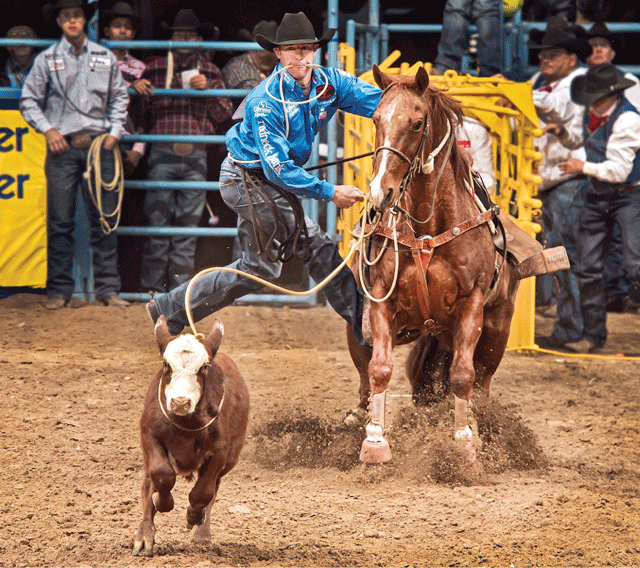
Nine-time WNFR qualifier Hunter Herrin has been involved in a variety of sports, especially rodeo, since childhood. Within the last few years, the 33-year-old from Apache, Oklahoma, has added a new pursuit—hunting—to his list of interests thanks to his son, Houston. “I’m learning more from him than he is from me,” says Hunter. “He’s 11 and he really enjoys deer hunting. I’ve done a whole lot more of that in the last three years than I have in my entire life.” Hunter is no stranger to long nights on the road and admits that he’s not the deer hunting kind of early riser, but he’s enjoyed the new experience nonetheless. “If you are out there when the earth wakes up, it seems to be refreshing, the way the animals move and the birds wake up when the sun starts to rise. It’s pretty cool. You can reflect on this, that, and the other, and enjoy the moment.” Houston, who learned about the hunting lifestyle from his grandpa, has harvested several deer. The meat is often shared among the family, and Hunter enjoys a bowl of deer chili.
Tracking calves is still his favorite pursuit, however, and rodeo is another thing that Hunter and Houston enjoy doing together. Family has often cheered him on from the stands at rodeos like the WNFR and The American, which he won in 2016, while Hunter and Houston spend several weeks in the summer on the road together. “He enjoys getting to hang out with his buddies that I’ve rodeoed with, like Shane Hanchey and Marty Yates. He’s a big fan of them and they spend time with him on the road.”
Hunter made a run at the winter stock shows and rodeos, working to find the balance between recovering from his October 2017 hip surgery but still getting a start on the 2018 season. “With a surgery or injury, you change your goals and double down and work harder like I should have in my 20s,” says Hunter, who first qualified for the WNFR in 2006. He was his son’s age when he started roping, encouraged by his step-dad, Bob Nunn. Hunter junior rodeoed and focused more on basketball and football in high school, but rodeo was back on his radar in his late teens. “I went to three semesters at Weatherford in Oklahoma and did college rodeo there, and in the winter of ’05, I started rodeoing full time. My parents bought my PRCA permit for me in ’04.” When Hunter stepped up his competition in 2006, it was the first of four consecutive qualifications to the WNFR. He went through a pattern of getting horses ready for the finals every other year, and in 2014, his horse Dualin Demon “Rambo” won PRCA Tie-Down Roping Horse of the Year.
Presently, Hunter is working on several horses that he anticipates being ready to rodeo on in the fall. “But I’m looking for that kind of rodeo horse now. Clint Akin has a horse that I rode in Houston and there’s a possibility I can rodeo on him some, but we’re still keeping our eye out for one that fits the mold of what we’re looking for.” Hunter and his dad train horses and have three in particular they’ll start hauling this summer. With the exception of his first year at the WNFR, Hunter has qualified for the finals every time on a horse he trained. What fuels his horses is equally as important as their training, and he recently started feeding Nutrena’s SafeChoice horse feeds. “My horses have done really well on it, and they have a whole lineup of different products to feed depending on what you’re looking to get out of your horse. One thing I’ve noticed is that it does keep their weight on them without them getting overly hot. We have six to seven horses out here and ride four or five of them every day and we haven’t had that problem.”
Along with horse training, Hunter also enjoys going to his son’s baseball games. Houston plays on a summer league but loves any sport that involves a ball. “He’s previously been in football and basketball, and now it’s baseball,” says Hunter. “If it’s a sport, he’s into it.”
Hunter anticipates competing in several rodeos in Texas or California in the next month, such as Corpus Christi and the Red Bluff Round-Up, but he’s mainly focused on being ready to go by June. “If the health comes along and I find a horse, I’d like to rodeo this summer and try to get back to where I was in the past and make the NFR again. If that doesn’t happen, I’ll just try to get everything squared away and for sure go for next year.” -
Big Picture Listening
One of the most important qualities of a great athlete is the ability to listen. It is a very difficult skill to learn, but one of the most important if you want to be able to improve. You need to be able to listen to your coaches, your peers, judges and many others to be successful.
Here are some problems I see with young athletes when it comes to listening.
First, listening to reply, not to learn or improve from what they are being told. The only reason they hear what you are saying is so that they can reply. When you listen simply to reply your comprehension of the message plummets, simply put you do not hear what is being said. When you are listening to reply you do not hear what is being said because you are thinking about your reply. You are thinking of the justification for your actions or you are just thinking of an excuse. Listen to hear the message.
Second, being able to remove emotion. What do I mean by that? Most of the time when you have a good performance you get plenty of praise and it is easy to listen to how good you are. Where it becomes difficult is when you don’t do well, when things don’t go your way. Most of the time you will be upset after a poor performance or practice and many times this is when your coach will be there to help you. This is the time when it is important to remove emotion. You might be upset, angry or disappointed, but you need to be able to hear the message your coach has for you in these circumstances if you don’t want to repeat the performance.
Third, listen to get the big picture. This is the tough one for many people. Many people hear only what they want to hear. Some will hear only the positive things a coach has to say and ignore the things that they need to work on the most. Some will hear only the negative things and think their coach doesn’t like them. I am pretty sure some don’t hear anything. Whatever the case may be, try to listen to get the big picture. Many times young athletes only see the actions of their last run or ride, and don’t understand why they are being coached a certain way. A good rule is to ask yourself why it was important enough for my coach to tell me that, and how will it make me better. If you don’t understand, ask. The most important part of being a good listener is to understand the message.
Everyone has different ways of relaying messages to you. How well you are able to listen and understand the message will be very important in how you develop as an athlete. -
Honest Feedback
One of the most important things a coach can provided to a student athlete is honest feedback. Some of the best coaches I know are great at providing honest evaluations and feedback to their athletes.
But providing assessment of a performance, is a two way street. If you want, and need, coaching from your coach, parents or peers it is a process.
I believe the most important aspect to the feedback process is to make sure the athlete receiving the feedback responds appropriately. Most coaches and parents know what I am talking about, we see one of two reactions. The first reaction is that the student will take the coaches feedback and work to improve at the next given practice opportunity. This is the ideal result. The second is that the student gets mad at the coach. This is not the desired outcome. The student in many cases will get angry with the coach, or even blame the coach, many times ignoring the fact that there is a problem that needs to be fixed. You may not always hear what you want to hear, but for you to improve you may need to listen and take the feedback appropriately if you want to continue to improve.
It is also important to remember that giving and receiving truly honest feedback is not comfortable. For this reason it is actually difficult to find people that will give you truly honest feedback on your performance. Many people will sugarcoat their assessment, because they don’t want to hurt your feelings. Sometimes you won’t get good feedback because there is no easy way to tell you that you really didn’t do that well. Other times you cannot get good feedback because people you are asking don’t really have your interest in mind. For these reasons it is very important that you are able to find someone who is willing to be honest with you. Find someone who will have an uncomfortable conversation with you. Someone who wants to see you do better and will tell you the truth.
The final problem I see is that if you are winning you still need to be working to get better. I see it every year, students come in with a distinguished high school career, the won a lot. Unfortunately they only had high praise in high school and did not get the needed honest feedback to keep improving. When they get to a level where the competition is tough they usually struggle. They needed the honest feedback and assessment long before they ever received it. Many times this slows or completely stops their improvement as a student athlete.
Your coaches need to know as a student athlete you not only listen to their feedback with an open mind, but that you’ll take that advice to heart, as well. For you to grow as a competitor you need to seek honest feedback. I guarantee you won’t always get the best advice, but show those helping you that you value their opinion and will always do your best to use their feedback to improve, and the majority of the time you will improve. -
Setting a Good Example
I have been involved in rodeo for a long time. And I see a recent trend in the sport that has me concerned.
I am concerned about the way many of the current contestants conduct their business.
In recent months I have read many social media posts about contestants leaving their trash around rodeo grounds. I have witnessed it personally at the majority of the rodeos I go to as well. It is bad at many of the pro rodeos, the problem carries down to college rodeos and even carries down to high school rodeos. If you doubt it yourself, walk through a parking lot at a pro rodeo, a college rodeo or a high school rodeo.
Just recently at one of the first winter rodeos of the year, I watched many contestants throw their trash out on the parking lot when trash barrels were only feet away. Barrel racers left used syringes all over in the parking lot. Contestants broke into locked stalls. Others treated the gate, committee and sponsors poorly. A few contestants’ actions can reflect on our sport as a whole.
I have also watched as contestants call out rodeo judges on social media. I am not siding with the any call, either way, I just don’t believe that social media is your best avenue to resolve the situation.
I do find it interesting that I have never saw a post where somebody calls out a great call by a judge.
I don’t think that a social media post will benefit you in the future in any positive way. Judges are on social media, and they are talking about it. Sponsors are on social media and they are talking about it. Most importantly younger contestants see the example you are setting.
Unfortunately for them when they follow in your footsteps, their association may have rules against social media posts about rodeo officials, and they may find themselves in more trouble.
The sad part is the trend is starting from the top down. A few top contestants are setting the example and it then becomes easy for others to follow their lead. People are watching them, and doing the same things that they see their idols doing.
I am not saying that all of the top contestants are bad, in fact I will say that the majority are really good people and do a very good job of taking care of their business. The problem is the few disrespectful rodeo contestants that are giving the entire group a bad reputation. Maybe, just maybe, we can start a new trend and have the younger generation be the good example we are looking for in the future.
My hope is that as a professional rodeo athlete your performance and conduct inside the arena is just as important to you as your conduct and performance outside of the arena. It is important to realize that in your lifetime your actions outside of the arena will determine your character, and your character will be what the majority of those who know you remember you for. -

A Giant Step Backwards for Animal Welfare – ELD Mandate
courtesy of Protect the Harvest
HOW THE ELD MANDATE AND HOURS OF SERVICE IMPACTS AGRICULTURE
The livestock hauling and other live cargo industries are asking the Federal Motor Carrier Safety Administration (FMCSA) to provide the industry with a longer-term extension to comply with the ELD Mandate than the initial 90-day extension that has been granted. They have asked for this longer extension because it is clear that both the ELD Mandate and the Hours of Service are not appropriate for the care and transportation of livestock. They believe, and we agree, that following the Hours of Service to the letter as is required with an ELD will be a giant step backwards for animal welfare and agriculture.
Hauling livestock – A job for a specialist
There are approximately 250,000 stockmen that haul all forms of livestock in the United States. Livestock haulers have two primary responsibilities. They must master the skills to drive a truck safely with a live load on our highways and they are responsible for animal husbandry; the health and wellbeing of the animals they are transporting. Livestock haulers are more than just drivers, they are stockmen as well. Their job is to transport animals from one place to another with the least amount of stress to the animals as possible.
Why cattle are hauled long distances
The Western United States is an area where there are Cow-calf operations. Cattle spend most of their lives out on pasture, primarily in areas that are not suitable for growing crops and are then shipped to finishing yards for several months. There they are fed and closely monitored as they finish growing to production weight.
The grazing areas, where the cattle are born and raised, and thrive are often 1000 miles or more away from most of the finishing yards. The reason for this is two-fold; the best land for growing crops is reserved for that purpose, and cattle thrive in areas where growing crops is not as productive. The area of highest crop production for cattle feed during the finishing stage is in the Midwest. So, cattle are born and raised in grazing areas that are not as productive for growing crops and then sent to crop-growing areas where finishing yards have been established. Most processing plants are located close to the finishing yards as well.
Cattle are not the only animals shipped
A variety of animals are shipped every day in the United States, these range from livestock animals commonly known to most people like cattle, pigs, and poultry, to bees. However, there are other animal industries that will also be impacted by the ELD mandate for example, fish (aquaculture), horses, pets, wildlife and even the transportation of bees. Handling each species properly has its own set of problems related to the ELD Mandate.
Bees – The unsung heroes of crop production
Bees are the unsung heroes of crop production. Billions and billions of bees are shipped all throughout the country each year. They play a vital role in crop production and help the farmer to maximize land and water use. Concentrated pollination, called saturation pollination by the industry, improves harvest yields by ensuring that the maximum number of fruit, vegetable and nut producing plants are pollinated during the critical bloom time. The list of vital crops that rely on the timing of bee pollination is long. Here are some examples of crops that are dependent on the delivery of bees during bloom; nuts, tomatoes, pomegranates, avocados, citrus trees, cucumbers, pumpkins, melons, blueberries, strawberries, and canola. Essentially, any plant that has a flower needs to be pollinated.
There are simply not enough local bee colonies to support the agricultural demands of a hungry nation. This is why bees are shipped across the country from as far away as Bakersfield, California to Maine.
How the ELD Mandate will devastate bees and crop production
There is an art to hauling bees. Approximately 400-500 bee hives are loaded onto step-deck flatbed trailers and then covered with specialized netting. The bees are typically loaded and unloaded at night or in the early morning hours. Bees are hugely susceptible to high temperatures and will die in the heat. To avoid this, when temperatures are warm or high, drivers cannot stop during the day as the air moving over the netting both keeps the bees cool and contained in their hives. Drivers can only stop during daylight hours if the temperature dips below 50 degrees and there are cloudy conditions. Drivers can’t stop during warm conditions or the bees will leave their hives. Even though the netting is specialized and secured, a certain number of bees escape which is a loss to the bee producer and can be a hazard and danger to the public.
The rules outlined in the Hours of Service and tracked to the letter under the ELD mandate do not allow bee haulers the flexibility they need in order to deliver the bees safely and without major losses. Asking bee haulers to comply with the ELD mandate will cause many to not be able to do their jobs properly, thus devastating crop production. There are simply not enough wild bees to help feed us. Without enough bees, food crops are not produced.
Animal welfare – education and technology
Not only is focusing on the welfare of animals the right thing to do, it has an impact on business, improving both efficiency and product. Bottom line, animals that are treated well and cared for, produce a better product. Focusing on animal welfare is good for all concerned; the animals, the producers and the consumer.
Animal Behaviorist and Professor, Temple Grandin of Colorado State has been a pioneer in advancing changes that have improved how livestock are cared for and handled, especially during transport and processing. In addition to Ms. Grandin’s work, researchers at agricultural universities have evaluated a variety of factors when seeking to improve both animal welfare and food safety . One such focus over the years has been evaluating and controlling cortisol levels which rise when animals are under stress. The rise in cortisol levels has an impact on animal behavior while they are in transit and at producer facilities as well as the quality of the food products they provide.
In response, the livestock industry has made significant changes over the years. Processing plants have adjusted to reduce stress to the animals by changing their corrals, lead ups and chutes as well as other equipment. Advances have also been made in how the animals are handled to keep them calm and to reduce stress. Livestock trucking has evolved as well with trailers equipped with venting for air flow and air-ride suspension to keep the animals comfortable and to reduce stress while they travel.
ELD – A setback for animal welfare
Simply put, the Hours of Service and the ELD Mandate will compel livestock haulers to make changes that are not good for the animals in their care, nor is it good for the safety of our food. The Hours of Service as they stand and the subsequent ELD Mandate do not make allowances for the needs of animals in transport.
UNLOADING ANIMALS DURING THE 10-HOUR DRIVER REST PERIOD
The trailers that move livestock have been designed with the animals’ well-being in mind. They have a special suspension system as well as venting that allows for air flow. Air flow is especially important on hot days to keep the animals in the trailer cool and comfortable. Animals are not inanimate cargo that can sit in a trailer for an extended period. Animals are transported every day, all thorough the year. If a trailer is stopped during hot days on the side of the road or at a rest area, there are no good outcomes if the animals have to stay on the trailer during that time.
LACK OF INFRASTRUCTURE
Following the 10-hour rest period to the letter would require that animals are unloaded at a facility because they cannot stay in the trailer during that time. Facilities that can handle the unloading, lay over care, and reloading of livestock onto trucks are few and far between. There simply are not enough facilities on major transportation routes to handle the numbers of livestock that are transported across the country every day.
LOADING AND UNLOADING STRESS ON THE ANIMALS
Even if there were plenty of suitable facilities to off-load and lay over animals, no matter how carefully stockmen and women handle their livestock, there is a certain level of stress that can occur when groups of animals are moved. Frequent loading, unloading and re-loading again puts both the animals and stockmen at risk of injury.
The Hours of Service as written and if followed to the letter via the electronic logging device (ELD), do not allow for the livestock hauler to make decisions about what’s best for the animals in their care. Instead, it creates the requirement for livestock haulers to unload and then reload animals in order to comply with rules set forth by a committee of people in Washington D.C., who do not have any experience with trucking, livestock, nor experience with the proper care of animals during transportation.
ELD – A setback for food safety
Our livestock transportation system today allows for the direct tracking of animals from point A to point B. As the system works now, if a disease outbreak occurs, officials can quickly isolate the group of animals infected and sick animals can be traced back to their source.
Following the 10 Hour Rest period to the letter as would be required with an ELD, could create a bio-security risk. Even if there were layover facilities available, with the thousands of animals that are transported daily, it would be almost impossible to fully sterilize facilities in-between each load. It would also create additional steps for officials or businesses if they need to track disease outbreaks back to their source, which is paramount in stopping the spread of disease. This is a concern because there are diseases that can be spread between species. In addition to that, there are diseases that can be transferred from animals to humans (zoonotic diseases). We simply do not want the possibility cross-contamination.
The ELD has no provision for livestock transportation
Unfortunately, the hours of service and ELD Mandate were not written with consideration for all of the different sectors of commercial transportation. In the case of the livestock and live cargo carrier situation, they simply do not fit.
Other forms of transportation are not a solution
When the challenges of livestock transportation are discussed, some have made the suggestion that livestock be transported by rail instead of truck since the Hours of Service and ELD compliance were not practical. This is actually a dangerous proposition for livestock and it is the reason transport has moved primarily to trucking. Livestock need to be monitored and cared for during transportation. This is not feasible during rail travel, nor is it feasible to stop a train easily if there is the need to do that. History has proven that it is not humane to transport animals without a caretaker to look after them. Because of incidents with cattle, the industry stopped hauling them by rail cars many years ago.
Team drivers are not an easy solution
Have you noticed that just about every truck you see on the road today that is not an owner-operator has a sign on the back that says, “We’re hiring”. There is a reason for this. Already our nation is facing a critical driver shortage. Transportation companies have trucks in their yards they can’t put into service because they don’t have drivers for them. Add to that the fact that livestock hauling is a job for a specialist. There is no 90-day school that can teach animal husbandry. They need to understand the animals they care for, their needs, behaviors and requirements. They also need to be a skilled, experienced driver that can handle live loads. If the standard logistics sector cannot find enough drivers, where are these specialists going to come from if we need to go from 250,000 livestock haulers to 500,000?
Its not a safety issue
Contrary to claims otherwise, safety is not improved with the Hours of Service and electronic logging devices. Unfortunately, that’s what the public and lawmakers have been led to believe. In reality, reports from insurance carriers that cover the transportation industry show the facts of the matter. Insurers that cover trucking companies report that livestock carriers have 44% fewer claims than other trucking sectors. Additionally, in a recent report, of the 1,123 accidents that occurred last year only 5 (0.4% – less than 1%) involved livestock carriers. Please note, these are incidents involving trucks, not incidents where truck drivers were at fault.
In summary
Animal welfare has come a long way with improvements in technology and husbandry. Livestock haulers do not need a computer to tell them how to take care of the animals in their charge. Nor do the animals need a computer determining their fate.
As a nation, we simply do not want to compromise those advances in the aim of following arbitrary rules set forth by a committee that does not understand the far-reaching consequences. We do not want to take a step backward. There is no “one size fits all”.
List of concerned groups
It is important to know about all the groups that will be negatively impacted by the ELD Mandate and Hours of Service to understand the magnitude of the issue. Here’s a partial list of the parties that have serious concerns and have alerted their members, and/or asked for extensions or exemptions:
Alabama Cattlemen’s Association Mississippi Cattlemen’s Association
American Beekeeping Federation Montana Stock Grower’s Association
American Farm Bureau Federation National Aquaculture Association
American Foods Group National Cattlemen’s Beef Association
American Honey Producers Association National Cutting Horse Association
American Horse Council National Paint Horse Association
American Quarter Horse Association National Pork Producers Council
American Sheep Industry National Reined Cow Horse Association
Arizona Cattle Feeders Association National Reining Horse Association
Arizona Cattle Grower’s Association Nebraska Cattlemen’s Association
Calico Beef Consulting Nevada Cattlemen’s Association
California Cattlemen’s Association New Mexico Cattle Grower’s Association
Colorado Cattlemen’s Association New Mexico Wool Growers, Inc.
Colorado Livestock Association North American Meat Institute
Cooper Horse Transportation North Carolina Cattlemen’s Association
Florida Cattlemen’s Association North Dakota Stockmen’s Association
Georgia Cattlemen’s Association Ohio Cattlemen’s Association
Iowa Cattlemen’s Association Pennsylvania Cattlemen’s Association
Kansas Livestock Association South Dakota Cattlemen’s Association
Kentucky Cattlemen’s Association Southwest Meat Association
Livestock Marketing Association Tennessee Cattleman’s Association
Minnesota Honey Producers Association Texas and Southwestern Cattle Raisers Association
Minnesota State Cattlemen’s Association U.S. Cattlemen’s Association
Utah Cattlemen’s Association
Virginia Cattlemen’s Association
Wisconsin Cattlemen’s Association
Wyoming Stock Growers Association
Zoological Association of America
List of Concerned Lawmakers and Public Officials
Indiana Attorney General
Curtis Hill, Indiana Attorney General is the only Attorney General thus far that has recognized the problems with this new mandate and has addressed it by writing a letter to the Federal Motor Carrier Administration.
US Senate
Here’s a list of United States Senators that have signed a request letter to the Honorable Mitch McConnell, Majority Leader and Charles Schumer, Democratic Leader regarding the ELD Mandate and Hours of Service:
Barrasso, John Enzi, Mike Hoeven, John Lee, Mike Roberts, Pat
Cassidy, Bill Gardner, Cory Heller, Dean Manchin, Joe Rubio, Marco
Crapo, Mike Grassley, Chuck Inhofe, James Moran, Jerry Tester, Jon
Ernst, Joni Heitkamp, Heidi Lankford, James Risch, James Tillis, Tom
US Congress
Texas Congressman, Brian Babin introduced HR3282, August 18, 2017, that asked for a 4-year extension to the ELD Mandate. Unfortunately, it was defeated. However, there are a large number of United States Congressmen and Congresswomen who understand the implications of the ELD Mandate and co-sponsored the bill. Here’s a list of their names:
Abraham, Ralph Lee [R-LA-5] Griffith, H. Morgan [R-VA-9] Norman, Ralph [R-SC-5]
Allen, Rick W. [R-GA-12] Grothman, Glenn [R-WI-6] Olson, Pete [R-TX-22]
Banks, Jim [R-IN-3] Hartzler, Vicky [R-MO-4] Pearce, Stevan [R-NM-2]
Bost, Mike [R-IL-12] Herrera Beutler, Jaime [R-WA-3] Peterson, Collin C. [D-MN-7]
Brady, Kevin [R-TX-8] Higgins, Clay [R-LA-3] Posey, Bill [R-FL-8]
Brooks, Susan W. [R-IN-5] Huizenga, Bill [R-MI-2] Rokita, Todd [R-IN-4]
Chabot, Steve [R-OH-1] Hurd, Will [R-TX-23] Scott, Austin [R-GA-8]
Cheney, Liz [R-WY-At Large] Jenkins, Lynn [R-KS-2] Sensenbrenner, F. James, Jr. [R-WI-5]
Coffman, Mike [R-CO-6] Johnson, Bill [R-OH-6] Sessions, Pete [R-TX-32]
Comer, James [R-KY-1] Johnson, Mike [R-LA-4] Shimkus, John [R-IL-15]
Conaway, K. Michael [R-TX-11] Kelly, Mike [R-PA-3] Smith, Jason [R-MO-8]
Cramer, Kevin [R-ND-At Large] King, Steve [R-IA-4] Smucker, Lloyd [R-PA-16]
Culberson, John Abney [R-TX-7] Knight, Stephen [R-CA-25] Stivers, Steve [R-OH-15]
Curtis, John R. [R-UT-3] Labrador, Raul R. [R-ID-1] Thompson, Glenn [R-PA-5]
Faso, John J. [R-NY-19] LaHood, Darin [R-IL-18] Thornberry, Mac [R-TX-13]
Franks, Trent [R-AZ-8] LaMalfa, Doug [R-CA-1] Tiberi, Patrick J. [R-OH-12]
Garrett, Thomas A., Jr. [R-VA-5] Lucas, Frank D. [R-OK-3] Tipton, Scott R. [R-CO-3]
Gianforte, Greg [R-MT-At Large] Luetkemeyer, Blaine [R-MO-3] Valadao, David G. [R-CA-21]
Gohmert, Louie [R-TX-1] Marchant, Kenny [R-TX-24] Walorski, Jackie [R-IN-2]
Gosar, Paul A. [R-AZ-4] Marino, Tom [R-PA-10] Weber, Randy K., Sr. [R-TX-14]
Graves, Tom [R-GA-14] Marshall, Roger W. [R-KS-1] Wenstrup, Brad R. [R-OH-2]
Massie, Thomas [R-KY-4] Yoder, Kevin [R-KS-3]
Noem, Kristi L. [R-SD-At Large] Young, David [R-IA-3]
-
Setting Goals
The New Year brings new hope to athletes in all sports. Along with the New Year everyone likes to set goals for the year. Here are a few tips from observing those who are successful at reaching their goals and holding themselves to a higher standard.
Write your goals down and share them with those who will help you achieve them. This adds a level of accountability to your goals. If someone shares them with you, take the responsibility to be part of their journey. It is rewarding to reach your goals, it is equally rewarding to help others reach theirs.
Once you have them down you need to develop a plan of action to help you reach your goals. Daily goals, weekly goals, monthly goals, yearly goals. You should have a detailed plan to reach all of them. The more detailed the better.
The next step is to make the commitment. Each goal and person will make a different level of commitment to reaching their goals. Most of the time the success or failure of reaching your goals depends solely on your level of commitment.
Once you make a commitment, you need to stay focused. It is easy to be committed for a few days a week, stay focused on your commitment. Stay focused on your goals. Focus your priorities to achieve your goals.
Be purposeful with your actions. Make sure your actions reflect your commitment to achieving your goals. Make sure your practices are purposeful. Your actions should be purposeful over a long period of time, not one or two days a week.
Visualize what you want. Know what you want and put a time frame on it. This year’s State Champion? This year’s regional Champion? This year’s National Champion? This year’s World Champion? None of them happen by accident. The person who earns each of those titles this year will have put in the time and effort into achieving the goal.
Have a belief in what you want, no one will help you achieve your goals if you don’t have confidence and a belief that you can accomplish them. Surround yourself with those who believe in you and your goals.
And finally there is no time like the present to get started. Everyone has the same time frame each day to work towards their goals. Others are working today towards their goals, start today on your journey towards reaching yours.
Hopefully I will see you achieve your goals this year at the High School National Finals, the College National Finals, or at the Wrangler National Finals Rodeo. -
Setting the Bar
Every year in Las Vegas the toughest competitors in our sport gather to battle it out for ten days to determine the World Champion. Each year in December someone sets the bar and everyone works to raise their game for the next year. Who will be the champions this year?
If you are a rodeo fan you know there isn’t a huge turnover of contestants at the WNFR every year. The talent level is very high in all of the competitors and they have all put in a lot of work and miles to get there. They understand the commitment that it takes to make it to the WNFR and more importantly they are willing to make that commitment each year.
Luke Branquihno, set the bar for the steer wrestlers for the past decade. He is not at the WNFR this year but many of the competitors who are at the WNFR are better competitors because of the standard he has set. This year someone will set the new standard, and Luke and many others will be back in the practice pen working to compete on that level for the winter rodeos. It is a never ending cycle and it happens in every event, every year.
From the professional level it carries over to college level, and even down to the high school level. The top contestants have made a commitment to compete at the highest level. As you advance through high school, to college and then to the professional level, the level of commitment has to increase as well.
It is exciting to see the contestants at the WNFR every year. I have had the opportunity to coach many of them, and watch them come up from the high school ranks through college and now on to the professional level. Some have been dominant since they were in high school. Others have had the dedication to improve each year until they are among the elite in our sport. Each of them has continued to improve, for some it is a slow process, and for a select few it is a quick jump to the top.
Every year I am surprised at how many people think they are going to make the finals the next year. Many of them have the talent, but they are not willing to make the commitment and the sacrifices it takes to make the finals. Many people think they can just turn on a magical switch and make the finals. For most the journey to the WNFR started years before.
This is why I am a fan of the WNFR. Every one of the contestants at the WNFR has a story and most of them are not fairy tale rises to the top. Everyone there has earned their spot, and the respect of their peers and fans.