There are a few coaches that transcend sports. The lessons they teach their students are more than what can be measured in wins and losses. I believe that coaches in any sport can learn lessons from some of these great coaches. Pat Summitt was a coach of the Tennessee Lady Vols Basketball team and her resume is more than impressive. She has the most wins in NCAA history with 1098. Summitt also won eight National Championships in her coaching career. I find her most impressive feat is that she graduated 100% of her players that used all of their eligibility in her 38 year career.
I have a few of my favorite Pat Summitt quotes and how I believe they apply to rodeo.
“Here is how I am going to beat you. I’m going to out work you. That it. That’s all there is to it.” Summitt grew up on a dairy farm and there was no doubt that her upbringing helped make her a hard worker. In basketball much like rodeo if you want to improve put in the work. There are no substitutes for hard work. Study. Learn. Compete. Practice. They are all forms of work. Don’t let you’re your competition beat you because you were not willing to work. That’s all there is to it.
“It’s my experience that people rise to the level of their own expectations and of the competition they seek out.” Summitt had high expectations for her teams and the results were a reflection of the expectations. Set high expectations and then work to meet those expectations. Find the best competition and compete against them. Learn from your competition to continue to improve. Don’t be afraid of tough competition, use it as a measuring stick, learn your lessons and improve. Set your expectations high then compete fearlessly to get meet them.
“See yourself as self-employed.” This one is very true in the sport of rodeo. On the professional level you truly are self-employed. Too many students in high school and college get comfortable with their parents helping them get down the rodeo road and do not realize that at some point they must produce results to justify the sacrifice the parents have made. To be great at any sport you must treat it like a job, can you make it on your wages?
Summitt was always looking for ways to improve, her coaching style and teaching style were always under construction. In rodeo you are only as good as your next run/ride, but you must always be practicing and working on improving to make that next run better than your previous run/ride. Always be building for the future.
Pat Summitt was a legendary coach, and the lessons she taught can be applied to rodeo as well.
Category: Uncategorized
-
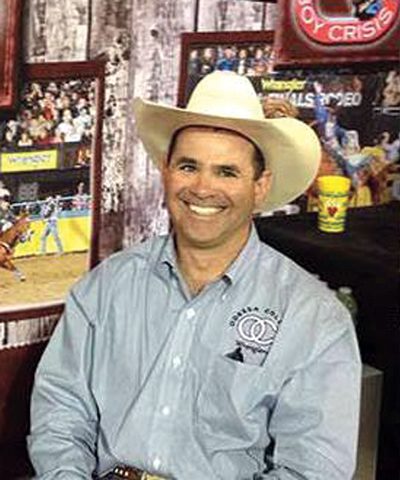
Pat Summit
-
College Rodeo Coaches
article by C.J. Aragon,
Odessa College Rodeo Coach College Rodeo Coaches are a small fraternity that I am proud to be a part of. There are not very many college rodeo coaches around the country and they do not get the recognition or pay that their counterparts in sports like basketball and football do. However just because we aren’t paid on the same level as many other college coaches it is by no means an indicator of our passion for the sport of rodeo.
I know many great college rodeo coaches across the country, these coaches run programs from small community colleges to major universities. Although the students may only be influenced by their coach for one to four years the impact can last much longer than that. All of the coaches I respect want to see their students be successful in the arena and in life.
There are a few things I think many of our students need to realize about college rodeo coaches and coaches in general.
If you are in our program, we want you to do well. When we recruited you to our program we saw potential based on your past performances. You obviously saw value in the program as well or you wouldn’t have made the choice to join the program. There will be ups and downs along the way but your coach will always be in your corner and looks forward to seeing you do well.
What many students need to realize about coaches is that we have watched many students be successful and some fail. We can help with from our past experiences. We have in a sense been there, done that.
Just because you had success at the high school level does not guarantee that you will be successful on the college or professional level. In my experience I have watched former High School National Champions have limited success on the college and professional level, I have also witnessed students who never qualified for the High School National Finals Rodeo have tremendous success at the college and professional level. Their achievements had to do with their coachability and their ability to communicate with their coach.
Which brings us right back around to college rodeo coaches. Your rodeo coach can offer you suggestions on what skills you need to improve on. Your coach can give you feedback on what they see you do in competition and in the practice pen. They offer tips and training exercises for you to work on. Coaches can give you structure to your practices and workouts. You will not always like what your coach has to say. You may not always like what your coach has you do, but rest assured that your coach is working help you achieve your goals.
Coaches can do a lot for you, they can be a great resource if you choose to use them.
The most successful and most improved students in any sports programs are the ones who take the small bits coaches offer and apply them daily. Be Coachable!
C.J. Aragon is the Rodeo Coach at Odessa College and has a Master’s Degree in Coaching Education. He has been an invited speaker to the Global Coaches Seminar at Ohio University working with coaches in all sports from around the country. -
It’s A Team Thing
“The people we surround ourselves with either raise or lower our standards. They either help us become the best version of ourselves or encourage us to become lesser versions of ourselves. We become like our friends. No man becomes great on his own. No woman becomes great on her own. The people around them help to make them great.
We all need people in our lives who raise our standards, remind us of our essential purpose, and challenge us to become the best version of ourselves.”
I saw this quote the other day and it truly fits with most athletes. It is defiantly true in for college rodeo students, I have watched it firsthand. I have watched how contagious students with great positive attitude and a tremendous work ethic can elevate those around them. Great attitudes and work can be contagious, it can lead everyone involved to become part of something greater than themselves.
It is a team thing.
Who is on your team? Who have you surrounded yourself with? Are your friends and teammates making you better? Are you making them better?
Are the people around you successful? If you want to improve quickly look for successful people in your chosen area and then join them. Watch them and learn from them. How do they practice? How do they handle business at the rodeos? By surrounding yourself with successful people you will find out the small things they do differently than others and how the small details can lead to bigger and better results for you in the future. Find successful people and learn from them.
Are you surrounded by people with a positive attitude? A positive attitude is truly one of the most contagious things around. Some of the best student athletes I have ever coached had marginal talent and a phenomenal positive attitudes. It affects everyone around them teammates, competitors and even coaches. These people are easy to spot, and every successful team has a few around. If you can’t find someone with a great positive attitude, be that person with the positive attitude.
Every successful team also has the hard workers. The hard workers, the ones who show up early, stay late and do more than is asked of them. I think it is funny how many people who arrive late, leave early and get by, refer to the hard workers as “Lucky” when they get beat by them. Don’t let someone beat you because they simply outworked you. Find the hardest working teammates and join them.
For your team to truly be effective you need the realist. The coach or mentor. It is critical that you have this person in your group, someone who will tell you what you need to hear when you don’t want to hear it. Someone who will support you on your efforts to accomplish your goals. This is the person who challenges you, who forces you to be better, and will hold you to a higher standard.
Being successful is a team thing. Choose a good team and be a good teammate you will be impressed with the results. -
Just Breathe
I am a big fan of the motivational speaker Eric Thomas. If you don’t know who he is you need to look him up and watch some of his videos.
There are a few of his videos I show every team. The first is his video on “How bad do you want it” If you haven’t seen it I will strongly recommend that you do before you read any further.
Since you are still reading I hope that you have watched his video. The message is great, when you want to succeed as bad as you want to breath you will be successful. It is a great motivational video.
When we watch the video in the group the majority of the students are pumped up and excited to practice, for at least a day or two. It is easy to see the students that understood the message in the video. After the excitement and the message has worn off the practice energy level and intensity levels begin to fall off for most students. It is easy to be motivated or excited for a practice or two, anyone can do that. Those college contestants who are still competing in June have found a way to motivate themselves every day regardless of their daily distractions.
From experience I would say that there is a big majority of the contestants that are motivated easily for a day or two. Usually they somehow find that motivation the day’s right before the rodeo. These are the guys that entered and think that they can be competitive with just a day or two of practice. This is the group doing CPR on their goals. There is not really any other way to describe it. It may work to save you to fight another day, but then again it might not. A chance a lot are willing to take.
The message of the video was “When you want to succeed as bad as you want to breathe you will be successful.” Breathing is simple, a little thing you do every day. Working towards your goals can be just as easy, just a little effort every day. It will keep you alive, a little effort can keep your goals alive as well.
Being successful in the arena, in the classroom and in life is just like breathing. Whatever you want to be successful at you will find a way to do every day. You breathe every minute of every day, it keeps you alive. You can’t breathe part time and have it work out well, unless you know people good at CPR.
Truly having goals doesn’t allow for taking a week off then working for two days before you compete or studying for two hours before a test. This may work in the short term, but your long term success will be very limited.
The successful athletes, students, and people of this world are not motivated on a part time basis, they are motivated daily. The top rodeo contestants don’t have their parents, coaches or friends asking them to go to practice, get an extra work out in, and exercise their horses. Their effort to be successful has become just as routine as breathing.
Success is much like breathing. If you keep breathing, you stay alive. If you want to keep your goals alive and growing you find a way to work towards them on a daily basis. It’s that simple._________________________________
C.J. Aragon was named the 2008-2011 Grand Canyon Region Coach-of-the-Year. 2014-2015 WJCAC Coach-of-the-Year, 2016 Southwest Region Coach-of-the-Year, and 2010 National Intercollegiate Rodeo Association Coach-of-the-Year.
-
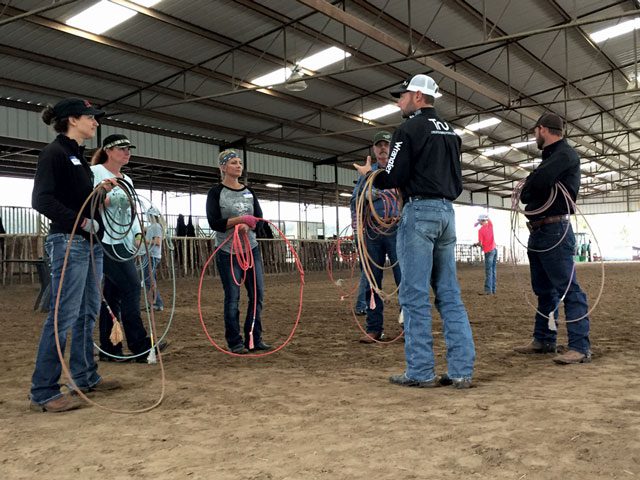
Steps for Heelers
As I write the third article, I am still presented everyday with the same situations during lessons and clinics that ropers are practicing with an unclear game or business plan. This is where the bad habits are created and not even knowing that it is happening. The first article was the model of the practice and the second article was breaking down the first five steps for the headers. This article is breaking down in order the steps for the Heelers.
We can always fine-tune each step but we need to execute them in order to get on the right track. Haze is step one for a Heeler. All this means is for the Heeler to be recognized as a threat to the steer before the header is so the steer does not run to the right. Our job is to keep the steer running straightforward.
Once you establish a haze or even if you don’t, the most important thing to do is step two. Get into position!! Position is the key to your run! I like to teach “keep your horses nose even with the hip of the steer” as you run down the arena. You will remain in your lane to the right of the steer. This is where “timing” is created! When you match the speed of your horse to the speed of the steer you are in time. Your tip will be forward and down when your horse is down in stride on their front feet.
Step three is to have your swing going and tip down towards the steer. If the tip is not loaded or in the direction of our target, the delivery is almost certain to be incorrect.
Step four is follow the hip of the steer. All Heelers are guilty of watching the head catch. The problem with this is that is not the target, where you look is where your horse goes. Disciplined eyes make disciplined feet. Your eyes are your horse’s feet! Many Heelers do not like to ride that high and stay with the hip because they will run by the corner. This is true if you are looking at the head of the steer. Look at the end of the steer you are going to rope.
Step five is “ROPE”! If we work smarter going down the arena keeping the steer running straight and making sure we achieve position, have our tip down going in the direction of our target and follow our target by watching the hip or backend of the steer, then we should be ready to rope. We can set it all up for success before we make the corner.
The first three hops a steer gives us are usually the best three. I am not teaching to rope fast, just promoting being efficient! If we execute a fundamentally sound business plan for every practice, then we will get the results desired for our efforts. Until next time, enjoy this practice plan!
Krece -
The Passion of Competition
This is one of my favorite times of the year. The College National Finals Rodeo and State High School Finals Rodeos going on across the country. What more can a college rodeo coach as for?
It is always interesting to me to watch the growth and maturity of rodeo students in the years that we get to watch them. I, like many coaches, have watched some student’s progress from high school rodeo, through college rodeo and on to win World Championships.
Some of the most talented students in high school that were highly recruited never make the jump to be competitive at the collegiate level. Others who were overlooked in high school go on to be outstanding college competitors. It is very interesting to watch and learn from. I know that in the past I have missed and recruited the very successful high school student and later had them underachieve in college. I have also regretted not recruiting many high school students.
Over the course of the past ten years I have had the chance to visit with any current and future champions of our sport. At an early age you could tell that they were destined for great things by what they did in the arena.
I think back to getting to visit with some current champions, many of them while they were still in high school. Most all of them were exciting to talk to because of the passion they had for competition. Winning titles didn’t motivate them every day, the love of competition motivated them.
I think this is very important because many physically talented students are motivated by winning and at an early age winning is easy because of their physical skills. In many cases in rodeo these students do not learn or work on the fundamentals of their chosen event, they simply rely on their god given skills. For the physically gifted they don’t learn to compete, many simply just learned to win without much effort, and I don’t believe this is a good thing.
The students who learn to love competition learn to work their way to a higher level. The drive that it takes to be successful, will then help elevate them as a competitor. These are the late bloomers. Their passion for competition will help them continue to improve. They may not have been that competitive when we watched them coming through high school, but they were always improving. In college they may have gone unnoticed for a while, but the late bloomers always have a way of eventually finding their way to the top.
Those who love to compete will work to be better. They will find ways to improve and develop their skills on a daily basis. They will be willing to grind every day to be ready for their next opportunity to compete. They are not afraid of competition.
Passion for competition is a great indicator for future success._____________________________________________
C.J. Aragon was named the 2008-2011 Grand Canyon Region Coach-of-the-Year. 2014-2015 WJCAC Coach-of-the-Year, 2016 Southwest Region Coach-of-the-Year, and 2010 National Intercollegiate Rodeo Association Coach-of-the-Year.
-

Attitudes
ATTITUDES
article by C.J. Aragon,
2010 NIRA Coach-of-the-Year, Odessa College Rodeo CoachAs a coach one of the first lessons I learned is how many rodeo contestants approach competition. Many young rodeo contestants have a difficult time at rodeos because they are concerned with what others are doing. They watch the rodeo and worry about being fast enough to beat someone, or ride better than someone.
Rodeo is indirect competition. Indirect competition means your only competition is yourself.
It is not like football or basketball where you line up across from your opponent. In these sports you are in direct competition with your opponent. If you are better physically and mentally prepared you should beat them, likewise if they are better physically and mentally prepared they should beat you. This is direct competition. Your performance does directly impact your opponent’s performance, and their actions will directly affect your performance.
In rodeo, your performance stands alone. No one scores for you in the timed events. No one else marks them out in the rough stock events. The spotlight is yours.
Your fellow contestants cannot physically dictate your performance. Just like you cannot dictate their performance. I understand that in rodeo there is the variable of the livestock draw, but everyone entered has to deal with the draw. Somedays it will be in your favor, other days the draw works against you.
Being indirect competition the only person that can beat you is yourself. It breaks down to be that simple. The fewer mistakes you make the better you will do. The more mistakes you make the more you will beat yourself. Indirect competition is a simple concept.
If you do your job, and do the best physically and mentally in the practice pen and competition, you have done your part. If you are worried about beating others, you usually just end up beating yourself. Some of the best contestants I have watched on every level from PRCA to junior rodeos do a great job of making rodeo indirect competition. They do the best with what they have drawn each time they nod their head. They come to the rodeo mentally and physically prepared to compete, their performance is not dictated by others.
Some students learn this lesson early on and it shows when they reach higher levels of competition. When you are entered in a rodeo and you are taking care of your business, doing your job there is a lot less anxiety and nervousness before you compete. When you watch contestants who do this well their performance at the rodeo looks just like their performance in the practice pen.
To excel in indirect competition, practice like you compete and compete like you practice. To excel in rodeo, practice like you compete and compete like you practice.C.J. Aragon was named the 2008, 2009, 2010, 2011 Grand Canyon Region Coach-of-the-Year. 2014, 2015 WJCAC Coach-of-the-Year and 2010 National Intercollegiate Rodeo Association Coach-of-the-Year.
-
Work Smarter, Not Harder
Hello ropers! Great to be back writing the second article! I hope everyone had a chance to read and try what was talked about in first tutorial. I am going to follow up where I left off.
Again, fundamentals are where you keep your focus. I always have students calling or sending messages/videos with a problem and every time the problem can be traced back to a fundamental oversight. This is where we dissect the steps I mentioned.
Step one for headers is scoring. This means learning to score yourself so your horse becomes consistent in your commands. If you anticipate the gates opening and your body moves, your horse is going to move as well. Keep your balance equal in your saddle and stirrups and nod with your head, not your back or body. Make sure your left hand is staying consistent with the pressure you have holding your horse. I prefer to use my stomach/abdominal area or saddle horn as a guide so I’m not lifting or moving. This is the start of your run.
Leaving the corner of the box sets the tone for the run. More often than not, headers will leave the corner of the box leaning forward to leave with their horse. Granted this keeps you from going off the back of your horse but it is not correct. This causes you to start your swing later and be out of balance in your swing. The first swing usually goes forward and up and now you have to take extra swings to get your tip down to rope once in position. If we leave the corner of the box balanced with our left hand moving forward, then our weight will remain equally balanced in the stirrups allowing us to square our shoulders and hips to our target. Now our horses are leaving flat, smooth and faster, which means they are out of our way to get the swing started with less effort and match the tip of our loop and swing to the head or horns of the steer.
Watch videos of the open ropers in slow motion and you will see how everyone of them leave the box rotating arms, shoulders and hips to get square to the target. If you don’t do this it definitely does not mean you can not catch, just means you are working harder to achieve the same result as someone who is doing it and you are being less efficient. Work smarter, not harder. Remember it is a timed event!
As we continue from month to month I will break down the “How and Why” of the steps which creates the solid practices. The catch is what makes us feel good but what makes us feel better is to understand how to get better and catch every time as we work in the practice pen.
Until next month, thank you for your time and work on what works and not recreating the same habit that doesn’t work.
Thank you and God Bless!
Krece Harris -
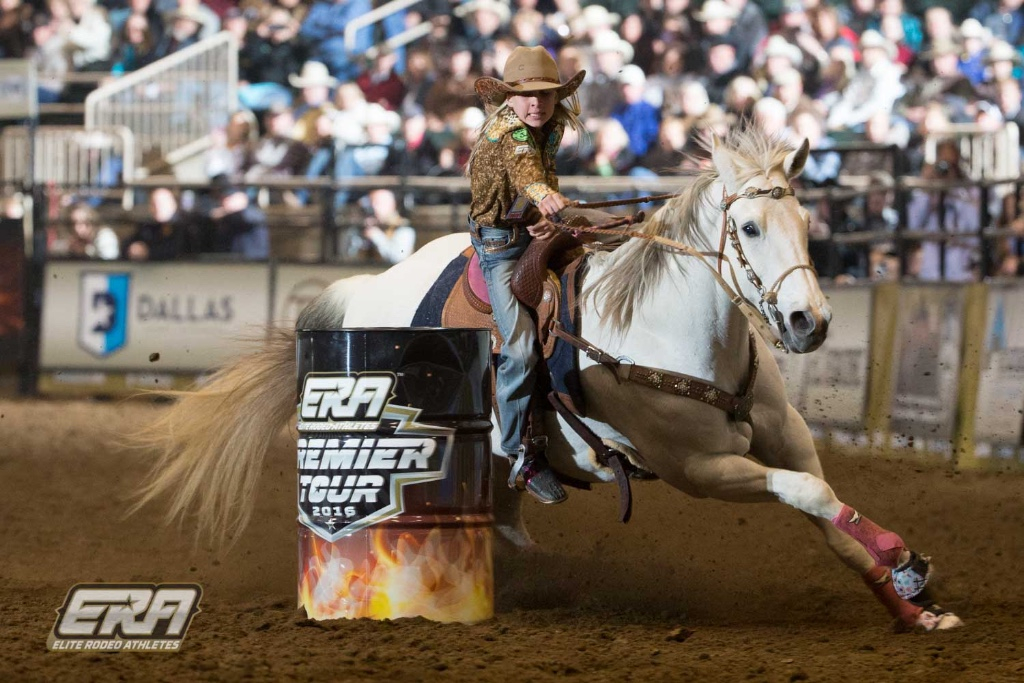
10-year-old Chamberlain leads Race to Dallas in ERA Premier Tour Barrel Racing
Courtesy of ERABegay and Cooper win again atAlbuquerque ERA Premier Tour Stop No. 7ALBUQUERQUE, New Mexico (May 20, 2016) – With a great run working in her favor, 10-year-old Chayni Chamberlain (Stephenville, Texas) now sits atop the Elite Rodeo Athletes (ERA) Premier Tour world standings in barrel racing, tied with Ashley Shafer (Yoder, Wyoming) after Friday’s Stop No. 7 in Albuquerque. Chamberlain ran in 14.27 seconds, tying with Sarah Rose McDonald (Brunswick, Georgia) for third place. When overall season leader Schafer toppled her second barrel, resulting in a run of 19.06 seconds with the five-second penalty, Chamberlain’s 212.5 points for the third place finish were enough to move her into first place alongside Schafer.For the third time this season, the World Championship Team Roping duo of Derrick Begay (Seba Dalkai, Arizona) and Clay Cooper (Gardenerville, Nevada) landed atop the podium as the winners the ERA Premier Tour’s Team Roping competition.Albuquerque fans saw Begay and Cooper produce a 4.62-second run, just one-one-hundredth of a second faster than the second place team of Speed Williams (Jacksonville, Florida) and Rich Skelton (Llano, Texas) (4.63 seconds). For the win, Begay and Cooper earned 275 points which gives them a 425-point lead in the ERA World Standings.In third place behind Williams and Skelton was Charly Crawford (Prineville, Oregon) and Kollin VonAhn (Sac City, Iowa) with a run of 4.78 seconds.Zeke Thurston, the 22-year old saddle bronc rider from Big Valley, Alberta, picked up his first ERA Premier Tour win with an 85.5-point ride on Stace Smith’s Ned Pepper. Tied for seventh place in the ERA world standings, the win moved Thurston into fifth place, now tied with New Mexico’s Taos Muncy. In second place was Isaac Diaz who posted a score of 83 points on Hello Dolly. Bradley Harter’s 81.5-point score on Levi the Boss landed him in third place.The steer wrestling competition generated some of the fastest scores of the season. Each of the Top 3 cowboys dogged their steer to the ground in under 4 seconds – Casey Martin (Sulphur, Louisiana) in 3.62 seconds for the win; Stockton Graves (Alva, Oklahoma), in 3.74 seconds and Nick Guy (Sparta, Wisconsin) in 3.90 seconds. It was Martin’s first win of the 2016 ERA Premier Tour and moved him from ninth place into a tie for sixth place in the ERA world standings with Luke Branquinho (Los Alamos, California).The World Champions reigned supreme in tie-down roping with 3-time World Champion Tuf Cooper (Decatur, Texas) picking up his second victory of the year with an 8.12-second. Behind him in second place was 8-time World Champion Fred Whitfield with a time of 8.28 seconds, and rounding out the Top 3 was 6-time World Champion Cody Ohl.Another first-time winner was Austin Foss (Terrebonne, Oregon) in bareback riding. An 84.5-point ride on Greely Hat Works Sugar Daddy of Cervi stock gave him the 275 points for first place. World Champion Kaycee Feild (Spanish Fork, Utah) rode into second place with an 84-point ride on Utopia (NT Rodeo). The American’s first $1 million winner, Richmond Champion (The Woodlands, Texas) came in third place with 83 points on Black Friday (Stace Smith).Chandler Bownds earned his second win of the 2016 ERA Premier Tour with an 87.5-point ride on Shyster (TNT Rodeo). Cody Campbell and Zack Oakes came in second and third place, respectively.All of the action from Stop 7 will air on Wednesday, May 25 on FS2 (Fox Sports 2) at 9 a.m. ET.Stop 8 of the Albuquerque ERA Premier Tour takes place Saturday at 7:30 p.m. at Tingley Coliseum. Tickets are available at all Ticketmaster outlets, online at ticketmaster.com, via phone at 800 745 3000 or at Tingley Coliseum starting at 12 p.m. on Saturday, May 21.In two months, on July 19-23, the ERA athletes will return to Salt Lake City for the Days of 47 Rodeo taking place at Vivint Smart Home Arena.The 2016 season will culminate with the $3 million ERA World Championships in Dallas, Texas, at the American Airlines Center on Nov. 9-13, where the 2016 ERA World Champions will be crowned. Tickets for the five-day event are on sale now at Ticketmaster.com or by calling 800 745 3000. For more information, visit www.eraprorodeo.com. -
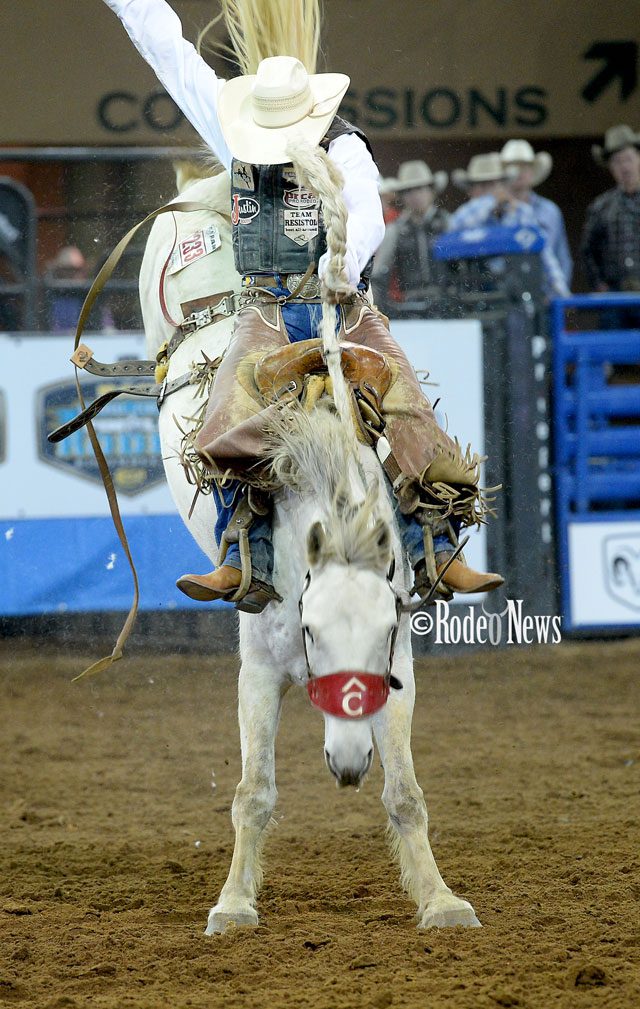
Saddle bronc rider Real makes most of opportunity
KISSIMMEE, Fla. – All of saddle bronc rider Joaquin Real’s hard work Friday went for naught on Friday night.
Real made three total rides – two of which were re-rides – and he had no score to show for it
at the RAM National Circuit Finals Rodeo at the Silver Spurs Arena.
“The third horse I got on (Friday) got me down (and bucked him off),” Real said. “I was pretty gassed and I was a little sore today.”
Real didn’t act sore Saturday afternoon.
The Santa Paula, Calif., cowboy took the second-round lead at the RNCFR with an 83-point ride on Pete Carr’s Classic Pro Rodeo’s Another Gray.
“I had to do good today to get a check,” said Real, 33. “I’ve seen that horse a handful of times and I always wanted to get on it and things worked out for me with that ride. That was a great horse and it felt good. I was really needing something like that. Today turned out to be great for me.”
Real wasn’t able to wait and see if his ride will hold up for the win, as he had to catch a flight from nearby Orlando at 6 p.m. (ET) to get to California, so he can compete at the Oakdale Saddle Club Rodeo. The second round of the RNCFR concludes tonight at 7:30 (ET).
“I hope it holds up,” Real said. “There are 12 more guys who will go tonight, so we will have to see. I think it will get a good check, for sure.”
Real, who placed 35th in the world standings a year ago with $24,963, is making his fourth appearance at the RNCFR. He punched his most recent RNCFR ticket by winning the California Circuit Year-End title.
Like Real, tie-down roper Cy Eames was able to seize his moment in the second round, grabbing the round lead with a 9.0-second run.
“I have a good chance to win some money in the second round,” said Eames, who competes for the Wilderness Circuit and is making his RNCFR debut. “The calf was good. I had to run her a little farther than I wanted. If I caught her a little quicker, I would be doing a little better in the average, but it worked out and I’m glad I’m here and grateful for this experience. There are a lot of things to do in Florida, and they’ve done a great job of putting this on. The hospitality is amazing.”
Eames, of Gooding, Idaho, is sitting fourth in the average heading into tonight’s performance with a 19.5-second time on two head. Eames is riding his 13-year-old horse, Lambo, at the RNCFR.
“Last year I was more of a circuit cowboy and this year I will go to quite a few more rodeos, and try and make the Finals,” said Eames, 25. “I would love to advance here (at the RNCFR), but if I don’t at least I know I tried my best.”
In addition to Real and Eames, other second-round leaders are bareback rider Tim O’Connell (87 points on Harry Vold’s Painted Coast), steer wrestler Josh Peek (4.0 seconds), team ropers Coleman Proctor and Jake Long (4.8 seconds), barrel racer Emily Miller (15.71 seconds) and bull rider Jake Gowdy (79.5 points on Pickett Pro Rodeo’s Dragonfly).
The average leaders are O’Connell (170.5 points on two), steer wrestler Riley Duvall (9.0 seconds on two), team ropers Jake Orman and Tyler Domingue (12.5 seconds on two), saddle bronc rider J.J. Elshere (163 points on two), tie-down roper Sterling Smith (17.0 seconds on two), barrel racer Sherry Cervi (31.44 seconds on two runs), and Gowdy (160.5 points on two). The RNCFR will crown its 2016 national champions in the final performance at 2:30 (ET) Sunday.
The tournament-style RNCFR format determines the national circuit champions in each event. All 24 qualifiers from the 12 circuits compete in the two preliminary rounds of the rodeo. The top eight contestants from the two-head average in each event advance to the semifinals, with all previous scores and times thrown out. The top four move on to the final round, and a sudden-death competition determines the national circuit champion in each event.
The Wrangler Network will be live streaming all the action from the RNCFR. The coverage begins at 7:30 p.m. (ET) today and at 2:30 p.m. (ET) tomorrow. Log on to www.wranglernetwork.com to watch.
RNCFR
Kissimmee, Fla., April 7-10
Bareback riding: First round: 1. (tie) Chase Erickson, on United Pro Rodeo’s Little Dougy, and R.C. Landingham, on Big Rafter Rodeo’s Logan’s Crossing, Mason Clements, on Stace Smith Pro Rodeos’ Miss Dunny, Tim O’Connell, on Korkow Rodeo’s Bambino Vold, 83.5 points, $4,121 each; 5. Ty Breuer, 80.5, $1,311; 6. Jake Brown, 80, $937. Second round leaders: 1. Tim O’Connell, 87 points on Harry Vold Rodeo’s Painted Coast; 2. Clayton Biglow, 82.5; 3. Evan Jayne, 81.5; 4. Frank Morton, 79.5; 5. Ty Breuer, 79; 6. Justin Miller, 78. Average leaders: 1. Tim O’Connell, 170 points on two head; 2. Ty Breuer, 159; 3. Clayton Biglow, 158; 4. (tie) Frank Morton and Evan Jayne, 157 each; 6. Justin Miller, 156.
Steer wrestling: First round: 1. Sterling Lambert, 4.6 seconds, $6,182; 2. Riley Duvall, 4.8, $4,683; 3. (tie) Cody Pratt and Jule Hazen, 4.9, $2,810 each; 5. Shayde Etherton, 5.3, $1,311; 6. (tie) Colt Floyd and Blaine Jones, 5.6, $468 each. Second round leaders: 1. Josh Peek, 4.0 seconds; 2. Riley Duvall, 4.2; 3. Ty Erickson, 4.8; 4. Juan Alcazar Jr., 5.0; 5. Kyle Whitaker, 6.2; 6. Blaine Jones, 6.6. Average leaders: 1. Riley Duvall, 9.0 seconds on two head; 2. Josh Peek, 9.6; 3. Blaine Jones, 12.0; 4. Kyle Whitaker, 12.1; 5. Ty Erickson, 14.0; 6. Colt Floyd, 15.9.
Team roping: First round: 1. Jake Orman/Tyler Domingue, 5.3 seconds, $6,182; 2. Billy Bob Brown/Garrett Jess, 6.3, $4,683; 3. J.B. Lord/Levi Lord, 6.5, $3,372; 4. Andrew Ward/Tyler Worley, 6.6, $2,248; 5. (tie) Tyler Wade/Kinney Harrell, Barak Freeman/Asher Freeman and Eric Fabian/Shawn Quinn, 6.9, $749 each. Second round leaders: 1. Coleman Proctor/Jake Long, 4.8 seconds; 2. Spencer Mitchell/Russell Cardoza, 5.3; 3. Shawn Bessette/Sid Sporer, 6.1; 4. Blake Hirdes/Joseph Shawnego, 6.5; 5. Jake Orman/Tyler Domingue, 7.2; 6. Eric Fabian/Shawn Quinn, 13.4. Average leaders: 1. Jake Orman/Tyler Domingue, 12.5 seconds on two head; 2. Shawn Bessette/Sid Sporer, 13.4; 3. Coleman Proctor/Jake Long, 15.1; 4. Blake Hirdes/Joseph Shawnego, 16.7; 5. Eric Fabian/Shawn Quinn, 20.3; 6. Barak Freeman/Asher Freeman, 21.4.
Saddle bronc riding: First round: 1. Jacobs Crawley, 84 points on Sutton Rodeo’s Prom Night, $6,182; 2. Allen Boore, 82, $4,683; 3. J.J. Elshere, 81, $3,372; 4. (tie) Sam Spreadborough, Heith DeMoss and Rusty Wright, 80.5, $1,499 each. Second round leaders: 1. Joaquin Real, 83 points on Pete Carr’s Classic Pro Rodeo’s Another Gray; 2. J.J. Elshere, 82; 3. Rusty Wright, 81; 4. Doug Aldridge, 79.5; 5. Brody Cress, 77.5; 6. Max Filippini, 75.5. Average leaders: 1. J.J. Elshere, 163 points on two head; 2. Rusty Wright, 161.5; 3. Jacobs Crawley, 159; 4. Doug Aldridge; 155.5; 5. Max Filippini, 151.5; 6. Ryan Bestol, 150.
Tie-down roping: First round: 1. Sterling Smith, 7.8 seconds, $6,182; 2. Josh Peek, 7.9, $4,683; 3. Cole Bailey, 8.7, $3,372; 4. Taylor Santos, 8.9, $2,248; 5. Timber Moore, 9.8, $1,311; 6. Brice Ingo, 10.0, $937. Second round leaders: 1. Cy Eames, 9.0 seconds; 2. (tie) Blake Hirdes, Sterling Smith and Josh Peek, 9.2 each; 5. Jason Schaffer, 9.4; 6. Tristan Mahoney, 10.3. Average leaders: 1. Sterling Smith, 17.0 seconds on two head; 2. Josh Peek, 17.1; 3. Blake Hirdes, 19.4; 4. Cy Eames, 19.5; 5. Jason Schaffer, 20.3; 6. Tristan Mahoney, 31.3.
Barrel racing: First round: 1. Sherry Cervi, 15.58 seconds, $6,182; 2. Emily Miller, 15.86, $4,683; 3. Sarah Kieckhefer, 15.90, $3,372; 4. Kelly Tovar, 15.92, $3,372; 5. Calyssa Thomas, 15.94, $1,311; 6. Ivy Conrado, 15.95, $937. Second round leaders: 1. Emily Miller, 15.71 seconds; 2. Ivy Conrado, 15.77; 3. Natalie Foutch, 15.84; 4. Sherry Cervi, 15,86; 5. Jennifer Barrett and Pamela Capper, 16.04 each. Average leaders: 1. Sherry Cervi, 31.44 seconds on two head; 2. Emily Miller, 31.57; 3. Ivy Conrado, 31.72; 4. Pamela Capper, 32.06; 5. Calyssa Thomas, 32.33; 6. Jennifer Barrett, 32.34.
Bull riding: First round: 1. Jake Gowdy, 81 points on Painted Pony Championship Rodeo’s Gentleman Jack, $6,182; 2. Cody Rostockyj, 80.5, $4,683; 3. Lon Danley, 75.5, $3,372; no other qualified rides. Second round leaders: 1. Jake Gowdy, 79.5 points on Pickett Pro Rodoe’s Dragon Fly; no other qualified rides. Average leaders: 1. Jake Gowdy, 160 points on two head; 2. Cody Rostockyj, 80 point on one head; 3. Lon Danley, 75.
Total payoff: $704,353. Stock contractors: Lancaster & Jones Pro Rodeo, Painted Pony Championship Rodeo, United Pro Rodeo, Brookman-Hyland Rodeo, Big Rafter Rodeo, Klein Brothers Pro Rodeo, Harry Vold Rodeo, Korkow Rodeos, Hi Lo ProRodeo, Rafter H Rodeo Livestock, Silver Spurs Club, Sutton Rodeos, Three Hills Rodeo, Silver Creek Rodeo, Pickett Rodeo and Stace Smith Pro Rodeos, Pete Carr Pro Rodeo.
-
Meet the Member: Lori Tierney
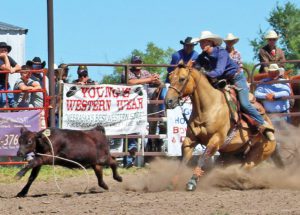
above: M-SRA member, Lori Tierney – Sugar Creek Photos story by Terry Rhodes
“Be fearless in the pursuit of what sets your soul on fire.” That quote has a lot of meaning to Lori Tierney and she strives to live by it every day. “I believe in this 100% and the preparation that I do in my roping and working my horses is part of that. It is a true passion for me. I believe that the amount of effort you put into something is what you will get out. I do that kind of preparation so when I get to the rodeo no matter how the cards fall I am satisfied with the results”
Lori has been in the Mid-States association 12 years and has served as event director for the breakaway roping for the last few years. You’ll find her in just about any event that includes throwing a rope, and sometimes barrel racing. “I’m kind of a closet barrel racer.”, she admits with a laugh. She likes the association because of the great people that are in it. “In the summer we travel all over the state each week. I feel like everyone is family; everyone supports one another. We have rodeos in a lot of little towns and the committees that put them on are great.” She is also in the KPRA, NSRA, and WPRA.
The Tierney name is well known in rodeo so it came quite naturally for Lori to get an early start in the arena. “My dad calf roped and team roped so it’s always been part of our family. Growing up on a ranch, I have always been around horses and roping. I did some junior rodeo and 4-H. I had a rodeo scholarship and went to Garden City Community College for two years and transferred to Southwestern Oklahoma State University and got my degree in social work.”
In roping, horse power is everything and Lori has a couple of great horses; Bueno and Charger. “Bueno was raised by my cousins, “Tierney Quarter horses.” Which is neat since they live right down the road and I travel with my cousin, Ginalee to many of the rodeos and ropings. My ‘B’ string horse, Charger was a raffle horse that I won in college and he’s turned out to be a really neat horse.”
Her home is in Broken Bow, Neb. with her family. Her parents are Larry and Kathy Tierney and she has an older brother, Cole. Lori says that she’s had several people helped in her rodeo career but none more than her father. “He’s turned out thousands of calves for me and he’s given me every opportunity to succeed in the arena. Jan Brown has always been a big influence and supporter. She took me under her wing when I was just starting out and has been big a supporter. I have a good friend, Lacey Baehler that is one of the most positive people I know. I think we push each other to bring out the best in each other. Those friendships are irreplaceable. There are so many people that have helped me.”
Lori’s work week is a mix of jobs and duties that keep her on the run. She’s a secretary for Power Solutions part of the day, runs cattle with her dad, does day work, rides horses, and teaches a Zumba class. “I love to dance, so Zumba is an opportunity to share my passion and hopefully inspire people. I’m lucky I have a really awesome balance in my life with all different avenues. I get to live my dream everyday! I’m pretty simple really. I love to rope, dance, am a huge Husker football fan and love to enjoy life!” -
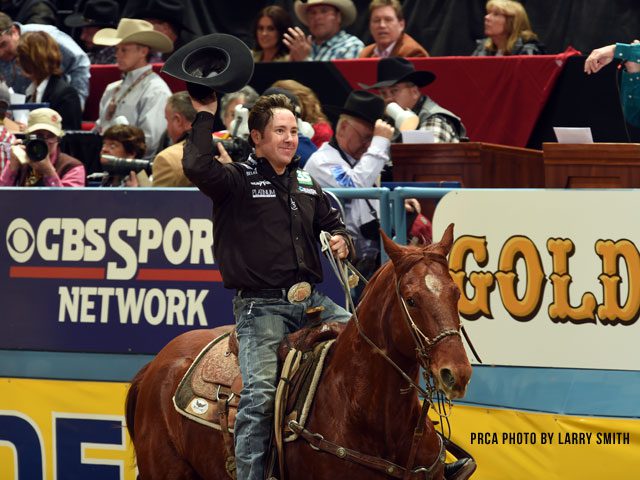
Trevor Brazile’s name is missing from the top of the tie-down roping and all-around world standings.
The 23-time world champ has won more money than any other tie-down roper this year, and just came off a win at the National Western Stock Show and Rodeo in Denver last weekend. But as long as the lawsuit between the Elite Rodeo Association and the Pro Rodeo Cowboys Association continues, his name will be absent from the standings.
Brazile, who is on the board of directors for the ERA, and the other 79 ERA members, are allowed to compete in PRCA rodeos, but their names are not included in the world standings.
The ERA brought the anti-trust class action lawsuit against the PRCA in November of last year, after the PRCA passed bylaws in September stipulating that PRCA members could not compete in “conflicting rodeo associations while receiving the benefits of PRCA memberships.” Those conflicting rodeo associations were defined to be any associations that “produce, promote and/or sanction professional rodeo contests” in two or more rodeo events.
On Jan. 5, a federal judge ordered that all members of the lawsuit (ERA members) can compete in PRCA-sanctioned events until Feb. 12, giving them a chance to make a living while the suit is pending. Brazile has won about $18,000 since the new year, but that money was put in escrow by the PRCA until the suit is resolved. If the ERA would lose the lawsuit, the cowboys’ entry fees would be refunded but they would not receive the prize money they had won.
Brazile thinks the ERA brings great opportunities to the pro rodeo world. “This (association) was brought on to be a bonus to contestants, to have another opportunity for television, for endorsements to grow. It is a $4.6 million tour that wasn’t already in the industry, 52 hours of TV (coverage) that wasn’t already in the industry. I think it’s got a lot of positives.”
The ERA has announced its 2016 schedule, with fifteen rodeos in eight cities and a finals in Dallas in November. FOX Sports is set to broadcast the rodeos.
When the judge made the order, she also required the ERA and PRCA to attend mediation. The mediation was not successful, said world champion bareback rider and ERA contestant Bobby Mote. The ERA was never meant to replace the PRCA, he said, but enhance what already exists. “These (cowboys) need more chances to be able to make a living doing what they do. The fans want to have the opportunity to see the type of action they’ve grown accustomed to seeing (on television, during the broadcast of the Wrangler National Finals Rodeo). One time a year, you get to see all the (rodeo) stars in one place on TV, and the rest of the year, it’s up in the air if you get to see the top names in the sport.”
Rodeo could use more publicity, Mote said, and he believes the ERA’s television contract was a way to attain that. “Everybody agrees that we have a great sport, and it’s undersold, and the people who do it are undersold. There are so many stories in rodeo, but unless you’re really wired into the western industry and you know where to find them, you have no idea.”
Rodeo needs to be in front of more fans, he said. “How do you get in front of not only core rodeo fans, but other groups of fans, so that the sport can grow instead of stagnate or lose ground? These are all things we feel where the ERA can add exposure and can present it differently than it’s been presented in the past.”
The two associations could co-exist, Brazile believes. “It’s been said, a rising tide raises all ships. I hope (the ERA) has an effect on high school, college, and junior rodeos, and that more people want to be cowboys because of more opportunity, not because of restricting opportunities.”
Mote likens the position of the ERA cowboys and cowgirls to the Turtles –the early cowboys in the 1930s who “stuck their necks out” to form the Turtles Cowboy Association, the beginnings of the PRCA. “We’re the ones sticking our necks out and getting criticized, but at the same time, somebody’s got to do it. In my twenty years of rodeo, I haven’t seen enough positive change, to make me feel like the sport’s better off than when I started.”
The ERA has been compared to the Pro Bull Riders, which began in 1992 with a band of twenty bull riders who decided to form their own association. “I’ve talked to a lot of those (bull riders),” Mote said, “and they all tell me they faced a lot of the same obstacles and a lot of people criticized them. But you look around now and it’s hard to find somebody to criticize the PBR. Rodeo has benefited from the PBR, whether they want to admit it or not. It’s helped grow the industry and we hope this does the same.”
“I know I’m fighting for cowboys and cowgirls,” Brazile said, “for the industry itself, not just one group.”
When asked, the PRCA’s comment was such: “The PRCA has and will continue to vigorously defend this action and is confident in its position. As there are current motions pending before the court, the PRCA will not comment on specific matters, but can say that it will doggedly prosecute this action to a final dismissal or judgment of the court.”
Reprinted with permission from TriState Livestock News