Rodeo Life

Category: Archive

  • Tyler Jackson

    Tyler Jackson

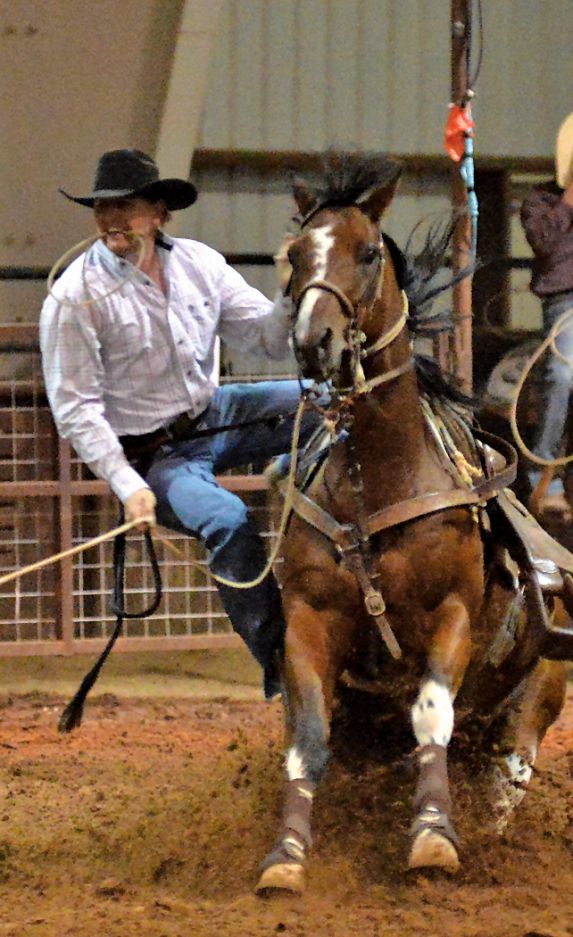
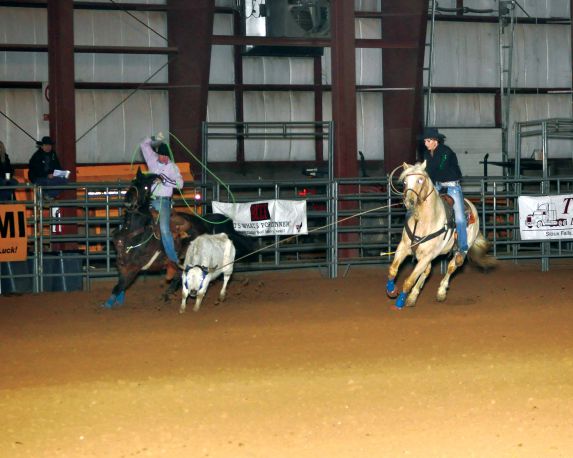
    Tyler Jackson burns the candle at both ends. While the twenty year old cowboy, a resident of Salem, Ark., is up and in town by 6 am each day, he’s not home, with chores completed, till after dark, and with a to-do list that isn’t crossed off. He’s a competitor in the Arkansas Cowboys Association, and his main emphasis this year is heading. He’s heeled for several years, and used to bulldog and rope calves, but the team roping is the focus this year.

    He has two good heading horses. Nugget, who is twenty, has been his horse since he was a kid. Tyler can rope calves, head and heel on Nugget. “He’s pretty well my all-around horse,” Tyler says. His other horse is a ten year old gelding named Jiggy, who he has owned for a year. In his senior year of high school at Salem High, he bought a sale barn and ran it for a year. He sold it, made a little profit on it, and now works for the man who bought it from him.

    Tyler and friend Hadley Deshazo are supplying timed event cattle this summer. They have team roping and bulldogging steers, breakaway and roping calves, and goats. This summer, they’ll have livestock at one to two rodeos each weekend, all over Arkansas, Illinois, Missouri, and Tennessee.

    And if he still didn’t have enough to do, he works two days a week at another sale barn, riding horses. Tyler has gone to ACA rodeos since he was 12, and has been an ACA member for seven years. He was the 2010 breakaway champion, the 2012 steer wrestling rookie, and he qualified in the team roping from 2010 through 2013.

    When he gets home at night, he has 30 mama cows to do chores for. They’ll calve in April. In twenty years, Tyler envisions himself with a much larger cattle herd and no debt. He plans on making his living in the cattle industry, whether it’s in sale barns, auctioneering, or with timed event cattle. He is the son of Sherry Jackson and Ronnie Jackson.

  • Casey Dupre

    Casey Dupre

    Casey Dupre is a tie-down roper in the Louisiana High School Rodeo Association. The 17 year old Lake Charles, La. resident has been roping calves for four years. He rides a ten year old mare named C.G., a sorrel with a white blaze, who is good, he says. “She does her job in the arena.” The family has owned C.G. for five years.

    As a senior at Grand Lake High School in Grand Lake, Casey loves the people, because they’re “down to earth, and nice.” His favorite subject is math. Last fall, he took a college course in math, and is now taking advanced math class. His least favorite class is English, mostly because reading and writing aren’t on his list of most enjoyable things to do. His favorite teacher is Mr. Scotty Poole, his ag teacher for his first three years of high school. Mr. Scotty loves to have fun with the kids, and is very helpful to them.

    Casey played basketball for Grand Lake as a forward. He’s a big basketball fan, and enjoys the Kentucky Wildcats and the Golden State Warriors. This fall, he will attend McNeese State University in Lake Charles, where he will work on a degree in mechanical engineering. He isn’t planning on rodeoing collegiately but instead will focus on his studies. After college, he’d like to work at a refinery.

    In his spare time, Casey helps his dad with chores and hangs out with friends at their houses or at the movies. He and his friends like to have bonfires and play video games. Casey’s favorite video game is Batman, and his favorite movie is Eight Seconds. The movie reminds him of his uncle, who was the 1970 Louisiana State High School Bull Riding champ. Casey considered riding bulls when he was young, but he prefers roping calves.

    He has qualified for state high school finals twice. When he was younger, he competed in the High Hope Riders Club, the Jeff Davis Club, and the Silver Spurs Club.

    His favorite meal is his mother’s rice with chicken and okra covered in gravy, and his favorite sweet treat is Reese’s peanut butter cups.He has two older sisters, LeAnne and Lauren, who competed in high school rodeo and who he loves to pick on. Casey is the son of Darryl and Leah Dupre.

  • Abigale Barks

    Abigale Barks

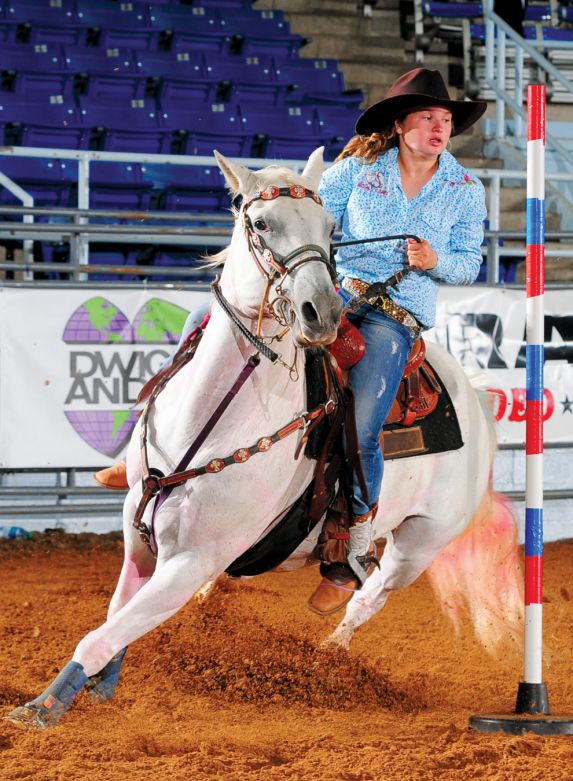
    Abigale Barks is proud to be a rodeo cowgirl, but she’s just as proud of being a Lady Panther for Starks (La.) High School. The fourteen year old cowgirl who lives in Starks, a small town close to Lake Charles where “everybody here is family,” competes in the Louisiana Junior High Rodeo Association in the barrel racing and pole bending, with poles being her favorite event.

    And in school, as an eighth grade student, she competes in junior high basketball, high school softball and track. Because of her school’s small size, she is allowed to compete with the high schoolers in two of her sports. Abigale would love to play volleyball, too, but again, because the school is small, there is no program. In track, she does the pole vault, long jump, mile relay, and 400m dash.

    The best part of school, she says, is her friends. The worst part is all the work, including science, which is not her favorite. “It’s not my thing,” she says. “I don’t get into that type of thing.” However, she loves math class and has always been a math whiz.

    Abigale is involved in more than sports at school. She’s a member of Junior Beta, 4-H, the Fellowship of Christian Students, LYFE, and the youth group at the First Baptist Church of Starks. She’s been on the honor roll pretty consistently, too.

    When Abigale’s not on the court, on the track, or in the arena, she likes to mud ride, chill while she rides her horse, hunt, fish, and hang out with friends. She loves to catch bass or catfish, but thank heavens for Paw-paw, R.T. Barnes, who cleans her catch, because she does not clean her own fish. “It grosses me out.”

    She and her friends also like to go to the movie theater, but because Starks is so small, they drive thirty miles to Orange, Texas, to the Orange Cinema. Her favorite movie is Ride Along, her favorite movie star is Kevin Costner, and her favorite comedian is Kevin Hart.

    When Abigale is out of high school, she plans on going to college, becoming a veterinarian, and continuing rodeo. After her junior high years are over, she won’t high school rodeo, so she can concentrate on her other sports. She competed at state junior high finals her sixth and seventh grade years in both events.

    Abigale has a younger brother, Cutter, who is ten and “a pest,” she says. He’s always bugging her, but she claims she does nothing to bother him! She looks up to her her parents, Patrick and Georgann Barks, because “they’re both hard working and I admire the way they encourage me and support me in my activities.”

  • Morgan Robson

    Morgan Robson

    Morgan Robson has a positive attitude, no matter what she does. The Hugoton, Kansas cowgirl knows that being cheery makes things better, and if she’s in a situation that isn’t the greatest, she works at being positive. Both of her parents have taught her, “make the best of it,” she says. “All along, have a great attitude about everything and it will end up good.”

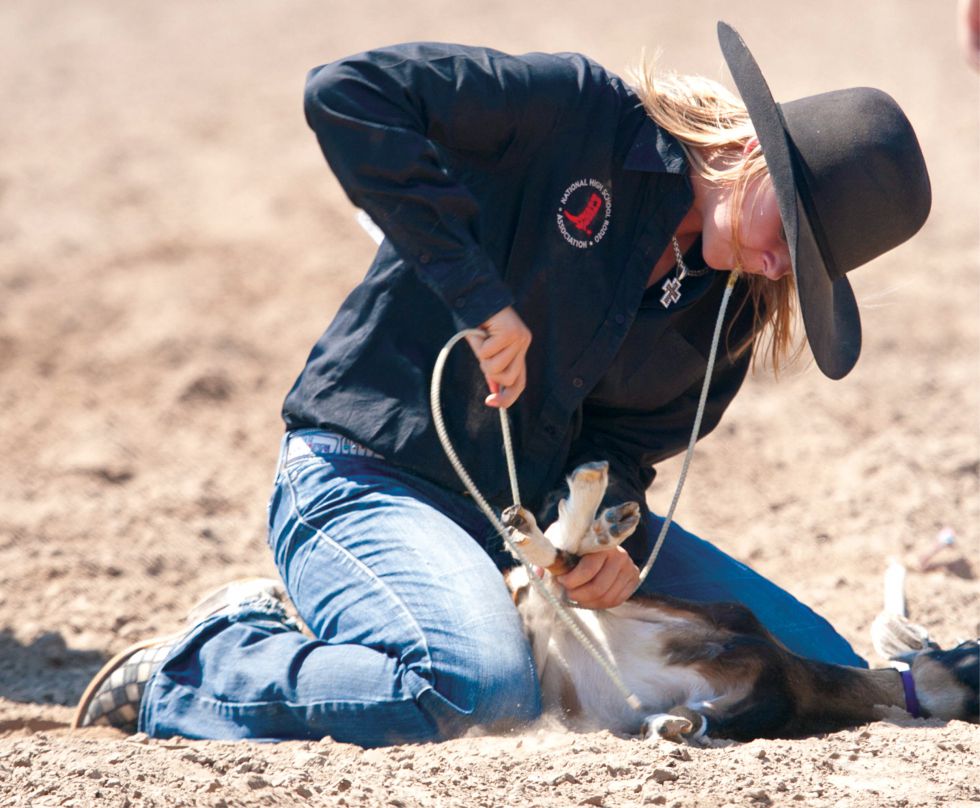
    Morgan, who is 14, is a member of the Kansas Junior High Rodeo Association. She competes in the breakaway roping, team roping (she heads for Hunter Brunson), ribbon roping (she runs for Hunter), and the goat tying. Of all her events, goats are her favorite. “I get to fly off a horse, have fun getting off and tying fast.” Tying goats appeals to the daredevil side of her, which causes her to do “stupid things” – like mudding when she’s not supposed to, riding four-wheelers with her little brother, and “doing crazy things as much as I can.”

    For the roping, she rides a twenty year old paint named Robin. He’s “got quite the attitude,” she says. “If you make him mad, he’s going to bite you on the shoulder or anywhere he wants to. When you’re picking out his front feet, he’ll bite you on the butt.”

    For the goat tying, she trades off between Robin and an equally ornery horse, a mare named Annie. Annie is her brother’s calf roping horse, and she’s a prima donna, Morgan says. “You’ve got to have everything perfect or she won’t do it. She has to have her feed in the same spot. She’s the same way (as Robin). She’ll bite you, paw the trailer, all that fun stuff.”

    She loves being an eighth grader at Moscow School in Moscow, Kan. “School is fun for me. You can make school boring, or you can make it fun. I choose to have fun. You’ve got to have a good attitude about it.” Her favorite class is pre-algebra, because it’s easy, but life science is not on her good list. It’s too complicated: “It’s crazy how you have to have everything perfect (in science) or it won’t turn out.”

    Morgan loves basketball almost as much as she loves rodeo. Even though she’s the tallest girl in junior high, she plays guard and forward, because she has good ball handling skills. She also plays volleyball and is on the school’s Principal’s Honor Roll.

    When she goes to college, she’d like to play basketball for the Oklahoma Sooners. She loves the coach, Sherri Coale, and would like to be involved in her program. After college, she’d like to play for the WNBA or be a nurse. Her favorite WNBA team is the Atlanta Dream, and her favorite player is Elena Delle Donne, who plays for the Chicago Sky.

    Morgan has a pet mini Australian shepherd, Wrangler, who loves to cuddle with her. He’ll sleep right next to her, his head on the pillow and under the covers.

    She also competes in the Kansas Pro Rodeo Association and the Little Britches Rodeo Association. She’s qualified for state junior high finals both of the last two years, and finished seventh grade in the top fifteen in the team roping and in second place in the breakaway, going on to compete at the National Junior High Finals in Gallup, N.M.

    She has an older sister, Jackie, who is deceased, a younger brother, J.D., who is eleven, and a younger sister, Megan, who is eight. She is the daughter of Dave and Brandy Robson.

  • Craig Allen

    If you’re a spectator at the Allen family arena, you’ll get to see a cowboys and Indians battle. Craig Allen, age five and a Northeast Junior Rodeo Association member, usually plays as one of the cowboys, and his younger brother Clancy, age two, is usually an Indian.

    The boys occupy themselves by the hour with the game, says their mom, Christen Allen. (And sometimes the parents join in.) After Craig is done practicing his events, he’ll get on a little pony, and fall off when his parents or brother shoot him. And usually, somebody ends up getting tomahawked.

    When he’s not getting shot or scalped, Craig enjoys doing the pole bending, flag race, barrel racing, goat ribbons, breakaway roping, junior ranch bronc riding, and mutton bustin’. He rides Yella for his events, but the boys also have Buck, Squirrel, Gunny, Roanie, and Coldbear as other mounts.

    Craig is a kindergarten student at Sperry (Okla.) Public School, where he loves to play outside at recess time on the monkey bars and do the fun stairs. He loves to get “smileys” at school for his good behavior, and he loves math and reading.

    He has competed in rodeo since he was two, and is in his second year of NJRA competition. He is the 2013 Pole Bending Year End champ for the six and under division. Prior to the NJRA, he was a member of the Checotah Roundup Club and the Okay Roundup Club. He won four buckles in those associations.

    Christen and Cody love what rodeo does for the kids. “It’s something we all do together. We’re at rodeos to support our kids and help them, and rodeo teaches them to take care of their animals and to train them. It teaches them patience and sportsmanship with the other kids. The kids get quite a bit out of it.”

    Christen and Cody and their boys work together on the family business, Pay Window Performance Horses, so rodeo is an extension of their family time. “We spend time together in the arena and the barns. We feed together, ride together, train together, and when we’re at the rodeos, it’s the same way.” When he grows up, he’d like to be a cowboy and a roper. The family lives in Sperry, Oklahoma.

  • Kelsey Garrison

    Kelsey Garrison

    It’s April, and Kelsey Garrison is on vacation. The Channing, Texas cowboy doesn’t get away often from his business, but when he does, it usually involves rodeo. He’s spending much of the month of April in California, tie-down roping at several pro rodeos and enjoying the warm sunshine. When he returns to his home in Channing, Texas, it’ll be back to the day-to-day operations for the Texas Cowboys Rodeo Association man.

    Kelsey began his rodeo career as a youngster in Oklahoma and Texas, and in high school, competed in the Tri-State Rodeo Association in Texas. After graduating from Channing High in 2003, he went to South Plains College in Levelland, representing them at the College National Finals in 2006. After that, he attended West Texas A&M in Canyon, and graduated with his bachelor’s in general studies in 2008.

    His dream was to be a full time rodeo cowboy, but after eight months, he realized something had to change. “I planned to rope (full time professionally) but reality set in,” he said. “I want to have a successful business and be able to take care of my family real well.”

    So he began his own business. He sold a tie-down roping horse and bought a semi-truck. After driving for a while, he earned enough money to buy a second truck. Then he bought some manure spreaders, and got into the manure spreading business. The dairies he worked for asked him to cut silage for them, so he bought silage cutters, then more semis, and his business was growing.

    Now, his business has morphed into highway transport and silage cutting. He owns four trucks that make a round trip to California each week, hauling meat from the Texas panhandle to Salinas, and bringing produce back to San Antonio, Houston or Amarillo. In May and September, he’s busy in the wheat fields and corn fields, cutting wheatlage and silage. Kelsey’s business, KGMS, Inc., employs seven people, with his dad helping and his mom doing the books.

    In his spare time, Kelsey competes at TCRA rodeos, and this year, hopes to go to a few PRCA rodeos as well. He’s qualified for the TCRA Finals four times, finishing last year in third place.

    Being a successful entrepreneur can be a double-edged sword, he says. Now that he has more money, he has less time to rodeo. “I try to do more rodeoing, but it doesn’t work,” he said. “You have to be home every day, making sure your business is going right. Either you’re going to be a rodeo cowboy, or an entrepreneur. Whatever you do, you have to do it every day.”

    Kelsey enjoys playing basketball. He cheers for the Dallas Mavericks and loves to attend Texas Tech games. He has a younger sister, Haley, who is 24 and is training barrel horses. He is the son of Jed and Kelly Garrison.

  • Fort Western Whitaker Award

    Fort Western Whitaker Award

    The Nebraska High School Rodeo Association is pleased to announce the inaugural “Fort Western Whitaker Award,” sponsored by Fort Western Stores with locations in Lincoln, Nebraska City, and Columbus, Neb., and given in honor of Kyle and Chip Whitaker.

    Fort Western Stores will provide a custom trophy saddle to the cowboy excelling in at least three events, encompassing both rough stock (bareback riding, saddle bronc riding and bull riding) and timed events (steer wrestling, tie-down roping, and team roping), in coordination with the Nebraska High School Rodeo Association, and a $500 scholarship payable to the continuing education facility of the winning high school student. The award will be similar, in nature to the “Linderman Award” of the Professional Rodeo Cowboys Association.

    Kyle, 37, has won the Linderman Award six times, more than any other cowboy. He credits his dad with getting him started in his three events: tie-down roping, steer wrestling, and saddle bronc riding. “I started out doing all the events in high school rodeo, because dad was teaching me, and I wanted to try them.”

    Kyle’s dad, Chip, who won the Linderman Award four times, did the same three events as Vern Whitaker – his dad – and Kyle. “In those days,” Kyle said, referring to his grandfather’s time, “it was common for guys to work both ends of the arena. Things hadn’t been specialized. Now if you want to be good enough to make the National Finals Rodeo, you have to devote all your time to honing your skills in one event. It’s a lot tougher to be competitive in more than one event.”

    “It’s a tremendous accomplishment, what Chip and Kyle have done in the sport of rodeo, and we’re grateful to Fort Western Stores for working with us to recognize similar achievement at the high school level in Nebraska,” said Jim Wakefield, President of the NHSRA.

    Tricia Schaeffer, Nebraska’s National Director for High School Rodeo, says it’s an honor for the association to have the Fort Western Whitaker Award. “It’s great that The Fort Western has come on board. I think it’s a good way to encourage kids to give (the riding events) a try.” And the high school association can provide help. “We’re fortunate that we have people who can give kids instruction, and that’s what it takes, too.”

    “Recognizing high school students for achieving what’s considered one of the most prestigious honors at the professional level, shot from an idea to ‘we’re doing this’ in a matter of hours.” said Reed Tuttle, Fort Western Stores Special Events Coordinator.  “The Nebraska High School Rodeo Association welcomed the idea with so much enthusiasm that we knew this was something special – the students benefit from the honor and all the hard work and diligence it takes to achieve it.”

    About The Fort Western Stores:
    Fort Western Stores is a national leader in Western lifestyle apparel and merchandise. The family owned business, founded in 1972 by Carl and Shirley Wohlfarth, has grown from a 1600 square foot retail store into a multi-channel marketer with three retail store locations, extending its reach worldwide through a catalog and the web; visit www.FortWestern.com.

  • Denise Nelson

    Denise Nelson

    Denise Nelson has been a Northwest Ranch Cowboys Association member for much of her life. The Midland, S.D. cowgirl grew up around horses on her family’s ranch near Wall, S.D. She ran barrels in junior high, high school and 4-H rodeos, but it wasn’t till she married into the Nelson family that she began to rope. After graduation from Wall High School in 1983, she attended Chadron (Neb.) State College and earned a degree in ag business. She graduated from college in 1987 and married Tim Nelson in 1988.

    It was at the age of 26 that she picked up a rope. It’s a standing joke with her, that the only reason she learned to rope was so she didn’t have to be chute help. “I always make this joke,” she said. “I got tired of pushing steers for everybody else.” In 1991, she joined the NRCA and spent much of her time breakaway roping. After her children, Kaylee, age 25, and Jade, 21, were born, she added team roping to her resume.

    Rodeo was on the back burner as she and Tim attended the kids’ activities, but when Jade got old enough to compete in the NRCA, she was back in the arena. Jade often ropes with his dad, and then with Denise in the mixed team roping. Roping with her son is great, she said. “It’s a wonderful family sport. You can’t beat it. You spend your weekends together. It’s just amazing.”

    The four Nelsons are often at the same rodeos, Tim and Jade in the team roping, Denise and Jade in the mixed team roping, and Kaylee in the breakaway roping. The whole family also competes in the South Dakota Rodeo Association; Tim, Jade and Kaylee also compete in the North Dakota Rodeo Association, but Denise does not, as they do not have mixed team roping. Jade is a Pro Rodeo Cowboys Association member and has qualified for the Badlands Circuit Finals the last four years.

    The Nelsons raise most of their own horses and train them. For a while, they rode outside horses, but the demands of their own horses keeps them busy. “Trying to keep horses for your kids takes a lot of time,” she said. Roping and rodeo is her and Tim’s fun, and their hobby. “We used to go to basketball and football games when the kids were  younger. That was our fun. Now we enjoy the horses, roping and rodeo. That’s what we do on the weekends.”

    Denise was NRCA Rookie of the Year in the breakaway roping in 1991. Since then, she’s competed at the NRCA Finals and SDRA Finals about twelve times each. She considers winning the USTRC National Finals Number 8 Shoot-Out with Brian Meredith a highlight in her roping career. Last year’s NRCA Finals were extra-special, as she, Jade and Kaylee all won the year-end saddles in their respective events. The family raises black Angus cattle; calving begins this month.

  • Randy Bernard

    Randy Bernard

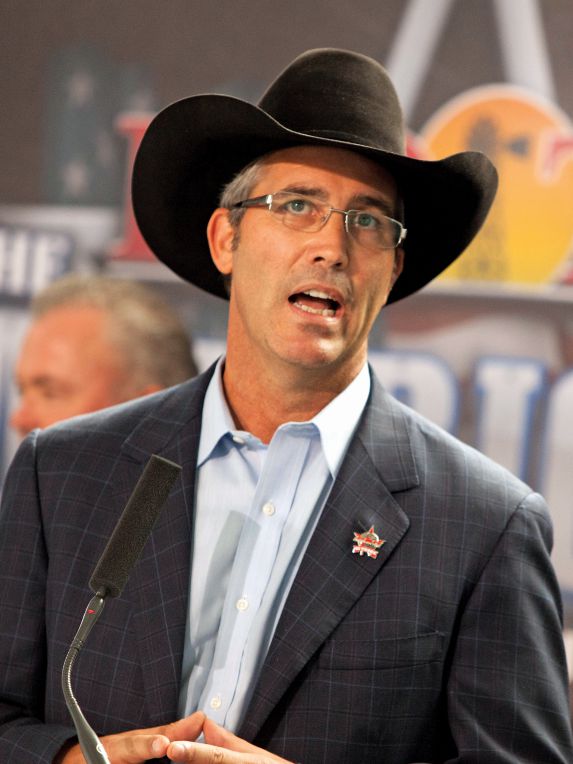
    Randy Bernard has paid out over 100 million dollars in the rodeo world throughout his career as a sports executive. Bernard grew up wearing a cowboy hat while working on his family’s ranch and farm in central California. Born in Paso Robles, Calif., he attended Kindergarten to eighth grade in a small town named San Ardo where there was never more than 18 classmates. Bernard studied at Cal Poly and in 1988 interned with the Calgary Stampede gaining valuable experience that set the course of his future career path.
    Bernard came back from the Calgary Stampede to work for the California Mid-State Fair, where one of his responsibilities was making the rodeo profitable. “I believed that we could help it significantly with guaranteeing the best in the world. I created a match with Ty Murray and Cody Lambert who were sitting number one and two in the PRCA all around world standings,” stated Bernard, “The rodeo attendance increased from 3,400 to a sellout crowd of 7,500 the first year. I knew then that our sport was no different than any other sport. People want to see the best in the world.”
    Bernard, had no idea that years later Murray, Lambert and Tuf Hedeman three of the Professional Bull Riders, Inc. (PBR) founders, would ask him to run the PBR. “In the early board meetings of the PBR it was about who yelled the loudest and fought the hardest for their vision,” stated Bernard.
    “We were all cowboys when we hired him. Randy’s ideas and work ethic took a group of the best bull riders in the world and built the PBR. Rodeo people weren’t ready for Randy. He is a cowboy and his ideas were coming from his background working on his family’s ranch,” stated Cody Lambert, PBR co-founder, 3x PBR World Finals qualifier and 6x NFR qualifier.
    Ty Murray, 9x World Champion Cowboy and PBR co-founder said, “Randy Bernard is a natural born promoter. He was a good honest person, really smart and had big ideas. That is the premise that we hired him to come run the PBR. We worked together for 15 years at the PBR. We’ve still remained really good friends and talk on a regular basis.”
    Under Bernard’s leadership, the PBR became one of the fastest growing sports properties in North America, providing opportunities to bull riders that only existed in the imaginations of the founding members. In April 2007, Bernard successfully executed a merger between PBR and Spire Capital Partners, a New York-based private equity firm. The merger allowed the founding members and other bull riding shareholders to capitalize on their vision, dedication and commitment, while maintaining a significant equity stake in the organization.. (Time magazine listed Bernard as one of the top sport executives in 2008. The PBR was named a finalist for the 2010 Sports Business Awards presented by Sports Business Journal and Sports Business Day in the Professional Sports League of the Year category with the MLB, NBA and NFL.)
    Bernard decided to leave PBR and emabark on a new venture, as CEO position of INDYCAR. He was instrumental in creating the new DW12 car introduced in 2012, which critics have said brought the best open wheel racing in over two and half decades. Add to that, changing the name from INDY Racing League to INDYCAR, creating a successful ladder series, implementing double file starts, and the first to develop double header races in a weekend. Under his leadership turbo charged engines returned along with manufactures Chevrolet and Lotus.
    “He helped come up with the most competitive car we’ve had in 20 years. He reintroduced double headers and the triple crown (three 500 mile races at Indianapolis, Pocono and Fontana ) and tried to light a spark under a series that had pretty much fallen off the map,” stated Robin Miller, racing writer and television analyst for Racer Magazine and NBC Sports Network.
    Miller recalled his first meeting with Bernard being six hours long. “The best thing about Randy is he’s a great people person. He is smart, knows marketing and leadership. I asked him if he hit his head in rodeo to take this job,” Miller mentioned, “Bernard was the best thing in INDYCAR management in three decades. He has friends in all these different fields of entertainment. He is a genuine guy and doesn’t have a phony bone in his body.”
    “When I left the PBR I wanted to see if I could capture lightning in a bottle twice. My life changed and I had to become a racing fan to understand their lifestyle. I ate, breathed and slept INDYCAR. I moved out of the western lifestyle for three years to wear suits and work on a different sport, but soon realized that my true passion is the western lifestyle,” stated Bernard.
    Randy came back to his western roots in 2012 when he joined Rural Media Group (RMG) as the President & CEO. On Sunday, March 2 2014, he produced the richest one-day rodeo in western sports history with RFD-TV’s THE AMERICAN paying out $2 million dollars. “I had the concept in the back of my mind, Patrick (Gottsch, Founder of RMG) asked for some big ideas and Jerry (Jones) always wanted me to do it. I’ve never had the opportunity to produce the event due to my commitments with PBR and INDYCAR,” he said.
    “I presented THE AMERICAN model to Patrick due to the tremendous potential for growing RFD-TV, western sports and rodeo in a very positive way. RFD-TV is the perfect vehicle to develop this concept and grow the sport” stated Bernard.
    Bernard feels he is sitting in the perfect position to continue to advance the viewership and monetary opportunities for rodeo athletes. “RFD-TV has a management team in place that loves western sports and understands it and wants to see it grow,” commented Bernard.
    THE AMERICAN focuses on developing stars and showcasing the elite athletes in rodeo while rewarding the best on a given day. “Professional rodeo is unfortunately one of the most faceless sports in America. It needs more media coverage that can help develop stars. If we can help build superstars it helps everyone in the sport. It is my personal belief that all you have is a club if you aren’t always building and showcasing the best in the world,” he explained. Bernard’s goal is to build THE AMERICAN into a $5 million purse.
    “I’d like to say I’ll have this done in five years, and to do that, a lot of good things have to happen,” Bernard admitted, “We aren’t a bunch of television executives who sit in an ivory tower in New York or Los Angeles that only appreciate stick and ball sports. Not one national network gave any news coverage to THE AMERICAN, which proves my point if they truly loved the sport they would give credence and provide coverage to showcase these great athletes.”
    “Our goal was to create the Super Bowl of the western industry and I have some other strong goals. I want to reinvigorate the rodeo fan from the 1980’s into today. I felt that we needed major events in this sport to engage our youth as we see youth rodeo participation declinging. When I was a kid, I roped the dummy countless times dreaming of winning the tenth round of the NFR and the Bob Feist Invitational. There is not enough of those events in my opinion. We want to help our grass roots by building awareness of our sport. We have the best athletes and personalities in the world, but there’s never been a way to showcase them. Even the rural world – if you don’t read the magazines, there’s no way to become familiar with the stars. That’s what we’ve done with Western Sports Roundup on RURAL RADIO and during the Rural Evening News segment.” Rural Media Group commands an audience of 26 million listeners on RURAL RADIO Sirius XM channel 80 and 60 million on RFD-TV and FamilyNet.As for the future of THE AMERICAN, “I want to continue to make cowboys wealthy just like we did Richmond Champion. I’m more passionate now than I ever was.”

  • Steve Gramith

    Steve Gramith

    Steve Gramith considers himself a “foot soldier” in the sport of rodeo. The humble man was involved as both a contestant and a pickup man, and even though he may deny it, he’s contributed his share to the sport.

    He was born in St. Louis Park, Minnesota, in 1942, the son of Clifford and LuVern Gramith. The family had no ties to rodeo, but his mother’s parents had a couple hundred head of cattle, and when they left Dupree, S.D., after their general store burned down twice, his grandfather gave the cattle to a neighbor and friend.

    Years later, Steve’s family would drive past the grandfather’s friend’s ranch in South Dakota. That started my enthusiasm for ranch life,” Steve remembers. From then on, he spent every summer on the family friend’s ranch, located seven miles upriver from White Horse, on the Moreau River and the Cheyenne Indian Reservation in north central South Dakota.

    In 1960, Steve graduated from Waconia (Minn.) High School and went straight back to the ranch, “as fast as my little legs could carry me,” he jokes. It was college that introduced him to rodeo. He  spent his freshman year at Colorado State University, and then took a year off, returning to the ranch near White Horse. He began learning to rope calves with a neighbor, Harlan Gunville. He and Harlan would head to the Timber Lake arena in the evenings, where they would rope calves. “We played, and visited, and practiced,” Steve says.

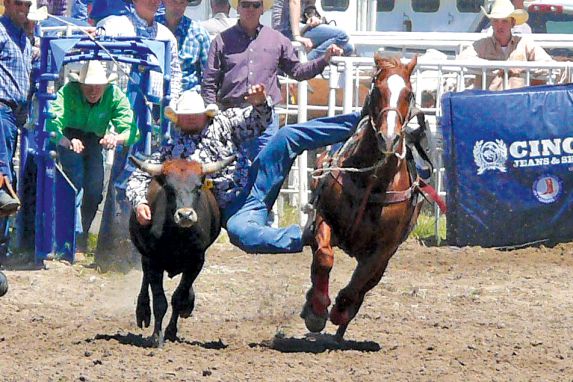
    After a year off, Steve returned to college, but this time to South Dakota State University, and as a member of the rodeo team. Roping calves was his first event, but not his best. “I basically started from scratch at South Dakota State, and was really inconsistent. I’d maybe win a go-round, and then miss. The calf roping was not something I was good at.” But he soon found an event at which he was good: steer wrestling. With roping he was nervous. Bulldogging was different. “Steer wrestling was just like getting out of bed,” he says. “It was easy. There was nothing to it. There were no nerves there. I’d just grab ahold and go to the mat.”

    It was at his home college rodeo, his senior year that he won the buckle he still wears: for winning first in the steer wrestling. He also won the SDSU all-around saddle that year, because he placed in the calf roping. After graduating in 1966 with an animal science degree and a minor in economics, he moved to Canning, S.D., and went to work for Erv Korkow. He had met one of Erv’s sons, Jim, at the Highmore rodeo, and Erv needed a pickup man. He became friends with Jim, and Steve found himself picking up alongside him at high school, college, and pro rodeos, and when they weren’t on the road, doing chores, feeding horses and bulls, riding colts, and driving truck. And while he was on the road with the Korkow and Sutton Rodeo Co., as it was owned by Erv Korkow and James Sutton at the time, he was able to bulldog professionally.

    Steve wasn’t the only college student recruited by Jim to work for the company. Alvin Chytka, Gary Chytka, Gerald Dewey, David Daul, and others were at the ranch. And even though Erv was the boss, it was his son Jim who was the reason for the crew. “We worked for Erv and James (Sutton), but we came there for Jim. It was because of Jim. We worked like dogs, but he was friends with everybody and he was fun to be around.”

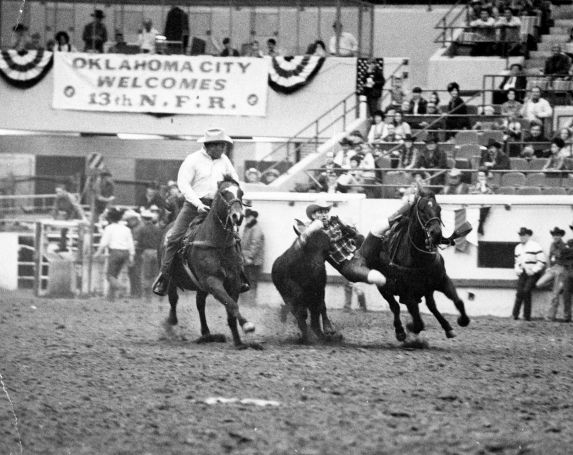
    Along with picking up, Steve steer wrestled, qualifying for the National Finals Rodeo in 1971. Because he was working as a pickup man, he got to fewer rodeos than the other bulldoggers. On the weekends he wasn’t picking up, he’d make three or four. But when he picked up, he competed at that rodeo only, while other cowboys were hitting several on the same weekend. In 1971, he went to forty rodeos, “the most I’d ever gone to,” he remembers. The 1971 year end champion, in comparison, went to more than 100 rodeos.

    He also held the record for the fast time at the NFR, winning the third go-round in 3.7 seconds. That record held till Tom Ferguson broke it in 1975. In those days, the steers were big Corrientes and arenas were larger, including the NFR arena at the state fairgrounds in Oklahoma City. “You could win money being ten (seconds) or under,” Steve says.

    In 1972, Steve left South Dakota and moved to Tunas, Missouri, southwest of the Lake of the Ozarks. He had started a cattle herd by then, and his friend Jim Korkow trucked them to his new home. Land was cheaper in Missouri than it was in South Dakota, the acres per unit for a cow/calf pair were lower, and the winters weren’t as severe. Steve still picked up for the Korkows, but his emphasis was turning to cattle. He had seen Simmental cattle at Jim Sutton’s, and he began crossing Herefords with Simmentals. Eventually, he became a purebred Simmental breeder. He lived near Tunas for about eight years, then moved to Marionville, Mo., where he lived for another eight years. In 1992, when he married his wife Beth, they moved to Willard, Mo., and on to Neosho, where they live now.

    In 1976, Steve ran his last steer. He went to two pro rodeos that year. “It wasn’t that much fun anymore,” he says. His cattle herd was demanding more and more attention. “I was working too hard to really rodeo properly.” He won first at the first rodeo he went to that year, and at the second rodeo, missed his steer and got run over by his hazer. It was time to quit. He didn’t own a bulldogging horse anymore, and the work at home was his focus. “I was always so busy, that the mental aspect was more difficult than the physical aspect. When you have bills to pay at home, and you want to win too bad, it doesn’t go well.”

    His wife, Beth, holds an important place in his heart. They began dating in 1989. She had divorced and was raising three kids. “We’d date some, then she’d want to do things with her kids, then we’d date some more. Finally I wore her down,” Steve laughs. Actually, it was her youngest child, daughter Christine, who helped her mother see what Steve was. “Christine was my champion,” he says. “She said to her mom, “That’s a pretty good guy.’”

    It was through God’s intervention that he found Beth. “I was just out twirling in the wind, until I decided I could not do life alone. It was my decision to ask Christ to come into my life, and I was 48 years old. I didn’t grow up till then. “It not only made a world of difference,” he says, “but I met someone of value that He put in my path. She’s my soul mate, my best friend. I found someone to spend the rest of my life with, and I have the comfort of knowing that Jesus Christ is my Lord and Savior and He died for my sins.”

    Steve has three step-children: Christine Ryan, an OB/GYN in Colorado Springs, Stephen Shank, who works with The Navigators in Texas, and Nathan Shank, a missionary in northern India.

    Of his work as a steer wrestler and a pick up man, he is most proud of picking up. “I think my picking up was more important to me than the steer wrestling, mostly because of my friendships, especially with Jim (Korkow). The work was very satisfying. We had some really nice horses to ride, and it was just such a pleasure because it was cowboying. It wasn’t rodeoing, it was cowboying. We were riding, working, and it was old time cowboyin’.”
  • Victoria Baxter

    Victoria Baxter

    Victoria Baxter would rather wear cowboy boots than a dress any day. “I hate dresses,” the 25 year old Zachary, La. cowgirl said. Victoria competes in breakaway roping and barrel racing in the Tri-State Rodeo Association. She is the 2008 TSRA Breakaway Rookie Champion, the 2010 TSRA All Around Champion and the 2013 CRA All Around Champion Cowgirl.

    Victoria started rodeoing at 9 years old when she began competing at the Liberty Ridge Club, Liverpool Riding Club, and the Livingston Riding Association. “I began riding horses at 18 months when my Mimi and Papa would lead line me around on our horse named Bucky. I was hooked!” she said. Victoria’s parents, David and Mona encouraged her to ride and her passion for horses continued to grow. She also learned a lot about horses from Lee Goynes. “He’s my rodeo idol. If it wasn’t for him, I wouldn’t have the knowledge of riding or competing. He’s taught me so much about horses and myself. I’m so blessed I was able to be a part of his life,” Victoria added.

    During her freshman year of high school rodeo, Victoria was slated to make the NHSFR but her pole horse came down with EPM. “That was very hard to accept and deal with,” she said. Victoria is a recent graduate of Southeastern. Besides riding horses and entering rodeos, Victoria stays busy by helping her boyfriend Tyler with cows and fencing. “I’m also working horses. I’m always looking for my next prospect,” she said. Victoria enjoys spending time at home with her family, younger brother Nicholas, and her Jack Russell, Tuff.

  • Stan and Jessica Goodman

    Stan and Jessica Goodman

    There are a lot of gold in the Goodman family. As in gold buckles. Stan, Jessica, and their son Wyatt, who are all Arkansas Cowboys Association members, all own at least one buckle and hope that more are on the way. And their daughter, Charslee, is headed for her own championships.

    Stan Goodman became interested in bareback riding in high school and competed at the Arkansas High School Finals in 1997. He won seventh in the world at Nationals the same year. His wife, Jessica, was an ACA barrel racer in high school, growing up in a family that competed as bull riders and team ropers. She and Stan were high school sweethearts, and after high school, they married in 1999.

    Stan hit the rodeo trail hard, riding barebacks in the ACA for several years before he struck out farther from home, competing in the International Pro Rodeo Association and the Pro Rodeo Cowboys Association. He rodeoed full time until he began his own business, Goodman Construction, in the early 2000s.

    Jessica earned an elementary education degree in 2003, and began teaching first grade at Cherokee Elementary, as part of the Highland School District.

    When Stan rodeoed full time, he traveled with tie-down roper Cavin Hall. He rode barebacks for ten years, winning the ACA’s Rookie of the Year in 1997, the championship in 1998, and the average three times. When he quit in 2007, he took up tie-down roping. “I’d never roped a calf till I was done riding horses,” he said. “I didn’t have any interest in it.” But when he hauled Jessica to rodeos, he got bored and missed the competition. “I told her I didn’t want to sit around and watch, so I bought a horse to rope calves.”

    That was four years ago, and Stan learned to rope calves at the same time he was training his horse Scooter. Fourteen years after winning the bareback rookie title, he was rookie of the year in the tie-down roping.

    Stan and Jessica started their family with the birth of Wyatt in 2003. Now Wyatt, age ten, is in his third year of ACA competition. The young cowboy ties goats and is starting to breakaway rope. Stan is proud of his son. “He’s going to make a hand someday.” And he’s followin in his dad’s footsteps, as the 2012 Goat Tying Rookie of the Year.

    After Wyatt, Jessica put her rodeo on hold while she enjoyed being a mom. She put off buying a barrel horse while she and Stan tried for their second child. But after heartaches and no success, she gave up and bought Ocho, her barrel horse. Two months later, she was pregnant with Charslee. God gave her Ocho for a reason, she believes. “I always felt like God was saying, ‘Here is Ocho. I’m sorry you had to go through all this. Here’s this amazing horse and here’s your baby, too.’”

    And Ocho has been an amazing horse. “He was a godsend,” Jessica said. “He’s an all-around perfect horse. He’s consistent and honest.” Ocho carried Jessica to the 2011 and 2012 ACA Barrel Racing Championships, and was the ACA’s Barrel Horse of the Year in 2011. The two years she won the title, she won more money in a single event than anyone else in the ACA.

    The two kids keep their parents busy with their activities. “Our horses are well-known at the ball field,” Jessica said. “There are many times our horses are standing beside the trailer at the baseball field while we watch a game. Then we load up and head to a rodeo.” Wyatt plays baseball, football, basketball, sings in the choir, and is a straight A student. Charslee, a kindergartener, plays t-ball, does gymnastic, and is beginning to barrel race.

    Wyatt was seven when he qualified for his first ACA Finals, and his goat tying horse had a unique connection to his daddy. He tied goats on Cavin Hall’s 27 year old calf horse, which had been a bucking horse that Stan rode in high school. That year, Wyatt was the youngest competitor at the ACA Finals. In addition to rodeo, the family raises beef cattle.