Rodeo Life

Category: Archive

  • Leanna Arcement

    Leanna Arcement

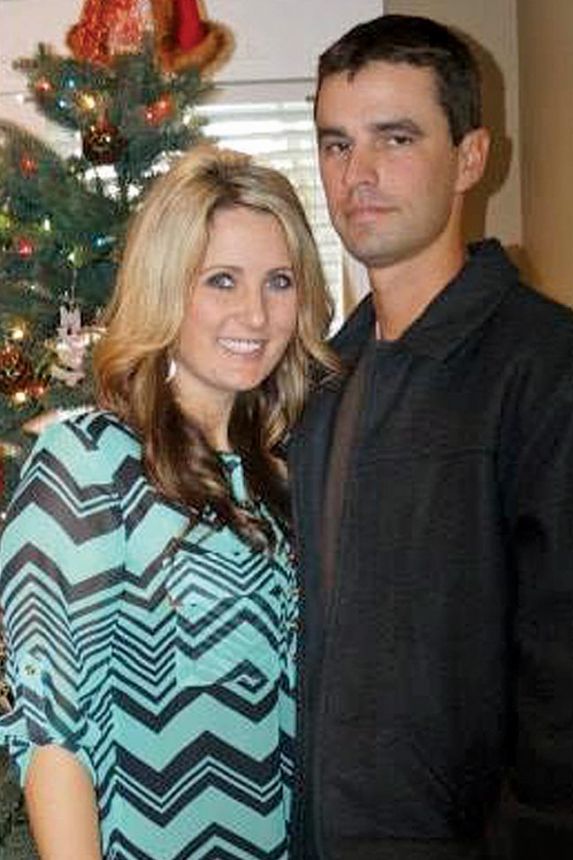
    Leanna Arcement is being grafted into the Cajun world, and she’s learning the culture well. The two-time Cajun Rodeo Association Breakaway Champion grew up in Bosque Farms, N.M., but after meeting her husband at college in Texas, moved to his home town of Raceland, La.

    And, according to her mother-in-law and friends, she’s doing quite well with the Cajun cooking and the accent. She grew up riding horses and competing in junior high and high school rodeo, making the National High School Finals in 2003 and 2004 in the goat tying. After accepting a rodeo scholarship to Frank Phillips College in Borger, Texas, she competed at the college level and met her husband there. Wesley Arcement caught her eye one day, and the two “hit it off right away.” Wesley roped calves at Frank Phillips, and convinced his soon to be wife to move to Cajun country with him.

    So Leanna left Frank Phillips, moved to Raceland, and began cosmetology school. She got her cosmetologist degree in 2005 and began work at a salon in Raceland.

    She and her husband have cattle and train horses on the side. In 2013, on her way to her second CRA breakaway title, Leanna broke her arm while riding a colt. The injury kept her out of rodeo from March through June, and while she couldn’t rope, her husband rode her breakaway horse, fell in love with him, and decided to rope calves on him. So Leanna was without a horse. While her arm was casted, she and Wesley began to look for a horse for her. They found a five year old black colt named Casino, and Wesley put two months of riding on him, before Leanna started hauling him. Even with the little bit of training, Casino did well, carrying Leanna to her average and year-end wins in the CRA. “There were mess-ups (with Casino), but I was very lucky. When you’re seasoning a horse, you have to expect issues. But it fell into place, worked real good, and gave me an opportunity to win something and get to finals.”

    This spring, she will season a new horse, a brother to Dually, the horse she rode to her 2012 title. Peppy, the name of the sorrel, will get a year of seasoning before he goes to Wesley for calf roping.

    Leanna is 1,200 miles from her parents’ home in New Mexico, and it was a culture shock, moving to Louisiana, “but I love it here, absolutely. The people are so nice.” The hardest adjustment has been the weather. “I had a hard time adjusting to the weather. It’s so much hotter and humid, but I love it here. It’s definitely become my home, for sure.”

    And she’s learning to cook and eat Cajun. “My mother-in-law has done very well in teaching me how to cook Cajun food. She always tells me, ‘I’m going to turn you into a Cajun yet’, and now she says, ‘I’m getting you there.’” And she loves boiled crawfish. “I never liked it in the beginning. It took me a long time to get used to it. You have to peel it, and it’s too much work, and it looks creepy, but they’re good. When it’s crawfish season, I say, we need to cook some crawfish.”

    Wesley was the 2013 CRA Calf Roping average and year-end champion, so their dual win at the CRA Finals last year were extra special. She also competes in open rodeos, Tri-State Rodeos, and Professional Cowboy Association rodeos.

  • Coleman Proctor

    Coleman Proctor

    Coleman Proctor can’t remember not roping. Growing up in Oklahoma, his mom, dad and both sisters roped. He entered his first roping at the age of nine and hasn’t slowed down since. Also during his childhood, the family raised and showed sheep, which kept Coleman involved in 4H.
    “I enjoyed that part of my life. It taught me a lot about responsibility. I remember raising a bottle goat in the kitchen. I would have to get up early and give her a bottle like a baby. We named her Clementine and I used to haul her to high school rodeos and practice on her. She thought she was a dog.”
    Coleman enjoyed sports in high school and attended Northeastern Oklahoma A&M and Northwestern Oklahoma State University. He has considered attending law school.
    It’s impossible to reach the professional level without some coaching and Coleman is thankful for the help he received as a young roper from more experienced ropers like Manny Egusquiza, Jeff Brown and Gaylen Fix.
    It’s just a matter of time before we see Coleman Proctor competing at the Wrangler National Finals. Winning rodeos like Oakdale, California and Caldwell, Idaho in 2013 helped Coleman to finish 19th in the heading world standings, roping with a variety of partners.
    This year, Coleman is heading for long-time friend, Jake Long. In 2010, the pair bested 468 teams to win the prestigious George Strait Team Roping Classic with a time of 14.93-seconds on three head.
    “In the 8th grade, Jake and I started hanging out and roping together. We roped all the time, whether it was steers, goats or dummies. We were both heeling at the time and only had one head rope. We would take turns heading for each other.”
    “Getting up and down the road is very expensive. You have to win, there’s no other answer. I enjoy helping people with their roping and teaching schools and that income is helpful. When I roped with Speed he taught me a lot about teaching and treating your roping as a business.”
    As for kids that want to rodeo and go pro, Coleman has this advice:
    “Set goals. Goals are nothing more than dreams with a timeline. Don’t ever give up or let up. In the end, you are the only person that stands in your way of doing anything. Leave alone the temptations on the road that will hinder your progress. Get your head down and make a plan.”
    Coleman is currently sponsored by: Fast Back Ropes, CSI Saddle Pads, Coats Saddles, Dixon-Flowers Quarter Horses, Wrangler, Justin, Pro Care Plus and speedroping.com.

    COWBOY Q&A:

    How much do you practice?
    Every day. Even if it’s just roping the dummy. If I’m not practicing, somebody else is. I learned from Speed, you have to have a great work ethic and be disciplined.

    Do you make your own horses?
    I made Booger, the horse I won the Strait on. But I do have some help from time to time. The horse I’m riding now, Switchblade, I got from Jimmy Lawrence, Lawrence Quarter Horses in Dewey, OK.

    Who were your roping heroes?
    My dad, Jeff Brown, Clay O’Brien Cooper, Speed Williams, Tom Ferguson

    Who do you respect most in the world?
    My mother

    Who has been the biggest influence in your life?
    My mother

    If you had a day off what would you like to do?
    I would play golf all day long.

    Favorite movie?
    Tin Cup

    What’s the last thing you read?
    Mind Gym – it’s about the mental aspect of anything related to sports.

    How would you describe yourself in three words?
    Funny, driven, motivated

    What makes you happy?
    Stephanie Arnold

    What makes you angry?
    People not taking their hats off during prayers or the National Anthem.

    If you were given 1 million dollars, how would you spend it?
    Wisely.

    What is your worst quality – your best?
    Worst quality, I tend to run late. Best quality, is being outgoing.

    Where do you see yourself in ten years?
    Living and ranching in Oklahoma. Still going to some rodeos.

  • Rowdy Rice

    Rowdy Rice

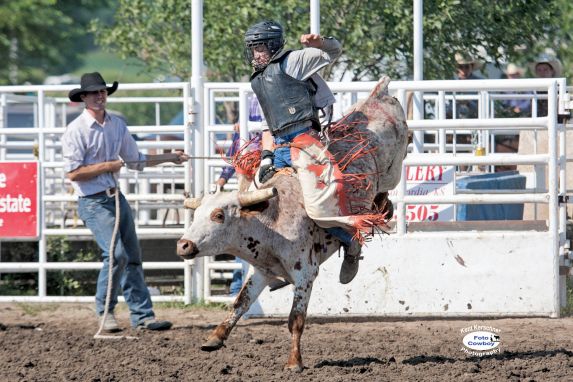
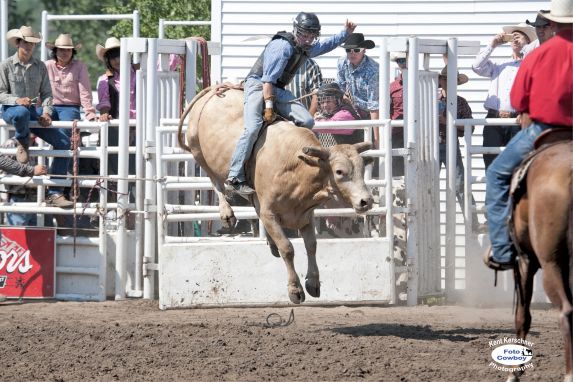
    Rowdy Rice is ramped at IFR 44. “With a name like Rowdy, you have to be,” said the 20-year-old bull rider from Easley, South Carolina. He was named by his dad after a Clint Eastwood movie, Rawhide, and feels he was destined to be a bull rider. “When I was younger, my mom used to tell me that I would climb up on the arm rest of the couch and ride it for hours. I used to open the porch door like it was a bucking chute. She’s got pictures of when I was two on a horse. My whole life I’ve been around rodeo. My mom barrel raced and I went with her. I remember watching rodeo bloopers over and over when I was young.”
    He didn’t get on a bull until he was 14, instead he played football. One day, he went to the rodeo right by the house, and at that moment, he decided he could ride a bull. “My mom took me the next day to a place to get on. I rode about six seconds. The second time, the next weekend, I stayed on the 8 seconds and I was hooked.” He spent the next several years getting on amateur bulls every Sunday at a place down the road called Elrods Farms. “I picked it up real fast. When I was about 15, I went to the Terry Don West bull riding school in Oklahoma. That helped me out the most – it took me to a different level. I got on a lot of bulls – and that helped me out too.”
    His advice to aspiring bull riders is simple. “If it’s not something that you really, really, really want to do – if you are doing it for the girls – don’t do it. It’s a good life; you get to travel all over the world and meet amazing people, but it’s a dangerous sport and you have to love it.” Rowdy graduated from Easely High School where he was part of the South Carolina High School Rodeo team and took the bull riding championship for the state in 2010 and 2011. “I went to Nationals and didn’t do good,” he admits. “At that time, Nationals we pretty big for me – I’d been to our high school rodeos, but I’d never been to Vegas or Cheyenne or any of the big rodeos. It’s a whole different world.” Since graduating from high school, Rowdy has won 2012 Southern Rodeo Association Champion Bull Rider and recently added the World Champion International Pro Rodeo Association Bull Riding title to his accolades. He is in his rookie year with the PRCA. “I’m going to have to make it count,” he said. “It’s the same aspect as I’ve been doing – you need to rodeo smarter not harder.”
    He and his mom, Tammy, are the only rodeo hands in the family. His dad, Rusty, is a blaster – when people hit rock and can’t dig, he goes in and blows it up. Tammy, is his secretary, keeping the business (Accurate Drilling and Blasting) straight. Rowdy has two brothers – Griffin is 15, Bailey is 11. “Neither one are rodeo guys, they are hunting and fishing specialists. My poor mom has had to deal with four boys in her life – she’s the toughest one of all.” Tammy has made up for having so many men in her life by having a lot of mares in hers. She started barrel racing when she was 12 and married a man that doesn’t rodeo at all. She wasn’t thrilled about Rowdy riding bulls, but felt he was destined to do so. “I didn’t get to see a lot of my rides because my mom would panic and drop the camera and couldn’t watch. She gets a lot more nervous than I do. My dad was for whatever I wanted to do as long as I stayed out of trouble.”
    Rowdy has bought a little house in Liberty SC, five minutes from where he grew up, from his earnings riding bulls. “I know that I can rodeo my whole life, and I want to have something to look back on. I thought it was a smart investment. And Griffin got big enough to wear my clothes, so I had a hard time keeping them in my closet.”
    His goal is to make it to the NFR and PBR Finals. “Once you get your name into the association, you’ve got to show them you belong there. I want to rodeo as long as I can. I thank God every single day for where I’m at. I’m so blessed going all over the world and meeting the most special people and my rodeo buddies are my closest friends.” His secret to his success is “having fun. If you are so focused on doing good and that extra pressure, likely you’re not going to do very good. It can be taken away. I enjoy and live life. Winning is what takes me to the next rodeo. It never gets old. When I’m on my last straw and I win, I hit a whole different level – I’d say rodeo is definitely a drug.”

  • Ben Jordan

    Ben Jordan

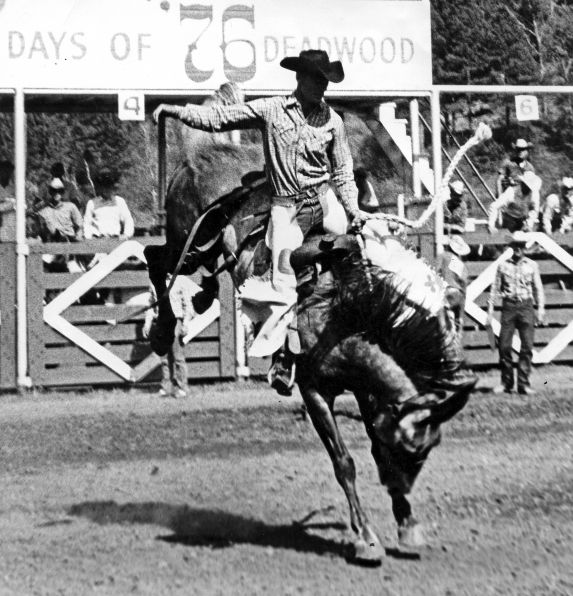
    Ben Jordan dominated the bareback riding in the International Rodeo Association for a decade. But his place in rodeo has lasted a lot longer than just ten years. The Smithville, Oklahoma cowboy was born November 30, 1931, to Ben and Blond Jordan, “under the same tree I’m living under now,” he says. His parents farmed and ranched: “they had to do a little of both to make a living.”

    As a youngster, his favorite thing was to ride anything, including calves and mules. “We practiced all the time,” he remembers. “Everybody had stock up and down the road” in southeast Oklahoma. “We’d just go by somebody’s cow lot and get on a calf or two there. I’d been on no telling how many calves and mules before I ever got to a rodeo arena.”

    Every Saturday, when he was a kid, Ben could be found at the weekly horse trading. “I’d be there at daylight, and I’d make me two or three dollars getting on horses somebody’d trade for. I’d done it since I was seven or eight years old. I had plenty of money then.”

    He completed school through eighth grade, a common thing for boys in those times. But he never got a certificate for graduation. “I went to three rodeos (the week of graduation), and I got back, and of course, graduation was over. (The superintendent) never would give me my certificate. He thought I should have been there to graduate.” Being gone to rodeo also cost him a girlfriend. “I had a little girlfriend holding my seat on the bus. I’d sit by her every evening, and when I was gone, I even lost my seat,” he laughed.

    Hitchhiking to rodeos was common. “It was hard times around here,” he said. “We hitchhiked for two or three years.” With the state penitentiary in McAlester, hitchhiking could be difficult. “When we got up there by that prison, when we’d stick out our thumbs, they’d pick up speed, thinking we was convicts,” he laughed.

    For five or six years, Ben did nothing but ride bulls. After his school days were over, he lived at home and did ranch work for family. He continued rodeoing “all I could go to.” Then he began riding barebacks and saddle broncs, He enjoyed riding broncs, but in those days, there wasn’t much saddle bronc riding in Oklahoma, Texas and Arkansas, so he stuck to barebacks.

    Most of the rodeos he went to were jackpots or Rodeo Cowboys Association events, forerunner to the Pro Rodeo Cowboys Association. He belonged to the RCA, but after paying several fines of the typical $50, a director fined him $800. “They put me on the black list, and I stayed on there,” Ben remembered. Tom Nesmith (a steer wrestler and tie-down roper), told me he was going to pay my fine at Denver (thinking it was $50), but he called me and told me it went to $800. I said, ‘Just forget it.’ I never went back.”

    By then, he had a wife and children to feed. He married a girl who grew up across the creek from him and with whom he rode the school bus. He and Roxie had their first child and only daughter, Betty Jo. Then came Benny, Kenny, John and Billy Bob. All the while, Ben raised cattle, hogs and horses, and rodeoed for extra income. Roxie took care of things at home. “She kept everything going. I believe I was home when one child was born, the first one. She was tough.”

    In 1959, he joined the newly formed International Rodeo Association (now the International Pro Rodeo Association). He was the eleventh person to get a card, and his card number is 1110. Ben turned his attention to IRA rodeos, and even though he was in his thirties, past what might have been considered his prime, his was a constant name in the standings. He won the IRA Bareback Riding World Championship in 1961-65, and again in 1968, the bull riding world title in 1961 and 1962, and the All-Around from 1961 through 1963. And along with the competition, he volunteered his time with the IPRA, as a bareback riding director and as vice-president.

    Ben’s rodeo career was relatively injury free, as well. Aside from being out for eight months due to a broken leg, he was never off the trail for long. “I never was crippled very much or very long at a time. Right after I got married, I was in a cast for eight months, but after that, just a week or two at a time.”

    His usual rodeo trail was in Oklahoma, Texas, and Arkansas, and the IPRA rodeos farther east. He often competed at Loretta Lynn’s rodeo series, which included eight fall and eight spring rodeos. One year, he won all eight of the fall rodeos, but his record didn’t last long, as Butch Stewart did the same thing the next year.

    And Ben learned as much as he could. “I absorbed all I could of it,” he said. “Where I could think about it, and pass it on to somebody it might help.” Cowboys came to him for advice, and he was happy to share. “You didn’t mind them fellers who’d ask you for advice if they’d use it all. If they didn’t use it all, you don’t never tell them again.”

    His secret to riding barebacks was simple. “I could pull on my feet, and I was pretty stout in my arms. I’d worked all my life. I had good balance, and I studied horses and bulls. If I had seen (the horse or bull), I might beat somebody a point or two on the same horse. But I didn’t get sloppy on them.”

    In 2007, Ben and Roxie’s youngest son, Billy Bob, was killed in a car crash, and six years later, their eldest, Betty Jo, died of cancer. In 2008, after 58 years of marriage, Roxie died, also of cancer. “She helped me through a lot of pains and struggles,” Ben remembered.

    Now, he keeps busy carrying mail. He’s been doing it for thirteen years, and it keeps him young. “I have a fifty mile route that takes me about two and a half hours. I have some widder women up and down (the route), and I keep their boxes popped up,” he laughed.

    He also raises black mouth cow dogs and hog dogs. He’s been breeding them for forty years, and the Jordan connection to good dogs is recognized nationwide. He has about twenty right now, and has no trouble selling them when he has puppies.

    And he says he didn’t have a boring life as he looks over the last eighty years. “I ranched, I did the things I liked outdoors and horseback. I had the top cowdogs in the world. I done just what I wanted to do. I didn’t have to dig ditches,” he laughs.

  • Jessica Holmes

    Jessica Holmes

    Jessica Holmes always looks on the bright side of life. The Northwest Ranch Cowboys Association member goes through life, thinking every phase “is the best years of my life,” she says, “but I keep saying it.” And now that she has a daughter, life “is better. She’s my life now.”

    Jessica grew up northwest of Buffalo, S.D., the daughter of Joe and Cindy Painter. She participated in youth rodeo and South Dakota High School Rodeo in every girls event, qualifying in all six events for the state high school finals all four years of high school, and winning the pole bending at the National High School Finals in 2002 and 2003. She was reserve all-around champion at Nationals those same years.

    After graduating from Harding Co. High School in 2003, she attended National American University in Rapid City, competing in goat tying, breakaway, barrel racing and team roping. She made the College National Finals Rodeo all four years in the goat tying and breakaway roping, and won the CNFR’s breakaway title in 2006.

    Jessica earned a degree in business and marketing, and then attended Black Hills State University in Spearfish. She earned her MBA and was assistant women’s rodeo coach while at Black Hills State.

    She worked in marketing for an aerial mapping company in Rapid City, and married Casey Holmes in 2009. Casey, who is from Madison, Wisc., came to South Dakota for college, and stayed, but Jessica jokingly wonders why. “I’m not sure if it was for me or if he liked it.” Casey’s parents get to see their granddaughter frequently, and they also Skype.

    Two years ago, Jessica and Casey decided to move back to her family’s ranch. The timing was perfect, she says. “I loved ranching and the lifestyle, and so did my husband. We were expecting the baby, and there is no better place than Harding County to raise her. We didn’t have to do day care, and she could grow up riding and ranching.”

    Tommi Jo, who was named after her grandparents, has a unique birth story. She was born in June of 2012 “accidentally,” Jessica laughs, at the College Finals. “My sister, who is six years younger than I am, was at the CNFR, and I had a really good feeling about her in the breakaway. So I just had to go watch her. I couldn’t stay home.” Jessica was only a week away from her due date, and Casper is a five hour drive from the ranch. “Tommi Jo decided to come, so she was delivered at the Casper hospital. My husband was coming to pick me up, because I only went for slack.” It was a memorable week, not just because of Tommi Jo’s birth, but also because Jessica’s sister Joey won the breakaway roping on the same horse that Jessica rode for her CNFR title six years before. And everyone from slack came to the hospital to visit the new arrival.

    Jessica joined the NRCA while she was in high school, and has competed at every NRCA Finals except for 2012, when her daughter was born. This year, she won the breakaway, and in the past, she’s won the barrel racing twice and the all-around once. This year, she has fully retired from goat tying. “I’m 28, so I should start considering my knees and ankles,” she says.

    Jessica is also a member of the Women’s Pro Rodeo Association, the Slope Circuit Association, and a former member of the South Dakota Rodeo Association. She has qualified for three Badlands Circuit Finals, and won the all-around at this year’s Slope Circuit Finals. Casey is also an NRCA and Slope Circuit member, and won the heading in the Slope Circuit this year.

    The National Pole Bending Association honored her this year with an induction into their Hall of Fame in Liberty, Kentucky, and she was also honored as one of the Rodeo Cowgirl Greats in the Casey Tibbs Foundation.

  • Heidi, Jake, Cara and Cade Snell

    Heidi, Jake, Cara and Cade Snell

    When the Snells pack the rodeo trailer, the whole family goes along. The four Snell kids: Heidi, Jake, Cara, and Cade, are all members of the Northeast Junior Rodeo Association. They began their NJRA rodeo competition two years ago.

    Heidi, the oldest, is eleven and competes in the barrels, poles, goats and breakaway. Barrel racing is her favorite event, and her barrel horse is a nineteen year old black mare named Hot Toddy. She also rides Hot Toddy for the pole bending. She is a sixth grade student at Cushing Middle School, where math and basketball are her favorite things. She is on the honor roll, and when she grows up, she’d like to be a professional barrel racer, like Sherry Cervi.

    Jake, age ten, is a calf rider who occasionally breakaway ropes. One of his favorite moments was last year, when he got to ride calves at the same event where L.J. Jenkins and Ryan McConnel were riding bulls. Both bull riders autographed his chaps, and he had his picture taken with them. Jake broke his right femur last year tying goats at a rodeo. The rod was taken out in December, and he’s back to competition. He is a fourth grade student, and Fridays are a favorite day at school because the class plays dodge ball every Friday in P.E. When he grows up, he’d like to be a professional bull rider.

    The next Snell child is Cara, age eight. She is a barrel racer who rides Bulldog, a nineteen year old chestnut who is also ridden by Heidi for the goat tying. Cara is the 2013 NJRA Barrel Racing champion and won a saddle for her efforts last year. She is in second grade, and enjoys math and dodge ball. When she grows up, she would like to be a large animal veterinarian. She enjoys the family’s pets: Sophie, Petey, Booger, Macy and Lucy (dogs), Sock and Sam (cats), and their donkeys, goats, miniature horse, and cows.

    The youngest Snell child will begin his NJRA career this year. Cade is two and Heidi will lead line him through the flags. Cade loves to ride and likes to do whatever his older siblings are doing. He’ll get plenty of coaching from them.

    Spud and Erin enjoy the NJRA and what rodeo does for their kids. “It’s something they really like,” Erin says. “They’re into it, and we know where they’re at, and what they’re doing. It’s better than them playing video games and running up and down the street.” The family lives in Cushing, Okla.

  • Clay Real

    Clay Real

    Clay Real is a tie-down roper and team roper in the Nebraska High School Rodeo Association. The 17 year old cowboy lives near Grafton, Neb., in the eastern part of the state, and inherited his love of rodeo from his grandpa, Dean Blum, who has team roped for a long time. His parents are also team ropers, and by the time he was ten, Clay was roping off a horse.

    He heels for Cody Nye of Alliance, and rides a twelve year old roan named Joe, who shares a wonderful story with Clay. When Clay was five, he was diagnosed with Type I Diabetes and spent time in the hospital. At the same time, Joe was born with windswept legs, an angular limb deformity. No one thought the horse would turn out to be much, and they even considered putting him down. But as the days went on, Joe got better, and the family broke him, trained him, and now Clay ropes on him. So, just like Clay, Joe had a bad situation that turned out well.

    Clay wears an insulin pump, which simplifies his life, especially during rodeo, he says. He still has to watch what he eats, but the adrenaline from competition during rodeo is easier to control with the pump.

    He is a senior at McCool Junction High School, where he is involved in a lot of things, in part because it’s a small school. He played football, and is a member of FFA, Student Council, FBLA, FCA, and had a part in the One-Act. He was tricked into being a part of the One-Act cast, he says. “I was looking to get out of school a couple of extra days (for One-Act competition), and Coach said he had a part that was ‘just me’ – one line. In my mind, I took that as I had to say one line.” Turns out, the part was 70 lines, but Clay still got out of school for it!

    His parents run a feedyard and a farming operation, and he spends his time after school activities and in the summer helping with cattle and driving tractor. He can fix pens, doctor and feed cattle, disc, spray, and drive grain cart during harvest. His favorite part of the farm is the cattle side of things.

    He’s been to state finals twice in his rodeo career, as a sophomore in the team roping and steer wrestling, and as a junior in the team roping and tie-down roping. Last year, his goal was to make it back to the short-go in the tie-down, and he’s proud to say he accomplished that.

    After high school, Clay will attend college somewhere in Nebraska, and hopes to rodeo. He’ll work on an agri-business degree. He has an older sister, Shelby, who is pursuing a nursing degree at Central Community College in Grand Island. He is the son of Ken and Kelli Real.

  • 2014 Miss Rodeo South Dakota – Melynda Rose Sletten

    2014 Miss Rodeo South Dakota – Melynda Rose Sletten

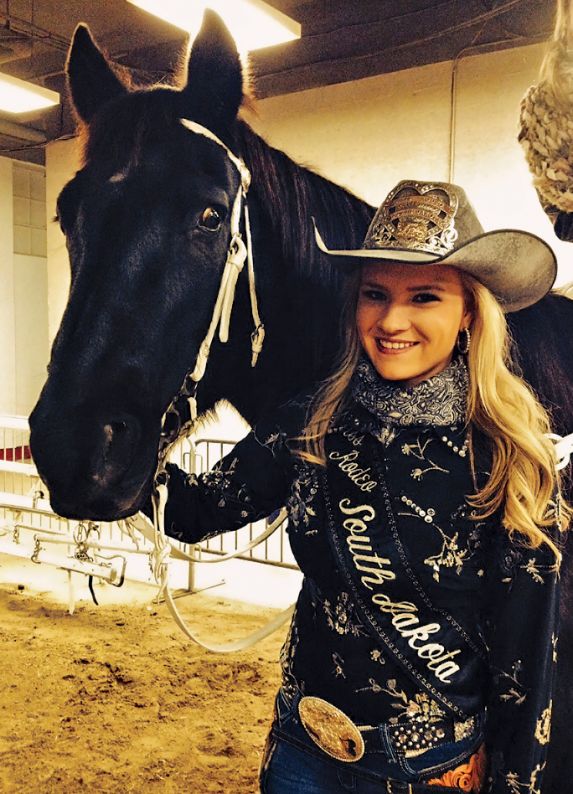
    Melynda Rose Sletten, 24, from Pierpont, SD, is the 2014 Miss Rodeo South Dakota. She came in first runner up last year and decided to give it another shot. “I don’t want to live with regret,” said the licensed cosmetologist who grew up in a town of less than 100 people. “My parents moved a church from Langford to Pierpont SD – and remodeled it into a house,” she said. Melynda spent her free time completing various 4-H projects. “I did everything from building flower beds to refinishing furniture to painting and drawing. I showed everything from cattle to horses to chickens to cats and dogs. 4-H taught me a array of responsibility. I was in 4-H rodeo, and active in a variety of sports in high school. My summers were really full.” She held two jobs her senior year in high school – at a nursing home as a house keeper and dietary aid and she worked as a receptionist in a salon to see if that’s what she wanted to pursue. “I work with the public every day, and it’s really easy for me to talk to people and I’ve been through a lot in my life, and I know how to work since I’ve worked all my life.” She works now as a licensed cosmetologist in Aberdeen and helps out one day a week at the Aberdeen Livestock Sales Co. penning cattle in the back with her horse. “Working in the back is my freedom and brings back memories of working on a ranch,” she said.
        Her life behind the chair and at the sale barn will be on hold for the coming year. “I’ve always worked, so this is the opportunity to put my work on hold and travel and get to have this journey of a lifetime,” she said. “This is going to open up endless opportunities for me.” Melynda has the upper edge on the hair and skin secrets with her studies in college. Her secret is hair extensions and PCA chemical peels – which she is certified in. “There is nothing better than making people feel good about themselves, it builds there confidence .”
        She decided four years ago to pursue becoming a queen. “It was during a 4H rodeo and I watched my friends Courtney Peterson, Krystal Carlasico, Kristina Maddocks and MacKenzie Haley. I grew up around it, but didn’t know if it was right for me. One day I decided I wanted to try so I borrowed all of my cousin’s clothes. Nothing fit quite right, but I ran and got my first title as Miss Foothills Rodeo in South Dakota.” She went on to become Miss Rodeo Aberdeen. Through her titles, she has been to the Black Hills Stock Show for the past two years. “This year I’ll go as Miss Rodeo South Dakota and it’s the biggest honer to me. I watched all my friends do it and it’s surreal that I’m doing it this year.” She started her reign with the National Western Stock Show in Denver, Colo. After Rapid City, she will head to Florida for the Silver Spurs Rodeo. “We stay at a host home and do school visits and go to the rodeos, and then we go Wild Hog hunting – and of course I get to get out of South Dakota’s cold weather.”
        She thinks the program set up for the Miss Rodeo South Dakota is the best program. “If it wasn’t for the girls ahead of me, I wouldn’t be doing this. All the past queens are willing to help you out. In turn, I will be the role model for the young girls coming up behind me. You can count on somebody to give you support. The Miss Rodeo South Dakota contest is similar to what the candidates go through in Vegas. We stay at a host home, with no cell phones, and ride horses we’ve never been on before for the contest.” Her biggest support through the entire process has been her family – mother, Brenda; dad, Lynn; brother, Tanner (20), and sister Megan (Ulrich) (26).

  • The Jandreaus

    The Jandreaus

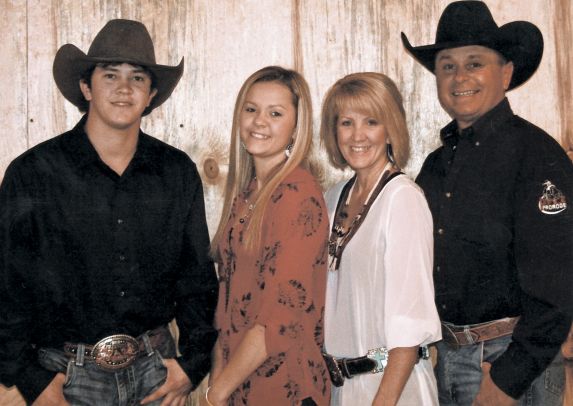
    Rodeo runs as deep through the Jandreau family as the Cedar Creek and the sod that covers the South Dakota plains. For Marty, Sindi, and their children Dawson and Cedar, rodeo is the glue that connects them all, provides their fun, their entertainment, and fulfills their competitive drive. 
         They live near Lower Brule, S.D., a few miles where Fay and Roberta Jandreau raised Marty and his brother, Fay, Jr. With Fay Jandreau’s brothers and sisters all living close, family was plentiful. At one time, there were five boy cousins, including Marty, all the same age. “They were cousins, but they just as well had been brothers,” Marty says, “and it’s still that way today. It’s a tight knit group of family.” 
        Members of the Lower Brule Sioux tribe, the Jandreau home place is on the Lower Brule Reservation, and since television was only two channels (CBS and PBS, when it came in), and nobody had any money, rodeo was cheap and good entertainment. Each summer, there would be a team roping twice a week and they’d buck horses once a week. “We were always rodeoing. We never quit.” 
        Marty competed in high school rodeo in the team roping and the saddle bronc riding, making it to the National High School Finals his senior year. It wasn’t easy. “By the time I was 15, there were twenty kids that could ride doggone good. There was so much talent in this state, and a lot of it never got seen.” In 1978, his senior year of high school, he won the South Dakota High School’s Team Roping Championship and placed second in the saddle bronc riding.
        After high school, he decided to forgo college and go straight to work on the tribal farm, but driving tractor all summer made him change his mind. “I started chewing Copenhagen because of it,” he jokes. “I couldn’t stand to be in the tractor. I decided to go to college.” Marty spent two years at Dawson Community College in Glendive, Mont., contributing his top five finish in the bronc riding to the men’s team, who won second in the nation that year. “Everybody on the winning  team went to the National Finals Rodeo that year. I don’t think any of them went to class, but they all went to the NFR.” 
        After Glendive, he sat out of college two years, and went to Ft. Scott (Kan.) Community College, and then on to Panhandle State in Goodwell, Okla. The plan was for him to return to Goodwell as assistant rodeo coach, but he had begun his pro rodeo career. “I got started winning so much money, I couldn’t afford to go back to school.” His Pro Rodeo Cowboys Association years had begun.
        He rode broncs, qualifying for the NFR in 1985. In September of ’86, he broke his leg at a rodeo in Spokane, and even though he qualified for the NFR that year, the injury kept him out. For five or six years after that, he finished in sixteenth or seventeenth place, just barely out of reach of another NFR. 
        It was in 1990 that he thought about slowing down. He was traveling with Bud Pauley and they were sitting fifteenth and sixteenth in the world standings. Bud was borrowing money from him, and he thought, “this is dumb.” He decided to slow down, and begin ranching. He came back to South Dakota and started a small cow herd. 
        All this time, a cowgirl a state away was doing her thing. Sindi Johnston grew up in Grassy Butte, N.D., the daughter of Jim and ElvaLou. She competed in high school rodeo, graduating from Watford City High School, and Dickinson State College. After spending two years helping her dad, a North Dakota Cowboy Hall of Fame inductee, on the ranch, she moved to Oklahoma with friends. She was living with her cousin, Brad Gjermundson, and his wife Jackie, when she met a saddle bronc rider from Lower Brule. Marty had run into the blond barrel racer and goat tyer when he judged a college rodeo, and later at another rodeo, but at the time she was dating someone else. When they met for a third time in Edmond, she had no boyfriend. “I didn’t waste any time,” Marty remembers. “I went ahead and grabbed on.”
        The couple married in 1990, and Sindi traded a horse for four or five cows. “It was a meager beginning,” Marty remembers. But it was the beginning to a good life.
        Marty continued to rodeo, and the next five years were the most profitable of his rodeo career. He competed at bronc matches and pro rodeos in the circuit, World’s Toughest Rodeos, and would occasionally venture off to the big shows. “I’d win $25,000 or $30,000 a year in the PRCA and another $20,000 in the matches.” The money went to get the place going, buying more cows, horses, and for diapers.
        In 1991, their first child, Dawson, was born. A second son, Bridger, was born in 1993, and at three months old, he died of SIDS. Three years later, their daughter, Cedar, was born. She was named after the Cedar Creek, near Marty’s parent’s home place.
        The kids have been riding and involved in rodeo since they were young. Dawson and Cedar competed in Little Britches Rodeo and 4-H rodeo, and then moved on to high school rodeo. In high school, Dawson rode bulls, team roped, rode broncs, and won the National High School Finals Saddle Bronc Riding title in 2009. He also played high school football for Lyman High School. He graduated from Vernon (Texas) College last May. He qualified for the College National Finals his freshman year, and now, with his degree in farm and ranch management, is helping his dad on the ranch and pro rodeoing. He’s competed at three Badlands Circuit Finals Rodeos, but sat out much of 2013 with knee injuries. His plan in 2014 is to make a run for the NFR, following in his dad’s footsteps. “I don’t know if I’ll ever be that good,” he says, “but I’d like to be.”
        Cedar, a junior in high school, runs barrels, breakaway ropes, goat ties, and heads in the team roping. In 2011, she won the Little Britches Rodeo Junior Girls Breakaway title, and has twice been to the National High School Finals and the Indian Rodeo Finals. She plays basketball, runs cross country (“it keeps me in shape for basketball and rodeo,”), is an honor roll student, member of the FFA, and Student Council member. After high school, she hopes to go to college in Wyoming, continue rodeoing, and get a radiology degree. 
        Marty quit riding broncs in 1999. He wanted to stay involved with rodeo in some way, however. He had judged rodeos back when the PRCA required NFR contestants to judge one a year, and now his judging has grown into 75 to 100 performances a year. He’s judged the National Finals Rodeo nine times since 2005. “I never envisioned being a judge. People don’t even remember me riding broncs, and that’s what I wanted to be remembered for.” 
        Sindi, who served on the Women’s Professional Rodeo Association board for nine years, has put her barrel racing on hold while her kids are still at home. “I made a choice that I wouldn’t miss what my kids do. I can’t justify going to a rodeo, and not watching my kids (compete in sports.) I have two years left (with Cedar in high school), and then I get to enter rodeos again.” 
        For her, rodeo has meant good times for her family, scholarships, and an outlet for competition. “It’s our fun time, and it’ll pay for my kids’ education. Dawson got his education paid for, so I’m hoping Cedar does, too.” 
        And competition is strong among the Jandreaus. “I think anybody who rodeos has that fear of losing, that determination.” When the family plays games, no one wants to lose. “If it’s Monopoly or cards or horse shoes, we hate to lose. We have some wicked Wii games, and the tempers start flying.” 
        But whoever wins or loses, rodeo unites them. And so long as there’s a Cedar Creek, and the sun comes up over South Dakota, somebody will have a rodeo to enter, and somebody will be in the stands, cheering them on.

  • Scott Hall

    Scott Hall

    Scott Hall was raised outside of Herald, SD, on a ranch. “We lived on a ranch and put up hay and farmed with horses,” said the 81-year-old who calls Elizabeth, Colo., home. “I did a lot of farming with a team of horses.” His dad had a herd of about 150 horses and Scott remembers riding on the back of the young colts while his dad led him around. “Then he’d turn me loose in the pasture and the wreck was on,” he recalled. He started rodeoing when he was 16 because his neighbor did. “We went to small rodeos, or we’d run in somebody’s cows and ride them. We always thought we were riders. It was something to do on Sunday.”  He had four sisters and four brothers and only his older brother joined him a couple of times riding bareback horses. 
        He started traveling to rodeos when he was about 17. “My brother in law, Harold Alleman, would pick me up and take me to rodeos in Minnesota and around the area. I had a Turtle saddle, and I was part of the RCA.  Before that I would go to some amateur rodeos around.” Scott never made it to the Finals. “I never tried – I was working.”  Scott made it to the 11th grade and didn’t like it. “I wasn’t a school guy, so I left school and I ran away. My dad was out farming for a guy $10 a day, and me and two other guys decided we were going to rodeo. I had $100. We got a bus ticket and went to Casper, Wyo.” By the time they got to Casper, they were broke and Scott ended up staying with his aunt and uncle, working on his irrigated farm, putting up hay. He broke a wild horse for his uncle’s friend and entered a couple rodeos in the bareback riding. “I didn’t know anything about spurring one out, but I got one rode.” His folks came out and made him go back to school, but he never finished that time either. He was drafted into the Army and got his degree in Korea. “I took one of those tests and got my diploma.”  He served in Korea from 1952 – 1954 as a crane operator after training in heavy equipment. “I was a good crane operator.  I put bridges in, and then tore them out. I did my job and got out of there ok.”
        In 1958, Scott went to Belgium to put on a rodeo, that’s when The World Fair was there. “The horses went by ship and the rest of us flew. There must have been about 30 of us altogether. It was a good deal. Gene Autry and Casey got this all together.  We put up the biggest tent that Goodyear ever built –we put it up with an air compressor. Something happened to the tent, and we ended up putting on the rodeo in the rain. It rained and rained and rained – we’d rodeo in six inches of rain sometimes.  It didn’t work out that great – we went broke. The government paid our way back.” 
        Scott got married in 1959 to Joyce Galinat and he and Joyce had five children.  At times he would take the family on the rodeo road, but mostly he went by himself. He put up hay, raised hogs, and ran a few cows between rodeos. “My wife died when she was 44 of a heart attack in 1983. I went back to South Dakota for nine years.” The two youngest were still in high school and Scott finished raising them by himself.  He leased a ranch in Wood, South Dakota.
        In 1991, he became reacquainted with a lady he had known in 1958. “I was crazy about him, but he was too busy rodeoing at the time,” said Mary (Lovoi) Hall. They were married Oct. 18, 1991. “He called me in March, and I went up to South Dakota in April. It was a very painful thing going back and forth, and we just decided to get married and he moved back here.”  
        Scott does the same thing he did in South Dakota. He has about twelve head of horses and rides and has a handful of calves and a bull. “I’ve still got ice to break and hay to move,” he said. He’s busy all the time – there’s  a lot of chores to do. “I’ve done about everything I’ve ever wanted to do. I’m going to try to cut my horses down to about two and get rid of some of the chores and take it easy.”

  • Adam Wrenn

    Adam Wrenn

    Adam Wrenn is all about riding bulls. The fourteen year old cowboy, who lives on the outskirts of Belle Plaine, Kan., started riding sheep when he was five, and liked it right away. He graduated to calves, steers, and last year made the jump to bulls.

    He is in his first year of competition in the Kansas Junior High Rodeo Association, but it’s not his first association. Last year, he was an Oklahoma Junior High School Rodeo member, and has also been a member of the Northwest Oklahoma Junior Rodeo Association, Out West Junior Bull Riders, the National Junior Bull Riding Association, the Heartland Youth Rodeo Association, the Kansas Junior Bull Riding Association, and the Oklahoma Kansas Youth Rodeo Association.

    He is an eighth grade student at Belle Plaine Middle School, where he enjoys math class, which is his best subject. Social studies isn’t his favorite, however. His favorite teacher was his kindergarten teacher, Mrs. Kinsley in Mooreland, Oklahoma. Adam started school in Mooreland and moved to Belle Plaine in second grade.

    He plays football, basketball, baseball, soccer, and runs track, and enjoys them all, but football is his favorite. He plays any position, wherever his coach needs him, and looks forward to playing for the Belle Plaine Dragons next year. He loves following the Oklahoma State football team and the Baltimore Ravens.

    Adam’s favorite bull riding role models are Lane Frost and J.B. Mauney. When he grows up, he hopes to pay for his college education with a bull riding scholarship, and possibly get a job involved with college sports.

    In his rodeo career, he has sprained his thumb, his right ankle, broken his nose, and got his head stepped on. The head injury was the worst one: he was riding a calf in 2007 in Shawnee, Okla., wearing a cowboy hat, when he got bucked off and the bull stepped on his head. He laid in the arena motionless, and after that, his parents insisted that he wear a helmet.

    Adam’s dad rode bulls in the pasture, but never competed, and neither did his mom. His older brothers, Chris and Jonathan, became interested
    in it when they overheard their dad visiting with a friend about riding. It spurred the older brothers to ride, and Adam became interested. “It made me want to do it, and I liked it from there.” The brothers don’t ride anymore, but Adam does.

    In addition to Chris, age 21 and Jonathan, age nineteen, he has another brother, Scott, who is seventeen. He also has a younger sister, Lorraine, who is four.

  • Charlie Romero

    Charlie Romero

    Charlie Romero is always looking for his next adrenaline rush. Whether it’s riding bulls, dirt bikes, mixed martial arts or four-wheelers, he loves living on the edge. The Kansas High School Rodeo Association member is in his first year with the organization, but has been riding bulls since he was twelve. Fellow contestant Dalton LaFalier encouraged him to join high school rodeo, and he loves it.

    He lives in Edna, Kan., twelve miles east of Coffeyville, and is a senior at Labette County High School in Altamont. School is easier this year, since most of his required classes are out of the way. He wrestles and is a member of FFA.

    When Charlie began riding bulls, it was in the National Junior Bull Riding Association, but after he got injured during a hang-up, his mom made him quit. He quit riding for two years, then began again at age sixteen. He got injured a second time, and then began wrestling.

    He credits Zach Strunk, a family friend who lives in Coffeyville, with getting him started. He rode the bucking barrel at Zach’s house, and Zach takes him to his high school rodeos. “He’s helped me so much, he’s been a brother to me,” Charlie said.

    Between riding bulls and doing crazy things, Charlie has had his share of broken bones. He’s broken his arm, collarbone, wrist and ankles, and his doctor teases him, telling him that his parents have helped build the new wing on the hospital with the doctor’s fees Charlie has incurred.

    This fall, he will compete at Northeastern Oklahoma A&M College in Miami on a bull riding scholarship. He hopes to get a business and marketing degree. He also plans on going to farrier school and completing an equine dentistry degree, so he has some options for jobs. He hopes to get his Pro Rodeo Cowboys Association permit this March, fill it, make money and gain experience, and move on to the PBR ranks.

    The best bull he’s ever gotten on was one of Matt Williams’ bulls at the Emporia high school rodeo last year. The bull was a “nice, stocky red bull, that was really rank, really awesome,” Charlie remembers. “He was leaping and blowing up in the air like crazy.” Charlie went 7.8 seconds on him.

    But even though his thrills extend to dirt bike riding, MMA, and other dangerous things, he’s careful to not go too far. “Nothing too dangerous,” he says. “I have to keep my bull riding career.”

    “Bull riding is the main thing that keeps me going. It keeps me happy. I can’t get enough of it. It’s great.”

    Charlie has an older sister, Sarah Day, who lives in Coffeyville. He is the son of Carlos and Stephanie Romero.