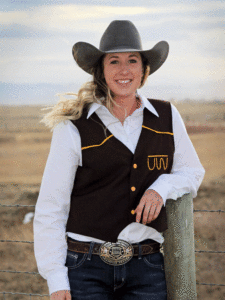
Lacee Curnutt from Talihina, Oklahoma, grew up riding on a ranch. Her grandfather, Don Huddleston (Back When They Bucked, page 18)raised her riding with him on the southeast Oklahoma ranch. “My grandpa went to the NFR 8 times and even though he had retired by the time I started hazing, I used to haze for everyone he helped,” said the oldest of five sisters. “On Sundays, Grandmomma took me to church and we always practiced after the meal.” Lacee competed in barrel racing and hazed with her two bulldogging teams through college. “Those two teams helped me stay on the rodeo team,” she said. Lacee went to college for elementary education, but left to go pro rodeo before completing the student teaching.
She hazed for her ex-husband and several bulldoggers and came home when she became pregnant. “Then along came Walker Don Woodall,” she said. “I couldn’t be luckier –he’s friendly, loving and kind. And a good boy.” She came home and waitressed and eventually worked in the oil fields. “I was still hazing at the amateur rodeos and raising Walker; trying to be a good mom.” Although Walker rides horses, his first priority is playing football. He also likes fishing and playing baseball.
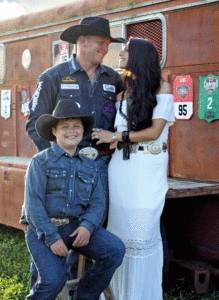
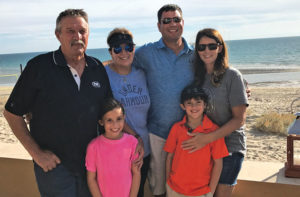
Lacee with her fiance Tom and son Walker – photo by Jana Hardin
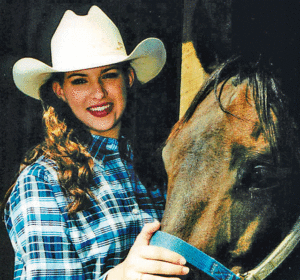
Lacee her senior year of high school, 2001 – Courtesy of the family
Lacee met steer wrestler Tom Lewis through a mutual friend and they literally met on the road – at a Wendy’s at Hayes, Kansas. He went his way and she went hers. “I told him if he made the short round at Dodge City, Kansas, I’d come watch him.” He did and she went and he won the rodeo. “It was a good first date.” That was more than a year ago and the couple will be married November 10.
She has been able to stay home, quitting her job of hauling horse trailers, to take care of the horses at home and keep up with 10-year-old Walker and Tom. Whenever she can, she hazes for Tom as well as several others. “I can remember the first time in 2003 when I bought my card. I hazed in Ft. Worth and they were fresh cattle; that will always weed out who deserves to be there. It was a man’s sport, and I had to prove myself before they were ever really nice. Once I did, they were good.”
She says that one of the secrets to being a good hazer is having a good horse. “That hazing horse has to help everyone,” explained the 35 year old. “When I was young, I had a horse that we got off the track. He bucked everyone off and finally I got him and he took care of me until the day he died. He was 22 – it’s been hard to find another one. I’ve trained a bunch, and Chad Richard out of Utah had one that has been super awesome – Superman.”
“Throwing your leg across enough of them you know the difference. When to say enough is enough and when to keep messing with them. With age, you recognize what a good horse has to have. You’ve got to have some heart in them – I like finding that peace in a horse.” They have the perfect team now between Superman and Maverick. It’s the same way they feel about working as a team with each other.
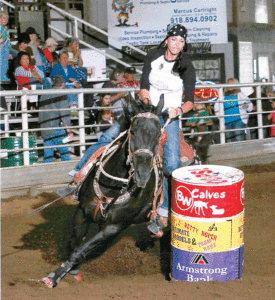
Barrel racing at the Betty Roper Ultimate Barrels and Team Race – Courtesy of the family
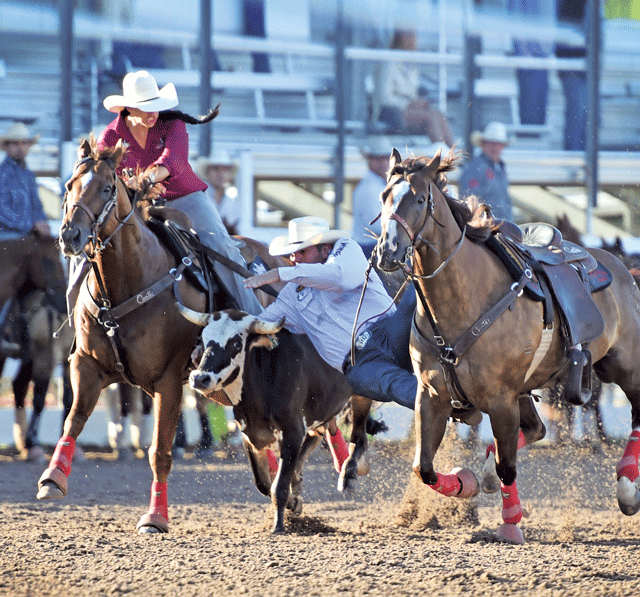
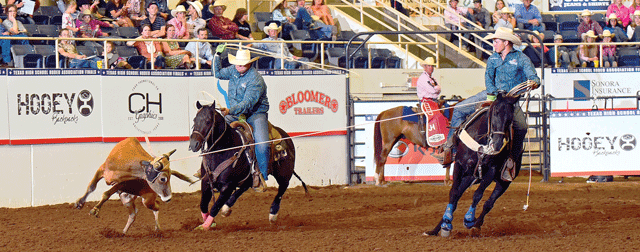
Lacee hazing for Curtis Cassidy at Cheyenne – photo by Hubbell
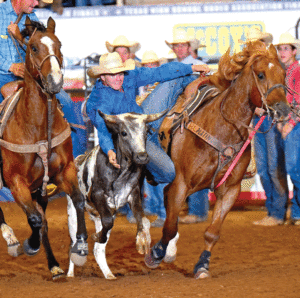
“I never thought I would ever have a lady haze for me,” said Tom, who made the NFR in 2012. “She’s not just a cowgirl; she’s special. She’s the love of my life, we’re good friends and we can talk. It’s been good. At the end of the day, it’s just a rodeo.” He has been dogging steers since he was a junior in high school, joining the PRCA in 2001. In 2012, after winning the circuit 4 times, he made a run at the NFR. His good horse got hurt after he made the NFR in 2012 and it’s taken him four years to find Maverick. Four guys rode him at the Finals last year and the duo, along with the hazing horse, Superman, have had a great year.
Lacee’s goal in life is to be happy and have a peaceful life. “I want to give back, I love helping young ones! Always give God the Glory; we would be nothing without Him! Her other goal is to be the first female hazer at the NFR, a goal she has held dear for many years. “I’d love to make history. To me it would be a payoff of years and years of hard work.”
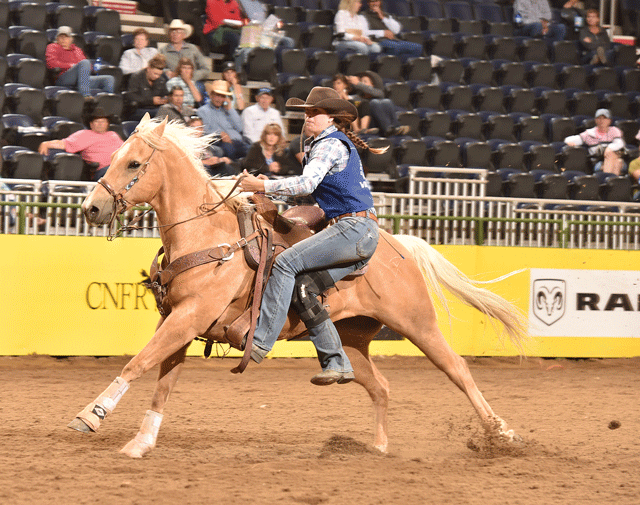
Last month, college junior Maddy Dickens was racing to the National Intercollegiate Rodeo Association barrel racing reserve championship on her main mount, Bucky. This month, you can catch them on the WPRA rodeo trail. “It’s all I’ve ever done,” she says. “When I take a step back, there’s nothing else I’d rather be doing.”
Maddy rodeoed for Odessa College this last year, taking the southwest region all-around and barrel racing titles. This fall, she plans to rodeo for Tarleton State University while majoring in business administration and finance. “It’s motivating knowing that putting the time and the work in will eventually work in my favor,” she comments.
“This is my second year having Bucky. I got him before I went to school my freshman year in college. His name is Bucky because he tried to buck me off an embarrassing amount of times. He had never bucked until I got him, so he was renamed to Bucky. He’s 11 this year, and so this is his first year going to a lot of pro rodeos… He’s one in a million, and I’m really lucky.”
Maddy’s main support system is her family, as rodeo is a way of life for the Dickens, who call Loveland, Colorado home. Brothers, Joey and Kyle, are PRCA tie-down ropers. Dad, Skip, a former all-around cowboy, is always behind the chutes helping. Mom, Lisa, was a trail rider turned barrel racer, former rodeo photographer and now the self-dubbed family videographer.
Maddy at the 2018 CNFR – Hubbell
Over the years, all three kids were members of the Colorado Junior Rodeo Association, National Little Britches Rodeo Association, Colorado State High School Rodeo Association and NIRA. Kyle and Maddy were also members of the Colorado Junior High School Rodeo Association (which was formed after Joey was in junior high). “We traveled with 6 horses, 3 kids and 1-2 goats,” Lisa adds. “Our own mini circus.”
While all three kids are now grown, they still support one another through the thick and thin of rodeo life. “My brothers have gone a lot more than I have, so they have a lot more ‘on the trail’ sense of everything,” Maddy says. Both brothers rodeoed for Colorado State University and competed at the College National Finals Rodeo themselves. “They’ve helped me a lot with my mental game, how to enter the rodeos, where to go and other things you learn as you go. I’ve been able to pick up from them a little bit because they’ve been going so much.”
Kyle says, “It’s nice to be able to help her. I feel like she’s had a lot of the same mental hurdles that it took me awhile to struggle through and figure out.” He has tried to “at least decrease the learning curve” for Maddy.
Mastering the mental game has proven to be even more important for Kyle and Joey, as they both quit their jobs in January to rodeo full-time. Joey, the oldest, remarked that Kyle was the driving force behind it all, as “he’s been planning this for years.”
“I just felt good about my abilities and felt good about my horses. It was something I wanted to try and not wonder ‘what if?’” Kyle says. It’s the one thing I enjoy the most, and if I can make a career out of it, I might as well try.” Joey and Kyle share a rig and in Joey’s words, they’re both trying to win. “It’s good to go with someone who has the same goals,” Kyle adds. “It’s good to have a supporter.”
Their transition from weekend warriors to full-time calf ropers has been fairly smooth. The biggest difference? “When we were working full-time, we had to cram in a lot more rodeos on the weekend so we could get as many in as we could,” Kyle says. They’ve realized they don’t need to exhaust themselves getting to rodeos since they have more time as full-time contestants.
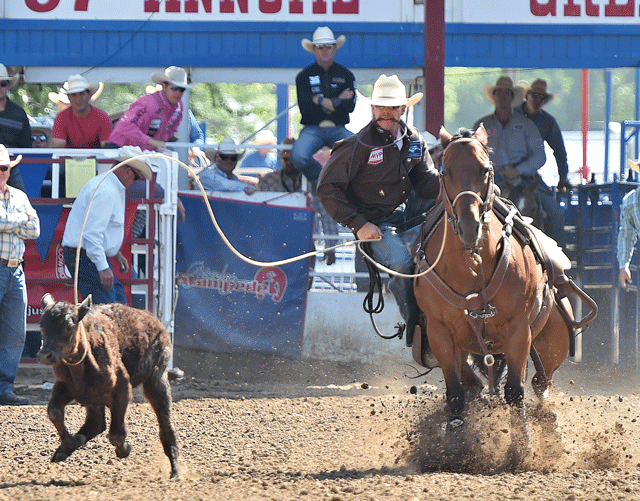
Kyle Dickens at the 97th Annual Greeley Stampede – Hubbell
And when the rodeo trail gets tough, Joey says perspective is everything. “I’ve had a real job… You know what I mean? I’m not one to complain about rodeo being hard.” For Kyle, remembering his goals pushes him on the trying days. The drive to accomplish what he set out to do motivates him, and he believes it’s “pretty counter-productive” to quit, even when that feels like the easier route.
Joey looks to his dad as his role model, as Skip “had to figure it out on his own.” Skip has worn many hats in supporting his kids’ rodeo pursuits– from practicing with them every day after work to teaching them the fundamentals of roping. He recently retired from his job, and now helps with the horses, keeps the rigs running and calls vets when they’re on the road.
“Rodeo is just something we’ve always done as a family. It was great. It was awesome,” Lisa adds. “Where other parents may have said, ‘Yeah, I don’t see my kids on the weekends,’ we were with the kids from junior/peewee age all the way through high school. We got to spend time with our kids all the time… I wouldn’t trade a minute of it. We loved, too, the opportunity to meet people from different parts of the country and the lasting friendships you make.”As Skip and Lisa have helped their kids over the years, they recognize the valuable lessons it has brought. “They learned how to be good sports in and out of the arena, whether they win or lose,” Lisa states. Responsibility is one of the greatest quality rodeo instilled in their kids. “You have to take care of the animal. You have to practice. If you don’t do well, if you don’t win, you don’t pay for your fees. And I think they’re learning that as they go down the road and are trying to make money at it,” Lisa says. “They have to be accountable for everything they do.”
While they experience the ups and downs of the rodeo trail, the Dickens kids know they have one another to lean on. “They tease each other, and they really like to pick on Maddy,” Lisa laughs, “But they are right there behind her, offering advice. They support each other all the time. They call Skip on things and ask his advice… As a mom, that’s really, really cool.”
“Every time the boys rope or Maddy runs barrels, I get videos, I get phone calls of what’s going on— ‘What could we have done? This was good, this was bad,’” Skip adds. “Just that interaction is great… That’s the biggest cherry on top of the sundae to me.”
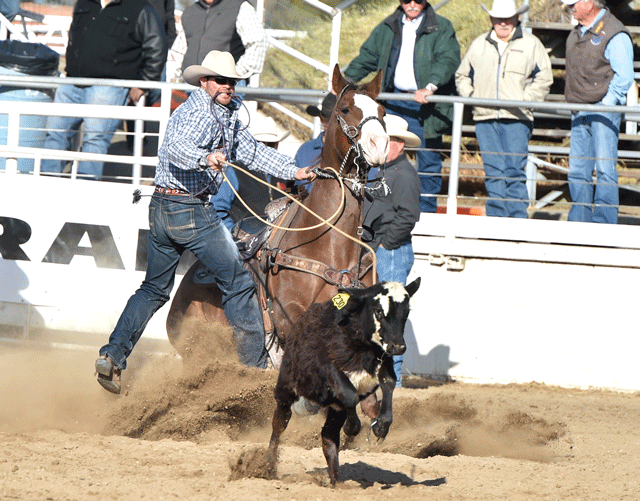
Joey tie down roping at the 97th Annual Greeley Stampede – Hubbell
The Dickens children attribute much of their success to Skip’s and Lisa’s early sacrifices for them, but their parents wouldn’t even call it a sacrifice. “I think the only thing sacrificed was time, and spending time with your kids goes without saying. It is not a sacrifice. It is what you do,” Lisa says.
“That’s the best thing to me— The kids want to spend time with us,” Skip adds. “All three of the kids help one another all the time. They are their main supporters. And I think that’s really the best part… We get along and work as a family to try to make this work, and I think that’s incredible.”
Cort Scheer is building his retirement one bronc at a time. The Elsmere, Nebraska, cowboy will top $1 million by the end of this season and he has managed his earnings well, investing in cattle for his family’s ranch in Nebraska and a piece of property in Stephenville, Texas. “I bought a place to fix up since I’m there for the winter and go to rodeos,” said the 32-year-old, who has been running down the rodeo road with the PRCA for eight years. “I’ve built the house and barn and this winter I’ll build the arena. Then I’ll sell it and get a bigger place.” At the end of his rodeo career, Cort plans to return to the family ranch, expand it, and run cattle with his brother, Clete. Right now, Cort doesn’t get home too often – maybe one month total each year. “It’s awesome,” he says of his home in Nebraska. “Cell phone don’t work, no town within 50 miles – it’s perfect –it’s just the ranch.”
Cort grew up there, traveling 40 miles one way to school. “We got on a bus 20 miles from home.” There was no activity bus and since Cort was big into football and wrestling, he and his older brother and sister (Kema) drove themselves. “My brother and sister packed me around until I was old enough to drive.” In Nebraska, that age is 14. He spent the rest of his time working on the ranch. He learned how to ride broncs from his dad, Kevin, who rodeoed until he got married and his uncle.
Scheer family – Dedra Stoner
Cort played running back and corner for his high school team – Courtesy of the family
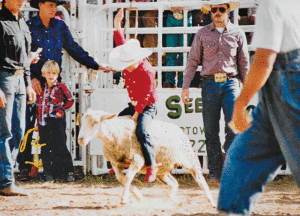
Cort at Cheyenne Frontier Days; Muttin bustin at age 6, 1992
He started by riding sheep and then started riding in eighth grade, the earliest his dad would let him. He competed in the Nebraska high school rodeo, making Nationals every year. He won the Nebraska High School All around, competing in steer wrestling, calf roping, and saddle bronc riding. He played running back and corner back in football. “I liked it – I wanted to play football more than rodeo but I was too short and slow.
“He’s always been a blessing – I like to say he’s as good a person as he is a bronc rider,” said his mom, Pam, fondly referred to as Grammy Pam. “I’m glad he stands up for what he believes in.” She also adds. “God really blessed him with this talent and I’m thankful that he’s walking with the Lord. He brings a lot of joy and happiness to this family.” Pam also loves ranch life in Nebraska. “I open my window up every morning to the Sandhills,” said the 22-year-veteran teacher that will be going on her second mission trip to Guatemala. She drives 28 miles each way to work each day to teach third grade.
Cort went to college in Garden City and ended up at Panhandle State. “It’s always been the powerhouse in the bronc riding,” said his dad. “He was in the bronc riding region and was there for three years and I think that has a lot to do with his ability. I raised horses for a few years and he got on those colts, but he did most of his practicing down south.” Kevin is proud of all his kids. “I tried to raise my kids so they would go after what they wanted, and Cort has.
When Cort does something, he goes all in – he’s pretty committed to anything he sets his mind to doing.” Kevin quit riding to pursue his first love, the ranch and his family. “I rodeoed at one a year on Labor Day to celebrate the end of haying, so they saw me ride once a year. I like ranching, it’s something I’ve done all my life.”
Tie down roping in 2004 with NHSRA – George Hipple Photography
Cort travels with two other bronc riders, and the three some make the best of the many hours on the road. “It’s been Tyler, Chet, and I for years.” He does a bit of hauling on his own, and spends the windshield time listening to music. “I’m a rocker, a big AC/DC fan and anything old country.” The day to day life on the road is pretty much the same. “We roll in an hour before, ease on up to the bucking chutes, and ride, go back to the van, and hang out. Lots of times we stay at a buddy’s house along the way, that’s a good thing about being older, you know everybody. It’s a big family, the door is always open, the light is always on.”
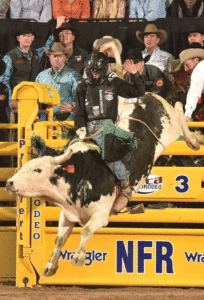
He doesn’t check the standings very often. “I let the numbers take care of themselves and worry about my riding. If I’m riding good, the numbers will work.” He has stuck to bronc riding since high school. “I blew my knee out one year and riding broncs was paying me pretty good so I didn’t want to jeopardize my knee.” As a veteran on the road, he thinks it’s easier than it was at the beginning of his career. “When I was younger I didn’t pay attention to my eating and being healthy like I do now,” he said. “I try to stay away from fried foods – now I eat more Cliff bars – low in sugar and high in protein. Even though I don’t work out, wherever I’m at I try to work at something. I figure if you’re working, you’re working out.” Entering is easier too. “After so many years, you hit the same trail – just different days up.” The quality of stock has improved as well. “It’s light years from where I started, with the futurity broncs, they are big and strong. They are so athletic, 1,400 pounds jumping 6 feet in the air.” His advice to stay on is simple. “Lift on your rein and a good spur out and hustle; you’re coming down if you don’t.”
“I like riding broncs, but I’d like to be home. My body is doing good, saddle doing good – I’ll keep doing it until they quit paying me. Then I’ll go home.” Until then, he is enjoying his rodeo days. “You dang sure have some stories when you sit in your rocking chairs.”
Cort Scheer summary of accomplishments include:
4x National High School Finals Qualifier 2002 National High School Rookie Bronc Rider 2004 Nebraska High School Steer Wrestling Champion 2005 Nebraska High School Champion Saddle Bronc, Calf Roping, Steer Wrestler, & All Around 4x College National Finals Qualifier 2006 Central Plains Region Saddle Bronc Champion 2008 Big Sky Region Champion Bronc Rider, Steer Wrestler, & All Around 2011 Rodeo Houston Champion Bronc Rider & Shootout Champ 2013 Calgary Saddle Bronc Champ 5x Wrangler National Finals Rodeo Qualifier 2016 Champion ERA Bronc Rider 4x Canadian Finals Qualifier 2018 The American Champion Bronc Rider Pendleton & Denver Champ
Rowdy Norwood of Amarillo, Texas, makes his debut at the 2018 NLBFR in July leading the senior boy rookie standings with 3,207 points separating him from second place. Rowdy, 16, originally joined the association with the goal of qualifying for the 2019 Jr. Ironman. He put his nose to the grindstone, and when he looked up, not only had he qualified for the NLBFR in all of his events—team roping, steer wrestling, ribbon roping, and tie-down roping—but he also made the Top Hand Team in each event.
Rodeo has been Rowdy’s sport of choice since childhood, though he also played basketball for several years and showed pigs in FFA in sixth and seventh grade. When it came time to choose between sports, he and his older brother, Justin (18), chose rodeo without hesitation, competing in junior rodeos and ranch rodeos before moving up to high school and Little Britches. “In Little Britches, you get to meet a lot of new people from areas you’ve never been before, and it’s really one of the only other national associations besides high school. We tried to start a franchise a few times when we moved here, but we couldn’t find anyone to host the rodeos. Kyle Northrup started the Texas Panhandle Little Britches and we got involved with it here,” says Rowdy, whose name was inspired by a roping his dad went to. “My dad always wanted to have a little girl, and he was convinced when my mom was pregnant that I was going to be his little girl. All he could think of was names for girls. MB Anderson, our neighbor, was announcing a roping my dad entered, and he couldn’t read my dad’s handwriting and announced his name as Rowdy, so now I’m Rowdy.”
Rowdy steer wrestling at the THSFR – JenningsRodeoPhotography.com
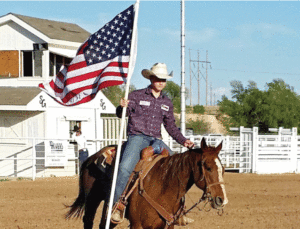
Rowdy carrying the flag at a HPJRA (High Plains Junior Rodeo Association) in Hereford, TX
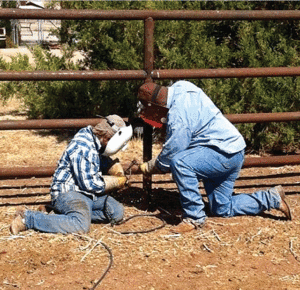
welding with his dad, Randy – Courtesy of the family
The Norwood’s moved to Texas from Olney Springs, Colorado, where they ran a small cattle ranch until the drought took hold. In 2007, Rowdy’s dad took a job in Texas, and the environment they moved to has played a central role in Rowdy and Justin’s rodeo careers. With a rodeo or roping held within a ten-mile radius of their house year round, Rowdy and Justin never lack for opportunities to compete, while they can get to a rodeo in New Mexico, Colorado, Oklahoma, or Kansas within four hours. The brothers team rope together, Rowdy heading and Justin heeling, while Justin hazes for Rowdy in the steer wrestling. Rowdy won the NRS Little Britches Rodeo Association all-around, steer wrestling, tie-down roping, and ribbon roping year-end titles in June. He racked up the majority of his rookie of the year points at the NRS LBRA franchise, competing in 24 of the 32 rodeos held in Decatur, Texas, at the NRS Events Center. His ribbon roping partner, Sophia Joyner, is also in contention for the NLBRA Senior Girl Rookie of the Year title.
Equally crucial to Rowdy and Justin’s rodeo success are their parents, Randy and Bobbi Norwood. Randy is often working out of town as a welding pipeline inspector but comes to as many of their rodeos as possible, including state finals and the NLBFR, and watched videos of their runs to give them pointers. Bobbi teaches high school chemistry and physics, and hauls Rowdy and Justin to all of their Little Britches and high school rodeos. “We get a list written and everybody takes some responsibility getting ready to go, and I do the final walk through to make sure everything on the list is done,” says Bobbi, who also helps with timing or secretary work at the rodeos when needed. “Every horse I’ve ever tried to rope on has wound up being one of the boys’ horses, and I’m protesting now saying they have to make a horse for me. They help out with the driving, and they haul by themselves occasionally.” Bobbi competed in the NLBRA in the 1970s, including team roping with her sister. “The competition in Colorado was always pretty stiff with Little Britches headquartered there, and since the finals has moved to Guthrie, I feel the sheer number of contestants has increased immensely, which makes the competition increase. It’s an awesome association, and you’re not hauling all over the country with your kids to get them qualified.”
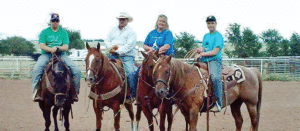
Rowdy with this parents Bobbi and Randy and his brother Justin
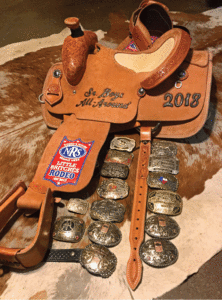
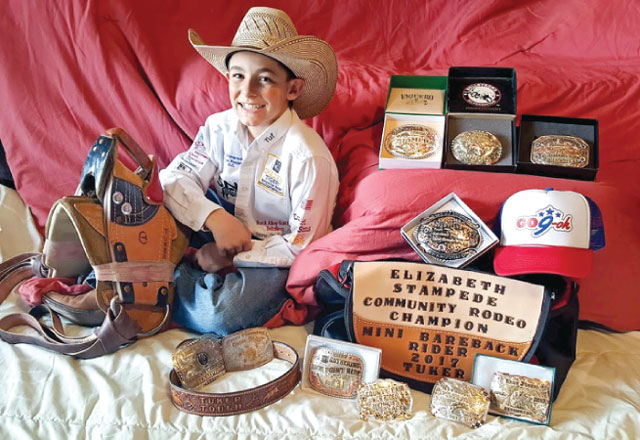
A collection of buckles and a saddle that Rowdy has won over the years – Courtesy of the family
Goat tying at age 7
The brothers also compete in Region 1 THSRA, and Rowdy qualified for state finals in the team roping with Justin, and steer wrestling, which he finished 13th in at state finals. He advanced to state finals last season in the steer wrestling as well, his first year competing in his favorite event since he advanced from chute dogging. “I just like how high speed it is,” says Rowdy, who was the High Plains Junior Rodeo Association Year-End Reserve Chute Dogging Champion in 2015. “Chase Pope, a local guy, did high school rodeos when he was younger, and he started teaching me chute dogging. I did Jace Honey’s bulldogging clinic and a few of Rope Myers’ clinics. I’m pretty much the first in my family to bulldog, and my cousin Dakota Camfield started it this year as well in Little Britches.“The roan horse I bulldog on, he’s our old team roping horse, and everyone in my family has won money on him. Ace has taken me pretty far in bulldogging,” says Rowdy. “My calf horse, Joker, I just got this year, and we’re just starting to get together now. Smoke is my team roping and ribbon roping horse. He was a calf roping horse first, and I stepped him up and he’s a really good team roping horse.” Rowdy and Justin practice and ride daily, either at their home arena, which Rowdy and Randy built together several years ago, or another local arena. Bobbi runs chutes and videos for them, and helps with tacking up and exercising horses. “When we travel, we talk about how the week’s been and watch our videos—video is one of the most amazing practice tools we have nowadays,” says Rowdy, who scarcely ever gets into the truck without his blue heeler, Dale, at his side.
Time on the road also gives Rowdy a chance to work on school. Last year when he was a junior, he switched to homeschooling, and plans to continue it through his senior year. “Rowdy gets the chance to work horses in the daytime in the winter, and he got a colt and has been able to ride it some,” says Bobbi. “He had to urge us toward homeschooling, and it’s the same deal,—we make a list of things to get done while homeschooling, and he brands and does some welding for a construction guy here. It’s a taste of the adult life and what it takes. Most kids that rodeo have to be disciplined to practice. We had a 15-minute rule—if you had a bad run, you had 15 minutes to be aggravated, and then go on to your next event. With the events in Little Britches back to back, we had to change that to a 15-second rule, and that really helped Rowdy. We’re just disappointed we didn’t join Little Britches sooner so Justin could have hauled more. He’s going to Dodge City Community College this fall and team roping for the Conquistadors.”
Rowdy also enjoys welding with his dad and kicking back at the family’s swimming pool, but it’s more likely he’s in the arena riding. His hard work won him a large check from the Double G Memorial Timed Event Rodeo in Canadian, Texas, last year, where he won the all-around, team roping, chute dogging, and tie-down roping. If Rowdy could enter any rodeo in the country, he’d choose Cheyenne Frontier Days, and hopes to back into the box of The Daddy of ‘Em All once he starts rodeoing professionally. “I’d like to make a career out of rodeo, and I’d love to rodeo through college and the rest of my life if I can.”
Rodeo roots run deep for young North Carolina cowboy, Cole Futrell. The Kidd, Tucker, and Futrell families have had an influence on the sport in the southeast. Cole, a first-year, youth IPRA member, is 16-years-old, and was born in Charlotte, North Carolina where his start in life was on his family’s legendary Rockin’ K Ranch. There aren’t many cowboys or cowgirls of any caliber in North Carolina, that don’t have a story to tell about their rodeo days there at the Rockin’ K, where Cole lived until he moved to their farm in Union Grove when he was in first grade. Cole’s great-grandparents, Helen and C.W. Kidd started the Rockin’ K Arena and were instrumental to the beginnings of the Southern Rodeo Association, and rodeo in North Carolina.
Cole’s Papaw, Scott Tucker (BWTB on page 22)is an SRA All-Around Champion Cowboy, that won the title multiple times in the 1960’s and 1970’s and had a big influence on Cole’s interest in rodeo. “I love listening to all of his old rodeo stories, especially his bull riding stories, and I want to be able to tell those kinds of stories one day too.” Cole’s late-Nana, Vicki Kidd Tucker, was quite the cowgirl, winning many titles during her rodeo days. Scott and Vicki raised their two children on the Rockin’ K; Cole’s mom, Keri Tucker Futrell, and his uncle, Jason Tucker. Jason competed as a team roper on the pro-level for several years and is an IPRA World Champion team roper. “My Uncle Jason has always helped me at rodeos to know what the start is and gives me advice on what I can improve on as a header.”
Cole Futrell at the 2017 IFYR – Phifer, RodeoBum.com
from left: Paige Futrell (Cole’s Sister) Brody Tucker and Jaxson Tucker (cousins) Cole Futrell in center, Jason Tucker (uncle) Keri Futrell (mom) Bart Futrell (dad) – Courtesy of the family
Cole is the youngest of Keri and Bart Futrell’s four children; his older siblings are Matt, 29, Paige, 27, and Clay, 19. Keri is a timer at many IPRA and SRA rodeos and has been a supportive rodeo mom to all her children. Cole appreciates that she hauls him anywhere he needs to go, watching most of his runs through the video lens, so that he can watch them later. Bart competed as a bull rider for several years and is a past IFR qualifier. He now owns Bow F Bucking Bulls and is a well-respected IPRA stock contractor and rodeo producer with his partner, Chet Kidd, (Keri’s cousin) as Rafter 3 Rodeo Company. Cole often helps his dad feed and care for bulls, as well as sorting stock and running them through the chutes before events to prepare them for the rodeo. “My dad has always told me to never give up no matter what anyone tells me. He is a hard worker, and I’ve learned from him that if I want something to never give up on it. If my dad puts his mind to something, he’s going to get it done.” Matt has also been an IFR qualifier, and still competes in many IPRA and SRA rodeos, as well as training horses and helping with the family stock contracting business. “When Matt is home, he’s always willing to pull the sled for me and is there to help me anyway he can.” Cole’s sister Paige is a NCHSRA alumni and went on to college rodeo in Texas; she is now a beautician and co-owner of the online boutique, Madeleine Paige. Paige is engaged to PRCA bull rider, Eli Vastbinder, who is currently in the top 15 in the world standings. “I really appreciate all of the help Eli gives me on my mental game; he has always been very motivational and positive.”
Clay, an IPRA heeler and IFR qualifier; and has been instrumental in Cole’s team roping. Cole watched Clay rope for a few years, while he stayed busy competing in steer riding, ribbon roping, and breakaway roping through junior high. Once Cole started heading, he and Clay spent nearly every day in the practice pen, roping the sled and steers together. Cole has been to several IFYR rodeos to watch Clay compete and last year was Cole’s first year to compete in Shawnee. Clay graduated in 2017, and is currently living in Stephenville, Texas. Cole’s favorite roping win was when he and Clay won the 12 Preliminary roping at the 2017 NTRL Finals in Jacksonville, Florida.
Besides the many family members, including cousins Cory and Tyler Kidd, that have been down the IPRA and IFR roads before him, Cole credits team roper, Bronc Fanning for much of his success as a header. Bronc competed at his first IFR in Tulsa, Oklahoma in 1971, and spent many years competing as a team roper. Bronc started working with Cole about five years ago, after Cole had told his dad he wasn’t ever going to rope, because he just wanted to ride bulls. “His dad called me that day, to see if I’d start working with him. I just started spending time teaching him how to do tricks on the dummy that his brother and cousins couldn’t do, and once he started beating them on the dummy, he got interested in roping steers. I don’t think I’ve ever been around such a kind and big-hearted kid, that has been so dedicated or works as hard at his roping.”
Cole with his cousin Jaxson Tucker – Courtesy of the family
Cole at age five – Courtesy of the family
Cole, a homeschooled sophomore, team ropes at rodeos as well as USTRC jackpots. He just finished his second year competing in the NCHSRA, with roping partner, Blake Walker; finishing the season as the Reserve Champion Header. The two are anxious to compete at the 2018 IFYR and high school national finals. Since 7th grade, Cole has headed on a 15-year-old grey gelding he calls Bam Bam, “I like riding him because he is so honest, he never gets too strong and lets me handle the steers however I want.”
Cole was chosen to be on the Smarty Young Pro Team and has been blessed by the experience. The help he has received from Smarty Pro members, like Kaleb Driggers and family friend, Luke Brown have been invaluable to him. Last March, the Smarty Young Pro Team gathering at Allen Bach’s Smarty training facility in Texas, was a life-changing experience that not only gave him the opportunity to learn from many of the pro team members involved, but also strengthened his walk with the Lord. Trey Johnson leads the ministry and motivational team meetings, and Cole has learned lessons from him about being a winner inside as well as outside the arena. “Trey has really helped to bring me closer to God.”
With such strong family connections to rodeo, it is not much of a surprise that Cole is also traveling down the rodeo road. Like a rite of passage, it’s now his turn to compete at these events he has spent his life watching. His plans, goals and dreams for his future include moving to Stephenville, Texas and competing in college rodeo before starting a career as a roper; with the ultimate dream of one day, heading steers for his brother Clay at the WNFR. “It’s all I want to do – it’s all I think about and what drives me.”
Justene Hirsig from Cheyenne, Wyoming, turned 21 a year ago, and it’s been a great year for her. She won The Wrangler Team Roping Championships All Girl roping with Jimmi Jo Montera as well as second with Lee Sherwood. “I was first, second, and third high call,” she said. She also took third place in the Central Rocky Mountain Region with her partner, Denton Shaw, and is currently sitting ninth in the nation in the college standings and the only woman in the top ten.
She started roping when she was in eighth grade. “My dad (Tom) let us start chasing calves around the arena when he was still tripping steers. My sister (Jordan) and I started when I was about 8 – that lasted for a summer, but I didn’t get into it until later. I didn’t like it too much – I played basketball.” Justene played point guard and several other positions during her time on the court. “That was my first love.” She did both rodeo and basketball, and was leaning more towards rodeo when she received an offer to play basketball for Casper College. “I wanted to see if I could make it in the basketball world. I knew rodeo would be there forever.” She hurt her knee during practice and had to sit out for the year. After knee surgery in January of her freshman year, she called it quits. “I had another surgery last November.” Basketball played a huge role in what she’s accomplished. “I’ve had some tough coaches and they taught me how to put aside everyone else’s thinking about you and perform well. I took that from playing college basketball to rodeo – it’s the same thing –if you don’t perform well, you don’t get paid. It doesn’t matter what anyone thinks. I’ve played in a lot of close games and you have to perform when things are tight and you only have a few minutes to pull it off. That’s helped in short rounds. I can talk myself into it’s just another steer.”
Basketball was Justene’s first love, before she started to rodeo – Courtesy of the family
Justene and Jimmi Jo Montera won The Wrangler Team Roping Championships – Olie’s Images
Justene, Debbie, Tom and Jordan Hirsig
The rodeo world is a very familiar place for Justene; she grew up going to Cheyenne Frontier Days. “My dad’s great great uncle (Charles Hirsig) was one of the cofounders of CFD. My family has been in the arena ever since. I’m carrying on the family tradition, picking up flank straps, or shagging cattle. I help where I can; I’m there every day.” Her dad is the CEO and President of Cheyenne Frontier Days. He is also the one Justene attributes her success in rodeo to. “He taught me how to rope and he knows so many people that have helped me – Tyler Magnus, Bobby Harris, JD Yates, Rod and Stephanie Lyman, and Rick and Jimmi Jo Montera – and he puts me on amazing horses.”
“The thing that always amazes me about Justene is how well she rides. She sits a horse picture perfect. That has always been her best attribute when it comes to improving her skills. Denton Shaw doesnt get the credit he deserves sometimes because he is amazing in his consistency and dedication. They have been partners almost their entire careers and is one of the biggest parts of her success. A great young man,” said Tom Hirsig. She works on her mindset by reading books – one of her favorite authors is Joel Osteen – and one of his that she reads often is ‘You Can, You Will.’ “My mom (Debbie) always gets me set up with books.” Her mom also helps with lots of other things. “Mom hasn’t missed church in more than ten years. Whenever I’m struggling, she encourages me to go to church and pray about it. She’s always praying for me as a person – my mother is the backbone of everything.” She also pulls the machine around, turns out calves for breakaway roping, and does whatever needs doing to help Justene succeed. “Without my mom, none of this would be possible. I’ll ask her to turn calves or steers and anytime of the day she says yes. If a horse needs reshod or hauled to the vet, she does it. Without her, we wouldn’t be able to do this. She sends me books to read and finds churches for me to go to on the weekends.”
Justene at Cheyenne Frontier Days – courtesy of the family
Justene heading and Denton Shaw heeling at the Gillette College Rodeo – Darsi Dale
Justene Hirsig – Andrew Birzer
“My dad gets me well mounted and I have that – and I’m blessed.” During the six-week long break at the University of Wyoming, after a short vacation, she and her dad headed to Arizona to rope for a few weeks. “My dad and I kept a horse for each of us in Arizona, and they were put on the walker every day and we’d fly back to rope. I think that’s a big part of my improving my roping.”
She transferred to UW two years ago, pursuing a degree in business financing. “My plan is to get a pretty good degree here so I can have the lifestyle that affords me to go to Arizona in the winters. I wouldn’t want to live there year round.” She has two years left on her rodeo eligibility and plans to make the most of it. “I sold horses when I was heading to basketball, and after two knee surgeries, the last year didn’t go so well. Now I’m roping with Denton Shaw – it’s been great. We roped together in high school for three years and qualified for Nationals, and we decided to rope together this year. We figured we did well in high school and tried it in college and we’ll rope at the CNFR.”
She sent her horses home so she could finish her finals. When she finished, she headed home to practice. “We have 22 to rope on. I have five head horses to practice on so I should be good.” She is excited to back into the box in Casper for the CNFR. “Making it is an end result of roping well in the college rodeos, and I’m looking at it as another rodeo. It’s going to be cool to make it there, but I’m going to rope like I always do – four more steers. I rope 50 a day if not more so that will be easy.”
Long term she plans to continue roping. “I want to be one of the best girl headers that’s on the road. I’d like to start getting into horse training and horsemanship – that’s something I want to work on. I don’t know what I want my job to be when I grow up – but I want to be one of the wellknown ropers.”
“Choose to dwell on thoughts that empower you, inspire you, and encourage you to have faith, hope and joy.”
“I’m around a lot of the people trying to make it to the NFR and it’s not something I’d be opposed to. If I wanted to try after college, I think it would be cool to do,” she concluded. “I have tons more to improve –and I just got moved to a #6, and I’ve worked hard to get there.”
Jerry Nelson’s love for rodeo began in 1991 when a friend invited Jerry and his family to their ranch in south Texas. As the son of a professional baseball player and raised in the city, he didn’t know a thing about rodeo.
“The first rodeo I went to, shoot, I didn’t know how you dressed. I was an oilfield guy,” Jerry said. “I wore a short sleeve shirt, a baseball cap and a pair of tennis shoes.”
Fast forward 27 years later Jerry went from leasing 1,900 acres to owning 8,000 acres and leasing some. Today, his ranch covers a vast 9,000 acres across the prairies near Freedom, Oklahoma, with 400 head of bucking horses, 70 rodeo bulls and about 350 commercial cows.
During the first few years after being introduced to the rodeo scene, Jerry helped produce amateur rodeos. Jerry said he worked his way from the ground up, doing everything from untying calves to working the back pens. The entrepreneur and rodeo stock contractor credits his success to his work ethic and long hours worked.
“I’m still having fun,” Jerry said.
In 1993, Jerry built an indoor arena and bought his first set of bulls. He began taking bulls to local amateur rodeos until 1997 when he bought his first pro rodeo card. That same year, he went to one of Harry Vold’s sales in Colorado to buy cows in order to begin his own breeding program.
Instead of buying the cows he originally planned to buy, Jerry said he left the sale with 10 mares. These mares began his new venture into the bucking horse business, “and the rest is history.”
Frontier Rodeo team – courtesy of Frontier Rodeo CO.
Rusty Wright at the 2016 WNFR on Medicine Woman – Hubbell
eath Stewart at Ranch in Freedom, OK – Carissa Stewart
Maple Syrup and Big Medicine are two of the most significant horses born out of the mares Jerry bought from Harry Vold. Maple Syrup is one of the first bucking horses he raised. She was talented enough to make multiple trips to the Wrangler National Finals Rodeo and now serves as a broodmare. Big Medicine is Jerry’s stud horse who has sired some of rodeo’s biggest names such as Medicine Woman and Maple Leaf.
Jerry began Frontier Rodeo Co. at his home in Beaumont, Texas. In 1998, his friend Dan Mundorf bought 100 acres and moved from south Texas to Freedom, Oklahoma. Not long after Dan moved, he leased 1,900 acres in Freedom and began moving his growing operation, leaving Dan in charge.
Soon after moving to Oklahoma, Dan decided to get out of the horse business. Dan introduced Jerry to Heath Stewart who was hired on not long after. Growing up in a rodeo family, Heath is no stranger to the rodeo world and happily took the job.
With the same goals, work ethic and love for the industry in mind, Heath gained Jerry’s trust and respect. In 2005, Heath began running the ranch and is now rodeo manager. Jerry said Heath has made Frontier Rodeo what it is today.
“Most of the reason we’re successful is because of Heath.”
Heath and Jerry have created a world-class operation with some of the best and most recognizable bucking horse bloodlines in the country.
“Heath and Jerry have built together an awesome operation,” said Butch Stewart, Heath’s father and coworker. “We’re so proud of them.”
The first time Frontier Rodeo Co.’s bucking stock made an appearance at the WNFR was in 2005 when they took one horse and three bulls, Heath said. Last year, Heath took 18 horses and 2 bulls to Las Vegas, Nevada, for the 2017 WNFR.
Frontier starts the rodeo circuit year the second week of January each year. Heath and his staff travel across the U.S. to work up to 25 rodeos a year. For each rodeo, six to eight employees and at least five truckloads of livestock make the trip, Heath explained.
“The success for Frontier Rodeo Co. is all the people who work for it,” Heath said. “It’s not just me. It’s the people who stay here at the ranch and feed, the pickup men, the guys loading the stock, driving the trucks, announcers and secretaries.”
The work ethic and professionalism of Heath and his employees quickly gained the respect of many different rodeo organizations throughout the country, said Steven Money, rodeo director for Spanish Fork, Utah’s PRCA Rodeo. Steven commended Heath for the quality of work and livestock he brings each year to Spanish Fork.
“It’s real exciting to see Frontier come in each year,” Steven said. “We both have the same goals to have the best stock for the contestants.”
Steven said because Frontier Rodeo helps put on such a great rodeo each year, both Steven and Frontier Rodeo Co. were recognized at the 2017 WNFR. Steven received 2017 Committee Man of the Year and Frontier Rodeo Co. received the 2017 Stock Contractor of the Year award for the third consecutive year.
Part of Frontier’s success is due to the strategic breeding program set in place to keep new livestock coming each year, said Butch. Selective breeding and training have allowed Frontier to own some of rodeo’s most well known bucking horses such as: Medicine Woman, Full Baggage, Maple Leaf, Show Stomper, Delta Ship and Bad Medicine. Medicine Woman is a 4X PRCA Saddle Bronc Horse of the Year. She is second in the PRCA record books for the most wins (2011-2014-2015-2016). Full Baggage is a 2X PRCA Bareback Horse of the Year (2011 & 2013), and Maple Leaf was the 2013 PRCA Saddle Bronc Horse of the Year. Frontier Rodeo Company has also been awarded the Remuda Award by the PRCA in 2012 & 2016. This award is given to a PRCA Stock Contractor for providing a high caliber herd of bucking horses.
Garrett Tribble at the 2016 WNFR on After All – Hubbell
Jerry Nelson, Owner and Heath Stewart, Rodeo Manager & Donnie Gay, General Manager – courtesy of Frontier Rodeo CO.
Frontier Colts – Carissa Stewar
Every May, Heath and his employees load 70 to 80 young horses and take them to Guymon, Oklahoma, to buck at Robert Etbauer’s arena for their first trip. During the three-hour drive home, Jerry said his wife, Beverly Nelson, names most of the horses. Both Heath and Beverly come up with unique names for all of the horses they keep each year.
Butch described the yearly cycle that expands up until a horse turns six. Butch said each year their foals are born, yearlings are weaned, 2 year olds are moved and 3 year olds are bucked. The 3 year olds that make the cut are turned out until they turn 4 then bucked at a few local college rodeos, Heath said. Then they are turned out until they turn 6. At age 6, they are developed enough physically to begin their debut on the rodeo circuit.
“A lot of people don’t understand that it takes that long to bring a horse along to where you can use them in the rodeo field,” Butch said. “That’s why we have a cycle.”
Jerry, Heath, and everyone employed at Frontier have all participated in creating one of rodeo’s largest and most successful stock contracting companies in the country.
“My reason for success in the rodeo company is good family and good employees,” Jerry said. “That’s what makes it work.”
Donnie Gay, eight-time PRCA World champion bull-rider, and Jerry’s pilot and general manager, also contributes to making Frontier Rodeo what it is today. Donnie has worked for Frontier Rodeo for the past 12 years and is in charge of public relations, sponsorship meetings and commentating events for the company.
Twenty years ago, Jerry pulled up to Rodeo Houston, his first PRCA rodeo as a stock contractor. A lot has changed in the industry since then, including the quality of rodeos and livestock, said Jerry. One thing that has not changed, however, is Frontier Rodeo.
“We’ve been doing the same thing and don’t plan on changing,” Jerry said.
Since their very first rodeo, the Frontier Rodeo Co. team has worked to put on a show and leave a good impression each time they pull into an arena.
“We try to be as professional as we can, and we try to put on the best rodeo there is,” Heath said. “We try to make it as even for every contestant who enters the rodeo. That’s our goal. When we leave a city after doing the rodeo that year, we want the people in that town to leave talking about it until they’re so excited to come back and buy a ticket for next year,” he said.
Coco van den Bergh saw her first pair of Wrangler jeans and a Western saddle when she came to the United States as a college exchange student from Holland. Today, the 51-year-old is a breakaway roper in the RMPRA, making her home near Ferron, Utah, at the base of the La Sal Mountains, happily ensconced in the rodeo and Western lifestyle.
Coco started riding English as a child, first learning to ride bareback on a pony. “In Holland, kids usually go to a stable and ride ponies, and a fun thing they do is give you coins or money, and if you’re able to keep that money between your bum and your horse, you can spend it at their candy store,” she says. Her mother and grandmother both rode horses, and though Coco didn’t have her own horse until she moved to the U.S., she rode horses for friends, including a black Arabian stallion. “I did dressage and jumping, but the most wonderful thing is I lived at the coast, and you can ride your horse through the forest to the beach and go swimming with your horse.”
All of the disciplines Coco rode gave her a horsemanship foundation that made it easy to start riding Western, and the rodeo community was quick to show her the ropes. “The people are so friendly, and they treat you like you’re a part of their family. It’s so pleasant to go, and it’s fun and educational,” says Coco. “I love to watch human and equine athletes perform. I’ve been an athlete my whole life — I used to fence and figure skate, but horses are my whole life. That’s what I live for.”
Brad Richman, Coco’s partner – Courtesy of the family
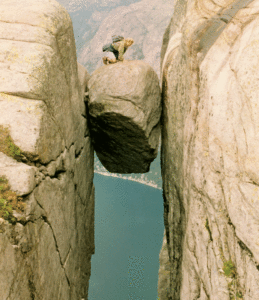
Coco van den Bergh sitting on Kjeragbolten in Norway. – Courtesy of the family
Coco breakaway roping at Draper Town Days Rodeo, July 7, 2017 – John Golom
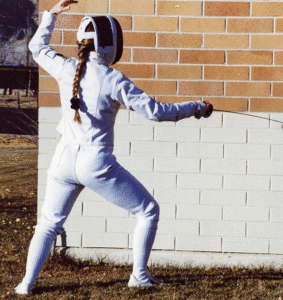
A love of learning brought Coco to Utah, where she did her research for one of her two master’s degrees in geology, but she stayed for the Western lifestyle. She earned a welding degree taking evening classes, and she’s also tried her hand — and feet — at ballet, field hockey, surfing, sailing, and skiing. Coco was even on the college fencing team at her university in Holland and University of Wisconsin-Madison, competing with other schools much like any other college sport. Coco finished her second master’s degree in geology at University of Wisconsin-Madison at the request of ExxonMobil, where she worked for a year. “It means so much more when you see the landscape and understand the carbonate rocks, or fluvial or volcanic. I just love it (geology) because I love nature. I’ve found Indian arrowheads and pottery, and I love the wildlife you see out in the middle of nowhere by yourself. After that (ExxonMobil) I started my own business as a geologist doing research for oil companies, but the income was too inconsistent, so I got the job I have now so I could live the Western lifestyle.”
Coco purchased her very first horse in 1996 after moving to Utah, and once she’d run a few chutes for friends, she wanted to back into the box herself. She learned to team rope first before switching to breakaway roping. The first rodeo she entered was in Salina, Utah, and Coco even went to a Stran Smith roping clinic. She has four quarter horses, several of which are bred by Mary Journigan of the K Cross Ranch in Lamoille, Nevada. “My partner, Brad Richman, is a cowboy, and he takes my horses for five months and does nothing but cowboy on them and get them broke for two summers. After that, I take them over and cowboy on them myself because I help the local ranchers.” Coco met Brad in the mountains where he was herding cows and she was helping the local ranchers, and they cemented their friendship looking for several horses that got loose. Coco also welds on the ranches when needed and takes much of her vacation time to work cattle with local ranchers. “I cowboy on my horses for two years before I rope on them. It takes a lot of years to make a good horse, and I get nothing but compliments about them.” She’s especially excited about her 3-year-old gelding, Charlie, whom she started breakaway roping off of in the last few months. “I went to two Clinton Anderson clinics and put that foundation on him, and Todd Fitch put three months on him. My goal is to make it to the RM (RMPRA finals) by basically training this horse all by myself.” Steve Young has also trained a few of Coco’s horses and helped her with the team roping. Brady Ramone works with her in the breakaway, while Coco says the Mascaros, Clowards, Webers, and Foxes have become like family. Her own family, who live in Holland, love that she rodeos, and her mom comes to visit for a month every summer.
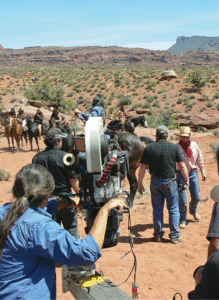
On the set of Disney’s John Carter, a sci-fi movie that she worked on in Moab, Utah – Courtesy of the family
Coco was on the fencing team at at her university in Holland and University of Wisconsin-Madison – Courtesy of the family
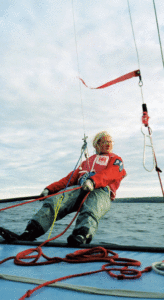
Coco sailing in Norway.- Courtesy of the family
In 2012, Coco’s horse training earned her a spot in the credits of Disney’s John Carter, a sci-fi movie that she worked on in Moab, Utah. “I worked for three weeks training the horses and then training the actors how to ride. There were five horses from Hollywood, and then a whole herd of horses from Washington.” One of the horses Coco trained — the backup horse to the lead horse from Hollywood — starred in the movie, and she also trained them to accept riders jumping on and off their backs at a lope. “It was so cool, and I got such nice friends out of it too.”
Along with her horses, Coco runs a small herd of Corriente cattle, which she raises for roping. “It takes time for them to grow horns, so in the meantime, I breakaway on them, and when they’re ready to team rope, they’re already broke in and they run nice and straight. It’s so much easier on the head horse.” She ropes at least four times a week at friends’ arenas, or the indoor arena in town. She’s now the branch manager of a laboratory that analyzes coal and water, and Coco uses her breaks to rope the dummy in the bed of her truck. “I have that Jackie Crawford DVD Elevate, and that’s made a huge difference. I met her at a clinic in Utah one day, and last year I went to her house for a week to rope. Jackie Crawford and Jake Barnes are my heroes and role models.
“My whole life is horses and roping and rodeo,” says Coco, who’s entering her third season in the RMPRA. “This year, my goal is to make it to the RM finals, and then go to the Rehab Productions open breakaway roping during the NFR in Las Vegas. Another goal is to show people that it doesn’t matter how old you are. Live life to the fullest and make your dreams come true by setting goals, creating a plan, and working hard. Believe in yourself and go for it.”
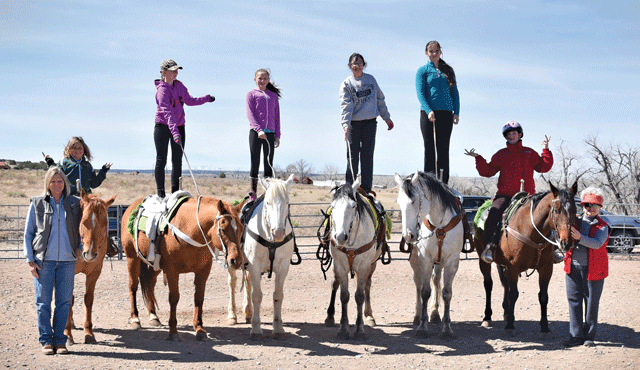
Red Top Ranch Trick Riding school celebrated its 30th years at the Vold Ranch in Avondale, Colorado, this past March. Taught by Karen Vold and Linda Scholtz, a total of 28 students attended one of the four schools. Students traveled from Alaska, Oklahoma, Wisconsin, Pennsylvania, and New York and several other states to attend the three day school.
Karen learned how to trick ride when she was young, “I learned from a lady that worked for us at the riding stables. I trick rode for a living from 14 to 27, when I went to work for Harry,” said Karen. “When I started going on the road, I didn’t have time to do it, so I started teaching.”
Linda came to work for Karen when Karen and Harry’s daughter, Kirsten, was 5. She and her husband, Paul, did the church services and Linda taught Sunday school. She learned to trick ride from Karen in 1978. “I was watching Karen teach Kirsten and I’d never seen it before. I wondered what it was.” Karen told her that she would teach them both. That went on for a year before Linda decided to ride professionally and she got her card in 1980. She and Paul took off for 27 years, part of the All American Trick Riders (Vickie Tyer and Lori Orman). “I fell in love with it,” said Linda. She and Paul continued their ministry at rodeos all over the country.
Warming up. – Rodeo News
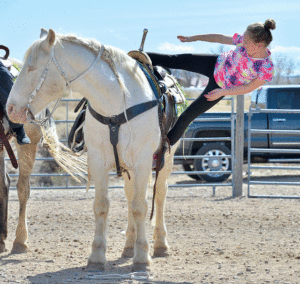
Rubie Sturgeon has been preparing for the school since the middle of February. “I worked out every night. Pullup planks, push ups, and sit ups.” She can do 32 situps in less than a minute and she does yoga too. The 11-year-old from Pittsburg, Penn., believes she is the only one that does trick riding in her area. She is also involved in Equestrian vaulting – Perfect Impulse – they meet every Sunday. “We go to competitions in Virginia and Tennessee.” She likes trick riding because there’s more freedom in it. – Rodeo News
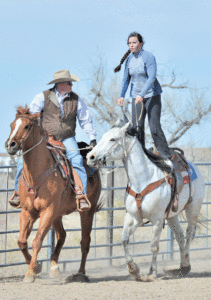
Cory Young ponies Ashtyn Walter from Loveland, Texas. – Rodeo News
Linda rode with the All American Trick Riders for 14 years, and during that time someone wanted a lesson. “We started with one lesson in 1987. After that it started rolling along. It started with one weekend,” said Linda. “When we became an official school, we did them for a week. We coordinated it with the local spring break. We advertised a little and it snowballed from there.”
Many of the staff were former students; one from Scotland, who came as a student, is still coming over once a year to rekindle friendships and teach the next generation. Lorna Campbell, from Trinty Gask in Scotland, came ten years ago. “I used to do vaulting and I was too old, and I’d seen it and it looked fun. I ended up getting a couple horses at home and continued.” She shows her talents at Agricultrual shows and Highland games. Unfortunately rodeo is illegal in Scotland, so she isn’t able to trick ride at those events.” Now the clinical trial monitor takes almost a month off to come over and visit and help train the next generation of trick riders. One of her trick riding friends, Mellissa Pfaff, from Broomfield, Colorado, started coming to the class when she was 15.
Mellissa has a BA, four Masters degrees and is midway through her PhD in Education. She teaches high school science and takes time out of her schedule to come every weekend and help. After learning the art, Mellissa went and trick rode all over the country and ended up working for Cavalia for a year and a half. “We worked all over the Us and Canada. “I keep coming back because I love teaching and Linda and Karen changed my life – I’m a better person – trick riding has led me to everywhere I’ve been in my life. It’s a part of my identity.”
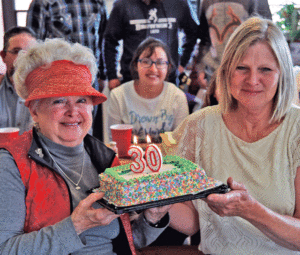
Karen Vold and Linda Scholtz with the cake that was brought to celebrate the occasion.
Cory Young, from Belton, Missouri, Lorna Campbell, from Trinty Gask in Scotland, and Aaron and Isaac Johnson – brothers. Cory Young has been a pony person for five years, but has worked with Linda for 18 years. He and Aaron and Isaac went to the trick riding competition in 2016 in Las Vegas. “Isaac and I competed in the individual performances,” said Aaron, who placed third and Isaac placed fourth. “Everything I know about horses I learned from Linda and Karen.” Cory went along for support, much like the rodeo minister does at the schools. – Rodeo News
Wyollah Moses, from Keenesburg, Colorado, came to this school for the second time. “I came here last year and had a lot of fun and wanted to come back and learn more – once I get better, I want to perform professionally. My dad is working on a horse for me right now.” The 14 year old has a whole workout routine on her mirror. She hopes to start colts and trick ride when she grows up. “I work at a riding stable in Brighton – cleaning pens, helping the kids, cleaning the tack.” She works so she could buy a trick riding saddle. – Rodeo News
The school is open to anyone seven years old and up and any level of experience. “We’ve had students as old 0as 48,” said Linda. “In the past, we’ve had several mothers who gave it a try.”
“It’s harder than it looks,” said Karen. “But by the end of every school, everyone has mastered at least one trick. “We have people from Wisconsin who say this is the best vacation we had as a family.”
Bob Brenner, from Pikes Peak Saddlery, comes one day during the school to help with straps and whatever the students need for the saddles, which belong to Karen and Linda. Linda brought all the horses.
The staff consists of Aaron and Isaac Johnson – brothers. Mellissa and her sister, Mimi, and Lorna, Cory Young, Aaron and Isaac’s mother, Debbie, is one of the cooks, along with Karen’s lifelong friends, Bobbie Fritz. Gail Shivelry also helps in the kitchen along with Cindy Robinson.
“We started this in the first place so the art wouldn’t die, and we’re still doing it,” said Karen. “We have really and truly a fabulous staff and they come back every year. I don’t know why they keep coming. Cory finds ways to share the Word through the avenue of trick riding. “We always have a church service at the last day of the school – It’s shocking when you see students that you had and they introduce you to their kids. It’s hard to imagine it’s been that many years.”
9 Time PRCA Announcer of the Year [ The best part of life is still to come: “I haven’t gotten there yet.” ]
The rich, baritone voice is unmistakable. Step inside a rodeo arena, hear the voice, and without glancing at the announcer’s stand, you know who it belongs to.
Bob Tallman and his warm, personable approach to calling a rodeo has brought the action to millions of people at rodeo arenas across the U.S. and Canada.
The Nevada native, now living in Poolville, Texas, has been around cattle, ranching and rodeo all his life. He was born the first child of John and Irene Tallman in Orovada, Nevada, in 1947. His sister, Maryanne Tallman Smith is full of the same family try, and they were both raised on the family ranch. He remembers as a little boy, using a stick to sweep a patch of dirt clear, to draw pasture lines in it. His dad owned Tallman Lumber Co. in Winnemucca. Bob attended a one room school, but he’d rather be on horseback, in the middle of a thousand head of cattle, as the Tallmans ran their cattle in common with ten or fifteen other area ranches. Sometimes he and the other kids would fall asleep in the herd, with their stirrups tied together so they wouldn’t get bucked off.
John and Irene moved their family to town when Bob was ten years old, the first time the family had running water, flush toilets, and television. He thought it was great, Bob remembered, but it wasn’t long till the ranch called again. “I was back working for six dollars a day, as a buckaroo, driving a Farmall C tractor.”
Bob’s first love wasn’t rodeo. He tried high school football, but it wasn’t for him. At 5’1” and 105 lbs. as a freshman, he lasted for three days of practice. He excelled at golf, and could hit a ball 300 yards. But he loved rodeo cowboys, and he could rope, and that would prove to be a stepping stone towards his lifelong career of announcing. His second grade teacher and her sister, Tillie Boynton Genter and Jayne Boynton Angus, and their husbands, were the ones who got Bob started in rodeo in junior high and high school.
Another integral part of Bob’s young life was 4-H. He was a 4-H state champion horsemanship winner, on the back of a 900 lb. mustang he and a friend had roped, brought home, and broke. He and John DeLong were buckarooing in the pasture when they ran into a bunch of wild mustangs. Bob roped a “little bald-faced sucker,” loaded him onto the truck, took him home, and the next day put a saddle on him. The mustang became his 4-H horse, on which he won the title.
In college at Cal Poly State in San Luis Obispo, Calif., he roped collegiately, “but I wasn’t good enough, and I didn’t care,” he said. What he did care about was spending time with the other cowboys: Ned Londo, Bobby Berger, Dennis Reiners, Larry Jordan, Tom Castleberry, and many more. “They were my roommates, my partners, my buddies.”
He tried to ride bucking horses, too, attending Tuesday night practices where he’d get on eight or ten horses a night. Bob Robinson, the Canadian bull rider, who was helping with the practices, had advice for him. “Bobby, I know you want to be a cowboy, but you’d better find something else.”
It was at a rodeo in Fallon, Nev., in about 1969 where he was roping calves, when he told the stock contractor, “this announcer is pitiful. Can’t you find anybody else?” The contractor told him, when you’re done roping, tie up your horse and you do it. So he did, getting paid $100 a performance, and “I thought I’d never see another poor day,” he remembers.
Bob at about age six, with his hand-me-down Stetson hat
Bob and Kristen Tallman and Daniel and Nicole Pennell, along with their children Canyon and Cashly on a vacation. The family lives near Poolville, Texas – Courtesy of the family
Bob at about age six, with his hand-me-down Stetson hat
That fall, he announced rodeos for Corky Prunty, Diamond A Rodeos in Elko. By that time, he was married to Kristen, and as they drove to the rodeos, they would program their eight-track tapes, with songs by Marty Robbins and Anne Murray, so they were keyed up at the right spot for playing at rodeos. Bob’s pickup had speakers on top of the shell top camper, so he’d drive through town, announcing the rodeo was going on that day.
He was still working three other jobs: for his dad at the lumberyard, as a brake man on the Western Pacific Railroad, and driving freight truck for the Southern Pacific Railroad.
Announcing came naturally to Bob. He knew the contestants well; many of them were his friends, so he told stories about them. “I started building a fan base of friends and people,” he said.
In 1970, he headed to the PRCA convention in Denver, at the Brown Palace Hotel, in a white hat he bought from Cotton Rosser’s clothes store. He brushed elbows with legends in the rodeo business, contract people who were also at the convention to drum up business: Clem McSpadden, Leon and Vickie Adams, Tommy Lucia, Jay Harwood, Mel Lambert, and more.
But nobody would hire him, and money was in short supply. He and Vick Carmen, another announcer, in the mornings would cross the street to a café where coffee was a dime. At lunch, they’d order hot water and add ketchup and crackers to make soup. And in the evenings, they’d order a dinner and split it.
It was at the convention that Bob got his first break: Bob Cook, who, with Jack Roddy and Jack Sparrowk owned Rodeo Stock Contractors, Inc., asked Bob to work for them. On February 2, 1972, Bob moved to Clements, Calif., to work for RSC. The first week, his job was to break down truck tires. He helped gather bucking horses, getting on them to try them out. They “peeled the hide off me from the top of my ankles to my cheek bones,” he remembered.
He drove truck for RSC, got flank straps ready, fed livestock, packed panels, whatever he was asked to do.
All the while, he was living in his shell camper, showering and eating in the house with Canadian saddle bronc riding champion Enoch Walker and his wife Maggie who also worked for RSC.
The next year, Bob announced all of the RSC rodeos plus a few for Flying U Rodeo and Cotton Rosser, feeding livestock after the rodeo in his suitcoat. He worked the National Finals Rodeo in Oklahoma City for livestock superintendent Buster Ivory, from 5 am to midnight every day, for $15 day.
At the time, Kristen stayed in Winnemucca. She had a good job, and they weren’t certain where they would land after Bob’s time with RSC. When she did go on the road with Bob, “we sold everything and bought a truck,” Kristen said, “with a twenty-one foot travel trailer, and that’s what we spent the first five years in, living on the road.”
It wasn’t easy at the beginning. Kristen believed in her husband’s dream of being a rodeo announcer, but no one else did, including his parents. The only person besides his wife who urged him on was her dad.
In 1976, he was asked to announce the NFR with Jay Harwood, and “away we went,” Bob said of his career.
After that, his announcing career blossomed. Mike Cervi searched him out, asking him to announce the Phoenix Jaycees Rodeo, Denver, Houston, Albuquerque, Greeley, and more. He met announcing legend Hadley Barrett, and they worked several rodeos together, which “was the most magical match in the world,” Bob said. “I spent a few thousand days with Hadley Barrett, behind me, in front of me, beside me. He was about the first guy I worked with, side by side, he in the announcer’s stand, I a-horseback.”
At one point in his career, Bob worked every major rodeo in North America, from Florida to Alberta, California to the Northeast, from Houston to Calgary. In 1983, Bob worked 313 performances, keeping up the pace for years.
He had a twin engine 414 Cessna, and when he put sheets, towels and a pillow in the airplane, “that was the day it got worse,” he said. “Instead of going home more often, I went harder.”
When he wasn’t announcing rodeos, he was doing radio and television. Bob broadcast the NFR in Oklahoma City for many years; he was on John Blair Television, CBS Sports Canada, ABC’s Wide World of Sports, FOX Sports, the Great American Cowboy, the Wrangler Network online, and hundreds of television specials, videos, and voice overs.
He and Kristen had a daughter, Nicole, in 1974. Bob was at a rodeo in Spokane, Wash., when she was born, and he celebrated with Larry Mahan and his friends in Spokane. Gary Gist bought champagne, and Cindy Dodge wrote “it’s a girl” on Winston cigarettes. “We gave away cigarettes, and we drank the whole case of champagne,” Bob said.
Five days later, he and Mahan flew to Reno to see the baby. Mahan bought a dozen roses, and when they walked into the hospital, he told Bob, “you stay in the hall.” He handed Kristen the roses, and told Bob, “Ok, you can come in now.”
Throughout his career, he has announced the National Finals Rodeo twenty-three times, nine of them consecutively, more than any other announcer, and was voted the PRCA Announcer of the Year nine times (1982, 87, 97, 99-01, 04, 06, 17). He’s appeared in several films as a rodeo announcer, was the voice of the Wrangler Network online, and is a 2004 inductee into the Pro Rodeo Hall of Fame.
Bob credits the people he’s been around for his success, those who helped him get to where he is today, the committees and contract people he works with, the contestants, and the rodeo audiences as well. “It took me a long time to figure that part out,” he said. “It’s people God puts in your life, and you’re either manipulated by them, or you learn how to deal and get along with them.”
He paints pictures for the fans with his announcing, and he knows how to handle an audience. “You gotta take them right to the edge, but don’t push them over,” he said. “And when they’re just about full, don’t give them anymore. They’ll come back for more tomorrow.”
He says rodeo is a lifestyle, not a sport, and when people buy a ticket to a sporting event like football or baseball, they already know something about it because they have played it. With rodeo, most of the fans have not done it, “so you have to let them taste it through your eyes, and you have to let them feel it by your inflection,” he said. “It isn’t always about winning, but having a better horse in the roping, understanding what an inside spur is in the barrel racing, understanding dedication and preparation.”
Bob Tallman – Brenda Allen
Bob Tallman’s grandchildren Cashly (on the left) and Canyon at their grandpa’s Bull Riders Hall of Fame induction in 2017 – Courtesy of the family
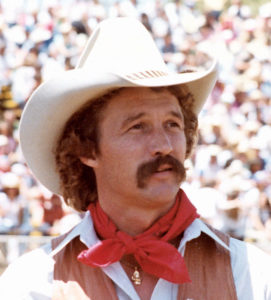
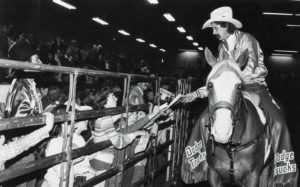
Bob signing autographs in the early 1980s, aboard John and Dottie Taylor’s palomino horse. – Courtesy of the family
He also treats everyone, from the lowliest to the highest, the same. “The guy in the shoe shine stand, and the man who cleans the toilets, they are important.” He follows the example of his Lord in the dignity he gives people. “Jesus treated them the same.” He also helps anyone who asks. “His phone never stops ringing,” Kristen said. “He goes out of his way, no matter where he is, no matter who it is. He’ll answer and talk to a marketing person, for heaven’s sake. He’ll say, ‘what are you selling me today?’”
He’s never worked less than four jobs at a time, and he’s diversified beyond rodeo. He and Kristen run a cow/calf herd, the 3T Angus Cattle Ranch, which sells pasture-to-plate beef. He founded a surveillance company, Pro View Digital Surveillance, with thirty employees and offices around the nation. He also cuts radio ads, serving as the voice for Boot Barn, Kubota tractors in north Texas, Coors, and Dodge. “I never remember not working,” he said.
And he doesn’t plan on retiring, which “drives a lot of young announcers to drink,” he joked. “I ain’t weakening.”
He loves to work, he said, “and I don’t hang around people who don’t like work.” He’s optimistic about his businesses. “I do something every day, in the rodeo business, to make somebody smile and look good. I do something every day, in the surveillance business, that protects people, their families and assets. I do something every day, with the ranch raised black Angus beef, that’s lean and healthy to feed somebody’s family.”
People ask Kristen, is he like this all the time? “What you see at a rodeo is what I wake up to every morning,” she said. “What you see is what you get with Bob.”
She’s not surprised at Bob’s accomplishments. “When Bob does something, he gives 200,000 percent. There’s no halfway with Bob. When he decided this was what he was going to do, there was no doubt in my mind he would do it and be successful at it. And he didn’t have any breaks on the way. He did it all on his own.”
He and Kristen live 250 yards from their daughter and her husband, Daniel Pennell, and their twin grandkids, a boy, Canyon, and a girl, Cashly, who are ten years old. Daniel, an accomplished team roper, builds barns and fences. Nicole sells livestock insurance, and together they follow their kids through their activities: the boy as a roper, and the girl with her volleyball. Kristen often cooks dinner for the family, and they eat together two or three nights a week, and every Sunday night. “We never miss a Sunday night together,” Kristen said. “We’re a very close family.”
Bob and Kristen have been married 49 years, and Bob calls her “the toughest woman on the planet to put up with me.” He has supported her in whatever she has wanted to do, Kristen said. She used to travel with him, but doesn’t anymore, and he understands that. “He’s a very good man,” Kristen said.
Arachnoiditis has hampered Bob’s mobility in the last eight years, but like everything else in his life, he’s met it head on. It is an inflammation of the arachnoid lining in the brain and spinal cord, which causes intense pain and significant disability. Bob was told when he was diagnosed that he would be in a wheelchair in two years, but he isn’t. He has learned to compensate where needed, being careful with steps. He doesn’t let the disease bring him down. “If you dwell on your moments of negativity, that dwell will swell, and clog the view of your future. And if you’re looking for sympathy, buy a dictionary. It’s in there.”
In 2000, he established the Bob Tallman Charities. He raises funds through an annual golf tournament, called the Pasture Pool Classic, for the M.D. Anderson Cancer Children’s Cancer Hospital in Houston. He also hosts the Bob Tallman Wrangler National Finals Rodeo Charity Bowling Tournament, which is held each year during the National Finals. Funds raised from the bowling tournament go to benefit the Speedway Children’s Charities in southern Nevada and the Justin Cowboy Crisis Fund.
He is a past member of the Texas 4-H Foundation, and is involved with the Weatherford (Texas) Christian School, where his grandchildren attend. And he’s optimistic. The best part of life is still to come: “I haven’t gotten there yet.”
The western lifestyle is not only her business, but the true roots under her feet, and the passion that fills her heart. Amy Wilson was born and raised in rural Colby, Kansas as the second-oldest of 6 children, with 4 sisters, 1 brother, and her parents, Lonnie and Lori Wilson. Family, horses, and cattle, were all instrumental parts of her childhood as she worked alongside her dad and uncles in their family livestock sale yards. Fond memories of the days riding sale barn horses, as she completed necessary tasks; and working on the family ranch, where they had a start-to-finish cattle operation raising Angus-crosses, built a strong work ethic in Amy, and an intense love for what it meant to be a cowgirl. Her love for cattle was apparent, as any money she made as a child, was generally spent purchasing cattle for her own herd. Amy’s dreams for her future bring her back to her roots, as she hopes to have her own cattle ranch one day, to share with another generation.
Amy jokes that she has a serious horse addiction, and loves talking about horses she owns, as well as unforgettable horses of her past. Flo-yo was a special horse from Amy’s childhood, that she rode in 4-H, used to move cattle, and taught her so much about riding and communicating with horses. When Amy was a junior in high school, she bought her first rodeo horse at a performance horse sale. Missile was an extraordinary 17-year-old gelding that propelled Amy into the rodeo world, as she competed on him in barrel racing and pole bending in the Kansas High School Rodeo Association. “He was such a great horse, they called him Missile because that’s what it felt like you were on, when he took off!” Missile continued to take care of Amy as she left high school and went on to Colby Community College on a rodeo scholarship. Grateful for the years and experience he gave her, Amy gifted Missile back to his previous owner to enjoy his well-deserved retirement. One of Amy’s mentors, Kelly Conrado, found her a phenomenal mare, Miss Piggy, that went all over the country with her, from college in New Mexico, to living in Colorado and Oklahoma for short times, to her move in Tennessee, and she was always competitive.
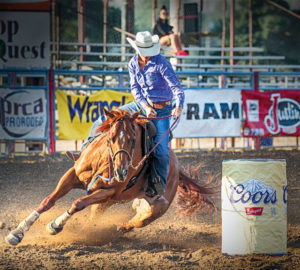
Amy at Dodge City Roundup 2017 – fotocowboy
Amy With Randy Bernard at The American – Courtesy of Amy
Miss Piggy in college in New Mexico – Courtesy of Amy
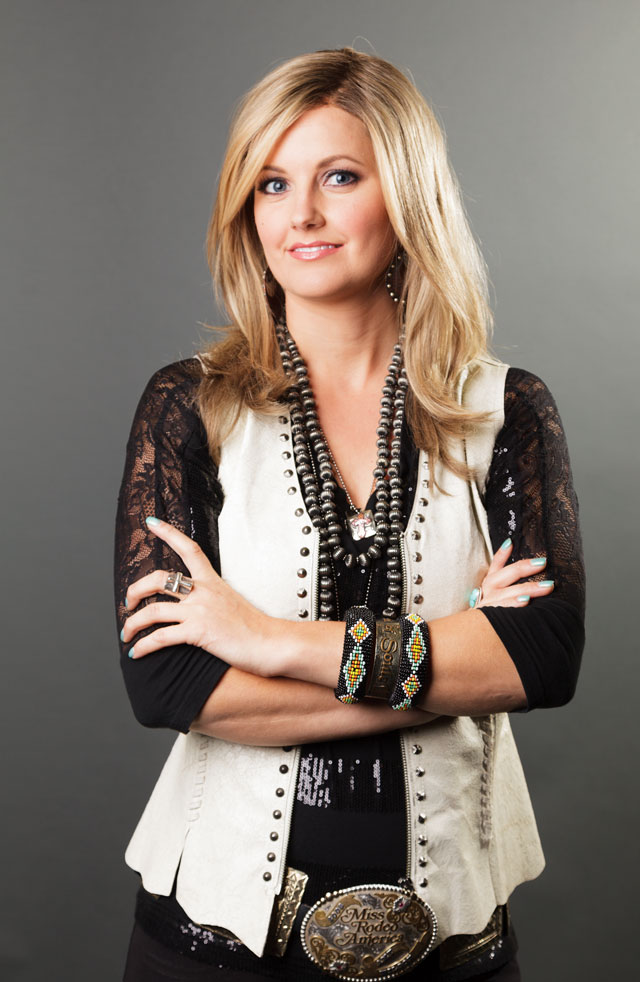
Amy had a background in princess pageants, as she had started competing in them from the time she was 11-years-old, and she combined that experience with her love of all things western, to become Miss Rodeo Kansas in 2007. The next year she set her sights even higher, and took over the most coveted crown of all, as she became Miss Rodeo America, 2008. Her reign as Miss Rodeo America presented Amy with many amazing opportunities, placing remarkable people and incredible experiences in her path. In 2011, Amy finished her degree at New Mexico Highlands University in Las Vegas, New Mexico, earning a bachelor’s degree in Media Arts; specializing in digital and graphic design, film and photography. While Amy was Miss Rodeo Kansas, she had many occasions to work with a Pam Minick, who became a special friend and mentor, and that relationship became instrumental in her path to RFD-TV, as Pam encouraged her to contact Rural Media Group’s CEO, Randy Bernard. After meeting with him, Amy was given a chance to show her abilities, covering the Miss Rodeo America contest at the NFR, for RFD-TV in 2012. Amy headed east in 2013, relocating for her new position, and has now worked for RFD-TV, based out of Nashville, Tennessee, for the past 5 years. Amy currently hosts RFD’s Western Sports Roundup, as well as Rural Radio on Sirius XM, Cowboy Minute on the Cowboy Channel, and the Road to the American. Amy travels to many major western and rodeo events across the country to interview rodeo athletes and feature important western icons. What she loves most about the job isn’t the spotlight that is on her during her hosting engagements; but is about being able to put that spotlight on others. “I’m passionate about western sports and the western way of life, and I am so grateful to have the opportunity to meet and share stories about people that possibly wouldn’t be shared otherwise.”
Eager to continue her rodeo endeavors while in Nashville, Amy was excited to find many options in the east for competing, and has competed in Southeastern Pro Rodeo Association rodeos, as well as other amateur and pro rodeos, and jackpots across the southeast. She competes in breakaway roping and barrel racing, and is blessed to have some special horses to enter on. It was love at first sight, when she first laid eyes on KN No Moe Siss, affectionately called Flapper, at a barrel race a few years ago; and although she didn’t purchase him then, he was a horse that didn’t leave her mind. Destined to be hers, she was able to track down the owners of the 9-year-old, sorrel gelding and purchase him in December, 2016. Since riding him, he has been everything her heart knew he would be, and she has gained so many experiences, to include winning 4th place in Garden City, Kansas, and winning 1st place at an American barrel racing qualifier this past summer. It was a similar gut-instinct that led her to purchasing a 5-year-old roan mare named Bailey, after seeing her Facebook sales ad, and they recently had the 6th fastest time out of 1200 runs at the No Bull barrel race in Florida this past January. Brandi, is Amy’s 14-year-old breakaway horse that she has competed on since college, and she is so appreciative that she can pull her out at any time, and the mare gives her a great run, whether there’s been much time for practice or not. Amy credits Total Equine Feed for keeping her special horses, at their best.
Amy on set at RFD-TV studio with Cort Scheer – Courtesy of Amy
Riding in the county fair parade on Flo-yo with her dad. – Courtesy of Amy
Not only did Amy find competition in the East, but this journey she has been on has also connected her with great people. Pro rodeo athletes that she’s interviewed or spent time with that have made lasting impressions on her, as she has gleaned from their attitudes or experiences, have left her with quotes that drive her forward in life. She writes some of the statements down in a journal to reflect on later, “There are so many that have influenced me and my mindset, it’s hard to mention them all. Trevor Brazille, the King of the Cowboys, he is drenched in winning, everything he says is important. Casey Tibbs, saying ‘Never leave home for Second,’ that works to remind me that once you’ve worked as hard as you have and invested all that you have, when you go to a rodeo your whole focus should be on winning.” Amy also has respect for cowgirls like Jackie Crawford, who has such a great mentality for making rodeo, and winning at them, fun. Sherri Cervi, who has the ability to stay so level, has helped Amy realize how important it is through the highs and lows of life or rodeo, to stay emotionally balanced. In addition to pros, there have been some great traveling partners Amy has been blessed to find, like Misty Orr, that traveled with her, always cheering her on and giving her advice on her riding; and Callie Correll has been a great friend, roping motivator, and become such a big part of the journey Amy has been on. The pair have traveled many roads together to rodeos and jackpots, and both qualified for the SPRA 2017 finals in February, where Amy and Flapper placed 2nd in barrel racing in both rounds and 2nd in the average, missing 1st place by only .002 of a second; and Callie won the average in breakaway roping. Amy was grateful to go and enjoy the finals with Callie as their journey took them separate directions when they were over. After the finals, Amy moved to Texas, and Callie headed further west to start her future with her fiancé.
The East has been good to Amy, and she treasures her time there, but Amy is excited about her new ventures in Texas, where she will be pursuing new opportunities with RFD-TV. RFD will be opening a new recording studio in Texas, and being in the heart of it all puts her in close proximity to cover many more live events for RFD; plus…being closer to family in Kansas is a huge bonus. Amy is already making plans for pro rodeos to be a big part of her future, as she plans to take a more substantial step into the big leagues this year, and she’s looking forward to balancing work and rodeo as she travels down the road. She believes that God has put significant people and animals in her life so far, at the right times and the right places. Amy lives with the faith that despite the harsh realities life may bring, she just needs to stay grounded in her faith and constantly follow the paths, and pursue the passions that God has given her.
Amy has worked for RFD-TV for five years, currently hosting RFD’s Western Sports Roundup – Courtesy of RFD-TV
Tuker Carricato has spent his whole life in Saratoga, Wyoming; until last year. This sixth grader’s quest for a championship in the mini bareback riding at the Junior National Finals Rodeo in Las Vegas led his family all over the country – he got on 32 horses last year and won 22 of the events he entered. He and his parents (Trisha and Tony) traveled to eight states to get the job done.
His career as a mini bareback rider began by watching a video. His dad, Tony, was a bareback rider from Gunnison, Colorado, who competed in high school, National Little Britches, and college rodeoed in Cheyenne, Wyoming. “I didn’t mind it because of the size of the horses, and the difference between me and Tuker is he’s in shape and I learned the hard way.” Tony bought Tuker his first riggin’ and he started riding with his dad’s advice. He got on his first mini bareback in Rock Springs, Wyoming, riding in the Winter Series put on by Casey Riggs, R and R Rodeo. His first ride was spent trying to think of everything his dad taught him. “I taught him how to hold his feet and how to lift – if they can’t get that down, they will go over the front end. We started with the spur board and Tuker is a natural athlete and picked it up. He’s very strong. Athletics and conditioning is a major part of this.”
Tuker’s first elk – 2017 – photo by Trisha Carricato
Tuker competing in Pinedale, WY where he placed first – photo by Trisha Carricato
Showing his steer at the Wyoming State Fair where he was Showmanship Reserve Champion – photo by Trisha Carricato
Tuker is used to athletics – he plays football, basketball, and wrestles. He also is very active in 4-H, showing sheep, goats, and cattle. He has five goats (boars) and still shows them. He ropes on the ranch all the time. “I don’t have the horses to rope or the equipment to practice, but I would compete if I could.” He also co-owner 20 Suffolk/Hampshire cross sheep with his older brother, Chaze, that they breed for show lambs to show and sell.
His riding career took a huge leap forward when he met Kelly Timberman, World Champion Bareback Rider and 7x NFR qualifier, who now sponsors Tuker. “We pick who we sponsor based on criteria that includes a strong community involvement, grades, personality, and incentive to achieve goals,” said the 2017 Mountain States Circuit Finals Bareback Champion. “When it comes to rodeo, they need to have the incentive to work to purchase their own equipment, travel expenses, etc. Tuker works that off himself – any kid that’s willing to work to get his own equipment shows ambition.” Kelly and his fiancé, Shannon Pearman, have started a program called Champions Go9-oh at their home in Casper, Wyoming. “We are teaching these kids how to be good men – never seeking mediocracy and going for their dreams. We help them go after them, setting up yearly goals and the building blocks of success.” Tuker followed that to a tee – he took time on Sundays to travel to Casper – two and a half hours from his home – to practice. He sent videos to Kelly and asked for advice. “He’s a young man that is very dedicated to his purpose and what he wants.”
Tuker has learned a lot from Kelly. “He teaches me rodeo and stuff like that. He taught me how to respect people – being yourself and not being rude.” Tuker’s family owns Battle Pass Outfitting and Tuker helps spot and retrieve game with his mother. They hunt deer and elk in the mountain range by the ranch where Tuker will spend time in the mornings and evenings looking through a spotting scope and will call his dad if he sees any. Tuker helps pack the archery elk hunters to the wilderness camp by horse back where he helps load pack horses and takes his own string of horses in and out of camp. He can’t wait until he is 18 so he can get a guides license and guide with his dad and oldest brother Chaze. Chaze graduated college from Western Dakota Tech in Rapid City, South Dakota, and Wyatt is a senior at Saratoga high school.
Tuker with Tim O’Connell in Salt Lake City at Days of 47 – photo by Trisha Carricato
l-r Oldest brother Chaze, mom Trisha, dad Tony, brother Wyatt & Tuker in front – courtesy of the family
Tuker with Kelly Timberman – photo by Trisha Carricato
After his first ride in Wyoming, where he missed covering by .25 seconds, he kept getting better and progressing. “My mom researched where the rodeos were and we’d drive there.” He bases his decision on where to go on payouts and entry fees and how far away they. “I have to pay for it – by my winnings.” Tuker has his own checking account and he balances monthly his earnings to his expenses. “I save for entry fees and rodeos. I have two different accounts – one for rodeo and one for fair.” There were lots of long nights and when the family headed to a rodeo and they relied on family to do the chores at home. “My cousin or brother would stay home and take care of my animals.” Tuker shows Maine Angus cross cattle. “They are popular and grow good.” He keeps them in barns where it’s cool and dark.
As the year progressed, his riding continued to improve. “I had a goal to get there (Junior NFR); when I kept winning them all and doing good I kept going. I just practice – my mind and muscle memory.” When Tuker found out the end of August he had made his way back to Vegas for the JR NFR, he checked his books and did some research where to get the best riding chaps, he had his dad call and make an appointment with Tim Bath to go pick out his colors so he would have brand new ones for Vegas. They match his new riggin that he had bought in June. He enjoyed his trip to Vegas for the Junior NFR. “It’s warmer than here. There were lots of people and crowds and big.” He would do it again and he plans to.
This year he is old enough to join the National Junior High Rodeo Association, competing in the bareback steer riding. He plans to continue all his sports, but admits that he would give them up for rodeo. “Rodeo makes me money and I like it better than the other sports,” he said. “I want to be a cowboy when I grow up – not much else. Rodeo and be a world champion bareback rider.”
Tuker with 2017 winnings – photo by Trisha Carricato