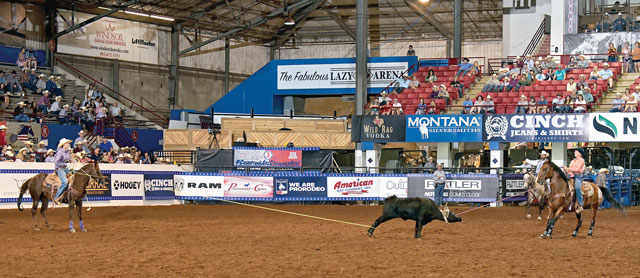
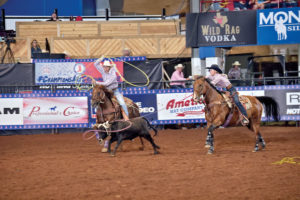
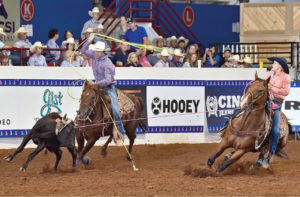
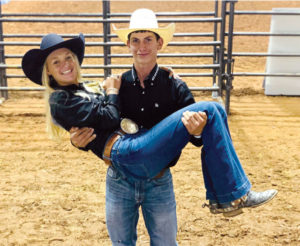
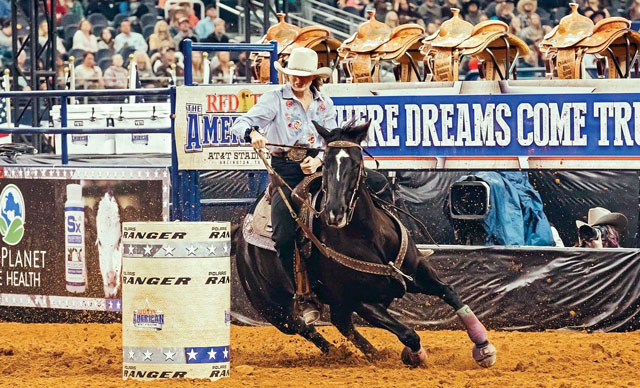
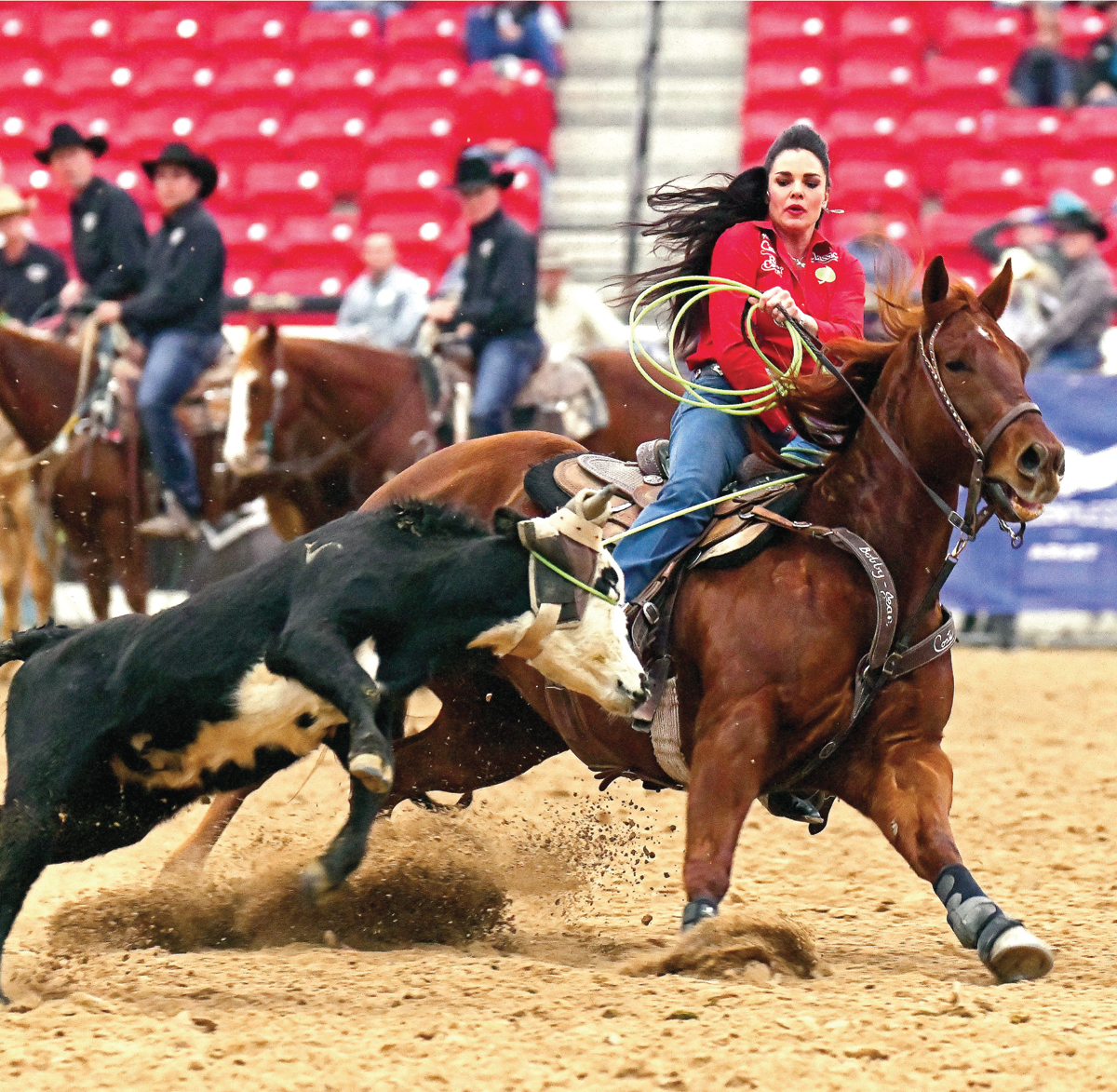
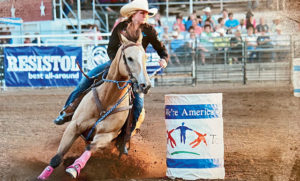
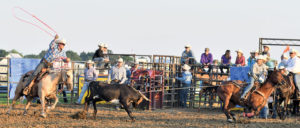
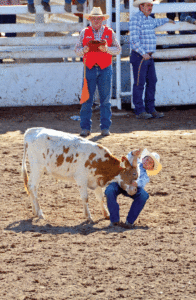
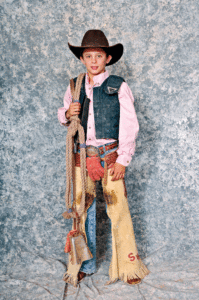
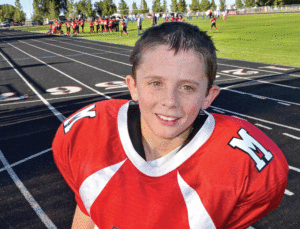
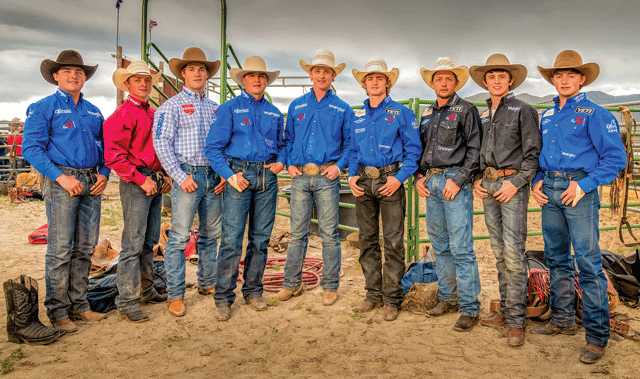
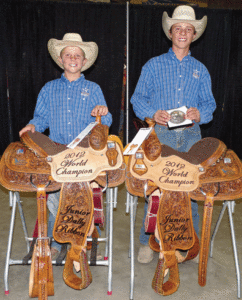
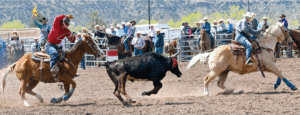
Quincy Sullivan is the second girl to ever win the National High School Finals in team roping..Brend Youtsey Reay was the first in 1986. The odds were totally against Quincy Sullivan and Luis Mendiaz, team ropers from New Mexico, that won the National High School Team Roping title for 2020. The last New Mexico high school rodeo was in October, 2019. 17 year old heeler, Luis Mendiaz, from Santa Fe, ended the fall season in 5th place. Header Quincy Sullivan, age 16, was in 6th place. The New Mexico first place team was unable to go to Nationals, and Luis was next in line. When his header couldn’t go Quincy was next in line. Quincy and Luis had only roped together once before making the trip to the National High School Finals in Guthrie, Oklahoma. “We each drove 80 miles to rope together before heading to the Finals,” explained Quincy.
“In the first round, we did pretty good,” she continued. “I didn’t rope the first one as good as I should and we ended up 8th in the round. The second round we drew a stronger steer – Luis pulled off an incredible heel shot!” In the short go, which eliminated all earlier scores, there were four teams ahead of Quincy and Luis, including another New Mexico team. Quincy continued: “I really didn’t think we were as fast as we were. But we did it in 9 seconds and took the lead.” After the first place team missed. —– We won it!”
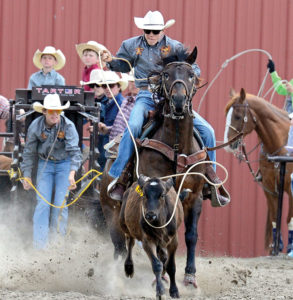
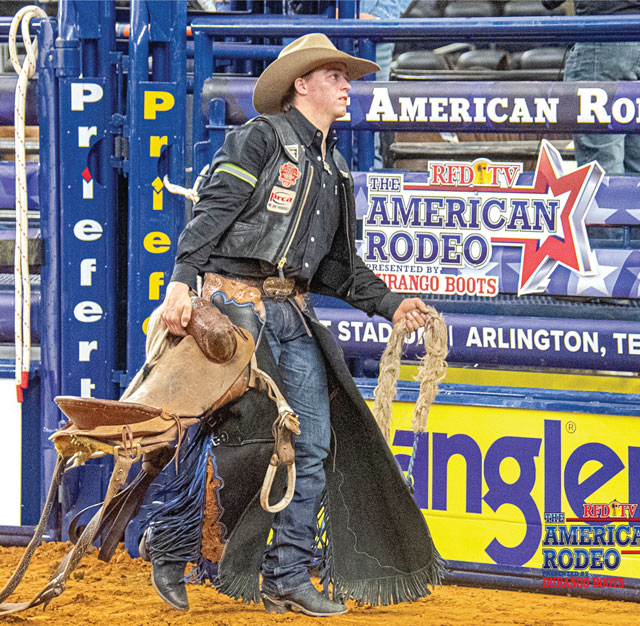
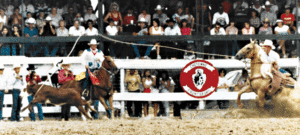
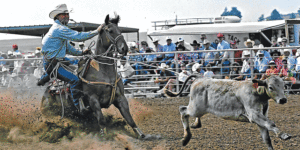
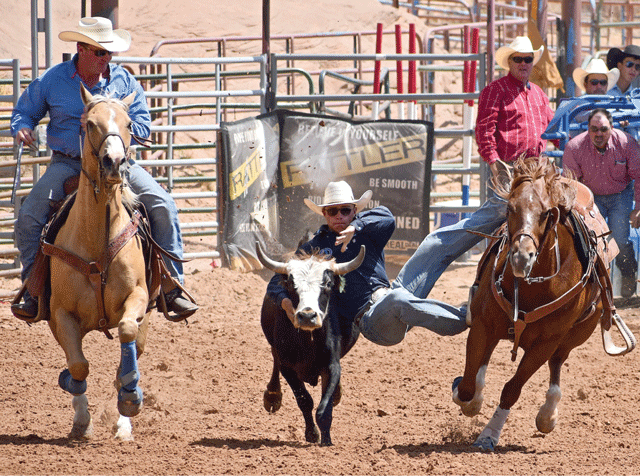
Quincy & Luis team roping at the 2020 National High School Finals Rodeo – Acentric Rodeo
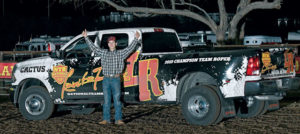
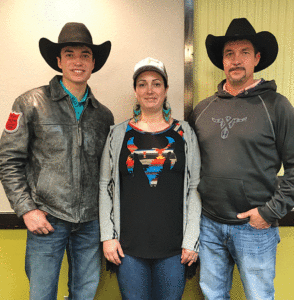
Luis Mendiaz with his father & brother in front of the Dodge Ram that he won at the NTR in Wickenburg in 2019 – AndersenC-C
: Quincy & Luis team roping at the 2020 National High School Finals Rodeo
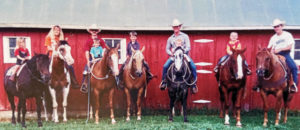
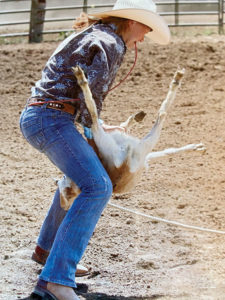
Quincy grew up in rodeo, both parents competed. She began by competing in all events – barrels, poles, goat tying, team roping and breakaway. Finally settling on team roping and breakaway roping. She works every day on her events. “I have 15 horses now and I ride them all. My head horse, Hondo, is amazing. He tries his hardest every time and even if a steer is slow or fast, he’s solid. My dad’s team roping partner sold him to us, and he’s worth every penny we paid for him,” she proudly reported, adding: “I hang out with the boys more, because most of the girls don’t rope as much as I do. I’m not your average high school girl.” She will be team roping with Hadley Oder this year and Luis is team roping with her cousin, Weslynn Reno.
With two more years of high school, Quincy is setting her sights on Oklahoma State University in Stillwater. “I want to be a lawyer,” she explained. “I took mock trial last year in school and really enjoyed it. I’m pretty passionate about it!” She is also running for president of the student council at her school which has 100 students. She added, “I want to make some changes to our school and have a voice.”
When Quincy was in the 7th and 8th grades she qualified in both the team roping and breakaway roping for Junior High National Finals. She has made the National High School Finals both her freshman year and this past year in both events again. She also qualified for the Junior World finals last year in both the ’15 and under’ as well as the ‘19 and under’ breakaway roping. She won the ’15 and under breakaway roping’.
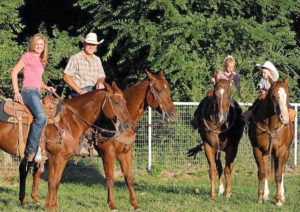
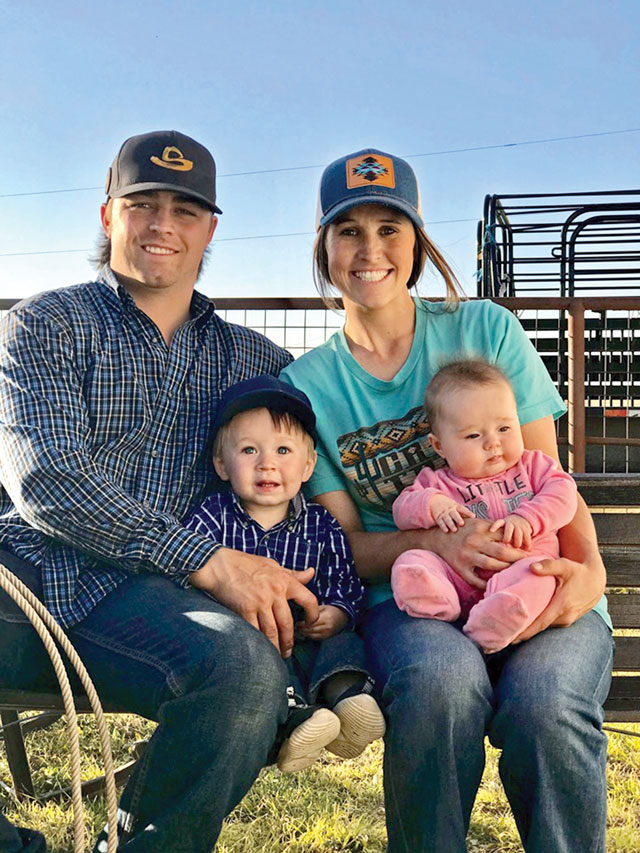
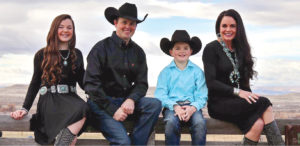
Quincy with her family – courtesy
Quincy & Luis – Courtesy
Luis with the Dodge Ram that he won at the NTR in Wickenburg in 2019 – Andersen C-C
Quincy’s mother, Shacey, grew up in rodeo, competing in speed and roping events in high school. She said of daughter, Quincy, “She works hard at her rodeo events and I’m glad she’s getting recognition for it.” Quincy’s dad, Russell, competed in calf roping and team roping in high school and won 2nd in team roping as a heeler. He went to the college finals in both events from 1996 through 1999.
Heeler, Luis Mendiaz, rode a quarter horse, Sus Beetle, his dad’s friend sold him. He’s a head and heel horse. “I won a truck on him heeling. He’s a good horse,” said Luis. He let’s his dad drive the Dodge Ram truck he won because it is standard shift. Luis admits he’s not good driving a standard shift vehicle. “My dad works construction, and didn’t rodeo until he came to New Mexico in 1999 and started watching roping. He began roping in 2005. He taught me to rope.” In 2010 his dad roped in the USTRC Finals at Guthrie and Luis watched him win 10th place in the #8 Division. “I like to rope the dummy during the day, before I practice on my horse,” Luis explained. His parents don’t speak English but we asked him to ask his mother how she felt about her son winning the world. He said, “She feels really happy for me and for her – that she had a son that won the world and how far I’ve gone in roping.” Luis will be a senior and when he finished he plans to go to college and learn to shoe horses. He said, “I want to thank my parents for supporting me and Quincy and her family.”
Quincy, with the support and rodeo experience from her parents, and the fact that Luis has his dad’s roping history to aid him, and with their hard work and determination we are sure tol continue to hear about their successes in the arena for years to come.
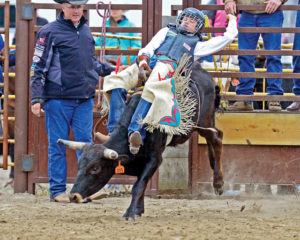
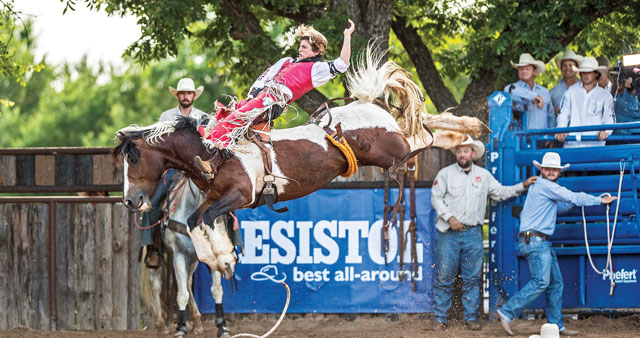
Gauge McBride has found success in the rodeo arena as well as the wrestling floor. He finished his senior year at Kearney High School as the Class A 152 pound state wrestling champion for Nebraska. He also finished his four years of high school rodeo as state champion in the bareback and bull riding, third in saddle bronc riding as well as the All Around title. He headed to the National High School Finals in Guthrie in all three events. Gauge was born without his 7th cranial facial nerve. The congenital defect affects the muscles that control facial expression and eye movement. “Just one side works – my left eye’s not great either. I can’t see out of it very well. I’ll wear my contacts for wrestling and sometimes for riding too.” He admits getting made fun of growing up. “I got in a couple fights about it, other than that, I try to find a good come back … it’s never been something that’s impacted me that much with friends or rodeo; it hasn’t stopped me from doing what I want.”
“From the second that Gauge was involved in high school wrestling it was apparent that he was a tough kid,” said his wrestling coach, Ty Swarm. “He brought a level of toughness and grit to him that helped our wrestling room and program for the four years he was at Kearney High School. He’s super coachable and driven, so if you tell him why and what he exceeds expectations. I’m not surprised he made a state champion. He is just a good competitor and has the mind-set of how to win and find success. If he knows something is going to benefit him, he’s into it full on. He’s a kid that has flourished under everything he’s done. He’s lighthearted and fun to be around.”
A picture Guage drew in art class his junior year
Gauge and Jacque at his graduation – Gary Lewis
Bow hunting hunting with Cooper at his Uncle Justin’s place. – Jacque McBride
2016 NJHSRA State Champion Boys All Around, plus all three rough stock champion. – JJJ Photo
Gauge has had plenty of coaching on the rodeo side from his dad, Cooper, a 7x NSRA saddle bronc champion, as well as his Uncle Justin McBride, 2x PBR champion. “I was pretty little when he was winning, so I never went to Vegas. But I learned a bunch from him. I used to go down there every summer for a week.”
Justin made the finals ten times, winning the world twice (2005, 2007). “From the time I was 19 until I was 29,” said Justin, who went from riding to the analyzing side of bull riding for CBS sports and regular CBS. The 40-year-old got his permit when he was 18 and made the finals the next year. “Gauge is a really tough kid; in fact I think that’s his best attribute. A lot of that toughness comes from his dad. Wrestling really translates in rough stock and that gives him an advantage.” Justin is ready to help again and sees ways to help him improve in the bull riding. “They’ve got to believe what they are saying. Even taking away that he’s my nephew, Gauge never looks for a shortcut, and he’s willing to do the work to get there.”
There are others that have given Gauge guidance and advice. “A bunch of us have,” said his dad. “Steven Dent has helped us a lot too – it’s a group effort.” Cooper thinks his son is “doing real good; he’s got a lot of good things ahead of him if he just takes care of business,” and gives him this advice: “Don’t be scared, scared gets you hurt.” Cooper started riding broncs after high school and went on to win the NSRA in the saddle bronc riding from 1998-2004. He quit riding in 2007 after breaking his leg. “I was going to the circuit finals and amateur finals one more year, but I broke my leg and hung it up.”
Cooper and Gauge ride to work together every day. Gauge works on gas lines for the Natural Gas Company. “I’m out there with dad; it’s not a bad gig. I’m a welding helper – when they make a well, I use the grinder and clean it off, or I’ll hand them a welding rod when they are finished with their last one. I run the shovel a lot, when they dig up the holes, I have to go in there and clean it up and find the pipe. Eventually I want to be welding for the pipeline. It’s fun and I’m learning a lot right now. It helps me stay in shape running the shovel.” Gauge is going to pursue a welding degree at Panola College in Carthage, Texas. “I really like the coach, Jeff Collins; his attitude and how he goes about business – he was really adamant that you stay in shape, on the right path, doing your schoolwork and things that a guy needs to do to be good at what he wants to be good at. They’ve got a good team; it’s the perfect spot for me … and it’s warmer than Nebraska.”
“I’m going to agree with Gauge – he’s going to be a blessing for our team,” said Jeff Collins, rodeo coach for six years at Panola. Panola College, known for its vocational degrees, is home to 2,500 students, with 35 on the rodeo team. “I’ve had really good luck with wrestling athletes; they are disciplined, in shape, and willing to give and do a lot of things other guys aren’t. Gauge told me he wants to ride all three like Ty Murray, and there hasn’t been a guy as talented in all three in a long time. When I say Ty Murray – at 51 he’s still one of my heroes to this day. I’ve got great expectations of Gauge.”Gauge will take 14 years of training, and success with him to college. He started muttin’ busting and wrestling when he was four. “When I was little I tried every sport and I really liked wrestling. I played soccer, football, and baseball but they were during rodeo season.” He moved from sheep to calves, to steers, and then mini bulls. “In junior high, I did goat tying, and breakaway roped, team roped, and rode all the rough stock.” Gauge admits he wasn’t that great at the timed event end. “I could have been, but getting on three every day and then to the timed event it was getting to where I wasn’t prepared for each event, and it cost me in the long run.”
2016 NJHSRA State Champion Boys All Around, plus all three rough stock champion. – JJJ Photo
Gauge and Carsyn, first day of school – his senior year, her sixth grade year – Jacque McBride
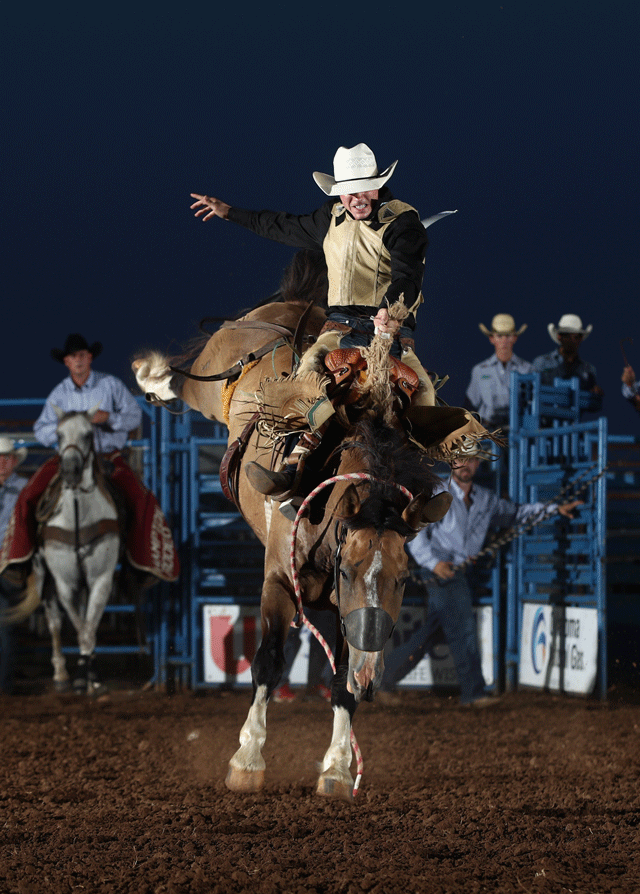
Riding in Valentine, NE, his junior year – Cathy Sandall
The 2020 Class A 152 pound state wrestling champion for Nebraska – Jacob Oertle, Assistant wrestling coach at Kearney
Preparing for each rough stock event is different, but they all include stretching and praying. He can’t choose one event he likes better. “Somedays the bareback goes good, sometimes the bull riding; I’ve been riding bulls the longest, but I think I’m better at the bareback; the bronc riding is a rough story.” He’s having a hard time getting the hang of it. “For some people it clicks, but there’s a lot of moving parts. In the bareback and bulls, you grit your teeth and hold on … in the bronc riding you’ve got to move your feet and when you’re in all three, it’s a different way of lifting with your body and it’s hard to get it. I end up lifting like I’m in the bareback and it ends up getting me out of there or getting me drilled.” The combination of wrestling and rough stock has worked well for Gauge. “Wrestling helps with roughstock a lot; being in shape and helping me in the way I land and flexibility.” It has also helped his mental game. “It’s helped me be mentally tough – never show you’re tired, never give up – it gets tiring getting on three every day, but having a tough mind keeps you from weakening.”
He prepared for the National High School finals by working out every day and riding the spur board. “Along with bench squat and curls, I run around the track at the YMCA and I’ve got intervals, sprint for 30, jog for a minute, then sprint for a minute and jog for a minute.” His experience last year at the NHSFR wasn’t the best. “I got bucked off in the first round of the bareback and both runs in the bull riding. Second round I was 72. This year I’m better mentality, last year I got worked up on wanting to win win win … it’s hasn’t changed, I still want to win, but I was so focused on winning I wasn’t thinking about how I was riding.”
His family, along with grandparents, and younger sister, Carsyn, 12 were in Guthrie to cheer him on. “He is extremely humble,” said his mom, Jacque, who competed in all the events in high school except cutting and team roping. “He can light up any room.” Gauge put on dances for all the high school rodeos. “He’s got Party Rockers; and he puts a party on at all the rodeos. He loves to dance.”
Along with Party Rockers, both Gauge and Cooper are guitar players. He’s been playing for about three years and plays any songs he can figure out. “I play a little country and a lot of rock and roll as long as I can crank the volume and not annoy mom and dad. Dad plays too, playing a lot longer than I have.”
Gauge finished seventh at the high school finals and he’ll be home one night and he’s off to his first PRCA rodeo in Deadwood, SD. After that it’s Phillipsburg on the 30th.
“Finals was a lot of fun,” he said. “I got bucked off my saddle bronc. I rode my second one for a 64 and I opted for a reride. I ended up getting three rerides and bucking off.” In the bull riding, he bucked off both of them.
“I have a short memory – I keep going and get ready for the next one.”
“I’ll make a shot for Resistol Rookie maybe next year. I’m just going to a couple this year and dip my feet in the water and hopefully not end up with my head in the ground. Next year when I have a little more time, I’ll get to a few more. I think college will be a big step up and I’m excited to see where that goes.”
“I don’t know many people do what we do – all for one.” Bobby Steiner
Bobby Steiner won his gold buckle when becoming the World Champion Bull Rider in 1973. “It was really something being born into a rodeo family that owned a rodeo company,” said Bobby. “The bull riders were my heroes from the time I was a kid. I dreamed of being in the Gold Buckle Club. I wasn’t just thrilled for me when I won it. I was happy for my wife, Joleen, my mom and dad, and all the people that had so much to do with my accomplishment. Everybody put so much into it.” Bobby was 22 when he won the world. He quit competing to help his dad, Tommy, with the Steiner Rodeo Company. “I had accomplished what I dreamed about,” he said.
The legacy of Steiner Rodeo Company began with Buck Steiner, an early day entrepreneur in many areas, including saddle making and rodeo. Buck helped Tommy run the Rodeo Company. “My dad, Tommy, was a great showman in the rodeo business,” said Bobby. “I can remember he had big entertainers at our rodeos, Roy Rogers and Dale Evans . . the crew from Gunsmoke and Bonanza television programs, and so many more big stars. As a kid I didn’t know how special that was.”
Bobby riding on 17 General Ismo – Jerry Gustafson
Tommy and Bobby ran the Rodeo Company together for the next nine years. Joleen also helped time and secretary when rodeos overlapped. She had seen success in barrel racing, qualifying for the NFR in 1970 and 1971. When they sold the Rodeo Company in 1982, Bobby and Joleen spent their time raising their sons, Sid and Shane, and ranching.
“When we sold the Rodeo Company, the boys were 6 and 7 years old. I never wore my gold buckle, and never talked about rodeo. About a year later the boys asked me if they could ride the calves that were in the pens,” he recalled. “I agreed to let them ride. I’d put on rodeo schools before – but I had no equipment for them to use. It was going to be like the farm boys getting on. They rode to the back of the arena, got off, and never talked about it again. I did coach baseball and football,” Bobby recalled.
Before Sid started steer wrestling, the family took to the water – courtesy
Sid doesn’t remember much about the Rodeo Company. He remembers growing up playing football and baseball. He and his brother are 14 months apart. “When we grew up on the ranch we were all we had, we played together and fought together. But we took different paths – we’ve both had success, and it was really a neat time. Rodeo wasn’t talked about — and there were no rodeo photos in the house.” Then Sid went to Ranger College, in Ranger, Texas, to play football. “That was the first time I’d been away from home, in Austin, and I wasn’t happy so I came home and worked on the ranch. A long-time friend and I started team roping in 1994. We would go to the arena and I’d borrow a horse. I didn’t really know how to saddle a horse, but we decided to team rope. I don’t think I even told my dad that I was roping, at first,” said Sid.
“A guy that was hauling cattle for us was a bulldogger and asked me to his house in 1995 to throw some steers down. I went and just kept working at it and getting better, but rodeo was the furthest from my mind. Joe Morris had some practice steers — I practiced with him for a month. Then I bought my permit and started going to pro rodeos. My mom entered me in Greeley in 1995 and I was off! Two months later I filled my PRCA permit.” Sid finished 18th in the PRCA Steer Wrestling in 1997 and that was a heart-breaker for him. “It took me three more years to get to the NFR,” recalled Sid. “My daughter, Steely, was born in 2001, and I decided not to rodeo any more.” Sid came home and watched the NFR from home. “That lit the fire under me again. I came out fresh in 2002 and knew exactly what I wanted out of it. I think everyone’s goal when they rodeo is to win the big title – that’s what we work for. I like to think I ‘outworked’ everybody. I was focused on what I wanted – I practiced hard, lifted a lot of weight and really tried. Sid won the gold buckle in steer wrestling in 2002. Like his father, that was it when he won, and he quit competing.
Jamie barrel racing at NFR 2000 – Hubbell
Sid met his wife, Jamie, at a rodeo in Caldwell, Idaho. Jamie grew up on the race track where her father was a jockey. “They didn’t want me to be a jockey so I ran barrels instead,” Jamie said. Sid and Jamie got engaged in December, 1999. She made the NFR the same year as Sid, in 2000. They got married in April of 2001. Steely, their daughter, was 11 months old at the 2002 National Finals when Sid won the world. “I’ve always been a stay-at-home mom,” Jamie explained. “Sid does real estate, buying places, fixing them up and selling them — I think we’ve moved seven times so far.”
“Every time we’ve moved it’s been exciting,” said Sid. “I like to buy places and improve them, then I find something else I want to go do. Our place here near Weatherford works really well for us – everybody is happy here. I’m fortunate to spend most of my days with my wife and kids. Steely rides horses, everybody’s got the things they like to do here, and we’re always trying to get better every day.”
Sid at the 2002 NFR – Hubbell
While the kids were young, they lived near Lake Austin and the family spent many hours on the lake, waterskiing. “Rocker started wakeboarding when he was three,” said Sid. “Steely wasn’t in to the water — horses were her way. She still wakeboards, but prefers her horses.”
“I’ve been riding since I was way little,” said 18 year-old Steely. “I got my first pony when I was three and rode it around like a banshee.” Steely just graduated from Brock High School. Her goal for this year was to fill her WPRA barrel racing permit. “The plan was to go out and rodeo a little bit, but there’s nothing to go to,” she said, “So I’ll wait until next season to go.” She’s spending her time riding and practicing. “I have a few young horses and it’s fun to bring them along.” She is hoping to start down the rodeo road next year and then consider an online college to study business and accounting to help the family. She was Reserve Champion at the Junior American in 2018 in barrel racing, as well as the short round at the International Finals Youth rodeo. “I’m grateful for my family – we want to win and we work real hard and always put in the effort. We are there for each other,” stated Steely.
Taking his celebration lap – Hubbell
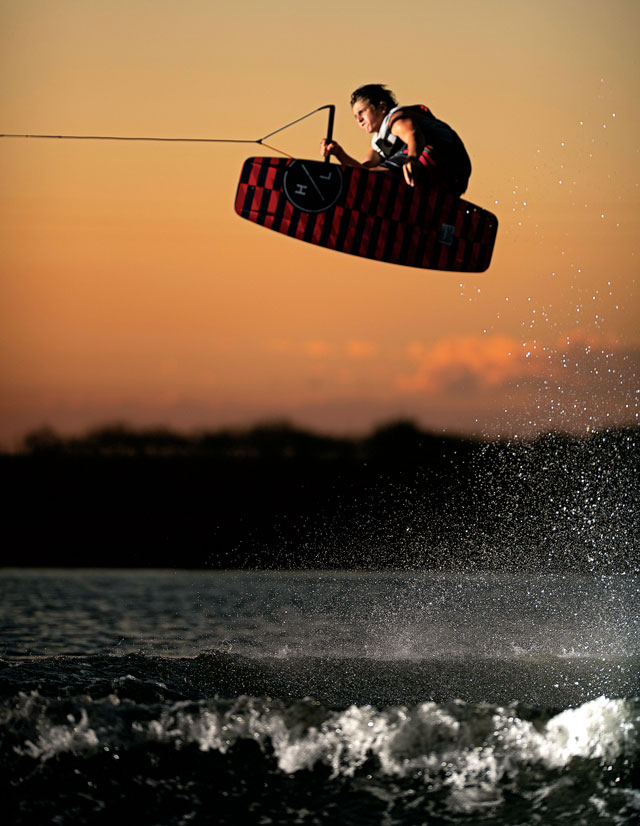
Her younger brother, Rocker, has lived up to his name. “He’s been a rock star from the time he was able to walk,” said granddad Bobby. “He thinks different – he was 8 when he tried a flip on the wakeboard and landed it. Rocker had competed all over the nation in wakeboarding. Rocker wasn’t raised in a family that was actively rodeoing but he decided he wanted to try rodeo. We put him on some bareback horses and he loved it. We’ve gotten him some broncs to practice on. He has a lot of body balance – Ty Murray has worked with him from the start and has even lent him the spurs Larry Mahan gave Ty, both great champions had ridden in them. You can never blame your ride on spurs,”
Bobby admitted, “I disliked being away from home when I was rodeoing. But I appreciate the rodeo world for what it is. I had forgotten the traveling road-show family and I’d forgotten how special that time was with my family.”
Rocker Steiner wakeboarding
“Wakeboarding is something fun to do with friends,” said Rocker. “But being four feet off the ground on a wild animal is an ginormous adrenalin kick. Bareback riding has an adrenalin rush. You can’t even know if you’re going to make it out of the arena alive.” Rocker got on his first bareback horse August 29, 2016 – almost four years ago. “I was pretty certain I was the worst bareback rider ever. I didn’t do very good and I was scared to death,” he admitted. He got on ten horses a week, five at each practice, rode spur board and bucking machine daily. “My grandfather helped me every day. I had to make a deal with myself that I wasn’t going to be scared and the more I got on, the less I was scared,” he discovered.
Rocker at the Riggin Rally – Rodrigo Donoso www.rodrigosnaps.com @rodrigosnaps @rodrigosnaps
Like his grandfather and dad, Rocker has set his goals high. “My main goal is make the Finals my rookie year, and I want that to be when I’m 18, and see if we can’t come home with a gold buckle – or something. I’m going to work every day to get there.”
With very few PRCA rodeos to go to these days, he’s had a couple of PRCA bareback riders staying at his home near Weatherford, Texas. “We (Leighton Berry and Cole Reiner) work out and try to get better every day – been doing that for the last couple of months since they’ve been here,” Rocker reported. They go to a little gym at Tesky’s in Weatherford. Cole is winning rookie this year, and both Leighton and Cole are on the road to the National Finals. “Seeing my buddies go and hit the road is going to push me and make me want to be on their level,” Rocker admitted. Rocker has two more years to go. “I’m not planning on doing any rodeos until I’m 18 – and I am going to keep doing this until I get my PRCA card. I want to be a world champion like my grandfather and dad – I wouldn’t be where I’m at without them – I appreciate that more than they’ll ever know.”
Steeley at the AMERICAN – Skylar Jo Photography
“I try to make my kids the best they can be,” said Sid. “We have a ranch outside Weatherford and we raise bucking horses. My wife, Jamie, and daughter, Steely, raise barrel horses. I do whatever I can do to help my family. I’m just real proud of my family – and that’s what I tried to do with rodeo – being proud of your last name and wanting to add something to it. That’s what keeps pushing us. We only got one shot at this deal, we might as well get after it.”
“I think if you look at the history of the Steiners, we’ve never talked about anything but great – we expect it,” concluded Bobby. “It’s way better watching your kids and grandkids have achievements – it’s a euphoric feeling.”
COVID-19 has wreaked havoc on the entire world, and the rodeo industry isn’t exempt. From contestants to contractors to committees, they’ve all been forced to adapt, since the nation was shutdown, starting in mid-March. For bareback rider Kaycee Feild, it took a bit to adjust to the new routine before he could switch roles. “I got lost for a few days,” he said. “My (rodeo) goals were unattainable, and I didn’t do a whole lot for about a week.” Then his focus shifted to being home.
At home in Spanish Fork, Utah, the four-time world champion has done projects around he and Stephanie’s house: welding, building, and grilling.
“I started to build a tack shed,” he said. “Growing up as a kid, we had a tack shed, and I spent a lot of time with my dad in it. So, not having one for the last decade, I’m building one and it’s bringing back a lot of memories.”
He’s spent more time with his kids, too. Elder daughter Chaimberlyn, who is seven years old, is always busy with something. “I have to saddle her horse every day,” Feild said. “She likes going on picnics, or doing puzzles or playing with my wife.” The couple’s son, Huxyn, is four, and is all about dirt bikes. “He’s a dirt bike kid. He’s on it all day, every day. He’s worn out two rear tires this spring.” Third child Remi, a daughter, is eighteen months old.
Time at home has also given Feild an opportunity to work with a few of his sponsors, including Power Pro (www.pwrprocbd.com) and Gel Blasters, a toy gun that shoots orbeez.
Feild thinks that when rodeos start back, competition will be tougher than ever. He and a few bareback riding friends are organizing a practice session with money up for grabs, to get in tune for rodeos.
“A lot of guys are on the same playing field right now, so when it opens back up, rodeo will be the best you’ve seen. There’s a limited amount of time to get to the (Wrangler National) Finals so you’ll see who wants it.
The COVID-19 break has been good for him, physically. “This has put two years on the end of my career,” he said, “to be able to give my body a break this time of year, being able to stay home.”
Wyatt and Leslie Casper with their two children – Courtesy
Leslie Casper, wife of Wyatt Casper (OTT in Rodeo News March 2020) had their second child this past December. “We were able to go a little in the winter and spring with him but it just wasn’t a fun time with a month old and a 13 month old,” she said. “It’s pretty nice to have help with the kids every day all day long. Cooper our 18 month old really LOVES having his daddy home, it’s going to be very hard when rodeos finally kick back up.”
For Binion Cervi, the worldwide pandemic is a double whammy. Not only has it forced the cancelation of pro rodeos for the stock contractor and his brother, Chase, but it has devastated the cattle markets.
The Cervis own and operate a feedlot near Greeley, Colo., and with cattle ready to be harvested, JBS Packing was closed due to the virus. (It has since reopened).
Like Feild, Binion is using the unexpected time at home to do projects that don’t get done when rodeos are in full swing.
“We’re doing everything you usually push to the side: upgrading fences, the ranch, headquarters, we’re doing all that.” They’ve been able to keep their rodeo employees working at the ranch. “The people who would normally be on the road, they’re at the ranch helping us, so we can make sure they have a job.”
When rodeos begin again, Cervi thinks things won’t be the same. “This changes people, and there will be caution in the world, even when everything is cleared to go. Some people will be blazing trails, some will go cautiously. I think you’ll see people with masks on at rodeos, and you’ll see people who don’t care. Everybody’s going to react to it differently.
The pandemic has shifted the way Cervi thinks, as it has for a lot of people. “This is such a reality check for every human in the world. It’s a dose of reality, that nobody controls anything in life.
Binion Cervi – ImpulsePhotographyMB.com
“This is the real world, and we all get caught up in going so fast, on a personal level, that it’s like, this tells you what is important in life. It’s like God waking you up. There’s more to life than rodeo, there’s more to life than always building a business. That’s the biggest blessing I’m getting, that our whole family is getting.”
The Franklin (Tenn.) Rodeo, didn’t have a choice when it canceled.
Set to be held May 14-16, executive director Bill Fitzgerald didn’t think the long-running rodeo would be shut down.
“For the longest time, I tried to play it off, to say this was going to go away. Then, as it got closer, the government was changing the way we did things. We couldn’t have our meetings, and I was starting to get nervous, like, how am I going to communicate with my committees, with my volunteers, with my people?”
The rodeo is held at the county-owned Williamson County Ag Expo Center, fifteen miles south of Nashville.
“The county actually shut the facility down, and that made the decision (to cancel),” he said. The building is closed through the end of May.
The cancellation was made on March 23, seven weeks before the start of the rodeo, which meant the committee hadn’t spent much money yet. “We weren’t out a lot, because we hadn’t gotten to that point yet,” Fitzgerald said.
He believes that next year’s crowds will be even better because they missed this year’s rodeo. “I honestly believe that folks love the sport of rodeo, and they’re going to come. The fans in middle Tennessee want to be a part of it. We still have people joining the fan club, knowing the rodeo won’t happen.”
Franklin Rodeo – Tom Thomson
Cheyenne Frontier Days is on the front lines of the time line.
The “Daddy of ‘em All” is set to kick off July 17-26, and, according to CEO Tom Hirsig, at this point, the staff and general committee are working to make it happen, with state and local government officials as part of the decision making process.
He’s spent sleepless nights worrying about all the factors, and believes that time will tell, especially as May rolls on. “The month of May will determine a lot, at least for the July rodeos.”
“We’re on the cusp of being one of the first ones that might get to have their event,” he said.
CFD is on people’s “bucket list, the Kentucky Derby of rodeo,” he said, with fans from all fifty states and 31 countries, which is another aspect to consider. He assumes that international travel won’t be opened yet, which could affect attendance.
The economic influence of canceling CFD is enormous. The last economic study done for CFD showed a financial impact of $28 million to Cheyenne and $40 million for the state of Wyoming. “All rodeos have an economic impact on their community, whether it be Meeteetse (Wyo.) or Cheyenne.”
Rodeos also have bills to pay, whether they hold their event or not.
“We are $2 million into our show now,” spent on it. If we can’t have (the event) we lose that money.” And there is the cost of maintenance as well. “We own our own park and we have ongoing costs. Those utility bills don’t go away and payroll doesn’t go away.”
Annual rodeos and events aren’t like other businesses that are open year-round, Hirsig pointed out. “It’s not just that we are missing out on making that money, but we have ongoing costs like any business. It’s just that we have ten days to make that money. It’s going to be hard on a lot of rodeos to recover from this. I don’t know, when we come out on the other side, how these rodeos will be.”
Hirsig said CFD contracts with about 300 people or entities. “There are 300 individuals or companies out there, hanging on what we’re doing.”
CFD sponsors have been loyal, he said. “I keep hearing that sponsors are pulling out, but we haven’t seen that. Our sponsors have been sticking with us, and are glad we’re making an educated decision. Many of them are local sponsors and they understand the long term effect that if CFD doesn’t take place, that increases the deterioration of their bottom line.”
He’s also very aware that he is not an expert in infectious diseases or healthcare. “We are event planners, and that’s where our expertise is. Our expertise is not in diseases, viruses or healthcare. We have to rely on the experts in those areas at the state and county level, as to what is safe and not safe.”
Hirsig also stressed that the decision to cancel or postpone a rodeo is not necessarily in the hands of the rodeo committee. They are “being advised by their health departments” if they can have an event.
Like Cervi, he believes the COVID-19 pandemic will change events and event planning and marketing. “The world has changed. There will be people with masks on, and some without masks, and when you put a bunch of people in a stadium, everyone’s going to have a different feeling about what social distancing means. You’ll have people with masks, and if you get too close to them, they’re going to feel uncomfortable. Or the people drinking and having fun, there could be another level of discomfort.
“You want people to leave your event saying, that’s so fun. I want to come back. You don’t want them to say, man, there’s a lot of people here, I don’t think we should go.”
The goal of entertainment is to provide a distraction from the “regular world,” Hirsig noted.
“What do you do to your brand if you put your event on, and people don’t have a great time? We’ve worked hard to create this brand where it’s fun, it’s away from the real world. With masks, there will always be that reminder, that there is something else going on in our world that you have to be concerned with. You have to measure that to some degree, too.”
Chancey Williams in Moorcroft, Wyoming helping shearing. – Courtesy
Chancey Williams and his band are staying busy as they wait to hear how to better plan for upcoming shows.
“Our last show was March 13 in Houston and they’ve canceled everything through May, some in June, and some in July,” said Chancey Williams, whose band is usually booked every week. They have had to cancel 9 shows so far. “We are getting a few emails and phone calls for things in June and July but we still don’t know if it’s going to hurt us or not. We have two at the end of May that are still holding on – Craig, Good Old West Days is still planning on it.” The band has been making good use of their time off. We spent the time working on equipment, practicing, and Chancey learning how to do the social media live. “It’s been a learning curve, but we’re getting it.” Chancey has been able to help his family with shearing. “Stay positive and work through it – we want to be ready to play – we’ve got a new set and an album coming out – we’ll be ready to go when they open up.”
Wyatt Casper can breathe a little easier after winning $600,000 at the AMERICAN. “When I’m home, I like to be home – and that’s what this money will help with,” said the Pampa, Texas, cowboy. “It’s tough, when I’m gone in the summer and my family can’t go with me. I go with buddies – we bust our butts for three months putting 45,000 miles on our rigs. Thank God for cell phones.” Last year, Wyatt supplemented his income by working for his dad, trucking.
The Casper family (John, Amy and Ty, Clay, and Wyatt) moved from Minnesota to the Panhandle of Oklahoma when Wyatt was 5. “I transferred my trucking company (Casper Express) down there and never looked back or regretted it,” said John, who tried a little bit of everything in rodeo, but when he started raising a family, he settled on team roping when he can. “It was a great move for us – we wanted our boys to grow up rodeoing and cowboying and have more opportunities.” All three boys found success in rodeo from the junior high level to the national level. Clay has gone on to success at the USTRC Finals and Ty has won many Top Hand awards at ranch rodeos. Wyatt qualified for the National High School Finals Rodeo in team roping in 2010 and for saddle bronc riding in 2014.
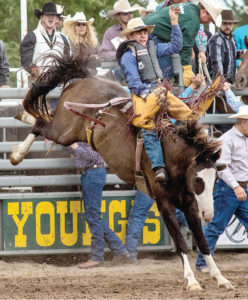
Wyatt didn’t get on a saddle bronc until his senior year in high school. “When Oklahoma high school only had two guys entered the first semester and neither one stayed on a horse, the money piled up,” he said. “There were six of us trying for that money by spring. If it weren’t for that, I don’t think I would have set foot on a bronc horse. I went out to OPSU in Goodwell that spring and Robert Etbauer and some of the other college kids helped me out.”
“He’s a great bronc rider and it’s been fun watching him,” said Robert Etbauer, coach at OPSU. Robert qualified for the NFR 12 times; 1988-1992 and 1994-2000 and won the gold buckle in 1990 and 1991. “We’ve got a great facility and we can get those kids started by helping them take care of themselves before they get on – Wyatt had a lot determination.”
Wyatt with his son, Cooper, in front of the AT&T Stadium during The AMERICAN. – Courtesy
Wyatt working for his dad, trucking – Courtesy
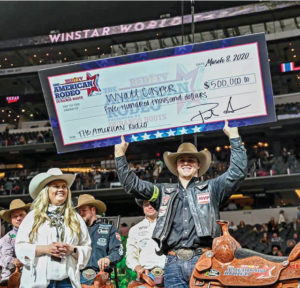
Wyatt, after winning The AMERICAN – Kay Miller
After graduating from a class of 15 from Balko (Okla.) High School in 2014, he went on to Clarendon (Texas) College under the coaching of former PRCA bronc rider Bret Frank. He earned an associates in welding. He got his PRCA card in 2015 and last year was the toughest year he’s had. “I only won $3,500 between June 1 and August 31,” he said. “I went through that time just trying to forget about the week and look forward to the next week. It was really tough – I was digging a hole and all I could think about was digging harder to get out of it. I thought I’d been riding good but hadn’t been getting paid.” By the end of August, he started winning money and finished last year in 33rd place.
The other thing that helped Wyatt is changing his riding style. “I shortened the seat of my saddle – 16 ¼, pulled my stirrups up and my binds up and that’s allowed me to expose myself in the back and show off those horses a lot better. I just tried it and ended up loving it.”
“He’s waited a long time for this,” said his mom, Amy, a Special Ed teacher at Balko. “His dad and I have supported him from the beginning and told him to never give up. Financially we were there for him if he ever needed it to keep going down the road and doing what he loves. He’s a great kid and has a beautiful family. He has a huge following up here in Balko, in Minnesota and Pampa – always cheering him on.” Amy has already taken the ten days off for the 2020 NFR.
Wyatt has never been to the NFR. “I said I wasn’t going until I make it.” Since a few rodeos cancelled, Wyatt headed home after the AMERICAN, which he says is now his favorite rodeo. “Hands down that’s my favorite – it’s such a cool place to ride.” Wyatt rode there in 2016, and was 78 points. He’s happy to be heading home to spend time with his family.
Riding in Rock Springs Senior Year – JenningsRodeoPhotography.com
Tie-down roping, 2007
Wyatt and Lesley’s wedding, standing with their parents – Christy Ladd Photography
He met Lesley at college. “I saw her and asked some friends about her. We were entered at the same rodeo, it rained pretty hard and she messaged me on Facebook about the ground. I stayed consistent after that and met her at another rodeo.” They were engaged on March 24, 2016 and married the following May 13. They have two children; Cooper, born November 4, 2018 and Cheyenne, born December 6, 2019.
He is going to seek counsel on the best way to invest his current earnings. “My brother in law bought 12,000 acres in Miama Texas, and wants us to help them so we might go that route. I’m going to talk to some people who have gone through this – I’ve got some people in mind to pick their brains to figure out what is going to be best for me and my family.”
Wyatt’s goal is to earn enough and invest enough that rodeo will carry him into his next venture. “I want stuff in place for me to already be making money when I’m done rodeoing.” His goal for riding is to ride at least 80% of his horses and use them. “I want to go at each horse the same and use them to my ability.” Last year, he rode 78% of his horses and so far this year he until Houston he was 35 for 35, with 30 of those rides being over 80 points. Houston didn’t go so well. “I landed straight on top of my head. I’m good – they say I have a compressed fracture on T1, but stable. I need to take a month off.”
Wyatt started out in the roping pen, team roping and calf roping. He still ropes when he has time. “My wife barrel races and I’m training some of her young horses; hopefully by the time I’m done riding broncs we’ll have some horses going and some colts coming along.”
“I am so proud of Wyatt,” said Lesley. “I have been with Wyatt basically from the start of his bronc riding career and to see him grow so much and come this far is truly amazing. Whatever Wyatt wants, he sets his mind to it and he always reaches that goal. He is a fantastic father and husband.”
For now his priorities remain the same – God first, family second, rodeo third. “We all wouldn’t be here without our Lord and Savior.”
Bobby-Jean Jones Colyer had a love for horses long before she competed. Growing up in Bruneau, Idaho, in a town of 300, she borrowed a horse to help her get going. “It’s a cool story – my parents (Penny and Gary) couldn’t even put a halter on a horse, but I grew up in a ranching and farming community that helped me get started.” Bobby-Jean remembers struggling in school. “I wanted to be a cowgirl so bad.” She got her first job washing dishes to pay for her entry fees for high school rodeo. “With three kids there wasn’t’ a lot of money there.” Her dad was a wood shop teacher and coach for basketball and football. Her mom was a stay at home mom. “My dad traded for the first horse I owned. I always wanted to barrel race. That first horse I owned got me started at 12 years old.” Gary built a screened in porch in trade for a three year old horse. Bobby-Jean has two older brothers, James and Danny, neither one who competes in rodeo.
“I could never get her to bake cookies with me – she always wanted to be on a horse,” said her mom, Penny. “But because of this valley and her hard work and determination she did it.” Bobby-Jean is the only female that has ever won the Bruneau Round-Up All Around Championship – it’s a big deal. She has also qualified for the World Series Finale six times, as well as qualifying for the AMERICAN, and the Columbia Circuit Finals. “The biggest accomplishment to me is the fact that Gary and I aren’t rodeo people. We worked in the school district. She was two months old when we moved here – we didn’t have the means or the ways to get her there –she babysat and did whatever she could to get horseback.”
Once she got started, her love of rodeo grew. She started roping and set goals for herself. “When I reach one I want another one.” Her rodeo career landed her a scholarship to Bozeman, Montana, where she made the CNFR in the team roping, goat tying, and barrel racing – one of only two women that qualified in 2002 in the team roping. “I would have never gotten through school if not for rodeo,” she said, graduating with a degree in consumer science. Once she graduated, she went down the rodeo road, but ended up back home and married to Kyle Colyer in 2005. They have two children – Piper (14), Cruz (9). Kyle is a third generation rancher and shows Hereford cattle. She continued rodeoing and added a central entry line to her job description.
Bobby-Jean working at the Art of the Cowgirl competition – Nicole Poyo Photography
Piper, Kyle, Cruz and Bobb-Jean Coyer – Photo by Katie Colyer
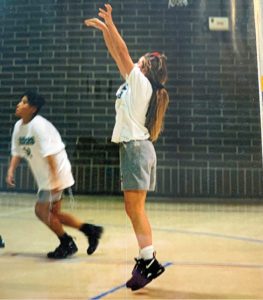
Bobby-Jean playing basketball for Rimrock High School – Courtesy
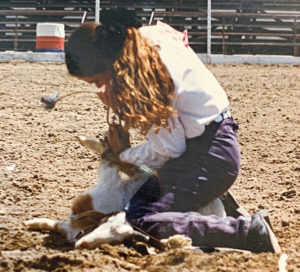
Goat tying at an Idaho high school rodeo
Roping a calf the Aquiso’s ranch at 12 years old
Bobby-Jean competing at the CNFR in Casper, Wyoming – Hubbell
Bobby-Jean worked for Central Entry, now known as Rodeo Central, the entry system for the Idaho Cowboys Association, two others, as well as several open rodeos. She worked for Central Entry before purchasing it seven years ago. Orla Knight, former ICA secretary for 25 plus years,, developed an online entry system, with that Bobby Jean has made some new improvements. “We worked with a developer, Advanced Software, to offer central entry online to website,” explained the 39 year old. “Contestants can still call, but this gives them an option.” She starts in March and the rodeo season winds down the end of October. During that time, she employs several others to help take entries. “I have a lot of passion for the ICA – I’ve been a member for 17 years, winning Rookie of the Year in 2003. I also served on the board as a barrel racing director for six years.” Bobby Jean explains the rodeo draw as a 2,000 piece puzzle. “The computer isn’t always perfect. We have trades and everyone has to get everywhere … anyone in this business has to care about cowboys because they are not going to get rich doing it.”
During the peak season of taking entries, Bobby-Jean still makes time for practicing. Through her example, Bobby-Jean is hoping to bring back old fashioned work. “In this day and age I’ve read all the books, but there is no substitute for working hard no matter how hard it is. I worked my arena with snow in there and if I don’t get out there and practice, they are going to beat me.” She tells herself there is always someone else out there working at it and there is no substitute for working at it. “When I go to the practice pen I have a goal every time.”
She recently competed in the Art of the Cowgirl Worlds Greatest Horsewoman in Phoenix. “Go big or go home – I split first in the last two events – steer stopping and fence work; after not doing very well in the first herd work and reining. I knew I had to lay it all out there in order to make the top ten finals where it would be a clean slate. 59 would have to check for sure – there’s a lot of very accomplished horsewomen in that and I had to go for it.” She ended up third place overall. She is hoping to find another show horse and is preparing for the Perfect 10 World Series event in Las Vegas in March.
Bobby-Jean continues to train her mind. “I think that having a good mental mind is the only thing that makes it at the end of the day. I’m not always there, but I’m working at it all the time. When you’re passionate, emotions go with it. I’ve always been passionate about horses – they’ve been my go to – when things are rough, I go get on the best in the pen – and the best one always turns things around for me.” Bobby-Jean loves to compete. “It’s not about beating someone it’s about reaching individual goals.”
Her dreams include becoming successful in the reined cowhorse. “I want to change people’s lives by hearing my story and drive them to follow those dreams and goals with horses even if they didn’t grow up with horses or have a lot of money.”
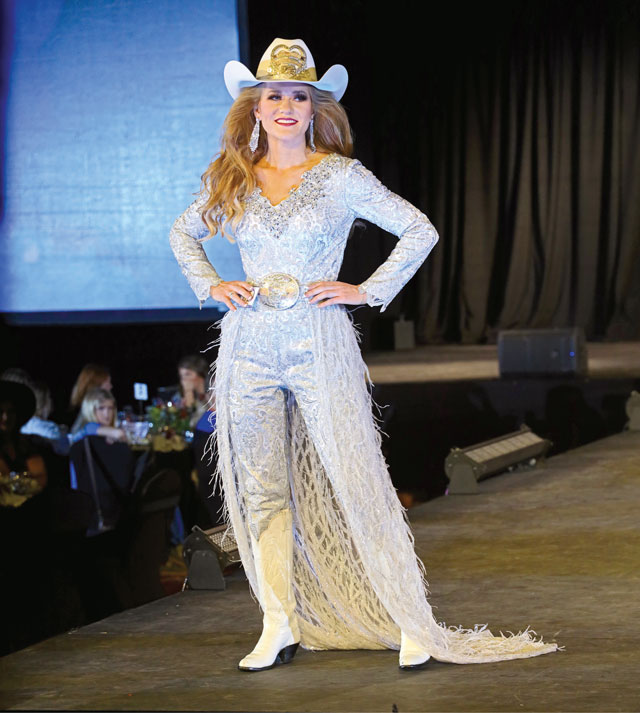
“When I was dedicated as a baby, they said I would flow through the lives of people like the Jordan River,” said Jordan Tierney, 2020 Miss Rodeo America. “I remember being at work one day and having this feeling that I was made to do more than that job.” Her sister, Amy, encouraged her to run for Miss Rodeo South Dakota and now the 25-year-old from Oral, South Dakota, has an opportunity to live a bigger life and have a positive impact on those around her. “I want to leave people feeling better after having talked to me.”
Oral, South Dakota, has a population of 60 and Jordan grew up on a ranch, south of town, riding with her father, Paul Tierney. They raised AQHA horses and cattle. “I just this past year bought my own set of cows and now I’m fully invested.” The youngest of four, Jordan considers herself to be the caboose in the family. “I spent a lot of time with my dad, when he went out to the pasture, I went with him. I was on the stud, Cash, and I remember riding double with him. We had a pony, Teddy, I remember riding him while my dad practiced.” Jordan sees her father as an incredible hard working man. “He works sun up to sun down and is always willing to help anyone that comes along. He gives roping lessons and wants to see people succeed – it all came from his desire to be a rodeo cowboy and that’s taken him far.” Paul qualified for the NFR qualifier from 1977-1986, only missing one year. He was the World All Around Champion in 1980 and Tie Down Champion in 1979.
Her mom, Robin, was the 1985 Miss Rodeo South Dakota and second runner up to Miss Rodeo America. “She sacrificed so much for our family,” said Jordan. “When I was a junior in high school, my mom switched careers – she had been a dental hygienist for 25 years and quit that to start her own oil field service company.” That job required Robin to be away from home for two weeks at a time while she built it up. “She always made my important volleyball and basketball games as well as my rodeos.” That leap of faith has allowed her the flexibility and freedom to continue her love of raising good horses and riding. “She’s an incredible horsewoman.”
Jordan has two older brothers, Jess and Paul David, as well as an older sister, Amy. “I’ve followed in her footsteps my entire life, from sports to school leadership. She and my brothers have been huge encouragers to me in my dream to become Miss Rodeo America.”
Jordan started competing in rodeo in elementary school, competing in 4-H rodeo junior division. She eventually joined the National Little Britches and the South Dakota High School Rodeo Association. “I had a horse accident when I was five on the ranch. I was going out to get cows with my dad and my horse took off with me.” Jordan fell underneath the horse and he jumped over her. “I refused to get on a horse for three years. I started riding again when I was 8 and was very fearful – I didn’t want to go fast. My parents were very persistent and I eventually got faster.”
: Jordan as a baby sitting with her dad (grey horse), with the rest of her family
Jordan barrel racing at the South Dakota High School Finals Rodeo, 2012 – Cowboy Images
Jordan and her mother
Robin remembers those three years. “We wanted her to go, but really a neighbor girl, Megan Harkless, is the one who got her going again. She would come over and ride and she would ask Jordan to start coming out with her and pretty soon she was walking the horse around the arena while they talked. She was so patient and understanding.”
After that, the best part was taking her to her first 4-H rodeo. “She walked the whole pattern and we were so thankful – and it was such a good feeling,” said Robin. “Here’s what we always knew about Jordan – her personality and the way she was – a slow starter and a strong finisher. She finished amazing and we have been so proud of her determination and diligence to perfect her craft.”
When Jordan got back into rodeo, she didn’t win a lot, but by the time she hit middle school she had a very competitive mare that she ran barrels on (her name was Princess and she was also her brother Paul’s main heel horse). “I won the Junior girls state 4-H championship in goat tying in 2008,” she said. “I do think winning is important because I am a very competitive person so I didn’t like not winning in the crucial times that could’ve resulted in going to nationals, but when you start finding your identity in worldly successes that can be detrimental. I want to be an inspiration for rodeo and ranch girls to try rodeo queening as an addition to all that they do.”
Her rodeo abilities earned her a scholarship to Chadron State College where she competed in barrel racing, breakaway roping and goat tying. She earned a degree in business administration and plans to continue her education after her reign as Miss Rodeo America. “I would like to get the masters online program and start working in a career path in marketing and the agriculture realm.”
Branding on her family’s ranch
Jordan goat tying
Robin, Jordan and her sister Amy – Courtesy
For now, she is watching the calendar fill up with appearances across the country. “I’ve always been a people person – when I went with my dad, he would give us $5 and tell us to meet him back at the trailer. I found friends and that’s how it all started. This past year as Miss Rodeo South Dakota, I was telling people that I thought I was outgoing; I got out of my comfort zone – figuring out how to bring up conversation.” Her secret is asking people about themselves. “I like learning more about people and their history.” Her platform is Rodeo, Agriculture and building relationships with fans and new comers that foster understanding for the western way of life. She uses part of a Bible verse on her autograph sheets. Psalm 139:14. “I praise you because I am fearfully and wonderfully made; your works are wonderful, I know that full well.”
“I shorten it and say you are fearfully and wonderfully made – that’s a verse I’ve carried with me,” explains Jordan. “I am made in His image and I should be proud of that. I want to make people know that I care and they are worth caring about. I love where I’m at now – I’m having a great time and after this year, I will get back to rodeoing, breakaway roping and team roping.”
“My why is to help build people up the same way that I was built up during my early adolescent years when I had a lack of self confidence. My parents really gave me a strong foundation to stand on with all the good information they gave me to overcome my mountains in life.”
Jordan hopes that as she represents rodeo and meets thousands of people this coming year that they will see her genuine authenticity for the sport of rodeo and the western lifestyle. “It’s what I was raised in and I’m proud to represent it. I hope they remember me for that genuine feel.”
‘Where did this guy come from,’ is undoubtedly on the minds of many team ropers in the IPRA that watched a rookie 21-year-old header, Colton Bugis, climb from the bottom to the top of the team roping leaderboard since June. With nearly $1900 separating him and the next header in line, Colton is excited to be traveling to the Lazy E Arena in Guthrie, Oklahoma for the IFR50 to see if he can finish the season as a world champion team roper.
Originally from Highland, Michigan, Colton’s start in horses didn’t give much of a clue that he would be where he is today. His parents Ed and Penny Bugis and younger sister, Eva, have a family farm where his dad sells grain, and also operates a septic company, King Septic; and none of them had a rodeo background. There was a love of horses in the family, and Colton’s grandma, Carol Redman, bred and raised Welsh ponies that became projects for Colton and his sister. “We were really young, but we would ride and drive the ponies she raised and turn them into show jumping and dressage prospects for other kids. My mom and sister were both really big into dressage and hunter jumpers, so I competed in that world growing up. I was in the Michigan Hunter Jumper Association and the Pony Club of America and did all that until I was about 13 years old.” In his heart however, he was a cowboy, “I always thought I was a little cowboy, running around with a rope when I was a kid. I went over to a roping school near us when I was young and learned to rope goats and got hooked. I started chasing everything I could on my pony, Lightning. A guy down the road, Tim Brown, took me to a roping pen at Rocky Alberts’ Blue Ridge Stock Farm one day, and that was all I wanted to do after that. My dad was glad to see me getting away from the hunter jumper riding and bought me a really good rope horse. It was a big deal for an old farm family to pay that much for a rope horse, but my dad bought me a black 7-year-old gelding named Player that really gave me a good start.”
Colton showing one of his grandma’s ponies – Courtesy of the family
Colton Bugis riding a ranch bronc – Natural by K.Willford Photography
Colton competing in a pony club game
Colton’s mom explained, “Roping is a better fit for Colton. He’s always been a little cowboy from a very young age. We are so excited to go watch him at the IFR50 in January. There is a whole group of his Michigan roper family going out to Guthrie with us to watch him compete. We are all extremely proud of him.”
Before graduating from Hartland High School in 2016, Colton competed in the Michigan High School Rodeo Association for three years, heading for Cale Johnson his sophomore through senior year of high school. The team won the MHSRA champion team roping title in 2015 and 2016 and qualified for national finals all three years they competed together. Colton also competed in calf roping and trap shooting during high school, but team roping was his main focus. Over the years, he’s even ridden ranch broncs for fun. “I come from a very supportive family, and even though my mom and sister didn’t like that I switched to roping, they still always came to watch me and support me in all that I do. They will be traveling to the IFR to watch me compete at my first IPRA finals rodeo, and hopefully watch me win the title there.”
Over the past few years, Colton has spent a lot of time at amateur rodeo associations and team roping jackpots. He attended a horse shoeing school in Purcell, Oklahoma in January 2017. “I didn’t stick with that as a profession, but I did learn enough to do some of my own horses when I need to.” He did, however, make a friend with Baker Roush while at the school, and Baker invited him to his family ranch in Dripping Springs, Texas for the winter. “He and I ranched cows, shoed horses, hauled cattle, and did odd jobs. His family had a wedding venue, so we helped set up things for weddings and maintain the property. I roped some, but mainly did whatever I could come across to make some money while I was there, and then I’d go back home to Michigan for the summer.” While Colton was riding a friend’s calf horse at a rodeo when he was in Michigan for the summer, Mike Culhain made a phone call that began a change in the course of Colton’s roping career. “I told everyone I talked to that I wanted to go back to Texas for the winter. Mike told me he was friends with Bob Masters, and that he would call him and put me in touch with his son Chad Masters. I ended up going out to Chad’s for the winter in 2018.”
Colton started out as the low man on the totem pole at Chad’s, mucking stalls, feeding cattle, and fixing fence. “I did whatever needed done, just trying to do my part. I also got to ride and rope with Chad and worked my way up. Chad taught me how he needed me to ride the horses and how he wanted things done. After winter, Chad went back to competing, and I decided to try rodeoing in the IPRA for the 2019 season. I didn’t really have a partner starting out, but I met Ty Parkinson at the Fort Worth Stockyards and we decided to start roping together in June. Ty is from Australia, and he’s a phenomenal heeler, he’s qualified for the IFR multiple times. We started out doing well together, and really went hard at the rodeos. From June until the end of the season we entered probably 75 rodeos and placed regularly. We won the team roping at St. Tite in Quebec, Canada, and just kept climbing in the standings as the months passed. Going into the IFR50, I’m leading the heading and Ty is leading the heeling.”
Colton on his pony Lightning that he started roping on
Colton with his mom, dad and sister – Courtesy
Colton roping with Ty Parkinson – Rayne Sherman, Circle S Photography
A little dark brown mare named Betty has helped Colton make his mark in the heading competition. “My good horse ended up having ringbone, and Chad had gotten Betty in from a guy and made me a good deal on her. I’ve been riding her since this spring. She’s a little mare, maybe 14.3, but she is such a good horse and has made my job so much easier. I’m so grateful Chad helped me out with her. Coming from Michigan to Chad’s ranch in Lipan, Texas was very eye opening. It’s a totally different ball game. In Michigan, roping is more of a hobby that you do for fun, but here it’s the real thing; this is what they do. You learn a lot! I learned how to ride my horses better, how to use a rope better, and how to rope smart.” Colton is currently at the Masters’ ranch for his third winter and honing his skills so that he is as ready as possible for the IFR in January.
“My main plan for the IFR50 is to get ready to catch them all so we can go for the average. I don’t get to practice with Ty much, he’s all over the place. But we’ll get together right before we head to Guthrie and make some runs together and we’ll be fine. After the IFR my goal is to just keep getting as good as I can get and see how far I can take it. I’ve been able to learn a lot from several people over the years, and I’ve been lucky enough that people have seemed to like helping me. I plan to take all of it and see where it leads. I may not have come from a rodeo background, but it’s in my blood and I’m here to stay.”
Stetson’s first bucking horse was his brother. “We had a TV stand with swinging doors,” he explained. “Rusty would get in there, we’d open the door, and he’d ride out, with me or Ryder riding.”
Now, at the age of 20, he’s joining his two brothers at the WNFR. “I didn’t know how soon it was going to happen, but I’m glad it’s now,” said the Beaver, Utah, cowboy who is going to Vegas sitting second in the bull riding and leading the all around. “I felt like I was ready, but I didn’t think I would have this much success this soon – I’ve always expected it of myself. Me and my brothers have always dreamed of this since watching my dad.” And watch their dad, Cody, is what Stetson has done since he was little. He’s been to every performance of the WNFR since he was three years old, watching dad for 13 years, then Rusty, who made his first WNFR in 2015, then Ryder in 2016, and now he is going.
The Wright family has made NFR history twice now – in 2014 when four of them (Jesse, Jake, Cody and Spencer) all qualified for the WNFR in the same year and again in 2016 when Cody and his sons, Rusty and Ryder, became the first father and two sons to compete in the same event at the WNFR.
“In my opinion, my dad’s the greatest bronc rider that ever lived. He might not have 6 world titles to show for it, but he’s perfected the style – he stays back, sets his feet, and he’s fast. From a husband to a dad – everything – he’s great. He tells us to trust our stuff and keep gassing it and just perform like you’re in the practice pen. He keeps us all positive; he’s a very positive guy.”
Stetson, winning Cheyenne with 93 points on Dakota Rodeo’s Safety Meeting – Hubbell
Statler & Stetson hippy day, 2010
Junior High rodeo in Nephi, Utah – courtesy
The boys wrestling – courtesy
Cody enters all three of his sons as well as two others. “He’s one of the best – he enters five guys and all five of us made it to the Finals this year. If we didn’t have him, we’d lose a lot of sleep. He wakes up every morning, looks at the books and enters us.” Along with entering the boys, Cody enjoys training dogs – border collies and kelpies. “Training dogs and entering us makes his living.” Along with his two older brothers, Rusty and Ryder, Stetson has a younger brother, Statler, 16; and a younger sister, Lily, 10. “Stetson’s my middle man,” said his mom, ShaRee. All of her kids rodeo and say collectively that if Lily could ride rough stock she’d be better than all the boys.
Stetson started riding broncs the summer before his freshman year in high school. He started riding bulls in the 5th and under state program and then did junior high and miniature bulls before getting on bulls in high school. “I honestly wasn’t good at riding bulls, Rusty and Ryder were better and it bugged me that I wasn’t good at it. It finally clicked my junior year and it’s been good going ever since.” He also played football and wrestled.
His senior year, 2017, he won the National High School Finals All Around along with All Around at the IFYR the same year. After high school, he rode on his permit in 2018.
Easter 2007
Junior High Nationals
Riding at Cheyenne Frontier Days – Hubbell
Milford little league football – courtesy
He had a setback last year in Kansas. “I had won about $70,000 on my permit. The bull stepped down on my hips. I tore my knee and it put me out for the rest of the year.” When he went to enter San Angelo, he had $100 left. “That made me really smart about my money. It was an awful feeling.” He won the first round and that put $5,000 back in his pocket. He won two rounds in San Antonio, so left there with over $20,000. That made rodeoing a little easier on my stomach.”
He had another setback when he broke his jaw this July in Kansas. “Honestly, it didn’t give me a concussion; it was such a perfect hit under my jaw. He hit me in the head first time, and that slid my helmet up; now I’ve got plates and screws and I lost four front bottom teeth.”
He kept riding horses, but didn’t do as well as he had hoped. He got on his first bull in St George, September 21, but had slipped behind Sage Kimzey in the standings. “I passed him and broke my jaw. There’s plenty of money to be won. If I didn’t think I could win, I wouldn’t have bought my card.”
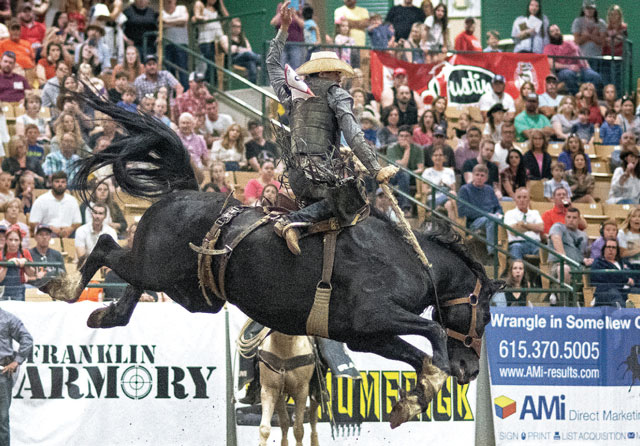
Stetson will join his two brothers as the recipient of the Resistol Rookie of the Year in the saddle bronc riding. He is also a contender for the All Around and Bull Riding saddles. “It’s not surprising,” said ShaRee of her son’s accomplishments. “He has always been a determined kid. Once he sets his mind to stuff, he works to get it. It’s super neat to see him work towards these goals. It was a setback when he broke his jaw July 31 in Dodge City, the day after his birthday.” That rodeo was one he went to by himself. “He usually travels with Ryder, and he was by himself. “I think they are each other’s biggest support team,” she said. “It’s hard as a mom when you have one that wins and one that doesn’t.”
Now that Stetson is about to get on 10 bulls, he is working on keeping in shape. “I’m hopefully going to be healthy and fast so I can outlast everyone there.” He’s doing it with speed and agility drills, to get his feet fast. He likes to ride his bike too. “I jump up on crates, sprint through ladders, and run across the field. Mostly running and jumping.” His goal for the WNFR is to be the fourth guy to ride all ten bulls at the NFR; Jim Sharp, 1988; Adriano Moraes, 1994; Norman Curry, 1990. “I figure if I did that the world champion would come easy.”
After the WNFR, Stetson and his fiancé, Callie, will welcome their first daughter in January. The couple plan to marry shortly after the WNFR. Stetson will start the 2020 season in Denver. “I’m going to get on for as long as I can,” he concluded. “I’m excited to see what’s in store for us.”
Doug Clark will receive the coveted Ben Johnson Award at the National Cowboy and Western Heritage Museum’s annual Rodeo Historical Society’s Hall of Fame Gala on November 9. Doug was born in Tulsa, Oklahoma. “I grew up in a saddle shop – Veach Saddlery – which belonged to my grandfather, Charley Beals, and was started 100 years ago by his father in law, Monroe Veach.” He spent his summers and every day after school at the shop. “I helped make saddles and repair things. My dad tooled all the saddles for years there and it’s a family business so we did a little bit of everything.”
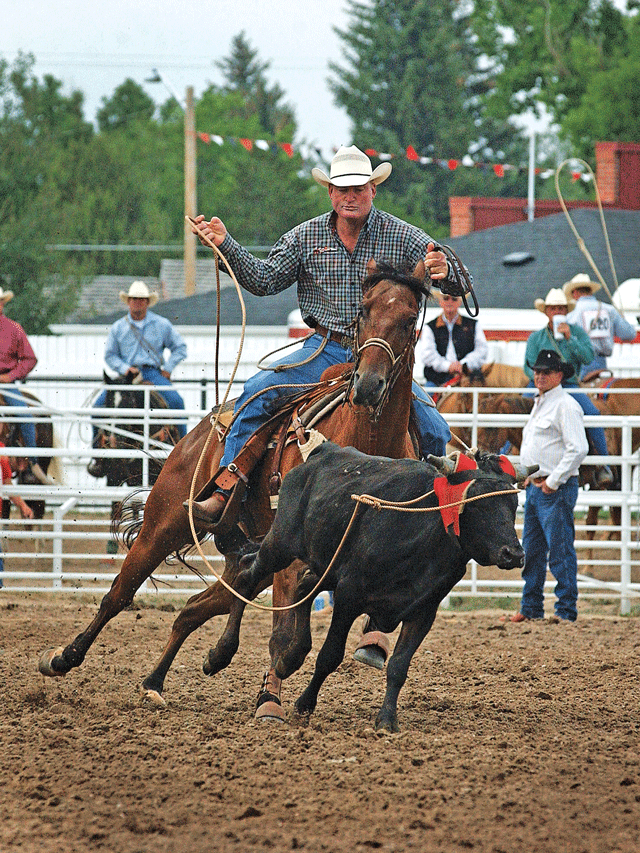
He started tie down roping when he was 10. At that same time, he started competing in the junior rodeos in all events. “They were called FFA rodeos,” said the 57 year old that calls Wayne, Oklahoma, home. “I was fortunate enough to be around the right guys and my dad was quite a horseman. We are a huge rodeo family, so that’s all we do.” Doug and his family lived in Tusla and in the early 70s they moved 90 miles east of there to get out of town. They built an arena and that’s where Doug really started honing his skills. He went one year to the IPRA rodeos, competing in tie down roping and team roping (heeler), earning the title as Rookie of the Year in the tie down roping. He hit the road in the PRCA circuit in 1981, as soon as he was 18. He was ranked in the top 20 year-end standings for several years, winning the top rodeos and invitational ropings of the year, nationwide, while traveling on a part-time basis. He was the PRCA’s Prairie Circuit Champion tie down roper and competed in many circuit finals in that event. He set an arena record at the Cheyenne Frontier Days in 1987 when they roped calves weighing 280-300 pounds, as well as winning their coveted championship buckle for the all-around title in 1995. He added steer roping to his events entered and in 2005 earned the Pendleton, Oregon Round-Up steer roping championship. The win helped boost him to the qualification for the 2005 PRCA National Finals Steer Roping where he won second in the average and top horse of the finals.
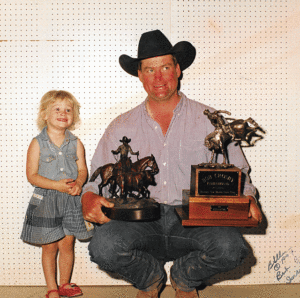
Darcy (Clark) Good & Doug Clark, Bob Crosby steer roping champion, Roswell, New Mexico 1995
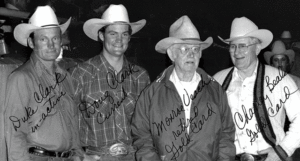
L to R- Duke Clark (Doug’s father), Doug Clark, great grandfather, Monroe Veach, grandfather, Charley Beals. Early 1980’s – Courtesy
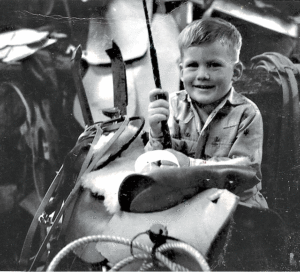
: Doug in Veach Saddlery, Tulsa, Oklahoma, his grandparents saddle shop. This photo was featured in Western Horseman article in early 1960’s – Courtesy
“I went as much as I could – I never set a goal to win this or that. I was training and traveling with some of the top guys so I couldn’t really go as much on my own.” Doug was riding and selling what he was riding to those guys. Doug has had horses either owned or ridden by Clark Quarter Horses at the National Finals Rodeo and National Finals Steer Roping Finals for over 30 years. Much of Doug’s career has been riding and training horses for the top ropers of the day, like Trevor Brazile, Tom Ferguson, and Roy Cooper. Never ‘living on the road’ entering and competing in rodeos, Doug’s real passion and specialty has been in training horses and people in a clinic format and one-on-one training in his home. “My dad was a great horseman – a quiet mild mannered gentleman – and learned how to be a good judge of horse flesh.” Doug was influenced by the old timers – great horsemen and ropers.
Along with the pros, Doug and his wife, Linda, have had the privilege of helping kids along the way. “We’ve had a lot of kids come live with us over the years. We still take kids in who want to get better in rodeo – but really it’s all about life – it all goes together.” Every one of the kids that have come through his doors has learned about everyday living. “That includes everything from riding 20-30 horses a day, shoeing, fixing corrals, cleaning pens – you name it.” It’s the Doug Clark school of hard knocks. The kids come in, learn how to be horsemen – sleep on a lumpy old couch and work alongside Doug to achieve their goals.
Doug at Cheyenne Frontier Days,1987, setting an arena record (11.1) over a 30-foot score and calves weighing 280-300 – photo by Jan Spencer
Doug riding “Touchdown”, 1993 horse owned by Doug that went on to be owned, ridden, and helped garner championships for many PRCA cowboys. – dudleydoright.com
“The parents entrust us with their kids and that’s a huge compliment,” says Linda, who is the cook, but doesn’t admit to being the cleanup. Doug and Linda have one daughter, Darcy, who competed as well. Doug and Linda got married in 1985. “We met on Valentine’s Day at Baton Rouge at a rodeo,” he recalls. Six months later Doug and Linda were married. Darcy was born in 1991, and joined the rodeo road when she was young. “When Doug was horse showing, she went along. “We won a lot of awards including the Super Horse in 1999 one year, competing in all the roping events.” He was a trainer and exhibitor and judge during his time at the AQHA. Darcy competed on Doug’s old roping horses and qualified for the CNFR in 2008 in the barrel racing. She also won the breakaway at the IFYR in 2006. Darcy and her husband, Billy Good, a steer roper, still hit the rodeo road. Linda works part time as well as running a courier business with her daughter, Equine Courier Services, driving 10,000 miles a month delivering semen and embryos.
Not only does Doug train horses and hold clinics at every age and skill level in all roping disciplines, but for many years he showed horses in the American Quarter Horse Association. He was one of the teammates winning the 1999 Super Horse Award showing the stallion, Look Whos Larkin. Doug also has been involved training and even owning three of the many horses recognized as finalists for the AQHA/PRCA Horses of the Year, which is an award voted on, annually, by top ranked cowboys.
Doug has enjoyed his entire career and life being around the horse industry as a fourth generation rodeo participant. “I enjoy what we do and I want to keep doing it. We’ve got some good kids and some good horses,” concludes Doug. The Ben Johnson award is bestowed upon a person who has had a notable career in the arena, as well as, working outside the arena helping others to achieve their rodeo and personal goals. “I was honored with the award – I didn’t even know I was in there – it’s not what happened in the arena as much as what you can do for other people and helping them get where they want to go.”
Timothy Troyer is the 2019 International Finals Youth Rodeo (IFYR) Saddle Bronc Champion and is also sitting number one in the International Pro Rodeo Association. From Columbia, Kentucky, Timothy admits there’s not a lot of saddle bronc riders around where he lives. Put that with his height, 6’2”, and the fact that he just started riding broncs two years ago, and that makes his win at the IFYR even sweeter. “I just started going to rodeos and figuring it out along the way,” he said. “I do base all my success on God and I couldn’t do it without Him. My brother Jesse has always been there to support me and push me to get better – he is definitely one of my biggest motivations!” Timothy spends many hours working out – preferring the old school workouts like jumping and cross fit work.
This was his second year at the IFYR. “It’s a great place for young people to get started and compete and it pays well.” Timothy was home schooled – he grew up Amish. “We weren’t allowed to go and even watch rodeos – no competitive sports. We played a lot of baseball or volleyball. But we couldn’t go to games.”
Timothy’s parents decided to leave the Amish community when he was 13. They moved to Westcliffe, Colorado, for four years before moving back to Columbia. “A month after we moved to Colorado we lost everything in a house fire and had to start over from scratch,” said Timothy. “But with help from God, family and friends we recovered.”
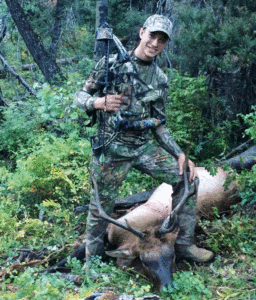
Timothy hunting.
Kate and William with Jesse, Dwayne, and Timothy – Courtesy of the family
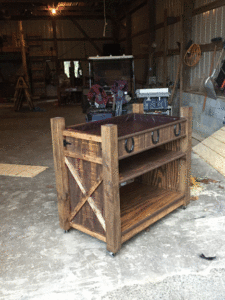
He doesn’t miss much about growing up in that lifestyle but says it helped him in life by teaching him life skills. “I know how to make a living from hard work,” he said. “We still talk Dutch at home and cook the same. I build furniture on the side, and that’s one thing that I will always do.” The one thing that stumped him was social media. Although he’s figured it out, he admits that it is over used.
While Timothy, Jesse, and his younger brother, Dwayne adapted well to the change, it has been more difficult for his mom, Kate. “I was taught so different that it’s hard. We didn’t learn English until we went to school at the age of six.” She also misses getting together with family and friends. She still raises a big garden and does all her own canning and freezing. They also raise their own meat, butchering a steer when the elk meat runs out. William is a big hunter and heads to Colorado every year to get an elk. The boys have gone with him.
Timothy has been riding for just over two years. “I always wanted to do it as a kid and my parents wouldn’t let me until I was 16.” He picked up rodeo on his own. “My brother started riding bareback horses when he was 16. I bought a saddle and a pair of chaps and started entering exhibitions at rodeos. I watched some YouTube videos and halfway had the basics figured out.” The hard part for Timothy was entering. “I didn’t know anything about associations; I just searched for rodeos to enter.”
Kate, wasn’t too happy about him riding right off, but she’s comfortable watching it now. “It was scary for me,” she said. “It was totally new for us. He was introduced to it through friends who barrel raced. The boys grew up on a farm – their dad used to train horses when he was younger – so they had always been around horses – we used them for everything.”
One of the pieces of furniture Timothy built.
Timothy with his mother, Kate, and father, William.
The other delay in Timothy’s starting was due to an accident he had in 2015. “He was at work and fell 22 feet off the roof, shattering both bones in his left leg above his ankle. It’s full of plates and screws– it took three surgeries to fix that. It took a full year until he was back to normal.” Timothy has worked on his father’s (William) construction crew since he was 13. He used to build houses and pole barns. William switched to excavating two years ago.
Timothy heads to school at South Western Oklahoma University this fall. “I am going to go for a business degree at Weatherford, Oklahoma, and rodeo.” He admits he’s a little nervous to start school. “I’ve never been to a public school – the Amish school I went to had 20 kids and was a 30×40 building.” He made it through the eighth grade in the Amish school. “That’s when you graduate anyway.”
He has continued his education online to prepare for college. “I’ll have classes every day of the week.” For now, rodeo will have to be done on the weekends. The goal is to have his own business someday – either in furniture or construction. For now, he’s going to enjoy college, rodeo, and his girlfriend, Sadie Wolaver, who he met at a rodeo in Canada. They have been dating since November. “I would marry her right now, but I don’t want to get married and have financial problems, so I’m saving up for it.”
“We’re proud of our boys and what they are accomplishing,” concludes Kate. “I love to watch him now. He’s got the determination and will power to push through and get after his goals. He doesn’t give up very easily. I would say he gets that from his dad.”
The 18 year old is from Yampa, Colorado, a small town located 30 miles south of the famous Steamboat Springs ski resort. Even with that close proximity, Jace doesn’t ski. “I get so busy with sports, I don’t make time for it.” Due to conditions and his high school sports, Jace is unable to practice in the winter. “We had 5 feet of snow last year and freezing temperatures all winter.” During the fall, he splits his time between football and rodeo and then wrestles throughout the winter. He was the running back and linebacker in football for Soroco High School and he wrestled in the 170 pound division, earning the state title this year in 2A. After spending the past three years as runner up, he finally reached his goal. Jace has wrestled since kindergarten, working his way through middle school into high school and coaching the peewee program. “I love the sport – it teaches great life lessons – I love that kind of competition. You are out there by yourself so there are no excuses. Dedication and teamwork are still in there as far as practice partners – being accountable for your actions on and off the mat. Wrestling teaches discipline in cutting weight, making weight, and grinding it out. It’s very rewarding in the success because it’s all you.”
Jace having fun at a branding – Jeannie Jo Logan
Jace and Eric with their 2012 NLBRA Champion Dally Ribbon Roping saddles – Jeannie Jo Logan
Kody and Jace making a run at the Rifle rodeo this spring – Jeannie Jo Logan
As a freshman, Jace was a big surprise to a lot as he made it to State finals, and ended up runner up – for the next three years. “It was a rough go for a while, but we got it done.” What he concentrated on this year was his mental game. “Honestly in life and in sport – if you can mentally overcome stuff, that will make the difference in your success.”
Jace competes in the Colorado State High School Rodeo Association, where he is this year’s All Around Champion. Going into the fall season he would play football Friday night and then immediately head to the weekend rodeos where he competed in reined cowhorse, tie down, team roping, and steer wrestling. Add that to the fall ranch work, Jace kept busy. His family ranch runs 1,300 leased cow calf pairs during the summer and fall gathering on the 12,000 + acres takes some time. Add shipping to that and the family of three boys has their work cut out for them. “My brothers and I are the cowboys pushing them up to summer pasture and putting out salt and mineral during the summer. Then we gather in the fall.”
Jace and his two brothers, Eric, 21, and Kody, 16, started their own cow herd when they were young. “I bought two cows in second grade and same with my brothers. Each year, we’ve grown our herd.” They have around 200 of their own cows now. “Mom and dad treat us good – we work pretty hard on the ranch and they help by taking care of most of the expenses on the cattle.” The cattle on the ranch are divided into four big bunches and the boys check on something every day during the summer.
Practicing tie down at age 11- Jeannie Jo Logan
Jace and Eric moving cows to summer pasture – Photo by Jeannie Jo Logan
Jace making a Tie Down Run at State Finals – Jeannie Jo Logan
He comes by his love of horses through his parents, Mark and Jeannie Logan, who competed in reining before the boys were born. They started raising horses with their stud, Doc Sugar Catalyst when Eric was just a baby and most of their horses they rodeo on and work the ranch on comes from Doc. Jace and his brothers found their niche in the horse world through rodeo, starting with the local gymkhana club and NLBRA, then climbing the ranks of junior high and high school rodeo. Jace competed in team roping and dally ribbon roping with Eric, and the brothers were crowned the NLBRA dally ribbon roping world champions in 2012.
Jace has been pro rodeoing since last October, running down the road with Eric, who also steer wrestles. They use the same horses and haze for each other. “I pulled a check at my hometown rodeo, the Steamboat Springs Pro Rodeo series. We hit that ten week series every weekend.” One of the horses, the haze horse Skeeter, is one that was raised at the ranch. The steer wrestling horse, Gray, was bought out of Texas when Eric was at Odessa College. Besides steer wrestling, Jace and Eric also compete in team roping together. Jace heads on Skeeter-the haze horse, and Eric heels on a horse they also raised on the ranch and used in reining. During the week the boys and Eric’s fiancee, Shelby-who breakaway ropes, make time to practice everyday. The family put in an arena a few years ago which allows them the flexibility to practice whenever they have free time from the ranch.
Jace is going to the University of Wyoming this fall to study Animal Science with a concentration in livestock production. He plans to apply that later in life as a ranch manager. For now, he’s going to rodeo for a while. “I want to see how far I can go in it.”