Rodeo Life

Category: On The Trail

  • Shaley Ham: The West Desperado Way

    Shaley Ham: The West Desperado Way

    Shaley Ham didn’t initially set out to be a fashion influencer. Though she always loved fashion — as a kid, she carried notebooks that featured her hand-drawn fashion designs — a career as a fashion icon wasn’t at the forefront of her mind during her childhood in Cheney, Washington, just outside of Spokane.

    The daughter of barrel racer Pam Capper, Ham grew up riding horses and attending rodeos on weekends, though she never really caught the competitive bug herself. But she loved traveling to the arenas alongside her mother, developing her love of the Western way of life along the way.

    “That Western lifestyle and those roots have always just been something I’ve connected with,” she says.

    Although her college years would whisk her away from Cheney, she moved back to her hometown after graduating with an accounting degree from the University of Oregon. Her return home sparked a renewed sense of passion for those Western roots.

    “I fell back in love with the romance of the Western way of life,” she says.

    The decision to return to her hometown ultimately changed her trajectory. She met bareback rider Nick Gutzwiler, who she would eventually marry. Around that time, she also began following others who sought to share their best Western-inspired outfits on social media.

    She put her accounting degree to use, cultivating a career in the field. But that job would also lay the foundation for her transition to fashion, which began after her coworkers constantly told her how much they liked her sense of style. Given the praise, she created a social presence exclusively dedicated to showing off her outfits.

    It didn’t take her long to build a community. After a couple of months, she already had a thousand followers.

    “When I hit over a thousand followers, I was like, ‘Oh my gosh, like, I’m a rock star!’ It’s funny to tell that story now because I feel like people can get a thousand followers overnight. But it was very different eight years ago,” she says.

    She now has more than 200,000 followers on Instagram, not to mention another 100,000 on TikTok. On her pages, you’ll find stylized images and videos of her in cowboy hats and boots, displaying classic Western style with a modern flair.

    While it may seem odd to some to build a Western fashion empire out of an accounting background, it has served her well. Her background in a business-adjacent field has given her an upper hand in terms of her ability to navigate the challenges that come along with being an influential personality, such as networking and maintaining a professional demeanor.

    Western fashion brands quickly identified Ham as someone they wanted to work with. They caught her attention with offers for free clothing—an irresistible perk for someone who was already fashion-obsessed. Something she’d started strictly for fun had suddenly started captivating Western fashion enthusiasts.

    That was 2016, a year her mother qualified for the National Finals Rodeo. She joined her mother in Vegas, where she also first encountered representatives of many of her favorite brands in person at Cowboy Christmas, the Western-themed holiday event that takes place in tandem with NFR festivities. This experience led to more opportunities to work with the brands she already loved.

    She also began receiving invitations to wholesale markets, such as the ones at the Dallas Market Center. These provide an early access opportunity to identify the styles and trends that Western wear brands are banking on for the coming seasons. They’re also a great opportunity to bond with the people behind the brands, which is an essential component of succeeding in the field of content creation.

    Still, even with all her success, it would take several years before she reached a point where she felt comfortable leaving behind the accounting world and transitioning into life as a full-time content creator.

    While her images often tout a carefree Western lifestyle, the truth is that success in this field requires the kind of work ethic only the most dedicated cowgirls can understand. She suggests that her background in the corporate world has proven a major asset, as her professionalism earns her kudos among her brand partners.

    “That’s always my biggest encouragement for other girls when getting started,” she says. “Set those standards because as soon as you release the reins and give some slack in the professionalism department, things can start to go sideways.”
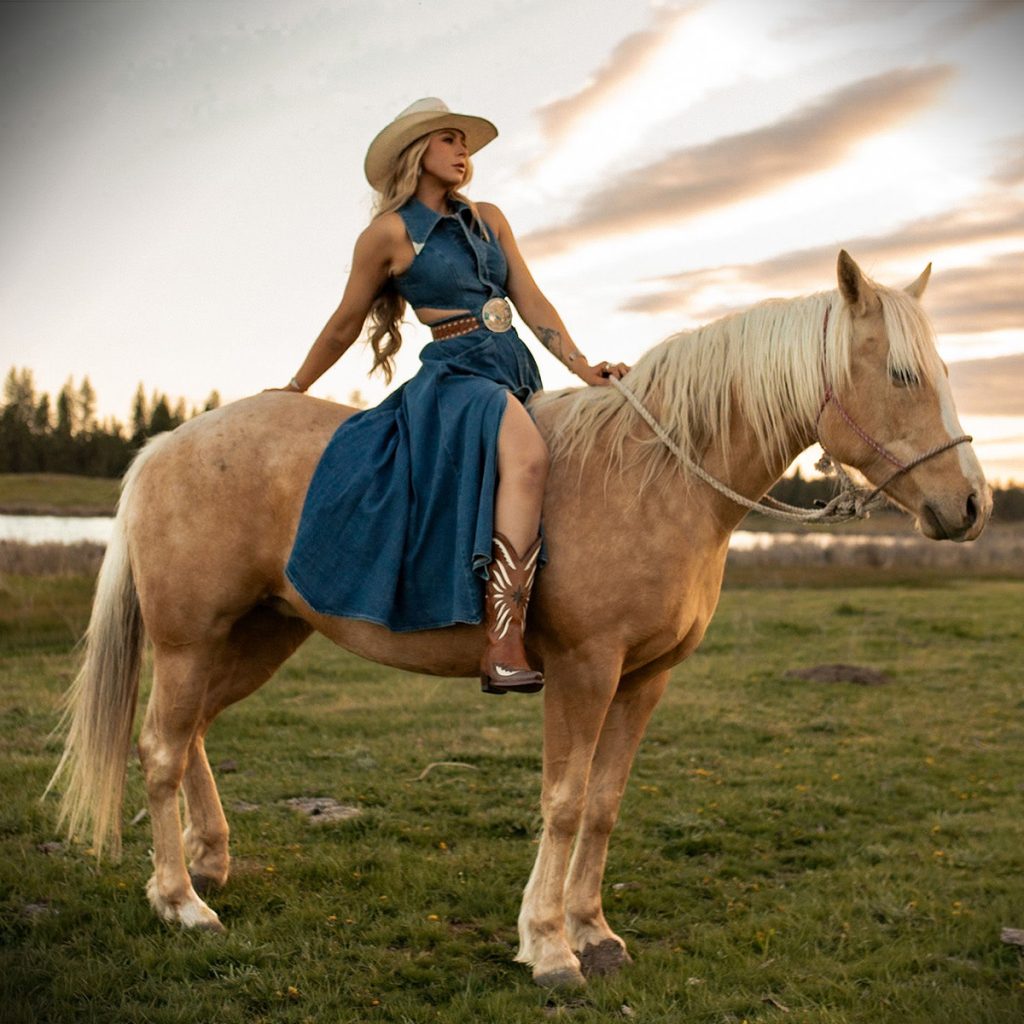
    Presently, Ham has several collaborations with major brands — her four-year partnership with Rock n’ Roll denim stands out as a favorite among many. But Ham doesn’t foresee herself opening her own boutique anytime soon.

    However, after realizing the concho belts that are a staple of her signature style can be challenging for people to find, she wanted to be able to tell her followers how they can get their own. So, she now offers them for sale on the West Desperado website.

    “I wear them all the time. And it’s just super easy to know that I can send people somewhere to find them,” she says.

    And as with any influencer, Ham varies her style based on the season or her vibe.

    “I’m starting to love rosettes and like little accented rosettes. When they first came out, I was not vibing with them, but I’ve been seeing them incorporated in a more Western way. And I think it’s a delicate aspect to add when wearing lots of leather or fringe,” she says.

    She’s also a fan of Lariat neckties, which are becoming increasingly popular.

    “They hit the scene during this last NFR in December. And now girls are wearing them with strapless tops. A little Lariat necktie tied around your neck adds a fun kind of Western accent to any outfit.

    And then, of course, there’s the most classic of all.

    “You can’t go wrong with denim on denim,” she says.

    Follow Shaley Ham on Instagram and TikTok at @westdesperado and visit her website at www.westdesperado.com.
  • Carrie Ann Sattler – Reno Rodeo’s First Female President

    Carrie Ann Sattler – Reno Rodeo’s First Female President

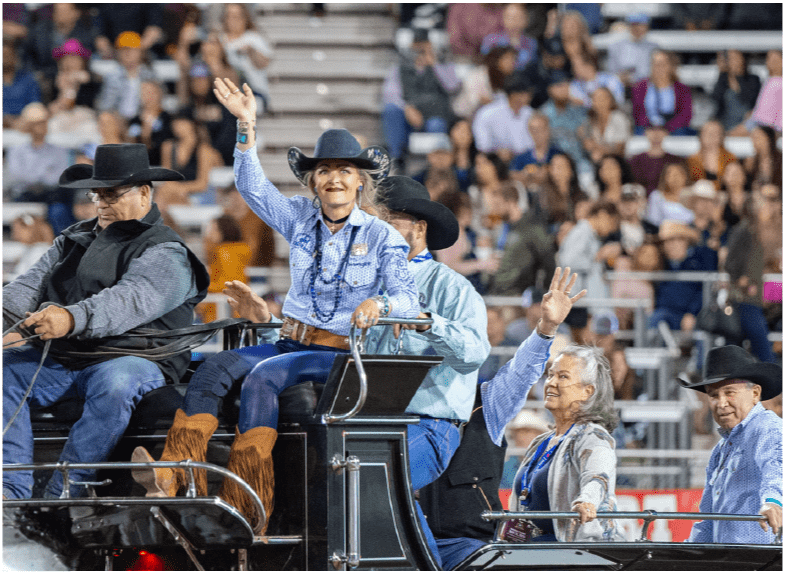
    Carrie Ann Sattler was only 16 when she knew she wanted to volunteer for the Reno Rodeo, one of the nation’s most revered Western sports events rooted in 105 years of tradition. As a young girl, she went to the rodeo each year with her family and found herself drawn to the excitement of the large crowds and festive atmosphere. “When I turned 16, I called and asked if I could volunteer. They said you had to be 18 if you didn’t have a connection inside the association already. So, I told the gal that I would call back on my 18th birthday,” Sattler says. “I called her back on my birthday in 2004 and became a volunteer. Now I’ve been doing it for 20 years.”

    That sense of unbridled enthusiasm and loyalty to the organization has served her well. Sattler’s hard work and passion led her to become the Reno Rodeo’s first female president—not to mention its youngest-ever president. She now oversees a volunteer base of around 800 people, making up 65 independent committees that work diligently to put on the annual rodeo in Reno, Nevada. The rodeo draws some of the biggest names in the Western world and spectators from all over the country. “In an association like Reno Rodeo, something that’s so special is just the amount of passion that gets poured into creating a single 10-day event,” she says. “I am one of many, many volunteers that contribute a major portion of their lives to the betterment of the association and our initiatives as a rodeo.”

    The Reno Rodeo is ranked seventh among nearly 700 rodeos nationwide. Each year, the organization’s volunteers and committee members donate thousands of hours of their time to produce one of the most elite events in Western sports. To some, it may seem uncanny that so many people would be willing to spend so much time and effort to put on a single event. But for Sattler and the others who keep the show going strong year after year, it’s hard to imagine not being part of such an iconic event. “There’s a quote that, from the outside looking in, you can’t really understand it. But from the inside looking out, you can’t really explain it,” Sattler says, summing up what drives so many people to become dedicated to developing the best event possible. Because of their hard work, the Reno Rodeo has become a must-see event that pays homage to rodeo’s storied history and the legacy of the West. “There’s something so rewarding about seeing the fruits of your labor. Knowing that you’re one small part of such a big machine is incredibly moving,” she says.

    It’s not just the rodeo itself that inspires these volunteers to come out in droves to support the event. Another big part of the Reno Rodeo’s overall mission is community involvement, which includes charitable initiatives that give back to various causes in the region while also helping to ensure that the thousands of visitors who flock to the area for the big event have an incredible guest experience.

    “The event itself is pretty significant in its impact,” she says. “We have about a $50 million economic impact in our region. On average, we donate about $250,000 a year to the Reno Rodeo Foundation, a foundation that was created to be the charitable arm for giving back. Beyond that, we donate hundreds of thousands of dollars back to the community through donations and charitable contributions. And in addition, we’re producing one of the largest attractions and events in our state and our region through the Professional Rodeo Cowboys Association.”
    And while the local community benefits from tangible effects such as spikes in regional tourism that benefit the local economy, the true beauty of getting involved is that it offers people the chance to be part of something much bigger than the sum of its parts. As has always been the case with the presidents before her, her primary goal is to organize a bigger and better event each year. She takes this mission seriously as the leader of a rodeo with a legacy dating back over a century.

    Adhering to tradition while remaining adaptable to the changes of the modern landscape can be a complicated balancing act. Sattler describes this balance as “incredibly delicate” but is proud of how the Reno Rodeo has come to honor its legacy and tradition while continuing to move the needle in rodeo sports.
    With the organization so profoundly rooted in tradition, Sattler understands the importance of paying it forward to the broader community. That’s why the organization will host its first-ever Reno Rodeo Scalability Conference this year, inviting representatives from rodeos nationwide to learn how to grow their own rodeos bigger and better.
    “We think that in our position, it’s really important to share the formula that we’ve been working on for 105 years and have now grown to feel pretty stable and very successful,” she says. “We want to share some of that industry knowledge with others.”

    Smaller rodeos don’t always have the luxury of massive pots or the inherent prestige associated with longer-running events. Therefore, their organizers must find creative ways to draw the best ropers and riders to their arenas if they want to sell out the grandstands. The conference aims to give the representatives from these rodeos a chance to learn how to scale based on Reno Rodeo’s success in growing to become one of the most revered events in the Western world.
    “I think it’s going to be great, and I’m excited that we’re doing it,” she says.
    Rodeo may be all about the blood, sweat, and tears of an American pastime, but Sattler understands there’s something deeper at the intersection of rodeo sports and the Western world. Since its earliest days, rodeo has been a celebration of Western heritage, honoring the traditions of the West and the cowboys and cowgirls of generations past. She thinks it’s essential to grow rodeo sports to keep those traditions alive by teaching future generations about rodeo’s historical importance and embodiment of that Western spirit.

    “Once you get involved, you just understand that it’s about family. It’s about values. It’s about hard work and tenacity. It’s about grit. It takes a lot of fortitude, both physically and mentally, to live a lifestyle of Western tradition. And I think that’s what makes it so worthwhile, and the juice worth the squeeze,” she says.


  • On the Trail with Chancey Williams

    On the Trail with Chancey Williams

    “I was spreading myself a little thin, doing all three, and I don’t think I was riding as good as I should have been because I was trying to go play dates, and I was like, well, I think I’m just going to play music.”

    He might have hung up his spurs for now, but saddle bronc rider turned successful country music artist Chancey Williams understands what it takes to be a cowboy behind the mic and in the arena.

    Despite leaving his rodeo career behind, Williams continues to draw upon his experiences as a cowboy to create authentic and heartfelt music that resonates with fans across the country.

    His journey from growing up on a ranch in Moorcroft, Wyoming, to performing at stages such as the Grand Ole Opry has been inspiring, and his success serves as a testament to his determination and understanding of the Western lifestyle.

    While in Rapid City, South Dakota, we were fortunate enough to have an exclusive sit-down interview with the Wyoming native. We caught up with him on his tour bus right after his sound check to talk about rodeo, ranching, and music.

    RN: When did you decide to be a musician? Rumor has it you were pretty big at the high school talent show?

    Williams: Yeah, we started in high school just kind of for fun. And we actually started just for a talent show. I tell people [it was] kind of an excuse to have everybody in town come out to the shop. We’d say we were practicing, and we knew like eight songs and just kept playing them, and people would get together. So we did it just for fun, really. I didn’t really know where it would take us.

    Then, some guy in Moorcroft hired us for a New Year’s Eve thing and gave us 200 bucks. We’re like, man, you get paid for this? So then we just kind of started playing all around the area in high school, dances, rodeos, fairs, and stuff. I went to college and we were busy in college playing. Then I had a lot of work, you know, go to the college rodeo and ride and then play at the dance that night. It was a good college job.

    It kind of took off from there. The rest of the band was still in college, so I went to grad school, got my master’s, and stayed in Laramie then, for an internship, I moved to Nashville to work for Toby Keith. Down there, [I] just decided, well, maybe I want to do this as a career. I was riding broncs and playing music, and I was picking up for Cervi’s and Franzen’s a little bit. I kind of liked it all, but I figured I better make a choice to do one and try to do it right. I was spreading myself a little thin, doing all three, and I don’t think I was riding as good as I should have been because I was trying to go play dates, and I was like, well, I think I’m just going to play music.

    RN: You talked about the high school talent show, are any of your band members you played with in high school still with you?

    Williams: No, I’m the only one left. The original guys, you know, a couple of them went and got real jobs, married, and grew up, and I didn’t grow up. But you know Wyatt and Brooke have been with me for 15 years, so they’ve been the longest. Then the other guys, most of them are five or six years in. I have a really good band right now, and it’s a lot of fun, but yeah, none of the originals. They all went off and did something else, but I didn’t want to grow up.

    RN: What’s something special that each band member brings to the stage?

    Williams: I always say Wyatt’s like the heart of the band; he’s so mellow- mannered. He’s kind of, you know, everybody looks up to Wyatt as being chill, so he kind of keeps the whole camp chillin’. Obviously Brooke, you know, with her fashion and [playing] fiddle. There are a lot of fiddle players, but not that look like her. But Brooke always brings a lot to the table with her Instagram fashion stuff, and she has her own way of doing things. [She] pretty much makes all of her own clothes; she and her mom thrift shop and make clothes. So Brooke’s awesome. Dale’s a drummer we got out of Fargo. He played in a band that we knew, and when our last drummer left, he was our first call, and he’s just so talented. We have to fly him every weekend. And then Casey, our other guitar player, he’s awesome, he’s kind of a rock and roll guy. He brought a lot to the table, too, but he lives in South Padre, so we have to fly him every weekend, too. Jay, our bass player, lives in Loveland, and so he was also a great fit. I always tell people it’s almost 90% personality and 10% playing. Because you can teach people how to play pretty good if they know what they’re doing, but you can’t teach people how to get along on the road and not be a jerk. We live on these buses pretty much year- round, so there are some great musicians in Nashville, but there are a lot of musicians who are kind of weird, too.

    RN: What are some skills you gained growing up on the ranch that have helped you today? 

    Williams: I always tell people we [apply] ranch work style to music. People think music, they just see you play live, and they’re like, oh, it must be really fun. It’s a lot of work. And to get to the level we’re trying to, it’s unbelievable. I look back to be like, man, I don’t know if I’d have started this because the music business is crazy, but growing up ranching is hard work.

    So that taught us to work hard, and we like it. It’s not that bad on the road.

    Music’s tough, but every time I think it’s hard work out here, I can just call my brother at home and ask him what he’s doing. He’s [usually] calving or something. They’re like, well, this music thing ain’t too bad. The hardest part of the day in music is still easier than ranching.

    RN: March is our equine edition: how have horses influenced your life and music?

    Williams: Well, you know, I tend to write a lot of songs about cowboys and ranching and the Western Way life, so I guess just, you know, growing up a horseman, growing up breaking colts, then riding broncs, you know, it gives me the credentials to write songs about it. You know, you hear a lot of songs on the radio that you can tell somebody from Nashville wrote about a cowboy. Well, they haven’t really lived that, so you know, growing up with my history, I can write songs that are lyrically correct.

    RN: I know you used to ride saddle bronc, can you tell me a little about that?

    Williams: Our dad was a saddle bronc rider, so I grew up wanting to be like Dad. We started when we were fairly young. Then a kid got hurt real bad at a school in Gillette, so mom put the halt to the bronc riding for a few years. Then finally, we were riding colts, breaking colts, and you know, they were just like rodeoing, so finally, mom’s like, well, it’s kind of the same thing, so I’ll let you. So, high school, rodeo went to high school finals in the bronc riding, then went to Casper College on a rodeo scholarship, rodeo’d there three years, made the college 2 finals there, then went to Laramie one year and made the college finals my senior year, and then rodeo’d for a couple years out after college.

    I love bronc riding and I miss it a lot. I think about it all the time. I think everybody that’s stopped doing it, I dream about it. I can’t stop thinking about it. It’s one of those things you can’t do forever. You can team rope for a long time, you know. So it’s just one of those sporting events that you can’t just go get on one for fun. If you’re not in shape for it you, can get hurt.

    I’m always worried about getting hurt, you know, And then we’d be out of work for a while. We played at Red Bluff a couple of years ago, and they’re like,

    “Hey, want to get on the wild ride.” I was like, sure, what’s one more? Then COVID hit, so I didn’t get on in Red Bluff. That’s probably a sign. Yeah, but I do miss it a lot.

    RN: What’s your favorite rodeo to play?

    Williams: Oh, Cheyenne.

    I mean, we love NFR. We got to do the opening ceremony there five times. It’s obviously cool because I never made it there in the bronc riding. But I feel like I made it my own way, getting to play in front of the yellow chutes.

    We’ve always loved Cheyenne. I rode there, in a couple of rounds in the rookie bronc riding. It’s just a special place.

    RN: What do you like most about playing for rodeo fans?

    Williams: Well, they’re just my people. They get my songs, you know? Sometimes, my songs are a little precise as far as some of the lyrics are too insider.

    So, like, there are probably certain songs that people don’t get if you’re not a cowboy. They’re like, what, I don’t know what that means. So, being too accurate can be bad, too, for a giant fan base.


    RN: Where do you get your inspiration from?

    Williams: You hear lines from people at the bar or at a rodeo; you hear somebody say something a certain way. I go through my notes on my phone, and I have all these ideas. Whether they ever make a song or not. Some days, you wake up the next day and [wonder], what does that mean? I wasn’t making any sense. Yeah. That’s kind of where, I just like to write things that are authentic.

    So, I think in this day and age, people in general are searching for authenticity. The real world, you know, maybe some of that came from shows like Yellowstone and stuff. It just brought like the cowboy way of life, opened it up to a broader spectrum where people from the East Coast and West Coast, like, wow, they want to live vicariously through our lives through shows like Yellowstone.

    I write songs that they can think they’re being a cowboy and listen to.

    RN: What artists inspired you?

    Williams: I grew up listening [to] ‘80s and ‘90s country. The ‘90s stuff was super influential, like Dan Seals and Toby Keith. Toby was really good to me when I worked for him. And obviously, George Strait and Chris LeDoux were two real cowboys. Obviously, Chris was a world-champion bareback rider. Just watching Chris’s career [thinking] if he can do it, maybe I can do it.

    Chris helped us out early on and kind of got us started. It made me want to do it. He let us open for him in Billings, and we were horrible. We were young. We just started, and Chris didn’t care. Because Dad and Chris rode together [they were friends]. We knew them and the family all growing up. I just called their house one day, and Peggy [LeDoux], and I was like, how do we get into doing opening stuff? She’s like, well, let’s talk to Chris. And Chris was like, yeah, we’ll let you open up there [Billings] in August. [It was our] first time playing in front of a big crowd of about 8,000 people in the Metra. I was really nervous. And we were pretty darn bad. But I was like, man, this feels awesome; I wanna do this. We’re bad, but we can do this. And I remember Chris being like, looks like you were meant to be up there.

    RN: What type of music do you listen to now?

    Williams: Do you know what Yacht Rock is? It’s like easy listening ‘70s stuff. Wyatt is the music genius; he finds all this stuff, and he got me listening to some, you know, easy listening ‘70s, California- type stuff. So I listen to that a lot. We listen to about everything on here.

    But I typically end up playing sad old country songs at the end of the night. And it puts everybody to bed. Stuff you can drink to. I was like, man, these old ‘90s and ‘80s sad country songs have more emotion than everything.

    They’re like, who played this on the jukebox? That’s me. I’m the guy that spent 40 bucks on old Dan Seals songs. Who played “Everything That Glitters Is Not Gold” again?

    RN: Who would you most like to collaborate with?

    Williams: Probably Dierks Bentley. Just cause out of all the guys we’ve played with in the past, Dierks has become a really nice guy. I mean, I consider him friends, but, like, he texts me all the time. I text him back. Dierks is a genuinely nice guy; he’s what you see on TV, and sometimes, the artists aren’t.

    It’d be fun to do a song with Dierks. You know, and just cause he’s fun, like all the songs are fun, they’re kind of like our songs.

    RN: What are you looking forward to most in 2024?

    Williams: Well, we’re excited about this new batch of songs. We just put out our new single, A Cowboy Who Would. And it’s the first batch of eight that I did with this new producer, Bryce. And it’s some really good stuff.

    We have some of the stuff that fits what we always do: cowboy stuff. But just sonically, we changed engineers and some session players, and it just sounds really good. And this new single is doing really well. It got picked up by 150 stations nationwide this week. Last week, it was on the CMT Top 40 country countdown. They have a launch pad section in the countdown, and they got played nationwide.

    So we’re really excited about the music, you know, at the end of the day, It’s kind of all about the song, you know, that’s what moves the needle for an artist. We’ve done really well, but to make you huge, you have to have a hit song that kind of changes the world. You know, Toby Keith built his career off ‘Should’ve

    Been a Cowboy”. It was the number-one song played in the ‘90s.

    Then we got some great dates coming up. Sounds like we’re going to get to play the Grand Ole Opry a couple more times. They said maybe three times this year.

    Yeah, bucket list things, and we get to play Red Rocks in Denver in June, which is a bucket list one because everybody wants to play Red Rocks, so it’s fun to finally play there since we live so close by. A lot of great tour dates, and [I’m really] excited about all this new music.

    RN: Anything else you would like to add?

    Williams: We always encourage people to stream our stuff on Spotify. Our fan base is kind of old-school out west. They still listen on the radio and buy CDs. But, the music business gauges how successful you are sometimes off your streaming numbers. Our fans don’t stream; they drive six hours, buy a concert ticket and a t-shirt, and come to the show. They stream some, but some don’t even have Spotify. I always encourage people to stream the heck out of it. It makes us look good.

  • On the Trail with Ky Hamilton

    On the Trail with Ky Hamilton

    Since the 2023 National Finals Rodeo in Las Vegas, Ky Hamilton has become a household name. The 23-year-old professional bull rider, originally from Queensland, Australia, rocked the rodeo industry after coming back to win a gold buckle following a serious injury after being bucked off a bull during round five of the finals. Just as shocked as fans, the other competitors were not expecting to see Ky at the round six performance.

    RodeoReady Photo

    “I know those guys didn’t think I was going to show up and win, and they damn sure didn’t want me to, and I went ahead and did it,” said the four-time National Finals Rodeo Qualifier and 2023 Professional Rodeo Cowboys Association Bull Riding World Champion.

    Ky, who joined the Professional Rodeo Cowboys Association in 2019, came into the National Finals Rodeo with over $250,000 in earnings in the regular season and started the finals in second place. Hamilton scored an 86.5 in the first round, a 78 in the second, 87.5 in round three, and an 89 in the fourth round of the NFR. 

    Still riding the high from his recent success, Ky drew the bull Bales Hay’s MAGA, owned by Honeycutt Rodeo, for the fifth round. During his ride, Hamilton’s head collided with the bull, rendering him unconscious. Fans and athletes watched as he was carried out of the arena on a stretcher and taken to University Medical Center Trauma Center in Las Vegas, where it was discovered he had suffered a concussion as well as injuries to his ribs and lungs. 

    Due to the severity of his injuries, medical professionals recommended he sit on the sidelines for the following rounds of the rodeo. However, the cowboy had different plans.

    “The whole time I was in the hospital, I knew I was coming back,” Ky said. Although he wanted to immediately return to the rodeo, he said he waited for a doctor to review any changes in his lungs the next morning before actually leaving the hospital. 

    “There was no doubt in my mind that as long as there was nothing worse with my lung, I was going to be riding,” said Ky.

    Not only did Hamilton return for the next performance, he tied for third place with 85.5 points and took home over $15,000 in round six alone. During round seven on Wednesday night, he was the sole rider and had a $99,000 payday. He continued his winning streak in the following days, earning over half of a million dollars overall in addition to a world championship title.

    RodeoReady Photo

    “I showed that I came there to win, and nothing was getting in my way,” said Ky.

    Although Hamilton has collected numerous wins in both the United States and Australia, he said the countries vary greatly when it comes to the rodeo industry. 

    “It’s a hell of a lot bigger,” Ky said about American bull riding and rodeos. He said that events are more spread out in Australia and have a smaller payout. Because of this, he said people in Australia must work a day job rather than travel full-time from rodeo to rodeo, which is a common practice for American cowboys and cowgirls.

    “Over there, you only get to go to about one rodeo per weekend, and there’s one performance, and that’s it,” Hamilton said. He also said that the stock and competitors of Australia are not on the same level of difficulty as the ones he has seen in the United States. 

    “Everything’s just on a smaller scale over there,” he said. 

    Ky competed for the first time in America at the age of fifteen, and a few years later, the bull rider decided to move from Australia to the United States to rodeo full-time. He now resides in Texas and travels to compete in rodeos across the nation. In 2023, Hamilton won rodeos in Texas, Arizona, California, Colorado, Oregon, North Dakota, Idaho, Utah, New Mexico, and Wyoming.

    With his successful 2023 season ending, Ky is now focused on the year ahead. 

    “It’s the same every year; just try to win a world title… I damn sure want to do it again,” he said. Ky said another goal he has for this year is to ride Bales Hay’s MAGA, the bull that cost him round five and sent him to the hospital.

    “He sure got the better of me, so I’d like to get even with him,” Hamilton said. 

    Ky plans to return to the arena in January 2024, sharing that he hopes to ride in Fort Worth, Texas and Denver, Colorado. Although he will be back on the road, he will be missing his travel partner, Stetson Wright, who is out due to a hamstring injury sustained at the NFR in December. 

    Despite the numerous injuries and Stetson’s absence, Ky will be continuing his chase for another gold buckle and won’t be throwing in the towel anytime soon.

    Editor’s Note: Ky was also featured in the November 2020 Edition of “On the Trail” by writer Siri Stevens  


  • On The Trail with Kirsten Vold

    On The Trail with Kirsten Vold

    [ “I will always have bucking horses in my life. I can’t imagine my life without them.” ]

    “Rodeo is my passion,” said Kirsten Vold, who has continued her father’s (Harry Vold) legacy as a stock contractor. “Rodeo has fed me, given me a college education, and allowed me to be part of a lot of firsts – from a young PRCA cowboy to a young horse. To watch a bucking horse go from when you saw them buck for the first time to being an experienced veteran where every cowboy knows them – that brings me great joy.”
    The youngest of six children, Kirsten Vold was born in 1973 and started taking over the Vold Rodeo Company when she was 25 years old. She spent her young years traveling with her parents, Harry and Karen Vold, to all corners of the US and Canada producing and providing stock for rodeos. “I always worked for the company growing up. I had a tutor and didn’t attend public school until high school.” When her parents were traveling, the people working at the ranch, looked after her. The school bus came to the red gate at the end of the ranch, she drove the feed truck up to the gate, and rode the bus an hour and 15 minutes each way. In the beginning it was fun, because I got to sit in the back row with my friend.”
    Kirsten was sure she wanted to be a lawyer. “I watched LA law and that was the life I wanted.” She went to the University of Southern Colorado, graduating in 1996 with a BA in Communications. “After graduation, I knew I wanted to do something with rodeo, but at the corporate level. I didn’t enjoy being in an office and I was ready to go back to the ranch.” She has no regrets about her stint in the bright lights. “I got to do a lot of things with that – I flew all over the place – I was 23 and very social. I had a great time but I came to the realization that I missed the hands-on, grass roots aspect of rodeo.”
    Harry Vold was having a tough time finding someone to take hold and run things. He had foremen in the past, but he didn’t really have anyone to take that job over at the time and run it. “He was looking for a change and so was I; the timing was right.”
    Harry had built the company from scratch and over the past 60 years, the Vold name has become synonymous with rodeo. “It’s very important to me to uphold what he started. We’ve got a reputation of quality, professionalism and ethics.” She does a few things differently than her dad; she doesn’t travel as much as he did and she has incorporated more time in the chutes for the stock. Kirsten stopped going south for winter rodeos, preferring to be home. “I’ll never be sad to be home.” She lives a stone’s throw from her mom, Karen Vold, who is still involved in her church, trick riding clinics, and spending time in her kitchen preparing some of the recipes in her cookbooks. Kirsten travels solid from June until September, creating a string of great rodeos that have been part of the Vold name for years. She does a few spring, fall, and winter rodeos, but is careful to pencil out each trip to be profitable. “The events I have now, I’m lucky to have. I work with great people, and we have been with them multiple years and the people are amazing.”
    She keeps her stock close to home to handle and see them every day. “From the time we wean them, we keep them up close, and we feed them daily until they are yearlings.” The young stock runs through the chutes several times, learning by the time they are five years old that the chute isn’t a scary place to be. “It’s different from how my dad did things; the horses were five before they got bucked and handled for the first time.”
    Kirsten has been married twice and admits that her lack of free time doesn’t help. “The majority of my failed relationships are because I didn’t have enough time to devote to the relationship.” She admires couples in the rodeo industry that make it work.
    For the first time since the inception of the NFR 65 years ago, the Vold Rodeo Company did not have bucking stock selected to go to the 2023 Wrangler National Finals Rodeo.
    “It makes me focus on doing a better job in 2024.”
    In order to get stock to the NFR, contestants pick the animals from the animals that stock contractors nominate – each animal must make 8 trips in a year to be eligible. The top 15 riders select the final animals. “I don’t have any il will, it’s a drawing contest on our end too – the animal must draw the right cowboy at the right time.”
    Kirsten has had her time to shine in the past, raising a stud, Painted Valley. “Painted Valley was one that I raised myself and he was actually mine. He was the first I put my brand on and was my own. He was very dear to my heart. I raised him in my back yard and he was very gentle.” The stud was selected to six Wrangler National Finals Rodeos, and was voted best Saddle Bronc Horse of the WNFR in 2009 and in 2010 Painted Valley was named PRCA Saddle Horse of the Year.
    “If you ask me the number one reason why I do what I do, it’s because of the animals,” she said. “I love working with animals.” Life has been very good to me; not the way I planned, it but that’s not a bad thing. You look back in your 20s and think you know, but you realize in your 40s that you are what you are and you accept life as it is. I’m trying new things, but I’m more self-accepting – accepting failure and success. I’m a lot more chilled out now than I was 20 years ago.”

  • On The Trail with Alex Phelps

    On The Trail with Alex Phelps

    [ Life is short, be happy and be a blessing to those who surround you. ]

    Alex Phelps has been on a mission to have a positive mindset through his experiences and lessons in rodeo. His attitude was evident to others around him when he won the Ramsey Award as a high school senior in Ulysses, Kansas, which celebrated rodeo athletes who had a bright attitude. His mindset poured into his time at Southwestern Oklahoma State University when he received the Walt Garrison Scholarship Award as a college rodeo athlete in 2016. The scholarship celebrates one recipient from each of the National Intercollegiate Rodeo Association’s (NIRA) region who demonstrates determination, loyalty, leadership and integrity. 14 years later, Alex relfects on the meaning of the award. “I’m competitive, so I was involved in a softball tournament the next day, and it didn’t really sink in. That award had meaning and I have always tried to represent the values inside and outside the arena, my values have not changed.”
    Alex was raised by his grandparents, Donnie and Peggy Phelps, in Ulysses, Kansas. “My mom committed suicide when I was 8. I grew up at a young age and I grew up faster after having that experience,” he said. “The village of people that raised me taught me two things: stand true to your values and life is short. You don’t get a second chance and the first impression should be the same as the rest; having good character and moral values is what people see in me.” His grandpa, Donnie, started out riding bulls at a young age and transitioned to team roping, which he competed in until he passed away in 2021. Alex is forever grateful for his grandparents who gave him the foundation of his rodeo knowledge. “They raised me to the person I am today.” The Mentzer family of Toby, Janet and Peyton took him in and helped him get to the next level. “They prepared me for college rodeo and life.” Alex is appreciative of all who have encouraged him. “Without the support of my grandparents, the Mentzers’, the Munsells’, and many others, my rodeo career would not be where it is at today,” he said.
    “He’s like my little brother,” said Wacey Munsell, who is seven years his senior. “He’s got a deep background on both ends of the arena and I’m super proud of what he’s been able to do.”
    Alex competed in the Kansas High School Rodeo Association, making it to Nationals in Gillette in 2015. He served as the regional student director while attending college. He also served as the 2016-2017 NIRA National Student President. “We were instilled as directors to encourage and help the production of rodeos. As a student director, I took advantage of that, in thinking of spectators and sponsors and families, we always work to produce a show that is timely.” He took the knowledge he learned through his rodeo career to help other rodeos work better. Alex is a board member for the Ulysses Stampede, a bull fighter at the College National Finals and served as the chute boss for the 2023 Kansas Pro Rodeo Association (KPRA) Finals in Dodge City, Kansas. Alex has been a member of KPRA for several years. He appreciates the association’s heart for rodeo. “The sky’s the limit because they have a passion for rodeo,” Alex said.
    Alex is also active in the NIRA, fighting bulls at the 2023 College National Finals Rodeo (CNFR) in Casper, Wyoming. He sees college rodeo as a stepping stone for contestants. College can be a doorway towards making it into pro rodeos in addition to giving athletes an education to fall back on. During his time in college, Alex competed in tie down roping, steer wrestling, team roping and bullfighting. He competed on three different occassions the CNFR; twice in the team roping in 2016 and 2018; steer wrestling in 2017. He has been fortunate to work as a bull fighter at the last three CNFR’s.
    Alex loves the adrenaline rush of bullfighting and being able to protect contestants. He started fighting bulls at 14 years old. He remembers the Munsell family- Doug, Lorrie, Wacey and Baleigh- were raising bucking bulls at that time. “I attempted to ride a bull and failed miserably,” Alex said. “Wacey, a World Champion Bull Fighter and my best friend, recommended that I end my bull riding career and try bullfighting.” Alex also attended the final school that Rex Dunn put on in Waurika, Oklahoma in 2011. Rex Dunn had a professional bullfighting career for 16 years and worked three National Finals Rodeos. After ending his bullfighting career, he began conducting bullfighting schools like the one Alex attended. Alex is grateful for the Munsell’s hand in shaping his bullfighting experience. “They have all been instrumental in getting my bullfighting where it is today,” he said. He continues to compete in team roping and steer wrestling but wasn’t able to compete this season due to breaking his wrist while bullfighting.
    Alex’s favorite aspect of rodeo is the community and the relationships he has been able to build throughout it. “You get to meet so many good people,” he said. “We all share the same passions and that’s our western heritage.” He remembers the first time he went to Las Vegas for Benny Binions Bucking Horse & Bull Sale in 2015. He was traveling alone and planned to meet other bullfighters and friends in Las Vegas. He was worried that he wouldn’t know many people there. In the airport he ended up seeing people he knew and continued to come across other friends throughout his travels. He appreciates the way that these relationships changed his outlook for that rodeo.
    Alex feels that these relationships have grown his character just as rodeo has grown his attitude and mindset. “I do remember saying to myself, there’s probably several people that would love to be doing what you’re doing so be appreciative and stay positive; be positive for being able to do it,” Alex said. Alex feels supported in his passion for rodeo by his loved ones, including his wife of six years, Tiana “I couldn’t continue my rodeo career without my wife’s support,” Alex said. “I am very blessed to have her in my life.” They met through a mutual friend. As a traveling X-ray and Cat Scan technician, she works through an agency and can pick a place to work. ”We always sit down before she goes, and we are able to schedule around my contracts. Currently, she works four tens and comes home for three days.”
    Tiana loves to travel with Alex. “Rodeo people are the best people and some of our closest friends. They are the nicest people you can meet. We go everywhere – from college rodeos to pro.” The couple got married in September of 2017 and spent their honeymoon at the National Finals Rodeo in Las Vegas. “I had never been before.”
    His first job out of college was a loan officer at Bank of Ulysses. After three years, he decided to switch it up and took a job at Pioneer Communications, a telecommunications company, headquartered in southwest Kansas as a business support specialist. “We serve 14 counties, and my job is to advise businesses on their telecommunication needs. “There’s satisfaction to that,” he said. “I get to network with our community members and assist their needs.”
    Alex is grateful for the community who has aided him in his rodeo career. “I’m thankful for my family and friends and anybody who’s had a hand in raising me or being a part of my life, and I’m grateful to be a part of theirs.”

  • On The Trail with Monte Downare III

    On The Trail with Monte Downare III

    [ “I feel God is with me every time I nod my head,
    and I know if I want to win I need to be calm, cool and collected.”]

    From the small town of Hartsel, Colorado, comes a cowboy tearing it up across the state in bareback and bull riding. Monte Downare, age 19, is no stranger to claiming wins at high school rodeos. He’s a four-time Colorado champion, ending his high school career as a four-time state champ: twice in the bareback riding and twice in the bull riding (2022, 2023).
    At the National High School Finals Rodeo, in Gillette, Wyo., the family got word his sister, Gracy, age 18, was injured in a horse accident. Despite several fractures and a concussion Gracy insisted the family stay in Gillette and support Monte. He made it to the short go in the bareback riding in fourth place, drawing 843 Lost Lakota from Summit Pro Rodeo. He made a clean 80 point ride to win second in the short round and seventh overall nationally in the bareback riding and brought home two buckles. He is known for his iconic bright yellow chaps, featuring a holstered pistol on the hip and on the bottom the initials, MD3. The MD3 symbolizes that he is Monte Downare the Third. “My dad was a really good bareback rider, and my grandpa made his legacy ranching.”
    When he wasn’t in school or playing sports, Monte was working on the four-generation family ranch with his three siblings; Gracy,18; Kally, 14; and younger brother, Vaughn, 12. The ranch supports five Downare families and continues to thrive through diversification. They invested in ground in Eastern Colorado to winter the cattle. They have a farm in LaJunta to raise the winter feed. The ladies cook the noon meal every day, feeding around 20. They invite friends and family from all over to enjoy the ranching life and be part of the spring branding. They also run buffalo, starting with 6 back in 1964. The herd continues to grow, providing additional income through the sale of meat.
    The Downares started out training saddle horses years ago and soon realized there was a market for trained Belgium teams. Since they use teams to feed in the winter, they started raising the training the horses for sale. A few of the Downare men acquired auctioneering abilities and were hired at various livestock barns. Using those skills and experience, they decided to create their own consignment sale. “We were ranching, and it was back when cattle weren’t worth a whole lot, and so we came together and started this auction,” explained Monte’s dad, Monte. “It has been great; we sell everything from antiques to animals.” The entire family is involved in the auction – from the auctioneering to the clerking. “I’ve been selling my whole life from livestock to buckets of bolts. I started when I was little, selling at consignment sales.” Monte spent a few years chasing his rodeo dreams, leading the standings in the Colorado Pro Rodeo Association along with his brother, Micky. “My brother and I rode bareback horses. We both amateured a little but mostly competed in PRCA.” He had some good years, including winning Denver in 2004. “It got too tough to keep going and support my family so I stayed in the circuit,” he said. “We used to have saddle bums come to the ranch for work…but that day is gone. Rodeo is the last of the cowboy.”
    Of the 14 Downare cousins, four compete in rodeo and many are still too young. “My dad was a rodeo clown and worked for Edger Wilson for years,” said Monte’s mom, Lacy, who also competed. Now both she and Monte are cheering on their son, Monte III, who is a freshman at Casper College. He received a full ride scholarship to ride barebacks and bulls for the Thunderbirds.

    After the high school finals, Monte spent the summer traveling along the CPRA, WRA, and PRCA circuit rodeos. He won his first PRCA rodeo in Steamboat Springs over the weekend of June 23-24. Now he will rodeo in the Central Rocky Mountain Region while studying Fire Services. His goal is to start his PRCA career by winning Resistol Rookie of the Year when the time is right. “I just feel it’s in my blood and I feel it’s my thing,” said Monte. “It’s my passion and what I want to do. My dad, and all his traveling partners, including Kelly Timberman, have inspired me. I think God put me here to rodeo – to make the most of it.”

  • On The Trail with Jennifer Welch Nicholson

    On The Trail with Jennifer Welch Nicholson

    Riata Ranch International

    [ “You earn your reputation in the arena, but you earn your respect in the barn”. ]

    Jennifer Welch Nicholson is the 2023 Tad Lucas Award recipient. “I’m proud that I was able to live my life in such a way that I was considered for this, award” said the 60-year-old trick roper, rider, and Executive Director of Riata Ranch. She will join recipients of this award, presented during the Rodeo Historical Society Hall of Fame Induction, November 10 – 11 at the National Cowboy & Western Heritage Museum in Oklahoma City.
    “I didn’t grow up in rodeo, I had to learn this lifestyle from the ground up. I never thought I was that kind of person; I was shy!” Jennifer sees this award as an opportunity to tell her story. “I was just a young girl, and this became my life.” Born on the family ranch in Redding, California, Jennifer’s family moved away when she was quite young. Her parents, Dennis, and Judy Welch, knew their daughter had a passion for horses and hoped that some time at the Riata Ranch, meeting her lifelong mentor, Tom Maier, and learning how to ride, would fill that need and she would eventually grow out of it. Her brother, Mark, was an outstanding award-winning athlete in football, basketball and track Her passion only grew and then a trick rider, Kathy Batchelor, was brought out to the ranch to teach the girls a little bit of western entertainment. “I was enthralled and enamored,” she said about meeting legends like Monty “Hawkeye” Henson. “I never knew of such a character.” When it came time to perform, Jennifer, age 13, and three other young women, comprised the first rodeo trick riding team performing at their first rodeo in Bakersfield with Rodeo Stock Contractors. “We didn’t know anything about rodeo.” The group began to expand their reach and with that they also started riding for the Flying U Rodeo. “It was Cotton Rosser and the Flying U Rodeo where we cut our rodeo teeth. I’m Flying U Rodeo raised!” They went on to perform internationally, building up Western riding in Europe in the early 1980s.
    She went to Riata to learn to ride horses and become a member of Tommy Maier’s’ junior horse show team specializing in reined cow horses – then the trick riding and roping evolved. 2002 was an eventful year for Jennifer and one that changed the trajectory of her life. The owner of Riata Ranch passed away and the property was in bankruptcy. She made the decision to save it and created the new business as a 501 c 3 Non-Profit. The biggest challenge was to rebrand, find new property and build new programs, yet keep the same values and integrity that Riata Ranch was known; Horsemanship, leadership, mentorship, education, and community service. A year later, Jennifer met and decided to marry Chad Nicholson. “I thought I’d met my life partner. And for 17 years that was true.” Between performances, they built Riata Ranch into a mentorship program for young women seeking the refuge and freedom that horses bring. From simple riding lessons to complex disciplines, Riata Ranch grew into more than just a riding program. It connects people to horses, ranching lifestyles and professional rodeo for a day, a week, a month, or lifetime.
    Jennifer learned many life lessons on the Riata Ranch growing up. “It helped me become tough, resilient, and endure crisis.” She learned to have a plan A, B, C, And D. “There is always a way to go – and you have to figure that piece out.” Jennifer lost the love of her life, Riata Ranch almost twice, and her dad got sick and passed away all within a year. “When I came out of it, I was a changed person – we all have choices – you make those based on what you want, and I wanted to keep going.”
    2019 started out like any other year, full of promise and opportunity. But, sadly, in May of that year, Chad was killed in a freak auto accident. And that event changed everything.
    “The Friday night I got word that Chad had passed away I was in Hayward at the Rowell ranch Rodeo in California. Surrounded by Randy and Michelle Corley, Cindy Rosser and a handful of other rodeo family, I was consoled and sent home with the girls.
    I got home stunned and dazed. Earlier in the year, a dear friend and Three Rivers Icon had also passed away and Chad and I had agreed to let the family host a memorial service for Earl McKee that Saturday for 400 people. As his (Earl McKee) service was happening I tried my best to disappear against the wall of my home. It was less than 24 hours, and I was still comprehending the loss of my husband, my partner, my future.
    As the service ended, I went inside feeling numb and not having any idea whether to cry or to be still. Soon, people started coming in with food and buzzing around asking me it there was anything they could for me. At first, I just wanted to scream but I realized they were asking, ‘What can we do for you right at this moment?’ Funny how you can be so unreasonable when you are in the grip of grief and despair. So, when I understand their compassion to help me right at the moment, I knew exactly what I didn’t want to do…I didn’t want to clean, I didn’t want to cook and I didn’t want to pick up dog poop!
    That was my first glimpse into a way to move forward, just not today. Bring it to a simplistic level and ask for help. Don’t bury your head in the sand and just put one foot in front of the other. I really fell apart, but not in public. I kept going and the people around me allowed me to keep going. It was the resilience – life is not fair and hard tough things happen.”
    Jennifer moved forward again. “Everyone gave me a grace period and I had wonderful people around me.” She knew the best way to continue was to build on what she and Chad started at Riata Ranch. “After Chad passed away, I had some down time, and saw things I needed to change. I realized I wasn’t communicating my expectations. I learned to be more upfront about things.” She is working on growing and building relationships and that includes giving more definite clear pictures of what she is doing.
    “I was passive – but sometimes I think it left people with a bigger gap to close.” She realizes that young girls come to her with stars in their eyes. She was the same way. “I tell them that this is a journey, and the commitments are real. We have red, white, blue, and silver levels for these girls to pass – they are benchmarks.” The biggest requirement is true passion. “We can provide any of the actual needs, but we can’t provide the want to.”
    She has developed leadership skills along the way. “It’s more than putting someone in charge, a good leader goes beyond that and realizes the value of their people and that includes having difficult conversations. If there is something I’m trying to achieve, I’ve got to figure out how to have a difference of opinion. The better equipped we are at handling the negatives, the better off we are.”
    Her time is split between traveling, performing, teaching, and administrative duties. “I love teaching, and I like connecting with people.” She is realizing that she has changed – that she meets hard challenges with thoughts on how she chooses her words and what she hopes for the results. “That’s leadership.” She is hoping to swing the pendulum a little more towards home and groom someone to take over the business end so she can teach or perform with the girls.
    “It’s a labor of love that I feel is more important than ever to educate about: teaching people from all around the world about livestock, how our food is produced and our western lifestyle.”

  • On The Trail with Wacey Schalla

    On The Trail with Wacey Schalla

    [ “I try to not over think it too much. I stay pretty mentally focused. I don’t let things distract me a whole lot.” ]

    He’s racking up titles, stacking up prizes, pocketing checks while keeping his eyes focused on the future with the same determination he has when he nods his head in the chute. Wacey Schalla, 17, is no stranger to competition and for most his life has been no stranger to the top of the results board.
    The talented “roughie” from Arapaho, Okla., won the 2023 National High School Rodeo Finals All Around and Bull Riding championships in Gillette on a recent Saturday night. By Wednesday he was back in Oklahoma at the Lazy E ready to ride to defend his title as the World Champion Junior Bull Riding Champion.
    If there is an argument about whether champions are born or made, Wacey might tilt the scale to the “made” side of things. But his journey to this point is a map of just how that happens with what family friend and mentor World Champion Bull Rider Cody Custer describes as “overly committed to discipline.”
    “In my mind, work ethic outweighs talent every time,” said Cody. “Wacey’s goal is to make a living riding bulls. Even when he was really little, if he didn’t ride well, he’d set out to do something about it.”
    Wacey grew up at the bucking chutes with his dad, rough stocker/saddle bronc rider Luke Schalla. He soon had his own gear and was riding sheep, calves, steers and finally junior bulls. Luke and Wacey shared a moment at the NHSRF while touring the memorabilia set out for the 75th Anniversary of Nationals when they located photos of Luke with the New Mexico team in 1996. What did Wacey think about that? “He thought I was old,” laughed Luke.
    Luke’s New Mexico rodeo roots and best friends are one of the reasons Wacey ended up rodeoing in New Mexico this past year. “My parents are still in Chama, NM with their Guide and Outfitting business,” explained Luke. “Our daughter Madison is a PRCA Specialty Act trick rider and was contracted to the NM State Fair Rodeo last fall and so we were going to be in the state a lot. And all my friends that I used to rodeo with now have kids that high school rodeo in New Mexico. Wacey is homeschooled so it just seemed like it might be a fun year to put together.”
    After spending his junior high through sophomore years rodeoing in Oklahoma, qualifying for Nationals every year in one or more rough stock event, Wacey packed his gear bag as a junior and came to New Mexico. With some extra travel time, he made it to all the rodeos, even flying into one that conflicted with him competing at a Stetson Wright Invitational. Wacey’s mom Nikki recalls, “It was a crazy trip of getting from Utah to Durango, and then rolling into the rodeo in Farmington an hour before it started. But he won both the Saddle Broncs and the Bulls that day.”
    Wacey finished the season with state Bull Riding and Bareback titles and third in the Saddle Bronc Riding. He proudly joined Team New Mexico in Gillette competing in all three rough stock events, placing in Barebacks and Bulls and earning the 2023 NHSRF Bull Riding and All-Around titles.
    “It was pretty neat,” he said. “Very first day of the NHSRF, I won the first perf in the Bareback Riding (80.5 points) and I didn’t really expect it to hold, but it did. I had to wait three days to know that, but the next day I got on my Saddle Bronc horse and I missed him out, probably to make the short round. That Wednesday I got on my first bull, he wasn’t too good, I was only 62 points. And so I didn’t expect to win the Bull Riding but it all kind of worked out.”
    Even with three events, Wacey says his process behind the chutes is pretty simple. “I try to not over think it too much. I stay pretty mentally focused. I don’t let things distract me a whole lot.” Other than that, Wacey says he’s pretty particular about his gear being in order and likes to keep his ropes and gloves pretty new.
    Wacey’s recall of his week-long climb to the NHSRF championship was fairly clinical considering the actual mechanics of any successful rough stock ride, let alone the grueling mental and physical toll of three events. Both titles came down to Wacey’s last bull ride in the short go. “I knew I couldn’t have drawn better,” Wacey recalled. “Grady Young won the short round the year before on that bull. Everybody wants to draw him. I knew what he was, and I was pretty confident I’d get him rode.” A jumping hard right spin in the gate and 86 points later, Wacey owned the short-round and the 2023 title.
    Cody Custer summed it up. “Fast forward to today and he’s graduated from high school early, he’s committed to a year of college at Clarendon and the day he turns 18 this November, he’ll have his PRCA permit and be on this way. The difference with Wacey is his discipline. I continually at schools use him as an illustration.”
    Wacey concurs. “I’m buying my permit as quick as I can and hopefully go to the NFR in 2024. So that’s my plan.’ Recognizing that he will also be college rodeoing he adds, “It’d be pretty awesome to make the College Nationals the same year.”
    When Wacey’s not shoving his hand in a bull rope or getting set to nod from the back of a horse, his main entertainment he says is “Cowboy Channel on the road. That’s about it. I try to keep up with some of my good friends like Justin Woodard (top-ranked PRCA Rookie bullrider). He came by the NHSFR twice to watch me ride.”
    If he was in a situation to pick just one event, Wacey is quick to say he’d be pretty crazy not to stick with the bull riding, although stacked up against the bareback riding, he says he enjoys them equally. He just started riding saddle bronc horse this past year. “He was small and just not ready for them, so we waited.” Said his dad. “But he’s coming along.”
    In the background and working toward a tomorrow he cannot yet see, entrepreneur Wacey has his own bucking bull business. “I mostly have a bunch of 2-year-olds that I buy and sell,” he said. “I have a few cows and I raise a few calves every year. I want to get where I have my own rodeo company and bucking bulls, that would be pretty neat. As of now, if I have a good bull. I end up selling him.”
    Wacey told of a recent success with a young bull that was given to him. “He was not outstanding at all. He was a psychopath; he’d flip over in the chutes and he wouldn’t eat. My dad and I took him over, we bucked him for a while, and he got pretty crazy again. He didn’t like anybody, was real hooky. So we just fed him and he grew up and a couple years later he became pretty much our family pet. He got really big and we were hauling him to some junior rodeos. He was never getting rode, so we decided it was probably best for him to go and do better things. I ended up selling him to Chad Berger. First time out, Chad hauled him to a PBR event and he bucked off the number one guy in the world. That was kinda neat.”
    Wacey is quick with recognizing his dad Luke and Cody Custer as his heroes, his mentors. He also says Clay Taylor has been extremely important to him since started getting on bulls at the age of 13. His sponsors are Taylors Rafter C Cattle and Vexil.
    By all accounts, Wacey likes to fly under the radar in his quiet confidence and not draw attention to himself. He also has been described as “a really good human being.” None of those things will hinder his success, although Cody laughingly said, “Getting this guy to do interviews is like trying to get him to talk to a group of pretty girls but he better get used to both.”

  • On The Trail with JJ Hampton

    On The Trail with JJ Hampton

    [ The only thing faster than the words coming out of JJ Hampton’s mouth is her breakaway loop. She’s the no nonsense type of person who’s found a way to speak her mind while wearing her heart on her sleeve and the rodeo world is better for it. ]

    The first time JJ Hampton discovered she didn’t know what it meant to quit; she was only 4 years old. “The water was draining out of the bathtub and somehow I hit my head and there was enough water left that my head went under,” JJ explained of the almost fatal incident. “When they got to me, I was purple. The doctor didn’t know if I would even make it or have function when I woke up. I think that perfectly illustrates that there’s a purpose and a plan for my life.” That same resilience and tenacity now play out in the arena. And perhaps there’s a link between physically turning purple and JJ’s lifelong affinity for the color. Simply put, JJ likes purple because it’s the color of royalty and power, and it’s been her color for a long time.
    “There is no quit in me, and I think that’s carried me further than anything,” JJ said. “I don’t give up and I have a will like no other. No matter what happens, I figure out a way to deal with it and use it for good. I don’t have to be the best if I refuse to give up.” With more than $450,000 in career earnings to date, JJ holds 18 WPRA world titles as a breakaway roper, header, women’s tie-down roper and in the all-around. On top of that, she’s qualified for the National Finals Breakaway Roping every year since it began in 2020. Many would argue that resume alone sits her among the very best in the industry. But there’s quite a bit more to JJ’s story than titles and checks won.

    Catch Her if You Can
    “Thank goodness for my dad [Johnny Wayne Hampton] who taught me to love the sport,” JJ said about learning to rope when she was 6 years old. “It took me awhile to start catching. I was better at goat tying, but I loved to rope.” It took a few years for JJ to catch live cattle with a significant amount of consistency. But one thing has never changed about her roping, even from that very first loop. “I could always rope fast, but for a long time that meant I didn’t catch as many,” she said. “I always roped to win because that’s how my mom [Barbara] taught me to practice.”
    While JJ’s dad was the professional roper in the family, it was her mom who helped in the practice pen most often. JJ and her siblings – Angie and Row – all improved under her guidance, despite her lack of personal experience inside the arena. “I guess in those years, when I was figuring out how to catch, I wouldn’t throw my rope,” JJ said. “Mom taught me to nod, kick, swing and throw. My mom had everything to do with me learning how to practice to be fast.”
    Coming in alongside her mom, was JJ’s grandpa – Johnnie Hampton – who she called Papa. The two forged a special bond; the kind JJ still feels privileged to have experienced. “My Papa was special to me; it didn’t matter what I did, he believed in me and told me I could do it,” JJ said. “He made me feel special and loved me like a grandparent should. And I know that set me up to be successful.”
    More often than not, Papa was in the passenger seat while JJ was rodeoing for Tarleton State University. It’s a traveling partner very few can claim, but for JJ, he truly made all the difference in the world. “I’ve always had a lot of try and heart, it didn’t matter what I did, I was going to be good at it and put everything into it,” she said. “But my Papa built up my confidence. I think I would be where I’m at today, but it was a lot easier with him loving me.” When her Papa wasn’t in the passenger seat, her late brother-in-law Marty Yates (“Big Marty”), took his place. Hauling to amateur rodeos together took JJs roping to the next level, and he would eventually be the reason she became a world champion tie-down roper.

    A Champion to Boot
    It was the influences of Roy and Bill Duval and Betty Gayle Cooper that JJ’s affinity for calf roping grew. But Big Marty also played a significant role. “Marty Yates was a big influence in me becoming a better roper and I wouldn’t have got into tie down roping if it wasn’t for him,” JJ said. “I grew up roping with him because he married my sister. I would rope with Marty almost every day.” About the time Jayme was trying to get JJ to join her at WPRA events, Big Marty was pushing the same agenda.
    “When we discovered these all-girl rodeos, Marty told me: ‘You’re going to be the next girl’s world champion tie down roper,” JJ said. “He died in 1993 and I won it, the first time, in 1994.” The early 90s proved to be monumental in JJ’s life: she lost her Papa but found a friend; and she lost her roping partner in Big Marty but found success in a whole new association, which opened the flood gates.
    “That’s one thing about JJ, she’s always roping for first; she doesn’t settle for second place and she’s not about to take an extra swing,” Jayme said. “She was always going for first and you can come along for the ride and if you accidently beat her then that’s great too.” The type of competitive friendship between JJ and Jayme is often pursued but very rarely achieved. Even 30 years later, both women can spot where the other is struggling both in person and on video. It comes in handy now that they’re back roping on a regular basis.

    Double Bubble, Everywhere
    Long before JJ was wicked fast with a rope, she was quite literally buzzing around the rodeos her dad entered. That’s where Jayme first remembers encountering a girl who would not only become her best friend but also a traveling partner of almost 30 years. “I’m 7 years older than JJ, and the first time I saw her they had a bell on her so they could know where she was at because she was running around so fast,” Jayme said. Their paths continued to cross through the AJRA until fate wrote their names together in the rodeo book of life.
    “It was July of 92, when my Papa’s health was giving out, and he said, ‘Go win Amarillo for me, bird,’” JJ explained. “I won the rodeo, and that was definitely a God thing.” That rodeo inadvertently brought JJ and Jayme together. As the story goes, JJ asked Jayme what happened at Amarillo and her answer came off the wrong way. “She thought I was kind of grouchy after that, but it wasn’t even two weeks later that we became friends and started hauling together,” Jayme said with a laugh. “We started hauling anywhere the truck would go, and I mean anywhere.”
    Back when they were lucky to have nine entries in the breakaway at any given rodeo, both JJ and Jayme felt like they couldn’t miss one. Their drive to compete was perfectly in sync that way. “We did whatever it took to get to every rodeo that had breakaway,” Jayme said. “Lots of those rodeos only paid out first and second and we needed to win to go on to the next one.”
    Most of Jayme’s time on the road was behind the wheel, especially at night, but when JJ took the wheel, she always kept it interesting. On a drive through the night to El Paso, a large package of Double Bubble gum took to the sky. “She would open a piece and chew it for maybe two or three minutes, until the flavor ran out, and then throw it out the window,” Jayme explained. “The next day, I went to crawl up to the hay pod where I found all that gum stuck to the ladder. That’s probably one of our best stories.”
    Originally JJ had plans to attend law school after graduating with a degree in criminal justice from Tarleton State. Rodeo effectively took over her life until the early 2000s. “Life just kind of happened where I had a couple good horses die and it just wasn’t fun, so I didn’t go for a while,” JJ said. “I took a break and started working in real estate with my mom and eventually got my license and opened my own business [JJ Hampton Realty].”

    Rooted in Roping
    That break from chasing highway lines only lasted a year before JJ got back to it, but it took a bit to get literally and figuratively get back in the swing of things. The people standing behind her, both in business and at home, made it possible then and now for JJ to compete at an elite level. “I can remember when JJ first started back, we’d leave as late as possible on Friday so she could finish at work and then we’d come home that night so she could go show houses on Saturday,” Jayme said. Much like those early days, Jayme was behind the wheel with JJ riding shotgun. Only now, JJ was wheeling and dealing as the miles pass by.
    “Her success in business hasn’t changed her mentality for roping,” Jayme said. “She’s sold houses at 11 at night and even after she’s on her horse she’ll still answer her phone for clients. But her mind is still naturally programmed to be fast, to win.” Keeping things together at home is JJ’s husband, Ricky Prince, and her son, 13-year-old Kason. The pair keeps horses fed and the cogs turning at the business when JJ’s out of town.
    The balancing act of being a mom, wife, business owner and professional athlete is precarious at best. “It’s difficult, and there are no buts; my son needs me, and I need him,” JJ said. “When you’re 51 years old, you don’t give up this opportunity.” Much like JJ herself, Kason has grown up roping alongside Marty Yates (“Little Marty”). Kason’s passion for roping is only matched by his mom, who’s in the practice pen every chance she gets at their home in Stephenville, Texas.
    “I really don’t like to drive, so as long as Kason doesn’t have a rodeo or a game, they’ll both come with me and I love that more than anything,” JJ said. “Ricky is an amazing dad. He does anything and everything to help me, the business and Kason.” Dubbed jack of all trades and peacekeeper, Ricky’s sacrifices don’t go unnoticed. With only four years left of high school rodeo for Kason, some day it’ll be Ricky’s turn to pursue his own passions. For now, he’s happy and content making dreams for both JJ and Kason come true.

  • On The Trail with Josh Frost

    On The Trail with Josh Frost

    “The way to ride a bull is different than the way to hang on to a bull,” said 3x Linderman recipient, and 3x WNFR qualifier, Josh Frost. “You’ve got to be 100% committed to make the whistle, but sometimes it’s better to accept that the bull beat you and know that there will be another ride.” The 27-year-old wrestled growing up. “We rodeoed from March to November; when it got cold, we were in the wrestling room.”

    Shane and Lisa Frost have four children. Joe, Josh, Jate, and little sister, Jacelyn. Josh’s rodeo roots run deep as he grew up in a rodeo family – three generations. His cousin is the legendary Lane Frost. “All of my family rodeos and it’s something that we have always done.” Joe Frost (grandpa), and his dad, Shane, were PRCA members. His great-uncle, Clyde Frost, competed at the first NFR in 1959 in the bareback riding and went on to qualify in 1960 and 1962-64 in the saddle bronc riding. His older brother, Joe, was on the cover of the Rodeo News June 15, 2012. The five-time WNFR qualifier for bull riding now lives on the family ranch with his wife, Kylee (Cahoy) … , and their two children, Luella and Lanae. Joe quit riding bulls in 2019, after breaking his leg and developing a blood clot. Luckily he’d had a very successful career, and is raising kids, ranching and training dogs (border collies) and bull riders.
    Josh started competing on sheep and went from there to junior high and high school rodeo. He went to OPSU and graduated with a degree in Ag Education. He is living a goal he set for himself more than 8 years ago when he was featured as a meet the member for Rocky Mountain Pro Rodeo Association. “I want to rodeo for a while and then maybe begin teaching later,” he was quoted as saying. “I’ve always wanted to make a career out of rodeo, so that’s what I’m doing now.” The road to success did not come easy for Josh. He won the Utah High School Rodeo Finals in bull riding in 2013 and went on to college rodeo for Oklahoma Panhandle State University. He qualified for the college finals in 2015-2017, winning third twice and fifth in his senior year. 2015 was his Rookie year and he didn’t qualify for the Finals for four years. “I couldn’t crack the top 15 – then in Reno over the fourth I got hurt.” He had a shot to make it a couple more times, but got hurt every year. “I started realizing that health was a priority; I worked out more and I got hung up less. I also switched to a Brazilian rope in 2018. I started not hanging off the side of bulls – that was a big factor.” In 2019, he finally made the finals.
    “I bucked off all ten bulls the first NFR, then won the average the next year,” he said. “I worked more on the mental game and then the consistency. I had to figure out how come I’d ride good one year and not the rest.” He worked on his process and getting into his zone to perform at the elite level he needed to be. “Then I figured out how to repeat my successes.”
    Besides his teaching certificate, the best thing that happened for Josh in college was meeting and marrying Erika Chartrand. Traveling south from Canada, Erika was college rodeoing for Panhandle State . She remembers her father warning her not to fall in love with an American cowboy. “I liked her, but I was focused on bull riding – I was hardheaded for the first six months. I wasn’t supposed to have a girlfriend.” It was meant to be, though, and the more time he spent with her, the more he felt she was the one. “She was the first one I met that I had those feeling for.” Within the first year, he had taken her home to meet the family. See Erika’s story on RMPRA page 90. They married on October 2, 2021, and went to Hawaii for their honeymoon.
    Then they set about accomplishing their goals. Hers was to make the NFR in the breakaway and win the coveted Resistol Rookie of the Year. His was to make the PBR and NFR finals. “She’s gone more than me – it’s been fun – we’ve been balancing it up pretty good.” They are able to do that because of the team they have behind them. His parents are holding down the ranch while they chase their dreams. “I come home from rodeoing and dad still kicks my butt working around the ranch,” said Josh. “Dad’s primary focus is ranching. Joe and I run a lot of cattle within the same herd.” When the cattle move off to summer pasture, Josh moves on down the rodeo road.
    “We support them in everything they want to do and have fun,” explained Lisa. “Their dad spends hours out there helping them.” They also enjoy watching the babies being born, looking to see if they will be the next great bucking bull. “It’s been a great lifestyle and it’s helped the kids in everything they do.” All four are huge goal makers. “When I met Shane, he had his goals written every year; we had the kids do that every year.” Lisa gets up every day and writes down what she’s grateful for; many times, that list includes the ranch and the life they live. Located between Vernal and Roosevelt, Utah, the cattle operation works around Mother Nature, having received 200% of normal snowfall of a foot a year by April. The family lives in the same house that Shane grew up in. “I didn’t come from a rodeo family, I married into it. That and ranching,” she said. “I wouldn’t trade it for anything. How can you not support your kids’ dreams and goals? I’m going to support it with anything I have and teach them how to do it to be the best they can at it – it’s been a blessing.” It just happened that all her kids had a passion for rodeo. The ranch is located 30 minutes from Vernal, and 27 minutes from Roosevelt. “You go by our house to go to Pelican Lake. We go there once a year for Easter and that’s our tradition.” They simply don’t have time to go more often. “When the boys were rodeoing during high school, Shane or I had to stay home. It was better for Shane to put them on bulls than me, and I stayed home and calved.”
    The other passion her boys shared was wrestling. They were in the wrestling room from November until March, then back to the arena. “Wrestling is one of the toughest sports,” Josh explains. “It’s about how hard you work out and making weight; you have to do all that before you step on the mat. It teaches you work ethic, and how to love the process.”
    Under the guidance of Shane, Josh has become the only man to make both PBR Finals and the NFR the same year, and he’s on track to do that again this year. “It’s hard,” he admits. “The PRCA is still number one to win the gold buckle.” It was exciting – that was one of my goals and it’s always exciting to get a goal done … it came with a $50,000 bonus – that’s always nice. He just won the Velocity Tour and is headed to the PBR finals. While his focus is on riding bulls, Josh has also won the prestigious Linderman Award three years in a row. His brother, Joe, won the award in 2014. The award recognizes the man who wins at least $1,000 in three events, and those events must include at least one rough stock and one timed event. “It’s cool – it’s a very cowboy award and I take a lot of pride in it.”
    For Shane, entering multiple events meant more chances to win. “You couldn’t win if you didn’t enter. I rode bareback, bulls, steer wrestled and roped calves We didn’t team rope a lot, but when the kids started, we rode calves, and roped; we did the events I knew how to coach them in. We pretty much roped every day, and we’d buck calves and steers in the arena in our front yard,” explains Shane. “We’d move sprinklers, then we’d swing by and push the snow out of the arena to dry out quicker.” Shane said that even in February there is decent weather to get out and practice. He is quick to clarify that the ranch is not raising bucking bulls. “I was raising bull riders, so I raised rider-friendly bulls to teach my kids how to ride.” Because of Shane’s background in multiple events, he taught his kids how to rope as well. “At one time there were a lot of guys that did multiple events, but now there aren’t and there’s very few that can do both ends of the arena.”
    When the youngest went off to college, Lisa and Shane filled their time on the ranch and followed them all on their journeys. “We barely turned the cows out, and I flew down to Texas (Frank Phillips college in Border, Texas) to drive Jacelyn home with her three horses.” With 13 years between the oldest and youngest, Lisa and Shane have spent 30 years raising their children. There are six years between Josh and Jate, Joe is 31, Josh 27, Jate, 22, and Jacelyn is 18. “I’ve been a mom for a long time, and when the last one went to college it makes you feel like ‘what do you do now?’. It’s been great. Joe has 2 kids and Jate has one, so we are grandparents now. Mainly we just do the same thing – helping the kids and watching rodeos. When they are gone, we work at the ranch. We are truly blessed that we get to do what we love to do. We do all our favorite things – working with cattle, ranching, rodeoing and being a family.” They have been able to raise bulls that they trust their sons to learn on. “Shane is the bull fighter, so we don’t want anyone getting hurt.”
    “If you want something, it takes hard work,” said Lisa. “The biggest challenge they had was they couldn’t rope until they moved sprinklers or hauled hay; they wanted to practice so they worked hard to make time to practice.” All the kids learned by watching the example set before them in their parents.
    “They are hardworking driven boys,” said Shane Frost of his sons. “I get up at five and come in at nine. They’ve been following me their whole life.” For Josh, his rodeo goals include a PRCA gold buckle and a PBR gold buckle. Then he plans to slow down a bit and quality for the calf roping and bull riding I the same year. The only one to accomplish that is Phil Lyne – and he won the average in both events (1972 NFR). He admits he is living his dream right now.
    “I have my Ag Ed degree; I taught for three months, and I really enjoyed that. I see myself doing that – but I want to be my dad when I grow up – here at the ranch with my wife and kids.”

  • On The Trail with Flint Rasmussen

    On The Trail with Flint Rasmussen

    “I changed the expectations for the quality and professionalism of the position of rodeo clown or entertainer, as the times changed. All while staying true to the history and integrity of the sport. And that through it all, I hope I treated everyone with kindness and respect.”


    Flint Rasmussen was the start of a new era in his job as a rodeo clown. He was the end of the era and an era during which nobody touched him. Now, at 55, he will step out of the dirt and onto the stage or the mic or whatever comes next. The Choteau, Montana, native has spent the past 50 years entertaining audiences. The youngest of four, his mom, Tootie, wasn’t surprised when her son hit the stage. “I always say, he learned how to entertain himself because he was a latch key kid,” she said. “After he went to school, he’d have to come home and be alone.” She and Flint’s dad, Stan, were both working. “He used his imagination to entertain himself.” Stan worked as a rodeo announcer and was the past president for the Northern Rodeo Association (NRA) and Tootie served as a timer. Their four children, Will, Pete, Linda, and Flint were raised on the announcers stand. “My claim to fame is I have four talented kids,” said Tootie. “I remember when Flint was really little, like three or four, and he would do imitations and pretend he was playing football in the middle of the floor in slow motion.”
    He got his first taste of clowning when he was a teenager. Lloyd Ketchum asked him to help him with a skit. “Loyd helped me put my make-up on,” Flint said. “It was a two-man act. We blew up an outhouse. It was awesome.” While in college, he became the voice of the Bulldogs, announcing basketball and football. After he completed college, Flint returned to the town where he was born, Havre, and taught math and history at Havre High School. He also coached football and track, continuing his announcing on the side. “I didn’t have any aspirations to do this (rodeo clown) for a living. It was my summer job. I did it for six years for the NRA, perfecting my craft and developing a character. When I jumped in and went to Red Lodge for the first pro rodeo (1994), I was pretty good – I’d been doing this awhile.”
    He started down the road, quickly racking up the accolades. He earned the title of PRCA Clown of the Year for eight consecutive years and won the Coors Man in the Can honor seven times. Flint met ex-wife, Katie Grasky, who was a barrel racer, while he was touring. He was working at both PRCA and PBR events when Randy Bernard, CEO of PBR called, offering him an exclusive deal. Flint turned it down because of all the work he had lined up. By the end of that year (2006), he made the decision to go full-time with PBR. With the PBR, he could fly on the weekends, and be home during the week. “We used to load up the motor home with a three-horse trailer behind it. We’d travel from June to September. We went together. When the girls started school, and their activities were on the weekends, it broke the connection we had – I was gone every weekend.”
    Paige, his youngest daughter, remembers growing up on the road with her dad. “I remember life in the motorhome,” said 21-year-old Paige. “It was how we lived. It wasn’t this crazy thing to me that my dad was a clown, we had a kiddy pool and other kids our age would come and play. It was normal for us to live on the road.” When the girls started school, he flew out on the weekends and then he would be home. “I remember going to rodeos with my dad and my mom around home.” Along with rodeo, she did track. “My dad was my track coach in high school – he was great. He was a great athlete himself – I did all the same events he did in high school, 100 hurdles, relay, triple jump and long jump.”
    Paige is a senior at Montana State University, where her sister, Shelby, graduated and is an assistant coach. Two years ago, as a sophomore, Paige was the 2021 College National All Around Champion. At the Finals in goat tying Paige was leading by a long way. In the short round she was confident she had it with 6.3 seconds. “It was a done deal – at the last second the goat got up,” she said. “I was heartbroken; my goals were relying on winning the goat tying.” Although she was teary-eyed, she went to the awards to support her team and sister, Shelby. Their team had won the National Women’s Title. “But then they announced that I won the All Around. It was surreal.” Paige did split the All Around title with her good friend that did win the Goat Tying.
    Paige has her own coaching business, traveling to produce clinics. That, along with rodeo will take a pause as she pursues medical school. “I want to be a psychiatrist in the Air Force and work with veterans with PTSD.” She loves learning about the brain and she has family roots in the military. “It would be great to work with populations that serve our country so I can serve them back. Before applying to med school, Paige is taking a year off to intern at MIT, in Boston, Mass., and prepare for med school. “I’ll be working in the brain institute at MIT – studying MRIs of teenagers and kids and looking for abnormalities.” When she’s done with her internship, Paige will study and prepare her applications for med school.
    She has maintained a 3.9 grade point average as well as competing on the rodeo team. It’s taken lots of early morning and late nights and weekends practicing and studying. “All my close friends on the rodeo team are good at time management; every free minute we get stuff done.” The team is under the athletic department, so they have their own strength training coach, twice a week at 6:30 am. The team does condition training the other day, and Paige works out on her own the fifth day of the week.
    Shelby has been coaching Paige forever, so having her as the coach for the team was an easy transition. “We get along well – she’s my role model, so now she just tells me what I need to hear when I need to hear it.” They also live together at the family home in Bozeman, Mont. “My mom lives in Arizona in the winter so we stay here.” In the summer, they all split up and rodeo. They also share a love of music and dance – something that runs in the family and was encouraged growing up. Both sisters went to a one-room school, where the teacher emphasized music. “I write songs, and play six different instruments, including drums. I also did musical theater in high school.”
    Shelby remembers that tiny county school. “I played trumpet, violin, and piano. We learned all about drums, and ballroom dancing. My dad’s whole family is very musical.” Her earliest memories of her dad revolved around rodeo and the motorhome. “We’d be gone for months at a time going to rodeos.” Even after school started, she remembers going during the summer until she was in second or third grade. “My mom trained barrel horses even on the road with my dad.” Her love was rodeo and competing was not thwarted by the weather of Montana. “It adds a whole level of difficulty – we had an indoor barn in Choteau and that helped – we just got two feet of snow here last week.”
    Shelby graduated from Montana State with a degree in marketing and is enjoying her first year as the assistant coach. “I’m using what I learned in marketing to find what styles work best for the students and communicating that.” The 24-year-old wants to be a role model for her team as well as anyone else she meets along the way. “My parents are both role models.” She is looking forward to her dad retiring from the arena. “All we’ve ever known is dad in the arena, so we don’t know. He will still be traveling, but maybe have some time to get to our stuff – he just went to his first rodeo banquet this year. It will be nice to have our dad back.” Both daughters are dedicated to preserving the Western lifestyle that they grew up in.
    “People don’t realize how close we are to losing it,” Flint said about the Western lifestyle. Flint travels to large cities like Madison Square Garden in New York City. “The farther we get away from it, the unhealthier our country is.” Flint set out to help bridge that gap and entertain people. He never dreamed of what would happen to his life once he made that decision. He also never realized the sacrifice that his career cost his family. “In my job there is a selfishness to it, a pride in doing it for myself. But I really truly believed through my career I was doing it for them. I consider them to be my biggest fans in the world, alongside their mom, who still is.” Flint is quick to give Katie credit for the girls’ success in the rodeo arena. “We did a lot of neat stuff. My job put us in the rodeo business, but the person that taught them how to ride and take care of horses is their mom – she college rodeoed.”
    On March 11, 2009, Flint, at the age of 41, suffered a heart attack. “We were home, and I was working out. I was out of breath and had stations set up – my wife, Katie, was trying to visit with me and I couldn’t talk – I ended up having a heart attack that day. We lived 11 miles out of town and she drove me to the ER in our little town.” Being in shape saved his life, and after a couple of procedures, he was back in the arena. “There’s not a day goes by that I don’t forget about it. I was working out when I had the heart attack. I was angry and confused. If I had a heart attack doing this, when’s the next one.” He had to wear a heart rate monitor and had to take a few breaks when his heart rate exceeded 140 bpm.
    His favorite part of his job is also the worst part of it – the travel. “What a wonderful thing – I’ve watched the college basketball tournament and I know where all the locker rooms are. The best thing is I fulfilled something that was always in me – performing in front of crowds. Singing and dancing and being in front of people fills up a place in you that other people don’t understand. I get to be on a starting lineup and bring people joy.” The PBR has had a record setting year. Before each rodeo, Flint has a little huddle with the bullfighters. “Look over your shoulder,” he reminds them. “These people paid to come see us, we are doing something right.”
    “There’s no handbook or guidelines about family – I’m a small-town guy that worked my way up. “In middle age, I’m in front of 15,000 fans in Madison Square Garden … no matter how ready for it you are, you aren’t ready.” Being on the road every weekend took it’s toll on family time – he missed a lot of things due to travel. “It’s the part of this job that people don’t think of. At the time, I was making decisions based on what was best for my family. I do believe I was. My girls have had an amazing life. “
    Flint has used his platforms to promote the sport of rodeo. From his studio in Montana, he has produced 66 podcasts, According to Flint, featuring guests from all walks of life that Flint has encountered over the years and some who he is meeting for the first time. His years of knowledge in the industry makes interviews easy. Flint has also hosted “Outside the Barrel” for 18 years at the National Finals Rodeo. “I don’t do the show because I’m a rodeo clown, but because it is a separate passion of mine. That’s all I ever wanted to do – I wanted to be a talk show host, to be on stage. If you want to be effective, you have to perfect your craft. That’s what I tried to do.” Flint also hosts the NFR’s Buckle Ceremony following the nightly performances. “That is part of the transitioning.” He wants to be an Ambassador for the lifestyle. “I see how close it is to disappearing – part of my job moving forward is to preserve the Western lifestyle.”