Rodeo Life

Category: On The Trail

  • On The Trail with Shelley Morgan

    On The Trail with Shelley Morgan

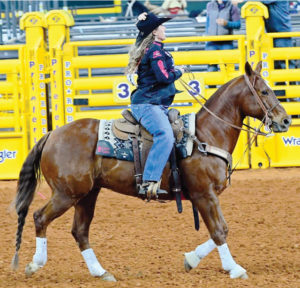
    “When I look back, it was God’s perfect timing on every aspect of my life,” said Shelley Morgan, the 2022 AMERICAN champion barrel racer. Winning $100,000 in Arlington, Texas, on March 6, was the most money she has won at a single event. She plans to take the money and “tithe 10% to the church and put the rest in my fuel tank.” The 49-year-old from Canton, Texas, has never craved the spotlight, but the stage she was on in Arlington was “pretty cool.” Canton is located an hour southeast of Dallas with a population of 3,805. Shelley grew up there and that is where she and Rex raised their two sons. Before competing in barrel racing full-time she taught school and coached basketball for six years.

    After winning the 2008 barrel racing title in the United Pro Rodeo Association, Shelley and Rex made the decision to buy her pro card. “I had a great horse, Short Go, and we thought we could have a run at the NFR.” Short Go and Shelley made that goal in 2009. “The first year was a huge learning curve,” she admits. “We were kind of dumb – we entered a lot, mapping out where we went according to the rodeos and their location. Short Go got off his feed and I learned about ulcers. We got all that fixed and then in 09 we were going for it all. The boys (Zach and Tanner) went everywhere with us.” Shelley describes the adventure as amazing. “To be able to do what you love and do and have your family there; what more could you ask for. I stole my husband from his job and we probably didn’t make any money, but it was great.” Rex had built his own company, Eagle Security, from the ground up and thanks to reliable help, he was able to go with Shelley and the boys.

    Shelley was 14th coming into the NFR in 2009, and finished the year 10th with $103,960. She placed in four out of ten rounds. In February of 2010, her run for another spot at the NFR came to a screeching halt. “I was at San Angelo; Lisa Lockhart and I had traveled back there from Tucson,” she explained. They turned their horses out in paddocks next to the arena and went to grab some lunch. While they were gone, Short Go kicked through the wooden panels and brought them down on top of him, breaking his back legs in half. “We sat there with him until the vet got there and put him down. I called my mom and dad (Bobby and Barbara Bridwell) who live in Canton. He loaded up his stock trailer and drove six hours to get him.” Short Go is buried outside the family’s arena.

    Without another horse, Shelley went home to start over again. “The boys had gotten to the age when they wanted to stay home and get involved in sports, so the timing was perfect,” she said. “I went to all their games and started looking for, buying, and training horses.” She competed locally and eventually found the next horse, Radar, to take down the road. “We don’t have the money to go buy big named horses,” she said. Shelley has ridden her whole life and started competing in high school, training all the horses she competed on. “We buy prospects and I train them.” The family has 220 acres including a 55-acre hay meadow. Together with her parents, they run 75 head of cattle, and Shelley has around 10 horses on the place.

    Her dad, along with other people they know, help find horses for Shelley to work with. When she found Radar, she admits she didn’t like him much. “That horse took up barrels like you wouldn’t believe and ran fast as lightning.” Shelley missed the NFR the first year aboard Radar by less than $1,000 – his feet got sore, and the duo had a hard time finishing the year strong. After that, Radar developed some bad habits, and it was back to searching once again for the perfect horse.

    Kiss is the mount that took Shelley to the pay window at The AMERICAN, ponied into the arena by her former mount, Radar, who has turned into a rock-solid pony horse. “You can drop his reins and do something with Kiss – he doesn’t mind her wallering all over him. Kiss likes him – and that’s important – Kiss doesn’t like just everybody.” Kiss came to the Morgan’s via a connection from her brother-in-law. “He contacted me to train two three-year-old’s; both by the same sire, but different dams. When they led Kiss out of the barn and up the driveway, he said, ‘this is going to be the next world champion.’ She was this tall lanky filly with not a big hip at all. I would not have bought her – she was just sent home with me. I got on her and I thought she was going to dump me in the dirt. A Brazilian had started her, but she hadn’t been worked with in almost six months. If I had walked up to a barn, I would not have picked Kiss out.”

    Within two weeks, Shelley changed her mind. “I knew she was the most like Short Go I’d ridden yet.” Their personalities were complete opposite, though. “Short Go was quiet and laid back; Kiss is high strung, moody, and doesn’t like crowds. I love her to death, but she is night and day different. They both trained themselves; natural from start to finish.”
    The timing is perfect for Shelley and Rex to hit the road again. The boys are grown and pursuing their own lives. “Zach (25) is working with the family company – he’s amazing and allows Rex to be gone and stay gone. He’s building a house – God knew all along what needed to happen with Eagle Security,” said Shelley. Tanner (21) is working while pursuing an education in the IT field. They both help take care of the place while Shelley and Rex are on the road. Rex and Shelley are high school sweethearts, meeting when they were juniors in high school. “He was a city boy,” admits Shelley. “His family came to the country, bought a calf roping horse and a few cows and Rex tried calf roping and team roping. I was a cheer leader, and he was a football player.” They dated for four years and got married in 1992. Rex went to college but didn’t go to class.

    “I had a job, but I didn’t like school,” he said. “I’m smart, but I didn’t try. I worked for an alarm company for 6 years and decided to open my own company. I took a pay cut for the first few years until I got it up and running.” Rex could have pursued team roping, but he devoted his time to Shelley, his family, and business. “My job on the road is to drive – I drive 99.9% of the time,” said Rex. “I do all her entering and help her on the road. I don’t do a whole lot at home with the horses, but I can fix a shoe and I can map out where we’re going. “When she wins, I win; when she loses, I keep my mouth shut.” Rex also helps keep Kiss calm when she’s being a dragon. “She likes me to rub her between the ears. Sometimes I’ll lead her away from Shelley when she gets too wound up – Kiss that is, not Shelley.”

    The couple will celebrate 30 years of marriage and while on the road they spend 24/7 together. The secret to their long happy marriage is simple.
    “She does what I tell her to do.”
    “He knows I’m always right.”

    Career Highlights
    • 2021 – Entered the Wrangler NFR ranked third with $94,229 and finished the year ranked 4th with $202,202 after winning $107,973 at NFR. Finished seventh in the average in a total time of 147.19 and placed in five out of 10 rounds
    • 2020 – Won $63,308 at the Wrangler NFR after placing in five rounds. Finished the year ranked 9th with $116,383.
    • 2019 – Finished the year ranked 29th in the world with $50,283. Won California Salinas, Longview (TX) PRCA Rodeo, the Rose City Roundup (Tyler, TX), the Great Plains Stampede Rodeo (Altus, OK) and Apache (OK) Stampede. Finished second at Oakley City (UT) Independence Day Rodeo and at the Rodeo of the Ozarks (Springdale, AR)
    • 2018 – Finished with $11,224
    • 2017 – Finished with $1,438
    • 2016 – Finished with $6,513
    • 2015 – Finished with $29,106
    • 2014 – Finished 17th in the world with $69,447
    • 2013 – Finished the year ranked 95th with $10,269
    • 2012 – Finished the year ranked 35th with $30,537
    • 2011- Finished the year ranked 48th with $24,433
    • 2010 – Finished the year ranked 34th in the world with $25,937
    • 2008 – United Professional Rodeo Association Barrel Racing Champion; 2008 Cowboys Professional Rodeo Association Finals – average champion and year-end reserve champion.

    Sponsors:
    5-Star Equine Products – Best pads ever created, create great support for my horses under their saddles, they are never back sore from saddle pressure and pads’ effectiveness as well as appearance hold up like new after years of hard day to day use. So many options to choose from to fit everyone’s style and needs.
    Eagle Security Systems – amazing clear cameras (even at night) on all my horses so I never miss a moment with my special equine partners as well as can keep an eye on the ones at home when I’m gone.
    Rock & Roll Denim/Panhandle Western Wear – keep me looking sharp in and out of the arena. Most comfortable jeans I have to ride in.
    Bluebonnet Feeds and Stride Animal Health – provides quality feed and supplements that I have been running Kiss on since the beginning of her career. Always one phone call away.
    Shiloh Saddlery – the best saddle I have ever sat in since I have started riding. I didn’t know I was missing out so much until I got my Shiloh.
    The Muffler and Hitch Shop in Canton – squeezes me in and helps me with all the accessories my truck needs to haul up and down the road, the gooseneck ball, bed liner, bumper replacement and best of all, big nice extra fuel tank….. troubleshoots any problems I have with my trailer .
    Western Dove – amazing tack set, my mom always says Kiss looks like she is wearing a sparkly crown!
    Resistol – giving us some of the most amazing hats at the NFR and American.
    There are so many more others who have been so key in helping my team succeed down the road, thank each of you so much, I appreciate each and every single one of them.

  • On the Trail with Briar Teague

    On the Trail with Briar Teague

    Briar Teague, from Rattan, Okla., makes his living with a rope. He is headed back to the Lazy E to defend his 2021 Cinch Jr. Ironman Championship. The 20-year-old is approaching the upcoming event as he approaches any event. “I’ve always had a natural way of not getting nervous. I don’t know if it’s from roping my whole life, but I know with each run I’ve just got to catch them – I do what I can with what I draw.”

    Briar has been on a horse since he was born. His dad, Philip, started roping when he was 27. His four sons, Briar, Clancy (18), Cutter (16), and Tryan (13), spent their childhood riding horses, roping, and raising cattle, including show cattle during their time in FFA. The family runs around 450 pairs on a few thousand acres outside of the small town of Ratton. There is one stoplight in the entire county. He graduated with a class of 20. Briar won his first buckle at the age of 3, winning the dummy roping at a USTRC roping his dad was competing at. He started competing in a youth rodeo, the OYRA, when he was 8 and a year later was competing at the USTRC ropings with his dad. He started with team roping (both ends) and breakaway roping, moving into calf roping, saddle bronc riding, and steer wrestling during his time with the Oklahoma Junior High and High School Rodeo Associations. He rode saddle broncs all four years of high school, making the National High School Finals (2017-2019) in that event as well as calf roping his senior year and team roping his sophomore, junior, and senior year. Riding saddle bronc riding started with encouragement from Wade Sundell, 8x WNFR qualifier in the saddle bronc riding. and a good friend. He didn’t pursue riding broncs after high school. “It helped me ride a bucking horse so that was good.”

    He started bulldogging his junior year, competing his last year in high school. Briar went to Tyler Pearson’s school and had never jumped a steer before. They did all the dummy work, and that afternoon, they jumped two steers and he threw both clean. They had a two head jackpot that he won as well. At the beginning, Briar used one horse, his dad’s heel horse, Casino, for all events. That horse gave his all to all the boys. As Briar got older, the family was able to buy other horses and today there are 30 horses on the place with specific jobs in the arena. Hard work and dedication paid off for Briar. He won the All Around title for the Oklahoma High School Rodeo Association in 2019 and 2020. Along with rodeo, Briar found success in FFA, showing cattle and pigs. He earned the State Farmers degree while in FFA. He played baseball as well as basketball.

    “We did this as a family,” said his mother, Misty. All six of them would into a living quarter trailer and spend weekends on the rodeo road. Having four boys kept Misty on her toes. “It’s probably better than raising four girls,” laughed Misty, a physical therapist who went from fulltime to part time so she could take care of four boys. “They are energetic and full of life. It took all of us – it was fun times and lots of work but well worth it.”

    “I’ve always tried to teach the boys that if you want something, you’ve got to work for it,” said Philip. “You can’t be afraid to reach your goals – you can’t sit back and play it safe all the time.” All four boys rope aggressively. “You don’t get anywhere running them three quarters of the way down the arena – that goes for roping as well as life – you’ve got to take your shots. I raised those boys to be confident – don’t let anyone tell you can’t do it and keep pushing forward.”


    Briar is a freshman at Western Oklahoma State College in Altus, Okla. He competes in Central Plains region where he is sitting in the top five in all the events, with the goal to make it to the college finals. After college, he plans to rodeo for a while and then come home and work for his dad. Most of his classes are online, and he spends several months in Arizona in the winter, roping every day. “This is my main source of income right now,” said the #7+header an #8 heeler. “I trade a few horses now and then, but that’s it.” He works his classes into his ropings. “If I miss a roping for class, it’s not a big deal there’s another one the next day.” He will be in Oklahoma the middle of February for his first Spring college rodeo and begin getting ready for the Junior Ironman March 10-12 at the Lazy E Arena in Guthrie, Okla.

    Preparation takes on many facets including heading to Tyler Pearson’s (5x NFR qualifier, 2017 World Champion steer wrestler) to find a horse to take to the event, and practice. Horses for calf roping and team roping will come from Briar’s herd. “I train a few of the ones I own – and ride a few colts. We have 8-10 colts at the house. We’ve raised a few and bought a few from online sales,” he explains about his horsepower. “I look for what fits me – size – bigger, I want something I can do both ends on. I’m not real good at breaking them, so I want something I can rope on.”

    “There’s a lot of God given talent but there’s a lot of hard work that goes into this,” admits Briar. “Plus the tremendous help I’ve gotten from so many different people. I hope my brothers will be able to look up to me and try to do the things I do just as good or even better than me.”

    “I work harder than most people and I’ve had a very supportive family to give me the resources to do what I love. I do it every day – you’ve got to get good at it eventually or you’d give up.”

  • On the Trail with Hailey Frederiksen

    On the Trail with Hailey Frederiksen

    Hailey Frederiksen, Miss Rodeo Colorado was crowned Miss Rodeo America 2022 on December 5th. The eight-day Miss Rodeo America Pageant was held at the South Point Hotel and Casino in Las Vegas, Nev. The pageant was last held in December of 2019 due to Covid. Like many of the 32 queens across the country, Hailey, from Wellington, Colorado, represented the Centennial State for two years. She is the sixth Miss Rodeo Colorado to win the coveted Miss Rodeo America title, last won by Tara (Graham) Rowe in 2001.

    Hailey grew up in the saddle; she ran barrels in gymkhanas and jackpots. Born and raised in Platteville, Colo., she was in 4H for 11 consecutive years showing market and breeding swine. “I was a pig gal,” laughed the 24-year-old. Through 4H, she learned responsibility, stewardship, and an appreciation for what farmers and ranchers do on a 24/7 basis. “A lot of our family friends and neighbors are farmers and it drove my platform to be an advocate for agriculture – which I did through my reign as Miss Rodeo Colorado.”

    Hailey started competing in dance in high school and had to make the tough choice between horses and dance. She picked dance and went through the ranks of competitive dance at the studio –which included a trip to Las Vegas to compete. “Even though dance is as far away from western as you can get, it taught me stage skills and confidence which is so important when competing in queen contests.” She switched her focus to Poms team. “I discovered I enjoyed that, so I transitioned into competing with my Poms team. We placed third in state my senior year.”

    Hailey’s first queen title was as had held one title previous as the 2009 Johnstown Saddle Club Princess. She spent the year traveling with her mom’s old barrel horse. “Puffy had a mind of her own, but she took very good care of me.” The pivotal moment in that reign happened at the Estes Park Rooftop Rodeo, where Hailey met the reigning Miss Rodeo America (Megan Ridley Hollinder) and the reigning Miss Rodeo Colorado (Audra Dobbs McNicolaus). “I wanted to be just like both of them and here we are.”

    She went to college at Colorado State University in Fort Collins, Colo., and realized how much she missed her roots. “Until you take a step back do you appreciate what you were able to grow up with,” she said. It was during her junior year in college (2018) she held her second queen title as Miss Rodeo Deer Trail. “That began my journey back into queening.” She rode a 4-year-old mare that her mom was working on making a barrel horse. “Honey was a rock star with flags, parades, and everything.”

    She tried out for the crown of Miss Rodeo Colorado twice (2018, 2019). “I knew I was going to be there,” she said. “Not winning fueled my passion to do better and win.” The critique from the judges was at the end of the day they didn’t know who Hailey was. “I worked hard the next year on being genuine, passionate and inquisitive … they must have seen the change, because they picked me the next year and again this year, as Miss Rodeo America.”

    During her two year reign as Miss Colorado, she spent the first year traveling to rodeos outside the state of Colorado. “When Covid first hit, we didn’t travel. My first rodeo back at it was Woodward, Okla., in June. Those small rodeo committees appreciated having us there.” She traveled with Miss Oklahoma, Miss Idaho, and Miss Kansas. “Putting ourselves out there helped us fulfill our obligation to represent rodeo and the western way of life.” She also created a Kids Corral, producing a video every Wednesday at 10 am. “I posted more than 40 videos of me reading kid’s books or interviewing rodeo personalities like Justin Rumford and Shali Lord. I interviewed my farrier, my vet and even did some kids crafts, I had a lot of fun with it and it kept me present as Miss Rodeo Colorado.” She plans to continue the Kids Corral as Miss Rodeo America.

    She is quick to attribute her win to her parents. “They have been there for me the whole time – I might be the one on center stage, but this title is as much theirs as mine.” Her parents instilled in her to work hard for whatever she wanted. “Everything I’ve put my mind to requires a bunch of work, When I was a dancer, I wasn’t flexible, so I had to work at it. I never had the best animals in 4H, but I knew if I worked hard and walked my pigs every day I’d get to where I wanted to be.”

    Megan and Trevin have been the biggest supporters of Hailey. “Dad works in oil and gas, and mom is a stay-at-home mom. She taught yoga and fitness ever since I was a baby, but her main job was being a mom.” They were both home quite a bit and helped Hailey with horses and whatever she needed. “I barrel raced growing up, but my dad put a rope in my hand and now I’m team roping with him. My dad taught me a good lesson when I’d get frustrated; there’s always going to be another steer in the pen.” He just finished the arena at their new place east of Wellington and now they can rope whenever they want, picking from any of the five horses that they own.

    Trevin has always believed in Hailey and told her before the competition. “Honey this crown does not define you – all those that love you know you don’t need to bring that crown home.” Trevin designed and built the two carts that carried all her very carefully picked out wardrobe for the competition.

    She spent many hours preparing for the Miss Rodeo America Pageant. “I am very OCD – and organized. I’d been packing for pageant for at least a month. I had all my outfits – 15 garment bags on one rack, and 17 pairs of Justin boots and 7 Greeley Hatworks hats on the other cart, a suitcase and a duffle bag. All in one trip. Appearance is one of the major categories of the pageant. “It tells the story of you – it took a year to figure out what I was going to wear. I worked with countless designers getting the clothes I needed for pageant. You only have 8 days to impress those judges.” The part of the pageant that she really enjoyed was the interviews. “We don’t get much one on one time with the judges. Those interviews were only 15 minutes.”

    Her first stop as Miss Rodeo America is the National Western Stock Show, where she will make appearances every day for 16 days. Then she’s off to Lake Charles, Louis. Her schedule is filling up. “She is worthy of whatever God has planned for her,” said her mother, Megan. “There’s no wrong or right – you pray it works out for the good – be healthy and happy is all we can wish for her.”

    “I can’t wait to see what lies ahead and the opportunities that will be available to me … I’m thrilled to see where life takes me next.”

  • On the Trail with Steer Wrestling 101

    On the Trail with Steer Wrestling 101

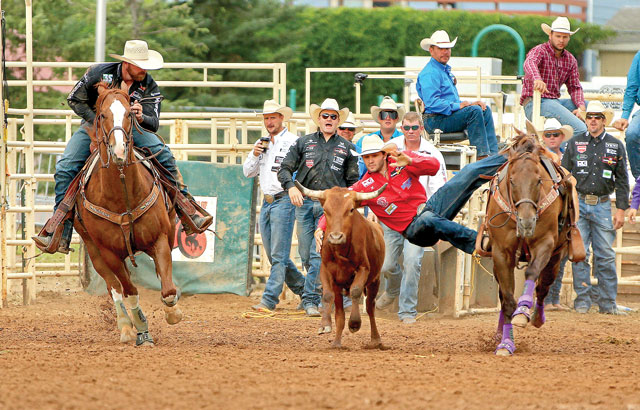
    Six of the 15 steer wrestlers at the 2021 National Finals Rodeo have two things in common. They’re all chasing the gold buckle, and each of them will be using the skills they learned in Tom Carney’s Steer Wrestling 101 program to try to win the world. Combined, these six cowboys are bringing 27 collective qualifications to the NFR and three world titles.

    “It’s huge, but I’d like to have more than half,” Tom said. “That’s a personal goal of mine. But, I’m just as happy to have a guy out there trying to get his first steer thrown down as I am about having six guys at the NFR. That’s where it all starts. I look at these guys and to see them get where they are is beautiful. I know where they came from and they were in my pen starting from scratch. How many am I training now that will be in that same position? I hope it’s all of them.”

    Jacob Talley, 30, finished the regular season No. 1 in the PRCA World Standings. He will be joined by Dakota Eldridge, 30, who finished third followed by Tyler Pearson, 36, in fourth. Tyler Waguespack, 30, ranked sixth for the regular season and Rowdy Parrott, 27, was 12th, followed by Tristan Martin, 25, in 14th.

    “Rowdy Parrott is the smallest guy at the NFR, but he’s one of the most powerful because his technique is so good,” Tom said. “On the other end of the spectrum, Jacob Talley is a workout guru and one of the most powerful guys out there, but we softened him up and don’t let him use his size. We made him smaller.”

    Tom grew up around rodeo and had legends such as John W. Jones Sr. guiding him and influencing his style. Watching how other cowboys steer wrestled and cherry picking the parts he liked is how he developed his own style, but that wasn’t his only source of inspiration. Tom was 10 years old when his 20-year-old brother died in a car accident.

    “He was my hero and so I said I’d be like him,” Tom said. “I wasn’t the athlete he was, but I stayed with it and gave it everything I had trying to be like him.” Tom enjoyed a bit of success as a steer wrestler, qualifying for the high school and college national finals rodeos.
    “But on the pro level, my students are better trained and better athletes. All of them have their own individual talents and strengths, so we don’t try to cookie-cutter them. Their styles are all a bit different but if you look at their basics, they’re pretty similar.”
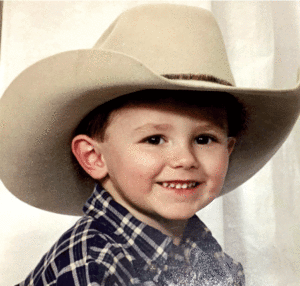
    Now 65, Tom is a Gold Card member of the PRCA. Unlike other sports, rodeo didn’t have a standard training program when Tom started Steer Wrestling 101 about 40 years ago. In 1989, Joey Roberts became the first of Tom’s students to go to the NFR and the list of steer wrestlers who went on to achieve great things continued to grow.

    “Last year we had nine state high school champions and that’s phenomenal,” Tom said. “Our style is advantageous to the smaller guys because we involve a lot of core strength. We have a lot of tools and it’s one the most efficient styles in steer wrestling.”
    Tom’s schools are typically held twice a year, one in Utah around Easter and one in Louisiana near Thanksgiving with about 40 participants. “My roster fills up within 30 minutes of announcing it online.”

    Tom also helps other schools around the country and pitches in with the college rodeo teams that ask for his guidance. When he’s not training steer wrestlers, Tom works for American National Insurance Company in Ruston, La.

    Tom’s training is from the waist down instead of the waist up, so footwork is imperative.
    “We’re one of the only schools to train from the waist down and that’s huge in our training,” Tom said, adding that he watches the footwork in boxing matches and the focus in the eyes of Olympic athletes. “Just watch the eyes of my guys. You won’t see any expression, that’s how Olympic athletes behave.”

    Unlike coaches in other sports, Tom didn’t limit his instruction to just scheduled time in the arena. He and his recently-deceased wife Tanya, T-Dog, brought the steer wrestlers into their home for extended stays while they perfected their craft. “She was such a big part of this because she would mother them and make sure they were fed right,” Tom said. “We had guys live with us for months and years trying to hone their skills and we’d take them in. She was like a mother to them, so it’s been quite a change not having her here.”

    Affectionately dubbed T-Dog, Tanya holds a special place in the hearts of each of the six steer wrestlers heading into the Finals as well as the rest of the cowboys she helped. “I’ll always remember the hospitality that he and T-Dog provided for me,” Dakota said.
    Pearson’s first time training with Tom was during his freshman year of high school and he recalls the impact she had.

    “He started us, but I think his wife had just as much to do with our success,” Pearson said. “Ms. Tanya was awesome and she’ll never be forgotten. She was the rock, the glue, that held everything together, that’s for sure. She was the reason I went back; she was a good-hearted woman.”

    Tyler Pearson’s coming into his fifth NFR (2013, 2017-19 and 2021). He won the world in 2017.

    “Pearson has great horses and is a great horseman — he’s just smart,” Tom said. “He bulldogs smart and has always been that way.”

    Dakota had already competed at the NFR three or four times before he got a chance to work with Tom. This year marks Dakota’s eighth NFR (2013-17 and 2019-21).

    “The first three years I made the Finals, it was off of having a great horse and athletic ability and the drive to win, and not so much technique,” Dakota said. “Before, I relied on my size and athletic ability but now I have just as good of a technique as anyone. Size and athletic ability are fine, but if you have all three it’s a great thing.”

    Dakota came close to claiming a world title after winning the NFR average in 2015 and 2017.
    “He breaks it down in a way that is very understandable and you can relay it to a lot of styles,” Dakota said, adding that he’s applied steer wrestling styles from a lot of people to his approach. “Tom was a huge part of bringing my steer wrestling to the next level of being consistent and knowing what I was doing in every run.

    Tyler Waguespack is entering his seventh consecutive NFR (2015-21). Winning the NFR average in 2016 and 2018 helped him win the world title both years. His dad, Mike Waguespack, would work with Tom and that played a big role in the young cowboy’s development.

    “Him and his wife, they’d go out of their way to help anyone at all; whether it was rodeo or not,” Tyler Waguespack said. “Tom was always willing to help and in a lot of sports there aren’t many people willing to go out of their way to help and he’s great at motivational talks. He’s a really good motivator. They’re two very special people to me.”

    Jacob started training with Tom in 2010 and this year marks his fourth time at the NFR (2016, 2018, 2020-21).

    “When I went there, I had no idea what to expect,” Jacob said. “I had ridden horses for fun, but nothing serious and not involved in rodeo. Tom’s program is so broken down into the baby steps where you can get all the little details figured out before you even jump your first one.”

    Rowdy is returning to the NFR after last qualifying in 2017. Growing up near Tom’s place, Rowdy has worked with Tom countless times since his freshman year of high school.
    “I definitely wouldn’t be where I am without his help,” Rowdy said. “I’m a smaller guy, 5-10 and 185 pounds, so I have to do it correctly and he teaches how to do it correctly.”
    Tristan got his start in steer wrestling by working with Tom when he was about 10 years old. Now he is celebrating his first NFR qualification.

    “Growing up, there was never a lot of steer wrestlers coming from the South, but now there’s more guys coming in from Louisiana and that’s a big statement in itself,” Tristan said.
    There’s no secret to their success as the Steer Wrestling 101 YouTube channel has been active for several years with instructional videos that were shot by Rob Pierce and are free to the public. Some of his videos have been viewed as much as 80,0000 times. Whether it’s in person or online, Tom breaks down the run and slows it down so that every aspect is fine-tuned, and then it’s on to repetition and dummy work.

    “You see if now with little guys sliding steers and making great runs,” Dakota said. “I don’t remember kids being able to technically bulldog like they do now at a young age. When I was in high school, it was grab them by the horns and wrestle them, but he has it down to a science and technique.”

    The game has changed over the years. It’s no longer just cowboys learning to steer wrestle as athletes from all walks of life are getting in the saddle.

    “They come from being football players and wrestlers, and it’s just amazing the level of talent we’re getting now,” Tom said. “We had to step our game up and take an Olympic approach where they train like those pros do.”

    In addition to the basics, Tom works on the finer details that fans in the stands might not be able to see.

    “Things like the eyes and facial expressions, things you don’t see in their runs but I do,” Tom said. “I teach them to breathe, just breathe. In weight lifting, the first thing they teach you to do is breathe but nobody was looking at that in our sport. We’re training athletes and not just cowboys.”

    Tom also helps competitors rehab after an injury, such as when Jacob tore his pectoral muscle.

    “I’m never satisfied with where we’re at, if we quit learning then I’m done,” Tom said. “I’m a sponge. I absorb it and try to implement it if it works; and we’re receptive to all kinds of styles. We never say a style is wrong. If you can take a style and win with it, then it’s all right. I teach my guys it’s not about trying to beat any steer wrestler, it’s about beating your steer.”

    He also trains the parents and coaches on the importance of positive reinforcement since maintaining an upbeat attitude is imperative in rodeo.

    The adrenaline rush draws them in, and the friendships are often why they stay since their competition is frequently hazing for them. No other rodeo event or sport does anything like this.
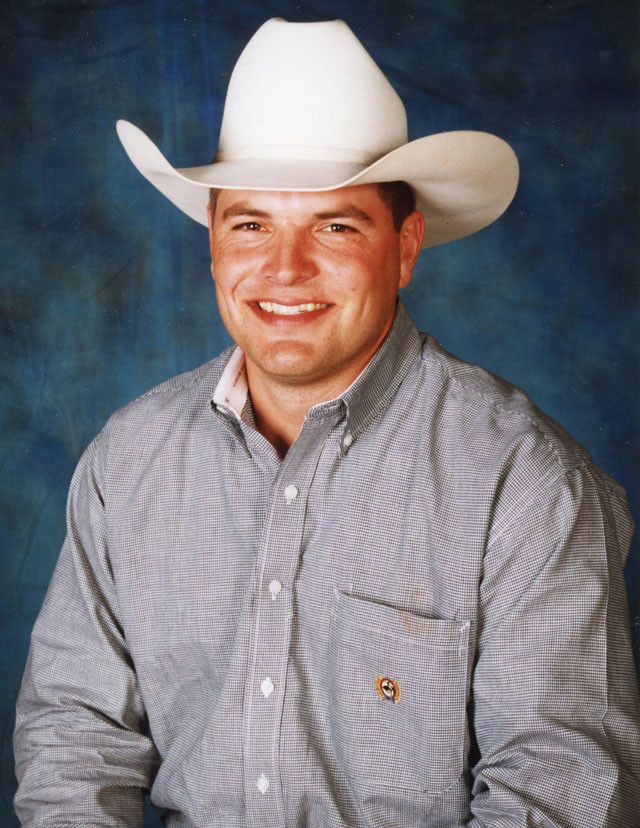
    “Not only are they good guys, but they’re good people,” Tom said. “The spiritual side of it is huge.”
    I love the steer wrestling mentality. They’re all pulling for each other and are such a big family. It has more camaraderie and there’s not a selfish aspect about it. I love that, and we demand it — helping each other, hazing, pushing steers and those things. That’s the biggest part of steer wrestling and that’s not how it is in the other events.”

  • On The Trail with Creek Young

    On The Trail with Creek Young

    A framed $25 check for winning the first mutton bustin’ he entered at only two-and-a-half years old hung on Creek Young’s wall for years.

    As a kid, Creek’s grandma, Lois Porter, would read to him from Gary Paulsen’s series, “Tucket’s Travels,” about a boy in the mid-19th century and his adventures in the American West.

    Now, the cowboy from Rogersville, Mo., is living a 21st century version of those tales with a bull riding twist that’s taking him to the 2021 National Finals Rodeo.

    “He’s kind of an old soul so that’s where the nickname Old Man River comes into it,” said Creek’s friend and mentor, Denton Fugate, referring to Creek being a fan of Lil Wayne. “It’s not as modern as it was a few years ago I guess.”
    His aunt, Michelle Porter, didn’t know about the nickname yet her description of Creek was identical, but for very different reasons.

    “When he was little, he’d ask very deep questions and he was like an old man in a young man’s body,” Michelle said. “He loves his quiet time and is contemplated and focused. He has a strong moral compass and has this wisdom about him that’s like an old man. It’s impressive.”

    Creek blew the competition out of the water in the race for PRCA Rookie of the Year with $143,511 and finished No. 4 in the PRCA’s world standings.

    “Last year, I left the house with $10,000 and hoped I’d win enough to keep going,” Creek said. “By the middle of the summer run, the dollars were stacking up. Breaking $100,000 was pretty cool.”
    Denton watched Creek progress through the Missouri Family Rodeo Association and the Junior Pro Bull Riders-Missouri.

    “He has a really strong mental game but it took him a little longer to get the basics down because he’s always been taller than the average kid; but that’s hard for me to judge because I’m 5-6,” Denton said.

    At 6 feet tall and 150 pounds, Creek is taller than most of the 2021 NFR bull riding roster.
    “I don’t feel like I’ve ever had a problem or rode different because I’m taller,” Creek said. “I have more arm to give on the bulls and that makes it easier.”

    His journey on the other hand, has been anything but easy.

    Creek was born to Randy Young and Raneé Porter-Young on Nov. 15, 2000. Randy was a bull rider and bullfighter, but he died when Creek was a toddler.

    “I love bull riding for my own reasons,” Creek said. “I never connected it with him because I was so young. I love it for my own reasons because I had to find my own way.”
    His mom passed when he was 11 years old. But, every cloud has a silver lining and Creek’s was arguably better than gold.

    His aunt Michelle finished raising him while his rodeo family continued to grow. Michelle didn’t know anything about rodeo, but was determined to support her nephew’s dream.

    He also has two half-sisters and a half-brother who are several years older than him, Najee Donson, Derrion Donson, and Bailey Young.

    “I have an extended family, a rodeo family,” Creek said. “When my mom passed, people stepped up and made me feel better.”

    He listed Mollie Howard and her grandson, Josh Steele, both of his grandmas, Lois Porter and Barbara Young, his aunt and uncle, and a long list of friends and family including Charlie and Shanna McDonald family.


    Charlie and Shanna McDonald family – Creek 13 years old is back row on the right with his friends Kelly McDonald and Quincey McDonald – Shelby Chante’ Photography

    “I don’t know if everyone understands how it (rodeo family) works, but I feel like it’s more common here than people think,” Creek said. “Maybe that’s because I’ve always done it.”

    While growing up, Michelle encouraged Creek to participate in football, basketball and track. Although he did well, it was clear that he wasn’t passionate about it.

    “I could tell he did not light up the way he does at his rodeos,” Michelle said. “It was so clear to me that I decided by sophomore year this isn’t that important. He knows where he is going and has strong friendships and is a well-rounded 15-year-old. So, I let it go and we shifted gears to ‘let’s make it happen,’ and he did.”

    Getting better and seeing his hard work pay off helped him grow into the bull riding powerhouse fans know today.

    “I wasn’t very good as a freshman and struggled with staying on,” Creek laughed. “I was always a little hesitant and scared when I was younger, and I did it anyway.”

    His fear faded over time and changed into a craving.

    “It got to where I always wanted to do it so I practiced all the time,” Creek said. “That was a turning point in my young career and that’s when I took it seriously.”

    He would get on practice bulls every Sunday and Wednesday with Quentin Vaught in Crane, Mo.
    Creek believes sophomore year is when he started to get serious and that’s about when Denton noticed something was different about Creek.

    Denton realized Creek has what it takes to go pro.

    Creek qualified for National High School Finals Rodeo his freshman and sophomore years of high school.

    “It was a cool experience and I made a lot of friends,” Creek said.
    Making friends and expanding his “rodeo family” has been a key component to his growth and success.
    He competed with the IPRA, and won the year-end and the rookie of the year titles with the ACRA in 2018.

    “I went to as much as I could for amateur rodeo,” Creek said.

    As his 18th birthday approached, Creek and Michelle sat down and discussed his plans.

    “I told him, ‘you know you want to be a bull rider and you live and breathe bull riding, so why wait until the spring to be riding if you can graduate in December and get started,’” Michelle said.
    His brilliant mind helped propel him onto the ProRodeo scene by graduating half a year early from Logan-Rogersville (Mo.) High School.

    “I doubled up pretty good on classes,” Creek said. “I just wanted to get out and be able to rodeo on my permit. There were some spring rodeos I wanted to go to and I didn’t want high school to interfere.”
    Creek made his ProRodeo debut by tying for fourth at the Sandhills Stock Show & Rodeo in Odessa, Texas, in early January 2019.

    “I remember vividly that it was a different feeling,” Creek said. “I was super excited, and just being a young kid at a ProRodeo was pretty exciting. I did well at it, so that was even better.”
    Creek moved to Fort Scott, Kan., to live with his friends while on his permit.
    “I was never broke, but I wasn’t living on a lot during my permit seasons,” Creek said.
    This year was a different story.

    Michelle speculates that COVID-19 putting a pause on his ProRodeo endeavors only fueled the fire.
    “Being able to get back out there and really do as much as he could possibly do without restrictions was exhilarating for him,” Michelle said.

    The 2021 season started slow by Creek’s standards, placing second at the RAM Prairie Circuit Finals Rodeo for $1,475 in mid-October 2020 followed by a few hundred dollars at the Brawley (Calif.) Cattle Call Rodeo a month later.

    In November 2020, he scored his first big win at The Egg Xtreme Bull Riding Event in Oxford, Miss., for $4,004.

    “That was the first X Bulls I ever won and was my biggest win at the time,” Creek said. “I went to the Finals (NFR) and watched one perf and that was really cool, and that’s when I noticed I was serious about making it and not wasting my rookie year.”

    Creek hooked up with Trey Kimzey over an online game of “Fortnite,” and the two decided to travel together for the 2021 season, starting in San Angelo, Texas.
    Bigger wins followed, such as $15,000 at the Tri-State Rodeo in Fort Madison, Iowa, in September.
    “I watch him on the Cowboy Channel and read the articles and it’s just mind-blowing,” Michelle said. “It feels a little surreal that this is happening and I’m just so excited for him. He’s worked hard to get here.”
    Creek nailed a 90.5-point ride on Bar T Rodeo’s Exit Strategy to win the Strawberry Days Rodeo in Pleasant Grove, Utah, in mid-June.

    “I wanted to be sitting good enough at the end of the year to not stress about having a perfect Finals,” Creek said.

    He was no longer the same bull rider who finished third in the permit standings with $24,584 in 2020 and 13th with $17,025 in 2019.

    “I felt like I went pretty hard both years on my permit, but not really since I just stayed close to the house,” Creek said. “I started taking it seriously since I knew I couldn’t get my rookie year back if I messed around.”

    Messing around simply isn’t in Creek’s character.

    As a young child, Creek would repeatedly watch and study his old VHS tapes of Lane Frost and Tuff Hedeman.

    “I know little about the rodeo world, but Creek is so calculated and has thought it out and you can see it in his riding,” Michelle said. “That gives me peace and confidence in his abilities.”

    Creek was one of only a handful of bull riders to qualify for the 2021 ProRodeo Tour Finale in Salinas, Calif., where he raked in $12,316 to finish his rookie season with an exclamation point.
    Most of his earnings were invested back into rodeo, but he saved quite a bit of it. Now his goal is to keep improving.

    “I’m fourth this year, so then I want to be in the top three next year,” Creek said. “I feel inspired by what I could achieve. That’s what inspires me to keep going and try hard. I have a good start to what could be a good story eventually.”

  • On The Trail with 2021 ProRodeo Hall of Fame Inductees

    story by PRCA & Siri Stevens PHOTOS COURTESY OF PRCA, Jackie Jensen & Rodeo News

    CODY OHL
    Tie-Down Roper
    Inducted 2020

    Cody Ohl blazed into the ProRodeo ranks in 1994 by winning Rookie of the Year and his first trip to the National Finals Rodeo. The young Texas roper had been planning his career since he was 15 and winning National High School Rodeo awards.

    It would take Ohl a few years to win his first gold buckle. He edged out Fred Whitfield to capture the 1997 Tie-Down World Title by $5,031. To prove that first win was no fluke, Ohl roared through 1998 and captured a second title.

    Ohl had another record-setting year in 2001 as he added steer roping and team roping to his agenda in order to compete for the All-Around title. In the ninth round of the Finals, Ohl missed his calf on the first loop. A second loop caught the calf by the hind legs. As Ohl dismounted, he twisted his knee, tearing two major ligaments. He managed to crawl to the calf, cut the rope, stand and flank the calf, and finish the tie with a time of 40.3 seconds. Ohl had to be carried from the arena by the Justin Sports Medicine Team. However, he had amassed enough money earlier in the week to secure both the tie-down title and the All-Around title. He accepted both buckles from crutches on the 10th night.

    Not one to stay inactive, Ohl battled through rehab and was back on the rodeo trail late in 2002. He continued to win and qualify for National Finals Rodeos, capturing his fifth and sixth tie-down roping titles in 2003 and 2006. He only missed one Finals appearance between 1994 and 2014. He entered an elite group when he passed the $3 million earnings mark in 2012.

    World Championships: 6 (tie-down 1997-98, 2001, 2003, 2006; all-around 2001)
    Born September 21, 1973 in Rosenburg, Texas.
    From the Induction:
    Due to a staph infection in his leg, he was represented by Kendra Santos. Cody roped at 20 National Finals Rodeos, earning 2 of his six buckles after obliterating his knee in the ninth round of the 2001 NFR. It took the better part of the year to recover from that and he came back and won two more titles. In his 20 plus years, his earnings of $3.5 million, second only to Trevor Brazile, makes him the highest money maker in calf roping history. He has taken home 55 National Finals go round buckles.

    SUNNI
    DEB BACKSTROM
    Contract Personnel
    Inducted 2020

    Sunni Deb Backstrom grew up with a stopwatch in her hand. No doubt encouraged by her mother Ellen, a three-time National Finals Rodeo Secretary and first woman to sit on the PRCA Board of Directors. At age 13, Backstrom made her debut as a rodeo secretary in Augusta, Montana. Since she did not have an RCA card, she had to receive special permission from RCA President Bob Ragsdale to work the event.

    Backstrom joined the RCA in 1968 as a timer while she was still in high school. After graduation in 1971, she was issued a secretary, timer, and contract act card. Backstrom quickly rose to become one of the best in the business. She has worked for many rodeo companies over the years including Flying U; Kesler, Ltd.; Rafter G; Jim Shoulders Rodeo Company; Bad Company; Linger Company; and B Bar J Rodeo. She joined the Cervi Championship Rodeo Company fulltime in 1979. In the course of a year, Backstrom works about 120 performances across the country at some of the most prestigious rodeos including Denver, San Antonio, Houston, Nampa, and Waco.

    Backstrom is the most decorated rodeo secretary in ProRodeo history. She has won PRCA Secretary of the Year 10 times and WPRA Secretary of the Year twice. She has also worked the National Finals Rodeo 17 years as secretary, three years as timer, and one year as the office manager. She has also worked four PRCA Tour Finales.

    Backstrom has dedicated her life to the betterment of the sport of rodeo.
    Born May 11, 1953 in Butte, Montana.

    From the Induction:
    “I’m not good at this, I’m used to being in the background. 26 years ago I stood up here and accepted this award for my mom, never thought I’d be here again. Things that are important to me are important to me. My dad bought his RCA card in 1948. Mom bought her timers card in 1960. Dad picked mom up from the hospital when I was 3 days old and off we went to Miles City Bucking horse sale. On my birth certificate, it has a spot for occupation of the father, he was a professional cowboy.

    Mom would give me a stop watch and a day sheet, I would time the rodeos when I was 6. By ten, I was in the saddle on a big black horse carrying the American flag in the grand entry. At 13, I secretaried my first rodeo – most rodeo offices were temporary, many in Montana were in bars. I took entries and drew stock in a bar at 13 years old.
    I did everything from carrying flags, taking care of the saddle horses, secretarying rodeos and even driving a load of bulls through Montana. I ran the roping chutes, picked up, flanked in flip flops, ran barrels, and team roped. I was one of two in the production department at the first NFR.
    That’s what rodeo gave me – my friends and my family.”


    RANDY WITTE
    Notable
    Inducted 2020

    Randy Witte always had an affinity for rodeo but didn’t get a chance to participate in the sport till he went to Colorado State University, where he majored in technical journalism and found the CSU rodeo club. He was befriended by Jerome Robinson, a sophomore who was “majoring” in bull riding, and before long Robinson was tying Witte onto bulls, offering instruction and encouragement.

    Witte enjoyed his days of competition in college rodeo, and in the Rodeo Cowboys Association, but he knew early on his future was as a rodeo writer, rather than rider. He sold his first magazine article to Western Horseman in 1968. “Judging Rodeo’s Bucking Events” was based on interviews he did with saddle bronc rider Jim Wise, World Champion Bull Rider Freckles Brown, and World Champion Bareback Rider Jim Houston.

    While still in college he worked a couple summers as a cub reporter for the Denver Post, and got the plum assignment to cover Cheyenne Frontier Days for the paper in 1968. Witte was offered the job as director of the R.C.A.’s Rodeo News Bureau when he graduated college in 1970, and for the next seven years he enjoyed publicizing ProRodeo with news releases, press kits and recorded radio programs. There was a need for an editor of Rodeo Sports News in early 1976, and Witte was able to also get out the association’s paper for the next two years.

    In late 1977, Western Horseman magazine offered him a job — they needed someone who could write knowledgeably about rodeo. He accepted the offer with one condition — that the PRCA not be left in a bind when he left. This was easily granted, and Witte transitioned gradually from one office to the other. By then, the R.C.A. had become the PRCA and Rodeo Sports News had become ProRodeo Sports News. Witte continued to write about rodeo for the next 29 years. During that time he served as editor, and later, as publisher of the magazine.

    Born January 28, 1948 in Denver, Colorado.
    From the Induction:
    “I have many good memories working in a little red brick building in Denver 50 years ago. I had a job as soon as I graduated from college. Our biggest day of the week was Monday; rodeo secretaries would phone me at home Sunday nightand I would record the results and I’d go to the office and I’d bat out a little news release. When the news release was done, we’d stuff them in envelopes and send them all over the country. I had to get the sacks of mail down to the train station before five. I never missed a deadline. I covered the groundbreaking celebration of the PRCA hall of fame. At the time this was the first building that went up in this area of Colorado Springs.”

    BUTCH KIRBY
    Bull Rider
    Inducted 2020

    Gary William Kirby, better known as Butch, started his rodeo career at age four when he joined his brothers in a trick riding troupe led by his mother, Mildred. By 16, he had changed his specialty to bull riding. Kirby credits the agility and balance of trick riding as helping with his transition to rodeo’s roughest event.

    In 1973, Kirby earned his first trip to the National Finals Rodeo at age 18. (At the time, the youngest qualifier in any roughstock event.) It would take a few more trips to the Finals before Kirby earned his world title. In 1975, Kirby and his brothers, Sandy and Kaye, became the first three brothers to qualify for a National Finals Rodeo in the same year. Kirby finally won his title in 1978 in a battle against reigning champion Don Gay. He won $15,000 at that Finals, placing him in the top spot. (In 1978, World Championships were determined by money won at the National Finals Rodeo.)

    Kirby would make three more trips to the National Finals Rodeo before transitioning to his third career in rodeo. Kirby began judging rodeos to earn money while recovering from an injury in 1987. He became a Pro Official in 1993 and has served in that capacity at many of the major rodeos in the country. He has been a National Finals Rodeo Official for 30 years.

    Through this long and decorated career, Kirby has participated in every major rodeo as either a contract act, bull rider, or judge.

    World Championships: 1 (1978)
    Born April 24, 1955 in Woodstown, New Jersey.

    From the Induction:
    My heroes have always been cowboys, and all my heroes are here in the Hall of Fame. Mom didn’t realize she was training me to be a bull rider. I don’t even know if I was shaving at my first NFR. Neal and Miss Kay helped me get on some practice bulls in Mesquite. Neal nodded for me because he knew I wasn’t going to nod. I got on a lot of practice bulls that day.

    Mom gave me $50 to go to San Antonio – ended up third in the world when I left Houston. By May, I dropped to 14th, and realized it was hard. Bobby Steiner got me to the NFR – you’re only as good as the company you keep. Bobby was great to me.


    G-65 GRATED COCONUT
    Livestock
    Inducted 2020


    G-65 Grated Coconut is a testament to the Born to Buck Breeding program of the Calgary Stampede Ranch. His mother, Coconut Roll, was a ten-time National Finals Rodeo qualifier. His sire, Wyatt Earp of Northcott Rodeo, was voted Saddle Bronc Horse of the National Finals Rodeo in 1997 and 1998.
    Grated Coconut became a dominant force during his career. Of his 114 outings, 37 cowboys hit the dirt, 25 scored in first place, and 29 finished in the money. If a cowboy was lucky enough to stay aboard for eight seconds, he usually won money. His prowess in the arena earned him six Bareback Horse of the Year titles (2003-04 and 2006-09), tying with the great Descent. He also earned six Canadian Champion Bareback Horse titles (2003-05 and 2007-09).

    Retired at the top of his game in 2010, Grated Coconut is continuing the Calgary Stampede Ranch Born to Buck program. Of his children, at least 45 are competing at the top level of rodeo athletes with several qualifying for both the National Finals Rodeo and the Canadian Finals Rodeo.

    For a horse feared by many cowboys, Grated Coconut was very social and gentle outside the arena. He enjoyed scratches from the cowboys before competition and has even let toddlers sit on his back. Grated Coconut became a top rodeo animal ambassador. Visitors to the Calgary Stampede Ranch were able to socialize with him before watching him explode into a rodeo arena. The pairing of his power and intelligence truly made him one of the great rodeo athletes.
    Born 1997 in Hanna, Alberta.


    JIM SUTTON, JR.
    Stock Contractor
    Inducted 2020


    James Sutton, Jr. could have chosen a very different path at the end of his college career. The young South Dakotan was drafted by the Minneapolis Lakers and he attended their preseason training camp. However, he believed following his father and grandfather in the ranching and stock contracting business made more financial sense than a basketball career. In 1968, Sutton joined his father in creating the Sutton Rodeo Company. They supplied stock from their Onida, S.D., ranch to rodeos across South Dakota and the Northwest. By the late 1970s, Sutton was raising more than 90% of his own bucking stock and developed a breeding program that is one of the best in the business. The program has produced three PRCA Horse of the Year winners: saddle bronc horse Deep Water (1979), bareback horse Big Bud (1985), and saddle bronc horse Chuckulator (2012). Chuckulator also won Top Saddle Bronc Horse of the National Finals Rodeo in 2012. Their horses and bulls won all three categories at the Badlands Circuit Finals Livestock of the Year Awards in 2011. The program has also earned Sutton four nominations for PRCA Stock Contractor of the Year.

    In 1978, Sutton started the Black Hills Stock Show and Rodeo. It has been nominated as Indoor Rodeo of the Year 15 times and won the award twice, 2002 and 2003. To draw attendance to the rodeo, Sutton created the Wrangler Bull Fights, the Bailey Bail-Off, World Championship Wild Horse Race, Bull Poker, and Teeter-Totter. Sutton’s pageantry and showmanship earned him National Finals Rodeo Opening Ceremony credits in 1995 and 1996.
    Sutton and his wife Julie won the PRCA Donita Barnes Lifetime Achievement Award in 2016.
    Born April 20, 1935 in Onida, South Dakota.

    From the Induction:
    “It all started with my granddad with a rodeo on the ranch in 1927. We had 60 palomino horses and ¾ of them bucked the cowboys off. The whole operation is a family operation – there are three grandsons and a granddaughter putting on a rodeo while we are here. Julie couldn’t make the trip and I’d ask for you to say a prayer for her.”


    ELLENSBURG RODEO
    Rodeo Committee
    Inducted 2020

    Nestled in the center of Washington State in the Kittitas Valley (land of plenty and no fighting), Ellensburg – called ‘the rodeo city’ – has become one of the top destinations for cowboys and cowgirls near the end of the regular PRCA season. The rodeo started in 1923 when local businessmen, farmers, ranchers, and townsmen began to feel the tug of nostalgia as airplanes, moving pictures, and automobiles started replacing the Western lifestyle. The Valley was settled in the 1870s – the rodeo came out of the local competition. At the time there were 50,000 head of cattle in the county. The rodeo will celebrate 100 years next year – they missed three years, two due to WWII and last year.

    Held over Labor Day Weekend each year, the Ellensburg Rodeo is an important stop in the series of Northwest rodeos, hosting around 400 contestants.

    The Ellensburg Rodeo is held on the historic rodeo grounds at the base of Craig’s Hill, and the Yakima Indian Nation has always participated. With a fulltime population of 21,000, this “Rodeo City” hosts one of the highest paying regular season rodeos, paying out more than $486,000 two years ago. Since 2009, Ellensburg has served as the finale for the PRCA Xtreme Bulls Tour.

    “We started the first PRCA stand alone single event in 2001(Xtreme Bulls),” said Rick Cole, the longest serving board member and arena director. There are 17 people on the committee and three to four hundred volunteers. “This in an honor for the community – without the selfless dedication of all, this event could not occur.”
    The committee has had three Justin Committeeman of the Year Awards: Ken MacRae (1998), Joel Smith (2007), Steve Alder (2013). These awards highlight the commitment of the 100% volunteer-run organization. In 1997, the Ellensburg Rodeo Hall of Fame Association was founded to preserve the history and traditions of this nationally renowned rodeo.

    “Being named into the pro rodeo Hall of Fame is really humbling and a huge honor. It’s a dream come true. We believe we put on the best rodeo,” said Jerry Doolin, the president of the committee, who has been a volunteer for more than 20 years.


    MARTHA JOSEY
    WPRA Barrel Racer
    Inducted 2020

    Martha Josey qualified for the National Finals Rodeo 11 times on six different horses across four consecutive decades. She won the WPRA barrel racing world title in 1980 on Sonny Bit O’ Both, the same year the duo also won the AQHA World Championship, a feat unmatched at the time of induction.

    A highlight of her career was competing in the rodeo exhibition during the Cultural Olympiad at the 1988 Winter Olympic Games in Calgary, Alberta, that pitted the United States against Canada. Josey would ride away with an individual bronze medal and helped Team USA win the team title.

    Josey was a true all-around cowgirl riding bulls, broncs, cutting horses, tying goats and roping calves while competing in all-girl rodeos. In 1969, Josey won the reserve All-Around World Championship Title in the Girls Rodeo Association.

    Not only did she make a name for herself in the arena but also gave back to the sport through her countless clinics. She and husband, R.E. Josey, started conducting barrel racing clinics in 1967 at their ranch in Texas and in 1981 began producing an all youth barrel race aptly named the Josey Jr. World Championship. Many of WPRA’s world champions credit Martha Josey with helping them achieve their goals. Her clinics grew to average over 2,000 students annually with students ranging in age from five to 80 and many returned yearly to participate in the annual Josey Reunion Barrel Race.

    In addition, Martha and R.E. were involved in creating new and innovative barrel racing saddles, pads, protective boots, knot reins, and combination bits. The result has been increased safety and barrel racing skills for all barrel racers throughout the World. No doubt Josey made a big impact on the sport of barrel racing.

    World Championships: 1 (1980)
    Born March 11, 1938 in Longview, Texas.

    From the Induction: “Rodeo is making America great again – such a great honor.

    When I was a little bitty girl, my first word was I want a horse. My dad was one of the first four directors of AQHA, he brought 36 mare to Texas. He passed away when I was 10 and mother had to sell all the horses except one old stallion. I went to a rodeo in Shreveport – saw the American flag come out and I watched the barrel racing and knew then that I belonged in the arena. I wanted to be a barrel racer. I went home and got on my dad’s old roping saddle and that stallion and went to the field to run barrels.

    I was trying for my fifth decade of running at the NFR, when the gateman shut the gate in front of me. I had a collapsed lung and other serious injuries and was in the hospital for three weeks – said I would never walk or ride again. That was in March, and I made the short go in Greeley in July.

  • On The Trail with Jim Boy Hash

    On The Trail with Jim Boy Hash

    The Hash family refers to themselves as weekend warriors on the rodeo trail. But Jim Boy, his wife Jessica, and their teenage sons Jaylyn and Jaytyn, are one of the driving forces behind the rodeo world in the Midwest. Through coaching, competing, training horses, raising goats and WNFR-bound broncs, and driving hundreds of miles a year, they give back to the sport that has given them a lifestyle they love.

    Kendall, Kansas, is home base for the Hash family, but they are equally at home at NIRA, KPRA, and NLBRA rodeos. Jessica’s grandparents, Otis and Shirley Jennings, started J&J Rodeo Company in 1978, and Jessica and her three younger brothers grew up helping fill any need at the KPRA, Little Britches, high school, and ranch rodeos their family produced. “My mom was in charge of cooking the meals and taking care of the kiddos,” says Jessica. “My brothers and I did a lot of the preparing the cattle beforehand. When Granddad got a new set of cattle, we’d track them through and rope them.” Jessica competed in the NLBRA in all the girl’s events and though she jokes she was primarily added money for the other goat tyers, she excelled in trail course and breakaway roping on a horse her grandpa purchased as a bucking horse. She and Jim Boy met through Little Britches and saw more of each other at KPRA, amateur, and college rodeos, where they started dating. “I went to Colby for my first two years of college and then followed my boyfriend to Panhandle State. Our joke is that Jim Boy was from Texas, so I thought he had money.”


    Jim Boy grew up in Canadian, Texas, and went to the Texas High School State Finals in steer wrestling and saddle bronc riding. He competed in the NHSFR in steer wrestling in 1990, and began his college rodeo career at Murray State College in Tishomingo, Oklahoma, that fall. Afterward, he transferred to Oklahoma Panhandle State University in Goodwell, where he won the steer wrestling in the Central Plains region in 1993 and 1994, and qualified for the CNFR from 1993—1995. His team finished second in the nation in 1993 and third in the nation in 1994. Jim Boy also competed on the PRCA Prairie Circuit, and he was asked by his rodeo coach at OPSU, Dr. R. Lynn “Doc” Gardner, to stay on as the assistant coach after Jim Boy graduated in 1995. When Doc passed away in 1996, Jim Boy took the assistant coach position at Cochise College in Douglas, Arizona, where the women’s team qualified for the CNFR in 1997.

    Jim Boy packed his bags again, this time bound for Garden City Community College in Garden City, Kansas, in 1998. He started as the assistant coach and has remained there since, becoming the head coach in 2003. Covid shut down most of their season in 2020 and Jim Boy took the opportunity to spend more time with his family. There are 11 students on his team this season and he’s excited about some new changes at GCCC. “This will be huge for us—we are revamping our stalls and can accommodate more horses, and increasing our scholarship budget. We have a few more kids lined up for next year and that will be a huge bonus to us.”

    “He cares a lot for the kids,” adds Brock Baker, the assistant rodeo coach at GCCC since 2008. “It’s important to Jim Boy to have good kids and for them to take care of business and get through school, and to leave a better person than they came. That’s something he’s always cared about is that they get a good start in life. Rodeo is important but life is more important.” Several GCCC alumni that Jim Boy coached have gone on to the WNFR, including Emily Miller, Cort Scheer, and Casey Colletti. “From Garden City, those kids have gone on to every major university,” says Bronc Rumford, the head rodeo coach at Fort Hays State University. “Jim Boy’s touched a big part of the rodeo world during his career. He does the bucking horses as a hobby and he’s raised some NFR horses. He’s had his hand in all aspects of the rodeo world. Anybody knows that when you go to a rodeo that has his goats, there’s going to be an even pen.”

    Jim Boy’s oldest son, Jaylyn (19), joined the Broncbuster nation at GCCC this rodeo season as a freshman, competing in steer wrestling, team roping, and tie-down roping. “I’m used to my dad being at practices because he was always at the house with us,” says Jaylyn. “He’s been pretty patient with me and wants me to live like a college student athlete on the rodeo team.” Jim Boy even invested in some property near the college recently, which has several barns, stalls, and runs. Jaylyn is staying there with his horses, camping in his grandma’s trailer. Rodeoing and his recent trip to the 2021 Cinch Jr. Ironman keep him on the road most weekends, however.


    It was Jaylyn’s first time to be invited to the Jr. Ironman, where he ultimately finished as the reserve champion by .8 seconds. He competed with nine other contestants in three rounds of steer wrestling, tie-down roping, heading, and heeling. Jaylyn felt his runs met with varying degrees of success—he tied for first place in the third round of tie-down roping with an 11.1 after switching horses—and went into the final day aiming for second place. “I was trying to do the math in my head and saw that Briar (Teague) was five seconds ahead. After the bulldogging I was too long, but I never would’ve known I’d come so close to winning by .8 seconds.” Jaylyn’s 22-year-old steer wrestling horse, Cooper, also won the Lone Star Ropes Top Horse Award during the event. “My girlfriend’s family came down, and I hung out with my team roping partner, Jordan Lovins. That was the first time we roped together, and he was great. My dad, brother, mom, and uncle Daylin came and watched, and my other family watched it on the Cowboy Channel.”

    Jaylyn went to his second college rodeo in Fort Scott, Kansas, immediately following the Jr. Ironman, and by his third rodeo in Durant, Oklahoma, accomplished one of his goals by making the short round in steer wrestling. “The very first goal I set was to at least make one short round my freshman year. Another goal was to beat my dad, who made it to his first short round in his fourth college rodeo. I made it to my first short round at my third rodeo.”
    Along with college rodeo, Jaylyn is competing in his last year of Little Britches and plans to enter KPRA rodeos. He’s also pursuing a career of more guaranteed money in bullfighting, which he started working as a freshman in high school, taking after several of his uncles. Jaylyn works for his family’s J&J Rodeo Company and Medicine River Rodeo Company, working about 20 rodeos a summer. In 2020, he was awarded KPRA Bullfighter of the Year. “That’s where my heart is now. Ever since me and my brother were young, we’d go to Tractor Supply and buy bulls and horses and toy semitrucks, and we’d put marks on them and pretend we were stock contractors. We would like to do that someday; we’ll see what happens. I’m going to major in athletic training. Once I’m retired from bullfighting, if I want another job, I can go into the Justin Sports Medicine and stay around rodeo.”

    “I’m very thankful my boys rodeo,” says Jessica. “I feel like kids learn so much responsibility and gain so many friendships. They learn to be patient and how to be a caregiver to their animals, or a teacher. When we first started this venture of children, Jaylyn did not want to ride horses or rodeo. We decided then as parents we need to support them in whatever they love to do. Jaytyn on the other hand had a rope in his car seat at all times—that was his binky. Rodeo was it from the beginning for him.”

    Jaytyn (15) is a freshman, competing in KHSRA, Little Britches, and the Young Guns Timed Event series. He does tie-down roping and ribbon roping, while team roping is his favorite. “My brother is really pushing for me to steer wrestle,” Jaytyn adds. Like his older brother, he plays basketball, football, and baseball in high school. He took a break from basketball this year and enjoyed roping at the college with his dad’s team and helping pick up broncs. Jaytyn likes to train horses, and says he noticed horse prices were on the rise and decided to start training horses, selling them to make money for college and the jackpots he wants to enter. One of his current project horses is part Arabian. “Somebody just dropped him

  • On The Trail with Colten Fritzlan

    On The Trail with Colten Fritzlan

    The 20 year old just won RFD TV the American in the bull riding with a show-stopper ride aboard Chad Berger’s Safety Meeting. “He had me bucked off a couple times and you ask yourself how bad do you want to win and I’m glad it worked out.” Colten now lives in Lipan, Texas. “I’ve lived in Texas for the past three years; there’s more opportunities for me down here and I wanted to be around it as much as I could.”

    Winning the American was a dream come true for Colten. “When the American started I was in high school and it’s always stuck out to me as somewhere I’d be and to win it was always something I wanted. To put it all together and come out on top – I was blessed to get it done. The Lord put that in my path to win and I’m glad he did and looking forward to weekends to come.”

    The win put $50,000 towards the PRCA standings and $100,000 in his pocket. “I’m savoring how to spend it I’ll put some toward my place or just whatever I need.”

    Colten grew up in Rifle, Colorado, learning to ride at a young age. When Colten’s interest in roughstock turned serious as a seven-year-old, the Fritzlans delved into buying and selling mini bulls, steers, and bulls.


    He competed in the National Little Britches, placing the first year he went. He made the short round in the team roping the other two years. The most instrumental for his bull riding comes from his mom, Velvet, who has been known to pull his bull rope, and his Dad, “I was blessed; whatever I needed I had, along with the responsibilities. Really a person I look up to is Kody Lostroh. I got around him at a young age. We had a rodeo Bible camp every year – He’s a world champion and one of the best guys I’ve met – and always wanted to be like him.”

    Kody taught rodeo Bible camps throughout his career and spent times with Colten at those camps. “I know that Colten is one of those kids that never missed an opportunity to practice so whenever we were bucking bulls he was there,” said the 2009 PBR World Champion Kody Lostroh. “The great athletes that have gone before me have always been my heroes and that inspired me – Colten grew up watching me and I was always around to help him.” Kody resides with his family, Candace, and two daughters, Sheridan and Odessa, in Ault, Colorado, raising bucking bulls and he has a small metal fabrication business. He also guides hunters in the winter – Comanche Wilderness Outfitters, where he is the mountain lion guide. “I’m so proud of the work he’s put in to get to where he’s at. He didn’t get where he is by luck, he’s put the work into it. I’m happy for him and his future.”

    Colten attended college at Western Texas College in Snyder. “It’s a great fit for me,” he said. “That school took care of me really well.” He went there for two years and under the guidance of coach Greg Rhodess, he learned how to take the sport of rodeo as a business. “He taught us how to be strong on the mental side. You get around guys like that – get the job done until it’s done – it ups your confidence and determination.”

    “Individuals like Colten separate themselves from the rest of the pack,” said Greg, who has been coaching for 24 years at Western Texas College. “It didn’t matter what needed to be accomplished he was all in. I don’t think he did any pick up duties before he showed up here and by the end of the first semester, he became handy at it. No matter if it was school or practice, he was all there. He never had to be told something twice – once he decides to nod his head it’s to get the job done.”

    On the physical side of things, Colten hits the gym every once in awhile, but he stays busy. “I don’t slow down at all. I ride horses, pick up bucking horses, and rope. I’ll do drills around the house.” Colten was always better at bull riding because he’s worked at it the most. “Bull riding is my favorite since I’ve been doing it the longest, but I also like that you’re not just competing against the animal or another competitor, but you’re bringing those forces together and seeing how it comes out when you make eight.”


    He admits to doing the other events to stay busy. “I don’t like standing around; I wanted to be a cowboy, just not a bull rider. Riding broncs and roping kept me from sitting around all day waiting to get on.” He competed as a wrestler until he was a freshman in high school. “I had a bad elbow injury and I had to get serious about my bull riding. I could wrestle for four years, or get it healed now and rodeo for the rest of my life.” Colten has had four surgeries on his elbow.
    Last year was his first trip to the NFR, placing 10th, riding 7 out of ten; and winning the average as well as Resistol Rookie of the Year. “I just knew I belonged there and I didn’t want to blow up anything – keep it as simple as I could, knowing my job at hand and that’s it – do my job and win. I’m glad it all worked out.”

    When Covid hit last year, Colten was trying for Houston. “I was 16th in the world. We were out of rodeo for a month or two. It drove me nuts – I didn’t want to be there or liked being there. I stayed in the gym and kept going to the practice pen. I knew when there was a rodeo to be at, I would be.” Cave Creek was his first rodeo back and he won second and it continued from there. He broke his jaw in July and the injury took him out of some of the summer rodeos. “I got jerked down and broke my jaw on both sides – they put plates and screws in my mouth. It wasn’t fun, but what I did during that time is hang out at the house, rode my colts and horses, and worked on my ranch pickup.”

    His win at the American will help keep him in the lead heading into summer. “I want to win a world title,” he concluded. “I didn’t get my bulls rode last year – they give you ten head and I fell short of riding all ten.
    The long term plan for Colten includes “a big old ranch with a bunch of horses and cows. I’d like to have some good pick up horses as well as a set of bulls for kids around to learn off of.”

    In the meantime, his advice to the younger generation coming up is to work at it every day. “It gets you down, and that’s when you get up and try harder. Don’t quit and keep going.” Colten knows that first hand. He was plagued with injuries at a younger age. “I couldn’t ride anything or anywhere. It was rough. I knew it was for a bigger reason and I got a hold of some different people to change my mentality and here we are.”

  • On The Trail with Jackie Crawford

    On The Trail with Jackie Crawford

    Multi-talented Jackie Crawford won the 2020 WPRA (Womens Professional Rodeo Association) Breakaway Roping world title by less than $2,000. Her performance at the first ever Wrangler National Finals Breakaway Roping held in Arlington, Texas, propelled the 38-year-old to win her 20th (WPRA) World title. This isn’t her first Breakaway World Championship, she has won the WPRA title in 2016 and 2014. She is the second most decorated member of WPRA, trailing the late Wanda Harper Bush, also an inductee of the ProRodeo Hall of Fame, who won 32 titles during her rodeo career. Jackie’s other titles have been in All-Around, Team Roping, Tie-Down Roping plus she also barrel raced.

    The National Finals Rodeo, held in December happened to coincide with Jackie being six month pregnant with her daughter, due in March. “At first I wasn’t sure if I would compete. It was a bittersweet feeling because we have worked so hard and been on this journey to bring breakaway to this level; so to watch the inaugural year from the sidelines would have been tough. After much discussion with my family, doctor, and prayers, I told myself as long as I was comfortable, I was going to compete!”

    Jackie makes her home in Stephenville, Texas, with her husband, Charly; their daughter, Kaydence, age 16; and three year old Creed. The 38 year-old said, “I cut the horn off my saddle, to protect the baby. I trust my horse, T-Boy, so much and had so much confidence in him.” She had continued to compete three years ago until she was five and a half months pregnant with her son, Creed.


    The National Finals Breakaway Roping event was ten rounds, then they took the top eight into a shoot-out round, followed by the top four. Jackie managed it all. She even went back to the judges in Round 5 and admitted she had an illegal catch (the calf’s back leg in the loop) that the judges did not catch. The judges listened and changed her score to a ‘no-time’. But in spite of her honesty, winning $25,536 with two go-round wins, and placing in four rounds, she came out on top, with a total for the year of $47,185.
    Jackie thought the National Finals event was an awesome time. “I was suppose to be on that journey . . . what a way to end on a high and take a break!” She and Charly have named the ‘soon to be born little girl’ Journey.

    “My mom (Annette) and dad (Mark Hobbs) rodeoed in Illinois. My dad and his brother are the only two to win the National High School Finals Team Roping from Illinois.” Jackie explained that her mom cut the middle out of a foam pillow, for the saddle horn, and that is where she rode. Her mother was well known for training barrel and roping horses and she was inducted into the Murray State College Rodeo Hall of Fame. “You can’t have a cake without the ingredients – in other words, it took a good work ethic, dedication, horses, coaches, and sacrifice – you have to be willing to put it first,” said Annette, who got her work ethic from her dad.

    Jackie began competing in junior rodeos in barrel racing, poles and flags. When they moved to Oklahoma she added roping. “I was drawn to it – I was meant to be a roper. I turned my barrel horse into a roping horse. I started competing my sophomore year in high school.”

    Before they moved to Oklahoma her mom worked at Fairmont Park Race Track in Collinsville, Illinois. In Oklahoma she went to work for Blue Ribbon Downs, in Sallisaw, while she studied to be a radiologist. Jackie began working there cleaning stalls when she was 14. She got her pony license at 16. “To this day I have scars on by body from ponying horses. It taught me to appreciate a good minded horse and what those horses are, and what they do and how athletic they are.”

    Her first team roping horse came from the track. “I team roped and barrel raced off that big impressive bay gelding,” she said. “I sold him to buy my first truck – a 1996 extended-cab Dodge. It was the coolest thing in the world to me; I got to go to college from that horse.” She had several full scholarships from colleges in her area of Oklahoma. “Wanting to be the best and being so competitive I wanted to go to the toughest place there was. I knew the southern region was the toughest region. I took a scholarship for less money to go to Vernon Regional Junior College, Texas.” As she expected the competition was something she’d never seen before. She did win the NIRA Breakaway Roping Championship which helped the Women’s Team win that year, as well. “Iron sharpens iron and that was my mentality.”

    Jackie then went on to Tarleton State University, in Stephenville, TX, with her best friend in college, Tessie McMullan Doyle. They pushed each other every day to become better competitors. Their women’s team won the National title their senior year, 2005
    After college she went to work for Lari Dee Guy, in Abilene, TX, riding colts training roping horses, whatever was necessary. She admits she learned a lot. In 2009 Trevor Brazile won the calf roping and team roping on Sans Diamond Shine at the World Show and the owner of the horse sent us a bunch of that stud’s colts to train. “They were all good horses and I bought T-Boy out of that group,” she said. At first they didn’t get along. “He was so quirky, and we went through a battle,” she admits. “I had the feeling there was something about him – he isn’t fancy. He was a problem and hard to get to work, but he had an ability to win.” When he was five she took him to Joe’s Boot Shop that had a five-header and he won. He has been taking her to the pay window for a decade. Today she says, “He’s just a phenomenal horse. I don’t think anyone can dispute the fact he’s probably the highest money-earning horse ever in breakaway roping. He’s just a winner.”

    Jackie met Charly through the roping world. She was dating a mutual friend of his. “I thought she was a buckle bunny,” said Charly. “It turned out that wasn’t the case at all. We became friends and had a lot of things in common. One year she needed a head horse for the World Series Finale in Vegas so I let her use one of mine, and it went from there – I could tell right way it was a fit.”

    Charly started roping at a young age in Canby, Oregon. He roped with his dad and made it to the National High School Finals three times. He graduated in 1996 and went to Central Arizona College for two years. “I got my PRCA permit when I was 17 but didn’t have enough horses to really compete.” He bought his PRCA card in 1998 and won the Resistol Rookie (header) of the Year in Team Roping. He’s made 10 appearances at the National Finals which included 2020, when he and his partner, Logan Medlin, won the 7th go-round. He plans to slow down and concentrate on his family, his roping schools and clinics. “I’ve gotten five heelers to the NFR so I figure I better take that talent and use it to put on schools and lessons. My daughter wants to make the UPRA and CPRA finals this year so I want to help her as well as help Jackie however I can. I’m good with being a good dad and husband.”

    Jackie graduated with a degree in Business Administration, which she admits has helped her with communication, sponsorships, and everything else that goes with rodeo. She has hired Cheyenne Britain that acts as Jackie’s ‘right hand man’. “She helps me saddle, unsaddle, drive and everything in between. “I hired an agent and a social media person,” Jackie explained. Charly and Jackie are restructuring their program so they can do the things a replacement can’t do. “Nobody can replace a mother, a dad, wife, husband or a competitive roper,” she said.

    Creed has grown up in the arena. “We have huge play areas set up inside a 10×20 chain link fence; slides, jungle gyms, etc.,” said Jackie. “In between horses, we play and do what we need to do.” The plan is to keep going. “Our biggest goal as a family is not to be broke cowboys – rodeo doesn’t have a 401K.” Jackie’s initial goals were to be in the conversation of the greatest women ropers in the world and get inducted into the Cowgirl Hall of Fame. Now that the doors are opening to breakaway roping opportunities, her goals are changing, but in the end she wants “to know that no matter what, I’ve accomplished the things, I’ve worked for. I did it and stamped my place in history … a sigh of relief that the first NFBR is in the books. Let’s rock on and keep this ball rolling. I’m so fortunate to do this – I get to be with my kids. Even though we are working, we are all together as a family all day. How many people get to say that.”

    “My vision for myself is continuing to help put this sport in a position that when I’m too old to do it, I’m sitting in the gold buckle seats watching my daughters roping at NFR.”


    CHAMPIONSHIP WINS
    2020 National Finals Breakaway Roping
    2016, 2014 Womens Professional Rodeo Association (WPRA) Breakaway Roping
    WPRA All-Around 2019, 2018, 2016, 2015, 2013, 2011, 2010, 2009 & 2008
    WPRA Team Roping 2016, 2014
    WPRA Tie-Down Roping 2014, 2013, 2011, 2010, 2009, 2008

    2003 National Intercollegiate Rodeo Association Breakaway Roping for Vernon Regional Junior College
    2003 National Woman’s Team for Vernon Regional Junior College
    2005 National Woman’s Team for Tarleton State University
    2000 Oklahoma State Champion Breakaway Roper
    2020 Betty Gayle Cooper Ratliff Fast-Time Award see story on pg 43
    Sponsors:
    American Hat, Ariat, Smarty, Hay Chix, Classic Equine, Rattler rope, Classic rope, Martin Saddlery, LubiSyn, Chute Help, Plaza Hotel and Casino, Total Feeds

  • On The Trail with Rider Kiesner

    On The Trail with Rider Kiesner

    Rider Kiesner has performed in every state and 15 different countries. “When I turned nine I got a Will Rogers trick roping kit for Christmas,” said the 29-year-old from Ripley, Oklahoma. Rider grew up as a fifth generation cowboy on his dad’s side and third generation on his mom’s side. He was competing in Youth and Little Britches rodeos, winning his first buckle when he was just 5 years old. Today he is a two time World Champion All Around Western Performer, four time World Champion Trick Roper, as well as a two time World Champion Gun Spinner. He has performed at the NFR seven times as well as the Ram National Circuit Finals and several circuit finals.

    He mastered the art of trick roping by pushing the living room furniture back and watching instructional videos over and over until he mastered each trick. “My dad (Phillip) trained Arab English horses and had as many as 30 horses in training.” His great great grandfather leased out horses and had a turn of the century full city block, three stories tall. The bottom floor held all the horses; the second and third floors were for the wagons. He leased out horses to all sorts of companies that needed horses to deliver things.


    “My grandfather would stop at wherever the train would stop and unload ten teams, based on whatever the logging camp needed.” said Phillip. “They would check them in and go to the next one. He had around 2,500 head of horses in Northern Minnesota that were used for loggers.”

    Phillip’s dad trained saddle bred horses in the late 60s and 70s, and then switched to Arabs – that’s where the money was. Phillip grew up training horses. He also competed in high school rodeo in saddle bronc riding. He met his wife, Julie, who was the Minnesota High School rodeo queen and qualified for the National High School Finals all four years and was state champion in barrel racing. They met when they were 24 and 25 and married within a year. They took a job training Arabs in Oregon and got into cutting and reined cow horses. “We moved around a lot training quarter horses,” said Phillip. “Rider was born in California. Roper was born in Colorado.” Phillip trained out of Randy Dunn’s (Bath Brothers Ranch) ranch in Laramie and trained for notable breeders as the Merritt’s in Laramie, Wyoming.

    Rider had gone to kindergarten in Laramie, the school was 30 miles west of Laramie and there were 13 kids enrolled. “They taught us to say yes ma’am and no ma’am,” said Rider. The family moved to Penrose, Colorado, and bought a house with 80 acres, where they continued to train horses and give riding lessons. After Sept. 11, 2001, it all stopped. “We got one gift each,” said Rider, whose gift was a trick roping set. The family was forced to sell their place and start down another path. “We started doing a mini Wild West show at rodeos. Dad started with cowboy mounted shooting, adding clowning and I would do rope tricks, and Roper did the trick riding. That’s how we made a living until I was 18.” The family booked enough little rodeos to fill their card. By 2005 the family was working some of the most prestigious rodeo in the PRCA. Not only did the family spend four months in Bejing, China in 2004 producing rodeos, but “my dad produced the first rodeo in Lebanon. It was really fun.” The family did everything during the rodeo. “I was the bull fighter .. we were in charge of the back pens and competed in every event … that was in 2010 – I was 18 Roper was 16.”

    Julie’s role was throwing props, occasional mounted shooting and keeping it all together. She also kept all four paint horses white along with the four white shirts. She also home schooled both boys. “I’d bathe them in the mud and snow – we lived on the road full time for ten years – we started with a four horse trailer with a four foot dressing room. The only splurge we did was an air conditioner … we all slept in the gooseneck of that trailer. It was the time of our lives .. we were all together and we had everything with us. It was absolutely phenomenal.” Julie still competes in barrel racing.

    “I am certain that God has a bigger plan … none of this would have happened if we hadn’t gone broke after 9/11,” said Phillip. “It was such a huge blessing – unanswered prayers… there was nothing I could do. It opened up the world to all of us.”


    They got their pro cards as team ropers. “I always thought I was going to be a team roper, but God had other plans.” Roper rides saddle broncs – and has gone to the Prairie Circuit finals 8 times. He makes knives (see page 114) The brothers often end up at the same rodeo. “We played golf and tennis yesterday.”

    Rider has added barrel man and clowning to his skills. “I was so bad as a clown at the first…I’m not funny and I don’t want to die.” He’s gotten better at it over time. “I do all the walk and talk – I try to make my own twist on it – I do fire eating and juggle – I’ve been doing that since I was six. I was also the 2012 Kansas State YoYo champion, so I do that too.” Rider remembers hearing Flint Rasmussen saying he made his own twist on rodeo clowns, so Rider took that to heart. “I like to perform – I have a lot of tricks and props and jokes.”

    The pandemic has been challenging for Rider. “I lost all my rodeos, but I got on the phone and hustled to get some other rodeos. I did a handful of rodeos and that filled in the gap. I did a lot of driving – from Florida to Montana. I had a better year than most, so I’m grateful.” He performed at the Cervi ranch last month. “Cervi is one of the biggest stock contractors that hired me – that was a pretty short notice and he called me up and asked if I would do it. He didn’t have to have acts – so for him to have me and perform at his house – he’s one of many stock contractors that have done a lot for me. I felt like I was performing at Dances with Wolves … it was awesome.”

    Rider has been nominated for Coors Man of the Year as well as nominated for Dress Act of the Year for the seventh year. “I’ve built a truck with a stage on it; I’ve got pyro on it, and I do a lot of trick roping on my horse. Bethany and I are on the road, so I’ve got all the acts as a bigger wild west show act … just like I did as a kid. Without God, none of this would be possible.”


    Bethany Iles

    “He’s the guy I’m going to end up with,” said Bethany Iles, who started 13 years ago as a trick rider. “My family was not rodeo – we had the white picket fence house.” After taking horseback lessons at 9, for about three months, the lady who was her coach now was about to get married and they put on a little trick riding show for the people trail riding. “My twin sister (Brittany) and I decided that’s what we wanted to do. We took lessons from her and about a year later we were doing some rodeos around Missouri.” When they were 18, they started trying to get their pro card. “She had a couple wrecks; she broke her back and neck and that stopped her trick riding.”

    Bethany went out on her own and has now joined up with Rider. “We have a lot of the same goals – dress act of the year and always to be better. I’m always working to improve to be better at what I do. Both Karen Vold and Linda Schotlz inspired me. I love God and He has been a big part of what we do. I want to be a light for Him and being an example is what I want to do.”


  • On The Trail with Ky Hamilton

    On The Trail with Ky Hamilton

    Ky Hamilton grew up in Mackay Queensland, Australia. “I actually grew up in town. My mom (Sharell) and dad (Micheal) had a house in town. My dad’s family lived three and a half hours south on a ranch – so I got to do cowboy stuff on the school holidays and stay with them. It was great.” Ky’s time in town was spent playing rugby and racing motocross with his brother, L’Koi. He also spent time watching PBR on TV. His dad drives a garbage truck, and his mom is a teacher’s aide. He rodeoed in America for the first time at the Junior High School Finals in Des Moines, Iowa, when he was 15.

    “I was always interested in bull riding,” admits the 20-year-old sophomore at Sul Ross University. “I bugged my dad enough to let me do it. I started riding steers when I was 12.” Ky and his dad did a lot of traveling chasing down the rodeos – from one to three hours for one rodeo. “He drove me everywhere- it was always me and dad on the road.”


    His determination to make it to the number one spot in the PRCA was instilled by his father. “This isn’t a sport that you can be half-hearted in – you’ve got to be 100% or it isn’t going to happen.” He learned the technique from his dad and Troy Dunn (1998 PRB Champion – only Australian). “He helped me out when I was 15 and he took me a lot further in it.” When Ky turned 18, he started doing the PBR in Australia. “I did that for about six months and then moved here.”

    “I always wanted to ride bulls professionally from the states and win a world title. I thought college was a great way to get started. CJ got a hold of me and offered me a scholarship and it’s opened a lot of doors for me.” He compares the caliber of the bulls here to those in Australia. “The bulls are definitely a big difference. I’d say 6 out of 10 at home are good, here it’s 9 out of ten. Over here there are so many events to go to and the money is bigger. I didn’t get to ride as much in competition at home as over here.” He admits to missing his family and not much else. He hasn’t been home since he came over two years ago. “My parents have come over here.”

    “He is probably one of the hardest workers I’ve ever coached in 14 years,” said CJ Aragon, his coach at Sul Ross State University in Alpine, Texas. “He’s a really good student in the classroom and the arena. Everything he does is at a high level.” CJ shares Ky’s workout routine at the University. “He goes to CrossFit at 5:30, and then runs up the hill – the hill behind campus is a mile and a half up to the top – basically the equivalent of 50 flights of stairs. We’ve gotten to where we can do it in 9 minutes to the top.” After the hill, Ky goes to the gym with the steer wrestlers and then he goes to classes. “If he is heading out to rodeos, he turns his work in early and stays on top of it.” One of his classes is with CJ – Event management and Planning. “He’s one of those students that is coachable. He wants to be good and he’ll work really hard at it. On the dash of his truck is a book – Mind Gym – and he’s read it a few times.”


    Whenever his travels take him close, he stays with Cody Lambert, who qualified for the National Finals Rodeo nine times between 1981 and 1993, consisting of seven trips in bull riding and three trips in saddle bronc riding. In 1992, he was one of 20 bull riders who helped establish the PBR; he’s been selecting bulls for the organization’s events ever since. “He’s a really good kid that’s worked hard and come a long ways in the year and a half that I’ve known him. I’ve gotten to know his parents and they are really good people that have instilled a work ethic and a level of respect for people – and appreciation – I can say he’s represented his country and his family and his sport really well.”

    Ky has a few online only classes that he can do while heading to rodeos. He is in his second year at Sul Ross, majoring in Industrial Technology – learning everything from welding to woodworking, small engine repair and industrial drawing. His real love is riding bulls.

    “I like it so much; when you love something that much, you do whatever you can to be better at it. There are a handful of guys out there that will go down as great – if I want to beat them; I’m going to have to work at it very hard.”

  • On The Trail with Malcom Heathershaw

    On The Trail with Malcom Heathershaw

    Malcom Heathershaw will spend the next few months healing up from breaking both bones (ulna and radius) in his left arm. “I drew a pretty wide stud and I was the first one out. I was three seconds and my stirrup on the left side snapped off – it sling-shotted me off the left side. My body weight folded my left arm. I tried getting up – it hit me like a bullet.” He had surgery where they inserted two plates and now is healing.

    The Quinn, South Dakota, cowboy started riding steer saddle broncs in junior high and got on his first saddle bronc in eighth grade. He got his start by his dad (Mike) and other family members. “I have a lot of cousins that do it.” The biggest thing that helped me this year was a new practice that has been set up in New Underwood, SD. Louie Brunson started a weekly practice deal and everyone came down and provided us with a chance to get better. There have been a lot of rough stock coaches and pick-up men that have come to help. It was there that I really made a change for the better last spring. If you stick to it long enough you can always change the outcome of your goal.”


    “I can relate that to my dad. His parents weren’t big on rodeo and he grew up learning from his older brother and mainly taught himself. He was very talented in his younger days – went to some pro rodeos – but as he got older he went to amateur rodeos and was in it for the sport of it instead of the world title.”

    “These older guys are giving back to the younger boys,” said Mike, who ranches and raises commercial cattle and Quarter horses. Mike helps several of the boys in his community. “I just liked to ride and they kept paying me for a little while in my younger days. I got to know and helped a lot of the younger boys get started back in the day and now they are giving back to my son. You can’t teach them anything on their back, but once you get them staying on, it’s another level.” Mike hopes that Malcom will pursue college. “We are paying for his tuition on the installment plan. I can throw things at him and he learns. He’s about to go to the next step and take advice from his cousins, who have won many Saddle Bronc Titles themselves, Cash Wilson and Jeremy Meeks.

    Along with a commercial cow herd the family owns Rockin T Quarter Horses. “We raise 15 to 20 baby colts a year,” explains Anita, a Title 1 teacher at Wall School in Wall, South Dakota. “In August, we take the colts up to the shed and spend three or four days halter breaking them. We do it slowly and then we sell them private treaty – we get a lot of repeat customers. My dad used to raise horses, his goal was to raise good looking buckskins.” They raise horses that can be used on the ranch or rodeo. “Our goal is to raise some nice bloodlines and good looking horses.” Malcom gets on the younger horses and gets them going good.
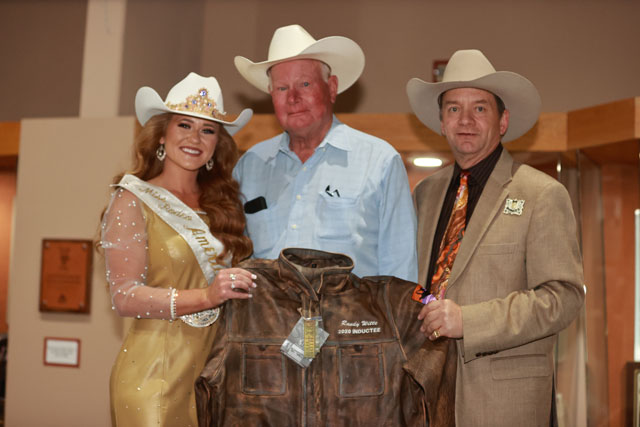
    “It’s a lot of fun,” said Malcom. “It’s a humbling experience doing that – it carries on to people – you’ve got to be able to read stuff to work with animals and it helps me deal with people.” Malcom is a junior and heads to school at 7:30. He used to drive in with his brother, Matthew, but since Mathew plays football, they take separate cars. They both drive older model Cadillacs. His classes include science, English, history, and math. “I’m a history buff, so I like that class.” Matthew and Malcom are a year apart, with their birthdays falling July 18 and 19.


    Matthew is a calf roper. Both boys started in steer saddle bronc riding and roping calves. Once they got to high school, they each chose to focus on one event – Matthew stuck with tie down roping and Malcom went with saddle bronc. Riding broncs has become Malcom’s passion – growing up he excelled at football and basketball and is a very good student. “You’ve got to find your passion and he’s developed such a passion and a drive for saddle bronc riding – he thinks about it all the time,” said his mom, Anita. “When he started riding this spring he was really struggling, his dad, who is his main coach and who has mentored many young cowboys worked hard at trying to figure out the problem. He ended up getting a bigger saddle and that seemed to help a lot. His dad and he are so dedicated to get where he wants to be.”

    Malcom ended his year fourth at state finals. His year started out rough – with the help of the practice pen and a new saddle, he got better each time he rode. At Nationals he ended up fourth as well. “I knew I was placing pretty good going into the short round and knew if I I just stayed on, I might get up there because the horses in the short go were tougher. I was ready to do good. My horse was probably one of the better horses I’ve gotten on; nice and smooth and even and I could show him off a little more.” It didn’t sink in that he ended up fourth in the nation for a few hours. “I was in awe that I got that far.” His goals for the future are to get better at rodeo, go to college, and keep performing at a higher level. “I know I want to continue to rodeo and work at the same time but I want a steady job to pay the bills.”