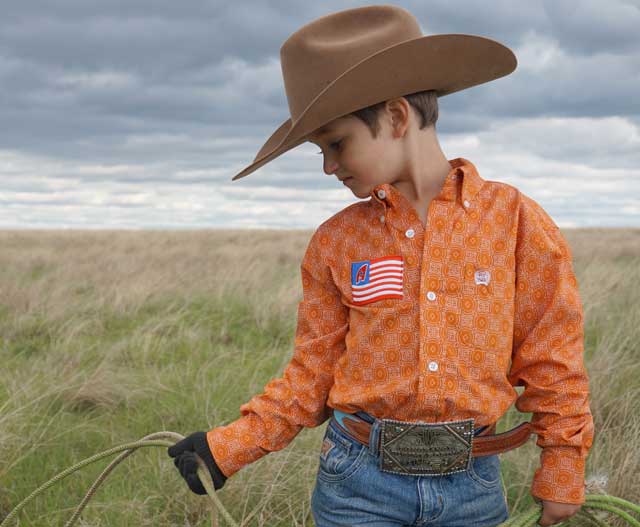
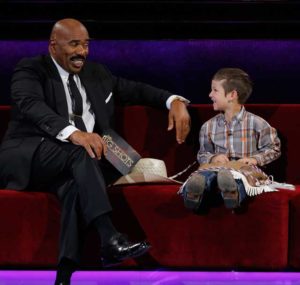
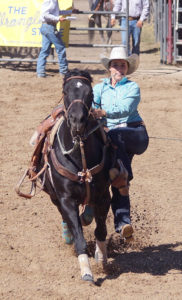
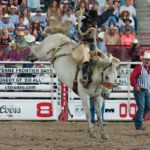
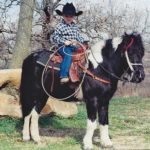
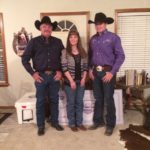
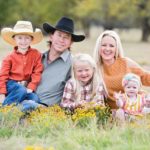
Blayze on the Little Big Shots show with Steve Harvey – courtesy of NBC
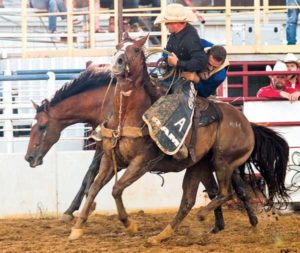
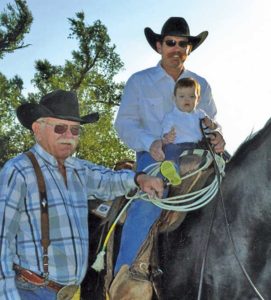
What is a real cowboy? According to Blayze Fallis, a real cowboy takes care of his ranch, takes care of his horses, and takes care of each other. “It’s not what you’re wearing, it’s what’s in your heart,” says the 6-year-old cowboy from Cashion, Oklahoma. Blayze captured the hearts of America with his appearance on Little Big Shots the end of March. The show was called “There’s a new sheriff in town” and Blayze tried to teach Steve Harvey how to rope. “As soon as I saw him, I wanted to rope with him,” said Blayze of his trip to Los Angeles to film the show. Filming the show took two trips for Blayze – one for dress rehearsal and the second one to actually film the show.
He ended up on the show through a Facebook friend. “She was looking for different kinds of talent, I sent her a message and said I might have a cowboy. They asked for some videos of Blayze and a couple days later I got a call saying they would fly us out,” said Heather. “We flew out at the end of June and back again at the beginning of July” The only coaching that Blayze had for the show was where to stand for his roping.
Blayze has come by his roping by hard work and practice. “I started roping when I was two. My dad ropes, but not a lot. I picked it up and started swinging it.” Neither Heather nor Ryan rodeo competitively; they both ride horses, and Ryan ropes for fun, but Blayze practices every day to improve. He can now rope three stacked 55-gallon barrels and his goal in life is to be a cowboy. He rides rank sheep and mini broncs. He’s an only child which he likes. “I get to play with my mom and dad all day long.”
“We have never forced anything on him,” explains Heather, who grew up in Shawnee, Oklahoma. “It comes natural to him – Ryan and I try to set our best example for Blayze, and behave the way we want him to.” Ryan works long hours at his job with BP, but manages to take Blayze to sorting and team penning practice.
Aside from wearing his cowboy hat and boots day in and day out, Blayze is a typical six year old. He likes to play TBall, which is the only time he trades his boots for tennis shoes with cleats. He is a Kindergartener at Cashion school, where his favorite part of the day is recess. “I get to play cowboy with my friends,” he said.
After school, he heads to the barn to ride, rope, and play cowboy some more. The family travels to rodeos on the weekends and they plan to join National Little Britches. “Whenever he was little, he’d pick up a rope and try,” said Ryan. “That’s all he wants to do is rope. Since he’s been able to talk everyone has commented on his personality.”
For Blayze, God comes first, then roping. If he could go anywhere, he’d like to go to George Strait’s house. “Then we’d go to a lot of rodeos and rope.” His main horse is Tank. “I bought him with my money that I got from raking a lot of horse poop.” When the weather was bad, he started making signs, screwing the screws, sandpapered the wood and stenciled on the letters to make quotes and sold them. He also did a lot of work over at his Grammies and Grandpas house. “I saved up a lot of money to buy Tank. I rope on him, chase cows, barrel race, poles, and everything.” He has two other horses, Tuff and Kerosene.
“Blayze is the most determined little boy I have ever met,” said Skylar Wright who has known him since he was a baby. “For a six year old to be that determined to go rope every day is amazing. He is adorable and so much fun to be around.”
Blayze takes his new-found-fame in stride. “I just want to thank y’all. I feel blessed.”
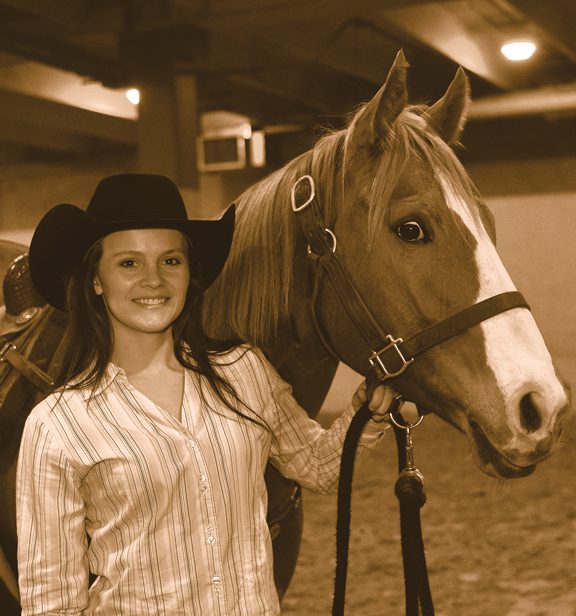
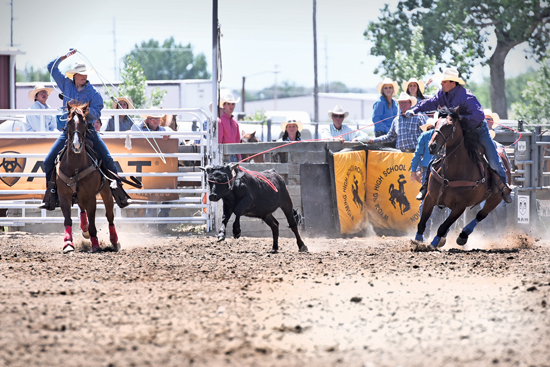
Faith Hoffman of Kiowa, Colorado, is the reigning CSHSRA goat tying champion. The 18-year-old plans to defend her title at state finals at the end of May, earning her third trip to the NHSFR. Yet as quick as her hands and feet are in her favorite event, Faith is even quicker to encourage her fellow competitors, friends, and family.
Faith celebrating at 2016 CSHSRA Finals – Chelsea Hoffman
Whether it’s giving someone a pep talk at a rodeo or sharing Bible verses, Faith is passionate about helping others. “Our family anthem is Ephesians 4:29, ‘Do not let any unwholesome talk come out of your mouths, but only what is helpful for building others up according to their needs, that it may benefit those who listen.’,” says Dave Hoffman, Faith’s dad. “She’s really an encourager of others, and I think because of her, other kids are encouraging as well.”
Faith’s introduction to the rodeo world came through her dad, a first generation rodeo cowboy and bareback rider turned farrier. Dave competed in the CPRA and PRCA Mountain States Circuit, and later coached the Air Force Academy college rodeo team. Faith started traveling with him when she was five or six, making fast friends with his traveling partners and their children. She was competing in peewee barrels by the time she was eight, and two years later, Faith was a member of the NLBRA and had discovered her passion for goat tying. “It’s such an aggressive and quick sport,” says Faith, who also competes in barrel racing, pole bending, and breakaway roping. She even team ropes on occasion when someone needs a header. “I play basketball too, and I think that sport and goat tying cross over.
When I’m teaching girls to tie, I compare it to basketball moves and how you have to be quick and aggressive in both. I also like how you don’t need an expensive horse to compete in goats – it’s about the work you put into it. I feel like everywhere I turn, there’s someone who has my back or will pick me up, and that’s really shown me that rodeo’s not all about what you put into the arena, but also who you are outside.”
Faith goat tying at CSHSRA Elizabeth 2015 – Chelsea Hoffman
Last summer, Faith had the opportunity to teach goat tying at High Plains Rodeo Bible Camp in Hugo, Colorado. She also teaches goat tying lessons from home and at clinics. “It was super fun in Hugo. There were about sixteen kids in the goat tying, and it was a lot of fun to teach them and be in a spiritual environment. I was also a group leader there, so I lead devotions and prayer with five or six girls. It was pretty cool seeing them learning and realizing what Jesus is all about.” Faith also spoke during Cowboy Church at a CJRA rodeo in Yuma, Colorado, last summer when Dave wasn’t able to be there. He’s been involved in the rodeo ministry since he was 19, and has lead Cowboy Church in the CSHSRA the last year and a half. Last summer, he performed a number of water trough baptisms in arenas.
For Faith, rodeo especially complements her relationship with the Lord. “My favorite verse is Jeremiah 29:11, ‘”For I know the plans I have for you,” declares the Lord, “plans to prosper you and not to harm you, plans to give you hope and a future.”’ I have that written down all over, and I can really see that in the rodeo world, because things can change so quickly. You can get hurt and be out a rodeo or a whole season, or other things can happen, and I think that it really puts an emphasis on faith. My mom tells me all the time if I have a bad rodeo or don’t win that God had the win planned for someone else that day.”
Faith received her own encouragement two autumns ago when her barrel horse, Cracker, fell during practice and broke his leg. “This was after Faith won state finals in the average on him. He was an amazing horse,” says Chelsea Hoffman, Faith’s mom. She works in marketing in Denver and does some of the photography for the CSHSRA. “We had ten people offering horses to her, which is huge in barrels. Rodeo has been really amazing for Faith and opened up opportunities like scholarships and being part of an amazing rodeo family. In junior high, she had sessions with college barrel racers, and she’s worked with Kaylee Moyer and Jill Francis, who are great goat tyers. She’d tie until midnight with them if she could. Logan Kenline and his family are very close and have helped her with her roping, and she’ll also rope with the Meeske family.”
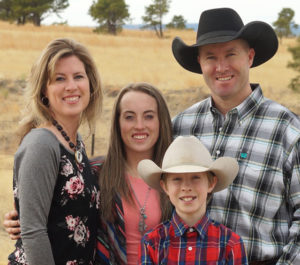
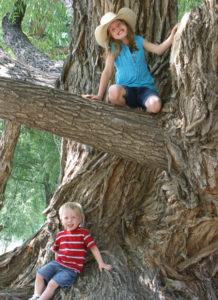
Chelsea, Faith, Cade and Dave Hoffman – Courtesy of the familyFaith at age 10 and her little brother, Cade at age 3 in Buena Vista – Courtesy of the family
At home, Dave helps Faith exercise horses, and Chelsea holds goats and videos runs. Faith competes on Johnny in pole bending, goat tying, and barrel racing. Johnny was voted CJRA Senior Girl Horse of the Year in 2016. Faith has also run barrels on Drifter, and recently brought home a mare, Barbie. “She’s a diva,” Faith says with a laugh. “She’s started in the breakaway, and I’m so excited to see her finish up. I’ll probably start her in barrels, too, since she’s super quick.” Family time is spent in the practice pen and at rodeos, and Faith’s itinerary this summer includes The Best of the Best Timed Event Rodeo in Gallup, New Mexico, the IFYR in Shawnee, Oklahoma, and the NHSFR in Gillette, Wyoming. Her 11-year-old brother, Cade, travels to many of the rodeos and is an avid hiker. Over spring break, he and Dave went on a hiking trip in the Grand Canyon, and they have several other national parks on the list to visit.
This school year, Faith has started her mornings at Abbott Ranch in Kiowa before finishing her afternoon classes at Kiowa High School, where she’s a senior. “One day I might be pulling manure, the next we’re moving cows or hauling hay,” says Faith. “I didn’t grow up on a ranch, so it’s nice that I get to learn these things.” She’s also helping plan the class of 2017 graduation, and finished a banner year playing basketball with the Kiowa Indians.
This fall, she plans on attending Sheridan College in Wyoming on a rodeo scholarship. Faith’s focus is on goat tying and breakaway, as well as majoring in athletic training. “My dad was a coach in the Central Rocky Mountain Region, and I still know a lot of the coaches there. I’d eventually like to transfer to a university so I can get my masters and rodeo a fifth year in college,” says Faith. “I want to win the state championship in goats again, and we have some tough competitors this year. I’d like to go on to Nationals and win there, but I’m not going to stress over anything, because God has a plan.”
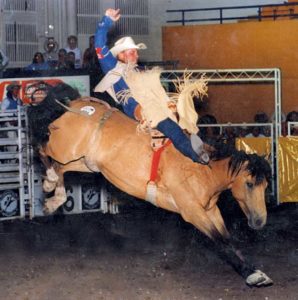
Matt Burch at the 1995 College National Finals Rodeo, Bozeman, MT – JJJ Photography
Max and George Ann Burch come from a long line of ranchers. The couple, who are in their 70s, met back in the 1950s in high school. “My folks had a ranch north of Moorcroft and her dad bought a ranch adjoining the ranch that my dad had,” said Max. They got married in 1965. The couple eventually settled back on the family ranch, living in her grandmother’s (Hazel Pickrel) original homestead, built in 1929 and added on to throughout the years. The ranch is 15 miles southeast of Rozet, Wyoming, which has a post office, school, and café/bar.
Their sons, Matt and Chad, were born in 1976. Chad is older by two minutes. George Ann found out she was having twins less than two weeks before they were born. Both boys grew up ranching and rodeoing, competing in junior rodeos through junior rodeos, high school and on to college. George Ann admits that she couldn’t take her eyes off them for more than five minutes at a time. “We got new knives one time,” recalled Matt. “So we went to the barn where the saddles were and shortened all the saddle strings as well as the cinches. One of the hands thought it was mice, but dad knew better. Our punishment for that was to stay home from cattle work that day – we didn’t mind – it was 30 below.” Matt competed in bareback riding, winning the Wyoming High School Rodeo Finals three years in a row and went to Nationals, placing in the top ten each year. He went on to PRCA and made the circuit finals, won it a few times, filled his permit. He quit competing when the family got busy in the rodeo stuff and he had a daughter. Chad competed in saddle bronc riding and bull dogging; both boys team roped.
Max started in the rodeo business in 1981. “Burch Rodeo Company started as a side line we got in on and we’ve gotten bigger in it than we ever planned to be,” said Max. “It’s what the boys want to do.” The business started when Pat Byrne from Mill Iron, Montana, came looking for pasture. “He was raising bucking horses and we made a deal to run 25 mares on shares. In the fall, when we pulled the colts off, he got the studs and we got the fillies. We had a stud we used in partnership.”
In 1985 it got really dry and things were getting slow with the drought and Pat decided to sell out. Max bought the mares that were on the place. “We continued on with that stud until 1987. They called him Last Stand. In 1987, right after we turned him out with the mares, he was injured and I called Ernie Toot in Montana and asked if he had a stud I could buy. He had some young studs so we drove up there.”
The plan was to pick up a gray stud, but Max eyed a different one – a three year old bay. “I walked through them horses looking at them and what impressed me about that horse – those horses would be chewing on each other, but that horse never quit looking at you as long as you were there and moving around.” The horse ended up siring many NFR broncs for Burch Rodeo. “Everything just worked,” said Max, who bought Tooke for $800. His offspring were big horses, one of them being the most recently retired Lunatic Fringe, out of an own daughter of Tooke.
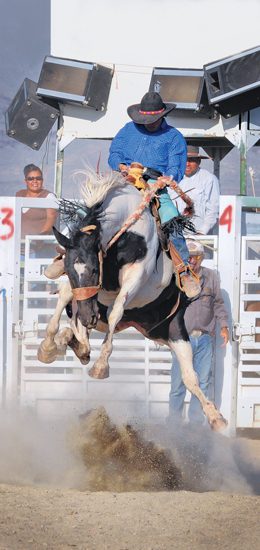
Jesse Bail riding Lunatic Fringe at the 2016 Buck ‘n Ball in Gillette, Wyoming. This was Lunatic Fringe’s last ride before he was retired. – Rodeo News
Even though Burch horses and bulls make appearances at the WNFR, Max and George Ann have only been to Vegas once. “I don’t like flying or crowds,” admitted Max. Instead they send Matt, Chad, and most recently, Matt’s daughter, Bailey, who has moved back home to help on the ranch.
Bailey lived on the ranch all her life, and left for three years to go to college on a rodeo scholarship in Ranger, Texas. The 21 year old came back this year in May of 2016. “I wanted to start helping with the ranch and rodeo company. I want to see it progress and it’s a family tradition,” she said. “I really loved the coach (Llew Rust) and I liked the environment and I’m going to finish my degree in Ag Business online. I missed home.” She lives seven miles from the ranch and travels with her dad and uncle to the rodeos where she flanks the bulls and will eventually flank the horses too.
Max and George Ann Burch – Jackie Jensen
The ranch, which encompasses 170,000 acres of owned, deeded, and leased land, is home to 750 bucking horses, 140 bucking bulls, and 2,000 Red Angus mother cows. Ten people work on the ranch and the winter chores include feeding hay to the rodeo stock that will be competing throughout the winter months. “The only hay we feed is 200 head that we are bucking. The rest are all running out on grass.” The majority of the bucking horses are kept in an 11,000 acre pasture. The yearlings up to the coming four year olds all run together and are gathered once a year to sort off the older ones and add the weanlings to the bunch.
One of Chad’s favorite parts of ranch life comes in September when he brings in the horses. “It takes 10 days to halter break, brand and castrate the yearlings,” he explained. “They we turn them loose until they are coming 5.” They have a big barn by Moorcroft that is set up with bucking chutes, and that’s where Chad spends many days, putting dummies on the horses, bucking them out four or five times, and making sure they behave in the chutes. Foaling starts the beginning of May and by then the horses are sorted into pastures with a stud, where they will stay until September.
Chad Burch, 1994 – Hubbell
While Chad is busy breaking the horses, Matt is busy with the hunting operation. “The lodge is 35 miles from here, between Moorcroft and Upton. We have hunters from September 1 until November 30. Hunters come from the East Coast to the West Coast, Canada and as far as Germany to the ranch to hunt antelope, deer, and elk. The family runs the ranch like a well-oiled machine. Chad and Matt both agree the secret is being able to compromise. “If we’re sorting, I have the list memorized in my head and we go through it,” said Chad. “It’s a give and take.” Most recently, the crew sorted 66 head to go to Rapid City. “We’ll come back for another 32 later in the week.” After Rapid City, they will have a rodeo every week all year long.
“I think the future of the bucking horses is going to get big,” said Matt. “The bucking bulls got big because of the PBR, and the ABBI has helped with that. You could prove the genetics. Bucking horses are the same way, and BHBA, Steve Stone and Kenny Andrews, and ABBI – It’s moving forward and there are more futurities for horses. If you go to a sale now, you can prove what your horse is. We love doing it …”
“We’ve got a lot of land, and could run a lot of cows if we got rid of the horses, but they mean as much as the cattle to us, ranch or bucking, it’s what we’ve always done. We’re going to keep raising them and hopefully Bailey will keep running with it. Mom and Dad provided us this lifestyle and it took a lot of years to get where we are with our card, and now we’re going to big rodeos that we want to go to … everything is set and ready to go.”
James Hajek at the NIRA Rodeo in Stillwater, OK 2015 – Hirschman Photography
James Hajek is a cowboy by blood and by choice, making a living in the stock pens and arenas of the South and Midwest since he was a child. Today, the 32-year-old from Hennessey, Oklahoma, is known for his finesse as a pickup man, finding his niche in the rodeo world while attending Northwestern Oklahoma State University.
“My dad used to rodeo and he co-owned Carpenter Rodeo Company in Kansas, so from the time I was little, rodeo is all I’ve done,” says James. “Growing up, I knew where every playground and park was in Kansas. We went somewhere every weekend, and I had friends all over the place. I didn’t know any different, or what it was like to go to the lake, but I loved it!” James and his older sister, Jena, became all-around hands, even riding a pair of mini mules to move cattle. “They were about the size of Shetland ponies, and we’d take them to every rodeo and drive cattle out. If there was a return alley, we’d bring the timed event cattle back up. We ran 140 – 150 team ropers a night, so we’d be there a while.”
When James was ten, his parents, Danny and Aronda Hajek, sold their half of the rodeo company. They kept a handful of bucking bulls, and James and his dad continued to raise bulls until 2014. In 2004, the rodeo coach at Northwestern Oklahoma State University had offered James a scholarship for supplying the team’s bucking bulls. Rodeo clown Justin Rumford was also a NWOSU student at the time, and James recalls, “We weren’t in very many of the same classes, but we did lots of extracurricular activities together. There were always good times to be had with him around.”
James Hajek at the PRCA NTFR (North Texas State Fair & Rodeo) – Todd Brewer James with his son Hagen and dad, Danny Hajek – courtesy of the family
James also watched rodeo practices and helped run the roping chutes, but the itch to be doing something more was always there. His sophomore year, James brought a trailer full of broncs to college, partnering with Andrews Rodeo Company, who sends James colts to start bucking every year. They’ve started a number of WNFR broncs such as Cool Water, PTSD Power Play, and Fire Lane. Picking up broncs naturally came next, and though James hadn’t spent much time on horseback during his teens, the muscle memory was still there. “When we sold the rodeo company, I’d sold my horse and mules, and I never even rode when I was in high school. I’d mainly worked rodeos, and I never had too much interest in competing since I was guaranteed a paycheck. I started picking up at practice, and the finessing and fine-tuning took a while to learn, but as far as setting riders down, I’d cowboyed enough to know where I needed to be and what to do.”
Nearly 12 years later, James works as many as 25 rodeos a year, along with bull ridings like ABBI and PBR. “I work all of Andrews Rodeo Company’s rodeos, and I’ll fill in for Phil Sumner, who partnered with my dad on some rodeos.” This is James’ seventh year picking up pro rodeos, and he’s also picked up for Beutler & Son Rodeo Company and Frontier Rodeo Company. “I’m just enough of an adrenaline junky that I really enjoy that part of it, and it’s fun to be doing so many things at one time, even if nobody can see it all.”
Yet those unnoticed moments are what catch a photographer’s eye, as is the case with the cover photo, taken at the 2015 Rylee Miller Memorial Ranch Bronc Riding in Cherokee, Oklahoma. James started the annual bronc riding in memory of his girlfriend, who passed away in 2013. “We did a winter series jackpot bull and bronc riding first, and after that I decided I wanted to set up a scholarship fund and do the ranch bronc riding,” says James. “Phil Sumner and Jaymie and Rooster Swartz have brought horses to the bronc riding, and we do it early in the year so the horses are coming in fresh and ready to go. That makes it pretty wild. We’ve also had women’s bronc riding, junior broncs, and mini broncs, which are a crowd favorite. We won’t be able to hold the bronc riding this year, but the goal is to come back next year and do it bigger and better.”
While he’s on the road for the summer, James’ family and friends look in on his livestock. He has 125 head of cows, originally starting with 30 – 40 head to help pay for his rodeo habit. “I work at a sale barn about twenty miles from the house, and I buy cows like some people buy shoes. I’ll go to work a sale and come home with four or five more. My fiancée, Jill Shaw, and I are partnering on forty head of mama cows, so we have a nice little ranch, and it keeps me going in the winter. It’s also something to do with my horses to get their minds back after a long summer of rodeos.”
James says his horses share his love for adrenaline, adding that they have to be gritty and tough, with plenty of run in them. “They’re all a little kamikaze with no hesitation in them. My dad said you know you have a good pickup horse if you can run them into a brick wall. I run my horses at anything I think they’ll be scared of.” Scooby, a 19-year-old gelding, is his best horse, starting out as Jena’s barrel horse in college. “Scooby had a motor on him, but he didn’t want to run the pattern, so Jena asked me to ride him a while. I was working at three sale barns at the time and cowboying. Scooby picked up rodeos so well, I told Jena she could either sell him or give him to me, because I wasn’t giving him back.” James found another of his horses, Colonel, in college, while he recently purchased Peso from Cody Webster. He also rides Cisco and Pepper, while the red roan featured on the cover is a former Canadian bronc. “Bromby didn’t have an ounce of buck in him, so I bought him from Sammy. I don’t pick up on him very much because he’s seventeen hands and it’s a long way to reach some of those broncs.” Bromby and James received a standing ovation several years ago at a rodeo in Longview, Texas, when a barrel truck was stuck in a muddy arena. James threaded his rope through the front tow of the truck and Bromby pulled it out within minutes.
“I think pickup horses are about the toughest horses in the rodeo,” James adds. “We get them hot and tired as they can handle, but then we don’t always have time to cool them off before getting another horse and going back to work. Jill takes off work to travel with me, so she’ll go back and cool horses out for me between events.” James met Jill six years ago at the North Texas State Fair, which her family has helped produce for many years. “Jill is part of a drill team and a flag team down there, which she’s really passionate about, and she runs sponsor flags. I met her while I was working that rodeo, and in 2015, we really hit it off and dated for about a year. I proposed to her in the arena, and we’ll be getting married in September in Texas.” The couple is taking their longest trip yet in August, on the road for two weeks traveling to rodeos. “We’ll see how much she likes me – it’ll be me and her and five dogs,” he jokes.
James’ one-year-old son, Hagen, is also showing interest in the western lifestyle. “Whenever he goes to feed with me, all he pays attention to is the horses and cows. He may be the only kid around with a seventeen hand Canadian bronc for his first horse.” Any time at home is spent with Hagen, while James also enjoys catching up with friends and doing day work in the area. One of his goals is to bring the Rylee Miller Memorial back in 2018. “We always have good horses, and I’ve even had guys talking to me from Idaho and northern California about it. I want it to become the premier ranch bronc riding in the country, and I think we’re fairly close.”
James Hajek at the NTFR 2016 Ranch Rodeo – Todd Brewer
Dave Dahl can spot one of his saddles from a mile away. When the bronc saddle maker from Ft. Pierre, S.D. watches pro rodeo, he can see the saddles he’s made aboard the bucking horses in the saddle bronc riding.
And the list of cowboys using his saddles sounds like a “who’s who” of great saddle bronc riders: 2016 world champion Zeke Thurston, world champions Taos Muncy (2007 and 2011), Jeff Willert (2005), Glen O’Neill (2002), and Cody DeMoss, Jake Watson, CoBurn Bradshaw, Chuck Schmidt, Clay Elliott, Wade Sundell, Cort Scheer, Kyle Whitaker, Jeremy Meeks, Shade Etbauer, and more.
The 72 year old cowboy grew up on a farm near Keene, North Dakota, next to an Indian reservation, “where there were cowboys,” he remembers. He and his friends used to go to the reservation, round up horses, and ride them. “We didn’t know what the horses were like,” he said. “We just ran in a bunch of them. There were a few chutes, and we practiced. We had some wild times,” he chuckled. After graduating from high school in 1962, he went to the oil fields. But he knew he didn’t want to spend his life there, so he went to college in Madison, S.D.
Eastern South Dakota wasn’t for him, either. “It was too much ‘east river’ for me, and I liked the Black Hills.” He made a phone call to Black Hills State University in Spearfish, S.D., and a few months later, he was there, on the rodeo team riding saddle broncs. As a member of the men’s team, he won the 1967 National Inter-Collegiate Rodeo Association year-end saddle bronc riding title, qualifying for the College National Finals Rodeo four times and competing there twice.
After graduating with a teaching degree, he taught a year at Pine Ridge, S.D., a year at a country school near Fruitdale, S.D., and a year in Eagle Butte.
He was doing construction work in Ft. Pierre, when he and a rodeo buddy, Dick Jones, ran across each other. Jones was making saddles, and Dave wanted to make his brother one. Dick helped him, and that was the beginning of Dave’s saddle career. Dick had made some saddles, and he gave instruction to Dave. “He knew a little bit, and I didn’t know much,” Dave recalled. “He showed me, and one thing led to another.” The two began a partnership in a saddle shop in Ft. Pierre.
Dave, being a saddle bronc rider (he won the 1968 SDRA title and had a Rodeo Cowboys Association card), made bronc saddles. His saddles are different from other brands, and the cowboys who ride them, love them.
Dahl’s bronc saddles differ from other makers in several ways, including the swells and the cantle. The swells are set higher so that a cowboy’s feet can set high in the neck of the horse, but not too high. The seat is a bit deeper, and the cantle is higher. Where a cowboy’s hips are is crucial. Chuck Schmidt, a saddle bronc rider from Keldron, S.D. and a three-time Wrangler NFR qualifer, has ridden a Dahl saddle since he started pro rodeo. “As in any sport, your hips are your power, and bronc riding is the same,” he said.
“You almost have to sit back on your butt a little, not just sitting there straight up, like you’re going to rope. You want to set back, (to reduce) the force the horse will use to throw you forward. You counteract it it by sitting back.”
The gullet on the saddle is also set narrower, so the saddle can sit higher up on the withers. “Beings it’s not a roping saddle, you can set your swells higher by bringing the bars in, thus allowing the cowboy to spur better,” Schmidt said. “If the swells are set too low and too wide, it’s harder to reach your feet up into the neck. When you narrow the swells and set them up higher, your legs are closer to the horse’s neck, creating better spur contact when you ride.”
Dave Dahl with the saddle he won at the 1967 National Inter-Collegiate Rodeo Association year-end saddle bronc riding title – courtesy of the family
Chuck Schmidt, Keldron, S.D., rides at Cheyenne Frontier Days. He has used a Dave Dahl bronc saddle since he was twenty years old
– Hubbell Photography
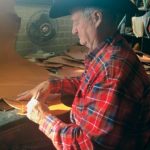
Dave in his workshop
– Tammy Tolton
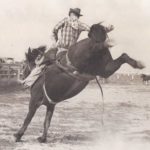
Dave competing in Bowman, North Dakota in 1966 – Ralan
Dahl’s saddles make riding broncs easier, Schmidt said. “Dave designed a saddle to take away half of your work as a bronc rider, the way it sets a horse and the way it sets the cowboy. It sets it up a little more natural, the way everything moves. There are minimal things to get in your way.”
For some cowboys, switching to a Dahl saddle made them a better rider. It happened for Zeke Thurston, who won last year’s world title. The Big Valley, Alberta cowboy wasn’t riding well last spring. He decided to give Dahl a phone call. Dahl had a new saddle to him within five days, and Thurston took it to the Guymon, Okla. rodeo. “It took me a few rodeos to get it dialed in,” he said. “Once I broke it in, my spring skyrocketed. There were probably four weekends in a row where I won $12,000 or more.” He credits the saddle with giving him better spur outs and better upper body control.
Jake Watson, Hudson’s Hope, BC., finished the 2016 season in fifth place in the world, and also uses a Dahl saddle. “The way the swells and cantle are shaped, the structure of them, they have a lot of forgiveness in them,” he said. “If you lift on your reins, you can turn loose and the saddle will do its job and keep ahold of you.” The different shaping of the swells and cantle make a difference. “Say you’re getting bucked off, and you’re still trying to spur, more often than not, you’ll end up back in the saddle and regain your position in the seat, which is definitely what you want.”
Watson has used a Dahl saddle since June of last year, and it has made a difference for him. “It changed my career, honestly,’ from the very first horse I got on,” he said. “I was having hell. I had won $2,000 that season (up till June), and from the end of June till September I ended up winning $20,000. Itw as a big turning point in my bronc riding.”
Dahl works out of his shop, the Diamond D Western Wear and Saddle Shop, on the main street of Ft. Pierre. He sells clothing, boots, hats, tack, and ropes, and does his leather work in the back of the shop.
And when most people are retired and drinking coffee all day, Dahl is working. He’s turning out about a saddle a week, working on number 1657 in mid-January. He puts in long days, clocking in about 8:30 am and working till 6:30 or 7 pm, six days a week, “depending on how bad I want to finish something.” The good work ethic comes from the motivation to succeed. “I guess I made up my mind that I wanted to be the best at what I’m doing. When you see the good results of the cowboys, it’s a big incentive.” And making saddles supplements the store’s income. “I’m fortunate that I can make a good living in my workshop when things are quiet in the store. That makes it nice.”
As cowboys call him to order saddles, he chats with them, finding out how they’re doing, what rodeos they’ve been to, and how they’re riding. He checks the internet nearly every day, to see the standings, and watches rodeos on the Wrangler Netowrk. He can pick his saddles out every time. “Everybody’s saddle looks a little bit different,” he said. “I have distinct little straps, little buckles. Most everybody has a buckle through the skirt (of the saddle), but my buckle is on the little piece that goes around the front of the swells.”
Dahl ships saddles to Australia and now the second generation of cowboys are using them. And the “old-timers” – retired bronc riders –refer young guys to him. National Finals average winner Rod Warren “sends boys to me,” Dahl said.
Six cowboys at the 2016 Wrangler NFR rode on Dahl saddles: Thurston, Schmidt, CoBurn Bradshaw, Cody DeMoss and Clay Elliott. And the list extends beyond the NFR. Wade Sundell rode one to win the $1 million at the American Rodeo last year. Cort Scheer won the Elite Rodeo Association title, Thurston won $100,000 at the 2016 Calgary Stampede; Jeremy Meeks won last year’s Indian National Finals Rodeo on one; Clay Elliott was on a Dahl saddle for his Canadian National Finals win, and eight-time Linderman winner Kyle Whitaker uses one.
Retirement is not on Dahl’s radar. “I have a lot of work to do,” he said. The man who supplies the d-rings for Dahl’s saddles is 95 years old, and still going. “I”ll have to work a while to catch up to him.”
And saddle bronc riders hope he keeps working.
Brenten Hall and Jake Clay may as well be brothers. They both come from rodeo families and they’ve grown up together as best friends. Both handy with a rope, it only made sense that the two 17-year-old cowboys should team up together in their professional rodeo careers. And if this year in the International Professional Rodeo Association is any indication, it was a smart move.
Both Brenten and Jake will be heading to the International Finals Rodeo this January in Oklahoma City to compete as two of the youngest in the field of competitors from the U.S., Canada and Australia.
Growing up in Oklahoma, Brenten and Jake met around the age of 7 and were quickly rodeoing together. “I don’t ever remember not roping or being around it. When I was little I went to rodeos with my mom and dad. It is just something that I do, I don’t see myself doing something different,” Jake describes of rodeo. His entrance into the IPRA was natural too. Both his father Dwayne and mother Julana are multi-time IFR qualifiers, his dad as a header in the team roping and his mom as a barrel racer. She won Rookie of the Year back in 1986 and continued on from there. Brenten’s mom LeAnna ran barrels and team roped, like Jake’s parents, his father Bob was also a multi-time IFR qualifier and team roping director for IPRA. Bob passed his love of roping on and coached Brenten to where he is today. Sadly, Bob passed away in 2015 from pancreatic cancer. Now they rope in his honor.
Brenten and Jake grew up doing junior rodeos locally and have both gone into high school rodeo, but have quickly made a name for themselves as professional competitors too. This is Jake’s second year in the IPRA and Brenten’s rookie year. They have focused on preparation and practicing while they have done home school through high school.
“We’re both homeschooled so it made it a lot easier. We couldn’t have done this if we couldn’t home school. We’d have had too many absent days, but you can kind of get ahead and prepare for what’s happening and take off for the weekend and not have to worry about it,” Brenten describes. He adds that his season had a slow start. “It’s been real fun. There were some very hard times. I went through some stuff I couldn’t figure anything out, I was having a hard time, I was missing, but the worst part about it is I felt like was letting my partners down, because I don’t do very good with that stuff,” he admits.
Then things turned around for the team. “I wasn’t doing very good then come about Pawnee rodeo it just kind of worked. I won 1st and third there and that shot me in 17th or 18th in the world, and then I got to where I thought, ‘you know, I’ve got to go, I’ve got to try to make it [to IFR] since I went this far, closer than I was, not there, but closer than I was,” Brenten says.
He and Jake make a good team for organizing a pro-rodeo career. “Pro-rodeoing has been fun, a lot of ups and downs. Entering, I still have zero clues whatsoever, I think I entered one rodeo,” Brenten says and adds of Jake, “he’s done every entering job, I just kind of tell him where I think we should go and then he does it whichever way it’s supposed to be done,” he laughs.
Jake at age 3 on his horse, Spotty
Jake with his mother and father, Dwayne and Julana
Brenten roping at age 10
Jake and Brenten roping in Checotah, OK in 2008 at the Duvall Arena – 3C
Brenten and Jake competing at the 2016 NARF – Emily Gethke Photography
Dylan, Brenten, Bob, LeAnna, Justin and Tarron Clay – Courtesy of the family
Brenten and Jake at the WSTR in Las Vegas – JenningsRodeoPhotography.com
Jake chimes in humorously that he also does all of the driving, to which Brenten replies, he looks after the animals. In reality, they get along well. “Neither one of us demands anything very often. Neither one of us are really that organized whatsoever. It takes us a good two hours to figure out how we want to go [to rodeos] just two a weekend but [our] moms take care of us,” Brenten laughs. Jokes aside, both acknowledge the great support they get from their families and sponsors. Brenten would like to thank his sponsors, Classic Ropes and Horselic, and Jake would like to thank Mid-States Industrial Sales and Tulsa Stockyards.
The fact that Brenten and Jake are both laidback, works great for their team dynamic. They can hardly recall ever fighting, maybe twice, they agree. And the sport of team roping is unique they realize, because, as Jake explains, “It makes you want to try harder because you know your partner is trying just as hard, and if you mess up you let not only yourself, but him down too.”
The boys split their days between school work and practicing. Jake also trains horses with his dad, and Brenten’s family has cattle and owns the local feed store in their town of Jay, in northeastern Oklahoma. Jake lives closer to the city of Tulsa, Oklahoma in the town of Sapulpa. It’s about an hour and 45 minutes-drive between their towns, but they practice together when they can, when they’re not on the road competing, which isn’t a lot now days. They’re usually gone every weekend to a rodeo.
Both Jake and Brenten credit their horses for helping them get where they are. Jake mostly rides a 10-year-old sorrel gelding he’s competed on for the past four years, and is special because his dad trained the horse. And Brenten’s main horse is a paint he actually bought off of Jake a couple of years ago.
Another component to success for the boys is a positive mindset. “[You’ve] just got to be humble in everything, because you could win one day and then not win for three weeks or however long,” Jake says and cites his favorite quote, ‘if you want to be the best, you’ve got to do things other people aren’t willing to do.” As for Brenten, he thinks of the saying, ‘if you want to succeed as bad as you want to breathe, you’ll be successful.’ “I think that’s something you should live by if you try to win,” he says and adds another motto, “for a successful Plan A is not have a Plan B’ so keep after that plan A, practicing a lot, keep your head down, keep going for it.”
Those mottos are clearly working for both Brenten and Jake. Beyond qualifying for the IFR, Brenten split the $100,000 win at the USTRC in October in Oklahoma City, “it was exciting, I wouldn’t know any other way to put it. I’m still kind of bumfuzzled over it,” Brenten says of that win. “I needed something, some kind of money so I could keep going and maybe get another horse, and it ended up coming through, and it helped,” he says but adds, “That money sure is good, but winning, the success, is what makes you happy.”
And in December, the team saw even more success. Together, Jake and Brenten roped to a first place finish and a $150,000 paycheck at the World Series of Team Roping #15 Finale.
Impressive accomplishments for two teenage high school kids.
Both boys will be soon looking to colleges and college rodeo, as well as continued success, but for January, all the focus is on the International Finals Rodeo, Jan. 13-15, 2017 in Oklahoma City.
The Harrison family is affectionately known across the rodeo world as the “Clown Family.”
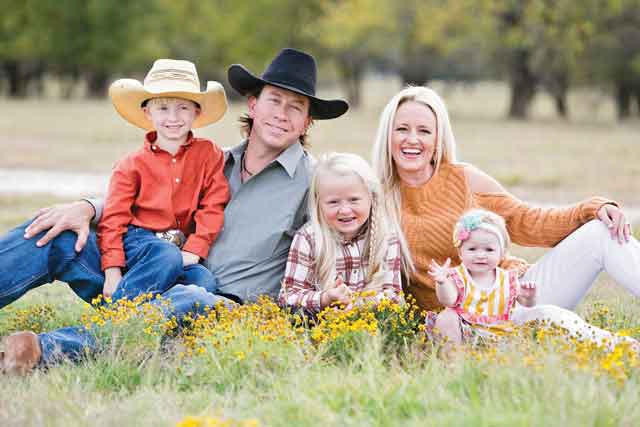
John and Carla Harrison and their four children: Addy, Caz, Billie, who passed away in October of 2014, and Charlee, are regulars at rodeos across the nation.
John, the grandson of world champion bull rider Freckles Brown, grew up in Soper, Oklahoma. When he saw Leon and Vicki Adams at his hometown rodeo at the age of six, he was hooked. “I knew then it looked like fun,” he said, “hanging upside down on a horse. I decided I wanted to do it.” His dad, Wiley Harrison, knew how to trick rope. He taught John in the family living room. “We tore up everything,” John remembers. “I broke lamps, hit the ceiling, knocked the lights out, knocked plaster off the wall. Mom was always cussing us.”
His first real audience was for 4-H talent show when he was fourteen. “I won the talent show and that threw gas on the fire.”
John had seen roman riding done at a rodeo, and decided he wanted to do that as well. He and his dad found a team broke for a wagon, but they “dang near killed me,” he said. “They were mean and kicked, and Dad realized I was going to get hurt.” They located a roman team owned by Vickie Tyer, who had sold them to Cotton Rosser, who was looking to sell them. John sold a few head of cows and over spring break, he and his dad loaded up for California to get them. They paid $10,000 for the team, what his dad considered a large sum. “My dad, a rancher, had never paid that much for horses, and he about croaked,” John laughed.
John spent two and three hours a day practicing his trick riding and roman riding, learning from trick riders like J.W. Stoker, Karen Vold and others.
It was in 1999 that he got his PRCA card. That year, he booked a dozen rodeos for Johnny Walters, doing the roman riding while Penny Walton and Kelly Brock were trick riding. He booked the next two years for Bob Barnes, roman riding, trick riding and trick roping. After that, his career blossomed. In 2002, he went to California and worked for Cotton Rosser and the Flying U Rodeo Co. The next year, he worked for Steve Gander’s World’s Toughest Rodeo tour based out of Iowa.
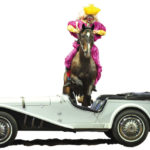
At this point, John wasn’t clowning rodeos yet, but he wanted to. A buddy in Wahoo, Neb., was putting on a bull riding and asked him to clown it. “Man, I’ll be terrible,” John told him. He borrowed a barrel from Gizmo McCracken, and “that’s what lit the fire,” he said. After a lot of performances and experience, clowning became fun and he became adept at it.
John gives credit to another clown, Keith Isley, for helping him get started. Keith had a trick riding act that he gave John permission to do. “Keith jumpstarted my career,” he said. “That’s truly the reason I am where I am in my career, due to that act.”
It was in Iowa that he met the California girl who would become his wife. Carla was interning with the World’s Toughest Rodeo, doing publicity and working closely with John on appearances and interviews. “I had a crush on her,” John said. “We were both too shy to let each other know it.” After her internship ended, she and John stayed in touch. Carla, who grew up on a cattle ranch near Salinas with a dad who ranch rodeoed, talked to John every night. When he called her, asking her to go with him to the PRCA Awards Banquet where he was nominated for Specialty Act of the Year in 2004, she realized she had an “overwhelming love” for him. They married in 2006.
Addy Harrison offers a banana to her little sister Billie, while Caz looks on. Billie died of kidney failure in the fall of 2014; little sister Charlee is now a member of the family. – Celeste Settrini
John Harrison trick riding at the Molalla Buckeroo Rodeo – Rough Around the Lens Photography
Addy, Caz and Charlee pose prior to a wedding. – courtesy of the family
John Harrison at the Hastings, Neb. rodeo. – John Olsen
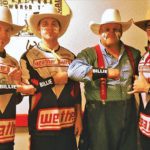
Bullfighters Cody Webster, Chuck Swisher, Justin Rumford and Dusty Tuckness show their tribute to Billie Harrison, who passed away in October 2014, with their wrist band – courtesy of the family
John and Carla Harrison with their children: Addy, Caz and Charlee. – Cross B Photography
They are on the road together, along with the kids, as much as possible. “We’re together constantly,” Carla said. “We did everything together, but now that the kids are in school, I stay home while he takes off.”
The Harrisons have diversified beyond rodeo contract work. They own rental properties in Hugo and Soper, Okla. “I’ve always been an entrepreneur,” John said. And he and Carla realize how the rodeo business works. “We talked about retirement in rodeo, and there is none. (Rentals) are something we could do and be gone.” They also own a liquor store in Hugo.
Each fall since 2007, they’ve produced a Wild West show at the Oklahoma State Fair in Oklahoma City. They aim for top-notch entertainment with good performers. Performers including Vickie Adams, Blake Goode, Vince Bruce, the Riata Ranch Cowgirls, Melissa Navarre, Jerry Wayne Olson, and others have worked the show. John used to trick rope but found it easier to be producer. They are in the same location for eleven days, a switch from being at a new rodeo each week. “It’s a nice break from rodeo after the summer,” John said.
John and Carla were hit with a tremendous blow in October of 2014 when their seventeen month old daughter, Billie, died of kidney failure. It was all sudden. Carla had been in California with her mother, who was going through cancer treatment. She had just flown home, and John had left for a rodeo, when Billie was life-flighted to a hospital in Texas. She died on October 17. Their faith and their rodeo family got them through the difficult time. “You use that term, rodeo family, loosely,” John said. “When we lost Billie, the way the rodeo community came together, it truly touches you in a way that is unexplainable.” Carla’s mom died four months later. “I spent many hours on the phone, crying with my mom,” Carla said, before she passed away. “I asked her, please, when you get to heaven, hug and hold Billie.” It was tough, Carla said, but she is grateful for others. “I want people to know how thankful I am for the love of others, how everyone poured into our lives. Our family, our friends and our rodeo family came in and surrounded us and uplifted us. I can’t tell you how that lifted us.”
Carla’s main job is wife and mother, but she also is an auctioneer. As a child, she discovered her dad’s old auction books and put herself to sleep, practicing. The family lived thirty miles from where they ran cattle, so on the way to and from cattle, he would help her with the tongue twisters and the speed.
She has sold cattle and farm equipment and still does junior livestock auctions, but her niche is benefits, especially the high-end auctions. She flies to California frequently, sometimes selling as few as a dozen items, but all very high-end. If John is free, he goes with her. “People assume he’s the auctioneer, and I get up, and they’re caught off-guard,” she laughs. Auctioneering is much like rodeo. “I want people to have fun, but you have to control the tempo of what’s going on.”
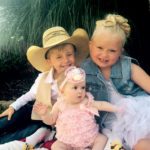
The couple’s children are Addison, age eight, Cazwell, six, and Charlee, who is thirteen months old. Addy is in third grade and learning to trick ride. Caz, a first grader, has a natural sense of humor, and Charlee, their “newest angel on the ground,” was born in November of 2015.
The “Clown Family” moniker came from announcer Jerry Todd. The kids frequently dress in John’s trademark yellow shirts with red fringe, and John loved to rub his red nose on Addy’s cheeks after a performance. Jerry picked her up and said, “oh, look at the little clown baby.” Carla started using the name on Facebook, in a tongue-in-cheek manner. But it’s grown. Last year in Las Vegas during the National Finals, people she had never met recognized them. “I love it, and welcome it,” she said.
They may be a rodeo family, but Carla jokes that she spends more time in vehicles than anywhere else. “I always tell John, we rodeo, but I feel like we really truly drive for a living. I’m always driving.” When they first married, John was reluctant to let her drive, even though she’d grown up driving trailers. He finally relented, in the middle of North Dakota, at night, when no one else was around. Now she drives most of the time, she joked. “So my alligator mouth has overloaded my little hiney. He went from never letting me drive to now, we get twenty miles down the road and he’s miraculously tired,” she laughed.
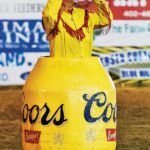
Throughout his career, John has been the PRCA Comedy Act of the Year in 2012, 2014-2015, the Coors Man in the Can in 2014, and has been nominated for either the Comedy Act, the Dress Act, or the Coors Man in the Can awards every year since 2008. This year, he has been selected to work the Wrangler National Finals Rodeo as barrelman.
Through their troubles and blessings, John and Carla hang on to their faith, crediting it with getting them through the passing of their daughter. “Without it, I don’t know how John or I could have gotten through.” They look at the positive in everything. “I try to find blessings along the way, even in the worst of times. I think it’s the only way to keep going.”
Ivy Conrado has figured out what it takes to make 18 hour drives. “I listen to audio books, music, and call people all the time.” To stay awake, she drinks lots of water and doesn’t eat much. “Then you have to go to the bathroom and you can’t go to sleep,” said the 22-year-old who will run into the Thomas & Mack for the first time in December. Ivy comes from two generations of rodeo. “I grew up going to amateur rodeos, but I’m the first one in the family to make it to the NFR.”
Ivy started riding when she was three on a little pony named Snip. “I rode her all the time while my parents were riding futurity colts.” Both her parents, Cody Doig and Kelly Conrado, are horse trainers. They divorced when Ivy was five and she spent the school year with her mom in North Carolina and the summers with her dad in South Dakota. “My brother, Chance, lived with whoever he wasn’t in trouble with and Paige and I lived with mom.” Both parents moved back to Colorado when Ivy was 12.
She hasn’t always been horseback though. She was involved in a terrible horse accident at the Ft. Smith futurity when she was five. It took more than a year for her to get back on a horse, and the horse she got on was Tibbie’s mom. Little Fancy Granny (Racie) was raised and trained by Ivy and the duo took Barrel Racing Champion for the Colorado State Junior High Rodeo when she was 14. She never made the trip to the National Junior High Finals because it fell at the same time as the Junior Olympics for volleyball.
“I picked volleyball,” she said. “I quit riding in high school and focused on volleyball.” She played club volleyball and said it was the best experience of her life. “I played for some of the greatest coaches – it was a great experience. If I had to go back and do it again, I would.” The club she played on was a high level club and to get invited in took talent and work.
“Ivy is not tall, 5’5”, but she’s so gritty,” said Cody, who spent six years hauling her daughter to practices and tournaments. “The girls – who were mostly 6’ tall –told her she’d never make it playing for Front Range because she’s so short.” From October through July, the schedule was grueling. “I would go to work, pick Ivy up from school, and drive an hour and a half to South Denver to practice. She’d have a couple months off, then back to it.”
Ivy concurred. “Her schedule revolved around me – if we didn’t have tournaments all over the state on the weekends, we would have two practices a day.” The results of her dedication and hard work were several Division 1 scholarship offers for college. Ivy made another huge decision – to get back into competing.
“My dad was very thick into the horses and that’s where I ended up – at Dad’s house.” She started working with the colts and doing chores – feeding up to 75 head and cleaning stalls for her dad while Paige was rodeoing. “I loved futurities and taking eight horses, having the colts and the three years olds.” And along came Tiddie.
“Ivy and Paige had been riding and winning with Racie, and we did an embryo transfer on the mare,” explained Kelly. “I liked the Dash to Fame line, but it wasn’t reality to breed to because of the stud fees, so I’m opted for his son, Eddie Stinson, who I’d seen run on the track.” Chad Harddt owned the horse at the time, and he was willing to work with Kelly on getting the stud fees paid. “Then I worked with Royal Vista to get the embryo transfer done – it took a while to pay off the embryo transfer. We were eating at Wendys on the dollar menu and paying with quarters to get her here. She was the first foal out of the crop of Eddie Sins, first one of the crop and she’s been an excellent athlete from the beginning.”
CFour Tibbie Stinson – Tibbie – won 7 futurities with Kelly and has now taken Ivy to the fourth position going into the NFR. “When you’re running barrels you have to have a great horse,” said Ivy. “The amazing kind to make a living at it. It is up to you to keep it going, but you’ve got to have a good horse. I’ve got the good one.” The 7-year-old mare has proven herself again by winning the Barrel Horse of the Year, a distinguished award given by the AQHA and the WPRA.
The partnership between Tibbie and Ivy took time. “Getting on a horse that was a proven performer with my dad and hitting maybe $60,000 worth of barrels in our first year together was disheartening,” shared Ivy. “I’m not a quitter – those kinds of things make me want to be better. I went with Tibbie until I figured out a good routine for us. Rodeo is so different from jackpotting or futurities – you have to be able to adapt.” Ivy and Tibbie spent hours together, and with the continued encouragement and support of her dad, Ivy feels the team is ready for the Thomas & Mack. “Dad is a huge tool in my success because he is always there if I’m unsure – which is often. The goal is to stay in tune and in center with your horse which never happens perfectly every time.”
This was their first full year going hard down the road. Kelly got in the rig at Ft. Worth and went with Ivy for most of the year, helping with Tibbie. They are partners on the horse and the winnings. “Ivy is a really focused young person. We work really well together as a team,” he said. “She is very respectful of my experience and is very coachable. She strives to continue to be the best and looks at this as her job, which I appreciate. She doesn’t take any of it lightly. She’s been a real pleasure to work with. It’s been a lifetime goal and we’ve been able to work towards it together and that’s something I will always value.”
Ivy has used her dad’s lifetime of experience to help her this year. “He’s really good at entering, so he does that. If I feel very very strongly about something, he listens. I get to make the decision on how many runs we make.”
Ivy plans to keep right on rodeoing. “I want to see what Tibbie can accomplish. She’s so sound for a barrel horse and I get to be on for the ride.” After that, she plans to either train or find another horse and keep winning. “I like to win, first place is my favorite. I want to be the best I can be in this industry and have a healthy life.”
Kellan and Carson Johnson, brothers from 30 miles outside Casper, Wyo., have roped together for eight years. “It’s great – we get to practice together all the time, but its nerve wracking because you don’t want to miss for your little brother,” said Kellan, the 6+ header, who is two years older. “We have an indoor and outdoor arena at home.” They have a great teacher in their dad, Jhett Johnson, 2011 WNFR World Champion Team Roping Heeler with his partner Turtle Powell. The pair won it with a total time of 57.5 seconds on nine head. Their mom, Jenny, competed in goat tying and breakaway in college. “We have plenty of help.” This is Kellan’s second year winning the team roping championship for the state of Wyoming, and he has been the USTRC regional champion, heading for his dad, for two years in a row.
He made his third trip to the National High School Finals this past summer, he and his partner last year (cousin, Jayden) came into the short go in the same position as this year, third. “The steer we had was great and we were a 5.3,” said Kellan of the run. “We put enough pressure on second and first,” recalls Kellan. “Second high call ended up winning it with a 5.1.” His plan is to practice up for the next year and hopefully win the state title again. “Then go back to Nationals and leave with a first instead of second.”
He spent the rest of the summer amateur rodeoing in Nebraska. After that, the high school rodeos started up again. “We put up hay and we check cattle and make sure everything is running smooth on the ranch.” The 17-year-old has one more year of high school and is unsure where he will go to college. “I might go somewhere that’s warmer,” he said, and plans to get a degree in Ag Business. He has considered Casper where his dad is the rodeo coach, but thinks he might head to Oklahoma or Texas.
He and his brother are sitting first in the state at the end of the fall season, he is fourth in calves, and second in the All Around.
Kellan gives credit for his success to growing up watching his dad and grandpa and uncle break horses. “I learned how a horse should move and act at a high level, cutting, roping, etc. Coming from this family, I learned what good horsemanship, and a good roper, and mindset is all about also,” he explained. “What my dad told me is you have 30 minutes to yourself to be frustrated or angry at anything in life, to understand and go from there. After that 30 minutes, you clear your mind and get on to the next whatever it is.” He explains good horsemanship as someone who can understand the difference between roping and the horse. “When your horse isn’t working right, it makes your job ten times harder than it should be. A horse also demonstrates the rider’s handiness and how success you will be. If you have a good horse, your roping goes up. If you have a bad horse, it goes down.” Kellan has gone through five head horses in the ten years he’s been roping. “The way I look at it, the better you get as a roper, the better your horse has to be. That will take your roping to the next level.” He has learned how to find the right horse. “For what I do, and for my event, I look for a lot of run, a good mindset, good attitude towards things. Kind of like a little kid, willing to learn what you ask of them.” Roping with his brother has gotten better every day. “We are figuring each other out – if you can wake up everyday and make the same run you made the day before, the sky is the limit.”
Carson is a #7 heeler, and he likes to rope with his brother. “We get to practice every day, it’s always in the family,” he said. The sophomore at Natrona County High School is riding Shwaze, a horse he got a year ago. “When I got him, he was a little green, but now he’s finished and fits me really good.” He spent his time getting ready for the short go by staying relaxed. “It’s nothing more than another steer that we rope in the practice pen. There’s nerves, but not as much as you think. I was super excited to rope our steer, we had a pretty good one. I knew if we could get by him, we’d have a decent shot. It was my first year out there (National High School Finals), coming up second was great.” For Carson, roping is a family deal. “Dad helps all the time, Kellan turns me all the steers I want, my mom supports me, and my grandma is at every rodeo.” His spent his summer the same as his brothers. Amateur rodeo with his brother and keep practicing. When he isn’t rodeoing, he plays basketball and ropes the dummy with his little brother, Kress. “We have matches and have a rodeo season, trying to make the NFR. We have teams with our cousins – we set it out there a ways, and we time it on the phone. We win bragging rights.”
Little brother, Kress, is seven. He ropes the Heel O Matic and likes to ranch and also likes the bucking end of the arena, helping Dona Vold this fall at the high school rodeos. The family lives on a 7,000 acre ranch that was homesteaded by their great great grandfather in 1884. The house that Jamis and Judy Johson (grandparents) live in was built in 1892, and remains the oldest two story log home that is lived in in Wyoming.
When Lane Barton was in fifth grade he was going to cow camps with his father, George, and going to rodeos on the weekends. “We were on the desert moving cows around and back to the ranch,” said the 24 year old from Winnemucca, Nevada. “I went to rodeos with him since I was a baby. Once I got old enough, I got to go behind the chutes. When I got to high school, I got to put the saddle on and get it set and pulled down, and measure the rein.” George competed all over – California, Idaho, Oregon, Utah, and everywhere. George, now 43, was 13 the first time he rode a horse out of a bucking chute in the days way before ranch bronc riding was even an event.
His grandfather, George Abel, is in the Buckaroo Hall of Fame in Winnemuca, a museum that preserves the Buckaroo Heritage of the Great Basin (Oregon, Idaho, and Nevada) area of the west. “Being a cowboy up in this country, back where there weren’t many fences; they lived their lives on horseback,” said George, who worked on ranches in the Great Basin most of his life. Several stock contractors came to buy horses that George Abel had. “We had a couple hundred head of horses on my grandma’s ranch in Fort McDermitt on the reservation,” he said. He was lucky to have plenty of horses to practice on. “They’d drive them 74 miles from McDermitt to town,” he remembers. “The horses would fill up a two lane road for a long time.” He rode broncs in high school rodeo and in 1991 was the Nevada State Champion and traveled to Shawnee, Oklahoma, for the National High School Finals. George went on to ride in the PRCA for seven years. He quit a little after his second son (Chance) was born. He picked up ranch bronc riding instead, working on his father-in-law’s ranch. “You don’t get the time off to travel, but I hit the ranch rodeos that I could get to.” He has since moved to Winnemucca, where his wife, Denise, teaches school and he works in the gold mine. “I learned a trade instead of cowboying,” he said. “I go brand calves and help out everyone around.”
Lane picked up the rodeo bug, climbing on his first bronc at the age of 13. “Ever since I was a little kid that’s all I wanted to do was ride bucking horses.” He started riding broncs in high school and rode until he was a junior, when he ventured out to bull riding. “I hung up the rope after the last one my senior year. I had already started riding ranch broncs and I could do that better.” Western States Ranch Rodeo started up his senior year in high school, so he had a place to go. “The biggest difference between ranch bronc riding and saddle bronc riding is the saddle – you get to ride with both hands if you want to.” He likes the fact that you don’t get disqualified if you ride with both hands or lose a stirrup.
He didn’t get his Western States Ranch Rodeo card until 2012. Ever since then, he is entering every rodeo he can, as time off from his full time job, and availability of entry money allows. Lane welds fence for Nuffer Welding and will marry his fiancé, Kayla Dowd, next September. He is determined to make the WSRRA National bronc riding finals for the third time this fall. Only the top fifteen, of over 100 ranch bronc riders who try for the same honor every year, can ride at this prestigious event.
Today, George is more his son’s biggest fan and mentor, traveling with Lane as often as he can, rather than going for points and money himself. Even after thirty years and over 1,000 broncs, George still loves to ride an occasional rank bronc, especially if he can complete against his son, Lane. “Take a deep seat, give your horse his head, keep moving your feet forward, and let the horse buck,” is his standard advice.
Somebody showed up at the Moeder’s front door when Ashlyn was about 7, and said: “Your daughter said you want to buy our horse.” Melinda and Mike, who had never been around horses at all, said ‘no.’ They tried to turn the experience into a life lesson for their daughter. “We had some friends that had a horse and we asked if we could feed the horse and water it through the summer. We thought if she could see how much work and time it took, we’d have this problem fixed. It worked in reverse. She fell in love,” said her mom, Melinda. “We had to learn everything from ground zero. We had some great people helping us.”
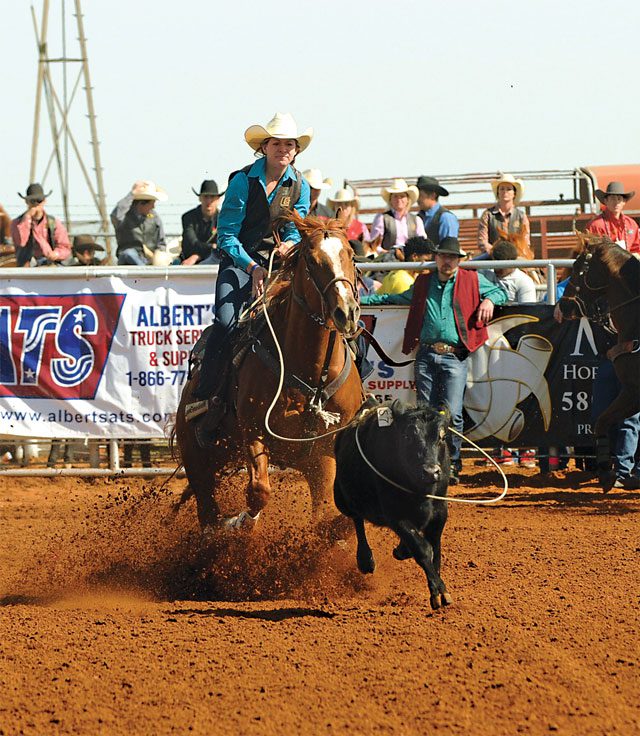
Ashlyn started with Western Horsemanship and jumping, competing in barrel racing to give her additional opportunities in the All Around. She entered her first rodeo as a sophomore in high school. “Once I started thriving in the show aspect of things, I wanted a new challenge and I loved rodeo more than showing,” said the 19-year-old from Oakley, Kansas. She competes in barrel racing, goat tying, and breakaway. “It’s been a challenge,” she admits, believing her start in the show world was helpful. “I would have never caught on with the horsemanship part of it. I’ve learned how to train two year olds – I’ve done two now on my own – and am now starting to win on those horses that I’ve trained.”
Her senior year was the year she actually started doing good. “I was giving donations just trying to learn the events,” she said. “I ended up winning the breakaway short go, and was in the top ten. I had finally started climbing up the ladder – nobody knew me.” After graduating, Ashlyn spent a year at Garden City Community College, bringing 18 college credits from high school with her. She completed 50 hours at Garden City in one year and has transferred to Northwestern Oklahoma State University in Alva, Oklahoma, where she will pursue a pre-vet degree and rodeo under Stockton Graves. “The school is really competitive on the rodeo side of things, and has a great ag and science program.” She is leaning towards surgery, and if that doesn’t work out, she will be a large animal vet. “I’ve done dissections since high school and I’ve thrived in any class. I want to help animals and this is the perfect combination.”
This is her second year rodeoing in the KPRA and she is sitting third in the breakaway, first in the barrels, and first in the All Around. “It’s been an eye opener, and competition I’ve never been around,” she said of the KPRA. “There are some big names competing on some tough horses.” Ashlyn has brought a few tough horses of her own to the arenas this summer. Picking from her herd of 15, which includes her now-retired show horses, she has a main barrel horse, Shake, her breakaway horse, Gruilla, and rounding out the pack is CC, her goat tying horse.
She bought Shake from Sabrina Devers. “When I was trying for my first saddle, and Sabrina had this horse, I took him to the junior rodeos and I fell in love with him.” He’s the only horse that has gotten her a check all summer in the barrel racing. Gruilla was used as a reining and working cow horse. “When I started roping, I started learning off of her and she’s been my main breakaway horse.” Learning to rope was a very frustrating experience. “I’d go rope for hours trying to get it right. It didn’t take many years, but it sure took a lot of hard work.” Her goat tying horses is DC, a horse she got from Ty Inlow, who has been instrumental in her success. Ty took her to the next level in the show world, and she would go out to his place and practice day in and day out. “He had me ride several different horses so I’d have the feel for them – he has really been a big part of my life.”
The first horse Ashlyn had was an $800 horse from a sale barn. “He got her started in barrels and he was amazing,” said Melinda. “They thought he was injured is why he was being sold.” Throughout Ashlyn’s horse career, both Mike and Melinda have tried to let God lead. “We’ve always said the horse needed us and we needed him.” Melinda is an accountant, and her dad, Mike, is a farmer and rancher at M3Farms. “We raise Black Angus and Wagyu cattle (a Japanese breed of beef), wheat, milo, and sometimes corn. Ashlyn tries to help when she can, but her rodeo schedule makes that pretty tough.
“Her hard work and determination to succeed in it has been fun to watch,” said Mike. “She has really dug her heels in to go and be the best she can. We’ve mounted her the best we can, but she has to be able to ride.”
“I spent the summer with Sabrina Devers, and she taught me more about training and I will always be grateful to her family for taking me in,” said Ashlyn. “She kept my horse sound the whole summer, teaching me how to do that. I learned how to stretch my horse before races and some tricks with medicines and wrapping so he could travel better.”
The regular season is over and she is sitting first in the barrels by $2,000, third in the breakaway and first in the All Around by $7,000.”
She is still looking for her first saddle, and hopes to accomplish that goal at the KPRA finals. “The rodeo people have become my family. I’m on the road so much, I’m never home. They have all welcomed me with open arms. It’s been awesome. I don’t know where I’d be without it. It’s been such a good part of my life, I’ve met such awesome people.”
Ashlyn competing at the Kansas State Fair – Wright Focus, wrightfocus.com
Ashlyn played basketball for her high school in Oakley, Kansas
Ashlyn with her seventh deer – courtesy of the family
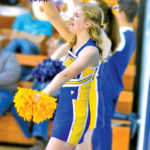
Ashlyn cheerleading for her high school in Oakley, Kansas – Brittany Jo’s Photography
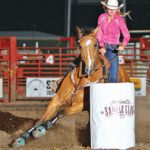
Ashlyn barrel racing at the Plainville Saddle Club. – Dale Hirshman
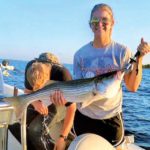
Ashlyn with her big catch while fishing with the Devers family
Daylon Swearingen split second and third place in the bareback riding at the NHSFR this July, riding all three of his horses after making the 34 hour drive from his home in Attica, New York. The 16-year-old bareback and bull rider won 2015 NHSFR All-Around Rookie Cowboy and qualified all three years of the NJHFR, the fruition of his hard work in the arena and on the spur board.
The oldest son of Sam and Carrie Swearingen, owners of Rawhide Rodeo Company, Daylon learned the art of balancing rodeoing and rodeo production from an early age. Sam finished the 32nd Annual Benton Rodeo before flying to Wyoming to watch Daylon and his 15-year-old brother, Colton, compete in the NHSFR. The family visited Devil’s Tower during their travels, but were immediately back to work as soon as their truck turned in the driveway. Daylon was introduced to rodeo by Carrie, a barrel racer and former trick rider for Longhorn Rodeo. He made wooly-fisted mutton busting runs before putting the Barstow youth bareback rigging from his uncle, Kenny Phillips, on a pair of roman riding ponies. “Me and a buddy built bucking chutes at the house when I was eight,” says Daylon. “We had one pony that bucked a little bit, but that was it. When we started bucking steers under the rigging and saddle, they worked out better.” He was competing at the National level by sixth grade in the bull riding, chute dogging, and breakaway roping. Colton followed in the tie-down roping. “I did the timed events for the all-around – and to beat Colton,” Daylon jokes. “I couldn’t lose to my little brother!”
Along with high school rodeo, Daylon competes in the SEBRA, IPRA, and APRA, where he was leading in the bareback riding his rookie year until heading out to Nationals. “I missed quite a few rodeos, and now I’m sitting third. It’s a little frustrating, but it doesn’t bother me too much because we still have quite a few rodeos left,” he says. Putting on 80 performances and 30 ropings from June to October, in addition to the usual rigors of summer haying, has its pros and cons. “I can always make it to at least two rodeos a week, and we have a weekly rodeo we put on. I usually get on every performance in at least one event,” Daylon explains. “We have good rodeos up here, there’s just not as many of them, so there’s not as many people to push you to get better.” His drive to be the best he can be motivates Daylon, along with the coaching from his dad, Kenny, Jerome Davis, Clint Cory, Dave and Tyler Waltz, and Doug Lutz. “Kenny is in Oklahoma, and I send him videos and talk over the phone. I went to Clint Cory’s bareback riding school this spring, and Jerome Davis has a bull riding school. He was a really good bull rider, and he got hurt, but he still has such a positive outlook on life, and he and his wife have helped me learn about the bull business.”
Two year ago, Daylon purchased several heifers and bred them. He has a crop of calves are on the ground and bucked his yearlings this summer. “They bucked pretty good, and so did my heifers. When they’re old enough, I’ll take them to a few futurities, and then start bucking them in my dad’s rodeos.” Rawhide Rodeo Company raises its own roping calves, broncs, and bulls, and purchases its steers. They produce everything from high school rodeos to PRCA and IPRA rodeos, including the Canadian rodeo company Sam is a partner of. “We’re also doing some novice bronc riding at seven of the big rodeos,” says Sam, who founded the company in 1987. “I want to give Daylon and all the young kids the opportunity to rodeo. The younger generation can go play video games and be competitive without the effort, and I think now anything that takes a lot of effort is dying off.” Sam is a first generation saddle bronc rider, growing up on a farm with 40 – 50 horses to ride. “You didn’t know you weren’t out West. My dad was a collector of horses, and as a kid, I’d get on one until it quit bucking, then get on another one! I rode saddle broncs for years and did pretty good, then started buying livestock and an arena and went from there. Daylon will get on the spur board and have me come down, or go over videos with me, but he knows what he’s supposed to do, so it’s more of a conversation.”
Sam and Carrie were married in 2011, joining their families – Carrie’s sons, Daylon and Colton, and Sam’s daughters, Katie and Molly. “Competing in rodeo is what both my kids strive for, and that’s all we really have in our life is our passions,” says Carrie, an RN and a vital part of the rodeo company. “We’ve met so many great people in rodeo – people competing, committees, and those who come to watch. It’s a great sport, and God has blessed us. We have a lot of fun, and it teaches our kids to work hard. It’s never easy, and sometimes you work hard and you don’t win, but that’s the way it can happen.” Carrie is barrel racing at the rodeos on a horse she’s been training, and is what Daylon calls the go-getter of the family. “We always come home with a ton of laundry, so we empty everything Monday morning and wash it, and get the crew’s western shirts to the dry cleaners,” says Carrie. “The Hazletts cook for the crew and anyone working the rodeo when we’re on the road, and that time is a definite blessing for our rodeo crew to get together.” Carrie often serves as a timer and keeps the company’s equipment organized on the road, which is even down to the arena itself. “Other parts of the country have permanent arenas, but up here, we don’t,” Daylon explains. “It takes about five hours to set up. We bring everything, from the chutes and fencing to the roping box. Colton and I help with that, and I do the feeding and help check calves.”
When Daylon’s not on the road with the company’s four trailers and motor home, he enjoys riding colts, mountain biking in the nearby state park, cross-fitting, and wrestling for Attica Central High School, where he’s a junior this fall. “I’ve wrestled since second grade – it gave me something to do during the winter,” he says. “You have to have mental toughness, and if something goes wrong, you can’t blame it on a teammate. It’s just you, like rodeo.” In the winter, Daylon rides practice bulls at home until the temperature is below 30 degrees. “We have about 500 acres, and the summers are good, but the winters suck,” he admits. Year round, he’s working toward his goals of competing in the PBR, and qualifying for the WNFR in both his events. Along with the APRA finals, he intends to compete in the SEBRA and IPRA finals this year, where he’s sitting 12th in the bareback.
“It’s a short rodeo season, but we’re blessed, and the boys work very hard at it,” Sam finishes. “They want it much more than I did, and it’s nice to see them getting involved and growing into rodeo.”