Rodeo Life

Category: Back When They Bucked

  • Back When They Bucked with Lydia Moore

    Back When They Bucked with Lydia Moore

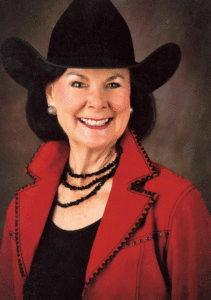
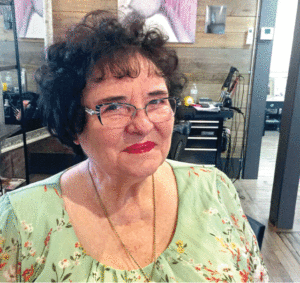
    Lydia Moore was raised in a rodeo family in Missouri. Her parents, Hazel and Percy worked for many rodeo and wild west show companies traveling the country with her older sister, Maudie, and younger sister, Percyna in tow. Maudie was a trick rider and roper and Percyna had a goat act. In fact, Percyna was actually born in a tent while on the road for the Colonel Jim Eskew Wild West Show.
    Lydia was forced to stay home most of the time as a tot with her grandfather, John Hickey, due to poor health. “I had no stomach lining when I was born,” said the 80-year-old, who now resides in Wayne, Oklahoma. “I drank goat’s milk and built up my resistance.” She finally grew out of the condition when she was ten years old and learned the art of trick riding and roping. “My dad taught me trick roping and my mom taught me trick riding,” she said. Rodeo season back then didn’t last all year like it does now – her parents were gone from April until September and the other months they were home. When they were home, they trained horses that went on to perform in wild west shows, movies, circuses, and elsewhere.
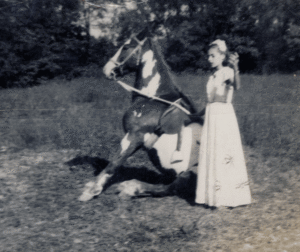
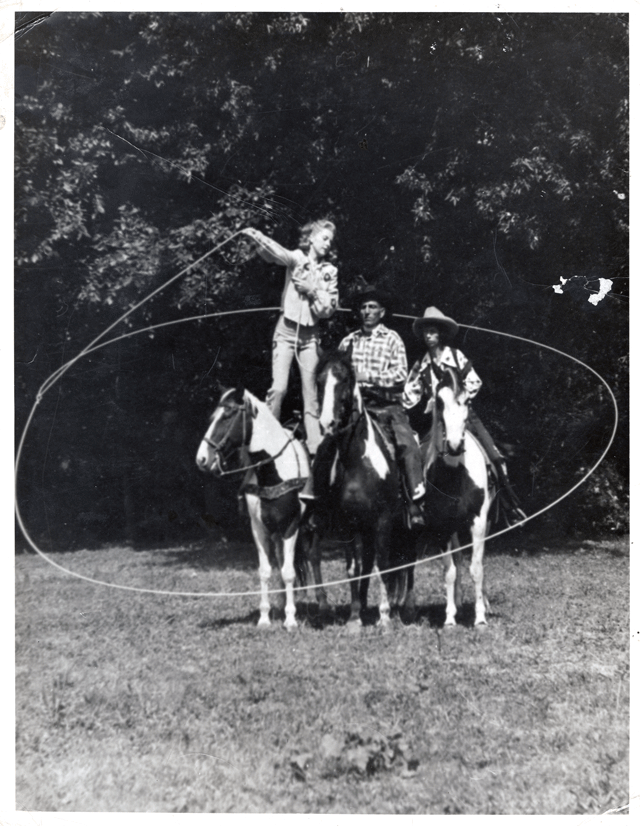
    Her parents, Hazel Hickey Moore, a noted circus equestrienne, who gravitated towards the wild west show side of entertainment when she married her husband, saddle bronc rider, and steer wrestler, Percy Moore, both instilled in Lydia a love of horses and all things western. Famed trick roping performer, calf roper, and steer wrestler, Billy Buschbom, also helped Lydia with her trick and fancy roping and gifted her with her first set of ropes. “The Buschbom’s and my family were very close friends and worked for many different wild west show companies.” As a youngster, Lydia performed with her family in dressage and trick roping acts, and won many talent contests as a teen with her skills.
    Lydia’s dad, Percy, broke his leg while competing on a saddle bronc, Preacher, Dun, at a rodeo produced by Monty Reger. The rodeo was in a resort called Sylvan Beach in Kirkwood, Missouri, a suburb of St. Louis. The family settled there while Percy recuperated, and afterwards was hired to manage the boarding stable. The entire family worked at Sylvan Beach. Young Lydia and Percyna worked as lifeguards, took riders from the boarding stable out on trail rides, as well as running pony rides. They also performed different circus and wild west show acts that Percy, Hazel, and Lydia were in.
    Lydia was introduced to barrel racing by accident. “The annual St. Louis Fireman’s Rodeo produced by Tommy Steiner, was in town around the early 1960’s. Wanda Bush, Fanny Mae Cox, and Boots Tucker, all barrel racers from Texas, were in town for the rodeo. They didn’t have enough barrel racing contestants, which was a new event for the rodeo. Wanda reached out to a local horse facility, Valley Mount Ranch, since Wanda knew they were starting to have barrel races at that arena. Lydia was one of the ladies invited to enter.
    Lydia went to a few barrel races, but due to her own family responsibilities, she was unable to pursue it. “I wasn’t driven like the other girls were. I was more interested in the administrative side.” In the early 1960’s she helped form the first chapter of the Girls Rodeo Association. “A group of barrel racers in the St. Louis area got together, and since we all worked full time, we had some administrative skills and used the guidelines of the GRA to form the chapter. We had advisors that we knew could help us, and they were instrumental.” While living in St. Louis she met one of her mentors – famed rodeo secretary June Ivory. Lydia learned to secretary and time rodeos from June, and over the years worked for many stock contractors like Beutler & Sons, David Bailey, and Jim Shoulders’ rodeo companies, and is a longtime PRCA gold card member.
    After Percy Moore passed away in 1962 from emphysema, Lydia’s mom, Hazel, moved in with Lydia and her toddler daughter, Linda. (Lydia only has one daughter, Linda). Percy had been a lifelong smoker. He started smoking as a teen like most young men of that era. He either rolled his own or smoked non-filtered cigarettes. He was even hired as a young man to model for a few Chesterfield cigarette ads.
    When Lydia made the move to Oklahoma City in 1967, it was with her mother Hazel, sister Percyna, and daughter Linda. She worked as a secretary for an oil field company upon her arrival. Before moving to Oklahoma, June Ivory had introduced Lydia to Stanley Draper and Bobbie Steenbergen from the Oklahoma City Chamber of Commerce who worked with Clem McSpadden, Buster and June Ivory as the group managing the National Finals Rodeo. “It’s hard to imagine, but during the early years of the NFR in Oklahoma City, there was little interest in the Finals. When it first moved there, tickets didn’t sell well – we had dinners and parades in downtown Oklahoma City to sell the event.”
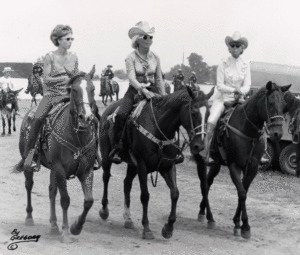
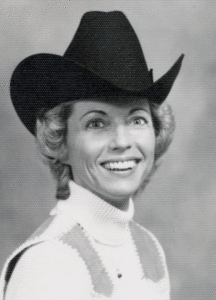
    With the NFR’s move to Oklahoma City, Oklahoma barrel racer Florence Youree worked with Stanley and Bobbie to bring on the barrel race as one of its standard events. Florence’s pitch worked and the event was sold as – “pretty girls on fast horses,” Lydia said. Needing a liaison for the barrel racers, as a go between to handle any issues barrel racers had, Lydia was hired. She worked in that capacity until 1985 when the NFR moved to Las Vegas.
    Adding to her jobs at the NFR, Lydia was hired by NFR manager McSpadden and stock superintendent Ivory to handle all secretarial duties in preparation for the National Finals each year and also ran the NFR press room with Arlene Worley. “Two weeks before the finals as the livestock came in, Buster and Clem needed someone to type the stock lists, so since I lived there, I’d take my vacation during the Finals and type the lists as the contractors came in.” “It was fun – Buster and Clem were wonderful. It was great to be part of it. They were so super to work with. And I knew all the contractors from secretarying and timing rodeos.
    Lydia also received the task in those early years of the NFR as the GRA Awards Chairwoman for the barrel racers garnering thousands of dollars of awards for the ladies each year. “I wrote letters to various companies and everybody I saw that had a business, I asked for awards. I was even able to get a car and a horse trailer donated. Imogene Veach Beals who owned a large western store, Veach Saddlery, in Tulsa, Oklahoma, was the first donor I got.” Lydia’s dedication came from her interest in doing something for the girls.
    Continuing her interest on the business side of women in rodeo, she served five years on the GRA board of directors as Bull Riding and Southeastern Region Director, before being hired as the executive secretary in 1973. “At that time, the GRA had all of the rodeo events – we had a lot of all girl rodeos – we used to have approximately one a month back in the day – we had a lot of great girls. Unfortunately, they don’t have any all girl or women’s rodeos anymore.”
    GRA president Margaret Clemons hired Lydia on a six month trial basis to be the secretary of the GRA – that tenure ran for two years and every two years they had an election. “I was at the meeting as the Southeastern Director and was hired by the board. I was able to quit my day job and I really became involved in the women’s rodeo part there.” Since her position came up for renewal every two years, there wasn’t a lot of job security in it. Her job ultimately lasted nearly 25 years.
    When she got the job, she converted her garage into an office. “There were a few boxes of records, 400 members and $800 in the bank. (A GRA card cost $25 in 1971, for example.”) (The WPRA card cost $150 in 1995, the last year we were in the WPRA office). When she left there were 2,000 members and the association was financially secure. “We ran a very efficient office and did everything we could for the members – Jimmie Munroe and Pam Minick were great at promoting the association.” She enlisted the help of her daughter, as well, along the way. “We all enjoyed working in the WPRA office,” said her daughter, Linda Clark. “Percyna and I did the newspaper and we are all a very close unit. We’ve always worked together. I typed envelopes on an old IBM Selectric electric typewriter when I was 13 – I totally loved it.”
    “She was the glue that held the WPRA together,” said Pam Minick. “She ran the association like she ran her household – she tried to save all the money she could. It was a 24 hour a day job for her.” Pam went to her house every October to help stuff envelopes for all the contestants. A prized honor she received in 1991, known as the WPRA Coca-Cola Woman of the Year, was awarded to Lydia for her years of service, passion, and devotion to women in rodeo, and rodeo in general. “I was absolutely thrilled. When Coca Cola put together that award for our association it was fabulous. Wanda Bush was the first honoree, Jimmie Munroe was the second, Pam Minick was the third, and I was the fourth.” The coveted bronze statue was created by artist and NFR qualifier Karen Galemba. Lydia feels fortunate to have seen firsthand the phenomenal growth in the sport of barrel racing that it enjoys today-barrel racing as a standard rodeo event, equal money at rodeos, and equal money at the National Finals Rodeo.
    Her second award will be received in November when she will be inducted into the Rodeo Historical Society Hall of Fame. “I feel absolutely the same about this one – I’ll be emotional to be recognized at this chapter of my life. I help Linda in her business and enjoy what I’m doing. I’m blessed with good health and it’s great. I’ve been very blessed. I have a beautiful daughter and granddaughter that I love. They and their families help take good care of me.”
  • Back When They Bucked with Lee & Dixie Wheaton

    Back When They Bucked with Lee & Dixie Wheaton

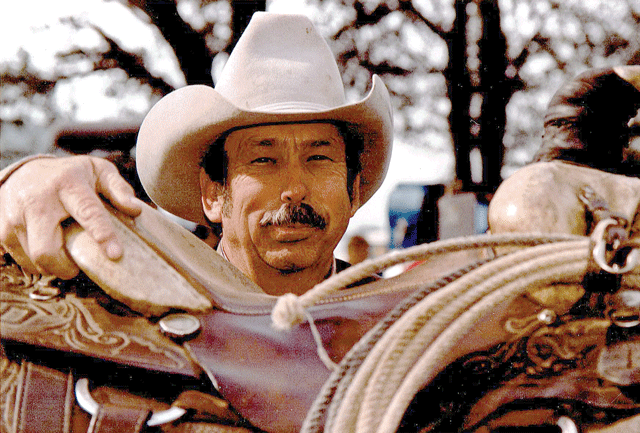
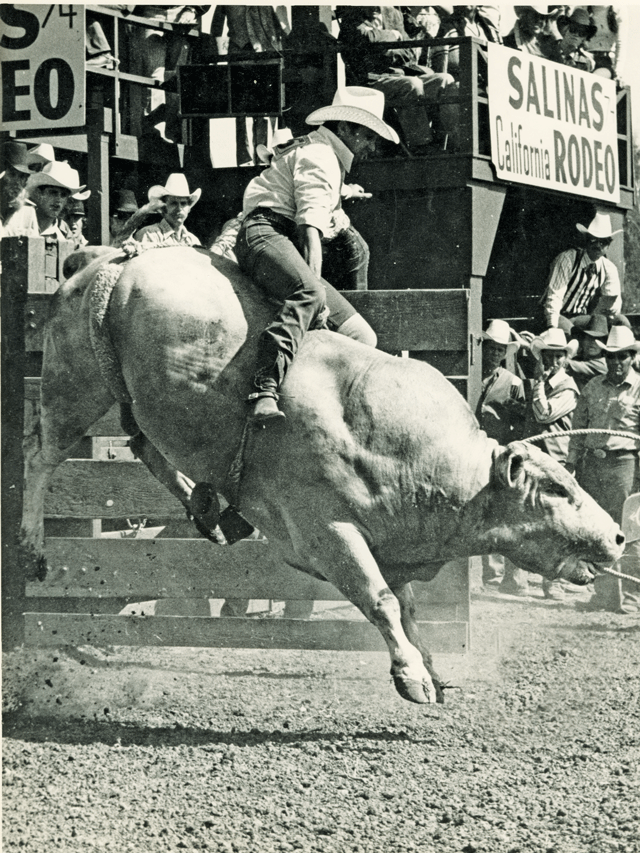
    Lee and Dixie Wheaton have five PRCA gold cards within their family. Lee, a former multiple-event contestant, and his wife Dixie, a barrel racer, each have one. Their daughter Deena Wheaton, has hers, and Dixie’s dad, 1939 world champion steer roper Dick Truitt, had his gold card. Lee and Dixie’s niece, Trula Truitt Churchill, also has hers.
    Lee began life in Rochester, New York, the son of Mel and Dee Wheaton. His dad owned a dude ranch, with weekend and overnight guests, and part of Lee and his older brother Jim’s job was to take care of the up to 100 head of horses that were kept. Each year, Mel would send for a new load of horses from the west, and Lee and Jim’s job would be to make dude horses out of them. “Some of the horses that came to us were not gentle enough for eastern dudes,” Lee remembered.
    When Jim started rodeoing, Lee wasn’t far behind. Lee began riding bulls in 1947, when he was twelve years old. His dad had produced rodeos for a few years, at which Lee sometimes served as the bullfighter, and his parents were supportive. At the time, New York State had lots of open and amateur rodeos. Lee competed at rodeos put on by Pappy Westcott and his son Jackie, and the Baldwin family, among others.
    Dixie Truitt was born in 1940, in Ada, Oklahoma, the daughter of Dick and Juanita Truitt. She traveled with her daddy as he rodeoed, and when she was twelve, she began barrel racing. In 1956, she got her Women’s Pro Rodeo Association card when it was the Girls Rodeo Association, and in 1959, she qualified for the first National Finals Rodeo, but her daddy wouldn’t let her compete because it was during college finals tests.

    Lee graduated from high school in 1954 and amateur rodeoed up and down the East Coast. Two years later, he joined the Rodeo Cowboys Association, and went farther, traveling to the south and crossing the Mississippi River, going to rodeos in Missouri.
    He was doing all three roughstock events and even steer wrestling, occasionally. In 1956 and 57, he worked for Frontier Town, a tourist attraction in New York. Frontier Town held three mini-rodeos a day, featuring one bareback ride, one saddle bronc ride, one calf roping run, one steer wrestling run, and one bull ride, plus contract acts. Lee was the roughstock cowboy and even steer wrestled a time or two. On Saturday nights, he’d drive the sixty miles to the pro rodeo in Lake Luzerne. “We’d drive like hell to get there, and contest there,” he said. He won the saddle bronc riding and the bull riding at Lake Luzerne’s series one year. He and his buddies would also take off for Cowtown, New Jersey, and compete there.
    Once he expanded his territory because of his pro card, he went to Florida one January, but with no success. “I rode every bull I got on, and never won a penny,” he remembered. It was before public announcement systems and riders didn’t know their scores till they looked at judges’ sheets after the rodeo. In Okeechobee that year, he rode a bull they had placed on regularly. “Everybody patted me on the back and said, ‘that ride looked great.’” But he didn’t win anything. Afterwards, he went to the judge, Buddy Medford, and asked why he didn’t place. “Buddy said, ‘that bull jumped and kicked but he didn’t spin.’”
    The next week in Kissimmee, Lee covered another bull with a good ride. “I had a bull that spun, wound it up, and again, everybody was saying, ‘that was a good ride.’” When the rodeo was over, Lee hadn’t won a dime. Medford was judging again, and Lee asked what the problem was. Medford replied, “Lee, he spun real good but he didn’t jump real good.’” They held it against him, that he was a Yankee and was a newcomer to the South.
    Every October, when rodeos had slowed down, he headed back to New York. Depending on how he had done, he either got a job or hunted all winter. Then, in January, he’d head back to Florida and start all over again.
    Lee met Dixie at a rodeo in Cookeville, Tennessee in June of 1961. They married in Iowa two and a half months later. They had planned to rodeo in place of a honeymoon, but Lee had torn up the palm of his hand and it wasn’t healed, so they took off. “We honeymooned in 21 states and five provinces,” Lee said, visiting Niagara Falls and other sites. The first bull he got on after marriage was one he’d won on a few times. For that ride, “I fell off like a big toad,” he said. “My buddies came around and said, “Damn, Lee, married life doesn’t agree with you, does it?” he laughed.
    That fall, Dixie, who had graduated from East Central College in Ada, Okla., had a contract to teach physical education in Wichita, Kan. So they got an apartment in Wichita, got Dixie settled in, and Lee hit the rodeo trail again.
    They stayed in Wichita for a year before going to Scott City, Kan., where Dixie spent four years teaching physical education: archery, swimming, bowling, basketball, tennis, and more. They moved again, this time to Dixie’s home state. “That Oklahoma girl got homesick,” Lee said. She had been working on her master’s degree and got a teaching job in Tulsa. It was 1965, and they moved to the place where they still reside, near Mounds, Okla., just south of Tulsa.
    Dixie taught school in Tulsa from 1965 to 1992, teaching P.E. and coaching basketball. She was awarded the girls basketball coach of the year honors in the First Frontier Conference, and finished her teaching career at Will Rogers High School in Tulsa. She switched to the classroom, teaching child development, parenting, and psychology.
    While at Will Rogers High School, the school had an annual roping contest among staff. Dixie won it several times, having grown up with her dad, the world champion steer roper, her uncle Everett Shaw, a six-time RCA steer roping champion, and her maternal granddad, Cole Underhill, a steer roper before the formation of the RCA.
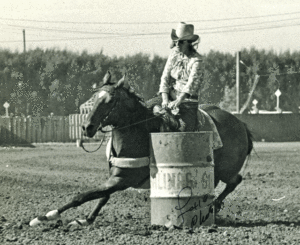
    Lee and Dixie rodeoed through the summers and during the school year, when she came home from school each night, Lee would have her horses saddled and ready to go. They usually bought race horses and Dixie trained them for the barrels. During her years, she had four bays that she considered her best. Levan II, “Reverend,” she considered her fastest horse ever. On Reverend, she won three rounds in Salinas, Calif. one year.
    Cajun was another horse that was one of her best, as was Tiny Mark, a gelding from Arkansas, and Strongwall Snip. Dixie was a good trainer, coming by it “honest,” she said. Her daddy trained his own horses, and if a horse didn’t make it as a steer roping horse, Dixie would get him.
    Their daughter Deena was born in 1962, and when she was sixteen, she had her WPRA card. Clem McSpadden called Deena “the teenage sensation from Mounds, Okla.,” and she ran barrels along with her mother.
    Several times, while he was injured, Lee was called on to judge. In 1965, with a broken arm, he judged rodeos in Ft. Worth, Miami, Fla., and Chicago. He also judged the College National Finals Rodeo three times.
    In 1975, Lee quit riding bulls. He’d been an RCA card holder for 21 years, and he still loved the sport, but it was time to quit. Dixie and Deena were still running barrels, but Lee couldn’t go with them. “I wouldn’t hardly go to a pro rodeo with them,” he said. “I knew, if I went, I’d want to get on. I was 41 and that was old enough to quit.”

    In 1980, when Dixie turned forty, her good friend Florence Youree entered her in a senior pro rodeo in Canadian, Texas. Lee went with her, and he saw that the senior bull riders were all guys he had rodeoed with for twenty years. He watched the rodeo and said, “If those guys can still ride bulls, I can too.” The senior pros were fun for them. Rodeoing “wasn’t stressful,” Lee said. “When you left home, you had money in your pocket, and you knew you could pay your bills. You didn’t have to win anything.” The two of them qualified for the National Senior Pro Rodeo Finals each year from 1980 to 1985.
    In 1982, Dixie won the year-end barrel racing title for the Senior Pros. That year, at every senior rodeo she ran, she won first place. She rode Dial Doc, a sorrel gelding that she and Lee traded for one of their horses and a tractor and brush hog. Doc, Lee said, was “half lunatic,” a horse who had been soured going into the arena. But Dixie figured out a way to get him down an alley. Two great big Native Americans who were at the senior pro rodeos would get ahold of the cantle and walk him up to the gate. “As soon as he got through the gate, he’d do his job great,” Lee remembered.
    Towards the end of his bull riding career in the RCA, Lee took a job with the Oklahoma Department of Agriculture. He worked for them for twenty years, testing for brucellosis and later visiting horse events checking for health papers.
    Dixie continued to train horses and ran barrels up to just a few years ago. Between she and Deena, they have trained eight world champion breed horses.
    Dixie had a stroke a few years ago but she and Lee still live in their home of 54 years. They celebrated 57 years of marriage in 2018.
    They also enjoy Deena’s son, Jesse Chelf, who is in the U.S. Army. Jesse has been stationed at Fairbanks, Alaska and has served tours in Afghanistan, Vietnam, the Philippines and Germany. Lee and Dixie have two great-granddaughters.
    Rodeo days were good days, and Lee loved riding bulls. “It was the biggest adrenaline rush I could imagine,” he said. “I still look at bull riding pictures and my heart gets to beating fast, thinking about how good it felt. I loved it.”
    They’ve had a good life. “We feel really fortunate. We’ve both never had a job that we didn’t enjoy. It’s been a wild ride.”

  • Back When They Bucked with Terry Peek

    Back When They Bucked with Terry Peek

    Terry Peek craved riding bulls. And although he never made a living at it, it was his hobby, his lifestyle, and where he made many friends. The Bandera, Texas cowboy was born in 1945 in Paris, Texas, the son of Joe Bailey and Robbie Lee Peek. When he was seventeen years old, he was at a rodeo, behind the chutes, when someone asked him, “Son, do you want to get on this bull?” He thought it was a good idea, so he said, “You bet.” The man asked, “Did you sign a release form?” “I said, sure I did,” he recalls. “I didn’t even know what a release form was.”
    So he found a cotton rope, wrapped it around the bull’s girth, and got on. He rode him for six seconds, got bucked off, and “from then on, I said, boy, this is fun and this is what I want to do.” The next Monday, he bought a bull rope and a pair of spurs, and his rodeo career began.
    Terry, who had worked for local farmers and ranchers around Paris, had broken and ridden horses for people, earning $35 a head. After his first bull ride, he went to every junior rodeo he could get to, hitching rides with buddies or going on his own. He was friends with Sammy Andrews, Gerald Smith, who owned Wing Rodeo, and Robert Wright. Friends would meet at Robert’s, near Talco, Texas, every Sunday, to ride bulls.

    He was also friends with Todd Whatley, who introduced him to world champion bull rider Freckles Brown. Freckles’ home in Soper, Okla., was just across the state line from Paris, and Terry went to work for Freckles, putting up hay on his ranch. Terry rode bulls at the Paris rodeo, where Freckles was the judge, and when Terry won a go-round, Freckles was “tickled to death,” he said. “He said, Terry, did you get your check? I said, I don’t even know where to go.” Freckles laughed and said, “Son, go right up those stairs to the announcer’s stand and there will be a secretary there with a check.” It was a check for $250, “which was huge for me. I came back, showed it to Freckles, and he said, ‘that-a-boy.’”
    His parents were not pleased with his decision to ride bulls. His junior year in high school, he declared to his parents that football did not interest him anymore; he’d be rodeoing. His mother had something to say about that. “She said,” Terry remembers, “let me explain something to you. You’ve made a commitment to play football to the coach. You’re going to fulfill that commitment. You can ride bulls, but you’ll play football.” He did, but “I was thrilled when the season was over,” he said.
    His parents grew to accept his choice to rodeo. “They finally understood, this boy is going to do what he’s going to do. My mother said to my dad, let’s just go to some of his rodeos and watch him, so they did.”
    After high school graduation, Terry was a student at Paris Junior College. He was still rodeoing, and to him, rodeo was more important than school. He declared to his mother that he was going to quit school and rodeo full time. “My mother had this look on her face,” he recalled. “She didn’t say anything.” A few weeks later, his mother told him Sonny Sikes, the rodeo coach at Sam Houston State University, had called, asking him to rodeo for the team. “I said, ‘he does?’” And she said, yes. “They have a great team there and he’s heard about you and he wants you to come and rodeo at Sam Houston.” It was a set-up; Sonny Sikes had never heard of Terry but his mother arranged it so that Terry would go back to college.
    It worked. Terry attended Sam Houston State for two years, riding bulls for them and earning a degree.
    While in college, he qualified for the College National Finals Rodeo in 1967 and 1968, finishing the ’67 season as Southern Region bull riding champion. Terry was in good company, competing alongside the likes of Phil Lyne, Carl Deeton, Ronnie Williams, and other good cowboys.
    His parents made a real sacrifice to send him to college. Before he left for Huntsville, his mom and dad gave him fifty dollars. It was what they were able to save for him. His mother told him, “your dad and I have saved fifty dollars and we want you to have it, to get off to a good start.” Each week, his mom would put a case of Campbell’s soup on the bus to him. Terry would meet the bus at Huntsville to pick it up. “I always had food,” he said, even if he did get tired of soup. Sometimes he’d trade a buddy a can of soup for a hamburger. In 1968, he graduated from college with a degree in ag education. He enrolled in the master’s program at Sam Houston, but got drafted into the Marine Corps. He spent two years in the Marine Corps, stationed in various places on the west coast and in the Pacific, before his honorable discharge.
    When he got out of the Marines, he got a job in Coldspring, Texas, teaching agriculture. He was still competing at 35 or 40 rodeos a year, all over east Texas, Louisiana, and farther. They were regional and International Pro Rodeo Association events.
    After two years in Coldspring, he moved to Cortez, Colo., spending five years there as an ag teacher and the high school rodeo coach. He was still rodeoing, this time in Colorado, Utah and that part of the country.
    In 1979, Terry moved to Ft. Collins, to work on his doctorate in ag science at Colorado State University. After earning his advanced degree, he moved to Glenwood Springs, Colo., to work for Colorado Mountain College as dean of community education. He had worked with Exxon Mobil, getting students jobs with the oil company. When Exxon offered him a job, he took it. They sent him to Colombia, South America for three years, then Mexico, then back to the States: Houston, Illinois and California.

    But he decided he missed teaching, so he went back to the classroom, as ag mechanics instructor and rodeo coach at Texas A&I in Kingsville (now Texas A&M in Kingsville). He loved the classroom and helping rodeo athletes. For the five years he was in Kingsville, his athletes qualified for the College National Finals every year.
    It was there that he got on his last bull. Terry had quit riding at age 35, but at the age of 49, he got on one more. During an evening practice, the college bull riders couldn’t stay on. “They couldn’t ride a milk cow that night,” Terry remembered. “I said, ‘golly, you boys are pathetic. Let me show you how this works.” He got on a bull, rode for eight seconds, and when he dismounted, he fell and the bull stepped on him, breaking his pelvis and separating it three and a half inches. The college kids were laughing. “Yeah, yeah, Dr. Peek,” they said, as the ambulance came. “I was always one to take a dare,” Terry said.
    After five years in Kingsville, the wanderlust in Terry returned, and he moved to Farmington, New Mexico, where he worked at San Juan College for five years. Then it was on to Roseburg, Oregon, to Umpquah Community College as vice-president. Two years later, he was on to Wenatchee (Wash.) Valley College.
    He and his first wife had two sons: Josh Peek and Jason Peek (Terry and his sons are no relation to the steer wrestler Josh Peek from Colorado), and one of his grandsons, Idan Peek, needed some extra attention, so Terry raised him. After his divorce, he was single for many years. “That was good,” he said. “I wasn’t distracted. I was able to do my work and do a good job of raising that child.”
    Then a chance encounter on a plane brought him his wife, Dorene. It was on a flight from Austin to Portland, and he was seated next to her. As they visited, he discovered that she was a barrel racer and her father had raised some National Finals Rodeo bucking bulls. After the plane ride, they stayed in touch, then married in 2008.
    Terry retired in 2009 and the couple settled in Bandera, Texas. He still receives phone calls from former college kids who were inspired and helped by him. He was an example to them, that rodeo and a good education aren’t exclusive of each other; he was able to get his schooling done yet still ride bulls. He loves to talk to former students. “They appreciate what I did for them, and I was lucky to have them,” he said. He also has a high respect for Sonny Sikes, and the two stay in touch.
    He is a member of the Rodeo Cowboy Alumni Association, a group that gets together twice a year and raises funds for scholarships for young people. He enjoys getting together with other rodeo friends.
    In retirement, he golfs and works in a saw mill he and a friend purchased. He makes furniture, and still attends rodeos, including the National Finals Rodeo, Pendleton, Bozeman, Mont., and others. There are several retired cowboys in Bandera, and they get together. “We talk about how good we were, back when they bucked,” he laughed.
    Bull riding was his love. “I loved to get on those things,” he said. “I just craved getting on bulls. I couldn’t wait to get on the next bull, for so many years.”
    “I wasn’t one of the best, but I had a lot of passion for what I was doing.”

  • Back When They Bucked with Jerome Robinson

    Back When They Bucked with Jerome Robinson

    courtesy of the family

    For Jerome Robinson, being born in Ogallala, Nebraska (the self proclainmed “cowboy capital of Nebraska”), might have been an omen as he was destined to spend his entire life dreaming about, and then acting out the life of a cowboy… Specifically, a rodeo cowboy. A three-year-old Robinson announced he wanted to be a bull rider while attending the Denver Stock show with his grandmother. Later that year he rode a horse (led by his mounted father) in the county fair and rodeo parade. By age five he was riding calves on the family wheat farm in Brandon, Nebraska.
    Riding calves evolved into riding steers and then cows in the farm’s corral that was converted into a make shift rodeo arena. These practice sessions along with breaking and training ponies and horses gave Robinson the confidence to enter little britches rodeos and later high school rodeos where he experimented in calf roping, bareback riding, and steer wrestling in addition to bull riding… He excelled at none of the rodeo events. When Robinson graduated from high school, he had not yet won an event at any of the rodeos entered and had placed only once.
    Robinson enrolled in Colorado State University (CSU) in Fort Collins, Colorado with thoughts of studying veterinary medicene. While struggling with chemistry, Robinson discovered a rodeo arena in Boulder, Colorado that was scheduled to host weekly practice sessions every Sunday afternoon throughout the year, weather permitting. Robinson became a regular at Rex Walker’s Sombrero Ranch practice sessions where he cut a deal to serve as rodeo bull fighter in return for mounting all the stock he could, without paying the customary three dollar practice fee.
    Robinson’s faithful practice habits didn’t render many results and his freshman year he was not selected to be on the csu rodeo team. Excluded from competing at any of the intercolligiate rodeos was his fate until team member injuries took their toll and Robinson was allowed to enter the last two rodeos of the year. Placing at both gave him a berth on the team and a trip to the National Intercollegiate Rodeo Association (NIRA) Finals in Yankton, South Dakota. The next two years of college, Robinson doubled down on the practice sessions along with attending World Champion Ronnie Rossen’s week long bull riding school where he got on thirty-three head of bulls at the seven day school. At one point, Robinson had practice sessions Tuesday and Thursday afteroons and Saturday and Sunday mornings in Fort Collins. Wednesday night and Saturday afternoon sessions took place in nearby Laramie, Wyoming and Sunday afternoon, it was Boulder again. Practice did not make perfect but it did make Robinson competitive on the intercolligiate level where he finished third and ninth nationally his junior and senior season, and the summers saw him being competitive at local PRCA rodeos while finishing fourth at Cheyenne Frontier Days in 1968.The 1970 PRCA rodeo year actually started the first rodeo after the 1969 San Franciso Cow Palace rodeo which ended in early November. All other 1969 rodeo winnings were credited to the 1970 championship standings. Robinson was attending his last few months of college, but to get a jump on the 1970 season, he would leave classes friday, driving overnight to scheduled PRCA rodeos in the midwest, competing on saturday or sunday and drive overnight to be back at school on Monday. St. Paul, Minnesota was the first rodeo of the 1970 season and Robinson drew up in the first performance on bull #1 and was the first bull rider to compete in that night’s performance. Robinson’s score held up for a first place finish. The next weekend was Bismark, North Dakota, where Robinson rode to another first place finish winning his first PRCA buckle and he won a second at the Chicago Stockyards rodeo over Thanksgiving weekend. The January 1st issue of the “Rodeo Sports News” had Robinson leading the bull riding standings. That would be the only issue in his sixteen years of competition (1967-82) that showed him leading the standings. Robinson would qualify for his first of eleven National Finals Rodeo (NFR) bull riding appearances, a PRCA record at the time. Robinson’s record would be broken by Donnie Gay, Wacey Cathy, Ted Nuce, and tied by Tuff Hedeman.

    Jerome competing at the Fort Collins College Rodeo, 1967 – Clore Photo

    Having qualified for his first NFR in 1970, Robinson decided to make some use of his degree in education and conduct a bull riding school. He recognized that at the seven day school he had attended, the majority of the learning was done in the first three days and the last four were just practice so he elected to cut the tuition in half and conduct a three-day riding clinic. Robinson’s clinics turned out some very accomplished riders. Wally Badgett from Ashland, Montana was a student at the first clinic and won the NIRA bull riding championship the next year and was an NFR qualifier four years later. Student’s from Robinson’s second and third clinic also won NIRA championships the year following their attendance. In addition to Badgett, several NFR qualifiers came from the ranks of Robinson’s clinic including Cody Lambert, Lonnie Wyatt, and Michael Gaffney (who, along with Owen Washburn, won PBR world titles).
    After six consecutive NFR appearances, Robinson while serving his fourth year as the PRCA bull riding director became involved in the implementation of a centralized rodeo entry office, known then as rocom (rodeo communications) and today as procom (prorodeo communications) that utilized a computer programed to implement the rules and guidelines of the prca rulebook regarding entries and drawing of competitive positions and livestock. It also utilized a bank of toll- free telephone lines to accommodate the communications of the rodeo contestants, stock contractors, and committees. Procom essentially consolidated the in excess of five hundred prca rodeo entry offices across the united states into one, facilitating a more efficient and cost- effective method of producing PRCA rodeos. While attending to procom growing pains, Robinson found it difficult to focus on his riding and 1976 proved to be the only year in a twelve-year span, Robinson failed to qualify for a berth at the NFR.
    Robinson left the 1981 NFR and elected to skip rodeos in Odessa, Texas and the Denver Stock Show for World Cup competition in Melbourne and Sydney Australia. Returning from Australia in time for the start of the Fort Worth Stock Show Rodeo, Robinson won a bull riding in Amarillo, Texas on his way to Fort Worth where he placed high in both of the first two go rounds and was leading the average going into the progessive third round. Prior to the his third round competition, Robinson competed in Scottsdale, Arizona, and was scheduled to fly from Scottsdale to Fort Worth the next morning when two bronc riders asked him to help them make the overnight drive and Robinson agreed. Robinson slept through the better part of the night and took over his driving shift at El Paso just after midnight Friday morning running into a Texas ice storm. Just past Big Spring, Texas, about three hours fom the Fort Worth destination, the storm seemed to subside, but a patch of ice sent the top-heavy van careening into the median, flipping onto its top, pinning Robinson’s right hand between the roof and the dashboard. An ambulance soon arrived and transported Robinson to the Big Spring hospital, leaving the bronc riders, who were uninjured, to settle the paperwork on the accident and find themselves a ride to Fort Worth where they were scheduled to ride that Friday night. Robinson was admitted to the hospital where a local surgeon amputated the end of two fingers and took skin from the front of his thigh and graphed it to the front of the two amputated fingers while suturing the third finger closed. All the time Robinson, being a left handed rider, was calculating his odds of competing on his third bull in Fort Worth. Calling the Fort Worth rodeo office, Robinson applied for and received a medical waiver allowing him to postpone his competition ride until Sunday afternoon. By Friday night, other residuals of the accident set in and Robinson was unable to lift his head off the hospital bed pillow. He all but abandoned any thoughts of Fort Worth competition. Amazingly, after a good nights rest, Robinson was much more mobile and began to think, “if I can improve as much in the next twenty-four hours as I have in the last eighteen, I think i could get on in Fort Worth”. By Saturday night, Robinson had made arrangements with a long-time-friend/traveling partner and Big Spring resident to catch a ride to Fort Worth for the Sunday afternoon third go round bull ride and hopefully the short-go finals Sunday night. Robinson arrived at the stock show arena in time to have Justin Sports Medicine’s team design and wrap a protective guard on the injured non-riding hand. Robinson scored a moderate score on a substandard bull in the afternoon performance and in the finals that night, Robinson posted another moderate score after the judges docked Robinson’s ride for being somewhat out of control on an excellent short go mount. Compounding Robinson’s lacluster performance was an unorthadox dismount that resulted in what Robinson thought was a dislocated knee but turned out to be a detached ligament. The injury required surgury and put Robinson on the medically disabled list for the next four months allowing him to return to competition on Memorial Day weekend. Robinson’s riding the remainder of 1982 was average at best and Robinson acknowledged that after riding competitive with the event’s premier riders for over a decade, riding just average wasn’t much fun. He announced his retirement that fall after making qualified rides on his last five bulls.

    Jerome tie-down roping at a Nebraska High School rodeo, June 1965 in Harrison, Nebraksa – Ken Studio

    During his four months of recovery, Robinson, who two years earlier had attended a three-day rodeo production seminar decided to try his hand at producing a rodeo. He convinced the CSU rodeo club to let him produce the “Skyline Stampede”, one of the oldest and longest running collegiate rodeos in the nation. The 1982 Skyline Stampede experienced a significant upgrade in entertainment value (complete with a sponsored “25 cent beer day”) and a modest increase in rodeo club profit. Robinson’s profits, though very modest monetarily, came in experience gained from producing a complete event from start to finish.
    Another mini project Robinson involved himself in while convalescing consisted of Howard Harris, PRCA livestock contractor representative, Ken Stemler, PRCA Properties Inc. President, and Robinson making a sales presentation to Steve Gander, a notable indoor rodeo producer in the midwest to bring his brand of “World’s Toughest Rodeo” under the sanctioning umbrella of the PRCA. Gander elected to join the PRCA and at a point in the year that it was obvious Robinson was not going to make his twelfth NFR qualification, Robinson was extended an offer from Gander to be his PRCA livestock liaison and arena director. Warning Gander he would be hiring a neophyte in both job areas, Gander laughed, repeated the offer, and Robinson accepted.
    The following three years, 1983-85, were filled with long days and short nights, with Gander and staff being responsible for Robinson receiving an education in rodeo production. In the late spring of 1985, Robinson was offered the position of production coordinator for a six event prca television series entitled “Winston Tour”. The rodeos were restricted to the top PRCA contestants selected to “outfits” with each “outfit” sponsored by a PRCA corporate partner. The best available livestock was used at each event with the televised performance being limited to the top six contestants in each event competing with two being eliminated, then four competing, eliminating two more, leaving the top two contestants in a head to head competition for the championship. In each televised performance, rodeo fans saw the top two contestants in each event compete three times on premium livestock in the two hour edited television show. The result was a rodeo fan’s dream.
    After the 1985 debut year, the “Winston Tour” made appearances at several existing rodeos in 1986 and then yielded to political pressure from within the PRCA ranks, and the waning involvement of Winston cigarette advertising that became restricted by federal regulation. The “tour” was discontinued at the end of 1986, but the basic concept the Winston Tour was founded on… the top contestants competing on the best livestock, multiple times, in the same performance… Would surface again and play an important part in another chapter of Robinson’s rodeo career.
    In 1986, Rex Walker of Sombrero Ranch practice arena, joined forces with Robinson to create Western Trails Rodeo (WTR) as a recognized PRCA livestock contracting firm. This made western trails rodeo an integrated company capable of producing rodeos from start to finish. While acquiring some venues from an acquisition of an existing company, 1987 proved to be a testing ground and was a springboard to 1988 and beyond when a couple of singing cowboys named Garth Brooks and George Strait, with what Nashville dubbed “the hat acts,” made western lifestyle events very popular with the American public and rodeo attendance soared, making Western Trails Rodeo a financially successful venture and opened the door to one of the most challenging but exciting segments of Robinson’s rodeo adventure… production of overseas rodeos/wild west events.
    Over the next two decades, Robinson would be contracted to take rodeo/wild west shows to Japan, Finland, France, Italy, Canada, Venezuela, Mexico, Oman, and Brazil. He considers the foreign performances as the most challenging and stressful, but also the most gratifying of the thousands of performances he has been a part of in the thirty-seven years of producing rodeo performances.

    Jerome, present day – Rodeo News

    In the middle of the decade of foreign events for Robinson and the WTR crew, they produced a 1992 bull riding in Scottsdale, Arizona for another promoter. Robinson remembers very little about that event other than the announcer being stricken with laryngitis and a woman rodeo association champion bull rider competing against the men, but a significant event took place in a room at the host hotel. A group of bull riders, several of who were the stars of the now defunct “Winston Tour,” acted on the basic premise of showcasing the premier contestant athletes, the best available livestock, and having those athletes compete multiple times in one performance. From that hotel meeting in Scottsdale, the delegation moved forward and soon afterward, twenty bull riders each putting up $1000, formed the “seed money” for a company that today is valued at between an estimated 150-200 million dollars… Professional Bull Riders,” the PBR!
    The next two years were filled with WTR winter/fall productions and the small county fair circuit rodeos in eastern Colorado, Kansas and Oklahoma. Sometime in early 1994, a delegation from the PBR headed by Robinson’s former bull riding school student, standout Winston Tour competitor and PBR founding member, Cody Lambert summoned Robinson to a meeting where they (based on the Winston Tour and subsequent rodeo/bull riding production interaction) asked Robinson if he would be interested in being the production coordinator for their first “PBR World Finals” at the MGM Grand Garden in Las Vegas, Nevada. Robinson accepted the task and began a job that continues today. The first two “PBR World Finals” utilized almost all equipment and personnel supplied and hired by WTR. They were successful beyond expectations and doubled in prize money each of the first three years and with growth, the PBR purchased their own equipment and employed staff to take over many of Robinson’s initial responsibilities. Robinson has remained in a significant operational implementation capacity at every “PBF World Finals” for over twenty-five years. PBR also began partnering with promoters (Robinson being one of them) to produce their own events, many of which Robinson took on the handling of logistical operations and today refers to himself as the PBR’s “logistics coordinator”.
    In 1999, while working on the sixth of the twenty-five PBR World Finals Robinson has worked on, he was bestowed the honor of being inducted into the PBR’s “Ring of Honor” for contributions to bull riding during his competition days and afterwards for work performed on behalf of the PBR. Earlier this year, Robinson was inducted into the “Bull Riding Hall of Fame” in Fort Worth, Texas and in August, Robinson will be inducted into the “PRCA Hall of Fame” as a “Notable Inductee” which is recognition of a competitive career along with contributions made while serving on the PRCA board of directors as bull riding director and a vice president. Serving a term on the National Finals Rodeo commission and serving on the PRCA research and development committee that recommended and facilitated the building of the PRCA headquarters in Colorado Springs and also the ProRodeo Hall of Fame and Museum.
    As Robinson embarks on his seventh decade of his rodeo adventure, he admits he enjoys the job’s travel demands, claiming to be a gypsy, relishes the challenges of producing rodeos/bull ridings and looks forward to more years with the PBR. Robinson is up for at least one, if not half a dozen more tours on foreign soil to share the culture that he loves and that has been so rewarding to him.

  • Back When They Bucked with Ronnie Bowman

    Back When They Bucked with Ronnie Bowman

    Ronnie Bowman was part of the pro rodeo bull riding scene in the 1960s and 70s. The Durant, Okla. cowboy qualified for the National Finals Rodeo four years, never going to more than 55 or 60 rodeos each year, and rarely going far from home to compete. He was born in 1941, the son of Paul and Leota Bowman. His dad was a calf roper who made sure his sons always had horses and calves to rope. Living close to Southeastern Oklahoma State University (SOSU) in Durant, college boys were always on hand for practice sessions with the Bowmans.
    When he was a senior in high school, Ronnie started riding bulls. He graduated high school in 1959 and went to SOSU. The college didn’t have a National Intercollegiate Rodeo Association team, but Ronnie competed collegiately in both of his events.
    During the summers, he and buddies would jump into a vehicle and be gone each weekend, traveling as far as Nebraska and winning money. Not one to brag, Ronnie won his share of the checks. “We got to beating them a little bit,” he said. One summer, he and a friend worked on a ranch south of Valentine, Neb., in the Sandhills. They would put up hay Monday through Thursday noon, then hit the rodeo road, competing Thursday, Friday, Saturday and Sunday afternoon before heading back to the hayfield on Monday morning.

    After graduation from SOSU in 1964, he spent six months in the Army Reserve. “That sure did interfere with my rodeoing,” he said, of the weekends he had to spend in training. Often they would let him make up training in advance.
    Ronnie competed in International Rodeo Association events (the forerunner of the International Pro Rodeo Association), and in 1965, got his Rodeo Cowboys Association (the predecessor to the Pro Rodeo Cowboys Association) membership. He was roping calves and riding bulls, when two of his good calf horses died. One went down due to colic and the second one was struck by lightning. He bought another horse, and after placing at three rodeos, the horse was paid for. Ronnie came home, put the horse out to pasture, and went on with his bull riding. “I didn’t rope much after that,” he said.
    He often traveled with world champion bull rider Freckles Brown, who was towards the end of his career. For five years, they hit the road together. He also traveled with Spanky Brown, Randy Majors, and Benny Holt. Benny, from the Durant area, never rodeoed much but rode really well, Ronnie said.
    Ronnie qualified for the National Finals Rodeo the first year he had his membership, 1965, and three more times: 1967, ’69, and ’70. In ’66, 68 and 74, he was never more than $300 from making it. He rodeoed close to home, never straying far except for three or four weeks in the summer, when he’d go real hard. “I’d get in with Freckles and we’d go to Cheyenne, Albuquerque, Omaha, Pine Bluff, Ark., and back to Oklahoma City,” he remembered. The money wasn’t as good at the NFR as it is now, and he didn’t have the inclination to travel so hard. “A fella would have to go hard to get (to the NFR) now.”
    Even with his low rodeo count, he still won the big shows. He won Houston in 1974, taking home a check for $3,700. He won Odessa and Albuquerque, and out of eight trips to Cheyenne, he placed six of those times. He won a short round in Ft. Worth and competed at the American Royal in Kansas City in the calf roping and the bull riding three times, winning the all-around twice. “Some of the good big ones were awful good to me,” he said. When other bull riders were riding at 100 rodeos a year, he was doing a bit more than half of that, and still making it into the top fifteen in the world.

    For a while, he bought and sold bucking bulls. His dad had bought some and used them for practice bulls with Ronnie and the college boys, and Ronnie kept that business going. They were sale barn bulls, good practice bulls, but as Ronnie culled the herd, he “was the victim on most of them,” he said. He sold several bulls that went on to do well in the IPRA and the PRCA. Beutler and Son bought a dozen of his bulls, with two of them making the National Finals Rodeo. He also sold No. 77, Sunset Strip, to J.C. Ward. The bull was the 1970 IPRA Bull of the Year and was only ridden twice in his career.
    He and Freckles also put on bull riding schools in southeastern Oklahoma, commenting that if they’d have worked that hard at anything else, they’d be rich.
    In 1970, he won a prestigious award at the NFR: the George Paul “Great Guy” Memorial. George Paul had been a bull rider, killed in a plane crash that year at the age of 23. It was an award voted on by his peers, going to the bull rider with “character, personality, appearance, congeniality, ability, rodeo image, personality, conduct, and most likely to succeed.” The four-foot tall trophy still sits in his house today.
    Ronnie was careful with his winnings, putting them away in savings. In 1977, when he figured his income tax and didn’t make a profit, it was time to quit. The next two years, he only entered July Fourth rodeos. “Most of those boys spent all they could make,” he said. “I used it for a job. I bought and paid for a five-hundred acre place.”
    He married his wife Judy in 1965. While both were students at SOSU, a mutual friend introduced them while Judy was working in the library. She taught school and during the summers, traveled with him.
    He and Judy raised two daughters, Marci Jackson and Jeana Holt. The girls were good hands, “pretty tough,” their dad said, rodeoing through high school. Both girls qualified for the National High School Finals Rodeo, each in four events; Jeana won the goat tying and the all-around titles in high school rodeo.
    His worst injury was a broken jaw, an injury occurring on the last bull at the 1969 NFR.
    Ronnie got on some memorable bulls throughout his career, some of them who are just memories but at the time were “bulls that everybody knew back then,” he remembered. One of them was No. 107 of Steiner’s. The bull went seven and a half years unridden, but Ronnie covered him four times. “The first time I drew him he like to threw me out of the arena.” One of those times, was in Belton, Texas. An insurance company was giving a one hundred dollar bill to the high marked ride. Ronnie rode No. 107 and got the money.
    He rode No. R-100 of Beutler and Son’s, and Tex M of Hoss Inman’s. And he won a go-round in Ft. Worth on Billy Minnick’s V61, the 1970 RCA Bucking Bull of the Year.
    He and Judy enjoy life on their place near Durant, raising black Simmentals and enjoying their granddaughter and grandson. He’s a humble person, not talking about his rodeo success. But he’d do it all over again, if he could. “I got along pretty good with it,” he said. In 2017, he was inducted into the SOSU Rodeo Hall of Fame.

  • Back When They Bucked with Franklin Manke

    Back When They Bucked with Franklin Manke

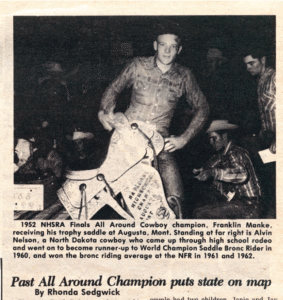
    The Edgemont, S.D. cowboy was the 1952 National High School Rodeo Bareback Riding champion, and it wasn’t until fellow South Dakotan Shane O’Connell won it in 2013, that the drought was over.
    Manke not only competed in the bareback riding, but also as a steer wrestler, cow cutter, wild cow rider, and occasional calf roper.
    He was born in 1935 to Alfred (Allie) and Dorothy (White) Manke, who ranched twenty miles south of Edgemont. As most country kids did in those days, he rode the three miles to the country school every day.
    By the time he was ten years old, he was riding calves at local county fairs, and as a freshman in high school, he got on his first bareback horse.
    High school rodeo wasn’t as prevalent then as it is now, and there were fewer rodeos to go to. But Franklin went to several, one of them being the Harrison, Neb. rodeo in 1952, when he won the bareback riding, calf roping, second place in the cow riding, and the all-around.
    That same year, his senior year, he won the S.D. state bareback riding and calf roping titles and split first in the cow cutting.
    Back then, if a high school finals rodeo contestant qualified for the National High School Finals in one event, they could enter a second event, and the all-around winner could enter as many events as they chose. He finished his high school rodeo career with not only the national bareback riding title, but the all-around as well, having competed at Nationals in Augusta, Montana in the tie-down roping, too.
    After high school, he came home to ranch with his parents. They owned two ranches, one south of Edgemont and the other about twenty-five miles away, in southeastern Wyoming.

    But he continued to rodeo, this time in the Northwest Ranch Cowboys Association (NRCA) and at local county fairs.
    In 1955 he went to a rodeo that was lacking steer wrestlers. The committee told Franklin they would pay his entry fees if he would bulldog. He’d ridden his rope horse in high school to bulldog, but the horse didn’t work out well. “I’d go to get off and he’d stop,” he said. “That left a lot of air between me and the steer.” But he borrowed a horse, rode him at that rodeo and all summer, finishing the year second in the steer wrestling for the NRCA.
    His dad, Allie, team roped when he was older, but as a young man, his hobby was race horses. He had a string of thoroughbreds he’d take to the county fair races, and some of them Franklin rodeoed on. It wasn’t a perfect situation, but back then, they made do. Every now and then the race horses didn’t know when to quit. “Sometimes it wasn’t very pleasant when you rode a race horse and you went to turn a cow and the horse just kept going,” Franklin chuckled.
    Franklin continued to rodeo in the NRCA. In 1956, he won the bareback riding, was second in the steer wrestling, and won the all-around. In 1957 and ’58, he won the steer wrestling both years. He competed in 1959, but injuries slowed him down.
    In ’59, he broke his riding hand while riding barebacks. As the pickup man approached, he worked to get his hand out of the rigging. Before he had it out, the bucking horse stopped, throwing Franklin’s body weight over the top of his hand and breaking a bone.
    The same year, he tore ligaments in a knee while bull dogging. There was no surgery for torn ligaments then; the only cure was time off. Franklin built a brace and wore it to bulldog, but his bulldogging days were coming to an end.

    After 1959, he quit rodeo for a few years, continuing to ranch on the family operation, which included mama cows, yearlings and sheep. His dad passed away in 1972, and by this time, Franklin and his wife Audrey had bought another place, between the Edgemont ranch and the Wyoming ranch. Without his dad’s help, it was too difficult to run both places, and he didn’t want to hire help. They also had a grazing lease that had expired, so it made sense to sell the S.D. ranch.
    Franklin’s parents owned and managed three motels in Edgemont, and after his dad’s death, his mom ran them for three years. It was more than she could handle, so Franklin and Audrey bought them from her, with the intent of running them for three years and then selling them. Two of them were side by side and shared an office, and one of them closed during the winter. They ran them for 22 years, before selling them in 1997.
    In the mid-1960s, when dally team roping became popular, Franklin began rodeoing again, at jackpots and a few rodeos close to home. He never ventured far from home, choosing to rodeo at NRCA events, local county fairs and jackpots in South Dakota and Wyoming. He didn’t go full time, believing it was difficult to do both well. “You either have to be a rancher and a part-time rodeo cowboy, or a full-time rodeo cowboy. That’s how I look at it.”
    Franklin team roped in the Old Timers Rodeo Association (now the National Senior Pro Rodeo Association.) He headed for a while, then switched to heeling, often partnering with Bob Stoddard of Douglas, Wyo. He enjoyed the jackpots the NSPRA held before the rodeo. He doesn’t brag, but “I guess I claimed my share of the money in the ropings.” He quit roping in 1994, after having a hip replaced.
    Franklin and Audrey first met when they were in country school. He had had his eye on her, he says, and asked her out on July 4, 1953. They married later that year and celebrated their 65th anniversary in October of 2018.
    And the rodeo gene didn’t end with Franklin. The couple’s daughter, Janie, was the 1971 Wyoming High School Girls All-Around champion, and their son, Jay, was the 1976 S. D. State High School Team Roping champion. Janie and her husband Butch Tinint live in Valentine, Neb., and both of Janie’s daughters competed in rodeo. Jay’s daughter and son, Katie and Ty, have also done well. Katie and her husband Jeremy Langdeau have three children who ride and compete, and Ty, who is married to Trista, has won the saddle bronc riding average at the Badlands Circuit Finals Rodeo twice. Franklin started Ty in the saddle bronc riding while in high school, buying him his first saddle. “In fact, I think he still owes me for that saddle,” he joked.
    Franklin and his great-grandson Jackson Langdeau goat rope together. On foot, Jackson heads and Franklin heels, and Franklin loves it.
    The couple sold the ranch in 1989, when the work with the motels became too much. They fully retired in 1997, when they bought forty acres and built a house on the east side of Edgemont. They stay busy: Franklin, traveling to rodeos to watch his grandchildren and great-grandchildren, and Audrey, who paints. Her artwork is excellent, Franklin said, and jokes that they’ll have to build longer walls to hang her work.
    He loved his days in rodeo. He and Audrey made it through the bad times, of which there weren’t many. They lost a granddaughter, Jay’s daughter Jayme, when she died in a car accident, but life is still good, filled with children, grandchildren and great-grandchildren. “We’ve never really had any downs in life.”

  • Back When They Bucked with Argene Clanton

    Back When They Bucked with Argene Clanton

    Argene Clanton laughs, and life laughs with him.
    The cowboy, an Okie, former calf roper, café and truck stop owner, veteran, rodeo committee member and daddy of three girls, loves a good joke.
    And at the age of 94 years young, he’s still laughing.
    He was born in 1924 to Cleve and Verda Clanton in Barnsdall, Okla., weighing in at two pounds, seven ounces and sleeping in a box in the closet. When he was born, he was a “blue baby,” and one of the midwives attending his mother asked if there was any whiskey in the house. There was; she took it, warmed a teaspoon of it, and gave it to him. He lived, and says with a twinkle in his eye, “I’ve had a few drinks since then.”
    As a child, the family lived on a farm near Chelsea, Okla. He loved to rope and would try to rope everything: chickens, pigs, anything that walked across his path. In high school FFA at Chelsea Public Schools, the FFA kids would be hired out to help farmers work their cattle, sheep and hogs. Argene would load his horse in the FFA trailer, and the crew would go to work. People didn’t have good corrals and chutes in those days. Animals often got out, and Argene and his buddies got to rope them. But the animals weren’t always getting out on their own. “I guarantee you, somebody’d let one out so we’d get to rope,” Argene chuckled.
    Argene calf roped with his good friend Roger Morris. Roger’s dad was a horse trader, and Argene would ride a lot of the horses he brought home. One time, he bought a cow horse and Argene couldn’t wait to get on him. Roger’s dad “wanted me to ride him, to see what kind of a horse he was. I was always a fool to get on,” he said.

    So Argene decided to skip school so he could ride this cow horse. The horse “was snorty when I got him in the corner,” Argene remembered. “I got up on him, and boy, he broke in two. He ducked his head, bucked, and threw me right into the saddle room.” Argene got up and this time opened the gate to the pasture. He was going to ride this horse. He got back on him, spurring and whipping, and “out the gate I went. He hit three licks and settled down.”
    It just happened that the Clanton barn and pasture was next to the school, and the principal had seen Argene riding. The next day, over the speaker, came the principal’s voice, asking him to report to the office. Argene lied about skipping school, telling the principal that his dad had asked him to get cattle in that day. The principal told him he was going to get three licks. Argene said, “no, sir.” The principal locked the door and Argene told him, “you’re going to have to give them to me.” The principal “got hot, and everything turned red.” But he unlocked the door, and “I felt better,” Argene said. The principal told him to ask his dad to come and talk to him the next time he was at school. “I said I sure will,” Argene laughed. “And then I forgot to tell him.”
    In 1943, the year before he would have graduated, Argene entered the Navy. Six Craig County boys all went at the same time, and Argene was sent to San Diego to machinist school. He was on a troop transport ship, the Admiral RE Coontz AP122, going through the Panama Canal seven times hauling Puerto Ricans back and forth from Europe, where they were serving in the U.S. military. After World War II ended, the ship was stationed in the New York Bay, and Argene stayed with the ship as it was decommissioned to the merchant marines. He was assigned the task of teaching them how to run the ship, and given the option to take his thirty day leave and then return for his final two months of service, or stay for three months and then be discharged. He chose to stay. “I said, if I get back to Oklahoma, I won’t want to leave.” He was on the ship longer than any other Navy personnel; he was on board when it was commissioned and when it was decommissioned.
    In 1946, Argene was honorably discharged from the Navy and came back to Oklahoma, never to leave again.
    He bought a farm on Route 66, halfway between Vinita and Chelsea. He had beef cattle and dairy cattle, married Martha Carter, and started a family, having three daughters: Connie Butler, Peggy McGehee and Pam Swift. A small arena was behind the dairy barn, and friends stopped by to rope. He served on the school board for the White Oak School as well.
    His paternal grandpa Grant Clanton, known as “Sweet Tater” started Clanton’s Café in 1927. Cleve and Verda took it over in the 1940s, and when they decided to retire, Argene bought it from them. He moved his family to the house behind the café and his parents moved to Argene’s farm. Then he bought the service station next to the café and ran it. After eleven years of running the café, he sold it to his sister and bought a truck stop at Big Cabin, running it for seventeen years.
    He and Roger Morris competed at area ropings and rodeos. They never went pro, but they loved to rope. They stayed in the area, never venturing more than 100 miles from home, to rodeos in Oklahoma, Arkansas and Kansas. He also competed in the calf mugging and wild cow milking.

    Argene played a vital part in the Original Will Rogers Memorial Rodeo, held in Vinita every August. He has served as rodeo chairman and has been on the rodeo committee for years. When he was fifteen, he rode his horse eighteen miles, from his home to Vinita to watch the rodeo. He has gone to at least one performance of the rodeo every year of its 82 year existence, except for the three years he was in the Navy. He has carried the flag in the rodeo parade and posted colors at the rodeo for forty years. He attended the PRCA convention and the National Finals Rodeo many times, and one time, when there was no money to put on a rodeo, he and his good friend Bob McSpadden, brother to Clem McSpadden, took out a personal loan to finance it.
    When he returned from the Navy, World War I veteran George Franklin paid his dues to join the Chelsea American Legion. Two years later, he joined the Vinita American Legion Post 40, and has been an active member for 72 years, serving as commander of the Legion several years.
    Argene also was active in politics, volunteering as Craig County Republican Party chairman many years. He knew Clem McSpadden, a Democrat, from playing high school basketball against him and going to rodeos with him, and Clem knew Argene had influence in Craig County. When Clem ran for Oklahoma Senate in the 1950s, he asked Argene to go with him to be introduced to folks in the area. Argene knew the real reason Clem wanted him along: to open the gates. In the 1970s, when Clem ran for U.S. Congress, he asked for Argene’s help again. Argene told him, this time you’re opening the gates, and he did. “I drove, and he opened.”
    In 2002, he, along with the other Chelsea veterans who didn’t graduate from high school due to their service, were asked to walk across the stage for high school graduation. His graduation party was at the senior citizen center!
    Six years ago, he, his daughters, and other veterans were part of an Honor Flight to Washington, D.C., where he saw the sights for the first time. The Clanton Café, which his dad started and he owned, is the oldest continuously owned family restaurant on Route 66 in Oklahoma (it’s now owned by Argene’s niece and her husband), and he still loves to dance, having taught all three of his girls by them standing on his boots.
    Argene’s wife Martha died in 1992 and he married Roberta Millarr two years later. Roberta has three boys and a girl; together, the couple has so many grandkids, Argene said, “we quit counting them.”
    Life is good for the old timer. He and Roger live two miles from each other and get together to tell old stories. Argene frequents the American Legion, where he likes to partake of the beverage that got his lungs working as a baby, and he counts his blessings. Life has “all been good, it really has,” he said. “Raising three girls and having two good wives, I don’t know how you could beat it.”
    It’s a life-well lived.

  • Back When They Bucked with The Ludwig Twins: Wilma Hybarger & Wanda Cagliari

    Back When They Bucked with The Ludwig Twins: Wilma Hybarger & Wanda Cagliari

    The Ludwig Twins – Wilma and Wanda – made their mark, and their living, in the horse and rodeo world.
    Wilma Ludwig Hybarger and Wanda Ludwig Cagliari were born in Auburn, California in 1935, the daughters of Everett and Edith Ludwig. They were raised on a dairy farm, bottling and delivering the milk the hired man and their dad milked, and when the hired man was on vacation, the girls helped in the milk barn. Hard work was part of their upbringing, but it was a good life.
    Their first horse was a Shetland named Nipper. Then came a big paint horse called Chief. Their dad would buy horses from the Roseville, Calif. auction ring and bring them home for the girls, and that’s how they learned to ride.
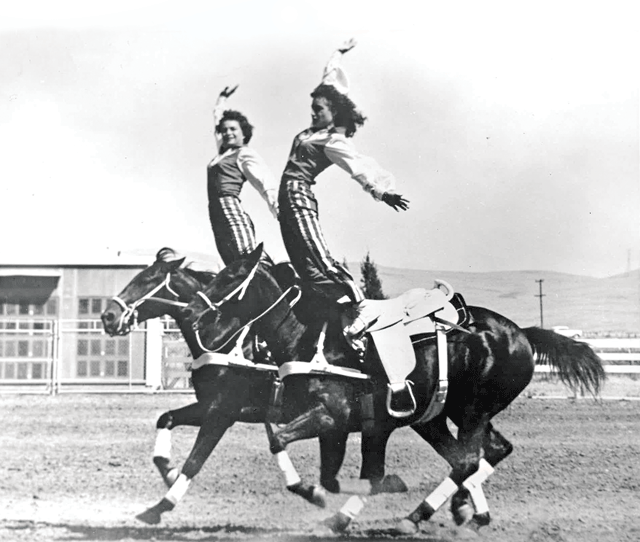
    It was when they were in their teens that they saw trick riding for the first time. They were at a rodeo in Hughes Stadium in Sacramento, Calif., with Buddy Farren trick riding. “We decided that’s what we wanted to do,” Wilma said. Their parents didn’t approve. But when Everett and Edith took a two week trip to New York, the girls stayed home to do chores, driving to Buddy’s place in Sacramento, to take trick riding lessons.
    By the time their parents were home, Wilma and Wanda were accomplished enough that their parents consented to the two to continue. They learned more, and then a stock contractor, Ray Hicks, wanted to hire them. They worked for him, then took other contracts for other rodeos, gradually working events across the western U.S.

    For fifteen years, from the time they were eighteen to the early 1970s, the women entertained fans with their dazzling trick riding. And it wasn’t just rodeos that hired them. Any event that wanted entertainment would book them.
    In 1972, the duo decided to quit trick riding. By this time, they had moved to Nevada, were both married, with small children, and it was time to do something else.
    For both women, the “something else” still involved horses.
    They had trained horses in their trick riding days, but now they did even more of it. They didn’t work together, but each trained horses for a wide variety of disciplines. Both women had horses that excelled at the National High School Finals Rodeo, the College Finals Rodeo, and the National Finals Rodeo. Wanda’s daughter won the barrel racing at the College Finals in 1988 on a horse Wanda trained. Both had shown horses in their teens, and Wilma continued to show, becoming the first woman to make the finals in the snaffle bit futurity in Reno, Nev. Wilma also had barrel horses that qualified for the Indian National Finals Rodeo.
    Wilma gave lessons (and continues to) to beginning and advanced riders, barrel racers, cutters, anyone who wanted to get better on a horse. She’s tutored riders who have been successful in every discipline. Wilma never competed professionally, but in 1991, she won the Reno Rodeo aboard Wanda’s barrel horse Toppy, when the rodeo was not a WPRA event that year.
    After the trick riding, Wanda began running barrels. She stayed in the state associations: the Nevada Cowboys Association, the California Cowboys Association, the Idaho Cowboys Association, and the Nevada Barrel Racing Association for ten years, winning the NCA nine consecutive years, the CCA twice, and the Nevada Barrel Racing title ten consecutive years. She ran into Tom Marvel, the father of 1978 world champion saddle bronc rider Joe Marvel, at a sale. He told her she should go pro. “You have a good horse,” he told her, “and you might not get another one like it.”
    So she did. It was 1980, and she was a barrel racer in the Women’s Pro Rodeo Association for eleven years. She stayed close to home when she could, but rodeoed across the nation, qualifying for the National Finals Rodeo in 1980 and 1981 and winning Rookie of the Year in 1980.
    The horse Wanda rode at pro rodeos was Whats the Use, “Whatsit.” The three-year-old mare was fourteen hands tall, and “looked like a pig,” Wanda remembered. The seller told her Wanda could have her, and if she was able to make something out of her, he’d take $350 for her. Wanda didn’t want her, but the mare from the Jack Schawbacker ranch in Madera, California, was already loaded in the trailer.
    So Wanda trained her. Whatsit was talented at everything: running barrels, heading, heeling, poles, cattle work, “she did anything you asked her to do,” Wanda said. “She was a good horse, just a natural.”

    After nearly a dozen years of WPRA rodeo, Wanda called it quits. She had competed at fifty or sixty rodeos each year, and “it was quite a chore,” she said. “You drove till your head almost fell off.”
    The next stage of the twins’ rodeo competition began.
    Wilma and Wanda joined the National Senior Pro Rodeo Association in the 1990s. Wilma mostly barrel raced and occasionally team roped and ribbon roped. Wanda ran barrels, team roped, ribbon roped, and did a little breakaway, too. Wanda won the senior pro barrel racing title ten consecutive years, the all-around title eight out of ten years and the reserve title twice. She was also the 1993 Canadian Senior Pro Rodeo champion barrel racer.
    At a rodeo in Wells, Nevada, a cowboy approached Wanda. “He said, “we gotta do something about you. You’re winning too damn much.” Wanda “got mad and told him off,” she said. “I’ve worked too hard my whole life and I don’t need you telling me I have to quit.” Unofficially, Wanda was the first woman to win the all-around title against men in the senior pro association. After that, the competition was split into two divisions: the men and the women.
    Wilma has a knack for re-training horses that came to her with problems. She remembers a barrel horse once, where, at the first barrel, he’d run down the fence. The rider brought him to Wilma, asking if she could fix him, and how long it would take. Wilma replied, “It’ll take me as long to fix it as it took you to mess him up.” It took a year and a half to straighten the horse out. The rider was “ripping on his head, and that’s why he ran off,” Wilma said. “He’d say, I’ve had enough of this and he’d go down the fence.”
    The rider couldn’t wait while her horse was being “fixed”, so she sold him to Wilma, who called him Belairo. Wilma rode him in the senior pros and won the senior reserve world champion barrel racing and the Canadian Senior Horse of the Year on him.
    Oftentimes, Wilma says people think of horses as machines. “They are not,” she said. “They are an animal with a brain, and a good brain.” It takes time to train horses. “There’s nothing better than time. Slow and easy to start, so they don’t get scared of anything. If you scare them, it’s hard to get them back.”
    Two of Wilma’s protégés: Hayley Campbell and Randi Buchanan, are known as “Wilma’s girls.” Both women are barrel racers and have had success. Buchanan said Wilma “is one of those people who teaches you to get out of your horse’s face and work with your legs. That was something I admired. She gave me the mechanics to do that.”
    Now in their eighties, the ladies live about a mile from each other and haven’t slowed down. Wanda retired from barrel racing in 2012, due to a bad back, and Wilma still trains horses. Wanda is involved in the trail trials, rides with obstacles similar to the trail riding competition at horse shows but in a larger outdoor setting.
    Both women set the next generation on horseback. Wilma’s son, Russ Ferretto, and daughter, Cindy Ferretto, were competing by the time they were four years old. Wanda’s daughter, Cathy Cagliari, lives in Corning, Calif. and has won the California Cowboys Rodeo Association barrel racing and breakaway roping titles several times.
    The women are both inductees into the Nevada Horseman’s Association Hall of Fame, and Wanda is a member of the Senior Pro Rodeo Hall of Fame and the University of Nevada Sanford Stars Hall of Fame.
    Their lives were, and still are, satisfying, they say. “I wouldn’t trade my life for anything. It was fun, and I made money at it,” Wanda said. They were able to make a living doing something they loved.

  • Back When They Bucked with Carolynn Seay Vietor

    Back When They Bucked with Carolynn Seay Vietor

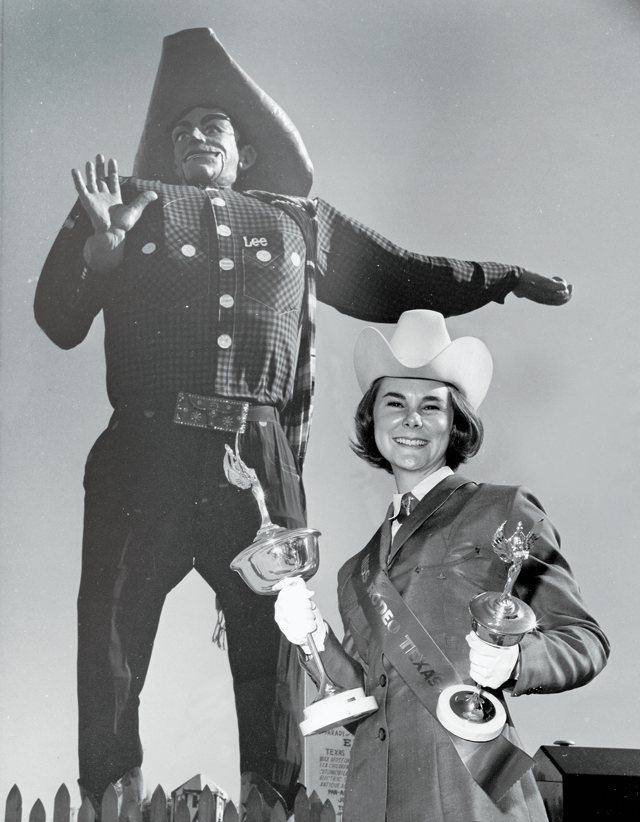
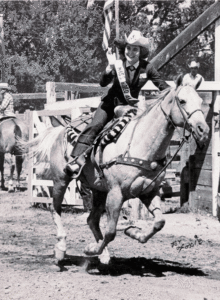
    Front porch sittin’ will have to wait at the Rocking Chair Ranch, in Philipsburg, Montana, because Carolynn and her husband Willy Vietor are far too busy in the rodeo world to occupy rocking chairs. Carolynn, former Miss Rodeo America 1966, has spent a lifetime promoting and competing in professional rodeo as well as promoting the western lifestyle. Carolynn spends many hours in the saddle each week exercising and training on three horses, (her competition horse, back-up horse and prospect mare) and often stays at the barn until after dark. With a rodeo career spanning over 6 decades, Carolynn still has a passion for running barrels and every Tuesday night through the summer season you can find her sharing that passion at the Ranch at Rock Creek, just 20 minutes across the mountain from her home. “Riding in the exhibition rodeos and sharing rodeo with people that know nothing about it has been one of the most rewarding things I’ve done in the promotion of the sport and the western lifestyle.” The rodeos are produced at the luxury dude ranch to share the experience of the wild west and a close-up view of rodeo with guests from all over the world, including social hours so guests can interact with the cowboys and cowgirls competing. Willy and Carolynn began working with the Ranch at Rock River three years ago, and the rodeos, produced with the help of former PRCA stock contractor Joe DeMers, offer a full slate of rodeo events to wow the crowds. Willy flags timed events and competes as a team roper in the rodeos. Barrel racing is one of the favored events of the night, and although many of the ranch’s wranglers race, Carolynn is the only professional barrel racer to star in the show, “I ride in full-dress code, bring one of my best horses and make the best run I can each rodeo, giving the guests a glimpse of true rodeo runs. All I’ve done in my life is coming to a head in doing this, it’s turned out to be one of the highlights of my life.”

    Carolynn grew up in San Antonio, Texas as an only child and spent many days at her grandparents’ ranch just outside of Campbellton, Texas. Doll and J.G. Callan instilled a love of horses into their granddaughter, and as a child would take her to the San Antonio Stock Show and Rodeo. “Some friends of my grandparents gave us box seat tickets, and from those seats I watched the barrel racing for the first time and was hooked. I knew right then and there that I wanted to barrel race one day.” Carolynn’s grandpa was a cattleman and although he didn’t have rodeo horses, he made sure to buy his young granddaughter a horse that was kept at a nearby boarding stable and Carolynn spent several years riding and even competing in western pleasure shows. “My grandparents bought me a wonderful Palomino gelding named Sunny Boy. I was honored to carry the American flag on him at one of the shows at just 9-years-old; little did I know then that I would one day carry the American flag as Miss Rodeo America, and later at the 1998 opening ceremony of the Wrangler National Finals Rodeo on the WPRA’s 50th Anniversary.”
    Although Carolynn’s dream was to be a barrel racer, even then barrel horses were very expensive, so she started out on ranch horses and entered high school rodeos as a breakaway roper. “I was 4th in the state of Texas in breakaway roping, on borrowed horses with borrowed trailers, actually borrowed everything!” Carolynn graduated from W.B. Ray High School in Corpus Christi, Texas before going on to compete on the college rodeo team for Southwest Texas State as a goat tyer. Carolynn was the NIRA Southern Region Champion Goat Tyer two years in a row and placed deep in the goat tying at the college national finals in 1964. In 1965, the NIRA held a Rodeo Queen contest and Carolynn rode away from the competition with the crown and title that summer. By the fall of that same year, she had also claimed the Miss Rodeo Texas crown, and finally went on to collect the coveted Miss Rodeo America crown, reigning for all three associations in 1966. Carolynn was the first Miss Rodeo America to win in all three categories of the competition; horsemanship, personality, and appearance. After taking the year off from college to focus on her responsibilities as rodeo queen, Carolynn graduated from Texas State University in San Marcos, Texas in 1968 with a degree in home economics and speech. Carolynn’s senior year of college, a friend set her up on a blind date with Bill, known as Willy; they were married 6 months later and have enjoyed a life of 50-years together so far. Willy served as a T-38 instructor pilot, stationed at the Laredo Air Force base for 6-years during the Vietnam War before the couple and their young son Cal, short for Callan, moved to Willy’s family ranch where they raised commercial cross-bred cattle in Philipsburg, Montana. While they were in Montana, Carolynn barrel raced at local amateur rodeos, staying close to home to focus on her family. The couple had their second son, Justin in 1974. Sadly, tragedy struck the young family in 1979 when they suffered the loss of both their 8-year old son, Cal, and Willy’s father Bill, in a tragic airplane accident.

    In the late 70’s Carolynn had a sorrel gelding that made such an impression on her that his impact on her life can still be seen today. “Promino, a son of Classy Bar, was the best horse I have ever owned, and because of him, I bought his full sister, Classy Julie, from Dears Quarter Horses in Simms, Montana, and she and our Doc Bar stud, Dee Barretta have been the foundation of every great horse I’ve had since then.” Carolynn won the Montana Barrel Racing finals on Promino two years, and while riding Promino, she filled her rookie GRA (now the WPRA) permit in 1979 at one rodeo in Helena, Montana. After filling her card while competing in the PRCA Montana Pro Rodeo Circuit, she went to the circuit finals a total of 18 times on 7 different horses. In 2003, she was the Montana Circuit Champion on one of her colts, Classy Eye Am, a sorrel mare more fondly known as Bump. In 2003, Carolynn qualified for the 2004 Dodge National Circuit Finals in Pocatello, Idaho. The couple built a winter home in 2005, just outside of Wickenburg, Arizona and Carolynn stopped going to the Montana circuit rodeos as heavily. However, slowing down was not exactly Carolynn Vietor’s speed, and she and Willy continued to compete in the National Senior Pro Rodeo Association, with Carolynn winning the 2008 NSPRA Champion Barrel Racer title on Bump.
    In 1985, she held the Northern Region Director position, followed by the Montana Director position for the Women’s Professional Rodeo Association, for a total of 10 years before taking the reins as president of the association from 1995 until 2003. After retiring for 10 years, she was re-elected as president once again serving from 2013 until 2016. During Carolynn’s time with the WPRA, she not only saw incredible growth in the industry but was also recognized with many honors and awards. Carolynn was named the 1999 Coca-Cola Woman of the Year, 2002 Pioneer Woman of the Year, and was awarded the WPRA Heritage Award in 2002 as well. “Everything is bigger and better, Miss Rodeo America, rodeos, barrel racing, all of it. There are so many more rodeos, more sponsors, and so much more money. No one ever dreamed we’d compete for the money we can today.” In 2008, Carolynn was honored as the Texas State University Alumna of the Year because of her work in professional rodeo. Although it was due to the efforts of several board members and many years of earnestly working towards goals, Carolynn was fortunate to see major accomplishments while she was the WPRA president; in 1998, team ropers and barrel racers were given equal money at the Wrangler National Finals Rodeo, and she was also in the lead of the WPRA when the prize money went to over a million dollars at the WNFR.
    Carolynn is as busy as ever today, filled with the same passion for barrel racing that has been the story of her life. “I have a 7-year old horse coming up, so I’m about ready to get more heavily into competing again. I broke my leg last year so that slowed me down some, but I’ve finally just about forgotten I broke it, so I’m getting back in the groove and ready to go again.” Besides judging at multiple events, when in Arizona Willy ropes nearly every day of the week, sometimes going to 2 or 3 ropings a day. They enjoy spending time with Justin, his wife Brook, and their two granddaughters, Ellie, 8, and Reese, 6, (lovingly known as MayMay), who live near Salt Lake City, Utah. Carolynn and Willy are on a desperate search to find the perfect kid horses to share with their granddaughters, hoping to instill the same passion for the lifestyle that her grandparents once did for her.
    The Vietor family was inducted to the 2016 Montana Pro Rodeo Hall and Wall of Fame and in 2017, Carolynn was included as one of the Outstanding Women of the West at the Montana Silversmith World Reunion and Gold Card Gathering.
    “Professional rodeo has grown by leaps and bounds from the cowboys of the Turtle days that worked to gain recognition as a professional sport to what it is today, but still with the ground roots of the western lifestyle and where we came from. I am so happy to have been a part of it and see it all happen.”

  • Back When They Bucked with John Harris

    Back When They Bucked with John Harris

    From the time he was a baby, all John Farris ever wanted to do was be a cowboy. And he spent his life doing it. The Addington, Oklahoma man was born in 1928 in Iowa Park, Texas, the son of B.A. and Eva Farris. When the neighbor’s cows got out and onto Farris property, John and his brother would ride them. At the age of sixteen, he hitchhiked to the rodeo in Jacksboro, Texas, to ride a bull. He got hit in the mouth, and when his parents found out where he’d been, “they threw a fit,” John remembers.
    But it didn’t discourage him. He graduated high school in 1944 and went to work, plowing for neighbors and working in the oilfield. He rodeoed, too, riding bareback horses, saddle bronc horses, bulls, roping, and even doing a little steer wrestling. Of his events, he won the most money at the saddle bronc riding and bull riding. In 1951, he won the wild horse race and placed in the amateur bronc riding at Cheyenne Frontier Days.
    It was at a rodeo in Stanford, Texas, in 1954 when he met a striking dark-haired barrel racer. John and Mildred Cotten met on July 4 and were married the next year. She was an accomplished barrel racer, winning the Texas Barrel Racers Association championship in 1955-57. When she joined the Girls Rodeo Association (the predecessor to the Women’s Pro Rodeo Association) in 1958, she began going to pro rodeos, and in 1957, John got his RCA (Rodeo Cowboys Association, the forerunner to the Pro Rodeo Cowboys Association) card, and the two traveled together.
    They spent the next fifty-plus years together, rodeoing and traveling across the nation.

    In 1962, they began working for stock contractor Tommy Steiner. Mildred took entries (those were the days before Procom and the computerized entry system, when contestants called the rodeo secretary to enter) and secretaried the rodeo. John was chute boss, for either the timed event end or the roughstock end, or both. Steiner was the first producer they worked for, but throughout their lives, they worked for others: Harper Morgan Rodeo Co., Neal Gay, Don Gay, Stace Smith, Mack Altizer, the Auger Rodeo Co., Mike Cervi, and more.
    When the Farris’s worked a rodeo, things went smoothly; the pay-out was right, the arena was clean, and the stock was loaded correctly.
    While they worked for stock contractors, both continued to compete. John rode bulls till the age of 44, and Mildred qualified for the National Finals Rodeo thirteen times.
    In 1967, one of the years Mildred made the NFR, John began a career of working the NFR that would last till 2012. Throughout those forty-six years, John did everything from security work to caring for grand entry saddle horses to working as chute boss. He was timed event chute boss for years, sorting cattle, setting the barrier, and making sure the animals were in the right sequence. He’s best known by rodeo fans as they saw him on TV: flagging in the next barrel racer during each night of the NFR. He set the barrel pattern at the NFR every year, from 1967 to 2012.
    The couple rodeoed nearly year-round. They would be gone all summer and most of the fall. After the NFR, they would be home till the Texas Circuit Finals on New Year’s, then home again until Ft. Worth started. The couple moved to Addington, to be near John’s parents. Their sons: Billy Tom and Johnny, stayed with B.A. and Eva Farris during the school year. As soon as school got out, the boys were with them. And during the school year, if the rodeo was close, John might run up to Addington to pick them up for a weekend, or a contestant traveling south might bring them. A few times, Tommy Steiner flew his airplane to get them.
    They worked thirty-five or forty rodeos a year, and as soon as their boys were old enough, they were on the labor list. They pushed calves and took saddles off, among other chores. “We’d rather do that than run around,” Johnny remembered.
    John and Mildred would call and check in on their kids but if the boys needed to get ahold of their parents, they called Procom. It was before the invention of the cell phone, and Procom would give the boys the number for the rodeo their parents were at. Then the boys would wait till entries opened for the rodeo, and Mildred would answer their call.

    John was working for Tommy Steiner when Tommy was the first producer to use the electric eye for the barrel race. He was with Tommy when it was purchased. He also considers improvements to the judging system as another forward step in pro rodeo. Before the professional judging system, a cowboy might get scored poorly if he wasn’t a friend of the judge. When the pro system started, it leveled the playing field.
    John and Mildred were reserved, but they took care of business, said Vickie Shireman, a PRCA secretary who knows the Farris family and worked with the couple. “They were very well respected. They were quiet, but if somebody needed help, John and Mildred would be the first to help.” They helped numerous cowboys and cowgirls get started, nurturing young people on the rodeo road. Buddy Lytle, a tie-down roper, steer wrestler, and later, a judge, lived with the family for years. Announcer Mike Mathis was a friend of the family. “John was an amazing cowboy,” he said. “He was a hell of a competitor, and he and Mildred were a team.” Rodeo producers knew that when John and Mildred worked for them, things would go smoothly. “No matter where,” Mike said, the work “was going to be taken care of, and properly.”
    One of John’s favorite parts of rodeo was the people. As contract labor, he and Mildred would be in town for the entire week of rodeo, and made countless friends among contestants, contract personnel, and committee members. They watched children of friends grow up, often seeing multiple generations compete. John worked through hundreds of hours of slack, sometimes six or seven hours a day, but it never got old for him. Once, after three days of slack at a rodeo, world champion tie-down roper Fred Whitfield asked John if he was tired of it. No, he answered, “because I get to see everybody.”
    Mildred passed away in 2013; before she died, she and John were recognized numerous times. They are the only couple to be inducted into the Pro Rodeo Hall of Fame (2006); the Texas Rodeo Cowboy Hall of Fame (2004) and the Rodeo Hall of Fame in the National Cowboy and Western Heritage Museum in Oklahoma City (2010).
    John was chute boss for the Texas Circuit Finals for twenty years and received the WPRA’s Outstanding Individual Award in 1999. He was Texas Circuit Man of the Year in 1997. Mildred was PRCA Secretary of the Year eight times and served as a director, vice-president and president of the Girls Rodeo Association and Women’s Pro Rodeo Association.
    His family: Bill and wife Sally, and Johnny and wife Jan, threw a ninetieth birthday party for him last year. More than 140 people came to visit with John and celebrate his life. John has four grandchildren and two great-grandchildren.

  • Back When They Bucked with Marilyn Freimark

    Back When They Bucked with Marilyn Freimark

    Marilyn Freimark knows her family’s genes run thick with the blue-jean lifestyle of rodeo and horses, but it was her own love of horses that put the passion back in her family tree—and Marilyn herself into rodeo history as the first Miss Rodeo America.
    Born in 1935, Marilyn was raised in town in Cheyenne, Wyoming, but she was a country girl at heart. “The first horse I saw I fell in love with, and I’ve been in love with them ever since,” says Marilyn. “My father was a railroad man, but he came from a ranch near Newcastle, Wyoming. His brothers were all ranchers, and we would visit them every summer and ride many cattle for pleasure. When I was 13 years old, I started working at Merritt Western Store, an upscale Western store. I met people from all over the United States, and I was able to visit with them and meet a lot of ranch and rodeo people.” She modeled Merritt’s clothing and a clothing store in Cheyenne, which made up most of her own wardrobe as well.
    Marilyn graduated from Cheyenne High School in 1954, and motivated by the many Colorado livestock club students she met at work, she enrolled at Colorado State University in Fort Collins, known then as Colorado A&M University. Paying for her tuition and all her expenses through her job at Merritt’s, Marilyn majored in business and mass communications, and leapt in to a variety of school activities and sports, including Western and English riding lessons, polo, swimming, ice skating, basketball, volleyball, tennis and was an expert rifle marksman and she was an award winning fisher person. Marilyn also became a Kappa Delta and competed in five non rodeo queen contests, including Miss Colorado, Miss Colorado A&M.

    A year into her studies at CSU, Marilyn’s employer at Merritt’s learned about the newly minted Miss Rodeo America organization and asked Marilyn if she’d like to compete for the title. “I just had fun doing it, never thinking that anything would come of it, but I won about four contests before I got into the (Miss Rodeo America) contest,” says Marilyn. Her first step was winning the Cheyenne Riding Club queen contest. With their sponsorship, as well as Merritt’s, she went on to win Miss Rodeo Wyoming, followed by Miss Rodeo Queen of the Rockies, all in 1955. “In those days, the contestants had grooms with them and some of them had been in special training for a year for the (Miss Rodeo America) contest. I had too, but it wasn’t that I was planning on doing anything with it—I just happened to be lucky and got in on some wonderful training before I went.”
    The first Miss Rodeo America contest took place in Marilyn’s home state in Casper, where she and nine other women, including a Canadian, competed in front of 15 judges over several days. “They also had silent judges at various places watching you and seeing how friendly you were, and if you were greeting people and on your best behavior.” Marilyn excelled in and won all three divisions—horsemanship, personality, and appearance—but horsemanship was always her favorite. “You brought your own horse at that time, and they furnished other horses for us to ride. I am not a bronc buster, but I do know how to train horses for riding and western equitation, and even for English.” Marilyn competed on her mare, Blue, her first horse given to her by a friend when she was a senior in high school. “She loved to show off and do beautiful things.”
    By the end of the contest, Marilyn was hoping for the unusual—that the title would go to someone else. “I had a girlfriend from Colorado State University in the contest, Laurie, and she wanted to win so badly and I really wanted her to win.” The first ever Miss Rodeo America crown was placed on Marilyn’s hat, however. She and Laurie continued their friendship, and Marilyn, with her mother as chaperone, began traveling and representing rodeo across the country. She made history again as the first rodeo queen invited to ride at the Denver Stock Show, and she was even offered a contract with Paramount Pictures, along with opportunities for television appearances. “It was always wonderful to travel like that and go to many places and meet lots of people.” Marilyn’s schooling in mass communications came to her aid, though she was never entirely comfortable being on stage in front of an audience, and she continued studying at CSU through her reign as Miss Rodeo America.

    A year after her reign, Marilyn was a junior in college when she married Paul Painter from Buffalo, South Dakota, who was also a student at CSU. The couple moved to South Dakota, where they ran Painter Ranch and Marilyn later finished her degree at Black Hills State University. She and Paul were married for 18 years and had 4 children, Joe, Laurie, Cindy, and Judy, who all went on to attend BHSU as well. When Marilyn and Paul separated, Marilyn moved to Spearfish, South Dakota, where she worked, and eventually met Dr. Lyle Freimark, a surgeon from Rapid City. They married in 1985, and while Marilyn wanted to become a stock broker, it wouldn’t give her the flexibility to travel with Lyle to seminars all over the world. Instead, she was his office manager for the next 15 years, and they traveled to 52 countries, sometimes staying for a week or even as long as 3 or 4 months. “He was very interested in music, and we always went to concerts and I loved the plays,” says Marilyn. Because of Lyle’s allergies, they didn’t have animals to care for at home, though Marilyn’s son, Joe, raised 75 head of buffalo for them at one time.
    Lyle retired in 1997, and he and Marilyn remained in Rapid City until he passed away in 2018. Marilyn stayed active in the horse world and even spoke at a rodeo queen clinic at Cheyenne Frontier Days in the early 2000s to 90 rodeo queens and their families. “I’ve always encouraged the girls to get their educations so they can take care of themselves in any situation,” says Marilyn. “I love schooling, and I told that to all my children and grand children.” Several of her children and grandchildren live nearby, and everyone in the family is involved with horses in some form, whether barrel racing like all three of Marilyn’s daughters, or team roping like her son and grandsons. Marilyn’s granddaughter-in-law, Jessica Routier, qualified for the WNFR for the first time in 2018 and finished second in the world standings. She also has a grandaughter Jessica Painter Holmes who has won over 50 saddles competing in rodeo events. “I always go to the Black Hills Stock Show, and my son, Joe, often gets into the ranch rodeo, so I’m always there that night, and I often go three or four times to the rodeo,” says Marilyn. “I’ve been blessed all my life. I’ve had two wonderful husbands, four great children, 6 grand children and 10 great grand children, two wonderful horses and two wonderful dogs. With the help of our dear Lord the many tasks I have chosen in this life have been the right decision. As a mentor for many, my legacy continues. God has blessed me and I feel very thankful.”

  • Back When They Bucked with Smokey Davis

    Back When They Bucked with Smokey Davis

    At 85 years old, Joe F. “Smokey” Davis is a Texas cowboy legend. Born August 25, 1933, in Crosby, Texas (35 miles northeast of Houston), Joe came into the world in the Great Depression. “Dad was a cattleman and a rice farmer; I was born right in the middle of the depression. They had a bunch of money on the rice, and when they called all the loans in, they lost everything. It took them three years to get back going again.”
    His dad, Joe Davis, along with 15 of his rodeo buddies, became tic inspectors for the USDA as part of a program to eradicate the tic problem that plagued a large portion of east Texas and Missouri – Cattle Fever Tick Eradication Program. “They worked four of five counties east of Houston,” he recalls. “I was six or seven and I’d go with him in the morning, moving cattle for inspection, then he’d take me to school.” His mom, Alice, was a bus driver, driving for three hours twice a day and working at the school cafeteria between shifts. “That was my young years right there.” His name, Smokey, came at a young age. His grandfather saw him covered in soot, coming from inside a heater pipe inside their home that had collapsed. He said ‘Looks like we have two Smokey’s – and it stuck.’ “I won’t answer to anything else.”

    His dad was a calf roper, so Smokey started breakaway roping at 9 years old. “When I was 11, they had a rodeo here at Barker Texas, TH Marks had a Memorial Day rodeo and my dad put me in the men’s breakaway. I won it with a 2.2.” That win pushed Smokey out of all school sports. “I was considered a professional. If you won money, you couldn’t enter any sports. They just changed that ruling 10 years ago.”
    Even though Smokey had no brothers or sisters, he was surrounded by kids. “We lived only a mile and a half from school, it was a dirt road, but all of us kids had horses and I grew up on a half Shetland pony. Three of the boys I run around with, their daddies worked for tic eradication program and we all went with our daddies. I did that until I was 13 or 14, and then they eradicated the tics.”
    In 1945, Smokey’s dad went to work for WW Fondren estate, raising Red Brahma cattle, – they won several awards in Houston and Dallas and San Antonio for their cattle. “I was showing them when I was a young man; we’d go to the sales and I was watching the rodeos, but never competed in those days. I was there from 1945 until I graduated in 1951.” When he graduated from high school, Smokey went to the University of Houston, competing on the rodeo team, serving as president, and competing in five events (calf roping, steer roping, steer wrestling, bareback riding, and bull riding). He married Betty Hambrick after the first year, and they began their family of five children. He worked side-by-side with his father as a pick-up man at the Texas Prison Rodeo for 12 years. He also took a job as a machinist beginning January 7, 1955, and working until 1972. He was looking for a job to supplement his income from rodeo. “My friend got me the job,” he recalls. “I had a wife and three kids, but not much income; I could do anything on a ranch and that got me the job.”
    He was still able to rodeo on the weekends, and he started picking up in the summer of 1953. “From then on I rodeoed everywhere.” He worked for Sloan Williams, an IPRA producer, for 10 years, and he bought him out in 1972 and joined the IPRA – producing 50 rodeos a year through Texas and Oklahoma, Louisiana, and leased stock for several other rodeos. He was SRA and TRA as well and was named producer of the year for three or four years for both of them. Rafter D Rodeo company was formed in 1978, bringing the entire family under one roof. Rafter D staged rodeos for dignitaries including Egyptian President Anwar Sadat, Queen Beatrix of the Netherlands and the Emperor of China. The many awards and honors he has earned cover a wall in the Fulshear, Texas, home he shared with his wife Betty, whom he lost in 2016 after 64 years of marriage.

    Betty, was the IPRA secretary for 15 years. “She and I were recognized as the longest rodeo members that was at the old timers in 2016.” Their five children followed their parents’ example in the rodeo world; three boys and two girls all rodeoed through school and college. “Steven, twins, Donald and Ronald (Donnie and Ronnie) – they picked up my rodeos for me, Steve announced later after A&M; Karen turned into the secretary, she did that for the Finals for several years; Kathryn was the oldest girl and she kept time, along with Betty. Now I’ve got 15 grandkids, and 19 great grandkids.” Five of the nineteen grea grand children rodeo. Betty was with him every step of the way. Smokey served on the IPRA board as the stock contractor for the southern region for 22 years. He gave it up in 2001. One honor stands out to him- his 2011 induction into the Texas Rodeo Cowboy Hall of Fame, whose primary mission is to preserve rodeo history and honor rodeo achievement. His father was inducted in 2001.
    “The best part of my life has been family and friends,” he said. “The people are what have made this whole ride worth doing.”