Rollie Gibbs has played several different roles in the sport he loves. He was a bull rider and bulldogger, competing for thirty-plus years, served as chairman of the Helldorado Days Rodeo in Las Vegas, president of the Wilderness Circuit, president and advisor for the Nevada High School Rodeo Association, and chairman of the Old Timers Reunion.
It all started in 1935, when he was born in Las Vegas, the younger son of Bert and Cecilia Gibbs, on the old Miller Ranch, which is now Sunset Park on Eastern and Sunset Roads, back when Fremont Street was gravel.
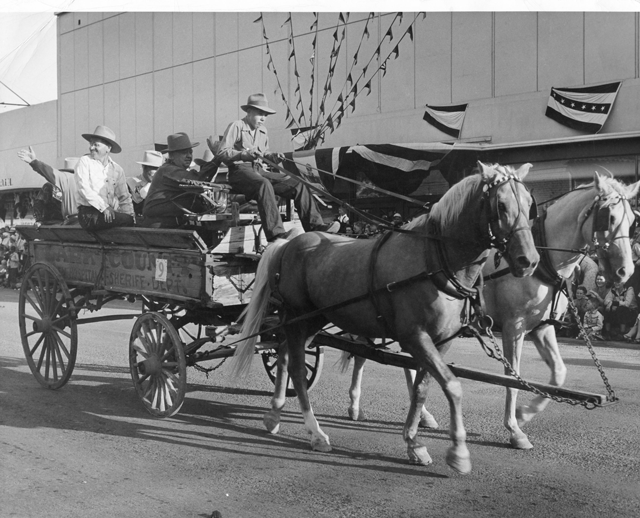
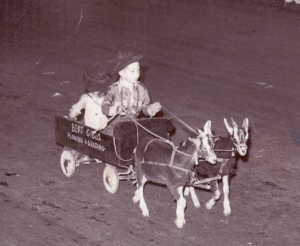
He was a year old when he was in the Helldorado Days Parade, in the back of a little cart while his older brother Delbert drove the cart with a pair of goats. When he was a kid, he and his brother would ride their horses to Bonanza and Second Streets, where they would watch the rodeo and the horse races.
In high school, he rodeoed, riding bulls. One Monday morning, he was up in slack and had to cut school to ride. His parents did not approve of his rodeo; they didn’t want him to get hurt and they did not know that he competed. That evening, he was working with his dad in the front yard, when his dad said, “I hear you can ride bulls.” Father Kenny, from the local parish, had seen Rollie ride and reported it to his dad. The cat was out of the bag.
After graduating from Las Vegas High School in 1954, Rollie went pro. For a while, he didn’t have to buy his Rodeo Cowboys Association card; Chuck Shepard, a judge, would waive the fee for him at the rodeos Chuck was at. One time, in Salt Lake City, June Ivory cornered Rollie, telling him Shepard wouldn’t be there, so he’d have to buy his card.
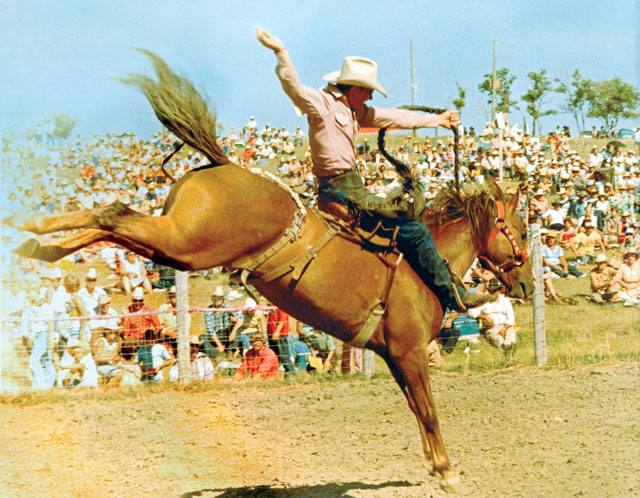
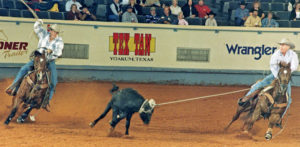
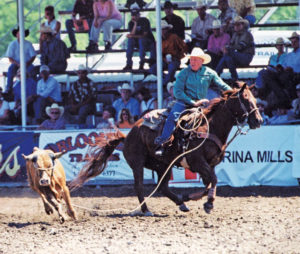
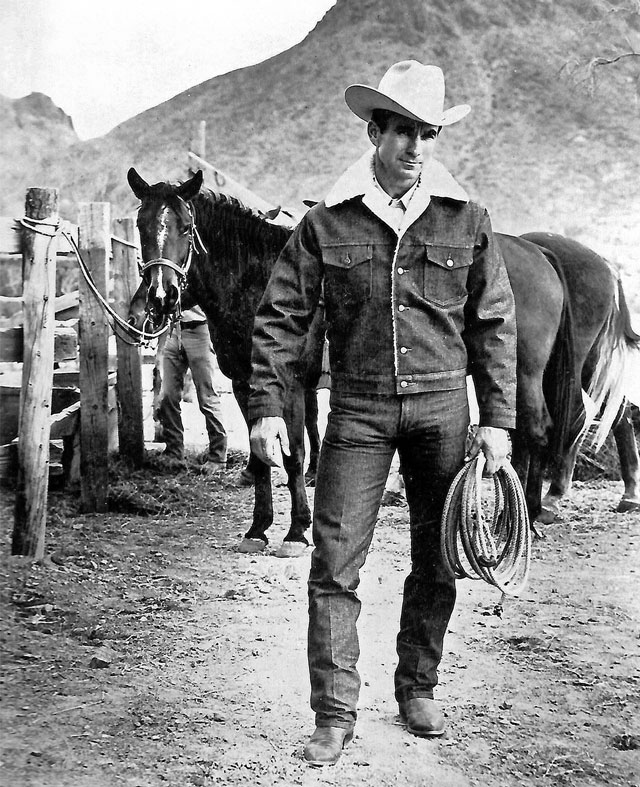
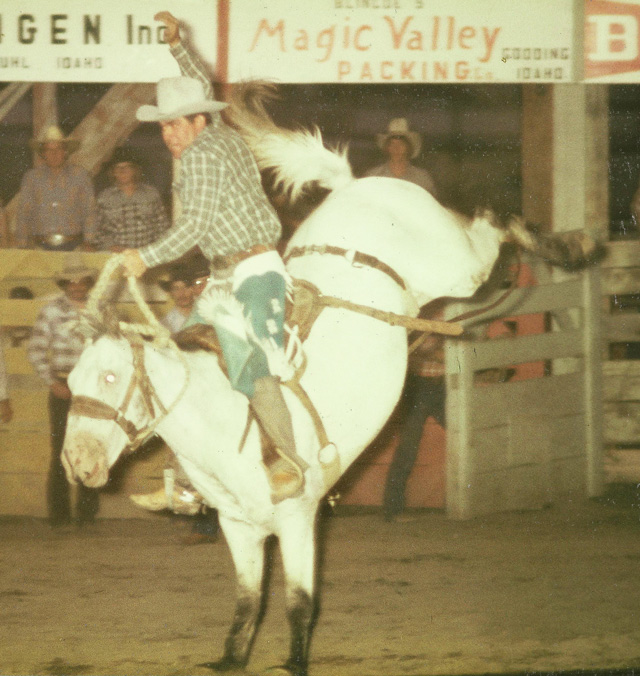
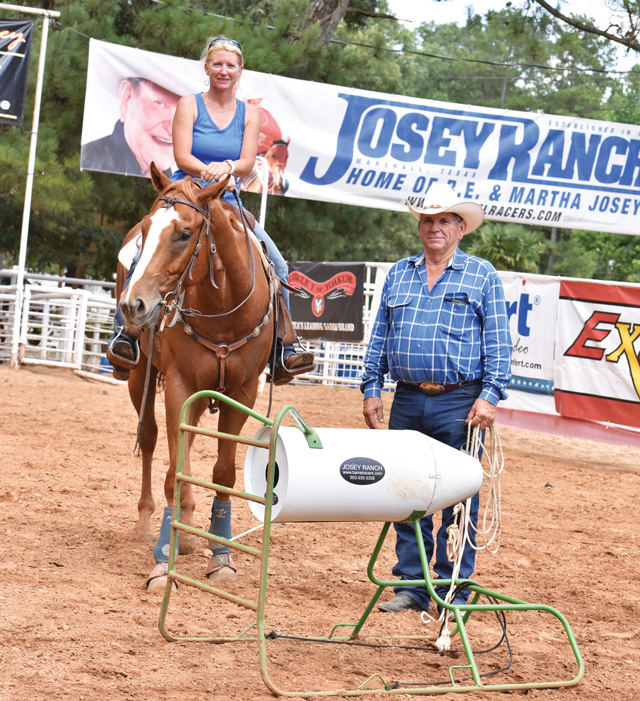
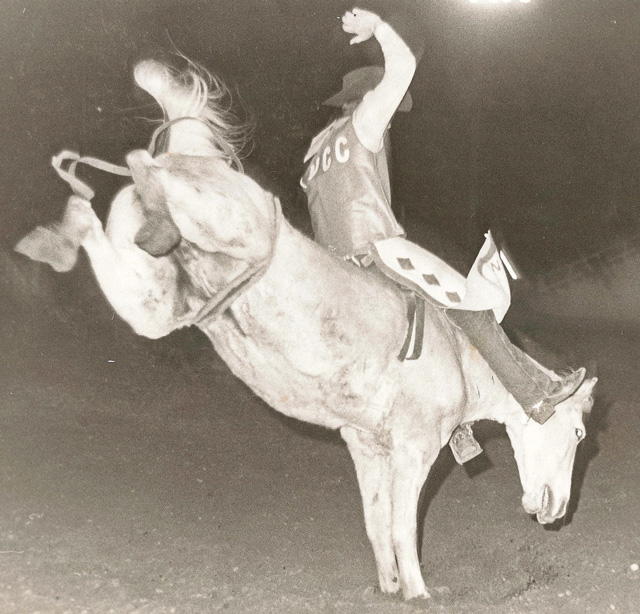
Rollie steer wrestling at the Silver Bird Hotel in 1980 with Jerry Jones hazing. It was a 5.5 second run. – courtesy of the family
Rollie’s older brother Delbert drives the wagon with Rollie in the back, 1940 – courtesy of the family
In his high school days, Gibbs rode bulls. It wasn’t till ’55 that he started steer wrestling, and he won the first rodeo he entered. Wide World of Sports was televising that event, and “I was twenty feet tall and bullet proof,” Rollie laughed. He competed at rodeos from Cheyenne, Wyo., to Denver, Salt Lake City, Ogden, Spanish Forks, Prescott, Phoenix, Scottsdale, and more. And when steer wrestling greats like Willard and Benny Combs hazed for him, he was on top of the world. “I thought, man, I was King Kong.”
He competed, on and off, for 36 years, and won his hometown rodeo, Helldorado Days, in 1977. A year later, he was asked to be the chairman for the rodeo. Rollie also served three years as chairman of the Helldorado Rodeo Queen pageant. During his year at the helm of Helldorado Days, he had a midnight performance for the workers on the graveyard shift.
Gibbs served as president of the Wilderness Circuit from 1979 to 1982, and helped with the Nevada High School Rodeo Association as an advisor and as president. He worked to bring the high school state finals to Las Vegas. The first time, it was hosted at the Star Dust arena. But when the arena was turned into an RV park, there was no other outdoor facility in Vegas to host it. Rollie went to the county commissioners and worked with them to build Horseman’s Park. Gibbs, in his ingenuity, used local supplies: drill stem pipe from the Nevada Test Site (now the Nevada National Security Site) for posts, leftover lights from the airport, and more. The high school finals was televised for several years by the PBS station, and Rollie secured a Las Vegas High School alumnus; Pam Martin Minick, to serve as commentator. Supporting youth was a big part of his life, whether it was in rodeo or through high school scholarships.
During this time, Rollie had been working for a crane company, with an understanding boss who allowed him to rodeo. When the company passed to the son, he decided to form his own company: the Rollie Gibbs Crane Service. After 26 years with the first company, he took many of his customers with him. He worked on many familiar buildings in town: Caesar’s Palace, the Mirage, the Riviera, the Stardust, at the Nevada Test Site, and more. His skills and dependability were in high demand; when Rollie did a job, it got done quickly and it got done well. “I was working seven days a week, around the clock,” he said.
An example of his hard work was the Landmark Tower. The tallest structure in Las Vegas when it was begun, he and his crew built 26 concrete floors in eleven days, pouring a foot an hour.
Rollie Gibbs (left) and Liz Kesler (far right) on behalf of the Cowboy Reunion present a check to Cindy Schonholtz (center) and the Justin Cowboy Crisis Fund – courtesy of the family
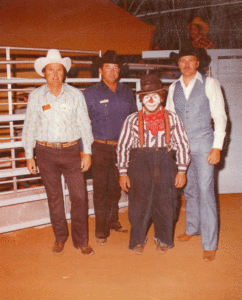
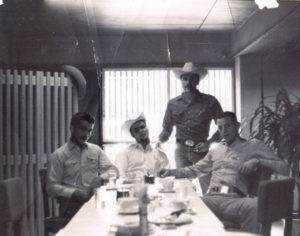
(l to r) Co-Chairman Gail Gibson, Chairman Rollie Gibbs, John Taylor and Co-Chairman Don Helm. The 1987 Elk’s Helldorado Rodeo in Las Vegas, Nevada – courtesy of the family
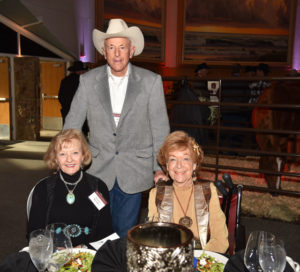
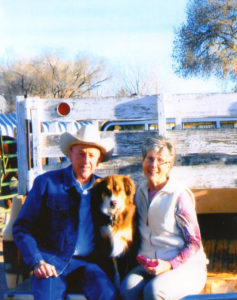
Rollie and Naomi – courtesy of the family
As owner of Rollie Gibbs Crane Service, he donated much of his time to charities, helping build the Ronald McDonald House, a Salvation Army warehouse, and more. He’s volunteered his time with Habitat for Humanity, and served as Cub Scout leader, receiving the Meritorious Service Award.
Rollie worked as a pickup man for Cotton Rosser and Flying U Rodeo, and served as a judge as well, judging rodeos from the 1960s into the ‘80s. He was on the board of the Miss Rodeo Nevada organization, produced a Little Britches Rodeo in Overton, Nev., and a high school rodeo in Pahrump, Nev.
Since 2008, he’s been president of the Las Vegas High School Alumni Association, and with his guidance, the association has paid out nearly $100,000 in scholarships for high school youth.
Rollie is currently on the board of directors for the Original Cowboy Reunion, begun by Buster and June Ivory and Liz Kessler. The group meets every year in Las Vegas during the National Finals Rodeo.
He built his own home in the early 1980s in a prestigious part of town, Section 10. He and his wife host parties and events at their home, weddings, memorials, Rollie’s high school reunion, church gatherings, and, each year, their rodeo friends when they are in town for the Cowboy Reunion.
A few years ago, he ran into a classmate from high school. Naomi Lytle had been a Helldorado Rodeo Queen, but after marriage, had moved out of town. Her husband died, and when she visited Las Vegas, they reacquainted and got married five years ago. “She dearly loves the same things I do,” Rollie said. Together, they’re spending their retirement days traveling the world, visiting Ireland, Scotland and England; Alaska, the Caribbean, Montreal, and more.
Rollie has had tickets to the NFR since it moved to Vegas in 1985. Four seats in the fourth row belong to him, and he goes to all ten performances. He also loves to visit the Gold Card Room, where the PRCA’s gold card members visit.
Looking back on his life, he recalls the good days. “I can’t say I’ve had a bad part of my life,” he said. “I’ve lived in the best of times.” And at the age of 82, he’s not done. “I’m not dead yet. I’ve got plenty of other things to do.”
Horses have been part of Howard Haythorn’s life since he was a kid. Actually, they run through the genes of his family. Haythorn, a National Finals Steer Roping contestant, grew up on the back of them, rode them for rodeo, and raised and trained them.
The Maxwell, Neb. cowboy was born in 1927, the great-grandson of Harry Haythornthwaite, a stow-away on a ship from England to America in 1877. When the captain found the sixteen-year-old boy and discovered the boy was raised on a farm, he was assigned to care for the Hereford cattle on the ship. When he arrived in America, he eventually made his way to Ogallala, Neb., where he shortened his name, married, and began the family tradition.
Howard, the son of Harry Jr. and Emaline (Menter) Haythorn, was born in 1927 north of Ogallala. When the Kinglsey Dam was built in 1941, part of the Haythorn ranch was taken for the dam, and Harry Jr. split the cattle with his brother Walter and headed east to Maxwell, Neb., to begin his own ranch. Harry Jr.,’s ranch was the Haythorn Ranch Co. (not to be confused with his brother Walter’s ranch, the Haythorn Land and Cattle Co., north of Ogallala, and now owned by Walter’s grandson Craig Haythorn.)
Before he could drive, Howard was calf roping at rodeos with his Uncle Walter. Uncle Walt, a saddle bronc rider as well as a roper, would load him up and take his nephew with him. There was no high school rodeo in those days, so they competed together at local shows. In addition to calf roping, Howard showed cutting horses and team roped.
He attended high school at St. John’s Military School in Salina, Kan., (“my mother thought I needed more direction,” he quipped), graduating in 1945. He had an appointment to the U.S. Military Academy in West Point, but his dad died when he was nineteen, and he was needed on the ranch.
Then Uncle Sam called; Howard went to Korea, serving for eighteen months, and “I saw all the action I wanted to see.”
When he came home, his rodeo career was about to change. Waldo, Walter’s son who was also a roper, told him, “You can throw away your calf rope. I found us a new sport. We’re going to start tripping steers.”
Haythorn Ranch Co.,recipient of the AQHA’s 50-Year Legacy Breeders Award,2009, for fifty consecutive years of registering AQHA horses. (left to right): friend and fellow steer roper Buddy Cockrell, his wife Geneva Cockrell, Londa and Harry Haythorn, Howard, and AQHA past president Jim Helzer. – Courtesy of the family
Howard as a child and his mom – Courtesy of the family
The two of them, fast friends, began their rodeo career together. They had the natural talent to rope, and the horse power, but they got some additional help from a world champion. Three-time world champion steer roper Ike Rude spent several summers at the Haythorn Ranch, teaching Waldo and Howard the intricacies of steer roping, while they trained his horses. They rodeoed together, the three of them competing, with Waldo and Howard sharing a horse in the early days.
In those days, nearly every little town had a rodeo, but not all of them had steer ropings. The two of them traveled near and far, hitting the local shows but also going as far as Cheyenne Frontier Days and Pendleton, Oregon.
Howard competed at the National Final Steer Roping in 1959 and 1963, finishing fourth in the average and twelfth in the world in 1963. The prior year, he and Clark McEntire flagged the finals. Waldo qualified for the NFSR four times (1958, 1960-61, and 1963).
The two also competed in a lot of match ropings, which were common back then. Entry fees might range from $300 to $500, usually with no purse, and only ten to twenty competitors. The matches might be four or six head, and they paid on the rounds and the finals.
Howard raised and trained nearly all of his roping horses. The best steer roping horse he ever had was a black horse, Little Pick, who started as a tie-down horse. When he and Waldo started steer roping, he turned Little Pick into a steer roping horse. “You could do everything on him,” Howard said. Howard roped right handed on him, and Craig, Waldo’s son, roped left handed on him. Pick was a kind, gentle horse, and when he got some age on him, Howard gave him to three little neighbor girls to show in 4-H. A few years later, at a jackpot in North Platte, Howard’s horse wasn’t doing so well, so he called the girls’ dad and asked him to bring the horse to town. Howard won the rodeo on Pick, the girls lost their 4-H horse, and Pick got turned out to pasture, never to leave the ranch again.
He loved all the rodeos, but two especially stick out in his mind. Pendleton was a favorite, because of its grass arena and no chutes. But when he was roping calves, the Ak-Sar-Ben rodeo in Omaha, Neb., was the best. They provided each contestant with a twelve-foot box stall, a forty-acre polo field on which to exercise horses, a sack of oats, a bale of hay, and straw.
Howard at AQHA headquarters – Courtesy of the family
Top 6 contestants at the 1963 NFSR: Six contestants at the 1963 NFSR. From left to right, Everett Shaw, Stonewall, Okla.; Joe Snively, Pawhuska, Okla.; Howard Haythorn, Maxwell, Neb.; Don McLaughlin, Ft. Collins, Colo.; Sonny Davis, Kenna, N.M. and Glen Nutter, Thedford, Neb. – Ferrell
Howard bought his Rodeo Cowboys Association card before he went to Korea in 1951, but the ranch and his family were his first priority. He married Sue Ann Cochran the same year, and after competing at the NFSR in in 1963, he slowed down, not rodeoing full time after that. “I never intended to go to the National Finals (Steer Roping). That was not my deal. I had a ranch to run. I just went because I had the chance.”
The Haythorn Ranch was known for its Herefords and its horses. Harry Haythornthwaite, the English stow-away, had gathered 500 head of horses from Burns, Ore. in the late 1800’s and railed them to Nebraska. Howard continued the tradition of raising, training and selling quarter horses on the approximately 20,000 acre ranch in the Nebraska Sandhills. The operation has about 1,500 cows and replacement heifers, and 20 to 30 mares that are bred to four stallions.
Waldo and Howard were best of friends, Howard said, “probably closer than if we’d have been brothers. We never had an argument. I could tell him what I wanted, and he could tell me, and it didn’t bother either of us.” They were cousins, but also brothers-in-law, having married sisters. The two traveled together till Waldo suffered a stroke in 1989. Howard said, “If he can’t go, I quit. I didn’t want to go if he couldn’t go.”
Howard and Sue Ann, who passed away in 2010, had three children: Mary Helen, Margaret, and Harry Byron. Mary Helen passed away in 2015. Margaret is married to Darrell Ruh, and they live in Kenesaw, Neb. Harry Byron and his wife Londa live just a quarter-mile east of where Howard lives. “He comes to the ranch every morning,” Harry said, “to check on us, to make sure we’re out of the bunkhouse and doing our job.” Howard plays cribbage in Brady, a small town near the ranch, and occasionally rides. Last year, he went to ride with his eight-year-old great-grandson, Harry Edward, and Howard asked one of the ranch cowboys to saddle his horse for him. The cowboy didn’t want to, saying he’d get in trouble. Why? Howard demanded. Harry and Londa don’t want you to ride anymore, was the answer. Howard told him, “if you don’t saddle my horse, you’re going to get in trouble with me.”
In 2009, Howard was honored by the AQHA for breeding American Quarter Horses for 50 consecutive years. The ranch won the AQHA’s Remuda Award as well. Howard is an inductee in the Hall of Great Westerners at the National Cowboy and Western Heritage Museum in Oklahoma City, and he was given the 1983 Trail Boss Award from NebraskaLand Days in North Platte. He is a gold card member of the PRCA. He, his father, and his grandfather have all been inducted in the Nebraska Sandhills Cowboy Hall of Fame.
Life has been good: his rodeo friends, school friends, and ranching. “That’s all I’ve ever wanted to do,” he said. “I’d starve to death, doing anything else. I’ve enjoyed everything. I’ve enjoyed it all.”
Audrey Griffin grew up in the silver-screened atmosphere of Santa Monica, California, but she was destined for the dusty and daring show business of the arena. Her father, Ray O’Brien, was the head of the property department for MGM Studios, and her mother, Hazel O’Brien, was a hairdresser to the stars. Her older brother, Douglas O’Brien, became a firefighter and later worked for MGM Studios as well, and though their parents never encouraged Audrey to enter the movie industry, her head was already turned to the equine world. “When Mother would take my father to work in the car, I would go along with her as a youngster,” Audrey recalls. “There was a little pony ride on Venice Boulevard, and I’d jump up and down and say I wanted to ride the ponies. I think I was born with the passion of horses, and I still have that passion.”
When she was 11, Audrey went riding with her father at Sunset Ranch in nearby Culver City. A girl near her age, Sis Smith, guided them on the trail ride, then invited Audrey to come back and spend the following day with her. “If it wasn’t for her, I wouldn’t be where I am today. She taught me how to Roman ride and drive wagons and tie a bolen. We’re still best friends.” Her first time to ever ride Roman — standing with one foot on the back of each horse — Audrey loped and jumped the team with ease. “It was not hard at all. Either you’re a natural and you can do it and you have the will to do it, or you can’t do it at all. You have to be gutsy to jump those big jumps.”
Audrey jumping four abreast performing at in Phoenix, Arizona with the Flying Valkyries. She drove the horses back into a standing ovation. – courtesy of the family
Audrey’s book club girls (they read and ride) left to right: Lisa Thompson, Kristin Reynolds, Sheila Varian, and Audrey Griffin at Sheila’s Ranch in Arroyo Grande – Kathryn Burke
Sunset Ranch became her second home, and Audrey and Sis provided the specialty act for the Sunday rodeos the ranch put on. “I Roman rode the team I drove hay wagons with — they were big and slow — and Sis had two quarter horses, so she always won the race.” Audrey also started working at the stables, giving riding lessons and driving hay wagons for birthday parties. “I think I got paid 25 cents an hour, and I got a dollar for harnessing the team and a dollar for driving the hay wagons, so some days I could make seven dollars.” She even drove a route from Culver City to UCLA when she was 16. “I would stop at the frat houses, and the guys and girls would get off and new kids would get on. I drove right down the thick of Wilshire Boulevard and up Veteran, right to UCLA. It was 1952, and I would get home at about midnight, but everything was so safe then.”
Audrey’s world rapidly expanded beyond California when she was invited to perform with The Flying Valkyries, a troupe of three girls and six white horses who traveled throughout the United States and Canada performing in rodeos and horse shows. “One of the girls broke her ankle, and I was the only other young lady at 19 that knew how to Roman ride and jump, so they invited me to go with them. We were chaperoned by Sidney Hall’s mom, Lois. After talking about integrity and morals and church on Sunday, and the things you talk to parents about, my mother finally let me go. My parents were the most fabulous parents ever.”
Their first rodeo just two weeks away in Lake Charles, Louisiana, The Flying Valkyries practiced twice a day. “When I traveled with the Valkyries and we jumped two horses, the jumps were four feet two inches, and the other jumps with three or five horses abreast were about three feet. I would sleep, eat, and dream the perfect jump, and when you get that perfect jump, it’s totally euphoric. We were very unique,” Audrey adds. “Cotton Rosser said we were the best act going down the road at the time. We worked a lot for him, Harry Knight, the Steiners, and many other stock contractors.”
Seven horses, a dog, and the girls’ suitcases traveled in a red semi announcing The Flying Valkyries in white lettering across its trailer. They traveled nearly nine months out of the year, and the girls were responsible for all of the horse care. “It was something we all loved to do,” says Audrey, whose Roman team consisted of Lady, a white Arabian, and Sunbeam, a white quarter horse. After jumping Lady and Sunbeam, another horse was added to Audrey’s team, then two more, until she was jumping five abreast. During the second act, she came out driving six horses, standing on the two at the back, called wheeler horses, and jumping obstacles on both sides of the arena. “I had six lines, three in each hand. The reins for the horses I was standing on were like roping reins, and the other four were lines I would just take a tight hold of, and I could pretty much guide them wherever I wanted to go. They told me what to do if I had a runaway, but that’s something you never practice, so I had to remember. In Billings, Montana, they put up sawhorses for the arena, and after the first jump, my team saw a space that two horses could go through and they took off. I was thinking, ‘My parents are spending their 25th wedding anniversary here, and they’re seeing their daughter running off into the sunset!’ I’d been told to drop the four lines and pull up my wheeler horses so they’d sit back on their heels, never knowing if that would happen, but it works. I stopped the horses and gathered the reins up, and I drove back into a standing ovation.”
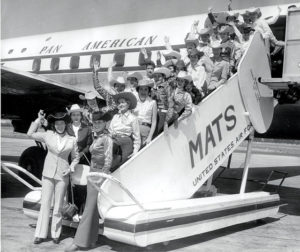
LAX cowgirls leaving for Brussels, 1958 – Courtesy of the family
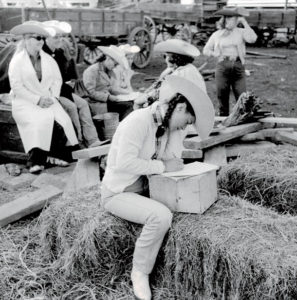
Audrey in Brussels writing a letter home in 1958 – Courtesy of the family
Audrey team roping – photo by John Kendall
Audrey performed with The Flying Valkyries for two years, 1956–1957, then went to work at Campbell’s Clothing Store briefly. The following year, she and the other Flying Valkyries were invited to perform in the Wild West Show and Rodeo starring Casey Tibbs in Brussels, Belgium. “I was there for two months performing, and it was a wonderful time. All the horses and cattle they flew over in stock planes, and then the cowboys and cowgirls flew from LAX to Denver to Brussels.” The Wild West Show and Rodeo featured today’s standard professional rodeo events, along with pole bending, square dancing on horseback, and performances by the trick riders and a number of Native Americans. In addition to performing daily at their arena, formerly a bombed-out gas shelter, Audrey and the other trick riders helped in a variety of ways, from caring for the horses, to entertaining visitors, including American actor, dancer, and politician, George Murphy, and his family. “You had to be really cordial, and it was important that you got along with everybody, because we were kind of a close-knit family,” Audrey recalls. “We stayed in little boarding houses for a while, and then moved closer to the rodeo grounds in a big apartment building. We had drivers to drive us to the rodeo grounds, and we did a lot of sightseeing too.”
Audrey returned to work at Campbell’s Clothing Stores once she was back in Santa Monica, and married Dick Campbell in 1960. They had six children, though sadly, their young son passed away. “I was a full-time mom, and I would take my kids riding. I didn’t have my own horse until I was 50. I would take my youngest with me, and I would put a pillow in front of me and they’d sit on the pillow. When they got older, they’d sit behind me. I rode one or two days a week, and I had friends that wanted me to exercise their horses for them, which worked out really nice.”
Audrey remarried, and she and her second husband, Gary Griffin, who had seven children of his own, moved to the Santa Ynez Valley in 1991 and were married for 12 years. In 1986, Audrey bought her very first horse, a Thoroughbred off the track, and she was given a quarter horse that she started team penning, roping, and sorting on. “I kept my first horse out at Glen Randall’s place in Newhall, and he and his wife, Lynn, were fabulous people. They trained all the Triggers and Black Beauties — any horse that sat in a car was trained by Glen. He taught me how to do a chest letdown with my horse, which is like a bow. I eventually bought a reining cow horse, and I did that for 10 to 12 years. It was really fun, and reining cow horse really puts the icing on the cake as far as your riding goes. Now I do a lot of team roping, and I go to a lot of brandings in the spring and rope at those.”
At 81, Audrey has three horses and loves riding on her friends’ ranches and working with cattle. She heels in the team roping, and enters the Fiesta Rodeo in Santa Barbara every year. Come summertime, she ropes once a week for the guests at the Alisal Guest Ranch & Resort in Santa Barbara. All 12 of her grandchildren and her two great-grandchildren have learned to ride with Audrey, just like her five daughters did growing up. “My life is really fun,” says Audrey. “I know a lot of knowledgeable cowboys and cowgirls, and I’m still learning from each and every one of them. Glen Randall told me, ‘Audrey, if you keep your eyes and ears open, you will learn a lot out of this ranch.’” And with a smile on her face, she did just that.
From competing in college rodeo, to the PRCA, to becoming a judge and a coach, Tom Miller has left his mark on the rodeo world. Excelling in both ends of the arena, Tom led a rodeo team at Black Hills State University that dominated the National Intercollegiate in the 1970s, winning All Around Champion in 1970 and 1971.Tom was also the Badlands Circuit Saddle Bronc Champion in 1979 and 1980. Tom qualified for the NFR six times and shares the record for most saddle bronc average titles.
Tom was recently inducted into the National Cowboy & Western Heritage Museum Rodeo Hall of Fame in Oklahoma City. His friend and 1974 world champion saddle bronc rider, John McBeth nominated him. “Tom is of the quality of bronc rider that should be in there. He is world championship quality – in fact – one year he lost it by $5.28 – 1981. Everything about Tom is outstanding, from ranching to judging – he has his principles and he holds to them.”
Born in Rapid City, South Dakota, on December 27, 1948, Tom was raised 100 miles from there on a ranch in between Faith and Red Owl, that his dad (JP Miller – Bub) put together. “I was born before the blizzard of 1949 – it took two weeks for them to get me home,” he said. His dad roped calves, but Tom and his older brother, John, never competed until high school. “We stayed home and worked – when we quit in the evening, we would rope. Nobody competed much in youth rodeos back then – there wasn’t the activities going on for the youth like there is now.” His mother (Patsy) didn’t want him riding broncs or bulls so he rode bareback until his junior year in high school. “My folks had gone to Texas and I snuck off to ride a bronc – it was easy. I didn’t get on a bull until I started college.” He learned from the hired man until he met John McBeth. “I was riding broncs pretty good but I didn’t think I was riding them right. So I called John and went to his school. He put me on 16 head in two days and it turned me around. It got me doing things I didn’t know I could do. John is a great teacher.”
He went to Black Hills State University where he competed in every event. “My dad let me take one horse, so I had to do all the events on that horse.” He studied education. “My dad gave me a choice when I got out of college – after I won the NIRA All Around for the World – he said – ‘are you going to rodeo or are you going to come home.’ He said if I was going to rodeo, he was going to sell the place. I went home for three years. I felt like I had to go try it.” He made a deal with his dad. “He said: ‘If you don’t go to the Finals, you go home, put the saddle up and we won’t talk about it.’ He also added he wasn’t a sugar daddy – my dad was black and white, right or wrong, that’s the way it was. When I first cracked out I rode all three events. It was looking like it was going to break me, so I stuck with bronc riding.”
Tom during his induction to the National Cowboy Hall of Fame – Rodeo News
Tom at the 1981 NFR in Oklahoma City, OK – Fain 3: Tom Miller competing in Burwell, Neb. in 1979 – JJJ Photo
Tom attended Black Hills State from 1968-1971. While in college he qualified for the NIRA finals four times and was a two time all-around national champion. In 1970 and in 1971 Tom won the bareback riding, saddle bronc riding and all around titles at the CNFR. After college Tom went on to professional rodeo and he qualified for the National Finals Rodeo six times. He won the saddle bronc average at the NFR in 1975, 1979 and 1981. He was runner up to the world champion in the saddle bronc in 1979 and 1981. Tom currently ranches near Red Owl and also in Texas with his wife Vivian. – courtesy of BHSU
When Tom won the average at the finals the first year, his dad was in the arena and said ‘You can’t quit now can you?’ “I’d spend falls at home and calving in March and April.” He met his wife, Vivian, at a match bronc riding in Texas. He met her again in Fort Worth at a rodeo. “She had a boy’s saddle from South Dakota that she thought he needed it that night. There was only two or three of us there yet – I’d flown in – and she gave me his saddle.” Three years later they were married.
He continued rodeoing, making the finals three more times after their marriage. He was the Badlands Circuit Saddle Bronc champion from 1977 to 1980. He qualified for the National Finals Rodeos six times, and won the average in 1975, 1979 and 1981, coming up short of winning the world title in 1981 by $5.28. He was able to hit multiple rodeos in one weekend due to his traveling partners, Johnny Morris, a bareback rider, and Bobby Brown, a bronc rider, who also had a plane and flew Tom to many rodeos.
Tom broke his leg one fall riding a good horse – doctoring yearlings. “He rolled over me and broke my leg in 1982. I didn’t get on one after that. I was in a cast for quite a while – all winter actually. The screws in my leg made it hard to ride again.” Johnny Holloway, who he worked with for years putting on bronc schools, invited him to a match bronc riding the next year, and one horse laid on his leg in the chute. “I thought the screw heads were going to come through my leg,” Tom said. “I was at the age — I was getting into my upper 30s — where it’s hard to get it back; it took a long time to get over that injury.”
He focused his attention on his ranch, his family; two boys – Jeff and Ryan – and his judging, which included judging five National Finals Rodeos. “When I started judging, there weren’t any judging schools. They started them shortly after that and it’s a good thing. Really familiarize yourself with the rules.” He served on the Rules committee, requested to do so by Shawn Davis.
His priorities shifted again the past couple years, and he has stayed close to the ranch. “My great great granddad came over as an immigrant from Germany – he kept a diary every day. He said the best cow country was in South Dakota – Western South Dakota. He put together 168,000 acres in Coleman County in Texas; he built a boulevard, library and built on to the Methodist Church,” explains Tom. “My grand dad took over management of that ranch at 18. When my dad got out of World War II, he went to South Dakota to find that best cow country.
“I always felt like I had so many big shoes to fill,” said Tom about his family. “My dad flew over the signing of the treaty of WWII – he didn’t tell me that – he flew and was the youngest one in his crew.” He passed away at the age of 85. “The day before, I called him and told him we needed some more cows in Texas. I asked him if he could go and check out some cows for me. He said how about if I sell you my cows. And he knew exactly what they were worth. He died the next day. He was sharp as a tack.”
Tom has carried on that legacy, priding himself in raising good cows and horses. He has been inducted in the Black Hills State University Rodeo Hall of Fame and the Casey Tibbs Foundation. He wants to be remembered as kind and considerate; a good horseman, and a good cowman. “The rodeo part of the deal –I’m getting honored for something I was going to do anyway. My roots are in the cow business and I’d hope to be remembered as one of the better cowboys in our country.”
Tom with his family at the 2017 National Cowboy Hall of Fame – Rodeo News
Butch Stewart spurred his first bronc in the IPRA — known then as the IRA — in 1966 as a senior in high school. It was the start of a long and wide-ranging career in the association, from winning World Champion Bareback Rider in 1973, to working as an IPRA field representative, and eventually, serving as the executive director for five years. “One of the things I admire and respect about Butch is his integrity,” says IPRA General Manager, Dale Yerigan. “He’s an old-school, look you in the eye and tell you the truth kind of guy. When he tells you something, you don’t have to wonder if he’s going to do what he says.”
Butch was born into that dependable lifestyle in 1946 on the ranch his dad, Bill, managed in Arkansas. The family later moved to North Carolina, and Butch and his three brothers all rodeoed. His two older brothers, Billy and Jim Bob, competed in timed events, and his younger brother, Ricky, rode bulls. Their dad rodeoed, but he passed away when Butch was 10. “I’d go to the rodeos in my early days, and the bareback riding would be the event I’d watch. Why I don’t know, but that’s what I wanted to be,” Butch recalls. “There were no rodeo schools, but when I was 13 or 14, there was a horse trader in town and my family was good friends with him. He would have something he thought might buck, and I just started getting on them. When I got up into high school, I went to rodeos in North Carolina and South Carolina and Georgia. It took me forever before I won any money, but I never did give up. One night at a rodeo, it just clicked, and from that point on my skills got better and better, but I really had to work on it. I won second at Rock Hill (South Carolina) and won $57, and I thought there would never be another dry time.”
Butch continued practicing on anything that would buck and traveled to rodeos with his older brother or his good friend Charles Malcolm, a bull rider who also helped Butch in the bareback riding. In 1966, Butch bought his IRA card and ventured into Florida for several rodeos, where he met Harry Watt of Meeker, Colorado. “Harry rodeoed for a living, and I told him I was going to graduate from high school and (asked) what would be the chances of me getting in and going to rodeos with him. He’s a very plain-spoken person, and he said, ‘Just tell me where you want me to pick you up. But I tell you right now, you hold your end up or you can go home.’” Butch graduated and left the same night on a Greyhound bus to meet Harry. “My mother, Pauline, was standing in the door just bawling. I stayed in contact with her and my oldest brother, and I’d call once a week.”
While in the past Butch made it to 15 rodeos a year at most, he and Harry entered 120 rodeos in 1966 throughout the eastern half of the country. Butch would eventually rodeo as far away as California, and even tried bull riding, but he primarily entered on the IRA circuit. He and Harry traveled in the Coloradoan’s single-cab pickup and camper, minus air conditioning, with as many as four other cowboys joining them at times. “I loved it! I couldn’t get to enough of them,” says Butch. “Those first rodeos we went to I drew some great horses and won first, and everything just clicked. Harry taught me how to get to rodeos, where to go, and how to enter. He’s been a great friend and we still talk all the time, and he’s the one who really taught me how to rodeo.”
Butch riding #15 Panic – courtesy of the family
Left to right, back row: Carissa, Butch, Chase, and Heath. Front row: Brenda, Jade, Shay, and Brooke – Hughes Photography
Heath, Shay, Brenda, Carissa, and Butch in Las Vegas – courtesy of the family
Butch had to set his gear bag aside when he was drafted into the Army in 1967, but after serving two years in Germany, he returned to the IRA. By that time, he had a world title on his mind and was runner up to the IRA world bareback riding champion in 1971 and 1972. “I went back home in the fall of ’72 and saw a friend of mine, R.D. Thompson. We went to school together and he was a teacher and a coach, and he wanted to know what I was doing. I told him I got real close to winning a world title the year before. He said, ‘You can win if you want it worse than anybody else,’ and that stuck in my mind. That following year I won my world title. Maybe my skills got to a higher level, but it was just the want-to. I set my sights on something and I went after it. It was a great feeling.”
Several years before winning the world title, Butch met his future wife, Brenda, at a rodeo in Eunice, Louisiana. They were married in 1971, and Brenda’s background in ranching and high school rodeoing fit the newlywed’s lifestyle like a hand to a roping glove. She worked with the IRA on merchandise while Butch worked for the association as a field representative from 1977 to 1983. He traveled often and worked with current stock contractors and recruited new ones, along with staying in touch with the contestants. Once Butch and Brenda’s two children, Heath and Carissa, were born, however, he wanted to stay closer to home. Butch took a job managing several large cattle ranches in North Carolina and Oklahoma from 1983 — when he retired from rodeo — until 1999.
The family moved from ranch to ranch sometimes every six or seven years, and the ranching lifestyle and Butch’s work in the IPRA proved valuable for his children. Carissa started working in the association in the early ‘90s as a receptionist and is now in charge of the IPRA rodeo sanctions, results, and standings. Heath started working with Jerry Nelson’s Frontier Rodeo Company in the early ‘90s as well, and is now the rodeo manager of the company. “Dad ran Five R Rodeo Company for a guy, and he always made sure his family was taken care of, and the livestock, before he went on the road,” says Heath, who took 18 horses and two bulls to the 2017 WNFR. “He took good care of things and has a good work ethic.” Heath’s sister, Carissa, adds, “I’m glad my dad chose to be a rodeo cowboy back in the day. The people you meet in rodeo become your rodeo family, and some of my lifelong friends I met through my dad rodeoing.” When Butch returned to work in the IPRA in 1999, Brenda started helping with the IFR, the IPRA convention credentials and check-in, and securing sponsors to cater food for the VIP room.
In 2002, Butch became the executive director. “It was the day-to-day business of running the association, the bills, the IFR, the sponsorships, and the contestants’ needs and concerns,” says Butch. He and Ronnie Williams, a longtime IPRA member and former executive director, were also instrumental in working with the governor of Oklahoma at the time, Frank Keating, on declaring the third week of January “IFR Week.” “I enjoyed seeing the success of the association and the new contestants coming on, the friends that you meet, the awesome staff, and the people in Oklahoma City that we worked with.”
Butch retired from his job as executive director in 2007 and managed a ranch in Davis, Oklahoma, for six years until it was sold. Presently, he works for Jerry Nelson’s Frontier Rodeo Company in Freedom, Oklahoma, feeding the livestock and running the ranch when the crew is on the road. “I really love what I’m doing, being around these bucking horses, and Brenda and I are very proud of our two kids and our grandkids.” He and Brenda make their home just a few hundred yards from Heath and his wife, Shay, and their children, Jade, Brooke, and Chase, who is on the Northwestern Oklahoma State University rodeo team. Butch is happiest caring for the equine athletes who made his rodeo career possible, but he often travels to the WNFR, and he never misses an IFR. “I tell them if there’s anything I need to do for them, I’m glad to do that, but I just have a good time, sit back and watch, and visit with old friends.”
Butch Morgan believes his biggest accomplishment in life was marrying his wife, Charlene, 55 years ago. His life, like most, is a series of opportunities and change, culminating in doing the very thing he is best at – promoting the Western way of life through the trophy business and his more than three decades with Western Horseman.
Albert Lewis Morgan was born June 13, 1940. He was nicknamed Butch by the Baggs Postmaster because of Butch Cassidy, the outlaw, who ran in the same country as they ranched. His dad, Lewis, was a rancher, running sheep and cattle near Baggs, Wyoming. His mother was killed in a water-heater explosion when he was nine months old. His father remarried but Butch was mostly raised by his sister, Carol Laramore Gipson. When he was in high school, he played basketball, selected twice to be on the all-state team. When he was a teenager, he moved in with his sister and her husband, Bill Laramore, who taught Butch how to rope. Since there was no high school rodeo, the only place he could compete was at the little local ropings.
He went to Casper College on a basketball scholarship, but was pulled to the rodeo side of things early on. “I grew up in the western way of life and thought the rodeo life was cool,” said the 77 year old, who is only 5’10”. “I wouldn’t have made it as a basketball pro.” He competed in tie down roping and steer wrestling. After earning his associate’s degree, he transferred to Colorado State University and won the CSU men’s All-Around title in 1961, the same year teammate Charlene Hammond, received the All Around Women’s title.
Butch placed third in heading with C.L. Morgan heeling at the AQHA World Show – KC Montgomery Photography
Long time friend, Karl Stressman, and Butch – Rodeo News
They met at the party after the awards. “I had a nice horse and she liked him. A year and a half later we got married.” Charlene’s brother, Dick Hammond, was a trick rider and wanted Butch to try it out. Turns out, he was pretty good at it and the couple started traveling with a group called the Fireballs, Dick and Deb Hammond, Karen Womack Vold and Butch. They worked all the major rodeos, Ft. Worth, Calgary and all over the United States and parts of Canada (Alberta, B.C. and Manatoba). The group traveled for three summers working for Harry Vold in Canada. They hauled in an old pickup and camper, then a van and four horse trailer. “We slept in the back of the camper shell back then.”
Karen Vold was one of the members of that group and remembers Butch’s abilities. “Butch was so athletic it came easy for him. He could make more mistakes than anybody because he could bounce right back. People loved him; he was a crowd pleaser, and he was fun to work with.”
Butch and Charlene traveled with the group for a three years and then decided it was time to settle down. When their first daughter was born, they moved to southeastern Colorado, where Charlene opened a ceramics shop and Butch got a job teaching fifth grade at Ordway. He made $300 a month, and he got his bus driver’s license because there were kids that had never gotten out of Ordway. Butch would take them on field trips. He taught for three years, traveling to rodeos and ropings in the summer.”
He gave up teaching to join Charlene in the ceramic shop, expanding the business into a full line of trophies called Blue Ribbon Trophies, in 1964. “Charlene did a lot of sculpturing and that’s what helped our deal. The horse and livestock industry was our Trophy Stones that Charlene created.” Charlene created sculptured relief figures for every event that were then molded, cast, and finished. She did the creative art work and Butch did the marketing and sales. Things grew and they moved that business to Colorado Springs. What started in a little chicken coop grew to 50 employees. “We did the awards for American Quarter Horse Association, Reiners, Cutters – we concentrated on the horse events. That’s when I started roping steers.”
He team tied with Dick Yates and Chuck King in the 1960’s and dally team roped in the early 70’s. When team roping came to Colorado around 1978, he lost his right thumb in the coil. “I had to learn to rope again, I was feeling pretty sorry for myself. I saw a sign in my doctor’s office that read: I used to gripe that I had no shoes, then I saw a man that had no feet. I remember it like it was yesterday.” In Butch’s typical witty personality, he has been known to pretend his thumb is stuck between the elevator doors and other objects and pull out the stub. He made the steer roping Finals in 1979, after he lost his thumb. “We had Blue Ribbon Trophies, it was hard to go team roping because I couldn’t always go when my partners wanted to, so I concentrated on steer roping.”
The couple has three children, and all of them have won high point championships and continue the parents’ passion for the Western way of life. The oldest daughter, Rhonda Holmes, and her husband own Triple J Ranch in Sarasota, Florida. Jay is an AQHA and NRCHA world champion and they breed and train cutting, roping, and working cow horses. Their daughter, Morgan (22), attends Texas Tech and has won six world titles. Butch and Charlene winter there, heading south after the Wrangler National Finals Rodeo, which they have attended for nearly 40 years, every performance.
Staff from the Western Horseman at the 2017 ProRodeo Hall of Fame Induction. Western Horseman was given the Pioneer Award during the Cowboy Ball – Rodeo News
Steer roping at the Windy Ryon Memorial, 2002 – Dudley Barker Photography
Their son, C.L and his wife, Renee have two sons, Braxton and Brayden, who both rodeo and have started their own collection of award saddles. Braxton has eight saddles and Brayden has five. CL won the open at the US Finals when he was 21 and is the superintendent for a large contractor in Colorado Springs. Christy, the youngest, is in the top 20 in the non pros in the reining world for the past two years, and has a little boy, Cooper.
Butch and Charlene sold the trophy business and Butch was managing Penrose Stadium in Colorado Springs when he was approached in 1988 by Pat Close and Randy Whitte to become the Director of Marketing for the Western Horseman magazine. “The first week I worked for them, I had to go to Scottsdale and got to play golf two days and rope three days – that was my first week. It’s been great.” His title changed about five years ago when the office moved to Ft. Worth. “I am now called Ambassador at Large. My job now is the face of the magazine –we go to a lot of shows and events and do the fun stuff.”
He ropes a lot in the winter in Florida, and spends his summers roping with his grandsons in Colorado. The #4 Elite spends his mornings on the computer and his afternoons roping or playing golf. “I want to watch my grandkids grow up and help them as much as we can and teach them how to play. I’ve been pretty lucky – when Charlene and I got married, I had $60, she had $40. We had a horse trailer, one car and two good horses.”
He attributes his success to the people he has known around the world that have helped him along. One of those people is his best friend, PRCA Commissioner, Karl Stressman. “We’ve roped a ton of steers together and laughed a lot over the past 30 years. Butch is good for a person’s soul – he’s a guy that really enjoys life and can get anybody rolling.” People refer to him as the ambassador of the Western Industry. “We need more people like Butch Morgan in the future to take on that responsibility. Butch and Western Horseman are complimentary to each other. We’ve been through thick and thin and anytime I needed somebody to fight or hold the light, it’s been Butch Morgan.”
Herb Friedenthal won the bull riding at the second RCA rodeo he ever went to. “It was the night of my 18th birthday and I split first with Walt Mason in Riverside, California,” said the 79 year old from Fallon, Nevada. “I feel so fortunate that in my career I was around the best rodeo cowboys that ever lived from three decades, the 40s, 50s, and 60s.” Herb Joined the RCA in March of 1956. “A couple guys came around to the amateur rodeos and they asked me to throw in with them. It was a big deal for me.”
Herb was raised in Southern California; back in the 1950s there were lots of rodeos in his area. His dad was an insurance salesman and his mom raised him and his younger brother, John. Herb joined the Marine Corp and served for a little over a year before being honorably discharged. His rodeo career took off after that and he competed all across the west. “Andy Jauregui was a stock contractor and world champion team roper. I worked for him on the labor list, that’s what we did a lot in those days – it kept us busy when we weren’t competing and gave us some extra money.” Herb also worked for Cotton Rosser. “Most of my career I stayed on the West Coast. I was happy living the dream and there were a bunch of good rodeos out there. I placed at most of the major rodeos; Cow Palace, Ogden Prescott, Las Angeles coliseum, and Tucson (he won that one).” He met a lot of great cowboys, including Casey Tibbs, who put together a Wild West Show and Rodeo to take to Japan, and invited Herb to join the group.
Herb Friedenthal with Arlene Kensinger and Arlene Worley at 2016 Rodeo Historical Society Inductee celebration. – Rodeo News
1956, bull riding in Ventura – photo by R.L. Pound
“We went over there in July of 1962,” he explained. The crew consisted of between 35 and 40 people; counting the Mexican bull fighters the Mariachi band, several Indians and the support crew. “Only about 15 of us were rodeo cowboys and out of that there were six past world champions; Gerold Roberts, Ben Johnson, Eddie Akridge, Clyde Vamvoras, Casey Tibbs, and Paul Mayo.” They were there for three months, which included six weeks in Tokyo. “It was a tough deal. We had two performances a day, three on Sunday, and Monday off. Casey took some national finals stock over there. If you got wiped out in the afternoon performance, you had to get on that night. There was no doctor release.” During that time in Japan’s history; 17 years after the war and two years before the Tokyo Olympics, the Japanese still believed that parts of the United States were the same as they had been watching in the old American Westerns, including cowboys and Indians. “It was 100% Japanese. You could get two blocks from the hotel and get lost. The way we made it was we had a business card from the hotel and the cab could drop us off.” After 125 performances, they headed home.
Herb & Star Friedenthal, married 50 years
(left to right) Clyde Vamvoras, World Champion Bareback Rider 1967-68, Paul Mayo, World Champion Bareback Rider 1970, Gary (Mad Dog) Gardner & Herb Friedenthal in Tokyo, Japan 1962
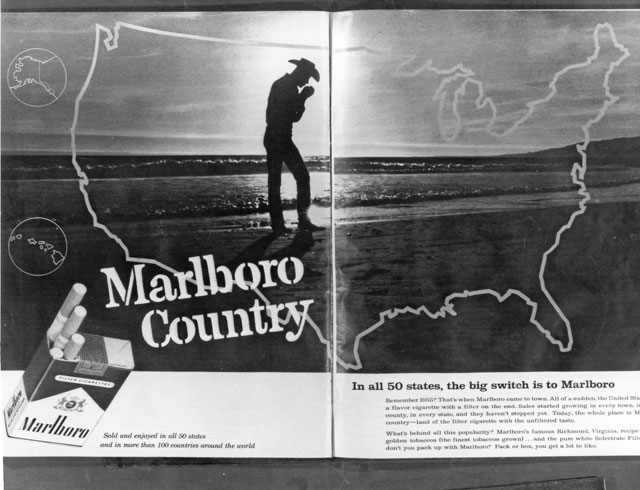
When he returned, he landed a job modeling for Marlboro. “Clyde Cisco May had it and didn’t want it and gave it to me.” He was photographed in silhouette form for more than a month all over the country. Most of the shots were taken at recognizable landmarks and he wore his hat, spurs, and jeans. He posed with an unlighted cigarette because it took so long to get each shot. “I’ve never smoked or even lit a cigarette,” he said. The ads ended up in national magazines such as “Life” and the “Saturday Evening Post.” That exposure led to stunt work as a bull rider on the television series, “Cowboy in Africa,” which starred Chuck Connors. He also doubled for Michael Landon (Little Joe) on Bonanza and bulldogged a steer for a Buick commercial. He never cared for the Hollywood life, and decided to move on.
He used his GI bill and went to aviation school. He also met and married his wife of 50 years, Starr. They have two girls, Carry Ila and Ila Carry, and two grandchildren. Herb worked as a flight instructor for two years before becoming a union carpenter. He made that his career for 20 years and moved up to become a business representative for the United Brotherhood of Carpenters until he retired at the age of 70. He took his competitive nature and became a marathon runner. “I finished the LA marathon three times and ran a couple hundred 5k and 10k runs.” He has also been a lifetime supporter of the Braille Institute. “Helping those who are blind or visually impaired is the right thing to do.”
Herb has no regrets in life. “I’d do it all over again. For 15 years I didn’t have a boss, I got to see the whole world and be around the best guys. I’ve got five acres in Fallon, Nevada. I’ve got a horse, a great wife and family, and I hang out at the sale yard coffee shop (Stockyards Diner), with my friends. The older you get, the fewer friends you have.”
story by Steve Alexander, Blaine County Journal; PRCA, and Siri Stevens
Bob Ragsdale was an all-around Montana cowboy, competing in steer wrestling, as well as calf roping and team roping. He qualified for the National Finals Rodeo on 22 separate occasions. Bob never won a world title, but his impact on rodeo has been profound.
He was the Montana High School All-Around Champion in 1956, and became an official member of the PRCA in 1961. He was one of only six left-handed tie-down ropers to qualify for the NFR, and he did so for 15 consecutive years from 1961-75. In that 15-year span, he finished as high as fourth in the world, and never lower than ninth. He competed at the NFR in steer wrestling five times, with two qualifications in team roping as well. Bob earned nine Top 10 finishes at the NFR in the all-around, including a second-place standing in 1972. He continued his support of rodeo by serving as the Vice President (1971-72) and President (1973-75) of the Rodeo Cowboys Association, and is credited as the one to propose the association include “Professional” to the organization’s formal title in 1975. – courtesy of PRCA
Bob was born October 23, 1936 in Harlem, Montana. His father, Slim, always had horses and the family split their time between farming and living in town. “Wherever we were living dad would have horses and they would wander from north of Harlem to the Canadian border.” Bob’s mom told a story about a man coming to the house to see if Bob would round up some horses for him. When the man was introduced to Bob, and saw that he was just a little kid, the man said, “those horses are big,” to which Bob replied, “I’ll take a big rope.”
Bob competed in the Montana High School rodeo. “Back then there was no divisional or regional rodeos, you went to state for a tournament that anyone could enter so long as you preregistered. I won Montana All Around and went on to the high school Nationals in Reno. I placed in a couple of events, but no wins.”
In October, right out of high school, Bob went to the Toots Mansfield Roping School in Texas. “He was a great guy; he showed me how to ‘flank’ a calf. At the time most professional ropers were legging calves. That immediately took a couple of seconds off my time.” To cover the expenses of getting to Texas and paying for the roping school Bob and his dad went to the bank in Harlem and borrowed $300 for the month-long school.
Bob met his wife, Ree, through high school. “We both went to the high school rodeos.” Ree and Bob married in December 29, 1956, after he completed the roping school and returned to Montana. “It was a pretty busy year.” He worked in the oil fields in the winter and that next summer, in 1957, went back into rodeo, working in Yellowstone Park and the following summer at the Cody Night Rodeo. “It was a rodeo,” Bob said, “but it was really a tourist show. We would work maintenance on the grounds for half the day, then do the rodeo show. They were looking for a calf roper, bulldogger and bareback bronc rider. That was 1957 and it was the last time I ever got on rough stock in the rodeo.”
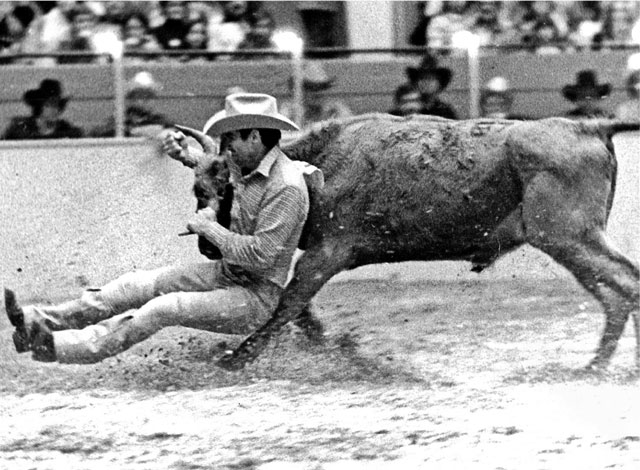
Steer wrestling at Cow Palace, 1973 – Foxie Photo
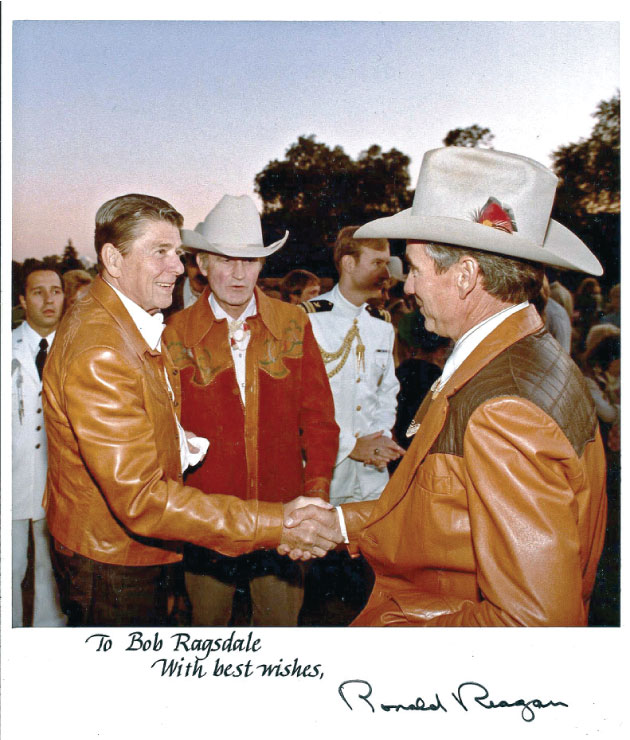
Bob meeting Ronald Regan – courtesy of Bob
Tie-Down Roping – courtesy of Bob
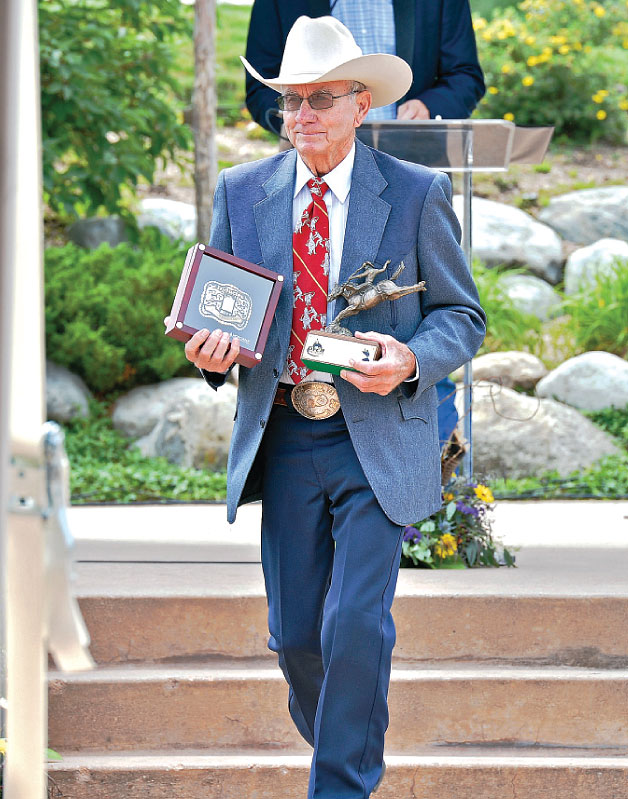
Bob was inducted into the Hall of Fame, 2017
– Rodeo News
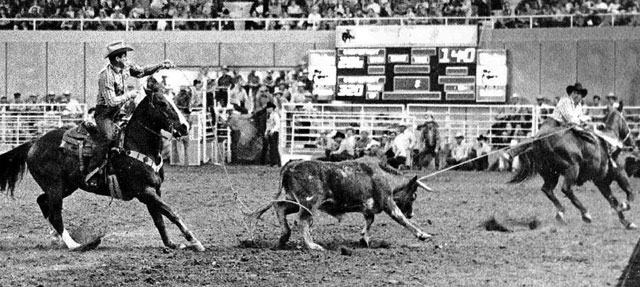
Ben C Reynolds and Bob team tie-down roping in Pheonix, Arizona, 1972
– Gustafson Photo
In 1958 the couple welcomed twin girls, Cathy and Cindy; then another girl, Jamie, in 1961.
“With plans to ‘fill my permit’ with the RCA (becoming a member of the Rodeo Cowboys Association, later the PRCA) at the end of the rodeo season in 1961,” Bob said, “I won big at a rodeo in Caldwell, Idaho. The RCA representative for that region was waiting for me and said, “You had better have your permit before you show up at the next RCA rodeo.” Members of the RCA resented non-members winning and reducing members’ chances to go to the year-end national rodeo.”
He moved his family to Chowchilla, California, in 1961 at the invitation of a farmer/rancher who also was a roper. “Dan Branco had a place where we could keep horses and practice roping.” They saved enough money rodeoing to buy a place there and that was home until just a few years ago when they retired. They now spend winters in Bakersfield, California and summers at their place in Landusky, Montana.
Beginning in 1961, for the next fifteen years, Bob made his living roping calves, steer wrestling and team roping. “I followed the money to choose rodeos. In the 1960-70’s I’d go to 90-100 rodeos a year. If I got into a slump I’d do a small rodeo to earn some money and get back on the RCA (PRCA) tour for the bigger rodeos.” He drove a station wagon and it was equipped with a grub box. “We’d camp out – the twins were small enough they could sleep in the front seat and Ree and I slept in the back.”
Because Bob roped left handed, he had to have horses that were comfortable seeing the rope on their left side. “A horse could be startled if it wasn’t used to a left-handed roper, which meant I had to have my own horse, sometimes more than one horse to keep up with the rodeo schedule.” He said often Ree and the kids would be driving one rig, pulling a horse trailer toward an upcoming rodeo, and he would be pulling a different horse to another rodeo on his schedule.
He not only competed, he gave back to the industry through his service as an office holder and active volunteer in a number of rodeo associated groups and as a spokesperson for rodeo. After that, he continued competing in the National Senior Pro Rodeo Association, winning three All Around titles, four calf roping titles and one ribbon roping title.
In 1983 Mac Baldrige, the U.S. Secretary of Commerce under President Ronald Reagan, organized an ‘exhibition’ rodeo for the President and selected guests. He asked Bob to rope in the exhibition which was staged in an arena just outside Washington, DC. Bob also helped create Friends of Rodeo (FoR), a non-partisan group that responded to animal rights issues. “Through FoR we did a better job of telling our side to the media and even instituted ‘chute tours’ so critics and media personnel could see reality about animal treatment.” Bob served as President of FoR and was on governing boards of several other rodeo related organizations, including the Senior Pro Rodeo executive board, during the 1990’s.
From 1973 to 1981 Bob worked for Sears as a consultant for the company’s western wear brand of clothing. “There were several professional cowboys interviewed and I was chosen to help Sears with their western wear line of clothing.” He described his role as “helping Sears clothing buyers and designers meet with rodeo fans and cowboys to see what kinds of clothing they were wearing or would like to see available. I even went to some of the markets with the Sears buyers to help choose the clothing for the next year’s catalog.” Bob often was photographed in Sears western wear for their catalogs and in 1973 was on the cover of the annual western wear catalog.
In the last two decades he’s been recognized with a number of inductions into rodeo related organizations: the St. Paul Rodeo Hall of Fame, St. Paul, Oregon (2001); the Senior Pro Rodeo Hall of Fame (2001); the National Cowboy and Western Heritage Museum in Oklahoma City (2003) and The Montana Pro Rodeo Hall and Wall of Fame in Billings. His latest accomplishment happened a few weeks ago in Colorado Springs, where he was inducted into the PRCA ProRodeo Hall of Fame. “It was a great event. I had no idea what to expect – I’ve never been to one before. This was the best one – it was developed by the professional cowboy.”
Bob and Ree saw the world through his rodeo career. Cathy Watkins, one of their twin daughters remembers going to Hawaii with her parents as a result of Bob’s rodeo career. “After Denny (Cathy’s husband and a professional team roper) and I were married we were visiting mom and dad and a guy drove up into the yard. He was from Hawaii and wanted dad to come to Hawaii and teach a roping school. We all went to Hawaii and while dad taught ropers the rest of us were treated to the sites of the islands. I think it was at that point I realized just how special my dad’s role was in rodeo-he was known all over the world. My sisters and I got to see a lot of things and meet a lot of interesting people because of his career choice.” As to interesting people, Cathy told about meeting a fellow teenager she and her sister met while traveling with their dad. The teenager played the guitar and the girls all sang together. The guitar player was Reba McEntire, whose dad and older brother were both accomplished ropers. “Of course none of us kids, at that time, had any idea of how Reba would develop into a famous singer and actress.”
For Bob, the biggest change in rodeo is in the rodeo competitors and the amount of money they make. “When I first got into professional rodeo, most of us were cowboys. The competitors now are truly athletes, devoting their lives to the sport and continually doing things to improve their ability to compete.” In the old days, “We often had to work other jobs between rodeos to keep our families going.”
And the winnings have increased. “When I was RCA All Around runner up at the NFR in 1972, I think first place for All Around paid about $40,000. That number now is in the neighborhood of $300,000-400,000.
“Whatever I’ve been able to accomplish has been through rodeo. I tore my knee up in 1976, and started looking for other things to do. But I had put enough away and then I got into the construction business. Everything I was able to do was because of rodeo.”
In 1957, Ken Adams was the year-end NIRA Bull Riding Champion. The Arizona cowboy qualified four times for the CNFR and competed there twice when it was held in Colorado Springs, Colorado. As a college student on a shoestring budget, he used his winnings to buy books while attending Arizona State University, and his experiences inspired him to start a scholarship for the NIRA Bull Riding Rookie of the Year four years ago. Since then, the NIRA Alumni have created a scholarship for the rookie of the year in each event, and in 2017 alone, they contributed $10,500 in scholarships to the CNFR.
Born in 1933 to Kenneth and Gladys Adams, Ken was the second of three boys. His parents had moved from Missouri during the Great Depression, and while en route to California, Ken’s dad was offered a job driving delivery trucks in Arizona. The family stayed and made their home near Phoenix, and Ken got his first job riding horses with a girl his age at a livestock auction nearby when he was 11 or 12. “I hadn’t ridden at all to speak of – we just started riding whatever horse we could a hold of,” Ken recalls. “We got a dollar apiece riding horses for them back in the ‘40s. I guess people thought it was a pretty good horse if a couple of kids could ride it, but anyone could ride in that ring.”
1956 Arizona State College Rodeo Team Fred Hannum, Billy Neal, Jon Nickerson, Terry Jensen, Ken Adams and Buddy Martin – Courtesy of the family
Current photo of Ken – Rodeo News
Not long after that, Ken started riding calves and cows in junior rodeos around the area, catching a ride with anyone who had a car. “I think the first time I ever won money, I was riding cows. The horses didn’t show up to the rodeo, so I got into cow riding. Someone would give you tips, but mostly they just let you get on and learn. There were no schools, and I didn’t have anybody I traveled with that was older, so all of us were pretty much in the same boat. I think the opportunities to learn are much improved now, and the biggest thing to me is videotaping performances to watch them and learn.”
Ken continued riding roughstock in the bareback and bull riding, though he won the most riding bulls. “I think at the time I had really good balance, and it was easier to find bull ridings than anything else.” Ken also worked on two or three ranches during high school, including the Boquillas Ranch, which now belongs to the Navajo Nation and is in the top 25 of the largest working cattle ranches in the United States. “I gathered horses for them, and then I’d enter rodeos and hope I learned something every time. The Palace Bar in Prescott was like an employment agency. Ranchers who needed a cowboy would go in there, or if you needed a job you went in there,” says Ken. He also worked at the copper mine in Baghdad, Arizona, for several months, living on site and hauling debris from the mill, but he hadn’t been there long when he was drafted into the Army during the Korean War. Although the cease-fire was signed by the time Ken finished basic training, he still shipped to South Korea where he drove supply trucks. “There was not much glamour in our jobs, unless you wanted to eat! Seoul was pretty much a mess – it had changed hands four times, but those trucks we had could go pretty much anywhere. All the roads were narrow and dirt, and in the summer they were very dusty. They had huge trucks, but the ones I was driving were three axles.”
Ken was discharged from the Army in 1955, and he enrolled at Arizona State University in 1956, majoring in animal science. Though he had dropped out of high school, he finished his GED in the Army, and he joined the rodeo team and competed in the West Coast Region. He even tried his hand at steer wrestling. “I wasn’t too good in timed events. I told everybody I had a record in the bulldogging – I was in the bulldogging seven or eight times and never got a flag,” Ken says with a laugh. He was helped along the way by college teammates John Fincher and Jon Nickerson. Ken enjoyed rodeoing in California and as far north as Klamath, Oregon. He was also a member of the RCA when a membership cost $10, and on summer breaks, he competed in Colorado, Utah, Texas, Arkansas, and Missouri, though many of his favorites were in Arizona, such as Phoenix, Prescott, and Tucson. “Some of the little towns didn’t have anything (like motels) to sleep in, so we’d sleep in the back of a car. You stayed in rooms when you were prosperous, and we’d split rooms with three or four people usually.”
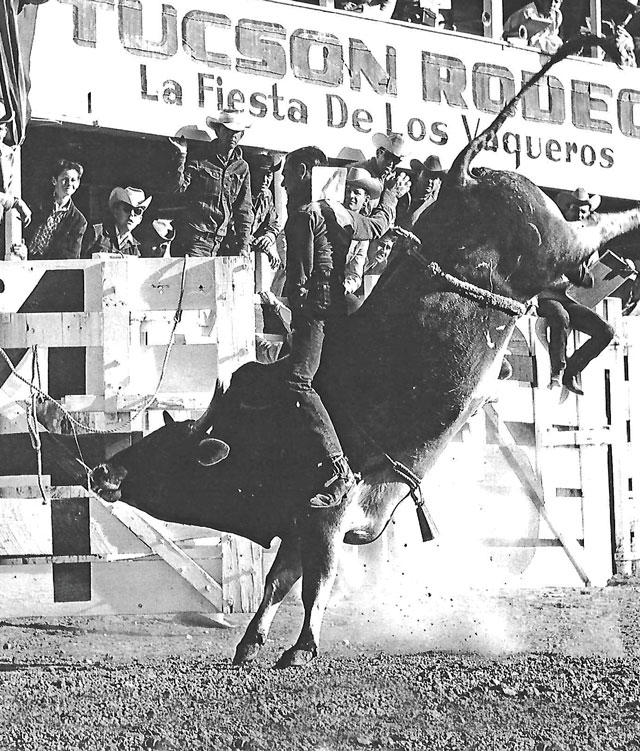
Ken bull riding in Tuscon – DeVere
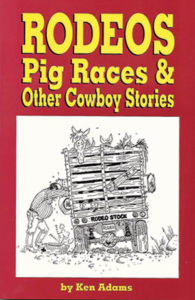
Ken wrote and published a book of short stories called ‘Rodeos, Pig Races & Other Cowboy Stories.” – Courtesy of the family
1957 College National Champions. Left to Right: Jack Burkholder, Ken Adams, Bill Duffy, Grady Allen, Clyde May, Dave Hopper, Monty Roberts, Betty Sims Solt, Teresa Sully Humphries – Courtesy of the family
Ken met his wife, Sharon, at school, and they were married after he graduated and she finished her teaching certificate. “We got married in July of 1960. I’d been teaching school for a year, and Ken won second in the bull riding at Prescott, so we had enough money to get married,” says Sharon. After he finished college, Ken was a brand inspector for several sale barns, then went into the crop spraying business with his brother-in-law before finding his niche in the animal health business selling medicine. Though Ken quit rodeoing not long after they were married, he stayed involved with rodeo by judging several of the law enforcement rodeos a college friend of his organized, along with jackpot bull ridings. In the late 1970s, one of Ken’s friends Stan Harter, a college champion tie-down roper, asked Ken to be the manager of the PRCA Turquoise Circuit when the circuit system was just getting started. Ken served on the board for three or four years and helped put on the finals, along with soliciting saddle donations. “The Turquoise Circuit Finals Rodeo was in Phoenix at the fairgrounds, and for some reason, there was a mix-up one year and all of the trophy saddles got shipped to our house!” says Sharon. “Each saddle came in a big box, and we had them everywhere in the house because we couldn’t leave them outdoors.”
Ken became involved in the NIRA Alumni when he attended the NIRA reunion in Rapid City, South Dakota, in 1997, the 40th anniversary of his NIRA bull riding championship. The following year, his friend Stan Harter was waiting for a kidney transplant, and he asked Ken to represent him on the NIRA Alumni board during the annual meeting. Together, Ken and NIRA founder, Evelyn Bruce Kingsbery, put together the 50th Anniversary Reunion of the NIRA in 1999, and Ken was president of the NIRA Alumni from 1999-2001. Sharon served as the NIRA Alumni secretary for 12 years, and Ken continues to serve on the board of directors. He hasn’t missed a performance of the CNFR since he started attending 20 years ago. When he started raising money for his bull riding rookie of the year scholarship, his plan was to ask former champions to donate $100 each, and by the next year, donations were coming in to provide scholarships for all nine college rodeo events, including team roping header and heeler. “I never had a scholarship, and even the year I won, I was never offered a scholarship,” Ken explains. “They’re giving quite a few scholarships now, but I just thought the rookie scholarship was something somebody wasn’t already covering.”
When they’re not off to the next CNFR, Ken and Sharon make their home in Phoenix, not far from where Ken grew up. They have a son, Ira Adams, and daughter, Adrienne Schiele, and her husband, Mark Schiele, while Ken and Sharon’s two grandsons, Mike and Matt Schiele, live in California. Ken stays current with rodeo via television and never misses a rodeo or bull riding, while he wrote and published a book of short stories about rodeo called “Rodeos, Pig Races & Other Cowboy Stories.” He and Sharon continue their passion of supporting the NIRA and alumni, and they are searching for all NIRA champions, top finishers, faculty, and board members from years ending in eight to join them for the 2018 Annual Reunion.
Stars converged at the ProRodeo Hall of Fame Saturday as a new class was enshrined into the prestigious Hall.
Randy Corley, a 12-time PRCA Announcer of the Year, joined five world champions to headline the 12-member 2017 induction class.
12-time PRCA Announcer of the Year Randy Corley with Stace Smith
Corley, along with gold buckle winners including the late Buck Rutherford (all-around, 1954), Enoch Walker (saddle bronc riding, 1960), Tommy Puryear (steer wrestling, 1974), Mike Beers (team roping, 1984) and Cody Custer (bull riding, 1992), were enshrined with rodeo notable Bob Ragsdale, a 22-time National Finals Rodeo qualifier in three events.
Also inducted into the Hall were four-time bareback horse of the year, Christensen Bros.’ Smith & Velvet, and the committee for the Ogden (Utah) Pioneer Days.
For the first time in the history of the ProRodeo Hall of Fame, barrel racers from the Women’s Professional Rodeo Association (WPRA) were amongst the class of inductees. Their inaugural class was comprised of Wanda Harper Bush, Charmayne James and a joint PRCA/WPRA equine inductee – Star Plaudit “Red.”
Corley’s résumé is ProRodeo Hall of Fame worthy. He has been selected PRCA Announcer of the Year 12 times (1984, 1990-96, 1998, 2003, 2011 and 2015). He also has been an announcer at the National Finals Rodeo 16 times (1985-86, 1992, 1994-96, 2007-2016).
“It was the worst night of sleep I had (Friday night) in 45 years,” Corley said. “I just think it was nerves. There are 259 people in the Hall and that’s not a huge number for a Hall that opened in 1979. I’m in a pretty select group and I’m so honored. My whole thing is cowboys are the stars. When they are nodding their head, you’ve already told everyone who they are.
“That’s what I strive for, and have forever, and to be a good person to everybody, inside the arena and outside the arena. Those are the deals that I think make you a better announcer because then you’re true, and true is the best way to announce.”
Puryear qualified for the NFR nine times, eight of which were consecutive, from 1971-78, and then again in 1983. The Texas bulldogger also won the gold buckle in 1974 and the NFR average title in 1976.
“This day is something that you never plan for when you’re out rodeoing. I’ve been ready for this to happen so I can stop thinking about it – it’s something you think about every day since the call that you’re in the Hall of Fame,” Puryear said. “One of the main reasons I’m here today is because of the people I had around me who supported and helped me. So many friends and family contributed to this. I never owned my own horse – I always traveled with horsemen and stayed in a positive rig. We’d go to 120 rodeos a year, and we loved every second of it.”
Charmayne James
Puryear first joined the PRCA in 1970, and now, 47 years later, he’s recognized as one of the best steer wrestlers in PRCA history.
“Leon (Bauerle) and I rode up to Colorado Springs together – we didn’t fly, we drove up in the truck from Texas together just like we used to,” Puryear said. “It was one for the road and to relive the old times, and we still get along really well. Leon was always easy to travel with, as long as you agreed with him. But a great deal of the credit for me being here is due to Leon and his horses.”
Rutherford was inducted into the ProRodeo Hall of Fame more than half a century after he was topping the world standings across four events – bareback riding, saddle bronc riding, steer wrestling and bull riding.
The Oklahoma cowboy was in the Top 5 of the world standings 11 times between 1949-57, and was the 1954 all-around world champion and the first cowboy to ever win more than $40,000 in a single year (approximately $362,235 in 2017 dollars, according to the U.S. Bureau of Labor Statistics).
“It’s quite an honor, and he’s a part of history,” said Claudine Rutherford, Buck’s sister-in-law. “He could do anything.”
Becky Raetzsch, Rutherford’s daughter, also was thrilled about the honor bestowed on her father.
“It’s exciting, and it gives us a chance to learn more about the history of him,” she said. “It really is quite an honor. I have his grandchildren here, all of his great-grandchildren are here, so it’s really exciting for all of them.”
Although he never won an individual event championship, he placed second in the bareback riding standings the same year he won the all-around title.
Rutherford twice finished third in the bull riding world standings (1951 and 1954).
His rodeo earnings fell flat after a bad spill slipped a disk in his back in November 1958. He then retired from rodeo and resumed ranching in his hometown until his death at 58 years old on April 28, 1988.
Walker, who won both the 1960 saddle bronc riding world championship and NFR average title, took to the skies in his ascent to ProRodeo fame – qualifying for 10 NFRs during his 20-year tenure with the Rodeo Cowboys Association.
“It’s a pretty cool deal and pretty humbling to be around the guys who are world champs. I knew a lot of them like Cody Custer and Mike Beers, and you look up to a lot of those guys. My father would have been humbled to be with them,” said Jack Walker, one of Enoch’s sons.
In 1960, the 28-year-old Walker had been knocking on the door of a gold buckle for years, placing third in 1957, second in 1958 and third again in 1959.
Walker entered the 1960 season with a plan for earning the gold buckle that literally took flight. He teamed up with Paul Templeton, who flew him from one rodeo to the next when his rodeo road trips got too hectic.
Walker arrived at the NFR in Dallas, Texas, leading the pack with $20,832 earned that season by placing 126 times at 56 rodeos and winning 21 rodeos throughout 1960, including Salinas, Calif., and Fort Worth, Texas.
He rode all 10 horses at the NFR in Dallas, placing on five of them – winning the NFR and the world title.
“I think it would have been great if he could have been here,” Jack Walker said. “It would have meant everything to him because of the caliber of people in the (ProRodeo) Hall of Fame; he would have thought it was really cool. These guys were all top of the world in their day, and I was on the bottom looking up, so it’s humbling for me to be here, but it would have been special for him to have seen it.”
Beers, a heeler, won his world championship while roping with header Dee Pickett, who was inducted into the ProRodeo Hall of Fame in 2003. Beers qualified for the NFR 23 times in team roping (1980-95, 1997-98, 2000-03, 2007). He also qualified for the NFR in tie-down roping in 1981, 1983 and 1985 and for the Clem McSpadden National Finals Steer Roping in 1992.
“I’m going into rodeo immortality and 50 years from now, they are still going to remember my name,” Beers said. “That’s something you never think about when you’re a kid growing up rodeoing. You want to win a championship or make the Finals, but it is never a thought of being in the Hall of Fame. There’s three things I guess in my career I really remember. One was winning the world championship with Dee Pickett, the second one was making the Finals with my son, Brandon, in 2007, and now being inducted into the ProRodeo Hall of Fame. This is the icing on the cake.”
Custer’s eight trips to the NFR and 1992 bull riding world championship win landed him in the ProRodeo Hall of Fame.
1992 bull riding world champion Cody Custer
“I found out that my permanent position will be next to John Quintana, and that’s a big deal because he was my hero as a kid,” Custer said. “It’s one of those deals where I’ve looked at the stuff here (at the ProRodeo Hall of Fame) and to see it next to a guy like that and then Ronnie Rossen and Charlie Sampson, it’s a cool deal. I took a picture of it, and I’ll send it to his (Quintana’s) son. I never met John as an adult, but I knew him as a kid and he made me feel like I belonged. I remember how he made me feel as a kid, and I try do that for kids now.”
Custer first joined the PRCA in 1985 and went on to qualify for the NFR from 1987-92, and again in 1998-99. He remained an active competitor through 2002.
“The people that have come here to be with me – everyone has a piece of this and it’s not just mine,” Custer said. “Corey Navarre is here too, I rodeoed with him and if it wasn’t for him I wouldn’t have gone to the NFR in 1999 because I had wanted to go home.
“I told everyone here with me that this is theirs too – everyone from my mom and dad to the guys I rodeoed with, it’s an awesome thing. I’ve said it before and I’ll say it again, everything I accomplished in the arena was because of my hard work and some talent. Being inducted is just a gift in my book.”
Ragsdale, for most of his adult life, has served the sport of rodeo as a competitor and as an ambassador. On Saturday, the cowboy they call “Rags” added “Hall of Famer” to his one-of-a-kind résumé.
“It’s been a whirlwind,” Ragsdale said. “It’s just been a great experience. Kind of the last of the big events probably, for me. I’m not rodeoing anymore, so I’m reminiscing like we used to in the old days.”
Ragsdale, a 22-time NFR qualifier in steer wrestling, team roping and tie-down roping, recognized he will forever be cemented into history among the legends of the sport he holds so dear.
“Going through the Hall, that’s what’s amazing,” he said. “I know so many of them, and I can remember stories, and when I see someone, a story will pop up in my head or some event that happened. It’s neat. Even though they’re gone, I relive that in my mind.”
Ragsdale became the first and only left-handed roper to qualify for the NFR for 15 consecutive years from 1961-75. He also served as both the Vice President and President of the Rodeo Cowboys Association in the early ‘70s, and is credited as the one to propose the association include “Professional” to the organization’s formal title.
Bobby Christensen accepting the hall of fame induction award for his late horse, Smith & Velvet
Smith & Velvet was the definition of a late bloomer.
The horse, which was honored as the PRCA’s top bareback horse four times (1977, as Mr. Smith, and then 1979-80 and 1982, as Smith & Velvet), didn’t become an award-winning bucker until he was into his 20s.
This is Bobby Christensen’s third horse to be inducted into the ProRodeo Hall of Fame. Christensen also has saddle bronc horses Miss Klamath (1998) and War Paint (2011) in the Hall, but Smith & Velvet is his first bareback horse to be enshrined.
“Early on, I never would’ve believed that he’d be in the Hall of Fame, but after he won horse of the year a few times I was thinking it would happen. It’s been 34 years since the horse died – I think the best way to describe this is late in coming, but well-deserved.
“When Smith & Velvet was in his prime, everybody wanted to see him and everybody wanted him at their rodeo. I could go to a committee and say, ‘Hey, I have the bareback horse of the year if you want to hire me to bring stock to your rodeo.’ That worked a lot of places.
“Smith & Velvet knew what he was doing, and liked what he was doing. He was even-tempered, and I rode him in his early years. But I wouldn’t have wanted to ride him in his later years, that’s for sure.”
Smith & Velvet died in 1983 in a tragic car accident that killed many of Christensen’s prized NFR horses. He says the horse was the pride and joy of his rodeo company.
The Ogden (Utah) Pioneer Days celebrated its 83rd year of existence July 20-24.
The event has come a long way since its inception in 1934, when Ogden City Mayor Harman W. Peery organized a Western festival to boost the spirits of the locals and entice tourists to visit the city.
“We just got done with this year’s rodeo, and it really settled in with the community and the rodeo and the committee,” said Dave Halverson, the rodeo’s director. “We have had honors and people have shed tears of joy. People have been outstanding, and we are humbly honored to be recognized.”
The Ogden Pioneer Days is more than just a rodeo, it’s an event. It includes concerts, parades, farmer’s markets, and, of course, the rodeo at historic Ogden Pioneer Stadium.
“When you look at the community of Ogden – this is one of the biggest awards this city will receive, and so on behalf of the committee and the city, we’re honored and delighted to be so recognized,” said Alan Hall, chairman of the Ogden Pioneer Foundation. “We appreciate the (ProRodeo) Hall of Fame and the committee for the selection and all those who make this organization world class.”
Bush was multi-talented, becoming the most decorated cowgirl in the history of the WPRA (formerly the Girls Rodeo Association).
When the GRA first formed in 1948, Bush was one of the first to sign-up. All totaled, she won 32 world titles – nine all-around (1952, 1957-58, 1962-65, 1968-69), two barrel racing (1952-53), two cutting (1966, 1969), one flag race (1969), 11 calf roping (1951-56, 1960, 1962, 1964, 1966-67) and seven ribbon roping titles (1951, 1953-54, 1956-59). She finished as reserve world champion in barrel racing three separate times.
While Bush’s barrel racing world titles came before the NFR began, she qualified seven times (1959-60, 1962-65, and 1974) for the NFR during her career.
“I’m honored to accept this honor for my mom, a famous legend, an icon, and my very best friend,” said Shanna Bush, Wanda’s daughter, who qualified for the NFR in 1984. “For my dear uncle, A.C. Harper, who said my mom was a world champion sister. How deserving to be the first woman inducted into the ProRodeo Hall of Fame. History is made today, and she did it by being just Wanda.”
Bush was inducted posthumously, having passed away Dec. 29, 2015.
Bob Ragsdale
“She was one to shy away from publicity, interviews and pictures,” Shanna said. “Material things just didn’t mean much to mom. She taught many movie stars, singers, governors, vice presidents and their kids to ride, or they bought horses from us. But no one ever knew when they came or went from our ranch, that’s just how our family was. She was a really appreciative person always content with just what she had.”
James may have had to wait 22 years to join her legendary horse, Scamper, in the ProRodeo Hall of Fame, but was ecstatic to be a part of this historic class.
“I finally get to join him (Scamper), and that’s emotional,” said James, who now makes her home in Boerne, Texas. “Today is really a big deal, not only for me, my family, but I think for all the barrel racers of the WPRA. I couldn’t be more proud and humbled to be one of the first inductees as one of the barrel racers.”
James, who grew up in Clayton, N.M., the home of the very first barrel racing National Finals Rodeo in 1959, won the first of 10 consecutive world titles at the youthful age of 14 in 1984.
James was the first WPRA member to wear the coveted No. 1 back number in 1987, and became the first barrel racer to cross the $1 million mark in career earnings. In addition to the 10 consecutive world titles (1984-1993), James and Scamper won the NFR average title six times (1984, 1986-87, 1989-90 and 1993). In 1996, Scamper became the first and only barrel horse (until 2017) to be inducted into the ProRodeo Hall of Fame.
James would add a cherry on top of her illustrious career, returning to the top of the sport aboard Cruiser (Cruisin on Six) in 2002, winning her 11th world title and seventh NFR average title.
“My mom traveled a million miles with me and my whole family sacrificed, so this induction is not just about me, but also your family and friends,” James said. “The horses along the way, I couldn’t have been here without the great horses. Obviously, Scamper was a godsend. This is just like icing on the cake getting up here today and accepting this honor.”
Star Plaudit “Red” holds a very unique record in the world of professional rodeo, one that is not likely to ever be duplicated. The bay gelding won two world championships in the sport in a single year and contributed to a third, at the age of 12.
In 1962, Red, as he was affectionately known, carried his owner Sherry (Combs) Johnson to the GRA world title in the barrel racing. The horse also helped close family friend Tom Nesmith to the RCA world title in the steer wrestling, as well as the RCA all-around championship.
Johnson credits the steer wrestling with teaching Red how to run hard through the pattern.
“He (Red) was such a special, special horse,” Johnson said. “He was a really good bulldogging horse. We went to Denver, his first rodeo, and we won the go and I found out that day what run meant. He always ran his hardest. He was the best horse. I never had a horse like him, and he had heart. I believe that a barrel racer better know her barrel horse better than her husband, and I think we do.”
Red passed away at the age of 22.
With the 2017 class, the ProRodeo Hall of Fame now has enshrined 259 people, 33 animals and 28 rodeo committees.
Kenny Pfeifer is always on the move. In his earlier days, it was on horseback, whether training horses, or riding broncs and bulls in the ICA and RCA. Today, he’s entering his 45th year as a business owner, operating Western States Movers, LLC, out of Nampa, Idaho, and staying involved in the rodeo world with his granddaughter, even helping at several Martha Josey Clinics a year.
Kenny and his daughter, Tammie, with the tie-down roping dummy he made for Josey Ranch – Rodeo News
Born in 1947 in Caldwell, Idaho, Kenny grew up northwest of there in Parma, Idaho, riding the horses his dad brought home. “We always had horses around, and I did everything on horseback. The first date my wife and I went on was horseback,” says Kenny. “I was riding a bunch of horses for people, and I’d ride one to school, tie it up, and ride a different one home. I didn’t even own a vehicle until I was a senior in high school. It was seven miles to town, and my dad told me if I wanted to play sports, I’d have to get myself there and home, so I rode horses there. When I was a kid, there weren’t any kid rodeos around,” he adds. “Leonard Hamilton produced rodeos around the area, and he had an arena we built. We’d go over there all the time. He bought all the horses from the ‘Run, Paint, Run’ movie, and we had to rope them all to catch them. Some were like a bull – if you were on the ground, they’d come after you.” Kenny even started horses on wagons, mowing and hauling hay. “It turned into a lot of wrecks, but we had a lot of fun!”
Kenny’s horse training made him the perfect candidate for riding roughstock. He and his dad put bronc saddles on the horses they started and snubbed them up to a post while Kenny climbed on. “It was just in a big dry lot, and it was harder than a pancake,” Kenny recalls. “I went to Polson, Montana, in the winter where the snow was deep and the ground was frozen, and I was riding bucking horses in a building. I never broke any bones, but I had lots of sprains, and I got stepped on and run over. I even fought bulls a couple of times. I liked riding bulls, but I got hurt too many times, so I quit that.”
Kenny started rodeoing in high school, including high school rodeos, jackpots, and local rodeos. Little Britches started when he was a senior, and he competed there for a year. With just one rodeo to qualify for the NHSFR at the time, Kenny often placed just one out of the qualification, though he won several high school rodeos in all his events and the all-around. He also college rodeoed, helping start the Treasure Valley Community College rodeo team with Joe Mayor in the 1960s. “Joe was the first president, and I was the second. I rode three years with them, and I made the ICA finals probably ten times in a row.” One cowboy who helped Kenny with his roughstock was Cotton Rosser, the producer of the Caldwell Night Rodeo at the time. “He had a paint bucking mule I rode for him during the rodeo, and he always started the rodeo with a buffalo scramble,” says Kenny. “They were all turned out at the same time, and I learned after riding the first one, that halfway down the arena, you’d better get off because they’d turn into a herd and you couldn’t get off.”
Following college rodeo, Kenny competed in professional and open rodeos around the Northwest, traveling with his wife, Kris. They met in 1965 on a trail ride after her horse – one that Kenny had trained – threw a shoe, and Kenny put it back on by campfire light. They were married in 1970, and Kris college rodeoed and competed in several rodeo queen contests afterward. Their two children, Shawn and Tami, rodeoed when they were growing up. Shawn also played football and went to school on a football scholarship, while Tami barrel raced in the PRCA.
Kenny Pfeifer riding while in college
It was at the Days of ’47 Rodeo in Salt Lake City, Utah, where Tami was competing that Kenny became acquainted with Martha Josey, holding her horse, Orange Smash, during the rodeo. They met again in Ogden, Utah, and when Kenny learned they were headed to Nampa next, he invited Martha and R.E. to stay at his place. “They’d come to the Northwest and stay with us for two or three nights, any time of day or night,” says Kenny. “Right after the Caldwell Night Rodeo, they started doing clinics each year, and my wife and I and both our kids helped. We’d rent the Caldwell rodeo grounds, the fair building, and the Charolais Barn. There was anywhere from 40 to 70 students depending on the year.” Kenny has also stayed involved locally judging the Snake River Stampede parade that kicks off the Snake River Stampede Rodeo. He judged the drill teams for many years, and most recently judged the wagon entries. “It’s originality for me – no rubber tires,” he says. “I also look at condition, cleanliness, and the type of harness. I’ve also judged horsemanship in some queen contests.”
While Kenny retired from rodeo in 1981, he started his moving business in 1972 on 40 acres in Nampa. “I started everything from scratch – it was tough! Back then, you had to have PUC (Public Utilities Commission) authority, which was a license you had to get. It usually took a few years to get them. I invented a machine that will raise a house or any load without jacks or dollies, and it runs wirelessly by remote control and raises and steers hydraulically. We do all our own machining and fabrication right here in the shop.” Over the years, they have moved silos, bridges, houses, historical buildings, and tanks – anything heavy or oversized. “It’s kind of like rodeo,” says Kenny. “They said it couldn’t be rode, so you try it anyway. Every one is different, and that’s the challenge. We moved a historical town, Sherman Station, to a park in Elko, Nevada. There was a livery stable, blacksmith shop, creamery, and a schoolhouse. It was 117 miles south of Elko, and it took two and a half months to move because it was in the mountains and we brought (the buildings) down narrow roads and through a creek. We moved another building in Battle Mountain, Nevada, they said couldn’t get out, and we raised up a bridge to get the building across it.”
Kenny’s inventiveness has also benefited the Joseys. Last year, they were in need of more drag dummies, and after putting together CAD drawings, Kenny fabricated 55 dummies out of half-inch pipe. “They’re a little wider and longer, so they don’t tip over so easy on the side. There’s a little drag to them, and when you rope them, they stand up and lay down when the rope comes back.” Kenny makes the 31 hour drive to Josey Ranch often three times a year, helping with their clinics and calf roping reunion, and taking his granddaughter, Kylie, to their roping and barrel racing clinics. “It’s Texas Disneyland,” says Kenny. “We’ve been doing that for 17 to 19 years.” His goal is to continue working at Josey Ranch and helping his granddaughter – and moving the West one project at a time.
On the wall in the meeting room at the Sisters, Ore., Pro Rodeo hangs a bull’s head, a testament to a man and his family’s way of life. That bull, Cuddles, was one of many bucking bulls and horses owned by Frank Beard, of Beard Rodeo Co.
Frank got his start in the bucking bull and horse business as a youngster. The son of Bill and Ruby Beard, the 89-year-old cowboy was born to a horse trader who also had race horses. Frank’s mother passed away when he was a baby, and by the time he was in his teens, he was riding bucking horses.
As a teenager, he began riding horses for Ruth Parton, Toppenish, Wash., a trick rider and girl bronc rider. When he was in his twenties, he was working for area ranchers and stock contractors, including Bob Nicholson and John Van Belle, and during the off-season, packed on bucking horses on hunting trips around Mt. Rainier. Frank also rode barebacks and saddle broncs and galloped race horses at local tracks in the Northwest.
Frank Beard on Widow Maker, Moses Lake, 1948 – Jim Chamberlain
It was while working for Van Belle that a rodeo queen caught his eye. It was Charlot Van Belle, the Toppenish, Wash. rodeo queen and John’s daughter, and they married in 1947. For their honeymoon, they went to the Moses Lake, Wash. rodeo, where Frank won second in the saddle bronc riding, and the next year, won the rodeo.
Frank and Charlot were both nineteen when they married, and the two made a home together. He continued working for his father-in-law, and together they welcomed “four studs and a filly,” as Frank likes to say: Casey, Tim, Kelly, who passed away four years ago, Pat, and Shannon, the daughter.
Frank added pickup man to his resume, picking up for Van Belle and Flying Five. He shod horses, and volunteered with his kids’ 4-H club and horse shows. The older boys showed horses more than they rodeoed, but when Pat came along, he wanted to ride broncs, so Frank made sure there were practice horses for the kids.
He and his father-in-law were providing stock for several amateur associations, including the Northwest Rodeo Association. In 1973, Beard Rodeo Co. was formed, and by the time the 1980’s rolled around, pro rodeo cowboys who got on his animals at amateur shows were urging him to get his Pro Rodeo Cowboys Association card.
Australian cowboy Dave Appleton told Frank to come to the National Finals Rodeo in Oklahoma City, where Frank and his son Pat made the decision to go pro. The rule was that any new stock contractor had to bring five new rodeos to the PRCA, so Beard Rodeo Co. brought some of their amateur shows, , including Molalla and The Dalles, Ore., and Monroe, Wash. “Some of the better amateur rodeos we were doing at that time made the switch with us,” Frank said.
The year 1987 was when they became PRCA members, and their shows were nearly all family-run. Pat picked up, along with Shannon’s husband Don Stewart. Frank’s nephew Randy Allan would also pick up. Charlot’s sister Ellen Pederson and Shannon timed. Charlot cooked, and the family traveled in a fifth-wheel, with the grandkids tagging along. Edie Longfellow was rodeo secretary: Charlot said she wouldn’t do that job. “That was not in the discussion,” remembers Daniel Beard, Tim’s son and Frank’s grandson. “Anything else would be OK with grandma, but not that.”
The Beard Rodeo Co. had great bulls but even better horses. The most memorable was a saddle bronc named Profit Taker, a thoroughbred who had made $32,000 on the race track. Not only did he buck, but after each ride, Frank could get on him bareback and ride him around. At the rodeos, he was penned with the saddle horses, and he’d get washed and brushed just like them for the rodeo. Profit Taker bucked at the National Finals Rodeo when he was thirty years old.
Beard Rodeo also had a bareback horse-turned saddle bronc named Roan Ranger who went to the National Finals Rodeo eight times, before Frank switched him to the saddle bronc riding, where he was ridden only three times in three years.
Another outstanding horse was Heckle, a ten-time NFR bareback horse who was a thoroughbred/quarter horse cross. A bay, the horse was beautiful, confirmation-wise, “a gorgeous-made horse,” Frank said. “People would talk about what a good riding horse he would be, if they could break him, but he’d have been pretty cowboy-y. He was as hard muscled as he could be.”
Frank had begun a breeding program with his horses and some registered mares from Barb McLean, but in 1991, his first crop of colts came, along with the main herd sire 101 Home Grown.
50th wedding anniversary, 8/31/97. Back row, L to R: Tim, Shannon (Stewart), Kelly Front row, L to R: Pat, Frank, Charlot, Casey – courtesy of the family
Frank and Charlot lived in Sunnyside, Washington, and when the state highway came through their property, were forced to move, so they went to Outlook. When Interstate 82 came through their property in Outlook, they had to move to Ellensburg. They live north of town, on an irrigated farm with good grass. Their log home is full of artifacts, western and Native American: spurs, bits, saddles, Indian handiwork, and more. Frank is “a trader,” said Edie Longfellow. During down time at rodeos, Edie, Charlot and Ellen would visit antique and thrift stores, and Charlot would always say, as she considered buying something, “how will this look at my estate sale?” Edie laughed.
The Beards were the starting point for several contract acts. Rodeo clowns Flint Rasmussen and JJ Harrison got their starts with them, as did a young unknown name, Boyd Polhamus. “The promoter hired a kid right out of school named Boyd, to announce (a Beard rodeo), and he would have a hard time pronouncing those Indian names for towns. Everybody in the crowd would tease him,” Frank said. “You could tell pretty soon that he was pretty talented.”
Frank and Charlot sold Beard Rodeo Co. to Mike Corey in 2007. Health reasons precipitated the sale, and “it was the best decision for everybody,” said Daniel. The Beards had bucking stock at the Wrangler NFR every year of the company’s existence.
Frank and Charlot’s home is still open to traveling rodeo people, contestants and contractors, and they often stop by to visit.
And the Beard family is still involved in the sport. Casey is general manager of the Pendleton, Ore. Roundup and served on the PRCA Board of Directors. Pat, a former Wrangler NFR pickup man, is the tourism director for the city of Pendleton. Don, Shannon’s husband, was a pickup man, Shannon worked as a timer, and the couple raised bucking horses. Daniel, Tim’s son, is a partner in Summit Pro Rodeo.
And the bull on the wall in Sisters, Ore.? It’s Cuddles, a Beard bull, who cornered the Sisters rodeo president Jim Morris in a back pen and broke his wrist. Frank and his family provided stock in Sisters from 1990 till 2007.
Frank doesn’t regret a minute of his life. “I got to do a lot of things that nobody had a chance to do,” he said. “I’ve enjoyed life, I’ll say that.”