Wally Woods was born in Victoria, Australia, the second youngest of four brothers. “When you’ve got four brothers, and I was the second youngest, I had to fend for myself,” said the 84-year-old Australian cowboy. “My father worked on a cattle/sheep property. My mother died when she was very young. When I was about five years old, we had a post office and I would deliver the mail bag three miles up the road five days a week on a horse.
Wally started competing in the steer riding when he was 14, winning the first one he entered. “I left school when I was about 11- there was no high school – I went traveling with a Wild West show, traveling all over riding bucking horses and doing all kinds of things in the show. You name it, I did it. We used to do two riding a bucking horse, one in the saddle and one behind, and we’d jump off.” He performed every night, and was part of each act. He traveled with the show for three years, and then switched to rodeo.
He worked in a spare car parts place and competed on the weekends. “In them days, in this country, money was hard to come by. We’d go to any buck jumping contest we could find (bronc riding).” He got his first big win in 1951, winning the Jubilee Championship of South Australia in the bronc riding. “I won a big cup and 100 pounds. From then on, at different times, one of me own brothers and I used to break in horses and a money earning contest, and travel around to different rodeos all over the country.” He entered every event. “There were five events in those days; bronc, bareback, steer riding, bull dogging, and roping. The roping was either calf roping or wild cow milking. Through the next ten years, I won four all around champions of the year, that’s the highest money winner over the five events.”
Wally was part of the Australian Rough Riders Association, which started in 1944. “They had a secretary, and a spokesman. It was just a membership that organized it all, and one secretary. From 1945 until 1959, then we formed a board of directors and all that,” he said. “They nominated me as the first president in 1959, and I was that until 1965, competing the whole time.” The ARRA is now the national governing body for professional rodeo competition in Australia, the oldest national rodeo organization in the world.
The first national finals was held in 1961. “It was an 8 round contest, so you’d ride eight of everything; eight saddle horses, eight bareback horses, eight bulls, bull dog eight steers, and rope eight head,” he explained. Wally, who is 5’6” and 11 stones (14 pounds = one stone) won the bull riding by three bulls, riding seven out of the eight. He won the high pot all around champion for the year, second in the bronc riding and placed in every event.
Wally met his wife, Lexi, at a rodeo in Victoria. “She was only a girl when I met her,” he said. “I waited seven years to marry her – my brother married her older sister.” Once they were married in 1958, she traveled all over the country with him. They have two children, a son, Guy, who is a cutting trainer in Texas, and a daughter, Lindy, two years and two days older than Guy.
They traveled around in a Ford 250, with his dogging horse in the back, and towing a caravan behind where they lived. Wally made a good living from rodeo. “In them days if you won 100 pounds (one pound = $2) in five weeks you were doing good; I won 500 pounds, which is good.
We used to buy petrol at about 2 shillings (.33 a gallon), now it’s $4.80 a gallon. We traveled anything up to 700 miles – there is some big distance between towns. From Victorian border to New South Wales is 600 miles.”
He continues to hold the record for winning three riding events in one day, and fourth in the bulldogging, at the Australian Championships. In 1958, he won the World Bronc Riding Championship, which included America, New Zealand, and other countries. “All told, I won 40 state Australian titles, and over the years, I’ve won 170 first places. We used to get a big sash when we won a contest, and I counted them out to see who many I won.”
He continued to compete well into the 1960s, and when he hung up his bull rope, he picked up a stopwatch and started judging. “I knocked off when I bought a transport business in Queensland, which I had started in Victoria. I transported cattle, sheep, horses, whatever livestock there was from one end of the country to the other, anywhere at all.” He still rodeoed around the arena for a little while, but he only went to a very few because he was too busy.
Wally is officially retired, but he still has some horses. “I breed them, since I give up rodeoing, I’ve managed two big quarter horse breeding properties and I’ve got a little place that we breed horses, Guy sent me a horse to breed here.”
He’s made several trips to the United States to visit his son and grandchildren, but since his four-way bypass a year and a half ago, he hasn’t done much traveling.
Wally has seen many changes to rodeo over the years. “It’s the same thing, but we used to ride in an Australian saddle. I was one of the very lucky ones that got to introduce the American saddle to the Australians. There’s a big difference. The
Australian saddle is an English saddle, but a lot smaller. It has a very low back, and very little, 1 ½ front on it. Once you got used to riding, it’s just like everything, you’re good at it or you’re not.”
The bareback riggin was completely different than today. “I used to make them and sell them. In 1956, a friend of mine that went to American brought me back a Dixon riggin. The ones they have now, you couldn’t even put them together. It was a straight head one – the original ones were like a bull rope, in fact, we used to use bull ropes riding horses.”
Bulldogging steers were much different back in his days of rodeoing too. “One of the best bull doggers this country had seen was 6’1, 15 stones (14 pounds per stone – 210 pounds) and I seen his feet not touch the ground for 100 yards after he caught the steer.
“All the years that I did it, I enjoyed it,” he said of rodeo. “There were quite a few of those fellows that rodeoed and traveled around and we became very good friends and it was also a way of life, it was a way of making money.”
Category: Back When They Bucked
-

Back When They Bucked with Wally Woods
-
Back When They Bucked with CR Boucher
courtesy of Scott Breen & Brandon Sullivan, Montanasports.comand and Siri Stevens
‘Routine’ is hardly the word that comes to mind when traveling with CR Boucher. But lunchtime may be the exception.
Every Monday through Friday he drives eight miles into Pryor, Montana, spends about two hours telling stories with friends at the Senior Center, checks mail at the post office, then drives eight miles home. This world champion cowboy is still sharp as a tack, and witty.
“I didn’t ride bulls,” said Boucher. “I just entered. My percentage wasn’t that great,” said the 85-year-old that has replaced bulls for a four wheeler and a cane.
CR – short for Clarence Raymond – grew up in Livingston, Montana. His father worked repairing steam engines. He spent his freshman year as a linebacker on MSU’s football team. He joined the army, and continued to play football for Ft. Worth for two years. When he got out in the 1958, a guy named Aubrey Rankin told him, “I’ll pay your entry fees, you wrestle steers and ride bulls. We’ll split the money.” He had a dogging team, and CR rode his horse. As CR tells it, he’d rarely even seen the sport – but just thought he’d give it a try.
“So, we got down to about the last rodeo there before we were both broke, and we was at Odessa, Texas,” he said. “I drawed a big ole charolais bull. By God if I didn’t ride him and win second. From then on we just started winning.”
Eventually a bull stomped on CR’s leg in Farmington, New Mexico, and Aubrey convinced him to stick to steer wrestling. That worked out pretty well for the pair. “Aubrey pumped me up pretty good, making me think I could throw a buffalo bull.” A freak accident at a rodeo performance in Mesquite, Texas, killed Aubrey. He was hazing for CR when the horse he was riding was clipped by a steer, and rolled on top of him. It whipped his shoulder and knocked a bone through his jugular. and when CR got to the back of the arena he wanted to go see his friend. “And they said you don’t want to go up there and look at him,” said Boucher. “They said, there’s blood running out of his nose, ears, everything. So there was a guy there who took me in his car, following the ambulance. Two or three guys in suits. Told me ‘you don’t need to go in there.’ He said D-O-A. And I said, ‘God dang’… That ended our deal.”
CR picked himself up and made it to the National Finals in Dallas, the last year they had it there in 1961, where he won the average. He went on to become a steer wrestling world champion in 1964. His earnings for the entire year were a little less than $20,000. His kitchen and fireplace mantle are filled with snapshots, trophies, plaques and buckles.
He qualified six times, then went to work as an arena director and pickup man for 19 year for Beutler Brothers Rodeo Company, picking up at the NFR the first year the NFR was in Las Vegas. CR is one of the very rare professional cowboys to hit every NFR site either as a competitor, or a hired hand. Dallas, Los Angeles, Oklahoma City, and Las Vegas. In fact, while living in Texas, he remembers qualifying for the first NFR in Los Angeles — shortly after JFK was assassinated in Dallas. “Yeah, everybody that had a Texas plates on their car, or pickup or trailer, they throwed rocks at you,” he remembers. “And they thought everybody from Texas was involved in that deal.”
That was over half a century ago. Today, CR’s credentials are listed in the AKSARBEN Hall of Fame at Omaha, and at both the PRCA Hall in Colorado Springs and the Cowboy Hall of Fame in Oklahoma City in the same year – 2001. Earlier this summer, a brand new buckle was sent to him as an inductee to the Texas Cowboy Hall of Fame. His name, with honors, went on the Montana Pro Rodeo Hall and Wall of Fame, located at the Metra Arena in Billings, in 2003 as World Champion Bull Dogger (1964). He is being inducted into and put on the Legends Wall as a Rodeo Legend this coming January.
He married Wilma Landie in 1985, the first year he quit picking up bucking horses. They moved to Pryor in 1987 and has been there ever since.
If he were younger, would he do it all over again in today’s rodeo era?
“You better believe it. I’d be the first one there. Too much money up.”
The National Finals Rodeo (NFR) showcases the talents of the nation’s top fifteen money-winners in each event as they compete for the world title. The first National Finals Rodeo (NFR) was held in Dallas in 1959 and continued at that venue through 1961. In 1962-64 Los Angeles hosted the competition. In 1964, however, Oklahoma City successfully bid to be the host city. In 1965 the first National Finals Rodeo (NFR) in State Fair Arena drew 47,027 fans. The world event remained there through 1978 and thereafter was held in the Myriad Convention Center.
The National Finals Rodeo (NFR) remained in Oklahoma City through 1984, bringing Oklahoma merchants an estimated annual revenue of $8 million dollars. In 1984, however, the city of Las Vegas, Nevada, bid for the NFR (National Finals Rodeo) event. Although the Oklahoma City Council considered building a new $30 million arena at the State Fairgrounds, the Las Vegas bid won. Since 1985 the NFR (National Finals Rodeo) has been held in the Thomas & Mack Center in Las Vegas.
The NFR (National Finals Rodeo) has become Thomas & Mack Center arena’s biggest client, bringing in more than 170,000 fans during the 10-day event. In 2001 a landmark sponsorship agreement was achieved and Wrangler became the first title sponsor of the National Finals Rodeo (NFR). In 2014 contracts were set for the National Finals Rodeo to remain in Las Vegas until 2024. -
Back When They Bucked with Donald Dorrell
Donald Dorrell was born February 8, 1926, “right up Beaver Creek in a log cabin across from where we live now. It was my grandmother’s homestead. She delivered me because the doctor couldn’t get there,” said Donald, who still lives on the ranch in Rifle, Colo. His dad was a farmer and Donald went to school with 14 others. “We were seven miles from the school house and we rode the horse for 8 years. Sometimes we’d leave the house in the morning it would be 20 below, so in the winter time we’d ride bareback so the horse’s body would keep us from freezing.”
He dreamed of being a pilot, but was told when he enlisted in the Navy at age 17, that he was too young, so he became a rear seat gunner on a torpedo plane. “I spent two years on the back seat of a carrier based on the First Enterprise,” he recalls. “It wasn’t very nice. On at the last, we got hit by a Kamikaze – it killed about 45 guys – and it really messed us up; so they sent us back, without an escort, to Pearl Harbor to get things fixed and we could only do about 7 knots (8 miles an hour). It took six days to get from where we got hit back to Pearl Harbor. The war got over then and I went back to the ranch.”Donald was 21 and got married about two years later to a local girl, JoAnn. He stayed on the ranch, and he and JoAnn raised cattle (350 mother cows), and put up hay. He started competing in rodeo the same time he got married, competing in “everything that came out of a bucking chute, bulls, bareback, and saddle broncs.” He liked saddle broncs the best. “It just seemed like a better thing to do really – bulls – that was the bad thing to do, but I rode a lot of bulls. Bareback was just another event.”
He would go every weekend, traveling as far as three states, Utah, Wyoming, Colorado,. “We had an association – Amateur Cowboys Association – and I won about four belt buckles.” He never went pro. “You’d have to travel most of the year, and I couldn’t because of the ranch. You had to make a living. Back then they didn’t pay like they do now.”
He traveled to the rodeos with his wife and a horse. “I took a horse to the rodeo so I could race him. He’d usually pay the expenses; they didn’t outrun him too many times.” He competed in both the Wild Horse Race and the Relay Race. Although he roped at home on the ranch, he never competed in the roping events. He quit competing when he was about 60, when he quit riding bulls. “I didn’t get beat up too bad. If you didn’t get bucked off, it wasn’t too bad.” He still goes to the local rodeo in Rifle. “They pay a lot more money, and the bulls are a lot harder to ride.”
He still works on the ranch, but “as little as possible, I’m past 90. We sold all the cows – it got to where it was too hard for JoAnn and I to take care of them. Now we do as little as possible. I don’t get around too good. I’ve got two saddle horses; one is about like I am, Skeeter’s got arthritis, but he was my good horse. He will be 26 this year.”
Donald is glad that he rodeoed when he did. “I sure had a lot of fun,” he said. His favorite place to go was the local rodeo, in Rifle, one that he still attends today, just to watch.
Riding in Aspen, Colo., in 1959 on the horse (I’ll Be Damned) that went to the NFR two years in row. – Courtesy of the family 
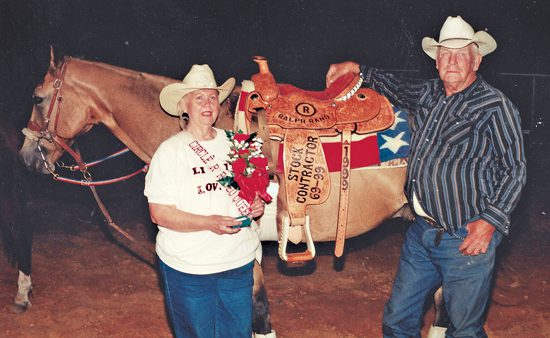
Donald and JoAnn, married 67 years, at their home in Rifle. 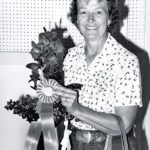
Grand Champion flowers in 1983. -
Back When They Bucked with Ralph & Helen Rand
story by Kyle Eustice
In the early 1950s, Ralph and Helen Rand used to frequent the Calico Rock Café in their hometown of Dolph, Arkansas, and the pair quickly grew fond of one another. The only problem was Helen was just 14 years old and Ralph was 24. Understandably, the age difference caused a lot of controversy in the family, but they were undeterred. They started seeing each other anyway, even though Helen’s father, Homer Pat Sanders, was adamantly against it. Despite his resistance, they fell in love, ran off together and got married in 1953.
After a whirlwind romance, the couple is still going strong 63 years later. Their eldest son, Tommy Rand, 57, was born into the cowboy way of life, along with older sisters Rema and Judy, and younger brother Tony. Ralph started producing rodeos in 1969 when they were all young children.
“I was 10 years old when dad started producing rodeos,” said Tommy. “The hardest part for me was catching cattle. There are 310 acres where the arena is, so it was a full day.”
As a child, Tommy helped his father raise horses and bulls. Several of them have been bucking bull or horse of the year. It started with his grandfather, Owen Rand, who bought and traded horses for a living.
“My dad basically turned it over to me when I was 12,” said Ralph. “I’ve always been a horse trader.”
Ralph started riding bucking bulls and horses at a young age, too. He loved the rodeo lifestyle from the first moment he was exposed to it.
“He’s always had horses as a kid,” said Tommy. “He just loved being around the rodeo and the people he met.”
In 1969, the Calico Rock Lions Club wanted Ralph to put on a rodeo. At that time, he didn’t have any bulls. Instead, he had bucking horses that weren’t broke yet. In fact, Ralph would regularly have his kids ride the unbroke horses and then take them to the local horse sale.
“If they sold and made money, the kids got to stop at the local truck stop to get something to eat, which was a real treat for them,” explained Judy. “But if the horses did not make any money, they didn’t get to stop. They would just drive by.”
At Ralph’s inaugural rodeo, instead of using bulls, he used cows to buck, while Helen would work the gate. His longtime friend, Paul McCarson, showed up to help him and essentially produced the first amateur rodeo along with Ralph.
“It didn’t require a membership,” said Judy. “It followed typical rodeo rules, but there was no rule book.”
Word started to spread that Ralph was producing quality rodeos on his property and soon people were asking him to produce rodeos in their town. That’s when the traveling began. Ralph had an old Bob Truck that could haul five horses and five bucking bulls. At one particular event in Ravenden, Arkansas, they ended up having the rodeo by moonlight after all of the lights were shut off. They did whatever it took to keep the rodeo going.
“In Imboden, Arkansas, the arena was a T-ball field, so it was not typical square arena,” said Judy. “This guy got in there with a bull and it knocked him completely through the fence. We had to fix the fence to finish the rodeo.”
With his unwavering dedication to producing the best rodeos in the area, Ralph dove head first into the production side, where he could be behind the scenes. While he’s not as involved as he used to be, he still raises several bucking bulls and horses on the Rand farm, where he hosts a “Born to Buck” program.
“We keep about 100 horses and 50 bulls,” said Tommy. “We put on junior rodeos, too. There’s always something going on.”
As a member of associations like the ACA, Arkansas Family Rodeo and Great American Bull Riding Association, Ralph has amassed countless accolades over the years. He served on the ACA board in the ‘80s, earned the GABRA Bucking Bull of the Year Award in 1994, and was named the ACA Cowboy of the Year in 1996. In 2013, he was the ACA Cowboys Choice Producer of the Year and two years later, earned the ACA Bareback Horse of the Year and Ranch Bronc Horse of the year. The Rand family’s most coveted award, however, is the 1998 Izard County Farm Family of the Year Award.
“I was shocked when I found out we got it,” said the now 78-year-old Helen. “I wasn’t expecting it. I came home from work and there were 70 or 80 people for a surprise potluck. There were six or seven photographers there to take pictures. Ralph and I were shocked. We had no idea they were going to do this surprise dinner.”
Every August, the Rands recreate the very first rodeo they had in 1969. Called the “Old Timers Rodeo,” they replicate the initial hand bill from 1969, when attending the event was only $2.50. It’s a huge spectacle and captures the hearts of their entire community. At 88, Ralph can watch the event unfold and soak in the magic of what he’s created over the years.
“It’s unreal how many people show up,” said Tommy. “About 1,100 to 1,200 people usually come. We give out buckles and just have a great time.”
Ralph is proud to watch his son take over the family business. He knows Tommy won’t stop until it’s the best rodeo it can be.
“He’s that kind of person,” said Ralph. “He’ll fight to get to the top. I tried other people in the past, but Tommy really does it the way we have always done it. He loves the rodeo.”
Ralph still checks on the cattle on a daily basis while Helen is content staying at home and spending time with her family. After such a long, fruitful career, they can look back with pride at everything they’ve accomplished, including Ralph’s biggest goal.
“I always wanted to be a cowboy,” said Ralph. “That was what I wanted to do as a young boy in school. The number one thing I said I wanted was a big ranch and I did it.” -

Back When They Bucked with Dr. Charles “Bud” Townsend
“For a guy who started out like I did, America was the land of opportunity. I’ve come from shoeshine boy to Grammy Award winner and author,” says Dr. Charles Townsend. Born November 5, 1929, the Texas native attributes rodeo as the gateway to his life, and an abundant one at that. He announced rodeos 50 consecutive years and took his oratory skills to the college classroom as a history professor, while also writing “San Antonio Rose: The Life and Music of Bob Wills”, published in 1976.
It began simply enough. Charles Buddy Townsend – named after musician Charles Buddy Rogers – had drawn a bull, Little Blue, at the rodeo in Ringold, Texas. It was Labor Day of 1946, and Bud’s older brother refused to let the 16 year old get on the bull. When the announcer didn’t appear, Bud, known for his rodeo announcing imitations, took up the microphone instead. “I took to that like a duck to water. I had a lot of fun, maybe more so than later because I wasn’t taking it seriously,” says Bud. “In those days, they brought an invalid in an old Sedan to the arena with his sound equipment inside. Sometimes the horses would hit the car or the calves would run behind it. We didn’t have electricity at the arena, so we ran a crystal microphone off the car. I would fold a handkerchief over it so it wouldn’t melt in the sun. Mine never did.”
Following his announcing debut, Bud got on one or two more bulls before leaving the chutes behind. “Announcing was my forte, and it gave me something to live for. My mother was widowed with seven children, and we were poor, which was nothing new in the Depression. I never dreamed I’d make ten dollars a day or that there would be any future – I had no reason to believe I’d ever be anything. I had a gang of friends around town, and we were into all kinds of mischief. Announcing opened a door in my life, and in a sense, I owe a debt to rodeo that I can never repay.”
Prior to living in the town of Nocona, Texas, Bud and his mother and siblings lived on his grandfather’s ranch, eight miles from town on the Chisholm Trail, and just four miles from where H.J. Justin started Justin Boots Company. “I lived in an era right between the frontier and modern America. We went to town with the team and wagon and brought groceries back. One of my granddad’s ranches was on the Red River, and he was rich when oil was three dollars a barrel. My Uncle Joe Hancock raised the great Hancock horses.” When Bud was in his early teens, his mother moved to Nocona and rented an old hotel for the family. “Main street was my front yard and the alley was my backyard. I was truly an alley rat. But when I started announcing, I became something of a businessman, and I had to give up my wild and wicked ways, because people won’t buy ads from a shady character,” he recalls with a laugh.
He announced horse races, baseball games, and sold ads, a long way from his ten cents a shoe shine. He returned to boots, however, in his late teens when Ruth Salmon (Roach) the lady bronc and trick rider, secured him the sales manager position at Olsen-Stelzer Boot and Saddlery Company in Henrietta, Texas. “She was a dear friend of my mother’s, and we lived on the ranch two and a half miles from Ruth and Dick Salmon. We were very close, and I also knew Tad Lucas because she’d stay on Ruth’s ranch. They never referred to rodeo as a sport – they looked on it as show business. To me, that was the greatest era of rodeo, when it was more of a show.”
Show business agreed with Bud, and he learned his craft announcing rodeos in towns such as Muenster and Gainesville, Texas. The 17 year old turned his attention to the RCA, and when Ruth put in good word to Bobby Estes, a rodeo producer, Bud was all but in with the association. “I announced for Bobby in Hamilton, near Stephenville, Texas, and he liked me. When I joined the RCA, their office was in Fort Worth in the Burnett Building. Earl Lindsey was the manager and they had a little 6×6 foot office with maybe one file cabinet and a desk. I asked Mr. Lindsey, ‘If I join the RCA, can I announce amateur?’ He said I’d be put on the blacklist, and I had to decide right then if I wanted to be amateur or pro. My original card number is 1249 – I was the 1,249th member in 1948.”
Two years later, Bud married Mary Smith, who was a book keeper for Olsen-Stelzer. Their first son, William, was born in 1951, and twins Mary Jane and Charles Jr. came several years later. Bud announced for Bobby Estes another five years, and the family always came along. “We wore out about three trailers – we couldn’t make any money if we stayed in hotels or ate out. Our first trailer was 17 feet and it wasn’t even self-contained.” Bud explains his biggest break in the rodeo business came when he quit working for Bobby Estes. “It freed me up to announce bigger rodeos – after I quit with him, I travelled all over. I went to the RCA convention and booked shows, from state fairs in California and North Carolina to rodeos in Mercedes, Texas, and Omak, Washington.” He also worked for rodeo producers including Homer Todd, Beutler Brothers, Cotton Rosser, Everett Colburn, and Walt Alsbaugh for 30 years.
“In the meantime, I became a Christian. My wife and her family are so Baptist, they go back to John the Baptist, and I decided I wanted become a preacher.” Bud continued to announce in the summers and work for Olsen-Stelzer and Nocona Boot Company while attending school. He graduated from Decatur Baptist College and went on to Midwestern State University in Wichita Falls, Texas. “The faculty got me a fellowship for Baylor University where I went for a year until I applied to University of Wisconsin. I’d gotten interested in history at Wichita Falls, and University of Wisconsin had a top history department, but I knew I wasn’t ready for the big league yet. I took a teaching job at Texas Tech University to really learn basic American history, and then went to Wisconsin for three years to get my PhD.”
He would go on to teach history at West Texas A&M University in Canyon for 27 years, where he is presently Professor Emeritus, while Mary taught first grade in Canyon for 24 years. Bud was one of the best lecturers the school had seen. “I attribute that to announcing rodeos,” he says. “I couldn’t announce a rodeo and use big words and be intellectual – you have to speak the people’s language. I lectured the same way in the classroom, and they could understand me.”
Bud also taught at Hardin Simmons, Texas Tech, and University of Wisconsin. While teaching at Texas Tech, he made extra money by interviewing rodeo people for Sylvan Dunn, an associate professor of Sociology. Bud made sure his interviews took him to Turkey, Texas, home of the King of Western Swing, Bob Wills. “When I was growing up on my granddad’s ranch, my dad was a big fan of Jimmy Rogers, whom he’d played guitar with. They both had TB, and Dad met Jimmy in a sanitarium in San Angelo. In full health, Dad worked in the oil fields, and he was a tinkerer. When I was five or six, he built a wind charger to charge the car battery so we could listen to the radio. We listened to three things – Bing Crosby, Franklin D. Roosevelt’s speeches, and one noontime, we found Bob Wills. In the Depression, there wasn’t much to live for with war coming. But Bob Wills’ music was uplifting. Dad told me one time, ‘Stay with this Bob Wills, he’ll be big one of these days.’ And I never forgot it.”
Bud’s chance to meet his childhood idol came when he met Johnny Lee Wills, Bob’s brother, who produced a rodeo in Tulsa, Oklahoma. “He got me in with Bob Wills, and when I came back to the history department, they thought I was lying about meeting him. But my wife fell in love with his wife, and we became close friends.” Bud was asked to write an article on Bob Wills for the Dictionary of American Biography, but he felt a book was in order. For the music lover who signed up for clarinet in college and carried the reeds in his pocket, the 85 interviews with Bob Wills that followed were exhilarating. “It was about ten years in the making. I did all my writing in the morning. I knew I was writing to the world, and I’d sit there and get a high just working on it!” A scholarly work edited by Judith McCullough, “San Antonio Rose: The Music and Life of Bob Wills” was published in 1976 by University of Illinois Press in a series of books on music and American life.
In 1975, Bud accepted the Grammy Award for his album notes on “For the Last Time”, Bob Wills’ final album with The Texas Playboys. Bud was one out of 4,000 entrants and five nominees for the Grammy Awards. “One reason I think I won the award was because I interviewed so many musicians and asked about their influences. Bob’s was Bessie Smith, Empress of the Blues in the ‘20s.”
Today, Bud and Mary continue to make their home in Canyon. Their son William is an optometrist, and Mary Jane is a medical advisor for one of largest blood distributing banks in the world, located in Scottsdale, Arizona, second only to the Red Cross. Their younger son, Charles Jr., passed away five years ago. “Regardless of what I’ve done, I’ve stayed with rodeo in the summers, and it was like paid vacation for 50 years,” says Bud, who’s been inducted into the Texas Rodeo Cowboy Hall of Fame, and received the Lifetime Achievement and All-Around Cowboy awards through the American Cowboy Culture Awards in Lubbock, Texas, which he announces. His childhood hometown of Nocona even held a Bud Townsend Day in his honor. “I wouldn’t take anything in the world for those 50 years of announcing,” Bud finishes. “Rodeo introduced me to so many cultures and foods and people, and it freed me from poverty and gave me ambition. Everything I’ve done goes back to that, and I’m so proud I did it.” -
Back When They Bucked with Willis Hamm
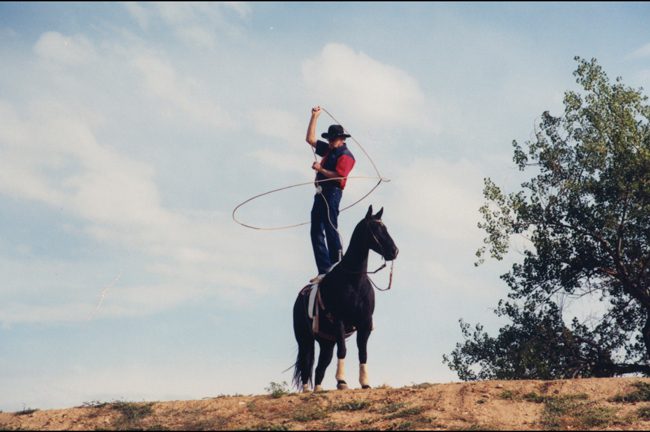
Trick roper, trader, entrepreneur, Willis Hamm was born near the second half of The Great Depression, yet hard work and ingenuity were spurs on the heels of the somber era. With them, Willis started his own business, Cowboy Metal, which celebrates its 50th anniversary this year, grown on the values of the western lifestyle – and $187.11.
Born November 5, 1934, to Henry and Esther Hamm, Willis was the youngest of four children. His father was a horse and dairy cow trader, and owned a dairy farm near Hooker, Okla., a town in the 34 mile wide Oklahoma panhandle. Willis was at once initiated into a lifestyle of rising when the day was just four hours old – or at least arriving home in time for milking. “Leland Friesen was my best friend in high school, and we’d ride after church into the night – my dad just said to be home by milking,” Willis recalls. “He never let me use the truck, saying I had a saddle and a horse. He had an extremely good reputation as a trader for his integrity and honesty, and he taught me all of that. We learned how to work and to be honest, and that’s still very important to me today.”
Willis and his brother took to breaking horses, both for their dad and the public. “I was trick riding then and teaching our horses,” says Willis. “My dad would have me show somebody the tricks a horse could do, and it was sold. It was key to my dad’s trading, but it was a heartbreaker for me to say goodbye. I really learned how to detach myself from an animal until I got my own horse, Lady.” The mare lived to be 34, and became Willis’s trick riding mount after he met Dixie Lee and Virginia Mae Reger of Woodard, Okla. “I saw them trick ride at a rodeo in Guymon, Oklahoma, and I fell in love with it,” Willis recalls. “I went home and started doing the tricks I’d seen. I didn’t have a trick saddle at the time, but I messed up my dad’s favorite saddle standing on it. The death drag was one of my favorites – it’s daring and spectacular.”
Never one prone to thumb twiddling, Willis added trick roping to his repertoire in grade school. The three Gilbert brothers from his school were from a ranching family, and they shared their knowledge of trick roping with him. “They were real cowboys, and also my heroes from the standpoint of trick roping,” he says. “I learned to do whip work on my own, and riding standing up while spinning a rope was something I specialized in.” He also experimented with roman riding, known for taking any two horses his family had and making them go forward. “Frank Gilbert could roman ride two horses jumping over a convertible, and I asked my dad about using a neighbors junk car to jump, but he said no, so I made some jumping standards and put a blanket in between to create the same distance. I also trained one of my dad’s horses, Dolly, for trick riding. She loved to fall, and I learned to fall free of her. I’d take her to one of our plowed fields and take her down at a gallop, just like in the movies.”
Willis took his talent from the cow pasture that was his practice pen to rodeos in Kansas and Oklahoma. He grew up just 30 miles from the late legendary rodeo clown and competitor, Buddy Heaton, who eventually left the RCA to create his own rodeo circuit. It was there Willis found his lifelong love of mules and buffalo. “Buddy was my hero, and he did the unusual,” says Willis. “He bucked mules and buffalo as his roughstock. I clowned his buffalo rodeos and did some trick riding and whip work for him for several years.”
Change came when Willis quit school and refused to return for his senior year. “I didn’t get along with my teacher, and he said I was unteachable. My sister had gone to Meade Bible Academy two years before, and my parents asked if I’d go there. I told them only if my best friend, Leland Friesen, came along. He didn’t have a father and his family was very poor, and to this day I’m fairly sure my parents made it possible for him to go that school.” It was there Willis met his future wife, JoAnn Friesen (no relation to Leland), and they were married on December 29, 1953, when Willis was 19, fitting the wedding between milking chores.
The newlyweds moved to Denver, where Willis worked for two and a half years at a Presbyterian hospital as an alternative to the draft for the Korean War. To supplement his income, he mowed lawns, delivered The Denver Post, and drove horses for Glacier Barns’ hayrides several hours a night. In 1960, he started working for a company that built doorframes, but boredom struck, and Willis decided to make good on his pledge to be a trader like his dad. “I’d saved up $187.11, and I wanted to see what I could do with it,” he says. “The first thing I did was buy a machine I didn’t know anything about, which turned out to be worthless. I knew a guy in the machine tool business, so I told him my story and we traded for a little punch press. I started making things like ornamental leaves for fences for three cents apiece, and then a friend of mine in the ceiling business needed ceiling clips, which I built by the thousands.”
By 1968, Willis had three employees, unbeknownst to his own employer, whom he was still working for. “I went into my boss two years after I started Cowboy Metal and told him what I was doing,” says Willis. “I thought he’d either fire me or tell me to get rid of it, but he only asked if I was man enough to run two companies, and I worked for him another two years.” In 1970, Willis had saved $2,000 cash to quit his doorframe job and begin working full time at Cowboy Metal, but the day he resigned, he went out to lunch with his billfold and came home without it. It was found and returned with everything but the $2,000. “That’s the money we were going to live on for a while, but the man I’d sold ceiling clips to advanced me some money, and it didn’t take me long to pay it back. I’m a risk taker and a pretty good manager, and I ended up fulfilling my wish of being a trader.”
Willis went on to buy and sell everything from wagons and buggies, to horses, mules, and harnesses, staying just ahead of the curve of what was trending for 25 years. He sold harnesses internationally to Germany, Japan, and South America, while Cowboy Metal expanded its services to building horse trailers. Today, the custom metal fabrication shop, still located in Denver, specializes in press brake, shear, and welding services, along with repairing many types of trailers and selling trailer parts.
While his business grew, so did Willis’s family. He and JoAnn have two children, Verle Hamm and Melody Brandt, along with four grandchildren – Verle and Dawn’s daughters, Alyssa and Randi, and Melody and Bruce’s sons, Jason and Lance – and five great-grandchildren. “I’m honored to have him as my dad and experience the things we have together,” says Verle. He competed in the NLBRA in bareback and bull riding, and was the CSHSRA bull riding champion in 1974, along with the all-around reserve champion. Today, he competes in the Cowboy Mounted Shooting Association (CMSA). He and Melody work at Cowboy Metal, while Willis ushered all of the grandchildren into the Denver National Western Stock Show, which he competed in with both horses and mules. “There’s been a second-class attitude about the mule industry, but at Cowboy Metal we always tried to raise the bar and be creative,” says Willis, who won every class at the Stock Show during his 30 years as a competitor.
Yet the creativity didn’t end there. In 1969, Willis had purchased a piece of property in Louisville, Colo., between Boulder and Denver, naming it Cowboy Meadows Farm, a division of Cowboy Metal. Complete with Western buildings, teepees, and stagecoaches, the farm hosted weddings, YMCA summer camps, company picnics, and other special events, until it was sold in 2010. Willis and Verle also drove rodeo dignitaries in their stagecoach for 18 years in the Greeley Stampede, including Leon Coffee and Bill Farr.
“It was fun growing up and having a dad who was a cowboy,” says Melody, “and all the fun we had at the National Western Stock Show will never be forgotten. He taught us a lot of things, and growing up with him as a dad was never dull. His faith and love of God and family is a wonderful heritage.” Today, Willis and JoAnn make their home in Lakewood, Colo., near Denver, where his garage is home to numerous mechanical dummies he creates and engineers to talk and make facial expressions. Though he sold his 14 buffalo – one of which, Harry, now hangs in Willis’s office – Willis still works with his mules. He sold two pairs of mules to a wrangler for the 2013 adaptation of The Lone Ranger, and his inventiveness also produced Little Spike in 2005, a train engine with ten passenger cars he and Verle take to special events such as Buffalo Bill Days in Golden, Colo., country clubs, farmers markets, parades, and Lakewood Cider Days. They have also taken their special events to Nashville, Tenn., Wichita and Liberal, Kan., Guymon, Okla., Tacoma, Wash., Las Vegas, Nev., Greeley, and The Broadmoor in Colorado Springs, Colo., while also making appearances in and providing props for TV commercials.
“Life has been good, and I’m grateful for the talent and opportunities God has given me,” Willis concludes. “To quote my hero, Will Rogers, it takes a life to make a living, and it takes a lifetime to make a reputation.” -
Back When They Bucked with Vernon Dude Smith
[ The Smith family’s only bootprint in the horse world was a great-great-grandfather who traded horses, but that all changed when Dude went to watch his first rodeo. ]
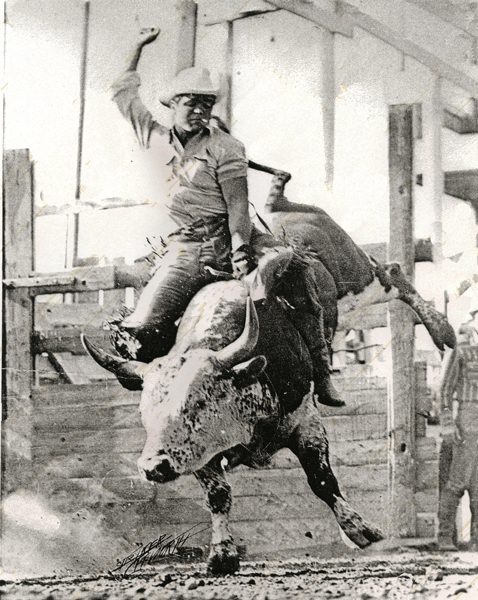
Dude Smith was 13 years old when he stuck a blue-jeaned leg over his first bucking bull. In actuality, it was a milk cow tied to the fence. But for the teenager from Burkburnett, Texas, it was the start to a rodeo career that would give him the love and friendships of a lifetime, and the honor of being inducted into both the Texas Cowboy Hall of Fame and the National Cowboy and Western Heritage Museum’s Rodeo Hall of Fame.
Born Vernon Smith, Jr., in 1928, he was the oldest of three sisters, Geneva, Anita, and Kay, and a brother, Billy. Neither Dude nor his dad, whom he was named after, had middle names, and went by Big Dude or Little Dude to tell them apart. The Smith family’s only bootprint in the horse world was a great-great-grandfather who traded horses, but that all changed when Dude went to watch his first rodeo. “I told my mom that’s what I wanted to do, and she told me I didn’t know anything about rodeo,” Dude recalls. “And I told her those cowboys didn’t know anything about it either at one time!”
Dude rode one bucking bronc that year, but nearly didn’t make it to the chutes again after he tried to join the U.S. Navy. “I lied about my age and tried to join up, but they caught me,” says Dude. “That was just before Pearl Harbor was bombed – a few people I knew lost their lives there.” Soon after, Dude was given a 4F by the draft board after he was kicked while playing football, which broke an artery in his leg. One hospital was ready to amputate it, but another doctor was able to operate and repair Dude’s leg, cautioning him to never do anything that would bump it.
But Dude wasn’t long out of the hospital bed before he was back in the arena, finding work for rodeo producer Paul Long in Kansas and running the rodeo arena for Floyd Reynolds of Montgomery, Ala., doing his own rodeoing on Saturday nights. Dude’s first jobs as a child were carrying water jars in wet tow sacks to field hands for 50 cents a day, or pulling a funnel wagon which carried grain. But in 1947, he and several friends, including Neal Gay and Wiz Whizenheimer, decided to head north and east to the larger rodeos, and Dude sold a cow he owned to his dad and used the money to buy a ticket to Philadelphia. “I sat on the airplane with my nose on the glass and wondered how much better it could get,” says Dude. “I had on boots with more tape than leather holding them together, and I went on to compete in Detroit and New York. I’d never seen that kind of money in my life.” He competed in 53 performances in 30 days in the Madison Square Garden rodeo, having joined the Cowboys’ Turtle Association just before it was named the RCA. He recently received a buckle from Montana Silversmiths for being one of the four oldest gold card members – #159.
Dude competed in every event but team roping, mainly entering the bareback riding, bull riding, steer wrestling, and wild horse mugging. “I loved riding bulls, and I could ride broncs, I just wasn’t as classy as the other guys. I travelled with Casey Tibbs for a while, and if I got lucky enough to draw and beat him, he’d say we didn’t go to that rodeo,” Dude says with a laugh. “There was one bull, Iron Ore, that I got on all the time, and I never rode him. He wouldn’t hook me, but he’d look at me like I was dummy to keep trying. When I leave this world, he’ll be on my headstone – I thought he deserved to be the winner of the deal.”
Dude saw much of his success in the steer wrestling, winning the event at Cheyenne Frontier Days more than any other rodeo. The greatest thrill of his steer wrestling career was in 1953, when he was invited to compete among the top 25 steer wrestlers in the world in Grady, N.M. Another high point came in the early 1960s, when Clem McSpadden, as part of John F. Kennedy’s “Partners of the Alliance” exchange with Mexico, asked Dude to go with a group of cowboys from Oklahoma to aid cities in Mexico and put on a rodeo. “During the rodeo, they brought out a pretty nice steer and a Mexican fighting bull that probably weighed 850 pounds,” says Dude. “I was able to throw that bull, and everybody threw their hats in the ring and hollered I could be president of Mexico!”
Yet one of the greatest events of his life was when Dude met his wife, Frances, in the late 1940s. She was performing with a horseback square dancing team in Burkburnett when Dude met her, and they married in 1950. “I chased her for a couple of years and finally got her hemmed up, but it wasn’t easy!” says Dude. “After that, it lasted pretty good. She was one of the greatest horsewomen there ever was.” A barrel racer, Frances qualified for the 1967 NFR in Oklahoma City – the first year barrel racing was added to the finals – and won the World title. She was also a member of the AQHA and won titles in the both the junior and senior divisions, along with keeping books for rodeo producer Ed Curtis. She and Dude rodeoed together for nearly 20 years, crisscrossing the plains of Kansas, Oklahoma, Texas, Nebraska, and even into New Mexico. Dude finished 16th in the world in steer wrestling in 1966. “But I never really rodeoed to be a world champion,” he says. “My dad told me it was better to be a big fish in a little pond than a little fish in a big pond, and I hardly remember going to a rodeo I didn’t win.”
One of Dude’s greatest horses was Scooter, born the same year he and Frances married. The horse was a gift from Dude’s father-in-law, and he was Dude’s mount in the steer wrestling, also winning Frances a barrel racing saddle in Mesquite, Texas, after her horse went lame. In his later years, Scooter went on to teach many kids how to steer wrestle and high school rodeo.
In addition to competing, Dude ran footraces to earn extra money on the road, and he worked as a pickup man, arena director, and even an arena policeman. “We had to keep people back from the arena a certain distance,” Dude explains. “In Cheyenne, people would bring their blankets and set up in the roping box end of the arena. I helped anywhere they needed me. Sonny Ringer was the arena director for Beutlers when I helped them. He carried a pair of pliers in his pocket, but if I couldn’t get a steer to go in, I’d just bite his tail!”
When Dude decided to retire from rodeo in the 1970s, he started training racehorses in Texas. “Frances didn’t understand how I could like training horses, since I didn’t get to ride them, but I told her when the horses crossed the finish line first you’d get goose bumps an inch high!” He and Frances had two sons, Mark and Vern. Vern went on to ride bulls after high school and qualified for the NFR in 1980 , but Mark passed away in 1973. He was driving home on a three-wheeler when a pipe fell off a passing truck and hit him. “I lost everything for a few months,” Dude remembers. “But between my friends and the Lord, I got myself on the right track.”
Dude and Frances made their home for many years in a house near the Red River but later moved to higher ground in Burkburnett. Their son Vern now lives near the river and runs cattle with his wife, LaDonne, who college rodeoed on a scholarship. Dude lives with his granddaughter, Sage Smith, who barrel races, and trains and sells horses. She won the BFA World Championship in 2003. Dude and Frances were married for 63 years before she passed away in 2013, and she was inducted into the National Cowboy and Western Heritage Museum’s Rodeo Hall of Fame in 2014.
Along with his immediate family, Dude continues many friendships with his rodeo family, and continues to run a small trucking business. “When I first started rodeo, Neal Gay was my closest friend, and he still is,” says Dude. “We’re like brothers.” He feels he competed in the greatest age of rodeo, where camaraderie was staying with families in the same town as the rodeo – some of them barely acquaintances – and hospitality was an ice box full of beer and a plate of chicken or steak. “I worked with committee men and contestants, and we were one big family. I never went to the National Finals, but I would venture to say I wound up better off than a bunch of the gold buckle boys.” -

Back When They Bucked with Harry Straw
Harry Straw married well.
When he married Betty Jane Webster, the sister of world champion steer roper Shoat Webster, he got an incredible horsewoman for a wife, the use of her horses, and the advice of her brother, Shoat.
He was born and raised in Nowata, Okla., the son of Homer and Lillie Straw, with a daddy who roped, and Harry would tag along to rodeos with his father. His dad made a living driving truck, hauling hay to western Oklahoma and grain on the return trip. The family lived on 125 acres of corn, oats and wheat, and Harry and his mother milked ten cows by hand, separated the cream, and sold it to Gus Andrews in Nowata for grocery money. Harry hunted possums at night with his possum dog, making thirty five cents a hide. “It was kinda tough,” he said. “That’s how I was raised.”
He learned to rope at Deacon May’s place. Deacon had a roping pen, and when Homer came over to rope, Deacon’s son and Harry would run calves in.
During his high school days, he worked for his uncle, who owned a Phillips gas station in Nowata, pumping gas for fifty cents a day.
After high school graduation in 1955, he went to work for Phillips Petroleum in Bartlesville, working in the plastics department.
And in the evenings, he’d rope.
Harry would come home after work, and Betty Jane would have the horses ready. “I’d get home by five, she’d have horses loaded, saddles in the pickup, and away we’d go,” he said, to a rodeo where he’d rope calves, steer wrestle or steer rope.
His wife was better with horses than he was, he readily admitted. “She could do more with a horse than I could,” he said. “Shoat had her pretty well tutored before I got her.” She also trained horses, and “she could rope better than I could,” he said. But Betty Jane only roped at home, never at a contest.
Harry roped evenings and weekends, never going too far out of Oklahoma, and concentrating mostly on steer roping. Steer roping was his strength, and his daughter Jeannie McKee remembers camping out at Cheyenne Frontier Days with her family while her daddy roped. He competed at amateur rodeos and in the Rodeo Cowboys Association as well.
He worked for Phillips Petroleum for 33 years and was part of the research team who developed plastic pipe. Phillips built four plastic pipe plants across the country: in California, Texas, Pennsylvania, and Pryor, Okla., and Harry was sent to train employees and work with the machinery. “They’d send me to get them out of trouble when the machines acted up. I’d go there, and train them.”
Harry often practiced with Shoat, his brother-in-law, a four-time world champion steer roper (1949-50, 1954-55) and twice runner-up. Shoat made his own horses, and Harry usually rode one of his. One of his favorites of Shoat’s was Deck, a calf horse and son of Leo. “Shoat made him, and boy he made a good one,” Harry said.
Another horse he liked to ride belonged to Willard Combs. The famous steer wrestling horse Baby Doll “was a dream to bulldog off of,” he said. “She was all right. She done the same thing every time, she’d run right up (to the steer), and let you down, not try to cripple you or cut in front of the steer. She done everything just right.” Harry rode the little blaze-faced dark bay anytime Willard or his brother Benny offered.
But, in his estimation, the best horse he ever got on was one owned by his wife. Betty Jane’s aunt Kate (Choteau) Lowry, the wife of Fred Lowry, took her into one of Fred’s pastures one day. “We was out in the big pastures on the Lowry ranch,” Harry remembered, with 35 mares and weanling colts, “and Kate told Betty Jane to pick a colt. That colt made the best steer horse I ever had.” The horse, named Chico, belonged to Betty Jane, not Harry, and “she never did let me forget that,” he chuckled.
Betty Jane broke and trained the gelding, who was a Hancock horse. The horse liked to buck. “He didn’t buck hard, but he had to crow hop out there every night, till he was eight years old.” One time, at Cheyenne Frontier Days, someone offered Harry $5,000 for Chico. “I just laughed at him,” he said. “There was no way I was ever going to sell him, or do anything with him but rope on him.” And Chico wasn’t Harry’s to sell anyway. “He didn’t belong to me, he belonged to my wife.”
Aunt Kate Lowry had a big heart and was willing to help anyone, including her niece and nephew. She didn’t ride much, Harry said, but she helped pay his entry fees. “When I first started roping, she’d stop by the house to see my wife and me, and she’d always ask, did I need a little entry fee money. Aunt Kate would help anybody.” Harry was reluctant to take her money, but in the early days, he did. “She’ll always have a soft spot in my heart.”
Harry rodeoed with the likes of Harry Swalley, Don McLaughlin, Sonny Davis, Troy Fort, and Sonny Worrell. He remembers their friendships and the characteristics each one had. Swalley was like Harry, a cowboy with a fulltime job, who “was the only guy who could work hard enough to keep up with Shoat,” he said. And Don McLaughlin, for his ability to remember cattle. “Don could be at a roping where they had 100 steers, and three years later, he could tell you what everybody (drew) and what they did on them.”
Harry spent a lot of time with Shoat in the practice pen. Shoat was “an extremely, extremely hard man on his horses, his dogs, anybody who worked for him or practiced with him,” a family member said. “He was rough and tough and hard to please.” But Shoat was never hard on Harry, and he attributes that to his wife. “I don’t know what Betty told him, but the only thing I knew was Shoat was scared of his little sister, and she didn’t weigh 95 lbs. Still to this day, I don’t know what she told Shoat, but he never treated me like anybody else.”
Harry and Betty Jane had two children: a son, Lee, who married Christie and has two children, Tori, and R.J., and daughter Jeannie, who married rodeo announcer Justin McKee and their daughter, Kassidy. Justin says people love Harry. “My father-in-law is the most well-liked human being who ever lived. He’s everybody’s favorite guy, non-judgmental, the most genuine, likeable, nice guy there ever was. Anybody who knows him, would agree one hundred percent.”
“I had an awful good life,” Harry said. “I’ve been the luckiest man alive. I had the only woman who would ever live with me, and I’ve had some awful good horses to rope on, and Shoat to rope with and help me. I’ve had a pretty good life.”
In 1955, he and Betty Jane moved to Lenapah, where they lived until Betty Jane’s passing two years ago. Harry just recently moved to a nursing home, and spends many days at the McKee household, surrounded by the love of his daughter, son-in-law, and granddaughter.
Harry served in the Army and was stationed in Washington State from about 1948 to 1951.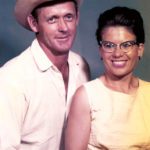
1968-Harry & Betty Straw – photo courtesy of the family 
Harry Straw bulldogging – photo courtesy of the family 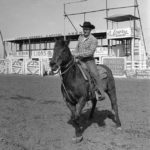
Harry Straw on Chico – courtesy of the family 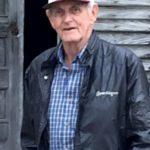
Harry Straw 
Little Bay- steer horse, tough little fellow -
Back When They Bucked with Charley Lyons
Charley Lyons had one of the most unique acts in rodeo, one that has rarely been duplicated.
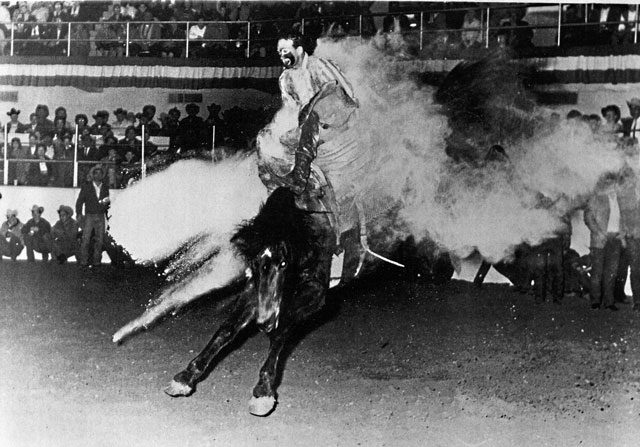
The Montana man built his reputation as a rodeo clown with his washtub saddle bronc act. With a #3 washtub bolted to a saddle tree and filled with flour, Charley would put it on a bucking horse. He’d sit in it, with legs over the bronc’s neck, and explode from the chute. Crowds loved it and it catapulted Charley onto the nation-wide rodeo scene.
He was born in 1938, the son of Ed and Vera Lyons, in Milliken, Colorado, just outside of Arvada. The city kid grew up with 4-H livestock: pigs, cattle, and horses, and somewhere in his youth, he decided he wanted to be a clown. His first rodeo was an FFA rodeo in Greeley, when he was a senior in high school.
After high school graduation in 1957, he went straight to the rodeo industry. The first few years were slim, but as committee members and stock contractors heard about his acts, he was hired for more and more rodeos.
In addition to riding a saddle bronc in a washtub, Charley had other acts. He had a pure white trick horse named Soapy who would crawl on his knees like an Indian scout, play dead, and sit like a dog. He had a half-Brahma steer named Roberto, who had foot-long horns. Roberto was broke to ride, and Charley rode him in parades and grand entries. He’d also ride Roberto in the barrel racing, dressed in a dress and wig and calling himself Charlotte. He also had a palomino Shetland pony named Dandy, and during the steer wrestling, dressed as Batman, he would bulldog a mini steer named Pistol.
Charley had a variety of solo acts, and he rounded out his repertoire with other acts, involving kids from the crowd (and later, his own kids). They milked his donkey named Ruba or were part of his very large family stuffed into a hollowed-out car.
Charley did more than clown. In those days, rodeo clowns often worked as bullfighter as well, and he was also a contestant in three events: bareback riding, steer wrestling and bull riding. He worked acts between contesting his events, and during the bull riding, the producer saved his bull for the last one. One time, at a small rodeo, they were short of contestants, so he had to work all five events, “and he couldn’t rope worth a darn,” his wife, Carol, laughed. There was no time to spare, he said. “I did all three events and worked two or three acts in between times. In my day, if you didn’t have a few acts, you didn’t get any jobs. Them bullfighters were a dime a dozen, but a clown could stay busy.”
He started out with stock contractor Hoss Inman, from Colorado, and worked many of his rodeos, before fanning out across the country. He worked rodeos in the Dakotas for Korkow and Sutton, in Iowa and Minnesota for Bob Barnes, in Canada for Harry Vold, and for the Christensen Brothers in the Northwest. He worked Pendleton, Ore.; Burwell, Neb.; Deadwood, S.D.; Fort Worth, Texas, and a whole bunch of other rodeos in between.
It was in the early 1970s that Charley and his wife Carol Lehl, who had married in 1961, decided where they wanted to settle. They had traveled across the country and found a beautiful place in Montana, just outside St. Ignatius, and decided to buy a place there. They made an offer on a ranch, it was accepted, and they moved there in 1972, calling the ranch the TUB and incorporating the TUB brand onto their Simmental-cross cattle.
As is typical among bullfighters, Charley had his share of injuries, just “broke a few bones, nothing serious,” he said. He broke his back twice, two legs, both arms, and at a rodeo in South Dakota, was unconscious when his head was knocked off the spinal cord. There was a doctor in the crowd who knew how to adjust it back on.
Some of the nastier bulls he recalls include one of Hoss Inman’s, named the Devil’s Partner, a fighting Mexican bull who would “darn sure come and eat your lunch.” Hoss also had another bull named Shorty who was fun to fight. “If he ever hit you, he’d back up and apologize. They’d have to rope him and drag him out of the arena, every performance.” And it was one of Erv Korkow’s bulls, Sonny Liston, who got ahold of him and knocked his head off his spinal column.
With the washtub, Charley rode whatever horse the stock contractor ran into the chute for him. Stock contractors liked the tub, he said. “They’d take a good solid horse that was slowing down, and he’d be good for another four or five trips” after he’d had Charley and the washtub on him.
And there was no getting off on the pickup man. “There was no way a pickup horse would run into that fog,” he said. “I’d catch my timing, bail out after a while, and try to land on my feet.”
Charley and Carol had three children: C.J., Anna and Katie, and before the kids were in school, they all traveled together. “We had a trailer house, a twenty-footer, and lived on the road,” Carol said. Charley had a two-ton truck with a big box he built on it for the animals, and the house trailer was pulled behind it. The family left in May and returned in October. The truck was full of animals: Charlie’s bulldogging horse, Carol’s barrel horse (she barrel raced for a short time), and the clown act animals: the trick horse, trained steer, donkey, and Shetland pony. When they pulled into a rodeo, it was like “the circus was in town,” Carol laughed.
Charley’s rodeoing slowed down after he bought the ranch. With three kids, 200 mother cows, hay to put up and irrigating to do, he stayed closer to home, and in 1972 he quit rodeo. He worked at a paper mill for a while, retiring in 2006, and the couple sold their cow herd in 2008. They rent out the pasture and continue to put up hay.
In 2014, he was inducted into the Montana Pro Rodeo Hall of Fame. He and Carol attend the rodeo clown reunions and they have never missed a year of the Wrangler National Finals Rodeo for the past three decades. In 2001, his washtub act was recognized and honored in one of the opening ceremonies of the Wrangler NFR.
He loved fighting bulls as much as he did clowning. “It would give me a big thrill to stand out in front of that chute and nod for the producer to turn out his fighting bull.” He fought the first Mexican fighting bulls that were brought into the U.S. at a rodeo Buddy Heaton promoted.
And his rodeo days were good ones. “I met a lot of good people rodeoing, and still have a lot of friends I stay in contact with.”
The couple’s children are married: C.J. to Miae, Anna to Jim and Katie to Ray. They have three grandchildren: Clay, Amanda and Mian.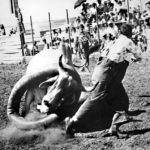
Charley throws an inner tube around Sammy, a Big Sky Company bull, at the Lewiston, Montana rodeo. – Rathbuy 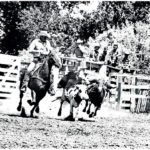
One of Charley’s acts was to steer wrestle while wearing a Batman suit. The steer was one of his, named Pistol, and his steer wrestling horse was Dandy. – Rathbuy 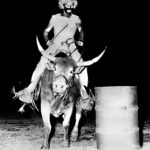
Charley Lyons, dressed as a woman, barrel races with Roberto the steer. – Allen Photo 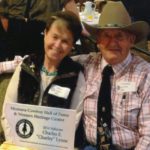
Carol and Charley Lyons celebrate his induction into the Montana Pro Rodeo Hall of Fame in 2014 – courtesy of the family -

Back When They Bucked with Liz Kesler
story by Gail Woerner
Liz was born to Chesley Russell and Irene Faulkner Russell on June 10, 1926 in Clay County, Texas just south of Henrietta. She had one sister, Margie, two years older. They lived in a two story home on a farm/ranch located on Old Joy Shannon Road which had belonged to her paternal great-grandparents. Her daddy was born in that house, too.
Their young lives were idyllic for young country girls. Liz and Margie had dolls galore, buggies for dolls, paper dolls, and a trike to ride. They had a swing and playhouses under the trees. They also got together with other children in the community at Sunday School as well as socials that were held in the area.
When Liz was old enough to go to school she went to the Bluegrove School for the first nine grades. There were 15, or so, in her class and several grades were in one room with one teacher. They had programs for parents with students performing. The principal, Mr. Gilbert and his son both played the fiddle. Mr. Gilbert taught Liz to play the bass fiddle. It took some doing, not because Liz had trouble learning, but because Liz wasn’t tall enough to stand and play the bass fiddle. First they removed the peg from the bottom of the fiddle to make it shorter, but Liz was still to short. Solution: They stood her on a box and she played just fine!
Liz was always an honor student and was valedictorian at her grade school graduation. She only attended school for eleven years and the last two years she was at Henrietta High School where she took typing, bookkeeping and regular courses.
Liz Kesler and Dr. Greer 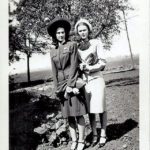
1944 – Margie and Elizabeth Russell 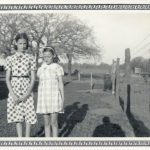
1934 – Margie and Elizabeth Russell 
Anna Lee and Bud Purdy, Liz and Reg Kesler Her dad was always interested in rodeos, both in Henrietta and in Fort Worth. The family always went with him to rodeos and Liz found it a special treat. She was always interested in the events and the rodeo people. When Liz was 17, at the rodeo in Henrietta, one of the timers did not show up. The announcer saw Liz as she was finding her seat in the grandstand and asked her if she would time. She did not hesitate. Obviously she did a good job because it wasn’t very long before she was asked to time other area rodeos.
She was hired by Mr. Gilbert, her former principal, who had become the Superintendent of Schools in Clay County. Her position was Assistant County Superintendent of Schools for Clay County. Her office was located in the court house in Henrietta. She held that position for eight years. Later Liz attended Draughan’s Business College in Wichita Falls to get more business training. She was an excellent administrative person and was eager to gain more knowledge and skills.
Liz met June Bull from Pampa, Texas, and when June finished high school her parents hoped she would want to go to college. Instead it was June’s desire to barrel race. Being their only child her parents were patient with her and agreed. Liz traveled with June Bull to various rodeos around Texas and beyond. At first, Mrs. Bull traveled with them. They always had such a good time and found people in rodeo easy to get to know. It wasn’t long before the rodeo people they met seemed just like family. By the early 1950s they were going to rodeos further from home. Cheyenne Frontier Days, Madison Square Garden Rodeo in New York City, the Boston Garden Rodeo and many others. By this time Liz had resigned her job as Assistant County Superintendent and could travel the country.
In time, Liz went to work for Standard Oil Company, and was offered a transfer with a substantial increase in salary and title. The transfer took Liz to Liberal, Kansas, which seemed like ‘the end of the world’ to her. Fortunately she could still see friends when she worked at a rodeo. She and June learned to secretary rodeos together and soon their reputations as ‘outstanding’ rodeo secretaries spread through the rodeo world.
She often worked in the rodeo office for Everett Colborn, who was the ramrod of the World’s Championship Rodeo. He had some of the biggest and the best rodeos in the country. His daughter, Rosemary, who married World Champion All-Around Cowboy, Harry Tompkins, was generally her dad’s secretary and often Liz would assist or do whatever was necessary.
In 1954 June Bull and Buster Ivory, a bronc rider, were married during the Cheyenne Frontier Days at a Methodist church in Cheyenne. Liz was maid of honor and Jo Decker was matron of honor. Casey Tibbs, World Champion saddle bronc rider and Bill Ward, also a bronc rider were Buster’s attendants. Bill Linderman, All-Around World Champion and President of the Rodeo Cowboy Association, gave June away. Mr. Bull was not ready to give his only daughter up and refused to attend the wedding. It was truly a rodeo wedding.
Liz met Reg Kesler, in Oklahoma City during the 1966 National Finals Rodeo. Liz was a good friend with Jim and Sharon Shoulders, Clem and Donna McSpadden as well as June and Buster Ivory. All these people were good friends with Reg. He was a former three-time All-Around Champion cowboy in Canada who worked every event. He was from Alberta, Canada and went to college there, but was more interested in playing hockey or riding bucking horses. It was evident his life was going to be rodeo. He also collected bucking horses and in 1951 he produced his first rodeo. He had become a well known stock contractor and produced rodeos in Canada and the United States until 1995. Later they became an item.
They married in Bozeman, Montana in 1971 during the NIRA (National Intercollegiate Rodeo Association) Finals. Those attending their wedding in the Methodist Church were Liz’s mother, and niece, Phyllis Jones, and good friends Bud and Anna Lee Purdy. Liz remembers that Byron Walker and Martha Tompkins were among the college students competing at the rodeo. She assisted announcer Don Harrington by identifying the various college contestants and what colleges they represented.
Two days after their wedding Liz was secretary and timer at the Red Lodge, Montana, rodeo. The newlyweds lived in Missoula, Montana and Rosemary, Alberta, Canada, but traveled most of their time on the ‘rodeo road’. They produced rodeos in Denver, Houston, San Antonio, all over the province of Alberta, all over Montana, Idaho and too many other places to mention. Often Reg would be hauling stock to one rodeo and Liz would be heading another direction and putting on a rodeo somewhere else. Reg trusted Liz and knew she had the skills and ability to run a rodeo the right way. Liz often was responsible for getting the cowboys monies to the bank and traveled by herself many miles with never a problem. They were a good team.
Reg was very instrumental with two other men in starting the ProRodeo Cowboy Association Circuit Finals in 1987. It was held in Pocatello, Idaho, and Reg not only helped organize it, he backed it financially, as well as offered his knowledge and his stock for the event. This allowed all 12 circuits in the United States to send their best cowboys in each event to compete against each other. A circuit was made up of one state, or more, depending on the rodeo activity in the states. PRCA cowboys could register for one of the twelve circuits. Liz was the secretary at the very first circuit rodeo held, which was in Montana. She, also secretaried the first National Circuit Finals in Pocatello. This additional level of competition helped the cowboys, who held jobs or were needed on their own ranches and couldn’t rodeo full time, earn more money.
Reg had outstanding broncs for both Saddle Bronc and Bareback events. He had good stallions that bred good bucking stock. Liz once said, “Reg only had to see a horse buck one time to know if it was going to be a good bucking horse.” His horses were chosen as top horses many years in the RCA, PRCA and the National Finals Rodeo. He also had some bucking bulls that were tops, too. He continued in the rodeo business until 1995, when his grandson, Duane Kesler, bought the business. Reg was inducted in to the ProRodeo Hall of Fame, the Canadian Rodeo Hall of Fame, Alberta Sports Hall of Fame and the Rodeo Historical Society Rodeo Hall of Fame in Oklahoma City. He was well respected and appreciated in the rodeo world.
Liz also began teaching others to secretary rodeos and held schools in Canada and also helped train secretaries in the U. S. At that time in rodeo the secretary was much more involved with those entering rodeos as it was all done by telephone directly calling the secretary. There was so much more ‘hands on’ administrative work done by the secretaries. They were working without all the technical machines and computerized programs that are in use today.
Liz, Donna McSpadden, Sharon Shoulders, June Ivory, Irene Harris and Nell Shaw started a Ladies Fashion Show during the National Finals Rodeo held in Oklahoma City in 1967. In the beginning they used contestant’s wives and mothers to model the clothing in the show. The local stores and boutiques were so gracious and allowed the gals to come in to the store and pick whatever they wanted to model. This style show has continued annually during the National Finals Rodeo in Las Vegas. It is still being organized by the wives of today’s contestants. The proceeds from the show, including sales of auction items and cost of the show are now given to the Justin Crisis Fund which helps cowboys that are injured or have a serious financial problem pay bills other than their medical bills.
When Liz’s mother became ill she and Reg came back to live with Mrs. Russell so Liz could help care for her. In 2001 Reg went back to his Canadian ranch on business and was tragically killed in an automobile accident. He was 82. It was a big shock to Liz and the entire rodeo world, Reg was still very active in rodeo.
Reg and Liz were involved with Buster and June Ivory in holding the Cowboy Reunion, during the National Finals each year. Today Liz is the ramrod of the event, held in Las Vegas, and still gathers the ‘movers and shakers’ in rodeo, from all across the United States and Canada, each year. The proceeds from this 501c3 organization, are given to the Justin Crisis Fund, the ProRodeo Hall of Fame and Museum of the American Cowboy and the Rodeo Historical Society.
Presently Liz lives in the family home which has a 130 year history for the Russell family. When her mother died, at the age of 98, Liz became much more active in the community and the county. She is a founding member of the Clay County Historical Society, and was a chairperson for the renovation of the museum. She is also involved in the Pioneer Reunion and rodeo and was chosen Pioneer Reunion Queen in 2000. She is a member of the Bluegrove Baptist Church. Her great-grandparents gave an acre of land for the Bluegrove Cemetery of which she is a member of the cemetery board. She also is a Clay County Memorial Hospital Foundation board member. In 2010 Liz received the Silver Award from the Retired Senior Volunteers of North Texas (which includes 17 counties). In 2013 she was honored as the Outstanding Senior Citizen of Clay County.
In the rodeo world she was honored by the Women’s Professional Rodeo Association in 1984 for her contribution to them which involved making each PRCA rodeo in Montana also a WPRA rodeo for the barrel racing event. At that time WPRA had to get each rodeo committee to agree to their requirements and Liz got the entire state committed. She also received the Montana Governor’s Award for the preservation of our western heritage in 1986. In 1988 Reg and Liz were honored as Outstanding Citizens of Missoula Montana. The Kesler outstanding bucking horse, Three Bars was inducted in to the ProRodeo Hall of Fame in 2004 and Liz accepted. In 2008 Liz and Reg were inducted in to the Texas Rodeo Cowboy Hall of Fame. Liz received the Tad Lucas Memorial Award at the National Cowboy & Western Heritage Museum, in 2010, which is given to women who give above and beyond what is expected of them in rodeo as did the namesake, Tad Lucas. That same year Liz and Reg were inducted in to the Montana Wall & Hall of Fame in Billings. In 2013 Liz was given an American Cowboy Culture Award as Pioneer Woman at the Cowboy Symposium held in Lubbock, TX.
She helped organize and is a member of H.A.N.D.S. which stands for Help A Needy Diva Survive. It is a fifty member group of rodeo women, dedicated to helping any rodeo family member who has been injured or has medical problems and may need help either financially, or emotionally.
Liz has enjoyed her life immensely. She has worked hard at everything she has done, and accomplished much. She has never hesitated to assist when anyone needs help. Liz is actually an important part of three families. Her own family, including her sister Margie, Margie’s children, grandchildren and great-grandchildren, as well as Reg’s children, grandchildren, and great-grandchildren and the rest of her relatives; her second family is the rodeo family which includes everyone who has had the good fortune to meet her or worked with her at rodeos and rodeo functions. Especially the young cowboys, who were just starting out in rodeo and love her so much for all the help she gave them when they were still ‘wet behind the ears’; and last but not least her Clay County family which grows with each and every event Liz participates in.
Liz is truly proud of her heritage and deep Texas roots. She has the manners and demeanor of a lady. She gains the respect of everyone she meets because of her gracious ways. She is no where near finished making memories and living her life to the fullest. Don’t expect to see her sitting in a rocking chair and watching the world go by. She still has much she wants to do, so many events to attend and so many friends to see. -
Back When They Bucked with Larry Clayman
Larry Clayman comes from a long line of rodeo clowns. He is third in the line of Claymans, including his daddy, Bill, and his granddaddy, Stanley, who were in the business of making rodeo fans laugh and protecting bull riders from angry bulls.
Clayman, who was chosen as the 1973 National Finals Rodeo bullfighter, was born in 1941 and “raised up” in the Missouri Ozarks, in the southwest part of the state. He worked his first rodeo in Mansfield, Mo., with his grandad at the age of 13. For two performances, he got paid twenty bucks, and “I thought, my gosh, I’ll never see another poor day,” he laughed.
Larry had already signed up for the Marine Corps when he was approached at an amateur rodeo in Okmulgee, Okla., by a legend in the rodeo world. World champion Jim Shoulders walked up to him, asking if he would clown rodeos for him. It “about floored” the barrelman to have the legend standing in front of him, but he had to decline, as his commitment was to the Marines came first. Shoulders told him about the rodeos held at Camp Pendleton in California, and that he should meet a Colonel who was working at Pendleton.
When Larry got out of boot camp and was assigned to Pendleton, he got to meet Colonel Ace Bowen, the man Shoulders had told him about. That acquaintance led to Larry meeting one of old original stock contractors in California, Andy Jauregui, an immigrant Basque sheep herder-turned contractor who was also the 1931 world champion steer roper. Andy owned J Spear Rodeo Co., and hired Larry to work his first professional rodeo. His dad and granddad had only worked amateur rodeos, but after being hired by Andy, Larry never worked another amateur. It was in Bishop, Calif., and he worked alongside Slim Pickens.
Larry clowned rodeos at Camp Pendleton, and then worked a lot of rodeos in southern California for Jauregui.
At the end of his four years in the Marines, he was stationed in Washington, D.C., at Marine Corps Headquarters, with top secret clearance, working for generals and colonels. He became acquainted with Howard Harris, Cowtown Rodeo, and began working his weekly rodeos in New Jersey.
While he was in D.C., Jim Shoulders was putting on a bi-weekly rodeo in Leesburg, Va., on a polo field. Larry clowned for him, as well as for other stock contractors up and down the East Coast: Foy and Reynolds, among others, in Virginia, Florida, Pennsylvania, Alabama, Delaware, all over. He worked for stock contractors across the country: Cotton Rosser, Harry Vold, the Alsbaughs, Keslers, Suttons, and Korkows,
After discharge from the Marines in 1965, he went back to California. Cotton Rosser’s Flying U Rodeo Co. and Any Jauregui’s J Spear combined to make the Golden State Rodeo Co., one of the biggest in the business. He clowned and fought bulls for them, which was a great thing, he said. “They had more rodeos than anybody, and kept me busy.”
Larry wasn’t working exclusively on the coasts. Throughout his career, which spanned three decades, he worked some of the biggest rodeos in North America: the Calgary Stampede, the National Western in Denver, Madison Square Gardens, the Cow Palace, the National High School Finals, the Indian National Finals, the College National Finals, and, in 1973, the National Finals Rodeo, which he worked with Jerry Olson
as the funnyman and Tommy Lucia
as barrelman.
Back in those days, the bullfighter and rodeo clowns were one and the same; the sport hadn’t evolved to where different people do each job. Larry was proud of his roles and loved doing both of them. “I was considered a good bullfighter, and took a lot of pride in that,” he said. “I loved to fight bulls. It was fun, exciting, and a challenge. And yet I loved to make people laugh.” He credits his grandpa with that trait. “It was natural for him to make people laugh.”
Larry was best known for his chimpanzee, Todo. He bought Todo in 1967 when he was six months old. For the next fifteen years, Todo traveled the rodeo road with Larry, making people laugh everywhere. One of his first acts was as a “doctor.” Larry would dress Todo in a white uniform with a red cross, with a red cross on his bag. Larry would be “down” from losing a shootout with the other rodeo clown, and his help would drive an “ambulance” into the arena, with Todo in it. Todo would jump out of the ambulance with his bag, stethoscope dragging on the ground, and bring the house down. He would give Larry CPR, jump on top of him, and make the monkey sound – “ooh, ooh, ooh, ooh, ooh.” Todo loved it. “He could hear the crowd roaring,” Larry said. “He got the biggest kick out of it.”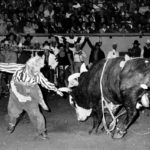
Larry bullfighting 01 Sue at the 1973 NFR, Oklahoma City, OK – Gustafson Rodeo Photography 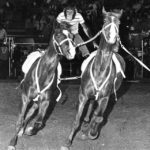
San Diego, CA 1973, Thunder, Todo and Blaze – Foxy Photo 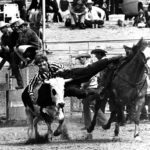
arry steer wrestling in Springville, 1993 – Foxy Photo 
ull Fighting Championship, Rapid City, SD 1979. (left to right) Red Stegall, Wick Peth, Jon Taylor, Skipper Voss, Miles Hair, Bob Robertson, kneeling Larry Clayman, Kelly LaCosta, little girl is Amy Noe – Johnny’s Photo 
George Doak, Larry Clayman, and Jon Taylor at Gold Card Reunion in Las Vegas – photo courtesy of the family
Todo also Roman rode a team of horses, slapping one of the horses on the backside, throwing him off. As the horses made the circle around the arena, Todo would tumble across the circle and get back on.
Todo was Larry’s main act, but he had others like a poodle named Squirrely Shirley who had “beatcha” bugs… scratch in one place and they “beatcha” to a new spot. He had a border collie act, and had trained horses that laid down, sat up, bucked him off, counted, and, while they napped together, stole the blanket off of Larry.
One of his greatest honors was being part of a rodeo tour in Europe in 1970. It was organized by Buster Ivory, and the group, called Rodeo Far West, performed in Italy, Switzerland and France. Larry took Todo as one of his acts, and also drove truck, hauling equipment and livestock. The tour lasted three and a half months. World champion bull rider Freckles Brown was also part of the tour, and Larry got to be good friends with him during that time.
In 1977, Larry decided to put on a pro rodeo in Springfield, Mo, and then he began a pro rodeo in Branson, Mo., six nights a week, all summer long. Harry Vold and Jim Shoulders were hired as stock contractors, and Jerry Olson came with his dress acts and worked as the barrelman. He got so busy producing the rodeos that his clown/bullfighter career slowly phased out.
And Todo had to be put to sleep for safety reasons in 1980. That was the final straw. “I didn’t intend to quit clowning, but it broke the straw in me a little bit,” he said. I didn’t have the umph, the fire in my belly, to go back on the road.”
And he wanted to live a normal life. He announced a few rodeos, but began trucking as his second career. He’d driven truck as a kid, and loved being around them. At the age of 75, he’s still driving. “Everybody asks me why I don’t retire. Heck, I don’t want to. Somebody’s gotta keep America rolling,” he joked.
Larry had a son, Stan, who died in an auto accident, and Stan has two sons, Joseph and Isaac, who live in Arkansas. Larry has three other kids: Kimberly, Matthew, and Michael, and five grandchildren. He and his wife Renee have been married twenty years.
He remembers fondly his rodeo days, and has no regrets about his work. “I never dreamed I’d fight bulls at the (National) Finals. I never dreamed I’d have that kind of success. I loved the rodeo business and it was so good to me.” He met a lot of people, went a lot of places, and had some unbelievable experiences.
He worked rodeos in nearly every state, he remembers, and one thing he is proud of is that he never missed a performance due to injury or illness. “I take pride in that,” he said, even though he suffered broken arms, legs, and had teeth knocked out. “You just keep working.” -

Back When They Bucked with HL Todd
HL Todd was larger than life. Whether it was riding his famous horse Rufus as he steer roped, hosting cowboys at his home in Burlington, Colo., or chewing on one of his signature cigars, he stood out in people’s minds.
The Colorado cowboy, who will celebrate his 79th birthday this year, qualified for the National Steer Roping Finals four times and took numerous victory laps at such rodeos as Pendleton, Cheyenne, and everywhere in between.
He grew up the son of John and Bernice Todd, hardworking farmers in northwest Kansas who were good people but had no use for rodeo. “They didn’t like nothing about it,” HL remembers. “It was like pulling teeth, when you loaded up to go to one.”
Their middle child of three, born in 1937, began roping at the neighbor’s. Elmer and Albert Garrett had a roping pen, and that’s where HL got his start. He was sixteen or seventeen years old, and he was looking for something different than farming. “I’d be out there, (in the field) in August, in the dust and it’d be hot and I’d be sleepy, and I was going to figure out some way to make a living without running this tractor,” he recalls.
He roped in high school a bit, then in college at Kansas State University, he competed in the calf roping and steer wrestling.
After college graduation, HL moved to Burlington, Colo., where he worked for an insurance company for ten years. In the early 1970s, he got into the feedlot business, with a 10,000 head operation. After ten years in the cattle business, he went broke and went back to the insurance company, living in Kansas City and Oklahoma City before moving to a ranch near Chickasha, Okla.
He roped steers on weekends and when he could get away from work. He won rounds and placed at rodeos across the country: Cheyenne Frontier Days, Walla Walla, Wash., Miles City, Mont., Pendleton, Ore., Ponca City, Okla., everywhere he went.
And he and his wife Rita’s place became a stopping spot for fellow cowboys. Their home north of Burlington included an indoor arena. It was on the way for those cowboys from Texas as they headed north for the summer run. “A lot of those steer ropers and calf ropers would come and stay with us,” Rita said. “They were coming from south Texas, and Burlington was over a day’s drive. They’d camp there, go to county fairs, and then go on to Cheyenne and Pendleton.”
Some of the names legendary to the sport of rodeo stayed with the Todds. James Allen, the father of eighteen-time world champion Guy Allen, came with his kids. Sonny Davis, Olin Young, Roy Cooper, Dick Yates, Jimmy Brazile, and more sat at the kitchen table with the Todds. They stayed in their campers or living quarters, and Rita cooked supper for them. Beef was plentiful, in the feedlot business. Cowboys often brought their families along, and HL and Rita’s two daughters, Kim and Kelly, loved it. Their home was a gathering place. “The kids loved it,” Rita said, “and I did, too. It was fun.”
HL Todd – courtesy of the family 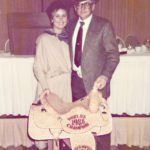
HL and his wife Rita. HL was the 1988 Senior Steer Roping World Champion – courtesy of the family 
L at Cheyenne Frontier Days, 1975 – Reed right: HL and his wife Rita. HL was the 1988 Senior Steer Roping World Champion – courtesy of the family 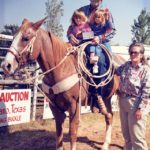
HL with his twin granddaughters Sierra & Sheridan after winning the Sonny Davis Memorial Roping in 1992 -JenningsRodeoPhotography.com 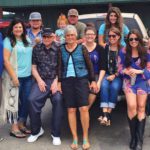
HL with his family, 2016 – courtesy of the family Clark McEntire, the father of country music superstar Reba McEntire, roped steers in the same era as HL did, and he often stayed at the house with his four kids. After roping all day, Rita would fix a big cook-out, and the McEntire kids, mainly Pake and Reba, would pull out their guitars to sing and entertain. “Mom jokingly said they had to sing for their supper,” Kim remembers.
Jeff Todd, HL’s nephew and a team roper, remembers the big personality his uncle had in his rodeo days. “He was just always a figure that was larger than life,” he said. People comment to him that they always wanted to be like HL when they grew up. “He was the guy who, everything he did, was first class. He wasn’t flamboyant, but he always had nice horses and took good pride in his stuff.”
He didn’t always catch, but if he did, he won, Jeff remembers. “That was his mojo. He had that winner’s knack. He might completely miss one in the first round, and then win the next round. He was always a go-round threat.”
HL rode good horses and his best-known horse might be one he raised, a roan gelding named Rufus, who was the AQHA’s 1995 Steer Roping Horse of the Year at the age of nineteen. Rufus was also ridden by HL’s son-in-law, Jimmy Hodge, who made the National Finals Steer Roping three times. The horse was the envy of every cowboy in the arena. One time, at Cheyenne after slack, as HL went to put horses away, one of his granddaughters said to her grandpa, “I want to ride Rufus.” Tee Woolman, overhearing her, said, “Yeah, and so does everybody else around here.”
HL qualified for the National Finals Steer Roping in 1973, 1975, 1976, and 1982, and continued to rope professionally till he was in his sixties. He won a go-round at Cheyenne at the age of 52, and went on to rope in the National Senior Pro Rodeo Association. He quit competing about seven years ago.
HL mentored young cowboys, including the 1978 Tie-Down Roping Champion Dave Brock, and another steer roper, Rod Pratt. As a youngster, Pratt and his family neighbored the Todds, and Rod worked for HL, rebuilding his arena. “One thing led to another,” Rod remembers, “and he taught me how to rope.”
Rod remembers HL with the big cigar in his mouth. “He always chewed on a cigar,” he said. “He’d light it twice, and it’d go out, and then he’d chew on it.” But when he spoke, it was time to listen. “He was pretty quiet and laid back, and you could tell when he spoke seriously, you needed to listen.”
Pratt qualified for the National Finals Steer Roping eight times, winning the average in 1987. He rode one of HL’s horses for the last five rounds in 1987, and placed in every round. “If I needed something, he always helped me,” he said.
HL worked hard to be a good roper, Rod said. “He was a good athlete. He had to work at it, but he wanted to, so that’s the driving factor right there. The ‘want to’ makes you do a lot of things well.”
In addition to teaching him how to rope steers, HL taught Rod some life lessons, like how to enjoy the moment. “It didn’t matter where you were, he enjoyed life. Wherever he was, he enjoyed being there. He never did let life get him down.”
HL and Rita enjoy retirement in Johnson City, Texas. Their older daughter Kelly married Mark Dykes and they have two daughters and a son, and their younger daughter, Kim, married Jimmy Hodge, and the couple has twin daughters.