Rodeo Life

Category: Back When They Bucked

  • Back When They Bucked with Doc Gee

    Back When They Bucked with Doc Gee

    If it wasn’t for Will James, John Gee might never have been a cowboy. The Montana man grew up reading the western books written by James, while he and his buddies dreamed of riding bucking horses and living the cowboy lifestyle, and Gee did just that.
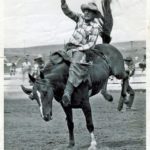
    Growing up in Delta, Ohio, on the west side of Toledo, John, also known as “Doc,” delivered newspapers to buy his first horse. “My father helped subsidize the horse,” Doc remembers. “I was nine or so.” Five years later he was at local county fairs and rodeos, riding bareback horses and bulls.
    He and childhood friends Tom and Don Decker and their buddies traveled together to rodeos, and Decker remembers when they rode at a rodeo in Findlay, Ohio. “They had a horse that was pretty rank,” Tom Decker said. John got on him in the saddle bronc riding. “The horse threw him over his head the first jump and took him down the arena, kicking every jump. John was unconscious for a short while, and on the way home, he didn’t remember his ride.” On the way home, he came to. “He didn’t remember anything. We told him his ride was like a Will James book,” he laughs.
    The boys were in training, Decker said. “We knew we’d have to be tough so we could become cowboys. We had to take cold freezing showers, to see who could stand in the shower longer.” The boys were daredevils on horseback, too. “”We’d ride this crazy horse down a gravel road, one-hundred miles an hour, bareback and double,” Decker said. “The horse was a renegade. John used to put the horse under the edge of the roof, and (the horse) would lift the rafter.”
    After high school graduation in 1953, John headed west. His interest in agriculture took him to Colorado A&M (now Colorado State University), in part for the education, and in part for their rodeo team. When the team was chosen that fall, John was not on it. “I was pretty broken up about the deal,” he said. In those days, a person could compete on the team or individually, so John went to some rodeos by himself and won. He was working three events: the bareback riding, steer wrestling, and bull riding. That spring, he was chosen for the team. Being voted on the team was done partly for a person’s talent and partly for if they had wheels:  “In those days, the team was picked by the people who were going to rodeo,” John says. “You put your name on the board, and the events you worked. And then each person who had their name up there got to vote. So you voted for somebody that had a car, you voted for yourself, and you voted for whoever you thought would be the best cowboys.”
    With paying out-of-state tuition, John had to concern himself with entry fees. “You didn’t go many weeks without winning something unless you were subsidized in some way,” he said. His
    dad, a truck driver, wasn’t paying his fees. “We weren’t that affluent.”
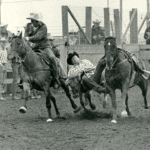
    In 1954, his first year of college, the Colorado A&M team won the national championship, and John won the National Inter-Collegiate Rodeo Association’s Steer Wrestling title. In his sophomore year, he won second place, and his third year of college, he won the title again. The Colorado A&M rodeo athletes knew how to get lots of points. In those days, there were no college regions and students could compete anywhere in the nation, “so some of us would get in the car and go to a rodeo and get on other people’s horses,” John recalls. Fuel was a quarter a gallon. “One weekend, we had a team 30 miles from the New Mexico border, and a team 30 miles from the Canadian line.” Because they borrowed horses, they could travel easier. “The Texans, if there were six on a team, there were probably six outfits, because they all hauled their own horses. We had an advantage.”
    After his first year of college, John switched his major from agriculture to animal husbandry. “Unless I married a rancher or inherited one, I couldn’t afford to be one.” After three years at Ft. Collins, he transferred to Ohio State to get his doctor of veterinary medicine degree.
    He graduated from Ohio State in 1960 and immediately headed back west. Doc, as he would be better known by, got a job for a veterinarian in Great Falls. Three years later, he went out on his own, establishing his practice in Stanford, Montana.
    And he kept rodeoing. He got his Rodeo Cowboys Association membership, predecessor to the Pro Rodeo Cowboys Association, in 1961. He worked all three events, never hitting the road full time due to his veterinary clinic, but going hard enough. Among his rodeos, he competed in Denver at the National Western Stock Show and Rodeo many years. He spent a few summers rodeoing in Ohio and back east. His practice never let him get too far from home.
    He rode bulls until 1964, quitting because he had married. He rode bareback horses for another ten years, and steer wrestled till he was in his forties.
    Doc’s wife, JoAnn Cremer always had an eye for horses, he said. She was the niece of well-known Montana stock contractor Leo Cremer, and grew up around rodeo. They met at a college rodeo in Bozeman. In her early years, she didn’t have a chance to rodeo, but after they married, she began running barrels. “She was a very good coach and fan,” Doc said. “She was always ready for the next good one,” eldest daughter Maria said. One year, Maria finished 17th in the Women’s Pro Rodeo Association barrel racing standings, missing qualification for the National Finals Rodeo by two places. JoAnn “laid a lot of groundwork” in getting Maria ranked in the top twenty, Doc said, even helping drive from rodeo to rodeo.


    Doc was and still is humble about his accomplishments “Dad always said, “God first, family second, work and rodeo after that,” Maria said. His family reflected those values. John’s son, John J., finished in the top twenty in the PRCA steer wrestling standings three times. The third time, his family only realized it later.  “That’s what my dad believed in,” Maria said. “You take care of other things first.”
    After he finished PRCA rodeo, he spent several years competing in the National Senior Pro Rodeo Association. He loved to compete. “He was pretty fun to watch,” Maria said. “He still gets that competitor grit in his eye.”
    He also judged PRCA and open rodeos, taking horses along that needed to be seasoned. “They usually figured he was the best bronc ride of the day,” Maria chuckled. He judged the open rodeo at Roy, Montana, for years.
    Doc was part of the group that started the Stanford, Mont. pro rodeo in 1965. The Jaycees, of which he was a member, produced the rodeo, and Doc was instrumental in building the arena from scratch.
    Last summer, he celebrated 50 years as veterinarian in the Judith Basin, Charles Russell Country in Montana. Childhood friend Tom Decker was on hand for the celebration. “We passed the mike around,” Decker said. “Everybody just loves him. He’s one of those kinds of people.” Decker, who served on the Board of Directors for the Russell Museum in Great Falls, kept in touch with Doc and his family. “He’s always been a hero of mine, and a mentor to me. His character is the finest. His Christian faith is what makes his character what it is.” Even on the rodeo trail, Doc went to church every Sunday. “If there was no ride, he walked,” Decker said. “He was razzed by a lot of his rodeo buddies about going to church.”
    His clients in the vet business love him, too. “He’s adored in Montana,” Decker said. “The people of Montana dearly love him. He’s a wonderful human being, and his Christian values are the center of it.”
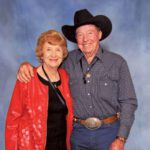
    Doc and JoAnn had four children: John J., Leo, who passed away at age 19, Maria and Theresa. JoAnn passed away two years ago. At the age of 81, Doc still goes out and helps at his son’s feedlot and, if the phone rings for a call to doctor an animal, he answers. His grandkids continue the rodeo tradition. John, Jr.’s son, Luke, won the Montana Circuit bull riding title in 2014, and has qualified for the Montana Circuit Finals eight times: five in the bull riding and three in the steer wrestling.
    Even though rodeo had its place behind his faith, his family and his work, Doc loved it. “The people we’ve met, they’re priceless. You can go practically anywhere and see people you know and enjoy. That part is especially, in my advanced age, the great part of it.” He also loves to see his son, John, and grandson, Luke, compete.
    “This guy is a sensational human being, and I’m not the only one who thinks so,” Decker said.
  • Back When They Bucked with Henry Hainzinger

    Back When They Bucked with Henry Hainzinger

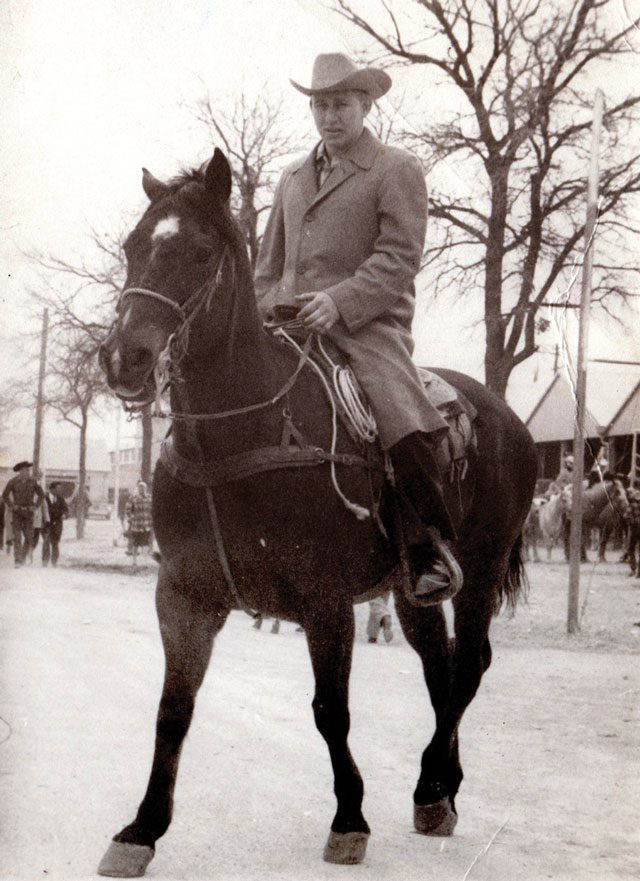
    Clem McSpadden called him the best match roper of his time.
    Henry Hainzinger may have never won a world championship, but he was well respected for his roping across the prairies of Oklahoma, Kansas, Texas, and beyond.
    He got his start at roping two blocks from his home in Bartlesville, Okla., with a neighbor, Art Saylor, who had a horse and goats. When he was twelve, he was spending time on Art’s horse, roping goats, and getting better at his craft.
    Many small towns had roping clubs, and Henry was part of the Bartlesville Round-Up Club. In those days, without social media, video games, and Ipods, kids made their fun at practice nights and Sunday afternoon ropings. Henry was one of them, and when they all got together, they often held match ropings: two calf ropers who went head to head, on two or four runs, with the fastest average time winning whatever had been bet, usually five or ten dollars, occasionally as much as one hundred dollars.
    Henry usually came out on top of the match ropings, and that’s what McSpadden referred to when he talked about the cowboy.
    He quit school at the age of sixteen and went to work for a local machine shop. In the summer of 1952, he worked for world champion steer roper Fred Lowry at Lenapah, Okla., breaking horses. Fred, who was the uncle of world champion steer roper Shoat Webster, would have Henry take horses to Shoat’s place for Shoat to look at and try. Fred was instrumental in Henry’s career, giving him tips and advice as they roped together nearly every day.


    In 1956, when he turned 21, he joined the Rodeo Cowboys Association, and his rodeo travels extended beyond jackpots and local shows to Little Rock, Denver, Ft. Worth, and farther.
    By that time, Henry spent his winters working in the machine shop in Bartlesville and saving money for entry fees so he could spend his summers roping.
    He often traveled with Ike Anderson, who he grew up with. Ike, who is 80 and still lives in Bartlesville, remembers some of the good times. He and Henry were at the Sidney, Iowa rodeo, on their way to two more that weekend, when they got the news that the county fair in Sedan, Kan., wanted to feature the two of them match roping and pay them $100 each. They left their horses in Sidney, and “drove like madman,” Ike said, to get back to Sedan. Ike’s mother hauled an extra horse to town, and Henry borrowed a horse. Henry beat Ike, “we got our $100, and drove like a son of a gun to get back to Sidney.”
    Henry was a jokester, Ike said. Once, at a rodeo in Kansas, the calves were “big, fresh black calves, off the cows, and it was like roping a mountain lion,” he said. Ike backed into the box, nodded, and his horse stalled on him. “The calf was going nine-oh across the arena, and finally the horse decided to go. I came a mile late, and ran this calf down the end of the arena, back up the other side, and through the hay where they’d fed the cattle the night before.” Ike roped the calf in 55 seconds. “I came back out of the arena, so angry I could have bit a piggin’ string in two. Henry comes up to me and says, ‘If you ever make another run like that, I’m not going to rodeo with you,’” Ike laughed. “That’s how we tormented each other, all the time. It was special.”
    In those days, calf roping was different. Ropers had a two minute time limit to rope and tie before they were disqualified, and they dismounted differently than today’s ropers. Henry was part of the era that roped, dismounted from the left, then ducked under the rope to flank and tie the calf. “We were still in the Dean Oliver mode of the right handed calf roper,” Ike said. “By the middle of the 60s, (that style of roping) was obsolete.”
    But in that north central part of Oklahoma, Henry and Ike were part of a special group of ropers. “With that era of the 50s, if you came into the Bartlesville community, there were a bunch of guys who were tough to beat,” Ike said. “I can’t remember a lot of that style of roper that was tougher than that bunch of guys was.”
    Henry remembered a unique roping he won in 1954, near Fairfax, Oklahoma, where the ropers roped deer. A rich oil baron had a section of ground with domesticated deer on it. The deer were run through the chute, and the ropers backed into a box. They were mature animals, and not hard to rope, Henry said. “It was like roping a goat. I believe it was easier than roping a goat. They held their heads up.”
    In 1957, when he was 23 years old, Henry took an adventure to California, hoping to extend his roping in the fall, when there were no rodeos at home. “I’d filled my pockets roping (at rodeos) and didn’t want to come back to work,” he said. He assumed they roped calves in California, but they did more team roping than calf roping, “and I didn’t know nothing about team roping,” he said. He stayed with Virgil Berry, Ace Berry’s dad, and when he came home, he was broke. “I had a nickel in my pocket when I come home.” Before he came home, he’d purchased cashews and nuts for his family. In Arizona, he stopped to fuel up, and his bill was $4.50. He handed the cashier his Phillips 66 credit card, but there were no Phillips 66 stations in Arizona. “I’m sorry, son, but we don’t take Phillips 66 cards,” he was told. An old Indian was sitting at the station. He was willing to buy one of his Australian shepherd puppies, but Henry said no. Instead, he sold the cashews to the Indian, paid his bill, and headed home.
    Ike remembered another story regarding Henry. The two of them roped at the annual rodeo held at the Cooper Ranch, between Bartlesville and Tulsa, and the lady who owned the ranch hosted a party at the house following the rodeo. Henry was the calf roping and all-around champion. Contestants were served drinks and food from a waiter in a bow tie and formal white jacket. After partying all night, the lady announced, “We’re going to stop the party and go to Collinsville, and the all-around champ is going to buy breakfast.” “I’ll never let him live that one down,” Ike said. “I bet it cost him over one hundred dollars to feed everybody, and money wasn’t easy to come by for all of us.”
    Rodeos back then were often two or more head, requiring cowboys to stay in town overnight. Henry knew how to beat the heat on the hot summer days, waiting for a performance to begin. He’d pay ten cents for a movie and stay in the air-conditioned theater all afternoon. “I’d take my nap inside the movie house, while a lot of them were laying out in the sun, and they’d be played out,” he said.
    In 1962, Henry married Ora Lee, a barrel racer, and a few years later, moved to Ponca City. After their marriage, he continued to rope but didn’t go as far from home. He bought a bulldozer, and had a successful business in the oilfield. He and Ora Lee raised two children: Hank and Nancy. Both competed in rodeo, and now the next generation is competing: Nancy’s daughter, Kathryn Todd, won the all-around in 2013 at the National Junior High Finals and was reserve champion in 2014.
    Henry loved his life of rodeo, roping, and work. “I enjoyed every bit of it,” he said. But whatever he did, he studied and practiced. “You gotta study it, whatever it is you choose to do. If you don’t study, it ain’t going to work. You’re just playing.”
    The rodeo life wasn’t always easy, Henry said. “It ain’t all peaches and cream in that rodeoing.” But the good days outnumbered the bad days. “I had a lot of fun.

  • Back When they Bucked with Wick Peth

    Back When they Bucked with Wick Peth

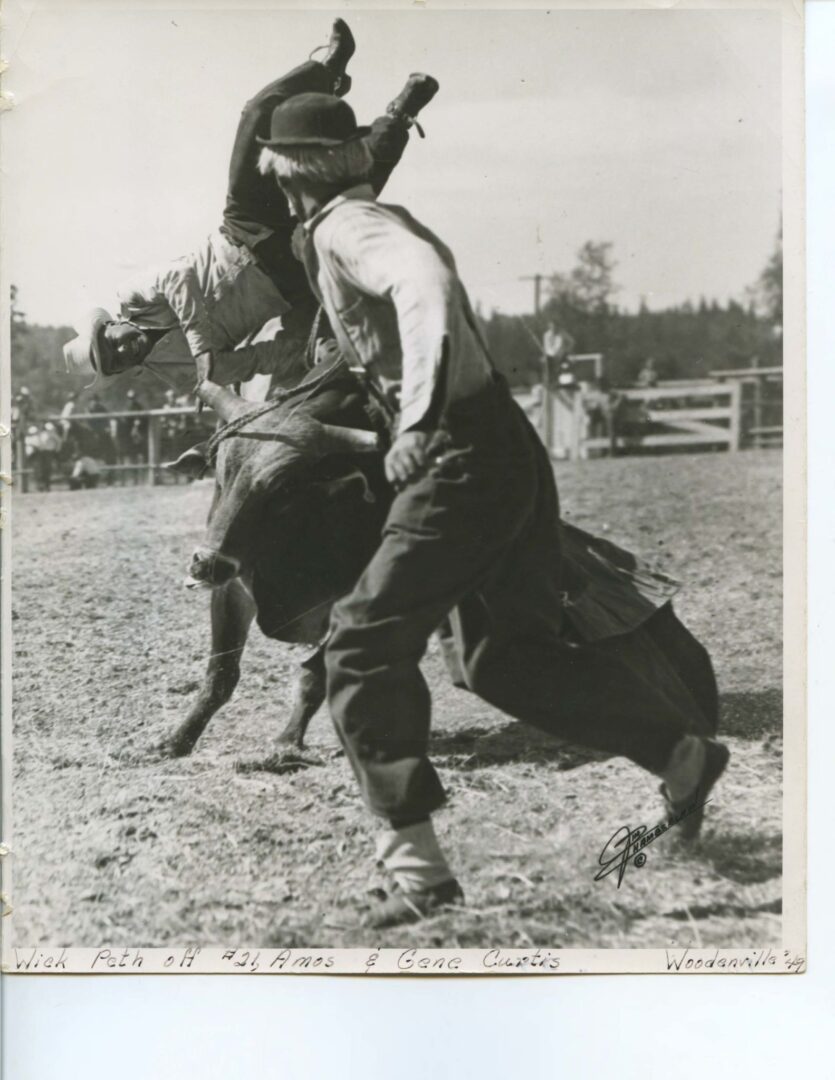
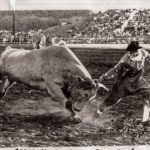
    Wick Peth was born in 1930 at Mt. Vernon, Washington. “My parents were farmers and ranchers. We run cattle and raised quite a few peas and potatoes.” In his early years, his dad and uncles put on a rodeo at the ranch that turned into a stock contracting business in the 1950s. “My father wanted to keep us out of town, so he had roping steers and calves for us. He asked one year what we wanted for Christmas; I was 17 or 18; I asked for some bulls. He had 20 come to town for us in a box car in the middle of January … we had as many as 60 living around here during the stock contracting years. The neighbors would come – my brothers (Jerry, Ted, and Buzz) were always roping, I steer wrestled a little but didn’t rope. Everybody would get on a bull and somebody had to get the bulls off, so I was good at that.
    “After we got bulls, at night I would crawl out in the pasture and lay down on the ground and watch them. I’d watch them fight in the daytime and watch where their feet were and where they are when they turn around. I did things with a bull that other bullfighters wondered how I figured it out.” One of the moves he used to make with a bull is to run up and grab him by the tail. “I don’t grab that until I get past his rear end. I swing around on his tail and on towards his head. He comes around in a circle. After he goes two or three times around, he figures he can’t hook me, I pull my butt away from his head, when he turns back the other way, he’s got all my momentum going and I can turn a summer sault in front of him and he can’t touch me. I’d show people how to do that in bull fighting schools after I studied the bulls and found ones that would work. It wouldn’t work on all of them, they think different. It’s hard to explain. It was a certain minded bull.”

    OLYMPUS DIGITAL CAMERA
    Wick studied the bulls. When he was growing up, he watched them and how they behaved and moved and took his job of taking care of the cowboys very seriously. He could predict what was going to happen and how the bulls were moving. He had a system. “When I was protecting the bull riders, I always went to the side of the right handed or left handed. I had a plan of what I was going to do if this or that happened or he got thrown off a certain side.” Wick never considered himself to be funny. “I always felt like the good bull fighters came off of cattle ranches that had some cow sense,” said Wick, who got his name from a neighbor. “I used to go with my father around the country to buy cattle,” he explained. “We would stop at the hardware store, and this guy’s name was Vick and they called me Little Vick. This guy had a stroke and he couldn’t say V and it became W, and that’s how it started.” His given name is Melvin, but he has never gone by that name. Wick put on bull fighting schools with Jerry Beagley over a period of ten years. “I had several students that picked up on them. The one main thing I told them is when you get knocked down, get up.” The schools were held all over the county.
    “Everybody is a genius at something and figuring out what that is is a blessing,” said his daughter Liza. “He was a genius at fighting bulls.” He changed the way rodeo clowns were in the rodeo. The art of the rodeo clown became the science of bull fighting. He took his job seriously. Not only did Wick study bulls, he rode them. Along with playing football, Wick competed in the bull riding, continuing that after high school. “I never went full time, because I had to work on the ranch.” He met his wife, Dorothy, at a rodeo. “She was always helping me,” said Wick, who considered her as his biggest support. “She never said “be careful” she was always trying to encourage me to go on.”
    Wick traveled thousands of miles to rodeo and fight bulls. As word got out about his abilities as a bull fighter, he gained the attention of the Beutler Brothers. “Lynn came over to me in Nampa, Idaho, and asked me to work all the rest of his shows and that kept me going.” Wick would stay gone for two or three weeks at a time, and then come home and spend hours on the tractor catching up. He and Dorothy had three children, Liza, and Lana, and Dan. He continued to ride until the late 1950s. “The reason I quit riding bulls is they kept me so sore, I felt like I owed it to the bull riders to stay healthy.” He quit fighting bulls in 1985 – after 35 years. “By that time, I was 55 years old and I couldn’t move as fast or heal up as quick. Age takes care of things.” He stressed the value of education and as a result all three of his children are college graduates.
    He still lives on the ranch and helps where he can. His son, Dan, and his grandson, Owen, run the day to day operation of the ranch, running 600 head of cows. Wick is there every morning to help and then he heads to the coffee shop. “Dad was so well received,” recalls Dan of his travels with his dad. “The bull riders looked up to him and appreciated what he was doing. They were really glad to have him around.”

    Wick Peth Cheyenne 1974
    The man in the red striped shirts, who helped change the way bull riders were protected, looks back on his life as a bull fighter and farmer. “I like fighting bulls and it was something that everybody couldn’t do. It got me off the farm and I could relax and go fight bulls.” Traveling down the road, he was always studying the soil, watching what other farmers did with the land. He has seen many changes in both bull fighting and farming. “We just started to irrigate the pasture ground 10 years ago, and we have a couple big reel sprinklers – we never used to have that here. What you don’t see, you don’t do.” His plans for the future are simple. “I just want to farm myself away – plow myself into the dirt.”
    Wick was inducted in the Pro Rodeo Hall of Fame in 1979, Cheyenne Frontier Days, Ellensburg Rodeo, and St. Paul Rodeo Halls of Fame. His family has nominated him for induction into the National Cowboy Museum in Oklahoma City.

  • Back When They Bucked with Dick Carr

    Back When They Bucked with Dick Carr

    Dick Carr’s shop sits on the back of his house in Elk City, Oklahoma. The walls are papered with pictures; memories of a life spent in rodeo.   It’s full of tools, pieces of leather and strands of twine. The strands will be meticulously weaved together into- not just functional bull ropes for cowboys- but works of art.
    When Dick is finished with each rope he makes, he prays over it to ask God to watch over the cowboy who will cling to that very rope hoping for success and safety. And success and safety have come for multitudes of professional bull riders who would surely tell you those ropes are connected to their success.
    Dick’s customers have won too many world championships, National Finals Rodeo qualifications and other accomplishments, to count.
    Dick was raised near the Beutler Brothers’ Rodeo ranch in western Oklahoma. He credits them for his start in rodeo. He began in the sport as both a bull and bronc rider, but he soon focused all of his attention on bulls. Dick got his pro card at 17. His PRCA card number is no. 166.
    For six years he went strong on the rodeo trail as a professional cowboy, competing in the biggest rodeos in the land from Madison Square Garden in New York City, to Prescott and Cheyenne.
    Dick, whose grandfather taught him to plait; the technique to make a rope, had already started to make bull ropes during his own riding career, knowing firsthand their importance.
    “In 1950 I started entering. The next year I went to winning a little, but it was a tough life, and you rode the bulls ‘til the whistle blew. They didn’t have the kind of bull fighters they have now days, and it was a different world,” Dick describes, adding “in 1952 is when I got noticed for my ropes, and I only made ropes for people who asked me.”
    In 1956 Dick was drafted into the Navy.  He quickly showed his work ethic was dedicated and was given some of the luckier duties on base such as working in the library and tending the bar in the Officer’s Club.
    He went to a rodeo on an off weekend and won the bull riding. A Navy recruiter was working the rodeo and wrote an article about Dick’s performance that made the Sunday paper.
    On Monday he was called into the captain’s office.
    “I thought, ‘oh my gosh.’ I hadn’t ever seen him, and I took my hat off. I stood up straight, and he said ‘Carr, what’s this about you riding a bull,’ and I said ‘yes sir,” Dick recalls laughing.
    The captain was far from mad like Dick had feared. The base had rarely made the news, and the captain was pleased Dick had been able to shed some light on them through rodeo. He gave Dick the green light to go to rodeos whenever he wanted.
    When Dick went overseas on a ship to China and Australia, rodeo was humorously not far behind him.
    “When we were in China they had a ship party, and a guy came by driving a bunch of wild water buffalos. I saw them and said ‘my gosh I want to ride one of those buffalos,” Dick laughs.
    They had an interpreter and arranged to pay the man who was driving the buffalo to let them attempt the ride. Dick roped the buffalo and about 10 sailors held the bull so he could get on. Dick rode him as he ran down the beach, not really bucking. “I rode him I know for half a mile, and when I got back to the ship you’d have thought I rode some real rank bull,” he laughs.
    Dick got out of the service in 1957 and went right back to the arena. “One day after I got out I won the bull riding at Buckeye, Arizona, but I’d been on that ship so long I had my sea legs, and [the bull would] move, and I’d just beat him over there,” Dick says with a smile.
    Though he went to the major rodeos in 1958, he stopped riding bulls in the following years. Still, Dick stayed involved with rodeo. He was a judge for quite sometime and began making bull ropes full time in 1970.
    “That’s 45 years. That’s got to be God,” Dick says wriggling his fingers around nimbly, with no obvious arthritis issues that could’ve stopped him from his work.  His work has a deeper meaning than being a functional art form. Dick emphasizes putting quality into his ropes that make the bull riders able to ride to the best of their ability while maximizing comfort.
    “My ropes are very comfortable. It’s like putting your head on a pillow when you put your hand in there.” It fits like a Tiffany Glove, he says.
    Dick’s work goes beyond making a good and comfortable rope. He’s able to pick out talent in bull riders and give them tips where they can get the most benefit from the kind of rope they might need.
    Perhaps Dick’s favorite customer was Harry Tompkins.
    “He was probably the greatest bull rider that ever lived. I made him bull ropes for 19 years, and he’s now 88 years old, and in a rest home.”
    Like his close relationship with Terry Don West, Gary Leffew and Tompkins, the rodeo family Dick grew close with over the years is extensive. They all share a mutual bond and understanding, Dick says. “We just talk, and they just know where I’m coming from, and I understand where they’re coming from. It’s unspoken.”
    Dick continues, “so many friends have passed. All the great rodeo cowboys; I was very dear friends with. Casey Tibbs was one of the greatest people I knew in my life. He was so good to me. He was my friend, and he encouraged me. I never asked Jim Shoulders for anything he didn’t give me. He always helped me.”
    The rodeo people Dick could name for being a part of his life could go on and on, and that’s the most important part of preserving rodeo for the youth, making sure they have mentors like he did, Dick explains.
    “The bible says, ‘remove not the ancient landmarks which our forefathers have established.”
    For Dick, the Western lifestyle and the Christian one go hand in hand.
    “The cowboy way and the word of God are one and the same. ‘Do unto others as you’d have others do unto you,’ and believe in a higher power. There’s someone greater than us, and it’s Jesus Christ, who we’re supposed to imitate, and that’s what I do. I live for God every second of every day,” Dick says and readily admits his shortcomings and how he was saved and cured of his struggle with alcohol abuse through his relationship with the Lord.
    “June the 3rd 1986 I received the anointment of the Holy Spirit, and it totally changed my life,” Dick says. He hasn’t had a drink since that day. “Anybody that says it can’t happen, they’re wrong because God can do anything.”  Filling your heart up with God is in many ways like dedicating yourself to bull riding.
    “Riding bulls, you either were dedicated and you were going to ride that sucker, or you weren’t. There was no ‘making  excuses.’ You had to give yourself to it just like you’ve got to give yourself to the word of God. It’s not just when you crawl over the chute gate. You’ve got to have it all the time, in everything you do, if you’re mowing grass or driving a car, whatever you’re doing,” Dick says.  And it’s clear, his faith, like his bull ropes, is strong.
    For more information on Dick Carr visit: DickCarrBullRopes.com. Perhaps Dick’s favorite customer was Harry Tompkins.
    “He was probably the greatest bull rider that ever lived. I made him bull ropes for 19 years, and he’s now 88 years old, and in a rest home.”
    Like his close relationship with Terry Don West, Gary Leffew and Tompkins, the rodeo family Dick grew close with over the years is extensive. They all share a mutual bond and understanding, Dick says. “We just talk, and they just know where I’m coming from, and I understand where they’re coming from. It’s unspoken.”
    Dick continues, “so many friends have passed. All the great rodeo cowboys; I was very dear friends with. Casey Tibbs was one of the greatest people I knew in my life. He was so good to me. He was my friend, and he encouraged me. I never asked Jim Shoulders for anything he didn’t give me. He always helped me.”
    The rodeo people Dick could name for being a part of his life could go on and on, and that’s the most important part of preserving rodeo for the youth, making sure they have mentors like he did, Dick explains.
    “The bible says, ‘remove not the ancient landmarks which our forefathers have established.”
    For Dick, the Western lifestyle and the Christian one go hand in hand.
    “The cowboy way and the word of God are one and the same. ‘Do unto others as you’d have others do unto you,’ and believe in a higher power. There’s someone greater than us, and it’s Jesus Christ, who we’re supposed to imitate, and that’s what I do. I live for God every second of every day,” Dick says and readily admits his shortcomings and how he was saved and cured of his struggle with alcohol abuse through his relationship with the Lord.
    “June the 3rd 1986 I received the anointment of the Holy Spirit, and it totally changed my life,” Dick says. He hasn’t had a drink since that day. “Anybody that says it can’t happen, they’re wrong because God can do anything.”  Filling your heart up with God is in many ways like dedicating yourself to bull riding.
    “Riding bulls, you either were dedicated and you were going to ride that sucker, or you weren’t. There was no ‘making  excuses.’ You had to give yourself to it just like you’ve got to give yourself to the word of God. It’s not just when you crawl over the chute gate. You’ve got to have it all the time, in everything you do, if you’re mowing grass or driving a car, whatever you’re doing,” Dick says.  And it’s clear, his faith, like his bull ropes, is strong.
    For more information on Dick Carr visit: DickCarrBullRopes.com.


  • Back When They Bucked: Karen Vold

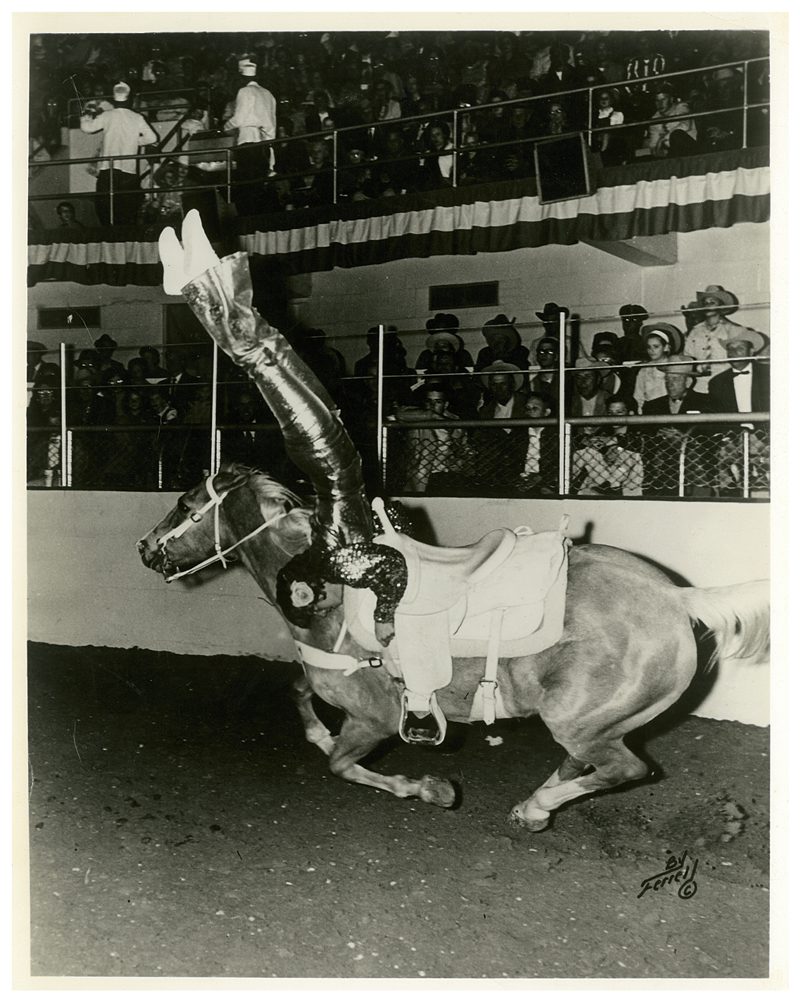
    Karen performing the full shoulder stand - Courtesy the family

    “We were blessed to rodeo in the best of times,” said Karen Vold, who began her trick riding career at the age of ten. Karen prefers to be in the background. She spends her days helping her husband, Harry, and daughter, Kirsten, run the Harry Vold Rodeo Company  located near Fowler, Colo. Karen can be found cleaning chaps, rolling flags, or working on a wardrobe for pick-up men.Karen as a child - courtesy the family
    She got her start in the rodeo business at a young age. Her family owned a riding stables on the north edge of Phoenix and she would guide people out in the desert to ride. There was a lady that worked at the stables who had a palomino horse and a trick riding saddle. She taught Karen her first three tricks. Karen performed at a professional rodeo for the first time when she was 14. 17 years later she continued the tradition by putting on trick riding schools for 27 years, completing the most recent one in March of this year – 2015.
    “My parents were divorced when I was eight. I was the oldest daughter and had a hard time with the divorce so they bought me a horse and a saddle to get my mind off it. The stables were located next to the Arizona Canal and we had 60 acres of commercial citrus and our house was the last thing before many miles of desert. I practiced next to this canal which was like a big long straightaway. My Dad was the chairman of the Phoenix Jaycee Rodeo for three years and the horse he bought me was part of a roman riding team that jumped a car and was also broke for trick riding. The horse refused the car a few times so they sold him to my Dad for me to trick ride on. I was ten.”
    About the same time as her parents’ divorce, Jasbo Fulkerson, one of the rodeo clowns her dad had hired several times to work the Phoenix rodeo was killed on his way home from a rodeo. They had been close friends and were built physically alike so Karen’s dad took off from his construction business and teamed up with Jasbo’s partner to rodeo for six years. Karen stayed in Arizona with her Mom. “When he came back and saw how serious I was about trick

    riding, he sent me to Colorado to take lessons from world champion trick rider Dick Griffith. In the early days, trick riding was a competition like five other events. Dick was the world champion trick rider and bull rider and my Dad wanted me to master the full shoulder stand that Dick performed when he worked with him at Madison Square Garden in New York City. It was very hard to learn – you have to face front – not the side – and dive over the saddle horn. I drove to Colorado when I was 18 with a horse trailer and my girlfriend. Dick had a few other students there. I only knew

  • Back When They Bucked with Chuck Henson

    Back When They Bucked with Chuck Henson

    story by Lily Weinacht

    Chuck Henson’s cowboy boots and bullfighting cleats have left their mark through rodeo history. From witnessing the Boston Garden Rodeo strike in 1936 to becoming the first contract member director in the PRCA, Chuck has spent a lifetime championing the sport of rodeo, even bringing the cowboy life to the silver screen through his work as a Hollywood stuntman, wrangler, and driver.
    The only child of Charlie and Margie Henson, Chuck was born in Arcadia, Fla., on February 4, 1931. Charlie Henson worked on the railroad and rodeoed during the winter. Margie (Greenough) Henson rode saddle broncs, formerly trick riding and competing in rodeos with her sister, Alice, and brothers, Bill and Turk, the siblings known as The Ridin’ Greenoughs. Several weeks after Chuck was born, the family packed up their Model A Ford Roadster and returned to their home in Red Lodge, Mont.
    Chuck was given a pony at an early age, and he was soon trick riding and roping from Blue Rocket’s back. One of his first experiences as rodeo entertainment was in 1940 at the Cowboy Coliseum in Chicago, where Chuck and nine other kids put on a show of trick riding and roping during the 30-day rodeo. The family also travelled as far as Canada and Mexico with Wild West Shows. “Mom would never let me ride broncs because she was afraid I would get hurt,” Chuck recalls. “It didn’t make much sense to me. She let me rope calves, but I probably would’ve been better off riding broncs. I was so little that every time I’d rope a calf, they’d meet me halfway and wreck me.”
    When Chuck wasn’t travelling the country, he travelled the mountain pastures of Montana for five years, helping his uncles, Bill and Frank, who worked for The Antler Ranch, one of the largest cattle ranches in the state at the time. By the time he entered high school at Lodge Grass High School, Chuck was an all-around athlete, rodeoing, playing basketball, baseball, and running track, which later earned him an induction into the Montana Sports Hall of Fame. Chuck steer wrestled like his dad, but the chutes held too much of a draw, and he started riding bareback and saddle broncs. Roughstock had come a long way since the time Chuck’s parents started, when broncs were tied to another horse and blindfolded, then turned loose into arenas made by a circle of buggies, wagons, and old cars.
    For a time, Chuck competed in or worked every rodeo event, though he drew the line at riding bulls. “I didn’t cherish the thought of getting on a bull, but I saw you could get good money for riding them, so I started, and that was probably my best event,” says Chuck. “There weren’t any rodeo schools, but I remember a few times I’d draw a horse in the saddle bronc riding and I’d have to ask my mom what kind of a rein to take on it – it was a little different to ask your mom how to ride a bronc!” He entered many of the same rodeos as his parents and also worked as a pickup man during high school, even picking up his mom and Aunt Alice. “You’d get a spanking if you didn’t pick them up good,” he recalls with a laugh.
    Chuck graduated high school in 1950 and won the Montana High School All-Around Cowboy title that year. Soon after, his family moved to Tucson, Ariz. Margie had developed a spot on her lung and was told to move to a warmer climate, though Chuck returned to rodeo in Montana every summer. In 1953 in Sidney, Mont., Chuck was behind the chutes when two gentleman approached him, informing him he hadn’t been in contact with his draft board. “I said I’d been rodeoing!” Chuck remembers. “I joined the National Guard for two years and then the Army. I don’t know how it happened, but I got into the Army Security Agency, and everything was top secret. I’ve never even told my wife or kids what we did.”
    Chuck was discharged in 1955 and used his G.I. Bill to go to the University of Arizona to play college football and rodeo for a year. In 1956 the team was at a rodeo on the Mexico border that couldn’t afford a rodeo clown. Chuck had clowned for one of his aunt and uncle’s rodeos in Montana during high school, and he offered to step into the role again. “Some of the girls in the theater group got me a shaggy wig, baggy pants, and some greasepaint,” says Chuck. “Swanny Kerby supplied the bucking stock, and after that, he asked me if I wanted to work some rodeos for him.” Chuck remained with the stock contractor for nearly six years before hiring on with stock contractors further east, all while still competing in four or five rodeo events.
    About the time Chuck married his wife, Nancy, in 1959, his rodeo clown career was also growing. The couple had met at a college rodeo in Alpine, Texas, two years earlier.
    Nancy was there with several girlfriends, taking a break from keeping books for George H.W. Bush’s oil company. A rancher’s daughter, she grew up barrel racing, and after marrying Chuck, she worked as a rodeo secretary and timer. After their first baby, Nancy Jane, was born, Chuck had a custom camper built for his truck to double as a dressing room. His mule, Nicodemus, and dogs, including one he called Beatrice, rode in a separate section near the tailgate. “Nick was a hard-headed little devil – sometimes he worked good, and sometimes he didn’t,” says Chuck. “Beatrice was pretty famous around the rodeo world –  she skipped rope and jumped through hoops and walked on her hind legs.”
    Chuck was asked to fight bulls at the NFR in Oklahoma City in 1968 and again in 1971. Two years later, he broke his left leg at a rodeo in Vernon, Texas, when a bull hooked his leg between two boards of a fence. A surgeon in Wichita Falls, Texas, put him back together with rods, mesh, and a hip cast. Chuck was fighting bulls four months later. “I had a special cast made that fit between my ankle and my knee,” Chuck recalls. “I couldn’t run real fast, but I could still go in circles!”
    From 1974 to 1977 Chuck served on the PRCA board of directors as the first contract member director, where he represented the specialty acts. “I passed a deal that if you worked the finals one year, you had to take a year off and give somebody else the chance – there were a lot of good hands that weren’t as well known that never got picked,” Chuck explains. He was also responsible for having buckles awarded to the bullfighters and clowns, which were sponsored by Lee, Wrangler, and Levi’s. Chuck’s own NFR bullfighting buckle still graces his belt to this day, and his work both in the arena and out earned him inductions into the ProRodeo Hall of Fame in Colorado Springs, Colo., and the National Cowboy Hall of Fame in Oklahoma City, as well as the Pima County Sports Hall of Fame.
    Chuck officially retired from fighting bulls in 1980, though he continued to work up to 12 rodeos a year until the late ’90s, and he performed his rodeo clown acts until 2000. After that, he focused his attention on Hollywood, which he had been working for since the 1960s. Chuck’s mom and aunt had driven buggies and wagons during the filming of Little House on the Prairie, along with several movies, and Chuck also made a name for himself in the movie industry. One of his first roles was riding in a posse of Indians. He found more work through word of mouth before getting his card with the Screen Actors Guild after working with John Wayne on El Dorado, released in 1966. “I worked with John Wayne quite a bit – he was a nice guy – and so was Robert Mitchum and Steve McQueen,” says Chuck. “I doubled James Coburn and Slim Pickens in a movie called The Honkers where the rodeo clown breaks his neck. I said I wanted a certain amount of money if I had to let a bull fling me through the air. It took six bulls before the camera man got the shot he wanted.” Chuck wrecked wagons and did stunt falls from horses, and even drove in car chases for shows like Mod Squad. He played himself in a documentary called The Ridin’ Greenoughs, which covered the story of his mother, Alice, and Bill and Turk, all of whom had roles in the documentary, narrated by Rex Allen.
    Today, Chuck and Nancy live in Tucson, Ariz., and commute to their ranch near Willcox, Ariz. Their two children, Nancy Jane and Leigh Ann, both rodeo competitors, live nearby. Leigh Ann’s husband, Eric Billingsley, is a former saddle bronc riding champion in the GCPRA. Chuck helps Nancy Jane and her husband, Jerry Dorenkamp, raise bucking horses for their rodeo company, Salt River Rodeo Company, as well as 75 – 80 cows with PBR bloodlines. “I don’t ride much anymore, but I watch Leigh Ann’s girls, Kaylee and Rayna, compete in the GCPRA,” says Chuck. “I’m pretty happy, and I’m really proud of my family!”

  • Back When They Bucked with Dr. Ed LeTourneau

    Back When They Bucked with Dr. Ed LeTourneau

    story by Lily Weinacht


    Dr. Ed LeTourneau has always been young at heart. Described by Larry Mahan as the “most unusual of cowboys”, Ed put himself through eight years of college on his rodeo earnings alone, all while competing in college rodeo and the newly formed RCA. Known for turning the area behind the chutes into study hall, Ed pursued his passions of school and rodeo with a vigor, graduating top of his class. The three-time NFR qualifier and great-nephew of earthmoving machinery inventor R. G. LeTourneau, Ed later went on to win multiple bull riding titles with the NSPRA. He has since been inducted into the UC Davis Cal Aggie Athletics Hall of Fame, Oakdale Athletic Hall of Fame, Oakdale Museum Hall of Fame, and the NSPRA Hall of Fame.
    Born on September 18, 1935, to Dorothy and Harlan LeTourneau in San Francisco, Ed preferred dusty arenas to the fog of The City by the Bay, and spent his childhood years first in Stockton, Cal., and then Oakdale. Ed and his older brother, Ray, grew up helping their uncle raise cutting steers before getting to know the foreman of U-3 Ranch, owned by W.H. Moffat. The brothers began fixing fences and irrigating pastures and were later promoted to working cattle on horseback.
    Drawn to anything bovine, Ray started riding bulls at the ranch, and then at local rodeos. “Ray was real good at it, so I wanted to be that good, too!” Ed recalls. Four years his brother’s junior, Ed started riding calves and steers and competed in his first rodeo when he was 13. As his legs grew, so did Ed’s sense of adventure, and he tried his spurs at bareback and saddle bronc horses as well. “With the bareback riding, I didn’t have good spurring action, but with bulls I just had to stay on and I could win something,” says Ed. With few high school rodeos in their area, and most of the rodeo associations located in southern California, Ray and Ed dedicated their entry fees to local amateur and junior rodeos.
    During high school, Ed was involved in FFA, serving as his chapter’s treasurer his junior year, and president during his senior year. An all-around athlete, Ed also ran the half mile and three-quarter mile in track, played defensive linebacker on his school’s football team, and wrestled, qualifying for North State meets. During college, he wrestled at the national level after winning third in the far western division, but retired from the sport after an injury sidelined him.
    When Ed finished high school in 1953, he informed his mother that he was going to be a cowboy – and she informed him that he needed to be a benefactor to society. Not one to turn his back on the chutes, nor disobey his mother, Ed decided to pursue a degree in animal husbandry at Cal Poly. A year later, Ed changed his degree to pre-vet science, and went to a local junior college before being accepted to UC Davis School of Veterinary Medicine in 1958. Though the school didn’t have a rodeo team, Ed purchased his card with the NIRA and qualified for the CNFR in 1961, where he won the finals in bull riding, missing the year-end title by one point. “Most people’s goal in rodeo is to win the world championship, but my goal was to make enough money to go to vet school,” says Ed. “When I went to school, it cost $1,000 a year. I could win money at a rodeo, put it in the bank, and I was ready for school. What I got out of rodeo, besides the people I met and the friends I made along the way, was my education.”
    A student by day and a bull rider by the weekend, Ed began entering RCA rodeos in 1957 using his NIRA card. Even with school six days a week – anatomy landing on Saturdays – Ed managed to get on 52 bulls in one season – and he only bucked off two. In 1959, Ed was a year into vet school and taking on the world with all the gusto of a 23 year old. He was hovering just outside of the top 15 bull riders going to the first NFR, but reasoned that he could rodeo on weekends to make 15th place. Ed entered the RCA rodeo in Portland, Ore., first. It was the week of mid-terms, and he and a friend missed a day of school to drive to the rodeo, where Ed won the event. He competed in several more rodeos, including the Grand National Rodeo held in the Cow Palace, which sent him to Dallas sitting 13th in the world.
    “The top 15 bulls were out for the first round, and 11 of them got rode,” says Ed, recalling the first NFR. “Some people said there was too much sand in the arena, and although those bulls had bucked 100 – 200 times, they’d never been consistently exposed to the top 15 guys in the world! By the last go-round, they had sorted out the stock and really knew who the top 15 bulls were.” Ed finished second in the average, and fifth for the year, but the following year, he was $150 short of qualifying for the NFR. However, 1961 brought him back to the finals, where he finished fifth in the average and second for the year, and in 1962, his senior year in vet school, he placed second in the average.
    By 1962, Ed had graduated with his doctorate of veterinary medicine. Newlywed to his wife, Frankie, Ed accepted an internship at UC Davis. Frankie lived in Dixon, a town near Davis, and when her dad went looking for someone to ride one of his horses, known for bucking off any rider that put their foot in the stirrup, Ed arrived. Not only did he ride the horse, he wooed the rancher’s daughter, and they were married a year later. Frankie travelled with Ed to many of his local rodeos, but she left flying the skies to Ed and his friend and fellow bull rider, Larry Mahan. The bull riders met in 1956 at the rodeo in Salinas, Ca., and Larry offered Ed a seat in his Comanche 250 he called Brownie. “That was the way to go!” says Ed. “It was a really good experience, and the beginning of a good friendship.”
    In the mid ’60s, Ed worked for several vet clinics while he rodeoed. Since he was finished with school, he had the opportunity to rodeo in the winter for the first time. In September of 1967, he was sitting fourth in the world, but a dislocated shoulder prevented him from competing in the NFR, though he finished 11th for the year. “After that, I went into my own vet practice in Oakdale and figured rodeo was over,” says Ed. He became the resident vet for a large thoroughbred farm in Madera before moving on to a quarter horse ranch in Oakdale, and eventually, he set up his own practice from his home in Madera.
    While he was practicing in Oakdale, his childhood home, Ed decided to grow a beard and wear a straw hat to ride one of the bulls during the town’s centennial celebration in 1971. “I hadn’t ridden in four years, but I won the rodeo, and I was also doing some team roping,” says Ed. “In 1980 I had Bob Cook calling me – they needed bull riders for the old-timers rodeo.” Though not enthusiastic at first, Ed agreed to help his friend and ended up winning third in the old-timers rodeo, which would later become the NSPRA. Though his bull riding muscles were sore, they ached to ride again, and Ed trained for bull riding once more, joining the NSPRA again in 1989. He won the World Bull Riding Championship four times from ’91 – ’94 and was crowned the Bull Riding Finals Champion twice, all after he was 50. Ed rodeoed well into the late ’90s, serving several terms on the NSPRA board and volunteering as chairman of the NSPRA Cowboy Crisis Fund. He gave his final nod in the chutes when he was 64 before retiring from the sport.
    Now 80, Ed and Frankie, make their home in Madera. Their two sons – David, a pilot for American Airlines, and Brett, who owns an almond orchard – live nearby, along with Ed and Frankie’s granddaughters, Amy and Cady. Ed recently retired after 53 years as a veterinarian, but he says, “Retirement doesn’t work well – I still have people coming to my clinic. But I still enjoy it! The drought got me, but I’m planning on raising cattle again, and I’m back to team roping, mostly at local events – but maybe I’ll rope in the World Series someday. I figure if I can ride a bull at 60, I’m not too old for anything!”

  • Back When They Bucked with B.J. Pierce

    Back When They Bucked with B.J. Pierce

    story by Lily Weinacht

    Born on August 22, 1926, to Grady and Dolores Pierce in Clovis, N.M., B.J. Pierce was fated to wear dirt on his boots, but always with pride – first as a farmer, and forever as a cowboy.
    The Pierce family raised cattle and farmed in the shadow of the Dust Bowl, sleeping with rags on their faces and perpetually cleaning the Kansas dirt from their window sills. B.J. worked the fields alongside his parents, but his dad always left him the last few minutes of daylight to rope in the backyard. Inspired by the tales told by his grandfather, a cowboy from Oklahoma, B.J. was more passionate about roping than anything else. With high school and college rodeo yet to be created, he taught himself to rope calves, winning his first rodeo in Tucumcari, N.M. in 1945. After graduating high school the same year, B.J. met Shorty Matlock, a steer wrestler and fellow tie-down roper from Grady, N.M.
    The two cowboys became travelling partners, and a summer full of roping boxes, rodeos, sleeping in horse trailers, and bathing in creeks earned B.J. enough money to pay for a year of college. The fall of 1945, he attended Eastern New Mexico University in Portales, studying for a degree in industrial arts and playing basketball on a scholarship. There, he met his first wife, Patty Rawls, whom he married in 1947. The following summer, B.J. and Shorty set out again, and B.J. won enough money to finish paying for his college tuition, as well as Patty’s. By his junior year of college, B.J. quit playing basketball, knowing his future was in the arena, not the basketball court. He graduated in 1950 and immediately began rodeoing full time, frequently announced as one of only two full-time rodeo cowboys in the region that had college degrees.
    Though B.J. also competed in wild cow milking, team roping, and steer roping, tie-down roping was his main event. He even served on the RCA Board of Directors as the Calf Roping Director. He competed in the RCA and won the tie-down roping – often more than once – in rodeos across the Pacific West, including Pendleton, Ore., Ellensburg, Wash., and Lewiston and Nampa, Idaho. His truck and trailer traversed the U.S. even further, taking him to Denver, Colo., which he won in the tie-down roping, Cheyenne, Wyo., where he earned buckles on two separate occasions, and even as far as New York City and Calgary.
    One of the single largest paychecks he earned came from a one day tie-down roping in Los Angeles. B.J. returned home with $2,500 riding comfortably in his wallet. Another favorite of his was the tie-down roping invitational held in his hometown of Clovis in 1952, where 17 of the world’s best ropers came to compete. B.J. and every other roper put up $500, and he left with $5,200. The furthest B.J. and Patty travelled, however, was Cuba. In the mid 1950s, Colonel Jim Eskew held a rodeo on the island, the rodeo livestock and contestants alike arriving on boats from Florida. B.J.’s own horse, Iodine, stayed in the U.S., and B.J. borrowed a horse to avoid putting Iodine in quarantine.
    B.J. remembers Iodine as his best roping horse, winning his three world tie-down championships with the IRA on the gelding in 1952, ’53, and ’55. “He was very good to me,” B.J. recalls. “He went with me a long time, all over the U.S. He was featured on the cover of the Quarter Horse Journal in the early 1950s. Iodine’s daddy was Billy Clegg, and his foals were noted for becoming good cow horses.”
    The thousands of miles B.J. racked up on his speedometer also left a trail of friends in many states, including world champion tie-down roper Dean Oliver from Idaho, who became one of B.J.’s close friends. Connections like these propelled B.J. into selling ads for Western Horseman. Patty wrote articles for the magazine while B.J. rodeoed in California, where they lived for five years. When the advertising position came open, B.J. filled it.  “Since I’d been so many places rodeoing, people knew who I was. I got to go to big horse shows and meet people you’d never meet rodeoing, like Gene Autry, James Arness, and Miss Kitty (Amanda Blake). A lot of those people were in the horse business. The only negative thing was selling ads and people not paying for them,” B.J. remembers. “You just didn’t go back to them again!”
    By the early 1960s, B.J. was ready to hang up his rope. “I guess I got tired!” he says. “All I did for 13 years was rodeo. So I retired from the rodeo business and started teaching school. I had a degree in secondary education, and I was going to teach one year in sixth grade. I ended up staying 31 years in the school system.” B.J. was a teacher for 16 of those 31 years before moving to administration and becoming a principal. He worked at several schools in Clovis, including Highland Elementary and James Bickley Elementary School. Having lived all but five years of his life in Clovis, B.J. still sees many of his former students. Ever the cowboy, B.J. brought the lessons he’d learned in the arena to the classroom, teaching discipline and organization.
    In 1979, B.J., who was divorced, married his second wife, Sue. He had two children, Rena and Ben, and Sue had a son, John, while B.J. and Sue became the delighted grandparents of four grandchildren. They were married for 31 years until Sue passed away in 2008, and during much of that time, B.J. continued to teach, while training calf horses for ropers all over the region. He has also been a member of the Curry County Mounted Patrol for many years, serving as the organization’s captain, vice-president, secretary, and treasurer. The patrol was created in 1939 to promote horses, horsemanship, and sponsor western entertainment like rodeos and ropings. A lifetime member, B.J. continues to help put on the annual Pioneer Days PRCA rodeo in Clovis. At 89, riding has lost none of its charm, and B.J. still takes his horses up to the mountains to ride. “It’s fun if you don’t fall off!” he adds wryly.
    Recently inducted into the National Cowboy and Western Heritage Museum’s  Rodeo Hall of Fame, B.J. also attended the 100th anniversary of the Pendleton Round-Up as a guest of honor in 2010. Visiting today’s rodeos brings back many recollections of his own rodeo years. “The cattle have changed a lot, and so have the arena conditions, and there weren’t many standards,” he says. “The longest score I ever roped was at 75 feet, and of course getting off on the right in roping has made it a second to a second and a half faster. I was fortunate to rodeo when I did, but I would like to rodeo nowadays for the money. To make $250,000 – that would be pretty neat!”

    B.J. Pierce at Cheyenne in 1967
    B.J. Pierce


  • Back When they Bucked with Lynn Smith

    Back When they Bucked with Lynn Smith

    High in the Rocky Mountains as the 1940’s were just cracking out, a desire to ride bulls and follow rodeo was brewing in young Lynn Smith’s heart. Lynn grew up on the Kremmling, Colo., ranch his granddad put together homestead by homestead beginning in 1881. His granddad raised many horses during those years even having a remount stud on the place to supply horses for the government. As natural progression goes, Lynn’s father took over the ranch and built a cow herd, kept some horses, and raised a family of three girls and Lynn, the youngest.
    The young mountain man’s interest in rodeo peaked one year at the National Western Stock Show and Rodeo. “Dad sold a big roan bucking horse to Verne Elliott at Denver when I was about four years old,” recalls Lynn. While in Denver the rodeo clown, Homer Holcomb, packed him all around on his shoulders, “and that’s when I decided I wanted to be a bull rider.”
    Lynn grew up without the luxury of electricity. He attended a one room multi-grade school of which he was the only student his 6th and 7th grade year. He would pack his .22 to school and shoot magpies in the school yard. Around the ranch he would ride calves and when he was 15 he started entering rodeos. He was a three event teenager taking part in the bull riding, cow riding and bareback riding. Although they didn’t buck him off many bareback horses, he confesses he didn’t like it very much. He laughs as he also confesses, “I rode barebacks like I rode bulls, and they didn’t pay much for riding like that.”
    His bull riding career spanned the two decades from 1953 to 1973, during which he made memories alongside the era’s best hands and on top of some of the best buckers in the business. Lynn met his late wife, Wilma (Willie), in the fall of 1956 during his short stint at college in Fort Collins, Colo. Before their marriage, he traveled with a few different cowboys including Gene Jordan of Durango, Colo. They were what rodeo folks call “splittin’” partners. When a partner placed he would split his winnings with the other.
    “This way you could live rodeo to rodeo,” chuckled Lynn. He went on to explain, “If it was a little rodeo that paid four places we’d split 10% and if it were a bigger rodeo, like Denver, we’d split 5%.”
    After his marriage, Lynn had a new traveling partner in Willie. “Naturally we didn’t have any extra money except what I won, and she got to working at rodeos then finally bought a timer’s card,” tells Lynn. This eventually worked into her becoming a rodeo secretary.
    Wheels to the rodeos were used Cadillacs. “I had a ’59 Cadillac I drove over 200,000 miles. Everybody gave me a bad time for driving it forever.”
    He used to tell people it was only an hour from Flagstaff to Phoenix-and it was back in those days because he drove 110 miles per hour! If Lynn won a check at a rodeo he and Willie would get a motel and if not, they would sleep in what they referred to as their “Cadillac Hotel.” Between the two, if they made $50 a rodeo they were making money. Wick Peth, the notable clown and bullfighter from that day, tried to convince Lynn to fight bulls. His response to that, “I train my feet to run from ‘em not to ‘em.” Even Willie thought a steady check at every rodeo might be a good idea. He told her, “Those bull riders aren’t going to like how I fight bulls.”
    He stuck with the riding and sure enough needed to win something in Gunnison, Colo., one year.
    “We pulled into town, filled up with gas, paid my fees and we had $1.43 left in our pockets. That’s it,” tells Lynn. He had drawn Little 8 of Walt Alsbaugh’s. “They just didn’t ride him anywhere,” he explains. According to Lynn, he was really a bucker and a fighter, too.


    Full story available in our September 15, 2015 issue.


    Heading for his nephew Ron last winter in Arizona – Olie’s Images
    Lynn working the ground at the Grover Rodeo
    Riding at the Boulder rodeo 1968
  • Back When they Bucked with Melvin Fields

    Back When they Bucked with Melvin Fields

    story by Ruth Nicolaus

    At Melvin Fields’ first rodeo as a barrelman, the first bull out of the gate hit his wooden barrel, knocked the staves out of it, and by the time the last bull bucked, it was demolished.
    “That’s what started my barrelman” career, Melvin said, but it sure didn’t stop it.
    By the time the Coffeyville, Kan. cowboy began as a barrelman, he’d already spent a dozen years as a bareback rider, saddle bronc rider, bull rider and bullfighter.
    He was born five miles north of Tyro, Kan., just west of Coffeyville, in 1938, the son of Merle and Edith Fields. Melvin decided he wanted to be a rodeo cowboy after he attended rodeos with his dad. The first rodeo he entered was a jackpot bareback riding in Miami, Okla., with five dollar entry fees, and “they bucked me off,” Melvin remembers. “I really didn’t know what I was doing.” He and his cousin pooled their limited money to buy a rigging, a glove and a pair of spurs together. “That’s how I got started.”
    In high school, he won the All-Around title for the Kansas High School Rodeo Association in 1956, working four events: the bareback riding, calf roping, steer wrestling, and bull riding. He went on to National High School Finals that year, winning second in the all-around in Reno, Nevada.
    After high school graduation in 1956, Melvin attended Coffeyville Community College but the rodeo road called him with its siren song. In the spring of ’57, he rode barebacks and bulls in Oklahoma. Somebody told him there was another rodeo further south in Texas, and “I didn’t come home for three weeks. I didn’t get any credit for the last semester, and my dad wanted to kill me,” Melvin remembered. His rodeo career was underway.
    Melvin’s favorite event was the bull riding, but he’d ride barebacks and saddle broncs at times, too. He’d rodeo till he was broke, then come home, haul hay, work for local farmers, anywhere there was work to be done. He ponied race horses, did some house building in Tulsa, whatever made a dollar. He got on the labor list for the Beutler and Son Rodeo Co., and worked for them for extra cash.
    Melvin got his Rodeo Cowboys Association card in 1958, the same year he worked his first rodeo as a barrelman. It was in McCook, Neb.. He showed up, and Elra and Jiggs Beutler asked him if he’d want to work the barrel. “What does it pay?” he asked. Twenty-five dollars, which was good money back then. “I’ll do it,” he said. The barrel was ruined by the end of the first performance, and Melvin drug it out to the fence.
    When he showed up to ride bulls at Salina, Kan., that same year, Jiggs Beutler asked if he had a barrel. No, he didn’t. Well, you have a barrel job here, Jiggs said. A committeeman owned a drive-in hamburger stand and had a wooden pickle barrel. Melvin converted it to a rodeo barrel, and worked it. After that rodeo, Jiggs told him, if he’d get a metal barrel, he’d be hired for all of the Beutler and Son Rodeos the next year.
    Melvin’s bull riding continued even as he worked the barrel. He’d be the first or the last rider to ride, which wouldn’t slow the rodeo down as much. Later on, he clowned rodeos while working four events. “I was busy,” he remembers. But rodeo life was different then. “You didn’t run up and down the road,” Melvin recalls. “You worked a rodeo and stayed there. There weren’t that many one headers.”
    Being a barrelman, Melvin carried acts with him. They were compilations of other acts. “You copied a little bit of this guy, or of that guy, and you’d change it a little bit.” His acts included a mule act that was borrowed from John Lindsey, a camera act, and a hat trick act. For a summer, he worked a disappearing cannon act with Gene Clark, while Gene’s brother Bobby recovered from a broken leg.
    The barrelman job helped out with family expenses. Melvin had married Judy in 1963, while he was in the U.S. Army. “Once I got married, clowning was more security. I still rode saddle broncs and bulls at all those rodeos I clowned. My clowning paid my expenses and what I won was basically extra.”
    His family traveled with him along with his wife, Judy. “She drove for me and helped me. She’s been a big help to me.”
    In 1967, he came as close as he would to making the National Finals Rodeo. He had run hard that fall, trying to make it. After the Cow Palace, he was broke. “My wife said, ‘I’m coming home to get a job.’ I said, if you do that, I’m going, too.” He took a job as a pipe fitter, which slowed down but didn’t stop his rodeo. His clowning slowed down, and 1969 was his last year to clown. He rode bulls until 1973, when he was 35 years old.
    Over his career he rode at and worked numerous rodeos, from Cheyenne to Salt Lake, from Nampa to Ogden to Salinas. He loved going to Salt Lake City because he and his family camped beside a small creek that ran through the rodeo grounds. He rarely missed the Nampa, Idaho rodeo because his wife’s parents lived close. He hit rodeos in Deadwood, S.D., Helena, Mont., Cody, Wyo., Cortez, Colo., and worked as a barrelman at his hometown rodeo in Coffeyville for nine years.
    He coached the rodeo team at Coffeyville Junior College for three years, and worked as a PRCA rodeo judge as well. He was inducted into the Kansas Cowboy Hall of Fame in 2011.
    Now he and Judy, who have been married for 51 years, enjoy their grandchildren and great-grandhcildren. Their daughter, Valerie Day, whose husband is deceased, and their son Devlin and wife Marie, have given them six grandkids, with five great-grands.
    He and Judy still attend the National Finals Rodeo and the Clown Reunions when they can. Their days of rodeo were good ones. For Melvin, it was the people. “We have best friends all over the country, and we still stay in contact. Rodeo is where my friends are at. They were good people, and you got to know them.
    “Rodeo was my life, and I enjoyed it. We got to meet a lot of people, and we have good memories, going up and down the road.”


  • Elmer & Ruth Nettleton

    Elmer & Ruth Nettleton

    story by Ruth Nicolaus

    Elmer and Ruth Nettleton spent their life in rodeo, and are making sure the next generation of rodeo kids gets to spend time in their favorite sport as well.
    The Helena, Montana couple, who have been married 63 years, spent their lives rodeoing, Ruth following as Elmer first rode bucking horses, then bulldogging, then roping. She joined him in the National Senior Pro Rodeo Association, and all the while, they helped others get a start in the sport.
    Elmer was born in Butte, Montana, in 1929, the son of Clifford and Katie Nettleton. He grew up on the family ranch, spending his days on horseback. He got on his first bucking horse when he was sixteen, a bareback bronc. Ruth, the daughter of Gus and Lima Malmquist, was born in Ekalaka.
    Uncle Sam called Elmer into duty in 1952 during the Korean Conflict, and he served for two years, but never left the United States. “I was one of the lucky guys,” he said. “I stayed stateside the whole time.”
    Before he went into the Army, he switched from bareback broncs to saddle broncs. A black cowboy, Paul Christensen told Elmer he should be riding saddle broncs. Elmer didn’t have a bronc saddle, so Paul lent him his, and coached him as well. They traveled together, Elmer borrowing Paul’s saddle. “He was a tough bronc rider,” Elmer remembered. He and his family “were good people.”
    After he returned from the Army, he switched events. Still without a bronc saddle, he borrowed his brother-in-law’s. But it wasn’t right. “I just couldn’t ride anymore.” So he began to steer wrestle.
    By then, Elmer was working as a general mechanic at the Veterans Administration Hospital in Helena. He and Ruth, who married in 1951, had bought a place in the valley near Helena, and they put up an indoor arena and a building, and he bulldogged a lot.
    He was mostly self-taught. “We’d go to rodeos, somebody would win, and we’d come home and try it again,” he said. Billy Joe Deussen, a bulldogger from Texas, spent his summers in Montana. “I got him to haze for me and he really put the fine touches on my bulldogging. He really taught me a lot,” Elmer recalled. Elmer could ride well, and get off, but Billy Joe helped with the polish. “When he came, that really helped me a lot.”
    Elmer and Ruth planned their yearly vacations around rodeo. Most of his rodeo competition was on the weekends, but during the summer, they’d plan two or three weeks on the road, hitting as many rodeos as they could. He had purchased his Rodeo Cowboys Association card in the early 1950’s, and he went to the big shows on his summer vacation. “One time we went to Pendleton (Ore.), Puyallup, and Ellensburg (Wash.) Each year we’d plan where we could go to the most rodeos in two or three weeks.”
    He won his hometown rodeo, the Last Chance Stampede in Helena, two times, once in the saddle bronc riding in 1951 and again in the steer wrestling in 1966.
    It was after his retirement from the Veterans Administration in 1984 that he and Ruth began rodeoing in the National Senior Pro Rodeo Association. This time he took up calf roping, team roping, and ribbon roping with Ruth, and she barrel raced. They spent their summers in the camper in Canada, and their winters at their second home in Arizona. “We’d leave the first of November and come back the first of April. We’d rodeo all winter in Arizona.”
    This time it was Ruth’s turn to shine. She won the Senior Pro Barrel Racing and All-Around titles in 1994 and the Ribbon Roping title twice, in 1994 and 1998, winning three saddles overall. “We had fun,” she said. They never missed qualifying for the Senior Pro Finals any time of their senior career, from 1986 till 1998.
    All the while, they were helping bring up the next generation of cowboys. There were always steers at their place in Helena, and a passel of bulldoggers as well. Elmer helped guys like Don Blixt, Jim Harris, and more get their start. Helena was the home to a lot of bulldoggers. “At one time Helena was considered the bulldogging capital of Montana,” Elmer said. “There were more bulldoggers in Helena than anywhere else” in the state.
    The couple still helps young people, including their neighbor and her kids. When Michelle Wolstein moved to Elmer’s neighborhood as a teenager, Elmer helped her hone her riding and roping skills. He let her borrow his roping horse, on whom she won a saddle and cash. Now she and her husband David’s children, a son, Treg, age thirteen, and daughter Haven, age eleven, are like grandchildren to Elmer and Ruth. “The kids had sleepovers there when they were little,” Michelle said. “As soon as the kids were able to hang on to the saddle horn, off they went, helping them. Elmer and Ruth put a lot of time into the kids.”
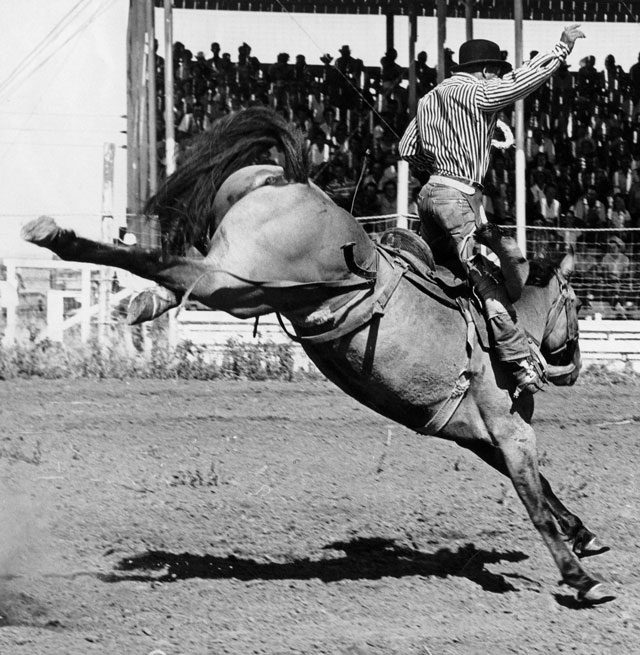
    They’re giving with others as well. “He’s always real generous with letting people come over and use his building, and giving advice.” The couple has helped Elmer and Ruth’s nieces and nephews with rodeo, and when a high school rodeo function takes place, they are in attendance. “Any time there’s a high school rodeo fundraising event, they always go. When the high school kids need sponsorships or are selling raffle tickets, they’re the first ones to sign up.”
    Being around the kids keeps him young, Elmer says. “That’s what keeps me going.” He stays involved in rodeo, subscribing to every rodeo publication there is, keeping up on the standings. “He keeps studying roping and rodeo, and watches every rodeo broadcast” on TV, Michelle said.
    Elmer, a PRCA Gold Card member, was inducted into the Montana Pro Rodeo Hall of Fame earlier this year, and the couple was honored at the Last Chance Stampede in Helena last July. They are humble about their accomplishments. “We had a lot of fun,” is all Ruth will say.
    And they’ve helped countless other cowboys and cowgirls have fun on the rodeo trail as well.


  • Back When they Bucked with Earl Batteate

    Back When they Bucked with Earl Batteate

    story by Siri Stevens

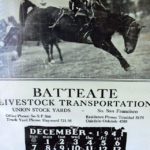
    Earl Batteate (Bud) was born Nov. 20, 1918. He grew up in Hayward, Calif. “I didn’t get to hear the news every night, nor were there the number of people and bad company around. It’s a lot different world. You could trust everybody then.”
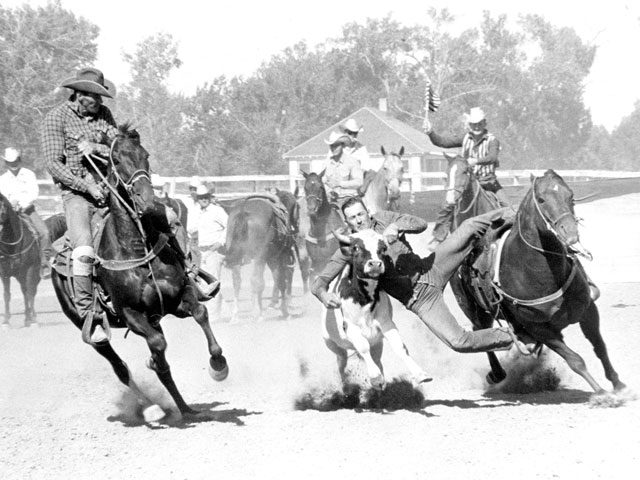
    He started riding calves at the age of 7. “They had them in the chutes, with guys holding them, there was an old saddle bronc rider that took me with him. All the kids rode with two hands, but I had to ride with one, and I got bucked off a lot, but I rode better.” Bud’s dad was a rancher and in the slaughter house business. He had two cattle ranches and hauled a lot of cattle. “He had 33 trucks back in the 1940s. I came from a working family that wasn’t afraid to work.” He had one brother, Al, who has passed away, and a sister, Wilma, who is still alive.
    Bud left home in his late teens to rodeo. He had been going on the weekends with the cowboys at the ranch. He competed in bull riding, and bareback riding, and every bronc riding or any amateur bronc riding he could get in. He quit high school in his senior year and drove truck for his dad and got married when he was 18 to Patricia, who he met in school. She was six months older.
    “I drove truck and got into the cattle business, my mother set me up with the bank so I could get some money and I bought cattle and got into the cattle business before I was 20. My dad had a ranch at Oakdale, so I bought the cows and calves and put them on the ranch.” He has three boys, Mike is the oldest now – close to 70. The oldest boy, Dan, passed away, Nick is close to 60. “All the kids were nine years apart, I guess I was gone a lot. In the fall of the year, I would get on the road and end up in Oregon, Washington, Idaho, Montana, and Canada and would be gone for two months that was the only time I was gone that long.” He remembers one of his big wins at Salinas and the belt buckle he won. “Someone offered me $400 and I didn’t even read what was on the buckle … I sold it to him. My dad got into town and wanted it, I’ll never forget the look on his face. His eyes got watery – I had sold the buckle to have more money to go up north – I already had enough money to go up north.”


    Full story available in our September 1, 2015 issue.