Rodeo Life

Category: Back When They Bucked

  • Back When they Bucked with Ladd Lewis

    Back When they Bucked with Ladd Lewis

    Ladd Lewis loves to tell stories, and he’s got lots of them.
    After 88 years of living, a hundred-thousand miles, thousands of bucking horses, ranch horses and mules, and a family, there are a lot of memories milling in his mind.
    He was born on March 12, 1926, to Glenn and Esther Lewis, a half-mile west of Eureka, Kan., in the “horse and mule days.”
    Agriculture, at that time, relied on horse and mule power and his dad was a trader. Since before he could remember, Ladd was outside, helping with his dad’s business. He spent his days breaking the mules and horses his dad bought, putting harness on them, leading them to the field, while someone else plowed and disked with them. When his dad brought home new livestock, Ladd was on horseback, bringing them home with a Johnson halter.
    When he was fifteen years old, the world was changed with the Pearl Harbor bombing. Ladd announced at the dinner table that as soon as he was old enough, he’d join the U.S. Navy. His mother didn’t want him to, but his dad didn’t say anything. Two years later, Ladd went off to the Navy. He got his GED during that time, and came home in March of 1946. A month later, he married his high school sweetheart, Mary Waltman.
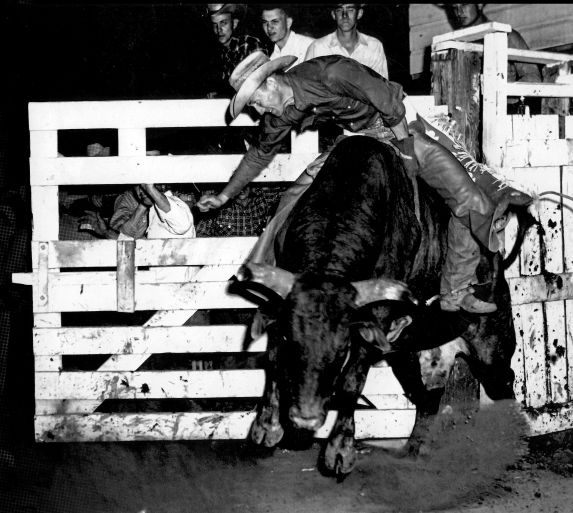
    Ladd began his rodeo career as a youngster, competing in the kids’ events. When he was 21, he joined the Rodeo Cowboys Association, riding bareback horses, saddle bronc horses, and bulls. Ladd was a student of anything he began, including rodeo. He studied the livestock, and he developed his own abilities as best he could. He made more money riding barebacks and saddle broncs than bulls, but when he drew well, anything could be a good ride.  “Part of it is a drawing game,” Ladd remembers. “You got to draw the ranker stock to win the money. You’d be drawing good bulls for a while, and when you draw those better bulls, it gets you deeper into development of that ride.”
    Studying the bucking horses and bulls was part of Ladd’s strategy. When he knew what he’d drawn, he’d watch for that animal. “If you had a chance to where you could watch that sensational horse or bull buck, you’d get to where you could see it the best you could, so you could study what was going on.” Studying livestock was something Ladd had done since he was a child. “When you’re raised as close to livestock as I was, it’s like reading people when you meet them. You look at their eyes, and watch them.”
    Ladd went to rodeos mostly in the area, from western Colorado to North Dakota, south to Oklahoma, and in Kansas. He stayed close to home, but he rubbed shoulders with the best, competing alongside Jim Shoulders and Casey Tibbs, among others. One of his fonder memories is riding a Roberts Rodeo Co. horse named School Boy. School Boy had thrown off all his previous riders, and Ladd rode him twice in one year: at Pretty Prairie, Kan., and at another rodeo which has escaped his memory, and winning both of those rodeos.

    Full story available in the October 15, 2014 issue.

  • Bob Robinson

    Bob Robinson

    R.J. “Bob” Robinson, one of Canada’s premier bull riders, spent his life competing and serving in the sport he loves. He is one of nine being inducted into the Rodeo Hall of Fame during the Rodeo Historical Society’s ceremony September 26-27 at the National Cowboy & Western Heritage Museum in Oklahoma City, Okla. He qualified for the National Finals Rodeo in 1962 and 1964, and held elective positions with the Rodeo Cowboy’s Association and the Canadian Professional Rodeo Association.
    Born in Calgary Alberta, Canada in 1931, Bob grew up around rodeos. His father, Sykes Robinson, was a top bronc rider and steer rider in the 1920s through the 1940s. Bob began his rodeo career at the age of eight, riding steers at Rolling Hills, Alberta. “I was too young and too weak,” he said. “They were riding steers and I didn’t have a rope, so they supplied me with a hard little 3/8” rope. I bucked off at the end of the gate and went home. My dad had gone to World War II so my Uncle John would hold calves at home and I would ride them.”  He got on again four years later and took fourth. His third try earned him a first place and $35. “I was on my way,” he said. “I didn’t really get into the rodeo business until I got out of high school.”
    Bob wanted to be a bronc rider like his dad, and was able to start that in his later teens. He graduated from Saint Mary’s High School in 1950, where he excelled in track, winning the mile run for his school in 1949 and 1950. He considers himself a natural at running and proved it by setting a new record of 4.57 in 1950. Bob remained involved in rodeo after high school, spending winters with Lawrence Bruce, his friend Winston Bruce’s father, in Central Alberta, where he rode bucking horses on the warmer winter days. He spent his summers working for Harry Vold in Dewinton, AB., driving truck and helping produce rodeos. “Bob was very reliable, he was a good hard worker,” said Mr. Vold. “He is a good honest person.”
    He also worked for Ted Glazier, a rodeo cowboy who was also a mixed farmer. “He hauled me to all the Alberta rodeos.”
    He  rodeoed whenever he could, learning how to win from his travelling partners Deb Copenhaver, Bill Linderman, Lyle Smith, Paul Templeton, Jim Shoulders, and Duane Howard. He had his first major win in 1953, winning the All Around title at Edmonton, Alberta, competing in saddle bronc riding, bull riding, and steer decorating. He purchased his RCA card in 1950 and in 1955 he crossed over into the states to compete.  In 1956 he won the All Around in Edmonton and the Saddle Bronc Riding at Calgary Stampede and became the 1956 Canadian Saddle Bronc Champion. 1957 was the year that Bob really developed into a world class bull rider. He won Salinas and Boston Gardens. He contributed being more consistent in bull riding to simply riding lots of stock. Jim Shoulders coached Bob, telling him to ride a little bit away from his riding hand. This advice helped him make the whistle more often.
    He got married for the first time in 1957 to Connie Ivins, her father was a roper. They had five kids and she stayed home while he was on the road.

    He served as the bull riding director for the RCA in 1959 and that same year he was asked by Lex Connally, General Manager of the RCA, to be the Executive Secretary (now called Rodeo Administrator). He held this job until the spring of 1962. His bull riding career took off when his tenure was up and he qualified for his first NFR that year. He managed to get to enough rodeos, even though he had a full time job in California as a project manager. He entered the Finals in 10th place and remained in the position with $8,417 at the end. He won the average at the National Finals, becoming the first Canadian to ever win a major event in professional rodeo history. He considers that as the greatest moment of his career. Jim Shoulders, Ronnie Rossen and Bob Wagner were all competing against Bob.
    The next year, he missed the cutoff for the finals by $16. He qualified again in 1964 in the 8th spot and ended the finals ninth. He wanted to be a dentist and returned to college that same year, enrolled in junior college at Porterville, Calif. He continued his love of track, running the mile in 5.20. He also started a rodeo school, charging students $150 a month. Bob decided teeth were not his future, and ended up obtaining a Bachelor of Arts degree in Radio and Television Broadcasting with a minor in Marketing from Fresno State in 1968. “I was announcing rodeos, so I was taking those classes and I just couldn’t do the chemistry and math.” He entered the sales profession equating sales to rodeo “except you have a lot better draw when you call on your accounts. I was a different type of sales person. I took their stock prepared a rate of sale of our product, suggested a fill in on their sales, then I showed them the new items and I almost always got an order.”
    The last buckle that Bob won was at Santa Marie, Calif., in the saddle bronc riding in 1969, one year before his last bull ride in Salinas, Calif. At the age of 38 he decided it was time to concentrate on his future. “I had a really good job with Levi Strauss in Canada and they didn’t want me to ride anymore.” He worked there until 1977. In 1978, 36 years ago, he realized he had a real problem with alcohol. “I called a well known 12-step program, with more than 1 million recovered members. By the grace of God, I have stayed sober for 36 years one day at a time.” From 1978 through 1980 he was a sales rep at GWG Ltd, a subsidiary of Levi Strauss on Canada, and switched to Blue Bell Canada Inc. (Wrangler) in 1981, working there until 1988.
    From 1988 until 2006, Bob had his own whole sales agency in Alberta. The itch to ride again became too great and Bob entered the bull riding at some Senior Rodeo Association events. He pulled his pelvis apart at a rodeo in 1980 and he traded his bull rope for a lariat and took up team roping. He continued to serve rodeo – President of the Canadian Rodeo Cowboy’s Association from 1973-74. “I led the CRCA board to putting on the first Canadian Finals Rodeo in Edmonton in conjunction with the Edmonton Exhibition led by Len Perry.” He was President of the CPRA in 1980 and 1981; President of the Canadian Senior Pro Rodeo Association for 1995-1997; President of the CPRA from 2004-2005. He was inducted into the Canadian Pro Rodeo Hall of Fame in 1997. He also received the Pioneer of Rodeo award from the Calgary Stampede in 2009.
    He and his second wife of 32 years, Peggy, live at Millet Alberta, Canada, and they are currently developing ¼ section of their land into small acreages. Between the two, they have eight children, 23 grandchildren, and ten great grandchildren.
    He continues to be an ambassador for rodeo. “Rodeo has been a lot of work, but I did it because I love it. I see lots of things that should be changed – it’s very hard to make a living rodeoing – and unless somebody goes into teams or getting a national league going with television. I’ve been in it for 60 years and it wouldn’t take much to make it work.” He has switched from running to walking after two knee replacements and one hip replacement.

    Story also available in October 1, 2014 Issue.

  • John Stokes

    John Stokes

    John Stokes was raised around an auction barn in Lubbock Texas that his dad owned. “Somebody was always daring you to do something you don’t normally do,” said John. “I was an aggravating kid back then.” He shared a story about shooting a bow and arrow at the neighbor kids after watching Little Beaver do it at the movies. “I got a good spanking.”
    Born in 1939, he enjoyed life and as an only child, he tried many things at the sale barn that led him to raise, ride and fight bulls. “My dad sold cattle, horses, and calves and I remember we got 17 head of bucking horses, and 17 head of bulls that belonged to Gene Autry. They were there for Everett Colborn’s rodeos that were held in the college football field. My daddy trucked them over there.” Clyde had a trucking company as well as the auction barn on the north side of Lubbock. The auction barn had a straightaway race track and on Sundays they would have horse races. “My mule, Josephine, could outrun most of them,” he said. “I thought it was a neat deal – they would bring in bulls and calves and horses and we’d rope and ride.”  He picked up his dad’s livestock trading skills and took it on with him into the rodeo world. “When I was rodeoing I’d buy bulls from one producer and sell to another one.”
    He started competing in 1953 at Rising Star, Texas, as a small open rodeo. He entered the bull riding at the age of 13. Two years later, at the age of 15, he had his first “gig” as a clown/bullfighter at that same arena. When they came out with the Rodeo Cowboys Association permits in 1956, he ended up with one. “If you won money, you had to buy a card for $25. The First RCA rodeo I entered, in Taylor, Texas, I entered two in one weekend. It was a two head in the bull riding – I won $15, so I had to buy a card.” Like many bull fighters in his time, he showed up to ride at rising star event and the bull fighter didn’t show up, so they asked John to do it. “After that, I would get on my bull first, and then I’d fight bulls for everyone else. Some of those rodeos down in South Texas there would be thirty or forty bull riders – and I was the only bull fighter – I was pretty skinny and pretty quick.” He won many rodeos as a bull rider.
    John attended Tarleton College in Stephenville, and in 1958 he was instrumental in helping form the first rodeo club at the school. That year he entered the Tarleton rodeo in bull riding, wild horse race, bulldogging and bareback – winning the All Around
    He married Lynn Kirby, the girl down the street, who he had known since junior high. The two will celebrate being married for 50 years this coming January. They settled on a ranch near Sonora, Texas, ranching 90 miles from the border. Lynn went with him to all the rodeos after they were married.
    John was drafted into the military, but he couldn’t serve due to his lack of hearing. “I got hit by lightning when I was 12 and that started my hearing problem. We had a rock barn, with jersey heifers. I’d come in from school and was down at the barn. Lightning hit the barn right next to me – I had a bad taste of sulfur in my mouth for six weeks – it killed a bunch of the heifers.”
    He continued a trade that he started in high school “I got paid .35 an hour for welding when I was in high school, and I could see how gates worked from growing up in the sale barn and being around my daddy (Clyde Stokes).” John built a set of metal pens for a friend and that’s how his welding business started. “Over the period of years we built four different auction barns, repaired a large feed yard – all while I was rodeoing and ranching.”
    Lynn and John had one daughter, Tamara Shane. His welding business ended up employing 20 people – 15 of them rodeoed. His bull fighting and riding slowed down, but he still wanted to go and rodeo – so he took up team roping and steer roping. “I learned how to rope as a kid – .it’s something I did every day of my life when I had cattle, sheep, and goats. It wasn’t hard to take what I did every day and put it in the arena. I roped left handed for a long time, but I got my finger mashed in a door, and had to start roping right handed.”
    John not only went to ropings, he and Lynn started producing them in the 1978. “Our first roping we had at the ranch we had a progressive after six and we had two kids, one was 13 (Guy Allen), one was 14 (Tee Woolman), won the roping.” They produced ropings for fifteen years, and after they quit, John continued roping until he was 70. “I roped and tripped until five years ago,” he said. “I spent 53 years in rodeo.” During that time, he endured 88 broken bones.
    He is still involved in the industry, raising bucking bulls – he has six coming two-year-olds that will be entered in futurity derbies for ABBI and UBBI. “All my cows are registered. All the bulls are out of our cattle and I trained them all. When I sell one for $5,000, I think I’ve made a lot of money! I train them and gentle them up. You can’t sell a mean one. They are just like people – they’ve got their own little thing.” John and Lynn enjoy their life on the ranch. “We ranched all our life, I don’t think we’ll ever get away from it. As long as the Lord lets us, we’ll be in the cattle business.”


    Story is also available in the September 15, 2014 issue.

  • Back When they Bucked with Richard Claycomb

    Back When they Bucked with Richard Claycomb


    Richard, (Dick), Claycomb, was born June 6, 1939. He spent the first two years of his life in a two-room cabin in Fox Park, Wyo. “My dad was hauling logs from Fox Park, Wyoming to Ft. Collins, Colorado. Mom hauled water from the creek.” The family moved to Cheyenne when his dad got a job at the UP Railroad. Dick decided to take on a paper route when he was ten, at first riding a bike, and then switching to horseback, and extending the route from 22 to 145 papers. “I paid $15 for the horse,” he said. “I’d ride seven miles every night – that’s where I learned how to ride.” His mare stepped on a coffee can and severed a tendon, which ended the paper route. Dick’s next job was as an apprentice mechanic and he received his mechanic license.
    Dick got his first taste of rodeo in Pine Bluffs, Wyo., at a high school rodeo, when he was 16. “I won the bull riding and was second in the bareback riding. I got $47 and I was hooked.” He won the All Around saddle at the Cheyenne High School Rodeo riding bareback horses and bulls and after he graduated from high school, he continued to rodeo in the summer and packed hod in the winter. “Packing hod for brick layers kept me strong,” he said.
    Dick met his wife, Darlene Stumpf, when they were seniors in high school. They married in 1958 and they worked winters and rodeoed summers and later went to college. “Tracy was born in 1964 and Troy was born in 1966. Tracy is an attorney for Office Depot in Idaho, and she has two middle school daughters, Maureen and Emery. Troy is a principal in Gillette, Wyo., and he has three children, Sophie a senior, Lainee is a freshmen, and Jess a sixth grader. He operates a fly in fish camp in Saskatchewan, Canada in the summer. I go up there every summer to help and fish, mostly fish.”

    Full story available in September 1, 2014 issue.


  • Back When They Bucked with Ferrell “Flashbulb” Butler

    Back When They Bucked with Ferrell “Flashbulb” Butler

    Ferrell “Flashbulb” Butler hadn’t a penny left to pay his entry fees. So the calf roper took out his camera and started shooting rodeos, selling the photos for a dollar and a half apiece in the 1960s. Each click of the lens drew him closer to the acclaim he receives today for the moments of rodeo history captured with his German Rolleiflex T camera.
    Butler, born in 1936 in Davidson, Okla., was the only child of his parents, UJ and Hazel Butler. His family later moved to Mesquite, Texas, and young Butler began competing in rodeo when he was 15. “I wanted to rope calves like all the other kids in the ’50s. I wanted to ride bulls, too, but that didn’t last long.” Butler went on to compete on the Arlington State College rodeo team. He was a charter member of several rodeo associations, but much of the time he competed in his hometown in Mesquite. It was there that 24-year-old Butler began his photography, learning the trade as he went. “I started taking pictures for money and the picture taking got plumb out of hand!” In 1960 at the NFR in Dallas, Texas, Butler met rodeo photographer DeVere Helfrich, future friend and mentor. Helfrich pioneered the technique of classic saddle bronc pictures capturing the rein picked up and the horse stretched out, jumping and kicking.

    Full story available in the July 15th edition.


  • Giles Lee

    Giles Lee

    Giles Lee grew up immersed in rodeo, as a ranch kid, a competitor, an organizer, a historian, and a fan. The Lovington, N.M. cowboy was born in Midland, Texas in 1922, the fourth child of Dick and Sarah Forrester Lee. When Giles was two, his dad and a partner bought a ranch in Lea County, New Mexico, and the family moved west. 

    Ranching, cowboying, and rodeo were all the Lee kids knew as they grew up. They helped out on the ranch, and Giles remembers their entertainment: cars parked in a circle to make an arena, with shotgun chutes and set-up pens. 

    Giles’ first time as a contestant in a formal rodeo setting was at the first Lea County Fair and Rodeo in 1935, where he and another rodeo legend, Tuffy Cooper, entered the junior calf roping. 
     

    His second time as a contestant was in 1938 in Midland. He placed high in the senior boys calf roping, winning a pair of boots and $150 cash, with the requirement that he had to write thank you notes to the sponsors! 
     

    The next time Giles got a taste of formalized rodeo was when he was a senior at Lovington High School. The intramural rodeo club at the junior college in Portales invited the seniors to rodeo with them. Giles didn’t have a way to get his little gray horse, Possum, to the rodeo. So “we borrowed a tiny little makeshift trailer somebody’d built, loaded ol’ Possum in this wooden trailer, and somewhere we got a pair of goggles to put on him.” Without a windshield, the horse needed protection for his eyes. Five seniors traveled together, in Giles’ father’s vehicle. “My dad had a little old Chevrolet coupe and we talked him into letting us drive that. Three of us sat in the front seat, and two sat in what they called the turtleneck, which raised up, in the back. It was quite a deal.” In Portales, they entered all the events they could. Giles and his friend Bill Spires won the wild cow milking and assumed they’d get prizes and buckles. But when they were called down to be introduced as winners, they each won a pair of socks and a necktie! 
     

    It was his first year of college at the New Mexico A&M (now New Mexico State) that Giles’ interest in organizing rodeo began. As a freshman in 1942, the University of Arizona had sent an 
    invitation to A&M to send a rodeo team. This begged the question: there was no rodeo team at A&M! Having a team required organization, officers, recognition from the college, sponsors, and someone to do the hard work of getting those things. With Giles as one of the thirteen team members, they got recognition from the administration and found sponsors: the Sheriff’s Posse and Paul Heffert’s Chevrolet garage, who provided two pickups and paid the bills for them. 

    The 1942 New Mexico A&M team traveled together, rode the same horses, used the same equipment, took bedrolls and slept in gyms at other universities. This was seven years before college rodeo had its official beginning with the NIRA. Then World War II interrupted, and contestants were thinned out as they either entered the service or were about to be drafted. Rodeos ceased, and Giles was called into duty. He joined the Army in 1943 and served three and a half years in the Army Air Corps as a Staff Sergeant and Crew Chief on B-17 aircraft in the Pacific.

    When he came home, it was back to school, but “what I had on my mind was rodeo, not college,” he laughed. They put together another college rodeo team again in 1946. There were a lot of small time rodeos going on, what Giles calls “brush rodeos,” with makeshift arenas and whatever stock could be rounded up, in Arizona and Texas, and “I was doing more rodeoing than going to school,” he said. Then the “showdown” came: “We got to electing rodeo team members, and ol’ Giles was left out because I didn’t have a C average.” He couldn’t travel with the team. He finally improved his grades enough to go back to college rodeo. And chemistry was a problem. “I took it three times,” he recalled, and still couldn’t pass it. “I decided, that was it. No more college.” He went home to ranch. 

    During his college days, Giles began riding barebacks and bulls in addition to his roping. Bareback riding went pretty well: “I was coming along pretty good in the bareback horse riding, but was never much of a bull rider.” It was while he was on leave from the Army that he met his future bride. Joie Anderson, who was the daughter of the new music teacher at Lovington, and in 1947, they married. He took her to a Beutler and Son rodeo in Tucumcari, N.M., and won third in the bareback riding. They went to the big dance east of town following the rodeo. That was their honeymoon! 

    When he left the arena at Tucumcari, somebody hollered, “you won some money! Give us ten bucks and you’ll be a member of the RCA!” And Giles’ Rodeo Cowboys Association membership began. Now he is a gold card member. After his marriage, Giles continued to rodeo, but it was mostly roping. “My mother convinced him that after they got married and had a baby that he didn’t need to be riding broncs anymore,” daughter Libby said. And he stayed close to home: rodeoing where he could get to and get back home to the ranch. 

    In 1959, he began Sunday team ropings on the ranch, the Lea Co. Championship Roping, which eventually turned into the Lea Ranch Roping. The Sunday ropings turned into Wednesday night ropings. The ropings were held until 1979, with many young men learning to rope at the arena, and casting an eye on the three Lee daughters: Libby, Becky and Mary Ann. The girls learned how to rope from their dad and competed in junior rodeos.

    When his team roping days ended, Giles began tripping steers. He and three other senior ropers organized the Senior Championship Steer Roping Association in Amarillo in 1984, and Giles served on the board for ten years. Tripping turned out to be his favorite event. “I think I enjoyed tripping steers more than anything else I did,” he said. “I wish I had been doing that all along. I was sixty years old when I started that. The last steer I tied down at a rodeo was in 1996. That’s a pretty good spread.”

    Now Giles directs ranch operations from he and Joie’s home at the Shinnery Oaks Community Home in Denver City. Daughter Libby and her husband Danny Berry run the ranch. “I’ve got a son-in-law running things,” Giles said. “He’s a good hand. I don’t have much to say.” Although he says that, he’s still involved with the daily operation; he and Danny regularly talk over what needs done at the ranch.

    Giles and Joie have seven grandchildren and three great-grandchildren, and hundreds of good memories of days past. They had fun, made memories, and he paved the way for future college contestants to get degrees doing what they loved: rodeoing. 

  • Alvin Davis

    Alvin Davis

    All his life, Alvin Davis has worked hard to promote the western culture and cowboy way of life. At the age of seven, he got bitten by the “cowboy bug”, and devoted the rest of his life to cowboys, ranching, and the west.

    He was born in 1927 in Post, Texas, the son of Glenn and Viva Davis. When he was seven, his parents took him to the Texas Cowboy Reunion at Stamford, where Will Rogers was a guest. Rogers, who was killed two months later, became his hero, and still is, to this day.

    Alvin wanted to be a calf roper, but weighing 140 lbs., “soaking wet,” he knew he couldn’t handle the calves. And at that time, team roping hadn’t made its way from California to Texas. So Alvin devoted his life to the administration side of rodeo and the western heritage. He graduated from high school in 1944 and spent a semester at Texas A&M. But A&M was too far from home, and not what he envisioned, so he came home.

    When he turned 18, Uncle Sam beckoned, and he enlisted for 18 months in the army. He missed fighting in World War II by three months but felt an obligation to enlist; “I felt I owed my country something, since I missed out on the war.” He came home a 19 year old sergeant, and went straight to Texas Tech in Lubbock. During his college years, he devoted himself to 4-H, winning at the county and state levels, and for three years, winning trips to the National 4-H

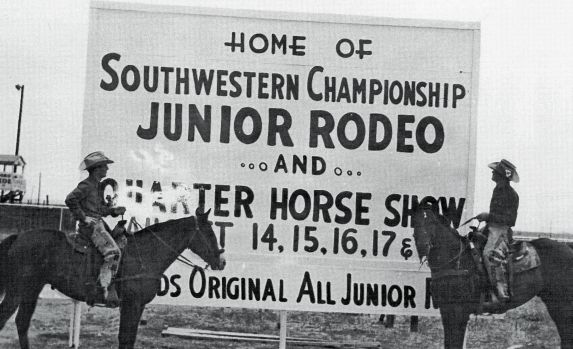
    His final 4-H project, in 1948, was the first of the numerous cowboy projects Alvin would be involved in. He produced the World’s Original All-Junior Rodeo. All participants, both contestants and directors, were ages 19 and under. It was held in Post, with an afternoon and evening performance the first year. The second year, it went to three days, and in its third year, in 1951, contestants came from three states, and news reels from across the nation covered it.

    In its fourth year, Alvin turned it over to the juniors, and began work on another rodeo project. He formed the American Junior Rodeo Association (AJRA), one of the first youth rodeo organizations in the nation. He served as administrator from 1952 to 1958. The AJRA celebrated its 61st year in 2013.

    People took note of Alvin’s ability to organize and administrate. The National Intercollegiate Rodeo Association (NIRA) came calling in 1955. They needed an administrator, and Alvin took the job. He set up headquarters for the AJRA and the NIRA in a one-room building he built in Post, decorated with a western theme. In 1958, he turned the NIRA to a new administrator, in good financial shape and order.

    During this time, he held down a fulltime job at the bank in Brownfield, earning $500 a month. His salary with the AJRA and NIRA was $125 a month, and after a short while, his rodeo income was increased by $25 for each association. But he wasn’t doing it for the money. “I wanted to provide a service, and support rodeo, wanting it to be big and great and fine.”

    Alvin didn’t stop at rodeo associations. He brought a cowboy poetry gathering to Lubbock in 1989, having seen it done in Alpine, Texas, and Elko, Nev., and he founded the National Cowboy Symposium and Celebration in Lubbock, the largest such event in the nation, which features cowboy storytellers, poets, musicians, chuckwagon cook-offs, and vendors.

    He also was executive vice-president and general manager of the National Ranching Heritage Center at Texas Tech, an indoor/outdoor museum with exhibits and 50 structures from historic Texas ranches.

    Alvin worked at the Brownfield bank till 1959, when he moved to Clovis, N.M., to work as executive vice-president and director of banks in Clovis and Melrose, N.M. He and his family spent a year in Clovis before coming back to Levelland, Texas, where he and a partner owned western stores there and in Brownfield. He first managed the Levelland store, but when the partnership split, his partner took the Levelland location and he and his wife moved to Brownfield to operate that store. He was in the retail business for twenty years, selling the store in 1979.

    It was while at a retailers’ meeting for western wear and equipment, that he and a group of men decided to form another organization to meet their needs. The Western/English Retail Association was born, with Alvin as its founding chairman for three years.

    And there are so many other ways Alvin supported, mentored and sustained the western heritage. He announced rodeos, including the NIRA Finals twice and the AJRA Finals. He spent thirteen years as director of the National Ranching Heritage Center at Texas Tech. He made many appearances as a cowboy poet, writing a poetry book and a children’s book (“A Day in the Life of a Cowboy”). He was a junior 4-H leader for years and often did the work of the county agent, when there was none. He is the only 4-H member to be inducted into the 4-H Hall of Fame, and in 2010, the newly formed National 4-H Hall of Fame.  He and his family raised and showed horses, owning and showing the World Reserve Appaloosa Cutting horse that topped the 1963 sale with a price of $8,300. He also owned a third place world calf roping horse and a national champion two year old halter stallion.

    When his future wife, Barbara Ann Hext, graduated from Texas Tech and moved to Brownfield to teach home-ec, he was waiting on her doorstep. The couple has been married for 59 years and have three children: Bob, who is married to Lee and works for a petroleum company in Houston, Debbie Garland, married to Mike and working as a banker in Jacksonville, Fla., and Todd, who is married to Lena and works for an education center in Lubbock. He and Barbara have four grandchildren.

    Looking back over his years, he’s most proud of all the things western he’s done, to keep the heritage going. His boundless energy and ability to organize have served him well. He is in his eighth decade but going strong: “I tell everybody I’m 86 years young, and except for using a cane to get around, I’m still in good enough physical condition to work day and night. “I thank the Lord that He’s allowed me to be able to do these kinds of things.”

  • Steve Gramith

    Steve Gramith

    Steve Gramith considers himself a “foot soldier” in the sport of rodeo. The humble man was involved as both a contestant and a pickup man, and even though he may deny it, he’s contributed his share to the sport.

    He was born in St. Louis Park, Minnesota, in 1942, the son of Clifford and LuVern Gramith. The family had no ties to rodeo, but his mother’s parents had a couple hundred head of cattle, and when they left Dupree, S.D., after their general store burned down twice, his grandfather gave the cattle to a neighbor and friend.

    Years later, Steve’s family would drive past the grandfather’s friend’s ranch in South Dakota. That started my enthusiasm for ranch life,” Steve remembers. From then on, he spent every summer on the family friend’s ranch, located seven miles upriver from White Horse, on the Moreau River and the Cheyenne Indian Reservation in north central South Dakota.

    In 1960, Steve graduated from Waconia (Minn.) High School and went straight back to the ranch, “as fast as my little legs could carry me,” he jokes. It was college that introduced him to rodeo. He  spent his freshman year at Colorado State University, and then took a year off, returning to the ranch near White Horse. He began learning to rope calves with a neighbor, Harlan Gunville. He and Harlan would head to the Timber Lake arena in the evenings, where they would rope calves. “We played, and visited, and practiced,” Steve says.

    After a year off, Steve returned to college, but this time to South Dakota State University, and as a member of the rodeo team. Roping calves was his first event, but not his best. “I basically started from scratch at South Dakota State, and was really inconsistent. I’d maybe win a go-round, and then miss. The calf roping was not something I was good at.” But he soon found an event at which he was good: steer wrestling. With roping he was nervous. Bulldogging was different. “Steer wrestling was just like getting out of bed,” he says. “It was easy. There was nothing to it. There were no nerves there. I’d just grab ahold and go to the mat.”

    It was at his home college rodeo, his senior year that he won the buckle he still wears: for winning first in the steer wrestling. He also won the SDSU all-around saddle that year, because he placed in the calf roping. After graduating in 1966 with an animal science degree and a minor in economics, he moved to Canning, S.D., and went to work for Erv Korkow. He had met one of Erv’s sons, Jim, at the Highmore rodeo, and Erv needed a pickup man. He became friends with Jim, and Steve found himself picking up alongside him at high school, college, and pro rodeos, and when they weren’t on the road, doing chores, feeding horses and bulls, riding colts, and driving truck. And while he was on the road with the Korkow and Sutton Rodeo Co., as it was owned by Erv Korkow and James Sutton at the time, he was able to bulldog professionally.

    Steve wasn’t the only college student recruited by Jim to work for the company. Alvin Chytka, Gary Chytka, Gerald Dewey, David Daul, and others were at the ranch. And even though Erv was the boss, it was his son Jim who was the reason for the crew. “We worked for Erv and James (Sutton), but we came there for Jim. It was because of Jim. We worked like dogs, but he was friends with everybody and he was fun to be around.”

    Along with picking up, Steve steer wrestled, qualifying for the National Finals Rodeo in 1971. Because he was working as a pickup man, he got to fewer rodeos than the other bulldoggers. On the weekends he wasn’t picking up, he’d make three or four. But when he picked up, he competed at that rodeo only, while other cowboys were hitting several on the same weekend. In 1971, he went to forty rodeos, “the most I’d ever gone to,” he remembers. The 1971 year end champion, in comparison, went to more than 100 rodeos.

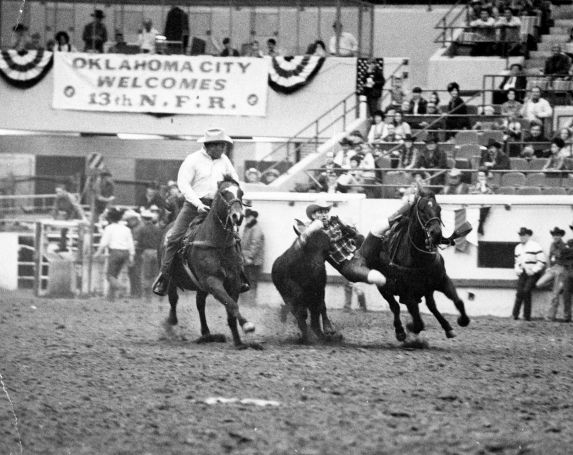
    He also held the record for the fast time at the NFR, winning the third go-round in 3.7 seconds. That record held till Tom Ferguson broke it in 1975. In those days, the steers were big Corrientes and arenas were larger, including the NFR arena at the state fairgrounds in Oklahoma City. “You could win money being ten (seconds) or under,” Steve says.

    In 1972, Steve left South Dakota and moved to Tunas, Missouri, southwest of the Lake of the Ozarks. He had started a cattle herd by then, and his friend Jim Korkow trucked them to his new home. Land was cheaper in Missouri than it was in South Dakota, the acres per unit for a cow/calf pair were lower, and the winters weren’t as severe. Steve still picked up for the Korkows, but his emphasis was turning to cattle. He had seen Simmental cattle at Jim Sutton’s, and he began crossing Herefords with Simmentals. Eventually, he became a purebred Simmental breeder. He lived near Tunas for about eight years, then moved to Marionville, Mo., where he lived for another eight years. In 1992, when he married his wife Beth, they moved to Willard, Mo., and on to Neosho, where they live now.

    In 1976, Steve ran his last steer. He went to two pro rodeos that year. “It wasn’t that much fun anymore,” he says. His cattle herd was demanding more and more attention. “I was working too hard to really rodeo properly.” He won first at the first rodeo he went to that year, and at the second rodeo, missed his steer and got run over by his hazer. It was time to quit. He didn’t own a bulldogging horse anymore, and the work at home was his focus. “I was always so busy, that the mental aspect was more difficult than the physical aspect. When you have bills to pay at home, and you want to win too bad, it doesn’t go well.”

    His wife, Beth, holds an important place in his heart. They began dating in 1989. She had divorced and was raising three kids. “We’d date some, then she’d want to do things with her kids, then we’d date some more. Finally I wore her down,” Steve laughs. Actually, it was her youngest child, daughter Christine, who helped her mother see what Steve was. “Christine was my champion,” he says. “She said to her mom, “That’s a pretty good guy.’”

    It was through God’s intervention that he found Beth. “I was just out twirling in the wind, until I decided I could not do life alone. It was my decision to ask Christ to come into my life, and I was 48 years old. I didn’t grow up till then. “It not only made a world of difference,” he says, “but I met someone of value that He put in my path. She’s my soul mate, my best friend. I found someone to spend the rest of my life with, and I have the comfort of knowing that Jesus Christ is my Lord and Savior and He died for my sins.”

    Steve has three step-children: Christine Ryan, an OB/GYN in Colorado Springs, Stephen Shank, who works with The Navigators in Texas, and Nathan Shank, a missionary in northern India.

    Of his work as a steer wrestler and a pick up man, he is most proud of picking up. “I think my picking up was more important to me than the steer wrestling, mostly because of my friendships, especially with Jim (Korkow). The work was very satisfying. We had some really nice horses to ride, and it was just such a pleasure because it was cowboying. It wasn’t rodeoing, it was cowboying. We were riding, working, and it was old time cowboyin’.”
  • Ben Jordan

    Ben Jordan

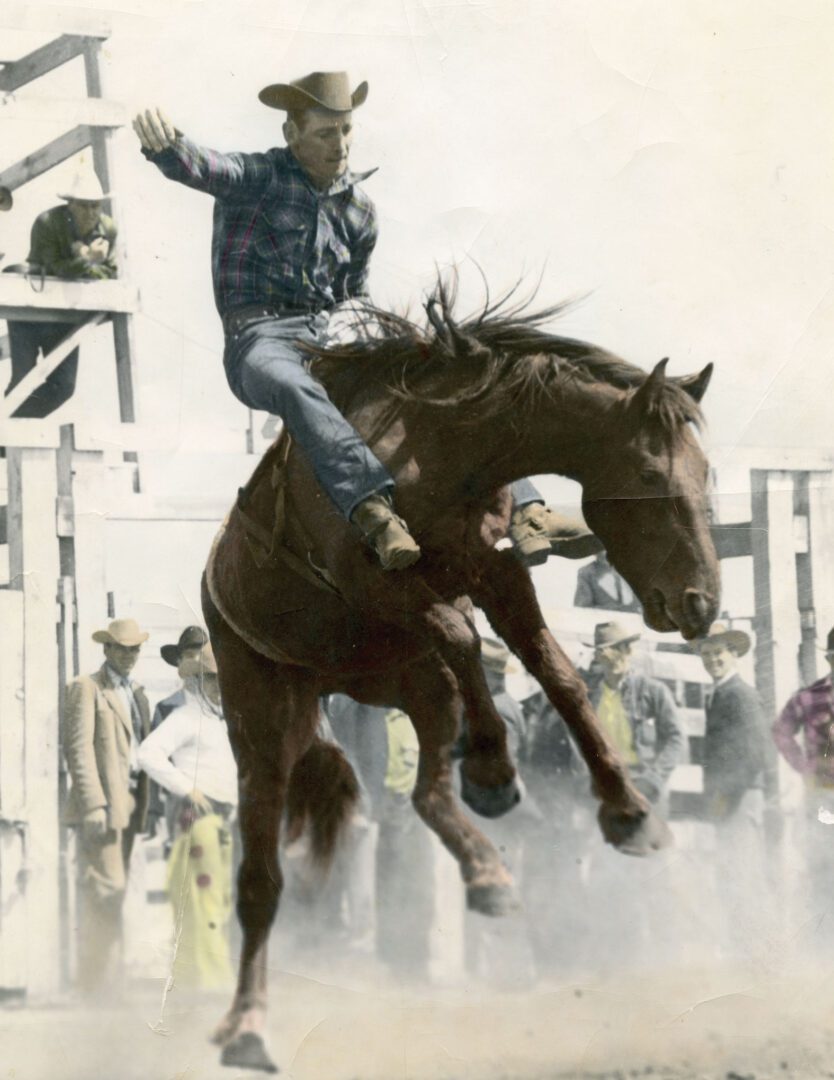
    Ben Jordan dominated the bareback riding in the International Rodeo Association for a decade. But his place in rodeo has lasted a lot longer than just ten years. The Smithville, Oklahoma cowboy was born November 30, 1931, to Ben and Blond Jordan, “under the same tree I’m living under now,” he says. His parents farmed and ranched: “they had to do a little of both to make a living.”
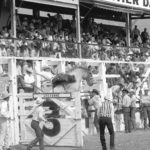
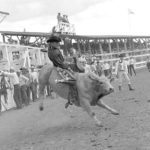
    As a youngster, his favorite thing was to ride anything, including calves and mules. “We practiced all the time,” he remembers. “Everybody had stock up and down the road” in southeast Oklahoma. “We’d just go by somebody’s cow lot and get on a calf or two there. I’d been on no telling how many calves and mules before I ever got to a rodeo arena.”
    Every Saturday, when he was a kid, Ben could be found at the weekly horse trading. “I’d be there at daylight, and I’d make me two or three dollars getting on horses somebody’d trade for. I’d done it since I was seven or eight years old. I had plenty of money then.”

    He completed school through eighth grade, a common thing for boys in those times. But he never got a certificate for graduation. “I went to three rodeos (the week of graduation), and I got back, and of course, graduation was over. (The superintendent) never would give me my certificate. He thought I should have been there to graduate.” Being gone to rodeo also cost him a girlfriend. “I had a little girlfriend holding my seat on the bus. I’d sit by her every evening, and when I was gone, I even lost my seat,” he laughed.

    Hitchhiking to rodeos was common. “It was hard times around here,” he said. “We hitchhiked for two or three years.” With the state penitentiary in McAlester, hitchhiking could be difficult. “When we got up there by that prison, when we’d stick out our thumbs, they’d pick up speed, thinking we was convicts,” he laughed.

    For five or six years, Ben did nothing but ride bulls. After his school days were over, he lived at home and did ranch work for family. He continued rodeoing “all I could go to.” Then he began riding barebacks and saddle broncs, He enjoyed riding broncs, but in those days, there wasn’t much saddle bronc riding in Oklahoma, Texas and Arkansas, so he stuck to barebacks.

    Most of the rodeos he went to were jackpots or Rodeo Cowboys Association events, forerunner to the Pro Rodeo Cowboys Association. He belonged to the RCA, but after paying several fines of the typical $50, a director fined him $800. “They put me on the black list, and I stayed on there,” Ben remembered. Tom Nesmith (a steer wrestler and tie-down roper), told me he was going to pay my fine at Denver (thinking it was $50), but he called me and told me it went to $800. I said, ‘Just forget it.’ I never went back.”

    By then, he had a wife and children to feed. He married a girl who grew up across the creek from him and with whom he rode the school bus. He and Roxie had their first child and only daughter, Betty Jo. Then came Benny, Kenny, John and Billy Bob. All the while, Ben raised cattle, hogs and horses, and rodeoed for extra income. Roxie took care of things at home. “She kept everything going. I believe I was home when one child was born, the first one. She was tough.”

    In 1959, he joined the newly formed International Rodeo Association (now the International Pro Rodeo Association). He was the eleventh person to get a card, and his card number is 1110. Ben turned his attention to IRA rodeos, and even though he was in his thirties, past what might have been considered his prime, his was a constant name in the standings. He won the IRA Bareback Riding World Championship in 1961-65, and again in 1968, the bull riding world title in 1961 and 1962, and the All-Around from 1961 through 1963. And along with the competition, he volunteered his time with the IPRA, as a bareback riding director and as vice-president.

    Ben’s rodeo career was relatively injury free, as well. Aside from being out for eight months due to a broken leg, he was never off the trail for long. “I never was crippled very much or very long at a time. Right after I got married, I was in a cast for eight months, but after that, just a week or two at a time.”

    His usual rodeo trail was in Oklahoma, Texas, and Arkansas, and the IPRA rodeos farther east. He often competed at Loretta Lynn’s rodeo series, which included eight fall and eight spring rodeos. One year, he won all eight of the fall rodeos, but his record didn’t last long, as Butch Stewart did the same thing the next year.

    And Ben learned as much as he could. “I absorbed all I could of it,” he said. “Where I could think about it, and pass it on to somebody it might help.” Cowboys came to him for advice, and he was happy to share. “You didn’t mind them fellers who’d ask you for advice if they’d use it all. If they didn’t use it all, you don’t never tell them again.”

    His secret to riding barebacks was simple. “I could pull on my feet, and I was pretty stout in my arms. I’d worked all my life. I had good balance, and I studied horses and bulls. If I had seen (the horse or bull), I might beat somebody a point or two on the same horse. But I didn’t get sloppy on them.”

    In 2007, Ben and Roxie’s youngest son, Billy Bob, was killed in a car crash, and six years later, their eldest, Betty Jo, died of cancer. In 2008, after 58 years of marriage, Roxie died, also of cancer. “She helped me through a lot of pains and struggles,” Ben remembered.

    Now, he keeps busy carrying mail. He’s been doing it for thirteen years, and it keeps him young. “I have a fifty mile route that takes me about two and a half hours. I have some widder women up and down (the route), and I keep their boxes popped up,” he laughed.

    He also raises black mouth cow dogs and hog dogs. He’s been breeding them for forty years, and the Jordan connection to good dogs is recognized nationwide. He has about twenty right now, and has no trouble selling them when he has puppies.

    And he says he didn’t have a boring life as he looks over the last eighty years. “I ranched, I did the things I liked outdoors and horseback. I had the top cowdogs in the world. I done just what I wanted to do. I didn’t have to dig ditches,” he laughs.

  • Scott Hall

    Scott Hall

    Scott Hall was raised outside of Herald, SD, on a ranch. “We lived on a ranch and put up hay and farmed with horses,” said the 81-year-old who calls Elizabeth, Colo., home. “I did a lot of farming with a team of horses.” His dad had a herd of about 150 horses and Scott remembers riding on the back of the young colts while his dad led him around. “Then he’d turn me loose in the pasture and the wreck was on,” he recalled. He started rodeoing when he was 16 because his neighbor did. “We went to small rodeos, or we’d run in somebody’s cows and ride them. We always thought we were riders. It was something to do on Sunday.”  He had four sisters and four brothers and only his older brother joined him a couple of times riding bareback horses. 
        He started traveling to rodeos when he was about 17. “My brother in law, Harold Alleman, would pick me up and take me to rodeos in Minnesota and around the area. I had a Turtle saddle, and I was part of the RCA.  Before that I would go to some amateur rodeos around.” Scott never made it to the Finals. “I never tried – I was working.”  Scott made it to the 11th grade and didn’t like it. “I wasn’t a school guy, so I left school and I ran away. My dad was out farming for a guy $10 a day, and me and two other guys decided we were going to rodeo. I had $100. We got a bus ticket and went to Casper, Wyo.” By the time they got to Casper, they were broke and Scott ended up staying with his aunt and uncle, working on his irrigated farm, putting up hay. He broke a wild horse for his uncle’s friend and entered a couple rodeos in the bareback riding. “I didn’t know anything about spurring one out, but I got one rode.” His folks came out and made him go back to school, but he never finished that time either. He was drafted into the Army and got his degree in Korea. “I took one of those tests and got my diploma.”  He served in Korea from 1952 – 1954 as a crane operator after training in heavy equipment. “I was a good crane operator.  I put bridges in, and then tore them out. I did my job and got out of there ok.”
        In 1958, Scott went to Belgium to put on a rodeo, that’s when The World Fair was there. “The horses went by ship and the rest of us flew. There must have been about 30 of us altogether. It was a good deal. Gene Autry and Casey got this all together.  We put up the biggest tent that Goodyear ever built –we put it up with an air compressor. Something happened to the tent, and we ended up putting on the rodeo in the rain. It rained and rained and rained – we’d rodeo in six inches of rain sometimes.  It didn’t work out that great – we went broke. The government paid our way back.” 
        Scott got married in 1959 to Joyce Galinat and he and Joyce had five children.  At times he would take the family on the rodeo road, but mostly he went by himself. He put up hay, raised hogs, and ran a few cows between rodeos. “My wife died when she was 44 of a heart attack in 1983. I went back to South Dakota for nine years.” The two youngest were still in high school and Scott finished raising them by himself.  He leased a ranch in Wood, South Dakota.
        In 1991, he became reacquainted with a lady he had known in 1958. “I was crazy about him, but he was too busy rodeoing at the time,” said Mary (Lovoi) Hall. They were married Oct. 18, 1991. “He called me in March, and I went up to South Dakota in April. It was a very painful thing going back and forth, and we just decided to get married and he moved back here.”  
        Scott does the same thing he did in South Dakota. He has about twelve head of horses and rides and has a handful of calves and a bull. “I’ve still got ice to break and hay to move,” he said. He’s busy all the time – there’s  a lot of chores to do. “I’ve done about everything I’ve ever wanted to do. I’m going to try to cut my horses down to about two and get rid of some of the chores and take it easy.”

  • Bill Feddersen

    Bill Feddersen

    Bill Feddersen was the first saddle bronc rider out of the chutes at the first NFR in 1959. At the time, the NFR took place in Dallas, Tex. and $10,000 was put up as prize money for each of the five events. Bill reflected on the difference just in prize money alone between today’s NFR and the first one held in 1959. “A few years ago I was going home with a cowboy from Oklahoma after going to the NFR. We were talking, and he told me that he rode four bulls at the finals and won $53,000. I told him, ‘You got more money riding four bulls than all of the money put together for the first NFR!’. Although, we probably ended up with as much money then as they do now, since gas was only 25 cents and a hamburger was a dime.”

    Bill was born in Union City, Okla. in 1927. He had a younger brother, Don, and their family ran a farm and raised beef cattle. Bill loves to tell the story about his first “horse”. “When I was four years old, I told my mother that all I wanted in life was a horse. One day she got me a horse and I ran outside all excited. It was a stick horse and I loved that horse. I taught it to walk and trot and backup, and I even rode it to school. I tied it up with the big horses. One day I came out of school and someone had stolen my stick horse. But what bothered me the most is that I had to walk home.” In high school, Bill rode a four legged horse the four miles between home and the schoolhouse. It was in high school that Bill had his first chance to compete in rodeo. “Ed Curtis was a rodeo cowboy and he moved down by me. I rode horses and calves and cows – everything I could get on. When I was in high school, he (Ed) took me to my first rodeo in 1943.” Bill loved his first rodeo, held on a baseball field, and became further involved in the sport when he joined the Cowboys’ Turtle Association. In 1946, the association became the Rodeo Cowboys’ Association (RCA), which would later become the PRCA. Bill’s rodeo pursuits were put on hold, however, when he was drafted into the Army during WW II. He got out of the Army in 1948 and continued on with the RCA. Altogether, he was their vice president for seven years, and Bill helped start the association’s first rodeo judging school. “That was quite an experience for me. I didn’t have anything written down on how to judge. I asked a lot of questions and we had to change some rules. It was just start from scratch and we figured out how to watch the barrier and where to stand and how the calves should be tied down. I went all over the United States and Canada teaching schools. I did that for about five years.”

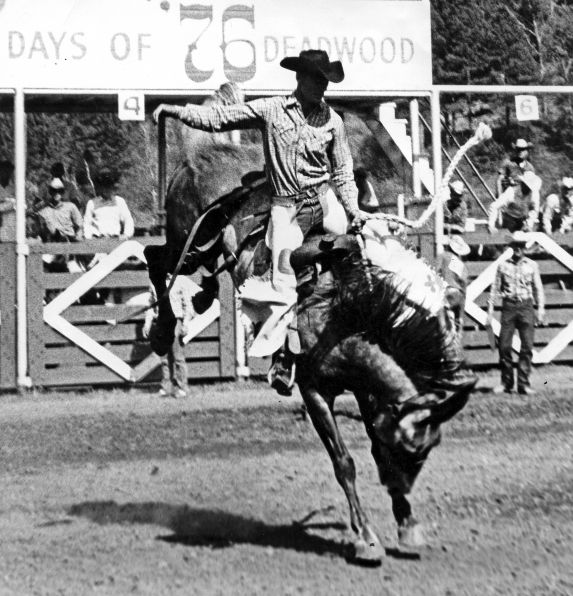
    Bill met his wife, Donna, in 1948 and they married soon after. It was in 1952 that Bill began rodeoing professionally, competing in the rodeos at Madison Square Garden and Boston Garden. “I rode down Fifth Avenue on horseback in New York City. They had a parade to advertise for the rodeo.” When Bill was embarking into rodeo competition, there were not many rodeo schools to attend or instructional films. “It was just learning by watching people and practicing with people,” Bill explains. Over the first few years, Bill experimented in all of the events, trying them out and seeing what he was best at. “I may hold a record in the rodeo business,” he said with a laugh, “I placed in nine different events. Bull riding, bareback, saddle bronc, team roping, bull dogging, calf roping, wild cow milking, the wild horse race, and the steer decorating up in Canada.” Bill settled in with bull dogging and saddle bronc riding and went to compete at the first NFR in both events. His brother, Don, joined him at the NFR in 1960, and they were the first brothers to compete in a timed event at the finals. They often hazed for one another. Bill says about bull dogging, “I weighed 163 pounds and I looked like a water boy to the Green Bay Packers.” He and his brother won the bull dogging at the Cow Palace three years in a row, from 1959 – 1961. Bill also won the saddle bronc riding in 1960 at the Los Angeles Coliseum in front of 98,000 people. He travelled down the road with his rodeo buddies Ed and Andy Curtis and Marty Wood, and Bill always admired Casey Tibbs when it came to rodeo idols. Bill was also travelling with his family to rodeos. “It was kind of a family affair. A lot of cowboys had their wives and kids with them.” One of the highlights for the Feddersen family was going on a free trip to Hawaii when Bill was invited to compete in a rodeo there. Another favorite memory of Bill’s is the day that Marty Wood gave him a pair of chaps and nick named him Good Times. “I always had a good time at the rodeo,” Bill remembers.

    When Bill retired from rodeo in 1962, he had ridden approximately 4,000 saddle broncs in his rodeo career and in all those rides, he never once was injured badly enough to go out in the ambulance. During his last year of rodeo, Bill went to 55 rodeos and placed 76 times. After retiring from the sport, he continued his job as a switchman for Rock Island Railroad. He had been working for the railroad since 1950, even through all of his years as a professional cowboy. “Jim Shoulders said he couldn’t believe that anyone could hold a job and go the NFR in two events. The railroad treated me real good.”

    Today, Bill lives with his wife of 65 years, Donna, in El Reno, Okla. They have two children, two grandchildren, and three great-grandchildren. Bill and Donna are sure to go watch the WNFR every year, which for Bill, brings back memories of the years he competed there during his rodeo career. Fittingly, Bill was inducted into the National Cowboy Hall of Fame in 2013, and he concluded, “After all those years of rodeoing, it’s an honor for me to make the Cowboy Hall of Fame.”

  • Bill Martinelli

    Bill Martinelli

    Bill Martinelli was born in 1935, in Glendale, California and grew up in Playa del Rey. His dad was a high school football coach and referred pro football games. Bill was the only one of his family to take a liking to rodeo. He began his rodeo career when he was in the seventh grade, riding bucking horses. That auspicious beginning continued into adulthood, with Bill traveling throughout most of the United States.

    He went Cal Poly and took a horse shoeing class – his desire was to rodeo.

    “In 1954, I went to Idaho with Bill Stroud, and rodeo’d all summer up there. In 1955, I went to Denver with John Hawkins on the train. I went to all the winter rodeos, and then started traveling with Alvin Nelson and the Teschers,” he recalled at the 9thAnnual Cowboy Museum Dinner Auction held at the Oakdale Cowboy Museum in Oakdale, Calif., September 16, 2006.

    After spending quite a bit of time in the Dakotas, Bill and his rodeo companions came back to California, where he met up with Jim Charles. Bill and Jim started hauling a bulldogging team for Harley May. Those trips took them to New York, Boston, and then back to San Francisco and the Cow Palace. When they weren’t traveling, they called Harley’s place home, dubbing it the ‘Rodeo Rancho.’

    Like a host of young men, Bill was drafted into the army, and served two years, from 1958 through 1960, with some of that time spent in Korea. After he was discharged, he came back to Oakdale, moving into the Live Oak Hotel with Jim. In those days, a room was 50 cents a day, with a bathroom down the hall. But, it was home. When he returned from the Army, he went right back to rodeoing, He met Kay in 1971 and they were married in 1972. “He was a 37-year-old bachelor,” said Kay. “We had a motorhome and took off rodeoing. My mother thought we lived like gypsies.”

    Bill’s rodeo exploits found him winning numerous awards. Of local notability, he won the all-round title at the Oakdale Rodeo in 1957, with his name being inscribed on the John Bowman trophy. He won the bareback competition at the Los Angeles Coliseum twice, and the bronc riding in Fort Worth. He won at San Antonio twice, and also at Phoenix. Three times, Salinas proved to be no problem, and he went on to add a notch for the Cow Palace to his winner‘s belt. He had five wins at Puyallup, Wash. He also won at Red Bluff, Long Beach, and Inglewood, all California rodeos. “I placed at all the other big rodeos, placing second at most of them.”

    He spent three months riding broncs in Europe for Rodeo Far West, a traveling Wild West show owned by Buster Ivory. The show traveled to Europe by freighter, taking 28 days to get there. When asked if that ocean trip reminded him of his trip to Korea, Bill wryly commented, “No. When I went to Korea, they got us there fast!”

    Over the course of his rodeo career, Bill went to the National Finals eight times, winning the average once, and placing all the other times. When not competing in rodeo, Bill earned a living by shoeing horses and all-around cowboy work, working for various ranchers in the Oakdale area. He also was the Winston Man – driving the Winston scoreboard around to the all PRCA rodeos. That became a family event, with his wife and kids traveling with him.

    When Bill reminisced, he has a twinkle in his eye and a laugh that comes from down deep as he told stories from days gone by. “When he told a story, one led to another,” said Kay.

    Bill is married to the former Kay Peterson. They make their home in Knights Ferry, and have raised four daughters, Mickey, Angie, Megan, and Tasha. They have twelve grandchildren.   Daughter Angie is serving in the United States Army and is stationed in Germany. “She makes her home in Switzerland and we have been there six times,” said Kay.

    Angie loved to rodeo with her dad. “One of my favorite times with dad was in Santa Maria ’96. I was entered in the barrel racing and dad in the gold card team roping. This was the first ever rodeo we had entered and traveled to together. We were both up in slack Saturday morning and Friday night I had gone out and had a pretty good time. I was moving really slow and late that morning and dad beat me to the arena. When I showed up, the barrel racing had already started and I was expecting a lecture, but instead I found my horse fed, saddled, and ready to go. We made a smokin run and placed in the go round. Dad just hugged me and said “nice photo finish”.”

    Bill quit competing in 1978 at the Cow Palace. “You couldn’t keep me away from rodeo. I don’t care if I wasn’t even entered, I was there. I’d watch it. That’s all I ever wanted to do. But when it was all over, it was all over, all done. I remember at the Cow Palace, I had a horse that was mediocre, and I thought, ‘if I ride him pretty well, I’m going to keep riding them, and if I don’t ride very well, I’m going to chuck it’ I was riding him pretty well, just giving it to him, and I thought ‘Well, shoot, I don’t have to quit.’ Then all of a sudden, I looked toward the ground, and I just pulled that rein across his neck and stepped off. And I thought, ‘Well that’s it. I’m supposed to quit riding them.’ And I did, I never got on another one”

    His love of rodeo continued as he took the scoreboard. When that stopped, he started running the side gate for the NFR, a job he did for ten years. “Bill was a good guy to have on the NFR crew as he was entertaining but was serious about his job,” recalled Shawn Davis, Wrangler NFR General Manager, who hired him to work the gate. “He kept everyone uplifted.” He worked his last NFR in 2005. He also went into the ranching and cattle business when his rodeo career ended. Bill suffered a stroke two days after his induction at the Oakdale Cowboy Museum in September of 2006 that left him unable to speak or work. His wife of 42 years, Kay, has been his voice ever since.

    “Dad is an amazing man,” said Angie. “He had mentored so many guys throughout the years. He and mom have always had an open door policy for our rodeo family. We never knew who would be camped out on our lawn. It was a great way to grow up.” When anyone mentions rodeo, Bill still gets a twinkle in his eye and for a brief period, he can focus on his life – and rodeo remains at the top of the list of his accomplishments.