Rodeo Life

Category: Back When They Bucked

  • Back When They Bucked with Billy & Pam Minick

    Back When They Bucked with Billy & Pam Minick

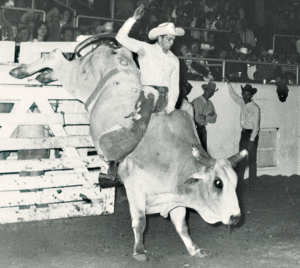
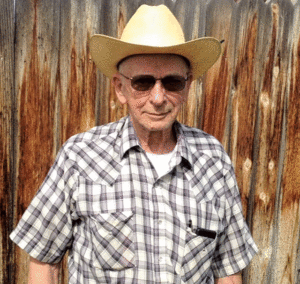
    Born January 10, 1939 in Fort Worth, Texas, Billy Minick’s dad was a boss gambler in Fort Worth. “Gambling in the late 40s and 50s wasn’t legal, it was tolerated,” said the 80-year-old.
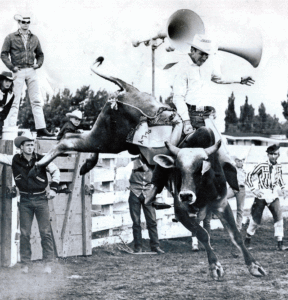
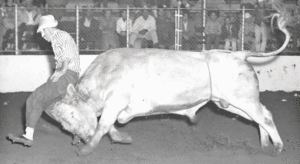
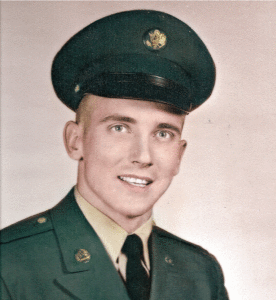
    Billy won the state high school All Around Champion in 1958, competing in steer wrestling and bareback riding. From there he went to the National High School Finals in Sulphur, Louisiana. “I was way in lead for all around; came off my second bull and broke my arm.” He was in the hospital in Lake Charles for ten days. While he was there, the coach from McNeese State College offered him a rodeo scholarship. “I went there a year and a half – got along good – but had ants in my pants and had to get back to rodeo. Fame and fortune were waiting.” A year into his rodeo road, in December of 1961, Billy was drafted into the Army, where he served as a medic. “How they made a medic out of the bull rider is a wonder.” He spent his time after medical school in Alaska. “I went to eight rodeos up there, winning the bareback at all of them, and won the All Around at the Anchorage rodeo.”
    His stay in Alaska was spent in a field hospital working with the natives, giving classes on childbirth and other things. “The Army taught me #1 to always be on time or early; #2 respect the system of bosses. You can fight it or take it for what it’s worth and get something out of it. I was bitter when I went in,” he admits. “I was peaking in my rodeo career – then I learned that I can’t fight it. You begin to realize how many people went through the same thing and died for this country to let us do what we do today.”
    Billy went right back to rodeo when he got out, starting off winning at the winter shows, but then hitting a cold spell and just getting by. He was able to make one NFR qualification in the bull riding, 1966. “I had a great year in ’66, leading one or two for the world championship most of the year, ending up fourth.” He had a job offer in 1967 and decided to take it, moving to Medora, North Dakota to start a show there. At the entrance to Teddy Roosevelt National Badlands Park, Medora is a tourist town that operated in summertime. The ranch/rodeo show was educational to the public and Billy remained there for two years. “I’d go to Spring rodeos and was approached by Harry Knight and Gene Autry to buy their rodeo company.”
    Billy had experience in production and he inquired where the rodeo company was located; they said San Antonio. “I asked what the temperature was and they said 72 and I took it.” He was able to purchase the Harry Knight Rodeo company and lease the Flying A ranch in Fowler, Colorado. “Harry Knight stayed with me a couple years and we went on to produce major rodeos they had from fall of 1968 to 1974 adding a few along the way. Billy sold the rodeo company to Mike Cervi in 1975.
    The year before, Mike had bought Beutler Brothers and combined them both and the combined rodeo companies dominated the major rodeos. Billy worked for Mike for four years, running Mike’s cattle ordering business, which was the largest order buying cattle company in Northwest. “The headquarters was in Caldwell Idaho, and we shipped thousands of head of cattle,” he said. “I loved that business – it was real people doing real things. I liked the action, and the numbers, I’ve always been good with numbers.” The job included working with a lot of people to ship the cattle all over.
    About 1979, Billy headed back to Texas. “I came back and had a ranch leased from Neal Gay.” Neal became his best friend, and Billy helped him with the Mesquite rodeo for a few years. Billy ended up quitting that and started messing around with the chrome plating business in Ft. Worth. “The company had a truck division and offered me and another boy 10% to get the sales up in the chrome business for over the road.” He built that up and added another side job, bringing him back to his love of rodeo.
    “When Billy Bob’s Texas opened April 1, 1981, I got hired to do the bull riding every Friday and Saturday night,” he said. The event is held in the former auction ring and is run like a regular rodeo – timers, announcers, secretary, bull fighters, etc. “It was a huge success. I had my own little operation in the bull riding. I was the only one that could stay on budget – I was in my element.” In December, Billy Bob Barnett, one of the owners of the 100,000 square foot club in Ft. Worth, made him an offer. “I took the club over as GM, not in charge of marketing, etc. just operational.” He stayed in that position through 1985.
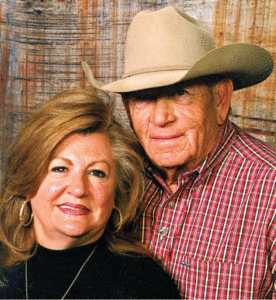
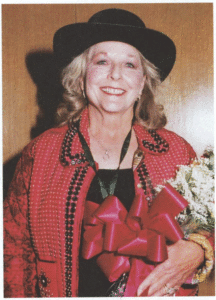
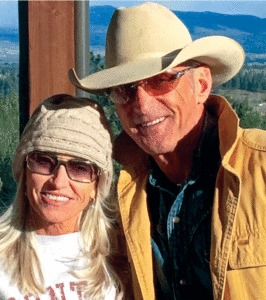
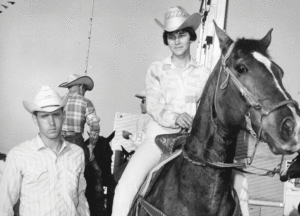
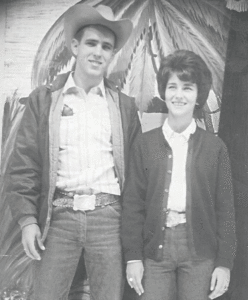
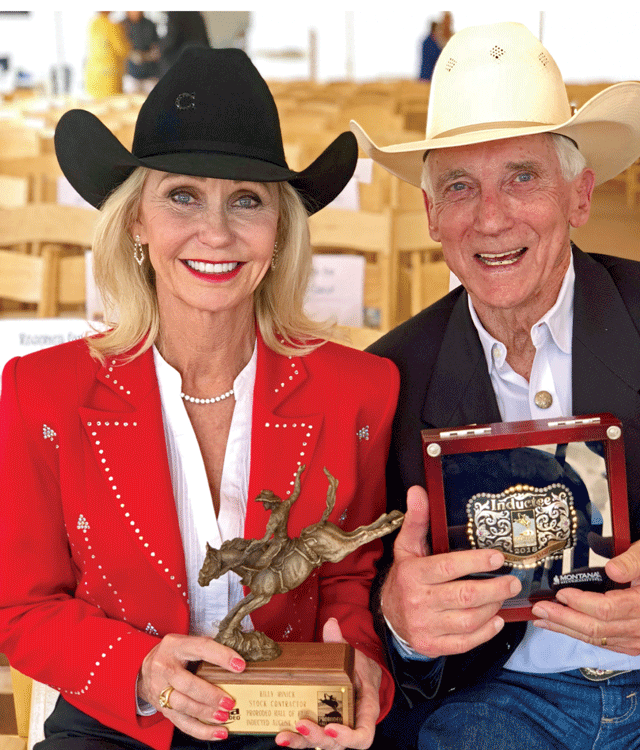
    In 1982, Billy’s life changed again. His wife, Pam, walked through the door of Billy Bob’s, there to watch The Beach Boys. “If it hadn’t been for Pam, I wouldn’t be here today,” said Billy. It was Pam’s first time in the Fort Worth Stockyards, and she fell in love with the brick paved streets and Billy Minick. That was in December and they were married the following May.
    In 1986, Billy Bob started to do a development in the Stock Yards and raised a lot of money from notes to fund the development. Billy and Pam decided not to invest, so they parted ways. Billy sold insurance and picked up broncs, Pam worked for various TV shows, the face of the interviews at the NFR. “We got by.”
    In 1987, country music declined in popularity the economy in Texas went south, and the development project failed to produce the budget necessary. Billy Bob’s fell into bankruptcy in 1988 and closed its doors Friday, Jan. 8, 1988. Three investors formed a partnership and reopened the honkytonk November 25, 1988 with a very conservative budget. “Holt Hickman was financing it. He came and got me and said would you go back to work and see if you can pull it out. Said I’d give it a try, only if I had total control of it all.” Billy walked back in the door Feb 1, 1989, and promptly hired his wife, Pam, to do the marketing. “We went to work cutting corners and getting this cleaned up and straightened out. We started breaking even and making a little money. Garth Brooks came along and changed music. Country turned around in the early 1990s and that was a big help.”
    37 years later, Billy Bob’s Texas is a success, with more than a million and a half people coming through the door each year. Billy Minick still comes “to the office” one day a week and Pam runs the marketing. The rest of his time is spent at their home, a little slice of heaven that they enjoy. “We have the best horses in the country and my biggest decision every day is where I’m going to lunch and playing golf.”
    “I’ve been fair with people – I come off the asphalt and made myself a cowboy,” he says of his life. “Rodeo taught me how to survive – I’ve always enjoyed real people doing real things.”
    He is quick to give credit to Pam. Married for 35 years, he calls her excellent. “I don’t like to take credit for anything. I couldn’t do it without that bond – it’s the relationships.” She’s excellent – married 35 years.

    Pam’s Story…

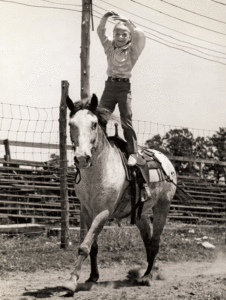
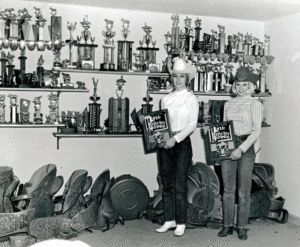
    Pam was raised on five acres in Las Vegas, Nevada; considered a ranch. Her family of four had no involvement in horses until Pam and her sister, Lynn, decided to give it a try. Her parents bought Rebel and Rio, quarter horses that were used to pull a wagon up and down the Vegas strip for advertising. Pam and her sister rode the $300 horses bareback for the first nine months – with no clue how to care for or even ride. Those two horses shaped Pam’s respect and love for horses and forever changed the direction of her life. She joined 4-H, showing her horse and entering all the events associated with the county fair, which included speed events. “They had 8 events; four speed and four show. One year I won high point in all 8 on the same horse,” she recalls.
    That led to rodeo. She started competing in the Nevada High School Rodeo Association. “Every high school rodeo is 400 miles away when you live in Las Vegas – every weekend you’re driving 400 miles one way. My mom would occasionally go, but for the most part, I went alone. My parents weren’t involved in rodeo, and we didn’t know any different.” She competed in breakaway, barrel racing, pole bending, and goat tying, finding the most success in barrel racing. Her horsepower changed over the years, and thanks to friends and mentors, she was able to compete at the National High School Finals.
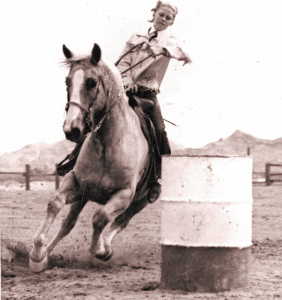
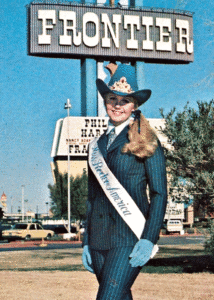
    After high school, she planned to go to UNLV, but before she could go to her first class, she won Miss Rodeo Nevada at the state fair in Reno. “Two months later, I won Miss Rodeo America,” she said. As the youngest Miss Rodeo America, she hit the road in 1973 to represent the sport. Traveling by herself was nothing new to her, having traveled to several rodeos, including National Finals, on her own. “For me, it felt like rodeoing, and I’d worked in high school in the PR department of a hotel, so publicity is what I knew, so when I would get into town, I was an aggressive publicity monger. I did every interview possible,” she said. “I felt the job was a PR person. The committees paid $15 a day and required you to go to Rotary breakfast and a few others, but I would go over and above those; I created my own path.”
    After her reign, she lived in Arizona for ten years. During that time, she continued to pursue her career in front of huge crowds and television; commentated for the NFR on and off since 1976, commentating for PBR for 12 years, 26 shows a year; announcing the Houston Livestock Show and rodeo – the first woman to announce that event. “I don’t like being a woman announcer,” she admits. “I like being a sideline reporter where I can do some investigative stuff.” She ended up in Ft. Worth to announce a rodeo. “That’s where I met Billy.”
    The duo have continued to manage the famous Billy Bob’s of Texas, Pam as the marketing director. “I’m here 9-5 everyday Monday through Friday – I love it because it’s a challenge,” she said. Along with that job, she produces Gentle Giants, a show she shoots, hosts, and edits every week for RFD-TV. When she’s home, she rides all her horses and really feels she has come full circle in her life.
    “I’ve never made big plans, I believe in God’s plan. Sometimes I have to be patient – I never thought I’d be Miss Rodeo America, or the first lady sports commentator; but I never looked at it as setting a goal,” she said. “I was in the right place at the right time. I’ve always been prepared for the next thing that God has for me. Every day I sit on my porch and look out where I live and say I’m blessed.”
  • Back When They Bucked with Arden Clement

    Back When They Bucked with Arden Clement

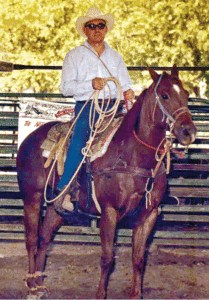
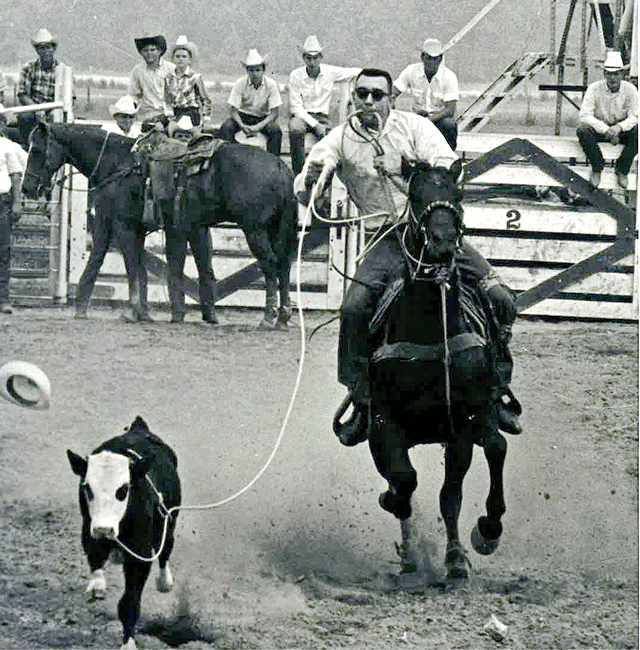
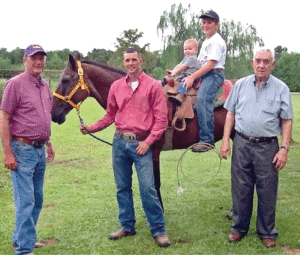
    Winston Churchill said, “We make a living by what we get, we make a life by what we give,” and the life of Arden Clement of Kinder, Louisiana, has been all about giving to the future of rodeo. With a Cajun heritage, speaking only French until starting school, Arden began training colts in his youth and quickly became a go-to cow horse trainer for many of the local farmers. In high school, he competed in the inaugural Louisiana High School Rodeo Association rodeo in 1950; and in 1951, riding a sorrel horse Red Man, in cutting, calf roping, and bulldogging, he finished the year as the LHSRA Reserve Champion Calf Roper, Reserve Champion Cutter, and Reserve Champion All-Around Cowboy. Red Man, owned by Sidney Marcantel of Welch, Louisiana, was sold to Wild Bill Elliott, who campaigned the horse in his shows for several years before selling him back to the Marcantel family for his retirement. After high school, Arden dedicated his life to training horses and kids for their own futures in rodeo, retiring from it in 2004, at the age of 72. He stepped back into the training arena in 2011, when his young great-grandson, Cole Ford, came to him with aspirations of becoming a calf-roper like his great-grandfather, and he was happy to get the fourth generation of cowboys started just right.

    Born in 1932, just after The Great Depression, Arden began training horses on the rice farm where his family worked, to ride the fields and doctor cattle. His knack for breaking young horses for work led him to training horses for many local farmers, charging them $10 per month to break their 2-year-old colts. Arden’s parents, Elza and Minnie Pearl Clement, counted on Arden to help on the farm, along with his three younger sisters, Rena, Dewanna, and Veronica. “I would break horses to make a little spending and rodeo money while I was in high school. My sisters would help me some, Veronica competed in rodeo through high school and would help work the cattle and the chute as I was training roping and cutting horses. Rena would help unless I raised my voice at her, and she’d head straight back to the house. At the end of the day, when I was done training on the colts, my sisters would ride them in the shade of a pecan tree grove by the house to cool them off, it was a pretty sight.” Arden would load horses up a ramp into the rice truck beds rigged with cattle racks to go to rodeos. “We also used old Chevy one-seater cars with 70-75 horsepower engines that would only pull at about 30-miles-per-hour, to haul trailers with no springs and wood boards on the sides. One time we were going to a rodeo and looked back when we heard something, to see boards falling off the trailer. We just picked them up and tied them back on, so we could make it to the rodeo.”
    After high school, Arden worked for a short time managing a hardware store in Elton, before being hired by George Grimshaw of Bunkie, Louisiana to train roping and cutting horses. “Mr. Grimshaw asked me if I needed someone to help me with the horses, and I introduced him to my good friend Billy Duhon. I had taught Billy how to rope and train horses, and he worked there with me until I left that job.” Billy Duhon was a lifelong friend of Arden’s and ended up spending his life training cutting and roping horses as well as competing as a steer wrestler for many years before his retirement. “I made the mistake of teaching Billy all I knew about competing and training, and after that I couldn’t beat him. He was athletic and knowledgeable, he just took to it like a duck takes to water.”
    Arden worked for Mr. Grimshaw for a year before leaving, “I went to work for Calcasieu Marine National Bank and started from the bottom up. I worked my way up to assistant vice president and manager of the bank during the 38 years I worked there before retiring.” While working at the bank, Arden continued to rodeo and train cutting and calf roping horses; and found a true enjoyment in helping aspiring rodeo athletes get a start in rodeo. He had a friend build an indoor arena for him at his farm, so he could give lessons year-round. “I could have a bad day at work but get home and ride or train on a horse and it would just relax me.” Arden and Billy remained friends but also worked together to help many get started in rodeo; including Arden’s son from his first marriage, Brent, and Billy’s son Steve Duhon. Steve went on to become a three-time world champion steer wrestler, and Pro Rodeo Hall of Fame Cowboy. Brent competed as a steer wrestler and won the champion title in the Louisiana Rodeo Association in 1981. The two friends were also instrumental in helping world champion steer wrestler, Mike Smith get started. “We both helped them, but Billy was really the champ teaching steer wrestling, I did most of the hazing.”

    Arden helped form the Louisiana Rodeo Association, now known as the Louisiana Rodeo Cowboy Association, remaining a member for many years. He competed in the PRCA for two years as a calf roper before a knee injury kept him home. Arden also competed in the Old Timer’s Rodeo Association, formed in Texas, and although he was one of the oldest in his group, he enjoyed competing in the association for several years before his retirement. Arden remained supportive of the LHSRA from its beginning and was honored at a LHSRA state finals rodeo a few years ago. His son, Brent, explained, “My dad has been active in rodeo his whole life. He’s helped people, trained horses, loaned horses, and let many come rope at his arena. At the LHSRA state finals, at least 50 to 70 people of all ages stood up that he had personally helped, and there have been so many more. He did it because he loved it.”
    Arden married his second wife, Betty, in 1970, and helped raise her children, Michael and Bill Creasman, and Sally Daigle. He was glad to share rodeo with them as they were raised, as well as several of their friends. Brent, who after competing in the LHSRA, amateur-rodeoed and college-rodeoed for McNeese State University, had a son, Cody Clement, who also competed in LHSRA as a saddlebronc rider. Cody’s stepson, Cole Ford, currently competes in the LHSRA as a calf roper. “Cole came to me and said he wanted to calf rope, so I started him on the dummy and he just took off, I was really glad to get him going in rodeo. Now Shane Hanchey has taken him under his wing and has really brought him along to where he is now.” Shane found Cole a new strawberry roan calf horse named Thumper, that Cole has had quite a bit of success on. When Arden checked Thumper out, they were surprised to discover that Arden had trained the gelding’s mother over 20-years-prior, as well as the gelding’s sister; and now the offspring of that mare is putting his great-grandson in the winning ranks of rodeo; evidence of the lasting effects of what Arden has given to a sport he loves.
    “Rodeo has changed so much over the years, there are better schools, better equipment, and better horses. Kids can go learn more about roping in a 3-day clinic than I learned in 6 years. What hasn’t changed is how good it is for the kids. I hear people say all the time that horses and rodeo fees are so expensive, but I tell them, ‘would you rather pay fines to get your kid out of trouble, or pay rodeo fees to keep them out of trouble?’ When it comes down to it, paying fees is cheap.”
    In his retirement, Arden enjoys going to the coffee shop to drink coffee with friends, reading the paper and taking naps after dinner. He still goes to the LHSRA rodeos that are close to home and enjoys seeing many of the results of the help he’s given over the years, especially his great-grandson that is starting down his own rodeo path.
    Looking back, Arden appreciates Zack Marcantel for furnishing him good horses and taking care of him throughout his rodeo career; and Doug Habert and family for furnishing his indoor arena for 20 years before he retired.
    “I’ve gone to every rodeo I ever wanted to go to in my life, except Calgary. I had a good career, met a lot of people, and saw a lot of things, I can’t complain.”

  • Back When They Bucked with Joe McBride

    Back When They Bucked with Joe McBride

    Although Joe McBride spends many hours behind the camera lens now, he started out in front of them as a rodeo clown and bullfighter during a rodeo career that spanned nearly 30 years. Joe has been capturing the essence of rodeo through photography at International Professional Rodeos, not missing a single IFR in Oklahoma City, Oklahoma since he snapped his first shot there in 1992. The Brooklyn born 79-year-old also takes photos at multiple rodeo events as he travels across the northeast on his off-time from his full-time position with the New York State Department of Corrections. Joe just passed his 35-year-mark of service to the job and has no plans to retire anytime soon. He watches inmates from his tower perch 50 feet above them at the Shawangunk Correctional Facility in Wallkill, New York. “When people ask when I’ll retire I tell them on the first…the first chance I get! But really, I have no intentions to retire, I’m like a worker bee, what would I do if I wasn’t working, sit on the couch and watch tv?”
    It was a very different line of work that filled Joe’s life before beginning his career with the corrections department. Joe had a fondness for horses, and an intrigue for the cowboy lifestyle. His mom, Eva Catherine McBride, an executive for IBM at their corporate headquarters in New York, fed her son’s passion by taking him on annual trips to the rodeo at Madison Square Garden in New York City, and even gifted him with a white gelding named Silver when he was 15-years-old. When Joe was 16, working at Camp Molloy in Mattituck, Long Island as a horse wrangler and trail guide, he went to the Islip Speedway Rodeo in Islip, Long Island and approached the owner, Gerry Partlow, for a job. Gerry let the teen exhibition ride on a bareback horse that night in 1956, and although he landed upside down into the fence after being bucked off in just a matter of seconds, Joe was drawn in to a life he wanted more of. “As I stepped out of the arena, my buddy asked me ‘How was it?’ and I said I loved it! I want to do it again!” Joe worked at a couple other rodeos for the Black Diamond Wild West Show that season, and at one of them, after sleeping on a bale of hay with a pair of clown baggies as his bedding, he remembers pulling them on just to see what they looked like, not knowing what a big part of his future he had just stepped into.

    Gerry agreed to let the aspiring cowboy have a job the next year if he came to Milan, Illinois the following spring. So, against his mother’s better wishes, in March of 1957, Joe dropped out of his studies at the School of Aviation Trades in Manhattan, and he and his friend Paul Dobin drove out of town in his Neptune green 1952 Ford pickup truck, headed for his future. “I thought spring started in March, and from watching television, I thought we were headed for a life that all cowboys lived, herding cattle on a ranch, sleeping in bunkhouses and then putting on rodeo shows as a sideline.” But, when Joe and Paul arrived in Milan to start their cowboy careers, they were taken aback when they found out the lifestyle of the wild west rodeo shows was not quite what they envisioned. “I was looking for the Black Diamond Ranch, but when we found Gerry Partlow, it ended up that he didn’t have a ranch; he rented a pasture to keep the horses turned out, and sold all the cattle but one bull after the season so he didn’t have to keep them through the winter, and he lived at home with his parents.” Even after attempting to sleep a few nights in Joe’s truck in the cold and snow, the two cowboy hopefuls were determined to make it work and finally decided to get a motel room and call their moms, who began sending them money to get them by. The friends worked several odd jobs and found a more permanent housing solution until May came along and the rodeo shows started up. Joe hauled a trailer that served as a stripping chute at the rodeos and was filled with the stakes and wire used to set up the rodeo arenas, and they left for the first rodeo of the season in Dexter, Missouri. “My job was to help set up and tear down the arena at each rodeo, and ride one bareback horse and one bull every performance.” There was another cowboy that hauled the bucking chutes trailer, and part of setting up the arena entailed taking the tires and wheels off the trailer, setting it on its axles at ground-level for the rodeo, covering the hubs with burlap sacks in case a cowboy was to land on them. They would then put the tires and wheels back on as they tore down the arena, readying it for travel to the next town. Joe spent several years working these traveling rodeo show seasons, riding and entertaining the crowds as a rodeo clown. In 1958, he added bullfighter to his list of job titles and often rode bulls while wearing his rodeo clown costume.
    Although rodeo is known to be big in the west, Joe made quite a career working as a rodeo clown and bullfighter in the northeast. Besides working for the Black Diamond, Joe worked for many other rodeo companies, such as Lou LaFalce and The Lazy L Rodeo Company based in Highlands, New York, Dick Quintoni who put on rodeos across Pennsylvania and New Jersey, the Crazy Horse Rodeo Company, Dodge City in Patchogue, Long Island, and for long-time IPRA rodeo contractor, Andy Compantero who owns Double R Rodeo Company. By 1965, Joe had given up bull riding, and was mainly perfecting his rodeo clown act. “In 1965 I bought a 1962 Ford F100 for $15 and turned it into my clown car. I moved the rear axle forward 3-or-4-feet so that it put the truck off balance. In my act, as soon as the other clowns got in the back of the truck it would buck and seesaw as I drove around the arena. The last part of the act a ‘bomb’ would go off, and then I’d pull a pin inside the truck that would flip the bed of the truck up and I’d drive out as the other clowns were dumped out onto the ground. As far as I know, it was one of the first clown trucks like it.”
    Joe Jr. was born in Brooklyn, New York in 1939 to his parents, Eva and Joseph F. McBride, who divorced when he was just 3-years old. Joe Sr. was a was a welder in the Brooklyn Navy yard and joined the Navy, becoming a Seabee and working as an underwater welder to repair damaged ships during World War II. He was also a golden gloves middleweight boxer.

    In February 1960, Joe met Carolyn Mirsky as he worked at Carroll’s Riding Academy in Brooklyn, by December of 1960 they married, and they ended up settling in the Middletown, New York area. In addition to rodeos, Joe worked many jobs ranging from installing chain link fencing to delivering produce and working as a driver for Sears for nearly 15 years. The couple had three children, Lisa, Joey, and Dennis, before divorcing in 1967.
    Photography was once just one of the many acts in Joe’s clown act arsenal, as he made the crowds laugh with delight as he wiggled and joked under a photographer’s cape with an exploding camera; but truly his passion for photography began with his mother. “My mom loved photography and bought me my first camera when I was about 13. Once I was clowning and fighting bulls, she gave me one of her old cameras and encouraged me to take photos at the rodeos; but I was so busy working I didn’t have time to take many. I finally upgraded to a Sears Camera, and then bought a Nikon and over the years I began taking photos at more and more rodeos. I really do it mostly for enjoyment, and now it’s my way of getting in to the rodeos without paying!”
    Although Joe didn’t finish his aviation studies in high school, planes were destined to become a big part of his life, and he still owns a 1962 Cessna 172 plane that he flew for many years, logging over 1000 hours of flight time. He is instrument rated and has a commercial rating on his pilot’s license. Joe also enjoyed traveling the roads on his 1993 Harley Davidson up until just 3-years-ago. His daughter Lisa May McBride currently lives in California, but recently passed the test to begin her own career with the same department of corrections as her father, so she will soon be relocating to New York. She has a son, Shawn that is married and living in California. Joe’s son Dennis also resides in California with his wife, Angela, where he manages a water treatment plant, and they have two children; daughter Lauren lives near Redding with her husband, and their son Chandler recently finished four years of service with the Air Force. Joe’s oldest son, Joey, lives on a 182-acre farm in New York, where he farms hay and he also drives double-trailer trucks for UPS, staying in town with Joe 5 nights each week. Joey and his wife Lisa Marie have 2 sons, Hunter and Logan that are 10 and 9-years old respectively, and 2 married daughters, Rachel who lives in Tennessee with her husband, and Heather who lives in upstate New York with her husband and just recently started in the training academy for the New York Department of Corrections.
    Joe McBride followed his passions in life and found happiness comes when you work for it, especially when what you do for work is a passion. He has literally spent a good portion of his life ‘clowning around’ and he wouldn’t have done it any other way.

  • Back When They Bucked with Don Huddleston

    Back When They Bucked with Don Huddleston

    story by Shiley Blackwell

    Don Huddleston’s name rings across the steer wrestling world as one of the greats. The Talihina, Oklahoma cowboy was an eight time NFR qualifier and has spent his days contributing to his community and the rodeo realm. “I’ve had some good guys beat me at bull dogging, and I’ve beat some good ones,” Don says of his 37-year career. “It was a lot of fun either way.”
    The 84-year-old Oklahoma native began his rodeo career during his teenage years in what was then-known as “FFA Rodeo.” “We didn’t have high school rodeo. The agriculture departments in different schools around here put on the rodeo,” Don says. “There was one in Clayton and one in Tuskahoma, and I’d make them every year and I got to where I could win.”
    During this time, a few boys from Kansas moved to Tuskahoma where Don went to school. A friendship formed and the group began rodeoing together. “We started branching out and going to stronger rodeos. I got to winning bulldoggings and bull ridings. That’s kind of what got me started.”
    Enthralled with his new-found love of rodeo, Don took every opportunity to improve his steer wrestling. “When I was going to school in Tuskahoma, we had one movie house and that was in Clayton. I went up there and I met Tater Decker and his wife, Jo, and they had bought a place down there in Clayton. We got to talking that night and he said he was going to build a practice arena. I said, ‘Well, if you want to, I’ll come help you then we can both practice down there.’ He said, ‘That’s a deal.’”

    That was the start of a building the arena that took four years and a friendship that lasted a lifetime. Tater and Don built an arena, then talked a stock contractor into letting them use a set of steers one winter in exchange for feeding and caring for them. “The bad steers we made better, and the good steers we didn’t use too much. He (the stock contractor) came out with a good set of cattle that year, so we started getting a set from a contractor nearly every year to straighten up.”
    After a few years of straightening steers out and practicing at Tater’s place, Don went to a rodeo in Ada in 1955 where he took third in the average and third in the go-round. “That showed me that I could rodeo with the rest of them since most of the professionals were there,” Don says. “I just went from there and got my RCA card.”
    This eventually led to him buying his Pro Rodeo card in 1958, leading to NFR qualifications in 1960, 1961, 1963, 1964, 1965, 1966, 1969-71. At Don’s first NFR, he set the record in the Dallas, Texas arena with a time of 4.0. Then, at the 1963 NFR he set the arena record in the Los Angeles, California arena with a 3.9. He also set the arena record in Oklahoma City with a 4.1.
    “In those days, they had the beefy, buffalo-type cattle, and at the first of the National Finals they let Lynn Butler have the steer contract. He’d buy a set of cattle in the spring, turn them out on the blue-stem grass in western Oklahoma in the summer, and then feed them 90 days before the rodeo… That made it a hustle to just be able to throw one down. When we started the National Finals, we had to bulldog steers weighing from 800 to 1000 pounds. You can imagine the hustle that that was,” Don comments.
    Between 1968 and 1982, he would fly his private plane to rodeos where a fellow cowboy would meet him with a steer wrestling horse. Don, who served as Latimer’s County Commissioner, was talked into running for office in the Oklahoma House of Representatives, which he won and he was a state representative for District 17 for two terms – 1971-74. Fellow politicians would join him on these “rodeo flights.” His other passengers included cowboys that were up at the same rodeos.
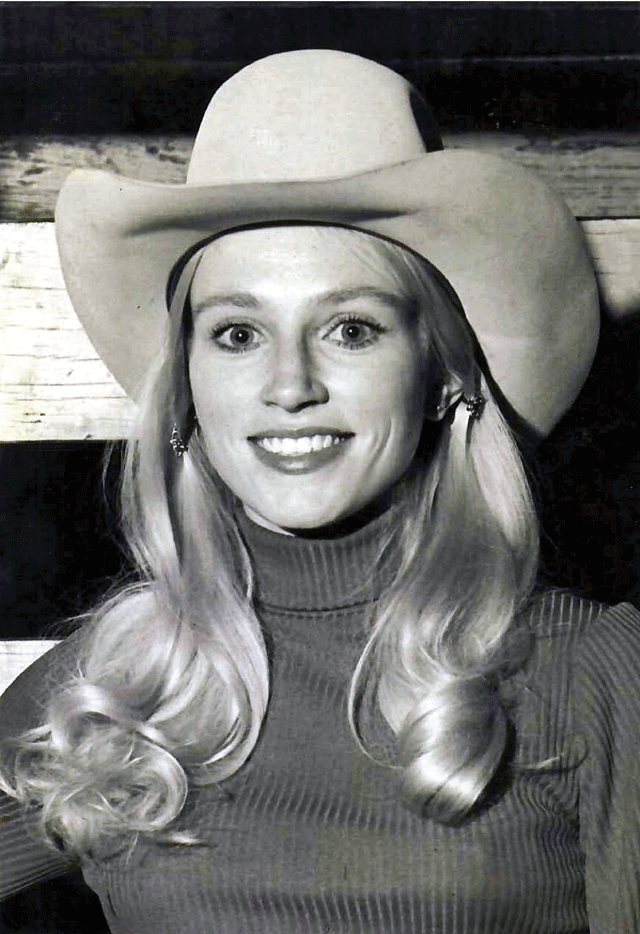
    “Most times, there in the house, there would be enough country boys there that would want to go to a rodeo with me. I had a six seat airplane so I’d load five up in there. One year, I loaded all of us up and we went to Helldorado Days in Las Vegas, and I won it. I couldn’t have had a better fan club there,” Don chuckles, “That’s the way it worked. There would always be people who wanted to come, so they’d jump in and come with me. I made sure that everyone who wanted to go could go.”
    During these years of flying to rodeos, Don had horses scattered throughout North America that he bulldogged off of. “I had several horses that went to California, a few in Canada, one in Idaho, another in Colorado. I sold them like that – all scattered out – then I rode them when I flew to rodeos.”
    Don’s arena on his ranch in Talihina became a gathering place for steer wrestlers looking to improve their skill and find the right horse. When Don retired from rodeoing full-time in the 80s, the arena they built in the 1970s continued to be a place for all the bulldoggers to gather. He and his twin brother, Dale, made many horses and competitors in this arena.
    Over the years, his “matchmaking” skills have helped dozens of cowboys find horses that have carried them to big wins. “I bought one horse from a guy over here in the county seat. He roped on him but he was just too charge-y. He told me he was going to sell him so I bought him and made a bulldogging horse out of him. I sold him to a kid in Arkansas and the first few months he had him he won $6,400 on him.”
    Don’s repertoire, as well as his ability to help cowboys find the right horse, brought in steer wrestlers from all over the country. “I had many bulldoggers here nearly every day,” he comments. “I trained a lot of bulldoggers, and many went to the finals.” Along with Don, there were many unmentioned cowboys that helped with the practices – opening a gate and pushing cattle.

    In his years of coaching steer wrestlers to success, Don emphasized the importance of attitude. “To win any rodeo contest, you need to have a good attitude. You can’t get mad at yourself, the steer, or your horse, then go to the next one and win anything… If someone has a good attitude, they’re worth working with and if they don’t have a good attitude, you might as well forget them.”
    He also served as the second vice president for the PRCA, from 1975-1980. Dale Smith was president, and Jack Roddy was 1st Vice President. After that he assisted Frank Shepperson as the steer wrestling director. His name was on the building at the ProRodeo Hall of Fame in Colorado Springs as being on the board when it was decided to build the building.
    In addition to steer wrestling schools, the Huddlestons’ arena also quickly became a place for rodeo competitors of all ages. “We filled that arena with bulldoggings and rodeos for junior cowboys and cowgirls. I had the first cancer society rodeo right here. We donated all the proceeds to the American Cancer Society in 1981.”
    They also started the now-famous Huddleston Ranch Bulldogging, which hit 46 consecutive years in May. The event, held over Memorial Day each year, brings top talent to Oklahoma for two days of competition. “Last year, we had several guys at the bull dogging who went to finals this year,” Don says. “There’s lots of gold buckles at this event.”
    And during these decades of bull dogging schools, ropings, and rodoes on the ranch, family has been at the center of it. “Our kids were raised right up here on the ranch, and they all rode horses,” Don says. “Lacee started hazing down here.”
    Don and Joye married in 1960 and traveled 17,000 miles on their honeymoon. They each had a child (Joni Grammar and Greg Vanderwagen) before they married and then they had two of their own (Gala Dawn Huddleston and Kevan Don Huddleston). They bought a ranch from Joye’s family in 1960, and still call it their home 58 years later. “We’ve been married a long time,” Don says. “And we’ve had a good life-the best life.”
    The ranch is now being run by Gala and her family and the tradition is being carried on under the careful direction of Don.
    Don has done a lot for rural Oklahoma, continuing the tradition of letting any child that had an interest in a horse to help them find their passion.

  • Back When They Bucked with Jane Douthitt

    Back When They Bucked with Jane Douthitt

    The wife of one of the biggest rodeo stars of his time led an interesting life of her own.
    Even though Jane Douthitt often lived in the shadow of her husband, Buff Douthitt, she managed to be involved in a variety of activities.
    Her life started on June 21, 1936, the daughter of R.C. and Ola Francis Kirkland, near Knox City, Texas. Her father was a rancher, and she and her brother were always on horseback. Living fifty miles from the nearest grocery store, horses and riding were their entertainment.
    She graduated from Guthrie High School in 1952 and went to college at Texas Tech in Lubbock, majoring in business. She did not compete in collegiate rodeo; she had other plans. “I had my mind made up,” Jane said. “I didn’t have time to do anything but get my education. I had my life to get on with, in my mind.”
    After college, she moved to Wichita Falls, where her dad’s kinfolk lived. She competed in barrel racing at amateur rodeos, riding borrowed horses. At the time, local ranchers would sponsor barrel racers, furnishing the horse and paying the cowgirl’s entry fees, and that’s how Jane rodeoed.
    She competed in several pageants, finishing as runner-up for Miss Wichita Falls Queen and winning the Miss Rodeo Archer City title in the mid-1950s.
    Her brother was in college in Wichita Falls when she met the man who would become her husband.
    Jane had admired the looks of Buff Douthitt, a tie-down roper, steer wrestler, and roper in the wild cow milking (at that time the wild cow milking was often included in pro rodeos) when a picture of him with a group of other cowboys at Madison Square Gardens in 1946 hung in the ranch office where her dad was general manager. At the age of ten, she had pointed to his face and declared to her mother, “here’s the man I’m going to marry.”
    She convinced her brother to take her to Vernon for a pro rodeo, and at the dance after the rodeo, Buff asked her to dance. She didn’t recognize him; he wasn’t dressed western but had on dress clothes and dress pants. “Gee, I thought he was cute, but I was determined that I was going to find me a pro cowboy,” she said. “So I turned him down. What a mistake that was.”

    The next day, on a date with another cowboy, she was introduced to Buff and she realized who he was. “I knew I had made a big mistake,” she said.
    She dated a couple of cowboys, seeing Buff occasionally, but he never paid any attention to her. In January of 1956, she was about to get his attention. She was at the Ft. Worth Rodeo, sitting with the contestants’ wives and girlfriends, looking down the stairs where the contestants were. “I was conniving,” she laughed. “I saw him start up the stairs, and I just happened to be going down the stairs.” This time, he stopped; they shook hands and talked a bit, and he asked her to the dance that night.
    By the time the dance was over, they knew they would marry. “I say it was God,” Jane said. “It was His design, from start to finish. It was wonderful. We were still just as in love to the day he passed away.”
    They married in September of 1957 and rented a house, no bigger than a studio, in Wichita Falls. He rodeoed and Jane traveled with him, as her job with the oil company allowed. Their first child, April, was born in 1959.
    In 1958, Jane quit work to travel with Buff. At that time, they lived in Throckmorton, where her parents had moved. Three years later, Buff helped train race horses at Hialeah Race Track in Miami, Florida, and Jane and April spent the time with him. Buff and Jane bought a used Air Stream Trailer to live in while in Florida.
    In 1962, the family moved to Ardmore, Okla., where they had some horses and cattle on fifteen acres. Buff continued to rodeo and that year, their son Jason was born.
    It was in the 1960s that Jane took another role with rodeo. She had timed rodeos for Beutler Bros. but decided if she was on the road with Buff, she could be earning some money, too. She learned to secretary rodeos and worked for Hoss Inman, Mel Potter of Rodeos, Inc., and others. This was before computers, when a secretary had to do all the work by hand, including typing day sheets. Often, Buff would drive while she balanced a typewriter on her knees and put together judges’ sheets. “I have always said that if you can (secretary rodeos) and not make a mistake, you can do anything in the world. Boy, what a responsibility,” Jane said. “I loved it.”
    While Buff rodeoed and his family and children traveled with him, they traveled in a car with a horse trailer, staying at hotels. But that year, the price of a room at the Holiday Inn went up $10 a night, “and that was bad news for every cowboy,” Jane remembered. That fall, Buff started planning and designed “horse house trailer”. He, along with a carpenter, in the Douthitt garage, started building a trailer that included a compartment to house horses. When spring came, the Douthitts left for the rodeo trail in their own custom designed horse house trailer, and everybody who saw it wanted one, Jane said. For several years, Buff tried to build one or two in the slow season to sell in the spring.
    In 1969, Buff quit rodeo competition and the family moved to the Ft. Worth area, where they bought a small manufacturing plant to make the horse house trailers. Two years later, they couldn’t keep up with the demand, expanding their manufacturing area and making not only horse house trailers but travel trailers, motor homes and hippie vans.

    Then the oil embargo hit in 1974 and fuel was in short supply. The general public cut back on driving and “cowboys quit pulling trailers,” Jane said. The heyday of their business was over.
    But they adapted to the times, and instead of building trailers, switched to contracts with the U.S. government. They built latrines for the troops in South Korea, relocatable housing, “skid towns” – portable housing for pipeline workers, and residential housing that ended up in Houston. Their products went to a variety of foreign countries, including Syria, Saudi Arabia and Iran, countries in Africa, and to Hawaii. Their business, called MBM International Inc., was headquartered in Ft. Worth. At its height, it employed over 3,500 people in the Dallas-Ft. Worth area.
    In 1981, they decided to retire and sold the business to a foreign company. Jane stayed on with the company for another year, helping them get on their feet. The couple decided to move to Hawaii, but it wasn’t as much fun to be residents there as it was to be tourists.
    So they flipped a coin to determine where their retirement home would be. Buff had grown up in New Mexico, Jane in Texas, and the flip decided the state. New Mexico won out, and the couple moved to Santa Fe. They became involved in the state’s movie industry, providing livestock for movies. Buff served as a movie consultant and played some cameo roles.
    Jane took a position with the Edgar Foster Daniels private foundation in Santa Fe, a foundation that funds operas around the world. It was a job she loved. Buff team roped locally, and Jane usually went with him. She loved team roping and she loved watching him compete. Together, they competed in the ribbon roping at senior pro rodeos. Jane ran for other ropers, too. “I could really run at that stage of my life,” she said.
    In 2006, tragedy struck. At the age of 43, their son Jason died in a gun accident. It hurt Buff and Jane terribly. “That about killed us both,” Jane said. She retired from the foundation.
    In 2014, a horse was tangled in an arena panel when Buff went to release him. No one was around when the accident happened, but it appeared that the horse drug Buff before kicking him, breaking vertebrae C1 through C5, his shoulder and four fingers. Doctors put four metal rods and 22 screws in his neck, and he was hospitalized for several months. He died in September of 2016. Jane had lost her business partner and husband. It took over a year for her to move through her grief.
    Now she stays busy, with an office complex she purchased in downtown Santa Fe. She loves to read, travel, and spend time with April’s sons, who are 23 and 18 years old.
    She looks back on her beginning, a modest start on a ranch in Texas, and is sometimes amazed at what she and Buff did. “I still wonder how two kids raised on ranches could accomplish what we did.”
    It was a good life, she said, and rodeo was a big part of it. “I loved rodeo. I loved watching Buff” compete.
    Buff was inducted into the National Cowboy Hall of Fame in 2001 and Jane was honored at the Ladies of Pro Rodeo Banquet in Las Vegas last December.

  • Back When They Bucked with Buddy Cockrell

    Back When They Bucked with Buddy Cockrell

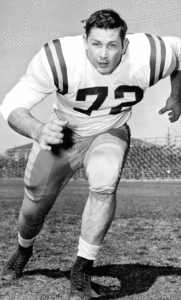
    Buddy Cockrell got to do a wide variety of things throughout his life. The Texas-born cowboy competed in high school and college rodeo, played college and professional football, owned ranches in Australia and Brazil and a gold mine in Costa Rica. He was born in 1934 and raised by his mother, Alice Gray Cockrell, and maternal grandparents, O.H. and May Etta Ingrum east of Pampa, Texas, on a farm and ranch.
    His granddad started him cowboying and working when he was six years old, and Buddy learned to rope from Perry Franks, a hired hand on the OK Ranch where they lived, a well-known Texas roper and Turtles Cowboy Association member.
    Buddy learned to steer wrestle in an unusual way. His uncle had horned purebred Hereford cows, and there was a cattle trail on the place, not far from the house. On horseback, Buddy would run a Hereford down the fence line, diving off his horse and onto the cow. He wasn’t usually able to throw the cow, but it gave him the chance to learn how to plant his feet, slide and get an arm hold. One day, one of the cows’ horns broke, and his granddad asked how it happened. Buddy never said a word, and no one found out. And when he began steer wrestling the real way, with a hazer, “he said he never knew how easy it was,” his wife Geneva said.
    Each morning, he and his older brother Lee would milk before school, get on the bus and ride twelve miles. They attended a one room school till they got to junior high, where Buddy’s height and size gave him an advantage in sports. He was a natural athlete, lettering in the shot put, basketball, and football, and playing defensive end and offensive tackle in football.
    In 1953, the year he graduated, he played on the Pampa High School basketball team, which was state champs. He was the regional heavy weight Golden Glove boxing winner and was chosen to be on the National High School All American Football team. He was also competing in rodeos by then, match roping other cowboys and winning. Buddy sharpened his roping and steer tripping skills by gathering and branding calves and doctoring for screw worms.
    The summer after high school graduation, he competed in the Texas High School Finals Rodeo and won the boys’ all-around saddle by placing in the calf roping and winning the steer wrestling. He competed in pro rodeos that summer, winning some and losing some. “I won more than I lost, or I couldn’t have kept going,” he said. “Money was tight at home and I needed all I could bank for college.”

    Buddy was in the field when Pop Ivy, one of the Oklahoma Sooner football coaches, visited. “I was out on the tractor plowing late one evening when a man stopped by. He had come to recruit me and offered me a scholarship,” Cockrell said. “It was better than driving a tractor, so I agreed.”
    He played two years at Oklahoma University, under the tutelage of Bud Wilkerson and as part of the team’s 47 game winning streak. He didn’t rodeo, as Wilkerson didn’t want him to. Then Hardin Simmons University’s coach Sammy Baugh came calling. He offered Buddy a football and rodeo scholarship, so he transferred, doing both sports at Hardin Simmons and earning a business degree with a minor in economics. He competed once at the College National Finals Rodeo.
    After college, Buddy headed back to Pampa to work on the family farm. But football wasn’t over for him. Pop Ivy had moved on to coach with the Saskatchewan Rough Riders, and he called Buddy, asking him to play for them. Buddy drove to Canada and signed a one year contract. When he got home, he found out he had been selected by the Cleveland Browns in the twenty-eighth round of the draft. But he stuck with his word and spent a year playing ball in Canada.
    The next year, he went to Cleveland to play for the Browns. But during a scrimmage before the season started, he was blindsided by one of his own players, injuring his right knee. It required surgery, and Buddy never played for the Browns. He worked hard to rehabilitate the knee.
    By this time, Sammy Baugh, his college coach, was coaching the New York Titans. He called Buddy and wanted him to come to New York. Buddy spent three years with the Titans (they became the Jets in 1962). The Denver Broncos asked him to play, but by then his knees were bad and he quit football.
    Buddy returned home to rodeo and farm. He roped calves and steer wrestled, often traveling with his brother Lee, who was a calf roper. He competed close to home and added steer roping to his repertoire. His best season was in 1977, when he was the PRCA season champion steer roper. There were three years (1976-1978) when two champions were awarded in each event. World championships were determined by the highest amount of money won at the NSFR. Season champs were awarded based on total season earnings. Buddy earned $11,386 that year; Guy Allen, ninth during the regular season, won the world title with earnings of $2,585 from the NFSR.
    He and his brother never drank; they had seen the effects of alcohol on their father. But that didn’t stop Buddy from having a good time. Good friend and fellow steer roper Howard Haythorn remembers that Lee and Buddy would get one room with one bed while rodeoing. Lee would take care of horses, eat a good solid meal and go to bed. Buddy would be gone all night, having a good time and coming in when Lee was getting up. “Lee would get more sleep but I had more fun,” Buddy laughed.
    Wherever Buddy went, fun and good times followed. He wasn’t scared of anything. His wife Geneva relates a tale of when he, Larry Nolan, Tom Henry, and Tuffy Thompson were headed to a steer roping in Nebraska. Their pickup died and there was no way to start it. Buddy said, “If I can get that big horse out of the trailer, I promise you I can pull this pickup and you can jump it.” Nobody believed him, but Buddy hooked his horse to the pickup, got it to move, and the pickup started.
    That same trip, the four of them were at their destination, where they ate supper and checked into a hotel. Two women in the bar decided to follow them to the hotel. Buddy and Tuffy were upstairs in their hotel room, with Larry and Tom on the first floor. All of a sudden, they heard a bang and glass flying. The women had accidentally driven their car into the wall, at Larry and Tom’s room. Buddy said, “what’s going on?” and Tom’s reply was, “girls, if we’d have known you were coming, we’d have opened the door for you.”
    After his football career, Buddy had several businesses. In 1971, he built a 25,000 head cattle feed lot east of Pampa, selling it seventeen years later. He and two other men built a 10,000 head hog operation outside Lefors, Texas, selling their hogs to Jimmy Dean’s processing plant in Plainview, Texas.
    In 1980, one of Buddy’s biggest adventures began. He flew to Australia to buy carrier airplanes. While he was there, he looked up an old rodeo friend, Carey Crutcher. Crutcher convinced him to buy a ranch (called a station in Australia) and Buddy was in the cattle business Down Under. The Blina Station was 640,000 acres with approximately 12,000 head of cattle. It was 100 miles from the closest town, Derby, and Buddy stayed six months of the year, while his son, Dan worked at the ranch year round.

    While he was in Australia, he attended and competed in rodeos, introducing team roping to the Australians, supplying timed event cattle for them, and winning an all-around saddle at his last rodeo in the country.
    He loved working at the station. The cattle were wild, some of them never having seen humans, and they would catch the bulls by roping them, tying them to the massive trees in the outback, and winching the animal into trailers. Then they were hauled back and put with the herd in the corral. One of Buddy’s worst injuries came when roping a bull. The bulls had been mustered and hauled into the corral. When Buddy roped one, it took off over a feed trough, catching the rope around his leg and breaking it. The bone was sticking through the skin, when Dan, his son, put him in the back of the pickup and drove him to Derby. There, doctors wrapped it, readying it for a flight to Perth for surgery. Buddy insisted that it was wrapped too tightly, but the doctor didn’t listen. When he was in flight, he asked the attendant to loosen it, cutting off over half of it to relieve the pressure. “He’s had some wild wrecks,” his wife Geneva said.
    Buddy’s business ventures didn’t end in Australia. He, along with partners, briefly owned a gold mine in Costa Rica and a ranch in Brazil.
    He didn’t ever touch alcohol, but he loved his Coca-Cola. He kept a cooler of it in the back of his pickup, and often drank 42 oz. a day.
    He was an excellent horseman, Howard said, and his daughter Amy was too. “She was a good hand.” He knew good horseflesh, his wife Geneva said. “He has a super, super eye for a good horse,” although he hasn’t ridden for three years.
    Buddy and his first wife, Joyce Moyer, had three children: Mel, Dan and Amy. He met his second wife, Geneva, in 2000, and together they have five children, nine grandchildren and three great-grandchildren. Amy and her husband Kyle Best ranch near Douglas, Ariz. Dan and his wife Drucy ranch at Higgins, Texas, and Mel lives at Amarillo. Geneva has two sons: Ty and his wife Kimberly Harris and Krece Harris, all of Decatur, Texas.
    At age 83, Buddy has Myasthenia gravis, a neuromuscular disease that weakens the skeletal muscles, causing difficulty in swallowing, walking and talking, and double vision. He got bucked off a horse three years ago, and since then, his health has declined.
    But Buddy has always met life’s challenges with a smile, ready to tackle them. “He lives life to the fullest extent,” Geneva said. “He’s been very blessed, and he’s always thought he was bulletproof.” He doesn’t worry about things. “He’s led a very carefree life. I worry and get grayer and grayer, and he says, why worry about it? Things will work out if they’re supposed to.”
    Howard Haythorn loves his old friend. “He’s a giant of a man, and not only in stature but in personality. He’s larger than life but he’s soft-spoken. He’s a lot of fun to be around.”
    Buddy is a 2010 inductee into the Texas Panhandle Sports Hall of Fame and a 2014 Texas Cowboy Hall of Fame member.
    He’s had a life that he would never have guessed, said his wife Geneva. “I don’t think he could have even dreamt up what would happen. He’s always been the kind, when he saw an opportunity that he was going to rise to the challenge.”
    “I’ve been blessed,” Buddy said. Life “has been good to me.”

  • Back When They Bucked with Madonna Eskew Pumphrey

    Back When They Bucked with Madonna Eskew Pumphrey

    If anybody was born with the Wild West in their blood, it was Madonna Eskew Pumphrey. The Ardmore, Okla. cowgirl was the third generation of her family to entertain in the western style.
    She was born August 24, 1941, the granddaughter of Colonel Jim Eskew, a famous Wild West show producer. Col. Jim took his show, the JE Ranch Rodeo, all over the eastern seaboard with his headquarters in Waverly, New York, where four railroads came together, for easy transportation of his animals. He made a home there and set up a small town for his workers: cabins, bunkhouses, a cookhouse, an Indian village, tack shop, barns, showgrounds and grandstands. As a young man, the Colonel had worked on Buffalo Bill’s Wild West shows and incorporated many of Bill’s ideas into his shows.
    Col. Jim and his wife Dolly, Madonna’s grandmother, had two sons: Jim, Jr. and Tom Mix Eskew. Jim, Jr. was Madonna’s father.
    Junior, as he was known, married Mary Louise Randolph, the step-daughter of internationally-known trick rider Florence Hughes Randolph and her husband Floyd, also a rodeo producer, from Ardmore.

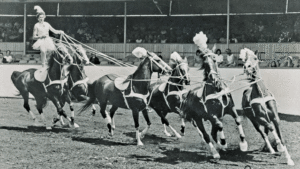
    Florence Randolph had as an impressive background as the Eskews. She was a world champion cowgirl, trick rider, trick roper and bronc rider and friend of fellow world champ Tad Lucas, another woman bronc rider. She competed in about 500 rodeos, supporting her mother and two sisters for a time. She had her own short-lived wild west show, “Princess Mohawk’s Wild West Hippodrome, with about sixty performers and workers. And she was an accomplished Roman standing racer: straddling two running horses while racing, and winning the event at the 1919 Calgary Stampede, the first woman to do so.
    Jim performed in the Colonel’s wild west shows, beginning at age five. It was said he could tie eighty different knots and name them all. He challenged Chester Byers, another roping great, in a contest for a world title, but Byers forfeited. And when nine famous ropers from the U.S., Mexico and Australia came to challenge Junior, at the end of three days, Junior was determined the world champ. One of the contestants ruefully said, “Jim started where the rest of us left off.”

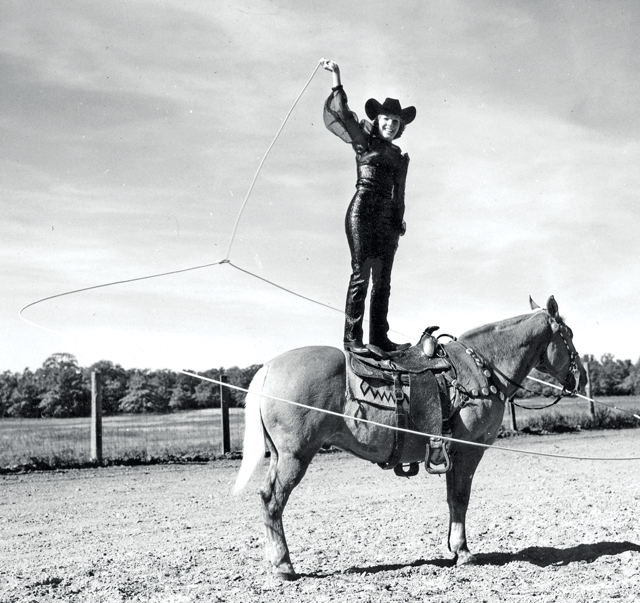
    Into this rich history, Madonna, an only child, was born. By the time she was two, she was on horseback. She was five years old when grandmother Florence taught her to trick ride on an old paint horse named Boy. By this point, her granddad the Colonel had switched to producing rodeos, and she performed in his rodeos, spending her summers in New York at the show’s home base.
    Each Fourth of July, the Colonel would put on a wild west show for the residents of Waverly. He had made a deal with the city of Waverly: in exchange for 300 acres four miles outside of town, he would put on an annual wild west show. Madonna was part of the show, dressed as a pioneer with her grandmother, in a covered wagon driven into the arena. Its cheesecloth covering was doused with kerosene, so when the Indian actors set it on fire as part of the act, Madonna would grab her dog and hide under the wagon.
    Native Americans, Sioux from North Dakota, were part of the show, and Madonna remembers playing cowboy and Indian with them between shows. At play, she was the Indian and they were the cowboys. And she remembers being her grandad’s “little secretary, with a pencil behind my ear,” as he paid his workers in cash. “He kept the cash in a trunk under the seat of a wagon,” she said. “He’d have all this money in little piles on his bed, and he’d call people in to get their pay.”
    When she was nine, her dad taught her to trick rope, and she added that to her part in her granddad’s rodeo. She was often part of his act, and the two were very close. “He was a good dad,” she remembers. “He wasn’t pushy, but he was there if you needed him. We were very close, like best friends.”
    Col. Eskew’s wild west shows, and later rodeos, entertained every week at big and small cities all over the east. They performed everywhere, from Pittsburgh to Washington, D.C., from Vermont to Georgia, and as far west as St. Louis. It was a wonderfully free life for a child, traveling with her family.
    When school time rolled around, she was sent back to Ardmore, Okla., to her mother’s parents, Floyd and Florence Randolph. She missed being on the road, but in November, after her parents were done working the Madison Square Gardens and the Boston Gardens shows, each a month long, they would join her in Ardmore and the family was together till school was out and they’d all go back on the road.
    The JE Ranch Rodeo operated until 1959, when the Colonel retired to Ardmore, where he died six years later. Madonna quit trick riding. Her horse was old, and she was traveling with her dad and his trick roping specialty act.
    Junior trick roped but was also an accomplished bulldogger, and sometimes his daughter was his hazer. His two biggest pieces of advice for her were “when the gate opens, whip and ride,” and “never pull up.” Those words came in handy when, at a rodeo in Estes Park, Colo., her dad volunteered her to haze for Buddy Heaton, a rodeo clown and steer wrestler. As Buddy slid down on the steer, the steer stumbled, throwing him and the steer directly under Madonna’s horse. She remembered her dad’s advice: she didn’t pull up but ran over the steer and Buddy. He wasn’t mad, she remembered. “Wrecks are part of it.”
    Madonna graduated from Ardmore High School in 1959 and spent a year in college. But her dad needed her in his act; she was part of the contract, so she came home and went back on the road.

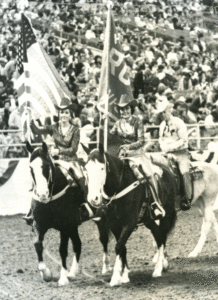
    She traveled with him, trick roping across the nation for producers like Beutler Bros., Harry Knight, Mike Cervi and Harry Vold. She also worked as a timer, and in those days, the timers often carried flags in the grand entry. Harry and Emily Knight considered her as a family member. “I was kind of like their kid. They were family.” She often spent time at Knights’ ranch in Colorado between rodeos. For several years, she timed the National Finals Rodeo in Oklahoma City.
    For a while, her dad Junior ran the Medora, N.D. Ranchorama, a show similar to a wild west show, and between rodeos, she would help her dad there. She also worked for the American Tobacco Co. for six months in 1968 promoting the Bull Durham cigarettes for ready roll instead of rolling your own. She trick roped for them, traveling across the nation. “That was a fun tour,” she remembers.
    Her dad quit performing in 1973. He had contracted lupus while serving in the Pacific in World War II. “He fought with that for many years,” Madonna remembered. When he retired, she quit as well. He passed away in 1977.
    When her rodeo career ended, she worked as a veterinarian’s assistant in the Ardmore area and as a dental assistant. Animals and kids are two things she loves.
    Her dad had told her she could not date cowboys till she had gone to college for a year. He didn’t think the rodeo scene was a proper place to date, as the only places for a couple to go were the dance hall or bar. She married in 1961, then divorced seven years later. Madonna married Jim Pumphrey in 1974, and they continued to live in Ardmore, until his passing in June of 2018. They celebrated 44 years of marriage together.
    Together, she and Jim raised quarter horses, boarded horses and taught a concealed carry school for fifteen years, instructing 15,000 students. She spent fifteen years volunteering with CASA (Court Appointed Special Advocates), speaking up for children’s best interests in court and mentoring them.
    She’s had the chance to be a buddy to lots of children, especially her granddaughter, Riley O’Linn. Jim had a daughter, Kaylynn, when they married, and Kaylynn came to live with Madonna and J.M. in her teenage years. Kaylynn is married to Tim O’Linn and they live in Georgia. Madonna doesn’t get to see her granddaughter as much as she would like, but they are close.
    She loved her days in rodeo and the friends she’s made, and loves to see them at reunions. They were good days. “I’ve had a pretty exciting life, I truly have. If I go tomorrow, I can’t say I haven’t tried a lot of stuff.”
    Madonna was awarded the Tad Lucas Award in 2003. Her grandfather the Colonel, her grandmother Florence Randolph, and her dad are members of the National Cowboy Museum’s Rodeo Hall of Fame in Oklahoma City.

  • Back When They Bucked with Joleen Hurst Steiner

    Back When They Bucked with Joleen Hurst Steiner

    story by Gail Woerner

    Joleen Hurst Steiner is a petite ‘tells it like she see’s it’ cowgirl who was born in Woodward, Oklahoma in 1952. She grew up in Fort Supply, Oklahoma, which she said was “in the middle of nowhere”. She had two sisters and a brother. Joleen was the third child. Her biggest desire as a youngster was to have a horse. Her sister felt the same way. Joleen remembered getting a pony when she was nine. Then her folks bought her and her sister full-sized horses. The girls both trained their own horses.
    At first Joleen competed in Little Britches rodeos and Junior Rodeos. She entered the pole bending, breakaway calf roping, goat tying, and barrel racing events. She broke a breakaway calf roping record at the age of 13 at the Little Britches Finals Rodeo in Littleton, Colorado.
    Joleen admits her horse was a good horse for barrel racing, but not National Finals quality. When her sister married she gave her horse, Hot Shot, to Joleen. In 1970, she joined the Girl’s Rodeo Association (GRA) and with her mother at her side she made all the Oklahoma rodeos, and ventured even farther to Colorado, Kansas, all the Texas rodeos, New Mexico, Arizona and even the West Coast. She loved the California rodeos because the weather was always so good.
    Joleen admits when asked ‘what was the hardest part of barrel racing’ she thought nothing was hard. She was young, life was good and she had a good horse. She would read the GRA News to decide which rodeos to go to. She picked the rodeos that added the most money and that is the direction she and her mother headed.
    When asked how much she practiced her answer was, “Never!” She laughingly admitted, “I just hung on to Hot Shot, and we were in the money a good deal of the time.” We know she worked harder at it than she admits, but she truly enjoyed every minute of it. She felt the rules in barrel racing were fair for everyone when she was competing.
    As we discussed, the changes that have occurred since her era she immediately mentioned “No one complained about the ground in my era. Whether it was sandy, too hard, or whatever, we just dealt with it.” Joleen also said there are a lot more quality horses bred to barrel race today than she saw in her days in the arena.

    Concerning the barrel racing horses, she feels that often trainers expect the horses they train to turn a barrel a certain way. “I feel they should allow the horses to decide how they choose to make the turn. The horse knows best what fits them.” She also said you can tell which horses love it as much as their rider – it shows.
    In 1970, Joleen was having a good year and her dad told her if she won the barrel racing at the Cow Palace he would buy her a trailer with living quarters. That win qualified her for the National Finals Rodeo, in Oklahoma City, as one of the top fifteen barrel racers in the world. There were nine rounds of barrel racing and she won three second places and two first places. “If I didn’t knock over a barrel I placed,” she admitted and laughed. That first year she finished 7th for the year.
    “When I hit the road in 1971, I was in heaven. My mom cooked wonderful meals, and we stayed on the rodeo grounds in my new gooseneck trailer. It wasn’t as common to stay on the rodeo grounds as it is today, but it was much easier, Hot Shot was with us, and it was fun.”
    The following year, 1971, she qualified for the National Finals Rodeo again, finishing in third place in the world, and third in the Average. There were ten rounds of barrel racing and Joleen had three second places, and three third place wins, but this year something happened that changed her life forever. She met Bobby Steiner, a bull rider.
    Her mother didn’t think much of bull riders. Mrs. Hurst was much more interested in Joleen finding a nice calf roper to marry. “Mom thought bull riders were lazy. All they had to do is bring their bull riding equipment in a bag to a rodeo. Mrs. Hurst felt a roper that had the responsibility of hauling his horse and keeping him sound would make a better husband for her.” Joleen was determined. She saw something in Bobby she hadn’t found before. He was very confident. They had their first date at Belton, Texas on the 4th of July. He picked her up in his big Oldsmobile 98 and she was impressed. She asked him if it was his dad’s car. She thought the car was way to fancy for a bull rider. After all, she was driving a little Ford pickup. Bobby informed her it was his car. Their first date was a drive-in movie in Temple where they saw “Bandolero” and “Butch Cassidy and the Sundance Kid”.
    After that they ran into each other at various rodeos and continued to date. The following year after the Houston rodeo Bobby asked Joleen to marry him. They married in June, 1972. Their family eventually expanded to three with the birth of Shane. Sid was born fourteen months later. Joleen had her hands full with two little boys, and a husband, so the barrel racing stopped.

    The following year Joleen began to help Bobby with his bull riding career. She entered him in all the rodeos and helped him plan to get to all of them. She said, “You might call me Bobby’s navigator. I made sure his entry fees and turn out fines were paid and took care of the business end of the sport.” (This was all before PROCOM).” She traveled with him until the doctor told her, when she was 7 months pregnant, that she needed to stay at home. Bobby won the World Championship in Bull Riding in 1973, and was 2nd in the Average. He retired from bull riding shortly after that.
    Bobby began helping his dad, Tommy, with the Steiner Rodeo Company at that time. The legacy of Steiner Rodeo Company began with Buck Steiner, Tommy’s dad running it with Tommy. Then Tommy and Bobby ran it together. Joleen carried the American flag and helped in many other ways. She helped Mildred Farris, the secretary for Steiner Rodeo Company, keep time. “When we had rodeos overlap, liked Belton and Pecos, I would secretary the smaller one,” explained Joleen. When they sold the rodeo company in 1982, Bobby and Joleen spent their time raising their sons and ranching.
    The Steiner family has always been tremendously benevolent to many groups and totally supportive of rodeo and the rodeo family. Some of the innovative things started in rodeo was done by Steiner Rodeo Company, including the electric eye for timing the barrel races, and instead of having the barrel racing event next to last they had it as their third event in each performance.
    Son Sid became a steer wrestler and went to the National Finals in 2000. In 2001, he was absent from those top fifteen in steer wrestling. But in 2002 he came back with a vengeance and won the Steer Wresting Championship and the Average. He followed in his dad’s footsteps and retired from steer wrestling shortly after winning the World title. This family is totally family-first and admit they don’t like being away from home. Son, Shane, is a musician and although he has played in numerous venues he enjoys his life performing at Steiner Ranch Steakhouse down the road from his home. Now the grandchildren are making their marks in bareback riding, barrel racing and wake-boarding sports.
    When doing this interview with Joleen, Bobby stuck his head in, and made this statement, “I may not have been the best bull rider, but I sure got the best looking barrel racer!”
    By the way, Joleen’s mom became a major fan of Professional Bullriders and knew all the cowboys competing as well as the bulls. I guess she decided bull riders weren’t so bad, after all.

  • Back When They Bucked with Scott Tucker

    Back When They Bucked with Scott Tucker

    Deep in Scott Tucker’s soul there were seeds of rodeo that drove the Jacksonville, Florida boy towards his destiny, and roots were developed that have entwined family, rodeo, and future generations of cowboys and cowgirls forever. Scott was born in 1946, an only child to his parents, Lucille and Holmes Tucker, but being a cowboy was more in his DNA than it was in his family upbringing. His dad graduated in 1939, from Yale University where he attended on a full-ride boxing and football scholarship; and he went on to work for General Foods, before settling in the automobile business. Although his parents were far more interested in life in the city, Scott was drawn to the Pecan Park horse racing track, where he started jockeying horses when he was just 12-years old. Only destiny knew then, that he was starting down a path that would lead him to become an integral part of one of the most notable rodeo families in North Carolina.
    Scott rode racehorses with Sonny Burris on the brush tracks, helping to start colts and train them to use the starting gates until his weight exceeded the 135-pound maximum allowed. Scott jockeyed the legendary Quarter Horse, Go Dick Go, in brush track races before the horse went on to make history as the winner of the first All American Futurity in 1966. Sonny was a boxer and jockey, that also rode bareback and saddlebronc horses; and he helped 12-year old Scott, step onto his first bareback horse at a Callahan, Florida rodeo. Scott did try following his dad’s path in life, and played football his freshman year of high school, but frustrated that the football schedule conflicted too much with his rodeos, he gave it up.
    Once Scott had his driver’s license, it was only the rodeo road on Scott’s mind. Scott started out entering bareback riding at open rodeos, before getting on bulls, which quickly became his favorite event. In 1962, Scott attended a Jim Shoulders bull riding school and the memory of staying atop the legendary bull “Tornado,” is forever etched in his memory. In 1963, he got his first membership card for the IRA, known as the Interstate Rodeo Association at that time. Scott started working as a rodeo clown, “Scooter,” when he was 15-years old, and quickly became enthralled with the new job he often performed between riding in his events. The challenge of outmaneuvering the bulls, was as exciting as staying on top of them.

    Although Scott’s parents were very proud of Scott’s success, they were far too nervous to come watch their fearless cowboy at the rodeos, so Scott often traveled solo or with rodeo friends that became his rodeo family. At 16-years old, Scott was cruising the interstates between rodeos, in a 1958 four-door Oldsmobile, decked with its giant tailfins, pulling a 13-foot travel trailer to sleep in. Scott thinks that rig is what got 14-year old Vicki Kidd’s attention when they met at the Silver Springs rodeo in Maryland. Meeting Vicki would prove to further cement the path of Scott’s life. Vicki Kidd was a barrel racer, and daughter of C.W. and Helen Kidd of Charlotte, North Carolina. The Kidd family was instrumental in bringing rodeo to North Carolina in the mid-50’s, after C.W. had fallen in love with the sport while he was stationed in Florida, in the Air Force. The Kidd’s started the Rockin’ K Ranch, which was a family commune of sorts, raising future cowboys and cowgirls around a central rodeo arena, and has hosted rodeos for over 60 years now. Not only did Vicki fall for the handsome, blue-eyed cowboy, but her parents did as well, taking the 16-year old in and treating him as their own.
    Scott would travel to rodeos, staying on the road most of the summer, returning to Florida to complete the school year. In 1963, the summer before his senior year, he and Lyle Wiggins made it up to Frontier Town in upstate New York, in the heart of the Adirondacks. “Frontier Town was an old western town theme park that put on three rodeos per day. I got a job there as a stagecoach driver, and later became the arena director for the rodeos.” The rodeos would highlight one or two competitors in each event, plus feature a trick rider, and there are many PRCA cowboys that got their start there. “It was the best place a young person could rodeo, besides the rodeo shows each day, there were a lot of jackpots within about 30-miles of Frontier Town. I was loving it up there, and making about $500 to $600 per week, which was a lot of money back then.”
    Scott graduated from high school in 1964, the year that he earned his first SRA All-Around Champion Cowboy title. He went on to win the title again in 1965, 1968, 1970, 1971 and 1973. When he left home for the summer in 1964, the plan was for him to PRCA, and SRA rodeo through the summer, before heading west to Las Cruces, New Mexico, where he had a full-ride scholarship to New Mexico State University; but seeing Vicki Kidd again that summer, changed his college plans completely. “I didn’t want to go to New Mexico as planned, I called my dad and told him I wasn’t going. He wasn’t very happy about me giving up the scholarship, but I told him if he’d pay my tuition at North Carolina State University in Raleigh, that I’d cover everything else.” Scott graduated from NCSU in 1966, with a degree in agriculture and livestock management, rooming with Vicki’s brother, Buddy, while they attended school there. “Buddy was such a fine person, always willing to help anyone. He always had good horses, and he would always let anyone that needed a better horse at a rodeo, ride them.”
    In 1966, after Scott left NCSU, and just three days after Vicki graduated from high school, the two soulmates were married, starting a union that would last for over 50 years, before Vicki’s passing on October 12, 2016. Scott also joined the Air National Guard, in 1966, serving for 6 years in the engine shop, as an airplane mechanic.

    The eastern cowboy couple traveled the roads of the rodeo circuit, chasing dreams while being blessed with new friends across the country. Vicki had a passion for horses, barrel racing, and supporting her roughstock riding husband. Vicki was the 1968 SRA Champion Barrel Racer and was crowned as the very 1st SRA All-Around Champion cowgirl in 1971, winning it again in 1974. Scott was doing quite well as a bull rider in the PRCA, ranking #7 in the world standings in June of 1970, but responsibility was beginning to tug on the roaming cowboy, so the couple continued to rodeo but made more of a permanent camp in Charlotte as they laid a foundation for their family. Scott had traded a good horse for some asphalt equipment, the beginnings of his paving business, Scott Tucker Paving and Grading, which he still operates. Scott and Vicki had their first child, daughter Keri, in 1967, and their son Jason was born in 1971. Also, in 1971, Scott dominated in the Coastal Rodeo Association, winning the All-Around Champion Cowboy title. Although Scott continued to find many successes in rodeo arenas across the east, looking back he wishes he would have continued his PRCA run to finish the 1970 season, thinking about the chance he may have had at that world champion gold buckle.
    Scott and Vicki continued to rodeo as they raised a new generation on the Rockin’ K, alongside Vicki’s brothers, Buddy and Jerry, and their budding families. The arena was often filled with champions and celebrities passing through while on their own rodeo circuit travels, and the art of rodeo was being practiced there on a daily basis. Cowboys like Red Duffin, who traveled with groups of cowboys and good horses, often practiced when he came through, and helped anyone interested in improving their steer wrestling skills. Scott served as the president of the SRA in 1979 and 1980 and was the vice-president for six years. Scott was also on the board of directors of the North American Rodeo Commission. Scott was responsible for producing hundreds of rodeos at arenas all over the east, and was the captain of the Southern Rebels, a rodeo team that competed at rodeos such as the Calgary Stampede. In 1983, Scott decided to focus more on the next generation of rodeo stars and he and Vicki stepped into the supportive role for their kids’ and grandkids’ rodeo dreams. Scott was the president of the NCHSRA in 1987 and 1988. Scott has been a pillar in the rodeo community, often stepping up to judge rodeos when needed, turned to when questions arise, and encouraging young rodeo athletes wherever he goes.
    The legacy that has continued from Scott and Vicki Tucker has went on to include their children, grandchildren, as well as many uncles, aunts and cousins that all participate in rodeo competition or production. Inevitably, the passion that Scott felt in his heart for rodeo so many years ago, will burn inside the many that will follow in his footsteps for years to come.

  • Back When They Bucked with Dr. Donald Mitchell

    Back When They Bucked with Dr. Donald Mitchell

    Donald was born in a farmhouse west of Mountain View, Oklahoma, in 1939, 35 miles south of where he lives now. He grew up on a family farm, milking cows, and helping his father (Donald) with crops – the least favorite being cotton. “I hated cotton. I used to pull the cotton by hand and it didn’t suit me. After my father retired, I turned the cotton to wheat, then I put it all in grass and have been happy as a lark ever since.”
    There wasn’t much for rodeo around Don, but his interest in livestock started when he would stand on the front porch and watch the neighbors across the road farm with horses. As he grew older, he anxiously awaited the Saturday afternoon matinees featuring Roy Rogers, Gene Autry, or Hopalong Cassidy. “I wanted to rodeo so bad growing up but my dad wouldn’t have horses because he grew up farming with mules.” He remembers going to his first real rodeo held at a football stadium, and knowing he wanted to know more about it.
    It wasn’t until his sophomore year in college that the opportunity arose. “I was in my second year in college and an auctioneer from Texas, Dale Walker, built a cattle sales facility complete with a small roping arena and started having a little Sunday afternoon roping. It got big and they started on Saturdays too. I didn’t have the funds or much experience but I was determined to give it a try. They had the local rodeo there in the summer and I couldn’t do anything so I entered the bareback riding. It was all mud and the horse fell and I got dumped. There was an old cowboy there sitting on the bench – Butch Franklin – who said ‘If you can get over the embarrassment and get cleaned up, come by tomorrow – I want to talk to you.’”

    He gave Don an old rope, instructions for building and swinging a loop, and an old ten gallon cream can to practice on. Don acquired a horse a few months later from his Uncle; he wasn’t fast, but he was the perfect horse for Don to learn on.
    He stayed out of school one semester in order to earn enough money to buy a better horse. He went back and graduated, continuing to rope and started timing some of the National Little Britches rodeos. He continued competing and timing as time allowed, putting his family and job obligations first. He married Thedis and they have three children, Jack, Sonya, and Damon. After several years of teaching and coaching football, including three years at The Riverside Indian School, he accepted a position at his AlmaMater, Southwestern Oklahoma State University in 1967, teaching industrial education and technology. He pursued his doctorate, traveling to Stillwater to accomplish that. He also accepted a position as the advisor/coach for the newly formed rodeo team.
    “It was a grass roots movement by some students,” explained Don. “I had just come on board, and I was working in my office the beginning of October and three young students from Southwestern came in that had gone to compete at a rodeo at another school. There were two college associations back then; this was the Central Plains – and they couldn’t enter. In order to enter they had to have a coach, advisor, and apply.” They were allowed to enter provided they produce the eligibility forms by the following Monday. Thanks to Don, that happened. Three years later, Bob Clore engineered a merge of the Central Plains into the NIRA, eventually adding an 11th region and the Central Plains Region of the NIRA was formed.

    The other challenge Don was faced with was securing an arena for the team to practice. “The city of Weatherford did not even have a fairgrounds,” said Don. In 1972, 640 acres was purchased with plans for a golf course, along with several other amenities, including a rodeo arena. The conditions for the arena construction was voluntary labor to match the cost of materials. Don and 20 members from the team and club actually designed and built the arena in time to host Southwestern’s first NIRA rodeo in April of 1972. Beutler & Son produced the third rodeo and that relationship has spanned 46 years. “We were a club until 1975 and Don petitioned the new president to take the club into the athletics – we had 20 kids rodeoing and up to 60 in the club. Being part of athletics allowed for additional funding.”
    Although he enjoyed coaching the rodeo team, his primary focus was teaching. “My emphasis was to prepare young teachers – and I taught those classes.” He took over as chairman of the Industrial Education and Technology department for the last 20 years of his career and admits he missed the teaching aspect. Don retired in 2001, taking over the family farm. He was inducted into the Southwestern Oklahoma State University Athletic Hall of Fame in 2003. He has only missed one performance of the rodeo he started 48 years ago. “I missed my first performance this year due to calving and bad weather.” He brought more than 800 athletes through the rodeo program during his 34 year tenure. 28 have gone on to the NFR with 60 filling their permits. More than 61 have made the IFR – 41 of those becoming world champions. The list of accomplishments is long.
    “The mix of teaching and coaching worked for me. I had time for my kids –they rodeoed, and even though they didn’t rodeo in college, we got to go everywhere. They made the high school and little britches finals, and we traveled all over.” His wife is retired from hospital administration and the couple spend time working on the ranch. “We don’t drive as much as we used to.”
    Rodeo allowed Don to meet some great friends and be part of the sport that he loved since childhood. “It was some of the most enjoyable times of my life.”

  • Back When They Bucked with Elaine Kramer

    Back When They Bucked with Elaine Kramer

    It all started at the Metro Theater in Prairie du Chien, Wisconsin. That’s where Elaine Kramer saw the horses and maneuvers that would make her famous, to which she would dedicate the next twenty years of her life. The Wisconsin woman was born in 1935 and grew up the middle child of Irvin and Helen Kramer. She and her brothers roamed their farm and the woods, playing cowboys and bank robbers and riding horses. Elaine’s first horse was a pony named Little Beauty, then an American saddle bred, and the farm’s draft horses, which she was able to mount by throwing an ear of corn on the ground. When the horse put his head down to eat it, she’d jump on its neck, then as the horse raised his head, she’d slide down on its back. But it was a chance encounter at the movie theater that determined the course of her life.
    On the big screen, Elaine watched the movie Ride a White Horse and was fascinated. When the credits rolled, she stayed in her seat, reading them, and discovered that the movie was filmed at the White Horse Ranch in Naper, Nebraska.
    Elaine sent a letter to the ranch, asking about it. An invitation came back to come and visit, so she did. It was the summer after her high school graduation, in 1954, and there she learned to roman ride.
    The White Horse Troupe, a group of riders from the White Horse Ranch, performed their act at various events. The Troupe was invited to perform at the American Royal Horse Show in 1954, and when a girl was injured during an act, Elaine was asked to take her place. She was “surprised, excited and scared, and determined to do my very best,” she said. And she did. Her goal became clear: she wanted a horse act of her own.
    She trained her own horses and learned how to roman ride, sometimes with five and even six horses abreast, and often with two jumps. After Sports Illustrated used a photo of her jumping six horses abreast, the Flying Valkyries, a horse act based out of Palm Springs, Calif., saw the picture and asked her to ride with them.
    Elaine performed with them, and also with a troop of performers from Franklin, Indiana, called the Jinks Hogland All Girl Review. The girls jumped horses, roman rode, and had a garland entry. They performed at circuses, wild west shows and horse shows.
    She also worked for two years in Pontiac, Michigan, at John F. Ivory’s ranch, instructing girls on jumping horses and ponies and roman riding. At that time, she jumped and rode a nine horse tandem. Each weekend, Ivory had a horse show and polo games, with hundreds of fans showing up to watch.
    Mr. Ivory helped her start her own roman riding team, and Elaine’s first show was the Dairy Cattle Congress in Waterloo, Iowa. She fell off her horse, but only her pride was hurt. Red Foley, who was performing, came to see if she was OK and gave her a hug.
    Elaine got her Rodeo Cowboys Association membership in 1955, and her career blossomed. She worked for all the major stock contractors of the era: Harry Vold, Bob Barnes, Lynn Beutler, Mike Cervi, Lynn Knight, Rodeos, Inc., and others.

    In 1969, she went to California and worked for Cotton Rosser, spending two years on the West Coast.
    Throughout her career, Elaine had a wonderful time, meeting wonderful people and making memories. One of her more memorable moments, in part because it was a near-accident, came in 1964. She was entertaining at the Toronto Royal Winter Fair, the opening of all winter fairs in Canada, with the queen in attendance. The queen’s rifle battalion was marching out of the arena when someone hollered that she was up. The gate was opened before the soldiers were out of the arena, and as Elaine and her six horses galloped in, she nearly ran over one of the soldiers. He never moved, she remembered, as she maneuvered around him. The next day’s newspapers said that she had made a splash at the Fair, and she was invited to sit with dignitaries in the press box.
    She never had any major accidents, but she recalled a wreck one time in El Paso. She was roman riding a six horse hitch when the right lead horse fell between jumps. The rest of the team landed on each other, and Elaine fell between the wheel horses, the horses she was standing on. She got up, put bridles back on, sorted out the reins, did her act, and got a big ovation.
    Elaine remembers meeting celebrities from all walks of life and doing extraordinary things. She drove the Budweiser hitch, and when Tanya Tucker was in her teens and not yet a big country music star, she sat on Elaine’s lap and told her, “I’m going to buy all your horses.” Elaine had a reply for her: “You don’t have enough money.”
    She usually did her roman riding with a two, four or six horse hitch, going over two jumps, with her trademark act being with the six horse hitch. She trained her own horses, sewed her own costumes, and did a lot of her own driving. Her horses: Flash, Frosty, Flicka, Frisky, Fleet, Fury, Fantasy and Fascination were all sorrels with white faces and four white socks, and if they didn’t have the white socks, she made boots so they looked alike. The horses wore white plumes, white harness, and had white glitter on their hooves.
    Occasionally, her younger brother Keith would help her. Their parents would pull him out of school and send him to the bigger shows and rodeos. He knew how to set the jumps: nine paces between the jumps, and as he got older, he drove truck for her. She taught him how to haul horses, “yelling at me if I took off too fast or hit the brakes,” Keith remembered. Her long-time companion Dan Quinn traveled with her for the majority of the time; they spent 41 years together.
    Throughout her career, she worked the Dallas-Fort Worth Stock Show (where she had a complete wardrobe change for each of the ten performances), Madison Square Gardens, the National Western in Denver, the Cow Palace in San Francisco, was invited to tour Europe, and more. (She didn’t go to Europe; the quarantine for her horses would have taken too long).
    In 1974, she decided to call it quits. One of her horses had passed, and the two wheel horses were getting old. Her knees were bad, and it was time to stay home. Her last performance was in Omaha at Ak-Sar-Ben, where one of her horses came up lame. The veterinarian gave him a shot of cortisone to get him through the show, and the horses were “flawless,” Elaine said. As she styled around the arena for one last round, she got a standing ovation. “My horses pranced out of the arena, as though they knew it was their last performance.” Later, the veterinarian told her if he’d known how dangerous her act was, he wouldn’t have let her ride. She told him, with his help, she had made another safe ride, her last ride.
    “After twenty years of training, feeding, washing and hauling horses and driving many miles, fixing harnesses, sewing sequins on costumes, I concluded I would definitely do it all again,” Elaine said.
    Her career came full circle when, in 1974 at the Metro Theater in Prairie du Chien where it all started, Elaine watched the movie The Great American Cowboy starring Larry Mahan, where a cameo appearance of her act was included.
    After her two decades, she came back to Prairie du Chien to help with her parents’ beef farm. She started a trailer park which she still oversees. Her parents have passed, and now her great-nephew David Kramer runs the farm. The circle may be coming back around; a few months ago, when Elaine was visiting David and his family, she witnessed his two-year-old daughter standing on her rocking horse, just like her great-aunt did years ago.
    Elaine is a 2005 Cowgirl Honoree in the National Cowgirl Hall of Fame and Museum. Her brothers: Keith and Russell, live in Wisconsin, and she has two nieces and two nephews.
    She doesn’t regret a minute of her career. “I never expected what a satisfying fulfillment it would be.”

  • Back When They Bucked with Ken Stanton

    Back When They Bucked with Ken Stanton

    It was while riding his dad’s milk cows that Ken Stanton got the inspiration to be a rodeo cowboy. The Weiser, Idaho man spent over two decades in pro rodeo, competing in both the bareback riding and the bull riding, and qualifying nine consecutive years for the National Finals Rodeo, six of those years in both of his events.
    He was born in 1941, the youngest of four children of Roy W. and Lillian (Pattee) Stanton in The Dalles, Ore. The family moved to Cloverdale, Oregon, five miles from Sisters, and the kids attended Redmond High School. Ken was an outstanding wrestler, winning the state championship two years and finishing one year as runner-up. As a freshman, he wrestled at 98 lbs. and four years later, at 115 lbs.
    Even though he had wrestling scholarships from Oregon and Oregon State, he chose to go to work, cowboying on a cattle ranch in eastern Oregon. It was winter time and one of the coldest winters, when he was on the wagon, throwing bales, while another worker was driving the tractor. One day, Ken told him, “it’s your turn to throw bales,” and the guy said no. Ken replied, “You are today, because I’m leaving.”
    He took off for Odessa, Texas. He and his older brother Bill had competed in a half-dozen amateur rodeos (there was no high school rodeo then), and together, they headed south. He didn’t win money in Odessa, but a week later, in San Antonio, won $1800, more money than he’d ever seen before. He wasn’t greedy: “I sent most of it home to the folks because I didn’t need it.”
    Ken stayed in the south, rodeoing at Rodeo Cowboys Association rodeos. He got his RCA card in 1960 and was a full time cowboy for the next decade. Bull riding was his favorite, but he was pretty even in his talent at both.

    He was a natural at bareback and bull riding. He was small: only 5’4” and 145 lbs., but wiry and strong. In high school, he had jumped on the school’s trampoline, strengthening his core and improving his balance while entertaining fans during basketball halftimes. And he’d worked hard on his family’s ranch, throwing bales that weighed as much as he did.
    From 1960 to1970, he rodeoed in the south during the winter and headed to the Northwest for the summer. He competed at about fifty rodeos a year, when other cowboys were going to 100 or more.
    And he did well, financially. He estimates he averaged $22,000 a year as income over the ten year period, with his best year earning $28,500. “That was a good income for us,” he said. “It was a lot of money then.”
    He competed at the National Finals Rodeo every year from 1962 through 1970, in the bareback riding eight times and the bull riding seven times. His highest finish was fourth place in the bull riding in 1964. In 1970, he was ahead of Gary Leffew in the bull riding, both having covered eight bulls, till Ken got bucked off his ninth bull and Gary beat him by only 35 points on nine head. “If I’d have rode (the ninth bull), nobody could have touched me.” He finished that year second in the average.
    When he was on the road, his family went with him. He married Ginger Tarter in 1965 and they had three children: daughter Tracy and sons Scott and James. The kids loved being on the road. “They were like rodeo orphans,” Ken said. “The kids loved (being at rodeos) and people loved them.” Some of Ken’s fondest memories were at the Pendleton Round-Up. His parents and Ginger’s parents attended the Round-Up, and they’d take a big box of tomatoes grown by friends of his parents’. The cowboys loved it. “They couldn’t wait for us to get there, and they’d sit there and eat tomatoes,” Ken recalled. “It was like a family reunion.”
    The year 1970 was his last year of full time competition. He spent the next three years working as a general contractor in Colorado Springs, building homes. Then he became a deputy sheriff for Washington County, Idaho, his home county. He worked that job for ten years, handling the civil lawsuit work and some of the jailer duties. He competed in a few rodeos, but not many.
    After ten years of deputy sheriff duties, Ken went to work for a gold mine in Battle Mountain, Nevada, driving a 350 ton haul truck and working there till 2000.
    It was an injury that started on the eastern Oregon ranch and culminated while he was a deputy sheriff that bothered him the rest of his life. On the ranch, he had gotten frostbitten feet while feeding cattle. A few years later, while traveling on slick roads on a cold snowy day with his wife and daughter, the car went into the ditch. Ken ran for help, running eleven miles in two and a half hours and getting frostbite again. The final straw was as deputy sheriff. He was working an accident that started with one car in the ditch on icy roads, and seven hours later, was a seventeen-car pileup. His feet were frozen, and gangrene set in. Doctors amputated two toes in 1974, then a few years later, his feet at mid-arch. In 2004, his left leg was amputated four inches above the knee. His leg’s veins had collapsed.

    The toughest bull Ken saw while rodeoing was Snowman, owned by the Christensen Brothers. The bull had been unridden for five or six years when Ken drew him at Pendleton. He got bucked off at the whistle and remembers seeing Jim Shoulders and Harry Tompkins kneeling in the arena, watching the ride. He also remembers their comment: “that bull can’t be that bad, that kid almost rode him.” It was several more years before someone made a qualified ride on Snowman.
    Ken was part of a unique brotherhood. At the 1967 and 1968 National Finals Rodeos, five contestants: Ken, his brother Bill, Jim Ivory, his brother John Ivory, and Larry Mahan were all graduates of Redmond High School and all members of the wrestling team.
    After his leg was amputated, Ken moved back to Weiser, where he lives with his brother Bill, who also competed at the National Finals Rodeo. Ken and Ginger divorced in 1981. His daughter Tracy, who has five children, lives a few miles away. His sons, Scott and James, live in Boise. Ken has three great-grandchildren.
    He served as bareback riding director for two years, but it wasn’t for him. And he was asked to judge rodeos, but by then, his feet were bothering him and it was difficult to stand for long periods of time.
    His brother Bill, who was a year and a half older than him, had a plane and a pilot’s license and they would sometimes fly to rodeos. Ken remembers one time when they left St. Paul, Oregon, headed south of San Francisco. As soon as Bill got the plane off the ground, he asked Ken to take the wheel for a minute. “Then Bill jumped into the back and said, ‘wake me when we get to Bakersfield,’” Ken laughed. They were cruising at 12,000 feet, and Ken knew Mt. Shasta was 13,000 feet, so he pulled the plane up to 14,000, following the freeway to their destination.
    His dad always knew when his boys had been riding the milk cows. “One of us would get on, and the other would turn her loose,” Ken remembered. “The hard part was ducking under the door.” The next day, those cows wouldn’t give milk, and it would be a dead give-away for the boys’ antics. His dad would ask, “have you boys been riding them cows?”
    Ken is an inductee into the Ellensburg (Wash.) Rodeo and Pendleton Round-Up Halls of Fame. At Ellensburg, he won the bareback riding, bull riding, and the all-around several times. Lewiston, Idaho was also a rodeo he won multiple times.
    Ken loved having his family with him as he rodeoed, and he loved rodeoing. “I wouldn’t trade it for nothing now,” he said. He never won a world title but he stayed in the top fifteen, competing at half as many rodeos as the others. “It’s in your blood or you just don’t do it,” he said. “It’s not easy but it’s a good way to make a living.”