Rodeo Life

Category: Back When They Bucked

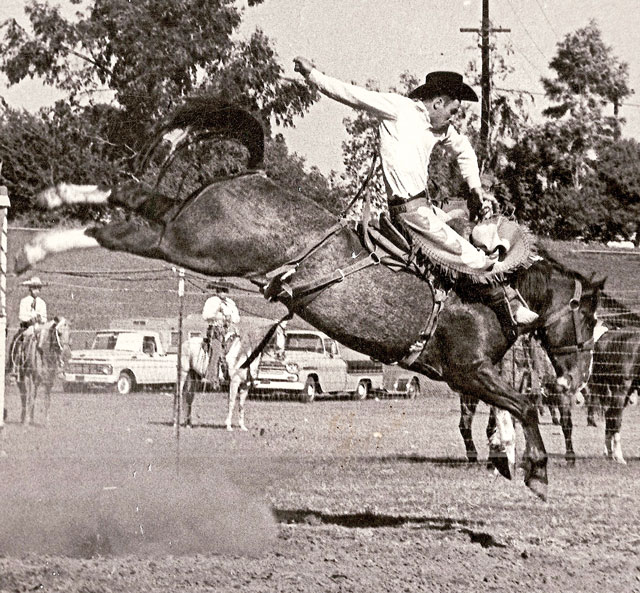
  • Back When They Bucked with Willard ‘Bill’ Phillips

    Back When They Bucked with Willard ‘Bill’ Phillips

    A cloud of dark, billowing dust is one of Willard “Bill” Phillips’ earliest memories. Towering several thousand feet, the cloud enveloped Bill and his three siblings while they were playing in the yard on the family ranch 7 miles north of Brownell, Kansas. That day went down in the history books as Black Sunday.
    “When that dust cloud came over, it was dark as night,” Bill said. “The dirt came in everywhere. When it was all over, we had to scoop dirt out of the house with a shovel.”
    The raging dust storms of the mid 1930s are only a small part of Bill’s unique story. Most of his life is built on a foundation of horses and horsepower.
    The Phillips family raised cattle, crops and horses in western Kansas. Bill witnessed firsthand the transition of horsepower from flesh and blood to the internal combustion engine.
    “We had about 20 head of horses and a team of mules,” he said. “At harvest they brought horses up from the big pasture and it got exciting sometimes. We had runaways and stuff like that. We used to do everything with horses: cut wheat, haul grain to town, everything.”
    Graduating from Trego County High School in WaKeeney in 1945, Bill turned 18 just in time to get drafted by the U.S. Army. He was trained at Fort Bliss as an anti-aircraft gunner.
    “I was part of the occupation troops in Japan; of course, we didn’t have any planes to shoot at by then. We walked guard through Tokyo and Yokahoma,” he recounted. “I remember walking along a ridge and looking down after the atomic bomb hit Hiroshima. The people who evaporated were the lucky ones.”

    Roughie
    A year later – 1947 – Bill was back home to Kansas. He enrolled at Kansas State College just days before the fall semester started and pursued a bachelor’s degree in animal husbandry.
    Even though Bill left the ranch when his parents divorced, he continued working on other operations. At what is now Kansas State University, Bill stumbled upon a newly formed club – The Chaparajos.
    “That club was for anyone interested in horses, it didn’t have to be for rodeo,” Bill said of the organization that would eventually become the National Intercollegiate Rodeo Association. “We did have a rodeo that first year though.”
    The club built an arena on the ball field with posts cut down along the river connected by woven wire. A single roughstock chute stood in the arena with a small backdrop of wooden bleachers.
    “That first rodeo I think we were $6.40 in the clear,” Bill said.
    As a kid, Bill had some bucket calves trained to ride. And he never passed up an opportunity to try and ride a cow when she gave him the opportunity. But his first official rodeo was inside the arena he helped build in Manhattan, Kansas.
    “I didn’t have a rope horse, so I guess that’s how I ended up in roughstock,” Bill said. “It doesn’t make much sense when it comes down to it. It’s a great feeling though when you get one ridden; when you get the job done.”
    The first time Bill was on a horse was in the saddle with his dad on the ranch. He eventually rode their stud – Ned. Of course, that was always bareback. Perhaps that’s why Bill was more skilled out of the saddle in the rodeo arena.
    “I tried saddle broncs about five times, and I got some of them ridden, but I couldn’t make it look pretty,” Bill explained. “That’s the ultimate rodeo event – it takes a lot of skill. To me, that’s a tough event.”

    On Tan Bark
    Even though college rodeo was still in its infancy, qualifying for the College National Finals was coveted. Bill managed to do it twice, first in 1949 and again in 1951. Both times he rode in the Cow Palace in San Francisco.
    “At the time, the Cow Palace was the last stop for the professionals before the finals,” Bill said. “That was big time rodeo to ride there. It was a totally different world from the arena in Kansas.”
    It was on the tan bark floor of the Cow Palace that Bill became fast friends with Slim Pickens who was a bull fighter at the time. Stuck in the vortex of his bull’s spin move, Bill finally came off.
    “This bull was right in my face and Slim Pickens just reached across and slapped that bull in the face,” Bill said with a chuckle. “I’ve considered him a friend ever since that day. He was one of the best bull fighters I’ve ever seen.”
    The tan bark of the Cow Palace was a far cry from the lumpy hog pen Bill was used to back in Kansas. A stock contractor by the name of Slim Pickering had an old chute he let the rodeo team use to practice.
    “The arena was an old hog pen that was rooted up and dried out, there were big old clods out there, so it wasn’t a nice place to land,” Bill said. “It’s completely different from what they have now with Weber Arena.”
    After college, Bill found himself in Ensign, Kansas, giving veterans hands-on training so they could learn how to farm. Four years later Bill earned his master’s degree from Fort Hays Kansas State College, which is now Fort Hays State University.

    Way Out West
    It was time for Bill to experience another part of the country. His degree in range management set him up well for a long career with the Bureau of Land Management.
    “I rode a lot in my work. One time we had to ride out 7 miles to find the horses and then run them back those 7 miles to the trap we set,” Bill said about his job as an area manager in Burns, Oregon.
    A good horse was an essential element for Bill to do his job well. One of his horses would hop up into the rack on the back of his pickup. Growing up in post-depression era Kansas made Bill efficient and resourceful, which led him to this unique hauling scenario.
    One very specific day of running horses into a trap sticks out as Bill’s very best day of his life. With a herd of 100 wild horses ahead of him, Bill knew the trap wasn’t big enough for them all.
    “I was on a horse called Roanie, and I tried to get down into the middle of them to split the herd into two,” Bill explained with a smile spreading wide across his face at the memory. “I was in the middle of those running horses for about a mile. It was one of the highlights of my life as far as adrenaline goes. That was my best day running horses.”
    When Bill first started with the BLM, fences were few and far between. He could ride for 60 miles before ever seeing one. It was very different country from what Kansas was and still is.
    Bill spent 20 years in the Burns District before transferring to Susanville, California, in 1980. He finally retired from the BLM in 1995 and eventually made his way back home to Kansas, but not before leaving his mark on both the land and animals.

    Mustang Man
    Always a student of good horsepower, Bill began noticing some horses with primitive colors and stripes. A herd management area was set aside for horses with dun and grulla coats accompanied by dorsal and leg stripes, which were all considered primitive markings.
    “There were very few left on the range when we started gathering them, maybe about 1 in every 400 horses was a dun or grulla,” Bill said. “People were really interested in them, and they brought a ton of money. Some sold for $10,000.”
    Bill and his coworkers – Ron Harding and Chris Vosler – didn’t know that they were rounding up some of the foundations of what would later become the Kiger mustang. They’re recognized by the International Alliance of Kiger Breeders as helping establish the Kiger mustang as it’s own breed.
    As a range management specialist, Bill also worked with the experimental stewardship program which had a special focus on improving grazing conditions. Their committee represented all stakeholders who had vested interest in public lands.
    “Prior to 1934, the land was so overgrazed that they thought ranching using public lands was going out of business,” he said. “Raising forage on the open range, that’s what ranching is at its core.”
    The Taylor Grazing Act of 1934 was supposed to help stabilize grass production for ranches, but it took a while for the act to be enforced. Bill was part of rejuvenating the grazing land.
    “All the energy for life on earth comes from the sun,” Bill said of the fundamentals of ranching. “The sun hits the growing plant which takes in carbon dioxide from the air and water from the ground. That’s the way the plant grows. Ranching is capturing that energy from the sun to serve people. To me, that’s one of the biggest miracles of the world, the miracle of grass plants capturing solar energy to feed people.”
    Now at 95 years young, Bill’s time in the saddle is a distant, but fond memory. And even though his time in rodeo was more than 60 years ago, he’s still an avid follower of the sport.
    “I have tv now and I like to watch rodeo,” Bill said. “I like to watch those roping and dogging horses – they sit there on tippy toes before they come out of the chute. I enjoy watching them because they know what the game is.”
    For Bill, life has been focused on horses in some way or another. Just because he needs a walker to get around, doesn’t mean that’s changed, it’s just moved to a screen.
    “I’ve led an interesting life. I probably would’ve become a good bull rider if I had worked hard enough at it,” Bill said. “I didn’t win any gold buckles, but I was a competitor. I’m glad I participated in [rodeo], I think it’s a great sport.”

  • Back When They Bucked With Pete Leibold

    Back When They Bucked With Pete Leibold

    When his grandfather gave him a dollar bill to buy tickets at ten cents each for the pony rides at Hershey Park in Pennsylvania, Pete Leibold was in heaven.

    From that first introduction to horses, Pete’s life-long passion for rodeo began.
    Born in 1949, he was raised by his grandfather, Wiley Warner, in the suburbs south of Lebanon, Pa. In sixth grade, when he and his grandpa moved to the country, they got a horse. Pete soaked up time with his horse, riding as much as he could. That same year, he asked his grandfather if he could ride to see his Aunt Betty, who lived thirty miles away in New Holland. “It was winter, it was cold, and it took me eight hours to go that far,” Pete chuckled.
    When he was fifteen, he began riding steers and young bulls at the Wellsville (Pa.) Frontier Days. Two years later, he was competing at the Cowtown Rodeo in Woodstown Pilesgrove Township in New Jersey. He continued to rodeo after graduating high school in 1967, and two years later, went to a bull riding school in Henryetta, Okla., put on by world champ Jim Shoulders. That same year, he bought his Rodeo Cowboys Association membership (predecessor to the Pro Rodeo Cowboys Association) and filled his permit that summer.
    As a youngster, he showed horses in 4-H, and that’s where he met the woman who would be his wife, Bonnie. She also showed horses and barrel raced at Cowtown. They married in 1970.
    By this point, he had joined the Delmarva Rodeo Association, with rodeos across Delaware, Maryland and Virginia. (Later, the Delmarva Association was replaced by the American Rodeo Association.)
    Pete rode bulls until he was about 28 years old and was too big, he thought. So he began steer wrestling, learning from Mike Rhineer, Sr, at his arena in Willow Street, Pa.
    By this point, he had started picking up. Dave Martin, a stock contractor, hired him, and he worked for Dave for many years. He picked up for more than three and a half decades for a host of stock contractors and producers across the Northeast: Martin, Ernie Hostetter, Bob Alexander, for Pennsylvania High School Association, and more.
    Rodeo wasn’t his fulltime job. Pete started as a mason tender, then became a stone mason. He also worked as a blacksmith for twelve years.
    One day Bonnie asked him when he was going to work for himself. That was the impetus he needed to start his own business as an excavator, and for the next nineteen years, he was self-employed. With his John Deere backhoe, 951 Caterpillar track loader, dump truck and trailer, he made a good living.
    Pete remembers some of his best and favorite horses.
    One of his first horses was a big registered thoroughbred-quarter horse cross that was 15.2 hands and weighed close to 1,300 lbs. “He was a stout son of a gun,” Pete said. “I often said to my wife, if I’d have had two horses like him, I’d have been mounted in the top ten, as far as picking up went.” He was a barrel horse, too; Bonnie won a fair share on him.
    Pete team roped on the horse, named Norton. But Norton had his share of quirks. “After you’d roped six steers, you might as well tie him up and get on another horse,” Pete chuckled. “When you backed him in the box for the seventh time, you could feel it. He’d stand on his hind feet and walk out of the box, straight up in the air. He was like, I’m done.”
    When Pete picked up on Norton, he had another unusual characteristic. As soon as the horse heard the gate latch open, he would stand up and walk on his back legs, “just like a Lipizzaner.” But as soon as the buzzer went, Norton was back on all fours, ready to work.
    Another notable horse Pete used was one he never owned. Mooch, a bay, was his steady pickup horse for years and was owned by a barrel racer whose daughter had ridden the horse before passing away. She would never sell him, even though Pete asked her to name her price. Mooch could be hazed and heeled on, plus he was used for the barrels, goat tying and pole bending. “He was phenomenal,” Pete said. “He was a great horse. He didn’t get rattled over anything.”
    Pete was more than competitor and pickup man. He has judged and been an arena director and co-producer with the late rodeo clown Bobby Paul. Working with youth has been important to him, too. The Leibold arena is often used for practice nights of roping and steer wrestling and has hosted clinics. He’s been active with the Pennsylvania High School Rodeo Association, the Keystone Rodeo Association, and the Central Pa. Youth Rodeo Association, where he served on the board of directors and as the chute dogging director for fifteen years.
    The accomplishment at the top of his list is being chosen nineteen consecutive years as pickup man for the APRA finals. Being voted for that role by the APRA roughstock contestants showed how much they appreciated his talents.
    With a fulltime job, Pete never traveled far from home to compete. In 1985, he finished in the top three in the ARA (now the American Pro Rodeo Association) in the steer wrestling. At the time, the North American Rodeo Commission held a finals, inviting the top three in each event from the 40-some regional associations across the continent, to compete in El Paso for a week. Pete wasn’t going to go; it was a long ways to haul from Pennsylvania to Texas, and he had the APRA Finals to pick up a few days after he would be done in El Paso.
    But Tommy Harvey, president of the ARA at the time, arranged for a horse for Pete to ride in El Paso, so he went. On his first steer, he made a four-second run; his second run didn’t go as well. But he enjoyed it. “It was quite an experience.”
    He was also asked to pick up the North American Rodeo Commission Finals, but it required five pickup horses and he didn’t have that many. After he reluctantly turned down the offer, his good friend Mike Rhineer told him he’d have secured the pickup horses for him amongst his rodeo friends. But it was too late.
    Pete bulldogged till he was 54 and his knees couldn’t take it anymore. That same year, he was diagnosed with prostate cancer, had it removed, and sold his business. That was in 2002, and he’s continued to work for another excavating company. “There’s nothing hard about it,” he quipped. “A man tells me to dig a hole here, I do it. He tells me to cover up a hole there, I do it. Nothing hard about it.”
    When Dave Martin began riding bulls as a young man, Pete was riding. “There was no better bull rider than Pete Leibold,” he said. “He was good.”
    When Dave began his own stock contracting company, Pete often helped out. “He’d come to the ranch and help try out new stock. I’m sure I got him in trouble more than once for keeping him later than he was supposed to stay,” he said. Pete was as good a steer wrestler as he was a bull rider, Dave noted. “Just like in the bull riding, he was hard to beat.”
    Mike Rhineer Jr. knew Pete because his dad, Mike Sr., rodeoed with him.
    “He’s the most honest man you’ll ever meet,” Mike Jr. said. “The man will not lie to you.”
    Mike, a tie-down roper, team roper and trick roper, pointed out that Pete gave back to the sport of rodeo. “He judged a lot of youth rodeos,” he said. “He was always there to help kids who wanted to learn. It didn’t matter if it was roping, riding, steer wrestling or riding bulls, Pete was there to help.”
    He and Bonnie have three children: sons Todd and Cody and daughter Caiti-Ty Leibold. All three excelled in rodeo at the youth, high school, regional and national level.
    Pete was never a world champ, but he loved rodeo and it treated him well.
    “I would have loved to chase a steer wrestling buckle for a year, just do nothing but steer wrestle. But when you pick up, you’re guaranteed a paycheck. It’s one of those things. I was never a (year-end) champion, but I got some buckles rodeoing.”
    He’d do it all over again, if he could.
    “I spent a lot of time horseback, and we made a lot of friends going down the road. We met a bunch of super people. We have friends all over the country.”

  • Back When They Bucked with Dan Ariaz

    Back When They Bucked with Dan Ariaz

    Story by Dan Ariaz

    It’s a marvel a career in fighting bulls would lead to a career in fighting the most dangerous insect on earth. The feared mosquito infects hundreds of millions of humans worldwide and kills millions a year. When the bucking chute opened, a door to save millions opened with it for Dan Ariaz. Although a massively muscled, enraged bucking bull was dangerous enough for the bullfighter, Dan, the tiny, biting mosquito offered him a more daunting challenge. Malaria, Bubonic Plague, Dengue Fever, West Nile Virus, Yellow Fever, Encephalitis, Lyme Disease, Chikungunya, Zika, and Bluetongue in livestock and deer herds, are just a few of the diseases that ravage our populations. As he grew up to be a man, Dan’s knowledge of such diseases grew too. Dan was to devote his life into combating disease-carrying mosquitos.
    A man from humble roots, Dan was introduced to the ranch life in 1958 when his stepfather, Don Bowman, moved the family from Los Angeles to Smokey Valley, NV. From 1959 to 1962, the family lived on the Babbitt Ranch located near the Grand Canyon. There was no electricity and no heat except for a wood-burning stove. Instead of plumbing, outhouses were used, and water had to be hauled in by truck. Chores were overwhelming. Dan had to care for the ranch horses Dan’s stepdad broke to move cattle in the scorching summer and frigid winter. As a youngster Dan learned the harshness of life on the ranch. At twelve years old, Dan’s stepdad, introduced him to rodeo clowning and bullfighting. He found a new passion, securing rodeo as an integral part of Dan’s life.
    At fourteen, he moved to Tollhouse, CA to attend Sierra High School which was known for its outstanding agricultural program. Under the tutelage of Bob and Doreen McColaugh and Tom and Susanne Dean, Dan became a decorated FFA competitor. He excelled in market and showmanship cattle and sheep events throughout California with championship wins at the famed Cow Palace in San Francisco. While in FFA, he began competing in high school bareback, saddle bronc, and bull riding (where he spent more time eating dirt and manure than staying on for the eight second ride). With his athletic ability, two good feet, and love for coming face to face with an angry horned bull, bull fighting was the perfect compromise. Another incentive was the cash from bullfighting he could put in his billfold.
    In 1968, Dan was drafted by Uncle Sam into the United States Marine Corps. After boot camp, he fought bulls for the All-Pro-Rodeo Armed Force Teams, which Andy Jaurequi stock contracted. After serving in the military, Dan attended Modesto Junior College, later transferring to the University of Nevada where he continued to fight bulls for the National Intercollegiate Rodeo Association. Also, during this time, he fought bulls for various stock contractors: RSC (Roddy, Sperick, Cook), Western Rodeo, Christian Brother, J Spear, Prunty and Gondolfo, and others.
    ‘Clowning around’ brought a new job opportunity for Dan. When in Reno, his clowning act needed a water truck, but Washoe County’s water truck was broken. This wasn’t a problem for the creative ranch kid with plenty of mechanical experience. Dan used a Coors beer pop top lid to adjust the points and fix the truck. The general manager of the Reno Rodeo arena noted his mechanical skills and desire to please, so he offered Dan a job maintaining the livestock pavilions of the Reno Rodeo grounds for Washoe County. The full-time job with insurance and retirement benefits provided enough incentive for Dan not to pursue a card-carrying Professional Rodeo Clown Association career and stay in Reno.
    The connections Dan had made in Washoe County and the investigative techniques he learned in the military proved useful. When the Washoe County Health Department posted a job for an environmental investigator, Dan applied and was hired. Responsibilities included tracking down those who damaged or vandalized public lands and fouled water sources. The Vector Control department specialized in insects that transmitted diseases to both man and animals. Occasionally, Dan’s responsibilities would intersect with Vector Control. Insect foggers that dispersed liquid Pyrethrum, a chemical derived from the chrysanthemum plant, were being used by the county to mitigate the bugs and when they wouldn’t start, Dan was the handyman they called. Fixing the foggers connected Dan with the Vector Control Coordinator who requested Dan be his replacement since he was leaving. As the new coordinator, Dan had a lot of learning to do. The only thing he knew about mosquitoes was the sting of their bite. Washoe County’s director of environmental health, Carl Cahill, assisted and supported Dan in his mosquito education, creative brainstorming, and equipment upgrading (all which eventually made Washoe’s County’s mosquito abatement program a success). Having been bitten by the mosquito, Dan now had the resources to bite back.
    As the door of cowboying was shutting, a new door was opening that would lead Dan to invent a mosquito-fighting machine. The start of this invention began in 1983, when Dan was fighting bulls at a collegiate rodeo where he saved a young cowboy, a microbiology student from Texas A&M, from serious injury. When this cowboy reached out to Dan to thank him, a mutual interest in mosquitos was discovered. The student was studying Bacillus Thuringiensis, a bacterium also known as Bti which is naturally occurring. It contains toxin producing spores that can target the larvae of black fly, fungus gnats, and mosquitoes. This product seemed to be a brilliant alternative to pesticides that were having disastrous effects on the environment. Washoe County’s expansive ranch lands became the testing ground for Bti.
    Such testing revealed a need for an invention. The new product utilized minute granules for application, which rendered the old foggers used to disperse liquid chemicals useless. Dan got to working on how to make something that could work with this new product. In his garage, he created the ARROGUN, a new fogger capable of granular distribution. By 1985, ARROGUN was patented, manufactured in the United States, and sold worldwide.
    Since then, Dan’s company, Bio Rational Vector Control, is recognized as a global leader in mosquito abatement. The company has invented a catch-basin which distributes granules into storm drains, a handheld fogger called The Bullet, electric foggers, a sand-fly injection system, and an amphibious dual-purpose vehicle. Now, Dan travels globally to Africa, Australia, Europe, and the Caribbean to teach the benefits of using environmentally conscious products to control mosquitoes. He continues to consult with governments in developing countries on mitigation of disease bearing insects. Presently, he is consulting on the construction of several high-end resorts outside the United States that need his expertise in combating vector-borne diseases. Dan’s well-earned nickname ‘Mazzie Dan’ (Mazzie means mosquito) or ‘Mosquito Killer’ is known throughout the world.
    After thirty years of fighting bulls, Dan’s last bull fight was at Truckee California in the early 90’s. By 1998, he had gone full mosquito. As president of the American Mosquito Control Association, he and his team lobbied Congress for funds to combat West Nile Virus. The millions of dollars helped to set up staff, education, health districts, and disease prevention programs. In 2009, Dan was awarded the Medal of Honor from the American Mosquito Control Association in recognition of a career distinguished by leadership, innovation, and dedication in mosquito control.
    A lot has changed for Dan. His arena has transformed from dust and dirt to humid swamps and beaches. He now ‘fights’ with a dipper, microscope, and soft chemical applications. His cleats have been traded for rubber boots and he no longer wears make-up, a wig, or a flamboyant clown costume, except when he regularly attends and supports the Rodeo Clown Reunions. The cowboy hat that now rests upside down on a closet shelf has been replaced with a baseball cap embroidered with a mosquito icon and the phrase, ‘Bite Me’. Whether he is wearing Levi’s or shorts, one thing that hasn’t changed is his trophy belt buckle that proudly displays his past in rodeo (and keeps his britches up). Dan loved his life of clowning and fighting bulls, but today he enjoys watching the action from his lounger. As the bulls get meaner and the purse gets deeper, cowboys remain tough competitors as they did in Dan’s era. Although there was a time when one bullfighter did the job of today’s two or three, the goal for these fighters remains the same: protect the cowboy from harm. Dan’s purpose is no longer fighting a nasty, snot-nosed bull to save a man’s life. Now his purpose is to save millions of lives by controlling diseases spread by mosquitoes. When the bucking chute gates opened, new opportunities arose for Dan, which transformed a rodeo clown-bullfighter into an acclaimed mosquito fighter.

  • Back When They Bucked With Butch Tirelli

    Back When They Bucked With Butch Tirelli

    Roland ‘Butch’ Tirelli was born January 14, 1941 in the Knickerbocker Hospital in New York City to Rachel Lopez and Frank Tirelli. Butch grew up in Brooklyn. Although his father was not in his daily life, he did have an ‘off and on’ relationship with him. Butch’s mother married a man named Cohen when Butch was just a toddler. Cohen was a good father, but money was scarce. Butch’s mom saved her pennies to be able to give Butch dance lessons.
    At age 12, Butch and his mother were leaving the CBS Studio 54 Dance Studio in New York City; they were headed home by way of the subway, when Butch saw a marquee advertising the Madison Square Garden Rodeo. ROY ROGERS — RODEO – 200 COWBOYS!! Butch excitedly said to his mom, “Mom, mom! We gotta go see that!” She told him she didn’t have money for a ticket. They passed by the Belvedere Hotel, across the street from Madison Square Garden. Butch saw dozens of cowboys going across the street from the Belvedere and entering the Garden. One cowboy, in particular, stood out – he wore a purple shirt and had initials, C. T. on his denim jacket.
    Being from Brooklyn, Butch walked up to the cowboy and said, “Hey, I’ve never been to a rodeo. Can you get me a ticket?”
    The cowboy grinned, reached in his back pocket and handed him two tickets and said, “Here kid, have a good time!”
    Butch was thrilled!
    Although the seats were up in the top of the Garden a man sitting next to his mother offered Butch his binoculars so he could see the cowboys ‘up close and personal’. Butch never went to another dance lesson. He was hooked! He was going to be a cowboy – NO MATTER WHAT IT TOOK!
    Young Butch went to all the Saturday afternoon cowboy movies. He watched how they walked, how they sat on their horse, and how they held their reins. He secretly practiced ‘holding reins’ with his belt.
    In 1954, he saw an advertisement in the newspaper for a horse for sale. Butch asked his mom if he could buy it – the price of the horse was $125.
    “Go ask your dad, Butch,” she said.
    Although he seldom saw his dad, he was hesitant — but this was important. Surprisingly his dad handed over $125. Butch worked very hard to get the money to be able to feed and take care of his horse, Melody. He got up at 4AM to assist an Italian man groom his horse before he went to deliver ice. He also worked at the hack stables. Eventually he moved Melody to Bergen Stables.
    One of the boys he met at Bergen Stables was Joe McBride who also had plans of being a cowboy. Joe introduced Butch to the Black Diamond Wild West Show that put on performances in the area. Joe worked for them doing odd jobs. Butch hoped that he might get a job with them, and be able to ride some of the stock. The day finally came when Butch got a chance to ride a bull in a performance and he was ready — he thought.
    When the time came, he asked, “Hey Joey, how do I get off?”
    Joe told him, “Just let go.”
    Butch admits it was a little wilder than he anticipated. He landed on his head.
    Sixteen year old Butch and his friends spent hours at Bergen Beach Stables in Brooklyn. In fact, they called a building on the grounds their ‘clubhouse’. It even had a television set. One day the kids were all watching the Cowtown New Jersey Rodeo. Atomic Power, one of their best bulls just bucked a rider off when his friend said, “Butch, I’ll bet you could ride Atomic Power.”
    His friends had never been able to throw Butch off the barrel they had tied between the trees to practice their ‘bull riding’.
    His friend’s statement made him think about it. He called Cowtown New Jersey and when the secretary answered the phone Butch said, “I want to ride Atomic Power.”
    The secretary’s answer was, “You have to draw him.”
    Innocently young Butch didn’t realize what she meant by ‘draw him’. He thought she meant he had to take a pencil and draw a picture of Atomic Power.
    He responded, “I don’t want to draw him, I want to ride him!”
    The secretary finally realized he was a kid and encouraged him to come to Cowtown and enter the bareback event instead. And that is what he did. According to Butch he did OK.
    There were several western-style towns around New York for entertainment. In 1958 he went to ‘Dodge City’, on Long Island where he met Colonel Jim Eskew for the first time. Another show in New Jersey called ‘Cowboy City’ he often enjoyed. He met real practicing cowboys and asked lots of questions about riding broncs and bulls.
    By 1959 the Black Diamond Wild West Show was back in Staten Island. Jack Jackson, head cowboy, was a steer wrestler and bronc rider that had previously worked for Colonel Eskew. He hired Butch and told him to get on as much stock as he could. But when Jackson was handing out paychecks, at the end of show at Staten Island, when he got to Butch, he closed the cash box.
    Butch asked him why he didn’t get paid, Jackson said, “I’ll kill you off in two weeks.” Butch knew he wasn’t very big, he only weighed 110 pounds, but he knew he could do whatever he was asked to do. He was so mad and said to Jackson, “Hey old man, I’ll piss on your grave!”
    Instead of being offended Jackson just grinned and handed him $10 and directions to get to Syracuse, New York, in time for their next ‘gig’.
    When Butch realized he was being hired he asked how was he suppose to get there, Jackson answered, “See, you’re doing it all ready!”
    Butch found that they were loading the bucking chutes on wheels and going to haul them behind a vehicle to Syracuse. He hopped in and headed north.
    Butch’s friend, Joe McBride, gave him wise advice when he started working with the wild west shows: “You have to buy a loaf of Wonder Bread and some peanut butter and jelly and some ‘rodeo chickens’ (bologna) and carry it in your duffle bag – you never know if you’re going to get paid or not in these wild west shows.”
    Cowboys from the east often travel back and forth from New York to Florida to rodeo, depending on the time of year. Butch was no different, and went to John Evans’ ranch in Florida. He met Red Wilmer there, and Red offered to let Butch use his Severe-made bronc saddle, to ride at the Webster (Florida) rodeo. Butch won the bronc riding on that saddle. Butch won the bareback riding and bull riding at that rodeo as well as fought bulls.
    When Butch went to California he worked on Andy Jauregui’s ranch. He rode some bulls Andy had chosen to go to the National Finals. Years later Butch, who had worked as a stunt man, met Bobby Jauregui, Andy’s great-nephew who was also a stunt man, and relayed this story. Jauregui said, “I grew up hearing about this little New York guy that rode those bulls – so you’re the one!”
    Butch also travelled the rodeo circuit with Buddy Heaton, the bullfighter and funnyman, from one side of the country to the next. Buddy was known for his antics and creativity in and outside the arena. Butch admitted he learned a lot of do’s and don’ts from this experience.
    Although Butch was doing OK as a roughstock rider, he found he enjoyed the producing end of rodeo and wild west shows, too. Because he was of Puerto Rican descent Gerry Partlow, a producer of wild west shows, sent Butch to Puerto Rico to ‘make a deal’ to produce a rodeo there. Butch, who didn’t hesitate, did make a deal. The Diamond P Wild West Show, produced by Gerry Partlow, with lots of help from Butch, held the “Gran Rodeo Americano” in Puerto Rico in 1964, and again in 1965. The first year they didn’t make much money, but everyone got paid and sent home. The following year the event was highly successful.
    By 1978 Butch was the producer of another successful wild west show in Caracas, Venezuela which included well-known cowboys, such as; Hub Hubbell, announcing; John McBeth, Saddle Bronc Champion; performers – Tommy Lucia, J. W. Stoker, Gene McLaughlin. He leased King Brothers bucking stock, pickup men, flags, etc. The show was successful and as Butch proudly said, “Everyone was paid, and everything came back to the States, down to the final paper clip!”
    Butch Tirelli is a multi-talented cowboy. Being small in stature never stopped him from thinking he could be a giant. He also made his mark in the fashion industry which began when as a kid he bought six antique trunks from a junk dealer for $10 each. He did not know what was inside the trunks. They happened to be full of beautiful ladies silk chiffon blouses and gowns.
    “I took them to Manhattan’s most expensive boutiques and sold them all. I made $1,500.” That experience started him buying vintage clothing at a low price and selling it much higher. He took other Wild West Shows out of the country, which were held successfully and every performer got paid and returned home.
    Today Butch is involved in manufacturing saddle pads for barrel horses called EQUFLX, purchased through Master Saddles, used by world champion barrel racers. The blankets he designed and manufactured are used with the Master light weight barrel saddles. His talents and abilities have truly made a big wandering trail through the cowboy world. His versatility might have kept him from doing more as a competing cowboy, but the youngster from Brooklyn truly did fulfill his dream – to be a cowboy — NO MATTER WHAT!

  • Back When They Bucked with Don Lee Smith

    Back When They Bucked with Don Lee Smith

    “There’s just something about getting on one of those horses and having them do the best he can, and you yourself do well.”

    Good horses, whether they are saddle broncs, roping horses or cutters, are what make Don Lee Smith’s world go round.
    The Texas native spent the first part of his life on the back of a bucking horse, then his mid-years in the roping arena, and now he’s in the cutting circle.
    Born in 1937 in Aspermont, Texas, his dad, a banker-rancher-cowboy combo, leased a ranch in Ft. Pierre, S.D. The family spent their summers there and the school years in Aspermont.
    Don Lee was the elder of two sons born to Wayman and Vista (Mays) Smith and had a younger brother, Jeff.
    During the summers, he and Jeff would rodeo in the South Dakota Rodeo Association, but come school-time, they’d head back south to Texas. They were nearly always at the top of the standings in their events, but their leads would slip as they left South Dakota. Don Lee competed in nearly every event, but saddle bronc riding was his favorite
    After graduating high school in 1955, he went to college, mostly to please his parents. He attended Sul Ross State University in Alpine, Texas and competed collegiately, in his main event,
    Money was tight in college, and for a year, he roomed in the athletic dorm with the football, basketball and baseball players. He talked the baseball players into giving him half of his entry fees. “They’d come up with $100 and I’d enter at least three events, maybe four,” he remembers. “Then when I got home, I’d have to give them half of my winnings.” After a year, Don Lee finally got enough capital ahead he could have quit, but the guys kept paying half his fees.
    In those days, only two teams from each of the National Intercollegiate Rodeo Association’s regions went to the College National Finals. For all four of Don Lee’s college career, Sul Ross finished as first in their region and headed to the CNFR, with Don on the team.
    In those days, once a guy had qualified for the CNFR, he could compete there in whatever event he chose, not just the event he qualified in. So at the CNFR his four years, 1956-59, Don Lee roped calves once and bulldogged once, rode bulls and barebacks, and, of course, rode saddle broncs.
    In 1957, he won the NIRA’s Southwest Region bull riding, and a year later, at the College National Finals, he won both the average and the year-end titles in the saddle broncs, making him the NIRA world champion.
    His rodeo role in college included administration: he was part of the group that helped form the NIRA. In 1957, he served as a director, and the next year, was president.
    It wasn’t easy, being president of a fledgling organization. Money was tight, and there was no guideline for what the student board should do. Don Lee remembers going to a payphone to make calls, and he recalls renting an airplane (“I don’t know how I paid for it”) and flying to Lamar, Colo., to visit with Hoss Inman, who was one of the adults helping with the NIRA.
    Don Lee is proud of the things he accomplished while involved with the NIRA. He suggested a rule where before a person could be NIRA president, they had to serve a term as a director. At Sul Ross, where the administration looked down their noses at rodeo as a college sport, he got rules changed so that participation in the rodeo club was considered physical education, like participation in the other college sports was.
    He lettered in rodeo all four years and got the leather jacket to prove it. He graduated with a degree in animal science in 1959 and hit the pro rodeo road. He had purchased his Rodeo Cowboys Association (forerunner to the Pro Rodeo Cowboys Association) card two years prior.
    But it was while at an airport, headed west to Oregon, that his pro rodeo days came to an end.
    “I was sitting in an airport with my (bronc) saddle, and a little girl was playing on it. I told myself, ‘crap, you have one of those (little girls) at home, you’d better get your butt home.’ I loaded up my saddle, got another airplane ticket, went home, never went to another rodeo, and savored my little girl who is now taking care of me.” Roxanne, his oldest daughter, was about two years old at the time.
    Don Lee’s attention turned to the ranch in South Dakota, which he and his brother Jeff leased. They had 40,000 acres, half deeded, half-leased and ran 1,000 mother cows with another 1,000 yearlings.
    While he ranched, he and Jeff team roped. They had practice steers and competed at the South Dakota Rodeo Association rodeos and jackpots. Don Lee also judged SDRA rodeos as well.
    He retired from ranching in 1999, and that year, was at a cutting in South Dakota when a good friend let him ride one of their cutting horses.
    His new passion was ignited. “That was the last of my fortune,” daughter Roxanne laughed.
    In 2000, he and his wife Lorren traveled the nation competing in the National Cutting Horse Association. That year, he finished as reserve world champion in the $50,000 Amateur and $20,000 Novice Non-Pro. “He is such a competitor,” Roxie said. “I think, let’s just go ride and turn some cattle back. But he doesn’t want to do that. That’s not his thrill. He wants to go and win. He works pretty hard at it.”
    He considers cutting a true ranching sport. “The competition is to see whose horses are the best. It’s the way a rancher can take his horse, ride really quiet into a herd of cows, and pick out a particular one that might be sick, that we want to doctor, or one that we want to sell, and quietly move that cow out of and away from the herd, and hold her there, so she doesn’t get back in. That’s what the cutting competition is all about.”
    Roxie remembers her dad’s philosophy when they worked cattle on the ranch. “Dad always stressed, don’t rouse them around.” That’s exactly what cutting is, Don Lee said. “Easy, with no disturbance of the herd. I enjoy getting a good cow cut out.”
    He has four reserve world champ buckles, “great big things,” he said. “Somebody said, what are you going to do with these? And I said, I’m going to use them as hubcaps on my Freightliner trucks.”
    College rodeo opened up the world for people like him, his classmates, and even kids today, he thinks.
    “I think, in my day, those kids on the rodeo team were all smart kids who did well in college. But they went to college not to be educated, but to rodeo. I honestly don’t think some people would have gone to college without rodeo.” Some of his college rodeo classmates became teachers, architects, airline pilots, and more. “The point being, (college) took them out of their little bitty schools, and the NIRA rodeo did a world of good for them.”
    Rodeo, team roping and cutting all three satisfy something deep in him.
    “I don’t think it was the buckles or the fanfare,” he said, of his rodeo career. “It’s hard to explain. There’s just something about getting on one of those horses and having them do the best he can, and you yourself do well. It’s a challenge to get on one and ride them.”
    The same goes for the cutting. “It’s not the buckles or the notoriety. Cutting is a real cowboy event, and it’s about getting a cow out easy with no disturbance of the herd.”
    Don Lee had three kids: Roxanne, born in 1959, Judy, born two years later, and Lee, born in 1963. He married his second wife, Lorren, in 1970; she passed away in March of 2022.
    Now it’s his grandchildren that bring him joy. Roxanne is married to Chris Harrison; Judy is married to Robert Fisher, and Lee isn’t married. He has six grandkids and seven great-grandkids.
    “I didn’t get to enjoy my children like I have my grandchildren,” he said. “I love having them on the ranch, and watching them do the things they do.
    “And I became a Christian thirty years ago, and that has been a big thing in my life.” He knows where he’s headed after life on this earth. “Besides the buckles and the mementos hanging in my office, it’s having the security” of heaven.
    The best part of life has been its fullness. “I’ve gotten to do everything I wanted to do,” he said.

  • Back When They Bucked with Dallas Hunt George

    Back When They Bucked with Dallas Hunt George

    Because of her grandfather, Dallas Hunt George began a lifelong love of horses, rodeo and rodeo queening.
    Born in Lincoln, Neb. in 1938, the now-Arizona resident served as the first Miss Rodeo Nebraska in 1956 and then as the 1957 Miss Rodeo America, at age eighteen.
    But eight years prior, she could be found crying as she walked back to the family farm, after having been thrown off her half-Shetland/half-Tennessee Walker pony.
    Her great-grandfather owned the first livery stable in Lincoln, and his son, Guy Hunt, her “Gramp,” loved horses.
    When she showed an interest at age three, they became inseparable, “attached at the hip,” she remembers.
    He would take her to horse sales over the weekend, and he’d bring home a horse. She rode for him, everything from Arabs to Tennessee Walkers to horses off the track. And when he got her the pony, he told her when she learned to ride it, he’d get her a better horse.
    He did. At age sixteen, she got an “upgrade” to the quarter horse Wyoming Badger, a son of the AQHA Hall of Fame horse Grey Badger II. Dallas showed Badger at the American Royal and Denver’s National Western Stock Show, earning an AQHA championship in 1958.
    She also competed in high school and regional rodeos, barrel racing and pole bending, and in 1955, was crowned Miss Burwell (Neb.) Rodeo, the Nebraska High School Rodeo Queen and the National High School Rodeo Queen.
    The next year, 1956, she was to go back to Harrison, Neb., as the reigning state high school and national high school queen, but Gramp had a different idea.
    He and Dallas went to Burwell, Neb., for the first ever Miss Rodeo Nebraska pageant, which she won.
    Gramp had even bigger plans for his horse-crazy granddaughter. There was to be a fledgling Miss Rodeo America pageant in Chicago, with cowgirls qualifying by winning their district. (This was the days prior to the present MRA organization.) Cowgirls didn’t have to be state queens to run; but they had to win their district contest to advance. Dallas’ district pageant was held at Ak-Sar-Ben in Omaha, which she won.
    Ak-Sar-Ben’s district contest was similar in some ways to today’s pageant, but had its differences. It still involved horsemanship, personality and appearance, but it included a barrel racing component. Cowgirls rode their own horse for the first round of barrels, then drew from the other candidates’ horses for the second round.
    Dallas took Badger, who was 15.3 hands and “drop dead gorgeous,” but he could be a handful. “You had to ride him correctly or he might decide to dump you off,” she remembered.
    Badger’s “naughty” side came out; another queen drew him for the barrel race and he misbehaved.
    She also remembers, from the Miss Rodeo America contest in Chicago, a paint horse who had been snake bitten on his lower lip, which gave him a funny look. The first cowgirl who drew him for the barrels couldn’t get the sour horse away from the others. That night, Dallas told her Gramp her luck would be that she’d draw the paint the next day, and she did. But he behaved better for her. “He was perfect for me,” she said.
    She won the 1957 Miss Rodeo America title, and was put to work right away, heading to Denver for the Stock Show, where she also had the chance to run barrels as a Girls Rodeo Association member.
    She remembers traveling about 100,000 miles that year, making appearances at Denver, Helldorado Days in Las Vegas, the Lions Rodeo in Pomona, Calif., a three-week series in West Yellowstone, Belle Fourche, S.D., the Diamond Spur Rodeo in Spokane, the Iowa State and Kentucky State Fairs, and more.
    Gramp got a new nickname as he chaperoned Dallas that year: the Eye. He kept an eye on Dallas and the other rodeo queens. “I was only eighteen,” Dallas said. “There was no way he was going to let those cowboys get to me,” she laughed.
    Dallas turned over her crown at the Cow Palace, where her best friend and fellow Nebraskan Lolly Cameron Klug competed. Lolly finished in the top five for the Miss Rodeo America title; the pageant was just one adventure the two women would share over their lifetimes.
    Dallas’ rodeo queening was over; she had graduated from Lincoln (Neb.) High School in 1956 and had put in three semesters at the University of Nebraska.
    Then she became a flight attendant for United, but only for a year, because in 1959, she married, and in those days, flight attendants couldn’t be married.
    After her marriage failed, Dallas, who lived in Scottsdale with her two children, went back to college in the early 1970s. She became a veterinary technician, and married one of the veterinarians, Larry George, in the office where she worked. They married in 1974.
    During her first marriage and as a single mother, there was no time or money for horses or rodeo.
    But when Gramp passed, he left her money in his will to buy a horse and a trailer and start back up, and she did just that. She bought a thoroughbred mare and did dressage and jumping. Then she got two quarter horses, Cactus Moon Star, “BJ,” and TJ Plum Classy, “Classy,” a little roan mare with white socks. She worked with Cynthia Canterbury and her husband, Red, and went to the AQHA World Show, qualifying for the Amateur Trail and Open Trail and finishing eleventh in the world at Amateur Trail.
    Dallas also had a gray mare, Zippers Tight Jeans, “Gracy,” who she raised and with whom she won an Open Superior Trail Award in the AQHA. On Gracy, she qualified in 2003 and 2004 for the Select World Trail in Trail.
    Her fourth horse, Pleasure on Impulse, “Promise,” earned Register of Merit in western pleasure, trail, showmanship and performance halter, finishing in the top fifteen at the 2010 Select World in performance halter. Promise also carried Dallas’ granddaughters to many championships.
    She’s retired from the show pen, “because judges look at eighty-year-old ladies differently than fifty-year-old ladies,” she quipped.
    On the thirtieth anniversary of her crowning as Miss Rodeo America, at the insistence of her friend, Lolly, Dallas attended the convention in Las Vegas.
    The women were put to work as volunteers with the MRA “store,” selling programs, memorabilia, and event tickets. Every year, from 1987 through 2021, she and Lolly ran the store. As time went on, it grew to include Wrangler clothing and products. “We went from three tables (of merchandise) to racks,” Dallas remembers. They decorated the store, and in the past few years, began selling roses for the pageant contestants.
    The store was a way to meet lots of people: parents and family members of contestants, and fellow volunteers. “We were there every day,” she remembers. “I loved it. I got to meet everybody, the parents, the grandparents. It wasn’t a job, it was a labor of love.”
    Dallas and Lolly were a good team. At the MRA convention, they roomed together and worked together. “Every night, we’d go to our room and do our spreadsheet, spread out our books, and make our deposit,” she remembered. “We’d laugh and have fun.” Dallas said Lolly was the “brilliant” one, and she was the go-fer.
    The two women, friends since their youth, are “attached at the hip,” Dallas said. “They laugh at us and call us the Bobbsey twins.”
    Dallas volunteered with the Miss Rodeo Arizona pageant for years, was a member of the association and served as president. She’s a lifetime member of the Miss Rodeo Nebraska Association and the American Quarter Horse Association. She and Lolly have both judged state queen contests, from California to Missouri, and from Florida to Washington.
    Last year, after the women’s 65 years of service with the Miss Rodeo America organization, Dallas and Lolly were recognized during the coronation ceremony on December 5. “They treated us like queens,” Dallas said, “for the whole week. They turned the two of us out to pasture in grand fashion.” The women got a standing ovation for their years of service.
    She and Larry blended their families: her son, Burr (Janiece) Shields and daughter, Cathy (Michael) Cushing, and Larry’s daughters, Cyndi (Drew) Callahan and Debbie (Roger) Benson. She has eight grandchildren: girls Ashlie, Mandie, Jynsen, Kyndra, Cory, Sarah and Maddie, and a boy, MJ. Jynsen, Kyndra and Cory showed horses with their “Grammy,” riding her horses, with Jynsen and Kyndra winning a combined nine buckles showing Promise. She has two great-grandchildren, a boy, Brody, and a girl, Savannah.
    Her husband, Larry, passed away in October of 2020.
    Lolly loves her best friend. “She’s a chip off the old block, from her granddad,” she said. “She’s just truthful and wholesome. What you see is what you get when you talk to Dallas. She’s the most precious person there is in the world today.”
    Dallas loves her MRA family as much as she loves her non-rodeo family. “The nucleus of that organization genuinely cares about each other,” she said. “I don’t know how else to say it, but rodeo is a family.”
    Rodeo exemplifies the Christian life, of which Dallas is a believer. “I love the Lord, and that’s one thing I love about rodeo, too, the prayers beforehand, the national anthem.
    “I’ve been very blessed.”
    Dallas is a 2014 inductee in the Miss Rodeo America Hall of Fame; Lolly was inducted in 2015.

  • Back When They Bucked with Roy Rodriguez

    Back When They Bucked with Roy Rodriguez

    “He was extremely fast from the horse to the calf, he was well mounted, and he was a competitor. He wanted to beat you and still be good friends while doing it.”

    Roy Rodriguez let his actions speak louder than his words.
    Whether it was in the rodeo arena, on a rodeo board, with his family or at his job, the Clayton, Michigan man did the right thing, even if it didn’t benefit him.
    A calf roper, team roper, and bulldogger, he dominated the rodeo arenas across the upper Midwest for several decades.
    He was fast, well-mounted, and for him, rodeo was a business and a way to provide for his family.
    Roy was born to Juan and Beatriz Rodriguez in 1944, the youngest of six children, in Cotulla, Texas. When he was two, his parents moved to Michigan because of the promise of better paying jobs. His dad went to work for a company that made motor parts for the Ford Motor Co.
    In Texas, Juan was handy as a ranch cowboy and with leatherwork, but also with a rope. He competed against some of the toughest ropers of his day in match ropings, beating many of them. But he didn’t have the wherewithal to rope full time.
    When he came north, he worked at a dairy farm for a short time before beginning at an auto parts factory, where Roy would join him after high school.
    Juan was a founding father in the Michigan Ropers Association in 1948-49. He competed in the organization, as did Roy and several of his brothers. At the age of 55, Juan was the MRA champion. Two years later, his son Ray was champ, and in 1974 and 1978, Roy was champ.
    In addition to the Michigan Ropers Association, Roy was a member of the now-defunct Midwest Cowboys Association.
    He graduated from high school in 1962 and a year later was working for the same company as his dad, starting as a laborer, then, two years later, as a foreman. By the age of nineteen, he was in charge of a multi-million dollar plant from 11 pm to 7 am each day.
    He was a “weekend warrior,” competing on the weekends and being home for a job Monday through Friday.
    He followed in his dad’s footsteps with his roping abilities. Calf roping was his strength, but he team roped and steer wrestled, too.
    He competed not only in the MRA and the MCA, but Mid-States Cowboy Association (the eastern association, compared to the western association), winning the tie-down title in 1978 and 1983. He also competed in the International Pro Rodeo Association. He was consistently in the top fifteen in all of his associations. Finals weren’t always held, due to a lack of funding, but when they were, Roy was at them.
    In 1966, Roy was drafted and sent to Vietnam for a year. He was discharged in July of 1968.
    While in Vietnam, he became acquainted with another rodeo cowboy, Ned Londo. Roy was in Fire Direction Control, Ned was in the 11th Armored Calvary Black Horse, on the gun. As is typical in the military, there was plenty of slow times, with nothing to do. Roy and Ned found a coil of rope , made a dummy and roped the dummy to kill time.
    But their biggest fun was a bit of rodeo in the jungles of Vietnam. Kids would walk by, heading to the rice fields with the Brahma cattle they used in the paddies. One time, it turned into a dare. “I don’t know if he said it or I said it, but one of us said, if you rope him, I’ll ride him,” Ned said. So Roy roped the Brahma and Ned rode it. “She didn’t buck much but we had fun and the kids enjoyed the show.” The village elders did not appreciate the rodeo, however, and the commanding officer spent the evening in the village smoothing things out!
    A year after his return to the States, Roy danced with a brunette girl at the dance hall by the lake. Later that night, at the hamburger joint, they met up again, and he asked her out. It was love at first sight, Sharon said. They married on Valentine’s Day, 1969.
    Roy made his own rope horses. His first horse was his dad’s, a big buckskin that stood 16 hands and weighed 1,600 lbs. When he went to buy his own horse, he found a black barrel horse in Oklahoma with the reputation of stopping so hard he flipped people over his head. The horse had been sold to a woman for the barrel racing, but it was also a calf horse. When Roy asked how much, the woman priced the horse so low “I couldn’t turn it down,” he said. He bought it, named it Smoky, and that weekend, went to a couple of rodeos and a match roping. “I ended up winning the match roping, placing at both rodeos, and I paid for him.”
    Smoky was “no speedster but he was quick,” he said, “for probably a good 100 feet. He’d get out of the box so quick, I’d get a shot off quick and I wouldn’t have to run my calves so far. He was quick and he was stout. He basically looked like a miniature draft horse.”
    Roy was the first calf roper in his part of the country to dismount on the right. It happened by accident. It was the early 1960s, at a rodeo in Michigan, and Roy was late in arriving. His dad advised him to not break the barrier, because the calf was fast. “When that calf came out, he flew,” Roy remembers. “I caught up with him at the bucking chutes. I was committed on the right side, and we were running so fast, I finally ended up throwing the rope and flew off the right side. And from that day forth, I got off on the right.”
    His wife Sharon was a farm girl, not a rodeo girl. She had always wanted a horse, so when they married, Juan bought her a saddle with a high back. “It was like a death trap,” Sharon laughed. “It had big swells in the front and the back came up. When you got in that saddle, you weren’t going anywhere.” She learned to ride and enjoyed it.
    The couple volunteered in several associations. In the 1980s and 1990s, Roy was president and Sharon was secretary of the Michigan Ropers Association. They held the same roles in the Mid-States Association for three years.
    When their children rodeoed in high school, there was no high school association in the state of Michigan, so they, along with others, traveled to Ohio to compete. After a few years, Roy said, “this is ridiculous. What does it take to get a high school association in Michigan?” It required $300. He went on a campaign at his rodeos, asking for donations. By the time the collections ended, he had $1,500. He and Sharon were founders of the Michigan High School Rodeo Association in 1989 and stayed on as board members till their kids were through high school.
    Their children: Raul, Ryan and Mindy, all competed in rodeo at one time or another. Raul was a roper, finishing third in the National Inter-Collegiate Rodeo Association in the steer wrestling. He continues to rodeo and is a PRCA judge. Ryan, a rodeo clown, worked PRCA events for years, including the 2010 National Finals Rodeo. Mindy, a barrel racer, qualified for the National High School Finals Rodeo.
    Raul remembers his dad always stood for what was right, even when no one was watching. He often told his kids, “this is not going to benefit you,” he’d say, regarding whatever situation they were in, “but it is the right thing to do.” He always dressed western for rodeos. “When you went to a rodeo, you’d better look the part,” Raul said. “Boots polished, jeans starched, a long sleeve shirt and a hat.”
    In addition to his fulltime job, rodeo board memberships and competition, he and Sharon had 160 acres, a couple dozen head of cattle and horses, a stud and brood mares. He was plant superintendent by the time he retired from his job in 2004 after 44 years of service.
    He roped his last calf in 2009. He’d had his knees replaced and didn’t want to put them through jumping off a horse.
    He’s won two calf roping titles in the Mid-States (1978, 1983) and two in the Michigan Ropers Association (1974, 1978). In 1974, he finished in the top twenty in the world in the International Pro Rodeo Association.
    “He was fast when nobody was fast,’ remembered his friend, Jeff Tracy. The Orient, Ohio cowboy roped against Roy numerous times. In the Ohio area in the ‘70s and ‘80s, cowboys were making runs of eleven, twelve, and thirteen seconds. But when Roy came to town, he was tying calves in the tens. “He was extremely fast from the horse to the calf, he was well mounted, and he was a competitor. He wanted to beat you and still be good friends while doing it.”
    Oftentimes Roy and Sharon’s oldest boy, Raul, rodeoed in high school in Ohio without his parents. Roy made Jeff Raul’s parental guardian while in the state. The Rodriguez family “isn’t big on patting themselves on the back,” Jeff said, “but they let their actions do the talking.”
    Roy had a family to support with his rodeo. When he bought his first house, he had a decade to pay it off. “I got it paid in ten years, with the help of rodeo,” he said.
    “He had a family to support,” Jeff said. “He was good. No matter where you put him, he would have been an excellent athlete. It just happened that he roped calves.”
    Roy and Sharon have four grandsons and one granddaughter: Paxton and Preston, the sons of Raul and Polly; Rad and Riot, the sons of Ryan, and Reese, the daughter of Mindy and Gary Fetzer.
    He’s loved his life. “I’ve been blessed, with almost everything I’ve done. I have a wonderful wife, I have good kids, and good grandkids. So what more can a person want?
    “I would do it all over again. I’d do it just like I did it the first time.
    “I’m blessed.”

  • Back When They Bucked with Lavonna “Shorty” Koger ( Shorty’s Caboy Hattery )

    Back When They Bucked with Lavonna “Shorty” Koger ( Shorty’s Caboy Hattery )

    “Something about me never wanted to work for somebody else,” says Lavonna “Shorty” Koger. The owner of world-famous Shorty’s Caboy Hattery in Oklahoma City, she forged the path of becoming one of the best-loved Western hatters in the country—one of few women to do so.

    Before Shorty’s skilled hands knew how to sew sweatbands, shape crowns, and sand brims, they held the reins to her barrel horse and even slipped into a bull rope. She was born in 1945 in an area of Osage County, Oklahoma, called Gray Horse, roughly 20 miles outside of Fairfax, Oklahoma. The ranches and blue-stemmed grass permanently shaped her love of Western lifestyle. “There weren’t even fences out there. The cattle just roamed and it was wonderful,” Shorty recalls. “I came along seven years after my siblings and I was the shortest of the bunch, so they pinned Shorty on me when I was a baby. On Saturdays, our biggest treat was going to Fairfax for Mom and Dad to buy groceries. I saw Ben Johnson and Randolph Scott (Western film actors) dressed in cowboy shirts, wild rags, and their britches tucked into their boots, and I thought, ‘I want to look like them someday.’”

    In 1956, her parents, Ivan and Vilora Koger, moved Shorty to Moore, Oklahoma, where Ivan transferred for his job with an oil company. “It was like moving me to New York City. We did rent a place in the country, but it was still a big town to me.” Shorty had a horse, however, and traveled with friends to compete in all-girl rodeos through the 1960s and into the early ‘70s. “I ran barrels and rode a few bulls, and I steer undecorated. In 1968, I had a bad accident helping someone build an arena and about cut my left arm off, so that ended my bull riding career for sure.” Shorty continued to raise horses and run barrels, dreaming of making the NFR. She had the horse to take her that far, Baldy, but when he cut his tendon, that dream ended. “I couldn’t get with another horse, so I gave it up in the ‘80s.”

    While she was rodeoing, Shorty also worked for Cattleman’s Western Company in the Stockyards. “I had a camper on my truck to go to barrel racings. Texans at the time couldn’t get Coors beer and Wranglers, so I sold those and that’s how I made my entry fees. I’d also load up my camper and sell halters to ranchers.” Shorty eventually went on the road as the only woman salesman in the Oklahoma area for a time, selling for belt, boot, hat, and clothing companies. It wasn’t until her brother sent several of their dad’s hats to be renovated and they came back ruined that Shorty found the niche where she’d stick. “My brother said, “As much as you love hats, you should go into a hat cleaning business.’ A light bulb went off for me and I started investigating that business, and learned the people wouldn’t tell you anything that was helpful at all.”

    However, Shorty accompanied a friend who was picking up a custom hat in Oklahoma City, and met another Shorty, this one a gentleman named Shorty Barnett, the owner of Shorty’s Hattery. “God works in mysterious ways if you just listen,” she says. Looking around his store and visiting about hats renewed Shorty’s determination to get into the business. After several more fruitless phone calls to other hat renovation businesses, she returned to Shorty’s Hattery. She learned that Barnett wanted to sell his business, but already had a buyer. “Of course, my heart just fell,” she recalls. “He said they were coming to pay Monday at 10, and I asked if they didn’t come if I could have it. I was there at 9:30. I paced his building and at one minute after 10, I handed him a check.”

    It was 1990 and Shorty owned a business she knew hardly anything about. Barnett agreed to teach her, but they hit a snag since Shorty was left-handed. “But his mother was left-handed, and she showed me how to renovate hats. There’s sewing involved and all sorts of things which I flunked in school, but I got the hang of it.” Shorty worked out of a small building near the original store so the customers would carry over, then moved to the Historic Stockyards in 1991 to be closer to her cowboy clientele. She rented out part of the 1,900 square foot building to a boot maker and worked for several years renovating hats. Yet the itch to build one of her own kept growing, and she bought a blocking machine, which starts the entire hat building process. “I thought, ‘If I can renovate a hat, surely I can build one.’ I again called Shorty’s mom and dad, and they told me over the phone how to build one. There were a lot I had to throw in the trash because they were so pathetic looking, but I just kept trying and trying to get it right. It took about 10–15 years to get it right, but we’re about the best there is now.”

    Shorty ventured out to cattle shows and 4-H and FFA shows during the day to sell several hats, then went back to her store and worked at night building more. She brought on a part-time employee, and today has two salesmen and eight people helping her build hats in the store. By 2014, Shorty had outgrown her store and moved to a 5,000 square foot building still in the Historic Stockyards, which they’ve nearly outgrown as well. “I couldn’t have done it without my brother and sisters. They helped me with the money, and I couldn’t have done it without their guidance.”
    In the early 2000s, both Shorty and her sister Shirley were diagnosed with breast cancer, and sadly, Shirley passed away in 2004. “Right after I buried my sister, I had to go in and have a double mastectomy, but by doing that, I didn’t have to have chemo. Shirley didn’t have insurance, so I decided I wanted to do something to help people with cancer who didn’t have insurance, not knowing it costs hundreds of thousands of dollars. I made a pink hat and cute cancer hat pins.” When Tracie Anderson, an exhibitor from the AQHA World Show, came in to the Hattery to pick up a custom hat in 2006, she saw Shorty’s memorial fund for Shirley. It so happened that Tracie was the Clinical Operations Director for the OU Cancer Institute at the time. Together with Cheryl (Magoteaux) Cody, the three women formed Rein In Cancer. The organization first funded the Shirley Bowman Nutrition Center at the Charles and Peggy Stephenson Cancer Center in Oklahoma City. Today, Rein In Cancer, run entirely by volunteers, has raised over one million dollars, and also helps pay the medical bills of cancer patients who are involved in the horse industry. “The horse people get all the credit,” says Shorty. “You don’t know what people are like until you try to do a fundraiser and see everyone digging in their pockets to give.”

    Much of Shorty’s work took off when she started selling hats at horse shows and rodeos. She set up her first booth at the AQHA World Show in 1993, and today Shorty’s Caboy Hattery is the official hat of the AQHA, NRHA, NCEA, and NRCHA. Shorty also sponsors the NLBRA, the IFR, Chris Neal’s Rising Stars event and a BBR race. “I love all the rodeos, and I decided I wanted to help them, and I appreciate them doing business with me. I’m also a sponsor of the IFYR and The American now,” she said. “I love my business and all my employees; some of them have been with me 25 years now.”

    At 76, Shorty is in her store daily unless she and her partner, Bobbie Gough, are traveling to one of the 200 shows all over the country they take their booth to each year. “We’re blessed with doing so well at these shows, but it’s going to take a while to build the inventory back up,” says Shorty, who is dealing with delays getting her straw and felt hat materials. It takes four days to build a hat from start to finish, involving nearly 20 steps. The Hattery uses several machines—made in the 1920s or earlier—for blocking, ironing, and some of the sewing, but all other steps are done by hand. From crisp reiner and cutting shapes that emanate professionalism in the show arena, to custom hats in a myriad of colors, hatbands, stitching, and even tooling, each one is a work of art that Shorty loves. “They’re all my favorite. Everyone that wears my hats, I consider them a star. It’s such great pleasure when they put it on and it fits great.”

    “I hope to go on doing it until I’m gone—I have no intention of retiring.”
    Shorty’s exceptional craftsmanship and her work with Rein In Cancer was recognized by the National Cowgirl Hall of Fame and she was inducted in 2021. “I’m just so grateful that happened, and honored and blessed beyond means. This business has been a godsend. I give God all the glory because He’s the one who’s gotten me there today, and I’m very grateful.”

  • Back When They Bucked with CR Hall

    Back When They Bucked with CR Hall

    C.R. Hall didn’t let anything get in the way of his dream of being a rodeo cowboy.
    Including the color of his skin.
    The black bareback rider and steer wrestler was raised in New York City and never got on a horse till his high school years.

    Then, through hard work and determination, he became a rodeo contestant, competing all over the East Coast and throughout the nation.
    He was born in 1943 in Vicksburg, Miss., the fifth child of William and Penola Hall.
    But his dad died before he was born, so his mom packed up her five kids and headed to New York City, where her sister was living.
    His mom never told her kids how her first husband, William, passed. “It was a mystery,” he said. “Mother refused to tell us. When we’d ask what happened to dad, she said, ‘you don’t want to know.’”
    C.R. assumes that his mother kept their dad’s cause of death a secret from her kids so they wouldn’t form prejudices. “The way I look at it, she didn’t want (the reason for his death) to transform us, to give us a reason to fight.”
    The family lived in Spanish Harlem, on 99th Street and 2nd Avenue in New York City, with Hispanics, blacks, and a few whites. The area had plenty of gangs: the Viceroys, the Dragons, the Untouchables, the Red Wings, all territorial, and if a person traveled through a gang’s territory, they had to tell why they were there and who they were going to see.
    C.R.’s mom was tough. She worked twelve hours a day, cleaning office buildings from 6 pm to 6 am, then seeing her kids off to school.
    The kids knew, when the streetlamps came on, they needed to be in the house or the neighborhood, and if they weren’t, she’d find out. “We listened to her, because we didn’t want to witness the strap,” he said.
    She laid down the law with her kids.
    “I don’t have to worry about my family,” she would tell people. “Because if the police station ever calls me and says ‘we have your son or daughter in the precinct, I’ll say, ‘keep them. Because I don’t raise convicts or drug addicts.’ That struck fear into us,” C.R. said.
    “She beat our butts a lot, but she stuck to her rules, and her rules were strict.”
    It was a chance encounter with horses after high school graduation in 1962 that started C.R. down the rodeo path.
    He and friends went to the Bear Mountain State Park along the Hudson River, the first time C.R had been out of the city. They decided to go horseback riding, and when C.R. got on the horse, the guide asked him how long he’d been riding. When C.R. replied that it was his first time, the guide said, ‘no, you’ve been riding longer than that. You’re a natural.’ That gave C.R. confidence and piqued his interest.
    When he got back home, he found the Park Riding Academy in the Bronx, where he went to ride every Sunday for several hours. His skills improved, and after a year, the academy owner suggested that C.R. could save money by buying his own horse. So he did, and went to the academy two or three times a week to ride, “as much as I could, and I got better and better.”
    There were steers at the barn, and professional cowboys Gene Lorenzo and Jack Meli were there. C.R. would watch them steer wrestle. One day, Gene asked if he’d like to join them. C.R.’s quick answer was no.
    But Gene coaxed him onto his steer wrestling horse and told him to point the horse at the box and nod his head.
    The steer came out, Gene hazed, and C.R. froze.
    “I wasn’t getting down (onto the steer) so Gene reaches over and pulls me down,” C.R. said, Gene talked him through the technique and C.R. turfed the steer.
    After that, he started going to the Cowtown (New Jersey) Rodeo every Saturday night with them, acting as their groom, warming up and tacking up their horses, and learning a lot through observation.
    After a year of that, Gene encouraged him to get his PRCA permit and suggested, because of C.R.’s small size, that the roughstock events would be his best choice.
    He tried bull riding and saddle bronc riding, but neither seemed to fit. So he tried bareback riding, and “that felt better than the other two,” he said.
    But it still took awhile to get the hang of bareback riding.
    For the first two years at Cowtown, “I got creamed every time I got on. People would come up to the fence when I got on because I’d make spectacular falls.”
    But another cowboy admired his try and perseverance. Teddy Fina, a bareback rider, showed him techniques and gave him advice. Teddy’s own grit rubbed off on C.R. “The determination and drive that I witnessed in him spilled over to me,” he remembered.
    He went to Larry Mahan’s riding schools, which helped tremendously, and he still remembers a compliment Larry gave him. “Charlie, you got a lot of try,” he said.
    Early in his career, he went by the name “Charlie Reno.” Jesse was his first name, but he didn’t like the references to Jesse James. Charlie Reno was the nickname he got at the barn where he kept his first horse, named Reno.
    He got his PRCA permit in 1966, and earned his card a year later.
    In 1968, he competed in Ft. Worth, the Cow Palace in Sacramento, Houston, and Madison Square Garden before breaking his neck and sitting out for two years.
    He attended two steer wrestling schools instructed by Butch Myers and became good friends with the family.
    C.R. married his first wife, Barbara, a barrel racer, in 1965. They divorced, and in 1972, he married Marie.
    In 1972, he broke his wrist, and with his marriage to Marie and the start of his family, he quit rodeo competition.
    He and Marie had their first son, Alexander, in 1975, and their second son, Jeremiah (Jerry), in 1981.
    “I had a choice,” he said. “I needed a paycheck every week. I made the choice to stay home and work and take care of my family.”
    But when the Red Pony Ranch, a riding academy in Lakewood, New Jersey, hosted an American Rodeo Association (now the American Pro Rodeo Association) rodeo in 1978, C.R. was there, and he got his APRA card.
    Red Pony, five miles from his house, hosted a series of APRA rodeos, so C.R. competed there. The first year, in 1978, he was leading the bareback riding with three rodeos to go when he broke his foot. Being out for the remainder of the season dropped him to runner-up.
    So the next year, he determined to get so far ahead that, if he got hurt, nobody could catch him. He did just that, finishing the 1979 season as bareback riding titlist, all-around champ, and third in the steer wrestling.
    In 1983, he retired a second time from competition and began producing rodeos as the Hall and Sons Championship Rodeo Co. He put on PRCA, APRA, and International Pro Rodeo events in Red Pony, and throughout New York and showdeos with timed events only.
    He became vice-president of the APRA in 1981, voted in, he believes, because he was always helping others.
    He also hosted rodeo schools and taught the bareback riding, with instructors Frank Hollis for the saddle bronc riding and Bruce Semeria for the bull riding. Pete Leibold served as pickup man and flank man, among other duties.
    All the while, he was working full time at the grocery store, being promoted up to the management level.
    Prejudice because of his skin color was rare, but it did happen.
    At first, his family discouraged him from rodeo, saying there were only white cowboys. “They said, I wouldn’t get a fair shot, the same fair opportunities afforded to the white cowboys,” he said.
    “Mom was afraid for my safety. She came from the deep, deep south. She knew how people could be.”
    He did witness prejudice against him because of his skin color, but incidences were few and far between. “The people who knew me as a cowboy and a competitor, they weren’t prejudiced against me.”
    He remembers competing in Durant, Okla. when a young white teenage boy followed him around. “I was the only black guy behind the chutes,” C.R. recalls, “and this kid was walking behind me, like what’s going on with this guy? He must be putting on the bareback rigging for somebody else. He can’t be doing this for himself.” The boy’s mouth fell wide open when C.R. got on the horse and readied to ride.
    At the same rodeo, he remembers the judge telling him, ‘I don’t know why you’re riding, because you’re not going to get (any points.)’ C.R. told him, “When I ride you won’t forget how I rode.” He remembers the ride, too. “The horse bucked and I rode the hell out of him, but I didn’t win any money on him. Then again, it was people who didn’t know me.”
    C.R.’s philosophy was to do what he loved doing, no matter what anybody else thought.
    “My dream was to be what I wanted to be. You can’t let people take your dream from you. Somebody can’t tell you you can’t do something. If you love it, you’ll do it no matter what and suffer the consequences.”
    He retired from the grocery business in 2004, then started his own transport business, delivering rooftop air conditioners to building sites, traveling throughout the tri-state area.
    In 2010, he closed his transport business, due to the high cost of diesel. But he went crazy sitting at home, so he answered an ad to be a New Jersey transit bus driver, and began driving bus. He drove for ten years before retiring in 2020.
    He and Marie have four grandchildren: grandsons Gavin and JJ and granddaughters Dakota and Jenah.
    His faith is strong, like his mama’s was. He knows who is in charge: God. “Don’t let man tell you where you’re going. (God) is in charge, he’s the one who knows, from day one, he knows how you came in and how you’ll go out. He’s your Creator, he created everything in your life, so listen to Him.
    “If you have an issue, put it in God’s hands. He’s the miracle worker. If anybody can solve it, it’s him. You have to lean on His understanding and His timing, not your timing.”
    Rodeo enriched his life, with good friends and life skills.
    “I made a lot of friends. The people that were just starting out, that nobody would help, I’d help. Those guys trusted me. I was sincere, I wasn’t afraid of competition.” His friends were true friends. “Those guys were the best. We traveled together, and they had my back, they really had my back.”
    Rodeo is a difficult sport, and because he learned it and became proficient in it, it benefited him throughout the rest of his life.
    “Rodeo made me better in everything else I’ve ever done, because rodeo was the hardest thing I’d done and I accomplished it. So everything else was easy.”

  • Back When They Bucked with Shawn Davis

    Back When They Bucked with Shawn Davis

    Shawn Davis has spent his life in the western or equine business with his biggest impact being in the sport of professional rodeo and specifically the National Finals Rodeo. Born Dec. 7, 1940, in Butte, Montana, Davis bought his RCA card in 1962 (RCA became the PRCA in 1975) and it was full-speed ahead. He made a name for himself in the arena winning three world titles in rodeo’s “classic” event of saddle bronc riding and then outside the arena as the General Manager for the “Super Bowl of Rodeo” from 1985 to 2018.
    “I am not sure I ever thought of my career in the sport of rodeo lasting so long, but I knew it was something I enjoyed and if I could help move the sport forward while maintaining its history, it was worth trying,” noted Davis. “As a true rodeo fan, it was a blessing to have a front row seat for so many years to watch a number of great rides and achievements of others. Those memories and the friends I made is what I cherish the most.”
    During his riding career Davis, who called Whitehall, Montana, home, qualified for the National Finals Rodeo a total of 12 times with his first trip coming in 1963, just a year after joining the RCA, and his final qualification in 1977. In 1963, he finished 13th in the world standings with $8,386. In 1964, he improved on his final ranking from the year before, finishing fifth in the world with $13,289, but it was 1965 that still holds a special place in his memory.
    It was 1965 that Davis captured his first world title and set a new record for most money won in saddle bronc riding at the time, and he did all of this while competing against the likes of Winston Bruce, Bill Martinelli, Dennis Reiners, Jim Tescher, Kenny McLean and Bill Smith. Davis won the world after picking up $25,599 in earnings that year and surpassed Marty Wood’s record earnings of $22,148 set in 1964. Davis was among the elite that year with Dean Oliver, Jim Houston, Harley May, Jim Rodriguez Jr., Glen Franklin and Larry Mahan all capturing world titles in their respective events. If being linked as 1965 World Champions wasn’t enough, all of them along with announcer Cy Taillon, were original inductees into the ProRodeo Hall of Fame in Colorado Springs, Colo., in 1979.
    “Those were fun times and to think now a round at the NFR pays more than I won in that entire year,” commented Davis. “I wouldn’t trade those memories for anything.”
    Davis was unable to defend his world title the following year as Marty Wood took top honors with $20,319 in earnings. Davis finished fifth in the final world standings. However, he returned in 1967 to capture his second world title. In fact, he had such a dominating regular season that he had the world title wrapped up before the NFR even started. He finished the year with $25,277.
    His third and final title came in 1968, when he edged Larry Mahan for the crown. Davis finished the year with $22,697, while Mahan came up short with $18,990 in earnings. This was Davis’ third title in four years, which cemented him in the rodeo history books.
    While in college at Western Montana, Davis began transitioning from competitor to rodeo producer to rodeo coach. The College of Southern Idaho (CSI) in Twin Falls, hired him to start a rodeo program in 1977 and the program flourished under Davis. During his 30 years at the helm of the program, the CSI Rodeo program won an astonishing 24 regional championships, three National titles and 23 National Top-19 finishes. Cowboys like 2000 World Champion bull rider Cody Hancock, two-time world champion bull rider Blue Stone, all-around hand Cody DeMers and saddle bronc rider Cody Wright all went through the program under Davis at CSI. Davis retired from coaching in June of 2007.
    “My goal as a rodeo coach was to not only help those students continue to hone their rodeo skills but also give them skills to use outside of the arena,” said Davis, whose grandson Dawson now competes in steer wrestling for Cochise College. “Our biggest fundraiser each year, known as the Boxing Smoker, was an event the rodeo team had to produce from start to finish which included selling tickets, securing sponsorships, event set-up, run of show, etc. I still hear from former students that tell me how much they learned through my program that still helps them in their everyday life.”
    Davis has had a front row seat to watching the Wright family become household names in the rodeo business. From helping a young Cody Wright reach the pinnacle of the sport to now seeing his children, who were just babies, rewriting the record books it has been quite a ride.
    “Cody’s work ethic was something you can’t teach and his dedication to winning a world title was something I admired,” said Davis. “To watch his kids riding today, winning world titles and setting new records is exciting. Ryder’s feet might be the fastest I have ever seen in the saddle bronc riding. There is no telling how many more records these kids will set before the end of their career.”

    In addition to being a rodeo coach, Davis became one of the top rodeo producers in the country, an area he became interested in while in college. He got his first crack at producing a rodeo when he was the President of the rodeo team at Western Montana. The opportunity presented itself and Davis ran with it. While working at CSI, he served on the National Intercollegiate Rodeo Association Board, including the role of President, and took on the role of producing the College National Finals Rodeo. He resigned from the NIRA Board, when he took over the reins of President of the PRCA. During his tenure as PRCA President, he was very instrumental in moving the National Finals Rodeo from its home in Oklahoma City, Oklahoma, to its current home in Las Vegas, Nevada. At the time, Davis knew that in order for rodeo to take the next step a new venue was needed and the prize money needed to increase. Since moving the NFR from Oklahoma City to Las Vegas the prize money has gone from $901,550 to a record $10.257 million in 2021.
    “Oklahoma City had done a wonderful job, but I felt like rodeo had hit its pinnacle there,” said Davis of the decision to move the NFR. “I felt like the move would help take rodeo to greater heights and I believed that Las Vegas was the perfect place for it to flourish. Thankfully, it has and now it is one of the hardest tickets to get.”
    Davis served as the events general manager from 1985 until he retired in 2018. He served as a consultant in 2019.
    “I had always been impressed with the Finals and what it stood for, so when I started overseeing the event I wanted to maintain its integrity while entertaining the fans,” said Davis regarding his role as NFR General Manager. “I am a big believer that every contestant deserves their moment of glory and that is why the main focus at the Finals was the competition. Also it is an event to match the best against the best in an entertaining environment.”
    Davis remains busy today training thoroughbred race horses at his place in Congress, Arizona and at race tracks throughout the United States. He hopes to one day train the Kentucky Derby winner that will go on to win the Triple Crown.
    “My granddad was into horse racing and I remember listening to him tell stories when I was around nine years old,” said Davis of how he got involved in horse racing. “My uncles then bought a horse and when I was 10 or 12 years old, they had me riding him in some races. It all seemed to go from there.”
    Davis was known far and wide for his riding skills, so when the jockeys were afraid to get on, the owners and trainers would call Davis. While competing in rodeo, horse racing was not far from his mind. After he and his wife, Jeanna, got married they got more involved in the racing industry. In fact, the first horse they raised won its first race with a jockey by the name of Gary Stevens. During Stevens’ career he has had nine wins in Triple Crown races, winning the Kentucky Derby, Preakness Stakes and Belmont Stakes three times each.
    These days you will either find Davis at a race track or watching his son, Zane, compete in reining cow horse competitions or at one of his grandkids’ (Zayle, Dawson and Presley) events.

  • Back When They Bucked with LaTonne Sewalt Enright

    LaTonne Sewalt in Houston, 1951
    LaTonne Sewalt in Houston, 1951 – J.B. Harris

    LaTonne Sewalt remembers the first barrel race she was in at Comanche, Texas. She was 9 years old and was riding her horse, Little Joe, just for fun, on a trick-riding saddle her folks had given her. She wasn’t even in western clothes, she was wearing shorts! The barrel race was about to start when her dad, Royce Sewalt, said, “OK, LaTonne, you’re next,” as he pointed at the arena gate that was opening. She was off and running. Little Joe was completely spooked when he saw the bright silver barrels they were headed for. He’d never seen bright shiny barrels before and he purposely stayed way far away. They didn’t score very well.
    LaTonne and her dad, a top-rated calf roper, trained Little Joe, a half-thoroughbred and half-Quarter horse, in the roping pen at home. They were using three old rusty barrels. Little Joe wasn’t quite ready for those ‘strange’ looking barrels. When they got home LaTonne’s dad painted those old rusty barrels bright colors, and in short time Little Joe never gave the color of the barrels another thought. He got better and faster.
    LaTonne went with her calf-roping dad to most all of his rodeos. Some rodeos didn’t have a barrel racing yet and when they did it was often called a “sponsor” event. If they did have barrel racing, her dad entered LaTonne and Little Joe.
    In early 1950 the Houston Rodeo had barrel racing for the first time. LaTonne and Little Joe won. She rode her bay horse around the clover leaf six times to outride her older and more experienced competitors. She was only 11 years old. She received $695 for winning, plus a buckle. Roy Rogers, the cowboy movie star featured at that rodeo, was appalled when he saw that the buckle little LaTonne received had a bucking horse on it. Rogers told her he would have a second buckle made for her. He also gave LaTonne a kiss as she received her winnings.
    Rogers got a photograph of LaTonne and Little Joe taken by a photographer at Houston and gave it to the Nelson Silvia Buckle Company, which had provided the buckles for the Houston rodeos. When LaTonne received the buckle there she and Little Joe were emblazoned on the buckle. In fact, that design was used extensively for years by Nelson Silvia on buckles being made for barrel racing events.
    LaTonne went to eight rodeos in a row and won all the go-rounds and averages: Childress, Jacksboro, and Texarkana, Texas; Memphis, Tenn.; Little Rock, Ark.; Colorado Springs, Colo.; Burwell, NE and an all-girl rodeo at Tulsa, Okla. for a total of $3,997. Her competitors were adult women, including Billie McBride, Florence Youree, Wanda Harper Bush, Margaret Owens, Amy McGilvray and Sherry Combs. “I’m sure they hated to see me enter,” said LaTonne. She won the 1950 World Champion Barrel Racing title at the Tulsa Pavilion, which was indoors, at the All Girl Rodeo Finals. LaTonne, still only 11, won $4,665.82 that year, and had 316 points higher than her nearest opponent Margaret Montgomery. The Girls Rodeo Association had only been in business since February of 1948 and this was their very first Finals.
    LaTonne Sewalt was born January 23, 1939 to Royce and Myra Sewalt in Brownwood, Texas. Royce was a calf roper and competed in rodeos because he was good enough to make a living at it. He used the money to buy cattle, which he would raise and then sell. He won the RCA World Champion Calf Roping title in 1946. LaTonne always wanted to be with her dad, whether he was just outside around the horses and cows, or at a rodeo. “It was a lot more fun than being in the house”, said LaTonne.

    Once she started to barrel race, LaTonne’s mother made all her outfits. LaTonne had a fascination with trick riders and her mother designed the clothes for her daughter similar to what the trick riders wore, which were very beautifully designed. Her younger brother, Ronnye, also roped calves, like her dad. “Mom was our biggest cheerleader,” said LaTonne, “She built our confidence and deserved a lot of the credit for our success.”
    LaTonne also won the GRA Barrel Racing World Championship again in 1954. She truly feels that her horse, Little Joe, never got the credit he deserved for being such a versatile and great horse. On occasion, she let some of the other barrel racers use Little Joe, and he always gave them all he had. Often they would be in the money, too. “He seldom knocked over a barrel or lost to another horse,” LaTonne remembered. In addition to his barrel racing talents, her dad also used the little bay gelding in calf roping and as a hazing horse. Little Joe died in 1958 due to a twisted intestine. Although she tried competing on a couple of other horses they just never could do what Little Joe had done.
    LaTonne graduated from Afton (Okla.) High School as valedictorian of her class in 1957. She continued to compete in barrel racing until 1960, but didn’t rodeo full time. But she always took time off from school to compete at the Fort Worth and Houston rodeos. The WPRA Reference Guide showed her in fifth place in 1958 and in 13th place in the barrel racing event in 1959. Until 1968, LaTonne was the youngest girl to ever win the Barrel Racing World Championship. That year, 10-year-old Ann Lewis, of Sulphur, Okla., won the title.
    LaTonne married Joe Green, a bull rider, in 1958. They had one daughter, Kellye Ann. They divorced later. Fred Enright became her husband in 1962, who was a former football and track coach who had moved into sales. They had daughter, Rene Michelle. LaTonne graduated from college cum laude in 1967 with a Bachelor of Arts Degree in Business Administration and a Masters Degree in Business Education.
    LaTonne was inducted to the Texas Rodeo Cowboy Hall of Fame in 2004. Her dad, Royce Sewalt was inducted in 2002, and brother Ronnye, in 2001.

    LaTonne today – Courtesy

    LaTonne taught accounting and typing, now called keyboarding, for 35 years at Paschal High School in Fort Worth. She retired from teaching in 2003. She moved to Decatur, Texas, to be near her daughter, Rene Fuller, when her husband became ill. He died in 2016. Today she is enjoying her five grandchildren and 10 great-grandchildren. She says they are all within a short distance so she gets to see them often.

  • Back When They Bucked with Sherry Price Johnson

    Back When They Bucked with Sherry Price Johnson

    As a young girl, Sherry Price Combs Johnson spent her days on horseback, riding bareback, playing “cowboys and Indians” or “bad guys,” with her bb gun on her family’s ranch near Addington, Oklahoma.
    Little did she know the hours spent on horseback would spill over into thousands of hours in her adult life, on horses in rodeo arenas around the nation.
    The second and last daughter of John Henry and Lena Price, she was born four years after her sister, Florence Price Youree, in 1938.
    The girls were their dad’s right hand men, helping him around the ranch. “It was expected,” Sherry remembers, of helping her dad. He also demanded that his girls do the job right. “He expected us to do it correctly, and if he ever told you something once, you were to remember it.” When they cut cattle out of the herd, he wouldn’t always tell his girls what he was cutting out, “because the first one that was cut out, you were supposed to know by then what was supposed to be cut,” Sherry remembered.
    By the time she was fourteen, she was rodeoing in the American Junior Rodeo Association, traveling with Florence and her husband Dale. The girls rode the same horse, with Dale changing saddles for them. Sherry would ask to be up last; Florence would run, Dale would switch out saddles, and Sherry would compete.
    In the AJRA, Sherry won five barrel racing championships and two all-arounds, competing not only in the barrels but in the pole bending and flag race.
    In high school rodeo in 1955, she won enough points for Oklahoma that they won the national title that year. Sherry won the barrels, the breakaway roping and placed second in the poles to win the all-around on a mare named Pokey.

    She remembers that her grandfather, an old-time rancher, did not approve of mares being used on the ranch. “In his day,” she said, “they sold the mares and kept the geldings for ranch horses.” But she fell in love with a pretty little flax maned mare, and told her daddy she wanted that colt. He told her to ask “Big Tree,” her grandfather’s nickname. “I was scared to death,” to ask, she said. But he agreed. “I was the first one allowed a mare on the place. It was such a big deal for me to get her.” Her mare’s name was Pokey, and that horse carried Sherry to her junior and high school rodeo wins, and her daughter Becky later on.
    Her dad might have been the prince in Sherry’s life, but her mom was the queen. In addition to her sister, her mom also hauled her to rodeos across the country, doing all the driving before Sherry was 16. “My mother hauled me all over the world. Daddy saw that the car and trailer were ready, and mother took me.”
    Her mother was made of steel, but a sweetheart. “Mother was the sweetest person in the world,” Sherry said. “She never raised her voice. She could sit down and talk to you, and it was worse than a spanking. You were sorry if you had messed up.” Lena raised her daughters to be ladies. “She told me, you can do or be anything you want to be, but you will be a lady, doing it. How many times have I thought of that memory?” Sherry reminisced.
    After high school graduation in 1956, she headed to Oklahoma State. She competed in one college rodeo, piling into a car with a bunch of other girls and two horses. They headed to Austin, Texas, where she placed in the barrels.
    It wasn’t convenient for her to keep a horse in Stillwater, so she didn’t. “I was in a sorority and I was busy being a girl,” she said.
    After one year of college, she met the 1955 world champion steer wrestler Benny Combs and married him in 1957. He was rodeoing and she had a condition for their marriage: that she would rodeo with him. At the time, women didn’t travel with their husbands. He concurred, and they traveled together, making Checotah, Oklahoma their home base.
    It was while married to Benny that Sherry rode a PRCA Hall of Fame horse and one that carried her to a world title.
    Benny and Willard Combs, his brother, bought a horse from the same fellow who had sold the famed steer wrestling mount Baby Doll to the brothers. They bought Star Plaudit, “Red,” for $400, training him in the steer wrestling. When Red was done with his dogging practice, Sherry would work him. He just didn’t train well, she said. “His feet were in the wrong place and he was just clumsy as all get out.”
    Sherry had no other mount, so she planned on riding him in Denver. It was the wildest run of her life, she said. The barrels always followed the steer wrestling, so when the steer wrestling was over, they changed saddles and Sherry got on him. “Red came flying out of that alley, and I knew what run was, right then,” she said. “I just picked him up on the right, he saw that barrel, and turned.”
    Red won Denver for Bob Maynard, who also rode him in Ft. Worth, as did other bulldoggers. When Bob paid his mount money to Benny, Sherry remembers that he pulled out a $1000 bill, which seemed like all the money in the world. Red was a good financial investment for Benny and Sherry. “With me running barrels, Benny bulldogging, and the mount money, we had a three-way shot (at earning), which was good.”
    It wasn’t long and Benny and Sherry bought Willard’s half of Red and owned him outright.
    Oftentimes the bulldoggers would gather at the arena fence during the barrel racing, to see what their bulldogging horse was doing, “if I was messing him up,” she said. “And I took care of him. It was my pleasure.” Red preferred women over men, especially Sherry. Benny couldn’t catch him; he’d always ask her to do it. And Sherry recalls a time at Ft. Worth when she asked sister Florence to feed him. Florence stepped in the stall, left the stall door open, put the hay down and Red “politely booted her out of the stall. He didn’t kick her or it would have hurt. He just booted her out. My space,” he was telling her.
    Red, inducted into the Pro Rodeo Hall of Fame in 2017, holds a record that probably won’t ever be duplicated. In 1962, he won two world titles (and helped with a third) for his riders: Sherry as world champion barrel racer, and family friend Tom Nesmith as world champion steer wrestler and all-around champ.
    Sherry, the 1962 world champion, had twelve qualifications to the National Finals Rodeo, the most of any cowgirl till Charmayne James came along. She has the distinction of qualifying for the WPRA’s barrel racing world championships in six of the seven cities in which it has been held. Her first qualification was in 1959, at Clayton, New Mexico. She also qualified when it was held in Scottsdale (1960), Santa Maria, Calif. (1961), Ft. Worth (1962-66), and when it was included with the PRCA’s world championship in Oklahoma City (’67-68, 70); and in Las Vegas, her last year to compete (1991). The only location she didn’t compete at was in Arlington, Texas last year. She didn’t compete every year she qualified; sometimes the added money was too low to justify traveling so far.
    And barrel racing wasn’t her only rodeo activity. She was part of the group of women with the Girls Rodeo Association (forerunner to the Women’s Pro Rodeo Association) that re-wrote part of the rulebook and asked for ten percent of purse money. At the time, in the early 1960s, committees did not provide equal purse money in the barrel racing. Ten percent “was not equal money but it was a start,” she said.

    She and Benny had a daughter, Becky, in 1958. About ten years later, she and Becky moved back to Addington. A house next door to John Henry and Lena was for rent, and Sherry began working for her dad. She would drop Becky off at school, and go to work, with Lena picking up Becky after school and helping with homework.
    It was while in Addington that Sherry connected with her high school sweetheart, Sid Johnson. Sid had lent her $10 to become a GRA member at a rodeo years before, and the two had gone to prom together in high school. After talking on the phone and seeing each other long distance, one day Sid was in Addington. The couple had obtained a marriage license and had planned on marrying, just hadn’t chosen a date. One day Sherry said, “let’s get married. My hair looks good,” she laughed. He replied, “Ok, that’s fine with me.” Sherry called Florence, asking her and Dale to stand up for them. Florence replied, “I’m cooking fish,” to which Sherry said, “cook faster.” The preacher agreed to marry them, if they would help him set up chairs for the next day’s speaker.
    “It wasn’t romantic, and I don’t think anybody took pictures, but my hair looked good,” she laughed.
    They were married in 1980, until Sid’s death in 2007. “It was the best 28 years of my life. We never argued.”
    They lived near Snyder, Texas, until Sid was diagnosed with cancer. He was always looking out for his bride; he insisted they move back to Addington after his diagnosis, so she would be near her sister after his passing. She refused to take him from his home, saying it was her home, too. He told her, “I’ll be packed and gone so you can decide if you’re going to follow me or not.”
    Now she and Florence live three miles apart as the crow flies, and talk several times a day. Daughter Becky Bradley lives with Sherry and together they manage the ranch. Sherry doesn’t ride anymore; her back won’t allow it. But she still loves her horses.
    Sherry was the 1961 WPRA all-around champ, competing in the barrels on Red, and doing the flag race, breakaway and cutting. In 1997, she was the WPRA’s Coca-Cola Woman of the Year. In 2005, she was inducted into the National Rodeo Cowboy and Western Heritage Rodeo Hall of Fame in Oklahoma City. Five years later, she was inducted into the Pecos (Texas) Rodeo Hall of Fame, and in 2015, she was the RAM Prairie Circuit Living Legend winner. The next year, she and Red were inducted into the Texas Rodeo Cowboy Hall of Fame. She helped design a Sherry Combs saddle, as well, benefitting from its sales.
    “She could outride me,” Florence said. “She was a natural on a horse, and that’s what my daddy and husband thought. She was a hand.”
    She is grateful for the good horses that have been in her life. “I have been blessed with so many good horses, and I thank God for that,” she said. “I tried to take care of them like He would want me to.”
    She loved working with horses; it was her life. “Riding and training was never a job for me. It was something I liked to do. I just plain loved to ride, all my life. Riding was my passion, and when you can make a living at what you love, you’re blessed.”