“For a guy who started out like I did, America was the land of opportunity. I’ve come from shoeshine boy to Grammy Award winner and author,” says Dr. Charles Townsend. Born November 5, 1929, the Texas native attributes rodeo as the gateway to his life, and an abundant one at that. He announced rodeos 50 consecutive years and took his oratory skills to the college classroom as a history professor, while also writing “San Antonio Rose: The Life and Music of Bob Wills”, published in 1976.
It began simply enough. Charles Buddy Townsend – named after musician Charles Buddy Rogers – had drawn a bull, Little Blue, at the rodeo in Ringold, Texas. It was Labor Day of 1946, and Bud’s older brother refused to let the 16 year old get on the bull. When the announcer didn’t appear, Bud, known for his rodeo announcing imitations, took up the microphone instead. “I took to that like a duck to water. I had a lot of fun, maybe more so than later because I wasn’t taking it seriously,” says Bud. “In those days, they brought an invalid in an old Sedan to the arena with his sound equipment inside. Sometimes the horses would hit the car or the calves would run behind it. We didn’t have electricity at the arena, so we ran a crystal microphone off the car. I would fold a handkerchief over it so it wouldn’t melt in the sun. Mine never did.”
Following his announcing debut, Bud got on one or two more bulls before leaving the chutes behind. “Announcing was my forte, and it gave me something to live for. My mother was widowed with seven children, and we were poor, which was nothing new in the Depression. I never dreamed I’d make ten dollars a day or that there would be any future – I had no reason to believe I’d ever be anything. I had a gang of friends around town, and we were into all kinds of mischief. Announcing opened a door in my life, and in a sense, I owe a debt to rodeo that I can never repay.”
Prior to living in the town of Nocona, Texas, Bud and his mother and siblings lived on his grandfather’s ranch, eight miles from town on the Chisholm Trail, and just four miles from where H.J. Justin started Justin Boots Company. “I lived in an era right between the frontier and modern America. We went to town with the team and wagon and brought groceries back. One of my granddad’s ranches was on the Red River, and he was rich when oil was three dollars a barrel. My Uncle Joe Hancock raised the great Hancock horses.” When Bud was in his early teens, his mother moved to Nocona and rented an old hotel for the family. “Main street was my front yard and the alley was my backyard. I was truly an alley rat. But when I started announcing, I became something of a businessman, and I had to give up my wild and wicked ways, because people won’t buy ads from a shady character,” he recalls with a laugh.
He announced horse races, baseball games, and sold ads, a long way from his ten cents a shoe shine. He returned to boots, however, in his late teens when Ruth Salmon (Roach) the lady bronc and trick rider, secured him the sales manager position at Olsen-Stelzer Boot and Saddlery Company in Henrietta, Texas. “She was a dear friend of my mother’s, and we lived on the ranch two and a half miles from Ruth and Dick Salmon. We were very close, and I also knew Tad Lucas because she’d stay on Ruth’s ranch. They never referred to rodeo as a sport – they looked on it as show business. To me, that was the greatest era of rodeo, when it was more of a show.”
Show business agreed with Bud, and he learned his craft announcing rodeos in towns such as Muenster and Gainesville, Texas. The 17 year old turned his attention to the RCA, and when Ruth put in good word to Bobby Estes, a rodeo producer, Bud was all but in with the association. “I announced for Bobby in Hamilton, near Stephenville, Texas, and he liked me. When I joined the RCA, their office was in Fort Worth in the Burnett Building. Earl Lindsey was the manager and they had a little 6×6 foot office with maybe one file cabinet and a desk. I asked Mr. Lindsey, ‘If I join the RCA, can I announce amateur?’ He said I’d be put on the blacklist, and I had to decide right then if I wanted to be amateur or pro. My original card number is 1249 – I was the 1,249th member in 1948.”
Two years later, Bud married Mary Smith, who was a book keeper for Olsen-Stelzer. Their first son, William, was born in 1951, and twins Mary Jane and Charles Jr. came several years later. Bud announced for Bobby Estes another five years, and the family always came along. “We wore out about three trailers – we couldn’t make any money if we stayed in hotels or ate out. Our first trailer was 17 feet and it wasn’t even self-contained.” Bud explains his biggest break in the rodeo business came when he quit working for Bobby Estes. “It freed me up to announce bigger rodeos – after I quit with him, I travelled all over. I went to the RCA convention and booked shows, from state fairs in California and North Carolina to rodeos in Mercedes, Texas, and Omak, Washington.” He also worked for rodeo producers including Homer Todd, Beutler Brothers, Cotton Rosser, Everett Colburn, and Walt Alsbaugh for 30 years.
“In the meantime, I became a Christian. My wife and her family are so Baptist, they go back to John the Baptist, and I decided I wanted become a preacher.” Bud continued to announce in the summers and work for Olsen-Stelzer and Nocona Boot Company while attending school. He graduated from Decatur Baptist College and went on to Midwestern State University in Wichita Falls, Texas. “The faculty got me a fellowship for Baylor University where I went for a year until I applied to University of Wisconsin. I’d gotten interested in history at Wichita Falls, and University of Wisconsin had a top history department, but I knew I wasn’t ready for the big league yet. I took a teaching job at Texas Tech University to really learn basic American history, and then went to Wisconsin for three years to get my PhD.”
He would go on to teach history at West Texas A&M University in Canyon for 27 years, where he is presently Professor Emeritus, while Mary taught first grade in Canyon for 24 years. Bud was one of the best lecturers the school had seen. “I attribute that to announcing rodeos,” he says. “I couldn’t announce a rodeo and use big words and be intellectual – you have to speak the people’s language. I lectured the same way in the classroom, and they could understand me.”
Bud also taught at Hardin Simmons, Texas Tech, and University of Wisconsin. While teaching at Texas Tech, he made extra money by interviewing rodeo people for Sylvan Dunn, an associate professor of Sociology. Bud made sure his interviews took him to Turkey, Texas, home of the King of Western Swing, Bob Wills. “When I was growing up on my granddad’s ranch, my dad was a big fan of Jimmy Rogers, whom he’d played guitar with. They both had TB, and Dad met Jimmy in a sanitarium in San Angelo. In full health, Dad worked in the oil fields, and he was a tinkerer. When I was five or six, he built a wind charger to charge the car battery so we could listen to the radio. We listened to three things – Bing Crosby, Franklin D. Roosevelt’s speeches, and one noontime, we found Bob Wills. In the Depression, there wasn’t much to live for with war coming. But Bob Wills’ music was uplifting. Dad told me one time, ‘Stay with this Bob Wills, he’ll be big one of these days.’ And I never forgot it.”
Bud’s chance to meet his childhood idol came when he met Johnny Lee Wills, Bob’s brother, who produced a rodeo in Tulsa, Oklahoma. “He got me in with Bob Wills, and when I came back to the history department, they thought I was lying about meeting him. But my wife fell in love with his wife, and we became close friends.” Bud was asked to write an article on Bob Wills for the Dictionary of American Biography, but he felt a book was in order. For the music lover who signed up for clarinet in college and carried the reeds in his pocket, the 85 interviews with Bob Wills that followed were exhilarating. “It was about ten years in the making. I did all my writing in the morning. I knew I was writing to the world, and I’d sit there and get a high just working on it!” A scholarly work edited by Judith McCullough, “San Antonio Rose: The Music and Life of Bob Wills” was published in 1976 by University of Illinois Press in a series of books on music and American life.
In 1975, Bud accepted the Grammy Award for his album notes on “For the Last Time”, Bob Wills’ final album with The Texas Playboys. Bud was one out of 4,000 entrants and five nominees for the Grammy Awards. “One reason I think I won the award was because I interviewed so many musicians and asked about their influences. Bob’s was Bessie Smith, Empress of the Blues in the ‘20s.”
Today, Bud and Mary continue to make their home in Canyon. Their son William is an optometrist, and Mary Jane is a medical advisor for one of largest blood distributing banks in the world, located in Scottsdale, Arizona, second only to the Red Cross. Their younger son, Charles Jr., passed away five years ago. “Regardless of what I’ve done, I’ve stayed with rodeo in the summers, and it was like paid vacation for 50 years,” says Bud, who’s been inducted into the Texas Rodeo Cowboy Hall of Fame, and received the Lifetime Achievement and All-Around Cowboy awards through the American Cowboy Culture Awards in Lubbock, Texas, which he announces. His childhood hometown of Nocona even held a Bud Townsend Day in his honor. “I wouldn’t take anything in the world for those 50 years of announcing,” Bud finishes. “Rodeo introduced me to so many cultures and foods and people, and it freed me from poverty and gave me ambition. Everything I’ve done goes back to that, and I’m so proud I did it.”
Author: Lily Landreth
-

Back When They Bucked with Dr. Charles “Bud” Townsend
-
ProFile: Lindsay Davis
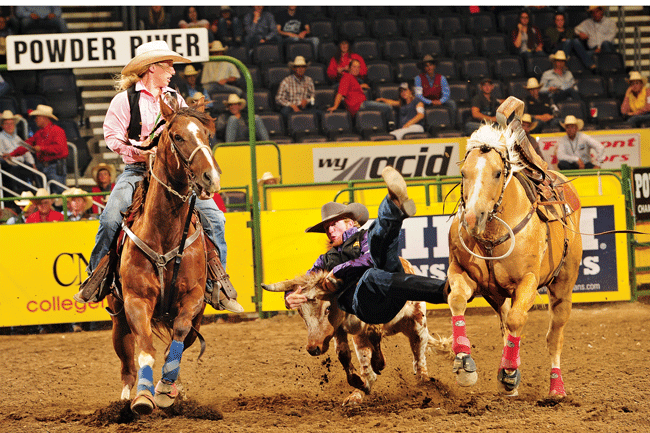
From the time Lindsay Davis entered her first rodeo astride a Shetland pony, she’s had college rodeo on her mind. Working through the ranks of junior and high school competition alongside her sisters, Jana and Kiley, the 23 year old from Malad, Idaho, achieved her goal of college rodeoing. She qualified for the CNFR in the breakaway roping her freshman year, and recently accepted the assistant rodeo coach position at Colorado Northwestern Community College (CNCC). But like many a trek down the rodeo trail, her journey isn’t without its share of detours – and surprises.
One of the greatest surprises – more so to her family than herself – was the opportunity for Lindsay to haze for several of the College of Southern Idaho’s steer wrestlers, from practice all the way to the CNFR. Her uncles, Kenny and Tom Holland, greatly influenced her interest in hazing when Lindsay was ten. They started an annual spring steer wrestling school in Montana, and when Lindsay’s dad drove a handful of steer wrestlers north for the school, Lindsay tagged along. “She was paying more attention than I thought, and when she got to college, one of her steer wrestling friends needed a hazer,” says her dad, Kelly Davis, a roper and steer wrestler himself who introduced Lindsay to rodeo. Lindsay hazed several steers for her friend and called home to ask about bringing back one of her dad’s hazing horses to school. Knowing the hazards of hazing, her mom, Mary Jo Davis, was far from being in favor of the idea. Lindsay’s determination found a way, however, and unbeknownst to her mom on a visit home, snuck the horse into the trailer with her dad’s help.
Having watched more steer wrestling than any TV show, Lindsay took to hazing naturally. By fall of 2015, her senior year, she was hazing for eight of the steer wrestlers, and hazed for several of them at the CNFR two years in a row. “I’ve chute dogged a few times, but never gotten off a horse. But if I could bulldog, I definitely would,” says Lindsay. “The guys will come ask me which are the stronger steers and how the last guy did on the one they drew. I pay attention, not just for them, but for myself so I know what moves the steers make and how to make the best haze. I was the only girl hazing in CSI, but there’s another girl in Rocky Mountain region who started doing it as well.”
Over the years, Lindsay has competed in nearly every girls event except barrel racing, and focused on breakaway roping, team roping, and goat tying in college. “I really enjoyed college rodeo – it was that step above everything else I’d done before, and I had to be more competitive. Not only are you riding and doing what you love, but you’re getting an education. Being a student athlete, there’s that drive to keep up your grades so you can rodeo and help your teammates and your coach.” She was also a talented softball player in high school, but chose to pursue a rodeo scholarship. “I told Lindsay that the sport of rodeo is where you go and help everybody,” says Kelly. “It’s not you against the next girl, it’s you against the stock you draw. Through that, she’s made good friends, and the coaches know her as a person who helps.”
Lindsay’s dedication to rodeo didn’t go unnoticed. Another surprise on the rodeo trail came when CNCC in Rangely, Colo., offered her the assistant rodeo coach position. “They’d had another girl coaching, and I told the head coach Jed Moore in passing that she had an awesome job,” Lindsay recalls. “I love coaching kids. A while later at a college rodeo, Jed asked me if I was serious about the job, and he offered it to me right there. It wasn’t in my plans, but it is now, and I’ll see where it takes me!” She starts her work with recruiting this July, and she’ll move to Rangely in August.
She’s also working to start her own business since graduating this spring with degrees in equine studies and business management. “I’m interested in chiropractic work and equine dentistry. Growing up, we’d take trailers full of horses to a guy who came through here specializing in those areas. People are always asking who they can call for those services, and that’s what gave me the idea for my business.”
While she’s also helping her family with ranching and farming this summer in southeast Idaho, Lindsay sets aside time for rodeoing with the RMPRA in both the team roping and breakaway. “I do both ends team roping, but I’d say I like breakaway a lot more,” she says. “I had a bad horse accident team roping right before my freshman year of college, so it took me a while to even want to team rope after that.” Lindsay doesn’t remember much of the accident, but her dad, who was watching, says she was roping a steer when her horse stepped into her curl and sent the pair tumbling head first. “She had a concussion, and she had a tough time for a year and a half being able to remember short term things,” says Kelly. “We went to Utah State University, which specializes in researching concussions and learned that Lindsay needed to teach her brain it could still learn new things. She started beading projects like belts, and working with her hands and creating patterns has really helped her mind heal itself.”
On the rodeo side, Lindsay missed her first regional college rodeo of the season, but she was released to compete shortly after and won the all-around in her first college rodeo, placing in both the breakaway and the team roping in Pocatello, Idaho, on her yellow mare, Piggy. “I probably wouldn’t still be team roping without the help of my friend Trasen Jones, and Cody DeMers, who was the assistant rodeo coach at CSI,” says Lindsay. “He really helped me get back into things mentally, and my dad helped me with the roping. Dad’s always been my go-to guy – I don’t know what I’d do without him. He and my mom are my biggest supporters, and I can always count on them being there.
“My biggest goal for the future is getting my business started up, and rodeo wise, I want to stay on top of my game and keep making the finals. I also want to get married someday and start a family and get them into rodeo. Rodeo is a family thing, and we’ve never let it die. I knew every summer I’d be living out of the truck and trailer. It’s part of my life, so I come back to it all the time.” -
Back When They Bucked with Willis Hamm
Trick roper, trader, entrepreneur, Willis Hamm was born near the second half of The Great Depression, yet hard work and ingenuity were spurs on the heels of the somber era. With them, Willis started his own business, Cowboy Metal, which celebrates its 50th anniversary this year, grown on the values of the western lifestyle – and $187.11.
Born November 5, 1934, to Henry and Esther Hamm, Willis was the youngest of four children. His father was a horse and dairy cow trader, and owned a dairy farm near Hooker, Okla., a town in the 34 mile wide Oklahoma panhandle. Willis was at once initiated into a lifestyle of rising when the day was just four hours old – or at least arriving home in time for milking. “Leland Friesen was my best friend in high school, and we’d ride after church into the night – my dad just said to be home by milking,” Willis recalls. “He never let me use the truck, saying I had a saddle and a horse. He had an extremely good reputation as a trader for his integrity and honesty, and he taught me all of that. We learned how to work and to be honest, and that’s still very important to me today.”
Willis and his brother took to breaking horses, both for their dad and the public. “I was trick riding then and teaching our horses,” says Willis. “My dad would have me show somebody the tricks a horse could do, and it was sold. It was key to my dad’s trading, but it was a heartbreaker for me to say goodbye. I really learned how to detach myself from an animal until I got my own horse, Lady.” The mare lived to be 34, and became Willis’s trick riding mount after he met Dixie Lee and Virginia Mae Reger of Woodard, Okla. “I saw them trick ride at a rodeo in Guymon, Oklahoma, and I fell in love with it,” Willis recalls. “I went home and started doing the tricks I’d seen. I didn’t have a trick saddle at the time, but I messed up my dad’s favorite saddle standing on it. The death drag was one of my favorites – it’s daring and spectacular.”
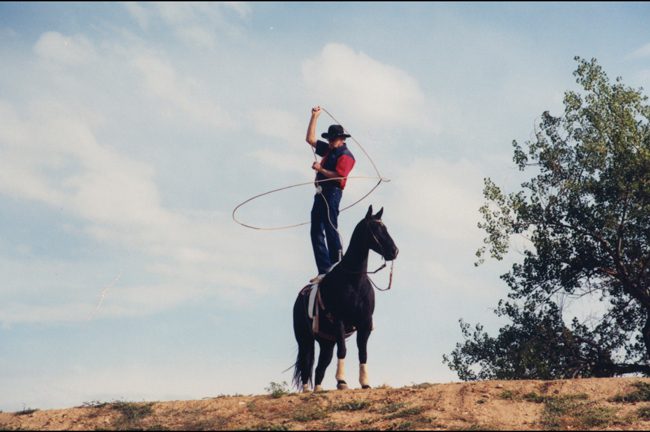
Never one prone to thumb twiddling, Willis added trick roping to his repertoire in grade school. The three Gilbert brothers from his school were from a ranching family, and they shared their knowledge of trick roping with him. “They were real cowboys, and also my heroes from the standpoint of trick roping,” he says. “I learned to do whip work on my own, and riding standing up while spinning a rope was something I specialized in.” He also experimented with roman riding, known for taking any two horses his family had and making them go forward. “Frank Gilbert could roman ride two horses jumping over a convertible, and I asked my dad about using a neighbors junk car to jump, but he said no, so I made some jumping standards and put a blanket in between to create the same distance. I also trained one of my dad’s horses, Dolly, for trick riding. She loved to fall, and I learned to fall free of her. I’d take her to one of our plowed fields and take her down at a gallop, just like in the movies.”
Willis took his talent from the cow pasture that was his practice pen to rodeos in Kansas and Oklahoma. He grew up just 30 miles from the late legendary rodeo clown and competitor, Buddy Heaton, who eventually left the RCA to create his own rodeo circuit. It was there Willis found his lifelong love of mules and buffalo. “Buddy was my hero, and he did the unusual,” says Willis. “He bucked mules and buffalo as his roughstock. I clowned his buffalo rodeos and did some trick riding and whip work for him for several years.”
Change came when Willis quit school and refused to return for his senior year. “I didn’t get along with my teacher, and he said I was unteachable. My sister had gone to Meade Bible Academy two years before, and my parents asked if I’d go there. I told them only if my best friend, Leland Friesen, came along. He didn’t have a father and his family was very poor, and to this day I’m fairly sure my parents made it possible for him to go that school.” It was there Willis met his future wife, JoAnn Friesen (no relation to Leland), and they were married on December 29, 1953, when Willis was 19, fitting the wedding between milking chores.
The newlyweds moved to Denver, where Willis worked for two and a half years at a Presbyterian hospital as an alternative to the draft for the Korean War. To supplement his income, he mowed lawns, delivered The Denver Post, and drove horses for Glacier Barns’ hayrides several hours a night. In 1960, he started working for a company that built doorframes, but boredom struck, and Willis decided to make good on his pledge to be a trader like his dad. “I’d saved up $187.11, and I wanted to see what I could do with it,” he says. “The first thing I did was buy a machine I didn’t know anything about, which turned out to be worthless. I knew a guy in the machine tool business, so I told him my story and we traded for a little punch press. I started making things like ornamental leaves for fences for three cents apiece, and then a friend of mine in the ceiling business needed ceiling clips, which I built by the thousands.”
By 1968, Willis had three employees, unbeknownst to his own employer, whom he was still working for. “I went into my boss two years after I started Cowboy Metal and told him what I was doing,” says Willis. “I thought he’d either fire me or tell me to get rid of it, but he only asked if I was man enough to run two companies, and I worked for him another two years.” In 1970, Willis had saved $2,000 cash to quit his doorframe job and begin working full time at Cowboy Metal, but the day he resigned, he went out to lunch with his billfold and came home without it. It was found and returned with everything but the $2,000. “That’s the money we were going to live on for a while, but the man I’d sold ceiling clips to advanced me some money, and it didn’t take me long to pay it back. I’m a risk taker and a pretty good manager, and I ended up fulfilling my wish of being a trader.”
Willis went on to buy and sell everything from wagons and buggies, to horses, mules, and harnesses, staying just ahead of the curve of what was trending for 25 years. He sold harnesses internationally to Germany, Japan, and South America, while Cowboy Metal expanded its services to building horse trailers. Today, the custom metal fabrication shop, still located in Denver, specializes in press brake, shear, and welding services, along with repairing many types of trailers and selling trailer parts.
While his business grew, so did Willis’s family. He and JoAnn have two children, Verle Hamm and Melody Brandt, along with four grandchildren – Verle and Dawn’s daughters, Alyssa and Randi, and Melody and Bruce’s sons, Jason and Lance – and five great-grandchildren. “I’m honored to have him as my dad and experience the things we have together,” says Verle. He competed in the NLBRA in bareback and bull riding, and was the CSHSRA bull riding champion in 1974, along with the all-around reserve champion. Today, he competes in the Cowboy Mounted Shooting Association (CMSA). He and Melody work at Cowboy Metal, while Willis ushered all of the grandchildren into the Denver National Western Stock Show, which he competed in with both horses and mules. “There’s been a second-class attitude about the mule industry, but at Cowboy Metal we always tried to raise the bar and be creative,” says Willis, who won every class at the Stock Show during his 30 years as a competitor.
Yet the creativity didn’t end there. In 1969, Willis had purchased a piece of property in Louisville, Colo., between Boulder and Denver, naming it Cowboy Meadows Farm, a division of Cowboy Metal. Complete with Western buildings, teepees, and stagecoaches, the farm hosted weddings, YMCA summer camps, company picnics, and other special events, until it was sold in 2010. Willis and Verle also drove rodeo dignitaries in their stagecoach for 18 years in the Greeley Stampede, including Leon Coffee and Bill Farr.
“It was fun growing up and having a dad who was a cowboy,” says Melody, “and all the fun we had at the National Western Stock Show will never be forgotten. He taught us a lot of things, and growing up with him as a dad was never dull. His faith and love of God and family is a wonderful heritage.” Today, Willis and JoAnn make their home in Lakewood, Colo., near Denver, where his garage is home to numerous mechanical dummies he creates and engineers to talk and make facial expressions. Though he sold his 14 buffalo – one of which, Harry, now hangs in Willis’s office – Willis still works with his mules. He sold two pairs of mules to a wrangler for the 2013 adaptation of The Lone Ranger, and his inventiveness also produced Little Spike in 2005, a train engine with ten passenger cars he and Verle take to special events such as Buffalo Bill Days in Golden, Colo., country clubs, farmers markets, parades, and Lakewood Cider Days. They have also taken their special events to Nashville, Tenn., Wichita and Liberal, Kan., Guymon, Okla., Tacoma, Wash., Las Vegas, Nev., Greeley, and The Broadmoor in Colorado Springs, Colo., while also making appearances in and providing props for TV commercials.
“Life has been good, and I’m grateful for the talent and opportunities God has given me,” Willis concludes. “To quote my hero, Will Rogers, it takes a life to make a living, and it takes a lifetime to make a reputation.” -
Back When They Bucked with Vernon Dude Smith
[ The Smith family’s only bootprint in the horse world was a great-great-grandfather who traded horses, but that all changed when Dude went to watch his first rodeo. ]
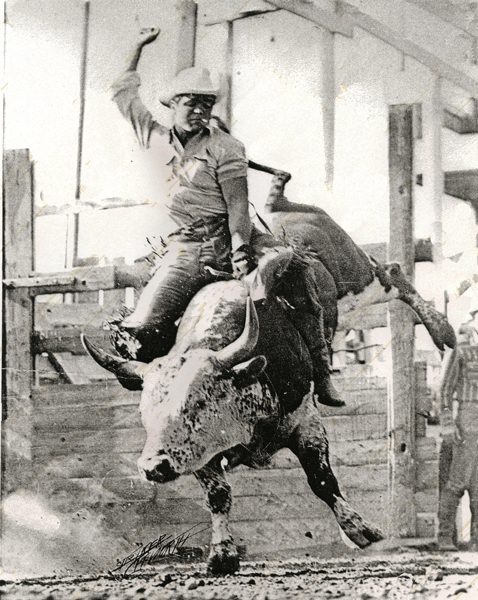
Dude Smith was 13 years old when he stuck a blue-jeaned leg over his first bucking bull. In actuality, it was a milk cow tied to the fence. But for the teenager from Burkburnett, Texas, it was the start to a rodeo career that would give him the love and friendships of a lifetime, and the honor of being inducted into both the Texas Cowboy Hall of Fame and the National Cowboy and Western Heritage Museum’s Rodeo Hall of Fame.
Born Vernon Smith, Jr., in 1928, he was the oldest of three sisters, Geneva, Anita, and Kay, and a brother, Billy. Neither Dude nor his dad, whom he was named after, had middle names, and went by Big Dude or Little Dude to tell them apart. The Smith family’s only bootprint in the horse world was a great-great-grandfather who traded horses, but that all changed when Dude went to watch his first rodeo. “I told my mom that’s what I wanted to do, and she told me I didn’t know anything about rodeo,” Dude recalls. “And I told her those cowboys didn’t know anything about it either at one time!”
Dude rode one bucking bronc that year, but nearly didn’t make it to the chutes again after he tried to join the U.S. Navy. “I lied about my age and tried to join up, but they caught me,” says Dude. “That was just before Pearl Harbor was bombed – a few people I knew lost their lives there.” Soon after, Dude was given a 4F by the draft board after he was kicked while playing football, which broke an artery in his leg. One hospital was ready to amputate it, but another doctor was able to operate and repair Dude’s leg, cautioning him to never do anything that would bump it.
But Dude wasn’t long out of the hospital bed before he was back in the arena, finding work for rodeo producer Paul Long in Kansas and running the rodeo arena for Floyd Reynolds of Montgomery, Ala., doing his own rodeoing on Saturday nights. Dude’s first jobs as a child were carrying water jars in wet tow sacks to field hands for 50 cents a day, or pulling a funnel wagon which carried grain. But in 1947, he and several friends, including Neal Gay and Wiz Whizenheimer, decided to head north and east to the larger rodeos, and Dude sold a cow he owned to his dad and used the money to buy a ticket to Philadelphia. “I sat on the airplane with my nose on the glass and wondered how much better it could get,” says Dude. “I had on boots with more tape than leather holding them together, and I went on to compete in Detroit and New York. I’d never seen that kind of money in my life.” He competed in 53 performances in 30 days in the Madison Square Garden rodeo, having joined the Cowboys’ Turtle Association just before it was named the RCA. He recently received a buckle from Montana Silversmiths for being one of the four oldest gold card members – #159.
Dude competed in every event but team roping, mainly entering the bareback riding, bull riding, steer wrestling, and wild horse mugging. “I loved riding bulls, and I could ride broncs, I just wasn’t as classy as the other guys. I travelled with Casey Tibbs for a while, and if I got lucky enough to draw and beat him, he’d say we didn’t go to that rodeo,” Dude says with a laugh. “There was one bull, Iron Ore, that I got on all the time, and I never rode him. He wouldn’t hook me, but he’d look at me like I was dummy to keep trying. When I leave this world, he’ll be on my headstone – I thought he deserved to be the winner of the deal.”
Dude saw much of his success in the steer wrestling, winning the event at Cheyenne Frontier Days more than any other rodeo. The greatest thrill of his steer wrestling career was in 1953, when he was invited to compete among the top 25 steer wrestlers in the world in Grady, N.M. Another high point came in the early 1960s, when Clem McSpadden, as part of John F. Kennedy’s “Partners of the Alliance” exchange with Mexico, asked Dude to go with a group of cowboys from Oklahoma to aid cities in Mexico and put on a rodeo. “During the rodeo, they brought out a pretty nice steer and a Mexican fighting bull that probably weighed 850 pounds,” says Dude. “I was able to throw that bull, and everybody threw their hats in the ring and hollered I could be president of Mexico!”
Yet one of the greatest events of his life was when Dude met his wife, Frances, in the late 1940s. She was performing with a horseback square dancing team in Burkburnett when Dude met her, and they married in 1950. “I chased her for a couple of years and finally got her hemmed up, but it wasn’t easy!” says Dude. “After that, it lasted pretty good. She was one of the greatest horsewomen there ever was.” A barrel racer, Frances qualified for the 1967 NFR in Oklahoma City – the first year barrel racing was added to the finals – and won the World title. She was also a member of the AQHA and won titles in the both the junior and senior divisions, along with keeping books for rodeo producer Ed Curtis. She and Dude rodeoed together for nearly 20 years, crisscrossing the plains of Kansas, Oklahoma, Texas, Nebraska, and even into New Mexico. Dude finished 16th in the world in steer wrestling in 1966. “But I never really rodeoed to be a world champion,” he says. “My dad told me it was better to be a big fish in a little pond than a little fish in a big pond, and I hardly remember going to a rodeo I didn’t win.”
One of Dude’s greatest horses was Scooter, born the same year he and Frances married. The horse was a gift from Dude’s father-in-law, and he was Dude’s mount in the steer wrestling, also winning Frances a barrel racing saddle in Mesquite, Texas, after her horse went lame. In his later years, Scooter went on to teach many kids how to steer wrestle and high school rodeo.
In addition to competing, Dude ran footraces to earn extra money on the road, and he worked as a pickup man, arena director, and even an arena policeman. “We had to keep people back from the arena a certain distance,” Dude explains. “In Cheyenne, people would bring their blankets and set up in the roping box end of the arena. I helped anywhere they needed me. Sonny Ringer was the arena director for Beutlers when I helped them. He carried a pair of pliers in his pocket, but if I couldn’t get a steer to go in, I’d just bite his tail!”
When Dude decided to retire from rodeo in the 1970s, he started training racehorses in Texas. “Frances didn’t understand how I could like training horses, since I didn’t get to ride them, but I told her when the horses crossed the finish line first you’d get goose bumps an inch high!” He and Frances had two sons, Mark and Vern. Vern went on to ride bulls after high school and qualified for the NFR in 1980 , but Mark passed away in 1973. He was driving home on a three-wheeler when a pipe fell off a passing truck and hit him. “I lost everything for a few months,” Dude remembers. “But between my friends and the Lord, I got myself on the right track.”
Dude and Frances made their home for many years in a house near the Red River but later moved to higher ground in Burkburnett. Their son Vern now lives near the river and runs cattle with his wife, LaDonne, who college rodeoed on a scholarship. Dude lives with his granddaughter, Sage Smith, who barrel races, and trains and sells horses. She won the BFA World Championship in 2003. Dude and Frances were married for 63 years before she passed away in 2013, and she was inducted into the National Cowboy and Western Heritage Museum’s Rodeo Hall of Fame in 2014.
Along with his immediate family, Dude continues many friendships with his rodeo family, and continues to run a small trucking business. “When I first started rodeo, Neal Gay was my closest friend, and he still is,” says Dude. “We’re like brothers.” He feels he competed in the greatest age of rodeo, where camaraderie was staying with families in the same town as the rodeo – some of them barely acquaintances – and hospitality was an ice box full of beer and a plate of chicken or steak. “I worked with committee men and contestants, and we were one big family. I never went to the National Finals, but I would venture to say I wound up better off than a bunch of the gold buckle boys.” -
ProFile: Cole Bailey
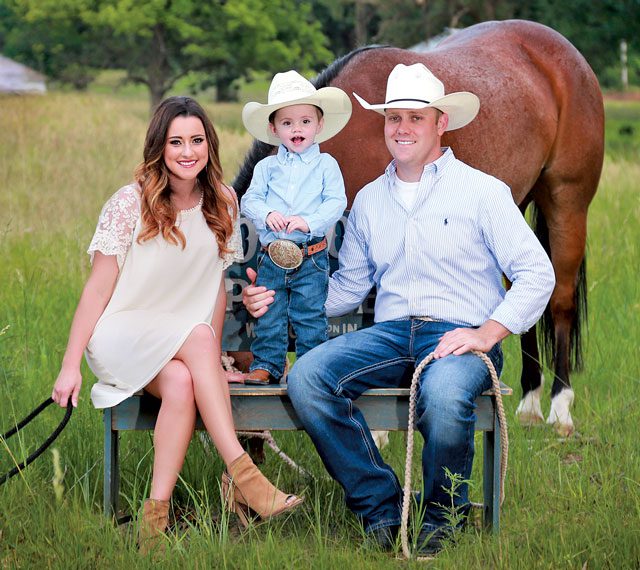
Cole Bailey stepped into the Silver Spurs Arena, home of the 2016 RNCFR, for the first time this spring. The 27-year-old tie-down roper from Okmulgee, Okla., has been competing on the PRCA Prairie Circuit for eight years, winning the average at the 2015 Prairie Circuit Finals with 26.5 seconds on three runs. His debut at the RNCFR was a highlight of his career, placing first in the semi-finals with nearly $7,500. “It was awesome! The facility was unbelievably nice, and it was cold and rainy at home, so it was nice to go to Florida – it was my first time rodeoing there,” says Cole. “It was pretty exciting to be at that big of a venue – there’s not many times in a year that I rope for that much money. I stayed pretty booked up with the rodeo, but my wife and I had a chance to check out some restaurants and go down to the beach.”
Another highlight for Cole was competing in The American in 2015, finishing fourth in the finals, while he advanced to The American Semifinals this year. “The competition is just amazing when you get to rope against the caliber of guys like Tyson Durfey who are out there going full time,” says Cole. He grew up on the coaching of his dad, Mike Bailey, and world champion ropers like Joe Beaver, who stopped in and roped at the Bailey’s arena. “I started junior rodeoing when I was seven, and that’s all I’ve known to do with my spare time the last 20 years! Clint Carpenter is one of my friends I’ve been roping with since I was eight. We’ve always been competitive with each other, and to this day, he still ropes with me and helps me critique my roping. Growing up, our arena was set up for roping calves, and we always had good calf horses, so it was easy to pick up that event.”
Cole added steer wrestling and team roping to his résumé when he college rodeoed for Southeastern Oklahoma State University, qualifying for the CNFR twice. He continues to team rope with his dad on occasion, but quit steer wrestling several years ago. Soon after college, he was invited to church by a rodeo buddy, where he met his wife, Brittany, a barrel racer. Their two-year-old son, Brody, feels no day is complete without riding and helping his family check cows. He rides his dad’s rope horse, Baboo. “Baboo started out as Baldy, but Brody was having a hard time saying his name,” Cole explains with a laugh. “I’ve been hauling Baboo for about three years now. He was born and raised on my family’s place, and we have the growing pains to prove it! Brittany ran barrels on him and got him rode down, and then I started riding him more. He’s 12, and now it’s smooth sailing for us. I was confident going into the RNCFR because I have a lot of confidence in my horse. Baboo’s super talented and always gives me a shot, even if the calves are running hard or being wild. He’s been a blessing to my family.” Baboo has also carried Cole to several major ropings, including the Windy Ryon Memorial Roping, Spicer Gripp Memorial Roping, and Mike Johnson’s World’s Richest Calf Roping.
When the truck is in park, Cole and Brittany are working cattle on their ranch outside of Okmulgee. “We run close to 300 head. It started out as a hobby, but it’s not much of a hobby anymore,” says Cole. “I start out my day selling trucks at my family’s car dealership, then come home and take care of cattle. I have a guy that helps me with them, but there’s not much free time. We like to hunt and fish, and Brittany teaches Sunday School, but with whatever time is left, we’re homebodies.”
During the summer, the Bailey’s home is often on the road, blending rodeoing with vacation. They’re planning a trip back to Florida for all things Disney World this fall, but otherwise meld rodeo and vacation together. “I’m pretty fortunate that my wife enjoys being gone for a week or two at a time. Last year, we left the Colorado Springs Pikes Peak or Bust Rodeo and went to Cheyenne Frontier Days after visiting some water parks and riding bicycles. I’d been to Cheyenne before, and it went pretty good! I had some luck last year, and this year I’m rodeoing a bit more and seeing how it goes. I’m going to Reno this month, and if things are going good, I’ll stay out longer doing PRCA rodeos. Otherwise, I’ll stay close to home and circuit rodeo. But I feel I have a pretty good horse that will let me win, and I’d like to try it! -
On the Trail with Garrison Panzer
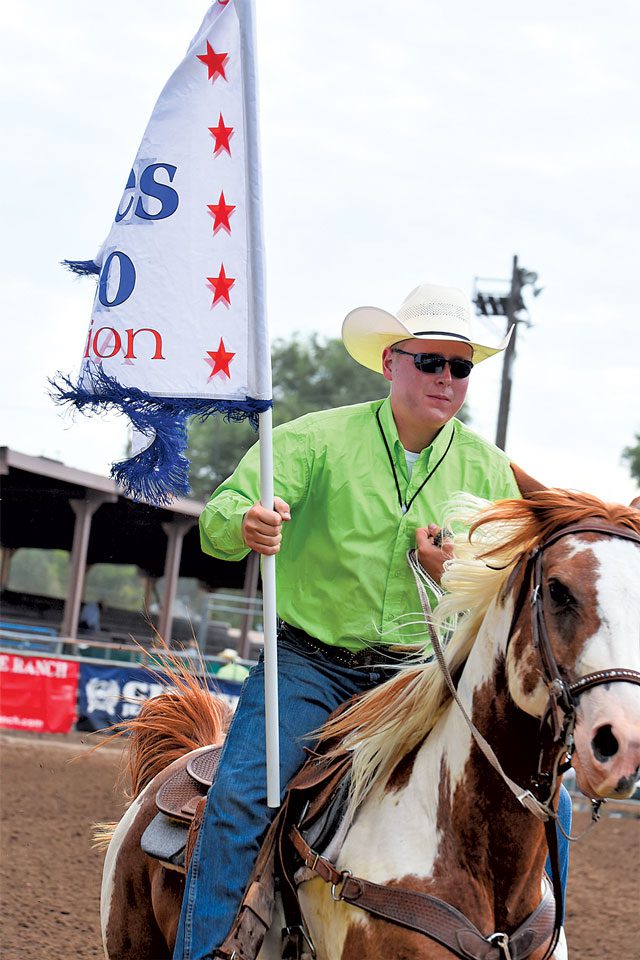
“Be a blessing because you are blessed,” said 18-year-old rodeo announcer Garrison Panzer before switching off the microphone, closing the 2016 Kansas Junior High School State Finals Rodeo. Such are the values of the entire Panzer family, who instilled the importance of serving others in the cowboy from Lakin, Kan., at a young age. A family of rodeo competitors, judges, announcers, timers, and secretary assistants, the Panzers have helped in nearly every aspect of the National Little Britches Rodeo Association in their 30 years with the association.
“We absolutely love the National Little Britches Rodeo Association and everything it does for our kids,” says Garrett Panzer, himself a Little Britches alumni and now a rodeo judge and former member of the NLBRA board of directors. “We’ve gotten everything out of rodeo that we could ever want. We haven’t so much rodeoed with the world championships and buckles and saddles in mind, but instead used it as an avenue to help raise our kids and teach them the strong values of competing, being responsible, and respecting the western lifestyle.”
Garrett and his sister, Dia Panzer-Biddle, grew up in Little Britches, while their dad, Dwayne Panzer, served as a rodeo judge for the association, and continues to do so today. Even from a young age, Garrett knew the rodeo lifestyle and values were what he wanted to instill in his future family. “I played college football two years for Dodge City Community College and then two years at Hastings College. After my playing days were done and I found my wife of 20 years, Kim, we knew rodeo was the avenue we wanted to take with our family,” says Garrett. “I think God really blessed us with two great boys to raise,” Kim adds. “When I was pregnant with Garrison, we attended the baptism of a friend, who was born about five months before Garrison. In part of the sermon, they quoted Proverbs 22:6, ‘Train up a child in the way he should go: and when he is old, he will not depart from it.’ The importance of starting early with a solid, Christian foundation really stuck with me.”
Garrison, the NLBRA youth board president and a ribbon and team roper, was one of the competitors to qualify for the 2003 NLBFR in the newly minted Little Wrangler division. His 15-year-old brother, Hadley, rodeoed for several years before pursuing other sports, but continues to help behind the scenes at Little Britches rodeos and run sound while Garrison announces. The 2016 NLBFR is Garrison’s last as a competitor, but his days with the association are far from over. “I’m in the process of getting my NLBRA judge’s and announcer’s card, and I plan to apply for one of the announcer positions for the finals next year,” he explains. “It’s always been my goal and dream to judge a rodeo with my dad and grandpa, and after this finals, I’ll have a chance to do that.” While he’s qualified for the finals in both his events, Garrison is also announcing the grand entry and portions of the queen contest, along with helping Doug Wade on the production side – and finishing out his third term as the youth board president. “It’s a bittersweet year. I wouldn’t trade any of the ups and downs of the past 13 years for the world. People might say the competition isn’t as tough as others, but if you look at the times and scores turned in, it’s just as tough as many other rodeo associations. And the friendships you build and the rodeo family you have is second to none.”
Beyond Little Britches, Garrison announces rodeos for the NSRA, KPRA, KJHSRA, mini bull ridings, and even the 2016 Oklahoma vs. Kansas Border Bash Rodeo in Guthrie, Okla. “Monty Stueve and I were the two announcers for the weekend, then I turned around and announced the high school rodeo in Lakin,” says Garrison. “I also announced a high school rodeo in McCook, Nebraska, so within a month, I announced a rodeo in three different states. Then I decided to skip a weekend so I could graduate high school, but I have a rodeo to announce every weekend except for three this summer. At first I was worried about being repetitive, but with each rodeo, I’ve gotten more relaxed. I’ve come to realize as long as the contestants are having fun and the crowd is enjoying it, that’s what I need to keep doing!” With the help of his Sports Sound Pro and pointers from several people, including NLBRA producer Janet Honeycutt, he has more than 5,000 songs and sound clips at his fingertips. Garrison announces most of his rodeos from the stand, but he’s debuting his horseback announcing during the NLBFR. “I’ve watched Boyd Polhamus do it a few times, and I can definitely see where you can build a connection with the crowd. I’d like to add that to the performances.”
During the KPRA rodeo in Springfield, Colo., last summer, Garrison announced, while Hadley ran sound, Garrett judged, and Kim was a timer. Garrett’s goal is to judge both the NLBFR and the NHSFR in the same year, while Kim has helped the Little Britches secretaries with their local rodeos the past five years. She plans to continue after Garrison ages out. “I didn’t grow up rodeoing, but my family always had horses,” she says. “My mother was a paraprofessional in Garrett’s first classroom he taught, and she told me I should meet him when I came home from college for Christmas break. We hit it off, and the rest is history! Since I came to be part of the rodeo family, I see so much kindness and generosity. Everyone is more than willing to bend over backwards to help, and I want to pay it forward.” Kim is also the coordinator of the federal programs for her school district, helping migrant and ESL families, as well as coordinating buildings during testing season. Garrett teaches STEM (Science, Technology, Engineering, and Mathematics) to seventh and eighth grade students at Lakin Middle School, while teaching driver’s ed. in the summer, refereeing basketball, and umpiring softball. He has coached football for more than 20 years at both the high school and middle school levels, and became a wrestling coach nine years ago.
Garrison and younger brother Hadley at 2004 D-K Series Finals in Garden City, where Garrison won his first saddle – Courtesy of the family 
The Panzer Family at First rodeo all four of us worked together, Springfield, CO – Courtesy of the family 
Garrison announcing at his first rodeo association finals, KJHSRA, in Whitewater, KS 
2003 NLBFR, first finals for Little Wranglers, Garrison’s favorite event still today – JJJ Photo 
Garrison Panzer 2015 NLBFR in Pueblo, CO An avid athlete, Hadley is attending several wrestling and football camps this summer, and playing baseball on a recreation ball team. “Football is my favorite – I enjoy being around my teammates. I play defensive end, and on offence I play center,” he says. “It’s me and my mom going to games most of the time since Dad is with Garrison at rodeos, and we have some good bonding time.” Hadley will be a freshman at Lakin High School this fall, which Garrison graduated from this spring at the top of his class with Honors. Like Garrison, Hadley will represent his class as the Class of 2020 Vice-President and serve on the Student Council. “We’re very pleased with the young man Hadley’s become,” says Garrett. “He graduated junior high lettering in four sports. Both our boys have learned from sports to compete at the best of their abilities and compromise without compromising their values.”
Throughout high school, Garrison was involved in Student Council (STUCO), band, vocal, golf, and refereeing basketball, while he played lead roles in two high school plays, including King Arthur in Camelot. His cowboy boots even travelled internationally in January when he went on a weeklong mission trip in Guatemala, which included building stoves for the people of Panajachel. A month later, he travelled to England for a week. A recipient of the OSU McKnight Scholarship and President’s Distinguished Scholarship, he’ll be studying Ag. Business at Oklahoma State University this fall and is considering law school in the future. Prior to that, he’s running sound for Jared Slagle at several PRCA rodeos this summer, and plans to keep up his roping through jackpots and helping the college rodeo team.
“It will hit me in August that Garrison’s not going to be able to walk through the door and give me a hug,” says Garrett. “But we’ll be there for him whenever we can. My mom and dad drove four hours to listen to him announce the KJHSRA finals – that’s how our family is. We meet ourselves coming and going sometimes and wonder why we do this crazy life, and I think the result is in the character of our kids. If between Kim and I our boys grow up to be fine gentlemen, then I think we’ve done our job.”
-
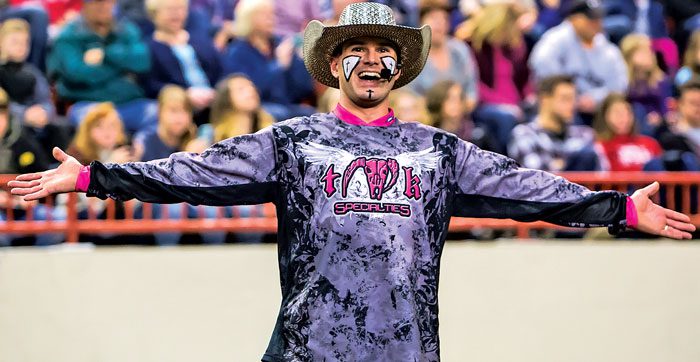
ProFile: Dave “Showtime” Meyer
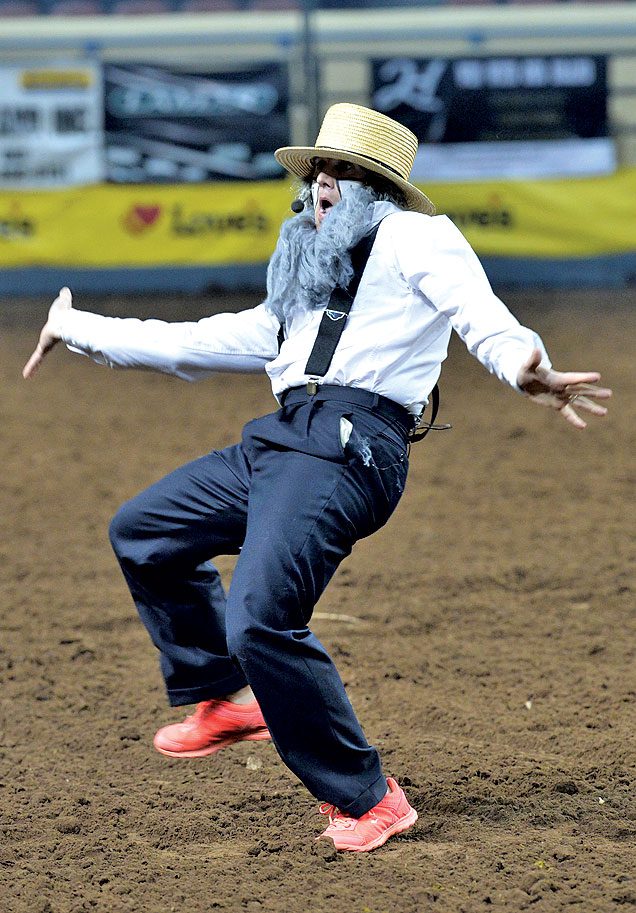
Dave in character as “Jacob the Amish Man” at the IFR46 Comedy Act Showcase – Rodeo News Dave “Showtime” Meyer danced his way to IFR46 Comedy Act Showcase Champion during the IPRA finals in Oklahoma City. Known for his YouTube videos featuring the Horse Screamer and an Amish man, Jacob, the rodeo clown from Jonestown, Pa., was competing in his first IPRA event with six minutes in the arena for his act. One of ten contestants entered, including Hollywood Harris, Dave knew his work would have to be distinctive. He pulled out one of his favorite characters, Jacob the Amish man, and shuffled into the arena, barefoot and bewhiskered. By the end of the act, Jacob was dancing in a pair of magical shoes, and Dave went home with the championship buckle. “It was cool to walk away with the buckle,” says Dave. “The announcer I worked with, Don McGee, also won first place, so that was pretty neat! We laid out a bit of a plan – I don’t like things to be scripted – and we rolled with it!”
Though Dave wasn’t born into rodeo, it captivated him in his teens, particularly the bull riding. “I got on my first bull when I was 18 or 19,” he recalls. “I’d wanted to do it since I was about 15, but my parents said absolutely not.” By the time he was 19, Dave was married to his wife, Becky, and though he couldn’t pursue bull riding full time, he was in the chutes at every opportunity. “I ended up riding bulls on and off for about ten years, and I wasn’t very good, but it all worked out in the end. I had never planned on being a rodeo clown, but I think travelling up and down the East Coast and watching a lot of other rodeo clowns was all in God’s plan – I just didn’t realize it at the time! In 2013, I got on my last bull and clowned my first event all in the same month.”
After seeing his fair share of clown acts from behind the chutes, Dave felt he could bring a fresh angle to the arena. “I work hard to make sure everything I do is unique, original, and different. I’m into physical comedy and using every day, real life events for material, because that’s what people can relate to. Everything I do is high energy.”
Dave’s high energy and marketing smarts have earned him a huge fan base, with more than 63,000 followers on Facebook, and several sponsors, including T K Specialties, Nod Big Apparel, Rodeo Wrecks, and Kimes Ranch Jeans. “I have close to 50 shows booked so far this year, including the IPRA, SEBRA, PCB events, and the entire Bullride Mania tour, but I still have plenty of dates available,” says Dave. If he’s not driving to his next show, Dave is hauling feed to dairy farms, but any down time is spent with his wife, Becky, and their two kids, Tyler (11), and Peyton (three). Their farm outside of Jonestown also serves as inspiration for many of Dave’s videos. “My wife teaches riding lessons, and we’re involved in 4-H, plus we used to run a boarding facility, so I have an endless amount of material from being with horse people for so long. Exaggerated truth is the best form of comedy, in my opinion.”
Entering his third year as a rodeo clown and entertainer, Dave’s goal is still the same. “My goal from the start has been to work the PBR and take over for Flint Rasmussen,” he says. “I have to give a lot of credit to my parents for giving me a good work ethic – when I decided to do this, I wanted to be the best. I’m of the mindset that whatever you do, you should give it 100% and not do a half-hearted job.” -
ProFile: Amy (Sutton) Muller
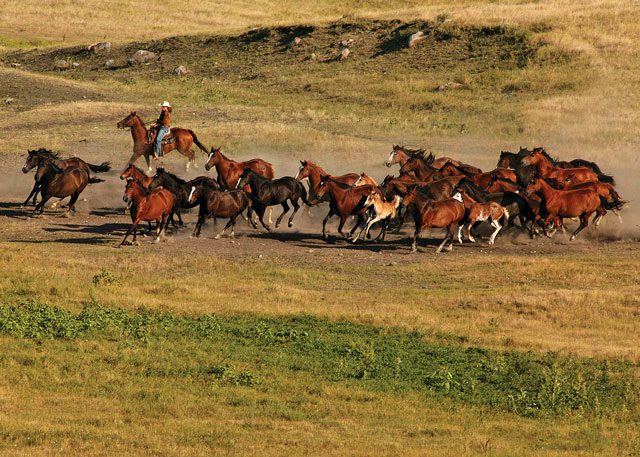
The Black Hills Stock Show celebrates its 39th anniversary this February, and for Amy (Sutton) Muller of Agar, S.D., the show is not only the brainchild of her family, but a showcase of the rodeo talent which runs thick through all six generations of Suttons.
The history of the Suttons starts even before South Dakota became a state. Amy’s great-great grandfather, Edwin Sutton, homesteaded the family’s ranch in 1883, set in the hills near the Missouri River. He started putting on rodeos Sunday after church for the township using his ranch stock. By the late 1920s, he and his sons were producing three-day rodeos on their ranch, where a young Lawrence Welk from North Dakota occasionally stopped to contribute his sparkling music. Edwin’s son, James, ushered the rodeo company into the next generation by becoming a member of the PRCA. He later became the first stock contractor to be inducted into the PRCA’s Hall of Champions in 1982. James and his son, Jim, focused in on the breeding of the rodeo company’s livestock, particularly the bucking horses, which earned them several first runners up and three winners of the PRCA Horse of the Year. In the late ‘70s, Amy’s dad, Steve, who has picked up the WNFR five times, took over the ranch management. Amy was born soon after, going to her first rodeo at ten days old.
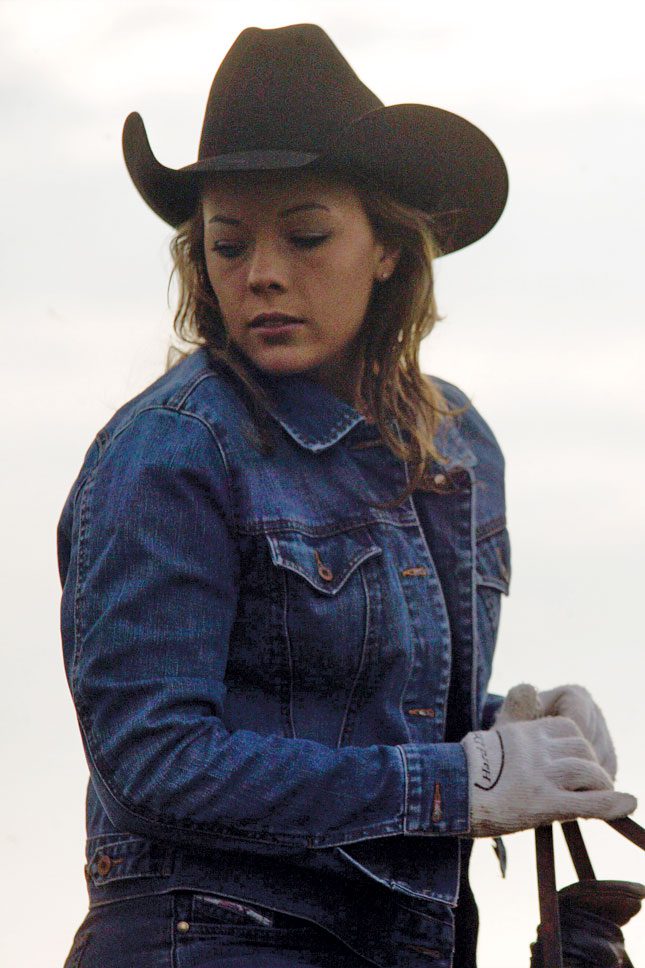
Her own history in rodeo includes competing through college, carrying the American flag in the 1995 WNFR, and most recently, timing during the 2015 WNFR. But the Black Hills Stock Show Rodeo holds a special place in Amy’s memories. “The show is second nature since it’s been there every year of my life, but I first remember being four years old and carrying the American flag,” she says. “Working alongside all those queens who were in their early 20,s and hanging out with the contestants’ kids made the whole thing feel like one big fun family celebration!”
Amy carried flags and chased cattle out of the arena until she was 18 and off to college at South Dakota State University like her grandfather and father before her. She studied animal science and competed on the college team in breakaway roping and barrel racing. Her brothers, Brent and Brice, following suit a few years later. “When I was halfway through school, Dad and Grandpa told me and my brothers that they would like for us to come back and join the company as partners,” Amy recalls. “Just like when I was a kid, I stayed very active with the livestock. From the time we were old enough, we’d hop in the truck and do our part with feeding, haying, fixing fence, and whatever else needed done.”
Within the last several years, however, Amy’s job description changed after the family’s bookkeeper of 21 years retired. “I took over the bookkeeping about the time I had my son, Shaden,” says Amy. “We work rodeos where we are the contractor for a committee, as well as producing rodeos as the committee and contractor ourselves. My day is filled with working on both of those types of rodeo events, as well as sponsorships, marketing, advertising, social media, and our Sutton Rodeo merchandising. I also keep the financial books and the livestock records. About three years ago, Dad started a cross breeding program and brought in outside stock contractors. Those colts are just getting to bucking age, so we’re very excited to see how the offspring from this program turns out.”
In addition to her office work, Amy continues to time about 12 of the 20 to 30 rodeos Sutton Rodeo produces each year. She obtained her PRCA card when she was 19 and took over timing when her grandmother, Julie, retired. Both Julie and Amy’s mom, Kim, have timed the WNFR, and in 2015, Amy was given the opportunity to do the same. “There’s no feeling I’ve ever experienced like working that rodeo,” says Amy. “The tenth round in that room was electric – so much could happen, you could feel the excitement buzzing, from the contestants, to the personnel and all the fans! Working with Tammy Braden and Jessi Franzen was extremely rewarding. They made working the NFR such a positive experience – they are wonderful ladies, and they’ll be lifelong friends!”
Alerted ahead of time by her mother and grandmother on how quickly the rodeo would move, Amy was prepared. “You don’t ever want to take your eyes off the arena for fear of missing anything, but you still have to record the times and penalties,” she explains. “One timer wears a headset that goes to the office, which puts out the official time for the record as the rodeo is running.” Along with timing, Amy and the other timers worked afternoons and evenings in the office putting together information such as the official stock draw and buck order, as well as updating the posted rodeo results, standings, and money. “Ultimately, it was one of the most interesting and rewarding experiences I’ve ever had!” says Amy.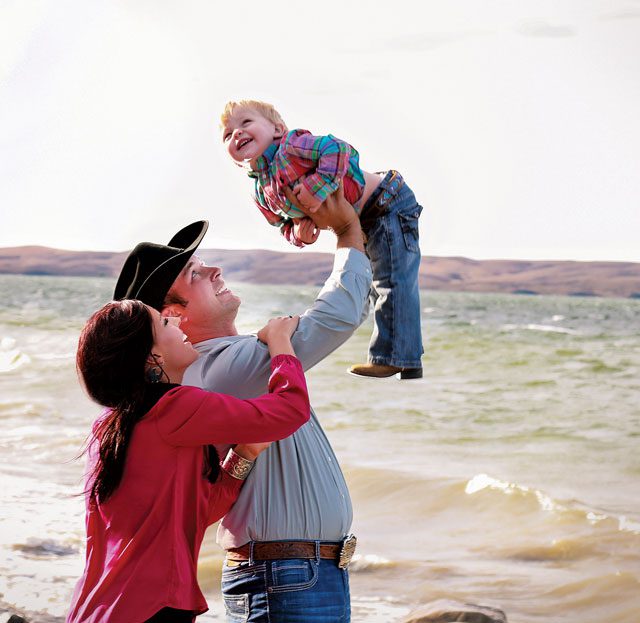
Fortunately, timing and Sutton Rodeo also tie in to Amy’s role as a wife and mother. She and her husband, Steven, have a two-year-old son, Shaden, as well as running their own cattle herd and operating a cattle carcass ultrasound business, Midwest Sonatech. A seasonal job that runs from December to May, Steven and hired friends and family travel around South Dakota, North Dakota, Minnesota, Iowa, and Nebraska, booking one or even two clients a day depending on the number of head to ultrasound. Amy does all the computer and bookwork while Steven does the imaging. “Steven and I travelled together exclusively for about five years until we had Shaden,” says Amy. “We ultra sounded until just a few hours before the c-section we’d scheduled for Shaden, and then went from the hospital to Rapid City to work the Black Hills Stock Show Rodeo!”
With just eight of them to produce all rodeo events held during the Stock Show, Amy and her family – who all live within a few miles of each other on the family ranch – know how to divide and conquer. “We start planning the next stock show in April,” says Amy. “Most of the rodeos that land in the same category as us – large indoor rodeo of the year – have hundreds to thousands of volunteers. We joke that we’re still looking for our first volunteer.” The Suttons’ events include the PRCA Rodeo, Sutton Ranch Rodeo, Girls in Spurs, Wrangler Champions Challenge, Bucking Horse Sale, and the PRCA Xtreme Bulls Tour, while the SDHSRA 20X Extreme Showcase is especially important to Steve Sutton. “Dad is always looking to give back to youth rodeo,” Amy explains. “We keep the numbers the same each year, but we’re always looking to give those kids more things to compete for and a bigger platform to showcase them on.
“As I’ve gotten older, I’ve realized how truly rewarding and exciting it is to work in this company and watch our animals develop and succeed,” says Amy. “You’re not going to get rich in this industry, but it’s really self-rewarding. Goal-wise, I’d love the opportunity to time the NFR again,” she adds. “And on a more personal level, I hope to keep expanding and improving our family business alongside my two brothers. Doing something like this for six generations doesn’t happen that often, and I want to keep this lifestyle going.”
-
Roper Review: Colton Workman
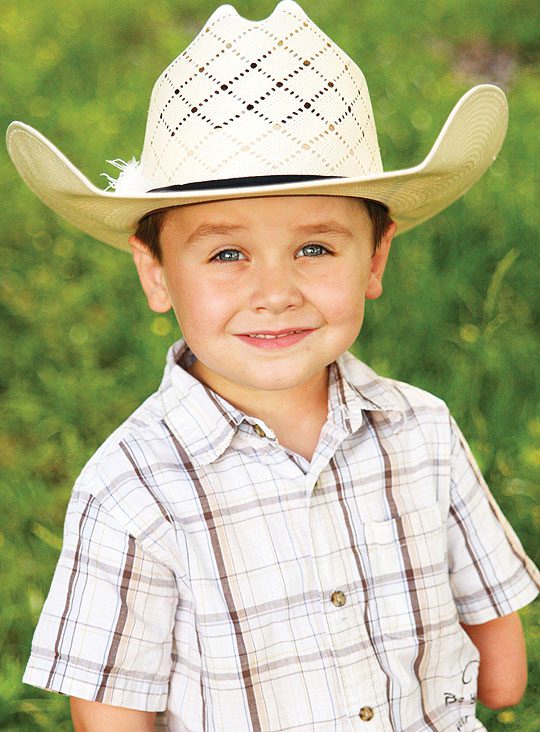
Five year old Colton Workman of Lincoln, Ark., may have only one hand to rope with, but he has more than enough heart to catch any roping calf or steer he encounters in the arena.Described by his family as coming into the world like a firecracker on the Fourth of July, Colton was born with only half of his left arm, but twice the determination. Born into a rodeo family, his parents, Brittany and Lewis Workman, roped and ran barrels, as well as his two older sisters, Tabor and Kayden. Colton was roping the dummy not long after his first birthday, and once old enough to ride by himself, he quickly figured out how to hold the reins with his left arm, which he refers to as his nub, and swing his rope with his right hand, his coils held securely by an attachment on his saddle.
When Colton’s dad passed away in 2013 after a car accident, thousands of people mourned the outgoing cowboy’s death. Eight-time world champion roper Roy Cooper heard about Colton losing his dad, and in December of that year, his foundation contacted Brittany, asking if the Cooper family could meet Colton in January. Roy, Clint, Clif, and Tuf, became fast friends with Colton, and he looks up to each one as a mentor. “After we met the Coopers, they took Colton into the Cooper Rodeo Foundation and the Rope Your Dreams Scholarship,” Brittany remembers. “Roy says Colton is family, and Colton is very close to the them.”
“What a great little kid!” says Roy. “He doesn’t even know he’s disabled. He’s so sharp and smart, and he’s got a great attitude.” Since becoming part of the Cooper family, Colton not only participates in their clinics and competes in their ropings, but he also travels with Tuf to events like The American and the WNFR. Through his travels, he has met numerous figures in the rodeo world, including Lane Frost’s parents. Signing autographs with Tuf and Trevor Brazile, and attending Elevation Sunday during the WNFR are always highlights for Colton. Having just entered Kindergarten, he has a multitude of all-access passes to some of the largest rodeos in the U.S., which Colton keeps with other mementos in a shadowbox in his room. He even has a letter written to him by the House of Congress in 2014, stating that Colton “is an inspiration to all.”
Colton’s travels have also helped him connect with other children who have disabilities. “Last year at The American, Colton met a little girl in a wheel chair, whose wish was to meet Colton,” says Brittany. “Other kids also want to meet him and touch his nub or ask him questions about it. Colton has met so many kids like him and he talks about them all the time. He doesn’t forget anyone.”
Having made so many connections with kids his age, Colton wasn’t expecting to be bullied when he entered Kindergarten this fall. Brittany wrote a piece on Facebook to spread awareness about bullying, and it was shared 24,000 times. “We got calls worldwide from kids who wanted to talk to Colton,” says Brittany. “I didn’t expect it to take off like that! We’ve even been contacted by The One-Armed Bandit (John Payne) and Willie Hart, the one-armed team roper, who have encouraged Colton.”
In November, the family started an anti-bullying project – Saddle Up and Together Let’s Rein in Bullying. “We designed a t-shirt for our project, and in January, we’re doing an assembly in Arkansas which will be televised by RFD-TV and local stations. We’re going to three schools in one day with several rodeo athletes who have disabilities, as well as athletes from other sports,” Brittany explains. “We’re hoping this will make children more aware of bullying, and for parents to talk to their children about it, because the change has to start at home.”
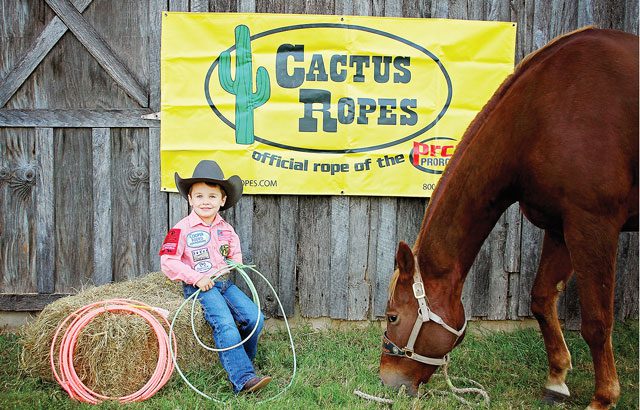
While Colton loves travelling, he finds equal joy in roping at home and competing in Roy Cooper’s ropings, as well as the USTRC and the CWRA. In 2015, he won the CWRA finals average in his age division, as well as the CWRA 7 – 10 Breakaway Roping Champion title, earning him a saddle, and a buckle, which is his current favorite to wear. He ropes the dummy every day and practices on live calves three times a week, riding his dad’s 17-year-old roping mare, Molly. His sisters, Tabor (11), and Kayden (eight) join him in the practice pen. The siblings also have a younger sister, Andi (18 months). Their step-dad, Ray Huffaker, is a team roping heeler, and he is teaching Colton to team rope. Colton also plans to be a tie-down roper, and he has taught himself how to tie a calf dummy, pulling the piggin’ string tight with his nub.
Colton further enjoys hunting and helping on his family’s ranch, from moving cattle to baling hay and cutting wood. He is also responsible for catching and feeding his horses, and he has even been known to stand on his roping dummy, pretending to crack the whip like John Payne. “Colton is very determined to be like everyone else,” says Brittany. “Whatever it is, he’ll figure it out! Shriners Hospital provided Colton with a prosthetic, and he uses it sometimes, but mostly he would rather use his nub.”
Taught to meet challenges head on, Colton’s dream is to make a career out of tie-down and team roping. His family and the Cooper Rodeo Foundation have given him the confidence and tools to succeed, and their encouragement has helped make Colton the inspiration he is today to people around the world. “Through this anti-bullying project, God has really opened my eyes to the reason Colton is here,” says Brittany. “There are a lot of children out there struggling with disabilities and Colton’s story has been a huge influence for them. Even if it’s people who don’t have disabilities, I think one of Colton’s purposes is to help encourage other children and adults.”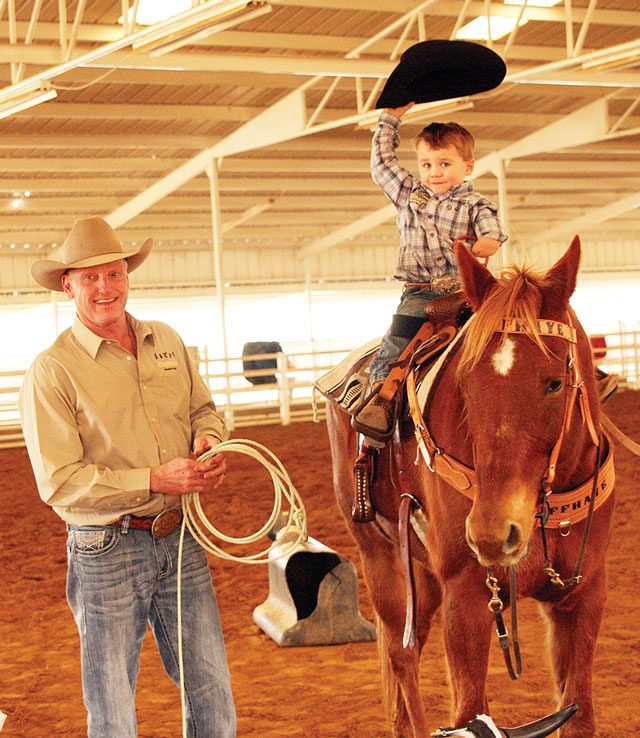
-
PROfile: Judy Wagner
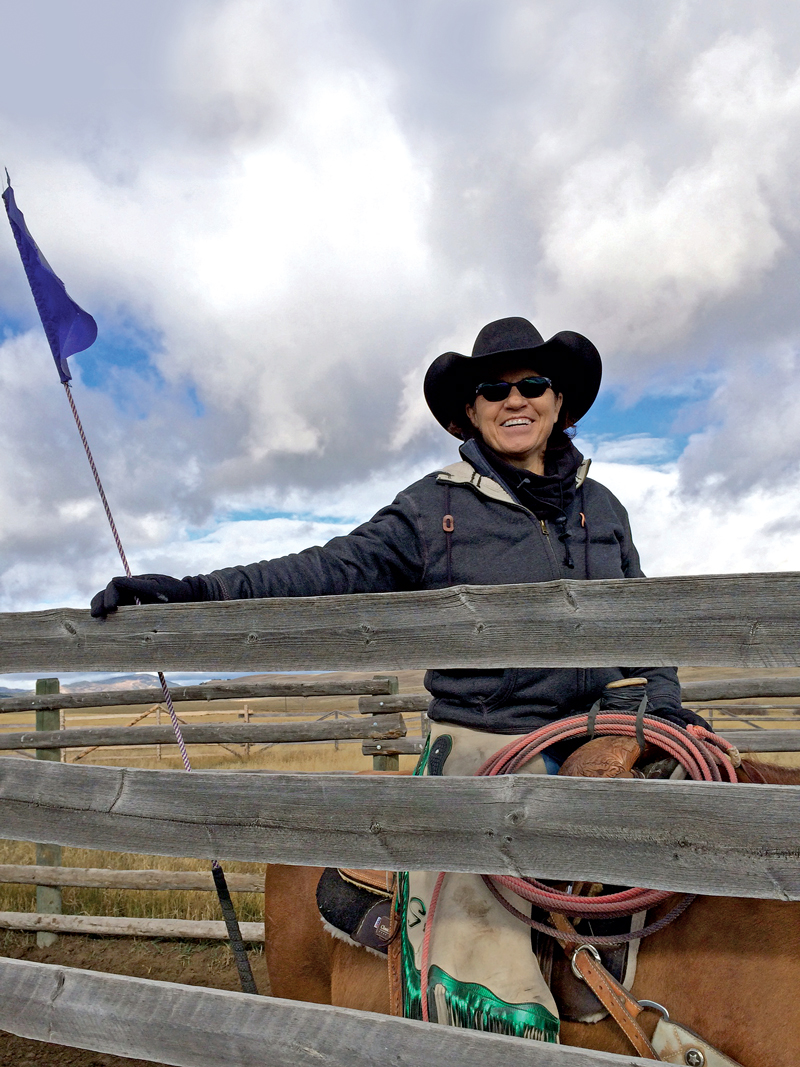
Judy Wagner is a storyteller. Growing up on a ranch in Montana nurtured her appreciation for the beauty and brevity of life, all while giving her experiences that ached to be retold over the dinner table among friends and family. Today, the wife, mother of two, and vice president of marketing for Montana Silversmiths still approaches life with the common sense that comes from her own brand of Ranch Grown Logic and her motto from Gladiola Montana: “The code of her West; use a short rope, a sweet smile, and a hot brand.”
Judy’s story began in the Big Sky State. Born in 1953 in Avon, Mont., the oldest of eight children, Judy likes to tease that she is the real Avon lady. But instead of selling cosmetics, she was saddling horses in the early morning light and loading them into the bed of her dad’s pickup to go check cattle. Judy and her brothers and sisters learned to rope from their dad and were active in 4-H, but their responsibilities doubled when their dad was killed in a tractor accident. Judy was 16 at the time, and she and her siblings took over the ranch with young but powerful determination. “We grew up fast,” says Judy. “We learned that the cows didn’t know it was Christmas Day – feeding and caring for the animals came first. We had to be responsible for our actions, and ranching taught us what it means to invest your time and money into something.”
Following high school, Judy went to Montana State University on a rodeo scholarship, as did all seven of her siblings, in either rodeo or other sports. She competed in team roping and majored in Home Economics with a minor in Child Development. “Back when I went to college, a marketing degree didn’t really exist yet,” Judy explains. “Most women went to college to become teachers or nurses. But I had 14 years of experience in 4-H and an entrepreneurial spirit!” She met her husband, Alvin, during college, and once she graduated, Judy went to work as a county extension agent for Teton County in Cheteua, Mont. Alvin was a sales representative in the western industry, and in 1988, he helped Judy as she entered into a partnership with another family to create Gator Ropes. “We met in a bar in Dillon to discuss the opportunity,” Judy recalls. “The whole thing just evolved! I didn’t have a lot of help, but I could have reached out to people. Now I realize as I mature in business how important it is to reach out. At the time my research on product development was through my family and my life experience as a roper and competitor. I didn’t focus much on our competitors at the time, because we were all young businesses then. Classic Ropes had been around a few years and Cactus Ropes was just starting. It was a fun time to be in the industry.”
Owning Gator Ropes gave Judy all the marketing experience and more that college could have provided, and the common sense she had developed as a child on the ranch came to her aid. “The first trade show I took Gator Ropes to was for the first Cowboy Christmas during the WNFR, and I had the bright idea to create a rope rack that looked like a Christmas tree. I decorated all the ropes with evergreens from the ranch and made them look like wreaths,” says Judy. “I took over 100 wreaths and I didn’t sell one of them.” So she took her rope wreaths to the parking lot and cut the evergreen boughs off, selling her ropes and chalking it up to experience.
In 1998, Judy sold Gator Ropes back to her original partners and tried her hand at freelance marketing, while she also helped establish an all-girl rodeo team in Helena and several other rodeo teams in her area. In 1990, she won the John Justin Boots Standard of the West award for the Rocky Mountain All Girl Team, a pre rodeo event for the Last Chance Stampede in Helena, Mont.
By 2000, Judy found out Montana Silversmiths was looking for a marketing director.”Other than my two years with the county extension office, that was my second job interview,” says Judy. “I started fresh – it was a new position – and our sponsorship with the PRCA was just starting, as was our line of jewelry.” Judy found a way to put her ranch background to use even with Montana Silversmiths, knowing the value of a handshake and looking someone in the eye.
When the company put up its website in 2005, it enabled Judy to share the stories of the business with an even wider audience. “Every one of our products has a story, from how it’s created by our master engravers, to how it’s packaged, or even merchandised in the catalogue,” Judy explains. “I get shivers whenever I have the opportunity to hand the buckles to rodeo champions. I know from Montana Silversmiths the talent it takes to produce that buckle, and I also know as a rodeo competitor how much went into making those rodeo champions, like parents driving all those miles for rodeos and making sure their kids have horses underneath them.”
In 2014, Judy was promoted to vice president of marketing for Montana Silversmiths. For her, an average day at the headquarters on the Yellowstone River in Columbus, Mont., might involve leading a team for product development, touching on customer service, or even helping organize an events team, such as for the PRCA.
At the end of the day, Judy makes the 20 mile drive to her home in Park City, Mont. Alvin is currently a sales representative for American Hats and Ariat boots, and both Alvin and Judy’s children inherited their parents’ entrepreneurial spirit. Their daughter, Tiffany, is a horse trainer, while their son, Ross, and his wife manage a barrel racing association, UBRC. Team roping continues to be one of Judy’s greatest pleasures, and she won the Team Roping Heading on the WPRA Montana Circuit in 2014, as well as the Team Roping Heading Rookie of the Year with the WPRA after buying her first card. She is also a member of the USTRC, and in February, she and Alvin plan to go south to Arizona to rope. Judy visits her three brothers’ ranches in Montana at every opportunity, and she has many nieces and nephews who all excel in sports. These include Ty Erickson, who is going into the WNFR sitting third in the steer wrestling, riding his horse, KR Montana Shake Em, who won 2015 AQHA Horse of the Year.
“Between the Wagners, Bignells, Ericksons, and Ayers (Judy’s brothers and sisters) there’s a lot of competitiveness and athleticism, and it all stems from ranch grown logic and the ranch life of my siblings,” says Judy. “When it’s all said and done, I hope people will say about me that I was a trail breaker. I ride for the brand in my faith, family, work on the ranch, creating the brand Gator Ropes or stewarding the brand Montana Silversmiths. Who would imagine that some girl from Avon would grow up to do this, but you can do anything if you have the desire and work toward your goals! Life is about those connections – people who empower you – and I am blessed.” -
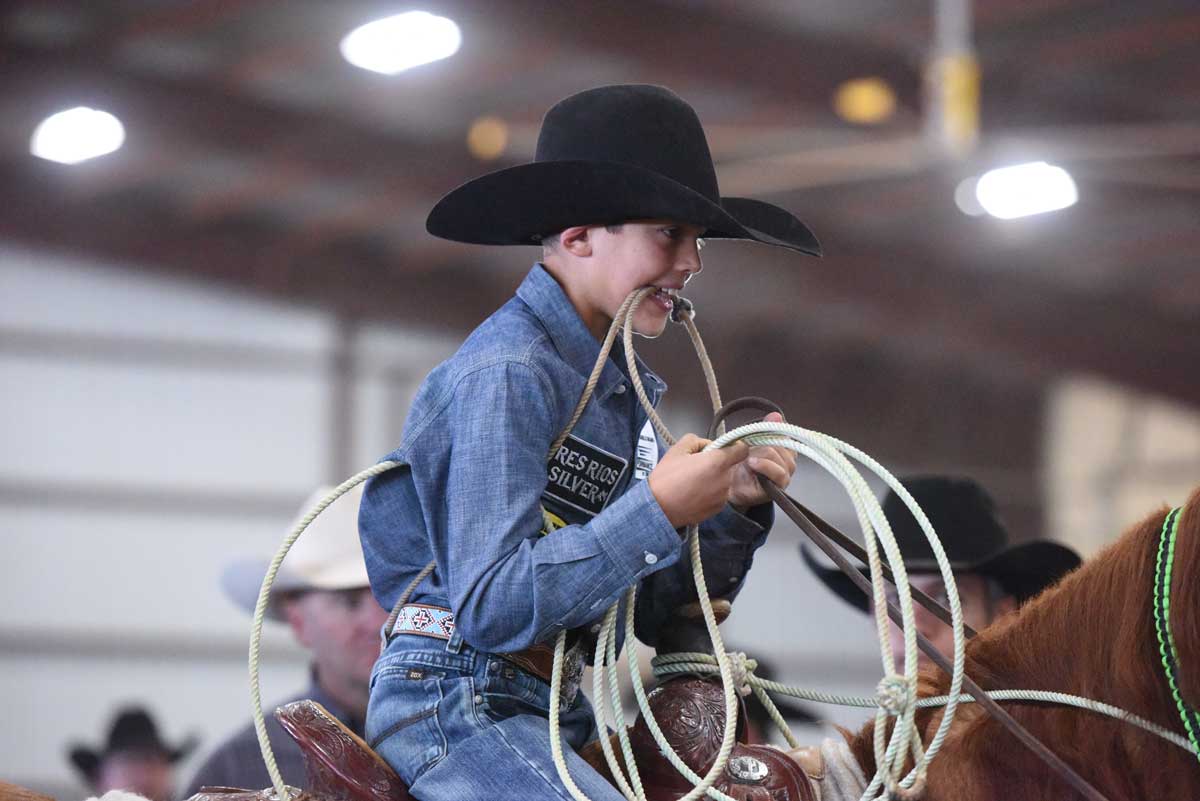
On the Trail with Pecos Tatum
Rodeo is really fun,” states nine-year-old Pecos Tatum. “The harder you practice and the more you do, the more it pays off!” The young cowboy from Llano, Texas, competes in the NLBRA and AJRA. He made the short round in three events in 2013 at the NLBFR. He won three world championships in the AJRA in 2014 in the 8 & Under calf riding, breakaway roping, and all-around cowboy, with a reserve championship in goat tying. Pecos also competes in ribbon roping, double mugging, tie-down roping, and steer riding now that he is older, but roping is where his true devotion lies. He will be back competing at the NLBRA next year in the junior boys. “This boy lives and breathes roping calves,” said Brett. “That’s what he works at every day. We’ve been up at 6 every morning to saddle and rope calves.”
Though an only child, Pecos enjoys the friendship of countless other rodeo kids, several of which live with the Tatums in the summer. “We were always going to have more kids, but as Pecos got older, it seemed like God was always placing at least one other kid in our lives,” says Brett. “We have a bunkhouse and RV hookups, and this summer we have a girl staying with us from Durango (Colo.). Her brother also stayed and rodeoed with us in the past.” The family is going to head back to Durango this summer to Durango Fiesta Days, and Pecos is entered in two junior rodeos that Keylie grew up with. It will be the first year in 8 years that they have been back to her roots.
Pecos never lacks for someone to rope with, whether it’s one of his family’s summer guests, or his parents. Pecos and his dad, Brett, rope in Ultimate Calf Roping Championships together, while mom, Keylie Tatum, was the WPRA World Champion Header in 2008. Up until he was four, Pecos and his parents travelled the U.S. doing equine dentistry while Brett rode bulls and worked as a rodeo judge. Brett lived on a ranch in Oregon until he was ten, and when the family moved to Arizona, he started riding steers in the Arizona Junior Rodeo Association. He continued roping and riding bulls, focusing on riding bulls for 13 years. He met Keylie at the NFR, and two years later they met again and started dating and married in May of 2003. They became partners in 2008 of Tres Rios and took over management three years ago. He and Keylie design and draw buckles all day, take orders, and manage the day -to-day operations.
Full story available in our August 15, 2015 issue. Available online!

Pecos at the Rising Stars Calf Roping – photo by Fletch 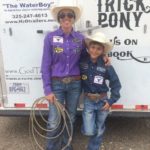
Pecos with his mother, Keylie 
Pecos Tatum -

On the Trail with the Thompson Family
Zane Thompson has grown up in the arena. From junior high rodeos to the WHSRA, the 17 year old from Cheyenne, Wyo., believes that home is in the saddle, including working Cheyenne Frontier Days with his dad, Frank Thompson, who is the arena director for the Daddy of ‘em All. Not only do Zane and Frank work the arena during performances, but Zane’s 12-year-old sister, Madison, does her share of work during slack, while their mom, Dawn Thompson is the Malt Beverage Manager and volunteer coordinator for Cheyenne Frontier Days.
“I come back to help at Frontier Days every year because of how much a person can learn,” says Zane, who competes in the WHSRA in steer wrestling, team roping, reined cowhorse, and his favorite, tie-down roping. “If I’m going to be in that arena for ten days, I try to learn something from every run. Not a lot of kids have that opportunity, and I figure I’d better take advantage of it!” Zane qualified for the 2014 NHSFR in team roping and qualified again for 2015, this time in reined cowhorse. “I’ve always had some interest in showing horses, and Brent Lewis, the guy I set as my idol, has shown quite a few horses and always says it made him a better roper. You learn how to ride your horse better and read a cow.”
Zane’s goal was to qualify for Nationals in his roping events, but missing his steer and breaking the barrier in the team roping at state finals decided otherwise. “Not making it in my other events this year is a wakeup call for me, and I’ll stay more focused,” says Zane, who plans to buy his PRCA permit when he turns 18. He did, however, compete at the IFYR with his roping partner, Riley Curuchet, before returning home to help with Cheyenne Frontier Days.
Zane, has been helping in the arena since he was seven, and is now in charge of hooking and picking up flank straps, as well as helping with the wild horse race. He and his dad spend more time in the saddle than on their feet. “It gets kind of grueling, but it does for everyone,” says Frank, who has been the arena director for Cheyenne Frontier Days since 2012. The PRCA World Champion Steer Wrestler in 2000, Frank grew up rodeoing in South Dakota and later, the NIRA Central Rocky Mountain Region, which he won in the steer wrestling in 1988. He met Dawn several years later at the National Western Stock Show and they were married soon after. Frank started volunteering at Cheyenne Frontier Days in the mid ‘90s, while Dawn had been working for the rodeo since 1988. “I was rodeoing all the time, but after I quit rodeoing for a living in 2005, I became more and more involved in Frontier Days,” says Frank. “I was ready to be home with my family. Zane was almost ten and I’d had my time rodeoing. I was ready to be home. I was scared to death of regretting my decision – when rodeo is such a huge part of your life, it’s scary to quit all of a sudden, but working for Cheyenne has helped. When you’re involved in the Daddy of ‘em All, you get your rodeo fix in different ways.”
Full story available in our July 15, 2015 issue. Available online!
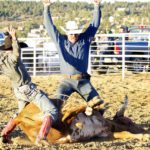
Stray gathering in New Castle, Wyo. – Marcy Cunningham 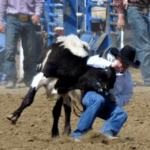
Zane bulldogging in New Castle, Wyo. 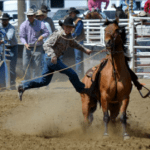
Zane tie down roping in New Castle, Wyo. – Marcy Cunningham