Rodeo Life

Author: Lily Landreth

  • ProFile with the Snake River Stampeders

    ProFile with the Snake River Stampeders

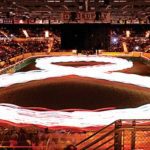
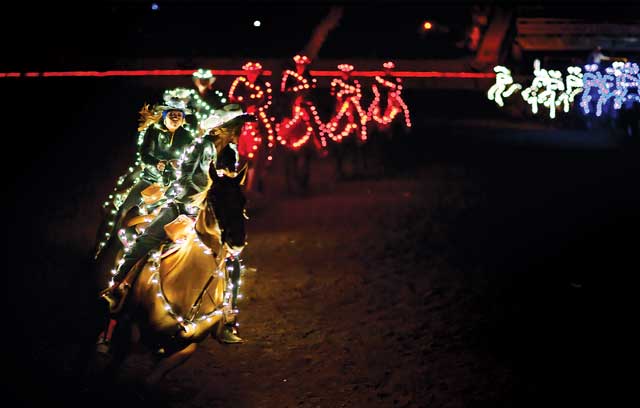
    The velvet darkness of the Thomas & Mack arena in Las Vegas, Nev., has been lit up five times by the Snake River Stampeders, a precision drill team of 16 riders galloping in the cover of darkness, each one glowing in the outline of nearly 200 lights. The only drill team invited to perform at the WNFR, the Snake River Stampeders also performed at the 2002 Winter Olympics in Salt Lake City, Utah, and the 2002 Copenhagen Cup Finale held in Texas, and were even approached by America’s Got Talent, who is considering adding outdoor related talent to the show. But the Stampeders’ trademark is their hometown rodeo in Nampa, Idaho.
    The Snake River Stampede moved from its well loved outdoor rodeo grounds to the indoor arena of the Ford Idaho Center in 1997, but Stampede fans were loathe to give up the old arena. “I wanted to think of something we could do to dress up the rodeo in the new place – something we couldn’t have done in the outdoor arena,” says Jimmie Hurley, the Stampede’s executive secretary. Brainstorming with her longtime friend Shawn Davis, the general manager of the WNFR, Jimmie’s solution didn’t come until Shawn’s wife recalled the opening of a rodeo she had seen with pretty girls on fast horses. It seemed the perfect complement to the Stampede’s claim as the wildest, fastest show on earth, but Jimmie wanted to add one more element – the pretty girls and their fast horses would perform in the dark.
    Jimmie set to work appointing a drill instructor and holding tryouts, which were well attended by horsewomen curious to ride in a drill team unlike any other. The riders wore all black clothing and hats, with yellow Christmas lights safety-pinned on to their clothes and tack. It was wryly observed by one of the volunteers that even D-Day hadn’t required so much planning. The hours of practice and planning were an instantaneous hit, however, and the cheers of the 1997 rodeo audience confirmed what Jimmie hoped was true – the Snake River Stampeders were ready for Las Vegas. They performed that very December at the WNFR and returned again in 2001, riding in red, white, and blue lights, to “Proud to Be an American”, sending out a lone Stampeder with a flag made of lights to start the drill, an especially moving performance just months after 9/11.
    Horsewomen all, the team is largely made up of wives, mothers, rodeo queens, and drill instructors, all hailing from the Treasure Valley in Idaho. Coached by Paula Vanhoozer, a seasoned drill team judge and rider, the Stampeders practice once a week over the course of three months, members chosen each year after a challenging night of tryouts in the spring. Of the 30 – 40 women who audition, only 19 are chosen – 16 regular team members and three alternates.
    “I enjoy practice!” says Brandi Krajnik, a seven year member of the team. “Paula writes such good drills, and adding that mixed element of danger turning the lights off is a challenge.” Another member, Heather Miner, adds, “You have to have a horse and rider that are willing to push the boundaries of what common sense says is okay, and have a little fun with some adrenaline.” Heather has ridden with the Stampeders the last four years and coaches another drill team, the EhCapa Bareback Riders, with Brandi. “Stampeders is challenging horsemanship wise. It takes a rider who can push through fear, and a horse that has some go but that also stays under control, which is kind of a rare combination.”
    Since its creation 18 years ago, the Snake River Stampeders have changed very little beyond team members and drill instructors coming and going. The team switched to L.E.D lights in 2010, which was brought about by Randi Wood, the assistant drill instructor, light coordinator, and rodeo board liaison. The new, brighter lights snake over the riders’ sleeves and up to their glowing hats with the help of extension cords. “Once your lights are fastened on, you’re pretty well staying put in the saddle,” says Randi.
    By the time the Snake River Stampede week arrives in July, the Stampeders’ drill – written anew each year by Paula – is second nature. Once the arena is set up, they have just three practices in the dark before launching into their six performances during the Stampede. Though seldom, when the lights do fail, charged by 45 pound battery packs on the saddles, the Stampeders never fail to care for one another, especially during the accidents that inevitably occur. Even performing to music so loud they can feel it in their horses’ hooves, the team manages to communicate with one another during what one Stampeder described as a four minute barrel race in the dark with 16 horses.
    “I think proof of how good we are is that we have the fastest riding, in the dark, with some of the best riders practicing in the least amount of time,” Heather Miner describes, “and there’s no way you can do that without amazing horses and riders.”


    Snake river stampede
    Celebrates 100 years

    Potatoes immediately spring to mind when the state of Idaho is mentioned. But among PRCA cowboys and cowgirls, the pistol shaped state hosts one of the West’s top rodeos to compete in during July. And while Idaho produces more than 13 billion pounds of spuds every year, the Snake River Stampede boasts a $400,000 payout, placing it in the top ten of the PRCA’s regular season rodeos.
    The Snake River Stampede, which lands in the middle of Cowboy Christmas, celebrates 100 years this month, a historic milestone coming just after the rodeo was inducted into the ProRodeo Hall of Fame in 2014. The legendary barrel man and rodeo clown, Leon Coffee, is coming out of retirement to be the man in the can during the rodeo, while the rodeo’s trademark drill team, the Snake River Stampeders, are performing their dark defying routine with a surprise twist at the opening. They’ll ride in green and yellow lights – the colors of the original Stampede arena.
    Originally an offshoot of the Nampa Harvest Festival, which began in 1911, the Snake River Stampede started as a bucking contest in a roped-off block in town. The event became official in 1915, the first year admission was charged, and soon took place in a ball field. Other events were added, and the buck show, still nameless, grew in popularity.
    The year of 1937 proved pivotal when the buck show was christened the Snake River Stampede by rodeo director Ike Corlett, and joined the Rodeo Cowboys Association. The bucking stock, which was originally herded to Nampa from a ranch near Horseshoe Bend, some 50 miles away, was later provided by Leo Cramer, a Montana stock contractor who brought the stock by train. The rodeo was changed to a nighttime show when lights were installed, and President Franklin Roosevelt opened the new rodeo from his home in Hyde Park, New York, where he pressed a golden telegraph key that turned on the lights of the rodeo grounds 2,000 miles away. In 1950, a new arena was built, seating 10,000 in its horseshoe shaped stadium. Gene Autry was the Snake River Stampede’s first star, followed by entertainers including Roy Rogers and Dale Evans, and later, Reba McEntire, and Glen Campbell. The Snake River Stampede moved indoors in 1997 to what is now the Ford Idaho Center, pulling spectators in from the heat and closer to the thrills and spills of the wildest, fastest show on earth.
    “I’ve been working here since 1977, and the rodeo is part of my family,” says the Snake River Stampede’s executive secretary, Jimmie Hurley. “I love the rodeo’s heritage, and the fact that the committees have toughed it out through the good and bad years and didn’t let the rodeo go. We strive to have the best announcers, stock, bullfighters, clowns, and specialty acts – and to pay out a lot of money – which of course attracts the best cowboys and barrel racers. It’s an honor for us to be one of the top ten (PRCA) rodeos!”

     

  • On the Trail with the Peterson Family

    On the Trail with the Peterson Family

    The Peterson family is the embodiment of the motto “One for all, all for one.” From the school auditorium to the sports bleachers and rodeo sidelines, the Petersons stand together and cheer in tandem. The bond of the family was forged largely in rodeo, the sport that Ross and Chrissy both competed in through high school and college, and wished to pass down to their children. “Ross and I feel that kids don’t come with manuals when they’re born,” says Chrissy with a laugh. “We decided the best way to raise our kids was to keep them super busy and keep them with each other. Every weekend, they’re with us! We know their buddies, and we have expectations for them.”

    Raised on these expectations, the girls have grown up training horses and selling them to pay their entry fees. Kaitlin and Karlee also competed in several rodeo royalty contests before they were ten, holding titles with local rodeo organizations. “The girls had to learn to speak eloquently in front of adults and crowds, introduce themselves, and learn horsemanship skills,” says Chrissy. “Today, when they have a high school or college presentation and have to speak in front of others, it’s not even an issue.”

    Rodeo practice at the Petersons is serious fun. Their arena, referred to as the Peterson Playpen, is almost more of a home to them than their log house, which pins down a portion of the swelling Black Hills. Karlee and Sidney practice together daily, and their parents join them after work. Ross is the shift supervisor at a saw mill in Spearfish, S.D., and Chrissy is the Special Education Director for the Meade School District. “Practice is kind of mass chaos,” says Ross. “Chrissy is the chute helper, I’ll be riding some young horses, and then we’ll have someone lining calves and holding goats, loping horses, and saddling and unsaddling.” Karlee adds, “Grandpa will help us, and some kids come over too, but you won’t get to come and watch. When friends come over to the Peterson house, Mom puts them to work – and they love it!”

    Kaitlin, a junior this fall at University of Wyoming (UW) in Laramie, Wyo., is competing in breakaway roping and goat tying. An NJHFR, NHSFR, IFYR, and NLBFR qualifier, she finished the college rodeo season sitting high in the breakaway roping for the Central Plains Region, which she competed in for Oklahoma Panhandle State University (OPSU) in Goodwell, Okla. She is also majoring in secondary math education, with plans to graduate in the next two years with a 3.5 or higher GPA. Her other passion is riding colts and turning them into barrel or roping horses, and she’s doing just that this summer as she rodeos with her family and does ranch work for the Haugen family. Last winter, she bought two broodmares, one of which foaled in early June. Kaitlin is smitten with her new bay filly.

    Karlee graduated from Sturgis Brown High School on May 17. With 12 college credits already under her belt from dual enrollment, her flair for time management has also allowed her to be this year’s student body president for her school, work 20 hours a week at The Buckle, volunteer in the South Dakota Teen Court System, and compete in the SDHSRA, SDRA, NLBRA, and 4-H rodeo. “Time management is something I learned from a young age, and its shown me how much I care about rodeo,” says Karlee. Family is her other secret to success. “It absolutely wouldn’t be possible to rodeo if not for such a team effort. Since I have so many horses to get in shape, Sidney helps me with exercising them every single day.”


    Full story available in our July 1, 2015


  • ProFile: Johnny Dudley

    ProFile: Johnny Dudley


    Johnny Dudley, Rodeo Clown, Rodeo News
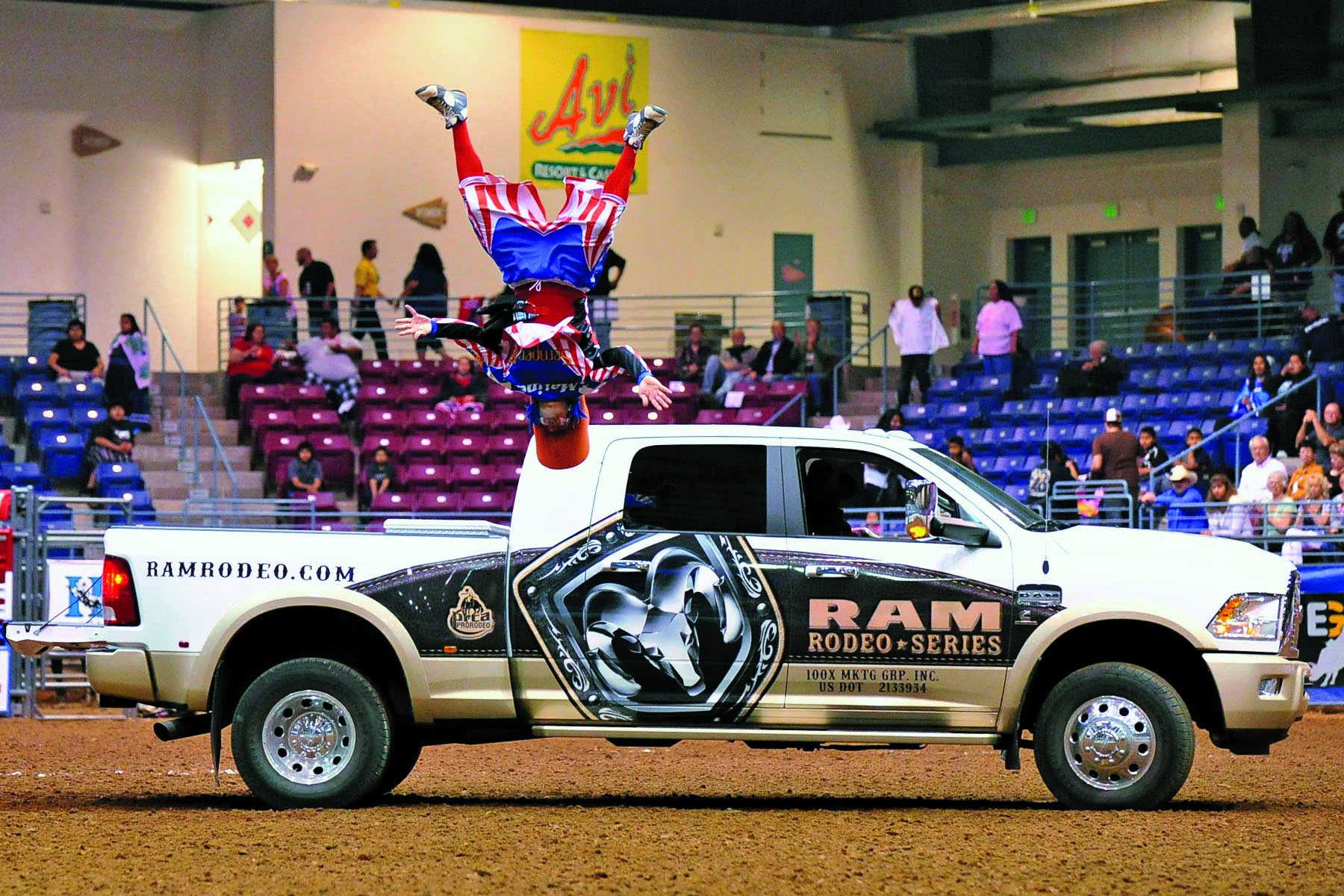
    Johnny’s famous backflip -Miller Photo

    Laughter is a precious commodity for “Backflip” Johnny Dudley. The rodeo clown, dubbed for his backward springs, has been splitting sides and spreading smiles at rodeos since 2006, but his dedication to his work is no laughing matter. “It’s my passion!” says the 37 year old from Aubrey, Texas. “I tell people all the time that I’d be a rodeo clown for free, I love it so much. I’m a certified air traffic controller, and I could be making $180,000 a year, but I love being a rodeo clown.”
    Though built like a steer wrestler at 6’3”, Johnny’s only ties to rodeo were the local rodeos in Dayton, Texas, that he and his family went to in the summer. The antics of the rodeo clowns were a highlight for Johnny, but by the time he was in third grade, his parents had divorced and he and his mom moved to Groesbeck, Texas. No more rodeos or rodeo clowns until 1999 on the Marine Corps base in Beaufort, S.C.. Johnny was 21 and had joined the Marines immediately after graduating high school. A rodeo was being held on the base and Johnny, who had no intention of going, was volunteered into taking tickets at the gate for the first half of the rodeo. He found a seat in the bleachers for the second half and unknowingly met his future. “I was paying attention to the clowns, and this short, chunky, older guy runs into the stands and sits on a good looking blonde lady’s lap,” Johnny says, recounting one of his favorite stories. “Her husband laughed, and a light bulb went on for me.” Johnny met the clown after the rodeo and was offered a role in his clown act the following night. “I bought some big pants and makeup and showed up as a clown. In my mind, I was thinking I’d be a clown, not a prop,” Johnny recalls humorously. “The fire was lit!”
    After getting out of the Marines in 2004, Johnny found the practice bull riding arena in his hometown of Dayton, Texas, and started learning to fight bulls twice a week. “I knew that bull fighting was my gateway to being a clown. I was young and athletic, and the guy who owned the practice pen also produced several local rodeos, so he hired me to clown for him. Cleveland, Texas, was my first rodeo. I made $50.” At the same time, Johnny attended San Jacinto College in Pasadena, Texas, paying for his degree in international business with his rodeo income and Montgomery G.I. Bill. He also continued to attend rodeos and study how other rodeo clowns worked. The experience wasn’t always comfortable. Some people were more welcoming than others, and a few rodeo clowns wanted nothing to do with the competition. “I didn’t have any buckles or boots,” says Johnny. “I was just some guy out of the Marines that wanted to learn! I didn’t know the rodeo terminology – I just wanted to clown.” Yet the people who were willing to help Johnny influenced one of today’s funniest men in ProRodeo. These included Rudy Burns and Lecile Harris, two of Johnny’s rodeo clown idols. “Rudy helped me with anything I wanted and sold me one of his clown cars. I learned from the old guys, so I’m more of a traditional clown. I’m not much for dancing around or clapping – I like to tell jokes and do clown acts.”
    Johnny has six different acts and a slew of jokes at the ready for what he calls “situational comedy”. “I don’t go out with a plan,” Johnny explains, “I just go out and wait for something to trigger a joke in my mind. It could be a girlfriend and boyfriend walking down the bleacher, or a guy with long hair. I want to relate to the crowd with a current situation that’s happening, not just tell little Johnny jokes out of nowhere.” None of Johnny’s banter with the rodeo announcer is ever scripted, and his title backflips are also spontaneous. The crowd pleasing maneuver is one of Johnny’s childhood talents that started with showing off for the girls at the swimming pool. Of the thousands of backflips he has made, only two have gone awry – once at a PBR event in Salt Lake City when the fence gave way beneath him, resulting in a broken neck, and one other rodeo where he slipped and barely made his rotation in time.
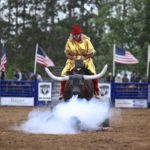
    Johnny is also known for his electric blue wig and large foam cowboy hat, courtesy of any mall in Texas. One of his best known acts is Cow Patty, performed to Jim Stafford’s song of the same title, completed by a mechanical bull mounted on a three wheeler, blowing smoke out the nostrils and shooting water from the rear. Another favorite act involves Johnny’s skunk, Rosie. His first skunk, Flower, was in the act for six years before passing away, and now Rosie performs to the frightened delight of rodeo audiences. “Everyone thinks she’s trained, but I just act off her instincts,” says Johnny. “If I want her to lift her tail, I’ll run at her to startle her a bit, or jump around in front of her. Then I’ll throw a dummy skunk into the audience, and depending on where I throw, they scatter!”
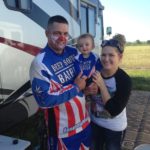
    Though the rodeo arena is a second home to Johnny, his home in Aubrey with his wife, Emily, and 18-month-old son, Jase, is still his favorite place to be. They recently purchased a 40 foot motor home so that Emily and Jase can travel with Johnny. The husband and wife first met in 2009 at a rodeo – Johnny clowning and Emily barrel racing. Emily is also the owner of Deuce’s Wild Tack, known by many professional barrel racers for its bright colors and bling. While helping Emily with the business, Johnny spends his time at home going to the gym, duck hunting, watching football and announcing barrel races, many of which Emily competes in. He recently became a certified hypnotist, and plans to do several shows during his off weekends. Johnny is also the cook of the family, having dinner with Emily’s parents several nights a week. “I have a killer lasagna, and I can put anything on a pit and smoke it,” he says.
    Taking to the road again, Johnny will be performing west of the Rocky Mountains this summer, with rodeos from Utah up to Montana, and even several in Alaska. He’ll work the All American ProRodeo Series Finals in October for the second year in a row, and is also the PRCA Turquoise Circuit Finals barrelman for the second time. “Everybody wants to do the biggest rodeos for the money and prestige, and I do too, but my favorites are the small hometown rodeos that I grew up working,” says Johnny. “When it comes to prestige in this business, I’d love to work Fort Worth, Pendleton, and of course the WNFR. But the one I thing I want even more is the Coors Man in the Can award, because that’s about who’s best at protecting the bull fighters. I’m just a family guy that likes clean comedy and rodeo.”

  • Back When They Bucked with Dixie Mosley

    Back When They Bucked with Dixie Mosley

    Dixie Mosley of Amarillo, Texas, had a most unusual childhood. The third and youngest child of Monte and Opal Reger, Dixie was born in Buffalo, Okla., on October 3, 1930. Before her sixth birthday, she had travelled more of the U.S. with her family than most people of that era saw in a lifetime. The Reger family were rodeo entertainers, fulfilling rodeo contracts in the eastern half of the country, and travelling with an 18 foot Schult house trailer, several trick horses, and a longhorn steer in tow.
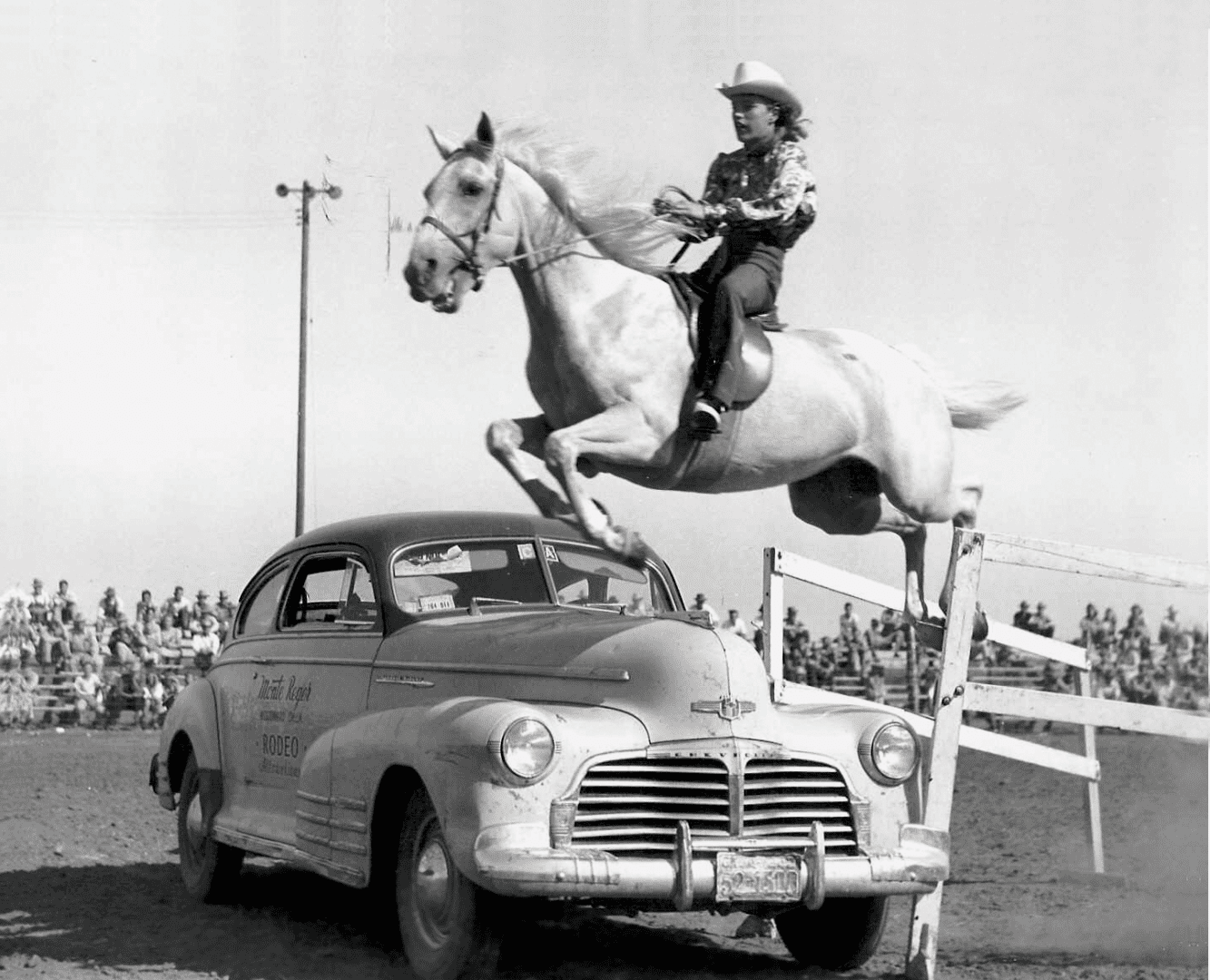
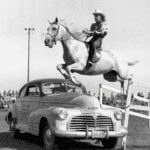
    It was Bobby the Longhorn Steer that propelled the Regers into their lifestyle of greasepaint faces and trick riding Death Drags. The Longhorn/Brahman cross had curvy horns measuring 8′ 6″, and at the time he was discovered by Monte Reger, the steer was known for his rank personality. But Reger saw potential in the tremendous bovine, and with dreams of leaving the farming life behind, he tamed Bobby. Soon, Reger was riding the steer like he was a trusty cowhorse, as were Dixie and her brother, Buddy, and sister, Virginia. Bobby and Reger even appeared in a movie, Wheels of Destiny, in Hollywood, and advertised for a barbecue chain in Burbank, Calif. But Bobby was best known for his iconic jumps, clearing a convertible with ease while directed on a lunge line by Reger.
    Though Reger had helped start the rodeo in Doby Springs, Okla., he had bigger dreams. Eventually, he was announcing for the Beutler Brothers and performing with Bobby in Colonel Jim Eskew’s Wild West Show. Eskew’s son, Jim Eskew, Jr., taught Dixie to trick ride and rope by the time she was five. She began performing alongside her brother and sister, riding a Shetland pony named Tom Thumb. Her brother, Buddy, was a rodeo clown, while Dixie and her sister represented the family in trick riding and roping. Their mother, Opal, occasionally took off her apron to perform the Quadrille – square dancing with horses – but she preferred to live outside of the spotlight. “She had more than a full time job looking after Dad and us three kids, feeding us and sewing all our clothes,” Dixie recalls. “She kept us together.”
    Dixie’s rodeo debut came in 1935 in Pittsburg. At five years old, she was a fearless performer. “I was never afraid of anything at a young age, and when you’re a teenager, you’re really not afraid!” says Dixie. She showed horses in western pleasure, and although she found nothing remarkable in her trick riding talents, rodeo spectators thought otherwise. As she grew, Dixie rode her family’s palomino American Quarter Horses that they bred, their fair coats reflected in the shining cars that Dixie jumped them over. Though the Regers stayed in their trailer or motels, they returned often to their home in Woodward, Okla., to “get cleaned up and go again,” according to Dixie. It was there that the family trained their show horses. They laid three 55 gallon drums down, placed two more on top, and finished with a heavy wooden door at the top to re-create the size of car Dixie jumped over, before practicing on the real thing.
    For all the excitement of living on the road, Dixie at times longed for what she calls a normal life. “I wouldn’t take anything for the life I’ve had, but sometimes I wonder what it would’ve been like to have a different type of life,” Dixie says reflectively. “We had to be careful in the summertime to go swimming in the late afternoon. We didn’t want to take the chance of getting sunburned and not being able to ride the trick horse. Even rollerskating you had to be careful to not twist an ankle. We were being paid to be at the rodeo, and we couldn’t get hurt having fun!” Missing out on regular schooling was what Dixie regretted the most. Up until high school, she and her siblings were homeschooled by their mother, a box of curriculum from Calvert Correspondence School arriving once a year with schoolbooks. When she entered high school, she came to school several weeks late and left in May to accommodate rodeo season. Yet homeschooling had agreed with Dixie, and she was several grades ahead of children her age, entering high school when she was 12 and graduating  in 1946, when she was 16.
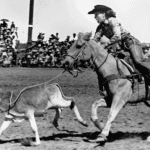
    In 1947, Dixie was clowning and performing in an all-girl rodeo in Amarillo, Texas, and the following year, the all-girl rodeo in San Angelo, Texas, was the birthplace of the Girls Rodeo Association (GRA). Dixie was a charter member, and later served as a contract representative and vice president for the association. In addition to trick riding and roping, she rodeo clowned for the GRA, the only woman in the area to do so. Dixie even rode several bulls and bareback horses, but the roping events like ribbon roping, breakaway, and calf roping, were what brought out her competitive side. “I’ve been bucked off and had horses fall with me, and I’ve never broken a bone,” says Dixie. “I’m real proud to be a charter member of what is now the WPRA. I met some wonderful cowgirls!” One of these cowgirls was the rodeo-renowned Tad Lucas, a bareback bronc rider and trick rider that Dixie created and performed several rodeo skits with. “She was a very nice lady, and she would do anything to help make the rodeo a better performance.”
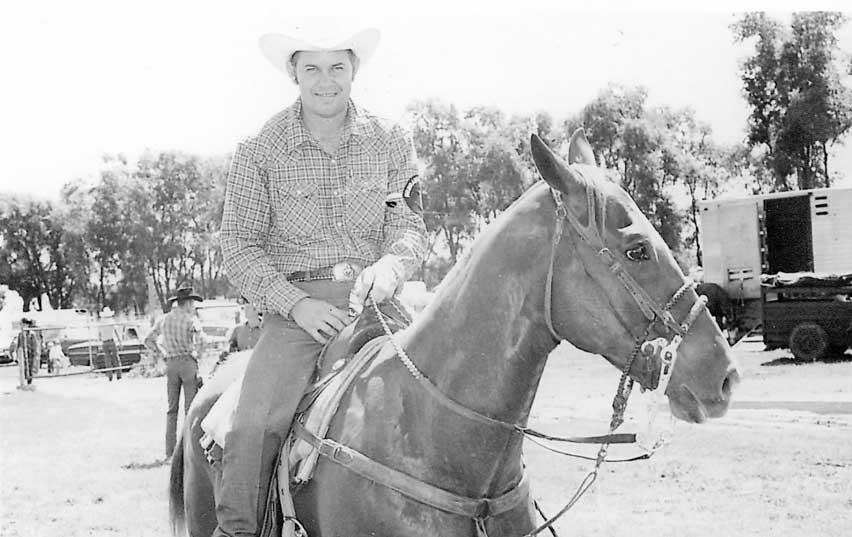
    By 1953, Dixie was 23 years old and ready to make a bold move. She retired from rodeo. Her final performance in the public eye was the inaugural all-girl rodeo in Colorado Springs, Colo. Following that, she married William Mosley in August of 1953. Bill was a cattleman, who served in both WWII and the Korean War, and was a friend of Dixie’s brother-in-law. “Growing up, I pretty much knew I didn’t want to marry a rodeo man,” says Dixie. “I think they are the most wonderful people in the world, but they’re always on the go! I wanted to stay home. Bill went back to college after he got out of the military, and I became a college wife. I got my PHT – Putting Husband Through,” she says with an infectious laugh.
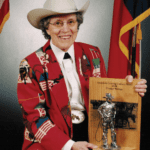
    After finishing college, Bill and Dixie settled in Amarillo, Texas, where they still make their home today. With partners, they built a meat packing house, and Dixie lived the life she’d dreamt of as a child, becoming a full-time wife and mother and living in a house that wasn’t on wheels. Their children, Judy, Clay, and Paul, all grew up riding horses, but didn’t pursue rodeo. Once their children were grown, Bill sold the packing house and became a cattle inspector. He and Dixie travelled the U.S. extensively, some of Dixie’s favorite travels taking her to the annual induction ceremony for the National Cowgirl Hall of Fame. She also attended Rodeo Clown Reunions held by Gail Woerner, where Dixie was the only female rodeo clown. Dixie herself was inducted into the Cowgirl Hall of Fame in 1982 and the National Cowboy Hall of Fame in Oklahoma City in 2003. She was named the Pioneer Woman of the Year in 2004 at the National Cowboy Symposium in Lubbock, Texas. Bobby the Longhorn Steer, who started it all, also holds a place of honor, his head mounted in the National Cowboy and Western Heritage Museum.
    Memories abound, and Dixie has no regrets. She concludes happily, “I’m glad it’s all worked out the way it’s worked out.”

    Story also available in our May 1, 2015 issue.


  • Back When they Bucked with Dean Oliver

    Back When they Bucked with Dean Oliver

    Dean Oliver attended his first rodeo when he was 15 years old. It may have been the heady feeling of stealing into the Snake River Stampede without a ticket, but as Dean watched a tie-down roper win $300 in a single run, he decided that rodeo was the life for him. Little did he know that he would become a record holder at that very rodeo, winning the tie-down roping ten times, and that a drawing of him would be featured on the Snake River Stampede’s rodeo poster 70 years later, heralding him an 11 time world champion.
    Born in 1929 to Verne and Vesper Oliver in Dodge City, Kan., Dean was the fifth of seven children. Each child was born in a different state, but all of Dean’s childhood memories reside in Idaho. His family moved to the Gem State in the late 1930s. Dean’s father was a private pilot, and he sold automobile and airplane parts and accessories, while also managing the Nampa (Idaho) Airport. In February of 1940, Verne and his friend Guy Givens were contracted by a farmer to hunt coyotes. The men did so from Verne’s airplane, with Guy shooting the predators from an open door. During one of their close passes to the ground, Verne’s plane crashed into the side of a snow-covered mountain, killing both men.
    Following the tragic accident, the Oliver family worked even harder to survive in a country just recovering from the Great Depression. Dean began working at dairy farms by his early teens. Sitting in a classroom didn’t suit the restless boy, and he dropped out of ninth grade, never to darken a school doorway again. That same year, he and his older brother snuck into the Snake River Stampede rodeo in Nampa. “When the rodeo came around, I really liked the cowboys’ western gear, and their horses and cars and trailers,” says Dean. “It looked like a fun way of life!”
    Inspired, Dean began his rodeo quest that same year, purchasing his first horse for $50 dollars and riding it bareback with just a rope around its nose to guide it. He began roping fence posts and hay bales, and even the calves at the dairy farm in the cover of night. While Dean was persistent about his roping, he was equally persistent in pursuing Martha Reisenstein, the daughter of one of the farmers he worked for. They were married in 1950, the year that would mark the beginning of Dean’s rodeo competition. He purchased another horse – this one green – for $400, and spent another $10 on a roping calf, which Martha would hold until Dean gave a nod.
    The self-taught cowboy made his debut at several local amateur rodeos in Idaho and soon won his first tie-down roping at the rodeo in Kuna. The taste of success was so satisfying that Dean told his boss at the dairy farm he might quit and rodeo instead. “What makes you think you’re a star? You couldn’t win anything!” The man replied hotly. Dean quit his job that summer and rodeoed until he ran out of money, returning to work in the fields until he could pay his entry fees.
    In December of 1950, Dean and Martha’s first child, Sheryl, was born. Her birth kept Dean from being drafted into the Korean War, changing him from a I-A (available for service) to a III-A (deferred because of dependents). After running into questionable rules at some amateur rodeos, Dean decided to join the Rodeo Cowboys Association in 1952. He went to his first professional rodeo in Jerome, Idaho, then leaped to Albuquerque, N.M., where the top professional ropers were competing. He was afoot, no longer trying to train a rope horse, but instead borrowing horses and paying the owners a percentage of his winnings. “There were 80 ropers, and not one of them would mount me, until finally a guy put me on a great, big tall horse,” Dean recalls. He won second in Albuquerque, then went to Denver’s new coliseum the following week, where he placed second in the average. He felt so optimistic with $1,700 in winnings that he purchased a gelding named Buck. He spent $1,750 on the buckskin with a knot on its knee, anxious to find a good rope horse. Dean made a makeshift trailer in the bed of his pickup for Buck and went home with an empty wallet.
    After working through the winter feeding cattle, Dean had enough money to rodeo again in May. He and Buck won several rodeos that summer, yet Dean still lacked an edge in his competition that could only come with practice. The winter of 1953-1954, Dean lived with tie-down roper Dan Taylor in Doole, Texas, and the Idaho cowboy finished third in the RCA standings at the end of 1954 with roughly $11,000. Dean stayed with another roper in Oklahoma the following winter, and despite dismounting on the left to tie calves, he still had the fastest time, finishing the 1955 rodeo season with $19,963 and a glistening gold buckle reading World Champion Calf Roper.
    His professional rodeo career soared out of the chutes, and Dean was rodeoing 11 months out of the year, often putting 80,000 miles on his station wagon each season. He competed in 70 to 80 rodeos a year, winning every professional rodeo he went to over the course of his career. Dean competed in the first National Finals Rodeo in 1959 on a horse named Mickey, whom he’d searched long and hard for after retiring Buck. Mickey and Dean won five world championships in a row from 1960-1964, and Dean also won three all-around world championships from 1963-1965. He had started steer wrestling and was just as talented in the event as tie-down roping with his 6’3″, 200 pound frame. But after breaking his leg at Madison Square Garden during the event, Dean feared further injuries and kept tie-down roping as his main focus, eventually dismounting on the right when he was in his 40s for faster time.
    Not only did Dean’s achievements catch the eyes of rodeo fans nationwide, but also magazines and other publications. Time magazine, People magazine, Sports Illustrated, Saturday Evening Post, and western publications all wanted an interview with the rags-to-riches cowboy. Dean even modeled jeans for Wrangler. He and Martha purchased a ranch in Boise, Idaho, with 80 acres and calves aplenty for roping. While he traveled the length and width of the United States, one of Dean’s favorite rodeos remained the Snake River Stampede. He won his hometown rodeo ten times in the tie-down roping, a record yet to be broken, while also winning the local Caldwell Night Rodeo eight times. He secured his eighth and final world title at the NFR in 1969 at the age of 38, with record earnings of $38,118 for the most money won in a single event in one year. That record has since been broken, but Dean’s eight world tie-down roping championships still sets the bar.
    Dean continued to rodeo into his 40s, but sorely missed his growing family of five daughters, Sheryl, DeAnn, Nikki, and twins Kelli and Karla. Martha had travelled with him as often as she could, but that didn’t make up for life at home. Yet Dean’s involvement in rodeo was hardly over. He served on the PRCA’s board of directors in 1979 and was inducted into seven halls of fame, including the National Cowboy Hall of Fame and the ProRodeo Hall of Fame. Texas sculptor Edd Hayes even included a bronze statue of Dean tie-down roping in a series of bronzes he called “Legends of Rodeo.”Dean also pursued his hobby of golfing, which he’d started in the 1950s, setting course records around the Treasure Valley and winning several tournaments.
    Today, Dean and Martha’s home sits just off a farm road in Greenleaf, Idaho. Dean raises calves for beef cattle, but finds himself busiest during the Snake River Stampede rodeo in July, where he grooms the arena, and contracts the sheep and calves for the mutton bustin’ and the calf scramble. He has been serving on the rodeo’s board of directors since 1990, and dons his media credentials every December to work as a grip for a television crew covering the WNFR.
    Dean’s story is marked with extraordinary grit and perseverance, but the rodeo legend says humbly, “I never did want to quit rodeo. When I started, I didn’t know I’d be any good. I was lucky enough that I had the ability, and I stuck with it.”


    Story also available in our February 2015 issue.


  • On the Trail with the McCoys

    On the Trail with the McCoys

    It’s been five years since Jet McCoy last competed in the International Finals Rodeo. During that period, the five-time IPRA World Champion and his wife, Ashlee, have been raising their daughter, and managing their ranch in Ada, Okla. Jet has also appeared three times on The Amazing Race with his brother Cord. After his hiatus from the regular rodeo circuit, the 35 year old is returning for the thirteenth time to the IFR in the saddle bronc riding, thanks in part to Ashlee, who will be one of the breakaway competitors to watch at the finals. She took up the event in 2013, and the combination of her team roping background, and the hours spent in the practice pen with Jet’s coaching, have put her in the top 20 of the breakaway roping.

    Ashlee’s newfound passion for breakaway made Jet realize how much he missed riding roughstock, having only done the occasional ranch rodeo since 2009. Sitting in the bleachers didn’t suit him, and in the spring of 2014, he was back in the bucking chutes with the saddle broncs. Jet rode all three roughstock events through high school and college, qualifying for the NHSFR, and later, the CNFR four years in a row on the Southwestern Oklahoma State University rodeo team. He also qualified for the IFR in all three events, and placed second in the saddle bronc riding at the DNCFR in 2004. “I can remember playing with my older brother when we were little, and him showing me how to put a saddle on by strapping it to a bale of hay,” Jet recalls. “I went to my first rodeo when I was five, and I can’t ever remember not rodeoing.” Jet, his sister, and their three brothers, all competed in rodeo growing up, while their dad rode bulls and bareback horses professionally.

    Similarly, Ashlee, 30, grew up with a rope either in her hand or coiled and at the ready. Her dad taught her to team rope, and they entered jackpots and USTRC ropings as Ashlee grew up. It wasn’t until two years ago that she competed in a rodeo, however. “In 2013, I saw breakaway at a rodeo for the first time, and I just went for it. It’s been very challenging, but Jet has helped me a lot, and it’s been quite an experience!” Ashlee recently won the breakaway roping at the IPRA Southeast Region Finals in Gay, Ga. She is roping off a five-year-old Quarter Horse palomino named Bingo that she purchased in December of 2013. The gelding was originally a western reining horse that made the Non Pro futurity in Oklahoma City, but he transitioned into a solid mount in the breakaway that Ashlee says makes the same run every time.


    Full story available in the January 2015 issue.

  • ProFile: Austin Wahlert

    ProFile: Austin Wahlert

    ‘Long live cowboys, may the legacy never fade, ‘cause honor is his code, it’s all he’s ever known and he’d die just to keep it that way. Throwing caution to the wind for the life he defends ‘cause he knows that’s what’s right. So long live cowboys, from now till the end of time!’
    The chorus to Austin Wahlert’s song, “Long Live Cowboys”, co-written with Baxter Black, reverberates with the 25-year-old singer songwriter and former bull rider from Gill, Colo. So do the words to Austin’s song “Las Vegas Gold”, which he is singing at the opening of the tenth round of the 2014 WNFR. Austin’s dream from childhood was to rodeo, but at age 23, nearly 25 broken bones from rodeo’s most dangerous sport, made him face the fact that his rodeo career was over. Yet the death of one dream led to the prelude of another. Austin had a talent for songwriting, and a guitar waiting to sing at his fingertips. He had written his first song when he was 16, and several years later put together a demo CD.
    Austin grew up on a 3,000 acre cattle ranch in northern Colorado with his brother and sister, learning rodeo from his parents and from being a competitor. His dad, Scot Wahlert, was the president of the Mountain States ProRodeo Circuit, and his mom, Chelle Wahlert, was the director of the WPRA. Austin decided that if he couldn’t compete in the sport, then he was going to sing about it and the western way of life.
    He learned to play guitar from his grandpa, Robert Gulvas, spending his afternoons after school soaking in everything he could about music. “Austin has always been very self motivated, and he feels there’s always something he can learn from others,” says his mom, Chelle. Following graduation from Eaton High School, Austin attended Odessa College on a full-ride scholarship, and his guitar took a backseat to his bull rope. However, he would play in the parking lot after rodeos, then began performing in bars and other venues to earn money. During his freshman year of college, Austin broke his back riding a bull and took a year off, which he used to write music while studying for his degree in business and marketing. After returning to rodeo and breaking his back a second time, Austin knew his competition days were at an end.
    Yet again, rodeo steered Austin toward music. His travels around the country for bull riding introduced him to gifted songwriters like David Lee and Wynn Varble, who quickly recognized Austin’s talent. Several of Austin’s music friends encouraged him to call Bruce Bouton, a steel guitarist who has played for Ricky Skaggs, Emmylou Harris, Garth Brooks, and Reba McEntire, among other notable artists. Despite the declarations that Austin would likely never reach Bouton on the phone, he called anyway, and caught the musician while he waited for a flight. “It was one of those God things,” says Austin. “Bruce told me to send him some of my songs, called me back after hearing the first two, and said we’d meet when he got back from touring in Europe.” That was the beginning of many trips to Nashville, which opened Austin up to a world of singers, songwriters, musicians, publishers, and record labels. Guitar legends like Bob Seger and Jim “Moose” Brown, who wrote “It’s Five O’clock Somewhere” for Jimmy Buffett, sat in on several of Austin’s recording sessions and even played with him. “I was just like a young cowboy that gets to rodeo with Ty Murray for a week,” Austin describes. “It changed my career.”
    Austin released his first album, Austin Wahlert, in 2011, and a second, Dirt Road Blues, in 2013. He is now working on a third album which should come out in late 2015. “For the songwriting, it takes about a year, while I work on the message of my album. When I’m playing these songs thousands of times for concerts, I want lyrics that help a person get through something in life, or celebrate something. There’s a lot of music out there that you can’t sink your teeth into, and we’ve lost any deeper meaning in our songs.” “The Day She Went to Heaven” is particularly special to Austin, written in honor of his late mother-in-law, and another favorite is “Las Vegas Gold”. The song is inspired by Chris LeDoux’s music, and Austin fantasized about it replacing Elvis’s “Viva Las Vegas” to kick off the tenth round of the WNFR. On December 13, two and a half years to the day he wrote the song, he will be singing it on the arena floor of the WNFR.
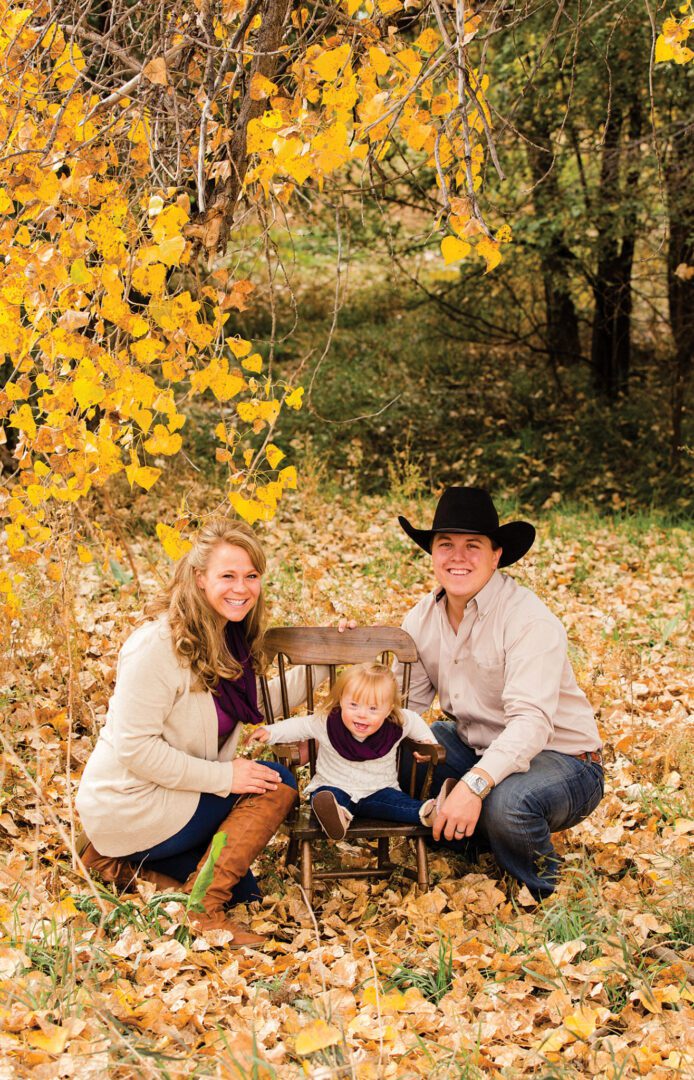
    As an independent artist, Austin is his own manager, and business and marketing agent. This has been one of his best years as a professional musician, touring from late April until the third week of August. He flies to Nashville every six weeks to record and write, but spends every other moment with his wife, Justine, and their two-year-old daughter, Reagan. Reagan was born with Down Syndrome and had to have open heart surgery when she was three months old. She pulled through and is an avid fan of her dad’s music. She’ll leave anything she’s doing to listen to Austin play when he brings out his guitar, with ‘music’ being one of the first words she learned in sign language. Justine  was a high school and middle school art teacher until Reagan was born, and now continues teaching at home with Reagan, coaching her in sign language and doing three hours of therapy every day. Justine recently took up running and ran the 26.5 mile Denver Marathon in October.
    Ever looking to advance his music, Austin is taking a music theory class, previously learning everything by ear. “I never want to be complacent,” he says. “To this day, I can pull into play at a rodeo, close my eyes, and I could be there riding bulls. I still miss it, but music was a dream always burning at the back of my mind too. Singing at the tenth round of the Finals is great, yet I still have so many things to learn. I keep setting new goals, and I’m always working to be better than I was yesterday.”

  • On the Trail with Tim O’Connell

    On the Trail with Tim O’Connell

    The Missouri Valley College rodeo team in Marshall, Mo., claims WNFR qualifier Tim O’Connell as one of their own. The 23 year old is sitting fourth in the bareback, having reached the $100,000 mark for the first time in his rodeo career. Tim was the 2013 PRCA Rookie of the Year, but didn’t qualify for the WNFR that year, making his 2014 qualification all the sweeter.

    Tim’s dream of riding bareback nearly didn’t come to realization. In high school, Tim’s original goal was to be, as his dad put it, “A Ty Murray”, and compete in all three roughstock events. He soon discovered that saddle bronc riding was too technical for his taste. He was considered small for his age, and the bareback riding left Tim flying high and doing face plants, so he zeroed in on bull riding. Tim’s hometown is Zwingle, Iowa, but he rodeoed with the Wisconsin High School Rodeo Association and was their year-end bull riding champion in 2010. He also poured himself into high school wrestling and was a three time state qualifier, placing fourth in the state his senior year. But the bareback riding was ever at the back of his mind. After a bad wreck while bull riding at the NHSFR his senior year, Tim soon decided to quit riding bulls. He attended a rodeo school in Iowa that PRCA saddle bronc rider Wade Sundell helped put on. “I don’t really know to this day what made me decide to start riding bareback again,” says Tim. “I would pay thousands of dollars to go back to that day at the school and know what was going through my mind!” He rode three barebacks that day, a new enthusiasm springing up in him for the event.

    Roughstock runs steady in the O’Connell family. Tim’s dad, Ray O’Connell, competed in saddle bronc riding in high school, then began working as a pickup man. By the time Tim and his older brother Will were born, Ray was working mainly for Cervi Rodeo Company and Three Hills Rodeo Company. He took his boys with him whenever their school allowed. They loved to help their dad cool his horses out after the rodeo, and at many of the high school rodeos that Ray worked, he would leave young Tim riding double with the kids in the warm up pen. When they were on deck, Tim was passed along to someone else.

    Growing up in the shadow of the bucking chutes made an impression on Tim early on. “Tim enjoyed being around the livestock, and if he decided to rodeo, you could tell that roughstock was where he was leaning,” says Ray. Tim started riding sheep, then worked his way through calves, steers, and bulls before finally settling on bareback. His mom, Joann O’Connell, admits that watching Tim and his brother Will – who also rode bulls – took her out of her comfort level. “I’m their biggest fan, but I worried every time they got on,” she remembers. Joann would watch the other kids ride, but left the stands when her boys rode, listening, but not watching. Today, she’s cheering from the stands – and watching with both eyes open. “I ride that horse jump for jump with Tim.” She and Ray add, “These last few weeks, Tim has been on fire, and we couldn’t be more proud of him.” Will, who is five years older than Tim, went on to be a pickup man like his dad, and fights bulls. Ray and Will have also started Diamond R Bucking Horses together, and will be taking two of their colts to the futurity sale at the WNFR.

    Full story is available in the November 1, 2014 issue.


  • On the Trail with Garrett Tribble

    On the Trail with Garrett Tribble

    “A lot of kids ride bulls, but some kids are just born to do it.” This is how Phil Fabela, a family friend and mentor, describes Garrett Tribble, who has been sitting first in the IPRA bull riding standings for nearly two months. Garrett isn’t the type to boast, but the bull rider from Slick, Okla. joined the IPRA in January 2014, and 11 states, three Canadian provinces, and nearly 50 rodeos later, he is sitting first in the world standings – ahead of second place by almost $20,000. And he’s only 17.

    “Garrett’s bull riding career really started when he was about two or three years old,” says his dad, Rodney Tribble. “He fell in love with bull riding and has wanted to do it since he was very young. From about the time he was three, he’d come home from school and put in Eight Seconds – he watched it every day!” Garrett’s bull riding dream took shape when he was about five. One of his friends was participating in the mutton busting at a local rodeo and invited Garrett to join him. Short as it was, the wooly ride made up Garrett’s mind. He was going be a bull rider. Although none of Garrett’s immediate family had ever competed in rodeo, his parents helped him join youth associations like the Junior Bull and Bronc Riders Association (JBRA), National Junior Bull Riders Association (NJBRA) and the Oklahoma Junior Rodeo Association (OJRA).


    Full story available in the July 15th edition.


    Full story available in the July 15th edition.
    Full story available in the July 15th edition.
  • Back When They Bucked with Ferrell “Flashbulb” Butler

    Back When They Bucked with Ferrell “Flashbulb” Butler

    Ferrell “Flashbulb” Butler hadn’t a penny left to pay his entry fees. So the calf roper took out his camera and started shooting rodeos, selling the photos for a dollar and a half apiece in the 1960s. Each click of the lens drew him closer to the acclaim he receives today for the moments of rodeo history captured with his German Rolleiflex T camera.
    Butler, born in 1936 in Davidson, Okla., was the only child of his parents, UJ and Hazel Butler. His family later moved to Mesquite, Texas, and young Butler began competing in rodeo when he was 15. “I wanted to rope calves like all the other kids in the ’50s. I wanted to ride bulls, too, but that didn’t last long.” Butler went on to compete on the Arlington State College rodeo team. He was a charter member of several rodeo associations, but much of the time he competed in his hometown in Mesquite. It was there that 24-year-old Butler began his photography, learning the trade as he went. “I started taking pictures for money and the picture taking got plumb out of hand!” In 1960 at the NFR in Dallas, Texas, Butler met rodeo photographer DeVere Helfrich, future friend and mentor. Helfrich pioneered the technique of classic saddle bronc pictures capturing the rein picked up and the horse stretched out, jumping and kicking.

    Full story available in the July 15th edition.


  • Dalton Ward

    Dalton Ward

    Roughstock. Flank straps. Quick thinking sharpened by adrenaline and put to the test at all speeds. This is the world of 22-year-old Dalton Ward, a pickup man for Harry Vold Rodeo Company, and the son of Billy Ward, seven-time WNFR pickup man. While it is no coincidence that Dalton is following in his father’s bootprints, the cowboy from LaGrange, Wyo. admits that being a pickup man wasn’t always his dream career. He grew up wanting to be a stock contractor, but had his first taste of picking up at a kid day rodeo in Odessa, Texas, when he was 12. “When I first did it, I didn’t like it all that well. It was fast, and to this day I don’t ever remember tripping a flank. I’d sit out there with my dad and that was it. Being 12 years old, I was just trying to save my own life, let alone someone else’s!”

    Dalton mainly worked college and ranch rodeos with his dad for the next six years. His mom, Marlo Ward, says, “Dalton was about 16 when he developed more of an interest in picking up with his dad. He’s always been so big and strong, and when everything came together, he was pretty efficient and got more comfortable with it. He’s always had a very strong work ethic – you could almost say he was born working! He and I used to travel to Billy’s rodeos together, and even before he could form many words he would talk to me for hours. He was always taking care of me.” Dalton and his younger brother, Denton, were paid five dollars a performance by their dad to do the bulk of the horse care, which Dalton continued to do until he was about 17. When they were younger, the boys brought out their play animals and semi trucks and played stock contractors. One Halloween, when the Wards were camped at a rodeo, Dalton and Denton borrowed a bareback rigging and a bronc saddle and rode their horses from trailer to trailer dressed as roughstock riders. They were given everything from chewing gum and cans of soup, to TV dinners and DVDs.

    Between helping their dad on the ranch and hauling with him to rodeos, Dalton and Denton were missing a lot of school. So their mom started homeschooling them. “It was a real good deal for us. A lot of people said that I didn’t have any friends, and I said I had a lot of friends in the rodeo world! I grew up around a lot of life lessons in rodeo. I think that contributes to who I am today.” Another influence in Dalton’s life is his parents. “The greatest thing about my dad was he always made his own horses – he’d trade them and make a pickup horse. My mom is always behind the scenes, but she’s the anchor. From my faith in Christ to my education, nothing would have happened without her.”

    Full story available in the June 15th edition.

  • Brylee Grubb

    Brylee Grubb

    Published in National Little Britches Rodeo Association (NLBRA)

    Brylee Grubb loves everything about competing in the NLBRA. From competing with her favorite horses to seeing friends and being with her family, eight-year-old Brylee pursues the sport enthusiastically. “I started Little Britches when I was five,” says Brylee. “My mom and dad competed in rodeo, and I love my horses and riding. I just thought it would be fun, and I like it a lot!” Brylee competes in the Little Wrangler division in barrel racing, flag racing, pole bending, and goat tail untying. While Brylee loves all of her events, she says her favorite is barrel racing. “My mom and dad have coached me and done a really good job,” she says. Brylee’s dad also judges quite a few of the Little Britches rodeos.

    Brylee savors the time she gets to spend with her family and friends at Little Britches rodeos. One group of her friends includes the Engesser family. “Taylor, Rickie, and Jace Engesser are some of my best friends,” says Brylee. “Taylor is in college now, but Rickie and Jace are still competing. They are really nice to me and they let me borrow a horse when my horse was hurt. They’re really good friends of ours.”

    The Grubb family lives in the country several miles outside of Spearfish, S.D. Brylee’s parents are Jason and Stephanie Grubb, and she also has a sister, Tiersyn, who is six. Tiersyn also competes as a Little Wrangler in the NLBRA. Since Brylee’s dad is a team roper and both sisters compete, the Grubbs have a number of horses. These include Abbe and Pueblo, Brylee’s barrel racing horses. She competes on her dad’s roping horse in the flag racing. Brylee holds the Little Wrangler arena record in pole bending with a 19.9 run, which she set during the second round of the 2013 NLBFR on her sister’s horse, Friday. Normally, Brylee competes on her horse Buddy in goat tail untying, but when Buddy got hurt several months ago, the Engessers let Brylee compete on their two horses, Sunny and Bucky. Finally, the Grubb’s home is made complete by their two dogs and two cats.

    Brylee is a second grade student at Spearfish West Elementary. She enjoys adding and subtracting, which makes math her favorite subject. In addition to school, Brylee has played soccer and most recently played basketball on a team called the Mini Spartans. When she’s home, Brylee likes to invite her friends over to ride horses together or play horse tag. One of her favorite movies is Secretariat, and she also enjoys reading. The Grubb family can often be found riding their horses together, riding bikes, going hiking, or playing board games when it’s cold. But in the summer, it’s most likely that Brylee and Tiersyn are in their arena.

    Several of Brylee’s rodeo accomplishments include winning a number of buckles in the NLBRA last year, as well as winning the Reserve All-Around Champion at the Elks Youth Rodeo in Sheridan, Wyo. in 2012 and 2013. Of the many rodeos she’s travelled to, Brylee’s top favorites are the Rapid City Little Britches rodeo and the NLBFR. This will be Brylee’s fourth year competing in the NLBFR, and she has qualified in all her events. “This year I would like to win the all-around saddle in the Little Wranglers division,” she says. “I’d like to make it to the junior high, high school, and college finals when I get older.” To be at her best for rodeo, Brylee says, “We practice four or five days a week, and then when it’s time, we go and I try as hard as I can!”

    Noble Outfitters recognizes youth accomplishments and supports programs like NLBRA. Brylee will receive a Hands Duffle!
    Learn more at nobleoutfiters.com