“I just feel that roping has come so far since I was a kid. I feel that people have gotten so many opportunities with videos and schools and tools like the Heel-O-Matic, and horsemanship has come so far. We as older competitors have even evolved. I learn as much from the younger guys as they learn from us, and it’s really cool to see the sport evolve,” says Lari Dee Guy.
A rodeo household name with numerous world titles to her credit, including 2018 WPRA World Champion Header, her mark on the evolution of roping has particularly inspired women ropers of all ages. Born in 1971, Lari Dee grew up roping and working on her family’s ranch in Abilene, Texas, where she still lives today. Her family taught her that challenges were meant to be overcome, not turned away from, and one of Lari Dee’s first challenges was learning to rope right handed, even though she was left handed. By the time she started college rodeoing, where Lari Dee won the breakaway roping twice at the CNFR, she also had 11 consecutive world titles in the AJRA. Her passion for roping was infectious, and she started putting on roping clinics while she was still in college. Since then, she has taught worldwide, along with sharing the Rope Like a Girl motto and all it stands for, which took root in 2013. “Two young women, Chelsea Shaffer and Kari DeCastro, approached me with that hashtag and asked if I could make Rope Like a Girl cool. I thought of how many young girls that it could touch, and women in the industry. The idea was really theirs, and I helped them put the roping behind it.”
5 Star Equine, which has endorsed Lari Dee for the last 5 or 6 years, also helps spread Rope Like a Girl, which can be stitched on their saddle pads, halters, and cinches. “Every time I see a 5 Star pad, I look to see if there’s a little girl roping on it, and if it says Rope Like a Girl. When I do see that, it makes me feel good that people believe in that,” says Lari Dee. She started using 5 Star pads around 2010, drawn to the quality and durability of their products. “I feel that is the very best felt and wool pad in the industry, and I love the way they breathe. I love the pads, but what turned me on to the company is the people who own it. I met Terry and Julia Moore at the WPRA finals one year, and we became like family right away. They’re a very great Christian family, and that’s what drew me to their company.”
5 Star Equine also sponsors custom pads for Lari Dee’s Rafter L Roping Finals, which she put on in October in San Angelo, Texas. Additionally, she puts on several ropings in conjunction with Cody Ohl’s Ultimate Calf Ropings, and continues to teach 10 schools a year, along with training horses and competing. “I’m a pretty organized kind of person, so I put on the calendar the most important places I want to attend, and I try to leave time during the week to ride the young horses and train, and then I try to be gone on weekends. I try to get most of my young horses ridden in the summer, and coming into the fall and winter, I try to focus on teaching and my finals. I also have a girl, Megan White, who really helps me out and keeps me organized, and Logan Harkey takes in horses for himself and he’s in there to help us with anything we need. Hope Thompson helps me do the schools, and here at the ranch riding horses and giving lessons. I live on my family’s ranch, and all the things a person could take for granted, they provide, like the calves and steers and feed. Having all that is a blessing.”
Another blessing came in the form of Lari Dee’s horse Gangster, who came back into competition this May after she thought he was permanently retired. “He’d been turned out for two years and had torn his deep flexor tendon twice, and I thought he was never going to come back,” says Lari Dee. “Doctor Brock out of Lamesa, Texas, and my local vet, Doctor Paul Patton, did surgery on him, and he came back really good and I’ve been competing on him in the breakaway. I bought another young horse to help back him up, Primo, from Jessica Gray out of Florida, and in team roping I’ve been riding a horse that belongs to Trevor Brazile, named Sabrina.
“My first love is roping calves, but I have really grown to love team roping because it’s brought lots of horse sales and it gives women the opportunity to make money roping. I think that rodeo in general is really growing and getting good for women ropers. The American is giving us a big stage to step on, and the WRCA has given us a big stage. It’s all because of the people and women who have worked so hard to get it where it is now,” Lari Dee explains. “My goals are to stay at the top of my game and stay focused, and try to do and be a part of everything that’s happening out there.”
Author: Lily Landreth
-
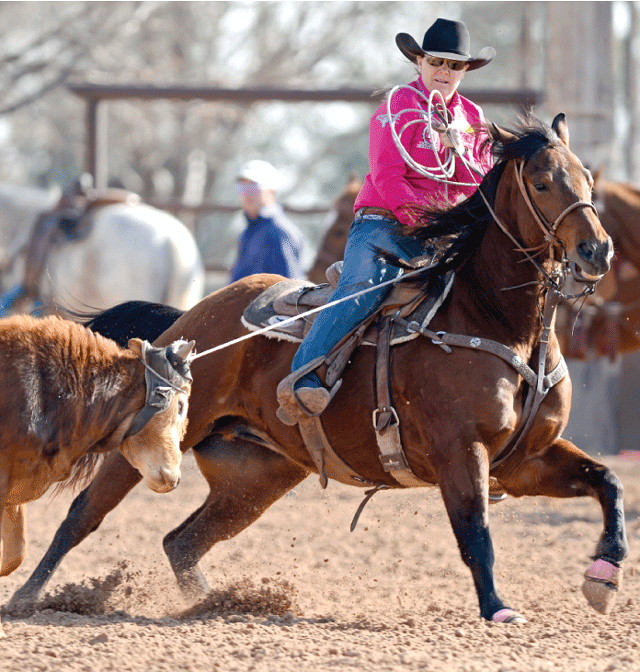
Lari Dee Guy
-
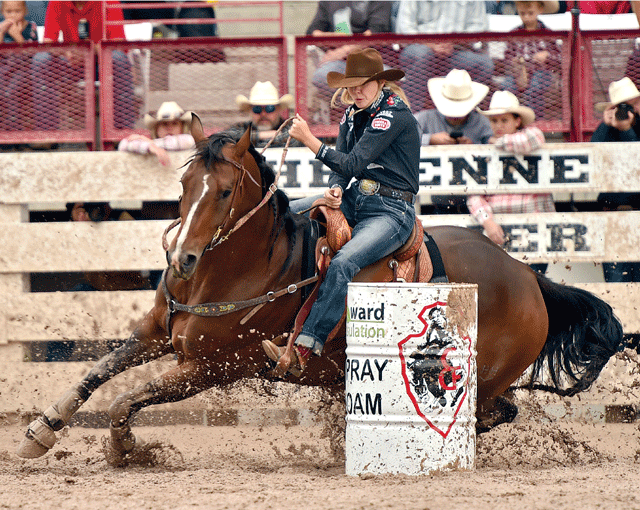
Jackie Ganter
Professional barrel racer Jackie Ganter took the road less traveled when it came to her rodeo goals this season. It ultimately led her to a new horse, who is poised to put Jackie firmly in the competition for the 2019 season. The 22-year-old from Abilene, Texas, started out her 2018 season by placing in Odessa at the Sandhills Stock Show in January, but the following weekend, she broke her ankle when her horse fell in the middle of a run. “I rode a bit prematurely and tried to run at San Antonio and Houston because those are such big rodeos, but I couldn’t really ride right, so I didn’t have any money coming out of the winter,” Jackie explains. “I changed my science and we went to Canada. Two of my horses got hurt really early in the year, and my mom really wanted to make the Canadian Finals, so we kind of focused on her.”
While Jackie and her mom, Angela Ganter, were rodeoing near Wainwright, Alberta, she was asked by a friend, Gayle Howes, to ride one of her horses, a powerful gelding named Tycoon. The duo won the first round at Wainwright, and they clicked so well that Jackie approached Gayle about purchasing the horse. “He was really special to her, but she said we fit so well together, and she sold him to us. Right after that, I went down to Cheyenne and he won fourth in the first round. My second round was under water, and we came back in the short round, which was muddy too, and he did great. Since my Baby J horse was hurt, I hadn’t ridden anything with that kind of power in a few months, so I had to get with it and remember how to ride that. He’s extremely powerful when he leaves a barrel.
“It was pretty hard to accept at first when I got hurt just because I had bigger plans for this year, but that’s sometimes how plans work—they don’t,” Jackie says with a laugh. “I think everything happens for a reason, and this year it was to take a step back, and I was also meant to get Tycoon, which probably never would have happened if my good horses hadn’t been hurt. I’ve been back on my other horses, and they’re both sound and they look great, so I’ll have Jet and Baby J back, and Cartel has been good all year. Now I have Tycoon, so hopefully next year we’ll start with four sound, ready-to-go horses.”
Part of Jackie’s program to keep her horses sound are her 5 Star Equine saddle pads, which she started using five years ago. “I started with them early in 2014—I won the BBR finals in Oklahoma City and I was riding a 5 Star pad, and they approached me and I’ve been with them ever since.” After four years of hard use, Jackie still uses her first sponsorship pad from 5 Star. “They’re incredible pads, and that’s all I ride in, at home and when I compete. I also use their breastcollars and just got introduced to their sport boots. They have awesome products and I’ve believed in them for a long time now. I’ve signed for them at the NFR both times I made it, and last year as well, and I’ve done some promotional videos and I try to promote them on Facebook. They are great people to work with.”
Since returning home from the summer run, Jackie is starting several colts on barrels and riding eight horses a day. “I’ve always been a jockey—I’ve never trained my own horses and I’d like to get into that. One of my good horses, Jet, is a stud and his oldest babies that we have are three, and one of them I’m about to start on barrels. It’s a whole new realm I’ve never done before,” says Jackie. “I don’t think you ever quit learning—you can get something out of every single person that you ride with, and I always try to pick up at least one thing that day that I can implement in my program.”
When she’s not in the saddle, Jackie enjoys visiting all the restaurants she misses while she’s traveling, along with reading. “I read murder mystery books, and I just read Rachel Hollis’s ‘Girl, Wash Your Face’. I thought it was incredibly motivational. Other than that, it’s horses from sunrise to sunset. I’m just glad to be home from the summer run like everybody is. Now I’m just trying to finish up the season in the top 40 so I can get into San Antonio next year.” -
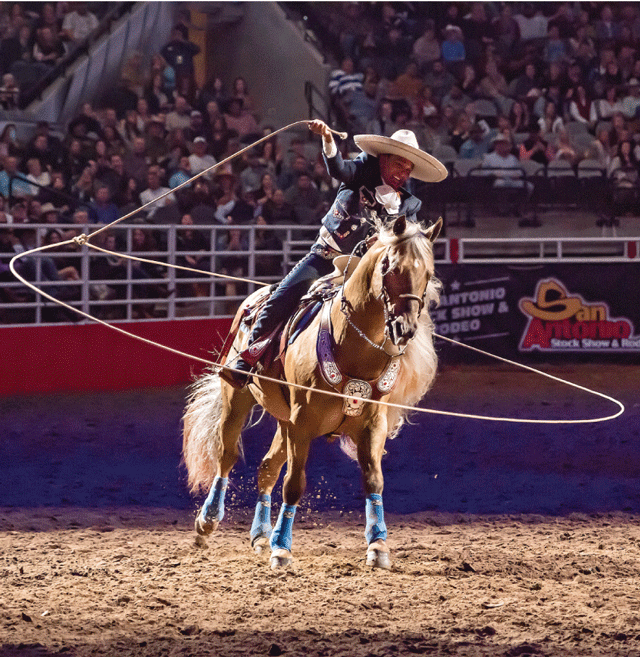
Tomas Garcilazo
When Tomas Garcilazo and his horse stride into the arena, the rope artist does so with the goal of representing the Mexican charro and the American cowboy, rodeo tradition and the heritage of the West. With each deft turn of his wrist, the three-time PRCA Specialty Act of the Year winner ties the traditions and cultures together in hopes of making a lasting impression for future generations. “It’s a mission for me as an ambassador of the charros to preserve that. In modern day, everything is getting lost, and we have to be strong and keep our culture for new generations to see the background and how everything started,” explains Tomas, 50, who is now a U.S. citizen living in Stephenville, Texas.
His own roots start in Mexico City, Mexico, where Tomas was raised in his family’s tradition learning the horsemanship and roping skills of the Mexican charro. He competed in all seven of the La Charreria events growing up, many of which are similar to rodeo events. “I didn’t have the modern toys that we have right now, so I was playing with a rope all the time and developed more skills. In school festivals, I was performing and showing my skills with a rope.” He particularly found his love for showmanship at age 9 after performing for the president of Mexico, and continued to develop his charro skills through high school. “I had to think of ways where the horses were not just for beauty, but that they could perform and be in the entertainment business.” Tomas came to the United States for a year in hopes of finding his place in the entertainment business, but the year came and went without accomplishing those goals.
Rather than give up and return home, he traveled back and forth between Mexico and California competing in charro events. “In the meantime, I needed to decide what to do with my life. I would become a charro or go into the entertainment business—either opportunity that came along my path, I’d take it.” The opportunity to do both came along in 1992 when Linda Ronstadt was on tour to promote a series of traditional mariachi albums she’d recorded. Tomas was given a part in the show, riding on stage in traditional charro attire and performing his rope artistry. Soon after, he auditioned for Broadway’s The Will Roger’s Follies, a six Tony Award winner, and performed in 58 cities in 48 states, along with several cities in Canada.
After the three-year tour was finished, Tomas was invited to perform at Disneyland Paris in the Buffalo Bill Broadway show, and when he wasn’t performing as a cowboy in the cowboys and Indians show, he donned his charro attire and performed in horse shows. While riding at a European Rodeo Cowboy Association rodeo at the U.S. Air Force Base in Germany, Tomas met Shawn Davis, the general manager of the WNFR. “He liked my skills and the way I performed, and he invited me to recreate those scenes at the NFR.”
Recently married to his wife, Justine, whom he met in France, Tomas made his debut at the Thomas & Mack Center in 1997, little realizing he would command the attention of WNFR fans for the next 20 years and counting. “Looking back all these years, it’s amazing the evolution. I want to maintain what we believe—our integrity throughout the roping, the horses, the tack, everything that speaks for that tradition. Something that I admire about Mr. Shawn Davis is that he is very open-minded. He went to Europe and saw everything different and pulled those elements together and made them work.”
Tomas has pulled his own elements together over the years, including a variety of horsemanship methods and disciplines that have helped him build the trust and harmony he shares with his horses. A palomino overo Paint named Pinto Bean helped Tomas build his career as an all-around charro and performance horse, and the most famous of the horses today is Latigo Dun It, better known as Hollywood. The 17-year-old Quarter Horse stallion, whose elegant mane reaches past his knees, has more than 34,000 followers on Facebook and a Breyer model horse made after him. He stands calmly while nearly all 65 feet of Tomas’s rope whirl’s around horse and rider in a trick called the Wedding Ring, then lopes forward in a shimmer of gold, the rope still circling. Justine and their 4-year-old son, Louis, also join Tomas in the arena and perform on their other horses, including an Andalusian and Louis’s pony.
In February alone, Tomas put on 20 performances at the San Antonio Stock Show and Rodeo, and loses count before the summer run even starts. To keep his horses at their peak all season, he feeds them Nutrena. “It’s been an amazing product for us. The grain has all the supplements together inside—you can spend the money on all the supplements, but a horse’s system will only take a portion and the rest will be wasted. Since we’ve been with Nutrena the last two years, we’ve had really great results with their coats and their systems and toplines. We feed ProForce Fuel, Senior, and SafeChoice, and for the performing horses, they develop muscle and they don’t get too hot. It’s really good nutrition, and I’m trying to educate more people about being more concerned about nutrition in Spanish.”
Along with preparing for his 21st year at the WNFR, which he’s been nominated in for 2018 PRCA Dress Act of the Year, Tomas’s focus is ever on maintaining his skills and learning more. His wife, Justine, has also been a part of the Jaripeo Sin Fronteras USA tour, a Mexican concert combined with rodeo acts, which she choreographed and managed. “Our goal as a family is to produce and feature our own show,” Tomas adds. “We’ve been involved with so many performers, and we have so many ideas we’d like to recreate in our profession with all the variety of cultures and horse people.” -
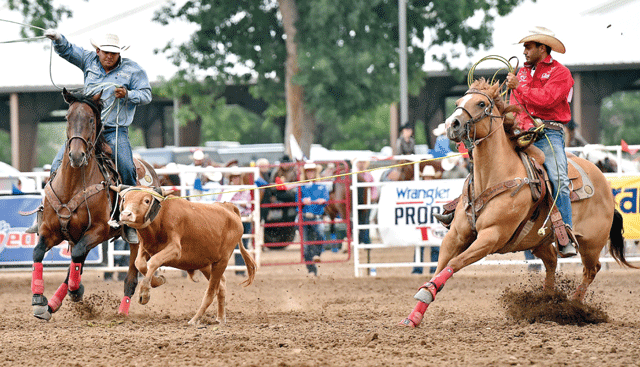
Josh and Jonathan Torres
[ Josh & Jonathan Torres both sit at 17th in the PRCA Standings and share the common goal of qualifying for the WNFR this year. ]
Josh and Jonathan Torres, lately of Stephenville, Texas, share the bond of brothers, team roping partners, and business partners, along with their common goal of qualifying for the WNFR this year. Josh, 29, is the header, and Jonathan, 26, is the heeler, both sitting 17th in the PRCA standings. The brothers spent their early years near Miami, Florida, following after their dad, who rode horses and kept a small herd of cattle. They high school rodeoed for Florida and later moved to Lake Charles, Louisiana, to attend McNeese State University. Despite their three-year age gap, they were able to rope together for two years and qualified for the CNFR in 2012 and 2013, where they won several rounds.
“I just like roping, period. But I like that you have to have somebody that also has the same plan and goal as you,” says Jonathan. “You pretty much have to be a team player for everything, and you both meet other people who help you out. Then you have two people with ideas and strategies, not just one.” Josh feels the same about teamwork, both with his brother and his horses. “It takes such special horses, and when a team is working on getting those horses together, you realize how many you have to go through to get a couple of good ones. I think trying to get on a lot of good horses or make them or find them is the best part about team roping. If I didn’t have a fun head horse to ride, I wouldn’t be doing it. I like to show them off and have fun doing it—that’s what keeps a guy motivated to do what we do.”
Josh’s main rope horse, Junior, is an 8-year-old gelding he purchased from his friend Willie Brooks in Baton Rouge, Louisiana, who asked Josh to season Junior. “He’s extremely smart. I asked my friend if he wanted to sell Junior just because he was so athletic. He’s kind of hard to ride—his feet move so fast, so your mind has to move just as fast. He’s been fun, and I wouldn’t be entering any rodeos if I didn’t have that horse.” Jonathan has ridden his 12-year-old gelding, Biggie, for the last two years, whom he purchased from Brock Hansen. “He’d been rodeoed on before by Cesar de la Cruz, and Brock had him and didn’t need a heel horse. He wants to win, and he’s a powerful, big horse. Biggie is out of a Playboy Boonsmal stud horse, and he’s kind of gritty and cocky.” Jonathan and Josh also took two other younger horses on the road with them this year as backup horses that they’re seasoning.
Whether on the road or at home, they’ve fed their horses Nutrena’s SafeChoice Original for the last five years. “You have to take care of your horse, because that’s what makes your money, whether it’s worming, hay, feed, or clean water—all those things make a difference,” says Josh, who has a degree in animal science. He and Jonathan have even conducted several feed experiments with their horses, and found they had the calmest energy on Nutrena. “It keeps our horses energized, and we might feed three or four times a day. I had a horse that wouldn’t eat very well on the road, but he went to eating that Nutrena and we’ve had really good luck with it on the road. Nutrena is sold all over, so it’s pretty easy to find. We like to have a good-looking herd.”
Along with keeping several young horses at home to work on when they’re not traveling, Jonathan and Josh run Young Guns Productions, LLC, a timed event stock contracting business. “We have Corriente cattle and we lease cattle to cutters. When they get big enough to break in, we use them for jackpots and then lease them to people for practice or ropings,” says Jonathan. “When we’re gone, a couple of our buddies like Cory Clark and Dillon Wingeried help out, or we’ve hired contract help. It’s a team effort!”
Of the many rodeos on their 2018 run, a favorite of Jonathan’s is the Salinas Rodeo, while Josh enjoys San Antonio. “I like Salinas because we’re there for a few days, and they have fresh steers that have never been roped—it’s kind of ranchy and fun,” says Jonathan. Josh adds, “The hospitality is great over at San Antonio, and it’s the loudest rodeo that I’ve ever been to. Your adrenaline is going and it’s a pretty fun and exciting rodeo.” Their goal is to experience the energy and excitement of the WNFR next. “It’s the best chance we’ve ever had this year. I definitely want to thank our parents, Jose and Teresa Torres, and my wife, She’Rae Torres, for helping all of us,” Josh finishes. “And I’m thankful for the relationship we’ve had with Nutrena. Rodeo is a hard deal, and it takes a lot of effort from so many people. The Lord has put certain people in our lives and got us through so many situations good and bad. Because the Lord is so good to us we keep our heads up and remind ourselves to take advantage of every situation as best as possible. We believe in His plan. We just try to do our jobs, believe, and work!” -
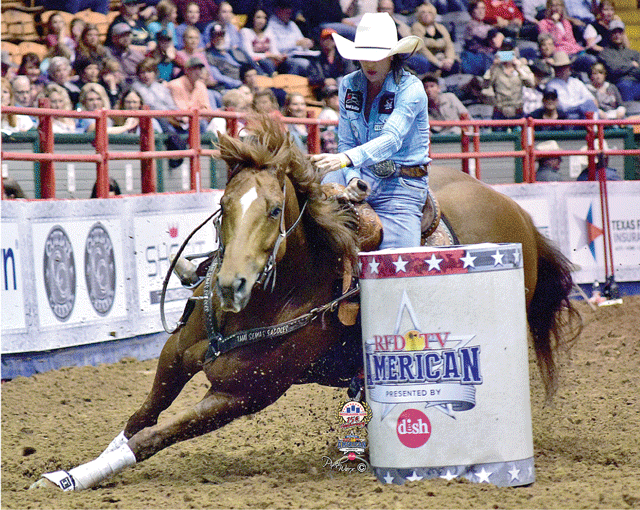
Tami Semas
Tami Semas—professional barrel racer, saddle designer, and wife and mother of two—found her niche in the horse industry in high school, and dug deep into her passion after college. The first of her family to rodeo growing up, the 41-year-old from Brock, Texas, learned by trial and error, and her persistence earned her two qualifications to the PRCA Columbia River Circuit Finals, and a place at The American’s inaugural rodeo in 2014. In 2015, she was Equi-Stat’s highest-earning rider of futurity horses, and has trained multiple futurity and derby winners. “Where a lot of people who’ve had parents in that event have the process narrowed down a little bit, I had my biggest successes from my biggest failures,” says Tami. “I’ve spent a lot of time learning from horsemen how to get a horse really broke. I understand the game of barrel racing, and to combine that with horsemanship is kind of my approach. I wanted a very smooth motion in my horses around the turn, and I have learned to get a horse to be soft. I’m a small person—I can’t hold the horse around a barrel—and I’ve learned through various horsemen how to get a horse to respond through weight, leverage, and positioning to keep them light.”
Searching for a saddle that was balanced for Tami’s smaller stature led her to becoming a saddle dealer for seven years, and ultimately, launching her very own line of Tami Semas Barrel Saddles. “A lot of saddles on the market didn’t feel like they balanced my weight great, and either pushed me forward or back. I ride everything centered, and I bought a saddle from one company that worked pretty good,” explains Tami, who at that time was Double J Saddlery’s highest-selling dealer without a store. “I learned a lot about what many riders were wanting and needing. I came up with some ideas on how I would tweak things if I would ever be able to build my own saddle from scratch.”
Tami quit her dealer job in 2014, and she approached a manufacturing company about building her own saddle that same year. “A lot of things are the same with saddle parts, but they can be put together to have a uniquely different feel,” Tami explains. Her saddle came out in the 2015, her best futurity year to date, and the Tami Semas Barrel Saddle was a success. They now sponsor several athletes, including Hallie Hanssen, a futurity horse trainer from South Dakota. After two-and-a-half years, Tami decided to go out on her own for manufacturing, and with the aid of her custom tree maker and a new manufacturer, the latest line of Tami Semas Barrel Saddles will launch this fall.
Of equal importance to a balanced saddle is the saddle pad underneath, and 5 Star Equine became one of Tami’s sponsors the year her first saddle came out. “I’m a firm believer in their product. I’d used their pads over the last 10 years, and they’ve been a sponsor over the last 3 years, and we also promote them with our saddles,” says Tami, who is also using 5 Star’s new line of leg gear. “The things I use for my barrel racing and riding I call timeless tools. I’m not someone to use the latest and greatest thing that’s come out on the market; I’m going to use the tools that have stood the test of time, and I believe 5 Star is a product that has stood the test of time. That 100 percent natural wool has always allowed my horses’ backs to breathe well, especially down in Texas. I want a pad that absorbs shock, breathes well, fits comfortably on my horse, and can withstand weather conditions, and 5 Star has been that product for us.”
Tami, who trains all of her horses, sold her futurity horses this year, thinking 2018 was her year to rodeo. But when her horse Smooth N Famous, who won nearly $200,000 during his futurity career, had an injury this year, she had to turn him out to pasture and make a new plan. That became running and seasoning a 6-year-old, Colour Me Gone, she trained and sold but bought back recently. “I’ve pretty much seasoned him at the pro rodeos, and I’ve gone to Northside, which is an open rodeo every weekend. I always like the Diamonds and Dirt Derby, and we just keep training horses this year and selling them. Next year we’re hoping to have our horse better seasoned for the rodeos,” says Tami.
Her 15-year-old daughter, Madison, traveled with her most of the summer, and enjoys riding and other sports, while Tami’s 16-year-old son, Myles, plays football. Aaron, Tami’s husband, rode bulls for 18 years and qualified for the WNFR 7 times, while he’s also one of the founders of the PBR. “He’s doing some fixer-upper homes down here and ropes, and when you have a family and kids at this age, it’s definitely a busy time. What we’re doing is just trying to train good horses, build a good saddle, and let the horses tell us where we’ll be going.” -

Scott Kormos
[ Eight-time WNFR qualifier Scott Kormos currently sits at 15th in the PRCA world standings. ]
“The first time I watched the NFR, I was 8 or 9 years old, and at that moment, I thought ‘I want to be there and compete.’ So I think it was a goal of mine from the very start,” says Scott Kormos. The 38-year-old tie-down roper from Teague, Texas, has eight WNFR qualifications to his name, last competing on the arena floor of the Thomas and Mack Center in 2013. Currently, he’s sitting 15th in the PRCA world standings, traveling with fellow tie-down roper Caleb Smidt.
With his gold buckle dreams hinging on horsepower, Scott started feeding his horses Nutrena five years ago and calls it the best decision he ever made. “I got a call from them asking if I wanted to be on their team, and it’s been a blessing from the start. The way my horses look, feel, and perform—there’s nothing better. I’ve seen a really big upside. I have a couple practice horses I ride when I’m home, and one is 18 and the other is 20, but they look 12. They’re strong and they stay healthy. I feed the SafeChoice Senior to all my horses, young and old. It’s really good for the stomach—a lot of performance horses are having stomach problems, especially traveling, so this is easier to digest. I got on it and I haven’t looked back since.”
Scott also attributes his horse Aggie’s endurance through the summer run to his feed. “You’re out here a long time going up and down the road, and you have to take care of the horses. If they’re not sound and feeling good, then we’re not going to win.” Scott purchased Aggie, now a 13-year-old, four years ago during the San Antonio Rodeo at the ranch horse sale. “The people who’d owned him had never roped on him, so we trained him and started hauling him a little bit last year. I’ve been riding him all year this year, and he seems today as good as he did at the start of the year. He’s just a little young to a lot of this, but he’s feeling his way through it.”
Scott and Aggie often return to enter at their meeting place at the San Antonio Rodeo, and the Houston Livestock Show and Rodeo is another one of Scott’s favorites, from the added money to the hospitality. “There’s not another rodeo we go to like it all year long. They feed you three times a day, have plug-ins and stalls—it’s just unreal,” says Scott. “Through the summer, I just try to tell myself it’s not going to last too long, and just try to drive through two to three months on the road. At my age, it’s about getting enough rest and eating good. I try to look past the travel and focus on the goal I’m trying to get to.”
At the end of the rodeo trail, Scott’s family waits for him. His wife, Laine, is a full-time nurse, and they have three children, Kade, Lawson, and Letty. “Last year, Kade came out with me a couple months to rodeo, but the boys are all about sports and football. Letty will be 3 in October and she shows a lot of interest in the horses, so she may be a little cowgirl.” When he’s home, Scott shoes horses, a skill he picked up as a 16-year-old working with Ricky Luke, who also coached him in roping. Scott’s dad, Michael Kormos, is an electrician, as well as a team roper, and Scott works with him on occasion. In November, Scott is also hosting his third tie-down and breakaway roping school in Buffalo, Texas.
“My dad roped steers and I got started roping steers a little bit at a young age, but I started roping calves and I loved it as soon as I started doing it. I love everything about it—the horses, the competition—there are so many things you have to do besides ride and rope. You have to be a good horseman, and you have to score good, rope, flank, and tie. There are so many more things about it that intrigue me,” Scott explains. “My ultimate goal this year is to make the NFR. I think that’s everybody’s goal out here, so I’m trying to get the finals made and have a chance to compete out there.” -
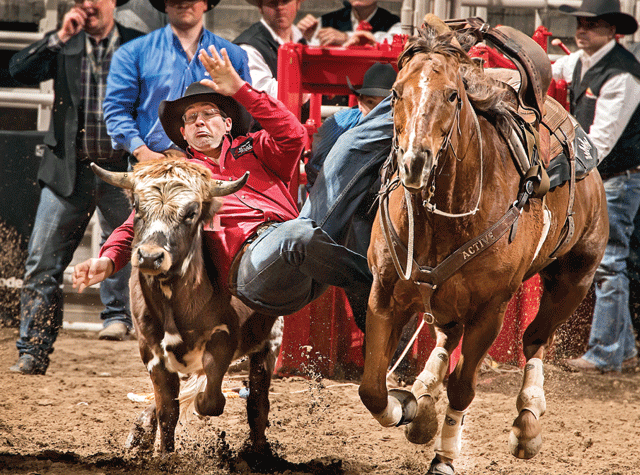
Cole Edge
Cole Edge of Durant, Oklahoma, is sitting second in the PRCA standings in steer wrestling, an event he originally took up in high school for the all-around points. The 33-year-old cowboy comes from a family of ropers and focused primarily on team roping and tie-down roping through high school, but he found his niche in steer wrestling. “I’m just steer wrestling now. I can rope when I retire,” he jokes. “I went down to Southeastern Oklahoma State in Durant for school where Sarah Burkes was the coach. Her husband, Jake, talked me into keeping up steer wrestling and it just took off from there. I like the physicality of it, and you have your hazer, but it’s more of an individual sport—everything depends on you. I like the competition and making good runs, and when you get to the big rodeos, I like the pressure in those situations.”
Cole finished third in the CNFR world steer wrestling standings in 2007, and the pressure at Rodeo Austin in March this year spurred him on to a first-place win. He was also invited to the Calgary Stampede for the first time this summer. Cole is traveling with Cameron Morman, Chason Floyd, and Tanner Brunner this season, and the four steer wrestlers are competing on the same three horses this season, all by Pride Farms’ stallion Lions Share of Fame. “We’re all in the top 20 right now, and I think that says a lot for those horses,” says Cole. “We ride all the same saddles and just adjust the stirrups. I’m primarily riding a horse of Sean Mulligan’s, Miss Kitty, and another mare named Holly, and our gelding Slick is our haze horse. Miss Kitty was pretty young when I qualified for The American on her in 2014, but this year and last year I’ve been riding her every day.
“The great thing about steer wrestling is that it’s kind of a big family. Everybody helps each other out,” Cole adds. “Sean Mulligan has helped me my whole career, and Jacob Burkes made sure I kept going with it. I’m pretty fortunate to be around people like that all the time.” Sean also hazes for Cole throughout the season. “You’re pretty much putting your life in your hazer’s hands. It’s a very crucial job. I started rodeoing with Sean and he’s one of the best in the business. Cameron hazes outstanding, and Chason hazed for me at the short round in Reno, and I haze for everybody else. We can’t win what we do without a good hazer.”
Another crucial component in Cole’s steer wrestling career is his tack, including the 5 Star saddle pads and cinches that he uses. He’s been using their products the last 10 years and joined the 5 Star Champion team in 2014, the first year he qualified for the WNFR. “I like things basic, and their pads are 100 percent natural. The wool absorbs the impact just as well, and I like the 100 percent wool cinches they have. They work for me, and they are a great company with great people.” Cole also appreciates the variety of sizes 5 Star pads are offered in, and has a tack room full of them to prove it. “I can have one saddle and switch it to different horses and make it fit that much better. My wife is a barrel racer, and she has a whole bunch of their pads too.”
Cole and his wife, Torrie, met at Southeastern Oklahoma State University where they were both on the rodeo team, and they were married in 2012. Torrie runs barrels on the WPRA Prairie Circuit, though she’s taking the season off since she and Cole are expecting the birth of their twins in November. The husband and wife also enjoy raising and training horses together, and taking them to barrel futurities. “If not barrels, then we try to rope on them and just turn them into good horses,” says Cole, who also likes welding.
“Winning Austin was probably my biggest highlight, and my horses are working good. I get my confidence from what I’m riding—if they keep working good, I’m pretty proud of them. My goal is pretty much to win as much as I can and save up for those babies. I want to keep placing at the rodeos and everything will take care of itself after that.” -
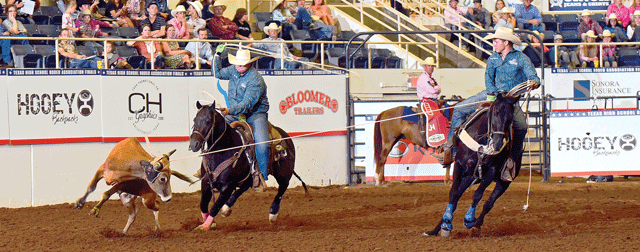
On The Trail with Rowdy Norwood
Rowdy Norwood of Amarillo, Texas, makes his debut at the 2018 NLBFR in July leading the senior boy rookie standings with 3,207 points separating him from second place. Rowdy, 16, originally joined the association with the goal of qualifying for the 2019 Jr. Ironman. He put his nose to the grindstone, and when he looked up, not only had he qualified for the NLBFR in all of his events—team roping, steer wrestling, ribbon roping, and tie-down roping—but he also made the Top Hand Team in each event.
Rodeo has been Rowdy’s sport of choice since childhood, though he also played basketball for several years and showed pigs in FFA in sixth and seventh grade. When it came time to choose between sports, he and his older brother, Justin (18), chose rodeo without hesitation, competing in junior rodeos and ranch rodeos before moving up to high school and Little Britches. “In Little Britches, you get to meet a lot of new people from areas you’ve never been before, and it’s really one of the only other national associations besides high school. We tried to start a franchise a few times when we moved here, but we couldn’t find anyone to host the rodeos. Kyle Northrup started the Texas Panhandle Little Britches and we got involved with it here,” says Rowdy, whose name was inspired by a roping his dad went to. “My dad always wanted to have a little girl, and he was convinced when my mom was pregnant that I was going to be his little girl. All he could think of was names for girls. MB Anderson, our neighbor, was announcing a roping my dad entered, and he couldn’t read my dad’s handwriting and announced his name as Rowdy, so now I’m Rowdy.”
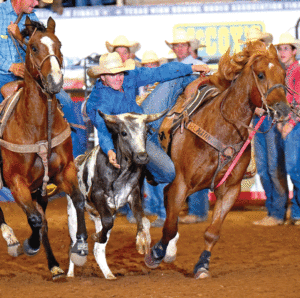
Rowdy steer wrestling at the THSFR – JenningsRodeoPhotography.com 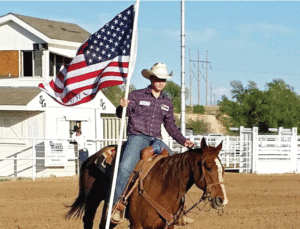
Rowdy carrying the flag at a HPJRA (High Plains Junior Rodeo Association) in Hereford, TX 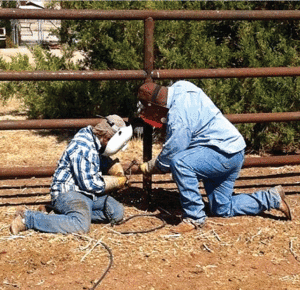
welding with his dad, Randy – Courtesy of the family The Norwood’s moved to Texas from Olney Springs, Colorado, where they ran a small cattle ranch until the drought took hold. In 2007, Rowdy’s dad took a job in Texas, and the environment they moved to has played a central role in Rowdy and Justin’s rodeo careers. With a rodeo or roping held within a ten-mile radius of their house year round, Rowdy and Justin never lack for opportunities to compete, while they can get to a rodeo in New Mexico, Colorado, Oklahoma, or Kansas within four hours. The brothers team rope together, Rowdy heading and Justin heeling, while Justin hazes for Rowdy in the steer wrestling. Rowdy won the NRS Little Britches Rodeo Association all-around, steer wrestling, tie-down roping, and ribbon roping year-end titles in June. He racked up the majority of his rookie of the year points at the NRS LBRA franchise, competing in 24 of the 32 rodeos held in Decatur, Texas, at the NRS Events Center. His ribbon roping partner, Sophia Joyner, is also in contention for the NLBRA Senior Girl Rookie of the Year title.
Equally crucial to Rowdy and Justin’s rodeo success are their parents, Randy and Bobbi Norwood. Randy is often working out of town as a welding pipeline inspector but comes to as many of their rodeos as possible, including state finals and the NLBFR, and watched videos of their runs to give them pointers. Bobbi teaches high school chemistry and physics, and hauls Rowdy and Justin to all of their Little Britches and high school rodeos. “We get a list written and everybody takes some responsibility getting ready to go, and I do the final walk through to make sure everything on the list is done,” says Bobbi, who also helps with timing or secretary work at the rodeos when needed. “Every horse I’ve ever tried to rope on has wound up being one of the boys’ horses, and I’m protesting now saying they have to make a horse for me. They help out with the driving, and they haul by themselves occasionally.” Bobbi competed in the NLBRA in the 1970s, including team roping with her sister. “The competition in Colorado was always pretty stiff with Little Britches headquartered there, and since the finals has moved to Guthrie, I feel the sheer number of contestants has increased immensely, which makes the competition increase. It’s an awesome association, and you’re not hauling all over the country with your kids to get them qualified.”
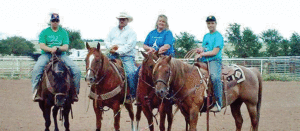
Rowdy with this parents Bobbi and Randy and his brother Justin 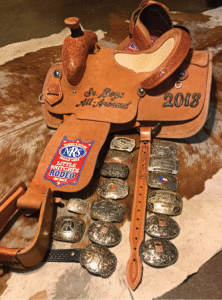
A collection of buckles and a saddle that Rowdy has won over the years – Courtesy of the family 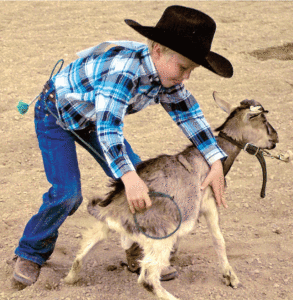
Goat tying at age 7 The brothers also compete in Region 1 THSRA, and Rowdy qualified for state finals in the team roping with Justin, and steer wrestling, which he finished 13th in at state finals. He advanced to state finals last season in the steer wrestling as well, his first year competing in his favorite event since he advanced from chute dogging. “I just like how high speed it is,” says Rowdy, who was the High Plains Junior Rodeo Association Year-End Reserve Chute Dogging Champion in 2015. “Chase Pope, a local guy, did high school rodeos when he was younger, and he started teaching me chute dogging. I did Jace Honey’s bulldogging clinic and a few of Rope Myers’ clinics. I’m pretty much the first in my family to bulldog, and my cousin Dakota Camfield started it this year as well in Little Britches.“The roan horse I bulldog on, he’s our old team roping horse, and everyone in my family has won money on him. Ace has taken me pretty far in bulldogging,” says Rowdy. “My calf horse, Joker, I just got this year, and we’re just starting to get together now. Smoke is my team roping and ribbon roping horse. He was a calf roping horse first, and I stepped him up and he’s a really good team roping horse.” Rowdy and Justin practice and ride daily, either at their home arena, which Rowdy and Randy built together several years ago, or another local arena. Bobbi runs chutes and videos for them, and helps with tacking up and exercising horses. “When we travel, we talk about how the week’s been and watch our videos—video is one of the most amazing practice tools we have nowadays,” says Rowdy, who scarcely ever gets into the truck without his blue heeler, Dale, at his side.
Time on the road also gives Rowdy a chance to work on school. Last year when he was a junior, he switched to homeschooling, and plans to continue it through his senior year. “Rowdy gets the chance to work horses in the daytime in the winter, and he got a colt and has been able to ride it some,” says Bobbi. “He had to urge us toward homeschooling, and it’s the same deal,—we make a list of things to get done while homeschooling, and he brands and does some welding for a construction guy here. It’s a taste of the adult life and what it takes. Most kids that rodeo have to be disciplined to practice. We had a 15-minute rule—if you had a bad run, you had 15 minutes to be aggravated, and then go on to your next event. With the events in Little Britches back to back, we had to change that to a 15-second rule, and that really helped Rowdy. We’re just disappointed we didn’t join Little Britches sooner so Justin could have hauled more. He’s going to Dodge City Community College this fall and team roping for the Conquistadors.”
Rowdy also enjoys welding with his dad and kicking back at the family’s swimming pool, but it’s more likely he’s in the arena riding. His hard work won him a large check from the Double G Memorial Timed Event Rodeo in Canadian, Texas, last year, where he won the all-around, team roping, chute dogging, and tie-down roping. If Rowdy could enter any rodeo in the country, he’d choose Cheyenne Frontier Days, and hopes to back into the box of The Daddy of ‘Em All once he starts rodeoing professionally. “I’d like to make a career out of rodeo, and I’d love to rodeo through college and the rest of my life if I can.”
-
Boyd Polhamus
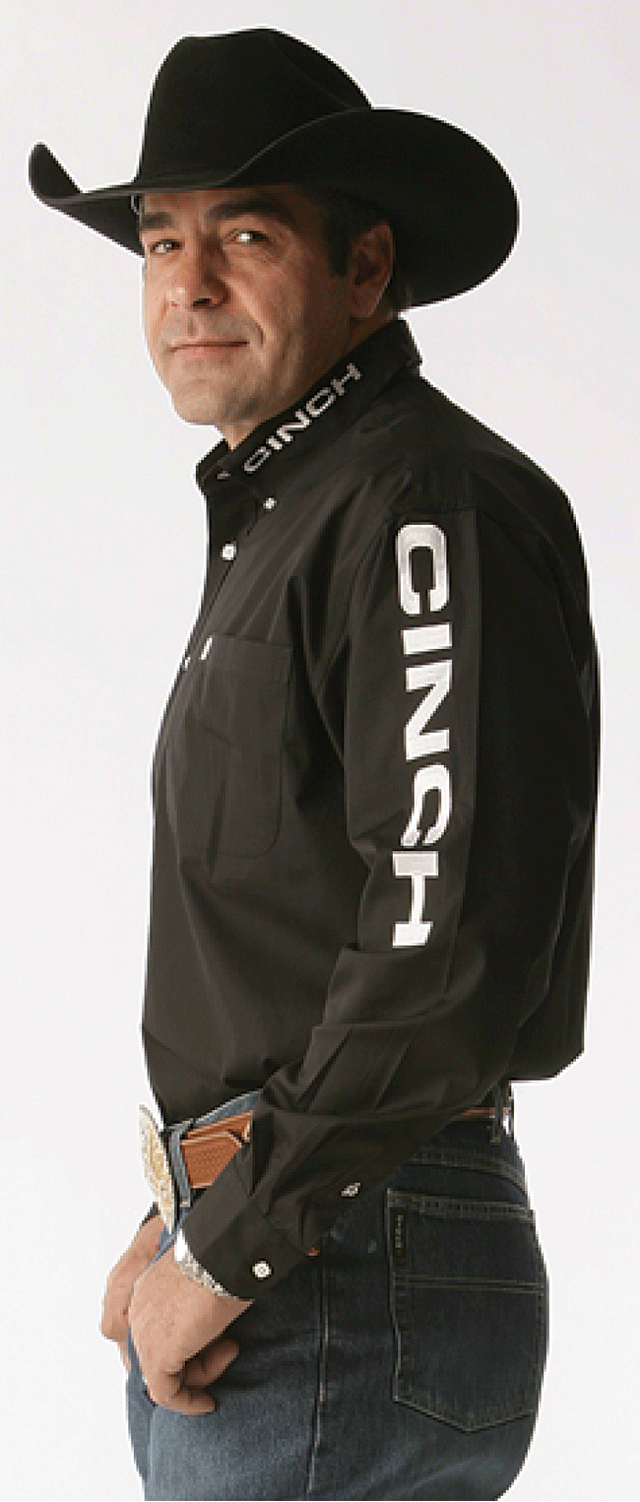
Behind Boyd Polhamus’s rodeo announcing career of 30 years and counting are numerous sets of hoofprints, left by the horses that have carried the Texan and his voice throughout rodeos all over the continent, from the college practice pen where he got his start to the height of professional rodeo at the WNFR. Gopher, Jack, Rolex, Limo, and a newcomer named Lambeau have all put Boyd close to the action on the arena floor.
Of the more than 1,000 rodeos Boyd has announced in his career, approximately 70 percent of those have been on horseback. “Number one, I love my job, and number two, my biggest fear is someone saying that Boyd took the day off, so I’m religious about my research. I want to make the fans know the contestant as best as I can,” explains the four-time PRCA Announcer of the Year. “It’s a lot easier to announce from a booth because you don’t have a horse to feed or bathe, but it’s therapeutic for me to step away from that research and interact with the contestants at the wash rack or feed time, and find some things out you wouldn’t in the media.”
When Boyd started announcing at 19, he rode stock contractors’ horses. Having ridden since he was 4—and known for being his home state of Wisconsin’s first three-time all-around cowboy in high school—he wasn’t scared to get on anything that was broke. By his early 30s, Boyd decided to start announcing on his own horses, and he looks for certain qualities in all the horses he works off of. Conformation is important to Boyd, along with a horse that isn’t too flashy—he prefers solid-colored horses without many markings. “If you study my horses, I want you to like them, but I want you to watch the competition,” he explains. “I want a horse that pays attention. It doesn’t matter if he’s a little flighty at first as long as he gets over it. I want one with spunk but who realizes something won’t hurt him.” Boyd’s horses have to grow accustomed not only to laser lights and pyrotechnics but being quick to respond, especially during the roughstock portion of rodeos. “You don’t want to be where the bucking horse can see you or you could draw the horse to you and out of the bucking pattern. I hide behind the gate the horse is coming out of, and if he goes bucking across the arena, I stay on his tail about three horse lengths back.”
Boyd is on the road often 260-280 days a year, frequently with a horse in tow. He and his horse experience a variety of temperatures, elevations, and climates, along with changes in water, within just a few weeks or even days of each other. His horse’s feed remains constant, however. “Zero times have I had a horse colic since I started feeding Nutrena, and I can’t remember feeding anything but Nutrena in over a decade,” says Boyd. “My horses look good and the reason is they’re getting proper nutrition. I do my part and worm them, but at the end of the day, you are what you eat, and my horses don’t colic.” Many of the animals on Boyd and his wife Sandee’s Band-Aid Ranch in Brenham, Texas, eat Nutrena, from their Brangus cattle to the fish in their pond. “They’re the cream of the crop when it comes to any kind of animal nutrition, and their reps are so knowledgeable,” Boyd adds. “My horses look fat and happy, they have shiny coats, and I have to attribute all that to Nutrena.”
Lambeau, a 5-year-old gelding Boyd purchased on Colorado, is his newest addition to the herd, though Limo remains his old faithful. Following the summer run, Boyd plans to take Lambeau to announce some smaller county rodeos in Texas to season him. The rest of Boyd’s time is spent at home, where down time is getting the trailer ready for his next trip, weaning calves, or spraying and fertilizing pastures. “Home is my vacation, but it’s not like I go home and go fishing—I’d much rather do something productive.”
His latest venture is picking up the baton from Shawn Davis as General Manager of Production of the WNFR in 2019. “I won’t be announcing the NFR this year because I’ll be shadowing Shawn Davis and learning from him. In 2019 I take over, and I’m going to continue announcing. In the words of Willie Nelson when they asked him what his goals for 2017 were, and he said to make it to 2018, my goals are to do everything better than I did before. I’ll be 53 in September, and I’m excited about the National Finals Rodeo and making it more fun and engaging for fans and contestants. Basically, I want to do things better than I have before.” -
Joe Beaver
“One, you have to really love it. Two, you have to sacrifice things for it. Three, you get out of it what you put into it, and four, always dream big, because you never know what’s going to happen.”
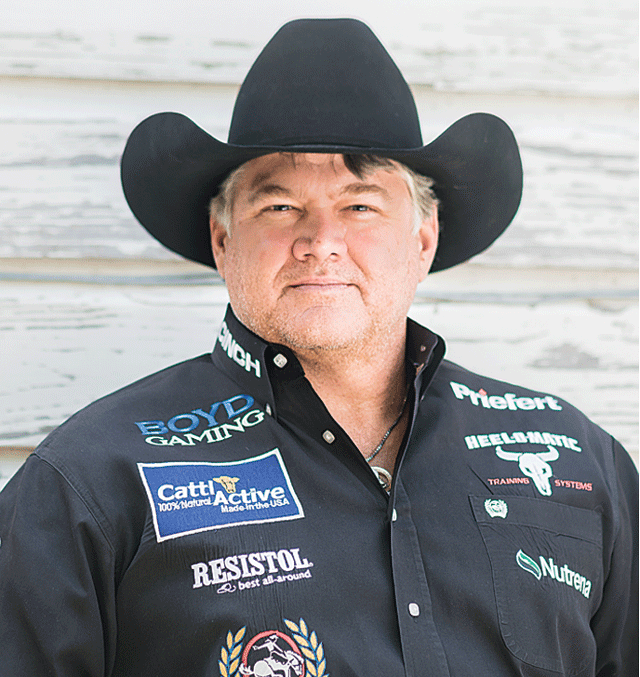
Many a student of Joe Beaver has heard this advice, which rings as true today as it did when the 8-time WNFR World Champion was just starting out. He built an exceptional reputation in the industry over 25-plus years of pro rodeoing, a reputation fueled by hard work and relentless passion, which Joe now strives to kindle in the next generation of rodeo athletes. He teaches numerous schools across the country—there are only five or six states in the U.S. he’s yet to visit—while Joe has taught as far away as Australia, New Zealand, Brazil, and the Dominican Republic. And if ropers can’t come to him, he’ll go to them. “I like to see raw talent and mold it,” he says. “The fun of it is seeing that develop and seeing what someone has been hoping for and wishing for come true. I’ll take the weekend warrior or the businessman who’s decided to rope again after 20 years and help him get back into the game and watch him succeed. That’s the fun of it.”
Joe also purchases horses from all over the country, finding the right horses to fit his students. Many of the horses are in their mid to late teens, and Joe depends on Nutrena feed to help them reach their highest potential. “I’ve been feeding Nutrena for about ten years, and it’s been a relationship with the product that brought on the relationship with the company. They are a top-of-the-line company that puts forth their best efforts, and they put forth the best products so the animals can work the best they can. I might buy some horses that look terrible, but I know if I put them on a senior feed, I’ll get them built back up and strong, but still keep the same minds on them as when we started,” Joe explains. “I also have roping cattle that make a lot of runs up and down the arena, and they get everything they need out of the bag. If you don’t keep horses and cattle fat and feeling good and ready to perform, then you won’t get the most out of your performance.” With nearly 200 kids entering each of his ropings, and teaching 60-80 days of private lessons altogether each year, Joe is equally confident about recommending Nutrena feed to his students. “When I put it out there, I mean it. There’s pride in the knowledge that when you’re giving away a bag of Nutrena, you’re giving the best you can offer.”
Several of Joe’s roping students stay at his home in Huntsville, Texas, and Joe travels with them to their larger events, from the Texas Junior High Rodeo State Finals, to the NHSFR and CNFR. He also encourages them to pursue rodeo scholarships for further education or learning a trade, reminding them that rodeo takes care of its own, but it requires blood, guts, and tears. “They’re good kids and they work hard at it. I keep them pretty busy. I sell a lot of horses, so between all that riding and roping and working on them, they stay pretty busy. I keep feelers out for good horses all the time. We don’t train young horses around here because you never know what you’re going to get. I like to get good horses and get them back to where they used to be, or make them better.”
While Joe says his work ethic carried him longer than his body did, he continues to compete, rodeoing on the PRCA’s Southeastern Circuit when he’s in Florida for the winter, as well as the All American ProRodeos. He qualified for both finals in the team roping last fall but had to sit out after back surgery. A horse fell on him at the end of February and broke his leg, which set him back several months, but Joe was back to roping by the end of April. “I’ll just have to see if I get the circuit finals made this summer, and if I do, then I do. You never lose the desire to win. One of the first times I hurt my knee, I was griping about it, and my dad told me, ‘I can fix this so it never hurts again. You back off; give 40 instead of 110 percent. No one will know who you are, and you won’t have any money.’” Joe lived on that perspective from then on and loves the way he’s involved in rodeo these days, particularly watching the sport progress. “They’re roping smaller calves and doing different things with their slack, roping smaller steers and reaching farther. To see the guys do it keeps you fresh. I’m so glad to see the money come up to where it should be. When I reached the 2 million dollar mark, it was at the end of my career. Now people win more money than that in a few years, and that’s a good sign for rodeo. I love to see people at my clinics win, and my goal is to keep doing what I’m doing and watch them get better and better.” -
Timber Moore
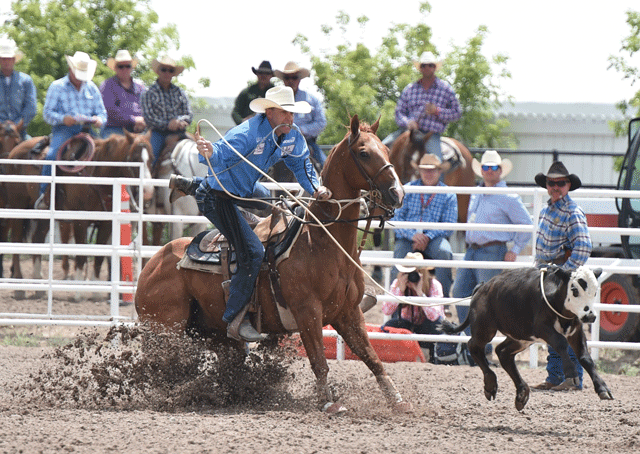
“My drive is to prove to myself that I still rope good enough to make the NFR and compete with the best in my event,” says Timber Moore. “It is more of a job, but I think there’s probably a lot worse jobs in life than traveling around with family and friends!” Timber, 32, comes from Aubrey, Texas, and the 6-time WNFR qualifier is no stranger to the arena of the Thomas & Mack Center. He’s competed at the finals consecutively the last five years and finished tenth in the world standings last season.
Born into a rich heritage that included rodeo athletes and outdoorsmen, Timber’s parents, Gordie and Dianne Moore, roped and ran barrels, and Timber’s grandfather William Holloway was a stock contractor. Many of Timber’s family roots on his dad’s side lead back to Canada, where Gordie worked as a bush pilot and hunting guide, but rodeo was the tradition that Timber chose to continue. He grew up with a rope in hand and started out team roping, later adding tie-down in high school. He competed in both events through his college rodeo career with Tarleton State University in Weatherford, Texas, and when he turned pro in 2007, Timber decided to pool his resources and enter solely in the tie-down roping. “I love everything about it. It’s one of those sports that takes an athlete. There’s lot of hand-eye coordination, timing, and horsemanship. Without a good horse, you don’t have much of a shot of winning at all. The horse has to do so much on their own, and there’s a lot going on in making a good run.”
Timber found his horses felt their best using 5 Star Equine’s saddle pads, which he learned about four years ago from a 5 Star Equine Products representative that lived nearby. “Their pads are unbelievable. I’m pretty sure I’m riding the same pad on my horse since I started with them four years ago,” says Timber. “They’re super durable and made with the best quality of wool—they’re just outstanding.” The past few years, Timber has signed autographs at 5 Star’s booth during Cowboy Christmas and the WNFR, while his social media posts are sure to have a shout-out to his favorite saddle pad company.
Colonel, Timber’s rope horse, has been one of the top three finalists of the AQHA/PRCA Tie-Down Roping Horse of the Year the past three years. Timber bought the 13-year-old sorrel gelding in 2012, the same year Timber was recovering from knee surgery. “I’ve pretty much ridden him ever since. I don’t have any others that I would actually take and feel confident about riding. Buying horses that I can take and have a chance to win money on is the best way for me to do it.”
Colonel travels in the bumper-pull trailer Timber tows behind his bus, which makes it easy for his wife, Valerie, and their 6-year-old daughter, Vaughn, to join him on the road. Tie-down roper Tyler Milligan is also traveling with Timber this season. “We’ve been to Disneyland and Disney World, and we stop and do some things to break it up so we’re not always driving. Vaughn is more into soccer and gymnastics and things like that.” Timber and Valerie met through their siblings, who went to high school together, and they were married in 2007. When they’re home in Aubrey, the husband and wife often work with Valerie’s parents, who run several businesses, including baling hay and selling flatbed and horse trailers.
Timber and his family and friends have also put on the Gordie Moore Bubblegum Roping the past ten years to honor his dad, who passed away when Timber was 19. In the past, it’s taken place in early May, but since the location it’s normally held at is closing down, Timber hopes to hold the memorial roping this fall instead. Gordie was one of Timber’s greatest supporters in his rodeo career, and he also looks up to Raymond Hollabaugh, a 7-time WNFR qualifier and a Texas Rodeo Cowboy Hall of Fame inductee. “I stayed with him a lot when I was in high school, and he taught me a lot about roping and rodeo,” says Timber. “We stay in touch and talk all the time.”
While Timber has competed extensively in Canada in the past, he rodeos primarily in the U.S. now, though the Calgary Stampede is a much-anticipated rodeo in the Moore household. “The Fourth of July is over and you’ve been driving a couple weeks on end, but in Calgary you get to sit still and be there for a week. It’s super neat to go up there and see all your friends,” explains Timber, whose main goal is a seventh qualification to the WNFR this December. “I like the summer in general because you get to rope and run a calf just about every day. You can get on a roll and have some good timing, and have things start going your way.” -
ProFile: Randy Ternan
In the last four and a half years, rodeo judge Randy Ternan has worked 135 rodeos in six associations. He’s currently the GCPRA Judging Director and a director in the AHSRA, while working the 2017 NLBRA finals marked the 30th finals rodeo he’s judged.
Before the 57-year-old from Phoenix, Arizona, became a rodeo judge, he competed on both ends of the arena, starting with 4 years of steer riding, followed by 12 years of bull riding and 14 years of steer wrestling. He grew up in Alberta, Canada, in a town of 800 people, where rodeo was the entertainment. “A kid said I should enter the cow riding, and I had no spurs, no hat, and no glove, but some bareback riders cut their spur straps down so I had spurs and someone put a hat on my head,” Randy recalls. “That was in 1970, and I shouldn’t have rode the first one, because I’ve had the fever ever since.” He later switched to steer wrestling, and Randy college rodeoed for a year and even competed in Australia for three months. He worked full time at a fertilizer plant and rodeoed on weekends. While he was jumping a steer in 2000, the steer’s horn went through the side of his mouth and into the bottom of his eye socket. He was in a coma for a week and needed two brain surgeries. “But if you take the good out of the bad, because of that accident, they also found out I had a double brain aneurism,” says Randy. He made a full recovery and backed into the box for several more years until he broke his leg. Three plates and 22 screws later, Randy felt it was time to retire, but he wanted to stay involved through judging.
“The first time I judged, I was just supposed to do steer wrestling and barrel racing, and just before the rodeo, the judge decided I should flag the team roping in an 80-by-140-foot indoor arena,” says Randy. “Because I’d been on both ends of the arena, I was a watcher, even when I wasn’t competing. The first year I judged in Alberta, I got voted to do a finals, and it just progressed from there. I started judging the Grand Canyon rodeos 10 years ago. The association is great — everything is volunteer and they work at promoting their association, and they’ve done a real good job at the finals. I judged their finals the last nine years.” Randy also judges youth, high school, college, PRCA, and Indian rodeos and enjoys the opportunity to travel. “After judging all over the country, I think Arizona is quite lucky to have the core of judges they do. The judges we have here are very good and everybody is conscientious. You have to have thick skin as a judge and know the rule book — and have fun doing it. When contestants thank you for coming, that’s your payback. You don’t need to be a policeman, you just need to know the rules and treat people fairly.”
Randy also used to work for a toy company, and he built the prototypes for the first rodeo action figures to come onto the market, called Rodeo Champions. Randy had a licensed agreement to do action figures for all the events, and he completed a bull rider and a barrel racer before funding for the project was canceled. Today, he judges part time and manages several rental properties, while his wife, Laurie, works for an engineering company, flying 150,000 miles a year for work. She shows halter and English, and they raise several barrel horses a year. “We have a PC Frenchmans Hayday mare bred to Slick By Design, so that should be an interesting baby next year,” says Randy. He’s taken up team roping as a header in the last year and turned 50 steers so far. “I have a horse like a golden retriever — he’ll take care of me, and I want to keep my fingers! Even though you flag it for 17 years, there’s things you don’t watch for as a line judge. There’s lots to learn,” Randy finishes, “and I think I will enjoy it.”