Rodeo’s opportunities for many athletes, and women in particular, wouldn’t be the same without Jimmie Munroe. Today’s professional barrel racers owe a tip of the hat to the 11-time WNFR qualifier as their horses dig into the well-groomed ground of a rodeo and run for home past precision timers. A trip to the pay window especially has Jimmie’s touch on it, as she advocated alongside her WPRA Board of Directors to increase purse money for barrel racers starting in the 1970s.
Born in 1952, Jimmie’s love of horses knew no bounds, and she started riding at three and competing in local Central Texas horse shows at four. Her grandfather, Zach Miller, was one of the brothers of the Miller Brothers 101 Ranch and Wild West Show, and both her parents ranched and rode. “My dad taught me to rope and I roped dummies on the ground. Then we got calves and I just loved to rope,” says Jimmie. At 10, she joined the AJRA and competed in all of the girl’s events on a little bay gelding named Bill. Together they won the barrel racing and the tie-down roping in the 12 and Under, with many more titles to follow. Jimmie’s parents, Jim and Blevins Gibbs, were her greatest supporters, and she also looked up to Texas cowgirl Wanda Bush, who was one of the first members of the GRA in 1948 and won more than 30 world titles in 5 events. “I went down and spent a week or two with Wanda when I was ten. She helped me and was such a role model to me, not only in the things she accomplished, but the person that she was. I was very blessed to have her as a mentor, and she was very instrumental in the GRA back then.”
Jimmie ran barrels on her roping horse, but her senior year of high school, she and her parents went in search of a barrel horse for her to ride when she joined the Sam Houston State University rodeo team on her rodeo scholarship. Several of Jimmie’s friends were running fast times on horses by Flit Bar, and she and her parents went to look at a five-year-old Flit Bar gelding. By the time the deal was closed, the family purchased two Flit Bar geldings for $1,400, including a three-year-old, Robin Flit Bar “Billy”, that caught her mom’s eye and would eventually carry Jimmie to the NFR.
“Billy is the reason I got into professional rodeo,” says Jimmie, who bought her GRA (now WPRA) card in 1974. “In college, I didn’t plan to rodeo professionally—that wasn’t my goal until I got him. He was talented and such a nice horse.” Her last two years in college, Billy and Jimmie won the NIRA barrel racing title in 1974 and 1975, and she capped off her senior year by winning three world titles in the GRA: barrel racing, tie-down roping, and the all-around. Jimmie also served on the NIRA student board as one of two women’s directors, and there she met her future husband, Dan “Bud” Munroe, a saddle bronc rider who rodeoed for Montana State University.
In the 1970s, there were roughly 30 all-women’s rodeos around the country that Jimmie competed in, while also entering PRCA rodeos. The barrel racing had just been added to the NFR in 1967. Billy carried Jimmie to the NFR six times, but his career was cut short when he developed a viral infection in early July of 1980 and passed away. At the time, Jimmie was sitting second in the world. “Billy was running at his peak then, and that’s how I’ll always remember him. I wound up 16th that year. I came home and had a couple young horses that I seasoned.” Jimmie took one of those horses on the road in 1981, but when her friend Lynn Flynn broke her leg at Red Lodge, Montana, she insisted Jimmie ride Lynn’s barrel horse Leroy the rest of the season. “He was a great horse, and I went on to make the Finals on him that year. That was also the first time Bud and I made the Finals together,” says Jimmie, who married in 1980. The following season of 1982, another barrel horse, Smooth Cadet “Cat” came to Jimmie through Pauline Haller. Jimmie seasoned Cat in 1982 and made the NFR on him four times, starting in 1983. “In 1984, I won the first five rounds of the Finals on him. No one had ever done that before and it hasn’t been done since. Pauline owned him the whole time, and she gave me quite the opportunity.”
Alongside her barrel racing achievements, Jimmie and the GRA Board were making advancements for women in rodeo every season. Jimmie, who was first on the board in 1976 as the All-Women’s Rodeo Director, was voted in as president in 1978 at 26 years old. “At the time, I’d said I don’t think I have enough experience, but I was very fortunate with the directors on the board. A lot of people were very helpful to me stepping into that position.” In 1982, Jimmie and the Board started on a three-year plan to bring women’s purse money up to equal that of the men’s PRCA events, including at the NFR. “I don’t believe it would’ve worked if we’d just said we want equal money. These ladies worked with the committees and stayed in such close contact with them in their circuits. When 1985 came, we lost very few rodeos, and the few that we did lose came back within a year or so when they could come up to the equal purse money.”
Ground conditions also improved when Jimmie and the GRA had the idea to incentivize rodeos to improve their ground. Justin Boots had recently started their Justin Sports Medicine program. “We said the wellbeing of the cowboy tied in with the safety and wellbeing of the equine athletes, and ground is important for all other events and livestock,” says Jimmie. “Justin came in with the Best Footing Award, and it was really a good start to encourage the committees.” The GRA also incentivized the use of electric timers for the barrel racing starting in the late 1970s.
Jimmie and Bud continued to rodeo together through the 1980s, Jimmie qualifying for the NFR a total of 11 times and Bud 12 times. He won the world in saddle bronc riding in 1986, and retired from competition when their daughter Tassie was born in 1989. He and Jimmie, who finished her WPRA presidency term in 1993, ran a cattle brokerage company with Jimmie’s dad in their hometown of Valley Mills, Texas. But the adventures didn’t stop there. Jimmie began hosting 20 or more barrel racing clinics a year, and was invited to teach in Australia, Canada, and Brazil. She and Bud also adventured into the world of English riding when Tassie began showing hunter jumpers all over the country and competing in Nationals. She later attended Texas Christian University on an NCAA equestrian scholarship. “We thoroughly enjoyed it. I always said whatever she wanted to do we would support it, and that’s the way my parents were.”
Jimmie and Bud were happily married through April of 2022 when Bud passed away. Both were inducted into numerous rodeo halls of fame, including their induction into the National Cowboy Hall of Fame together in 2016. They were also inducted into the ProRodeo Hall of Fame—Bud in 2007 and Jimmie in 2019—one of few husband-and-wife competitors to have that honor. Jimmie continues to make her home in Valley Mills and ride horses, along with picking up the reins as the WPRA president again in 2021. “There have been a lot of milestones since the WPRA started in 1948. The barrel racing developed into a major event in rodeo, and now the breakaway roping is growing phenomenally and also developing into one of the major events. The sport of professional rodeo was very good to me through the people I’ve met and friends that I made, and places I was able to travel to. I’m very blessed that the things in my life fell into place the way they have, and I wouldn’t go back and change anything.”
Author: Lily Landreth
-

6 Over 60: Jimmie Munroe
-

Karen Vold
Karen Vold calls trick riding the desire of her heart. But the sport of daredevil skills and showmanship on horseback was even more than that to Karen, who held on to it like a lifeline through turbulent times in life. She learned to know and trust God through her experiences on the rodeo trail, and now has the privilege of sharing lessons learned through her trick riding school, Red Top Ranch Trick Riding School. “Because of rodeo, I’ve had a very wonderful life,” says Karen. “I started out with not such a great youth, but as I got older and got into trick riding, it got better. I thank God to not only trick ride, but to be in rodeo, where I met my husband.”
Before Karen became Karen Vold, wife of the late, legendary stock contractor, Harry Vold, she was already leading a life heavily steeped in rodeo. “Dad (Andy Womack) was the only person at the Phoenix Rodeo who was chairman more than one year during the war, and he hired the announcers and clowns and specialty acts. They would come to our house and have dinner, and I was so enthralled with the trick riders and listening to their stories. So at a very young and tender age, I decided to be a trick rider.” When she was about eight years old, Karen learned to trick ride from Louise Tex Lee, a woman trick rider who worked at the Womack family’s riding stable in Phoenix. Later, Karen’s parents purchased a palomino, Gold Dust, from a trick rider who worked the Phoenix Rodeo, and he became Karen’s bosom friend and trick horse during her parents’ divorce. Louise had taught Karen three tricks that she knew, and when Karen got her PRCA card in 1953 at age 14, the Phoenix Jaycee Rodeo was the first PRCA rodeo she worked. Her dad also worked as the clown that year.
When Karen was 18 and a senior in high school, her dad paid for her to have lessons with the world champion trick rider Dick Griffith at his ranch in Colorado, provided she learn the full shoulder stand the way Dick performed it. It was a more complicated stand that faced forward and required diving over the saddle horn, rather than the side shoulder stand. “I did learn that for my dad, and always did that particular trick as an honor to him,” says Karen. The following year in 1958, Karen took a hiatus from trick riding when she was crowned the Phoenix Jaycee Rodeo queen. Through them, she represented her home state as the first Miss Rodeo Arizona at the Miss Rodeo America pageant. “It added some very lovely adventures to my life and wonderful memories. There used to be a program called Queen for a Day, and they took me to California and I was on TV. I invited their program to the Phoenix Rodeo. At the Miss Rodeo America pageant, there were a lot of interesting things for a young girl to do and see. Jane Russell, who was a very popular actress in those days, was one of the judges. Arlene Kensinger was the chaperone for Miss Rodeo America for many years, and she taught me a lot of things that were helpful.”
Karen returned to trick riding in 1959, and in 1962, she formed her own troupe, The Flying Cimarrons, who performed together for a few years before disbanding. Not long after that, Karen and Dick Hammond, a fellow student she met at Dick Griffith’s school, formed The Fireballs trick riding team, together with Dick Hammond’s wife, Bev, and brother-in-law, Butch Morgan. Karen still lived in Phoenix at the time, and the other members of the team, who lived in Colorado, came to practice at her place in the winter. They met Canadian stock contractor Harry Vold at the rodeo convention in Denver, and he asked them to come perform at several of his rodeos in Canada. “The first rodeo, it rained three days and three nights—I’d never seen so much water in my life. The rodeo was canceled, and we were so impressed that Harry paid us, even though he didn’t get paid for the rodeo.”
The Fireballs were invited back to Canada the following summer, which further developed Karen and Harry’s friendship. They married in 1972, combining their families, including Karen’s daughter from her first marriage, Nancy, and Harry’s four children, Wayne, Dona, Doug, and Darce. Harry and Karen were also blessed with their daughter, Kirsten. Once Karen married Harry, she put trick riding aside to help run Vold Rodeo Company. Her knowledge of rodeo showmanship and attention to detail helped continue Vold Rodeo’s reputation, which earned Harry Vold the PRCA Stock Contractor of the Year award 11 times. One of many highlights for Karen was Vold Rodeo Company working in Helsinki, Finland, at the invitation of bull rider turned rodeo producer, Jerome Robinson. “I’ve had lots of favorite rodeos for different reasons. Naturally in trick riding, you love the big arenas. For Santa Fe and Colorado Springs, this is our 55th consecutive year putting those rodeos on, and Prescott is 50 years and we’re still putting it on. My daughter Kirsten is still in charge. First I was the stock contractor’s wife, and now I’m the stock contractor’s mother. Those places are special because you see the same people once a year like a family reunion, and the people make the difference.”
Karen makes her home in Avondale, Colorado, and travels with Kirsten in the summers to the rodeos they’re producing. She also continues to run Red Top Ranch Trick Riding School, one of the few trick riding schools in the country, which she started in 1988. At 83, she teaches alongside Linda Scholtz, a former student of hers who was a professional trick rider for 20 years before coming to teach at the school. Karen also handles much of the cooking for the three-day schools and the rodeo crews coming through for Vold Rodeo Company.
One very special person to Karen was her trick riding hero, Tad Lucas, whom she met when the women were both inducted into the Cowgirl Hall of Fame in 1978. Karen made another friend in author Tracie Peterson, who came to the trick riding school to research the sport for one of her historical fiction novels. “She’s a very famous author and has written over 100 books. I wrote two cookbooks and took a year for writing each,” Karen says with a laugh. “Those are the types of experiences I wouldn’t have had without trick riding or rodeo. When I was in high school, I went to a church camp in Prescott and I thought if I wanted to serve the Lord, I had to go to South Africa. Little did I realize that I could still serve the Lord in my backyard by teaching and having those schools. I can share what the Lord has done in my life with students and their parents. I enjoyed 53 years shared with my husband, providing wholesome family entertainment in rodeo business, and got to perform in trick riding. When you’re teaching, you feel the same thing you experienced when you were riding, and when a student is working hard on something and accomplishes it, you feel same excitement.” -

On the Trail With Statler Wright
The last of the Wright’s is making his run for the Resistol Rookie of the year, joining his three brothers, Rusty, Ryder, and Steston, on the rodeo road. The Utah All State Linebacker, owes his love of riding broncs to Covid. “I was part of an undefeated football team – we took state two years in a row – and then Covid hit and we couldn’t play anymore,” said the 18-year-old who graduated six months early to hit the rodeo trail. “I got after dad to let me get on, and ever since, it’s been a full head of steam.”
Growing up, he didn’t participate in much of what his older brothers were doing. “If they needed help, I was the pickup man, I did get on one saddle bronc steer and the only saddle that would fit me was too big and after that I didn’t get on another bucking horse until I was a junior (in high school).” He liked going with Stetson to ride bulls. “My freshman year, I got on a few and the third bull I got on slammed me and broke my collar bone; I hung it up after that.”
The main reason Statler started riding later in life was due to his size. Statler got his mom’s genes for being bigger than the rest of his siblings. “My dad was 6’4”,” said his mother, ShaRee. “He was always eager to rodeo. Cody (his dad) was hesitant because Statler was bigger than the other boys. When you grow that fast, you get hurt easier. Cody would just tell him in due time, you will get on.’” ShaRee has supported her husband as well as all her kids in whatever endeavors they pursued .. except riding bareback and bulls … and she continues to be their biggest fan. “Now we’ve got five grandkids and one on the way. As a mom with busy kids and lots of grandkids you don’t have time to think about anything else.”
Cody started all four of his sons to ride bucking horses the same way, on a saddle horse. “He told us that if we could spur a saddle horse, then we could spur a bucking horse – the kicking helps you throw your feet forward,” explained Statler. “I started riding bucking horses right handed and I bucked off to the left. Dad told me to ‘get my riding boots on and walk across a real thin metal pole. Whatever arm you stick up to balance is the one you use to balance.’ I stuck my right arm up and so I started riding left-handed and it’s worked out.”
All the boys lean heavily on Cody for advice as well as entering. “It’s the respect that they have for him – not just as a cowboy that’s done it, but as a dad and a person … we are a super close family – we all live within a couple miles of each other,” explained ShaRee. “We are always together when they are home.” Their younger sister, Lily Jo, is chasing cans when she’s not playing softball or basketball. “My boys always tease that as athletic as they are, she got far more genes than any of them.”
ShaRee has spent her life supporting her rodeo family. “I remember when Cody and I were married, we had Rusty and Ryder; he was pouring concrete for his dad. Cody put together a video of his bronc rides to send to Shawn Davis, the rodeo coach for college of Southern Idaho. He told Shawn that he wanted to be a bronc rider needed to be learning from someone like Shawn. When Shawn accepted him to CSI, he packed up his clothes in a truck with a camper shell and headed to CSI.” ShaRee stayed behind with Rusty and Ryder. Cody found an apartment after a couple months of living in the back of his truck and we moved to Twin Falls, Idaho.”
Cody, one of 13 siblings, came from a small town called Milford, Utah, in Southern Utah; a town with no stoplight and where the Wrights are the main attraction. He ended up a father with 13 NFR qualifications and two world titles and three sons with a combined 15 NFR Qualifications and seven world titles, and a young daughter, Lily Jo, who is capable of joining her brothers either as a barrel racer or softball or basketball star. Statler feels very blessed. “I love being the youngest (of the boys). I get to be in the truck with three world champs. As a rookie, you don’t get that privilege and it’s awesome.”
All three of his brothers give him advice on different things. “Stetson likes the pressure moments and it’s all on you and coming out on top. Got nothing to lose and everything to gain. Rusty is like the all around situation- he’ll tell you what you need to hear. He knows everything it seems like. He’s good with the bronc saddles, he knows a lot about those. Ryder – he’s the motivator – I love it when I go after Ryder, he’s on the back of the bucking chutes. He always says; ‘lift and stay back’ – that’s the one jump that’s mandatory is the mark out – Gas it and give it to ‘em. All these guys were trial and error and they get to tell me what to do and how to do it.”
As far as getting advice from his dad. “He’s still the boss – I can totally get in trouble with my dad, I’m the king of it. I’ve always been the troublemaker. My dad does the entering, from the horses to the days to get up. I love it – they’ve all been pro rodeoing and I get to benefit from that.”
Growing up with a football background has helped him as well. “I was either the leading tackler or second with that – I was all over the field, either guarding the receiver or stopping the run. I had to read what the quarterback was going to do. You still have to try like it’s 0-0 like anything else. I’m not number one but the come behind win is always better than the pull away win.”In his pursuit of the Resistol Rookie of the Year, Statler has been on more bucking horses this year than he’s on in the last two years. “I love it – I love getting on bucking horses. Waking up getting to do what you love there’s nothing better.” He also loves it when the little kids come over to take a picture. “I’ve only been graduated a month and to have that impact on that kid is mind blowing to me.”
Cody has instilled the most important quality he could to his family – humbleness. “If they feel they got jaded, he tells them ‘You do you and don’t worry about anything else’. Cody is super humble and he’s instilled that in his kids – to appreciate the opportunity to do what they do and be competitive at it.“They know their dad opened lots of doors for them,” concluded ShaRee, “but they work hard – people may not realize they aren’t winning because their last name is Wright – they put a lot of work into it. They appreciate the family for the guidance, but they put the time in. Just because you’re a Wright, the work never ends. There is always a way to do better. It’s a humbling sport for sure.”
-

6 Over 60: Brenda Allen
Brenda Allen was the first woman chosen as the official photographer of the NFR in 1981. She went on to photograph the Finals four more times, both in Oklahoma City and Las Vegas when it moved to Nevada in 1985. Among numerous other accomplishments, she went on to become the official photographer of the USTRC for more than twenty years, and only just retired from professional photography in 2016 at the age of 74.
As a wife, mother to two, and a schoolteacher, Brenda didn’t set out to make history in the arena. But her camera savvy, attention to detail, and love of the excitement of sports made her the woman for the job. Brenda’s husband, Carl Allen, built a dark room in their home and enjoyed photography himself, but passed the camera along to Brenda so he could coach Little League football. She photographed the games and took team photos, and her familiarity with photography landed her a job with a photographer in New Jersey, where she and Carl lived at the time. She worked as a darkroom technician until Carl, who worked for Trans World Airlines, was transferred to California. “That’s where Carl met up with Jack Roddy and a few others he knew from way back in high school, and he started roping again,” says Brenda. “I was in my forties. I was teaching school, and I went along and sat on the fence and watched him rope. I started taking pictures, and I’d go home and develop them. The next week I’d take them back to the guys and started selling them. But then I was falling asleep in the classroom. I decided to take a sabbatical and the school said to come back when it [photography] didn’t work out, but it did. I got my PRCA card in 1978.”
Although it had taken her 4 colleges and 16 years to finish her teaching degree due to moving for work, Brenda only taught for 5 years before discovering her passion for action photography. She traveled with Carl to his rodeos and honed her photography skills through trial and error, one of few women working a rodeo from behind a camera. She had been photographing rodeos for about a year when she received her PRCA card in 1978 at the recommendation of Jack Roddy, Dale Smith, and Dick Yates. Just two years later in 1980, she was the first woman to win ProRodeo Sports News’ Best Action Photos award and a silver buckle sponsored by Frontier Airlines. She shot the NFR from the sidelines, and in 1981, she was chosen as the official NFR photographer. “I just treated it like another rodeo. It was exciting to be a part of it—really exciting,” Brenda recalls. “My husband went with me and sold pictures at the NFR.” Like any other rodeo, Brenda asked for a hotel room with no windows in the bathroom so she could set up her darkroom there. Otherwise, she came prepared with tin foil to cover the windows. She kept meticulous records of all her NFR photos. “I had a piece of paper and a pen in my pocket, and I’d pull it out and make a note every time I shot.” This, added to the tasks of changing and rewinding her film every 36 shots—sometimes while climbing a fence to get out of the way of a human or animal athlete barreling towards her—made for plenty excitement of her own to manage. If it was an indoor rodeo, Brenda also had heavy batteries strapped to her belt to run her flash.
While Brenda was run over by a barrel racer, her person and equipment mostly unharmed, she jokes that most of her close calls came from the fence rather than an animal. “In Sonora, California, I climbed a fence that made an alleyway where the bulls came through, and they were knocking the fence. It knocked me headfirst into the alley and I was hanging from the fence by my knees. Every time I tried to get up, the bulls would hit the fence and I couldn’t get up. John Growney the stock contractor was just laughing. It was totally quiet in the stands and everybody was watching. John Growney wanted to know if I’d do that act the next day.”
Someone else’s mishap, that of world champion bull rider Charlie Sampson, landed one of Brenda’s photos in a national magazine. Brenda was photographing the 1983 Presidential Command Performance Rodeo in Landover, Maryland, with President Ronald Reagan in attendance, when Charlie Sampson suffered a severe head injury from his bull. Brenda happened to capture the historic accident on film. And while the photographers were instructed not to photograph the president directly, Brenda managed to position herself so that he was in the background of some of her photos.
Along with rodeo, Brenda photographed other professional sports events including football, baseball, hockey, and the Indie 500, as well as photographing the start of the of CART Long Beach California Grand Prix from the pace car in 1989. She loved being a part of and capturing the excitement that came with each sport, but especially loved the thrills of rodeo and the lasting opportunities it brought. In 1988, she was hired as the official photographer of the USTRC, which she worked until 2016 when she couldn’t climb the fence anymore. Her sports photography has also been used by television networks ABC, CBS, and NBC, and even BBC, ESPN, and CBC.
“I had a great career and really enjoyed it,” says Brenda. She particularly loves that rodeo introduced her daughter, Veronica, to her husband, world champion bareback rider Lewis Feild, because Veronica helped her mother sell rodeo photographs. “My grandson is Kaycee Feild, and I tell him that the only reason he’s here is because his mom worked for me selling pictures,” Brenda says with a laugh. She occasionally gets calls from people who have found proofs of their photos that they want developed—one as far back as 1993—which Brenda can still develop with the right information. She and Carl have made their home near Denton, Texas, since 1984, and when she’s not hunting for a long-lost photo, she can be found working in her large garden. -

On the Trail With Tristan Martin
“This year has been absolutely the best season I’ve had so far,” says professional steer wrestler Tristan Martin. “I’m third in the world with $56,000 won, and coming off a great first WNFR gave me a lot of confidence. We just had our first baby, and knowing I have him to support I guess made me step it up.”
The 26-year-old from Sulphur, Louisiana, has always been spurred on by family to do his best, from the youngest to the oldest. And as the oldest of 54 grandchildren in the Martin family, Tristan has the best chute help, practice buddies, and cheering section just a few miles away from his front door. His uncle, Casey Martin, steer wrestled professionally and made the WNFR five times, quickly making the event stand out to Tristan, who attended each Finals with his family.
Tristan’s dream of walking into the box of the Thomas and Mack Center himself became reality in 2021, an accomplishment that was all the more meaningful for the hard work and sacrifice it took to get there. When Tristan reached September of 2021 and the last few pivotal weeks of the season, his grandmother, Betty Martin, passed away. Tristan had the difficult choice of flying home to attend her funeral and turning out of three rodeos, or staying out to finish the season. “I was 17th or 18th in the world and making the short round at Ellensburg, and I had Sulphur Springs and Walla Walla. I talked to Grandpa and my wife, and we decided Mawmaw’s biggest dream was for me to make the WNFR. I won White Sulphur Springs, Montana, and set an arena record with a 3.2, and I placed at Ellensburg the day of her funeral,” says Tristan, who also won second at Walla Walla, Washington. “Without that, I wouldn’t have made the WNFR.” Tristan flew to Albuquerque for the New Mexico State Fair and Rodeo, then hustled back to Oregon for the Pendleton Round-Up. On an impulse, he called his wife, Josee, and asked if she could get off work early the following day and fly to Pendleton to watch him compete. “She was pregnant, but she flew to Pendleton, and I won the short round and secured my spot for the WNFR. It was all part of the plan—God has a bigger design.”
Tristan and Josee’s first WNFR was no less remarkable, with Josee nine months pregnant and due any day of the rodeo. “First things first, I was more worried about her than anything. We went twice to the doctor while we were there to check and make sure everything was okay,” says Tristan. “But it was maybe a blessing in disguise that we weren’t busy keeping up with everyone. My sponsors were awesome, knowing I couldn’t leave Josee some days but I could do autographs other days. I think that helped me a lot staying focused, not only to do good, but knowing that I had a baby to pay for in a couple of days, so I’d better make some money.” Tristan and Josee also had the support of their family, nearly all of whom made it to Las Vegas for the WNFR by the final days of the rodeo. It took two 30-passenger buses to transport Tristan’s cheering section to the rodeo. Josee attended every performance, as well as the ceremonies. “It wasn’t easy, but there’s nothing like that back number ceremony and watching him in grand entry,” says Josee. “Whether I was nine months pregnant or I had a baby on the hip, I wouldn’t have missed it.” Tristan placed in three rounds and won Round 3, finishing the WNFR fifth in the world standings with $172,827. He and Josee, along with Tristan’s dad, uncle, and younger brother, started the long drive home the very next morning, December 12. With several drivers, they traded off and drove straight through, stopping in Texas to drop several horses off before hurrying the rest of the way home. They made it home at 4:00 PM on December 13, and Tristan and Josee’s son, Boudreaux, was born at the hospital less than three hours later.
Little Boudreaux went to his first rodeo about six weeks later, watching his dad win the 2022 Fort Worth Stock Show and Rodeo. “Tristan bought an 18-wheeler semi, and it’s Boudreaux’s truck,” says Josee. “He rides good in that.” She plans to take Boudreaux to Wyoming after the Fourth of July, where her family lives, and meet up with Tristan there to watch him compete. She and Tristan met at the NHSFR in 2014 where she was goat tying and he was steer wrestling, and they reconnected several years later at another rodeo. They got married in November of 2020, and Josee moved from her family’s ranch in Wyoming to put down new roots in Louisiana. “I really fell in love with Tristan’s family, and there’s such a great community here with them. Anywhere, from California to Florida, if you’re with rodeo people, you’re going to feel at home, I think. I miss doing the ranch stuff, but that’s probably the biggest difference—that and we don’t get snowstorms here.”
Like Josee, Tristan was involved in rodeo from a young age—although her family wasn’t known for showing up with a freezer plugged into the horse trailer, packed with meat to feed a large family through a week of finals. “I roped a lot in junior high and high school, and I played sports up until I was in sixth grade. My dad said I could play sports or do rodeo because of the financial burden. Obviously, I chose rodeo, and I’m so glad that I did,” says Tristan, who is the oldest of his six sisters and one brother. Their parents are Stoney and Mandy Martin. Tristan is the second generation in his family to rodeo, although the family legacy really begins with his great-grandfather, Preston Martin, who owned a feed store and helped supply Tristan’s dad and uncles with horses to train and ride. “If I hadn’t seen the success my uncle Casey had, I probably would’ve stuck with team roping or tie-down roping, but bulldogging is like nothing else. Once I started jumping off a horse and seeing success in it, I didn’t want to touch a rope.”
Tristan’s accomplishments in high school rodeo frequently put him at the top of the leaderboard—and on top of the world. He won steer wrestling his senior year, 2014, both at state finals and the NHSFR, as well as the IFYR. “I thought it was easy, and that the next year I would made the WNFR. Little did I know, it takes a lot more than thinking you’re going to be there,” Tristan recalls. He joined the McNeese State University rodeo team in 2015, but found he wasn’t meeting his school or rodeo goals. “2017 was when I made up my mind that I was either going to give rodeo 100 percent and be the best I could be, or I was going to take a different path in life. Since 2017, I’ve done nothing but try to make the WNFR every day. In 2018, I won the College Finals and ended up top 30 in the World.” Tristan also completed his college goals, graduating from East Mississippi Community College with degrees in fine arts and applied science of marketing.
An integral part of Tristan’s newfound purpose was the mentorship of his uncle Casey and another professional steer wrestler, Bray Armes. Tristan moved to Texas in 2015 and lived with Bray for about six months. “Bray helped me grow up and get out of the college partying deal, and he was a great mentor to me. He and my uncle Casey are always God first, and both very spiritual men. They taught me how to be a man and take care of my business.”
Fitness also became a top priority for Tristan in 2017. Several of his uncles committed to going to the gym with him at 4:30 each morning for six months. “I went from weighing 160 pounds soaking wet to 215 pounds. It was really a game changer for me, not only being bigger and stronger, but the mental aspect of being bigger and stronger too. When I’m in the gym and I feel ready to compete, that eases my mind a little bit. Even if I mess up, I won’t say, ‘If I’d been in shape, I wouldn’t have done that.’”
Practice is a widespread family affair at the Martin’s arena located on Tristan’s grandparents’ property. “Most of my aunts and uncles live on the same family land, and me and Josee live three miles down the road through the woods on the same land.” Some of Tristan’s younger cousins compete in rodeo and practice in the arena with him. “I’ve never had trouble trying to find someone to help me practice or open the gate, and if I do, I find the first car coming down the driveway. There’s always someone around,” says Tristan. “There are six little cousins in junior high rodeo or younger, and that’s who I practice with, and the boys love it. They’ll have all the steers ready, including mine. They push me as much as I push them, and they make me want to do better. One day, I hope they are that for my son.”Tristan is traveling with fellow steer wrestlers Hunter Cure, Tanner Brunner, and Ryan Nettle this summer. Hunter is leading the steer wrestling standings currently. “At the end of the day, we’re not trying to beat each other, we’re trying to beat the steers. Because we’ve traveled together before, we know how to help each other or push each other. I love rodeoing with Hunter.” Also on the road with Tristan are his two horses. FedX, who carried him through the second half of the 2021 season and into the WNFR, belongs to Amy Craig and Kate Stayton. He is also hauling his own horse, Rez, to expose him to more rodeos this summer.
Before the summer run started, Tristan and his uncle Casey hosted the Martin Family Bulldogging School in May. They had 29 kids attend, 6 of them Tristan’s cousins, who also pitched in with coaching. The family also helped host the Betty Martin Memorial Pro Rodeo in May, an LRCA benefit rodeo in memory of Tristan’s grandmother.
There aren’t many rodeos on Tristan’s summer run that he hasn’t been to before, and he’s especially looking forward to Deadwood, South Dakota, which is close to Josee’s family, as well as Pendleton and St. Paul, Oregon. “Most importantly, taking care of my family is my main goal,” he finishes. “But as far as rodeo, my main goal is to win the WNFR and the gold buckle.”
-

6 Over 60 with Pam Minick presented by Montana Silversmiths
Editors Note:
6 over 60 will feature women in the rodeo industry that paved the way for the next generation to step into the sport and contribute to it’s growth. Each of the six will receive a concho scarf slide created exclusively for this project by Montana Silversmiths. This is the first annual recognition of 6 over 60. If you have any suggestions for nominees, please send them to info@i4d.c86.myftpupload.comPam Minick is a pioneer for women reporting in rodeo—and sports as a whole. The now 68-year-old’s classic girlish love for horses set her boots down a trail to covering the largest rodeos in the country. She developed award-winning marketing skills, made history herself winning WPRA world championships, and even acted on the silver screen. And the rodeo arena was her classroom.
“I don’t know what this girl would look like without the world of rodeo,” says Pam. “Rodeo, especially being Miss Rodeo America, shaped my entire life.” Prior to winning Miss Rodeo America in 1973—one of the youngest to do so at age 19—Pam competed in 4-H, Little Britches, and high school rodeos in her home state of Nevada. She and her younger sister, Lynn, pioneered the love of horses in their family, and their parents, Ralph and Edith Martin, purchased a pair of palominos for the girls when Pam was 9. “We joined 4-H because we knew nothing about horses other than we loved them. That began my foundation for riding and horsemanship,” says Pam, who is an active 4-H volunteer to this day.
On a dare, Pam entered a rodeo queen competition in high school. She won Miss Rodeo Nevada in 1972, and just months later, she was crowned Miss Rodeo America 1973. “You’re really a marketing person for the sport of rodeo. It taught me that in any given town on any given day, if you pitch a story, there’s a chance it will be told by the media. That helped me in marketing later on—I spent over 30 years as vice president of marketing at Billy Bob’s Texas. Then there’s the foundation of independence to be able to figure things out. It’s not uncommon to find yourself with a canceled flight, or trying to get to a location that’s very obscure. During one stretch, I wasn’t home for 30 days in a row. I had to make sure my outfits were well planned, and I had to find a way to get them laundered.”
By the end of her Miss Rodeo America reign, Pam had been interviewed hundreds of times, ridden a mechanical bull on The Tonight Show starring Johnny Carson, and even undertook a two-week tour for her sponsor Parkay, cooking with their squeeze liquid margarine. She got her timer’s card and timed rodeos, helped the stock contractors with their opening ceremonies, and was active in any area of the event that needed an extra hand. She made scores of friends, and when the PRCA began televising their rodeos in earnest in 1976, Pam was an obvious choice for handling the commentary and reporting. Her first television broadcast as a commentator was the Wrigley’s Big Red Rodeo with Donny Gay and Jim Shoulders in 1976. “My mother was a very positive person, and she wouldn’t let us say the word ‘can’t’,” Pam recalls. “If you can dream it, you can do it. So when the PRCA called and said would you do the commentary on this rodeo, I said yes and didn’t even think about the millions of people who would be watching.” There were only four television networks at the time, and the PRCA televised eight rodeos a year in 1978 and 1979, which Pam covered, followed by a dozen rodeos a year with ESPN starting in 1980.
She commentated on the live broadcast of the National Finals Rodeo from 1978 on, and conducted numerous interviews. Pam also co-announced the Houston Livestock Show and Rodeo in 1994, the first woman to do so. Her firsthand knowledge of many of the events helped her with both commentating and interviewing. “I found that people like to talk about their performance, and if you pick a certain part of a ride and have a competitor expand on it for you, they’ll be ready to tell you. The challenge back then was the athletes hadn’t seen anybody be interviewed and cowboys at that time were shy by nature. But most competitors knew me after my year of travel as Miss Rodeo America, so being a familiar face was a leg up, and asking the right questions. You have to ask a question that’s thought provoking.”
One interview in particular stands out to Pam from the 1995 PBR World Finals when bull Bodacious broke Tuff Hedeman’s face in the short round. Pam was a sideline reporter at the event and her director sent her to the locker room to report on Tuff’s condition. “I went in there, and his face was completely rearranged. He looked at me and said, ‘Tell my wife I’m okay.’ I still remember that because he was more concerned about his wife, who was sitting in the stands watching. The fact that he trusted me to deliver that message was pretty cool too.”
Pam’s broadcasting and marketing skills, and their impact on the world of rodeo, have earned her inductions into numerous halls of fame, including The National Cowgirl Museum and Hall of Fame, as well as the Tad Lucas Memorial Award. She currently hosts two shows on RFD-TV and covers the Fort Worth Stock Show for The Cowboy Channel. The American Rancher was one of the first series on RFD-TV in 2004, while Gentle Giants, which Pam produces and hosts, became the top equine show on RFD-TV when it started in 2012.
Pam continued to rope and run barrels following her reign as Miss Rodeo America, and recently found another passion in showing. She competes in the ranch riding and versatility ranch horse events, and won Reserve World Champion at the AQHA World Show in 2020 on her horse “Smart Smartie”. She and her husband of nearly 40 years, Billy Minick, now make their home in Argyle, Texas. “I’ve had a glorious life. I just never said no to an opportunity,” Pam concludes. “If somebody said can you do it, I said yes and figured out a way to do it. And I still say yes!” -

McCoy Rodeo
Cord McCoy is known for his bull riding career in the PBR and PRCA, raising professional-level bucking bulls, and even taking his cowboy smarts to the TV show The Amazing Race with his brother Jet. Now, the 41-year-old husband and dad is taking on his next adventure of producing rodeos.
McCoy Rodeo started in 2021 and already has 10 PRCA events scheduled for the 2022 season in Illinois, Oklahoma, Texas, and Iowa. “It’s been a pretty exciting ride,” says Cord. “Most conversations I have are with committees and sponsors. Now we’re talking to marketing groups and deciding which events to televise and what to add as far as entertainers and specialty acts. It’s pretty cool, because I’ve always been in the western way of life and rodeo, but now I get to be the guy that brings rodeo to those towns and show our lifestyle. It’s not only a big responsibility, but pretty exciting when communities can come together and celebrate events about this lifestyle, and it can be a highlight of that community.”
A favorite event for Cord in 2021 was the Tulsa Time Invitational, named after his 3-year-old daughter, Tulsa. Hosted at McCoy Ranch in Lane, Oklahoma, 77 women entered their own two-year-old bulls or leased bulls, flanked them in the chutes, and bucked them for four seconds with a dummy or box. “It was women only behind the chutes, and it paid out close to $15,000 to win first. Women came from all over to compete, and some of them were flanking a bucking bull for the first time.” The invitational will be held again on April 30, 2022, in conjunction with the McCoy Ranch Production Sale, which takes place twice a year. McCoy Rodeo is also teaming up with the WRCA to produce the Duncan Ranch Rodeo on May 5, 2022.
Raising bulls since he was 6 years old inspired Cord to not only see his livestock bucking all over the country, but also produce some of the events they compete in. “My breeding program literally started in 1986 when my dad gave me a big, longhorn cow. From 1986, it was always my intention to raise bucking bulls. My oldest brother (Justen) worked for Larry Kephart, who owned a bunch of the original Plummers from Charlie Plummer. When we leased bulls off Kephart, that had an effect in the start of our bull breeding program. We were able to tap into some of the best genetics as a foundation for our breeding program. When we were younger, my dad (Denny McCoy) produced junior rodeos for us to ride in the winter. Whether we’ve had horse sales or rodeos, we’ve always had it in our blood. But for our family owning a PRCA stock contracting business, this is a first.”
One of Cord’s most popular bulls is 612 Ridin Solo. “He has a pretty cool attitude about him, and I think the fans love him and the riders love him. Through ABBI competition, he’s won a little over $300,000. His semen sells good, and he was in the top 5 for PBR Bull of the Year in 2021. An up-and-coming superstar we introduced in Las Vegas in November is Black Cherry, a three-year-old coming on four. He was the top high-mark bull in Vegas, and when he’s doing that at three, that’s like the idea of Lebron James coming out of high school and going into the NBA. He’ll make his 2022 debut in Fort Worth, and he’s also on the roster to go to Madison Square Garden. Our partner for him is ProVantage Animal Health.”
Whether Cord is purchasing bulls, like Cliff Hanger, the top WNFR bull of 2020, or breeding his own stock, the chief characteristic he looks for is heart. “People really need to understand that you can’t make a bull buck. They have to want to buck, so heart is really the first thing I look for. Then I’m looking for that athletic ability.” Cord also studies which lines of bulls cross well with which lines of cows, researching the ABBI database carefully before breeding season begins in April.
McCoy Ranch has all of the facilities on site needed to prepare their bulls for competition, mimicking the setup a bull might see at a PBR or PRCA event. “We’re really giving the bull the opportunity to practice and get better. The more they buck, the more they know where to put their feet and how to kick and turn,” Cord explains. “I try to let the bulls do the talking. They’re all individual and have their own needs and wants.” Cord uses a remote to release the bucking dummy from young bulls when they exhibit skills he wants to reward, such as turning fast or hard. “We’re prepping these calves to walk in (to competition) and know how to jump and spin, and when you see them on TV, you get to see the finished product.”
Depending on the bulls’ size and development, three years old is often the earliest they have riders climb on. Cord travels all over the country taking his bulls to futurities, and PBR and PRCA events. In January alone he’ll haul his stock trailer to Indianapolis, New York City, and Chicago. “It’s kind of like managing a team. I’m just changing the roster every week to fit those bulls.”
Though at times Cord spends more time in the cab of his truck than at home, his wife, Sara, and daughter, Tulsa, often travel with him, and all work together to run the ranch. “People would say when you’re buying a rodeo company, you don’t have as much time with family. But other than Christmas and Easter, nothing has brought our family closer. We have brothers and sisters, cousins, and brothers-in-law who jumped in and helped. We’ve enjoyed it a lot, bringing family together and being wrapped around McCoy Rodeo,” says Cord. “I’m excited about our program and how fast it’s growing. It all happens with our partners, and we have so many good ones. When we think we see a contender for bucking bull of the year out there, our partners jump on with us so we can add superstars to our program.” -

Back When They Bucked with Lavonna “Shorty” Koger ( Shorty’s Caboy Hattery )
“Something about me never wanted to work for somebody else,” says Lavonna “Shorty” Koger. The owner of world-famous Shorty’s Caboy Hattery in Oklahoma City, she forged the path of becoming one of the best-loved Western hatters in the country—one of few women to do so.
Before Shorty’s skilled hands knew how to sew sweatbands, shape crowns, and sand brims, they held the reins to her barrel horse and even slipped into a bull rope. She was born in 1945 in an area of Osage County, Oklahoma, called Gray Horse, roughly 20 miles outside of Fairfax, Oklahoma. The ranches and blue-stemmed grass permanently shaped her love of Western lifestyle. “There weren’t even fences out there. The cattle just roamed and it was wonderful,” Shorty recalls. “I came along seven years after my siblings and I was the shortest of the bunch, so they pinned Shorty on me when I was a baby. On Saturdays, our biggest treat was going to Fairfax for Mom and Dad to buy groceries. I saw Ben Johnson and Randolph Scott (Western film actors) dressed in cowboy shirts, wild rags, and their britches tucked into their boots, and I thought, ‘I want to look like them someday.’”
In 1956, her parents, Ivan and Vilora Koger, moved Shorty to Moore, Oklahoma, where Ivan transferred for his job with an oil company. “It was like moving me to New York City. We did rent a place in the country, but it was still a big town to me.” Shorty had a horse, however, and traveled with friends to compete in all-girl rodeos through the 1960s and into the early ‘70s. “I ran barrels and rode a few bulls, and I steer undecorated. In 1968, I had a bad accident helping someone build an arena and about cut my left arm off, so that ended my bull riding career for sure.” Shorty continued to raise horses and run barrels, dreaming of making the NFR. She had the horse to take her that far, Baldy, but when he cut his tendon, that dream ended. “I couldn’t get with another horse, so I gave it up in the ‘80s.”
While she was rodeoing, Shorty also worked for Cattleman’s Western Company in the Stockyards. “I had a camper on my truck to go to barrel racings. Texans at the time couldn’t get Coors beer and Wranglers, so I sold those and that’s how I made my entry fees. I’d also load up my camper and sell halters to ranchers.” Shorty eventually went on the road as the only woman salesman in the Oklahoma area for a time, selling for belt, boot, hat, and clothing companies. It wasn’t until her brother sent several of their dad’s hats to be renovated and they came back ruined that Shorty found the niche where she’d stick. “My brother said, “As much as you love hats, you should go into a hat cleaning business.’ A light bulb went off for me and I started investigating that business, and learned the people wouldn’t tell you anything that was helpful at all.”
However, Shorty accompanied a friend who was picking up a custom hat in Oklahoma City, and met another Shorty, this one a gentleman named Shorty Barnett, the owner of Shorty’s Hattery. “God works in mysterious ways if you just listen,” she says. Looking around his store and visiting about hats renewed Shorty’s determination to get into the business. After several more fruitless phone calls to other hat renovation businesses, she returned to Shorty’s Hattery. She learned that Barnett wanted to sell his business, but already had a buyer. “Of course, my heart just fell,” she recalls. “He said they were coming to pay Monday at 10, and I asked if they didn’t come if I could have it. I was there at 9:30. I paced his building and at one minute after 10, I handed him a check.”
It was 1990 and Shorty owned a business she knew hardly anything about. Barnett agreed to teach her, but they hit a snag since Shorty was left-handed. “But his mother was left-handed, and she showed me how to renovate hats. There’s sewing involved and all sorts of things which I flunked in school, but I got the hang of it.” Shorty worked out of a small building near the original store so the customers would carry over, then moved to the Historic Stockyards in 1991 to be closer to her cowboy clientele. She rented out part of the 1,900 square foot building to a boot maker and worked for several years renovating hats. Yet the itch to build one of her own kept growing, and she bought a blocking machine, which starts the entire hat building process. “I thought, ‘If I can renovate a hat, surely I can build one.’ I again called Shorty’s mom and dad, and they told me over the phone how to build one. There were a lot I had to throw in the trash because they were so pathetic looking, but I just kept trying and trying to get it right. It took about 10–15 years to get it right, but we’re about the best there is now.”
Shorty ventured out to cattle shows and 4-H and FFA shows during the day to sell several hats, then went back to her store and worked at night building more. She brought on a part-time employee, and today has two salesmen and eight people helping her build hats in the store. By 2014, Shorty had outgrown her store and moved to a 5,000 square foot building still in the Historic Stockyards, which they’ve nearly outgrown as well. “I couldn’t have done it without my brother and sisters. They helped me with the money, and I couldn’t have done it without their guidance.”
In the early 2000s, both Shorty and her sister Shirley were diagnosed with breast cancer, and sadly, Shirley passed away in 2004. “Right after I buried my sister, I had to go in and have a double mastectomy, but by doing that, I didn’t have to have chemo. Shirley didn’t have insurance, so I decided I wanted to do something to help people with cancer who didn’t have insurance, not knowing it costs hundreds of thousands of dollars. I made a pink hat and cute cancer hat pins.” When Tracie Anderson, an exhibitor from the AQHA World Show, came in to the Hattery to pick up a custom hat in 2006, she saw Shorty’s memorial fund for Shirley. It so happened that Tracie was the Clinical Operations Director for the OU Cancer Institute at the time. Together with Cheryl (Magoteaux) Cody, the three women formed Rein In Cancer. The organization first funded the Shirley Bowman Nutrition Center at the Charles and Peggy Stephenson Cancer Center in Oklahoma City. Today, Rein In Cancer, run entirely by volunteers, has raised over one million dollars, and also helps pay the medical bills of cancer patients who are involved in the horse industry. “The horse people get all the credit,” says Shorty. “You don’t know what people are like until you try to do a fundraiser and see everyone digging in their pockets to give.”Much of Shorty’s work took off when she started selling hats at horse shows and rodeos. She set up her first booth at the AQHA World Show in 1993, and today Shorty’s Caboy Hattery is the official hat of the AQHA, NRHA, NCEA, and NRCHA. Shorty also sponsors the NLBRA, the IFR, Chris Neal’s Rising Stars event and a BBR race. “I love all the rodeos, and I decided I wanted to help them, and I appreciate them doing business with me. I’m also a sponsor of the IFYR and The American now,” she said. “I love my business and all my employees; some of them have been with me 25 years now.”
At 76, Shorty is in her store daily unless she and her partner, Bobbie Gough, are traveling to one of the 200 shows all over the country they take their booth to each year. “We’re blessed with doing so well at these shows, but it’s going to take a while to build the inventory back up,” says Shorty, who is dealing with delays getting her straw and felt hat materials. It takes four days to build a hat from start to finish, involving nearly 20 steps. The Hattery uses several machines—made in the 1920s or earlier—for blocking, ironing, and some of the sewing, but all other steps are done by hand. From crisp reiner and cutting shapes that emanate professionalism in the show arena, to custom hats in a myriad of colors, hatbands, stitching, and even tooling, each one is a work of art that Shorty loves. “They’re all my favorite. Everyone that wears my hats, I consider them a star. It’s such great pleasure when they put it on and it fits great.”
“I hope to go on doing it until I’m gone—I have no intention of retiring.”
Shorty’s exceptional craftsmanship and her work with Rein In Cancer was recognized by the National Cowgirl Hall of Fame and she was inducted in 2021. “I’m just so grateful that happened, and honored and blessed beyond means. This business has been a godsend. I give God all the glory because He’s the one who’s gotten me there today, and I’m very grateful.” -
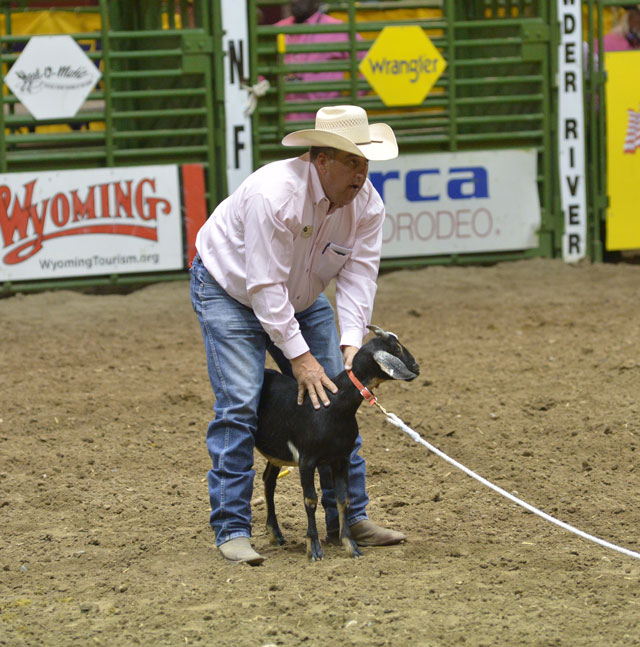
On The Trail with Jim Boy Hash
The Hash family refers to themselves as weekend warriors on the rodeo trail. But Jim Boy, his wife Jessica, and their teenage sons Jaylyn and Jaytyn, are one of the driving forces behind the rodeo world in the Midwest. Through coaching, competing, training horses, raising goats and WNFR-bound broncs, and driving hundreds of miles a year, they give back to the sport that has given them a lifestyle they love.
Kendall, Kansas, is home base for the Hash family, but they are equally at home at NIRA, KPRA, and NLBRA rodeos. Jessica’s grandparents, Otis and Shirley Jennings, started J&J Rodeo Company in 1978, and Jessica and her three younger brothers grew up helping fill any need at the KPRA, Little Britches, high school, and ranch rodeos their family produced. “My mom was in charge of cooking the meals and taking care of the kiddos,” says Jessica. “My brothers and I did a lot of the preparing the cattle beforehand. When Granddad got a new set of cattle, we’d track them through and rope them.” Jessica competed in the NLBRA in all the girl’s events and though she jokes she was primarily added money for the other goat tyers, she excelled in trail course and breakaway roping on a horse her grandpa purchased as a bucking horse. She and Jim Boy met through Little Britches and saw more of each other at KPRA, amateur, and college rodeos, where they started dating. “I went to Colby for my first two years of college and then followed my boyfriend to Panhandle State. Our joke is that Jim Boy was from Texas, so I thought he had money.”
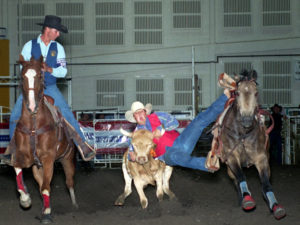
1994 College National Finals at Bozeman, MT – JJJ Photo 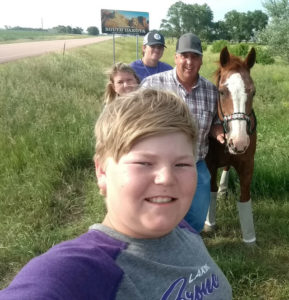
On the way to the Junior High Finals in South Dakota, June 22, 2018- courtesy 
Hardy Braden on Garden City Gal – Hubbell Jim Boy grew up in Canadian, Texas, and went to the Texas High School State Finals in steer wrestling and saddle bronc riding. He competed in the NHSFR in steer wrestling in 1990, and began his college rodeo career at Murray State College in Tishomingo, Oklahoma, that fall. Afterward, he transferred to Oklahoma Panhandle State University in Goodwell, where he won the steer wrestling in the Central Plains region in 1993 and 1994, and qualified for the CNFR from 1993—1995. His team finished second in the nation in 1993 and third in the nation in 1994. Jim Boy also competed on the PRCA Prairie Circuit, and he was asked by his rodeo coach at OPSU, Dr. R. Lynn “Doc” Gardner, to stay on as the assistant coach after Jim Boy graduated in 1995. When Doc passed away in 1996, Jim Boy took the assistant coach position at Cochise College in Douglas, Arizona, where the women’s team qualified for the CNFR in 1997.
Jim Boy packed his bags again, this time bound for Garden City Community College in Garden City, Kansas, in 1998. He started as the assistant coach and has remained there since, becoming the head coach in 2003. Covid shut down most of their season in 2020 and Jim Boy took the opportunity to spend more time with his family. There are 11 students on his team this season and he’s excited about some new changes at GCCC. “This will be huge for us—we are revamping our stalls and can accommodate more horses, and increasing our scholarship budget. We have a few more kids lined up for next year and that will be a huge bonus to us.”
“He cares a lot for the kids,” adds Brock Baker, the assistant rodeo coach at GCCC since 2008. “It’s important to Jim Boy to have good kids and for them to take care of business and get through school, and to leave a better person than they came. That’s something he’s always cared about is that they get a good start in life. Rodeo is important but life is more important.” Several GCCC alumni that Jim Boy coached have gone on to the WNFR, including Emily Miller, Cort Scheer, and Casey Colletti. “From Garden City, those kids have gone on to every major university,” says Bronc Rumford, the head rodeo coach at Fort Hays State University. “Jim Boy’s touched a big part of the rodeo world during his career. He does the bucking horses as a hobby and he’s raised some NFR horses. He’s had his hand in all aspects of the rodeo world. Anybody knows that when you go to a rodeo that has his goats, there’s going to be an even pen.”
Jim Boy’s oldest son, Jaylyn (19), joined the Broncbuster nation at GCCC this rodeo season as a freshman, competing in steer wrestling, team roping, and tie-down roping. “I’m used to my dad being at practices because he was always at the house with us,” says Jaylyn. “He’s been pretty patient with me and wants me to live like a college student athlete on the rodeo team.” Jim Boy even invested in some property near the college recently, which has several barns, stalls, and runs. Jaylyn is staying there with his horses, camping in his grandma’s trailer. Rodeoing and his recent trip to the 2021 Cinch Jr. Ironman keep him on the road most weekends, however.
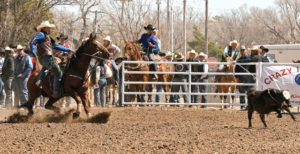
Jaylyn at the Garden City Community College Rodeo.- Dale Hirschman 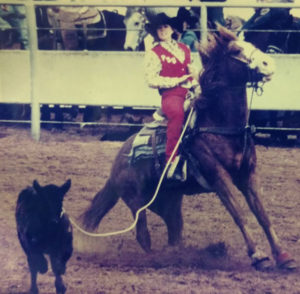
Jessica at the SWOSU college Rodeo 1995 – courtesy 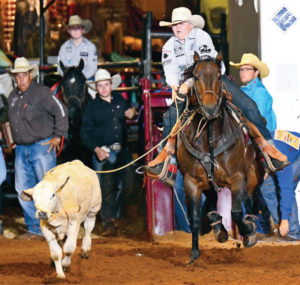
Jaytyn at the 2019 NLBFR – Jennings It was Jaylyn’s first time to be invited to the Jr. Ironman, where he ultimately finished as the reserve champion by .8 seconds. He competed with nine other contestants in three rounds of steer wrestling, tie-down roping, heading, and heeling. Jaylyn felt his runs met with varying degrees of success—he tied for first place in the third round of tie-down roping with an 11.1 after switching horses—and went into the final day aiming for second place. “I was trying to do the math in my head and saw that Briar (Teague) was five seconds ahead. After the bulldogging I was too long, but I never would’ve known I’d come so close to winning by .8 seconds.” Jaylyn’s 22-year-old steer wrestling horse, Cooper, also won the Lone Star Ropes Top Horse Award during the event. “My girlfriend’s family came down, and I hung out with my team roping partner, Jordan Lovins. That was the first time we roped together, and he was great. My dad, brother, mom, and uncle Daylin came and watched, and my other family watched it on the Cowboy Channel.”
Jaylyn went to his second college rodeo in Fort Scott, Kansas, immediately following the Jr. Ironman, and by his third rodeo in Durant, Oklahoma, accomplished one of his goals by making the short round in steer wrestling. “The very first goal I set was to at least make one short round my freshman year. Another goal was to beat my dad, who made it to his first short round in his fourth college rodeo. I made it to my first short round at my third rodeo.”
Along with college rodeo, Jaylyn is competing in his last year of Little Britches and plans to enter KPRA rodeos. He’s also pursuing a career of more guaranteed money in bullfighting, which he started working as a freshman in high school, taking after several of his uncles. Jaylyn works for his family’s J&J Rodeo Company and Medicine River Rodeo Company, working about 20 rodeos a summer. In 2020, he was awarded KPRA Bullfighter of the Year. “That’s where my heart is now. Ever since me and my brother were young, we’d go to Tractor Supply and buy bulls and horses and toy semitrucks, and we’d put marks on them and pretend we were stock contractors. We would like to do that someday; we’ll see what happens. I’m going to major in athletic training. Once I’m retired from bullfighting, if I want another job, I can go into the Justin Sports Medicine and stay around rodeo.”“I’m very thankful my boys rodeo,” says Jessica. “I feel like kids learn so much responsibility and gain so many friendships. They learn to be patient and how to be a caregiver to their animals, or a teacher. When we first started this venture of children, Jaylyn did not want to ride horses or rodeo. We decided then as parents we need to support them in whatever they love to do. Jaytyn on the other hand had a rope in his car seat at all times—that was his binky. Rodeo was it from the beginning for him.”
Jaytyn (15) is a freshman, competing in KHSRA, Little Britches, and the Young Guns Timed Event series. He does tie-down roping and ribbon roping, while team roping is his favorite. “My brother is really pushing for me to steer wrestle,” Jaytyn adds. Like his older brother, he plays basketball, football, and baseball in high school. He took a break from basketball this year and enjoyed roping at the college with his dad’s team and helping pick up broncs. Jaytyn likes to train horses, and says he noticed horse prices were on the rise and decided to start training horses, selling them to make money for college and the jackpots he wants to enter. One of his current project horses is part Arabian. “Somebody just dropped him
-
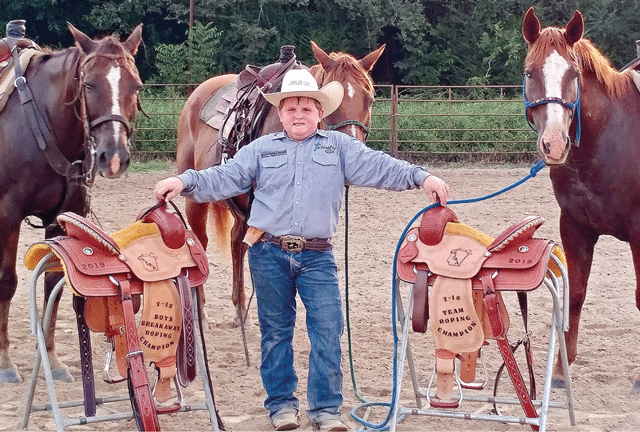
Featured Athlete: Nollie Launius
Every day, Nollie Launius makes strides toward his dream of becoming a professional roper. The 10-year-old cowboy from Nashville, Arkansas, is already a dual-event champion in the Southern Junior Rodeo Association, competing in team roping, breakaway roping, and goat tying.
He’s traveling the rodeo trail with a prosthetic leg, born with one bone in his left leg instead of two, a birth defect called fibular hemimelia. While Nollie has had a prosthetic leg from the knee down since he was four and a half months old, with the exception of a slower dismount in the goat tying, his competition knows no limitations. “The biggest trouble we have with it is that his leg doesn’t move, so keeping it in the stirrup is a big challenge,” says Bill Launius, Nollie’s dad. “His prosthetic doctor came up with a wrench we could use to turn his foot so it stays in the stirrup, but then when he’s done, his foot is turned the wrong way,” he adds with a laugh. “We did get some stirrups that are curved, but most of the time, he rides with one foot in the stirrup and one foot out.” Nollie also has zippers put in his boots so he can easily slip them on.
As Nollie grows, so does his prosthetic foot—he’s on his 14th replacement, but saves his smaller prosthetics, particularly ones that have been signed. “Wade Sundell the bronc rider signed my leg, and we met Kory Koontz at a rodeo, and he didn’t have anything to sign it with, but he took a picture with us,” says Nollie. “Shawn Harris and Jimmy Driggers help Nollie a lot at the rodeos with team roping,” Bill adds. “There have been lots of people helping him because he has such a passion for it and he works so hard.”
“I want to do it every day,” says Nollie. “I want to be a professional roper, and I like to watch Kaleb Driggers.” Nollie won two saddles of his five saddles in the SJRA this year for breakaway roping and team roping, the same events he won last year as well. His favorite event is team roping. “I head, and I’ve been roping since I could walk. I’m learning handling steers and horsemanship, and I rope with my dad a lot. My mom (Michelle Launius) and dad come help me with practice—they turn out steers and they’ll pull the dummy for me,” says Nollie. His 8-year-old brother, Henry, enjoys riding and roping, and he competes in junior rodeos as well. They also have an older brother and sister, Casey and Cassidy, who are twins.
Family is one of Nollie’s main motivators in rodeo, from his parents to his grandfathers. His great-grandfather Clay Godfrey was Nollie’s biggest fan, faithfully cheering him on until his passing in April. He helped Nollie get started with roping dummies and finding two of his main horses, while Nollie’s grandfather Thomas Launius shoes all his horses and cares for them daily. “I have Blazer—I use him for heading—and I have Doc, and I use her for breakaway and goat tying,” Nollie explains. “I have a horse Zero that I use for heeling. My mare Chavez is my favorite because she’s a Paint and she’s my favorite colors, red and white. I pull bulls and broncs on her too.”
Nollie and his dad enjoy helping pick up broncs and bulls at Riding for the Brand youth rodeos around the area, while Nollie also loves to work cattle for friends. Whatever the job, he saddles up his horses with a 5 Star Equine pad, which he and his dad started using several years ago. Nollie purchased his 5 Star pad with the first rodeo check he ever won, and plans to buy another when his entry fees are squared up. “It protects my horses’ backs because I ride a lot,” says Nollie, who’s hoping to join their Rising Stars program in the future.
If he’s not roping, Nollie is at the very least thinking about it, or studying team roping videos. He pulls himself away from the arena long enough to attend Nashville Elementary, where he just started fifth grade and enjoys math. Then it’s back home to his horses, while he also enjoys deer hunting and playing basketball with his siblings.
“I want to go to the NFR, and I probably will junior high rodeo soon,” Nollie finishes. He extends his thanks to his sponsors, Trinity Ropes, and Horton’s Orthotics and Prosthetics, and says, “Thanks to the one who paid it all and gave me this ability and talent, my Lord and Savior, Jesus Christ.” -
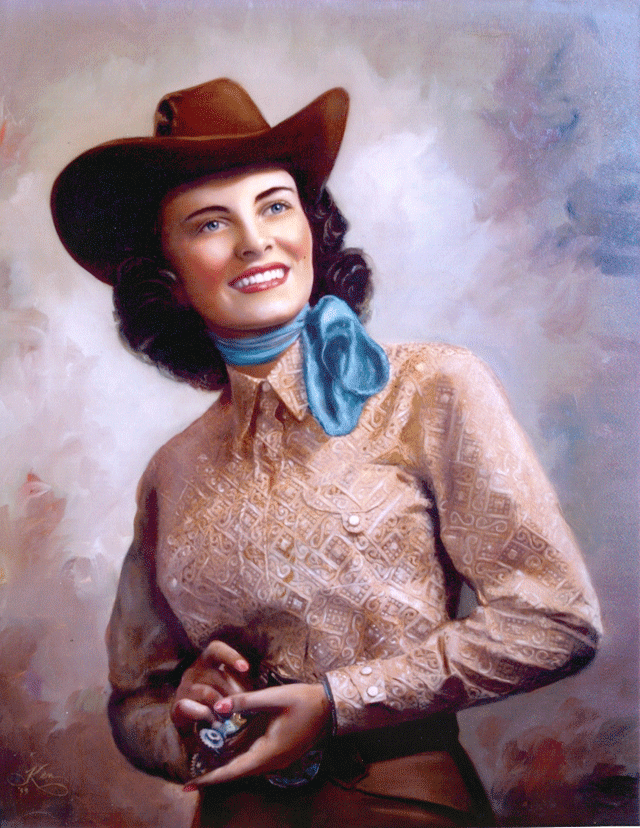
Back When They Bucked with Marilyn Freimark
Marilyn Freimark knows her family’s genes run thick with the blue-jean lifestyle of rodeo and horses, but it was her own love of horses that put the passion back in her family tree—and Marilyn herself into rodeo history as the first Miss Rodeo America.
Born in 1935, Marilyn was raised in town in Cheyenne, Wyoming, but she was a country girl at heart. “The first horse I saw I fell in love with, and I’ve been in love with them ever since,” says Marilyn. “My father was a railroad man, but he came from a ranch near Newcastle, Wyoming. His brothers were all ranchers, and we would visit them every summer and ride many cattle for pleasure. When I was 13 years old, I started working at Merritt Western Store, an upscale Western store. I met people from all over the United States, and I was able to visit with them and meet a lot of ranch and rodeo people.” She modeled Merritt’s clothing and a clothing store in Cheyenne, which made up most of her own wardrobe as well.
Marilyn graduated from Cheyenne High School in 1954, and motivated by the many Colorado livestock club students she met at work, she enrolled at Colorado State University in Fort Collins, known then as Colorado A&M University. Paying for her tuition and all her expenses through her job at Merritt’s, Marilyn majored in business and mass communications, and leapt in to a variety of school activities and sports, including Western and English riding lessons, polo, swimming, ice skating, basketball, volleyball, tennis and was an expert rifle marksman and she was an award winning fisher person. Marilyn also became a Kappa Delta and competed in five non rodeo queen contests, including Miss Colorado, Miss Colorado A&M.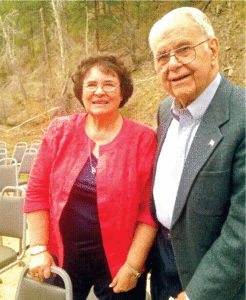
Marilyn and her late husband, Lyle – Courtesy of the family 
The Los Angeles County Sheriff’s Rodeo; 70,000 people attended the rodeo. Tonto, Lone Ranger, Sheriff, Roy Rogers, Marilyn Scott (Freimark), Dale Evans and Piper Laurie – – Courtesy of the family A year into her studies at CSU, Marilyn’s employer at Merritt’s learned about the newly minted Miss Rodeo America organization and asked Marilyn if she’d like to compete for the title. “I just had fun doing it, never thinking that anything would come of it, but I won about four contests before I got into the (Miss Rodeo America) contest,” says Marilyn. Her first step was winning the Cheyenne Riding Club queen contest. With their sponsorship, as well as Merritt’s, she went on to win Miss Rodeo Wyoming, followed by Miss Rodeo Queen of the Rockies, all in 1955. “In those days, the contestants had grooms with them and some of them had been in special training for a year for the (Miss Rodeo America) contest. I had too, but it wasn’t that I was planning on doing anything with it—I just happened to be lucky and got in on some wonderful training before I went.”
The first Miss Rodeo America contest took place in Marilyn’s home state in Casper, where she and nine other women, including a Canadian, competed in front of 15 judges over several days. “They also had silent judges at various places watching you and seeing how friendly you were, and if you were greeting people and on your best behavior.” Marilyn excelled in and won all three divisions—horsemanship, personality, and appearance—but horsemanship was always her favorite. “You brought your own horse at that time, and they furnished other horses for us to ride. I am not a bronc buster, but I do know how to train horses for riding and western equitation, and even for English.” Marilyn competed on her mare, Blue, her first horse given to her by a friend when she was a senior in high school. “She loved to show off and do beautiful things.”
By the end of the contest, Marilyn was hoping for the unusual—that the title would go to someone else. “I had a girlfriend from Colorado State University in the contest, Laurie, and she wanted to win so badly and I really wanted her to win.” The first ever Miss Rodeo America crown was placed on Marilyn’s hat, however. She and Laurie continued their friendship, and Marilyn, with her mother as chaperone, began traveling and representing rodeo across the country. She made history again as the first rodeo queen invited to ride at the Denver Stock Show, and she was even offered a contract with Paramount Pictures, along with opportunities for television appearances. “It was always wonderful to travel like that and go to many places and meet lots of people.” Marilyn’s schooling in mass communications came to her aid, though she was never entirely comfortable being on stage in front of an audience, and she continued studying at CSU through her reign as Miss Rodeo America.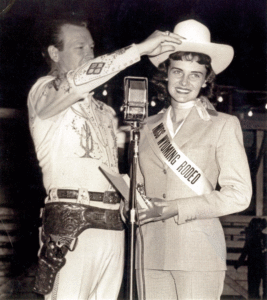
Western star Rex Allen ‘crowns’ Marilyn with her new white Stetson – Courtesy of the family 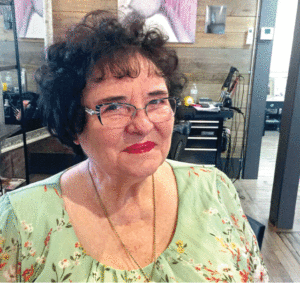
Marilyn – Courtesy of the family A year after her reign, Marilyn was a junior in college when she married Paul Painter from Buffalo, South Dakota, who was also a student at CSU. The couple moved to South Dakota, where they ran Painter Ranch and Marilyn later finished her degree at Black Hills State University. She and Paul were married for 18 years and had 4 children, Joe, Laurie, Cindy, and Judy, who all went on to attend BHSU as well. When Marilyn and Paul separated, Marilyn moved to Spearfish, South Dakota, where she worked, and eventually met Dr. Lyle Freimark, a surgeon from Rapid City. They married in 1985, and while Marilyn wanted to become a stock broker, it wouldn’t give her the flexibility to travel with Lyle to seminars all over the world. Instead, she was his office manager for the next 15 years, and they traveled to 52 countries, sometimes staying for a week or even as long as 3 or 4 months. “He was very interested in music, and we always went to concerts and I loved the plays,” says Marilyn. Because of Lyle’s allergies, they didn’t have animals to care for at home, though Marilyn’s son, Joe, raised 75 head of buffalo for them at one time.
Lyle retired in 1997, and he and Marilyn remained in Rapid City until he passed away in 2018. Marilyn stayed active in the horse world and even spoke at a rodeo queen clinic at Cheyenne Frontier Days in the early 2000s to 90 rodeo queens and their families. “I’ve always encouraged the girls to get their educations so they can take care of themselves in any situation,” says Marilyn. “I love schooling, and I told that to all my children and grand children.” Several of her children and grandchildren live nearby, and everyone in the family is involved with horses in some form, whether barrel racing like all three of Marilyn’s daughters, or team roping like her son and grandsons. Marilyn’s granddaughter-in-law, Jessica Routier, qualified for the WNFR for the first time in 2018 and finished second in the world standings. She also has a grandaughter Jessica Painter Holmes who has won over 50 saddles competing in rodeo events. “I always go to the Black Hills Stock Show, and my son, Joe, often gets into the ranch rodeo, so I’m always there that night, and I often go three or four times to the rodeo,” says Marilyn. “I’ve been blessed all my life. I’ve had two wonderful husbands, four great children, 6 grand children and 10 great grand children, two wonderful horses and two wonderful dogs. With the help of our dear Lord the many tasks I have chosen in this life have been the right decision. As a mentor for many, my legacy continues. God has blessed me and I feel very thankful.” -
On The Trail with J.J. Elshere
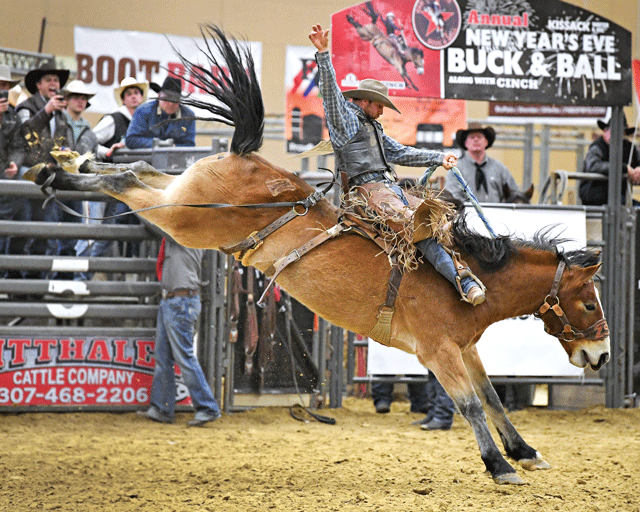
South Dakota native J.J. Elshere finished 16th in the PRCA saddle bronc riding standings in 2018, and won his fifth Badlands Circuit Saddle Bronc Champion title in October. While J.J., short for Jeremy James, is also a four-time WNFR qualifier and the 2006 WNFR average champion in the saddle bronc riding, his motivation for riding at the age of 39 is still bucking horses over dollar signs— though pulling a check is always a highlight. “I wasn’t even planning on traveling that much, but with how Kissimmee went last year, and when I won a little out of San Antonio, things got rolling a little bit to where I decided I’d try (to qualify). I ended up pretty good for what I was planning on doing.”
J.J. won $75,773.58 last season, and his 2019 rodeo lineup includes the San Antonio Stock Show and Rodeo, and Houston Livestock Show and Rodeo. In 2015, he competed in The American just a few months after winning the 2014 PRS World Saddle Bronc Champion title. These days, the Badlands Circuit, which J.J. has competed in since buying his PRCA card in 2000, keeps him closer to home and his wife and five sons, while the Black Hills Stock Show and Rodeo is just 40 miles down the road from his ranch near Hereford. “I’ll probably get into the Extreme Broncs there, and then the regular rodeo. They have some pretty good stock there and quite a little added money. Any time you can ride for that money and not have to travel is pretty nice.”
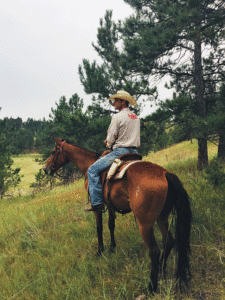
J.J. – Courtesy of the family 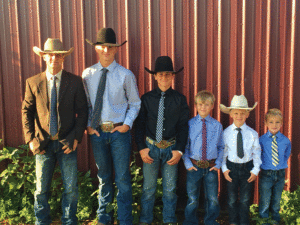
J.J. with his five sons Talon (16), Thayne (14), Trik (9), Tel (8), and Trailon (6) – Courtesy of the family These days, J.J.’s wife, Lindsay, and their five sons, Talon (16), Thayne (14), Trik (9), Tel (8), and Trailon (6), don’t often travel with him altogether because of a ranch to run and multiple school sports to attend. The whole family was with him the years he competed in the WNFR however, as well as the RNCFR in 2016, making the 30-hour drive to Kissimmee, Florida, following Trik’s state wrestling competition. “Rodeo is just the greatest sport there is. The rodeo family that you meet along the way are lifelong friends,” says Lindsay. “The years J.J. was making it to the Finals, I had four little boys with one on each side holding on to my purse. That was pretty stressful having all the kids there, and Taos Muncy’s mom (Johnnie Muncy) was sitting right behind us. She’s become one of my dearest friends and she helped me through the Finals. They become family and you can’t raise your kids without them. They video for you when you’re not there and text you to let you know how they did. And we get to see the country—our kids have been to pretty much every big zoo in the United States and Canada, and it’s a real great experience. It’s a hard life, but it’s great.”
The Elsheres run cattle and grow hay on their ranch, all with the help of their older boys. “We sure couldn’t do half the things we do without their help. They’re pretty handy boys—rarely do we ever need outside help,” says Lindsay. She too grew up on a ranch, and rodeoed in the SDHSRA with J.J. Talon and Thayne handle the bulk of haying while J.J. is rodeoing in the summer, along with helping their neighbors during branding season and taking on other jobs like riding colts. J.J. has been starting colts since his teens, and has a pen full of horses to ride year round. “I put the basic 30 or 40 days on them, or whatever the owner wants. I have a barn that I can ride in, so they’re pretty good about loping circles in the barn all winter long. I just really like to ride horses. I like coming across the ones that are smart and pick it up quick that are pretty fun, and there are some that can be pretty challenging.” Like his sons, J.J. grew up ranching with his parents, Jim and Lana Elshere, and siblings, Cory, Ryan, and Misty, working the operation his grandpa started and later passed down to J.J.’s dad. “We’d make sure everything was done, and our parents would take us wherever we needed to go, and they worked pretty hard to help us along.”

J.J., his wife Lindsay and their sons – Jessica Deering Photography 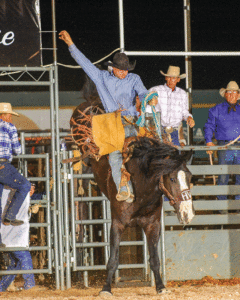
J.J. Elshere competing at a pro rodeo in El Paso, Texas – JenningsRodeoPhotography.com J.J.’s dad rode bareback horses for several years, then passed the roughstock gene along to J.J.’s older brother Ryan, who rode saddle broncs and helped J.J. start his rodeo career. “The goal was to ride professionally and make the NFR—I decided that right around high school. They didn’t have junior high rodeos back then, so I did a lot of 4-H rodeoing and then I high school rodeoed for South Dakota.” J.J. qualified for the NHSFR in saddle bronc riding in 1997 and 1998 and even slid his hand into a bull rope for a time, but saddle broncs were his niche. “It was just a little easier event because that’s what a lot of guys from up here did, so that made it easier traveling. My parents helped me out the most getting me started, and my brother. I used to work for Jeff Gabriel and he helped coach me along and we’d go to some schools. Eudell Larson, the rodeo coach in Dickinson, helped me out at some of those schools, and Tom Miller.”
Today, J.J. helps with as many rodeo schools as he can, along with coaching Talon in the saddle bronc riding and Thayne in the steer riding. “We’ll have some practices in town or at the neighbors. We’re not really set up for bronc riding, but Thayne rides steers and we can do that at home. If not, then we go into Rapid City or Sturgis—Rory Lemmel has a nice facility we can use.” Talon qualified for the NJHFR in 2016 and now competes in the SDHSRA, while Thayne went to the 2018 NJHFR in Huron, South Dakota. “I could hit a couple rodeos that were close when he wasn’t competing, so that worked out good,” says J.J., who competes in bronc riding matches in addition to pro rodeos throughout the summer. Four of his five boys will be in 4-H rodeo this summer following their school sports, including basketball and wrestling. J.J.’s goal is just as much to help them pursue their passions as his own. “I plan on going to the stock shows and all my circuit rodeos, and to just keep having fun and pull a check or two. I want to thank everybody who’s ever helped me along the way. There’s a lot of people to name, but I’ve had a lot of support over the years.”