RL Tolbert has jumped out of burning buildings, tumbled down cliffs, crashed cars and been shot numerous times.
But he’s walked away from every near-death experience.
That’s because the Vale, Oregon cowboy served as a stuntman in the movie industry as well as being a rodeo contestant.
That’s him getting the girl out of the wagon in “Back to the Future III”, before the wagon goes over the cliff. That’s him driving the six-horse hitch in the same movie, and tumbling down a staircase in “Silverado.”
He’s been a stunt double and worked as a stuntman in such movies as “The Sacketts” (1979), “Shadow Riders” (1982), “Silverado” (1985), “Three Amigos” (1986), “Mask of Zorro” (1998), “Conagher” (1991), “The Quick and the Dead” (1987), “Lonesome Dove” (1982), “Back to the Future II and III” (1989, 90), “The Rookie” (1990), “Far and Away,” (1992), “Tombstone” (1993), and many more.
Born in 1941 in Fountain, Colo., both of his grandfathers worked with horses: AR Ward, as a farmer, and Ed Tolbert, building roads in Kansas with horsepower and later driving a coach at the Royal Gorge’s Buckskin Joe tourist attraction.
By the time he was in his early teens, he was working at local dairies while attending school. He worked at the Littleton race track, then spent a year in Watsonville, Calif., with his mother, after his parents divorced. By age 15, he was back in Colorado, working at the Appelt Ranch.
In his twenties, RL broke horses for ranches all over Colorado. He spent time on the Butler Ranch, the Trinchera Ranch, the McQuaid Ranch, anywhere where they still fed cattle or hayed with horsepower.
Situated in the Rockies, with long, snowy winters, RL had told his fellow ranch cowboys, “when the first snowflake hits me, the second flake will be in my tracks because I’m leaving here.”
So that winter, he went to Colorado Springs, where he found an indoor arena, local cowboys held jackpots, and RL fine-tuned his saddle bronc riding.
“I knew how to ride horses that bucked,” he said, from breaking them. The learning part that took place at the arena was how to use the equipment and working on his technique.
RL also rode bulls as well, anything to make a little money.
While there, in 1964, he met another bull rider from Iowa, who talked him into going back to Iowa. There, he worked for PRCA stock contractor Bob Barnes, as a pickup man, driving truck, feeding and loading cattle, doing whatever was needed, and sometimes working five events: the three roughstock events, plus tie-down roping and steer wrestling, at Barnes rodeos where contestants were lacking. He had gotten his Rodeo Cowboys Association (predecessor to the PRCA) card in 1962.
After a year of that, he went to work for Jake and Lynn Beutler and Beutler Brothers, driving truck and picking up. He rode saddle broncs and bulls at the Beutler rodeos where he worked.
From the late 1960s to 1970, RL worked for Larry Mahan in Phoenix in the trailer business, then moved to California in the early 70s, using the Golden State as his rodeo base.
While he was rodeoing in California, he went to work for Cotton Rosser and the Flying U Rodeo Co., driving the chariots that Cotton used for his specialty act.
Through rodeo friends, RL got hired at Great Adventure, a huge amusement park in New Jersey. The park had a wild west show, with chariot racing, jousting, Roman riding, and a stagecoach hold-up, and RL got hired to help with that. He spent three years, from 1975-1977, working at the park, and on the weekends, he headed to Cowtown, N.J., for the weekly rodeos.
In those days, cowboys would winter in Tucson during the winter rodeo run, while they hit the rodeos in Odessa, Denver, El Paso, Scottsdale, and Phoenix. While RL was there, he made friends with several stuntmen, including Chuck Hayward, who was John Wayne’s main stuntman.
He also became friends with Glenn Randall, Sr., a trainer who had trained Roy Rogers’ and other celebrities’ horses, and Glenn’s son, Glenn, Jr. He learned more about horsemanship and training by working with Glenn, Sr.
Once RL got his Screen Actors Guild card, Hayward helped get him established in the movie industry.
He was a stuntman for dozens of movies, rigging wagon wrecks, car wrecks, falling horses, and more.
He doubled for Sam Elliott, Barry Corbin, Christopher Lloyd, and others. He doubled for Lloyd when Lloyd played “Doc” in the “Back to the Future III” movie and rigged the six horses to the DeLorean car, hooking the car’s steering into the wagon tongue.
He trained horses to fall and had three special ones. El Guapo was his favorite. A bucking horse, he used him for bucking in the movies till he later turned him into a liberty horse. The horse was “a really good raring horse,” he said. “He was excellent.
Juan was one of his falling horses. A thoroughbred, the horse was hard to work with. RL would get mad at him and vow to sell him, “then he’d bail me out.” Roanie was another of his beloved horses; as a four-year-old, Sam Elliott rode him for the movies “Quick and the Dead,” and “Conagher.” Roanie and El Guapo are buried side by side.
For about twenty years, from 1979 to the early 2000s, a lot of the six-horse hitches in the movies were driven by RL.
He became a member of the Screen Actors Guild in 1975, the Stuntman’s Association of Motion Pictures in 1977, and is also a member of the Directors’ Guild of America.
In 2002, he and his wife Kim, who had married in 1986, moved to Oregon. RL had admired the country when he had been there in his rodeo days.
On his farm near Vale, he raised alfalfa, oats and wheat, horses, goats and llamas. In 2015, they sold the farm.
From his first marriage, RL has two daughters, Robin and Stephanie. With Kim, he has a son, Elliott, and a daughter, Tessa. Kim passed away in 2021. The couple has seven grandkids.
RL still craves getting on saddle broncs. “I loved riding broncs,” he said. “I’d still get on one. That’s what I miss most, more than anything. And maybe meeting a lot of girls,” he chuckled.
He’s had a good life. “You really can’t beat it. It was all good times.”
RL was a 2018 Silver Spur recipient for his work in various western movies as a stuntman. Examples of his stunt work can be found at https://www.reelcowboys.org/members/LifetimeMembers/TolbertRL.php
Category: Archive
-

Back When They Bucked with RL Tolbert
-

On The Trail with Flint Rasmussen
“I changed the expectations for the quality and professionalism of the position of rodeo clown or entertainer, as the times changed. All while staying true to the history and integrity of the sport. And that through it all, I hope I treated everyone with kindness and respect.”
Flint Rasmussen was the start of a new era in his job as a rodeo clown. He was the end of the era and an era during which nobody touched him. Now, at 55, he will step out of the dirt and onto the stage or the mic or whatever comes next. The Choteau, Montana, native has spent the past 50 years entertaining audiences. The youngest of four, his mom, Tootie, wasn’t surprised when her son hit the stage. “I always say, he learned how to entertain himself because he was a latch key kid,” she said. “After he went to school, he’d have to come home and be alone.” She and Flint’s dad, Stan, were both working. “He used his imagination to entertain himself.” Stan worked as a rodeo announcer and was the past president for the Northern Rodeo Association (NRA) and Tootie served as a timer. Their four children, Will, Pete, Linda, and Flint were raised on the announcers stand. “My claim to fame is I have four talented kids,” said Tootie. “I remember when Flint was really little, like three or four, and he would do imitations and pretend he was playing football in the middle of the floor in slow motion.”
He got his first taste of clowning when he was a teenager. Lloyd Ketchum asked him to help him with a skit. “Loyd helped me put my make-up on,” Flint said. “It was a two-man act. We blew up an outhouse. It was awesome.” While in college, he became the voice of the Bulldogs, announcing basketball and football. After he completed college, Flint returned to the town where he was born, Havre, and taught math and history at Havre High School. He also coached football and track, continuing his announcing on the side. “I didn’t have any aspirations to do this (rodeo clown) for a living. It was my summer job. I did it for six years for the NRA, perfecting my craft and developing a character. When I jumped in and went to Red Lodge for the first pro rodeo (1994), I was pretty good – I’d been doing this awhile.”
He started down the road, quickly racking up the accolades. He earned the title of PRCA Clown of the Year for eight consecutive years and won the Coors Man in the Can honor seven times. Flint met ex-wife, Katie Grasky, who was a barrel racer, while he was touring. He was working at both PRCA and PBR events when Randy Bernard, CEO of PBR called, offering him an exclusive deal. Flint turned it down because of all the work he had lined up. By the end of that year (2006), he made the decision to go full-time with PBR. With the PBR, he could fly on the weekends, and be home during the week. “We used to load up the motor home with a three-horse trailer behind it. We’d travel from June to September. We went together. When the girls started school, and their activities were on the weekends, it broke the connection we had – I was gone every weekend.”
Paige, his youngest daughter, remembers growing up on the road with her dad. “I remember life in the motorhome,” said 21-year-old Paige. “It was how we lived. It wasn’t this crazy thing to me that my dad was a clown, we had a kiddy pool and other kids our age would come and play. It was normal for us to live on the road.” When the girls started school, he flew out on the weekends and then he would be home. “I remember going to rodeos with my dad and my mom around home.” Along with rodeo, she did track. “My dad was my track coach in high school – he was great. He was a great athlete himself – I did all the same events he did in high school, 100 hurdles, relay, triple jump and long jump.”
Paige is a senior at Montana State University, where her sister, Shelby, graduated and is an assistant coach. Two years ago, as a sophomore, Paige was the 2021 College National All Around Champion. At the Finals in goat tying Paige was leading by a long way. In the short round she was confident she had it with 6.3 seconds. “It was a done deal – at the last second the goat got up,” she said. “I was heartbroken; my goals were relying on winning the goat tying.” Although she was teary-eyed, she went to the awards to support her team and sister, Shelby. Their team had won the National Women’s Title. “But then they announced that I won the All Around. It was surreal.” Paige did split the All Around title with her good friend that did win the Goat Tying.
Paige has her own coaching business, traveling to produce clinics. That, along with rodeo will take a pause as she pursues medical school. “I want to be a psychiatrist in the Air Force and work with veterans with PTSD.” She loves learning about the brain and she has family roots in the military. “It would be great to work with populations that serve our country so I can serve them back. Before applying to med school, Paige is taking a year off to intern at MIT, in Boston, Mass., and prepare for med school. “I’ll be working in the brain institute at MIT – studying MRIs of teenagers and kids and looking for abnormalities.” When she’s done with her internship, Paige will study and prepare her applications for med school.
She has maintained a 3.9 grade point average as well as competing on the rodeo team. It’s taken lots of early morning and late nights and weekends practicing and studying. “All my close friends on the rodeo team are good at time management; every free minute we get stuff done.” The team is under the athletic department, so they have their own strength training coach, twice a week at 6:30 am. The team does condition training the other day, and Paige works out on her own the fifth day of the week.
Shelby has been coaching Paige forever, so having her as the coach for the team was an easy transition. “We get along well – she’s my role model, so now she just tells me what I need to hear when I need to hear it.” They also live together at the family home in Bozeman, Mont. “My mom lives in Arizona in the winter so we stay here.” In the summer, they all split up and rodeo. They also share a love of music and dance – something that runs in the family and was encouraged growing up. Both sisters went to a one-room school, where the teacher emphasized music. “I write songs, and play six different instruments, including drums. I also did musical theater in high school.”
Shelby remembers that tiny county school. “I played trumpet, violin, and piano. We learned all about drums, and ballroom dancing. My dad’s whole family is very musical.” Her earliest memories of her dad revolved around rodeo and the motorhome. “We’d be gone for months at a time going to rodeos.” Even after school started, she remembers going during the summer until she was in second or third grade. “My mom trained barrel horses even on the road with my dad.” Her love was rodeo and competing was not thwarted by the weather of Montana. “It adds a whole level of difficulty – we had an indoor barn in Choteau and that helped – we just got two feet of snow here last week.”
Shelby graduated from Montana State with a degree in marketing and is enjoying her first year as the assistant coach. “I’m using what I learned in marketing to find what styles work best for the students and communicating that.” The 24-year-old wants to be a role model for her team as well as anyone else she meets along the way. “My parents are both role models.” She is looking forward to her dad retiring from the arena. “All we’ve ever known is dad in the arena, so we don’t know. He will still be traveling, but maybe have some time to get to our stuff – he just went to his first rodeo banquet this year. It will be nice to have our dad back.” Both daughters are dedicated to preserving the Western lifestyle that they grew up in.
“People don’t realize how close we are to losing it,” Flint said about the Western lifestyle. Flint travels to large cities like Madison Square Garden in New York City. “The farther we get away from it, the unhealthier our country is.” Flint set out to help bridge that gap and entertain people. He never dreamed of what would happen to his life once he made that decision. He also never realized the sacrifice that his career cost his family. “In my job there is a selfishness to it, a pride in doing it for myself. But I really truly believed through my career I was doing it for them. I consider them to be my biggest fans in the world, alongside their mom, who still is.” Flint is quick to give Katie credit for the girls’ success in the rodeo arena. “We did a lot of neat stuff. My job put us in the rodeo business, but the person that taught them how to ride and take care of horses is their mom – she college rodeoed.”
On March 11, 2009, Flint, at the age of 41, suffered a heart attack. “We were home, and I was working out. I was out of breath and had stations set up – my wife, Katie, was trying to visit with me and I couldn’t talk – I ended up having a heart attack that day. We lived 11 miles out of town and she drove me to the ER in our little town.” Being in shape saved his life, and after a couple of procedures, he was back in the arena. “There’s not a day goes by that I don’t forget about it. I was working out when I had the heart attack. I was angry and confused. If I had a heart attack doing this, when’s the next one.” He had to wear a heart rate monitor and had to take a few breaks when his heart rate exceeded 140 bpm.
His favorite part of his job is also the worst part of it – the travel. “What a wonderful thing – I’ve watched the college basketball tournament and I know where all the locker rooms are. The best thing is I fulfilled something that was always in me – performing in front of crowds. Singing and dancing and being in front of people fills up a place in you that other people don’t understand. I get to be on a starting lineup and bring people joy.” The PBR has had a record setting year. Before each rodeo, Flint has a little huddle with the bullfighters. “Look over your shoulder,” he reminds them. “These people paid to come see us, we are doing something right.”
“There’s no handbook or guidelines about family – I’m a small-town guy that worked my way up. “In middle age, I’m in front of 15,000 fans in Madison Square Garden … no matter how ready for it you are, you aren’t ready.” Being on the road every weekend took it’s toll on family time – he missed a lot of things due to travel. “It’s the part of this job that people don’t think of. At the time, I was making decisions based on what was best for my family. I do believe I was. My girls have had an amazing life. “
Flint has used his platforms to promote the sport of rodeo. From his studio in Montana, he has produced 66 podcasts, According to Flint, featuring guests from all walks of life that Flint has encountered over the years and some who he is meeting for the first time. His years of knowledge in the industry makes interviews easy. Flint has also hosted “Outside the Barrel” for 18 years at the National Finals Rodeo. “I don’t do the show because I’m a rodeo clown, but because it is a separate passion of mine. That’s all I ever wanted to do – I wanted to be a talk show host, to be on stage. If you want to be effective, you have to perfect your craft. That’s what I tried to do.” Flint also hosts the NFR’s Buckle Ceremony following the nightly performances. “That is part of the transitioning.” He wants to be an Ambassador for the lifestyle. “I see how close it is to disappearing – part of my job moving forward is to preserve the Western lifestyle.” -

5 Star Champion JJ Hampton
A decorated career didn’t make JJ Hampton’s return to the toughest sport on dirt any easier after taking off a year from breakaway roping in the early 2000s. After losing a few good horses, JJ just needed some time at home to regroup. And that she did, because when she started chasing the rodeo trail again, she was as fast as she’d ever been. “Some people don’t understand how important a horse that fits you as a roper is to winning,” said the real estate agent from Stephenville, Texas. “I came back faster than I thought and I started winning in the UPRA and CPRA.” JJ wasn’t competing in the WPRA just yet, but when she came back it would be with a literal and metaphorical fire lit under her rope.
“I had my son [now 13, Kason] in 2009 and I was still winning titles in those associations even while I was pregnant. It took me a few months to get back to feeling good after I had him. Getting back into the groove of going and winning is hard when you’re competing against girls who are going hard every weekend.” While JJ appreciates the increasing interest in her favorite event, it definitely makes her job harder than it’s ever been. “I just had to put in my time knowing I was going to get beat but I had to keep practicing and entering. You have to be willing to grind it out in this sport because it’s hard to beat these girls who are talented and have good horses.”
Along the way, breakaway roping made it’s first appearance at the NFR in 2020. JJ was there alongside 14 other fierce ropers. “Other than barrels, we are the biggest event. We show up and participate. While I appreciate that we can rope at the NFR, I’m not sure how long we can do it for a small fraction of the prize money that the boys go for. We need and deserve to be roping for more.” JJ knows the answer is complex at best, but at the same time she believes that as a group, breakaway ropers have to stick together and stand up for each other in this endeavor. “I think it comes down to needing more sponsors who believe in us, but I don’t have the total answer for that either.” On that same token, it’s the sponsors who have helped keep JJ going when things get tough out on the road. And 5 Star Equine happens to be one of those for her.
“Lari Dee Guy and Hope Thompson both use 5 Star and we rodeo together and so they thought it would be great if I used them too. They both liked how well the pads protected their horses, so I figured why not give them a try.” This was back in 2020 and Lari Dee even called 5 Star on JJ’s behalf about getting her a sponsorship. JJ started out using their fleece pad, but went back to the felt and it’s been a great switch for her horses. “I really love how the pads fit my horse; they do a good job protecting my horses’ back. I use some of their boots too, but they’re pads are my favorite.” Much like her peers, JJ’s never had any issues fitting a saddle to her horses thanks to the 5 Star pads. It doesn’t hurt that they come in favorite color: purple. “It’s the color of royalty and power and it’s been my color for a long time. I really appreciate that this is a family-owned company and they’re great to work with no matter the situation.” -

Back When They Bucked with Bob Wiley
Lots of kids grow up aspiring to be a cowboy or a police officer, but only some accomplish that feat. And even less manage to do both. Bob Wiley is the exception to that rule.
Long before Bob Wiley was able to fulfill his childhood dreams, he was learning fundamental life lessons while running track and playing football for Kingsburg High School in central California. The Fresno County Swedish village is now home to just over 10,000 residents. It was and is a small, quiet town by California standards.
Back in the 1950s, Wiley was a star athlete alongside his classmate Rafer Johnson who would go on to win Olympic gold as a decathlete in 1960. Standing an inch over 6-foot, Wiley was the right hand running back to Johnson’s left when the pair played for the Kingsburg Vikings.
“We won our division in both football and track my senior year,” Wiley said who is now 85 years old and lives just 30 miles down the road from where he was born and raised. “Porterville College had a real strong football program. They recruited me to play for them out of high school. I played football for two years there and that’s where I met my wife, Sonja, because she’s from Porterville.”Cowboy Town
When Porterville College was still trying to entice Wiley to play for them, they had an unknown advantage.
“I went down to Porterville, and discovered it was a Western town,” Wiley said. “People around there had different roping events going on and lots of horse activity. I liked it, so I went to school there.”
The grandson of Swedish immigrants, Wiley grew up on the family farm where he could often be found swamping grapes and peaches. Horses were always part of the landscape, but they certainly weren’t the talented athletes that Wiley would later come to own.
“Some of my earliest memories as a little bitty kid were of my dad and his friends packing into the mountains on horses to go hunting,” he said. “They’d plan for months, and I could hardly wait to go.”
Always interested in horses and roping, Wiley watched people rope any chance he got. At the impressionable age of 15, he was introduced to calf roping for the first time and decided that’s what he wanted to do.
“A friend of mine taught me how to tie and that’s how it really started,” Wiley said. “I bought a horse for $85 and a calf for $15. I didn’t have an arena to rope in, so I just chased that calf around a little pen at home. I essentially taught myself how to rope by doing that.”
High school athletics took a lot of Wiley’s time, but roping was always in the back of his mind. He found his groove in college and rodeo took center stage.A New Cowboy in Town
“When I got out of college I started working right away and I’d practice roping until 9 at night, then go inside to eat, head to bed and do it all over again the next day,” Wiley explained. “Then I’d rope all day on Saturday and Sunday.”
For most of Wiley’s roping career he was working part-time as a deputy in Porterville while traveling the countryside to rodeo.
“I’d practice in the early hours of the morning until about 4 when I’d go home to put on my uniform and go to work,” Wiley said. “I’d come home around 3 and sleep for a few hours before doing it all again. That was usually my schedule Monday through Wednesday and then the rest of the week I was getting ready for a rodeo and traveling.”
“I finally started getting good and winning a little,” Wiley said. “It wasn’t until 1961 that I was good enough to do it full time.”
That same year Wiley qualified for his first National Finals Rodeo in Dallas. They moved to the L.A. Sports Arena the following year before heading to Oklahoma City in 1965. He’d compete in five NFRs in total, all in consecutive years and in all three locations.
In 1963, Wiley was the reserve world champion behind one of the greatest calf ropers of all time, Dean Oliver, who was inducted into the PRCA Hall of Fame in 1979.
There were plenty of times when Wiley was gone for a month or more at a time. Wiley’s wife and kids spent a lot of time on the rodeo trail right alongside him in the first few years.
Their oldest daughter, Andrea, was born in 1959, followed closely by Acia in 1962 and later Robert in 1967. When the kids started school, their time on the road dwindled. Especially in 1963 when Wiley was making his strongest run at the NFR.A Gold Buckle Career
“I got started early that year, probably in March, and I was roping pretty good,” Wiley said. “I had a good horse that year too. It all started in Springville, which was kind of a hometown rodeo for me. I won that and I just kept on winning.”
Wiley headed east for the summer so he could hit some of the biggest venues in pro rodeo: Calgary, Cheyenne, Great Falls, Saint Paul, Burwell, Bozeman, and Billings before heading back west for Salt Lake, Ogden, Eureka and Klamath Falls.
“If you’re going to rodeo and try to win something for the year, you have to go to all the big rodeos,” Wiley said. “When you went like I did in ‘63, it’s hard for little kids to be in the car all the time like I was.”
Even though Wiley loved roping competitively for himself, teaching people the finer details of the event became one of his many passions in life. Throughout the 60s he put on multiple calf roping schools for both tie-down and breakaway roping.
“I had quite a few students over the years, but I never charged more than enough to cover the cost of the calves,” Wiley said. “I was mostly doing it to pass my own time really. I liked teaching them how to do it and it kept me involved in the sport when I wasn’t roping myself.”
In 1965, Wiley made his last run at the finals. He didn’t know it initially, but his life was destined for a career outside the arena.
He started that year out strong and won enough to keep him in the top 15, but he was preoccupied to say the least.A Golden Badge Life
“I got the idea that I wanted to be sheriff and after I announced my candidacy, I campaigned for 22 months,” Wiley said. “I was in full-bore campaign mode, so I wasn’t practicing or competing at all by the fall of ’65.”
Early success in the spring kept Wiley in seventh heading into the finals. He shut the campaign down for a week to compete in Oklahoma City for the first and last time.
“Before the finals my wife and I flew to Amarillo to see my friend Lee Cockrel to ride with him up to the finals,” Wiley said. “Lee took an extra horse for me because I hadn’t ridden my horse in a few months. I won just enough at the finals to pay for the trip there.”
Even though this wouldn’t be Wiley’s last time in the arena, it was his final year as a full-time professional calf roper. As soon as he got back to California, Wiley picked up the campaign trail right where he left it.
In November 1966, Wiley was elected Tulare County Sheriff where he would serve his community for 24 years and win a total of seven elections.
“When I took office in January, I was only 30 years old,” Wiley said. “As a kid, I was always interested in policemen and my family had several law enforcement members that would come and visit us. It was always interesting to me.”
Just like every endeavor before, Wiley put his full weight into being sheriff. He changed the face of the Tulare County Sheriff’s Department, which transcended into revolutionizing jail training programs.A Life of Discipline
When Wiley first decided to throw his hat into the ring for sheriff, the department was doing the bare minimum. Most notably, it wasn’t taking care of its employees the way Wiley thought they should.
“It was one of the lowest paid operations in the state that didn’t offer any overtime pay, no uniform allowances, and no retirement plans,” Wiley said. “It was tough at first, but I had a lot of good ideas. I knew I wanted to work in the schools with the young people to get a handle on the drug problems.”
It all started when Wiley placed deputies in schools and created educational programs to teach kids about the dangers of drug use. They even introduced kids to ammo, grenades and dynamite so they would know what they are and that they shouldn’t mess with them.
It was a novel approach to a rapidly growing problem. First illustrated by his roping schools, Wiley enjoyed teaching people new things and improving efficiency any chance he got.
“Lots of people copied our school educational programs,” Wiley said. “I also developed a jailer training program that was recognized by the Department of Justice. I went to several jail training programs, and their trainers had never worked in jails. I didn’t like that, so my staff and I developed our own program.”
It shouldn’t be surprising that Wiley made his way inside the jail houses and left his mark there as well. He helped remodel some and build a brand new one. In 1987, his work in the county was commemorated in Visalia when the jail was named the Bob Wiley Detention Facility.
Wiley’s time as a sheriff is a testament to his upbringing. The order and efficiency he instilled in his department kept the cogs running smoothly for a long, effective career.
“My mom was real particular about not abusing people; not making fun of anyone for any reason and not making snide remarks,” Wiley said. “There’s a lot of people that make a habit out of pushing people around and whenever I found out about that, I put a stop to it.”
Over his career, Wiley implemented two narcotic units in his department, solved multiple homicide cases, found lost children and was one of the first to have a K-9 unit. By his retirement in 1991, Wiley was the senior officer of the 58 county sheriffs in California.A Cowboy at Heart
Getting back to his cowboy boots and roots, Wiley and his wife traveled the country following the NSPRA schedule for a few years. Even competing in Canada at one point.
“At the time, I didn’t have a great horse to rope on, they had gotten really scarce and thus very expensive,” Wiley said.
Dabbling in roping schools for a few more years helped Wiley pass the time before the turn of the century. By then, roping and riding was becoming increasingly difficult.
“The last time I roped was in 2003 and it hurt to come out of the box and to get off,” Wiley said. “I got crippled in the hips and it made it hard to move the way I needed to for calf roping.”
Even though Wiley officially hung his hat up from roping and teaching almost 20 years ago, rodeo is never far from his mind.
“I was lucky that I won quite a bit of money roping,” Wiley said. “I had a good life, and I was young and sound when I needed to be.” -
On The Trail with Riley Wakefield
I’ve learned how to win and lose – to deal with adversity – that’s easier said than done. I try to be thankful from the beginning and look failure in the eye.
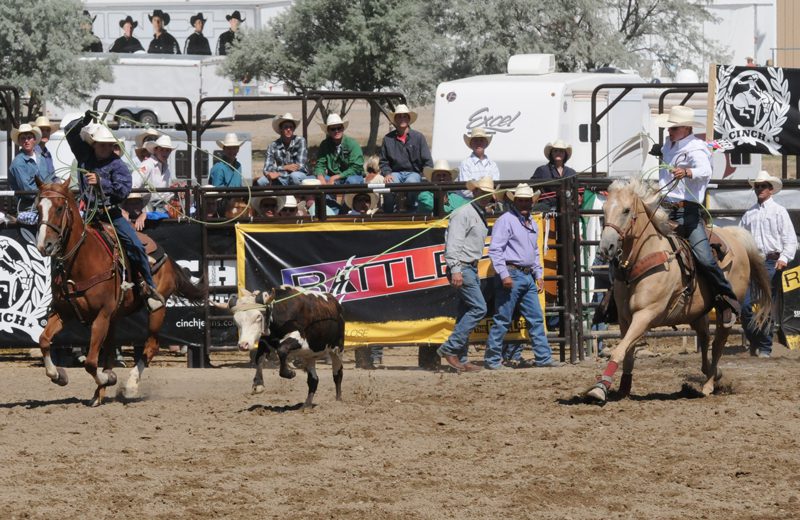
he first time Riley Wakefield went to the Cinch Timed Event Championships, he and his older brother Brady were star-struck. The next time he attended, 15 years later, he went as a contestant, finishing in fourth place. At the 2023 Cinch TEC, the O’Neill, Neb. cowboy turned in a time of 366 seconds throughout five rounds to finish fourth and win $10,000. After applying for the prestigious event for the past five years, Riley was first on the alternate list this year. He got the call in early February that someone couldn’t make it, and there was a spot for him. He prepared, making four or five runs in each event, every day.
It was in 2008, when Riley was eleven years old, that he and his family, including parents Jim and Susan Wakefield, went to Guthrie’s Lazy E Arena as spectators. “It was a treat,” Riley said. He and Brady saw their heroes among the competitors. “I just remember seeing role models,” he said, “seeing people in places that I wanted to be, people with extreme talent. We had old videotapes of the finals so we knew who guys were, and when they’d walk by us, we’d stare at them. And to see them in person, we were star struck. It was a pretty amazing experience.”
He and Brady, who passed away in a vehicle accident in 2015, got their picture taken with Trevor Brazile.
The CINCH Timed Event Challenge is an invitational event, taking the best twenty cowboys in the world, to compete in five events: steer wrestling, tie-down roping, heading, heeling, and steer roping, in four rounds, with the best fifteen going on to the fifth round. Fastest time in all four events, over five rounds, wins. Riley was leading the average going into the fifth round but a sixty second run in the team roping put him in fourth place for the finish.
A 2020 graduate of Northwestern Oklahoma State in Alva, Riley has been living in Stephenville, Texas. But this winter, he was at home on his parents’ (Jim & Susan) ranch near O’Neill, during what was the worst winter in the last ten years in north-central Nebraska; O’Neill has had 57 inches of snow. The snow and cold weather made everything harder to accomplish. “We had three feet of snow on the ground, and it was an absolute workout to get to the horses. You had to lift each leg through the snow.” All the watering was done by hand, because the tanks would freeze to the bottom by morning. “We hand watered everything,” he said. Riley’s girlfriend Jenna Dallyn helped him, loading cattle, roping with him, until she had to return to High River, Alberta, to work. Then his dad helped. Jim “was out there every day, all day, pushing cattle. When Jenna left, he had to fill in and be the guy to help me. He was a huge part of this.”
Cinch TEC contestants designate “helpers,” who head, heel and haze for them. Cinch TEC contestants cannot head or heel for each other, but they can haze for each other. Riley’s header was CJ DeForest; his heeler was Tanner Braden, and Allen Good was his hazer for three rounds with Mason Couch for the last two rounds. Nerves wore on him for round number one, which showed up in the heading. “That first head loop I threw, it was not a good head loop but a nervous head loop. It was sloppy,” he said. “I was feeling the nerves.” But when the tie-down roping came around, he settled in. “As soon as I tied my first calf, I felt a lot more comfortable. The set-up fit my horse perfectly. He has a lot of run, he’s fairly free, and he doesn’t take my shot away.”
In February, after getting the call that he would be competing at the Cinch TEC, Riley was nervous. The event was so important to him, the concept of being a “true” cowboy and showing skills across four disciplines, had him anxious. So nervous, that he’d never felt this much nerves since he and Brady backed into the box at the 2012 National High School Finals Rodeo, when he was a freshman. The brothers had done some mental training, with one of the pieces of advice being that they should visualize the best thing that could happen and the worst thing that could happen. It worked; he and Brady finished as reserve team roping champions that year.
So Riley applied the same concept to the Cinch TEC. He knew, if he failed, that he’d still have family and friends who still cared about him, and he could still have the chance of being invited to compete at next year’s Cinch TEC. “After I looked failure dead in the eyes,” he said on a Facebook post, “the rest of the Cinch TEC was pretty smooth sailing.”
He grew up on the family ranch south of O’Neill, in the Sandhills of Nebraska, with a dad who was a pro steer wrestler and roper.
When family friends came over to the Wakefields to rope, it was Brady and Riley running the chutes, and looking up with respect to the men who practiced with their dad.
“It was an honor to ride their horses around after practice.”
Like many young cowboys, they fell in love with the sport. Jim and Susan hauled their boys to Little Britches Rodeos and youth events all over the region.
The brothers loved it, Riley said. “We took a liking to it and got small successes along the way, that keep you going, and sooner or later, you get bigger successes, then bigger and bigger, and by that time, we were hooked.”
In junior high, Riley wanted to be a bull rider. He followed the PBR faithfully and got on roping steers at home. But in eighth grade, he realized the timed events were more his thing.
In high school, he qualified for state finals and the National High School Finals all four years, competing at Nationals four times in the team roping and once in the steer wrestling.
In college at Gillette (Wyo.) College, he made it to the College National Finals Rodeo in 2017 in three events, then two years later, won the tie-down in the Central Plains Region while a student at Northwestern Oklahoma State.
Riley rode his horse Gator for the tie-down roping and his horse William for the heeling, borrowing horses for the other three events. Gator has been a long-time project for the cowboy. When Riley’s horse died of colic three years ago, friend Austin Barstow suggested that Riley borrow Gator, who showed potential but was really green. “I knew from the start that Gator had tremendous ability and athleticism,” he said. “But he is extremely playful. He is difficult to catch, he messes around, and he sees how much he can get away with. That’s been the struggle, to get the business attitude out of him.”
At a rodeo in 2021, after Riley roped a calf, Gator misbehaved, stepping away from him as he tried to re-mount. “It took me a full minute to get on him. He was inching away from me in a circle. He wasn’t dragging the calf, but he was moving away.” A few weeks after that, Riley took him to the Badlands Circuit Finals Rodeo, where he worried how the horse would respond to an indoor arena with noise and lots of activity. “I was nervous and had no idea what he would do, but the circuit finals was a turning point. He worked better than he ever had, in a loud and pressure-filled environment.” The twelve-year-old bay has improved. “He’s more business-like now, and I think we’ve both grown up together. I’ve learned how to train one and ride one correctly, and that’s more important than a lot of people understand. A horse is sometimes only as good as his rider.”
For the steer tripping, he rode Todd Eberle’s horse Mississippi, and for the heading, he rode Danielle Wray’s horse, Peanut. Danielle was instrumental in helping him in 2021 when he qualified for the Badlands Circuit Finals Rodeo in three events, and at the Cinch TEC as well. “I couldn’t have done either without her.”
Riley, at age 26, is working at making rodeo his fulltime job. It’s not easy. Last year, he competed across the nation, at times broke and trying to prove himself, not only to the rodeo world, but to himself. “I went through some hard times, really low times,” he said. “I questioned why the heck I was doing this. I have my (college) degree, why am I not at home, working, making for-sure money.” He remembers tough times last summer, traveling in a small trailer with a shower, no bathroom, and two bunk beds, and the time in Caldwell when his traveling partner headed to another rodeo but Riley stayed for the short round. From 6 am, when his buddy got on the road, till 4 pm, when a friend arrived, he sat on the grounds with his lawn chair and phone, while Gator grazed, “taking it all in.”
Rodeoing isn’t cheap, either, with entry fees and fuel bills. “You pull the trigger anyways,” he said. “You can’t be emotional about (spending) the money. You have to trust your talent. If you worry about the money, you’re going to be worried all the time.” During the hard times, he talked to his dad, telling him he was ready to come home. “I remember calling my dad, and he said, ‘you chose to do this, you’re going to stay on the road.”
It can be a game of confidence, Riley said. “When you’re new on the trail, you feel like you have something to prove. You feel like you’re not trying to lose, instead of trying to win, not looking like an idiot, instead of going out there and wining first.
The fourth place finish at the Cinch TEC has boosted his confidence. Now, when backing into the box, “I’m thinking about how fast I can be instead of how not to mess up. I’m thinking of what can go right instead of what can go wrong.”
His parents are behind him one hundred percent. “If I didn’t have my parents helping me out, I would be working a nine-to-five,” he said. “My wins are just as much theirs as they are mine. We’re a team.”
This summer, he will rodeo full time, competing at 80 rodeos, heading to California in April, with a bounce in his step and more confidence under the cowboy hat.
Rodeo hasn’t always come easy to him. “I wasn’t one of those guys that was consistently winning,” he said. “It took some things I needed to work through.”
There were several times he could have quit, but he didn’t. “To me, it’s the fact that I put all the work in and I didn’t want to waste it. I wanted it to pay off somehow.”
“I felt like I could have decided to teach school, forget about rodeo and make some money. I could have, and I’ve had ended up OK. But I had the opportunity (to rodeo) and I have so many people behind me, and it’s what I love to do and what I’ve worked for, so why not let it pay off? And if it doesn’t, that’s fine, but I want to give it the chance.”
His hard work and perseverance is yielding a profit. “I’m so glad it’s paying off now. There’s nothing better than hard work paying off.”
Riley credits his sponsors with helping him stay on the rodeo road. They are Rattler, Wrangler, Wakefield Insurance Agency, Pritchett Twine and Net Wrap, Laursen Chiropractic, Twin Creek Ranches, and Make An Impact.
Cody Doescher won the 2023 Cinch TEC with a time of 312.7 seconds (total on 25 head); Russell Cardoza was second (321.7 seconds); Lane Karney was third (355.3 seconds.) -
5 Star Champion Sissy Winn
[ I’ve been using 5 Star pads forever; I’ve tried them all and I love the way they fit.” Sissy has a horse that’s 16.2 hands and she doesn’t have to cinch her saddle up to prevent it from rolling. “I’ve got one horse that’s 16 2, and my saddle doesn’t roll, it has to do with my pad. I don’t have to cinch up so tight.” ]
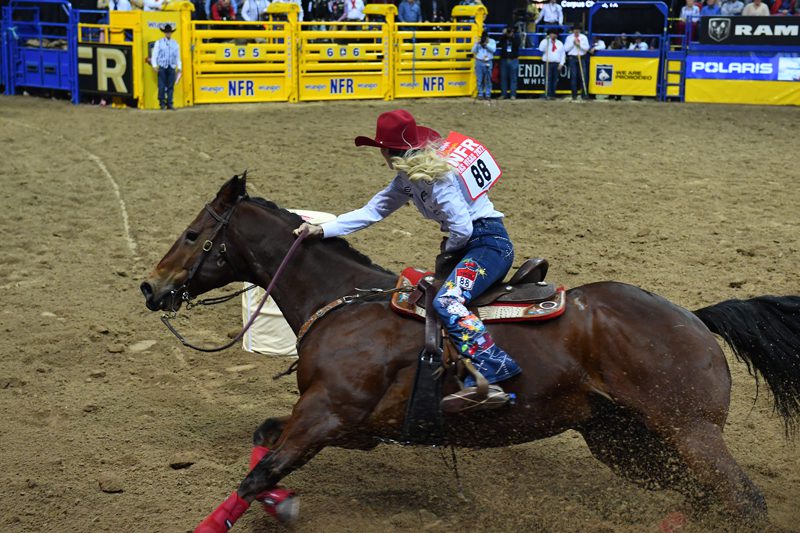
“Making it to Vegas still brings tears to my eyes,” said 25-year old Sissy Winn. “I put in the hard work and it happened. Looking back, I thought it was going to be easier than it is. What we sacrifice to keep going to the next one is worth it, but we give up a lot. This summer, my dad (Tom) will take one trailer and my mom (Melissa) will take another one and I will fly back and forth.” She is quick to give her parents the credit for her success. She entered her first NFR ranked 7th in the world and finished ranked 13th with $149,156 after winning $47,308.
Sissy, who was named after an aunt that passed away, had her future as a lawyer planned out. She graduated Texas A&M University at College Station Magna cum laude with an ag leadership and development degree. “I was studying for the LSAT, and trying to go down the road,” she said. “I wasn’t doing either one very well, I had the horses to go.” She grew up competing in every event in rodeo offered to young girls in southern Texas. She is a 7x National High School qualifier and won the coveted Texas High School Rodeo Association All Around Cowgirl in 2013.
She and her older sister, Amy, shared horses growing up. “We had the same horse for every event,” said Sissy, who spent a few years getting the horsepower she needed to make her first NFR last year. She has two horses that are NFR capable – Chewy and his newest partner, Scoop. “Chewy is scared of men, he won’t let a man catch him.” Chewy got his name from his habit of chewing things. She was looking for a good second horse and found Scoop. “I’m going to love Houston because I have a horse that will love Houston – Scoop. I got him from Danielle Campbell who trained and futuritied on him and we made the NFR last year.” She travels with one of her parents, two horses, and two “support” ponies. It is a drive to get anywhere from her home in Chapman Ranch, in southern Texas. “I drag them everywhere with me; I don’t go by myself. My mom and I did Jackson this week – 13 hours one way.” Chapman Ranch is a small community that used to be part of the King Ranch. It is 15 miles from Corpus Christi and the Gulf of Mexico; a few hundred miles from the Mexico border. “Anytime we see a horse trailer, I’m so excited and then I wonder who it is.” She didn’t spend much time at the beach as a kid. “I appreciate it more now than I did back then.”
She won the 2022 Jerry Ann Taylor Best Dressed Award at the Fort Worth (TX) Stock Show and Rodeo, presented by National Cowgirl of Fame. “I pursued the queen title in junior high because not very many girls competed in rodeo as well as represented the rodeo as a queen; I love to dress up and talk about rodeo.” She was able to do that as she was a former Miss Rodeo Texas Princess (2011) and Miss Rodeo Texas Teen (2015). She and her mom enjoy picking out the outfits. “I want some nice pictures, so it comes easy to dress up.” All her shirts and pants are Rock and Roll and Panhandle. “I love the season I’m in, but I want to have a family and enjoy that in the future.” “Keep going …. It might be better than you ever imagined.” -
Back When They Bucked with Bill Nelson
[ “He had that internal fortitude and a lot of try.”]
Bill Nelson dominated the rodeo world for a short time, in two events.
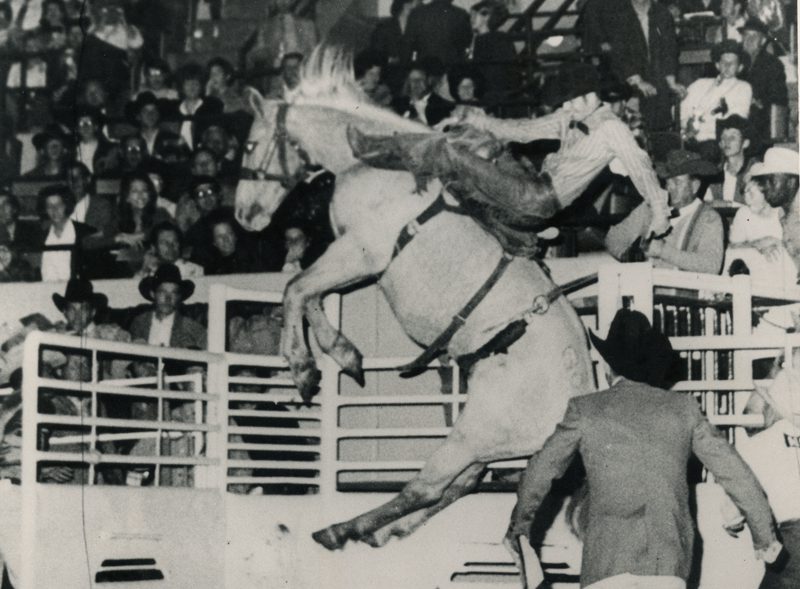
Saddle bronc riding might have been Bill Nelson’s strongest event, but he won the world in the bull riding in 1971.
The California cowboy competed at the National Finals Rodeo in both the saddle bronc riding and bull riding, but it was the bull riding in which he came out on top of the world.
He was born in 1944 in San Francisco, the son of Bill and Irene Nelson. Even as a little kid, he wanted to be a cowboy. He came by it naturally; his dad was from Winnemucca, Nev., and his uncles had made a living by rounding up wild horses and selling them to the U.S. Army at the beginning of the 20th century.
After high school graduation, Bill attended Cal Poly and “one thing led to another,” he said, “and pretty quick I was riding bulls.”
Riding bulls was an easy discipline to start. “All you had to do was buy a bull rope at the feed store,” he said. With other events, a person needs a horse and more expensive equipment.
He caught on quickly to riding bulls, but he really wanted to ride saddle broncs. He taught himself, “but it took forever to learn to ride broncs.”
He bought his membership to the Rodeo Cowboys Association, forerunner to the PRCA, in 1966 so he could compete at the San Francisco’s Cow Palace, and rode bulls there.
By then, he was in college at Cal Poly. At first, he went to school in the fall, winter and spring and rodeoed in the regional shows and worked, trying to make money. Before the school year was over, he was calling his dad and needing to borrow money.
His dad asked, do you want a job? “I said, ‘no,’” Bill replied. When he told his dad he was going to rodeo in place of a job, his dad said, “oh, crap, you won’t have no money.”
But he did. “Things went to clicking, and I had more money than I had the year before,” he said.
Bill changed his college schedule; he attended in the spring quarter only, so as to compete at the big winter rodeos. He remembers winning $3,000 in Houston. “It doesn’t sound like much, but we thought we were rich,’ he recalls.
He began winning more money, so he’d take off in the fall and winter to rodeo, then while he attended college in the spring quarter, he’d rodeo up and down the West Coast and in California.
And he was winning money, so much that he qualified for the 1970 National Finals Rodeo in the saddle bronc riding, the next year in the bronc riding and the bull riding, and in 1972, in the bull riding. In 1971, he finished as the world champion bull rider and seventh in the saddle broncs.
Bill also competed collegiately, finishing as the regional all-around champion twice and the saddle bronc riding champ twice and qualifying for the College National Finals Rodeo three times, finishing one year as NIRA reserve champion saddle bronc rider.
He graduated from college in 1972 with a degree in animal husbandry.
In those early days, when he was young, it was fun to rodeo. “We went wherever we wanted,” he said. “We didn’t have to go back and forth to school or work. We’d just take off and go. If we were tired, we went fishing. We enjoyed ourselves, and we had fun.”
In 1973, his dad had a heart attack, and Bill turned out of Calgary and went home. Then his mom got sick, and he married, and “one thing led to another, and after that, I just rodeoed on the weekends.”
He began his lifetime career of managing ranches for absentee landowners in California and Oregon.
He continued to rodeo, but it was more on the weekends only. It wasn’t so enjoyable anymore.
“You’d have to drive all night to get to the rodeo, then drive all night to get back to work,” he said.
He entered his last PRCA rodeo in the early 1980s. He had competed at Caldwell, winning second in the bull riding. But when he got off, he felt a muscle tear: it was a torn groin. “I thought, somebody’s trying to tell me something,” he said. “Things like that hadn’t happened to me before.” He got on a couple more bulls to prove he wasn’t scared of them, then he quit rodeoing.
Bill preferred riding saddle broncs over bulls, but it was the bulls that paid the bills. “If I hadn’t been riding bulls, I’d never have had enough money to ride broncs.”
He remembers some of his favorite bucking horses.
He got on Beutler Brothers’ saddle bronc Descent four times. “I rode him twice and he killed me twice,” he quipped. The first time he got on him was in Tucson, and when he bucked off, “I did a somersault, he was kicking so hard.” Years later, he had him in Nampa, thinking, “Boy, I’ll get rich now.” But he got bucked off again. “He threw me so high the stirrups came off my feet and I was still going up. I lit under the pickup horse.” He did ride the horse once, to win second in Denver.
He also recalls a buckskin named Whiz Bang who was first owned by Andy Jauregui then by Cotton Rosser. Bill drew him fourteen times, four of those consecutive. “He’d rare out and buck me off,” Bill said. “He killed me.” In Yuma, Ariz., Shawn Davis was the judge for one of those buck offs. The horse “drove me into the ground right in front of Shawn, and Shawn said, ‘well, kid, you spurred him out good.’” Bill said to himself, “Big deal. I spurred him out for three weeks in a row and I ain’t rode him for six seconds total yet.” After those four consecutive buck-offs, Whiz Bang only bucked Bill off one time. “I won a lot of money on Whiz Bang.”
His parents supported their son in his rodeo.
“My dad loved it,” Bill said. “He wouldn’t let me play football because it was dangerous, but riding bulls was OK.” For a while, his mom was scared of the bull riding. “If she came to a rodeo, when the bull riding started, she’d go hide. She was scared to death.” But when Bill needed money, she helped finance him.
“A couple years later, when I was broke, she’d pay my fees for half.” One year he competed at Reno, and she went with him. She paid his fees, he won second, and she took her half of the winnings and was ready to pay his fees the next week, too. “I told her, no, I have money,” he chuckled.
“She ended up being my biggest fan.”
It was at the beer stand in Reno that he met his wife, Cindy. They married in 1974 and had two sons: Jay and Billy.
Bill was a world champion when J.C. Trujillo came onto the pro rodeo scene, and Bill mentored J.C.
“When I got out of college and hit the rodeo trail fulltime, he had already won the world’s championship,” J.C. said. “He said, you need somebody that knows what they’re doing. So I jumped in his pickup that he called the Watermelon. He had the experience and the know-how. I ended up going to the National Finals that year.”
Bill had perseverance and determination, J.C. said. “He had that internal fortitude and a lot of try. He would tough it out on a lot of bulls that would buck some guys off. He’d cowboy up and get to the whistle on them. He was a pretty talented cowboy.”
Bill managed a ranch near Whitmore, Calif., before he and his wife Cindy moved to Idaho to be closer to their sons and their families.
Jay is married to Kara; they have a son and a daughter. Billy is married to Shanna and they have three daughters and a son.
Bill reminisces on the best parts of his life.
His family and kids rank at the top.
But the years he rodeoed, when he had no bills and no responsibilities, were good years. “I had more fun than anybody going down the road.” -
On The Trail with Tru Most
Similar to Dorothy Gale in The Wizard of Oz, a pair of ruby red shoes were hard to remove from Tru Most’s feet. These, however, were glittering cowgirl boots that accompanied Tru everywhere from the time she was 2 years old until the shoes were no longer sold. They were part of the outfit that brought Tru’s favorite Toy Story character, Jessie, to life. “She was obsessed with those boots and wore them until all the glitter fell off,” said Tru’s mom, Nichole Most. “I probably replaced those boots three times before I couldn’t find them anymore. Tru wanted to be a cowgirl like Jessie, so she had a rope and would chase our English bulldog around the house trying to catch him.” Tru’s older sister, Alivia, took an interest in horses first. At the end of her sister’s riding lessons, Tru found her way into the saddle for a few minutes. It was enough to appease the brewing horse craze, but in a few years that passion would explode and take her family on a wild ride. “My brother [Michael Paulsen] got married and they lived on a ranch with horses,” Nichole explained. “Tru was probably 7 at the time and she’s been hooked [on horses] ever since.”
The Tornado
“We didn’t grow up with horses, but there was no stopping Tru,” said her dad, Josh Most. “When she has a goal in mind, she’s relentless and there’s no stopping her so you might as well get on board.” The Longview, Washington, cowgirl is a tornado, personified. She’s the only type of natural disaster that can be classified as good. Those first few years of lessons were on western pleasure horses. And while Tru loved horses of any discipline, she knew speed was in her future. “We found ourselves in my hometown at the 4-H fair horse show when Tru saw barrels for the first time and that’s all she wanted to do from then on out,” Nichole said.
Diving in with both feet, Josh and Nichole bought Tru a barrel horse. The seller disclosed that the horse, Cash, was herd bound, but that didn’t resonate until they got him home. “We just didn’t know what that meant, so we eventually had to get a pony [Flo] to even get Cash on the trailer,” Nichole said. “For a long time it was Flo and I in the arena while Tru and Cash ran their barrels.” He was a strong, powerful horse that didn’t actually enjoy his job running around the barrels. He loved his little girl and would do anything for her, but their story didn’t begin that way.
“I was scared of him at first and even hated him because of that. Probably because I was used to lesson ponies who listened to me,” Tru said. “We had some family stuff going on at the time and I found my comfort in Cash. He became my best friend, and we formed a bond on the ground. After that we worked a lot better together in the saddle.” That transformation took about six months. Even though Tru trusted Cash, every ride was a little more about survival than anything else according to her dad. He was a lot of horse for Tru, but he’s very likely one of the reasons Tru found success at the 2022 Junior World Finals.A Step Up Mount
“Knowing what I know now, I would have never put my little girl on Cash, but we just had no idea at the time,” Nichole said. “We took him to a clinic put on by Ryan Lovendahl and KC Groves hoping they could fix him.” Ryan and KC fixed Cash’s problem, but not in the way Tru or her parents expected. “Ryan came up to me and said quietly: ‘I’ve seen thousands of horses and only said this to one other person, your daughter is not safe on that horse. He takes care of her, but he hates his job and he’s fighting everything,’” Josh explained of Cash’s immediate retirement. “Ryan and KC got us on the path we’re on now with Tru; from running barrels as a hobby to executing the plan Tru always had in her head.” Leo was one of Ryan and KC’s horses who became Tru’s next barrel mount. He was the type of horse who ran the same pattern every time. Where Cash made Tru fearless, Leo kept her honest and developed her horsemanship as a jockey.
“She’s always been a great rider, but Leo helped Tru get comfortable so she could work on her skills,” Josh said. “He taught her how a barrel turn should feel but he was also the kind of horse who would hit the barrel if she gave him too much rein. It was such a great experience for her.” It only took a year before Tru was ready for her next step up in horsepower. Since Cash always had a home with the Most family, Leo had to move on down the road to make room for Tru’s next mount. “It was really hard for Tru to make that decision, but also for me,” Nichole said. “I looked that horse in the eyes and told him to take care of my little girl. And then we all bonded with him and loved him, and it was hard to let him go.” The Most’s were reunited with Leo in Vegas where he carried his new little girl through the pole pattern. He’s thriving with his new family, just like Tru is with his replacement.The Rocket
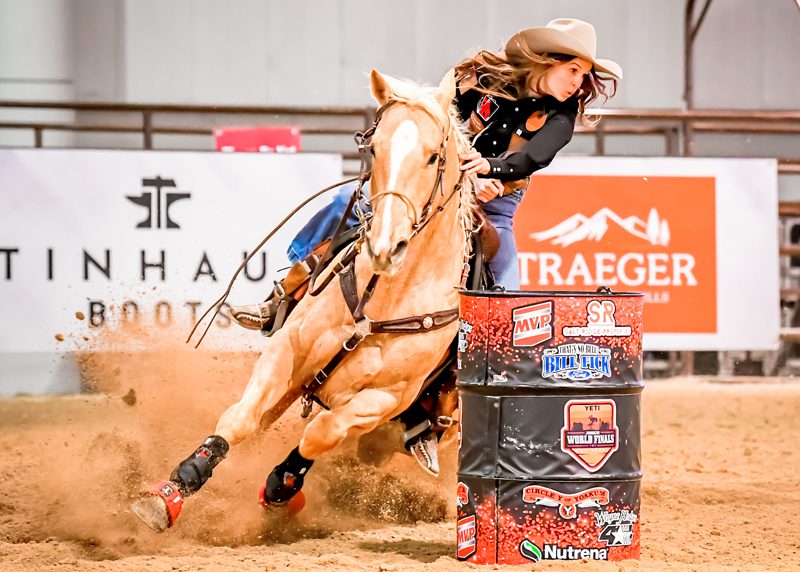
Firewater Requests, Rockette for short, comes by her name honestly. The 9-year-old palomino is everything Tru needed in a barrel horse and much more. “We actually bought Rockette two months before I ever rode her,” Tru said. “There was a jackpot nearby when we came to pick her up in Utah. It was a KK qualifier. I had only run her once before we entered up. I was just test running her before we took her home, but we won the qualifier. I was shocked because I didn’t know what to expect from her.” Their honesty about Cash poured the foundation of trust that’s built a strong friendship between Ryan and KC and the Mosts. The fruit of that trust was picked in Vegas when Tru not only won the Junior World Finals in the senior barrels but also took home the youth championship at the All In Barrel Race as well as ninth in the open average.
From the outside, Tru’s success looked easy. Even though Tru and Rockette clicked instantly, their climb to the top in less than a year as a team was anything but. “As Tru finished out junior high last spring, she just swept everything she entered,” Josh said. “By the time summer hit, Rockette started declining; and by that, I mean she wasn’t winning every race she entered anymore. We didn’t know that her hocks could get sore or that she might get ulcers being hauled a lot.” After getting Rockette back to peak condition, Tru had some work to do as a rider. But the pair also had to figure out how to get all 16 hands of Rockette around the NFR-sized pattern, something neither had much experience with at that point.
“We had about four months to really train for Vegas, and all of our high school rodeos were in big outdoor pens,” Tru said. “We ended up going to a local jackpot – Rocky Top – almost every week this fall because the pattern was only 12 feet off what we’d do in Vegas. It was rough at first because I wasn’t sure how to set up such a big horse in a small pen.” Through the trials and tribulations that indoor pen presented, Tru never wanted to throw in the towel. It’s this relentless determination that her parents are most proud of, more than anything Tru’s ever won. “She could’ve walked out of there and said she never wanted to go back, but she didn’t,” Josh said. “She never gave up. By the end of that series, she finished third against some top riders who consistently put up times that were tough to beat. Tru needed to see that she wouldn’t win every time she got on that horse, that she had to work for it. That’s when I knew they were ready for Vegas.” As a push-style horse, Rockette was nothing like other horses Tru had ridden before, with the exception of Cash, who shared one similarity.Fearless Freshman
“When Tru first ran Rockette, Ryan turned to me and said: ‘Because of Cash, she has no idea that she’s riding a literal rocket,’” Josh said. “At 10 years old, Tru learned how to handle a beast and then every other horse out there is nothing by comparison. Her only game plan is to ride well, and it never crosses her mind to be scared to go fast.” It’s this fearless approach that fuels Tru’s confidence. She gets nerves and even entertains occasional doubts much like her peers, but Tru doesn’t let it take hold of what she knows to be true: she’s a skilled horsewoman riding one of the fastest rockets out there.
“Tru went to the world finals never thinking anything less than she could win it,” Josh said.
Taking her turns a bit wide was a safe gamble in the first two rounds of Vegas. Tru knew Rockette had the speed to get them to the finals if they could stay clean. Once in the finals, Tru left it all out in the arena. She pushed Rockette harder simply because she was proud of the fact they even made the short round. Anything after that feat was just extra for Tru. “The whole experience in Vegas was better than I could have ever imagined it to be,” Tru said. “We’ve joked that we won’t be able to top it.”
While outdoing 2022 will be tough, Tru has the determination, work ethic and the horsepower to accomplish anything she sets her mind to.
Tru’s cheering section in Vegas is the perfect illustration of the community surrounding her in this endeavor. “We probably had 15 people fly in from Washington and California to watch her in the short round,” Nichole said. “We’ve all fallen in love with the sport and the people. We get to spend so much time together as a family because of rodeo and that’s been such a blessing.” At 18, Tru’s older sister didn’t pursue horses after hitting the dirt during a riding lesson. “Alivia was a beautiful dancer and later did voice lessons and theater in high school, she just didn’t have any interest in horses like Tru did,” Nichole said. “She’s literally the exact opposite of a cowgirl; like picks up a pitchfork with two fingers.”
Regardless of their divided interests, Alivia is at every one of her sister’s events.
For a family that knew nothing about rodeo only eight years ago, they’ve come a long way together. “Being so big, horses seem like they should be really dangerous but they’re so docile,” Nichole said. “It’s so therapeutic to go out and just brush a horse or clean their stall. I think riding horses makes Tru feel like she’s part of something bigger than herself. She’s a lot more spiritual than anyone else in our family and I think it’s cool that horses brought her closer to God.” Perhaps qualifying for the Junior World Finals was the happiest accident of Tru’s life so far. Or maybe it’s just the very beginning of her story as a barrel racer. “Anyone can be like Tru; yes, it will cost money and be a lot of work, but anyone can make it big,” Josh said. “There are so many kids out there who don’t have anyone propelling them to the next level, but they should all know that it’s within their reach if they work hard.” -
5 Star Featured Athlete Rylie Smith
While Rylie Smith is the definition of self-made, she’s quick to credit her parents – Ricky and Misty Smith – and everyone else who’s had a hand in her roping career so far. Perhaps one of the most important people on that list is Hope Thompson. “I believe my best year of all is still ahead of me, but my biggest accomplishment so far was when Hope and I won the Inaugural Women’s Rodeo World Championship in 2020,” said the roper from Whitsett, Texas. “We’ve been roping together for the last 5 years. We may not always be the best team, but we certainly rope well together, and we’re blessed to win when we have the opportunity.” Typically, Rylie is throwing for two heels but she’s as versatile as the Quarter Horses she rides. The 21-year-old can throw a solid head loop for both a calf and steer.
“Jane [Halleluiajah Wild Card] is my number one for heeling and sometimes when we enter backwards, Hope will ride Jane on the heel side.” When Rylie bought 7-year-old Jane, she came as a pair with her half-sister, Hail Mary Wild Card. When Hope heels off Jane, Rylie uses Mary on the head side. “The girls were born in the same pasture and every time they got moved around, they always went together. And then I bought them together, so they have some separation anxiety for sure.” Anyone would be hard pressed to find Jane without Mary any time Rylie’s out chasing white lines. Where Jane is eager and willing, Mary is hard-headed and full of sass. “No matter what, both of them will give anyone riding them 110%. I never have to worry about them trying to take something from me when I back in the box for a lot of money. I was very fortunate to get those girls.”
With equine partners like Jane and Mary, Rylie’s always protected them with the best. She found that in 5 Star pads and sport boots back in 2018. She became a sponsored athlete in 2020 after cashing a $90,000 check with Hope. “My horses do everything they can for me, so I try to take care of them the best I can. I think 5 Star pads and boots are the best products I can give them to keep them comfortable and sound.” It was a little bit of trial and error for Rylie when it came to finding equipment she liked. “I had ridden quite a few different brands; some that I won and some that I bought. I rotated through them and found the best fit for my horses in 5 Star.” Comfort and protection are Rylie’s top priorities when it comes to her equipment and 5 Star delivers on both.
As both a professional athlete in the WPRA and a rope horse trainer, it wasn’t all that long ago that Rylie and her parents were diving headfirst into the horse world. “Neither of my parents grew up in [rodeo], but when my dad was in his early 20s, he started team roping. When I was little, I always wanted a horse of my own so I could rodeo.” At 9 years old, Rylie got her first horse. And the rest, as they say, is history. “I started in the speed events which helped with my horsemanship. I think that’s the best thing to help with riding a horse. As I got older, I always wanted to rope. I hounded my dad and finally I got a rope in my hand.”
As Rylie puts it, things just snowballed from there. “My parents took me anywhere and everywhere so I could get help and be the best possible, I’m very fortunate to have had that.” Even before Rylie got her first horse, she was always finding a reason to be outside. She’s the same way today, but now she has plenty of four-legged reasons to keep her busy. “I never want to be sitting at a desk somewhere all day long. I like to be hands on and outside. I have some outside horses and some younger ones of my own. I do horse teeth, braid custom halters and tie downs, and everything else relating to horses. -

On The Trail with Killer Bee
“Cowboys don’t know what pen to put her in,” said 4x World Champion Saddle Bronc Rider, Clint Johnson, about Killer Bee. “She is probably the greatest in this generation. She’s been a little bit of an exception all along. She is an outstanding bronc – one of those horses that comes along once in a lifetime – like Secretariat, Scamper, and a handful of others that were exceptional in their discipline.”
Killer Bee is the daughter of Commotion and Molly Bee. “Molly Bee had been to the finals four or five times and we bred her to Commotion as we retired him. That mare colicked when we were in Nebraska and she didn’t survive the surgery,” said Bennie Beutler. “Killer Bee was two months old, and we raised her on a bottle. She never got real gentle.”
She bucked her first time as a four-year-old, at a college rodeo. “We eased her along to some of the smaller rodeos,” continued Bennie. “We knew we had something – she was rank in the bareback.” Cowboys couldn’t mark her high enough, so she was switched to bronc riding. The Wrights got on her – that was in 2015 – the bronc riders wouldn’t get on her because they couldn’t ride her. When cowboys could ride her, they, they were in the 90s and same in the bronc riders. “She’s just as rank one way as the other.”
At 17, Killer Bee went out on top – Dawson Hay scoring a 92 point ride in Round 9 of the 2022 WNFR. Among her other accolades Killer Bee was the 2020 Wrangler NFR top bareback horse. She was the 2019 PRCA Bareback Horse of the Year and voted top bareback horse of Round 3 of the 2019 NFR after bucking off Austin Foss. Killer Bee was also the top bareback horse of the 2018 NFR and top saddle bronc horse of the 2013 and 2014 NFRs. Her job now? Raise colts. “Now the hard part comes.”The Beutler name has long been connected to rodeo stock and this year their ranch-raised stock took all three awards for top-scored rough stock of the Finals. Beutler & Son were awarded best bareback, bronc, and bull of the Finals. This comes from the judges scores – and with 105 in each event, winning one is an honor and winning all three has never been done.
“We were pretty fortunate.”Killer Bee Accomplishments
2013 – Top Saddle Bronc of the NFR
2014 – Top Saddle Bronc of the NFR
2018 – Top Bareback Bronc of the NFR
2019 – PRCA Bareback Horse of the Year
2020 – Top Bareback Bronc of the NFR
2022 – Top Saddle Bronc of the NFRBeutler & Son Accomplishments
Most Top Bucking Stock of the NFR Awards for a Single Rodeo Company – (14), six bucking bulls, four barebacks, and four saddle broncs.
Most Top Bucking Stock of the NFR Awards – Killer Bee (5), 2013, 2014 & 2022 as a saddle bronc and 2018 & 2020 as a bareback horse (Tied with Sippin’ Velvet (Bernis Johnson).
Most Top Saddle Bronc of the NFR Awards – Killer Bee (3), 2013, 2014 & 2022 (Tied with Angle Blue (Flying U), Trade Winds (Big Bend), & Trails End (Zumwalt).
First Stock Contracting Company to Win All Three Top Bucking Stock of the NFR Awards In A Single Year – 2022 with Killer Bee (saddle bronc), Ghost Town (bareback), and Smoke Stack (bull).
4th Highest Scored Bareback Ride in PRCA History (13-way tie) 93 points by Devan Reily on Beutler & Son Rodeo’s Killer Bee in Tucson, Arizona, in 2018.Ranch Raised
The Beutler name has long been connected to rodeo stock and this year their ranch-raised stock took all three awards for top-scored rough stock of the Finals. Beutler & Son were awarded best bareback, bronc, and bull of the Finals. This comes from the judges scores – and with 105 in each event, winning one is an honor and winning all three has never been done.
-

On The Trail with Jackie Crawford
Multi-talented Jackie Crawford won the 2020 WPRA (Womens Professional Rodeo Association) Breakaway Roping world title by less than $2,000. Her performance at the first ever Wrangler National Finals Breakaway Roping held in Arlington, Texas, propelled the 38-year-old to win her 20th (WPRA) World title. This isn’t her first Breakaway World Championship, she has won the WPRA title in 2016 and 2014. She is the second most decorated member of WPRA, trailing the late Wanda Harper Bush, also an inductee of the ProRodeo Hall of Fame, who won 32 titles during her rodeo career. Jackie’s other titles have been in All-Around, Team Roping, Tie-Down Roping plus she also barrel raced.
The National Finals Rodeo, held in December happened to coincide with Jackie being six month pregnant with her daughter, due in March. “At first I wasn’t sure if I would compete. It was a bittersweet feeling because we have worked so hard and been on this journey to bring breakaway to this level; so to watch the inaugural year from the sidelines would have been tough. After much discussion with my family, doctor, and prayers, I told myself as long as I was comfortable, I was going to compete!”
Jackie makes her home in Stephenville, Texas, with her husband, Charly; their daughter, Kaydence, age 16; and three year old Creed. The 38 year-old said, “I cut the horn off my saddle, to protect the baby. I trust my horse, T-Boy, so much and had so much confidence in him.” She had continued to compete three years ago until she was five and a half months pregnant with her son, Creed.
The National Finals Breakaway Roping event was ten rounds, then they took the top eight into a shoot-out round, followed by the top four. Jackie managed it all. She even went back to the judges in Round 5 and admitted she had an illegal catch (the calf’s back leg in the loop) that the judges did not catch. The judges listened and changed her score to a ‘no-time’. But in spite of her honesty, winning $25,536 with two go-round wins, and placing in four rounds, she came out on top, with a total for the year of $47,185.
Jackie thought the National Finals event was an awesome time. “I was suppose to be on that journey . . . what a way to end on a high and take a break!” She and Charly have named the ‘soon to be born little girl’ Journey.“My mom (Annette) and dad (Mark Hobbs) rodeoed in Illinois. My dad and his brother are the only two to win the National High School Finals Team Roping from Illinois.” Jackie explained that her mom cut the middle out of a foam pillow, for the saddle horn, and that is where she rode. Her mother was well known for training barrel and roping horses and she was inducted into the Murray State College Rodeo Hall of Fame. “You can’t have a cake without the ingredients – in other words, it took a good work ethic, dedication, horses, coaches, and sacrifice – you have to be willing to put it first,” said Annette, who got her work ethic from her dad.
Jackie began competing in junior rodeos in barrel racing, poles and flags. When they moved to Oklahoma she added roping. “I was drawn to it – I was meant to be a roper. I turned my barrel horse into a roping horse. I started competing my sophomore year in high school.”
Before they moved to Oklahoma her mom worked at Fairmont Park Race Track in Collinsville, Illinois. In Oklahoma she went to work for Blue Ribbon Downs, in Sallisaw, while she studied to be a radiologist. Jackie began working there cleaning stalls when she was 14. She got her pony license at 16. “To this day I have scars on by body from ponying horses. It taught me to appreciate a good minded horse and what those horses are, and what they do and how athletic they are.”
Her first team roping horse came from the track. “I team roped and barrel raced off that big impressive bay gelding,” she said. “I sold him to buy my first truck – a 1996 extended-cab Dodge. It was the coolest thing in the world to me; I got to go to college from that horse.” She had several full scholarships from colleges in her area of Oklahoma. “Wanting to be the best and being so competitive I wanted to go to the toughest place there was. I knew the southern region was the toughest region. I took a scholarship for less money to go to Vernon Regional Junior College, Texas.” As she expected the competition was something she’d never seen before. She did win the NIRA Breakaway Roping Championship which helped the Women’s Team win that year, as well. “Iron sharpens iron and that was my mentality.”
Jackie then went on to Tarleton State University, in Stephenville, TX, with her best friend in college, Tessie McMullan Doyle. They pushed each other every day to become better competitors. Their women’s team won the National title their senior year, 2005
After college she went to work for Lari Dee Guy, in Abilene, TX, riding colts training roping horses, whatever was necessary. She admits she learned a lot. In 2009 Trevor Brazile won the calf roping and team roping on Sans Diamond Shine at the World Show and the owner of the horse sent us a bunch of that stud’s colts to train. “They were all good horses and I bought T-Boy out of that group,” she said. At first they didn’t get along. “He was so quirky, and we went through a battle,” she admits. “I had the feeling there was something about him – he isn’t fancy. He was a problem and hard to get to work, but he had an ability to win.” When he was five she took him to Joe’s Boot Shop that had a five-header and he won. He has been taking her to the pay window for a decade. Today she says, “He’s just a phenomenal horse. I don’t think anyone can dispute the fact he’s probably the highest money-earning horse ever in breakaway roping. He’s just a winner.”Jackie met Charly through the roping world. She was dating a mutual friend of his. “I thought she was a buckle bunny,” said Charly. “It turned out that wasn’t the case at all. We became friends and had a lot of things in common. One year she needed a head horse for the World Series Finale in Vegas so I let her use one of mine, and it went from there – I could tell right way it was a fit.”
Charly started roping at a young age in Canby, Oregon. He roped with his dad and made it to the National High School Finals three times. He graduated in 1996 and went to Central Arizona College for two years. “I got my PRCA permit when I was 17 but didn’t have enough horses to really compete.” He bought his PRCA card in 1998 and won the Resistol Rookie (header) of the Year in Team Roping. He’s made 10 appearances at the National Finals which included 2020, when he and his partner, Logan Medlin, won the 7th go-round. He plans to slow down and concentrate on his family, his roping schools and clinics. “I’ve gotten five heelers to the NFR so I figure I better take that talent and use it to put on schools and lessons. My daughter wants to make the UPRA anc CPRA finals this year so I want to help her as well as help Jackie however I can. I’m good with being a good dad and husband.”
Jackie graduated with a degree in Business Administration, which she admits has helped her with communication, sponsorships, and everything else that goes with rodeo. She has hired Cheyenne Britain that acts as Jackie’s ‘right hand man’. “She helps me saddle, unsaddle, drive and everything in between. “I hired an agent and a social media person,” Jackie explained. Charly and Jackie are restructuring their program so they can do the things a replacement can’t do. “Nobody can replace a mother, a dad, wife, husband or a competitive roper,” she said.Creed has grown up in the arena. “We have huge play areas set up inside a 10×20 chain link fence; slides, jungle gyms, etc.,” said Jackie. “In between horses, we play and do what we need to do.” The plan is to keep going. “Our biggest goal as a family is not to be broke cowboys – rodeo doesn’t have a 401K.” Jackie’s initial goals were to be in the conversation of the greatest women ropers in the world and get inducted into the Cowgirl Hall of Fame. Now that the doors are opening to breakaway roping opportunities, her goals are changing, but in the end she wants “to know that no matter what, I’ve accomplished the things, I’ve worked for. I did it and stamped my place in history … a sigh of relief that the first NFBR is in the books. Let’s rock on and keep this ball rolling. I’m so fortunate to do this – I get to be with my kids. Even though we are working, we are all together as a family all day. How many people get to say that.”
“My vision for myself is continuing to help put this sport in a position that when I’m too old to do it, I’m sitting in the gold buckle seats watching my daughters roping at NFR.”
CHAMPIONSHIP WINS
2020 National Finals Breakaway Roping
2016, 2014 Womens Professional Rodeo Association (WPRA) Breakaway Roping
WPRA All-Around 2019, 2018, 2016, 2015, 2013, 2011, 2010, 2009 & 2008
WPRA Team Roping 2016, 2014
WPRA Tie-Down Roping 2014, 2013, 2011, 2010, 2009, 20082003 National Intercollegiate Rodeo Association Breakaway Roping for Vernon Regional Junior College
2003 National Woman’s Team for Vernon Regional Junior College
2005 National Woman’s Team for Tarleton State University
2000 Oklahoma State Champion Breakaway Roper
2020 Betty Gayle Cooper Ratliff Fast-Time Award see story on pg 43
Sponsors:
American Hat, Ariat, Smarty, Hay Chix, Classic Equine, Rattler rope, Classic rope, Martin Saddlery, LubiSyn, Chute Help, Plaza Hotel and Casino, Total Feeds -

6 Over 60: Judy Wagner
“A woman who knows the ropes isn’t likely to get tied up,” says Mae West. It’s a concept that Judy Wagner takes seriously, whose background in ranching and owning Gator Ropes for ten years gave her an affinity for the lithe and useful tool. Just as she relies on its strength to catch a steer or a loose calf, Judy relies on certain strands of the Western lifestyle to put her best boot forward in her family, in her work as the Chief Marketing Officer for Montana Silversmiths, and in the rodeo community at large.
Born in 1953 in Avon, Montana, Judy was the oldest of eight children and a handy cowgirl as soon as she could walk. By the time she finished high school, she had 14 years of 4-H under her belt and an entrepreneurial outlook. “The cows don’t know it’s Christmas, and it’s that simple and that complicated. But if you take care of your responsibilities, and work from those values and what you learn as a kid growing up on a ranch—or in sports or other teamwork—that eventually sets the foundation for you as you go into your work life.”
A marketing degree wasn’t common in college at that time, so Judy studied home economics and child development, then took a job as a county extension agent for Teton County. Her husband, Alvin Wagner, whom she met in college, was a sales representative in the western industry, and he helped Judy as she entered into a partnership with another family to create Gator Ropes in 1988.
“I went to a business class two years after starting Gator Ropes, and I remember thinking I’d be scared to death now if I had known all of that just starting out. I just jumped in because it was my passion and I didn’t know you couldn’t succeed,” says Judy. “I’m thankful for the people at that time like Jake Barnes, Clay O’Brien Cooper, and Speed Williams who gave endorsements, and the people who helped me with advertising or questions with the business. With the other rope companies back then, we were friends more than competitors, and we sharpened each other like steel on steel. I think I earned the respect of the industry because they saw the blood, sweat, and tears it takes to own a business. Because for me, business is personal and I want to create something of value. I used what I call WIT, whatever it takes, to get the jobs done.
“I love to speak and tell stories, and one goes back to the creation of the rope and the threads that bind us. And that’s how I look at marketing or the world, because in this industry or this country, we are stronger when we are together.” One of Judy’s strands, which comes from the term she coined, Ranch Grown Logic, is keeping your eyes on the goal. “I was helping my brother at his ranch gather heifers and steers, and I was riding a younger horse. We had to cross a ditch, but it practically turned into a ravine because he just didn’t want to cross it. Thankfully my brother saw I was struggling and came back, and he said, ‘Judy, look up.’ And for me, that was exactly it. You must look where you want to go, and when you do that, you release everything. If I get stuck now, I look up and see where I need to go.”
Another strand in Judy’s rope of life is what she calls “getting your cowgirl on.” She met a woman near her age one year at the PBR Finals in Las Vegas and was impressed with her spiritedness, especially after learning the woman had recovered from a stroke, coma, and six months recovery on her couch. “In her own way, she was telling me, ‘Get your cowgirl on.’ It gave me so much strength and courage, and for me, wearing a cowboy hat helps me get to peak performance. It brings me pride in and out of the arena and gives me strength.”
Judy is also passionate about passing that encouragement and strength along to others, inspired by another one of what she calls divine appointments. “I was fortunate enough to be a side walker for a handicapped lady. I was walking beside her and she was riding a big bay horse. She kept talking to it, and when she got done, she reached down and put her arms around his neck and said, ‘Good job, cowboy.’ Her voice rings still in my ears today. I try to pass that on now, like in my social media posts. I want to encourage people to keep going, keep riding, and keep making a difference. We need help and relationships, and in this sport, we know we can ask for help. That gives us the strength to be courageous no matter what lies ahead of us.”
Judy feels another important strand in life is to continue dreaming, always. “It doesn’t matter how old you are—never stop dreaming. We each have a season, and whatever that is, we can break the trail for our time. For the women in this group of 6 Over 60, this is our time to break ground in our season. We can celebrate each other in and out of the arena and create those strong ties. We are stronger together, and as we tie these strands together, what we give comes back tenfold. We couldn’t do it without each other.”
In 1998, Judy sold Gator Ropes back to her original partners and tried her hand at freelance marketing, while she also helped establish an all-girl rodeo team in Helena, Montana, and several other rodeo teams in her area. In 1990, she won the John Justin Boots Standard of the West award for the Rocky Mountain All Girl Team, a pre rodeo event for the Last Chance Stampede in Helena. In 2000, she had her second job interview ever and started working for Montana Silversmiths. Judy is now marking 20 years with the company, and was promoted to Chief Marketing Officer in January of 2022.
She and her husband Alvin continue to make their home in Park City, Montana. Their two children, Tiffany and Ross, both carry on the family love of the West. Tiffany trains horses, and Ross and his wife Casey own Big Time Barrel Racing Championships and Wagner Performance Horses. Judy loves to team rope and won WPRA Heading Rookie of the Year in 2014 at the age of 60. She also competes in the Wrangler Team Roping Championships and National Team Roping. “A year and a half ago, I became a grandmother to Westee Rein, and she and my family are the light of my life,” says Judy. “Life now is about quality time with them, work-life balance, and appreciating the moments with faith, family, and friends.”