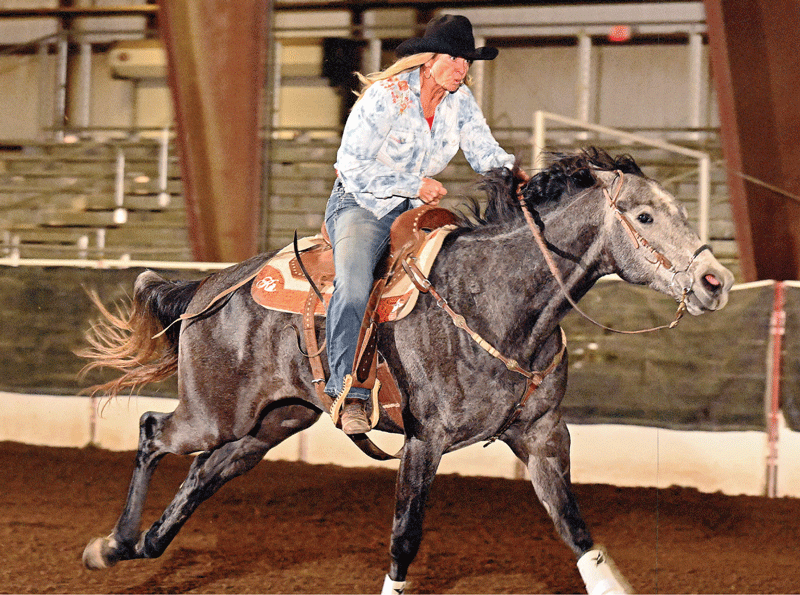
Kim Thomas has been a horse trainer most of her life. Her business savvy and horsemanship skills have carried her to compete in the Barrel Futurities of America World Championship, the Dodge National Circuit Finals Rodeo, serve on the WPRA board, and teach clinics in the United States and abroad.
While she now calls Noble, Oklahoma her home, Kim, 65, grew up in the rural Florida town of Wauchula. “There were a lot of day-working cowboys there that rodeoed. My parents were not horse people, but they got me and my sister a horse and we went to gymkhanas when we were little. Then we high school rodeoed. Nobody college rodeoed back then,” says Kim. “I trained my own horses.”
Kim purchased her WPRA card in 1980 and went to her first Southeastern Circuit Finals that year. She rodeoed hard through the 1980s and ‘90s, qualifying for the Southeastern Circuit Finals a total of 10 times, along with three Prairie Circuit Finals and two trips to what was the Dodge National Circuit Finals Rodeo at the time. “I’m kind of glad I rodeoed back when I did,” says Kim. “Everybody had one horse, and they trained their own horses.”
The training skills Kim developed turned into a career. While rodeoing, Kim also competed in barrel futurities on her horses and sold them. At the BFA World Championships, where many of Kim’s horses won, she met renowned horse breeder Jud Little, who invited Kim to come train his horses at his ranch in Oklahoma.
Not long after joining the WPRA, Kim also began serving on the board of directors and was instrumental in forming the Florida Chapter of the WPRA in the mid-1980s. They produced futurities including the Florida Sunshine Classic, and put on the Wauchula Rodeo in 1987. In all, Kim served around 10 years on the board in many different capacities, most recently as the Prairie Circuit Director.
During her rodeo and futurity days, Kim was also raising her son and daughter, Matt and Marsee Ferguson. Matt preferred playing other sports to rodeo, but Marsee followed in her mom’s bootprints. Despite being born with a heart defect and having her first open heart surgery when she was eight days old, with four more surgeries to follow, Marsee excelled in the arena. “When she was about 10 years old, Marsee won the NBHA state championship in both the youth and the open on two different horses, and she won the Speed Horse derby when she was 11, which is a very professional event,” says Kim. “She’s very competitive and won a lot. She high school rodeoed and went to the national high school finals.” Marsee got married and she and her husband Hunter McCown have a 10-year-old son, Kellen. Unfortunately, she suffered a massive stroke due to birth control several years ago, but she recently started riding her horse again. “It’s brought her a lot of joy to have this horse,” says Kim, who lives just 30 minutes from Marsee and sees her often.
Kim continues to be very involved in the horse world, though in new and unique ways. She went back to training horses on her own in 2003, and that eventually morphed into teaching barrel racing clinics. She’s been all over the Southeast with her two-day clinics and even taught in Brazil and Bolivia. “I teach all ages, and I’m a big foundation and horsemanship person. We usually spend the first half of the day working on getting control of the horse and learning where the rider’s body needs to be, and then we do slow work. The second day I usually work with the riders one on one. I truly enjoy it.”
Kim’s clinics are sponsored by 5 Star Equine, who provide her shirts and hats, which she awards to the most improved horse and most improved rider at each clinic. She teamed up with 5 Star when she began riding horses for owner Terry Moore in the early 2000s, and coached his daughter Rachel Moore-Lowrey, who high school rodeoed at the time. “I bought their pads and helped them market along the way,” says Kim. “I’ve always believed that the best thing for a horse’s back is 100 percent wool, and theirs are, so those have always been my pad of choice.” Kim used all of their products, though the pads and mohair cinches are her favorites. “The horses never get any kind of girth itch or rash with them, they’re easy to clean, and the horses don’t seem to sweat as much in them. All of their products are very high quality, and they are good family people.” 5 Star even sent a new saddle pad to Marsee for her birthday.
Kim is recently engaged to Chip Bennett, a former PRCA steer wrestler. “I’ve known him for 40 years and we’re best friends,” says Kim. Along with teaching 8-10 clinics a year, she travels for her work as a sales rep for SUCCEED equine products. Her work will take her to the upcoming WNFR for 12 days, where they are running the hospitality tent for two days and cheering on their sponsored riders in the Finals.
Category: Archive
-
5 Star Champion: Kim Thomas
-
Community Coffee: Coleman Proctor
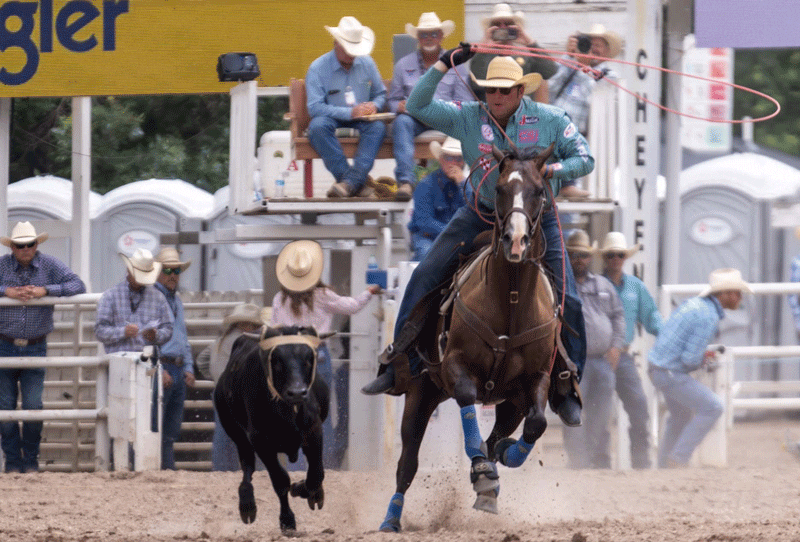
Community Coffee strives to serve with consistency, integrity and excellence. This is only one aspect 7x Wrangler National Finals Rodeo qualifier Coleman Proctor loves about the family-owned brand.
“They keep the freshness coming to you,” said the 38-year-old from Pryor, Oklahoma. “Having fresh coffee is something that us rodeo guys, particularly, can appreciate.
“We [rodeo contestants] get a lot of 4 a.m. truck-stop coffee that has been on the cooker for way too long and isn’t always the best,” he said.
“They [Community Coffee] package their coffee and ship it straight to your door and ensure freshness that makes a difference.”
Proctor said he drinks a variety of flavors and blends sold by the company, but he starts every morning with Pecan Praline. He added the company also offers a variety of iced late and espresso that are kept cold.
Another thing he said brings Community Coffee and what he is doing now together is the way the brand began in 1919. In 2022, Proctor started a podcast titled “Toter Tales.”
“When you think about people sitting around, telling stories in the mornings, they are enjoying a good cup of coffee,” he said. “So, a podcast setting goes hand in hand with Community Coffee.
“I started by putting little video clips on Facebook to update people on what I am doing and where I’m at,” he said. “The first one posted was because I was trying to figure out how icy the roads were from Texas to Oklahoma.
“People seemed to enjoy the videos, so I coined them the “Toter Tales” because I drive a toterhome,” he said. “And then a buddy said I should start a podcast.”
“It has certainly been a learning experience, but I have been having a lot of fun with it,” he said. “I really enjoy doing it, and as long as people are enjoying it with me, I’ll keep doing it.”
He added it offers an opportunity to feature and promote sponsors and companies, including Community Coffee.
So far, Proctor has released 12 episodes and has featured people like Jess Tierney, Justin McKee and Clay Smith.
According to the “About” description on Spotify, Toter Tales provides an insight into Proctor’s daily life and interaction while on the rodeo trail.
The newest episode features his team-roping partner, Logan Medlin. Together, Proctor and Medlin most recently won the aggregate at the 2023 RAM Prairie Circuit Finals Rodeo in Duncan, Oklahoma.
According to the official results released by the Professional Rodeo Cowboys Association, the team averaged 18.1 seconds on three head and won the second go-round with a 4.1 second time.
Heading into the 2023 WNFR, Proctor said he and Medlin are one go-round win away from leading the world standings in the team roping.
“The first time I saw Logan run one, I thought, ‘Man, this kid ropes good,’” he said. “And then we got a chance to start roping together in 2021.
“We were both between partners, and it just worked out for us,” Proctor said. “We have really good chemistry because we’re kind of at the same place in life and have a lot of the same values and work ethic.”
Proctor said teaming up with Medlin has made a huge difference in the direction of his ProRodeo career.
They have made two straight WNFR appearances and have qualified for their third. The pair ended their 2022 rodeo season sixth in the team roping world standings and won two rounds at the WNFR.
The day before their round-eight win, Proctor received a bachelor’s degree in General Studies with an emphasis in Agricultural Business from Northwestern Oklahoma State University.
“It was always a huge regret for me,” he said. “I never finished my degree, and I felt like I had let up just before the finish line.
“When I was in college, I always thought I’d make the Finals and not need a degree,” he said. “Then I made the finals, and I was disappointed that I hadn’t finished college and gotten my degree.”
Proctor added he had set a goal to maintain a 4.0 Grade Point Average in his senior year of college. While his final year may have been untraditional, he was proud to say he finished the semester with a perfect GPA.
Another aspect of his life Proctor spoke proudly of was his family. He said they own and live on a ranch in Pryor, Oklahoma, where they are not far from his mother-in-law.
“I am married to the love of my life, Stephanie,” Proctor said. “And we have two beautiful daughters.
“Our oldest, Stella, will be six later this month [October 2023]. Our middle child, Caymbree, is four,” he said. “And we just found out we are expecting a third beautiful little girl come April.
“God knew I wouldn’t have been able to handle boys,” he said. “I am a girl dad through and through.” -
Back When They Bucked with Wally Badgett
[ Pro rodeo cowboy-turned-cartoonist entertains with “Earl” cartoons about the western way of life ]
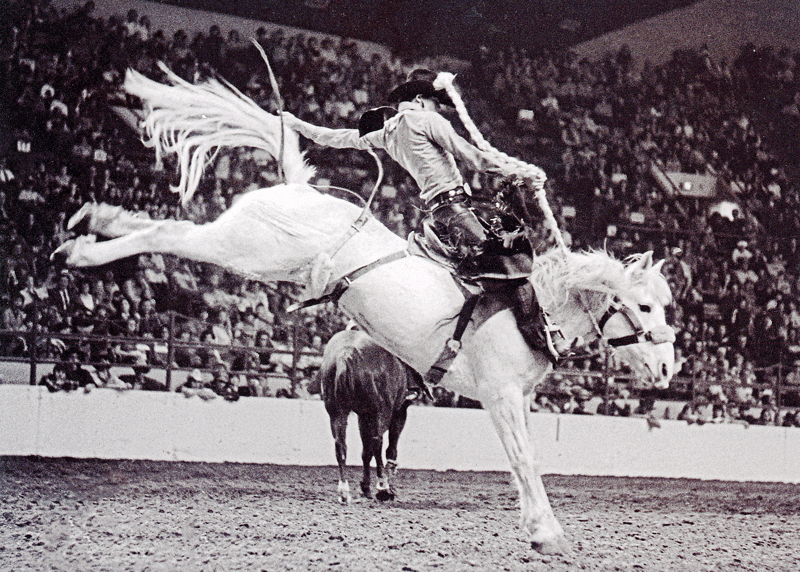
Wally Badgett was a ranch kid-turned rodeo cowboy, then deputy sheriff -turned cartoonist.
And through it all, he’s had a sense of humor.
The Miles City, Montana man was born in 1952 on a ranch 75 miles south of Miles City, the son of Kirk and Lora Badgett.
Wally was intrigued by the sport of rodeo because of his older brother, who competed, and after high school, attended Sheridan (Wyo.) College, where he rode bulls and was the 1971 National Intercollegiate Rodeo Association champion bull rider.
He competed in high school rodeo in every event but steer wrestling. After high school graduation in 1970, Badgett went to Sheridan, where he rodeoed collegiately two years, before he moved back to Montana.
From 1972 to 1975, he was on the pro rodeo trail, competing in the saddle bronc riding, calf roping, and bull riding, and qualifying in the bull riding for the 1974 National Finals Rodeo, finishing eighth in the world standings.
By 1975, he stayed closer to home, rodeoing in Montana and the surrounding states, and four years later, he was done. A self-professed homebody, he was married to Pam (they married in 1973) with two little children at home. And it was time to quit. “I had never left the arena in an ambulance,” he said, “and I thought, I’m way overdue.” With a family to support, “you start to think of other things.”
And he was pain-averse, he joked. “I’ve always hated pain, and I’m kind of a no-pain guy. Obviously, riding roughstock can be fairly painful at times.” His worst injuries were a broken ankle and pulled groins.
Wally and his brother leased part of the family ranch for awhile (his mother had had a serious stroke when he was four years old, and his dad was forced to sell the ranch to pay for her care.) Then, one day, while in Ashland, Montana, he ran into the deputy sergeant. The sergeant mentioned that they were looking to hire a police officer, so Wally applied and got the job.
For three years, he was a deputy sheriff in Rosebud County,(Forsyth), then the next nine years he spent as deputy sheriff in Custer County (Miles City).
It was an injured back that drew him into his next profession: drawing.
While laid up due to the back injury, he drew cartoons to entertain himself. He’d drawn as a child, but never anything serious.
And thus Earl the rancher was born.
As Badgett’s cartoons featuring Earl and his wife in various ranching situations grew in popularity, he got busier with the artwork.
“People were starting to call the sheriff’s office looking for the cartoonist instead of the cop,” he quipped.
He had to make a choice: continue in law enforcement, or build on the cartoon skills.
“I chose (cartooning) because there’s less chance of getting shot,” he joked. “I was always worried about getting shot (as a sheriff). I might have been the shakiest gun in the west. I was always worried someone would steal my gun and beat me up with it.”
Badgett’s cartoons with Earl and his situations tickle the fancy of ranchers, farmers, and those in the western lifestyle. They can be found in about 150 publications, from Texas to Canada, in rural and livestock newspapers.
When he started, his cartoon content was “inside cowboy humor, and if you weren’t a cowboy, you might not get it,” he said. “I realized, if I’m going to make this work, I have to draw so the butcher, the baker and the candlestick maker can understand it, and it’s still funny.”
Badgett is always looking for content that he can work Earl into. “I keep my ears open. In our western world, you can be talking to someone, and they say something not intended to be funny, but it’s hilarious. I write those things down.”
Earl is depicted as a hard luck rancher whose cows tend to be thin, and whose wife often outwits him. He drives a 1950s truck and does some of his ranch work with a team. It’s a throwback to Badgett’s youthful years on the family ranch. He fed cattle with a team and has always been fascinated with that.
Badgett never gave a name to the wife, but occasionally, tongue-in-cheek, he’ll call her “She Who Must Be Obeyed.”
Every Earl cartoon Badgett draws has a dog in it (“I don’t think I’ve ever known a rancher that didn’t have a dog,”) and a magpie.
The magpie came by accident. Badgett included the bird occasionally, but one day, someone told him he looked for but couldn’t find the magpie in the latest Earl cartoon he’d read.
So Badgett, whose pen name is M.C. Tin Star, went back and included the bird in his previous cartoons and now draws one in every one. “It’s my trademark,” he said.
Much of his drawing is done in the winter, when the weather is cold. “The days are short, and sometimes I might do two or three or four in a day. I usually operate in a state of disorganization and confusion,” he joked.
Badgett served as the rodeo coach at Miles City (Mont.) Community College for about twenty years, first as assistant coach, then as head coach. He retired from that role in 2021.
Justin Miller was one of Wally’s rodeo athletes from 2008-2010.
The Lockwood, Mont. cowboy rode barebacks in college rodeo and appreciated his coach’s willingness to help.
“If you were going to work hard (in college rodeo), he was going to work hard with you. He would do whatever it took, for whatever you wanted,” Miller said. “He wouldn’t give up on you or leave you wanting. He’d help you out as much as you wanted.”
In his pro rodeo career, Wally held the record for the high marked ride bull ride in Houston for several years, at 85 points. “That doesn’t sound like much now,” he said, noting that markings have gotten higher.
He also said that bullfighters are more proficient now. “Back in my day, there might be one bullfighter, and he may or may not be any good. He might outrun you to the fence, but at least there might be someone to help you up if you got there, too.”
He and Pam have a son, Brett, who is married to Joni and lives in Miles City, with a daughter, and a daughter, Whitney, who is marked to Fakhrul Hasan; they have a son and a daughter and live in California. Both children are artistic; one of Brett’s sculptures, a half-life size of a steer roper, stands at the Pro Rodeo Hall of Fame in the back garden.
He cowboys for a local ranch, when they need him, but mostly stays home and enjoys Montana and rural life.
He refuses to use any digital device, social media, and doesn’t text. “I’ve seen a lot of changes, and I’ve been against almost all of them,” he joked. “But they happen anyway.”
Badgett is a 2023 Montana Cowboy Hall of Fame inductee and the third recipient of the Saddle of Honor, joining the 2018 Saddle of Honor recipient Charles M. Russell and 2019 recipient Jay Contway. -

On The Trail with Alex Phelps
[ Life is short, be happy and be a blessing to those who surround you. ]
Alex Phelps has been on a mission to have a positive mindset through his experiences and lessons in rodeo. His attitude was evident to others around him when he won the Ramsey Award as a high school senior in Ulysses, Kansas, which celebrated rodeo athletes who had a bright attitude. His mindset poured into his time at Southwestern Oklahoma State University when he received the Walt Garrison Scholarship Award as a college rodeo athlete in 2016. The scholarship celebrates one recipient from each of the National Intercollegiate Rodeo Association’s (NIRA) region who demonstrates determination, loyalty, leadership and integrity. 14 years later, Alex relfects on the meaning of the award. “I’m competitive, so I was involved in a softball tournament the next day, and it didn’t really sink in. That award had meaning and I have always tried to represent the values inside and outside the arena, my values have not changed.”
Alex was raised by his grandparents, Donnie and Peggy Phelps, in Ulysses, Kansas. “My mom committed suicide when I was 8. I grew up at a young age and I grew up faster after having that experience,” he said. “The village of people that raised me taught me two things: stand true to your values and life is short. You don’t get a second chance and the first impression should be the same as the rest; having good character and moral values is what people see in me.” His grandpa, Donnie, started out riding bulls at a young age and transitioned to team roping, which he competed in until he passed away in 2021. Alex is forever grateful for his grandparents who gave him the foundation of his rodeo knowledge. “They raised me to the person I am today.” The Mentzer family of Toby, Janet and Peyton took him in and helped him get to the next level. “They prepared me for college rodeo and life.” Alex is appreciative of all who have encouraged him. “Without the support of my grandparents, the Mentzers’, the Munsells’, and many others, my rodeo career would not be where it is at today,” he said.
“He’s like my little brother,” said Wacey Munsell, who is seven years his senior. “He’s got a deep background on both ends of the arena and I’m super proud of what he’s been able to do.”
Alex competed in the Kansas High School Rodeo Association, making it to Nationals in Gillette in 2015. He served as the regional student director while attending college. He also served as the 2016-2017 NIRA National Student President. “We were instilled as directors to encourage and help the production of rodeos. As a student director, I took advantage of that, in thinking of spectators and sponsors and families, we always work to produce a show that is timely.” He took the knowledge he learned through his rodeo career to help other rodeos work better. Alex is a board member for the Ulysses Stampede, a bull fighter at the College National Finals and served as the chute boss for the 2023 Kansas Pro Rodeo Association (KPRA) Finals in Dodge City, Kansas. Alex has been a member of KPRA for several years. He appreciates the association’s heart for rodeo. “The sky’s the limit because they have a passion for rodeo,” Alex said.
Alex is also active in the NIRA, fighting bulls at the 2023 College National Finals Rodeo (CNFR) in Casper, Wyoming. He sees college rodeo as a stepping stone for contestants. College can be a doorway towards making it into pro rodeos in addition to giving athletes an education to fall back on. During his time in college, Alex competed in tie down roping, steer wrestling, team roping and bullfighting. He competed on three different occassions the CNFR; twice in the team roping in 2016 and 2018; steer wrestling in 2017. He has been fortunate to work as a bull fighter at the last three CNFR’s.
Alex loves the adrenaline rush of bullfighting and being able to protect contestants. He started fighting bulls at 14 years old. He remembers the Munsell family- Doug, Lorrie, Wacey and Baleigh- were raising bucking bulls at that time. “I attempted to ride a bull and failed miserably,” Alex said. “Wacey, a World Champion Bull Fighter and my best friend, recommended that I end my bull riding career and try bullfighting.” Alex also attended the final school that Rex Dunn put on in Waurika, Oklahoma in 2011. Rex Dunn had a professional bullfighting career for 16 years and worked three National Finals Rodeos. After ending his bullfighting career, he began conducting bullfighting schools like the one Alex attended. Alex is grateful for the Munsell’s hand in shaping his bullfighting experience. “They have all been instrumental in getting my bullfighting where it is today,” he said. He continues to compete in team roping and steer wrestling but wasn’t able to compete this season due to breaking his wrist while bullfighting.
Alex’s favorite aspect of rodeo is the community and the relationships he has been able to build throughout it. “You get to meet so many good people,” he said. “We all share the same passions and that’s our western heritage.” He remembers the first time he went to Las Vegas for Benny Binions Bucking Horse & Bull Sale in 2015. He was traveling alone and planned to meet other bullfighters and friends in Las Vegas. He was worried that he wouldn’t know many people there. In the airport he ended up seeing people he knew and continued to come across other friends throughout his travels. He appreciates the way that these relationships changed his outlook for that rodeo.
Alex feels that these relationships have grown his character just as rodeo has grown his attitude and mindset. “I do remember saying to myself, there’s probably several people that would love to be doing what you’re doing so be appreciative and stay positive; be positive for being able to do it,” Alex said. Alex feels supported in his passion for rodeo by his loved ones, including his wife of six years, Tiana “I couldn’t continue my rodeo career without my wife’s support,” Alex said. “I am very blessed to have her in my life.” They met through a mutual friend. As a traveling X-ray and Cat Scan technician, she works through an agency and can pick a place to work. ”We always sit down before she goes, and we are able to schedule around my contracts. Currently, she works four tens and comes home for three days.”
Tiana loves to travel with Alex. “Rodeo people are the best people and some of our closest friends. They are the nicest people you can meet. We go everywhere – from college rodeos to pro.” The couple got married in September of 2017 and spent their honeymoon at the National Finals Rodeo in Las Vegas. “I had never been before.”
His first job out of college was a loan officer at Bank of Ulysses. After three years, he decided to switch it up and took a job at Pioneer Communications, a telecommunications company, headquartered in southwest Kansas as a business support specialist. “We serve 14 counties, and my job is to advise businesses on their telecommunication needs. “There’s satisfaction to that,” he said. “I get to network with our community members and assist their needs.”
Alex is grateful for the community who has aided him in his rodeo career. “I’m thankful for my family and friends and anybody who’s had a hand in raising me or being a part of my life, and I’m grateful to be a part of theirs.” -
5 Star Champions: Mike and Hannah White
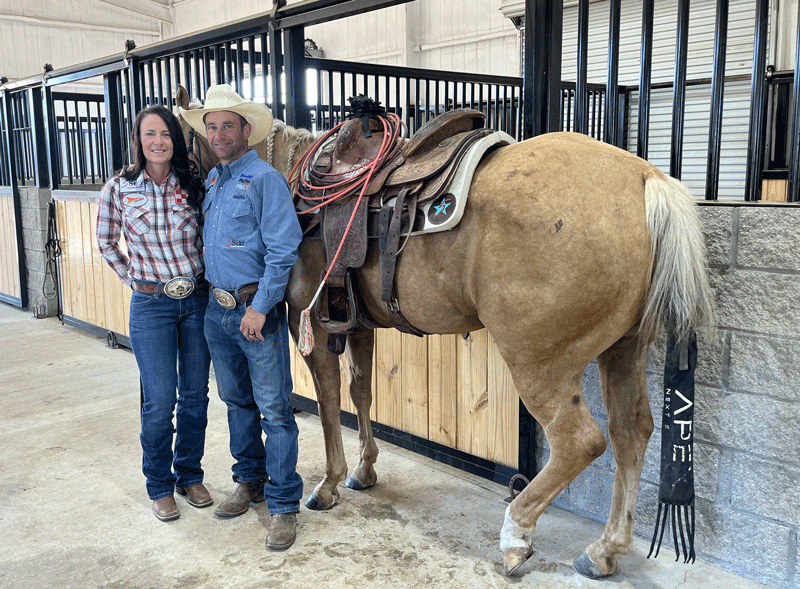
Mike and Hannah White have known each other since freshman year of college. And through their 24 years of marriage thus far, whether it’s raising their two sons, training horses, starting a business, or coming out of the roping box after a steer at the Bob Feist Invitational, the couple from DeKalb, Texas, knows how to work as a team.
Both Mike and Hannah come from rodeo families, and feel very fortunate that they had to train their own horses to compete on. “We were extremely blessed that we got to rodeo and our parents worked hard so we could rodeo. But on the other hand, our family didn’t have money to throw away,” says Mike, who is one of five children. He bought and trained colts, and even took a horse that wouldn’t buck out of his brother Pat’s bucking string and trained it to rope.
Likewise, Hannah has four siblings, and their parents couldn’t afford to buy them all finished rodeo horses. Their grandfather, Jack, who had been a stock contractor on the East Coast and raised quarter horses, along with helping found the Southern Rodeo Association, gave them all the opportunity to train some of his colts. “If we truly made something out of them, he’d sign the papers over to us,” says Hannah. “At the time I hated it because I didn’t understand why my mom and dad couldn’t buy me a finished horse, but now I realize how great that was.”
Mike and Hannah both went on to college rodeo, though neither one considered team roping more than a fun pastime initially. Hannah competed primarily in breakaway and goat tying while pursuing her nursing degree, and Mike rode bulls and went pro. He won PRCA Rookie of the Year in 1997 and competed in the NFR 1997-1999, winning the average and world title in ’99. Mike also competed in his first PBR Finals in 1999, and qualified for 10 more Finals before deciding he’d had enough serious injuries, and retiring in 2010. He was inducted into the PBR Ring of Honor in 2012.
Mike’s career change brought the opportunity for the husband and wife to team rope together more than as a hobby. With Hannah heading and Mike heeling, they began entering World Series ropings and the Bob Feist Invitational. They won the #12.5 Oil Field Showdown at the Wrangler BFI, held in Guthrie, Oklahoma, in both 2020 and 2021, taking home over $100,000 both years.
Team roping also gave them an avenue to give back to their community. They hosted Mike White’s Annual Pasture Roping and Benefit for 13 years, donating the proceeds to Ropin Dreams, an organization that benefits children with serious illnesses or injuries. They’ve been unable to host the benefit since 2021 when the land they used for the pasture roping was sold, but hope to bring the event back. “We’ve helped a lot of people through rough times.”
Mike’s main heel horse went to college with their oldest son, Logan (19), who is rodeoing at Howard College, but Mike has a 4-year-old that he’s excited to put more miles on. Hannah won both years at the BFI on her gelding Theodore, and rides another gelding named Charlie, who is also becoming a solid head horse. Their youngest son, Morgan (12), won’t be taking over any horses since he is a football and baseball athlete. “We’re great with that and we support him. But I told him if he’s ever interested in roping to let me know, and I’ll have the horses saddled,” says Mike.
Additionally, there will be three foals on the ground next spring out of Mike and Hannah’s mares. They are starting over after downsizing their breeding program around 2010, when the horse market in Texas hit rock bottom. Their focus these days is the AQHA Riata Buckle stallion incentive program. “I don’t have specific bloodlines, because if a horse rides good, I keep it. And if I don’t like it, I don’t keep it—you can’t ride the papers,” says Mike. He takes in a few outside horses to ride, but is primarily focused on training his own horses, which Hannah rides as well once they are started.
Whichever horses the couple saddle each day, they have a 5 Star Equine pad on their back. Mike and Hannah joined the 5 Star sponsor team this year, and are excited to be part of a line of products they’ve used for years. The company also sponsored their pasture roping. “What I really like about their pads is that they sit square underneath my saddle and contour to the back, so the saddle isn’t rolling all over the place or cutting my horse in two,” says Hannah. Mike adds that his horses aren’t sore when using 5 Star pads, even when they take some impact when he’s heeling.
The roping duo’s plans are to continue caring for their family, roping in the World Series and jackpots, and further developing their horse training program, MW Performance Horses. Mike, who is also an auctioneer, is building his customer base in the spray foam industry. “I know if I can get that going, I can free up time to ride those young horses more.” -
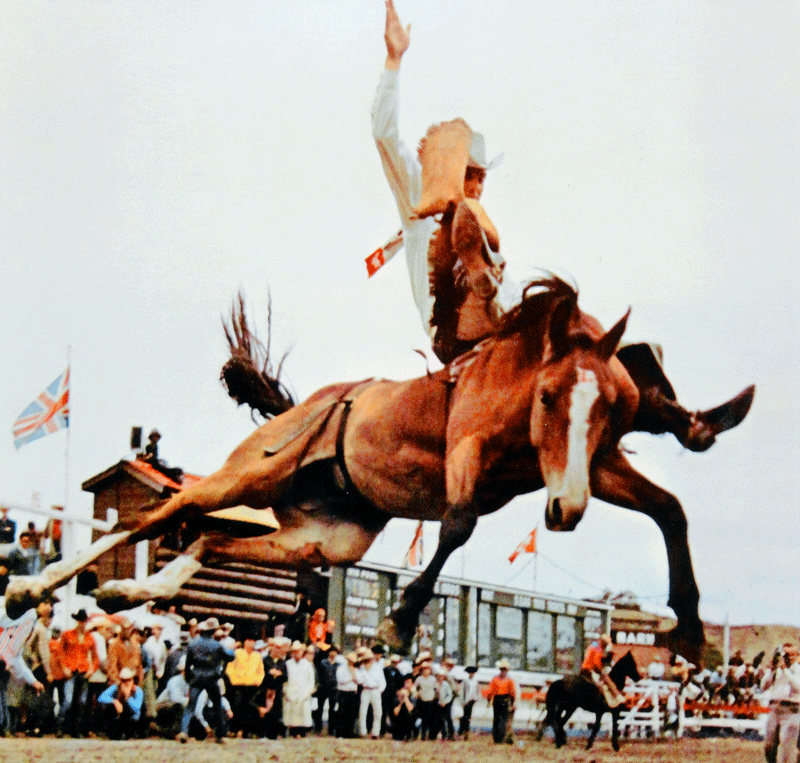
Back When They Bucked with Dave Garstad
[ “We had fun when we rodeoed, and it was good to us.” ]
or fifteen years straight, bull rider Dave Garstad never finished a Canadian rodeo season in less than fifth place in the Canadian standings.
The Stettler, Alberta cowboy dominated the rodeo scene for more than two decades, beginning in 1959 till he retired in 1980.
The eighth of nine children born in 1943 to Norwegian immigrants Magna (Juleson) and Olav Garstad, he and his brothers rode one of the family’s milk cows. “She bucked really well without a flank,” Dave said. “She’d turn back and spin right at the gate.” Weighing 1400 lbs., riding her gave the boys the rodeo bug.
Back then, near Veteran, Alberta, where he was raised, the local farmers and ranchers would have cow riding during the multi-day brandings. Men and boys could pay an entry fee of $3 or $4 and ride. At the age of fifteen, Dave won the contest and $400, which was a lot of money in those days.
And that success determined his fate in life: rodeo.
He was a three-event cowboy, riding barebacks and bulls and steer wrestling, but bull riding was his forte.
Because of his $400 winnings, he could buy a Canadian Pro Rodeo Association membership and compete professionally. But his mother wouldn’t sign for him, as a minor. So George Myren signed the release form and he became a full-fledged member.
He rodeoed professionally as he finished high school. He had “senior matriculation” – high enough grades to attend university – but he chose to rodeo. Dave still remembers what the school principal told him. “He said, for somebody that had the academic promise that I had, I was wasting my time in the rodeo business.”
But it wasn’t a waste.
He rodeoed across the country, and ventured to the States in the winter of 1963, hitting the big shows: Odessa, Denver, Ft. Worth, Amarillo, and on down the line.
His first time rodeoing in the U.S. was an interesting story. He’d gotten to the rodeo in Big Sandy, Montana, but didn’t have his RCA (predecessor to the PRCA) card. He phoned the RCA office, in Denver at the time, requesting a card on short notice. He got results: Bill Linderman, president of the association, called the rodeo secretary in Big Sandy, giving her Dave’s new card number.
When he was broke, he worked in the oil patch in northern Alberta and British Columbia to make some money. But there weren’t too many lean years. At first, he was winning $12,000-$15,000 a year, getting on 120 bulls and 60 horses. A person could live on those wages.
But as he got more experience, he was making $20,000 to $25,000 a year, when a regular income might be $10-$12,000.
In 1967, he was the Canadian champion bull rider, having won more money than any other bull rider in the country. That year, he won eleven rodeos and placed second at 37. “I won a lot of money, considering the times.” He was sixty cents short of qualifying for the National Finals Rodeo, due to missing two rodeos while he courted Linda, who would be his future wife. “That’s the girl I wanted,” he said, “and I ended up with her.”
From 1963-1978, he never finished lower than fifth place in the year-end standings in the Canada Pro Rodeo Association.
Bull riders covered more bulls then, he said. “We didn’t have the misfortune of being thrown off eighty percent of the cattle we got on. You might ride sixty or seventy in a row before being bucked off.”
Two of his brothers rodeoed with him: Gid and Dave’s twin, Mark. Sometimes they traveled together. Their dad, Olav, passed away when Dave and Mark were nine years old.
One year, Dave, rodeoing in the Midwest and the South, got on the bulls of 33 different stock contractors, and only got bucked off two of them.
He was a three-time Southern Circuit CPRA champion, and in 1980, qualified for his first Canadian Finals Rodeo. (The Canadian Finals Rodeo didn’t come into existence until 1974).
At the Finals that year, during a ride, the bull’s head came up as Dave’s head came down. The bull’s horn broke his left cheek bone and the horn tip crushed his eye, causing him to lose sight in that eye. After that, he retired. He and Linda had two young sons. “We had little kids, (ages three and five) at home, so I had to make some money. You can’t be bumping your head when you’re not physically fit,” he said.
After rodeo, he was a rig hand in the oil field, then in the 1980s, he went into the service business, monitoring drilling mud for ten years. Intelligent and a quick study, he understood every facet of the drilling business, knew the lexicon and the earth’s formations. He soon became a drilling foreman.
Typical of bull riders, Dave had his share of injuries. He broke his back once, and as a kid, broke his jaw, requiring him to live on canned milk for a time as his jaw was wired shut.
His worst injury was at Baird, Texas. After the buzzer, when Dave went to reach for his wrap, the bull bucked into a post, dumping Dave on the ground. The bull stepped on his back, breaking a shoulder blade and ten ribs on the same side. The ambulance driver, who had been drinking, forgot that Baird had a new hospital and drove his patient twenty miles farther than necessary to Abilene, Texas.
When Dave was released from the hospital, his brother, Gid, drove him to a motel. While there, he sneezed, causing a rib to puncture his lung, so he was back to the hospital. The “big-time” doctor at the hospital refused to see sports-related injuries because he felt they were self-inflicted. But the head surgeon was willing to treat him.
He was in ICU for a week, and when he flew home, the stewardess checked on him every five minutes, making sure he was OK.
Linda remembers a funny story from this hospital incident. She called him every morning, before work, to see how he was. One morning on the phone he gasped for air and couldn’t talk. She was upset, thinking he was getting worse. They talked that evening, and he explained: he had been laughing at Archie Bunker on TV. “He laughed so hard he couldn’t breathe,” she said.
Linda worked as a lab and X-ray technician; the couple had two sons, Ned, and Nate. The family traveled together when they could. The boys “always thought the bull riding should be first,” Linda said, “so they could go to the playground.”
The best part of rodeo, both Dave and Linda agree, is the people. Dave often traveled with Myrtus Dightman, Mel Hyland, and Tom Silverthorn, among others. “I could count on them,” he said.
“Rodeo is its own big family,” Linda said. And travel teaches lessons as well. “You learn so many life skills and coping skills out on the road.”
The couple lived in Big Valley, Alberta for 48 years, before moving to Stettler last year.
In addition to their sons and their spouses, they have three grandsons and a great-granddaughter.
Dave said desire is an important part of rodeo. “With any sport, if the desire isn’t there, you can’t do much at all, and in rodeo, that’s really evident.” He was inducted into the Canadian Pro Rodeo Hall of Fame in 2014.
He thinks about that first check he won, $400 for riding a cow at the ranchers’ branding. His rodeo career started, more or less, by accident. “If I’d have gotten stomped on that day, instead of winning, it would have been much different.
“We had fun when we rodeoed, and it was good to us.” -
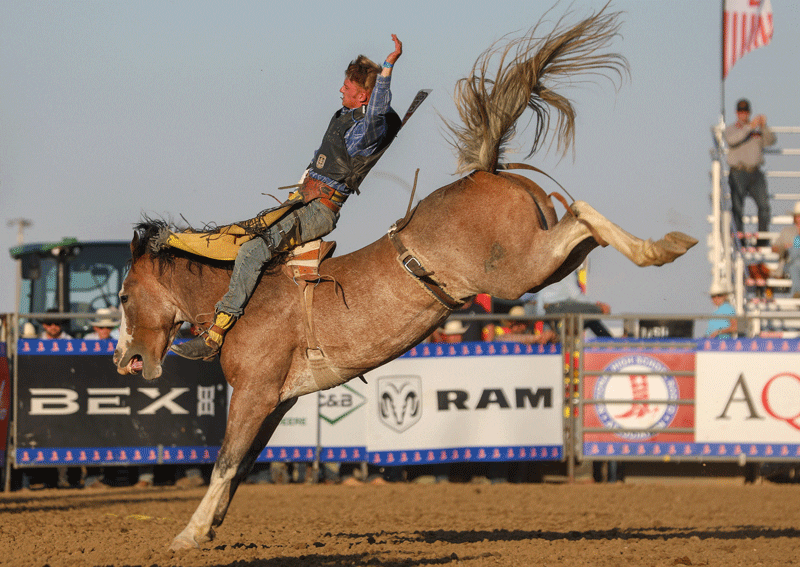
On The Trail with Monte Downare III
[ “I feel God is with me every time I nod my head,
and I know if I want to win I need to be calm, cool and collected.”]From the small town of Hartsel, Colorado, comes a cowboy tearing it up across the state in bareback and bull riding. Monte Downare, age 19, is no stranger to claiming wins at high school rodeos. He’s a four-time Colorado champion, ending his high school career as a four-time state champ: twice in the bareback riding and twice in the bull riding (2022, 2023).
At the National High School Finals Rodeo, in Gillette, Wyo., the family got word his sister, Gracy, age 18, was injured in a horse accident. Despite several fractures and a concussion Gracy insisted the family stay in Gillette and support Monte. He made it to the short go in the bareback riding in fourth place, drawing 843 Lost Lakota from Summit Pro Rodeo. He made a clean 80 point ride to win second in the short round and seventh overall nationally in the bareback riding and brought home two buckles. He is known for his iconic bright yellow chaps, featuring a holstered pistol on the hip and on the bottom the initials, MD3. The MD3 symbolizes that he is Monte Downare the Third. “My dad was a really good bareback rider, and my grandpa made his legacy ranching.”
When he wasn’t in school or playing sports, Monte was working on the four-generation family ranch with his three siblings; Gracy,18; Kally, 14; and younger brother, Vaughn, 12. The ranch supports five Downare families and continues to thrive through diversification. They invested in ground in Eastern Colorado to winter the cattle. They have a farm in LaJunta to raise the winter feed. The ladies cook the noon meal every day, feeding around 20. They invite friends and family from all over to enjoy the ranching life and be part of the spring branding. They also run buffalo, starting with 6 back in 1964. The herd continues to grow, providing additional income through the sale of meat.
The Downares started out training saddle horses years ago and soon realized there was a market for trained Belgium teams. Since they use teams to feed in the winter, they started raising the training the horses for sale. A few of the Downare men acquired auctioneering abilities and were hired at various livestock barns. Using those skills and experience, they decided to create their own consignment sale. “We were ranching, and it was back when cattle weren’t worth a whole lot, and so we came together and started this auction,” explained Monte’s dad, Monte. “It has been great; we sell everything from antiques to animals.” The entire family is involved in the auction – from the auctioneering to the clerking. “I’ve been selling my whole life from livestock to buckets of bolts. I started when I was little, selling at consignment sales.” Monte spent a few years chasing his rodeo dreams, leading the standings in the Colorado Pro Rodeo Association along with his brother, Micky. “My brother and I rode bareback horses. We both amateured a little but mostly competed in PRCA.” He had some good years, including winning Denver in 2004. “It got too tough to keep going and support my family so I stayed in the circuit,” he said. “We used to have saddle bums come to the ranch for work…but that day is gone. Rodeo is the last of the cowboy.”
Of the 14 Downare cousins, four compete in rodeo and many are still too young. “My dad was a rodeo clown and worked for Edger Wilson for years,” said Monte’s mom, Lacy, who also competed. Now both she and Monte are cheering on their son, Monte III, who is a freshman at Casper College. He received a full ride scholarship to ride barebacks and bulls for the Thunderbirds.After the high school finals, Monte spent the summer traveling along the CPRA, WRA, and PRCA circuit rodeos. He won his first PRCA rodeo in Steamboat Springs over the weekend of June 23-24. Now he will rodeo in the Central Rocky Mountain Region while studying Fire Services. His goal is to start his PRCA career by winning Resistol Rookie of the Year when the time is right. “I just feel it’s in my blood and I feel it’s my thing,” said Monte. “It’s my passion and what I want to do. My dad, and all his traveling partners, including Kelly Timberman, have inspired me. I think God put me here to rodeo – to make the most of it.”
-
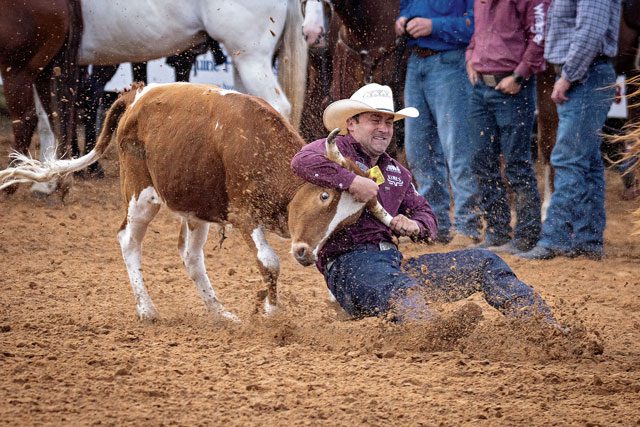
Community Coffee: Tristan Martin
Editor’s note: Tristan Martin was featured as the On the Trail in the 2022 July issue of Rodeo News Please see link below to read full article:
https://reader.mediawiremobile.com/RodeoNews/issues/207953/viewer[ “Growing up in Louisiana, I didn’t know there was another kind of coffee,” said Tristan Martin, 2x NFR qualifier in steer wrestling. “Every breakfast table and store served Community Coffee.” The cowboy from Sulphur, Louis., won $170,981 last year steer wrestling. We caught up with him during the run in the Northwest. “I just put a big order In for more – these guys up here love it.” Tristan’s favorite is sweet tea. “When I saw them getting involved in rodeo, I reached out to them. It’s a Louisiana brand and you don’t see many of them coming in to help us out.” ]
Tristan hails from a long line of rodeo greats, including his uncle, Casey Martin, who made five trips to the NFR in steer wrestling. He is the oldest to 57 grandchildren in the Martin family, which gives him access to chute help, practice buddies, and a cheering section just one mile from his house. Tristan married Josee in 2020 and their son, Boudreaux was born right after the NFR in 2021. He went to his first rodeo six weeks after he was born and watched his dad win the 2022 Fort Worth Stock Show.
This is Tristan’s fifth year on the rodeo road, and he just bought a new horse, so he plans to continue for several years. “I feel like this is a talent God’s blessed me with and it’s a great way to meet people and do what I love.” The only downside is leaving his wife and son at home for long periods. Josee has a really good job as a nurse and that provides the family with health insurance. “There’s lots of family close by so she’s got help if she needs it.”
He has developed a network of places to stay and made friends in all corners of the country during his tenure on the rodeo road. “It takes years to figure out where to stay and make friends,” he said. “It’s really nice, we base our northwest run out of one place – we can wash clothes and have homemade meals.” He admits it’s hard to receive the notoriety along the way. “I got my name on the side of my truck, and people pull a $1 out of their pocket and have me sign it.”
Tristan has been giving back by doing clinics to help the upcoming steer wrestlers. “We’ve done one at home for four or five years.” His Uncle Casey, and Tom Carney help. He does a second clinic in North Dakota in the spring. -
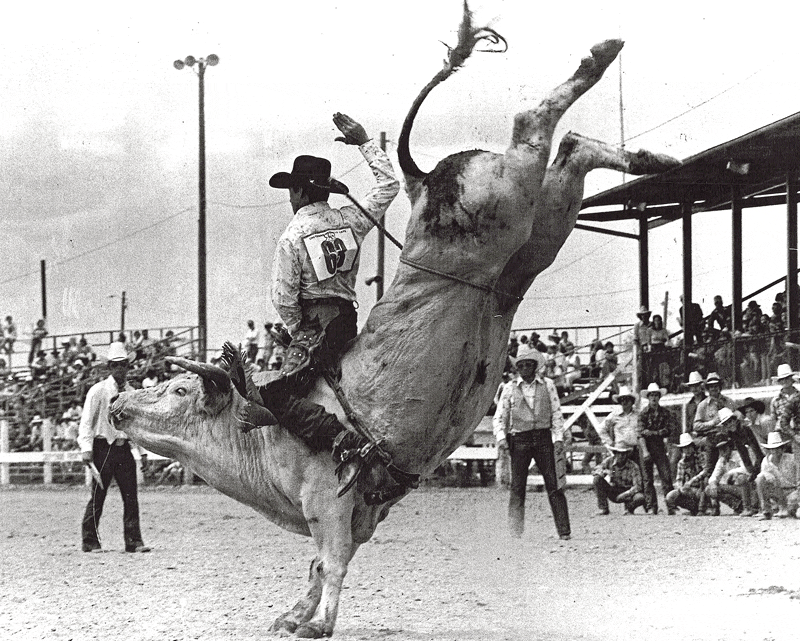
Back When They Bucked with Jerry Beagley
Jerry Beagley has enjoyed a Western way of living from the time he was born. He was born in Medicine Lodge, Kansas, October 2, 1954 to Otto and Evelyn Beagley. He was an only child. His dad was foreman for the Chain Ranch, located in Kansas and Oklahoma. The Chain Ranch ran 2,500 mama cows. His dad always had good horses. In addition to his dad being foreman of the Kansas part of this major ranch he was also in demand as a pickup man at various area rodeos.
When Jerry was 4 years old his dad would put him on calves and run alongside holding him by his belt, so he wouldn’t fall off. Jerry was seven when his parents took him to the 1961 National Finals Rodeo in Dallas. As he watched the cowboys compete he asked his mother, “Do you think I will ever be good enough to compete at the National Finals?” She said, “Of course, son, you will be good enough.” Jerry said his mother never lied to him, so he always knew he could do it. The first big bull he rode was at a rodeo in Turley, Oklahoma at age 12.
As a youngster he competed in Little Britches Rodeos in goat tying, flag races and more. His sophomore year in high school at an FFA rodeo in Freedom, Oklahoma, they were using feisty wild Hereford cows. The stock contractor told Jerry’s dad Jerry couldn’t ride one of his cows. Jerry’s dad bet him Jerry could. Jerry knew his dad didn’t make a lot of money, and was concerned that if he didn’t ride the cow his dad would lose the bet, and his money. Jerry did ride the wild cow, even though he lost both of his boots during the ride. He made the whistle! He also was the Kansas High School Calf Roping Champion. In 1972 he was the Little Britches Bull Riding Champion and All-Around Champ.
“I had extremely positive parents” said Jerry. “ They told me I could do whatever I set out to do. They made me believe in myself. ” He was valedictorian of his Medicine Lodge Senior class.
He attended Fort Hayes (KS) State University and majored in Math. He was on the rodeo team and won the 1974 NIRA Bareback Riding Championship. He transferred to Southeast Oklahoma State University and at the College National Finals, in 1977, held at Bozeman, Montana, he won the Bull Riding Championship and the All-Around.
Sylvia Mahoney, author of “College Rodeo, From Show to Sport” wrote: “Jerry Beagley’s eighty-two-point ride on Black Satin in the final round led to the bull riding buckle and helped his team win the Men’s Team Championship.” That was the year he decided to start concentrating solely on bull riding.
Jerry got his Rodeo Cowboys Association (RCA) permit in 1974 and his card the following year. Previously he had been making a living competing in amateur rodeos. Before he turned pro he had gone to approximately 120 amateur rodeos each year.
Jerry’s mother was right when she told him, at age seven, he would be good enough to go to the National Finals. He went to his first National Finals in 1978. He was the Reserve Champion in 1979, just after World Champion Donny Gay, in spite of the fact he was injured after the 2nd round at the Finals. He also qualified for the 1980 and 1982 National Finals.
Injuries are part of rodeo, some events are more injury-prone than others, and bull riding is one that definitely causes injuries.. Jerry was injured in 1979 when he broke his jaw and had to have stitches in his face due to his injury. The following year, 1980, he qualified again and this time the bull broke his ribs in the second round. He tried for two more rounds to compete but it wasn’t working. Jerry jokingly said, “Yes, I rode bulls — I rode bulls before they began tipping their horns.” This did not deter Jerry from continuing to ride bulls, but when he quit in 1986 he explained it this way, “I quit because I didn’t want to get bitter about something I liked so much. I loved riding bulls.”
Jerry held Bull Riding Schools in various Midwestern locales. It was going so well he taught bull riding as far west as Hawaii and Florida to the east. But that wasn’t enough for Jerry so he took his Bull Riding Schools to Canada, Australia and Brazil. Jerry said, “Lots of students that sign up will never become bull riders. I tried to teach them how to have the right mental attitude, how to win, how to get from rodeo to rodeo, and much more. I wanted them to leave my school having learned something more than just how to ride a bull for their $200.”
The era in which Jerry contested was when those serious contenders found ways to get to several rodeos during the same weekend by flying. He got his pilot’s license and flew in small planes to get to as many rodeos as he could. In 1978 he competed in 175 rodeos and 169 rodeos in 1979. He and Brian Claypool, another rodeo competing pilot, flew together a great deal. Claypool was in a plane that went down somewhere in mountains near the California-Oregon border, May 22rd, 1979. Brian and three other cowboys were killed. The wreckage was not found for months until a hunter found the remains in a remote area. Jerry explained, “If I hadn’t opted to stay home and put together an anniversary celebration for my parents, I would have been on that plane.”
Other cowboys Jerry traveled with were Jerome Robinson, Lane Frost, Ted Nuce, Lyle Sankey, Bobby DelVecchio and Steve Lance . Jerry traveled alone more than he did with other competitors. The work ethic his parents instilled in him early in life kept him on the road getting to as many rodeos as he could possibly get to. In fact, Butch Bratsky said: “They called Jerry ‘Milemarker’ because he got to more rodeos than most cowboys could or would get to.”
Jerry worked extremely hard to get the Justin Sports Medicine Program up and going because he believed it was important in the world of rodeo. He worked with Dr. J. Pat Evans, the doctor that was responsible for keeping Dallas Cowboys football players healthy for their games. Dr Evans started having medical people available at each rodeo to keep cowboys with minor injuries able to compete, and advising them medically if necessary.
The Christmas after Jerry turned 18 his dad gave him a hundred dollar bill. Jerry drove to Tulsa and bought as much nylon parachute cord as the money would buy. “I took it back to college and started braiding and creating reins in the dorm. They make great reins and presently I have quite a group of people braiding for me in their homes. It’s called cottage labor and individuals work making items at home, send it to the company and are compensated for their efforts.”
Jerry owns his own businesses, Jerry Beagley Braiding Company Inc. and Ott Ranch Saddles. He sells horse equipment wholesale, which includes over 400 items, for all kinds of horses – barrel racing horses, calf roping and more. He sells to over 200 stores in the United States. He also sells all over the world, including Canada, Australia, Switzerland and Brazil . Jerry met, at his bull riding school, the man who ended up providing through Jerry’s company the bull riding equipment for bull riders in Brazil. I don’t think it was more than a handshake, but it has been very successful for both of us.” said Jerry. He also met Adriano Moraes, from Brazil, who became the first Professional Bull Riding World Champion three times, 1994, 2001 & 2006. They have had a twenty-plus year friendship. In the early 2000s Jerry received the Small International Import-Export Company of the Year, in Oklahoma.
Martha Josey competed in barrel racing the same time Jerry was competing in bull riding and they became friends. Martha said, “Years ago at the Mesquite rodeo my hand slipped on the reins, when I was competing. When I finished I told Jerry and he created the ‘Martha Josey Knot Reins’ which have been selling for over 40 years. Jerry has such a good work ethic he could out-rodeo every one else. I can’t say anything that isn’t good about Jerry.”
Jerry married Beva Farnham, from Canada, and they had two children. Their daughter Martha who competed in rodeo in various events through college, presently she is a full-time mother to two children. Son, Brian, never was interested in the rodeo world, he found his passion in motorcycles and such. He lives in Canada and has two children.
The National Intercollegiate Rodeo Association Alumni Association was formed in 1982. Jerry became involved to be able to help students go further in their desired professions. He is a Board member and when U. S. Tobacco dropped their support for college students he became a strong supporter of the fund raising part of the organization making every effort to get more sponsors to provide scholarship monies. Sylvia Mahoney said about Jerry: “He is one of the silent people that is always working to discover new ways for the Alumni Association to raise funds to support the rodeo teams. He donated a saddle to be raffled off to raise funds for the project.”
Jerry is a self-made man who has accomplished many things in his lifetime. He has given back by his efforts to rodeo in numerous ways. He has helped many young people just starting their rodeo careers. He is revered by those who competed with him and worked with him. He is his own man – an individual, honest, determined and perseveres, while displaying humility. He admits he owes it all to his parents, friends and Jesus. -

On The Trail with Jennifer Welch Nicholson
Riata Ranch International
[ “You earn your reputation in the arena, but you earn your respect in the barn”. ]
Jennifer Welch Nicholson is the 2023 Tad Lucas Award recipient. “I’m proud that I was able to live my life in such a way that I was considered for this, award” said the 60-year-old trick roper, rider, and Executive Director of Riata Ranch. She will join recipients of this award, presented during the Rodeo Historical Society Hall of Fame Induction, November 10 – 11 at the National Cowboy & Western Heritage Museum in Oklahoma City.
“I didn’t grow up in rodeo, I had to learn this lifestyle from the ground up. I never thought I was that kind of person; I was shy!” Jennifer sees this award as an opportunity to tell her story. “I was just a young girl, and this became my life.” Born on the family ranch in Redding, California, Jennifer’s family moved away when she was quite young. Her parents, Dennis, and Judy Welch, knew their daughter had a passion for horses and hoped that some time at the Riata Ranch, meeting her lifelong mentor, Tom Maier, and learning how to ride, would fill that need and she would eventually grow out of it. Her brother, Mark, was an outstanding award-winning athlete in football, basketball and track Her passion only grew and then a trick rider, Kathy Batchelor, was brought out to the ranch to teach the girls a little bit of western entertainment. “I was enthralled and enamored,” she said about meeting legends like Monty “Hawkeye” Henson. “I never knew of such a character.” When it came time to perform, Jennifer, age 13, and three other young women, comprised the first rodeo trick riding team performing at their first rodeo in Bakersfield with Rodeo Stock Contractors. “We didn’t know anything about rodeo.” The group began to expand their reach and with that they also started riding for the Flying U Rodeo. “It was Cotton Rosser and the Flying U Rodeo where we cut our rodeo teeth. I’m Flying U Rodeo raised!” They went on to perform internationally, building up Western riding in Europe in the early 1980s.
She went to Riata to learn to ride horses and become a member of Tommy Maier’s’ junior horse show team specializing in reined cow horses – then the trick riding and roping evolved. 2002 was an eventful year for Jennifer and one that changed the trajectory of her life. The owner of Riata Ranch passed away and the property was in bankruptcy. She made the decision to save it and created the new business as a 501 c 3 Non-Profit. The biggest challenge was to rebrand, find new property and build new programs, yet keep the same values and integrity that Riata Ranch was known; Horsemanship, leadership, mentorship, education, and community service. A year later, Jennifer met and decided to marry Chad Nicholson. “I thought I’d met my life partner. And for 17 years that was true.” Between performances, they built Riata Ranch into a mentorship program for young women seeking the refuge and freedom that horses bring. From simple riding lessons to complex disciplines, Riata Ranch grew into more than just a riding program. It connects people to horses, ranching lifestyles and professional rodeo for a day, a week, a month, or lifetime.
Jennifer learned many life lessons on the Riata Ranch growing up. “It helped me become tough, resilient, and endure crisis.” She learned to have a plan A, B, C, And D. “There is always a way to go – and you have to figure that piece out.” Jennifer lost the love of her life, Riata Ranch almost twice, and her dad got sick and passed away all within a year. “When I came out of it, I was a changed person – we all have choices – you make those based on what you want, and I wanted to keep going.”
2019 started out like any other year, full of promise and opportunity. But, sadly, in May of that year, Chad was killed in a freak auto accident. And that event changed everything.
“The Friday night I got word that Chad had passed away I was in Hayward at the Rowell ranch Rodeo in California. Surrounded by Randy and Michelle Corley, Cindy Rosser and a handful of other rodeo family, I was consoled and sent home with the girls.
I got home stunned and dazed. Earlier in the year, a dear friend and Three Rivers Icon had also passed away and Chad and I had agreed to let the family host a memorial service for Earl McKee that Saturday for 400 people. As his (Earl McKee) service was happening I tried my best to disappear against the wall of my home. It was less than 24 hours, and I was still comprehending the loss of my husband, my partner, my future.
As the service ended, I went inside feeling numb and not having any idea whether to cry or to be still. Soon, people started coming in with food and buzzing around asking me it there was anything they could for me. At first, I just wanted to scream but I realized they were asking, ‘What can we do for you right at this moment?’ Funny how you can be so unreasonable when you are in the grip of grief and despair. So, when I understand their compassion to help me right at the moment, I knew exactly what I didn’t want to do…I didn’t want to clean, I didn’t want to cook and I didn’t want to pick up dog poop!
That was my first glimpse into a way to move forward, just not today. Bring it to a simplistic level and ask for help. Don’t bury your head in the sand and just put one foot in front of the other. I really fell apart, but not in public. I kept going and the people around me allowed me to keep going. It was the resilience – life is not fair and hard tough things happen.”
Jennifer moved forward again. “Everyone gave me a grace period and I had wonderful people around me.” She knew the best way to continue was to build on what she and Chad started at Riata Ranch. “After Chad passed away, I had some down time, and saw things I needed to change. I realized I wasn’t communicating my expectations. I learned to be more upfront about things.” She is working on growing and building relationships and that includes giving more definite clear pictures of what she is doing.
“I was passive – but sometimes I think it left people with a bigger gap to close.” She realizes that young girls come to her with stars in their eyes. She was the same way. “I tell them that this is a journey, and the commitments are real. We have red, white, blue, and silver levels for these girls to pass – they are benchmarks.” The biggest requirement is true passion. “We can provide any of the actual needs, but we can’t provide the want to.”
She has developed leadership skills along the way. “It’s more than putting someone in charge, a good leader goes beyond that and realizes the value of their people and that includes having difficult conversations. If there is something I’m trying to achieve, I’ve got to figure out how to have a difference of opinion. The better equipped we are at handling the negatives, the better off we are.”
Her time is split between traveling, performing, teaching, and administrative duties. “I love teaching, and I like connecting with people.” She is realizing that she has changed – that she meets hard challenges with thoughts on how she chooses her words and what she hopes for the results. “That’s leadership.” She is hoping to swing the pendulum a little more towards home and groom someone to take over the business end so she can teach or perform with the girls.
“It’s a labor of love that I feel is more important than ever to educate about: teaching people from all around the world about livestock, how our food is produced and our western lifestyle.” -
Community Coffee: Hailey Kinsel
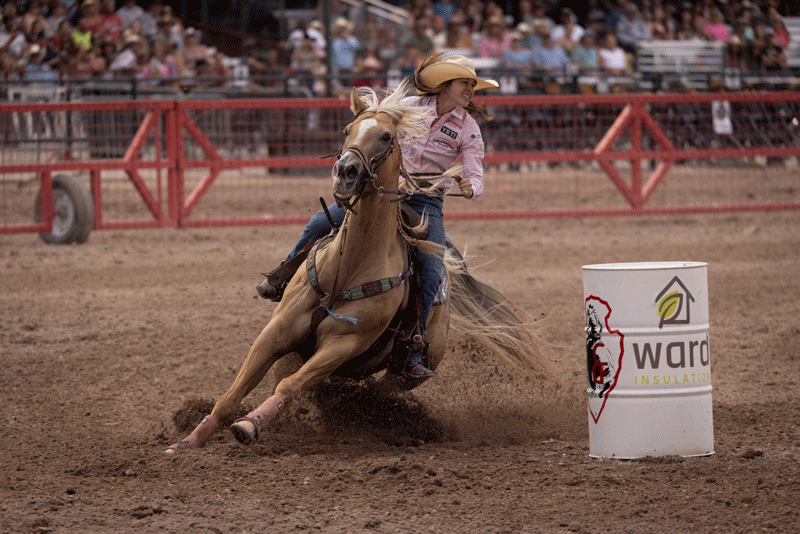
Hailey Kinsel starts her mornings with a warm cup of Community Coffee and a grateful heart. A 4x World Champion barrel racer, the 28-year-old is currently ranked seventh in the world. She doesn’t go a morning without her caffeine boost, her favorite being Community Coffee’s Mardi Gras King Cake blend. Hailey has a routine before her events that goes hand in hand with her cup of joe. “I try to take a moment where I get to sit outside, usually with coffee in hand,” Hailey said. “And just appreciate that I’m at this rodeo, this is a rodeo I’ve wanted to come to…and I’m here to do my job.” Hailey is appreciative for her sponsorship with Community Coffee, which began in the spring of 2022. “They’ve gone above and beyond their promises to us as far as what their goals were on helping the industry grow,“ Hailey said, grateful for the organization’s commitment to working directly with athletes. She enjoys the coffee stands they set up for contestants at rodeos. She is also thankful to be working with an organization that is aligned with her values.
“They’re all about family and community and taking care of the people around us,” Hailey said.
“They’re big on working together and helping us work with each other, helping as a group to grow our sport and they truly believe in rodeo’s value system.” She is grateful to work with Community Coffee as she moves forward in her rodeo career.
Hailey grew up on a ranch in Cotulla, Texas, where she currently lives when she’s not on the road for rodeo. She has had a love for working with horses ever since she can remember. She has memories of her mother leading her on a horse at around three or four years old. Hailey participated in rodeo and 4-H events growing up but found a deep passion for rodeo competition and working with her horses. “I really just love running a horse down an alley,” Hailey said. “I really liked that rodeo takes you to different places all the time where you can do that same thing somewhere else.”
Hailey is grateful for the support of her family throughout her career, as they have encouraged her passion as a competitor. She has faced victories and challenges during her time in rodeo. She recalls the first time she won a world championship. “It was so special, you know it’s kind of a surreal feeling, because that’s something you dream about but you’re not sure if it will happen to you,” Hailey said. Along with the fulfilled goals, comes the challenges. Rodeo has thrown her unplanned curve balls.
“If there’s a challenge in rodeo I’ve faced it,” Hailey said.
She has faced challenges with horses, equipment, finances and the struggle to be away from her family. Rodeo calls for a lot of travel, which means missing big events in her family. Hailey explains that she will be missing celebrations like her cousin’s wedding. While Hailey wishes she could celebrate these events and milestones, her path in rodeo calls for her to be on the road, chasing her goals.
As she has won championships over the years, she has also accumulated fame. After a race, fans call her name asking for pictures and autographs. Hailey is grateful to be a role model and to interact with fans. This aspect does limit her time to reflect after an event. She has had to find a way to balance these aspects. She’s learned to turn on her ‘greeting switch’ after races and make time to reflect and learn from her run later on. She’s found that she often has time to reflect on her performances during her drive time between rodeos. Hailey often drives on her own, with her mom or a friend driving with her occasionally. This gives her time to reflect on her performance. “There’s no real guide on how to handle that, it’s just something you learn as you go,” Hailey said. These challenges have grown her in her career.
No matter what, Hailey is always looking toward the future. She’s thankful for the past and the aspects that have led to her success and championships but uses “that as fuel to move forward,” Hailey said. “We’re not going to get stuck in what we used to do, we’re going to keep trucking forward.” Hailey is cautious to not let her success of the past allow her to stop working toward her next goal.
Burnout often lurks in the back of many rodeo athletes minds as they continue to chase their passions. Hailey, however, has a plan to conquer it. She has already experienced some burnout in her career and feels prepared to handle it. “I’ve experienced it so I can’t say it’s something I’m afraid of by any means,” Hailey said. She recalls when she did experience a little burnout. It occurred “because I got so fixated on the things I wanted to accomplish here that I couldn’t be content with what God had for me at that time,” Hailey said. She plans to guard her heart and not get fixated on the small aspects like wins and losses when put in perspective of God’s plan for her life.
Hailey is looking forward to her next goal as she prepares for the Cinch Playoffs in Sioux Falls, South Dakota. She is working hard to qualify for the playoffs. In 2020, she had the opportunity to compete at the playoffs in Rapid City, South Dakota. Despite the COVID conditions during that time, the state made a way for her and the other athletes to still have an opportunity to compete. Reflecting on this experience, Hailey is looking forward to competing in Sioux Falls under more normal conditions. She is looking forward to honoring “those people that champion us and our sport and allowed us to make a living in 2020,” Hailey said.
As she plans for approaching rodeos, she is also taking steps to make sure that her 12-year-old horse, Sister, is prepared for big events. Sister currently has $2.8 million in earnings and has always shown up ready to compete. “She’s had an incredible career and one that isn’t anywhere close to finished,” Hailey said. She picks certain rodeos to bring Sister to so she has less travel time and is ready for bigger rodeos. Hailey explains that Sister is “truly special” and is sure to keep Sister’s fitness up through workouts. Hailey also spends time to make sure that she is communicating well with Sister and they are both prepared for rodeos.
When she’s back home in Cotulla, Hailey spends her time training horses. She trains horses for different purposes like ranch work, barrel racing and to sell. She trains an equal amount for her personal use as she does to sell at this point. When she is travelling, her mom helps with the training when she can. Hailey has enjoyed training kid horses that are safe for children to ride and has clients in south Texas for these horses.
As she prepares for upcoming rodeos, she never forgets the reason why she is where she is. “I’m very thankful for the blessings I’ve had that allowed me to live this dream, but I always try to remember that I’m living this dream because of what God has for me to do, which is to give Him glory,” Hailey said. -
Confessions of regret
As it turns out, I know way more about failing than I do victory in Jesus. The victory part I seem to be dismal at. The failing part, in a major sense of the word, I may be at a professional level. It is true that God uses everything and everyone for His Story. Yet, honestly, I fail. By faith I know that God will use it. Yet, the failure or regrets remain.
Please keep in mind I am not a pessimist or an optimist. Both will get one killed at worst and embarrassed at best. I am a realist. The cup is both half full and half empty. Allow me to be truthful about my “cup.”I have regrets. Here are a few I am willing to talk about for broad readership:
Children: It always frustrates me, and has for decades, when we give ourselves a pass on parenting. It comes in the form of: “well, we all do the best we can.” To which my honest side says: “well, maybe, sometimes.” There were times when I was absent too often. As they grew, there were times where I spoke with a lack of sensitivity. In ignorance and inability generally. Regardless, I missed their hearts. Their eyes shifted and dropped, and I was helpless to correct it. There were occasions, I cannot recall now, where I was lazy. Not tired, but just lazy. Other times, I forced compliance for my best, not theirs. Occasionally too harsh or too soft. My youth prevented me from knowing how to enter their worlds with courage and sensitivity. My language skills for my son were adequate. For my daughters however, who preceded him, they were desperately lacking. Especially before they left to craft their own lives. My poor skills and fear of a heart-language caused me to step back too far or step in too hard. It feels now that I rarely got it right. There are regrets here. Yet, they are each independent, kind, strong, and far better parents than I.
Spouse: Occasionally, I get it right. More often than not, I get it somewhere between really missing and kind-of missing Susie’s heart. 30 or 40 years ago was another story. Ambitious and aggressive, sometimes necessarily so, I put so many things in front. Career demands, other people, my pride, and my hobbies slithered to the top of the daily planner. I cannot get these back. They just are and mark different phases of my life. These days, it is hopefully different. I miss less, but still miss. Self-care is important. Self-focus is indulgent. As much as I think I defer in kind and humble ways, I have been, and can be, self-focused. Regrets abound.
Career: Had I put my head down and gotten after it, I would have been more effective. My staff would have thrived better. There may have been a book. A few hours a day of absolute laser focus would have been monumental. Again, sometimes I did my best. Other times, I took the easy way and got a pass. It maybe was good, but not my best. I hate that.
Friends: There are many who ask for attention from all of us. I have given lots of attention to the wrong people. Other times, I have given not enough to the right people. The reasons, in part, have to do with character flaws in me, I’m sure. Some of those I’m aware of, others I’m not. For those true friends who asked for more, I am sorry I failed you. For my friends who wanted to know my heart and I played it safe by talking about hobbies and the weather, I apologize. At some level, I believe if you really knew me you wouldn’t like me. That has made me cowardly on occasion. Overbearing at other times. I regret that.
Pastoring: it seems like this would be the one place where all my other failings fade away and I announce, in false-humility, one giant success story. Nope. It would be easy to god-speak and talk about blessings and victorious preaching. For me, that’s a nonsense smoke screen. I fail myself and my congregation regularly. This is the primary topic of my prayer life with God.
Despite all of this, I will carry on. Acknowledging these things will hopefully produce more meekness. I need it.
I’m sure more failures and regrets await. Probably in these same arenas. I will do what I’ve always done. Keep going and trusting in the grace, forgiveness and redemptive nature of a Good Father. I’ll never regret that.