Rodeo Life

Author: Ruth Nicolaus

  • BUFFALO BILL RODEO TITLISTS

    BUFFALO BILL RODEO TITLISTS

    Team roping duo sets new record, Texas cowboy matches bareback riding record at North Platte rodeo

    North Platte, Neb. (August 8, 2020) – In front of empty grandstands, the cowboys at the Buffalo Bill Rodeo put on a show.

    One record was broken, and another was matched in a year that saw empty grandstands on three of the rodeo’s four nights, due to COVID-19.

    Nelson Wyatt, Clanton, Alabama, and Levi Lord, Sturgis, S.D., made a 3.8 second run to win the team roping and beat the old record, set in 2018 at 4.4 seconds by Curry Kirchner and Chase Boekhaus.

    For Lord, who is 24 years old, it wasn’t a surprise. “I’ve been to that rodeo a lot of times, and (the team roping) usually isn’t that fast, so I figured we broke it,” he said.

    The pair is having the best year of their pro rodeo career. Nelson is ranked ninth in the PRCA’s world standings and Lord is eighth, and they’re hitting every rodeo they can get to.

    But so is everybody else. The virus pandemic has canceled more than 350 pro rodeos across the nation, making for larger numbers of contestants at them. “The rodeos have been tough because everyone has the best guys in the world, with close to 100 teams. It’s definitely been different and it’s been tough but it’s worked out for us so far.”

    Rodeoing has always required a lot of travel but it’s even more so this year, Lord said. “They’re so spread out and we’ve been entering quite a few. You rope at one and have to get in the truck to the next one.”

    They’re mentally preparing to compete on pro rodeo’s biggest stage, the Wrangler National Finals Rodeo in December. “We’ll try to finish out the year doing what we can do, controlling what we can control, and we’ll see how it works out from there.”

    In the bareback riding, the number five man in the world standings tied the arena record and won his event.

    Tilden Hooper, Carthage, Texas, scored 89 points on the Rocky Mountain Rodeo horse Hard Times to match Austin Foss’  2018 ride with the same score.

    Hooper was delighted to draw the horse, whose bucking pattern allows a rider to showcase his talent. “That horse blows up in the air and stays real close (to the chutes),” he said. “The higher they get in the air, the more time it gives us to spur and show off. It’s more fun.”

    It was the first time for Hooper to compete in North Platte. “I’ve never been to this rodeo before, and this probably won’t be the last time. For no more rodeos than we’ve been getting to go to, it means a lot to us for the people of North Platte to put on a rodeo, to give us a place to come and go to work. And to get to win, that’s great.”

    Fewer rodeos to compete at is a benefit for Hooper.

    “I tell you what, this is the week normally when we’re going full blast and rodeo becomes a job for me and it gets to be work. You’re driving a lot and you have been for eight weeks straight.”

    He will be home for a week before he leaves for another show. “If anything, it’s a blessing to be so rested. I’m 32 years old, and any time I get to let my body heal and recover and not take the beating, is more time on the back side. (Bareback riding) is the most fun thing in the world and the best job in the world and I want to try to do it as long as I can.”

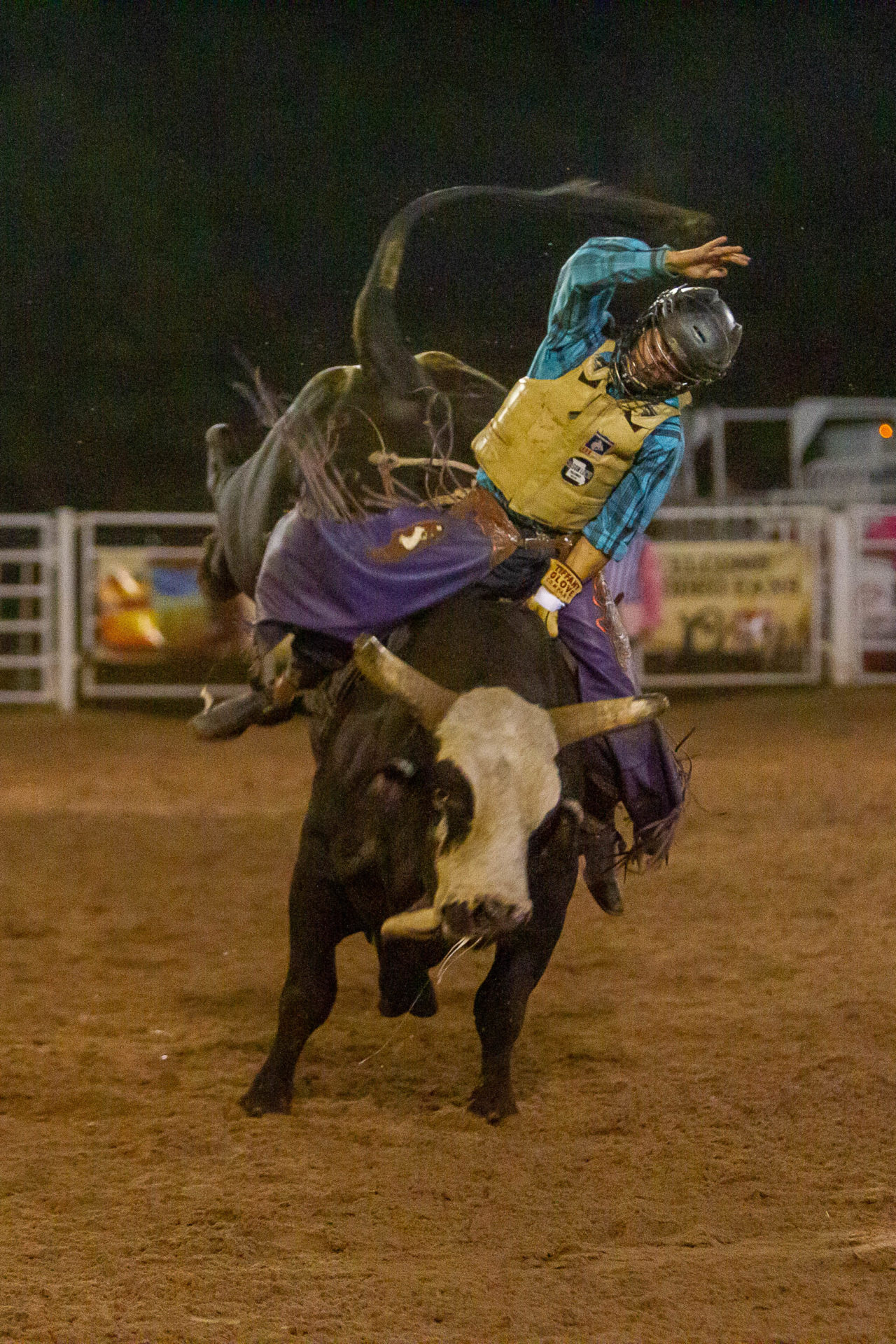
    Missouri man Denton Fugate won the bull riding. He scored 88 points on Beutler and Son Rodeo’s Roll Tide, after having seen Jeff Askey win the Burwell, Neb. rodeo on him two weeks ago.

    “I drew him and was just lucky to have him,” he said. “He kept trying to drop me off on the inside of the spin in the well. I just kept fighting him, staying out of the well, and it worked out.”

    The 25 year old man won San Antonio, Texas and two other rodeos over the winter and was having the best year of his career when COVID-19 hit. Over the July fourth holiday, he won a little money, but “after that it’s been really slow.” He dropped from ninth in the world standings to sixteenth over several weeks.

    The North Platte rodeo “was definitely a need-to-ride situation,” he said.

    He’s been overanalyzing bull riding lately, he believes. “I’ve been forcing it too much instead of letting it happen. I quit thinking about it and it worked out tonight.”

    The win could turn things around, he said. “It already has, I feel like. I’m excited about it.”

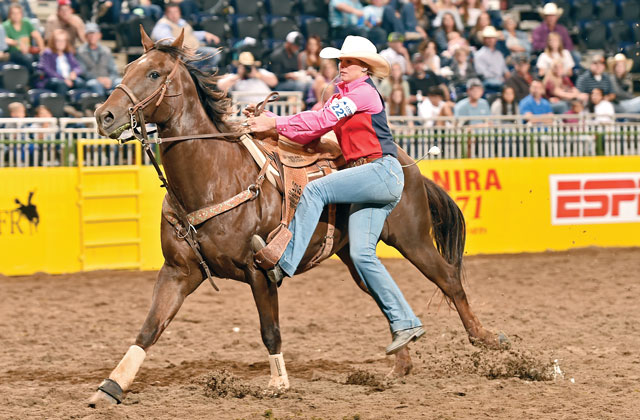
    Other 2020 champions include steer wrestler Cody Devers, Balko, Okla. (3.6 seconds), tie-down roper Macon Murphy, Keatchie, La. (7.8 seconds); saddle bronc rider Jake Finlay, Goondiwindi, Australia (87.5 points); breakaway roper Syerra “C.Y.” Christensen, Kennebec, S.D. (2.3 seconds) and barrel racer Michelle Alley, Madisonville, Texas (17.20 seconds).

    – ### –

    Results, North Platte, Nebraska – Buffalo Bill Rodeo August 5-8, 2020

    All-around champion: Zach Jongbloed, Iowa, La. – tie-down roping and steer wrestling

    Bareback riding – 2020 champion: Tilden Hooper, Carthage, Texas

    1. Tilden Hooper, Carthage, Texas 89 points on Rocky Mountain Rodeo’s Hard Times; 2. Tim O’Connell, Zwingle, Iowa 86.5; 3. Zach Hibler, Wheeler, Texas 84.5; 4. Kaycee Feild, Genola, Utah 82.5;  5. Pascal Isabelle, Okotoks, Alb. 82;  6. Will Martin, Goodwell, Okla. 81; 7. Blaine Kauffman, Pretty Prairie, Kan. 80; 8. (tie) Jesse Pope, Marshall, Mo. and Craig Wisehart, Kersey, Colo. 78 each.

    Steer wrestling – 2020 champion: Cody Devers, Balko, Okla.

    1. Cody Devers, Balko, Oklahoma 3.6 seconds; 2. (tie) Cole Edge, Durant, Okla. and Tanner Milan, Cochrane, Alb. 3.8 each;
    2. Jace Melvin, Ft. Pierre, S.D. 4.0 each; 5. (tie) Jacob Talley, Keatchie, La., J.D. Struxness, Milan, Minn., Cade Staton, Jonesboro, Texas and Dakota Eldridge, Fallon, Nev. 4.1 each; 9. (tie) Stetson Jorgensen, Blackfoot, Idaho, Will Lummus, Byhalia, Miss., and Blair Jones, Colby, Kan. 4.2 each.

    Tie-down roping – 2020 champion:  Macon Murphy, Keatchie, La.

    1. Macon Murphy, Keatchie, La. 7.8 seconds; 2.  Cory Solomon, Prairie View, Texas 8.0; 3. Will Howell, Stillwater, Okla. 8.4; 4.. Ryan Jarrett, Comanche, Okla. 8.5; 5.Ben Robinson, Red Deer County, Alberta 8.7; 6. (tie) Kyle Lucas, Carstairs, Alb. and Zach Jongbloed, Iowa, La. 8.8 each; 8. Trey Young, Dupree, S.D. 8.9; 9. Chance Oftedahl, Pemberton, Minn. 9.1; 10. Lane Livingston, Seymour, Texas 9.2.

    Saddle bronc riding – 2020 champion:  Jake Finlay, Goondiwndi, Australia 

    1. Jake Finlay, Goondiwindi, Australia 85.5 points on Beutler and Son Rodeo’s Night Latch; 2. Taos Muncy, Corona, N.M. 89.5; 3. Jacob Kammerer, Philip, S.D. 85;
    2. (tie) Keene Justesen, St. Cloud, Fla. and Jesse Bail, Camp Crook, S.D., 84 each; 6. (tie) Tegan Smith, Winterset, Iowa and Cole Elshere, Faith, S.D. 80.5 each; 8. Brady Hill, Onida, S.D. 80.

    Breakaway Roping -2020 champion: Syerra (C.Y.) Christensen,  Kennebec, S.D.

    1. Syerra (C.Y.) Christensen, Kennebec, S.D.2.3 seconds; 2. Katie Mundorf, Mullen, Neb. 2.4; 3. Alyssa Lockhart, Oelrichs, S.D. 2.6; 4. (tie) Samantha Jorgenson, Watford City, N.D., Misti Brown, Valentine, Neb. and Erin Johnson,  2.7 each; 7. Ceri Ward, Wayne, Okla. 3.0 seconds; 8. Brandi Hollenbeck, Mooreland, Okla. 3.1.

    Team roping – 2020 champions: Nelson Wyatt, Clanton, Ala./Levi Lord, Sturgis, S.D.

    1. Nelson Wyatt, Clanton, Ala./Levi Lord, Sturgis, S.D. 3.8 seconds; 2. Steven Duby, Hereford, Ore./Evan Arnold, Stephenville, Texas 4.6 seconds;3.(tie) Clint Summers, Lake City, Fla./Douglas Rich, Herrick, Ill. and Andrew Ward, Edmond, Okla./Buddy Hawkins II, Stephenville, Texas 5.0 each; 5. (tie) Jake Orman, Prairie, Miss./Brye Crites,Welch, Okla.and Aaron Tsinigine, Tuba City, Ariz./Kyle Lockett, Visalia, Calif. 5.1 seconds each; 7. (tie) Colby Lovell, Madisonville, Texas/Paul Eaves, Lonedell, Mo. and Tyler Wade, Terrell, Texas/Billie Jack Saebens, Nowata, Okla. 5.2 each; 9. Reno Cash Stoebner, Stephenville, Texas/Colton Brittain, Rockwall, Texas 5.3; 10. (tie) Jake Cooper, Monument, Ariz./Caleb Anderson, Mocksville, N.C. and Clayton Van Aken, Yoder, Wyo./Levi Tyan, Wallace, Neb. 5.4 each.

    Barrel racing – 2020 champion: Michelle Alley, Madisonville, Texas

    1. Michelle Alley, Madisonville, Texas 17.20 seconds; 2. (tie) Amanda Welsch, Gillette, Wyo. and Tiany Schuster, Krum, Texas 17.51 each; 4. Destri Devenport, Escondido, Calif. 17.55; 5. Megan Swint, Dunnellon, Fla. 17.57; 6. Cindy Smith, Lovington, N.M.17.58; 7. Brittany Pozzi Tonozzi, Lampasas, Texas 17.60;  8. Michelle Darling, Medford, Okla. 17.63; 9. Jimmie Smith, McDade, Texas 17.64; 10. Emily Miller, Weatherford, Okla. 17.65; 11. Stevi Hillman, Weatherford, Texas 17.66; 12. (tie) Carly Taylor, Andersonville, Tenn. and Kathy Grimes, Medical Lake, Wash. 17.69 each.

    Bull riding – 2020 champion: Denton Fugate, Niangua, Mo.

    1. Denton Fugate, Niangua, Mo. 88 points on Beutler and Son Rodeo’s Roll Tide; 2. (tie) Brody Yeary, Morgan Mill, Texas and Jesse Hopper, Mangum, Okla. 82 each; 4. Jeston Mead, Holcomb, Kan. 78; 5. Ty Wallace, Colbran, Colo. 74; 6. Clayton Sellars, Fruitland Park, Fla. 72; 7.Trey Kimzey, Strong City, Okla. 69.

    ** All results are unofficial.


    Virus-free. www.avg.com


  • PHILLIPSBURG RODEO VICTORS

    PHILLIPSBURG RODEO VICTORS

    Courtesy Ruth Nicolaus

    91ST Annual Kansas Biggest Rodeo crowns champs, awards buckles

    Phillipsburg, Kans. (August 1, 2020) –  A home state cowboy came to Phillipsburg to ride and left with a gold buckle.


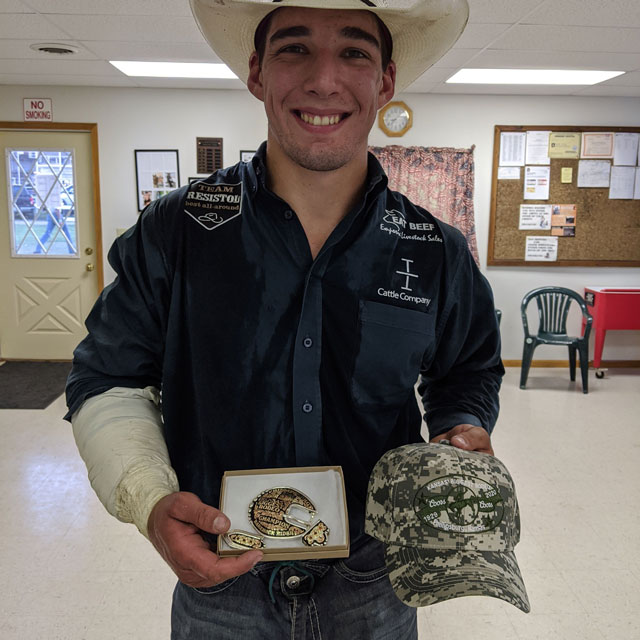
    Bareback rider Jesse Pope, Waverly, Kan., rode the Beutler and Son Rodeo horse Anything Goes for 89.5 points to best the field by three points more than the number two man, Tilden Hooper.


    Pope loved his draw. “Man, that horse is really, really strong, and just bucks. That’s what I enjoy getting on, just buckers.” He likens bareback riding to a fist fight. “I tell myself, before I get on, if you start the fight, you better finish it. And that’s what (the ride) was the whole time, a fist fight.”


    Pope, who will be a junior at Missouri Valley College in Marshall, Mo., this fall, has never lost a regular season college rodeo, winning twenty consecutive rodeos. He’s a two-time Ozark Region collegiate champion (2018-2019) who is majoring in public relations.


    Last year in the second week of August, he tore his hamstring at a rodeo in Lovington, N.M., taking him out of competition for ten weeks and dashing his dreams of a trip to his first Wrangler National Finals Rodeo. This year, he’s ready. He’s ranked fourteenth in the world standings. “That’s the plan,” he said, of a Wrangler NFR trip.


    The horse, Anything Goes, was the same mount that the 2019 bareback champ, Shane O’Connell, rode last year to win the rodeo.


    Sterling Crawley already owns a piece of Phillipsburg rodeo hardware, and he’s taking home another one.


    The saddle bronc rider scored 84.5 points on No Show Jones to be the top score for the weekend, to win the three-piece gold buckle. He won his first Phillipsburg title in 2014.


    The Huntsville, Texas cowboy has made good use of his time, since COVID-19 canceled nearly three months of rodeo. He worked on his and fiancée Hanna Rose’s house, preparing for their November wedding. “I did a lot of honey-dos I’ve never gotten to in past years,” he said. “I redid the entire porch on the house, which we bought a year and a half ago. And I got more land cleared on the skid steer than I thought I’d get done in two calendar years. It’s been really good to catch up on things.”


    Crawley didn’t get rusty while out of pro rodeo competition. A group of Texas stock contractors held informal buck-outs, for cowboys to stay fresh. “They bucked hard enough to show a guy where there are chinks in his armor,” Crawley said. “We got to hone things.”


    Crawley has competed at six Wrangler National Finals Rodeos and is headed to his seventh, as he is ranked sixth in the world standings.


    A special mare carried her barrel racer to the win for the 91st annual Kansas Biggest Rodeo.


    Shelley Morgan, Eustace, Texas, rode her mare, Kiss, to make a 16.76 second run around the cloverleaf pattern.


    It’s unusual for a six-year-old horse to be doing so well on the pro rodeo world, but Eustace and her husband, Rex, knew she was good. “We knew she had it in her,” she said.


    Kiss, whose registered name is HR Fameskissandtell, is “all woman,” Morgan said. “She loves people, and always has. The more they pet her, the better she likes it.” But she’s also grouchy, too. “She knows she’s somebody. She knows she’s the queen of the place.”


    Morgan is ranked as the number five barrel racer in the WPRA standings right now, thanks to Kiss. “She’s making this summer really fun,” Morgan said. “I’m really, really blessed and thankful and appreciative to be her person. I definitely do not take her for granted.”


    Morgan’s husband, Rex, travels with her. “He drives me everywhere. He’s definitely my moral support and keeps me grounded. And I think he enjoys it as much as I do.” They have been married 28 years.


    Other champions from this year’s rodeo include steer wrestlers Taz Olson, Prairie City, S.D., Clayton Hass, Weatherford, Texas and Maverick Harper, Iowa, La. (3.5 seconds each); team ropers Jeff Flenniken, Caldwell, Idaho/Tyler Worley, Berryville, Ark. (4.8 seconds); tie-down ropers Ryan Jarrett, Comanche, Okla., Justin Smith, Leesville, La., Stetson Vest, Childress, Texas (8.4 seconds each); and bull rider Shad Winn, Nephi, Utah (84.5 seconds).


    The rodeo saw the most contestants it had seen in years, due to the COVID-19 pandemic. Because more than 350 PRCA rodeos have been cancelled, remaining rodeos are seeing higher contestant numbers as contestants rodeo to make a living and qualify for the 2020 Wrangler National Finals Rodeo. More than 700 cowboys and cowgirls came through the gate at Kansas Biggest Rodeo, and among them, many world champions and those in the top fifteen of the world standings.


    For more information and complete rodeo results, visit www.kansasbiggestrodeo.com.


    – ### –


    Cutlines:

    Jesse Pope, Waverly, Kan., poses with the buckle he won as 2020 bareback riding champion at Kansas Biggest Rodeo in Phillipsburg.


    It’s the second time for Sterling Crawley to win a Phillipsburg rodeo buckle. The saddle bronc rider from Huntsville, Texas won his event with an 84.5 point ride.


    Final results, Kansas Biggest Rodeo, Phillipsburg, Kansas – July 30-August 1, 2020


    All-around co-champions: Clayton Hass and Maverick Harper


    Bareback Riding

    1. Jesse Pope, Waverly, Kan.89.5 points on Nutrena’s Anything Goes; 2. Tilden Hooper, Ft. Worth, Texas 86.5;  3. Jake Brown, Cleveland, Texas 86; 4. (tie) Garrett Shadbolt, Gordon, Neb. and Waylon Bourgeois, Church Point, La. 85.5 each; 6. Jamie Howlett, Rapid City, S.D. 85; 7. Caleb Bennett, Corvallis, Mont. 84.5; 8. Jayco Roper, Oktaha, Okla. 84.


    Steer Wrestling

    1. (tie) Clayton Hass, Weatherford, Texas, Taz Olson, Prairie City, S.D., and Maverick Harper, Iowa, La. 3.5 seconds each; 4. (tie) Reed Kraeger, Elwood, Neb. and Scott Guenthner, Provost, Alb.3.6; 6.Gus Franzen, Kearney, Neb. 3.8 seconds; 7. (tie) Tanner Brunner, Ramona, Kan., Will Lummus, Byhalia, Miss.,  Rowdy Parrott, Bellville, Texas, Jason Thomas, Benton, Ark., Kaleb Summers, Claremore, Okla., Jesse Brown, Baker City, Ore. 3.9 seconds each;


    Team Roping

    1. Jeff Flenniken, Caldwell, Idaho/Tyler Worley, Stephenville, Texas 4.8 seconds; 2. (tie) Matt Sherwood, Pima, Ariz./Trey Yates, Pueblo, Colo. and Clay Smith, Bowie, Texas/Jade Corkill, Stephenville, Texas 4.9 seconds each; 4. Jake Clay, Sapulpa, Okla./Martin Lucero, Stephenville, Texas 5.2; 5. Riley Minor, Ellensburg, Wash./Brady Minor, Ellensburg, Wash. 5.3; 6. (tie) Tanner Tomlinson, Angleton, Texas/Brady Norman, Springer, Okla., Brandon Webb, Carizzo Springs, Texas/Kollin VonAhn, Blanchard, Okla., Lane Stock, San Tan Valley, Ariz./Bruce Reidhead, Taylor, Ariz., and Charly Crawford, Stephenville, Texas/Logan Medlin, Tatum, N.M. 5.4 seconds each; 10. Andrew Ward, Edmond, Okla./Buddy Hawkins II, Stephenville, Texas 5.5.


    Saddle Bronc Riding

    1. Sterling Crawley, Huntsville, Texas 84.5 points on 040 No Show Jones; 2. Jacob Lewis, Stephenville, Texas 84; 3. Ben Anderson, Rocky Mountain, Alb. 83.5; 4. Chase Brooks, Ennis, Mont. 83; 5. 5. (tie) Tanner Butner, Daniel, Wyo., Logan James Hay, Wildwood, Alb. and Rusty Wright, Milford, Utah 82 each; 8. Isaac Diaz, Desdemona, Texas 81.


    Tie Down Roping

    1. (tie) Justin Smith, Leesville, La.; Ryan Jarrett, Comanche, Okla., and Stetson Vest, Childress, Texas 8.4 seconds each; 4. Tyler Prcin, Alvord, Texas 8.5; 5. Caleb Smidt, Bellville, Texas 8.6; 6.Ty Harris, San Angelo, Texas 8.8; 7. Haven Meged, Miles City, Montana 8.9; 8. Cody Huber, Albia, Iowa 9.2; 9. Paul David Tierney, Oklahoma City, Okla. 9.6; 10. Trell Etbauer, Goodwell, Okla. and Michael Otero, Weatherford, Texas 9.7 each.


    Barrel Racing

    1. Shelley Morgan, Eustace, Texas 16.76 seconds; 2. BryAnna Haluptzok, Tenstrike, Minn. 16.89; 3. Jessica Routier, Buffalo, S.D. 16.95; 4. Dona Kay Rule, Minco, Okla. 16.96; 5. Shali Lord, Lamar, Colo. 16.97; 6. Wenda Johnson, Pawhuska, Okla. 17.03; 7. Hayln Lide, China Springs, Texas 17.16 8. Cassidy Kruse Dean, Wills Point, Texas 17.18; 9. (tie) Abby Phillips, Marshall, Texas and Ivy Hurst,  Springer, Okla. 17.21 each; 11. Jacie Etbauer, Edmond, Okla. 17.22; 12. Megan Champion, Ukiah, Calif. 17.23; 13. (tie) Lexie Goss,  Redmond, Ore. and Hollie Etbauer, Edmond, Okla. 17.25 each; 15. (tie) Haley Wolfe, Flora Vista, N.M. and Jill Tanner, Stephenville, Texas 17.27 each.


    Bull Riding

    1.Shad Winn, Nephi, Utah 84.5 points on Beutler and Son Rodeo’s 014 Make My Day; 2. Ky Hamilton, Mackay, Australia 84; 3. Levi Gray, Klamath Falls, Ore. 83.5; 4. Roscoe Jarboe, New Plymouth, Idaho 79; 5. Parker Cole McCown, Montgomery, Texas 78.5; 6. (tie) Brady Portenier, Caldwell, Idaho and Sage Kimzey, Strong City, Okla. 76 each; 8. Tyler Bingham, Honeyville, Utah 70.


    ** All results are unofficial.  For complete results, visit www.prorodeo.com. For more information, visit www.KansasBiggestRodeo.com.

  • Featured Athlete: Ashton Padon

    Featured Athlete: Ashton Padon

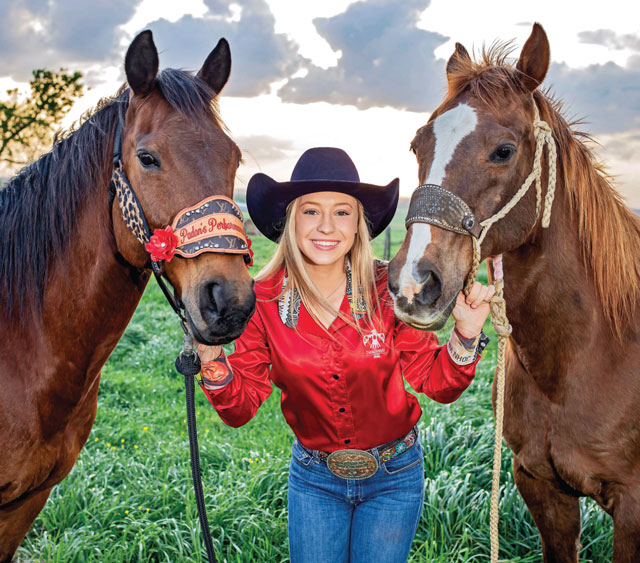
    Ashton Padon is in love with her 5 Star Equine Products.
    The Conroe, Texas cowgirl, a recent graduate of Grace Christian Academy, uses the saddle pads, sport boots, bell boots and shin guards.
    “I want the best for my babies,” she said of her horses. The pads work well, especially for her pole horse, Rack It, who is a sway back with high withers. “I like the support the saddle pad gives her and the cushion it has. It has a flex-fit cut for her withers and I like how it sets on there. My saddle doesn’t roll on her.”
    She also loves the support the boots give her horses. “I really like how they are lightweight and have the extra strap to make sure they don’t come loose.” She appreciates the extra material at the bottom, where the bell boot fits, “so there is no opening or space between the bell boot and the sport boot, for your horse to hit their ankle.
    The eighteen-year-old cowgirl competes in the barrels, poles and breakaway, in the Better Barrel Races, the Cowboys Pro Rodeo Association, and the Texas High School Rodeo Association, where she just wrapped up her senior year at state finals.
    For the barrels, she rides Skippin Lanes, “Churro,” a seven-year-old gelding who “is the biggest baby on the face of the planet,” she said. “He’s in my lap. He wants all your love and affection. He’s probably one of the calmest barrel horses I’ve ever had.” He’s the most recent addition to the Padon place.
    Her pole horse, Rack It, has a beautiful story. The mare was owned by Sherri Herndon who trained her on the barrels and poles. When Miss Sherri got bucked off a young horse and became paralyzed, Ashton and her mom took Rack It in hopes of selling the horse for her. But “we ended up falling in love with her and we bought her.” They include Miss Sherri in the horse’s successes, including the AQHYA World Show, where Rack It won the reserve world title in the pole bending. Rack It “was her baby, and she didn’t want to give her up, but I told her, I’ll take care of her, I promise.”
    Ashton’s barrel horse is a 28-year-old gelding named Houston, who, the family was told by the seller, was a fourteen-year-old grade horse. It turned out, Houston was stolen. When the rightful owners were found, Ashton discovered the horse was 22, not 14, and was registered. She and her mom became friends with the former owners, who gave the horse’s papers to Ashton when she graduated from high school. Last year, Houston won the Horse with the Most Heart award at the Martha Josey Junior World.
    Her favorite horse of all is a thirteen-hand paint pony named Jasper. Jasper is an all-around horse, capable of the barrels and poles. “He’ll do anything,” she said. “He has won probably more buckles and money than any of the horses I have.”
    The 5 Star Equine shin guards come in handy when she rides Rack It. “For the longest time I would hit the second barrel every single time,” Ashton said. “That’s why I started running her on poles. I love the shin guards. They don’t slip down, they have support and extra cushion to when I hit a barrel, I don’t feel it.” They also fit under a pair of jeans instead of on top. “My pride won’t let me wear the big ones outside of my pants. I like that these go underneath and you can’t see them.”
    Ashton has plenty of favorite foods, including her mom’s barbecue cashew chicken with rice, strawberry cheesecake from the Cheesecake Factory, and plain cucumbers, cut into circles. She likes strawberries, but especially when they’re stuffed with cheesecake filling or used in smoothies. And washing it all down with Dr. Pepper is the best! But she’s trying to ration her Dr. Pepper intake and replace it with more water.
    Ashton’s favorite place to be is the horse barn. “I like seeing my horses out there, seeing what I’ve been blessed with, and what my parents have done for me.”
    This fall, she will attend Sam Houston State University, where she will compete in the barrels. Ashton would like to get a business degree and run her own business, possibly as a provider of RV parks for families of military members.
    She has a younger sister, Brenlynn, who is six years old. Ashton is proud to be the daughter the late Roland Padon, who passed away in 2008. Her mom is J.J. Hill Wallace, and her stepdad is Robert Wallace.

  • Featured Athlete: Cole Younger

    Featured Athlete: Cole Younger

    Cole Younger is a 5 Star Equine Products team member.
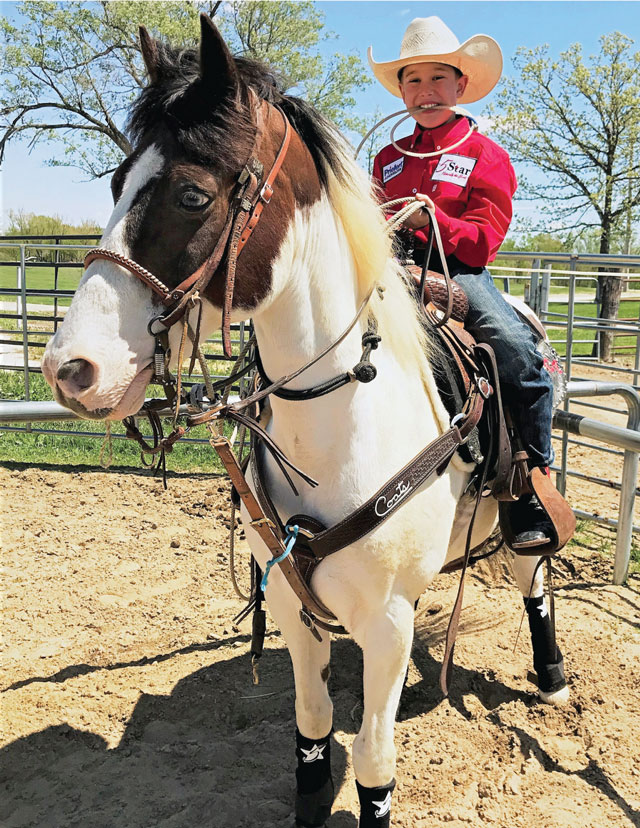
    The nine-year-old cowboy, a resident of Oskaloosa, Iowa, competes in the breakaway roping, tie-down roping, goat tying and team roping (as a heeler for his dad.) Of his events, tie-down is his favorite because “you’re always moving and there’s no time to dilly-dally,” he said.
    As a 5 Star member, he appreciates their products. “I use the Rancher one-inch saddle pad with fleece lining, the 5 Star Patriot boots, and the Pegasus bell boots. The boots give good support all the way around, and they last a really long time if you take care of them.”
    His parents, Morgan and Derrick, appreciate the 5 Star Equine products. “One of the things Cole did was design his own pad,” Morgan said. “He was able to make it his own, to personalize it for himself.” The long-lasting high quality goods are another selling point for the Youngers. “To have him using high quality products gives him an extra boost of confidence in the arena,” she said. “As he learns new things, like horsemanship and how to tie and work with his horse, we don’t have to worry, ‘are the boots on right? Is the pad ok?’ It’s one less thing to worry about.”
    For the tie-down, Cole rides two horses: Charlie, a horse he got earlier this spring, and Bear, a 26-year-old horse his dad competed on. For the heeling and breakaway, he rides Tex, a twenty-year-old sorrel. For the goat tying and breakaway, he rides Pearl, a nine-year-old roan. His favorite is Charlie, “because he’s more my size. I’m a little guy and all my other horses are big.” Charlie has a good personality, too. “He’s a really good calf horse. He’s really friendly and he likes it when you come out and pet him. He’s not shy.”
    Cole just finished his fourth grade year, and, due to COVID-19, did online school through Zoom meetings. He prefers school work at home. “You get done way earlier and you get to rope way more.”
    His favorite subject is science “because you learn about animals and I’m really into animals.” His favorite animals are horses (first choice); cows (second choice) and zebras (third choice.) He also plays basketball.
    The best food his mom makes is homemade macaroni and cheese. His favorite dessert is bunny tracks ice cream (caramel and chocolate pieces in vanilla), and his favorite meat is steak He loves sweet corn, apples and Snickers and likes to wash it down with a diet Pepsi.
    The best trip he’s taken was to Chris Neal’s Future Stars Calf Roping in Oklahoma. Cole attended it twice last year and will go again this spring. He learned lots and was one calf away from finishing in the top ten.
    The Younger place has a variety of pets: a “ton” of cats, one dog, and chickens. Some of the cats are tame, some are wild, and the dog loves to chase all of them. The dog is a Corgi named Annie who Cole has trained to hunt rabbits.
    When he grows up, he would like to be a professional tie-down roper and make multiple trips to the National Finals Rodeo. He looks up to Tyson Durfey because “he’s a really good calf roper and he’s a good guy.”
    Cole has a younger brother, Carter who is four years old.

  • Back When They Bucked with Jan Youren

    Back When They Bucked with Jan Youren

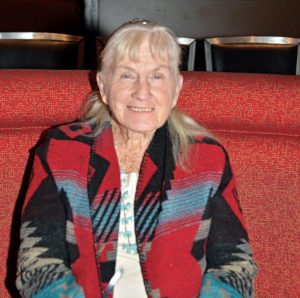
    If the boys could do it, Jan Youren was there to prove that girls could do it, too.
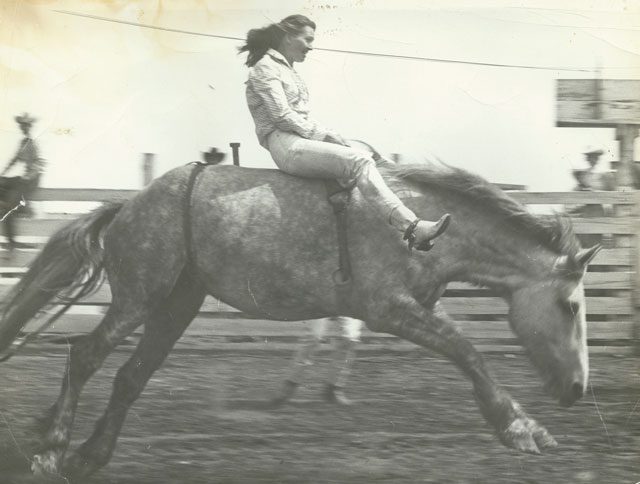
    The Idaho woman was a roughstock cowgirl for nearly all of her life.
    Born in 1943 as the second oldest child of Sterling and Madelyn Alley, the family lived on a farm and ranch near Garden Valley, Idaho.
    The Alley place was the last house on the road up Alder Creek, Jan said, and it was seven miles to town. “When I was six years old, I would ride to Crouch,” a village near her home, Jan remembered.
    She wasn’t big enough to saddle her own horse, and they didn’t have an extra saddle for her anyway, so she rode bareback, “all the time, all over the mountain. I was a bit of a wild child, so most time it was at a high rate of speed.”
    That’s how she was raised, she said. “You did your chores and the day was yours. You could go do what you wanted to, if dad and mom didn’t have anything special for you to do.”
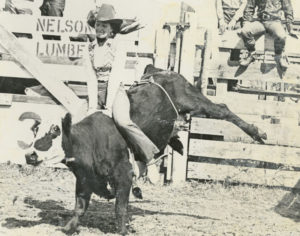
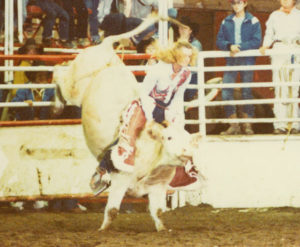
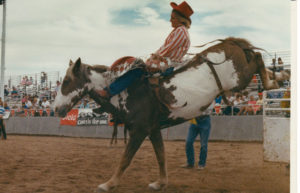
    By the age of eleven, Jan was riding bareback broncs and bulls. Her daddy produced the first full all-girl rodeo, and he entered her in every event. The rodeo was in Emmett, Idaho, and she placed in two events: the bareback broncs and cow riding. “I won $54 for twenty-four seconds of work and I thought I was on the road to riches,” she said.
    Jan competed at junior rodeos and all-girl rodeos, and in 1960 she graduated from high school.
    She was married and had her first two children within eleven months.
    After her first two babies were born, she continued to ride barebacks, but not with the skill she had possessed before.
    It was 1962, and her dad told her something she didn’t want to hear. “My dad said, ‘Babe, you better quit and be a mom. You’re just not riding like you used to.’” That set a spark back into Jan. “You talk about waving a red flag in my face,” she said.

    She went to prove him wrong. At a rodeo in Glenns Ferry, Idaho, she drew a buckskin horse. Her timing was right, she spurred him, and her dad changed his mind. “He came up to me and said, ‘Babe, I take it all back. That’s the best ride I’ve ever seen you make.’ I was in seventh heaven.”
    She continued to rodeo at all-girl events. She was a charter member of the Idaho Girls Rodeo Association then the Girls Northwest Rodeo Association, which included events in Oregon, Washington and Montana.
    In 1966, she was invited to an invitational international all girl rodeo in Calgary.
    The rodeo was organized by Pearl Borgul, a public relations person who was excellent at promoting rodeo but didn’t always understand the sport. Jan remembered one time that Pearl insisted the contestants wear corsages donated by the chamber of commerce. She balked at that. “I said, ‘Pearl, I am not riding a bucking horse with a three-inch pin under my chin.’” Pearl conceded.
    From that rodeo, the Girls International Rodeo League (GIRL) was formed, and Jan became a charter member of that organization, too. The League had good events. “They were probably the best, and the best paying rodeos,” she said.
    All the time, she continued to work as a waitress, a job she had started as a twelve-year-old girl at her aunt and uncle’s restaurant.
    By this point, she had divorced her second husband, Roger, in 1965.
    At a rodeo in 1970, she met her third husband, Dee Edmondson. He rodeoed, and when Jan’s oldest daughter was old enough to ride, Jan and the kids moved to Texas, where the spring and fall shows took place. Dee moved to California and worked for Cotton Rosser.
    A few years later, at the Cow Palace in San Francisco, Jan ran into her uncle, Jim Youren. Jim had been married to her mother’s sister, and his wife died of cancer. Jan knew Jim well; Aunt Carol had lived with her family when she was dating Jim.
    They began to call each other. Jim wanted to marry her, but Jan wasn’t ready yet. But he persisted, and they married on January 31, 1984. “I saved the best till last,” Jan joked. “I tell people practice makes perfect.”
    Jan continued to rodeo. Bareback riding was her best event, in part because she had ridden bareback so many years as a kid. For the first twenty-five years of her rodeo career, she did the timed events too. But when she moved to Texas with the kids, she didn’t have an arena and access to calves, and it was cheaper to throw a riggin’ bag in a truck and leave.
    She never felt discriminated against by cowboys. She never competed against the men; it was only women’s rodeos that she competed in. And the men knew she wasn’t trying to be one of them. “Too many girls thought you were doing a man’s event and had to act like one,” she said. Her daddy had set her straight years ago. “My dad told me, you are a lady. You can be as tough as you can, but when you start getting rough, you’re done.” Usually, she said, after the men realized she was a professional at her sport, they accepted her. “Most of them were very respectful and helpful to us,” she said, recalling that Lane Frost and world champion Bruce Ford had pulled her rigging many times.

    In 2006, she and Jim moved from their ranch in Bruno, Idaho, to Cimarron, Kansas. Horse properties in Idaho were expensive, and Jim was tired of flood irrigating 400 of the ranch’s 700 acres. They were there seven years, then they moved back to Idaho. Jim didn’t appreciate the never-ending wind, and they missed home.
    Jan’s list of accolades stretches far. In 1965, she won the first saddle for the all-around in the Idaho Girls Rodeo Association, also winning the bareback riding and tie-down roping. In 1981, she won the bareback riding in the Girls Rodeo Association, and in 1987 she won it again, this time with a broken back. “I didn’t realize my back was broken,” she said. “I thought I was just being wimpy.” In 1994 and ‘95, she won the bareback riding again.
    Through this, she was taking her kids rodeoing and supporting them at their events.
    Between her and Jim, they have fifteen kids. Hers are Tonya, Jim, Todd, Dawnita, Susie, Kristen, and Ty. Jim’s are Deanie, Deb, Dusty, Dixie, Doug, Don, Dodi, and together, their last child, is Cole. Jan rode against all four of her daughters throughout her career.
    She always said she’d quit when her granddaughters beat her. In 2005, she shattered her arm at a rodeo in Grand Valley, Idaho in August, breaking it in seven places. The repair work required plates, a rod and three pins. The finals were in October, and she wasn’t supposed to ride, but she did. Her second granddaughter, Tavia, got ahead of her in points, and at the finals, Tavia beat her grandma for the year-end title, finishing one place ahead of her. That was her last professional rodeo; she had competed for 51 years.
    Her last ride was six years ago, at a women’s roughstock reunion when she was nearly seventy years old. Son Cole and grandson Zane discouraged her from riding, hiding her riggin’ bag and then, when they realized she couldn’t be stopped, finding a horse that was as safe as possible. Cole chose a good bronc, instead of the runaway, because she wasn’t able to get off on the pickup man. She got on, but after the whistle, her dismount was straight to the ground. “I was satisfied with my last ride but when I bailed off, I hit the ground like a ton of bricks.” She told Jim, “I didn’t bounce.”
    Jim passed away in 2014. She fills her life with her kids, grandkids (there are 64 of them) and great-grandkids (97 of them and counting.) Most of the grandkids are in Idaho, but some are scattered from Washington to Florida and she loves being grandma. “I said I’d see them all at least twice a year so they know who I am.” She goes to whatever activities they participate in: rodeo, football, basketball, track, and more.
    Rodeo was great to her. “I was on the road for a lot of years and had a lot of riches, but not necessarily monetary,” she said.
    Her family is her biggest accomplishment. “I raised nine kids that have never been in any serious trouble and never into drugs.
    “I tell everybody I’m the most blessed woman in the world. I have all those kids, grandkids, and great-grandkids, and they’re all healthy. I did something I thoroughly enjoyed my whole life and had a small measure of success at it. And I still get around as well as most women my age, and they didn’t have half the fun I’ve had.”

  • Finals Moves from Hastings to Burwell

    Finals Moves from Hastings to Burwell

    May 18, 2020 (Hastings, Neb.)  Due to the COVID-19 pandemic, the Adams County Ag Society has made the decision that the 2020 Nebraska High School Finals Rodeo will not be held in Hastings, NE. The rodeo was to be held June 18-20.


    After receiving guidance from the local health department and the governor’s office, it was determined that protecting the health of the participants and the community will be best met by not hosting the event. Directed health measures, including limitations of gathering size of events, social distancing, requiring the wearing of masks, and testing all volunteers and committee members for COVID-19, was not feasible.


    It was an emotional decision, but it was decided that, in order to be socially responsible, there was no reasonable way to keep competitors, fans, volunteers and sponsors healthy. Directed health measures have made it nearly impossible.


    We will miss seeing the bright smiles and eager faces of our Nebraska high school rodeo athletes and we’ll be ready for them in 2021!


    The 2020 Nebraska High School Finals Rodeo is set to take place in Burwell June 17-20.


    For more information on the Nebraska High School Rodeo Association as they move forward with alternate plans for the 2020 State Finals, visit their website at www.hsrodeo-nebraska.com.

  • Featured Athlete: Brooke Klinger

    Featured Athlete: Brooke Klinger

    Don’t mess with Brooke Klinger. She’ll take you down.
    The 5 Star Equine Products team member has a first degree black belt in karate.
    But her true love is barrel racing.
    Growing up in Andover, New Jersey, she did trail rides and participated in English and jumping as well as riding a bit of western pleasure. But when she was twelve years old, she saw the barrel racing at the local fair.

    It fit her to a “T”. “I like to go fast,” she said. “I loved racing on the trails.”
    So, a trainer, Jim Tenhoeve, taught her. She got a faster horse, and began running barrels.

    She uses 5 Star Equine products, with two of them her favorites. The saddle pads are wonderful, she said. “I’ve had (other brands of) saddle pads that after a few uses, get really stiff. The 5 Stars are flexible and stay soft. I like how they’re contoured so they fit flatly on the horse’s back. There are no gaps or spaces.” They’ve helped her horses. “They’re never sore.”
    She just recently started using the boots for her horses and those are now her favorites. “I love them a lot. They’re not bulky and they don’t let sand in, which is very nice.”

    She loves it that she can customize colors for the saddle pads and boots, and she loves the saddle pads. “I have six of them now,” she said. “I just keep adding. I have an obsession with them.”
    A 2019 high school graduate, Brooke works for her parents in their three enterprises: her dad’s electrical company, their real estate rental business, and with her dad as he teaches karate lessons. Her dad is the Sensei and she teaches the younger levels while she continues her instruction in the art.

    Brooke also gives riding and barrel racing lessons, which she loves. She travels to people’s houses, or students can come to her farm and ride one of her gentler horses. It’s one of her favorite jobs. “I like teaching people what I know and seeing them accomplish things. I like it when they work harder towards their goals, and when I know I was the one able to help them.”
    She got her WPRA permit in 2019 and filled it within a few months. This year, she hopes to work towards the title of Rookie of the Year for the First Frontier Circuit.

    The family has five horses: King, her first horse; Dancer, her primary barrel and pole horse; Sunny, another barrel horse; Charlie, a five-year-old she acquired last year, and her newest horse, Brownie.

    In her spare time, she loves to hunt for pheasant and deer, and she combats the stereotype that New Jersey is full of nothing but cities. “There are a lot of country people here,” she said. “People don’t really know that. They think New Jersey is nothing but city, but where I am, it’s all farmland.”
    She is the daughter of Scott and Jackie Klinger.

  • Back When They Bucked with Bill Skavdahl

    Back When They Bucked with Bill Skavdahl

    Bill Skavdahl has gotten plenty of adrenaline rushes in his life. Some of them were ones he planned on, like when he rode bulls and bulldogged, and some were unpleasant ones, like when his helicopter was shot down while serving in the Army Air Corps in Vietnam in 1968.
    The northwestern Nebraska man was born near Harrison in 1946 to Harold and Ellen (Howard) Skavdahl. His parents were ranchers and had never rodeoed, but Bill loved to ride the milk cow, much to his mother’s consternation. He was a hand with a horse; ranch work at the Skavdahls was done on horseback.
    As a freshman at Harrison High School in 1961, he competed at the state finals, held in Harrison. There were no regular season rodeos; anyone who wanted to could compete at the finals, and the top three in each event went on to the National High School Finals. He rode bareback horses and bulls, mostly because the equipment was easy to come by. An old bareback rider bequeathed him a riggin’, and bull ropes were cheaper than horses.
    At the state finals, he won second place in the bull riding. At that time, if a contestant qualified in one event for Nationals, they could add two more events in which to compete. So Bill added bareback riding.
    Nationals were in Douglas, Wyo., and he caught a ride to them with a friend. He made a qualified bull ride in round one, then made it to the finals, ending up tying for third with Denny Wall from Montana.

    Third place was a pair of spurs, nice ones, and fourth place was a certificate for a 20X Resistol hat. Bill loved the spurs but needed the hat. “I’d never had a felt hat,” he said, “and I wanted one, so I told (Denny) I didn’t need to flip (for third place prize), I’d just take the hat. I had that hat for a long time.”
    As a high school junior, he won second at state in the bull riding again. This time, Nationals were in Tarkio, Missouri, and he chose bareback and saddle bronc riding as his additional events. He rode one of his bulls and both of his saddle broncs, missing the short round by two places in the saddle broncs. He rode one of his bareback horses, but missed out the second horse.
    In 1964, four high school regular season rodeos were held in Nebraska, and Bill competed at two of them. At Thedford, he won the steer wrestling and bull riding, finished second in the barebacks, and won the all-around. In Crawford, he won the steer wrestling, bull riding and the all-around again. “I was on a roll for state,” he said.
    But in Crawford, he broke his ankle. He was in the chute on a Hollenbeck bull, one that hadn’t been ridden. “The bull threw a fit,” Bill said. He made a qualified ride in spite of the break.
    State finals were the next week, and he had a plan. He had won a pair of spurs in Thedford, and he modified one of them for his cast. “I took one of them out to the shop, took a blow torch, heated her up, and fitted it around that cast. I got me some plaster of Paris and baling wire and got that thing fastened on there pretty good.”
    The spur worked. He covered his first two bulls, but in the short round, the bull spun to the left. “I had a broken right ankle and that didn’t work out too good,” he remembered. He finished fourth in the state, one hole out of qualifying for Nationals.
    After high school graduation, Bill worked on the ranch for his dad. Times were tough, so he decided to go to California. He had an aunt there, and he found a job working for a paving company, making $150 a week. It was a good job, considering it would take a month at home to make that same amount. While in California, he competed at a few rodeos.
    He was there for a year when a letter came from his dad. A draft notice had arrived addressed to him in Nebraska, and Bill needed to take care of business. He got a physical in California, and passed it. The draft board told him he’d have to go back home to be inducted.
    So Bill went home and talked to a recruiter, asking what his options were. His test scores were good enough that he could choose several things. He wanted to be a pilot.
    Basic training was in Louisiana then he was on to flight training at Ft. Wolters in Mineral Wells, Texas and advanced flight training at Ft. Rucker, in Dothan, Alabama.
    The Army was short on helicopter pilots, so he volunteered. After more training in Ft. Benning, Georgia, he was one of 52 pilots in the 235th Aviation Co., an attack helicopter company formed by the Pentagon, and on October 10, 1967, he was sent to Vietnam.
    The attack helicopter’s main job was to escort the helicopters carrying troops into a landing area and to drive the enemy from the landing site till the men were unloaded. They also provided support fire for ground troops.
    Within a month, he was the aircraft commander and the fire team leader. Pilots spent about forty hours a week in the air, and Bill flew 805 missions, over 1,050 hours.
    The helicopters rarely went unscathed. At the end of every mission, the bullet holes in the sides were counted and recorded. Bill’s record was 29 holes in one mission.
    His helicopter was shot down on April 14, 1968. He and his crew were providing air support as a medivac unit worked to evacuate crews from two downed helicopters. Enemy fire knocked out the tail motor gear box on Bill’s helicopter, and he and his crew knew what was coming.
    “The feeling you experience is like that of having a horse fall with you,” he said. “It happens so fast you don’t get scared, you just try to get away.”
    The enemy was all over the area, but Bill’s helicopter had hit the ground farther away from the actual fighting. It wasn’t long till another crew was there to rescue them. It was only after he was on the rescue flight that he realized a piece of the helicopter had been driven through his leg. During his time in Vietnam he broke his back, and he received a Purple Heart for being wounded while serving his country. He also was awarded the Distinguished Flying Cross twice, for “heroism or extraordinary achievement while participating in an aerial flight.”
    A year to the day that he went to Vietnam, he was sent home. It was October 10, 1968.
    He spent another year in the Army, this time at Ft. Carson, Colo., where he and fellow soldiers filled in for the National Guard unit in Kansas City, Mo., as replacements, as the guard members were sent to Vietnam.
    While in Colorado, he rode bulls at Canon City and Pikes Peak or Bust, where he got to rub shoulders with bull riding greats like Freckles Brown and Larry Mahan.
    He was discharged in 1970, and headed back to the ranch.
    By this time, his dad had bought a second ranch, and Bill took over management of it. He married and had three sons: Josh, Jud and Joe, and a daughter, Tomi Jain.

    He rodeoed a bit, riding bulls at regional rodeos in Nebraska, but he had a family, ranching obligations, and aches and pains from Vietnam. “You borrow a lot of money from the bank (to ranch),” he said, “and you can’t afford to get hurt.”
    But there was one more bull ride for him. At the age of 45, in 1991, he got on a bull at the senior pro rodeo in Crawford. He didn’t make the buzzer, but it “felt pretty good. I wanted to get on again. There’s a rush, you know.”
    His children didn’t compete in high school rodeo, but Jud, the middle son, rode saddle broncs at county fairs and was on the University of Nebraska-Lincoln rodeo team in the mid 1990s. He continued to rodeo in the Nebraska State Rodeo Association, making the finals several times. But, like his dad, he had a family to support and a ranch to run, so he career wound down, and, again like his dad, he rode his last saddle bronc at age 45, at the senior pro rodeo in Crawford last summer.
    All three boys attended the University of Nebraska, and help with the ranch. All three boys live close to each other and ranch and work together, even though their operations are separate. Joe is also a veterinarian at the Torrington (Wyo.) sale barn. Daughter Tomi Kirkland lives in Riverton, Wyo., and is an English teacher. Bill has ten grandchildren.
    Last summer, Bill went through another ordeal. He contracted a rare virus called campylobacter fetus, the “human” form of brucellosis in cattle. The bacteria can cause sepsis and localized infections in the brain, lungs, joints, and the pericardial sac around the heart. The virus got him down. He was in Rock Springs, Wyo., to watch a grandson compete at the National High School Finals and felt so poorly he couldn’t get out of the vehicle.
    He went misdiagnosed for two months and after a spinal tap, it was a doctor in Casper, Wyo., who diagnosed him. He made a full recovery and is back to feeding cattle and doing nearly everything he used to do.
    He, son Jud, and grandson Jack, a saddle bronc rider, all wore the same chaps as they competed. Bill purchased the “Jim Shoulders” brand out of a catalog in 1963 for $44, which “was a lot of money then,” he said.
    And one of his fondest memories was from the 1961 National High School Finals. He was the last bull rider for the evening, and the crowd roared when he made the buzzer. “I can remember the crowd was thunderous,” he said. The ride “was a crowd pleaser.”
    His mother gave her sons advice when they were growing up. There were two things they were not allowed to do: ride bulls and join the service. Bill did both, and loved it.
    Surrounded by his children and grandchildren, Bill’s life has been full and happy. He has served his country, has four children, kept a ranch going into the next generation, and rodeoed. The patriarch of the family is well-loved and is doing what he loves: ranching, working, and enjoying his kids and grandkids.

  • On The Trail with COVID-19

    On The Trail with COVID-19

    COVID-19 has wreaked havoc on the entire world, and the rodeo industry isn’t exempt. From contestants to contractors to committees, they’ve all been forced to adapt, since the nation was shutdown, starting in mid-March. For bareback rider Kaycee Feild, it took a bit to adjust to the new routine before he could switch roles. “I got lost for a few days,” he said. “My (rodeo) goals were unattainable, and I didn’t do a whole lot for about a week.” Then his focus shifted to being home.

    At home in Spanish Fork, Utah, the four-time world champion has done projects around he and Stephanie’s house: welding, building, and grilling.

    “I started to build a tack shed,” he said. “Growing up as a kid, we had a tack shed, and I spent a lot of time with my dad in it. So, not having one for the last decade, I’m building one and it’s bringing back a lot of memories.”

    He’s spent more time with his kids, too. Elder daughter Chaimberlyn, who is seven years old, is always busy with something. “I have to saddle her horse every day,” Feild said. “She likes going on picnics, or doing puzzles or playing with my wife.” The couple’s son, Huxyn, is four, and is all about dirt bikes. “He’s a dirt bike kid. He’s on it all day, every day. He’s worn out two rear tires this spring.” Third child Remi, a daughter, is eighteen months old.

    Time at home has also given Feild an opportunity to work with a few of his sponsors, including Power Pro (www.pwrprocbd.com) and Gel Blasters, a toy gun that shoots orbeez.

    Feild thinks that when rodeos start back, competition will be tougher than ever. He and a few bareback riding friends are organizing a practice session with money up for grabs, to get in tune for rodeos.

    “A lot of guys are on the same playing field right now, so when it opens back up, rodeo will be the best you’ve seen. There’s a limited amount of time to get to the (Wrangler National) Finals so you’ll see who wants it.

    The COVID-19 break has been good for him, physically. “This has put two years on the end of my career,” he said, “to be able to give my body a break this time of year, being able to stay home.”


    Wyatt and Leslie Casper with their two children - Courtesy
    Wyatt and Leslie Casper with their two children – Courtesy

    Leslie Casper, wife of Wyatt Casper (OTT in Rodeo News March 2020) had their second child this past December. “We were able to go a little in the winter and spring with him but it just wasn’t a fun time with a month old and a 13 month old,” she said. “It’s pretty nice to have help with the kids every day all day long. Cooper our 18 month old really LOVES having his daddy home, it’s going to be very hard when rodeos finally kick back up.”


    For Binion Cervi, the worldwide pandemic is a double whammy. Not only has it forced the cancelation of pro rodeos for the stock contractor and his brother, Chase, but it has devastated the cattle markets.

    The Cervis own and operate a feedlot near Greeley, Colo., and with cattle ready to be harvested, JBS Packing was closed due to the virus. (It has since reopened).
    Like Feild, Binion is using the unexpected time at home to do projects that don’t get done when rodeos are in full swing.

    “We’re doing everything you usually push to the side: upgrading fences, the ranch, headquarters, we’re doing all that.” They’ve been able to keep their rodeo employees working at the ranch. “The people who would normally be on the road, they’re at the ranch helping us, so we can make sure they have a job.”

    When rodeos begin again, Cervi thinks things won’t be the same. “This changes people, and there will be caution in the world, even when everything is cleared to go. Some people will be blazing trails, some will go cautiously. I think you’ll see people with masks on at rodeos, and you’ll see people who don’t care. Everybody’s going to react to it differently.
    The pandemic has shifted the way Cervi thinks, as it has for a lot of people. “This is such a reality check for every human in the world. It’s a dose of reality, that nobody controls anything in life.


    Binion Cervi – ImpulsePhotographyMB.com

    “This is the real world, and we all get caught up in going so fast, on a personal level, that it’s like, this tells you what is important in life. It’s like God waking you up. There’s more to life than rodeo, there’s more to life than always building a business. That’s the biggest blessing I’m getting, that our whole family is getting.”


    The Franklin (Tenn.) Rodeo, didn’t have a choice when it canceled.

    Set to be held May 14-16, executive director Bill Fitzgerald didn’t think the long-running rodeo would be shut down.
    “For the longest time, I tried to play it off, to say this was going to go away. Then, as it got closer, the government was changing the way we did things. We couldn’t have our meetings, and I was starting to get nervous, like, how am I going to communicate with my committees, with my volunteers, with my people?”

    The rodeo is held at the county-owned Williamson County Ag Expo Center, fifteen miles south of Nashville.
    “The county actually shut the facility down, and that made the decision (to cancel),” he said. The building is closed through the end of May.

    The cancellation was made on March 23, seven weeks before the start of the rodeo, which meant the committee hadn’t spent much money yet. “We weren’t out a lot, because we hadn’t gotten to that point yet,” Fitzgerald said.

    He believes that next year’s crowds will be even better because they missed this year’s rodeo. “I honestly believe that folks love the sport of rodeo, and they’re going to come. The fans in middle Tennessee want to be a part of it. We still have people joining the fan club, knowing the rodeo won’t happen.”


    Franklin Rodeo – Tom Thomson

    Cheyenne Frontier Days is on the front lines of the time line.
    The “Daddy of ‘em All” is set to kick off July 17-26, and, according to CEO Tom Hirsig, at this point, the staff and general committee are working to make it happen, with state and local government officials as part of the decision making process.

    He’s spent sleepless nights worrying about all the factors, and believes that time will tell, especially as May rolls on. “The month of May will determine a lot, at least for the July rodeos.”

    “We’re on the cusp of being one of the first ones that might get to have their event,” he said.

    CFD is on people’s “bucket list, the Kentucky Derby of rodeo,” he said, with fans from all fifty states and 31 countries, which is another aspect to consider. He assumes that international travel won’t be opened yet, which could affect attendance.

    The economic influence of canceling CFD is enormous. The last economic study done for CFD showed a financial impact of $28 million to Cheyenne and $40 million for the state of Wyoming. “All rodeos have an economic impact on their community, whether it be Meeteetse (Wyo.) or Cheyenne.”

    Rodeos also have bills to pay, whether they hold their event or not.
    “We are $2 million into our show now,” spent on it. If we can’t have (the event) we lose that money.” And there is the cost of maintenance as well. “We own our own park and we have ongoing costs. Those utility bills don’t go away and payroll doesn’t go away.”

    Annual rodeos and events aren’t like other businesses that are open year-round, Hirsig pointed out. “It’s not just that we are missing out on making that money, but we have ongoing costs like any business. It’s just that we have ten days to make that money. It’s going to be hard on a lot of rodeos to recover from this. I don’t know, when we come out on the other side, how these rodeos will be.”

    Hirsig said CFD contracts with about 300 people or entities. “There are 300 individuals or companies out there, hanging on what we’re doing.”

    CFD sponsors have been loyal, he said. “I keep hearing that sponsors are pulling out, but we haven’t seen that. Our sponsors have been sticking with us, and are glad we’re making an educated decision. Many of them are local sponsors and they understand the long term effect that if CFD doesn’t take place, that increases the deterioration of their bottom line.”

    He’s also very aware that he is not an expert in infectious diseases or healthcare. “We are event planners, and that’s where our expertise is. Our expertise is not in diseases, viruses or healthcare. We have to rely on the experts in those areas at the state and county level, as to what is safe and not safe.”

    Hirsig also stressed that the decision to cancel or postpone a rodeo is not necessarily in the hands of the rodeo committee. They are “being advised by their health departments” if they can have an event.

    Like Cervi, he believes the COVID-19 pandemic will change events and event planning and marketing. “The world has changed. There will be people with masks on, and some without masks, and when you put a bunch of people in a stadium, everyone’s going to have a different feeling about what social distancing means. You’ll have people with masks, and if you get too close to them, they’re going to feel uncomfortable. Or the people drinking and having fun, there could be another level of discomfort.

    “You want people to leave your event saying, that’s so fun. I want to come back. You don’t want them to say, man, there’s a lot of people here, I don’t think we should go.”

    The goal of entertainment is to provide a distraction from the “regular world,” Hirsig noted.
    “What do you do to your brand if you put your event on, and people don’t have a great time? We’ve worked hard to create this brand where it’s fun, it’s away from the real world. With masks, there will always be that reminder, that there is something else going on in our world that you have to be concerned with. You have to measure that to some degree, too.”


    Chancey Williams in Moorcroft, Wyoming helping shearing. – Courtesy

    Chancey Williams and his band are staying busy as they wait to hear how to better plan for upcoming shows.

    “Our last show was March 13 in Houston and they’ve canceled everything through May, some in June, and some in July,” said Chancey Williams, whose band is usually booked every week. They have had to cancel 9 shows so far. “We are getting a few emails and phone calls for things in June and July but we still don’t know if it’s going to hurt us or not. We have two at the end of May that are still holding on – Craig, Good Old West Days is still planning on it.” The band has been making good use of their time off. We spent the time working on equipment, practicing, and Chancey learning how to do the social media live. “It’s been a learning curve, but we’re getting it.” Chancey has been able to help his family with shearing. “Stay positive and work through it – we want to be ready to play – we’ve got a new set and an album coming out – we’ll be ready to go when they open up.”


  • Back When They Bucked with Bob Click

    Back When They Bucked with Bob Click

    Bob Click was never a threat to any big-name cowboys, but he loved to compete. “Jim Shoulders never lost any sleep over me,” Bob quipped, “although I knew him personally and liked him.”
    Born the son of O.B. and Thelma Click, on the family farm near Warren, Oregon, just south of St. Helens, Bob rode calves and cows at junior rodeos, helped feed the polled Herefords on the farm, and was derisively nicknamed “Cowboy Bob” by his classmates at school.
    He and a buddy, both farm kids, were members of 4-H and FFA and “we were taunted at school,” Bob remembers. “They thought you were a clod and a hick” if a person did 4-H and FFA.
    But rodeo remained a constant throughout Bob’s life.
    In junior rodeos, he competed in every event, but in high school, it was narrowed to bareback horses and very few bulls, “mostly to please my mother, because she didn’t want me getting on bulls,” Bob remembered. He qualified for the Oregon amateur finals (now the Northwest Pro Rodeo Association) in the bareback riding, and added bull riding to his repertoire.
    In 1954, at the age of seventeen, he enlisted in the U.S. Navy. He saw guys, during their leave, who would buy a bottle, sneak it into the movie theater, finish off the bottle and sleep it off, then head back to the boat after leave. That was not for him. “I saw enough of that that I wanted no part of it,” he said. One day, in the paper, he saw a rodeo being advertised in Santa Anna, Calif., so he got a Greyhound bus ticket, headed to Santa Anna, and watched the rodeo.


    The bucking bulls didn’t look any tougher than what he’d ridden back at home. “I looked at the stock, and it didn’t look any worse than what I was getting on at amateur rodeos,” Bob said.
    At the time, the Rodeo Cowboys Association, the predecessor to the PRCA, was allowing those serving in the military to compete without having a card, so Bob went for it.
    And any time he had “liberty,” or leave, he was at a rodeo. “I had a 72 hour pass every weekend,” he said. Stationed at Mare Island Naval Ship Yard in Vallejo, Calif., northern California was full of rodeos in the summertime. “I was at a rodeo every weekend, sometimes two a weekend.”
    In 1957, before Bob left the Navy, he bought his RCA card. Stationed in an active submarine, he made port in Japan, and mailed his membership fees to Denver, so he could compete at the Cow Palace in San Francisco, Calif.
    After the Navy, he got a job at the phone company and continued to ride bulls. He wasn’t the best bull rider around, but that didn’t bother him. “I was getting bucked off bulls all the time, but I didn’t care,” he said. “I loved being there, being part of it.”
    He’d come to work with the typical bull riding injuries, and be put on “light duty.” After a six month probation, workers couldn’t be fired, so he knew that wasn’t an issue. But one day, his supervisor pulled him aside. “You’re a hard worker,” he told Bob, “when you can work, and we love your rodeo stories. But you can’t make a career out of light duty.” Bob told him he’d take his words under advisement.
    Not long after that, in 1963, Bob was in a bad car wreck, breaking vertebrae, and his bull riding days were over.
    After he healed, he did some scuba instructing. He had learned to scuba dive in the Navy for submarine escape training and took instruction on shooting a camera underwater. His parents had given him a Brownie Kodak camera for eighth grade graduation, and he enjoyed taking pictures. This knowledge would come in handy down the road.
    Married to his first wife Beverly in 1958, she loved rodeo as much as he did, and even after he got hurt, they would attend rodeos. But it was hard to buy a ticket and sit in the grandstand when he was used to being behind the chutes.
    One year, the county fair was happening in Vancouver, Wash., and Bob noticed there was a bull-a-rama. He bought a ticket, grabbed his camera, and took a few pictures.


    The next week, at a rodeo in Longview, Wash., he took his developed pictures from the prior week and went behind the chutes. Ron Hall, a bull rider whose dad, Tom Hall, had been one of Bob’s rodeo peers, grabbed his buddies and said, “come look at this guy’s pictures,” Bob said. “I had printed eight by tens, and they bought them all immediately. I was hooked then,” he remembered.
    Bob also helped his friend, Jim Smith, a tie-down roper, with a roping jackpot he produced near Molalla. Bob was the chute boss, but he brought his camera along and took pictures. The cowboys “loved having pictures of themselves,” he remembered.
    His underwater photography learning came in handy. “I learned the basics of photography from my underwater photography,” Bob said. “That helped more than anything.” The use of a strobe light in dark settings, like underwater, was similar to the use of a strobe shooting rodeo pictures after the sun went down.


    His hobby grew. It was the early 1990s and he was still working for the phone company, and taking rodeo pictures in the evenings and weekends. At the time, there were six rodeos in the Portland area that he could work and still be home every night.
    Being adept at photography and understanding rodeo didn’t necessarily mean that rodeo photography was easy, he said. “I had a lot of rodeo experience and a lot of photo experience but I did not have rodeo photography experience,” he said. “I had to learn it.”
    One of the people who helped him was Fred Nyulassy, also a rodeo photographer. “I was very fortunate to meet a nice guy,” Bob said. The two were Navy veterans, and they hit it off. “He is one of the best.”
    Bob also worked for three different news services, providing rodeo photos for them. The East Oregonian (Pendleton, Ore.), the Bend (Ore.) Bulletin, and the Spokane (Wash.) Spokesman-Review used his photos and loved them.
    Before he retired from the phone company, Bob worked as many as twenty rodeos a year, including the National Finals Rodeo, which he photographed for eighteen years.
    He retired from the phone company in 2003, and by this time, he had remarried. Jean, his second wife, had helped care for his three kids while Bob was on the road doing construction for the phone company. They became close, and married in 1963.
    In 2013, while he was shooting the National Finals, he got a call as he traveled home. Jean had died in her sleep. He had adopted her daughter, Michelle, who is handicapped and lives with Bob. The next year was his last one to work the National Finals; he couldn’t be gone from Michelle, who needs him at home.
    Now retired, he takes photos at about a dozen rodeos a year: Red Bluff and Redding Calif.; Sisters, St. Paul, Hermiston, Canby and Pendleton, Ore.; and Bremerton and Ellensburg, Wash.


    Rodeo photography has changed since he started snapping pictures at the bull-a-rama in Washington. The technology has advanced, Bob said. “When I started, everyone shot film. It has improved so much, and it’s so much easier to do than when I started.” One of his photographer heroes is Devere Helfrich, who shot rodeo pictures from the 1940s through the 70s. “I didn’t realize, when I was riding, how good Devere was. He didn’t have the great cameras they have now, and all the support, like Photoshop. Photography has changed dramatically in a twenty-five year period. Frankly, it’s not that hard to do anymore.”
    And it will require fewer skills to be a photographer in the future, Bob believes. Cell phone cameras have improved, and he foresees the day when high quality still shots can be pulled out of video.
    When he was riding bulls, he dreamed of the day his picture might be in the Western Horseman. He did have pictures in the magazine, but they were taken by him, not of him.
    Bob is the 2010 PRCA Media Award for Excellence in Rodeo Photography winner.
    But it’s not the awards and honors that satisfy him. It’s the friends he’s made.
    “It’s like you’re all one family,” he said. “We’re not blood related but we’re still family to each other.”
    Rodeo is one of the best parts of his life, he said. “All the unhappiness you see,” in the world, is forgotten when a person attends a rodeo. “With rodeo, for the most part, you get away from it. Rodeo people care about each other.”

  • Back When they Bucked with Sammy Thurman Brackenbury

    Back When they Bucked with Sammy Thurman Brackenbury

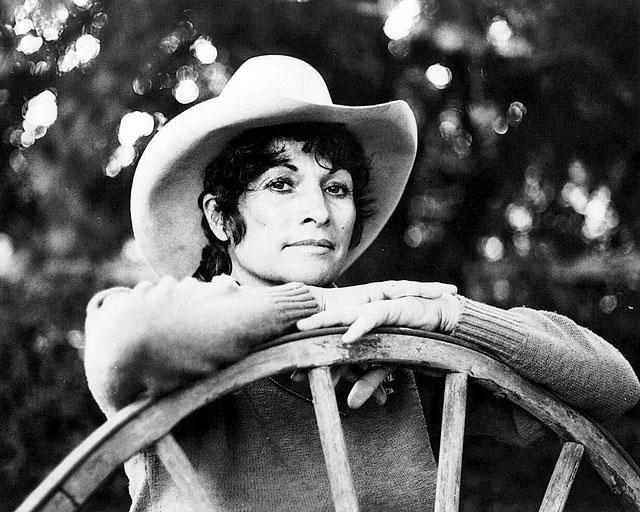
    Whether it was with wild horses, barrel horses or movie horses, Sammy Thurman Brackenbury lived her life with spirit, a sense of adventure, and a shot of adrenaline. By the age of seven she was breaking mustangs with her dad and selling them.
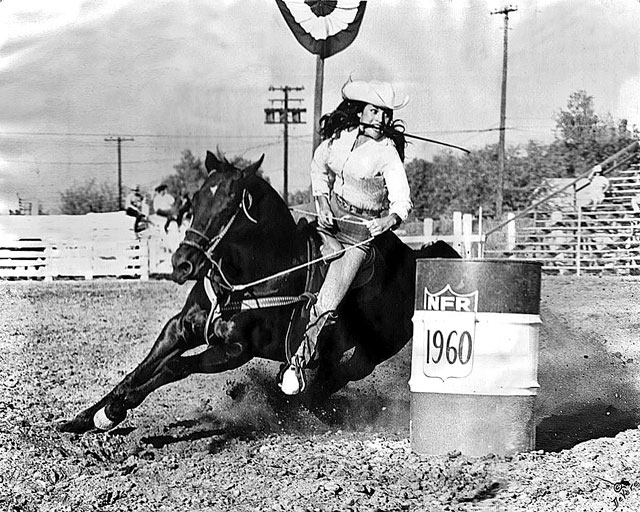
    At the age of 27, she ran barrels at her first of what would be eleven consecutive National Finals Rodeos, and five years later, she was the world champion barrel racer.
    She even doubled famous movie stars in the industry, doing horse riding and other stunts for them.
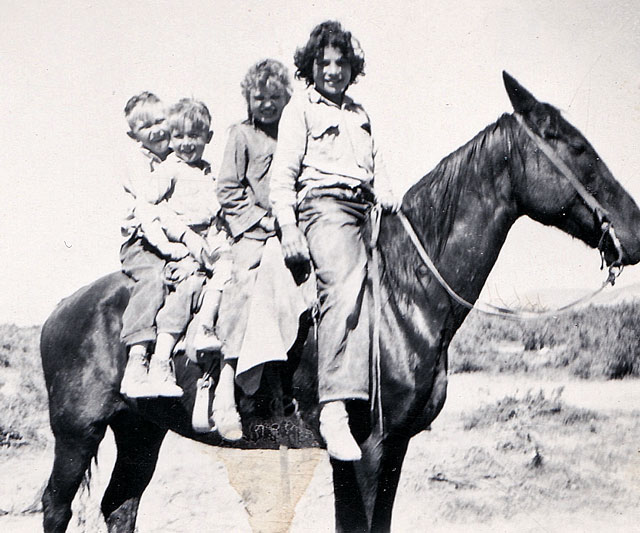
    She was born in 1933 on a ranch in the Big Sandy, near Wickieup, Ariz., the daughter of Sam and Mamie Fancher. Her mother had three children from a previous marriage, but they were grown and out of the house. Named after her dad, he wanted a boy and treated her like one. “I did everything a boy would do,” she said.
    Her father ran a ranch in Arizona, and when she was five years old, he quit his job to rodeo. The family moved to California to be closer to rodeos, since there weren’t a lot in Nevada at the time. After Sammy’s dad’s horse was injured, the family packed up again, this time moving near Imlay, Nevada, to work on another ranch. Her dad had bought interest in the ranch and rodeoed again to help pay the bills, and the mustangs Sammy broke were sold as kids’ ponies, which brought in a bit more income for the family.

    She attended rodeos with her dad, but few of them included women’s barrel racing. Barrel racing hadn’t found its way to California yet; it was more common in Oklahoma and Texas. She match raced, riding her dad’s horses, and rode calves, and read all she could about the Girls Rodeo Association, the forerunner to the Women’s Pro Rodeo Association.
    By this time, the family was living near Las Vegas, Nev., and Sammy was sixteen. Every horse her dad had she turned into a barrel horse. One fall, she and her cousin tried to convince the organizers of a small rodeo in Las Vegas to add barrel racing. They talked them into it, and the first year, with forty entries, Sammy won first and her cousin won second.
    By about 1950, a California rodeo advertised it was adding barrel racing, and Sammy went there, excited to run. But when she got there, there was no barrels; it was poles. She rode her barrel horse, having to “rein him through” the pattern. The girl who promoted the pole bending won the event. Sammy got even; on the second run, she got her dad’s rope horse: “you could do anything on him,” she said, “and he smoked the poles and I won the second round.”


    Sammy’s life was full of training horses, running barrels, and roping with her dad. Her first time competing with him at an RCA rodeo came about by accident. His partner didn’t show up, so she took his place. She hadn’t dally roped much, and her dad “was as nervous as a whore in church,” she laughed, about his daughter. “I got out perfect, laid it on (the steer),” Sammy said, “and when I roped him, my dad was looking at me to see if I was getting my dally, and went right on past the steer.”
    Her daddy spoiled her, she said. One time, at a rodeo in Delano, Calif., she ran her rope horse in the barrels. When it was announced she’d have to run again because they missed her time, she told her dad she was going to ride Punkin, an exceptional palomino that her father used for the hazing, bulldogging, heading, heeling and calf roping. “No, you’re not,” he told her, and she replied, hide and watch! “I was a brat,” she laughed.
    At the time, women were not allowed to compete in RCA rodeos, but Sammy and her dad were friends with Bill Linderman, RCA secretary and former president.
    Linderman helped Sammy out several times, paving the way for her to rope with her dad. Bill told her, “when you want to enter, you tell them I said you could enter. If they give you grief, have them call me. So I started roping with my dad,” she said.


    Because she did so well in the barrel racing, the Utah and Idaho rodeos often barred her from entering. She’d call on her friend Linderman again, and he’d say, “you tell them if they won’t let you enter, they can’t have barrels at the rodeo,” she remembered.
    By then, barrel racing was becoming more common and more rodeos were including it. It helped, Sammy said, that world champion Wanda Bush and Florence Youree came to California to promote the event.
    In 1960, she qualified for her first National Finals Rodeo. Living in Nevada, she competed in her home state and across California, Utah and Idaho. She and her dad made all the horses she rode, including what she considers her best horse, a bay mare named Ugh “because she was ugly,” Sammy remembers. The first time she had a chance to buy the mare, who wasn’t papered, the cost was $350. Her husband at the time, Anson Thurman, wouldn’t let her buy the horse. By the time she got her, the price was $850. But Ugh was worth it. “She was an outstanding barrel horse. You could do anything on her.”
    Sammy qualified for the NFR every year from 1960-1970, winning the world in 1965. That year, she rode Ugh for most of the season but due to injury, the horse was out for the NFR. She rode a borrowed horse, Roanie and still finished third in the average. Sammy didn’t often rodeo back east; it was too far. But when she did, she borrowed horses, to cut down on the expense of driving a horse trailer and because the rodeos didn’t pay well enough to haul a horse.
    One of the more innovative things she did for the sport was switching hands between the first and second barrel. Her dad taught her that. While most barrel racers ran with one hand, leading to the neck rein making horses stiff in the turn, Sammy changed hands between the first and second barrels. “Left hand, left turn, right hand, right turn,” she would chant to the students she later taught at clinics.
    Sammy won rodeos all over: Rodeo Salinas (Calif.) several times; the Grand National at the Cow Palace in San Francisco; Phoenix; Red Bluff; Oakdale; Redding; Tucson; Denver; and Caldwell, among others.

    In the mid 1960s, she began hosting barrel racing clinics. The concept was relatively new; Wanda Bush and Florence and Dale Youree had done some, and so had horse trainer Monte Forman, after whose she patterned hers. Barrel racing was so new that many of her students had only seen the event on TV.
    They were three days in length, with the first day for observation. “I’d give (the students) a paper to fill out, a brief story on them and their horse. Then I’d watch them all make a run and analyze their runs,” she said. On day two, Sammy worked with each girl on any problems they might have, and the third day was competition, for students to put into practice what they had learned. She did the clinics for ten years.Another part of her life was doing stunt work in Hollywood. When she was eighteen, she had a part in the movie In Cold Blood. Then movie work was put on the back burner to rodeo, but after she married husband Bill Burton, a team roper, steer wrestler, bull rider, and stuntman, she became involved in movies again. In addition to horse riding, she did whatever stunts were needed, including swimming, even though she couldn’t swim. In the 1993 movie Another Stakeout, she had to jump off the dock into the Fraser River in Vancouver. “I told them I couldn’t swim,” she said, “and they had security guys all over to keep me safe.” After jumping in and coming up, she swam for the ladder. The safety man said, “I thought she can’t swim,’ and she told him, “I can sure swim when I need to,” she laughed.
    She doubled for well-known actresses like Kathy Bates, Linda Evans, Jane Fonda and Dolly Parton. She was a charter member of the United Stuntwomen’s Association.
    She also held positions in the GRA, serving as west coast director in the early 1970s and director at large. In 1975, she was voted president of the GRA, but didn’t stay in that role for long. Her new marriage to Burton and her work with the picture business kept her busy.


    Sammy ran at her last pro rodeo in 1990, the same year she married her seventh husband, Jesse Brackenbury, a reined cow horse trainer, “possibly the best horse trainer I know,” Sammy said. She had her first daughter, Patti Parker, “before I was born,” she quips, joking about her age. She has two other daughters, Jodi Branco and Syd Thurman. Two of Jodi’s children, Stan Branco and Roy Branco, have continued the rodeo tradition. Stan, a steer wrestler, competed at the 2013 NFR and Roy has qualified for the California Circuit Finals in the tie-down roping. Her step-children include Billy Burton, Jr., David Burton, and Heather Gibson-Burton, along with six grandkids and four great-grandkids.
    Thurman was inducted into the Pro Rodeo Hall of Fame in August of 2019 and is a member of the National Cowboy & Western Heritage Museum’s Rodeo Hall of Fame. She has also been honored with the 2013 WPRA California Circuit True Grit award and the WPRA California Circuit Pioneer Cowgirl award in 2016.
    The best part of her life, she says, started “when I was one year old and it’s still happening. I love my life, I love everything that’s happened in my life. I worked the picture business, I rodeoed, I loved it all and I still do.”

  • Featured Athlete: Beau Peterson

    Featured Athlete: Beau Peterson

    Beau Peterson loves her 5 Star Equine products, and they have served her well.

    The Council Grove, Kan. cowgirl has put them to good use, too, as she is a Kansas State High School Rodeo champion in the breakaway roping and goat tying (three titles in each event), and the pole bending (once).

    And, at the College National Finals Rodeo, she tied with Mia Manzanares as the 2019 National Inter-Collegiate Rodeo Association goat-tying champion (25.1 seconds on four head).

    As sophomore at Panhandle State University in Goodwell, Okla., Beau is studying biology, and after earning a bachelors in the subject, will go to nursing school. Her aim is to be a CRNA – a certified registered nurse anesthetist. She enjoys learning how the body works and helping people. “I think it’s fascinating,” she said. A CRNA usually works regular hours and few weekends, which is also appealing to her, as is the pay.

    As for 5 Star Equine products, Beau loves the saddle pads and has been using them for several years. “They’re such a great quality,” she said. “They last forever, if you take care of them.” She cleans hers frequently. “Some saddle pads get hard from dirt, sweat and hair,” she said. “They are easy to clean and if you take care of them, they last a long time.”

    Every week she uses the sponge that is sent with them, and, in a circular motion, wipes them down. “The hair comes off pretty easy. If your saddle pad is really bad, you can hose it down with a power washer and let it dry.” She never lets them get that dirty. “I do the sponge every week or so and it really gets the hair and dirt off and keeps them from getting hard.”
    Her horses love them, too. “Being wool, (the horses) don’t get sore.”
    She also uses 5 Star Equine front boots. “I like them. They are a unique style and have the double tabs. After you cross them once, it’s really easy to seal them for extra support. I just think they’re a nice set of boots.”
    For the goat tying, she rides a six-year-old mare named Missy who was purchased last year from her sister’s boyfriend, who started her in the heeling. “He let me ride her, and I’ve loved her ever since. She’s so willing to learn and has made everything so easy. She’s so quick, she’s fun to tie goats and breakaway on.” Missy is her backup breakaway horse.
    For the breakaway, she rides a thirteen-year-old gelding named Hustler, a bay she’s owned for seven years. He has improved her roping. “My breakaway has grown with him and through him. He’s just been awesome, and he was an awesome horse to start out on. He’s solid for me, he scores like a rock every time, and gives me the best shot. He’s true, every run.”
    Barbie is her barrel horse. Owned by Marc and Kim Harland, the seven-year-old bay has made Beau a better barrel racer. “I haven’t been much of a barrel racer, but the few years I’ve been doing it, they’ve kept nice horses under me, and she’s been fun to ride.”
    For the past two years, Beau has won 5 Star Equine Products’ social media contest, winning the most votes in the college division.
    For fun, when she has spare time, she likes to watch Grey’s Anatomy. She and her friends like to get out the cards and play pitch, too.
    She has an older sister, Michaela, who lives in Dodge City. Beau sometimes spends weekends with her sister.
    She currently leads the goat tying in the Central Plains Region, is fourth in the barrels, and sixth in the breakaway. She is also leading the all-around race and is on Panhandle State’s Dean’s list.
    Beau is the daughter of Matt and Dustin Peterson.