Rodeo Life

Author: Ruth Nicolaus

  • Back When They Bucked with Wally Badgett

    Back When They Bucked with Wally Badgett

    [ Pro rodeo cowboy-turned-cartoonist entertains with “Earl” cartoons about the western way of life ]

    Wally Badgett was a ranch kid-turned rodeo cowboy, then deputy sheriff -turned cartoonist.
    And through it all, he’s had a sense of humor.
    The Miles City, Montana man was born in 1952 on a ranch 75 miles south of Miles City, the son of Kirk and Lora Badgett.
    Wally was intrigued by the sport of rodeo because of his older brother, who competed, and after high school, attended Sheridan (Wyo.) College, where he rode bulls and was the 1971 National Intercollegiate Rodeo Association champion bull rider.
    He competed in high school rodeo in every event but steer wrestling. After high school graduation in 1970, Badgett went to Sheridan, where he rodeoed collegiately two years, before he moved back to Montana.
    From 1972 to 1975, he was on the pro rodeo trail, competing in the saddle bronc riding, calf roping, and bull riding, and qualifying in the bull riding for the 1974 National Finals Rodeo, finishing eighth in the world standings.
    By 1975, he stayed closer to home, rodeoing in Montana and the surrounding states, and four years later, he was done. A self-professed homebody, he was married to Pam (they married in 1973) with two little children at home. And it was time to quit. “I had never left the arena in an ambulance,” he said, “and I thought, I’m way overdue.” With a family to support, “you start to think of other things.”
    And he was pain-averse, he joked. “I’ve always hated pain, and I’m kind of a no-pain guy. Obviously, riding roughstock can be fairly painful at times.” His worst injuries were a broken ankle and pulled groins.
    Wally and his brother leased part of the family ranch for awhile (his mother had had a serious stroke when he was four years old, and his dad was forced to sell the ranch to pay for her care.) Then, one day, while in Ashland, Montana, he ran into the deputy sergeant. The sergeant mentioned that they were looking to hire a police officer, so Wally applied and got the job.
    For three years, he was a deputy sheriff in Rosebud County,(Forsyth), then the next nine years he spent as deputy sheriff in Custer County (Miles City).
    It was an injured back that drew him into his next profession: drawing.
    While laid up due to the back injury, he drew cartoons to entertain himself. He’d drawn as a child, but never anything serious.
    And thus Earl the rancher was born.
    As Badgett’s cartoons featuring Earl and his wife in various ranching situations grew in popularity, he got busier with the artwork.
    “People were starting to call the sheriff’s office looking for the cartoonist instead of the cop,” he quipped.
    He had to make a choice: continue in law enforcement, or build on the cartoon skills.
    “I chose (cartooning) because there’s less chance of getting shot,” he joked. “I was always worried about getting shot (as a sheriff). I might have been the shakiest gun in the west. I was always worried someone would steal my gun and beat me up with it.”
    Badgett’s cartoons with Earl and his situations tickle the fancy of ranchers, farmers, and those in the western lifestyle. They can be found in about 150 publications, from Texas to Canada, in rural and livestock newspapers.
    When he started, his cartoon content was “inside cowboy humor, and if you weren’t a cowboy, you might not get it,” he said. “I realized, if I’m going to make this work, I have to draw so the butcher, the baker and the candlestick maker can understand it, and it’s still funny.”
    Badgett is always looking for content that he can work Earl into. “I keep my ears open. In our western world, you can be talking to someone, and they say something not intended to be funny, but it’s hilarious. I write those things down.”
    Earl is depicted as a hard luck rancher whose cows tend to be thin, and whose wife often outwits him. He drives a 1950s truck and does some of his ranch work with a team. It’s a throwback to Badgett’s youthful years on the family ranch. He fed cattle with a team and has always been fascinated with that.
    Badgett never gave a name to the wife, but occasionally, tongue-in-cheek, he’ll call her “She Who Must Be Obeyed.”
    Every Earl cartoon Badgett draws has a dog in it (“I don’t think I’ve ever known a rancher that didn’t have a dog,”) and a magpie.
    The magpie came by accident. Badgett included the bird occasionally, but one day, someone told him he looked for but couldn’t find the magpie in the latest Earl cartoon he’d read.
    So Badgett, whose pen name is M.C. Tin Star, went back and included the bird in his previous cartoons and now draws one in every one. “It’s my trademark,” he said.
    Much of his drawing is done in the winter, when the weather is cold. “The days are short, and sometimes I might do two or three or four in a day. I usually operate in a state of disorganization and confusion,” he joked.
    Badgett served as the rodeo coach at Miles City (Mont.) Community College for about twenty years, first as assistant coach, then as head coach. He retired from that role in 2021.
    Justin Miller was one of Wally’s rodeo athletes from 2008-2010.
    The Lockwood, Mont. cowboy rode barebacks in college rodeo and appreciated his coach’s willingness to help.
    “If you were going to work hard (in college rodeo), he was going to work hard with you. He would do whatever it took, for whatever you wanted,” Miller said. “He wouldn’t give up on you or leave you wanting. He’d help you out as much as you wanted.”
    In his pro rodeo career, Wally held the record for the high marked ride bull ride in Houston for several years, at 85 points. “That doesn’t sound like much now,” he said, noting that markings have gotten higher.
    He also said that bullfighters are more proficient now. “Back in my day, there might be one bullfighter, and he may or may not be any good. He might outrun you to the fence, but at least there might be someone to help you up if you got there, too.”
    He and Pam have a son, Brett, who is married to Joni and lives in Miles City, with a daughter, and a daughter, Whitney, who is marked to Fakhrul Hasan; they have a son and a daughter and live in California. Both children are artistic; one of Brett’s sculptures, a half-life size of a steer roper, stands at the Pro Rodeo Hall of Fame in the back garden.
    He cowboys for a local ranch, when they need him, but mostly stays home and enjoys Montana and rural life.
    He refuses to use any digital device, social media, and doesn’t text. “I’ve seen a lot of changes, and I’ve been against almost all of them,” he joked. “But they happen anyway.”
    Badgett is a 2023 Montana Cowboy Hall of Fame inductee and the third recipient of the Saddle of Honor, joining the 2018 Saddle of Honor recipient Charles M. Russell and 2019 recipient Jay Contway.
  • Colorado cowgirl selected as Wrangler NFR saddle horse boss

    Colorado cowgirl selected as Wrangler NFR saddle horse boss

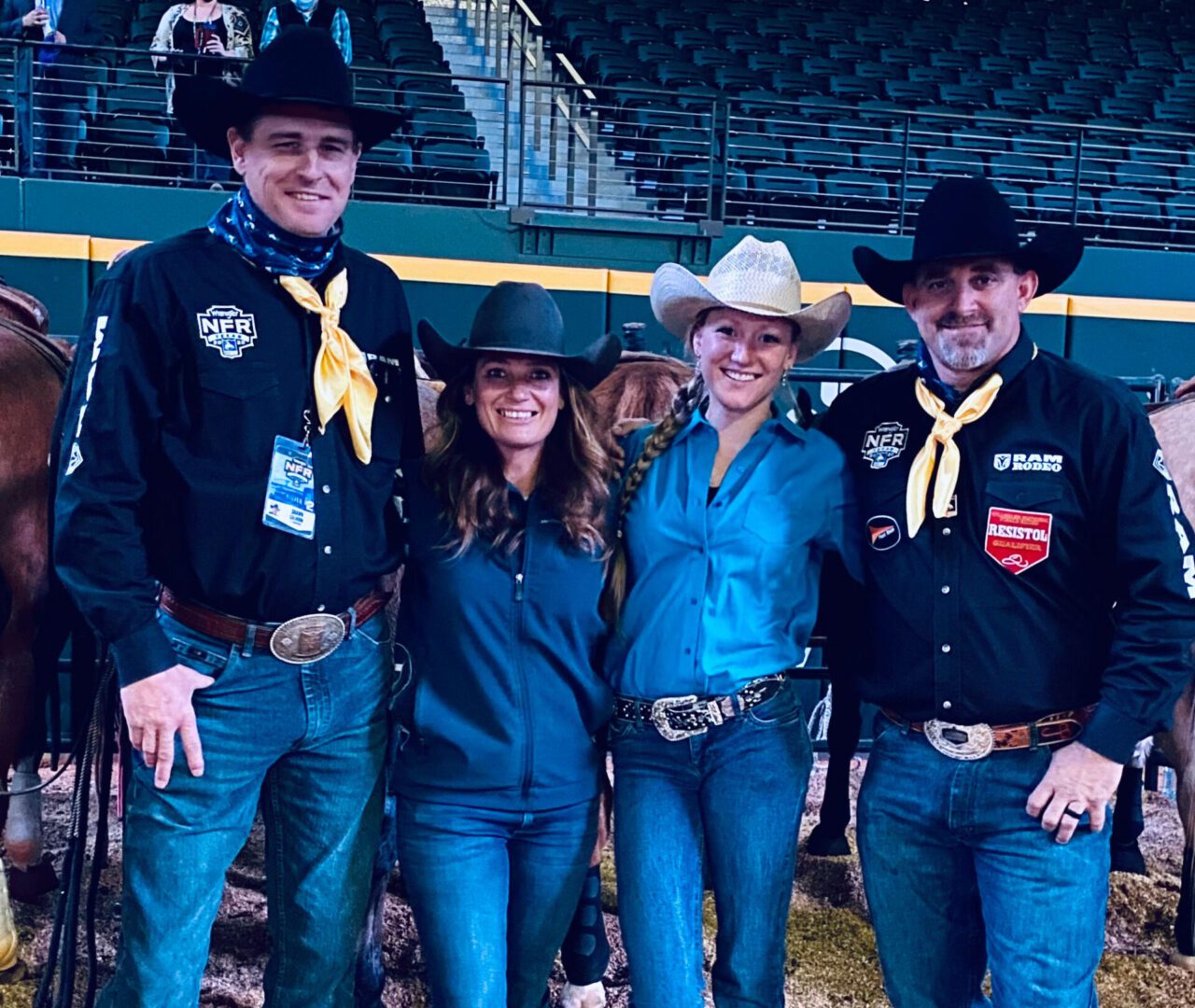
    Raina Hudson-Chavez has been selected as the saddle horse boss at this year’s Wrangler National Finals Rodeo.

    As boss, she is responsible for the 74 horses ridden for various uses at the Wrangler NFR, and the eleven people under her, who help care for, tack, and exercise the horses.
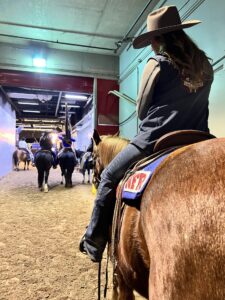
    Those animals include 24 black flag horses, ridden by the flag girls for the grand entry pivot and sponsor flags (called the front end horses), 30 horses ridden by the saddle bronc and bull riders during the states grand entry, two horses for judges, four ushers’ horses, and pickup horses, owned by the pickup men but housed at the Thomas and Mack Arena in Las Vegas.

    Her and her cohorts’ workday starts at about 6:30 am, when they come in to clean, feed, water and exercise horses. They usually leave at about 11 am, then come back by 2 pm for that evening’s performance. They’re there till the rodeo is over, at about 9:30 pm, after the last of the horses, the pickup horses, are unsaddled, cooled out and settled in for the night.

    Of the eleven people under her management, two cowgirls are assigned to the pickup horses. The other nine people each get six to seven horses to care for, water, feed and ride, the same  horses every day.

    It’s a tight-run ship; everything has to run on schedule for rodeo production, Raina said.

    The saddle bronc and bull riders come for their horses for the states’ flags grand entry in a staggered fashion, not all at once. But when the grand entry is over, when all of those horses return, “they all come back at the same time, so you’re trying to make sure the horses get put in the right stalls.”

    The two cowgirls assigned to the pickup horses help with the switch of horses during the bareback and saddle bronc riding. It’s a fifteen second switch, Raina said. “The pickup men are running at you with their hot horses, and you’re holding the fresh horses. (The cowgirls) needs to swap that off fluidly to where you’re not in their way, but you’re also keeping everybody safe and the horses are not out of control.

    “Those swaps are exciting and it’s fast-paced and you have to be on your game.” The crew helps exercise the pickup horses in the morning, and warm them up during the performances.

    Horses are usually exercised in the morning. The exercise pen is the same area where the arena dirt for the Thomas and Mack arena is stored throughout the year. The dirt is gone, leaving an area of about 200 feet long by 100 feet wide. Contestants warm up their horses in the same pen, but when it gets crowded, everyone is respectful of others, Raina said.

    Their work begins a week before the Wrangler NFR starts. The state grand entry horses are borrowed from stock contractors, and Raina and her people ride every one of them, “getting any kinks worked out of them,” she said. “We can see where each horse is at.” (The timed event contestants and barrel racers ride their own horses and the bareback riders don’t ride in the states grand entry; they’re getting ready to compete.)

    Before the Finals starts, the crew gets stalls ready and bedding put out for not only the horses in their care, but for the contestants and rodeo acts as well.

    After the ten days of the Wrangler Finals are over, she and her people tear down, storing the water hoses, tack, and other equipment in a storage unit. They help in organizing the stock contractors’ tack and their horses as they are loaded and ready to leave.

    Raina grew up in Michigan, the daughter of Howard and Joyce Overholt, competing in the IPRA but mostly helping her dad at horse sales and with training horses. The family often had 300 head that her dad, a horse and cattle dealer, bought and sold.

    “I was the guinea pig,” she said, of her youth. “Any horse my dad bought, I was the one who got to jump on and see what was broke and what wasn’t.”

    Raina was given the “problem” horses and often had a string of 15 to 20 to ride. “I would work with them, and my dad would usually sell them.” The experience she gained working with those horses is part of how she makes a living now.

    Living in Brighton, Colo., with her husband, Adrian Chavez, she puts on clinics, gives riding lessons and works with a variety of horses. “My clients bring me all types of horses, and it’s been fun getting to work with them,” she said. She’s compiled a list of what she’s termed the “micro-expressions” a horse gives: a slow eye blink or the flick of an ear, for example, and teaches her clients how to read those expressions. “My clinics teach people how to connect with their horses and read their body language. It’s stuff we take for granted when we grow up with it.”

    She and Adrian operate the Twisted Arrow Ranch in Brighton, where they breed their own horses and raise them for roping and barrel racing.

    Raina got her start at the Wrangler NFR in 2013, through Floyd Campbell, who worked with the Finals saddle horses. She was galloping race horses at the Arapahoe Park Race Track in Aurora, Colo., where Campbell also worked, when he asked her to help. For the first few years, she was assigned to the grand entry horses, then to the pickup horses. She helped wherever she was needed. “Whatever job needed to be done, I would jump in and help. It got to where people came and asked me for help.”

    TVs are placed around the tunnel and warm up tents where Raina and her crew work, but they don’t get to watch much of the rodeo, and she’s fine with that.

    “I like the behind the scenes stuff. But you can stop and watch and catch up with things.”
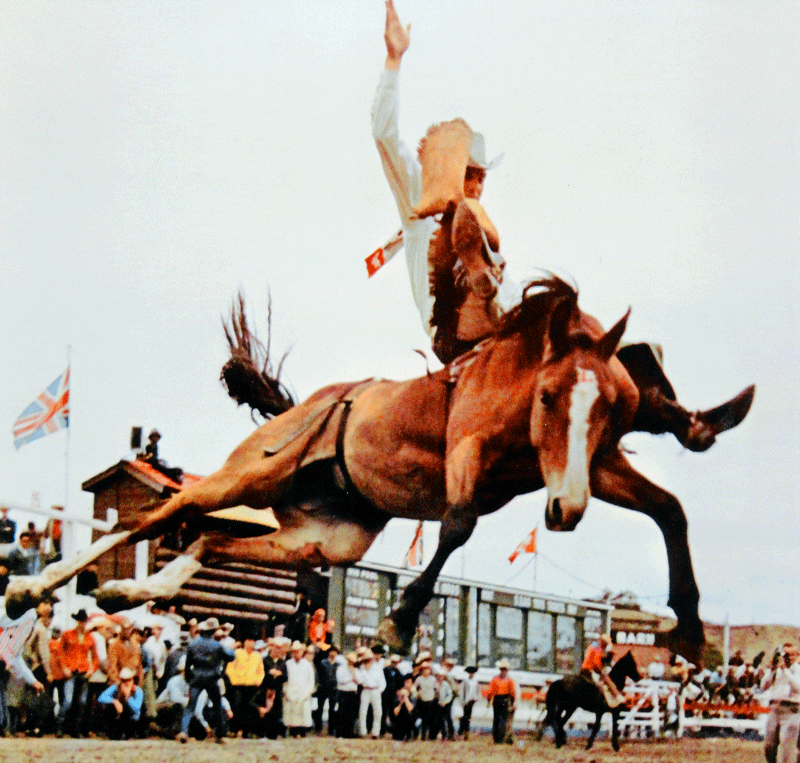
    Working behind the scenes at the Wrangler NFR calls for a disciplined person, she said. “For the job to be done correctly, you need people who are self-starters and self-motivators. You show them the job, then they understand it and want to keep doing it. You don’t want to have to micromanage people at the Finals. They need to be able to do the job they’re hired for, and be able to think through things on their own.”

    The job isn’t easy, but it’s very enjoyable. “You have to love rodeo and the whole atmosphere of it, because it’s a lot of work, and hard work, but if you love it, it’s not.

    “I enjoy the rodeo crew and all the people, the way they come together. I don’t think you get that in any other sport. We’re all there for one cause.

    “It’s an honor just to be there.”


  • BEST IN THE BADLANDS

    BEST IN THE BADLANDS

    Badlands Circuit Finals determines champs, qualifiers for the NFR Open


    MINOT, N.D. (October 15, 2023) – The gold buckles are on their winners’ belts, the championship saddles are packed in trucks headed home, and the final rodeo of the 2023 season is over for Badlands Circuit cowboys and cowgirls.


    The annual Badlands Circuit Finals Rodeo was held Oct. 13-15, with two champions crowned in each event: the year end champ (the cowboy or cowgirl who has won the most money throughout the regular season, and the finals champ (the cowboy or cowgirl who won the rodeo in Minot.)


    Year end and finals champs qualify to compete at the NFR Open, held in Colorado Springs, Colo., next July. With a payout of over $600,000, the NFR Open is an exclusive opportunity for circuit winners from across the nation to win money and improve in the standings.


    Some of the ’23 champs are repeats, continuing their winning ways, and some are just getting a good start to their pro rodeo careers.


    Bareback rider Ben Kramer, Max, N.D. won his first circuit titles, claiming both the year end and finals spots. For the finals, he scored 240.5 points on three head, only two and a half points more than the number two man, Shane O’Connell, Rapid City.


    The twenty-two year old has had the best year of his rodeo career. He won first place at Badlands Circuit rodeos like Clear Lake, Brookings and Watertown, S.D., and at the big shows as well, having won money at Ft. Worth, San Antonio, and Cheyenne (Wyo.) Frontier Days.


    Kramer is a third generation bareback rider; his granddad, Jack Kramer, and his dad, Shawn Kramer, also rode. Shawn qualified for the Badlands Circuit Finals three times in the 1990s.


    This was Kramer’s fourth circuit finals qualification. He is currently ranked 34th in the world standings.


    Another new name topped the list for Badlands winners.


    Saddle bronc rider Cash Wilson, Wall, S.D., went home with both the year-end and finals titles, having won the most money during the regular season and earning 242.5 points on three head to win the finals.


    The twenty-one year old won checks in each round, tying for second in round one, winning second in round two, and taking first place in the third round.


    On Friday night, in round one, he rode the Sutton horse Big E Macksteel. “I could have rode that horse a lot better,” he said. “but I came back Saturday night and made a really good ride. Today I knew I had to do my job. I had a good horse of Korkow’s named Bambino Vold, so I knew I had a good chance.”


    Wilson acknowledged the history of North and South Dakota being home to excellent saddle bronc riders.


    “I’ve always looked up to these guys,” he said. “There are so many good bronc riders in the Dakotas, it’s hard to name them all. There’s been a lot of great guys who have won the Badlands Circuit, and I’m just happy to add my name to the list.”


    Wilson, who finished the 2023 pro rodeo season in 26th place in the world standings, is excited to be heading to the NFR Open. “It’s a great opportunity. There’s a lot of big money up for grabs there. I’m excited to compete at that.”


    Steer wrestler Cameron Morman is no stranger to Badlands titles. The Glen Ullin, N.D. cowboy won his eighth and ninth gold buckles this year, having won the year-end and finals titles.


    He was aboard Kenny, a seventeen-year-old sorrel who carried Morman to his 2022 wins.


    The sorrel “is real quick across the line, and I feel like this arena fits his style,” he said.


    Bily Bolden hazed for Morman and for several other steer wrestlers at circuit finals.


    The indoor arena at the N.D. State Fair Center in Minot is also a good fit for another horse.


    Breakaway roping champ Sawyer Gilbert, who won the finals with 7.7 seconds on three head, was aboard her nineteen-year-old paint horse named Roger.


    “He really likes this building,” she said. “It’s indoor and a short setup, and that’s his game. The cattle were a little slower, and he does really, really good with softer cattle, the ones that stop at the end of the rope. He quarters and gets the rope broke away really fast.”


    Roger also likes music, which is louder at indoor rodeos. “He likes loud music,” she said. “When we practice on him, we’ll play music, and he’ll play with the lead rope or the fence.”


    Gilbert won first place in the second round and fourth place in the third round.


    “I drew really good all weekend,” she said, and she was careful not to break barriers, which adds a ten second penalty and ruins any chance a breakaway roper has of winning the rodeo.


    During the third performance, as she rode into the breakaway box, she heard the announcer say she had to make a three second run, or faster. “I could have tried to win the round tonight and win the year end (title), but the smart thing to do when you’re winning the average by that much is to get out of the barrier and rope your cow and that’s what I did.”


    Gilbert is the 2021 WPRA World Champion breakaway roper. Brooke Howell, Belle Fourche, S.D., was the year-end winner.


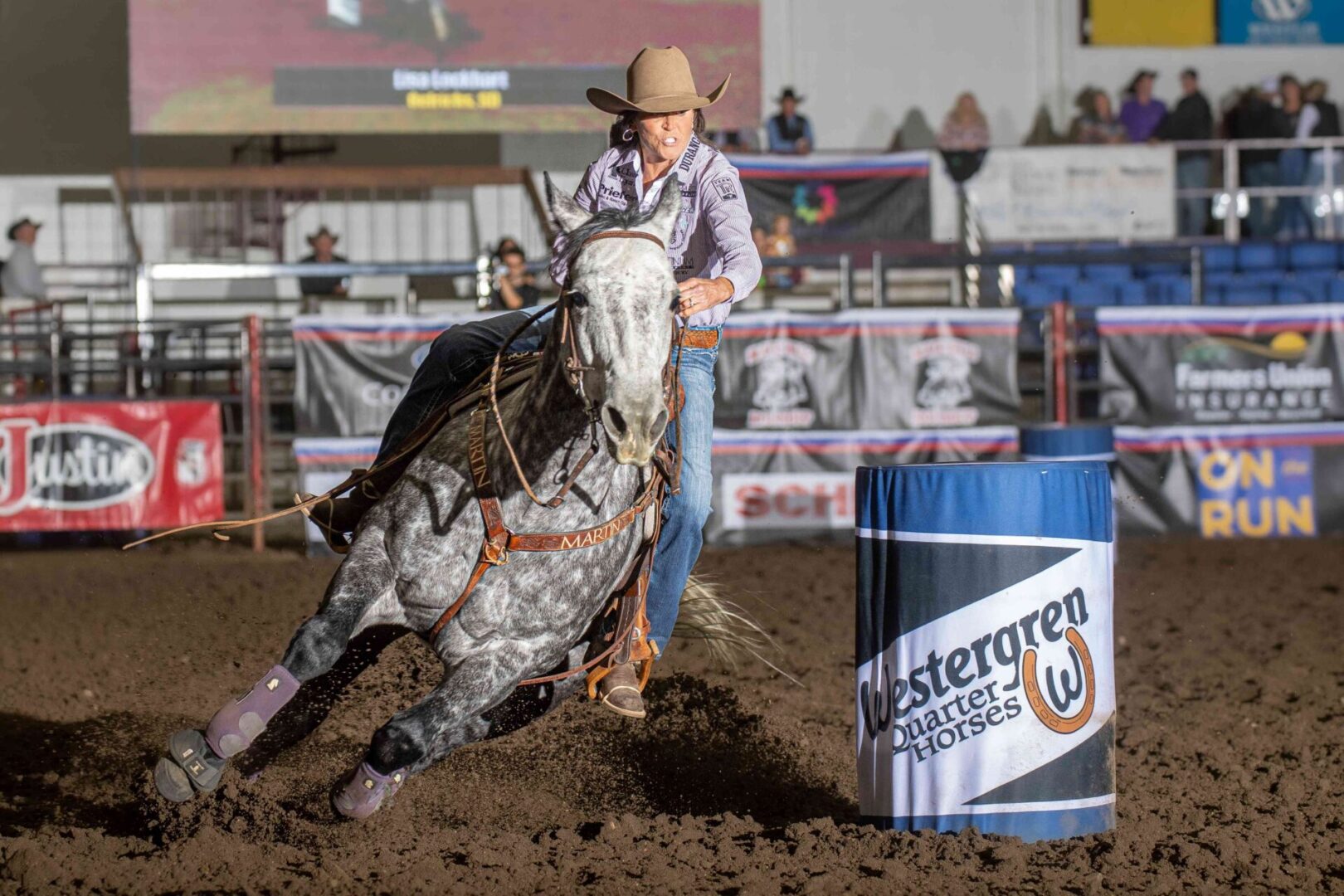
    In the barrel racing, two veterans claimed wins. Jessica Routier, Buffalo, S.D., won the year-end title aboard her popular palomino horse Fiery Miss West, “Missy,” and Lisa Lockhart, Oelrichs, S.D., won the finals rodeo, on her well-known gray horse, Promise Me Fame Guys, “Levee.”


    Mason Moody dominated the bull riding from the start.


    The Letcher, S.D. man came into circuit finals with a commanding lead, and was the only bull rider to make three qualified rides; no one else rode two bulls, and only two men covered one bull (Riggin Shippy, Colome, S.D. and TJ Schmidt, Belle Fourche, S.D.) For his efforts, Moody won both the year end and finals titles.


    Other 2023 champions include tie down ropers Grant Turek, St. Paul, Neb. (year end) and Austin Hurlburt, Norfolk, Neb. (finals), and team ropers Bodie Mattson, Sturgis, S.D. and Cash Hetzel, Lemmon, S.D. (year end) and Jon Peterson, Belle Fourche, S.D. and Trae Smith, Georgetown, Idaho (finals).

    The Badlands All-Around of the Year title went to Bodie Mattson, Sturgis, S.D. The Badlands All-Around title was won by Austin Hurlburt, Norfolk, Neb.

    Both year-end and average champions will represent the RAM Badlands Circuit at the NFR Open, formerly known as the National Circuit Finals Rodeo, to be held in Colorado Springs in July of 2024. In the event that the same person has won both titles, the second person in the year-end race qualifies for the NFR Open.

    – ### –


    3Year end and average winners for the Badlands Circuit

    3rd performance results from Oct. 15, 2023


    All-around Champion: Bodie Mattson, Sturgis, SD

    All-around champion for the Finals: Austin Hurlburt, Norfolk, NE


    Bareback riding

    Bareback Riding Year End Champion: Ben Kramer, Max, ND

    Bareback Riding Average Champion: Ben Kramer, Max, ND


    3rd round results:

    1. Ty Breuer, Mandan, ND 85 points on Sutton Rodeo’s Deets; 2. Clay Jorgenson, Watford City, ND 83; 3. Chase Yellow Hawk, Blunt, SD 80; 4. Steven DeWolfe-Shedeed, Buffalo Gap, SD 78.5.


    Average results:

    1. Ben Kramer, Max, ND 240.5 points on 3 head; 2. Shane O’Connell, Rapid City SD 238; 3. Chase Yellow Hawk, Blunt, SD 228; 4. Steven DeWolfe-Shedeed, Buffalo Gap, SD 222.5.


    Steer Wrestling

    Steer Wrestling Year End Champion:  Cameron Morman, Glen Ullin, ND

    Steer Wrestling Average Champion: Cameron Morman, Glen Ullin, ND


    3rd round results:

    1. Justice Johnson, Bismarck, ND 3.8 seconds; 2. (tie) Cameron Morman, Glen Ullin, ND and Reed Kraeger, Waco, NE 4.0 each; 4. Austin Hurlburt, Norfolk, NE 4.2.


    Average results:

    1. Cameron Morman, Glen Ullin, ND 12.1 seconds on 3 head; 2. Scott Kleeman, Killdeer, ND 13.7; 3. Austin Hurlburt, Norfolk, NE 14.6; 4. Tyler Thorson, Manning, ND 14.7.


    Team Roping

    Team Roping Year End Champion Header: Bodie Mattson, Sturgis, SD

                                                                Heeler: Cash Hetzel, Lemmon, SD

    Team Roping Average Champion Header: Jon Peterson, Belle Fourche, SD

                                                                Heeler: Trae Smith, Georgetown, Idaho


    3rd round results:

    1. Jon Peterson, Belle Fourche, SD/Trae Smith, Georgetown, Idaho 4.5 seconds; 2. Jr Dees, Aurora, SD/Ross Ashford, Lott, Texas 4.8; 3. Clay Holz, Niobrara, NE/Matt Zancanella, Aurora, SD 4.9; 4. Trevor Olson, Mud Butte, SD/Jace Engesser, Spearfish, SD 5.0.


    Average results:

    1. Jon Peterson, Belle Fourche, SD/Trae Smith, Georgetown, Idaho 20.7 seconds on 3 head; 2. Jr Dees, Aurora, SD/Ross Ashford, Lott, TX 21.0; 3. Guy Howell, Belle Fourche, SD/Riley Curuchet, Kaycee, WY 22.4; 4. Cooper White, Hershey, NE/Tucker White, Hershey, NE 25.4.


    Saddle Bronc Riding

    Saddle Bronc Year End Champion: Cash Wilson, Wall, SD

    Saddle Bronc Average Champion: Cash Wilson, Wall, SD


    3rd round results:

    1. Cash Wilson, Wall, SD 80.5 points on Korkow Rodeo’s Bambino Vold; 2. Cole Elshere, Faith, SD 77; 3. Jade Blackwell, Rapid City, SD 75; 4. Shorty Garrett, Eagle Butte, SD 70.

    Average results:

    1. Cash Wilson, Wall, SD 242.5 points on 3 head; 2. Cole Elshere, Faith, SD 235; 3. Jade Blackwell, Rapid City, SD 231.5; 4. Shorty Garrett, Eagle Butte, SD 227.


    Breakaway Roping

    Breakaway Roping Year End Champion: Brooke Howell, Belle Fourche, SD

    Breakaway Roping Average Champion: Sawyer Gilbert, Buffalo, SD


    3rd round results:

    1. Taylor Engesser, Spearfish, SD 2.0 seconds; 2. Danielle Wray, Ord, NE 2.2; 3. Kayla Olson, Chadron, NE 2.6; 4. Sawyer Gilbert, Buffalo, SD 2.8.


    Average results:

    1. Sawyer Gilbert, Buffalo, SD 7.7 seconds on 3 head; 2. Danielle Wray, Ord, NE 7.9; 3. Brooke Howell, Belle Fourche, SD 9.4; 4. Jessica Holmes, Buffalo, SD 18.2.


    Tie-down Roping

    Tie Down Roping Year End Champion: Grant Turek, St. Paul, NE

    Tie Down Roping Average Champion: Austin Hurlburt, Norfolk, NE


    3rd round results:

    1. Austin Hurlburt, Norfolk, NE 8.1 seconds; 2. Grant Turek, St. Paul, NE 8.2; 3. Bodie Mattson, Sturgis, SD 10.9; 4. Thane Lockhart, Oelrichs, SD 11.3.


    Average results:

    1. Austin Hurlburt, Norfolk, NE 26.6 seconds on 3 head; 2. Bodie Mattson, Sturgis, SD 29.9; 3. Thane Lockhart, Oelrichs, SD 37.1; 4. Ty Moser, Volga, SD 42.6.


    Barrel Racing

    Barrel Racing Year End Champion: Jessica Routier, Buffalo, SD

    Barrel Racing Average Champion:  Lisa Lockhart, Oelrichs, SD


    3rd round results:

    1. (tie) Taylor Hanson, St. Onge, SD and Lisa Lockhart, Oelrichs, SD 13.35 seconds each; 3. Bobbi Olson, Sheyenne, ND 13.42; 4. Lakken Bice, Killdeer, ND 13.51.


    Average results:

    1. Lisa Lockhart, Oelrichs, SD 40.61 seconds on 3 runs; 2. Lakken Bice, Killdeer, ND 40.69; 3. Molly Otto, Grand Forks, ND 40.91; 4. Jessica Routier, Buffalo, SD 40.94.


    Bull Riding

    Bull Riding Year End Champion: Mason Moody, Letcher, SD

    Bull Riding Average Champion: Mason Moody, Letcher, SD


    3rd round results:

    1. Riggin Shippy, Colome, SD 78.5 points on Muddy Creek Rodeo’s War Zone; 2. Mason Moody, Letcher, SD 59; no other qualified rides.


    Average results:

    1. Mason Moody, Letcher, SD, 228 points on 3 head; 2. Riggin Shippy, Colome, SD 78.5 on 1 head; 3. TJ Schmidt, Belle Fourche, SD 77 on 1 head.


    ** All results are unofficial.  For more information, visit www.ProRodeo.com.


  • Back When They Bucked with Dave Garstad

    Back When They Bucked with Dave Garstad

    [ “We had fun when we rodeoed, and it was good to us.” ]

    or fifteen years straight, bull rider Dave Garstad never finished a Canadian rodeo season in less than fifth place in the Canadian standings.
    The Stettler, Alberta cowboy dominated the rodeo scene for more than two decades, beginning in 1959 till he retired in 1980.
    The eighth of nine children born in 1943 to Norwegian immigrants Magna (Juleson) and Olav Garstad, he and his brothers rode one of the family’s milk cows. “She bucked really well without a flank,” Dave said. “She’d turn back and spin right at the gate.” Weighing 1400 lbs., riding her gave the boys the rodeo bug.
    Back then, near Veteran, Alberta, where he was raised, the local farmers and ranchers would have cow riding during the multi-day brandings. Men and boys could pay an entry fee of $3 or $4 and ride. At the age of fifteen, Dave won the contest and $400, which was a lot of money in those days.
    And that success determined his fate in life: rodeo.
    He was a three-event cowboy, riding barebacks and bulls and steer wrestling, but bull riding was his forte.
    Because of his $400 winnings, he could buy a Canadian Pro Rodeo Association membership and compete professionally. But his mother wouldn’t sign for him, as a minor. So George Myren signed the release form and he became a full-fledged member.
    He rodeoed professionally as he finished high school. He had “senior matriculation” – high enough grades to attend university – but he chose to rodeo. Dave still remembers what the school principal told him. “He said, for somebody that had the academic promise that I had, I was wasting my time in the rodeo business.”
    But it wasn’t a waste.
    He rodeoed across the country, and ventured to the States in the winter of 1963, hitting the big shows: Odessa, Denver, Ft. Worth, Amarillo, and on down the line.
    His first time rodeoing in the U.S. was an interesting story. He’d gotten to the rodeo in Big Sandy, Montana, but didn’t have his RCA (predecessor to the PRCA) card. He phoned the RCA office, in Denver at the time, requesting a card on short notice. He got results: Bill Linderman, president of the association, called the rodeo secretary in Big Sandy, giving her Dave’s new card number.
    When he was broke, he worked in the oil patch in northern Alberta and British Columbia to make some money. But there weren’t too many lean years. At first, he was winning $12,000-$15,000 a year, getting on 120 bulls and 60 horses. A person could live on those wages.
    But as he got more experience, he was making $20,000 to $25,000 a year, when a regular income might be $10-$12,000.
    In 1967, he was the Canadian champion bull rider, having won more money than any other bull rider in the country. That year, he won eleven rodeos and placed second at 37. “I won a lot of money, considering the times.” He was sixty cents short of qualifying for the National Finals Rodeo, due to missing two rodeos while he courted Linda, who would be his future wife. “That’s the girl I wanted,” he said, “and I ended up with her.”
    From 1963-1978, he never finished lower than fifth place in the year-end standings in the Canada Pro Rodeo Association.
    Bull riders covered more bulls then, he said. “We didn’t have the misfortune of being thrown off eighty percent of the cattle we got on. You might ride sixty or seventy in a row before being bucked off.”
    Two of his brothers rodeoed with him: Gid and Dave’s twin, Mark. Sometimes they traveled together. Their dad, Olav, passed away when Dave and Mark were nine years old.
    One year, Dave, rodeoing in the Midwest and the South, got on the bulls of 33 different stock contractors, and only got bucked off two of them.
    He was a three-time Southern Circuit CPRA champion, and in 1980, qualified for his first Canadian Finals Rodeo. (The Canadian Finals Rodeo didn’t come into existence until 1974).
    At the Finals that year, during a ride, the bull’s head came up as Dave’s head came down. The bull’s horn broke his left cheek bone and the horn tip crushed his eye, causing him to lose sight in that eye. After that, he retired. He and Linda had two young sons. “We had little kids, (ages three and five) at home, so I had to make some money. You can’t be bumping your head when you’re not physically fit,” he said.
    After rodeo, he was a rig hand in the oil field, then in the 1980s, he went into the service business, monitoring drilling mud for ten years. Intelligent and a quick study, he understood every facet of the drilling business, knew the lexicon and the earth’s formations. He soon became a drilling foreman.
    Typical of bull riders, Dave had his share of injuries. He broke his back once, and as a kid, broke his jaw, requiring him to live on canned milk for a time as his jaw was wired shut.
    His worst injury was at Baird, Texas. After the buzzer, when Dave went to reach for his wrap, the bull bucked into a post, dumping Dave on the ground. The bull stepped on his back, breaking a shoulder blade and ten ribs on the same side. The ambulance driver, who had been drinking, forgot that Baird had a new hospital and drove his patient twenty miles farther than necessary to Abilene, Texas.
    When Dave was released from the hospital, his brother, Gid, drove him to a motel. While there, he sneezed, causing a rib to puncture his lung, so he was back to the hospital. The “big-time” doctor at the hospital refused to see sports-related injuries because he felt they were self-inflicted. But the head surgeon was willing to treat him.
    He was in ICU for a week, and when he flew home, the stewardess checked on him every five minutes, making sure he was OK.
    Linda remembers a funny story from this hospital incident. She called him every morning, before work, to see how he was. One morning on the phone he gasped for air and couldn’t talk. She was upset, thinking he was getting worse. They talked that evening, and he explained: he had been laughing at Archie Bunker on TV. “He laughed so hard he couldn’t breathe,” she said.
    Linda worked as a lab and X-ray technician; the couple had two sons, Ned, and Nate. The family traveled together when they could. The boys “always thought the bull riding should be first,” Linda said, “so they could go to the playground.”
    The best part of rodeo, both Dave and Linda agree, is the people. Dave often traveled with Myrtus Dightman, Mel Hyland, and Tom Silverthorn, among others. “I could count on them,” he said.
    “Rodeo is its own big family,” Linda said. And travel teaches lessons as well. “You learn so many life skills and coping skills out on the road.”
    The couple lived in Big Valley, Alberta for 48 years, before moving to Stettler last year.
    In addition to their sons and their spouses, they have three grandsons and a great-granddaughter.
    Dave said desire is an important part of rodeo. “With any sport, if the desire isn’t there, you can’t do much at all, and in rodeo, that’s really evident.” He was inducted into the Canadian Pro Rodeo Hall of Fame in 2014.
    He thinks about that first check he won, $400 for riding a cow at the ranchers’ branding. His rodeo career started, more or less, by accident. “If I’d have gotten stomped on that day, instead of winning, it would have been much different.
    “We had fun when we rodeoed, and it was good to us.”

  • Badlands cowboys, cowgirls enter Circuit Finals Rodeo in first place in respective events

    Badlands cowboys, cowgirls enter Circuit Finals Rodeo in first place in respective events

    Minot, N.D. (September 25, 2023) – The best cowboys and cowgirls in the Dakotas will be in Minot next month for the Badlands Circuit Finals Rodeo.


    And these number ones lead the charge, in their respective events.


    North Dakota cowboy Chase Lako leads the tie-down roping. The Mandan man has won more than $17,000, with this the fifth time he has qualified for the Badlands Circuit Finals.

    A financial advisor by day, rodeo is more of a “hobby” for he and his wife Kennedi, a barrel racer.


    “It’s a hobby but a serious one,” he said. “My wife and I go to the barn every night and we’re riding five or six horses.” He will ride his nine-year-old gelding named Dunnie, who he trained.


    South Dakota cowboy Mason Moody is on top of the pile of bull riders.


    The 20-year-old is in his rookie year of PRCA action, and went straight from high school to rodeo. He competed in the PBR last year but decided to switch to professional rodeo this spring, and has done well, having won money at rodeos in Newtown, N.D., Mobridge, S.D., and Hamel, Minn.


    “I felt like I could make a pretty good living rodeoing so I decided to pro rodeo and it’s worked out for me,” he said. “I’m definitely paying my bills, and this is definitely something you’ll always remember, when you look back at your rodeo career.”


    Moody has more than $31,000 in winnings, ahead of the number two man, Chance Schott, who has won nearly $20,000.


    Moody’s first trip to the Badlands Circuit Finals was two years ago, when he was a high school senior. He also qualified last year. He is ranked 36th in the world standings.


    In the barrel racing, a fan favorite, Jessica Routier, leads her event.

    The South Dakota cowgirl has won more than $20,000 this year, having done well at Mandan and Killdeer, N.D., and Mobridge and Deadwood, S.D.


    She also won the NFR Open (previously known as the National Circuit Finals Rodeo), which gave her a big boost in the world standings. Champs from each circuit finals qualify for the NFR Open, held in Colorado Springs in July. It was “super exciting,” she said, “and a result of winning the circuit finals, and all the more motivation to try to get back there this year.”


    For most of the year, she rode Missy, her twelve-year-old mare who is a multiple Badlands Circuit Barrel Horse of the Year winner. She also rode Nicki, a daughter of the mare she won her first Badlands Circuit title on.


    Routier, Buffalo, S.D., has won six year-end titles in the Badlands Circuit (2010, 2017, 2019-2022).


    Another North Dakota cowboy, Joe Nelson, comes into the circuit finals in first place, in the steer wrestling.

    The Watford City resident had planned to rodeo across the nation, but a horse injury forced him to come home and ride a borrowed horse.


    He rode River Voigt’s horse, Woody, and on Woody, won money in Mobridge and Belle Fourche, S.D., Ashley and Killdeer, N.D. and Gordon, Neb.


    Nelson rodeoed in the circuit and worked as a horse shoer and electrician.


    As a kid, his sport of choice was baseball, not rodeo.


    One day, he participated in a youth rodeo, winning the dummy roping, “and it was game on from there,” he said. “I told my parents I was done playing baseball.”


    Nelson, who is 28 years old, won the average at the 2019 Badlands Circuit Finals. This is his fourth trip to the finals.


    Other leaders coming into the circuit finals include bareback rider Ben Kramer, Max, N.D.; saddle bronc rider Shorty Garrett, Eagle Butte, S.D.; team ropers Bodie Mattson, Sturgis, S.D. (header) and Cash Hetzel, Lemmon, S.D. (heeler); and breakaway roper Tanegai Zilverberg, Holabird, S.D.


    The top twelve contestants in each of eight events, after the pro rodeo season, compete at the Badlands Circuit Finals Rodeo.


    The rodeo is Oct. 13-15, with shows starting at 7 pm on Oct. 13-14 and at 1 pm on Oct. 15.


    Tickets are $25 for adult general admission and $10 for kids ages 3-10. Gold buckle seats, the five rows closest to the arena floor, are $35 for all ages. The October 15 performance is Family Day with all general admission tickets at $10. They are available online at RodeoMinot.com, at North Country Mercantile in Minot (2000 20th Avenue SE) and at the gate.


    For more information, visit the website at RodeoMinot.com or Facebook and Instagram (search for Badlands Circuit Finals Rodeo.)


    A complete list of contestants follows.


    – ### –


    The list of the top 12 men and women in their respective events in the Badlands Circuit, after the regular season is over, qualify to compete at the Badlands Circuit Finals Rodeo.


    Bareback riding

    1. Ben Kramer, Max, N.D.
    2. Shane O’Connell, Rapid City, S.D.
    3. Nate McFadden, Elsmere, Neb.
    4. Andy Gingerich, Aberdeen, S.D.
    5. Clay Jorgenson, Watford City, N.D.
    6. Bobby Reynolds, Humboldt, S.D.
    7. Kaden Clark, Black Hawk, S.D.
    8. Kyle Bloomquist, Raymond, Minn.
    9. Steven DeWolfe-Shedeed, Buffalo Gap, S.D.
    10. Ty Breuer, Mandan, N.D.
    11. Cole Gerhardt, Mandan, N.D.
    12. Chase Yellow Hawk, Blunt, S.D.


    Steer wrestling

    1. Joe Nelson, Watford City, N.D.
    2. Cameron Morman, Glen Ullin, N.D.
    3. Tyler Thorson, Manning, N.D.
    4. Kaden Wooters, Elwood, Neb.
    5. Logan Lemmel, Whitewood, S.D.
    6. Reed Kraeger, Waco, Neb.
    7. Scott Kleeman, Killdeer, N.D.
    8. Jake Kraupie, Bridgeport, Neb.
    9. Cole Fulton, Miller, S.D>
    10. Austin Hurlburt, Norfolk, Neb.
    11. Justice Johnson, Bismarck, N.D.
    12. Joe Wilson, Martin, S.D.


    Team roping – headers

    1. Bodie Mattson, Sturgis, S.D.
    2. Braden Pirrung, Hartford, S.D.
    3. Brent McInerney, Alzada, Mont.
    4. Guy Howell, Belle Fourche, S.D.
    5. Cooper White, Hershey, Neb.
    6. Clay Holz, Niobrara, Neb.
    7. Jade Schmidt, Rapid City, S.D.
    8. Tucker Dale, Halliday, N.D.
    9. Jr Dees, Aurora, S.D.
    10. Jon Peterson, Belle Fourche, S.D.
    11. Reece Weber, Valentine, Neb.
    12. Trevor Olson, Mud Butte, S.D.


    Team roping – heelers

    1. Cash Hetzel, Lemmon, S.D.
    2. Jade Nelson, Midland, S.D.
    3. Tanner McInerney, Alzada, Mont.
    4. Riley Curuchet, Kaycee, Wyo.
    5. Tucker White, Hershey, Neb.
    6. Matt Zancanella, Aurora, S.D.
    7. Conner Herren, Crooks, S.D.
    8. Taylor Brower, Parshall, N.D.
    9. Ros Ashford, Lott, Texas
    10. Trae Smith, Georgetown, Idaho
    11. Matt Kasner, Cody, Neb.
    12. Jace Engesser, Spearfish, S.D.


    Saddle bronc riding

    1. Shorty Garrett, Eagle Butte, S.D.
    2. Lane Schuelke, Newell, S.D.
    3. Kash Deal, Faith, S.D.
    4. Cash Wilson, Wall, S.D.
    5. Taygen Schuelke, Newell, S.D.
    6. Lavern Borntreger, Elsmere, Neb.
    7. Cole Elshere, Faith, S.D.
    8. Jake Foster, Faith, S.D.
    9. Jade Blackwell, Rapid City, S.D.
    10. Traylin Martin, Faith, S.D.
    11. Ty Manke, Rapid City, S.D.
    12. Brady Hill, Onida, S.D.


    Breakaway roping

    1. Tanegai Zilverberg, Holabird, S.D.
    2. Brooke Howell, Belle Fourche, S.D.
    3. CY Christensen, Kennebec, S.D.
    4. Rickie Engesser, Spearfish, S.D.
    5. Jessica Holmes, Buffalo, S.D.
    6. Kayla Olson, Chadron, Neb.
    7. Taylor Engesser, Spearfish, S.D.
    8. Samantha Fulton, Miller, S.D.
    9. Danielle Wray, Ord, Neb.
    10. Sawyer Gilbert, Buffalo, S.D.
    11. Hailey Kleeman, Killdeer, N.D.
    12. Misti Brown, Valentine, Neb.


    Tie-down roping

    1. Chase Lako, Arthur, N.D.
    2. Jason Schaffer, Broadus, Mont.
    3. Ty Moser, Volga, S.D.
    4. Grant Turek, St. Paul, Neb.
    5. Trey Young, Dupree, S.D.
    6. Bodie Mattson, Sturgis, S.D.
    7. Austin Hurlburt, Norfolk, Neb.
    8. Matt Peters, Hot Springs, S.D.
    9. Brock Belkham, Flandreau, S.D.
    10. Rex Treeby, Hecla, S.D.
    11. Cole Robinson, Moorcroft, Wyo.
    12. Thane Lockhart, Oelrichs, S.D.


    Barrel racing

    1. Jessica Routier, Buffalo, S.D.
    2. Hallie Fulton, Miller, S.D.
    3. Lakken Bice, Killdeer, N.D.
    4. Lisa Lockhart, Oelrichs, S.D.
    5. Fonda Melby, Backus, Minn.
    6. Nicole Bice, Killdeer, N.D.
    7. Molly Otto, Grand Forks, N.D.
    8. Taylor Hanson, St Onge, S.D.
    9. Britany Diaz, Desdemona, Texas
    10. Bobbi Olson, Sheyenne, N.D.
    11. Britta Thiel, Belle Fourche, S.D.
    12. Amanda Lewis, Oreana, Idaho


    Bull riding

    1. Mason Moody, Letcher, S.D.
    2. Chance Schott, McLaughlin, S.D.
    3. Jeff Bertus, Avon, S.D.
    4. Riggin Shippy, Colome, S.D.
    5. Jayden Hicks, Dunn Center, N.D.
    6. Riley Shippy, Colome, S.D.
    7. TJ Schmidt, Belle Fourche, S.D.
    8. Dalton Wright, Keene, N.D.
    9. Levi Schoenbaum, Burke, S.D.
    10. Billy Stephenson, Jasper, Texas
    11. Reid Helgoth, Burwell, Neb.


    Unofficial list; subject to change.


  • CHAMPS IN ABILENE

    CHAMPS IN ABILENE

    Legendary bull rider wins Abilene, team ropers repeat as champs

     Abilene, Kans. August 5, 2023 – The winningest man in bull riding history came to Abilene and won himself a check.


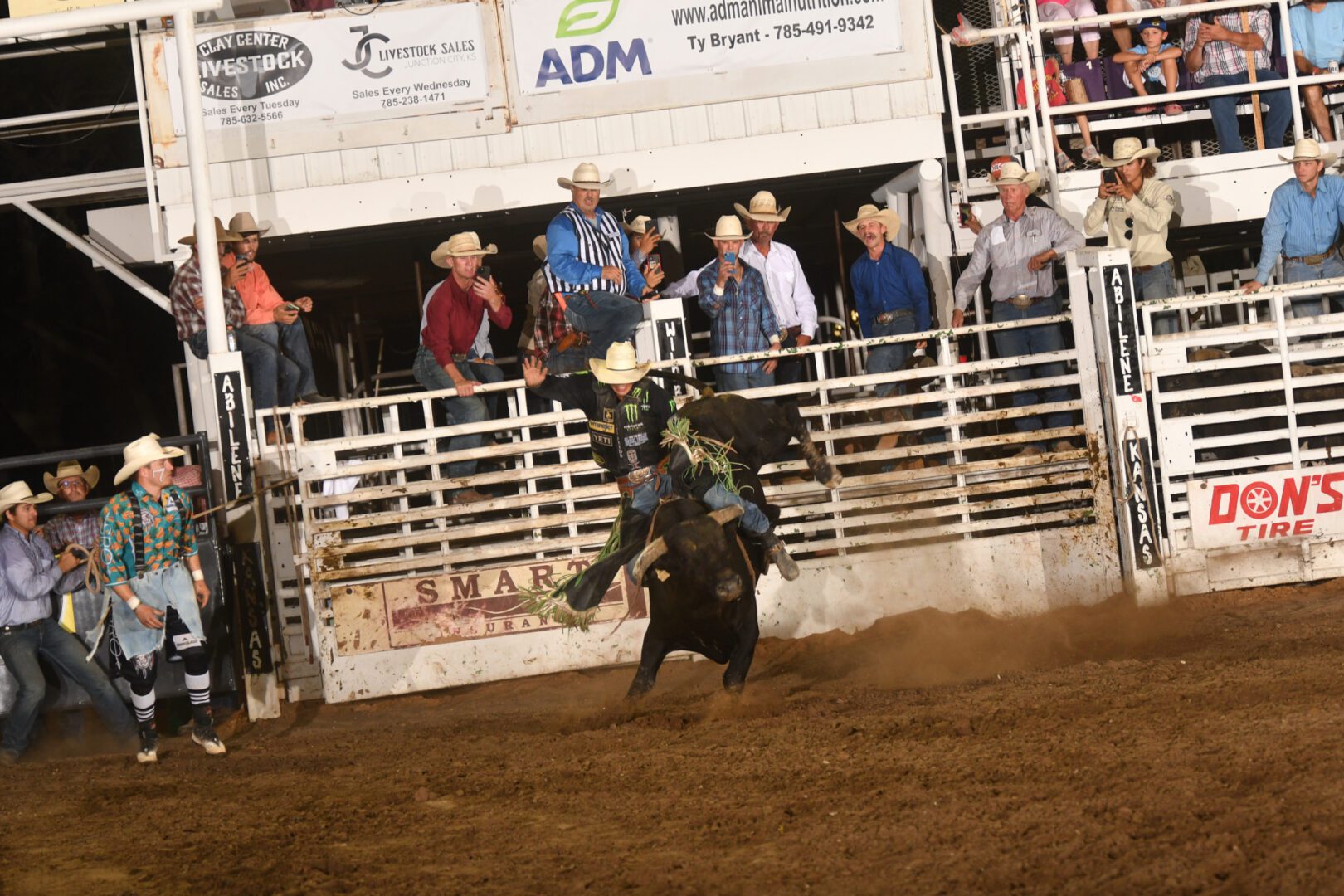
    J.B. Mauney, of Stephenville, Texas, scored 90 points on the Andrews Rodeo Co. bull named The Kracken to walk away with the 2023 Wild Bill Hickok Rodeo title.


    It was a bull that Mauney had seen at the Window Rock, Ariz. rodeo, that Cody Jesus won first place on, and he knew it was a good bull, although a small one.


    “It was a little bit smaller of a bull than I like,” he said. “I have longer legs so it’s harder for me to get ahold of” small bulls. But the bull performed like Mauney expected. “He did exactly what I thought he’d do. He bucked hard.”


    The 36 year old cowboy is a two-time PBR champion (2013, 2015) and has lately turned to PRCA rodeos. He sat out much of last year due to groin injuries, resulting in surgery to put a plate on the pelvis after the muscles were ripped off the bone. After rehab, Mauney returned to bull riding, but after seven bulls, he ripped the groin muscle in half again and he was out the rest of the year.


    Scores of fans stood in line, waiting for the autograph of the man who is considered the best bull rider ever. Mauney complied, visiting with every fan who was in line.


    In the team roping, two teams tied for the title, and one of those teams is a repeat from last year.


    Header Paul David Tierney, Oklahoma City, and his heeler Tanner Braden, Dewey, Okla., along with header Braden Pirrung, Hartford, S.D. and his heeler Jade Nelson, Midland, S.D. both turned in times of 4.4 seconds each.


    For Tierney and Braden, it was the second consecutive year to win the Abilene rodeo.


    Tierney didn’t throw a very good loop, “but it ended up falling on,” he said. “I just turned my horse and let Tanner do what he does. He had to make a hand, and he did.”


    Abilene is a tough rodeo to win, Braden said. The steers were evenly matched, which gave every team a good chance. And the best of the best come to Abilene. “You have the best fifty guys around, so you know you have to make a good run, and not beat yourself.”


    The duo went to college together at Northwestern Oklahoma State University in Alva, where they roped together. They’ve roped together the last several years, missing making the Wrangler National Finals Rodeo last year by a couple thousand dollars.


    Tierney’s older brother, Jess, won the steer roping held at the rodeo on Monday, and Paul David won the all-around title, the most money won at a rodeo in two or more events. He competed in the tie-down roping as well.


    Other 2023 champions include bareback rider Rocker Steiner, Weatherford, Texas (84); steer wrestler Gus Franzen, Kearney, Neb. (84 points); breakaway roper Danielle Lowman, Gilbert, Ariz. (1.9 seconds); saddle bronc rider Ryder Sanford, Sulphur, La. (90.5 points); tie-down roper Riley Webb, Denton, Texas (7.8 seconds); and Jordon Briggs, Tolar, Texas (17.05 seconds).


    Next year’s Wild Bill Hickok Rodeo is tentatively set for July 30-August 2, 2024.


    ###


    Jordon Briggs rounded the barrels in 17.05 seconds to win the Abilene rodeo championship. Photo by Fly Thomas.


    Results, Wild Bill Hickok Rodeo – Abilene, Kansas August 1-5, 2023


    All-Around champion: Paul David Tierney, Oklahoma City – team roping and tie-down roping


    Bareback riding champion: Rocker Steiner, Weatherford, Texas

    1. Rocker Steiner, Weatherford, Texas 84 points on Andrews Rodeo’s Cash and Carry; 2. Bill Tutor, Huntsville, Texas 83.5; 3. Gauge McBride, Kearney, Neb. 82; 4. Trent Tuten, Okeechobee, Fla. 80; 5. Quintonn Lunsford, McCune, Kan. 77; 6. Colt Eck, Redfield, Kan. 75.


    Steer wrestling champion – Gus Franzen, Kearney, Neb.

    1. Gus Franzen, Kearney, Neb. 3.9 seconds; 2. Tyler Pearson, Atoka, Okla. 4.6; 3. Olin Hannum, Malad, Idaho 4.7; 4. (tie) Chad Van Campen, McCook, Neb., Hoyt Kraeger, Weeping Water, Neb., and Mitch Hutto, D’Hanis, Texas 4.8 each; 7. (tie) Tevin Cowan, Harrold, S.D. and Travis Munro, Townsville, Australia 4.9 each.


    Breakaway roping champion – Danielle Lowman, Gilbert, Ariz.

    1. Danielle Lowman, Gilbert, Ariz. 1.6 seconds; 2. Ashley Goforth, Azle, Texas 1.8; 3. (tie) Kelsey Domer, Dublin, Texas and Tacy Webb, Midway, Texas 1.9 each; 5. Hope Thompson, Abilene, Texas 2.0; 6. (tie) Nicole Baggarley, Las Cruces, N.M., Jordi Edens, Gatesville, Texas and Alli Masters, Leon, Iowa 2.1 each; 9. (tie) Kamie Landolfi, Ada, Okla., Morgan Kessler, Callaway, Neb., Rheagan Cotton, Fairfield, Texas and Alex Loiselle, Decatur, Texas 2.2 each.


    Saddle bronc riding champion – Ryder Sanford, Sulphur, La. 90.5 points

    1. Ryder Sanford, Sulphur, La. 90.5 points on Andrews Rodeo Co.’s Cracker Jack;

    Ean Price, Goodwell, Okla. 88.5;  3. Denton Ward, Goodwell, Okla. 85.5; 4. (tie) Riggin Smith, Winterset, Iowa and Wade Sundell, Boxholm, Iowa 85 each; 6. (tie) Jake Finlay, Goondiwindi, Australia and Cole Elshere, Faith, S.D. 83 each; 8. Will Pollock, Utopia, Texas 82.5.


    Tie-down roping champion – Riley Webb, Denton, Texas

    1. Riley Webb, Denton, Texas 7.8 seconds; 2. Paul David Tierney, Oklahoma City, Okla. 8.4; 3. (tie) Kadin Boardman, Jackson, Mo. and Jax Clegg, Coweta, Okla. 9.1 each; 5. Roan Hudson, Arcadia, Fla. 9.4; 6. Nolan Richie, Bristol, S.D. and Lane Livingston, Seymour, Texas 9.5 each; 8. Pax Vogel, Mattfield Green, Kan. 9.8; 9. Logan Wiseman, Paola, Kan. 9.9; 10. (tie) Dallen McIntire, Thayer, Iowa, Colton Greene, Rock Springs, Texas, and Tom Crouse, Osage City, Kan. 10.1 each.


    Team roping co-champions: Paul David Tierney, Oklahoma City, Okla./Tanner Braden, Dewey, Okla. and Braden Pirrung, Hartford, S.D./Jade Nelson, Midland, S.D.

    1. (tie) Paul David Tierney, Oklahoma City, Okla./Tanner Braden, Dewey, Okla. and Braden Pirrung, Hartford, S.D./Jade Nelson, Midland, S.D. 4.4 seconds each; 3. (tie) Brye Crites, Welch, Okla./Rance Doyal, Hartshorne, Okla. and Erich Rogers, Round Rock, Ariz./Paul Eaves, Lonedell, Mo. 4.5 each; 5. (tie) Clay Smith, Broken Bow, Okla./Coleby Payne, Stephenville, Texas and Blake Hughes, Sulphur, Okla./Casey McCleskey, Hedley, Texas and Brent Mibb, Pryor, Okla./Austin Rogers, Crescent, Okla. 4.7 each;8. (tie) Mason Appleton, Chelsea, Okla./Cooper Freeman, Carthage, Mo. and  Zack Woods, Walters, Okla./Gavin Foster, Elmore City, Okla. 4.8 each; 10. Wheston Jones, Okla./Lane Reeves, Wann, Okla. 4.9.


    Barrel racing champion – Jordon Briggs, Tolar, Texas

    1. Jordon Briggs, Tolar, Texas 17.05 seconds; 2. Rainey Skelton, Llano, Texas 17.12; 3. Hico, Texas 17.22; 4. Sara Winkelman, Big Lake, Minn. 17.27; 5. Summer Kosel, Glenham, S.D. 17.33; 6. Quincy Sullivan, Peralta, N.M. 17.46; 7. (tie) Sadie Wolaver, Weatherford, Okla., Timber Allenbrand, Paola, Kan. and Katie Sowada 17.48 each; 10. Cayla Small, Afton, Okla. 17.53; 11. Michelle Darling, Medford, Okla. 17.56; 12. (tie) (tie) Sissy Warren, Glenwood, Iowa and Nikki Singler, Ashland, Wis. and LaTricia Duke, Three Rivers, Texas and Jamie Olsen 17.59 each.


    Bull riding champion – JB Mauney, Stephenville, Texas 90

    1. JB Mauney, Stephenville, Texas 90 points on Andrews Rodeo Co.’s The Kracken 2. Braden Richardson, Jasper, Texas 88.5; 3. Hudson Williams, Midlothian, Texas 86; 4. Cody Teel, Kountze, Texas 84.5.


    Steer roping champion – Jess Tierney, Hermosa, S.D.

    First round: 1. Brian Garr, 11.9 seconds; 2. Cody Lee 12.0; 3. (tie) Trenton Johnson and Trey Wallace, 12.7 each; 5. Brodie Poppino, 13.2; 6. Jess Tierney 13.3

    Second round: 1. Jess Tierney 9.6; 2. (tie) Brodie Poppino and Slade Wood, 10.6; 4. Tanner Stec 11.1; 5. Billy Good 11.2; 6. Coleman Proctor, 11.3.

    Third round: 1. Scott Snedecor 9.1; 2. Cole Patterson 9.4; 3. Rocky Patterson 10.1; 4. Kyle Cauthorn 10.2; 5. Matt Phipps 10.8; 6. J. Tom Fisher 10.9.

    Average: 1. Jess Tierney 30.0 seconds on three head; 2. Brodie Poppino 35.1; 3. Cody Lee 36.9; 4. Martin Poindexter 43.4; 5. Brian Garr 53.1; 6. Cole Patterson 21.2 on two head.


    ** All results are unofficial.  For more information, visit WildBillHickokRodeo.com.


  • Back When They Bucked with Ed Sundby

    Back When They Bucked with Ed Sundby

    Ed Sundby averaged 70,000 miles a year on his 1966 Ford pickup with a little white topper camper, while he rodeoed, and he loved every minute of it.
    And to make money for entry fees, the North Dakota cowboy did some Roman riding as a specialty act.
    Born in 1952 to Orvin and Ginger Sundby, he was raised in Williston and started out in horse shows and doing the cow cutting. But it was too slow-paced for him.
    “That wasn’t enough action for me,” he said, so he started with Little Britches Rodeo, then progressed to high school, college, amateur and the professional ranks.
    In high school, he was a steer wrestler, bareback rider and cutter, then added saddle bronc riding and bull riding.
    He was the 1968 North Dakota High School Rodeo All-Around winner, and in college won the bareback riding for the Great Plains Region three times (1970-71, 74), twice while at the University of North Dakota-Williston, then at the National College of Business (NCB) in Rapid City.
    He and his dad believed in practice.
    His dad, who never competed much but had been a steer wrestler, built an indoor arena.
    The Sundbys borrowed bucking horses from Marvin Brookman and Jack Fettig, and had plenty of steers.
    “There were nights when I would bulldog fifty head of steers,” Ed said. “Dad would haze for me. He enjoyed it as much as I did.”
    Then, he’d ride two or three bareback horses, and the next night, switch to saddle bronc riding. It was good practice time. “When I practiced, I practiced with a purpose. You have to, if you want to go on with rodeo.”
    Even in the winter, they practiced, seven nights a week. The only time they didn’t was if it got to -5 degrees F, because they thought at that temperature it was too hard on the horses. The barn wasn’t heated, but with the bucking stock and steers, it was comfortable, he said.
    Orvin liked it as much as his son did. “He was down in the barn with us, every night. He really loved it.” Orvin believed in hard work; his work day started at 5 am, and after work, they’d be in the barn practicing till 10:30 or 11 pm each night.
    While in high school, Ed added a bit of Roman riding to his repertoire. He had been Roman riding a mare and her son, a gelding, in the practice arena at home.
    As he got better at it, he was asked to perform at rodeos, mostly amateur, with his pay going towards his entry fees.
    For a time, he put his younger brother Lynn, thirteen years his junior, on his shoulders as he Roman rode and jumped the horses.
    The UND-Williston college rodeo team practiced at the arena, as did many of Ed’s friends, including college teammates Mark Ellis, Don Schwalbe, and Rick Woodward.
    Between his time at UND-Williston and NCB, he sat out of college for a year, while he worked for his future father-in-law.
    Ed had met Connie Schatz, also a high school rodeo contestant, at a high school rodeo, and he jokes that she chased him. “She was running after me,” he laughed, “and she just wouldn’t leave me alone.” While she finished high school, Ed worked for her dad, till she was college age. Then the two of them went to Rapid City’s NCB.
    They courted for several years before marrying in 1974. “She had to chase me for a couple years before she caught me,” he joked. But in seriousness, he said, “She was always the one for me.”
    After college, the couple moved to Williston. Ed began pro rodeo competition, but felt the obligation to get a job, rodeoing on weekends. “I thought, if you’re married, you should have a job,” he said.
    For several years, he was a heavy equipment operator. Then his dad, who owned a federal meat processing plant, asked him to join the business. When Orvin passed in 1982, Ed and a partner, Gene Storoe, purchased it. When Gene wanted out, Ed got out as well, selling the company.
    Then he went into the oilfield business in the abandoned well segment for several years, including buying and selling equipment.
    After that, he managed Schatz Truck Stop in Minot for 18 years, then went back to the oilfield, till he retired in 2019.
    Ed had become a Rodeo Cowboys Association (forerunner to the PRCA) member in the early 1970s, while in college, and continued to rodeo for the next decade.
    He competed at a few N.D. Rodeo Association events, but at the time, cowboys couldn’t do both associations: they had to choose one. So he chose the pros. “And it was the right move for me. I did all right.”
    At first, he did the steer wrestling and the three roughstock events, but by 1976, he concentrated solely on the steer wrestling and bareback riding.
    He traveled across the western half of the nation, from Denver to Edmonton, and from Calgary to Texas. He and Connie’s honeymoon was at the Cow Palace in San Francisco, where he joked, “I was going to leave her at Alcatraz, but they didn’t want her.”
    In college, he made lifelong friends, rodeoing with Paul Tierney, Monte Melvin, Billy Zurcher and Doug Corrington on his rodeo team. “College was great,” Ed said. “We didn’t get a lot of schooling in.”
    He didn’t drink or smoke and attributes his good health to that fact. “I’ve never had a drink and never had a cigarette,” he said. “I was serious about what I wanted to do.” Hauling his steer wrestling horses was part of the motivation to not drink. “I always drove,” he said. “I never let anybody else drive, and I wanted to know where my hat was the next morning and where my vehicle was.”
    He rodeoed against Tom Miller, who was a student at Black Hills State University (Rapid City, S.D.) from 1967-1971.
    Ed “rode awfully well,” Tom said. “He was very correct in the way he rode. He just didn’t buck off many.” Tom remembered Ed always having a smile on his face. “Ed was very much a gentleman and a good person. Still is.”
    Ed has made sure to give back to the sport. He held bulldogging schools for young people at the family arena in Williston, and judged rodeos, including high school events in North Dakota, South Dakota, and Montana, and some pro rodeos as well.
    He figures it was his duty to contribute. “I felt it was a way to give back,” he said, “to the people who helped me.”
    Ed’s last ride was in 1982 in Sidney, Montana. Between work and a family, it was time to stay closer to home.
    He and Connie have two sons: Ty, who lives in Bismarck, N.D., and Cody, a former PRCA and PBR bull rider who lives in Williston. They have two grandchildren and a great-grandson.
    The couple spends winters in Gold Canyon, Arizona and summers in Hill City, S.D.
    He enjoyed the sport. “When I went to a rodeo, I loved going. If I won anything, it was a bonus.”
    The friends are life-long. “They’re amazing, and they’re for life. It’s like college. You never forget your college buddies, and rodeo is the same way. If you see them after 30 years, you pick up right where you left off.
    Does he miss it? “I’d have to say I do. If I was 18, I’d love to start all over.”
    Ed is a 2016 inductee in the North Dakota Cowboy Hall of Fame, a 2018 inductee in the University of North Dakota-Williston Sports Hall of Fame, and a PRCA Gold Card Member.

  • FIND YOUR CALLING

    FIND YOUR CALLING

    Horse finds perfect job as a trick riding animal for Helena cowgirl
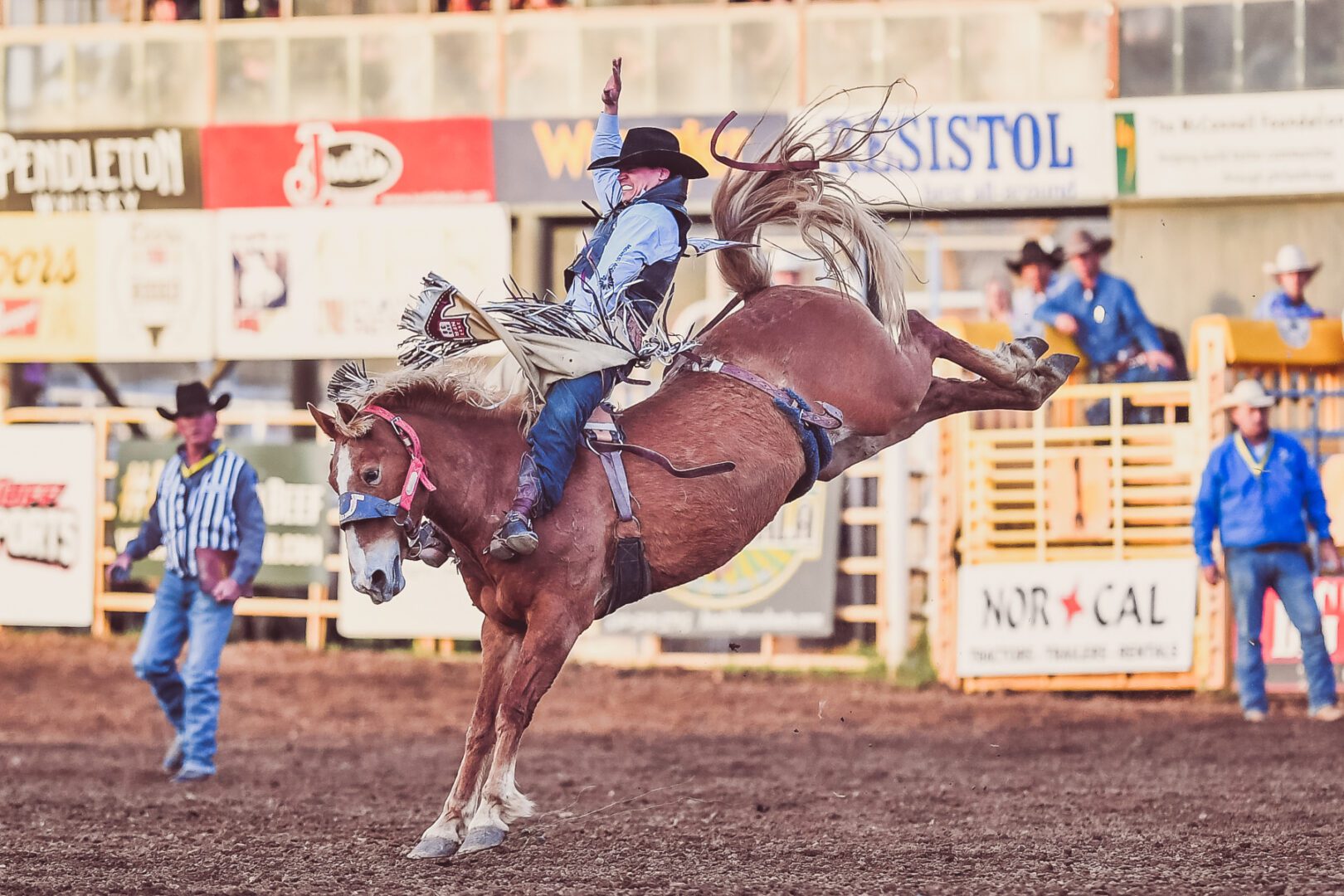
    Helena, Mont. – July 17, 2023 – A special horse has found a new direction to go in her life.

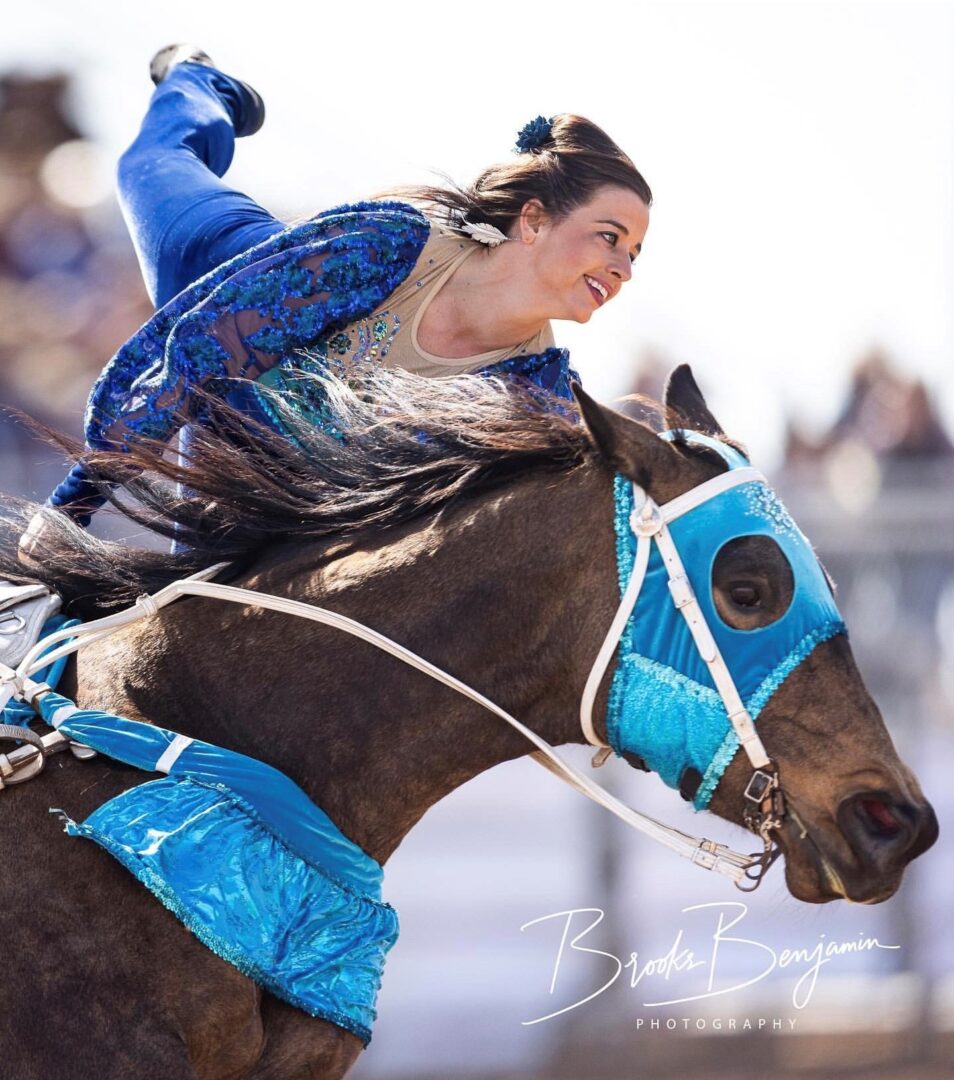
    When Big Bonnie, a buckskin mare, was young, she didn’t fit anywhere. Because she was big at seventeen hands high, weighing 1,600 lbs., and smart, she could be intimidating, the people around here were unsure of her. There seemed to be nothing that the mare was willing to do.

    When Big Bonnie was five years old, she was purchased by CR Kunesh, who had been her farrier. Her previous owner had called her “a handful,” he said, but he had always admired her. “She was a well-built big mare,” he said.

    And when her owner wanted to sell her, nobody wanted her but Kunesh saw her potential. He didn’t need any more horses, but the owner asked what he’d give for her. “Fifty dollars,” he said, and for that price, she became his horse.

    Kunesh, who guides elk hunts in the fall, rode her for three months on hunts, long days in the mountains. He knew she was good. “I really liked her. She was amazing,” he said.

    But Big Bonnie was about to get a new home and a new job.

    The mare “had a whole lot of energy with no place to go with it, and she was super intelligent,” he said. She needed a year-round job, not just three months a year guiding hunts.

    In stepped Kunesh’s neighbors, nationally known trick rider Madison MacDonald-Thomas and her husband, Keegan Thomas, who live in Helena.

    Madison had admired the buckskin, but had no need for another horse, till several of her trick riding horses were on the injured list.

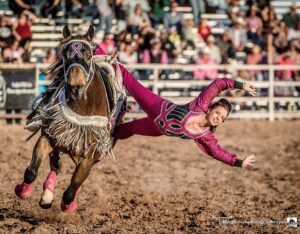
    Trick riding horses have to be trustworthy. They’re supposed to gallop around an arena, all while their rider is hanging off of them in precarious positions, without the reins in her hand.

    But Madison had a sense that Bonnie could do it.

    “She was big and beautiful,” she said, “and her previous owner couldn’t find a job for her. I asked if I could try her, because sometimes those horses work.”

    And Bonnie worked great. Now she’s part of Madison’s herd, one of the horses she trusts as she performs at rodeos across the country.

    Madison read Bonnie’s personality and came to understand that the big mare doesn’t respond positively when a rider pulls on the bit.

    “If you hang in her mouth, she doesn’t take that very well.

    “I can throw her the reins and she does her circle (in the trick riding). I stay out of her mouth,” she said.

    Keegan gave the horse to Madison as a Christmas gift in December of 2021, and the mare took to the trick riding almost immediately.

    “She loves running the circle (in the arena),” Madison said. “When she learned the pattern, it took nothing to teach her the tricks. She was so happy to run her little circle and stop. She’s tuned into one of my best horses.”

    Madison, who is 5’4”, looks tiny when she’s on Big Bonnie.

    “Everybody laughs when I ride her because I look like a fly on her back.”

    Big Bonnie’s gift is the trick riding; Madison said she’s not well suited for anything else.

    “Honestly, she’s not fun to ride outside the arena. I wouldn’t want to do any other discipline on her. She’s broke, but she loves trick riding.”

    Bonnie loves to run, Madison said, and likes big rodeo arenas where there’s plenty of space to go full speed. “She’s so big, she stretches out and runs. She floats. It’s amazing.”

    The horse, who seemed to have no purpose in life, now has a job.

    “She was always a nice horse,” Kunesh said. “She just needed a job.

    “Trick riding was the last thing I thought she’d do. But she’s found her calling.”

    Big Bonnie will be one of the horses Madison rides as she trick rides at the Last Chance Stampede & Fair in Helena July 26-29.

    The Night Show on July 26 is Nelly, with three nights of rodeo July 27-29.

    Tickets for Nelly are $60 in advance and $65 on July 26. Rodeo tickets vary in price from $21-$26.

    Night Show and rodeo tickets are available online at LCCFairgrounds.com, at the gate, and at the fairgrounds ticket office. Fees apply.

    For more information, visit the website or call 406.457.8516.

  • Back When They Bucked with Rodney Towe

    Back When They Bucked with Rodney Towe

    Rodney Towe held down a fulltime job while he rodeoed, with a rodeo career that spanned fifty years.
    The Hilmar, California cowboy worked for 36 years at the Turlock Irrigation District, while he rodeoed, hitting sometimes as many as 60 rodeos annually.
    Born in 1941 in Fillmore, Calif. to William and Minnie Towe, he grew up on the Rancho Sespe. His dad was an irrigator for the citrus orchards that dotted the ranch.
    As a child, he loved the gymkhanas that took place. “I was a gymkhana nut,” he said.” He rode a grade mare, purchased for $150.
    The family moved to Oxnard, California, where they built an arena on their two acres. They formed a riding club, the Rio Riders. As a teen, his mother pulled the trailer to Turlock, where he competed at the California State Horsemen’s Association Gymkhana and won the state championship in the ring spearing once and was two times a runner-up behind his uncle Frank Cox.
    But he wanted to do more than gymkhanas. His cousin Gordon Cox, two years his senior, wanted to be a bull rider. So in 1955, Gordon entered himself and Rodney in the steer riding at the Monterey County Sheriff’s Rodeo in Salinas. The boys drove six hours from home to ride; out of 75 riders, Rodney won it.
    “Gordon hated me all the way home,” he chuckled. “He was supposed to be the bull rider.” For first place, Rodney won a pair of black and white Acme boots with black wingtips.
    “That was the start,” he said, of a rodeo career that would take him across the nation.
    At age seventeen, he started riding bareback horses at amateur rodeos. A strong upper body, in part due to tumbling and gymnastics, helped him succeed, along with a natural athleticism.
    After high school graduation in 1958, Rodney went to work in a variety of places. He did construction, drove a forklift, installed ceilings, whatever he could find.
    And he continued to rodeo, competing at the Western Approved Rodeos (WAR), the California fair rodeos. The family moved to northern California in 1961, where he cowboyed for $10 a day, worked for the turkey plant in Turlock, and rode bareback horses.
    He began team roping, too, at jackpots and area arenas.
    But it was the bulldogging that intrigued him. “I kept watching it, and it looked like a lot of fun,” he said. One day, Frank Costa asked him if he’d like to do it, and offered his old baldy mare to him to try. Rodney was nervous. Riding bareback horses “wasn’t no big deal,” but jumping onto a steer was. Three times, he ran by the steer, and “I couldn’t get off.”
    John Wheatley, Sr. was hazing for him, and on Rodney’s fourth try, “I made up my mind, I’m going to jump this steer,” he said. “I jumped plum over the steer and under the hazing horse, who rattled me like a tin can down the arena. I landed on my feet, so I could catch the mare and do it again.”
    His new career began. It was 1963, and two years later, he was done riding bareback horses. “The steer wrestling fit me better, and wasn’t near as hard on my body.”
    In 1964, he won second for the year-end steer wrestling title at the WAR rodeos, behind John Wheatley, Jr. In 1967-68, he won the year-end.
    Rodney practiced with and competed against all of the California cowboys of the day: Jack Roddy, Harley May, Bob Marshall, Tommy and Larry Ferguson and Jim Warren.
    In the early 1960s he got his Rodeo Cowboys Association permit. For the next two decades, he competed not only in California and the Northwest, but across the nation: Cheyenne, Tucson, Phoenix, Yuma, Dickinson, N.D.; Red Lodge, Livingston, Calgary, and more.
    He had several good horses throughout the years.
    One of the first ones was a barrel-turned bulldogging horse named Dexter. Another was a horse named Woodstock who “ran like a locomotive, and scored like a champ”.
    Another mare he got was Duster, a bay mare who was broke by Rodney’s father-in-law and was “so simple and easy to ride, with a super-soft mouth. She’d let you catch every steer.” Duster had a filly colt, Twinkle Star Bars, who was broke and trained by Rod’s father-in-law and who Rod used as a hazing horse.
    One of the best horse stories Rod has goes to one of his later steer wrestling horses, Mama. In 1971, he flew to Springdale, Ark., to bulldog. He needed a mount, so Jim Poteet asked Bob Littrell who owned Mama, if Rod could ride her. “Damn, Jim, you know I got everybody” mounted on her,” Bob said, which included 18 bulldoggers. But he relented and let Rodney ride her. Rod won second in the first round and second in the average, behind Roy Duvall.
    He rode Mama at Cheyenne, winning third on her. So he asked Bob if he would sell her. “These Okies would kill me if I sold the mare,” he told Rod, knowing the Oklahoma steer wrestlers mounted out on her.
    In 1972, Littrell had a career-ending broken leg. The next February, as Rod sat at a restaurant, eating breakfast with Jim Warren, Barry Burk came in and told him, if he still wanted to buy Mama, Littrell was willing to sell.
    Rodney and Jim looked at each other, “we ran to the phone, and bought her,” Rod said. They paid $4,000 for her, “which was a lot of money,” and brought her to California. “We rode her everywhere.” Bob Marshall was a part-owner of Mama, on whom he won the 1973 world title.
    Rod met his wife of 50 years, Deb, when she came to California with a friend who was dating Jim Warren at the time. Deb grew up on an Arizona ranch, roping and riding, so she was familiar with horses and rodeo.
    The couple has four children: sons Odle and Traxel, and daughters Zantha and Abbra.
    The kids went with them when Rodney rodeoed, traveling in their 24-foot motorhome.
    In the early 2000s, Rodney became a committeeman for the Salinas Rodeo. He had won the steer wrestling there in 1980 with a buckle, and eight years ago, the committee honored him as “committeeman of the year,” with another buckle. His job is to take care of the roping box.
    In 2012, he jumped his last steer, at the age of 71. He attributes his longevity to the fact that he stayed healthy, and “I was just loving what I was doing, and having fun.”
    Juggling work and rodeo wasn’t easy. He worked 40 hours a week, which included evenings so he could leave early on Fridays to make a rodeo. And he had to shift his focus from work to rodeo and back again, where the fulltime competitors only had to think about rodeo.
    “The other guys I was competing against were rodeoing for a living, and that was all they were thinking about. They’d get someplace and have time to practice. It made it tough. It was very hard, and it kept me from wining a lot of money.” Even with part-time rodeo, he came within $10,000 of making the National Finals Rodeo in 1980.
    But the job was a necessity. “I had a job, with insurance, to take care of my family. That was important, taking care of my family.”
    He was still bulldogging until ten years ago.
    “It was fun for me. I saw so many guys with more talent than I had, that quit. It wasn’t fun for them, it was just a job. I never could understand that.”
    His family was behind him, all the way. “I had the full support of my wife and kids, or none of this would have happened,” he said.
    He and Debbie say the best part of rodeo is the people, “the people you meet and get acquainted with, from all parts of the country. You can reconnect with them ten or thirty years later, and it’s just like it was yesterday.”
    He looks back fondly on his rodeo days.
    “We had quite a time.”

  • SUNSHINE AND RODEO

    SUNSHINE AND RODEO

    First night of Red Bluff Round-Up sets the bar for cowboys, cowgirls

     Red Bluff, Calif. (April 21, 2023) –   Tanner Aus traded the cold winter of Minnesota for California sunshine, and he’s loving it.


    The bareback rider came to the Red Bluff Round-Up and put on a show, tying for the lead in the bareback riding after the first performance of the Round-Up on April 21.


    He scored 86.5 points on the horse called Little Red Hawk, cared for by the Flying U Rodeo Co. Jacek Frost, Browns Valley, Calif., also scored 86.5 points, aboard the Rosser Rodeo horse Yeti Rambler.


    For Aus, it was a horse he was anxious to partner with. “That horse is a very good bucking horse,” he said, “one of the best, the funnest horses to get on. She’s fun for me, anyway. She bucks, and she’s very consistent, and she’s been around a long time.” The mare is 17 years old.


    The Round-Up is what is informally called part of the California run, rodeos in the state that draw cowboys and cowgirls, because of spring weather and outdoor arenas.


    “We got two inches of snow this morning,” he said. “Being from Minnesota, you can expect that, but to be able to come out here for a few days and rodeo in the sunshine, it’s awesome.”


    Aus is a seven-time qualifier to the Wrangler National Finals Rodeo, the PRCA’s world championship, and is currently ranked nineteenth in the world standings.


    He’s quick to give credit to his wife, Lonissa, who holds down the fort, with their three children, ages 5, 3 and 9 months, in Granite Falls, Minn. “My wife is my rock. She makes it all work. If I didn’t have her support, I definitely couldn’t do this. She believes in the dream that I have and lets me chase it. She’s a blessing.”


    For saddle bronc rider Allen Boore, he got a birthday gift on April 21, with a lead in his event at the Round-Up.


    The Axtell, Utah cowboy turned 32 years old on Friday and scored 86 points to take the lead after the first performance of the Round-Up.


    He was complimentary of the bucking horse he rode, a horse named Houchie Mama and owned by C5 Rodeo.


    “She’s a dream horse,” he said, “a horse you want, that feels good, that you have time to spur.”


    He noted that the seven-year-old mare jumps higher than the average bucking horse, giving him time to make a better spur stroke. “That horse jumps up in the air high enough that you have time to set your feet, before the horse’s front feet hit the ground. The higher they jump, the longer you have to make that spur stroke.”


    Like Aus, Boore was glad to experience springtime in California. His part of Utah has been colder and snowier than normal.


    “I came over the (Sierra) Mountains, and dropped into the valley with the green grass, knee high, and it’s 70-some degrees.”


    And rodeoing outside is good, too. “After being in the building (rodeos) all winter, it’s nice to get out.”


    Boore has qualified for the Wrangler National Finals twice (2016, 2020).


    Other leaders after tonight’s performance include steer wrestlers Jake Nelson, Whitehall, Mont. and Brandon Harrison, Cheek, Texas (5.0 seconds each); tie-down roper Tyler Forsberg, Fillmore, Calif. (9.0 seconds); breakaway roper Samantha Fulton, Miller, S.D. (2.8 seconds); team ropers (and brothers) Kellan Johnson and Carson Johnson, both of Casper, Wyo. (6.6 seconds); and barrel racer Timber Allenbrand, Paola, Kan. (17.39 seconds).


    In the bull riding, Tristen Hutchings, Monteview, Idaho, scored 90 points to take the lead. Hutchings is a college student at Sul Ross University in Alpine, Texas.


    The second of three performances of the Red Bluff Round-Up takes place Saturday, April 22. Other activities taking place on Saturday include the rodeo parade at 10 am, Jackson Dean in concert at 6 pm, and more.


    Round-Up tickets range in price from $20 to $40 and are available at the gate and online.


    Results from the first performance, Red Bluff Round-Up, April 21, 2023


    Bareback riding

    1. (tie) Tanner Aus, Granite Falls, Minn. 86.5 points on Flying U Rodeo’s Little Red Hawk and Jacek Frost, Browns Valley, Calif. 86.5 points on Rosser Rodeo’s Yeti Rambler; 3. Jacob Lees, Caldwell, Idaho 85; 4. Dean Thompson, Altamont, Utah 83.5.


    Steer wrestling

    1. (tie) Jake Nelson, Whitehall, Mont. and Brandon Harrison, Cheek, Texas 5.0 seconds each; 3. Kalane Anders, Bayard, Neb. 5.2; 4. Darcy Kersh, Charters Towers, Australia 7.2.


    Tie-down roping

    1. Tyler Forsberg, Fillmore, Calif. 9.0 seconds; 2. Shane Hanchey, Sulphur, La. 9.1; 3. Kass Kayser, Ellensburg, Wash. 11.0; 4. Bo Pickett, Caldwell, Idaho 11.6.


    Saddle bronc riding

    1. Allen Boore, Axtell, Utah 86 points on C5 Rodeo’s Houchie Mama; 2. Damian Brennan, Injune, Australia 84.5; 3. Kade Bruno, Challis, Idaho 84; 4. Cole Elshere, Faith, S.D. 83.5.


    Breakaway Roping

    1. Samantha Fulton, Miller, S.D. 2.8 seconds; 2. Josie Conner, Iowa, La. 3.2; 3. Kelsie Domer, Dublin, Texas 4.1; 4. Erika Frost, Randlett, Utah 4.3.


    Team Roping

    1. Kellan Johnson, Casper, Wyo./Carson Johnson, Casper, Wyo. 6.6 seconds; 2. Cole Thomas, Emelle, Ala./Clay Green, Pine Grove, La. 7.1; 3. Braden Pirrung, Hartford, S.D./Lane Siggins, Coolidge, Ariz. 7.2; 4. J7 Bland, Turkey, Texas/Tyson Thompson, Munday, Texas 10.8.


    Barrel racing

    1. Timber Allenbrand, Paola, Kan. 17.39 seconds; 2. Miley Bunting, Red Bluff, Calif. 17.40; 3. Emily Beisel, Weatherford, Okla. 17.57; 4. Paige Dove, Hico, Texas 17.62.


    Bull riding

    1. Tristen Hutchings, Monteview, Idaho 90 points on Big Stone Rodeo’s Dirty Dave; 2. Braden Richardson, Jasper, Texas 86; 3. Trey Benton III, Richards, Texas 83; 4. Robbie Taylor, Chinle, Ariz. 80.


    ** All results are unofficial.  For more information, visit RedBluffRoundup.com.


    – ### –

    Cutlines:

    Minnesota cowboy Tanner Aus leads the bareback riding after the first night of the Red Bluff Round-Up. Photo by Crystal Amen Photography.


    Allen Boore makes an 86 point ride to lead the pack of saddle bronc riders at the Red Bluff Round-Up. Rodeo action continues April 22-23. Photo by Crystal Amen Photography

  • Back When They Bucked with RL Tolbert

    Back When They Bucked with RL Tolbert

    RL Tolbert has jumped out of burning buildings, tumbled down cliffs, crashed cars and been shot numerous times.
    But he’s walked away from every near-death experience.
    That’s because the Vale, Oregon cowboy served as a stuntman in the movie industry as well as being a rodeo contestant.
    That’s him getting the girl out of the wagon in “Back to the Future III”, before the wagon goes over the cliff. That’s him driving the six-horse hitch in the same movie, and tumbling down a staircase in “Silverado.”
    He’s been a stunt double and worked as a stuntman in such movies as “The Sacketts” (1979), “Shadow Riders” (1982), “Silverado” (1985), “Three Amigos” (1986), “Mask of Zorro” (1998), “Conagher” (1991), “The Quick and the Dead” (1987), “Lonesome Dove” (1982), “Back to the Future II and III” (1989, 90), “The Rookie” (1990), “Far and Away,” (1992), “Tombstone” (1993), and many more.
    Born in 1941 in Fountain, Colo., both of his grandfathers worked with horses: AR Ward, as a farmer, and Ed Tolbert, building roads in Kansas with horsepower and later driving a coach at the Royal Gorge’s Buckskin Joe tourist attraction.
    By the time he was in his early teens, he was working at local dairies while attending school. He worked at the Littleton race track, then spent a year in Watsonville, Calif., with his mother, after his parents divorced. By age 15, he was back in Colorado, working at the Appelt Ranch.
    In his twenties, RL broke horses for ranches all over Colorado. He spent time on the Butler Ranch, the Trinchera Ranch, the McQuaid Ranch, anywhere where they still fed cattle or hayed with horsepower.
    Situated in the Rockies, with long, snowy winters, RL had told his fellow ranch cowboys, “when the first snowflake hits me, the second flake will be in my tracks because I’m leaving here.”
    So that winter, he went to Colorado Springs, where he found an indoor arena, local cowboys held jackpots, and RL fine-tuned his saddle bronc riding.
    “I knew how to ride horses that bucked,” he said, from breaking them. The learning part that took place at the arena was how to use the equipment and working on his technique.
    RL also rode bulls as well, anything to make a little money.
    While there, in 1964, he met another bull rider from Iowa, who talked him into going back to Iowa. There, he worked for PRCA stock contractor Bob Barnes, as a pickup man, driving truck, feeding and loading cattle, doing whatever was needed, and sometimes working five events: the three roughstock events, plus tie-down roping and steer wrestling, at Barnes rodeos where contestants were lacking. He had gotten his Rodeo Cowboys Association (predecessor to the PRCA) card in 1962.
    After a year of that, he went to work for Jake and Lynn Beutler and Beutler Brothers, driving truck and picking up. He rode saddle broncs and bulls at the Beutler rodeos where he worked.
    From the late 1960s to 1970, RL worked for Larry Mahan in Phoenix in the trailer business, then moved to California in the early 70s, using the Golden State as his rodeo base.
    While he was rodeoing in California, he went to work for Cotton Rosser and the Flying U Rodeo Co., driving the chariots that Cotton used for his specialty act.
    Through rodeo friends, RL got hired at Great Adventure, a huge amusement park in New Jersey. The park had a wild west show, with chariot racing, jousting, Roman riding, and a stagecoach hold-up, and RL got hired to help with that. He spent three years, from 1975-1977, working at the park, and on the weekends, he headed to Cowtown, N.J., for the weekly rodeos.
    In those days, cowboys would winter in Tucson during the winter rodeo run, while they hit the rodeos in Odessa, Denver, El Paso, Scottsdale, and Phoenix. While RL was there, he made friends with several stuntmen, including Chuck Hayward, who was John Wayne’s main stuntman.
    He also became friends with Glenn Randall, Sr., a trainer who had trained Roy Rogers’ and other celebrities’ horses, and Glenn’s son, Glenn, Jr. He learned more about horsemanship and training by working with Glenn, Sr.
    Once RL got his Screen Actors Guild card, Hayward helped get him established in the movie industry.
    He was a stuntman for dozens of movies, rigging wagon wrecks, car wrecks, falling horses, and more.
    He doubled for Sam Elliott, Barry Corbin, Christopher Lloyd, and others. He doubled for Lloyd when Lloyd played “Doc” in the “Back to the Future III” movie and rigged the six horses to the DeLorean car, hooking the car’s steering into the wagon tongue.
    He trained horses to fall and had three special ones. El Guapo was his favorite. A bucking horse, he used him for bucking in the movies till he later turned him into a liberty horse. The horse was “a really good raring horse,” he said. “He was excellent.
    Juan was one of his falling horses. A thoroughbred, the horse was hard to work with. RL would get mad at him and vow to sell him, “then he’d bail me out.” Roanie was another of his beloved horses; as a four-year-old, Sam Elliott rode him for the movies “Quick and the Dead,” and “Conagher.” Roanie and El Guapo are buried side by side.
    For about twenty years, from 1979 to the early 2000s, a lot of the six-horse hitches in the movies were driven by RL.
    He became a member of the Screen Actors Guild in 1975, the Stuntman’s Association of Motion Pictures in 1977, and is also a member of the Directors’ Guild of America.
    In 2002, he and his wife Kim, who had married in 1986, moved to Oregon. RL had admired the country when he had been there in his rodeo days.
    On his farm near Vale, he raised alfalfa, oats and wheat, horses, goats and llamas. In 2015, they sold the farm.
    From his first marriage, RL has two daughters, Robin and Stephanie. With Kim, he has a son, Elliott, and a daughter, Tessa. Kim passed away in 2021. The couple has seven grandkids.
    RL still craves getting on saddle broncs. “I loved riding broncs,” he said. “I’d still get on one. That’s what I miss most, more than anything. And maybe meeting a lot of girls,” he chuckled.
    He’s had a good life. “You really can’t beat it. It was all good times.”
    RL was a 2018 Silver Spur recipient for his work in various western movies as a stuntman. Examples of his stunt work can be found at https://www.reelcowboys.org/members/LifetimeMembers/TolbertRL.php

  • Wrangler Team Roping Championships

    Wrangler Team Roping Championships

    For a team roper, nothing quickens the blood like a horse and some steers to turn.
    And the Wrangler Team Roping Championships have given the team roping world a place to rope, to be horseback, to enjoy friends, and to win money for the past eighteen years.
    Founded by Dennis Tryan, the Wrangler Team Roping Championships are headquartered in Huntley, Montana.
    They consist of between 45-55 team ropings a year, scattered throughout Montana, North and South Dakota, Minnesota, Nebraska, Wyoming, Washington, and Canada.
    They average about 4,000 members annually, and at their 2022 finals, held in Billings, about 6,000 teams came to rope.
    It started in the fall of 2005 when the UPS truck drove up one day, as Dennis sat in the shade by the bunkhouse. He watched as the driver dropped off a box of goodies for his boys, professional team ropers.
    “What I noticed,” he said, “was that the better they got at team roping in the professional ranks, the more free stuff all these companies gave them. Every single day, it seemed like, the UPS truck would stop by, drop off free ropes, leg gear, free clothes, this and that, and it was for my kids.”
    He realized that for the ropers who weren’t on the national scene, there were no freebies.
    “My brain said, ‘Oh, wow, what if I did that for the amateur team roper, the hobby team roper, that will never get a shot at anything free from these companies?’”
    He had already been producing team ropings around the state, and knew there was a need for a new level of competition.
    So he called his old friend Allen Bach, co-owner of Cactus Ropes, and pitched the idea to him.
    Cactus Ropes agreed, as did several other companies. Wrangler came aboard as title sponsor, and the Wrangler Team Ropings were born.
    Dennis designed some of his divisional ropings to be designated for individual companies. For example, the No. 9 roping might be the Cactus roping, and winners from that roping who are using Cactus ropes are rewarded with a check and a multi-month rope contract with Cactus.
    “You’re a hobby roper, you won a Wrangler roping, and a national company just took interest in you, calls you and askes you what ropes you want,” he said.
    “Here’s what’s unique about what we do: we go to sponsors, and instead of the sponsor writing a check to us, they come with product. Instead of it going into our pockets, the ropers end up with it.
    “That’s what makes us different.”
    Another thing unique to the Wrangler Team Roping Championships is the Challenge Race. At every roping, ropers accumulate points. At the end of the year, the top point-holders win product: Fast Back Ropes, Cactus Ropes, Boulet Boots, Wrangler clothing, Preifert chutes, Smarty, PRO Orthopedic, and more.
    “It’s something else to win at the end of the year,” he said, “and it didn’t cost you a penny to win it.”
    Dennis, a team roper himself, began roping in his teens, and in 1984, made the Wrangler National Finals Rodeo. But the rodeo life wasn’t what he wanted. He remembers driving to Clovis, N.M., for a rodeo in 1985, going 110 miles per hour to get there on time. “My kids were going to start Little League baseball, and I was 1,500 miles away from them. I thought, ‘is this really what I want to do?’”
    So he quit full time competition.
    Team roping is so popular, he believes, because it’s a sport that can be done as an adult. After high school and college, there aren’t many sports to compete in, other than golf.
    Being around horses is also a draw. “A lot of old ranchers have been around horses their entire life, and anything to do with a horse, they want to do it.”
    It’s addictive and a challenge. He remembers watching his younger brother rope in high school, before Dennis started, and thinking, ‘what’s so fun about this?’ Then he tried it. “I got on and tried it and instantly I loved it, and I think a lot of people are like that.”
    There’s also a strong sense of camaraderie among the competitors, which Dennis is evident of. “I have friends all over the place. I don’t know a town I couldn’t get broke down in that I couldn’t call somebody.”
    His family helps with the business. Wife Pat works in the office; son Travis and his wife Hillary manage the office, and son Brady and his wife Callahan manage the records. His sons Clay and Matt and daughter Taylor are also ropers.
    His sons Clay, Travis and Brady are all pro ropers and are the only three-some of brothers who qualified for the Wrangler National Finals the same year, 2010. “That was a cool moment for me,” he said.
    He and Travis produce some of the Wrangler ropings, but other people produce as well.
    The finals are huge, “an undertaking like you wouldn’t believe,” he said. “That many teams, stalls, and the other details.” Pre-entries are not required for the Wrangler championships, so there’s no way of knowing the exact number of teams that will be in town. The finals used to average between 4,800-5,200 teams, but in 2020, because of the pandemic, the number jumped to 7,000 teams. That year, they roped around the clock. In 2021 and 2022, the number has leveled off to 6,000 teams and Dennis has added a third arena, so the ropings are done by evening time.
    The finals are held in two locations in Billings: the MetraPark Coliseum and the Expo Center. They both provide “the atmosphere that’s needed for big events like that,” he said.
    Among team roping associations, the Wrangler Championships are in the top five, he estimates. But if the finals are the measuring stick, “we have one of the biggest finals in the U.S.”
    He’s pleased with what he’s produced.
    “I had a dream, and it came to life, to fruition. I made it work. It’s been a lot of work, but it’s very satisfying.”
    More information can be found at WranglerTeamRoping.com