Rodeo Life

Blog

  • Shada Brazile

    Shada Brazile

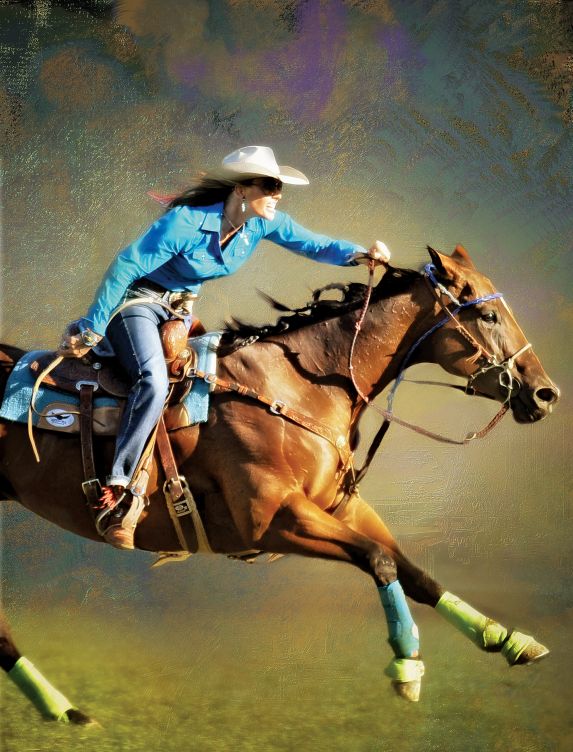
    There will be five first time qualifiers at the Wrangler National Finals this year in the barrel race and each one has a great tale to tell of their journey. None though have the same perspective of Shada Brazile.

    You could say that Shada grew up around rodeo but that would be an understatement. Let’s see, she’s married to Trevor Brazile, a 17-time World Champion, including seven consecutive All Around World Championships. Her grandfather is Clifton Smith who qualified for the NFR in the 1960s. Her uncle is Stran Smith, an 11-time WNFR qualifier and a World Champion Calf Roper. Shall we continue? Her brothers are none other than Clif and Tuf Cooper and stepbrother Clint Cooper who combined have 14  WNFR qualifications and two World Championships. Her father is Steve Norris from Colorado Springs, Colo., who is a two time World Champion cutter. Her other grandpa, Bob Norris, owns the famed T-Cross Ranches. See what I mean?

    Shada was destined to love horses or at least have every opportunity provided. There is a difference though between what you are provided with and what you do with it. There are many people who are provided ample opportunity but do not have the perseverance and work ethic to succeed. Shada is not one of these individuals.

    As the mom of two young children, Treston, 5, and Style, 3, Mrs. Brazile has her hands full. For the past several years since marrying Trevor, she has been his partner on the road never feeling like she was in his shadow. “I’ve never really felt like I was in Trevor’s shadow. We worked together for every one of his gold buckles. I don’t ever feel like I’m just Trevor’s wife. I have been completely comfortable with how it was,” Shada said lovingly.

    With several rigs on the road at one time and a husband who competes in three different events, Shada had a full-time job just tending to business. Even when she wasn’t on the rodeo road herself she kept her hand in the barrel racing business.

    “After college I didn’t rodeo a whole lot. I would buy a horse here and there. After Trevor and I were married I would take his second and third string head horses and train them and then I would end up selling them. I think that helped me more than anything is training my own. I’ve done it both ways – I’ve bought horses and I’ve trained my own,” Shada said.

    After taking some time off to have her children and enjoying every minute of raising them, the desire to barrel race came back, but it wasn’t without heartache. “I bought two horses in October of 2011; that following January I lost two horses in two days. Salmonella got one and another horse crippled himself out in the pasture. Both of those horses were just about ready to go and literally, I was just heartbroken,” she said.

    The desire was gone. It wasn’t long though before her husband and friend, Brittany Pozzi would light a fire in her. Probably little did Trevor know how much a quick comment would change things! At the Texas Circuit Finals, a horse that Pozzi was riding caught the attention of the great horseman. Trevor casually asked about the horse and commented that he liked him. A few weeks later, Pozzi would come to stay with the Brazile family during the rodeo at Fort Worth and strike up a conversation with Shada about a horse she had that she felt like Shada should try. Politely Shada shrugged off the suggestion feeling like she wasn’t ready. Persistence on Pozzi’s part about a week later paid off.

    “Brittany called and said since she was coming back, she would just throw Dial It in the trailer and I could ride him. I figured it couldn’t really hurt anything so I agreed. I knew the minute I loped him through the pattern that he was perfect. It wasn’t like it was a perfect pattern either – I think he even bucked a little bit, but I just knew,” Shada said. Call it instinct, call it luck, call it whatever you want – Dial It was “it” so to speak. The success didn’t come easy though.

    “Dial It was a little wild and crazy when I got him. In fact, I wouldn’t let my kids within 30 feet of him when I got him. He was terrified of cattle and just in general wild,” Shada laughed. “Now, he literally looks for my kids when I take him back to the trailer. They give him treats and honestly, he loves them. I think he’s in his comfort zone when he is at the trailer with them.”

    After a full year of seasoning and doctoring injuries, Shada confessed that at the beginning of the 2013 year, it was her goal to make the Wrangler National Finals and come running down the alley at the Thomas and Mack in Las Vegas.

    “I had a good winter and was about seventh in the standings and then things got rough. I put a lot of emphasis on Calgary and I didn’t win anything there. Dial It wasn’t feeling good and it was apparent in his runs. After Cheyenne I had slid all the way to 23rd in the World. After Cheyenne I had to make a decision – either send Dial It home and call it a year or get busy and figure things out. I chose the latter. I can’t say I did it all by myself either. I have a great support team in my mom, my entire family, and my friends. Bambi Robb never missed a beat in helping me figure out what was wrong and how to tend to Dial It,” Shada reflected.

    The team did things right and Shada got back on the top of her game. It was a struggle to make the top 15, but Shada never took her foot off the gas and if there is a bet to be made on a barrel racer in Las Vegas, there is no doubt Shada will be prepared.

    “I’ve watched the epitome of work ethic in Trevor. The pace in Vegas is something that we have been used to all year. Trevor says we took the busiest rig in all of rodeo and just added another event to it. I guess that’s right. We just do what we have to do to make it happen but it sure doesn’t happen without all of the people that support us. Faith is what gets us through. I know we have a loving God who has a plan for our lives that is much bigger and greater than I can even imagine. I thank Him for blessing our family with this moment and for helping me and guiding me through the year. I didn’t take this challenge on this year to prove anything or for my happiness. I was happy filling my role as wife and mother. I did this because I have a passion for horses and rodeo. I love it and the life it allows for us. I’ll be prepared when I get to Vegas but I don’t have to win to have a storybook ending. It’s already perfect in my eyes. Just making it and riding in the grand entry behind Trevor and the Texas flag…that’s a happy ending and more than enough for me.”

  • Devon Waters

    Devon Waters is a steady kind of guy. “You just have to keep consistent,” is his motto, and he applies it not only to his rodeo, but his education and extracurricular activities. The fourteen year old cowboy who lives near Meade, Kan., in the southwest part of the state is a member of the Kansas Junior High Rodeo Association. He competes in the dally ribbon roping (with Carlie Jones as his runner), team roping, tie-down roping, goat tying, and chute dogging. Of all his events, tie-down is his favorite.

    He rides a buckskin pony named Jet for the tie-down, goats and heeling, and a roan horse named Roanie for the dally ribbon roping and the tie-down. His header is Cinch Bullock, who lives in Campo, Colo.
    Many weekends Devon can be found practicing at his cousin Shade Etbauer’s house in Goodwell, Okla. Shade, a sophomore in college, is also a tie-down and team roper (as well as steer wrestler and saddle bronc rider), and he and Devon practice together. Shade goes to school at Oklahoma Panhandle State University, along with Cinch’s older brother Caleb, and Shade and Caleb are a great help to Devon.

    Devon is an eighth grade student at Meade Junior High, where the best part of the day is social studies. He loves his teacher, Mr. Leiker, who makes learning fun. Devon loves learning about American history, and if he could choose a person to meet from the past, he’d choose his Great-Grandpa Poteet, who was a World War II veteran and who “inspired me a bunch.” Devon faintly remembers his grandpa, who died not long after he was born, and loved him very much.

    He participates in track, where he runs the mile, the 800m, the 400m, and the 4×4 relay. He loves to read the Great Illustrated Classics, adaptations of great works by Mark Twain, Charles Dickens, and others. His favorite so far is The Adventures of Tom Sawyer, and his favorite book ever is Hatchet by Gary Paulsen.

    He has been a member of Little Britches Rodeo since he was seven. Devon is in his first year as a senior in Little Britches, and competes in the team roping, tie-down, and ribbon roping. He heels for Sean Doherty of Branson, Colo., and his dally ribbon roping partner is J.D. Draper of Oakley, Kan. He made it to the Little Britches Nationals from 2008 through 2013. In 2012, he finished third in the world in the goat tying, and this year, he finished sixth.

    He has two older sisters, Kaylee, who is 25, and Shayla, who is 21, who pick on him incessantly. He is the son of J.A. and JoBeth Waters. When he grows up, he’d like to attend Panhandle State and then run a ranch in southwestern Kansas.

  • Aaron Ferguson

    Aaron Ferguson

    Aaron Ferguson has been dreaming about yellow chutes for a long time. They’ve been the backdrop on his phone and his computer for the past three years, and now finally he’s going to be the bullfighter in front of them. Those yellow chutes are the famous chutes at the Wrangler National Finals in Las Vegas, and for the first time, Ferguson has been chosen to fight bulls there. And for the 25 year old, it’s a dream come true.

    He grew up in High River, Alberta, Canada, and at the age of twelve, spent a summer traveling with his older brother, a bullfighter. “We traveled in Alberta and Saskatchewan, going to rodeos, and I decided I wanted to do it. I thought it was the coolest thing. The way he got around those bulls, it looked like so much fun. (My brother) was a handy bullfighter, and once I got the chance to try it, I did and never looked back.”

    After graduating from high school in 2006, he spent a semester at Olds (Alberta) College. Every Tuesday night, they had a practice pen, and Aaron was there. “I just had no clue what I was doing, but I fought a ton of bulls up there.”

    After that, he had the chance to attend Western Oklahoma State University in Altus, so he came south. His first break into the Pro Rodeo Cowboys Association came with Jerome Robinson and Bronc Rumford. A friend got him the job at one of Robinson’s bull ridings in Wichita, Kan., and he met Bronc, who needed a bullfighter for his Kansas rodeos. “I got five (PRCA) rodeos in Kansas, just enough to get my name out there,” he recalls.

    After that, Aaron’s list of rodeos grew steadily. “I got lucky to get good rodeos.” He kept his faith during the rough times. “There were times where I had no hope of getting a rodeo, and the call would come: ‘hey, so and so got hurt, can you be there’? It ended up leading me to great people.” He’s been loyal to those who have helped him since the beginning: he still works all of Jerome Robinson’s events, for the Korkows, Bar T Rodeo, and others. “Just the great people in this business that you meet, they want to help you out, and help you get to the next level. It makes it special to me.”

    And he’ll be working the Finals with friends Dusty Tuckness and Cody Webster. “Me and ol’ Tuck go way back,” he says. “I’ve been lucky to fight bulls with him, and we really fight good together.” And he’s excited to work with Webster for the first time, too. “It’ll be cool, The first time to fight together is at the NFR. I’ve watched him a lot and I know he’s upstanding talent.”

    A special guest will be in the stands cheering for Aaron. His grandma, Viv Schwab, age “29” – (that’s what she tells everybody), will be there. “I’ve always had a deal with my granny,” Aaron says, “that when I get (the Finals) she has to come down. It’ll be pretty special to have here there. She’s definitely a character, a very strong woman.”

    Aaron’s parents, Brenda and Glen, and his brothers, Craig, who started his bullfighting dream years ago, and Trevor, a former bareback rider, and their wives and daughters, will be in the stands. “They’re all really special to me. They’ve supported me not just with good advice but financially when times were tough.” And they all can get pictures of Aaron in front of those yellow chutes.

  • Kelli Neville

    Kelli Neville

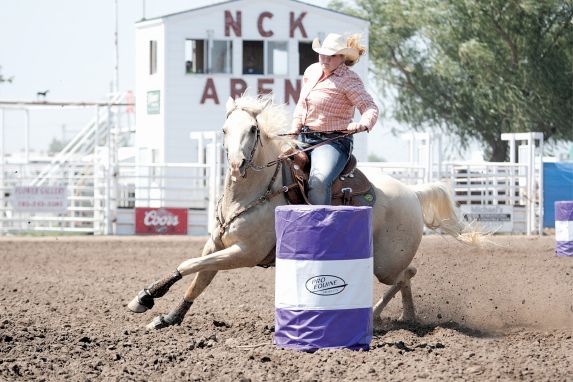
    Kelli Neville is a barrel racer in the Kansas High School Rodeo Association. The eighteen year old Kingman, Kan. cowgirl used to run poles, but when her pole horse sold more quickly than she planned, she let him go, and now she concentrates on barrels.

    She has two barrel horses. Ace, who is 17, is a big bay quarter horse who “is the biggest sweetheart ever,” she says. “He gives me 110% every time. He always takes care of whoever is on him.” Her second horse is a little palomino mare named Ira who is new to Kelli this summer. Ira will eventually replace Ace, and the ten year old mare is not typical. “She is very mellow for a mare. She’s almost like having another gelding around. She’s not moody or cranky, but very sensitive. You can put anybody on her, but if somebody is heavy-handed or rough, she doesn’t like that.”

    Kelli is a senior at Kingman High School, where she enjoys it, but is excited for her senior year to end so she can get out and “start a whole new chapter in life.” Her younger sister, Valerie, is a freshman and plays sports, so Kelli enjoys watching her play. “She does the sports, I do the rodeo. During the week, we’re at her games, cheering her on, and on the weekends, she comes to the rodeos and cheers me on. It’s fun to watch my little sister do well at sports.”

    After school, she works as a clerk at the Kingman Drug Store. She packages and delivers medicine for the local nursing home, and loves the experience she is gaining. She is saving her earnings for college. After Kelli gets home from work, she helps out on the family farm and hog operation. She, her brother, and her dad rotate in doing hog chores each evening, so after riding horses, she does her chores, showers, homework, and heads to bed.

    Her mom and dad raise wheat and own Neville Built Trailers and a welding shop. Her dad made a deal with her. If she’d pay for the grain, he’d provide the hay from the waterways between wheat fields.

    When she’s not at school, working, riding, or doing chores, she likes to go with friends to Wichita. They like to watch movies or go to the Buckle (“that isn’t good because I like jeans”) or Shepler’s, “and that isn’t good because I like shirts. Mom doesn’t let me go to Wichita for that reason.” They like to stop at Texas Roadhouse for their delicious steaks.

    After high school, Kelli might attend Ft. Hays State University, of which her dad is an alumni. She’d like to major in sports medicine. In school, she is reporter for her FFA chapter, and is on the Eagle Honor Roll. In addition to her sister Valerie, Kelli has an older brother, Cole, who is 20. She is the daughter of Marvin and Jill, who have “done so much for me, to get me where I’m at,” she says.

  • Garrett Yerigan

    Garrett Yerigan

    Garrett Yerigan graduated from high school last May and is hoping to make rodeo his career. “I would use college as a backup plan – but right now rodeo is my main gig. I think I can make that work, but you never know what tomorrow will bring.”

         He is checking one goal off his bucket list this year by announcing the International Finals Rodeo, in Oklahoma City, Okla. January 17-19, 2014. “Announcing the IFR was on the top of the list,” said the 19-year-old from Pryor, Okla. Garrett started as a technical director of the IFR several years ago. “I handled the lights, the video, oversaw the music, and built the performance outlines – pretty much one step down from the production manager.” His dad, Dale, is the General Manager for the International Pro Rodeo Association, so Garrett has worked many angles of the event over the years. “I never competed. Everybody always thought I was crazy especially having a dad as the bulldogger. But I looked at the for sure paycheck and did the back end work instead.” Garrett started announcing when he was 11, locally at some rodeos and barrel racings in the Claremore, OK area. “When I started, I just used the equipment that was there, and now I have a sponsor – Red Master Harrow – that provides the tractor and harrow that I use is for my jobs working ground. Floyd Fain, who owns the company out of Amarillo, comes to the event now. I’ve been with him almost two years.” Another one of his sponsors, Cody Jensen with Oxbow Tack, helps advertise anything that he’s doing. “That company is a family company and I appreciate those kind of people – that’s how our country keeps turning. Anybody that can make something out of nothing is impressive. I and I have a pair of chaps, saddle, and breast collar made by them.”
    Garrett considers announcing as a conversation between himself and the audience. “I’m not going to talk at you, I’m going to talk to you. I like to think of myself as a person that can relate to the audience, wether they are watching rodeo for the first time or the 500th time. It goes back to the sports broadcaster – our job is to explain the event – things that people may not realize, but we’re educated to make them aware. The toughest part of that is coming across in a way that is understandable to the first time rodeo fans, but not obnoxious and elementary to the people that watch week in and week out. I don’t ever feel like I’m going to work, I’m going to have fun.”
    He does his homework before showing up at an event. “I get day sheets and find out what contestants are there – hometown, money won and even some personal interest stuff. Then I take a look at the livestock coming and the accolades of that. I meet with sponsors and producers – there’s a lot more to it than showing up and picking up a microphone.” He is announcing the IFR with Brandon McLagan – it is Brandon’s second trip. “Brandon and I are great friends and we talk on the phone several times a week. Once we get closer to the date, we will talk a lot more. Whose doing what will happen the day of.”
    Garrett has learned a lot about public relations through FFA. He joined in 2008 and has won two National Awards through that association. The first one was the National Ag Communication Proficiency Award for FFA, which he received Friday, Oct. 26, 2012, in Indianapolis at the National FFA Convention and Expo.
    After winning the title for Oklahoma, he moved to the national competition. “They start with 51, then the top four are the national finalists. We moved on to the interview process, which included an application, interview, and a fifteen minute question and answer session. The hardest question was how do I look when I go to a new location as an announcer, I’m taking someone’s position that was there the year before, does that change your mindset or are you yourself. I told them that if the committee liked  what I did in another location, they will like me there – I don’t change my style – I’m going to be myself wherever I’m at.”
    His second title was achieved this year – the Outdoor Recreation Proficiency Award. “After the state level, they crown three winners. The state winner from every state goes to summer judging, where the application is judged. The top four become national finalists. The final live interview is 75% of the score. My SAE, Supervised Agricultural Experience, is Rodeo Announcing, Sound and Music – all the things I do in rodeo.” Because the FFA is such a prestigious organization, these awards looks great on Garrett’s resume. Garrett is still trying for one more award – the American FFA Degree – the highest any single member can receive. That will be something I’d go to convention for next year. It’s a lengthy application that you submit and get judged on.”
    Garrett came upon his love of rodeo naturally. His dad, Dale, was an eleven time IPRA World Champion steer wrestler. His mom, Kathy, was an IFR barrel racer, who now works as an office manager at a local hospital. “Dad grew up in Minnesota playing hockey and wrestling, he got into high school rodeo through friends of the family. Mom is from Ohio; she was born into rodeo; her mom and dad were both competitive (Barbara Ink, Bob Ink – IFR judge multiple times, bareback riding). My other grandparents, Dean and MaryLou, were not involved in rodeo, but they supported my dad the whole way, just like they do with me. Both sides are very supportive of continuing the family tradition of rodeo. I’ve got a phenomenal support system at home. Whatever path I go down, my parents are going to be behind me one hundred percent.”
    Garrett spent years collecting music and sound effects. He has more than 15,000 songs on his computer – that includes songs and sound effects. “I can do both announce and music. If I can concentrate on one or the other, I can be more responsive and not concentrating on something else. Music is fun because of the mood setters and you have some control over that feel. On the other side, you get to accent the music by setting the scene of what the ride means for the cowboy. There are some guys that I work multiple events with, but every event is different.”
    Along with his expertise in sound and music, Garrett is also sought out for his expertise in ground work. He was part of the ground crew for the International Finals Youth Rodeo for several years and works the ground for several barrel races around his house. “Diversity is definitely there. I’ve always been a personal tractor nut. Growing up I’d spend time with my grandfather in Minnesota. He was a farmer and I drove big John Deeres up there.”
    Come Jan. 19, when the IFR is all done, Garrett can check that one off his bucket list. “I would love to announce the NFR, obviously, and the bigger ones like Cheyenne, Houston, and the National High School Finals.  I did get selected for the National Junior High Finals in DeMoines, Iowa in 2014. There’s always expansion in my future and growing – rodeo and announcing is where I’m headed.”

  • Jake Cruzan

    Jake Cruzan

    Jake Cruzan lives in Cave Creek, Ariz., a recent transplant from Cortez, Colo. His family moved a month ago and the National High School Reserve Team Roping Header Champion is excited about the move.
        “It’s really been good for me since I’m into the cutting and there is a bigger opportunity for me here,” said the 17-year-old home schooled senior. Jake won the Colorado State High School Finals in both cutting and team roping. “This move will allow me to show our rope horses, reiners, and cow horses at the AQHA shows close to where we live.” Jake won reserve World Champion Heading at the AQHA World Show this year and he is hoping to become a professional performance horse trainer. “I’m hoping to continue to get my name out there,” he said.
        Jake has always rodeoed, beginning with the junior rodeos at the age of eight. Junior high was the next step, and he moved into the high school rodeo after that, working his way up to making Nationals for the first time in the team roping his junior year. He made it both sophomore and junior year in the cutting. Jake has shown rope horses, cutters, and other horses in the AQHA and qualified three horses this year for the first time. Arizona has given Jake another opportunity to compete against some tough competition. He’s sitting second in the All Around, second in team roping, and winning the cutting. “My goal this year is continue going after the All Around. I want to be competitive in all three of my events – cutting, team roping, and tie down roping. I have a really good partner this year, Zane Yates, from Cortez, who is going to keep living in Colorado and rodeo in Arizona.”
        Jake splits his time between school, his nine horses at home, and his full time job with a local horse trainer.  “We have quite a few show horses – they are under lights, blanketed, and exercised daily so that‘s a lot of work. I work for Brad Barkemeyer six days a week – this will be my third year working for him. I’m an assistant rope horse trainer for him and help him with whatever he needs done. He’s taught me a lot – and helped me on all levels of life from riding to being a good person,” said Jake. “Brad has a lot going for him and he his endorsement with Weaver Leather has opened up some doors for me. I’ve got some really good sponsors from his help.” He is endorsed by Bobs Custom Saddles, Anderson Bean Boots, New West Performance Horses, BetterBoots.com, and is working on a sponsorship with Twister Trailer. “The hardest part of getting sponsors is getting your name out there. I have tried hard by introducing myself to everyone I can. I have worked on getting a very clean appearance from myself to my horses. I’m one of the only kids that is endorsed by some of these companies. I work hard at keeping my record clean and everything tidy.”
        Jake’s family owns an irrigation company (Cruzan Irrigation) in Cortez and his dad (Kyle) commutes now that the family has moved to Cave Creek. They still have the house in Cortez and they spend time there in the summer. Both Jake and his brother (Brock) work at the company in the summer. They help with deliveries, as well as help take down and set up pivots and side rolls. Brock took to motorcycles instead of horses. He does a little bit of competing, but mostly rides for fun. His mother (Rickie) is the secretary of the business and devotes a lot of time helping Jake with the horses at home

  • Jim Watkins

    Jim Watkins

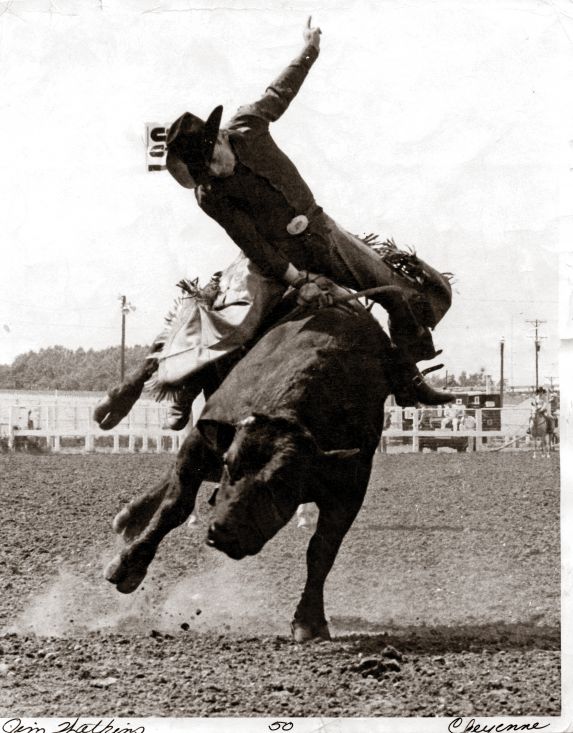
    Jim Watkins was born in Fairfax, Missouri. His dad was a tanker driver for Farmers for MFA oil company. After getting his start in Little Britches, Jim competed in bareback, bull riding, steer wrestling, and calf roping in high school rodeo in Missouri, graduating in 1963. He was National High School Vice President from Missouri in 1963 and qualified for the high school finals in the bareback and calf roping, adding bull riding to that list his senior year.
        He went on to college, graduating from Sul Ross State University in 1968, and rodeoing on his PRCA card in the summer. “I rodeoed full time after college,” he said. Jim made the big ones across the country from Cow Palace to Cheyenne. “I was in the top 15 and tore a groin – that finished that year,” he said. His wife had been calling him about a job offer in Odessa as an Industrial Technology teacher. “I was going to teach for one year, just until I got healed up, and I ended up teaching and coaching for a total of 40 years,” he said. “I’ve never done anything I’ve enjoyed more. My wife says I never had to grow up because I got new kids to play with every year.” He kept rodeoing, weekends and summers, until 1984. He also judged a lot of rodeos including Cheyenne Frontier Days, Pikes Peak or Bust, Pecos and Odessa for several years. He was also the chute boss at Deadwood, SD, after Jack Buschbaum. 
        Jim and his wife, Katherine Carol (KC), met in college. They have three children, two boys and a girl in the middle -Todd, Jamie, and Ty. “My wife was a teacher of chemistry and biology at Crockett Junior High – she taught for 31 years. When I started teaching, she stayed home with the kids and went to school part of the time.” They built a place north of Odessa that included an arena.  “We built a bucking barrel and roping dummy at school the second year I taught and the kids would get off the bus with rigging bags and rope cans and we’d ride the bucking barrel and rope,” he recalls. In 1974, Joe Turner, with El Torro Bucking Machines, found out what Jim was doing and donated a brand new bucking machine to the cause. “We bucked that thing until we wore it out,” he said. He charged $.05 to ride during the week and then had trophy days on Fridays – the winner got the trophy. “We had a lot of fun with that bucking machine.” 
        Jim supplemented his income as a teacher by making bull ropes. “Booger Bryant and I were rodeoing together in the summer of 66. He was building bull ropes and I was braiding the tails. I braided tails for him all summer. During the spare time during the rodeos that’s what we did. Come time for me to get a new bull rope, I asked Booger to do it and he said for me to make it myself. He taught me how and I’ve made them over the years for several world champions – Harry Tompkins, Freckles Brown, Benny Reynolds, Bobby Steiner, Larry Mahan, Cody Snyder, Jim Sharp – he was still wanting them when I quit in 1993. That was the best insurance policy I had.” The first ones he made he charged $35 each, when he quit they were $175. “I’d work after supper 11:30 to 2:30, and in three nights I’d finish a rope. I’d start the next one the third night. Then I’d get up at 6:30 and go to school. I’d do that three nights a week. School teacher didn’t make a whole lot of money and making ropes saved my bacon more than once.”
        All three of their kids started in junior rodeo and worked their way up. “Both boys rode steers and roped calves, my daughter did everything. And long story short, they were all three several times AJRA world champions, Texas State High School Champions, national high school go around winners and my oldest son held the record for highest marked bull ride at the high school finals.” Ty went on to be the PRCA rookie of year in 1991. One arena turned into two at the house and in 1983 Dr. Miles Eckert from Odessa College got in touch with him to see if he would be interested in putting together a rodeo program.
        “They had a rodeo club and they had two kids that college rodeoed. Dr. Clara Willis was the rodeo club advisor,” said Jim, who accepted the job, and started the program in 1984. “They used my facility because the college didn’t have anything. The first year was very lucrative for me. I got $5,000 for the whole year – that included my coaching and the use of my facility.” Jim recruited some great rodeo athletes including Jim Sharp (two-time bull riding world champion), who won Rookie of the Year in 1985, and the college championship in 1986 and 1987. “We hauled Jim to the high school finals – the same one Lane Frost won.” He also coached nine-time world champion and seven-time all-around champion Ty Murray, the late Shawn McMullan, Jerome Davis, Adam and Gilbert Carrillo, Cimmaron Gerke, and Ryan Gray, who won Jim’s last college championship – bringing the total to 11.
        Jim taught public school and coached the Odessa Rodeo Team from 1984 – 1998. “I’d teach all day, get off at 4:30. The team would be at my house and we’d start practice at 6 and be out there until 11 at night.” In 1998, his 4.5 acre place with two arenas, was also home to 28 kid , 20 calves, 20 steers, five goats, and ten bucking horses. “We had panels put up and horses everywhere.”
        All that changed in 1999. “Herbert Grahm called me at Thanksgiving – he owns Grahm Central Stations across the country. He said ‘Jim, looks like you’ve outgrown your place. I came by there the other day with Kenny Carr, a promoter who put on all the top gun PBR in Odessa, and we both agreed that you can’t grow anymore.’” Herbert gave credit to Odessa College for a lot of his success and after talking it over with his family, they decided to donate the West Texas Stud farm (120 acres) to the rodeo program. There were no arenas, but lots of horse stalls (400). “I could see where the arenas could go and that’s what became a reality.” Jim convinced the board and Dr. Vance Gipson (president of the college) that he could do it and when they agreed, he went to Butch Pinkerton with WW Arena. Butch improved on his schematic of the layout which included three arenas. “$59,000 is what it cost for everything – now something like that would be more than $500,000. In 11 days we had the whole thing done.” 
        Jim retired in 2009, and was honored as coach of the year for the NIRA and was inducted into the Texas Rodeo Cowboy Hall of Fame in 2010.  “I loved teaching, rodeoing, and coaching – It was a great way for my wife and I to raise a family and we did it all together. She was my best supporter and critic. Now we stay busy on our place taking care of her mom and dad. My goal is to get to team rope a little bit and travel more in Europe. We’ve raised three great kids, have wonderful daughters’ in law, a great son in law, and four fantastic grandchildren. We are all doing well. We’ve been blessed all the way around. What more could we ask for?”

  • Derek Weinreis & Levi O’Keeffe

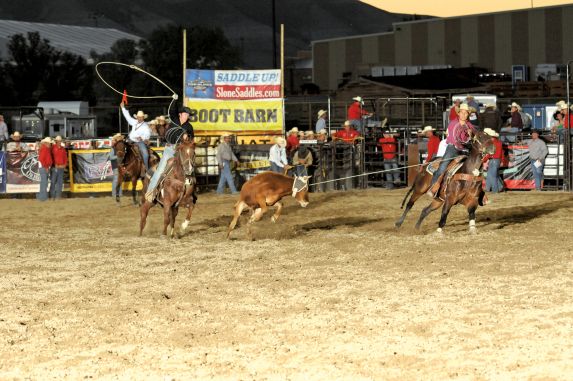
    Derek Weinreis and Levi O’Keeffe make one heck of a team, whether it’s in the rodeo arena or on the basketball court. The North Dakota cowboys are leading the team roping in the National Standings of the National Intercollegiate Rodeo Association, and their intramural basketball team doesn’t have many losses.

    The two are in their third year of roping together and are students at Eastern Wyoming College in Torrington. Right now, they’re more than 300 points ahead of the number two team, but Derek isn’t counting his chickens yet. “We try not to look (at the standings.) We still have to rope every steer.”

    Derek will graduate next May with a degree in business, and will probably head back home to the Weinreis farm and ranch operation located about an hour south of Beach, N.D. In the summers, he helps with the family business, which involves farms and ranches in several states. He stays busy branding, haying, harvesting, and moving cattle. He also competes in the Wrangler Team Roping Championships, World Series of Team Roping, and U.S. Team Roping Championships.

    Levi will also graduate in May, with a degree in ag business. In the summers, he often helps his dad with his fuel business and putting up hay. He is a member of the Pro Rodeo Cowboys Association, the Wrangler Team Roping Championships, and the USTRC. He just competed at his first PRCA Badlands Circuit Finals, finishing sixth in the year end standings.

    The two not only rope together, they’ve played intramural basketball together the past two years. Their team has done well, except for last year, when Derek and Levi had to miss the first game of the year end tournament, and they lost. Derek says basketball is a lot like team roping: “You can’t do much with one guy.”

    They have a good relationship, which makes for a great team. “We’re pretty open with each other,” Levi says. “We sit down and talk about what we need to change, and what the other person needs to change. There are no secrets between us.” For Derek, a positive attitude pervades. “Mainly, not beating ourselves is the most important thing. Whatever we draw, we try to make the best out of (the steer) and go on with it. If you have a steer to be a six on, go be six, and don’t try to be five.”

    The cowboys devote a lot of time to practice. Each man saddles four horses, and they’ll run anywhere from 30 to 100 steers nearly every day. In the first four college rodeos this year, they’ve placed second at the first one and won the next three. Last year, they won second at the College National Finals, and the previous year, won second in the Central Rocky Mountain Region.

    Derek has two older sisters and an older brother; Levi has two older sisters. Derek’s parents are George and Pam Weinreis. Levi’s parents are David and Lisa O’Keeffe.

  • Willie & Loretta Cowan

    Willie & Loretta Cowan

    Willie and Loretta Cowan believe in giving back. The Pierre, S.D. couple grew up in hard times, built a home and made a family, all the while contributing to others through rodeo. Willie was born into the rodeo world in Highmore, S.D. in 1937, the son of Art and Mary Cowan. His dad rodeoed and owned a rodeo string when Willie was young. His mom’s dad, Boots Gregg, put on rodeos on the Crow Creek Indian Reservation.

    Willie can’t remember a time he wasn’t horseback. His dad bought, sold and traded horses for a living, and after World War II, he helped with a U.S. Government contract to supply horses to Eastern Europe, to rehabilitate the small farmers whose stock had been killed or destroyed. The story goes that the night Willie was born, Art was trading horses with Pete Metzinger, his future wife’s grandfather and another horse trader, and “there may have been a little brown jug involved,” Loretta laughed.

    Because the Cowan place saw so many horses come through it, Art kept back the potential bucking horses. “My dad sent 10,000 horses to Yugoslavia,” Willie said. “Me and my brother were horseback forever.” Any time anyone found a horse that would buck, they’d hang on to it. “We had an arena and chutes, and pretty quick we found out (if they’d buck). We kept the good ones and sold the rest.” And Willie grew to appreciate good horseflesh. “We had to ride all kinds of junk. Dad was trying to make a living, so if we got something that worked good, he’d sell it.”

    As a youngster, there were no youth rodeos. He rode bucking horses at home and did some roping, but it wasn’t till high school that he competed in a more structured setting. He competed in every event: barebacks, saddle broncs, bulls, roping, bulldogging, even the cutting, and qualified for the South Dakota State High School Finals in 1954 and 1955, winning the saddle bronc riding championship in 1955. He qualified for the 1954 National High School Finals, but getting to Huntsville, Texas “was out of the question with a ’49 Chevy pickup,” Willie said. When Nationals were at Harrison, Neb. the next year, he attended.

    After high school, Willie had a scholarship to play football at South Dakota State University in Brookings, but he didn’t want to go. The next year, when he was ready to go to college, “Brookings wasn’t interested in me,” he laughed. Two friends from Texas were attending Sul Ross State University in Alpine, Texas, and they got him a rodeo scholarship and supposedly a football scholarship, so Willie was headed south. But the day before he left, a bull stepped on him and broke four ribs, so his football career was over before it started, “but that’s probably a good thing anyway.”

    The Sul Ross team made the College National Finals, but that summer, Willie was home in South Dakota and the funds weren’t available for him to travel. “Money didn’t grow on trees then,” so he didn’t go. After one year of college, he was back home, ranching with his dad.

    But his rodeo wasn’t over. He competed in the South Dakota Rodeo Association, winning the saddle bronc riding, tie-down roping, team roping, and even the all-around. Saddle bronc riding was his strength. “I never could ride bareback horses worth a damn,” he remembered. “And the bull riding, sometimes I would and sometimes I wouldn’t. I would never say I was really good at it, just good enough to stay in it.” His rodeo competition didn’t last long, however. “I quit pretty young,” he said. “I didn’t think a guy should be on the road when he had a wife and family.”

    Willie had married in 1960, and he and Loretta began ranching near Harrold, S.D. After the ranch owner died in a blizzard, they spent several months calving for Raymond Sutton near Gettysburg. Then the chance to buy some land came, and they bought the ranch where they live now, 15 miles northwest of Pierre, on Lake Oahe. That was in 1963, and by then, they had two children, Shane and Kim.

    When he and Loretta were done, there were six Cowan kids: the first two, plus Carmen, Colleen, Casey and Lori, and the kids competed in 4-H rodeo. In 1972, he and Loretta helped begin the South Dakota 4-H Finals Rodeo, because “there was a need,” Willie remembered. “We really thought we could keep the older kids in 4-H, so we started the finals. It just evolved and got bigger and bigger.” Willie served as president and Loretta secretaried the finals for fifteen years.

    He also worked as a pickup man. He began for his dad, and then worked for Korkow Rodeo and Sutton Rodeo for several years. He picked up the National High School Finals Rodeo five times, and the College National Finals once. And he did so much more. He served on the Hughes County Fair Board for nine years, and won the Heartland Saddle in 1992 for helping the youth of Central South Dakota. In 1982, he won the South Dakota 4-H Outstanding Service Award, and was inducted into the South Dakota 4-H Hall of Fame during its centennial celebration. He was the 2002 National High School South Dakota High School Rodeo Person of the Year, and in 2006 was the Casey Tibbs Honoree as a Past Rodeo Great.

    Just last year, he retired as arena director for the Casey Tibbs Match of Champions, which he had done for twenty years. Willie credits his family for his volunteering service. “Everything she and I have done, we’ve done for our family. We’ve been blessed with a good family, we haven’t had any trouble with our family. We’re really blessed. Our health is good.”

    At the young age of 76, Willie is still going strong. He and his daughters made an eight day, 132 mile wagon trip from Buffalo, S.D., to Medora, N.D., and he was delighted that his girls went with him. He and Loretta are partners with one of their sons on their beautiful ranch in the Missouri breaks, where they run a cow-calf operation. They lost a daughter, Kim, to cancer in 2003 and are proud to enjoy their thirteen grandkids and four great-grandkids. And his giving back? “All this stuff I’ve done, if it wasn’t for my family, I’d never have done it. You do it with your family and for your family.”

  • The Thompsons

    The Thompsons

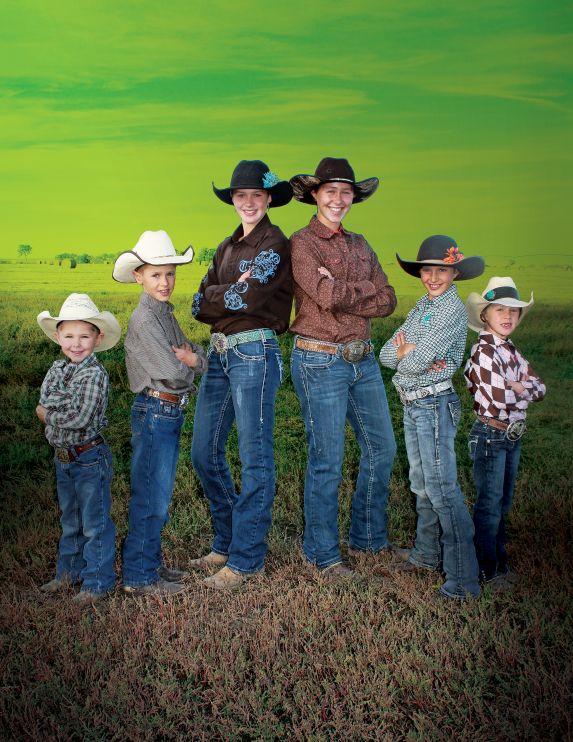
    Thorpe and Shelly Thompson of Whitney, Neb., have six children: Turek (3), Hadley (5), Tiegen (7), Haiden (9), Jacey (14), and Jamie (17). Each child has a competitive side and they all like to express it through the sport of rodeo. At the National Little Britches Finals Rodeo (NLBFR) in July, this family alone accounted for 46 runs over the course of four days. And this doesn’t even include the short-go. In another year, all six will be competing in the NLBRA, from five to 18. They will haul 8 horses for them to compete on. “Finding horses is the hardest thing for us – each horse has to be able to do more than one event and have more than one rider,” said Shelly.
        “It’s a team effort,” explains Thorpe, who owns a feedlot, farm, and has several other businesses going like AI, embryo transfer, and most recently a power washing business on the oil rigs in North Dakota. “The kids all pitch in. I’m proud of the kids from the standpoint they make their own decisions on ninety percent of stuff. Shelly and I help and provide as many opportunities as we can and the kids contribute by putting in the time and effort required to do well. They help with everything we do. They all understand what physical labor is and know what it’s like to put in an 18 hour day.” The days are long, but they’re spent together. 
        “We are big into practice at our house,” says Shelly. “Jamie and Jacey are usually up at 5 most days saddling horses. Our goal is to have everything warmed up by 6, then practice until around lunch.” Shelly home schools the kids and they work for everything they do. “They help dad ride pens, heat check, and anything else that needs to happen here. Thorpe was in a bad accident in March and was in and out of the hospital, so the kids had to look elsewhere for the coaching that Thorpe had started.” Shelly is on the Nebraska Farm Bureau Board of Directors and travels one week a month. “They have to be organized and keep the place up when I’m gone. There’s a lot of planning that goes on around here or it doesn’t work.”  
        The oldest help the youngest first. “We have them focus on one event and while they’re cooling off horses afterward Jacey and I will discuss what needs more work,” said Jamie. “Jacey and I are as close as sisters can get.” says Jamie. 
        “I use two horses,” said Hadley Jo, the youngest competitor. “Frosty and Spitty. “Frosty’s my favorite because she runs faster.”  She likes Little Britches rodeos because she gets to compete with her brother and sisters. She loves going to the National Little Britches Finals Rodeo in July in Pueblo, Colo. “I had fun and liked the water fights,” she says. This past year was a challenge for Hadley Jo as she broke her arm while playing with friends. She still competed using one hand. 
        Tiegen’s favorite events are goats and flags. “When I do goats, I just go out and have run,” he says. “I use Spitty for this and he is good.” Tiegen uses a pony named Squirt for Flags. Squirt has a tendency to buck if he’s not properly prepared. 
        Haiden’s favorite subject in school is math. Her least favorite chore is cleaning the goat pens. “We have 30 goats,” she said. Like most other responsibilities, the family shares this chore – until someone gets in trouble that is. Then the task becomes their responsibility. Another trademark specific to Haiden is her two-tone hat with decorative flower. “I saw someone wearing one and liked it,” she explains. “Then I got mine for Christmas.” 
        Jacey has moved on to high school rodeo this year. “It was an easy transition,” says Jacey. “National Little Britches gave me a lot of rodeos to go to and practice performing at the big rodeos, like their finals, which helps me with the pressure.” For the past two years, she’s accompanied the family to Wyoming high school rodeos…and then worked behind the scenes to help put them on. As a freshman, she now gets to spend her time competing instead of holding goats, a job she held for two years. Jacey takes responsibility for training her own horses and is proud of this. Her breakaway horse has a thing for donuts. This was discovered by accident. “Haiden had one and set it on the trailer. When she went to pick it up, Shag was eating it,” she explains. “My main goal this year is to win state in goats,” she explains. She has a lot of other goals including winning the All Around and breakaway. As an eighth grader, she was the reserve national champion for NLBRA in this event. 
        Jamie has been competing in Wyoming High School Rodeo as well as NLBRA. Jamie is the Wyoming State High School Goat Tying Student Director this year. “I like it, I like being down there to see how the other girls tie and encourage them. I like the responsibility part of it. Mom and Dad have always taught us to step up and help wherever we can.” She has made it to the short round a the Little Britches finals every year, qualified for the Nigh School Nationals and was the Reserve World Champion Goat Tier at the National Junior High Finals in Gallup, NM. She’s also active outside the arena, “I’m a member of the Alliance FFA chapter,” she explains. Alliance is an hour drive for her and she takes online college Ag courses to be eligible to be part of it. She’s the acting Sentinel for the club and participates on the Livestock Management/Judging Team as well. “I skype call for the weekly meetings and go there once a month to the meetings. FFA has taught me leadership skills and what kind of person it takes to be one.”
        The Thompson children are thankful for the life they lead and the oldest speak for the bunch when they extend thanks first to their parents for all the driving, support, and encouragement. They then pass out appreciation to others who’ve made important contributions to their success. “We would like to thank Jordan Thurston for her help with our goat tying,” they say. “We would also like to thank Paul Tierney for his help with breakaway and team roping, Carol Hollers for her advice on breakaway roping, and Sam Flannery for her help with barrel racing.” The sisters continue by offering appreciation to their extended family for encouragement over the years, and make it a point to mention Papa T. for supplying donuts – and handling chores while they’re away from home. 
        Jamie and Jacey speak on behalf of the entire family when they take the opportunity to give thanks to God. “We would like to say thanks to The Good Lord Above for watching over us and providing what we have.” 

  • Linsay Rosser-Sumpter

    Linsay Rosser-Sumpter

    Linsay Rosser-Sumpter and her husband of four years, Wade, are expecting their first baby sometime around December 20th. Since Wade is sitting 11th in the bull dogging standings, it’s looking like he’s going to Vegas without her this year. “That’s going to be hard,” she said. “I did the opening (for the NFR) when I was 6 and I’ve been there ever since – 24 years.” That’s not the only thing that has been challenging. As the coach for Otero Junior College, she has continued a rigorous schedule of daily practices and a fall schedule which included traveling to five rodeos. “I stopped riding at about seven months, and stopped roping after the Reno Rodeo All Girl Roping.  I continued to keep horses legged up, but I haven’t slowed down – I wasn’t raised that way.” 
        Linsay entered her first rodeo when she was 10. “My grandfather (Cotton Rosser) has been in the rodeo business for close to 65 years, so I would go with Flying U Rodeo Company and help with all aspects of the business.  I’ve been carrying the American flag since I could hold it. I would take care of saddle horses, do victory laps, and I spent a few years performing trick riding (11-13). I have also timed, we grew up rodeoing, on the work side of things.”
        There weren’t a lot of choices for junior rodeos and since her family produced rodeos, it made it tough to haul to very many. “When my brother got into high school rodeo, they hauled him, and that opened the door for me to start.” Linsay claimed the California State High School Champion Goat Tier in 2000 and 2001, and All Around Champion Cowgirl her senior year – 2001. She went to California Polytechnic State University, San Luis Obispo and went to the college finals two years (2003-2004). Linsay took a job as PR and marketing for the PBR, until she got married and then started at Otero in June of 2009. “I loved that job (PBR), it was a lot of work and hard, but I wouldn’t trade the experience for anything.” The coaching position fits Linsay’s life better. “I was on the road a lot, and so was Wade, but now I’m home during the week, and it allows me to take care of our place. My contract here is an 11-month contract, so I don’t get to travel with Wade but I don’t crave the travel – I like to fly in to the good ones and fly home. I was raised in the rodeo business, so I don’t have the desire to go to all 70 rodeos that Wade is entered in. I put my vacation time around the rodeos that are easy to fly into and the All Girl ropings that I like to go to.”
        Linsay is one of a handful of female coaches in the nation. “When I started here, there were only two of us,” she said. “I’m lucky in the fact that I’m not little. I’m almost six foot tall and my mother tried really hard for me to be the debutante and I loved the rugged cowboy lifestyle. My grandfather always had a bunch of cowboys working for him and I worked right beside them, riding colts, branding, and doing whatever they were doing. Since I was never discriminated against, I have the ability to speak my mind, work like a man and stand my ground. Being in this business for so long, I sometimes feel like I know too much, but you have to show respect to get respect. I work alongside my team from flanking, roping, tying with them and working hard every day at practice.  Her assistant coach, JW McCuistion, handles most of the rough stock side of the program. She also gets PRCA cowboys like Casey Colletti, Trevor Knowles, Seth Brockman, and Jake Rinehart to come and help. “I never ask them to do something I won’t do. Obviously I can’t go to the gym now, but before that I was at the gym every lunch break with the team and we have an outstanding strength and conditioning trainer at Otero.”
        Wade and Linsay have around 15 horses at the house. “Wade has two really nice bull dogging horses, Dashs Dapper Star “Wick” the AQHA/PRCA Steer Wrestling Horse of the Year 2010-11 and Speedy Faila “Two Guns” AQHA/PRCA Steer Wrestling Horse of the Year 2013 and his haze horse Grumpy, who has really done a great job this year.  “We have a lot of colts and ranch horses, and I have a good head horse and a good breakaway horse that I compete on.” Wade and Kenneth Lewis bought Wick in 2006 but now Wade is partners Billy Bugenig his traveling partner and Two Guns came from NFR team roper Charly Crawford. He was a head horse when we got him, and Wade trained them so it makes  horse of the year title extra special. “We love to train horses, I haul them to jackpots to expose them to the elements – I’ll try to go as much as I can after the baby comes. It’s unchartered territory but I’m not hanging up my rope. The baby will be like every other rodeo baby and since we all survived it, he will too.  He’ll be my new accessory.”

  • Irene Wilson

    Irene Wilson

    Irene Wilson is one of only a handful of women to be inducted into the Idaho Rodeo Hall of Fame. She rodeoed with the Idaho Cowboys Association in 1959, the first year that the ICA would present a saddle to the barrel racing champion. Irene was determined to be that champion. “I had never won a saddle, and I wanted a saddle,” Irene said. Married with two children, Irene rodeoed on the weekends, sometimes bringing her two sons with her. “I had an old Ford pickup. My youngest son was one and a half and my oldest son was three. We only had room for the horse in the bed of the pickup, with a suitcase on one side of him and the diapers on the other.” At that time, many people transported their horses in their pickup beds as it was more affordable than hauling a horse trailer. Irene’s dedication paid off. She was the first woman to win a saddle in the ICA and was the 1959 barrel racing champion.

    While Irene grew up with horses, she did not begin barrel racing until her twenties. Born in 1935 in the mining town of Pearl, Idaho, Irene grew up living in both Pearl and Star, Idaho. Her parents, Fred and Irene Turner, owned a ranch and grew hay in Star, and Irene’s father also worked in the mines of Pearl. When Irene was six years old, her father decided that she and her older sister, Mary, should begin trick roping. “My dad brought home two ropes and said ‘you girls are going to learn to rope’. And we did, an hour every day whether we wanted to or not,” Irene remembers. The sisters performed their trick roping act in Idaho with the Roser, Moody, and Kershner Rodeo Producers, and in Oregon with the Roland Hyde Rodeo Producer. Irene recalls that she didn’t find trick roping on the horses enjoyable at all. “It was scary,” she says, “There were always nerves right before you went on.”

    When Irene was about 15, her sister married and went on to train horses with her husband. The rodeo act split up, Irene’s father wanted her to start competing in cow cutting. “I didn’t like it, but my dad did,” says Irene. After several years of cutting, Irene was anxious to move on. By this time she was married and in her early twenties. She began competing in barrel racing and pole bending in the IGRA (Idaho Girl’s Rodeo Association). Irene was self-taught. At that time they took movies instead of photographs of Irene barrel racing so that she could watch what she was doing. In the 1950’s, Quarter Horses were being introduced in Idaho, and Irene bought a gelding named Candy Bill. They were a talented team, and won the IGRA barrels and poles from 1957 through 1959.

    Irene also tried out for Snake River Stampede Rodeo Queen for five years. While out of nearly 50 contestants Irene never won the title, she was runner up several years. “It was more fun to not be queen,” says Irene. “After the contest, they took all of the girls, three to a convertible, and went to every town from Ontario, (Ore.) to Mountain Home (Idaho). We went to every town at a certain time and they were ready for us. They’d give us ice cream or Coke, whatever we wanted. Then the new queen would stand up and say something about the rodeo. It was a big advertisement for the rodeo.”

    It was after winning the ICA saddle in 1959 that Irene decided to quit rodeoing. She was married to her second husband, Bert Wilson, and her two sons, Dan and John, were old enough to start their own activities. However, Irene admits that she didn’t want them to rodeo. “I knew they weren’t going to rope, and I didn’t want them to ride roughstock.” Instead, they began showing Quarter Horses, which they continued to do for over ten years. When Dan graduated from high school in 1974, he went to Alaska to get a job in the fishing industry and John went with him.

    After their sons had left home, Irene and Bert were no longer showing horses. Although Bert worked as a state policeman and Irene was a secretary and dispatcher for a trucking company, they needed a hobby to occupy their weekends. “We fished for a year, but we were at loose ends,” says Irene. Instead, they became involved with horse racing in Emmett, Idaho. Soon they branched out to races in Portland, Spokane, and even Phoenix. The husband and wife raised and trained their race horses, standing two studs and occasionally buying other prospective horses. Bert passed away in 1997, but Irene continued to race horses with the help of her two granddaughters, Tanya and Samantha Tackitt. In 1999, Irene’s mare Irish Staff won the prestigious Idaho Cup race, a race that only ten of the best racehorses in Idaho qualify for. Following her win, Irene retired from horse racing.

    Irene’s son, Dan, was now running petting zoos and he asked Irene to start a pony ring with him. She travelled with sixteen ponies, but that became such a hassle that she decided to open a farm on her ten acres in Star. The pony ring and petting zoo became specifically a place for kindergarteners, as well as children with disabilities, to visit.  The children were given hay rides around the zoo, where they saw a zebra, a camel, emus, reindeer, sheep, and over ten breeds of horses.

    In 2010, Irene sold the petting zoo and pony ring, which is still in operation. She continues to live in Star. Irene is a director for the Idaho Horse Council and is on the Idaho Horse Expo committee. While she doesn’t ride anymore, two of Irene’s great granddaughters ride with the EhCapa Bareback Riders, and Irene travels with the group throughout the summer. EhCapa performed in honor of her induction into the Idaho Rodeo Hall of Fame at the Gooding Pro Rodeo. “Looking back, it seems like I’ve done something new about every ten years,” Irene said with a laugh. “I wonder what I will do in the next few years.”