Rodeo Life

Blog

  • Tommy Tibbitts

    Tommy Tibbitts

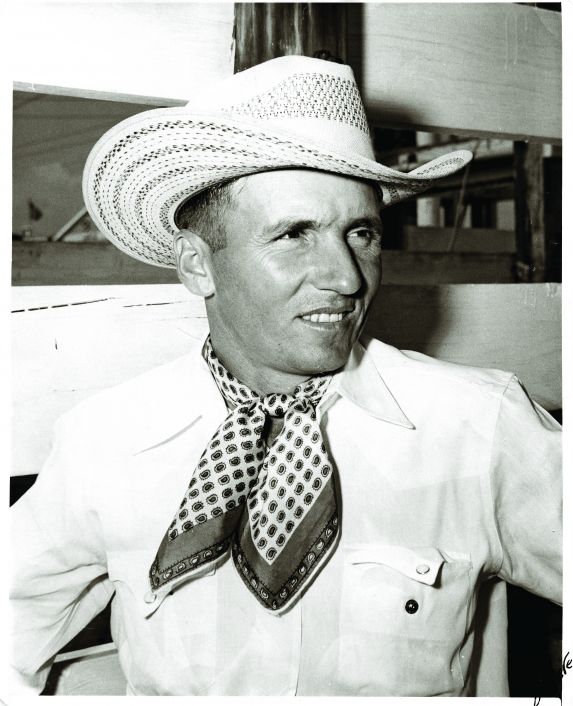
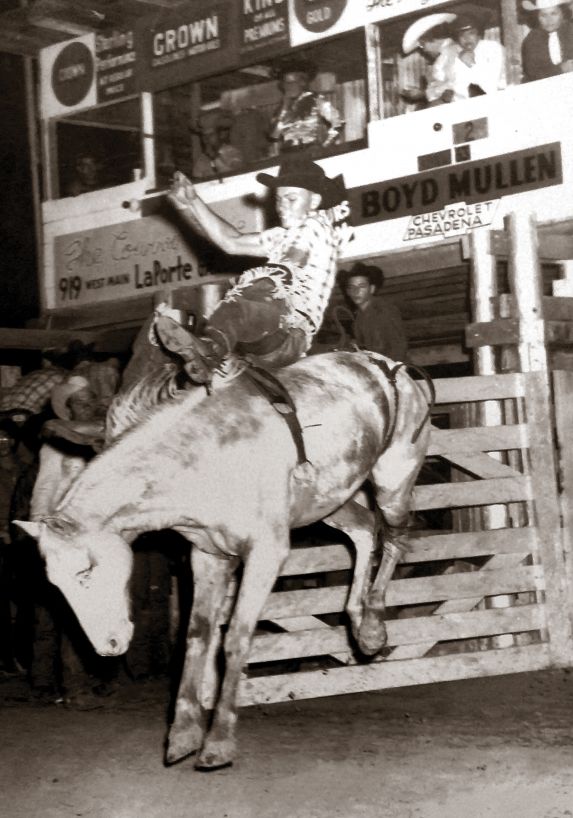
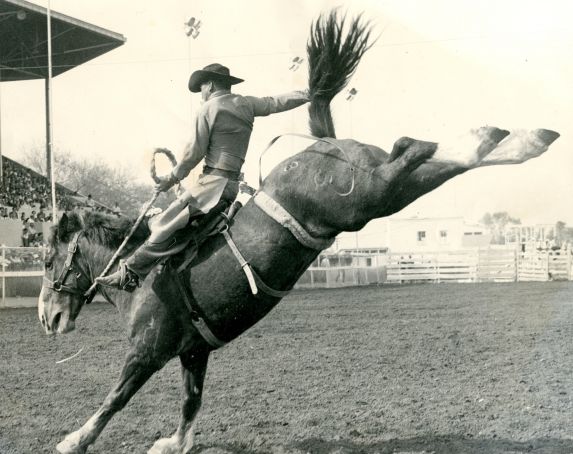
    Tommy Tibbitts was born August 15, 1928, on a ranch about 25 miles south of Merriman, Neb. The ranch was called the Churn Ranch and was owned by Tom Arnold. His dad (Tom) was a straw boss as they were called in those days. Tommy had four sisters older than he and two younger. Mr. Arnold sold the ranch and the family moved to South Dakota when Tommy was a year old. He went to a country school on the Arnold Ranch through the 8th grade and went to high school in Mission, SD.
    The Arnold Ranch was so big that it took up to ten days to brand all the cattle. When Tommy was 8, he went on his first branding. His job was to herd the horses while the hands were busy branding. His next job was breaking colts, and he was paid $5.00 a colt. At that time, the men working in the hay field were getting $1.00 a day and meals. “The first year it took me all summer to break four colts to ride. The second year I broke enough colts I made more than the hands in the hay field did, so the next year Mr. Arnold put me on a hay rake.” The Arnold Ranch had about four hundred head of horses, both riding horses and work horses. They had about 3,000 head of mother cows and 12,000 head of sheep. The sheep farm and the cattle ranch were connected but apart from each other.”

    After World War II was over the US Marines Air Corp offered an enlistment for two years. Tommy was 17 years old, and in his senior year of high school when he enlisted. “I was sworn in on April 9, 1946. Since I enlisted before duration was signed, I am considered a World War II veteran.” After his time in the Marines, Tommy moved to Ft. Pierre along with a couple of friends. “We found work at the Old Horse and Mule Ranch which had been sold to Billy Barrak.” It was here that Tommy started riding saddle broncs at a few rodeos. He joined the Rodeo Cowboys Association (RCA now PRCA) in the spring of 1948. “My PRCA gold card number is 1198. In my beginning years of rodeo I rode bareback horses and saddle bronc. The last years of my rodeo career I just rode saddle bronc. I tried bulls but they just didn’t work for me.”

    Tommy worked local rodeos in South Dakota, Nebraska, Kansas and North Dakota until a bareback horse bucked him off and broke his left knee which put him out of commission for a few months. “While I was healing I went to work in the oil fields at Lovington, New Mexico – that was a new experience. I worked there all winter until spring and I started to rodeo again.” While at a rodeo in Springfield, Missouri, he got an opportunity to make money and rodeo. A rodeo act called the Valkeries asked Tommy to drive their truck, hauling their horses. The act consisted of three girls standing on the back of horses and jumping hurdles. They had seven white horses to haul. “Their offer was to pay my expenses, pay my entrance fee at the rodeos plus a small wage. I accepted the job offer as it was a god send to a cowboy just getting started. “ His new position allowed Tommy to see the nation – they went to Denver, Ft. Worth, El Paso, Phoenix, Cheyenne, Chicago, New Yor,k and the Cow Palace to name a few. “The girls were like sisters to me, more or less like a family. We laughed and argued like a family but we still got along.”
    He worked with the Valkeries for three years. “They got a contract with a circus so I quit and went on my own. Later that spring at a rodeo at Tulsa Jake Beutler of the Beutler Bros. Rodeo Producers, asked me to go to work for them hauling livestock. I went to work for them and worked until I quit rodeoing in the fall of 1959.”

    He recalls his best year of rodeo – 1956. “I bucked off five horses all year and I believe I finished some where in the top 15 standings for that year. The national finals hadn’t started-yet.”
    On August 2, 1958 Tommy married Linda. “That was the best thing I did in my life time. She was not only beautiful on the outside but she is beautiful on the inside. We have had two children a girl and a boy. The girl (Sonya) is an accountant in Phoenix and the boy (Tom) does a lot of work for the department of defense. He works out of Santa Diego.” After getting married, Tommy left Beutler Bros. “I rodeoed some in 1959 but I decided to give up rodeo all together.” He got a job driving truck out of Amarillo, Texas. “I drove from there for about six years. In 1967 I changed companies and started driving for Leeway Motor Frieght out of Oklahoma City. My total time driving truck was about thirteen years. During that time I logged over 2,000,000 miles.”
    In the fall of 1974, he left trucking and moved back to South Dakota to ranch, farm, trade horses and work as a tribal ranger for the Pine Ridge Indian Reservation as well as in the tourism industry. “In 1995 I was named as one of the delegates, from South Dakota, to go to Washington D.C. to the conference on travel and tourism. Every state had delegates at the conference, a total of 1700 delegates, in all. That has been the only conference on tourism that has ever been held at Washington D.C.”

    In the year of 2001 John Hadley and his wife Lois talked Tommy into trying to make rodeo the official sport of South Dakota. “It took me two years before I was able to get it to the legislator for approval. Congressman Larry Rhoden and state senator Eric Bogue introduced the bill to the legislator and it passed by a land slide on February 27, 2003 The governor, Michael Rounds signed the bill into state law making it the official sport of South Dakota.”
    Tommy retired in the late 1990’s and volunteered to be a council member on a resource, conservation and development (RC&D) program. RC&D is a community development program. “The area we covered was four counties. I worked on that until the government stopped funding the program two years ago.”

    He and Linda still live on the ranch outside of Martin, SD. “We live 32 miles from town,” he said. They started going to Arizona for the winter about three years ago. “It can snow really hard and the electricity goes out for days,” said Linda. They both like the change of pace for the winter.

    They still enjoy going to rodeos and seeing people that they remember. “I like being able to walk into an arena and know everybody.” They enjoy their life now. “We didn’t get anything done, but we’re busy.”
  • Donna Shedeed

    Donna Shedeed

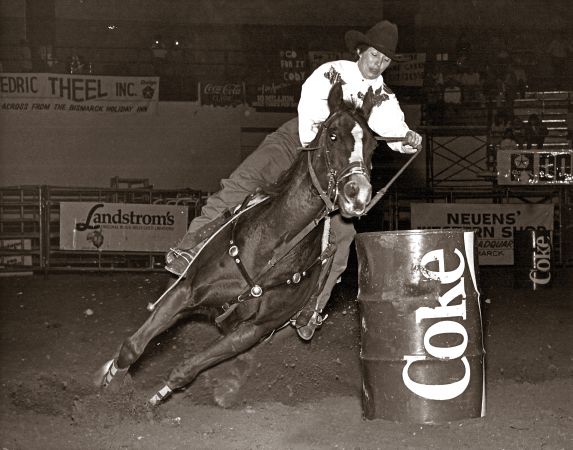
    Opportunities for girls to barrel race or rope were rare as Donna Armstrong (now Shedeed) grew up on a farm near Gordon, Neb. It was the early ’50s; before organized barrel racing associations and the newly formed WPRA was just getting off the ground. “I had always loved horses growing up, but there weren’t places to go and compete for girls. Especially in the roping; women just did not rope, it was all men roping. It was quite a while after high school that I got started doing some barrel racing.” One of the first early organizations that Donna joined was the Wyo-braska Association, a part of the WPRA. In 1961 Donna and her friend, Jean Reeves began competing in barrel racing in Gordon, Neb. “Somewhere along the way I picked up roping and began competing where ever I could.”

    Donna competed in the WPRA Badlands Circuit for several years and continues to make her presence known. “I’ve won the Badlands Circuit Team Roping Heeling Championship in 2010, ’11, and 2012. I was in the top 15 and I’m planning on trying to get that again this year.” She doesn’t limit herself to just rodeo and has her set her sight on some of the big USTRC ropings. “I’m going to the Big Horn Classic and rope in the all-girl roping. It’s co-approved for WPRA so it counts in both associations.”

    Donna met Bob Shedeed in 1964 and they were married a year later. The couple settled in the town she was born in, Rushville, Neb. “We had a hardware store and ran that for 30 years. We had a farm outside of town and built an indoor arena. We used to have jackpots there and even had Oldtimer Rodeos there in ’85 and ’86.” They ran their store, farmed, and rodeoed there until 2000 when they retired and moved to Hermosa, S.D.

    They joined the National Old Timer’s Rodeo Association, fore-runner of today’s National Senior Pro, in 1978. “We traveled all over, going to rodeos in Canada, and in the States. In those years, it seemed like that if he placed in the calf roping; then I wouldn’t place in the barrels. And if I place in the barrels; he’d wouldn’t place in the calf roping. One of us would win enough to keep our entry fees paid.” She was also active in the association as an officer and served as the barrel-racing director for six years.

    To say that Donna was successful in the Senior Pro association would be an understatement. Over the years, she teamed up with Bob to claim the titles as the World Champion Ribbon Runner in 1993, 1994, Reserve World Champion Ribbon Runner in 2003, and the Reserve World Champion Barrel Racer in 2002 and 2004. She was the women’s All Around Champion in 2001, 2003, and 2005. She was the Reserve All Around World Champion in 2004, the Frontier Circuit Champion Barrel Racer in 2006, and the 2007 Champion Heeler. In the Canadian Senior Pro association she has the 2003 Reserve Champion Ribbon Runner title and was the Champion Ribbon runner in 2004.” For Donna the win that has the most meaning is the 2005 Women’s All Around Championship. “Both Bob and I won the All Around titles that year, and he was Reserve World Champion Calf Roper.” The pair also won the 2003 Reserve Champion Ribbon Roper and Ribbon Runner. Donna and Bob were inducted into the National Senior Pro Hall of fame in 2008.

    She gives credit to the equine partners that she has had over the years and says, “You have to have a good horse. That is so important to any event , whether its team roping, barrel racing or calf roping, that can make the difference between winning and losing.”

    It was in 1983 that Donna and Bob began a life-changing work by starting a ministry. “We bought a building and started our Christian Community Center. We put on Cowboy Church services for 15 years and that is still a big part of our lives. Now we’re combining church services with team roping since we’re roping more now. People need to have that in their lives; all you have to do is look around to what is happening in this world. The good news is Jesus, you have to focus on that. Now we’re moving towards doing cowboy church at team ropings and have done that for Dennis Tryan in Dillon (Mont.). We’ve done some for Larry Steele in Rapid City.”

    Donna says that the Senior Pro Association gives her the incentive to stay in shape and work out. “It’s pretty demanding competing in rodeos and you do need to be in shape to keep up.” But by far it’s the friendships and people that Donna and Bob have come to know and love that given them their biggest reward. She has shifted from competitive barrel racing to team roping but continues to train and work with barrel horses. “I have stopped barrel racing a couple of years ago and now I train barrel horses for my granddaughters.”

    Their permanent residence is Hermosa, S.D. and they winter in Arizona. “We do a lot of team roping down there. There are jackpots you can go to every day and sometimes two in a day. I won a jacket down there this last winter in a jackpot that had over 200 teams. So I’m pretty proud of that jacket.” They have a daughter, Denell, and four sons, Stacy, Troy, Cory, and David Dunn. Donna and Bob have 15 grandchildren and seven great-grandchildren with one more due yet this year.

    Donna plans to keep running in the Senior Pro rodeos with no quit date set. “Don’t ever give up. The story for us is continuing. You have to set your goals. That’s what keeps you going is riding and roping. You ever been to a hospital lately and see people that have some real problems.

  • Will Smith

    Will Smith

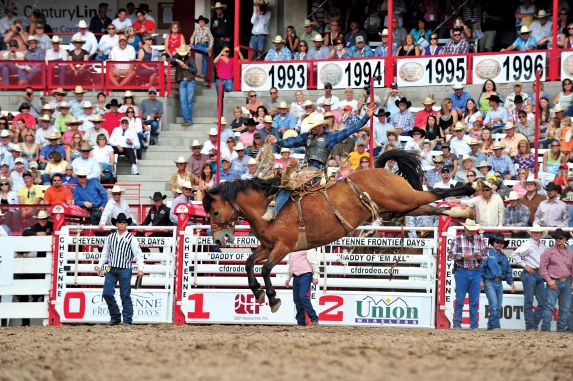
    Determined is the word that best describes PRCA cowboy Will Smith and his rodeo career. Coming from a family that did not have roots in rodeo, Will’s leap into the sport began when he was 13 at a weekend rodeo school. After buying his PRCA permit twice, then filling both permits at his first rodeos, Will acquired his rookie card in 2010. Since then, the 24-year-old saddle bronc rider from Marshall, Mo. has persistently worked his way to now being 16th in the PRCA world standings.

    Will’s introduction to rodeo came from watching a friend of his compete in high school rodeo. His interest piqued, 13-year-old Will told Jim Smith – his grandfather and close friend – that he wanted to ride a bucking horse. “He told me that I would have to ask my mom,” Will recalls. “She wasn’t very excited about it, but I went to Summerville, Ga. (for the Sankey Rodeo School) and I got on seven broncs that weekend. The last one I broke my arm on. When my dad took me to the doctor and found out it was broken, he knew that I really wanted to ride broncs, since I’d broken my arm and still wanted to do it.” After his first taste of saddle bronc riding, Will was sold on the sport.

    Following the weekend at the Sankey Rodeo School, Will began competing in high school rodeos in saddle bronc riding and calf roping. He and his family, especially his grandfather, plunged into rodeo together. Being a town kid, Will spent a considerable amount of time riding horses on his grandparent’s farm outside of Lugoff, S.C. Will and his grandfather traded with a friend for an old bay mare which Will would practice bucking on. The mare was put on a lunge line and Will was put on her back. “That horse bucked like crazy and that got us our big start,” says Jim Smith.

    Although Will and his family had been involved in horse 4H, they were now off to rodeos. Will would travel with his grandparents, Jim and Myra Smith, in their RV, and his parents, Billy and Lynn Smith, would come after getting off work. Though competition was fierce his first year of high school rodeo, Will made it to the national high school finals that year, and every year after. In addition to his family, Will was greatly supported by SCHSRA board members Eddie Truesdale and Scott Smith. Will spent his high school years going to rodeos, wrestling, or working on projects for student government. His senior year of high school Will ran an extensive campaign for student government. “I could’ve been mayor of the town,” he said with a laugh. “It was a pretty big campaign.”

    It was at the national high school rodeo finals that Ken Mason, rodeo coach at Missouri Valley College, first saw Will riding a saddle bronc. He recruited him to the rodeo team, and in 2007 Will took the next step towards his rodeo career. Coming from the east coast, Will stood out amongst his teammates from the Midwest. His skinny jeans and long hair made him look a little different, according to his friend Brady Wilson, who first met Will in college. However, his teammates always wanted him to win, and Will was on the team when they won second in the nation at the college national finals rodeo in 2010.

    Will’s bronc riding improved significantly through college rodeo. “He wanted to get better. He craved it,” says Brady Wilson. Then Ken Mason put him to work on the spur board, and Will worked at it feverishly, getting his legs into shape. “Will would get on as many broncs as we had at practice. If we had ten horses to buck, Will would get on every one,” Ken Mason says. “He’s a winner. He loves riding broncs and he loves Christ.”

    Will began college studying political science, thinking he would go into politics later in life. However, he says, “I fell into a good group of kids. They started a Bible study, God led me in that direction, and the next thing I knew I was a religion major.” Will has also started working on a double major in business, which he hopes to finish when rodeo slows down for him. He hopes to earn his master’s degree in theological studies and become a professor, and even pursue a mission trip to Papua New Guinea someday. Another goal that is very significant to Will is settling down to have a family.

    Since finishing his degree and leaving college, Will has been on the road to rodeos all over the U.S., as well as Canada in CPRA rodeos. He is constantly looking for ways to improve his riding. One approach that he has taken is travelling with fellow saddle bronc riders and PRCA cowboys Cody DeMoss, Curtis Garton, Ty Atchison, and Wade Sundell. Another asset to Will’s success is being surrounded by so many supportive people. Of his role models, Will says, “My granddaddy, Jim Smith, is always telling me that you only live once. Ken Mason, (Will’s rodeo coach) is like a second dad/brother. I call him all the time.” Will looks up to his dad for his discipline, and he says of his mother, “I love her to death. Her motherly love keeps my heart full and my hopes up.”

    The support that Will has received from family and friends has done wonders, as he has many titles and accomplishments under his belt. Will is most proud of winning the 2010 Great Lakes circuit championship in saddle bronc riding. And one of his most recent accomplishments, winning the Casey Tibbs Match of Champions with a 90 point ride on Chuckulator. “Not very many guys can say that they won that. I’m proud to be one of them.”

    Will has the WNFR in his sights, and many of his friends and mentors expect to see him riding broncs there this December. “I think every cowboy’s goal is to win a world title. For sure that’s my goal someday.” But Will is not in rodeo only for titles and championships. He says, “Growing up, my granddaddy had really cool stories of travelling. I want to have those stories to tell my grandchildren.”

  • Gene Peacock

    Gene Peacock

    Gene Peacock has spent his life immersed in rodeo and the cattle business. The 84 year old Cottonwood Falls, Kan. man was a rodeo contestant, laborer and judge, as well as a feedlot manager and order buyer.

    He was born in 1928 south of Seminole, Okla., one of nine children of Curtis and Marie Peacock. After his schooling ended with the eighth grade. he helped his parents ranch and farm. By the time he was 15, he was competing in the bareback riding, bull riding and saddle bronc riding. In his late teens, Gene made a dollar a day working for a local farmer and rancher. A 4th of July rodeo was advertised in Oilton, Okla., and Gene had a friend with a car, so they entered the rodeo. He won $75 at the rodeo, “and I only had made $65 working all winter,” he marveled. His rodeo career began in earnest.

    Gene joined the Rodeo Cowboys Association, predecessor to the Pro Rodeo Cowboys Association, in 1945. At that time, cowboys could not cross over and compete in both RCA and amateur events, so Gene stuck with RCA rodeos. Bareback riding was his strength, but he also competed in the bull riding, occasionally the saddle bronc riding, and even roped and bulldogged a little bit.

    He rodeoed “all over,” he said, “from Washington State to the East Coast.” Gene competed at Madison Square Garden in New York City and the Boston Garden five times. “Those were the biggest rodeos there were back then.” Madison Square was 53 performances, and Boston followed it. Together, they ran about seven weeks in length. Gene competed there five times, from 1945 to 1952, only missing one year, in 1949, when he was injured. New York City was big time for the Oklahoma cowboy. Madison Square was a 15 header, Gene remembered, “but I couldn’t stay sound. I never did win it but I won go-rounds there.” He had broken his neck when he was young, and “it bothered me at times.”

    During his rodeo days, he became friends with Gerald and Ken Roberts. Gerald was the RCA’s all-around champion in 1942 and 1948, and Ken won the world bull riding title three times. Gene lived with the family on and off for several years. E.C. and Clara Roberts, parents of the boys, requested that Gene work for them. “They raised a lot of horses. I’d go nearly every year in the spring and break horses for them. They’d call and need me, and I’d go and stay a while.” For a couple of years, Gerald did the entering for Gene, and paid his entry fees and expenses, and if Gene won, Gerald got half of Gene’s winnings.

    He also worked for the world champion brothers with the Roberts’ stock contracting business as arena director and flankman, first as part time and then full time in 1948. He often competed at the same rodeos at which he worked. At that time, the Roberts family provided stock for rodeos in Phillipsburg and Abilene Kan., Vinita, Okla., Burwell, Neb., and many others. When the Roberts brothers sold their company in 1961, he continued to work as arena director for other stock contractors. He was also on the labor list for many contractors, helping feed, sort and load timed event cattle at rodeos across the nation.

    Gene had been an order buyer in Oklahoma, and in the early ‘60s, his company moved him to Strong City, Kan., to work at their feedyard, the Crofoot Cattle Co. He wound up managing the feedyard, and became a board member of the Strong City, Kan., PRCA rodeo.

    Gene quit competing in 1965 (his last ride was in Strong City), but he didn’t leave rodeo. By that time, he had begun to judge PRCA shows and high school rodeos. Throughout his career, he traveled with the likes of Charlie Beales, Jack Buschbom, and Wallace Brooks, brother to world champion Lewis Brooks. He suffered injuries like any rodeo contestant, but they were never career-ending. He broke his neck three times, his ankle once, and numerous ribs, fingers, and a leg a time or two. The injuries slowed him down temporarily, but he always bounced back from it.

    Gene’s favorite horse was the 1961 Horse of the Year, Jesse James. At the time, Gene worked for Walter Plugge, a stock contractor in Nebraska, and Gene bought the straight palomino, a saddle bronc, for $100 in Ft. Pierre. When Plugge went to sell the horse, E.C. Roberts was at the sale and refused to buy him, thinking he was too high-priced at $320, which was what Plugge wanted for him. Gene said, “I’ll buy him,” and sent the horse home with Mr. Roberts. Jesse James had an illustrious career with the Roberts’. “He’d rear out of the chute, and the farther he went, the harder he bucked.” Gene never had the chance to ride him, but flanked him plenty of times. When Mr. Roberts sold the horse in 1961, he went for $2300, a significant amount of money paid for a bucking horse at that time.

    Gene was married to Walter Plugge’s daughter, the late Barbara Nichols, and they had two sons, Allan, and Phil. They were later divorced and in 1977 married Patty. Together they have fourteen grandchildren and four great-grandchildren.

    Rodeo was different back then. Contestants don’t stay in the same town as long. “Back then, we used to go to a lot of two or three day rodeos, a day ahead of time, and stay till it was over,” Gene said. Oftentimes those early day rodeos were multiple go-round events. “Now, sometimes (cowboys) are there two hours” and then leave. And rodeo has more money. “I remember in 1950, I won the first go round in the bareback riding in New York. It paid $860, and Gerald (Roberts) and I thought we were rich and had plenty of money.”

    At the age of 84, Gene just quit his order buyer business, but it’s still in his blood. He heads to the sale barn every week, and continues as a board member on the Strong City rodeo committee. He’ll celebrate his 85th birthday this June, and jokes that his family threw him a party for his 80th because “they thought I’d never have another one.” On June 9, they’ll throw another party this year, with family from Oklahoma and friends from all over in attendance.

    The cowboy may be aging but his rodeo friends and memories are still young in his mind. He loves his rodeo memories. “I met a lot of great people that I cherished and we liked each other. I made a lot of friends.”

  • Cody Heffernan

    Cody Heffernan

    Cody Heffernan missed going to the CNF last year by one bull. “It was the last rodeo of the season and I bucked off and that was it,” said the 23-year-old bull rider from Mesalands Community College in Tucumcari, New Mexico. He was determined to make it this year – and he did. Cody is sitting number one in the nation going into the finals. He changed a few things this year including not putting pressure on himself. “You have to perform good for your coach and your team and of course for yourself, but you’ve got to forget about it and just ride and have fun.”

    Cody is a long way from home – 21 hours by plane to be exact. Cody came over in August of 2011 from his home in Singleton, NSW Australia, to rodeo. “It was good but bad – I was sitting second in the National Rodeo Association back home. I gave that up and came over.” He had finished apprenticing as a diesel mechanic but decided that field wasn’t for him. “I didn’t like it at all, so I wanted to come over here and study something that bucked. It might come in handy when I raise some bucking bulls.” He has one semester left before completing his studies in Animal Science.

    Cody is spending his time before the College Finals going to the gym and playing X Box.

    “I do a lot of cardio and definitely not getting bulky, just getting lean.” He admits life is a bit boring right now. “I have two mates here from Australia and they went home. My girlfriend is from Canada and she’s gone too.” After the college finals, he will head to Canadafor a couple PBRs and pro rodeos. Then he will go home to Australia and go to a mate’s wedding. He will return to the US in September to start his last semester at Mesaland.

    Cody started riding at the age of 6. “We don’t have sheep riding back home, we got on little calves. You go from calves to steers to junior bulls, second division bulls and open bulls. They are just starting high school rodeo – all the juniors are run with the senior. Growing up I’d watch all the pros ride at the same rodeo I was riding at.”

    He learned how to ride bulls from his older brother (Craig). “He was riding and I basically was learning off him growing up. I’ve looked up to guys like Gary Leffew, Justin McBride – I like their style of riding bulls.” Cody wears a large cowboy hat when he rides that is pulled way down on his head. “You only need to see the front shoulder of the bull and it blocks everything else out. It gets me in trouble when I go to jump off because I don’t know where I am.”

    Growing up, Cody rode horses – a little bit of competition – not rodeo, and raced motorbikes. The town he is from has a population of around 20,000 and he had a couple hundred in his school. He also played football.

    He got on his first big bull when he was 16. “I actually won my first event in the second division bulls, but it didn’t feel real good. I was used to riding calves and there’s a big difference between bulls and steers.” He has been going to the PBR since he turned 18. “I won an event when I turned 19 in Australia, that put me #1 for about three months. In 2009 made the national finals – PBR Austrailian finals. I made the short go.” He is a seven time Junior NFR qualifier.

    There have been other students go through Mesalands Community College from Australia and Cody is grateful for CJ Aragon. “He is a good fellow. He gave me an opportunity and I’d like to thank him for that. He’s not afraid to get kids from other countries – Canada,Australia, and Mexico.” The hardest thing for Cody to get used to was driving on the opposite side of the road. “You all drive on the wrong side. There’s been plenty of times that I get in the passenger side of the car and realized I had to get out and get in the drivers side.”

    He says that the country is pretty similar, so that wasn’t a very difficult adjustment. His favorite food here is Buffalo Wings. “I think they might have those there, but you can get them everywhere here.” Both of his parents work in the coal mine – his Mom drives a big dump truck, the same ones that Cody used to fix when he was apprenticing there. “Basically my whole family is in the coal mines – my two older brothers (Craig and Brad) and mom and dad (Colleen and Peter), and my older sister, Casey. His oldest brother, Brad, surprised him and came over for the CNFR along with his parents and Casey.

    As for Cody’s future – he plans to win the world. “I want to be a champion so as long as it takes to do that.”

  • Lari Dee Guy

    Lari Dee Guy

    Lari Dee Guy strives to be a role model in competing, training, and clinics. “I want to be an inspiration that helps that little girl start roping or that lady that’s 50 that thinks they want to do that. I had all kinds of opportunities – I was left handed. Everything I was taught, my dad made them teach me left handed.”

    Her multiple talents in the roping world include her latest $18,000 win at the Wildfire in February. “I won it heading and heeling,” said the 42-year-old from Abilene, Texas. “I don’t think anyone has ever done that before.” In the equine training arena she has an extensive list of references that includes Trevor Brazile. “We own three colts together – we train them together. I’ll train them and get them going and he takes them from there – he’s like my little brother.”

    As a clinician, Lari Dee has shared her knowledge of horsemanship and ropers to several world champions. Passing on her knowledge of horsemanship and roping to others began 25 years ago while she was still in college. Her abilities with a rope started when she was a little girl.

    “My dad (Larry) is the reason I’m a perfectionist and kind of became a machine as a roper. With him it was his way or no way. He taught me the right way. There was no in-between. He didn’t settle. I was to catch everything that I ran no matter what. I both respected and feared him.” Her first challenge with roping came from being left handed. Her dad knew how difficult it would be to rope left handed and refused to allow her to rope left handed.

    Even though her mom (Mary) was a barrel racer, Lari Dee had a passion for roping because of her brother (Tommy). “He was a roper and I thought anything he could do I could do better. He went to the NFR in 93 in the calf roping.” She’s run barrels all her life, but once she got into high school, “I chose the rope.”

    She was also a bit of a daredevil. Raised on a 10,000 acre ranch outside of Abilene, she managed to total five vehicles before she was 16 – the first one when she was five. “My brother and I would play hide and seek and even though there was a ten foot drop between the hay loft and the floor, I would bail out the door hit and roll. I wasn’t scared of anything when I was a kid. My brother wasn’t the daredevil, I was.”

    She perfected her roping skills on the ranch during the many cattle drives. More than once her catches resulted in the necessity of the cowboys to get her rope back. She entered her first rodeo at 8, after her dad was sure she could rope well enough. She won that first breakaway roping. Her success continued into college where she won the breakaway roping three times in the Southwest Region and the national title in 1991 and again in 1993. She went to college at Vernon Regional Junior College and graduated from Texas Tech University. Lari Dee double majored in exercise sport science and recreational therapy. “I was going to be a trainer or own a gym. Obviously I pursued roping instead. I took motor learning and kinesiology and those classes really helped me understand a lot of things in our sport.”

    She came home and worked on the ranch and roped. “I was fortunate enough to have the ranch and my family that supported me and gave the freedom to do that.” Her roping has earned her titles in several associations. She divides her time between competing, training horses, and putting on clinics. “I want to be instrumental in making our female athletes better. I’m also putting on some big ropings, one I had last year paid $6,100 to win the average.”

    She started putting on schools when she was still in college. “I love having schools – I feel you learn from everyone you have. If you would say what would I break it down to now – the thing that people have trouble is- It’s all horsemanship. I watch people rope the dummy and every one can catch and I put them on the horse and they can’t. What makes me so successful roping is that I ride my horse good every time and I give myself a high percentage chance of catching.” She does about ten schools a year and travels all over the world doing them. “I’ve been to Sweden, Australia, Hawaii, and all over the US – you name it.”

    Lari Dee has also had to overcome two back surgeries. “I struggle with back pain everyday and one of the things that helps is going to the gym – I go at least five days a week. I run and do core exercises.” She had her first surgery in 1993 and the second one in 2000. She is hoping medical research will improve enough over the next several years to help her with the scar tissue and bone spurs. “Until then, it’s mind over matter – I’m pretty tough.”

    Lari Dee is the first to admit she is living the life she loves. “I don’t feel you can ever quit learning or be your best. I strive to be better every single day. I feel I rope, teach, and ride better every day. When I feel I can’t, that’s when I’ll do something else. I’m real competitive and I like to be good. If someone’s doing something better than me, I will work harder.I’m real disciplined. If I’m going to do something, I will get it done.”

  • Terry Etzkorn

    Terry Etzkorn

    “He was one of those little tough guys that was all muscle, who rodeoed for 25 years and took everybody’s money, and never seemed to get old.”

    Those are the words Jim Korkow uses to describe Terry Etzkorn, a four-event cowboy from Pierre, S.D., who rode broncs till he was fifty years old and still, at the age of 78, helps run the family ranch.

    Born in 1934, Terry grew up along the Missouri River, in the DeGrey area, 25 miles east of Pierre on Highway 34, the son of Anton “Tony”, a full-blood German from Wisconsin, and Bernice, an Irishwoman. He jokes, “I’m Irish and Dutch and don’t amount to much.”

    But he did amount to a lot. He began riding at a very young age, and as he got older, he broke horses and “liked the action,” he said. He began riding bucking horses, and “it just materialized, and then I finally got to where I was riding real good.”

    Etzkorn competed in area rodeos and became a member of the South Dakota Rodeo Association, winning the bareback and the all-around titles in 1955.

    In the fall of 1955, he was riding well enough that he joined the Rodeo Cowboys Association. He entered the National Western Stock Show and Rodeo in Denver, and rode there with Irv Korkow, a Blunt, S.D. stock contractor delivering a load of livestock. After Denver, he rode with rodeo legend Casey Tibbs to the spring rodeos: Houston, San Antonio, El Paso, and his pro career began.

    Etzkorn juggled ranch work with rodeo work, and in the early years, rodeo was his primary income. He competed in all three roughstock events, and sometimes entered the bulldogging, too. “I survived on my rodeo money for a few years. We didn’t have too much when we first started out, of course. It bought a lot of bread for the kids.”

    Rodeo helped him build up his cattle herd, and he worked with his parents, feeding cattle, haying, and even running a lumber mill on the river.

    In 1960, he bought the home place, which has been in the family for over 100 years. They ran a registered red Limousin cattle herd, and Etzkorn continued to rodeo.

    He competed in North Dakota, South Dakota, Nebraska, Iowa, Minnesota, Wisconsin, and the big shows, too: Denver, Houston, Calgary, and more. He never got too far from home, because there was cattle to feed, hay to mow, and kids to raise. He’d go hard on the weekends, and be ready to work first thing Monday.

    In 1956, he married Reita Maher, and together they raised six children. Reita and the kids often traveled with him, and he remembers a funny occasion. “We had the pickup, and we went to a rodeo, and the five kids (at that time the youngest wasn’t born), they all started rolling out of the pickup. Of course, everybody laughed.” But that was a way to get the job done. “You gotta do what you gotta do.”

    Terry competed at between thirty and forty rodeos a year, putting in long days. “Sometimes I’d come home and work all day, and all night, and take off for a rodeo.” He often traveled with other cowboys. Ken Badger, Scott Hall, Harold Alleman, and Bernard Gregg were traveling partners. “They were good hands.”

    His strength was the bareback riding, but when he was in his forties, he “kind of had a little slump, of course, I was getting up a little then.” So he quit riding barebacks but continued with the saddle bronc riding and bull riding. The last bull he got on was Korkow’s Dick, at Mobridge, S.D. Dick had a horn “an inch long, and he punched it right between my eyes, and drew a little blood,” Terry laughed. “I was struggling on bulls so I quit getting on them.”

    It wasn’t until 1984, when he was fifty years old, that he quit riding saddle broncs and rodeo altogether. His last rodeo was Ft. Pierre. He wanted to quit while he was still riding well, and he did. But his involvement with rodeo did not end. He judged rodeos in the SDRA and PRCA for many years, and became a PRCA gold card member.

    Injuries never plagued his career. A few animals took a shot at him, but nothing major. “I think I got kicked a couple three times. Getting off, you’d sometimes get off and they’d buck in a whirl and kick and get you, but I never got anything busted up bad.”

    The couple’s six children: Allen, Leon, Karrie, Lisa, Jay, and Julie, all competed in rodeo as youngsters. Allen was a bareback rider, and Leon was a saddle bronc rider and pickup man. Many of the ten grandchildren and four great-grandchildren also competed in rodeo.

    Now Terry and Reita semi-retired, helping on the ranch and with the family’s commercial pheasant and goose hunting business.

    A house fire in 1980 destroyed many of his trophies, saddles, buckles, and pictures, but the memories remain. He considers that today’s bucking horses and bulls are getting better and the cowboys are tougher. “Everything changes,” he said. But they can’t be any tougher than the cowboy from DeGrey who competed in four events, rodeoing for nearly 30 years in the pro ranks.

  • Scout Yochum

    Scout Yochum

    Scout lives in Clarkston, Wash., in the southeastern part of the state and close to Idaho. The 13-year-old competes in breakaway roping, goat tying, and barrel racing. She got her rodeo start through her family. “My mom (Jami) and aunt, Tracy, grew up rodeoing so I was born into it. My dad (Trever) rode bulls all through high school and into his 20s.” She is an only child. “I love it. I’m the center of my parent’s world and it’s great. Sometimes I wish I had a sibling to have company, but I like it for the most part.”
    She was on a horse when she was three days old and started competing in lead line events when she was four. She started with a horse that her mom grew up on, Cowboy, who turned 31 this year. “I love this way of life. It’s great to be involved in and I’m glad that I’ve picked this. The people in it are awesome.” She plays basketball and last year did track, but rodeo is what she loves the most.

    There is only one other girl in Lincoln Middle School (430 students) that competes in rodeo. She just happens to be one of Scout’s best friends, Julia Reeves. Scout likes school, claiming science as her favorite subject. “I like hands on,” said the eighth grader. This will be her last year in both middle school and the junior high division of National High School rodeo. It has been a great ride so far.

    At the National Junior High Finals last year in Gallup, NM, Scout roped all three of her calves in three seconds or less each and ended up fifth in the nation overall. Her horse, Yellow (registered name Continental Sun Dust), also won the 2012 National Girls AQHA Horse of the Year for points they earned while in Gallup, competing just in the breakaway roping. They bought the Palomino three years ago as an 18-year-old. Scout has made two trips to the National Jr. High Finals, traveling the 23 hours to get to Gallup with her Aunt Tracy and Uncle Jason Hammond, as well as her mom and dad. “They have a really nice living quarter trailer and they love taking me,” she said. Scout loves going too. “It’s the people and the environment – there are so many people and the competition is so tough, but I love it.” The little getaway takes three days of travel, making stops at fairgrounds along the way. “One of the places we stay is where Mom competed during her state high school finals – the state fairgrounds in Filer, Idaho.”

    She is currently tied for first in the breakaway roping with her friend, Julie, and fifth in barrel racing after the fall rodeos for the state of Washington. She will have three rodeos in the spring to try to make her third trip to Gallup. She is also planning on doing the rifle shooting at the Junior High Finals this year.
    She and her dad, Trever, spend October and November hunting and she has shot four deer and although she keeps trying, has not yet gotten her first elk. Once hunting season is over, she and her dad switch to snowmobiling. She rides less in the winter, opting for indoor barns and arenas that are well drained. When March comes, it’s time to get back to the riding and practice. Scout rides every day in the summer.

    Scout is grateful for everyone that has supported her with the expenses of getting to rodeos and especially to her Aunt Tracy and Uncle Jason for taking her to the National Finals. “The state of Washington doesn’t have districts so we travel all over the state to rodeo. Our first rodeo is close to the coast, 7 hours away. I’m blessed to be in this way of life – everyone has each other’s backs and it’s amazing what we can accomplish together.”
    About the photographer:

    Roni Holder Diefenbach is Omak, Washington, is a mom and the director of an economic development association for their county. She is also a small business owner with her husband, Kevin and the mother of two children (Cayle, 18, Cayden, 14) who are active in sports. “I took it up as a hobby,” she said. “I do all my kid’s sports; my son wrestled and my daughter plays basketball, so I shoot that too. My son graduated last year and my daughter is a freshman, so I have three more years. I take pictures of different events at my work too.” She shoots a Canon SD and has about five different lenses.

  • Tom Grigg

    Tom Grigg

    Tom Grigg was born in Shoshoni, Wyo., March 5, 1926. The 87-year-old still makes it to the Central Wyoming College three or four times a week to watch the rodeo team practice. “If somebody asks for help, I make a little suggestion on what to do,” he said. “Rodeo has been my life. Comes natural I guess.”
    He didn’t start competing until he was at the University of Wyoming. He was able to go to college thanks to the GI Bill. He served during WWII in the Air Force, joining right after he graduated from high school. “I was playing football there and was a pledge at a fraternity. They were forming the rodeo team and since I came from a ranching family, I represented them on the team.” He went to two rodeos, winning the Fort Collins rodeo in the bronc riding, and that was the end of his college career. He finished out the year, came home, and went down the road. “At that time it was a whole different world. I joined the RCA and went to Denver and Cheyenne – traveling with guys, pulling a trailer with a car. He added bull dogging to his rodeo skills in 1952 and then started tie down roping as well. “My dad used to run the Pitch Fork Ranch and he came down to watch me in Shoshoni. He needed help and told me to come home, so I went with him.”

    From there on, Tom’s rodeo career was limited to weekends and when he could get away from the ranch. His ranching career actually started when he was ten years old. “The Chapel Brothers ran horses in the northwest, and the CBC round up happened once a year where they would gather up thousands of horses, on thousands of acres. My dad took me on my first roundup when I was ten. We gathered those horses and I got paid $1 a day to help bring them in.”

    He met his wife of 60 years, Shirley, while he was working at the Pitch Fork, running 1,500 head of cattle, 20,000 head of sheep and a round up wagon. “She didn’t like me at first – you know how cowboys are.” She came around after a couple years and the two brought three children into the world, Tracy, Tom, and Christy. “My oldest son (Tracy) passed away three years ago from a heart attack, he rodeoed. My youngest son, Tom, high school rodeoed too, but Christy wasn’t that interested in it. The kids were raised on a ranch, they had to work hard. From the time they could ride, they helped me.”

    The family spent weekends going to rodeos with dad. Tom won All Around at the 1953 Cody Night Rodeo for the summer. Back in those days you had to work both ends of the arena. “We drove the 50 miles to Cody about three times a week to the night show,” said Shirley. “We pulled a two horse trailer with a car. Nobody in those days had a pick up. I loved going to the rodeos and I met lots of friends.” Tom trained all his rodeo horses except one calf roping horse that he bought. Tom added team roping to his events when he turned 50. “They didn’t have it in this country for years,” he said. Tom continued to rope until he was 70. He was in the Senior Pro Rodeo, making their finals several years.

    Tom and Shirley supported their kids in rodeo during the school years. His support continued when they went to college, supplying rope horses and steer for practice, practice cattle and feed to the kid’s rodeo teams in Montana. He also supplied rough stock horses to Dale Stiles rodeo teams at Casper College during the late 1960s and early 70s.
    Tom took a job as brand inspector for Freemont County, and then he had the opportunity to go to work at the Matador Ranch in Montana where he moved his family for ten years. They moved back to Riverton in the late 1970s and continued brand inspecting, retiring at age 70. He continued to teach young people how to rope and steer wrestle and was one of the founders of the Old Timers Arena in Lander.

    When Central Wyoming College moved the rodeo program to their present location, the college did not have an outside arena and Tom allowed the college rodeo team to practice at his arena. He continues to be a familiar face at the practices and events, allowing some of the team members to board their horses at his place. During his life, he has had two major shoulder surgeries, two knees replaced, and open heart surgery to replace a valve and repair five bypasses.

    He has a simple philosophy in life: Treat everybody the same and do your best in everything you do. “I remember lots of days it was 50 below and after waiting until it was 30 below, saddling up my horse to take care of the cattle. We used to calve 2,800 head of first calf heifers in Dillon, Montana. That’s where my kids learned everything.”

  • Zach Curran

    Zach Curran

    Miracles happen every day and Professional Rodeo Cowboys Association (PRCA) bareback rider, Zach Curran is absolute proof of it. Only four short years ago, Zach was told that he would never get on a bucking horse again. After undergoing neck surgery at Swedish Medical in 2010 for the fusion of the Cervical six and seven (C6 and C7) vertebrae and removing a bone spur causing a long contusion on his spinal cord, Zach’s injuries were diagnosed as a concern that he should not be walking. “We were right in the middle of all of this during our wedding. We had been to a few neurologists and there was a 50/50 chance that he had MS (Multiple Sclerosis). It was a scary time. I was at the end of my graduate program and working an internship at Swedish. I asked for a good neurosurgeion and Dr. Elliott was the one that came up. We were thrilled with him. The event brought us closer and we had to lean on each other. We were uncertain of our future, but everything worked out,” said Zach’s wife, Lindsay.

    In a remarkable turn of events, Zach was fully recovered in three months other then the contusion on the spinal cord. “The recovery wasn’t too bad, it was a month of not doing a whole lot but walk and not really lifting anything,” he said.

    Zach had injured his neck three years prior to his incident after jumping off of a horse in the middle of his ride, landing on his head at the National Western Stock Show and Rodeo in Denver, Colo., which is the speculation point of the beginning of his problems. For the next three years, Zach says that he had problems in his neck and began getting stringers in his riding arm that progressively got worse. Continuing to ride, Zach qualified for the Mountain States Circuit Finals in 2009. “I came out on my horse and he must of whipped my head back. My legs went completely paralyzed in the middle of my ride. When I came off my horse, I landed on my knees and was unable to move my legs or walk out of the arena. After about ten minutes, the feeling returned and I was able to walk, but I was carried out,” he remembered of his first horse.

    Originally, Zach’s doctor did not think the contusion would ever completely heal, but after a check up two-and-a-half years later, found that it was nowhere to be seen. “I missed riding, and I kept praying the whole time for God to give me a new neck. I didn’t think I would be able to ride again,” he said. In the spring of the same year, Lindsay got in touch with Dr. Tandy Freeman, who required the examination of all of Zach’s MRIs. Dr. Freeman then set Zach up with Denver Bronco neurosurgeons, who immediately cleared Zach to ride again. “I couldn’t believe it. We were actually just checking, but never thought that it would happen,” said Zach of his excitement.

    As soon as Zach learned the news of his release, he went home and got on some practice horses at JD Hamaker’s (H&H Rodeo Company). “I had figured that I wasn’t going to be able to ride, but after getting on the practice horses, I bought my [PRCA] card the next day,” he said. He went on to entering the PRCA Thermopolis rodeo, at the end of June, for his first one back and won it. He then went to Laramie and hit Estes Park for his third show, which he also won. He had gotten himself on a roll and went on to winning the Wyoming State Fair and Rodeo in Douglas, Sterling, Colo., and Afton. “Last summer was great. I started off really well. This year has been slower, but I have to get stuff rolling again,” he said. His continuous hard work allowed him to go into the 2012 Mountain States Circuit Finals and finish second behind year-end and finals champion, Casey Colletti. Currently returning home from his second Ram National Circuit Finals in Oklahoma City, Okla., Zach was able to tie with George Gillespie IV, Jessy Davis and Wes Stevenson for sixth place with a 81-point ride, but missed his horse out in the second round. “I kept praying about it and figured if that was what I was supposed to be doing. I never though about quitting after I started last summer,” he said.

    Zach is a self-made cowboy. Growing up in Aurora, Colo., where his parents never competed or got involved in the sport of rodeo. His dad (Pat) works in insurance and his mom (Joanie) is a speech pathologist. Zach’s younger brother (Nick, 26), also has nothing to do with rodeo and is currently finishing up graduate school for teaching. “I’m the black sheep of the family as far as rodeo goes, but my family is and always has been very supportive,” he said. Zach got his start in the sport from a neighbor, a stock contractor (Bob West) who lived down the road. “I got to going out there and hanging out. It soon caught my eye and I decided to get on,” Zach said. “They [West] haven’t bucked anything since I was in middle school.” At the time, he was only nine years old. Living on the west side of town, where there are plenty of people with horses, Zach grew up riding horses just for fun. After only one year, he began competing in the bull riding in the National Little Britches Rodeo Association (NLBRA) and stayed with the event until his freshman year of college. By the age of 12, Zach decided to pick up another event, so bought a riggin’ and got on his first bareback horse. “It ended up being better then bull riding – I caught on to it faster and even began winning more, so I decided to drop bulls and focus on the one event,” he said of his reasons.

    Zach clicked immediately with his new event and by 1998, was able to win his first World Championship title in the junior division of the NLBRA. He then went on to winning his second World title in 2002, in the senior division, and the National High School Rodeo Association championship the same year from Farmington, N.M. With numerous titles under his belt, Zach bought his PRCA permit at the age of 18 and filled it the same summer; buying his card in the spring of 2003.

    A cowboy of Zach’s caliber quickly caught the eye of numerous colleges. He spent his freshman year at Frank Phillips College in Borger, Tex., and then transferred to Central Wyoming College (CWC) in Riverton, Wyo., where he got an Associates Degree in general studies. “All my basic classes are done, if I ever wanted to go on,” he said. Here, Zach met his future wife, Lindsay (Bierma), who competed in the barrel racing and goat tying. “We actually didn’t get along that good when we first met, but we came around,” he admitted. Under the watchful eye of Lindsay’s uncle and head coach Rick Smith, Zach spent two years at CWC. “I really liked it up here. Rick was a great coach,” said Zach. He was able to qualify for the CNFR two separate times, finishing fourth the first year. The following year, he was unable to attend due to torn stomach muscles, which put him out of competition for six months. In 2008, Zach qualified for his first DNCFR, but was unable to make the trip to Pocatello, Idaho, but worked his way in-and-out of the top 15 in the PRCA World Standings in 2009. “I was right on the bubble, so I figure that I better give it one more chance,” he said of one of the reasons for returning to rodeo.

    Zach and Lindsay reside in Pavillion, Wyo., about 25 miles northwest of Riverton. The couple were married in 2009 at the Haythorn Ranch in Ogallala, Nebr., a connection through Lindsay’s high school rodeo days with Sage and Court.

    Lindsay grew up in Stapleton, Nebr. Her grandparents had some land and they raised a few horses. “We mostly just had our rodeo horses,” said Lindsay. Her parents have recently moved to Arkansas, but when in Stapleton, her dad drove a truck and her mom worked at the Wal-Mart Distribution Center in North Platte. “I grew up rodeoing. I always loved horses and always have,” she said. After finishing up her two years at CWC, Lindsay attended the University of Wyoming to finish up her bachelors and masters in Speech Pathology. “I knew since eighth grade that I wanted to be a speech pathologist, because I knew how hard it was. I chose a field that is very dynamic – the whole medical side is something I had no idea I would be interested in. I see patients at the hospital here in Riverton and Lander, because there is such a shortage of speech pathologists. I really love my job.”

    Zach works as a cowboy for a local ranch, when he’s home. The cattle are run in Dubois and for the past two summers, he has spent his time running the cattle in the high country. He also does a little bit of leather work, mostly just for close friends as a hobby and would like to start getting a few cows to start a herd. “I’ve also got some horses that I trained to keep going,” he said. Lindsay is a speech pathologist for an elementary school on the Wind River Reservation and had quit rodeoing when attending graduate school. “One of the biggest benefits of working in the school is having the summers off, going with Zach and staying home and getting some of my younger horses going,” she said. Lindsay is starting to get back into it and is currently working with a new barrel horse. “I don’t know what my time frame is in the next three years. Buying them young, it takes a lot of time,” she said. “She plans on starting out small and hitting some local jackpots to get him going. From there, I think she would like to move on to bigger and better associations. She’ll be done with work in a couple weeks, so hopefully if she can get her horses going we can go together to the regional rodeos” added a hopeful Zach. Lindsay is at a cross roads in her life and is throwing around the idea of going back to school to get her PhD. “It’s a life turning decision between that and rodeo. It looks like rodeo is going to win,” she testified.

    Zach’s original goal for this season was to make the Wrangler National Finals. “This year has not been as good as last year. I got in a slump early and I’m working my way out of it. I figure that I’ll just get my qualifications built back up and go at it hard next year. I want to be able to get into everything,” said Zach. He is well on his way to doing that as he placed in the first round of the National Western Stock Show and Rodeo at the beginning of 2013 and made it back to the short-go. He will hit the road with Seth Hardwick and Casey Colletti for the rest of the season. Zach is up in Eagle Mountain City, Utah, next and has recently returned from the California rodeos. “I’ll work on the ranch for a while and my wife’s family has a horse sale [Bill and Carole Smith, Wyoming Quarter Horse Sale] coming up next weekend, which we’ll help with,” he said. “I worked for Bill the first summer I was hurt and spent the whole summer riding.”

  • Lloyd South

    Lloyd South

    Lloyd South is a veteran calf roper and team roper from the Texas Panhandle. He now lives an hour west of Ft. Worth, in the country, and has devoted the past six years to developing the 40+ Team Roping Championships. He started team roping in 1964. “When we were growing up we roped calves and started team roping when it started getting going down here.  I’ve been part of it since the beginning.” His brother, John South, former National Senior Pro Rodeo Association General Manager, is also a roper. 

    “I did a lot of research before I started this,” he said. “Half of the USTRC membership is over 40 and that age group doesn’t improve and change as much as the kids do. It’s impossible to keep up with the kids as fast as they get better at their roping. I felt there was a need for another association that met the needs of the over 40.” Lloyd started the ropings in east Texas, and has now branched throughout Texas, Oklahoma, and New Mexico and has plans to move into Colorado this year. “That’s as far as I want to go – our finals are in Stephenville and I don’t want people to have to go further than that. I want to take care of what I’ve got,” he said of the continued 30% growth each year. “We had 3,061 teams at the finals last October.” The association gives saddles to the average winners and a trailer to the high point money earner at the Finals and has lower entry fees than most sanctioned ropings. 

    “It’s more about having a good time. You can still win substantial money, but you are around people that are more in your age group. We are up to 2,000 members and hope to have 3,000 by the end of the year,” he said. 

    Lloyd volunteered for the draft out of high school and went into the Army.  His unit was on standby to go to the Middle East, but he never had to go. When he got out of the military he dabbled in several careers including western retail, construction, oil rigs, and producing clinics to teach kids how to rope.   “I mostly worked in construction,” he said. He has been to every USTRC Finals since they started, as well as the World Series Finals. Now he is heavily involved in the 40+ Team Roping Championships, but still ropes in the other associations.  “I spend every weekend doing something related to the 40+. We have 70 events this year,” he said. He has help with keeping up with the points during the year from Tammy Youngblood. 

    “All I want to do is rope, so this fits me well,” he admits. Lloyd is married to Leisha and has two daughters that live in Florida.

  • Jerry Derby

    Jerry Derby

    Since his first introduction to rodeo in 1956, Jerry Derby has made a career surrounding the sport of rodeo. First he started out as a competitor and a judge in the arena and later became a supplier to rodeo athletes and fans alike through his large list western wear stores stretching through seven states. His love of the sport has never faded and at the ripe age of 70, continues to attend rodeo events as a big supporter. “It doesn’t matter if it’s a pro show or a Little Britches rodeo, I’m just anxious to be around the sport. I just love rodeo,” said Jerry.

    Born to Harold and Alma Derby on Nov. 16, 1942, Jerry grew up on a farm between Bandera and San Antonio, TX. Although Harold was not a competing cowboy, Jerry states that he was a cattleman and backed his sons’ play, while Alma did not approve of Jerry’s choice in extracurricular activities. “She never attended a single rodeo. She always said that I would get hurt,” said Jerry. At the same time, Alma worked as a bank teller. “Every time I went in to cash a winning check, my mother always made sure that the whole bank knew what I was in there for,” said Jerry of his mother’s bragging rights. Jerry was the youngest of three boys. While oldest brother Jack competed in the RCA as a bareback rider, middle child Tommy was not interested in rodeo.

    By 1956, Jerry got his first taste of rodeo during a trip with brother Jack to the “Daddy of ‘Em All” in Cheyenne, Wyo. Upon his return home, Jerry began riding calves and steers at local events. His progression grew into high school competition where he was able to compete at one of the first high school finals rodeo held in Hallettsville, TX., in 1961. “In those days, there weren’t too many, if any, rodeo schools to attend. We would learn our skills and trades from each other,” said Jerry of his growing skills of the time. He quickly earned the mentorship of Fred White, who traveled with Jack. “He was an extraordinary college and rodeo athlete,” Jerry remembered.

    After graduating from high school, Jerry bought his RCA permit in 1962, focusing on bulls and barebacks. “I was a good average bull rider and could make enough to live off of my rodeo checks,” he said. He stuck with the association for approximately two or so years before turning his attentions to the International Professional Rodeo Association and the Southwestern Rodeo Association. “It was a time when judging was tough in the pros. I was a rookie competing against guys like Jim Shoulders and at times it was a name that earned the points,” he said of his reasons for quitting the RCA. “But the SRA was one of the toughest amateur associations. There were quite a few members that went on to qualify to the NFR.”

    It wasn’t long until Jerry fell into a group of friends, all with the first name – Jerry. This is where he adopted the name Derby or “Derb”, which he is still referred to as today. Jerry McDannald, who rode saddle broncs and steer wrestled, was Derby’s traveling partner through the 60s and 70s. “Jerry was a solid hand and went to a lot more rodeos then I did. He was still a member of the RCA even after I quit and competed in places like Madison Square Garden,” said Derby. The pair would meet up with Jerry Simms, who competed in the bull riding and the three of them would run around the rodeos together. “We were all just some average cowboys, but the memories that we made are better than any championship,” said Derby.

    With cell phones not in existence in the early 60s, it was common that rodeos were heard about through the word of mouth. Derby and other rodeo cowboys began hanging around Stelzig Saddlery and the American Hat Company in downtown Houston, TX. Here, is where Derby got his interest in the western wear business. “Bubba Silva and Mr. Cohen [owners of the American Hat Company] would allow me to shape hats for my rodeo buddies while we were hanging around the stores,” said Derby. Through his travels and living in Texas his entire life, Jerry knew that the large cattle industry laid near the coast, but cowboys had to travel far distances to any western store. With his go-getting spirit, Jerry opened his first store in Dickinson, TX., where he specialized in making cowboy hats.

    Although a small business owner and operator, Jerry continued to rodeo hard until 1973. His bull riding and bareback riding careers were brought to a sudden end after breaking his back in Pasadena, TX. His luck looked to spiral downward as his little store in Dickinson began struggling with its small list of inventory and Derby began thinking about closing the doors. In a stroke of luck, Derby was offered the opportunity to buy the inventory out of a western store in Victoria, TX., with a net worth of $43,000. “I was about to close the doors myself and didn’t have that kind of money, so offered $3300 and won the bid,” Jerry said. His new large supply of inventory allowed business to skyrocket and he had to build a new big store in Alvin, TX. By 1974, Tandy Corporation had decided to get into the western wear business and purchased the store from Derby at the age of 29.

    At the age of 35, Jerry took a ski trip with Jerry McDannald to Colorado, where they met some people, who he spent some time with in Grand Junction, Colo. With very few and small western stores located in the western Colorado town, Jerry moved from Texas in 1977 and built a new store in 1978. “I hit another stroke of luck, because the movie Urban Cowboy came out in 1979 and the people went crazy in the western fashion. I couldn’t even get inventory out of the boxes and on to the shelf before they bought it,” he said of the two-year craze. In the meantime, Derby continued in buying and selling smaller stores and their inventory to generate a steady cash flow. His addiction to the arena struck again and Jerry began steer wrestling and judging rodeos in the PRCA and the Colorado Pro Rodeo Association. His competition years then stretched until he was 52-years old and he was forced to stop once again after continuing injuries to his knees.

    Jerry still resides in Grand Junction and currently owns and operates his 57th store called Rocky Mountain Hats and Boots and still specializes in building custom hats and renovating old ones. He maintains that it is his last store due to his age factor, but says that he’ll be a cowboy until he dies. His ongoing support of rodeo has never let down and he has been known to donate buckles and horse trailers to the Colorado Stampede. “Rodeo was good to me through my winnings as a competitor and the selling of my products throughout the years. It’s just one way that I can pay it back,” he said.

    Looking into his past, and even with the injuries and hard luck that Jerry sustained, he claims that he would do it all again. “I’ve met a lot of people through rodeo and there is just no better people then rodeo people. I’ve had the privilege of meeting great people and I think I’ve like each and everyone of them through the years,” he concluded.