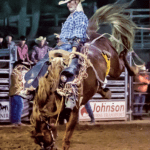
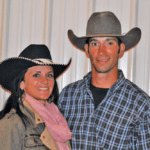
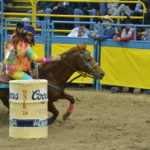
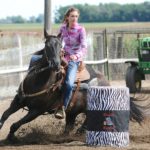
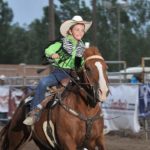
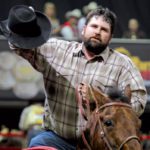
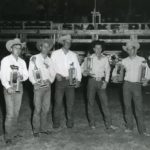
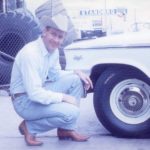
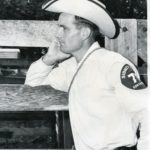
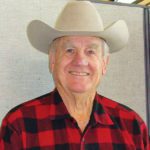
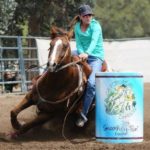
Just as the Buckeye tree plants its roots in Ohio, Bump Postlethwait, a natural-born cowboy from Byesville, plants his in rodeo. Born Raymond Postlethwait, or JP as his mom liked to call him, was given the name Bump when his dad heard the bump, bump sound of his heart beat while his mom was in labor. She passed away when he was only eight but, “The name’s stuck with me ever since.” Though raised in southern Ohio Bump now resides in Adrian, Mich. with his wife, Andrea and their four kids Chelsea, Haley, Hunter and Ayden.
Following in the footsteps of a man he’s always admired, Bump took to rodeo at a young age watching his father. “I grew up around it, I wanted to be like him.” His father who placed 16th in the world at the RCA was one of Bump’s biggest supporters growing up and always helped him along the way. Starting at nine years old, Bump rode his first amateur bull then at fourteen he was doggin’ steers. He went to a clinic held by his friends who taught him how to bull dog and when he went to his first rodeo he placed. “I never really had to work at anything, never practiced much. I’ve just always been able to do it. If I wanted it I went and I did it.” The Buckeye Rodeo Company was a rodeo was where his dad went and where he grew up. Today, Bump competes in all three rough stock events: bull riding, saddle bronc and bareback as well as team roping and bull dogging.
What started out as a fun, family affair soon turned into a job for Bump. He won all-around four years in a row in high school and did so well he qualified for a scholarship to Martin, Tenn. His rodeo career was doing well and as he continued to succeed he turned down the chance for the scholarship, “I was making good money and it was easier not to go to school.”
It was while riding horses at a horse sale he met his future wife who was looking at horses to buy. In 2008 after dating a few years, Bump married Andrea and welcomed her four children as his own. “It’s hard when she’s not at the rodeo with me,” Bump explains. “She keeps the horses warmed up and ready for me. She makes my job a lot easier.” Andrea is his backbone and what he does couldn’t be possible without her support. As for his kids, “Hunter,” Bump says, “wants to go on with it more than the others.”
Full story available in our May 1, 2015 issue. Read online!
Winning the saddle bronc riding on one of Painted Pony’s great horses – Casey Martin Photography
Bump and his wife, Andrea
Bump leaving the APRA finals with the All Around and Saddle Bronc Championships – Casey Martin Photography
he best bulldogging horse Shawn has ever sat on, Grey – courtesy of the family
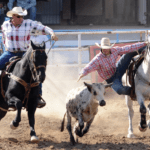
Bulldogging off his horse, Grewy, with Tim Slater hazing. – Casey Martin
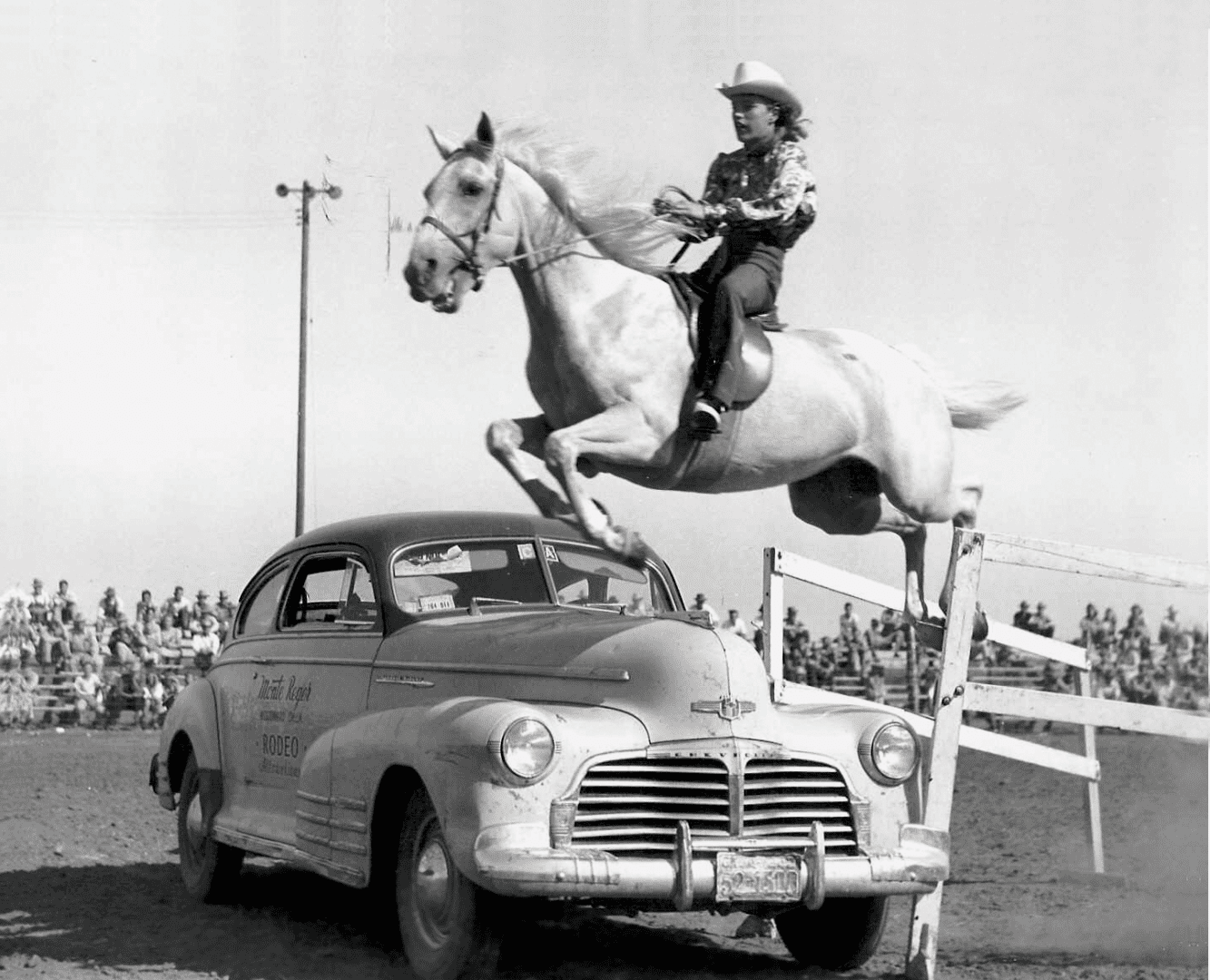
Dixie Mosley of Amarillo, Texas, had a most unusual childhood. The third and youngest child of Monte and Opal Reger, Dixie was born in Buffalo, Okla., on October 3, 1930. Before her sixth birthday, she had travelled more of the U.S. with her family than most people of that era saw in a lifetime. The Reger family were rodeo entertainers, fulfilling rodeo contracts in the eastern half of the country, and travelling with an 18 foot Schult house trailer, several trick horses, and a longhorn steer in tow.
It was Bobby the Longhorn Steer that propelled the Regers into their lifestyle of greasepaint faces and trick riding Death Drags. The Longhorn/Brahman cross had curvy horns measuring 8′ 6″, and at the time he was discovered by Monte Reger, the steer was known for his rank personality. But Reger saw potential in the tremendous bovine, and with dreams of leaving the farming life behind, he tamed Bobby. Soon, Reger was riding the steer like he was a trusty cowhorse, as were Dixie and her brother, Buddy, and sister, Virginia. Bobby and Reger even appeared in a movie, Wheels of Destiny, in Hollywood, and advertised for a barbecue chain in Burbank, Calif. But Bobby was best known for his iconic jumps, clearing a convertible with ease while directed on a lunge line by Reger.
Though Reger had helped start the rodeo in Doby Springs, Okla., he had bigger dreams. Eventually, he was announcing for the Beutler Brothers and performing with Bobby in Colonel Jim Eskew’s Wild West Show. Eskew’s son, Jim Eskew, Jr., taught Dixie to trick ride and rope by the time she was five. She began performing alongside her brother and sister, riding a Shetland pony named Tom Thumb. Her brother, Buddy, was a rodeo clown, while Dixie and her sister represented the family in trick riding and roping. Their mother, Opal, occasionally took off her apron to perform the Quadrille – square dancing with horses – but she preferred to live outside of the spotlight. “She had more than a full time job looking after Dad and us three kids, feeding us and sewing all our clothes,” Dixie recalls. “She kept us together.”
Dixie’s rodeo debut came in 1935 in Pittsburg. At five years old, she was a fearless performer. “I was never afraid of anything at a young age, and when you’re a teenager, you’re really not afraid!” says Dixie. She showed horses in western pleasure, and although she found nothing remarkable in her trick riding talents, rodeo spectators thought otherwise. As she grew, Dixie rode her family’s palomino American Quarter Horses that they bred, their fair coats reflected in the shining cars that Dixie jumped them over. Though the Regers stayed in their trailer or motels, they returned often to their home in Woodward, Okla., to “get cleaned up and go again,” according to Dixie. It was there that the family trained their show horses. They laid three 55 gallon drums down, placed two more on top, and finished with a heavy wooden door at the top to re-create the size of car Dixie jumped over, before practicing on the real thing.
For all the excitement of living on the road, Dixie at times longed for what she calls a normal life. “I wouldn’t take anything for the life I’ve had, but sometimes I wonder what it would’ve been like to have a different type of life,” Dixie says reflectively. “We had to be careful in the summertime to go swimming in the late afternoon. We didn’t want to take the chance of getting sunburned and not being able to ride the trick horse. Even rollerskating you had to be careful to not twist an ankle. We were being paid to be at the rodeo, and we couldn’t get hurt having fun!” Missing out on regular schooling was what Dixie regretted the most. Up until high school, she and her siblings were homeschooled by their mother, a box of curriculum from Calvert Correspondence School arriving once a year with schoolbooks. When she entered high school, she came to school several weeks late and left in May to accommodate rodeo season. Yet homeschooling had agreed with Dixie, and she was several grades ahead of children her age, entering high school when she was 12 and graduating in 1946, when she was 16.
In 1947, Dixie was clowning and performing in an all-girl rodeo in Amarillo, Texas, and the following year, the all-girl rodeo in San Angelo, Texas, was the birthplace of the Girls Rodeo Association (GRA). Dixie was a charter member, and later served as a contract representative and vice president for the association. In addition to trick riding and roping, she rodeo clowned for the GRA, the only woman in the area to do so. Dixie even rode several bulls and bareback horses, but the roping events like ribbon roping, breakaway, and calf roping, were what brought out her competitive side. “I’ve been bucked off and had horses fall with me, and I’ve never broken a bone,” says Dixie. “I’m real proud to be a charter member of what is now the WPRA. I met some wonderful cowgirls!” One of these cowgirls was the rodeo-renowned Tad Lucas, a bareback bronc rider and trick rider that Dixie created and performed several rodeo skits with. “She was a very nice lady, and she would do anything to help make the rodeo a better performance.”
By 1953, Dixie was 23 years old and ready to make a bold move. She retired from rodeo. Her final performance in the public eye was the inaugural all-girl rodeo in Colorado Springs, Colo. Following that, she married William Mosley in August of 1953. Bill was a cattleman, who served in both WWII and the Korean War, and was a friend of Dixie’s brother-in-law. “Growing up, I pretty much knew I didn’t want to marry a rodeo man,” says Dixie. “I think they are the most wonderful people in the world, but they’re always on the go! I wanted to stay home. Bill went back to college after he got out of the military, and I became a college wife. I got my PHT – Putting Husband Through,” she says with an infectious laugh.
After finishing college, Bill and Dixie settled in Amarillo, Texas, where they still make their home today. With partners, they built a meat packing house, and Dixie lived the life she’d dreamt of as a child, becoming a full-time wife and mother and living in a house that wasn’t on wheels. Their children, Judy, Clay, and Paul, all grew up riding horses, but didn’t pursue rodeo. Once their children were grown, Bill sold the packing house and became a cattle inspector. He and Dixie travelled the U.S. extensively, some of Dixie’s favorite travels taking her to the annual induction ceremony for the National Cowgirl Hall of Fame. She also attended Rodeo Clown Reunions held by Gail Woerner, where Dixie was the only female rodeo clown. Dixie herself was inducted into the Cowgirl Hall of Fame in 1982 and the National Cowboy Hall of Fame in Oklahoma City in 2003. She was named the Pioneer Woman of the Year in 2004 at the National Cowboy Symposium in Lubbock, Texas. Bobby the Longhorn Steer, who started it all, also holds a place of honor, his head mounted in the National Cowboy and Western Heritage Museum.
Memories abound, and Dixie has no regrets. She concludes happily, “I’m glad it’s all worked out the way it’s worked out.”
Story also available in our May 1, 2015 issue.
Dixie Mosley 1936
Dixie, jumping 1946
Dixie Mosley receiving American Cowboy Culture Award 2004
Dixie Mosely breakaway roping, early 1950s – James Cathey
From RFD-TV’s The American, to the Diamonds & Dirt Barrel Horse Classic, barrel racer and trainer, Sharin Hall from Kingston, Okla., has burst into the spotlight, but she’s by no means a stranger to the barrel pen. As a lifelong competitor, Sharin, originally from Sunbury, Ohio, was born to turn three barrels. Her father, Jackson Hall, was a barrel horse trainer. Sharin’s mom was also into horses, so it was only natural their daughter would saddle up as quick as she could.
Every cowgirl has that one horse who really lights the fire, and for Sharin, that horse was T’ Heck, a winning barrel horse of her father’s. She was 8 years old when she started running barrels on the horse. “I won on him until I was 13. I basically learned how to ride and sit right on a horse, and then when I was 16 my mom bought my first horse to train for myself,” Sharin said.
Since that first training project, Sharin has learned how to help shape different horses, while allowing for their individuality, and she’s made a career out of the skill. “I’ve learned that not every horse is the same, and you have to adapt sometimes to their style and their way of doing things, all the while asking for what I want.”
Initially, Sharin’s grandmother stressed a college education, but Sharin quickly realized that a 9-5 desk job wouldn’t be something she could do long term, so she practiced cosmetology at first. “I did that for 10 years and rode my own horses, and then when I was 28 I got a phone call and got a job offer in Oklahoma training horses, so I took the job,” she said, eventually branching out into her own full time training business that’s still thriving today.
It’s a profession where the biggest challenges are, in some ways, also the rewards. “The challenge has been when you pour your heart and soul and everything you have into a horse and develop it into a winner, and it gets sold or it goes back home, you separate from something that you love and created into a winner,” she said but added, “I love it though when they go on to win, that is probably the most satisfying thing that I experience in what I do.”
Over the years, in addition to her training program, Sharin has competed in multiple futurities and pro-rodeos. She has a strong faith in God, and remains close to her family. Sadly, Sharin’s father passed away in December of 2011.
In 2013 she organized an annual memorial barrel race in Ardmore, Okla., in his honor.
To balance the difficulties of saying goodbye to horses she’s trained, Sharin is starting to ride more of her own horses these days, such as the breakout star of the Diamonds and Dirt, a mare named Bulleva Sharin co-owns with attorney Brad Oesch. They bought Bulleva in Oklahoma City. It didn’t hurt that the Bully Bullion breeding in the mare appealed to Sharin. “I picked her and just loved the way she felt, it was a good fit. We’ve just gotten better and she’s gotten better and more confident to the point of winning the slot race. It was my first slot win. It was really special to be on something I part owned, and I just feel very blessed,” Sharin said of her win at Diamonds & Dirt, where she and Bulleva took home over $110,000.
This year also brought success when it came to RFD-TV’s The American. Sharin, riding a client’s horse, Streaking Ta Fame, whom she trained, was the only qualifier to make the final-four in the Shoot Out round, where she ended up third. In the long go, she ran the second fastest time of the entire rodeo against the world’s fiercest competition.
“It’s really a lifetime experience. I think that the American is a golden opportunity for someone who is not able to be on the road and rodeo all year. It’s a great opportunity to be able to run at that money,” she said.
Sharin plans to continue to rodeo on some of her mares and young horses this year, as well as continue down the futurity trail with Bulleva.
It’s that don’t stop attitude that embodies Sharin, explained her apprentice Stevie Ann Tucek, who previously traveled and trained with NFR barrel racer June Holeman and chronicled her tales of inspiration for the rodeo world.
Now, Stevie is finding inspiration in Sharin. “Sharin has amazing will power and drive and gives 110 percent all the time. I believe her having this mindset, faith, and hard non-stop 18-hour days, is what has gotten her to where she is, and where she is going.” Stevie said and added, “She is a great teacher and has passed down some of her techniques that I will cherish and apply in my career for a lifetime. She has a gift, and she knows what she wants from life: to live it to the fullest, and make herself better each day. We could always use more Sharin Halls in this field.”
And if Sharin has anything to do with it, that field is only going to get faster.
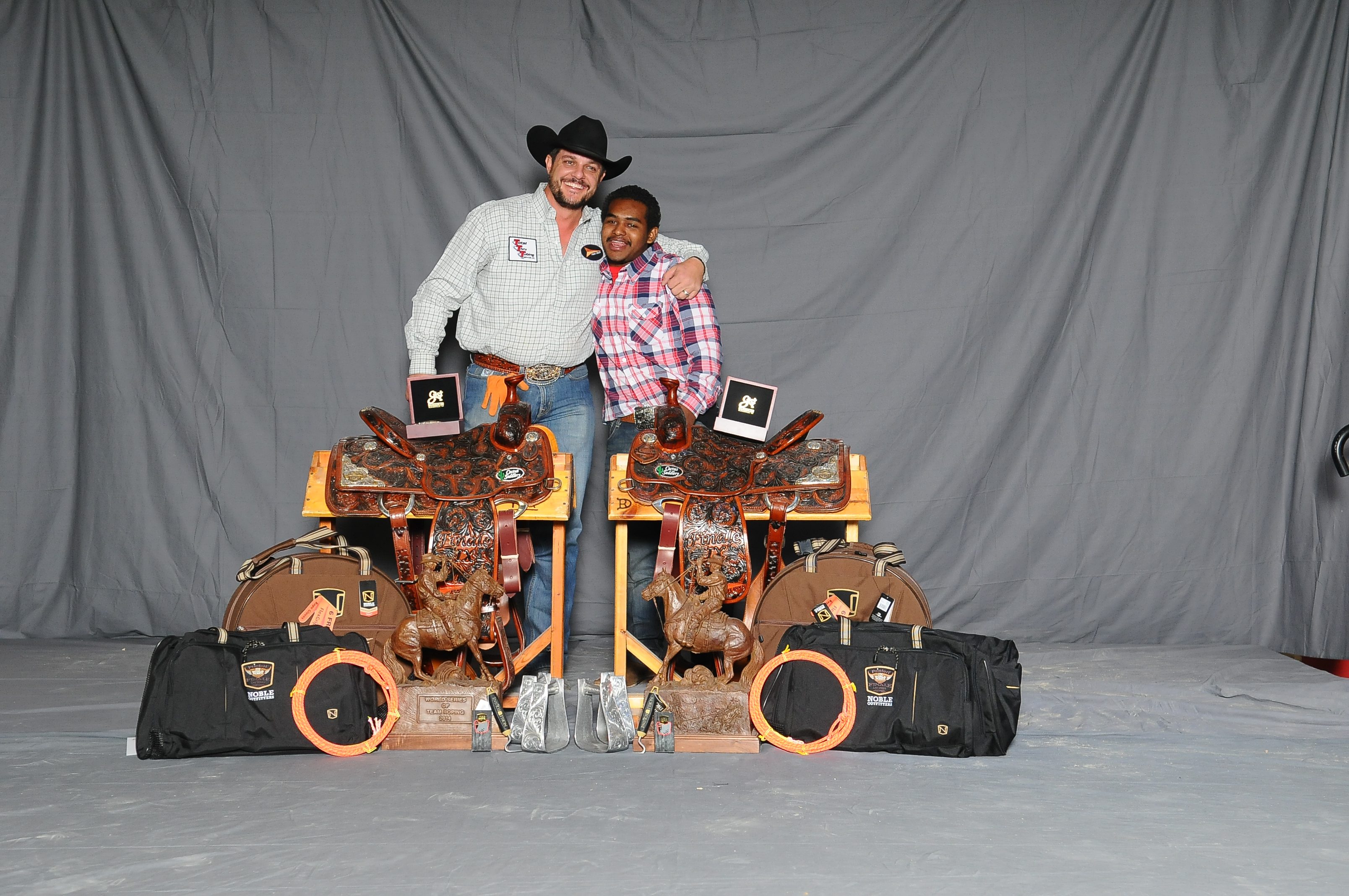
Not many ropers have a week like Scot Brown enjoyed at the World Series of Team Roping Finals at the South Point last December. Scot, a #9 heeler and #6E header from Orange Grove, Texas, was entered up at the finals, thanks to one of his sponsors. Scot and Josh DeBord, won 6th in the #15, earning each man $20,000.
Getting nothing done in the #12 and #13 was not devastating for Scot, who still had a $20,000 check in his pocket. In his last and final roping, the #11, Scot was scheduled to head for one of his sponsors, who ultimately couldn’t make the trip. Brown replaced him with Clayton Moore, a #5, who he had practiced with the week before back in Texas.
The team drew three good steers for an average of 22.90, making them high team back. A short round steer that ran, along with a late start, caused the team to be 9.5 at the back end, but well under the 11.9-seconds needed to keep the lead. Brown and Moore split first place prize money of $288,000, in addition to $6,000 for a rotation fast time.
“At the end of the run, the flagger, Brooks Bearden, rode up and told me that Clayton legged,” says Brown. “He was joking, but I didn’t even care. I told him, ‘That’s okay, we won second or third.’”
Brown, 37, stays busy running his business, Absolute Terra Services and Maintenance. He started the herbicide business in 2007. ATS sprays and kills weeds for commercial farmers and oil well pads, among other businesses. In 2010, the business was expanded and added mowers, seeding, and mulching services.
“Even though it’s a lot of work and responsibility, I enjoy owning my own business,” says Scot. “It enables me to spend more time with my family.”
Brown and his wife, Michelle, have four children, three sons and a daughter: Spencer, 16, Jackson, 15, Makayla, 8 and Brooks, 4. Michelle teaches online for Waldon University.
As a business owner with a large family, there’s not a lot of spare time for the practice pen.
“I’ve been very fortunate,” explains Brown. “I’ve been able to ride good horses and rope with some of the best ropers in the world. My mental game is probably my strongest asset in the roping pen. I thrive on pressure. In the #15, at the World Series Finals, we came from 21st call back where we had to be 6.2 to take the lead and we were 6-flat. I just love that kind of pressure.”
This May 8th & 9th, Brown will produce the 4th Annual Colton Rusk Memorial roping. This roping is held in memory of Colton Rusk, a Marine who was killed in Afghanistan. The proceeds are donated for scholarships. The first year it was held, in 2012, this roping raised $30,000. Each of the last two years the event has raised $100,000.
“I’m extremely proud of what we’ve been able to accomplish,” says Scot. “Not only honoring Colton’s memory, but being able to help kids afford an education is amazing.”
Scot is sponsored by Fast Back Ropes, Total Thru Tubing and Noble Outfitters.
COWboy Q&A
How much do you practice?
I don’t get the opportunity to practice as much as I’d like due to running my business. I always practice before an event.
Do you make your own horses?
I used to when I was younger. Now I don’t really have time.
Who were your roping (rodeo) heroes?
Clay O’Brien Cooper
Who do you respect most in the world?
My dad.
Who has been the biggest influence in your life?
My family.
If you had a day off what would you like to do?
Spend time with my kids.
Favorite movie?
Tombstone, Lonesome Dove
What’s the last thing you read?
Lone Survivor
How would you describe yourself in three words?
Motivated, easy-going, hardworking
What makes you happy?
My family.
What makes you angry?
Lazy people.
If you were given 1 million dollars, how would you spend it?
I’d pay off bills, take my family on a vacation and invest the rest.
What is your worst quality – your best?
My worst quality is procrastination. My best quality is being happy go lucky.
Where do you see yourself in ten years?
I hope that the business I’m building continues to grow and be successful, allowing me to spend more time with my family.
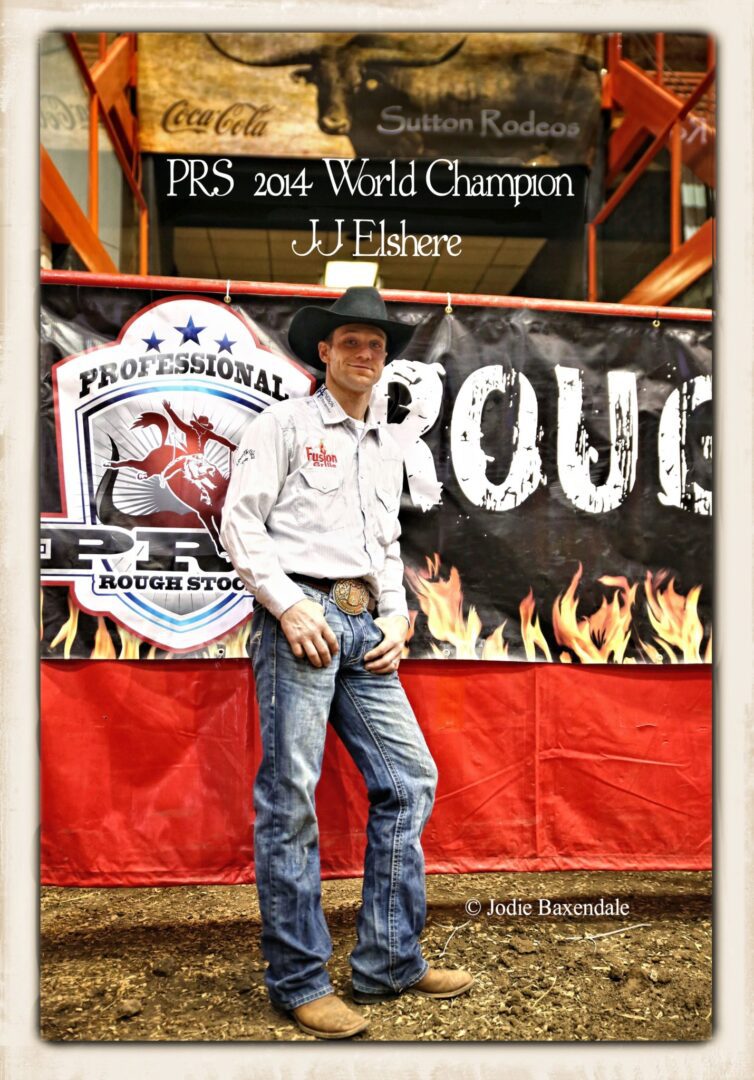
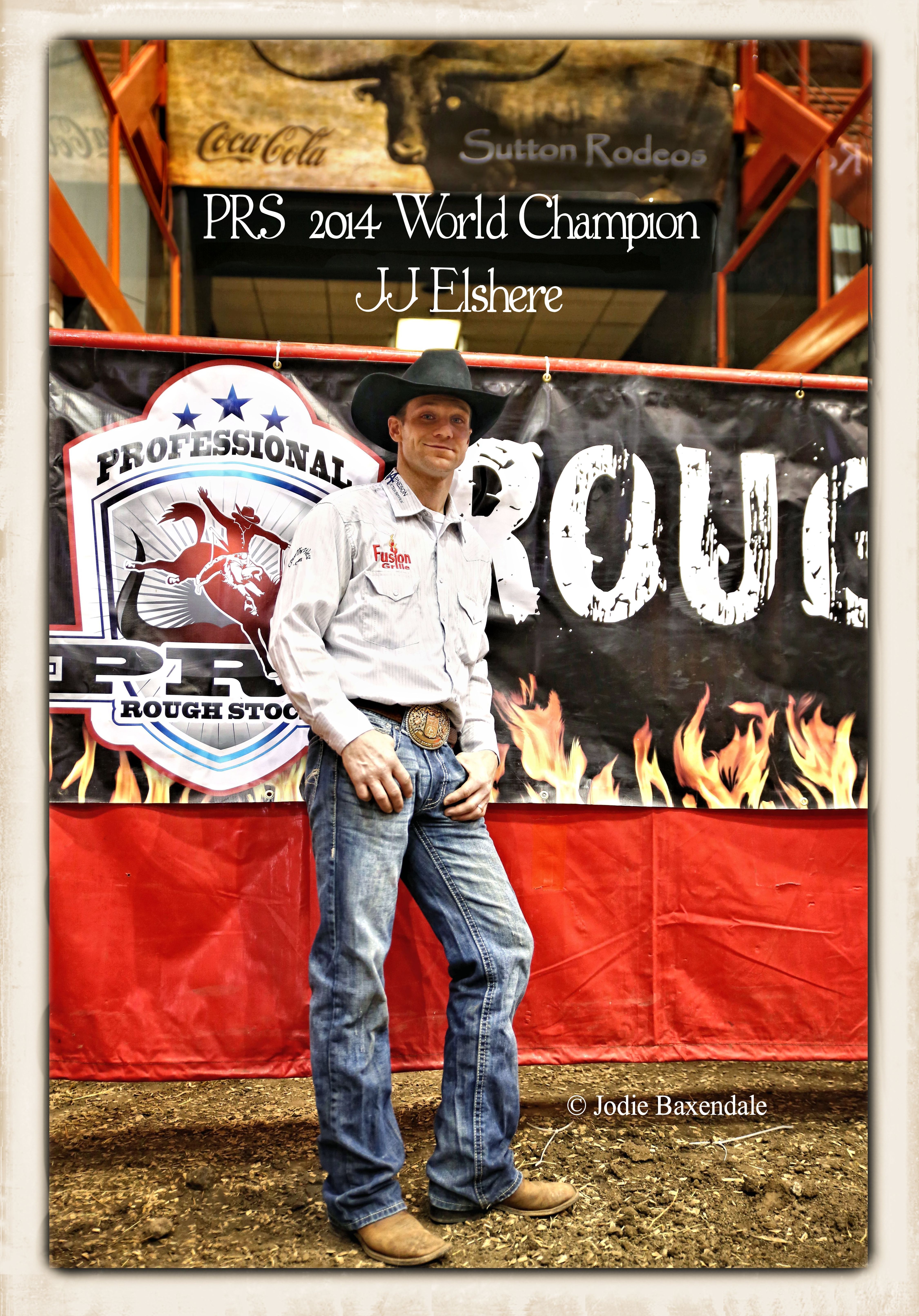
JJ Elshere PRS 2014 Champ – photo by Jodie Baxendale
J.J. Elshere, Professional Rough Stock competitor and 2014 PRS World Saddle Bronc Champion, is carrying his gear bag into the AT&T Stadium for the first time this month. The recipient of one of The American’s coveted exemptions, J.J. has every intention of winning the saddle bronc riding at the world’s richest one-day rodeo. While winning the average in the saddle bronc riding at the 2006 WNFR is one of his career highlights, J.J.’s trip to Arlington, Texas, is equally exciting to him. “I think it’s going to be fun!” says the 34 year old from Hereford, S.D. “I’m just going to treat it like any other rodeo – you want to do your best at every rodeo you go to, and that’s what I’m going to do.”
Following in the bootprints of his older brother, Ryan, J.J. started riding saddle broncs in high school. The boys’ father introduced them to rodeo early on, and both gravitated toward roughstock. “Our whole family went with us to our rodeos, and gave us the opportunity to compete,” J.J. recalls. “Ryan taught me a lot about saddle bronc riding, and that made it a little easier for me to learn.” While J.J. also rode bulls, it was rodeo’s classic event that he pursued after high school. He joined the PRCA in 2000. “Ryan bought my permit for me and got me started in pro rodeo. He entered me in rodeos – even some I didn’t want to go to, but I got money out of it!”
Wayne Cornish followed in his dad’s footsteps, and the rodeo world was a better place because of it.
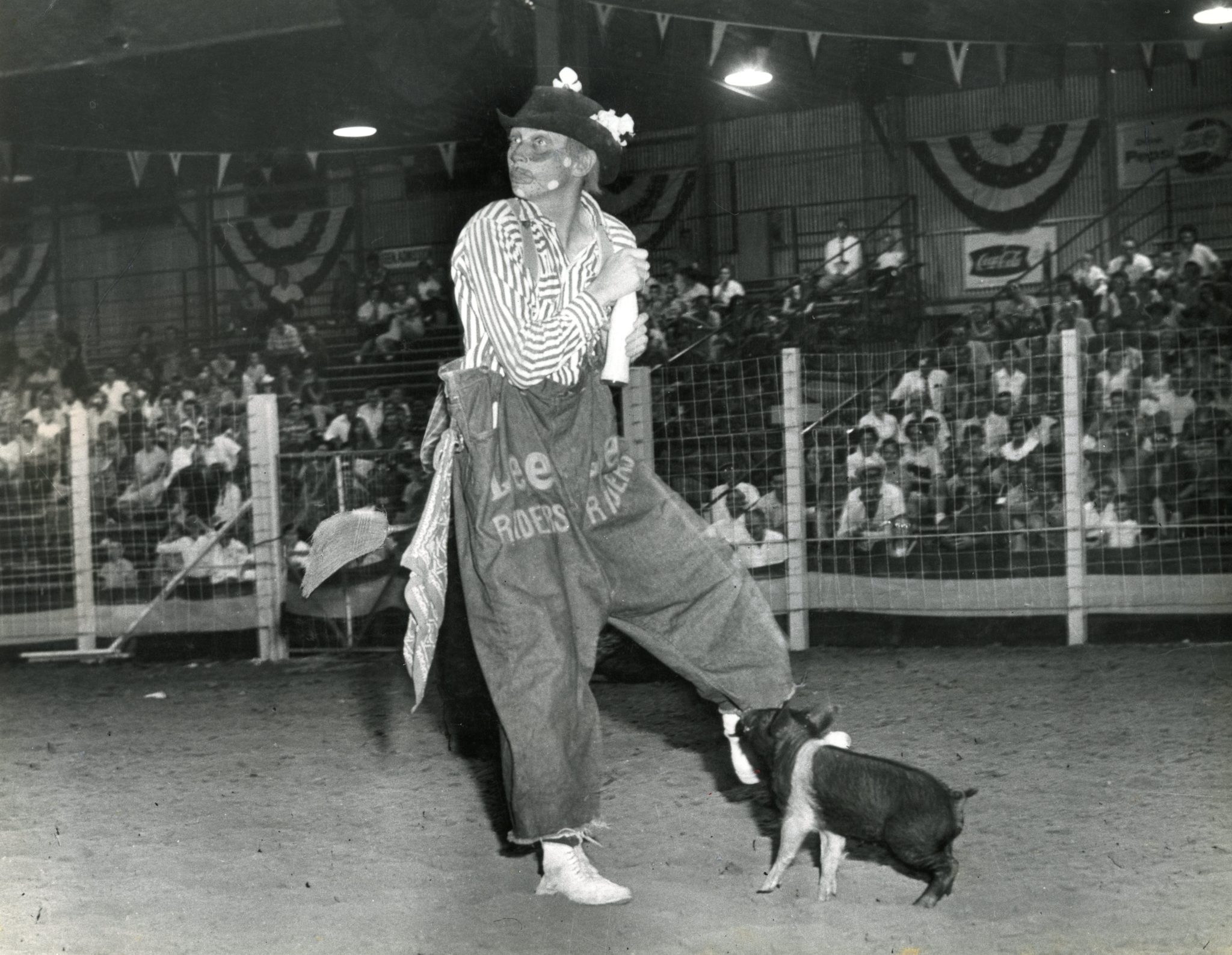
Born February 2, 1935 in Waukomis, Okla.,, the son of Cecil and Juanita Cornish, Wayne grew up doing the same thing his dad did. His dad had a variety of famous specialty acts, and after high school, Wayne joined him, criss-crossing the country with the Cornish animal acts, and working as a barrelman as well.
He was part of his dad’s acts, but made his first rodeo money when he was five. At Ponca City, Okla., barrel men and bullfighters Hoyt Heifner and John Lindsay put him on a Brahma bull calf. Wayne rode him all the way across the arena, lost his boots, but didn’t fall off the calf. And he won his first rodeo check with that ride, after Heifner and Lindsay gathered money to pay him for his effort.
At age thirteen, Wayne began clowning. He put on a “dude” suit and rode into the arena on a donkey, carrying a suitcase. Someone behind the scenes would shoot a gun, the suitcase would open, and live chickens would fall out.
Wayne graduated from high school in 1954, but barely. He had missed several days of school while on the rodeo circuit, and the school board threatened to dismiss him. Wayne’s dad told the principal his son had learned more in those few days he was gone than he did in school.
After high school, Wayne hit the road with his dad. Together, they had a variety of acts, mostly involving animals. Cecil had started in 1935 or ’36 with his trick horse Smoky, which would become his most famous act. But the family had a lot more up their sleeves. There was Danger, the Brahma bull who jumped over a car, and six golden liberty horses. They had a bull that pulled a cart, and a roman team that Wayne rode called the Golden Eagles. Wayne had a pig he put in a suitcase and called the “Handy Dandy Garbage Disposal,” and a skunk whose act was called Mr. Stinkbottom. He had a roman team named Susie and Sally, sisters, who he called the Flying White Clouds. They did figure eights, jumped through hoops of fire, and re-enacted the Days of Ben Hur. Wayne, like his dad, had an affinity for training animals, and Juanita made their flashy costumes.
He kept up his specialty acts, mostly his roman riding, but because of his early friendship with Heifner and Lindsay, he preferred to be a barrel man and clown.
Together, Wayne and his dad traveled across the nation and Canada, working big rodeos and small ones alike. One of his favorite stories is that he drove a load of bucking horses and his barrelman equipment to a rodeo in northern Canada. He was supposed to leave the truck and horses and meet his dad at the North Platte, Neb. rodeo, but he had no way to get there. He called his dad and asked him to pick him up in Calgary. He told his dad, laughing, “did you ever try hitchhiking with a barrel?”
Being a barrelman came with the usual broken bones, and Wayne had his share. He broke his neck in Carlsbad, N.M., in 1962, when a bull stuck his horn in the barrel. The bull threw him into the air, and even though his neck hurt, he went on and rode his roman team that same night. After the injury continued to ache, he decided to have it checked out.
Another time, he broke a shoulder in Crockett, Texas, when a bull did the same thing. And he suffered so many broken ribs, he learned to bandage them himself.
Wayne would work as a barrelman at the same rodeos where his dad and he entertained. He got his Rodeo Cowboys Association card in 1953. About twenty years later, after the Evanston, Wyo. rodeo, Cecil had had enough. He came home and decided to retire. Wayne quit then, too. His roman team was old, and having to train a new team would be time consuming.
That was in 1971, and he began driving. He hauled horses for Hull and Smith out of Ashland, Neb., one of the nation’s largest horse haulers. He hauled livestock for A.J. Foyt, Dale Robertson, and race horse breeder Walter Merrick. He hauled horses for Dee Raper, and hauled cattle. Driving was something he enjoyed, and even though he can’t drive now, he can still tell his wife Jackie what roads to take, and when to turn.
And, in typical rodeo style, Wayne has lots of stories to tell. He traveled with Slim Pickens, who told him he was glad God gave him such an ugly face so he didn’t have to paint it up like Wayne did. And once, at a rodeo in Independence, Mo., the hometown of Harry Truman, he came home and told his wife he’d have to shoot his dog, because Margaret Truman, who was in the stands watching the rodeo, had stepped on its tail and the dog had yelped, “Ike, Ike, Ike” (the nickname for Dwight Eisenhower.)
He and Jackie, who were high school sweethearts, went their separate ways after school but were reunited and married in 1995. They each brought three daughters to the marriage: Donna Kay, Shawna and Jacquetta from Wayne, and Jackie’s Kelly Ann, Kimberly and Karen. Two of the six girls have passed: Donna Kay and Kelly Ann.
Two years ago, Wayne suffered an aneurysm that nearly killed him. It has affected his eyesight and speech, but he is able to get around. Jackie serves as his eyes and voice, and is happy to do it, because she’s glad he’s still alive.
Wayne is proud to have worked for some of the best rodeo producers in the business: Beutler Bros., Harry Knight, Todd Rodeo, Jim Shoulders, Gerald Roberts, Casey Tibbs and Associates, Beutler & Son, Ralph Collier, Neal Gay, Lawrence Winfrey, Harry Nelson, Reg Kesler, Tommy Steiner, and Summit Rodeo, among others.
And he’s glad to have worked with some big names: Slim Pickens, Gene Autry, Marty Robbins, Rex Allen, Roy Rogers, Michael Landon, Jack Lord, and Edgar Buchanan.
If he could, Wayne would still be on the rodeo trail. “He’d still be rodeoing if he possibly could,” Jackie said. “That was his life. He just loved it.”
And he’s still living the memories.
Story also available in our March 2015 issue.
Wayne and Jackie Cornish – courtesy of the family
The only time and the only photo of father and son Roman riding together at the family farm. Wayne is on the left with the Flying White Clouds, and Cecil ir riding the Golden Eagles.
2000 Rodeo and Clown Reunion, Colorado Springs, Colo., where Wayne received the “Andy Womack Memorial Award. Presented by Karen and Harry Vold – courtesy of the family
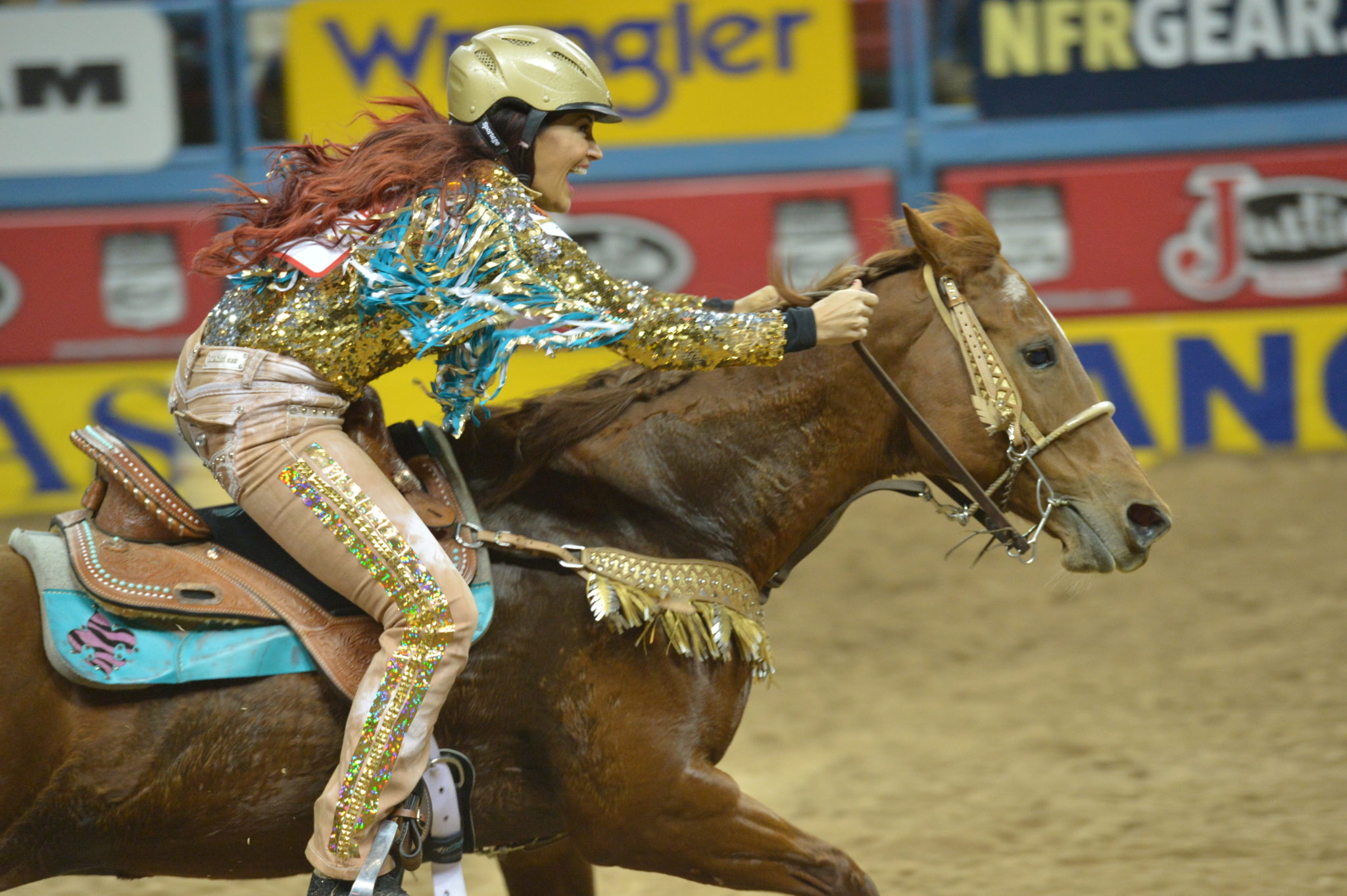
Fallon Taylor grew up in Tampa, Fla, and moved to Texas when she was seven. “I started riding horses and in six months I decided that’s what I wanted to do,” said the youngest of three. Her parents, Shelton and Dian, hired a trainer to help since they knew nothing about riding horses or rodeo. Fallon was homeschooled so she could focus on riding and barrel racing. “We stumbled our way through the rest and ended up with a trainer that lived at the ranch and trained my mare, Flowers and Money, the dam of Babyflo.”
Fallon qualified for her first NFR in 1995, at 13 years old. She qualified for the next three years and found that life on the road had lost its allure. The bright lights of New York City caught her attention and she spent the next ten years modeling in New York City, acting in Las Angeles, and riding her horses in Texas. “I was training horses for other people, and had no aspirations to come back to the NFR,” said the 32 year old. A near-fatal accident five years ago set Fallon down a different path. She was loping a 16.3 hand gelding one night and he slipped and started bucking “It got Western,” she said. “He was snapping and kicking. He reared up and fractured my skull in four places. I picked a spot to land and tried to get off – terrible idea. When I did, he kicked my feet and I went 12 feet in the air and landed straight on my head.” Fallon was paralyzed for three days with the same injury as Christopher Reeves, better known as Superman, and was given a 2% chance to walk. She shattered bones on the right side of her face, including her eye socket, fractured her skull in four places and broke the C-2 vertebra. “I’m blessed to be here.” Fallon’s recovery included wearing a halo for three months. “I had no other choice so I made it my life mission to learn how to recover. I had one come apart moment when I was trying to eat dinner with a halo on and couldn’t get the fork to my face.” After that, Fallon’s mission was to ride again and after a year of riding poorly, she finally found her stride. “I ride ten times better now than the first finals in the 90s, I have a lot more awareness of my body and my horse.”
Along came a football player named Delbert Alvarado – who came to town with the Dallas Cowboys’ training camp. “My uncle and his dad are coworkers – he gave me his phone number, and asked me to show him around. I’d just gotten out of the collar and he came to the ranch.” They were married three years ago and even though Delbert had never ridden before, he saw the talent that Fallon had in her horses and herself and encouraged her to pull the horses out of the pasture and try again. “Babyflo was the last one I pulled out of the pasture, and I cinched her up and we ran barrels that night.” Flos Heiress, sired by Dr Nick Bar out of Flowers and Money, was born, raised, and trained on the ranch. The 14.2 hand 8-year-old mare has carried Fallon to two NFRs and the team continues to improve.
Full story available in our March 2015 issue.
Fallon Taylor – photo by Cameron Gott
Fallon at the 2014 NFR, Las Vegas, NV – photo by Rodeo News
Horses are the tie that binds the Zancanella family, and Kristen Zancanella wouldn’t have it any other way.
Matt and Kristen Zancanella, along with Matt’s sisters, ReAnn Zancanella and Bryel and her husband Sean Mulligan, own and operate Pride Farm, a horse business centered around their stud, King, whose registered name is Lions Share of Fame.
But for Matt and Kristen, their love of horses starts much farther back.
For Matt, life began in Rock Springs, Wyo. the eldest child of three, with two younger sisters. While his dad worked hard to get his veterinary clinic started, his mom groomed dogs. The money she earned from grooming went for entry fees for her kids: Matt and his sisters Bryel and ReAnn. And after she worked all day, she drove all night, hauling her kids to youth rodeos. Matt and his sisters competed in Little Britches, junior and high school rodeos, with his attention being focused mainly on the team roping, and Matt realizes the sacrifices she made for her kids to rodeo.
After graduating from high school in 1994, he spent a semester in college. That winter, he entered Rodeo Houston and never returned to college. “He started rodeoing (fulltime) after that, and never looked back,” Kristen said. “He was addicted to team roping.”
For the next decade and a half, he criss-crossed the country, competing at pro rodeos and making his dream come true three times: qualifying for the Wrangler National Finals Rodeo. In 2002 and 2003, he heeled for Travis Tryan, and in 2004, he roped with Wade Wheatley.
In 2004, he met a tall slender cowgirl named Kristen Storm at the San Juan Capistrano, Calif. rodeo. Kristen was there as a volunteer, and the couple started dating. She moved to South Dakota the next year, and in 2006, they married.
In 2011, the road was wearing on Matt, and he quit rodeo full time, focusing on the Badlands Circuit. He began his own business: Pro Earth Animal Health. The business sells all-natural supplements for cattle and horses, and since he began, it’s taken off. Matt’s genuine personality and friendliness helped him in rodeo and has helped him with his business. “He’s never met an enemy, everyone remembers him and everyone likes him,” Kristen said. “He’s a genuine guy, and he tends to remember everyone. He has a lot of friends.”
Kristen grew up in Orange County, California, in town, with a love of horses but parents who never rode and had no place to keep a horse. So she took riding lessons at the age of seven, when her instructor recognized her as a “horse freak,” as Kristen says. The lady allowed her to spend as much time as she wanted at the stables, where Kristen ended up giving riding lessons and spent summers working for jumping, cutting and reining trainers. Growing up, barrel racing was not her favorite event. “Growing up I thought barrel racing was the stupidest sport ever.” Now that she spends days breaking and training horses for barrels, her opinion has changed. “It’s tougher than anything I’ve ever done.” Full story available in the February 2015 issue.
Kristen Zancanella barrel racing
– Scott Voigt
Keylee Zancanella competing in the Little Wrangler division for Little Britches Rodeo – JenningsRodeoPhotoraphy.com
Dean Oliver attended his first rodeo when he was 15 years old. It may have been the heady feeling of stealing into the Snake River Stampede without a ticket, but as Dean watched a tie-down roper win $300 in a single run, he decided that rodeo was the life for him. Little did he know that he would become a record holder at that very rodeo, winning the tie-down roping ten times, and that a drawing of him would be featured on the Snake River Stampede’s rodeo poster 70 years later, heralding him an 11 time world champion.
Born in 1929 to Verne and Vesper Oliver in Dodge City, Kan., Dean was the fifth of seven children. Each child was born in a different state, but all of Dean’s childhood memories reside in Idaho. His family moved to the Gem State in the late 1930s. Dean’s father was a private pilot, and he sold automobile and airplane parts and accessories, while also managing the Nampa (Idaho) Airport. In February of 1940, Verne and his friend Guy Givens were contracted by a farmer to hunt coyotes. The men did so from Verne’s airplane, with Guy shooting the predators from an open door. During one of their close passes to the ground, Verne’s plane crashed into the side of a snow-covered mountain, killing both men.
Following the tragic accident, the Oliver family worked even harder to survive in a country just recovering from the Great Depression. Dean began working at dairy farms by his early teens. Sitting in a classroom didn’t suit the restless boy, and he dropped out of ninth grade, never to darken a school doorway again. That same year, he and his older brother snuck into the Snake River Stampede rodeo in Nampa. “When the rodeo came around, I really liked the cowboys’ western gear, and their horses and cars and trailers,” says Dean. “It looked like a fun way of life!”
Inspired, Dean began his rodeo quest that same year, purchasing his first horse for $50 dollars and riding it bareback with just a rope around its nose to guide it. He began roping fence posts and hay bales, and even the calves at the dairy farm in the cover of night. While Dean was persistent about his roping, he was equally persistent in pursuing Martha Reisenstein, the daughter of one of the farmers he worked for. They were married in 1950, the year that would mark the beginning of Dean’s rodeo competition. He purchased another horse – this one green – for $400, and spent another $10 on a roping calf, which Martha would hold until Dean gave a nod.
The self-taught cowboy made his debut at several local amateur rodeos in Idaho and soon won his first tie-down roping at the rodeo in Kuna. The taste of success was so satisfying that Dean told his boss at the dairy farm he might quit and rodeo instead. “What makes you think you’re a star? You couldn’t win anything!” The man replied hotly. Dean quit his job that summer and rodeoed until he ran out of money, returning to work in the fields until he could pay his entry fees.
In December of 1950, Dean and Martha’s first child, Sheryl, was born. Her birth kept Dean from being drafted into the Korean War, changing him from a I-A (available for service) to a III-A (deferred because of dependents). After running into questionable rules at some amateur rodeos, Dean decided to join the Rodeo Cowboys Association in 1952. He went to his first professional rodeo in Jerome, Idaho, then leaped to Albuquerque, N.M., where the top professional ropers were competing. He was afoot, no longer trying to train a rope horse, but instead borrowing horses and paying the owners a percentage of his winnings. “There were 80 ropers, and not one of them would mount me, until finally a guy put me on a great, big tall horse,” Dean recalls. He won second in Albuquerque, then went to Denver’s new coliseum the following week, where he placed second in the average. He felt so optimistic with $1,700 in winnings that he purchased a gelding named Buck. He spent $1,750 on the buckskin with a knot on its knee, anxious to find a good rope horse. Dean made a makeshift trailer in the bed of his pickup for Buck and went home with an empty wallet.
After working through the winter feeding cattle, Dean had enough money to rodeo again in May. He and Buck won several rodeos that summer, yet Dean still lacked an edge in his competition that could only come with practice. The winter of 1953-1954, Dean lived with tie-down roper Dan Taylor in Doole, Texas, and the Idaho cowboy finished third in the RCA standings at the end of 1954 with roughly $11,000. Dean stayed with another roper in Oklahoma the following winter, and despite dismounting on the left to tie calves, he still had the fastest time, finishing the 1955 rodeo season with $19,963 and a glistening gold buckle reading World Champion Calf Roper.
His professional rodeo career soared out of the chutes, and Dean was rodeoing 11 months out of the year, often putting 80,000 miles on his station wagon each season. He competed in 70 to 80 rodeos a year, winning every professional rodeo he went to over the course of his career. Dean competed in the first National Finals Rodeo in 1959 on a horse named Mickey, whom he’d searched long and hard for after retiring Buck. Mickey and Dean won five world championships in a row from 1960-1964, and Dean also won three all-around world championships from 1963-1965. He had started steer wrestling and was just as talented in the event as tie-down roping with his 6’3″, 200 pound frame. But after breaking his leg at Madison Square Garden during the event, Dean feared further injuries and kept tie-down roping as his main focus, eventually dismounting on the right when he was in his 40s for faster time.
Not only did Dean’s achievements catch the eyes of rodeo fans nationwide, but also magazines and other publications. Time magazine, People magazine, Sports Illustrated, Saturday Evening Post, and western publications all wanted an interview with the rags-to-riches cowboy. Dean even modeled jeans for Wrangler. He and Martha purchased a ranch in Boise, Idaho, with 80 acres and calves aplenty for roping. While he traveled the length and width of the United States, one of Dean’s favorite rodeos remained the Snake River Stampede. He won his hometown rodeo ten times in the tie-down roping, a record yet to be broken, while also winning the local Caldwell Night Rodeo eight times. He secured his eighth and final world title at the NFR in 1969 at the age of 38, with record earnings of $38,118 for the most money won in a single event in one year. That record has since been broken, but Dean’s eight world tie-down roping championships still sets the bar.
Dean continued to rodeo into his 40s, but sorely missed his growing family of five daughters, Sheryl, DeAnn, Nikki, and twins Kelli and Karla. Martha had travelled with him as often as she could, but that didn’t make up for life at home. Yet Dean’s involvement in rodeo was hardly over. He served on the PRCA’s board of directors in 1979 and was inducted into seven halls of fame, including the National Cowboy Hall of Fame and the ProRodeo Hall of Fame. Texas sculptor Edd Hayes even included a bronze statue of Dean tie-down roping in a series of bronzes he called “Legends of Rodeo.”Dean also pursued his hobby of golfing, which he’d started in the 1950s, setting course records around the Treasure Valley and winning several tournaments.
Today, Dean and Martha’s home sits just off a farm road in Greenleaf, Idaho. Dean raises calves for beef cattle, but finds himself busiest during the Snake River Stampede rodeo in July, where he grooms the arena, and contracts the sheep and calves for the mutton bustin’ and the calf scramble. He has been serving on the rodeo’s board of directors since 1990, and dons his media credentials every December to work as a grip for a television crew covering the WNFR.
Dean’s story is marked with extraordinary grit and perseverance, but the rodeo legend says humbly, “I never did want to quit rodeo. When I started, I didn’t know I’d be any good. I was lucky enough that I had the ability, and I stuck with it.”
Story also available in our February 2015 issue.
Champions (l to r), Pete Crungs (Bull Riding), Gerald Roberts (for Bill Hartman Steer Wrestling, 2 World Titles), Dean Oliver (Tie-Down Roping, 11 World Titles), Casey Tibbs (Saddle Bronc, 7 World Titles), Jim Shoulders (All Around & Bareback Riding, 16 World Titles)
Dean Oliver modeled jeans for Wrangler
– courtesy of the family
Dean in Sydney, 1963 – DeVere Helfrich
Dean Oliver – Photo by Lily Weinacht
Dean Oliver steer wrestling in Great Falls, 1965 – Ben Allen Rodeo Photos
Sean Mulligan grew up in Valentine, Neb., going to rodeos with his dad, Bill, in a 1978 Ford Super cab pulling a two horse inline. “His first love was calf roping, but he’s a better bulldogger.” Sean learned from him, jumping his first steer at Paul Cleveland’s school in Ogallala when he turned 16. Sean grew up with three older sisters and made the National High School Finals rodeo his junior and senior year. He was recruited by Pete Burns to the University of Wyoming. “I bull dogged – roped in college, but there’s a reason I bulldog; I can’t rope – I have to ride up and grab them by the horns.”
He started rodeoing fulltime after graduating with an Ag Business degree in 1998. He hit the northwest with Lynn Churchill and had a good fall out there. “I loved the country – and I thought rodeoing was awesome.” His career as a PRCA cowboy includes four WNFR qualifications – 2000, 2004, 2007, and 2011. He met his wife (Bryel Zancanella) in college. “She won the region in breakaway roping every year but her senior year.” She quit roping after college due to a bad shoulder and concentrated on training barrel horses. Bryel was raised in Rock Springs, Wyo., where her dad is a vet. Her initial plan was to go south for college and is glad she didn’t because she met Sean while getting her teaching degree from the University of Wyoming.
“After I graduated, I did my student teaching in Rock Springs, and taught for a year in Brookings, South Dakota. I loved the kids, but I wanted to spend more time with the horses.” Sean and Bryel moved from Brookings, South Dakota, to Coleman, Okla., and ended up in the stallion business quite by chance. “I was riding for some people from South Dakota and found an FM Radio horse for them on the internet. We found another colt, full brother to FM Radio (AQHA Junior Barrels World Champion), that was really nice and bought Lions Share of Fame off the internet from a picture. We got him home and my sister-in-law started him, put him on the barrels, and the rest is history.” They had decided to leave “King” a stud as long as he earned that right. They watched his full brother, Gun Battle, run the fastest qualifying time at the All American Futurity, winning second in the race. After watching that, they decided to keep King as a stud. He won $60,000 as a futurity colt.
Full story available in our February 2015 issue.
Baileys Dash Ta Fame by LSOF. Pro Rodeo money winner ridden by Rachael Myllymaki
Sean Mulligan as a toddler
Sean Mulligan – Photo by Rodeo News
Prize Stallion, “King” – Photo by Lea Watson
King” with a young Keylee Zancanella – Photo by Lea Watson
Peggy (Green) Fifer was born in the small town of Meeker, Okla., where she was raised with two sisters by a single mother. She had just turned 14, when her mother died of cancer, leaving her and her two sisters in foster care for eight months. “My grandmother came and raised us in a house that we were able to purchase with insurance money,” said Peggy, who lives in Eufaula, Okla., 45 miles from her childhood home.
She met her first horse when she was four and a photographer came by with a Shetland pony to take pictures of the girls. Her horse experiences ended for several years, until she met and married a rodeo man. After graduating high school, Peggy went to business school in Tulsa, Okla., where she first met Earl Fifer. “He was real cute and had a good sense of humor,” she recalled. “I kinda fell for him.” They married and Peggy got her first introduction into the rodeo world. “On weekends they would have a rodeo at the city park. Earl would go over there and ride horses and bulls and listen to Jim Shoulders give ideas on how to ride,” she said. Peggy and Earl had two daughters, Wauthena and Earlene. “Wauthena would rather take dancing lessons than rodeo, so she stayed with her grandmother most of the time. Earlene started riding horses at the age of two. In July of every year, we would go to Pawhuska to the International Calvacade Rodeo. In 1967, Earlene competed in the queen contest and won. Wauthena rode in all girl rodeos when she was in high school. She rode Bareback Horses and bulls. She placed with her horses but that lasted one year. Earlene started the all girl rodeos too and after one bull, decided that wasn’t for her, so she continued to stay with training horses and running barrels. She ran barrels for about 5 years after graduation from high school. Earl started rodeoing more and Peggy would go with him, sometimes waiting until the wee hours of morning for him to compete.
Peggy got tired of waiting, so she volunteered to help out and that was her start as a rodeo secretary. “We would go to rodeos where we had to set up pens and the announcer stand was a flat bed truck. I would make a bed below that and put the girls there so I didn’t have to worry about them. Later, Earl was placing consistently so we traveled more and I would fry two chickens, butter a loaf of bread, make a chocolate cake, buy a bag of chips and away we would go to meet whoever was competing that night where we would have pot luck and visit before the rodeo. Lots of times it was before you had to call in, they just entered when they wanted to.”
It’s been five years since Jet McCoy last competed in the International Finals Rodeo. During that period, the five-time IPRA World Champion and his wife, Ashlee, have been raising their daughter, and managing their ranch in Ada, Okla. Jet has also appeared three times on The Amazing Race with his brother Cord. After his hiatus from the regular rodeo circuit, the 35 year old is returning for the thirteenth time to the IFR in the saddle bronc riding, thanks in part to Ashlee, who will be one of the breakaway competitors to watch at the finals. She took up the event in 2013, and the combination of her team roping background, and the hours spent in the practice pen with Jet’s coaching, have put her in the top 20 of the breakaway roping.
Ashlee’s newfound passion for breakaway made Jet realize how much he missed riding roughstock, having only done the occasional ranch rodeo since 2009. Sitting in the bleachers didn’t suit him, and in the spring of 2014, he was back in the bucking chutes with the saddle broncs. Jet rode all three roughstock events through high school and college, qualifying for the NHSFR, and later, the CNFR four years in a row on the Southwestern Oklahoma State University rodeo team. He also qualified for the IFR in all three events, and placed second in the saddle bronc riding at the DNCFR in 2004. “I can remember playing with my older brother when we were little, and him showing me how to put a saddle on by strapping it to a bale of hay,” Jet recalls. “I went to my first rodeo when I was five, and I can’t ever remember not rodeoing.” Jet, his sister, and their three brothers, all competed in rodeo growing up, while their dad rode bulls and bareback horses professionally.
Similarly, Ashlee, 30, grew up with a rope either in her hand or coiled and at the ready. Her dad taught her to team rope, and they entered jackpots and USTRC ropings as Ashlee grew up. It wasn’t until two years ago that she competed in a rodeo, however. “In 2013, I saw breakaway at a rodeo for the first time, and I just went for it. It’s been very challenging, but Jet has helped me a lot, and it’s been quite an experience!” Ashlee recently won the breakaway roping at the IPRA Southeast Region Finals in Gay, Ga. She is roping off a five-year-old Quarter Horse palomino named Bingo that she purchased in December of 2013. The gelding was originally a western reining horse that made the Non Pro futurity in Oklahoma City, but he transitioned into a solid mount in the breakaway that Ashlee says makes the same run every time.
Full story available in the January 2015 issue.
Ashlee and Ti at Sand Springs, Okla. summer of 2014
Ti barrel racing at an IPRA/ACRA rodeo in Kellyville, Okla. – photo by Nathan Bailey
Ashlee McCoy competing in breakaway roping – Photo by Nathan Bailey
Jet McCoy competing in Ironton, Missouri this summer – Photo by Nathan Bailey