Rodeo Life

Category: Articles

  • On The Trail with Jordan Tierney

    On The Trail with Jordan Tierney

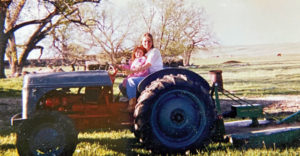
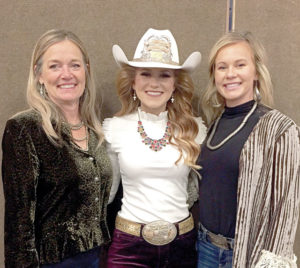
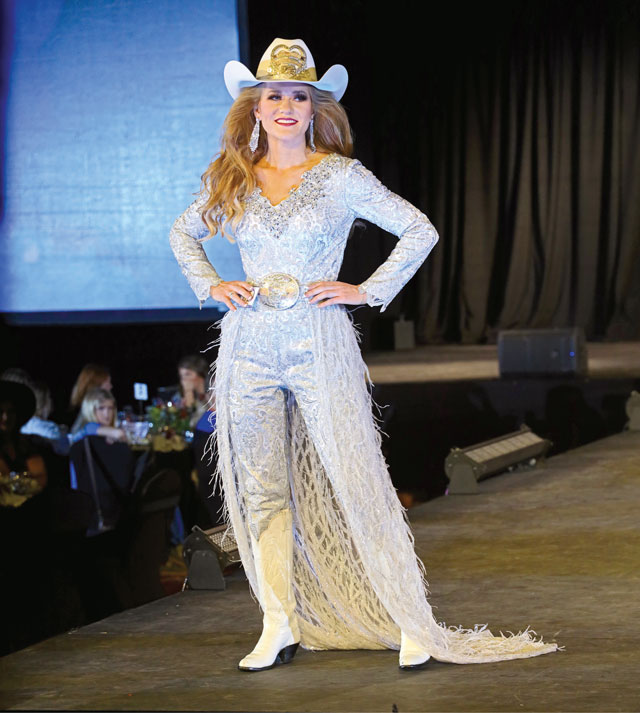
    “When I was dedicated as a baby, they said I would flow through the lives of people like the Jordan River,” said Jordan Tierney, 2020 Miss Rodeo America. “I remember being at work one day and having this feeling that I was made to do more than that job.” Her sister, Amy, encouraged her to run for Miss Rodeo South Dakota and now the 25-year-old from Oral, South Dakota, has an opportunity to live a bigger life and have a positive impact on those around her. “I want to leave people feeling better after having talked to me.”

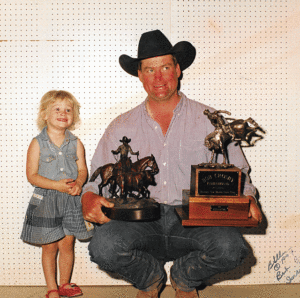
    Oral, South Dakota, has a population of 60 and Jordan grew up on a ranch, south of town, riding with her father, Paul Tierney. They raised AQHA horses and cattle. “I just this past year bought my own set of cows and now I’m fully invested.” The youngest of four, Jordan considers herself to be the caboose in the family. “I spent a lot of time with my dad, when he went out to the pasture, I went with him. I was on the stud, Cash, and I remember riding double with him. We had a pony, Teddy, I remember riding him while my dad practiced.” Jordan sees her father as an incredible hard working man. “He works sun up to sun down and is always willing to help anyone that comes along. He gives roping lessons and wants to see people succeed – it all came from his desire to be a rodeo cowboy and that’s taken him far.” Paul qualified for the NFR qualifier from 1977-1986, only missing one year. He was the World All Around Champion in 1980 and Tie Down Champion in 1979.

    Her mom, Robin, was the 1985 Miss Rodeo South Dakota and second runner up to Miss Rodeo America. “She sacrificed so much for our family,” said Jordan. “When I was a junior in high school, my mom switched careers – she had been a dental hygienist for 25 years and quit that to start her own oil field service company.” That job required Robin to be away from home for two weeks at a time while she built it up. “She always made my important volleyball and basketball games as well as my rodeos.” That leap of faith has allowed her the flexibility and freedom to continue her love of raising good horses and riding. “She’s an incredible horsewoman.”

    Jordan has two older brothers, Jess and Paul David, as well as an older sister, Amy. “I’ve followed in her footsteps my entire life, from sports to school leadership. She and my brothers have been huge encouragers to me in my dream to become Miss Rodeo America.”

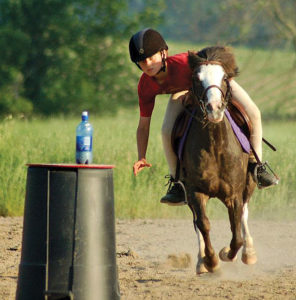
    Jordan started competing in rodeo in elementary school, competing in 4-H rodeo junior division. She eventually joined the National Little Britches and the South Dakota High School Rodeo Association. “I had a horse accident when I was five on the ranch. I was going out to get cows with my dad and my horse took off with me.” Jordan fell underneath the horse and he jumped over her. “I refused to get on a horse for three years. I started riding again when I was 8 and was very fearful – I didn’t want to go fast. My parents were very persistent and I eventually got faster.”
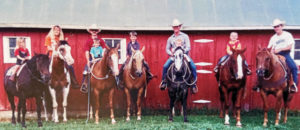
     

    Robin remembers those three years. “We wanted her to go, but really a neighbor girl, Megan Harkless, is the one who got her going again. She would come over and ride and she would ask Jordan to start coming out with her and pretty soon she was walking the horse around the arena while they talked. She was so patient and understanding.”

    After that, the best part was taking her to her first 4-H rodeo. “She walked the whole pattern and we were so thankful – and it was such a good feeling,” said Robin. “Here’s what we always knew about Jordan – her personality and the way she was – a slow starter and a strong finisher. She finished amazing and we have been so proud of her determination and diligence to perfect her craft.”

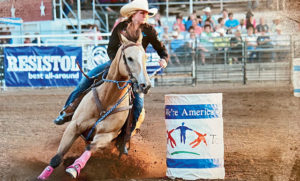
    When Jordan got back into rodeo, she didn’t win a lot, but by the time she hit middle school she had a very competitive mare that she ran barrels on (her name was Princess and she was also her brother Paul’s main heel horse). “I won the Junior girls state 4-H championship in goat tying in 2008,” she said. “I do think winning is important because I am a very competitive person so I didn’t like not winning in the crucial times that could’ve resulted in going to nationals, but when you start finding your identity in worldly successes that can be detrimental. I want to be an inspiration for rodeo and ranch girls to try rodeo queening as an addition to all that they do.”

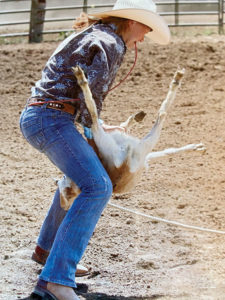
    Her rodeo abilities earned her a scholarship to Chadron State College where she competed in barrel racing, breakaway roping and goat tying. She earned a degree in business administration and plans to continue her education after her reign as Miss Rodeo America. “I would like to get the masters online program and start working in a career path in marketing and the agriculture realm.”
     

    For now, she is watching the calendar fill up with appearances across the country. “I’ve always been a people person – when I went with my dad, he would give us $5 and tell us to meet him back at the trailer. I found friends and that’s how it all started. This past year as Miss Rodeo South Dakota, I was telling people that I thought I was outgoing; I got out of my comfort zone – figuring out how to bring up conversation.” Her secret is asking people about themselves. “I like learning more about people and their history.” Her platform is Rodeo, Agriculture and building relationships with fans and new comers that foster understanding for the western way of life. She uses part of a Bible verse on her autograph sheets. Psalm 139:14. “I praise you because I am fearfully and wonderfully made; your works are wonderful, I know that full well.”

    “I shorten it and say you are fearfully and wonderfully made – that’s a verse I’ve carried with me,” explains Jordan. “I am made in His image and I should be proud of that. I want to make people know that I care and they are worth caring about. I love where I’m at now – I’m having a great time and after this year, I will get back to rodeoing, breakaway roping and team roping.”

    “My why is to help build people up the same way that I was built up during my early adolescent years when I had a lack of self confidence. My parents really gave me a strong foundation to stand on with all the good information they gave me to overcome my mountains in life.”

    Jordan hopes that as she represents rodeo and meets thousands of people this coming year that they will see her genuine authenticity for the sport of rodeo and the western lifestyle. “It’s what I was raised in and I’m proud to represent it. I hope they remember me for that genuine feel.”

  • On the Trail with Colton Bugis

    On the Trail with Colton Bugis

    ‘Where did this guy come from,’ is undoubtedly on the minds of many team ropers in the IPRA that watched a rookie 21-year-old header, Colton Bugis, climb from the bottom to the top of the team roping leaderboard since June. With nearly $1900 separating him and the next header in line, Colton is excited to be traveling to the Lazy E Arena in Guthrie, Oklahoma for the IFR50 to see if he can finish the season as a world champion team roper.

    Originally from Highland, Michigan, Colton’s start in horses didn’t give much of a clue that he would be where he is today. His parents Ed and Penny Bugis and younger sister, Eva, have a family farm where his dad sells grain, and also operates a septic company, King Septic; and none of them had a rodeo background. There was a love of horses in the family, and Colton’s grandma, Carol Redman, bred and raised Welsh ponies that became projects for Colton and his sister. “We were really young, but we would ride and drive the ponies she raised and turn them into show jumping and dressage prospects for other kids. My mom and sister were both really big into dressage and hunter jumpers, so I competed in that world growing up. I was in the Michigan Hunter Jumper Association and the Pony Club of America and did all that until I was about 13 years old.” In his heart however, he was a cowboy, “I always thought I was a little cowboy, running around with a rope when I was a kid. I went over to a roping school near us when I was young and learned to rope goats and got hooked. I started chasing everything I could on my pony, Lightning. A guy down the road, Tim Brown, took me to a roping pen at Rocky Alberts’ Blue Ridge Stock Farm one day, and that was all I wanted to do after that. My dad was glad to see me getting away from the hunter jumper riding and bought me a really good rope horse. It was a big deal for an old farm family to pay that much for a rope horse, but my dad bought me a black 7-year-old gelding named Player that really gave me a good start.”


    Colton’s mom explained, “Roping is a better fit for Colton. He’s always been a little cowboy from a very young age. We are so excited to go watch him at the IFR50 in January. There is a whole group of his Michigan roper family going out to Guthrie with us to watch him compete. We are all extremely proud of him.”

    Before graduating from Hartland High School in 2016, Colton competed in the Michigan High School Rodeo Association for three years, heading for Cale Johnson his sophomore through senior year of high school. The team won the MHSRA champion team roping title in 2015 and 2016 and qualified for national finals all three years they competed together. Colton also competed in calf roping and trap shooting during high school, but team roping was his main focus. Over the years, he’s even ridden ranch broncs for fun. “I come from a very supportive family, and even though my mom and sister didn’t like that I switched to roping, they still always came to watch me and support me in all that I do. They will be traveling to the IFR to watch me compete at my first IPRA finals rodeo, and hopefully watch me win the title there.”

    Over the past few years, Colton has spent a lot of time at amateur rodeo associations and team roping jackpots. He attended a horse shoeing school in Purcell, Oklahoma in January 2017. “I didn’t stick with that as a profession, but I did learn enough to do some of my own horses when I need to.” He did, however, make a friend with Baker Roush while at the school, and Baker invited him to his family ranch in Dripping Springs, Texas for the winter. “He and I ranched cows, shoed horses, hauled cattle, and did odd jobs. His family had a wedding venue, so we helped set up things for weddings and maintain the property. I roped some, but mainly did whatever I could come across to make some money while I was there, and then I’d go back home to Michigan for the summer.” While Colton was riding a friend’s calf horse at a rodeo when he was in Michigan for the summer, Mike Culhain made a phone call that began a change in the course of Colton’s roping career. “I told everyone I talked to that I wanted to go back to Texas for the winter. Mike told me he was friends with Bob Masters, and that he would call him and put me in touch with his son Chad Masters. I ended up going out to Chad’s for the winter in 2018.”

    Colton started out as the low man on the totem pole at Chad’s, mucking stalls, feeding cattle, and fixing fence. “I did whatever needed done, just trying to do my part. I also got to ride and rope with Chad and worked my way up. Chad taught me how he needed me to ride the horses and how he wanted things done. After winter, Chad went back to competing, and I decided to try rodeoing in the IPRA for the 2019 season. I didn’t really have a partner starting out, but I met Ty Parkinson at the Fort Worth Stockyards and we decided to start roping together in June. Ty is from Australia, and he’s a phenomenal heeler, he’s qualified for the IFR multiple times. We started out doing well together, and really went hard at the rodeos. From June until the end of the season we entered probably 75 rodeos and placed regularly. We won the team roping at St. Tite in Quebec, Canada, and just kept climbing in the standings as the months passed. Going into the IFR50, I’m leading the heading and Ty is leading the heeling.”


    A little dark brown mare named Betty has helped Colton make his mark in the heading competition. “My good horse ended up having ringbone, and Chad had gotten Betty in from a guy and made me a good deal on her. I’ve been riding her since this spring. She’s a little mare, maybe 14.3, but she is such a good horse and has made my job so much easier. I’m so grateful Chad helped me out with her. Coming from Michigan to Chad’s ranch in Lipan, Texas was very eye opening. It’s a totally different ball game. In Michigan, roping is more of a hobby that you do for fun, but here it’s the real thing; this is what they do. You learn a lot! I learned how to ride my horses better, how to use a rope better, and how to rope smart.” Colton is currently at the Masters’ ranch for his third winter and honing his skills so that he is as ready as possible for the IFR in January.

    “My main plan for the IFR50 is to get ready to catch them all so we can go for the average. I don’t get to practice with Ty much, he’s all over the place. But we’ll get together right before we head to Guthrie and make some runs together and we’ll be fine. After the IFR my goal is to just keep getting as good as I can get and see how far I can take it. I’ve been able to learn a lot from several people over the years, and I’ve been lucky enough that people have seemed to like helping me. I plan to take all of it and see where it leads. I may not have come from a rodeo background, but it’s in my blood and I’m here to stay.”

  • Children’s Western Wish Foundation

    Children’s Western Wish Foundation

    Glee Nett was born in the Southern Black Hills in Edgemont, SD, her parents and grandparents homesteaded in South Dakota. She enjoyed her 4H activities, loving horsemanship, which was taught by her relatives. She competed in 4H rodeo and went from there to amateur rodeos. There were seven children in her family and they’ve all had horses throughout their lives. She competed in many available activities. “None of my competing was on a high level – I just did it for fun,” she said. She dreamed of obtaining her degree in Range Management, however with the start of her family and ranching obligations, she realized her responsibilities would require her to be at home. “I chose to have my children while I was young, so I could be active with their lives, plus be able to be enjoy my wonderful grand children.”
    She went to work for a pathologist and a well known necrologist. “He was the greatest boss that ever existed – I learned how to succeed in life and that was to be respectful and be mindfully kind to everyone.” Glee had four children and the Good Lord has called two of them home. Both losses were unexpected and immediate. Their passing have taught her to be thankful and to live every day to its fullest capacity. “God gives us life and thus He has the right to call us home on His terms and on His timeline. You can either let it get the best of you or you can make the best of it.” Kindness is the most generous gift an individual can give, as we do not know what another may be experiencing in their life.”

    She also worked in law enforcement. “I was asked by an amazing sheriff to come work for him” and as she was the only female, she transported female prisoners to the state hospital and did intake interviews for rape, abuse and incest. It was difficult to leave this type of work at the office with young children at home. She switched from that to being a legal secretary and from there she became a multi peril-crop hail adjuster and traveled nine states doing that. Her career took her to Texas for six years with the children in tow. “Texas was a unique and exciting family and work experience.”
    After that career she managed two major airlines – America West and United, United Express. Starting out as a full time employee, she advanced into management quickly. “I was a field station manager in Lubbock, TX and opened new stations in Vail, CO and many other cities.”
    She went to work as a Fed X courier and that’s where she had her second major accident and decided to retire. “I had been dispatched to the water treatment plant and I went around a 90 degree corner, and caught the bladed berm left on the road when the passenger’s back wheel pulled the van and as she tried to correct the direction of the van, the passenger’s front wheel caught and the vehicle rolled end over end 2 ½ times, while only traveling 22 mph! Her injuries were not life threatening, however they were substantial. The doctors did not project a life of full activity, however she relied on her faith in the Lord to walk, ride and have a full productive life again so she took time off to heal. She wanted to remain amongst her rodeo family,,,,but how? She made the decision to do so by giving back to others and sharing her western heritage with idea of granting wishes and connecting the western world with the rest of the world. This year marks the 15th anniversary of Children’s Western Wish Foundation
    “It actually started with me helping to grant a wish for another organization. I knew from that moment that I wanted to start this foundation.” She applied for her non profit and was rejected three times. “I didn’t have an age limit or a specific challenge identified. When I got rejected for third time, I put on the letter,” Talk to God” and we got our 501c{3}. We didn’t have to change a thing.”
    She was off and granting wishes around the United States and Canada. The wish recipient’s are local community members and their immediate family. Some rodeos request more than one wish at their event and there has been a committees where a total of 6 wishes were granted at their venue. Glee coordinates every aspect of each wish and is present at all of the wishes.
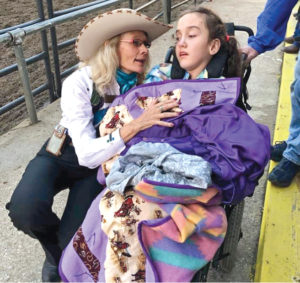
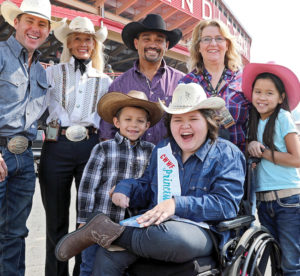
    She is blessed to work with her Board of Directors whom are all rodeo personnel and as they are all in attendance at the NFR, they hold their Annual Meeting in Vegas. Glee has many responsibilities in life, ts, but the foundation is her priority. “I spend as much time as it takes – probably around 15 hours per wish.” There isn’t an application process, it’s all recommendation. “If the rodeo doesn’t have a recipient, they ask us to find one.” All the wishes are handled by Glee. “The confidentiality remains where it should. I take all of it through phone calls and emails – we give each recipient . We find out what their hobbies are so we can get the buckle to represent that. They get a buckle, hand autographed Bible by Clyde and Elsie Frost. Every quilt is made by a local quilters from Laramie, Wyoming. Every knot that is tied on that quilt is tied with a special prayer for that individual. They are customized with their name on the inside as well as one block in the center dedicated to their hobby or something special and unique to that individual. Each recipient also receives an autographed signed hat, and the female wish recipient receives a tiara and a personalized sash, many times with the title “honorary princess of the rodeo.” Each of them get to do a lot of the meet and greet with the competitors and any country western artist that may be there. A compliment we hear often, especially from the families that have never experienced a rodeo or western event, is they are so appreciative as “not very often is a special needs or challenged person been given VIP treatment and treated with such a great honor.”
    She works with approximately 80% repeat rodeos and 20% new rodeos. “I have been granting wishes at the NFR for fifteen years. We grant the girls presentation wish during the WPRA luncheon – they are escorted on stage by one of our barrel racing qualifiers and presented with their gifts. This is the kick-off for the wonderful banquet the WPRA does for its qualifiers, their families, sponsors and many rodeo committees are present as they are awarded many honors. The boys recipient is honored at various venues during the NFR. Last year, it was presented during the Junior NFR (Junior World Finals.)
    For Glee matching the families with the rodeos brings the western way of life to the outside world. “I’m very proud to be part of rodeo – our rodeo family and our contestants aren’t afraid to pray or show their faith and it’s great for others to see.”
    “I’m not doing this for my glory – it’s not about me. I don’t care for the accolades and credit, it’s about the families.” She has had that attitude for most of her life. “When I was in fifth grade Sunday school – there was a verse in my Bible, that I always remember, whereas if you do good deeds and expect accolades, the gates of heaven will be closed. That verse is followed by: If you give alms and do not expect accolades, the gates of heaven shall be open to you.”
    “I choose to never use someone’s hardship to make my foundation better.” She feels that all the recipients are special people. “To me, God chooses the parents and the people to take care of these people. I am grateful to the parents and children for allowing me to do this. I also believe that special needs people are “Special Gifts from God.”
    This is her full time ministry. She assists friends as a caregiver whenever necessary, but mostly she coordinates and grants wishes. She has an abundant amount of windshield miles. The two tragedies of losing her daughter and son have helped shape the giving, kind person that she is today. “I wanted to just stay home after losing my son, and little by little, my rodeo family coxed me back into the arena to grant wishes. It’s the greatest personal satisfaction – when you get to work for the Man above and give from your heart – what more is there.”
    The website for the Children’s Western Wish Foundation is currently being reconstructed so keep checking. www.cwwf.org. In the meantime, follow them on Facebook.

  • Art of Rodeo: Circle M Custom Hides

    Art of Rodeo: Circle M Custom Hides

    What started out as a way to support their horse addiction has turned into a full-time business for an Arizona family. Melanie Edwards of Buckeye, Arizona, and her daughter, Doskie Edwards of Casa Grande, Arizona, are the mastermind artisans behind the sassy signature styles of Circle M Custom Hides. This mother-daughter-duo spends many hours creating custom leather creations, whether it be luscious purses that would make a statement on any western runway, or into a bridle/ breast collar set that has their horses looking like the best dressed equine in the alley. It all began 12 years ago, when Melanie was competing along with her three daughters, Megan, Courtney, and Doskie, in 4D barrel race jackpots. “It was a lot of money just for all the entry fees, then of course the girls would want new tack for their horses, and I just flat couldn’t afford to spend money on tack that wasn’t even made of good leather; and the quality stuff I really liked was way overpriced. I had dabbled in leatherwork before, so I started embellishing what we already had. Imagine my surprise when people started buying my used pieces, literally off my horses’ back.” And, so the seed was planted. “We wanted to offer tack that was made well in addition to being rustic and unique,” explained Melanie.
    By making cowhide rugs and fulfilling their own desires for quality original tack that would hold up to competition and use, a business was born that not only supported the passion the Edwards’ had for their horses, but also fed their creative fires as they developed new skills to continue producing items that stood out. “The city of Phoenix offered a jewelry making class, and Doskie and I took the class so we could learn more about soldering and jewelry making. We learned skills that helped us create our own buckles and conchos that are used in our completely handcrafted products.” With every detail of each item they make customized to their own liking, the Edwards really prefer to consider their equine creations “horse jewelry” rather than tack. And each piece with its truly one-of-a-kind embellishment is perfect for special occasions and events. Besides their horse products, they are also well-known for their one-of-a-kind purses, belts, and dog collars.
    One of the dog collars you’ll find on their website, www.circlemleather.com is called the “Charlie collar,” which Melanie created 10 years ago as a gift for Ree Drummond, The Pioneer Woman. “I loved reading her blogs every morning with my coffee and just decided to make a collar for her Basset Hound, Charlie. I sent it to her with a letter, not really expecting to hear anything back. Little did I know, Ree had posted it online, and our computer went crazy! The next morning my email was flooded with inquiries about the collar, and we are still making the Charlie collar after all these years!” Many creations made are never advertised before being sold, and although they try their best to update their website and Facebook page, Circle M Custom Hides, it is impossible to show all that they do. Besides their leather work, they also carry a full line of Dutton bits and spurs, which they embellish to make special awards or gifts. They are also a dealer for Iconoclast boots. “It is hard to keep up with making sure the website is completely updated with all we are doing, because I work in manufacturing, purchasing, bookkeeping, as well as being a wife, mother, and horse rider!”

    Melanie was your typical horse crazy girl, toting Breyer horses to school and starting with an ornery Shetland pony named Candy and she’s ridden her entire life. As she grew up, she competed in gymkhanas, but most of her horseback miles were racked up on desert trails. Married in 1988, Melanie and her husband, Paul Edwards, enjoyed their horses together. Melanie rode horses till just before the birth of each of their children. Besides the three daughters, they have a son, Craig, who lives just a mile down the road from them with his wife Nikki and daughter, Mary. “When each of the kids were little, they would ride in a backpack with me; as they got bigger, I could pony them along on a lead line, until they were finally old enough to ride alone.” Paul recently retired from his family trucking business, Edwards Brothers Trucking, and while he enjoys trail riding and has been supportive of all the horse activities the family was involved in, his passion has always been in the horsepower of old vehicles and tractors. “My husband always joked that I better not break our family with my horse obsession, but the leather hobby turned into a business, so it was perfect.” Melanie began competing alongside her daughters while they were attending the barrel racing jackpots, and currently still rides at least three times a week, and enters Grand Canyon Professional Rodeo Association rodeos when she can. “We’re not any top-notch rodeo people, but we love the people and rodeo and being a part of this life.”
    Doskie remembers staying up late one night when she was about 16 years old and helping her mom work on adding crystals to some tack sets she was working on. “I remember her taking the tack in to the local feed store in Casa Grande, Arizona and when she came back, she handed me some money for helping her finish the orders. I thought that was a pretty cool way to make some money and have been working on orders ever since!” Doing double duty in her own shop as well as her mother’s, Doskie says she likes looking at vintage tack and even clothing for inspiration when coming up with new designs. “I’m not afraid to try creating something different, and I make things I think are cool, and hopefully someone else thinks it is cool too. I really look forward to setting up our booth in Vegas each year and seeing all the other vendors again; we are like a bunch of rodeo carnies, traveling the roads with our goods.” Doskie is as enthralled with her horses as her mom and is extremely proud of the babies she raises. Her main three horses she rides and has consistently running in the 1D, are Peanut, Bailey, and FX. “Peanut is a 12-year-old sorrel gelding with a flaxen mane and tail, and he’s huge, not much of a peanut at all. He is my everything horse; the first one I raised from birth and trained myself, and I just love him.” Doskie has had two major horse accidents where she had to be medi-flighted by helicopter to the hospital but has not let that deter her from riding. She is hopeful that next year will be a great year of competition in the GCPRA and WPRA with her beloved horses.
    For the past 9 Decembers, Circle M Custom Hides has made the trek to Las Vegas, Nevada to display and sell their wares at the Southpoint Hotel and Casino during the WNFR’s Cowboy Christmas. “We love going to the NFR and showing all that we’ve been up to. People are always so surprised because there is not two of anything in our booth, we don’t make the same thing over and over, unless someone places a custom order for multiple items, such as awards, otherwise you won’t see a repeat. So, people always enjoy coming into our booth each year and seeing new things and knowing that they are one-of-a-kind creations. Doskie is so artistically talented and comes up with so many ideas of her own. Our tastes really complement each other, and we love sharing the quality items we produce. We guarantee everything we sell, and we are picky about what we do and how we do it. That’s part of the reason we have stayed smaller because we want control over every piece we produce.” Brent Giblin of BG Custom Silver works with Circle M, “Brent creates stunning jewelry, and he does a lot of cutting and piercing of metals used for our products. He is so good at what he does, it’s truly an art.”
    Each year begins with a plan of making a certain amount of inventory each month, so that by December they will be able to fill their 10 X 30 booth in Las Vegas. The few months prior to the NFR is like crunch-time for Doskie and Melanie. Doskie explained, “We really have to hustle to crack things out before we get to Vegas, and I’m always creating things thinking of what would be good to have there at the NFR. Truth is we don’t get a lot of guys that rope coming to buy our tack, but we do get a lot of chick ropers and barrel racers that want to make as much of a statement with their looks as we do.”
    Circle M Custom Hides started out as a means to an end for the Edwards family, but has turned in to a source of expression and creativity they didn’t initially expect. They are proud to use Herman Oak Harness leather from the United States of America for the base of all of their tack. They invite you to check them out and give them a chance to set you apart with one of their custom creations. If you’re in Vegas this December, stop by and tell them hello!

  • Caleb Anderson

    Caleb Anderson

    The first man with a rope in his hands from North Carolina to qualify for the WNFR.
    The 29-year-old heeler from Mocksville, North Carolina is now preparing for his first-ever PRCA National Finals Rodeo in Las Vegas and fulfilling a goal he’s had since he was a young child. Caleb’s path to Las Vegas has been a long one, but with each year he worked towards qualifying, his determination grew and his passion for becoming one of the best heelers in the business never waned. He will compete in Las Vegas in December, with Jake Cooper, and the team roping duo is preparing just as hard for the competition now, as they did to qualify for it.
    By all rights, Caleb should have been a fourth-generation logger, as he grew up with his dad, Jeff Anderson, making his living as a logger like the many Anderson men before him. Caleb definitely knows the family business and has returned to it several times over the years, as he was making his way in the rodeo world. “My mom, Kathy Stikeleather, works for Statesville Auto Auction and ran barrels some; and my dad liked to team rope and would head at jackpots.” Caleb has an older sister, Leah Renegar, and younger brother Koda Stikeleather.
    Caleb started competing as a calf rider when he was just 6 years old. When Caleb was 8, he started roping at Ricky Vaughn’s, in Harmony, North Carolina, and practiced there often, as he started competing in several junior rodeo associations. Caleb started high school rodeoing his sophomore year and qualified for national finals in Springfield, Missouri with Clint Keller, and again his senior year in Farmington, New Mexico with Brent Murphy before graduating from Davie High School in 2008. Although roping had become his main focus, his roughie spirit never left. “I was a bull rider at heart. I won steer riding titles and moved up to bulls, riding some 2-year-old bulls Mike Colyer owned; but when I moved up to the senior bulls it was a little intimidating and ended my bull riding career. I’ve always wished I would have stuck with it.”
    Weatherford, Texas was where Caleb always felt he needed to end up to really make his team roping dreams realities. After high school he hoped to go to college there, but instead went to Hobbs, New Mexico after childhood friend, Maggie Moore, convinced him to try college rodeoing there. “I knew school was not something I was going to do over roping, but I knew it would give me a chance to get out on my own. I became friends with Kurt Jones out there, and he had made the finals a couple times, had won the George Strait, and I hung out with him and tried to learn as much as I could from him. There was another buddy at school that was from Canada and he talked me into going to some Canadian rodeos. I stayed up there for a month, but Canada was not for me at that age, so I came home and got a real job.”

    Caleb still roped every day but worked with his dad in the Bear Creek Logging company, where he had worked off and on since he was 10 years old. “I’d start early and log until 5:00pm, then I’d go rope at Corey Honeycutt’s arena. I was a #6 heeler but didn’t completely understand the basic fundamentals of how I was roping; and Cory knew how to break it down for me. I’d load up all the horses I had, and we’d take turns heading and heeling for each other. Our friendship grew during those years, I became a better roper, and he became my best friend. Caleb had a lot of success during his younger years in North Carolina, winning a truck at a JX2 roping at 16, and started competing seriously in the IPRA in 2012. Caleb qualified for his first IFR in 2012, where he won the team roping average, and went on to win the heeling title at the IFR in 2013, 2014, and 2015.
    On January 1, 2017, Caleb moved to the Phillips Ranch in Navasota, Texas. Shane Phillips gave him a job riding as many horses as he could stand and breaking in steers. “I stayed there for 8 months and rodeoed through the winter with Brady Tryan. But when April came, I didn’t go to California to rodeo like everyone else was. I moved to Hillsboro, Texas with DJ Smith and worked for his dad’s grading company to make money to keep alive. When he sold his place and moved to Weatherford, Caleb bought a camper and he and then girlfriend, Carrie Putnam, moved the camper to DJ’s new place in Weatherford, where Caleb was certain he needed to be.
    Caleb roped all of 2018 with fellow North Carolinian, Cory Kidd, and was determined to compete all year without going back home. “It was kind of crazy how God works and that I had finally ended up in Weatherford. It’s like He let me know what I needed to do and worked me towards it. It took me a little longer to get there because I was kind of stubborn; but being there felt like I was on the right track. It wasn’t’ the greatest year, but it was the first year I had accomplished rodeoing from start to finish.” Caleb ended up in the top 30 heelers in the world in 2018, and although it was not enough to make it to the WNFR, it qualified him for Houston the following season, and that’s where things started really turning around for him.
    After the season was over in 2018, Caleb began working for Luke Brown as he built his new ranch in Lipan, Texas. “Carrie works as a cost analyst for Patrick Smith’s company, Driven, and I’d drop her off at work, and work at Luke’s all day. “We started building the NFR arena at Luke’s so they could practice for the 2018 finals, and it was really cool because if Luke’s partner wasn’t there I’d get to fill in and rope with him. I would work turning steers out, raking the arena, basically everything they didn’t need to do so they could just rope. Just being around those elite ropers was like being at school, watching the pros and how they did things. I was fortunate to get to be around them and tried to pay attention to every detail.” Caleb fed for Luke, Paul Eaves, and Clayton Hoss, while they competed in Las Vegas last December, and after the finals were over, he and Carrie moved their camper to Luke’s ranch, where they now reside. “it’s been a blessing being at Luke’s, we have a Texas family and it has been a great thing for us.”
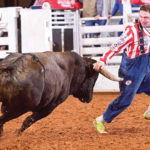
    Caleb wasn’t sure who he would rope with for the 2019 season, but after some success at jackpots during the winter with Jake Cooper, the ropers agreed to team up together. “I was broke and trying to do anything I could to make money that winter, and although we started out with a few successes, it was a little shaky. But we agreed we were going all the way and not giving up on each other. When we went to Houston, we were in 80th position, and after winning $30,000 each there, it shot us up 77 places. It was the most money I’d ever won at one time, and we had confidence that we could keep going.” Towards the end of the season, Caleb’s position to qualify seemed fairly solid, but Jake had dropped to 16th after Pendleton. “It was tough towards the end because he was on and off the chopping block, and I really wanted to qualify with him for finals. I couldn’t really take a deep breath until the final steer was roped that season and I knew we had made our goal and qualified together. It wouldn’t have been as sweet if we hadn’t both made it; but it worked out the way the good Lord wanted it to, and we’re blessed with that.”
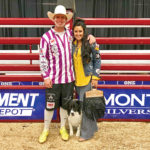
    Caleb and Carrie recently came back to North Carolina in October, and surrounded by family and friends, were marred after 5 years of dating. Caleb’s groom cake was a replica of an NFR back number. Although Carrie is a competitor herself, she’s put off her rodeo aspirations these past few years to support Caleb’s goals. “Carrie won the IPRA barrel racing title in 2015 and has given up quite a bit for me. I look forward to getting to a point where she can start going for herself again.”
    Caleb will compete on his sorrel mare that he’s been riding since 2012, “My aunt, Ronda Beaver, gave me Sugar Bear. She’s a 2006 model and has taken me through all of my competition so far. I have a second horse I ride occasionally, but when it’s game time and big money is up, I ride Sugar Bear. I’m looking forward to being at the finals on her because I’ve always felt if I could get her in that building that she’d do well. In the east, the set-ups are short in small pens and we rope a lot of big steers, so I think she’ll be right at home. I think she’ll be one of the best heel horses there.”
    Caleb is all about setting goals and staying disciplined to reach them. “I’m big on being prepared and working hard. This is what I’ve always wanted to do. If something isn’t right, I work to fix it. I’ve been studying tapes from prior finals and watching how other teams go about it. It hit me the other day, that I’m not just going to be watching it on tapes; it’s going to be me backing into the box. I don’t think it will sink in fully until I’m there.” In 2017, when Caleb moved out to Texas for his first real attempt at qualifying, he saved a screenshot of a Facebook post before turning off his social media. “The post was a picture of the Thomas & Mack that said, ‘Set a goal so big that when you achieve it, it will blow your mind.’ I quit Facebook when I moved out there because I knew I had to full heartedly be in it. I didn’t want distractions, I figured I could be roping a dummy or riding my horses rather than wasting time looking at things that weren’t going to get me to my goal. But I’d open that screenshot often to remind myself of exactly where I was trying to get.”
    Caleb has had the chance to go to the WNFR several times over the years, and although the stands are often filled with many aspiring rodeo athletes, hoping to be on that arena floor one day, for Caleb he declared at a young age that he’d never go to the WNFR until he was there to run a steer himself. So, although over the years he passed on many trips to attend as a spectator, he held fast to his goal and has saved the special moment of walking into the Thomas & Mack, for this December, when he rides in as a 2019 WNFR competitor, mind blown.

  • Patrick Gottsch

    Patrick Gottsch

    “I’ve always felt confident that there was an audience in America for rural progarming that was being ignored by urban broadcasters,” said Patrick Gottsch, the man behind RFD-TV and the new Cowboy Channel, both owned by Rural Media Group. Born and raised on a farm outside of Elkhorn, Nebraska, Patrick knows firsthand the role rural America plays in the lives of all Americans. His father, Pat, was a farmer. He grew corn and raised cattle and had a feedlot as well as two other farms. “The cowboy values are important and main stream media doesn’t cover it. The best memory a kid has is of the county fair and now RFD-TV and the Cowboy Channel bring viewers the county fair 365 days a year.”
    Patrick went to college at Sam Houston State University for two and a half years. “I wanted to go back and farm with my dad; which I did for three years; the three worst drought years in Nebraska. My dad encouraged me to find a job in town.” He moved to Chicago in 1977 and worked as a commodity broker for the next two years. “I wanted to come back home to Nebraska – I didn’t want to live in downtown Chicago, so I was a commodity broker in Omaha. The Carter Grain embargo in 1980 wiped out a lot of people and I went broke.
    “My daughter was born Dec 13 1984 and I came down the hill from the hospital and there was a guy trying to put a dish together. I pulled in and was interested in buying a satellite dish – he asked me if I had any tools, and I ended up helping him. It took us six hours and we were turning the dish and all of a sudden HBO came on and I was hooked.” He got a job that day installing dishes for him and started E.T. Installations, a company that sold and installed C-band home satellites. “I always followed up after installing one, and everyone loved them.” As Patrick traveled through rural America, he heard customers wondering why there was a lack of rural programming as well as old westerns like Gunsmoke, which seemed to be taken over by shows about urban cops or suburban housewives. There wasn’t anything directed at rural folks.
    He launched RFD-TV (Rural Free Delivery Television) in 1988 and the company had the right idea but the timing was off. In March 1991, Patrick moved to Fort Worth, Texas and served as the Director of Sales for Superior Livestock Auction from 1992 to 1996. Superior Livestock Auction was the first to introduce satellite video marketing, which was carried on RFD-TV, to the livestock industry and has since grown to become the largest livestock auction enterprise in the United States. He was putting programming on RFD-TV, but he was still trying to fill programming. “We got our break in December of 2000, when DISH network agreed to launch it. It was a one man and two daughter network, we’d put all the programming on a hard drive a week at a time.”
    Today, RFD-TV is available in more than 52 million homes nationwide. Rural Media Group, Inc. has since expanded to include RFD-TV The Magazine (2003), RFD HD (2008), RURAL TV (2009), RURAL RADIO (2013) on SiriusXM channel 147, and most recently the Cowboy Channel, launched in July of 2017.
    “I am always amazed that when Patrick has a vision, he has the ability and tenacity to see it through to fruition,” said Pam Minick, who has known Patrick since before he launched RFD-TV. “When he came to work here (in Ft. Worth) for Superior, you could find his daughters sleeping in his office.” Pam has recognized his passion for rural America for years. She has been part of American Rancher, one of the first shows that aired on RFD-TV as well as Gentle Giants. “A lot of things he does, he does with the intention of making rural America look good. I applaud him for that.”
    The latest venture, the Cowboy Channel, has been a dream of Patrick’s since 2013 when Randy Bernard came along with the AMERICAN. “I’ve always thought there was a void with the other sports channels, why not a rodeo channel? If there was one thing missing in our sport in regard to linear TV, it was a TV devoted to rodeo – and everything that has to do with western sports.”
    The partnership between the Cowboy Channel and the PRCA was announced the first of September “We tried five years ago to get PRCA and didn’t get it –quite frankly I was upset at the time, but it’s been a blessing in disguise,” admits Patrick. “We’ve really worked hard the last four years to build the Cowboy Channel up and tried to prove ourselves. The goal was always to have the Cowboy Channel the premier rodeo channel.
    “We’ve got content now, and media is changing at a rapid pace. We will be distributing content through any means possible. We want the younger audience – we haven’t made any announcements yet on that but be assured we are looking to stream any way possible to create more fans.” Although he’s not home much, Patrick lives in his hometown of Elkhorn where his brother continues to raise corn and soybeans. Patrick has three daughters—Raquel, Gatsby and Rose. Raquel currently serves as the CEO of the Cowboy Channel, based in Ft. Worth. Raquel and Gatsby currently serve on the Company’s Board of Directors. Patrick jumps out of bed in the morning and spends his time promoting the Cowboy Channel and the western industry. “Helping spread Western culture and the rural values back into the cities – that’s my fun and it’s a real challenge. There’s a wall being built between urban and rural and we have to work at it.
    “Our goal is to serve the needs and interest of rural America,” he concludes. “We want to reconnect city and country – it’s a fight and a struggle – but we have found that we have as much interest in the urban area.” The Cowboy Channel has seen an increase in homes from 12 million to 40 million in the last two years. “We are doing everything we can with our own company to expand the fan base.” One thing the company is doing is hosting the first rodeo in New York since 1984. Madison Square Gardens began in 1922, Tex Austin produced it. Madison Square Gardens continued as an annual rodeo until 1959. In 1925, there was no rodeo as a new facility was being built. “We are inviting a lot of the folks that competed there to make it a celebration,” he said. “All the major distributors for cable are in New York – we are going right where they are and somehow we will get them to come to the event.” The other opportunity he sees in New York is the expanded opportunities for advertising. “90% of advertising comes out of New York and we are hoping to get a lot of them to come and attend, and maybe get main stream advertising.” For now, Patrick is crisscrossing the country promoting the Cowboy Channel and Rodeo New York. “We are just going to keep doing what we’re doing. I’m proud of what RFD-TV has done over the past 31 years.”

  • Brenda Michael

    Brenda Michael

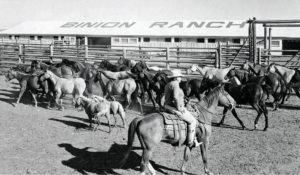
    Brenda Michael adored her dad, Benny Binion. She and her dad had a relationship like no other. Although he was a successful business man that made his fortune in the world of gambling, his passion was to be a cowboy. Eventually, after moving his family from Dallas to Las Vegas and getting them situated comfortably he amassed a ranch in Montana in 1943. Brenda was only two.
    Brenda was born in Dallas, Texas, the middle child of five. Barbara was six years older, Jack was four years older, then Brenda, Ted was 16 months younger, and Becky was three years younger. “We moved to Las Vegas, when I was five. It was a very small town, only 15,000, when we got there. But gambling was becoming a major force and it grew rapidly. Daddy ran crap games and a policy game in Dallas, but after World War II was over, the ‘powers that be’ tried to shut down gambling. So we moved,” explained Brenda.
    “My dad was always particular about his girls. He didn’t want us around the casino,” Brenda remembers. “We’d go eat and that was it.” Brenda remembers her mother staying at home with the children and driving them to Saint Joseph Catholic School growing up. She graduated from Catholic High School with 42 in her graduating class. “Daddy bought our home because it had a place for horses. I don’t think he even looked in the house. It was seven acres and we always had horses,” she laughed.
    The ranch finally grew to 210 sections, including one pasture that was 98 sections. “I looked forward to going back to Montana in the summer. I always liked the ranch. I’d cry when I had to come back to Las Vegas. I was the only one that cried,” she admitted.
    Benny wanted everything done on the ranch the way it used to be done. “He refused to use four-wheel-drive pickups because it tore up the land. We did everything with horse and wagon. Daddy bought fifty WWI wagons that had never been uncrated. They would fill them with cake, take them out in the pastures, feed, and come back,” remembers Brenda. She has a very vivid memory of everything that was done on the ranch.

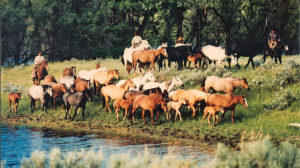
    When Benny Binion was sent to the penitentiary over income tax, when Brenda was 12, she was very sad because she didn’t get to go to the ranch. She just knew no one would take care of the horses, and she couldn’t see them. He didn’t get released until 1957, on a technicality. Turned out Brenda was right. The hired hands that were left to tend to things on the ranch were told not to sell the horses, but they did sell the cattle. When the hired hands heard Benny was out they disappeared. There was only one filly left. “We had no idea where they went, and those that were left had gotten down in the Missouri breaks, so Ted and I started riding the Missouri River breaks trying to find them. The horses knew the trails but we didn’t. It took years and since none of the studs had been cut we ended up gathering nearly 1,200 horses. Two that we found were named ‘Happy’ and ‘Sappy’. We took them to a rodeo and boy could they buck,” said Brenda with a big smile. “We took nineteen horses, including Happy and Sappy, to Harry Knight at Great Falls and he bought them and they ended up in a rodeo in Belgium. Benny recognized Brenda’s interest in the horses and although she was only seventeen he asked her to register all their horses with the American Quarter Horse Association. “The inspector came from Amarillo to inspect them, they were all cataloged. Every summer they would upgrade until they got papers.
    Brenda fell in love with Bert France, a cowboy from Las Vegas, who rode bareback and saddle broncs. She was just eighteen. He qualified for the first National Finals Rodeo in 1959 in the bareback event. Three months later he was killed, on July 4th, in an automobile accident. At the time he was leading for the All-Around in the Rodeo Cowboys Association. Brenda had traveled with him that summer, but was at the ranch at the time of his accident. She tried going back to school but she couldn’t concentrate on her studies. She went to work at Bank of America, but spent summers at the ranch in Montana that she loved.
    A bronc rider from South Dakota was coming to the ranch and starting horses for Benny. His name was Andy Michael and in 1963 he and Brenda were married. Their daughter, Mindy, was born the following year. They lived on the ranch until Mindy needed to start school. They moved to Amarillo in September, 1969. Brenda and Andy were married 27 years, and divorced in 1990.

    Brenda had always wanted to get in to the cutting horse competition, but was always too busy. The year after Benny died she bought a mare, ‘Lena Leo War Lady’ and the first cutting competition to which she took her, in Reno; the horse won the open. Brenda went home with more than $25,000! Brenda admitted, “she was a lop-eared mare, that was pretty plain looking, but she could cut.” She spent the next four years in the cutting circle and did quite well.
    When Brenda’s mother passed away, in 1994, Brenda was named the executrix of the estate. It was a full time job and she had to give up her cutting competition. “Everything had to be appraised and taxed, and finally we had to sell the ranch.” All of the stress had contributed to Brenda’s poor health. She broke her femur due to an infection and spent 20 days in the hospital battling osteomyelitis. It look Brenda three years to recover from this debilitating health issue.
    Brenda continues to live in Amarillo. She bought Lighthouse Ranch which is next to Palo Duro Canyon and runs cattle on it. She has watched her two grandchildren, from Mindy and Clint Johnson, past Saddle Bronc World Champion 1980, 1987, ’88,’89, grow to adults. Ben, winner of the Texas High School Cutting Horse title in 2009, now owns restaurants, and he and wife, Kaitlin, have two children, Porter and Emory, and are expecting twins in February. Janie is a WPRA barrel racer, works for Ride TV with the PBR Velocity Tour and is presently a sideline reporter.
    Brenda continues to be heavily involved in the bucking horse business through the Benny Binion World Famous Bucking Horse Sale which is held during the National Finals Rodeo in Las Vegas, and watches son-in-law Clint work with Dr. Gregg Veneklasen with Timber Creek Veterinary Clinic in creating clones and taking embryos of proven bucking stock. She supports many projects held in Amarillo involved with rodeo and the western way of life. Brenda received the Ken Stemler Pioneer Award in 2015 at the ProRodeo Hall of Fame in Colorado Springs, Colorado, for her commitment to professional rodeo through the Binion Bucking Horse Sale that benefits the ProRodeo Hall of Fame and is used for youth educational scholarships.
    Brenda proudly continues to do the things her dad taught her that were important. “He was part of the vanishing breed of westerner that saw that the western way was not lost. He thought a handshake was better than a bond. His word was better than any written agreement. He taught me a lot of great things. I met a lot of nice, interesting people. I’ve always been proud to continue my dad’s work,” said the red-headed, quiet spoken woman, who has always been there to support her community, the rodeo world and the people in it with their western way of life.

  • Benny Binion Statue at South Point

    Benny Binion Statue at South Point

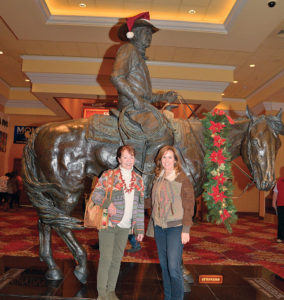
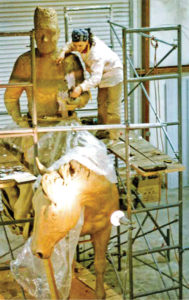
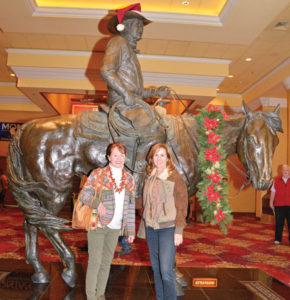
    The huge statue sitting in the walkway of the South Point Hotel and Casino in Las Vegas of Benny Binion on his horse, Trece, has traveled far to find a home here in this very busy thoroughfare within the confines of the headquarters of the Professional Rodeo Cowboy Association and the World Series Finale when the National Finals Rodeo comes to town. It is a larger than life bronze 15 feet tall and 16 feet long, weighing 2,800 pounds created by well-known sculptor, Deborah Copenhaver.
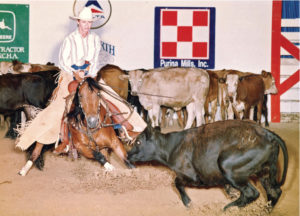
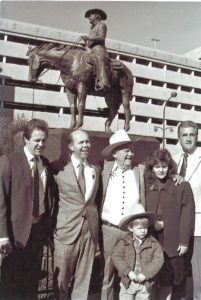
    Benny Binion was a successful businessman, who found his fortune in gambling in Dallas, Texas before moving to Las Vegas. The horse was owned by his daughter, Brenda, but Benny, who always wanted to live the western way of life, wanted her to sell him to her to use on his ranch in Montana. “No dice,” she said. Trece was one of 18 foals from the mare, Brenda Joe. “I think my dad thought if he made a bronze of him, I’d let him have the horse,” explained Brenda Binion Michael. The Texas Historical Society paid for Copenhaver to sculpt the bronze. It was placed in front of the famous Billy Bob’s, The Largest Honky Tonk in the World, in the Stockyards at Fort Worth, Texas and was unveiled on Benny’s 80th birthday. When Billy Bob’s was sold, Ronnie Campbell hauled the statue to Las Vegas and it was placed in front of the parking garage of The Horseshoe, Benny’s casino, on 2nd Street in downtown Las Vegas.
    Michael Gaughan, owner of South Point, wanted it once Binion’s were no longer owners of The Horseshoe. “It was out in a back street collecting bird shit,” said Michael. “Mr. Binion was very close to me – he never said no to me. I tried to get the statue a couple of times, and finally got it for $1. Getting it into South Point was a challenge. First it had to be cleaned – which took two people three days working on it. “We were told not to tilt it or use steel wool,” explained Michael, “so we used warm water, soap, and Irish-cut oatmeal to get it cleaned up. They cut a hole in the building, and a second hole to get it into the casino. It took an entire day – it was like moving a Trojan horse.”
    Benny Binion had a love of the west, and a high regard for cowboys. He was very instrumental in getting the Professional Rodeo Cowboys Association National Finals Rodeo to move to Las Vegas. Since South Point has become the destination of the PRCA Convention, the Benny Binion World Famous Bucking Horse Sale, the World Series Finale, and so much more during the National Finals Rodeo plus so many other western events and competitions held there during the year the bronze of Benny Binion and Trece is destined to be a focal point at South Point forever.

  • Forrie J. Smith

    Forrie J. Smith

    Forrie Smith fell off a horse in front of his mom and step dad when he was 6 and proclaimed that he was going to be a stunt man. 54 years later, he’s doing just that. Forrie plays Lloyd Pearce on Paramount Network’s hit series Yellowstone and recently completed shooting the third season of the show. He has been involved in Yellowstone since season one. “I was a guest star and now I’m on contract. I’m the cow boss. We started shooting season three the first week of August, and just finished up. It takes 8 days to do an episode.”
    Rodeo paved the path from bronc rider to stunt man. Born in Helena, Montana, and raised on his grandpa and grandma’s ranch southwest of there, he spent his early years going down the rodeo road with his parents. “I went to grade school at Montana City – there were 13 kids in 8 grades.” He started competing in rodeo when he was 8. “I was on my second pair of chaps already – I wore one out riding at home.” His grandma (Josephine Palmer) didn’t want him riding bucking stock, so he was raised in the timed events. “My granddad rodeoed when they circled the cars and snubbed the horses,” recalls Forrie. “I was drawn to it. I’m known as a horseman. I’ve started a lot of warm bloods for the equestrian people.” He always knew his call was riding bucking stock. He started riding bareback horses when he was 11. “I would get on turnout horses and people like Pat Linger and Steve Loney would help me out.”
    He was still spurring bucking horses in 2009, taking after his dad. “I was raised in the back seat of a station wagon. My dad was winning checks until he was 52 in the RCA.” His mom, Chick, was a barrel racer and when she had troubles with her horse she would time and secretary. “I started working the labor list when I was eight under guys like Sonny Linger, Reg Kesler, and the Big Bend Rodeo Company.” Through the years, he did anything necessary at a rodeo including flanking, loading, and riding. “I’ve been on 17 horses in one day and 11 head of bulls in one day. Everything good in my life was because of rodeo.”

    He is quick to say that it was rodeo that got him into the film business. “I use a lot of the things I learned from rodeo in the film industry – like breaking things down into steps, thinking positive and not being negative. Thinking about what you did wrong and forgetting it; thinking about what you did right and building on it. Hurry up and wait – that’s all learned from rodeo.” He relates his acting to riding a bucking horse. “You read that dialog and figure out the scene and why you’re saying what you’re saying. If you look at the script and say ‘I got this’ – that positive attitude will work out for you and the energy will carry you – same as riding a bucking horse. If you say you’re not going to ride it, you probably won’t.”
    Forrie has been a stunt man for 25 years. His first part was in Desparado. “I had started in the movie business a year before as a wrangler, my first movie was that remake of Stagecoach with Willie Nelson. Then they needed a guy that could rope a guy off a roof. I was the only one that showed up with a rope long enough to reach him. Then I had to get the dialog … my name was Harley.” He had only been in the film business for a week when he went to sign up for the teamsters union. “I had to have references and they were all old rodeo partners. The guy looked at me and said ‘who are you, you come with some of the best and highest recommendations I’ve ever seen’ – that was 1986 – almost to the day I got my screen actors guild card.”
    With his look and voice, he was encouraged to take acting lessons. “I just wanted to do stunts .. but I went to Lawrence Parks for acting lessons and learned how to break down a character and a script. That was 25 years ago and I’ve been in it ever since.” Everybody that was in the stunt business back then had some kind of rodeo background. The hardest stunt he’s had to do are horse falls. “There’s a lot of components that go into that – you’ve got to hit your mark, set your horse up and follow through with it. Doing high falls isn’t as bad – it’s just that first step that’s hard. And I didn’t really like the fire gigs – you usually lose all your eyebrows.”
    Forrie was raised in Helena, Montana, and moved to Arizona 30 years ago, and now calling San Acacia, New Mexico, home. “I fed cows with a team and sleigh when it was 50 below and it was 106 in August when I was setting posts,” he recalls of his days in Montana. “I drove my cousin back to Texas – 20 years ago – right after Urban Cowboy came out and cowboys were in.” He started doing day work and rodeoing, competing in open rodeos and he filled his permit in 1982 and started competing in pro rodeos. “That was easy back then, there were 100 rodeos in Texas.” He was part of the National Senior Pro Rodeo Association, joining in 2006, when he was 47. He competed for three years there, never winning the world, but winning his circuit twice and taking the average at the Finals. “I was raised to make money – if I didn’t make money rodeoing, I didn’t do it.” He spent his off time wrangling or hauling horses before getting his gig with Yellowstone. He still does wrangling jobs, the latest one for an upcoming Tom Hanks movie.
    At 60, Forrie has no plans to slow down. “Thank God to the movie business I’ll have a decent retirement through the teamsters guild. As long as I can stick my feet in the stirrup, I’ll always do day work and I’ll still do movies.” Any chance he gets, he goes home. “I like sleeping in my own bed, petting my own dogs, and saddling my own horses. It’s getting better around home about going out and having a meal and not getting interrupted. I’m not complainin’ – it’s so cool – the excitement and joy you bring people with just a hug and a picture. Without them, I wouldn’t have a show. It’s kind of wild.” Season three of Yellowstone comes out in summer 2020. “I’m a very blessed man – I thank God and my Lord and Savior Jesus Christ that I’m still on the ride. It ain’t over yet.”

  • Evan Allard

    Evan Allard

    When Evan Allard was a kid, while his friends were playing football under the bleachers during the Vinita, Okla. rodeo, he was glued to the rodeo, watching the rodeo clown.
    He loved rodeo, and every time the Will Rogers Memorial Rodeo came to town, he was there, with a singular focus, observing. And when he showed cattle at the Inter-State Fair and Rodeo in Coffeyville, Kan., just thirty miles north of Vinita, he was watching there, too.
    And now he’s headed to the biggest stage in pro rodeo: as a bullfighter at the Wrangler National Finals Rodeo.
    Allard grew up around cattle in a family that didn’t rodeo, but he idolized the rodeo clowns and bullfighters.
    When he was fifteen years old, he snuck behind the chutes in Coffeyville and introduced himself to Cory Wall, who was fighting bulls. Wall invited him to a Sankey rodeo school in late August, where Wall was the bullfighter instructor, and Evan went. “I wanted to do it so bad I couldn’t stand it,” he remembered.
    He got ahold of a Humps and Horns magazine, with a listing of stock contractors and associations, and started making phone calls, asking for jobs. “I didn’t know any better,” he said. “I didn’t know the difference between the PRCA and the NFL, for that matter. It didn’t matter to me. I sure wanted to fight bulls and wanted somebody to give me a shot.”
    He began working a junior bull riding association, two events a month for thirty dollars an event. “I was uptown,” he said, thinking he had it made. Ironically, he was working with Cody Webster, who he’ll work alongside in front of the yellow chutes in Las Vegas. “He was just a pup,” Evan said. “We were just babies.”
    In 2005, thanks to Jim McClain, he got introduced to freestyle bullfighting, which became his forte. “That’s where I really made a name for myself,” Evan said. He worked Two Bulls Protection shows, which were owned and produced by McClain.
    In 2006, he went to his first freestyle bullfighting competition, and four years later, he won his first freestyle national championship, with two more titles after that, in 2014 and 2015.
    At the time, he worked a fulltime job as a journeyman substation technician, testing and maintaining high voltage transformers. His job supplemented his rodeo income, helping him buy his place, the Hookin’ A Ranch, and start his herd of fighting bulls.

    Then he got a call to work a rodeo as a bullfighter. He had done plenty of cowboy protection, but freestyle was his main work. He couldn’t refuse this job, but didn’t have any vacation time away from work. “I thought, one of these days, I’ll work when I can’t fight bulls,” he said. “So I quit my job.” It was 2015, and he became a PRCA member.
    He estimates he works more than 100 performances a year protecting cowboys, at rodeos from Oklahoma to California and everywhere in between: the Ft. Worth Stock Show, several PBRs, the Texas Circuit Finals, and more.
    There’s more to Evan than rodeo. He got his pilot’s license three years ago, with the sole purpose of flying to rodeos. Last year, he got his aerial applicator’s license, to crop dust, and this year, he bought an agricultural plane. He’s growing his business, spraying farmers’ crops and pastures in northeast Oklahoma and southeast Kansas, with his long-time girlfriend, Kelsea Walker, helping out.
    When he got the call that he was selected to work the WNFR, it was a surreal feeling. “Getting that phone call was an unreal moment,” Evan said. “I instantly was glad it was six weeks away. I don’t want to lose that feeling.” The two bullfighters who signed for his PRCA card four years ago are the men he’ll work alongside in December; Cody Webster and Dusty Tuckness.
    When he was a little bitty kid, he never thought his dream would take him this far. As a kid, all he wanted to be was a rodeo clown, because he didn’t understand the difference between the clown and the bullfighters. Having the natural athletic ability to fight bulls took him in that direction instead of clowning. He knows there might be a kid in the audience who looks up to him, just like when he was young. “That’s why it’s important to me to put on the face paint and the baggies,” he said. He knows that for the kids in the crowd, the bullfighters and clowns are bigger than life. “At the end of the day, protecting bull riders is very important, and it has turned into an art, but without somebody in that crowd, we have no job, and the only way to get people in that crowd is to entertain them. There’s more to it than just fighting bulls and going home.”
    Evan knows that when he gets to Las Vegas, the ten days will fly. He’s not ready for that, but he’ll savor every moment. “I don’t want it to be over. I know once I get out there, it will go so fast it’ll seem like it’s over before it starts.”

  • On The Trail with Stetson Wright

    On The Trail with Stetson Wright

    Stetson’s first bucking horse was his brother. “We had a TV stand with swinging doors,” he explained. “Rusty would get in there, we’d open the door, and he’d ride out, with me or Ryder riding.”

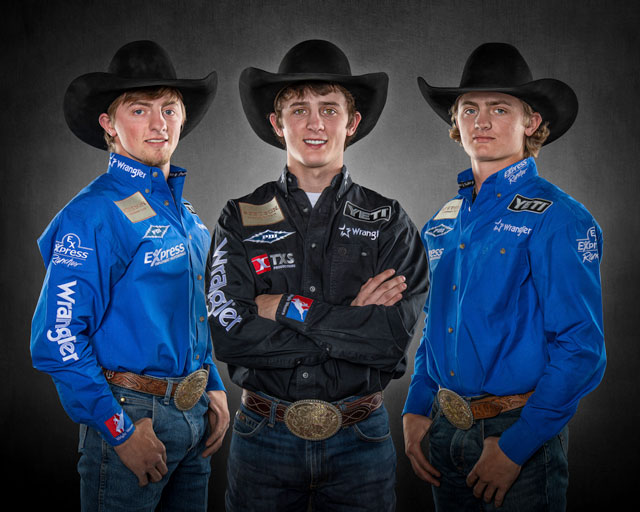
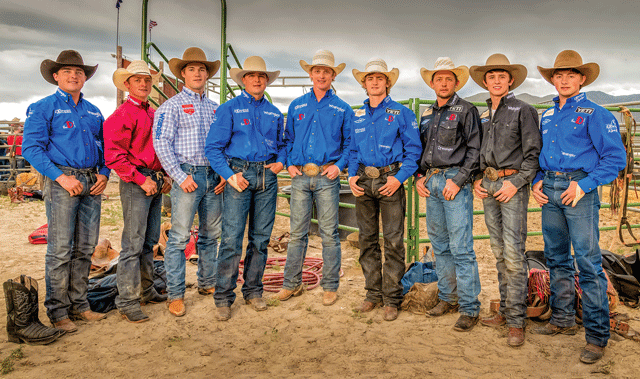
    Now, at the age of 20, he’s joining his two brothers at the WNFR. “I didn’t know how soon it was going to happen, but I’m glad it’s now,” said the Beaver, Utah, cowboy who is going to Vegas sitting second in the bull riding and leading the all around. “I felt like I was ready, but I didn’t think I would have this much success this soon – I’ve always expected it of myself. Me and my brothers have always dreamed of this since watching my dad.” And watch their dad, Cody, is what Stetson has done since he was little. He’s been to every performance of the WNFR since he was three years old, watching dad for 13 years, then Rusty, who made his first WNFR in 2015, then Ryder in 2016, and now he is going.

    The Wright family has made NFR history twice now – in 2014 when four of them (Jesse, Jake, Cody and Spencer) all qualified for the WNFR in the same year and again in 2016 when Cody and his sons, Rusty and Ryder, became the first father and two sons to compete in the same event at the WNFR.

    “In my opinion, my dad’s the greatest bronc rider that ever lived. He might not have 6 world titles to show for it, but he’s perfected the style – he stays back, sets his feet, and he’s fast. From a husband to a dad – everything – he’s great. He tells us to trust our stuff and keep gassing it and just perform like you’re in the practice pen. He keeps us all positive; he’s a very positive guy.”


    Cody enters all three of his sons as well as two others. “He’s one of the best – he enters five guys and all five of us made it to the Finals this year. If we didn’t have him, we’d lose a lot of sleep. He wakes up every morning, looks at the books and enters us.” Along with entering the boys, Cody enjoys training dogs – border collies and kelpies. “Training dogs and entering us makes his living.” Along with his two older brothers, Rusty and Ryder, Stetson has a younger brother, Statler, 16; and a younger sister, Lily, 10. “Stetson’s my middle man,” said his mom, ShaRee. All of her kids rodeo and say collectively that if Lily could ride rough stock she’d be better than all the boys.

    Stetson started riding broncs the summer before his freshman year in high school. He started riding bulls in the 5th and under state program and then did junior high and miniature bulls before getting on bulls in high school. “I honestly wasn’t good at riding bulls, Rusty and Ryder were better and it bugged me that I wasn’t good at it. It finally clicked my junior year and it’s been good going ever since.” He also played football and wrestled.
    His senior year, 2017, he won the National High School Finals All Around along with All Around at the IFYR the same year. After high school, he rode on his permit in 2018.


    He had a setback last year in Kansas. “I had won about $70,000 on my permit. The bull stepped down on my hips. I tore my knee and it put me out for the rest of the year.” When he went to enter San Angelo, he had $100 left. “That made me really smart about my money. It was an awful feeling.” He won the first round and that put $5,000 back in his pocket. He won two rounds in San Antonio, so left there with over $20,000. That made rodeoing a little easier on my stomach.”

    He had another setback when he broke his jaw this July in Kansas. “Honestly, it didn’t give me a concussion; it was such a perfect hit under my jaw. He hit me in the head first time, and that slid my helmet up; now I’ve got plates and screws and I lost four front bottom teeth.”

    He kept riding horses, but didn’t do as well as he had hoped. He got on his first bull in St George, September 21, but had slipped behind Sage Kimzey in the standings. “I passed him and broke my jaw. There’s plenty of money to be won. If I didn’t think I could win, I wouldn’t have bought my card.”
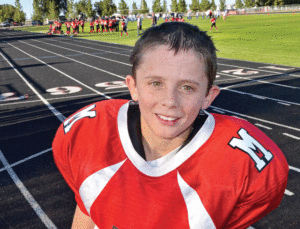
    Stetson will join his two brothers as the recipient of the Resistol Rookie of the Year in the saddle bronc riding. He is also a contender for the All Around and Bull Riding saddles. “It’s not surprising,” said ShaRee of her son’s accomplishments. “He has always been a determined kid. Once he sets his mind to stuff, he works to get it. It’s super neat to see him work towards these goals. It was a setback when he broke his jaw July 31 in Dodge City, the day after his birthday.” That rodeo was one he went to by himself. “He usually travels with Ryder, and he was by himself. “I think they are each other’s biggest support team,” she said. “It’s hard as a mom when you have one that wins and one that doesn’t.”

    Now that Stetson is about to get on 10 bulls, he is working on keeping in shape. “I’m hopefully going to be healthy and fast so I can outlast everyone there.” He’s doing it with speed and agility drills, to get his feet fast. He likes to ride his bike too. “I jump up on crates, sprint through ladders, and run across the field. Mostly running and jumping.” His goal for the WNFR is to be the fourth guy to ride all ten bulls at the NFR; Jim Sharp, 1988; Adriano Moraes, 1994; Norman Curry, 1990. “I figure if I did that the world champion would come easy.”

    After the WNFR, Stetson and his fiancé, Callie, will welcome their first daughter in January. The couple plan to marry shortly after the WNFR. Stetson will start the 2020 season in Denver. “I’m going to get on for as long as I can,” he concluded. “I’m excited to see what’s in store for us.”


    Stetson family – Steve Gray
  • On The Trail with Doug Clark

    On The Trail with Doug Clark

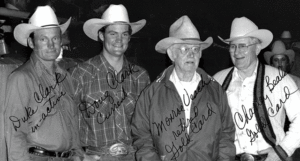
    Doug Clark will receive the coveted Ben Johnson Award at the National Cowboy and Western Heritage Museum’s annual Rodeo Historical Society’s Hall of Fame Gala on November 9. Doug was born in Tulsa, Oklahoma. “I grew up in a saddle shop – Veach Saddlery – which belonged to my grandfather, Charley Beals, and was started 100 years ago by his father in law, Monroe Veach.” He spent his summers and every day after school at the shop. “I helped make saddles and repair things. My dad tooled all the saddles for years there and it’s a family business so we did a little bit of everything.”

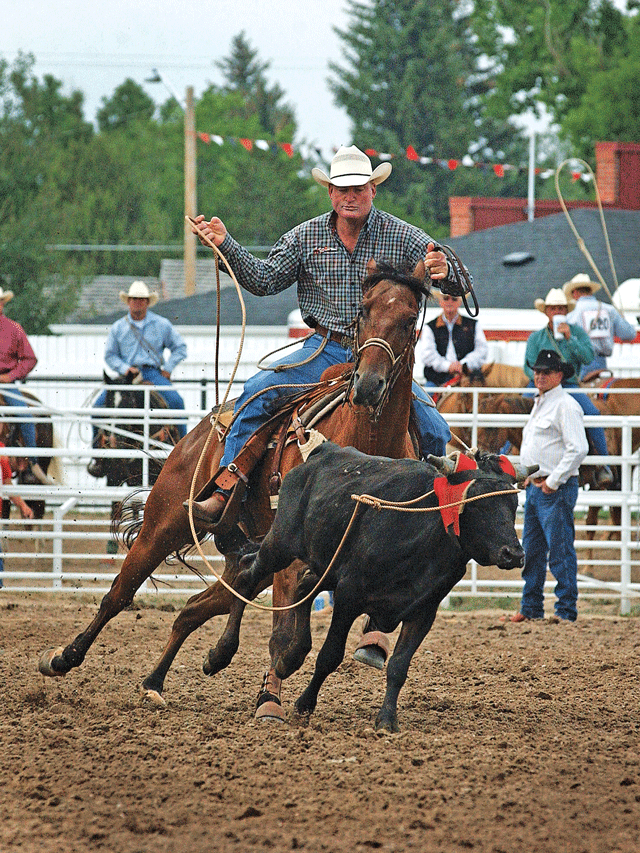
    He started tie down roping when he was 10. At that same time, he started competing in the junior rodeos in all events. “They were called FFA rodeos,” said the 57 year old that calls Wayne, Oklahoma, home. “I was fortunate enough to be around the right guys and my dad was quite a horseman. We are a huge rodeo family, so that’s all we do.” Doug and his family lived in Tusla and in the early 70s they moved 90 miles east of there to get out of town. They built an arena and that’s where Doug really started honing his skills. He went one year to the IPRA rodeos, competing in tie down roping and team roping (heeler), earning the title as Rookie of the Year in the tie down roping. He hit the road in the PRCA circuit in 1981, as soon as he was 18. He was ranked in the top 20 year-end standings for several years, winning the top rodeos and invitational ropings of the year, nationwide, while traveling on a part-time basis. He was the PRCA’s Prairie Circuit Champion tie down roper and competed in many circuit finals in that event. He set an arena record at the Cheyenne Frontier Days in 1987 when they roped calves weighing 280-300 pounds, as well as winning their coveted championship buckle for the all-around title in 1995. He added steer roping to his events entered and in 2005 earned the Pendleton, Oregon Round-Up steer roping championship. The win helped boost him to the qualification for the 2005 PRCA National Finals Steer Roping where he won second in the average and top horse of the finals.


    “I went as much as I could – I never set a goal to win this or that. I was training and traveling with some of the top guys so I couldn’t really go as much on my own.” Doug was riding and selling what he was riding to those guys. Doug has had horses either owned or ridden by Clark Quarter Horses at the National Finals Rodeo and National Finals Steer Roping Finals for over 30 years. Much of Doug’s career has been riding and training horses for the top ropers of the day, like Trevor Brazile, Tom Ferguson, and Roy Cooper. Never ‘living on the road’ entering and competing in rodeos, Doug’s real passion and specialty has been in training horses and people in a clinic format and one-on-one training in his home. “My dad was a great horseman – a quiet mild mannered gentleman – and learned how to be a good judge of horse flesh.” Doug was influenced by the old timers – great horsemen and ropers.

    Along with the pros, Doug and his wife, Linda, have had the privilege of helping kids along the way. “We’ve had a lot of kids come live with us over the years. We still take kids in who want to get better in rodeo – but really it’s all about life – it all goes together.” Every one of the kids that have come through his doors has learned about everyday living. “That includes everything from riding 20-30 horses a day, shoeing, fixing corrals, cleaning pens – you name it.” It’s the Doug Clark school of hard knocks. The kids come in, learn how to be horsemen – sleep on a lumpy old couch and work alongside Doug to achieve their goals.


    “The parents entrust us with their kids and that’s a huge compliment,” says Linda, who is the cook, but doesn’t admit to being the cleanup. Doug and Linda have one daughter, Darcy, who competed as well. Doug and Linda got married in 1985. “We met on Valentine’s Day at Baton Rouge at a rodeo,” he recalls. Six months later Doug and Linda were married. Darcy was born in 1991, and joined the rodeo road when she was young. “When Doug was horse showing, she went along. “We won a lot of awards including the Super Horse in 1999 one year, competing in all the roping events.” He was a trainer and exhibitor and judge during his time at the AQHA. Darcy competed on Doug’s old roping horses and qualified for the CNFR in 2008 in the barrel racing. She also won the breakaway at the IFYR in 2006. Darcy and her husband, Billy Good, a steer roper, still hit the rodeo road. Linda works part time as well as running a courier business with her daughter, Equine Courier Services, driving 10,000 miles a month delivering semen and embryos.

    Not only does Doug train horses and hold clinics at every age and skill level in all roping disciplines, but for many years he showed horses in the American Quarter Horse Association. He was one of the teammates winning the 1999 Super Horse Award showing the stallion, Look Whos Larkin. Doug also has been involved training and even owning three of the many horses recognized as finalists for the AQHA/PRCA Horses of the Year, which is an award voted on, annually, by top ranked cowboys.

    Doug has enjoyed his entire career and life being around the horse industry as a fourth generation rodeo participant. “I enjoy what we do and I want to keep doing it. We’ve got some good kids and some good horses,” concludes Doug. The Ben Johnson award is bestowed upon a person who has had a notable career in the arena, as well as, working outside the arena helping others to achieve their rodeo and personal goals. “I was honored with the award – I didn’t even know I was in there – it’s not what happened in the arena as much as what you can do for other people and helping them get where they want to go.”