Rodeo Life

Category: Articles

  • Profile: Johnny Salvo & Clay Acuna

    Profile: Johnny Salvo & Clay Acuna

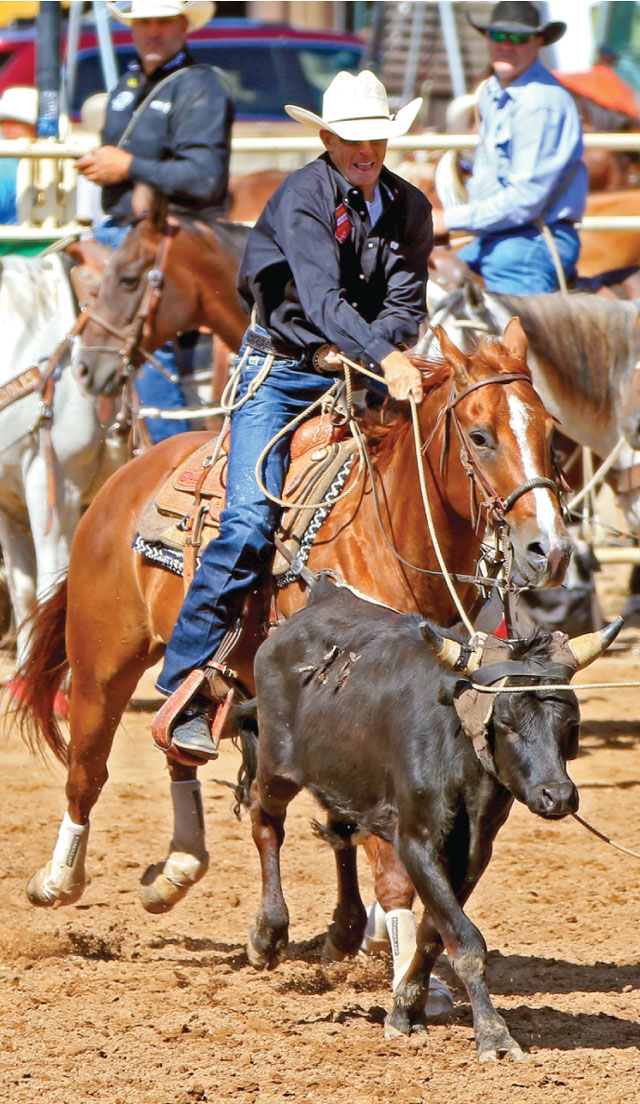
    [ If ever there was a match made in heaven, it was between Johnny Salvo and Clay Acuna during the World Series of Team Roping Finale XV in Las Vegas this last December. The pair grew up together in New Mexico junior rodeo, but life eventually led them both to team roping and, for several years in a row now, the World Series finale. ]


    As a first-generation rodeo competitor, Johnny Salvo is no stranger to forging new paths in life. His dad, Bobby, taught him this lesson early and often.
    “My dad grew up working on farms and just always liked cattle,” Salvo said. “He owned a construction company and was pretty successful at that, which allowed him to buy a ranch and fulfill his dream of raising cattle.”
    At the tender age of 5, Salvo and his two older brothers – Dominic and Dylan – were moved to a ranch just outside of Horse Springs, New Mexico. Salvo describes it as the middle of nowhere, but perhaps the desolation was a driving force behind his desire to become a successful roper.
    Much like Salvo, Acuna was raised around the very lifestyle that rodeo was born out of. With veterinarians as parents, Acuna was never short of horses or cattle at home. He first met Salvo through junior rodeos behind the calf roping chutes.
    “My dad roped, so I grew up around it essentially,” Acuna said. “When I got to college in Las Cruces (New Mexico State University), I started team roping more.”

    Young Man’s Game
    “My brothers wanted to rope calves and my dad was buying bits from Greg Dutton at the time,” Salvo said. “In my opinion Greg is the best calf horse trainer there is. I was little when he started teaching my brothers, but he started me on the dummy.”
    Salvo’s breadth as a roper is illustrated by his past success in the tie-down roping and his ability to swap ends. He won the calf roping at the CNFR in 2008 and 2011 and made the Turquoise Circuit Finals in both calf and team roping in years past.
    Both Salvo and Acuna dabbled in calf roping with the PRCA and found their fair share of success in the event. But as life often does, the ropers were taken in different directions.
    “I blew out my knee and I haven’t been able to rope calves since, so now I’m just an old team roper,” Acuna joked. “Calf roping is a fit, young man’s sport and you have to work at it a bunch. When you have a full-time job it’s a lot easier to go team rope.”
    Acuna eventually found himself in Stephenville, Texas, arguably the team roping capital of the world. With several hundred miles from Salvo’s front door to Acuna’s, it would be easy for the dynamics of their roping partnership to be ravished by time.
    They were given a unique opportunity to prove that wasn’t the case when both of their partners were unable to rope in the number 13 in Vegas.
    Perfectly Orchestrated
    “I originally qualified with Hayden Moore, but they raised both his number and mine,” Salvo said. “I’ve known Clay forever. He qualified with Bodie Baize but then they raised his number. I was actually already going to direct enter with Clay if I didn’t qualify, but everything lined up for us.”
    Neither roper had seen the timed event box together for several years, but their individual practice clearly paid off.
    “My girlfriend, Catherine Hisel, turned a lot of steers for me in the practice pen before we left,” Salvo explained. “Clay and I roped together once the day before the first round of the finale.”
    Salvo left for Vegas a few days early to run extra steers in Wickenburg, Arizona. He found himself hitting a dry spell before running his first steer in the finale.
    “I didn’t win a dime out there [Arizona],” Salvo said. “Oren Matthews let me practice on some of his jackpot steers when we got to Vegas, and I think that really helped. It was nice to not be roping for money and just relax a bit.”
    When asked about his practice for the finale, Acuna quoted Proverbs 27: 17, “As iron sharpens iron, so one man sharpens another.” Acuna sharpens his skills with some of the top professional ropers in the world who also live in Stephenville.
    “If you’re the best guy in the pen, you’re probably not getting the most out of your practice,” Acuna said. “I get to rope with guys who are leaps and bounds better than I am almost daily, and they help me out a whole bunch.”

    Horsepower
    A borrowed horse and trailer were part of the recipe for success for Salvo and Acuna.
    After selling his trailer, Salvo couldn’t find the right one to replace it before heading north. The rodeo family came in clutch when Lee Kiehne hooked his trailer up to Salvo’s truck. Acuna experienced the same type of generosity, but with the other kind of horsepower.
    “I had never ridden this horse until the day before the roping,” Acuna said. “Bodie Baize was the one who taught me to team rope, and he was the one I qualified for Vegas with until his number got moved. In Vegas I rode Ice Nation, who belongs to Bodie’s brother Bobby.”
    As a header, Acuna depends on his horse as much as any other but in Vegas the 12-year-old gelding truly made all the difference.
    “I’m not a big time reacher. I can’t make a fast run like that, so I have to use my horse more,” Acuna said. “The first steer I roped on him was the burn steer in the 13 and came back as the number two high call.”
    Living on a ranch almost two hours from school opened the door to horses and roping for Salvo. Both have become his way of life as he trains and sells roping, ranch and trail horses.
    “I really enjoy the horses, it’s just how I’ve always been,” Salvo said. “When we first moved to the ranch, my dad got me a Shetland pony and I begged him to let me move cattle on him. He finally did and I’ve been horseback ever since.”
    Most of Salvo’s calf horses were made by his roping mentor Greg Dutton. Many of the horses he’s ridden in recent years come from Todd Hedrick all the way up in Michigan, including the heel horse Salvo won on in Vegas.
    Salvo won an additional $10,000 while in Vegas heading on home-grown gelding he calls Mister. Although a smaller paycheck, it’s a special accomplishment for this horseman.
    “Every time Todd has a horse he thinks I’ll like, I send him a check and he sends me a horse,” Salvo said. “He really knows what he’s doing and he’s an honest guy. He sent me Spade when he was 2 and I just babied him around because I liked him so much.”
    For several years Salvo roped the donkey on Spade, which created both a breakaway and head horse. One day Salvo looked up and Spade was his only heel horse, so he started loading him up for seasoning.
    “He was green and is probably just now getting made into the horse that I want him to be,” Salvo explained of the gelding. “He’s a good horse with a really great mind.”

    Round and Round
    When it was all said and done, Salvo and Acuna agree that the first-round steer was their toughest. With a lot of try, the steer left Acuna in the box and Salvo did a double take on his dallies.
    A quick-footed horse helped position Acuna to make a quality handle for Salvo coming up behind him. A trip on the corner for Spade slowed up Salvo’s dally, but the duo still clocked an 8-second run.
    “We were 6 on our second steer after I necked him quick and Johnny T’d him off,” Acuna said. “Our third steer was in the other arena, and he looked really soft. And he was.”
    Acuna said he scored for what felt like forever and credits his mount with making the most of three very different runs. He would’ve ran through the barrier on the short-round steer if he was on almost any other horse he’s ridden in the past.
    “That steer was a little stronger than the rest and I actually had my thumb in the dally,” Acuna said. “We were roping for 200 grand, and I decided for that kind of money, they could have my thumb.”
    Before the run even started Salvo had decided he was going to take one swing over the steer’s back and throw. This was the highest call back Salvo’s ever been in a World Series finale.
    “As fifth high call, we were close enough to smell blood and I just wanted to make the most of the opportunity that we had in that,” Salvo said. “Everyone who roped after us either missed or roped a leg, and we certainly didn’t expect that to happen, especially here.”
    Acuna only lost a small chunk of his thumb in that final dally and split $200,000 with Salvo.
    “The World Series makes it where a nobody like me can rope, and win, $100,000,” Acuna said. “It was just our day. I’m no better of a header than anybody else there. It was the grace of God and just one of those things were everything worked out for us.”

  • On the Trail with Hailey Frederiksen

    On the Trail with Hailey Frederiksen

    Hailey Frederiksen, Miss Rodeo Colorado was crowned Miss Rodeo America 2022 on December 5th. The eight-day Miss Rodeo America Pageant was held at the South Point Hotel and Casino in Las Vegas, Nev. The pageant was last held in December of 2019 due to Covid. Like many of the 32 queens across the country, Hailey, from Wellington, Colorado, represented the Centennial State for two years. She is the sixth Miss Rodeo Colorado to win the coveted Miss Rodeo America title, last won by Tara (Graham) Rowe in 2001.

    Hailey grew up in the saddle; she ran barrels in gymkhanas and jackpots. Born and raised in Platteville, Colo., she was in 4H for 11 consecutive years showing market and breeding swine. “I was a pig gal,” laughed the 24-year-old. Through 4H, she learned responsibility, stewardship, and an appreciation for what farmers and ranchers do on a 24/7 basis. “A lot of our family friends and neighbors are farmers and it drove my platform to be an advocate for agriculture – which I did through my reign as Miss Rodeo Colorado.”

    Hailey started competing in dance in high school and had to make the tough choice between horses and dance. She picked dance and went through the ranks of competitive dance at the studio –which included a trip to Las Vegas to compete. “Even though dance is as far away from western as you can get, it taught me stage skills and confidence which is so important when competing in queen contests.” She switched her focus to Poms team. “I discovered I enjoyed that, so I transitioned into competing with my Poms team. We placed third in state my senior year.”
    Hailey’s first queen title was as had held one title previous as the 2009 Johnstown Saddle Club Princess. She spent the year traveling with her mom’s old barrel horse. “Puffy had a mind of her own, but she took very good care of me.” The pivotal moment in that reign happened at the Estes Park Rooftop Rodeo, where Hailey met the reigning Miss Rodeo America (Megan Ridley Hollinder) and the reigning Miss Rodeo Colorado (Audra Dobbs McNicolaus). “I wanted to be just like both of them and here we are.”
    She went to college at Colorado State University in Fort Collins, Colo., and realized how much she missed her roots. “Until you take a step back do you appreciate what you were able to grow up with,” she said. It was during her junior year in college (2018) she held her second queen title as Miss Rodeo Deer Trail. “That began my journey back into queening.” She rode a 4-year-old mare that her mom was working on making a barrel horse. “Honey was a rock star with flags, parades, and everything.”

    She tried out for the crown of Miss Rodeo Colorado twice (2018, 2019). “I knew I was going to be there,” she said. “Not winning fueled my passion to do better and win.” The critique from the judges was at the end of the day they didn’t know who Hailey was. “I worked hard the next year on being genuine, passionate and inquisitive … they must have seen the change, because they picked me the next year and again this year, as Miss Rodeo America.”

    During her two year reign as Miss Colorado, she spent the first year traveling to rodeos outside the state of Colorado. “When Covid first hit, we didn’t travel. My first rodeo back at it was Woodward, Okla., in June. Those small rodeo committees appreciated having us there.” She traveled with Miss Oklahoma, Miss Idaho, and Miss Kansas. “Putting ourselves out there helped us fulfill our obligation to represent rodeo and the western way of life.” She also created a Kids Corral, producing a video every Wednesday at 10 am. “I posted more than 40 videos of me reading kid’s books or interviewing rodeo personalities like Justin Rumford and Shali Lord. I interviewed my farrier, my vet and even did some kids crafts, I had a lot of fun with it and it kept me present as Miss Rodeo Colorado.” She plans to continue the Kids Corral as Miss Rodeo America.

    She is quick to attribute her win to her parents. “They have been there for me the whole time – I might be the one on center stage, but this title is as much theirs as mine.” Her parents instilled in her to work hard for whatever she wanted. “Everything I’ve put my mind to requires a bunch of work, When I was a dancer, I wasn’t flexible, so I had to work at it. I never had the best animals in 4H, but I knew if I worked hard and walked my pigs every day I’d get to where I wanted to be.”

    Megan and Trevin have been the biggest supporters of Hailey. “Dad works in oil and gas, and mom is a stay-at-home mom. She taught yoga and fitness ever since I was a baby, but her main job was being a mom.” They were both home quite a bit and helped Hailey with horses and whatever she needed. “I barrel raced growing up, but my dad put a rope in my hand and now I’m team roping with him. My dad taught me a good lesson when I’d get frustrated; there’s always going to be another steer in the pen.” He just finished the arena at their new place east of Wellington and now they can rope whenever they want, picking from any of the five horses that they own.

    Trevin has always believed in Hailey and told her before the competition. “Honey this crown does not define you – all those that love you know you don’t need to bring that crown home.” Trevin designed and built the two carts that carried all her very carefully picked out wardrobe for the competition.

    She spent many hours preparing for the Miss Rodeo America Pageant. “I am very OCD – and organized. I’d been packing for pageant for at least a month. I had all my outfits – 15 garment bags on one rack, and 17 pairs of Justin boots and 7 Greeley Hatworks hats on the other cart, a suitcase and a duffle bag. All in one trip. Appearance is one of the major categories of the pageant. “It tells the story of you – it took a year to figure out what I was going to wear. I worked with countless designers getting the clothes I needed for pageant. You only have 8 days to impress those judges.” The part of the pageant that she really enjoyed was the interviews. “We don’t get much one on one time with the judges. Those interviews were only 15 minutes.”

    Her first stop as Miss Rodeo America is the National Western Stock Show, where she will make appearances every day for 16 days. Then she’s off to Lake Charles, Louis. Her schedule is filling up. “She is worthy of whatever God has planned for her,” said her mother, Megan. “There’s no wrong or right – you pray it works out for the good – be healthy and happy is all we can wish for her.”

    “I can’t wait to see what lies ahead and the opportunities that will be available to me … I’m thrilled to see where life takes me next.”

  • Profile: Sawyer Gilbert

    Profile: Sawyer Gilbert

    2021 Breakaway World Champ


    When the 2021 World Champion Breakaway Roper was crowned in Las Vegas in December, she wasn’t even old enough to buy a drink or sit at a gaming table.
    Nineteen-year-old Sawyer Gilbert sat with her “rowdy” roping friends, while they drank, buying a few rounds for them and having fun alongside them.
    But that didn’t bother the Buffalo, S.D. cowgirl a bit.
    She grew up on the Gilbert Angus Ranch in the northwest corner of the state, doing chores since she could walk. The daughter of Lloyd and Patty Gilbert, the family had chickens when she was young, so her responsibility was to feed and water them. “Chores and responsibilities with animals have always been a part of my life,” she said. Chores “make you grow up real fast.”
    She helped with ranch chores as well, on horseback from a young age.
    Sawyer competed in junior high and high school rodeo, winning the breakaway roping at the National Junior High School Finals Rodeo in 2016, and the South Dakota state title as a freshman and sophomore (2017-2018). In high school, she competed not only in the breakaway but in the goat tying, team roping, and the cutting. Breakaway was always her strength but she loves doing the other events.
    After high school graduation in 2020, she attended Weatherford (Texas) College for a year on a rodeo scholarship. But she was unsure of a major, and because the breakaway event had exploded on the scene, she decided not to return.
    “I didn’t ever really want to be a student,” she said. “That sounds bad, but I never knew what I wanted to do in school.” Because she decided to rodeo full time, she made the decision to not go back. “I knew there were lots of commitments that go with being in school: college rodeos, hours spent on homework. School will always be there, so if I decide to go back, I can, but I don’t have to get it done right now.”
    After finishing second in the goat tying for the National Intercollegiate Rodeo Association’s Southwest Region, she knew she’d qualified for the College National Finals Rodeo.
    So she turned her attention to the pro rodeo breakaway roping, and didn’t tie another goat till the CNFR.
    “I tied three practice goats before the College Finals,” she said. And while in Casper, Wyo., at the Finals, her mind was still on pro rodeo. “I had made it, and I wanted to win, but I was (in Casper) for three days and had to drive to Reno (for the pro rodeo). It was not one of my top priorities.”
    By mid-June, Sawyer had missed enough of the rodeo season to be outside the top fifteen breakaway ropers in the world. She hit every possible rodeo she could, trying to climb in.
    Then, at the Cheyenne Frontier Days, lightning struck; she won the rodeo, adding over $17,000 to her winnings and moving her into the top five in the world. After that, she never slipped out of the top five again.
    Six weeks later, Sawyer won the Pendleton Round-Up.
    She went into the National Finals Breakaway Roping Dec. 7-8 at the Orleans Arena in Las Vegas in second place in the world, behind Shelby Boisjoli. Shelby led the entire Finals, till the eighth round, when she missed her calf. Slowly, Sawyer was catching up in the rounds and when it was all done, Sawyer was the only cowgirl out of the fifteen to not miss a calf; a perfect ten head and an average win.
    The tenth round was suspenseful; Sawyer knew she had to catch. “Definitely walking into the tenth round it was a little high intensity,” she said. But Sawyer is good at refocusing the nerves for short rounds and important runs. “At the end of the day, it’s still just one run, just one calf, like any other calf I’ve roped. I just wanted to be strong at the barrier, get out of the barrier. I wasn’t trying to win the round. I had a good calf drawn, and I just knew I needed to get that calf roped.”
    Three horses took care of her during the 2021 season.
    Hollywood, Roger and Big Enough each had their role for the year.
    Hollywood, a sixteen-year-old sorrel mare, was her primary horse for much of the year. “She’s the most well-rounded horse I have,” Sawyer said. “She can do it all. At the normal rodeos over the summer, when you can see where the barrier is, she shines on those setups, because she is so fast and scores so well.” Hollywood took care of most of the NFBR rounds, but when she rared up once and got hot, Sawyer gave Roger a round.
    Roger, a paint gelding who is also sixteen, is for the short scores and slower calves. “He quarters and gets the rope broke off faster.” He does well in loud and chaotic atmospheres. “He’s a wired little animal, so he works better under pressure.”
    Big Enough is a horse borrowed from Sawyer’s younger brother, Grey, who rides him for high school rodeo in the tie-down and heeling. Big Enough has won horse of the year in South Dakota junior high rodeo; “everyone who swings a leg over him wins money on him,” she said.
    Sawyer trained Roger; Linsay Sumpter trained Hollywood.
    She doesn’t often cook when she’s on the rodeo road, but if she does, it’s with a can of her grandma’s famous canned beef, “steak in a jar,” as grandma Linda Gilbert calls it. “I could live on that stuff,” she said. “If I could have canned meat every single day of the week and prime rib on Christmas, I could live on that.” It goes along with her, in her trailer, along with baby potatoes and canned corn, and when she needs a quick meal, it all goes into one pot, to be warmed up.
    This winter, Sawyer is home in Buffalo, letting her horses rest, working out with weights and cardio, and training new horses, working on a second string. Her mother, a physician’s assistant specializing in sports training, has made workout plans for her, which include plenty of upper body weight lifting.
    Sawyer knows herself well enough to know she has a “one-track mind. I can only focus on one thing. I’m 110 percent in or absolutely not at all.”
    At the end of her pro rodeo career, she wants her name to be synonymous with breakaway roping. “When you think about breakaway roping,” she said, “you think about Sawyer.” She hopes to have a place in Texas, because of the opportunities to rope in the winter, but Buffalo will always be home.
    Sawyer loved the fourteen cowgirls she roped alongside of at the NFBR.
    “They were a great group of girls, all for each other and very supportive of each other and willing to help. That goes a long ways in helping the sport progress. Everybody wanted everybody to do well.”
    Sawyer placed in five rounds and won the average with a time of 46.3 seconds on ten head.

  • 2021 Cowgirl Honorees Inducted

    2021 Cowgirl Honorees Inducted

    courtesy of Linda Clark

    photos by Rhonda Hob


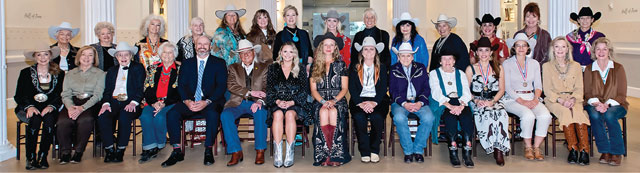
    What began in a library basement nearly 50 years ago in dusty Hereford, Texas, has turned into an amazing 33,000 square-foot destination featuring fearless, talented women, also known as ‘cowgirls.’ The annual National Cowgirl Museum & Hall of Fame luncheon located at the Dickie’s Arena in the cultural district of Ft. Worth, Texas, once again hosted induction ceremonies Oct. 26.
    Pat Riley, the museum’s executive director expressed her joy regarding this year’s event, “the 2021 annual induction luncheon was a sold out event attended by over 1,300 people. We are grateful to everyone who attended and paid tribute to the amazing group of females who were being honored. The power, strength and trailblazing spirit of this group is unparalleled, and hearing their stories and listening to their acceptance speeches was moving and empowering. We are already looking forward to next year.’’
    The word ‘cowgirl’ was traditionally thought of as someone who roped a cow and lived on a ranch; someone who was tough inside and out. While those platitudes may still apply to the term ‘cowgirl,’ the fulfilment of the definition has certainly evolved. Women that now define themselves as cowgirls seems to epitomize more of an independent spirit; perhaps involved in the agricultural industry in some form or fashion; an individual thinker; one who is creative, perhaps breaking the glass ceiling on what was formerly thought of as male dominated career fields.
    This year’s slate of inductees encompassed five women from diverse backgrounds and careers, but all consider themselves ‘cowgirls.’
    Miranda Lambert — hailing from east Texas has accomplished much in the country music world. A talented musician, singer and song writer she is a force to reckon with as an entertainer, businesswoman, and cowgirl. Lambert began her singing career as an underage teen in local honky-tonks with the permission of her parents. At last count, she has won 35 Academy of Country Music Awards (ACM) awards, nine of those consecutive honors as the Female Artist of the Year. Another woman of strength, Lambert is a valiant pioneer for women in the music industry who many times do not receive parity in radio airplay compared to their male counterparts. She was instrumental in the creation of the Women Creators Fund at Belmont University. Her passions are not only in the music field — she and her mom, Bev Lambert, created the MuttNation Foundation that raises money for shelter animals, through fund-raising efforts and her same-named line of pet supplies. Lambert’s passion for animals is not lost on shelter animals and she is the owner of several horses, especially her beloved Gypsy Vanner breed, which are known for their magnificent manes, tails, and feathered legs.
    Kathryn Kusner — was the first American woman to win an Olympic medal in show jumping. Starting her horse career as a stable hand she quickly showed an aptitude for English riding, jumping, as well as steeple chase, and won many national and international titles. Kathryn’s slender, petite build was also an asset in the horse racing world and she made several, failed, attempts to get her jockey license. Her gender in the 1960s was a hindrance to qualification and she successfully sued becoming the first U.S. licensed female jockey in 1968. The glass ceiling definitely shattered as a result of her tenacity. In addition, Kusner is an accomplished pilot, scuba diver, and competitive marathoner, but her most important work has been a program she began providing horsemanship camps for at risk children in Los Angeles.

    Lari Dee Guy — is a multiple time world’s champion in breakaway roping, heading, heeling, and all around. Growing up on her family’s ranch in Abilene, Texas, Guy has lived her life horseback with a rope in her hand. Breakaway roping has long been a standard event for boys and girls in the junior, high school, non-professional, and college ranks of rodeo. Lari Dee and many of todays’ top breakaway ladies were successful in bringing breakaway roping to the PRCA rodeo ranks in 2020 with much hullabaloo and fan acceptance.
    WPRA President Jimmie (Gibbs) Munroe, herself a National Cowgirl Museum & Hall of Fame inductee had this to say about Lari Dee, “The National Cowgirl Hall of Fame inducted one of our champions this year. Lari Dee Guy was inducted along with an impressive 2021 class. The WPRA is very proud of Lari Dee and all of her accomplishments and achievements. Not only is she an eight-time WPRA World Champion, but she has given so much back to women in rodeo. Through her clinics she had inspired young girls to want to be ropers and to believe they can achieve anything they set their minds to. With “Rope Like a Girl,” she has created a movement in women’s roping that we have never seen before. She is truly a phenomenal ambassador for the sport, and we are so fortunate to have her represent our association. Congratulations from the WPRA and thanks to Lari Dee for what she has done for breakaway roping and women in rodeo. We know that her contributions are nowhere close to being done.”
    Merina Lujan, known in the art world as Pop Chalee, a name given to her by her grandmother, a Taos Pueblo, means ‘Blue Flower.’ The Native American painter rose to prominence in the 1930s when at the ripe old age of 29 Pop began her art career after attending the Santa Fe, (New Mexico) Indian School of Art. Her depictions of Indian ceremonial dancers, forest and wildlife scenes, horses, and deer met with interest and commission pieces purchased from such notables of the day as Gene Autry, Walt Disney, and Howard Hughes. Some credit her whimsical artistry of deer as the model for Disney’s ‘Bambi.’ She is credited with being an influential figure in the Native American arts movement of the 20th century.
    Lavonna Koger — better known as ‘Shorty,’ is a native Oklahoman and long-time rodeo cowgirl. Not coming from a rodeo background, her family supported her rodeo interests, however. After working in a Western retail store, she had the opportunity to go into business for herself. Always being enamored with Western retail, especially hats, she met another person named Shorty, who had a hat restoration business he was interested in selling. Shorty seized upon the opportunity and for the last 30 years has designed, manufactured, and restored hats. Her store is located in the historic Oklahoma City National Stockyards district and she travels setting up at tradeshows all over the United States. Shorty will tell you, however, that her greatest success was not in the arena, or in her store, but the creation of the non-profit, Rein In Cancer, a program initiated by Shorty and a group of horsemen to honor her sister, Shirley Bowman, who died of cancer. Rein In Cancer helps fund treatments, nutrition, and counseling through the OU Cancer Institute of Oklahoma City.
    To sum up this years’ honorees, National Cowgirl Museum & Hall of Fame board member and past inductee Pam Minick commented, “Each year I am overwhelmed by the accomplishments of the honorees and how they have paved the way and shined a light on cowgirls and our Western heritage — but this year, with almost 1,400 people in attendance … I feel that we showed the world what an impact cowgirls continue to make.”
    For more information on the National Cowgirl Museum & Hall of Fame, visit www.cowgirl.net.

  • Rodeo Historical Society Hall of Fame Induction

    Rodeo Historical Society Hall of Fame Induction

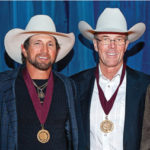
    2021 Rodeo Hall of Fame ‘Greats’ Inducted

    courtesy of Linda Clark

    photos by Jerry Hymer


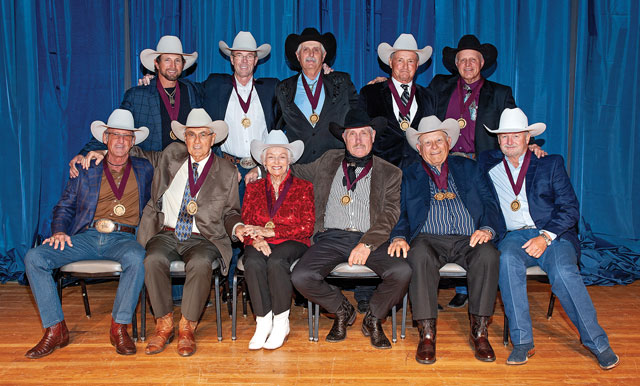
    The hallowed halls of the National Cowboy & Western Heritage Museum (NCWHM) in Oklahoma City, Oklahoma were once again a memorable recognition of rodeo greats, who were ushered into the Rodeo Historical Society’s Hall of Fame November 15-16 with 400 friends, family and rodeo fans in attendance. A non-profit organization, the Rodeo Historical Society has been part of the NCWHM since 1967 with the mission of working jointly with the NCWHM to preserve the heritage and legacy of rodeo.


    The following are the class of 2021 Inductees

    Bobby ‘Hooter’ Brown
    Bobby found his niche in the saddle bronc riding as a more enjoyable challenge for him than following in the rodeo footsteps of his father, Earl, an RCA calf roper and horse trainer. He qualified for and competed in ten National Finals Rodeos in saddle bronc riding. As a youngster growing up in Adrian, Texas he became friends with some crop duster pilots who taught him to fly. The skill set served him well. He has worked as a corporate pilot, including 300 flights in the medical industry transporting physicians and nurses in the organ transplant field.

    Jerome Robinson
    As a farm kid from Nebraska, Jerome read a Sports Illustrated article on Jim Shoulders and became fascinated by the sport that would set a career course in the rodeo arena and, later, the rodeo management industry. He competed in bull riding at the NFR in 1970-1975. In 1976 the RCA (Rodeo Cowboys Association-now PRCA) hired him part time in developing a revolutionary way to enter rodeos, PROCOM, or the central entry system, while competing on a limited basis. Jerome would, once again compete at the NFR in 1977-1981. After retirement from rodeo competition Jerome formed his own event management business, Western Trails Rodeo. This entity has taken him all over the world producing rodeos in Japan, Finland, France, and Italy. Thanks to Jerome’s background in coordinating events, he has been in charge of PBR event logistics since 1994.

    Jim Snively
    deceased.
    Growing up as the kid of sharecropper parents, Jim Snively left home and went to work breaking horses for $60/month for the famed Chapman/Barnard ranch in Pawhuska, Oklahoma. Jim began his rodeo career in 1929 in calf roping and became a world’s champion steer roper and Cheyenne all-around champion. A noted rope horse trainer Jim mounted several traveling partners on his horses. Famous ropers Everett Shaw, Clyde Burk, and Toots Mansfield all benefitted financially from riding his horses. Jim won worlds’ championships in steer roping in the IRA in 1954 and 1956.

    Ricky Bolin
    Ricky was born and raised near the Mesquite, Texas rodeo arena. He enjoyed riding dirt bikes as a youngster, but when he went to the Mesquite Rodeo his life changed forever. Jim Shoulders and Neal Gay took him under their wings. Ricky will say about his life ‘I had the best mentors and traveling partners a guy could ever have.’ He was also fortunate in 1981 to have the first corporate sponsorship for an individual cowboy from a local Coors distributorship. He received a monthly stipend and a ‘tricked out’ van, complete with red shag carpet. With four NFR qualifications in bull riding, Ricky wanted to semi-retire when he was about 30. As luck would have it, he took a job at a western store shaping hats. That was 32 years ago, and now he sits at the helm of HatCo, as the President/General Manager. HatCo is the parent company of Resistol and several other western hat and clothing brands. Ricky is very focused on ‘giving back’. He has set fund-raising records for his philanthropic endeavors and charitable causes.

    Bobby & Sid Steiner
    Rodeo is more than what goes on in the arena. For many it is a lifestyle that is handed down from generation to generation. So is the case in the Steiner family. Buck Steiner would start the rodeo dynasty at the age of 12 competing in rodeo. When his rodeo career was ending, he started his own rodeo production company and for the next several decades he and son Tommy raised some of the best bucking stock and produced some of the top rodeos in the country. These four Steiner men represent an unprecedented four generations of inductees into the NCWHM’s Hall of Fame. Bobby and Sid are both world’s champions in bull riding and steer wrestling, respectively. Both men earned championships early in their careers and chose to retire and raise families. Sid has two children charting their course as the fifth generation in rodeo in bareback riding and barrel racing. Bobby summed up what the induction meant to him, “four generations of inductees in the most historic rodeo hall is just an amazing thing for our family. It’s twice as cool since Sid and I are going into the hall at the same time.”

    Cody Lambert
    This shy, unassuming family man is a brilliant rodeo mind. Cody grew up in the racehorse industry; his dad was a jockey and trainer and his mom was a seamstress who made racehorse gear. As a kid, Cody was fortunate to attend the 1974 NFR in Oklahoma City and visit the NCWHM. That has been a standout memory for him so to be inducted into the museum is very special. Cody qualified for three NFR’s in saddle bronc riding and seven times in bull riding. While he had determination to win, his top priority was not the usual family sacrifice involved in becoming a world’s champion. Uppermost in his mind, was the impact his winning would have on providing for his family. A $1,000 investment Cody made along with 21 other bull riders in a bull riding association they formed, would morph into what is now the Professional Bull Riders (PBR). Cody remains as the only one of original investors on the payroll of the PBR and calls himself the ‘bull picker’ or livestock director, charged with the duties of putting together the best bucking bulls for PBR events.

    John Tewskbury Rhodes & Thomas Rhodes
    These two deceased inductees were a well-known father/son duo in team roping and team tying, and earned steer roping championships in the 1930’s. A Hatfield and McCoy type range war has been famously written called The Pleasant Valley Wars about the Graham and Tewksbury families. Sadly, the family infighting over their vast Arizona ranch holdings resulted in many killings. John took his stepfather’s name Rhodes to get away from the stigma of his warring family and began roping as a release from the stress of managing the family’s 300,000 acre ranch. John and Thomas were not able to travel extensively because of their ranching responsibilities but that did not deter their winning, primarily traveling to rodeos from Texas to the west coast.
    Richard “Tuff” Hedeman – As his nickname implies, Richard grew up with the name ‘Tuff Nut’ after having his hand slammed into the door of a pickup as a kid and never flinching or crying. Those internal strengths would serve him well as one of a few cowboys whose first name is synonymous with greatness. Tuff grew up in the horse racing industry as the youngest of seven children. Tuff and childhood friend, Cody Lambert, would create an indominable force in the high school, college, and professional ranks of rodeo as all around hands in rough stock and roping events. The first million dollar bull rider in earnings, Tuff won three PRCA world’s championships-1986, 1989, and 1991. He won the NFR bull riding average in 1987 and 1989. After retirement in 1998, he became a color commentator for the PBR. He now produces his own bull riding events throughout the United States.

    Carl Nafzger
    Ben Johnson Memorial Award
    This award is bestowed upon a living person who was prominent in the rodeo arena, but more importantly excels in the ‘arena of life’ as a positive role model. Carl competed in two NFR’s in bull riding- 1963 and 1965. Retiring in 1970 to go into the thoroughbred racing industry, he found success in that field and trained the 1990 Kentucky Derby winner, Unbridled, and the Eclipse racing winner the same year. He won his second Kentucky Derby in 2007 with Street Sense. The soft-spoken man has written books about positive life skills, Traits of a Winner, and Why, which is about living in truth and honesty.

    Pat Ommert
    Tad Lucas Memorial Award
    The petite, 92-year-old ‘ball of fire’ has had a storied life and became a renowned horse woman and daredevil. She is a lifelong resident of California and has a love of horses and the western way of life. Coming from a loving and close-knit family, Pat’s father, an ex-Marine encouraged physical fitness which was important when her career demanded muscle strength for trick riding and Roman riding. Her father also taught her to be an independent thinker and always provided her with good horses. She was a stunt double for many westerns and still loves to ride horses. Pat’s husband of 54 years, Willard Ommert, DVM, and Pat were involved in community activities relating to the horse industry. They were founding members of the Rancho California Horsemen’s Association.

  • Jennie Murray – Time Marches On

    Jennie Murray – Time Marches On

    There’s no question that rodeo is a generational sport, but how deep does that standard run? As it turns out, it breaches even the far corners of the rodeo office.

    When Jennie Murray takes her place as assistant secretary for the 2021 Wrangler National Finals Rodeo, she will be the third generation in her immediate family to hold this position. But it won’t actually be the first time she’ll be making history at the Thomas & Mack.
    “When Jennie kept time at the finals in 2005, she was the third generation in our family to do so,” said her mom, Vickie Shireman. “There’s never been a third-generation timer before, until Jennie.”
    Like most rodeo legacies, it all started when someone fell in love with a cowboy. Una Beutler was raised with eight siblings, four of which were brothers who all dabbled in rodeo. She traveled to rodeos with her brothers and eventually stock contractors started asking her to keep time for them. And the rest, as they say, is history.
    “When mom (Una) married my dad, Jiggs Beutler, she started secretarying all the Beutler rodeos,” Vickie said. “Rodeo was our way of life, so I was just born into it.”
    Raising and hauling rodeo stock since 1929, the Beutler family has known little else. Vickie’s grandad, Elra, was one of the original Beutlers who started in the stock contracting business. In the early 50s, that same grandad started Beutler & Son Rodeo Co. with Jiggs.
    “I got my timer’s card when I was 16 and then a couple years later, I got my secretary card,” said Vickie who will be completing her 50th year as a rodeo secretary in 2021. “As a kid, my sister (Dollie) and I grew up in the rodeo office with my mom because she was the secretary for my dad.”
    As both girls got older, they started helping their mom in the rodeo office. They quickly absorbed everything they needed to know about the job from the unsung expert, Una.

    Time Stands Still

    Just like her mom before her, Jennie spent every summer in the rodeo office as Vickie’s unofficial assistant secretary. Both Vickie and Jennie loved spending their entire summer on the rodeo trail. And now, Jennie is doing the same with her three girls – Josie, 15, Dacie, 12, and Carlie, 8.
    “It’s super sweet that the girls get to go on the road, and that they get to experience the same things that I did when I was kid,” said Jennie who, just like her grandma Una, married a rodeo cowboy.
    Naturally, Jennie met Dustin Murray at a rodeo she was working with her mom. At the time, Dustin was riding bareback horses for Southwestern Oklahoma State University with his eye on the PRCA circuit.
    Also attending Southwestern at the time, Jennie was pursuing a marketing degree while running for the cross-country team. She was still spending her summers on the road with her mom, which was ultimately building her career as a secretary and timer.
    “After Dustin and I got married in 2002, then I started working rodeos that he was entered in,” Jennie said. “Scotty Lovelace eventually hired Dustin and taught him the production side of rodeo and he hired me as a timer.”
    Scotty sold Classic Pro Rodeo in 2013 and just two years later, Dustin launched Hi Lo ProRodeo. The Murrays were back on the rodeo trail, along with their three girls.
    “We visit these cities once a year, but these people all become like family,” Jennie said. “And they really love our girls well, no matter where we are. They have become our rodeo family.”
    That rodeo family transcends time itself as multiple generations continue to cross paths at the same events year after year.
    “I still go to rodeos that I enjoyed as a kid, but now I get to take my granddaughters,” Vickie said. “It’s neat to go back to those places because of the people there who I’ve known my whole life.”

    Generation Two

    “There was no PROCOM back when my mom was a secretary, so cowboys had to call in and enter the day before a rodeo,” Vickie said of her days spent in the rodeo office with her mom and sister.
    Although both Vickie and Dollie have worked in the rodeo office for the last 50 years, they also dabbled in trick riding in the 70s.

    “JW Stoker was a world champion trick rider and roper, and he was halfway kin to us,” Vickie said. “JW was in Burwell (Nebraska) every year and my sister really enjoyed the trick riding. We were probably 12 or 13 when she told my dad she wanted to learn.”
    That following winter JW stayed with the Beutler’s for two weeks teaching Vickie, Dollie and their brother, Bennie, how to trick ride.
    “My sister kept at it, but I realized I didn’t care for it too much,” Vickie said. “I was probably 20 when my dad decided he wanted to have trick riding at all his rodeos. I did it for a couple of years, but after I broke my back, I stayed in the office.”
    Dollie has also worked at the NFR, first as a timer and most recently as assistant secretary in 2017 and 2018. But it was Una who got the family started at the NFR in 1972, when it was still in Oklahoma City.
    Nineteen years later, Vickie was selected as the assistant secretary and the following year she was the secretary, 20 years after her mom. And now 30 years after Vickie’s first trip to the NFR, Jennie will be the assistant secretary.

    Vegas or Bust

    Vickie learned everything she knows about working in the rodeo office from her mom. And she passed that knowledge down to Jennie.
    “Back when Jennie was about to get her card as a PRCA secretary, you had to go through a school beforehand,” Vickie explained. “We got special permission from the PRCA office so that I could teach Jennie and my niece, Melissa Nevarre.”
    A majority of the information passed through the NFR office in the last 40 years has gone through the hands of a Beutler relative. Vickie is continuing her reign as office manager in 2021.
    “This will mark my 26th trip to the NFR as either a secretary, timer or the office manager,” Vickie said. “This will be my 16th year as the office manager. I really enjoy each position, so I don’t have a favorite.”
    Like most of rodeo nation, Vickie is excited to see the NFR back in Vegas. Even a month before the event she said the anticipation was tangible among personnel and contestants alike. Working alongside Jennie again is what Vickie is looking forward to most about this year’s event.
    Both Dustin and Jennie will have their hands full while in Vegas. Jennie will be learning the finer details of what it takes to be the NFR’s assistant secretary. And Dustin will wrangle the 10 head of Hi Lo ProRodeo horses selected for the bareback and saddle bronc.
    “I’m not looking forward to being away from my girls for two weeks, but I am excited about the job itself and everything I’m going to learn from it,” Jennie said. “I’m always wanting to progress as a rodeo secretary and applying to work at the NFR was a surefire way to do just that.”
    In years past, Jennie refrained from applying to work at the NFR because she was needed at home as a mom. Now that her girls are more self-sufficient, she felt like it was the right time to apply for the biggest rodeo in the world.
    “I really don’t have a favorite rodeo to work, being at the NFR and the RNCFR have definitely been highlights for me,” Jennie said. “But my favorite events are the times when my family is all together.”
    Just like Una, rodeo was and is everything that Vickie and Jennie have known all their lives. Perhaps they’ve already started training the next generation of great timers and secretaries without even knowing it. Only time will tell if the Beutler legacy Una began will continue with the next generation.

  • Max Reynolds

    Max Reynolds

    Keeping the Spirit of the West Alive

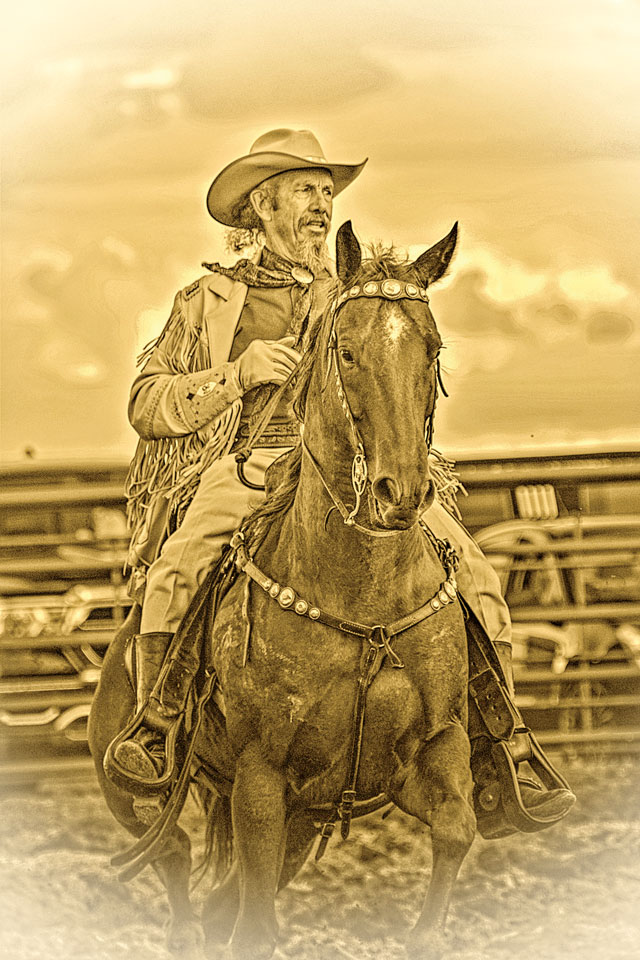
    “Heroes get remembered, but legends never die,” is a quote from Babe Ruth that gets used a lot, but Max Reynolds takes it a step further with his Wild West Acts. Spinning guns, trick roping, cracking whips, and Roman Riding while portraying Buffalo Bill and Wyatt Earp are just some of the feats this Lexington, Nebraska, cowboy has showcased to countless fans over the years to keep the spirit of the Wild West alive.
    Everything from the opening of the National Finals Rodeo to a private family party for the sheik in Abu Dhabi fills Max’s long list of performances. He was also the stunt double as Buffalo Bill (played by Peter Coyote) on the 1995 CBS mini-series “Buffalo Girls” starring Reba McEntire as Annie Oakley, Anjelica Huston as Calamity Jane, Sam Elliott as Wild Bill Hickock, and Russell Means as Sitting Bull.
    As a kid, Max watched the likes of Leon Adams and Jerry Olson perform and was inspired to learn Roman Riding on ranch horses at home. There wasn’t much the young cowboy was afraid of while growing up in Arapahoe, Colorado — except for getting caught by his parents.
    “I was afraid they wouldn’t let me do it, so I did it out behind the barn where nobody could see me,” Max said. “I was afraid they’d stop me, but I got to where I could gallop around. Then one day, I had them going good and I came out by the house and I guess Mom was out putting clothes on the clothes line and I came flying down the road on those horses and she saw me, but it was too late to stop me then. They were supportive of it, and probably would have always been, but I was afraid they wouldn’t be.”
    When he started trick roping, there weren’t any instructional videos on how to do it. Instead, it was books with drawings and instructions on which direction the rope was supposed to spin. Luckily, he soon crossed paths with J.W. Stoker who took him under his wing and taught him the ropes. His first performance was at a high school talent show at a neighboring town where he did some trick roping. He started performing at rodeos when he was 15 years old and by the time he was 16 he landed one of his first big performances at the National Little Britches Finals in Littleton, Colorado. “I can’t remember much, but I do know I was nervous,” Max said. “If you aren’t a little nervous I think you lose your edge.”
    Learning the skill was one thing, but learning the trade was another. Getting his name out there and picking up jobs performing was tough work when relying primarily on word of mouth. “You have to prove yourself, then once you do that everything takes care of itself and people will start calling and you’ll get more contracts and it just snowballs from there. It’s like anything else, you need to get known before you can get anywhere.
    “As an amateur, a man by the name of Floyd Rumford from Abbeyville, Kansas, gave me my first big summer run of rodeos and that was a big first for me,” Max said. “I was in college then, so I was about 19. Then when I turned pro, Bob Barnes gave me my first big run of professional summer rodeos in 1982.”

    After graduating high school with a class of six in Arapahoe, Max competed in team roping and calf roping while attending Colorado State University in Fort Collins. Although he earned his degree in animal science from CSU, he opted for a career in animal art instead. While in college he met Jerome Robinson who eventually produced Pro Rodeo Classics. Robinson also produced the Western American Extravaganza, a show that was taken around the world to places such as Finland, France and South America. “Some of the overseas shows were with people I looked up to when I was little, like Leon Adams and J.W. Stoker,” Max said of his travels in the 1990s.
    Now 69 years old, Max continues to perform and has several gigs in the works with his wardrobe designed by his wife, Cathy, whom he married in 1980. Wild West Acts is just himself performing at rodeos and other Western events and he’s been part of the Great American Wild West Show since it was started by Don and Sharon Endsley in the mid-90s.
    “Don and J.W. Stoker were very good friends, so I guess Max was the second one we called,” Sharon said. “J.W. said ‘Max Reynolds would be perfect because he is so versatile and can do so much,’ and now I love him like a brother.”
    Not too long after that, The Great American Wild West Show did 97 performances in 28 days with millions in attendance in Los Angeles. They were also featured in a documentary which landed Max on the cover of the LA Times. “He has been one of the backbone performers for all of these years,” Sharon said. “I can’t brag enough about him.”
    Timing is everything for Max. “You only have so much time you should be out there performing, six to ten minutes is the maximum,” he said. “You need to hit the happy area where you leave them wanting to see more, but you need to do your best stuff in that small timeframe.”
    He considers Roman Riding to be his riskiest feat since there’s fire involved. “You’re jumping through fire, and if the arena conditions are muddy or slick, or if one of the horses decides not to jump, it leaves you out there,” Max said. “It’s the most dangerous, but it’s also the most fun.”
    Audiences agreed, as his Roman Riding was the part that stuns the crowd the most. “Max on those two horses brought down the house everywhere we went,” Sharon said. Finding the right horses is harder than it sounds since they need to be able to learn to perform, and they need to look the part.
    “For Roman Riding, you need to have one with a good mind on them and I have had all kinds,” Max said. “Some would take anything, and since you put them in a lot of different situations you want them to handle those without blowing up on you. Some of them are naturals and nothing bothers them, like some people can give a speech and not have a problem, but some are scared to death of giving a speech.”
    Trick roping and gun spinning took the longest to master since the action is too fast to think about. “Your mind and body have to be coordinated,” Max said. “You can’t think that fast; you work at your craft for all of those years and it’s automatic.”
    Practice paid off as Max was nominated for Specialty Act of the Year three times in the 1990s. “You never know where life is going to lead you,” Max said. “I don’t know how many can say they were in a movie with Reba McEntire and Peter Coyote, and the rest of those stars. It’s not like I made a living at it (acting), but it was an adventure.”

  • Molly Otto – 15th Barrel Racer

    Molly Otto – 15th Barrel Racer

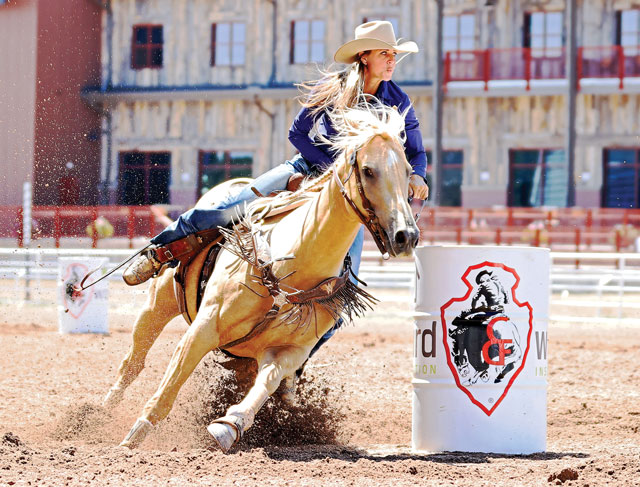
    Barrel racer Molly Otto’s horse was on the sheriff’s patrol at 2 years old and set an arena record on her first run out at 3 years old. Now five years old, she helped Molly qualify for the National Finals Rodeo on the cowgirl’s first season of hitting the rodeo road hard.
    Not bad for a horse who was named for chewing the tails off all the horses in her pen.
    Chewy (registered name Teasin Dat Guy) is owned by Katie Lindahl but was turning heads and barrels all over the country with Molly. Molly, 34, attributes some of that success to Chewy’s background on patrol.
    “She was so broke and easy and not afraid of anything,” Molly said. “She’s just very confident in herself.”
    Confidence is a quality the horse and rider share. Nobody in Molly’s family competed in rodeo or rode horses, but she was determined to follow her dream.
    “They were all terrified of horses … well, that may be a little dramatic,” Molly said. “They’d say it was a phase, and that I would grow out of it. I’d been asking for a horse for as long as I could remember. It was at the top of my list for any holiday, but my parents always said no since we didn’t live on a farm, so I would cut out ads of farms for sale.”
    Persistence paid off. Molly started riding lessons in seventh grade and her parents leased a horse for a year when she was 14 years old. But Molly knew she was destined to do more and was willing to work for it. She got her first horse at 15 and worked at a pet store and cared for other people’s horses to fund it.


    Now she trains horses professionally and qualified for the RAM Badlands Circuit Finals Rodeo the last three years in a row. She joined forces with Chewy in July 2019 and the North Dakota cowgirl knew she had something special on her hands after her first run out. They broke the arena record at a jackpot in Solway, Minnesota, with a 13.9-second run. But this was no ordinary jackpot record.
    “I previously held the arena record there on two different horses, one of them won three rounds at the Canadian Finals (Eyema Rare Bug, ridden by Cayla Melby) and another was a pro rodeo winner (Famous Charm, ridden by Sydney Forrest, Andrea Busby, and Michelle Alley),” Molly said. “It was cool she went out there and beat those horses’ records her first time out.
    Molly filled her WPRA permit in 2011 but as the saying goes, “life happened.” Living in Grand Forks, N.D., it takes a few hours of driving to reach a jackpot, so it was nearly a decade before she felt ready to give the NFR a shot. Katie was surprised that Chewy did so well, but Molly’s success didn’t surprise her.
    “I don’t know of Molly setting a goal and not accomplishing it,” Katie said. “I was excited when Molly was willing to put in the time to go for it. I’d asked her what her thoughts were on rodeoing more even though futurities were her bread and butter. We decided to see how the spring goes and then it was a quarter-by-quarter thing since neither of us has the resources to go when you’re not winning. She needed to win enough to stay on the road.”
    It wasn’t until after the Fourth of July run that Molly felt she’d reached a turning point as she jumped from 25th to 17th in the world standings. Tensions were high as the season’s end drew close and the race for the Top 15 was tight. It got worse when Chewy had to take the sidelines in September due to an abscess and Molly hadn’t qualified for the ProRodeo Tour Finale in Salinas, California.
    “I didn’t think I was going to make it,” Molly said. “There were so many people from 10th to 20th that weren’t too far apart.”
    Molly won her 12th rodeo of the season on Allison Ness’ horse, aptly named Mr. Right Now Guy. A 17.39-second run at the Wild Rides Rodeo Dickinson (North Dakota) was a hometown win of sorts, and the Sept. 18 win for $869 gave her a boost in maintaining the No. 15 spot. Molly qualified for her first NFR by a margin of $4,761.
    “I was relieved…Like, I went through all of that hard stuff all year and made all of those sacrifices and it all paid off,” Molly said. “I feel like it’s God’s purpose for me and this is the platform he gave me to use. All year, when I’d feel unsure if I was supposed to be out there, it was like ‘bam,’ he would give me something huge and my horse would win a rodeo.”
    The encouragement from her family and friends also helped throughout the season. Now her husband, Andy, and their sons Sterling, 15, Rowdy, 12, and daughter Blaisy, 5, will be cheering her on at the Thomas & Mack.
    “I wanted to show my kids that with God anything is possible, and I hope to inspire them to have a ‘no quit’ attitude in life and that if they work hard enough, they can achieve anything,” Molly said.

  • Hamblen Hats

    Hamblen Hats

    Travis Hamblen Starts A New Hat Company.

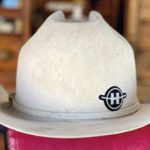
    Travis Hamblen started out with $28 in his pocket when his life abruptly changed course. After four years of working for another hat shop, his new path led toward starting his own business, Hamblen Hats. “I tell people this isn’t my hat shop, it’s God’s shop and my customers’ shop, because without my customers and God there’s no way I’d be where I am,” Travis said. “I was a single dad starting over from scratch.”
    Travis started with 250 American Hats and a mobile shop in a trailer that was taken to jackpots and other events across Colorado, Oklahoma, New Mexico, Texas, Wyoming and Nebraska. “We got all of our hats a week before COVID shut things down and it was tight quarters in that trailer, about 10-by-10 feet,” Travis said. “Keith Mundee (President of American Hat Company) helped us get going. We picked up the Atwood hat line too since they’re made in America. That’s why I went to Brooks Atwood. We checked his cows, prayed over dinner and these are my people.”
    In less than two years he went from a small trailer to opening the first Hamblen Hats store on June 28 in Ault, Colorado, about 40 miles south of Cheyenne, Wyoming. “We’ve grown a lot over the last couple of years and with the storefront it’s doubled,” Travis said. “It’s an amazing community here in Ault. We are getting to the point where there’s a crew of people who stop by to talk and it has a coffee shop atmosphere.”
    Travis shaped his first hat over a tea kettle when he was 13 years old and by the time he was 16 he had shaped all of his hats. “I didn’t want my hat to look like a store-bought hat, I wanted it shaped like Ty Murray’s,” Travis said. “I dropped out of high school about six months before graduating, and my grandpa (Sam Hamblen) told me if I went back to school he’d buy me the best hat that he could. But, I couldn’t shape that hat. That was my love language, so I said I can put up with six months of not liking school.”
    Sam received the first custom hat Travis built in January 2020 and he was at the grand opening of Travis’ store shortly before passing away in the fall of 2021.
    Before diving into the hat business, Travis worked with the Wild West Cattle Company in eastern Colorado, doing anything that needed to be done for the competition, including announcing. “I’ve always been around cowboy stuff and I just love the lifestyle.”
    Now he enhances that lifestyle for others, and it comes with a wide brim. “We had a cowboy tell us ‘the relationship with my hat shaper is the most intimate relationship I have. My hat is ME, the stories that are in the hat, the work I do every day, it has a lot to do with my personality so having a hat shop that understands my lifestyle and passions, and me as a person, is what gets me,’” Travis said. “That’s what guys who wear hats every day want, not to just grab one off the shelf.”
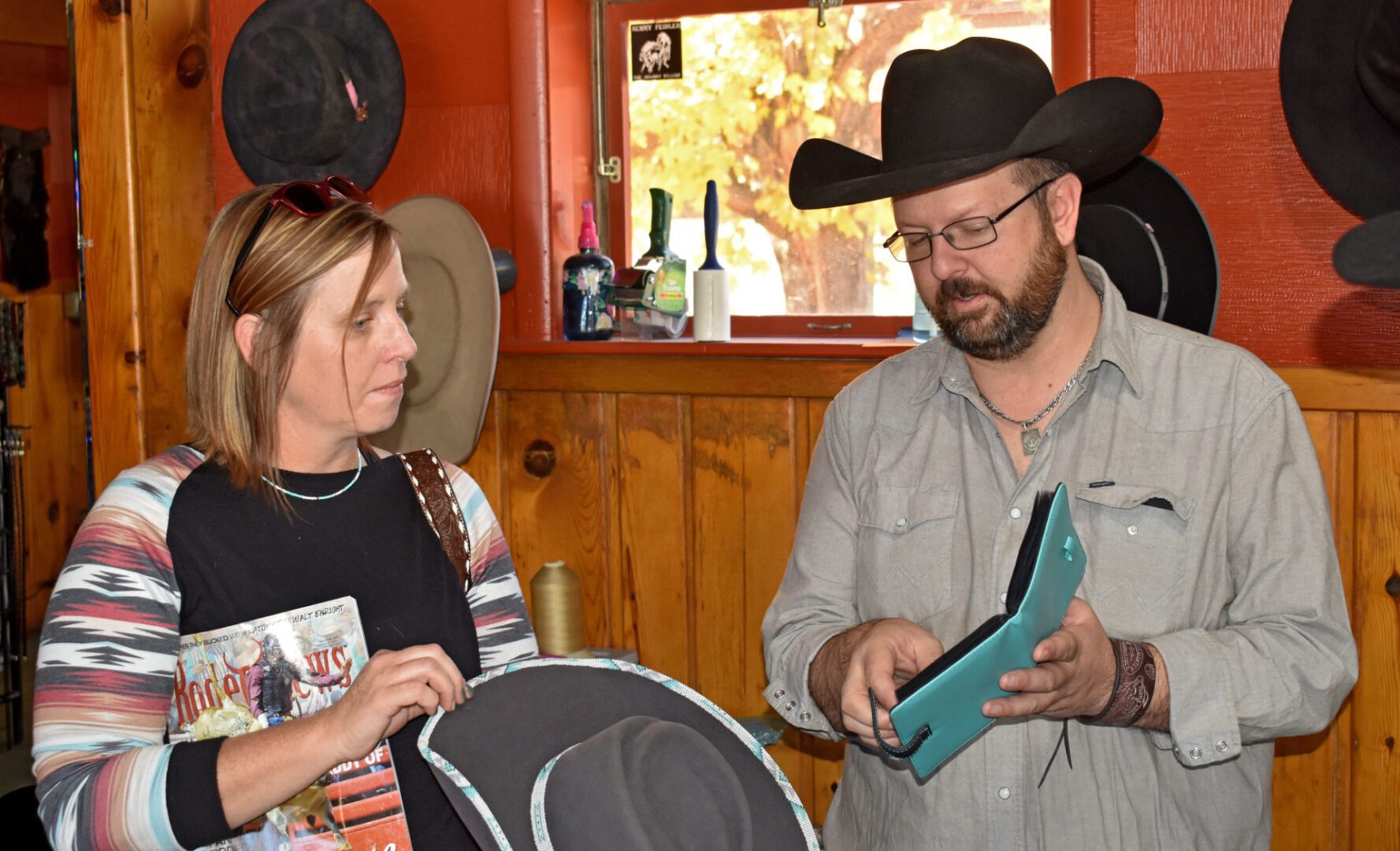
    Striving for a unique product presented some equally unique opportunities. Claire Parr sold her hat business, Claire West Designs, to Travis before losing her battle with cancer in early 2021. “She was building hats for Jay-Z and Beyoncé,” Travis said, holding Claire’s notebook of measurements with a letter of encouragement to him.
    As for which celebrities Travis makes hats for, that’s up to his clientele to reveal. “They come to us because they want to have that confidence and be treated like a person.”
    James Young (guitarist in the Eli Young Band), Dalton Risner (offensive lineman for the Denver Broncos), comedian Steve “Mudflap” McGrew, and rodeo contestants such as Sadie Jackson, Kyle and Maddie Dickens, Devon Burbank, and the entire Colorado State University rodeo team are some of his clients. Hamblen Hats also sponsors nationally ranked ranch sorter Shawn Elliott from Greeley, Colorado.

    No appointments are needed and there’s a catalogue of hats to choose from at hamblenhats.com.
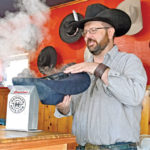
    “We can custom fit them, custom design them and build them from scratch,” Travis said. “We can rebuild hats too, so if they bring in a dirty, nasty hat we can block it, flange it and re-craft it.”
    The first time someone brings in a beat-up old hat, they’ll toss it on the counter as a challenge – “I’ve got one for you, see what you can do.” But after their first one is fixed; the rest are brought in with a bit of a somber and hopeful tone of “see what you can do.”
    “It’s nice to see their eyes light up when they brought in a hat that’s all caked up with grease and dirt and they thought we couldn’t do it, but then we did,” said Travis’ employee Parker Longbottom.
    Parker started shaping hats about two years ago at The Wrangler in downtown Cheyenne. “I taught myself the ropes there and came here to get further into it,” Parker said. “Hats are one of those things where it’s more than just a hat. There’s that style to it and being able to help someone make theirs unique.”
    Travis also gets help around the shop from his parents, Carol and Cliff, and his sons, Braxton, 14, and Kasen, 12.
    Travis prefers not to clean his own hats. “They have memories. They’ve been to the feedlot and funerals and been with me when I won the only buckle I own and when my kids were born,” Travis said. “Hats are no different than pickups; the better you care for and maintain them, the longer they last; and it’s fun making them last a little longer.”
    Shaping hats takes about 15-20 minutes, picking one out takes a bit longer. Fitting one and custom designs can take a few hours. Depending on the hat’s condition, it could take two to three weeks for it to be cleaned.
    “It very much is an artform, every hat has eight to ten raw manhours put into it,” Travis said. “We take a blank hat and pick which block based on the shape and size of their head and the design of the hat. Then we’ll hand-finish it to smooth it out.”
    It’s not just cowboy hats – there’s top hats, bowlers, fedoras, broadbrim fashion hats, and just about anything a customer could want.
    “We always ask people if they want the Flying H on the back of their hat and the coolest thing is seeing that on the back of a hat since they made the conscious decision to support our brand,” Travis said. “That’s what means the most to me since that brand is no different to me than ‘riding for the brand’ when I worked on ranches.”
    Travis likened the relationship between a cowboy and his hat shaper to a woman and her hairdresser.
    “Hat people and cowboys make a living with their hats, it’s part of their equipment,” Travis said. “Our slogan is ‘keeping cowboy cool,’ so I try to stay close to those roots.”

  • Profile: Cole Patterson

    Profile: Cole Patterson

    Cole Patterson shatters regular season earnings record with $104,516

    Announcers used to introduce Cole Patterson to the crowd as the son of four-time world champion steer roper Rocky Patterson (2009-2010, 2012, 2016). That’s not the case any more as the young steer roper won the 2021 steer roping world title.
    “I’ve grown up my whole life being ‘Rocky’s son,’ so it’s definitely a change whenever they have something to say about me other than what my dad’s done,” Cole said. “It’s hard to believe that you’ve joined that elite group of people that have won. In steer roping it’s particularly difficult since there’s only been about five guys who have won it in the last 30 years.”
    Cole shattered the steer roping regular season earnings record with $104,516, a solid $15,089 leap over the previous record of $89,427 set by Tuf Cooper in 2018.
    “When you go in with a lead like that, everyone expects you to win,” Cole said. “After the first night of the Finals I was just thinking about the average since I had about a 7-second lead and winning the average is just as hard as winning the world, I think.”
    Now he has both buckles, as world champion and winnger of the 2021 National Finals Steer Roping average with 97.7 seconds on nine head.
    Cole’s horse is also making a name for himself as RBS Badger Tigger, or just “Tigger” for short, won the 2021 Nutrena Steer Roping Horse of the Year Award.
    “I didn’t have him for all of last year, but I had him for all of this year and I’m still pretty green at this, so I feel like I’m getting better as he’s getting better,” said Cole, 26. “He had no other option but to win it after the year we’ve had and the places we won. He’ll never will know he was Horse of the Year, but I am grateful that he did win it since he changed everything for me.”
    This is the second horse Cole’s ridden to win this award. In 2019, Mr. Blackburn Chex 113, “Dunny,” won and helped Cole claim the 2019 Steer Roping Rookie of the Year title. Cole bought Tigger during the spring of his rookie season and he wasn’t a steer horse at the time.
    “I cracked him out too early and too green, so we had some growing pains together my rookie year,” Cole said. “But then the COVID break came along and I guess that’s when he figured it out. He scores good, has tons of run and is really strong. Man, he also has about the perfect drag for me too. I can’t name a downfall on him. He’s definitely been what I needed.
    “I don’t know what he’s thinking, but he definitely has a personality – he is a pain in the rear to tell you the truth. He’s like a spoiled kid; he knows he’s good, so he expects special treatment and he’s super lazy when you get on his back. In the arena, he struts around after you tie a steer on him. He’s definitely got a personality.”
    Cole finished 15th in the PRCA world standings in 2019 with $43,671 and was fourth in 2020 with $87,405. The Pawnee, Okla., cowboy credits a lot of his growth to Tigger.
    “I don’t know why, but the wins all seemed to come at the right time,” Cole said.
    Cole got married shortly after last year’s NFSR on Nov. 21, 2020, and his wife, Natalie, watched the season unfold.
    “It was kind of surreal but definitely very exciting,” Natalie said. “It was like, ‘how can we top this?’ I didn’t think it could get much better, but then it did. I’m so proud of him. His horsemanship has really evolved over the last few years, same with his roping. He’s getting comfortable in knowing what to do in different situations and adapting to anything that can happen and that comes with experience.”
    Now he’s shooting for the 2022 world title.
    “Everyone is chasing the same thing, you know, so the crazy part about it is there’s people who dedicated their entire lives to trying to win one and never did. You know it’s not easy, but that’s it for me.”

  • Art of Rodeo with Sharon Widmer

    Art of Rodeo with Sharon Widmer

    The memories of people’s favorite horses live on through Sharon Widmer’s work.

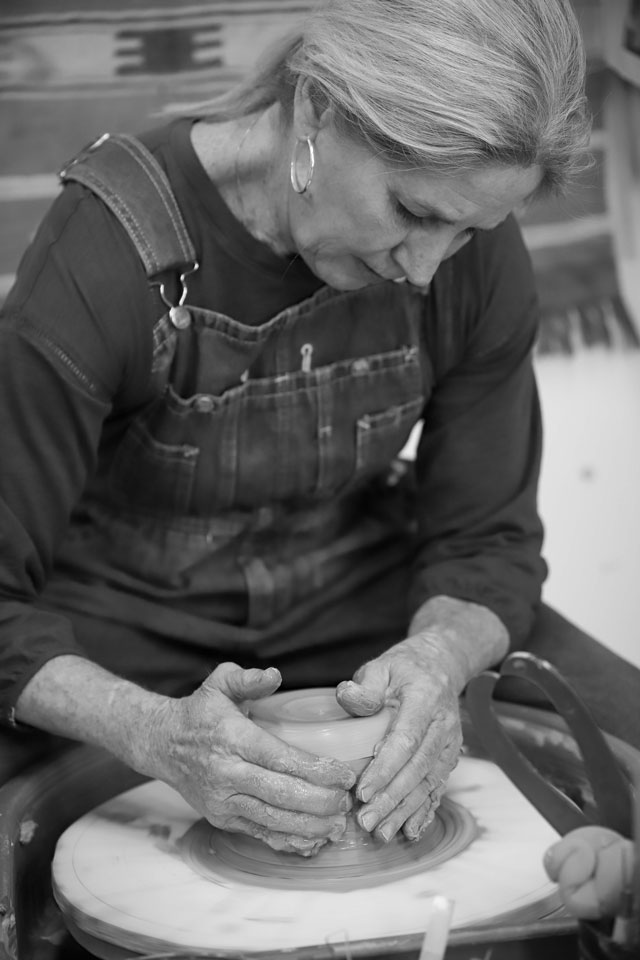
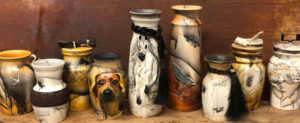
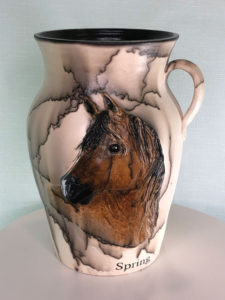
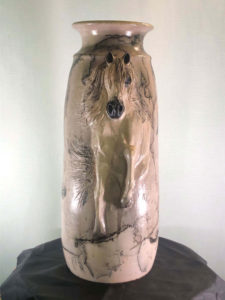
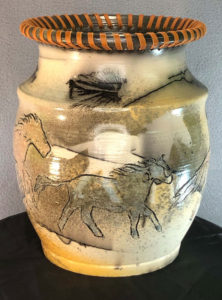
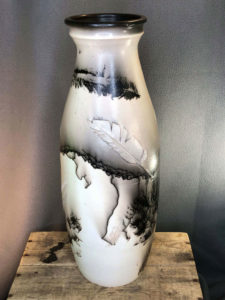
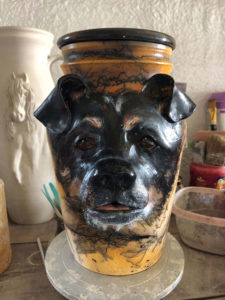
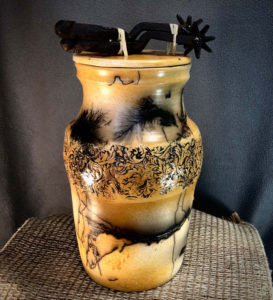
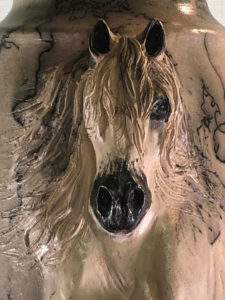
    The Deep River, Iowa cowgirl makes horsehair pottery from the manes and tails people send her of their beloved horses who have passed.

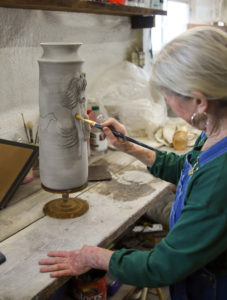
    In her studio at her and husband Neil’s house outside Deep River, she uses the Navajo technique of putting horsehair on pottery the instant it comes out of the kiln. It sears into the pottery, leaving a smoky pattern, carbon trailings and a unique, one-of-a-kind piece of artwork commemorating the animal.

    Sharon herself is a horse lover.

    Growing up in east central Iowa, she rode horses but didn’t attend her first rodeo till she was in her twenties. She saw the horses, and was in awe. “Those horses were so broke and fit and beautiful and athletic,” she remembered. “It was what I wanted to do.”

    So she bought an 18-year-old horse that showed her the ropes of barrel racing. Sharon knew how to ride, but the horse helped her. “He let me know what it felt like to ride a horse that knew what he was doing.”

    She competed at regional rodeos, with the horse carrying her to some placings. Sharon was delighted. “I am all in. I love this,” she said, of the experience.

    She bought a few horses, trained some, and continued to run barrels in the regional associations and in pro rodeos as a WPRA member, qualifying for the Great Lakes Circuit Finals several times.

    An artist by trade, she graduated from college with an art degree and had a pottery studio at her house, making functional pottery for purchase.

    In 1987, after a divorce, she sold her equipment, quit throwing pottery, and never looked back. “I walked away,” she said. “It felt like it was time for another season in my life.”

    She had made pottery that was still in use in her kitchen, and four years ago, her kids asked when they were going to get a piece of Mom’s pottery.

    So she borrowed the use of a friend’s studio and threw some pots.

    The light switch was flipped. “It had been 30 years since I’d touched clay, and I didn’t miss it, long for it, and didn’t really have any intention of getting back into it. But the first time I put my hands on the clay, my thoughts were, oh, my goodness, I forgot how much I love this,” she said.

    A friend asked if she knew how to do horsehair pottery.

    Sharon didn’t know, but after searching online and watching videos, she taught herself.

    When the pottery comes out of the fire, which is over 1,000 degrees, horsehair is laid onto it and it burns in, disintegrating and leaving a pattern and a carbon trail. Feathers can also be used.
    The process must be done quickly, before the pottery cools off and the hair won’t burn.

    Sharon estimates there’s about a five minute window to place the horsehair or feathers. She has an assistant who helps with the process.
    She might put on a strand at a time, or she might put a handful on. “It’s very organic.”

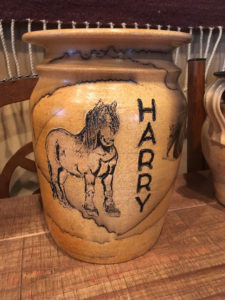
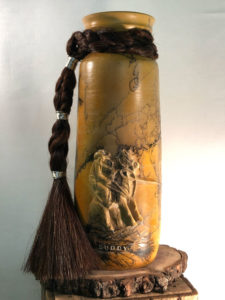
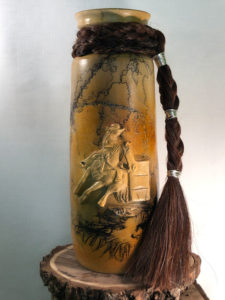
    In addition to commemorating an animal with hair, she sculpts pots with a variety of figures: horse’s heads, dogs, barrel racers or ropers’ figures. She’s put horse’s names on pots and uses other keepsakes to personalize a piece.

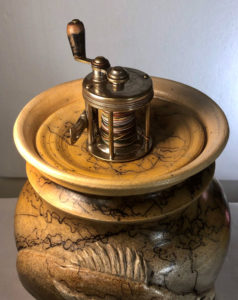
    When her dad, an avid fisherman, passed away, she used a reel on the lid of the pot, and sculpted a walleye into its side with her dad’s lure in its mouth.

    She uses horsehair as braids or a tassel on pieces, too. “I keep working on it till I sense it’s done. It can be a long process or a quick process.

    “No two pieces are ever alike. Not only are they hand-thrown, which makes them unique, but the hair and the whole process is unique.” Most of the pieces she makes are custom, but she also has pottery for sale that isn’t custom-designed.

    They are works of art, she said. “Each one is intended specifically for someone and something.

    “People cry all the time when they see their horsehair pieces. People fall in love with their animals, and this is a way to remember them.”

    Throughout her working life, she has been involved in various aspects of rodeo and other business ventures.

    She worked for Steve Gander and the World’s Toughest Rodeo securing sponsorships, from 1990 to 1998. She worked for the WPRA in marketing and sponsorships, producing the WPRA World Finals in 2007-2008. She sold advertising for the RFD television show Women’s Pro Rodeo Today, for a while. She produced the Iowa River Catfish and Cowboy Show for the Iowa County (Iowa) Fair Board, and worked with Tommy Joe Lucia on sponsorships for some of his events. She and her husband, Neil, a team roper, produced family rodeos at their place for eight years, along with lessons and clinics in goat tying, pole bending, barrels and breakaway.

    For a while, she owned a candy store, making the “world’s best mints” and selling them across the country.

    She brought Louisiana to the Midwest, producing a Cajun and Zydeco Festival, complete with crawfish, boudin, accordion and fiddle, to Amana, Iowa; Lincoln, Neb.; Dayton Ohio, and Sault Sainte Marie, Wisconsin.

    “I like putting things together,” she said. “I like creating the company and getting it rolling.”

    Nine years ago, Sharon had a horse accident that changed her attitude about life.

    She was training a skittish barrel horse. She was on the ground, and got trapped between him, a gate and a fence. He got scared and wanted through the gate, which, Sharon believes, he got a stirrup caught on, which pulled it shut tighter the more he struggled. “It was the gate, him and me, and the space got smaller,” she said. “I was crushed.” She suffered compound fracturing, degloving of her left arm, a torn ACL and punctured lung, and broken vertebrae. She didn’t ride for nine months. It was hard getting on a horse again, but she did, and continues to barrel race today.

    “I was tickled to be riding again,” she said. She had a different perspective on life. “Whatever I wanted to get done, I figured I’d better get on it.”

    Her pottery includes more than horses. She’s done pieces with dog hair and cows (someone once sent a switch from a 4-H heifer), and sculptures with wild turkeys and bears on them. She works in her husband’s shop. “It’s a messy process,” she said. “There’s clay on the walls and the floor, and when you glaze, there’s glaze all over.” Burning the horsehair and feathers smells terrible and causes smoke, so in the summer, she opens the overhead door to let the smoke and odor out.

    Creating things and being an artist is her love.

    “Horses are a gift from God, and (her artistry) is a gift from God, too.

    “It’s my season to be an artist and I’m so thankful to have found this particular media that speaks to me. To me, it’s very spiritual, to have someone’s horsehair, and create something for that person. It helps them to feel like they have that animal.”

    Sharon’s work can be found online on her website at: SharonWidmerClayArtist.com

    She and Neil have five children: Kelly Hall, Luke Winegarden, Tyler Winegarden, Anne Audo, and Camarie Widmer. They have four grandchildren.

  • Madi Outhier wins second consecutive world title

    Madi Outhier wins second consecutive world title

    Madi Outhier has won more than half a million dollars in breakaway roping and she’s just getting started. The Fulshear, Texas, cowgirl was crowned the 2021 Breakaway Roping Rookie of the Year at the end of the regular season.

    Not a bad way to celebrate her 19th birthday.

    More recently, the Texas A&M freshman earned $60,000 and became the first to win back-to-back WCRA Women’s Rodeo World Championships in breakaway roping at South Point in Las Vegas on Oct. 29. Madi’s 1.91-second run to win the title also made her the only athlete to win the WCRA’s world championship and the WCRA Triple Crown of Rodeo in Corpus Christ, Texas, in the same year.

    Madi ended her high school rodeo career with an exclamation point, winning the 2021 Texas High School Breakaway Roping title. Madi didn’t consider her summer run to be particularly successful, so winning the WCRA title came just when she needed it most.

    “It was awesome to get my confidence back,” Madi said. “The production the WCRA put on there was amazing. It was first class and they put us contestants first. The final round aired on CBS and they say it had 2.3 million viewers, which was a record for number of viewers for a rodeo.”

    Madi narrowly missed qualifying for the 2021 National Finals Rodeo since she cut her season short to begin her fall semester in College Station, Texas.

    Madi is majoring in business and thanks to her rodeo winnings, she’s already started her own business making and selling jewelry. Although rodeo’s been profitable, the entrepreneur is in playing the long game and is prioritizing her education. “I went home to go to college while they continued to rodeo hard, so I missed some of the big ones at the end of the season.”

    Rodeo isn’t entirely on the backburner as she competes on the Texas A&M rodeo team in breakaway roping and barrel racing. Madi considers the competition to be just as tough at the collegiate level as it is at the pros. “All these girls are at the top of their game and it’s just as difficult to win at the college rodeos since they all rope so good.”

    Although she won’t be competing at the Thomas & Mack, she could still strike it rich in Las Vegas during the NFR as she’s set to compete at five nearby ropings. Fans can watch her in action at:

    • Vegas Tuffest Jr. World Championship at The Expo At World Market Center, Dec. 1-6
    • Junior World Finals in the Wrangler Rodeo Arena at the Las Vegas Convention Center, Dec. 9-11
    • The Masters Elite at the Henderson Saddle Association Arena, Dec. 2
    • Resorts World Breakaway Championship at Resorts World Las Vegas, Dec. 8-10
    • Rope For The Crown Breakaway Championship at The Plaza Hotel & Casino, Dec. 3-4

    “It’s incredible how much money is at the youth events,” Madi said. “The Resorts World roping is new this year and it will have a pot of $80,000.”.

    Beyond that, Madi has her eyes on The American and qualifying for the 2022 NFR. “I was just short of making the Finals, so that’s a huge goal of mine, then The American is going to pay $2 million and they include breakaway in the pot.”

    Madi continues to compete on Rooster, the grandson of Colonel Freckles, a futurity champion and one of the top cutting horses of his era.

    “Rooster is still my main man; I rode him at the majority of the pro rodeos,” Madi said.

    Just like her horse, Madi comes from a family that excels in equine athletics. Madi’s dad, Mike, competed in several events on both ends of the arena but is best known for saddle bronc riding, having qualified for the NFR four times (2001-04). He also won the All Around title at the International Finals Rodeo in 1995-97 and was a two-time winner of the PRCA’s Linderman Award (2004 and 2007). Madi’s mom, Kristy, was a professional polo player for 25 years.

    “It was cool getting to go to the big rodeos he competed in and I’d watched him compete at while growing up,” Madi said. “It was a new and awesome experience being on the road all summer.”

    Madi’s had a lot of firsts in her career. As a sophomore in high school, she became the first-ever breakaway roping champion at The American.

    “It was a pivotal moment in my career. I was juggling a lot of things between rodeo, school and polo and I was loving everything. I was captain of the varsity basketball team and didn’t know which area I would focus on, but after winning The American it pushed me to focus on rodeo and work on my roping. I wouldn’t be where I am now without that win. I got so many messages from younger girls or their parents saying I’m an inspiration, which I don’t view myself as, but it makes me want to be better and do better at everything.”