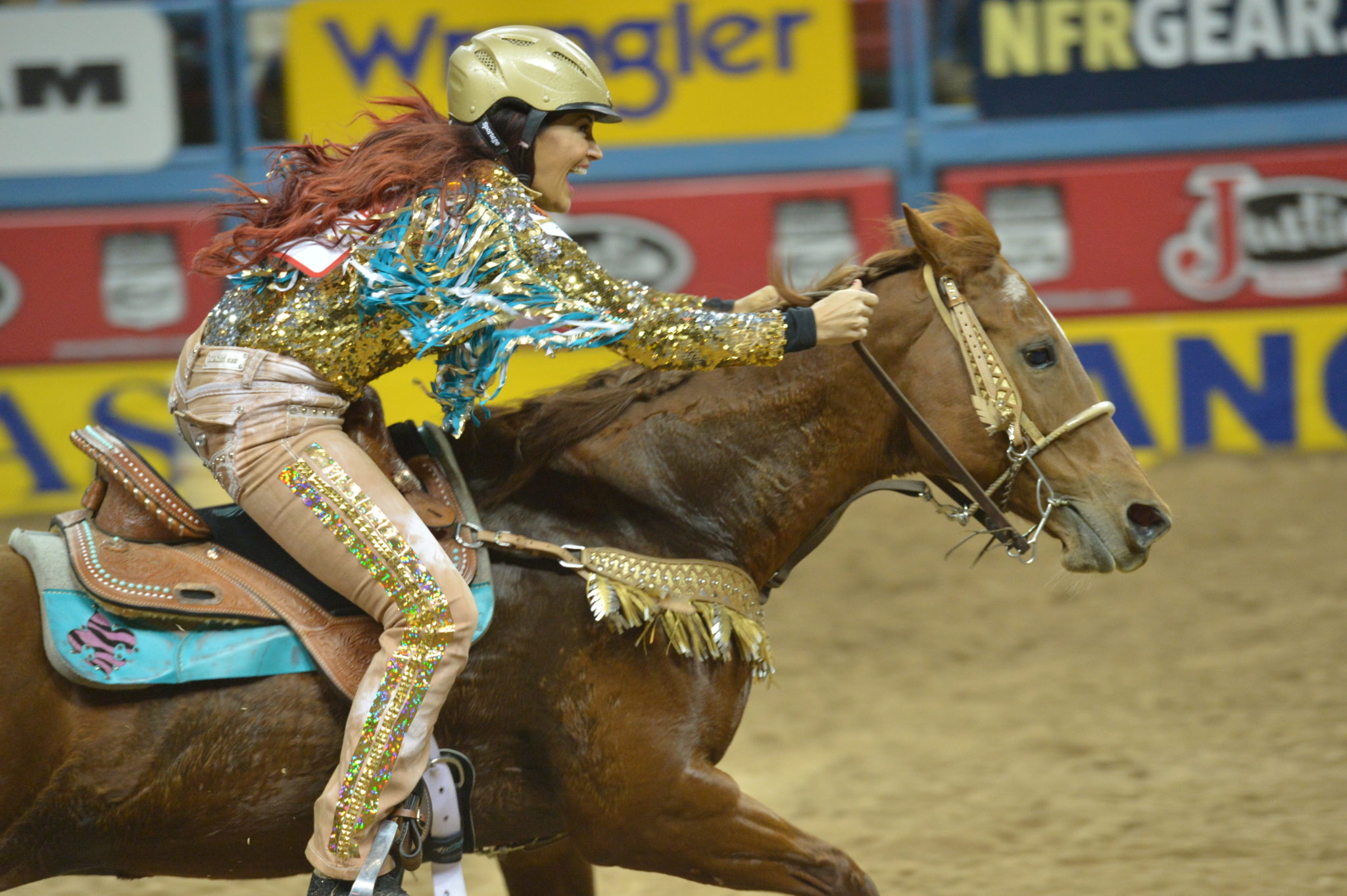
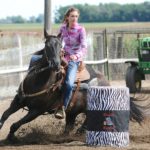
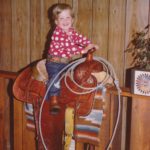
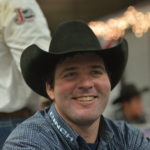
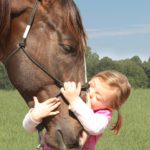
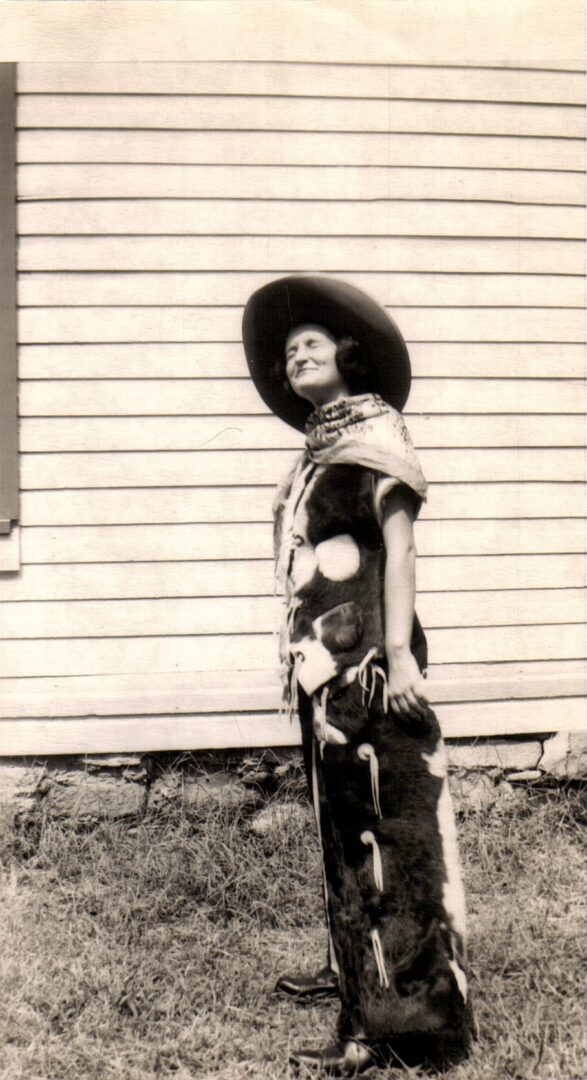
Fallon Taylor grew up in Tampa, Fla, and moved to Texas when she was seven. “I started riding horses and in six months I decided that’s what I wanted to do,” said the youngest of three. Her parents, Shelton and Dian, hired a trainer to help since they knew nothing about riding horses or rodeo. Fallon was homeschooled so she could focus on riding and barrel racing. “We stumbled our way through the rest and ended up with a trainer that lived at the ranch and trained my mare, Flowers and Money, the dam of Babyflo.”
Fallon qualified for her first NFR in 1995, at 13 years old. She qualified for the next three years and found that life on the road had lost its allure. The bright lights of New York City caught her attention and she spent the next ten years modeling in New York City, acting in Las Angeles, and riding her horses in Texas. “I was training horses for other people, and had no aspirations to come back to the NFR,” said the 32 year old. A near-fatal accident five years ago set Fallon down a different path. She was loping a 16.3 hand gelding one night and he slipped and started bucking “It got Western,” she said. “He was snapping and kicking. He reared up and fractured my skull in four places. I picked a spot to land and tried to get off – terrible idea. When I did, he kicked my feet and I went 12 feet in the air and landed straight on my head.” Fallon was paralyzed for three days with the same injury as Christopher Reeves, better known as Superman, and was given a 2% chance to walk. She shattered bones on the right side of her face, including her eye socket, fractured her skull in four places and broke the C-2 vertebra. “I’m blessed to be here.” Fallon’s recovery included wearing a halo for three months. “I had no other choice so I made it my life mission to learn how to recover. I had one come apart moment when I was trying to eat dinner with a halo on and couldn’t get the fork to my face.” After that, Fallon’s mission was to ride again and after a year of riding poorly, she finally found her stride. “I ride ten times better now than the first finals in the 90s, I have a lot more awareness of my body and my horse.”
Along came a football player named Delbert Alvarado – who came to town with the Dallas Cowboys’ training camp. “My uncle and his dad are coworkers – he gave me his phone number, and asked me to show him around. I’d just gotten out of the collar and he came to the ranch.” They were married three years ago and even though Delbert had never ridden before, he saw the talent that Fallon had in her horses and herself and encouraged her to pull the horses out of the pasture and try again. “Babyflo was the last one I pulled out of the pasture, and I cinched her up and we ran barrels that night.” Flos Heiress, sired by Dr Nick Bar out of Flowers and Money, was born, raised, and trained on the ranch. The 14.2 hand 8-year-old mare has carried Fallon to two NFRs and the team continues to improve.
Full story available in our March 2015 issue.
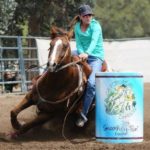
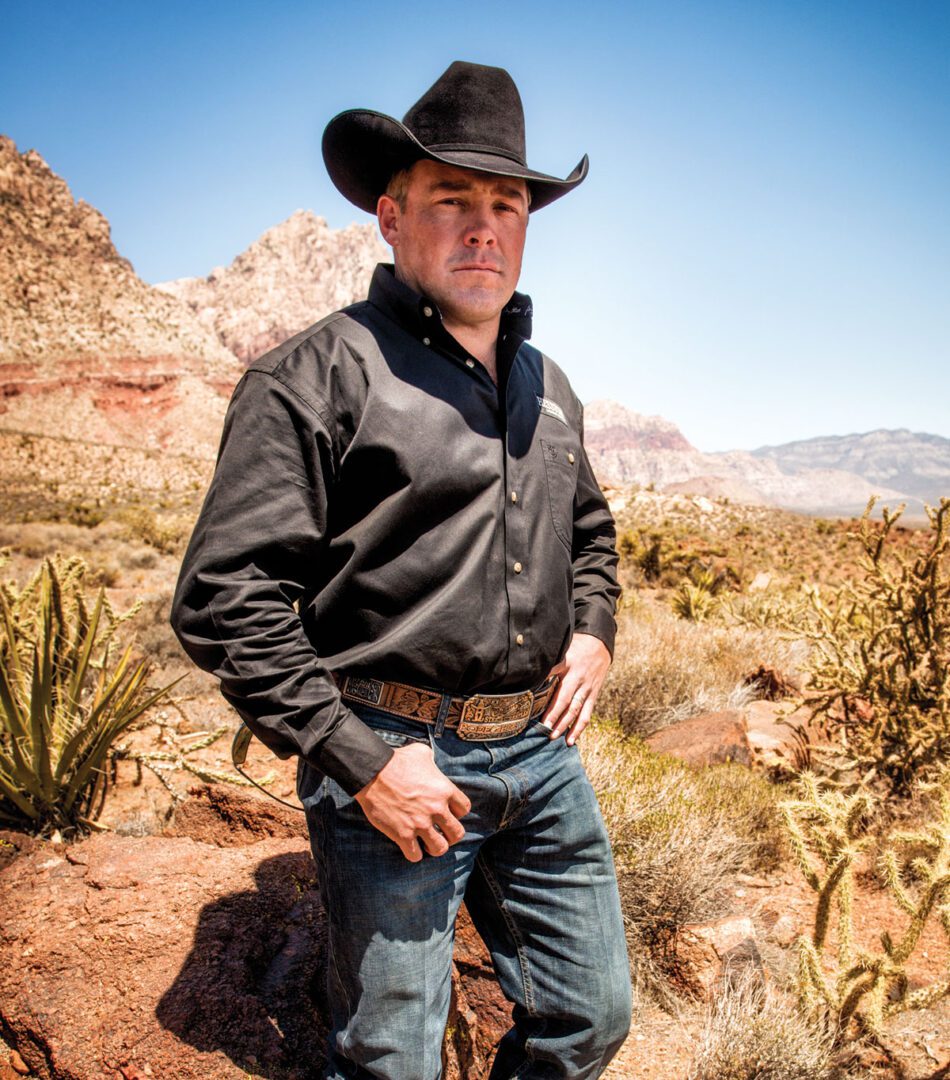
Fallon Taylor – photo by Cameron Gott
Fallon at the 2014 NFR, Las Vegas, NV – photo by Rodeo News
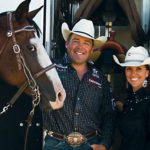
Horses are the tie that binds the Zancanella family, and Kristen Zancanella wouldn’t have it any other way.
Matt and Kristen Zancanella, along with Matt’s sisters, ReAnn Zancanella and Bryel and her husband Sean Mulligan, own and operate Pride Farm, a horse business centered around their stud, King, whose registered name is Lions Share of Fame.
But for Matt and Kristen, their love of horses starts much farther back.
For Matt, life began in Rock Springs, Wyo. the eldest child of three, with two younger sisters. While his dad worked hard to get his veterinary clinic started, his mom groomed dogs. The money she earned from grooming went for entry fees for her kids: Matt and his sisters Bryel and ReAnn. And after she worked all day, she drove all night, hauling her kids to youth rodeos. Matt and his sisters competed in Little Britches, junior and high school rodeos, with his attention being focused mainly on the team roping, and Matt realizes the sacrifices she made for her kids to rodeo.
After graduating from high school in 1994, he spent a semester in college. That winter, he entered Rodeo Houston and never returned to college. “He started rodeoing (fulltime) after that, and never looked back,” Kristen said. “He was addicted to team roping.”
For the next decade and a half, he criss-crossed the country, competing at pro rodeos and making his dream come true three times: qualifying for the Wrangler National Finals Rodeo. In 2002 and 2003, he heeled for Travis Tryan, and in 2004, he roped with Wade Wheatley.
In 2004, he met a tall slender cowgirl named Kristen Storm at the San Juan Capistrano, Calif. rodeo. Kristen was there as a volunteer, and the couple started dating. She moved to South Dakota the next year, and in 2006, they married.
In 2011, the road was wearing on Matt, and he quit rodeo full time, focusing on the Badlands Circuit. He began his own business: Pro Earth Animal Health. The business sells all-natural supplements for cattle and horses, and since he began, it’s taken off. Matt’s genuine personality and friendliness helped him in rodeo and has helped him with his business. “He’s never met an enemy, everyone remembers him and everyone likes him,” Kristen said. “He’s a genuine guy, and he tends to remember everyone. He has a lot of friends.”
Kristen grew up in Orange County, California, in town, with a love of horses but parents who never rode and had no place to keep a horse. So she took riding lessons at the age of seven, when her instructor recognized her as a “horse freak,” as Kristen says. The lady allowed her to spend as much time as she wanted at the stables, where Kristen ended up giving riding lessons and spent summers working for jumping, cutting and reining trainers. Growing up, barrel racing was not her favorite event. “Growing up I thought barrel racing was the stupidest sport ever.” Now that she spends days breaking and training horses for barrels, her opinion has changed. “It’s tougher than anything I’ve ever done.” Full story available in the February 2015 issue.
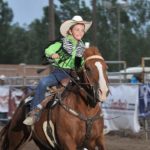
Kristen Zancanella barrel racing
– Scott Voigt
Keylee Zancanella competing in the Little Wrangler division for Little Britches Rodeo – JenningsRodeoPhotoraphy.com
Dean Oliver attended his first rodeo when he was 15 years old. It may have been the heady feeling of stealing into the Snake River Stampede without a ticket, but as Dean watched a tie-down roper win $300 in a single run, he decided that rodeo was the life for him. Little did he know that he would become a record holder at that very rodeo, winning the tie-down roping ten times, and that a drawing of him would be featured on the Snake River Stampede’s rodeo poster 70 years later, heralding him an 11 time world champion.
Born in 1929 to Verne and Vesper Oliver in Dodge City, Kan., Dean was the fifth of seven children. Each child was born in a different state, but all of Dean’s childhood memories reside in Idaho. His family moved to the Gem State in the late 1930s. Dean’s father was a private pilot, and he sold automobile and airplane parts and accessories, while also managing the Nampa (Idaho) Airport. In February of 1940, Verne and his friend Guy Givens were contracted by a farmer to hunt coyotes. The men did so from Verne’s airplane, with Guy shooting the predators from an open door. During one of their close passes to the ground, Verne’s plane crashed into the side of a snow-covered mountain, killing both men.
Following the tragic accident, the Oliver family worked even harder to survive in a country just recovering from the Great Depression. Dean began working at dairy farms by his early teens. Sitting in a classroom didn’t suit the restless boy, and he dropped out of ninth grade, never to darken a school doorway again. That same year, he and his older brother snuck into the Snake River Stampede rodeo in Nampa. “When the rodeo came around, I really liked the cowboys’ western gear, and their horses and cars and trailers,” says Dean. “It looked like a fun way of life!”
Inspired, Dean began his rodeo quest that same year, purchasing his first horse for $50 dollars and riding it bareback with just a rope around its nose to guide it. He began roping fence posts and hay bales, and even the calves at the dairy farm in the cover of night. While Dean was persistent about his roping, he was equally persistent in pursuing Martha Reisenstein, the daughter of one of the farmers he worked for. They were married in 1950, the year that would mark the beginning of Dean’s rodeo competition. He purchased another horse – this one green – for $400, and spent another $10 on a roping calf, which Martha would hold until Dean gave a nod.
The self-taught cowboy made his debut at several local amateur rodeos in Idaho and soon won his first tie-down roping at the rodeo in Kuna. The taste of success was so satisfying that Dean told his boss at the dairy farm he might quit and rodeo instead. “What makes you think you’re a star? You couldn’t win anything!” The man replied hotly. Dean quit his job that summer and rodeoed until he ran out of money, returning to work in the fields until he could pay his entry fees.
In December of 1950, Dean and Martha’s first child, Sheryl, was born. Her birth kept Dean from being drafted into the Korean War, changing him from a I-A (available for service) to a III-A (deferred because of dependents). After running into questionable rules at some amateur rodeos, Dean decided to join the Rodeo Cowboys Association in 1952. He went to his first professional rodeo in Jerome, Idaho, then leaped to Albuquerque, N.M., where the top professional ropers were competing. He was afoot, no longer trying to train a rope horse, but instead borrowing horses and paying the owners a percentage of his winnings. “There were 80 ropers, and not one of them would mount me, until finally a guy put me on a great, big tall horse,” Dean recalls. He won second in Albuquerque, then went to Denver’s new coliseum the following week, where he placed second in the average. He felt so optimistic with $1,700 in winnings that he purchased a gelding named Buck. He spent $1,750 on the buckskin with a knot on its knee, anxious to find a good rope horse. Dean made a makeshift trailer in the bed of his pickup for Buck and went home with an empty wallet.
After working through the winter feeding cattle, Dean had enough money to rodeo again in May. He and Buck won several rodeos that summer, yet Dean still lacked an edge in his competition that could only come with practice. The winter of 1953-1954, Dean lived with tie-down roper Dan Taylor in Doole, Texas, and the Idaho cowboy finished third in the RCA standings at the end of 1954 with roughly $11,000. Dean stayed with another roper in Oklahoma the following winter, and despite dismounting on the left to tie calves, he still had the fastest time, finishing the 1955 rodeo season with $19,963 and a glistening gold buckle reading World Champion Calf Roper.
His professional rodeo career soared out of the chutes, and Dean was rodeoing 11 months out of the year, often putting 80,000 miles on his station wagon each season. He competed in 70 to 80 rodeos a year, winning every professional rodeo he went to over the course of his career. Dean competed in the first National Finals Rodeo in 1959 on a horse named Mickey, whom he’d searched long and hard for after retiring Buck. Mickey and Dean won five world championships in a row from 1960-1964, and Dean also won three all-around world championships from 1963-1965. He had started steer wrestling and was just as talented in the event as tie-down roping with his 6’3″, 200 pound frame. But after breaking his leg at Madison Square Garden during the event, Dean feared further injuries and kept tie-down roping as his main focus, eventually dismounting on the right when he was in his 40s for faster time.
Not only did Dean’s achievements catch the eyes of rodeo fans nationwide, but also magazines and other publications. Time magazine, People magazine, Sports Illustrated, Saturday Evening Post, and western publications all wanted an interview with the rags-to-riches cowboy. Dean even modeled jeans for Wrangler. He and Martha purchased a ranch in Boise, Idaho, with 80 acres and calves aplenty for roping. While he traveled the length and width of the United States, one of Dean’s favorite rodeos remained the Snake River Stampede. He won his hometown rodeo ten times in the tie-down roping, a record yet to be broken, while also winning the local Caldwell Night Rodeo eight times. He secured his eighth and final world title at the NFR in 1969 at the age of 38, with record earnings of $38,118 for the most money won in a single event in one year. That record has since been broken, but Dean’s eight world tie-down roping championships still sets the bar.
Dean continued to rodeo into his 40s, but sorely missed his growing family of five daughters, Sheryl, DeAnn, Nikki, and twins Kelli and Karla. Martha had travelled with him as often as she could, but that didn’t make up for life at home. Yet Dean’s involvement in rodeo was hardly over. He served on the PRCA’s board of directors in 1979 and was inducted into seven halls of fame, including the National Cowboy Hall of Fame and the ProRodeo Hall of Fame. Texas sculptor Edd Hayes even included a bronze statue of Dean tie-down roping in a series of bronzes he called “Legends of Rodeo.”Dean also pursued his hobby of golfing, which he’d started in the 1950s, setting course records around the Treasure Valley and winning several tournaments.
Today, Dean and Martha’s home sits just off a farm road in Greenleaf, Idaho. Dean raises calves for beef cattle, but finds himself busiest during the Snake River Stampede rodeo in July, where he grooms the arena, and contracts the sheep and calves for the mutton bustin’ and the calf scramble. He has been serving on the rodeo’s board of directors since 1990, and dons his media credentials every December to work as a grip for a television crew covering the WNFR.
Dean’s story is marked with extraordinary grit and perseverance, but the rodeo legend says humbly, “I never did want to quit rodeo. When I started, I didn’t know I’d be any good. I was lucky enough that I had the ability, and I stuck with it.”
Story also available in our February 2015 issue.
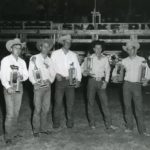
Champions (l to r), Pete Crungs (Bull Riding), Gerald Roberts (for Bill Hartman Steer Wrestling, 2 World Titles), Dean Oliver (Tie-Down Roping, 11 World Titles), Casey Tibbs (Saddle Bronc, 7 World Titles), Jim Shoulders (All Around & Bareback Riding, 16 World Titles)
Dean Oliver modeled jeans for Wrangler
– courtesy of the family
Dean in Sydney, 1963 – DeVere Helfrich
Dean Oliver – Photo by Lily Weinacht
Dean Oliver steer wrestling in Great Falls, 1965 – Ben Allen Rodeo Photos
Sean Mulligan grew up in Valentine, Neb., going to rodeos with his dad, Bill, in a 1978 Ford Super cab pulling a two horse inline. “His first love was calf roping, but he’s a better bulldogger.” Sean learned from him, jumping his first steer at Paul Cleveland’s school in Ogallala when he turned 16. Sean grew up with three older sisters and made the National High School Finals rodeo his junior and senior year. He was recruited by Pete Burns to the University of Wyoming. “I bull dogged – roped in college, but there’s a reason I bulldog; I can’t rope – I have to ride up and grab them by the horns.”
He started rodeoing fulltime after graduating with an Ag Business degree in 1998. He hit the northwest with Lynn Churchill and had a good fall out there. “I loved the country – and I thought rodeoing was awesome.” His career as a PRCA cowboy includes four WNFR qualifications – 2000, 2004, 2007, and 2011. He met his wife (Bryel Zancanella) in college. “She won the region in breakaway roping every year but her senior year.” She quit roping after college due to a bad shoulder and concentrated on training barrel horses. Bryel was raised in Rock Springs, Wyo., where her dad is a vet. Her initial plan was to go south for college and is glad she didn’t because she met Sean while getting her teaching degree from the University of Wyoming.
“After I graduated, I did my student teaching in Rock Springs, and taught for a year in Brookings, South Dakota. I loved the kids, but I wanted to spend more time with the horses.” Sean and Bryel moved from Brookings, South Dakota, to Coleman, Okla., and ended up in the stallion business quite by chance. “I was riding for some people from South Dakota and found an FM Radio horse for them on the internet. We found another colt, full brother to FM Radio (AQHA Junior Barrels World Champion), that was really nice and bought Lions Share of Fame off the internet from a picture. We got him home and my sister-in-law started him, put him on the barrels, and the rest is history.” They had decided to leave “King” a stud as long as he earned that right. They watched his full brother, Gun Battle, run the fastest qualifying time at the All American Futurity, winning second in the race. After watching that, they decided to keep King as a stud. He won $60,000 as a futurity colt.
Full story available in our February 2015 issue.
Baileys Dash Ta Fame by LSOF. Pro Rodeo money winner ridden by Rachael Myllymaki
Sean Mulligan as a toddler
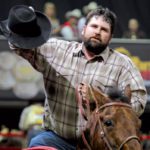
Sean Mulligan – Photo by Rodeo News
Prize Stallion, “King” – Photo by Lea Watson
King” with a young Keylee Zancanella – Photo by Lea Watson
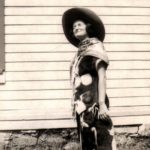
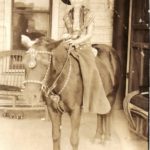
Peggy (Green) Fifer was born in the small town of Meeker, Okla., where she was raised with two sisters by a single mother. She had just turned 14, when her mother died of cancer, leaving her and her two sisters in foster care for eight months. “My grandmother came and raised us in a house that we were able to purchase with insurance money,” said Peggy, who lives in Eufaula, Okla., 45 miles from her childhood home.
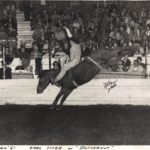
She met her first horse when she was four and a photographer came by with a Shetland pony to take pictures of the girls. Her horse experiences ended for several years, until she met and married a rodeo man. After graduating high school, Peggy went to business school in Tulsa, Okla., where she first met Earl Fifer. “He was real cute and had a good sense of humor,” she recalled. “I kinda fell for him.” They married and Peggy got her first introduction into the rodeo world. “On weekends they would have a rodeo at the city park. Earl would go over there and ride horses and bulls and listen to Jim Shoulders give ideas on how to ride,” she said. Peggy and Earl had two daughters, Wauthena and Earlene. “Wauthena would rather take dancing lessons than rodeo, so she stayed with her grandmother most of the time. Earlene started riding horses at the age of two. In July of every year, we would go to Pawhuska to the International Calvacade Rodeo. In 1967, Earlene competed in the queen contest and won. Wauthena rode in all girl rodeos when she was in high school. She rode Bareback Horses and bulls. She placed with her horses but that lasted one year. Earlene started the all girl rodeos too and after one bull, decided that wasn’t for her, so she continued to stay with training horses and running barrels. She ran barrels for about 5 years after graduation from high school. Earl started rodeoing more and Peggy would go with him, sometimes waiting until the wee hours of morning for him to compete.
Peggy got tired of waiting, so she volunteered to help out and that was her start as a rodeo secretary. “We would go to rodeos where we had to set up pens and the announcer stand was a flat bed truck. I would make a bed below that and put the girls there so I didn’t have to worry about them. Later, Earl was placing consistently so we traveled more and I would fry two chickens, butter a loaf of bread, make a chocolate cake, buy a bag of chips and away we would go to meet whoever was competing that night where we would have pot luck and visit before the rodeo. Lots of times it was before you had to call in, they just entered when they wanted to.”
It’s been five years since Jet McCoy last competed in the International Finals Rodeo. During that period, the five-time IPRA World Champion and his wife, Ashlee, have been raising their daughter, and managing their ranch in Ada, Okla. Jet has also appeared three times on The Amazing Race with his brother Cord. After his hiatus from the regular rodeo circuit, the 35 year old is returning for the thirteenth time to the IFR in the saddle bronc riding, thanks in part to Ashlee, who will be one of the breakaway competitors to watch at the finals. She took up the event in 2013, and the combination of her team roping background, and the hours spent in the practice pen with Jet’s coaching, have put her in the top 20 of the breakaway roping.
Ashlee’s newfound passion for breakaway made Jet realize how much he missed riding roughstock, having only done the occasional ranch rodeo since 2009. Sitting in the bleachers didn’t suit him, and in the spring of 2014, he was back in the bucking chutes with the saddle broncs. Jet rode all three roughstock events through high school and college, qualifying for the NHSFR, and later, the CNFR four years in a row on the Southwestern Oklahoma State University rodeo team. He also qualified for the IFR in all three events, and placed second in the saddle bronc riding at the DNCFR in 2004. “I can remember playing with my older brother when we were little, and him showing me how to put a saddle on by strapping it to a bale of hay,” Jet recalls. “I went to my first rodeo when I was five, and I can’t ever remember not rodeoing.” Jet, his sister, and their three brothers, all competed in rodeo growing up, while their dad rode bulls and bareback horses professionally.
Similarly, Ashlee, 30, grew up with a rope either in her hand or coiled and at the ready. Her dad taught her to team rope, and they entered jackpots and USTRC ropings as Ashlee grew up. It wasn’t until two years ago that she competed in a rodeo, however. “In 2013, I saw breakaway at a rodeo for the first time, and I just went for it. It’s been very challenging, but Jet has helped me a lot, and it’s been quite an experience!” Ashlee recently won the breakaway roping at the IPRA Southeast Region Finals in Gay, Ga. She is roping off a five-year-old Quarter Horse palomino named Bingo that she purchased in December of 2013. The gelding was originally a western reining horse that made the Non Pro futurity in Oklahoma City, but he transitioned into a solid mount in the breakaway that Ashlee says makes the same run every time.
Full story available in the January 2015 issue.
Ashlee and Ti at Sand Springs, Okla. summer of 2014
Ti barrel racing at an IPRA/ACRA rodeo in Kellyville, Okla. – photo by Nathan Bailey
Ashlee McCoy competing in breakaway roping – Photo by Nathan Bailey
Jet McCoy competing in Ironton, Missouri this summer – Photo by Nathan Bailey
Central Plains coaches and Vicki Shireman, Central Plains Secretary for the past 20 years. – Photo by Dale Hirschman
Vickie Shireman has lived around the Elk City (Oklahoma) area all of her life. “My family rodeoed – that’s all we did,” said the daughter of Una and Jiggs Beutler. “My dad was part owner of Beutler and Son, he was the son. And my mother kept the books and timed.” Vickie and her brother, Bennie, and sister, Dollie Riddle, rode to the rodeos in a car when their mom secretaried. “We stayed in motels; we didn’t have a camping trailer. We were raised in a rodeo office. Back then, you opened the books before the rodeo opened so you answered the phone and after you got it set up, they would call back to see what the draw was.” They entertained themselves with fighting with each other and there were always things to do. “A lot of times the rodeo office was in the lobby of the hotel, and sometimes people would take us to the pool. I didn’t know anything else. That’s all we did.”
Vickie learned to trick ride with her sister from JW Stocker, a Hall of Fame trick rider and roper that stayed with the family one winter. “My sister and I went to the West Coast in the early 1970s. She trick rode and I was the ‘extra.’ By the next summer, my dad had us trick riding at the rodeos.” Dollie continued to perform, but after Vickie broke her back, she decided to stick with secretarying. Vickie went to Southwestern Oklahoma State for a year. “I secretaried rodeos and that turned into a full time job.”
She met her husband, Dennis, when he came to work for her dad. “He drove a truck for him and that’s how we met.” The two married a year after that and have two children, a boy and a girl. Vickie kept up with her secretary jobs, raising her two children in the rodeo office. “My daughter, Jennie Murray, has carried on the tradition, and is a rodeo secretary and timer.” Justin works for Hallburton and his rodeo career consisted of helping Bennie with the stock for a few summers.
Vickie took over as the secretary for Central Plains in1994. “My mother was the Southwest Regional secretary for 20 years, so I knew about the work, and I applied for the job and got it.” She has done it ever since. “I still like to go, and I enjoy them.” The region is the largest in the NIRA and she describes each rodeo as a marathon. When she got the job, they didn’t enter with a fax, the entries were mailed in. “I encouraged them to use the fax machine the next year and now most of it is emailed. The region has grown over the years – there were more than 500 this past year. When I started in 1994, Jim Boy Hash was the student director, and now he’s the faculty director. There’s only one coach left that was coaching when I started – Allen Russell from Colby.”
Vickie has been the NIRA Secretary of the Year, the PRCA Secretary of the Year and the WPRA Secretary of the Year. “I couldn’t have a better job – and this will be my 20th year working the NFR, and my tenth year as the office manager.” Her job while at the NFR consists of running the contestant rodeo office with the help of an assistant. She is responsible for the draws, the points, and the money.“I’ve raised my kids and I have five granddaughters.” She and her husband (Dennis) just built a new home out in the country, and that was one of her goals. Now she is working on the landscape. Other than that, “I’ve had a good career. I’ve worked lots of the top rodeos, and I love what I do.”
KC Jones keeps organized with lists. The 43-year-old bull dogger from Southeastern Colorado has qualified for the Wrangler National Finals Rodeo eight times since joining the PRCA in 1995. When not on the rodeo trail, KC works on his lists, which include two successful businesses he created: Rodeo Vegas (the Official NFR After Party of the PRCA) and Pro Fantasy Rodeo (the official fantasy rodeo game of the PRCA and WNFR).
KC has been rodeoing for 20 years with a pro card. “When I started I never got to rodeo like a lot of others,” he said. I was late to get my PRCA card as my parents wanted me to get a college degree before joining the pro ranks. Early in KC’s life, “Mom and dad (Ruby and Charlie) did everything for me, taking me to gymkhanas, jackpots and junior rodeos. It was all about making sure we had everything we needed. It was more important to have a good horse than a fancy rig. So we were always mounted well, and they went out of their way to haul us around.” KC and his sister Kelly competed in about every event in every division of rodeo except the rough stock events.
He grew up with National Little Britches rodeos and high school rodeos. “I won enough scholarship money to go to college,” he said, starting his college career at Northeastern Junior College in Sterling, Colo. “I wanted to be an Architectural Engineer, so I got an Associate Degree at Sterling and went on to the University of Wyoming.” He switched his major to Business Marketing, graduating in 1994. He went back to the farm and started working and rodeoing. “My rodeo habit was costing a lot, so I started shoeing horses and went to Equine Dentistry School. I could work really hard doing Equine Dentistry and still go rodeo.” He had a fair amount of success in the circuit and decided to branch out in 2000. He bought a big green truck that he named “Mean Green” which was one of the first “Big” trucks that was converted and used for rodeo and it carried everything he owned – shoeing tools on one side and equine dentistry on the other. “I was $600 short of making the cut to the WNFR that year.”
He met his wife, Gayle, a barrel racer and flight attendant for Southwest Airlines, in 2002 in Oakdale, Calif. “I gave her a ring a month later, in November, we got married. “Neither one of us was looking and it was meant to be at first site…it happened fast and we’ve been running ever since,” he said. “I’ve been successful ever since I met her. She’s got my back 100% so that gives me the confidence to do anything. She is in charge of the horses…she gets up and feeds all the horses, giving them their supplements and exercises them. During the winter we have a lot of guys staying here (Decatur, Texas) for the winter rodeos. She cooks and cleans for everybody – I don’t want her job.”
Full story available in the December 2014 issue.
KC competing at the 1982 NLBRA Finals (pg 56)
KC Jones first succesful duck hunt, 1975
KC with wife Gayle and his horse Buggers
Horse Katie having dental work by KC
KC in Cheyenne – Photo by Hubbell
KC Jones Team Hesston
Photo enhancement by Karen Kelly
– Photo by Craig Miller
Deb Copenhaver grew up in a ranch family in Wilbur, Wash. “I worked for a lot of different ranches riding colts,” said the 89-year-old World Champion Saddle Bronc Rider. Born January 21, 1925, Deb is considered one of the greatest bronc riders to come out of the Pacific Northwest He lived through the Depression and at 17, enlisted in the Navy during World War II. “I was in the construction battalion of the Navy, the Seabees. I had always liked construction work as a kid, so that was my reason for joining the Seabees. It was a branch of the Navy put together during WWII – the Seabees kid the Marines that they came in on the road the Seabees built.” Deb spent two years in North Africa running a bull dozer for $70 a month.
“When I got out, I made up my mind I was going to rodeo and I started going to a few rodeos close to home.” The first year, 1946, he went to Calgary and won day money in the bull riding. “I was riding broncs and barebacks, but I got a little sore and kept to bronc riding. I had a good beginning -God gave me the ability to win right off the bat. I was fortunate to win Calgary three times, New York (Madison Square Garden) twice; Denver, Ft. Worth, Houston, Phoenix, Pendleton, Cheyenne, and Salinas.”
In the 1950s, Deb teamed up with Paul Templeton, and Bill Linderman and went airborne in Paul’s 180 Cessna. “We were all over the country for rodeo—Calgary, Elko, Omaha, Kalispell, Butte. We did them all.” Dedication paid off and Deb came in second in the world in 1951, ’53, and ‘54 to his good friend, South Dakota roughstock rider, Casey Tibbs. He won it the next two years.
Deb was elected to the RCA Board of Directors in 1958. “While on that Board I had a vote in having the first National Finals Rodeo. It was held in Dallas, Texas, in 1959.”
He took his earnings from rodeo and invested in land near Creston, Wash., where he bred and raised quality quarter horses and operated Deb’s Cafe in town. “This little restaurant had belonged to my dad and was in the town that I was born in,” said Deb, who had made the last ride of his career in Pendleton in 1974 and was looking for a source of income for his family. “At that time it was a small restaurant and gas station. We bought a big building, 40 x 80, and moved it across the road and tied it into the existing building and had enough floor space for nice consequences.” The decision paid off; Deb and Cheryl built the restaurant into the heyday of Deb’s Cafe, decorated in true western style, and his ‘Steak Nights” were a hit with the town’s people as well as the country bands that he’d bring in to play on Saturday nights. Hank Thompson, Bonnie Guitar, and Earnest Tubb, and other country music greats all played at “Deb’s”.
Cheryl was not as excited about the purchase of the restaurant. “It was open 7 days a week from 5 am until the last dog went home. We did that for 16 years and raised three kids in the midst of it.” Deb’s daughter Debra is a former Miss Rodeo Washington and a respected bronze sculptor (see Art of Rodeo, page 42). His son Jeff was ’75 World Champion Calf Roper and founding pastor of the store of the New Frontier Cowboy Church in Texas (see Christian Corner, page 7). Deb is proud of his boys Matt and Guy, who are in the construction business, and his daughter Kelly, who is a Florida businesswoman and mom to three.
It was Jeff that led Deb and Cheryl to the Lord in 1979. It wasn’t long after that they sold the restaurant. “If we are going to serve God, we are not going to serve booze,” Deb had said. “And that was the end of the restaurant. In two months time we had it sold, so our lives went on – we run cattle and quarter horses. If you are doing something that is not in God’s good will, if you pray about it, He will take you out of it.” After that, Deb and Cheryl sold the restaurant and settled into raising quarter horses and spreading the Gospel. “The most important thing that I could add is our Love for God – that’s more important now than anything you might write about us.”
Today, Deb and Cheryl Copenhaver keep busy with their quarter horses, and Deb spends time in the log chapel he built down the road from his house. Deb says proudly. “I want to be remembered for serving
the Lord.”
Story also available in the December 2014 issue.
Jeff and Deb – Jeff on the great bucking horse Badger Mountain in Omak, Wash. 1953
Jim Shoulders and Deb opening day of Rimrock Meadows, Wash. 1973
Casey Tibbs, Jim Shoulders and Deb
Deb riding the never-before-ridden Snake in Penticton, BC., 1949 – photo by Jim Chamberlain
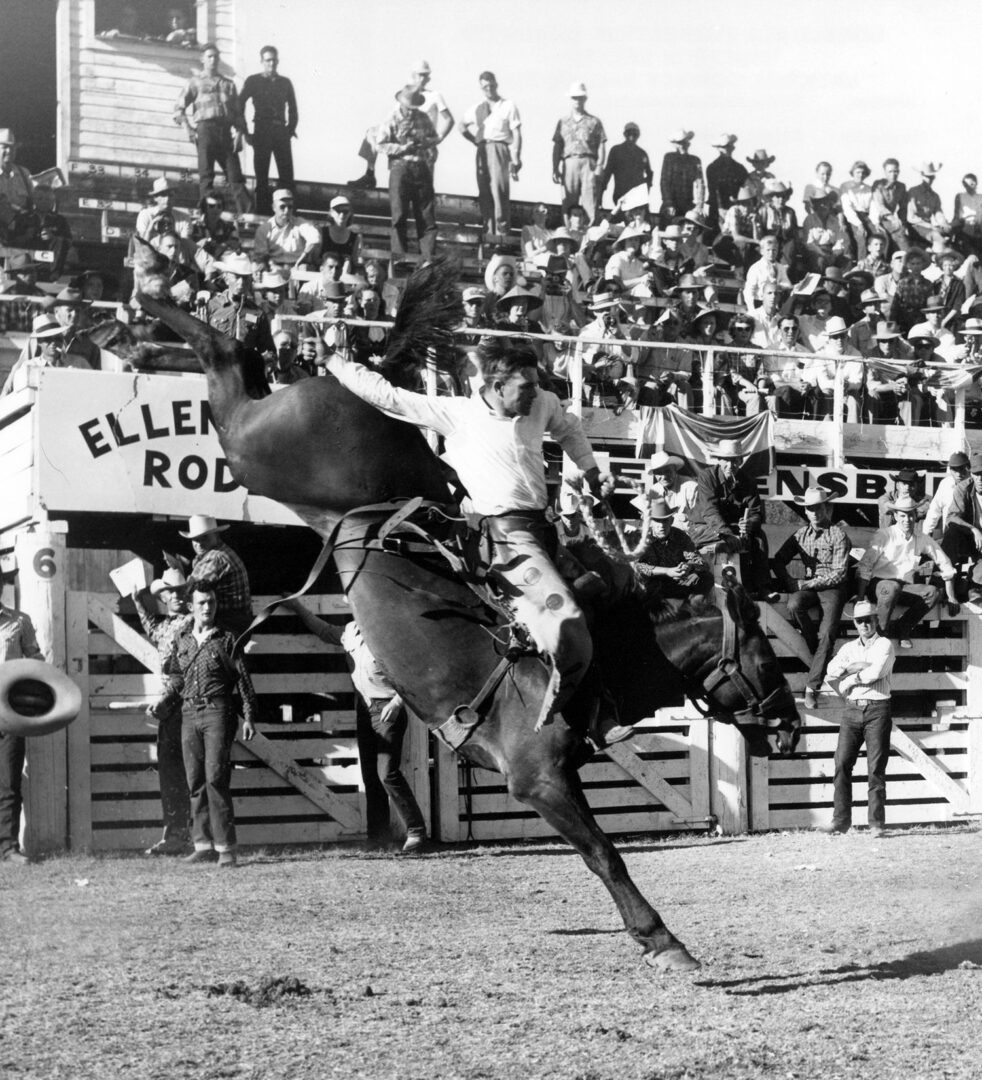
Deb on Miss Klamath in Ellensburg, Wash., 1952
– photo by DeVere
Deb, Casey Tibbs, and Bill Linderman in Phoenix, Ariz. in 1957 – photo by Helfrich
In 1954, Olin Young started his professional rodeo career at Pecos, Texas. From there, the young cowboy competed in, and placed in all the major and small town rodeos of the time, vying for a chance at the World Title, a dream he would achieve many times in the coming years. In fact, the cowboy was so dedicated to his career, that in the early 1960’s, Young designed his own roping saddle, that was built by Windy Ryon. Later, Ryon manufactured and sold “The Olin Young Roper” at his store, Ryon’s Saddle Shop & Western Store in Ft. Worth.
Of course, winning multiple world titles requires much travel. Some memories of traveling are not always good ones, like the night he and a crew of fellow ropers were traveling from Salinas, California in separate vehicles. Glen Franklin, and Herschel Romine had new cars. Olin and Jake Bogard were in an older 1957 Chevrolet pulling a horse trailer. Coming out of Salinas Olin was driving, vividly recalling the horrific traffic. He witnessed a vehicle almost hitting Glen. Because of it, Olin had to swerve hitting cement causing two tires on the trailer to blow out.
“That was pretty scary,” Young admits.
According to Young, during his travels, following a long day on the road, he would try to locate rodeo grounds to spend the night. He carried with him as part of his gear, an army cot so he could sleep near his horses. Of course, this wasn’t the case when his wife, Letha, traveled with him. Hotels/motels were not as commonplace as they are today, and according to Letha, there were no accommodations at all in Burwell Nebraska, Sidney Iowa, and Cheyenne Wyoming. However, local residents would open their homes to cowboys, and their wives, if traveling with them. As far as restaurants go, not only did Sidney, Iowa not have a motel, the town didn’t have a restaurant. The ladies from the local Baptist Church would feed the cowboys in the basement of their church.
Young didn’t always travel by vehicle, but sometimes flew to rodeos. Flying, however, didn’t come without it’s share of excitement. Once, six cowboys decided to ride in a small plane to quickly get to another rodeo. Although six were aboard, the plane was only rated to hold five passengers. Leaving Salinas, California headed to Nampa, Idaho, the passengers were Shawn Davis, John W. Jones (a steer wrestler), Barry Burk, Jim Kenney, the pilot, Harley May, and Young. Jones was riding in the front of the plane, and announced to the passengers ‘we got a problem.’ The hydraulic light and the landing gear came on indicating a possible malfunction. Obviously relaying the message from the pilot, Jones announced they would have to land in the dirt beside a track. He instructed the group to ‘get out’ when the plane slowed down enough to do so. Kenney ‘abandoned ship’ before the plane even stopped.
The Missouri Valley College rodeo team in Marshall, Mo., claims WNFR qualifier Tim O’Connell as one of their own. The 23 year old is sitting fourth in the bareback, having reached the $100,000 mark for the first time in his rodeo career. Tim was the 2013 PRCA Rookie of the Year, but didn’t qualify for the WNFR that year, making his 2014 qualification all the sweeter.
Tim’s dream of riding bareback nearly didn’t come to realization. In high school, Tim’s original goal was to be, as his dad put it, “A Ty Murray”, and compete in all three roughstock events. He soon discovered that saddle bronc riding was too technical for his taste. He was considered small for his age, and the bareback riding left Tim flying high and doing face plants, so he zeroed in on bull riding. Tim’s hometown is Zwingle, Iowa, but he rodeoed with the Wisconsin High School Rodeo Association and was their year-end bull riding champion in 2010. He also poured himself into high school wrestling and was a three time state qualifier, placing fourth in the state his senior year. But the bareback riding was ever at the back of his mind. After a bad wreck while bull riding at the NHSFR his senior year, Tim soon decided to quit riding bulls. He attended a rodeo school in Iowa that PRCA saddle bronc rider Wade Sundell helped put on. “I don’t really know to this day what made me decide to start riding bareback again,” says Tim. “I would pay thousands of dollars to go back to that day at the school and know what was going through my mind!” He rode three barebacks that day, a new enthusiasm springing up in him for the event.
Roughstock runs steady in the O’Connell family. Tim’s dad, Ray O’Connell, competed in saddle bronc riding in high school, then began working as a pickup man. By the time Tim and his older brother Will were born, Ray was working mainly for Cervi Rodeo Company and Three Hills Rodeo Company. He took his boys with him whenever their school allowed. They loved to help their dad cool his horses out after the rodeo, and at many of the high school rodeos that Ray worked, he would leave young Tim riding double with the kids in the warm up pen. When they were on deck, Tim was passed along to someone else.
Growing up in the shadow of the bucking chutes made an impression on Tim early on. “Tim enjoyed being around the livestock, and if he decided to rodeo, you could tell that roughstock was where he was leaning,” says Ray. Tim started riding sheep, then worked his way through calves, steers, and bulls before finally settling on bareback. His mom, Joann O’Connell, admits that watching Tim and his brother Will – who also rode bulls – took her out of her comfort level. “I’m their biggest fan, but I worried every time they got on,” she remembers. Joann would watch the other kids ride, but left the stands when her boys rode, listening, but not watching. Today, she’s cheering from the stands – and watching with both eyes open. “I ride that horse jump for jump with Tim.” She and Ray add, “These last few weeks, Tim has been on fire, and we couldn’t be more proud of him.” Will, who is five years older than Tim, went on to be a pickup man like his dad, and fights bulls. Ray and Will have also started Diamond R Bucking Horses together, and will be taking two of their colts to the futurity sale at the WNFR.
Full story is available in the November 1, 2014 issue.