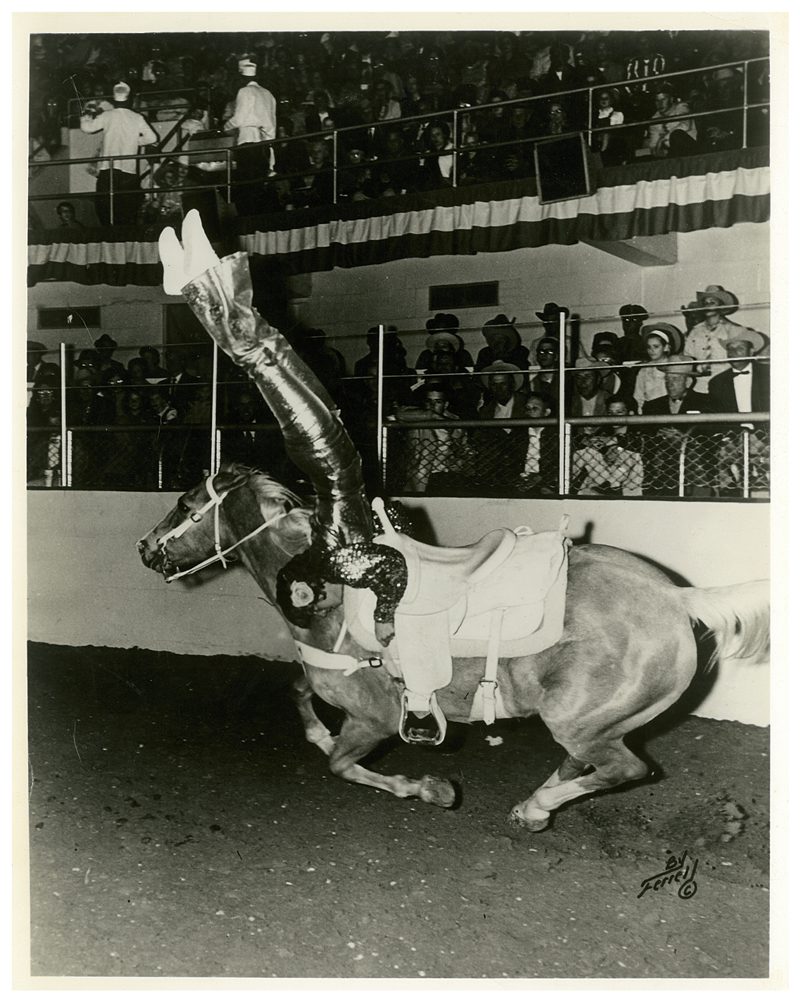
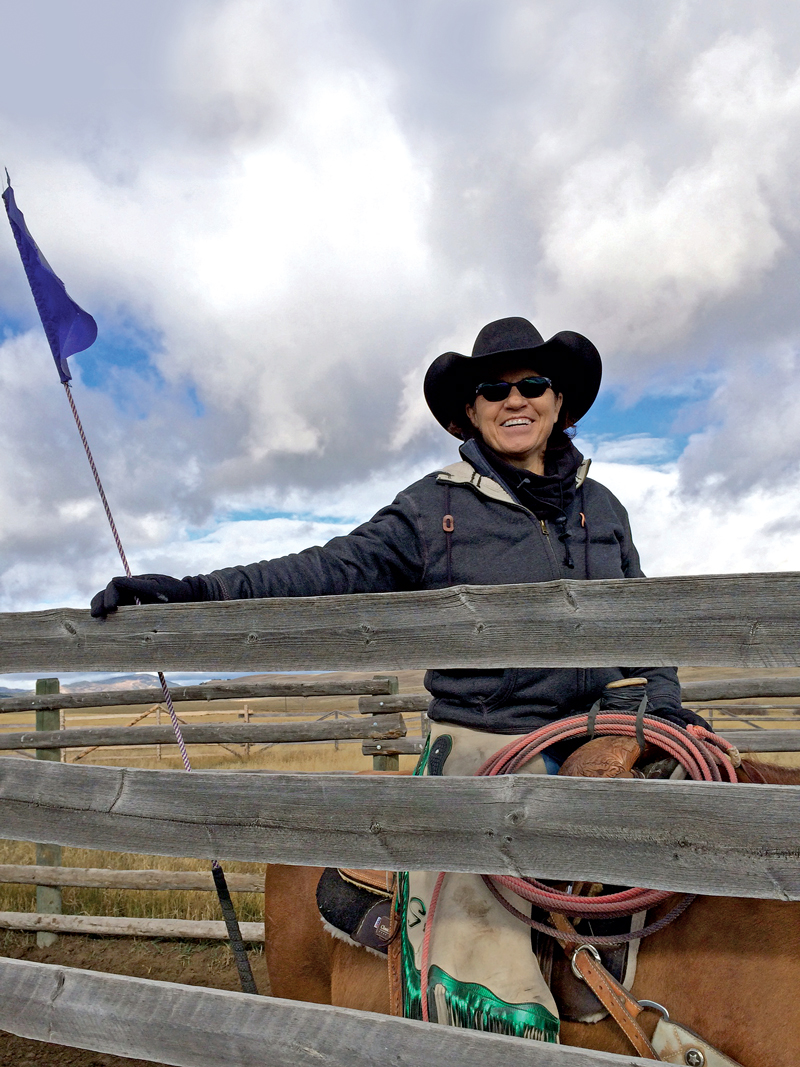
“We were blessed to rodeo in the best of times,” said Karen Vold, who began her trick riding career at the age of ten. Karen prefers to be in the background. She spends her days helping her husband, Harry, and daughter, Kirsten, run the Harry Vold Rodeo Company located near Fowler, Colo. Karen can be found cleaning chaps, rolling flags, or working on a wardrobe for pick-up men.
She got her start in the rodeo business at a young age. Her family owned a riding stables on the north edge of Phoenix and she would guide people out in the desert to ride. There was a lady that worked at the stables who had a palomino horse and a trick riding saddle. She taught Karen her first three tricks. Karen performed at a professional rodeo for the first time when she was 14. 17 years later she continued the tradition by putting on trick riding schools for 27 years, completing the most recent one in March of this year – 2015.
“My parents were divorced when I was eight. I was the oldest daughter and had a hard time with the divorce so they bought me a horse and a saddle to get my mind off it. The stables were located next to the Arizona Canal and we had 60 acres of commercial citrus and our house was the last thing before many miles of desert. I practiced next to this canal which was like a big long straightaway. My Dad was the chairman of the Phoenix Jaycee Rodeo for three years and the horse he bought me was part of a roman riding team that jumped a car and was also broke for trick riding. The horse refused the car a few times so they sold him to my Dad for me to trick ride on. I was ten.”
About the same time as her parents’ divorce, Jasbo Fulkerson, one of the rodeo clowns her dad had hired several times to work the Phoenix rodeo was killed on his way home from a rodeo. They had been close friends and were built physically alike so Karen’s dad took off from his construction business and teamed up with Jasbo’s partner to rodeo for six years. Karen stayed in Arizona with her Mom. “When he came back and saw how serious I was about trick
riding, he sent me to Colorado to take lessons from world champion trick rider Dick Griffith. In the early days, trick riding was a competition like five other events. Dick was the world champion trick rider and bull rider and my Dad wanted me to master the full shoulder stand that Dick performed when he worked with him at Madison Square Garden in New York City. It was very hard to learn – you have to face front – not the side – and dive over the saddle horn. I drove to Colorado when I was 18 with a horse trailer and my girlfriend. Dick had a few other students there. I only knew
Judy Wagner is a storyteller. Growing up on a ranch in Montana nurtured her appreciation for the beauty and brevity of life, all while giving her experiences that ached to be retold over the dinner table among friends and family. Today, the wife, mother of two, and vice president of marketing for Montana Silversmiths still approaches life with the common sense that comes from her own brand of Ranch Grown Logic and her motto from Gladiola Montana: “The code of her West; use a short rope, a sweet smile, and a hot brand.”
Judy’s story began in the Big Sky State. Born in 1953 in Avon, Mont., the oldest of eight children, Judy likes to tease that she is the real Avon lady. But instead of selling cosmetics, she was saddling horses in the early morning light and loading them into the bed of her dad’s pickup to go check cattle. Judy and her brothers and sisters learned to rope from their dad and were active in 4-H, but their responsibilities doubled when their dad was killed in a tractor accident. Judy was 16 at the time, and she and her siblings took over the ranch with young but powerful determination. “We grew up fast,” says Judy. “We learned that the cows didn’t know it was Christmas Day – feeding and caring for the animals came first. We had to be responsible for our actions, and ranching taught us what it means to invest your time and money into something.”
Following high school, Judy went to Montana State University on a rodeo scholarship, as did all seven of her siblings, in either rodeo or other sports. She competed in team roping and majored in Home Economics with a minor in Child Development. “Back when I went to college, a marketing degree didn’t really exist yet,” Judy explains. “Most women went to college to become teachers or nurses. But I had 14 years of experience in 4-H and an entrepreneurial spirit!” She met her husband, Alvin, during college, and once she graduated, Judy went to work as a county extension agent for Teton County in Cheteua, Mont. Alvin was a sales representative in the western industry, and in 1988, he helped Judy as she entered into a partnership with another family to create Gator Ropes. “We met in a bar in Dillon to discuss the opportunity,” Judy recalls. “The whole thing just evolved! I didn’t have a lot of help, but I could have reached out to people. Now I realize as I mature in business how important it is to reach out. At the time my research on product development was through my family and my life experience as a roper and competitor. I didn’t focus much on our competitors at the time, because we were all young businesses then. Classic Ropes had been around a few years and Cactus Ropes was just starting. It was a fun time to be in the industry.”
Owning Gator Ropes gave Judy all the marketing experience and more that college could have provided, and the common sense she had developed as a child on the ranch came to her aid. “The first trade show I took Gator Ropes to was for the first Cowboy Christmas during the WNFR, and I had the bright idea to create a rope rack that looked like a Christmas tree. I decorated all the ropes with evergreens from the ranch and made them look like wreaths,” says Judy. “I took over 100 wreaths and I didn’t sell one of them.” So she took her rope wreaths to the parking lot and cut the evergreen boughs off, selling her ropes and chalking it up to experience.
In 1998, Judy sold Gator Ropes back to her original partners and tried her hand at freelance marketing, while she also helped establish an all-girl rodeo team in Helena and several other rodeo teams in her area. In 1990, she won the John Justin Boots Standard of the West award for the Rocky Mountain All Girl Team, a pre rodeo event for the Last Chance Stampede in Helena, Mont.
By 2000, Judy found out Montana Silversmiths was looking for a marketing director.”Other than my two years with the county extension office, that was my second job interview,” says Judy. “I started fresh – it was a new position – and our sponsorship with the PRCA was just starting, as was our line of jewelry.” Judy found a way to put her ranch background to use even with Montana Silversmiths, knowing the value of a handshake and looking someone in the eye.
When the company put up its website in 2005, it enabled Judy to share the stories of the business with an even wider audience. “Every one of our products has a story, from how it’s created by our master engravers, to how it’s packaged, or even merchandised in the catalogue,” Judy explains. “I get shivers whenever I have the opportunity to hand the buckles to rodeo champions. I know from Montana Silversmiths the talent it takes to produce that buckle, and I also know as a rodeo competitor how much went into making those rodeo champions, like parents driving all those miles for rodeos and making sure their kids have horses underneath them.”
In 2014, Judy was promoted to vice president of marketing for Montana Silversmiths. For her, an average day at the headquarters on the Yellowstone River in Columbus, Mont., might involve leading a team for product development, touching on customer service, or even helping organize an events team, such as for the PRCA.
At the end of the day, Judy makes the 20 mile drive to her home in Park City, Mont. Alvin is currently a sales representative for American Hats and Ariat boots, and both Alvin and Judy’s children inherited their parents’ entrepreneurial spirit. Their daughter, Tiffany, is a horse trainer, while their son, Ross, and his wife manage a barrel racing association, UBRC. Team roping continues to be one of Judy’s greatest pleasures, and she won the Team Roping Heading on the WPRA Montana Circuit in 2014, as well as the Team Roping Heading Rookie of the Year with the WPRA after buying her first card. She is also a member of the USTRC, and in February, she and Alvin plan to go south to Arizona to rope. Judy visits her three brothers’ ranches in Montana at every opportunity, and she has many nieces and nephews who all excel in sports. These include Ty Erickson, who is going into the WNFR sitting third in the steer wrestling, riding his horse, KR Montana Shake Em, who won 2015 AQHA Horse of the Year.
“Between the Wagners, Bignells, Ericksons, and Ayers (Judy’s brothers and sisters) there’s a lot of competitiveness and athleticism, and it all stems from ranch grown logic and the ranch life of my siblings,” says Judy. “When it’s all said and done, I hope people will say about me that I was a trail breaker. I ride for the brand in my faith, family, work on the ranch, creating the brand Gator Ropes or stewarding the brand Montana Silversmiths. Who would imagine that some girl from Avon would grow up to do this, but you can do anything if you have the desire and work toward your goals! Life is about those connections – people who empower you – and I am blessed.”
Being crowned the USTRC Cruel Champion is quite an accomplishment. And Shawn has done it twice now. The first time was in 2001, heading for Kelli Jo Shurden. This year Shawn headed for California cowgirl, Ali Bilkey. The pair bested the field with an aggregate time of 36.96 on four head, splitting $16,200 in prize money in addition to Martin saddles and a year’s supply of Cruel Girl Jeans.
Shawn can often be found in the winner’s circle, with recent wins at the Wiley Hicks roping in Amarillo, Texas. In 2013, she and Jennifer Williams were the Reserve All Girl Champs at the Wildfire Roping in Salado, Texas.
Oddly enough Shawn didn’t start team roping until college. She has been riding her entire life and started breakaway roping when she was ten. She qualified for High School National Finals more than once in both Breakaway and Goat Tying. She earned a rodeo scholarship and attended Howard College in Big Springs, Texas and Southwest Oklahoma State in Weatherford, Oklahoma. She qualified for the college finals in both Breakaway and Goat Tying. Once she started team roping, she discovered it was both enjoyable and profitable.
Shawn credits her parents for starting her roping as a kid. Her mom and dad, now retired, raise show cattle. Shawn grew up roping and stock showing. In addition to rodeo, during high school she played a variety of sports, including volleyball, basketball and track.
For the last five years Shawn has been a Petroleum Land Man where she researches titles with regard to mineral or surface rights. She also owns and operates Baby Cakes Bakery in Vernon, Texas, where she takes custom orders for cakes, cup cakes, cookies, etc.
If that’s not enough to keep her busy, she has four sons, Landon, 9, Hilton, 8, Paxton, 5, and Callon, 3. Shawn gives much credit to her family for helping out with her boys.
An ideal weekend for Shawn T. is spending time with her kids and helping her parents with their show cattle. She has recently taken up fishing and finds it very relaxing. She is very thankful to the Lord and her friends and family that have helped her accomplish her goals. She extends a special thanks to Christy, Terry, and Daniel McBroom.
COWBOY Q&A
How much do you practice?
I try to practice three or four times a week.
Do you make your own horses?
No.
Who do you respect most in the world?
My Lord.
Who has been the biggest influence in your life?
My father.
If you had a day off what would you like to do?
Relax. Maybe hunt or fish.
Favorite movie?
Steel Magnolias.
How would you describe yourself in three words?
Determined, caring, happy.
What makes you happy?
My family and my Lord.
What makes you angry?
Negativity.
If you were given 1 million dollars, how would you spend it?
Invest it.
What is your worst quality? Your best quality?
My worst is being unorganized. My best is that I’m hard working.
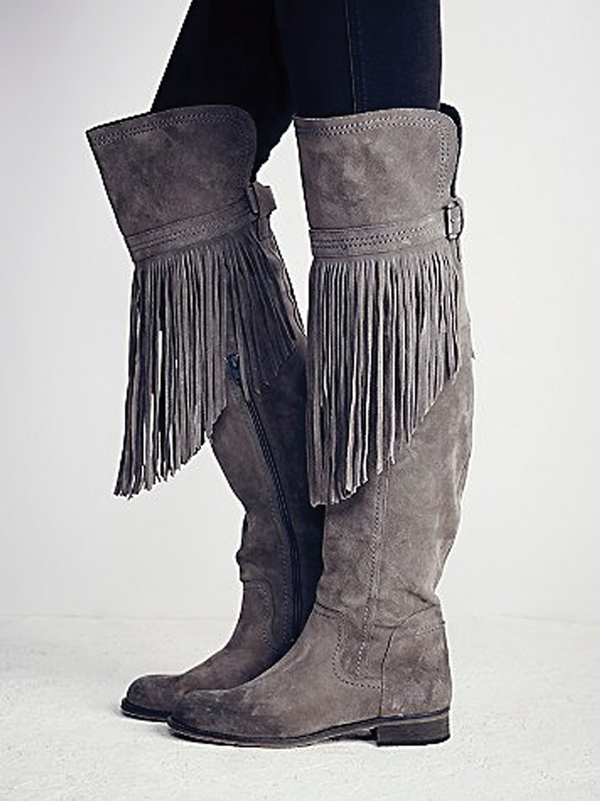
Fringe over the knee boots freepeople.com
Ear Jackets baublebar.com
Las Vegas Rodeo Fashion Week
Kacee Willbanks ~ “I am credentialed media and girlfriend to the toughest, comeback cowboy and Boyd Gaming Cinch Chute Out Bareback Riding contestant, Casey Colletti.”
Tip: I created a private folder on Pinterest strictly for outfit creations. When I am in a hurry all I have to do is scroll through the photos, choose an outfit inspiration and put it together!
Fringe over the knee boots freepeople.com
Ear Jackets baublebar.com
Cassidy Kruse ~ “I am a WNFR Barrel Racing contestant this year”
Tip: I’m making sure I have double the western shirts, actually needed, pressed and ready to go for autograph signings, performances and additional appearances! All the horse stuff comes first, my stuff comes second!
Juan Antonio Hand tooled leather purse jewelofthewest.com
Tanner Mark Boots sheplers.com
Lauren Crawley ~ “I’m the wife of the most handsome, red headed, WNFR Saddle Bronc Riding qualifier, Jacobs Crawley.”
Tip: Take pictures of your pre-planned outfits. If you are pressed for time, just scroll through your camera roll and pick one!
Jessica Simpson Knee High boots jessicasimpson.com
Graphic skirt zaful.com
Bridget Ryan ~ “I am the girlfriend of WNFR Bareback Riding qualifier Austin Foss”
Tip: I organize all my outfits and put jewelry with each of them before I pack. Then I have pre-made outfits once I get there!
Tyrel competing at Red Bluff in the Wild Ride as Fallon Taylor
story by Siri Stevens
Tyrel Larsen obtained his undergraduate degree at Panhandle State University in Business Management and rode saddle broncs under the direction of rodeo coach, Craig Latham; he took it a few steps further, marrying his daughter, Chaney, October 17. “Somebody was trying to talk me into buying her flowers one day for Valentine’s day and it went from there,” said the Canadian from Inglis, Manitoba. Tyrel has had a busy summer, preparing for his wedding and punching his ticket to his first Wrangler National Finals Rodeo in December. He took the 15th spot by $573 over Chad Ferley. “I was 16th two years ago so I know how it feels,” he said. “It was a little bit déjà vu from a few years ago. It all worked out. There were at least seven of us that last weekend that could have probably made it. Whoever drew good really and got lucky is what it came down to. There’s no hard feelings, but it’s tough. I’ve been there and you’re not ever mad at anybody but yourself.” Tyrel blew his knee out last year. “I got hurt when I was having the best year I’ve ever had.” He spent eight months recovering and working in Canada to put the money together to hit the rodeo road once he was cleared. “Chaney and I bought a house instead and so I had to scrape it together to go, but it worked out.” He will be riding broncs at the Thomas and Mack and his younger brother, Orin, will be there as well, riding barebacks, competing for the first time and making it in the 10th spot.
Tyrel has been in the United States now for almost eight years, and during that time, he made five trips to the College National Finals Rodeo and won it his fifth year, 2012. The distance from Manitoba and his home in Weatherford, Okla., is 25 hours. “It was 21 hours from home to Guymon,” he said. “And we’d drive that straight through.” Driving is nothing new to Tyrel or his family. “We rode steers in the amateur association. Being in Manitoba we had to drive further I’d say an average of six hours to a rodeo a weekend to a CCA rodeo – so it didn’t seem like that big a deal to go to school so far away.” Tyrel’s dad, Kevin, who ranches, amateur rodeoed as a bull rider, and got the family interested. His mom, Wanda, runs a hair salon, Wanda’s Barber Shop in nearby Roblin, Manitoba. In addition to his younger brother, Orin, Tyrel has an older sister, Cassie, and a younger brother, Kane, who is just finishing college.
“Manitoba’s winters are really tough. Once we came down and had a full year, me and my two brothers, and could practice in February and March and the guys back home were feeding cows from the trucks, it was pretty awesome.” He has known his wife, Chaney, since his freshman year of college in 2008. The couple is expecting their first child in April. He has been rodeoing in the PRCA since 2010, balancing his education with his rodeo career. After obtaining his Business Management degree, he went on to his Masters, completing his MBA in Business Administration in 2013 through Southwestern Oklahoma State University in Weatherford, Oklahoma. “My first year on my Masters was a reality check,” he said. “The work was piled on to make sure I was taking it serious. I was rodeoing full time and college rodeoing, so I’d stop at different colleges and write papers for a few hours and send stuff off, it was a little bit of dedication but I’m sure glad I did it.”
He chose the business degrees for a variety of reasons. “Everything is a business whether it’s running your place, getting a job, or anything – it’s all business related in one way or another.” He is not sure what he’s going to do with his degree. “My biggest idea was to come down and go to school and get that paid for with rodeo.” He went on to get his masters to help him make some investment decisions and get as much education in the business world and financial world to make good decisions so he’s sitting better financially when he’s done. “I have to pay taxes on both sides of the border, so that takes a chunk out of my earnings,” he said. He’s investing in buying a place, putting on a wedding, and now that they have a place, he’s working on paying it off. “We’d like to buy a little bit of land and add on to the house and add value to the place so hopefully it’s worth more in the end.”
Since Tyrel is Canadian, he can’t have a full time job in the United States. “I was fortunate enough to have a decent winter and go all year and keep a fire at the place, rodeo, and put a wedding on.” Tyrel and Chaney got married at their place in Weatherford and had the reception in Guymon. They took a short honeymoon in Florida and are focused on the finals. He’s planning to start on his green card now that he’s married. “Since I’ve been on two different student visas and a sport visa, it should be pretty easy. It can take some time, though. It depends on your paperwork – sometimes it takes a couple years to get. You never know.” Once he gets his card, he will continue to rodeo and be able to get some cows or do day work. “It would open up a lot more doors for me.” ”
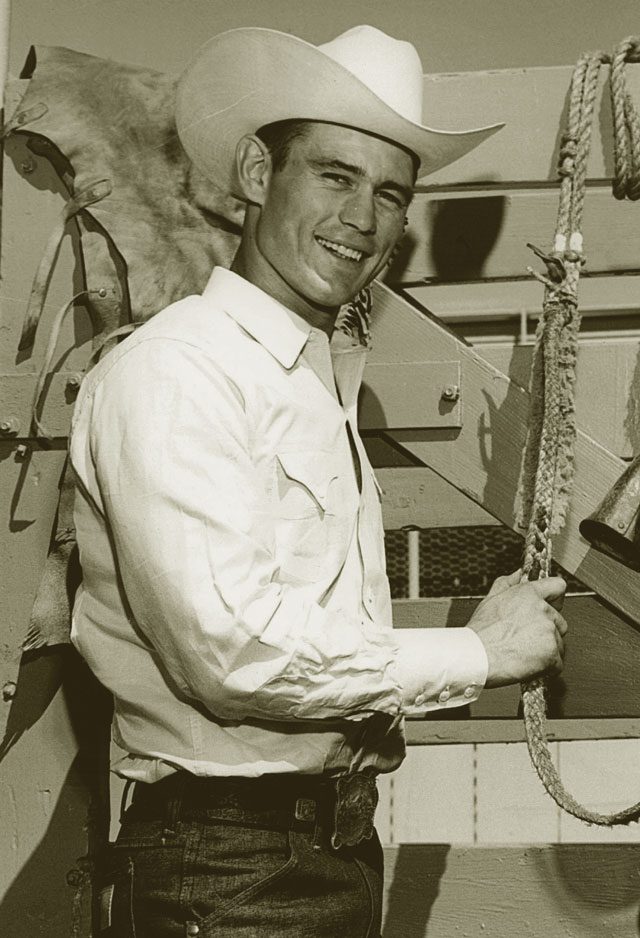
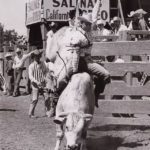
Bareback riding at the Central Montana Fair in 1952, – Culver Studio
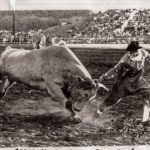
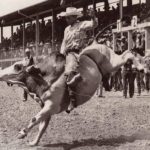
Bullfighting in Brawley, CA 1974 – Foxie Photo
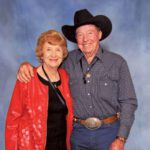
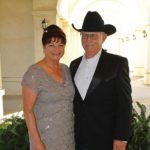
Nancy and Chuck Henson, 63rd class reunion, Lodgegrass, MT – courtesy of the family
story by Lily Weinacht
Chuck Henson’s cowboy boots and bullfighting cleats have left their mark through rodeo history. From witnessing the Boston Garden Rodeo strike in 1936 to becoming the first contract member director in the PRCA, Chuck has spent a lifetime championing the sport of rodeo, even bringing the cowboy life to the silver screen through his work as a Hollywood stuntman, wrangler, and driver.
The only child of Charlie and Margie Henson, Chuck was born in Arcadia, Fla., on February 4, 1931. Charlie Henson worked on the railroad and rodeoed during the winter. Margie (Greenough) Henson rode saddle broncs, formerly trick riding and competing in rodeos with her sister, Alice, and brothers, Bill and Turk, the siblings known as The Ridin’ Greenoughs. Several weeks after Chuck was born, the family packed up their Model A Ford Roadster and returned to their home in Red Lodge, Mont.
Chuck was given a pony at an early age, and he was soon trick riding and roping from Blue Rocket’s back. One of his first experiences as rodeo entertainment was in 1940 at the Cowboy Coliseum in Chicago, where Chuck and nine other kids put on a show of trick riding and roping during the 30-day rodeo. The family also travelled as far as Canada and Mexico with Wild West Shows. “Mom would never let me ride broncs because she was afraid I would get hurt,” Chuck recalls. “It didn’t make much sense to me. She let me rope calves, but I probably would’ve been better off riding broncs. I was so little that every time I’d rope a calf, they’d meet me halfway and wreck me.”
When Chuck wasn’t travelling the country, he travelled the mountain pastures of Montana for five years, helping his uncles, Bill and Frank, who worked for The Antler Ranch, one of the largest cattle ranches in the state at the time. By the time he entered high school at Lodge Grass High School, Chuck was an all-around athlete, rodeoing, playing basketball, baseball, and running track, which later earned him an induction into the Montana Sports Hall of Fame. Chuck steer wrestled like his dad, but the chutes held too much of a draw, and he started riding bareback and saddle broncs. Roughstock had come a long way since the time Chuck’s parents started, when broncs were tied to another horse and blindfolded, then turned loose into arenas made by a circle of buggies, wagons, and old cars.
For a time, Chuck competed in or worked every rodeo event, though he drew the line at riding bulls. “I didn’t cherish the thought of getting on a bull, but I saw you could get good money for riding them, so I started, and that was probably my best event,” says Chuck. “There weren’t any rodeo schools, but I remember a few times I’d draw a horse in the saddle bronc riding and I’d have to ask my mom what kind of a rein to take on it – it was a little different to ask your mom how to ride a bronc!” He entered many of the same rodeos as his parents and also worked as a pickup man during high school, even picking up his mom and Aunt Alice. “You’d get a spanking if you didn’t pick them up good,” he recalls with a laugh.
Chuck graduated high school in 1950 and won the Montana High School All-Around Cowboy title that year. Soon after, his family moved to Tucson, Ariz. Margie had developed a spot on her lung and was told to move to a warmer climate, though Chuck returned to rodeo in Montana every summer. In 1953 in Sidney, Mont., Chuck was behind the chutes when two gentleman approached him, informing him he hadn’t been in contact with his draft board. “I said I’d been rodeoing!” Chuck remembers. “I joined the National Guard for two years and then the Army. I don’t know how it happened, but I got into the Army Security Agency, and everything was top secret. I’ve never even told my wife or kids what we did.”
Chuck was discharged in 1955 and used his G.I. Bill to go to the University of Arizona to play college football and rodeo for a year. In 1956 the team was at a rodeo on the Mexico border that couldn’t afford a rodeo clown. Chuck had clowned for one of his aunt and uncle’s rodeos in Montana during high school, and he offered to step into the role again. “Some of the girls in the theater group got me a shaggy wig, baggy pants, and some greasepaint,” says Chuck. “Swanny Kerby supplied the bucking stock, and after that, he asked me if I wanted to work some rodeos for him.” Chuck remained with the stock contractor for nearly six years before hiring on with stock contractors further east, all while still competing in four or five rodeo events.
About the time Chuck married his wife, Nancy, in 1959, his rodeo clown career was also growing. The couple had met at a college rodeo in Alpine, Texas, two years earlier.
Nancy was there with several girlfriends, taking a break from keeping books for George H.W. Bush’s oil company. A rancher’s daughter, she grew up barrel racing, and after marrying Chuck, she worked as a rodeo secretary and timer. After their first baby, Nancy Jane, was born, Chuck had a custom camper built for his truck to double as a dressing room. His mule, Nicodemus, and dogs, including one he called Beatrice, rode in a separate section near the tailgate. “Nick was a hard-headed little devil – sometimes he worked good, and sometimes he didn’t,” says Chuck. “Beatrice was pretty famous around the rodeo world – she skipped rope and jumped through hoops and walked on her hind legs.”
Chuck was asked to fight bulls at the NFR in Oklahoma City in 1968 and again in 1971. Two years later, he broke his left leg at a rodeo in Vernon, Texas, when a bull hooked his leg between two boards of a fence. A surgeon in Wichita Falls, Texas, put him back together with rods, mesh, and a hip cast. Chuck was fighting bulls four months later. “I had a special cast made that fit between my ankle and my knee,” Chuck recalls. “I couldn’t run real fast, but I could still go in circles!”
From 1974 to 1977 Chuck served on the PRCA board of directors as the first contract member director, where he represented the specialty acts. “I passed a deal that if you worked the finals one year, you had to take a year off and give somebody else the chance – there were a lot of good hands that weren’t as well known that never got picked,” Chuck explains. He was also responsible for having buckles awarded to the bullfighters and clowns, which were sponsored by Lee, Wrangler, and Levi’s. Chuck’s own NFR bullfighting buckle still graces his belt to this day, and his work both in the arena and out earned him inductions into the ProRodeo Hall of Fame in Colorado Springs, Colo., and the National Cowboy Hall of Fame in Oklahoma City, as well as the Pima County Sports Hall of Fame.
Chuck officially retired from fighting bulls in 1980, though he continued to work up to 12 rodeos a year until the late ’90s, and he performed his rodeo clown acts until 2000. After that, he focused his attention on Hollywood, which he had been working for since the 1960s. Chuck’s mom and aunt had driven buggies and wagons during the filming of Little House on the Prairie, along with several movies, and Chuck also made a name for himself in the movie industry. One of his first roles was riding in a posse of Indians. He found more work through word of mouth before getting his card with the Screen Actors Guild after working with John Wayne on El Dorado, released in 1966. “I worked with John Wayne quite a bit – he was a nice guy – and so was Robert Mitchum and Steve McQueen,” says Chuck. “I doubled James Coburn and Slim Pickens in a movie called The Honkers where the rodeo clown breaks his neck. I said I wanted a certain amount of money if I had to let a bull fling me through the air. It took six bulls before the camera man got the shot he wanted.” Chuck wrecked wagons and did stunt falls from horses, and even drove in car chases for shows like Mod Squad. He played himself in a documentary called The Ridin’ Greenoughs, which covered the story of his mother, Alice, and Bill and Turk, all of whom had roles in the documentary, narrated by Rex Allen.
Today, Chuck and Nancy live in Tucson, Ariz., and commute to their ranch near Willcox, Ariz. Their two children, Nancy Jane and Leigh Ann, both rodeo competitors, live nearby. Leigh Ann’s husband, Eric Billingsley, is a former saddle bronc riding champion in the GCPRA. Chuck helps Nancy Jane and her husband, Jerry Dorenkamp, raise bucking horses for their rodeo company, Salt River Rodeo Company, as well as 75 – 80 cows with PBR bloodlines. “I don’t ride much anymore, but I watch Leigh Ann’s girls, Kaylee and Rayna, compete in the GCPRA,” says Chuck. “I’m pretty happy, and I’m really proud of my family!”
Dr. Ed LeTourneau has always been young at heart. Described by Larry Mahan as the “most unusual of cowboys”, Ed put himself through eight years of college on his rodeo earnings alone, all while competing in college rodeo and the newly formed RCA. Known for turning the area behind the chutes into study hall, Ed pursued his passions of school and rodeo with a vigor, graduating top of his class. The three-time NFR qualifier and great-nephew of earthmoving machinery inventor R. G. LeTourneau, Ed later went on to win multiple bull riding titles with the NSPRA. He has since been inducted into the UC Davis Cal Aggie Athletics Hall of Fame, Oakdale Athletic Hall of Fame, Oakdale Museum Hall of Fame, and the NSPRA Hall of Fame.
Born on September 18, 1935, to Dorothy and Harlan LeTourneau in San Francisco, Ed preferred dusty arenas to the fog of The City by the Bay, and spent his childhood years first in Stockton, Cal., and then Oakdale. Ed and his older brother, Ray, grew up helping their uncle raise cutting steers before getting to know the foreman of U-3 Ranch, owned by W.H. Moffat. The brothers began fixing fences and irrigating pastures and were later promoted to working cattle on horseback.
Drawn to anything bovine, Ray started riding bulls at the ranch, and then at local rodeos. “Ray was real good at it, so I wanted to be that good, too!” Ed recalls. Four years his brother’s junior, Ed started riding calves and steers and competed in his first rodeo when he was 13. As his legs grew, so did Ed’s sense of adventure, and he tried his spurs at bareback and saddle bronc horses as well. “With the bareback riding, I didn’t have good spurring action, but with bulls I just had to stay on and I could win something,” says Ed. With few high school rodeos in their area, and most of the rodeo associations located in southern California, Ray and Ed dedicated their entry fees to local amateur and junior rodeos.
During high school, Ed was involved in FFA, serving as his chapter’s treasurer his junior year, and president during his senior year. An all-around athlete, Ed also ran the half mile and three-quarter mile in track, played defensive linebacker on his school’s football team, and wrestled, qualifying for North State meets. During college, he wrestled at the national level after winning third in the far western division, but retired from the sport after an injury sidelined him.
When Ed finished high school in 1953, he informed his mother that he was going to be a cowboy – and she informed him that he needed to be a benefactor to society. Not one to turn his back on the chutes, nor disobey his mother, Ed decided to pursue a degree in animal husbandry at Cal Poly. A year later, Ed changed his degree to pre-vet science, and went to a local junior college before being accepted to UC Davis School of Veterinary Medicine in 1958. Though the school didn’t have a rodeo team, Ed purchased his card with the NIRA and qualified for the CNFR in 1961, where he won the finals in bull riding, missing the year-end title by one point. “Most people’s goal in rodeo is to win the world championship, but my goal was to make enough money to go to vet school,” says Ed. “When I went to school, it cost $1,000 a year. I could win money at a rodeo, put it in the bank, and I was ready for school. What I got out of rodeo, besides the people I met and the friends I made along the way, was my education.”
A student by day and a bull rider by the weekend, Ed began entering RCA rodeos in 1957 using his NIRA card. Even with school six days a week – anatomy landing on Saturdays – Ed managed to get on 52 bulls in one season – and he only bucked off two. In 1959, Ed was a year into vet school and taking on the world with all the gusto of a 23 year old. He was hovering just outside of the top 15 bull riders going to the first NFR, but reasoned that he could rodeo on weekends to make 15th place. Ed entered the RCA rodeo in Portland, Ore., first. It was the week of mid-terms, and he and a friend missed a day of school to drive to the rodeo, where Ed won the event. He competed in several more rodeos, including the Grand National Rodeo held in the Cow Palace, which sent him to Dallas sitting 13th in the world.
“The top 15 bulls were out for the first round, and 11 of them got rode,” says Ed, recalling the first NFR. “Some people said there was too much sand in the arena, and although those bulls had bucked 100 – 200 times, they’d never been consistently exposed to the top 15 guys in the world! By the last go-round, they had sorted out the stock and really knew who the top 15 bulls were.” Ed finished second in the average, and fifth for the year, but the following year, he was $150 short of qualifying for the NFR. However, 1961 brought him back to the finals, where he finished fifth in the average and second for the year, and in 1962, his senior year in vet school, he placed second in the average.
By 1962, Ed had graduated with his doctorate of veterinary medicine. Newlywed to his wife, Frankie, Ed accepted an internship at UC Davis. Frankie lived in Dixon, a town near Davis, and when her dad went looking for someone to ride one of his horses, known for bucking off any rider that put their foot in the stirrup, Ed arrived. Not only did he ride the horse, he wooed the rancher’s daughter, and they were married a year later. Frankie travelled with Ed to many of his local rodeos, but she left flying the skies to Ed and his friend and fellow bull rider, Larry Mahan. The bull riders met in 1956 at the rodeo in Salinas, Ca., and Larry offered Ed a seat in his Comanche 250 he called Brownie. “That was the way to go!” says Ed. “It was a really good experience, and the beginning of a good friendship.”
In the mid ’60s, Ed worked for several vet clinics while he rodeoed. Since he was finished with school, he had the opportunity to rodeo in the winter for the first time. In September of 1967, he was sitting fourth in the world, but a dislocated shoulder prevented him from competing in the NFR, though he finished 11th for the year. “After that, I went into my own vet practice in Oakdale and figured rodeo was over,” says Ed. He became the resident vet for a large thoroughbred farm in Madera before moving on to a quarter horse ranch in Oakdale, and eventually, he set up his own practice from his home in Madera.
While he was practicing in Oakdale, his childhood home, Ed decided to grow a beard and wear a straw hat to ride one of the bulls during the town’s centennial celebration in 1971. “I hadn’t ridden in four years, but I won the rodeo, and I was also doing some team roping,” says Ed. “In 1980 I had Bob Cook calling me – they needed bull riders for the old-timers rodeo.” Though not enthusiastic at first, Ed agreed to help his friend and ended up winning third in the old-timers rodeo, which would later become the NSPRA. Though his bull riding muscles were sore, they ached to ride again, and Ed trained for bull riding once more, joining the NSPRA again in 1989. He won the World Bull Riding Championship four times from ’91 – ’94 and was crowned the Bull Riding Finals Champion twice, all after he was 50. Ed rodeoed well into the late ’90s, serving several terms on the NSPRA board and volunteering as chairman of the NSPRA Cowboy Crisis Fund. He gave his final nod in the chutes when he was 64 before retiring from the sport.
Now 80, Ed and Frankie, make their home in Madera. Their two sons – David, a pilot for American Airlines, and Brett, who owns an almond orchard – live nearby, along with Ed and Frankie’s granddaughters, Amy and Cady. Ed recently retired after 53 years as a veterinarian, but he says, “Retirement doesn’t work well – I still have people coming to my clinic. But I still enjoy it! The drought got me, but I’m planning on raising cattle again, and I’m back to team roping, mostly at local events – but maybe I’ll rope in the World Series someday. I figure if I can ride a bull at 60, I’m not too old for anything!”
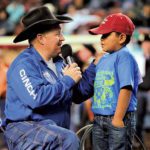
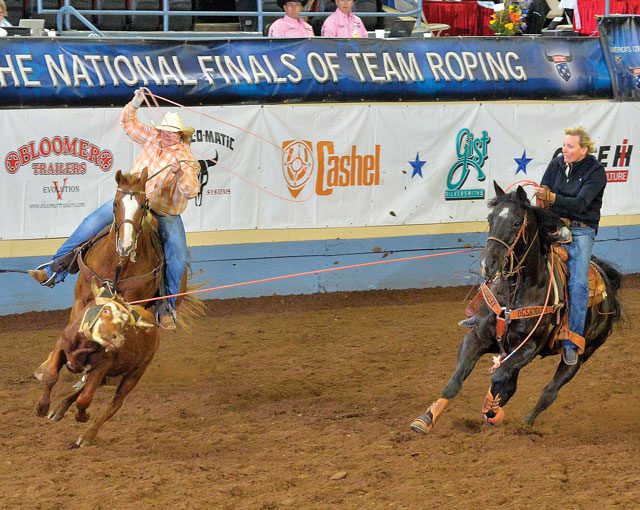
Ben conducts an interview, Cinch National Finals of Team Roping, 2014
– Photos courtesy Ben Clements
Ben & TyAnn roping the Leap Steer
Ben competes as Heeler, West Texas Championships, San Angelo, Texas , 2015
story by Siri Stevens
Ben Clements grew up with a rope in his hand. “I drug a rope with me everywhere I could go, even to school,” said the 39-year-old from Odessa, Texas. Born in Amarillo, his family moved to Odessa to run the cattle portion of the K-Bar Ranch, which encompasses 70 sections in the desert. “My sister (Brandi) and I drove seven miles of dirt road to catch the bus for school – I was driving in the fourth grade.”
Ben ropes both ends, starting out as a heeler. “I entered my first team roping in 1986, when I was ten.” He competed in the AJRA and high school rodeo, making the Texas High School Finals three years and making one trip to the National High School Finals. He started college at Howard College, in Big Spring, Texas, and continued his education at the University of Texas. He made it to the CNFR all four years, three times as a heeler and once as a header.
Ben decided in the sixth grade that he wanted to be a dentist and oral surgeon. He graduated high school as valedictorian, and went to college majoring in biology with a chemistry minor. After obtaining that degree, he chose a different path and got a second degree in mass communications. “I came home from college one weekend and my mom and dad were putting on a high school rodeo in Crane and they needed an announcer. It took off from there,” he said. He partnered with his sister, Brandi, who runs the sound board, and formed X-Treme Entertainment. “We are now announcing 40 to 45 events a year. Brandi runs sound for the rodeos, but not necessarily the team ropings.”
After he graduated with his second degree, Ben was in limbo for a while, working for his dad and announcing. The door opened for him to work at the USTRC handling event insurance, the affiliate program, and the scheduling. “I still do that today, but since then, I’ve added the job as editor of the Super Looper (2004).” He also started the Final Spin, a TV show that began in 2011 as a UTube show, and has graduated to a show on RFDTV. “We just finished our second season and the third season starts in January.” The show, which focuses on team roping, with an emphasis on the USTRC, can been seen on RFDTV, Wednesdays at 7:30 Central Time.
He met his wife, Jodi Cornia, through the USTRC. Her dad (Bill Cornia) is a producer in Utah and she was announcing, timing, and secretarying and they visited by phone, dating on and off for several years. Jodi took a marketing job for Outlaw Conversions in Stephenville and the rest is history. They got married in May of 2008 and had their daughter in 2011. “TyAnn fits perfectly into everything we’re doing, she loves horse and likes to ride and run barrels. She is starting to rope too.” Jodi is mainly a barrel racer, but she also heads. They have leased ground next to their house that they run commercial Angus cattle, as well as Corrientes. “We also raise a little hay. We ride quite a bit but we don’t practice as much as we used to. Most of the time we are getting home and putting up hay or doing something with cows.” Jodi still secretaries, announces, and times ropings throughout the region.
As if the plate wasn’t full enough, Jodi and Ben are now producing three ropings a year. “I grew up juggling a lot of balls and multi tasking. There’s a lot going on, but I’m pretty good at prioritizing and keeping in the right direction. I’ve got a great family and support system so we knuckle down and get everything done.” They started with Jingle Bell Classic in November 2011. “I always wanted to do a fund raiser and give money back to kids over Christmas and we incorporated a food drive and toys with the event. Last year we gave a very sizable donation to Tarleton State University as well as two pick up beds full of toys to the foster home and a full pick up bed of food to the Soup Kitchen. It was hugely successful and has grown into something we are very proud of.” In 2015 they added the Big Break in March as well as the Summer Blast over July 4. “I don’t know if time will allow for anymore, but we are open to that.” Producing fits right into their lifestyle with both of them being heavily involved in the production of it.
Ben enjoys what he is doing with the sport of team roping. “I enjoy the people and the uniqueness of the team roping community, and our goal is to continue to produce events.” The most important role he’s playing now is dad. “We want to raise our daughter in a good home with a solid foundation and allow her to follow her dreams. Right now she loves music and loves to dance. We dance a lot together.”
“He can do anything in the roping world from A to Z,” said Philip Murrah. “He’s behind the mic more than he ropes.”
“You many not know what God has in store for you, but if you follow his plan and guidance, you will be pleasantly surprised with the outcome. From the time I was in the sixth grade, I knew I wanted to be an oral surgeon. My path changed and here we are today and I’m extremely happy with everything we’re doing …”
Kay Stevens of Maquoketa, Iowa, is returning to the Cinch USTRC National Finals of Team Roping for the seventh time. The 51 year old #4 header is travelling to Oklahoma City with her Australian Cattle Dog as her co-pilot and her famous horse, Walmart, in tow. Though her husband’s saddle now sits empty since he passed away in March of 2014, Kay continues to rope in the memory of Mike Stevens and the absolute passion that the husband and wife had for the sport of team roping.
Mike was responsible for turning Kay into the avid roper she is today. The husband and wife met at a horse show in DeWitt, Iowa, and while Kay had been rodeoing since she was ten, she was chasing cans instead of steers. Born and raised in Illinois, Kay was exposed to both the racetrack and the rodeo pen at an early age. “My mom was a jockey and she’d take the racing rejects and start them on barrels,” Kay explains. “I learned good horsemanship from the racing world and rodeo. I could wrap a horse’s front legs by the time I was four. I always wanted to be a jockey, but by the time I was 13, I was already 5’6″, so I knew I was out.”
Kay focused on barrel racing instead, competing in open rodeos and barrel races, including several events put on by Wheeler Hobbs, Jackie Hobbs’ uncle. She went to a junior college in Illinois and was a member of the horse judging team before transferring to Kansas State University where Kay joined the rodeo team. She earned her degree in Animal Science and met Mike, a PRCA tie-down roper, soon after. Once they were married, the couple moved to Iowa, Mike’s home state. “I got interested in roping in the late ’90s,” Kay recalls. “I was working with our horses, and the next thing I knew, Mike was taking them and competing. Eventually I decided I should start competing and not just training!” Kay started breakaway roping but found her niche in the team roping, and began heading for Mike.
In 1993, Kay and Mike started holding roping practices for local kids at their house every Tuesday and Thursday night. “It was our way of giving back, and the kids were passionate about it,” Kay explains. “We live off of a black top road and we’d have parents droppings kids off at the road, then they’d come trotting in with a rope bag over their horn.” Many junior high, high school, and college national champions got their start in the Stevens’ weekly roping practices.
Kay and Mike retired their roping practices in 2008 after their daughter, Jyme, a barrel racer and pole bender, graduated from high school. They began pursuing the USTRC more seriously, but when Mike passed away in 2014, Kay’s motivation to rope was shaken. “I wasn’t really sure I wanted to keep roping, but I was already committed to going to the Windy Ryon roping with some girlfriends,” says Kay. “I knew I should stick with it, so I hit the road pretty hard. My daughter ran my business so I could spend the winter roping in Arizona.” Putting 36,000 miles on her odometer last year proved healing for Kay, restoring her desire to rope almost as soon as she had questioned it.
When she’s not roping, Kay is working from home in her animal cremation business, which she started in 2006. “I have a contract with vets in eastern Iowa, and I pick up animals, cremate them, return ashes, and start all over again. I wanted to do something helpful, but after I did the first one, I didn’t think I could keep going,” Kay admits. “Yet I couldn’t believe how appreciative people were, and I decided I could do it after all. I’ve taken everything from dogs and cats to horses, llamas, alpacas, ferrets, albino crows, flying squirrels, and snakes.”
After achieving a longtime goal of hunting elk in New Mexico this fall, all of Kay’s weekends have been spent at ropings, including the second annual Mike Stevens Memorial Roping held in Bethany, Mo. “Friends come and rope at my house every night,” she says. “The Priefert Automatic Chute is the only way to go, and my heeler, K.O., runs the steers down the arena and loads them. Mike taught her how to do it.” K.O. was named when Kay figured she’d get kicked out for bringing another puppy home to Mike, but he and K.O. were quick to make friends. “Now she goes with me everywhere – she’s my right hand man!” Kay says with a laugh. Likewise, she is never at a roping without Walmart, a black gelding with a strikingly long mane and tail. “He was Mike’s heel horse and last year I decided to head on him,” says Kay. “Mike named him, saying he was so lazy, you had to put a quarter in him to make him go, like the horse rides at Walmart. But I love him – he’s my main man!”
With only one USTRC roping held in Iowa, Kay travels to Nebraska, Colorado, Missouri, Oklahoma, Ohio, Tennessee, and Indiana, to qualify for the USTRC finals. “Rodeo is very popular here in Iowa,” says Kay. “There are lots of ropings, and we have the IRCA and MSRA rodeos.” Kay competes in all-girl rodeos and was also a member of the WPRA for several years, winning the Great Lakes Reserve Team Roping Champion title in 2011. At the close of her 15th season in the USTRC, Kay says, “A personal goal of mine is to win more money and go to some of the bigger USTRC ropings, and I’d like to get into the Cruel Girl standings. Roping is my passion. It turned into my life, and I love it!”
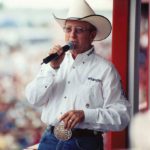
Rodeo fans across the nation are familiar with Hadley’s voice, and those who were on dance floors across Nebraska, Kansas and Colorado from the 1950s through the mid-80s, listened to Hadley Barrett and the Westerners as he played guitar and sang.
The Kersey, Colo. resident was born and raised in the North Platte, Neb. area, the sixth of seven children of C.J. and Estella (better known to friends and neighbors as “Mom” Barrett.) The family lived on the ranch ten miles north of town, and Hadley grew up knowing how to work. He was “working out” –working for neighboring farmers and ranchers –by the time he was fifteen. Hadley remembers the generosity of his parents. There was always a few extra plates around the dinner table. “Periodically we would have a less privileged kid who would hang out at our place.”
He attended country school, and when he went to high school in North Platte, he boarded with his sister, who had a job and an apartment in town. It was not to his liking. “I was a country kid, and had not been exposed to that kind of life,” he said. “I wasn’t accustomed to the city kids, I didn’t like being away from home, and I didn’t like the school.” At the end of his freshman year, he announced to his parents that he wasn’t going back. “I’m going to work,” he said, and he did.
When Hadley was eight, his parents signed him and his brothers Mike and Bob up for music lessons. Lessons were fifty cents per student, per week, “which was quite a lot then,” Hadley said. “We were living basically on a cream can check for groceries.” Even though Hadley doesn’t remember his parents being musically talented, he and his brothers showed promise. “We learned real quick.” The teacher had recitals at rural schools, taking his best students to perform at them. He began to feature the Barrett boys, because of their skill and ability to play together.
Hadley’s first public music performances after the recitals were intermissions between the Saturday matinees at the local theater in North Platte, where he and his brothers played instruments. At age ten, he was playing the ukulele and the banjo ukulele. The boys were paid a quarter each, plus free movies, and they were delighted. “We could watch the movie and buy popcorn and a pop.”
Then he began to learn to play the guitar. His older sister had one that he used, and between his older brother and a neighbor who knew how, and experience, he learned. “I learned mostly sitting in my room at night with a coal oil lamp and picking,” he recalled.
By this time, Hadley was riding bareback horses and bulls and doing more ranch work. He never planned on being in a band. But a man he knew through the rodeo business, a good singer, decided to put a band together, and called Hadley to play. Hadley played the guitar and sang while his brother Mike played the electric guitar.
When the man married, his new wife objected to the band lifestyle. He quit, and Hadley and his brothers took over.
It was the mid 1940s, and the band, called Hadley Barrett and the Westerners, played at dances, county fairs and grandstand shows across Nebraska, Kansas and Colorado. In those days, “those little towns had dance halls, and that was typically the only entertainment those small towns had.” He can’t list all the towns he’s played in. “It would be easier to tell you the little towns we didn’t play,” he laughed.
In the ‘60s and ‘70s, as Grand Ol’ Opry stars played across the region, it became customary that their bands did not travel with them; they found a local band, and Hadley’s band was often called. They played for Jim Reeves, George Morgan, Little Jimmy Dickens, Don Gibson, Carl Perkins, Johnny Cash, Roger Miller, and more.
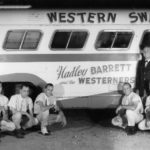
The band was huge, Hadley recalled, “a lot bigger than we realized at the time.” It was also cutting edge in some of its practices. Band members wore matching outfits, they had a public announcement system, and they would talk between songs, announcing that their next song would be a waltz, for example, or announcing a birthday or anniversary. Hadley also bought a bus with which the band traveled.
During all this, he was still ranching at home. Having been the last of the Barrett kids to marry, at age 22, he was running the home place with his dad’s help, working for other farmers and ranchers, playing with the band, and rodeoing. He’d begun to make contacts in the rodeo world, which would lead to his next career.
He was friends with Joe Cavanaugh, a rodeo announcer and bull rider, who always found a fill-in while he rode his bull at rodeos he announced. Joe knew Hadley had experience in front of a microphone, so at the Arnold, Neb. rodeo, he called on Hadley to help. The second performance, Joe had the flu and couldn’t talk. The committee asked Hadley to fill in, and “that was the first full-fledged rodeo performance I announced,” he said.
As a result, rodeos contacted him, asking him to work. He was in the same predicament as Cavanaugh: find someone to announce while he got on his bareback horse or bull. But that didn’t stop committees from hiring him. He announced almost every amateur rodeo he could get to: from Nebraska to Kansas to the edge of Colorado.
At this time, Harry Waltemuth, committee member with the Buffalo Bill Rodeo in North Platte, told Hadley he wanted to hire him. Hadley didn’t have a Rodeo Cowboys Association card; Harry didn’t care. When the RCA informed Harry that Hadley would not be announcing their rodeo, as he was not a card holder, Harry told them that if Hadley didn’t announce North Platte, North Platte would not be an RCA rodeo. “That got everybody off dead center,” Hadley quipped. He still has the letter from the RCA, giving him permission to announce the rodeo without a membership.
Hadley did become an RCA member the next year, in 1965, but it was a worry. At that time, RCA members could only work RCA events, and all of Hadley’s rodeos were amateur. “I had to give up pretty good contracts,” he recalled. “You had to wonder if you’d make a living.”
By this time, the band activities were beginning to decrease. Hadley booked rodeos so far in advance it was difficult to know when a dance would be scheduled on top of a rodeo. And it didn’t work well if the front man, lead singer and guitar player couldn’t show up. The band dissolved in the mid 1980’s.
It didn’t take long for his rodeo career to grow. “The first year was really skinny,” he recalls, but that changed quickly. In his fifty years of pro rodeo (now the Professional Rodeo Cowboys Association), he’s announced nearly every big rodeo in the country: from Sidney, Iowa, to Greeley, Colo., Cheyenne Frontier Days, and the Buffalo Bill Rodeo in North Platte since 1965. He’s been the PRCA’s Announcer of the Year four times, and has announced the Wrangler National Finals Rodeo four times and the National Steer Roping Finals as well. He was the television announcer for the Wrangler National Finals Rodeo from 1980 through 1990, and from 1994 through 2004, and he’s called the action at the Canadian Finals Rodeo seven times.
In 1993, he left North Platte and moved to Kersey, Colo. His rodeo career had grown to where he needed to be near a big airport. For a while, Hadley’s son Trent took care of his cow herd, but eventually he sold it. “I always considered my rodeo career as a part time job. I was basically a rancher who had this sideline of announcing rodeos. It took a long time to come to my senses that the ranching was my sideline, and the rodeo was my banker for the ranch.”
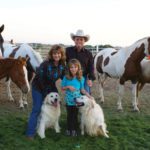
“Now I’ve gone to the dogs,” he jokes. He and his wife, Lee, raise white Golden retrievers, and he laughs that he is her “most affordable maintenance man.”
Hadley and his first wife Clarice have three children: Trent, who lives on the Barrett place north of North Platte, Michelle Corley, married to rodeo announcer Randy Corley, and Kimberly Jurgens. Lee’s children are Travas Brenner and Katie Brenner; Hadley and Lee have an adopted daughter, Taleah Barrett.
And he’s still going strong. He continues to announce rodeos and enjoy friends in both rodeo and the music world. “Rarely does a week go by that someone doesn’t say, ‘we used to dance to your music,’ or ‘you played at my mom and dad’s prom.’”
And the legend hasn’t quit. He keeps up a busy rodeo schedule and loves the friendships he’s made. “The friends, that’s where the real value is.”
Hadley Barrett gets bucked off a bull at the Sutherland rodeo on July 4, 1950
Hadley Barrett shakes hands with President Reagan at the Presidents Rodeo in Landover, MD in 1983
– courtesy of the family
Hadley Barrett and the Westerners’ first poster
Hadley guitar – Hadley still loves to pick the guitar, even though the band is long gone and his focus is on rodeo
Hadley Barrett and band members in front of their bus. The band was known for its innovative ways, including talking to the crowd between songs and having its own bus
Hadley has announced the Cheyenne Frontier Days and is a member of the Cheyenne Frontier Days Hall of Fame, as well as the Pro Rodeo Hall of Fame
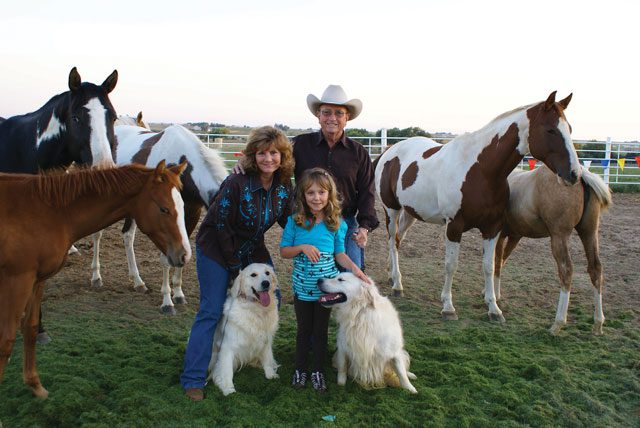
Hadley and Lee Barrett and daughter Taleah with their horses and white Golden Retrievers. The family lives near Kersey, Colo
Katie Leibold was born and raised in Phoenix, Arizona, where she lived for the first 22 of her 26 years. She grew up around horses and cattle on the ranches her dad leased.
Her first horse, El Gato, or “the cat” came from a ranch in Mexico. Katie started out doing 4-H and ended up doing every event on him including, heading, heeling, and breakaway.
“My dad got him from a fellow rancher and paid about $850 for him,” says Leibold. “He was a big, slow footed horse that was perfect for a nine year old girl. He really took care of me.”
In high school she competed in Breakaway and Team Roping, but soon found Breakaway roping was her favorite. After graduating high school in 2007, Katie attended a local community college while going to team roping jackpots and rodeos.
In 2012 a good friend, Bobby Jean Colyer, invited her to Idaho for the summer, enticing her with the many summer rodeos in the area. That summer she met her now boyfriend, Jared Thompson, and they have been together ever since. The couple divides their time between Idaho in the summer and Arizona in the winter.
Katie owns and operates Lariat Productions, a full service company that includes website design, video production, photography and marketing. The digital nature of the business allows her the freedom to travel.
“It allows me to go to rodeos when I need to and not have to stay in one spot,” explains Katie. “I have clients all over the country and in today’s digital age, I can do this from anywhere.”
On any given day during the summer, Katie and Jared start the day with chores on the ranch his dad manages. Katie will then spend her morning working on various projects for Lariat Productions. Late in the afternoon they start getting the arena ready for the evening roping practice. On the weekends they are gone to rodeos from Thursday until Saturday or Sunday. During the winter, the pair helps her dad at the feedlot and then focus on the many team roping jackpots around Wickenburg.
COWBOY Q&A
How much do you practice?
Three or four times a week.
Do you make your own horses?
Yes. The best head horse I’ve ever owned was a two-year old stud my dad bought at a sale barn for $650. I was about 12 when we got him and rode him all through high school and afterwards. I’ve probably won over $75,000 on him. He’s now 15 and a once in a lifetime kind of horse.
Who do you respect most in the world?
My dad.
Who has been the biggest influence in your life?
My dad.
If you had a day off what would you like to do?
I would enjoy a spa day, and then maybe some wine tasting and then lay on the beach somewhere.
Favorite movie?
Stepbrothers or Wedding Crashers
What’s the last thing you read?
A novel, called The Villa
How would you describe yourself in three words?
Professional, determined, goofy
What makes you happy?
Spending time with the people I care about, and riding a good horse.
What makes you angry?
Failing.
If you were given 1 million dollars, how would you spend it?
I would buy a place, go back to school, invest part and save the rest.
What is your worst quality – your best?
My worst quality is avoiding confrontation. My best quality is being dependable.
Where do you see yourself in ten years?
I hope we have our own place. I’d like to see my business grow and become more successful. Maybe have started a family by then, but I’m not in a hurry. Still roping and have the best horses possible. Still enjoying roping and going to rodeos.
Dustin Brewer put on his baggies and cleats for the last time Labor Day weekend at his hometown rodeo in Elk City, Okla.
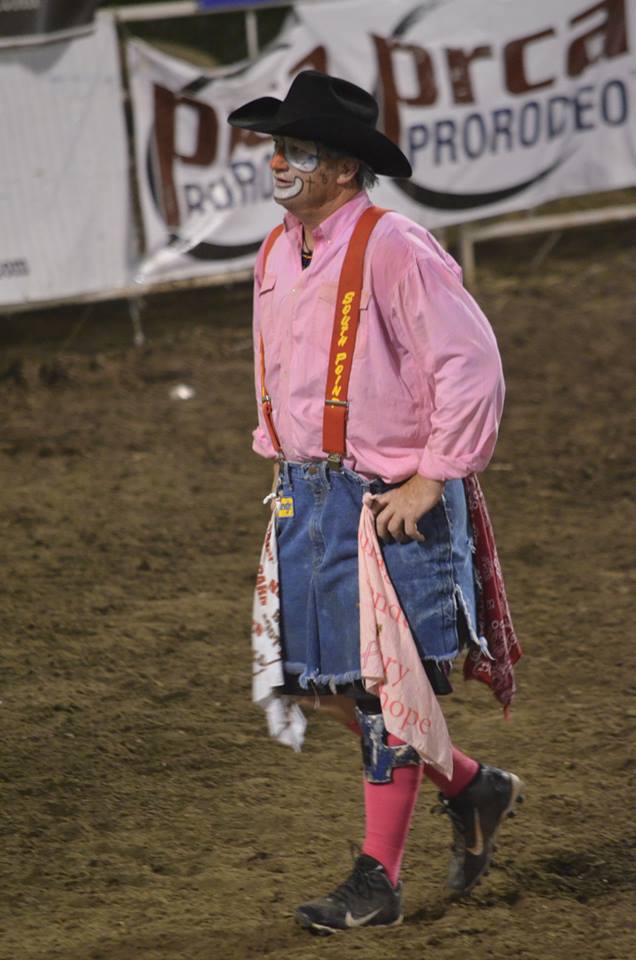
The 46-year-old cowboy has been involved in rodeo for most of his life, as a bullfighter, and now as a clown.
Brewer, born to Lee and Donna in Elk City, Okla., in 1969, tagged along as his older sisters competed at Little Britches Rodeos. He began riding bareback horses and bulls in high school, and it was in the practice pen where his talent became evident.
A bull rider got hung up, Brewer recalls, “and I stepped in, got him out, never got touched, and thought that was pretty cool.” That was the beginning of a 27-year career.
He worked as a bullfighter at high school and amateur rodeos, and he struck up a friendship with the late Rex Dunn, a bullfighting and bull raising legend. In 1996, Dunn told Brewer he needed to apply for his Pro Rodeo Cowboys Association membership. At that time, the PRCA gave membership to bullfighters after they had worked the Binion Bull Sale, held in Las Vegas during the National Finals Rodeo. A panel of bullfighters and experts judged the rookies, and out of a class of 18, only two were awarded cards: Brewer and Dusty Essick.
From then on, Brewer’s resume grew. He’s worked major rodeos across the country, including Tucson, Ariz., Greeley, Colo., Oakley, Utah, Salt Lake City, and lots of the smaller rodeos: Elk City, Okla., Abilene and Manhattan, Kan., Burwell, Neb., and more.
He competed in the freestyle bullfighting the Wrangler Bullfights held, and was ranked fourth in the Bullfights standing when he broke a leg. That was in 2000, his only chance to go to the National Finals Rodeo, and it turned out to be the last year for the Bullfights.
Bullfighters are prone to injury, and Brewer has had his share, although nothing that took him out of the game for long. In 1991, he broke his jaw in three places when a horn caught him in the neck. In 1996, he ruptured his spleen. In 2000, the broken leg kept him from going to the Bullfights in Las Vegas, and in 2002, he tore an ACL in his knee.
He’s had a wonderful career, and the people he’s worked with and for hold a high regard for him.
He has worked his hometown rodeo in Elk City, Okla. for sixteen years, and he’s been a real asset to the rodeo, said chairman Larry McConnell. “Dustin’s one of those guys that, whatever you ask him to do, he does it. He’s easy to work with, and he’s an icon around this rodeo.”
Former bullfighter and five-time Wrangler Bullfights champion Rob Smets helped Dustin get started in his early years and considers him like a brother. “I mentored him through some of his career,” Smets said. “Dustin’s done a bang-up job. The guy has integrity and has had it his whole career.”
Brewer has grown close to many of the rodeo committees for whom he has worked. He worked the Abilene, Kan. rodeo for fifteen years, and became like family to the committee men and women, so much that Brewer and his wife Tarra decided to marry in Abilene in 2004. “He was a professional,” said Jerry Marsteller, chairman of the Abilene committee. “He did whatever was asked of him.”
Brewer worked closely with barrelman Mark Swingler, and Swingler believes Brewer’s rodeo career was marked with consistency. “He was always there for the cowboy,” Swingler said. “If he had to take a shot, he’d take a shot.” Brewer was able to handle the mental stress of being injured as well. “Some (bullfighters) get injured and get gun shy, but I’ve never seen that in his work.”
Even though he’s retiring, Brewer isn’t leaving rodeo, he’s just switching roles. He has plans to work as a barrelman and rodeo clown, and has already been hired for some rodeos in 2016. He loves rodeo. “I just love the sport,” he said, “the camaraderie between everybody, the atmosphere.”
His baggies and cleats may go in the closet, but he’ll be back on the road next summer, to another rodeo, just in a different role.
Through it all, Dustin has loved – and still loves – -rodeo.