Wally Woods was born in Victoria, Australia, the second youngest of four brothers. “When you’ve got four brothers, and I was the second youngest, I had to fend for myself,” said the 84-year-old Australian cowboy. “My father worked on a cattle/sheep property. My mother died when she was very young. When I was about five years old, we had a post office and I would deliver the mail bag three miles up the road five days a week on a horse.
Wally started competing in the steer riding when he was 14, winning the first one he entered. “I left school when I was about 11- there was no high school – I went traveling with a Wild West show, traveling all over riding bucking horses and doing all kinds of things in the show. You name it, I did it. We used to do two riding a bucking horse, one in the saddle and one behind, and we’d jump off.” He performed every night, and was part of each act. He traveled with the show for three years, and then switched to rodeo.
He worked in a spare car parts place and competed on the weekends. “In them days, in this country, money was hard to come by. We’d go to any buck jumping contest we could find (bronc riding).” He got his first big win in 1951, winning the Jubilee Championship of South Australia in the bronc riding. “I won a big cup and 100 pounds. From then on, at different times, one of me own brothers and I used to break in horses and a money earning contest, and travel around to different rodeos all over the country.” He entered every event. “There were five events in those days; bronc, bareback, steer riding, bull dogging, and roping. The roping was either calf roping or wild cow milking. Through the next ten years, I won four all around champions of the year, that’s the highest money winner over the five events.”
Wally was part of the Australian Rough Riders Association, which started in 1944. “They had a secretary, and a spokesman. It was just a membership that organized it all, and one secretary. From 1945 until 1959, then we formed a board of directors and all that,” he said. “They nominated me as the first president in 1959, and I was that until 1965, competing the whole time.” The ARRA is now the national governing body for professional rodeo competition in Australia, the oldest national rodeo organization in the world.
The first national finals was held in 1961. “It was an 8 round contest, so you’d ride eight of everything; eight saddle horses, eight bareback horses, eight bulls, bull dog eight steers, and rope eight head,” he explained. Wally, who is 5’6” and 11 stones (14 pounds = one stone) won the bull riding by three bulls, riding seven out of the eight. He won the high pot all around champion for the year, second in the bronc riding and placed in every event.
Wally met his wife, Lexi, at a rodeo in Victoria. “She was only a girl when I met her,” he said. “I waited seven years to marry her – my brother married her older sister.” Once they were married in 1958, she traveled all over the country with him. They have two children, a son, Guy, who is a cutting trainer in Texas, and a daughter, Lindy, two years and two days older than Guy.
They traveled around in a Ford 250, with his dogging horse in the back, and towing a caravan behind where they lived. Wally made a good living from rodeo. “In them days if you won 100 pounds (one pound = $2) in five weeks you were doing good; I won 500 pounds, which is good.
We used to buy petrol at about 2 shillings (.33 a gallon), now it’s $4.80 a gallon. We traveled anything up to 700 miles – there is some big distance between towns. From Victorian border to New South Wales is 600 miles.”
He continues to hold the record for winning three riding events in one day, and fourth in the bulldogging, at the Australian Championships. In 1958, he won the World Bronc Riding Championship, which included America, New Zealand, and other countries. “All told, I won 40 state Australian titles, and over the years, I’ve won 170 first places. We used to get a big sash when we won a contest, and I counted them out to see who many I won.”
He continued to compete well into the 1960s, and when he hung up his bull rope, he picked up a stopwatch and started judging. “I knocked off when I bought a transport business in Queensland, which I had started in Victoria. I transported cattle, sheep, horses, whatever livestock there was from one end of the country to the other, anywhere at all.” He still rodeoed around the arena for a little while, but he only went to a very few because he was too busy.
Wally is officially retired, but he still has some horses. “I breed them, since I give up rodeoing, I’ve managed two big quarter horse breeding properties and I’ve got a little place that we breed horses, Guy sent me a horse to breed here.”
He’s made several trips to the United States to visit his son and grandchildren, but since his four-way bypass a year and a half ago, he hasn’t done much traveling.
Wally has seen many changes to rodeo over the years. “It’s the same thing, but we used to ride in an Australian saddle. I was one of the very lucky ones that got to introduce the American saddle to the Australians. There’s a big difference. The
Australian saddle is an English saddle, but a lot smaller. It has a very low back, and very little, 1 ½ front on it. Once you got used to riding, it’s just like everything, you’re good at it or you’re not.”
The bareback riggin was completely different than today. “I used to make them and sell them. In 1956, a friend of mine that went to American brought me back a Dixon riggin. The ones they have now, you couldn’t even put them together. It was a straight head one – the original ones were like a bull rope, in fact, we used to use bull ropes riding horses.”
Bulldogging steers were much different back in his days of rodeoing too. “One of the best bull doggers this country had seen was 6’1, 15 stones (14 pounds per stone – 210 pounds) and I seen his feet not touch the ground for 100 yards after he caught the steer.
“All the years that I did it, I enjoyed it,” he said of rodeo. “There were quite a few of those fellows that rodeoed and traveled around and we became very good friends and it was also a way of life, it was a way of making money.”
Category: Rodeo LIFE Cover Feature
-

Back When They Bucked with Wally Woods
-
On the Trail with Kellan & Carson Johnson
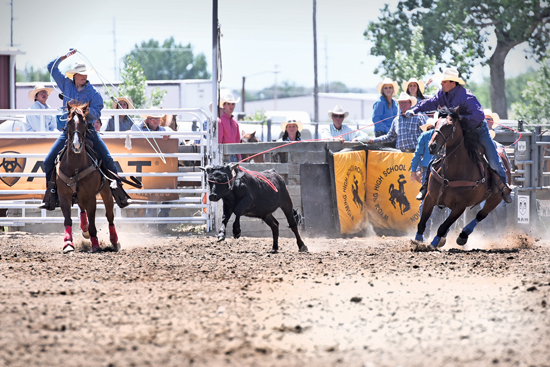
Kellan and Carson Johnson, brothers from 30 miles outside Casper, Wyo., have roped together for eight years. “It’s great – we get to practice together all the time, but its nerve wracking because you don’t want to miss for your little brother,” said Kellan, the 6+ header, who is two years older. “We have an indoor and outdoor arena at home.” They have a great teacher in their dad, Jhett Johnson, 2011 WNFR World Champion Team Roping Heeler with his partner Turtle Powell. The pair won it with a total time of 57.5 seconds on nine head. Their mom, Jenny, competed in goat tying and breakaway in college. “We have plenty of help.” This is Kellan’s second year winning the team roping championship for the state of Wyoming, and he has been the USTRC regional champion, heading for his dad, for two years in a row.
He made his third trip to the National High School Finals this past summer, he and his partner last year (cousin, Jayden) came into the short go in the same position as this year, third. “The steer we had was great and we were a 5.3,” said Kellan of the run. “We put enough pressure on second and first,” recalls Kellan. “Second high call ended up winning it with a 5.1.” His plan is to practice up for the next year and hopefully win the state title again. “Then go back to Nationals and leave with a first instead of second.”
He spent the rest of the summer amateur rodeoing in Nebraska. After that, the high school rodeos started up again. “We put up hay and we check cattle and make sure everything is running smooth on the ranch.” The 17-year-old has one more year of high school and is unsure where he will go to college. “I might go somewhere that’s warmer,” he said, and plans to get a degree in Ag Business. He has considered Casper where his dad is the rodeo coach, but thinks he might head to Oklahoma or Texas.
He and his brother are sitting first in the state at the end of the fall season, he is fourth in calves, and second in the All Around.
Kellan gives credit for his success to growing up watching his dad and grandpa and uncle break horses. “I learned how a horse should move and act at a high level, cutting, roping, etc. Coming from this family, I learned what good horsemanship, and a good roper, and mindset is all about also,” he explained. “What my dad told me is you have 30 minutes to yourself to be frustrated or angry at anything in life, to understand and go from there. After that 30 minutes, you clear your mind and get on to the next whatever it is.” He explains good horsemanship as someone who can understand the difference between roping and the horse. “When your horse isn’t working right, it makes your job ten times harder than it should be. A horse also demonstrates the rider’s handiness and how success you will be. If you have a good horse, your roping goes up. If you have a bad horse, it goes down.” Kellan has gone through five head horses in the ten years he’s been roping. “The way I look at it, the better you get as a roper, the better your horse has to be. That will take your roping to the next level.” He has learned how to find the right horse. “For what I do, and for my event, I look for a lot of run, a good mindset, good attitude towards things. Kind of like a little kid, willing to learn what you ask of them.” Roping with his brother has gotten better every day. “We are figuring each other out – if you can wake up everyday and make the same run you made the day before, the sky is the limit.”
Carson is a #7 heeler, and he likes to rope with his brother. “We get to practice every day, it’s always in the family,” he said. The sophomore at Natrona County High School is riding Shwaze, a horse he got a year ago. “When I got him, he was a little green, but now he’s finished and fits me really good.” He spent his time getting ready for the short go by staying relaxed. “It’s nothing more than another steer that we rope in the practice pen. There’s nerves, but not as much as you think. I was super excited to rope our steer, we had a pretty good one. I knew if we could get by him, we’d have a decent shot. It was my first year out there (National High School Finals), coming up second was great.” For Carson, roping is a family deal. “Dad helps all the time, Kellan turns me all the steers I want, my mom supports me, and my grandma is at every rodeo.” His spent his summer the same as his brothers. Amateur rodeo with his brother and keep practicing. When he isn’t rodeoing, he plays basketball and ropes the dummy with his little brother, Kress. “We have matches and have a rodeo season, trying to make the NFR. We have teams with our cousins – we set it out there a ways, and we time it on the phone. We win bragging rights.”
Little brother, Kress, is seven. He ropes the Heel O Matic and likes to ranch and also likes the bucking end of the arena, helping Dona Vold this fall at the high school rodeos. The family lives on a 7,000 acre ranch that was homesteaded by their great great grandfather in 1884. The house that Jamis and Judy Johson (grandparents) live in was built in 1892, and remains the oldest two story log home that is lived in in Wyoming.
-
Roper Review: Justin Loya
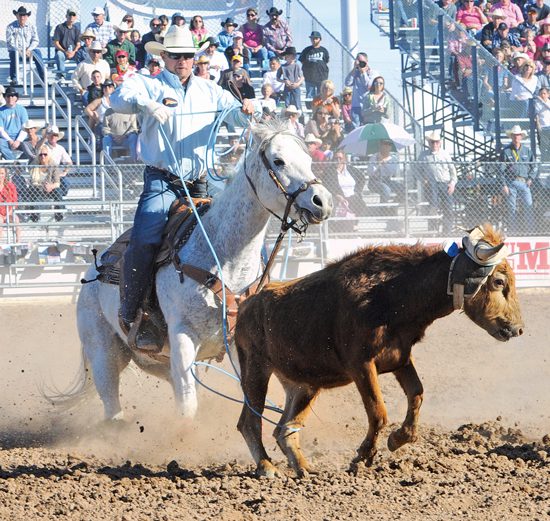
As a kid, Justin Loya had big dreams. Just not the NFR dreams most rodeo kids have. From the age of five, Justin craved baseball. Both parents, Sam and Marilyn, competed in rodeo and as a youngster Justin roped calves, winning the Tie Down title in New Mexico Junior Rodeo more than once.
He also played football, wrestled, and competed in other sports during school. But baseball was always his first passion and the thing he wanted to pursue to the highest level.
Consequently, as a high school freshman, Justin sold his horses to focus solely on baseball. This passion earned him a scholarship at Benedictine College in Kansas. As a senior, he was selected to play on Team USA and traveled to Australia where he ultimately threw his arm out. Corrective surgery soon followed, but Justin found he was not able to throw as he had before.
With the option of an academic scholarship at University of New Mexico, Justin decided to stay close to home and learn to team rope. After a year and a half of roping close to home, Justin was offered a rodeo scholarship at Frank Phillips College in Borger, Texas. There, he completed his Associates Degree before transferring to West Texas A&M the following year.
When Justin started roping at 19 years old, he was a #2. In 2006, he missed making the NIRA finals by just one spot. His college rodeo team went on to win the region and nationals. And by the time he was 22, he was rated a #8.
“I roped all day, every day. I set up my classes where I was done by noon,” explains Loya. “My roommate and I would visit three or four roping pens every day and rope until dark. My parents furnished me with nice horses and that helped quite a bit.”
Now, at 33, Justin works as a Senior Real Time Trader for PNM (Public Service Company of New Mexico). There he monitors and balances New Mexico’s energy load and generation. He also buys and sells energy as needed throughout the United States.
Additionally, Justin owns and operates Loya Performance Horses, in Los Lunas, New Mexico, where he trains and sells some nice horses. He is also teaching his seven-year old son, Payson, to rope on his retired rope horse.
How much do you practice?
About five days a week.
Do you make your own horses?
I’ve made some and bought some. Right now I’m making more than buying.
Who were your roping (rodeo) heroes growing up?
I didn’t really have any because I was playing baseball. At the time I was more of a calf roper and Brent Lewis was from New Mexico so I paid attention to him.
Who do you respect most in the world?
My father.
Who has been the biggest influence in your life?
My parents always have been, now my son is a big influence.
If you had a day off what would you like to do?
Play golf.
Favorite movie?
Lonesome Dove.
How would you describe yourself in three words?
Honest, driven, fun.
What makes you happy?
Knowing I’m setting a good example for my son.
What makes you angry?
When I don’t do well from lack of preparation.
If you were given 1 million dollars, how would you spend it?
I would invest in property and save the rest for my son’s education.
What is your worst quality – your best?
My best is striving for perfection. My worst is being overly competitive.
Where do you see yourself in ten years?
Hopefully I will be getting ready to take my son to college. Much of the next ten years will be about him and me roping when I can. -

ProFile: Josh Peek
Josh Peek is heading to the Wrangler NFR for the first time in six years – as the top contender ($116,603.15) in the All Around and sitting in the middle of the pack (7th with $71,396.90 )in the steer wrestling. The 6x WNFR qualifier hasn’t made it back due to a number of factors. “It hasn’t been any one thing,” said the 37-year-old from Pueblo, Colo. “I didn’t have horses for a couple years, and then I took a couple years off to spend with my family,” said the father of twins who welcomed their new baby brother on September 20. “Add to that the injuries -last year I got hurt the first of August.”
He fixed his horse problem by training a new bulldogging horse, Ace, that Pecos Shannon found for him. “It took two years to get him right. I bought him off a ranch in New Mexico; he was a bronc when we first got him. I tried him on the calf roping side, tripping, heeling; he never got good at any of it. I hazed on him one year and he got really good at that, and then I needed a bulldogging horse and now numerous cowboys are winning on him across the country. He’s a game changer of a horse.”
With his horse problems solved and the blessing of his family and his current employer, Josh made the push to compete at the Thomas and Mack one more time. “My job with Boulder Energy takes precedent over anything I am doing in the rodeo world,” he explained. “I sat down with Boulder Energy – to see if I could make a run at it this year. I knew I wouldn’t be able to put in as much time as I should for that job. I wanted to make sure that I would still have a job when I got back,” he shared. “Right now I’m at that stage of life where it’s great to be out here, but that job and the opportunity that I have there is something I can’t lose.” The company is backing him 100%. “Rodeo is an extreme risk and there are a lot of things that have to go right to get that elusive gold buckle.”
He is still hoping to make it in the calf roping, sitting 26th, $14,611 out, but it can be done. “I’m the only one that can feasibly make it in two events right now,” he said. “God has a plan no matter what – it’s a blessing going out in the bulldogging and I feel like my bull dogging has matured along with my horse.”
He is the first to admit this year has been tough. “I realistically haven’t been able to spend as much time with my family. They’ve had to give up a lot for me to be in this position,” he said. His wife, Kori, has been a trooper. His two oldest are in first grade now and can’t be gone like they could when they were younger. “I like our kids being in school and the structure of how to sit down for a full day and have to listen. Someday you are going to have a boss and have to work together, and sit all day and I think school teaches that.” Besides missing his family, he’s had a lot of trials in the calf roping. “I’ve had to change horses a lot and the miles and hours on the road have been a lot harder this year.”
He is grateful to be home for two days with his new son and his family. “I’m done the end of September, and then I can be home for a couple of months.” For now, he plans to finish 2016 strong. He is leading the All Around right now; and also won the RAM Circuit Finals All Around in April. “I went to 26 circuit rodeos this year, I’ve never been to more than 18, just to make sure I’d stay in a position to win the circuit so I could be down there next year – winning the $30,000 from there is half way to the NFR.”
He thanks his sponsors, Nutrena, Duba Trailers Customizing, Oxy-Gen, Knukle Energy, Bayou West, Boulder Energy, and Cactus Ropes & Gear.
Most of all, he thanks the Lord for the opportunities he has and is looking forward to Las Vegas. “Las Vegas is hard to make and you never know when you’re going to be out there. I’ve had a lot of success when I get to the NFR.” -
Back When They Bucked with CR Boucher
courtesy of Scott Breen & Brandon Sullivan, Montanasports.comand and Siri Stevens
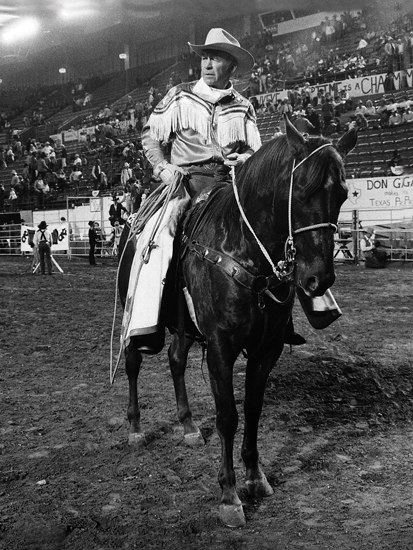
‘Routine’ is hardly the word that comes to mind when traveling with CR Boucher. But lunchtime may be the exception.
Every Monday through Friday he drives eight miles into Pryor, Montana, spends about two hours telling stories with friends at the Senior Center, checks mail at the post office, then drives eight miles home. This world champion cowboy is still sharp as a tack, and witty.
“I didn’t ride bulls,” said Boucher. “I just entered. My percentage wasn’t that great,” said the 85-year-old that has replaced bulls for a four wheeler and a cane.
CR – short for Clarence Raymond – grew up in Livingston, Montana. His father worked repairing steam engines. He spent his freshman year as a linebacker on MSU’s football team. He joined the army, and continued to play football for Ft. Worth for two years. When he got out in the 1958, a guy named Aubrey Rankin told him, “I’ll pay your entry fees, you wrestle steers and ride bulls. We’ll split the money.” He had a dogging team, and CR rode his horse. As CR tells it, he’d rarely even seen the sport – but just thought he’d give it a try.
“So, we got down to about the last rodeo there before we were both broke, and we was at Odessa, Texas,” he said. “I drawed a big ole charolais bull. By God if I didn’t ride him and win second. From then on we just started winning.”
Eventually a bull stomped on CR’s leg in Farmington, New Mexico, and Aubrey convinced him to stick to steer wrestling. That worked out pretty well for the pair. “Aubrey pumped me up pretty good, making me think I could throw a buffalo bull.” A freak accident at a rodeo performance in Mesquite, Texas, killed Aubrey. He was hazing for CR when the horse he was riding was clipped by a steer, and rolled on top of him. It whipped his shoulder and knocked a bone through his jugular. and when CR got to the back of the arena he wanted to go see his friend. “And they said you don’t want to go up there and look at him,” said Boucher. “They said, there’s blood running out of his nose, ears, everything. So there was a guy there who took me in his car, following the ambulance. Two or three guys in suits. Told me ‘you don’t need to go in there.’ He said D-O-A. And I said, ‘God dang’… That ended our deal.”
CR picked himself up and made it to the National Finals in Dallas, the last year they had it there in 1961, where he won the average. He went on to become a steer wrestling world champion in 1964. His earnings for the entire year were a little less than $20,000. His kitchen and fireplace mantle are filled with snapshots, trophies, plaques and buckles.
He qualified six times, then went to work as an arena director and pickup man for 19 year for Beutler Brothers Rodeo Company, picking up at the NFR the first year the NFR was in Las Vegas. CR is one of the very rare professional cowboys to hit every NFR site either as a competitor, or a hired hand. Dallas, Los Angeles, Oklahoma City, and Las Vegas. In fact, while living in Texas, he remembers qualifying for the first NFR in Los Angeles — shortly after JFK was assassinated in Dallas. “Yeah, everybody that had a Texas plates on their car, or pickup or trailer, they throwed rocks at you,” he remembers. “And they thought everybody from Texas was involved in that deal.”
That was over half a century ago. Today, CR’s credentials are listed in the AKSARBEN Hall of Fame at Omaha, and at both the PRCA Hall in Colorado Springs and the Cowboy Hall of Fame in Oklahoma City in the same year – 2001. Earlier this summer, a brand new buckle was sent to him as an inductee to the Texas Cowboy Hall of Fame. His name, with honors, went on the Montana Pro Rodeo Hall and Wall of Fame, located at the Metra Arena in Billings, in 2003 as World Champion Bull Dogger (1964). He is being inducted into and put on the Legends Wall as a Rodeo Legend this coming January.
He married Wilma Landie in 1985, the first year he quit picking up bucking horses. They moved to Pryor in 1987 and has been there ever since.
If he were younger, would he do it all over again in today’s rodeo era?
“You better believe it. I’d be the first one there. Too much money up.”
The National Finals Rodeo (NFR) showcases the talents of the nation’s top fifteen money-winners in each event as they compete for the world title. The first National Finals Rodeo (NFR) was held in Dallas in 1959 and continued at that venue through 1961. In 1962-64 Los Angeles hosted the competition. In 1964, however, Oklahoma City successfully bid to be the host city. In 1965 the first National Finals Rodeo (NFR) in State Fair Arena drew 47,027 fans. The world event remained there through 1978 and thereafter was held in the Myriad Convention Center.
The National Finals Rodeo (NFR) remained in Oklahoma City through 1984, bringing Oklahoma merchants an estimated annual revenue of $8 million dollars. In 1984, however, the city of Las Vegas, Nevada, bid for the NFR (National Finals Rodeo) event. Although the Oklahoma City Council considered building a new $30 million arena at the State Fairgrounds, the Las Vegas bid won. Since 1985 the NFR (National Finals Rodeo) has been held in the Thomas & Mack Center in Las Vegas.
The NFR (National Finals Rodeo) has become Thomas & Mack Center arena’s biggest client, bringing in more than 170,000 fans during the 10-day event. In 2001 a landmark sponsorship agreement was achieved and Wrangler became the first title sponsor of the National Finals Rodeo (NFR). In 2014 contracts were set for the National Finals Rodeo to remain in Las Vegas until 2024. -
On the Trail with Lane Barton
story by Siri Stevens and Mary Williams Hyde
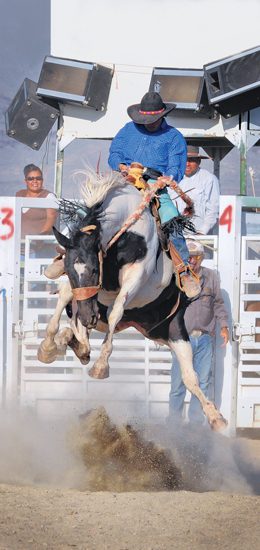
When Lane Barton was in fifth grade he was going to cow camps with his father, George, and going to rodeos on the weekends. “We were on the desert moving cows around and back to the ranch,” said the 24 year old from Winnemucca, Nevada. “I went to rodeos with him since I was a baby. Once I got old enough, I got to go behind the chutes. When I got to high school, I got to put the saddle on and get it set and pulled down, and measure the rein.” George competed all over – California, Idaho, Oregon, Utah, and everywhere. George, now 43, was 13 the first time he rode a horse out of a bucking chute in the days way before ranch bronc riding was even an event.
His grandfather, George Abel, is in the Buckaroo Hall of Fame in Winnemuca, a museum that preserves the Buckaroo Heritage of the Great Basin (Oregon, Idaho, and Nevada) area of the west. “Being a cowboy up in this country, back where there weren’t many fences; they lived their lives on horseback,” said George, who worked on ranches in the Great Basin most of his life. Several stock contractors came to buy horses that George Abel had. “We had a couple hundred head of horses on my grandma’s ranch in Fort McDermitt on the reservation,” he said. He was lucky to have plenty of horses to practice on. “They’d drive them 74 miles from McDermitt to town,” he remembers. “The horses would fill up a two lane road for a long time.” He rode broncs in high school rodeo and in 1991 was the Nevada State Champion and traveled to Shawnee, Oklahoma, for the National High School Finals. George went on to ride in the PRCA for seven years. He quit a little after his second son (Chance) was born. He picked up ranch bronc riding instead, working on his father-in-law’s ranch. “You don’t get the time off to travel, but I hit the ranch rodeos that I could get to.” He has since moved to Winnemucca, where his wife, Denise, teaches school and he works in the gold mine. “I learned a trade instead of cowboying,” he said. “I go brand calves and help out everyone around.”
Lane picked up the rodeo bug, climbing on his first bronc at the age of 13. “Ever since I was a little kid that’s all I wanted to do was ride bucking horses.” He started riding broncs in high school and rode until he was a junior, when he ventured out to bull riding. “I hung up the rope after the last one my senior year. I had already started riding ranch broncs and I could do that better.” Western States Ranch Rodeo started up his senior year in high school, so he had a place to go. “The biggest difference between ranch bronc riding and saddle bronc riding is the saddle – you get to ride with both hands if you want to.” He likes the fact that you don’t get disqualified if you ride with both hands or lose a stirrup.
He didn’t get his Western States Ranch Rodeo card until 2012. Ever since then, he is entering every rodeo he can, as time off from his full time job, and availability of entry money allows. Lane welds fence for Nuffer Welding and will marry his fiancé, Kayla Dowd, next September. He is determined to make the WSRRA National bronc riding finals for the third time this fall. Only the top fifteen, of over 100 ranch bronc riders who try for the same honor every year, can ride at this prestigious event.
Today, George is more his son’s biggest fan and mentor, traveling with Lane as often as he can, rather than going for points and money himself. Even after thirty years and over 1,000 broncs, George still loves to ride an occasional rank bronc, especially if he can complete against his son, Lane. “Take a deep seat, give your horse his head, keep moving your feet forward, and let the horse buck,” is his standard advice.
-
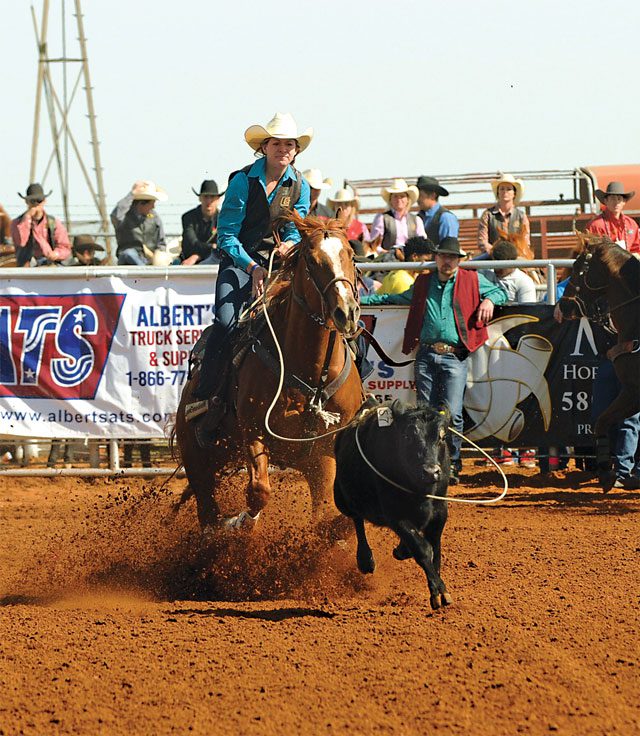
On the Trail with Ashlyn Moeder
Somebody showed up at the Moeder’s front door when Ashlyn was about 7, and said: “Your daughter said you want to buy our horse.” Melinda and Mike, who had never been around horses at all, said ‘no.’ They tried to turn the experience into a life lesson for their daughter. “We had some friends that had a horse and we asked if we could feed the horse and water it through the summer. We thought if she could see how much work and time it took, we’d have this problem fixed. It worked in reverse. She fell in love,” said her mom, Melinda. “We had to learn everything from ground zero. We had some great people helping us.”
Ashlyn started with Western Horsemanship and jumping, competing in barrel racing to give her additional opportunities in the All Around. She entered her first rodeo as a sophomore in high school. “Once I started thriving in the show aspect of things, I wanted a new challenge and I loved rodeo more than showing,” said the 19-year-old from Oakley, Kansas. She competes in barrel racing, goat tying, and breakaway. “It’s been a challenge,” she admits, believing her start in the show world was helpful. “I would have never caught on with the horsemanship part of it. I’ve learned how to train two year olds – I’ve done two now on my own – and am now starting to win on those horses that I’ve trained.”
Her senior year was the year she actually started doing good. “I was giving donations just trying to learn the events,” she said. “I ended up winning the breakaway short go, and was in the top ten. I had finally started climbing up the ladder – nobody knew me.” After graduating, Ashlyn spent a year at Garden City Community College, bringing 18 college credits from high school with her. She completed 50 hours at Garden City in one year and has transferred to Northwestern Oklahoma State University in Alva, Oklahoma, where she will pursue a pre-vet degree and rodeo under Stockton Graves. “The school is really competitive on the rodeo side of things, and has a great ag and science program.” She is leaning towards surgery, and if that doesn’t work out, she will be a large animal vet. “I’ve done dissections since high school and I’ve thrived in any class. I want to help animals and this is the perfect combination.”
This is her second year rodeoing in the KPRA and she is sitting third in the breakaway, first in the barrels, and first in the All Around. “It’s been an eye opener, and competition I’ve never been around,” she said of the KPRA. “There are some big names competing on some tough horses.” Ashlyn has brought a few tough horses of her own to the arenas this summer. Picking from her herd of 15, which includes her now-retired show horses, she has a main barrel horse, Shake, her breakaway horse, Gruilla, and rounding out the pack is CC, her goat tying horse.
She bought Shake from Sabrina Devers. “When I was trying for my first saddle, and Sabrina had this horse, I took him to the junior rodeos and I fell in love with him.” He’s the only horse that has gotten her a check all summer in the barrel racing. Gruilla was used as a reining and working cow horse. “When I started roping, I started learning off of her and she’s been my main breakaway horse.” Learning to rope was a very frustrating experience. “I’d go rope for hours trying to get it right. It didn’t take many years, but it sure took a lot of hard work.” Her goat tying horses is DC, a horse she got from Ty Inlow, who has been instrumental in her success. Ty took her to the next level in the show world, and she would go out to his place and practice day in and day out. “He had me ride several different horses so I’d have the feel for them – he has really been a big part of my life.”
The first horse Ashlyn had was an $800 horse from a sale barn. “He got her started in barrels and he was amazing,” said Melinda. “They thought he was injured is why he was being sold.” Throughout Ashlyn’s horse career, both Mike and Melinda have tried to let God lead. “We’ve always said the horse needed us and we needed him.” Melinda is an accountant, and her dad, Mike, is a farmer and rancher at M3Farms. “We raise Black Angus and Wagyu cattle (a Japanese breed of beef), wheat, milo, and sometimes corn. Ashlyn tries to help when she can, but her rodeo schedule makes that pretty tough.
“Her hard work and determination to succeed in it has been fun to watch,” said Mike. “She has really dug her heels in to go and be the best she can. We’ve mounted her the best we can, but she has to be able to ride.”
“I spent the summer with Sabrina Devers, and she taught me more about training and I will always be grateful to her family for taking me in,” said Ashlyn. “She kept my horse sound the whole summer, teaching me how to do that. I learned how to stretch my horse before races and some tricks with medicines and wrapping so he could travel better.”
The regular season is over and she is sitting first in the barrels by $2,000, third in the breakaway and first in the All Around by $7,000.”
She is still looking for her first saddle, and hopes to accomplish that goal at the KPRA finals. “The rodeo people have become my family. I’m on the road so much, I’m never home. They have all welcomed me with open arms. It’s been awesome. I don’t know where I’d be without it. It’s been such a good part of my life, I’ve met such awesome people.”
Ashlyn competing at the Kansas State Fair – Wright Focus, wrightfocus.com 
Ashlyn played basketball for her high school in Oakley, Kansas 
Ashlyn with her seventh deer – courtesy of the family 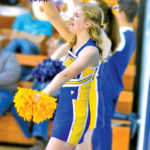
Ashlyn cheerleading for her high school in Oakley, Kansas – Brittany Jo’s Photography 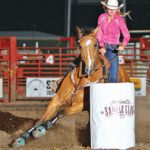
Ashlyn barrel racing at the Plainville Saddle Club. – Dale Hirshman 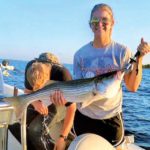
Ashlyn with her big catch while fishing with the Devers family -
Back When They Bucked with Donald Dorrell
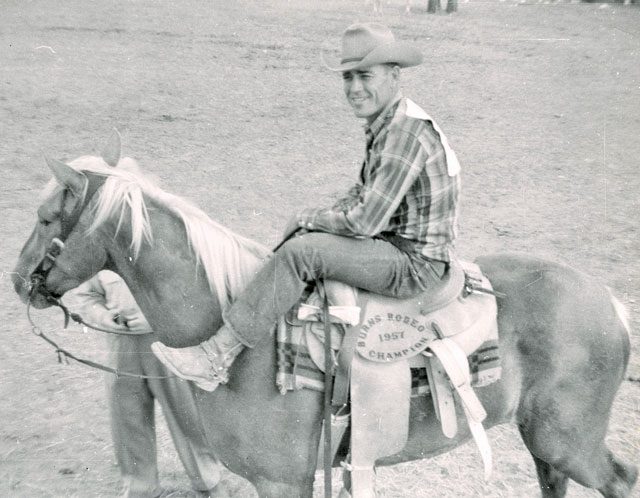
Donald Dorrell was born February 8, 1926, “right up Beaver Creek in a log cabin across from where we live now. It was my grandmother’s homestead. She delivered me because the doctor couldn’t get there,” said Donald, who still lives on the ranch in Rifle, Colo. His dad was a farmer and Donald went to school with 14 others. “We were seven miles from the school house and we rode the horse for 8 years. Sometimes we’d leave the house in the morning it would be 20 below, so in the winter time we’d ride bareback so the horse’s body would keep us from freezing.”
He dreamed of being a pilot, but was told when he enlisted in the Navy at age 17, that he was too young, so he became a rear seat gunner on a torpedo plane. “I spent two years on the back seat of a carrier based on the First Enterprise,” he recalls. “It wasn’t very nice. On at the last, we got hit by a Kamikaze – it killed about 45 guys – and it really messed us up; so they sent us back, without an escort, to Pearl Harbor to get things fixed and we could only do about 7 knots (8 miles an hour). It took six days to get from where we got hit back to Pearl Harbor. The war got over then and I went back to the ranch.”Donald was 21 and got married about two years later to a local girl, JoAnn. He stayed on the ranch, and he and JoAnn raised cattle (350 mother cows), and put up hay. He started competing in rodeo the same time he got married, competing in “everything that came out of a bucking chute, bulls, bareback, and saddle broncs.” He liked saddle broncs the best. “It just seemed like a better thing to do really – bulls – that was the bad thing to do, but I rode a lot of bulls. Bareback was just another event.”
He would go every weekend, traveling as far as three states, Utah, Wyoming, Colorado,. “We had an association – Amateur Cowboys Association – and I won about four belt buckles.” He never went pro. “You’d have to travel most of the year, and I couldn’t because of the ranch. You had to make a living. Back then they didn’t pay like they do now.”
He traveled to the rodeos with his wife and a horse. “I took a horse to the rodeo so I could race him. He’d usually pay the expenses; they didn’t outrun him too many times.” He competed in both the Wild Horse Race and the Relay Race. Although he roped at home on the ranch, he never competed in the roping events. He quit competing when he was about 60, when he quit riding bulls. “I didn’t get beat up too bad. If you didn’t get bucked off, it wasn’t too bad.” He still goes to the local rodeo in Rifle. “They pay a lot more money, and the bulls are a lot harder to ride.”
He still works on the ranch, but “as little as possible, I’m past 90. We sold all the cows – it got to where it was too hard for JoAnn and I to take care of them. Now we do as little as possible. I don’t get around too good. I’ve got two saddle horses; one is about like I am, Skeeter’s got arthritis, but he was my good horse. He will be 26 this year.”
Donald is glad that he rodeoed when he did. “I sure had a lot of fun,” he said. His favorite place to go was the local rodeo, in Rifle, one that he still attends today, just to watch.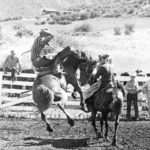
Riding in Aspen, Colo., in 1959 on the horse (I’ll Be Damned) that went to the NFR two years in row. – Courtesy of the family 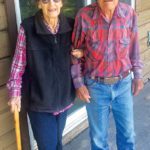
Donald and JoAnn, married 67 years, at their home in Rifle. 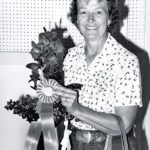
Grand Champion flowers in 1983. -

ProFile: Austin Singley
Steve Martin advises, “Be so good they can’t ignore you,” and 24-year-old barrelman, hypnotist, and professional stuntman, Austin Singley, took the advice to heart. Now in the middle of his second year as a PRCA barrelman, while also performing part time in Universal Studios’ WaterWorld, Austin has been developing and refining his panache since seventh grade. “I was pretty shy through elementary and kept to myself, but in seventh grade, I auditioned for the school musical, Grease, and that’s what really sparked the fire for performing,” Austin explains. His senior year of high school, Austin and several friends put together an illusion magic show, with all original illusions and routines, which they took on the road and performed in professional theatres around their home state of Utah.
Yet it was the dusty stage of rodeo that Austin wanted to command. Growing up a rodeo-goer rather than a competitor, he was in the audience of the Ogden Pioneer Days Rodeo in 2009 when Keith Isley performed his trick horse act. “That night, everyone kept telling me I had a similar personality to Keith’s and that I’d make a great rodeo clown, so two days later, I booked my first rodeo in Duchesne, Utah. I’m a guy who gets something in my mind and I don’t stop until I achieve it!” For the high school junior, the performing aspect was no difficulty, but he’d spent little time in the arena, let alone in a clown barrel. A family friend from Ogden Pioneer Days, Jackie Belnap, found out Austin was making his debut, and surprised him with an interview with Keith Isley before Austin left town. “It was a huge star struck moment for me,” Austin recalls. “He sat for 20 minutes and coached through some things to do and watch out for. To this day, I can call and ask him questions, and he and his wife, Melanie, have become good friends and are very supportive of me. Keith has helped me in more ways than he’ll ever know!”
Austin and his trick horse, Tess. Tess is a half-Quarter Horse, half-Arabian mare he rescued four years ago and trained for his act. 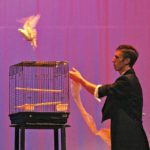
Austin Singley performing his Dove Act from his Magic Show – courtesy of austinsingley.com 
Austin performing in Universal Studios’ WaterWorld – Jayme Seleska Photography
Rodeo clown greats like Keith Isley and John Harrison, who endorsed Austin for his pro card, have inspired him. “I watch them and observe what makes them successful, in addition to being funny. I think it’s having acts that require some kind of talent that puts them above the rest,” says Austin. “Too many rodeo clowns nowadays go into the arena and make fools of themselves at the expense of a laugh, but these are genuinely hilarious guys that took years to put their acts together.” Austin uses his own strengths, such as creating illusions and training trick horses, and infuses them with comedy. “When I got into the industry, I promised myself to always bring fresh and new material to rodeo audiences. It’s hard to choose a favorite act – they’re like my children – but I have a horse appearing illusion act, and another with a custom inflatable version of me as a rodeo clown that are two of my favorites. With my acts, I want to be sure everyone, of any age, can see and enjoy them from any seat in the house.” His trick horse, Tess, is a half-Quarter Horse half-Arabian mare he rescued four years ago and trained. He’s copyrighted all of his acts, explaining how important branding is to success. “I always have the same costume and makeup and the same acts – I don’t want people confusing my acts and material with any other clown.
“If someone had asked me in high school what I thought I’d be doing in 2016, this would not be my answer, but I can’t think of anything better suited for me,” says Austin. “I love being on the road and meeting new people. The rodeo family is a very close knit community, and it’s nice to go almost anywhere and know the people there.” He’s performed as far east as Colorado, covering most of the western states, while he anticipates branching out to Oklahoma and South Dakota as his PRCA career takes root within the next year. Stops this summer have included the Tehachapi Mountain Rodeo in California, ten nights at the Cody Nite Rodeo in Wyoming, Flagstaff Pro Rodeo in Arizona, and many more.
His travels have even taken him to Hollywood, where he’s performed in Universal Studios’ WaterWorld Stunt Show since February. He plays one of the villains called the Smokers, shooting through a wall of fire on a stand up jet ski. The show, though only 20 minutes long, plays up to ten times a day, and actors may perform in a maximum of five shows a day since it is so physically demanding. “We have six people for a single part, for flexibility, which is nice for my rodeo schedule,” says Austin. The show has been running since 1995, and Austin was four when he saw it first. Jet skis dancing in his head, he came across a casting call for auditions for the Universal Studios in Japan several years ago. A few weeks before auditions, he bought a stand up jet ski and practiced on the lake, but wasn’t cast. Two years later, he auditioned for the show in Hollywood and made is as far as callbacks, but didn’t make the cut. “It was a long drive back to Utah,” Austin recalls. “I was teaching a stunt workshop at the University of Utah when I got a call saying they wanted me back for water callbacks that weekend. So I drove down for those, and the following Thursday they gave me the job and told me I started on Monday.” He’s made his home temporarily in Lake Elsinore, California, but will be moving back to Clearfield, Utah, this fall. “Being in the show was a bucket list thing for me, and my eyes are usually way bigger than my stomach, but somehow I’m always able to pull it off!”
He attributes that to the support of his family, including his mom, Sherie Reynolds, brother, Brayden, a dancer, teacher, and choreographer for the NBA’s dance teams, and their sister, McKenna, a sophomore at Oregon State University with a position on the gymnastics team. “There’s something in the water at the Singley household!” Austin jokes. “We were raised by an amazing woman, and my mom is my hero. I know I speak for myself and my siblings when I say we owe everything to her.”
Austin’s goals include marrying and raising a family of his own someday. “Until then, I’ll focus on building my rodeo career and earning as many buckles as I can. As long as I can keep audiences entertained, and bring in fresh material and acts, this is what I believe I’m meant to be doing with my time on this earth. -
Burgers from the Ranch & Baked Candy Apples
Burgers from the Ranch
recipe courtesy of Kristie Binder,”Rodeo Road Recipes”
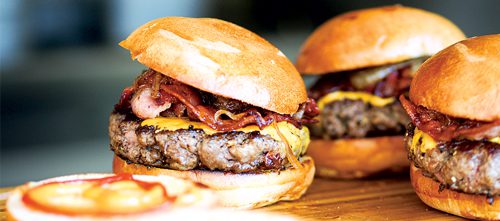
INGREDIENTS:
1 1/2 lb. ground beef
1 pkg. chipotle seasoning mix
1/4 cup red onion, chopped fine
1 cup cheddar cheese, shredded
1/2 lb. bacon, precooked
mayonnaise
lettuce
tomatoes
large hamburger bunsDIRECTIONS:
Preheat grill to medium-high heat. Combine hamburger with the next four ingredients. Place patties on the grill. Grill until they reach desired doneness. Lightly toast buns on the grill. Spread mayonnaise on one bun, top with patty, lettuce and tomato.Baked Candy Apples
recipe courtesy of Kristie Binders,”Rodeo Road Recipes”
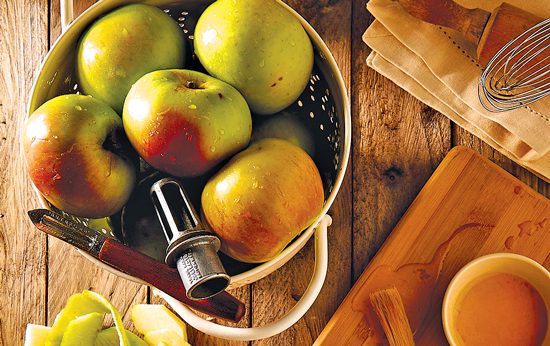
INGREDIENTS:
1 large baking apple, cored
2 T. brown sugar
3/4 tsp. butter
5 red-hot candiesDIRECTIONS:
Preheat grill to medium-high heat. Place bown sugar, butter and candies into the center of apple. Wrap apple in heavy-duty aluminum foil and place on grill. Grill apple for approximately 20 minutes. Test apple for doneness by poking with fork. Once done, enjoy! -
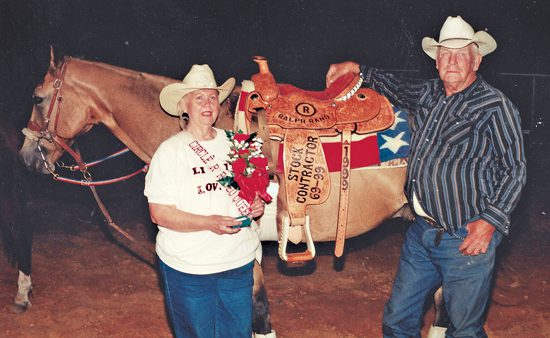
Back When They Bucked with Ralph & Helen Rand
story by Kyle Eustice
In the early 1950s, Ralph and Helen Rand used to frequent the Calico Rock Café in their hometown of Dolph, Arkansas, and the pair quickly grew fond of one another. The only problem was Helen was just 14 years old and Ralph was 24. Understandably, the age difference caused a lot of controversy in the family, but they were undeterred. They started seeing each other anyway, even though Helen’s father, Homer Pat Sanders, was adamantly against it. Despite his resistance, they fell in love, ran off together and got married in 1953.
After a whirlwind romance, the couple is still going strong 63 years later. Their eldest son, Tommy Rand, 57, was born into the cowboy way of life, along with older sisters Rema and Judy, and younger brother Tony. Ralph started producing rodeos in 1969 when they were all young children.
“I was 10 years old when dad started producing rodeos,” said Tommy. “The hardest part for me was catching cattle. There are 310 acres where the arena is, so it was a full day.”
As a child, Tommy helped his father raise horses and bulls. Several of them have been bucking bull or horse of the year. It started with his grandfather, Owen Rand, who bought and traded horses for a living.
“My dad basically turned it over to me when I was 12,” said Ralph. “I’ve always been a horse trader.”
Ralph started riding bucking bulls and horses at a young age, too. He loved the rodeo lifestyle from the first moment he was exposed to it.
“He’s always had horses as a kid,” said Tommy. “He just loved being around the rodeo and the people he met.”
In 1969, the Calico Rock Lions Club wanted Ralph to put on a rodeo. At that time, he didn’t have any bulls. Instead, he had bucking horses that weren’t broke yet. In fact, Ralph would regularly have his kids ride the unbroke horses and then take them to the local horse sale.
“If they sold and made money, the kids got to stop at the local truck stop to get something to eat, which was a real treat for them,” explained Judy. “But if the horses did not make any money, they didn’t get to stop. They would just drive by.”
At Ralph’s inaugural rodeo, instead of using bulls, he used cows to buck, while Helen would work the gate. His longtime friend, Paul McCarson, showed up to help him and essentially produced the first amateur rodeo along with Ralph.
“It didn’t require a membership,” said Judy. “It followed typical rodeo rules, but there was no rule book.”
Word started to spread that Ralph was producing quality rodeos on his property and soon people were asking him to produce rodeos in their town. That’s when the traveling began. Ralph had an old Bob Truck that could haul five horses and five bucking bulls. At one particular event in Ravenden, Arkansas, they ended up having the rodeo by moonlight after all of the lights were shut off. They did whatever it took to keep the rodeo going.
“In Imboden, Arkansas, the arena was a T-ball field, so it was not typical square arena,” said Judy. “This guy got in there with a bull and it knocked him completely through the fence. We had to fix the fence to finish the rodeo.”
With his unwavering dedication to producing the best rodeos in the area, Ralph dove head first into the production side, where he could be behind the scenes. While he’s not as involved as he used to be, he still raises several bucking bulls and horses on the Rand farm, where he hosts a “Born to Buck” program.
“We keep about 100 horses and 50 bulls,” said Tommy. “We put on junior rodeos, too. There’s always something going on.”
As a member of associations like the ACA, Arkansas Family Rodeo and Great American Bull Riding Association, Ralph has amassed countless accolades over the years. He served on the ACA board in the ‘80s, earned the GABRA Bucking Bull of the Year Award in 1994, and was named the ACA Cowboy of the Year in 1996. In 2013, he was the ACA Cowboys Choice Producer of the Year and two years later, earned the ACA Bareback Horse of the Year and Ranch Bronc Horse of the year. The Rand family’s most coveted award, however, is the 1998 Izard County Farm Family of the Year Award.
“I was shocked when I found out we got it,” said the now 78-year-old Helen. “I wasn’t expecting it. I came home from work and there were 70 or 80 people for a surprise potluck. There were six or seven photographers there to take pictures. Ralph and I were shocked. We had no idea they were going to do this surprise dinner.”
Every August, the Rands recreate the very first rodeo they had in 1969. Called the “Old Timers Rodeo,” they replicate the initial hand bill from 1969, when attending the event was only $2.50. It’s a huge spectacle and captures the hearts of their entire community. At 88, Ralph can watch the event unfold and soak in the magic of what he’s created over the years.
“It’s unreal how many people show up,” said Tommy. “About 1,100 to 1,200 people usually come. We give out buckles and just have a great time.”
Ralph is proud to watch his son take over the family business. He knows Tommy won’t stop until it’s the best rodeo it can be.
“He’s that kind of person,” said Ralph. “He’ll fight to get to the top. I tried other people in the past, but Tommy really does it the way we have always done it. He loves the rodeo.”
Ralph still checks on the cattle on a daily basis while Helen is content staying at home and spending time with her family. After such a long, fruitful career, they can look back with pride at everything they’ve accomplished, including Ralph’s biggest goal.
“I always wanted to be a cowboy,” said Ralph. “That was what I wanted to do as a young boy in school. The number one thing I said I wanted was a big ranch and I did it.” -

ON THE TRAIL WITH Daylon Swearingen
Daylon Swearingen split second and third place in the bareback riding at the NHSFR this July, riding all three of his horses after making the 34 hour drive from his home in Attica, New York. The 16-year-old bareback and bull rider won 2015 NHSFR All-Around Rookie Cowboy and qualified all three years of the NJHFR, the fruition of his hard work in the arena and on the spur board.
The oldest son of Sam and Carrie Swearingen, owners of Rawhide Rodeo Company, Daylon learned the art of balancing rodeoing and rodeo production from an early age. Sam finished the 32nd Annual Benton Rodeo before flying to Wyoming to watch Daylon and his 15-year-old brother, Colton, compete in the NHSFR. The family visited Devil’s Tower during their travels, but were immediately back to work as soon as their truck turned in the driveway. Daylon was introduced to rodeo by Carrie, a barrel racer and former trick rider for Longhorn Rodeo. He made wooly-fisted mutton busting runs before putting the Barstow youth bareback rigging from his uncle, Kenny Phillips, on a pair of roman riding ponies. “Me and a buddy built bucking chutes at the house when I was eight,” says Daylon. “We had one pony that bucked a little bit, but that was it. When we started bucking steers under the rigging and saddle, they worked out better.” He was competing at the National level by sixth grade in the bull riding, chute dogging, and breakaway roping. Colton followed in the tie-down roping. “I did the timed events for the all-around – and to beat Colton,” Daylon jokes. “I couldn’t lose to my little brother!”
Along with high school rodeo, Daylon competes in the SEBRA, IPRA, and APRA, where he was leading in the bareback riding his rookie year until heading out to Nationals. “I missed quite a few rodeos, and now I’m sitting third. It’s a little frustrating, but it doesn’t bother me too much because we still have quite a few rodeos left,” he says. Putting on 80 performances and 30 ropings from June to October, in addition to the usual rigors of summer haying, has its pros and cons. “I can always make it to at least two rodeos a week, and we have a weekly rodeo we put on. I usually get on every performance in at least one event,” Daylon explains. “We have good rodeos up here, there’s just not as many of them, so there’s not as many people to push you to get better.” His drive to be the best he can be motivates Daylon, along with the coaching from his dad, Kenny, Jerome Davis, Clint Cory, Dave and Tyler Waltz, and Doug Lutz. “Kenny is in Oklahoma, and I send him videos and talk over the phone. I went to Clint Cory’s bareback riding school this spring, and Jerome Davis has a bull riding school. He was a really good bull rider, and he got hurt, but he still has such a positive outlook on life, and he and his wife have helped me learn about the bull business.”
Two year ago, Daylon purchased several heifers and bred them. He has a crop of calves are on the ground and bucked his yearlings this summer. “They bucked pretty good, and so did my heifers. When they’re old enough, I’ll take them to a few futurities, and then start bucking them in my dad’s rodeos.” Rawhide Rodeo Company raises its own roping calves, broncs, and bulls, and purchases its steers. They produce everything from high school rodeos to PRCA and IPRA rodeos, including the Canadian rodeo company Sam is a partner of. “We’re also doing some novice bronc riding at seven of the big rodeos,” says Sam, who founded the company in 1987. “I want to give Daylon and all the young kids the opportunity to rodeo. The younger generation can go play video games and be competitive without the effort, and I think now anything that takes a lot of effort is dying off.” Sam is a first generation saddle bronc rider, growing up on a farm with 40 – 50 horses to ride. “You didn’t know you weren’t out West. My dad was a collector of horses, and as a kid, I’d get on one until it quit bucking, then get on another one! I rode saddle broncs for years and did pretty good, then started buying livestock and an arena and went from there. Daylon will get on the spur board and have me come down, or go over videos with me, but he knows what he’s supposed to do, so it’s more of a conversation.”
Sam and Carrie were married in 2011, joining their families – Carrie’s sons, Daylon and Colton, and Sam’s daughters, Katie and Molly. “Competing in rodeo is what both my kids strive for, and that’s all we really have in our life is our passions,” says Carrie, an RN and a vital part of the rodeo company. “We’ve met so many great people in rodeo – people competing, committees, and those who come to watch. It’s a great sport, and God has blessed us. We have a lot of fun, and it teaches our kids to work hard. It’s never easy, and sometimes you work hard and you don’t win, but that’s the way it can happen.” Carrie is barrel racing at the rodeos on a horse she’s been training, and is what Daylon calls the go-getter of the family. “We always come home with a ton of laundry, so we empty everything Monday morning and wash it, and get the crew’s western shirts to the dry cleaners,” says Carrie. “The Hazletts cook for the crew and anyone working the rodeo when we’re on the road, and that time is a definite blessing for our rodeo crew to get together.” Carrie often serves as a timer and keeps the company’s equipment organized on the road, which is even down to the arena itself. “Other parts of the country have permanent arenas, but up here, we don’t,” Daylon explains. “It takes about five hours to set up. We bring everything, from the chutes and fencing to the roping box. Colton and I help with that, and I do the feeding and help check calves.”
When Daylon’s not on the road with the company’s four trailers and motor home, he enjoys riding colts, mountain biking in the nearby state park, cross-fitting, and wrestling for Attica Central High School, where he’s a junior this fall. “I’ve wrestled since second grade – it gave me something to do during the winter,” he says. “You have to have mental toughness, and if something goes wrong, you can’t blame it on a teammate. It’s just you, like rodeo.” In the winter, Daylon rides practice bulls at home until the temperature is below 30 degrees. “We have about 500 acres, and the summers are good, but the winters suck,” he admits. Year round, he’s working toward his goals of competing in the PBR, and qualifying for the WNFR in both his events. Along with the APRA finals, he intends to compete in the SEBRA and IPRA finals this year, where he’s sitting 12th in the bareback.
“It’s a short rodeo season, but we’re blessed, and the boys work very hard at it,” Sam finishes. “They want it much more than I did, and it’s nice to see them getting involved and growing into rodeo.”