Rodeo Life

Category: Rodeo LIFE Cover Feature

  • Back When They Bucked with Pat Ommert

    Back When They Bucked with Pat Ommert

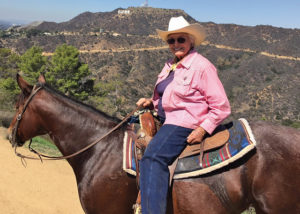
    Pat riding in Hollywood, Los Angeles, CA posing near the Hollywood sign – courtesy of the family
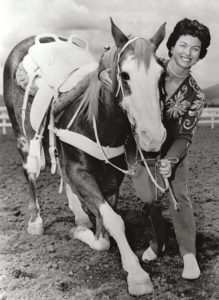
    Pat Ommert with her horse, Strawberry Shortcake – Courtesy of the family

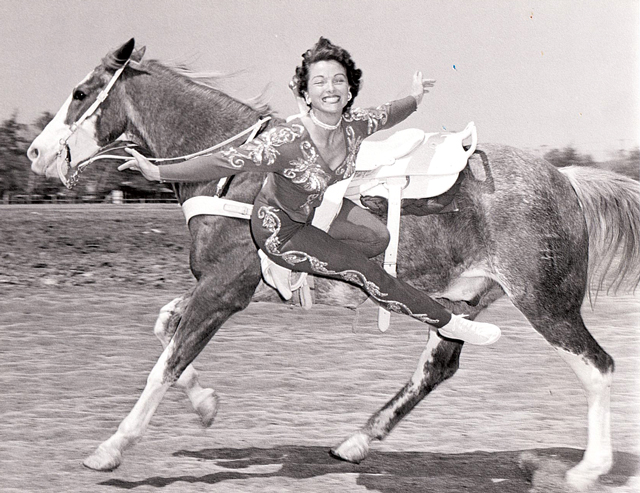
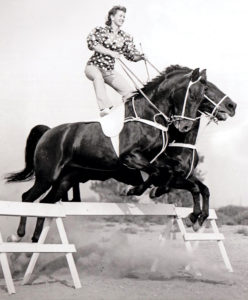
    Laces tied snug, tennis shoe cowgirl Pat North Ommert made hundreds of laps around as many arenas throughout the United States from the 1940s to the 1960s, dazzling crowds with her signature one-foot stand and vivid smile. The trick rider, jockey, and stunt double from California traveled and performed extensively, including 56 performances at the Madison Square Garden Rodeo in New York, and riding in Powder Puff Derbies at the Caliente Racetrack in Tijuana, Mexico. Yet her favorite place is still the back of a horse, and her accomplishments, whether astride or beside her equine friends, recently earned her an induction into the National Cowgirl Museum and Hall of Fame in Fort Worth, Texas.
    Pat was nominated 18 years ago for the National Cowgirl Hall of Fame before her induction in October of 2016. “I know many of the former inductees, so I was very honored,” she says. In 1999, Pat and her husband, Dr. Willard Ommert, received the California Professional Horsemen’s Association Lifetime Achievement Award for their devotion and contributions to the horse world. Pat is also active in preserving horse trails and the equestrian lifestyle in Southern California, where she grew up and continues to live today.
    Born in 1929, Pat was the second daughter of Bob and Vera North. A savvy businessman, Bob started Bob North Hardware Store in Bell, California, during the Great Depression, and the store flourished. The North’s home in Bell was eight miles away from the Los Angeles Union Stock Yards, and the vacant lots around Bell and the Los Angeles riverbed offered plenty of riding opportunities. The North family, including Pat’s sister, Laura, shared a love of horses. Vera, Pat’s mother, came to love horses after being sent to the Mohave Desert in 1912 with her younger sister. They boarded with a family to avoid the polio epidemic in Los Angeles and rode a horse to school. Vera later learned to train trick horses from a circus trainer stabled in Bell. She entered the show business, and even performed in the Hawaiian Islands with the E.K. Fernandez Wild West Show in 1934.
    Pat’s sister, who had an act with their mother, was married in 1943 and retired from show business. Pat was 14 at the time and performed the Patsy North and Her Trick Horse Rex act through World War II. Her own trick riding career started when she was 16, and she performed in rodeos and fairs around California. She still holds gold card number 1890 with the PRCA. “The trick riding was easy,” says Pat, who trained her own Roman riding and jumping team of horses. “I was an athlete. During World War II, my family moved to some acreage and we raised calves and did all our own work. My Roman riding was the most fun, and I think more spectacular. The hippodrome is one of the easiest tricks, but to do it with grace is something else. The one-foot stand was really my specialty. I consider myself a tennis shoe cowgirl because I had boots, but it was usually tennis shoes for trick riding and even working the trick horse.” Rex, who was half Morgan, was Pat’s left hand horse in the Roman riding, and Juan Monroe, a registered American Saddlebred, was the outside horse. Pat competed in many of the Los Angeles Sheriff’s Rodeo Roman races, and even did several publicity shots for the rodeo.
    When one of the North’s horses was sick in the 1940s, the regular vet sent his new associate, Dr. Willard Ommert, to make the farm call. Dr. Will and Pat took an instant liking to each other, and they were married in 1947. “Will was my best fan and loved what I did,” says Pat. “Like my dad, he never had a problem with me performing or being in show business. It didn’t make much money in the early days, but it did take care of the horse costs, and it was always fun.”
    Pat’s dad had passed away in 1951 from a heart attack, and after Pat and Dr. Will were married, Vera greatly encouraged Pat to continue her show career. Starting in 1951, Pat performed at the Salinas Rodeo with 14 or 15 other trick riders on her horse Shortcake, working her way into bigger rodeos. “Edith Happy and I worked many California rodeos together. She was a beautiful, long-torso lady who did the most beautiful stand ever,” says Pat, who performed at Salinas for 11 years. “I’m delighted that California Rodeo Salinas is using Edith’s hippodrome stand for their poster this year.”
    The year 1953 took Pat to New York City and Boston for several weeks, and Dr. Will used some of his vacation time to travel with her and watch several performances. Everett Colborn from Dublin, Texas, co-owned the World Championship Rodeo Company and produced both the Madison Square Garden Rodeo and Boston Garden Rodeo. Colborn’s own rodeo in Dublin became the Pre-Madison Square Garden Rodeo. Following the Texas performance, the entire production, joined by Pat and her husband, boarded the 24 car train for New York, stopping to perform in Fort Madison, Iowa, on the way. Many rodeo and western movie figures including Tad Lucas, Jim Shoulders, Gene Autry, Roy Rogers, and The Lone Ranger performed in Colborn’s rodeos. Pat rode Quadrille and the trick riders did publicity work for the rodeo. “That was really fun. The head of publishing for Madison Square Garden owned a white convertible, and five of us trick riders were seen around town. We were always in our western outfits,” says Pat. “We had lunch at the 21 Club, saw the premier opening of a movie, visited the Bellevue Hospital, and had a parade. We also had a rodeo parade in Boston. I rode my Roman team and my husband rode in the parade with me. After the parade, they had a Cowgirl Special thoroughbred race in Rockingham Park in New Hampshire, which I won.”
    By this time, Pat and Dr. Will’s first daughter, Annie, was three, and her sister, Janie, was born in 1954. In the 1950s, Pat acquired her Screen Actor Guild card and worked in several motion pictures as a stunt double and driver. One of her friends, showman Monte Montana, needed six women for a horse catch scene in “A Star is Born”, starring Judy Garland and James Mason. Pat was one of the six, along with her mentor, Polly Burson, Faye Blessing, Shirley and Sharon Lucas, and Louise Montana. “The last movie I worked was ‘Cimmaron’, and I was in Tucson for two weeks. They needed girls to ride and drive wagons for the Oklahoma land rush scenes. We made money on those shows, but it was a hurry-up-and-wait business. I had kids and horses at home waiting on me, and I thought of how I could use that time to be home riding!”
    In the 1950s, Pat also raced horses, even while on tour with the Bob Estes Wild West Show in 1957 in Mexico City. She retired from show business in 1962, and by then, her daughters were showing in the hunt seat division. Pat also showed hunters and jumpers for a time, and when she wasn’t taking Annie and Janie to horse shows, she was traveling and working with Dr. Will. Originally in the cavalry, he was transferred to the U.S. Army Veterinary Corps after the cavalry was dismounted. He worked with Dr. Bob Miller as the official veterinarians of the NFR from 1962- 1964 when it was hosted by Los Angeles, and his renown as a veterinarian was international. He advanced equine medicine in a number of ways, performing the first equine arthroscopic surgery, and even fitting a horse for contact lenses. “Will was the chief veterinary officer for the 1984 Olympics, and he was the vet for a lot of the California horse shows. I was in the horse show world with him,” says Pat. In 1969, the couple moved to Temecula, California, where Dr. Will built the state-of-the-art Los Caballos Veterinary Hospital, the first privately owned equine clinic and surgery in California. Pat managed the neighboring Los Caballos Farm, a facility for resting and retired horses, and they also raised several colts. Pat leased the ranch out several years after Dr. Will’s passing in 2004, and continues to make her home in Temecula.
    Now 87, Pat rides daily, boarding her horse a short distance away. She has four granddaughters and five great-grandsons, all of whom learned to ride from Pat. “I feel that it’s so important for kids to learn about the good earth and see livestock. I love seeing kids who know how to sit on a horse and ride,” says Pat, who supports the Pacific Crest Trail. She’s a member of Saddle Sore-Ority, along with the Rancho California Horsemen’s Association since 1970. “I feel so lucky to have been able to experience several different phases of the rodeo world. I feel I had the best of all of it.”
  • On The Trail with Blayze Fallis

    On The Trail with Blayze Fallis

    NUP_174363_3204.jpg_web-2
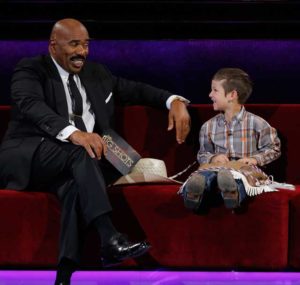
    Blayze on the Little Big Shots show with Steve Harvey – courtesy of NBC

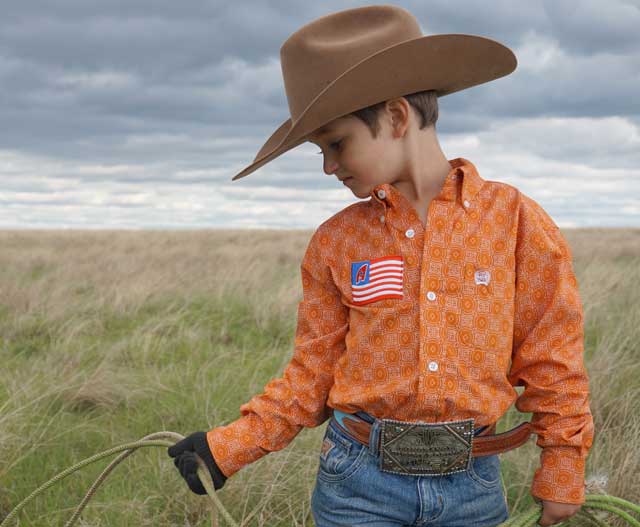
    What is a real cowboy? According to Blayze Fallis, a real cowboy takes care of his ranch, takes care of his horses, and takes care of each other. “It’s not what you’re wearing, it’s what’s in your heart,” says the 6-year-old cowboy from Cashion, Oklahoma. Blayze captured the hearts of America with his appearance on Little Big Shots the end of March. The show was called “There’s a new sheriff in town” and Blayze tried to teach Steve Harvey how to rope. “As soon as I saw him, I wanted to rope with him,” said Blayze of his trip to Los Angeles to film the show. Filming the show took two trips for Blayze – one for dress rehearsal and the second one to actually film the show.

    He ended up on the show through a Facebook friend. “She was looking for different kinds of talent, I sent her a message and said I might have a cowboy. They asked for some videos of Blayze and a couple days later I got a call saying they would fly us out,” said Heather. “We flew out at the end of June and back again at the beginning of July” The only coaching that Blayze had for the show was where to stand for his roping.

    Blayze has come by his roping by hard work and practice. “I started roping when I was two. My dad ropes, but not a lot. I picked it up and started swinging it.” Neither Heather nor Ryan rodeo competitively; they both ride horses, and Ryan ropes for fun, but Blayze practices every day to improve. He can now rope three stacked 55-gallon barrels and his goal in life is to be a cowboy. He rides rank sheep and mini broncs. He’s an only child which he likes. “I get to play with my mom and dad all day long.”

    “We have never forced anything on him,” explains Heather, who grew up in Shawnee, Oklahoma. “It comes natural to him – Ryan and I try to set our best example for Blayze, and behave the way we want him to.” Ryan works long hours at his job with BP, but manages to take Blayze to sorting and team penning practice.

    Aside from wearing his cowboy hat and boots day in and day out, Blayze is a typical six year old. He likes to play TBall, which is the only time he trades his boots for tennis shoes with cleats. He is a Kindergartener at Cashion school, where his favorite part of the day is recess. “I get to play cowboy with my friends,” he said.

    After school, he heads to the barn to ride, rope, and play cowboy some more. The family travels to rodeos on the weekends and they plan to join National Little Britches. “Whenever he was little, he’d pick up a rope and try,” said Ryan. “That’s all he wants to do is rope. Since he’s been able to talk everyone has commented on his personality.”

    For Blayze, God comes first, then roping. If he could go anywhere, he’d like to go to George Strait’s house. “Then we’d go to a lot of rodeos and rope.” His main horse is Tank. “I bought him with my money that I got from raking a lot of horse poop.” When the weather was bad, he started making signs, screwing the screws, sandpapered the wood and stenciled on the letters to make quotes and sold them. He also did a lot of work over at his Grammies and Grandpas house. “I saved up a lot of money to buy Tank. I rope on him, chase cows, barrel race, poles, and everything.” He has two other horses, Tuff and Kerosene.

    “Blayze is the most determined little boy I have ever met,” said Skylar Wright who has known him since he was a baby. “For a six year old to be that determined to go rope every day is amazing. He is adorable and so much fun to be around.”
    Blayze takes his new-found-fame in stride. “I just want to thank y’all. I feel blessed.”


  • Back When They Bucked with “Cody” Bill Smith

    Back When They Bucked with “Cody” Bill Smith

    Bill-on-Sonny-001.jpg_web-3
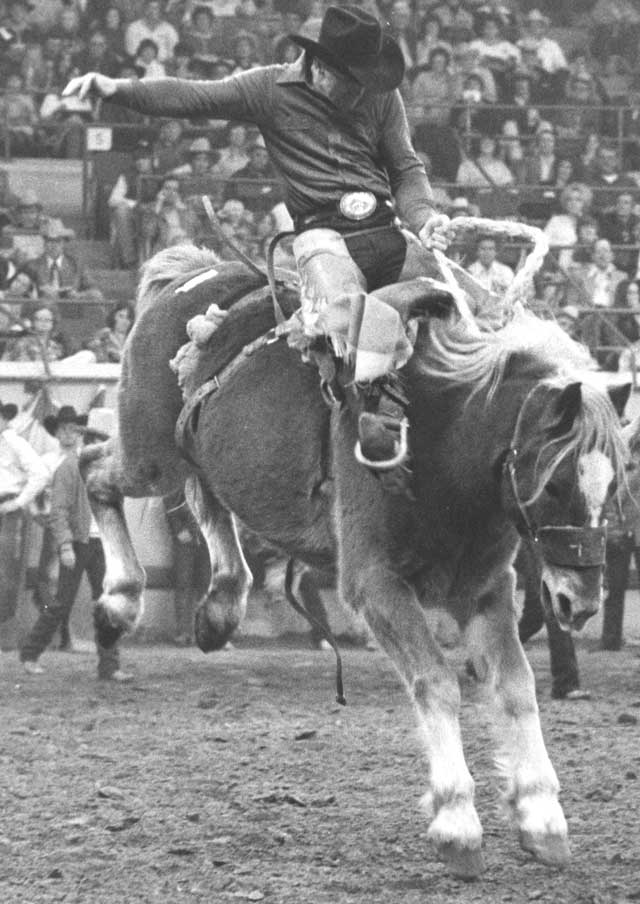
    Phil on Sonny, Calgary, Alberta, Canada, NFR 1978 taken by Huffman Foto

    All Bill Smith ever wanted to do was ride bucking horses, and be like his heroes, the Linderman boys.
    Smith, a three-time world champion saddle bronc rider, got to fulfill both of his childhood dreams.
    The cowboy was born in 1941 in Red Lodge, Montana, and grew up north of Red Lodge in the little coal mining town of Bear Creek. There wasn’t much to do in Bear Creek. “All there was, for anybody to do,” Bill recalls, “was go to school and go to the rodeo on the Fourth of July. The Lindermans were the thing back then, and they were my heroes. All I ever wanted to do, ever since I could remember, was learn to ride bucking horses. It wasn’t about winning, it was to have a chance to ride bucking horses.”
    And he did. The family had horses, and he’d ride anything he could catch. Back then, everybody had two or three head and they weren’t penned up; they ran out in the hills together. Bill and his longtime childhood friend, Chuck Swanson, would pen them and ride them all. “We’d ride the two- and three-year-olds, and we’d get bucked off and drug around.” But it didn’t matter. They were cowboys.
    As young boys, they’d work on the local ranches, doing whatever they could, just to be cowboys. And they’d ride anything possible. “I spoiled lots of horses,” Bill mused. “Everything I rode, I tried to get them to buck with me.”

    When he was a senior in high school, the Smith family: Glenn and Edna and their seven children, moved to Cody, Wyo. It was perfect for a bucking-horse-crazy boy. With the nightly rodeo, Bill started going, “taking his spills,” and refining his bronc riding abilities. In 1961, he bought his Rodeo Cowboys Association card (the forerunner of the PRCA), and that year, won the amateur bronc riding at the Cheyenne Frontier Days. “That was the first money I ever really had.”
    From there, he was ready to hit the rodeo road full time. Starting in 1961, he rode saddle broncs across the nation, competing at every big rodeo in the U.S. and Canada and lots of little ones. He won numerous events, and some of them more than once: Houston, San Antonio, Denver, Cheyenne, Nampa, Ida.; Cody, Prescott, Greeley, Colo.; Las Vegas, Dallas, Omaha, Oklahoma City, Tulsa, Memphis, Tenn.; St. Paul, Ore. and more.
    He loved to be on the road, and was gone most of the year. But home was still Cody, and his nickname reflected that. He was known as “Cody” Bill Smith. “They latched that on to me,” and he liked it. 130301_billsmith_07-(2).jpg_web-2
    Smith made the National Finals Rodeo for the first time in 1965, and then every year except one till 1978: thirteen out of fourteen years. Saddle bronc riding wasn’t necessarily easy for him at first. “I wasn’t an instant success. It took me a while to learn. I was never a natural at it.”
    His childhood friend, Chuck Swanson, had moved to Cody with the Smiths. Chuck also rode saddle broncs, and was exceptionally good, Bill remembers. But Chuck didn’t hunger to be on the rodeo road like Bill did. “He was a natural, but he didn’t have the bug quite as much as me. He wanted to be a cowboy on a ranch. I didn’t have time for that. There weren’t enough bucking horses for me.”
    Bill estimates he competed at about seventy rodeos a year, with his favorites being the ones with multiple rounds. Back in the day, most rodeos would be more than one round, and cowboys would stay several days in one location. He liked Ft. Worth, which was five rounds, San Antonio, which was six, and Houston and Omaha, which each had several rounds.
    Bill’s childhood dream of competing alongside his heroes, Bill and Bud Linderman, came to fruition early in his career. He was entered in the Filer, Idaho rodeo, as was Bill Linderman, and it was four rounds. Smith broke his leg on the first horse, but got on the next three. “I didn’t go far,” he said of riding with a broken leg, “but I got on them. I wasn’t about to let my hero see that I was crippled. I’d buck off after three jumps, but I got on.”
    He especially remembers some special horses. His favorite and one that stood out far above the rest was the big palomino horse Descent, owned by Beutler Bros. Bill drew him nine times, riding him five and getting bucked off four. “He was the greatest horse I’ve seen to this day. He could jump higher and kick higher than any horse I ever saw.” If a cowboy drew Descent, there was a good chance he’d win the rodeo, and that was true for Bill. He won Nampa on him twice and got bucked off there once. He won Tulsa on him and placed at the NFR on him.
    Other horses stick out in Bill’s mind. Trade Winds, owned by Big Bend Rodeo Co. bucked Bill off once and he covered him once. Trails End, a horse owned by Oral Zumwalt, bucked him off twice. On Harry Knight’s Sage Hen, he was the high mark at the NFR, and she carried him to his first big win in 1964 in Dallas. She bucked him off several times, too. “I wasn’t above being bucked off,” he laughs. “I could hit the ground with the best of them.”
    Smith missed the NFR in 1976 due to back surgery, and two years later, decided to call it quits. He was invited to a big match bronc riding at Ft. Worth, called the Copenhagen Skoal Match Ride. It paid a huge amount and included bull riding, tie-down roping, and barrel racing, all invitational. He won it, and decided to retire. “I thought, this is a good time to quit.” So he did. He was 38 years old, and “I was starting to slow down. I was still winning, but I didn’t want to keep going till I couldn’t ride anymore.”
    After retirement, he and his wife Carole moved to North Platte, Neb. in the summers where he produced the nightly rodeo. He put on 72 performances each summer, seven nights a week, from Memorial Day to Labor Day. It was good, he said, to get him started on life outside rodeo. “That helped me bridge the gap.”
    Then he and Carole bought a place in Thermopolis, Wyo. and moved there. They have a semi-annual quarter horse sale, the third Saturday of May and the second Saturday in September. The sale started in 1983, and this May, they will host their fiftieth sale, with 58 geldings, ten yearlings and a dozen started two-year-olds. They are picky about their horses. He buys the geldings, and he, Carole, and Carole’s nephew Reid O’Rourke ride them. The horses are guaranteed, and they take great pride in having good horseflesh.

    DSC_0060.jpg_web-4
    Phil and Carole Smith – courtesy of the family

    Rodeo was a good way to make a living, the best, in Bill’s eyes. “They were the best days of my life, right there, rodeoing. When you can rodeo, ride broncs, and win enough to pay your way, there’s absolutely nothing better. You gotta starve to death for a while, but once you get going, you don’t have a boss, and you can tell anybody in the world to kiss your butt and it won’t bother what you win, if you can ride.”
    He holds a deep inclination for horses. “Horses are my life, from the biggest Clydesdale to the littlest Shetland pony. I love them all.”
    Rodeo may have changed, but he loves the horses. “The horses still buck. That’s the thing that doesn’t change. Horses still buck.”
    “I’ve had a great life, a fairy tale life, actually. A little kid from the coal mines, doing nothing but what I wanted to do my whole life.”

  • Roper Review: T.J. Jones

    Roper Review: T.J. Jones

    Growing up, T. J. Jones knew from an early age he wanted to be a cowboy, a real cowboy. At the age of ten, his dad bought some property in the country and built an arena for his older brother to practice bulldogging.
    Not long afterwards, the Jones had some friends come to their place with horses purchased in Mexico that they brought back to Texas to ride and sell. T. J. received specific instructions from his parents not to “mess with the horses,” since he didn’t know how to ride. With as much logic as a ten year can muster, T. J. figured what his parents didn’t know, wouldn’t hurt them. After school, before anyone got home from work, T. J. would catch the horses and ride them. As their friends prepared to leave, they told T. J. to pick out any horse of the bunch to keep. The stocking legged chestnut would be the first horse he ever roped on.
    For the first couple of years T. J. and his uncle would chase cows in the pasture but never had any training. But once his cousin, Justin Parish, a trainer and accomplished roper, came to stay. T. J. soaked up all he could learn.
    “He told me I could make my own horses and be able to rope,” explains Jones. “It fit me perfectly because it fulfilled my dream of being a cowboy, not a rodeo cowboy, but a cowboy.”
    Parish helped young Jones get started with his roping at small jackpots, high school and youth rodeos. T. J. enjoyed success by qualifying for the state finals. In 2002 T. J. and close friend, Justin Walker, won the Pro Youth Rodeo Team Roping year-end championships with T. J. heeling. The following year, T. J. headed for Garrett Wright, winning the title once more.
    “After high school I went to some college and pro rodeos,” says T. J. “It didn’t take long to realize I was a big fish in a small pond.”
    This prompted Jones to work at and focus on his roping. While training and riding cutting horses, he was offered a chance to work for Allen Bach, where he says, “That was a fantastic opportunity and it helped my roping tremendously.”
    T. J. would continue to train horses during the day and work jobs in the evenings to help supplement his income.
    “I’ve been fortunate to have access to and advice from some of the best ropers going,” says Jones. “Jake Barnes helped me with the business aspect and the mental game. When my brother, Seth, and I became friends with Ryan Motes, that’s when I saw my biggest improvement.”
    Last year T. J. married long time girlfriend, Jacquelyn and they currently live in Weatherford. Now, at 33, T. J. co-owns a successful construction business with his brother and enjoys training a few outside horses.

    COWBOY Q&A

    How much do you practice?
    At least four times a week.
    Do you make your own horses?
    Yes.
    Growing up, who were your roping heroes?
    Trevor Brazile and Jake Barnes.
    Who do you respect most in the world?
    My dad first, then Ryan Motes.
    Who has been the biggest influence in your life?
    My dad and Ryan.
    If you had a day off what would you like to do?
    I would like to be cowboying somewhere.
    Favorite movie?
    McClintock, with John Wayne.
    What’s the last thing you read?
    How Champions Think by Bob Rotella.
    How would you describe yourself in three words?
    Loyal, proud, hard headed.
    What makes you happy?
    My wife.
    What makes you angry?
    When things don’t go as planned.
    If you were given 1 million dollars, how would you spend it?
    I would pay cash for a place, buy a new vehicle, and buy my wife a barrel horse.
    What is your worst quality – your best?
    My worst is being too hard on myself. Best quality is loyalty.
    Where do you see yourself in ten years?
    I see myself owning a successful company, a nice place and getting to rodeo more than we do now.

  • Back When They Bucked with Larry Trenary

    Back When They Bucked with Larry Trenary

    Trenary001.jpg_WEB_4
    Family picture at the Colorado State High School Finals in Lamar, CO – Courtesy of the family

    Larry Trenary was “hungry” to rope, and it showed. The Arthur, Nebraska cowboy spent the best days of his life, roping with his sons, Bret and Troy.
    He was born in 1939, the son of Elza and Erma Trenary, both teachers, who lived five and a half miles north of the tiny Nebraska Sandhills town. He grew up in a sod house, and when his parents bought the ranch where he and his wife Sonja live, they moved there.
    A ranch kid, when his family moved to Lincoln, he “hated every minute of it.” The Trenarys spent vacations and summers on the ranch, and Larry spent time with his uncle Lawrence Shaw at Sutherland, Nebraska. Uncle Lawrence was a cowboy who knew how to rope. Larry knew how to rope from growing up on the ranch, but Lawrence smoothed out the rough spots on his skills, and provided a horse Larry could ride.
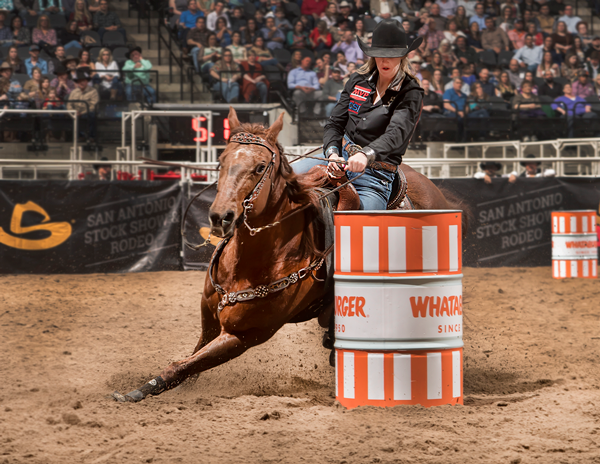
    He graduated from Northeast High School in Lincoln in 1957, and that summer, went to the Nebraska State High School Finals Rodeo in the calf roping, steer wrestling, bareback riding and cutting. He won the all-around and represented Nebraska in the calf roping and cutting at the National High School Finals.
    Then a move to California would add to his rodeo repertoire. Larry spent a year in college in Visalia, Calif., and met two fellows: Manuel Macedo, and Bob Wiley. Manuel got him started team roping, heeling for him at amateur rodeos (team roping wasn’t new in California but it was not common in Nebraska). Wiley, who was from Porterville, Calif., roped and tied calves with Larry all night long. In the old dairy barn owned by Manuel’s parents, with the lights on, “we’d tie calves till three or four in the morning, till we got tired,” Larry remembered. “We were learning to be faster all the time, and consistent.”

    Trenary005.jpg_WEB_3
    Larry heeling for Marvin Mueller at the 2002 Mid-States Finals – Peter Hammer

    After a year in California, Larry was back to Arthur, where he had been dating a local girl, Sonja Mickelson. The two tied the knot in 1959, and lived in California for a short time before making their home on his parents’ ranch north of town, where they still live today.
    They ranched, but Larry’s parents weren’t rich and didn’t have a lot of land or cattle to give their son. So he supplemented his income with rodeo. He became a member of the Nebraska State Rodeo Association (NSRA) the same year he got married. He also belonged to the Mid-States Rodeo Association (M-SRA).
    Larry dominated his events in the NSRA and the Mid-States. He won the NSRA calf-roping title in 1961 and 1963-64, and the heeling title in 1961, 1972, 1978-79, and 1982-83. In 1984, he won the heading title. In 1961 alone, he won the all-around, calf roping and team roping titles and was reserve champion in the steer wrestling. He also won numerous titles in the Mid-States.
    Larry competed in the PRCA as well, roping at Denver, Ft. Worth, Cheyenne, Chicago, Pendleton, and other venues, and at USTRC ropings. But he didn’t want to be gone from home that much, so he returned to the NSRA and Mid-States, plus ropings and rodeos in Nebraska and surrounding states. When he turned forty, he joined the Old Timers Rodeo Association (now the National Senior Pro Rodeo) and the Living Legends Rodeo Association. In 1991, he and Tony Tonozzi won the world in the USTRC’s senior division.
    His most memorable calf roping horse was possibly the best calf horse ever in the state, he thinks. Old Black “was as ugly as could be,” Larry said. Old Black supposedly came from the wild horse herds in Montana, and was brought to Nebraska by a horse trader. Uncle Lawrence traded two bucket calves for the horse and he and Larry trained him. Old Black was never truly tamed. “He was so wild, he would kick you. You could never trim his tail and hardly trim his feet. He was just an outlaw, but he was a terrific calf horse.”
    Larry and Sonja have two sons, Bret, who was born in 1960, and Troy, born three years later. Roping with his boys was his joy. “When my boys got old enough (to rope), that was the finest time in my whole life.” The three were serious students of the sport. They practiced hard, setting up a video camera and watching their runs, to see where they lost time and how to make it up. “We really worked at it, because it was our livelihood.”
    The three Trenarys roped everywhere. If there was a good roping, they were there. They competed across Nebraska, Kansas, Colorado, Wyoming, South Dakota, Iowa, anywhere there were steers and a chute. They put on roping schools as well, teaching kids the fundamentals of the sport.
    When Troy was seventeen years old, he was hit in the head while playing high school football. The injury put him in a coma for fifteen days. He had been an excellent heeler, Larry said, and three friends came and stayed for days, trying to help Troy rope again, but the use of his right arm was gone. Their son is still alive, and able to lead a normal life, and for that, Sonja and Larry are grateful.
    After Troy got hurt, Bret switched from heading to heeling, so Larry, who heeled, lost his partner. He tried five or six different headers, but things weren’t the same. In his last years of roping, he found a good partner: his friend Marvin Mueller.
    Bret’s team roping career flourished. He roped professionally for years, qualifying for the National Finals Rodeo in 1987, heading for Allen Bach.
    Not growing up with a silver spoon in his mouth was an advantage, Larry feels. “I didn’t have the money to do things, and I had only one really good horse, and gosh, not very good vehicles. I was purt near broke, but kept going because of my roping.” He feels that money isn’t always the answer. To be a good roper, “I think you have to have the ability to stay on track, and the will to win. Money won’t do it. I know so many kids that their folks have a lot of money, and they want to be a great calf roper or team roper. But most of the guys who are really, really good have had to go without things in their life. You can’t give it to them. It just doesn’t work that way. They don’t seem to have enough guts to stay with something that long.
    “You gotta be hungry for it, almost like you need the next dollar to eat on. That forces you to try not to make a mistake, because if you make a mistake, you’re not going to win.”
    He and his boys were that way, he says. “We were like a basketball team. We trained here at home, and everywhere we went, we watched the good guys. And on the way home, we’d talk about the good guys, and what they’d done that made them so great. We just learned from them.”
    The best days of his life were spending time with his boys. “It was everything,” he remembers. “We were learning together. We’d argue and fight, but it would all come out to be the best.”
    Larry roped his last calf at the Arthur rodeo in the late 1970s, on Old Black. He quit team roping at the age of seventy, after having been an NSRA member for over fifty years. His roping was as good as ever, but his knees hurt. Two years ago, Larry was inducted into the Nebraska Sandhills Cowboy Hall of Fame.
    Larry and Sonja take great pleasure in their grandchildren, Jhett and Mercedes, the son and daughter of Bret and Dede, who live in Salida, Colo. Mercedes, a former college breakaway roper and goat tyer is teaching school in Oklahoma. Jhett, who team ropes with his dad, is a student at South Plains College in Levelland, Texas. “They’re the delight of our life,” Sonja said.

    Trenary007.jpg_WEB_2
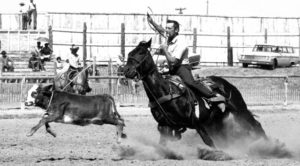
    Larry tie-down roping in Gordon, NE on Old Black in the 60’s where he won the rodeo – Courtesy of the family

    They sold their cow/calf herd a few years ago and now background calves, which Larry enjoys. “It’s not work to him,” Sonja said. “He just loves what he’s doing. We just keep a-going.” Troy lives with his parents and helps out with the cattle work.
    The couple enjoyed their rodeo years, and life now, too. “It’s a wonderful life, what we’ve done,” she said. “It’s been a great life. We’ve been up and down the road. I wouldn’t change it for anything, and I know Larry and the boys wouldn’t, either. “We love what we do.”

  • On The Trail with Faith Hoffman

    On The Trail with Faith Hoffman

    Faith Hoffman of Kiowa, Colorado, is the reigning CSHSRA goat tying champion. The 18-year-old plans to defend her title at state finals at the end of May, earning her third trip to the NHSFR. Yet as quick as her hands and feet are in her favorite event, Faith is even quicker to encourage her fellow competitors, friends, and family.


    DSC01423-faith-glory.jpg_WEB
    Faith celebrating at 2016 CSHSRA Finals – Chelsea Hoffman

    Whether it’s giving someone a pep talk at a rodeo or sharing Bible verses, Faith is passionate about helping others. “Our family anthem is Ephesians 4:29, ‘Do not let any unwholesome talk come out of your mouths, but only what is helpful for building others up according to their needs, that it may benefit those who listen.’,” says Dave Hoffman, Faith’s dad. “She’s really an encourager of others, and I think because of her, other kids are encouraging as well.”

    Faith’s introduction to the rodeo world came through her dad, a first generation rodeo cowboy and bareback rider turned farrier. Dave competed in the CPRA and PRCA Mountain States Circuit, and later coached the Air Force Academy college rodeo team. Faith started traveling with him when she was five or six, making fast friends with his traveling partners and their children. She was competing in peewee barrels by the time she was eight, and two years later, Faith was a member of the NLBRA and had discovered her passion for goat tying. “It’s such an aggressive and quick sport,” says Faith, who also competes in barrel racing, pole bending, and breakaway roping. She even team ropes on occasion when someone needs a header. “I play basketball too, and I think that sport and goat tying cross over.


    When I’m teaching girls to tie, I compare it to basketball moves and how you have to be quick and aggressive in both. I also like how you don’t need an expensive horse to compete in goats – it’s about the work you put into it. I feel like everywhere I turn, there’s someone who has my back or will pick me up, and that’s really shown me that rodeo’s not all about what you put into the arena, but also who you are outside.”


    FAITH-HOFFMAN-GOATS-ELIZABETH.jpg_WEB
    Faith goat tying at CSHSRA Elizabeth 2015 – Chelsea Hoffman

    Last summer, Faith had the opportunity to teach goat tying at High Plains Rodeo Bible Camp in Hugo, Colorado. She also teaches goat tying lessons from home and at clinics. “It was super fun in Hugo. There were about sixteen kids in the goat tying, and it was a lot of fun to teach them and be in a spiritual environment. I was also a group leader there, so I lead devotions and prayer with five or six girls. It was pretty cool seeing them learning and realizing what Jesus is all about.” Faith also spoke during Cowboy Church at a CJRA rodeo in Yuma, Colorado, last summer when Dave wasn’t able to be there. He’s been involved in the rodeo ministry since he was 19, and has lead Cowboy Church in the CSHSRA the last year and a half. Last summer, he performed a number of water trough baptisms in arenas.

    For Faith, rodeo especially complements her relationship with the Lord. “My favorite verse is Jeremiah 29:11, ‘”For I know the plans I have for you,” declares the Lord, “plans to prosper you and not to harm you, plans to give you hope and a future.”’ I have that written down all over, and I can really see that in the rodeo world, because things can change so quickly. You can get hurt and be out a rodeo or a whole season, or other things can happen, and I think that it really puts an emphasis on faith. My mom tells me all the time if I have a bad rodeo or don’t win that God had the win planned for someone else that day.”

    Faith received her own encouragement two autumns ago when her barrel horse, Cracker, fell during practice and broke his leg. “This was after Faith won state finals in the average on him. He was an amazing horse,” says Chelsea Hoffman, Faith’s mom. She works in marketing in Denver and does some of the photography for the CSHSRA. “We had ten people offering horses to her, which is huge in barrels. Rodeo has been really amazing for Faith and opened up opportunities like scholarships and being part of an amazing rodeo family. In junior high, she had sessions with college barrel racers, and she’s worked with Kaylee Moyer and Jill Francis, who are great goat tyers. She’d tie until midnight with them if she could. Logan Kenline and his family are very close and have helped her with her roping, and she’ll also rope with the Meeske family.”


    DSC02145-family-hoffmans.jpg_WEB
    Chelsea, Faith, Cade and Dave Hoffman – Courtesy of the family
    faith-cade-tree-bv-large810.jpg_WEB
    Faith at age 10 and her little brother, Cade at age 3 in Buena Vista – Courtesy of the family

    At home, Dave helps Faith exercise horses, and Chelsea holds goats and videos runs. Faith competes on Johnny in pole bending, goat tying, and barrel racing. Johnny was voted CJRA Senior Girl Horse of the Year in 2016. Faith has also run barrels on Drifter, and recently brought home a mare, Barbie. “She’s a diva,” Faith says with a laugh. “She’s started in the breakaway, and I’m so excited to see her finish up. I’ll probably start her in barrels, too, since she’s super quick.” Family time is spent in the practice pen and at rodeos, and Faith’s itinerary this summer includes The Best of the Best Timed Event Rodeo in Gallup, New Mexico, the IFYR in Shawnee, Oklahoma, and the NHSFR in Gillette, Wyoming. Her 11-year-old brother, Cade, travels to many of the rodeos and is an avid hiker. Over spring break, he and Dave went on a hiking trip in the Grand Canyon, and they have several other national parks on the list to visit.

    This school year, Faith has started her mornings at Abbott Ranch in Kiowa before finishing her afternoon classes at Kiowa High School, where she’s a senior. “One day I might be pulling manure, the next we’re moving cows or hauling hay,” says Faith. “I didn’t grow up on a ranch, so it’s nice that I get to learn these things.” She’s also helping plan the class of 2017 graduation, and finished a banner year playing basketball with the Kiowa Indians.

    This fall, she plans on attending Sheridan College in Wyoming on a rodeo scholarship. Faith’s focus is on goat tying and breakaway, as well as majoring in athletic training. “My dad was a coach in the Central Rocky Mountain Region, and I still know a lot of the coaches there. I’d eventually like to transfer to a university so I can get my masters and rodeo a fifth year in college,” says Faith. “I want to win the state championship in goats again, and we have some tough competitors this year. I’d like to go on to Nationals and win there, but I’m not going to stress over anything, because God has a plan.”

  • Featuring Karen Vold’s Recipes

    Featuring Karen Vold’s Recipes

    Karen’s Cowboys
    Favorite Salad Dressing (Makes a little more than 2 quarts)

    ingredients:
    2 qts mayonnaise
    4-5 hard boiled eggs
    16 oz sweet bread and butter chips (pickles)
    1 – 6 oz. can of olives
    1 – 12 oz. bottle chili sauce

    DIRECTIONS: Put pickles and olives through food chopper. Chop hard boiled eggs. Mix with mayonnaise in large bowl. Mix chili sauce in to taste and pink in color. Let dressing sit in refrigerator overnight or for several hours. This will flavor the mix. I put the dressing back in the 2 qt Mayonnaise jars and label it. You can store it in the refrigerator for a long time if they don’t eat it up quickly!

    web_breakfast-casserole
    Crunch Square Breakfast Casserole

    Crunch Square Breakfast Casserole (Yield 12 servings)

    ingredients:
    1 tsp vegetable oil
    2 c (8 oz.) grated Colby and Monterey Jack cheese blend, divided
    1 package (22.5 oz.) frozen toaster hash brown patties, thawed
    8 oz. cream cheese, softened
    12 eggs
    ½ tsp. black pepper
    8 oz. thickly sliced deli ham
    4-5 green onions with tops
    3 plum tomatoes

    DIRECTIONS: Preheat oven to 450. Lightly brush 10 x 15 in. pan with oil. Crumble hash browns over pan, press gently into an even layer. Sprinkle half of the cheese evenly over hash browns. Bake 13-15 minutes or until crust starts to brown and cheese is melted. Meanwhile, in a bowl, whisk cream cheese until smooth. Gradually add eggs and black pepper, whisk until smooth. Coarsely chop ham, slice green onions, reserving ¼ cup of the tops for garnish. Place ham and remaining green onions into saute pan. Cook and stir over medium heat 2-3 minutes or until hot. Stir ham mixture into egg mixture. Remove pan from oven to cooling rack. Pour egg mixture over crust. Return pan to oven; bake 6-8 minutes or until center is set. Meanwhile, slice tomatoes in half and scrape out seeds, dice. Remove pan from oven; top with remaining cheese, tomatoes, and reserved green onions. Sprinkle with additional pepper. Cut into squares and serve.

    The “100” Cookie (Yields 4 dozen cookies)

    ingredients:
    1 c sugar
    1 c packed brown sugar
    1 c margarine, softened
    1 c vegetable oil
    1 egg
    1 tsp vanilla extract
    1 c crisp puffed rice cereal
    1 c flaked coconut
    1 c quick oats
    ¾ tsp salt
    3 ½ c flour
    1 tsp baking soda
    1 tsp cream of tartar

    web_100-cookie
    The “100” Cookie

    DIRECTIONS: In bowl, mix sugar, brown sugar, margarine, oil, egg, vanilla, rice cereal, coconut, and oats. Sift together salt, flour, baking soda, and cream of tartar. Add to sugar mixture and mix well. Drop teaspoonful size onto greased cookie sheet and bake 350 for 10-12 min. Makes 4 dozen. Note: Dough can be frozen in 6 oz. size frozen juice containers. Slice ¼ inch thick when ready to bake.

  • Back When They Bucked with Jim Ivory

    Back When They Bucked with Jim Ivory

    web_Jim-Ivory_006
    Jim on Big Horn in Brawley, California, 1969 – Foxie Photo

    Jim Ivory admits he’s a gypsy, and that’s part of what has made him enjoy the rodeo world.
    The cowboy, who grew up in northern California rode bareback horses at the National Finals Rodeo (NFR) four times, and has worked behind the scenes at rodeos across the world.
    He was born in 1942, the son of Ed and Ellen Ivory, in the tiny ranching town of Alturas, California, the third generation of the Ivorys to rodeo. His dad worked on the ranches in the area, and “we were raised in those cow camps in the corner of Nevada, California and Oregon,” Jim remembered. Ed was a stock contractor, gathering bucking and saddle horses from the ranches and hayfields of the country. Jim and his siblings went along when it was time to rodeo. “That’s the only time we went to town, when the rodeos were going.”
    He competed in junior rodeos in nearly every event. There was no high school rodeo association then, and kids ages thirteen through eighteen could enter the juniors. The family moved to Redmond, Oregon during his high school years, and he competed in amateur rodeos while in high school.
    After high school graduation in 1960, he continued to rodeo. There were plenty of opportunities for it, too. “There used to be a lot of good amateur rodeos around there (California, Nevada, Idaho, and Oregon), and you could win a lot of money.”
    By 1962, he got his Rodeo Cowboys Association (forerunner to today’s Pro Rodeo Cowboys Association) permit, and hit the rodeo trail professionally. One of the first pro rodeos he competed in was the Portland (Ore.) International Livestock Show. From there, he headed south to the Cow Palace, where permits weren’t accepted but he was on the labor list.

    web_DSC_1647
    Jim Ivory – Rodeo News

    He rode bareback horses professionally for four years, often serving on the labor list as well. He worked for the Christensen Brothers Rodeo Co., Beutler Brothers, Harry Knight, and Cotton Rosser, and frequently for his uncle, Buster Ivory, who had bucking horses and put on rodeos.
    It worked well, riding and working at the events. “The first year I won $9,000 and it was all in the bank, because I had a job all the time.”
    Working on the labor list, he did everything, flanking, driving truck, feeding and sorting stock. “I’ve done everything in the rodeo business except announce,” or work as a barrelman or bullfighter, he said. He rode bulls in the amateur ranks a bit but barebacks was his niche.
    In 1967, the first year of four that he qualified for the NFR, he traveled with fellow bareback rider Jim Houston. Houston had asked Jim to travel with him, and Ivory was glad he did. “He refined my bareback riding,” Ivory said. “He made me a better bareback rider than I was. He was a great coach.” One year, Houston helped hone the skills of the three top bareback riders: Ivory, Paul Mayo, and Clyde Vamvoras. It was a testament to Houston’s good teaching skills. “He was a heck of a coach, because we all rode different but he had the ability to see what your natural skills were and how to improve what you did,” Ivory said.
    Jim’s best year was 1969, when he finished second to the world champion, Gary Tucker.
    After the 1970 season, he quit rodeoing professionally. The most rodeos he had competed at during a year was 77. “I didn’t like that much, rodeoing that hard,” he said. He also liked to have fun. “One of my downfalls was I thought I was supposed to have fun, so I didn’t do as good as I should have, but I had a lot more fun than a lot of them.”
    He also knew he wanted to quit before he got to where he dreaded it. “I saw some of my old heroes, and they didn’t want to get on. They screwed around in the chute. I said, when this is no fun anymore, I won’t do it.” He could still win, but “it got to where I didn’t really like getting on.”
    In 1972, in partnership with Australian bareback rider Jimmy Dix and Jim’s brother-in-law Van Vannoy, he shipped quarter horses, including a Triple A race horse, to Australia. He and his wife Cathy lived there for four years, taking care of them.
    In 1975, he and Cathy came back to the U.S, and he worked at the Sunlight Ranch west of Yellowstone. In 1977, he began producing the Cody (Wyo.) Night Rodeo, which he would produce for a total of thirteen years (from 1977-1980 and from 1998-2006).
    He also helped his uncle Buster produce rodeos in Europe in 1970, spending three months there as part of Rodeo Far West. The entire rodeo “outfit” was shipped there, including 100 head of saddle horses and seventy bucking horses and bulls. A few times in the 2000s, he took a group of cowboys to Brazil to enter their rodeos: Cody DeMers, Wesley Silcox, and Steve Woolsey, and Lewie Feild, as pickup man, among others.
    Jim was part of a unique group: five cowboys at the 1967 and 1968 NFR had been members of the Redmond High School wrestling team: Jim, his brother John (a saddle bronc rider), bareback rider Ken Stanton, his brother Bill Stanton (a bull rider), and Larry Mahan, who did all three roughstock events.
    Jim won’t agree that they were tough, but they were: “I don’t know if we were tough or not but we were tougher than some of them.” The Redmond bunch was a good rodeo group. “A lot of really tough rodeo kids came out of that group that I rodeoed with. Jack Thrasher, the Stantons, Buzz Seeley” and others. “We could go to those amateur rodeos and win a lot of money.”

    web_Jim-Ivory_003
    Jim bareback riding in Woodlake, California 1969 – Foxie Photo

    The best bareback horse Ivory encountered was a horse owned by Reg Kesler. Three Bars, a 2004 inductee into the Pro Rodeo Hall of Fame, “was no doubt the best, rankest bareback horse there’s ever been,” Jim said. “She could throw everybody off, and it always hurt, for some reason. There’s been a lot of good ones over the years but she was unbelievable.” Three Bars was selected to buck at the NFR in three decades and won the bareback horse of the NFR in 1967, 1973 and 1980. Jim got on her twice, getting bucked off both times. “She almost killed me the first time,” he quipped, “and she did the second time.”
    While he was on the rodeo circuit, Jim made Pampa, Texas his address, because his uncle Buster lived there. He loved Wyoming and Montana, and he and Cathy moved to Wyoming after marrying.
    In his later years, Jim has shared his experience with Chad and Matt Burch of Burch Rodeo, and Chad loves working with him. He has an eye for bucking horses, Chad says, and they have bought many horses from him. “He knows what to look for with a horse. He’s seen a lot of them,” Chad said. “He’s a very smart man, and he’s been successful at rodeo.”
    Jim has helped at many rodeos, including those for Burch, Reg Kesler, and Mike Cervi, among others. He’s raised a lot of horses that were sold to PRCA stock contractors and selected to buck at the NFR. Last year, Jim Dandy, a bareback horse whose mother Jim had sold to the Burches, carried Jake Vold to a sixth round win at the 2016 Wrangler NFR.
    He and his wife live in Banner, south of Sheridan, Wyo. He still has a half-interest in two studs and three mares, and continues to help the Burches with their rodeos but doesn’t do as much as he used to. When Chad asked him to come to Kaycee, Jim told him he was too crippled to do anything. “I’m just a pretty face,” he told Chad, and Chad replied, “that’s what we pay you for,” Jim laughed.
    He and Cathy, who married in 1969, have four children: sons Buster and James, daughter Mandy, and a daughter Kelly Jo, who passed away when she was four years old. Buster lives in Gillette and has two daughters and a son; James lives in Virginia with his two daughters and son, and Mandy is in Australia with two children.
    Looking back on his rodeo life, Jim can’t imagine doing anything else. “I really liked to get on bucking horses, and the lifestyle and the people, the freedom and the money. It was a lot better than working on the ranch.
    “I’ve been playing cowboy since I was three years old. That’s all I ever did, and I’m still playing it.”
    web_Jim-Ivory_001
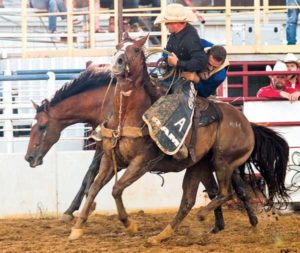
    Red Bluff 1969. First row: Ace Berry, Ralph Maynard, Jim Ivory, Jerry Hixon, Clyde Longfellow, John Ivory, Don Flannigan. Second Row: Bill Martinelli, Manuel Enos, John Hawkins, Louie Zabala, Bill Stanton, Sonny Johnson, Bob Swain, Bob Edison – DeVere
  • On The Trail with Burch Rodeo

    On The Trail with Burch Rodeo

    Burch022_WEB
    Matt Burch at the 1995 College National Finals Rodeo, Bozeman, MT – JJJ Photography

    Max and George Ann Burch come from a long line of ranchers. The couple, who are in their 70s, met back in the 1950s in high school. “My folks had a ranch north of Moorcroft and her dad bought a ranch adjoining the ranch that my dad had,” said Max. They got married in 1965. The couple eventually settled back on the family ranch, living in her grandmother’s (Hazel Pickrel) original homestead, built in 1929 and added on to throughout the years. The ranch is 15 miles southeast of Rozet, Wyoming, which has a post office, school, and café/bar.

    Their sons, Matt and Chad, were born in 1976. Chad is older by two minutes. George Ann found out she was having twins less than two weeks before they were born. Both boys grew up ranching and rodeoing, competing in junior rodeos through junior rodeos, high school and on to college. George Ann admits that she couldn’t take her eyes off them for more than five minutes at a time. “We got new knives one time,” recalled Matt. “So we went to the barn where the saddles were and shortened all the saddle strings as well as the cinches. One of the hands thought it was mice, but dad knew better. Our punishment for that was to stay home from cattle work that day – we didn’t mind – it was 30 below.” Matt competed in bareback riding, winning the Wyoming High School Rodeo Finals three years in a row and went to Nationals, placing in the top ten each year. He went on to PRCA and made the circuit finals, won it a few times, filled his permit. He quit competing when the family got busy in the rodeo stuff and he had a daughter. Chad competed in saddle bronc riding and bull dogging; both boys team roped.
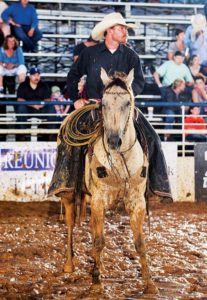
    Max started in the rodeo business in 1981. “Burch Rodeo Company started as a side line we got in on and we’ve gotten bigger in it than we ever planned to be,” said Max. “It’s what the boys want to do.” The business started when Pat Byrne from Mill Iron, Montana, came looking for pasture. “He was raising bucking horses and we made a deal to run 25 mares on shares. In the fall, when we pulled the colts off, he got the studs and we got the fillies. We had a stud we used in partnership.”

    In 1985 it got really dry and things were getting slow with the drought and Pat decided to sell out. Max bought the mares that were on the place. “We continued on with that stud until 1987. They called him Last Stand. In 1987, right after we turned him out with the mares, he was injured and I called Ernie Toot in Montana and asked if he had a stud I could buy. He had some young studs so we drove up there.”
    The plan was to pick up a gray stud, but Max eyed a different one – a three year old bay. “I walked through them horses looking at them and what impressed me about that horse – those horses would be chewing on each other, but that horse never quit looking at you as long as you were there and moving around.” The horse ended up siring many NFR broncs for Burch Rodeo. “Everything just worked,” said Max, who bought Tooke for $800. His offspring were big horses, one of them being the most recently retired Lunatic Fringe, out of an own daughter of Tooke.


    DSC_8811_WEB
    Jesse Bail riding Lunatic Fringe at the 2016 Buck ‘n Ball in Gillette, Wyoming. This was Lunatic Fringe’s last ride before he was retired. – Rodeo News

    Even though Burch horses and bulls make appearances at the WNFR, Max and George Ann have only been to Vegas once. “I don’t like flying or crowds,” admitted Max. Instead they send Matt, Chad, and most recently, Matt’s daughter, Bailey, who has moved back home to help on the ranch.
    Bailey lived on the ranch all her life, and left for three years to go to college on a rodeo scholarship in Ranger, Texas. The 21 year old came back this year in May of 2016. “I wanted to start helping with the ranch and rodeo company. I want to see it progress and it’s a family tradition,” she said. “I really loved the coach (Llew Rust) and I liked the environment and I’m going to finish my degree in Ag Business online. I missed home.” She lives seven miles from the ranch and travels with her dad and uncle to the rodeos where she flanks the bulls and will eventually flank the horses too.


    IMG_7242-(2)_WEB
    Max and George Ann Burch – Jackie Jensen

    The ranch, which encompasses 170,000 acres of owned, deeded, and leased land, is home to 750 bucking horses, 140 bucking bulls, and 2,000 Red Angus mother cows. Ten people work on the ranch and the winter chores include feeding hay to the rodeo stock that will be competing throughout the winter months. “The only hay we feed is 200 head that we are bucking. The rest are all running out on grass.” The majority of the bucking horses are kept in an 11,000 acre pasture. The yearlings up to the coming four year olds all run together and are gathered once a year to sort off the older ones and add the weanlings to the bunch.

    One of Chad’s favorite parts of ranch life comes in September when he brings in the horses. “It takes 10 days to halter break, brand and castrate the yearlings,” he explained. “They we turn them loose until they are coming 5.” They have a big barn by Moorcroft that is set up with bucking chutes, and that’s where Chad spends many days, putting dummies on the horses, bucking them out four or five times, and making sure they behave in the chutes. Foaling starts the beginning of May and by then the horses are sorted into pastures with a stud, where they will stay until September.


    Burch019_WEB
    Chad Burch, 1994 – Hubbell

    While Chad is busy breaking the horses, Matt is busy with the hunting operation. “The lodge is 35 miles from here, between Moorcroft and Upton. We have hunters from September 1 until November 30. Hunters come from the East Coast to the West Coast, Canada and as far as Germany to the ranch to hunt antelope, deer, and elk. The family runs the ranch like a well-oiled machine. Chad and Matt both agree the secret is being able to compromise. “If we’re sorting, I have the list memorized in my head and we go through it,” said Chad. “It’s a give and take.” Most recently, the crew sorted 66 head to go to Rapid City. “We’ll come back for another 32 later in the week.” After Rapid City, they will have a rodeo every week all year long.

    “I think the future of the bucking horses is going to get big,” said Matt. “The bucking bulls got big because of the PBR, and the ABBI has helped with that. You could prove the genetics. Bucking horses are the same way, and BHBA, Steve Stone and Kenny Andrews, and ABBI – It’s moving forward and there are more futurities for horses. If you go to a sale now, you can prove what your horse is. We love doing it …”

    “We’ve got a lot of land, and could run a lot of cows if we got rid of the horses, but they mean as much as the cattle to us, ranch or bucking, it’s what we’ve always done. We’re going to keep raising them and hopefully Bailey will keep running with it. Mom and Dad provided us this lifestyle and it took a lot of years to get where we are with our card, and now we’re going to big rodeos that we want to go to … everything is set and ready to go.”

  • Kristy Lee Cook

    Kristy Lee Cook

    Kristy Lee Cook didn’t grow up in a rodeo or hunting family, but once she discovered those passions, she planted herself firmly in both worlds. Originally from Oregon, the 33 year old presently makes her home in Amarillo, Texas. Kristy is a country singer and songwriter who made her debut through American Idol, and has since released an album and four singles. She’s hosted the Outdoor Channel’s “Outdoors 10 Best” and Versus Channel’s “Goin’ Country”, while she’s currently the host of “The Most Wanted List”. The show is finishing its third season on the Sportsman Channel in March, with filming for the fourth season underway. “I really love sharing the outdoors with friends and family, and being able to go on adventures with people who have always wanted to do those things,” says Kristy. “That’s what started the show. I’ve gotten to check a lot of things off my bucket list and take other people along to check things of theirs. Capturing it on TV is even more rewarding, and sharing those memories with friends and family for the rest of my life.”
    Kristy plans and organizes every episode of the show, and season three promoted elk, mule deer, and even Tahr hunting in New Zealand. “I’d like to try an Alaska hunt for something different next season,” she adds. Kristy’s sister, Terina Dutton, appeared on Kristy’s first TV show “Goin’ Country”, while their brother, Sonny Cook, has come on to “The Most Wanted List”. “My brother was really excited when I started hunting since he was the only one in the family that did it. He tried getting me to hunt years back, but I didn’t start until I was probably twenty-two. My boyfriend at the time wasn’t into horses and I wasn’t into hunting, so we decided to make a trade and get into each other’s hobbies. That started my hunting life!”
    Near her home in Texas, the hunting opportunities include coyotes, hogs, and whitetail deer. Kristy often hunts coyotes with her boyfriend, Lee Orr, who does predator control for ranchers. “The coyotes are so over-populated here because they are the predator; there’s not very many mountain lions or wolves. There are hundreds of coyotes in a small area, and I think they’re coming in close to these ranches and going after livestock because the food is easier to hunt,” Kristy explains.
    She and Lee recently took part in a weekend-long coyote hunting contest, while they hunt whitetail deer on one of the ranches Lee works for. “We take the Rangers out and load the feeders with Record Rack. Lee got a whitetail deer recently, and I was with him on his hunt, which was very cool. We use Record Rack to keep the deer around and keep them healthy. They’re a reputable company and their product works, and that’s why I’m stoked to have them also be a part of my TV show.”
    When she’s not on her latest hunting trek, Kristy is patterning and seasoning a pair of stallions in the barrel racing. She grew up riding her friend’s horses and learning to work cattle and even move pipes and water lines on her friend’s family ranch. “I think it’s really rewarding and very challenging to make your own horses, and it’s really awesome when you’ve worked so hard to have a really good run,” says Kristy. She refers to the stud she raised from a baby, Tazer, as her miracle horse. In his six years, Tazer has broken his jaw, which was repaired with 300 stitches, colicked, overcome a problem with his suspensory ligament, and lacerated his right eye, which is 100% blind due to glaucoma. Kristy has mainly been running her horses in jackpots and barrel races around Texas, but her goal is to enter them in rodeos in the future. “I’m working so hard to rodeo on Tazer because I think his testimony of not giving up and his will to live is really powerful!”

    Kristy competing at a jackpot rodeo in Clovis, NM – Christpher Cook

    Though Kristy had taken a break from her music to work on horses and focus on her show, she’s written several songs in the meantime and plans to start recording soon. “It’s been nice to take a break from the road and spend time with the horses and get them where I want to go – it was hard to get them legged up and working and then leave for a month,” she says. “You can be overworked in an area sometimes, and all you need is a break to come back stronger. I’m excited to get some music going again.”

  • Kellie Collier

    Kellie Collier

    article by Holly Wilson

    Kellie Collier is a Hereford, Texas native with an impressive rodeo resume.
    She was originally introduced to the sport by her mom, Kathleen, and fell in love with the rodeo lifestyle.
    As a student at Happy High School, Kellie competed in multiple events and is a four-time National High School Rodeo Association Finals qualifier. She continued the tradition during her two years at Texas Tech, where she also made the College National Rodeo Finals.
    “I’ve always run barrels, but I also breakaway roped, team roped and ran poles. Last year in the college finals I won the All-Around,” Kellie said, “I got to go to the national finals in the barrels and the breakaway.”
    Kellie finished the 2016 College National Finals Rodeo sitting sixth in the barrel racing with a 14.16.
    Now, Kellie is pursuing a full-time position on the rodeo road. Some of her recent accolades include a win at Redding Rodeo, a third place finish at the Fort Worth Stock Show & Rodeo and a 13th place overall finish in the 2016 WPRA standings. She is currently sitting 9th in the 2017 standings.
    “I’m trying to take the pro rodeo circuit a little more seriously this year,” Kellie said.
    This was made possible, in part, by her family. They have supported her throughout her rodeo career, and continue to do so.
    “My mom has always been my coach,” Kellie said, “She’s helped me with my highs and my lows and taught me everything I know.”
    And while her mom is by her side on the rodeo road, Kellie’s dad, Matt, supports her from afar.
    “My dad doesn’t have a rodeo background at all, but he’s my biggest fan. He gets mad if we don’t send him videos and call him right after,” Kellie said with a laugh, “He stays home as much as he can to make it possible for me to go.”
    At just 20 years old, Kellie has her sights set high with a goal of making the 2017 National Finals Rodeo.
    “My biggest plan right now is to rodeo as hard as I can and make the NFR,” Kellie said.
    A Hereford, Texas native, Kellie competes on the Wilderness Circuit with her horse Streakin Easy April.
    Kellie admits that it’s a tough road out there, and staying mentally focused is her biggest challenge.
    “That’s probably the hardest part, is staying mentally focused and staying positive. It’s very very important for me to keep my head on and keep my horse comfortable in any situation,” Kellie said, “It’s a tough, tough mental game.”
    However, nine-year-old “Lolo” has plenty of experience in high-pressure situations. She’s been run at the Thomas & Mack, and has numerous other accolades under her belt. “She’s making my dreams come true, making all of this possible. Having a horse of this caliber, that can compete against the best of the best,” Kellie said. “She has made my dream real, making me believe that I really can run at the Thomas & Mack someday.”
    When Kellie and her mom spotted “Lolo” almost three years ago, they knew she would be the horse to make her childhood dreams come true.
    “You know it was kind of a ‘Oh my gosh we have to have her’ kind of thing,” Kellie said, “It was a known from the start, as soon as we saw her, we knew. My mom has a great eye for horses, and she’s always mounted me so well.”
    One of the aspects that drew the Colliers to Lolo was her kind eye and willing nature.
    “When we saw Carlee Pierce run her at the NFR, and handle the situation and the ground, we loved her style. You could tell how sweet and willing she is, especially when you look in her eye,” Kellie said, “You could just tell.”
    Over the past several years, Kellie and Lolo have strengthened their bond and developed a strong relationship.
    “She’s really set my goals, she’s made my dreams come true. I want to be able to repay her for that and do everything to keep her the happiest she can be,” Kellie said, “I’ve been so blessed and lucky to have a chance to own this mare.”

    Kellie Collier with Lolo – courtesy of family
  • On the Trail with James Hajek

    On the Trail with James Hajek

    James Hajek at the NIRA Rodeo in Stillwater, OK 2015 – Hirschman Photography

    James Hajek is a cowboy by blood and by choice, making a living in the stock pens and arenas of the South and Midwest since he was a child. Today, the 32-year-old from Hennessey, Oklahoma, is known for his finesse as a pickup man, finding his niche in the rodeo world while attending Northwestern Oklahoma State University.

    “My dad used to rodeo and he co-owned Carpenter Rodeo Company in Kansas, so from the time I was little, rodeo is all I’ve done,” says James. “Growing up, I knew where every playground and park was in Kansas. We went somewhere every weekend, and I had friends all over the place. I didn’t know any different, or what it was like to go to the lake, but I loved it!” James and his older sister, Jena, became all-around hands, even riding a pair of mini mules to move cattle. “They were about the size of Shetland ponies, and we’d take them to every rodeo and drive cattle out. If there was a return alley, we’d bring the timed event cattle back up. We ran 140 – 150 team ropers a night, so we’d be there a while.”

    When James was ten, his parents, Danny and Aronda Hajek, sold their half of the rodeo company. They kept a handful of bucking bulls, and James and his dad continued to raise bulls until 2014. In 2004, the rodeo coach at Northwestern Oklahoma State University had offered James a scholarship for supplying the team’s bucking bulls. Rodeo clown Justin Rumford was also a NWOSU student at the time, and James recalls, “We weren’t in very many of the same classes, but we did lots of extracurricular activities together. There were always good times to be had with him around.”


    James Hajek at the PRCA NTFR (North Texas State Fair & Rodeo) – Todd Brewer
    James with his son Hagen and dad, Danny Hajek – courtesy of the family

    James also watched rodeo practices and helped run the roping chutes, but the itch to be doing something more was always there. His sophomore year, James brought a trailer full of broncs to college, partnering with Andrews Rodeo Company, who sends James colts to start bucking every year. They’ve started a number of WNFR broncs such as Cool Water, PTSD Power Play, and Fire Lane. Picking up broncs naturally came next, and though James hadn’t spent much time on horseback during his teens, the muscle memory was still there. “When we sold the rodeo company, I’d sold my horse and mules, and I never even rode when I was in high school. I’d mainly worked rodeos, and I never had too much interest in competing since I was guaranteed a paycheck. I started picking up at practice, and the finessing and fine-tuning took a while to learn, but as far as setting riders down, I’d cowboyed enough to know where I needed to be and what to do.”

    Nearly 12 years later, James works as many as 25 rodeos a year, along with bull ridings like ABBI and PBR. “I work all of Andrews Rodeo Company’s rodeos, and I’ll fill in for Phil Sumner, who partnered with my dad on some rodeos.” This is James’ seventh year picking up pro rodeos, and he’s also picked up for Beutler & Son Rodeo Company and Frontier Rodeo Company. “I’m just enough of an adrenaline junky that I really enjoy that part of it, and it’s fun to be doing so many things at one time, even if nobody can see it all.”

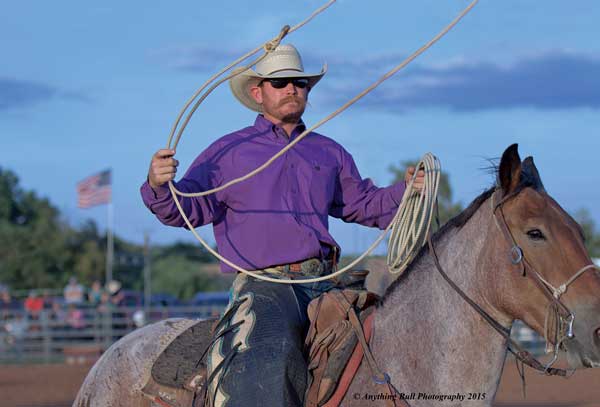
    Yet those unnoticed moments are what catch a photographer’s eye, as is the case with the cover photo, taken at the 2015 Rylee Miller Memorial Ranch Bronc Riding in Cherokee, Oklahoma. James started the annual bronc riding in memory of his girlfriend, who passed away in 2013. “We did a winter series jackpot bull and bronc riding first, and after that I decided I wanted to set up a scholarship fund and do the ranch bronc riding,” says James. “Phil Sumner and Jaymie and Rooster Swartz have brought horses to the bronc riding, and we do it early in the year so the horses are coming in fresh and ready to go. That makes it pretty wild. We’ve also had women’s bronc riding, junior broncs, and mini broncs, which are a crowd favorite. We won’t be able to hold the bronc riding this year, but the goal is to come back next year and do it bigger and better.”

    While he’s on the road for the summer, James’ family and friends look in on his livestock. He has 125 head of cows, originally starting with 30 – 40 head to help pay for his rodeo habit. “I work at a sale barn about twenty miles from the house, and I buy cows like some people buy shoes. I’ll go to work a sale and come home with four or five more. My fiancée, Jill Shaw,  and I are partnering on forty head of mama cows, so we have a nice little ranch, and it keeps me going in the winter. It’s also something to do with my horses to get their minds back after a long summer of rodeos.”
    James says his horses share his love for adrenaline, adding that they have to be gritty and tough, with plenty of run in them. “They’re all a little kamikaze with no hesitation in them. My dad said you know you have a good pickup horse if you can run them into a brick wall. I run my horses at anything I think they’ll be scared of.” Scooby, a 19-year-old gelding, is his best horse, starting out as Jena’s barrel horse in college. “Scooby had a motor on him, but he didn’t want to run the pattern, so Jena asked me to ride him a while. I was working at three sale barns at the time and cowboying. Scooby picked up rodeos so well, I told Jena she could either sell him or give him to me, because I wasn’t giving him back.” James found another of his horses, Colonel, in college, while he recently purchased Peso from Cody Webster. He also rides Cisco and Pepper, while the red roan featured on the cover is a former Canadian bronc. “Bromby didn’t have an ounce of buck in him, so I bought him from Sammy. I don’t pick up on him very much because he’s seventeen hands and it’s a long way to reach some of those broncs.” Bromby and James received a standing ovation several years ago at a rodeo in Longview, Texas, when a barrel truck was stuck in a muddy arena. James threaded his rope through the front tow of the truck and Bromby pulled it out within minutes.

    “I think pickup horses are about the toughest horses in the rodeo,” James adds. “We get them hot and tired as they can handle, but then we don’t always have time to cool them off before getting another horse and going back to work. Jill takes off work to travel with me, so she’ll go back and cool horses out for me between events.” James met Jill six years ago at the North Texas State Fair, which her family has helped produce for many years. “Jill is part of a drill team and a flag team down there, which she’s really passionate about, and she runs sponsor flags. I met her while I was working that rodeo, and in 2015, we really hit it off and dated for about a year. I proposed to her in the arena, and we’ll be getting married in September in Texas.” The couple is taking their longest trip yet in August, on the road for two weeks traveling to rodeos. “We’ll see how much she likes me – it’ll be me and her and five dogs,” he jokes.

    James’ one-year-old son, Hagen, is also showing interest in the western lifestyle. “Whenever he goes to feed with me, all he pays attention to is the horses and cows. He may be the only kid around with a seventeen hand Canadian bronc for his first horse.” Any time at home is spent with Hagen, while James also enjoys catching up with friends and doing day work in the area. One of his goals is to bring the Rylee Miller Memorial back in 2018. “We always have good horses, and I’ve even had guys talking to me from Idaho and northern California about it. I want it to become the premier ranch bronc riding in the country, and I think we’re fairly close.”

    James Hajek at the NTFR 2016 Ranch Rodeo – Todd Brewer