Rodeo Life

Category: On The Trail

  • Shada Brazile

    Shada Brazile

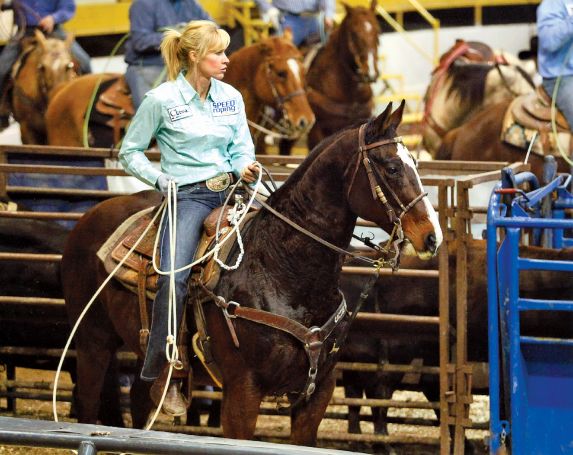
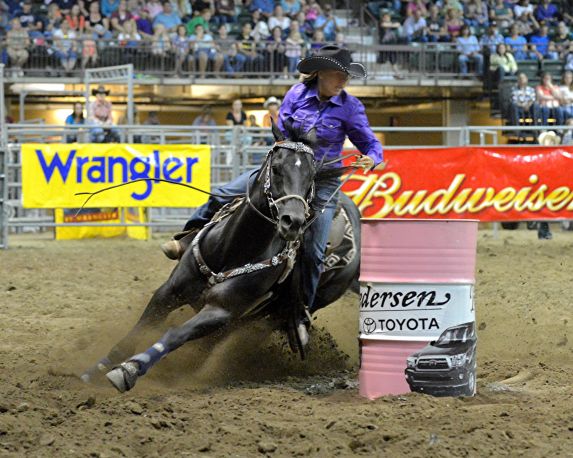
    There will be five first time qualifiers at the Wrangler National Finals this year in the barrel race and each one has a great tale to tell of their journey. None though have the same perspective of Shada Brazile.

    You could say that Shada grew up around rodeo but that would be an understatement. Let’s see, she’s married to Trevor Brazile, a 17-time World Champion, including seven consecutive All Around World Championships. Her grandfather is Clifton Smith who qualified for the NFR in the 1960s. Her uncle is Stran Smith, an 11-time WNFR qualifier and a World Champion Calf Roper. Shall we continue? Her brothers are none other than Clif and Tuf Cooper and stepbrother Clint Cooper who combined have 14  WNFR qualifications and two World Championships. Her father is Steve Norris from Colorado Springs, Colo., who is a two time World Champion cutter. Her other grandpa, Bob Norris, owns the famed T-Cross Ranches. See what I mean?

    Shada was destined to love horses or at least have every opportunity provided. There is a difference though between what you are provided with and what you do with it. There are many people who are provided ample opportunity but do not have the perseverance and work ethic to succeed. Shada is not one of these individuals.

    As the mom of two young children, Treston, 5, and Style, 3, Mrs. Brazile has her hands full. For the past several years since marrying Trevor, she has been his partner on the road never feeling like she was in his shadow. “I’ve never really felt like I was in Trevor’s shadow. We worked together for every one of his gold buckles. I don’t ever feel like I’m just Trevor’s wife. I have been completely comfortable with how it was,” Shada said lovingly.

    With several rigs on the road at one time and a husband who competes in three different events, Shada had a full-time job just tending to business. Even when she wasn’t on the rodeo road herself she kept her hand in the barrel racing business.

    “After college I didn’t rodeo a whole lot. I would buy a horse here and there. After Trevor and I were married I would take his second and third string head horses and train them and then I would end up selling them. I think that helped me more than anything is training my own. I’ve done it both ways – I’ve bought horses and I’ve trained my own,” Shada said.

    After taking some time off to have her children and enjoying every minute of raising them, the desire to barrel race came back, but it wasn’t without heartache. “I bought two horses in October of 2011; that following January I lost two horses in two days. Salmonella got one and another horse crippled himself out in the pasture. Both of those horses were just about ready to go and literally, I was just heartbroken,” she said.

    The desire was gone. It wasn’t long though before her husband and friend, Brittany Pozzi would light a fire in her. Probably little did Trevor know how much a quick comment would change things! At the Texas Circuit Finals, a horse that Pozzi was riding caught the attention of the great horseman. Trevor casually asked about the horse and commented that he liked him. A few weeks later, Pozzi would come to stay with the Brazile family during the rodeo at Fort Worth and strike up a conversation with Shada about a horse she had that she felt like Shada should try. Politely Shada shrugged off the suggestion feeling like she wasn’t ready. Persistence on Pozzi’s part about a week later paid off.

    “Brittany called and said since she was coming back, she would just throw Dial It in the trailer and I could ride him. I figured it couldn’t really hurt anything so I agreed. I knew the minute I loped him through the pattern that he was perfect. It wasn’t like it was a perfect pattern either – I think he even bucked a little bit, but I just knew,” Shada said. Call it instinct, call it luck, call it whatever you want – Dial It was “it” so to speak. The success didn’t come easy though.

    “Dial It was a little wild and crazy when I got him. In fact, I wouldn’t let my kids within 30 feet of him when I got him. He was terrified of cattle and just in general wild,” Shada laughed. “Now, he literally looks for my kids when I take him back to the trailer. They give him treats and honestly, he loves them. I think he’s in his comfort zone when he is at the trailer with them.”

    After a full year of seasoning and doctoring injuries, Shada confessed that at the beginning of the 2013 year, it was her goal to make the Wrangler National Finals and come running down the alley at the Thomas and Mack in Las Vegas.

    “I had a good winter and was about seventh in the standings and then things got rough. I put a lot of emphasis on Calgary and I didn’t win anything there. Dial It wasn’t feeling good and it was apparent in his runs. After Cheyenne I had slid all the way to 23rd in the World. After Cheyenne I had to make a decision – either send Dial It home and call it a year or get busy and figure things out. I chose the latter. I can’t say I did it all by myself either. I have a great support team in my mom, my entire family, and my friends. Bambi Robb never missed a beat in helping me figure out what was wrong and how to tend to Dial It,” Shada reflected.

    The team did things right and Shada got back on the top of her game. It was a struggle to make the top 15, but Shada never took her foot off the gas and if there is a bet to be made on a barrel racer in Las Vegas, there is no doubt Shada will be prepared.

    “I’ve watched the epitome of work ethic in Trevor. The pace in Vegas is something that we have been used to all year. Trevor says we took the busiest rig in all of rodeo and just added another event to it. I guess that’s right. We just do what we have to do to make it happen but it sure doesn’t happen without all of the people that support us. Faith is what gets us through. I know we have a loving God who has a plan for our lives that is much bigger and greater than I can even imagine. I thank Him for blessing our family with this moment and for helping me and guiding me through the year. I didn’t take this challenge on this year to prove anything or for my happiness. I was happy filling my role as wife and mother. I did this because I have a passion for horses and rodeo. I love it and the life it allows for us. I’ll be prepared when I get to Vegas but I don’t have to win to have a storybook ending. It’s already perfect in my eyes. Just making it and riding in the grand entry behind Trevor and the Texas flag…that’s a happy ending and more than enough for me.”

  • Garrett Yerigan

    Garrett Yerigan

    Garrett Yerigan graduated from high school last May and is hoping to make rodeo his career. “I would use college as a backup plan – but right now rodeo is my main gig. I think I can make that work, but you never know what tomorrow will bring.”

         He is checking one goal off his bucket list this year by announcing the International Finals Rodeo, in Oklahoma City, Okla. January 17-19, 2014. “Announcing the IFR was on the top of the list,” said the 19-year-old from Pryor, Okla. Garrett started as a technical director of the IFR several years ago. “I handled the lights, the video, oversaw the music, and built the performance outlines – pretty much one step down from the production manager.” His dad, Dale, is the General Manager for the International Pro Rodeo Association, so Garrett has worked many angles of the event over the years. “I never competed. Everybody always thought I was crazy especially having a dad as the bulldogger. But I looked at the for sure paycheck and did the back end work instead.” Garrett started announcing when he was 11, locally at some rodeos and barrel racings in the Claremore, OK area. “When I started, I just used the equipment that was there, and now I have a sponsor – Red Master Harrow – that provides the tractor and harrow that I use is for my jobs working ground. Floyd Fain, who owns the company out of Amarillo, comes to the event now. I’ve been with him almost two years.” Another one of his sponsors, Cody Jensen with Oxbow Tack, helps advertise anything that he’s doing. “That company is a family company and I appreciate those kind of people – that’s how our country keeps turning. Anybody that can make something out of nothing is impressive. I and I have a pair of chaps, saddle, and breast collar made by them.”
    Garrett considers announcing as a conversation between himself and the audience. “I’m not going to talk at you, I’m going to talk to you. I like to think of myself as a person that can relate to the audience, wether they are watching rodeo for the first time or the 500th time. It goes back to the sports broadcaster – our job is to explain the event – things that people may not realize, but we’re educated to make them aware. The toughest part of that is coming across in a way that is understandable to the first time rodeo fans, but not obnoxious and elementary to the people that watch week in and week out. I don’t ever feel like I’m going to work, I’m going to have fun.”
    He does his homework before showing up at an event. “I get day sheets and find out what contestants are there – hometown, money won and even some personal interest stuff. Then I take a look at the livestock coming and the accolades of that. I meet with sponsors and producers – there’s a lot more to it than showing up and picking up a microphone.” He is announcing the IFR with Brandon McLagan – it is Brandon’s second trip. “Brandon and I are great friends and we talk on the phone several times a week. Once we get closer to the date, we will talk a lot more. Whose doing what will happen the day of.”
    Garrett has learned a lot about public relations through FFA. He joined in 2008 and has won two National Awards through that association. The first one was the National Ag Communication Proficiency Award for FFA, which he received Friday, Oct. 26, 2012, in Indianapolis at the National FFA Convention and Expo.
    After winning the title for Oklahoma, he moved to the national competition. “They start with 51, then the top four are the national finalists. We moved on to the interview process, which included an application, interview, and a fifteen minute question and answer session. The hardest question was how do I look when I go to a new location as an announcer, I’m taking someone’s position that was there the year before, does that change your mindset or are you yourself. I told them that if the committee liked  what I did in another location, they will like me there – I don’t change my style – I’m going to be myself wherever I’m at.”
    His second title was achieved this year – the Outdoor Recreation Proficiency Award. “After the state level, they crown three winners. The state winner from every state goes to summer judging, where the application is judged. The top four become national finalists. The final live interview is 75% of the score. My SAE, Supervised Agricultural Experience, is Rodeo Announcing, Sound and Music – all the things I do in rodeo.” Because the FFA is such a prestigious organization, these awards looks great on Garrett’s resume. Garrett is still trying for one more award – the American FFA Degree – the highest any single member can receive. That will be something I’d go to convention for next year. It’s a lengthy application that you submit and get judged on.”
    Garrett came upon his love of rodeo naturally. His dad, Dale, was an eleven time IPRA World Champion steer wrestler. His mom, Kathy, was an IFR barrel racer, who now works as an office manager at a local hospital. “Dad grew up in Minnesota playing hockey and wrestling, he got into high school rodeo through friends of the family. Mom is from Ohio; she was born into rodeo; her mom and dad were both competitive (Barbara Ink, Bob Ink – IFR judge multiple times, bareback riding). My other grandparents, Dean and MaryLou, were not involved in rodeo, but they supported my dad the whole way, just like they do with me. Both sides are very supportive of continuing the family tradition of rodeo. I’ve got a phenomenal support system at home. Whatever path I go down, my parents are going to be behind me one hundred percent.”
    Garrett spent years collecting music and sound effects. He has more than 15,000 songs on his computer – that includes songs and sound effects. “I can do both announce and music. If I can concentrate on one or the other, I can be more responsive and not concentrating on something else. Music is fun because of the mood setters and you have some control over that feel. On the other side, you get to accent the music by setting the scene of what the ride means for the cowboy. There are some guys that I work multiple events with, but every event is different.”
    Along with his expertise in sound and music, Garrett is also sought out for his expertise in ground work. He was part of the ground crew for the International Finals Youth Rodeo for several years and works the ground for several barrel races around his house. “Diversity is definitely there. I’ve always been a personal tractor nut. Growing up I’d spend time with my grandfather in Minnesota. He was a farmer and I drove big John Deeres up there.”
    Come Jan. 19, when the IFR is all done, Garrett can check that one off his bucket list. “I would love to announce the NFR, obviously, and the bigger ones like Cheyenne, Houston, and the National High School Finals.  I did get selected for the National Junior High Finals in DeMoines, Iowa in 2014. There’s always expansion in my future and growing – rodeo and announcing is where I’m headed.”

  • The Thompsons

    The Thompsons

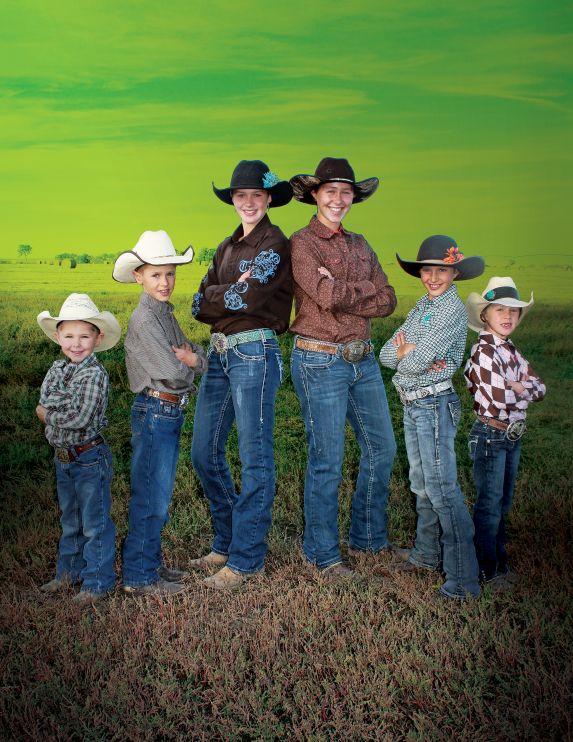
    Thorpe and Shelly Thompson of Whitney, Neb., have six children: Turek (3), Hadley (5), Tiegen (7), Haiden (9), Jacey (14), and Jamie (17). Each child has a competitive side and they all like to express it through the sport of rodeo. At the National Little Britches Finals Rodeo (NLBFR) in July, this family alone accounted for 46 runs over the course of four days. And this doesn’t even include the short-go. In another year, all six will be competing in the NLBRA, from five to 18. They will haul 8 horses for them to compete on. “Finding horses is the hardest thing for us – each horse has to be able to do more than one event and have more than one rider,” said Shelly.
        “It’s a team effort,” explains Thorpe, who owns a feedlot, farm, and has several other businesses going like AI, embryo transfer, and most recently a power washing business on the oil rigs in North Dakota. “The kids all pitch in. I’m proud of the kids from the standpoint they make their own decisions on ninety percent of stuff. Shelly and I help and provide as many opportunities as we can and the kids contribute by putting in the time and effort required to do well. They help with everything we do. They all understand what physical labor is and know what it’s like to put in an 18 hour day.” The days are long, but they’re spent together. 
        “We are big into practice at our house,” says Shelly. “Jamie and Jacey are usually up at 5 most days saddling horses. Our goal is to have everything warmed up by 6, then practice until around lunch.” Shelly home schools the kids and they work for everything they do. “They help dad ride pens, heat check, and anything else that needs to happen here. Thorpe was in a bad accident in March and was in and out of the hospital, so the kids had to look elsewhere for the coaching that Thorpe had started.” Shelly is on the Nebraska Farm Bureau Board of Directors and travels one week a month. “They have to be organized and keep the place up when I’m gone. There’s a lot of planning that goes on around here or it doesn’t work.”  
        The oldest help the youngest first. “We have them focus on one event and while they’re cooling off horses afterward Jacey and I will discuss what needs more work,” said Jamie. “Jacey and I are as close as sisters can get.” says Jamie. 
        “I use two horses,” said Hadley Jo, the youngest competitor. “Frosty and Spitty. “Frosty’s my favorite because she runs faster.”  She likes Little Britches rodeos because she gets to compete with her brother and sisters. She loves going to the National Little Britches Finals Rodeo in July in Pueblo, Colo. “I had fun and liked the water fights,” she says. This past year was a challenge for Hadley Jo as she broke her arm while playing with friends. She still competed using one hand. 
        Tiegen’s favorite events are goats and flags. “When I do goats, I just go out and have run,” he says. “I use Spitty for this and he is good.” Tiegen uses a pony named Squirt for Flags. Squirt has a tendency to buck if he’s not properly prepared. 
        Haiden’s favorite subject in school is math. Her least favorite chore is cleaning the goat pens. “We have 30 goats,” she said. Like most other responsibilities, the family shares this chore – until someone gets in trouble that is. Then the task becomes their responsibility. Another trademark specific to Haiden is her two-tone hat with decorative flower. “I saw someone wearing one and liked it,” she explains. “Then I got mine for Christmas.” 
        Jacey has moved on to high school rodeo this year. “It was an easy transition,” says Jacey. “National Little Britches gave me a lot of rodeos to go to and practice performing at the big rodeos, like their finals, which helps me with the pressure.” For the past two years, she’s accompanied the family to Wyoming high school rodeos…and then worked behind the scenes to help put them on. As a freshman, she now gets to spend her time competing instead of holding goats, a job she held for two years. Jacey takes responsibility for training her own horses and is proud of this. Her breakaway horse has a thing for donuts. This was discovered by accident. “Haiden had one and set it on the trailer. When she went to pick it up, Shag was eating it,” she explains. “My main goal this year is to win state in goats,” she explains. She has a lot of other goals including winning the All Around and breakaway. As an eighth grader, she was the reserve national champion for NLBRA in this event. 
        Jamie has been competing in Wyoming High School Rodeo as well as NLBRA. Jamie is the Wyoming State High School Goat Tying Student Director this year. “I like it, I like being down there to see how the other girls tie and encourage them. I like the responsibility part of it. Mom and Dad have always taught us to step up and help wherever we can.” She has made it to the short round a the Little Britches finals every year, qualified for the Nigh School Nationals and was the Reserve World Champion Goat Tier at the National Junior High Finals in Gallup, NM. She’s also active outside the arena, “I’m a member of the Alliance FFA chapter,” she explains. Alliance is an hour drive for her and she takes online college Ag courses to be eligible to be part of it. She’s the acting Sentinel for the club and participates on the Livestock Management/Judging Team as well. “I skype call for the weekly meetings and go there once a month to the meetings. FFA has taught me leadership skills and what kind of person it takes to be one.”
        The Thompson children are thankful for the life they lead and the oldest speak for the bunch when they extend thanks first to their parents for all the driving, support, and encouragement. They then pass out appreciation to others who’ve made important contributions to their success. “We would like to thank Jordan Thurston for her help with our goat tying,” they say. “We would also like to thank Paul Tierney for his help with breakaway and team roping, Carol Hollers for her advice on breakaway roping, and Sam Flannery for her help with barrel racing.” The sisters continue by offering appreciation to their extended family for encouragement over the years, and make it a point to mention Papa T. for supplying donuts – and handling chores while they’re away from home. 
        Jamie and Jacey speak on behalf of the entire family when they take the opportunity to give thanks to God. “We would like to say thanks to The Good Lord Above for watching over us and providing what we have.” 

  • Jimmi Jo Montera

    Jimmi Jo Montera

    Jimmi Jo Montera loves to rope. “We started riding when we were three and roping when we were four,” she shared of her childhood with her older sister, Shannon, and brother, Shawn. “I tried barrels a little bit, but never got too excited. We tried horse shows too and it was boring. I love to rope and I love to tie goats.”
    Jimmi Jo grew up outside Longmont, Colo. Her parents, Jim and Shirley Martin, began Colorado Animal Health 40 years ago and although Jim wasn’t raised roping, after college he took up roping as his kids were learning about rodeo. All three competed in National Little Britches and High School rodeo. Jimmi Jo went to Otero College for one year, following her sister there, and then switched to the University of Wyoming from 1987 – 1990, under the coaching of Pete Burns and Danny Dunluvy. “Jimmi Jo is as good a hand as I’ve ever worked with, man or woman,” said Pete. “I didn’t have to do a thing with her – all I did was load calves and give her a scholarship.” Her abilities across the various events came to fruition in 1990 when she alone won the women’s team enough points to take the National Women’s Intercollegiate Team Championship Title. She won the All Around Cowgirl of the NIRA, placed in the breakaway, took second in all three rounds of goat tying and won the average.
    After college, Jimmi Jo took her degree in merchandising and marketing and went to work for her dad. “I did the in-store buying until I got pregnant with Colby, then I went back part time.” Colby had heart surgery at two days old and open heart surgery when he was six months old. “Obviously that didn’t stunt his growth,” said Jimmi Jo of her 6’5″ basketball playing son. Garrett came along a few years later and Jimmi Jo stayed home for ten years raising her sons. Both excel at basketball and she spends her time helping them pursue their goals to be pro ball players. “My boys are 16 and 13 – huge basketball players. Between my practice and getting them to club basketball – that’s what I focus on. Colby and Garrett have been involved in basketball since fourth grade.” They attend school 25 miles from home, Fossil Ridge High School and Preston Junior High. “We really like the schools and they are very competitive,” she said.
    Competitive is something the boys inherited from Jimmi Jo. Years after winning the team championship, Jimmi Jo is still working every day to improve her roping. Her most current win was the Wild Fire, heeling for Lari Dee Guy. “That is one of the best all girls ropings and I’ve come close to winning it before, but I’d never won it. It pays really good for an all girl roping.”
    Jimmi Jo is concentrating on the little things in her roping and riding. “I’ve gotten better, but I’m not where I want to be,” she said. “During the fourth (of July), I see all these guys come through here and practice and you see how good they are – it’s no mistake that’s why they are good.” Jimmi Jo works closely with Speed Williams on her roping. “I’m working on position right now – Speed is helping me a lot. He preaches to me – the roping part is easy, but I don’t ride my horse right or make my horse work right. So I’m paying attention to that.” She has realized through the years that it is one thing to practice and another thing to practice productively. “I’ve gained information from great ropers like Speed, Alan Bach, and others that made me think about things a little differently.” She still heads some, but likes heeling much better. “I feel like I’ve studied it a lot and worked on it. In the time frame I have to practice, I want to focus on my heeling. It works out well because Rick (her husband) likes to head.” The couple, who married six years ago, have been around the rodeo and roping pens for years. “Rick and I we go roping all the time; he supports my roping – he loves it as much as I do.” Their place, located east of Ft. Collins, Colo., includes a barn that Jimmi Jo spends a fair amount of time at.
    “We don’t have people over for dinner, we have people over to rope,” she says with a laugh. “We also host a few charity ropings in the barn, but it stays pretty busy in here with ropers all year long,” she said. At one of the events this year, the Bill Perusek Memorial Roping, Jimmi Jo won the saddle and immediately gave it to a little girl in the audience that was all decked out in her western attire while maneuvering little crutches. “I’d seen her there and she loved horses – she had her boots on and there was something about her – I could have lost Colby and it just hit me how fortunate I was – we are – to be able to do normal activities.”
    She has a busy October between her roping and her sons’ ball games. She and Rick will haul up to Billings Mont., the beginning of October for the Wrangler Finals and will finish the month in Oklahoma City at the USTRC Finals (October 26 through November 3.) She hauls three horses – Chain Saw, who she got from JW Borrego, Chica, from Gary Grokett, and Rango, from Chris Glover. She’s got two others that she practices on and young horses that are coming along. “I’m a horse collector – I’ve got lots of them. I could have a whole herd – it wouldn’t bother me.” She also recognizes that roping at her level requires great mounts. “It’s hard to take a young horse and win right now, there’s no cheap roping. Look what you’re asking these horses to do. Go from a dead stop to blowing their guts out, sliding around the corner, dead stop, take a hit, do it again fifteen times at a jackpot.”
    She practices at least four days a week, and ropes the dummy in between. “You have to rope the dummy correctly, you can actually reinforce bad habits on the dummy. I’ll rope the dummy to work on little weaknesses I’ve got.” She is also a regular at the gym. “I broke my back (L4 & 5) nine years ago, so it’s fused. Working out is one thing I do pretty faithfully because if I don’t, I can’t rope. At the US finals, I can go a week, but by the time I get home I can tell.” Her workouts consist of free weights, stability ball exercises, bands, elliptical, treadmill, and the bike. “I’ll do some basketball with my boys too,” she said. “I don’t feel good when I don’t work out, it’s a habit. I like working out.” She is also a regular at the chiropractor and sticks to a healthy diet. “I try to eat right 75% of the time – I stick with the simple stuff – fruit, good yogurt, and I pack a lot of protein bars, nuts, and almonds. My favorite are Kind bars – they are mainly nuts and coconut. I love Mexican food, and I rarely buy packaged food, or eat fast food.”
    Jimmi Jo plans to continue to improve and win. “I’d like to win the US finals coming up and the Wrangler Finals next week.” She sees team roping as a sport continuing to grow thanks to the numbering system and the national sponsors that step up to assist with the cost of going down the road. “There’s people that can compete and win that can’t rope365 days a year and that’s part of the draw. When I was young, I had to go in the mixed ropings and rope against people like JD Yates.” She has also seen the increase in talent that has come along with more instruction. “It’s just like any sport – there are more tools – we didn’t have all the learning DVDS. I watch the Patrick Smith video – I wish I would have had that when I was young. My dad was learning and I would learn from him … my parents worked hard to afford our horses and rodeo. We did what we could and got information where we could.” She will continue to improve and work on the details that make her a strong competitor. Her sponsors include Classic, Wrangler, and Speed Williams. She is grateful to them for continued support and plans to represent them for a long time. “I never think ‘Gosh, I don’t want to go rope.’ I’m fortunate that my husband loves to do it. And I’m fortunate that I can fit it in. I just love to rope.” 

  • Michele McLeod

    Michele McLeod

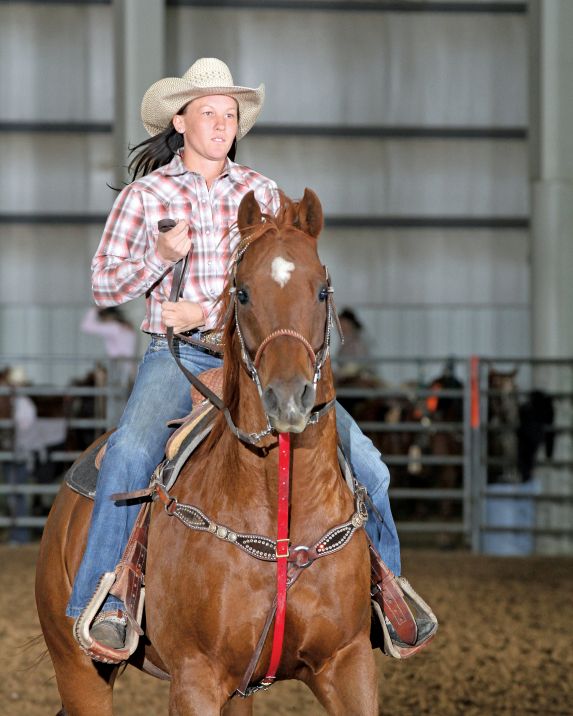
    Michele McLeod has been training futurity colts since 2005. “Basically my job was to train and I didn’t travel more than a three hour radius from home to compete,” said 43-year-old mother of three from Whitesboro, Texas. All that changed this March when she met the Black Stallion.
       “Every girl’s dream,” said Charlie Cole, co-owner of the five year old stud, with his partner, Jason Martin, (High Point Performance Horses) out of Pilot Point, Texas. “It’s the most random story. I was not looking for a barrel horse at all. I had just sold a horse and I had always wanted a barrel horse sire so I was watching the barrels at the AQHA World Show and he blew everyone away – 2012 World Champion Jr. Barrel Horse. I texted my business partner and said I saw an amazing horse just run. The next day I watched the finals and the way he worked I just knew he was a special horse. He used himself well and had explosive power away from the barrels and accelerated his way to the next one. He kept his feet moving around the barrel. I texted my business partner again and I got him bought in two weeks.” He was dead lame four days later. Slick By Design had to have knee surgery late last December and they took their time rehabbing him. The comeback of the stallion out of Brazilian owned sire Designer Red out of Dreams of Blue – a former barrel horse by Dream on Dancer, “is history. I thought Michele was a good fit and from the moment she stepped on him it was a match made in heaven.”
        “They approached me in March to see if I’d start taking him around the house,” said Michele. “Right off the bat we started doing well – it was crazy. After I won Guymon and Duncan, Charlie and Jason asked me if I’d go for the summer to see if we could get into some of the winter rodeos.” Michele wasn’t sure if she wanted to leave home for that long, so she jokingly said if she won the Derby (Slick by Design, Old Fort Days Derby, Fort Smith, Ark.)  she would have enough money to leave at home for her three daughters, then she would go. “I won and I hit the road.” 
        The general plan was to see if the team could get in the top 40 to get into some of the winter rodeos and get some more experience on him. “We hired Ann Thompson to do all the entering for me and she knew exactly what to do. Jason, Charlie and I would laugh that it was the blind leading the blind. We give a lot of credit to her for that. She knew the miles and exactly how long it would take.”
        Michele left Katelyn (20), and Lindsay (17) at home to run the place with her husband, John. “He doesn’t travel – he stays home and has a normal job as an insurance adjuster for a body shop.” Daughter Jenna (25), who was living in Los Angeles at the time, came home in August to help run the technical side of the team. 
        Michele had a great summer. “When you’re winning like that how could you not,” she said. “Some of the all night drives we did were a little nerve wracking. It was so different for me – I’m used to working all day long, riding horses. For the summer I took three horses with me in addition to Slick, but sitting in the trailer waiting for the rodeo took a little adjusting.” 
      She and Slick quickly climbed the standings and ended the season third in the world. “I’ve never been to Vegas, to watch or anything. I’d said years ago I’d never go unless I make it – so I guess we’re going. The whole family is going – everyone will be there – parents – aunts – uncles. It hasn’t really set in yet because I’ve been so busy, but now that it’s getting closer, sending photos to the WPRA, I’m actually going to the NFR.”
      “I had no idea this is what I’d be doing with my life.” Michele grew as an only child and her parents, Gary and Gloria Morrison, didn’t have any interest in animals. “I got a pony as a birthday present when I was 8, but I didn’t learn to run barrels until I was 18.” She went to some college rodeos, but decided to go another route. “I went to the fire academy,” she said. “And then things changed. I got pregnant with my first daughter.” That sizzled the firefighting plan. “Once you start a family, you have to redirect what’s best for having a family.” Michele became a vet tech and worked for the next 16 years on the night shift for a mix practice so she could be home with her daughters. “I trained horses on the side, and finally quit my job to train full time for the public in 2005.”
        Her partnership with Charlie and Jason began in 2013 and now she is running another of their recent purchases, Kellies Chick, a mare they purchased in July from Kelly Conrado, Colorado horse breeder and trainer. “When we tried her, I ran her in Steamboat, and won. I sent her home with my daughter, Katelyn, to do some tuning, and Katelyn entered her in the Oklahoma City Summer Shoot-Out and won it. So now I have two great horses. They have very different styles, so we’ve given Slick some time off – he doesn’t like to see a trailer leave without him in it, though. I’m running Skye now for the rodeos that are counting for the 2014 season. I’ll stay on her until after Congress and then I’ll get back on Slick.”
        As for Jason and Charlie, they are getting ready for Congress. “That’s a lot of my life,” he said. “Barrel racing is my hobby and I spend most of my time working with the 40 horses we’ve got at Congress. We do things on a giant scale in the horse show world.” The two have accumulated more than 100 World Championships during their 20 plus years of combined training. “I love it – the horse training industry has been unbelievably good to me, I have no complaints.” Charlie has only had barrel horses for 15 years. “I had a rodeo background from being at boarding school, Rawhide Ranch, in Bonsall, California, I went the show horse route and we’ve had a great career doing that. I thought about getting a reiner, but that was judged and I wanted something that was all about the clock. You can blame the ground, yourself, or the horse. You only have three options. So I went the barrel horse route. I got lucky right out of the box.” 
        As for Michele, she’s still having the time of her life on the road. “We had a great time in Omaha – there were 12 of us there – and we will all be in Vegas.” Her Cruel Girl partnership along with her other sponsors are happy to help get her ready to make her first appearance in Vegas…. Shorty’s Caboy Hattery, Deuces Wild Tack, Alfalfa Express, Professional Choice, Back on Track, Cetyl M, Oxy-Gen, SmartPak, and Shiloh Saddles. “We’re for sure going next year,” she said. 
        “She is so hard working and so deserving of this,” concludes her family.

  • Mike & Sherrylynn Johnson

    Mike & Sherrylynn Johnson

    “I don’t know any other way of life,” said Mike Johnson, who went straight from high school to the rodeo road in 1982. “I’ve never held a job, I just rodeo. I’ve been an event representative in the PRCA for tie down for four years, but that’s as close to a job as I’ve had.” Born and raised in Henryetta, Okla., Mike averages around 40 days a year at home. He started roping when he was 6, and went to his first rodeo at 10. He had his PRCA card at 18. He roped the dog and everything else when he was a kid. “Rodeo is what I’ve wanted to do – all of a sudden 31 years have gone by and I have no regrets. You meet a lot of people and go a lot of places.”
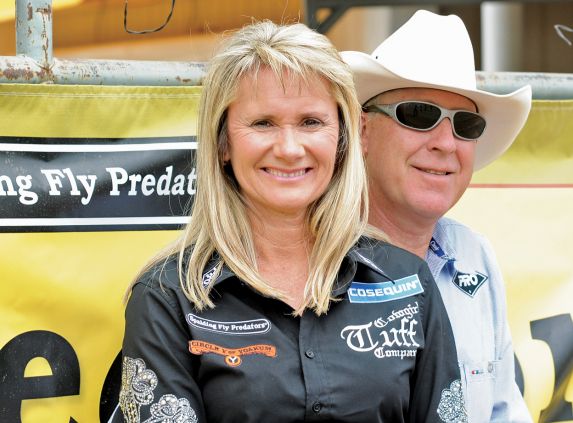
    His traveling partner, best friend, and wife, Sherrylynn agrees. “I think if there was a male me, it would be Mike. When you’re in a box as much as we are – truck or horse trailer – you’ve got to be best friends – you’re together constantly.” They share the same common goal that they had and accomplished five years ago – to make the Wrangler National Finals. Along the way, they are giving back. They didn’t even know their truck had Sirrus radio for a year and a half. “We’d read the Business Journal and talk about it,” she said. “When we’re on the road we take in things we enjoy. We’re doing what most people do when they retire. If we’re in San Diego and the pro game is going on, and we’ll get on the internet and buy tickets and go.” They have a four horse Hart aluminum with a slide out. “It works great. We pull it with a 3500 Dodge dually. We pull two horses and another young horse with us. We use the front hole for storage for hay. We have a pod on top with prizes for our clinics.
    The couple married in 2002, 18 years after they first met during a high school rodeo. “We got married in Calgary, Alberta. We went to the rodeo the week before got married in an 1800-style church, complete with costumes.” The church they got married in was the first church in Canada. “I ran ribbons for Mike in high school and we won the Ribbon roping at the High School finals in 1982 – Oklahoma High School. We laugh because we can end that way – when we get into the Old Timers.” Sherrylynn went to college at Southern Arkansas University in Magnolia. “When I left high school I wanted to go to college. I went to school for 3 ½ years and agriculture and business. The college allowed me to stay on and coach the team and work on my masters. I completed on my masters and went on for my doctoral in developmental education. Sherrylynn finished her masters in counseling while coaching the rodeo team at Southern Arkansas University. She completed 30 plus hours towards her doctorate in developmental education while teaching at the college. She went on to teach for five years, moving from that to working for Purina. “I had a really nice horse, I felt like I was in a rut and decided to test myself and try to make the Finals with Purina’s support. The first year we took my vacation days and doubled them and I went out on the road for a month and a half. I worked both for the first year and I made the Finals. I did that for two years and then hit the road.” She met up with Mike on the road.
    The couple has built their life around rodeo and passing their knowledge on to others. Mike started doing clinics 30 years ago. “They were more mom and pop type clinics when we started helping,” said Sherrylynn. “Mom and dad(name) have also sold horses with Martha Josey at the Josey Ranch for over 20 years. We ventured out and got a schedule of days we weren’t rodeoing and started helping kids in small groups. It’s went bonkers. We’ve been doing these now for five years. We take off March, April, and May for clinics.” They have one open week from now until the end of May. Thanks to the great support of sponsors like Spalding Labs, Nutramax Labs, PRO, Wrangler & Cowgirl Tuff, they can get to even more clinics than before. “Spalding Lab flew us in for the National Little Britches Finals so we could help those kids,” said Sherrylynn. “We have really good sponsors and part of what we ask is for them to be a part of the clinics so it’s not so expensive for the parents.
    “We don’t have kids, I don’t have patience for young horses, but I do with the kids. A lot of our clinics have adults that want to go faster and win but we have a special place in our hearts for the kids. They call me the energizer bunny because I’ll just stay until they get it.” Their students have become the children they never had. “There’s a lot of kids we see once a year. We did a clinic in Indiana and when the kids found out we were there all week, we would go to a barn every night and work with a group. It’s so rewarding to help students at a clinic and see them go from running a 21 in the poles to breaking the 20 second barrier at their next rodeo – we help in all the events, poles, goats, barrels & tie down.”
    Part of what they educate people about is their horse. “You ride the horse the style he goes. You can tweak it and make it better, but at the end of the day he’s got a style – you have to learn that. I just did that about a month and a half ago. He wasn’t the style I wanted to continue to ride. I make sure they understand that,” said Sherrylynn. “Maybe we don’t come from money so we understand how much it costs to do the sport we love. Our clinics are designed by the person that puts them on to help their individual groups and what they can afford. The majority of people don’t have six figures to buy a horse.”
    They also talk about tack and bits – and they have developed a line of barrel racing and roping saddles with Circle Y. The Johnson sportline racer and roper has evolved over time. “We have a nice saddle with a ten year warranty. We’ve been super fortunate with them. They give us try saddles for the kids to try – they can work the barrels, or see how it fits. We’ve been lucky that way.”
    The couple has worked their entire life to do what they doing now. They have an extended family with several of their repeat clinics, including Central Wyoming College in Riverton, Wyo. “We’ve gone back twice a year for the past three years. – it’s our third year going there and we get to see those kids improve. They bring us in as their family and it makes us feel good – it’s a special place for us.”
    They don’t have a five year, or ten year plan, but they do have a one year. “My guess is we’ll still be rodeoing and doing clinics,” said Mike.

  • Willow Raley

    Willow Raley

    Willow Raley started roping when she was 13. “I junior rodeoed a little bit when I was 8, and then I got a horse from my aunt, who rode English, and I rode in a pony club for three years. I used to do a lot of three phase jumping – it’s where you do dressage, cross country, and show jumping in one day.” What she gained from that is balance. “I remember when they took our stirrups away and made us jump jumps – that taught me how to keep the horse soft and squeeze with my legs and keep good balance. That has helped me with my roping.”
    Willow has given up the English riding, but she still has her saddle. “I don’t have time,” said the 31-year-old that calls Baggs, Wyo., home. Located about an hour and a half north of Steamboat Springs, Colo. Baggs has a nice indoor arena that belongs to the county. “We buy a membership for $600 for a lifetime for residents and we can rope all winter.” The arena isn’t heated, and Willow rides until the temperature drops below 15 degrees. “If it’s over that, it’s usually bearable. We usually have about two weeks of 40 below weather – and it usually hits around the NFR.”
    Willow and her husband – Aaron – have been married for eight years. They rope together and spend the summer showcasing horses they have trained. Willow belongs to seven associations: CPRA, WPRA, PRCA, WRA, USTRC, WSTR, WTRC. “I have a lot of money in memberships,” she admits. Her membership in the PRCA landed her a spot in the short go at Cheyenne this year. “I didn’t know I was the only girl to do that,” she said of her accomplishment in Cheyenne. Her next goal is to make the Circuit Finals. “Finding partners is hard sometimes – everybody that I rope with at the circuit level I rope with at the amateur level, so it’s the same group of guys.” As far as a shot at the NFR, she is skeptical. “It’s the hauling and the amount of money you’ve got to do to get there,” she said.
    Aaron appreciates his wife’s drive. “It’s just something that I like about her – that she wants to do good at what she does. She is so talented. One of my bigger goals is our horses that we raise and rope on. For me, that’s a goal that I’m getting accomplished with her.” Aaron realizes that there is no better way to advertise their horses than to have them on the road roping on them. “My goal is to have those horses that people want to have.”
    Aaron, Willow, and Willow’s dad, Paul Nicholas, bought their first stud in 2004, before Willow and Aaron were even married. Senator Dual, out of Dual Pep and a daughter of Doc O’lena, was purchased from Texas as a five-year-old. “He had some earnings as a cutting horse, but he was bred well and has a great disposition,” said Willow. “You can do anything on him.” They brought him back to Baggs and started roping on him and breeding their mares to him.
    They furthered their program by purchasing better mares and then they found Tigh and Jill Cowan. They owned Sun Frost and they sold Aaron and Willow a Sun Frost stud. “We became good friends and they’ve been like family to us as we have put our program together. They have been instrumental in our success. We are trying to build the perfect performance horse from barrels to roping to ranching,” said Aaron. The couple continues to strive to get that next best horse. “Our goal has always been to build the best rodeo horse we could get on. The rest is gravy. If we can raise a nice horse for someone else, that’s great.” Aaron competes in team roping and throws a steer from time to time. He roped calves in college but as time has gone on, he has settled on team roping and training horses. “When I met Willow I was getting into raising horses and we started roping together and that’s where we are today.”
    Willow met Aaron through mutual rodeo friends while she was going to school in Casper, where he lived. They spend most all their time together. They are on the road a lot in the summer and hire a person every year for the summer to feed, ride, and take care of the place. “You’ve got to have somebody to help with chores and the horses,” she said. “We have a girl that’s out of college for a year and that’s who is helping us right now.”
    Aaron spends most of his fall guiding hunters for Snake River Outfitting. “I help them and Henry Ranches,” he said. “I grew up around Casper and have been hunting ever since I can remember. I’ve been guiding since 1998.” The three months is the only time the couple is apart.
    Willow’s dad had an outfitting business when she was growing up so hunting is not new to her. “He’d throw me on a horse on a pack string and send me on my way,” she said. “I would enter the Baggs Fun Days on our pack string horses.” She competed in high school and she tried out the poles on a horse that won her a second place check at her first rodeo. “It’s an addiction to keep going and trying to do good. The people and the competition is so fun.” She made the High School Finals her freshman, sophomore, and junior year in the pole bending and went on to college at Casper, where she made the CNFR in the breakaway from 2002-2005 and won the region in 2003. She majored in Ag Business and Accounting and uses her degree in her role as book keeper for the family came out of that degree.
    She added another role to her life. She sold saddle pads for K Bar K Saddle Pad company because they used the pads. “Allen Bach endorsed them for awhile,” she said. “They are good, hand-made quality pads. The owner retired and we tried to find another pad that compared and couldn’t find one.” They found the guy and made him an offer. “We drove to his place, learned how to make the pads, brought the materials home, bought a new sewing machine, and that’s what I do in the winter.” The pads are made from scratch, including cutting out the material, sewing it together, and selling them (which Aaron does). Willow made the pad the Nikki Steffes rode at the Finals last year. “I’ve learned how to tool leather and found a person that will bling them out.”
    At the end of the day, Willow’s favorite thing to do to relax is take the boat on the lake. “There’s no cell phone service out there,” she said.

  • Cord McCoy

    Cord McCoy

    “I’ve been blessed with competing in rodeo,” said Cord McCoy. “The Western way of life keeps you pretty grounded. It’s a humbling experience. You really can’t tell the bulls about reality TV and when you’re breaking colts at the house, they don’t care if 30 million people saw you on Sunday night’s TV.” At the age of 33, Cord has been around the world twice, once going east and once going west and his ranch is one mile from his mom and dad’s place in Tupelo, Okla. (population 323).

    He went around the world during his two seasons on the Amazing Race, partnered with his brother, Jet. “I think that race is built for rodeo cowboys and cowgirls. You’re going to be tired, hungry, sore, and broke – it sounds like a normal fourth of July to me,” he said. “They turn you lose in countries they know you won’t have a clue and make you do things so out of your comfort zone and set back and watch how you cope and handle it.”

    Cord learned early in life how to handle things. He shocked the rodeo world in 1997 by becoming the first high schooler to win the All Around title at the International Finals Rodeo, IPRA’s championship event. His brother broke his wrist that year, knocking him out of contention for second place, but still winning the IPRA Rookie of the Year. Both boys competed in all three rough stock events. Two of five children, the family was raised rodeo by their parents, Denny and Janet, both competitors in the sport. Cord entered his first rodeo at age five. He was the catcher on his high school baseball team and qualified for the state tournament. He was a member of the Oklahoma high school team that won a national rodeo title and was a member of the Southwestern Oklahoma State rodeo team that finished second in the nation in 2000. He graduated from Tupelo High School with 13 other people and attended Southwestern Oklahoma State University in Weatherford, Oklahoma and achieved a bachelor’s degree in Business Administration.

    Cord appreciates the IPRA for allowing kids under 18 the opportunity to compete. “All through the IPRA I’d won trailers, saddles, and a truck one time when I was still in high school. Jett and I had this idea if we saved our money together we could buy a truck faster. We bought Jett’s truck and just started saving for mine and I won one at Lowell Indiana – a 1997 Chevy – I don’t think the kids as school understood rodeo o until I drove in with a brand new truck in high school. I was 16 ½ and walked in with a paid truck. My wife jokes about it, I was winning more than the teachers that were educating me.”

    Cord was kicked in the head coming off a bucking horse at the IFR in 2004 fracturing his skull. He was in a coma for two weeks and spent the next several months in intense therapy learning to walk and talk again. He decided to stick with bulls after that, qualifying for the NFR in 2005 and then solely competing in the PBR. He made it to the PBR World Finals in 2006, 2007, 2008, 2009, and 2011.

    He and his brother ended up on the Amazing Race 16 thanks to Jett. “I was leaving Cheyenne Frontier Days and Jett called me up and told me he had a great idea -be a team, race around the world, and win. I was ready to eat whatever and jump off a cliff. We went home and did a 30 second video and sent in explaining who we are and why we’d win. They called us from California and we spent a week out there doing interviews. They had 20,000 entries. Just to be picked as one of the 11 teams was huge. Walked in and sat down wearing western attire, and they asked what we were going to wear when we raced and we said we were ready to go now. The coolest thing is every week our family got together to enjoy the race.” At the end, Cord is quick to reply that his favorite country is the United States of America. “It gives you a better appreciation for where we live.” The team finished second and were invited back to compete in Amazing Race 18 – unfinished business.

    Cord met his wife, Sara, at a bull riding in Tulsa, Okla. “I was told to tell him hi for my dad and the next thing I know I’m moving to Oklahoma,” said the ranch girl from Iowa. Cord proposed to her on November 1, 2009, while being interviewed by PBR in front of an audience.[ “We were engaged when he was on the first race.” They got married the day before he left for the second race.

    Now Cord spends his time raise bucking bulls that he hauls to PBR and ABBI and UBBI competitions and hosting a RFDTV show called The Ride. “Cow Horse Productions approached me and asked if I would be interested in doing this show that would showcase ranchers, trainers, rodeos, or whatever would highlight the western way of life.” The program, shown every Monday at noon and ten pm (Central Standard Time), has been on for 8 months. “Every week it gets better. We just got through filming a show with Clyde and Elsie Frost. It’s been almost 25 years ago since Lane was killed and it was pretty neat to sit down with them and go to their ranch.” His most recent show profiles the International Finals Youth Rodeo. Cord shoots 26 new episodes a year which leaves little time for riding bulls, which he still does from time to time.

    Cord and Sara spend quite a bit of time apart. “I’m the hired hand around the ranch,” she says with a laugh. “We were ten hours apart when we dated, so it’s not unusual. Between the TV show and hauling bulls, he’s gone a lot. But in all of it he’s grounded and down the earth and that’s what I admire most about him.”

  • Casey Martin

    Casey Martin

    Casey Martin began his bull dogging career when he was a freshman in high school. “Before steer wrestling, I mostly roped calves and team roped. My brother and I decided to try it one day when Matt Rider, a rodeo friend, had a bunch of fresh steers they were going to break in. We come back with cuts and scrapes and some clothes missing.” Casey comes from a large rodeo family consisting of five brothers and three sisters. Rodeo resources were abundant. Casey’s grandfather, the late Preston Martin, owned a feed store and always made sure that horses were available to Casey and his siblings. He would often bring horses home for the kids to break. His grandfather’s feed store was somewhat symbolic in that a rodeo seed was planted, which flourished on the Martin family land. Rodeo became a way of life for Casey and his family.

    Casey competed in the National High School Rodeo Finals in steer wrestling and saddle bronc riding during his senior year. After high school, he attended McNeese State University in Lake Charles, Louisiana. While competing on the MSU college rodeo team, Casey also worked for his father in residential construction, which allowed him to buy his PRCA permit. He made the National College Rodeo Finals his junior and senior year (2002, 2003), ending one year as the reserve champion. “I decided to make a run at this (PRCA). I knew I could do it, I wanted it bad enough, I just had to figure out how. I was tall and skinny and grew way too fast.”  Casey jokes about having to spend extra time on his footwork due to his rapid growth spurt. “I had legs going everywhere for a long time.” He credits Tom Carney and lots of practice to eventually learning the mechanics of controlling his frame and long legs.

    Casey spent much of his time practicing in an arena his father built on the family ranch. He remains close to his brothers and sisters who have all built homes near the house in which they grew up. In August 2004, Casey’s family grew when he married Shawna. They have five children; Reese (7), Sydna (6), Therese (5), Waylon (2), and Woodrow (1). Casey admits that Shawna doesn’t ride, however she remains supportive of her husband and the rodeo lifestyle. “Right beside the arena is a 40×40 outdoor kitchen.” Casey explains that with such a large family, such a large structure is essential. “There are 55-60 at the dinner table,” said Casey. The outdoor kitchen is conveniently located right next to the family arena. “It’s a good practice session going on every day.” Being a typical southern family, dinner and fellowship are also important to the Martins. Whether it is Betty, the matriarch of the Martin family, preparing Sunday dinner or a sister-in-law cooking a simple meal for all, the end result is an atmosphere is of faith, laughter, and of course, rodeo stories. Casey has 38 nieces and nephews, which serves as a comforting distraction for his children while he is on the road. He currently runs down the road with his partners; Dru Melvin, Bray Armes and Sean Mulligan, while hauling five horses in a trailer complete with living quarters. Casey explains that traveling and living with three other guys is easy, “Everybody takes care of their own business”.

    The Martin family faithfully follows Casey’s travels. A good indicator of Casey’s success is when his girls come home with ICEEs. His earnings from rodeo and resourcefulness have provided for his family of seven for the last couple of years. “I worked (construction) until the last year or two,” he said. Admitting that rodeo life is expensive, Casey jokes, “everybody eats and has clothes.”

    Casey is very grateful to Tom for teaching him the mechanics behind bull dogging. He has attended Tom’s schools since they started and he’s helped since his senior year in high school. Steer wrestling is short on instructors. “You can’t go anywhere and find a practice pen,” he said. “But, there’s dang sure quite a few kids interested in it.” In an effort to give back to the sport, Casey took a few days off during his July run to go to the International Finals Youth Rodeo and help his mentor, Tom Carney, teach Steer Wrestling 101. “I had a couple days off due to not getting up right, so it worked out good,” he said. “Everything I’ve accomplished is from Tom – all the form and everything. He calls me and I call him. I’ve never called anybody else. Everybody has cold spurts – not winning steers – you just have to be able to handle that. To be able to win, in my opinion, you have to be able to lose. I try to not to ever look back. It’s got to get better.” Even his mother, Betty Martin, considers him dedicated. “If I had to use one word to describe my son, it would be faithful. Faithful to his family, faithful to his beliefs, faithful to his friends, faithful to his practice in the rodeo pen. Casey is truly living his dream.”

    His goal for this year is to get the gold buckle. He came in second last year behind Luke Branquinho. Beyond that, he has no plans. He knows that rodeo is what he wants to do for now.

    “Do what you want to do, set goals and stay at it. Don’t give up, do what you love and what you’re passionate about. 15 years ago when I started, nobody thought I’d stick with it, but I did.”

  • Shade Etbauer

    Shade Etbauer

    Shade Etbauer finished his first year at Panhandle State University, continuing his education and rodeo career under the coaching of his dad, Robert Etbauer, and Craig Lathum. Both of his parents went to school there, along with his brother, Trell (27), and sister, Chancey (30). He is studying Industrial Technology. “I’m going to use it after rodeo,” he said. “I mainly like woodworking, building log furniture and stuff. I did a bunch in high school and I’m starting to do it through my woodworking teacher now. It’s a lot of fun.”

    He spends his days during the school year in class and helping his dad ride and shoe horses at their place in Goodwell, Okla.“We’ve got around 40 horses on the place and around 200 roping calves,” said the 19-year-old nephew of Billy Etbauer. Shade competes in saddle bronc riding, steer wrestling, tie down roping, and team roping. “We train calf horses and bull dogging horses. We also break colts to ride – dad buys and trades horses. He finds them all over the place – people come looking for calf horses and he’ll trade them.”

    Shade grew up in Goodwell, surrounded by rodeo. “I started competing in National Little Britches when I was 7.” He competed in all the events – goats, flags, breakaway, ribbon roping. He also competed at the high school level – Texas Tri State – when he was a freshman. “My sophomore year I moved on to Oklahoma High School and competed there for three years.” When he first started rodeoing, Trell and Chancey were in high school so they helped him out a bunch. “My dad or my team roping partner haze for me – sometimes Trell does depending on what rodeo we’re at.”

    He missed the 7-man-team that won the nation at the CNFR this year by one spot. He ended up sixth in the bronc riding and if he had been fifth he could have gone. “I stayed home and rode and fed.” He’s going to wait until the new season to buy his permit and enter the Rookie Bronc Riding at Cheyenne. For this year, he’s going to the Texas and Kansas amateur rodeos and this is his last year for eligibility with the National Little Britches. He has won the All Around for the last three years at the National Little Britches Finals, and won the bronc riding last year. He’s taken that title at the Oklahoma State Finals the last two years in high school.

    Of all the events he competes in, he likes calf roping and bronc riding the most. “They are really competitive events and they are the most complicated events there are – and you have to do them right to be successful at it.” His practice consists of riding the horses on the place. “Dad has all these horses that we’re roping on and we saddle them up and rope. There’s a lot to learn to train horses and I’ve got a lot to learn.” Shade’s biggest fan is his girlfriend, who he met at the High School Finals last year. Randi Buchanan lives in Reno, Nevada, and will be attending college this next year at Panhandle State.

    Rodeo has been good to Shade so far. “My senior year at the IFYR I ended up second in the all around – I did really good – I took home a little under $5,000. Between that and all the scholarship money – high school, little britches finals, and a really good rodeo scholarship from the college.” He had enough left over to buy a 2012 Dodge.

    All of Shade’s competition horses were born and raised on their place. “I’m riding horses that we’ve trained ourselves. My calf horses is an old bull dogging horse – and he didn’t work out that way so we started roping calves on him. My heeling horse I’ve had since I was a kid.” He hauls to most rodeos with his team roping partner (Caleb Bullock), who lives on the place with the Etbauer family. “Between the two of us we haul between six and seven horses. He lives up by where my grandma and grandpa live inColorado and he came down here one time. We helped him get started and he ended up staying one summer with us and that was that. He’s been living with us a few years now.

    It’s helpful to have an extra hand around the place. “I’ve been here by myself for the last couple years,” he said. The Etbauers provide all the roping calves for the last college rodeos – 200 to be exact. “We buy them from a guy down in Texas and bring them home and straighten them out, make sure they are healthy and then we go to roping them. We’ll get in anywhere from 30-60 head at a time. We don’t have team roping steers here at the house. There are 50 head over at the college that we rope every week and we have a jackpot every week there.” Allen McCloy, from Morse, Texas, supplies the college with broncs to practice on.

    Shade plans to rodeo for a long time after he’s done with college. Shoeing horses and raising bucking horses is what he thinks about doing when rodeo slows down. “When I was a little kid when dad was still rodeoeing, we had about 300 head of them and I always thought that would be neat to do.” In the meantime, he keeps plenty busy at the place. “I got up at 4:30 this morning to help an old rancher friend of our haul cattle and doctor them. Now I’m back at home and about to rope some. We’ll rope for five hours or so. I like it. I don’t like to sit around and do nothing.

    The NLBRA annually awards nearly $60,000 in Scholarships.

    Shade Etbauer has earned more than $10,700 toward his education and still has this season to earn more for a potential of another $3,700 if he repeats his Finals’ performance of 2010-2012. Etbauer has earned scholarships for his performance at the National Finals Rodeo including the $1,000 All Around Scholarship sponsored by Ram Rodeo. Other scholarships are made up of local franchise rodeo sponsored by the Lamar Elks, the Wrangler Academic Scholarship, being a Rainwater Memorial Scholarship recipient, as well as being the Senior Boy with the most points earned for another $1,200 annually.

    It is predicted that Shade will become a four-time World Champion All-Around in the NLBRA.

  • Will Smith

    Will Smith

    Determined is the word that best describes PRCA cowboy Will Smith and his rodeo career. Coming from a family that did not have roots in rodeo, Will’s leap into the sport began when he was 13 at a weekend rodeo school. After buying his PRCA permit twice, then filling both permits at his first rodeos, Will acquired his rookie card in 2010. Since then, the 24-year-old saddle bronc rider from Marshall, Mo. has persistently worked his way to now being 16th in the PRCA world standings.

    Will’s introduction to rodeo came from watching a friend of his compete in high school rodeo. His interest piqued, 13-year-old Will told Jim Smith – his grandfather and close friend – that he wanted to ride a bucking horse. “He told me that I would have to ask my mom,” Will recalls. “She wasn’t very excited about it, but I went to Summerville, Ga. (for the Sankey Rodeo School) and I got on seven broncs that weekend. The last one I broke my arm on. When my dad took me to the doctor and found out it was broken, he knew that I really wanted to ride broncs, since I’d broken my arm and still wanted to do it.” After his first taste of saddle bronc riding, Will was sold on the sport.

    Following the weekend at the Sankey Rodeo School, Will began competing in high school rodeos in saddle bronc riding and calf roping. He and his family, especially his grandfather, plunged into rodeo together. Being a town kid, Will spent a considerable amount of time riding horses on his grandparent’s farm outside of Lugoff, S.C. Will and his grandfather traded with a friend for an old bay mare which Will would practice bucking on. The mare was put on a lunge line and Will was put on her back. “That horse bucked like crazy and that got us our big start,” says Jim Smith.

    Although Will and his family had been involved in horse 4H, they were now off to rodeos. Will would travel with his grandparents, Jim and Myra Smith, in their RV, and his parents, Billy and Lynn Smith, would come after getting off work. Though competition was fierce his first year of high school rodeo, Will made it to the national high school finals that year, and every year after. In addition to his family, Will was greatly supported by SCHSRA board members Eddie Truesdale and Scott Smith. Will spent his high school years going to rodeos, wrestling, or working on projects for student government. His senior year of high school Will ran an extensive campaign for student government. “I could’ve been mayor of the town,” he said with a laugh. “It was a pretty big campaign.”

    It was at the national high school rodeo finals that Ken Mason, rodeo coach at Missouri Valley College, first saw Will riding a saddle bronc. He recruited him to the rodeo team, and in 2007 Will took the next step towards his rodeo career. Coming from the east coast, Will stood out amongst his teammates from the Midwest. His skinny jeans and long hair made him look a little different, according to his friend Brady Wilson, who first met Will in college. However, his teammates always wanted him to win, and Will was on the team when they won second in the nation at the college national finals rodeo in 2010.

    Will’s bronc riding improved significantly through college rodeo. “He wanted to get better. He craved it,” says Brady Wilson. Then Ken Mason put him to work on the spur board, and Will worked at it feverishly, getting his legs into shape. “Will would get on as many broncs as we had at practice. If we had ten horses to buck, Will would get on every one,” Ken Mason says. “He’s a winner. He loves riding broncs and he loves Christ.”

    Will began college studying political science, thinking he would go into politics later in life. However, he says, “I fell into a good group of kids. They started a Bible study, God led me in that direction, and the next thing I knew I was a religion major.” Will has also started working on a double major in business, which he hopes to finish when rodeo slows down for him. He hopes to earn his master’s degree in theological studies and become a professor, and even pursue a mission trip to Papua New Guinea someday. Another goal that is very significant to Will is settling down to have a family.

    Since finishing his degree and leaving college, Will has been on the road to rodeos all over the U.S., as well as Canada in CPRA rodeos. He is constantly looking for ways to improve his riding. One approach that he has taken is travelling with fellow saddle bronc riders and PRCA cowboys Cody DeMoss, Curtis Garton, Ty Atchison, and Wade Sundell. Another asset to Will’s success is being surrounded by so many supportive people. Of his role models, Will says, “My granddaddy, Jim Smith, is always telling me that you only live once. Ken Mason, (Will’s rodeo coach) is like a second dad/brother. I call him all the time.” Will looks up to his dad for his discipline, and he says of his mother, “I love her to death. Her motherly love keeps my heart full and my hopes up.”

    The support that Will has received from family and friends has done wonders, as he has many titles and accomplishments under his belt. Will is most proud of winning the 2010 Great Lakes circuit championship in saddle bronc riding. And one of his most recent accomplishments, winning the Casey Tibbs Match of Champions with a 90 point ride on Chuckulator. “Not very many guys can say that they won that. I’m proud to be one of them.”

    Will has the WNFR in his sights, and many of his friends and mentors expect to see him riding broncs there this December. “I think every cowboy’s goal is to win a world title. For sure that’s my goal someday.” But Will is not in rodeo only for titles and championships. He says, “Growing up, my granddaddy had really cool stories of travelling. I want to have those stories to tell my grandchildren.”

  • Cody Heffernan

    Cody Heffernan

    Cody Heffernan missed going to the CNF last year by one bull. “It was the last rodeo of the season and I bucked off and that was it,” said the 23-year-old bull rider from Mesalands Community College in Tucumcari, New Mexico. He was determined to make it this year – and he did. Cody is sitting number one in the nation going into the finals. He changed a few things this year including not putting pressure on himself. “You have to perform good for your coach and your team and of course for yourself, but you’ve got to forget about it and just ride and have fun.”

    Cody is a long way from home – 21 hours by plane to be exact. Cody came over in August of 2011 from his home in Singleton, NSW Australia, to rodeo. “It was good but bad – I was sitting second in the National Rodeo Association back home. I gave that up and came over.” He had finished apprenticing as a diesel mechanic but decided that field wasn’t for him. “I didn’t like it at all, so I wanted to come over here and study something that bucked. It might come in handy when I raise some bucking bulls.” He has one semester left before completing his studies in Animal Science.

    Cody is spending his time before the College Finals going to the gym and playing X Box.

    “I do a lot of cardio and definitely not getting bulky, just getting lean.” He admits life is a bit boring right now. “I have two mates here from Australia and they went home. My girlfriend is from Canada and she’s gone too.” After the college finals, he will head to Canadafor a couple PBRs and pro rodeos. Then he will go home to Australia and go to a mate’s wedding. He will return to the US in September to start his last semester at Mesaland.

    Cody started riding at the age of 6. “We don’t have sheep riding back home, we got on little calves. You go from calves to steers to junior bulls, second division bulls and open bulls. They are just starting high school rodeo – all the juniors are run with the senior. Growing up I’d watch all the pros ride at the same rodeo I was riding at.”

    He learned how to ride bulls from his older brother (Craig). “He was riding and I basically was learning off him growing up. I’ve looked up to guys like Gary Leffew, Justin McBride – I like their style of riding bulls.” Cody wears a large cowboy hat when he rides that is pulled way down on his head. “You only need to see the front shoulder of the bull and it blocks everything else out. It gets me in trouble when I go to jump off because I don’t know where I am.”

    Growing up, Cody rode horses – a little bit of competition – not rodeo, and raced motorbikes. The town he is from has a population of around 20,000 and he had a couple hundred in his school. He also played football.

    He got on his first big bull when he was 16. “I actually won my first event in the second division bulls, but it didn’t feel real good. I was used to riding calves and there’s a big difference between bulls and steers.” He has been going to the PBR since he turned 18. “I won an event when I turned 19 in Australia, that put me #1 for about three months. In 2009 made the national finals – PBR Austrailian finals. I made the short go.” He is a seven time Junior NFR qualifier.

    There have been other students go through Mesalands Community College from Australia and Cody is grateful for CJ Aragon. “He is a good fellow. He gave me an opportunity and I’d like to thank him for that. He’s not afraid to get kids from other countries – Canada,Australia, and Mexico.” The hardest thing for Cody to get used to was driving on the opposite side of the road. “You all drive on the wrong side. There’s been plenty of times that I get in the passenger side of the car and realized I had to get out and get in the drivers side.”

    He says that the country is pretty similar, so that wasn’t a very difficult adjustment. His favorite food here is Buffalo Wings. “I think they might have those there, but you can get them everywhere here.” Both of his parents work in the coal mine – his Mom drives a big dump truck, the same ones that Cody used to fix when he was apprenticing there. “Basically my whole family is in the coal mines – my two older brothers (Craig and Brad) and mom and dad (Colleen and Peter), and my older sister, Casey. His oldest brother, Brad, surprised him and came over for the CNFR along with his parents and Casey.

    As for Cody’s future – he plans to win the world. “I want to be a champion so as long as it takes to do that.”