Rodeo Life

Author: Siri Stevens

  • ProFile: Dr. Doug Corey

    ProFile: Dr. Doug Corey

    story by Stacie Jones, for Whitman Magazine

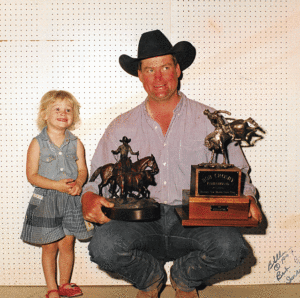
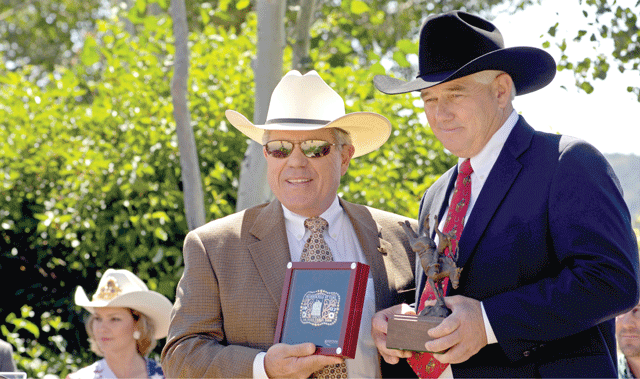
    Those who know Dr. Doug Corey ’72 describe him as a humble, honest man — a straight shooter. He’s the type of guy who prefers to kick around the horse barn in dusty boots and a Western hat, but who will put on a sharp tux for a black-tie event and impress everyone with his cowboyish charm. He’s also the type of guy who makes change happen.
    The Whitman graduate has committed 40 years to protecting the well-being of rodeo livestock. Recognized as a national authority on animal welfare, the veterinarian has garnered many honors for his contributions to the sport, including a prestigious spot in the ProRodeo Hall of Fame.
    “When I was in vet school, they didn’t teach the terms ‘animal welfare’ and ‘animal rights,’” Corey said. “The first time I heard those words was from a young bull rider. He said, ‘We really need to work on these animal welfare issues now, because they are going to become even bigger issues.’ I didn’t know what he was talking about at the time, but he was right.”
    In 1981, Corey joined the newly formed Professional Rodeo Cowboys Association (PRCA) Animal Welfare Committee, taking a lead role in crafting the national guidelines and regulations for the care and welfare of rodeo livestock. He authored “A Guide to Veterinary Service at PRCA Rodeos” and traveled the country lobbying for rule changes and educating the rodeo and public.
    The PRCA now has more than 60 animal welfare rules, including the requirement for an on-site veterinarian and a livestock ambulance at every professional rodeo.
    “It used to be there were always ambulances and medical staff for the people, but never for the animal-athletes,” he said. “It was a big deal to make that happen.”
    Corey has remained an active volunteer in the PRCA over four decades. Each December, he spends two weeks at the National Finals Rodeo in Las Vegas as the media spokesperson on animal welfare issues.
    In 2007, he was recognized for his leadership in animal welfare with the highest honor in the rodeo industry: He was the first – and remains the only – veterinarian inducted into the ProRodeo Hall of Fame.
    “It was the ultimate honor,” he said. “There were so many people throughout the country who played a part in developing all of these guidelines. I share the honor with them.”
    In 2011, the American Association of Equine Practitioners honored Corey with the Distinguished Life Member Award. He was also named Oregon Veterinarian of the Year in 1997.
    “I really enjoy the Western lifestyle and want to keep those Western traditions alive,” Corey said. “I truly believe the welfare of these animals is one of the biggest challenges to continuing that heritage.”
    Growing up on a large cattle and sheep ranch, Corey formed an affinity for working with large animals at an early age. While at Whitman, the biology major considered medical school, but his heart steered him in another direction.
    “Whitman gave me a very good background for moving on to that next degree,” he said.
    He earned a Doctor of Veterinary Medicine from Colorado State University in 1976, then returned to Eastern Oregon to join the Associated Veterinary Medical Center in Walla Walla. Now semi-retired, Corey still tends to his beloved equine patients.
    “Horses are extremely incredible animals, and to be part of their lives and take care of them on a daily basis has been something truly special,” Corey said. “There hasn’t been a day it felt like work.”
    While Corey is well-known on the national rodeo circuit, he’s also a celebrity around his hometown rodeo: the Pendleton Round-Up. Thousands of competitors and fans flock each year to the annual weeklong event in September.
    “In Pendleton, there are two times of year: before the Round-Up and after the Round-Up,” Corey said.
    Corey, a Pendleton native, has been a part of the Round-Up since he was a child. He is a past president and member of the Round-Up board of directors, and he volunteers as the rodeo’s on-site veterinarian.
    His wife Heather, who died in 2012, also had a long history with the event: She was the first woman named to the Round-Up’s board. Their daughter, Cydney, and son, Bobby, now hold Round-Up leadership roles.
    “It’s always been an important tradition for our family, and it’s important to the economy of our city,” Corey said.
    Corey and friend Andy McAnally started another annual event that has become a boon to the Pendleton economy: the Pendleton Whisky Music Fest. Now in its fourth year, the event has featured sold-out shows with headliners Zac Brown Band, Maroon 5, Blake Shelton, Pitbull and Post Malone.
    “We wanted to bring the best entertainment to Pendleton so people could see great entertainers without having to go to a big city,” he said. “It was a crazy idea, but so far it seems to be working.”
    Longtime friend Eric Johnson ’72 said Corey’s community involvement reflects a deep affection for his hometown.
    “He’s Mr. Pendleton,” Johnson said. “Community runs in his blood.”
    Corey credited his education at Whitman for providing not only the foundational skills to put his passions into action, but also the perspective to spur change on both local and national levels.
    “Whitman gave me a well-rounded education that shaped my mind and opened my eyes to a lot of different viewpoints and opinions,” he said. “It genuinely made me a better person.”
  • On The Trail with Stetson Wright

    On The Trail with Stetson Wright

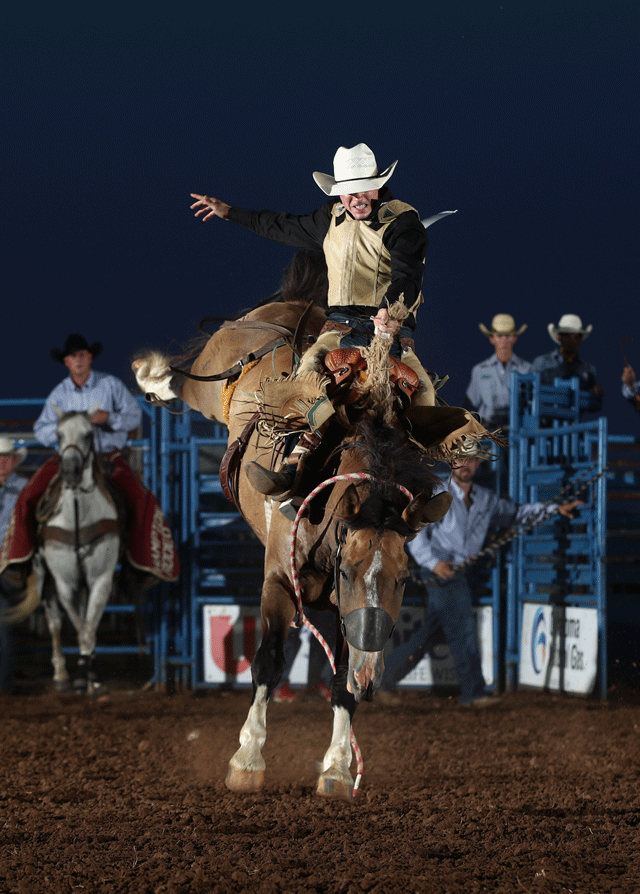
    Stetson’s first bucking horse was his brother. “We had a TV stand with swinging doors,” he explained. “Rusty would get in there, we’d open the door, and he’d ride out, with me or Ryder riding.”

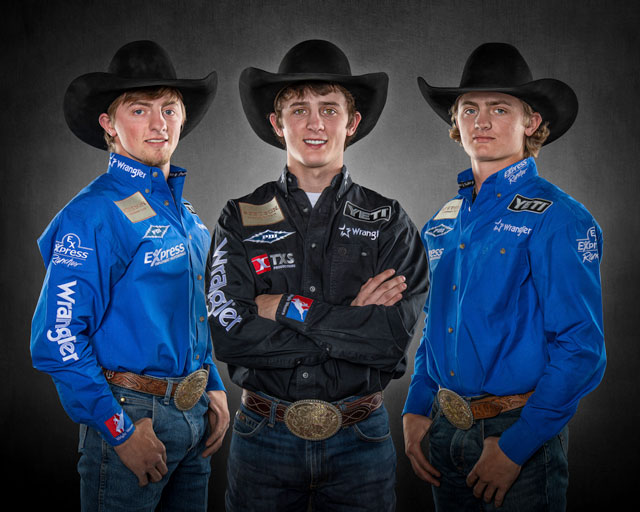
    Now, at the age of 20, he’s joining his two brothers at the WNFR. “I didn’t know how soon it was going to happen, but I’m glad it’s now,” said the Beaver, Utah, cowboy who is going to Vegas sitting second in the bull riding and leading the all around. “I felt like I was ready, but I didn’t think I would have this much success this soon – I’ve always expected it of myself. Me and my brothers have always dreamed of this since watching my dad.” And watch their dad, Cody, is what Stetson has done since he was little. He’s been to every performance of the WNFR since he was three years old, watching dad for 13 years, then Rusty, who made his first WNFR in 2015, then Ryder in 2016, and now he is going.

    The Wright family has made NFR history twice now – in 2014 when four of them (Jesse, Jake, Cody and Spencer) all qualified for the WNFR in the same year and again in 2016 when Cody and his sons, Rusty and Ryder, became the first father and two sons to compete in the same event at the WNFR.

    “In my opinion, my dad’s the greatest bronc rider that ever lived. He might not have 6 world titles to show for it, but he’s perfected the style – he stays back, sets his feet, and he’s fast. From a husband to a dad – everything – he’s great. He tells us to trust our stuff and keep gassing it and just perform like you’re in the practice pen. He keeps us all positive; he’s a very positive guy.”


    Cody enters all three of his sons as well as two others. “He’s one of the best – he enters five guys and all five of us made it to the Finals this year. If we didn’t have him, we’d lose a lot of sleep. He wakes up every morning, looks at the books and enters us.” Along with entering the boys, Cody enjoys training dogs – border collies and kelpies. “Training dogs and entering us makes his living.” Along with his two older brothers, Rusty and Ryder, Stetson has a younger brother, Statler, 16; and a younger sister, Lily, 10. “Stetson’s my middle man,” said his mom, ShaRee. All of her kids rodeo and say collectively that if Lily could ride rough stock she’d be better than all the boys.

    Stetson started riding broncs the summer before his freshman year in high school. He started riding bulls in the 5th and under state program and then did junior high and miniature bulls before getting on bulls in high school. “I honestly wasn’t good at riding bulls, Rusty and Ryder were better and it bugged me that I wasn’t good at it. It finally clicked my junior year and it’s been good going ever since.” He also played football and wrestled.
    His senior year, 2017, he won the National High School Finals All Around along with All Around at the IFYR the same year. After high school, he rode on his permit in 2018.


    He had a setback last year in Kansas. “I had won about $70,000 on my permit. The bull stepped down on my hips. I tore my knee and it put me out for the rest of the year.” When he went to enter San Angelo, he had $100 left. “That made me really smart about my money. It was an awful feeling.” He won the first round and that put $5,000 back in his pocket. He won two rounds in San Antonio, so left there with over $20,000. That made rodeoing a little easier on my stomach.”

    He had another setback when he broke his jaw this July in Kansas. “Honestly, it didn’t give me a concussion; it was such a perfect hit under my jaw. He hit me in the head first time, and that slid my helmet up; now I’ve got plates and screws and I lost four front bottom teeth.”

    He kept riding horses, but didn’t do as well as he had hoped. He got on his first bull in St George, September 21, but had slipped behind Sage Kimzey in the standings. “I passed him and broke my jaw. There’s plenty of money to be won. If I didn’t think I could win, I wouldn’t have bought my card.”
    Stetson will join his two brothers as the recipient of the Resistol Rookie of the Year in the saddle bronc riding. He is also a contender for the All Around and Bull Riding saddles. “It’s not surprising,” said ShaRee of her son’s accomplishments. “He has always been a determined kid. Once he sets his mind to stuff, he works to get it. It’s super neat to see him work towards these goals. It was a setback when he broke his jaw July 31 in Dodge City, the day after his birthday.” That rodeo was one he went to by himself. “He usually travels with Ryder, and he was by himself. “I think they are each other’s biggest support team,” she said. “It’s hard as a mom when you have one that wins and one that doesn’t.”

    Now that Stetson is about to get on 10 bulls, he is working on keeping in shape. “I’m hopefully going to be healthy and fast so I can outlast everyone there.” He’s doing it with speed and agility drills, to get his feet fast. He likes to ride his bike too. “I jump up on crates, sprint through ladders, and run across the field. Mostly running and jumping.” His goal for the WNFR is to be the fourth guy to ride all ten bulls at the NFR; Jim Sharp, 1988; Adriano Moraes, 1994; Norman Curry, 1990. “I figure if I did that the world champion would come easy.”

    After the WNFR, Stetson and his fiancé, Callie, will welcome their first daughter in January. The couple plan to marry shortly after the WNFR. Stetson will start the 2020 season in Denver. “I’m going to get on for as long as I can,” he concluded. “I’m excited to see what’s in store for us.”


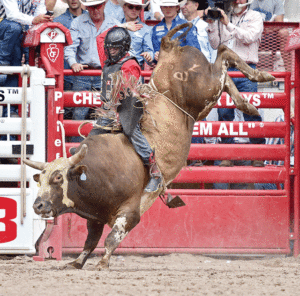
    Stetson family – Steve Gray
  • Back When They Bucked with Lydia Moore

    Back When They Bucked with Lydia Moore

    Lydia Moore was raised in a rodeo family in Missouri. Her parents, Hazel and Percy worked for many rodeo and wild west show companies traveling the country with her older sister, Maudie, and younger sister, Percyna in tow. Maudie was a trick rider and roper and Percyna had a goat act. In fact, Percyna was actually born in a tent while on the road for the Colonel Jim Eskew Wild West Show.
    Lydia was forced to stay home most of the time as a tot with her grandfather, John Hickey, due to poor health. “I had no stomach lining when I was born,” said the 80-year-old, who now resides in Wayne, Oklahoma. “I drank goat’s milk and built up my resistance.” She finally grew out of the condition when she was ten years old and learned the art of trick riding and roping. “My dad taught me trick roping and my mom taught me trick riding,” she said. Rodeo season back then didn’t last all year like it does now – her parents were gone from April until September and the other months they were home. When they were home, they trained horses that went on to perform in wild west shows, movies, circuses, and elsewhere.

    Her parents, Hazel Hickey Moore, a noted circus equestrienne, who gravitated towards the wild west show side of entertainment when she married her husband, saddle bronc rider, and steer wrestler, Percy Moore, both instilled in Lydia a love of horses and all things western. Famed trick roping performer, calf roper, and steer wrestler, Billy Buschbom, also helped Lydia with her trick and fancy roping and gifted her with her first set of ropes. “The Buschbom’s and my family were very close friends and worked for many different wild west show companies.” As a youngster, Lydia performed with her family in dressage and trick roping acts, and won many talent contests as a teen with her skills.
    Lydia’s dad, Percy, broke his leg while competing on a saddle bronc, Preacher, Dun, at a rodeo produced by Monty Reger. The rodeo was in a resort called Sylvan Beach in Kirkwood, Missouri, a suburb of St. Louis. The family settled there while Percy recuperated, and afterwards was hired to manage the boarding stable. The entire family worked at Sylvan Beach. Young Lydia and Percyna worked as lifeguards, took riders from the boarding stable out on trail rides, as well as running pony rides. They also performed different circus and wild west show acts that Percy, Hazel, and Lydia were in.
    Lydia was introduced to barrel racing by accident. “The annual St. Louis Fireman’s Rodeo produced by Tommy Steiner, was in town around the early 1960’s. Wanda Bush, Fanny Mae Cox, and Boots Tucker, all barrel racers from Texas, were in town for the rodeo. They didn’t have enough barrel racing contestants, which was a new event for the rodeo. Wanda reached out to a local horse facility, Valley Mount Ranch, since Wanda knew they were starting to have barrel races at that arena. Lydia was one of the ladies invited to enter.
    Lydia went to a few barrel races, but due to her own family responsibilities, she was unable to pursue it. “I wasn’t driven like the other girls were. I was more interested in the administrative side.” In the early 1960’s she helped form the first chapter of the Girls Rodeo Association. “A group of barrel racers in the St. Louis area got together, and since we all worked full time, we had some administrative skills and used the guidelines of the GRA to form the chapter. We had advisors that we knew could help us, and they were instrumental.” While living in St. Louis she met one of her mentors – famed rodeo secretary June Ivory. Lydia learned to secretary and time rodeos from June, and over the years worked for many stock contractors like Beutler & Sons, David Bailey, and Jim Shoulders’ rodeo companies, and is a longtime PRCA gold card member.
    After Percy Moore passed away in 1962 from emphysema, Lydia’s mom, Hazel, moved in with Lydia and her toddler daughter, Linda. (Lydia only has one daughter, Linda). Percy had been a lifelong smoker. He started smoking as a teen like most young men of that era. He either rolled his own or smoked non-filtered cigarettes. He was even hired as a young man to model for a few Chesterfield cigarette ads.
    When Lydia made the move to Oklahoma City in 1967, it was with her mother Hazel, sister Percyna, and daughter Linda. She worked as a secretary for an oil field company upon her arrival. Before moving to Oklahoma, June Ivory had introduced Lydia to Stanley Draper and Bobbie Steenbergen from the Oklahoma City Chamber of Commerce who worked with Clem McSpadden, Buster and June Ivory as the group managing the National Finals Rodeo. “It’s hard to imagine, but during the early years of the NFR in Oklahoma City, there was little interest in the Finals. When it first moved there, tickets didn’t sell well – we had dinners and parades in downtown Oklahoma City to sell the event.”

    With the NFR’s move to Oklahoma City, Oklahoma barrel racer Florence Youree worked with Stanley and Bobbie to bring on the barrel race as one of its standard events. Florence’s pitch worked and the event was sold as – “pretty girls on fast horses,” Lydia said. Needing a liaison for the barrel racers, as a go between to handle any issues barrel racers had, Lydia was hired. She worked in that capacity until 1985 when the NFR moved to Las Vegas.
    Adding to her jobs at the NFR, Lydia was hired by NFR manager McSpadden and stock superintendent Ivory to handle all secretarial duties in preparation for the National Finals each year and also ran the NFR press room with Arlene Worley. “Two weeks before the finals as the livestock came in, Buster and Clem needed someone to type the stock lists, so since I lived there, I’d take my vacation during the Finals and type the lists as the contractors came in.” “It was fun – Buster and Clem were wonderful. It was great to be part of it. They were so super to work with. And I knew all the contractors from secretarying and timing rodeos.
    Lydia also received the task in those early years of the NFR as the GRA Awards Chairwoman for the barrel racers garnering thousands of dollars of awards for the ladies each year. “I wrote letters to various companies and everybody I saw that had a business, I asked for awards. I was even able to get a car and a horse trailer donated. Imogene Veach Beals who owned a large western store, Veach Saddlery, in Tulsa, Oklahoma, was the first donor I got.” Lydia’s dedication came from her interest in doing something for the girls.
    Continuing her interest on the business side of women in rodeo, she served five years on the GRA board of directors as Bull Riding and Southeastern Region Director, before being hired as the executive secretary in 1973. “At that time, the GRA had all of the rodeo events – we had a lot of all girl rodeos – we used to have approximately one a month back in the day – we had a lot of great girls. Unfortunately, they don’t have any all girl or women’s rodeos anymore.”
    GRA president Margaret Clemons hired Lydia on a six month trial basis to be the secretary of the GRA – that tenure ran for two years and every two years they had an election. “I was at the meeting as the Southeastern Director and was hired by the board. I was able to quit my day job and I really became involved in the women’s rodeo part there.” Since her position came up for renewal every two years, there wasn’t a lot of job security in it. Her job ultimately lasted nearly 25 years.
    When she got the job, she converted her garage into an office. “There were a few boxes of records, 400 members and $800 in the bank. (A GRA card cost $25 in 1971, for example.”) (The WPRA card cost $150 in 1995, the last year we were in the WPRA office). When she left there were 2,000 members and the association was financially secure. “We ran a very efficient office and did everything we could for the members – Jimmie Munroe and Pam Minick were great at promoting the association.” She enlisted the help of her daughter, as well, along the way. “We all enjoyed working in the WPRA office,” said her daughter, Linda Clark. “Percyna and I did the newspaper and we are all a very close unit. We’ve always worked together. I typed envelopes on an old IBM Selectric electric typewriter when I was 13 – I totally loved it.”
    “She was the glue that held the WPRA together,” said Pam Minick. “She ran the association like she ran her household – she tried to save all the money she could. It was a 24 hour a day job for her.” Pam went to her house every October to help stuff envelopes for all the contestants. A prized honor she received in 1991, known as the WPRA Coca-Cola Woman of the Year, was awarded to Lydia for her years of service, passion, and devotion to women in rodeo, and rodeo in general. “I was absolutely thrilled. When Coca Cola put together that award for our association it was fabulous. Wanda Bush was the first honoree, Jimmie Munroe was the second, Pam Minick was the third, and I was the fourth.” The coveted bronze statue was created by artist and NFR qualifier Karen Galemba. Lydia feels fortunate to have seen firsthand the phenomenal growth in the sport of barrel racing that it enjoys today-barrel racing as a standard rodeo event, equal money at rodeos, and equal money at the National Finals Rodeo.
    Her second award will be received in November when she will be inducted into the Rodeo Historical Society Hall of Fame. “I feel absolutely the same about this one – I’ll be emotional to be recognized at this chapter of my life. I help Linda in her business and enjoy what I’m doing. I’m blessed with good health and it’s great. I’ve been very blessed. I have a beautiful daughter and granddaughter that I love. They and their families help take good care of me.”

  • On The Trail with Doug Clark

    On The Trail with Doug Clark

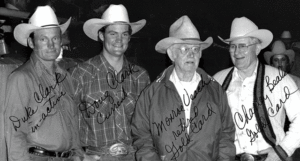
    Doug Clark will receive the coveted Ben Johnson Award at the National Cowboy and Western Heritage Museum’s annual Rodeo Historical Society’s Hall of Fame Gala on November 9. Doug was born in Tulsa, Oklahoma. “I grew up in a saddle shop – Veach Saddlery – which belonged to my grandfather, Charley Beals, and was started 100 years ago by his father in law, Monroe Veach.” He spent his summers and every day after school at the shop. “I helped make saddles and repair things. My dad tooled all the saddles for years there and it’s a family business so we did a little bit of everything.”

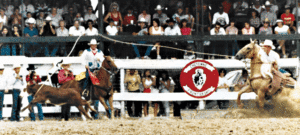
    He started tie down roping when he was 10. At that same time, he started competing in the junior rodeos in all events. “They were called FFA rodeos,” said the 57 year old that calls Wayne, Oklahoma, home. “I was fortunate enough to be around the right guys and my dad was quite a horseman. We are a huge rodeo family, so that’s all we do.” Doug and his family lived in Tusla and in the early 70s they moved 90 miles east of there to get out of town. They built an arena and that’s where Doug really started honing his skills. He went one year to the IPRA rodeos, competing in tie down roping and team roping (heeler), earning the title as Rookie of the Year in the tie down roping. He hit the road in the PRCA circuit in 1981, as soon as he was 18. He was ranked in the top 20 year-end standings for several years, winning the top rodeos and invitational ropings of the year, nationwide, while traveling on a part-time basis. He was the PRCA’s Prairie Circuit Champion tie down roper and competed in many circuit finals in that event. He set an arena record at the Cheyenne Frontier Days in 1987 when they roped calves weighing 280-300 pounds, as well as winning their coveted championship buckle for the all-around title in 1995. He added steer roping to his events entered and in 2005 earned the Pendleton, Oregon Round-Up steer roping championship. The win helped boost him to the qualification for the 2005 PRCA National Finals Steer Roping where he won second in the average and top horse of the finals.


    “I went as much as I could – I never set a goal to win this or that. I was training and traveling with some of the top guys so I couldn’t really go as much on my own.” Doug was riding and selling what he was riding to those guys. Doug has had horses either owned or ridden by Clark Quarter Horses at the National Finals Rodeo and National Finals Steer Roping Finals for over 30 years. Much of Doug’s career has been riding and training horses for the top ropers of the day, like Trevor Brazile, Tom Ferguson, and Roy Cooper. Never ‘living on the road’ entering and competing in rodeos, Doug’s real passion and specialty has been in training horses and people in a clinic format and one-on-one training in his home. “My dad was a great horseman – a quiet mild mannered gentleman – and learned how to be a good judge of horse flesh.” Doug was influenced by the old timers – great horsemen and ropers.
    Along with the pros, Doug and his wife, Linda, have had the privilege of helping kids along the way. “We’ve had a lot of kids come live with us over the years. We still take kids in who want to get better in rodeo – but really it’s all about life – it all goes together.” Every one of the kids that have come through his doors has learned about everyday living. “That includes everything from riding 20-30 horses a day, shoeing, fixing corrals, cleaning pens – you name it.” It’s the Doug Clark school of hard knocks. The kids come in, learn how to be horsemen – sleep on a lumpy old couch and work alongside Doug to achieve their goals.
     

    “The parents entrust us with their kids and that’s a huge compliment,” says Linda, who is the cook, but doesn’t admit to being the cleanup. Doug and Linda have one daughter, Darcy, who competed as well. Doug and Linda got married in 1985. “We met on Valentine’s Day at Baton Rouge at a rodeo,” he recalls. Six months later Doug and Linda were married. Darcy was born in 1991, and joined the rodeo road when she was young. “When Doug was horse showing, she went along. “We won a lot of awards including the Super Horse in 1999 one year, competing in all the roping events.” He was a trainer and exhibitor and judge during his time at the AQHA. Darcy competed on Doug’s old roping horses and qualified for the CNFR in 2008 in the barrel racing. She also won the breakaway at the IFYR in 2006. Darcy and her husband, Billy Good, a steer roper, still hit the rodeo road. Linda works part time as well as running a courier business with her daughter, Equine Courier Services, driving 10,000 miles a month delivering semen and embryos.

    Not only does Doug train horses and hold clinics at every age and skill level in all roping disciplines, but for many years he showed horses in the American Quarter Horse Association. He was one of the teammates winning the 1999 Super Horse Award showing the stallion, Look Whos Larkin. Doug also has been involved training and even owning three of the many horses recognized as finalists for the AQHA/PRCA Horses of the Year, which is an award voted on, annually, by top ranked cowboys.

    Doug has enjoyed his entire career and life being around the horse industry as a fourth generation rodeo participant. “I enjoy what we do and I want to keep doing it. We’ve got some good kids and some good horses,” concludes Doug. The Ben Johnson award is bestowed upon a person who has had a notable career in the arena, as well as, working outside the arena helping others to achieve their rodeo and personal goals. “I was honored with the award – I didn’t even know I was in there – it’s not what happened in the arena as much as what you can do for other people and helping them get where they want to go.”

  • On The Trail with Timothy Troyer

    On The Trail with Timothy Troyer

    Timothy Troyer is the 2019 International Finals Youth Rodeo (IFYR) Saddle Bronc Champion and is also sitting number one in the International Pro Rodeo Association. From Columbia, Kentucky, Timothy admits there’s not a lot of saddle bronc riders around where he lives. Put that with his height, 6’2”, and the fact that he just started riding broncs two years ago, and that makes his win at the IFYR even sweeter. “I just started going to rodeos and figuring it out along the way,” he said. “I do base all my success on God and I couldn’t do it without Him. My brother Jesse has always been there to support me and push me to get better – he is definitely one of my biggest motivations!” Timothy spends many hours working out – preferring the old school workouts like jumping and cross fit work.

    This was his second year at the IFYR. “It’s a great place for young people to get started and compete and it pays well.” Timothy was home schooled – he grew up Amish. “We weren’t allowed to go and even watch rodeos – no competitive sports. We played a lot of baseball or volleyball. But we couldn’t go to games.”

    Timothy’s parents decided to leave the Amish community when he was 13. They moved to Westcliffe, Colorado, for four years before moving back to Columbia. “A month after we moved to Colorado we lost everything in a house fire and had to start over from scratch,” said Timothy. “But with help from God, family and friends we recovered.”


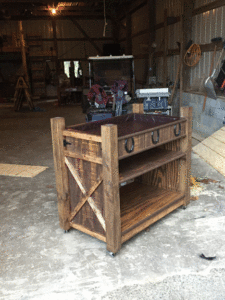
    He doesn’t miss much about growing up in that lifestyle but says it helped him in life by teaching him life skills. “I know how to make a living from hard work,” he said. “We still talk Dutch at home and cook the same. I build furniture on the side, and that’s one thing that I will always do.” The one thing that stumped him was social media. Although he’s figured it out, he admits that it is over used.

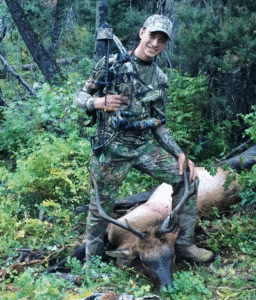
    While Timothy, Jesse, and his younger brother, Dwayne adapted well to the change, it has been more difficult for his mom, Kate. “I was taught so different that it’s hard. We didn’t learn English until we went to school at the age of six.” She also misses getting together with family and friends. She still raises a big garden and does all her own canning and freezing. They also raise their own meat, butchering a steer when the elk meat runs out. William is a big hunter and heads to Colorado every year to get an elk. The boys have gone with him.

    Timothy has been riding for just over two years. “I always wanted to do it as a kid and my parents wouldn’t let me until I was 16.” He picked up rodeo on his own. “My brother started riding bareback horses when he was 16. I bought a saddle and a pair of chaps and started entering exhibitions at rodeos. I watched some YouTube videos and halfway had the basics figured out.” The hard part for Timothy was entering. “I didn’t know anything about associations; I just searched for rodeos to enter.”

    Kate, wasn’t too happy about him riding right off, but she’s comfortable watching it now. “It was scary for me,” she said. “It was totally new for us. He was introduced to it through friends who barrel raced. The boys grew up on a farm – their dad used to train horses when he was younger – so they had always been around horses – we used them for everything.”


    The other delay in Timothy’s starting was due to an accident he had in 2015. “He was at work and fell 22 feet off the roof, shattering both bones in his left leg above his ankle. It’s full of plates and screws– it took three surgeries to fix that. It took a full year until he was back to normal.” Timothy has worked on his father’s (William) construction crew since he was 13. He used to build houses and pole barns. William switched to excavating two years ago.

    Timothy heads to school at South Western Oklahoma University this fall. “I am going to go for a business degree at Weatherford, Oklahoma, and rodeo.” He admits he’s a little nervous to start school. “I’ve never been to a public school – the Amish school I went to had 20 kids and was a 30×40 building.” He made it through the eighth grade in the Amish school. “That’s when you graduate anyway.”

    He has continued his education online to prepare for college. “I’ll have classes every day of the week.” For now, rodeo will have to be done on the weekends. The goal is to have his own business someday – either in furniture or construction. For now, he’s going to enjoy college, rodeo, and his girlfriend, Sadie Wolaver, who he met at a rodeo in Canada. They have been dating since November. “I would marry her right now, but I don’t want to get married and have financial problems, so I’m saving up for it.”

    “We’re proud of our boys and what they are accomplishing,” concludes Kate. “I love to watch him now. He’s got the determination and will power to push through and get after his goals. He doesn’t give up very easily. I would say he gets that from his dad.”

  • ProFile: Mayce Marek

    ProFile: Mayce Marek

    Mayce Marek is looking forward to starting a new chapter in her life – she will be going to Warton Junior College on a rodeo scholarship, majoring in business with a minor in physical therapy. “I want to look into business and running an equine facility that has a deal for troubled or disabled kids,” said the 18 year old from Taylor, Texas. “I want to be around equine all the time and I like helping the youth. I’ve seen a lot of different cases where equine has a positive effect on youth. I want to give back in some way what horses have done for me. My life revolves around them – they’ve given me a future and helped me find friends that have become family.”
    Her summer rodeo run proved to be quite profitable as she won $12,000 at the Best of the Best; winning both the goat tying and the breakaway roping – and the All Around. “Winning Gallup was the biggest win I have had. As far as a youth rodeo, there aren’t many rodeos that pay like that. Along with the money, I won two pairs of Corral boots, and two American hats, an Ipad and leather cover.” She took the money and put it away for college.
    Mayce started rodeo at the age of five. “My mom and dad had both rodeoed and I’d always been around horses. I started out barrel racing and got into the breakaway roping and goat tying. It’s a lot more you in the roping events – barrel racing was about horse power.”
    Mayce is an only child. “It comes in handy when it comes to rodeo, because it’s not cheap to compete. But sometimes I’d like to have siblings.”
    Her mom (Misty) and dad (Rob) divorced when she was four. “My faith got me to where I am – and I learned that from life – by being allowed to never have to put down a rope – even when times got tough. God always seemed to help me get to the next one and I’ve been thankful for that.”
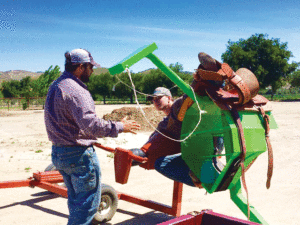
    Mayce tries to tie goats at least three times a week. “I rope everyday either the rope sled or live cattle.” All the practice worked. “At the Best of the Best – it comes from all the practice you do in the practice pen. I would think about my run, seeing it in my head. So when it came time, it was muscle memory – at that point it just happens and you use everything you have prepared to do.”
    Mayce is grateful for her life thus far. “Struggling and prospering from it is good. Anything is possible with faith – you set your mind to something, it’s only if you want it bad enough you can do it. If you have faith, there’s nothing you can’t achieve.”

  • Roper Review: Brandon Ben

    Roper Review: Brandon Ben

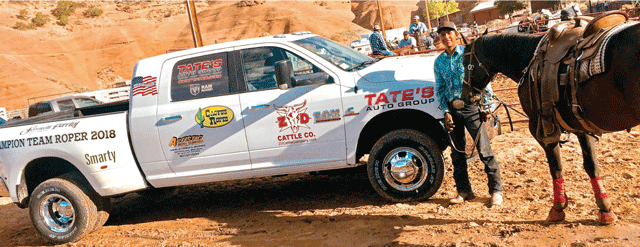
    Brandon Ben has been roping for 11 years. He started because his family ropes and he’s carrying it on. He learned from his dad, Rawley Ben, who is a 8+ heeler and 7 header. From, Peridot, Arizona, the 17 year old has done quite well in the roping world; he’s won two trucks so far – including the one that ZD Cattle is giving away in September. “I am keeping both of them, using them to travel,” said the #7 heeler who is also a #6 header. He ropes on a 6 year old bay mare. “She’s pretty small, like a kid’s horse, but we’ve been roping on her since she was three.” Six of Brandon’s eight siblings’ rope and they each have a horse they compete on. Whenever they are not at school or traveling, the family can be found in the arena.
    He is going to be a senior and fits school into his roping. Sometimes that doesn’t always work out – he qualified for the World Series Finale in Vegas this coming December, but can’t attend. “I can’t miss that much school.”
    Along with the two trucks, Brandon has more than 500 buckles that he has collected over the years.
    He takes the money he wins roping to enter more, buy feed and tack and help support his family. The family trains horses and rides horses for people that send them to them. He learned how to train horses from his dad, and they can have as many as 15 outside horses they are working with at a time. “If we buy a horse, we keep it for ourselves,” he said.
    He and his two brothers help with the training. His five sisters are not as involved in the training, but they rope.
    Their place is complete with cattle and a donkey, which they trail.
    When he graduates from high school next spring, he plans to try prorodeoing and go to college at Central Arizona College, and focus on college rodeo.
    He is looking forward to the upcoming truck roping. “I rope with Zane alot and he puts on a great event.”

  • On The Trail with Jace Logan

    On The Trail with Jace Logan

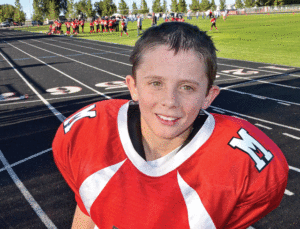
    The 18 year old is from Yampa, Colorado, a small town located 30 miles south of the famous Steamboat Springs ski resort. Even with that close proximity, Jace doesn’t ski. “I get so busy with sports, I don’t make time for it.” Due to conditions and his high school sports, Jace is unable to practice in the winter. “We had 5 feet of snow last year and freezing temperatures all winter.” During the fall, he splits his time between football and rodeo and then wrestles throughout the winter. He was the running back and linebacker in football for Soroco High School and he wrestled in the 170 pound division, earning the state title this year in 2A. After spending the past three years as runner up, he finally reached his goal. Jace has wrestled since kindergarten, working his way through middle school into high school and coaching the peewee program. “I love the sport – it teaches great life lessons – I love that kind of competition. You are out there by yourself so there are no excuses. Dedication and teamwork are still in there as far as practice partners – being accountable for your actions on and off the mat. Wrestling teaches discipline in cutting weight, making weight, and grinding it out. It’s very rewarding in the success because it’s all you.”


    As a freshman, Jace was a big surprise to a lot as he made it to State finals, and ended up runner up – for the next three years. “It was a rough go for a while, but we got it done.” What he concentrated on this year was his mental game. “Honestly in life and in sport – if you can mentally overcome stuff, that will make the difference in your success.”

    Jace competes in the Colorado State High School Rodeo Association, where he is this year’s All Around Champion. Going into the fall season he would play football Friday night and then immediately head to the weekend rodeos where he competed in reined cowhorse, tie down, team roping, and steer wrestling. Add that to the fall ranch work, Jace kept busy. His family ranch runs 1,300 leased cow calf pairs during the summer and fall gathering on the 12,000 + acres takes some time. Add shipping to that and the family of three boys has their work cut out for them. “My brothers and I are the cowboys pushing them up to summer pasture and putting out salt and mineral during the summer. Then we gather in the fall.”

    Jace and his two brothers, Eric, 21, and Kody, 16, started their own cow herd when they were young. “I bought two cows in second grade and same with my brothers. Each year, we’ve grown our herd.” They have around 200 of their own cows now. “Mom and dad treat us good – we work pretty hard on the ranch and they help by taking care of most of the expenses on the cattle.” The cattle on the ranch are divided into four big bunches and the boys check on something every day during the summer.


    He comes by his love of horses through his parents, Mark and Jeannie Logan, who competed in reining before the boys were born. They started raising horses with their stud, Doc Sugar Catalyst when Eric was just a baby and most of their horses they rodeo on and work the ranch on comes from Doc. Jace and his brothers found their niche in the horse world through rodeo, starting with the local gymkhana club and NLBRA, then climbing the ranks of junior high and high school rodeo. Jace competed in team roping and dally ribbon roping with Eric, and the brothers were crowned the NLBRA dally ribbon roping world champions in 2012.

    Jace has been pro rodeoing since last October, running down the road with Eric, who also steer wrestles. They use the same horses and haze for each other. “I pulled a check at my hometown rodeo, the Steamboat Springs Pro Rodeo series. We hit that ten week series every weekend.” One of the horses, the haze horse Skeeter, is one that was raised at the ranch. The steer wrestling horse, Gray, was bought out of Texas when Eric was at Odessa College. Besides steer wrestling, Jace and Eric also compete in team roping together. Jace heads on Skeeter-the haze horse, and Eric heels on a horse they also raised on the ranch and used in reining. During the week the boys and Eric’s fiancee, Shelby-who breakaway ropes, make time to practice everyday. The family put in an arena a few years ago which allows them the flexibility to practice whenever they have free time from the ranch.
    Jace is going to the University of Wyoming this fall to study Animal Science with a concentration in livestock production. He plans to apply that later in life as a ranch manager. For now, he’s going to rodeo for a while. “I want to see how far I can go in it.”

  • ProFile: Chris Woodruff

    ProFile: Chris Woodruff

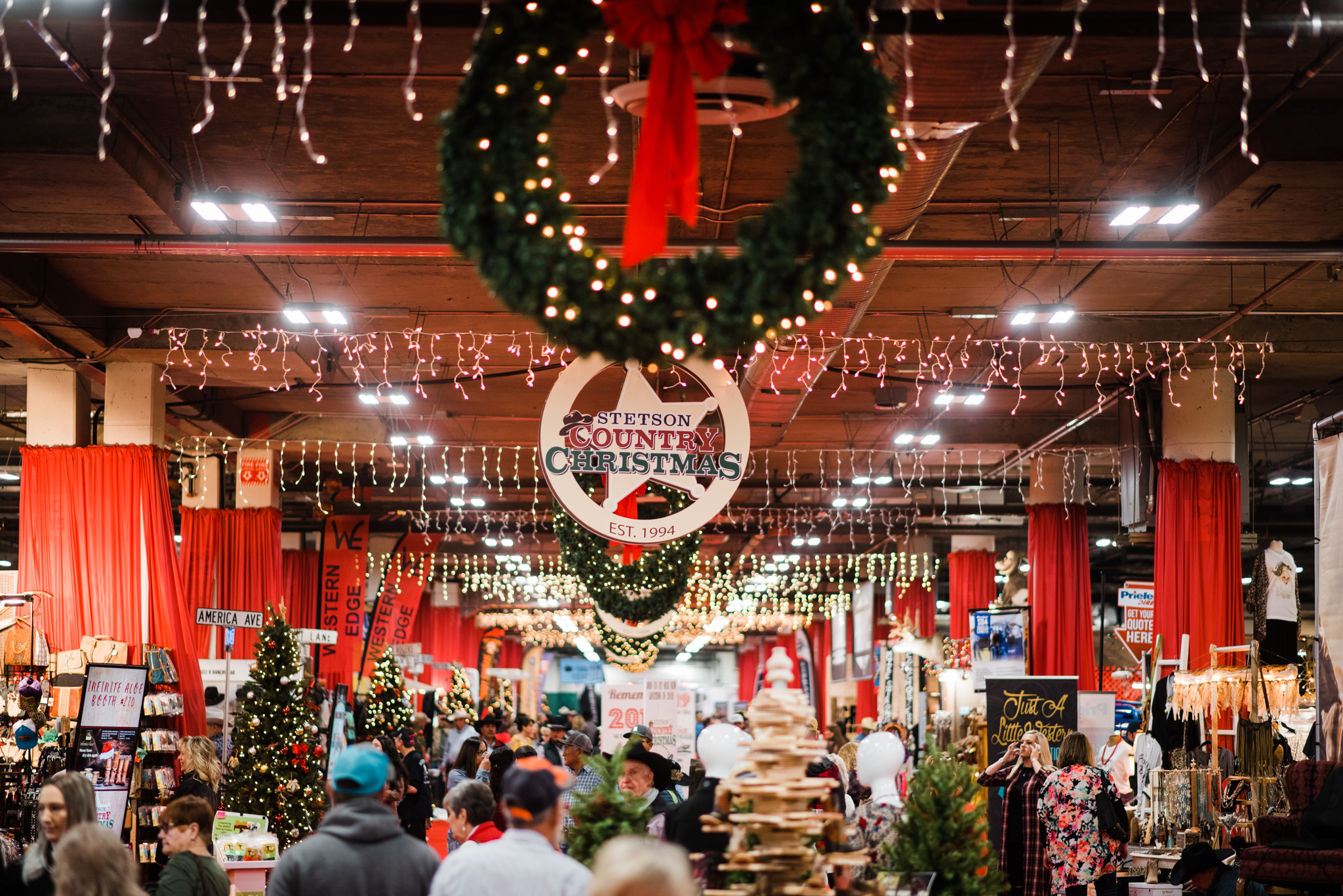
    Chris Woodruff is the man behind Stetson Country Christmas, Roper Cowboy Marketplace, and his latest venture, ALL IN Barrel Race and ALL IN Breakaway – both held at the Orleans Arena during the WNFR and guaranteeing more than $800,000 payout. Chris rode bareback horses in high school and college. “I was in the era of Bruce Ford and I wasn’t that level,” he admits. He got his start with a family owned advertising company in the oil field industry. “I learned how to talk to people and get my foot in the door –Las Vegas can be so intimidating in 2019. But when I started in 1994 that wasn’t the case.” He got into real estate for awhile and then in 1994, he saw the need for additional shopping during the NFR and the “rest is history.”
    “When I first started my goal was 100 booths – with hard work, effort and a great team, we’ve grown it into a must shop must see shopping experience during the NFR.” The first year he managed to get 500 booths into the Sands Expo and it grew from there. Fast forward to 2019 and between the two trade shows (Roper Cowboy Marketplace at Mandalay Bay and Stetson Country Christmas) it grew to more than 2,000 10×10 booths.
    With an unexpected move from the Sands Expo in 2016, Chris was given an opportunity to expand into producing an event. “I find the good in everything,” he said. “That move downtown got us into the ALL IN Barrel Race which we held downtown at the World Market Center, in conjunction to the Stetson Country Christmas. 2016 was the first year for the ALL IN.”
    Stetson Country Christmas has found a new permanent home at the Rio Hotel and Casino, with 14 acres of free parking on Twain Street (west side of the Rio). “Once people get there, they will be amazed at the accessibility of the shopping. We are already sold out of exhibit space.”
    Being in Las Vegas at the level of what he produced for 25 years with the two trade shows, Chris saw a need to cater to barrel racers. “The barrel racing interest comes from my daughter, Autumn, who started racing when she was 12.” Autumn was actually allergic to horses and was willing to take shots or whatever it took to be around them. She has outgrown it and keeps her allergies under control with over the counter medications. Chris has been a hands-on dad, attending the barrel racings that Autumn ran at and seeing firsthand what each event was like from the competitor side. “I saw the need for the barrel race event after watching the success with the team ropers and the World Series. Why not let the barrel racers have their presence,” he said. “I’m an entrepreneur; we produced the trade shows for 25 years so we have knowledge of how Las Vegas works internally. Group W Productions was an operational partner for the Rose Palace in San Antonio – so we put on several events there over the years. We just moved to bigger and better and set our sights on Las Vegas. We’ve participated first hand as a competitor so we’ve seen all the misses that a producer misses at an event. I take that into consideration and that’s part of our plan – to be everything we can be at the ALL IN.”
    “The concept is “ALL IN.” We want it to be a seamless experience for the barrel racers. There’s only 15 going to the NFR and this offers others a part of the pageantry and the lights plus pocket some pretty nice prize money.” Each entry includes a hotel room and stall, contestant’s jacket, trailer parking and more goodies as time goes. Sponsors are stepping up to add perks all the time. “We’ve got everyone entering from Sydni Blanchard to the weekend warriors and grandmas. Sydni is now one of the sponsors – she is giving one of her saddles to the fastest time to the event.”
    Whatever race entered, starting on Thursday, December 5th, each contestant gets two go rounds, and a short round. The top 30 of every D to the short go. “It’s a clean slate race in the short go, so who knows who will get it.”
    The entries are limited by the number of stalls available on each race – and now they added breakaway with a guaranteed $100,000 – so Chris encourages anyone interested to get their entries in early. “We want to make this ALL IN Barrel Race as big as we can make it. I had no idea we’d be paying over $700,000 by the fourth year of the event, and that’s just the barrels. The breakaway is $100,000. I haven’t seen anything where the breakaway is paid out that much. I feel like we’re stepping out there pretty good.”

  • On The Trail with Piper Yule

    On The Trail with Piper Yule

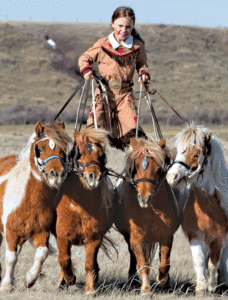
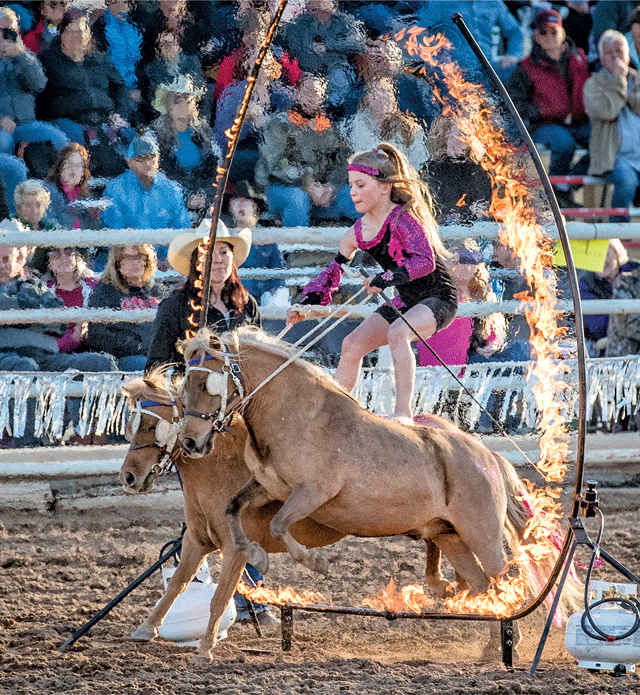
    Piper is currently mastering four ponies, and has been working on that for a year. She began her career as a trick rider at the age of four. She added Roman Riding a year later, hopping on her brother’s ponies one day in the arena. “My brother was driving a wagon and I wanted to be part of that, so I just jumped on.” She relies on her brother, Cash, for the ponies. Cash doesn’t mind anymore because the ponies aren’t fast enough for him to use on the chuck wagon. Chuck wagon racing is a Canadian thing, and he started with ponies, and is now moving to Shetlands. Along with the rodeo events, both Piper and Cash do a lot of work on the ranch, which has been in the family for five generations. The family lives in Wardlow, Alberta, a small ranching community, three hours from the border in the middle of nowhere. Between Brooks and Hanna, the community is known for the Calgary Stampede rodeo horses that make their home there as well. Most of their family lives around the area.


    Piper is a gymnast, nicknamed Pipes because she is so strong and has the ability to do things that kids her size can’t do. Her gymnastics teacher, Petre Neda, is an Olympian champion. He immigrated from Austria and coached the Olympian gold Korean team. She started at age 2 and at this time in her life, her groundwork in gymnastics is more difficult that the strap work of trick riding. “That’s what has set her apart,” explains her mom, Kelsey. “She can do difficult maneuvers like the bar work in gymnastics. Her snappy groundwork is her signature. The maneuver she likes the least is anywhere that the ponies can potentially bite her. “Since she rides naughty ponies, she has a hard time trusting her horse so she would prefer to vault.” Her work ethic in gymnastics included 20 hours of training a week. “Her coach was very strict – back hand springs, back walkovers, putting her feet in bars against the wall and lifting up; multiple chin ups and climbing a rope up a wall were other “warm up activities” he required of Pipes. “Piper respects her coach because he can do anything she is doing and when she doesn’t want to try, he shows her.”

    Pipes received her first formal training in trick riding from Rae-Lynn Armstrong, who was Madison MacDonald Thomas’s partner in Magic in Motion. “I met her through that,” explained Madison, who has been working with her for four years now. “She’s determined with a lot of try and a lot of heart. She’s very fun to teach – you can throw anything at her and she’ll try it. For someone as young as she is and the pressure of the shows we put her under, it’s incredible what she can do and handle.” Madison, who has been trick riding for 20 years, teaches trick riding from coast to coast. “The number of trick riders is growing,” she said. “The ‘trick’ is learning how to use your body, and Pipes is a natural – I love that little girl – she’s a fun one.”

    The trick riding and Roman Riding has come easily to Pipes, who practices Roman Riding often while the family is moving cows. This is the first year that she has had to work on the mental part. She’s never been nervous before. In Roman Riding there is no room for error. In order to “button up mentally,” Pipes has implemented a song into her preparation time. Fairland Ferguson used to performa in the show Cavallia, so Pipes sings the song: ‘Strong in the legs, quiet in the hand, chest and eyes up and go sell eggs.’ It’s an inside joke – she repeats the song until she is calm and focused.

    Piper leaves with Madison July 2, and she will go all the way to the end of August. Kelsey will travel along. “Maddie is contracted with Flying U, Mr. Rosser has given me my first chance to see if I’m good enough to be with her,” said Pipes. Her first show is Nephi, Utah, July 11-13. This is her first full summer on the road and she is excited. She came down to the states from the end of January until the middle of March for The AMERICAN and performed during the Junior American. “My teacher sent me homework. Miss Gray has been her teacher since kindergarten and now in third grade, she will work ahead to get done before she leaves. Half of her class is gone for the winter.

    “It gets pretty cold up here, so many of them go to Arizona,” explains Kelsey. “We do everything in -40 degree weather and it will be like that for a long time.”
    There is a tremendous amount of work that goes into the few minutes in the arena. “The production behind it takes a whole team,” said Kelsey. “It takes two hours just to get in the arena.” For Pipes, she would rather skip that part.

    “I don’t like to brush my hair,” she admits. “I just want my hair in braids.” She is not taking after her mom – who has a chain of beauty schools in Canada.
    “I grew up out here and I wanted to braid my ponies hair instead of barrel racing,” said Kelsey. “I worked internationally for Revlon for several years as Canada’s creative director. So I got to go to Barcelona and Paris, designing shows. I loved this side of the business, so I started schools. I have a great team – we’ve had the same team my whole career and we’re committed to each other. You can’t be strong without that.” Her ability to produce a style show has helped with the specialty act scripts. “We can do the photography, the make-up and all the art that goes behind it.”

    Her husband, Wes, spends his days doing ranch work, and is supportive of his children’s interests. “It takes a lot of time, but it’s good.” After a full day of looking after cows, haying, or whatever is necessary, he practices with the kids, rope a little with Cash. As a former bronc rider in Canada, he knows what it takes to get trucks and trailers ready to go. His bronc riding skills have come in handy as Cash breaks his ponies. “The ponies are too small for me to get on, but I can coach him.” He stays behind when the family hits the rodeo road. “I got the easy job – I fly down to watch and then fly home.”


    …A Little more about:

    Cash Yule

    Cash started working with ponies when he was six – he is 11 now. His secret is to spend lots of time with them. “Don’t give up and don’t let them win or they will keep doing that over and over again,” he said. “When I was little, I liked to play around with them. When I got older I started doing other stuff with them. I try to pick the better ones that aren’t naughty.” His cousin dropped off a trailer load when Cash was younger and he sorted through and picked the ones he thought he could break. “The other ones that I couldn’t break, I would buck them.” He puts them on a wagon and drives them until they are tired. He tarps them and ponies them on to something and Piper is often the rider.


    Cash is in sixth grade and attends a school where there are 75 kids in school from k-12. His favorite part is social studies and math. He plans to play defense in the NFL one day as well as become a veterinarian. Along with racing ponies, Cash team ropes.

    Last year, Kynan Vine, rodeo director of Calgary Stampede, hired Cash for the Presidents Day – a private performance done before the Calgary Stampede to recognize the sponsors. Last year it was geared towards kids and they had the opportunity to produce their first rodeo. They had to find all the other kids to help, they did events like ranch roping, mini broncs, barrel racing. He pushed the kids – they learned how to take the entire production seriously. He has become a huge mentor – they work hard for him and the rewards. Cash just sold 25 ponies – ponies that he raised. He has quite the business going on.

  • Trio From Down Under Travel State-side for IFYR

    Trio From Down Under Travel State-side for IFYR

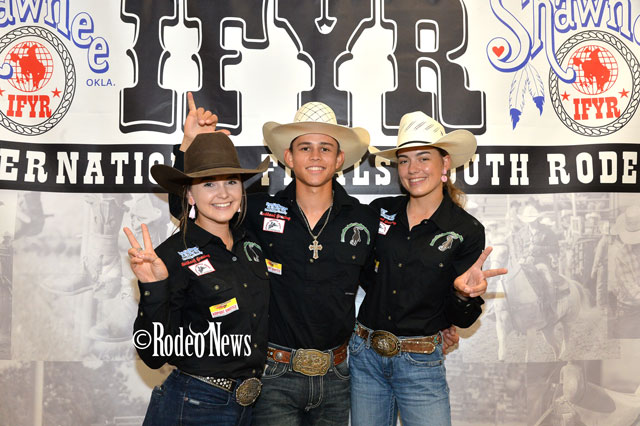
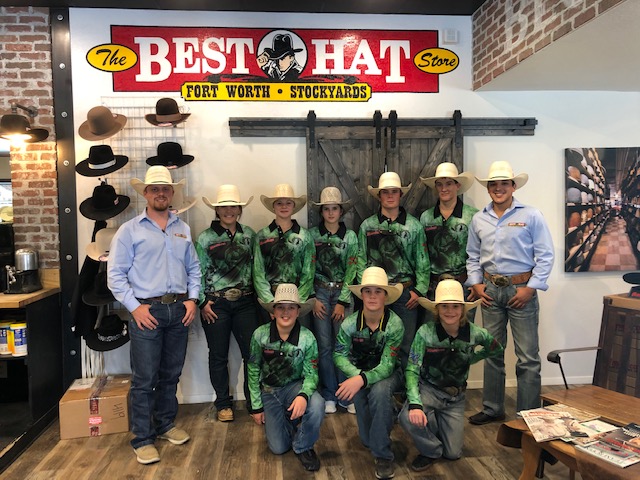
    (SHAWNEE, Okla.) – The Australian Junior Rodeo Association has brought a team to the International Finals Youth Rodeo for three years. Each family must raise around $4,000 to join the tour. They land in Ft. Worth, Texas, and hit the big stores like Teskeys, NRS, Justin and American Hat with the ultimate destination being the IFYR in Shawnee, Oklahoma.

    There are three on the team this year, one from New Zealand and two from Australia. They have travelled to four events along with the IFYR, but this remains their favorite.
    “The people here are so friendly,” said event coordinator, Kylee Ferguson, who has been doing this for three years. “We all travel together and stay together and the volunteers here make it very easy to do that. They are amazing!”

    Kurtis Pertab is 18 years old and lives with his family of five; two younger brothers and his parents. They train race horses and Kurtis competes in team roping and tie down roping. This is his first trip to the United States and he enjoys how big it is and the professional way they handle rodeo.

    “It’s a higher level of competition,” said Kurtis.

    He competed in tie down roping Tuesday morning at the IFYR and got a time on the board. He is borrowing a horse that was found by Kylee. When he is done with his trip, he plans to finish school and start training race horses for a career. He lives by the saying: You’ll never have this day again, so make it count.

    “When I go to practice sometimes I don’t want to, so I pump myself up by saying that,” said Kurtis.

    Brandee Ferguson is 16 years old and this is her second trip to the United States. She was ready for the level of competition and prepared herself for the IFYR by roping a lot and keeping her mental stability active so she “doesn’t go crazy.”

    “I stress out a lot and over think my run – it all goes downhill from there,” said Brandee.
    She is always amazed by how many people she encounters on her trips to the states.

    “There are more people in Texas than in Australia,” said Brandee. “We went to Las Vegas – I enjoyed walking through the streets and seeing all the different casinos.”

    Her favorite rodeo she’s been to is the IFYR.

    “I like the atmosphere here. I was just ready to rope and I saw three people that I knew,” said Brandee. “I’m very surprised to see that – people were recording my voice and adding me on social media – so I’ll come back next year – they love to hear us talk.”

    She is currently living outside of Houston, Texas and has been here since the Junior American and is not homesick at all.

    “The family I live with make me feel like I’m at home,” said Brandee. “For me to go to a pro rodeo back home I have to travel 13 hours for one – here I can drive three hours and go to four.”

    Full send or no send is a saying she lives by. She is competing in breakaway roping and team roping at the IFYR.

    Holly Forster is making her first trip to the IFYR. She wanted to make the trip to experience new rodeos and meet different people.

    “It’s really big and overwhelming I reckon,” said the 16-year-old who lives on a cattle property.

    She has an older brother who is doing an apprenticeship in another town. The property consists of 60,000 acres of Downs country, mostly flat and in seven years of drought. She attends a boarding school six hours from home and spends most of her time there.

    “I like it – I meet new people and get a better education,” said Holly. “I hope to own a cattle property or something like that.”

    She competes in team roping and breakaway roping.

    “My dad taught me how to rope.”

  • On The Trail with Bridger Anderson

    On The Trail with Bridger Anderson

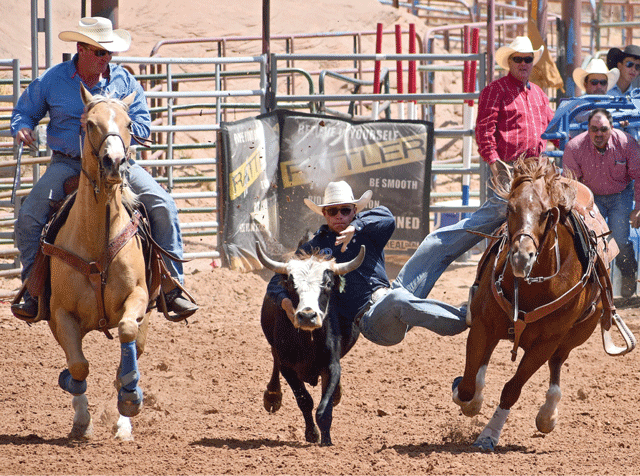
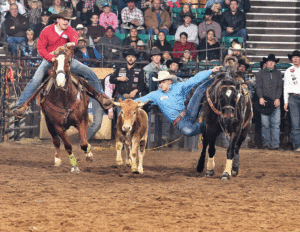
    Bridger Anderson is from Carrington, North Dakota, where winters are seven months long. “For five months out of the year you can’t beat it,” said the 20-year-old who just won the College National Finals in steer wrestling. “In the winter we practice when it’s above 15 degrees, but that doesn’t happen too often. The temperatures will get to -20 with wind chill down to -50.”

    “Bridger has been horseback for as long as he can remember. “My parents rodeoed, dad (Glenn) roped and mom (Robin) breakaway roped and team roped.” He has two sisters, Cedar and Dawsyn, who both competed growing up as well. “I was tying goats at amateur rodeos when I was five. The first time I roped at an amateur rodeo was in fifth grade.” He made it to Nationals in the calf roping twice in junior high and once in high school. His true passion has always been steer wrestling.

    “When I was three, I told my mom I wanted to be a steer wrestler. I was going to be a Paleontologist during the day and professional steer wrestler at night.” Although he’s not so interested in dinosaurs anymore, he’s definitely got his sights set on the WNFR. “I grew up going to rodeos, it was during the NFR that Luke Branquinho became my rodeo hero – the person I looked up to and idolized growing up.”


    He jumped his first steer in the spring of his eighth grade year at Tyler Schau’s bulldogging school.

    Then Robin came up with an idea in December of 2015. “We don’t give Christmas gifts; so we look for experiences,” explained Robin. “I wanted to do something that would take Bridger to the next level and to create some relationships. I sent a message to Luke’s Fan page on Facebook, asking if I could pay him to send Bridger to California to throw steers with him for a few days. Luke responded 20 minutes later and said ‘let’s do it’. We flew down and spent a weekend at the Branquinho Ranch in April, 2016. Ever since that weekend, Luke has been a mentor for Bridger; often seen in the box with him if they are at the same rodeo. I could always tell from a distance that Luke was a great human being – you need to surround yourself with people like Luke.”

    Luke has been glad to help. “He’s a sharp kid, he excels in the classroom and the arena. There’s a lot of talent out there, but he has all the things that will make a champion out of him. He has the right mentality, technique and work ethic. There’s several ways to bulldog. I teach the basics and let guys find their own timing. Nobody bulldogs the same. That’s what I like about Bridger – he’ll adapt to the situation and picks up things from here or there that will help him out. There’s very few out there that are like that.”


    As far as adapting Luke’s signature move once he’s thrown a steer, Bridger said, “I’ll be better known for walking out emotionless – I don’t do much.”
    Bridger went to Shawnee to the IFYR his sophomore year (2015) and won the steer wrestling title there. He was the North Dakota State champion wrestler at 170 # in 2016 – his junior year in high school. He was also in football but made the decision his senior year to retire from both sports so he could focus on getting into The AMERICAN. He qualified for the semi-finals that year in Rapid City, but didn’t make it to the AT&T – he finished in the top 25. He turned 18 in August before his senior year, bought his PRCA permit and made the short go his senior year in high school in Denver (2017) at the National Western Stock Show.

    When it came time to pick a college, Bridger chose to rodeo for Stockton Graves at Northwestern Oklahoma State University. “I’ve known him for three years, said Stockton, who has been the coach for seven years. “He’s a great kid – he works hard in the classroom and he works hard at steer wrestling.”
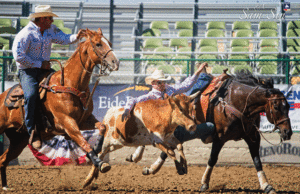
    Stockton is traveling with Bridger this summer along with Billy Bolden and JD Struxness, who was the 2016 CNFR steer wrestling champion, under the coaching of Stockton. They are hauling Bridger’s horse, Whiskers, Freeway, JD’s haze horse Wave, and Billy’s horse. “Whiskers is 10 – and came from Diamond S Performance Horses (Tyler & Jackie Schau, who are also mentors of his). He came off the track. He knows his job, usually if something goes wrong it’s my fault not his.”


    Bridger says the driving is just part of the game. “I like to rodeo and you have to travel to rodeo. It’s worth it if you get to run steers; there are cool rodeos and cool arenas out there. We’ve gone to quite a few, and this year we’re going to even more in hopes to make it to Vegas.”

    “I never doubted Bridger was going to be here. He’s always been determined, focused and willing put in the work,” said Robin. “When he was three he decided to quit daycare, saying ‘Mom, cowboys don’t go to daycare.’ So at the age of three, Bridger stayed home – Glenn was around on the ranch, and he painted pink fingernail polish on the television remote to show the power on and off button and the channel up and down button. He also taught him how to push ‘1-9 start’ on the microwave so he could make himself a hot dog.” He had lots of stories for his mom at the end of the day including what laundry detergent to use, and what his teacher had taught him during the day, insight gained from the television.

    Glenn taught Bridger good horsemanship. “He keeps his hands soft and is light on Whiskers mouth in the corner.” Glenn, who works for ProAg in the crop insurance world, is excited for his son. “The kid is living his dream and more power to him.”