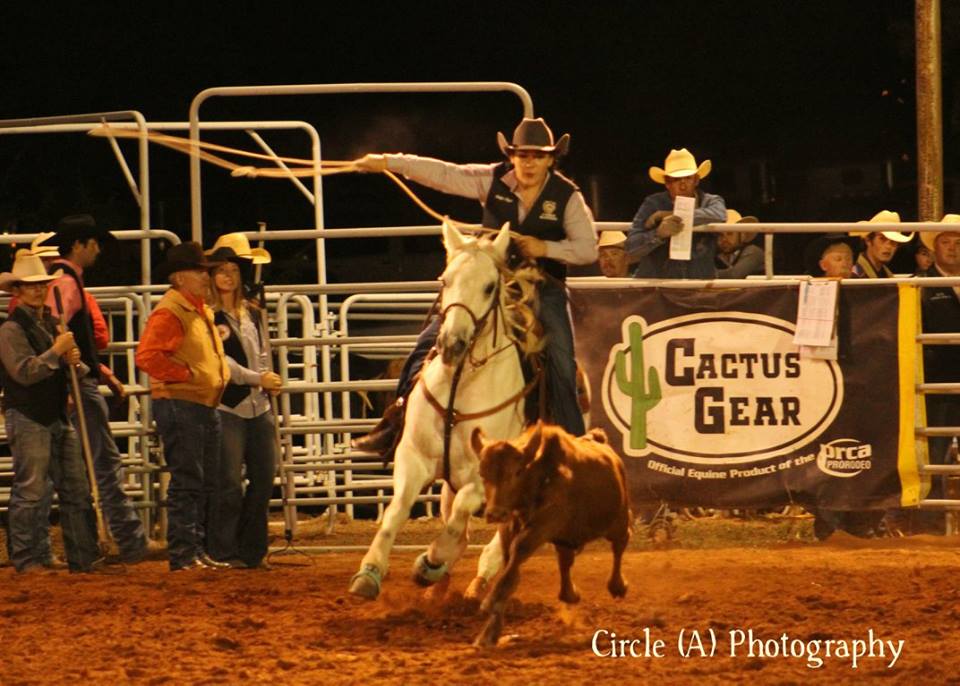
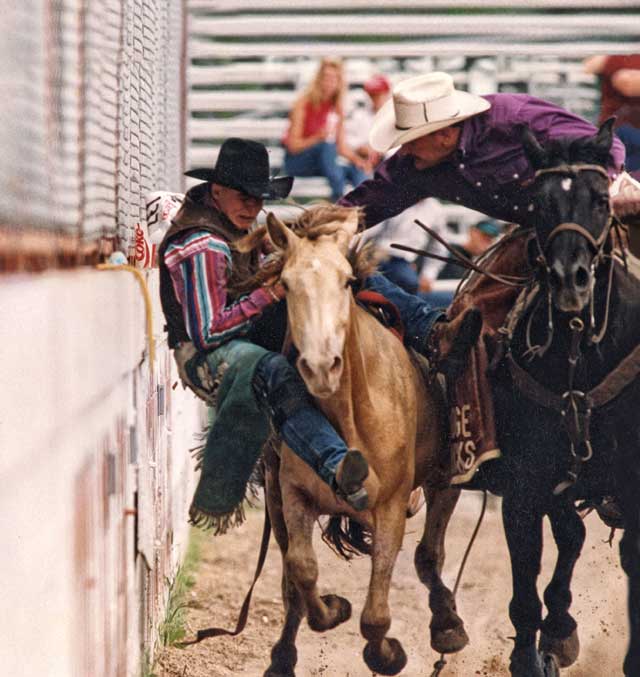
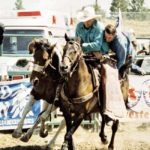
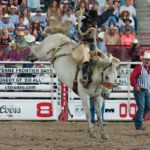
Kent Magnuson did his rodeoing when he was young, and now he gets to continue in the sport with his job.
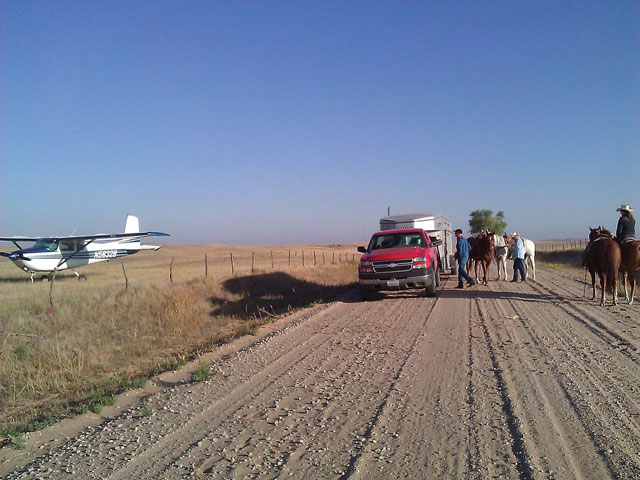
The Kearney, Nebraska man, who grew up riding saddle broncs and tie-down and team roping, was never good enough to make a living at it. But when he quit competing, he turned his attention to flying cowboys and rodeo people around the country.
He began flying small planes in the late 1970s, and introduced himself to Donnie Gay at the National Finals Rodeo in Oklahoma City. At the time, a lot of cowboys were flying from rodeo to rodeo, and Gay, who was in the middle of his eight world title run, was also flying. In 1980, Gay called him and asked him to fly him to events.
Gay sold his plane to Lyle Sankey a few months later, and since Sankey didn’t have a pilot’s license, Magnuson flew him to his rodeos. Other rodeo super stars, including Bruce Ford, Roy Cooper, Bobby Brown, and more than Kent can remember, joined in, guys who were “hard on the rodeo trail.”
After the 1980s, Kent turned his attention to the corporate world, flying for four different businesses, seven days a week, from across the U.S. to Canada, Mexico, and the Caribbean.
Don Gay and Kent Magnuson in the cockpit – courtesy of the family
Then, six years ago, he and Gay reconnected. Gay was flying a twin engine Cessna and wanted to learn to fly a turbine airplane. He came to Nebraska and stayed with Magnuson for a week, learning from his experience. Now he and Gay share duties on a Merlin IIIB, a plane owned by Jerry Nelson of Frontier Rodeo. Magnuson flies for Nelson in several different capacities: with his stock contracting firm, his minor league basketball team, the Kentucky Mavericks, and his other businesses.
His schedule varies. He might be flying for two weeks, and then be home for four or five days. Being a pilot requires flexibility. “That’s one of the benefits of having your own plane,” he said, “having 24/7 access. The flight crew needs to be able to launch within an hour. You might go to the east coast or the west coast, you never know where it’s going to be. To me, that’s fun to do.”
The one thing that changes a pilot’s schedule, beyond what the boss says, is the weather. “Our biggest consideration is the weather,” Magnuson said. A second plan is always in place. “If we can’t do this, what’s plan B? Where’s the next closest airport?”
Occasionally, but not often, he’ll fly cowboys to rodeos. He usually flies cowboys over the busy Fourth of July weekend, and in mid-February, flew world champion Sage Kimzey to some events.
The best part, for Magnuson, is the people. He loves them. “The rodeo crowd is a very unique group,” he said. “The rodeo world has a different way of handling people, the way they do things, how they relate to their competitors. They’re friends, and everybody helps everybody. It’s a code of the west. If you can help, you help whoever needs it, regardless of who they are.”
Now he and his wife, Beth Baxter, barrel race and compete in the 4D events. It’s how they enjoy each other’s company. “It’s a real bonding time for us. Neither of us have any other hobbies, or money enough to support another hobby.”
Magnuson, who is in his sixties, loves his job. “My mother and my stepdad (Beverly and Glen Nutter) conditioned me, that you don’t do a job for the money, if you don’t have to. Follow your heart and the money will always be enough, sometimes more, sometimes less. You’ll always want to do the work.
“And after 35 years of flying, I still want to fly every day.”
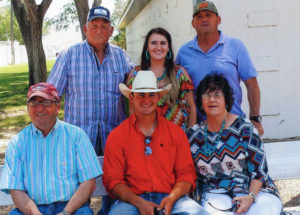
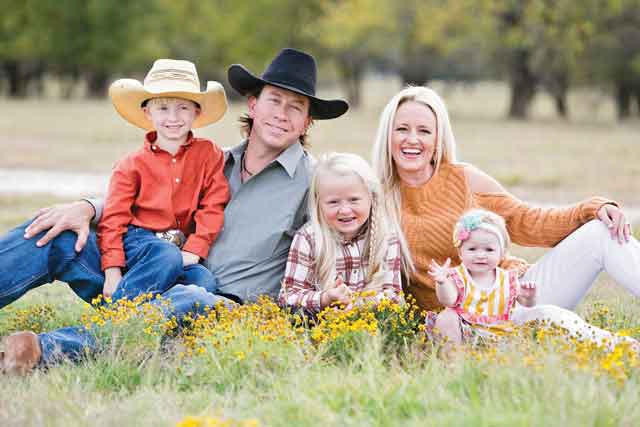
Family picture at the Colorado State High School Finals in Lamar, CO – Courtesy of the family
Larry Trenary was “hungry” to rope, and it showed. The Arthur, Nebraska cowboy spent the best days of his life, roping with his sons, Bret and Troy.
He was born in 1939, the son of Elza and Erma Trenary, both teachers, who lived five and a half miles north of the tiny Nebraska Sandhills town. He grew up in a sod house, and when his parents bought the ranch where he and his wife Sonja live, they moved there.
A ranch kid, when his family moved to Lincoln, he “hated every minute of it.” The Trenarys spent vacations and summers on the ranch, and Larry spent time with his uncle Lawrence Shaw at Sutherland, Nebraska. Uncle Lawrence was a cowboy who knew how to rope. Larry knew how to rope from growing up on the ranch, but Lawrence smoothed out the rough spots on his skills, and provided a horse Larry could ride.
He graduated from Northeast High School in Lincoln in 1957, and that summer, went to the Nebraska State High School Finals Rodeo in the calf roping, steer wrestling, bareback riding and cutting. He won the all-around and represented Nebraska in the calf roping and cutting at the National High School Finals.
Then a move to California would add to his rodeo repertoire. Larry spent a year in college in Visalia, Calif., and met two fellows: Manuel Macedo, and Bob Wiley. Manuel got him started team roping, heeling for him at amateur rodeos (team roping wasn’t new in California but it was not common in Nebraska). Wiley, who was from Porterville, Calif., roped and tied calves with Larry all night long. In the old dairy barn owned by Manuel’s parents, with the lights on, “we’d tie calves till three or four in the morning, till we got tired,” Larry remembered. “We were learning to be faster all the time, and consistent.”
Larry heeling for Marvin Mueller at the 2002 Mid-States Finals – Peter Hammer
After a year in California, Larry was back to Arthur, where he had been dating a local girl, Sonja Mickelson. The two tied the knot in 1959, and lived in California for a short time before making their home on his parents’ ranch north of town, where they still live today.
They ranched, but Larry’s parents weren’t rich and didn’t have a lot of land or cattle to give their son. So he supplemented his income with rodeo. He became a member of the Nebraska State Rodeo Association (NSRA) the same year he got married. He also belonged to the Mid-States Rodeo Association (M-SRA).
Larry dominated his events in the NSRA and the Mid-States. He won the NSRA calf-roping title in 1961 and 1963-64, and the heeling title in 1961, 1972, 1978-79, and 1982-83. In 1984, he won the heading title. In 1961 alone, he won the all-around, calf roping and team roping titles and was reserve champion in the steer wrestling. He also won numerous titles in the Mid-States.
Larry competed in the PRCA as well, roping at Denver, Ft. Worth, Cheyenne, Chicago, Pendleton, and other venues, and at USTRC ropings. But he didn’t want to be gone from home that much, so he returned to the NSRA and Mid-States, plus ropings and rodeos in Nebraska and surrounding states. When he turned forty, he joined the Old Timers Rodeo Association (now the National Senior Pro Rodeo) and the Living Legends Rodeo Association. In 1991, he and Tony Tonozzi won the world in the USTRC’s senior division.
His most memorable calf roping horse was possibly the best calf horse ever in the state, he thinks. Old Black “was as ugly as could be,” Larry said. Old Black supposedly came from the wild horse herds in Montana, and was brought to Nebraska by a horse trader. Uncle Lawrence traded two bucket calves for the horse and he and Larry trained him. Old Black was never truly tamed. “He was so wild, he would kick you. You could never trim his tail and hardly trim his feet. He was just an outlaw, but he was a terrific calf horse.”
Larry and Sonja have two sons, Bret, who was born in 1960, and Troy, born three years later. Roping with his boys was his joy. “When my boys got old enough (to rope), that was the finest time in my whole life.” The three were serious students of the sport. They practiced hard, setting up a video camera and watching their runs, to see where they lost time and how to make it up. “We really worked at it, because it was our livelihood.”
The three Trenarys roped everywhere. If there was a good roping, they were there. They competed across Nebraska, Kansas, Colorado, Wyoming, South Dakota, Iowa, anywhere there were steers and a chute. They put on roping schools as well, teaching kids the fundamentals of the sport.
When Troy was seventeen years old, he was hit in the head while playing high school football. The injury put him in a coma for fifteen days. He had been an excellent heeler, Larry said, and three friends came and stayed for days, trying to help Troy rope again, but the use of his right arm was gone. Their son is still alive, and able to lead a normal life, and for that, Sonja and Larry are grateful.
After Troy got hurt, Bret switched from heading to heeling, so Larry, who heeled, lost his partner. He tried five or six different headers, but things weren’t the same. In his last years of roping, he found a good partner: his friend Marvin Mueller.
Bret’s team roping career flourished. He roped professionally for years, qualifying for the National Finals Rodeo in 1987, heading for Allen Bach.
Not growing up with a silver spoon in his mouth was an advantage, Larry feels. “I didn’t have the money to do things, and I had only one really good horse, and gosh, not very good vehicles. I was purt near broke, but kept going because of my roping.” He feels that money isn’t always the answer. To be a good roper, “I think you have to have the ability to stay on track, and the will to win. Money won’t do it. I know so many kids that their folks have a lot of money, and they want to be a great calf roper or team roper. But most of the guys who are really, really good have had to go without things in their life. You can’t give it to them. It just doesn’t work that way. They don’t seem to have enough guts to stay with something that long.
“You gotta be hungry for it, almost like you need the next dollar to eat on. That forces you to try not to make a mistake, because if you make a mistake, you’re not going to win.”
He and his boys were that way, he says. “We were like a basketball team. We trained here at home, and everywhere we went, we watched the good guys. And on the way home, we’d talk about the good guys, and what they’d done that made them so great. We just learned from them.”
The best days of his life were spending time with his boys. “It was everything,” he remembers. “We were learning together. We’d argue and fight, but it would all come out to be the best.”
Larry roped his last calf at the Arthur rodeo in the late 1970s, on Old Black. He quit team roping at the age of seventy, after having been an NSRA member for over fifty years. His roping was as good as ever, but his knees hurt. Two years ago, Larry was inducted into the Nebraska Sandhills Cowboy Hall of Fame.
Larry and Sonja take great pleasure in their grandchildren, Jhett and Mercedes, the son and daughter of Bret and Dede, who live in Salida, Colo. Mercedes, a former college breakaway roper and goat tyer is teaching school in Oklahoma. Jhett, who team ropes with his dad, is a student at South Plains College in Levelland, Texas. “They’re the delight of our life,” Sonja said.
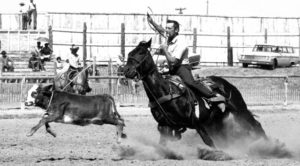
Larry tie-down roping in Gordon, NE on Old Black in the 60’s where he won the rodeo – Courtesy of the family
They sold their cow/calf herd a few years ago and now background calves, which Larry enjoys. “It’s not work to him,” Sonja said. “He just loves what he’s doing. We just keep a-going.” Troy lives with his parents and helps out with the cattle work.
The couple enjoyed their rodeo years, and life now, too. “It’s a wonderful life, what we’ve done,” she said. “It’s been a great life. We’ve been up and down the road. I wouldn’t change it for anything, and I know Larry and the boys wouldn’t, either. “We love what we do.”
Jim on Big Horn in Brawley, California, 1969 – Foxie Photo
Jim Ivory admits he’s a gypsy, and that’s part of what has made him enjoy the rodeo world.
The cowboy, who grew up in northern California rode bareback horses at the National Finals Rodeo (NFR) four times, and has worked behind the scenes at rodeos across the world.
He was born in 1942, the son of Ed and Ellen Ivory, in the tiny ranching town of Alturas, California, the third generation of the Ivorys to rodeo. His dad worked on the ranches in the area, and “we were raised in those cow camps in the corner of Nevada, California and Oregon,” Jim remembered. Ed was a stock contractor, gathering bucking and saddle horses from the ranches and hayfields of the country. Jim and his siblings went along when it was time to rodeo. “That’s the only time we went to town, when the rodeos were going.”
He competed in junior rodeos in nearly every event. There was no high school rodeo association then, and kids ages thirteen through eighteen could enter the juniors. The family moved to Redmond, Oregon during his high school years, and he competed in amateur rodeos while in high school.
After high school graduation in 1960, he continued to rodeo. There were plenty of opportunities for it, too. “There used to be a lot of good amateur rodeos around there (California, Nevada, Idaho, and Oregon), and you could win a lot of money.”
By 1962, he got his Rodeo Cowboys Association (forerunner to today’s Pro Rodeo Cowboys Association) permit, and hit the rodeo trail professionally. One of the first pro rodeos he competed in was the Portland (Ore.) International Livestock Show. From there, he headed south to the Cow Palace, where permits weren’t accepted but he was on the labor list.
Jim Ivory – Rodeo News
He rode bareback horses professionally for four years, often serving on the labor list as well. He worked for the Christensen Brothers Rodeo Co., Beutler Brothers, Harry Knight, and Cotton Rosser, and frequently for his uncle, Buster Ivory, who had bucking horses and put on rodeos.
It worked well, riding and working at the events. “The first year I won $9,000 and it was all in the bank, because I had a job all the time.”
Working on the labor list, he did everything, flanking, driving truck, feeding and sorting stock. “I’ve done everything in the rodeo business except announce,” or work as a barrelman or bullfighter, he said. He rode bulls in the amateur ranks a bit but barebacks was his niche.
In 1967, the first year of four that he qualified for the NFR, he traveled with fellow bareback rider Jim Houston. Houston had asked Jim to travel with him, and Ivory was glad he did. “He refined my bareback riding,” Ivory said. “He made me a better bareback rider than I was. He was a great coach.” One year, Houston helped hone the skills of the three top bareback riders: Ivory, Paul Mayo, and Clyde Vamvoras. It was a testament to Houston’s good teaching skills. “He was a heck of a coach, because we all rode different but he had the ability to see what your natural skills were and how to improve what you did,” Ivory said.
Jim’s best year was 1969, when he finished second to the world champion, Gary Tucker.
After the 1970 season, he quit rodeoing professionally. The most rodeos he had competed at during a year was 77. “I didn’t like that much, rodeoing that hard,” he said. He also liked to have fun. “One of my downfalls was I thought I was supposed to have fun, so I didn’t do as good as I should have, but I had a lot more fun than a lot of them.”
He also knew he wanted to quit before he got to where he dreaded it. “I saw some of my old heroes, and they didn’t want to get on. They screwed around in the chute. I said, when this is no fun anymore, I won’t do it.” He could still win, but “it got to where I didn’t really like getting on.”
In 1972, in partnership with Australian bareback rider Jimmy Dix and Jim’s brother-in-law Van Vannoy, he shipped quarter horses, including a Triple A race horse, to Australia. He and his wife Cathy lived there for four years, taking care of them.
In 1975, he and Cathy came back to the U.S, and he worked at the Sunlight Ranch west of Yellowstone. In 1977, he began producing the Cody (Wyo.) Night Rodeo, which he would produce for a total of thirteen years (from 1977-1980 and from 1998-2006).
He also helped his uncle Buster produce rodeos in Europe in 1970, spending three months there as part of Rodeo Far West. The entire rodeo “outfit” was shipped there, including 100 head of saddle horses and seventy bucking horses and bulls. A few times in the 2000s, he took a group of cowboys to Brazil to enter their rodeos: Cody DeMers, Wesley Silcox, and Steve Woolsey, and Lewie Feild, as pickup man, among others.
Jim was part of a unique group: five cowboys at the 1967 and 1968 NFR had been members of the Redmond High School wrestling team: Jim, his brother John (a saddle bronc rider), bareback rider Ken Stanton, his brother Bill Stanton (a bull rider), and Larry Mahan, who did all three roughstock events.
Jim won’t agree that they were tough, but they were: “I don’t know if we were tough or not but we were tougher than some of them.” The Redmond bunch was a good rodeo group. “A lot of really tough rodeo kids came out of that group that I rodeoed with. Jack Thrasher, the Stantons, Buzz Seeley” and others. “We could go to those amateur rodeos and win a lot of money.”
Jim bareback riding in Woodlake, California 1969 – Foxie Photo
The best bareback horse Ivory encountered was a horse owned by Reg Kesler. Three Bars, a 2004 inductee into the Pro Rodeo Hall of Fame, “was no doubt the best, rankest bareback horse there’s ever been,” Jim said. “She could throw everybody off, and it always hurt, for some reason. There’s been a lot of good ones over the years but she was unbelievable.” Three Bars was selected to buck at the NFR in three decades and won the bareback horse of the NFR in 1967, 1973 and 1980. Jim got on her twice, getting bucked off both times. “She almost killed me the first time,” he quipped, “and she did the second time.”
While he was on the rodeo circuit, Jim made Pampa, Texas his address, because his uncle Buster lived there. He loved Wyoming and Montana, and he and Cathy moved to Wyoming after marrying.
In his later years, Jim has shared his experience with Chad and Matt Burch of Burch Rodeo, and Chad loves working with him. He has an eye for bucking horses, Chad says, and they have bought many horses from him. “He knows what to look for with a horse. He’s seen a lot of them,” Chad said. “He’s a very smart man, and he’s been successful at rodeo.”
Jim has helped at many rodeos, including those for Burch, Reg Kesler, and Mike Cervi, among others. He’s raised a lot of horses that were sold to PRCA stock contractors and selected to buck at the NFR. Last year, Jim Dandy, a bareback horse whose mother Jim had sold to the Burches, carried Jake Vold to a sixth round win at the 2016 Wrangler NFR.
He and his wife live in Banner, south of Sheridan, Wyo. He still has a half-interest in two studs and three mares, and continues to help the Burches with their rodeos but doesn’t do as much as he used to. When Chad asked him to come to Kaycee, Jim told him he was too crippled to do anything. “I’m just a pretty face,” he told Chad, and Chad replied, “that’s what we pay you for,” Jim laughed.
He and Cathy, who married in 1969, have four children: sons Buster and James, daughter Mandy, and a daughter Kelly Jo, who passed away when she was four years old. Buster lives in Gillette and has two daughters and a son; James lives in Virginia with his two daughters and son, and Mandy is in Australia with two children.
Looking back on his rodeo life, Jim can’t imagine doing anything else. “I really liked to get on bucking horses, and the lifestyle and the people, the freedom and the money. It was a lot better than working on the ranch.
“I’ve been playing cowboy since I was three years old. That’s all I ever did, and I’m still playing it.”
Red Bluff 1969. First row: Ace Berry, Ralph Maynard, Jim Ivory, Jerry Hixon, Clyde Longfellow, John Ivory, Don Flannigan. Second Row: Bill Martinelli, Manuel Enos, John Hawkins, Louie Zabala, Bill Stanton, Sonny Johnson, Bob Swain, Bob Edison – DeVere
Red Bluff teacher is barrel racer, Round-Up competitor
Red Bluff, Calif. (March 13, 2017) – Kaillee Hamre is somewhat of a rock star in her own classroom.
The fourth grade teacher at Bidwell Elementary in Red Bluff, Calif. is also a cowgirl, a barrel racer who will compete at the Red Bluff Round-Up in April.
And because she’s a cowgirl, and for many kids, the only cowgirl they know, kids she doesn’t even know will greet her in the school hallways, and tell her they love her horse.
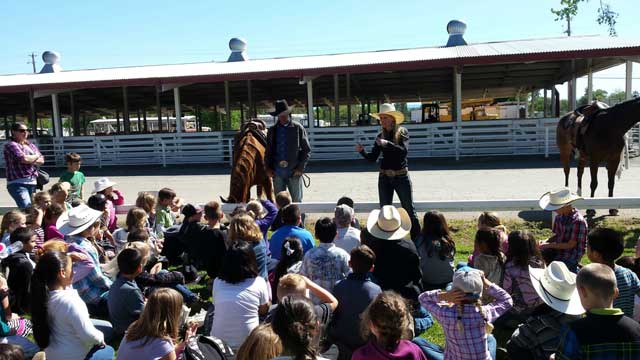
It all started last year when Hamre brought her students, then the second and third grade class, to the Round-Up to watch her compete. She made her barrel racing run in slack, the extra competition that takes place during the day, so the students made a field trip out of it. She and the students visited after her run, and she brought her horse so students could see it and they could talk about the equipment – saddle, reins, spurs, boots, and hat – that she uses in barrel racing.
It was a hit, she said. Students sat in the stands and cheered for her as she competed. “They thought it was so neat that they knew somebody who was doing that. They had so much fun.” Her students chanted her name, hollering for Mrs. Hamre, so that “a couple of people said, ‘Well, I see you brought your students,’” Hamre said.
Hamre and her husband, AJ, live in Los Molinos, and AJ visited her students as well last year. A bull rider, he competed at last year’s Round-Up but has retired from the sport and won’t be competing this year.
Students love to hear how she and AJ did on Monday mornings. “Every time we come back from a rodeo, I’ll show them the video (from the weekend’s competition). They think it’s cool.”
Attending the Round-Up is a real treat for her students, Hamre said. The Round-Up gives tickets students who participate in the Cowboys and Kids program, and she said several of her kids came to the rodeo that night. The Round-Up is “one of the biggest rodeos in California and the nation, and it was neat to expose them to an element of it.”
Hamre, who is in her ninth year of teaching and third year in Red Bluff, says she competes at about 30 rodeos a year, mostly in the summers. She and her husband used to compete at the same rodeos until he retired. “We are weekend warriors,” she said, “because of our jobs.” AJ is a territory manager for a heavy equipment company.
This year, spring break falls on the same dates as the Round-Up, so Hamre won’t be bringing her class to it. But she’s hoping some of them will be in the audience to cheer her on. “I’ll spread the word and recruit some students to come.”
The Red Bluff Round-Up is April 21-23 at the Tehama District Fairgrounds. Tickets range in price from $14 to $30 and are available online at www.RedBluffRoundup.com, at the gate, and through the Round-Up office at 530.527.1000. For more information, visit the website or call the office.
Performances of the Round-Up kick off at 7 pm on April 21, 2:30 pm on April 22, and 1:30 pm on April 23.
Kaillee Hamre, Los Molinos, Calif., makes a barrel racing run at the 2016 Red Bluff Round-Up. The cowgirl, also a fourth grade teacher, took her students to the rodeo last year to see the barrel racing. Photo by Hubbell Photos
Ft. Hays rodeo students benefit from Kansas’ Biggest Rodeo
PHILLIPSBURG, KAN. (March 13, 2017) – Two Ft. Hays (Kan.) State University (FHSU) students have been awarded scholarships courtesy of the Phillipsburg Rodeo Association.
Kaitlyn Dinges, Ness City, Kan., and Wyatt Livingston, Oxford, Neb., are recipients of $500 scholarships towards their education at Ft. Hays State.
Dinges, who will graduate in May of 2018, is working towards a major in agricultural business and economics certificate. The twenty-year-old cowgirl competes in the barrel racing and breakaway roping, and in high school, was involved in FFA, Kansas High School Rodeo, was a Kay’s Member, a member of FCCLA, and on the president’s honor roll.
After graduation, she plans on working on her master’s degree in agricultural economics at West Texas A&M in Canyon, Texas, with the possibility of getting her doctorate. She may teach, or might pursue a career in agriculture risk management.
Receiving the scholarship is important to her, as she has made the goal of graduating debt free from college and will graduate in three years instead of four. “It’s super expensive to rodeo and go to college, and make ends meet,” she said. “With taking as many hours as I am, I have to make up the difference in my tuition.” She hasn’t taken out any student loans, either. “I’ve worked my butt off, trying to get as many scholarships as I can. If I’m able to graduate debt free, it’ll make a huge impact on my life down the road.”
Dinges, whose sister Danielle (Dinges) Foos was the 2010 Miss Rodeo Kansas, has attended the Phillipsburg rodeo in the past.
She is the daughter of Darren and Brenda Dinges.
Wyatt Livingston is one of two recipients of scholarships awarded to Ft. Hays State University rodeo athletes by the Phillipsburg Rodeo Association. The Oxford, Neb. cowboy is majoring in agricultural business. Photo by Logan Becker.
Wyatt Livingston is the second recipient of a Phillipsburg Rodeo scholarship. The college sophomore competes in the team roping as a heeler, and is majoring in agricultural business.
In high school at Southern Valley south of Oxford, Neb., he was a member of FFA, FBLA and Nebraska High School Rodeo, played football and wrestled, and showed cattle and horses in 4-H. He was on the honor roll and was a member of the Oxford Volunteer Fire Department.
During the summers, he competes in the Kansas Pro Rodeo Association, the U.S. Team Roping Championships and the Mid-States Rodeo Association.
He has attended the Phillipsburg rodeo the past ten years, as a guest of his girlfriend’s parents, sponsors of the rodeo. He loves watching the team roping. “The most entertaining thing for me, as a team roper,” he said, “is to see the big gun team ropers. I like to see the big names rope.”
The scholarship means a lot to him, he said. “Fort Hays (State University) doesn’t give us money for entry fees (per the rules of the National Intercollegiate Rodeo Association). They pay for our fuel and motels, but we still have to pay entry fees, food expenses and horse and hay expenses.” He works part time for a veterinarian in Hays.
He will graduate in May of 2018, and hopes to work on the family farm and ranch near Oxford.
He is the son of Julie Sherwood and Jeff Livingston.
Since 1997, the Phillipsburg Rodeo Association has awarded scholarships to FHSU students who compete in rodeo. The Phillipsburg Rodeo Association is the organization behind Kansas’ Biggest Rodeo, which will be held August 3-5, 2017. For more information on the rodeo, visit www.KansasBiggestRodeo.com.
Dick Hermann served his country well. The former saddle bronc rider and pickup man was in the U.S. Navy for 25 years, five years in active duty, mostly in Vietnam, and twenty years in the Reserve. After he was Seaman Hermann, he became a cowboy.
Dick’s story starts as a farm kid, one of seven children born to Roy and Alta Hermann, in 1948 near Lesterville, S.D., southwest of Sioux Falls. For his twelfth Christmas, his dad gave him a set of harnesses, and Dick hitched up Corky and Princess, two of the saddle horses around the place. “They just looked at each other,” Dick laughed. His grandpa tied them together so they couldn’t split apart, and Dick trained them as a team. He remembers pulling his sisters on a toboggan on the lake near the house, behind the team. “I’d cut the corners a little sharp, and roll the girls out” of the toboggan. “They’d laugh till somebody got hurt and then it wasn’t fun anymore.”
There were plenty of chores to do on a dairy farm, and Dick couldn’t participate in after-school sports. When he was a junior, he quit school. “I wasn’t much of a school guy,” he remembered. He did odd jobs, and youthful energy started getting him into trouble. A friend suggested they join the military. “We were going to get into trouble if we didn’t.”
He joined the Navy in 1966, because the Marine and Army recruiter weren’t around. “The only guy there was the Navy recruiter,” Dick said. “I said, if I don’t have to milk cows, I’ll join the Navy.” Uncle Sam sent him to Vietnam for three years, and he returned to the States in 1970.
After getting home, he went with a friend to a rodeo, where he got on a bareback horse and broke his arm. But the experience was worth it. It was a rush, and the rodeo bug bit him. He needed a place where he could work and get on as many bucking horses as possible. Someone recommended he talk to stock contractor Erv Korkow in Blunt, S.D., so he did. “I said I’d try it for a while, and I ended up staying for 30 years,” he joked.
For the first couple years, Erv wouldn’t let him get on bucking horses. He worked, making $75 a week, plus board, which was good money, better than he had made in the military.
Then he found out about the nightly rodeo held in Cody, Wyo., for six weeks during the summer. He quit work and went to Cody, where he met up with world champion saddle bronc rider Bill Smith and his nephews Jack Wipplinger and Tom Wipplinger from Red Lodge, Mont. Smith coached them in the finer points of riding saddle broncs, and Dick’s rodeo competition career began. He competed in Cody and area rodeos, becoming a member of the Rodeo Cowboys Association (the predecessor to the PRCA) in 1972 (his permit year) and often slipping off with his buddies to the Canada rodeos.
But every fall, he’d be back to the Korkow Ranch. At that time, Erv didn’t have any fall rodeos, but he had a trucking company, so Dick hauled cattle all winter. And every spring, after helping with the rodeo school Erv put on at the ranch, he’d be off to rodeo again.
Erv and his wife LaFola were like second parents to Dick. He “treated me good,” Dick said. “He treated me like one of his boys. He’d chew on you once in a while, but that happens to everybody. He was a good man.”
And Erv always took Dick back on the labor crew each fall. “I’d go back to the ranch, and Jim (Erv’s son) would tell him, ‘Dick’s back in the bunkhouse’ and I’d pick up where I left off.”
In the 1980’s, Dick started working as a pickup man. He was in Dallas, at a Steiner rodeo, on the labor list. Tommy and Bobby Steiner wanted to know if Dick would come to Austin, to work for them, and in Austin was where he first picked up. The Steiners were bucking horses at the ranch when the pickup man didn’t show up. Would Dick pick up? He agreed to, even though he never had before.
That fall, at the National Finals Rodeo in Oklahoma City, Erv talked Dick into returning to South Dakota the next year, to pick up for Korkow Rodeo Co.
As time went on, he purchased a semi-tractor and used Erv’s trailer to haul a load of bucking horses and bulls to rodeos, plus ride broncs and pick up, all at the same event. In addition to working for Korkow Rodeo, he also picked up for Jim and Steve Sutton.
Dick credits Jim Korkow with teaching him the finer points of picking up. “He was good,” Dick said of Jim. Picking up “is all about timing, being at the right place at the right time. By watching other people, I learned. And I had different people point out different things, which I appreciated.”
In 1986, he broke his arm in June, and his leg a month later. Lying around, the realization hit him: what would he do for finances if he was seriously hurt? “I realized I had to do something different.” He decided to go into the Naval Reserve, serving one weekend a month and two weeks a year.
Dick served until 2006. In 2002, he decided to quit as a pickup man. He knew he was to be deployed in 2003, to Iraq. He and forty others were sent to train in Italy for two weeks with the Marine Corps. After the training, the group was sent home, which disappointed Dick. “Gol dang, I wanted to go.”
Since his retirement in 2006, he enjoys his home in St. Onge, S.D. in the summers and in Phoenix in the winters. He has a team of Belgians that he uses to pull wagons in the parades for the rodeos in Deadwood and Belle Fourche, S.D.
Dick with a Twin 50 Cal. Gunner on a patrol river boat – courtesy of Hermann
Dick on a Korkow horse at St. Onge, S.D.
Dick picking up at the Dickinson, N.D. rodeo in the mid 1980’s
– Ridley
Dick Hermann
In Vietnam, Dick was one of a four-man crew on the PBR river gun boats: patrol river boats. They were little gun boats, as Dick explains, 28 feet long, and ten feet wide, with a forward gunner, driver, an M60 gunner, and a 50 caliber gunner. The job of the PBR in Vietnam was to search and destroy. Dick was on many PBR patrols with the Navy SEALS, the Green Beret, and the Army, and two of those missions nearly killed him.
Twice his life was in peril on the patrol river boats. On June 21, 1968, the boat he was in was completely destroyed, killing two of the men. He and one of his original crew, plus two new members, were assigned a new PBR, and two days later, the new boat was damaged to where Dick got blown over the side of the boat. It was 3 am, so dark a person couldn’t see the jungle tree line. When he came to the water’s surface, another boat ran over him, causing serious injury. The secret to surviving was staying in the middle of the river; the enemy was on the beach. Dick treaded water for so long his legs cramped up. He was the only survivor of the four in that incident. He nearly lost his life, but he can joke about it now. “I drank half of that dirty old river. It took me all these years of drinking beer to get rid of it,” he laughed. Out of the four men who were part of Dick’s original boat crew, he was the only survivor.
For his bravery, he received the Bronze Star, the Purple Heart, and the Navy Commendation Medal, with Combat V and the Gold Star. At one time, his days in Vietnam troubled him at night. But the dreams have subsided. “The nightmares ain’t nearly as often as they used to be.”
Rodeo has provided him with a lifetime of recollections. “I got a saddle bag full of memories and friends that all of the money in the world can’t buy,” he said. He loved riding saddle broncs, and watching bucking horses. “When I got tapped out on one, it was like poetry in slow motion. You’re so engrained in what you’re doing, you don’t even hear the whistle. There’s nothing better than watching a good horse that bucks.”
Dave Dahl can spot one of his saddles from a mile away. When the bronc saddle maker from Ft. Pierre, S.D. watches pro rodeo, he can see the saddles he’s made aboard the bucking horses in the saddle bronc riding.
And the list of cowboys using his saddles sounds like a “who’s who” of great saddle bronc riders: 2016 world champion Zeke Thurston, world champions Taos Muncy (2007 and 2011), Jeff Willert (2005), Glen O’Neill (2002), and Cody DeMoss, Jake Watson, CoBurn Bradshaw, Chuck Schmidt, Clay Elliott, Wade Sundell, Cort Scheer, Kyle Whitaker, Jeremy Meeks, Shade Etbauer, and more.
The 72 year old cowboy grew up on a farm near Keene, North Dakota, next to an Indian reservation, “where there were cowboys,” he remembers. He and his friends used to go to the reservation, round up horses, and ride them. “We didn’t know what the horses were like,” he said. “We just ran in a bunch of them. There were a few chutes, and we practiced. We had some wild times,” he chuckled. After graduating from high school in 1962, he went to the oil fields. But he knew he didn’t want to spend his life there, so he went to college in Madison, S.D.
Eastern South Dakota wasn’t for him, either. “It was too much ‘east river’ for me, and I liked the Black Hills.” He made a phone call to Black Hills State University in Spearfish, S.D., and a few months later, he was there, on the rodeo team riding saddle broncs. As a member of the men’s team, he won the 1967 National Inter-Collegiate Rodeo Association year-end saddle bronc riding title, qualifying for the College National Finals Rodeo four times and competing there twice.
After graduating with a teaching degree, he taught a year at Pine Ridge, S.D., a year at a country school near Fruitdale, S.D., and a year in Eagle Butte.
He was doing construction work in Ft. Pierre, when he and a rodeo buddy, Dick Jones, ran across each other. Jones was making saddles, and Dave wanted to make his brother one. Dick helped him, and that was the beginning of Dave’s saddle career. Dick had made some saddles, and he gave instruction to Dave. “He knew a little bit, and I didn’t know much,” Dave recalled. “He showed me, and one thing led to another.” The two began a partnership in a saddle shop in Ft. Pierre.
Dave, being a saddle bronc rider (he won the 1968 SDRA title and had a Rodeo Cowboys Association card), made bronc saddles. His saddles are different from other brands, and the cowboys who ride them, love them.
Dahl’s bronc saddles differ from other makers in several ways, including the swells and the cantle. The swells are set higher so that a cowboy’s feet can set high in the neck of the horse, but not too high. The seat is a bit deeper, and the cantle is higher. Where a cowboy’s hips are is crucial. Chuck Schmidt, a saddle bronc rider from Keldron, S.D. and a three-time Wrangler NFR qualifer, has ridden a Dahl saddle since he started pro rodeo. “As in any sport, your hips are your power, and bronc riding is the same,” he said.
“You almost have to sit back on your butt a little, not just sitting there straight up, like you’re going to rope. You want to set back, (to reduce) the force the horse will use to throw you forward. You counteract it it by sitting back.”
The gullet on the saddle is also set narrower, so the saddle can sit higher up on the withers. “Beings it’s not a roping saddle, you can set your swells higher by bringing the bars in, thus allowing the cowboy to spur better,” Schmidt said. “If the swells are set too low and too wide, it’s harder to reach your feet up into the neck. When you narrow the swells and set them up higher, your legs are closer to the horse’s neck, creating better spur contact when you ride.”
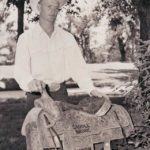
Dave Dahl with the saddle he won at the 1967 National Inter-Collegiate Rodeo Association year-end saddle bronc riding title – courtesy of the family
Chuck Schmidt, Keldron, S.D., rides at Cheyenne Frontier Days. He has used a Dave Dahl bronc saddle since he was twenty years old
– Hubbell Photography
Dave in his workshop
– Tammy Tolton
Dave competing in Bowman, North Dakota in 1966 – Ralan
Dahl’s saddles make riding broncs easier, Schmidt said. “Dave designed a saddle to take away half of your work as a bronc rider, the way it sets a horse and the way it sets the cowboy. It sets it up a little more natural, the way everything moves. There are minimal things to get in your way.”
For some cowboys, switching to a Dahl saddle made them a better rider. It happened for Zeke Thurston, who won last year’s world title. The Big Valley, Alberta cowboy wasn’t riding well last spring. He decided to give Dahl a phone call. Dahl had a new saddle to him within five days, and Thurston took it to the Guymon, Okla. rodeo. “It took me a few rodeos to get it dialed in,” he said. “Once I broke it in, my spring skyrocketed. There were probably four weekends in a row where I won $12,000 or more.” He credits the saddle with giving him better spur outs and better upper body control.
Jake Watson, Hudson’s Hope, BC., finished the 2016 season in fifth place in the world, and also uses a Dahl saddle. “The way the swells and cantle are shaped, the structure of them, they have a lot of forgiveness in them,” he said. “If you lift on your reins, you can turn loose and the saddle will do its job and keep ahold of you.” The different shaping of the swells and cantle make a difference. “Say you’re getting bucked off, and you’re still trying to spur, more often than not, you’ll end up back in the saddle and regain your position in the seat, which is definitely what you want.”
Watson has used a Dahl saddle since June of last year, and it has made a difference for him. “It changed my career, honestly,’ from the very first horse I got on,” he said. “I was having hell. I had won $2,000 that season (up till June), and from the end of June till September I ended up winning $20,000. Itw as a big turning point in my bronc riding.”
Dahl works out of his shop, the Diamond D Western Wear and Saddle Shop, on the main street of Ft. Pierre. He sells clothing, boots, hats, tack, and ropes, and does his leather work in the back of the shop.
And when most people are retired and drinking coffee all day, Dahl is working. He’s turning out about a saddle a week, working on number 1657 in mid-January. He puts in long days, clocking in about 8:30 am and working till 6:30 or 7 pm, six days a week, “depending on how bad I want to finish something.” The good work ethic comes from the motivation to succeed. “I guess I made up my mind that I wanted to be the best at what I’m doing. When you see the good results of the cowboys, it’s a big incentive.” And making saddles supplements the store’s income. “I’m fortunate that I can make a good living in my workshop when things are quiet in the store. That makes it nice.”
As cowboys call him to order saddles, he chats with them, finding out how they’re doing, what rodeos they’ve been to, and how they’re riding. He checks the internet nearly every day, to see the standings, and watches rodeos on the Wrangler Netowrk. He can pick his saddles out every time. “Everybody’s saddle looks a little bit different,” he said. “I have distinct little straps, little buckles. Most everybody has a buckle through the skirt (of the saddle), but my buckle is on the little piece that goes around the front of the swells.”
Dahl ships saddles to Australia and now the second generation of cowboys are using them. And the “old-timers” – retired bronc riders –refer young guys to him. National Finals average winner Rod Warren “sends boys to me,” Dahl said.
Six cowboys at the 2016 Wrangler NFR rode on Dahl saddles: Thurston, Schmidt, CoBurn Bradshaw, Cody DeMoss and Clay Elliott. And the list extends beyond the NFR. Wade Sundell rode one to win the $1 million at the American Rodeo last year. Cort Scheer won the Elite Rodeo Association title, Thurston won $100,000 at the 2016 Calgary Stampede; Jeremy Meeks won last year’s Indian National Finals Rodeo on one; Clay Elliott was on a Dahl saddle for his Canadian National Finals win, and eight-time Linderman winner Kyle Whitaker uses one.
Retirement is not on Dahl’s radar. “I have a lot of work to do,” he said. The man who supplies the d-rings for Dahl’s saddles is 95 years old, and still going. “I”ll have to work a while to catch up to him.”
And saddle bronc riders hope he keeps working.
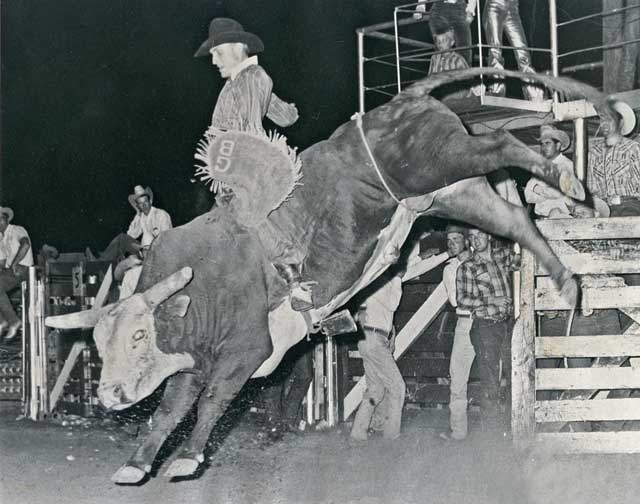
Because of his high school ag teacher, Glen Bird began riding bulls.
The Weatherford, Texas man began his rodeo career at the behest of Mr. William T. Woody, ag teacher at Peaster (Texas) High School, a career that would end up with six International Pro Rodeo Association (IPRA) titles and the high respect of his fellow cowboys. As a child, Glen attended rodeos with his granddad, who loved them, especially the bull riding.
He rode calves on the family ranch then continued the sport when he was in high school.
Mr. Woody had competed as a bull rider at Sul Ross University in Alpine, Texas, and he saw potential in his student. Because Glen couldn’t drive, Mr. Woody would enter him in the FFA rodeos held across the state and drive him there. And because many of the FFA rodeos hired professional stock contractors, the bulls were extra rank and the high school kids turned them out, not wanting to get on them. “Mr. Woody knew all them stock contractors,” Glen remembers, “and he’d tell them stock contractors, ‘Look, these bulls are turned out and this boy I brought with me will get on them.’” So Glen ended up getting on five or six bulls at each rodeo. He may not have got them rode, but he was willing to get on them.
He remembers one time at a rodeo in Gainesville, Texas, where Adrin Parker was the stock contractor. He had a bull, No. 36, that nobody wanted. Every performance, No. 36 was turned out and Glen got on him. “He slung me all over that arena. I was so beat up and bruised up by the time I got on the bull I had drawed, Mr. Woody kept ice on me all day.” Two years later, he got his revenge on No. 36; he rode him for a third place finish.
In 1964, after high school graduation, he hit the rodeo road. He was already competing on the weekends, but now he hit the trail hard. He had gotten his IPRA card a few years prior, and, along with Hal Pilgrim, went to rodeos everywhere. “We’d try to go to a rodeo every day,” he said. It wasn’t hard. With bull buckouts at Mansfield, Texas two nights a week and a rodeo on Saturday nights, and rodeos in Simonton every weekend, there was always somewhere to ride.
And Glen and his buddies didn’t limit themselves to Texas. It was common for them to be up at a rodeo on a Saturday afternoon in Texas or Oklahoma or Arkansas, then jump in the car and make a Sunday matinee performance in California. The car was full, too. By this time, Glen and friends Red Doffin (a bull rider) and Ronnie William (a bareback rider) were in the vehicle, along with Bernie Johnson, Glen’s brother Arnold Bird, and Hulen Missildine. “They would go anywhere I entered us,” Glen said. “I always had a full car, and we’d go non-stop.”
In his glory days, Glen and his buddies were competing in anywhere from 150 to 200 rodeos a year. “The thing about it is, we loved it,” he said. “If you can’t travel, you’re not going to ever rodeo. Every day, when we’d wake up, we’d more than likely be in another state, meeting new people. It was unbelievable.” And his riding was unbelievable, too. According to Ronnie Williams, Glen’s style was impeccable. “I think he was one of the greatest bull riders there ever was,” Ronnie said. “He had a perfect style and form, he rode so perfect, that he made it look effortless. And his percentage of winning first place was unbelievable. It seemed like every time he’d nod his head, he was winning first.”
In the early days of his rodeo, Glen rode bareback horses. He didn’t like to, but for a while, he did. And his friend Ronnie knew it, and occasionally set him up for a joke. “That dang Ronnie would enter me in the bareback riding, and I’d get there (to the rodeo) and find out I was entered. But he didn’t enter me in a whole bunch of them, because I was entering him in the bull riding, and he didn’t like that.”
Glen won the IPRA’s bull riding title four times: 1966-67-68 and 1970, and the all-around in 1968 and 1970. The International Finals Rodeo began in 1970, so prior to that, whoever had the most money won at the end of the year was the champion.
Ronnie won eight IPRA bareback titles, and thought his buddy was the best in the business. “I don’t think anybody ever rode with the style he rode with, and was dominant in the IPRA all those years. It was a privilege for me to get to rodeo with him.”
Another traveling partner, Red Doffin, thought the world of Glen. “He had lots and lots of class,” Red remembered. “You talk about a bull rider that looked pretty on bulls. He just turned his toes out and rode them with style, rode them perfect. That’s the way he rode.” Glen was hard to throw off, as well. “He had good form,” Red said, “and when they throwed him off, they throwed him off on the top of his head because he tried as hard as he could try.”
Glen competing at Benton, AR 1969 – photo courtesy of the family
Glen and his wife Judy at Texas Rodeo Cowboy Hall of Fame in Fort Worth, TX – photo courtesy of the family
Glen Bird, San Juan Capistrano 1967 – Sandy Wares
Glen never suffered from a lot of injuries. He broke a leg during his first – and only – semester of college, affixing a spur in the cast so he could continue to ride. He also broke a bone in his left hand, his riding hand that took six months to heal. The broken leg and possibly returning to riding bulls too soon has affected his walking today. That’s not being tough, he insisted, in riding with a cast, “all that was, was stupidity. If I had not have done that, I would be walking so much better today.”
In 1972, he got on the last bull he’d ever ride. His legs were bothering him so badly he took the locks out of his spurs and rode with loose rowels. “I couldn’t stand the pressure it was putting on my legs,” he said. “After a while, anything you do that you burn at it like that, it makes the longevity of it short. It finally caught up with me.”
By this time he had a wife, Judy, and two children, Jennifer (White) and Jason. He got a job with Miller Brewing Co. in Ft. Worth, working there for 33 years. He also started a Limousin cow herd, selling the bulls at the Texas Limousin Association’s annual sale for years. He started his herd from some heifers and a bull that his aunt and uncle had in Oklahoma. He ended up with a herd of 35 purebreds and did very well with the breeding program. Both of his kids showed the cattle, his daughter winning Limousin Heifer of the Year.
When he quit riding bulls, Glen had to quit going to rodeos, for fear he’d get the bug again and hit the road. “I didn’t watch a rodeo on TV for ten years or so,” he said. “I wasn’t going to be able to quit them if I kept around them.” Then one day his friend Sam Roberts called, asking if he’d watched a bull riding on TV. “I can’t, Sam,” he said. “I’ll want to get to riding again.” Sam shot that idea down. “Hell, you ain’t going to do that, you’re too old,” he said. “And I thought, by gosh, he’s right, and now I don’t miss one.”
Inducted into the Texas Rodeo Cowboys Hall of Fame in 2010, Glen remembers with great fondness his rodeo days. “I had more fun than the law allows. I thought I was a millionaire. I enjoyed every bit of it. I don’t regret any part of it,” he said. “If I ever got the chance to live it over again, I would.”
And Mr. Woody, the ag teacher? They still stay in touch, even though Glen nearly got kicked out of his class the first day of school. Glen walked into the classroom with his hat on, pants stuffed into his boots, and put his feet on the table. Mr. Woody jumped up with a two-by-four in his hands and said, “We’re going to find out who runs this class right now. You or me? I’m going to ask you to take your feet off the desk and your hat off.” “I looked at that two-by-four,” Glen chuckled, “and I sure didn’t want no part of that.”
Glen and Judy spend their time now “doing whatever we want to,” said Judy, who spent most of her years at home, working a couple different jobs along the way. “We’ve been married for 48 years and we have learned that it’s about being a companion to each other and doing for each other all the time. We go to church all the time and have a lot of friends to spend time with.” They also have two granddaughters, Skylar and Taylor.
The One Armed Bandit and his Mule, Moe – Dale Miller
“Hi. I’m Moe and I’m more famous than John Payne. Or maybe not, but I’d like to think I am.
You might know John Payne, but you might know him by his other name. The One Arm Bandit. I’d like to brag that I’m the one who made him lose an arm, but it wasn’t me.
I came into John’s life ten years ago, when I was eight.
He was sitting at a sale, chewing the cud with all the other cowboys…. Well, actually, I’ll let John tell the story…
Hello, I’m John Payne, the One Arm Bandit, and one day, I was sitting at a mule sale in Ada, Oklahoma. I had a bullfight to work that night, and the mule sale was at the same place as the bullfight, or I’d have never been there and I’d have never bought him.
He’s a man killer, Moe is. He had six problems: you couldn’t catch him, you couldn’t bridle him, you couldn’t saddle him, you couldn’t get on him, and you couldn’t ride him. And he’d run off with you if you tried, even leading him.
But Moe and I, after I’ve pulled a lot of wet saddle blankets off of him, have come to an understanding. I ride him, he does what he’s supposed to, and we both get paid.
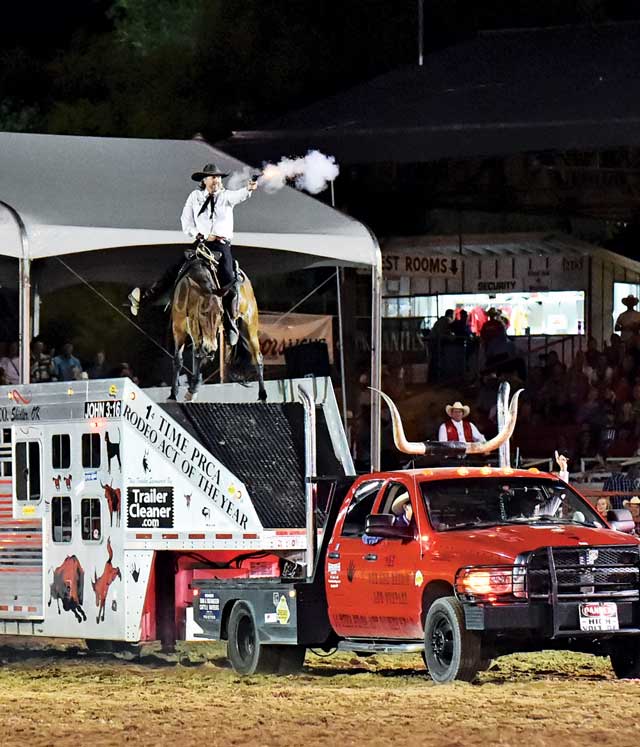
Part of my act is driving my trained buffalo or Watusi longhorns to the top of my trailer, following them up, and spinning my mule on the top of the trailer while cracking a bullwhip. All with one arm.
I used a horse for twenty years. I was the cowboy who said, when all the horses die, and I get tired of walking then I’ll use a mule.
But after I’ve had Moe, I sure do like how he works. He’s surefooted on the ramp. If it rains and it’s muddy and that ol’ ramp is wet and slick, he is really good at keeping his feet under him.
I’ve trained a lot of animals in my life. Horses, mules, zedonks, zorses, zebras, watusi cross longhorns, Corrientes, quarter horses, and mustangs, not to mention buffalo. And a chicken hawk. This hawk, I found it under a tree when it was a baby. I took it home, and fed it till it grew up. I’d whistle and he’d land on my arm. He loved mountain oysters and hamburger meat. When we was working cattle, he’d fly around and hang around us all the time.
Once I trained a woman …… to do whatever she wanted to do.
Buffalo is the meanest critter in North America. Buffalo tried to kill me almost every day for two years, and they’ve hooked me off the top of the trailer, twice, horse and all.
But back to Moe. Moe wasn’t harder to train than buffalo. He was a jerk, pulling back, making it hard on you every darn day, but he was not dangerous all the time. He was not hardheaded. He is very firm in his convictions.
He was worth it. Well, I had a lot of nice compliments on him and I’ve been offered $20,000 for him. But nobody could handle him but me. He’s the best looking mule in the world. He’s built great, stout, strong, durable, sure-footed, and trustworthy. I do parades on him when I jump off the trailer onto asphalt, and he slides on all four. A horse would be straddle-legged.
He’ll outwork two horses, but he’ll also outwork two horses trying to get out of work and being a little pillbox.
I can walk out there and say, ‘Moe,’ and he’ll come to me. Something else this mule can do, is I can stand on top of my trailer and pop a whip and he jumps out of the trailer and onto the pickup and up the ramp and come right to me.”
He’s the most famous mule in the world.
Moe: Well, I love you, too, John Payne, but I’m always keeping score and I’m not going to love you anymore than you love me.
The Harrison family is affectionately known across the rodeo world as the “Clown Family.”
John and Carla Harrison and their four children: Addy, Caz, Billie, who passed away in October of 2014, and Charlee, are regulars at rodeos across the nation.
John, the grandson of world champion bull rider Freckles Brown, grew up in Soper, Oklahoma. When he saw Leon and Vicki Adams at his hometown rodeo at the age of six, he was hooked. “I knew then it looked like fun,” he said, “hanging upside down on a horse. I decided I wanted to do it.” His dad, Wiley Harrison, knew how to trick rope. He taught John in the family living room. “We tore up everything,” John remembers. “I broke lamps, hit the ceiling, knocked the lights out, knocked plaster off the wall. Mom was always cussing us.”
His first real audience was for 4-H talent show when he was fourteen. “I won the talent show and that threw gas on the fire.”
John had seen roman riding done at a rodeo, and decided he wanted to do that as well. He and his dad found a team broke for a wagon, but they “dang near killed me,” he said. “They were mean and kicked, and Dad realized I was going to get hurt.” They located a roman team owned by Vickie Tyer, who had sold them to Cotton Rosser, who was looking to sell them. John sold a few head of cows and over spring break, he and his dad loaded up for California to get them. They paid $10,000 for the team, what his dad considered a large sum. “My dad, a rancher, had never paid that much for horses, and he about croaked,” John laughed.
John spent two and three hours a day practicing his trick riding and roman riding, learning from trick riders like J.W. Stoker, Karen Vold and others.
It was in 1999 that he got his PRCA card. That year, he booked a dozen rodeos for Johnny Walters, doing the roman riding while Penny Walton and Kelly Brock were trick riding. He booked the next two years for Bob Barnes, roman riding, trick riding and trick roping. After that, his career blossomed. In 2002, he went to California and worked for Cotton Rosser and the Flying U Rodeo Co. The next year, he worked for Steve Gander’s World’s Toughest Rodeo tour based out of Iowa.
At this point, John wasn’t clowning rodeos yet, but he wanted to. A buddy in Wahoo, Neb., was putting on a bull riding and asked him to clown it. “Man, I’ll be terrible,” John told him. He borrowed a barrel from Gizmo McCracken, and “that’s what lit the fire,” he said. After a lot of performances and experience, clowning became fun and he became adept at it.
John gives credit to another clown, Keith Isley, for helping him get started. Keith had a trick riding act that he gave John permission to do. “Keith jumpstarted my career,” he said. “That’s truly the reason I am where I am in my career, due to that act.”
It was in Iowa that he met the California girl who would become his wife. Carla was interning with the World’s Toughest Rodeo, doing publicity and working closely with John on appearances and interviews. “I had a crush on her,” John said. “We were both too shy to let each other know it.” After her internship ended, she and John stayed in touch. Carla, who grew up on a cattle ranch near Salinas with a dad who ranch rodeoed, talked to John every night. When he called her, asking her to go with him to the PRCA Awards Banquet where he was nominated for Specialty Act of the Year in 2004, she realized she had an “overwhelming love” for him. They married in 2006.
Addy Harrison offers a banana to her little sister Billie, while Caz looks on. Billie died of kidney failure in the fall of 2014; little sister Charlee is now a member of the family. – Celeste Settrini
John Harrison trick riding at the Molalla Buckeroo Rodeo – Rough Around the Lens Photography
Addy, Caz and Charlee pose prior to a wedding. – courtesy of the family
John Harrison at the Hastings, Neb. rodeo. – John Olsen
Bullfighters Cody Webster, Chuck Swisher, Justin Rumford and Dusty Tuckness show their tribute to Billie Harrison, who passed away in October 2014, with their wrist band – courtesy of the family
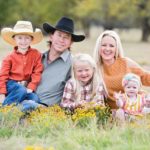
John and Carla Harrison with their children: Addy, Caz and Charlee. – Cross B Photography
They are on the road together, along with the kids, as much as possible. “We’re together constantly,” Carla said. “We did everything together, but now that the kids are in school, I stay home while he takes off.”
The Harrisons have diversified beyond rodeo contract work. They own rental properties in Hugo and Soper, Okla. “I’ve always been an entrepreneur,” John said. And he and Carla realize how the rodeo business works. “We talked about retirement in rodeo, and there is none. (Rentals) are something we could do and be gone.” They also own a liquor store in Hugo.
Each fall since 2007, they’ve produced a Wild West show at the Oklahoma State Fair in Oklahoma City. They aim for top-notch entertainment with good performers. Performers including Vickie Adams, Blake Goode, Vince Bruce, the Riata Ranch Cowgirls, Melissa Navarre, Jerry Wayne Olson, and others have worked the show. John used to trick rope but found it easier to be producer. They are in the same location for eleven days, a switch from being at a new rodeo each week. “It’s a nice break from rodeo after the summer,” John said.
John and Carla were hit with a tremendous blow in October of 2014 when their seventeen month old daughter, Billie, died of kidney failure. It was all sudden. Carla had been in California with her mother, who was going through cancer treatment. She had just flown home, and John had left for a rodeo, when Billie was life-flighted to a hospital in Texas. She died on October 17. Their faith and their rodeo family got them through the difficult time. “You use that term, rodeo family, loosely,” John said. “When we lost Billie, the way the rodeo community came together, it truly touches you in a way that is unexplainable.” Carla’s mom died four months later. “I spent many hours on the phone, crying with my mom,” Carla said, before she passed away. “I asked her, please, when you get to heaven, hug and hold Billie.” It was tough, Carla said, but she is grateful for others. “I want people to know how thankful I am for the love of others, how everyone poured into our lives. Our family, our friends and our rodeo family came in and surrounded us and uplifted us. I can’t tell you how that lifted us.”
Carla’s main job is wife and mother, but she also is an auctioneer. As a child, she discovered her dad’s old auction books and put herself to sleep, practicing. The family lived thirty miles from where they ran cattle, so on the way to and from cattle, he would help her with the tongue twisters and the speed.
She has sold cattle and farm equipment and still does junior livestock auctions, but her niche is benefits, especially the high-end auctions. She flies to California frequently, sometimes selling as few as a dozen items, but all very high-end. If John is free, he goes with her. “People assume he’s the auctioneer, and I get up, and they’re caught off-guard,” she laughs. Auctioneering is much like rodeo. “I want people to have fun, but you have to control the tempo of what’s going on.”
The couple’s children are Addison, age eight, Cazwell, six, and Charlee, who is thirteen months old. Addy is in third grade and learning to trick ride. Caz, a first grader, has a natural sense of humor, and Charlee, their “newest angel on the ground,” was born in November of 2015.
The “Clown Family” moniker came from announcer Jerry Todd. The kids frequently dress in John’s trademark yellow shirts with red fringe, and John loved to rub his red nose on Addy’s cheeks after a performance. Jerry picked her up and said, “oh, look at the little clown baby.” Carla started using the name on Facebook, in a tongue-in-cheek manner. But it’s grown. Last year in Las Vegas during the National Finals, people she had never met recognized them. “I love it, and welcome it,” she said.
They may be a rodeo family, but Carla jokes that she spends more time in vehicles than anywhere else. “I always tell John, we rodeo, but I feel like we really truly drive for a living. I’m always driving.” When they first married, John was reluctant to let her drive, even though she’d grown up driving trailers. He finally relented, in the middle of North Dakota, at night, when no one else was around. Now she drives most of the time, she joked. “So my alligator mouth has overloaded my little hiney. He went from never letting me drive to now, we get twenty miles down the road and he’s miraculously tired,” she laughed.
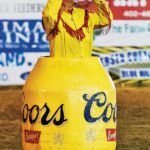
Throughout his career, John has been the PRCA Comedy Act of the Year in 2012, 2014-2015, the Coors Man in the Can in 2014, and has been nominated for either the Comedy Act, the Dress Act, or the Coors Man in the Can awards every year since 2008. This year, he has been selected to work the Wrangler National Finals Rodeo as barrelman.
Through their troubles and blessings, John and Carla hang on to their faith, crediting it with getting them through the passing of their daughter. “Without it, I don’t know how John or I could have gotten through.” They look at the positive in everything. “I try to find blessings along the way, even in the worst of times. I think it’s the only way to keep going.”
Bucking Horses, Bulls awarded for excellence in Pro Rodeo’s Badlands Circuit
Minot, N.D. (October 20, 2016) – They are the silent dance partners in rodeo, and they’ve won themselves some accolades.
Four bucking horses and two bucking bulls have been awarded Animal of the Year and Animal of the Finals in the RAM Badlands Circuit.
Bareback Horse of the Year was given to Sutton Rodeo’s American Graffiti.
Bareback Horse of the Badlands Circuit Finals was awarded to Korkow’s En Vogue.
Korkow Rodeo’s bareback horse En Vogue, ridden by Mike Fred, is a five-year-old mare, out of a Wrangler National Finals Rodeo horse Vogue. Photos by Peggy Gander/Cowboy Images.
Saddle Bronc of the Year was won by Sutton Rodeo’s South Point, and Saddle Bronc of the Finals went to Korkow’s Duck Butter.
Bull of the Year was given to Sutton’s Tea Time, and Bull of the Finals went to Bailey Rodeo’s High Maintenance. Drew Antone rides Sutton Rodeo’s Tea Time at the 2016 RAM Badlands Circuit Finals Rodeo in Minot. The white and yellow bull repeats as the Bull of the Year for the RAM Badlands Circuit. Photo by Peggy Gander/Cowboy Images.net
American Graffiti, the Bareback Horse of the Year, is a nine year old paint mare the Suttons of Onida, S.D., purchased from Steve Waagen of Bottineau, N.D. The mare “isn’t an eliminator,” Steve Sutton said, “but she’ll test you. You have to have your A game going and she’ll give you hers, and you’ll usually go to the pay window.”
The Suttons won Saddle Bronc of the Year with their ranch-raised nine-year-old bay gelding named South Point. South Point started his rodeo career as a saddle bronc horse, was switched to the bareback riding, and is now back to the saddle bronc. Cole Elshere, Faith, S.D. and Chuck Schmidt, Keldron, S.D., both had first place finishes on the gelding during the second and fourth rounds of the Badlands Circuit Finals October 6-9.
Korkow Rodeo’s bareback horse En Vogue, ridden by Mike Fred, won the Bareback Horse of the Year for the Badlands Circuit. The horse is a five-year-old mare, out of a Wrangler National Finals Rodeo horse Vogue. Photo by Peggy Gander/Cowboy Images. Korkow Rodeo’s five year old mare En Vogue won Bareback Horse of the Finals. The striped-face chestnut didn’t make the trip to the Northwest rodeos with TJ Korkow but stayed closer to home with TJ’s dad Jim Korkow, at rodeos in Aberdeen and Sioux Falls, S.D., Hastings, Neb., and others. The mare bucked off two riders at the Badlands Circuit Finals, TJ said. “She circles right in front of the chutes to the left, getting in the air, kicking, bobbing her head, and curling her feet. She’s an ideal bareback horse. She looks cool when she bucks. When she bucked off Andy (Hall) the other night (at the Circuit Finals), she stood in one spot, jumped in the air, and kicked and curled her feet, doing it time and time again. She’s pretty cool.”
Korkow Rodeo’s Duck Butter won Saddle Bronc of the Finals. The seven year old gelding is a small horse, TJ said, about 950 lbs., but “he bucks big. He leaps in the air and he takes a pile of rein. He bucks with his head down, but he’s leaping in the air at the same time, and he kicks. It’s a pretty cool style, and he’s pretty flashy.” Shorty Garrett won first place on Duck Butter during the fourth performance of the Circuit Finals.
For High Maintenance, the Bull of the Finals, it was his second year of rodeo competition. The four year old red and white bull was purchased by Bailey Pro Rodeo as a calf from Nebraska. He was unridden in 2016, including two rides on him at the Badlands Circuit Finals, said Kelly Klein part owner of Bailey Pro Rodeo, and only two bull riders made qualified rides on him in 2015 (Brett Stall and Zac Peterson, both at PBR events.) “He kicks straight up and down, out of the chute, then turns back about two jumps, and goes to spinning,” Klein said.
Sutton’s bull Tea Time, who won Bull of the Year, also won the same award last year. Bull riders that make the eight second buzzer on him are usually a lot of points, Sutton said.
Animals were voted on by the contestants in their respective events.
The RAM Badlands Circuit Finals Rodeo was held October 6-9 in Minot, N.D., and was hosted by the Minot Y’s Men’s Rodeo. Year-end and average champions were determined in each event, and qualify to compete at the RAM National Circuit Finals Rodeo in Kissimmee, Fla., in April 2017. For more information on pro rodeo, visit the website at ProRodeo.com. For more information on the Badlands Circuit, visit MinotYsMensRodeo.com.
Troy Heinert takes care of cowboys and constituents. In rodeo, the Mission, S.D. man works as a pickup man, and in the world of politics, he is a senator in the South Dakota State Legislature.
He grew up on the family ranch west of Mission, the son of Margo and the late Harold Heinert. When he was twelve, his dad died, and his mom moved the family to Pierre.
In high school, Troy team roped and rode bareback horses, and continued the bareback riding while in college at Black Hills State University in Spearfish, S.D., and at Sinte Gleska University in Rosebud. He graduated with a bachelor’s degree in elementary education and taught school at Rosebud Elementary for ten years, all the while competing in the PRCA and at Indian rodeos.
Troy’s dad Harold and stock contractor Jim Korkow were best of friends, and when Harold passed away, Jim said, “you’re my boy now,” Troy said. “He never treated me any different than he treated TJ (Jim’s son.) If TJ got a twenty (dollar bill), I got a twenty.”
It was through Jim that Troy began picking up. He started with 4-H and high school rodeos, working through the summers for Korkow Rodeo. After he quit riding barebacks twelve years ago, he picked up more steadily.
He works many of the Korkow Rodeos, along with rodeos for Stace Smith, Three Hills Rodeo, and Wilson Rodeo. He’s been selected to pick up the Indian National Finals Rodeo five times, and was chosen this year to work the Badlands Circuit Finals Rodeo in Minot, N.D. this month.
He loves picking up. “It’s as close as you can get to a bucking horse without having to get on them anymore. It’s fun, especially when you know the horses and you can put yourself in a position to help the guys make good rides, and help that horse buck, and see a match-up click.”
He loves spending time with the bucking horses. “To be around them, to sort, feed, truck them, learn their personalities. They learn your voice, and if a horse is throwing a fit in the chute I can ride up to it and start talking to it, and you can see them pay attention and stand up.”
Four years ago, Heinert ran as a Democrat in the 26th District, for the S.D. State House of Representatives. He won, served a two year term, then ran for state senator in 2014. He won that election, and is running again this fall, unopposed.
He feels he has met a lot of his goals as a representative for his district, which is predominantly Native American. He is a member of the Rosebud Sioux tribe, and it is important for him “to be a voice for Native Americans and cowboys,” he said. “My district has three reservations in its boundaries, and we don’t have many opportunities for a voice. I have a lot of people depending on me to be that voice, and I’ve been able to do that, and to get people to understand some of the issues we see on the reservation, to see why things are the way they are, and what they can do to help.”
As a senator, he is able to show people unfamiliar with Native Americans and reservations what it’s like. “I think, even in South Dakota, there’s a lot of people who just don’t know what our healthcare system is like, what our education system is like, what poverty looks like, and the different relationships the tribes have with state and federal governments.”
He is very proud that he was able to pass an Achievement Schools Grant program, which allows public schools to apply and create a cultural school for Native American kids in the district. “That’s the first time it’s happened in South Dakota,” he said.
Being a cowboy in politics is also an advantage. “There are some farmers and ranchers in the legislature, but when it comes to ag issues, even something in transportation and trucking, it helps to have that background knowledge of what it means to load a truck and go down the road.”
Heinert is the Senate Assistant Minority Leader; fellow cowboy Billie Sutton, a former saddle bronc rider, is Senate Minority Leader and has been a part of South Dakota politics for the last six years. Heinert credits Sutton with helping him get his feet under him in politics. “I had a great mentor in Billie. He had been there a while, and he knew the ins and outs, and that gave me a head start.”
He is married to Gena; they have three children: sons TJ, who is 22, and Harold, who is ten, and a daughter, Jordan, who is 21.