ProRodeo being back in action Memorial Day weekend for competition is one of the topics PRCA CEO George Taylor discussed with The Cowboy Channel in an interview Saturday.
Taylor talked about COVID-19 pandemic ground rules that will have to be followed when PRCA rodeos return.
“We’re going to have to really take that responsibility seriously as we begin to rodeo again, so that nobody stops us, even though we are frustrated with a lot of those things,” he said. “It’s really going to be about where we use masks, how we disinfect, how we compartmentalize different production personnel and really strive to keep ourselves safe so that we don’t have any COVID instances as a result. Probably one of the biggest things is we will have to screen our contestants at Cave Creek as we get ready to go there.”
Cave Creek (Ariz.) Rodeo Days is May 22-24 and will air live at 10:30 p.m. (ET) each night on The Cowboy Channel. Fans will not be permitted at the rodeo.
Moving forward, fans are expected to be able to attend rodeos at Woodward (Okla.) Elks Rodeo (June 10-13) and Strawberry Days Rodeo in Pleasant Grove Utah (June 17-20).
“Relative to the rodeos we expect to have fans, they will be at reduced capacity, those rodeos (Woodward, Okla., and Pleasant Grove, Utah), in addition to Springfield (Mo., May 29-30), have been given some initial approval to have fans, which really changes the experience for the contestants and everybody watching on television, so it will be a great addition,” Taylor said.
RodeoHouston was canceled before completion because of the COVID-19 pandemic, but the PRCA is going to complete the rodeo with the Finishing Super Series Rodeos, May 29-31, in Fort Worth, Texas.
“This will not be the RodeoHouston we all know and love, but we will really be finishing up the Super Series from RodeoHouston, which is about seven performances,” Taylor said. “We’re going to broadcast that on The Cowboy Channel, obviously, and we are going to do it from Fort Worth, which is a little bit different, RodeoHouston from Fort Worth. So, we’re excited about that, and we have had great support from the mayor’s office in Fort Worth. It will be right in the backyard of Rural Media Group.”
Taylor also spoke about the numerous payouts remaining in the season.
“The most exciting thing I can tell you is while it seems like we’ve missed a lot of rodeos, we still have about 90% of the payouts left in the season,” Taylor said. “So, while we have had 137 rodeos canceled, we have a lot on the board, and we have 50 to 55 in June that are currently scheduled and 100 on the schedule for July. That time that we are coming up to is really important and as we’re looking at this, a lot of the contestants are asking if we need to extend the season? What are we going to do about rodeo counts and all that type of stuff. Because of the numbers I just said, we’re going to wait no later than July 1 before we can tell everybody what we are planning to do for the full year.”
PBR Monster Energy Team Challenge to Be Televised on CBS and CBS Sports Network
PUEBLO, Colo. (May 17, 2020) – PBR (Professional Bull Riders) has announced a new 40-hour televised team competition that will run from June 5 – July 12, beginning at South Point Arena in Las Vegas, Nevada. The competition will then culminate in a championship weekend that will welcome fans to ticketed events at the Denny Sanford PREMIER Center in Sioux Falls, South Dakota July 10-12.
The PBR Monster Energy Team Challenge will feature 48 of the world’s top professional bull riders split into 12 teams and two divisions, facing off until two teams remain to compete for the championship. The competitions each Friday and Saturday will be televised on CBS Sports Network with a “Game of the Week” broadcast on CBS Television Network each Sunday. Every night of competition will feature three “games,” where each game will comprise a head-to-head matchup of three riders from one team against three riders from another on the sport’s toughest bulls.
The first four weekends of the team challenge in Las Vegas will be closed-to-the-public on June 5-28 using the safety protocols PBR debuted during three previous event weekends in April and May, including a scaled-down crew, medical testing, functional separation and social distancing.
Championship weekend in South Dakota will be held in front of fans July 10-12. To help ensure a safe environment for fans purchasing tickets, event partners Denny Sanford PREMIER Center, the City of Sioux Falls, South Dakota Governor Kristi Noem and PBR will institute a new series of safety protocols, including mobile ticketing, staggered POD seating, re-routed in-arena traffic flow, social distancing guidelines, enhanced disinfecting and cashless concessions options.
The event will include activation of ASM Global’s “Venue Shield”– an advanced environmental hygiene protocol that will be deployed in more than 325 ASM facilities around the world. ASM Global, which manages Denny Sanford PREMIER Center, is the world’s leading venue management and services company. Venue Shield, which reduces physical touch points, increases venue sanitization and cleanliness, and provides various health monitoring guidelines and services, will be combined with PBR’s newly announced “Be Cowboy Safe” protocols for live events.
The guidelines and protocols in place at the Denny Sanford PREMIER Center will include:
– To increase physical distancing, tickets available to the public for only approximately 35% of the capacity for PBR events at the arena.
– POD seating that separates fans with a minimum four- to six-foot buffer between ticketed seats and minimizes the potential for crossover for fans entering and exiting their seats.
– Complimentary facial coverings for fans entering the venue.
– More efficient “top to bottom” exit following the event to reduce aisle, hallway and exit congregation.
– Mobile ticketing to replace traditional printed tickets.
– Increased reliance on cashless, contactless concessions with prepackaged food available for sale.
– Social distancing guidelines and monitoring at restroom and concession areas.
– Limiting the number of fans who may enter and occupy restrooms at any time.
– Regular medical testing/screening for all staff as they enter the venue.
“South Dakota is working to get back to normal, and that includes the return of sports at the proper time,” said Governor Kristi Noem. “South Dakotans have been smart and innovative in responding to this crisis, and the plan for the Denny Sanford PREMIER Center shows that we can reopen arenas in safe and innovative ways. We commend ASM Global and PBR for their careful planning and will continue to work with them to ensure the safety of their fans.”
“After successfully holding closed events in Oklahoma that utilized a comprehensive wellness and safety plan now being reviewed by other leagues, we have added protocols to provide fans a secure place to enjoy a new exciting team format,” said PBR Commissioner Sean Gleason. “We want to thank our fans for their patience and cooperation, as well as our venue, city and state partners, including Governor Kristi Noem, for collaborating on these measures for bringing this new team tournament in front of fans in an environment they’ll be comfortable in.”
“We are proud to partner with PBR and excited about the addition of a team-based format to the world’s best bull riding circuit. This new competition series will provide a platform for established and upcoming talent to shine in the spotlight, and we look forward to a successful PBR Monster Energy Team Challenge,” said Mitch Covington, Senior Vice President of Sports Marketing at Monster Energy.
In the team challenge, every team will have played six regular season games after four weeks. The teams with the top three records in each division will make the playoffs, with the regular season division champion earning a first round bye. Championship weekend – a single elimination bracket – will feature wild card matchups on Friday, the semifinals on Saturday, and Championship Sunday broadcast on CBS Television Network, with the consolation game on CBS Sports Network.
The Monster Energy Team Challenge Championship Weekend at the Denny Sanford PREMIER Center will begin at 7:45 pm on Friday, July 10, 6:45 p.m. on Saturday, July 11 and 1:45 p.m. on Sunday, July 12.
Tickets for this event will go on sale for PBR Rewards members on Monday, May 18 and for the general public on Friday, June 5, and can be purchased on PBR.COM, Ticketmaster.com, and at the KELOLAND box office. Ticket prices start at $15.
PBR’s most recent Unleash The Beast ticketed event for fans was in Little Rock March 6-7, 2020. When restrictions on mass gatherings from COVID-19 (Coronavirus) were put into place, PBR held closed-to-fans events for television in Georgia March 15-16, and at the Lazy E Arena in Oklahoma April 25-26 and May 9-10 with a comprehensive safety plan approved by three layers of government.
PBR will announce in the coming weeks further competition details and rosters for The PBR Monster Energy Team Challenge, which will not offer individual riders’ points toward the 2020 world standings.
PBR will handle all production for these events, which are subject to change depending on developments with Covid-19.
Mason Taylor Wins Round 1 of PBR’s Historic Third Closed Unleash the Beast Event in Oklahoma
Three-time World Champion Silvano Alves further solidifies record, Derek Kolbaba snaps buckoff streak, and world No. 1 Jose Vitor Leme falters
GUTHRIE, Okla. – At the historic third closed-to-fans PBR (Professional Bull Riders) Unleash The Beast event inside Lazy E Arena in Logan County, Oklahoma, the world’s Top 35 bull riders continued to pioneer the return of professional sports in an empty arena on a night where the bovine athletes reigned supreme.
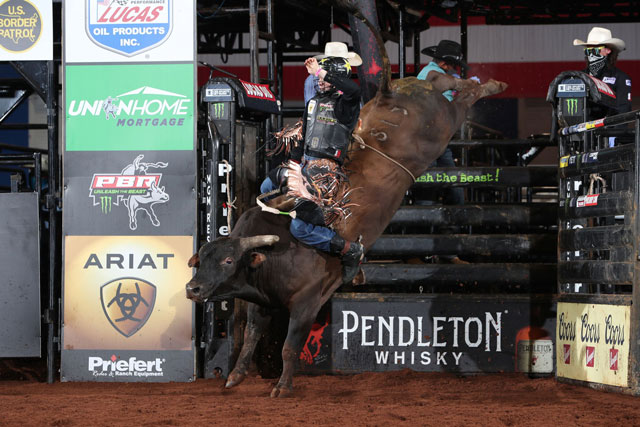
With bull power in full force, only six cowboys recorded qualified rides on the opening night of the two-day PBR Lucas Oil Invitational, presented by U.S. Border Patrol.
Compliments of his 88.75-point score aboard Hell on the Red (Bill Henson/Gene Owen), young gun Mason Taylor (Maypearl, Texas) won Round 1.
For photos from Round 1, click here. All images are courtesy Andy Watson/Bull Stock Media.
The ride marked Taylor’s second round win of the 2020 season and also snapped a three-out buckoff streak for the 20-year-old. He earned $3,750 and 20 world points.
After beginning the event No. 17 in the world, the Texan climbed one position to No. 16.
In Round 2, Taylor will face a familiar opponent, set to attempt God’s Country (Owens/Wyatt/Smith) for the second time in his career.
When the duo first met last weekend at the Lazy E, God’s Country bested Taylor in a swift 4.71 seconds.
Three-time PBR World Champion Silvano Alves (Pilar do Sul, Brazil) further etched his name in the PBR record books tonight, courtesy of his 82.5-point, fifth-place ride aboard Sidewinder (TNT Bucking Bulls/Hart Cattle Co.) in Round 1.
The 8-second effort marked the Brazilian veteran’s 414th career ride on the elite Unleash The Beast.
After surpassing two-time PBR World Champion Chris Shivers (Jonesville, Louisiana) for fifth-most rides all-time last weekend, Alves is now within 15 rides of tying Valdiron de Oliveira (Balcimo, Brazil) for fourth in the league history books. Shivers logged 412 rides in his career, while Oliveira reached the 8-second whistle 429 times.
PBR’s 2008 World Champion Guilherme Marchi (Tres Lagoas, Brazil) leads the league with 635, followed by two-time World Champion J.B. Mauney (Statesville, North Carolina) with 528, and 2004 World Champion Mike Lee (Decatur, Texas) with 525.
Alves’ latest ride netted him seven world points, propelling him from No. 49 to No. 42 in the world.
In Round 2 of the PBR Lucas Oil Invitational, presented by U.S. Border Patrol, Alves will attempt Bullseye (Owens/Wyatt/Smith/Mears). After propelling Alves’s countryman Fabiano Vieira (Perola, Brazil) to the event victory at the first premier series event held inside Lazy E Arena in late April, Bullseye got the best of Lucas Divino (Nova Crixas, Brazil) last weekend.
The opening night of PBR’s final event at the Lazy E to finish a three-weekend stand also featured a breakthrough performance from phenom Derek Kolbaba (Walla Walla, Washington).
Kolbaba snapped a five-out buckoff streak in riding Caddy Black (Owens/Wyatt/Smith) for 81.75 points to finish sixth in the opening round.
Kolbaba earned six world points, maintaining his No. 19 ranking.
World No. 1 Jose Vitor Leme (Ribas do Rio Pardo, Brazil) was not among the contingent celebrating the evening’s six qualified rides.
Leme was bucked off by rank, high-kicking M.A.G.A. (TNT Bucking Bulls/Hart Cattle Co.), in an uncharacteristic 1.84 seconds.
As he looks to redeem himself on Championship Sunday, the former semi-professional soccer player will attempt a bovine athlete in a high-profile rubber match.
Leme will face Blue Crush (Cord McCoy/Chad Reese) for the third time in his career. With both their outs on record taking place at the annual January Unleash The Beast event in Chicago, Leme first rode Blue Crush for 87.25 points in 2019, before being bucked off in 5.61 seconds this season.
Rookie of the Year contender Amadeu Campos Silva (Atair, Brazil) was second in Round 1, earning $2,500 and 10 world points, after completing an 87.5-point trip aboard Real Gun (Cord McCoy/Graber/Gallagher).
Climbing one position in the world standings, now No. 30, Silva will attempt Honey Man (D&H Cattle Co./Buck Cattle Co.) in Round 2 as he seeks his first premier series event win.
Third was Alex Cerqueira (Iguatemi, Brazil).
As the first rider to log a qualified ride, Cerqueira covered Spit Out The Bone (Cord McCoy/Double R) for 84.75 points to net $2,000 and nine world points.
The 8-second effort marks the second time Cerqueira has been able to cover the bovine athlete. The duo first squared off this January when Cerqueira reached the whistle for 85.5 points at the Touring Pro Division’s Cowtown PBR in Fort Worth, Texas.
Cerqueira’s performance allowed him to gain ground in the world title race. Ahead of his Round 2 matchup against Danny Boy (D&H Cattle Co./Gordon/OK Corralis), the 27-year-old rose from No. 48 to No. 41 in the world.
Rounding out the Top 5 in fourth was Divino, riding Eye of the Storm (McCoy Ranches) for 84.25 points.
Nabbing a paycheck for $1,250, along with eight world points, Divino maintained his world No. 12 rank.
The PBR Lucas Oil Invitational, presented by U.S. Border Patrol, will conclude with Round 2 and the championship round on Sunday, May 17. CBS Sports Network and RidePass’ LIVE coverage of Round 2 will begin at 11:30 a.m. ET.
Starting at 2:00 p.m. ET, CBS Sports will televise the championship round LIVE, as PBR’s historic trio of events concludes inside Lazy E Arena, utilizing a health and safety plan that has been reviewed by more than a dozen other sports leagues and organizing bodies.
Fans can relive all the action from Round 1 of the PBR Lucas Oil Invitational, presented by U.S. Border Patrol, starting at 8:00 a.m. ET on Sunday, May 17, on RidePass at RidePass.com or via the mobile app.
PBR Unleash The Beast
PBR Lucas Oil Invitational, presented by U.S. Border Patrol
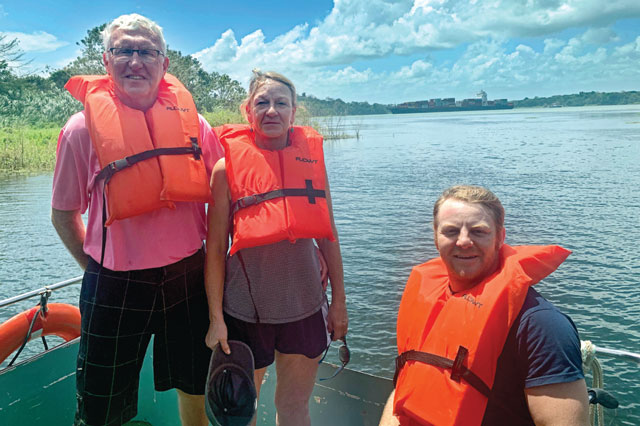
When a storm comes upon you what is your first reaction? Do you think of the worst possible outcomes? Do you turn your nose up and act like it’s no big deal? Do you get fearful and start to worry? Do you stay calm and rely on the Lord? All of these can be normal responses for any person but I want to take a look at how the disciples reacted during a storm they faced and how Jesus responded.
“Then Jesus got into the boat and started across the lake with his disciples. Suddenly, a fierce storm struck the lake, with waves breaking into the boat. But Jesus was sleeping. The disciples went and woke him up, shouting, “Lord, save us! We’re going to drown!” Jesus responded, “Why are you afraid? You have so little faith!” Then he got up and rebuked the wind and waves, and suddenly there was a great calm. The disciples were amazed. “Who is this man?” they asked. “Even the winds and waves obey him!””
Matthew8:23-27
Jesus had been teaching a crowd from the lake. When it started to get dark he told his disciples to get on the boat and go to the other side with him. As they were crossing the lake a ferocious storm built up and settled over them. Violent winds and waves began crashing the boat tossing it around like a rag doll.
Before the storm Jesus had fallen asleep. As the storm raged he remained asleep. The storm had not woken him yet. The storm was so violent the disciples began to get scared they might end up shipwrecked. They panicked. They grew fearful for their lives.
They ran to Jesus shouting at him to wake up and save them. They were fearful they were going to drown. He replied with “Why are you afraid? Why do you have such little faith?” He got up from his nap and calmed the storm at once.
Have you ever felt like Jesus fell asleep during your storm? Maybe you were hanging on for dear life while everything seemed to be falling to pieces all around you. During this whole Corona Virus outbreak maybe you have been laid off from work. Maybe your business has been shut down. Maybe you have been fired and aren’t sure what your next job will be or how you’ll provide for your family. Maybe you lost your job, your car broke down, and the doctor diagnosed you with an outcome that has you scared for your life.
There are many storms in life. What is important is to remember who is in the boat with you. The disciples didn’t particularly see this storm coming. All seemed calm. Jesus fell asleep. Next thing they knew they were being tossed around viciously by the storm. Like many storms in our life. They come out of nowhere when we least expect it. All seems good, usual, on track, then bang, life is turned upside down.
Jesus didn’t cause the storm. God doesn’t cause storms in our lives. Sometimes though, God allows storms to take place in our lives. The disciples ran and shook Jesus awake in their terror. Sometimes God allows the storm to rattle our cage long enough until we have no other choice but to run to him. He wants us to urgently call out to him. To completely trust and rely on him, and give him the opportunity to show his glory in our lives.
The disciples went to worst case scenario thinking. They thought they were going to die. But what did they do? They ran to Jesus and woke him up. They cried out to Him, “Lord save us!”
It says that Jesus woke up and rebuked the storm. Immediately, the wind and waves became perfectly calm. When they cried out to Him in their desperation, He responded.
Often times we grow fearful of the storm and think worst case scenarios. “They’ll turn down my application.” “My business will go under.” “There’s no way my marriage can be fixed.” “My child is to far gone and can’t be saved.” “There’s no way I can be healed.”
You see, we’re not in control. God is, and in one command, He can calm the raging sea. In an instance he can stop the storm. In a matter of seconds he can turn chaos into calmness.
Jesus won’t let us sink. He’ll always provide when we call out to Him. It may not be the way we want, and there may be situations we have to row through, but when we call on His name, we can know that He’s fully awake to our situation and that He can and will intervene on our behalf. He’s always with us and He hears our prayers.
Even if your faith is small, pray big prayers. You can trust him and rely on him too calm the raging sea in your life. God is always in your boat!
The Douglas County Fair Board and County Staff are working diligently with health and government officials in efforts to produce another great Fair & Rodeo (Castle Rock). This year marks the 102nd celebration and even with challenges presented by COVID-19, it will be a celebration nonetheless, honoring the heritage and community tradition of Douglas County. As we move ahead with preparations for the 2020 Douglas County Fair & Rodeo (Castle Rock); the health and safety of our entire community is our highest priority and the Colorado Public Health Orders will continue to guide our direction in the coming months. Please check our website for updates DouglasCountyFairAndRodeo.com
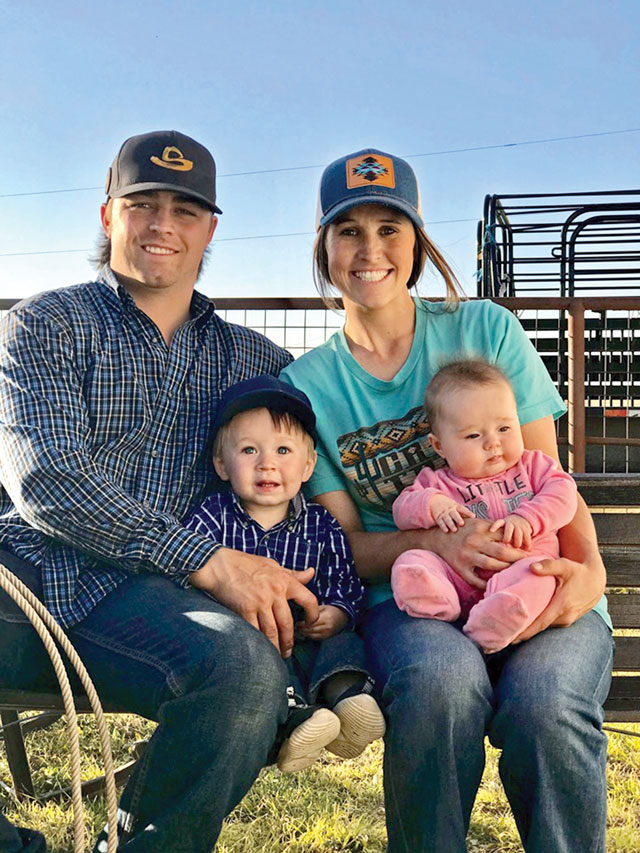
May is a special month with an entire day dedicated to the hard-working, resilient women in our lives we call mothers. My name is Chaney Larsen, and I am blessed to have the title of momma to two amazing little boys. Charlie Russell is my ornery, but sweet four year old, and Waylon Weldon is just three months old.
I think God gave me boys because he knew I couldn’t handle being a girl mom. I’m not so good at fixing hair or the many things a girl mom can do. I also grew up with four cowboys that helped prepare me for the many adventures of being a boy mom. Their names might be familiar to some of you, my dad, Craig Latham, and the Etbauer brothers, Robert, Danny, and Billy.
I was fortunate to get to travel with them on several occasions during my youth. The most memorable trip was probably the plane ride to Greeley, CO when I was about eight years old. We had lots of snacks on board and let’s just say pop tarts and plane rides don’t mix. Billy held the throw up bag while I got sicker than a dog.
Some of the greatest times of my childhood was on the rodeo trail with this crew, and I hope to raise my boys in the same fashion as they rode broncs – to give it my all, be genuine, and ultimately help them be the best they can be.
The rodeo cowboy has multiple layers and many of them go unseen during the span of a rodeo athletes career. They carry the weight on their shoulders to make the next dime and keep up their craft, but it’s their other half, their wives, that are the backbone of the family – working hard at the home place, taking care of the children, and ultimately doing all of the things a single parent would do while their husbands are on the road the majority of the year chasing that gold buckle dream. Hang in there mommas, you’re doing an outstanding job and it’s all worth it. (Thanks mom for everything you did for my sister and I.)
My husband, Tyrel Larsen, has been working on his dream for a while now in the saddle bronc riding. He’s found success on all levels with winning the collegiate title in 2012 and making it to his first NFR in 2015. Due to injuries, it’s been put on hold the last few years, and this year has definitely been a strange one with the given circumstances of the global pandemic. However, there is always good with the bad, and it has allowed rodeo athletes to be home and spend quality time with their families.
“A person’s own family is, without a doubt, the greatest wealth that we will ever possess. Treasure every moment and take the time to ensure that the story you create is one that you will be proud of and look back on with a huge smile.” I know from a wife and mother’s perspective, this time together is everything and means so much, especially with a newborn.
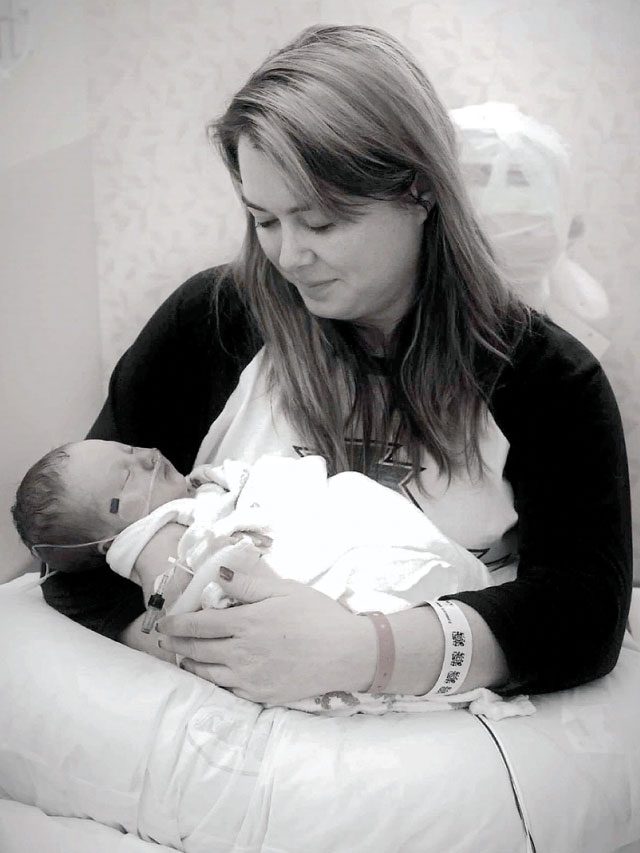
Our son, Waylon, was born on February 28th this year, right before things took a turn with the virus. His journey into this world was extraordinary, and bless his heart, he has been a little warrior from the start. At my 18 week ultrasound, on my husband and I’s 4th anniversary, we received the news that our unborn son has a condition called spina bifida, a term we had never heard before.
Spina bifida is when the spinal cord develops outside the baby’s body and can cause neurological and physical handicaps, and in Waylon’s case, with the size of the lesion a possibility of not being able to walk. The doctor told us that most parents terminate the pregnancy when they are given this diagnosis, but my husband and I never gave it one thought. If God blessed us with this baby we were going to do everything in our power to give him the best life possible.
Johns Hopkins hospital in Baltimore, Maryland, specializes in fetal surgery to repair the opening while the baby is still in the womb. Truly incredible. Thankfully both Waylon and I passed all of the tests to be able to do surgery giving him a better chance of having a brighter outcome, and the surgery took place on December 10th. He was only 25 weeks old.
Today, Waylon is doing phenomenally well, there is still no movement in his right leg, but we know that he is a warrior with cowboy grit and determination. Through the grace of God our little boy is healthy and here with us, and one day we know he will do great things.
Three-time World Champion Silvano Alves further solidifies record, Derek Kolbaba snaps buckoff streak, and world No. 1 Jose Vitor Leme falters
GUTHRIE, Okla. – At the historic third closed-to-fans PBR (Professional Bull Riders) Unleash The Beast event inside Lazy E Arena in Logan County, Oklahoma, the world’s Top 35 bull riders continued to pioneer the return of professional sports in an empty arena on a night where the bovine athletes reigned supreme.
With bull power in full force, only six cowboys recorded qualified rides on the opening night of the two-day PBR Lucas Oil Invitational, presented by U.S. Border Patrol.
Compliments of his 88.75-point score aboard Hell on the Red (Bill Henson/Gene Owen), young gun Mason Taylor (Maypearl, Texas) won Round 1.
The ride marked Taylor’s second round win of the 2020 season and also snapped a three-out buckoff streak for the 20-year-old. He earned $3,750 and 20 world points.
After beginning the event No. 17 in the world, the Texan climbed one position to No. 16.
In Round 2, Taylor will face a familiar opponent, set to attempt God’s Country (Owens/Wyatt/Smith) for the second time in his career.
When the duo first met last weekend at the Lazy E, God’s Country bested Taylor in a swift 4.71 seconds.
Three-time PBR World Champion Silvano Alves (Pilar do Sul, Brazil) further etched his name in the PBR record books tonight, courtesy of his 82.5-point, fifth-place ride aboard Sidewinder (TNT Bucking Bulls/Hart Cattle Co.) in Round 1.
The 8-second effort marked the Brazilian veteran’s 414th career ride on the elite Unleash The Beast.
After surpassing two-time PBR World Champion Chris Shivers (Jonesville, Louisiana) for fifth-most rides all-time last weekend, Alves is now within 15 rides of tying Valdiron de Oliveira (Balcimo, Brazil) for fourth in the league history books. Shivers logged 412 rides in his career, while Oliveira reached the 8-second whistle 429 times.
PBR’s 2008 World Champion Guilherme Marchi (Tres Lagoas, Brazil) leads the league with 635, followed by two-time World Champion J.B. Mauney (Statesville, North Carolina) with 528, and 2004 World Champion Mike Lee (Decatur, Texas) with 525.
Alves’ latest ride netted him seven world points, propelling him from No. 49 to No. 42 in the world.
In Round 2 of the PBR Lucas Oil Invitational, presented by U.S. Border Patrol, Alves will attempt Bullseye (Owens/Wyatt/Smith/Mears). After propelling Alves’s countryman Fabiano Vieira (Perola, Brazil) to the event victory at the first premier series event held inside Lazy E Arena in late April, Bullseye got the best of Lucas Divino (Nova Crixas, Brazil) last weekend.
The opening night of PBR’s final event at the Lazy E to finish a three-weekend stand also featured a breakthrough performance from phenom Derek Kolbaba (Walla Walla, Washington).
Kolbaba snapped a five-out buckoff streak in riding Caddy Black (Owens/Wyatt/Smith) for 81.75 points to finish sixth in the opening round.
Kolbaba earned six world points, maintaining his No. 19 ranking.
World No. 1 Jose Vitor Leme (Ribas do Rio Pardo, Brazil) was not among the contingent celebrating the evening’s six qualified rides.
Leme was bucked off by rank, high-kicking M.A.G.A. (TNT Bucking Bulls/Hart Cattle Co.), in an uncharacteristic 1.84 seconds.
As he looks to redeem himself on Championship Sunday, the former semi-professional soccer player will attempt a bovine athlete in a high-profile rubber match.
Leme will face Blue Crush (Cord McCoy/Chad Reese) for the third time in his career. With both their outs on record taking place at the annual January Unleash The Beast event in Chicago, Leme first rode Blue Crush for 87.25 points in 2019, before being bucked off in 5.61 seconds this season.
Rookie of the Year contender Amadeu Campos Silva (Atair, Brazil) was second in Round 1, earning $2,500 and 10 world points, after completing an 87.5-point trip aboard Real Gun (Cord McCoy/Graber/Gallagher).
Climbing one position in the world standings, now No. 30, Silva will attempt Honey Man (D&H Cattle Co./Buck Cattle Co.) in Round 2 as he seeks his first premier series event win.
Third was Alex Cerqueira (Iguatemi, Brazil).
As the first rider to log a qualified ride, Cerqueira covered Spit Out The Bone (Cord McCoy/Double R) for 84.75 points to net $2,000 and nine world points.
The 8-second effort marks the second time Cerqueira has been able to cover the bovine athlete. The duo first squared off this January when Cerqueira reached the whistle for 85.5 points at the Touring Pro Division’s Cowtown PBR in Fort Worth, Texas.
Cerqueira’s performance allowed him to gain ground in the world title race. Ahead of his Round 2 matchup against Danny Boy (D&H Cattle Co./Gordon/OK Corralis), the 27-year-old rose from No. 48 to No. 41 in the world.
Rounding out the Top 5 in fourth was Divino, riding Eye of the Storm (McCoy Ranches) for 84.25 points.
Nabbing a paycheck for $1,250, along with eight world points, Divino maintained his world No. 12 rank.
The PBR Lucas Oil Invitational, presented by U.S. Border Patrol, will conclude with Round 2 and the championship round on Sunday, May 17. CBS Sports Network and RidePass’ LIVE coverage of Round 2 will begin at 11:30 a.m. ET.
Starting at 2:00 p.m. ET, CBS Sports will televise the championship round LIVE, as PBR’s historic trio of events concludes inside Lazy E Arena, utilizing a health and safety plan that has been reviewed by more than a dozen other sports leagues and organizing bodies.
Fans can relive all the action from Round 1 of the PBR Lucas Oil Invitational, presented by U.S. Border Patrol, starting at 8:00 a.m. ET on Sunday, May 17, on RidePass at RidePass.com or via the mobile app.
PBR Unleash The Beast
PBR Lucas Oil Invitational, presented by U.S. Border Patrol
Lazy E Arena – Guthrie, Oklahoma
Event Leaders (Round 1-Round 2-Round 3-Event Aggregate-Event Points)
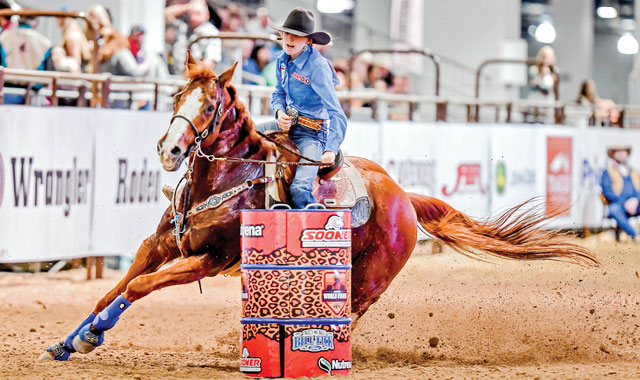
Don’t mess with Brooke Klinger. She’ll take you down.
The 5 Star Equine Products team member has a first degree black belt in karate.
But her true love is barrel racing.
Growing up in Andover, New Jersey, she did trail rides and participated in English and jumping as well as riding a bit of western pleasure. But when she was twelve years old, she saw the barrel racing at the local fair.
It fit her to a “T”. “I like to go fast,” she said. “I loved racing on the trails.”
So, a trainer, Jim Tenhoeve, taught her. She got a faster horse, and began running barrels.
She uses 5 Star Equine products, with two of them her favorites. The saddle pads are wonderful, she said. “I’ve had (other brands of) saddle pads that after a few uses, get really stiff. The 5 Stars are flexible and stay soft. I like how they’re contoured so they fit flatly on the horse’s back. There are no gaps or spaces.” They’ve helped her horses. “They’re never sore.”
She just recently started using the boots for her horses and those are now her favorites. “I love them a lot. They’re not bulky and they don’t let sand in, which is very nice.”
She loves it that she can customize colors for the saddle pads and boots, and she loves the saddle pads. “I have six of them now,” she said. “I just keep adding. I have an obsession with them.”
A 2019 high school graduate, Brooke works for her parents in their three enterprises: her dad’s electrical company, their real estate rental business, and with her dad as he teaches karate lessons. Her dad is the Sensei and she teaches the younger levels while she continues her instruction in the art.
Brooke also gives riding and barrel racing lessons, which she loves. She travels to people’s houses, or students can come to her farm and ride one of her gentler horses. It’s one of her favorite jobs. “I like teaching people what I know and seeing them accomplish things. I like it when they work harder towards their goals, and when I know I was the one able to help them.”
She got her WPRA permit in 2019 and filled it within a few months. This year, she hopes to work towards the title of Rookie of the Year for the First Frontier Circuit.
The family has five horses: King, her first horse; Dancer, her primary barrel and pole horse; Sunny, another barrel horse; Charlie, a five-year-old she acquired last year, and her newest horse, Brownie.
In her spare time, she loves to hunt for pheasant and deer, and she combats the stereotype that New Jersey is full of nothing but cities. “There are a lot of country people here,” she said. “People don’t really know that. They think New Jersey is nothing but city, but where I am, it’s all farmland.”
She is the daughter of Scott and Jackie Klinger.
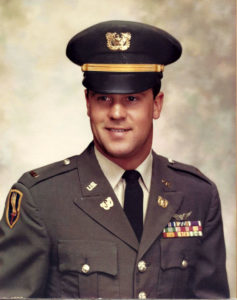
Bill Skavdahl has gotten plenty of adrenaline rushes in his life. Some of them were ones he planned on, like when he rode bulls and bulldogged, and some were unpleasant ones, like when his helicopter was shot down while serving in the Army Air Corps in Vietnam in 1968.
The northwestern Nebraska man was born near Harrison in 1946 to Harold and Ellen (Howard) Skavdahl. His parents were ranchers and had never rodeoed, but Bill loved to ride the milk cow, much to his mother’s consternation. He was a hand with a horse; ranch work at the Skavdahls was done on horseback.
As a freshman at Harrison High School in 1961, he competed at the state finals, held in Harrison. There were no regular season rodeos; anyone who wanted to could compete at the finals, and the top three in each event went on to the National High School Finals. He rode bareback horses and bulls, mostly because the equipment was easy to come by. An old bareback rider bequeathed him a riggin’, and bull ropes were cheaper than horses.
At the state finals, he won second place in the bull riding. At that time, if a contestant qualified in one event for Nationals, they could add two more events in which to compete. So Bill added bareback riding.
Nationals were in Douglas, Wyo., and he caught a ride to them with a friend. He made a qualified bull ride in round one, then made it to the finals, ending up tying for third with Denny Wall from Montana.
Bill Skavdahl spent a year in the Army in Vietnam, where he won the Distinguished Flying Cross twice and a Purple Heart
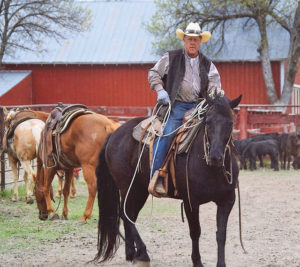
Bill ranches with his three sons near Harrison, Neb. – Courtesy
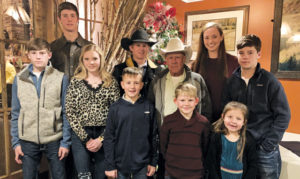
Bill stands with his grandchildren
Third place was a pair of spurs, nice ones, and fourth place was a certificate for a 20X Resistol hat. Bill loved the spurs but needed the hat. “I’d never had a felt hat,” he said, “and I wanted one, so I told (Denny) I didn’t need to flip (for third place prize), I’d just take the hat. I had that hat for a long time.”
As a high school junior, he won second at state in the bull riding again. This time, Nationals were in Tarkio, Missouri, and he chose bareback and saddle bronc riding as his additional events. He rode one of his bulls and both of his saddle broncs, missing the short round by two places in the saddle broncs. He rode one of his bareback horses, but missed out the second horse.
In 1964, four high school regular season rodeos were held in Nebraska, and Bill competed at two of them. At Thedford, he won the steer wrestling and bull riding, finished second in the barebacks, and won the all-around. In Crawford, he won the steer wrestling, bull riding and the all-around again. “I was on a roll for state,” he said.
But in Crawford, he broke his ankle. He was in the chute on a Hollenbeck bull, one that hadn’t been ridden. “The bull threw a fit,” Bill said. He made a qualified ride in spite of the break.
State finals were the next week, and he had a plan. He had won a pair of spurs in Thedford, and he modified one of them for his cast. “I took one of them out to the shop, took a blow torch, heated her up, and fitted it around that cast. I got me some plaster of Paris and baling wire and got that thing fastened on there pretty good.”
The spur worked. He covered his first two bulls, but in the short round, the bull spun to the left. “I had a broken right ankle and that didn’t work out too good,” he remembered. He finished fourth in the state, one hole out of qualifying for Nationals.
After high school graduation, Bill worked on the ranch for his dad. Times were tough, so he decided to go to California. He had an aunt there, and he found a job working for a paving company, making $150 a week. It was a good job, considering it would take a month at home to make that same amount. While in California, he competed at a few rodeos.
He was there for a year when a letter came from his dad. A draft notice had arrived addressed to him in Nebraska, and Bill needed to take care of business. He got a physical in California, and passed it. The draft board told him he’d have to go back home to be inducted.
So Bill went home and talked to a recruiter, asking what his options were. His test scores were good enough that he could choose several things. He wanted to be a pilot.
Basic training was in Louisiana then he was on to flight training at Ft. Wolters in Mineral Wells, Texas and advanced flight training at Ft. Rucker, in Dothan, Alabama.
The Army was short on helicopter pilots, so he volunteered. After more training in Ft. Benning, Georgia, he was one of 52 pilots in the 235th Aviation Co., an attack helicopter company formed by the Pentagon, and on October 10, 1967, he was sent to Vietnam.
The attack helicopter’s main job was to escort the helicopters carrying troops into a landing area and to drive the enemy from the landing site till the men were unloaded. They also provided support fire for ground troops.
Within a month, he was the aircraft commander and the fire team leader. Pilots spent about forty hours a week in the air, and Bill flew 805 missions, over 1,050 hours.
The helicopters rarely went unscathed. At the end of every mission, the bullet holes in the sides were counted and recorded. Bill’s record was 29 holes in one mission.
His helicopter was shot down on April 14, 1968. He and his crew were providing air support as a medivac unit worked to evacuate crews from two downed helicopters. Enemy fire knocked out the tail motor gear box on Bill’s helicopter, and he and his crew knew what was coming.
“The feeling you experience is like that of having a horse fall with you,” he said. “It happens so fast you don’t get scared, you just try to get away.”
The enemy was all over the area, but Bill’s helicopter had hit the ground farther away from the actual fighting. It wasn’t long till another crew was there to rescue them. It was only after he was on the rescue flight that he realized a piece of the helicopter had been driven through his leg. During his time in Vietnam he broke his back, and he received a Purple Heart for being wounded while serving his country. He also was awarded the Distinguished Flying Cross twice, for “heroism or extraordinary achievement while participating in an aerial flight.”
A year to the day that he went to Vietnam, he was sent home. It was October 10, 1968.
He spent another year in the Army, this time at Ft. Carson, Colo., where he and fellow soldiers filled in for the National Guard unit in Kansas City, Mo., as replacements, as the guard members were sent to Vietnam.
While in Colorado, he rode bulls at Canon City and Pikes Peak or Bust, where he got to rub shoulders with bull riding greats like Freckles Brown and Larry Mahan.
He was discharged in 1970, and headed back to the ranch.
By this time, his dad had bought a second ranch, and Bill took over management of it. He married and had three sons: Josh, Jud and Joe, and a daughter, Tomi Jain.
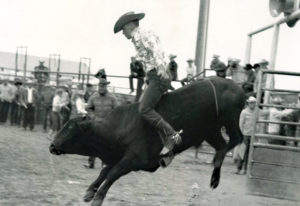
Bill rides a bull at a high school rodeo. This ride would end in a buck off, the first one after thirteen successful rides
Bill Skavdahl – Courtesy
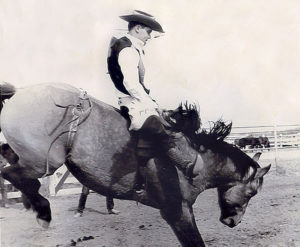
Bill rides a bareback horse in the Nebraska State Rodeo Association in Lewellen, Neb. The hat he is wearing is the one he won for the National High School Finals Rodeo.
He rodeoed a bit, riding bulls at regional rodeos in Nebraska, but he had a family, ranching obligations, and aches and pains from Vietnam. “You borrow a lot of money from the bank (to ranch),” he said, “and you can’t afford to get hurt.”
But there was one more bull ride for him. At the age of 45, in 1991, he got on a bull at the senior pro rodeo in Crawford. He didn’t make the buzzer, but it “felt pretty good. I wanted to get on again. There’s a rush, you know.”
His children didn’t compete in high school rodeo, but Jud, the middle son, rode saddle broncs at county fairs and was on the University of Nebraska-Lincoln rodeo team in the mid 1990s. He continued to rodeo in the Nebraska State Rodeo Association, making the finals several times. But, like his dad, he had a family to support and a ranch to run, so he career wound down, and, again like his dad, he rode his last saddle bronc at age 45, at the senior pro rodeo in Crawford last summer.
All three boys attended the University of Nebraska, and help with the ranch. All three boys live close to each other and ranch and work together, even though their operations are separate. Joe is also a veterinarian at the Torrington (Wyo.) sale barn. Daughter Tomi Kirkland lives in Riverton, Wyo., and is an English teacher. Bill has ten grandchildren.
Last summer, Bill went through another ordeal. He contracted a rare virus called campylobacter fetus, the “human” form of brucellosis in cattle. The bacteria can cause sepsis and localized infections in the brain, lungs, joints, and the pericardial sac around the heart. The virus got him down. He was in Rock Springs, Wyo., to watch a grandson compete at the National High School Finals and felt so poorly he couldn’t get out of the vehicle.
He went misdiagnosed for two months and after a spinal tap, it was a doctor in Casper, Wyo., who diagnosed him. He made a full recovery and is back to feeding cattle and doing nearly everything he used to do.
He, son Jud, and grandson Jack, a saddle bronc rider, all wore the same chaps as they competed. Bill purchased the “Jim Shoulders” brand out of a catalog in 1963 for $44, which “was a lot of money then,” he said.
And one of his fondest memories was from the 1961 National High School Finals. He was the last bull rider for the evening, and the crowd roared when he made the buzzer. “I can remember the crowd was thunderous,” he said. The ride “was a crowd pleaser.”
His mother gave her sons advice when they were growing up. There were two things they were not allowed to do: ride bulls and join the service. Bill did both, and loved it.
Surrounded by his children and grandchildren, Bill’s life has been full and happy. He has served his country, has four children, kept a ranch going into the next generation, and rodeoed. The patriarch of the family is well-loved and is doing what he loves: ranching, working, and enjoying his kids and grandkids.
COVID-19 has wreaked havoc on the entire world, and the rodeo industry isn’t exempt. From contestants to contractors to committees, they’ve all been forced to adapt, since the nation was shutdown, starting in mid-March. For bareback rider Kaycee Feild, it took a bit to adjust to the new routine before he could switch roles. “I got lost for a few days,” he said. “My (rodeo) goals were unattainable, and I didn’t do a whole lot for about a week.” Then his focus shifted to being home.
At home in Spanish Fork, Utah, the four-time world champion has done projects around he and Stephanie’s house: welding, building, and grilling.
“I started to build a tack shed,” he said. “Growing up as a kid, we had a tack shed, and I spent a lot of time with my dad in it. So, not having one for the last decade, I’m building one and it’s bringing back a lot of memories.”
He’s spent more time with his kids, too. Elder daughter Chaimberlyn, who is seven years old, is always busy with something. “I have to saddle her horse every day,” Feild said. “She likes going on picnics, or doing puzzles or playing with my wife.” The couple’s son, Huxyn, is four, and is all about dirt bikes. “He’s a dirt bike kid. He’s on it all day, every day. He’s worn out two rear tires this spring.” Third child Remi, a daughter, is eighteen months old.
Time at home has also given Feild an opportunity to work with a few of his sponsors, including Power Pro (www.pwrprocbd.com) and Gel Blasters, a toy gun that shoots orbeez.
Feild thinks that when rodeos start back, competition will be tougher than ever. He and a few bareback riding friends are organizing a practice session with money up for grabs, to get in tune for rodeos.
“A lot of guys are on the same playing field right now, so when it opens back up, rodeo will be the best you’ve seen. There’s a limited amount of time to get to the (Wrangler National) Finals so you’ll see who wants it.
The COVID-19 break has been good for him, physically. “This has put two years on the end of my career,” he said, “to be able to give my body a break this time of year, being able to stay home.”
Wyatt and Leslie Casper with their two children – Courtesy
Leslie Casper, wife of Wyatt Casper (OTT in Rodeo News March 2020) had their second child this past December. “We were able to go a little in the winter and spring with him but it just wasn’t a fun time with a month old and a 13 month old,” she said. “It’s pretty nice to have help with the kids every day all day long. Cooper our 18 month old really LOVES having his daddy home, it’s going to be very hard when rodeos finally kick back up.”
For Binion Cervi, the worldwide pandemic is a double whammy. Not only has it forced the cancelation of pro rodeos for the stock contractor and his brother, Chase, but it has devastated the cattle markets.
The Cervis own and operate a feedlot near Greeley, Colo., and with cattle ready to be harvested, JBS Packing was closed due to the virus. (It has since reopened).
Like Feild, Binion is using the unexpected time at home to do projects that don’t get done when rodeos are in full swing.
“We’re doing everything you usually push to the side: upgrading fences, the ranch, headquarters, we’re doing all that.” They’ve been able to keep their rodeo employees working at the ranch. “The people who would normally be on the road, they’re at the ranch helping us, so we can make sure they have a job.”
When rodeos begin again, Cervi thinks things won’t be the same. “This changes people, and there will be caution in the world, even when everything is cleared to go. Some people will be blazing trails, some will go cautiously. I think you’ll see people with masks on at rodeos, and you’ll see people who don’t care. Everybody’s going to react to it differently.
The pandemic has shifted the way Cervi thinks, as it has for a lot of people. “This is such a reality check for every human in the world. It’s a dose of reality, that nobody controls anything in life.
Binion Cervi – ImpulsePhotographyMB.com
“This is the real world, and we all get caught up in going so fast, on a personal level, that it’s like, this tells you what is important in life. It’s like God waking you up. There’s more to life than rodeo, there’s more to life than always building a business. That’s the biggest blessing I’m getting, that our whole family is getting.”
The Franklin (Tenn.) Rodeo, didn’t have a choice when it canceled.
Set to be held May 14-16, executive director Bill Fitzgerald didn’t think the long-running rodeo would be shut down.
“For the longest time, I tried to play it off, to say this was going to go away. Then, as it got closer, the government was changing the way we did things. We couldn’t have our meetings, and I was starting to get nervous, like, how am I going to communicate with my committees, with my volunteers, with my people?”
The rodeo is held at the county-owned Williamson County Ag Expo Center, fifteen miles south of Nashville.
“The county actually shut the facility down, and that made the decision (to cancel),” he said. The building is closed through the end of May.
The cancellation was made on March 23, seven weeks before the start of the rodeo, which meant the committee hadn’t spent much money yet. “We weren’t out a lot, because we hadn’t gotten to that point yet,” Fitzgerald said.
He believes that next year’s crowds will be even better because they missed this year’s rodeo. “I honestly believe that folks love the sport of rodeo, and they’re going to come. The fans in middle Tennessee want to be a part of it. We still have people joining the fan club, knowing the rodeo won’t happen.”
Franklin Rodeo – Tom Thomson
Cheyenne Frontier Days is on the front lines of the time line.
The “Daddy of ‘em All” is set to kick off July 17-26, and, according to CEO Tom Hirsig, at this point, the staff and general committee are working to make it happen, with state and local government officials as part of the decision making process.
He’s spent sleepless nights worrying about all the factors, and believes that time will tell, especially as May rolls on. “The month of May will determine a lot, at least for the July rodeos.”
“We’re on the cusp of being one of the first ones that might get to have their event,” he said.
CFD is on people’s “bucket list, the Kentucky Derby of rodeo,” he said, with fans from all fifty states and 31 countries, which is another aspect to consider. He assumes that international travel won’t be opened yet, which could affect attendance.
The economic influence of canceling CFD is enormous. The last economic study done for CFD showed a financial impact of $28 million to Cheyenne and $40 million for the state of Wyoming. “All rodeos have an economic impact on their community, whether it be Meeteetse (Wyo.) or Cheyenne.”
Rodeos also have bills to pay, whether they hold their event or not.
“We are $2 million into our show now,” spent on it. If we can’t have (the event) we lose that money.” And there is the cost of maintenance as well. “We own our own park and we have ongoing costs. Those utility bills don’t go away and payroll doesn’t go away.”
Annual rodeos and events aren’t like other businesses that are open year-round, Hirsig pointed out. “It’s not just that we are missing out on making that money, but we have ongoing costs like any business. It’s just that we have ten days to make that money. It’s going to be hard on a lot of rodeos to recover from this. I don’t know, when we come out on the other side, how these rodeos will be.”
Hirsig said CFD contracts with about 300 people or entities. “There are 300 individuals or companies out there, hanging on what we’re doing.”
CFD sponsors have been loyal, he said. “I keep hearing that sponsors are pulling out, but we haven’t seen that. Our sponsors have been sticking with us, and are glad we’re making an educated decision. Many of them are local sponsors and they understand the long term effect that if CFD doesn’t take place, that increases the deterioration of their bottom line.”
He’s also very aware that he is not an expert in infectious diseases or healthcare. “We are event planners, and that’s where our expertise is. Our expertise is not in diseases, viruses or healthcare. We have to rely on the experts in those areas at the state and county level, as to what is safe and not safe.”
Hirsig also stressed that the decision to cancel or postpone a rodeo is not necessarily in the hands of the rodeo committee. They are “being advised by their health departments” if they can have an event.
Like Cervi, he believes the COVID-19 pandemic will change events and event planning and marketing. “The world has changed. There will be people with masks on, and some without masks, and when you put a bunch of people in a stadium, everyone’s going to have a different feeling about what social distancing means. You’ll have people with masks, and if you get too close to them, they’re going to feel uncomfortable. Or the people drinking and having fun, there could be another level of discomfort.
“You want people to leave your event saying, that’s so fun. I want to come back. You don’t want them to say, man, there’s a lot of people here, I don’t think we should go.”
The goal of entertainment is to provide a distraction from the “regular world,” Hirsig noted.
“What do you do to your brand if you put your event on, and people don’t have a great time? We’ve worked hard to create this brand where it’s fun, it’s away from the real world. With masks, there will always be that reminder, that there is something else going on in our world that you have to be concerned with. You have to measure that to some degree, too.”
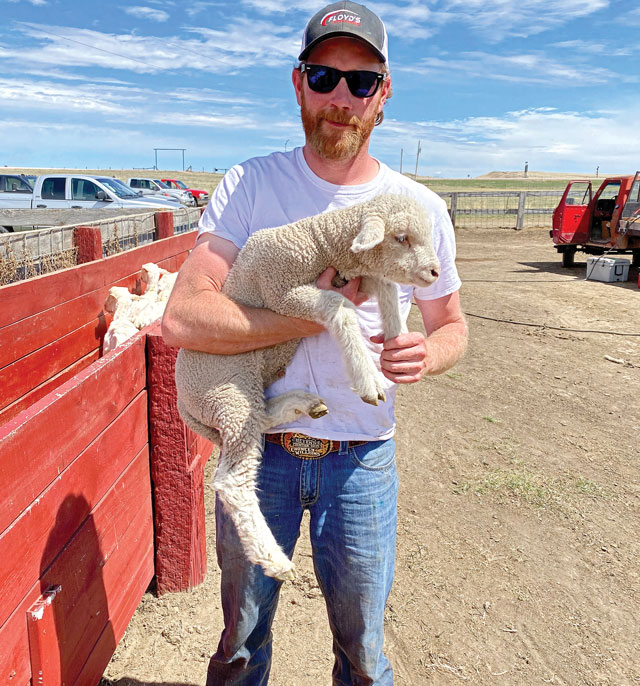
Chancey Williams in Moorcroft, Wyoming helping shearing. – Courtesy
Chancey Williams and his band are staying busy as they wait to hear how to better plan for upcoming shows.
“Our last show was March 13 in Houston and they’ve canceled everything through May, some in June, and some in July,” said Chancey Williams, whose band is usually booked every week. They have had to cancel 9 shows so far. “We are getting a few emails and phone calls for things in June and July but we still don’t know if it’s going to hurt us or not. We have two at the end of May that are still holding on – Craig, Good Old West Days is still planning on it.” The band has been making good use of their time off. We spent the time working on equipment, practicing, and Chancey learning how to do the social media live. “It’s been a learning curve, but we’re getting it.” Chancey has been able to help his family with shearing. “Stay positive and work through it – we want to be ready to play – we’ve got a new set and an album coming out – we’ll be ready to go when they open up.”
During pandemic isolation, Proctor finding a silver lining to moments at home
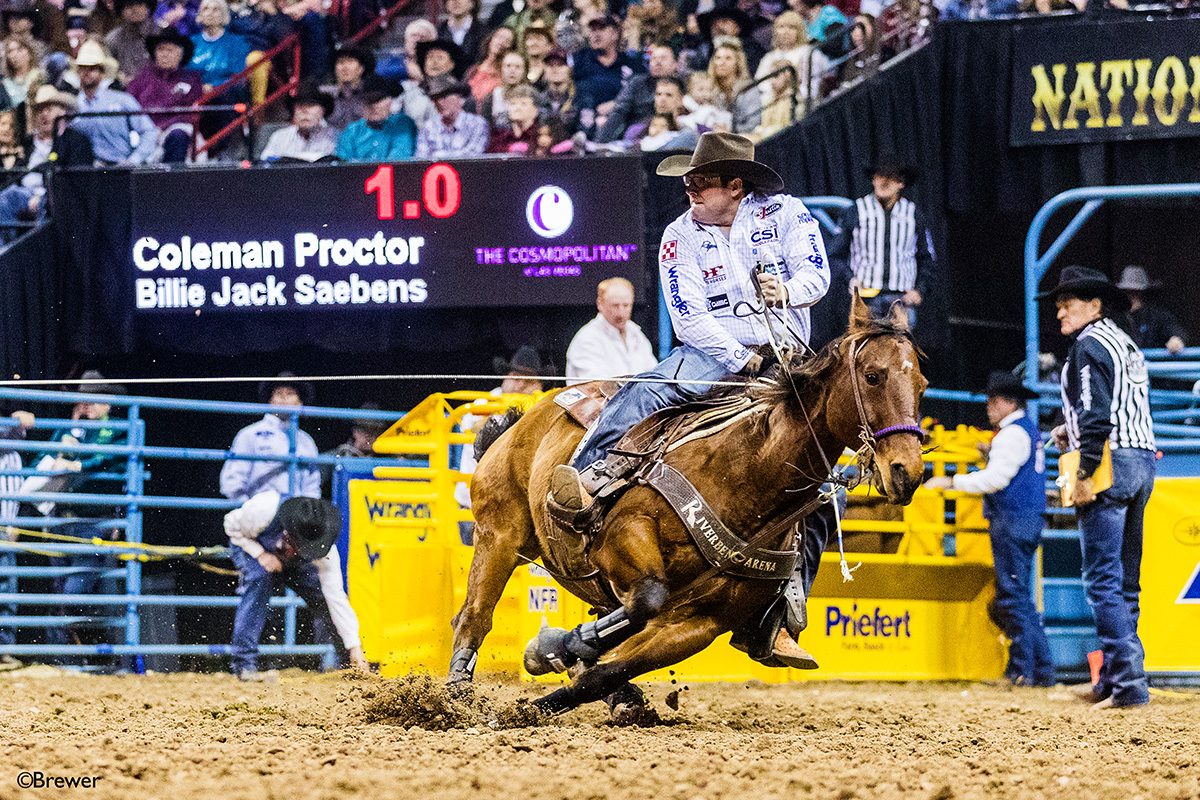
PRYOR, Okla. – Anybody who knows him will describe Coleman Proctor in an abundance of ways, but most will discuss his openness and ability to communicate with anyone and everyone.
“I’m a pretty social person, so the hardest thing for me is being so far out of the loop,” Proctor said, describing his thoughts on self-isolation through the COVID-19 pandemic. “It’s like being on my own little island.”
His piece of paradise is 240 acres near Pryor, and he shares that plot of land with his wife, Stephanie, and their two daughters, Stella, 2, and Caymbree, 9 months. On a typical year, he would have just returned to Oklahoma from a spring run California. Instead, he’s been hanging out with his girls, performing tasks around his place and finding a little extra work when possible.
“It’s actually been nice,” he said. “I’ve had a set of heifers I’ve been calving; we have about 240 head of cows, 40 of which were first-year heifers.
“I’ve been catching up on the around-the-house stuff. My youngest has been changing, so that’s been fun to see in person. I got to see her crawl for the first time, and how she’s standing up and pulling herself up to things.”
There were several little things he missed when Stella was this age that he’s not missing with Caymbree. That’s the life of a rodeo cowboy, especially one in the elite status like Coleman, a five-time National Finals Rodeo qualifying header. He’s roped with three cowboys at ProRodeo’s grand finale: Longtime friend Jake Long, Billie Jack Saebens and, most recently, Ryan Motes.
Other than calls and other forms of communication, that’s really all he’s been able to do as far staying in touch with other ropers.
“Motesy and I did a Zoom interview for our friends at Brazos Valley Equine, and that was the first time I’d seen him since we left Houston,” said Proctor, noting that he and Motes had competed in the first two rounds of the third set at RodeoHouston before it was canceled in March. “It was definitely odd leaving Houston and not knowing when we’d see each other again.
“We’ve got our run down pretty good. I’m practicing on what makes me really good, and he’s practicing on what makes him really good. He and (wife) Courtney are the most hospitable people you’d ever meet. I’ve been missing out on being with them, grilling out and roping.”
The hardest part of being at home, he said, is not having a steady income, which is proof of his roping prowess; he has made a pretty good living roping the horns. For a man who is used to the confidence it takes to pay the entry fees at rodeos and ropings and understand the opportunity before him, it’s a bit of a stretch to know the chances of that have been diminished greatly.
“It feels like you’re spending a lot of money, and you’re not making a lot,” he said, noting that he’s taken on some skid-loader work recently. “I think we get accustomed to how rodeo can be a very profitable business.”
He’s done pretty well over his career, most of it coming in the last six years. At the NFR alone, he has pocketed about $325,000, but that’s even small compared to the big win he and Motes secured at The American in 2019; they each earned $433,000 by winning the team-roping title, $50,000 of which helped them secure their NFR bids.
He’s holding out hope everything recovers quickly from the pandemic, which not only hit the rodeo industry hard but also has affected the overall economy.
“I think we’re going to see a pretty good drought of selling horses right now, and that limits everyone,” Proctor said. “Diesel is below $2 a gallon, and while that seems nice, it’s not good for anybody. Oil fields drive a lot of what we do.
“Still, I love the time at home and the time I get to spend with my family. It’s been a lot of fun. We’ve been able to work on Steph’s breakaway roping.”
Interest and financial support have boomed in breakaway roping over the last two years, and more rodeos are planning to include the event in their schedules. That might open the door for more opportunities for the family.
Doing things with ropes is nothing new for Coleman Proctor. With the support of his parents, friends and other family members, he’s been doing it all his life.
“Even though they were divorced, my mom and dad were very good friends,” he said. “Both would take me roping. Jake Long and I roped together when we were 2 and 3. That’s all I ever wanted to know. My freshman year of high school, Jake and I started going around Miami (Oklahoma) with our Fast Lane (roping dummy). We’d rope in parking lots all over town, and we’ve been kicked out of every parking lot.
“We’d rope in all the different parking lots, and we’d save the Walmart parking lot to last. It didn’t have the best lighting, but they’d let us rope there longer.”
Even then, he had an end goal in mind.
“Even when I got jobs, it as what I needed to do to get my fees paid,” Proctor said. “Working was a way to gather up money. I wanted to rope for a living and make the National Finals.”
He’s done that, and over time, his priorities have changed. That comes with having a family; in his case, Proctor looks directly into the eyes of his three girls.
“My greatest accomplishment would be giving Stella and Caymbree everything I had,” he said. “I want Stella and Caymbree to feel it for the rest of their lives.
“I want a gold buckle. Now I’ve made a living with a rope in my hand, but I want something more. Last year was the first time I went to the National Finals and really wanted to win the gold buckle. This is the only reason I’m still doing this.”
Still, he’s ready to get back out on the road and chase his dreams of that elusive world championship. He knows what it takes, and he has faith in Motes that the tandem can make it happen in short order, but there’s work to be done.
“I think being home more is almost making me more excited about getting started again,” Proctor said. “This has been a first-hand look at life after rodeo. You’re getting a free look at what it could be. I know my time on the road is getting shorter. I’m more excited and grateful. I have so much at home that keeps me grounded.
“Sometimes it’s hard to leave and go to rodeo, but I think this year, it’s going to be a little more reactive. At the end of the day, the competition is what drives me.”
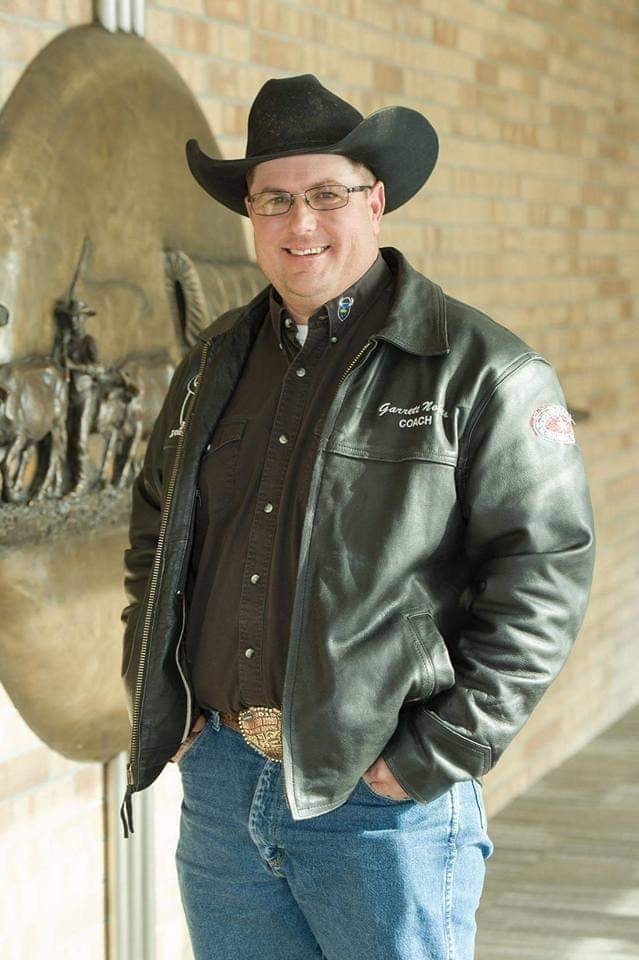
Mid-Plains Community College Rodeo Team coach Garrett Nokes has been named Coach of the Year for the Great Plains Region.
The coaches and captains from every team in the region vote for a Coach of the Year at the end of every season. It’s the first time Nokes has received the recognition.
“It’s a big honor,” Nokes said. “One of the things I love about my job is that coaching in this region is pretty unique. Our environment is the most positive environment I’ve ever been around in college rodeo. All of the coaches want their kids to win, but there’s not a coach in the region that won’t help a kid from another school if asked.”
He said that type of cooperation has led to a phenomenal atmosphere where student-athletes can develop their skills and advance to the next level.
“We just want the competition to be the toughest it can be, and that’s something that’s felt by every coach in the region,” Nokes said.
It’s important to him that his own team develops a strong work ethic and that members take away as much from outside the arena as inside.
“I want them to learn that if they want it, they have to work for it. Then, the sky’s the limit. That’s true for life in general,” Nokes said. “I will help them get to wherever they want to go, but I also want them to get an education to fall back on. In this business, it’s never ‘if a rodeo career is over’ – it’s when.”
His convictions stem from a lifetime spent in the rodeo industry – experiencing its ups and downs – in addition to his own experience as a college rodeo athlete at Oklahoma Panhandle State University in Goodwell, Okla. He was on the university’s first two national championship teams in 1997 and ’98.
“College rodeo prepared me for both professional rodeo and life after because I was surrounded by good mentors,” Nokes said. “My coach during my first two years of college [Dr. R. Lynn ‘Doc’ Gardner] had never been in a rodeo arena but ended up being one of the most influential guys in my life. I’m thankful for him every day.”
Gardner died when Nokes was a junior – about the time Nokes’ professional career was taking off.
“That next year, I was contemplating leaving school without a degree,” Nokes said. “What prompted me to stick around and finish was a friend and our team secretary [Lynette Frueh Harbin]. She told me that if I left without a degree, Doc would roll over in his grave. That really hit home, and I decided to stay. I just hope that someday I can have that kind of impact on someone else.”
He already has if the Coach of the Year award is any indication. One of the themes that remains consistent year-to-year among MPCC Rodeo Team members is that they appreciate Nokes for caring about them. They also respect him for not just talking the talk, but also living it.
A member of the Professional Rodeo Cowboys Association since 1996, Nokes currently has $740,032 in PRCA career earnings. That includes winnings from the 2005 Wrangler National Finals Rodeo where he competed in steer wrestling and placed fourth in the world standings.
Later on, in 2017, Nokes won the Ariat World Series of Team Roping in Las Vegas, beating out more than 500 other teams for a spot in the final round.
Nokes has also been highly involved in “the greatest sport on dirt” at the local level. He won the Nebraska State Rodeo Association’s “Rookie of the Year” title in 1996 and was the all-around champion in 2011 and 2014. He was the organization’s tie-down champion in 2011, ’13 and ’14.
A state to the south, Nokes was named the Kansas Professional Rodeo Association’s all-around champion in 1996, 2010, ’12 and ’14, steer wrestling champion in ’96 and tie-down roping champion in 2011, ’13 and ’14.
Additionally, Nokes is a three-time Prairie Circuit steer wrestling and all-around champion and was the tie-down roping champion in 2007.
He has won numerous all-around titles at major rodeos such as the National Western Stock Show in Denver in 2005 and Cheyenne Frontier Days in 2006.
He took home the all-around title and was co-champion in the team roping, alongside Matt Wilken, at the Buffalo Bill Rodeo in North Platte in 2012. He also won the calf roping at the Buffalo Bill Rodeo in 1997 and steer wrestling in ’98.
Nokes currently lives on a farm south of McCook with his wife, Laura, and sons, Trevor and Parker. Together they raise crops, cattle and performance horses. Garrett is also a crop insurance agent for First Crop Insurance, LLC.