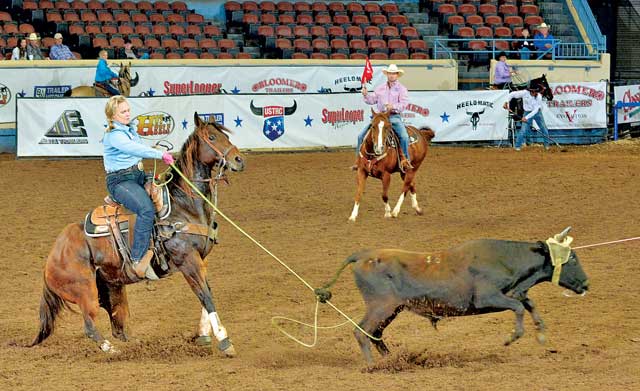
The elite equine show grounds of the Kentucky Horse Park in Lexington, Kentucky definitely felt wild and western this weekend for the International Professional Rodeo Association’s National All-Region Finals, Oleika Shriners rodeo.
The top contestants in each of the IPRA’s designated regions worked all season to qualify for their spot at the NARF, and for many contestants on the bubble, Lexington was a last shot in the 2016 IPRA season to make it to the International Finals Rodeo this coming January. Cowboys and cowgirls from across the U.S. and Canada arrived in Kentucky for the first go round Friday night. French-Canadian, Spur Lacasse took the round win in the bareback riding, followed closely by last year’s NARF champion, Trey Moore from Alabama. Rookie Ryan McDaniel took the round in the bull riding, and the no. 1 saddle bronc rider in the IPRA World Standings, Shane Hand, won the round in night one.
Daryl Matthews was quickest in the tie down roping, and rookie sensation, steer wrestler J.W. Ery took the lead in his event. For team ropers Terry Crow and Buddy Hawkins, both multi-time IFR qualifiers, NARF was especially important, because they were right on the bubble ranked no. 15 and 16 going into the weekend, and the team started off strong with a Round 1 win. In the cowgirls’ events of barrel racing and breakaway roping, it was barrel racer, Jodi Colton and breakaway standings leader, Megan Rinehart, both from Tennessee, who took the win.
For Round 2 on Saturday night, we would see bareback rider, Josh Cragar, no.1-ranked bull rider, Corey Bailey and rookie bronc rider, Travis Gardner, take the wins in the rough stock events. For the timed events in night two, Luke Potter of the Southern Region won the tie-down roping. Canadian all-around cowboy, Rodney Weese wrestled his steer and breakaway roper Jenna Lee Hays caught her calf, the fastest, while the no. 1 ranked barrel racer, Kindyl Scruggs won the round, taking her even closer to a world title come January.
The 17-year-old team roping partners and childhood best friends, Brenten Hall and Jake Clay of Oklahoma are making a strong bid for their first IFR qualification, and their win in Round 2 will certainly help. Their mentors, veterans Terry Crow and Buddy Hawkins, who won round 1, came in second and took the average, winning the NARF championship title.
Back-to-back NARF champions were crowned this year with Jenna Lee Hays in breakaway roping and Trey Moore in the bareback riding. “It feels really good, just a small step to the top,” said Moore after his win. He added, “It’s been an outstanding weekend. Great horses, rode good, I’m healthy, so it’s always a blessing.” Josh Cragar also split the event win.
Shane Hand won the title in the saddle bronc riding, further cementing his lead in the race to a world title, and Luke Potter and Daryl Matthews split to win the event of tie-down roping. J.W. Ery, the rookie who was second in the world going into NARF, out wrestled the no. 1 man for the NARF championship and overtook the lead in the world title race, so it will be tight competition at the IFR.
Ery’s win was made even more special by the fact that his father won the same title years before, and he had his dad hazing for him there this weekend. “It’s like a dream come true, not only to have won, but to have won the same finals as my dad with him hazing for me,” Ery enthused.
At the other end of the standings, Canadian bull rider, James Sullivan, was ranked no. 17 going into NARF and needed to make the whistle to try and qualify for the IFR. Not only did he make the whistle, he won the championship. “It feels great. I had high hopes coming into this weekend, and I got it all done so I’m happy with myself. I’m right on the bubble so this might help me out to get in [to IFR],” Sullivan said.
The NARF was clearly important to many contestants this weekend. Not least of which, was barrel racer Jodi Colton, who got to experience her first true victory lap in the storied horse town of Lexington. “My first run went really well. My horse worked great, she was really snappy on the backside of the barrels. My second run she got by them a little, bit but we were bottom of the ground, so I was really pleased with both of them,” Colton said and added of her win, “It feels amazing. This is the second buckle I’ve won on her, so it really means a lot to me, and I got to take my first victory lap last night, so this is really special.”
Next stop for the champs is the IFR in Oklahoma City Jan. 13-15, 2017.
COLORADO SPRINGS, Colo. – High-stakes drama is waiting to unfold in Las Vegas for the Professional Rodeo Cowboys Association.
The upcoming $10 million Wrangler National Finals Rodeo presented by Polaris RANGER – rodeo’s Super Bowl – takes place Dec. 1-10 at the Thomas & Mack Center, beginning at 6:45 p.m. (PT) each night.
Cowboys will be competing for gold buckles in bareback riding, steer wrestling, team roping heading, team roping heeling, saddle bronc riding, tie-down roping, barrel racing, bull riding – and of course the battle for the prestigious all-around cowboy title.
There are several tight races to watch at the Wrangler NFR with the chase for that all-around gold buckle leading the way.
Team roping heeler Junior Nogueira arrives in Las Vegas as the all-around leader with $122,342 in the WEATHER GUARD® PRCA World Standings. Nogueira and his team roping partner, header Kaleb Driggers, are also atop their respective standings.
“I want to do my job and rope really well, because these are the top ropers in the world, and the guys competing for the all-around are all very talented,” Nogueira said. “Whoever has the best Finals will win the all-around title.”
Nogueira is correct.
Steer wrestler Josh Peek ($116,603) and team roping header Dustin Bird ($109,694) round out the top three in the all-around standings, followed by team roping header Clay Smith ($104,809), team roping heeler Russell Cardoza ($100,233) – Bird’s partner – steer wrestler Clayton Hass ($97,319), Caleb Smidt, the reigning tie-down roping world champion ($89,969) and tie-down roper Ryan Jarrett ($85,127).
Cardoza is the only one of the group who can’t claim the gold buckle because he starts the rodeo $9,000 behind his partner, Bird.
Peek’s best career finish in the all-around standings was second in 2007 and 2009.
The all-around standings leader could easily change during the 10-round rodeo since first place in a round pays $26,231, and first place in the average pays $67,269.
Of the contenders for the all-around gold buckle who will be at the 2016 WNFR, only Jarrett has won the title in the past (2005).
Ingredients:
Crust:
2 cups flour
2 tbs sugar
3 tbs mild
1 tsp salt
2/3 cup oil
Topping:
2 eggs
1 pint sour cream
1 cup sugar
1 tsp vanilla
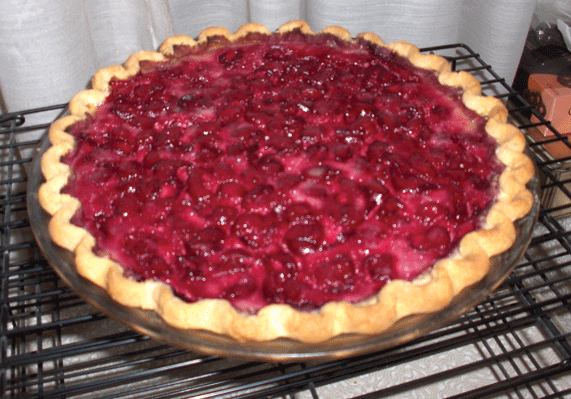
21 oz can cherry pie filling or blueberry
DIRECTIONS: Mix crust ingredients together and press in deep-dish 10” pie pan. Sprinkle with cinnamon on bottom. Pour can of pie filling on bottom of crust.
For topping, beat eggs, add sour cream, sugar and vanilla. Mix together and pour on top of fruit, then sprinkle a little cinnamon on top. Bake at 375 degrees for 45-55 minutes.
My sister, Pam Barton, served this fabulous pie to me when we went to Florida to visit her. She got it from her neighbor, and it’s oh so good! You will be sorry it doesn’t make more.
Ingredients:
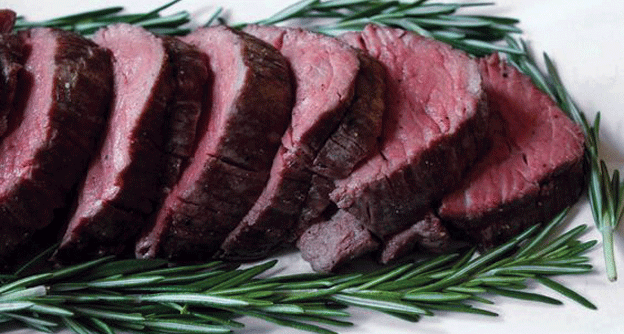
Full beef or pork tenderloin
Worchestershire sauce
lemon pepper powder
garlic powder
butter
brandy
DIRECTIONS: A full beef tender trimmed – pour Worcestershire sauce all over. Rub with lemon pepper and garlic powder (lightly). Brown all over on high heat in electric skillet with butter. Put in corningware dish – then pour 1/2-3/4 cup cheap brandy into drippings. Stir around a few minutes and pour over beef tender. Put in oven at 300 degrees covered for about 30 minutes. Then uncover and cook another 30 minutes, depending on how rare you prefer. It is ready to serve, but if you must hold for a while take out of pan you cooked in as it will continue to cook.
This fabulous recipe comes from a lady in Oklahoma City who invited us to supper while there during the National Finals Rodeo over 30 years ago. Her name was Judy and I’m sorry I don’t remember her last name! My entire family loves it so much it has been our Christmas Dinner special every Christmas. Hope you enjoy it as much!
Ingredients:
1 box of Uncle Ben’s Brown and Wild Rice Seasonings – cook according to instructions.
DIRECTIONS: Sauté onions and mushrooms and add to rice; mix, then pour half and half over it until soupy, 3 cups or more. Bake 30-45 minutes at 300 degrees. Add more liquid if needed. You can use 3/4 – 1 cup of sour cream to replace equal amount of half and half if you like. This makes a great accompaniment to a turkey dinner.
Shirley Churchill has brought this dish several times for Thanksgiving and everyone always enjoys it. Good any time of year if you like rice.
Ingredients:
1 1/2 quarts water
1/2 cup instant chocolate drink mix
1/2 cup sugar
1/4 cup instant coffee granules
1/2 gallon vanilla ice cream
1/2 gallon chocolate ice cream
1 cup whipped cream, whipped chocolate curls (optional)
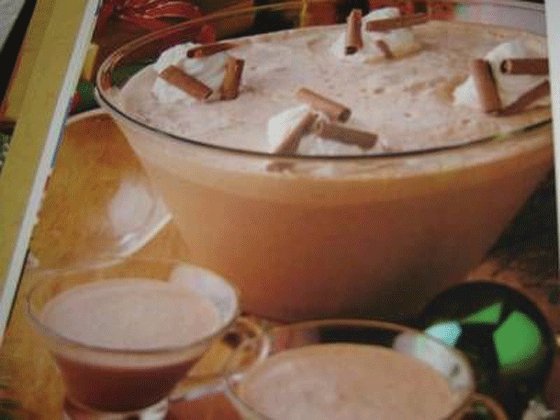
DIRECTIONS: In a large saucepan, bring the water to a boil. Remove from the heat. Add drink mix, sugar and coffee; stir until dissolved. Cover and refrigerate for 4 hours or overnight. About 30 minutes before serving, pour into a punch bowl. Add ice cream by spoonfuls; stir until partially melted. Garnish with dollops of whipped cream and chocolate curls if desired.
Christmas 2007 was the first time I tried this punch. I used it at our Christmas party and it was so pretty in the punch bowl. It looked like a giant chocolate milkshake. It really disappeared fast. I highly recommend it if you like chocolate shakes. I found it in the “Country Catalogue.”
Everyone who enters the USTRC Finals has dreams of clean runs and big paychecks. Unfortunately, only a handful of ropers realize those dreams. One such dream come true was Courtney Small, and header, Lari Dee Guy, who came from third high call to win the Cruel Girl Roping. The pair posted a time of 37.25 on four head to win the roping and split $16,000 in cash plus prizes.
“Actually I prefer being third high call. From there the goal is to make a nice run and put pressure on the top two teams,” says Small.
Courtney, 24, started roping when she was just eight. She and her dad started roping at the same time. Eventually her brothers, Zac and Blair, rope as well.
“We would rope almost every night,” explains Courtney. “That’s where my addiction to roping started.”
Small is grateful to her parents for giving them the opportunity to rope and pursue their passion.
“My dad blessed us with the chance to rope every day during the summer. He wanted us to succeed in whatever we wanted to do,” says Small. “Every day we would start out roping the dummy, then saddle our horses and rope the mechanical dummy. That was our routine from about ten to fifteen years old. We were consumed by it.”
Courtney admits to a life long passion for horses and roping. When she was about thirteen, the family built an indoor arena where they roped and also had a church.
“The arena has been a huge blessing. God has used our arena to bless the lives of many people; and given young people a place to come and rope. We still rope in our arena every day and I’m very thankful for it.”
The Blair kids were homeschooled and well educated using the accredited Christian based A Beka Academy. To see how her education measured up, Courtney attended public school during her sophomore year and found it very easy.
After high school Courtney attended Tarleton University in Stephenville, Texas before transferring to and graduating from Oklahoma State University. Currently she is working with her father at the family cattle embryo laboratory near Welch, Oklahoma. She will soon pursue a Masters in Animal Science, a degree that will be helpful as they expand their business.
“There are some new things we want to do,” says Courtney. “I so enjoy working with my family. I also have lots of time to rope, which is a huge plus.”
“I am very grateful and give the glory to God. Without Him, none of these blessings would be in my life. I have to thank my parents and am so blessed to have them. I realize not many people get the opportunity to do what I do. I also want to thank my sponsor, Classic Ropes.”
COWBOY Q&A
How much do you practice?
About five days a week.
Do you make your own horses?
Yes. My brothers and I have made every horse we own.
Who were your roping heroes?
I always looked up to my dad because he got me started. He had won quite a bit and was my idol.
Who do you respect most in the world?
My father.
Who has been the biggest influence in your life?
My father.
If you had a day off what would you like to do?
Rope.
Favorite movie?
The new Magnificent Seven was very good.
What’s the last thing you read?
A textbook of some sort.
How would you describe yourself in three words?
Leader, dedicated, shy.
What makes you happy?
When I win.
What makes you angry?
When I miss.
If you were given 1 million dollars, how would you spend it?
I would set quite a bit back and probably build a horse barn on my property.
What is your best quality – your worst?
Best quality is independent thinking. Worst quality is procrastinating.
Where do you see yourself in ten years?
Hopefully more involved in our lab with the expansion, and enjoying the growth of business.
Ropers, hope you are doing great and had a successful fall start! The USTRC Finals are over with and now on to Las Vegas if you are planning to compete. I wish all of you the best of luck!
As we move into winter, we are blessed to have many indoor arenas across the country now where we can still put forth the effort to stay sharp. What I would like to discuss with you in this article is just that, Staying Sharp! It does not matter how many clinics or lessons I do through out the year, it easy to see who has continued to put time into the practice pen. All of the articles so far have been about breaking your practices down to execute a sound and fundamentally correct business plan within practicing. How you practice is how you will compete. The one thing that no clinic or lesson will ever teach you is to rope at a higher level than what you are capable of achieving. I have many students that come in throughout the year for tune-ups or wanting to advance to the next level of their roping career. It is so fun and rewarding to see the excitement of those who have been working at it and knowing they are enjoying the sport that much more. When asking them what they have been working on, I continue to hear what we have discussed in previous sessions but always hear whom they have been roping with. Where I am going with this is they have continued to keep their game plan in place and rope with other ropers that rope at a higher level than they do. The first thing that comes to mind is I don’t rope good enough to get invited to rope with “that” person or even practice with them. As long as you think that, you will not get the opportunity. If you believe you want to get better and be around a higher level of roping, then you will. We can lay out the instructions of the sport but roping with someone that pushes you to being better is taken in by sight and sound. If you are around it, you will start to perform and do it. Once we have reached the roping status and moved on from the chute working status, we are all guilty of becoming complacent within our practices. Since we do not do this for a living and want to enjoy the time we get to rope, practices tend to flat-line. If you have the opportunity to work chutes around someone that ropes really good, you will still absorb what is going on and pick things up that will help you within your roping. The most incredible thing to happen in the team roping world has been the handicap system and everyone able to compete on their own level. But, then we continue to remain at that level and go through the ups and downs of being successful. The good days come and go and seem like they get further apart. Keeping yourself sharp by practicing or watching better ropers practice will push you to excelling and doing things you don’t even think about. Remember, iron sharpens iron! God Bless until next time.
We recently concluded the Ace High Roughstock Academy at Odessa College. We had forty students from across the country come to learn from some of the top athletes in our sport. Over the time spent with the instructors and students I was able to pick a lot up. I learned from watching students make mistakes, from the instructors, and from the students.
A few things that I learned from the instructors at the Roughstock School:
• They pay attention to details. They know their sport inside and out. They pay attention to the horses. They watch the gate men, the flank man and the pick-men. They really know the judges and their tendencies, who watches the mark outs like a hawk, which ones like certain riding styles or certain horse types.
Little Details. Big Details.
Rodeo is their livelihood and they learn and pay as much attention to all of their surroundings as possible. They know their equipment, they know how to fix it, and they know when not to fix it. Most everything they do in and around the arena is done on purpose. Everything in their world is detail oriented to give them the best shot to be competitive.
• If you want to win a gold buckle or make the WNFR you had better be dedicated to the sport. The Top ranked bareback rider (Tim O’Connell) and the top ranked saddle bronc rider (Jacobs Crawley) were both at the school as instructors. They had early morning workouts before the school started. They were on the spur board with the students. Even though they were instructors at the school they each got on practice horses with the students. So did most of the other instructors. They are extremely dedicated to their craft; to be in their spot in the future or take their spot at the WNFR you are going to dedicate yourself to the sport. You will have to earn your right to compete with these guys and they aren’t just resting waiting for you to come get them.
• If you want to be great you must have an inner competitive drive. Your mom and dad can’t make you want to be great; your friends can’t make you want to be great. It has to come from you and it has to be your passion. On the way to lunch we had five 2016 WNFR qualifiers in the truck. Everything they do inside the arena is competitive and everything they do outside of the arena becomes a competition as well. The top guys thrivwe on competition, they enjoy it, and they become great because of it. If rodeo is your passion make sure you have the competitive fire.
You can learn a lot at any rodeo school. To get the most out of it make sure you watch and learn as much as you can from everyone around you.
A special thanks to Cervi Rodeo, Jabob and Sterling Crawley, Richie Champion, Winn Ratliff, Binion and Chase Cervi, Tim O’Connell, Clint Johnson, Chuck Kite, Randy Britton, Vicki Pack and Hanna Wiebelhaus. Also a big thanks to the sponsors, Justin Boots, the PRCA, Rodeo Houston, and Cinch for helping put on the third annual Odessa College Ace High Roughstock Academy.
C.J. Aragon was named the 2008-2011 Grand Canyon Region Coach-of-the-Year. 2014-2015 WJCAC Coach-of-the-Year, 2016 Southwest Region Coach-of-the-Year, and 2010 National Intercollegiate Rodeo Association Coach-of-the-Year.
The One Armed Bandit and his Mule, Moe – Dale Miller
“Hi. I’m Moe and I’m more famous than John Payne. Or maybe not, but I’d like to think I am.
You might know John Payne, but you might know him by his other name. The One Arm Bandit. I’d like to brag that I’m the one who made him lose an arm, but it wasn’t me.
I came into John’s life ten years ago, when I was eight.
He was sitting at a sale, chewing the cud with all the other cowboys…. Well, actually, I’ll let John tell the story…
Hello, I’m John Payne, the One Arm Bandit, and one day, I was sitting at a mule sale in Ada, Oklahoma. I had a bullfight to work that night, and the mule sale was at the same place as the bullfight, or I’d have never been there and I’d have never bought him.
He’s a man killer, Moe is. He had six problems: you couldn’t catch him, you couldn’t bridle him, you couldn’t saddle him, you couldn’t get on him, and you couldn’t ride him. And he’d run off with you if you tried, even leading him.
But Moe and I, after I’ve pulled a lot of wet saddle blankets off of him, have come to an understanding. I ride him, he does what he’s supposed to, and we both get paid.
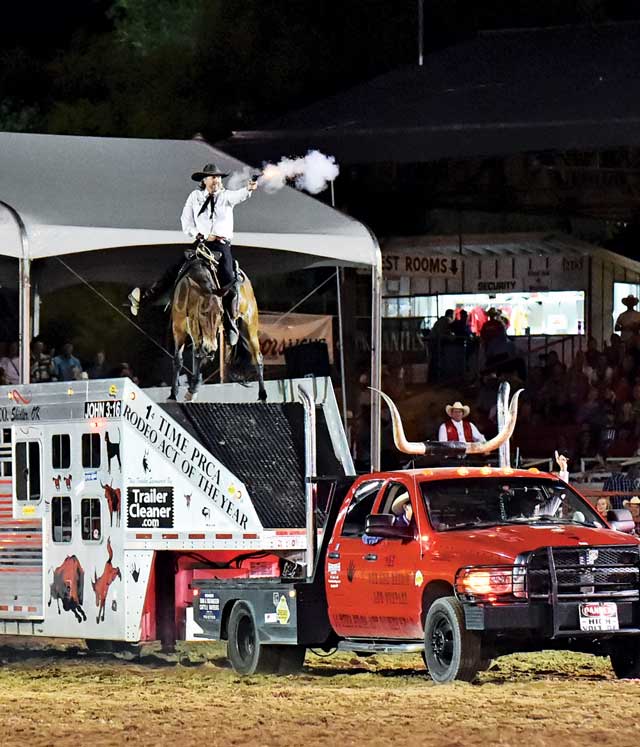
Part of my act is driving my trained buffalo or Watusi longhorns to the top of my trailer, following them up, and spinning my mule on the top of the trailer while cracking a bullwhip. All with one arm.
I used a horse for twenty years. I was the cowboy who said, when all the horses die, and I get tired of walking then I’ll use a mule.
But after I’ve had Moe, I sure do like how he works. He’s surefooted on the ramp. If it rains and it’s muddy and that ol’ ramp is wet and slick, he is really good at keeping his feet under him.
I’ve trained a lot of animals in my life. Horses, mules, zedonks, zorses, zebras, watusi cross longhorns, Corrientes, quarter horses, and mustangs, not to mention buffalo. And a chicken hawk. This hawk, I found it under a tree when it was a baby. I took it home, and fed it till it grew up. I’d whistle and he’d land on my arm. He loved mountain oysters and hamburger meat. When we was working cattle, he’d fly around and hang around us all the time.
Once I trained a woman …… to do whatever she wanted to do.
Buffalo is the meanest critter in North America. Buffalo tried to kill me almost every day for two years, and they’ve hooked me off the top of the trailer, twice, horse and all.
But back to Moe. Moe wasn’t harder to train than buffalo. He was a jerk, pulling back, making it hard on you every darn day, but he was not dangerous all the time. He was not hardheaded. He is very firm in his convictions.
He was worth it. Well, I had a lot of nice compliments on him and I’ve been offered $20,000 for him. But nobody could handle him but me. He’s the best looking mule in the world. He’s built great, stout, strong, durable, sure-footed, and trustworthy. I do parades on him when I jump off the trailer onto asphalt, and he slides on all four. A horse would be straddle-legged.
He’ll outwork two horses, but he’ll also outwork two horses trying to get out of work and being a little pillbox.
I can walk out there and say, ‘Moe,’ and he’ll come to me. Something else this mule can do, is I can stand on top of my trailer and pop a whip and he jumps out of the trailer and onto the pickup and up the ramp and come right to me.”
He’s the most famous mule in the world.
Moe: Well, I love you, too, John Payne, but I’m always keeping score and I’m not going to love you anymore than you love me.
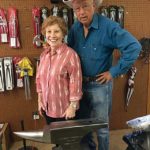
Dilton and Pat Emerson of Bossier City, Louisiana, know the value of a horse shoe. Keeping equine athletes of all disciplines shod has sustained the husband and wife for many years, and their bootprints through rodeo history are accompanied by their ingenuity. This includes inventing a now widely-used anvil and starting their own horseshoe supply business – one of the largest in the country. They also support the rodeo industry with their time, serving on the boards of several rodeo organizations, and most recently, helping organize the Gold Card Reunion in Las Vegas during the WNFR. “The reunion originated last year, and we had about 150 gold card members come,” says Dilton, chairman of the reunion board and a gold card member himself. Shawn Davis, manager of the PRCA and one of Dilton’s longtime rodeo friends, recently asked Dilton to help organize the reunion. Open to all PRCA gold card members, the reunion takes place this year in the Thomas & Mack Center on December 8th. “We have someone in charge of getting interviews during the reunion for the Pro Rodeo Hall of Fame in Colorado Springs, and there will be slideshows and storytelling,” Dilton describes.
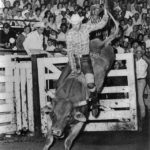
His own rodeo career with the PRCA – known at the time as the RCA – began in 1954, the year he married Pat. The couple – both born in 1936 – were raised one town over from each other, Dilton in Taylor, Arkansas, and Pat in Bradley, Arkansas. Horses were Pat and her family’s means of transportation, but Dilton didn’t own a good horse until he was in his 40s. Instead, he competed in all three roughstock events and steer wrestling. “His family thought he was totally crazy and doomed from day one,” Pat recalls with a laugh. Yet Dilton paid all his expenses and made friends with competitors like Shawn Davis, Tom Nesmith, who put Dilton on his horse Old Brown, and Neal Gay. “Neal took a liking to me when I was a kid and helped me out, and I worked for stock contractor Tommy Steiner. I got on everything he turned out,” says Dilton. “Steiner had a bronc saddle in his tack room that became mine, and I had a bareback riggin’ of my own.” His bronc saddle is now on display in the Lynn Hickey American Rodeo Gallery of the National Cowboy and Western Heritage Museum in Oklahoma City, its cinch tightened on a bronc sculpture rearing from the chutes.
Steer wrestling in Opelousas, LA, 1961 – Ferrell
Dilton and Pat in their shop with the Emerson Anvil created by Dilton – Courtesy of the family
Bull riding in Lafayette, LA 1962
– Ferrell
Near the time Dilton’s RCA career began, Pat tried her hand at riding bareback horses in the Girls Rodeo Association (GRA). “I hadn’t thought about competing, but I had an older sister that rode roughstock. I was staying with her one summer and she took me to rodeos,” says Pat. “There weren’t more than six or seven bareback riders, but enough to have a rodeo. I messed with it for two or three years, and did exhibitions in saddle bronc riding the summer of ‘55. But once I started raising our three kids, I quit.”
Dilton was rodeoing with Pat’s brother when the couple met. While their children – Peaches, Joe, and Ross – were young, Pat worked as a secretary for several steel firms and Dilton rodeoed full time. When he eased off the gas pedal in the mid 1960s to start shoeing horses on racetracks, Pat was a mutuel teller, cashing tickets for the bidders. They travelled with their children to Detroit, Chicago, Omaha, Nebraska, and the Louisiana Downs in Bossier City, Louisiana, where they eventually settled. “We never had a horse trailer when we rodeoed or worked on the racetracks, we rented apartments,” says Pat. “We worked together for three or four years before starting our horseshoe supply business. Everything Dilton has done, he’s taught himself.”
“When I started shoeing horses, it was at an all-time low for farriers,” Dilton recalls. “A big horseshoe company went out of business in 1965, and people were predicting that it was the end of the horse era. Back then, they didn’t have playdays or horse shows. Horses were mainly used on ranches for working cattle, and the ranchers did their own shoeing.” Yet the Emersons still saw a need for horseshoeing, though they never intentionally set out to start a business. “Dilton always had a good supply of stock that he shod with, which a lot of horseshoers didn’t, so they’d buy or borrow from him. He got a distributorship specifically for thoroughbred racing shoes, and then we were able to get distributorships for bigger companies.” Within ten years, Emerson Horseshoe Supply was one of the larger horseshoe suppliers in the business. The anvil Dilton designed in the mid 1990s also set them apart. “There’s a lot of nickel in the anvil, which gives it good bounce-back,” he explains. The Emerson Anvil is preferred for many horseshoeing contests and even knife makers, and is shipped across the country and even as far as England. Their anvil is in use in the bladesmithing TV show Forged in Fire, and Dilton designed a commemorative 25th anniversary anvil for the 2004 World Championship Blacksmiths’ Competition, held during the Calgary Stampede.
Emerson Horseshoe Supply has been distributing horseshoes and farrier supplies for 35 years, the shop right next door to the Emerson’s house. “It works well for waiting on customers after hours. Before cell phones and ordering ahead of time, I’d be up at six in the morning selling horseshoes,” says Pat, who runs the store. “Grandma is really amazing – she can tell you about all the shoes, their differences, and the prices,” says Seth Emerson, their grandson. He’s worked in the store since he was old enough to stock shelves, and only recently left to become an auditor for the state and continue his rodeo career, tie-down roping in the PRCA. “My grandparents have done so much for me, and it was very rewarding for me to work with them. My grandpa started team roping in his 60s, and I’ve always roped at their place. I’ve been good friends with Shane Hanchey since high school, so he’s stayed there. I also used to hold a big jackpot there and guys like Cody Ohl and Marty Yates would come and Grandma would cook for them. Grandpa’s always been there when I rope, even if it’s cold, and then he pulls the truck up next to the arena to watch.” The Emersons also have three granddaughters, Cassie, a breakaway roper, Stewart, an aspiring actress in New York City, and Kirby, a junior in college at the University of Edinburgh in Scotland.
Prior to team roping, Dilton took up chuckwagon racing, living just a few hours from the National Championship Chuckwagon Races in Clinton, Arkansas. Dilton and his team, racing under Emerson Horseshoe Supply, won the classic division in 1997 racing thoroughbreds. He built his own wagon, weighing approximately 1,000 pounds, but his interest moved to team roping around 2000. He currently heels in the USTRC and local team roping associations. “I practice three times a week, but I generally go to Stephenville (Texas) so I can rope with Rickey Green,” says Dilton.
Pat enjoys snow skiing, and is planning a skiing trip with her granddaughters and grandson’s girlfriend in February. She’s also active in her church, and one of 50 rodeo wives that make up H.A.N.D.S. (Helping Another Needy Diva Survive). The organization, started by Sharon Shoulders and Donna McSpadden, sends anything from money, food, cards, or even personal visits to rodeo families going through hard times. “We were in Oklahoma City recently for Rodeo Hall of Fame inductions, and we also go up to Colorado Springs for the Pro Rodeo Hall of Fame, and then Las Vegas in December,” says Pat. “We’re both very active and very social. We’ve been blessed with good health, good friends, and good family!”
The Harrison family is affectionately known across the rodeo world as the “Clown Family.”
John and Carla Harrison and their four children: Addy, Caz, Billie, who passed away in October of 2014, and Charlee, are regulars at rodeos across the nation.
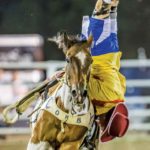
John, the grandson of world champion bull rider Freckles Brown, grew up in Soper, Oklahoma. When he saw Leon and Vicki Adams at his hometown rodeo at the age of six, he was hooked. “I knew then it looked like fun,” he said, “hanging upside down on a horse. I decided I wanted to do it.” His dad, Wiley Harrison, knew how to trick rope. He taught John in the family living room. “We tore up everything,” John remembers. “I broke lamps, hit the ceiling, knocked the lights out, knocked plaster off the wall. Mom was always cussing us.”
His first real audience was for 4-H talent show when he was fourteen. “I won the talent show and that threw gas on the fire.”
John had seen roman riding done at a rodeo, and decided he wanted to do that as well. He and his dad found a team broke for a wagon, but they “dang near killed me,” he said. “They were mean and kicked, and Dad realized I was going to get hurt.” They located a roman team owned by Vickie Tyer, who had sold them to Cotton Rosser, who was looking to sell them. John sold a few head of cows and over spring break, he and his dad loaded up for California to get them. They paid $10,000 for the team, what his dad considered a large sum. “My dad, a rancher, had never paid that much for horses, and he about croaked,” John laughed.
John spent two and three hours a day practicing his trick riding and roman riding, learning from trick riders like J.W. Stoker, Karen Vold and others.
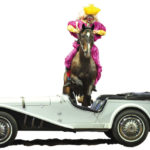
It was in 1999 that he got his PRCA card. That year, he booked a dozen rodeos for Johnny Walters, doing the roman riding while Penny Walton and Kelly Brock were trick riding. He booked the next two years for Bob Barnes, roman riding, trick riding and trick roping. After that, his career blossomed. In 2002, he went to California and worked for Cotton Rosser and the Flying U Rodeo Co. The next year, he worked for Steve Gander’s World’s Toughest Rodeo tour based out of Iowa.
At this point, John wasn’t clowning rodeos yet, but he wanted to. A buddy in Wahoo, Neb., was putting on a bull riding and asked him to clown it. “Man, I’ll be terrible,” John told him. He borrowed a barrel from Gizmo McCracken, and “that’s what lit the fire,” he said. After a lot of performances and experience, clowning became fun and he became adept at it.
John gives credit to another clown, Keith Isley, for helping him get started. Keith had a trick riding act that he gave John permission to do. “Keith jumpstarted my career,” he said. “That’s truly the reason I am where I am in my career, due to that act.”
It was in Iowa that he met the California girl who would become his wife. Carla was interning with the World’s Toughest Rodeo, doing publicity and working closely with John on appearances and interviews. “I had a crush on her,” John said. “We were both too shy to let each other know it.” After her internship ended, she and John stayed in touch. Carla, who grew up on a cattle ranch near Salinas with a dad who ranch rodeoed, talked to John every night. When he called her, asking her to go with him to the PRCA Awards Banquet where he was nominated for Specialty Act of the Year in 2004, she realized she had an “overwhelming love” for him. They married in 2006.
Addy Harrison offers a banana to her little sister Billie, while Caz looks on. Billie died of kidney failure in the fall of 2014; little sister Charlee is now a member of the family. – Celeste Settrini
John Harrison trick riding at the Molalla Buckeroo Rodeo – Rough Around the Lens Photography
Addy, Caz and Charlee pose prior to a wedding. – courtesy of the family
John Harrison at the Hastings, Neb. rodeo. – John Olsen
Bullfighters Cody Webster, Chuck Swisher, Justin Rumford and Dusty Tuckness show their tribute to Billie Harrison, who passed away in October 2014, with their wrist band – courtesy of the family
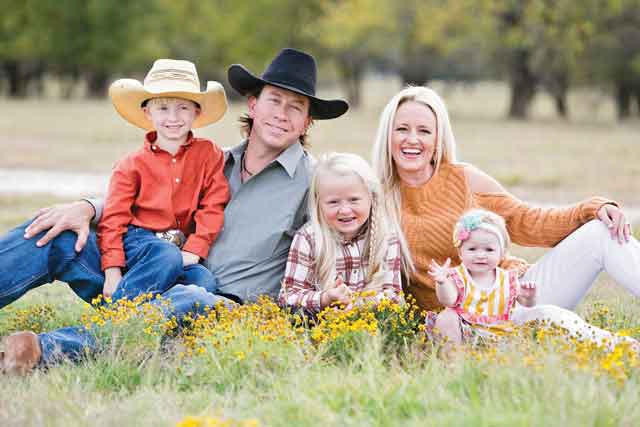
John and Carla Harrison with their children: Addy, Caz and Charlee. – Cross B Photography
They are on the road together, along with the kids, as much as possible. “We’re together constantly,” Carla said. “We did everything together, but now that the kids are in school, I stay home while he takes off.”
The Harrisons have diversified beyond rodeo contract work. They own rental properties in Hugo and Soper, Okla. “I’ve always been an entrepreneur,” John said. And he and Carla realize how the rodeo business works. “We talked about retirement in rodeo, and there is none. (Rentals) are something we could do and be gone.” They also own a liquor store in Hugo.
Each fall since 2007, they’ve produced a Wild West show at the Oklahoma State Fair in Oklahoma City. They aim for top-notch entertainment with good performers. Performers including Vickie Adams, Blake Goode, Vince Bruce, the Riata Ranch Cowgirls, Melissa Navarre, Jerry Wayne Olson, and others have worked the show. John used to trick rope but found it easier to be producer. They are in the same location for eleven days, a switch from being at a new rodeo each week. “It’s a nice break from rodeo after the summer,” John said.
John and Carla were hit with a tremendous blow in October of 2014 when their seventeen month old daughter, Billie, died of kidney failure. It was all sudden. Carla had been in California with her mother, who was going through cancer treatment. She had just flown home, and John had left for a rodeo, when Billie was life-flighted to a hospital in Texas. She died on October 17. Their faith and their rodeo family got them through the difficult time. “You use that term, rodeo family, loosely,” John said. “When we lost Billie, the way the rodeo community came together, it truly touches you in a way that is unexplainable.” Carla’s mom died four months later. “I spent many hours on the phone, crying with my mom,” Carla said, before she passed away. “I asked her, please, when you get to heaven, hug and hold Billie.” It was tough, Carla said, but she is grateful for others. “I want people to know how thankful I am for the love of others, how everyone poured into our lives. Our family, our friends and our rodeo family came in and surrounded us and uplifted us. I can’t tell you how that lifted us.”
Carla’s main job is wife and mother, but she also is an auctioneer. As a child, she discovered her dad’s old auction books and put herself to sleep, practicing. The family lived thirty miles from where they ran cattle, so on the way to and from cattle, he would help her with the tongue twisters and the speed.
She has sold cattle and farm equipment and still does junior livestock auctions, but her niche is benefits, especially the high-end auctions. She flies to California frequently, sometimes selling as few as a dozen items, but all very high-end. If John is free, he goes with her. “People assume he’s the auctioneer, and I get up, and they’re caught off-guard,” she laughs. Auctioneering is much like rodeo. “I want people to have fun, but you have to control the tempo of what’s going on.”
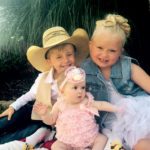
The couple’s children are Addison, age eight, Cazwell, six, and Charlee, who is thirteen months old. Addy is in third grade and learning to trick ride. Caz, a first grader, has a natural sense of humor, and Charlee, their “newest angel on the ground,” was born in November of 2015.
The “Clown Family” moniker came from announcer Jerry Todd. The kids frequently dress in John’s trademark yellow shirts with red fringe, and John loved to rub his red nose on Addy’s cheeks after a performance. Jerry picked her up and said, “oh, look at the little clown baby.” Carla started using the name on Facebook, in a tongue-in-cheek manner. But it’s grown. Last year in Las Vegas during the National Finals, people she had never met recognized them. “I love it, and welcome it,” she said.
They may be a rodeo family, but Carla jokes that she spends more time in vehicles than anywhere else. “I always tell John, we rodeo, but I feel like we really truly drive for a living. I’m always driving.” When they first married, John was reluctant to let her drive, even though she’d grown up driving trailers. He finally relented, in the middle of North Dakota, at night, when no one else was around. Now she drives most of the time, she joked. “So my alligator mouth has overloaded my little hiney. He went from never letting me drive to now, we get twenty miles down the road and he’s miraculously tired,” she laughed.
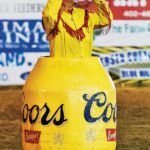
Throughout his career, John has been the PRCA Comedy Act of the Year in 2012, 2014-2015, the Coors Man in the Can in 2014, and has been nominated for either the Comedy Act, the Dress Act, or the Coors Man in the Can awards every year since 2008. This year, he has been selected to work the Wrangler National Finals Rodeo as barrelman.
Through their troubles and blessings, John and Carla hang on to their faith, crediting it with getting them through the passing of their daughter. “Without it, I don’t know how John or I could have gotten through.” They look at the positive in everything. “I try to find blessings along the way, even in the worst of times. I think it’s the only way to keep going.”