Rodeo Life

Category: ProFiles

  • ProFile: Josh Peek

    ProFile: Josh Peek

    Josh Peek jumped his last steer in January at a buddy’s house. Before that it was Houston, March 2018. “I slowed down and decided to quit in September of 2017 – I couldn’t be away from my wife and kids anymore and I knew there was more on the horizon as far as making a living for my family,” said the 39-year-old father of three. The 7x NFR qualifier ended his career on a high note, winning the All Around at the 2017 RAM National Circuit Finals Rodeo.
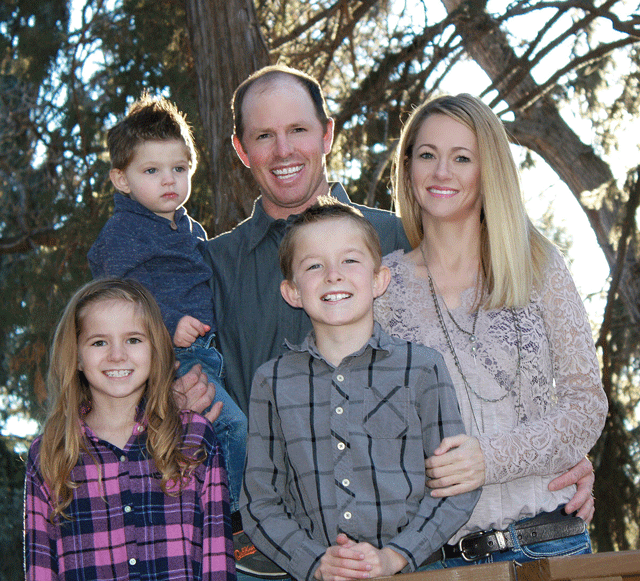
    “If I penciled it out, rodeo opened up the doors to everything I’m doing now and the platform for how I do business, but at the end of the day, I can maximize my time better doing something other than rodeo.” He spent eight months a year on the road and missed his family. “My mom and dad raised me as a family man and I know my life has always been God, family, work; no matter what that work was.” Josh is married to Kori and they have nine year old twins, Emry Autumn and Keagan Cole (born June 18, 2009); and a son, Jagger Devlin (born Sept. 20, 2016).
    During his rodeo career, he took his family with him as often as possible. “There’s good and bad in raising kids on the road – the western industry is one of the best ways to raise kids and instill values. On the other hand, they can’t live your dream in a back seat of a pickup. You’ve got to juggle that.” Once Emry and Keagan started school, the traveling was minimized.
    “There’s so much ebb and flow in rodeo– you can have the best horse and the calf you draw is not good enough to win on. The day you’re up in slack it can rain while others have a dry run-there’s just a ton of variables,” he said. His son, Jagger, was born September 20, 2016, and due to some heart and stomach issues, stayed in the NICU for a month. “I didn’t go much – I stayed home for a week and flew to a few rodeos. With the many things going on I ended up missing the finals by $74. At the end of 2017 I was in a spot to reflect and I realized I didn’t want to be away from home anymore.”
    Josh had a very successful rodeo career, competing since he was nine. He started in the AQHA, National Little Britches, high school level; winning World Championships all along the way. “I was able to have an unbelievable career, I feel like I achieved everything that God had planned for me in rodeo. I needed to put more time into my relationship with the Lord, being a husband and a father, and when my kids started school, I needed to be there for my kids; homework, soccer games, birthdays. At the end of the day, God gave me the ability to be one of the best cowboys to ever ride and compete.”
    Thanks to his degree in Business with an emphasis in entrepreneurship, Josh bought a hoof trimming business early in his rodeo career, building his business to supplement his rodeo expenses. He found a couple great calf horses, Nitro and Cody, started traveling with Kyle Hughes, and his rodeo career started to take off. He found sponsors along the way that he created a partnership with.
    “I was still trimming dairy cattle feet and owned the business until 2014, but I started training people into that business in 2008.” Then he started a sponsorship partnership with Stallion Oil Field Services and Toyota. In 2014 Josh met and started working with Danny Ford, Owner of Boulder Energy. He sold the trimming business that winter and went on with Danny doing sales and operations. “Danny took me under his wing, mentoring me, allowing me to be involved in budget meetings, legal battles, and bidding million-dollar jobs. I learned and watched about everything in the sales, marketing, productions, and the whole nine yards,” said Josh, who stayed there for two years. “I always had my sponsorships set up as business partnerships. I would take a position in the company for a base salary with a structured sponsorship/bonus program. I worked that position on top of rodeo every year.”
    Josh always looked at life after rodeo – which he admits could have hindered his rodeo career. “It was always my goal to build my own company. I was striving for the Gold Buckle but building a platform for my future was my goal after rodeo. Now, looking back, my focus could’ve been on that instead of solely winning a Gold Buckle. Everything along my path had inspiration that made me the person I am today, doing what I’m doing so I have no regrets.”
    “God had me in the right place, good and bad, losing money to having money to now understanding what it takes to attain success and have something that I can leave for my kids. At the end of the day, I strive to instill work ethic and values in my kids so they can be successful in life because of their mindset.
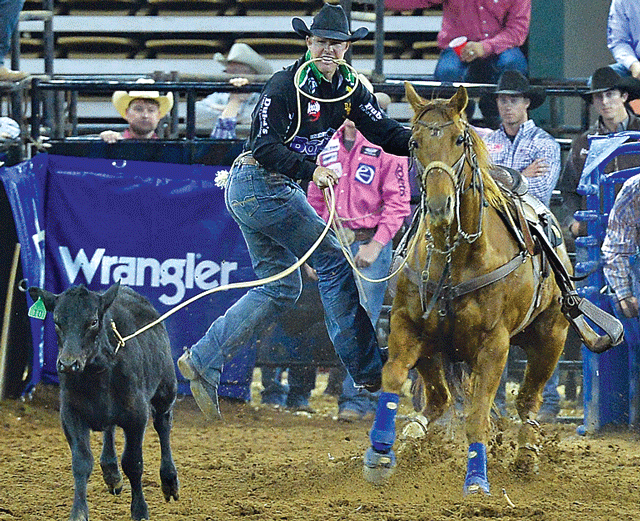
    After taking the job as an insurance adjuster in 2017, and running more than 500 insurance claims last year, he decided to explore steel buildings with his old college roommate, Brandon Falk. “I went and built three or four Metal Buildings and started learning about them – I sell under Premo Steel Buildings Umbrella. I enjoy building and putting a structure up. It was so rewarding to see the faces of those people that had been dreaming of that building for years – and we are giving that to them.”
    He took a district sales position for Premo Steel and since then he started a construction company (J&B Construction) on the side to erect the buildings he was selling. “We specialize in construction projects from remodels to metal buildings and roofs on residential and commercial projects in the state of Colorado and abroad.”
    One thing that Josh learned through rodeo is the necessity of building a good team. “I’ve got guys that have been mentors of mine, from my dad to BASICS with Bill Roth. They have allowed me to have the ability to call and bounce things off in business and understand how to handle any situation and be prepared.” Scheduling 75 to 100 rodeos a year and running two rigs down the road helped Josh with organizing crews and scheduling on the construction sites.
    “We strive to provide a better customer service and exceed our competition. We are the only steel building company that offers onsite inventory of our product – we physically drive or fly, take inventory and we stay alongside that client until that project is done.”
    Josh has always been willing to learn. “To be successful you have to be willing to learn and work with people and provide a quality product with customer satisfaction. Then the client will be happier that they came to me and my partners rather than any other person or company.”
    Josh has not left the rodeo world behind, and still provides several roping clinics across the nation. “I offer a clinic for whatever somebody wants,” he said. “Strive to be the best you can be and let God guide your path.”

  • ProFile: Talsma Performance Horses

    ProFile: Talsma Performance Horses

    story by Madison Clark

    Ty Talsma is a fifth generation South Dakota rancher, who also fills the role of cowboy and horse trainer at Talsma Performance Horses. “Where I’m at now evolved from rodeoing,” explains the 41-year-old from, Springfield. “Growing up all I wanted to do was go to rodeos, but my dad wouldn’t buy a rodeo horse for me. There was a herd of them out there and my dad said go make one.”
    Larry Talsma, Ty’s father, was the first in his family to compete in rodeos. He team roped and rode bulls. Ty followed suit, participating in 4H, high school, and college rodeos growing up. He went to college at Oklahoma Panhandle State University and competed in steer wrestling, calf roping, and team roping. “I played football too and had a full ride in both football and rodeo.”
    The Talsma family operates the Tall T Ranch out of Springfield, South Dakota and the Trails End Ranch out of Verdigre, Nebraska. Ty eventually took it upon himself to commercialize his family’s horse training prospects. “My dad had it going pretty good too, and I decided to go for it.” He spends half of his year in Arizona, selling horses that he mainly gathers from Nebraska, South Dakota, Wyoming and Montana to snowbirds spending their winter team roping. “The team roping scene down there is huge – everybody is down there – and it’s great to be out of South Dakota in the winter.”
    Selling around 100 head of horses a year, Ty says he always has 30 or 40 at all times, and keeps about 10 to 15 with him in Arizona. His Uncle Pete Talsma helps with the operations while he winters and works with horses in the south. They also hire a few interns in the summer to learn the ropes and assist with training.
    “I didn’t really go out expecting to do it this way. There’s always been a demand, and I’ve always enjoyed the lifestyle. Riding horses, ranching, rodeoing, it all goes together,” explained Ty. While Ty says the larger market is the lower number roper, cow horse or team roping horses, he still has many rodeo cowboys as customers. “There’s a good market for the steer wrestling horses too – I train half a dozen or more a year.”
    Times have changed when it comes to methods of selling horses. Ty relies on repeat customers, word of mouth and social media for contacts to buy his horses. “Early in my career I put horses on pretty much every major sale in the country. Ninety percent of my sales are private now. A lot of people contact us through Facebook,” said Ty.
    Ty’s wife, Kristin, helps as much as she can with riding and training barrel horses, but she keeps very busy with homeschooling their three kids, Terran-12, Treyvan-10, and Gianna-5. “They like to rope and ride, I guess they kind of have to if they’re going to be out there with me. I think they’ll start junior rodeoing soon,” remarked Ty.
    Ty tries to make it to as many pro rodeos as he can each year, he makes between 30 or 40 and hopes one year to hit the road and try to make it to the NFR. “One of these years I’m going to dedicate myself and do it.” He has made the Circuit Finals a dozen times in both steer wrestling and team roping.
    In regards to the future of the business, Ty hopes to get back to basics when it comes to where his horses are coming from. He currently owns a couple of studs and mares but would like to expand. “Starting off, my dad always had a bunch of brood mares and a stud around. If I could sell ranch raised and ranch trained horses, started and finished by me, that would be best by me.”

  • ProFile: Sydney Frey

    ProFile: Sydney Frey

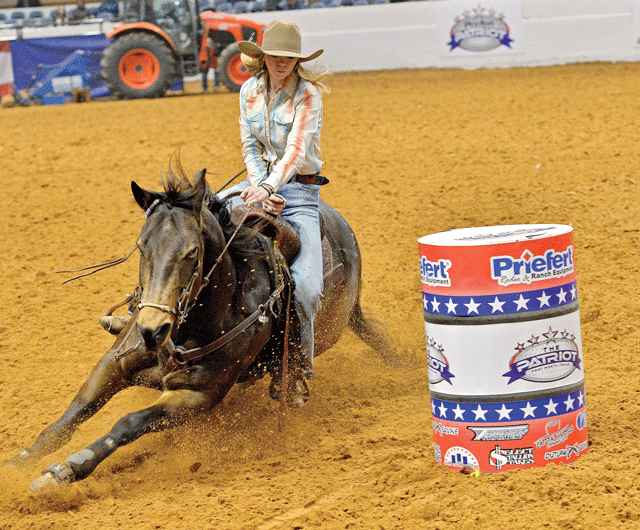
    Sydney Frey, daughter of NFR bareback rider, Shawn Frey, won the barrel racing at the Junior American, held in Fort Worth, Texas. Her efforts against 155 barrel races won her $10,000 and a Twister 2 horse trailer, a beautiful buckle, and a Resistol 100x hat. “It’s another great opportunity for kids my age to go after the money they put up,” said the Marlow, Oklahoma, cowgirl who plans to put the money back. “If I had it right now, I’d probably go shopping.” Sydney started running barrels at the age of five, with her mom (Gaye) leading her. “I was really involved with dancing at that age, but I didn’t get serious until my sixth grade year. I started Oklahoma Junior High and I wanted to make nationals. I quit dance and after one year I quit basketball and it was full on rodeo.”
    Gaye ran barrels, making the Prairie Circuit Finals. “My mom, she didn’t get to do what she wanted to do in the rodeo career, when she had her kids she let us live our dream.”
    Sydney is riding the Great Guns on Dakota. “I call him Jax – that’s what his name was when we got him and I heard its bad luck to change names. I’ve had him for a year now – we bought him from Kelly Yates. I finished out my high school year with him – won the average at the Oklahoma State High School Finals – and then we placed at some pro rodeos in Colorado, Sterling and Lamar, and he filled my permit.”
    Sydney has taken this year off from college to pursue her dream of being PRCA Resistol Rookie of the Year. “I’m going for it. I’m doing ok, I’ve hit some barrels so I need to do better, but that’s part of it and I’m going to keep going.”
    She travels mostly with her mom and dad. Her older brother also competes as a steer wrestler. Her dad trades cattle and ranches and made the NFR three times, ‘88, ‘89, ‘90. “It’s changed a bunch since then. He’s a good driver though.”
    “I thank the Good Lord above first all, and my family, who has gotten me here and I thank Kelly Yates and I thank my vet, Robbin Johnson – she’s kept my horses all together and she’s a phone call away.”
    She also thanks her sponsors, Stierwalt Superflex, Team Resistol, and Team Tres Rios.

  • ProFile: Jessica Routier

    ProFile: Jessica Routier

    In her first year at the Wrangler National Finals Rodeo, Jessica Routier set her rodeo career on fire. And she had some help in doing it, aboard an exceptional horse.
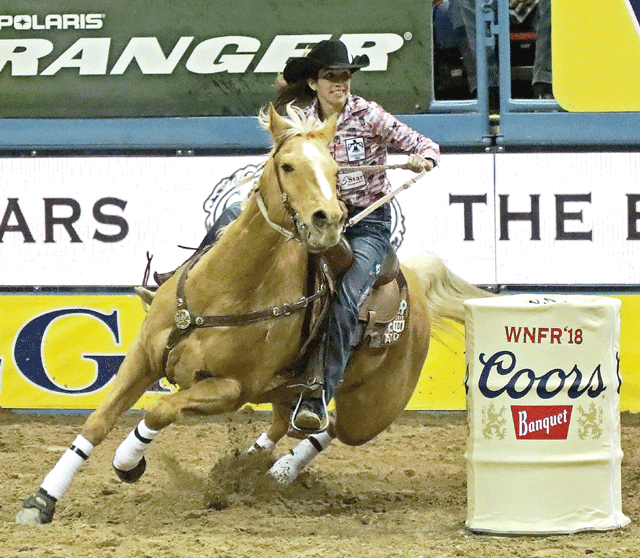
    Routier, of Buffalo, South Dakota, rode Fiery Miss West, “Missy”, won over $250,000 for the year, and finished the rodeo season as reserve champion, second only to the 2018 world champ Hailey Kinsel.
    Missy, an eight-year-old palomino, was Jessica’s futurity horse just two years ago. Owned by Gary Westergren of Westergren Quarter Horses in Lincoln, Neb., she is an exceptional horse who is unusual for her self-awareness, Jessica said. “You see quite a few young horses running these days, but to have one that makes runs like she does, with no mistakes, is pretty rare.”
    Jessica’s exceptional year began with her RAM Badlands Circuit championship in 2017, which qualified her to compete at the RAM National Circuit Finals in Kissimmee, Fla., in March. There, she finished in second place, which put her at her highest rodeo rankings ever: the top twenty in the world. A trip to the WNFR was within reach. So at the Guymon, Okla. rodeo, she sat in her trailer with an atlas and a rodeo schedule, mapping out her rodeo year, knowing that she might have a chance to make the Finals.
    Jessica competed at 58 rodeos, traveling all over the nation, but never being gone from home more than two weeks at a time. Missy, her untried mount, handled them all. “There’s not a lot of different things I have to watch out for” with Missy, Jessica said. “That helped us last year, where we didn’t know where we were going (the arena conditions and set ups). She’s really adjustable to all the different situations.” Missy never ran like an amateur. “There wasn’t once where I felt she had a novice horse moment that screwed something up for us.”
    Jessica has been rodeoing since she was a little girl, growing up in Montfort, Wisconsin. The daughter of Jon and Shelly Mueller, her mom trained horses and both parents rodeoed a bit during their college and young adult days. Jessica was always interested in horses, competing at Little Britches Rodeos and the Wisconsin High School Rodeo Association where she did every girls event, winning the Wisconsin high school cutting title four years, the goat tying three years, and the poles and breakaway twice. She is a three-time Wisconsin all-around champion as well.
    With a rodeo scholarship to National American University in Rapid City, she competed under the tutelage of Glen Lammers. He was the main reason she chose NAU, and she appreciated his help. “He was a really involved coach who wanted to help anyone who worked hard. He was just a really great rodeo coach,” she said.
    She qualified for the College National Finals Rodeo four times, winning the national barrel racing title in 2003. She graduated in 2006 with a master’s degree in business.
    During her time in college, she met the man she would marry. Jessica was friends with Jessica Painter Holmes, Riley Routier’s cousin. At the time, Jessica Painter was dating Casey Holmes, a good friend of Routier’s from Wisconsin. Painter and Casey “set up” Jessica and Riley on a date; the four of them were going spotlighting for rabbits. Not being a hunter, it wasn’t an activity she enjoyed. She didn’t like the date, but she still liked the guy. “I don’t really know why I liked him after that,” she joked. Jessica Painter ended up marrying Casey Holmes; they live close to the Routiers.
    The Routiers married in 2007, making their home on the ranch ten miles from Buffalo. The ranch has come down through Riley’s mom’s family, the Painters, and Riley and Jessica’s kids are the sixth generation to live there. Riley’s dad Harold died twenty-eight years ago; Laurie, Riley’s mom, married Terry Goehring. Laurie and Terry, Riley and Jessica, and Riley’s brother Ryan all live on the ranch, working together but with their own herds.
    Like her mom, Jessica rode outside horses, up to a dozen horses a day. She met Westergren through mutual friends and business acquaintances, John and Liz Holman from Hot Springs. He was looking for someone to start his horses, with the ultimate goal of getting one of them to the WNFR. Jessica gets Westergren’s horses as two-year-olds. Someone else puts thirty to sixty days on them, breaking them. Then she gets them back, putting lots of ranch miles on them and slowly starting them on barrels. At that point, she and Gary decide if the horse is a good fit or not. If it is, it stays. If not, Gary sells it or if it’s a mare, takes it back and breeds it. She and Gary have worked together the last seven years, and she’s ridden a lot of really nice Westergren horses, but Missy was special. She reminded Jessica of Smoothy, the horse she won the College National Finals Rodeo on. Missy “had a lot of good qualities that I knew I liked.” Missy is a natural fit for Jessica’s riding style, too. “She’s one that I never had to really think about how I need to ride her correctly when I go into the arena. It’s natural. The way I want to ride is the way she wants to be ridden.” That’s a rare occurrence, Jessica said. “I’ve always said there are a lot of good horses and a lot of good jockeys out there, but finding two that fit together is important.”
    Missy does have a quirk, however. She doesn’t like to face cows, head on. Jessica discovered the trait while working the alleyway during AI season. “I think that’s one of the things that made her tough at a young age,” Jessica said. “We made her work through her fear. She was right in there with the cows, and she had to work through it. She’s as tough as nails. I think it’s good for a young horse to have to face their fears and learn to trust you.”
    She and Riley have five kids. Their son Braden is thirteen years old, a seventh grader and a math whiz. All year long, Braden kept track of his mom’s winnings. Daughter Payton is ten and a fifth grader who fell in love with trick riding after seeing trick rider Roz Beaton at the Badlands Circuit Finals in Minot, N.D. six years ago. Now she trick rides at regional rodeos and is working on getting her PRCA card so she can work as a specialty act.
    Twin daughters Rayna and Rose are three years old, and daughter Charlie, age two, makes up the family.
    Life in Buffalo is wonderful, especially with a family. “I love it here,” she said. “I don’t think there’s a better place in the world to raise kids.” Being gone for much of the summer was a prime example. The whole community stepped in to help babysit and take care of kids while she was gone and if Riley was out on the ranch and unable to take the kids with him. “The whole community will do whatever they need to, to help you. It’s a small town. You know everybody and everyone feels like family.”
    Her experience at her first WNFR was wonderful, and Jessica hated for it to end. There wasn’t time to sightsee and play tourist, but they made time to shop. The stomach flu hit the kids; almost every night at the rodeo, one child wasn’t able to be there, but Jessica never got sick. Both sets of grandparents were in Las Vegas and able to babysit when needed.
    She doesn’t have big plans for 2019; she’s waiting to see what Missy has in mind. Finishing second in the world will allow her to enter the big winter rodeos, which will hopefully help her move up into the top fifteen in the world standings earlier. She would like to give Missy the month of April off, to pull embryos from her. “We’ll see what we get done in the winter and that will determine how much we need to go in the summer.”
    This year, Jessica will know what rodeos are a good fit for her and Missy. “I have a better idea of what places are good for us to go to. Last year was a great big learning year, and it went well despite the fact that I hadn’t been to most of the places we went to. This year we have more experience under our belts.”
    She’s going to let it play out, “like we did last year. It’s hard to say you’re going to push hard (to qualify for the WNFR) when you only have one horse because you don’t know if they’ll get tired or need a break.” Making the WNFR is important, but she realizes that there are other important things, too. “It’s a goal again but it’s not a do or die goal.”

  • ProFile: Luke Branquinho

    ProFile: Luke Branquinho

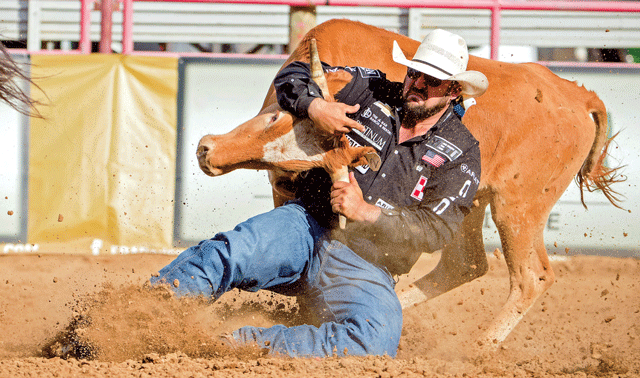
    Five-time World Champion Steer Wrestler Luke Branquinho won’t be shaking his booty under the bright lights of Las Vegas this December. He’s spent way too much time on the injured reserve list lately for that. But after a couple of comebacks in consecutive years, the living legend is looking forward to the $500,000 WCRA Semi-Finals, which will light up the Lazy E Arena in Guthrie, Oklahoma, during its November 15-18 run.
    Branquinho will be there via the World Champions Rodeo Alliance (WCRA) Virtual Rodeo Qualifier (VRQ) system, thanks to a series of recent rodeo nominations. Since his first event back after the latest injury—his hometown Santa Barbara Old Spanish Days rodeo in August, where he finished fifth—Branquinho has been busy nominating circuit rodeos in his quest to qualify for the WCRA Semi-Finals.
    As of press time the middle of September, Branquinho had placed at four of those rodeos, and was sitting fifth in the VRQ steer wrestling standings. The cutoff date for cowboys to nominate events for the Semi-Finals—for which the top 150 qualify—is October 29 (nominate now at app.wcrarodeo.com). He was vying to hold onto his spot in the VRQ standings, as the top-eight point-earners bypass the preliminary and progressive rounds, and advance directly into the top-eight finals at the Semi-Finals.
    Branquinho has largely planned his nominations strategy around cowboy-friendly conditions.
    “I’m nominating rodeos where the cattle are most likely to be even—not where there are three good ones, and eight you can’t win on,” said the Los Alamos, California, cowboy, who won the world in 2004, ’08, ’11-12, and ’14. “If it’s a rodeo where you’re likely to draw a steer that stops with the neck rope or runs so hard you couldn’t catch him with a rope, I’m less likely to nominate a rodeo like that, because too much is out of the cowboy’s control. The older I get, the less likely I am to enter rodeos that are notorious drawing contests.”
    The WCRA is going to great lengths to keep competitive conditions fair for all contestants.
    “I like a lot of things about the WCRA,” Branquinho said. “As professional cowboys, there just aren’t that many big-money opportunities. With the Virtual Rodeo Qualifier System, everybody has a chance to qualify to get there, and it’ll be a cowboy contest when we get there. I’ve heard people question the VRQ system, but to earn another chance at making good money from a rodeo I’m already going to is a no brainer. You already made the decision to enter that rodeo, why not pay a little extra to have a shot at a lot more money?”
    Branquinho turned 38 in September. So what’s left on his bulldogging bucket list?
    “I want to win as much money as I can before I retire, and the WCRA will help give a guy that opportunity,” he said. “Obviously, winning another gold buckle to get to six (and tie Hall of Famer Homer Pettigrew’s record) would be a big deal. My older boys (Cade and Jameson) got to see me win one. I’d like (Luke and wife Lindsay’s baby) Bear to get to watch me win one, as well.”
    In addition to the Days of ’47 in Salt Lake City, the WCRA will host three “majors” in 2019, for a total of four events featuring a $1 million guaranteed payoff in the coming calendar year.
    “I’m excited about all of this,” said Branquinho, whose trademark booty shake after a winning run is always a crowd favorite. “A shot at short-term financial gain is great, but in the bigger picture, we’re talking about the chance at money that helps set a cowboy up for the rest of his life. I want to be a part of it. With the PBR (Professional Bull Riders) as a partner, the WCRA will bring a lot more mainstream exposure to our sport, and that has all kinds of additional benefits and potential for cowboys.
    “More money and less travel is something we’ve all wanted for a long time. I look forward to the day when professional rodeo cowboys don’t have to travel like carnies to try and earn a living. Someday, cowboys won’t have to miss their families all the time to make ends meet, and I hope that day comes sooner than later. The WCRA is providing cowboys with some real-deal opportunities. Everybody has a chance to qualify to get there, and the cream will rise to the top. I just hope that in this day and age, I’m not low-fat milk.”

  • ProFile: J.C. Malone

    ProFile: J.C. Malone

    All-night drives, truck-stop coffee, fast food, and a laundry list of expenses that never seem to end. There are thousands of easier occupations than the life of a professional rodeo cowboy, and it’s pretty tough at times to make it pencil, even for a world-class-caliber contestant. One big check can be a game-changer that loosens the financial noose from around your neck. Just ask J.C. Malone.
    The 33-year-old, family-man tie-down roper from Plain City, Utah, works multiple day jobs to make ends meet and complement his cowboy career, in order to cover his mortgage. So the opportunity to compete at the million-dollar, July 19-21 and 23-24 Days of ’47 Cowboy Games & Rodeo was a big deal. And the $27,800 that hit his roping hand while the silver medal was being placed around his neck at rodeo’s end in Salt Lake City was huge.
    “This one rodeo was worth as much as my best month ever,” said Malone, who finished 18th in the world in 2015 before ending the 2016 season in the 16th-place heartbreak hole. “Twenty-five grand’s a lot of money, and when you get a check like that at one rodeo, it really makes a difference in your year. It’s a lot more typical to work your butt off for three months to win that much.
    “Between trucks, trailers, horses, fuel, food, and entry fees, there is so much overhead in our sport. This is a very hard way to make a living. So this kind of money coming into our sport is a breath of fresh air. Money like this pays stuff off, and lets you invest in something for your future, and your family.”
    After two consecutive close calls, Malone broke through last season, and achieved his lifelong goal of qualifying for his first Wrangler National Finals Rodeo in 2017. After having a “decent” 2018 winter, he says his spring and summer seasons were “pretty slow. Salt Lake saved my year.”
    Malone and his wife, Mandy, have two young kids. Treyson is 7, and his little sister, Macie, is 4. The Malones recently built a house, that’s also home to Mandy’s nail salon. Add “Mr. Mom” to J.C.’s list of day jobs when he’s not off rodeoing. He’s also a horseshoer at home and on the rodeo road, and works alongside his dad, Bryan, on their J.B. Trailer Conversions business.
    Malone took advantage of the World Champions Rodeo Alliance’s Virtual Rodeo Qualifier system to punch his ticket to the Days of ’47. He nominated three Professional Rodeo Cowboys Association rodeos, in Hayward and Redding, California, and St. Paul, Oregon, and earned the points it took to get him into Salt Lake by placing in a round at St. Paul.
    “We all have our favorite rodeos—rodeos we love, where we feel like we have an advantage,” Malone said. “Those are the ones I’m going to nominate, where I like my chances of winning something.”
    The top two times from each of the preliminary performances advanced to the Gold Medal Round in Salt Lake, and Malone moved on by being 7 flat on his first calf, and tying at the top with Kyle Parrish of Stephenville, Texas. Malone then rose to the Gold-Medal-Round occasion, and turned in the first 6-second run of his career. Gold Medalist Cory Solomon, who cashed checks totaling $52,400 for first, was 6.6, and Malone was hot on his heels at a sizzling 6.7.
    Contestants are currently busy using the Virtual Rodeo Qualifier system to try and secure a spot at the $500,000 WCRA Semifinals, coming November 15-18 to the Lazy E Arena in Guthrie, Oklahoma. In addition to the Days of ’47, the WCRA will host three “majors” in 2019, each of which will feature a $1 million guaranteed payoff.
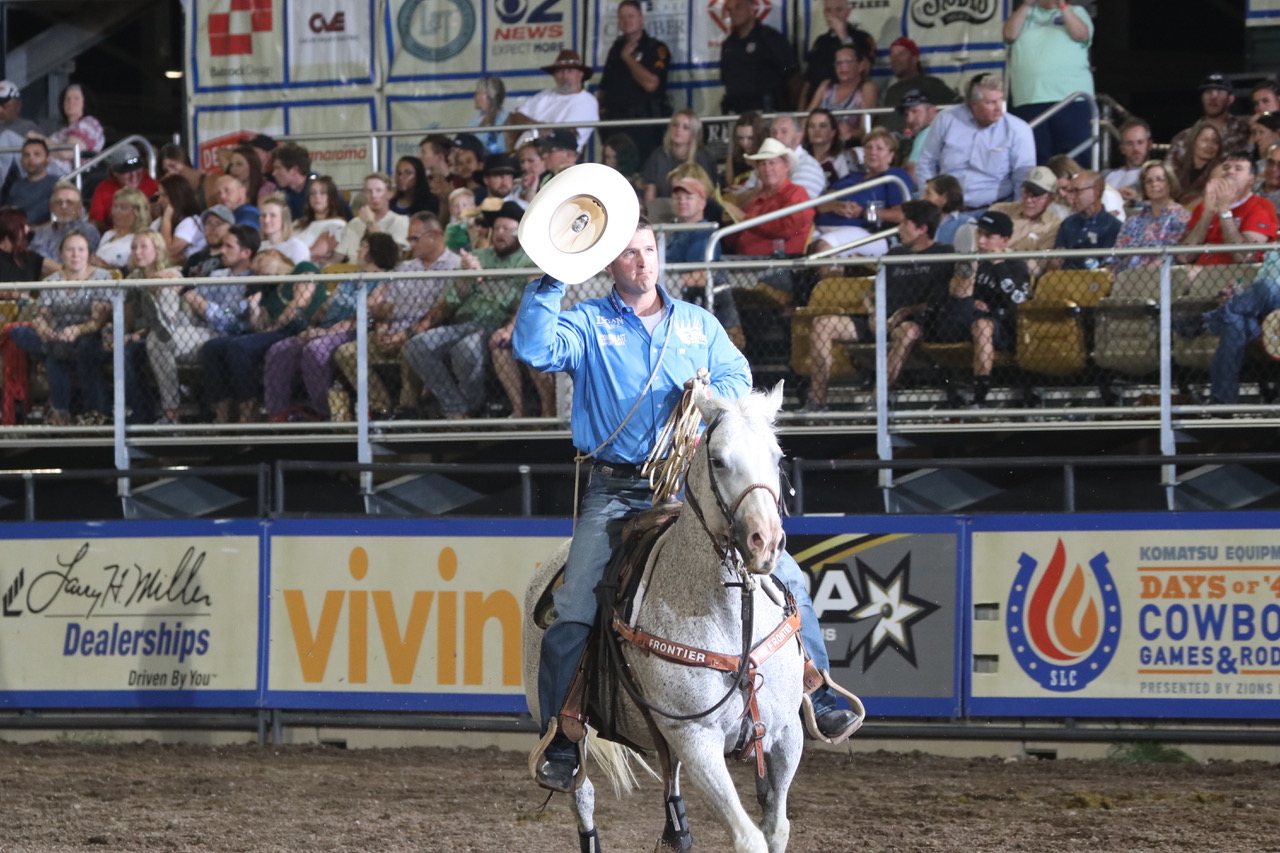
    “This money makes a difference in my life, and that’s for second,” said Malone, who got it done with the help of close friend Cody Hill’s 18-year-old gray mare, Lucy. “I can’t say that about very many rodeos in my career. We’re going to finish a barn at home, and take the kids to Disneyland this fall. This kind of money makes it possible to call this sport a career instead of a hobby, and money is what makes any sport truly professional.
    “Salt Lake was such a first-class event. I wish every rodeo was just like it. I love rodeo more than anything, and would love to see more chances of this caliber for cowboys. The competition is so tough, and we all know they aren’t going to give it away. But the opportunity is there, and that’s something we’re all very thankful for as cowboys.”

  • ProFile: WyoTech

    ProFile: WyoTech

    Jim Mathis of Wheatland, Wyoming traveled many miles chasing the USTRC jackpot circuit for nearly 17 years. Jim had worked the rope in ranch work for many years, but after watching his younger brother, Scott competing as a team roper, he took some instruction from him and started entering himself. He was at a point in his career with WyoTech that he had the income to support his newfound hobby and spent much of his free time between 1985 and 2002 entering jackpots up and down the roads. In 2002, Jim fulfilled a lifelong dream of becoming a rancher, so his travels slowed down due to focusing his time on his new venture. He still has a rope horse and enjoys occasionally roping with his brother. “Scott has had a big impact on my life, he’s a pastor in North Platte, we’re both Christians and so we compare notes all the time.” Jim and his wife Mary, now own two Wyoming ranches where they operate a cow/calf operation. They live on the lower elevation Wheatland ranch where they keep cattle through the winter after trailing them down on a 3-day cattle drive each fall from their historic Kite Ranch near Rock River, Wyoming. In April they truck the cattle back up to the over-7000’ elevation ranch to calve and enjoy the milder summer and fall. Jim and Mary enjoy spending time with their children; daughter Jodi Hill, and sons JD and Justin Mathis, as well as their 9 grandchildren.

    Jim Mathis – Courtesy of the family

    Jim’s love for agriculture, and being a cowboy started early, and he stepped into the lifestyle as quickly as possible when his father, Pastor Don Mathis relocated his family to take on a new church in La Grange, Wyoming. Jim still appreciates the support and encouragement of his father, who at 91 is still preaching at convalescent homes. When Jim was just 14, he moved in with Gene and Dot Smith, living and working on their farm and ranch for 3 years, and all the while he was learning many farming and ranching skills. “Even today, I think of things Gene taught me, from setting flood irrigation dams to packing wheel bearings, he made such a huge impact on my life.” At 17, Jim was driving combines and semi-trucks, harvesting wheat fields, following the crops from Texas to the north as they were ready for harvest. His life story has been filled with WyoTech from the age of 18, when he first attended the school. Thinking he wanted to own his own fleet of semi-trucks to haul grain and cattle one day, he graduated from a 6-month program at WyoTech so that he could manage and mechanic on his own trucks in his future; however, an inspiring WyoTech instructor, Marlowe Jones, opened a new vision for his life. “Marlowe was so inspirational and funny, and I wanted to be just like him, so at 19, I begged my way into a teaching position at WyoTech.” This move led to not only working with Marlowe for over 25 years, but also to many opportunities for Jim during the 26 years he spent there. WyoTech was founded in 1966, with the goal of providing a concentrated training program to prepare their students to fill the need for technicians in the automotive and diesel industry; however, after several ownership changes over the years, the once thriving school was recently on the verge of being closed. Jim Mathis was the man that many looked to as the answer while employees of the school fought to find a solution to keep the doors open. Jim had the experience and knowledge to take control of the school from the many positions he had held in nearly every capacity and management level that there was before leaving the school in 2002. His newest position, as owner of WyoTech, began on July 2, 2018. This was all made possible because of the support of the community and Wyoming Legislature making a $5-million loan available to Jim and his small investor group, to help complete the purchase.

    Jim Mathis has a passion for WyoTech and the education it has provided to over 50,000 graduates in the industry over the years. Because of his background in rural farming communities, he wants to share the news about WyoTech with other farming and ranching families. “As I take over at WyoTech, we will start focusing our marketing to reach rural communities rather than large metropolitan areas. WyoTech has changed the lives of many of our former students and we can offer a career path to many young ranch kids in rural America.” WyoTech offers fully accredited programs, that prepare the students for successful careers. “Part of our claim to fame is that we offer a short program, so for those serious about wanting to get into a career quickly, can be in and out in 9 months because they will be immersed in their education, attending classes for 8-hours-and-20-minutes each day. That’s more training, and clock and credit hours than most junior colleges offer.” WyoTech offers diplomas in diesel, automotive, or collision repair technology and associate degrees in business management. WyoTech is approved to offer federal financial aid to those that qualify. The school also has housing for approximately 650 students on campus. Employers appreciate that the students leaving WyoTech are prepared for the real work world, and the graduates are often sought after by companies such as Caterpillar, GM, Ford, and Cummins dealerships. Half of WyoTech’s instructors are alumni and have believed in the program so much that they returned to teach after enjoying successful careers in the industry. For many involved in rodeo, trucks and hauling rigs are a part of everyday life, and even if not looking for a career change, there are many skills to be obtained and much knowledge to be gained from courses at WyoTech. “Part of the reason I love WyoTech is that we truly have a great opportunity to give the students confidence and professionalism, teaching them timeliness, and about having positive attitudes that can help relay into a great professional career. We have really changed lives over the years.” Life often comes full circle, and for Jim Mathis, stepping in to ensure the future success of WyoTech, it certainly has.
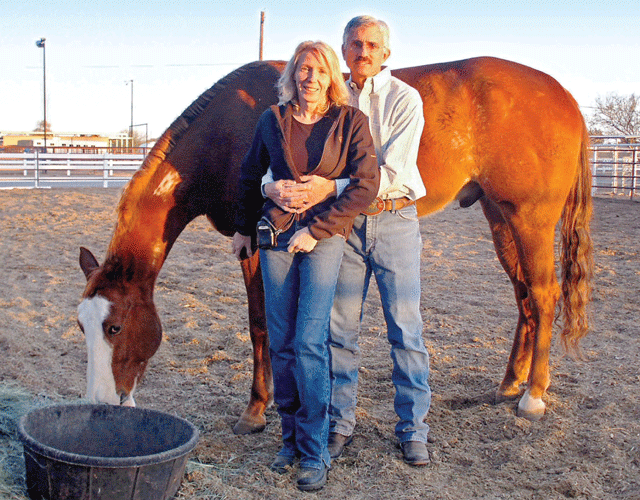
  • ProFile: Mia Manzanares

    ProFile: Mia Manzanares

    Mia Manzanares has come a long way since being on the cover of the Rodeo News in August of 2012. Six years later, the 21-year-old cowgirl has achieved her goals she set at that time. She will be a senior at McNeese State University and will graduate with a degree in pre physical therapy. She will continue for an additional three years to become a physical therapist.
    She was in pre law for a year and half way through, she tore her ACL. After surgery with Dr. Tandy Freeman, and extensive physical therapy, she realized that what she wanted to do is help others recover from injury and get back to the sports or activities they love to do. “I made the college finals that year even though I was out for a few rodeos, but I decided not to go because of my ACL.”
    She sat out for four months, the beginning of her sophomore year, and didn’t make the finals. “There’s lots of things I could have done better, but that was a rebuilding year for me. I had to trust myself again. Stacey Martin, my goat tying coach, worked with me more on the mental than physical,” she admits. “I competed for so long with it torn that I was over protective of it.” Dr. Tandy told her it would take a year before she felt 100% and he was right. She worked with some great physical therapists that helped her with workouts and machines to strengthen her leg and get her ready again. ““That’s another reason I want to pursue that.” Time is what she attributes getting past the mental part of goat tying. “I stepped off a lot and stepped off the dummy a lot. Stacey and I watched videos and really time and repetition.”
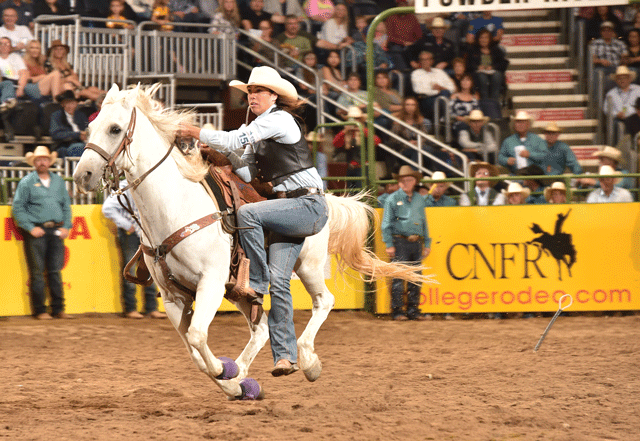
    She came back her junior year, made her goal sheet, and accomplished all three of her goals, winning the Goat Tying, Breakaway Roping, and All Around titles at the 2018 CNFR. “From the beginning of the rodeo season, it was different – I’m super blessed I was able to achieve all three of those goals.”
    She is spending some time relaxing in New Mexico with her horses. “We are fly fishing and hanging out.” Then she will head back and ride some colts and start all over again. “I want to break arena records – I tied an arena record this year – and hopefully next year I’ll be a 5.6 in the goat tying and break that one again and win everything I won this year. I also want to graduate and pursue my doctorate in physical therapy.”
    Neither of her siblings compete. “After hauling with me when they were little, they had no desire to do it themselves. They love to watch me, but they don’t compete.” Her brother, Micah, just got accepted into a computer college and her little sister, Emma, is going to be a sophomore in high school. “I can’t believe she’ll be driving this year.” Both her parents, Pancho and Kathryn, support her and she is quick to attribute her success to them and her goat tying coach, Stacey.

  • ProFile: Donna Keffeler

    ProFile: Donna Keffeler

    Donna Keffeler is surrounded by clowns, but she loves every minute of it.
    As the marketing arm for one of the PRCA’s national sponsors, she works closely with 45 PRCA barrelmen and with rodeos, providing the right tools to go to retail and increase sales. She administers the Man in the Can program and provides the barrelmen with the buff colored tape and decals for their barrels.
    It all started two days before the 1981 Miss Rodeo South Dakota pageant. Donna grew up rodeoing, breakaway roping, barrel racing and pole bending on a ranch in southwestern South Dakota. She had tried a rodeo queen pageant but was told she was “too cowgirly,” so she didn’t try again.
    But two days before the state pageant, someone asked her to run, and she decided to give it a whirl. She borrowed clothes, a reining horse, and won the pageant.
    No one had told her that as a state queen, she was obligated to run for Miss Rodeo America. She didn’t really want the title; with a semester left of college at Black Hills State University, she wasn’t interested.
    But she ran, with the intent of having fun “I had a blast, the whole pageant,” Donna remembers. “I didn’t want to win, so I was myself.” She ended up winning the 1982 Miss Rodeo America title, and “my whole world changed.”
    Donna spent the year traveling the country as Miss Rodeo America, having a ball. Two months before her reign was over, a national sponsor asked her to work for them. When she was done as queen, she began work for them in Denver.
    She worked for them for three years, then spent four years in California working in the racing industry, for indie cars, off-road, Trans Am and truck racing.
    Then her life took another turn. In 1990, the racing company she was working for declared bankruptcy and she would be out of a job soon. The national sponsor called: would Donna come back to Colorado and work for them again? “I said, I’m there,” she said. She had a job.
    Since then, she’s been the “one-woman” show, putting the right tools in place so that more product can be sold. And as product sells, it sells rodeo tickets, too. “It’s all about rodeo retail and selling rodeo tickets.”
    She works closely with the barrelmen and they are family to her. “They are probably the most loyal and dedicated men in our rodeo industry,” she said. “They live, breath and fight for us.”
    They are her extended family, including their wives and girlfriends. “They call me Mama Donna,” she said. “When they start calling me Grandma Donna, I’m retiring,” she laughed.
    John Harrison, a three-time winner of the Man in the Can award and a four-time PRCA Comedy Act of the Year winner, loves working with Donna. “She’s got our backs,” he said. “When it comes to going to bat for us, she takes care of her guys.”
    Donna takes care of business, too. At the barrelmen’s annual meeting in Las Vegas prior to the Wrangler National Finals Rodeo, she is in attendance, “telling us what goes on with the national sponsor’s program, what changes are coming our way, or why they’re not selling enough product at a rodeo,” John said. “And she’s not afraid to jump in the middle of you, either. She’ll let you know what you need to do to help her.”
    But when business is over, she’s willing to have fun. “When you walk out of the room, she has said her piece and she doesn’t hold a grudge,” John said. “She’s truly friends with us. She loves us.”
    Donna has two daughters, Monique, age 24, and Gianna, who is 21, and they are her pride and joy. The girls are excelling in their chosen fields. Monique is a microbiologist working for the Jewish National Hospital. Gianna is working on her bachelor’s degree in geology and will study lava in Italy this year. “They’re so successful, and they’re amazing, sweet, beautiful girls,” Donna said. “We don’t go a week without seeing each other. We’re so close.”
    When she started in the rodeo industry in the 1980s, she was the only female representative among the national sponsors. It wasn’t always easy. “I had to break down some doors to gain respect. I couldn’t make a wrong move or say anything wrong. I was very professional in everything I said and did.” She earned the high regard of others. “I did get the respect.” Her advice for other women in fields dominated by women: You have to be respectful.
    She is grateful to her South Dakota rodeo family for the support they gave her when she started out as Miss Rodeo South Dakota, then Miss Rodeo America. “If it wasn’t for the Korkows and the Suttons, I wouldn’t have gotten through Miss Rodeo South Dakota. Those two families wrapped their arms around me and guided me.” Jim Sutton still teases her about the time when, as Miss Rodeo America, she was bored and cleaned out his tack trailer. He said, “Donna, what are you doing? You’re Miss Rodeo America!” She replied, “I know, but I’m still Donna Keffeler.”
    She loves her job. “I’m living a career in the sport I grew up in and love. I get up every day and love what I do. And after 35-plus years, who can say that?”
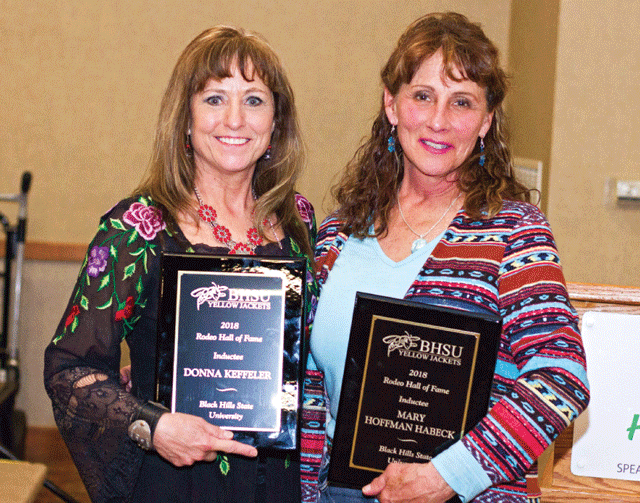
    Donna was inducted into the Black Hills State University (Spearfish, S.D.) Rodeo Hall of Fame earlier this year.

  • ProFile: Randy Ternan

    ProFile: Randy Ternan

    In the last four and a half years, rodeo judge Randy Ternan has worked 135 rodeos in six associations. He’s currently the GCPRA Judging Director and a director in the AHSRA, while working the 2017 NLBRA finals marked the 30th finals rodeo he’s judged.
    Before the 57-year-old from Phoenix, Arizona, became a rodeo judge, he competed on both ends of the arena, starting with 4 years of steer riding, followed by 12 years of bull riding and 14 years of steer wrestling. He grew up in Alberta, Canada, in a town of 800 people, where rodeo was the entertainment. “A kid said I should enter the cow riding, and I had no spurs, no hat, and no glove, but some bareback riders cut their spur straps down so I had spurs and someone put a hat on my head,” Randy recalls. “That was in 1970, and I shouldn’t have rode the first one, because I’ve had the fever ever since.” He later switched to steer wrestling, and Randy college rodeoed for a year and even competed in Australia for three months. He worked full time at a fertilizer plant and rodeoed on weekends. While he was jumping a steer in 2000, the steer’s horn went through the side of his mouth and into the bottom of his eye socket. He was in a coma for a week and needed two brain surgeries. “But if you take the good out of the bad, because of that accident, they also found out I had a double brain aneurism,” says Randy. He made a full recovery and backed into the box for several more years until he broke his leg. Three plates and 22 screws later, Randy felt it was time to retire, but he wanted to stay involved through judging.
    “The first time I judged, I was just supposed to do steer wrestling and barrel racing, and just before the rodeo, the judge decided I should flag the team roping in an 80-by-140-foot indoor arena,” says Randy. “Because I’d been on both ends of the arena, I was a watcher, even when I wasn’t competing. The first year I judged in Alberta, I got voted to do a finals, and it just progressed from there. I started judging the Grand Canyon rodeos 10 years ago. The association is great — everything is volunteer and they work at promoting their association, and they’ve done a real good job at the finals. I judged their finals the last nine years.” Randy also judges youth, high school, college, PRCA, and Indian rodeos and enjoys the opportunity to travel. “After judging all over the country, I think Arizona is quite lucky to have the core of judges they do. The judges we have here are very good and everybody is conscientious. You have to have thick skin as a judge and know the rule book — and have fun doing it. When contestants thank you for coming, that’s your payback. You don’t need to be a policeman, you just need to know the rules and treat people fairly.”
    Randy also used to work for a toy company, and he built the prototypes for the first rodeo action figures to come onto the market, called Rodeo Champions. Randy had a licensed agreement to do action figures for all the events, and he completed a bull rider and a barrel racer before funding for the project was canceled. Today, he judges part time and manages several rental properties, while his wife, Laurie, works for an engineering company, flying 150,000 miles a year for work. She shows halter and English, and they raise several barrel horses a year. “We have a PC Frenchmans Hayday mare bred to Slick By Design, so that should be an interesting baby next year,” says Randy. He’s taken up team roping as a header in the last year and turned 50 steers so far. “I have a horse like a golden retriever — he’ll take care of me, and I want to keep my fingers! Even though you flag it for 17 years, there’s things you don’t watch for as a line judge. There’s lots to learn,” Randy finishes, “and I think I will enjoy it.”

  • ProFile: Brazos Heck

    ProFile: Brazos Heck

    story by Ted Harbin

    [ Brazos wins all-around championship at Jr.NFR in Las Vegas ]

    Brazos Heck is quite driven and focused.
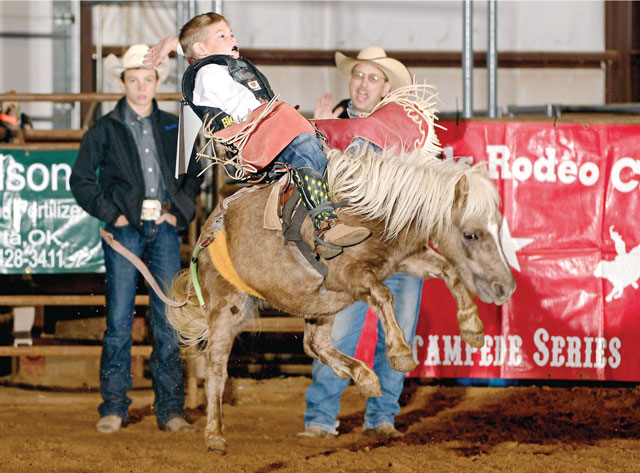
    He knows exactly what he wants in his future to be. He’s a cowboy in every sense of the word, and in rodeo, he competes on the backs of bucking bovines and bucking broncs.
    “I want to ranch here in Oklahoma,” he said. “I think I can ride all three (roughstock) events, and it would just be a dream come true to win 10 all-around world titles.”
    Driven. Focused. Oh, and he’s only 9 years old.
    “I do this because I love to do it, and I think it’s my passion,” said Brazos, the son of Odie Heck and Shasta Yost.
    He’s also pretty good at it. In early December, he competed at the Jr.NFR in Las Vegas. He finished several days of competition as the No. 2 man in mini bareback riding, where he won two rounds. He also finished third in the middle saddle bronc riding.
    Because of his success, he earned the pee wee division all-around championship. No matter the age group, it is the most cherished prize in the sport.
    “This is a once-in-a-lifetime thing,” he said. “I’m hoping to win more.”
    He stands a good chance, thanks in large part to his work ethic, his study of the game and having a couple of the best-known cowboys as friends and mentors. His father is a cowboy in Tupelo, Okla., and is close friends with Jet and Cord McCoy, two all-around champs who made their names on CBS-TV’s “The Amazing Race.”
    The McCoys have been rodeo champs since they were youngsters, too.
    “In a lot of ways, he does remind me of me,” Jet McCoy said. “He’s pretty special. I’ve been pretty impressed with him.”
    Brazos’ list of accomplishments is long. He’s been riding since age 5, and he’s progressed fairly rapidly, too

    “He started out wanting to get on sheep,” Odie Heck said. “He’d been at a rodeo, and they had mutton busting. He was always around Cord and Jet, so he wanted to ride. Then we were at a rodeo, and kids were riding little ponies in bareback riding. He wanted to get a rigging and enter the bareback riding.”
    Heck has been around rodeo all his life, but he was a timed-event cowboy. Roping and steer wrestling were good fits for the athletically built, 6-foot cowboy.
    “Brazos’ athletic ability is a little different than mine,” he said. “He’s a bucking horse guy.”
    In fact, Brazos craves it. When he’s not riding, he’s thinking about it, and he watches a ton of videos to help with those thoughts, from the bronc riding Wright family – brothers Cody, Jesse and Spencer have won world titles, as has Cody’s second-oldest son, the 2017 champ, Ryder – to the McCoys, to bareback riding world champions Kaycee Feild and Bobby Mote and world champion bull riders Cody Custer, J.B. Mauney and Cody Custer.
    “They just make me feel like I ride really good,” said Brazos, who is sponsored by the American Hat Co. and Oklahoma Ag Transports. “I watch them over and over again, and I want to ride like them.”
    Those are the types of champions he looks up to and wants to emulate. Even at his young age, he understands the need for constructive criticism if he is to improve. That’s why he looks to the McCoys for assistance. Both were five-time International Professional Rodeo Association world champions who competed in all three roughstock events.
    “I almost make him ask me for help before I offer any,” said Cord McCoy, a 2005 Wrangler National Finals Rodeo qualifier in bull riding and a six-time competitor at the PBR World Finals. “If he wants to come to the house and train in our arena, I step back and let it be his idea. I let him show the desire.
    “I think all of us have our own natural style. He’s pretty natural. I know he’s been watching every rodeo in the area and on TV. That’s all he craves.”
    He knew Brazos was pretty good but admitted that there may have been some bias because of his relationship to the youngster.
    “Then they had the Jr.NFR, which was all the kids who qualify from across the country, and he’s the all-around champion,” Cord McCoy said. “He’s got raw talent. If he keeps the desire he has today, he’s going to be a contender when he gets older.
    “It was pretty inspirational to go to the Jr.NFR and see Billy (Etbauer), Ty (Murray) and Larry Mahan there. The superstars of rodeo got to watch the next generation compete.”
    Jet McCoy likened the Jr.NFR as the Little League World Series, and that young cowboys and cowgirls who compete at the pinnacle of their sport are taking the steps necessary to excel as teens and adults.
    “If you want to compete at the highest level, you’ve got to start early,” he said. “To have the opportunity to go to Vegas and spend three or four days to see what it’s like, it gives them something to visualize and something to shoot for.”
    For now, though, those closest to him support and believe in what Brazos Heck is doing because they see his passion for the sport.
    “You’ve got to have the want-to, and I don’t think anybody’s forced it on him,” Cord McCoy said. “When you nod your head, you’ve got to have the eye of the tiger.
    “He’s got that winning attitude to go along with the talent.”

  • ProFile: Bridger Anderson

    ProFile: Bridger Anderson

    Bridger Anderson is getting a good start on his career rodeo resume.
    The Carrington, N.D. cowboy won the steer wrestling at Ote Berry’s Junior Steer Wrestling World Championship, held at the Junior National Finals Rodeo (NFR) in Las Vegas in mid-December.
    He’s a North Dakota High School Rodeo champ, and he’s secured two entries in the semifinals for the RFD-TV’s The American.
    Anderson, the son of Glenn and Robin Anderson, grew up riding. His dad trained horses and roped, his mom was a breakaway and team roper, and by the time he was six, he was tying goats and roping at youth rodeos.
    His career progressed to junior high, then high school rodeo, winning the state steer wrestling title twice and the short go at the National High School Finals Rodeo in 2016. He also won the International Finals Youth Rodeo in Shawnee, Okla. in 2015.
    Bridger graduated from Carrington (N.D.) High School in 2017 and is a freshman at Northwestern Oklahoma State University in Alva, under the guidance of rodeo coach Stockton Graves. Graves, a National Finals Rodeo qualifying bulldogger, has improved Bridger’s skills. He’s competed at four college rodeos last fall, placing at two of them, and he plans on being at the six spring rodeos. Alva (population 5,100) may not have a big social scene, but that’s OK, Bridger says. “There’s not a whole lot to do in Alva but steer wrestle so it works out pretty good.” One of Bridger’s classmates is another NFR qualifier, J.D. Struxness, and “it’s good to have J.D. around there.”
    Last December was the first time steer wrestling was part of the Junior NFR, and Bridger qualified for it at two events: the Dupree (S.D.) Cinch Chute-Out last May, and the Melvin-Swanson-Halligan Memorial Steer Wrestling in Sutherland, Neb. in June. Fifty-two steer wrestlers, ages 19 and under, qualified for the Junior NFR, competing in two rounds. The top twenty made it to the short round. Anderson tied for first in the first round with a time of 4.3 seconds (along with Gabe Soileau and Clay Iselt), was 4.9 in the second round, and in the short round, had a time of 4.0 seconds. His average time of 13.2 was two-tenths of a second better than Marc Joiner of Loranger, La.
    His win at the Junior NFR is an automatic qualification to the semi-finals for the American Rodeo, held Feb. 25 at AT&T Stadium in Arlington, Texas. The semi-finals for the American in the steer wrestling (each event is different) is in Alvarado, Texas on February 20; the twenty fastest times from that event go on to compete at Cowtown Coliseum in Ft. Worth, Texas on Feb. 22-24 (along with other event qualifiers). From Cowtown, about five qualifiers in the steer wrestling will compete at the American, along with the invites: the top ten in the PRCA world standings from 2017.
    The American allows steer wrestlers two qualifications, and Bridger earned his second qualification in Rapid City at the qualifier on December 17. Two qualifications double a cowboy’s chance to make it to the American and compete for $1 million. If he should make two qualifying runs, he would be allowed only one berth at the American.
    Bridger credits a strong team in getting him where he is today. His mom and dad taught him horsemanship and roping, and another North Dakota bulldogger, Tyler Schau and his wife Jackie, helped get him going. “I’m kind of their adopted son,” he said. Tyler and Jackie train horses, and every opportunity Bridger had, he was at their place at Almont, N.D., even though it was more than a two hour drive from Carrington to the Schaus.
    The Schaus have known Bridger since he was twelve years old, and they love him. “He’s a good kid, and fun to be around,” Tyler said. As soon as he had his driver’s license, Bridger would load up and spend a weekend, or during the summer, a week, at the Schaus.

    He has what it takes to be a good bulldogger, Tyler said. Bridger wrestled since sixth grade, winning a state championship in 2015, and “that helps with his athletics. He has athletic ability, he’s strong, and he’s not afraid to get hurt. Those are three requirements for being a good steer wrestler.”
    He also knows how to work. “He ain’t afraid to come over when it’s fifteen degrees out and practice. There’s not a lot of people willing to do that.” The Schaus, who have an eleven year old daughter, help out other steer wrestlers. “If they call and want to practice, I do everything I can to make sure we’re available.”
    Bridger is riding a horse purchased from the Schaus. Whiskers, a nine-year-old gelding, was raised and trained by Diamond S Performance Horses, the Schau’s business. He’s a bigger built horse, taller than most steer wrestling horses, which fits Bridger’s style. “He’s got a lot of power, and he’s long strided. It looks like he’s running slow, but he’s covering more ground,” Bridger said.
    Whiskers “can power out of there,” he said. “Some guys feel out of time with him and they think he’s too tall. He runs hard, and I don’t mind crawling off a few extra inches.”
    Whiskers, a former race horse, shouldn’t be warmed up on a race track. “If you let him run and try to loosen him out, you might not get him stopped,” Bridger said. “I’ve had to run him into a corner to get him to slow down. If somebody else is warming him up, I don’t let them open him on the track.”
    Whiskers is also independent-minded. “He likes to do his own thing. He likes to irritate you. He’ll step on your foot when he’s cinched up or run into you.” But Bridger can live with his quirks, because he’s good. “I think he knows that (he’s a winner) and he uses it to his advantage.”
    When he was three years old, as he watched the NFR on television with his parents, Bridger announced to his mom that he wanted to be a steer wrestler when he grew up. Advancing from high school, to college, the amateurs, and now professional rodeo is a big step. Bridger has had his PRCA card since the fall of 2016. “College rodeo is glorified high school (rodeo.) But pro rodeo is another level,” he said. “You can go to college rodeos, make a few mistakes, and get by. At pro rodeos, they don’t pay any money if you make a mistake. It’s another level.” In Livingston, Montana last July, Bridger made a 4.3 second run, “and they threw rocks at me,” he joked. “You had to be 3.9 there to place.”
    His ultimate goal is to make the NFR, and he’s realistic about what it takes. “You have to sacrifice everything to focus on one task at hand, and that’s rodeoing and winning enough to make the NFR.”
    Part of pro rodeo is learning how and what rodeos to enter. Bridger rodeos with Tyler and Jackie, who have helped him sharpen his mental game and stay healthy. He’s also relied on world champion Luke Branquinho and his rodeo coach Graves. Being confident is a big part of rodeo. “It’s huge to move from high school to amateur to pro rodeo and not let that intimidate you. It’s intimidating to bulldog against guys who have rodeoed for twenty years and have been to the NFR. But you have to surround yourself with those guys to get better.”
    He also has Plan B. He’ll graduate in 2021 with a degree in ag business, and as of now, he plans on getting his college degree. “If I don’t, I won’t go back and get it. I think going to school is something I should do. You never know what will happen in this sport. Hopefully I won’t need a backup plan, but if I do, it’ll be good to have one.”
    Bridger has two younger sisters: Cedar, a senior in high school and a high school rodeo athlete, and Dawsyn, an eighth grade student.